1. Introduction
Forests provide essential ecosystem services and renewable resources that support both human well-being and environmental sustainability. Reliable data-gathering procedures and robust quantitative methods are fundamental for understanding forest structure, growth dynamics, and productivity and for informing sustainable forest management and policy decisions. Addressing these challenges requires continuous advances in forest biometrics, inventory methods, and modelling approaches that can adequately capture the natural variability in forest ecosystems across spatial and temporal scales. Improvements in field-based measurements, statistical methods, and modelling techniques are central to enhancing our capacity to quantify forest resources, assess biomass and carbon stocks, and support decision-making in forest management and planning.
This Special Issue was conceived to provide a forum for recent methodological developments and new empirical data related to forest biometrics, forest inventory procedures, and the modelling of forest growth and yield. Contributions were welcomed from all forest types and management contexts, including urban and rural trees, natural and planted forests, as well as productive and protective forest systems. As a result, this Special Issue published ten high-quality papers spanning diverse aspects of forest quantifying methods, authored by 53 researchers affiliated with institutions in 14 countries worldwide. The study sites reflect the broad geographic scope of this Special Issue, including trees and forest ecosystems from China [
1,
2,
3]; Ethiopia and Nigeria [
4,
5]; New Zealand [
6]; Romania and Spain [
5,
7]; and Brazil, the Dominican Republic, and Nicaragua [
8,
9,
10]. This geographic diversity highlights the wide applicability of forest biometrics, inventory methods, and growth and yield modelling approaches across different forest types and management contexts.
2. Papers in This Special Issue
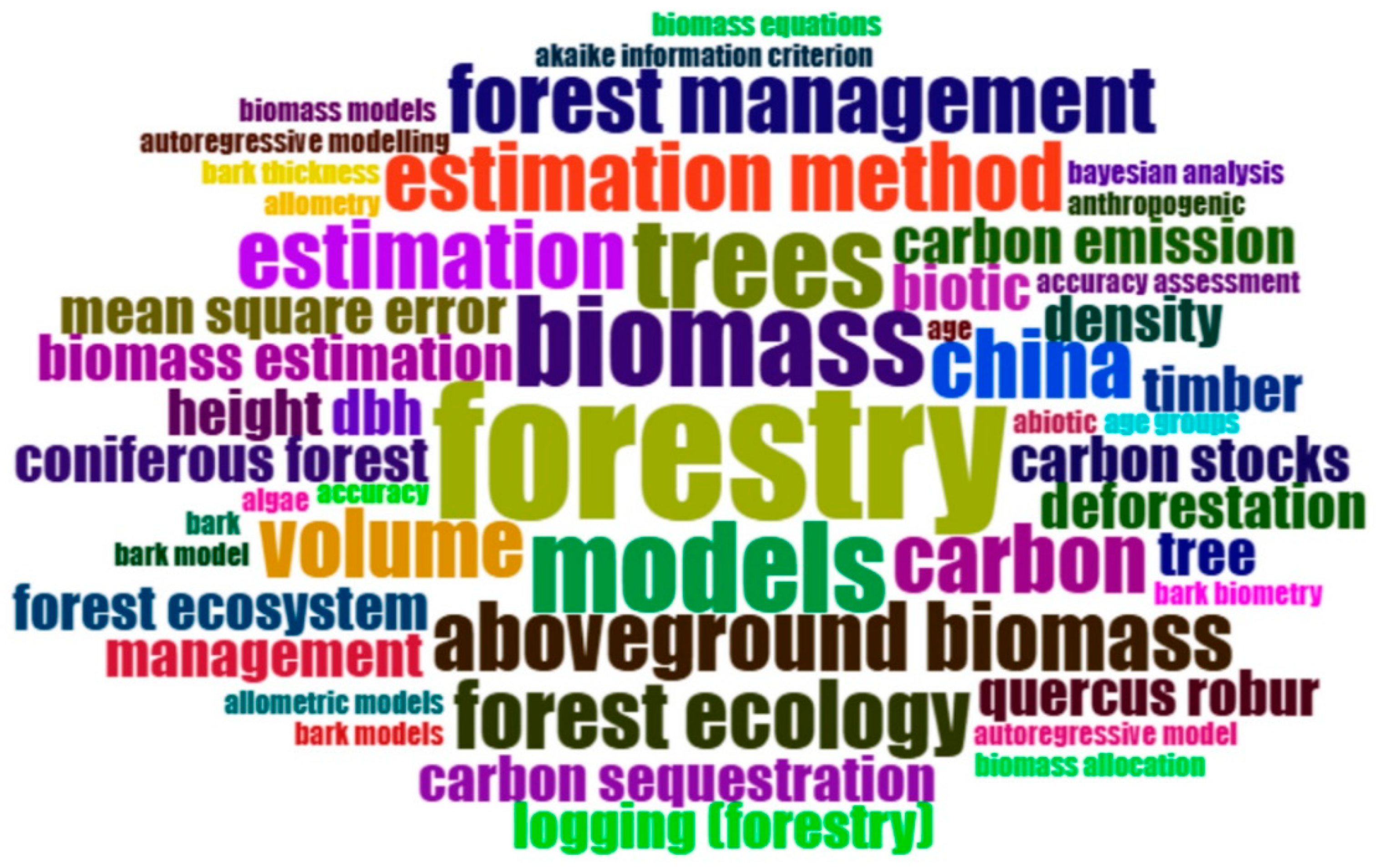
To provide a concise overview of the main topics addressed across these contributions,
Figure 1 summarizes the most frequent terms appearing in the titles and keywords of the ten papers published. The most prominent terms include forestry, biomass, models, carbon, trees, volume, and estimation, indicating the core topics addressed across the contributions.
The papers published in this Special Issue can be broadly grouped into two categories according to the level of resolution of the study. The first category includes contributions that aim to estimate individual tree attributes (tree biomass, wood volume, bark thickness, and crown width) using regression-based approaches [
3,
4,
7,
9,
10]. The second category comprises studies that go beyond the tree level and were conducted at broader spatial scales, addressing themes related to forest structure and genetic variability [
5,
8] and the spatial distribution of biomass and/or carbon at regional [
1,
2] or national scales [
6].
Among the contributions conducted at the tree level, the most common theme was the estimation of individual-tree aboveground biomass or stem volume, using a range of distinct statistical approaches. Jilo et al. [
4] fitted linearised power–function models to estimate aboveground biomass (total and by compartments) for five representative tree species from southern Ethiopia and found that tree diameter, wood basic density, and crown diameter were significant predictors in both generic and species-specific models. The authors also emphasised the value of location and species-specific equations, rather than relying on existing multispecies models, to improve biomass estimation accuracy.
The other two contributions focused on tree volume within the
Pinus genus [
9,
10]. Bueno-López et al. [
9] reported that the nonlinear form of the Schumacher–Hall model provided the best estimates of total stem volume for
Pinus occidentalis in the Dominican Republic and showed further gains when using nonlinear weighted fitting and stratifying the data by ecological zones (dry, intermediate, and humid).
In a related contribution, Valerio Hernández et al. [
10] developed a compatible system of taper, volume, and biomass equations for
Pinus oocarpa in Nicaragua that ensured additivity and consistency among component and total estimates and enabled the estimation of merchantable volume, total volume, and individual-tree aboveground biomass by component (stem wood, bark, branches, and needles). To achieve this, they fitted two equation systems using seemingly unrelated iterative regression and the generalized method of moments to simultaneously fit the volume and biomass equations. The authors applied weighted regression together with a second-order continuous autoregressive error structure to correct heteroscedasticity and autocorrelation, indicating that these equation systems could strengthen forest inventory applications and increase the reliability of compatible-volume-, biomass-, and carbon-related assessments.
The other contributions conducted tree-level modelling to predict tree bark thickness [
7] and crown width [
3]. Vasilescu [
7] presented models for predicting bark thickness in key Romanian tree species (
Picea abies,
Fagus sylvatica, and
Quercus robur). Linear regression models using diameter over bark as the predictor variable were identified as the most accurate for estimating double bark thickness, and a sixth-degree polynomial using relative height as the predictor variable was provided to estimate relative double bark thickness. Quantifying bark from biometric characteristics is valuable because it can indicate a tree’s susceptibility to vegetation fires and support the estimation of under-bark wood volume, a key measure of merchantable volume.
Wu et al. [
3] developed crown width models for Chinese fir (
Cunninghamia lanceolata) trees in pure plantations in southern China. Using data from trees of many different ages, the authors were able to cover the species’ full growth cycle. To estimate tree crown width, the authors used diameter at breast height and height as core predictor variables and age-group dummy variables. The most accurate model identified was a power function fitted using a two-level (forest stand and plot) nonlinear mixed-effects model. The ability to estimate a tree’s crown width using biometric characteristics can significantly reduce measurement time and costs, while providing useful insights into important silvicultural characteristics, such as tree competition and growing space utilisation.
The next group of contributions focused on using statistical procedures to inform plot- and forest-level metrics, estimating plot diameter distribution [
5] and genetic parameter variability [
8]. Gorgoso-Varela et al. [
5] investigated probability density functions fitted using different methods (moments or optimisation) to estimate the diameter distribution of sample plots located in even-aged stands of
Quercus robur in Spain and
Tectona grandis plantations in Nigeria. The authors found that Johnson’s SB function was more suitable for describing the diameter distribution of the stands, regardless of the fitting methods, with the three-parameter Weibull and generalised beta functions also exhibiting good performance. Tree diameter distribution is a key forest management metric that supports harvest and silvicultural decisions, and helps assess, e.g., forest dynamics, stand stability, productivity, and assortment structure. Thus, the findings of [
5] are particularly relevant for selecting appropriate probability density functions and fitting methods.
Porfírio et al. [
8] evaluated
Dimorphandra mollis seedling growth during the nursery, hardening, and field-testing phases to estimate quantitative genetic parameters for this socioeconomically important non-timber forest product (NTFP) species of the Brazilian Cerrado. To do so, they used mixed linear models and REML/BLUP-based estimates. The authors found considerable genetic variation among the tested progenies, concluding that this material has potential for use in breeding, management, and genetic conservation programs for the species. Because genetic parameter estimation is an important component of forest breeding and conservation planning, the findings of [
8] are relevant for guiding early selection and conservation-oriented improvement programs for
D. mollis in Brazil.
The final contributions comprise studies [
1,
2,
6] that combined field-based forest metrics with remote sensing data, thereby enabling the spatialisation of biomass and carbon across large areas. Hu et al. presented two contributions [
1,
2] within this theme, both focused on the spatial distribution of standing biomass in China. The first contribution [
1] investigated aboveground biomass (AGB) estimation for
Cunninghamia lanceolata in southern China, combining field data with Landsat images, aiming to quantify uncertainties in biomass estimation arising from different estimation methods. The authors extracted spectral features, vegetation indices, and texture factors from remote sensing images and compared three estimation methods (K-nearest neighbour regression, gradient-boosted regression tree, and random forest), finding that the random forest model achieved the best performance and the lowest uncertainty. They also showed that uncertainties associated with the remote sensing model at the plot scale were the main source of uncertainty, exceeding those transferred from the tree scale, offering valuable insights for improving AGB estimation accuracy.
In their other contribution, Hu et al. [
2] investigated how socioeconomic human activities affect forest biomass, characterising the spatial and temporal evolution of county-level forest biomass and economic density. To achieve this, the authors used ArcGIS spatial analysis and two-way fixed-effects modelling to integrate forest biomass (dependent variable), economic density (independent variable), and human activities, land use, and forestland protection (control variables) in the Yellow River Basin in China. The authors found a positive correlation between economic density and forest biomass, with a 1% increase in forest biomass for each one-unit increase in economic density. Forest land protection, primary industry development (particularly forestry), and urbanisation were also positively associated with forest biomass, whereas cultivated land, arable land expansion, population growth, and the number of permanent residents were negatively associated with forest biomass. These findings help inform more targeted and practical policies to balance forest biomass conservation with socioeconomic development, ultimately supporting coordinated ecological and economic development.
Finally, Watt et al. [
6] provided updated nationwide reference tables that enable the computation of carbon sequestration for New Zealand forest land by age, considering different species (
Sequoia sempervirens,
Cupressus lusitanica and
C. macrocarpa) and scales (national, island, and regional levels). To achieve this, the authors used forest growth data from permanent sample plots to compute productivity indices (300 Index and Site Index), and used climatic, water, edaphic, and topographic variables to estimate these variables nationwide via random forest models. The productivity indices were then used to estimate carbon production using growth models, allometric equations, functions describing carbon partitioning, and basic density. The authors found significant variation between the predicted carbon stocks and those in the current lookup tables, in some cases exceeding the values by 200%. This information is important, since growers with forest land smaller than 100 ha rely on these pre-formulated lookup tables to participate in New Zealand’s Emissions Trading Scheme (ETS), which provides payments through the accumulation of carbon units for increased carbon stock.
We hope that the papers collected in this Special Issue will encourage continued engagement with advances in forest biometrics, inventory, and growth and yield modelling and will stimulate further methodological innovation in this important area of forest science. By bringing together contributions across diverse forest types, geographic regions, and analytical scales, this collection also highlights the value of integrating field measurements, statistical modelling, and remote sensing to support forest management, conservation, and climate-related decision-making.



 ,
,