Article

Soil Pore Architecture and Hydraulic Functioning of Native Forest and Sugarcane Systems with and Without Cover Crop Intercropping Revealed by X-Ray Computed Tomography


by
Gabriel Oladele Awe
1,2,*,
Ademir de Oliveira Ferreira
3,
Brivaldo Gomes de Almeida
3,
Williams Ramos da Silva
3,
Antonio Celso Dantas Antonino
2 and
José Miguel Reichert
2,4
1
Department of Soil Resources and Environmental Management, Faculty of Agricultural Sciences, Ekiti State University, Ado Ekiti 360001, NG-EK, Nigeria
2
Nuclear Energy Department, Centro de Tecnologia e Geociências, Universidade Federal de Pernambuco, Recife 50740-540, PE, Brazil
3
Agronomy Department, Universidade Federal Rural de Pernambuco, Recife 50740-540, PE, Brazil
4
Soils Department, Universidade Federal de Pelotas, Pelotas 96010-900, RS, Brazil
*
Author to whom correspondence should be addressed.
Forests 2026, 17(3), 365; https://doi.org/10.3390/f17030365
Submission received: 25 January 2026 / Revised: 24 February 2026 / Accepted: 5 March 2026 / Published: 14 March 2026
(This article belongs to the Special Issue Forest Soil Stability in Response to Global Change Scenarios)

Abstract

Soil pore architecture and hydraulic functioning strongly regulate water flow and retention. However, despite the growing application of X-ray computed tomography (X-ray CT) in soil science, its application in characterizing the pore system and hydraulic functioning of native forest soils converted to sugarcane production systems in northeast Brazil is still poorly known. This study therefore quantified the soil structure, pore system, and hydraulic functioning of a native forest (NF) and an adjacent sugarcane field receiving vinasse and managed without intercropping (sole sugarcane (SG)) and with Brachiaria ruziziensis intercropping (SG + Bra intercrop) in northeastern Brazil, using conventional soil physical measurements and X-ray CT, in three soil layers (0–10, 10–20, and 20–40 cm). Soil physical and hydraulic properties, as well as soil water retention, were quantified. The native forest soil exhibited a uniformly sandy texture across all depths, whereas sugarcane systems ranged from loam to sandy textures in surface layers due to long-term management. Soil organic matter and total nitrogen in the 0–10 cm layer were approximately 75 and 65% higher, respectively, in sole Sole SG and SG + Bra intercrop than in NF. Soil bulk density increased with depth under sugarcane, reaching values about 10%–13% higher than NF in the 20–40 cm layer. Saturated hydraulic conductivity in the surface layer was higher in the NF, approximately five to nine times greater than in sole SG and SG + Bra intercrop, respectively. Conventional water retention analysis showed that sole SG and SG + Bra intercrop had greater total porosity (0.49–0.55 m3 m−3), microporosity (0.26–0.36 m3 m−3), field capacity (0.19–0.33 m3 m−3), and plant available water (0.09–0.15 m3 m−3) in the upper 20 cm compared with the NF (≤0.10 m3 m−3 available water). In contrast, X-ray CT revealed higher macroporosity (0.20–0.23 mm3 mm−3) and pore connectivity in the NF across all depths, with predominantly complex, inclined to near-horizontal pores and low anisotropy. Intercropping sugarcane with Brachiaria did not significantly alter (p > 0.05) bulk density, hydraulic conductivity, or CT-derived pore connectivity relative to sole sugarcane. The degree of anisotropy and fractal dimension derived from X-ray CT were significantly correlated (p < 0.05) with conventionally measured hydraulic properties. The X-ray computed tomography proved effective in linking pore-scale architecture to soil hydraulic functioning, providing insights beyond conventional measurements. The short-term inclusion of Brachiaria as a cover crop at 10 kg seed ha−1 did not result in significant improvements in soil pore structure, indicating that longer-term adoption and/or higher planting densities may be required to induce measurable changes in pore system architecture and soil hydraulic functioning.

1. Introduction

Soils in native forests are usually characterized by well-developed pore networks that have formed over many years owing to the buildup of organic matter, diverse root systems, and no disturbance [1,2,3]. This creates a strong connection between large and small pores, allowing for effective water infiltration and gaseous exchange [4]. However, the conversion of native forests into agricultural land use has had a significant impact on soil pore structure, negatively affecting water and air movement and its long-term productivity.
When forests are cleared for farming, the repeated tilling, mechanical disturbance, and loss of organic matter leads to the breakdown of soil aggregates, resulting in changes in pore sizes, by decreasing larger pores and increasing smaller ones, leading to poor pore connectivity compared with natural forest soils. These structural changes have been reported to slow down water infiltration and disrupt how water moves through the soil, which reduces water retention and makes the soil more prone to compaction and surface runoff when used for agriculture. In addition, loss of soil organic carbon after conversion to agricultural land is well documented and linked to the decline in soil quality, including low total porosity and unstable aggregates that further harm the pore structure [5,6,7,8]. These changes in soil pore characteristics can hinder root growth, reduce aeration and nutrient cycling, and ultimately limit the sustainability of crop production systems. This underscores the importance of careful management to prevent further structural degradation after forest conversion.
Intercropping using cover crops is one of the sustainable, climate-smart conservation agricultural strategies deployed to improve soil quality [9]. Generally, the use of cover crop intercropping systems has been shown to improve soil structure by increasing soil organic matter, aggregation, and pore space, decreasing soil bulk density, and increasing water retention capacity [10,11,12,13,14,15,16,17,18]. In sugarcane cultures, the efficacy of cover crop intercropping in improving the soil quality has also been reported [19,20].
Proper soil pore function is crucial for root and crop development, and for adequate water flow and gas exchange in the soil. Traditional methods of assessing soil pore systems have been limited to quantifying soil pore volume alone. Furthermore, laboratory measurements of soil porosity or pore size distribution have been estimated from soil water characteristic curves [21,22,23], but they may not accurately reflect the subtle characteristics of soil pores [24]. For a better understanding of soil pore functionality, characterizing and visualizing the topological, geometric, and morphological configurations of the pore space have gained attention [25,26,27,28]. In this context, the non-destructive and state-of-the-art imaging technique of X-ray computed tomography and other digital image processing algorithms have offered opportunities to better visualize and quantify internal pore structure with high precision [29].
X-ray computed tomography (CT) has emerged as a transformative tool in soil science, particularly in the analysis of soil pore orientation and structure. The capabilities of X-ray CT have enabled researchers to visualize and quantify pore networks in three dimensions in a non-destructive manner. This technology has been widely adopted as a result of its ability to provide detailed information about various pore structural parameters in agricultural soils under different soil use and management, such as porosity, pore size distribution, orientation, inclination, circularity, and connectivity, which are critical for understanding soil functions and processes such as gaseous exchange, water retention, and root growth [29,30,31,32,33,34,35]. For instance, Baniya et al. [30], working on the effect of soil moisture content on pore structural parameters based on micro-focus X-ray computed tomography analysis, found that soil moisture content clearly affected pore structural parameters: pore tortuosity and coordination number decreased with increasing soil air-filled porosity; however, the measured effective pore diameter was independent of the moisture content. In another study on soil pore network as influenced by long-term application of manure and fertilizer characterized by X-ray micro-computed tomography, Singh et al. [29] found that higher CT-derived porosity was observed in dairy cattle manure treatment compared to the control, but the porosity was similar for both inorganic fertilizer treatment and the control. Yu et al. [35] studied soil pore structure and prediction of related functions following land-use conversion using multi-scale X-ray tomography. The X-ray tomography revealed that the connected porosity of both aggregates and soil cores was significantly increased after land-use conversion. The isolated porosity of soil aggregates increased, while conversely, it decreased for soil cores. For aggregates, the isolated porosity of paddy fields and vegetable fields 5 years after conversion from paddy fields accounted for over 70% of the total imaged porosity, reflecting a larger water and carbon storage ability but limited exchangeability of air, water, and nutrients. Conversely, the isolated porosity of vegetable field aggregates 13 and 20 years after conversion from a paddy field accounted for approximately 50% of the total imaged porosity, suggesting they could effectively balance the exchange and storage of air, water, and nutrients.
In Pernambuco State, in the northeast of Brazil, studies on soil pore systems have focused on the effect of soil texture and type [36,37], compaction [36], chemical treatment [21], and grazing [38], among others. Despite these studies and the wide application of X-ray CT in soil science, limited information is available [39,40] on pore system characteristics and hydraulic functioning of native forests and agricultural production systems in northeast Brazil using X-ray computed tomography.
We hypothesized that (i) conversion of native forest to sugarcane cultivation alters soil pore structure and functioning, and (ii) intercropping sugarcane with Brachiaria enhances soil pore organization relative to sole sugarcane cultivation. Therefore, the objective of this study was to characterize and compare soil structure, pore system architecture, and pore functioning in a native forest and adjacent sugarcane fields with and without cover crop intercropping using X-ray computed tomography.

2. Materials and Methods

2.1. Study Area

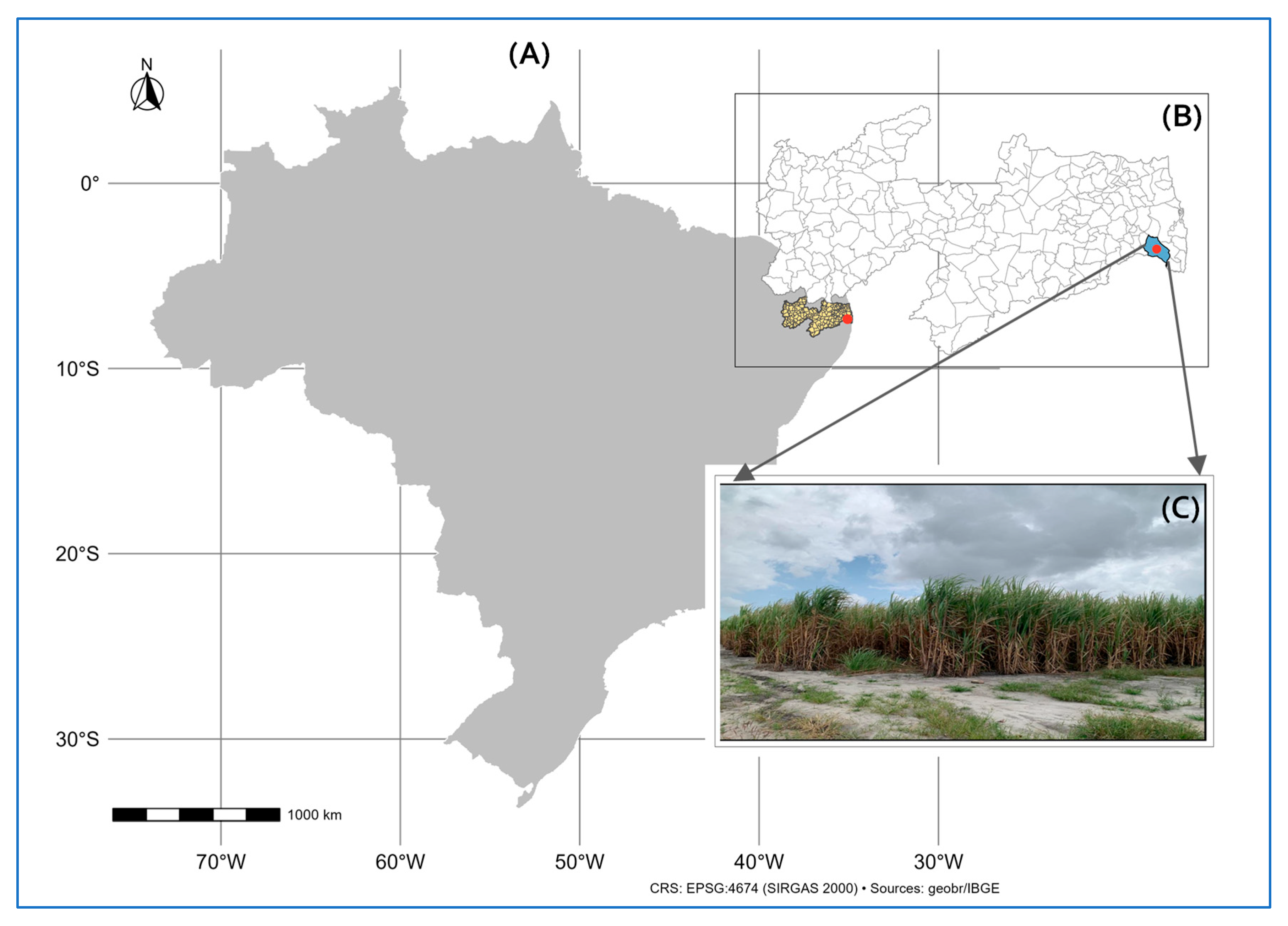
The study was conducted in the experimental area of the Giasa Plant, located in the municipality of Pedras de Fogo, in the state of Paraíba (Figure 1), with geographic coordinates of 7°21′08.9″ S, 35°01′33.0″ W and an altitude of 177 m. According to the Köppen [41] classification, this region has an AS climate, which is hot and humid. The municipality of Pedras de Fogo is located in the Mata Paraibana mesoregion, encompassing Atlantic Forest vegetation [42]. Thirty-year average weather data for the area showed that the average minimum and maximum monthly temperature are 21 °C (August) and 30 °C (December–March), while mean monthly precipitation ranged between 33 mm (November) and 121 mm (June) [43]. The vegetation of the area is predominantly sub-evergreen, with areas of sub-deciduous and savannah forest [44]. The soil of the area was classified as Neossolo Quartzarênico according to the Brazilian Soil Classification System [45] or Quartzipsamments according to Soil Taxonomy [46].
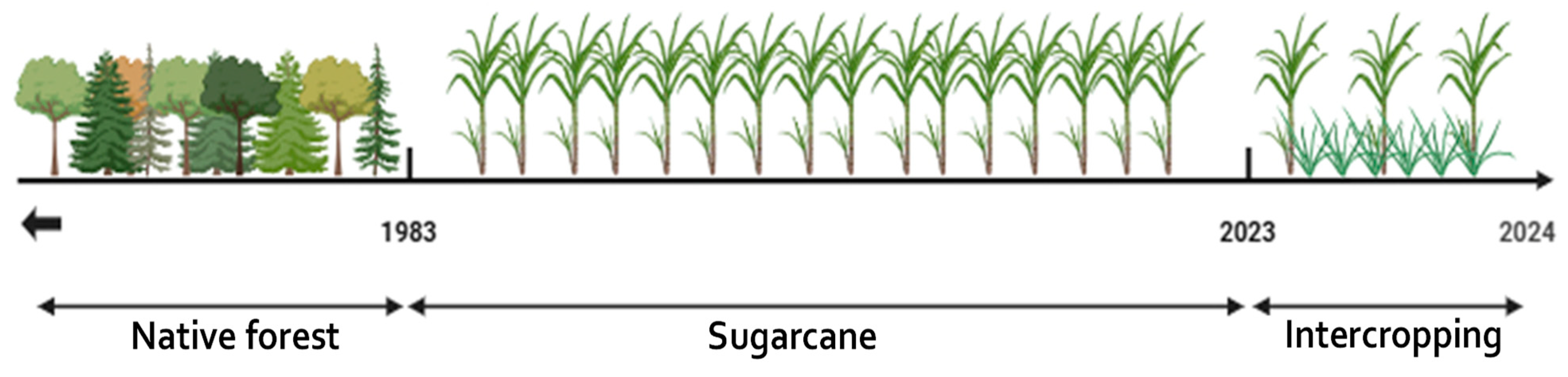
Before the cultivation of sugarcane in 1983, the site was under native forest cover. Between 1983 and 2023 (40 years), the study area was managed for sugarcane cultivation. In 2023, cover crop intercropping was introduced into sugarcane cultivation (Figure 2), where the cover crop used was the grass Brachiaria ruziziensis, known as signal grass. The sugarcane field has also received vinasse at the rate of 300 m3·ha−1 for 20 years.

2.2. Experimental Design and Treatments

The study was implemented in a randomized complete block design (RCBD) with three treatments and three replications. The treatments comprised native forest (NF), sugarcane + Brachiaria grass at 10 kg seed ha−1 (SG + Bra intercrop), and Brachiaria grass at 0 kg seed ha−1 (sole sugarcane, sole SG).

2.3. Soil Sample Collection

In each of sugarcane + Brachiaria ruziziensis grass at 10 kg seed ha−1, sole sugarcane (control) as well as an adjacent native forest, three (3) profiles about 50 cm deep, were dug, and soil samples were collected at depths of 0–10, 10–20, and 20–40 cm. Undisturbed samples for soil bulk density, saturated hydraulic conductivity, and soil water retention curve were collected using metallic cores 48 mm in diameter and 50 mm in height and a Dutch auger, while disturbed samples for soil texture, organic matter, and nitrogen were collected in well-labeled nylon bags. In all, three (3) sets of 27 samples were collected, comprising three (3) per treatment, three (3) soil layers, and three (3) replicates. One set of disturbed and another set of structured soil samples were used for conventional soil analysis, while the third set was collected for the X-ray computed tomography image analysis.
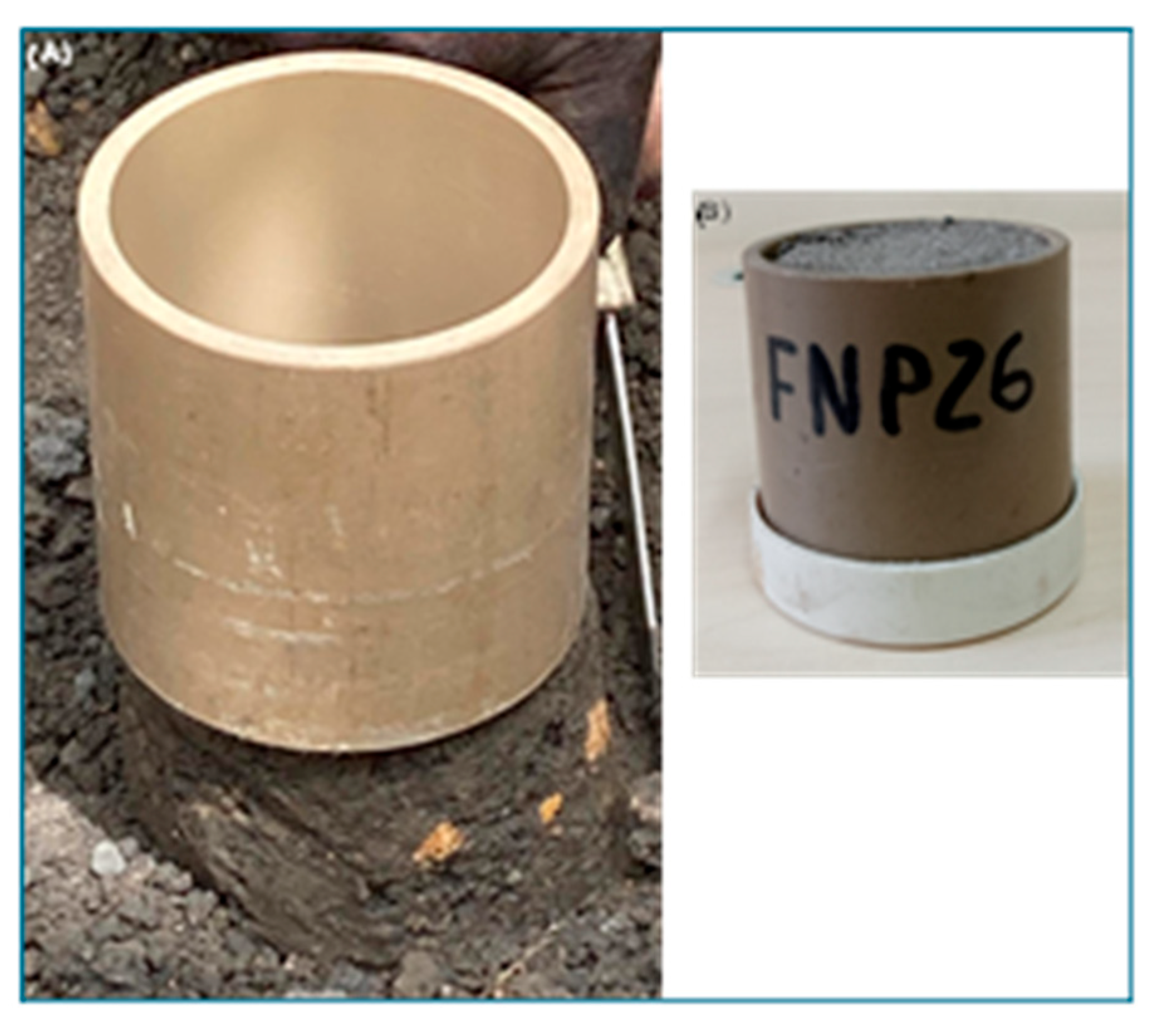
The soil samples for the X-ray computed tomography imagery were collected using polyvinyl chloride plastic cores (about 66 mm in diameter and 70 mm in height), which were carefully driven into the soil by scraping the outer soil off the cores while they were gradually pushed down manually until they were filled up (Figure 3). The reason for this system of collection was to ensure there was no disturbance to the soil pore system.

2.4. Conventional Soil Analysis

2.4.1. Preliminary Soil Analysis Before Imposing Cover Crop

The disturbed soil samples were passed through a 2 mm sieve and placed in an air-circulated environment to obtain air-dried fine soil, which was later used to determine chemical parameters. Soil pH was obtained using a soil-to-liquid suspension ratio of 1:2.5, and the pH was read using a pH electrode; available phosphorus (P), potassium (K+), and sodium (Na+) were determined using Melich-1 extraction solution (0.05 mol L−1 HCl and 0.0125 mol L−1 H2SO4), while exchangeable cations (Al3+, Ca2+, and Mg2+) were determined using 1 mol L−1 KCl extraction solution, with all determination following the methodology described in Teixeira et al. [47]. Potential acidity (H+ + Al3+) was quantified following the methodology proposed by Campos et al. [48]. Based on these parameters, the sum of bases (S), cation exchange capacity (CEC), base saturation (BS), and aluminum saturation (m) were calculated. Soil organic matter (SOM) was determined using the wet oxidation method of Walkley and Black [49], as modified by Mendonça and Matos [50]. Some soil chemical characterization of the experimental area before the implementation of the intercropping system is shown in Table 1.

2.4.2. Soil Analysis Alongside Image Processing

Soil textural analysis was performed using the methodology of Almeida et al. [51] with adaptations from Gee and Bauder [52]. Soil bulk density (BD) was determined following the methodology described by Blake and Hartge [53]. Soil saturated hydraulic conductivity was determined using the constant-head method described in EMBRAPA [54].
Soil organic matter fractions of total organic matter (TOM) and particulate organic matter (POM), as well as total nitrogen (TN) and particulate nitrogen (PN), were determined using the dry oxidation method [55] in an automatic analyzer (Auto-Analyzer, Flash EA 1112, Thermo Finnigan, Milan, Italy). Both mineral-associated organic matter (MAOM) and mineral-associated nitrogen (MAN) were obtained as the difference between the total and particulate components of organic matter and nitrogen [50].
For soil water retention, the undisturbed samples were saturated in a water bath for two days and subjected to water potentials of −1, −6, and −10 kPa in a tension table [56], and −33, −100, −1000, and −1500 kPa in Richard plates, following procedures from Dane and Hopmans [57]. After −1500 kPa water potential measurement, the samples were oven-dried at 105 °C for 48 h to determine the volumetric soil water content at each water potential ( Ψ ) according to Equation (1):
θ Ψ = V o l u m e   o f   w a t e r   ( Ψ ) V o l u m e   o f   s o i l
Volume of water ( Ψ ) is obtained as the weight of water at each Ψ divided by the density of water, taken as 1 g cm−3; the volume of soil is the volume of the core, in cm3.
The van Genuchten [58] model was fitted to the water retention data, using the retention curve (RETC) software developed by van Genuchten et al. [59], according to Equation (2):
θ Ψ = θ r + θ s θ r 1 + α Ψ n m
where θ Ψ is the soil volumetric water content (cm3 cm−3) at a given water potential Ψ (kPa); θ s is the soil volumetric water content (cm3 cm−3) at saturation; θ r is the soil residual volumetric water content (cm3 cm−3); α (0 < α <1 in kPa−1) is a fitting parameter related to the inverse of the air entry potential; n (n > 1) is a measure of pore size distribution; and m = 1 − 1/n.
From the soil water retention curve, the following hydraulic properties were extracted: total porosity considered as saturation water content at 0 kPa (assuming all pores are filled with water); microporosity (−6 kPa); macroporosity as the difference between total porosity and microporosity; soil water content at field capacity (−10 kPa); soil water content at permanent wilting point (−1500 kPa); and available water, which is the difference between field capacity and permanent wilting point.

2.5. Image Scanning, Reconstruction, and Processing

After field collection, the samples were air-dried until they reached a constant weight, using a semi-analytical balance. This process minimizes water interference with X-ray attenuation [60]. The dried samples were scanned using a NIKON XT H 225 ST X-ray microtomography machine (Nikon Corporation, Japan) with a tungsten tube as the X-ray source, with a maximum energy of 225 kV, 1001 μA, at the X-ray Computed Tomography Laboratory (LTC-RX), Department of Nuclear Energy (DEN) of the Federal University of Pernambuco (UFPE). The source was operated at 150 kV and 226 μA with a 0.5 mm copper filter, which was used to reduce beam hardening and produced images with satisfactory contrast between soil pores, the matrix, and rocks. The configuration of the detector and the distance between the source, object, and camera were adjusted to produce images with 50 μm spatial resolution. The total time of data acquisition was approximately 30 min per scan.
The scanned images were reconstructed using the CT PRO 3D XT 3.0.3 program [61], where the region of interest (ROI), calibrated away from the edges, was 30 × 30 × 30 µmm voxels in size, resulting in 1000 × 1000 × 1000 (1,000,000,000) by volume. After reconstruction, the image block was imported into VG Studio Max 2.2 [62], where the data obtained from a phantom were used to convert the block into Hounsfield units. To reduce noise, the images were filtered using the Gaussian smoothing filter (3 × 3 × 3). Filtering was done because some images are not perfect due to scattering, noise, and optical transfer functions [63]. Immediately afterward, the image block, previously in bulk volume, was exported as a TIFF image block, divided into 1000 slices. After reconstruction. The images were sent to the LTC-RX server for segmentation.
Image segmentation and binarization were performed using their respective plugins, CTsegmentation and Large Bitwidth Thresholding, in the ImageJ program [64,65], available at https://imagej.net/ij/download.html (accessed on 3 September 2025). From the binarized image, the pore characteristics of voids (porosity), inter-aggregate voids (macroporosity), and intra-aggregate voids (microporosity), small and medium pore classes ranging from very fine micropores to very coarse macropores as well as the orientation and inclination of the pores were quantified using the particle size analyzer, a sub-plugin within the BoneJ plugin within ImageJ [66]. Pore connectivity, anisotropy, and fractal dimension were obtained using their respective plugins in BoneJ within ImageJ.
Pore circularity was obtained directly from the analyze particles algorithm in ImageJ according to Equation (3), following the description in Fan et al. [67]:
C = 4 π A P 2
where C is pore circularity, A is the cross-sectional area of voids, and P is the perimeter of voids.
The pore circularity was thereafter classified as elongated (circularity between 0.5 and 1.0 mm pore diameter), regular (circularity between 0.0 and 0.2 mm pore diameter), and irregular (circularity between 0.2 and 0.5 mm pore diameter).

2.6. Statistical Analysis

Data were subjected to normality testing using the Shapiro–Wilk test (p > 0.05) and homogeneity testing using the Bartlett test (p > 0.05). Variables not following a normal distribution or homogeneity of variance were transformed before further analysis. Based on the experimental design (RCBD) and to compare the three land use systems (native forest, sole sugarcane, and sugarcane + Brachiaria intercrop) and soil layers within each land use, a two-way analysis of variance (ANOVA) was performed, and means were separated using the Tukey test at a 5% probability level (p < 0.05). Pearson’s correlation analysis was performed to determine the correlation between pore parameters measured by X-ray computed tomography and variables (e.g., soil bulk density, saturated hydraulic conductivity, field capacity, permanent wilting point, available water, and soil organic matter) obtained through conventional analytical methods. Statistical analyses were performed in R Studio software (R-core, version R 4.5.1).

3. Results

3.1. Soil Texture, Organic Matter Fractions, Bulk Density, and Saturated Hydraulic Conductivity

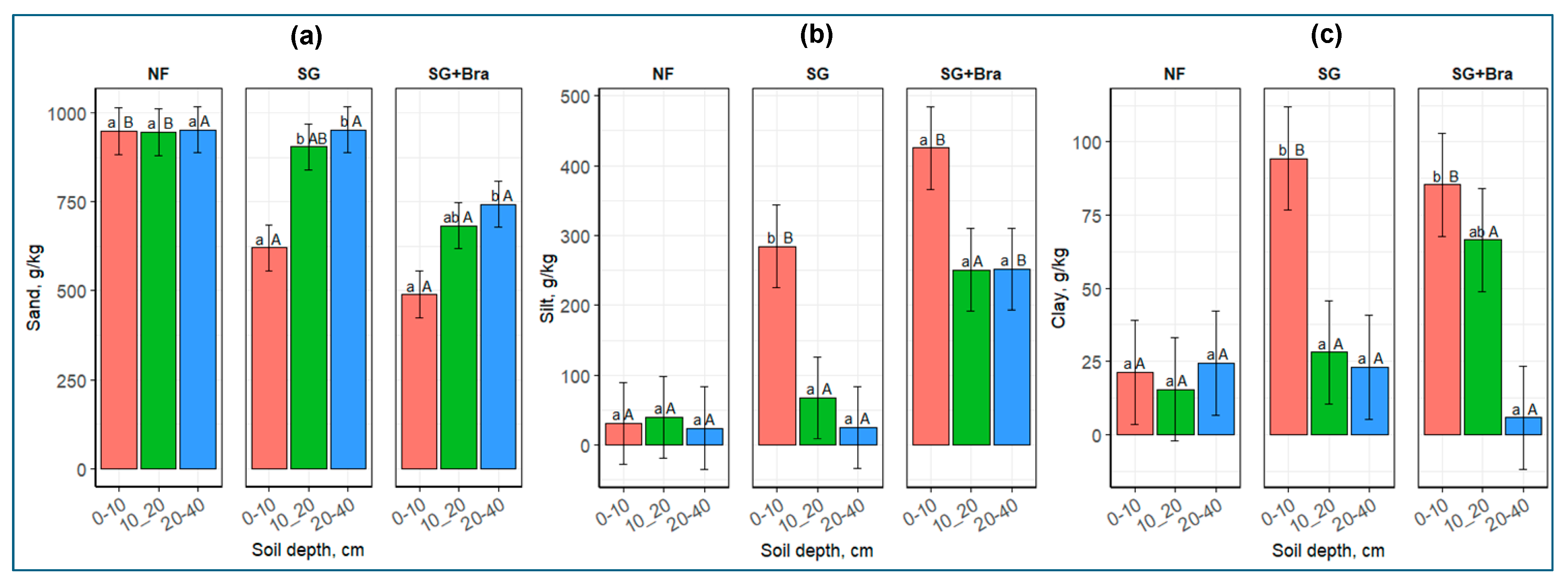
Sand content (Figure 4a) was highest (p < 0.05) in the native forest (NF) compared with sugarcane alone (sole SG) and sugarcane + Brachiaria intercrop (SG + Br intercrop) in the 0–10 cm surface layer. In deeper soil (10–20 cm layer), the NF also had the highest sand content, although the difference compared with sole SG was not significant (p > 0.05), while in the 20–40 cm layer, there were no significant differences (p > 0.05) in sand content. While the sand content was similar for all three layers under NF, sand content increased with soil depth (p < 0.05) under both sole SG and SG + Bra intercrop (Figure 4a).
Conversely, both the silt and clay contents (Figure 4b,c) of the 0–10 cm surface layer were higher (p < 0.05) in sole SG and SG + Bra intercrop compared with NF. The three layers of the NF are sandy; the 0–10 cm surface layer of sole SG is sandy loam, while the other layers are sandy. For the SG + Bra intercrop soil, the 0–10 cm surface layer is loam, while the 10–20 and 20–40 cm layers are sandy loam and loamy sand, respectively. For the 10–20 cm layer, both silt and clay contents did not differ (p > 0.05), while in the deeper 20–40 cm layer, SB + Bra intercrop had higher (p < 0.05) silt content compared with NF and sole SG, while clay content did not differ.
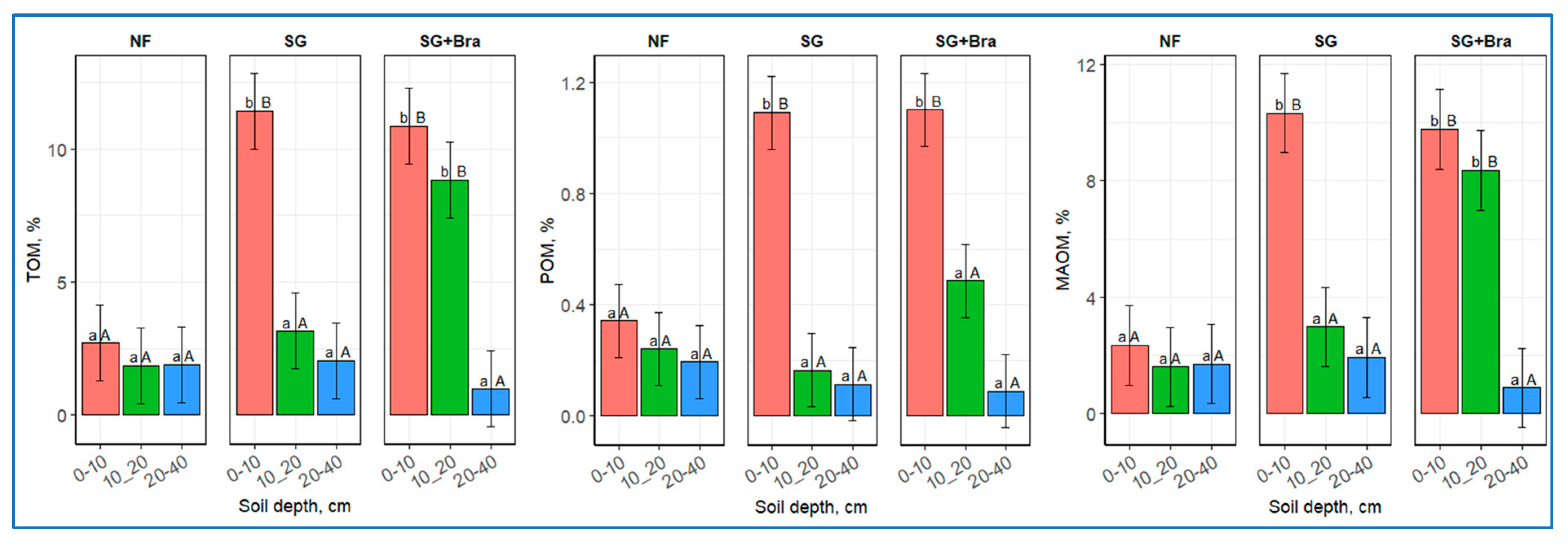
Soil total organic matter (TOM, Figure 5) in the 0–10 cm surface layer was higher (p < 0.05) by about 76% for sugarcane (sole SG) and sugarcane + Brachiaria intercrop (SG + Bra) compared with native forest (NF). In the 10–20 cm layer, SG + Bra soil had the highest (p < 0.05) TOM compared with both SG (by 64%) and NF (by 79%). For the deeper 20–40 cm layer, there was no significant difference (p > 0.05) in SOM, although the NF soil had TOM numerically higher than SG by 23% and SG + Bra by 44%.
For other soil organic matter fractions (Figure 5), the particulate organic matter (POM) of the 0–10 cm layer differed (p < 0.05) between the sugarcane cropping systems and native forest, with both sole SG and SG + Bra intercrop having a higher POM about 69% greater than that of NF. Intercropping sugarcane with Brachiaria slightly increased the POM, although the difference from that of sole SG was not significant (p > 0.05). In the 10–20 cm subsurface layer, SG + Bra intercrop had a numerically higher POM (p > 0.05) compared to both NF and sole SG.
In the 0–10 cm surface layer, both Sole SG and SG + Bra intercrop had a mineral-associated organic matter (MAOM) significantly greater than NF by about 77%, but the difference between the two sugarcane cropping systems was not significant (p > 0.05). For the 10–20 cm layer, the SG + Bra intercrop had an MAOM significantly greater than the NF (81%) and sole SG (64%). For the 20–40 cm layer, there were no significant differences in MAOM among the NF and sugarcane cropping systems (Figure 5).
Comparing the soil layers showed that the TOM generally decreased with soil depth; for the NF, there was no significant difference (p > 0.05) among the soil layers. For sole SG, the 0–10 cm surface layer had a higher (p < 0.05) TOM compared with the other layers, while for the SG + Bra intercrop, the 0–10 cm surface layer also had the highest TOM, but the difference was not significant compared with that of the 10–20 cm layer (Figure 5). For the POM, it also decreased with soil depth, with the 0–10 cm surface layer having higher value (p < 0.05) than other soil layers except for NF, where there is no significant difference (p > 0.05). For the MAOM, the same trend as obtained for the TOM was also observed.
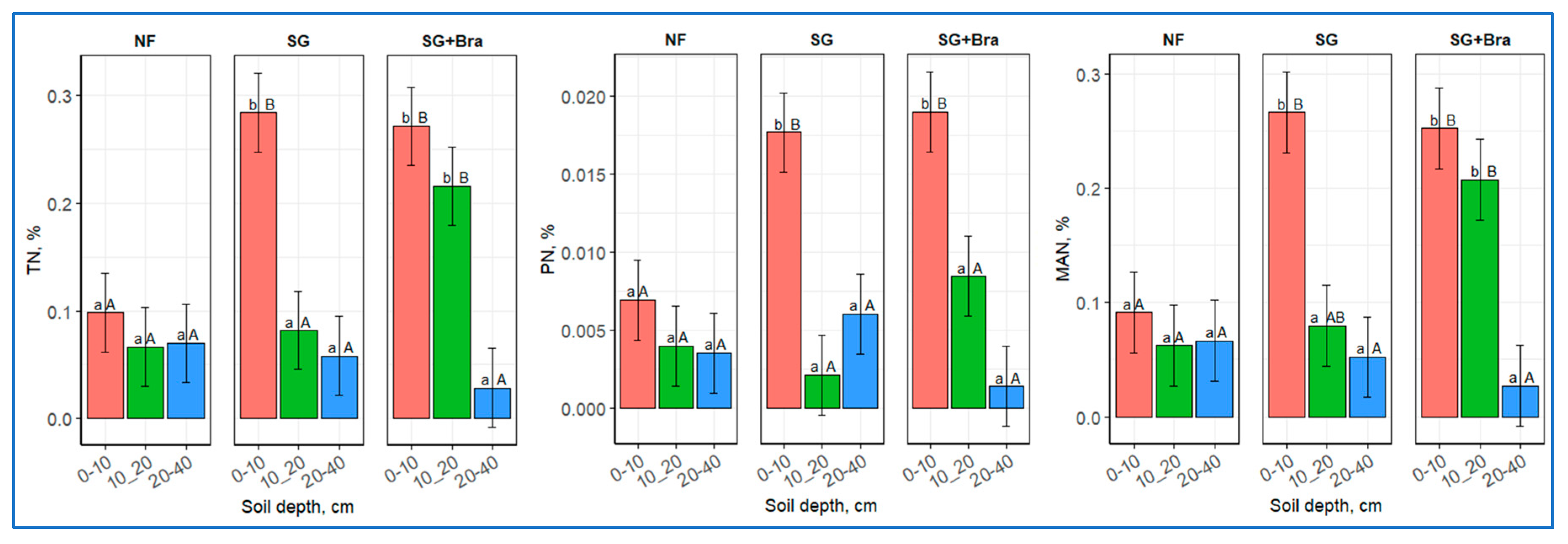
Soil total nitrogen (TN) in the 0–10 cm surface layer of the native forest (NF) was lower (p < 0.05) by about 65% compared to both sole SG and SG + Bra intercrop. In the 10–20 cm layer, the NF had a TN lower than sole SG and SG + Bra intercrop by 23 and 224%, respectively. For the deeper 20–40 cm layer, there was no significant difference (p > 0.05) in TN, although the NF soil had a TOM numerically higher than sole SG by about 17% and SG + Bra by 59% (Figure 6).
For other nitrogen fractions (Figure 6), the same trend as observed for the POM and MAOM was also observed for both PN and MAN.
Comparing the soil layers for the TN, PN, and MAN showed a similar trend as observed for the TOM, POM, and MAOM, respectively (Figure 6).
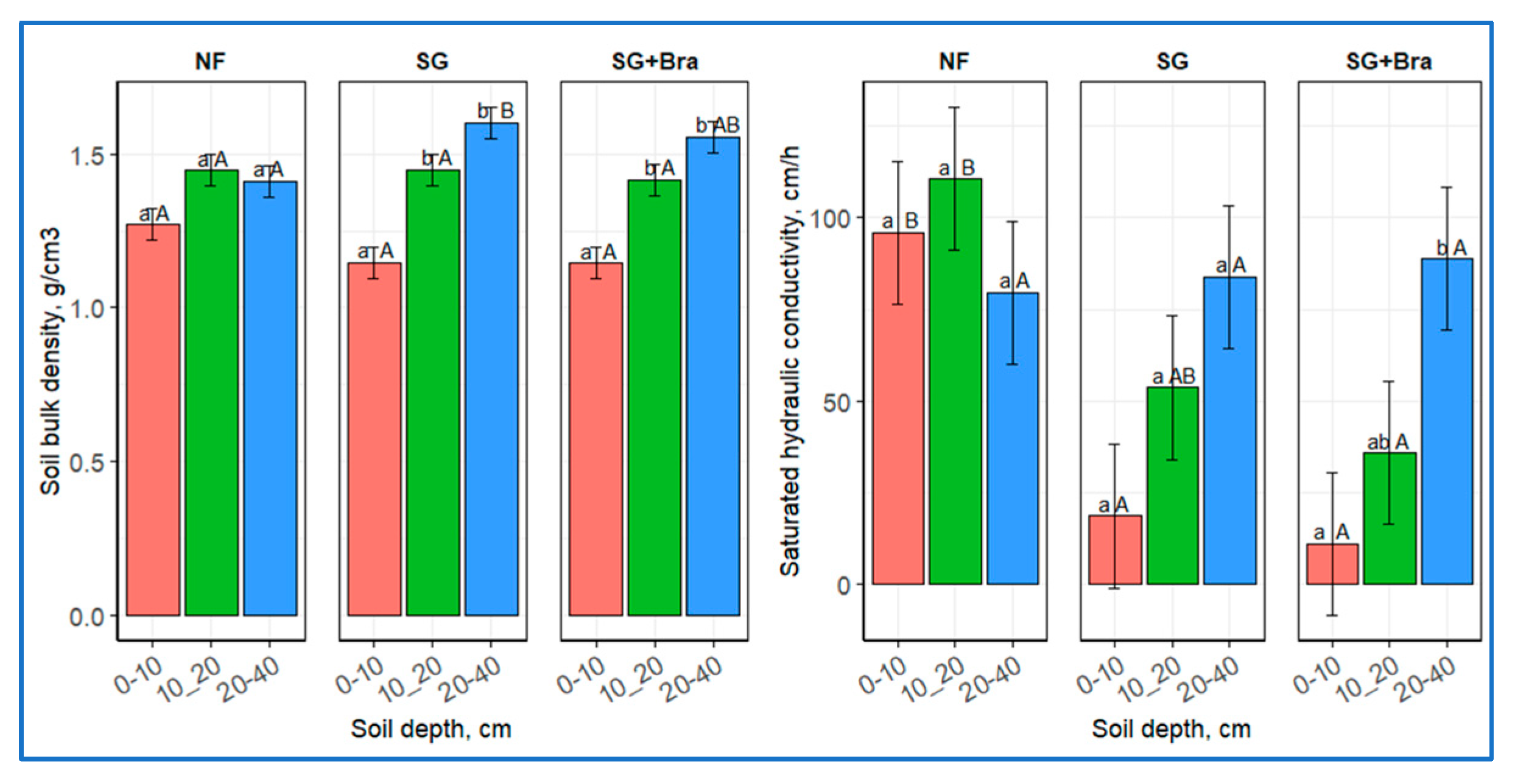
Soil bulk density (BD, Figure 7) of both the 0–10 and 10–20 cm layers did not differ (p < 0.05) among the sugarcane cropping systems and native forest, but BD decreased in magnitude in both sole SG and SG + Bra intercrop by 10% in the 0–10 cm surface layer and increased by 2% in the 10–20 cm layer. For the 20–40 cm layer, sole SG and SG + Bra intercrop had a higher (p < 0.05) BD than that of the NF by about 13 and 10%, respectively. A comparison of the soil layers shows that the BD did not differ under NF, while in both sole SG and SG + Bra intercrop, the BD increased (p < 0.05) with soil depth, with the subsurface layers having a BD about 40% higher than the surface layer. Furthermore, intercropping sugarcane with Brachiaria marginally decreased the BD by about 0.1, 2, and 3% in the 0–10, 10–20, and 20–40 cm layers, respectively.
Soil saturated hydraulic conductivity (Ksat, Figure 7) of the 0–10 cm surface layer differed (p < 0.05) among the sugarcane cropping systems and native forest, with the NF having a Ksat about five and nine times those of sole SG and SG + Bra intercrop, respectively. For the 10–20 cm subsurface layer, NF also had the highest Ksat, about two and three times that of sole SG and SG + Bra intercrop, respectively, although the difference between the NF and sole SG was not significant (p > 0.05). For the deeper 20–40 cm layer, the Ksat was lowest under NF by about 5 and 11% compared with sole SG and SG + Bra intercrop, respectively; however, the difference was not significant (p > 0.05). Comparing the soil layers shows that the Ksat increased with soil depth in both Sole SG and SG + Bra intercrop, with the difference only significant (p < 0.05) under SG + Bra intercrop, while no discernible trend was observed for NF.

3.2. Soil Water Retention and Porosity

3.2.1. Soil Water Retention Curve (SWRC) Shape

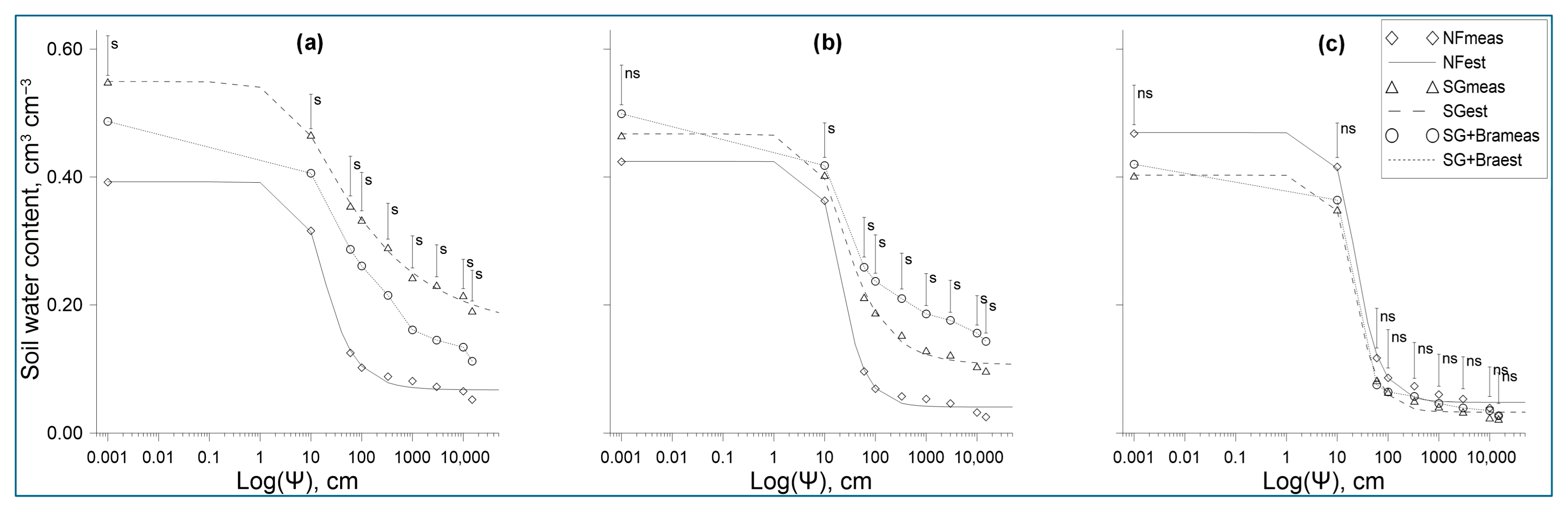
Sugarcane cropping and native forest soils exhibited contrasting shapes of the SWRC (Figure 8), with significant differences (p < 0.05) in the SWRC in the 0–10 and 10–20 cm layers. Between saturation (0 kPa) and −1 kPa water potential, the SWRC sloped gently as water is held by capillary forces. Between −1 and −6 kPa water potential, there was a steep descent in the SWRC in the NF, where a small change in water potential caused a significant reduction in the water retained compared with the gentle slope observed for both sole SG and SG + Bra intercrop in the 0–10 cm surface layer. From the lower water potential range of −100 to −1500 kPa, the SWRC becomes flat in NF compared with those of sole SG and SG + Bra intercrop (Figure 8a).
In the 10–20 cm layer, the same trend observed for the 0–10 cm layer was also observed near saturation. Between −1 and −6 kPa water potential, the steepness of the SWRC increased, more pronounced in the NF. At the lower potential range, both the NF and sole SG had their SWRC flattened compared with SG + Bra intercrop (Figure 8b). For the deeper 20–40 cm layer, the steepness of the SWRC between −1 and −6 kPa water potential has become similar in all the systems evaluated. Similarly, at the lower water potential range, all the systems exhibited the same flattened SWRC (Figure 8c).
The NF soil showed the lowest (p < 0.05) water retention for all water potentials in both 0–10 and 10–20 cm layers. While the sole SG soil retained higher water relative to SG + Bra intercrop in all the water potential in the 0–10 cm layer, the soil of SG + Bra intercrop retained more water relative to sole SG in the 10–20 cm layer; the difference was not significant (p > 0.05) in both cases. In the 20–40 cm layer, the difference was also not significant (Figure 8).

3.2.2. Water Release Pattern

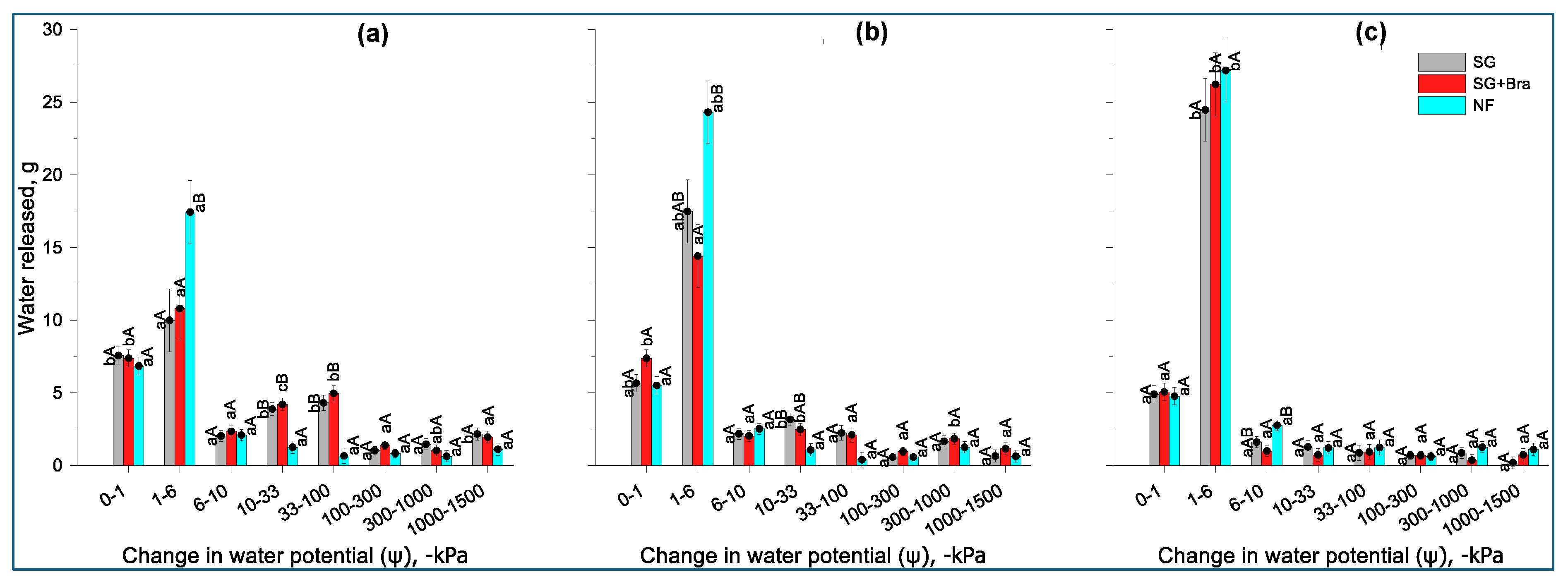
For the higher water potential range of −1 to −6 kPa and −10 to −33 kPa, there were differences (p < 0.05) in the amount of water released by the soils of the sugarcane cropping systems and native forest in the 0–10 and 10–20 cm layers (Figure 9a,b) and only for the water potential range of −6 to −10 kPa in the 20–40 cm layer (Figure 9c). For the −6 to −10 kPa water potential range, the NF released the highest amount of water relative to sole SG and SG + Bra intercrop systems, although the difference was not significant (p > 0.05) in the 20–40 cm layer. Conversely, the soils of the sole SG and SG + Bra intercrop systems released more water in the −10 to −33 kPa water potential range in both 0–10 and 10–20 cm layers compared with the NF (Figure 9a,b). In the 20–40 cm layer, the NF released the highest amount of water compared with sole SG and SG + Bra intercrop in the −6 to −10 kPa water potential range (Figure 9c).
Comparing the soil layers, there were differences (p < 0.05) in the water released. Between saturation (0 kPa) and −1 kPa, a higher amount of water was released in the 0–10 and 10–20 cm layers of sole SG and SG + Bra intercrop compared with the 20–40 cm layer. Between −1 and −6 kPa, the amount of water released increased with soil depth. Between −10 and −100 kPa, the amount of water released numerically decreased with soil depth in sole SG and SG + Bra intercrop only. While the 10–20 cm layer of SG + Bra intercrop released the highest amount of water in the −300 to −1000 kPa, the 0–10 cm layer of sole SG released the highest amount of water in the −1000 to −1500 kPa water potential range (Figure 9).

3.2.3. Soil Water Retention State Points

Soil total porosity (Pt, measured as the saturation water content—Table 2) differed (p < 0.05) in the 0–10 cm surface layer, with both SG and SG + Bra intercrop having a higher Pt compared with the NF, although the SG had a Pt about 11% numerically greater than that of SG + Bra intercrop. In the 10–20 and 20–40 cm layers, there were no differences (p < 0.05) in Pt between the sugarcane cropping systems and native forest, although the SG + Bra intercrop had a Pt numerically greater than sole SG by 7.0 and 4.5% in the two layers, respectively. Comparing soil layers (Table 2), only sole SG had the highest Pt (p < 0.05) in the 0–10 cm surface layer.
Soil macroporosity (Mac, Table 2) did not differ (p > 0.05) between the sugarcane cropping systems and native forest in the three layers, with even the NF presenting a numerically higher Mac by 2%–27% in all the soil layers. A comparison of the soil layers showed that the 20–40 cm layer of both sole SG and SG + Bra intercrop had a higher (p < 0.05) Mac relative to the upper layers. Furthermore, Mac dominated all three soil layers of NF, the 10–20 and 20–40 cm layers of SG, and only the 20–40 cm layer of SG + Bra intercrop.
Both sole SG and SG + Bra_intercrop had higher (p < 0.05) soil microporosity (Mic, Table 2) than the NF in both the 0–10 and 10–20 cm layers, but there was no significant difference (p > 0.05) in the Mic between the sugarcane cropping systems. Comparing the soil layers, the 0–10 cm surface layer of sole SG had the highest (p < 0.05) Mic compared with the other layers, while the 20–40 cm layer of the SG + Bra intercrop had the lowest (p < 0.05) Mic relative to the upper layers. Soil Mic dominated the 0–10 cm layer of sole SG, while the upper 0–10 and 10–20 cm layers of SG + Bra intercrop had more micropores (Table 2).
Soil water content at field capacity (FC, Table 2) of both the 0–10 and 10–20 cm layers was higher (p < 0.05) in the SG and SG + Bra intercrop compared with NF. Similar results as observed for the Mic were also obtained for the soil layer comparison.
Permanent wilting point (PWP, Table 2) was higher (p < 0.05) in SG and SG + Bra intercrop than in NF by 73 and 83% in the 0–10 and 10–20 cm layers, respectively. Comparing the soil layers, while the 0–10 cm layer of SG had a higher (p < 0.05) PWP relative to the subsurface layers, it was the 10–20 cm layer of SG + Bra intercrop that had the highest PWP compared with the other layers (Table 2).
Soil available water (AW, Table 2) was significantly lower (p < 0.05) in the 0–10 and 10–20 cm layers of the NF compared with both sugarcane cropping systems. The 0–10 cm surface layer of both SG and SG + Bra intercrop had the highest (p < 0.05) AW compared with the other layers.

3.2.4. Visualization of the Pore System by X-Ray Computed Tomography

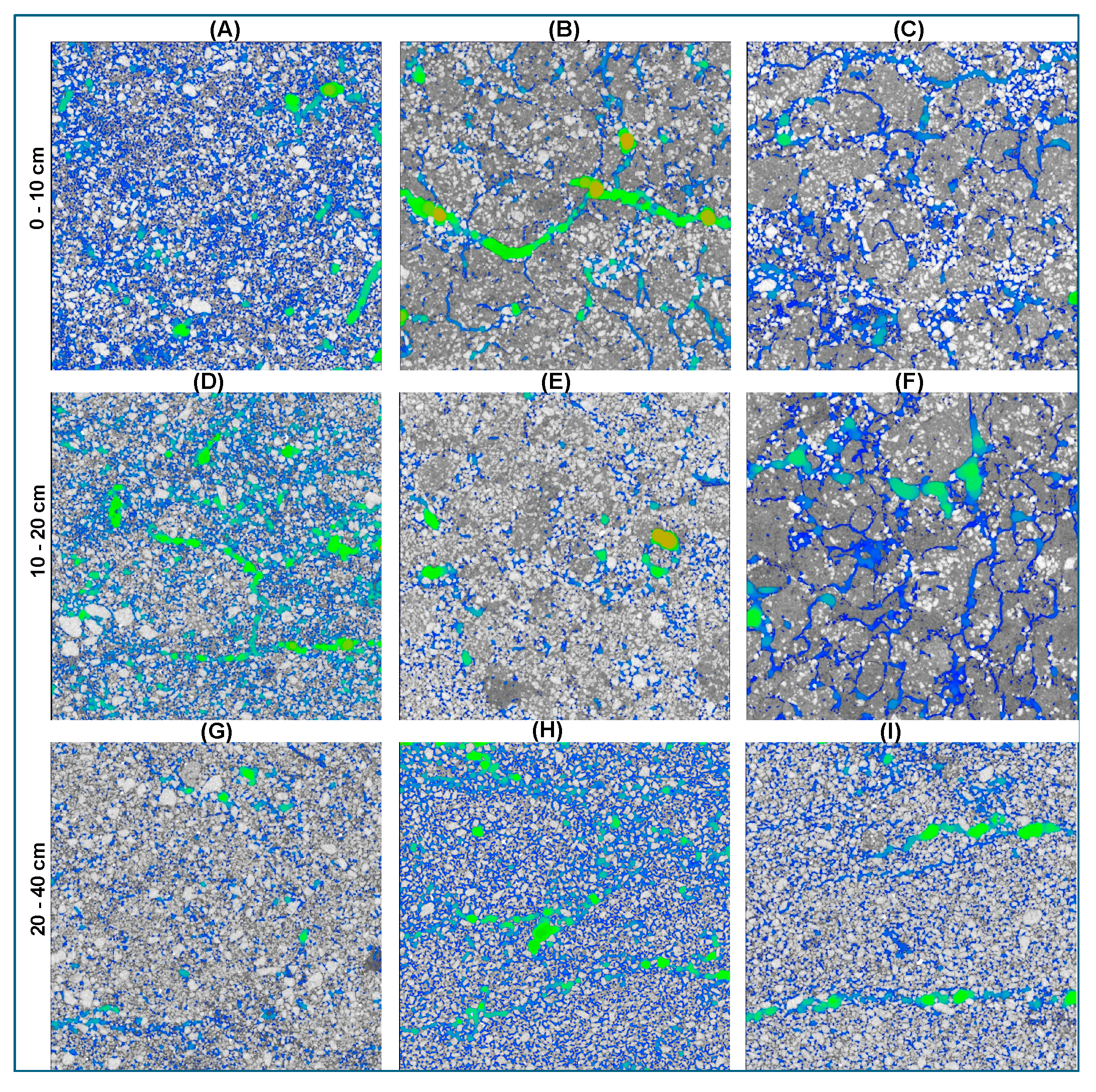
The front view of the pore system of a sample of the three soil layers of the native forest (NF) and sugarcane cropping systems is presented in Figure 10. In the 0–10 and 10–20 cm layers, the NF had a greater and denser distribution of pores (Figure 10A,D) compared with both SG (Figure 10B,E) and SG + Bra intercrop (Figure 10C,F). Moreover, both sole SG and SG + Bra intercrop appeared to have a larger pore network distribution (blue color), and the large pore network of the SG + Bra intercrop extended to the 10–20 cm layer compared to that of sole SG. In the 20–40 cm layer, small pores predominate, with sole SG having a greater and denser pore distribution (Figure 10H) compared with both the NF (Figure 10G) and SG + Bra intercrop (Figure 10I). For the NF, pore density decreased with increasing soil depth, while for both sole SG and SG + Bra intercrop, the large pores decreased with soil depth, while the small pores increased.

3.2.5. X-Ray Computed Tomography-Derived Porosity and Pore Morphological Characteristics

Soil porosity derived from X-ray computed tomography (CT-porosity, Table 3) was reduced (p < 0.05) in the 0–10 cm surface layer for intercropping sugarcane with Brachiaria compared with both NF (38%) and sole SG (34%). The NF had a higher CT-porosity than sole SG, but the difference was not significant (p > 0.05). Similarly, in the 10–20 cm layer, both sole SG and SG + Bra intercrop had a CT-porosity which was significantly (p < 0.05) higher than that of NF by about 42 and 51%, respectively. The opposite was observed in the 20–40 cm layer, where the NF had a higher CT-porosity than both Sole SG and SG + Bra intercrop by 34%. Comparing the soil layers, the CT-porosity differed (p < 0.05) only in the sole SG soil, with the 0–10 cm surface layer having the highest value (Table 3).
Soil macroporosity derived by X-ray computed tomography (CT-Mac, Table 3) was higher (p < 0.05) in the NF compared with both sole SG and SG + Bra intercrop in all three layers by 30%–55%. A comparison of the soil layers showed a lower CT-Mac in the 10–20 cm layer of both SG and SG + Bra intercrop (Table 3).
Soil microporosity revealed by X-ray computed tomography (CT-Mic, Table 3) for the 0–10 cm surface layer was reduced (p < 0.05) by 85% when the sugarcane was intercropped with Brachiaria. A similar reduction was also observed in the NF (93%) compared with sole SG. In the 10–20 cm layer, the NF had a lower (p < 0.05) CT-Mic compared with sole SG (by 54%) and SG + Bra intercrop (by 27%). The CT-Mic was also reduced in SG + Bra intercrop relative to SG, but the difference was not significant (p > 0.05). Comparing the soil layers, both NF and SG + Bra intercrop had a higher CT-Mic in the deeper 20–40 cm layer than in the two upper layers, whereas the CT-Mic of the surface layer of the SG soil was significantly the highest.
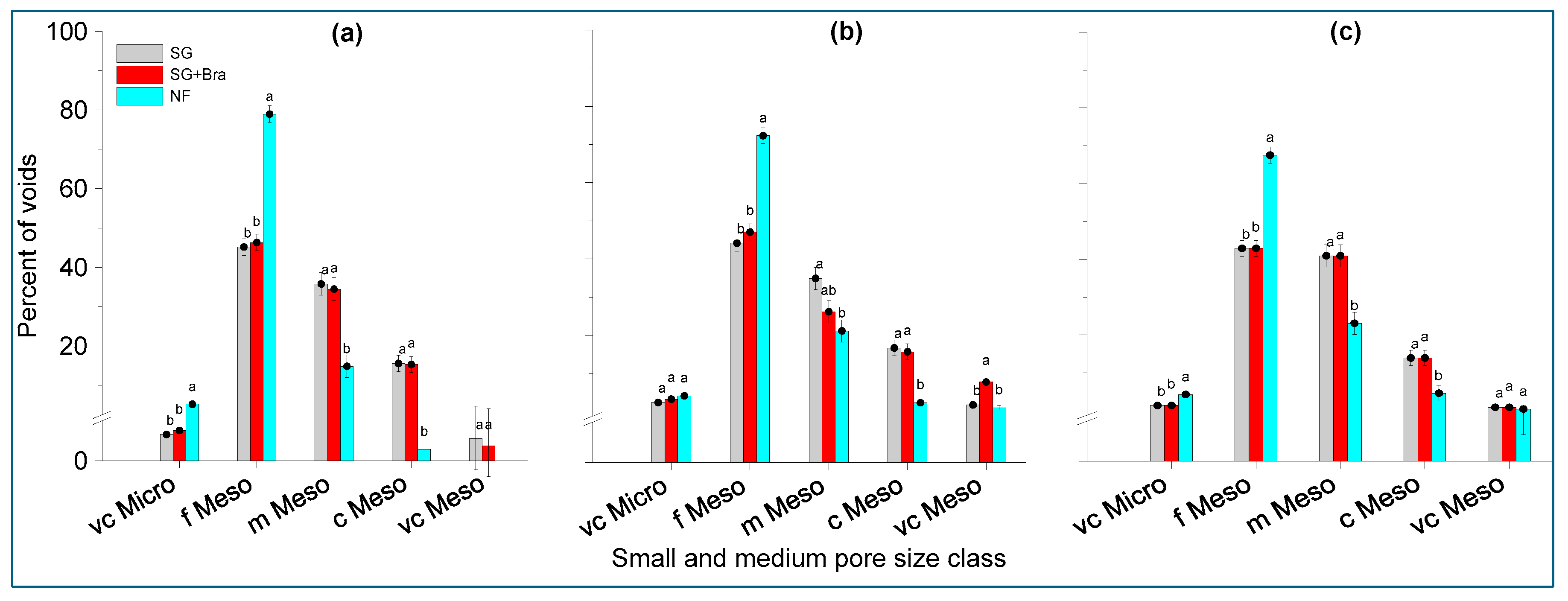
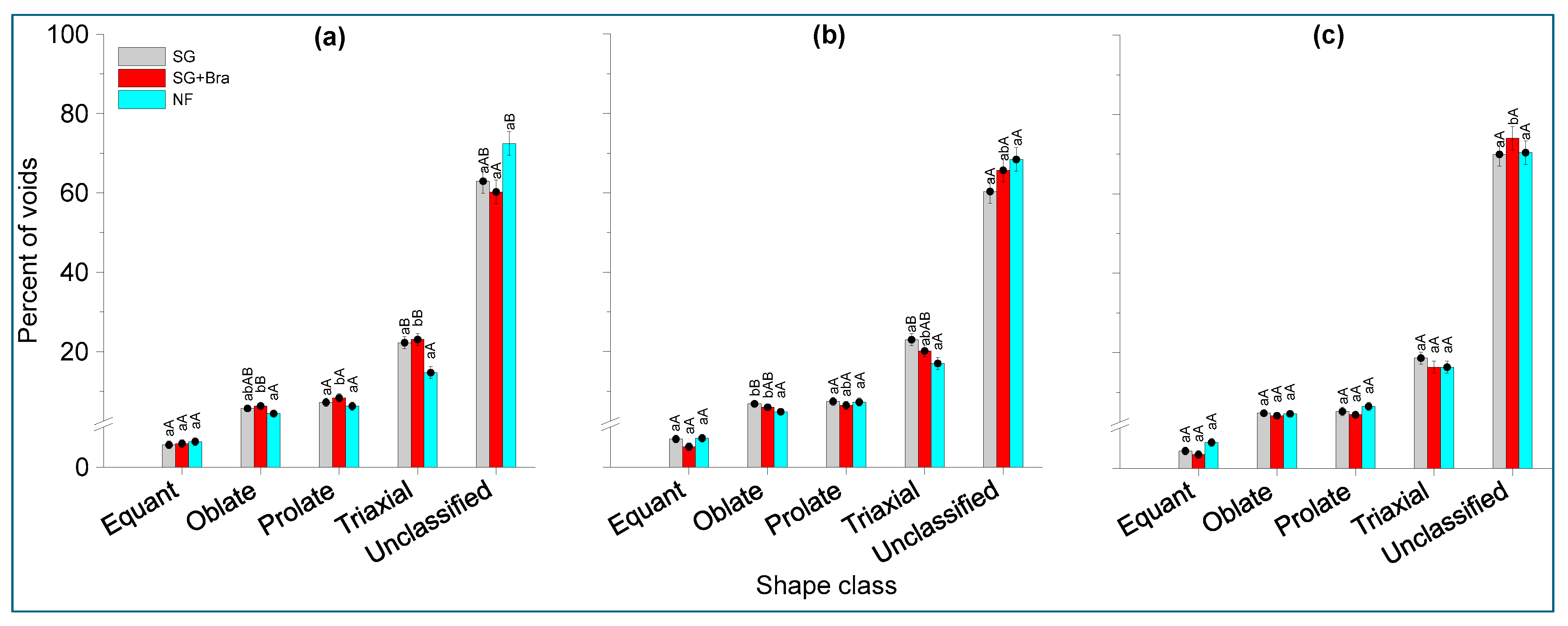
Small and medium pore size classes (Figure 11) differed (p < 0.05) between the NF and sugarcane cropping systems in the three soil layers, except for very coarse mesopore (vc meso) in the 0–10 and 20–40 cm layers and very coarse micropore (vc micro) in the 10–20 cm layers. The fine mesopore (f meso) dominated the small and medium pores in all the soil layers of both the NF and sugarcane cropping systems. Except for the deeper 20–40 cm layer, there were differences (p < 0.05) in the proportion of the pore shape classes between the NF and sugarcane cropping systems as revealed by the X-ray computed tomography.
For the shape classification (Figure 12), the unclassified pore shape class dominated the three soil layers. Sole SG and SG + Bra intercrop had the highest proportion of oblate, prolate, and triaxial pore shape classes, while the NF had the highest proportion of unclassified pore shape class in the 0–10 and 10–20 cm layers. For the 20–40 cm layer, there was no significant difference (p > 0.05). Unclassified pore shape class (Figure 12) was highest for SG + Bra intercrop in the 20–40 cm soil layer, triaxial pore shape class was also highest (p < 0.05) for SG + Bra intercrop in the 0–10 cm layer, and oblate pore shape was highest (p < 0.05) for SG in the 10–20 cm layer.
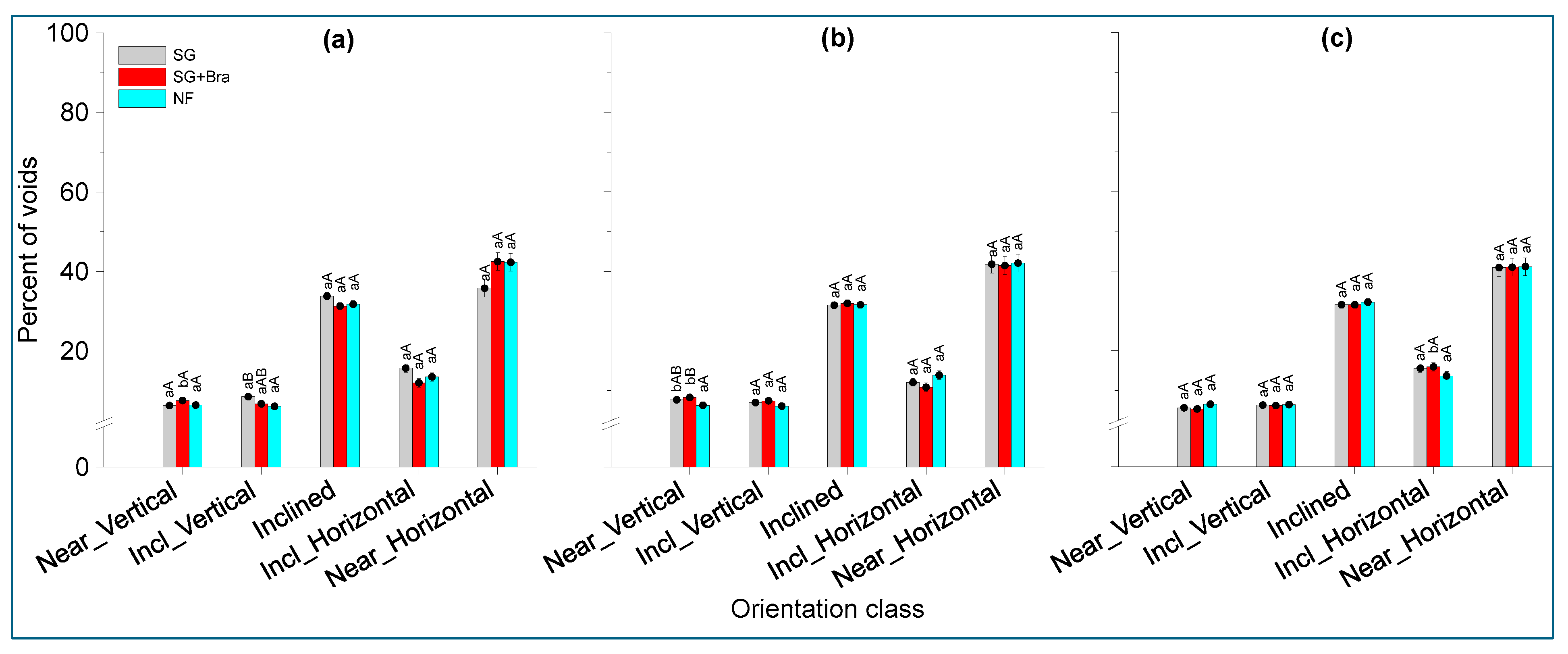
The orientation of soil pores (Figure 13) was different (p < 0.05) between NF and sugarcane cropping systems. SG alone had the highest proportion of vertically inclined pores (incl-vertical), while SG + Bra_intercrop had the highest proportion of near-vertical pores (near-vertical). Generally, the pores that are near-horizontal dominate in all three soil layers.
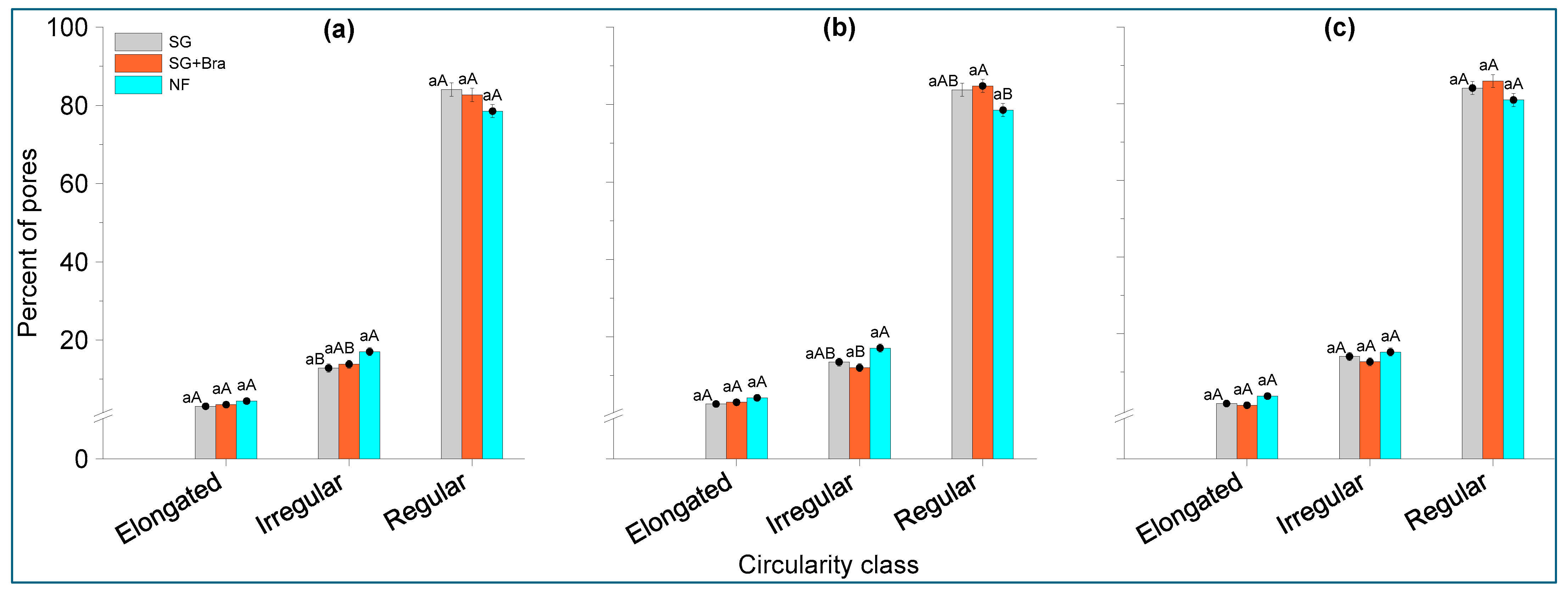
Pore circularity (Figure 14) results showed elongated pores had a similar proportion compared with NF and sugarcane cropping systems in all the soil layers. However, the proportion of irregular pores differed (p < 0.05) in the 0–10 and 10–20 cm layers, with NF having the highest values.
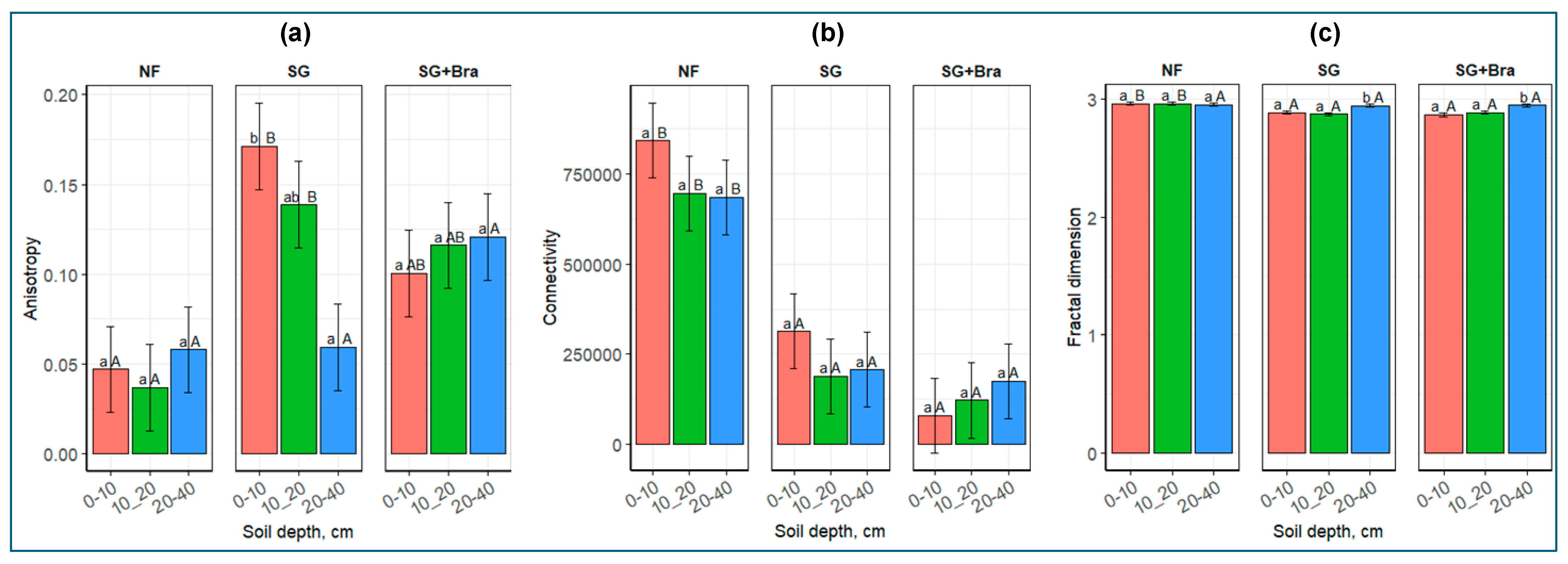
Pore anisotropy (Figure 15a) in the 0–10 and 10–20 cm layers was significantly higher (p < 0.05) in sole SG compared with NF and SG + Bra intercrop, while the difference in anisotropy between sole SG and SG + Bra intercrop was not significant (p > 0.05). For the 20–40 cm layer, there was no significant difference (p > 0.05) in anisotropy among the NF and sugarcane cropping systems.
Pore connectivity (Figure 15b) as revealed by X-ray computed tomography was significantly higher (p < 0.05) in the NF in all the soil layers compared with the sugarcane cropping systems. Fractal dimension (Figure 15c) showed NF had the highest (p < 0.05) value in both 0–10 and 10–20 cm layers in comparison to both SG and SG + Bra intercrop, while there was no significant difference (p > 0.05) in the 20–40 cm layer.
Comparing the soil layers (Figure 15), the SG had higher (p < 0.05) anisotropy in the 0–10 cm surface layer compared with the subsurface layers, while both pore connectivity and fractal dimension did not differ (p > 0.05) among the soil layers of NF and sugarcane cropping systems.
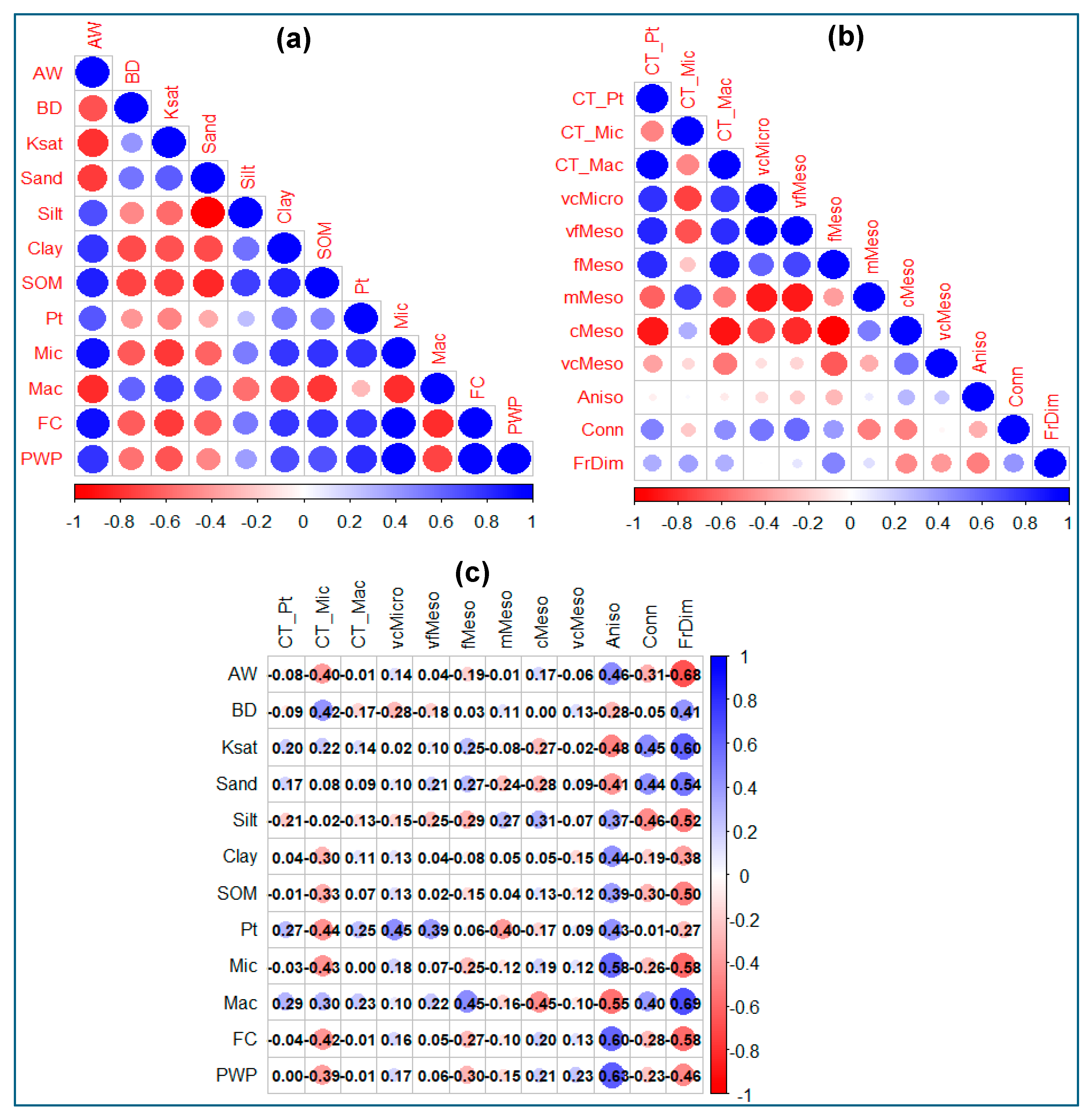
For the Pearson correlation analysis (Figure 16), there was significant correlation within groups of the conventionally evaluated soil hydro-physical properties (Figure 16a), with AW showing a negative correlation (p < 0.01) with BD, Ksat, sand, and Mac, while the correlation was positive (p < 0.01) with silt, clay, SOM, Pt, Mic, FC, and PWP.
For the X-ray CT-derived soil pore morphological characteristics (Figure 16b), the CT-Pt showed a positive correlation (p < 0.01) with CT-Mac, vc Micro, vf Meso, f Meso, and connectivity, while the correlation was negative (p < 0.01) with m Meso and c Meso. The CT-Mac significantly correlated with other CT-derived soil pore morphological characteristics except CT-Mic and anisotropy, while the CT-Mic showed a negative correlation (p < 0.01) with only vc Micro. The connectivity was significantly correlated (p < 0.01) with the CT-derived soil pore morphological characteristics except for CT-Mic and vc Meso.
There were correlations between conventionally evaluated soil hydro-physical properties and CT-derived soil pore morphological characteristics (Figure 16c), where AW negatively correlated with f Meso (p < 0.05), connectivity (p < 0.05) and fractal dimension (p < 0.01), while the correlation was positive with c Meso (p < 0.05). The CT-Pt, CT-Mac, CT-Mic, vc Micro, and vc Meso did not significantly correlate with all the conventionally evaluated soil hydro-physical properties. Apart from AW (already presented), both anisotropy and the fractal dimension significantly correlated with other conventionally evaluated soil hydro-physical properties, except for the BD, while the connectivity correlated with only Ksat and silt.

4. Discussion

4.1. Soil Organic Matter, Physical Properties and Water Retention Determined by Conventional Methods

The higher silt content and differences in the texture in the surface layer of both sole SG and SG + Bra intercrop are attributed to the cumulative effect of the prolonged application of vinasse to the sugarcane field. The addition of vinasse, a by-product of alcohol and sugar production, introduces fine particles that build up over time, leading to changes in soil texture (increased silt) compared with the sandy NF whose soil is undisturbed and unamended for years. Jiang et al. [68] also reported increased silt content due to prolonged vinasse application to sugarcane fields in China.
While the sand content of the subsurface layers of the SG is similar to that reported by Costa et al. [69], they did not find significant increase in the silt content in the surface layer of a sugarcane field with over 20 years of vinasse application in the same locality, about 5 km from this study location. The difference could be attributed to two aspects: first, their study considered a thicker surface layer (0–20 cm), while in our study this was split into two layers (0–10 and 10–20 cm), showing differences in the sampling depths. Secondly, our sampling was conducted over 14 years after their sampling in 2011; this time gap could have given room for more accumulation of fine particles due to the yearly vinasse application.
Intercropping Brachiaria with sugarcane also increased the silt content in the 10–20 cm subsurface compared with SG. Brachiaria has a fibrous root system that digs deeper into the soil compared with the pivoting root system in sugarcane [70]. This “digging” not only promotes soil bioturbation but also helps in mixing the soil particles, effectively moving finer silt particles into deeper layers.
Conversion of the native forest for sugarcane cultivation is expected to hasten soil organic carbon loss through accelerated carbon and nitrogen cycling [71]; however, the higher soil organic matter and nitrogen in the 0–10 cm surface layer of both sole SG and SG + Bra intercrop compared with the NF is attributed to the addition of vinasse for over 30 years, compensating the negative effect that could have accrued from the conversion. This nutrient-dense by-product from ethanol and sugar production is loaded with dissolved nutrients. As a result of repeated application, it enriches the soil with organic materials, especially in the top layer, boosting the overall levels of soil organic matter and total nitrogen. Several authors have also reported increased SOM and TN in sugarcane fields with vinasse addition [68,72,73,74,75].
Addition of vinasse improved the soil organic matter and nitrogen fractions, particulate (POM and PN) as well as the mineral-associated fractions (MAOM and MAN) of the 0–10 cm surface layer of both sole SG and SG + Bra intercrop compared with NF. The importance of both POM and MAOM in creating resilient soil structure for better plant growth and ecosystem health has been highlighted [76,77,78], and they exhibit different characteristics [79,80,81]. The predominance of MAOM, responsible for the persistence of carbon input, in the sugarcane culture agrees with results from previous studies [78,82,83]. The very low labile POM in the deeper 20–40 cm layer of both sole SG and SG + Bra intercrop is an indication of less readily decomposable organic matter in this layer [84]; the carbon cycling rate becomes slower, resulting in reduced aggregate stability, poor soil structure characterized by high BD and reduced porosity. It follows that the layer will have a soil physical structure that depends largely on mineral particles and less on organic binding agents, leading to reduced soil resilience to compaction [85,86,87].
Despite the high SOM and lower sand content in both the 0–10 and 10–20 cm layers of both sole SG and SG + Bra intercrop, there was a numerical decrease in BD in these systems compared with the NF, strictly following the inverse and direct linear relationship between BD versus SOM and sand content, respectively. When the NF and sole SG are compared, this result disagrees with Miranda et al. [88], Costa et al. [69] and Jiang et al. [68], who found a significant decrease in the BD of sugarcane fields with vinasse application.
The non-significant influence of intercropping Brachiaria with sugarcane on BD agrees with Nascente et al. [89] and da Silva et al. [90], who did not find a significant difference in BD in the surface layer of a crop rotation system involving Brachiaria cover crop. However, other studies found a significant influence of Brachiaria cover crop, whether solely or in combination with other cover crop species, on soil BD [91,92]. The contradictory results can be attributed to differences in soil type and time of deployment of the cover crop. While our soil is an entisol (quartzipsamment), Cherubin et al. [91] worked on oxisols, alfisols, and ultisols, while Farhate et al. [92] worked on ultisols. Furthermore, the Brachiaria cover crop was deployed just two years prior to our study, whereas it was deployed about 36 years prior to the study of Cherubin et al. [91], while the same cover crop was deployed 11 years prior to the study of Farhate et al. [92].
The significant reduction in BD in the 20–40 cm layer of the NF compared with both Sole SG and SG + Bra intercrop is attributed to higher SOM in this layer of the NF. Although the NF has higher sand content in this layer, the presence of more organic matter due to root turnover, exudates, and decomposition from the extensive and deep root architecture of the wide range of plant species in the NF possibly reduced BD compared with sugarcane crop with a shallow root system [93,94]. Furthermore, the significant increase in BD with soil depth in both sole SG and SG + Bra intercrop is attributed to the reduction in SOM and increased sand content with soil depth. The densification in the subsurface layers according to Reinert and Reichert [95] can be explained by the loss of aggregation and pore-forming influence by the reduced organic matter, the predominance of dense sand particles, and probably due to compaction caused by the mass of the upper layers.
Soil macroporosity (Mac, pore diameter > 50 µm) is an important property responsible for water and air movement in the soil, controlling the ability of the soil to quickly remove excess water and promoting root proliferation [96]. However, the size, distribution, connectivity, tortuosity, and geometry of these pores are the principal features controlling the water and air movement. The higher Mac in the NF compared with sole SG and SG + Bra intercrop means enhanced removal of excess or gravitational water and solute movement. Nevertheless, a negative effect could be an inability to retain enough water.
Soil saturated hydraulic conductivity (Ksat) was high, as expected for soil textural classes with the higher sand content [97]. Despite the higher SOM and lower BD in the surface layers of both sole SG and SG + Bra intercrop, soil Ksat decreased compared with the NF. This drop in Ksat might be due to the way organic matter causes soil particles to cluster together, which increases total porosity mainly in the micro- to mesopore range. Although this could help with water retention, it limits the number, size, and continuity of large pores required for easier saturated flow. Furthermore, flow pathways may have been partially blocked by organic coatings (such as the addition of vinasse) or decaying root materials, and surface sealing from rainfall can further hinder infiltration. Thus, while the organic-matter-rich surface layer holds onto more water, it does so at a slower pace, leading to a lower Ksat even with the reduced bulk density [98,99]. Hence, it shows that the pore type, distribution, and connectivity become more important than the total porosity or the BD alone.
The higher microporosity (Mic) observed from both sole SG and SG + Bra intercrop could explain the reduced Ksat relative to the NF as also reflected in the negative relationship between Mic and Ksat. Our findings agree with Bodner et al. [100], who found lower Ksat under cover crops along a toposequence despite a high SOM. The authors also attributed the result to blocked pores by the cover crop’s roots. Villarreal et al. [101] in a study that compared cover crops versus bare soil reported that cover crops create more microporosity and alter pore connectivity, resulting in contrasting behavior in Ksat (gradual increase in a certain period and decrease at some other time due to pore clogging).
The higher water content at field capacity (FC) and plant available water in both SG and SG + Bra intercrop compared with the NF is attributed to the soil structure produced as a result of the differences in SOM. Organic matter accumulation, improved aggregation, and continuous biological activity resulting from vinasse addition promote a pore structure dominated by mesopores capable of retaining water within the plant available range. Furthermore, the high SOM provides a higher surface area which enhances water adsorption, thereby improving soil moisture storage and buffer during droughts [102].
The lower wilting point (PWP) in the NF compared with the sugarcane cropping systems can be linked to the differences in soil texture observed. Texture has a great influence on various soil physical properties and processes, such as PWP, water release pattern, and water availability [103,104,105], by controlling pore size distribution and surface area and influencing how tightly water is held and how it is released with changes in matric potential [106]. The pure sandy texture found in the NF is dominated by macropores, which release water quickly, holding less water at both field capacity and permanent wilting point, and, coupled with the low SOM, have less plant available water. These findings contradict Geleta Likasa et al. [107], who found higher FC and plant available water in forest land compared with cropland. They attributed their findings to the higher SOM in the forest land from the accumulation of deadwood, leaf litter, and root turnover in the surface layer.
The contrasting water release between the native forest and sugarcane soils reflects the combined influence of macroporosity, texture, and organic matter dynamics. The higher water release at higher matric potentials observed in the native forest soil compared with the sugarcane systems is attributed to the differences in pore size distribution and structural integrity. Native forest soils typically contain a greater proportion of macropores formed through continuous root turnover, litter deposition, and intense soil faunal activity [108,109]. These large pores retain water only under very low suction and drain rapidly with slight increases in matric tension. As a result, the soil water retention curve showed a sharp decline in water content from saturation (0 kPa) towards the field capacity (−10 kPa). The higher sand fraction observed in the native forest further enhances this response, as larger particle sizes create large pore spaces that exert weaker capillary forces and promote rapid drainage [110].
Conversely, the sugarcane system exhibits reduced water release at similar matric potentials due to structural modification caused by repeated organic loading from vinasse application resulting in blocked pores, decreasing macropore volume while increasing the relative dominance of mesopores and micropores. Smaller pores retain water more strongly and require more negative matric potentials for drainage [111], as indicated by the flatter soil water retention curve near saturation.
Improved soil quality indices of higher SOM fractions, lower BD, and higher FC and PWP recorded in the surface layers of both Sole SG and SG + Bra intercrop are reflected in the higher water retention at the different matric potential and overall plant available water. Nascente et al. [89] reported that intercropping cover crops, such as Brachiaria, increased the SOM, improved aggregation, and reduced bulk density in the surface layers, resulting in increased available water.

4.2. Soil Pore Morphological Characteristics Derived from X-Ray Computed Tomography

The X-ray CT-derived soil pore classes of porosity, inter-aggregate voids (macroporosity), and intra-aggregate voids (microporosity) were lower than the corresponding values extracted from the soil water retention curve (conventional method). This agrees with previous reports (e.g., [29,39,112]) who found lower values of X-ray computed tomography-derived pore classes compared with conventional methods. We would like to emphasize here that the parameters are not directly equivalent as the two approaches, X-ray computed tomography and conventional methods, are conceptually different, with the soil water retention curve-based porosity being defined hydraulically, whereas the X-ray computed tomography-based porosity is defined geometrically. The lower values of porosity classes from the tomographic image analysis are due to image resolution during scanning, where the dimension of image voxels for this study was 0.03 mm × 0.03 mm × 0.03 mm, that is 2.7 × 10⁻⁵ mm3 voxel volume, indicating a finer image resolution. Smaller voxel size (finer image resolution) has been reported to yield higher pore morphological features compared with larger voxel size or coarse image resolution [113,114].
Higher CT-derived porosity observed in the NF compared with SG and SG + Bra intercrop agrees with Dhaliwal and Kumar [115], who found higher CT-derived porosity in native pasture compared with corn/soybean/cover crops and no-cover-crop systems. These authors attributed the lowest porosity in the no-cover-crop system to low soil organic carbon, but in our study Sole SG and SG + Bra intercrop had higher SOM compared with the NF. The plausible reason for the greater porosity from the NF could be the greater diversity of the root system and the absence of soil disturbance. Furthermore, the addition of vinasse could create clogged pores in the sugarcane cropping systems as a result of accumulated salt and microbial-mediated precipitation [116,117], which is reflected in the lower Ksat observed in the 0–20 cm surface layer of both SG and SG + Bra intercrop.
Intercropping Brachiaria cover crop with sugarcane reduced the CT-derived Pt and Mac, as also revealed by the conventional method. Although the soil BD was slightly lower under the SG + Bra intercrop, CT analysis revealed reduced total porosity and macroporosity. The correlation analysis indicated that BD was not related to both CT-derived Pt and Mac. Thus, Brachiaria intercropping could have altered the pore geometry by disrupting large, vertically oriented macropores and replacing them with finer, more tortuous pores, leading to lower CT-derived Pt and Mac despite the slight reduction in BD [118,119]. This result contradicts other studies that reported increased porosity in cover crop systems compared with no cover crop [115,120,121]. The contradictory results can be attributed to differences in soil type, cover crops and type of deployment as well as whether the respective experiment was conducted in pot or in situ (field).
In this study, while the SWRC conventional method revealed increased Mac with soil depth, the CT-derived Mac revealed a decrease with soil depth for both the SG and SG + Bra intercrop. While the result from the conventional method could be linked to the soil texture with an increase in sand content with depth in both SG and SG + Bra intercrop, the pores created due to higher SOM and root proliferation in the surface layer could be more important for the result obtained from X-ray CT scanning. Previous studies have reported a decrease in CT-derived Mac with soil depth [113,121,122], and this was also attributed to a higher proportion of roots and greater SOM in the surface layer.
For the small and medium pore classes, the X-ray CT revealed a predominance of fine mesopores (pore diameter 50–100 µm) for both the NF and sugarcane cropping systems. Fine mesopores possess a higher capacity for holding plant available water and provide a buffer during droughts while water and air flow could be very slow [23,123], such as the observed lower Ksat and higher soil water retention for both sole SG and SG + Bra intercrop.
The degree of anisotropy is a geometric parameter that reflects the magnitude and direction of water flow and characterizes preferential orientation of the pores and flux in saturated soils [124,125], with values between 0 (isotropic behavior) and 1 (anisotropic behavior) [126]. In this study, the degree of anisotropy is close to 0 in the three soil layers of the NF, showing an isotropic pore system. An isotropic pore system enhances uniform and efficient water and air movement and reduces preferential flow losses [127]. The higher degree of anisotropy observed for both sole SG and SG + Bra intercrop compared with the NF shows more anisotropy behavior.
Anisotropic behavior favors preferential flow, increasing or decreasing total flow depending on the pore orientation by the root architecture. Plants with deep tap roots tend to exhibit a vertically oriented flow pattern, while those with a shallow root system, such as sugarcane and Brachiaria, exhibit a multi-directional flow pattern [128]. The multi-directional water flow, characterized as slow (reduced Ksat), could help water redistribution, favoring water retention [129], as observed for both sole SG and SG + Bra intercrop. This observation is also supported by the significant positive and negative correlation between the degree of anisotropy versus AW and Ksat, respectively.
Moreover, the relatively lower degree of anisotropy observed for SG + Bra intercrop compared with sole SG agrees with Dhaliwal and Kumar [115], who recorded a lower degree of anisotropy under an integrated crop–livestock system with a cover crop. However, the result contradicts previous studies that reported a higher degree of anisotropy in management systems with cover crops [126,130,131]. The contrasting results could be a result of differences in soil type, crop type, and cover crop species used.
The highest pore connectivity in the NF, as revealed by X-ray CT, shows the presence of well-defined and connected pore clusters [132] for improved water, gas, and heat movement within the soil matrix [133,134]. Therefore, the high Ksat in the NF is linked to the high pore connectivity and low degree of anisotropy, indicating high drainage and no surface runoff. On the other hand, the low pore connectivity observed in both SG and SG + Bra_intercrop is an indication of less dense pore connections. Low pore connectivity is characterized by isolated pores; that is, the soil pores were either displaced or deformed. Combined with the anisotropic behavior observed for both SG and SG + Bra_intercrop, the low pore connectivity could reduce excessive drainage, and in turn increase water redistribution and water retention for the sugarcane crop [135].
Fractal dimension has been used to assess changes in heterogeneity and complexity of the pore system due to soil processes [136,137]. The fractal dimension obtained in this study falls within the range already reported for soils under different management [138,139]. The fractal dimension was almost the same, indicating fractals that were reported by Pires et al. [138] in a study under alternate wetting–drying cycles. According to Ju et al. [140] and Vidal-Vazquel et al. [141], a similar fractal dimension means a less complex and more homogeneous pore system than multifractal systems.
The predominance of unclassified pore shape in all the soil layers of both the NF and sugarcane cropping systems is an indication of the complexity of the pore architecture as also reported in previous studies for different soils, contrasting management practices, and land use [126,142,143]. The significantly higher proportion of unclassified pore shape in the surface layer of the NF compared with both SG and SG + Bra intercrop is attributed to the predominance of macropores and biopores created by the diverse root system in the NF [144,145]. The complexity of the pore system in the NF in the surface layer also followed the higher proportion of irregular pores revealed by circularity analysis.
The next abundant pore shape is the non-spherical triaxial class used to describe the ability of the soil for adequate water flow, solute transport, and gaseous exchange [146]. In this study, the low proportion of triaxial pore shape in the NF indicates it is not that important in relation to the rapid water flow observed. The elongated, prolate pore shape is judged to reflect the quality status of the soil pore network in relation to biological and root activities [115,127].
In this study, the quality of the soil pore network cannot be distinguished with respect to biological and root activities. There was no significant difference in the proportion of prolate pore shape and elongated pores among the sugarcane cropping systems and the NF.

4.3. Synthesis of Mechanisms and Hypothesis Testing

Taken together, the combined evidence from conventional soil physical analyses and X-ray computed tomography provides strong support for the first hypothesis, that the conversion of native forest to sugarcane cultivation fundamentally alters soil pore structure and functioning, while offering limited support for the second hypothesis regarding the short-term benefits of Brachiaria intercropping. The native forest exhibited a pore system dominated by large, well-connected, and isotropically distributed macropores generated by long-term biological activity, high root diversity, and absence of disturbance, which collectively promote rapid drainage, high saturated hydraulic conductivity, and low water retention. In contrast, sugarcane cultivation induced a shift toward a pore architecture characterized by reduced macropore connectivity, increased anisotropy, and a greater proportion of micro- and mesopores, reflecting the combined effects of simplified root architecture, repeated vinasse application, and soil densification with depth.
These mechanisms explain the observed trade-off between reduced drainage capacity and enhanced water retention in the sugarcane systems, confirming that land-use change modifies not only total porosity but, more critically, pore geometry, orientation, and connectivity. Thus, the higher water flux in the native forest is explained by saturated hydraulic conductivity being controlled primarily by macropore continuity and topology rather than by total porosity alone.
Although intercropping sugarcane with Brachiaria was expected to enhance pore organization through increased biopore formation and aggregation, the lack of significant differences between SG + Bra and sole SG indicates that, within the two-year timeframe and at the planting density used, Brachiaria primarily altered pore redistribution rather than creating new, continuous macropore networks. The fibrous root system of Brachiaria likely promoted finer, more tortuous pore structures and partial disruption or infilling of existing macropores, leading to increased microporosity and water retention but without improving pore connectivity or saturated flow.
Thus, while intercropping did not yet result in a structurally superior pore system relative to sole sugarcane, the observed trends suggest a short-term response and an early-stage transition toward a more retentive but hydraulically constrained pore network. Given the slow development of pore networks, especially in sandy soils, these findings highlight that improvements in soil pore organization driven by cover crops are strongly time-dependent and mediated by interactions among organic matter inputs, root architecture, and pore-scale reorganization, emphasizing that long-term management and higher planting densities are required to fully realize the structural benefits hypothesized for sugarcane–Brachiaria intercropping systems.

4.4. Implications for Soil Management and Agronomic Decision-Making

The observed structural and hydraulic changes reflect the combined influence of sugarcane cultivation and long-term organic amendment, rather than crop management alone. The contrasting pore architectures and hydraulic behaviors observed across land-use systems provide guidance for refining soil management strategies in sugarcane cultivated on sandy soils. Management interventions should explicitly target pore functionality rather than relying solely on bulk indicators such as total porosity or bulk density.
In systems receiving long-term vinasse applications, the improvement in soil water retention indicates a beneficial role of organic inputs in increasing plant available water. However, management should aim to avoid excessive accumulation of fine organic and mineral particles at the soil surface, which may reduce macropore continuity. Adjusting vinasse application rates, improving spatial uniformity, and avoiding applications under wet soil conditions may help limit pore blockage and maintain drainage capacity.
Given the limited short-term structural response to Brachiaria ruziziensis intercropping, cover crop adoption in sandy sugarcane soils should be considered a medium- to long-term strategy. To enhance its structural effectiveness, intercropping may need to be combined with increased residue persistence, multi-species cover crop mixtures, or inclusion of deeper-rooting functional types capable of creating vertically continuous biopores. Management objectives should prioritize pore connectivity and orientation rather than expecting immediate reductions in soil bulk density.
The higher pore anisotropy associated with sugarcane cultivation suggests a vulnerability to preferential flow and uneven water redistribution. Traffic management practices, such as permanent traffic lanes and reduced axle loads, are recommended to minimize directional compaction and preserve three-dimensional pore continuity. Where feasible, reduced tillage intensity may further limit disruption of biologically formed pores.
The dominance of fine mesopores in managed systems highlights their role in improving soil water storage but also underscores the need for complementary practices that sustain aeration and infiltration. Integrating management practices that encourage biological activity, such as residue retention and root turnover, can support the coexistence of water-retentive pores and functionally connected macropores.
Finally, the strong sensitivity of pore-scale indicators to management effects demonstrates that soil structural quality cannot be fully inferred from conventional measurements alone. While not intended for routine field use, X-ray computed tomography provides a valuable framework for evaluating how specific management practices modify pore architecture. Insights from such analyses can support the design of soil management systems that balance water retention, drainage, and aeration in sandy agroecosystems.

5. Conclusions

The conversion of native forest to long-term sugarcane cultivation markedly altered soil pore architecture and hydraulic functioning, with clear contrasts between natural and managed systems. Native forest soils exhibited a highly connected, isotropic pore network dominated by macropores, which promotes rapid drainage and efficient gas exchange, but resulted in lower water retention. In contrast, sugarcane systems showed a shift toward a pore system dominated by micro- and mesopores, enhancing water retention and plant available water, albeit at the expense of saturated hydraulic conductivity.
Intercropping sugarcane with Brachiaria ruziziensis did not lead to significant short-term improvements in either conventionally measured or X-ray computed tomography-derived soil physical parameters when compared with sole sugarcane. While slight reductions in bulk density and changes in pore geometry were observed, cover crop intercropping tended to redistribute pore space toward smaller, more tortuous pores rather than increasing total porosity or pore connectivity. These structural changes favored water retention over drainage, reinforcing the functional trade-off between hydraulic conductivity and soil water storage in sandy soils under intensive management.
X-ray computed tomography proved to be a powerful and complementary tool to conventional soil physical measurements, enabling detailed visualization and quantification of pore morphology, orientation, connectivity, anisotropy, and fractal complexity. The strong correlations observed between CT-derived parameters, particularly anisotropy and fractal dimension, and conventionally measured hydraulic properties highlight the relevance of pore geometry and connectivity in controlling soil hydraulic behavior beyond bulk indicators such as porosity and bulk density.
Overall, the results demonstrate that organic inputs can substantially modify soil pore functioning in sandy soils; however, short-term cover crop intercropping alone was not sufficient enough to influence soil pore architecture and hydraulic functioning comparable to the native forest. These findings emphasize the need for long-term integrated soil management strategies and confirm the added value of X-ray computed tomography for advancing the understanding of soil structure–function relationships in tillage and agroecosystem research.

Author Contributions

Conceptualization, G.O.A. and J.M.R.; methodology, G.O.A. and W.R.d.S.; software, G.O.A.; validation, G.O.A., A.d.O.F., A.C.D.A., B.G.d.A. and J.M.R.; formal analysis, G.O.A.; investigation, G.O.A.; resources, B.G.d.A., A.d.O.F. and A.C.D.A.; writing—original draft preparation, G.O.A.; writing—review and editing, A.d.O.F., A.C.D.A., B.G.d.A. and J.M.R.; visualization, A.d.O.F., A.C.D.A., B.G.d.A. and J.M.R.; supervision, J.M.R.; funding acquisition, G.O.A. and A.d.O.F. All authors have read and agreed to the published version of the manuscript.

Funding

This research was funded by the National Council for Scientific and Technological Development (CNPq), Brazil, grant number 101681/2024-0, for the Postdoctoral Senior Fellowship for the first author, Gabriel Oladele Awe, and also the National Council for Scientific and Technological Development (CNPq), Brazil Research Productivity Fellowship (304026/2025-5) for Ademir de Oliveira Ferreira.

Data Availability Statement

Data will be made available on request.

Acknowledgments

We thank the Olho D’água group and especially the Giasa Unit for allowing access to the experimental fields. We greatly appreciate the help from Silas Alves in the collection of experimental samples as well as Eudes de Oliveira of the Soil Physics Laboratory, Federal University Rural, Pernambuco during the soil analysis.

Conflicts of Interest

The authors declare no conflicts of interest.

References

  1. de Oliveira, J.A.; Cássaro, F.A.; Pires, L.F. Estimating soil porosity and pore size distribution changes due to wetting-drying cycles by morphometric image analysis. Soil. Tillage Res. 2021, 205, 104814. [Google Scholar] [CrossRef]
  2. Kan, X.; Zheng, W.; Cheng, J.; Zhang, Z.L.; Li, J.; Liu, B.; Zhang, X. Investigating soil pore network connectivity in varied vegetation types using X-ray tomography. Water 2023, 15, 3823. [Google Scholar] [CrossRef]
  3. Wilpert, K.V. Forest soils—What’s their peculiarity? Soil. Syst. 2022, 6, 5. [Google Scholar] [CrossRef]
  4. Prajjwal, A.S.; Phogat, P.; Verma, A. Role of forest in managing and restoring soils for sustainability. In The Living Soil: Foundations for Agriculture, 1st ed.; Bedwal, S., Kumar, S., Saini, V., Eds.; Chapter 11; Paper Trail Publication: Kurukshetra, India, 2025; pp. 260–319. [Google Scholar]
  5. Ayoubi, S.; Mosaddeghi, M.R.; Yousefifard, M.; Vafaeezadeh, R.; Shahpouri, F.; Cerda, A. Soil pore size distribution and quality indicators affected by land use change and slope position, using micromorphology analysis in Southern-West Iran. Land. Degrad. Dev. 2025, 36, 5697–5710. [Google Scholar] [CrossRef]
  6. Galindo, V.; Giraldo, C.; Lavelle, P.; Armbrecht, I.; Fonte, S.J. Land use conversion to agriculture impacts biodiversity, erosion control, and key soil properties in an Andean watershed. Ecosphere 2022, 13, e3979. [Google Scholar] [CrossRef]
  7. Hasanah, U.; Amami, A.A.; Amelia, R. Forest conversion to agricultural lands: Impact on soil physical characteristics. In IOP Conference Series: Earth and Environmental Science; IOP Publishing: Bristol, UK, 2023; Volume 1253, p. 012027. [Google Scholar] [CrossRef]
  8. Owuor, S.O.; Butterbach-Bahl, K.; Guzha, A.C.; Jacobs, S.; Merbold, L.; Rufino, M.C.; Breuer, L. Conversion of natural forest results in a significant degradation of soil hydraulic properties in the highlands of Kenya. Soil. Tillage Res. 2018, 176, 36–44. [Google Scholar] [CrossRef]
  9. Adetunji, A.T.; Ncube, B.; Mulidzi, R.; Lewu, F.B. Management impact and benefit of cover crops on soil quality: A review. Soil. Tillage Res. 2020, 204, 104717. [Google Scholar] [CrossRef]
  10. Bonetti, J.D.A.; Franco, H.H.S.; Guimarães, R.M.L.; Tormena, C.A. Short-term effects of Urochloa intercropped with corn on the structure properties of a soil under no-tillage. Rev. Bras. Ciência Solo 2025, 49, e0240036. [Google Scholar] [CrossRef]
  11. Irmak, S.; Sharma, V.; Mohammed, A.T.; Djaman, K. Impacts of cover crops on soil physical properties: Field capacity, permanent wilting point, soil-water holding capacity, bulk density, hydraulic conductivity, and infiltration. Trans. ASABE 2018, 61, 1307–1321. [Google Scholar] [CrossRef]
  12. Reichert, J.M.; Amado, T.J.C.; Reinert, D.J.; Rodrigues, M.F.; Suzuki, L.E.A.S. Land use effects on subtropical, sandy soil under sandyzation/desertification processes. Agric. Ecosyst. Environ. 2016, 233, 370–380. [Google Scholar] [CrossRef]
  13. Öztürkmen, A.R.; Ramazanoglu, E.; Almaca, A.; Çakmakli, M. Effect of intercropping on soil physical and chemical properties in an olive orchard. Appl. Ecol. Environ. Res. 2020, 18, 7783–7793. [Google Scholar] [CrossRef]
  14. Mattei, E.; de Oliveira, P.S.R.; Crusciol, C.A.C.; Rego, C.A.R.D.M.; Piano, J.T.; da Silveira, L. Effect of intercropping between tropical fodder plants with corn and nitrogen fertilization on soil physical properties. Rev. Agric. Neotrop. 2021, 8, e6318. [Google Scholar] [CrossRef]
  15. Pott, C.A.; Conrado, P.M.; Rampim, L.; Umburanas, R.C.; Conrado, A.M.C.; Outeiro, V.H.; Müller, M.M.L. A mixture of winter cover crops improves soil physical properties under no-tillage system in a subtropical environment. Soil. Tillage Res. 2023, 234, 105854. [Google Scholar] [CrossRef]
  16. Xu, Q.; Xiong, K.; Chi, Y.; Song, S. Effects of crop and grass intercropping on the soil environment in the karst area. Sustainability 2021, 13, 5484. [Google Scholar] [CrossRef]
  17. Wen, Z.; Wu, J.; Yang, Y.; Li, R.; Ouyang, Z.; Zheng, H. Implementing intercropping maintains soil water balance while enhancing multiple ecosystem services. Catena 2022, 217, 106426. [Google Scholar] [CrossRef]
  18. Gagna, C.P.; Guedes Filho, O.; Paschoal, M.C.G.; Mazzini-Guedes, R.B.; Siqueira, G.M. Soil structural quality and development of second-crop corn intercropping with forage grasses under no-tillage. Bragantia 2023, 82, e20230110. [Google Scholar] [CrossRef]
  19. Singh, S.R.; Yadav, P.; Singh, D.; Shukla, S.K.; Tripathi, M.K.; Bahadur, L.; Kumar, S. Intercropping in sugarcane improves functional diversity, soil quality, and crop productivity. Sugar Tech. 2021, 23, 794–810. [Google Scholar] [CrossRef]
  20. Zhang, T.; Liu, Y.; Li, L. Sugarcane/Soybean Intercropping with Reduced Nitrogen Application Synergistically Increases Plant Carbon Fixation and Soil Organic Carbon Sequestration. Plants 2024, 13, 2337. [Google Scholar] [CrossRef]
  21. de Melo, D.V.M.; de Almeida, B.G.; Andrade, K.R.; de Souza, E.R.; da Silva Souza, W.L.; de Almeida, C.D.G.C. Pore size distribution and hydro-physical properties of cohesive horizons treated with anionic polymer. Afr. J. Agric. Res. 2016, 11, 4444–4453. [Google Scholar] [CrossRef]
  22. Jabro, J.D.; Stevens, W.B. Soil-water characteristic curves and their estimated hydraulic parameters in no-tilled and conventionally tilled soils. Soil Tillage Res. 2022a, 219, 105342. [Google Scholar] [CrossRef]
  23. Jabro, J.D.; Stevens, W.B. Pore size distribution derived from soil–water retention characteristic curve as affected by tillage intensity. Water 2022b, 14, 3517. [Google Scholar] [CrossRef]
  24. Vogel, H.A. Numerical experiment on pore size, pore connectivity, water retention, permeability, and solute transport using network models. Eur. J. Soil. Sci. 2000, 51, 99–105. [Google Scholar] [CrossRef]
  25. Ambus, J.V.; Awe, G.O.; Faccio de Carvalho, P.C.; Reichert, J.M. Integrated crop-livestock systems in lowlands with rice cultivation improve root environment and maintain soil structure and functioning. Soil. Tillage Res. 2023, 227, 105592. [Google Scholar] [CrossRef]
  26. Ambus, J.A.; Alves, A.R.; Scheid, D.L.; Antonino, A.C.D.; Reichert, J.M. Lowland integrated crop-livestock systems with grass crops increases pore connectivity and permeability, without requiring soil tillage. Soil. Syst. 2024, 8, 111. [Google Scholar] [CrossRef]
  27. Anovitz, L.M.; Cole, D.R. Characterization and analysis of porosity and pore structures. Rev. Mineral. Geochem. 2015, 80, 61–164. [Google Scholar] [CrossRef]
  28. Armstrong, R.T.; McClure, J.E.; Robins, V.; Liu, Z.; Arns, C.H.; Schlüter, S.; Berg, S. Porous media characterization using Minkowski functionals: Theories, applications and future directions. Transp. Porous Media 2019, 130, 305–335. [Google Scholar] [CrossRef]
  29. Singh, N.; Kumar, S.; Udawatta, R.P.; Anderson, S.H.; de Jonge, L.W.; Katuwal, S. X-ray micro-computed tomography characterized soil pore network as influenced by long-term application of manure and fertilizer. Geoderma 2021, 385, 114872. [Google Scholar] [CrossRef]
  30. Baniya, A.; Matsuno, A.; Kawamoto, K. Characterizing pore-structural parameters of volcanic ash soil: Comparison between nondestructive and indirect methods. GEOMATE J. 2020, 18, 59–66. [Google Scholar] [CrossRef]
  31. Cortina-Januchs, M.G.; Quintanilla-Dominguez, J.; Vega-Corona, A.; Tarquis, A.M.; Andina, D. Detection of pore space in CT soil images using artificial neural networks. Biogeosciences 2011, 8, 279–288. [Google Scholar] [CrossRef]
  32. Rab, M.A.; Haling, R.E.; Aarons, S.R.; Hannah, M.; Young, I.M.; Gibson, D. Evaluation of X-ray computed tomography for quantifying macroporosity of loamy pasture soils. Geoderma 2014, 213, 460–470. [Google Scholar] [CrossRef]
  33. Turrakheil, K.S.; Shah, S.S.A.; Naveed, M. Evolution of soil pore structure and shear strength deterioration of compacted soil under controlled wetting and drying cycles. Atmosphere 2024, 15, 843. [Google Scholar] [CrossRef]
  34. Yang, Y.; Wu, J.; Zhao, S.; Han, Q.; Pan, X.; He, F.; Chen, C. Assessment of the responses of soil pore properties to combined soil structure amendments using X-ray computed tomography. Sci. Rep. 2018, 8, 695. [Google Scholar] [CrossRef]
  35. Yu, X.; Qi, D.; Zhou, H.; Lu, S. Variation of soil pore structure and prediction of the related functions following land-use conversion identified by multi-scale X-ray tomography. Land. Degrad. Dev. 2024, 35, 4875–4886. [Google Scholar] [CrossRef]
  36. de Lima, R.P.; Rolim, M.M.; Toledo, M.P.; Tormena, C.A.; da Silva, A.R.; e Silva, I.A.C.; Pedrosa, E.M. Texture and degree of compactness effect on the pore size distribution in weathered tropical soils. Soil. Tillage Res. 2022, 215, 105215. [Google Scholar] [CrossRef]
  37. Parahyba, R.D.B.; Araújo, M.; Do Socorro, B.; Almeida, B.G.; Rolim Neto, F.C.; Sampaio, E.V.; Caldas, A.M. Water retention capacity in Arenosols and Ferralsols in a semiarid area in the state of Bahia, Brazil. An. Acad. Bras. Ciências 2019, 91, e20181031. [Google Scholar] [CrossRef] [PubMed]
  38. Batista, P.H.D.; de Almeida, G.L.P.; Pandorfi, H.; de Lima, R.P.; de Medeiros, V.W.C.; da Silva, J.L.B.; Coutinho, A.S. Assessment spatial soil physical properties under rotational cattle grazing in Northeastern Brazil. Catena 2024, 240, 108002. [Google Scholar] [CrossRef]
  39. Costa, L.F.; Antonino, A.C.D.; Heck, R.J.; Coutinho, A.P.; de Mendonça Pimentel, R.J.; Vasconcelos, T.C.; Machado, C.B. Espaço poroso em solos brasileiros usando tomografia computadorizada de raio-X. Rev. Bras. Geogr. Física 2016, 9, 692–706. [Google Scholar] [CrossRef]
  40. Costa, L.F.; Balbinot Antonino, A.C.; Richard, J.H.; Coutinho, A.P.; Vasconcelos, T.C.; Machado, C.B. X-ray computed microtomography in the evaluation of the porous system of soils. Rev. Bras. Eng. Agrícola Ambient. 2018, 22, 249–254. [Google Scholar] [CrossRef]
  41. Koppen, W. Climatología Con un Estudio de Los Climas de la Tierra; Fondo de Cultura Económica: Mexico City, Mexico, 1948.
  42. Silva, W.K.M.; De Freitas, G.P.; Coelho Junior, L.M.; De Almeida Pinto, P.A.L.; Abrahão, R. Effects of climate change on sugarcane production in the state of Paraíba (Brazil): A panel data approach (1990–2015). Clim. Change 2019, 154, 195–209. [Google Scholar] [CrossRef]
  43. CLIMATEMPO. Climatologia e Histórico de Previsão do Tempo em Pedras de Fogo, BR. 2026. Available online: https://www.climatempo.com.br/climatologia/6096/pedrasdefogo-pb (accessed on 1 January 2026).
  44. CPRM. Serviço Geológico do Brasil. Projeto Cadastro de Fontes de Abastecimento por Água Subterrânea. Diagnóstico do Município de Pedras de Fogo, Estado da Paraíba. Organizado: João da Costa Mascarenhas, Breno Augusto Beltrão, Luiz Carlos de Souza Júnior. Recife: CPRM/PRODEEM, 2005. 2005. Available online: https://rigeo.sgb.gov.br/bitstream/doc/16247/1/Rel_Pedras_Fogo.pdf (accessed on 18 September 2025).
  45. Santos, H.G.; Jacomine, P.K.T.; Anjos, L.H.; Oliveira, V.A.; Lumbreras, J.F.; Coelho, M.R.; Almeida, J.A.; Araujo Filho, J.C.; Oliveira, J.B.; Cunha, T.J.F. Sistema Brasileiro de Classificação de Solos, 5th ed.; Embrapa: Brasília, Brazil, 2018; 355p, Available online: https://www.agroapi.cnptia.embrapa.br/portal/assets/docs/SiBCS-2018-ISBN-9788570358004.pdf (accessed on 3 September 2025).
  46. Soil Survey Staff. Keys to Soil Taxonomy, 12th ed.; USDA-Natural Resources Conservation Service: Washington, DC, USA, 2014. Available online: https://www.nrcs.usda.gov/resources/guides-and-instructions/keys-to-soil-taxonomy (accessed on 26 August 2025).
  47. Teixeira, P.C.; Donagemma, G.K.; Fontana, A.; Teixeira, W.G. Manual de Métodos de Análise de Solo, 3rd ed.; Embrapa Solos: Rio de Janeiro, Brazil, 2017; 573p.
  48. Campos, D.V.B.; Teixeira, P.C.; Pérez, D.V.; Saldanha, M.F.C. Acidez Potencial do solo. In Capítulo 4 Manual de Métodos de Análise de Solo, 3rd ed.; Teixeira, P.C., Donagemma, G.K., Fontana, A., Teixeira, W.G., Eds.; Embrapa Solos: Rio de Janeiro, Brazil, 2017; 573p. [Google Scholar]
  49. Walkley, A.J.; Black, I.A. Estimation of soil organic carbon by the chromic acid titration method. Soil. Sci. 1934, 37, 29–38. [Google Scholar] [CrossRef]
  50. Mendonça, E.S.; Matos, E. Matéria Orgânica do Solo: Métodos de Análises, 2nd ed.; UFV-Gefert Publisher: Viçosa, Brazil, 2017. [Google Scholar]
  51. Almeida, B.G.; Donagemma, G.K.; Ruiz, H.A.; Braida, J.A.; Viana, J.H.M.; Reichert, J.M.; Oliveira, L.B.; Ceddia, M.B.; Wadt, P.S.; Fernandes, R.B.A.; et al. Padronização de Métodos para Análise Granulométrica no Brasil; Embrapa Solos: Rio de Janeiro, Brazil, 2012; 11p, (Comunicado técnico, 66). [Google Scholar]
  52. Gee, G.W.; Bauder, J.W. Particle-size analysis. In Methods of Soil Analysis, Part 1. Physical and Mineralogical Methods, 2nd ed.; Klute, A., Ed.; Agronomy Monograph No. 9; American Society of Agronomy/Soil Science Society of America: Madison, WI, USA, 1986; pp. 383–411. [Google Scholar]
  53. Blake, G.R.; Hartge, K.H. Bulk density. In Methods of Soil Analysis, Part 1—Physical and Mineralogical Methods, 2nd ed.; Klute, A., Ed.; Agronomy Monograph 9; American Society of Agronomy, Soil Science Society of America: Madison, WI, USA, 1986; pp. 363–382. [Google Scholar]
  54. EMBRAPA. Manual de Métodos de Análise de Solo, 2nd ed.; Centro Nacional de Pesquisa de Solos: Rio de Janeiro, Brazil, 2011; p. 230. [Google Scholar]
  55. Nelson, D.W.; Sommers, L.E. Total carbon, organic carbon, and organic matter. In Methods of Soil Analysis: Part 3 Chemical Methods; American Society of Agronomy, Soil Science Society of America: Madison, WI, USA, 1996; Volume 5, pp. 961–1010. [Google Scholar]
  56. Almeida, B.G.; Freitas, P.L.; Teixeira, W.G.; Viana, J.H.M.; Donagemma, G.K. Porosidade. In Manual de Métodos de Análise de Solo, 3rd ed.; Teixeira, P.C., Donagemma, G.K., Fontana, A., Teixeira, W.G., Eds.; Embrapa Informação Tecnolôgia: Brasilia, Brazil, 2017; pp. 82–94. [Google Scholar]
  57. Dane, J.H.; Hopmans, J.W. Water retention and storage. In Methods of Soil Analysis. Part 4: Physical Methods; Dane, J.H., Topp, G.C., Eds.; Soil Science Society of America: Madison, WI, USA, 2002; pp. 671–690. [Google Scholar]
  58. van Genuchten, M.T. A closed-form equation for predicting the hydraulic conductivity of unsaturated soils. Soil. Sci. Soc. Am. J. 1980, 44, 892–898. [Google Scholar] [CrossRef]
  59. van Genuchten, M.T.; Liej, F.J.; Yates, S.R. The RETC Code for Quantifying the Hydraulic Functions of Unsaturated Soils; Document EPA/600/2-91/065; USDA, US Salinity Laboratory, US Environmental Protection Agency: Riverside, CA, USA, 1991.
  60. Carducci, C.E.; Oliveira, G.C.; Curi, N.; Rossoni, D.F.; Costa, A.L.; Heck, R.J. Spatial variability of pores in oxidic latosol under a conservation management system with different gypsum doses. Ciência Agrotecnologia 2014, 38, 445–460. [Google Scholar] [CrossRef]
  61. Nikon. CT Pro 3D XT 3.0.3. 2025. Available online: https://industry.nikon.com/en-gb/products/X-ray-ct/xt-h-series (accessed on 3 September 2025).
  62. Graphics. VGStudio Max 2.2. 2025. Available online: https://www.volumegraphics.com/en/products/vgstudio-max.html (accessed on 3 September 2025).
  63. Kaestner, A.; Lehmann, E.; Stampanoni, M. Imaging and image processing in porous media research. Adv. Water Resour. 2008, 31, 1174–1187. [Google Scholar] [CrossRef]
  64. Stallman, R. ImageJ. 1986. Available online: https://imagej.net/ij/ (accessed on 3 September 2025).
  65. Rasband, W. NIH ImageJ; National Institute of Mental Health: Bethesda, MD, USA, 2002.
  66. BONEJ. Particle Analyze. 2019. Available online: http://bonej.org (accessed on 26 February 2025).
  67. Fan, W.; Yang, P.; Wang, S.; Zuo, X.; Chen, Y. Multiscale analysis of pore structure in clay due to freeze-thaw. Case Stud. Constr. Mater. 2023, 19, e02273. [Google Scholar] [CrossRef]
  68. Jiang, Z.P.; Li, Y.R.; Wei, G.P.; Liao, Q.; Su, T.M.; Meng, Y.C.; Zhang, H.Y.; Lu, C.Y. Effect of long-term vinasse application on physico-chemical properties of sugarcane field soils. Sugar Tech. 2012, 14, 412–417. [Google Scholar] [CrossRef]
  69. Costa, C.D.S.; Pedrosa, E.M.; Rolim, M.M.; Santos, H.R.; Cordeiro Neto, A.T. Effects of vinasse application under the physical attributes of soil covered with sugarcane straw. Eng. Agrícola 2013, 33, 636–646. [Google Scholar] [CrossRef]
  70. Serafim, M.E.; Barbosa, S.M.; Zeviani, W.M.; Severiano, E.D.C.; Costa, K.A.D.P.; Romano, L.R.; Silva, B.M. Biopores, soil decompacting potential, and biomass of Brachiaria cultivars. Rev. Bras. Ciência Solo 2025, 49, e0240079. [Google Scholar] [CrossRef]
  71. Ramesh, T.; Bolan, N.S.; Kirkham, M.B.; Wijesekara, H.; Kanchikerimath, M.; Rao, C.S.; Sandeep, S.; Rinklebe, J.; Ok, Y.S.; Choudhury, B.U.; et al. Soil organic carbon dynamics: Impact of land use changes and management practices: A review. Adv. Agron. 2019, 156, 1–107. [Google Scholar] [CrossRef]
  72. Cardoso, E.N.D.L.; Coelho, A.P.; Fernandes, C. What are the impacts of long-term vinasse application on clayey and sandy soils? Sugar Tech. 2022, 24, 602–613. [Google Scholar] [CrossRef]
  73. da Luz, F.B.; Gonzaga, L.C.; Cherubin, M.R.; Castioni, G.A.F.; Carvalho, J.L.N. Soil health impact of long-term sugarcane vinasse recycling. Biofuels Bioprod. Biorefining 2024, 18, 2064–2077. [Google Scholar] [CrossRef]
  74. dos Santos, O.A.Q.; Tavares, O.C.H.; García, A.C.; Rossi, C.Q.; de Moura, O.V.T.; Pereira, W.; Pinto, L.A.D.S.R.; Berbara, R.L.L.; Pereira, M.G. Fire lead to disturbance on organic carbon under sugarcane cultivation but is recovered by amendment with vinasse. Sci. Total Environ. 2020, 739, 140063. [Google Scholar] [CrossRef] [PubMed]
  75. Yin, J.; Deng, C.B.; Wang, X.F.; Chen, G.L.; Mihucz, V.G.; Xu, G.P.; Deng, Q.C. Effects of long-term application of vinasse on physicochemical properties, heavy metals content, and microbial diversity in sugarcane field soil. Sugar Tech. 2019, 21, 62–70. [Google Scholar] [CrossRef]
  76. Kauer, K.; Pärnpuu, S.; Talgre, L.; Eremeev, V.; Luik, A. Soil particulate and mineral-associated organic matter increases in organic farming under cover cropping and manure addition. Agriculture 2021, 11, 903. [Google Scholar] [CrossRef]
  77. Prairie, A.M.; King, A.E.; Cotrufo, M.F. Restoring particulate and mineral-associated organic carbon through regenerative agriculture. Proc. Natl. Acad. Sci. USA 2023, 120, e2217481120. [Google Scholar] [CrossRef] [PubMed]
  78. Schiebelbein, B.E.; Bordonal, R.D.O.; Cerri, C.E.P.; Oliveira, D.M.D.S.; Cherubin, M.R. Mineral-associated and particulate organic matter in aggregates as a proxy for soil C changes in pasture-sugarcane land use transitions. Rev. Bras. Ciência Solo 2023, 47, e0220103. [Google Scholar] [CrossRef]
  79. Benbi, D.K.; Boparai, A.K.; Brar, K. Decomposition of particulate organic matter is more sensitive to temperature than the mineral associated organic matter. Soil. Biol. Biochem. 2014, 70, 183–192. [Google Scholar] [CrossRef]
  80. Haddix, M.L.; Gregorich, E.G.; Helgason, B.L.; Janzen, H.; Ellert, B.H.; Cotrufo, M.F. Climate, carbon content, and soil texture control the independent formation and persistence of particulate and mineral-associated organic matter in soil. Geoderma 2020, 363, 114160. [Google Scholar] [CrossRef]
  81. Li, J.; Ramirez, G.H.; Kiani, M.; Quideau, S.; Smith, E.; Janzen, H.; Larney, F.; Puurveen, D. Soil organic matter dynamics in long-term temperate agroecosystems: Rotation and nutrient addition effects. Can. J. Soil. Sci. 2018, 98, 232–245. [Google Scholar] [CrossRef]
  82. Brandani, C.B.; Abbruzzini, T.F.; Conant, R.T.; Cerri, C.E.P. Soil organic and organomineral fractions as indicators of the effects of land management in conventional and organic sugar cane systems. Soil. Res. 2017, 55, 145–161. [Google Scholar] [CrossRef]
  83. Morais, M.C.; Siqueira-Neto, M.; Guerra, H.P.; Satiro, L.S.; Soltangheisi, A.; Cerri, C.E.; Feigl, B.J.; Cherubin, M.R. Trade-offs between sugarcane straw removal and soil organic matter in Brazil. Sustainability 2020, 12, 9363. [Google Scholar] [CrossRef]
  84. Cotrufo, M.F.; Lavallee, J.M. Soil organic matter formation, persistence, and functioning: A synthesis of current understanding to inform its conservation and regeneration. Adv. Agron. 2022, 172, 1–66. [Google Scholar] [CrossRef]
  85. da Silva Oliveira, D.M.; Schellekens, J.; Cerri, C.E.P. Molecular characterization of soil organic matter from native vegetation–pasture–sugarcane transitions in Brazil. Sci. Total Environ. 2016, 548, 450–462. [Google Scholar] [CrossRef]
  86. da Silva Oliveira, D.M.; Paustian, K.; Cotrufo, M.F.; Fiallos, A.R.; Cerqueira, A.G.; Cerri, C.E.P. Assessing labile organic carbon in soils undergoing land use change in Brazil: A comparison of approaches. Ecol. Indic. 2017, 72, 411–419. [Google Scholar] [CrossRef]
  87. Yu, G.H.; Liu, S. Visualizing mineral-associated organic matters in long-term fertilization-treated soils by NanoSIMS and SR-FTIR. Front. Soil. Sci. 2022, 2, 847623. [Google Scholar] [CrossRef]
  88. Miranda, T.L.; Pedrosa, E.M.; Silva, E.F.D.F.; Rolim, M.M. Alterações físicas e biológicas em solo cultivado com cana-de-açúcar após colheita e aplicação de vinhaça. Rev. Bras. Ciências Agrárias 2012, 7, 150–158. [Google Scholar] [CrossRef][Green Version]
  89. Nascente, A.S.; Li, Y.; Crusciol, C.A.C. Soil aggregation, organic carbon concentration, and soil bulk density as affected by cover crop species in a no-tillage system. Rev. Bras. Ciência Solo 2015, 39, 871–879. [Google Scholar] [CrossRef]
  90. da Silva, L.D.C.M.; Avanzi, J.C.; Peixoto, D.S.; Merlo, M.N.; Borghi, E.; de Resende, A.V.; Acuna-Guzman, S.F.; Silva, B.M. Ecological intensification of cropping systems enhances soil functions, mitigates soil erosion, and promotes crop resilience to dry spells in the Brazilian Cerrado. Int. Soil. Water Conserv. Res. 2021, 9, 591–604. [Google Scholar] [CrossRef]
  91. Cherubin, M.R.; Franco, A.L.; Guimarães, R.M.; Tormena, C.A.; Cerri, C.E.; Karlen, D.L.; Cerri, C.C. Assessing soil structural quality under Brazilian sugarcane expansion areas using Visual Evaluation of Soil Structure (VESS). Soil. Tillage Res. 2017, 173, 64–74. [Google Scholar] [CrossRef]
  92. Farhate, C.V.V.; Souza, Z.M.D.; Cherubin, M.R.; Lovera, L.H.; Oliveira, I.N.D.; Guimarães Júnnyor, W.D.S.; La Scala, N. Soil physical change and sugarcane stalk yield induced by cover crop and soil tillage. Rev. Bras. Ciência Solo 2022, 46, e0210123. [Google Scholar] [CrossRef]
  93. Ma, W.; Tang, S.; Dengzeng, Z.; Zhang, D.; Zhang, T.; Ma, X. Root exudates contribute to belowground ecosystem hotspots: A review. Front. Microbiol. 2022, 13, 937940. [Google Scholar] [CrossRef]
  94. Neupane, A.; Raya, S.B.; Bhattarai, S.; Neupane, S. Organic matter and properties of soil in forest and agricultural areas. Int. J. Geogr. Geol. Environ. 2019, 1, 28–33. [Google Scholar] [CrossRef]
  95. Reinert, D.J.; Reichert, J.M. Propriedades físicas do solo. In Universidade Federal de Santa Maria, Santa Maria; Centro de Ciências Rurais: Santa Maria, Brazil, 2006; 18p. [Google Scholar]
  96. Reynolds, W.D.; Drury, C.F.; Tan, C.S.; Fox, C.A.; Yang, X.M. Use of indicators and pore volume-function characteristics to quantify soil physical quality. Geoderma 2009, 152, 252–263. [Google Scholar] [CrossRef]
  97. Ottoni, M.V.; Teixeira, W.G.; Reis, A.M.H.; Pimentel, L.G.; Souza, L.R.; Albuquerque, J.A.; Curi, N. Saturated hydraulic conductivity and steady-state infiltration rate database for Brazilian soils. Rev. Bras. Ciência Solo 2025, 49, e0240003. [Google Scholar] [CrossRef]
  98. Assouline, S. Rainfall-induced soil surface sealing: A critical review of observations, conceptual models, and solutions. Vadose Zone J. 2004, 3, 570–591. [Google Scholar] [CrossRef]
  99. Pagliai, M.; Vignozzi, N. Image analysis and microscopic techniques to characterize the soil pore system. In Physical Methods in Agriculture; Blahovec, J., Kutílek, M., Eds.; Chapter 3; Springer Science Business Media: New York, NY, USA, 2002; pp. 13–38. [Google Scholar]
  100. Bodner, G.; Loiskandl, W.; Buchan, G.; Kaul, H.P. Natural and management-induced dynamics of hydraulic conductivity along a cover-cropped field slope. Geoderma 2008, 146, 317–325. [Google Scholar] [CrossRef]
  101. Villarreal, R.; Lozano, L.A.; Melani, E.M.; Polich, N.G.; Salazar, M.P.; Bellora, G.L.; Soracco, C.G. First-year cover crop effects on the physical and hydraulic properties of the surface layer in a loamy soil. Soil. Tillage Res. 2021, 213, 105141. [Google Scholar] [CrossRef]
  102. Calonego, J.C.; Raphael, J.P.; Rigon, J.P.; de Oliveira Neto, L.; Rosolem, C.A. Soil compaction management and soybean yields with cover crops under no-till and occasional chiseling. Eur. J. Agron. 2017, 85, 31–37. [Google Scholar] [CrossRef]
  103. Amorim, R.S.S.; Albuquerque, J.A.; Couto, E.G.; Kunz, M.; Rodrigues, M.F.; Silva, L.C.M.; Reichert, J.M. Water retention and availability in Brazilian Cerrado (neotropical savanna) soils under agricultural use: Pedotransfer functions and decision trees. Soil. Tillage Res. 2022, 224, 105485. [Google Scholar] [CrossRef]
  104. Huang, L.; Zhao, W.; Shao, M.A. Response of plant physiological parameters to soil water availability during prolonged drought is affected by soil texture. J. Arid. Land. 2021, 13, 688–698. [Google Scholar] [CrossRef]
  105. Reichert, J.M.; Albuquerque, J.A.; Solano Peraza, J.E.; Costa, A. Estimating water retention and availability in cultivated soils of southern Brazil. Geoderma Reg. 2020, 21, e00277. [Google Scholar] [CrossRef]
  106. Ding, D.; Zhao, Y.; Feng, H.; Peng, X.; Si, B. Using the double-exponential water retention equation to determine how soil pore-size distribution is linked to soil texture. Soil. Tillage Res. 2016, 156, 119–130. [Google Scholar] [CrossRef]
  107. Geleta Likasa, W.; Fufa, F.; Bekele, A. Soil hydraulic properties under different land use types and soil depth at Arjo-Dhidhessa estate sugar factory, Western Ethiopia. Front. Soil. Sci. 2025, 5, 1565143. [Google Scholar] [CrossRef]
  108. Gorems, W.; Goshal, N. Effects of land use on soil physicochemical properties at Barkachha, Mirzapur District, Varanasi, India. Afr. J. Agric. Res. 2020, 16, 678–685. [Google Scholar] [CrossRef]
  109. Xu, Q.; Zhang, W.; Hu, J.; Wang, X.; Leuzinger, S.; Zheng, Y.; Hu, Y. Effects of litter inputs on soil aggregate C turnover and flow differ among three natural forest ecosystems along a climate gradient in China. Ecol. Process. 2026, 15, 15. [Google Scholar] [CrossRef]
  110. Liu, Y.; Zhu, L.; Chen, C. The mechanisms and optimization strategies of tillage practices affecting soil pore structure. Geogr. Res. Bull. 2025, 4, 507–529. [Google Scholar] [CrossRef]
  111. Collis-George, N. A re-interpretation of the drainage moisture characteristic. Geoderma 2012, 189, 87–90. [Google Scholar] [CrossRef]
  112. Alves, A.R.; Roosch, S.; Felde, V.J.M.N.L.; Holthusen, D.G.; Antonino, A.C.D.; Peth, S.; Reichert, J.M. Long-term organic fertilization with high carbon input improves pore geometry and functionality of no-till sandy soil. Soil. Tillage Res. 2024, 244, 106256. [Google Scholar] [CrossRef]
  113. Kaur, P.; Lamba, J.; Way, T.R.; Balkcom, K.S.; Watts, D.B. Effect of image resolution and soil core diameter on soil pore characteristics quantified using X-ray computed tomography. J. Soils Sediments 2025, 25, 2611–2625. [Google Scholar] [CrossRef]
  114. Ziółkowski, G.; Szymczyk, P.; Pawlak, A.; Kurzynowski, T.; Dybała, B.; Chlebus, E. Porosity detection by computed tomography. Pomiary Autom. Robot. 2017, 21, 27–34. [Google Scholar] [CrossRef]
  115. Dhaliwal, J.K.; Kumar, S. 3D-visualization and quantification of soil porous structure using X-ray micro-tomography scanning under native pasture and crop-livestock systems. Soil. Tillage Res. 2022, 218, 105305. [Google Scholar] [CrossRef]
  116. Moran-Salazar, R.G.; Sanchez-Lizarraga, A.L.; Rodriguez-Campos, J.; Davila-Vazquez, G.; Marino-Marmolejo, E.N.; Dendooven, L.; Contreras-Ramos, S.M. Utilization of vinasses as soil amendment: Consequences and perspectives. SpringerPlus 2016, 5, 1007. [Google Scholar] [CrossRef] [PubMed]
  117. Stephen, G.S.; Shitindi, M.J.; Bura, M.D.; Kahangwa, C.A.; Nassary, E.K. Harnessing the potential of sugarcane-based liquid byproducts, molasses, and spentwash (vinasse) for enhanced soil health and environmental quality. A systematic review. Front. Agron. 2024, 6, 1358076. [Google Scholar] [CrossRef]
  118. Bodner, G.; Leitner, D.; Kaul, H.P. Coarse and fine root plants affect pore size distributions differently. Plant Soil. 2014, 380, 133–151. [Google Scholar] [CrossRef]
  119. Galdos, M.V.; Brown, E.; Rosolem, C.A.; Pires, L.F.; Hallett, P.D.; Mooney, S.J. Brachiaria species influence nitrate transport in soil by modifying soil structure with their root system. Sci. Rep. 2020, 10, 5072. [Google Scholar] [CrossRef] [PubMed]
  120. Haruna, S.I.; Anderson, S.H.; Nkongolo, N.V.; Zaibon, S. Soil hydraulic properties: Influence of tillage and cover crops. Pedosphere 2018, 28, 430–442. [Google Scholar] [CrossRef]
  121. Rankoth, L.M.; Udawatta, R.P.; Gantzer, C.J.; Anderson, S.H. Cover crop effects on μCT-measured geometrical pore characteristics. Agrosystems Geosci. Environ. 2022, 5, e20284. [Google Scholar] [CrossRef]
  122. Çerçioğlu, M.; Anderson, S.H.; Udawatta, R.P.; Alagele, S. Effect of cover crop management on soil hydraulic properties. Geoderma 2019, 343, 247–253. [Google Scholar] [CrossRef]
  123. Hillel, D. Environmental Physics of Soils: Fundamentals, Applications, and Environmental Considerations; Elsevier: Amsterdam, The Netherlands, 1998. [Google Scholar]
  124. Odgaard, A. Three-dimensional methods for quantification of cancellous bone architecture. Bone 1997, 20, 315–328. [Google Scholar] [CrossRef]
  125. Pulido-Moncada, M.; Katuwal, S.; Munkholm, L.J. Characterisation of soil pore structure anisotropy caused by the growth of bio-subsoilers. Geoderma 2022, 409, 115571. [Google Scholar] [CrossRef]
  126. Gaspareto, J.V.; Pires, L.F. X-ray microtomography analysis of integrated crop–livestock production’s impact on soil pore architecture. AgriEngineering 2024, 6, 2249–2268. [Google Scholar] [CrossRef]
  127. Pulido-Moncada, M.; Katuwal, S.; Ren, L.; Cornelis, W.; Munkholm, L. Impact of potential bio-subsoilers on pore network of a severely compacted subsoil. Geoderma 2020, 363, 114154. [Google Scholar] [CrossRef]
  128. Bodner, G.; Leitner, D.; Nakhforoosh, A.; Sobotik, M.; Moder, K.; Kaul, H.P. A statistical approach to root system classification. Front. Plant Sci. 2013, 4, 292. [Google Scholar] [CrossRef] [PubMed]
  129. Li, M.; Yao, J.; Yan, R.; Fan, Y.; Liu, S. Effect of slope position on the spatial distribution of soil preferential flow paths based on point pattern analysis. PLoS ONE 2024, 19, e0315660. [Google Scholar] [CrossRef]
  130. Garbout, A.; Munkholm, L.J.; Hansen, S.B. Tillage effects on topsoil structural quality assessed using X-ray CT, soil cores and visual soil evaluation. Soil. Tillage Res. 2013, 128, 104–109. [Google Scholar] [CrossRef]
  131. Gaspareto, J.V.; Oliveira, J.A.D.; Andrade, E.; Pires, L.F. Representative elementary volume as a function of land uses and soil processes based on 3D pore system analysis. Agriculture 2023, 13, 736. [Google Scholar] [CrossRef]
  132. Koestel, J.; Larsbo, M.; Jarvis, N. Scale and REV analyses for porosity and pore connectivity measures in undisturbed soil. Geoderma 2020, 366, 114206. [Google Scholar] [CrossRef]
  133. Pessoa, T.N.; Cooper, M.; Nunes, M.R.; Uteau, D.; Peth, S.; Vaz, C.M.P.; Libardi, P.L. 2D and 3D techniques to assess the structure and porosity of Oxisols and their correlations with other soil properties. Catena 2022, 210, 105899. [Google Scholar] [CrossRef]
  134. Menezes, A.S.; Alencar, T.L.; Júnior, R.N.A.; Toma, R.S.; Romero, R.E.; Costa, M.C.G.; Cooper, M.; Mota, J.C.A. Functionality of the porous network of Bt horizons of soils with and without cohesive character. Geoderma 2018, 313, 290–297. [Google Scholar] [CrossRef]
  135. Li, Y.; Song, X.; Pang, Y.; Yang, X.; Zhang, X.; Yao, L.; Sun, X. Laboratory investigation of permeability property of natural gravels with different particle sizes under different laying conditions. Sci. Prog. 2021, 104, 00368504211002357. [Google Scholar] [CrossRef]
  136. de Oliveira, J.A.; Cássaro, F.A.; Posadas, A.N.; Pires, L.F. Soil pore network complexity changes induced by wetting and drying cycles—A study using X-ray microtomography and 3D multifractal analyses. Int. J. Environ. Res. Public. Health 2022, 19, 10582. [Google Scholar] [CrossRef]
  137. Jia, Y.; Feng, Y.; Zhang, X.; Sun, X. Multifractal Analysis of Temporal Variation in Soil Pore Distribution. Agronomy 2024, 15, 37. [Google Scholar] [CrossRef]
  138. Pires, L.F.; Oliveira, J.A.D.; Gaspareto, J.V.; Posadas, A.N.; Lourenço, A.L. Impact of wetting-drying cycles on soil intra-aggregate pore architecture under different management systems. AgriEngineering 2024, 7, 9. [Google Scholar] [CrossRef]
  139. Sun, X.; She, D.; Wang, H.; Fei, Y.; Gao, L. Modelling soil hydraulic properties with an improved pore-solid fractal (PSF) model through image analysis. Eur. J. Soil. Sci. 2022, 73, e13156. [Google Scholar] [CrossRef]
  140. Ju, X.; Jia, Y.; Li, T.; Gao, L.; Gan, M. Morphology and multifractal characteristics of soil pores and their functional implication. Catena 2021, 196, 104822. [Google Scholar] [CrossRef]
  141. Vidal-Vázquez, E.; Camargo, O.D.; Vieira, S.R.; Miranda, J.G.V.; Menk, J.R.F.; Siqueira, G.M.; Paz González, A. Multifractal analysis of soil properties along two perpendicular transects. Vadose Zone J. 2013, 12, vzj2012.0188. [Google Scholar] [CrossRef]
  142. Passoni, S.; Pires, L.F.; Heck, R.; Rosa, J.A. Three dimensional characterization of soil macroporosity by X-ray microtomography. Rev. Bras. Ciência Solo 2015, 39, 448–457. [Google Scholar] [CrossRef]
  143. Pires, L.F.; Borges, J.A.; Rosa, J.A.; Cooper, M.; Heck, R.J.; Passoni, S.; Roque, W.L. Soil structure changes induced by tillage systems. Soil. Tillage Res. 2017, 165, 66–79. [Google Scholar] [CrossRef]
  144. Nespoulous, J.; Merino-Martin, L.; Monnier, Y.; Bouchet, D.C.; Ramel, M.; Dombey, R.; Stokes, A. Tropical forest structure and understorey determine subsurface flow through biopores formed by plant roots. Catena 2019, 181, 104061. [Google Scholar] [CrossRef]
  145. Qu, Y.; Wu, Q.; Khan, F.U.; Wang, J.; Ren, X.; Chai, X.; Du, F. The impact of root systems on soil macropore abundance and soil infiltration capacity. Plant Soil. 2025, 513, 1197–1214. [Google Scholar] [CrossRef]
  146. Pagliai, M.; Vignozzi, N.; Pellegrini, S. Soil structure and the effect of management practices. Soil. Tillage Res. 2004, 79, 131–143. [Google Scholar] [CrossRef]
Figure 1. (A) Map of Brazil showing (B) Paraiba State showing the location of Pedras de Fogo municipality and (C) the Giasa Plant Sugarcane Plantation. The red dot is the location of the experimental site/sugarcane plantation.
Forests 17 00365 g001
Figure 2. History of the experimental area.
Forests 17 00365 g002
Figure 3. Scraping and insertion of the core sampler to collect undisturbed samples (A), and soil sample ready for X-ray computed tomography scanning (B).
Forests 17 00365 g003
Figure 4. Sand (a), silt (b), and clay content (c) of the 0-10 cm, 10–20 cm, and 20–40 cm soil layers of the sugarcane-based intercropping system and native forest. SG: sole sugarcane; SG + Bra: sugarcane + Brachiaria; NF: native forest. The vertical lines represent the standard error of the mean. Bars with different lowercase letters differed significantly among the soil depths under a given sugarcane cropping system and native forest, and uppercase letters differed significantly among the sugarcane cropping systems and native forest for a given soil depth, at a 5% level of probability using the Tukey test with NF (50%) and sole SG (66%). For the deeper 20–40 cm layer, POM did not differ significantly (p > 0.05), but NF had POM numerically greater than sole SG and SG + Bra intercrop by 41 and 54%, respectively.
Forests 17 00365 g004
Figure 5. Soil organic matter, particulate organic, and mineral-associated organic matter of the 0–10 cm, 10–20 cm, and 20–40 cm soil layers of the sugarcane-based intercropping system and native forest. SG: sole sugarcane; SG + Bra: sugarcane + Brachiaria; NF: native forest. Vertical lines are the standard error of the mean. Bars with different lowercase letters differed significantly among the soil depths under a given sugarcane cropping system and native forest, and uppercase letters differed significantly among the sugarcane cropping systems and native forest for a given soil depth, at a 5% level of probability by the Tukey test.
Forests 17 00365 g005
Figure 6. Soil total nitrogen (TN), particulate (PN), and mineral-associated nitrogen (MAN) of the 0–10 cm, 10–20 cm, and 20–40 cm soil layers of the sugarcane-based intercropping system and native forest. SG: sole sugarcane; SG + Bra: sugarcane + Brachiaria; NF: native forest. The vertical lines represent the standard error of the mean. Bars with different lowercase letters differed significantly among the soil depths under a given sugarcane cropping system and native forest, and uppercase letters differed significantly among the sugarcane cropping systems and native forest for a given soil depth, at a 5% level of probability by the Tukey test.
Forests 17 00365 g006
Figure 7. Soil bulk density and saturated hydraulic conductivity of the 0–10 cm, 10–20 cm, and 20–40 cm soil layers of the sugarcane-based intercropping systems and native forest. SG: sole sugarcane; SG + Bra: sugarcane + Brachiaria; NF: native forest. The vertical lines represent the standard error of the mean. Bars with different lowercase letters differed significantly among the soil depths under a given sugarcane cropping system and native forest, and uppercase letters differed significantly among the sugarcane cropping systems and native forest for a given soil depth, at a 5% level of probability by the Tukey test.
Forests 17 00365 g007
Figure 8. Soil water retention curve of the 0–10 cm (a), 10–20 cm (b), and 20–40 cm (c) soil layers of the sugarcane-based intercropping systems and native forest at different water potentials (Ψ). NFmeas: measured soil water content in native forest; NFest: estimated soil water content in native forest; SGmeas: measured soil water content in sole sugarcane; SGest: estimated soil water content in sole sugarcane; SG + Brameas: measured soil water content in sugarcane + Brachiaria; SG + Braest: estimated soil water content in sugarcane + Brachiaria. The capped vertical lines are the standard error of the mean. s and ns indicate significant and not significant, respectively, at a 5% level of probability by the Tukey test.
Forests 17 00365 g008
Figure 9. Amount of soil water released in the 0–10 cm (a), 10–20 cm (b), and 20–40 cm (c) soil layers of the sugarcane-based intercropping system and native forest. SG: sole sugarcane; SG + Bra: sugarcane + Brachiaria; NF: native forest. The capped vertical lines are the standard error of the mean. Bars with different lowercase letters differed significantly among the soil depths under a given sugarcane cropping system and native forest, and uppercase letters differed significantly among the sugarcane cropping systems and native forest for a given soil depth, at a 5% level of probability by the Tukey test.
Forests 17 00365 g009
Figure 10. Front view of the 3D images of the 0–10, 10–20, and 20–40 cm layers of the native forest (A,D,G), sole sugarcane (B,E,H), and sugarcane + Brachiaria intercrop (C,F,I), respectively, obtained from the 3D viewer plugin of ImageJ. The blue color represents the pores, the white and grey color is the soil solid.
Forests 17 00365 g010
Figure 11. Small and medium pore size classes measured by X-ray computed tomography in the 0–10 cm (a), 10–20 cm (b), and 20–40 cm (c) soil layers of the sugarcane-based intercropping system and native forest. SG: sole sugarcane; SG + Bra: sugarcane + Brachiaria; NF: native forest. vc Micro: very coarse micropore; f Meso: fine mesopore; m Meso: medium mesopore; c Meso: coarse mesopore; vc Meso: very coarse mesopore. The capped vertical lines are the standard error of the mean. Bars with different letters differed significantly at the 5% probability level by Tukey’s test.
Forests 17 00365 g011
Figure 12. Pore shape classes measured by X-ray computed tomography in the 0–10 cm (a), 10–20 cm (b), and 20–40 cm (c) soil layers of the sugarcane-based intercropping system. SG: sole sugarcane; SG + Bra: sugarcane + Brachiaria; NF: native forest. The capped vertical lines are the standard error of the mean. Bars with different lowercase letters differed significantly among the soil depths under a given sugarcane cropping system and native forest, and uppercase letters differed significantly among the sugarcane cropping systems and native forest for a given soil depth, at a 5% level of probability by the Tukey test.
Forests 17 00365 g012
Figure 13. Pore orientation classes measured by X-ray computed tomography in the 0–10 cm (a), 10–20 cm (b) and 20–40 cm (c) soil layers of the sugarcane-based intercropping system. SG: sole sugarcane; SG + Bra: sugarcane + Brachiaria; NF: native forest; Incl: inclined. The capped vertical lines are the standard error of the mean. Bars with different lowercase letters differed significantly among the soil depths under a given sugarcane cropping system and native forest, and uppercase letters differed significantly among the sugarcane cropping systems and native forest for a given soil depth, at a 5% level of probability by the Tukey test.
Forests 17 00365 g013
Figure 14. Pore circularity measured by X-ray computed tomography in the 0–10 cm (a), 10–20 cm (b) and 20–40 cm (c) soil layers of the sugarcane-based intercropping system. SG: sole sugarcane; SG + Bra: sugarcane + Brachiaria; NF: native forest. The capped vertical lines are the standard error of the mean. Bars with different lowercase letters differed significantly among the soil depths under a given sugarcane cropping system and native forest, and uppercase letters differed significantly among the sugarcane cropping systems and native forest for a given soil depth, at a 5% level of probability by the Tukey test.
Forests 17 00365 g014
Figure 15. Pore anisotropy (a), connectivity (b), and fractal dimension (c) of the three soil layers of the sugarcane-based intercropping systems and native forest measured by X-ray computed tomography. SG: sugarcane; SG + Bra: sugarcane + Brachiaria; NF: native forest. The capped vertical lines are the standard error of the mean. Bars with different lowercase letters differed significantly among the soil depths under a given sugarcane cropping system and native forest, and uppercase letters differed significantly among the sugarcane cropping systems and native forest for a given soil depth, at a 5% level of probability by the Tukey test.
Forests 17 00365 g015
Figure 16. Pearson correlation analysis within each group of soil hydro-physical properties evaluated by conventional methods (a), X-ray computed tomography-derived soil pore morphological characteristics (b), and conventionally obtained soil hydro-physical properties versus X-ray computed tomography-derived soil pore morphological characteristics (c) of the sugarcane cropping systems and native forest. AW: available water; BD: bulk density; Ksat: saturated hydraulic conductivity; SOM: soil organic matter; Pt: total porosity; Mic: microporosity; Mac: microporosity; FC: field capacity; PWP: permanent wilting point CT: computed tomography; vc Micro: very coarse micropore; vf Meso: very fine mesopore; f Meso: fine mesopore; m Meso: medium mesopore; c Meso: coarse mesopore; vc Meso: very coarse mesopore; Aniso: anisotropy; Conn: connectivity; FrDim: fractal dimension.
Forests 17 00365 g016
Table 1. Soil chemical properties before the imposition of the cover crop.
Soil Chemical PropertyUnitSoil Layer (cm)
0–2525–50
pH in water 5.34.8
SOMg kg−16.03.0
P (Mehlich-1)mg kg−115.013.0
Cacmol kg−10.90.8
Mgcmol kg−10.50.4
Kcmol kg−10.160.18
Alcmolc kg−10.00.1
H + Al cmolc kg−12.12.0
CECcmolc kg−13.663.42
BS%42.042.0
m%0.05.0
SOM: soil organic matter; P: phosphorus; Ca: calcium; Mg: magnesium; K: potassium; Al: aluminum; H + Al: hydrogen + aluminum; CEC: cation exchange capacity; BS: base saturation; m: aluminum saturation.
Table 2. Soil total porosity (Pt), microporosity (Mac), microporosity (Mic), field capacity (FC), permanent wilting point (PWP), and available water (AW) of the three soil layers of the sugarcane-based intercropping systems derived from the soil water retention curve.
Soil Layer, cm
Soil PropertyTreatment0–1010–2020–40SEM
PtNF0.392 aA0.424 aA0.468 aA
SG0.549 bB0.465 abA0.402 aA0.031
SG + Bra0.487 aAB0.499 aA0.420 aA
MacNF0.267 aA0.327 aA0.352 aA
SG0.194 aA0.253 abA0.320 bA0.024
SG + Bra0.200 aA0.240 aA0.344 bA
MicNF0.125 aA0.096 aA0.117 aA
SG0.355 cB0.212 bB0.082 aA0.031
SG + Bra0.287 bB0.259 bB0.075 aA
FCNF0.102 aA0.069 aA0.086 aA
SG0.333 cB0.188 bB0.064 aA0.03
SG + Bra0.261 bB0.237 bB0.064 aA
PWPNF0.052 aA0.025 aA0.027 aA
SG0.191 bB0.097 aAB0.022 aA0.024
SG + Bra0.113 abAB0.143 bB0.027 aA
AWNF0.049 aA0.043 aA0.060 aA
SG0.142 cB0.091 bB0.042 aA0.01
SG + Bra0.149 cB0.094 bB0.038 aA
SG: sole sugarcane; SG + Bra: sugarcane + Brachiaria; NF: native forest. SEM: standard error of the mean. Mean values in the same row followed by the same lowercase letters and in the same column followed by the same uppercase letters did not differ significantly at a 5% level of probability by the Tukey test.
Table 3. Soil total porosity, macroporosity, and microporosity in the three soil layers of the sugarcane-based intercropping systems were measured by X-ray computed tomography.
Soil Layer, cm
0–1010–2020–40
Cropping systemTotal porosity, mm3 mm−3
NF0.209 aB0.232 aB0.209 aB
SG0.197 bB0.113 aA0.137 aA
SG + Bra0.130 aA0.135 aA0.138 aA
SEM0.034
Macroporosity, mm3 mm−3
NF0.206 aB0.228 aB0.200 aB
SG0.144 bA0.103 aA0.120 bA
SG + Bra0.122 bA0.104 aA0.117 bA
SEM 0.037
Microporosity, mm3 mm−3
NF0.004 aA0.005 aA0.011 bA
SG0.061 cB0.011 aB0.019 bB
SG + Bra0.009 aA0.008 aB0.024 bB
SEM0.017
Scheme: SG: sole sugarcane; SG + Bra: sugarcane + Brachiaria; NF: native forest. Mean values in the same row followed by the same lowercase letters and in the same column followed by the same uppercase letters did not differ significantly at a 5% level of probability by the Tukey test.
Disclaimer/Publisher’s Note: The statements, opinions and data contained in all publications are solely those of the individual author(s) and contributor(s) and not of MDPI and/or the editor(s). MDPI and/or the editor(s) disclaim responsibility for any injury to people or property resulting from any ideas, methods, instructions or products referred to in the content.