1. Introduction
Reports of the Intergovernmental Panel on Climate Change (IPCC) indicate that global climate change is accelerating and becoming increasingly extreme, primarily manifested by continuously rising temperatures and the frequent occurrence of extreme drought and flood events [
1,
2]. As critical components of global carbon and water cycles, terrestrial ecosystems are highly sensitive to climate change in terms of structure and function. Rising temperatures and increasing atmospheric CO
2 concentrations are reshaping the processes of ecosystem carbon uptake and evapotranspiration, as well as their coupling relationships, generating significant feedback on regional and global climates [
3,
4,
5,
6,
7].
Forest ecosystems, acting as the mainstay of terrestrial ecosystems, cover approximately 31% of the global land area and store nearly half of the global terrestrial carbon pool, playing a key role in regulating the carbon cycle, water cycle, and climate system [
8]. Among them, boreal forests are located in one of the regions with the fastest global warming rates, and their carbon-sink function is particularly sensitive to climate change [
9,
10,
11,
12,
13,
14]. Existing studies suggest that continuous warming may weaken the carbon uptake capacity of boreal forests and, under extreme scenarios, increase the risk of their transition from carbon sinks to carbon sources [
14,
15,
16].
Cold, temperate coniferous forests, vital components of boreal forests, are characterized by short growing seasons, significant temperature limitations, and strong regulation of carbon uptake by water processes. They represent an important high-latitude terrestrial carbon pool, with carbon–water fluxes that are highly sensitive to climate change. Net Ecosystem Exchange (NEE) and Latent Heat Flux (LE) are two core indicators characterizing the carbon–water cycle processes of forest ecosystems [
17], reflecting the net carbon exchange and the intensity of water vapor and energy exchange between the ecosystem and the atmosphere, respectively. In cold, temperate coniferous forests, influenced by factors such as low temperatures and short growing seasons, the responses of NEE and LE to environmental factors exhibit significant seasonal differences and non-linear characteristics [
18,
19,
20].
Eddy Covariance (EC) observations are widely applied for long-term monitoring of carbon and water fluxes in different ecosystems, providing a crucial data foundation for ecological process analysis and model validation [
21,
22]. Based on this, process models such as CENTURY, Biome-BGC (Biome-Biogeochemical Cycles), and BEPS (Boreal Ecosystem Productivity Simulator) have been extensively used to simulate ecosystem carbon, water, and energy cycles. By explicitly describing key processes like photosynthesis, respiration, and water transport, these models possess advantages in mechanistic explanation; however, their performance in high-temporal-resolution flux simulation and the characterization of complex non-linear responses remains limited by parameter settings and regional-scale adaptability [
23,
24,
25,
26,
27,
28,
29,
30,
31].
In recent years, machine learning and deep learning methods have gradually become important tools for ecosystem carbon–water flux research [
32]. By constructing non-linear mapping relationships between carbon fluxes and multi-source environmental variables such as radiation, meteorology, and biosphere parameters, ensemble learning methods like Random Forest (RF) and gradient-boosting decision trees (GBRT/XGBoost) have demonstrated higher prediction accuracy and robustness in NEE simulation compared to traditional models. Meanwhile, Long Short-Term Memory (LSTM) networks and their variants have shown distinct advantages in multi-site carbon-flux prediction due to their ability to effectively capture the temporal dependencies of flux sequences [
33,
34,
35]. Tramontana et al. [
36] systematically evaluated the performance of various machine learning algorithms in predicting carbon–water fluxes across global FLUXNET sites. Zhang et al. [
37] developed a hybrid framework that couples the Noah-MP land surface model with a U-Net deep learning architecture to estimate global Gross Primary Productivity (GPP). Leng et al. [
38] coupled machine learning with process models and utilized eddy covariance data to dynamically optimize photosynthetic parameters, significantly improving simulation accuracy and mechanistic interpretability. Reichstein et al. [
39] pointed out that flux modeling based on deep learning models, such as LSTM networks, has become a significant frontier for understanding and predicting carbon, water, and energy fluxes. However, applying deep learning models to eddy covariance flux modeling still has limitations: their performance is highly dependent on the coverage of training samples for target scenarios, with increased extrapolation uncertainty under climate change or unseen hydrothermal combinations, and flux–driver relationships may exhibit non-stationarity; meanwhile, observational uncertainties from instrument errors, gap filling, and quality control can propagate to the model and affect sensitivity estimates. Furthermore, under multi-factor collinearity, training purely oriented towards error minimization does not necessarily guarantee ecological reasonableness and mechanistic consistency. Therefore, it is necessary to introduce explicit carbon–water process constraints in model training.
Most existing data-driven methods still focus on modeling single fluxes, typically inputting multi-source environmental factors into models via simple vector concatenation. This approach ignores differences in the physical attributes and regulatory mechanisms of different factors. Under conditions of high collinearity and strong seasonal coupling, the stability and ecological interpretability of these models remain limited. In addition, model interpretability often relies on post hoc analyses, and process-level constraints on carbon–water coupling are insufficient, which may lead to cases where predictive accuracy is high but ecological realism is inadequate. Therefore, maintaining the predictive advantages of data-driven models while introducing stable carbon–water process relationships to achieve the unification of joint prediction, process constraints, and mechanistic explanation remains a significant challenge in carbon–water flux research for cold, temperate coniferous forests.
Based on this, this paper constructs a modeling framework for carbon–water flux prediction and ecological process analysis in cold, temperate coniferous forests. The main research content and innovations include the following:
(1) Construction of a multi-channel attention BiLSTM model for joint carbon–water flux prediction: Through separate channel encoding, bidirectional temporal dependency modeling, and the synergistic action of channel and temporal attention mechanisms, the model achieves high-precision joint prediction of Net Ecosystem Exchange (NEE) and Latent Heat Flux (LE).
(2) Construction of dynamic Water Use Efficiency (dWUE) and Sensitivity of Carbon–Water (SCW) indices to characterize the synergistic response features of carbon uptake and evapotranspiration under humidity and temperature gradients: The stable carbon–water relationships revealed by these indices are formalized as ecological process consistency constraints and explicitly introduced into the model training process.
(3) Establishment of a flux contribution decomposition method to analyze the relative contributions of key environmental factors across different seasons at the level of model response structure to verify the consistency between the model’s internal decision structure and the carbon–water regulatory mechanisms of cold, temperate coniferous forests.
This paper aims to realize the organic unification of high-precision carbon–water flux prediction, ecological process constraints, and analysis of driving mechanisms, providing a modeling approach with both predictive capability and ecological interpretability for the study of carbon–water cycles in cold, temperate forest ecosystems.
The ecologically constrained deep learning framework proposed in this study can be applied to flux monitoring and carbon–water coupling diagnostics in forest management and protected-area governance, and it supports the identification of ecosystem responses under drought and heat stress. Its joint prediction and driver-contribution attribution can inform carbon accounting, ecological monitoring, and model evaluation, and it provides a methodological reference for improving the ecological realism and interpretability of data-driven models.
2. Study Area and Data Sources
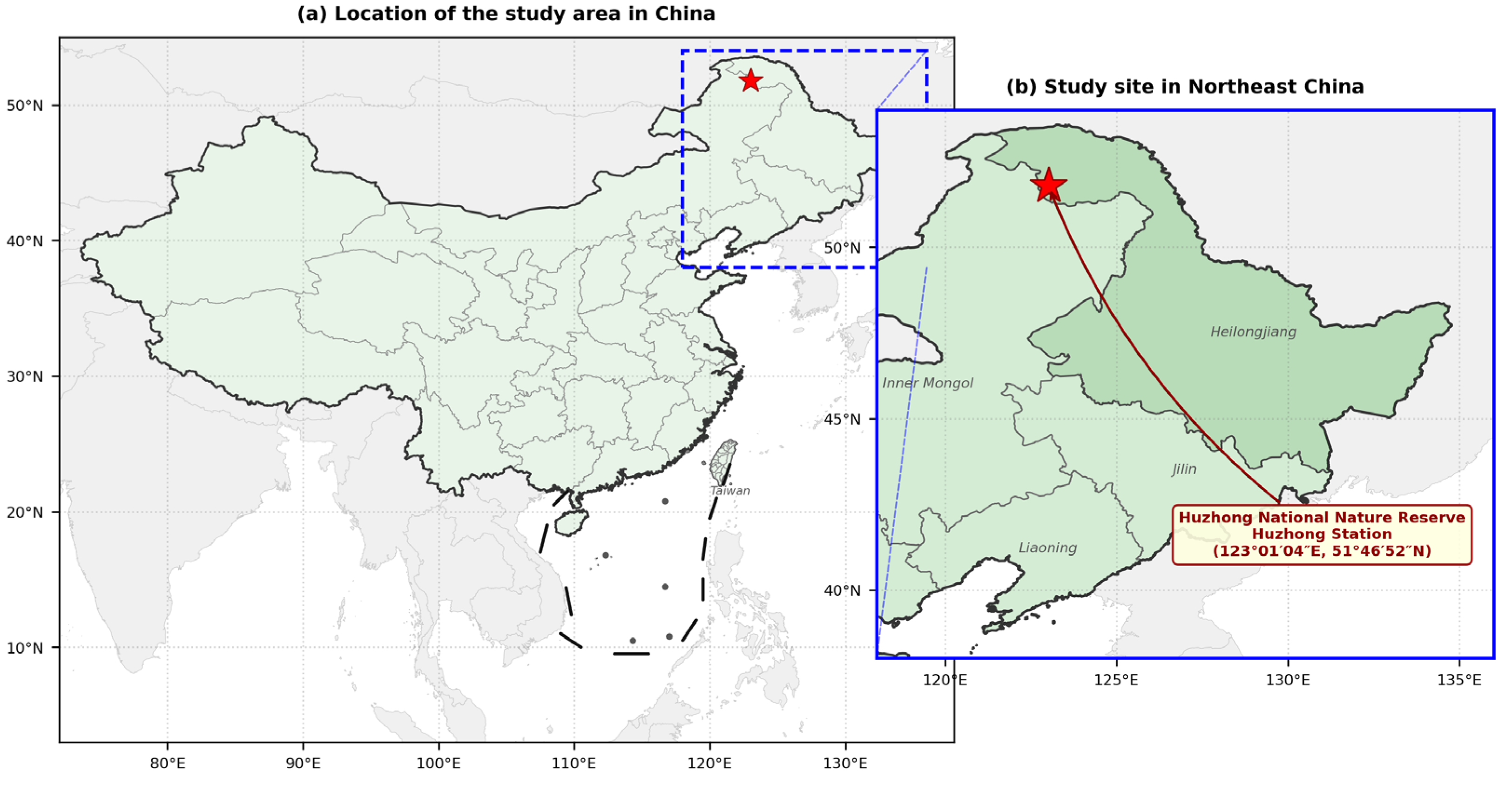
The Research Station of Cold, Temperate Coniferous Forest Ecosystems in Northern China (123°01′04″ E, 51°46′52″ N) is located within the Huzhong National Nature Reserve in Heilongjiang Province, which is the largest nature reserve for cold, temperate coniferous forest ecosystems in China, as shown in
Figure 1. The vegetation type is classified as a zonal cold, temperate coniferous forest, with Larix gmelinii (Dahurian larch) as the single dominant tree species, mixed with a small amount of Betula platyphylla (White birch) and Pinus sylvestris var. mongolica (Mongolian Scotch pine). The average tree height is 15 m, and the understory shrub layer is well developed. Brown coniferous forest soil is the most representative soil type in this region.
It should be noted that this study focuses on proposing and validating a methodological framework—namely, developing and evaluating a deep learning model that incorporates ecological process constraints to improve the ecological realism and interpretability of high-temporal-resolution carbon–water flux predictions—rather than attributing long-term climate change trends.
Consistent with this objective, we used continuous, quality-controlled observations from 2014 to 2018 at the Huzhong site from the shared database of the China Terrestrial Ecosystem Flux Observation and Research Network (ChinaFLUX). The dataset includes net ecosystem exchange (NEE), latent heat flux (LE), and auxiliary meteorological and soil environmental variables such as air temperature, radiation, soil temperature, and volumetric soil water content, all at a 30 min temporal resolution. These data are continuous and complete over the selected period, enabling a chronological train–validation–test split and ensuring reproducible comparisons. They also cover the major seasonal processes and representative hydrothermal variability in the study region, providing an empirical basis for model performance evaluation and tests of mechanistic consistency.
We also acknowledge the importance of further assessing model robustness under more recent climatic conditions; once additional years of high-quality data become available for this site, we will conduct extended training and independent validation.
3. Methodology
This paper constructs a systematic modeling framework designed for the prediction of carbon–water fluxes and the analysis of ecological processes in cold, temperate coniferous forests. This framework utilizes a Multi-Channel Fusion Attention BiLSTM (MCF-ABiLSTM) model [
36,
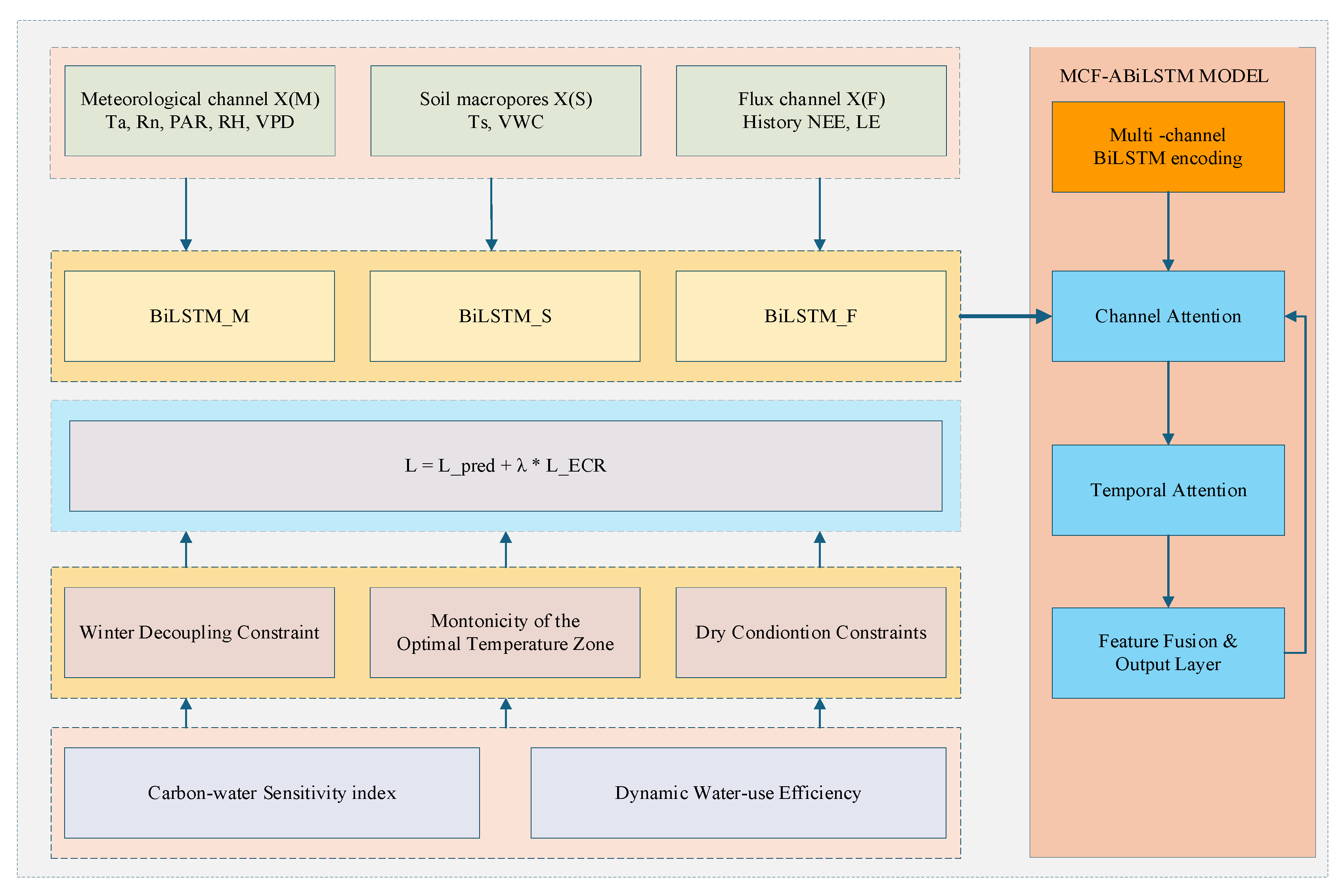
40] to structurally represent heterogeneous driving factors—such as meteorology, soil, and historical fluxes—thereby achieving joint modeling of the dynamic variations in NEE and LE. Building on this, dynamic Water Use Efficiency (dWUE) and Sensitivity of Carbon–Water (SCW) indices are introduced to characterize the coupled carbon–water responses under humidity and temperature gradients. The stable ecological relationships revealed by these indices are formalized as ecological process consistency constraints and explicitly embedded into the model training process, guiding the model to learn results that conform to known physiological regulatory characteristics. Finally, Flux Contribution Decomposition (FCD) is employed to analyze the model’s response structure to key environmental factors, evaluating the consistency between the model’s internal decision-making features and the carbon–water regulatory mechanisms of cold, temperate coniferous forests at the driver level. The overall methodological framework is illustrated in
Figure 2.
Compared to most existing data-driven studies that primarily focus on single-flux prediction or post hoc interpretation, the methodological novelty of this paper lies in integrating multi-channel structured representation, ecological process consistency constraints, and response-structure mechanistic verification into a unified closed-loop framework. This includes separate channel encoding and dual attention fusion to enhance the extraction of key driving information and achieve joint NEE–LE modeling; constructing carbon–water coupling indicators based on dWUE and SCW, formalizing the stable relationships they reveal as Eco-Consistency Regularization (ECR) to impose mechanistic consistency guidance on the model’s learning process during training; and further leveraging of FCD to translate the model’s comprehensive response structure into ecologically meaningful seasonal-scale driving contributions, systematically verifying whether the model’s internal decision logic is consistent with observed ecological characteristics.
3.1. Multi-Channel Fusion Attention BiLSTM Model (MCF-ABiLSTM)
Variations in NEE and LE are co-regulated by multiple environmental factors, including radiation, temperature, atmospheric dryness, and soil moisture. Different types of variables exhibit significant differences in physical attributes, temporal scales, and statistical characteristics. Employing a simple feature concatenation approach under conditions of high collinearity tends to weaken the model’s ability to identify key driving information. To address this, we constructed a Multi-Channel Fusion Attention Bidirectional Long Short-Term Memory (MCF-ABiLSTM) network. Input variables are divided into independent channels based on their physical attributes. A BiLSTM network [
41,
42] is used to extract the internal temporal dependency structure of each channel, followed by channel attention and temporal attention mechanisms [
43,
44], to perform cross-channel feature fusion and weighting, thereby realizing the joint modeling of NEE and LE.
To clearly characterize the heterogeneity in how carbon–water fluxes are controlled by different process pathways and to enhance the model’s ability to identify key driving signals, we partitioned the input variables into three channels based on their physical meanings: meteorological drivers, soil environmental conditions, and historical fluxes, denoted as
Specifically, the meteorological channel primarily represents atmospheric energy supply and evaporative demand. Net radiation, photosynthetically active radiation, and air temperature jointly determine the photosynthetic and energetic background, while vapor pressure deficit (VPD) characterizes atmospheric evaporative demand and reflects the strength of stomatal regulation; therefore, it imposes critical constraints on both NEE and LE. The soil channel is used to describe hydrothermal conditions in the rooting zone, where soil temperature and volumetric water content directly affect plant water uptake and evapotranspiration. In cold, temperate coniferous forests, soil hydrothermal conditions are also closely linked to freeze–thaw processes, which, in turn, influence the coupling between carbon uptake and water consumption. The historical flux channel captures ecosystem time lags and memory effects, reflecting phenological status and the persistent influence of antecedent hydrothermal conditions. This structured input design helps retain key driving information under strong multicollinearity and improves the model’s process consistency and ecological interpretability.
The input variables for each channel are described as follows:
- (1)
Meteorological Channel (): Contains meteorological factors characterizing energy input and atmospheric evaporative demand, including air temperature (), net radiation (), photosynthetically active radiation (PAR), relative humidity (RH), and vapor pressure deficit (VPD);
- (2)
Soil Channel (): Contains soil temperature () and volumetric water content (VWC) at different depths;
- (3)
Flux Channel (): Contains historical NEE and LE and is used to extract internal system memory features.
Each channel consists of a vector sequence of length
T:
where
and
represents the input vector of channel
c at time step
t.
Since the response of carbon–water fluxes to environmental changes exhibits significant time-lag effects and the current flux state is often influenced by both past cumulative conditions and adjacent temporal information, we employ a Bidirectional Long Short-Term Memory (BiLSTM) network to encode each channel sequence. This allows for the simultaneous capture of forward and backward temporal dependency features. Each input channel is encoded by an independent BiLSTM network to extract the intra-channel temporal structure. For each input channel, the forward and backward hidden states are calculated as follows:
where
is the forward hidden state,
is the forward state at the previous time step,
is the backward hidden state, and
is the backward state at the subsequent time step.
The bidirectional fusion is obtained as follows:
where
is the final hidden representation of channel
at time step
. The hidden- state sequence for the entire channel is expressed as follows:
The BiLSTM network is capable of capturing non-linear correlations across time steps. However, since different variable categories influence NEE and LE to varying degrees, the model needs to adaptively weight the contribution of each channel. The channel attention is calculated as follows:
First, pooling is performed for each channel:
where
is the compressed vector representation of channel c. Then, the channel attention weights are calculated:
where
is a trainable scalar parameter allowing the model to learn the importance of different channels. The fused channel representation is expressed as follows:
Through the channel attention mechanism, the model can adaptively learn the relative weights of different input channels during the training process for joint prediction, thereby reflecting the differential contributions of various categories of environmental factors to carbon–water flux variations at the structural level.
Flux variations are influenced by processes such as radiation bursts, temperature lags, precipitation events, and soil water replenishment, resulting in inconsistent validity across different time steps. To highlight critical time periods, a temporal attention mechanism is used:
First, a linear transformation is applied to the hidden vector at each time step:
where
is a trainable weight matrix responsible for mapping the hidden state (
) to the attention space and b is the bias vector. The attention score is calculated as follows:
where
is a trainable vector used to project the features after non-linear activation into a scalar score (
et). The temporal attention weights are obtained via normalization:
The temporal attention weights reflect the degree to which the model utilizes information from different time steps rather than a direct characterization of causal relationships in ecological processes.
The context vector is obtained by the weighted sum over the time dimension:
This mechanism highlights the critical moments affecting NEE and LE. The final prediction is given through a linear layer:
where
is the predicted output and
and
are the output-layer weight matrix and bias parameters, respectively. Since NEE and LE are intrinsically linked through physiological processes such as stomatal regulation and energy partitioning, joint modeling helps to characterize their commonalities and differences within the same framework, providing a consistent predictive basis for subsequent ecological process constraints and mechanism analysis.
3.2. Construction of Carbon–Water Relationship Indices
To quantitatively characterize the synergistic variation features of carbon uptake and evapotranspiration processes in cold, temperate coniferous forest ecosystems, this study introduces two statistical indices based on eddy covariance flux observation data: dynamic Water Use Efficiency (dWUE) and the Sensitivity of Carbon–Water coupling (SCW). These indices are utilized to delineate the response characteristics of carbon–water processes under humidity and temperature gradients.
3.2.1. Dynamic Water Use Efficiency (dWUE)
Dynamic Water Use Efficiency (dWUE) is defined as the carbon uptake efficiency per unit of evapotranspiration, reflecting the relative variation relationship between ecosystem carbon exchange and water consumption. Compared to traditional water use efficiency indices, dWUE emphasizes dynamic characteristics in response to changing environmental conditions, making it suitable for analyzing the synergistic response of carbon–water processes under varying humidity backgrounds.
First, daily Gross Primary Productivity (
) is derived from flux data, and daily Evapotranspiration (
) is calculated using Latent Heat Flux (LE). Since the site observations provide LE at a 30 min resolution, the daily-scale evapotranspiration flux is converted using the following formula:
where
is the latent heat of vaporization,
is the density of water,
represents the length of each time step (30 min), and
Nt is the number of time steps on day
. Atmospheric dryness is represented by the daily mean Vapor Pressure Deficit (
), calculated from air temperature and saturation vapor pressure. Based on this, we define the following [
45]:
To avoid interference from nighttime and invalid evapotranspiration, only daily samples satisfying the following conditions are retained for dWUE calculation: daily net radiation of and daily evapotranspiration of .
Changes in dWUE are used to reflect the relative response characteristics of carbon–water processes rather than directly representing quantitative parameters of stomatal scale or vegetation physiological processes. This index emphasizes the reinforcing effect of atmospheric dryness on evaporative demand. By correcting for ET, dWUE characterizes the variation in carbon uptake efficiency relative to water consumption under different humidity conditions. When rising VPD causes stomatal closure, GPP declines while ET maintains a high level, resulting in a decrease in dWUE; conversely, during the growing season with sufficient light and fully open stomata, dWUE typically reaches its maximum.
3.2.2. Sensitivity of Carbon–Water Coupling (SCW)
In cold, temperate coniferous forest ecosystems, rising temperatures typically enhance both photosynthesis-related enzyme activity and evapotranspiration potential simultaneously. However, the response rates of Net Ecosystem Exchange (NEE) and Latent Heat Flux (LE) to temperature changes are inconsistent. This asymmetric response of carbon uptake and evapotranspiration processes to temperature gradients is a key feature of carbon–water processes in cold, temperate forests. To quantitatively characterize the effect of the relative driving intensity of temperature changes on carbon uptake and evapotranspiration, we constructed the Sensitivity of Carbon–Water coupling (SCW) index.
To eliminate the influence of the NEE sign convention (where uptake is negative and emission is positive) on sensitivity analysis, the daily-scale net carbon uptake flux is defined as follows:
where
is the daily net ecosystem exchange observed from fluxes. By negating the value,
indicates enhanced net carbon uptake, thereby aligning the sign significance of the carbon flux with LE and ET (which take positive values as they increase), facilitating subsequent comparative analysis.
SCW is constructed based on the local linear response relationships of carbon and water fluxes to temperature changes. The specific steps are outlined as follows:
All daily-scale samples are binned at 1 °C intervals based on the daily mean air temperature (), forming a set of temperature bins {}, where the k-th temperature bin satisfies . Only daily samples meeting the following conditions are retained for fitting: daily net radiation of , daily evapotranspiration of , and a number of valid samples within each temperature bin of . Bins with insufficient samples are ignored.
Univariate linear regression is performed on the data within each temperature bin (
):
where
and
represent the statistical sensitivity of carbon uptake and water flux to temperature within bin
, respectively. The purpose of using local linear regression is to obtain a first-order approximation of the non-linear temperature response curve, thereby characterizing the relative sensitivity of carbon and water fluxes to temperature variations. This method emphasizes the direction and relative intensity of response trends rather than precise functional forms, making it suitable for comparing differences in carbon–water process response structures across different temperature ranges and seasonal scales. Based on this, the SCW index is defined for each temperature bin (
):
Given indicates that warming enhances net carbon uptake, while indicates that warming inhibits it, generally indicates that rising temperature enhances evapotranspiration. Therefore, the value of SCW characterizes the relative features of carbon–water processes in response to temperature changes:
(1) : The enhancing effect of rising temperature on carbon uptake is relatively stronger than that on evapotranspiration, interpreted as “carbon response-dominant”;
(2) : The response of evapotranspiration to temperature is stronger than that of carbon uptake, interpreted as “water response-dominant”;
(3) : Carbon uptake is insensitive to temperature, while evapotranspiration continues to vary with temperature, typically corresponding to frozen periods or stages where photosynthesis is limited.
In this paper, SCW serves as a statistical sensitivity index constructed based on flux observation data. Its numerical variations reflect the relative response relationship of carbon–water processes under temperature gradients rather than characterizing causal mechanisms or quantitative parameters of specific eco-physiological processes.
3.3. Ecological Process Consistency Constraints
To introduce ecological consistency constraints of carbon–water processes into the model training process, this study incorporates Eco-Consistency Regularization (ECR) [
46] alongside the primary prediction loss. ECR is constructed based on the observed statistical characteristics characterized by dWUE and SCW. By penalizing prediction patterns that significantly deviate from stomatal regulation, temperature responses, and seasonal coupling characteristics, it provides flexible guidance for model training. The overall loss function is defined as follows:
where
is the sum of mean squared errors for NEE and LE and
λ > 0 is the total weight for ECR. In this study, we set λ = 0.1.
ECR consists of three constraint terms:
where
α,
β, and
γ > 0 are the weights for each constraint term. We set
α = 1.0,
β = 0.5, and
γ = 0.5. To ensure the differentiability of the penalty terms, the softplus function is adopted as a smooth hinge function:
The values of λ, α, β, and γ primarily balance the relative influence intensity between the main prediction loss and the consistency constraint terms during training. We adopt a moderate weighting configuration, allowing ECR to constrain prediction patterns that significantly deviate from ecological consistency without dominating model training.
3.3.1. dWUE Constraint Term
Since the model outputs are NEE and LE, to construct a computable carbon–water efficiency proxy during training, we approximate carbon uptake intensity using the predicted daily-scale net carbon uptake, i.e.,
. Combining this with the observed
and
converted from the predicted LE, we define the predicted consistency dWUE index as follows:
To apply constraints only under daytime and dry conditions, a dry sample set is defined:
where
. This value is used to identify scenarios with significantly enhanced atmospheric evaporative demand and is consistent with empirical ranges commonly used in studies on stomatal regulation and evapotranspiration response, effectively distinguishing between non-stressed and transpiration-limited states.
The dWUE constraint term is defined as follows:
This term penalizes prediction patterns where , thereby suppressing combinations that are clearly inconsistent with physiological expectations, such as “negative (or significantly declined) net carbon uptake while evapotranspiration remains high” under high-VPD conditions.
3.3.2. Winter SCW Constraint Term
The annual daily-scale samples are binned by daily mean temperature () at 1 °C intervals. For samples within each temperature bin (), the local slopes ( and ) are estimated using least squares linear regression.
The winter set is defined as follows:
Let
be the set of temperature bins corresponding to winter. The average winter sensitivity is defined as follows:
Setting an allowable residual threshold of
, the winter constraint term is expressed as follows:
This term pushes SCW during the frozen period towards 0, penalizing anomalous prediction patterns where “carbon–water processes still exhibit strong coupling/sensitivity under low-temperature conditions”.
3.3.3. Optimal Temperature-Zone Monotonicity Constraint Term
To constrain photosynthesis to show a monotonically increasing SCW with temperature within the optimal temperature zone, we define the optimal zone as follows:
This range references common reports on the optimal temperature for photosynthesis in the growing season of cold, temperate coniferous forests and is used to characterize the overall trend of the responses of carbon–water processes to temperature. This range is used only to constrain directional response features rather than assuming strict physiological thresholds.
Based on temperature binning, we take the sequence of temperature bins
located within
and calculate the SCW increment between adjacent bins:
A softplus penalty is applied to all negative increments:
A penalty is generated when , guiding the SCW within the optimal temperature zone to exhibit an overall monotonically increasing trend with temperature.
3.3.4. Implementation Details
ECR is calculated synchronously with the main loss () during model training. Specifically, in each training iteration, dWUE and temperature-flux scatter points are first calculated based on the current batch predictions . Local slopes and SCW values for each temperature bin are estimated for the batch samples. Then, , , and are obtained according to the above formulas and weighted to derive . During backpropagation, the derivative of is used to update the network parameters. ECR aims to provide training guidance for the MCF-ABiLSTM at the level of ecological consistency rather than forcing a causal description of ecological processes.
The thresholds and temperature intervals adopted in ECR are not intended as universal physiological constants but serve to characterize the typical response ranges of cold, temperate coniferous forests at the study-site scale. Their specific values may shift with site climatic background, vegetation type, and soil conditions. Future research could further improve the applicability and transferability of this constraint framework across different ecosystems by introducing multi-site joint training or parameter-adaptive strategies.
3.4. Flux Contribution Decomposition (FCD) Method
Under conditions of high-dimensional and multi-source inputs, the predictive results of deep learning models are difficult to interpret directly in terms of the structure of their dependency on different environmental driving factors. To quantitatively analyze the response characteristics of the MCF-ABiLSTM model to major environmental factors when predicting Net Ecosystem Exchange (NEE) and Latent Heat Flux (LE), this paper constructs a Flux Contribution Decomposition (FCD) [
47] method. This method transforms the model’s comprehensive sensitivity to input variables into degrees of ecologically meaningful relative driving contributions and analyzes the model’s internal decision-making structure on a seasonal scale. Given the non-linear characteristics and high-dimensional input nature of deep learning models, we adopt a linear surrogate model on a seasonal scale to approximate the model’s local response structure, thereby improving the stability of contribution estimation.
For each season, five key environmental factors are selected: air temperature (
), vapor pressure deficit (VPD), volumetric water content (VWC), wind speed (WS), and net radiation (
). A standardized explanatory variable matrix is constructed as follows:
where
is the standardized time series of the
-th environmental factor and the flux (
) predicted by MCF-ABiLSTM is also standardized. Subsequently, a linear surrogate model is constructed on a seasonal scale:
where
is the vector of regression coefficients and
is the residual term. Since both
and
are standardized, the absolute value of the coefficient
can be regarded as the relative intensity of influence of that factor on the model’s prediction. To facilitate the comparison of the relative importance of different environmental factors within the same season, the regression coefficients are normalized, defining the flux contribution decomposition index as follow:
represents the relative proportion of the contribution of the i-th environmental factor to the variations in the model-predicted flux within a given season. FCD reflects the structure of the relative sensitivity of the model’s prediction results to different environmental variables rather than a direct quantification of causal relationships in real ecological processes. By comparing the FCD distributions of , VPD, VWC, WS, and across different seasons, the dominant environmental drivers of carbon–water processes in cold, temperate coniferous forests and their seasonal transition patterns can be identified. Furthermore, comparing FCD analysis results with dWUE, SCW, and structural features of carbon–water coupling helps verify the consistency between the internal decision structure of the MCF-ABiLSTM model and known carbon–water process characteristics at the driver level.
4. Experiments and Analysis of Results
This chapter validates the methodological innovations of this study and focuses on addressing three questions: (1) whether multi-channel structured representation and dual-attention fusion further improve the stability of joint NEE–LE predictions compared with traditional feature-concatenation models; (2) whether introducing consistency constraints ecological processes based on dWUE and SCW enhances ecological realism and carbon–water coupling consistency while maintaining predictive performance; and (3) whether flux contribution decomposition (FCD) can translate the deep model’s integrated response structure into ecologically meaningful, seasonal-scale driver contributions, thereby providing testable evidence for mechanistic interpretation. Compared with existing flux-modeling studies that target a single flux or rely mainly on post hoc explanations, this chapter emphasizes an integrated validation pathway of “prediction–constraint–interpretation.”
To systematically evaluate the prediction performance, ecological process representation capability, and mechanistic consistency of the MCF-ABiLSTM model, this paper establishes a three-layer experimental system covering “Model Performance—Ecological Process Response—Driving Factor Mechanism”. First, we compare and analyze the performance of MCF-ABiLSTM against various benchmark models in predicting NEE and LE from the perspective of prediction accuracy. Second, combining dWUE, SCW indices, and the Flux Contribution Decomposition (FCD) method, we analyze the carbon–water response characteristics of cold, temperate coniferous forests from the perspectives of carbon–water efficiency, temperature sensitivity, and driving-factor contribution and verify the consistency between the model’s internal decision structure and known ecological processes.
It is important to emphasize that the conclusions of this study primarily demonstrate the effectiveness of the proposed framework at the site scale and should not be interpreted as unconditional extrapolation to broader cold, temperate forest regions. Regional-scale generalization requires joint training on multi-site datasets and independent validation. Overall, the ecologically constrained approach based on carbon–water coupling is potentially transferable; however, parameters involved in the constraints may vary with climatic context, vegetation composition, and soil conditions and, thus, should be re-estimated in multi-site applications or learned adaptively through data-driven approaches.
4.1. Experimental Designs
The experiments were implemented in a Linux environment based on Python 3.10 and TensorFlow 2.14. To evaluate the model’s prediction performance, the dataset was partitioned chronologically, as shown in
Table 1.
To systematically assess the role of each key module in the model’s structural design, multiple categories of comparison models were set up, covering traditional machine learning methods, single-channel recurrent models, multi-channel models without attention, and single-output models. The specific structural features and comparison objectives are shown in
Table 2.
4.2. Model Configuration and Training Details
The construction of the model input, network architecture, and training strategy are described as follows. Model inputs are generated using a sliding-window scheme: a historical sequence of 48 time steps (corresponding to 24 h) is used to predict NEE and LE at the next time step. Three input channels—meteorology, soil, and flux—are configured in the input layer. The three subnetworks share the same architecture but use independent parameters to prevent different information sources from interfering with representation learning.
Each channel consists of two stacked BiLSTM layers, with 64 hidden units per direction in each layer. After concatenating the bidirectional outputs, a 128-dimensional hidden representation is obtained. Dropout regularization is applied to the output of the second BiLSTM layer before it enters the attention module, with a dropout rate of 0.3. Dropout is applied both between the two BiLSTM layers and before the attention module to reduce the risk of overfitting. The model also incorporates L2 regularization, with the weight decay coefficient set to .
In the feature-fusion stage, channel attention is first applied to adaptively weight the representations from the three channels. The channel attention module uses a single fully connected mapping, with the channel embedding dimension set to 64. Next, a temporal attention mechanism is introduced on the fused sequential representation to capture differences in the contributions of historical time steps to the prediction; the projection dimension of the temporal attention module is also set to 64. This yields a 128-dimensional context vector, which is then used to jointly produce the predicted NEE and LE outputs.
For training, the model uses the Adam optimizer with an initial learning rate of 0.001, a batch size of 128, and a maximum of 200 epochs. To prevent overfitting and improve training efficiency, we apply early stopping based on the validation-set RMSE (patience = 20): training is terminated when the validation metric shows no improvement for 20 consecutive epochs, and the model weights are restored to those from the epoch with the best validation performance. To assess training stability and the robustness of the results, all models are independently trained three times under different random initializations, and the final results are reported as the mean across the three runs.
4.3. Data Preprocessing
To ensure the stability of model training and the physical rationality of ecological index calculations, systematic preprocessing was performed on the raw observation data:
(1) Flux-Data Quality Control: For flux data, gap-filled NEE and LE were used as final prediction targets. Anomalous spikes and physically unreasonable values were removed based on empirical thresholds. To ensure the stability and physical consistency of ecological indices constructed based on LE, this study adopted the minimum energy-flux threshold method recommended by FLUXNET to correct LE [
48].
(2) Meteorological-Data Gap Filling: For short-term and long-term gaps in meteorological driving factors, linear interpolation and the Marginal Distribution Sampling (MDS) method based on boundary conditions were employed for filling, respectively. Subsequently, flux data were aligned with meteorological and soil data to a uniform 30 min temporal resolution via timestamp alignment. On this basis, input sequences for meteorological, soil, and flux channels were constructed using a sliding-window approach and matched with corresponding future NEE and LE prediction targets.
(3) Standardization: All input variables were z-score-standardized based on the mean and standard deviation of the training set to eliminate dimensional differences and improve the stability of model training under multi-source input conditions. The validation and test sets were processed using the same standardization parameters.
4.4. Evaluation Metrics
Three metrics—Root Mean Square Error (RMSE), Mean Absolute Error (MAE), and Coefficient of Determination (
)—were selected to evaluate model accuracy.
where
is the t-th observed value,
is the t-th predicted value, and N is the number of samples.
4.5. Evaluation of Model Prediction Performance
Based on the 2018 test set from the Huzhong station, the performance of eight categories of models in predicting NEE and LE was systematically compared. The results are presented in
Table 3 and
Table 4.
The NEE prediction results (
Table 3) show that traditional machine learning models, i.e., RF and SVR, yielded RMSEs of 0.1387 and 0.1340, with
values of only 0.5460 and 0.5760, respectively. This indicates that under conditions of complex driving factors, significant non-linear relationships, and obvious time lags, traditional methods struggle to fully characterize the high-frequency fluctuations and diurnal characteristics of carbon fluxes. Upon the introduction of temporal dependency modeling, single-channel LSTM and BiLSTM reduced RMSE to 0.1250 and 0.1199 and improved
to 0.6306 and 0.6614, respectively, demonstrating that recurrent neural networks can effectively enhance the representation of dynamic NEE variations. Building on this, the MC-BiLSTM model, which uses multiple channels but lacks attention mechanisms, further reduced RMSE to 0.1127 and increased
to 0.7004. This suggests that modeling heterogeneous driving factors such as meteorology, soil, and historical fluxes in separate channels helps alleviate feature coupling issues caused by mixed inputs of variables with different physical attributes. With the further introduction of channel and temporal attention mechanisms, the MCF-ABiLSTM model reduced RMSE and MAE in NEE prediction to 0.1047 and 0.0836, respectively, and raised
to 0.7411. Compared to MC-BiLSTM, the RMSE was reduced by approximately 7%, and the coefficient of determination increased by about 0.04. These results indicate that the channel attention mechanism can adaptively distinguish the importance of meteorological, soil, and historical flux information at different stages, thereby improving the model’s responsiveness to dominant environmental drivers. Meanwhile, the temporal attention mechanism helps highlight key time steps that contribute significantly to carbon-flux variations within the diurnal cycle, making the model’s predictions more stable during typical process intervals such as photosynthetic inversion and afternoon evapotranspiration limitation.
The LE prediction results (
Table 4) show a trend consistent with NEE. As the model structure evolved from traditional machine learning to multi-channel, attention-enhanced deep learning models, the RMSE for LE gradually decreased from 21.28 (RF) to 15.82 (MCF-ABiLSTM), and
improved to 0.8866, demonstrating that the proposed model also possesses significant advantages in water-flux prediction.
The performance of single-output models, i.e., NEE-only and LE-only, generally fell between that of MC-BiLSTM and MCF-ABiLSTM. Compared to MC-BiLSTM, the single-output models showed some improvement in RMSE and for their respective fluxes, indicating that specialized modeling for a single flux can improve prediction accuracy to a certain extent. However, under the condition of simultaneously predicting NEE and LE, the MCF-ABiLSTM model still achieved better overall performance. This suggests that the joint prediction strategy helps the model utilize intrinsic coupling information between carbon–water processes, achieving comprehensive performance enhancement without sacrificing accuracy for individual fluxes.
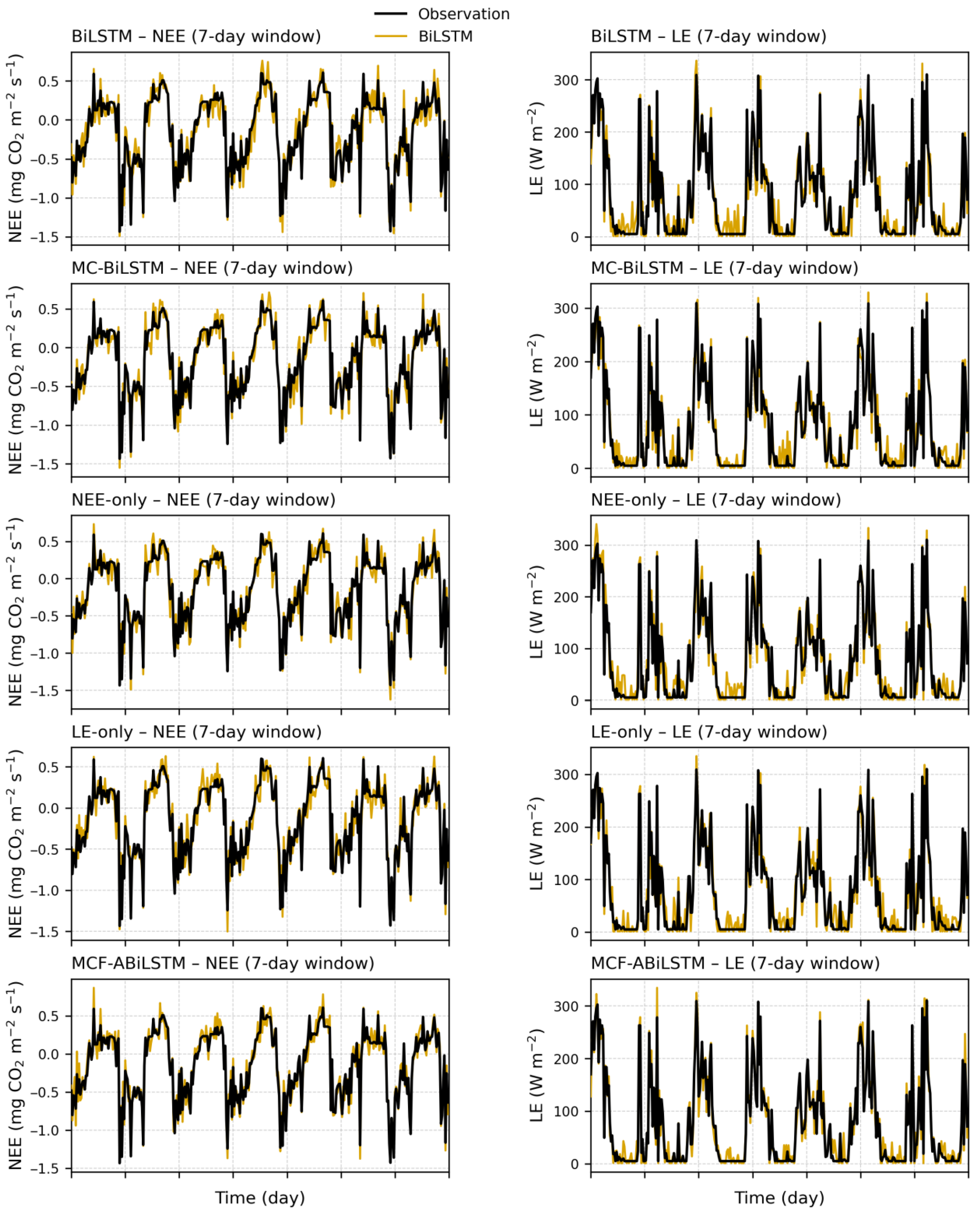
Figure 3 illustrates a comparison between observed values and predictions from various models over a continuous 7-day period (336 time points). This period includes multiple complete diurnal photosynthesis–respiration cycles, serving as a representative sample for testing of the models’ ability to respond to diurnal structures and high-frequency variations. From the prediction results, it can be observed that the prediction curves of RF and SVR deviate significantly from observations in terms of peak magnitude and timing. This is particularly evident during peak carbon uptake at noon and the evapotranspiration peak, where response lags and amplitude errors are prominent. LSTM, BiLSTM, and MC-BiLSTM can better reproduce the diurnal-cycle variations of fluxes, but they still exhibit underestimation or smoothing near extreme values to varying degrees, failing to fully capture short-term fluctuations in some daily segments. In contrast, MCF-ABiLSTM maintains better consistency with observed values in key features such as peak magnitude, timing, and valley recession, demonstrating more stable tracking of diurnal-cycle structures and short-term variations. This indicates that multi-channel feature modeling and the introduction of attention mechanisms contribute to the enhancement of the model’s ability to characterize complex, dynamic carbon–water processes at local temporal scales.
It is worth noting that, compared with NEE, LE is more sensitive to soil moisture supply, energy partitioning, and turbulent exchange conditions, and it is also more susceptible to measurement uncertainty and short-term disturbances. As a result, LE often exhibits greater dispersion during peak periods and phases of rapid variability, making the improvement less visually apparent than for NEE in some graphical comparisons. Nevertheless, the overall statistical metrics and time-series comparisons indicate that the proposed model can still reproduce the diurnal pattern of LE and its event-driven fluctuations reasonably well (see
Table 4 and
Figure 3).
4.6. Seasonal Variation and Environmental Gradient Response of dWUE
This section analyzes the structure of carbon–water efficiency of cold, temperate coniferous forests from two perspectives: the seasonal variation of dynamic Water Use Efficiency (dWUE) and its response to environmental gradients. This analysis provides an ecological baseline for subsequent analyses of temperature sensitivity and coupling relationships.
4.6.1. Analysis of Seasonal Variation Characteristics
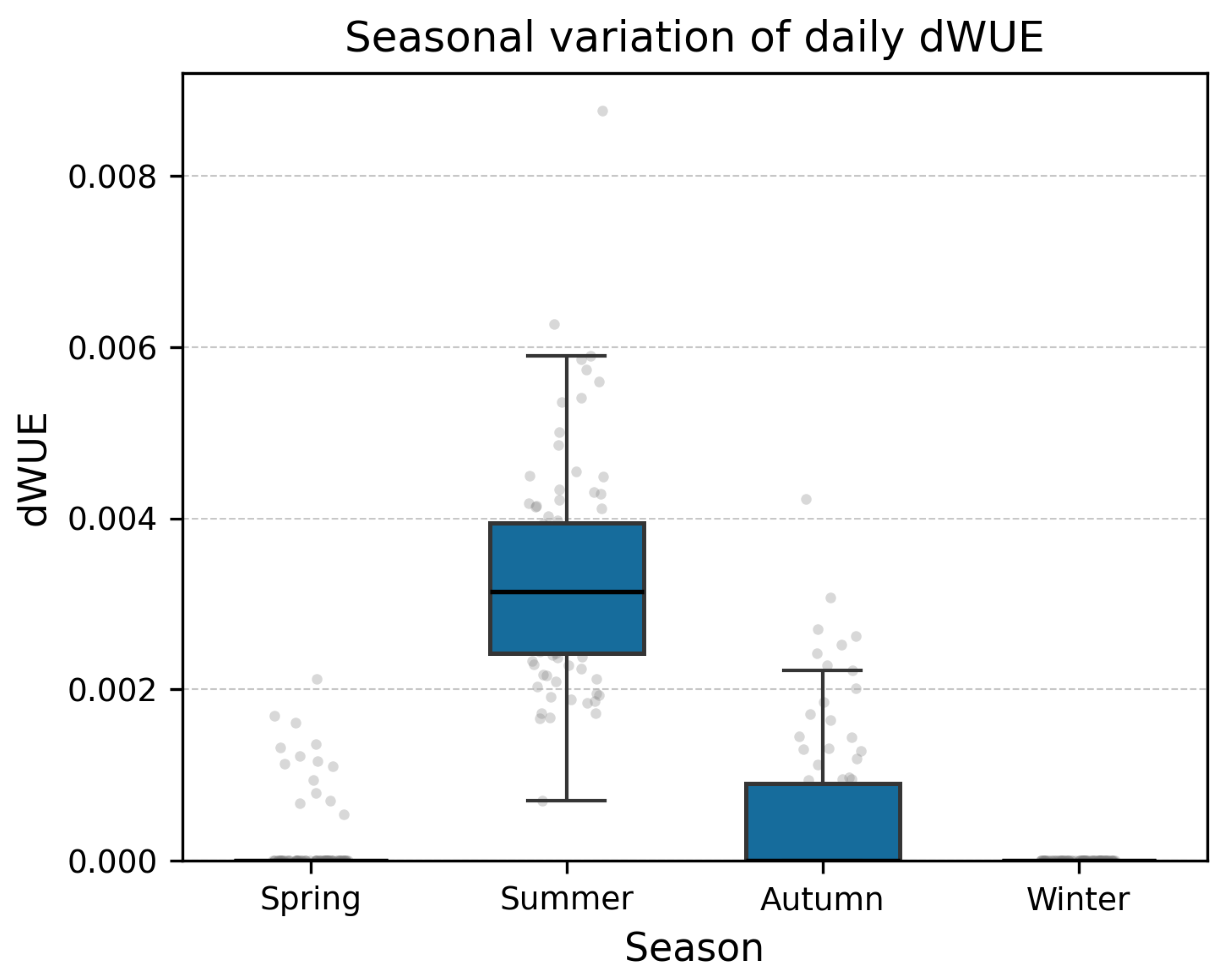
The daily-scale dWUE, calculated based on observed NEE and LE, exhibits significant seasonal differences. The distribution characteristics are shown in
Figure 4, and the statistical results are summarized in
Table 5.
In spring, dWUE is generally at a low level, with a mean of 1.78 × 10⁻⁴ and a median close to zero, reflecting the fact that the synergy between photosynthetic and evapotranspiration processes remains limited during the early recovery period after winter. In summer, dWUE reaches its annual maximum, with a mean and median of 3.29 × 10⁻³ and 3.14 × 10⁻³, respectively, and a wide distribution range. This indicates that under conditions of sufficient light, enhanced stomatal activity, and relatively stable water supply, the synergistic efficiency of carbon uptake and evapotranspiration improves significantly. In autumn, dWUE is noticeably lower than in summer but remains higher than in spring overall. Its distribution characteristics reflect a weakening trend in carbon–water synergy as leaf function gradually declines and radiation conditions weaken. In winter, dWUE approaches zero, indicating that the synergistic relationship between carbon uptake and evapotranspiration is significantly diminished under freezing and dormant conditions.
Overall, the carbon–water use efficiency of cold, temperate coniferous forests is co-regulated by the length of the growing season, the degree of photosynthesis–evapotranspiration synergy, and background energy conditions, exhibiting a seasonal pattern of “highest in summer, followed by spring and autumn, and lowest in winter”. This characteristic aligns with eco-hydrological processes revealed by flux observations in cold, temperate coniferous forests, supporting dWUE as an effective statistical indicator for characterizing seasonal variations in carbon–water efficiency. The seasonal variation of dWUE provides a crucial ecological reference baseline for the subsequent analysis of the model’s ability to characterize carbon–water coupling processes.
4.6.2. Response of dWUE to Environmental Gradients
To further characterize the response of carbon–water efficiency in cold, temperate coniferous forests to changing environmental conditions, this study analyzes the relationship between daily-scale dWUE and variations in Vapor Pressure Deficit (VPD), Air Temperature (), and Volumetric Water Content (VWC).
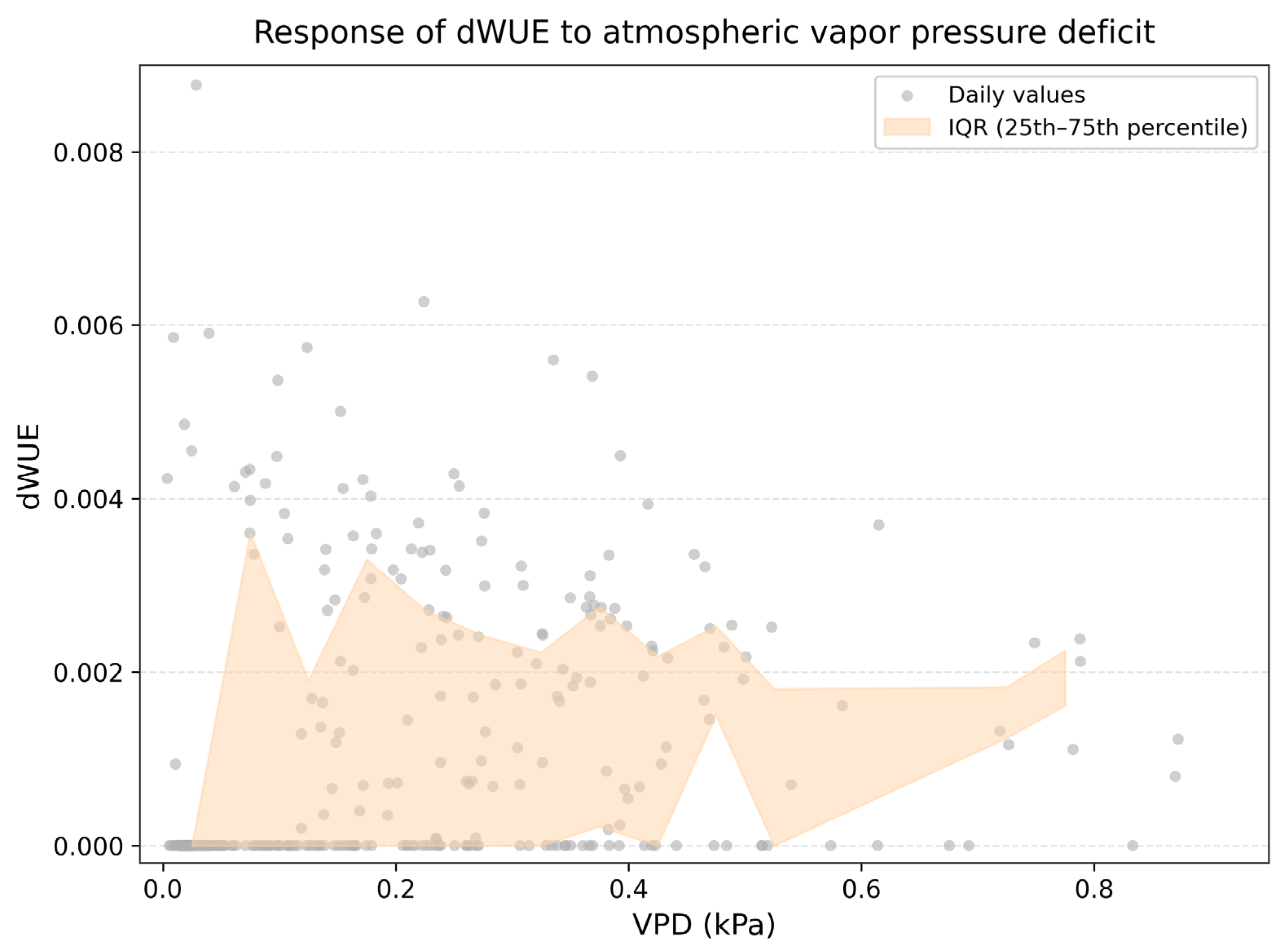
Figure 5 illustrates how dWUE varies across VPD conditions. Overall, under low VPD (<0.2 kPa), the interquartile range (IQR) of dWUE is relatively wide, with a high upper bound, indicating that relatively high dWUE values can still occur under weak atmospheric dryness. As VPD increases to 0.2–0.6 kPa, the IQR of dWUE shifts toward lower values and becomes more concentrated, while the proportion of high dWUE values gradually decreases. This pattern suggests an overall decline in carbon–water efficiency with increasing atmospheric dryness. When VPD rises further (>0.6 kPa), the number of samples decreases markedly, and dWUE is dominated by lower values with limited dispersion, implying that carbon uptake efficiency relative to evapotranspiration is more strongly constrained under high atmospheric dryness.
This pattern is consistent with the ecological response in which vegetation reduces water loss via stomatal regulation under high VPD while simultaneously suppressing CO2 exchange. In other words, as dryness intensifies, GPP typically shows a stronger response to environmental stress than ET, leading to an overall decrease in dWUE. These results indicate that atmospheric dryness plays an important role in regulating carbon–water efficiency in cold, temperate coniferous forests.
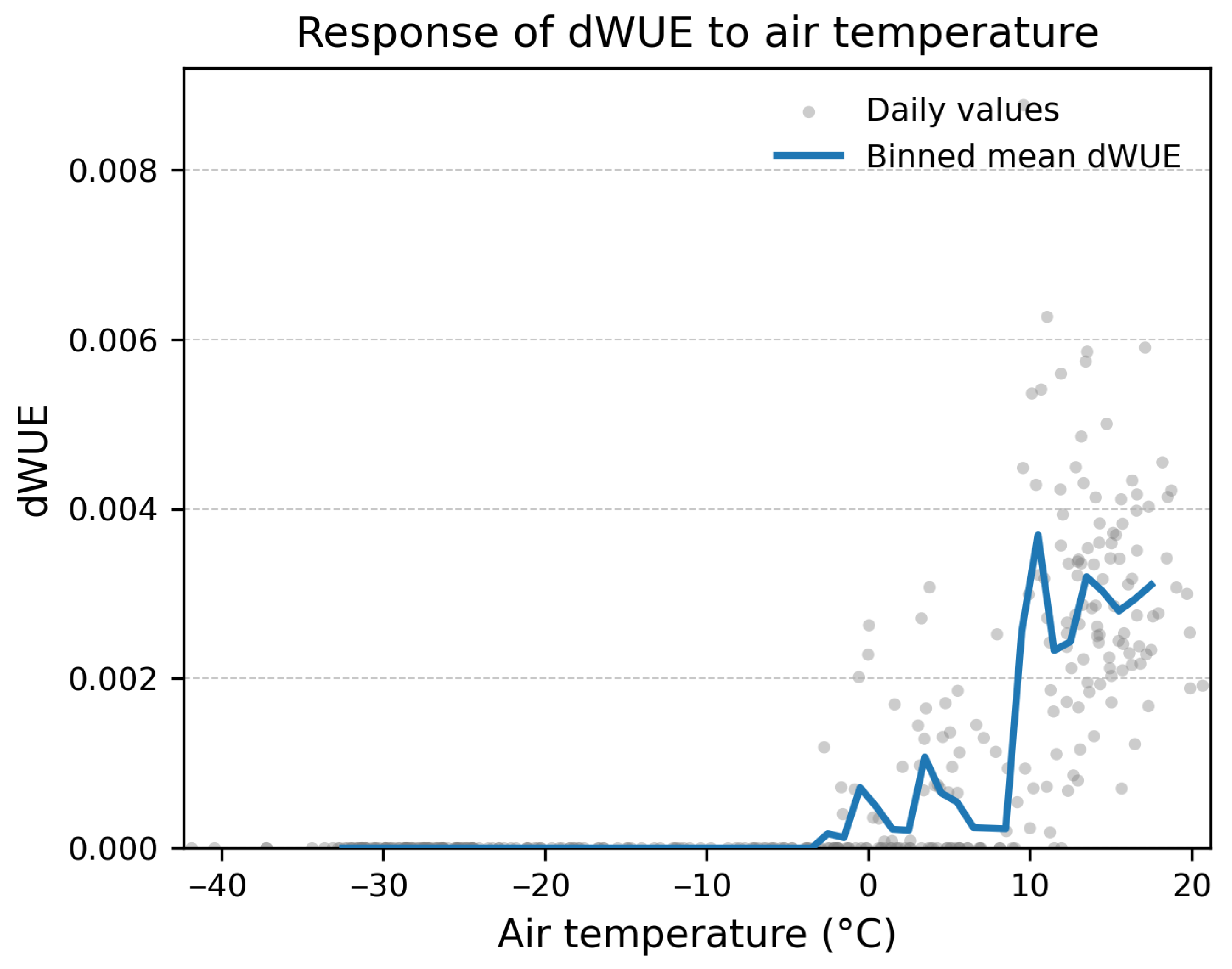
Figure 6 shows the distribution characteristics of daily-scale dWUE with respect to air temperature. When the temperature is below 0 °C, dWUE is close to zero, indicating that carbon–water efficiency is significantly suppressed under low-temperature conditions. As the temperature rises to the range of approximately 5–15 °C, dWUE increases markedly, with the highest concentration of high values, showing a significant improvement in the efficiency of carbon uptake relative to evapotranspiration. When the temperature further rises above approximately 18–20 °C, the overall level of dWUE ceases to increase continuously, and the frequency of high-value samples decreases, exhibiting a certain weakening trend. Overall, the response of dWUE to temperature presents a pattern of “limited at low temperatures, enhanced at intermediate temperatures, and flattening at high temperatures”. This temperature response pattern is consistent with known characteristics of photosynthetic response to temperature in cold, temperate coniferous forest ecosystems: photosynthetic processes are limited under low-temperature conditions, while intermediate temperatures favor enhanced photosynthetic enzyme activity and CO
2 fixation; under higher temperature conditions, increased evaporative demand, accompanied by enhanced stomatal regulation, limits further improvements in carbon–water efficiency.
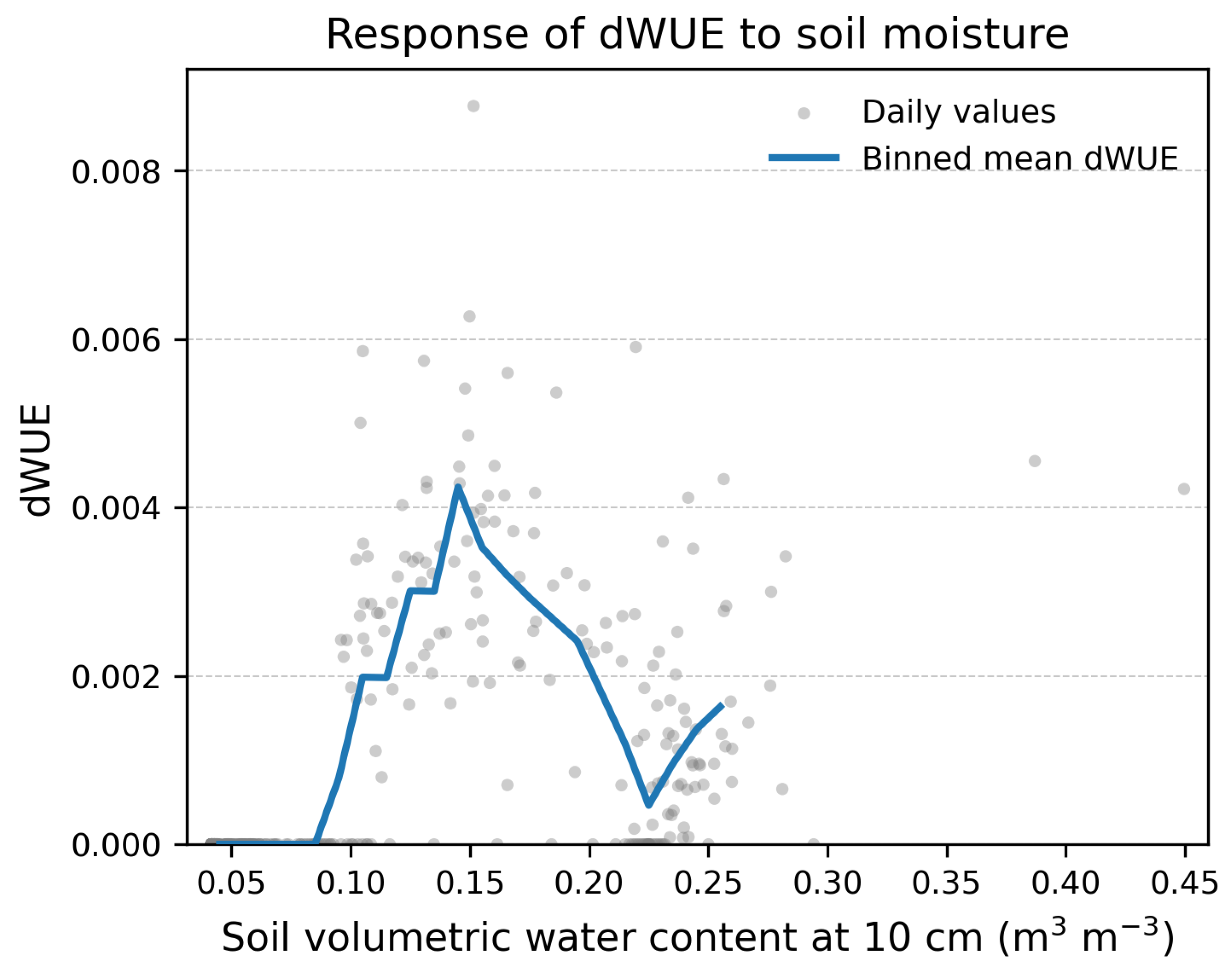
Figure 7 displays the distribution characteristics of dWUE with respect to Soil Volumetric Water Content (VWC). When VWC is below approximately 0.10 m
3 m
−3, dWUE is close to zero, indicating that carbon–water efficiency is significantly restricted under dry soil conditions. As soil moisture increases to an intermediate range of approximately 0.12–0.22 m
3 m
−3, dWUE rises noticeably, with the most concentrated distribution of high-value samples, reflecting significantly enhanced synergistic efficiency between carbon uptake and transpiration processes. When VWC further exceeds approximately 0.25 m
3 m
−3, the overall level of dWUE shows a declining trend, with a reduced proportion of high-value samples. This phenomenon suggests that carbon–water efficiency may be limited to some extent under excessively wet conditions, a response characteristic consistent with known ecological effects such as restricted oxygen diffusion in the root zone and changes in evapotranspiration efficiency under high-soil-moisture conditions. Overall, the response of dWUE to soil moisture exhibits a pattern of “limited when too dry, optimal at intermediate levels, and weakened when too wet”, reflecting the typical optimal soil-moisture-zone characteristic of cold, temperate coniferous forests, where intermediate moisture conditions are more conducive to efficient coupling between carbon uptake and water consumption.
Synthesizing the characteristics of the response to VPD, Air Temperature (), and Volumetric Water Content (VWC), it can be seen that dWUE in cold, temperate coniferous forests exhibits relatively high levels under conditions of low atmospheric dryness, intermediate temperature, and intermediate soil moisture. Conversely, dWUE is generally lower under conditions of high VPD, low or high temperature extremes, and excessively dry or wet soil moisture. This comprehensive response pattern aligns with the known regulatory characteristics of photosynthesis and evapotranspiration processes in cold, temperate coniferous forests, reflecting the synergistic variation modes of carbon uptake and water consumption under different environmental gradients. This provides an important ecological reference background for subsequent model-based analysis of carbon–water coupling mechanisms.
4.7. Temperature Response and Seasonal Structure of Carbon–Water Sensitivity Index (SCW)
To characterize the asymmetric response features of carbon–water processes in cold, temperate coniferous forests from the perspective of temperature driving, this paper calculates the daily-scale Sensitivity of Carbon–Water coupling (SCW) index. We analyze its response relationship with air-temperature variations and its distribution characteristics across different seasons to reveal the relative sensitivity of carbon uptake and evapotranspiration processes to temperature changes.
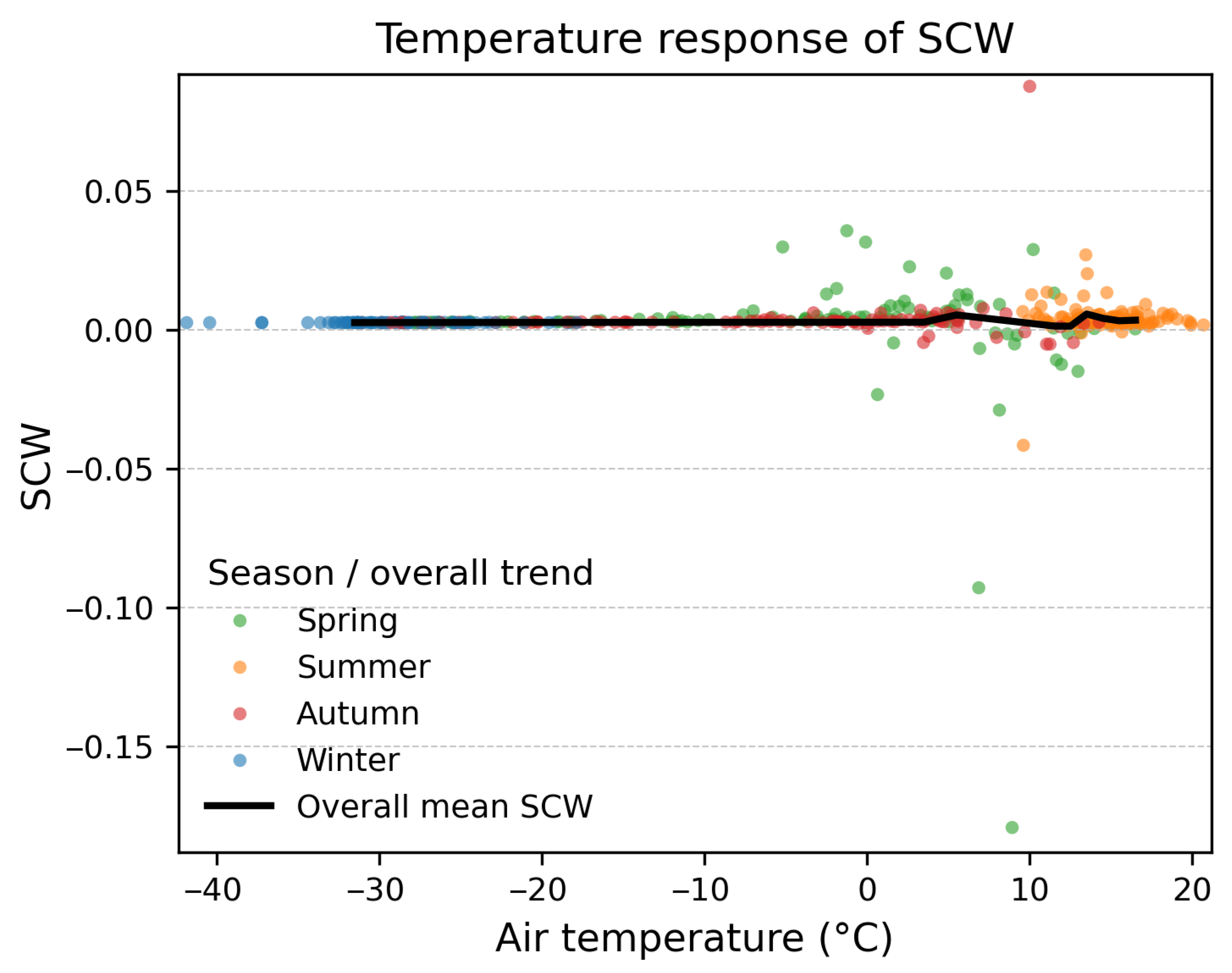
Figure 8 illustrates the distribution characteristics and overall trend of SCW with respect to air temperature. When the temperature is below 0 °C, SCW is basically distributed near zero, indicating that the response of carbon uptake to temperature changes is significantly limited under conditions of frozen periods and that the driving effect of evapotranspiration changes on carbon flux is weak. As the temperature rises to approximately 5–15 °C, the overall level of SCW gradually increases, showing enhanced relative sensitivity of carbon–water processes to temperature changes. Within the temperature range of approximately 10–18 °C, SCW is at a relatively high level, and summer samples are concentrated in this interval. This indicates that within this temperature range, the response of carbon uptake to temperature changes is more sensitive than that of evapotranspiration processes, which can be regarded as the main temperature interval for enhanced carbon–water sensitivity in cold, temperate coniferous forests. When the temperature further rises above 20 °C, SCW does not show a continuing increasing trend; its overall level tends to flatten, accompanied by greater dispersion, reflecting the complication of the response of carbon–water processes to temperature changes under high-temperature conditions.
Overall, the response of SCW to temperature presents a characteristic of “limited at low temperatures, enhanced at intermediate temperatures, and flattening at high temperatures”. This pattern is consistent with the known laws of the responses of carbon uptake and evapotranspiration processes to temperature in cold, temperate coniferous forest ecosystems, providing a quantitative basis for the subsequent introduction of ecological process constraints based on temperature zoning.
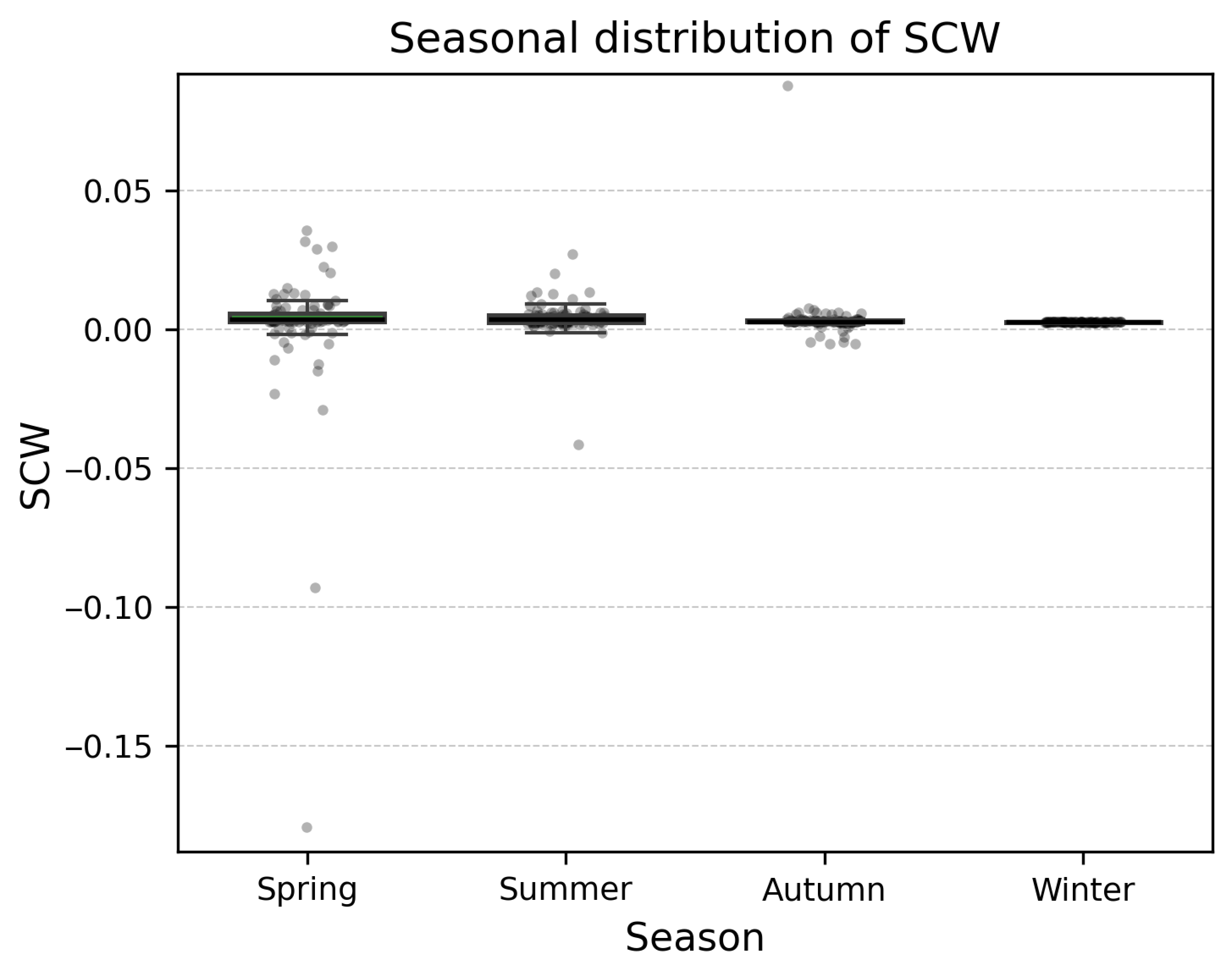
Figure 9 shows the distribution characteristics of the Carbon–Water Sensitivity (SCW) index across different seasons. Winter SCW is almost entirely concentrated near zero, indicating that the response of carbon uptake to temperature changes is significantly limited under low-temperature conditions and that the driving effect of evapotranspiration changes on carbon flux is weak. Spring and autumn SCW values are generally distributed near zero but exhibit some dispersion, reflecting that the sensitivity of carbon–water processes to temperature changes is at an intermediate level during the stages of photosynthesis initiation and senescence. In contrast, summer SCW has a relatively higher overall level and the largest fluctuation amplitude, indicating that during the peak growing season, the response of carbon uptake to temperature changes is more sensitive relative to evapotranspiration processes but is also accompanied by strong uncertainty in environmental regulation.
Integrating the temperature response curve and seasonal distribution characteristics, it can be seen that the carbon–water processes of cold, temperate coniferous forests exhibit a statistical response pattern of “limited at low temperatures, enhanced at intermediate temperatures, and flattening at high temperatures” under different temperature backgrounds. This pattern characterizes the main regulatory features of carbon uptake and evapotranspiration processes with temperature changes in cold, temperate coniferous forests. It provides important observational evidence for the subsequent introduction of ecological process constraints based on temperature zoning into the model and offers ecological background support for the mechanistic interpretation of Flux Contribution Decomposition (FCD) analysis.
4.8. Analysis of Carbon–Water Coupling Types
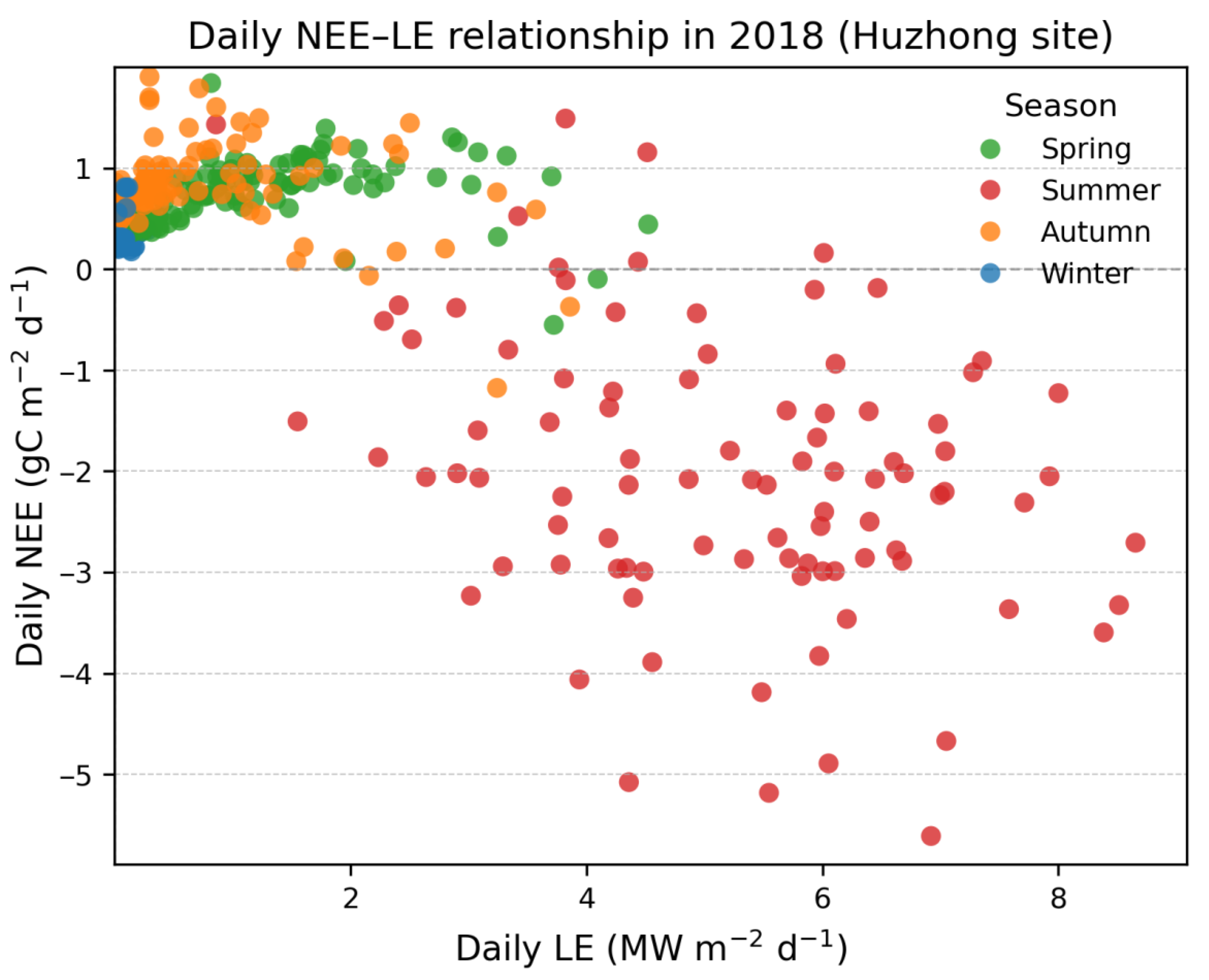
To examine the synergistic or decoupled structure of carbon uptake and evapotranspiration in the ecosystem across different seasons from the perspective of overall carbon–water behavioral relationships, this paper constructs the carbon–water coupling structure based on daily-scale NEE and LE data from flux observations at the Huzhong station in 2018 (
Figure 10). The NEE-LE scatter plot exhibits a typical seasonal stratification structure, which can be categorized into three types of carbon–water relationships: strong negative coupling in summer, weak negative coupling in spring and autumn, and decoupling in winter.
Summer samples (red) are the most dispersed, with LE increasing significantly and NEE extending substantially towards negative values, forming a distinct “High LE–Strong Carbon Sink” band. This feature indicates that as evapotranspiration intensifies, ecosystem carbon uptake deepens significantly, reflecting the strongest synergistic response mechanism between photosynthesis and evapotranspiration in summer. High radiation, high temperatures, and ample water supply in summer collectively promote stomatal opening and sap flow, enabling evapotranspiration-driven water flux to effectively enhance the CO2 assimilation rate. This period represents the strongest carbon-sink capacity of the ecosystem. Therefore, summer can be characterized as a “Strong Negative Coupling” carbon–water structure, where enhanced evapotranspiration drives deeper carbon uptake.
Spring and autumn samples (green and orange) are mainly concentrated in the intermediate LE range, with NEE fluctuating slightly around zero. Compared to summer, the negative slope is significantly weaker, indicating that the enhancing effect of evapotranspiration on carbon uptake is partially limited by temperature, light, or leaf physiological status. In spring, the photosynthetic enzyme system and leaf conductance are still in the recovery phase; in autumn, leaf senescence, combined with declining radiation, leads to reduced photosynthetic potential. Consequently, spring and autumn manifest a “Weak Coupling” carbon–water relationship, where evapotranspiration and carbon uptake still vary synergistically, but the magnitude is significantly lower than in summer.
Winter samples (blue) are highly clustered in a small range where both LE and NEE are close to zero, showing almost no systematic trend. This feature reflects the typical physiological state of cold, temperate coniferous forests during the frozen period: low temperatures cause stomatal closure, photosynthesis nearly ceases, and respiration dominates, resulting in NEE approaching zero and extremely low evapotranspiration. Variations in evapotranspiration cannot drive changes in carbon flux; thus, winter exhibits a typical “Decoupled” structure, where carbon and water processes are completely separated.
This seasonal coupling structure is highly consistent with the carbon–water efficiency and temperature sensitivity characteristics revealed by dWUE and SCW, providing an ecological reference at the behavioral level for the subsequent driving-factor contribution analysis based on FCD.
Integrating the seasonal variation and environmental gradient response of dWUE, the temperature-sensitivity characteristics of SCW, and the daily-scale carbon–water coupling structure of NEE-LE, the synergistic and decoupling mechanisms of carbon–water processes in cold, temperate coniferous forests under different environmental conditions can be systematically revealed. dWUE indicates that the carbon–water use efficiency of cold, temperate coniferous forests has significant seasonality—highest in summer, followed by spring and autumn, and close to zero in winter—and reaches an optimal state under low VPD, intermediate temperature, and suitable soil moisture conditions, reflecting the synergistic enhancement of photosynthetic and evapotranspiration processes during the growing season. The temperature response of SCW further reveals the asymmetric regulatory characteristics of carbon–water processes: carbon and water processes are basically decoupled during the frozen period; in the intermediate temperature range, the response of carbon uptake to temperature is stronger than that of evapotranspiration, making it the most sensitive stage for carbon–water coupling; under high-temperature conditions, carbon–water sensitivity declines due to stomatal limitations. The seasonal coupling types of NEE-LE are consistent with the above results, manifesting as three typical modes: strong negative coupling in summer, weak negative coupling in spring and autumn, and decoupling in winter. These three indicators form a consistent interpretation framework for the ecological mechanism at the levels of efficiency, sensitivity, and overall behavior, providing a clear ecological baseline for subsequently evaluating whether the model prediction results conform to the carbon–water regulatory mechanisms of cold, temperate coniferous forests.
4.9. Flux Contribution Decomposition (FCD)
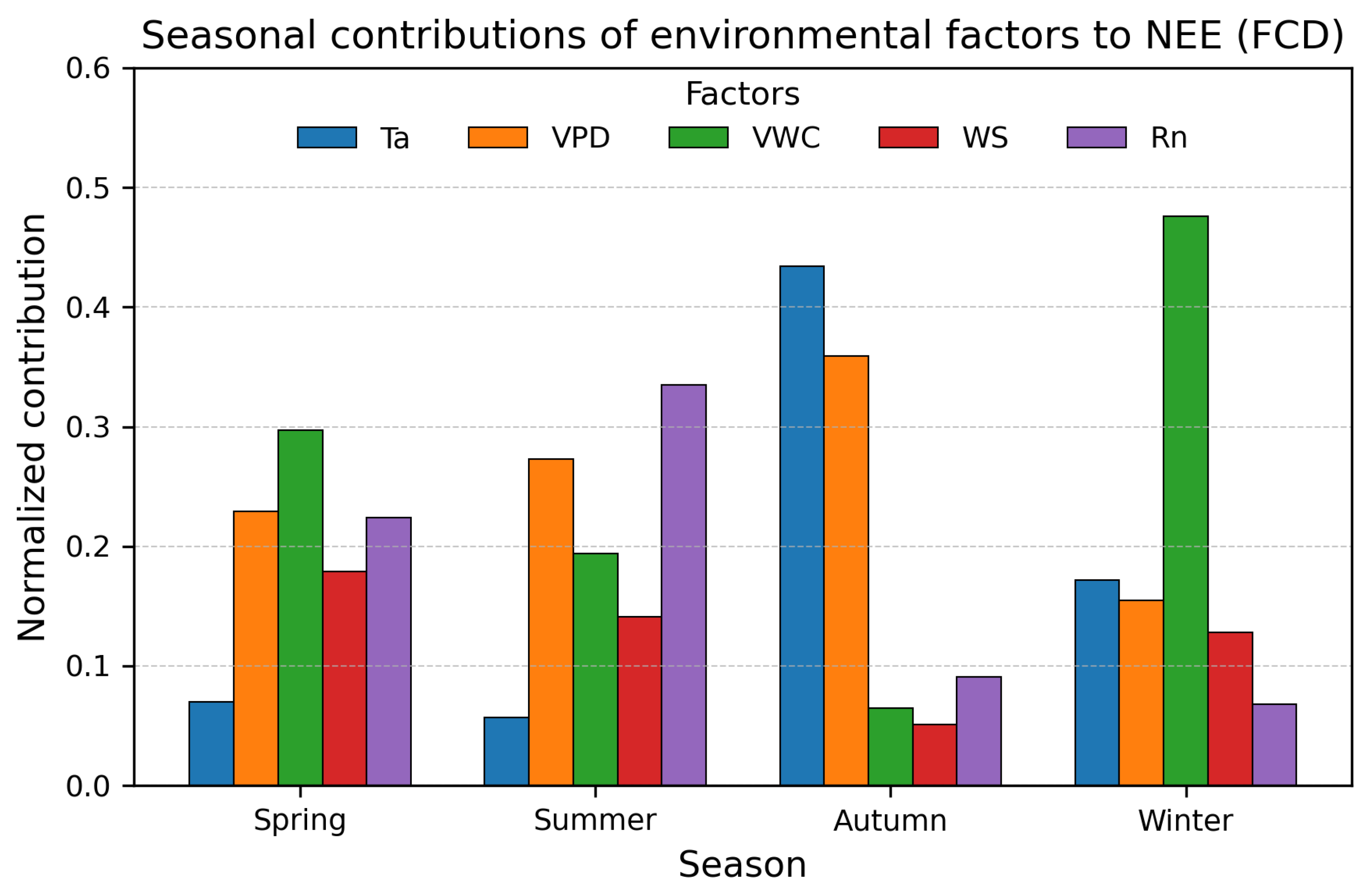
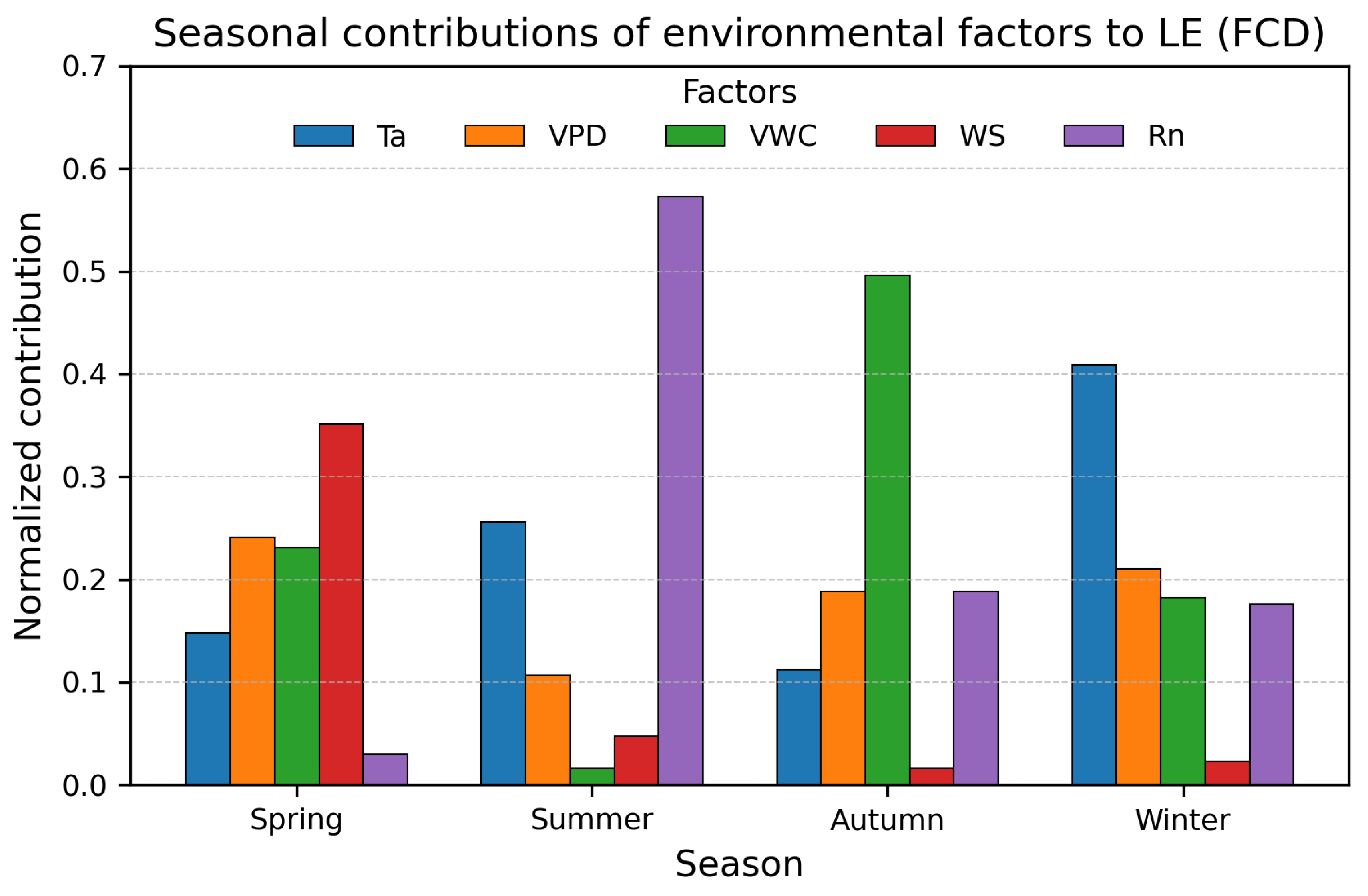
After clarifying the two ecological indicators, i.e., dWUE and SCW, and the carbon–water coupling structure, this paper examines the consistency of the ecological mechanism of the model from the perspective of driving factors. Flux Contribution Decomposition (FCD) quantifies the predictive contribution of five categories of environmental factors to NEE and LE, revealing whether the model’s internal feature utilization structure aligns with actual ecological regulatory mechanisms. The FCD results are shown in
Figure 11 and
Figure 12 and
Table 6 and
Table 7.
Figure 11 and
Table 6 show that the contributions of environmental factors of the MCF-ABiLSTM model to NEE exhibit a clear and ecologically meaningful difference structure on a seasonal scale. In spring, the contributions of VWC, VPD, and Rn to NEE are relatively close, while Ta has the lowest contribution. This indicates that during the early thaw period, carbon flux is mainly co-regulated by soil moisture conditions, atmospheric dryness, and energy input, with temperature not yet being a major limiting factor. In summer, NEE is dominated by Rn and VPD, reflecting that carbon uptake during the peak growing season is primarily driven by radiation and regulated by atmospheric dryness affecting stomatal behavior; VWC and WS play auxiliary roles, while Ta no longer constitutes a major limitation during this phase. In autumn, the contributions of Ta and VPD to NEE increase significantly, showing that with declining temperatures and changing air dryness, temperature and atmospheric conditions become key factors controlling photosynthetic decline and respiratory release. In winter, variations in NEE are mainly controlled by VWC, followed by Ta and VPD, with the lowest contribution from Rn indicating that carbon flux during the frozen period is dominated by soil moisture status and freeze–thaw processes, while the regulatory impact of energy input on flux variations is significantly weakened.
The FCD results show that the environmental-factor control structure of LE exhibits both correlations and distinct differences relative to NEE on a seasonal scale (
Figure 12,
Table 7). In spring, the contributions of WS, VPD, and VWC to LE are higher than those of
and
, indicating that in the early spring stage with low radiation, turbulent transport, atmospheric dryness, and soil moisture conditions have a more significant regulatory effect on evapotranspiration recovery, while radiation has a relatively lower explanatory power for daily-scale LE variations. In summer, LE clearly exhibits a radiation-dominated structure, with the highest contribution from
, followed by
, while the contributions of VPD, WS, and VWC are smaller. This suggests that the evapotranspiration process in the growing season is mainly controlled by energy input, with temperature playing an amplifying regulatory role, and moisture conditions do not show significant limitation characteristics during this phase. In autumn, LE shifts to a structure dominated by moisture conditions, with the highest contribution from VWC, followed by VPD and Rn, reflecting that with reduced soil moisture and decaying radiation, the sensitivity of the evapotranspiration process to moisture and energy conditions increases significantly. In winter, Ta has the highest contribution to LE, with contributions from VPD, VWC, and Rn being similar and WS having the lowest contribution, indicating that limited energy and water-vapor exchange during the frozen period are primarily controlled by air temperature, while the roles of other factors are relatively weakened.
Overall, the FCD results demonstrate that, guided by the Eco-Consistency Regularization (ECR), the environmental-factor response structure of the MCF-ABiLSTM model for LE is consistent with dWUE, SCW, and carbon–water coupling characteristics on a seasonal scale. The FCD results are used to assess whether the model’s structure of internal response to environmental drivers aligns with known ecological processes rather than to provide a causal explanation for ecosystem carbon–water processes.
Overall, the proposed MCF-ABiLSTM model outperforms the baseline models in predicting both NEE and LE, indicating that multi-channel heterogeneous feature encoding and joint learning can effectively improve the stability and generalization of flux simulations. Time-series comparisons further show that the model better captures diurnal cycles and key peak–trough dynamics, reducing biases during highly variable periods. More importantly, the observation-based dWUE, SCW, and NEE–LE coupling types reveal pronounced seasonal differences in carbon–water processes in cold, temperate coniferous forests, providing an ecological baseline for testing mechanism consistency. Combined with flux contribution decomposition, the model yields ecologically meaningful seasonal contribution patterns for key drivers—including radiation, temperature, atmospheric dryness, and soil hydrothermal conditions—that are consistent with the inferred carbon–water coupling characteristics. In summary, by introducing ecological process consistency constraints, the model achieves not only more accurate joint predictions but also improved interpretability of carbon–water coupling mechanisms at the seasonal scale.
5. Conclusions
This study developed a Multi-Channel Fusion Attention BiLSTM (MCF-ABiLSTM) model and proposed two ecological process indices: dynamic Water Use Efficiency (dWUE) and the Sensitivity of Carbon–Water coupling (SCW). The stable carbon–water regulatory patterns revealed by these indices were formalized as ecological process consistency constraints and explicitly embedded into the model training process to enhance the ecological rationality of the prediction results. Experimental results demonstrate that overall, the MCF-ABiLSTM model outperformed various benchmark models in predicting Net Ecosystem Exchange (NEE) and Latent Heat Flux (LE). The joint prediction structure exhibited higher robustness while improving prediction accuracy. Furthermore, Flux Contribution Decomposition (FCD) results indicate that the structure of the model’s response to key environmental factors—such as radiation, air temperature, vapor pressure deficit, and soil water content—across different seasons is consistent with the carbon–water efficiency and temperature sensitivity characteristics characterized by dWUE and SCW at the seasonal scale. This suggests that the model’s internal feature utilization patterns align with the known carbon–water regulatory mechanisms of cold, temperate coniferous forests. Overall, this study achieves an organic integration of high-precision carbon–water flux prediction, the construction of ecological process indices, and analysis of driving mechanisms, providing a deep learning modeling framework that combines predictive performance with ecological interpretability for research on carbon–water coupling in cold, temperate forest ecosystems.
From an application perspective, the proposed framework can be used for site-scale joint monitoring of NEE and LE and for diagnosis of carbon–water coupling, helping identify flux responses under drought and heat stress and shifts in their dominant drivers. It can also provide process-consistent flux estimates and interpretations of driver contributions for carbon accounting and ecological monitoring and offers a constraint-based training strategy grounded in ecological consistency to support model evaluation and improvement.
The main limitations of this study are outlined as follows. First, model training and validation are based on observations from a single site; therefore, the conclusions mainly reflect the effectiveness of the framework at the site scale, while regional-scale generalization still requires external validation using multi-site data. Second, the method was tested using the 2014–2018 time series, and additional evaluation with more recent data is needed to assess robustness and extrapolation reliability under a non-stationary climate. Third, the ecological consistency constraints are primarily used to guide mechanism consistency, and the associated parameter settings may require further adaptive optimization when applied across sites. Fourth, this study did not systematically quantify observation-error propagation or predictive uncertainty.
Future work will extend the framework in terms of spatiotemporal transferability and uncertainty. On the one hand, we will conduct extended training and external validation using high-quality observations from multiple sites and more recent years to systematically test generalization under contemporary climate conditions and evaluate sensitivity to climate non-stationarity and extreme events. On the other hand, we will develop adaptive learning schemes for the parameters in the ecological constraints and incorporate uncertainty quantification and error-propagation analysis, thereby reducing site dependence, improving cross-region transferability, and increasing the credibility of the results.