Article

Spatial Variation and Seasonal Dynamics of Leaf Stoichiometry in Vascular Epiphytes


1
CAS Key Laboratory of Tropical Forest Ecology, Xishuangbanna Tropical Botanical Garden, Chinese Academy of Sciences, Mengla 666303, China
2
Jiangxi Provincial Key Laboratory of Carbon Neutrality and Ecosystem Carbon Sink, Lushan Botanical Garden, Jiangxi Province and Chinese Academy of Sciences, Jiujiang 332900, China
3
State Key Laboratory of Vegetation Structure, Functions and Construction (Veglab), Ministry of Education Key Laboratory for Transboundary Ecosecurity of Southwest China, Yunnan University, Kunming 650500, China
4
School of Municipal and Environmental Engineering, Henan University of Urban Construction, Pingdingshan 467041, China
*
Authors to whom correspondence should be addressed.
Forests 2026, 17(3), 306; https://doi.org/10.3390/f17030306
Submission received: 14 January 2026 / Revised: 18 February 2026 / Accepted: 24 February 2026 / Published: 27 February 2026
(This article belongs to the Section Forest Ecophysiology and Biology)

Abstract

Understanding spatial and seasonal variations in leaf stoichiometry is essential for understanding plant nutrient-use strategies and their implications for ecosystem biogeochemical cycling. Although broad-scale stoichiometric patterns have been well documented for terrestrial plants, comparable evidence for vascular epiphytes remains limited. Here, we examined spatial and seasonal variation in leaf stoichiometry of vascular epiphytes by integrating field data from subtropical and tropical forests in southwestern China with a global literature synthesis. At the global scale, leaf nitrogen and phosphorus concentrations (LNC and LPC) of vascular epiphytes were significantly related to climate variables, whereas no clear latitudinal pattern was detected for leaf N:P ratios. At the regional scale, vascular epiphytes in the subtropical montane moist forest exhibited higher LNC and LPC and lower C:N and C:P ratios than those in the tropical seasonal rainforest. At the local scale, LPC of epiphytes was positively correlated with host LPC, whereas LNC showed a weak but statistically significant association with N availability in canopy soils. Seasonally, evergreen epiphytes exhibited higher leaf nutrient concentrations during the rainy season, and deciduous species showed significantly higher stem N, P, and K concentrations during the dry season, indicating contrasting seasonal nutrient-use strategies. Our results demonstrate that leaf stoichiometry of vascular epiphytes is jointly shaped by climate, canopy-level nutrient dynamics, and seasonal regulation, and differs fundamentally from patterns commonly observed in terrestrial plants. These findings highlight the importance of considering canopy-specific processes and fine-scale species turnover when assessing large-scale stoichiometric patterns and forest nutrient cycling.

1. Introduction

Studying patterns of plant leaf stoichiometry provides fundamental insights into biogeochemical cycling and ecosystem functioning [1,2,3]. Broad biogeographic patterns in leaf stoichiometry in terrestrial plants have been well documented across climatic gradients [1,2,4,5]. For example, LNC and LPC generally decrease from high to low latitudes, whereas leaf N:P ratios generally increase toward lower latitudes [1,6]. Similar large-scale patterns have also been reported for potassium (K), with leaf K concentrations (LKC) increasing toward higher latitudes in China [2]. These global trends are commonly attributed to the combined effects of phylogenetic constraints and environmental drivers, particularly climate and soil nutrient availability [1,3,7]. However, current understanding of leaf stoichiometric biogeography is largely based on trees and herbaceous plants, leaving other ecologically important plant life forms underrepresented.
Vascular epiphytes are a conspicuous and diverse component of forest ecosystems, especially in tropical and subtropical forests, where they contribute substantially to canopy biodiversity, nutrient retention, and hydrological regulation [8,9,10]. Unlike terrestrial plants, vascular epiphytes are largely decoupled from soil nutrient pools and instead rely on a variety of nutrient sources, including atmospheric deposition, host tree leachates, and canopy soils [11,12]. Despite their ecological importance, large-scale patterns of leaf stoichiometry in vascular epiphytes remain poorly understood.
Phylogenetic composition may further complicate stoichiometric patterns in vascular epiphytes. Globally, orchids and bromeliads dominate epiphyte assemblages in tropical regions, whereas ferns become increasingly prevalent toward higher latitudes [10]. Given that epiphytic ferns generally have higher LNC and LPC than orchids or bromeliads [13], latitudinal turnover in dominant epiphyte lineages could potentially generate stoichiometric gradients similar to those observed in terrestrial plants. However, whether such taxonomic shifts translate into consistent large-scale patterns in epiphyte leaf stoichiometry remains unclear. In contrast to terrestrial plants, vascular epiphytes inhabit forest canopies, where environmental conditions differ fundamentally from those in the soil-rooted environment [9]. Canopy microclimate can strongly buffer or modify the effects of macroclimatic gradients on plant physiological processes [14,15,16], potentially weakening latitudinal signals in leaf stoichiometry. Moreover, nutrient availability for epiphytes is closely linked to host trees and canopy soils [11,12]. Several studies have reported nutrient coupling between epiphytes and their host. For example, Cardelús and Mack [13] observed a positive relationship between LPC of epiphytes and their host trees along an elevational gradient, and epiphytic cyanolichens preferentially colonize host trees with higher LPC [17]. Canopy soils further represent an important nutrient reservoir, particularly for epiphytic ferns, which often exhibit higher leaf nutrient concentrations than other epiphyte growth forms [18]. In addition, vascular epiphyte communities can experience high species turnover at small spatial scales [19,20], and the canopy microclimate can regulate the impact of the macroclimate on the physiological metabolism of epiphyte individuals [14], which may result in nonsignificant spatial patterns in the leaf stoichiometry of vascular epiphytes at larger spatial scales [15,16]. Together, canopy-level nutrient processes and canopy microenvironmental buffering may reduce the sensitivity of epiphyte nutrient acquisition to edaphic constraints and large-scale climatic gradients.
In addition to spatial variation, seasonal dynamics may further shape leaf stoichiometry of vascular epiphytes. Seasonal variation in leaf nutrient concentrations has been widely documented in terrestrial plants and is often linked to growth phenology and seasonal changes in nutrient availability [21,22,23]. In contrast, evidence for seasonal variation in epiphyte stoichiometry remains limited and inconsistent. Early studies reported weak or negligible seasonal variation in leaf macronutrient concentrations of epiphytes, particularly N, P, and K [24], whereas more recent work in subtropical montane forests has documented pronounced seasonal differences, with leaf nutrient concentrations generally higher during the rainy season and lower during the dry season [25,26]. These contrasting findings suggest that seasonal stoichiometric responses of vascular epiphytes may be species-specific and influenced by differences in nutrient acquisition.
Based on current understanding of plant stoichiometry and the unique ecological characteristics of forest canopies, we tested the following hypotheses: (1) leaf stoichiometric patterns of vascular epiphytes differ from those of terrestrial plants and exhibit weak or absent latitudinal gradients at the global scale due to reduced dependence on soil nutrient pools; (2) at local scales, variation in epiphyte leaf stoichiometry is positively associated with nutrient availability from host trees and canopy soils, reflecting canopy-level nutrient coupling; and (3) seasonal variation in elemental composition and stoichiometry differs between epiphyte species and growth forms, indicating contrasting nutrient-use and storage strategies. To test these hypotheses, we analyzed leaf C, N, P, and K concentrations of vascular epiphytes from two representative forest types in southwestern China and integrated these data with a global literature synthesis.

2. Materials and Methods

2.1. Study Site

We investigated leaf stoichiometry of vascular epiphytes in two representative forest types in southwestern China: a subtropical montane moist forest (SMF) and a tropical seasonal rainforest (TSF). The SMF is located in the core area of the Ailao Mountains National Natural Reserve (101°01′ E, 24°32′ N, 2000~2650 m a.s.l.). The region has a mean annual precipitation of 1730 mm, approximately 85% of which occurs during the rainy season from May to October, and a mean annual temperature was 11.3 °C [27]. The forest landscape in this area is characterized by continuous primary forest (PF) interspersed with small patches of secondary forest (SF). PF is dominated by the subtropical evergreen broadleaved species Lithocarpus hancei, Castanopsis wattii, and Lithocarpus xylocarpus [28,29]. SFs have a species composition similar to that of PF but have a small basal area and mean diameter at breast height and a high canopy openness and tree density [28]. The TSR is located in the Mengla National Natural Reserve (101°35′ E, 21°37′ N). The annual mean precipitation was 1493 mm, with approximately 84% of rainfall occurring during the rainy season, and the annual mean temperature was 21.8 °C [30]. This tropical forest is dominated by Parashorea chinensis, Pittosporopsis kerrii, Garcinia cowa and Castanopsis echidnocarpa.

2.2. Leaf Sample Collection

Leaf samples of vascular epiphytes and host trees in the subtropical montane moist forest were collected in August 2018 along a line transect in PF. In this study, each epiphyte individual was treated as one replicate. For each epiphyte individual, multiple fully developed leaves were collected and pooled to generate one composite sample for chemical analysis. For epiphyte species with very small individual size, multiple individuals growing on the same host tree were pooled and treated as a single composite sample in order to obtain sufficient material for elemental analysis. Conspecific samples of vascular epiphytes were collected from different trees or newly fallen trees and branches. Host tree samples represented individual host trees on which epiphytes occurred, and leaf samples were collected from sun-exposed outer-canopy positions to ensure consistency in light conditions. Canopy soil samples were defined as spatially discrete soil accumulations on branches or trunks directly associated with epiphyte occurrence. To reduce the influence of fine-scale spatial heterogeneity within individual trees, soil from multiple microsites (e.g., different branch junctions or trunk depressions) on the same host was pooled to form a single composite sample. Living epiphytic plant material was carefully removed prior to analysis. The samples in SF were collected from several continuous patches of secondary forests. In addition, we collected epiphyte samples at the edge of a primary forest near a reservoir, a habitat that was observed to be rich in epiphytes. All the collected samples were oven-dried at 80 °C for 48 h and stored in envelopes. In total, 343 epiphyte individuals from 20 species were collected at this site (Tables S1 and S2). A total of 58 host tree leaf samples were obtained, corresponding to 112 epiphyte individuals. In addition, 52 canopy soil samples were collected, corresponding to 117 epiphyte samples.
To examine seasonal variation in leaf stoichiometry, additional epiphyte samples were collected in March 2018 (dry season) using the same sampling protocol. Individuals sampled in the dry and rainy seasons were not necessarily the same plants, partly because some epiphyte species are herbaceous and could not be reliably re-sampled across seasons. However, all samples were collected from the same habitats and comparable canopy positions using identical sampling criteria to ensure seasonal comparability. Two datasets were generated by combining samples collected during the dry and rainy seasons. The first dataset included stem C, N, P, and K concentrations of the deciduous vascular epiphytes (Lepisorus bicolor, Lepisorus scolopendrium, and Araiostegia perdurans) and evergreen vascular epiphytes (Agapetes mannii (the sampled part was the bulb), Aeschynanthus buxifolius, and Selliguea griffithiana) (Table S3). The second dataset consisted of leaf stoichiometry data for evergreen vascular epiphytes (Haplopteris flexuosa, Lepisorus loriformis, Agapetes mannii, Aeschynanthus buxifolius, Asplenium ensiforme, and Asplenium indicum) collected during both seasons (Table S3).
Leaf samples of vascular epiphytes in the tropical seasonal rainforest were collected in July 2018. Five 20 × 20 m plots were established at both the lowest (709 m) and highest (869 m) elevations out the 20 ha tropical forest dynamics plot (101°34′26″~47″ E, 21°36′42″~58″ N), as well as at the periphery of a 1.44 ha square plot (101°34′59″ E, 21°37′2″ N). All plots were separated by more than 20 m. Sampling procedures were consistent with those used in the subtropical montane moist forest. In total, 70 epiphyte individuals from 19 species were collected (Table S1).

2.3. Leaf Elemental Analysis

For each sample, leaf carbon concentration (LCC, g kg−1), LNC (g kg−1), LPC (g kg−1), and LKC (g kg−1) were determined. All samples were ground into a fine powder and oven-dried at 65 °C for 24 h prior to chemical analyses. Leaf elemental analyses were conducted at the Biogeochemical Laboratory of the Xishuangbanna Tropical Botanical Garden, Chinese Academy of Sciences. LCC and LNC were measured using an elemental analyser (Vario MAX CN, Elemental Analysensysteme GmbH, Langenselbold, Germany). For the determination of LPC and LKC, 0.2–0.3 g of each powdered sample was digested with 10 mL of HNO3 and 2 mL of HClO4 at room temperature for 5 h, followed by heating at 185 °C for 2 h. After digestion, the solutions were diluted to 50 mL with deionized water. Mass-based P and K concentrations were determined using an inductively coupled plasma-atomic emission spectrometer (iCAP6300, Thermo Fisher Scientific, Cambridge, UK).

2.4. Literature Data Compilation and Usage

To investigate large-scale patterns in leaf stoichiometry of vascular epiphytes, we compiled published data primarily from Hietz et al. [18], which provides a comprehensive global synthesis of vascular epiphyte trait data, including detailed documentation of contributing studies and geographic coverage. Additional data were obtained from Paula Oliveira et al. [16]. Because the contributing studies and their geographic distribution were already systematically summarized in Hietz et al. [18], we did not generate an additional Supplementary Table listing all primary sources in order to avoid redundancy. Instead, we explicitly describe the dataset reorganization and filtering procedures below to enhance transparency. Only records containing explicit species-level identification and precise geographic coordinates (including latitude) were retained. Records lacking species information or clear geographic location were excluded to ensure consistency in stoichiometric comparisons and accurate extraction of climatic variables. For analyses involving leaf N:P ratios, we further restricted the dataset to cases in which LNC and LPC were measured from the same sample. Species-level averages aggregated across different sources were excluded to avoid potential duplication and to maintain internal consistency in stoichiometric calculations. To minimize taxonomic inconsistencies, species names were screened for spelling errors and obvious synonymies. Because the primary database had already undergone taxonomic standardization, additional harmonization in the present study was minimal. The curated literature dataset was then integrated with our newly collected field measurements to construct a unified global dataset, which served as the basis for all large-scale analysis.
Mean annual temperature (MAT) and annual precipitation (AP) for each study site were extracted from the WorldClim database (ca. 1 km resolution; http://www.worldclim.org/) (accessed on 12 January 2022) based on geographic coordinates.

2.5. Statistical Analyses

All leaf stoichiometric variables were log-transformed prior to analysis to improve normality and homoscedasticity. The relationships of LNC, LPC, and leaf N:P ratio with absolute latitude, MAT, and AP were examined using linear regression analyses. Differences in leaf stoichiometry of vascular epiphytes between SMF and TSR were tested using independent-samples t-tests. Variations in leaf stoichiometry between different habitats within the Ailao Mountains were analysed using two-way analysis of variance (ANOVA), with habitat and species as fixed factors. Relationships between leaf stoichiometry of vascular epiphytes and the nutrient status of host leaves and canopy soils were analysed using linear mixed-effects models, with epiphyte species and habitat included as random effects. These models were fitted using the lmerTest package in R [31]. Marginal and conditional R2 values are reported to distinguish variance explained by fixed effects alone versus the full model (including random effects).
Seasonal differences in leaf stoichiometry of evergreen vascular epiphytes were evaluated using t-tests and linear mixed-effects models, with epiphyte species treated as a random factor. Seasonal variation in stem nutrient concentrations of vascular epiphytes was analysed using one-way ANOVA.
All statistical analyses and data visualization were performed using R 4.2.2 [32].

3. Results

3.1. Spatial Patterns of Leaf Stoichiometry of Vascular Epiphytes

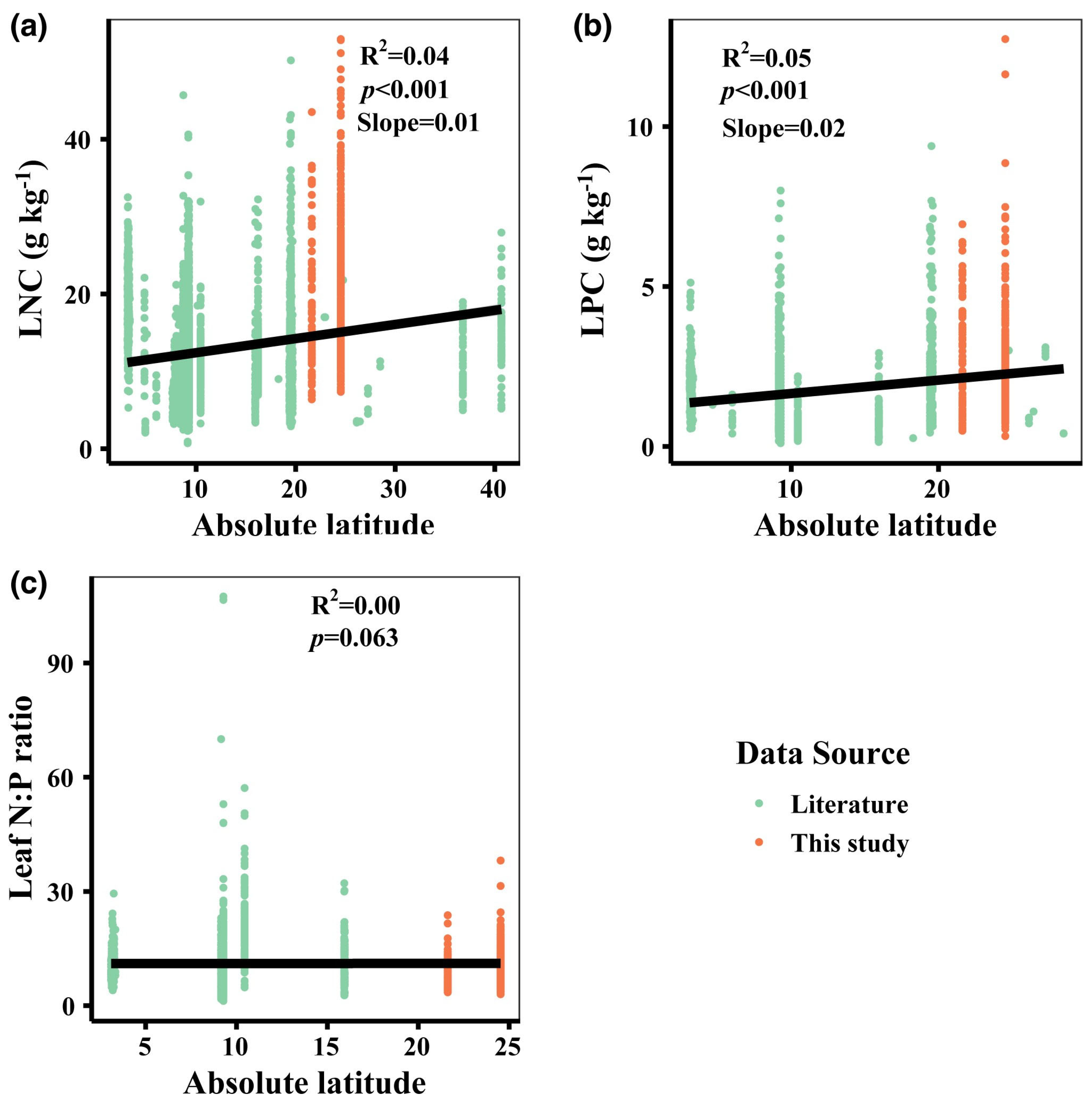
Although LNC and LPC showed statistically significant relationships with absolute latitude when all records were included (Figure 1a,b), the explanatory power of latitude was low (low R2 values), indicating substantial unexplained variation. Leaf N:P ratio showed no significant relationships with latitude (Figure 1c).
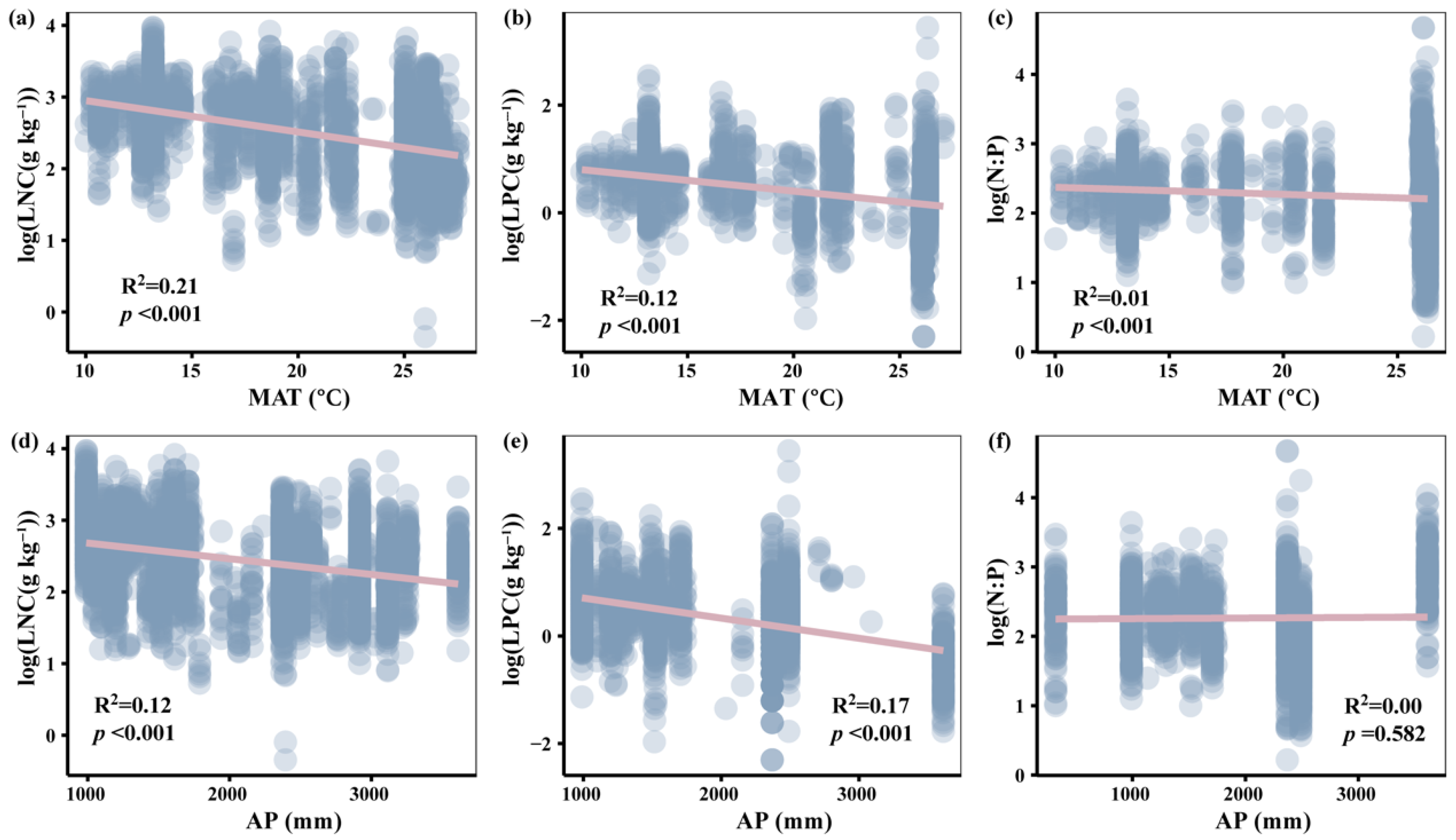
Across all vascular epiphyte individuals worldwide, both LNC and LPC were significantly related to mean annual temperature (MAT) and annual precipitation (AP) (Figure 2a,b,d,e). Leaf N:P ratio was significantly associated with MAT but showed no significant relationship with AP (Figure 2c,f).
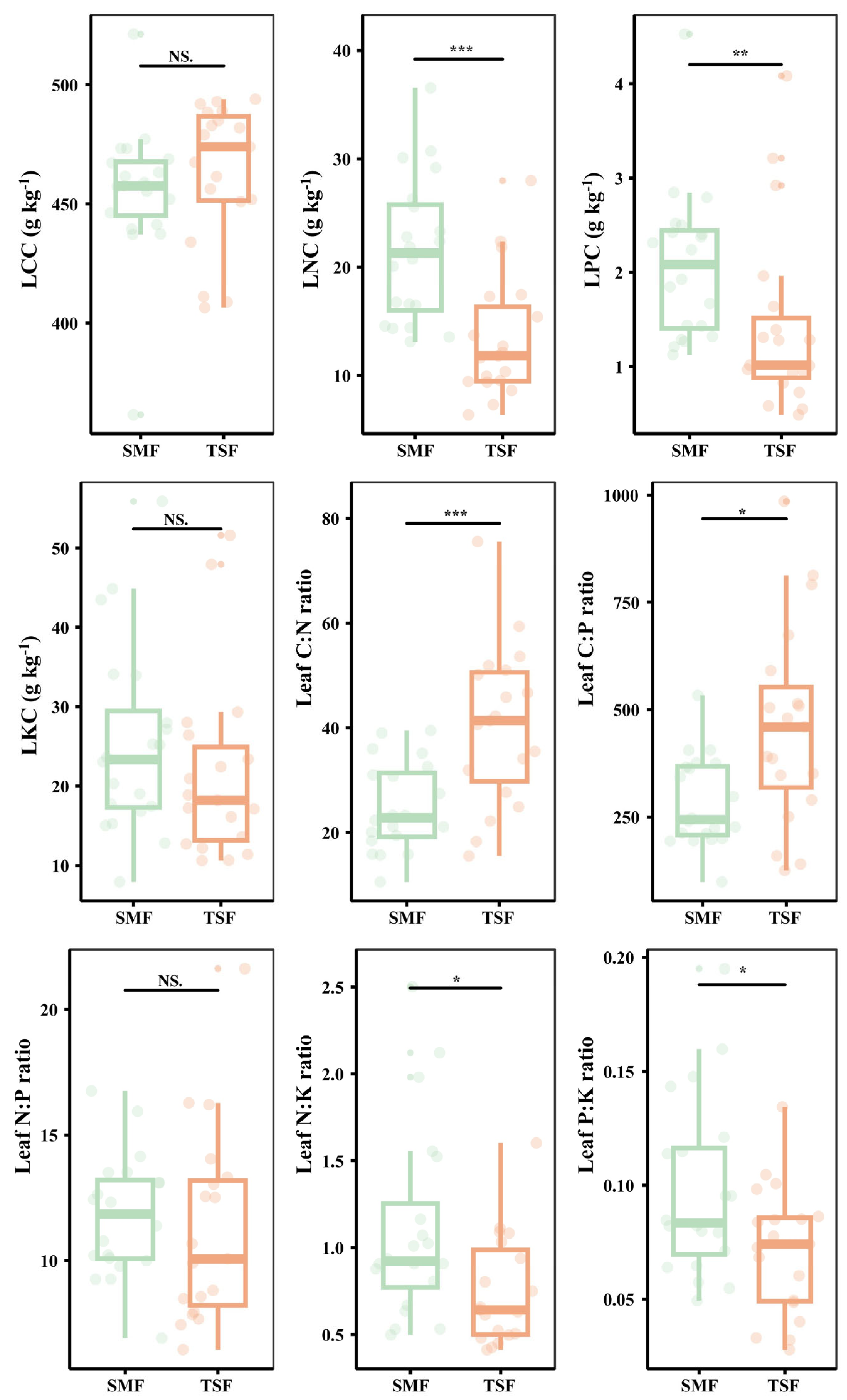
Vascular epiphytes in the subtropical montane moist forest exhibited significantly higher LNC, LPC, and N:K and P:K ratios at the species level compared with those in the tropical seasonal rainforest, while C:N and C:P ratios were significantly lower (Figure 3). No significant differences were observed in LCC or LKC between the two forest types.
Within the three habitats at SMF, species identity significantly contributed to variation in all leaf stoichiometric traits. Habitat effects were significant for LCC, LNC, LPC, C:N, C:P, and N:P ratios (Table 1).

3.2. Factors Affecting the Leaf Stoichiometry of Vascular Epiphytes at the Local Scale

At the local scale, no significant relationships were detected between vascular epiphytes and their host trees for LNC or LKC. In contrast, LPC of vascular epiphytes was significantly correlated with LPC of host leaves (p = 0.004; Table 2), although host LPC explained only 5.8% of the variation in epiphyte LPC.
LNC of vascular epiphytes was significantly related to N concentration in canopy soil (p = 0.012; Table 3), whereas no significant relationships were observed for other nutrients. Canopy soil N explained 1.9% of the variation in epiphyte LNC.

3.3. The Seasonal Variation in Stoichiometry in Vascular Epiphytes

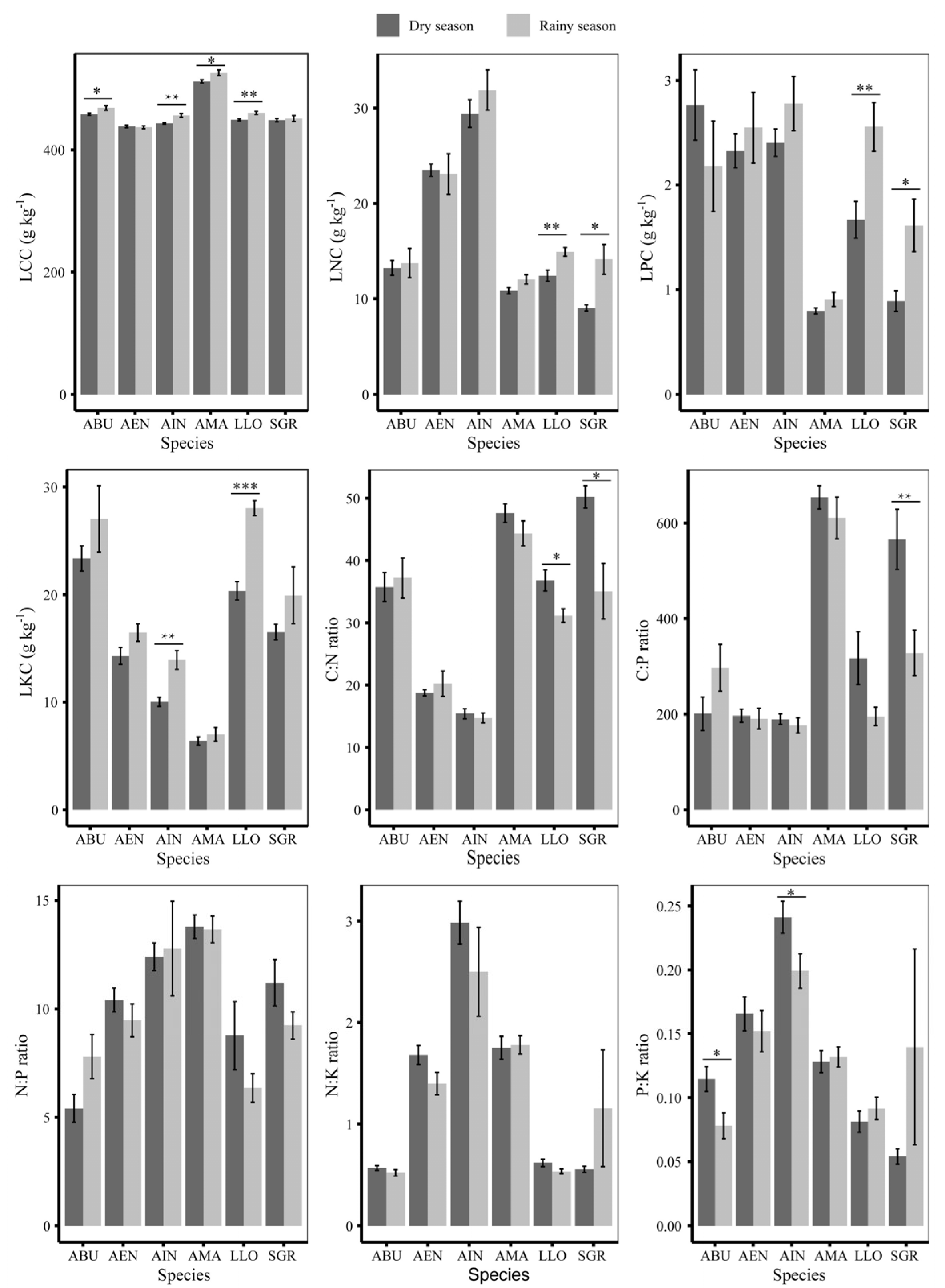
Seasonal variation in leaf stoichiometry differed between epiphyte species, with the greatest seasonal changes observed in Lepisorus loriformis (Table 4).
Mixed-effects model analysis, with species treated as a random factor, showed that vascular epiphytes had significantly higher LCC, LNC, LPC, and LKC during the rainy season than during the dry season, while C:N and C:P ratios were significantly lower (Figure 4).
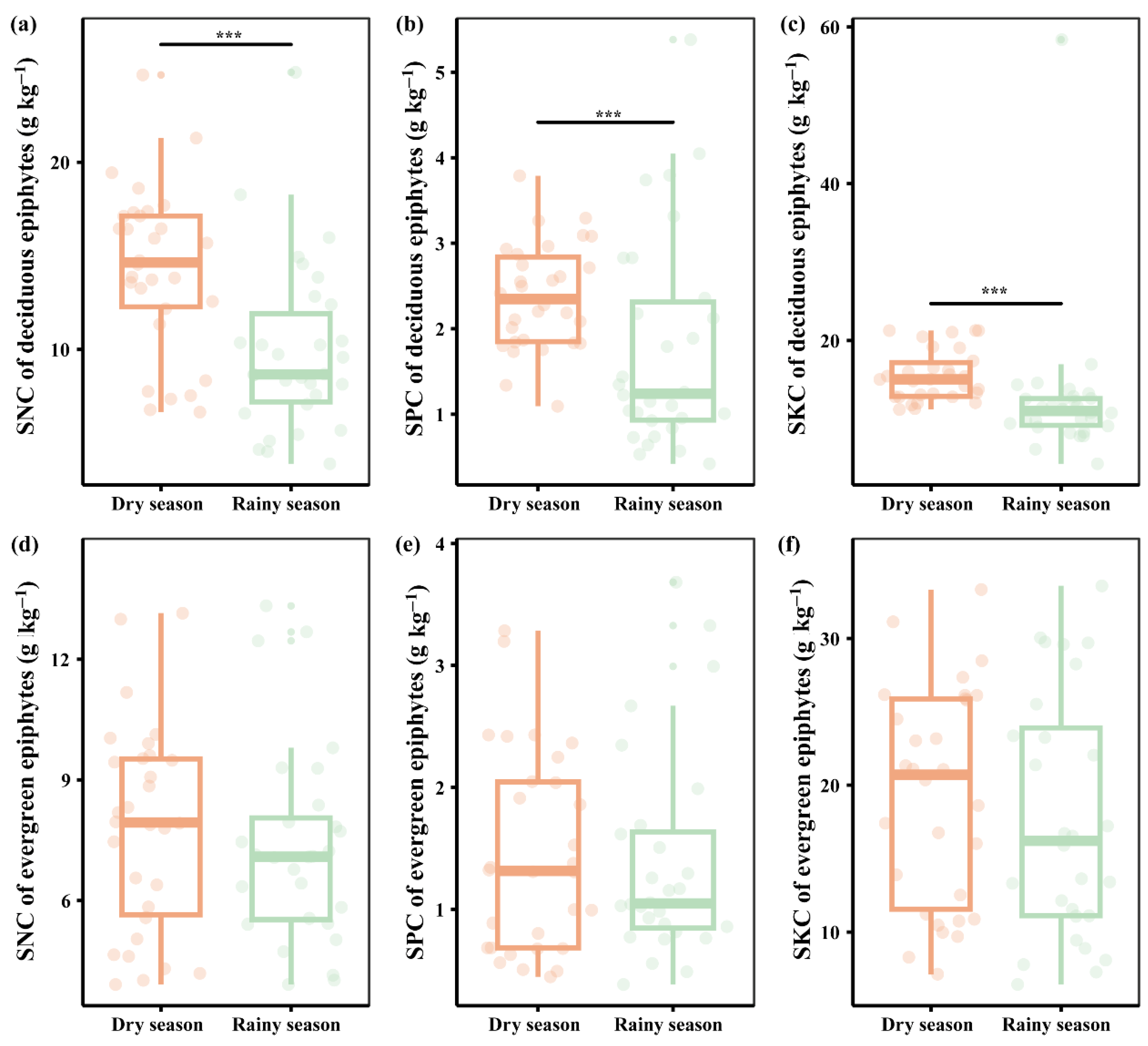
Stem N, P, and K concentrations of deciduous vascular epiphytes were significantly higher during the dry season than during the rainy season. In contrast, no significant seasonal differences in stem nutrient concentrations were detected for evergreen vascular epiphytes (Figure 5).

4. Discussion

4.1. Absence of Strong Latitudinal Patterns in Epiphyte Leaf Stoichiometry

In contrast to terrestrial plants, vascular epiphytes worldwide did not exhibit significant latitudinal gradients in LPC or leaf N:P ratio (Figure 1). This finding contrasts with the well-documented biogeographic patterns observed in soil-rooted plants, in which LPC typically decline and N:P ratios increase toward lower latitudes [1]. The lack of clear latitudinal trends in epiphytes suggests that their leaf stoichiometry is only weakly constrained by soil-driven macroclimatic gradients. A key explanation for this difference lies in the reduced dependence of vascular epiphytes on soil nutrient pools. Unlike terrestrial plants, epiphytes rely on multiple nutrient sources, including atmospheric deposition, host tree leachates, and canopy soils [11,12,33]. These canopy-based nutrient pathways may decouple epiphyte nutrient acquisition from large-scale climatic and edaphic controls, thereby weakening latitudinal signals in leaf stoichiometry. In addition, climate-driven species turnover may further obscure large-scale stoichiometric gradients. Although epiphytic ferns generally have higher LNC and LPC than orchids or bromeliads [13,18], the latitudinal replacement of dominant epiphyte lineages does not necessarily translate into consistent stoichiometric patterns. One possible explanation is that vascular epiphytes often exhibit pronounced species turnover even at relatively small spatial scales, driven by strong microenvironmental heterogeneity within forest canopies [19,20]. Such fine-scale species replacement may weaken or override large-scale stoichiometric signals associated with latitudinal species turnover. This contrasts with terrestrial vegetation, where functional convergence and soil nutrient limitation tend to operate more consistently across spatial scales, thereby reinforcing broad biogeographic patterns in leaf stoichiometry.

4.2. Climatic Controls and Forest-Type Differences in Epiphyte Stoichiometry

Temperature is widely recognized as an important driver of biogeographic variation in LPC, as higher LPC may compensate for reduced metabolic activity under low-temperature conditions [1]. Consistent with this framework, we observed significant relationships between LNC, LPC, leaf N:P ratio, and MAT in vascular epiphytes worldwide (Figure 2). In addition, vascular epiphytes in the subtropical montane moist forest, characterized by lower MAT, exhibited higher LNC and LPC than those in the tropical seasonal rainforest (Figure 3). However, in our study, a greater proportion of variation in LNC was explained by MAT than in LPC, and comparatively less variation in leaf N:P ratio was explained. This pattern differs from those commonly reported for terrestrial plants [1,34]. Water availability may play a key role in driving this discrepancy. Specifically, both LNC and LPC decreased with increasing precipitation, and vascular epiphytes in the tropical seasonal rainforest exhibited higher C:N ratios and lower N:K and P:K ratios than those in the subtropical montane moist forest. These stoichiometric traits are consistent with more conservative nutrient-use strategies under conditions of water limitation [35,36]. Overall, vascular epiphytes with more acquisitive nutrient-use strategies, characterized by higher LNC and LPC, are more prevalent in the subtropical montane moist forest [37]. In contrast, epiphytes in the tropical seasonal rainforest tend to exhibit more conservative strategies, potentially associated with reduced effective water availability. Climate-driven species turnover may therefore contribute to large-scale variation in epiphyte leaf stoichiometry.
Microclimatic conditions can further modulate the physiological responses of vascular epiphytes to macroclimatic factors [38]. For example, between the three habitats in the subtropical montane moist forest, significant differences were observed in LPC, C:P, and N:P ratios (Table 1). In secondary forests, water availability tends to fluctuate more strongly, and higher light availability may enhance transpiration rates [39]. Under such conditions, increased LPC may improve water-use efficiency [40,41], contributing to habitat-specific variation in epiphyte stoichiometry.

4.3. Canopy-Level Nutrient Coupling as a Driver of Local Stoichiometric Variation

At the local scale, we detected statistically significant but quantitatively modest relationships between epiphyte leaf stoichiometry and the nutrient status of host leaves and canopy soils (Table 2 and Table 3). Specifically, LPC of vascular epiphytes was positively correlated with host LPC, consistent with previous observations along elevational gradients [13]. This relationship supports the hypothesis that epiphytes may obtain a substantial proportion of P through leaching and decomposition of host leaves [9]. In addition, LNC of vascular epiphytes was significantly related to N concentrations in canopy soils. Epiphytes sampled in this study were primarily distributed on tree trunks and in the lower canopy, where epiphytes often exhibit relatively high leaf δ15N values [11,14], indicating a reduced reliance on atmospheric nitrogen sources. These findings suggest that epiphytes in these canopy positions may acquire nitrogen from canopy soils or associated leachates. Supporting this interpretation, stable isotope analyses have demonstrated that vascular epiphytes in the study area utilize a wide range of nitrogen sources, including canopy soils [12].
Taken together, these results highlight the importance of canopy-level nutrient dynamics in shaping epiphyte stoichiometry. Although marginal R2 values were low, these findings suggest partial nutrient coupling within a highly heterogeneous canopy environment, rather than strong direct nutrient dependence.

4.4. Seasonal Nutrient Dynamics and Contrasting Strategies of Epiphyte Growth Forms

Our results further showed that vascular epiphytes in the subtropical montane moist forest exhibited higher leaf nutrient concentrations during the rainy season, whereas nutrient ratios remained relatively stable (Figure 4). This pattern is consistent with previous observations for Aeschynanthus buxifolius, Agapetes mannii, and Agapetes rubrobracteata in similar forest types [25]. The increase in LCC during the rainy season may reflect enhanced C assimilation, while increases in other nutrient elements likely correspond to greater nutrient demand during the active growth period. Rivas-Ubach et al. [42] reported that concentrations of primary metabolites, such as sugars and amino acids, increase during the growing season, accompanied by elevated LNC and LPC. Higher N and P concentrations facilitate the synthesis of proteins and RNA, thereby supporting rapid growth. In addition, increased rainfall during the rainy season may enhance nutrient availability in epiphytic habitats through canopy leaching and stemflow [9]. Nevertheless, seasonal variation in leaf stoichiometry differed markedly between species. While some epiphytes exhibited pronounced seasonal changes, others showed little variation, consistent with previous reports of strong species-specific responses [24,26]. In the present study, Lepisorus loriformis showed significantly higher leaf C, N, P and K concentrations during the rainy season, whereas Asplenium indicum exhibited little seasonal variation. This difference may reflect contrasting nutrient acquisition strategies, with L. loriformis relying more heavily on atmospheric deposition, while A. indicum exhibits greater dependence on canopy soil nutrients during the dry season [25]. Further studies integrating stable isotope analyses could help clarify the mechanisms underlying these seasonal patterns.
Another notable feature of seasonal variation was the higher stem N and P concentrations of deciduous vascular epiphytes during the dry season, whereas evergreen species showed no significant seasonal changes in stem nutrient concentrations. This pattern is likely associated with nutrient resorption during leaf senescence in deciduous epiphytes, allowing nutrients to be stored in stems during unfavorable periods and rapidly reallocated to new leaves at the onset of the growing season [43].

4.5. Implications for Canopy Nutrient Cycling

By demonstrating distinct spatial and seasonal stoichiometric patterns in vascular epiphytes, this study underscores the importance of canopy-level processes in forest nutrient cycling. Epiphytes contribute to nutrient retention, redistribution, and transformation within forest canopies, yet their nutrient-use strategies differ fundamentally from those of terrestrial plants. Incorporating epiphytes into ecosystem nutrient frameworks is therefore essential for improving our understanding of forest biogeochemical functioning, particularly in tropical and subtropical ecosystems.

5. Conclusions

This study provides a comprehensive assessment of spatial and seasonal variation in leaf stoichiometry of vascular epiphytes across subtropical and tropical forests. In contrast to terrestrial plants, vascular epiphytes showed weak or absent latitudinal patterns despite significant climatic associations. At local scales, canopy-level nutrient dynamics contributed to variation in epiphyte stoichiometry, although their explanatory power was modest. Seasonal regulation further shaped nutrient allocation, with higher leaf nutrient concentrations during the rainy season and contrasting storage strategies between deciduous and evergreen epiphytes. Together, these findings demonstrate that epiphyte stoichiometric patterns emerge from interactions between climate, canopy processes, species turnover, and seasonal dynamics, underscoring the importance of incorporating canopy-specific mechanisms into broader biogeochemical frameworks.

Supplementary Materials

The following supporting information can be downloaded at: https://www.mdpi.com/article/10.3390/f17030306/s1, Table S1: Leaf stoichiometry of epiphyte species in SMF and TSF in southwestern; Table S2: Number of samples of vascular epiphytes in the subtropical montane moist forest; Table S3: Elemental stoichiometry of vascular epiphytes species in the dry and rainy seasons in the subtropical montane moist forest.

Author Contributions

Conceptualization, T.H. and W.L.; methodology, T.H., X.X. and W.L.; validation, T.H. and T.Z.; formal analysis, T.H.; resources: X.X., Y.Y., Y.J. and Z.L.; data curation, T.H. and Y.A.; funding acquisition, W.L., X.X. and T.H.; writing—original draft preparation, T.H. and Y.A.; writing—review and editing, Y.Y., Y.A., Y.J., Z.L., X.X. and W.L.; project administration, T.H. All authors have read and agreed to the published version of the manuscript.

Funding

This study was supported by the National Natural Science Foundation of China (grant number 42071071, 31770496, 32460259), the Natural Science Foundation of Jiangxi Province (20232BAB215009) and the Natural Science Foundation of Jiujiang City (2025_001561, 2025_001334, 2025_001377, 2025_000206).

Data Availability Statement

The data that support the findings of this study are available from the corresponding author upon reasonable request.

Acknowledgments

We thank the members of the Public Technology Service Center of the Xishuangbanna Tropical Botanical Garden (XTBG) for their assistance with the chemical analysis of plant samples. We also thank Zhongde Huang for his valuable help with data compilation and organization. In addition, we are grateful to the National Field Scientific Observation and Research Station of Subtropical Forest Ecosystem in Ailao Mountain and the National Field Scientific Observation and Research Station of Tropical Forest Ecosystem in Xishuangbanna for providing access to the study sites and background information.

Conflicts of Interest

The authors declare that they have no conflicts of interest.

References

  1. Reich, P.B.; Oleksyn, J. Global Patterns of Plant Leaf N and P in Relation to Temperature and Latitude. Proc. Natl. Acad. Sci. USA 2004, 101, 11001–11006. [Google Scholar] [CrossRef] [Scilit] [PubMed]
  2. Li, X.; He, N.; Xu, L.; Li, S.; Li, M. Spatial Variation in Leaf Potassium Concentrations and Its Role in Plant Adaptation Strategies. Ecol. Indic. 2021, 130, 108063. [Google Scholar] [CrossRef] [Scilit]
  3. Tian, D.; Yan, Z.; Schmid, B.; Kattge, J.; Fang, J.; Stocker, B.D. Environmental versus Phylogenetic Controls on Leaf Nitrogen and Phosphorus Concentrations in Vascular Plants. Nat. Commun. 2024, 15, 5346. [Google Scholar] [CrossRef] [Scilit] [PubMed]
  4. Han, W.; Fang, J.; Guo, D.; Zhang, Y. Leaf Nitrogen and Phosphorus Stoichiometry across 753 Terrestrial Plant Species in China. New Phytol. 2005, 168, 377–385. [Google Scholar] [CrossRef] [Scilit]
  5. Han, W.X.; Fang, J.Y.; Reich, P.B.; Ian Woodward, F.; Wang, Z.H. Biogeography and Variability of Eleven Mineral Elements in Plant Leaves across Gradients of Climate, Soil and Plant Functional Type in China. Ecol. Lett. 2011, 14, 788–796. [Google Scholar] [CrossRef] [Scilit]
  6. Tian, D.; Yan, Z.; Niklas, K.J.; Han, W.; Kattge, J.; Reich, P.B.; Luo, Y.; Chen, Y.; Tang, Z.; Hu, H.; et al. Global Leaf Nitrogen and Phosphorus Stoichiometry and Their Scaling Exponent. Natl. Sci. Rev. 2018, 5, 728–739. [Google Scholar] [CrossRef] [Scilit]
  7. Sardans, J.; Vallicrosa, H.; Zuccarini, P.; Farré-Armengol, G.; Fernández-Martínez, M.; Peguero, G.; Gargallo-Garriga, A.; Ciais, P.; Janssens, I.A.; Obersteiner, M.; et al. Empirical Support for the Biogeochemical Niche Hypothesis in Forest Trees. Nat. Ecol. Evol. 2021, 5, 184–194. [Google Scholar] [CrossRef] [Scilit]
  8. Gotsch, S.G.; Nadkarni, N.; Amici, A. The Functional Roles of Epiphytes and Arboreal Soils in Tropical Montane Cloud Forests. J. Trop. Ecol. 2016, 32, 455–468. [Google Scholar] [CrossRef] [Scilit]
  9. Zotz, G. Plants on Plants—The Biology of Vascular Epiphytes; Fascinating Life Sciences; Springer International Publishing: Cham, Switzerland, 2016; ISBN 978-3-319-39236-3. [Google Scholar]
  10. Taylor, A.; Zotz, G.; Weigelt, P.; Cai, L.; Karger, D.N.; König, C.; Kreft, H. Vascular Epiphytes Contribute Disproportionately to Global Centres of Plant Diversity. Glob. Ecol. Biogeogr. 2022, 31, 62–74. [Google Scholar] [CrossRef] [Scilit]
  11. Wania, R.; Hietz, P.; Wanek, W. Natural 15N Abundance of Epiphytes Depends on the Position within the Forest Canopy: Source Signals and Isotope Fractionation. Plant Cell Environ. 2002, 25, 581–589. [Google Scholar] [CrossRef] [Scilit]
  12. Su, T.-H.; Zhou, C.-Y.; Sun, W.; Jia, T.; Hu, T.; Li, Z.-F.; Pu, X.-Y.; Lu, Z.-Y.; Li, S. Greater Differentiation in Nitrogen Sources Is Essential for Co-Occurring Epiphytes under Low-Nitrogen Canopy Conditions. Environ. Exp. Bot. 2023, 215, 105509. [Google Scholar] [CrossRef] [Scilit]
  13. Cardelús, C.L.; Mack, M.C. The Nutrient Status of Epiphytes and Their Host Trees along an Elevational Gradient in Costa Rica. Plant Ecol. 2010, 207, 25–37. [Google Scholar] [CrossRef] [Scilit]
  14. Petter, G.; Wagner, K.; Wanek, W.; Sánchez Delgado, E.J.; Zotz, G.; Cabral, J.S.; Kreft, H. Functional Leaf Traits of Vascular Epiphytes: Vertical Trends within the Forest, Intra- and Interspecific Trait Variability, and Taxonomic Signals. Funct. Ecol. 2016, 30, 188–198. [Google Scholar] [CrossRef] [Scilit]
  15. Schellenberger Costa, D.; Zotz, G.; Hemp, A.; Kleyer, M. Trait Patterns of Epiphytes Compared to Other Plant Life-forms along a Tropical Elevation Gradient. Funct. Ecol. 2018, 32, 2073–2084. [Google Scholar] [CrossRef] [Scilit]
  16. Paula Oliveira, R.; Zotz, G.; Wanek, W.; Franco, A.C. Leaf Trait Co-variation and Trade-offs in Gallery Forest C3 and CAM Epiphytes. Biotropica 2021, 53, 520–535. [Google Scholar] [CrossRef] [Scilit]
  17. Benner, J.W. Epiphytes Preferentially Colonize High-Phosphorus Host Trees in Unfertilized Hawaiian Montane Forests. Bryologist 2011, 114, 335–345. [Google Scholar] [CrossRef] [Scilit]
  18. Hietz, P.; Wagner, K.; Nunes Ramos, F.; Cabral, J.S.; Agudelo, C.; Benavides, A.M.; Cach-Pérez, M.J.; Cardelús, C.L.; Chilpa Galván, N.; Erickson Nascimento da Costa, L.; et al. Putting Vascular Epiphytes on the Traits Map. J. Ecol. 2022, 110, 340–358. [Google Scholar] [CrossRef] [Scilit]
  19. Zhao, M.; Geekiyanage, N.; Xu, J.; Khin, M.M.; Nurdiana, D.R.; Paudel, E.; Harrison, R.D. Structure of the Epiphyte Community in a Tropical Montane Forest in SW China. PLoS ONE 2015, 10, e0122210. [Google Scholar] [CrossRef] [Scilit] [PubMed]
  20. Amici, A.A.; Nadkarni, N.M.; Williams, C.B.; Gotsch, S.G. Differences in Epiphyte Biomass and Community Composition along Landscape and Within-Crown Spatial Scales. Biotropica 2020, 52, 46–58. [Google Scholar] [CrossRef] [Scilit]
  21. Townsend, A.R.; Cleveland, C.C.; Asner, G.P.; Bustamante, M.M.C. Controls over Foliar N:P Ratios in Tropical Rain Forests. Ecology 2007, 88, 107–118. [Google Scholar] [CrossRef] [Scilit]
  22. Zhao, Y.; Xu, F.; Wang, W.; Wang, L.; Wang, G.; Sun, P.; Bai, X. Seasonal Variation in Content of C, N and P and Stoichiometry Characteristics in Fine Roots, Stems and Needles of Larix Principis-Rupprechtii. Chin. Bull. Bot. 2014, 49, 560. [Google Scholar] [CrossRef] [Scilit]
  23. Li, H.; Crabbe, M.; Xu, F.; Wang, W.; Niu, R.; Gao, X.; Zhang, P.; Chen, H. Seasonal Variations in Carbon, Nitrogen and Phosphorus Concentrations and C:N:P Stoichiometry in the Leaves of Differently Aged Larix principis-rupprechtii Mayr. Plantations. Forests 2017, 8, 373. [Google Scholar] [CrossRef] [Scilit]
  24. Zotz, G. What Are Backshoots Good For? Seasonal Changes in Mineral, Carbohydrate and Water Content of Different Organs of the Epiphytic Orchid, Dimerandra Emarginata. Ann. Bot. 1999, 84, 791–798. [Google Scholar] [CrossRef] [Scilit]
  25. Tang, D. Ecological Stoichiometry of Common Woody Epiphytes and Parasites and Their Relationship with Hosts in Ailao Mountain. Master’s Thesis, University of Chinese Academy of Sciences, Kunming, China, 2019. [Google Scholar]
  26. Zhang, T. Ecological Stoichiometry of Facultative Vascular Epiphytes in the Montane Moist Evergreen Broad-Leaved Forest in Ailao Mountains, Yunnan. Ph.D. Thesis, University of Chinese Academy of Sciences, Kunming, China, 2021. [Google Scholar]
  27. Gnanamoorthy, P.; Song, Q.; Zhao, J.; Zhang, Y.; Liu, Y.; Zhou, W.; Sha, L.; Fan, Z.; Deb Burman, P.K. Altered Albedo Dominates the Radiative Forcing Changes in a Subtropical Forest Following an Extreme Snow Event. Glob. Change Biol. 2021, 27, 6192–6205. [Google Scholar] [CrossRef] [Scilit] [PubMed]
  28. Li, S.; Liu, W.-Y.; Li, D.-W. Epiphytic Lichens in Subtropical Forest Ecosystems in Southwest China: Species Diversity and Implications for Conservation. Biol. Conserv. 2013, 159, 88–95. [Google Scholar] [CrossRef] [Scilit]
  29. Wen, H.; Lin, L.; Yang, J.; Hu, Y.; Cao, M.; Liu, Y.; Lu, Z.; Xie, Y. Species Composition and Community Structure of a 20 Hm2 Plot of Mid-Mountain Moist Evergreen Broad-Leaved Forest on the Mts. Ailaoshan, Yunnan Province, China. Chin. J. Plant Ecol. 2018, 42, 419. [Google Scholar] [CrossRef] [Scilit]
  30. Cao, M.; Zou, X.; Warren, M.; Zhu, H. Tropical Forests of Xishuangbanna, China1: Tropical Forests in China. Biotropica 2006, 38, 306–309. [Google Scholar] [CrossRef] [Scilit]
  31. Kuznetsova, A.; Brockhoff, P.B.; Christensen, R.H.B. lmerTest Package: Tests in Linear Mixed Effects Models. J. Stat. Soft. 2017, 82, 1–26. [Google Scholar] [CrossRef] [Scilit]
  32. R Core Team. R: A Language and Environment for Statistical Computing, R Foundation for Statistical Computing: Vienna, Austria, 2022.
  33. Hietz, P.; Wanek, W.; Wania, R.; Nadkarni, N.M. Nitrogen-15 Natural Abundance in a Montane Cloud Forest Canopy as an Indicator of Nitrogen Cycling and Epiphyte Nutrition. Oecologia 2002, 131, 350–355. [Google Scholar] [CrossRef] [Scilit]
  34. Elser, J.J.; Fagan, W.F.; Kerkhoff, A.J.; Swenson, N.G.; Enquist, B.J. Biological Stoichiometry of Plant Production: Metabolism, Scaling and Ecological Response to Global Change. New Phytol. 2010, 186, 593–608. [Google Scholar] [CrossRef] [Scilit]
  35. Bussotti, F.; Borghini, F.; Celesti, C.; Leonzio, C.; Bruschi, P. Leaf Morphology and Macronutrients in Broadleaved Trees in Central Italy. Trees 2000, 14, 361–368. [Google Scholar] [CrossRef] [Scilit]
  36. Tian, D.; Reich, P.B.; Chen, H.Y.H.; Xiang, Y.; Luo, Y.; Shen, Y.; Meng, C.; Han, W.; Niu, S. Global Changes Alter Plant Multi-Element Stoichiometric Coupling. New Phytol. 2019, 221, 807–817. [Google Scholar] [CrossRef] [Scilit] [PubMed]
  37. Peñuelas, J.; Fernández-Martínez, M.; Ciais, P.; Jou, D.; Piao, S.; Obersteiner, M.; Vicca, S.; Janssens, I.A.; Sardans, J. The Bioelements, the Elementome, and the Biogeochemical Niche. Ecology 2019, 100, e02652. [Google Scholar] [CrossRef] [Scilit] [PubMed]
  38. Gotsch, S.G.; Williams, C.B.; Bicaba, R.; Cruz-de Hoyos, R.; Darby, A.; Davidson, K.; Dix, M.; Duarte, V.; Glunk, A.; Green, L.; et al. Trade-Offs between Succulent and Non-Succulent Epiphytes Underlie Variation in Drought Tolerance and Avoidance. Oecologia 2022, 198, 645–661. [Google Scholar] [CrossRef] [Scilit]
  39. Chen, Q.; Lu, H.-Z.; Liu, W.-Y.; Wu, Y.; Song, L.; Li, S. Obligate to Facultative Shift of Two Epiphytic Lepisorus Species during Subtropical Forest Degradation: Insights from Functional Traits. For. Ecol. Manag. 2019, 435, 66–76. [Google Scholar] [CrossRef] [Scilit]
  40. Sardans, J.; Peñuelas, J. Drought Changes Phosphorus and Potassium Accumulation Patterns in an Evergreen Mediterranean Forest. Funct. Ecol. 2007, 21, 191–201. [Google Scholar] [CrossRef] [Scilit]
  41. Huang, Z.; Ran, S.; Fu, Y.; Wan, X.; Song, X.; Chen, Y.; Yu, Z. Functionally Dissimilar Neighbours Increase Tree Water Use Efficiency through Enhancement of Leaf Phosphorus Concentration. J. Ecol. 2022, 110, 2179–2189. [Google Scholar] [CrossRef] [Scilit]
  42. Rivas-Ubach, A.; Sardans, J.; Perez-Trujillo, M.; Estiarte, M.; Penuelas, J. Strong Relationship between Elemental Stoichiometry and Metabolome in Plants. Proc. Natl. Acad. Sci. USA 2012, 109, 4181–4186. [Google Scholar] [CrossRef] [Scilit]
  43. Piper, F.I.; Fajardo, A. Foliar Habit, Tolerance to Defoliation and Their Link to Carbon and Nitrogen Storage. J. Ecol. 2014, 102, 1101–1111. [Google Scholar] [CrossRef] [Scilit]
Figure 1. Relationships between leaf stoichiometry of vascular epiphytes worldwide and latitude absolute values. Linear regressions are shown for (a) absolute latitude and LNC (n = 3990); (b) absolute latitude and LPC (n = 1954); and (c) absolute latitude and leaf N:P (n = 1803). Each point represents an individual observation compiled from field measurements and literature synthesis. LNC, leaf nitrogen concentration; LPC, leaf phosphorus concentration.
Forests 17 00306 g001
Figure 2. Relationships between leaf stoichiometry of vascular epiphytes worldwide and climatic variables. Linear regression models were fitted between mean annual temperature (MAT) and (a) LNC (n = 3990), (b) LPC (n = 1954), and (c) leaf N:P ratio (n = 1803) and between annual precipitation (AP) and (d) LNC (n = 3990), (e) LPC (n = 1954), and (f) leaf N:P ratio (n = 1803). Each point represents an individual observation. LNC, leaf nitrogen concentration; LPC, leaf phosphorus concentration; MAT, mean annual temperature; AP, annual precipitation.
Forests 17 00306 g002
Figure 3. Differences in leaf stoichiometry of vascular epiphytes between a subtropical montane moist forest (SMF) and a tropical seasonal rainforest (TSF). Values represent species-level means. The symbols indicate the results of the t-test (NS. p > 0.05, * p < 0.05, ** p < 0.01, *** p < 0.001). LCC, leaf carbon concentration; LNC, leaf nitrogen concentration; LPC, leaf phosphorus concentration; LKC, leaf potassium concentration.
Forests 17 00306 g003
Figure 4. Seasonal variations in leaf stoichiometry of vascular epiphytes in the subtropical montane moist forest. The symbols indicate the results of the t-test (* p < 0.05, ** p < 0.01, *** p < 0.001). LCC, leaf carbon concentration; LNC, leaf nitrogen concentration; LPC, leaf phosphorus concentration; LKC, leaf potassium concentration. Vascular epiphytes: ABU, Aeschynanthus buxifolius; AEN, Asplenium ensiforme; AIN, Asplenium indicum; AMA, Agapetes mannii; LLO, Lepisorus loriformis; SGR, Selliguea griffithiana.
Forests 17 00306 g004
Figure 5. Seasonal variation in stem nutrient concentrations of deciduous and evergreen vascular epiphytes in the subtropical montane moist forest. Comparisons between the dry and rainy seasons are shown for deciduous epiphytes (a) stem nitrogen concentration (SNC), (b) stem phosphorus concentration (SPC), and (c) stem potassium concentration (SKC); and for evergreen epiphytes (d) SNC, (e) SPC, and (f) SKC. The symbols indicate the results of the t-test (*** p < 0.001). SNC, stem nitrogen concentration; SPC, stem phosphorus concentration; SKC, stem potassium concentration.
Forests 17 00306 g005
Table 1. Differences in leaf stoichiometry for vascular epiphytes between habitats in a subtropical montane moist forest. F-values from two-way ANOVA are shown (* p < 0.05, *** p < 0.001). LCC, leaf carbon concentration; LNC, leaf nitrogen concentration; LPC, leaf phosphorus concentration; LKC, leaf potassium concentration.
Leaf StoichiometrySpeciesHabitatsSpecies:Habitats
LCC116.930 ***2.4652.142 ***
LNC30.046 ***1.0051.567 *
LPC12.297 ***3.693 *2.181 ***
LKC32.781 ***1.1550.813
C:N36.512 ***0.8331.527 *
C:P16.261 ***3.692 *2.142 ***
N:P7.477 ***3.663 *2.412 ***
N:K28.435 ***1.6221.076
P:K14.962 ***1.6201.255
Table 2. Linear mixed-effects models for leaf stoichiometry, with leaf nutrient concentrations of host tree as fixed effects, epiphyte species and habitats as random effects. LNC, leaf nitrogen concentration; LPC, leaf phosphorus concentrations; LKC, leaf potassium concentrations.
Leaf NutrientsRandom Effect (p-Value)Conditional R2Marginal R2p-Value
LNCSpecies (<0.001)0.6020.0040.349
Habitats (0.247)
LPCSpecies (<0.001)0.3210.0580.004
Habitats (0.182)
LKCSpecies (<0.001)0.5360.0040.454
Habitats (0.624)
Note: Bold values indicate statistically significant results (p < 0.05).
Table 3. Linear mixed-effects models for leaf stoichiometry, with nutrient concentrations of canopy soil as fixed effects, epiphyte species and habitats as random effects. LNC, leaf nitrogen concentration; LPC, leaf phosphorus concentrations; LKC, leaf potassium concentrations.
Leaf NutrientsRandom Effect (p-Value)Conditional R2Marginal R2p-Value
LNCSpecies (<0.001)0.6190.0190.012
Habitats (0.399)
LPCSpecies (<0.001)0.4450.0150.070
Habitats (0.001)
LKCSpecies (<0.001)0.5220.0040.281
Habitats (0.327)
Note: Bold values indicate statistically significant results (p < 0.05).
Table 4. Seasonal variations in leaf stoichiometry for common epiphytes in subtropical montane moist forest. Values represent t-values from independent-samples t-tests. Significance levels are indicated as follows: * p < 0.05; ** p < 0.01; *** p < 0.001. ABU, Aeschynanthus buxifolius; AEN, Asplenium ensiforme; AIN, Asplenium indicum; AMA, Agapetes mannii; LLO, Lepisorus loriformis; SGR, Selliguea griffithiana.
Species
ABUAENAINAMALLOSGR
LCC−2.48 *0.44−4.03 **−2.67 *−3.88 **−0.46
LNC−0.290.19−0.97−2.04−3.32 **−3.21 *
LPC1.07−0.59−1.28−1.49−3.04 **−2.68 *
LKC−1.11−1.92−4.02 **−0.85−7.05 ***−1.25
C:N−0.37−0.690.611.302.85 *3.15 *
C:P−1.610.240.660.862.083.01 **
N:P−2.001.01−0.170.151.421.59
N:K1.261.950.99−0.211.94−1.04
P:K2.57 *0.642.31 *−0.31−0.86−1.12
Disclaimer/Publisher’s Note: The statements, opinions and data contained in all publications are solely those of the individual author(s) and contributor(s) and not of MDPI and/or the editor(s). MDPI and/or the editor(s) disclaim responsibility for any injury to people or property resulting from any ideas, methods, instructions or products referred to in the content.