Article

Tree Geo-Positioning in Coniferous Forest Plots: A Comparison of Ground Survey and Laser Scanning Methods


by
Lina Beniušienė
1,*,
Donatas Jonikavičius
1,
Monika Papartė
1,
Marius Aleinikovas
2,
Iveta Varnagirytė-Kabašinskienė
2,
Ričardas Beniušis
2 and
Gintautas Mozgeris
1,3
1
Faculty of Forest Sciences and Ecology, Agriculture Academy, Vytautas Magnus University, Studentų Street 11, LT-53361 Akademija, Kaunas Distr., Lithuania
2
Lithuanian Research Centre for Agriculture and Forestry, Institute of Forestry, Liepu Street 1, LT-53101 Girionys, Kaunas Distr., Lithuania
3
Public Institution Forest 4.0, Universiteto Str. 10, LT-53361 Akademija, Kaunas Distr., Lithuania
*
Author to whom correspondence should be addressed.
Forests 2026, 17(2), 272; https://doi.org/10.3390/f17020272
Submission received: 31 December 2025 / Revised: 15 February 2026 / Accepted: 16 February 2026 / Published: 18 February 2026
(This article belongs to the Section Forest Inventory, Modeling and Remote Sensing)

Abstract

Accurate spatial information on individual tree locations is essential for precision forestry, the integration of field and remote sensing data, and tree-level forest analyses. This study compared the positional accuracy and tree identification performance of four tree-mapping approaches: legacy paper maps, a pseudolite-based field positioning system (TerraHärp), drone-based laser scanning, and mobile laser scanning (MLS). The analysis was conducted in five long-term experimental forest sites in Lithuania, comprising pine- and spruce-dominated stands with varying stand densities. Tree locations derived from legacy maps and the TerraHärp system were compared to assess systematic and random positional discrepancies. TerraHärp-derived tree positions were subsequently used as a reference to evaluate the laser scanning-based methods. Positional accuracy was assessed using Hotelling’s T2 test, root-mean-square error, and the National Standard for Spatial Data Accuracy (NSSDA), while spatial autocorrelation of deviations was examined using Moran’s I. The results indicated that discrepancies between TerraHärp and legacy maps were dominated by systematic horizontal shifts in the historical maps, whereas random positional variability was relatively small and consistent across stand types. Drone-based laser scanning showed a strong dependence of tree identification accuracy on stand density and mean tree diameter. Overall, CHM-based segmentation yielded more accurate tree identification than 3D point cloud segmentation, with mean F1-scores of 0.78 and 0.72, respectively. Positional accuracy varied by method, with the largest errors from CHM apexes and highest 3D point cloud points (mean NSSDA ≈ 1.8–2.0 m), improved accuracy using the lowest 3D cluster points (1.45–1.72 m), and the highest accuracy achieved using mobile laser scanning (mean NSSDA 0.76–0.90 m; >95% of trees within 1 m). These results demonstrate that pseudolite-based field mapping provides a reliable reference for high-precision tree location and for integrating field and laser scanning data in managed conifer stands.

1. Introduction

Stand-level approaches remain essential in contemporary forest management for scalable planning, modelling stand dynamics, and meeting policy and certification requirements. They are usually built using mean stand-level estimates of forest attributes. Nevertheless, modern forest management increasingly relies on high-resolution information, where individual tree data, including both the location and descriptive characteristics, enable precise inventory, targeted silvicultural treatments, biodiversity conservation, and operational optimization [1,2,3]. Recent research highlights that combining both stand and individual tree data provides the most effective framework, allowing the integration of fine-scale ecological and economic decisions within broader management structures [4,5]. Thus, multi-scale data synthesis is central to precision forestry. At the individual tree scale, precise stem-map information (such as location, species, diameter at breast height (DBH), height and crown dimensions) allows targeted silvicultural decisions such as selecting crop trees, releasing specific stems to increase growth, monitoring health or microhabitats, and improving operational logistics [6]. At the stand (or site) scale, aggregated individual tree data can be summed or averaged to compute stand-level attributes (e.g., mean tree height, average diameter, volume per area and basal area) and used in growth modelling, harvest scheduling, density management, and landscape planning [1]. Data merging at different levels—when data from individual trees are incorporated into forest stand models, thus providing stand-level insights based on stem-level variability—enables more targeted management and allows for the development of recommendations for adjusting stand-level management measures (e.g., thinning and selection systems) based on tree-level conditions marked on maps [3]. Individual-tree information within area-based airborne laser scanning (ALS) inventory frameworks provides detailed tree-level attributes such as height, crown size, and stem location. These attributes can be used as predictors or calibration inputs for plot- and stand-level models, improving the estimates of volume, basal area, and other stand variables [1,7,8]. Previous studies have shown that integrating individual tree-level data into area-based inventories improves the robustness of these estimates, particularly under varying point cloud densities, forest structural complexities, and tree crown characteristics [9,10]. Therefore, knowing the position and attributes of individual trees is increasingly recognised as fundamental in modern forestry, regardless of whether these data originate from field surveys or remote sensing.
Accurate measurement and delineation of forest boundaries and individual forest holdings have long been essential for effective forest administration and management in developing countries. Historically, various methods have been employed to determine the spatial location of objects within or adjacent to forested areas. Initially, these efforts relied on traditional geodetic and topographic survey methods and large-scale boundary delineation was performed via triangulation, baseline chaining, theodolites, and levelling instruments within cadastral and forest-estate survey systems [11,12]. Geodetic/field-based individual-tree mapping methods have also been applied to define the precise location of individual trees, primarily for research objectives [13,14,15]. The location of objects in forests is determined using instruments or systems that measure the azimuth (angle from the north) and distance from a reference point. Using geodetic instruments such as total stations, achieves centimetre-level accuracy but is costly, time-consuming, and labour-intensive. This requires establishing accurate reference coordinates in open areas and then deriving each tree’s coordinates through total station observations of angles and distances [16]. Owing to the high operational costs and slow data acquisition, this approach is seldom applied in routine forestry practices.
The widespread availability of global navigation satellite systems (GNSSs) and electronic distance measurement (EDM) tools in the latter half of the 20th century substantially improved the spatial accuracy and efficiency of the measurements used to locate individual trees and plots. Simultaneously, surveying costs have decreased enabling precise staking of plots, monitoring of forest holdings, and integration of geo-referenced timber inventories [17,18]. Modern GNSS receivers can provide coordinate estimates in forested environments with an accuracy of 30–50 cm. Numerous studies have examined the performance of GNSS positioning under closed canopy conditions, where foliage and tree stems attenuate and obstruct satellite signals [19]. In practice, conventional GNSS approaches rarely achieve sub-decimetre precision when locating individual trees, with accuracies typically exceeding 0.3 m [20]. To accelerate field measurements, devices are frequently placed close to trees, beneath crowns or between stems; however, such positioning further reduces signal availability and quality due to canopy occlusion, particularly in dense deciduous stands during the growing season.
Mapping individual trees in forested environments increasingly leverages modern remote and proximal sensing systems, particularly terrestrial and mobile laser scanning technologies that are becoming a new standard for forest measurement and modelling [21]. While geodetic and topographic survey approaches are labour-intensive, time-consuming, and prone to cumulative positioning errors, particularly in dense or structurally complex forests [22,23], these limitations have motivated the adoption of laser-based sensing technologies to enable more efficient and spatially explicit representations of forest structures. ALS is a remote-sensing method in which a laser scanner mounted on an aerial platform emits pulses toward the ground and records the reflected signals to generate a dense three-dimensional point cloud [24]. Terrestrial laser scanning (TLS) uses a ground-based laser scanner to produce dense three-dimensional point clouds of forest plots from multiple scan positions. Similarly to TLS, mobile laser scanning (MLS) refers to a laser scanner mounted on a moving platform (e.g., vehicle, handheld) that collects point clouds while in motion along forest roads or beneath the canopy, enabling individual-tree detection and stem attribute estimation [25]. Collectively, ALS, TLS, and MLS systems serve as data acquisition platforms whose point-cloud outputs, following dedicated processing, enable the extraction of individual tree coordinates with sub-metre to centimetre-level accuracy, depending on point density, instrument specifications, and forest structure [26,27,28,29,30]. Compared with conventional ground surveys, laser scanning methods offer higher data acquisition efficiency and spatial coverage, although their positional accuracy can be affected by occlusion, scan geometry, and the selected processing algorithms. ALS enables extensive spatial coverage and rapid acquisition of crown-level structures over large, forested areas, whereas TLS/MLS delivers high-density point-cloud data that capture detailed stem geometry, branching and lower-crown elements. However, ALS, especially if limited by lower point density, may result in canopy occlusion and reduced fidelity for understory or stem measurements, whereas TLS/MLS face constraints in spatial extent, time intensiveness, and occlusion from surrounding vegetation or terrain [31,32,33,34].
Recently, innovative ground-based solutions have adopted GNSS principles to achieve higher accuracy in forested environments. One such approach employs pseudo-satellite systems that operate within a defined survey area—typically up to one hectare—using multiple anchor devices that continuously communicate with each other and with a mobile receiver, often integrated into calipers via wireless communication. The system was georeferenced by measuring a few control points using conventional GNSS devices. During tree measurements, the position of the measuring device and its distance from the deployed anchors were recorded. Once the distances from at least three anchors are available, triangulation converts the coordinates generated by the sensor-based coordinate system into georeferenced coordinates, providing precise x and y positions for each tree.
Manufacturer specifications for pseudo-satellite-based positioning systems report an RMSE of 0.13 m, with 99.5% of tree location errors below 0.30 m under boreal forest conditions [35], while experimental evaluation of a standalone ultra-wideband (UWB) positioning system against GNSS-based reference coordinates demonstrated comparable decimetre-level accuracy in forest environments [36]. Another study using a UWB data-driven method for mapping individual tree locations in boreal forest sample plots reported RMSE values of 17–26 cm, depending on the complexity of stand conditions, based on validation against reference data derived from GNSS-located plot centres and TLS-based tree mapping [37]. Overall, the reported positioning accuracies at the decimetre level indicate sufficient spatial resolution for individual tree location mapping in forest surveys. However, differences in measurement principles, data acquisition efficiency, and potential error sources motivate a systematic comparison of ground-based surveying and laser scanning approaches for evaluating spatial accuracy in forest environments.
The primary objective of this study was to assess and compare the spatial accuracy of tree geolocation obtained using traditional ground-based survey techniques, a pseudo-lite positioning method, and laser scanning technologies under forest plot conditions. Specifically, this study aims to (i) evaluate the positional precision of tree coordinates derived from each method, (ii) quantify systematic and random deviations between datasets, and (iii) identify the impact of stand density and mean diameter on measurement accuracy. By systematically analysing the performance of these approaches, this study seeks to provide practical insights into the reliability and applicability of pseudolite surveying and individual tree identification in point clouds, available from laser scanning, for high-precision forest mapping, particularly in support of scientific applications requiring accurate tree-level spatial data.

2. Materials and Methods

2.1. Study Area

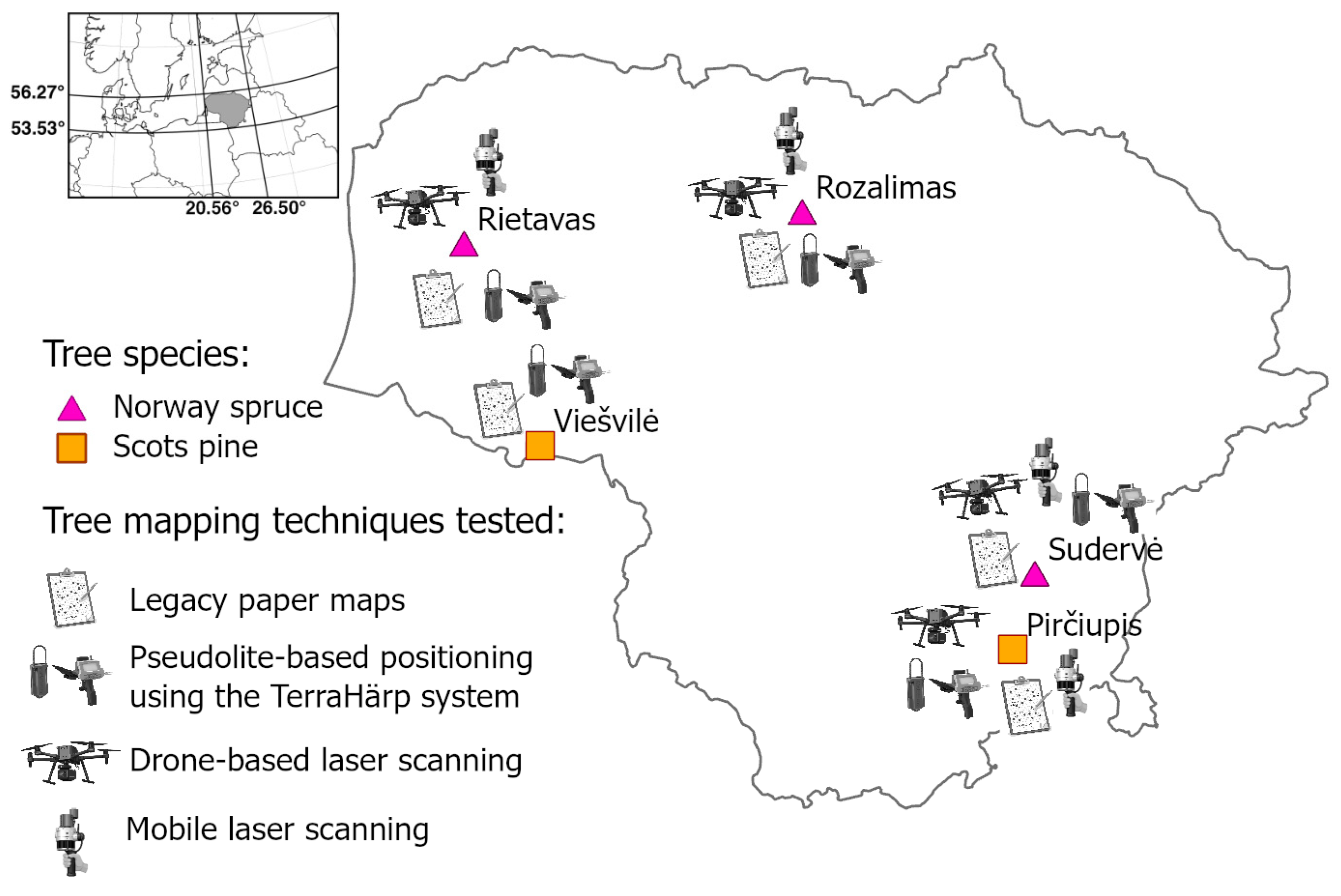
Data for this study were collected at five sites in Lithuania (Figure 1), which were established between 1990 and 1992 for long-term experiments on stand growth under different thinning regimes. Since their establishment, the stands have been managed under varying initial densities and subjected to distinct thinning treatments [38]. These sites represent different regions of the country. Each site comprises 4–10 rectangular test-site segments that differ in tree density and other dendrometric characteristics owing to the applied thinning regimes or tree mortality caused by biotic or abiotic factors. The sites were originally established as pure Scots pine and Norway spruce stands, although natural ingrowth has occurred. The current dendrometric characteristics are presented in Table 1. The sites were also used as research polygons for testing airborne, terrestrial, and mobile laser scanning techniques for forestry applications.
Owing to Lithuania’s relatively small geographic extent, the climatic conditions across the sites are similar, with a long-term mean air temperature of approximately 7.5 °C and a mean annual precipitation of approximately 695 mm. The landscape is predominantly lowland, and the study sites lie between 80 and 129 m above sea level. Across the sites, variations in the ground surface level did not exceed, on average, 2°. Throughout the study period, the groundwater depth remained less than 250 cm.

2.2. Data Collection and Tree Mapping

Four approaches to tree mapping were compared: (i) legacy paper maps, (ii) TerraHärp pseudolite positioning system, (iii) drone-based laser scanning, and (iv) mobile laser scanning.

2.2.1. Use of Legacy Paper Maps

Tree mapping data from legacy paper maps, created during the establishment of the test-sites at a scale of 1:100 were initially intended to be used as one of the reference datasets. These cartographic maps have been continuously updated as part of long-term research on stand growth under different thinning regimes in the past. In the present study, the most recent remeasurement data from 2021 were used.
The original cartographic maps were produced by measuring inter-tree distances using measuring tapes and recording tree positions on graph paper, where 1 mm corresponded to 10 cm in the field. For this study, these maps were digitised by measuring the position of each tree directly from the cartographic map using a ruler and manually recording the corresponding x- and y-coordinates in the digital environment. To georeference the dataset, four corner trees were assigned geographic coordinates measured in the field using a Trimble R12 GNSS receiver (Trimble Inc., Westminster, CO, USA). The coordinates of the remaining trees were then calculated based on their relative distances from these reference trees, which were known from cartographic maps. Final digital tree maps were created using ArcGIS Pro (version 3.6; Esri, Redlands, CA, USA).

2.2.2. Pseudolite Positioning System

Tree positions were measured using the TerraHärp pseudolite positioning system [40] (Field Finland Oy, Helsinki, Finland) integrated with Masser ExCaliper II calipers (Masser Oy, Rovaniemi, Finland). This system operates through a network of base stations with known coordinates defined in a local reference frame. Tree locations were determined by measuring the distance between the caliper and base stations.
Sixteen base stations were installed at each site. The first four stations were positioned in the southwestern corner of each plot in a rectangular configuration to establish a stable local reference system. Tree coordinates were recorded simultaneously with the DBH measurements. The measured DBH for every tree and the measured height of every tenth tree were used to model the heights of the other trees. Missing tree heights were modelled using Lorey’s height formula, as applied by Kuliešis (Equation (1)) [41].
H q = i = 1 n b a i × h i i = 1 n b a i     ,  
where Hq is the mean height in m, bai is the basal area of the sample trees in m2, and hi is the measured or modelled height of the trees in m. The volume of each tree was estimated from its DBH, height, and form factor. The form factors were obtained from Kuliešis (Equations (2) and (3)) [41].
For Scots pine:
f s = 0.41097 + 0.47997 h + 1.02196 D B H + 0.1288 D B H × h 2.8412 D B H 2 + 6.3796 D B H 2 × h     ,  
For Norway Spruce:
f s = 0.34138 + 0.91231 h + 0.13122 × h D B H 0.19231 × h D B H 2   ,
where fs is the form factor, h is the tree height in m, and DBH is the tree diameter at breast height in cm.
Trees were identified using the same IDs as those in the legacy maps established during plot installation, whereas new IDs were assigned to ingrowth trees. The local coordinate system was transformed into the Lithuanian National Coordinate System (LKS94) by surveying the GNSS receiver positions located in nearby open areas using the same procedure applied for tree measurements. Only trees successfully linked between the TerraHärp reference and laser scanning-based datasets were included in the positional accuracy analysis.

2.2.3. Drone-Based Laser Scanning

Drone-based laser scanning and aerial photogrammetry were performed using a DJI Matrice 350 RTK unmanned aerial vehicle (UAV) (SZ DJI Technology Co., Ltd., Shenzhen, China) equipped with a DJI Zenmuse L2 sensor (SZ DJI Technology Co., Ltd., Shenzhen, China). The LiDAR sensor was operated in triple-return mode with a sampling rate of 240 kHz and a non-repetitive scanning pattern to enhance canopy penetration and capture detailed structural information.
Data acquisition was conducted at a flight altitude of 100 m, resulting in an average point density of approximately 260 points per square meter. The flight lines were planned with a 50% overlap. Simultaneously, RGB images were acquired for point cloud colorization and photogrammetric point cloud generation. The RGB imagery had 61% side overlap and 70% forward overlap, with a ground sampling distance (GSD) of 2.7 cm.
Drone-based scanning was conducted at four of the five test-sites. Data acquisition at test-site 5 was not permitted because of its proximity to an international border and the associated flight restrictions. All UAV surveys were conducted under leaf-off conditions and coincided with the TerraHärp field measurements.
Initial LiDAR processing was performed in DJI Terra (version 4.5.0, SZ DJI Technology Co., Ltd., Shenzhen, China), including point-cloud generation and ground-point classification. The classified point cloud was normalised, and a canopy height model (CHM) was generated using LAStools (version 241210; Rapidlasso GmbH, Gilching, Germany).
Individual trees were identified using two approaches:
  • CHM-based watershed segmentation: Tree crowns were delineated using a watershed algorithm implemented in eCognition Developer (version 10.4, Trimble Germany Gmb: Munich, Germany). The CHM raster (resolution: 0.1 m) was segmented to extract the individual tree crowns. Tree height was derived from the maximum CHM value within each crown segment, and the tree location was defined as the centre of the pixel with the maximum height.
  • 3D point-cloud segmentation: Individual trees were detected using the SegmentAnyTree machine-learning algorithm based on semantic and instance segmentation of LiDAR point clouds [42]. Each tree was assigned a unique identifier. Tree coordinates were derived from the highest and lowest above-ground points within each segmented crown.
Each detected tree was assigned a unique ID corresponding to the field-based tree maps. Tree identification was validated in the field by comparing the segmentation results with the observed tree positions. Species, diameter, height, and volume attributes were assigned to each tree identified in LiDAR data.

2.2.4. Mobile Laser Scanning

Mobile laser scanning was performed using the Phoenix RECON-XT system (Phoenix LiDAR Systems, Austin, TX, USA), which employs simultaneous localization and mapping (SLAM) for data acquisition. Owing to severe GNSS signal obstruction at test-site 5, this site was excluded from further MLS-based analyses. Data acquisition was conducted in autumn 2025, one year after the drone and pseudolite surveys; consequently, some trees had died or been removed during this interval. Scanning was performed by walking through the study area along linear paths covering the entire object, with trajectories spaced at approximately 5–10 m intervals. The acquired point clouds exhibited a high average point density of approximately 11,000 points/m2 and a mean point spacing of approximately 0.01 m, providing sufficient spatial resolution for a detailed analysis of fine-scale forest structural elements. The initial processing of the laser scanning data was conducted using Phoenix Spatial Explorer software (version 9,01, Phoenix LiDAR Systems, Austin, TX, USA). Subsequently, the point cloud was normalised and classified into three classes: ground, noise and other points. For further analysis, points belonging to the ground and other point classes were used. Tree positions were determined by extracting a 10 cm thick horizontal slice of the point cloud at the breast height (1.3 m). The centre of each tree stem was manually identified by placing points at the geometric centre of the visible stem cross-section. This manual approach was adopted because the primary aim of the MLS analysis was to explore the feasibility and potential of SLAM-based data acquisition for tree mapping, rather than to evaluate the automated tree detection performance. Manual placement ensured reliable reference tree position at this exploratory stage. This method for determining tree locations from MLS data was consistently applied across the four study sites.

2.3. Data Analysis

The analysis was performed at three levels of spatial aggregation, depending on the task: the tree species level (with the Pirčiupis and Viešvilė test-sites representing pine stands and the remaining test-sites representing spruce stands), the test-site level, and the test-site segment level. The tree identification accuracy was assessed using the F1-score, which combines precision and recall into a single performance metric. The F1-score was calculated by comparing the trees identified by the evaluated methods with the TerraHärp dataset, which was used as a reference. Precision (P) and recall (R) (Equations (4) and (5)) are defined as follows:
P = T P T P + F P ,    
R = T P T P + F N ,  
where T P denotes correctly identified trees, F P falsely identified trees, and F N missed reference trees. The F1-score was then computed as follows (Equation (6)):
F 1 = 2 P R P + R .
Tree positional accuracy was evaluated by comparing independently measured coordinates with the corresponding reference positions derived from the compared mapping methods. Horizontal systematic bias was assessed using Hotelling’s T2 test [43], which jointly evaluates deviations in the horizontal coordinates (X and Y) while accounting for their covariances. A statistically significant result indicates that the mean horizontal error vector is different from zero.
The random positional error was quantified using the RMSE of the horizontal coordinates. The final accuracy metrics were reported following the National Standard for Spatial Data Accuracy (NSSDA), with horizontal accuracy at the 95% confidence level calculated by multiplying the horizontal RMSE by 1.7308 [44].
The spatial autocorrelation of absolute horizontal errors was assessed using Global Moran’s I, which was computed in ArcGIS Pro. The relationships between forest structural variables (e.g., stand density and mean tree diameter) and positional accuracy metrics (NSSDA and Moran’s I) were analysed separately for pine- and spruce-dominated test-site segments using Pearson’s correlation analysis at a significance level of α = 0.05. R2 values were derived from the regression model. A paired t-test was used to compare the segment-level means, assuming negligible within-segment variance owing to the large number of trees contributing to each mean. All analytical calculations were performed using the standard functionality available in Microsoft Excel (Microsoft Corporation, Redmond, WA, USA) and ArcGIS Pro.

3. Results

3.1. Accuracy of Field Mapping of Trees: Pseudolite Mapping vs. Legacy Maps

3.1.1. Identification of Trees

Using the TerraHärp system, 6650 trees were mapped, of which 6185 (93%) were successfully matched to the trees recorded on the legacy maps. Conversely, 6197 of the 6638 trees (93.4%) mapped on paper maps were also detected by the TerraHärp system. In pine stands, the corresponding identification rates were 93.5% (TerraHärp → legacy) and 93.0% (legacy → TerraHärp), whereas in spruce stands the rates were 92.6% and 93.6%, respectively.
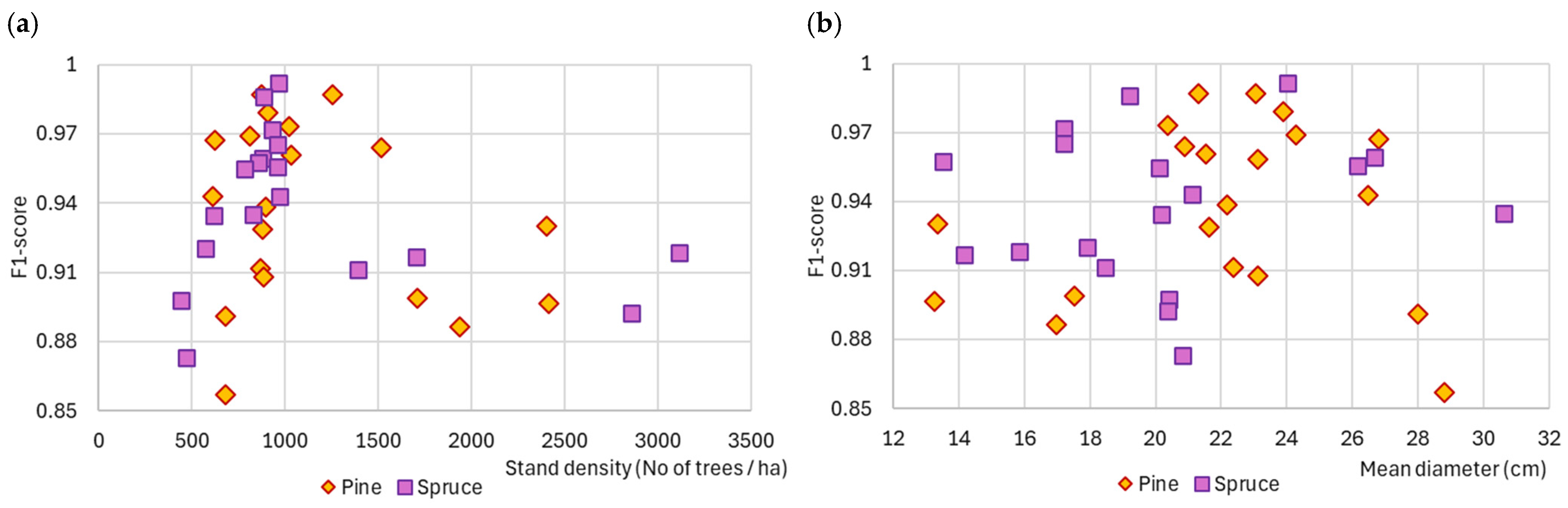
To avoid redundancy, tree identification using the TerraHärp system was treated as the reference, and in subsequent laser scanning analyses, the maps derived from laser scanning were compared with the TerraHärp maps. The correspondence between tree identification obtained using the TerraHärp system and legacy maps was high, with an overall F1-score, precision, and recall of approximately 0.93. At the scale of individual test-site-segments, the identification accuracy, expressed as the F1-score, varied across segments (Figure 2) and ranged from 0.86 to 0.99. However, no meaningful relationship was observed between the F1-score and either average tree density or mean diameter in pine (R2 = 0.06 and R2 = 0.01, respectively) or spruce stands (R2 = 0.06 and R2 = 0.02, respectively).
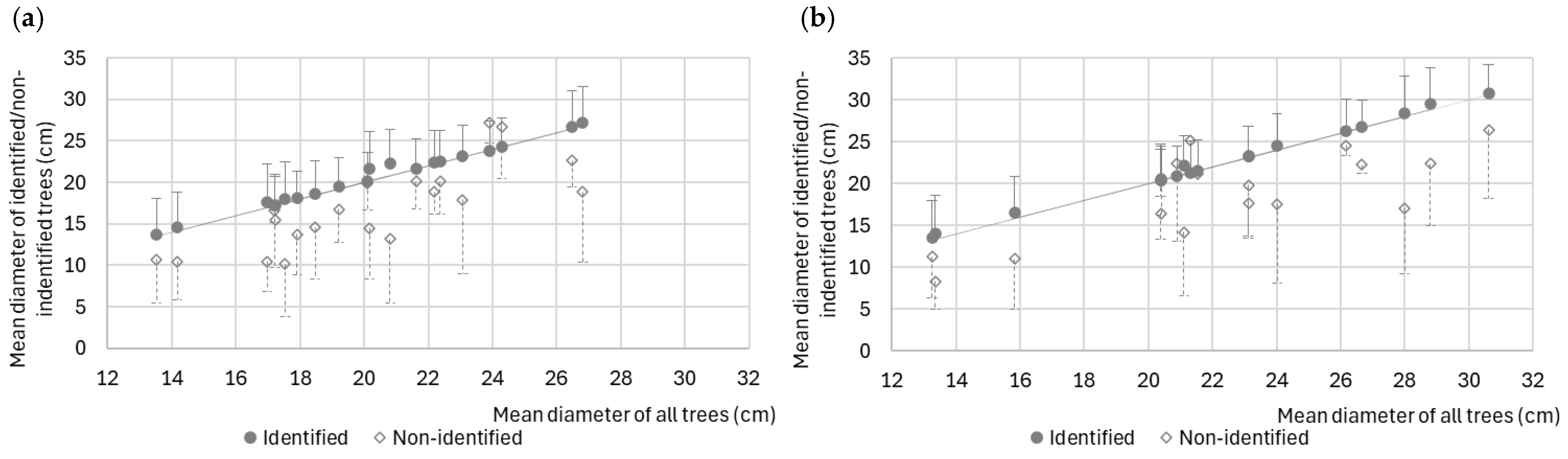
Trees identified using the TerraHärp system tended to have larger mean diameters at the test-site segment level than the mean diameter of all trees, including both identified and non-identified trees (Figure 3). With few exceptions, trees that were not detected by the TerraHärp system but were present on legacy maps generally had smaller mean diameters (mean difference = 2.37, p = 0.0029 in pine stands but not statistically significant in spruce stands, mean difference = 1.79, p = 0.073).
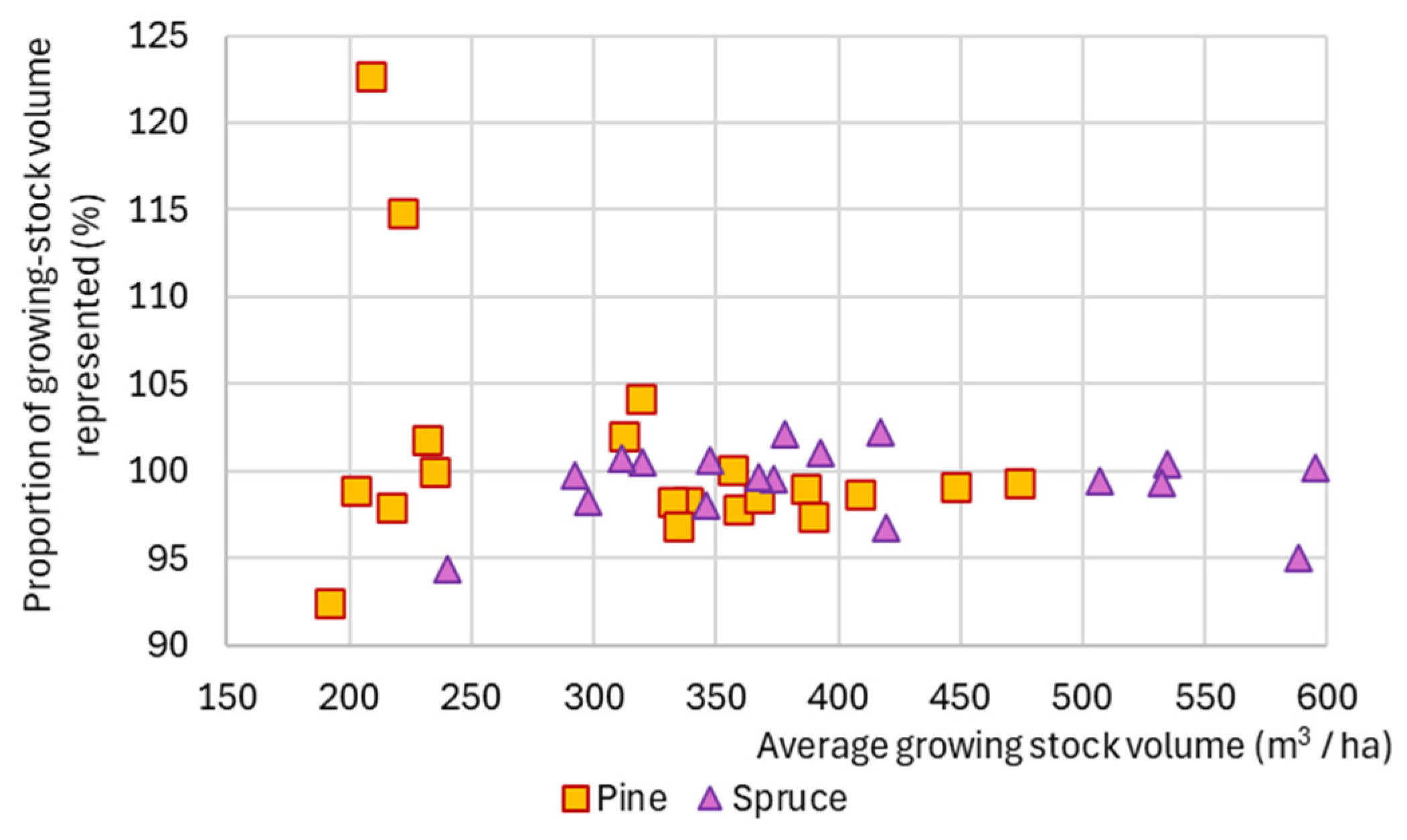
Although some trees recorded on legacy maps were not detected by the TerraHärp system, and some ingrowth was identified only by the TerraHärp system, the total stand volume across all study sites remained very similar between the two mapping approaches. In pine stands, the average growing-stock volume was 330.8 m3/ha for both the data sources. In spruce stands, the difference was minimal: trees mapped on legacy maps yielded a volume of 384.7 m3/ha, while those mapped using the TerraHärp system produced a volume of 382.4 m3/ha, corresponding to a 0.6% difference. This pattern was consistent at the test-site segment level (Figure 4), with a few segments deviating due to naturally regenerated ingrowth trees that were not recorded on the legacy maps. At the test-site–segment level, average growing stock volumes were higher for trees mapped using the TerraHärp system than for those mapped in the legacy maps (pine segments: mean difference = 10.6, p = 0.0018; spruce segments: mean difference = 11.9, p < 0.001).

3.1.2. Positioning

Across all five test-sites, clear differences emerged between the tree coordinates obtained using the TerraHärp pseudolite mapping system and those derived from legacy paper maps. When positional deviations were evaluated at the level of the test-site segments, discrepancies consistently demonstrated evidence of systematic horizontal shifts. Hotelling’s T2 test identified significant two-dimensional positional bias in 35 of the 38 test-site segments with available statistics, indicating that mean horizontal offsets were not solely attributable to random variability but reflected systematic displacement patterns in the reference map coordinates or pseudolite measurements. Only three segments showed no detectable bias. These results suggest that horizontal misalignment is pervasive across the study area at the scale of individual mapping units.
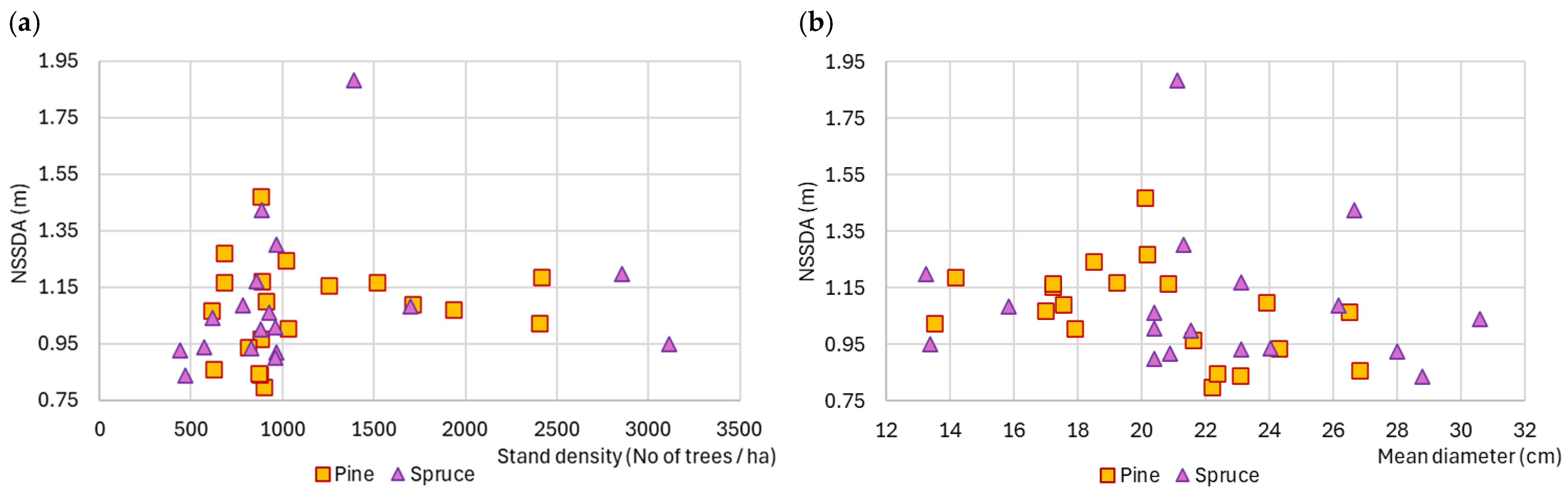
The random positional error, summarised by the NSSDA 95% horizontal accuracy metric, was generally consistent among sites dominated by pine and spruce (Figure 5). The mean horizontal NSSDA was 1.07 m for pine-dominated sites and 1.09 m for spruce-dominated sites, indicating that species composition and associated stand structure did not markedly influence the magnitude of random tree map discrepancies. These values reflect the combined effect of both absolute deviations and the fixed systematic offsets detected by Hotelling’s T2. Thus, even when systematic bias was present, the dispersion of deviations around the biased mean remained within a relatively narrow range.
Using a threshold of |z| > 3 applied to the NSSDA 95% accuracy values, only one segment (test-site Rietavas, spruce, stand density 1391 stems/ha) was identified as an outlier. This segment showed the largest NSSDA value (1.88 m), exceptionally high Hotelling’s T2, and a strong positive spatial autocorrelation of deviations (Moran’s I = 0.41, p < 0.001). Therefore, the outlier was treated as a genuine characteristic of the legacy map dataset rather than being excluded to improve the accuracy estimates. Excluding this observation would result in a mean difference of 0.047 m in the spruce stands, and a Welch two-sample t-test indicates no statistically significant difference between the datasets with and without the observation (t = 0.67, p = 0.51).
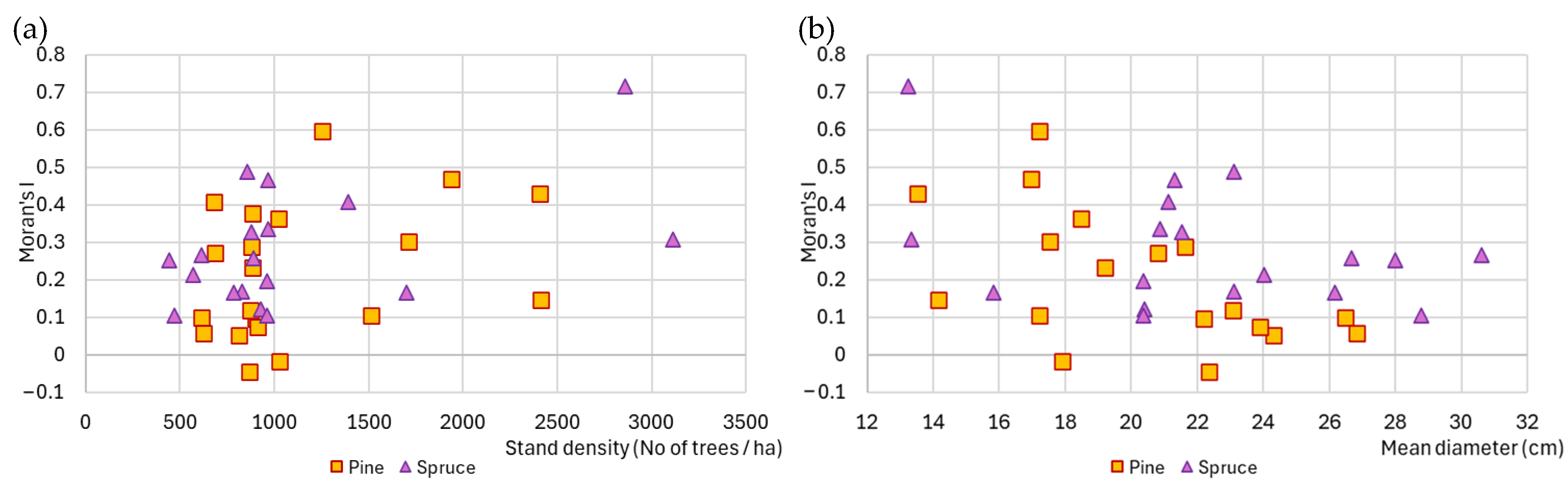
The spatial patterns of the deviations were more variable (Figure 6). Moran’s I values at the test-site segment level ranged from strongly positive to near zero, showing that spatial autocorrelation of absolute positional deviations was present in some segments but absent in others. Several pine segments exhibited high and statistically significant Moran’s I values (for example, 0.469 and 0.302), indicating localised clustering of larger or smaller errors, whereas other segments within the same test-sites showed low or non-significant autocorrelation. Spruce-dominated sites displayed a similar mixed pattern, with multiple segments showing significant spatial structure in deviations and others showing random spatial distributions of trees. These results suggest that error clustering is not primarily determined by forest type but rather by segment-level variations in map quality, stand silvicultural treatment history, or local measurement conditions.
Correlation analysis revealed no statistically significant relationships between stand density and horizontal positional accuracy (NSSDA) for either pine-dominated (r = 0.13, p = 0.59) or spruce-dominated (r = 0.16, p = 0.51) test-site segments. Similarly, the mean tree diameter showed no significant correlation with the NSSDA in either forest type. In contrast, the spatial autocorrelation of positional deviations exhibited species-specific structural dependencies. In pine stands, Moran’s I was significantly and negatively correlated with mean tree diameter (r = −0.52, p = 0.018), indicating reduced clustering of positional errors in stands with larger trees. In spruce stands, Moran’s I was significantly and positively correlated with stand density (r = 0.50, p = 0.035), suggesting that denser spruce stands are associated with a stronger spatial clustering of positional deviations.
Tree-level positional deviations in all test-site segments (TerraHärp vs. legacy paper maps) are displayed in more detail in the Supplementary Materials (Figure S1).

3.2. Accuracy of Laser Scanning-Based Tree Mapping

3.2.1. Identification of Trees

A comparison of the tree identification results highlighted noticeable differences between the tested laser-scanning data processing methods. The TerraHärp approach identified 5293 trees in the study area. In comparison, CHM segmentation identified 3420 trees (64.6%), whereas 3D point cloud segmentation identified 4522 trees (85.4%). Mobile laser scanning (MLS) identified 4551 trees; however, a direct comparison with TerraHärp was not possible because of incomplete scanning of some segments and tree removal between acquisitions. CHM-based identification rates were 74.2% in pine stands and 59.9% in spruce stands. Higher rates were obtained using 3D point cloud segmentation, with 106.5% of trees identified in pine and 75.0% in spruce stands. Only 37 CHM-identified trees (1.8%) were not linked to any TerraHärp-mapped tree (16 in pine and 21 in spruce stands). In contrast, 1017 trees (22.5%) identified from the 3D point clouds were not linked to the TerraHärp trees, including 374 in pine stands and 643 in spruce stands.
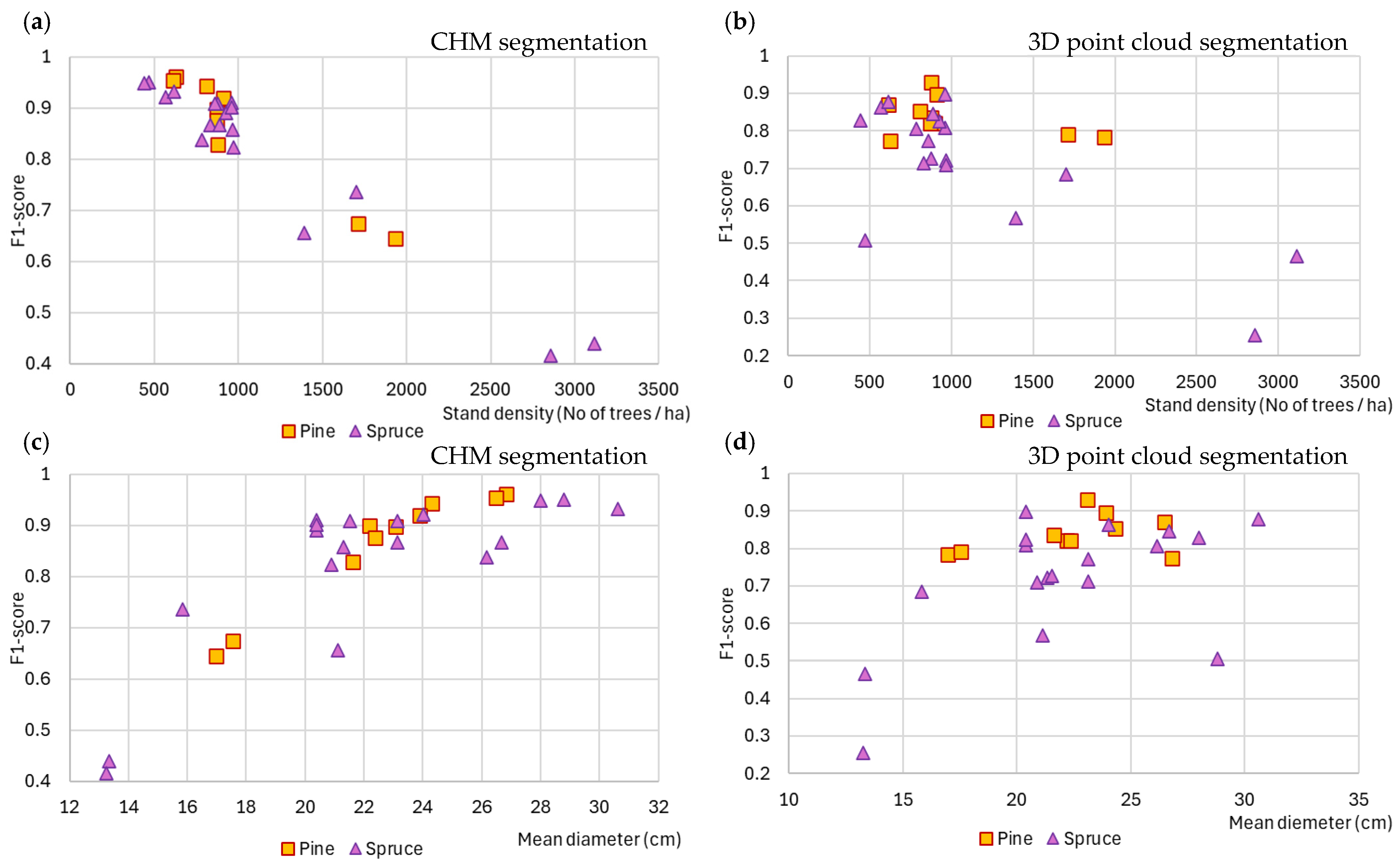
Overall, tree identification based on CHM segmentation was more accurate than that based on 3D point cloud segmentation, with mean F1-scores of 0.78 and 0.72, respectively. Precision was higher for the CHM segmentation approach (0.98 vs. 0.78), whereas recall was similar (0.65 vs. 0.66). At the test-site–segment level, the F1-scores exceeded 0.9 for approximately half of the segments processed using CHM segmentation, whereas 3D point cloud segmentation generally resulted in F1-scores below 0.9. Notably, the segmentation accuracy was low in the two densest stands, regardless of the segmentation method used.
The tree identification accuracy at the test-site–segment level was strongly related to stand density and mean diameter (Figure 7). Stand density typically exhibited a strong and statistically significant negative correlation with the F1-score, with higher accuracies observed in less dense stands. The only exception was 3D point cloud segmentation in pine stands, where a moderate but non-significant negative correlation was observed (pine stands: r = −0.97, p < 0.01 for CHM segmentation; r = −0.44, p = 0.21 for 3D point cloud segmentation; spruce stands: r = −0.97, p < 0.01 for CHM segmentation; r = −0.75, p < 0.01 for 3D point cloud segmentation).
Because stand density and mean diameter were strongly correlated, the opposite pattern was observed for the mean diameter, with F1-scores increasing as the mean diameter increased. This relationship was strong and statistically significant for CHM segmentation in both pine and spruce stands, whereas for 3D point cloud segmentation, it was moderate and non-significant in pine stands but significant in spruce stands (pine stands: r = 0.96, p < 0.01 for CHM segmentation; r = 0.38, p = 0.28 for 3D point cloud segmentation; spruce stands: r = 0.78, p < 0.01 for CHM segmentation; r = 0.57, p = 0.014 for 3D point cloud segmentation).
3D point cloud segmentation produced a substantial number of trees that could not be linked to the TerraHärp reference. In pine stands, the proportion of such trees showed weak, non-significant relationships with stand density (r = −0.384, p = 0.274) and mean diameter (r = 0.286, p = 0.42), while no relationships were observed in spruce stands for either stand density (r = 0.12, p = 0.63) or mean diameter (r = −0.06, p = 0.87). Consequently, further analysis of stand-level attributes was not conducted due to the lack of field-based dendrometric data for these trees.
Because the mobile laser scanning data did not fully cover all TerraHärp objects, typically at the edges of some test-site segments, tree identification accuracy could not be analysed in greater detail. Nevertheless, when the test-site segments with incomplete mobile laser scanning were excluded, the F1-score reached 0.94 in pine stands and 0.96 in spruce stands, attaining a value of 1.0 in some cases.

3.2.2. Positioning

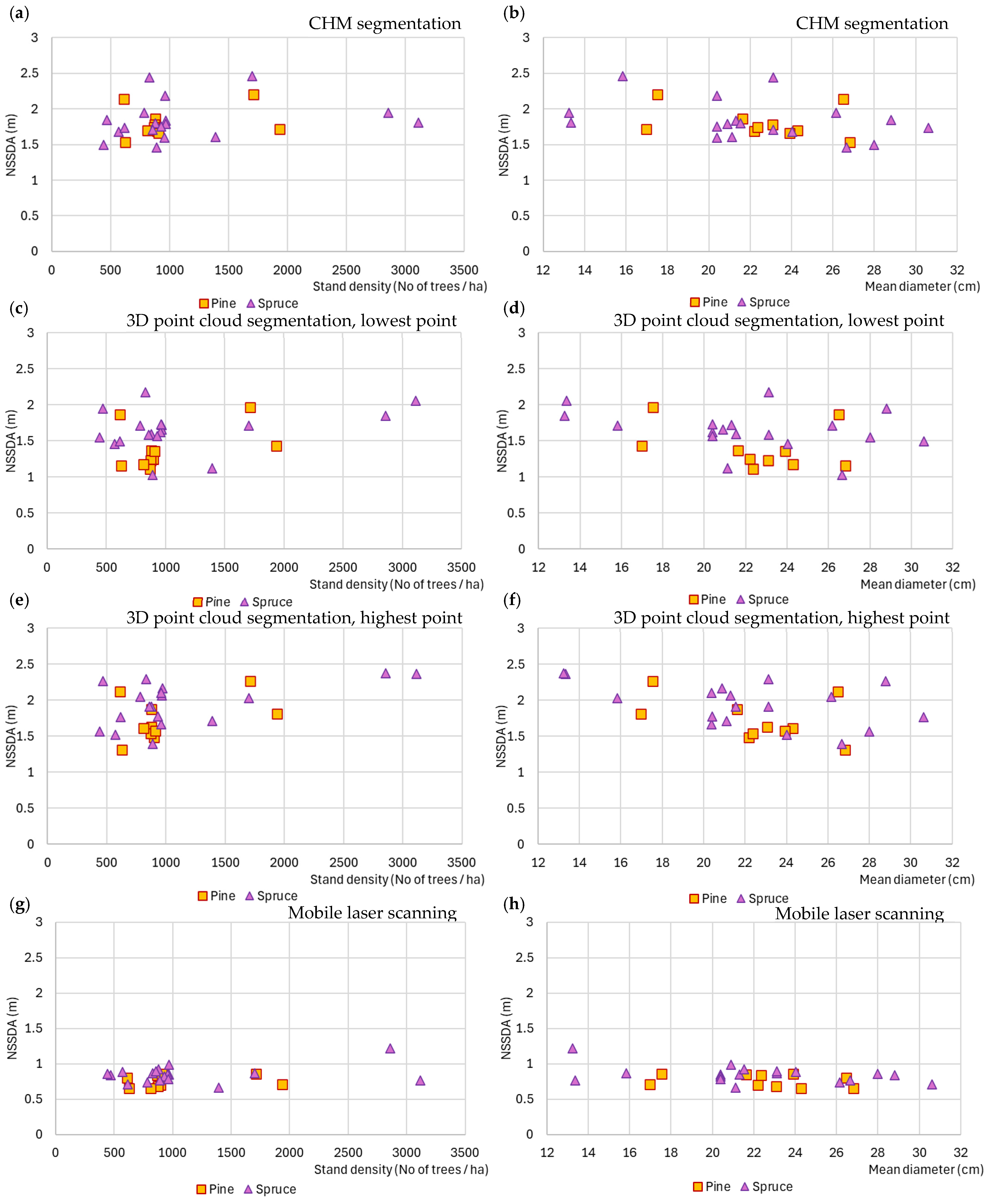
The largest positional errors were observed when tree locations were derived from crown apexes identified in CHMs (mean horizontal NSSDA of 1.81 m in pine and 1.78 m in spruce stands) and from the highest points of 3D point cloud segments (1.76 m in pine and 1.98 m in spruce stands). Using the lowest cluster point in the 3D point cloud segmentation resulted in improved positional accuracy (NSSDA of 1.45 m in pine and 1.72 m in spruce stands). The highest accuracy was achieved using mobile laser scanning, with more than 95% of trees located within 1 m of the TerraHärp reference and mean NSSDA values of 0.76 m in pine and 0.90 m in the spruce stands.
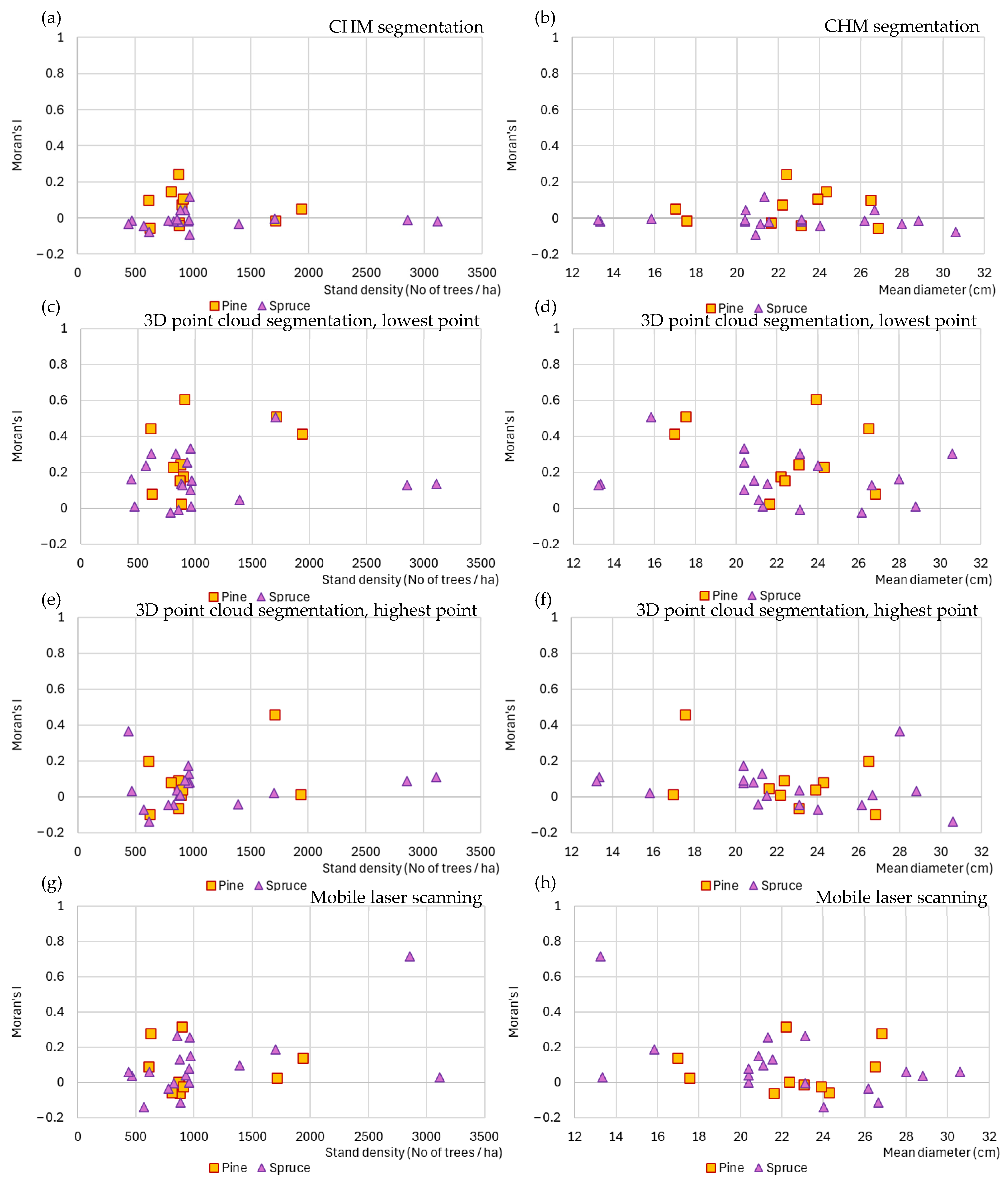
Three distinct levels of positional deviation were also observed at the test-site-segment level (Figure 8). Typically, the discrepancies consistently indicate systematic horizontal shifts. In most cases, NSSDA showed no relationship with stand density or mean diameter; the only statistically significant correlations were found in spruce stands when tree locations were derived from crown apexes extracted by 3D point cloud segmentation (r = 0.516, p = 0.029 for stand density; r = −0.478, p = 0.045 for mean diameter). Deviations were generally not spatially autocorrelated across segments (Figure 9), although spatial autocorrelation occurred in some segments. In particular, the approach based on 3D point cloud segmentation with tree locations defined by the lowest segment point differed from the other methods, showing a statistically significant spatial autocorrelation for the majority of segments in pine stands and in one spruce test-site.
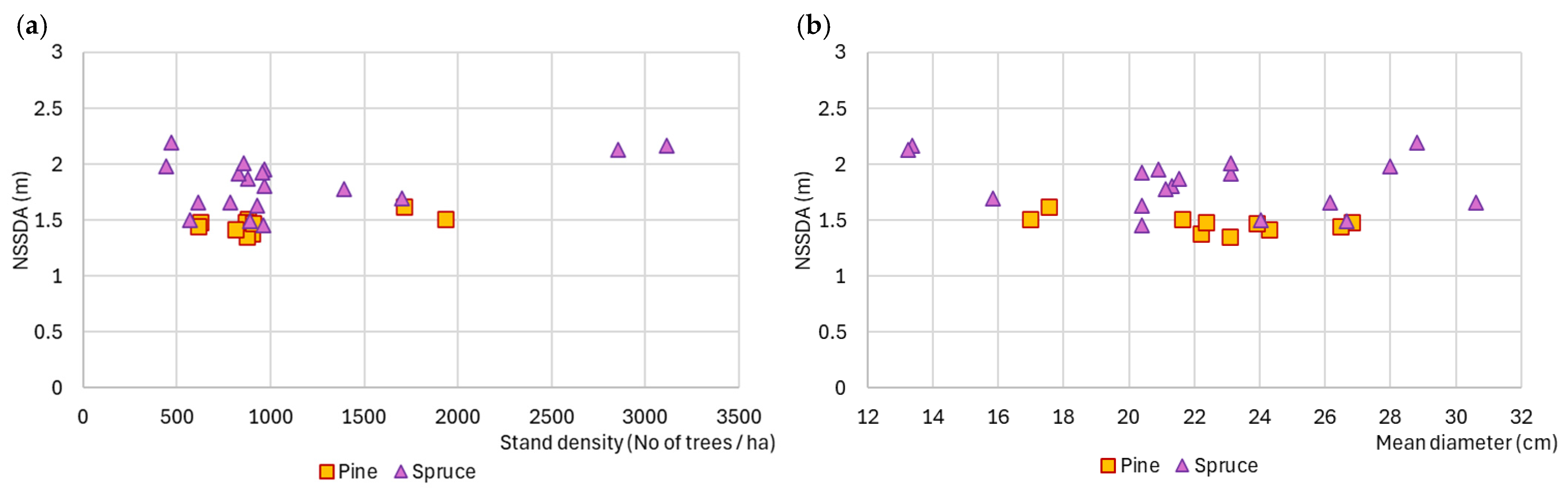
The mean distance between the points used to locate the same tree derived from 3D point cloud segmentation was 0.856 m in pine stands and 1.114 m in spruce stands, corresponding to mean horizontal NSSDA values of 1.48 m and 1.93 m, respectively. In pine stands, the NSSDA showed moderate but non-significant relationships with stand density (r = 0.582, p = 0.078) and mean diameter (r = −0.522, p = 0.122) (Figure 10). Statistically significant systematic horizontal shifts between the lowest and highest points of the same segment were observed in all pine test-site segments, but only in approximately half of the segments in the spruce stands; deviations were not spatially autocorrelated.
Tree-level positional deviations in all test-site segments (TerraHärp vs. laser-scanning-based tree maps) are displayed in more detail in the Supplementary Materials (Figures S1–S5).

4. Discussion

The primary aim of this study was to evaluate whether pseudolite-based positioning provides sufficiently accurate tree locations to serve as a reference for surveys requiring high positional accuracy. Given that all alternative approaches tested here have inherent limitations, we assessed the suitability of the pseudolite-based TerraHärp system for producing tree maps in pine- and spruce-dominated stands in Lithuania using pairwise comparisons of tree identification accuracies and positional discrepancies. Tree mapping was considered (i) as a ground reference for airborne laser scanning-based inventories, which require unambiguous linking of trees on the ground to those detected in laser point clouds or terrain models, and (ii) as a prerequisite for scientific studies and precision forestry applications that depend on accurate tree-level positioning of trees.
Overall, discrepancies between the TerraHärp system and historical map-based tree locations were characterised by (i) pervasive systematic horizontal shifts across most test-site segments, (ii) relatively small and consistent random variability in horizontal deviations across forest types, and (iii) spatially heterogeneous clustering of deviations within and among test-sites. This pattern indicates that the disagreement between the two mapping approaches is dominated by geometric offsets in the legacy maps, while local conditions introduce secondary, spatially structured variability. Outlier analysis further supports this interpretation, that there exist localised distortions in the historical map rather than random surveying errors in TerraHärp.
The absence of significant relationships between stand density or mean diameter and horizontal positional accuracy indicates that the magnitude of the random tree location error is largely independent of forest structure and is governed by the properties of the underlying spatial datasets. In contrast, the spatial organisation of the positional deviations showed structure-dependent patterns. In pine-dominated segments, the negative relationship between mean diameter and Moran’s I suggests stronger clustering of errors in stands with smaller trees, potentially reflecting higher local geometric inconsistency in the original cartographic maps in younger or more heterogeneous pine stands. In the spruce-dominated segments, the positive relationship between stand density and Moran’s I indicates that denser stands are associated with a more spatially coherent clustering of discrepancies. Together with the widespread systematic bias indicated by Hotelling’s T2, these findings support the conclusion that distortions in original cartographic paper maps—rather than TerraHärp positioning uncertainty—are the primary drivers of both the magnitude and spatial structure of positional discrepancies. Our interpretation is consistent with prior stem-map alignment research in the region, which shows that mismatches between independently produced single-tree datasets are often dominated by systematic shifts and therefore require explicit co-registration to achieve reliable tree-to-tree linking [24,45].
Based on these considerations, TerraHärp-mapped trees were used as references for evaluating drone-based and mobile laser-scanning approaches. Although positional agreement could likely be improved through more rigorous reference construction and additional processing steps, the focus of this study was to assess pseudolite-based positioning, which remains relatively underexplored in forest mapping applications. We acknowledge that the positional accuracies obtained in this study are lower than those reported for similar techniques in Finnish forest conditions; however, those studies were conducted under different experimental designs and environmental settings [35,36,37].
The results from laser scanning demonstrated a clear separation of error sources: (i) tree detection depends strongly on stand density and mean diameter, whereas (ii) positional accuracy depends primarily on how tree location is defined (CHM crown apex versus point-cloud highest/lowest points, and MLS stem-proximal geometry). At the detection stage, omission and commission errors arise from the stand structure and segmentation choices [46]. CHM-based segmentation primarily captures the crowns of dominant trees, resulting in minimal commission errors (high precision values) because the detected crown maxima correspond closely to the mapped stems. However, suppressed and intermediate trees are poorly represented in 2.5D CHMs, leading to omission errors (lower recall values). In contrast, 3D point cloud segmentation increases canopy penetration and thus improves the detection of smaller trees, but it also increases the number of additional trees that cannot be linked to TerraHärp.
Localisation errors (expressed as NSSDA) are primarily a function of the chosen location proxy and any remaining systematic shifts. In addition, TerraHärp coordinates reflect the position of caliper placement during measurement and may therefore be offset from the stem centre by approximately the stem radius at the measurement height, which can contribute to small systematic differences between reference and remotely derived locations.
Tree identification showed strong relationships with stand structure, including underestimation in dense segments (>1000 trees/ha). In high-density stands, crown overlap increases, CHMs smooth local maxima, and crown delineation becomes ambiguous, which likely contributes to undercounting in segments with smaller mean diameters and a higher proportion of small trees [9,25,47,48,49,50]. In pine stands with fewer than 1000 trees/ha, 3D point cloud segmentation identified more trees than the TerraHärp reference. This likely reflects the detection of understory and natural ingrowth not captured by TerraHärp, which is plausible given that the test-sites represent long-term afforestation and thinning experiments where ingrowth may not be consistently recorded. Although dendrometric characteristics could not be compared directly, the mean height derived from 3D point clouds was notably lower for the “extra” trees—17.3 m versus 21.0 m in pine stands (mean difference = 3.41, p = 0.001) and 19.8 m versus 22.1 m in spruce stands (mean difference = 1.21, p < 0.001), supporting the interpretation that many additional detections represent smaller individuals. Operationally, these results imply that tree counts derived from drone-based segmentation may require calibration (e.g., density- or diameter-dependent correction) before being used for stand-level stocking assessments [51,52,53,54].
The positional accuracy results were consistent across the methods. Mobile laser scanning achieved the highest accuracy (>95% of trees within 1 m of the TerraHärp reference), whereas CHM-derived crown apex locations and point-cloud highest-point proxies produced the largest positional errors. Using the lowest cluster point of 3D point cloud segments improved positional accuracy. MLS likely performs best because it captures stem-proximal geometry with a high point density at lower canopy levels [55,56]. It should be noted that the analysis relied exclusively on automated tree identification in the drone point clouds. However, MLS completeness may be reduced by occlusion and acquisition failures; such limitations affected some segments in this study, including those with notable Moran’s I outliers. Consequently, MLS is well-suited for accurate stem positioning; however, acquisition protocols must ensure sufficient coverage [57]. Although cost-effectiveness was not evaluated, MLS is likely the most expensive approach tested. More generally, crown apex-based proxies are expected to deviate from stem locations, particularly in stands with leaning stems or asymmetric crowns. The highest point within a segment is also sensitive to outliers and crown geometry, whereas the lowest point may better approximate the stem base or lower crown structure, reducing the horizontal offset.
This study had several limitations. Temporal mismatches and tree removal between acquisitions affected comparability, and incomplete MLS coverage limited the detection comparisons in some segments. TerraHärp measurements were supported by Finnish partners, and this campaign represents the first application of the system under Lithuanian conditions. Data acquisition could not always be optimised because of proximity to the national border and GNSS disturbances.
Methodological inconsistencies arise from the processing of laser-scanning data. Tree coordinates for the MLS data were determined manually, whereas automated algorithms were applied to drone-based laser-scanning data. Manual stem identification may introduce subjectivity and differ from algorithmic tree detection. Automated detection was also tested for SLAM-based data but did not produce consistent results across the study sites, likely because of dense understory vegetation. This difference represents a limitation of the study and should be considered when comparing results between datasets.

5. Conclusions

TerraHärp vs. legacy maps. Differences between the pseudolite-based TerraHärp tree map and original cartographic map-based tree locations were dominated by systematic horizontal shifts present in most test-site segments, whereas the random component of horizontal deviations was comparatively small and consistent across pine- and spruce-dominated stands. Spatial clustering of deviations was heterogeneous, indicating localized distortions in the legacy maps.
Use of TerraHärp as a reference. Because the disagreement with historical maps was largely attributable to legacy-map geometric artifacts rather than stand structure, the TerraHärp system provides a practical reference for accurate tree location and for linking ground-mapped trees with remotely sensed detections in pine and spruce stands in Lithuania.
ALS tree identification is stand structure dependent. Tree identification from drone-based laser scanning were strongly related to stand density and mean diameter, with consistent underestimation in the densest forest conditions (>1000 trees ha−1). The results indicate that CHM-based segmentation achieved higher tree identification accuracy than 3D point cloud segmentation, primarily due to higher precision, while recall values were nearly identical. The 3D point cloud segmentation resulted in a higher number of additional trees that could not be linked to the reference data.
Positional accuracy depends on the location proxy: The largest positional errors occurred when tree locations were derived from CHM crown apexes or point-cloud highest-point proxies. Defining tree location by the lowest cluster point in 3D point cloud segments improved positional accuracy, indicating that location proxies that better approximate stem position reduce horizontal offsets.
MLS provides the highest positional accuracy, but its application requires dense and continuous field surveying, which increases operational complexity compared to the other approaches. Mobile laser scanning achieved the best tree location accuracy (>95% of trees within 1 m of the TerraHärp reference), although completeness can be limited by occlusion and acquisition coverage, emphasizing the importance of robust field collection protocols.
Practical recommendations. For drone-based tree mapping in comparable conifer stands, CHM segmentation should be preferred when maximizing detection is the priority but stand-density–dependent calibration and validation of additional detections are advisable before using tree characteristics for stand-level assessment. When MLS is not available, point-cloud location proxies that better approximate stem position (e.g., lowest cluster point) should be used instead of crown apexes, and segment-wise co-registration should be applied prior to fusing datasets.
Future work should include targeted field verification of additional (unlinked) trees and explicit correction of legacy-map distortions (e.g., local translation or affine adjustment) to improve multi-source integration and to better quantify commission errors and their implications for derived stand attributes. Further research should also evaluate integrated SLAM and GNSS-based approaches as an alternative to pseudolite-based field mapping.
Overall, the results support the use of pseudolite-based field mapping as a robust geospatial reference for integrating ground observations with drone- and MLS-derived tree maps, and they provide method-specific guidance for operational inventories and precision forestry applications in managed conifer stands under Baltic conditions.

Supplementary Materials

The following supporting information can be downloaded at: https://www.mdpi.com/article/10.3390/f17020272/s1, Figure S1: Tree-level positional deviations for all test-site segments: pseudolite positioning using TerraHärp system versus legacy paper-mapped trees; Figure S2: Tree-level positional deviations for all test-site segments: lowest versus highest points in segmented 3D point clouds; Figure S3: Tree-level positional deviations for all test-site segments: lowest points in segmented 3D point clouds versus pseudolite positioning using TerraHärp system; Figure S4: Tree-level positional deviations for all test-site segments: highest points in segmented 3D point clouds versus pseudolite positioning using TerraHärp system; Figure S5: Tree-level positional deviations for all test-site segments: mobile laser scanning versus pseudolite positioning using TerraHärp system.

Author Contributions

Conceptualization, G.M. and L.B.; methodology, G.M. and D.J.; software, D.J. and M.P.; validation, L.B.; formal analysis, G.M., M.P. and L.B.; investigation, G.M. and R.B.; resources, L.B.; data curation, L.B., M.A., I.V.-K., D.J. and R.B.; writing—original draft preparation, G.M. and L.B.; writing—review and editing, M.P., D.J., M.A., R.B. and I.V.-K.; visualization, G.M., M.P. and D.J.; supervision, G.M.; funding acquisition, L.B. All authors have read and agreed to the published version of the manuscript.

Funding

This research was carried out as part of the postdoctoral fellowship project (Agreement No. S-PD-24-75) funded by the Research Council of Lithuania.

Data Availability Statement

Dataset available on request from the authors.

Conflicts of Interest

The authors declare no conflicts of interest.

References

  1. Yu, X.; Hyyppä, J.; Holopainen, M.; Vastaranta, M. Comparison of Area-Based and Individual Tree-Based Methods for Predicting Plot-Level Forest Attributes. Remote Sens. 2010, 2, 1481–1495. [Google Scholar] [CrossRef]
  2. Martin, M.; Raymond, P.; Boucher, Y. Influence of individual tree characteristics, spatial structure and logging history on tree-related microhabitat occurrence in North American hardwood forests. For. Ecosyst. 2021, 8, 27. [Google Scholar] [CrossRef]
  3. Keefe, R.F.; Zimbelman, E.G.; Picchi, G. Use of Individual Tree and Product Level Data to Improve Operational Forestry. Curr. For. Rep. 2022, 8, 148–165. [Google Scholar] [CrossRef]
  4. Pommerening, A.; Maleki, K.; Haufe, J. Tamm Review: Individual-based forest management or Seeing the trees for the forest. For. Ecol. Manag. 2021, 501, 119677. [Google Scholar] [CrossRef]
  5. Santopuoli, G.; Vizzarri, M.; Spina, P.; Maesano, M.; Scarascia Mugnozza, G.; Lasserre, B. How individual tree characteristics and forest management influence occurrence and richness of tree-related microhabitats in Mediterranean mountain forests. For. Ecol. Manag. 2022, 503, 119780. [Google Scholar] [CrossRef]
  6. Kwak, D.A.; Lee, W.K.; Lee, J.H.; Biging, G.S.; Gong, P. Detection of individual trees and estimation of tree height using LiDAR data. J. For. Res. 2007, 12, 425–434. [Google Scholar] [CrossRef]
  7. Vastaranta, M.; Holopainen, M.; Haapanen, R.; Yu, X.; Melkas, T.; Hyyppä, J.; Hyyppä, H. Comparison between an area-based and individual tree detection method for low-pulse density ALS-based forest inventory. In LaserScanning 2009; IAPRS: Paris, France, 2009; pp. 1–2. Available online: https://www.isprs.org/proceedings/xxxviii/3-w8/papers/p67.pdf (accessed on 5 December 2025).
  8. Shinzato, E.T.; Shimabukuro, Y.E.; Coops, N.C.; Tompalski, P.; Gasparoto, E.A.G. Integrating area-based and individual tree detection approaches for estimating tree volume in plantation inventory using aerial image and airborne laser scanning data. iForest 2016, 10, 296. [Google Scholar] [CrossRef]
  9. Peuhkurinen, J.; Mehtätalo, L.; Maltamo, M. Comparing individual tree detection and the area-based statistical approach for the retrieval of forest stand characteristics using airborne laser scanning in Scots pine stands. Can. J. For. Res. 2011, 41, 583–598. [Google Scholar] [CrossRef]
  10. Kaartinen, H.; Hyyppä, J.; Yu, X.; Vastaranta, M.; Hyyppä, H.; Kukko, A.; Holopainen, M.; Heipke, C.; Hirschmugl, M.; Morsdorf, F.; et al. An International Comparison of Individual Tree Detection and Extraction Using Airborne Laser Scanning. Remote Sens. 2012, 4, 950–974. [Google Scholar] [CrossRef]
  11. LaBau, V.J.; Bones, J.T.; Kingsley, N.P.; Lund, H.G.; Smith, W.B. A History of the Forest Survey in the United States: 1830–2004; Department of Agriculture, Forest Service: Washington, DC, USA, 2007; 82p.
  12. Papartė, M.; Bikuvienė, I.; Mozgeris, G. Evolution of forest inventory and management planning system in Lithuania. Balt. for. 2025, 31, id789. [Google Scholar] [CrossRef]
  13. Reed, D.D.; Liechty, H.O.; Burton, A.J. A Simple Procedure for Mapping Tree Locations in Forest Stands. For. Sci. 1989, 35, 657–662. [Google Scholar] [CrossRef]
  14. Quigley, M.F.; Slater, H.H. Mapping Forest Plots: A Fast Triangulation Method for One Person Working Alone. South. J. Appl. For. 1994, 18, 133–136. [Google Scholar] [CrossRef]
  15. Churchill, D.J.; Jeronimo, S.M.A.; Larson, A.J.; Fischer, P.; Dahlgreen, M.C.; Franklin, J.F. The ICO Approach to Quantifying and Restoring Forest Spatial Pattern: Implementation Guide; Stewardship Forestry and Science: Vashon, WA, USA, 2016; p. 42. Available online: https://scholarworks.umt.edu/ico/3 (accessed on 4 December 2025).
  16. Su, J.; Fan, Y.; Mannan, A.; Wang, S.; Long, L.; Feng, Z. Real-Time Estimation of Tree Position, Tree Height, and Tree Diameter at Breast Height Point, Using Smartphones Based on Monocular SLAM. Forests 2024, 15, 939. [Google Scholar] [CrossRef]
  17. Pascual, A.; Guerra-Hernández, J.; Cosenza, D.N.; Sandoval, V. The Role of Improved Ground Positioning and Forest Structural Complexity When Performing Forest Inventory Using Airborne Laser Scanning. Remote Sens. 2020, 12, 413. [Google Scholar] [CrossRef]
  18. Liu, C.J. Using portable laser EDM for forest traverse surveys. Can. J. For. Res. 1995, 25, 753–766. [Google Scholar] [CrossRef]
  19. Strunk, J.L.; Reutebuch, S.E.; McGaughey, R.J.; Andersen, H.E. An examination of GNSS positioning under dense conifer forest canopy in the Pacific Northwest, USA. Remote Sens. Appl. Soc. Environ. 2025, 37, 101428. [Google Scholar] [CrossRef]
  20. Liu, Z.; Kaartinen, H.; Hakala, T.; Hyyppä, J.; Kukko, A.; Chen, R. Tracking foresters and mapping tree stem locations with decimeter-level accuracy under forest canopies using UWB. Expert Syst. Appl. 2025, 262, 125519. [Google Scholar] [CrossRef]
  21. Åkerblom, M.; Kaitaniemi, P. Terrestrial laser scanning: A new standard of forest measuring and modelling? Ann. Bot. 2021, 128, 653–662. [Google Scholar] [CrossRef] [PubMed]
  22. Mozgeris, G.; Jonikavičius, D.; Kasputytė, G.; Kupstaitis, N.; Matusevičius, A.; Narmontas, M.; Papartė, M.; Tiškutė-Memgaudienė, D.; Krilavičius, T. Challenges and opportunities in the integration of digital technologies into forest management. In Digital Technologies for Sustainable Agriculture and Food Systems; Ben Hassen, T., El Bilali, H., Eds.; Elsevier: Amsterdam, The Netherlands, 2026; pp. 241–276. [Google Scholar] [CrossRef]
  23. Liang, X.; Kukko, A.; Hyyppä, J.; Lehtomäki, M.; Pyörälä, J.; Yu, X.; Kaartinen, H.; Jaakkola, A.; Wang, Y. In-situ measurements from mobile platforms: An emerging approach to address the old challenges associated with forest inventories. ISPRS J. Photogramm. Remote Sens. 2018, 143, 97–107. [Google Scholar] [CrossRef]
  24. Maltamo, M.; Mustonen, K.; Hyyppä, J.; Pitkänen, J.; Yu, X. The accuracy of estimating individual tree variables with airborne laser scanning in a boreal nature reserve. Can. J. For. Res. 2004, 34, 1791–1801. [Google Scholar] [CrossRef]
  25. Pires, R.D.P.; Olofsson, K.; Persson, H.J.; Lindberg, E.; Holmgren, J. Individual tree detection and estimation of stem attributes with mobile laser scanning along boreal forest roads. ISPRS J. Photogramm. Remote Sens. 2022, 187, 211–224. [Google Scholar] [CrossRef]
  26. Koch, B.; Heyder, U.; Welnacker, H. Detection of individual tree crowns in airborne LiDAR data. Photogramm. Eng. Remote Sens. 2006, 72, 357–363. [Google Scholar] [CrossRef]
  27. Vastaranta, M.; Kankare, V.; Holopainen, M.; Yu, X.; Hyyppä, J.; Hyyppä, H. Combination of individual tree detection and area-based approach in imputation of forest variables using airborne laser data. ISPRS J. Photogramm. Remote Sens. 2012, 67, 73–79. [Google Scholar] [CrossRef]
  28. Wang, K.; Wang, T.; Liu, X. A Review: Individual Tree Species Classification Using Integrated Airborne LiDAR and Optical Imagery with a Focus on the Urban Environment. Forests 2019, 10, 1. [Google Scholar] [CrossRef]
  29. Liang, X.; Kankare, V.; Hyyppä, J.; Wang, Y.; Kukko, A.; Haggrén, H.; Yu, X.; Kaartinen, H.; Jaakkola, A.; Guan, F.; et al. Terrestrial laser scanning in forest inventories. ISPRS J. Photogramm. Remote Sens. 2016, 115, 63–77. [Google Scholar] [CrossRef]
  30. Newnham, G.J.; Armston, J.D.; Calders, K.; Disney, M.I.; Lovell, J.L.; Schaaf, C.B.; Strahler, A.H.; Danson, F.M. Terrestrial laser scanning for plot-scale forest measurement. Curr. For. Rep. 2015, 1, 239–251. Available online: https://link.springer.com/article/10.1007/s40725-015-0025-5 (accessed on 5 December 2025). [CrossRef]
  31. Maeda, E.E.; Brede, B.; Calders, K.; Disney, M.; Herold, M.; Lines, E.R.; Nunes, M.H.; Raumonen, P.; Rautiainen, M.; Saarinen, N.; et al. Expanding forest research with terrestrial LiDAR technology. Nat. Commun. 2025, 16, 8853. [Google Scholar] [CrossRef] [PubMed]
  32. Jeronimo, S.M.A.; Kane, V.R.; Churchill, D.J.; McGaughey, R.J.; Franklin, J.F. Applying LiDAR Individual Tree Detection to Management of Structurally Diverse Forest Landscapes. J. For. 2018, 116, 336–346. [Google Scholar] [CrossRef]
  33. Srinivasan, S.; Popescu, S.C.; Eriksson, M.; Sheridan, R.D.; Ku, N.-W. Terrestrial Laser Scanning as an Effective Tool to Retrieve Tree Level Height, Crown Width, and Stem Diameter. Remote Sens. 2015, 7, 1877–1896. [Google Scholar] [CrossRef]
  34. Arrizza, S.; Marras, S.; Ferrara, R.; Pellizzaro, G. Terrestrial Laser Scanning (TLS) for tree structure studies: A review of methods for wood-leaf classifications from 3D point clouds. Remote Sens. Appl. Soc. Environ. 2024, 36, 101364. [Google Scholar] [CrossRef]
  35. Kostensalo, J.; Mehtätalo, L.; Tuominen, S.; Packalen, P.; Myllymäki, M. Recreating structurally realistic tree maps with airborne laser scanning and ground measurements. Remote Sens. Environ. 2023, 298, 113782. [Google Scholar] [CrossRef]
  36. Liu, Z.; Kaartinen, H.; Hakala, T.; Hyyppä, J.; Kukko, A.; Chen, R. Performance Analysis of Standalone UWB Positioning Inside Forest Canopy. IEEE Trans. Instrum. Meas. 2024, 73, 9511214. [Google Scholar] [CrossRef]
  37. Liu, Z.; Kaartinen, H.; Hakala, T.; Hyyti, H.; Hyyppä, J.; Kukko, A.; Chen, R. Performance analysis of ultra-wideband positioning for measuring tree positions in boreal forest plots. ISPRS J. Photogramm. Remote Sens. 2025, 15, 100087. [Google Scholar] [CrossRef]
  38. Kuliešis, A.; Saladis, J. The effect of early thinning on the growth of pine and spruce stands. Balt. For. 1998, 1, 8–16. [Google Scholar]
  39. Food and Agriculture Organization of the United Nations. World Reference Base for Soil Resources 2014: International Soil Classification System for Naming Soils and Creating Legends for Soil Maps; FAO: Rome, Italy, 2014. [Google Scholar]
  40. Savolainen, P. Method for Positioning and Measuring Trees on a Sample Plot. 20 December 2017. Available online: https://patenttitietopalvelu.prh.fi/en/patent/20170172 (accessed on 8 December 2025).
  41. Kuliešis, A. Lietuvos Medynų Prieaugio ir jo Panaudojimo Normatyvai [Standards for the Increment and Use of Lithuanian Stands]; Girios Aidas: Kaunas, Lithuania, 1993. (In Lithuanian) [Google Scholar]
  42. Wielgosz, M.; Puliti, S.; Xiang, B.; Schindler, K.; Astrup, R. SegmentAnyTree: A sensor and platform agnostic deep learning model for tree segmentation using laser scanning data. Remote Sens. Environ. 2024, 313, 114367. [Google Scholar] [CrossRef]
  43. Nordhausen, K. Hotelling’s T2 Test. DescTools R Documentation, version 0.99.60. DescTools: Tools for Descriptive Statistics (Comprehensive R Archive Network). R: El Dorado Hills, CA, USA, 2023. Available online: https://search.r-project.org/CRAN/refmans/DescTools/html/HotellingsT.html (accessed on 14 February 2026).
  44. Subcommittee for Base Cartographic Data. Geospatial Positioning Accuracy Standards Part 3: National Standard for Spatial Data Accuracy; National Aeronautics and Space Administration: Virginia, NV, USA, 1998. Available online: https://www.fgdc.gov/standards/projects/FGDC-standards-projects/accuracy/part3/chapter3 (accessed on 5 December 2025).
  45. Olofsson, K.; Holmgren, J. Co-registration of single tree maps and data captured by a moving sensor using stem diameter weighted linking. Silva Fenn. 2022, 56, 10712. [Google Scholar] [CrossRef]
  46. Brodić, N.; Cvijetinović, Ž.; Milenković, M.; Kovačević, J.; Stanćić, N.; Mitrović, M.; Mihajlović, D. Refinement of Individual Tree Detection Results Obtained from Airborne Laser Scanning Data for a Mixed Natural Forest. Remote Sens. 2022, 14, 5345. [Google Scholar] [CrossRef]
  47. Pitkänen, J.; Maltamo, M.; Hyyppä, J.; Yu, X. Adaptive Methods for Individual Tree Detection on Airborne Laser Based Canopy Height Model. Int. Arch. Photogramm. Remote Sens. Spat. Inf. Sci. 2004, 36, 187–191. Available online: https://www.isprs.org/proceedings/xxxvi/8-w2/PITKAENEN.pdf (accessed on 2 December 2025).
  48. Vauhkonen, J.; Ene, L.; Gupta, S.; Heinzel, J.; Holmgren, J.; Pitkänen, J.; Solberg, S.; Wang, Y.; Weinacker, H.; Hauglin, K.M.; et al. Comparative testing of single-tree detection algorithms under different types of forest. Forestry 2012, 85, 27–40. [Google Scholar] [CrossRef]
  49. Dietenberger, S.; Mueller, M.M.; Bachmann, F.; Nestler, M.; Ziemer, J.; Metz, F.; Heidenreich, M.G.; Koebsch, F.; Hese, S.; Dubois, C.; et al. Tree Stem Detection and Crown Delineation in a Structurally Diverse Deciduous Forest Combining Leaf-On and Leaf-Off UAV-SfM Data. Remote Sens. 2023, 15, 4366. [Google Scholar] [CrossRef]
  50. Stereńczak, K.; Kraszewski, B.; Mielcarek, M.; Piasecka, Ż.; Lisiewicz, M.; Heurich, M. Mapping individual trees with airborne laser scanning data in an European lowland forest using a self-calibration algorithm. Int. J. Appl. Earth Obs. Geoinf. 2020, 93, 102191. [Google Scholar] [CrossRef]
  51. Ene, L.; Næsset, E.; Gobakken, T. Single tree detection in heterogeneous boreal forests using airborne laser scanning and area-based stem number estimates. Int. J. Remote Sens. 2012, 33, 5171–5193. [Google Scholar] [CrossRef]
  52. Lindberg, E.; Hollaus, M. Comparison of Methods for Estimation of Stem Volume, Stem Number and Basal Area from Airborne Laser Scanning Data in a Hemi-Boreal Forest. Remote Sens. 2012, 4, 1004–1023. [Google Scholar] [CrossRef]
  53. Vastaranta, M.; Holopainen, M.; Yu, X.; Hyyppä, J.; Mäkinen, A.; Rasinmäki, J.; Melkas, T.; Kaartinen, H.; Hyyppä, H. Effects of Individual Tree Detection Error Sources on Forest Management Planning Calculations. Remote Sens. 2011, 3, 1614–1626. [Google Scholar] [CrossRef]
  54. Eysn, L.; Hollaus, M.; Lindberg, E.; Berger, F.; Monnet, J.-M.; Dalponte, M.; Kobal, M.; Pellegrini, M.; Lingua, E.; Mongus, D.; et al. A Benchmark of Lidar-Based Single Tree Detection Methods Using Heterogeneous Forest Data from the Alpine Space. Forests 2015, 6, 1721–1747. [Google Scholar] [CrossRef]
  55. Tupinambá-Simões, F.; Pascual, A.; Guerra-Hernández, J.; Ordóñez, C.; de Conto, T.; Bravo, F. Assessing the Performance of a Handheld Laser Scanning System for Individual Tree Mapping—A Mixed Forests Showcase in Spain. Remote Sens. 2023, 15, 1169. [Google Scholar] [CrossRef]
  56. Muhojoki, J.; Hakala, T.; Kukko, A.; Kaartinen, H.; Hyyppä, J. Comparing positioning accuracy of mobile laser scanning systems under a forest canopy. Sci. Remote Sens. 2024, 9, 100121. [Google Scholar] [CrossRef]
  57. Kükenbrink, D.; Marty, M.; Rehush, N.; Abegg, M.; Ginzler, C. Evaluating the potential of handheld mobile laser scanning for an operational inclusion in a national forest inventory-A Swiss case study. Remote Sens. Environ. 2025, 321, 114685. [Google Scholar] [CrossRef]
Figure 1. Location of the study test-sites and the tree mapping techniques tested.
Forests 17 00272 g001
Figure 2. Tree identification accuracy using the TerraHärp system relative to legacy-mapped trees as a function of (a) stand density and (b) mean tree diameter at the test-site-segment level.
Forests 17 00272 g002
Figure 3. Relationships between the mean diameter of all trees and the mean diameters of identified and non-identified trees for (a) pine stands and (b) spruce stands. The diagonal line represents the mean diameter of all the trees. Error bars denote the standard deviation of the diameters within each category.
Forests 17 00272 g003
Figure 4. Proportion of growing-stock volume represented by trees mapped using the TerraHärp system relative to trees mapped on legacy maps.
Forests 17 00272 g004
Figure 5. Horizontal positional accuracy at the 95% confidence level for TerraHärp-based tree locations relative to those derived from legacy paper maps, shown as a function of (a) stand density and (b) mean tree diameter at the test-site segment level.
Forests 17 00272 g005
Figure 6. Global spatial autocorrelation in the magnitude of deviations between TerraHärp-based tree locations and those derived from legacy paper maps, shown as a function of (a) stand density and (b) mean tree diameter at the test-site segment level.
Forests 17 00272 g006
Figure 7. Tree identification accuracy from drone-based laser data relative to the TerraHärp reference as a function of stand density ((a) CHM segmentation, (b) 3D point cloud segmentation) and mean tree diameter ((c) CHM segmentation, (d) 3D point cloud segmentation) at the test-site-segment level.
Forests 17 00272 g007
Figure 8. Horizontal positional accuracy at the 95% confidence level for laser-scanning-based tree locations relative to those derived using the TerraHärp system, shown as a function of stand density ((a) CHM segmentation, (c) 3D point cloud segmentation, lowest point, (e) 3D point cloud segmentation, highest point, (g) mobile laser scanning) and mean tree diameter ((b) CHM segmentation, (d) 3D point cloud segmentation, lowest point, (f) 3D point cloud segmentation, highest point, (h) mobile laser scanning) at the test-site segment level.
Forests 17 00272 g008
Figure 9. Global spatial autocorrelation in the magnitude of deviations between laser-scanning-based tree locations relative to those derived using the TerraHärp system, shown as a function of stand density ((a) CHM segmentation, (c) 3D point cloud segmentation, lowest point, (e) 3D point cloud segmentation, highest point, (g) mobile laser scanning) and mean tree diameter ((b) CHM segmentation, (d) 3D point cloud segmentation, lowest point, (f) 3D point cloud segmentation, highest point, (h) mobile laser scanning) at the test-site segment level.
Forests 17 00272 g009
Figure 10. Horizontal positional accuracy at the 95% confidence level for tree locations derived from 3D point cloud segments using the lowest and highest segment points as a function of (a) stand density and (b) mean tree diameter at the test-site–segment level.
Forests 17 00272 g010
Table 1. Characteristics of forest stands at the study test-sites.
Test-Site IDTest-Site NameNo. of Test-Site SegmentsSegment Area Range, haTotal Area of Site, haTree Number per ha Range *Mean Diameter Range, cmAge, YearsPresence of UnderbrushSoil Type **
1Sudervė100.16–0.181.8612–193517.0–26.842Yes ***Dystri-Haplic Arenosol
2Pirčiupis100.18–0.202.0442–311413.2–28.842Yes ****Epidystric Planasol, Dystri-Haplic Arenosol
3Rozalimas40.19–0.200.8570–170215.8–24.042NoHapli-Calc(ar)ic Luvisol
4Rietavas40.08–0.100.3615–139121.1–30.640NoOrthi-Haplic Luvisol
5Viešvilė100.08–0.171.1681–241313.5–20.835NoHapli-Albic Arenosol
* Based on pseudolite positioning using the TerraHärp system. ** Soils that, according to the FAO, are highly suitable for growing pine and spruce trees [39]. *** Understorey: density—rare; mean height—2 m; prevails Picea abies Karst., Tilia cordata Mill. Underbrush: density—average; mean height—1 m; prevails Corylus avellana L., Sorbus aucuparia. **** Underbrush: density—rare; mean height—2 m; prevails Corylus avellana L., Sorbus aucuparia. In dead trees areas is high density of Rubus idaeus L. (mean height—0.5 m).
Disclaimer/Publisher’s Note: The statements, opinions and data contained in all publications are solely those of the individual author(s) and contributor(s) and not of MDPI and/or the editor(s). MDPI and/or the editor(s) disclaim responsibility for any injury to people or property resulting from any ideas, methods, instructions or products referred to in the content.