Review

Climate-Smart Forestry and Its Strong Correlation with Forest Genetic Resources: Current State and Future Actions

by
Ermioni Malliarou
1,
Eleftheria Dalmaris
2 and
Evangelia V. Avramidou
3,*
1
Forest Research Institute, ELGO-DIMITRA, Vasilika, 57006 Thessaloniki, Greece
2
Department of Forestry and Natural Environment, Aristotle University of Thessaloniki, 54636 Thessaloniki, Greece
3
Institute of Mediterranean Forest Ecosystems, ELGO-DIMITRA, Terma Alkmanos, 11528 Athens, Greece
*
Author to whom correspondence should be addressed.
Forests 2026, 17(2), 268; https://doi.org/10.3390/f17020268
Submission received: 11 December 2025 / Revised: 12 February 2026 / Accepted: 14 February 2026 / Published: 16 February 2026

Abstract

Climate-smart forestry (CSF) is a comprehensive approach that aims to sustainably enhance wood productivity (production), improve forest resilience and adaptation, sequester carbon (mitigation), and support broader development goals. This strategy is profoundly linked with Forest Genetic Resources (FGR), which are crucial for the adaptive capacity and long-term sustainability of forest ecosystems in the face of the escalating climatic changes. Climate change presents significant risks, including increased air temperatures, altered precipitation regimes, and a rise in extreme weather events, leading to tree mortality, shifts in vegetation distribution, and a potential loss of critical forest functions and services, such as carbon sequestration capacity. While forests have inherent resilience, the rapidity and magnitude of projected changes may exceed their natural adaptive capacity, potentially resulting in local extinction and degradation of ecosystems. This review explores various facets of the interplay between CSF and FGR, emphasizing their role in sustainable forest management. Key areas of focus include: (1) Genetic Diversity, (2) Genotype Selection and Breeding, (3) Modern Breeding Techniques, (4) Molecular Breeding, (5) Genomic Prediction (GP), (6) Breeding Programs, (7) Silvicultural Practices, (8) Adaptation Mechanisms, (9) Phenotypic Plasticity, (10) Migration, particularly Assisted Gene Flow (AGF) and (11) Reproductive Material Management. Ultimately, the study highlights the crucial role of FGR in the resilience of forest ecosystems and proposes future actions for their integration into CSF strategies, including in situ and ex situ conservation, assisted migration, advanced research and development, community involvement, and supportive policy frameworks, all vital for the long-term sustainability and vitality of forest ecosystems in a changing climate.

1. Introduction

1.1. Background

Climate change poses significant risks to forest genetic resources and presents major challenges for forest tree breeding. Responses to climate change, through both mitigation and adaptation, represent a critical challenge for researchers, according to [1]. Climate change is associated with increasing air temperatures and altered precipitation regimes, including changes in snowfall, as well as shifts in the timing, amount, and interannual variability of precipitation [2]. Forests are among the most widespread and long-lived ecosystems and are therefore particularly sensitive to these long-term climatic changes [3]. Although forest ecosystems exhibit a degree of resilience and many forest species have adapted to past environmental changes, future climatic changes may be of such magnitude or occur at rates that exceed the natural adaptive capacity (the ability of a system, population, or species to adjust to climate change, to moderate potential damages, to take advantage of opportunities, or to cope with the consequences) of forests and tree species [4]. This could result in local extinctions and the loss of important ecosystem functions and services, including reductions in forest carbon stocks and carbon sequestration capacity [4].
Recent global warming has already induced substantial changes in forest ecosystems [5]. While climate change may benefit certain forest species (e.g., elevated CO2 concentrations increasing aboveground biomass in Pinus taeda), its effects are predicted to be predominantly negative for most species. These negative impacts include shifts in vegetation distribution and increased tree mortality driven by drought and heat stress. Changes in vegetation distribution have been documented worldwide [6,7]. Increased tree mortality associated with drought and heat has also been widely observed [8], although not all such events can be directly attributed to climate change; they nevertheless illustrate the potential consequences of rapid climatic shifts. These effects may be further exacerbated by other anthropogenic pressures, including elevated ozone concentrations, nitrogen deposition, introduction of exotic insect pests and pathogens, habitat fragmentation and increased disturbance regimes such as fire [3]. In addition, sea level rise is already affecting freshwater tidal forests [9] and tidal salt forests (mangroves), which are expanding landward in subtropical coastal areas at the expense of freshwater marshes and forest zones [10]. Forest types differ markedly in their sensitivity to climate change. Bernier and Schoene [3] identified boreal, mountain, Mediterranean, mangrove and tropical rainforest ecosystems as the most vulnerable ecosystems to climate change. Furthermore, tropical rainforests [11,12,13] and temperate forests located in increasingly dry climates may face particularly high risks [14]. It is generally assumed that forest species will shift along latitudinal and altitudinal gradients in response to climate change [15,16]. Although such displacement can be considered part of natural succession, the rate of species migration is limited [17] and is often even slower along equator-to-pole gradients [18]. Moreover, anthropogenically fragmented habitats combined with additional stressors [19] further constrain the adaptive capacity of many species. Forest ecosystems have already exhibited phenological shifts associated with changing temperature regimes, including altered timing of bud burst, seed dispersal and flowering. The resulting mismatches and desynchronization of these processes represent emerging threats to forest functioning [16,20,21].
The adaptive capacity of forests should be assessed in relation to spatially variable local environmental selective pressures [22] and the genetic and evolutionary potential of tree populations [23]. These factors jointly shape and feed into overall adaptive genetic variation. Consequently, a sound understanding of genomics is essential for effective species conservation. Advances in forest genomics [24,25] have revealed the genetic basis of numerous plant traits [26,27]. Such knowledge has been increasingly applied in plant breeding and conservation efforts [28], with genetic management becoming particularly important under growing environmental pressures [29]. However, breeding woody perennials remains challenging due to their complex reproductive systems, long juvenile phases [30], large genomes [31] and a historical emphasis on productivity traits at the expense of adaptive characteristics [32,33].
Climate-Smart Forestry (CSF) represents an integrated approach that seeks to link climate change mitigation with adaptation measures while enhancing the resilience and productivity of forest resources and ecosystem services. Resilience is defined as the capacity of a system, community, or ecosystem to absorb disturbances, reorganize, and retain essentially the same function, structure, and identity in the face of environmental change. CSF has been introduced as a holistic framework to guide forest management in Europe [34,35,36,37] and has broader global relevance [38].
CSF builds on the principles of sustainable forest management, with a strong emphasis on climate regulation and ecosystem services. It is structured around three mutually reinforcing pillars: (1) increasing carbon storage in forests while maintaining other ecosystem services; (2) strengthening forest health and resilience through adaptive management; and (3) promoting the sustainable use of wood resources to substitute non-renewable materials. By combining these elements, CSF promotes spatially differentiated forest management strategies that deliver long-term mitigation benefits while supporting a wide range of ecosystem services [38].
Improved forest management practices can contribute to climate change mitigation by reducing emissions by an estimated 0.4–2.1 Pg CO2 eq. yr−1 [39]. Forest management decisions strongly influence the composition of future forests in terms of tree species, genetic origins, and carbon uptake potential. The selection of species and provenances is therefore a critical management decision, particularly in major forest regions such as North America, Europe, Russia, China, southern Brazil, Chile, South Africa and Australia [40]. While forest management has traditionally favored certain species, growing evidence indicates that higher tree species richness is positively associated with increased productivity and biodiversity, offering benefits for both climate mitigation and adaptation, according to [41]. For example, enhanced species diversity in temperate and boreal forests has been shown to improve resilience to disturbances such as fire, wind and pest outbreaks [42,43]. A critical component of CSF is the conservation and sustainable use of Forest Genetic Resources (FGR), which underpin the adaptive capacity and resilience of forest ecosystems.
The objective of this review is to link Forest Genetic Resources (FGR) with the goals and implementation of Climate-Smart Forestry (CSF). This is achieved through the application of FGR principles that enhance adaptive capacity, support sustainable forest management and facilitate forest restoration and reforestation. Forest tree breeding plays a fundamental role in these processes. In addition, this review highlights key factors such as adaptive potential across environments, migration capacity and phenotypic plasticity, all of which are crucial for the survival, conservation and selection of forest species under climate change. The review finally addresses the identification of climate-adapted genetic material along with its collection and reproduction and outlines strategies for effectively integrating FGR into the CSF framework.

1.2. Literature Review Approach

This study is based on a systematic literature review conducted using the Web of Science database, an online scientific citation indexing platform that enables comprehensive searches across multiple databases and facilitates in-depth exploration of scholarly literature within specific academic and scientific fields. The search was performed using the following terms in publication titles: forest* and genetic* and resources* and climate* and management* and adapt* and mitigation*. The review was restricted to publications published between 1990 and 2025. Studies focusing exclusively on climate change mitigation were excluded. In total, 172 publications were selected and analyzed for the purposes of this study.

2. The Significant Role of Forest Genetic Resources in Climate-Smart Forestry

Forest Genetic Resources play a pivotal role in Climate-Smart Forestry, which seeks to manage forests sustainably while enhancing their resilience to climate change. FGR encompass the genetic diversity of tree species, populations and individual trees, which is essential for maintaining ecosystem functionality and adaptive capacity. Genetic diversity allows forests to better withstand various environmental stresses, including drought, pests, and diseases, all of which are increasingly exacerbated by climate change. By selecting and promoting genetically diverse tree populations, forest managers can enhance productivity, improve ecosystem services, and support biodiversity conservation. Additionally, conserving FGR facilitates the development of climate-resilient tree species capable of thriving under changing conditions, thereby optimizing carbon sequestration and reducing greenhouse gas emissions. Effective utilization of FGR in reforestation and afforestation ensures that planted forests are equipped to adapt to future climate scenarios. Furthermore, incorporating local knowledge and traditional practices into FGR management strengthens integrated forest adaptation strategies.
Specifically, FGR contribute to CSF objectives in several key ways. First, it enhances adaptive capacity, as the genetic diversity contained within forest trees and other woody plants underpins species’ ability to respond to changing climatic conditions. Different genetic variants exhibit varying tolerance to stressors such as drought, pests and diseases. Epigenetic mechanisms are also critical for forest adaptation, enabling flexible responses to environmental changes. Epigenetic regulation processes that temporarily or permanently modify gene expression or transposable element activity without altering DNA sequences [44] have been shown to promote phenotypic plasticity in response to environmental stress and are considered an important contributor to climate change resilience [45,46,47]. Consequently, epigenetics can generate heritable phenotypic diversity, facilitating the rapid acquisition of stress-tolerance traits at a rate sufficient to counter the effects of rapid anthropogenic environmental change [48]. By preserving and utilizing a wide range of genetic material, CSF can enhance forest adaptive capacity and increase resilience to climate change. Second, FGR support sustainable forest management. Genetic diversity underpins the health, productivity and ecological functions of forests, including nutrient cycling and soil stabilization. Sustainable forest management practices—a cornerstone of CSF—rely on the conservation and responsible use of FGR to ensure that forests continue to provide essential ecosystem services over the long term. Third, FGR facilitate restoration and reforestation, which are key components of CSF. By utilizing genetically diverse and locally adapted planting material, these efforts increase forest cover, enhance carbon sequestration and ensure that restored or newly planted forests are resilient to local environmental conditions. This approach supports both climate change mitigation and adaptation objectives while also promoting long-term ecosystem stability and productivity.

3. Forest Tree Genetic Breeding

In the context of Climate-Smart Forestry, forest breeding contributes to populations through continued selection and testing and rarely to developing new varieties [25]. Due to the long generation times of trees, forest breeding programs have traditionally relied on phenotypic selection within natural stands, targeting the best-performing individuals. Superior phenotypes—primarily selected for productivity and architectural traits and less frequently for adaptive capacity—are typically evaluated in field or provenance trials. This initial group of selected trees forms the foundation of the breeding population from which further selection is conducted to establish a seed/offspring donor population, based on genetic testing. However, intensive selection can lead to erosion of genetic diversity, potentially compromising productivity and resilience through increased inbreeding. To mitigate this risk, breeding populations are designed to enhance genetic variability, often through the introduction of material from external populations. These populations subsequently serve as base populations for second-generation breeding programs [49].
The breeding cycle of forest trees can be accelerated using hybrids and backcrossing. Hybrid breeding exploits heterotic effects arising from dominance and overdominance, which can enhance yield and adaptability in forest species [50,51]. Dominance refers to the masking of deleterious recessive alleles through increased heterozygosity following hybridization, while overdominance reflects increased fitness due to additive and epistatic allele interactions maintained by balancing selection and expressed primarily in hybrid genotypes. Hybrid breeding has been widely applied to improve traits such as diameter at breast height and tree height [52]. Back-crossing enables the targeted introduction of desirable traits from external sources into elite breeding populations [53].
The application of genetic markers to assist selection [54] offers significant opportunities to accelerate tree breeding cycles. Marker-Assisted Selection (MAS) [55,56] and Marker-Assisted Backcrossing (MAB) [57] target genetic variation in simple Mendelian traits controlled by a limited number of major genes. Gene editing [58,59] and transgenic approaches [60] enable transfer, modification, or silencing of major allelic variants across generations [61]. However, molecular breeding approaches such as MAS, MAB and gene editing are often less effective for complex quantitative traits, including growth and adaptation to abiotic stress. Such traits are typically polygenic, involving many genes of small effect [62,63,64].
Genomic prediction (GP) represents a next-generation breeding strategy specifically designed to address polygenic traits [30,65,66]. GP uses predictive models trained on historical phenotypic and genotypic data [67], which rely on linkage disequilibrium or genetic autocorrelation within breeding populations [68]. The effectiveness of GP has been demonstrated in several forest species, including Eucalyptus [69], Pinus [33] and Pseudotsuga menziesii [70]. Genomic prediction may also be extended to epigenetic variation [71] and multi-trait genomic models [72]. Furthermore, GP can be integrated with somatic embryogenesis to enable clonal propagation of elite genotypes by selecting superior zygotic embryos based on their genomic breeding values [30]. Additionally, GP can be used to predict the performance of untested hybrid genotypes [73] in woody perennials [74] by genotyping potential parents and phenotyping first-generation (F1) hybrids.
It is therefore well established that forest improvement programs have traditionally relied on phenotypic selection within natural stands, primarily due to the long generation times of trees. That is a standard practice to select individuals with the best performance (mainly in terms of productivity and architectural characteristics) and evaluate them through field or provenance tests. The effectiveness of molecular breeding methods (MAS, MAB and gene editing) in identifying and improving complex, quantitative traits, such as growth and adaptation to abiotic stress, remains uncertain. This is because these traits are usually polygenic, i.e., controlled by many genes of small effect, which makes their precise genetic prediction and improvement difficult. In Table 1, the comparison of traditional breeding with genomic prediction and assisted gene flow is presented.

4. The Role of Forest Management Practices on the Forest Genetic Resources

In the context of Climate-Smart Forestry, forest management contributes to increasing the number of goods and services an ecosystem provides in relation to an unmanaged one. Initially, the concept of ecosystem sustainability in forestry was closely associated with timber production. Over time, this focus expanded to multiple-use forestry, incorporating strategies for biodiversity conservation, water resource protection and responses to climate change [75]. Forest management can directly influence the genetic composition of forest stands through tree selection, silvicultural systems, regeneration practices, and seed transfer. Indirect effects also arise through management-driven changes in environmental conditions [76]. Consequently, modern forest management increasingly emphasizes the preservation of forest biodiversity, with particular attention to safeguarding genetic diversity.
Regeneration represents a critical component of forest management and may occur through natural regeneration, a combination of natural and artificial regeneration or exclusively through artificial regeneration via planting or seeding [77]. The genetic structure of naturally regenerated stands depends on several factors, including the number and spatial distribution of reproductive trees, pollen flow, seed dispersal, etc. [78]. According to Konnert [79], natural regeneration does not result in genetic diversity loss when a sufficiently large number of reproductive trees is retained within a stand. However, when the number of reproductive individuals is substantially reduced through logging, the genetic variability and structure of regeneration may differ markedly from that of the adult stand [22]. Similar effects may occur in rare or sparsely distributed species with low population densities.
The removal of older trees does not necessarily affect the genetic structure or diversity of natural regeneration if logging intensity remains low and spatial harvesting patterns are heterogeneous. Under such conditions, regeneration consists of individuals from multiple age cohorts, facilitating extensive gene flow and thereby maintaining genetic diversity [80]. In contrast, seed regeneration under conditions of low or spatially isolated reproductive tree density can negatively affect genetic diversity, heterozygosity, and offspring multiplicity. These circumstances promote genetic drift and the loss of rare alleles [81].
Logging influences forest genetic diversity through changes in population size, age structure, tree density, and spatial distribution of genotypes. Thinning, in particular, aims to reduce stand density in order to improve growth performance and timber quality of remaining trees while also potentially modifying species composition, enhancing tree health, or disturbing ground vegetation to promote natural regeneration [82].
Low to moderate thinning regimes have generally been shown to exert minimal effects on stand genetic structure [83]. In coppice forests, frequent thinning around selected trees has even been shown to support the conservation of forest genetic resources [84]. Similarly, traditional thinning regimes applied to several major European forest species (e.g., Fagus, Abies alba, Picea abies) have resulted in only minor genetic changes. When a large number of trees is retained, genetic impacts are comparable to those of natural selection; however, intensive thinning leading to substantial tree removal can result in the loss of rare alleles [79]. Selective thinning in older stands may also alter the genetic structure of subsequent generations if removed phenotypes are associated with specific genotypes [81]. Furthermore, premature removal of fast-growing trees before they reach reproductive maturity can have adverse genetic consequences [85].
Logging practices in mature stands are commonly categorized into selective logging and clear-cutting. Selective logging is applied in uneven-aged or mixed-species stands and supports continuous wood production while promoting natural regeneration [80]. Because forests managed under this system are never completely cleared and consistently retain trees of varying sizes, ages and species, selective logging is generally considered beneficial for maintaining genetic diversity and adaptive potential [79].
In contrast, clear-cutting removes most mature trees, leaving only a small number of reproductive individuals—5–10 trees ha−1. These residual trees are spatially scattered and offer limited seed supply or protection for natural regeneration, thereby negatively affecting the genetic diversity of subsequent generations [78]. Clear-cutting combined with artificial regeneration has historically been employed as an economically efficient management strategy. During the 18th and 19th centuries, this approach was widely used in Europe, leading to the conversion of many broadleaf forests into fast-growing coniferous plantations [86]. Under such systems, the genetic diversity of future stands largely depends on the genetic composition of the reproductive material used. From an ecological perspective, these practices have had detrimental effects on water regimes, microclimate, soils, nutrient cycling and plant and animal diversity [75].
Overall, the impact of forest management on genetic diversity depends on multiple interacting factors, including the management system, stand structure, species biology, spatial distribution and population demography [76]. Importantly, not all management interventions exert neutral or negative genetic effects. Depending on management intensity and selection criteria, genetic diversity may be maintained or even enhanced [87].
In summary, forest management, when properly implemented, can maintain or enhance the genetic diversity of forests. Natural regeneration and selective logging are considered practices that support genetic diversity, especially when there are enough reproductive trees and variation in age groups. Low or moderate thinning has little effect on genetic structure and can preserve forest genetic resources. Therefore, prudent management maintains genetic diversity. What remains uncertain is the impact of all types of forest management on genetic diversity, as it depends on many factors such as the management system, stand structure, species biology, tree distribution and the selection criteria applied. That is, while some practices are generally beneficial, it is not clear how each scenario or combination of practices will affect genetic diversity, especially across different species or environments [77]. In conclusion, the more intense or one-sided the management, the greater the risk to genetic diversity and forest adaptability.

5. Adaptation to Different Environments

Forest species rely on three interaction mechanisms in response to climate change: adaptation, migration and phenotypic plasticity [88]. Adaptation is defined as the process by which populations become better suited to their environment through heritable changes in traits that increase fitness under prevailing or changing conditions. In the context of climate change, adaptation in forest trees occurs through natural selection acting on standing genetic variation, gene flow, phenotypic plasticity, and, over longer timescales, mutation, enabling populations to persist under altered temperature, precipitation, and disturbance regimes [88]. In the context of Climate-Smart Forestry, adaptation refers to the capacity of forest ecosystems to adjust their structure, composition, and functioning in response to climate variability and change, thereby reducing vulnerability and maintaining ecosystem services [89]. Many forest species exhibit extensive genetic variability in adaptive traits, enabling them to survive across a wide range of environmental conditions [90]. Adaptive characteristics such as drought and cold tolerance, as well as resistance to pests and diseases, vary along ecological and geographical gradients. The magnitude of these differences among species and populations can be substantial, shaping locally adapted genetic traits across environmental gradients [91]. For example, Navarro et al. [92] reported that populations of Cedrela odorata L. originating from regions with prolonged drought periods displayed greater drought tolerance than populations from more humid environments. Similarly, Alfaro et al. [93] found that populations of Sitka spruce (Picea sitchensis [Bong.] Carr.) were more resistant to Pissodes strobi Peck in areas where the pest was historically present than regions where it was absent. The process of adaptation to climate change is mediated by migration and genetic drift, with adaptive traits transmitted across generations to ensure species persistence [94].
Although a substantial proportion of genetic variation is not directly related to adaptation [95], the high levels of within-population genetic diversity observed in numerous forest species may facilitate responses to climate change [96]. Several forest species exhibit considerable genetic diversity in adaptive characteristics, coupled with long lifespans and high fecundity, resulting in large gene pools [97]. The capacity to express adaptive responses within populations depends on several factors, including population size, the heritability of fitness-related traits, genetic linkage, and the intensity, direction, and duration of selection pressures.
Field trials have been instrumental in revealing the magnitude and spatial distribution of genetic diversity in fitness-related traits among forest species [22]. Additionally, recent molecular studies have identified population-specific allelic variation associated with drought and heat tolerance, highlighting the role of local adaptation across environmental gradients [98]. Experimental evidence indicates a dynamic balance between divergent selection in heterogeneous environments and reproductive connectivity, which together maintain high levels of genetic diversity essential for adaptation to changing conditions [94]. Furthermore, Thorsen et al. [99] demonstrated that conserving high genetic diversity both within and among tree populations enhances ecosystem resilience, particularly when trees function as keystone species [100]. Increased intraspecific diversity has also been shown to improve both productivity and resistance to parasites within forest species [101].
Forest responses to climate change may benefit substantially from local genetic adaptation [22] driven in part by the accumulation of pre-adapted alleles [102]. Advances in genomic approaches now allow the identification of genetic mechanisms underlying responses to abiotic stress. Genome-Wide Selection Scans—GWSS [103] and Genome-Environment Associations—GEA [104] aim to detect genomic regions associated with environmental heterogeneity, thereby identifying signatures of selection along ecological gradients [105].
Assisted Gene Flow—AGF [106]—has been proposed as an additional strategy to enhance adaptation to climate change. AGF seeks to reduce endogenous genetic constraints, enhance exogenous adaptive variation, and promote adaptation through the targeted translocation of populations [106]. Conservation and AGF initiatives will increasingly benefit from advances in understanding the genetic, pan-genomic [107] and epigenetic [108] bases of adaptive traits in forest species [109]. However, the long generation times characteristic of trees, combined with the rapid pace of climate change, limit the speed at which natural selection can produce well-adapted genotypes [88]. Adaptive challenges faced by forest populations differ greatly from those encountered during demographic expansions. When environmental change exceeds the rate at which adaptive genetic responses can occur, populations may enter demographic decline and face extinction. Conversely, populations are more likely to persist when climate change proceeds at a moderate pace, population sizes are large, and evolutionary potential is high [95].
The need to adapt to environmental changes driven directly or indirectly by climate change is therefore evident. FGR play an important role in enabling such adaptation. The current global distribution of forests reflects thousands of years of geological, ecological, genetic, and anthropogenic processes, resulting in populations adapted to diverse local environments [96]. This adaptive legacy includes responses to recurrent disturbances such as fire, pests, and diseases, underscoring the importance of conserving genetic diversity to support future forest resilience.
It is certain that the adaptation of forest species to climate change is based on three fundamental mechanisms: genetic adaptation, migration and phenotypic plasticity. Moreover, many forest species exhibit high genetic diversity in adaptive traits. Local populations adapt along ecological and geographical scales and maintaining high genetic diversity within and between populations enhances the resilience and adaptability of forest ecosystems. However, there is uncertainty as to whether natural rates of genetic adaptation can keep up with the speed of modern climate change. More specifically, this concerns the capacity of populations with long generation times to adapt rapidly enough to changing conditions, the influence of factors such as population size, selection intensity and duration, genetic linkage, and genetic drift on adaptive responses, and the effectiveness of natural selection when environmental change outpaces a population’s evolutionary potential.

6. Migration

In the context of Climate-Smart Forestry, migration contributes to allowing forest species to cope with climate change. Migration plays a critical role in connecting populations and facilitating the exchange of genetic material (gene flow). By restoring population-level genetic variation and reducing the effects of genetic drift in small or isolated stands, pollen- and seed-mediated gene flow can enhance the adaptive capacity of forest populations under climate change [35,110]. However, irregular gene flow from central to peripheral populations [111] may be maladaptive for populations located at the trailing edge of migration fronts, while it is generally advantageous for populations at the leading edge, where it can promote range expansion and adaptation [112].
Forest fragmentation and degradation substantially reduce natural migratory rates, thereby increasing the vulnerability of forest populations to climate change [113]. The establishment of trees on agricultural land and the creation of ecological corridors can enhance pollen-mediated gene flow across fragmented landscapes, facilitating more effective adaptive responses to changing climatic conditions [114]. According to Loarie et al. [115], in Mediterranean regions characterized by steep environmental gradients, natural migration rates may keep pace with climate change, provided that human activities do not further restrict gene flow and species movement. Successful migration depends on adequate seed production. However, the effects of climate change on tree fertility remain poorly understood, as flowering phenology and reproductive output are influenced by complex and often unknown environmental drivers. Climate change-induced increases in tree mortality reduce stand density, which in turn negatively affects both the quantity and genetic quality of seed production [116]. In addition, climate-driven asynchronies between flowering phenology and pollinator availability are increasingly observed, further constraining successful reproduction and gene flow [117].
In conclusion, migration is a key mechanism for forest species to adapt to climate change. It connects populations and allows gene flow through pollen and seeds. Gene flow increases or restores genetic diversity. Migration reduces the effects of genetic drift, especially in small or isolated populations, thus aiding climate adaptation. It is not yet clear how climate change affects tree fertility and seed production. The factors that control flowering phenology and seed production are not fully known. Future research will have to answer several questions, such as how climate change affects the frequency and quality of reproduction; to what extent can natural migration rates always keep pace with the pace of climate change, especially under human intervention, etc.?

7. Phenotypic Plasticity

Phenotypic plasticity is defined as the capacity of a single genotype to express different phenotypes in response to environmental variation, without changes in the underlying DNA sequence. In forest trees, phenotypic plasticity allows individuals and populations to adjust growth, physiology, phenology, and morphology across heterogeneous or changing environments, thereby contributing to short-term persistence under climate variability and change [118]. In the context of Climate-Smart Forestry, phenotypic plasticity refers to the ability of individual trees or tree populations to modify their growth, physiology, phenology, and functional traits in response to climatic and environmental variability, without genetic change, thereby enhancing short-term forest resilience and buffering the impacts of climate change on forest productivity and ecosystem functions [119]. This is another strategy that species use to adapt to changes due to climate. Many trees have this capacity; however, it varies between and within species [120]. It has been noted that phenotypic plasticity for developmental features is considerable, even in species with limited genetic diversity, such as Pinus pinea L. [121], which aids the species in adapting to new environments [122].
High plasticity can aid the short-term survival of trees in a changing environment. However, long-term survival may not be favored, even if the processes linked to phenotypic plasticity may be the opposite of those linked to genetic adaptation [106]. Natural selection may favor phenotypic plasticity in response to a constantly shifting environment because it has a strong and heritable epigenetic foundation [123]. Populations and genotypes exhibiting significant phenotypic plasticity are considered effective management strategies for climate change adaptation, particularly in regions with pronounced climatic variability. Due to its remarkable morphological plasticity and limited genetic diversity, Pinus pinea L. has been proposed as a model species [124]. Trees, such as Pinus radiata D. Don., have been found to exhibit more plastic reactions than expected, given their geographic range [125].
Phenotypic plasticity and adaptive capacity can be influenced by epigenetic changes [126], with environmental epigenetic modifications/impacts that can last for many generations [127]. These alterations are considered “plastic” because they can be reversed, allowing for a direct response to change without requiring additional genetic variation [128]. To give the genome time to “preempt” the change, the epigenome may offer momentary protection against climate change [106].
It has been proven that phenotypic plasticity is a key mechanism for the adaptation of forest species to climate change. It is widespread in trees, although it varies between and within species. It can be important even in species with low genetic diversity, helping them adapt to new environments and have a strong and heritable epigenetic basis. What needs to be further investigated is whether phenotypic plasticity favors the long-term survival of forest species, even though it helps their short-term survival. Moreover, whether the processes associated with phenotypic plasticity may conflict with those of genetic adaptation. Finally, it is unclear whether plasticity can substitute for genetic adaptation to long-term environmental changes.
Concluding remarks: adaptation, migration, and phenotypic plasticity.
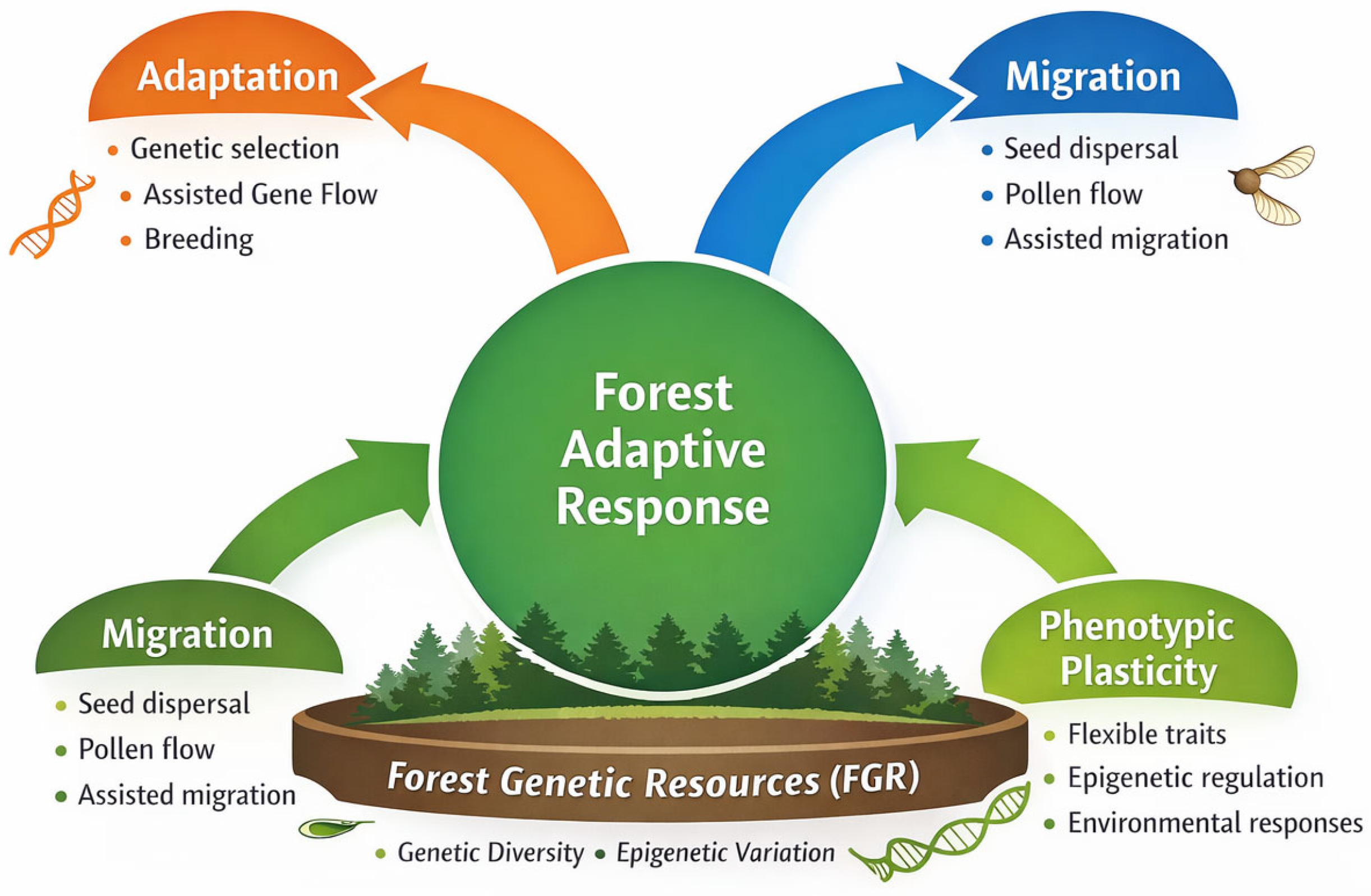
Adaptation, migration, and phenotypic plasticity constitute interlinked and complementary mechanisms through which forest tree populations can respond to ongoing and future climate change [129]. Rather than acting in isolation, these processes operate across different temporal and spatial scales, collectively shaping the resilience and adaptive capacity of forest ecosystems. As illustrated in Figure 1, this integrated framework aligns closely with the principles of CSF, emphasizing the strategic role of FGR as a foundation for sustainable forest management under changing environmental conditions.
From a conservation genetics perspective, genetic adaptation represents a long-term process driven by natural selection acting on existing genetic diversity. Management interventions such as assisted gene flow, selective breeding, and the conservation of genetically diverse populations can enhance this process, increasing the likelihood of local adaptation and long-term population persistence. However, due to long generation times in forest trees, genetic adaptation alone may be insufficient to keep pace with the rapid rate of climate change [130].
In this context, phenotypic plasticity and epigenetic regulation play a critical buffering role by enabling short- to medium-term responses to environmental variability. Plastic responses allow individuals to adjust their morphology, physiology, or phenology without underlying genetic change, thereby increasing tolerance to novel or extreme conditions. As highlighted in Table 2, phenotypic plasticity can operate even in populations with limited genetic diversity, although its capacity to support long-term survival may be constrained if not accompanied by genetic adaptation.
Migration, whether natural or assisted, further contributes to adaptive potential by facilitating gene flow and the redistribution of genetic variation across landscapes. Through seed and pollen movement, migration can increase genetic diversity, reduce genetic drift, and promote population connectivity. Nevertheless, migration processes are often restricted by habitat fragmentation and anthropogenic barriers, and they may carry risks such as maladaptive gene flow or reduced reproductive success if poorly managed [131].
Overall, the comparative assessment presented in Table 2 underscores that no single mechanism provides a complete solution to climate change impacts on forests. Instead, conserving, managing, and deploying both genetic and epigenetic diversity within FGR is essential for balancing immediate resilience with long-term evolutionary potential. Integrating genetic adaptation, phenotypic plasticity, and migration into climate-smart forestry strategies offers a robust pathway to sustain forest ecosystem function, productivity, and biodiversity in an era of rapid environmental change [129].

8. Climate Change and Forest Genetic Resources

Forest species and their genotypes may be adversely affected by climate change if they are poorly adapted, leading to their decline and eventual replacement by better-adapted genotypes and/or species. As a result, the relative number of species and genotypes within an ecosystem may alter. These shifts can be unpredictable, with notable variations in ecosystem production [132]. Moreover, the adaptation of surviving organisms will be negatively impacted by the extinction of ecologically significant species.
It is well documented that climate change can lead to high variability of temperature and precipitation, with an increase in the frequency of extreme events, such as floods, late frosts, and droughts [130]. Under these conditions, natural selection cannot lead to effective adaptation [88]. Furthermore, genetic diversity may not be sufficient to generate new resistant genotypes. If the ecological tipping points of affected ecosystems are exceeded, these ecosystems may undergo significant alteration [133]. The effects of climate change may have detrimental effects on forests because of the role species play in ecosystem functioning, according to [134]. It may result in the irreversible loss of ecosystem function and integrity, with new, non-endemic ecosystems taking their place [135].
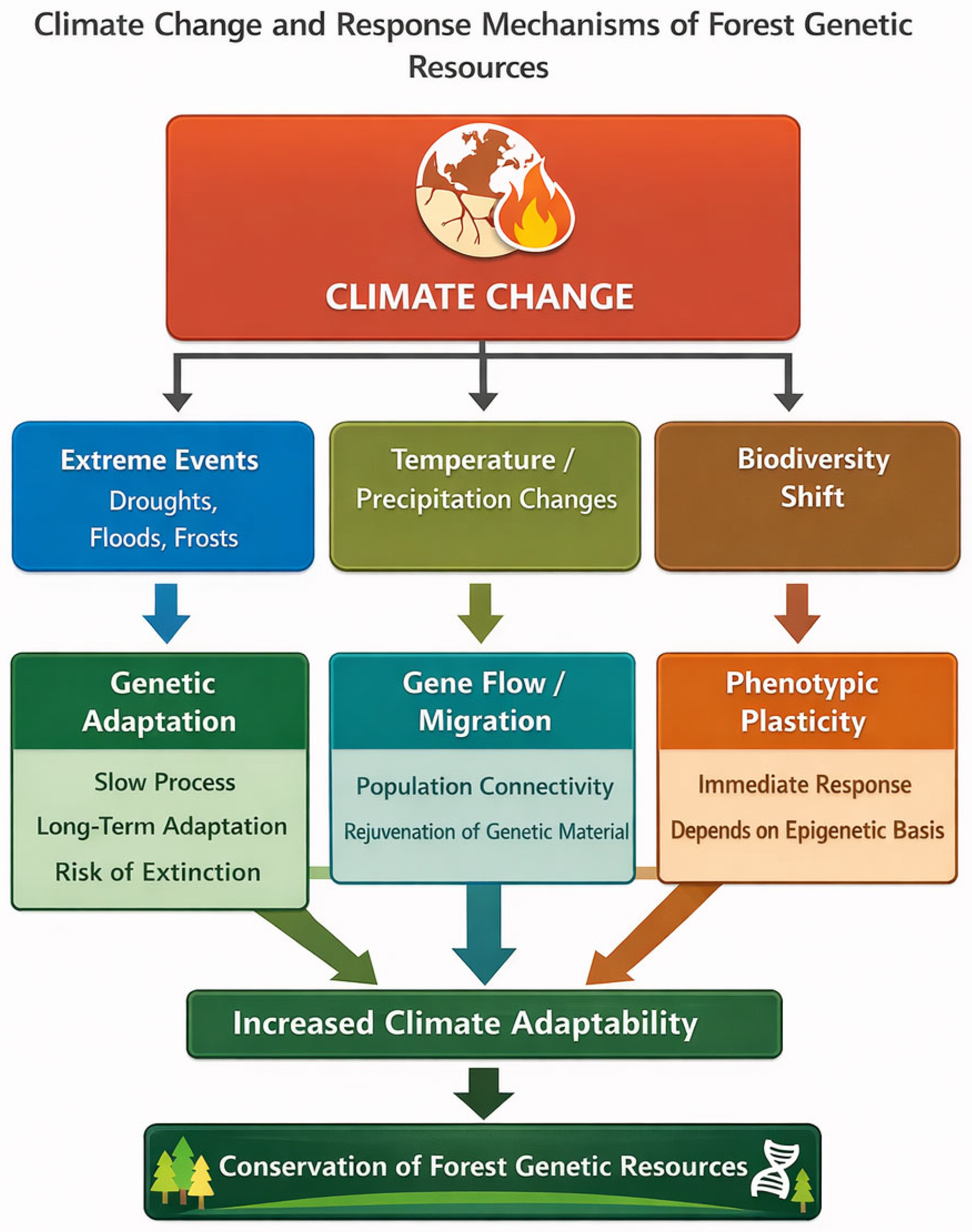
Figure 2 illustrates how climate change impacts forest genetic resources and delineates response mechanisms that are directly relevant for management-oriented CSF strategies. Climate-driven stressors, including extreme events, altered temperature, precipitation regimes, and biodiversity shifts, are linked to genetic adaptation, gene flow and migration, and phenotypic plasticity as key pathways shaping forest resilience [136]. From a conservation genetics perspective, genetic adaptation constitutes a long-term process that can be supported through management actions such as the conservation of genetically diverse populations, selective breeding, and assisted gene flow. Gene flow and migration processes inform spatially explicit decision-support frameworks, guiding seed sourcing, assisted migration, and landscape connectivity planning. Phenotypic plasticity, often mediated by epigenetic mechanisms, provides short-term buffering capacity that can be integrated into risk-based management decisions under climate uncertainty. Collectively, these mechanisms contribute to increased climate adaptability and underscore the importance of embedding genetic and epigenetic considerations into decision-support tools and adaptive management frameworks central to climate-smart forestry [77].

9. Selection and Breeding Actions

It is fundamental that species’ traits related to climate change resilience, including phenotypic plasticity and genetic adaptation, are incorporated into breeding programs. Many provenance tests were established prior to identifying the need to address the effects of climate change, and therefore, the traits assessed were not the most critical for this purpose. Nevertheless, it is possible that the information from these tests can be reinterpreted in the context of climate change [96].
Adaptation-related characteristics necessary for coping with diverse climatic conditions, but overlooked in previous breeding programs, are as follows:
Pest and disease resistance: Climate change is contributing to an increase in pest and disease infestation. One of the longest-running programs for developing resistant genotypes to insect attack is being implemented in British Columbia. Using a conventional breeding method, resistant genotypes of Picea sitchensis to white pine beetles were identified and used in reforestation programs [98]. Such traits are controlled by a few loci, which can simplify breeding efforts.
Drought tolerance: Humidity fluctuations pose greater challenges for many species in Mediterranean and tropical regions than temperature variations [136]. Reproduction is impacted by several physiological and biochemical reactions brought on by drought stress, including the expression of several genes in particular organs. Abscisic acid production, transcriptional regulators of drought-induced pathways, and embryogenesis proteins are among the genes linked to drought resistance [101].
Fire resistance: Breeding genotypes with traits such as serotiny, thicker bark, and high-water usage efficiency will be in high demand as fire frequency and intensity rise [88].
Salt tolerance: The rise in sea levels and the increase in the frequency of storms can cause serious damage to coastal forests. Different tolerance to storm surge and salinity is detected more often between species than within them. However, the possibility of intraspecific selection should be studied further [130].
Phenotypic plasticity: Common Garden experiments can be used to study the flexibility of forest species, which is useful for combating climate change. Response functions that characterize the change in a trait as a function of transit distance or change in an environmental element can be developed and quantified. For instance, certain Pinus contorta populations develop more quickly than others in a variety of temperatures [132].
In response to climate change, traditional breeding methods should be investigated at the management level. In their study of 260 acts for the reproduction of diseases and pests in trees, Reference [137] discovered certain instances in which functionally resistant material had been created. Thus, they concluded that relying solely on traditional breeding techniques will probably result in minimal success for future initiatives aimed at addressing the growth of pests and illnesses. Breeding programs for forest species are more expensive and time-consuming than those for annual species due to their extended life cycle, enormous size, and poorly defined genetic diversity.
Breeding programs should target multiple traits simultaneously, preserving large genetic bases for potential adaptations. Next generation sequencing and genotyping by sequencing approaches offer many genetic markers, creating opportunities for new developments [69]. In addition, there is a need to find new methods that will provide improvements in reproduction. Efforts are still needed to improve and simplify crude propagation methods, starting from conventional root cuttings production to somatic embryogenesis.
To summarize, traits related to climate change resilience need to be incorporated into forest species selection and breeding programs. Genetic adaptation and phenotypic plasticity are considered fundamental elements for addressing climate change. Traits such as pest and disease resistance, drought tolerance, fire resistance, salt tolerance and phenotypic plasticity are critical for future adaptation. Traditional provenance tests can, to some extent, be reinterpreted in the light of climate change. It should also be investigated whether existing and mainly traditional breeding programs are sufficient to address the future challenges of climate change. Many programs had not assessed the most critical adaptive characteristics. Intraspecific selection for traits such as salt tolerance has not been adequately studied, and it is not clear what the most effective strategy is for combining traditional and modern breeding methods. Therefore, a comprehensive re-evaluation and strategic modernization of current breeding programs is essential to ensure they effectively enhance adaptive capacity and meet the accelerating challenges posed by climate change.

10. Selection of Species and Reproductive Genetic Material

In the restoration and conservation of existing ecosystems, native species are preferred over alien species. Native species are better adapted to local biotic and abiotic conditions, supporting native biodiversity and ecosystem function. In the context of Climate-Smart Forestry, selection of the species contributes to the selection of the appropriate reproductive material. There could be detrimental effects, such as a low survival rate or a high mortality rate before reproductive age, if the material is not acclimated to local conditions [138]. In addition, poor adaptation to the conditions of the respective ecosystem can be expressed gradually, such as reduced growth, low competitiveness, and poor seed production.
Since the first generation of trees is crucial to the ecosystem’s natural regeneration, a small founding population will result in low genetic diversity in the reproductive material. This could lower fitness for later generations through inbreeding. Furthermore, self-fertilization may be an issue for the following generation(s) if the original planting material is propagated rudimentarily and originates from a small number of individuals. The average survival of self-fed progeny of the clonal Pseudotsuga menziesii was only 39% when compared to out-crossed individuals, according to research performed 33 years after the plantation was formed. Additionally, self-fed trees’ average diameter at breast height was only 59% that of crossbred trees. Therefore, the impact of inbreeding will be less severe when planting material is obtained from seeds of a few related individuals, although fitness may be decreased in subsequent generations depending on the quantity of mating between close relatives. Since inbreeding is more common in stressful circumstances regardless of the breeding technique, it is especially crucial to ensure a minimum degree of genetic diversity under founder populations [139].
It is not necessarily accurate to assume that local reproductive material has undergone natural selection to better adapt to the local requirements of an ecosystem. Gene flow, genetic drift, and/or a lack of genetic variation can all impede local adaptation. Provenance trials and reciprocal transplanting tests have shown the superiority of non-native genotypes [140].
Any introduction of non-local reproductive material, even native species, carries risks. If the non-native reproductive material is of the same species or closely related to the species growing in the ecosystem but from genetically distinct sources, there is a risk of genetic contamination of local populations. Therefore, it is important to try to ensure that reproductive material is genetically matched to neighboring populations of the same species [106]. Gene flow between native and non-native populations can lead to outbreeding depression. Depression occurs when crosses between native and non-native species produce offspring with reduced fitness. One theory explaining this phenomenon is that co-adapted gene complexes are broken up during recombination.
For habitats that have not been as impacted by climate change but are at the boundaries of the species’ tolerance, the gene pool of trees growing in climate-affected ecosystems can supply reproductive material. The relationship between genotype performance and both current and projected environmental conditions determines the identification and selection of suitable reproductive material for a given ecosystem. Approximately 700 tree species worldwide are undergoing some sort of enhancement, such as provenance and/or progeny testing [141]. These tests can be used to find appropriate reproductive material that is adapted to a specific habitat and that can be relocated without suffering a major loss of adaptation. The variety of situations in which the forest species thrives, as well as potential future planting conditions, should be covered by provision tests. Mixed species planting, close spacing to promote early competition, and minimal intervention should be used to develop less conventional plantation forms, which resemble natural regeneration [142].
To mitigate the possible effects of climate change, numerous studies recommend using seeds from a variety of sources [143]. The goal of this strategy is to mimic the natural dynamic gene flow with admixture, consisting of a large amount of local material, a medium amount of material from intermediate distances that ecologically match future predicted conditions, and a small amount of material from dissimilar populations, which are ecologically diverse.
Several rules have been developed for the number of samples that need to be collected to capture at least 95% of the genetic variation with the least possible effort. These rules are related to many factors, such as the breeding or pollination system and flowering and seed characteristics. To maximize the capture of genetic diversity within a population, it is preferable to collect a limited number of seeds from many trees rather than many seeds from a small subset of trees. In fully crossed species, samples should be taken from at least 30 randomly selected trees. Where evidence exists of significant self-pollination, it is recommended that the sample consist of at least 60 individuals. If the maintenance of genetic diversity over generations is the primary objective, gathering a higher sample size is advised. Overall, sampling fewer trees will not capture the spectrum of genetic diversity [140].
When harvesting seeds, unintentional biased selection of traits such as growth rate and flowering and fruiting time should be avoided, as this can lead to a loss of adaptability of the genetic material. In addition, harvesting seeds in a short period of time can reduce genetic diversity at flowering time. Moreover, harvesting at the beginning or end of their maturity can lead to genetic changes [140].
In some cases, environmental conditions can change so much that it is necessary to move reproductive material along environmental gradients. In several countries, relocation of origin or assisted migration has been incorporated into management practices. The decision to transfer should be based on field test data, while its design, based on climate distribution modeling approaches, is still controversial. This is due to the uncertainties associated with species distribution models and climate models [98].
When choosing possible seed sources, modeling the distribution of species can be helpful. This happens when genetic characterization data, which reveal profiles of genetic variation between and within populations of origin, are combined with distribution models [144]. Many forest species still lack genetic data, despite the continuously declining costs and time requirements of molecular genetic analysis.
In conclusion, native species are preferred in ecosystem restoration and conservation because they are better adapted to local biotic and abiotic conditions and support biodiversity. Appropriate selection of reproductive material is critical, as poor adaptation leads to low survival, reduced growth and poor seed production. Low genetic diversity in founding populations increases the risk of inbreeding and reduces fitness in subsequent generations. Origin and progeny testing is a key tool for selecting suitable genetic material. Using multiple seed sources can mimic natural gene flow and enhance the adaptability of plantations. What should be further studied is whether local reproductive material is always the best adapted, due to gene flow, genetic drift or low genetic diversity. Reproductive genetic material collection underpins climate-smart forestry by ensuring the right trees grow in the right place under the right future conditions, supporting both ecological and economic sustainability (Table 3). The effectiveness of origin relocation/assisted migration also remains controversial, due to uncertainties in climate and ecological models. Furthermore, the lack of genetic data for many forest species limits the accuracy of seed source selection. Finally, the long-term performance of non-local genotypes under future climatic conditions has not been sufficiently studied.

11. Strategies for Integrating FGR into Climate-Smart Forestry

Conservation of Genetic Diversity: Conserving Forest Genetic Resources involves both in situ and ex situ strategies. In situ conservation includes the protection of natural habitats and the implementation of sustainable management practices within forests to maintain genetic diversity. Ex situ conservation involves the collection and storage of seeds, pollen, and tissue samples in seed banks and gene banks. Both strategies are essential for preserving the genetic material necessary for adaptation and restoration efforts.
Assisted Migration and Gene Flow Management: Assisted migration involves the deliberate movement of tree species or populations to new areas where they are likely to thrive under future climate conditions. Managing gene flow through controlled breeding programs and the introduction of genetic material from diverse populations can also enhance the resilience of forests. These practices can help forest species keep pace with changing environmental conditions, thereby supporting the goals of CSF [131].
Research and Development: Investing in research to understand the genetic basis of traits related to climate resilience is crucial. This includes studying the genetic variation within and among tree species and identifying genes associated with drought tolerance, pest resistance, and other adaptive traits. Developing advanced breeding programs and biotechnological tools can facilitate the creation of tree varieties that are better suited to future climatic conditions.
Community Involvement and Knowledge Sharing: Engaging local communities in the conservation and management of forest genetic resources is essential. Traditional knowledge about local tree species and their uses can complement scientific research and support the development of effective CSF strategies. Community involvement also ensures that conservation efforts are culturally appropriate and socially acceptable, enhancing their long-term sustainability [131].
Policy and Legislation: Strong legal frameworks and policies are needed to support the conservation and sustainable use of forest genetic resources. National and international policies, such as the Convention on Biological Diversity and the Global Plan of Action for Conservation, Sustainable Use, and Development of Forest Genetic Resources (GPA-FGR), provide guidelines and support for countries to integrate FGR into their forestry practices.
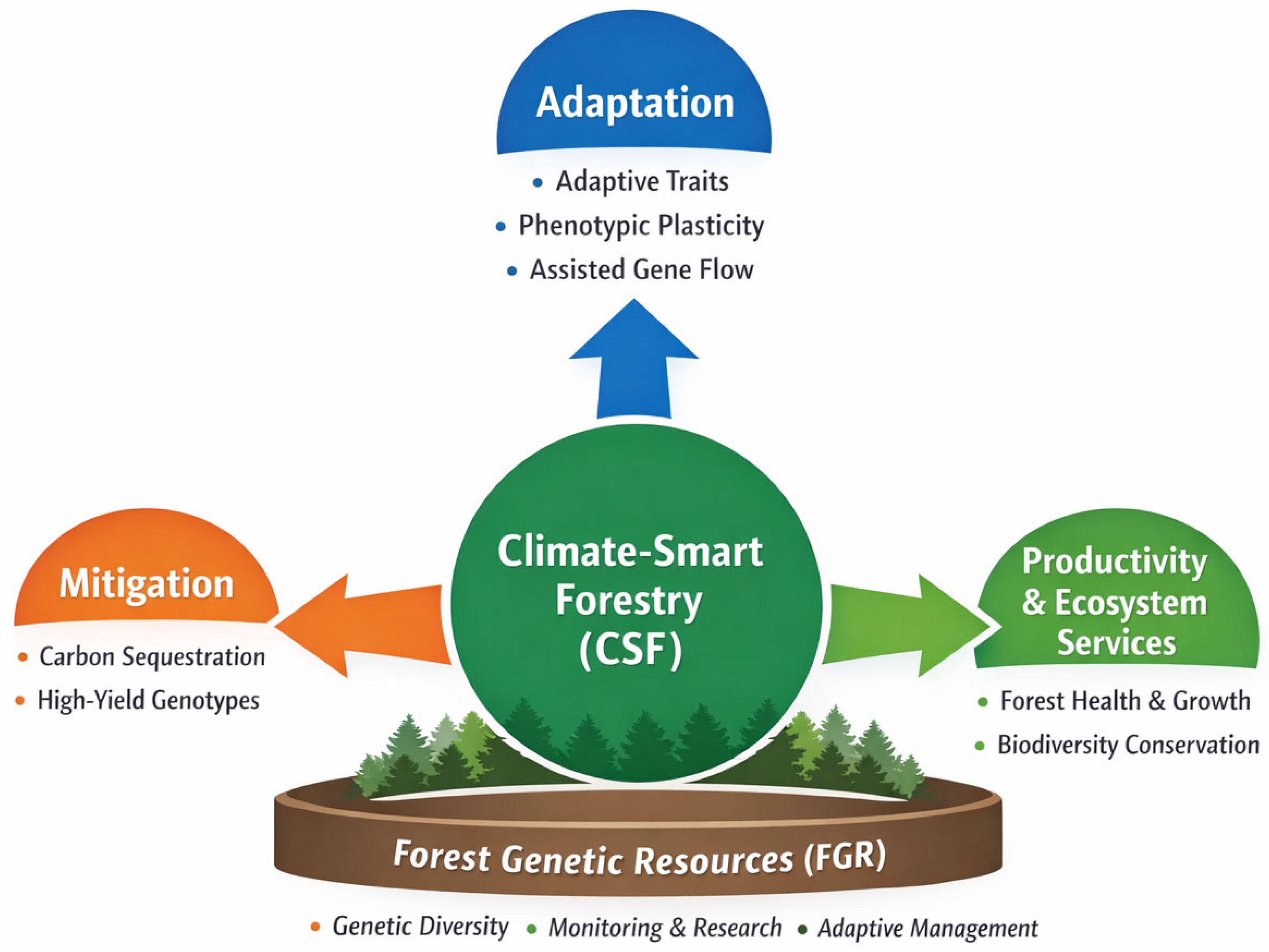
Figure 3 illustrates the interactions between Climate-Smart Forestry (CSF) and Forest Genetic Resources (FGR). The central circle represents the overarching CSF concept, which integrates forest management strategies aimed at enhancing mitigation, adaptation, and productivity. Arrows from the central circle highlight the three pillars of CSF: (i) mitigation, representing the role of forests in carbon sequestration and climate regulation; (ii) adaptation, reflecting the capacity of forests to respond to environmental change; and (iii) productivity, indicating the sustainable provision of wood and non-wood forest products. Forest Genetic Resources form the foundational layer, underpinning these CSF objectives by providing the genetic diversity, adaptive potential, and evolutionary resilience necessary for forests to withstand climate change. Mechanisms supported by FGR include adaptive capacity, phenotypic plasticity, assisted gene flow, and natural migration, all of which enable the selection and deployment of well-adapted genotypes in forest management and restoration. The figure emphasizes that the integration of FGR into CSF strategies ensures long-term ecosystem stability, resilience, and the sustainable provision of ecosystem services under changing climatic conditions.

12. Risks, Uncertainties and Ethical Considerations

The management of forest genetic resources under rapid climate change involves complex trade-offs between productivity, adaptation, and long-term genetic conservation [106]. While active interventions such as assisted migration, assisted gene flow, and selective breeding are increasingly proposed to enhance forest resilience, they also introduce substantial genetic and ecological risks that require careful evaluation [96].
Assisted migration and assisted gene flow (AGF) aim to compensate for the limited natural migration capacity of tree species facing rapid climatic shifts [104]. However, the introduction of non-local reproductive material carries a significant risk of genetic contamination of local populations. Gene flow between genetically differentiated native and non-native populations may disrupt locally adapted gene complexes, resulting in outbreeding depression and reduced offspring fitness. These risks are exacerbated when founder populations are small, increasing the likelihood of inbreeding, particularly under stressful environmental conditions [139]. Moreover, maladaptive gene flow from central to peripheral populations can negatively affect populations at the trailing edges of species’ distribution ranges [104]. Decision-making based on species distribution models also involves substantial uncertainty due to limitations in climate projections and species–environment relationships [98].
Intensive selection for superior phenotypes and commercially valuable traits can lead to genetic homogenization, characterized by reduced genetic diversity, loss of rare alleles, and increased genetic drift. Forest management practices such as high logging intensity, premature removal of reproductively mature trees, and clear-cutting reduce effective population size and compromise natural regeneration. In small or isolated populations, reduced heterozygosity and limited offspring diversity further constrain adaptive potential. Although these practices may enhance short-term productivity, narrowing the genetic base undermines long-term resilience and evolutionary capacity under novel climatic and biotic stressors [88].
The application of advanced genetic tools and breeding approaches in forestry raises ethical and regulatory concerns related to uncertainty, irreversibility, and intergenerational responsibility. The long life cycles of forest trees and the delayed expression of genetic effects complicate risk assessment and governance. Furthermore, strong emphasis on commercial output can create conflicts between short-term economic gains and the conservation of genetic diversity necessary for long-term ecosystem stability. These challenges underscore the need for precautionary and adaptive regulatory frameworks that explicitly integrate genetic conservation into forest management planning.
The adaptive capacity of forest populations is constrained by long generation times, which limit the speed of genetic evolution relative to the pace of climate change [104]. When evolutionary responses are insufficient, populations may experience demographic decline or local extinction, particularly when population size and genetic diversity are already reduced. Climate change further disrupts reproductive success through reduced seed production, declining seed quality, and phenological asynchrony between flowering and pollinators [126]. Although phenotypic plasticity and epigenetic mechanisms may provide short-term buffering against environmental stress, these responses are often reversible and may reduce selective pressure for long-term genetic adaptation [127].
Overall, no single intervention can ensure forest resilience under accelerating climate change. Effective forest genetic resource management must prioritize the maintenance of broad genetic diversity, cautious implementation of assisted migration and gene flow, and explicit consideration of long-term ecological uncertainty [143]. Strategies that balance productivity goals with evolutionary resilience are essential for sustaining forest ecosystems under increasingly variable and unpredictable environmental conditions.

13. Conclusions

Climate-Smart Forestry (CSF) depends fundamentally on the conservation and effective use of Forest Genetic Resources (FGR) to ensure forest resilience, ecosystem stability, and long-term productivity under climate change. The maintenance of genetic, functional, and epigenetic diversity emerges as a central prerequisite for sustaining ecosystem services and enhancing the capacity of forests to contribute to climate change mitigation, particularly through carbon sequestration. At the same time, the adaptive potential of forest species should not be overestimated, highlighting the importance of applying the precautionary principle in forest management and prioritizing the use of well-adapted genetic material.
Advancing Climate-Smart Forestry requires a deeper understanding of phenotypic plasticity, its adaptive significance, and its interaction with genetic and epigenetic mechanisms. Targeted research efforts, including multi-site common garden experiments and studies on reproductive responses to climate change, are essential to clarify these processes. Continuous monitoring of genetic, phenotypic, and ecosystem-level responses is equally critical to support adaptive management and enable timely interventions as environmental conditions continue to change.
Despite growing recognition of the importance of Forest Genetic Resources, significant policy, management, and research gaps remain. At the policy level, stronger and more explicit frameworks are needed to systematically integrate FGR into climate and forest strategies, operationalize the precautionary principle, and link carbon mitigation objectives with the deployment of appropriate genetic resources. At the management level, the translation of genetic knowledge into practice is still limited, with insufficient monitoring and application of genetic, phenotypic, and epigenetic information in decision-making. Adaptive management approaches that promote genetic diversity, use diverse and well-adapted reproductive material, and actively involve local communities are therefore crucial. From a research perspective, key uncertainties persist regarding the mechanisms of adaptation, particularly the roles of phenotypic plasticity and epigenetics and their long-term implications for evolutionary responses.
Ultimately, the full and systematic integration of Forest Genetic Resources into Climate-Smart Forestry strategies, policies, and management practices is essential for safeguarding forest ecosystems. Addressing existing policy, management, and research gaps will enhance forest resilience and productivity, support both mitigation and adaptation goals, and ensure the sustained provision of vital ecosystem services in the face of increasing climatic uncertainty.

Author Contributions

Conceptualization, E.V.A.; investigation, E.M., E.V.A. and E.D.; writing—original draft preparation, E.M. and E.V.A.; writing—review and editing, E.M., E.V.A. and E.D.; supervision, E.V.A. All authors have read and agreed to the published version of the manuscript.

Funding

This research received no external funding.

Data Availability Statement

Not applicable.

Conflicts of Interest

The authors declare no conflicts of interest.

Abbreviations

The following abbreviations are used in this manuscript:
CSFClimate-Smart Forestry
FGRForest Genetic Resources
GPGenomic Prediction
AGFAssisted Gene Flow
MASMarker-Assisted Selection
MABMarker-Assisted Breeding
GWSSGenome-Wide Selection
GEAGenotype-Environment Association

References

  1. Schoene, D.H.; Bernier, P.Y. Adapting forestry and forests to climate change: A challenge to change the paradigm. For. Policy Econ. 2012, 24, 12–19. [Google Scholar] [CrossRef]
  2. Stocker, T.F.; Qin, D.; Plattner, G.-K.; Tignor, M.M.; Allen, S.K.; Boschung, J.; Nauels, A.; Xia, Y.; Bex, V.; Midgley, P.M. Climate Change 2013: The Physical Science Basis. Contribution of Working Group I to the Fifth Assessment Report of IPCC the Intergovernmental Panel on Climate Change; The Intergovernmental Panel on Climate Change (IPCC): Geneva, Switzerland, 2014. [Google Scholar]
  3. Bernier, P.; Schoene, D. Adapting Forests and Their Management to Climate Change: An Overiew; Food and Agriculture Organization: Rome, Italy, 2009. [Google Scholar]
  4. Seppälä, R. A global assessment on adaptation of forests to climate change. Scand. J. For. Res. 2009, 24, 469–472. [Google Scholar] [CrossRef]
  5. Lucier, A.; Ayres, M.; Karnosky, D.; Thompson, I.; Loehle, C.; Percy, K.; Sohngen, B. Forest responses and vulnerabilities to recent climate change. In IUFRO World Series; The International Union of Forest Research Organizations (IUFRO): Vienna, Austria, 2009. [Google Scholar]
  6. Kelly, A.E.; Goulden, M.L. Rapid shifts in plant distribution with recent climate change. Proc. Natl. Acad. Sci. USA 2008, 105, 11823–11826. [Google Scholar] [CrossRef] [PubMed]
  7. Lenoir, J.; Gégout, J.-C.; Dupouey, J.-L.; Bert, D.; Svenning, J.C. Forest plant community changes during 1989–2007 in response to climate warming in the Jura Mountains (France and Switzerland). J. Veg. Sci. 2010, 21, 949–964. [Google Scholar] [CrossRef]
  8. Allen, C.D.; Macalady, A.K.; Chenchouni, H.; Bachelet, D.; McDowell, N.; Vennetier, M.; Kitzberger, T.; Rigling, A.; Breshears, D.D.; Hogg, E.T. A global overview of drought and heat-induced tree mortality reveals emerging climate change risks for forests. For. Ecol. Manag. 2010, 259, 660–684. [Google Scholar] [CrossRef]
  9. Doyle, T.W.; Krauss, K.W.; Conner, W.H.; From, A.S. Predicting the retreat and migration of tidal forests along the northern Gulf of Mexico under sea-level rise. For. Ecol. Manag. 2010, 259, 770–777. [Google Scholar] [CrossRef]
  10. Di Nitto, D.; Neukermans, G.; Koedam, N.; Defever, H.; Pattyn, F.; Kairo, J.G.; Dahdouh-Guebas, F. Mangroves facing climate change: Landward migration potential in response to projected scenarios of sea level rise. Biogeosciences 2014, 11, 857–871. [Google Scholar] [CrossRef]
  11. Corlett, R.T. Impacts of warming on tropical lowland rainforests. Trends Ecol. Evol. 2011, 26, 606–613. [Google Scholar] [CrossRef]
  12. Huntingford, C.; Zelazowski, P.; Galbraith, D.; Mercado, L.M.; Sitch, S.; Fisher, R.; Lomas, M.; Walker, A.P.; Jones, C.D.; Booth, B.B. Simulated resilience of tropical rainforests to CO2-induced climate change. Nat. Geosci. 2013, 6, 268–273. [Google Scholar] [CrossRef]
  13. Feeley, K.J.; Rehm, E.M.; Machovina, B. Perspective: The responses of tropical forest species to global climate change: Acclimate, adapt, migrate, or go extinct? Front. Biogeogr. 2012, 4, 69–82. [Google Scholar] [CrossRef]
  14. Choat, B.; Jansen, S.; Brodribb, T.J.; Cochard, H.; Delzon, S.; Bhaskar, R.; Bucci, S.J.; Feild, T.S.; Gleason, S.M.; Hacke, U.G. Global convergence in the vulnerability of forests to drought. Nature 2012, 491, 752–755. [Google Scholar] [CrossRef]
  15. Hughes, L. Biological consequences of global warming: Is the signal already apparent? Trends Ecol. Evol. 2000, 15, 56–61. [Google Scholar] [CrossRef] [PubMed]
  16. Parry, M.L. Technical Summary. Climate Change 2007. Impacts, Adaptation and Vulnerability. Contribution of Working Group II to the Fourth Assessment Report of the Intergovernmental Panel on Climate Change 2007, 23–78. Available online: https://www.ipcc.ch/site/assets/uploads/2018/03/ar4_wg2_full_report.pdf (accessed on 10 December 2025).
  17. Davis, M.B.; Shaw, R.G. Range shifts and adaptive responses to Quaternary climate change. Science 2001, 292, 673–679. [Google Scholar] [CrossRef] [PubMed]
  18. Hansen, J.; Sato, M.; Ruedy, R.; Lo, K.; Lea, D.W.; Medina-Elizade, M. Global temperature change. Proc. Natl. Acad. Sci. USA 2006, 103, 14288–14293. [Google Scholar] [CrossRef] [PubMed]
  19. Hannah, L. Biodiversity and climate change in context. In Climate Change and Biodiversity; Yale University Press: New Haven, CT, USA, 2005. [Google Scholar]
  20. Dullinger, S.; Dirnböck, T.; Grabherr, G. Modelling climate change-driven treeline shifts: Relative effects of temperature increase, dispersal and invasibility. J. Ecol. 2004, 92, 241–252. [Google Scholar] [CrossRef]
  21. Lovejoy, T.E. Climate Change and Biodiversity; The Energy and Resources Institute (TERI): New Delhi, India, 2006. [Google Scholar]
  22. Savolainen, O.; Lascoux, M.; Merilä, J. Ecological genomics of local adaptation. Nat. Rev. Genet. 2013, 14, 807–820. [Google Scholar] [CrossRef]
  23. Howe, G.T.; Brunner, A.M.; De la Barrera, E.; Andrade, J.L. An evolving approach to understanding plant adaptation. New Phytol. 2005, 167, 1–5. [Google Scholar] [CrossRef]
  24. Brunner, A.M.; DiFazio, S.P.; Groover, A.T. Forest genomics grows up and branches out. New Phytol. 2007, 174, 710–713. [Google Scholar] [CrossRef]
  25. Neale, D.B.; Kremer, A. Forest tree genomics: Growing resources and applications. Nat. Rev. Genet. 2011, 12, 111–122. [Google Scholar] [CrossRef]
  26. Khan, M.A.; Korban, S.S. Association mapping in forest trees and fruit crops. J. Exp. Bot. 2012, 63, 4045–4060. [Google Scholar] [CrossRef]
  27. Tuskan, G.A.; Groover, A.T.; Schmutz, J.; DiFazio, S.P.; Myburg, A.; Grattapaglia, D.; Smart, L.B.; Yin, T.; Aury, J.-M.; Kremer, A. Hardwood tree genomics: Unlocking woody plant biology. Front. Plant Sci. 2018, 9, 1799. [Google Scholar] [CrossRef]
  28. Flanagan, S.P.; Forester, B.R.; Latch, E.K.; Aitken, S.N.; Hoban, S. Guidelines for planning genomic assessment and monitoring of locally adaptive variation to inform species conservation. Evol. Appl. 2018, 11, 1035–1052. [Google Scholar] [CrossRef]
  29. Scherer, L.; Svenning, J.-C.; Huang, J.; Seymour, C.L.; Sandel, B.; Mueller, N.; Kummu, M.; Bekunda, M.; Bruelheide, H.; Hochman, Z. Global priorities of environmental issues to combat food insecurity and biodiversity loss. Sci. Total Environ. 2020, 730, 139096. [Google Scholar] [CrossRef]
  30. Grattapaglia, D.; Silva-Junior, O.B.; Resende, R.T.; Cappa, E.P.; Müller, B.S.; Tan, B.; Isik, F.; Ratcliffe, B.; El-Kassaby, Y.A. Quantitative genetics and genomics converge to accelerate forest tree breeding. Front. Plant Sci. 2018, 9, 1693. [Google Scholar] [CrossRef] [PubMed]
  31. Nystedt, B.; Street, N.R.; Wetterbom, A.; Zuccolo, A.; Lin, Y.-C.; Scofield, D.G.; Vezzi, F.; Delhomme, N.; Giacomello, S.; Alexeyenko, A. The Norway spruce genome sequence and conifer genome evolution. Nature 2013, 497, 579–584. [Google Scholar] [CrossRef]
  32. Burdon, R.D.; Klápště, J. Alternative selection methods and explicit or implied economic-worth functions for different traits in tree breeding. Tree Genet. Genomes 2019, 15, 79. [Google Scholar] [CrossRef]
  33. Li, Y.; Klápště, J.; Telfer, E.; Wilcox, P.; Graham, N.; Macdonald, L.; Dungey, H.S. Genomic selection for non-key traits in radiata pine when the documented pedigree is corrected using DNA marker information. BMC Genom. 2019, 20, 1026. [Google Scholar] [CrossRef] [PubMed]
  34. Nabuurs, G.-J.; Delacote, P.; Ellison, D.; Hanewinkel, M.; Hetemäki, L.; Lindner, M. By 2050 the mitigation effects of EU forests could nearly double through climate smart forestry. Forests 2017, 8, 484. [Google Scholar] [CrossRef]
  35. Bridle, J.R.; Polechová, J.; Kawata, M.; Butlin, R.K. Why is adaptation prevented at ecological margins? New insights from individual-based simulations. Ecol. Lett. 2010, 13, 485–494. [Google Scholar] [CrossRef]
  36. Yousefpour, R.; Augustynczik, A.L.D.; Reyer, C.P.; Lasch-Born, P.; Suckow, F.; Hanewinkel, M. Realizing mitigation efficiency of European commercial forests by climate smart forestry. Sci. Rep. 2018, 8, 345. [Google Scholar] [CrossRef]
  37. Jandl, R.; Ledermann, T.; Kindermann, G.; Freudenschuss, A.; Gschwantner, T.; Weiss, P. Strategies for climate-smart forest management in Austria. Forests 2018, 9, 592. [Google Scholar] [CrossRef]
  38. Bele, M.Y.; Sonwa, D.J.; Tiani, A.-M. Adapting the Congo Basin forests management to climate change: Linkages among biodiversity, forest loss, and human well-being. For. Policy Econ. 2015, 50, 1–10. [Google Scholar] [CrossRef]
  39. Roe, S.; Streck, C.; Obersteiner, M.; Frank, S.; Griscom, B.; Drouet, L.; Fricko, O.; Gusti, M.; Harris, N.; Hasegawa, T. Contribution of the land sector to a 1.5 C world. Nat. Clim. Change 2019, 9, 817–828. [Google Scholar] [CrossRef]
  40. Curtis, P.G.; Slay, C.M.; Harris, N.L.; Tyukavina, A.; Hansen, M.C. Classifying drivers of global forest loss. Science 2018, 361, 1108–1111. [Google Scholar] [CrossRef] [PubMed]
  41. Liang, J.; Crowther, T.W.; Picard, N.; Wiser, S.; Zhou, M.; Alberti, G.; Schulze, E.-D.; McGuire, A.D.; Bozzato, F.; Pretzsch, H. Positive biodiversity-productivity relationship predominant in global forests. Science 2016, 354, aaf8957. [Google Scholar] [CrossRef]
  42. Jactel, H.; Bauhus, J.; Boberg, J.; Bonal, D.; Castagneyrol, B.; Gardiner, B.; Gonzalez-Olabarria, J.R.; Koricheva, J.; Meurisse, N.; Brockerhoff, E.G. Tree diversity drives forest stand resistance to natural disturbances. Curr. For. Rep. 2017, 3, 223–243. [Google Scholar] [CrossRef]
  43. Astrup, R.; Bernier, P.Y.; Genet, H.; Lutz, D.A.; Bright, R.M. A sensible climate solution for the boreal forest. Nat. Clim. Change 2018, 8, 11–12. [Google Scholar] [CrossRef]
  44. Iwasaki, M.; Paszkowski, J. Epigenetic memory in plants. EMBO J. 2014, 33, 1987–1998. [Google Scholar] [CrossRef]
  45. Zhao, J.; Lu, Z.; Wang, L.; Jin, B. Plant responses to heat stress: Physiology, transcription, noncoding RNAs, and epigenetics. Int. J. Mol. Sci. 2020, 22, 117. [Google Scholar] [CrossRef]
  46. García-García, I.; Méndez-Cea, B.; Martín-Gálvez, D.; Seco, J.I.; Gallego, F.J.; Linares, J.C. Challenges and perspectives in the epigenetics of climate change-induced forests decline. Front. Plant Sci. 2022, 12, 797958. [Google Scholar] [CrossRef]
  47. Miryeganeh, M. Plants’ epigenetic mechanisms and abiotic stress. Genes 2021, 12, 1106. [Google Scholar] [CrossRef]
  48. Meyer, P. Epigenetic variation and environmental change. J. Exp. Bot. 2015, 66, 3541–3548. [Google Scholar] [CrossRef]
  49. Scott, M.F.; Ladejobi, O.; Amer, S.; Bentley, A.R.; Biernaskie, J.; Boden, S.A.; Clark, M.; Dell’Acqua, M.; Dixon, L.E.; Filippi, C.V. Multi-parent populations in crops: A toolbox integrating genomics and genetic mapping with breeding. Heredity 2020, 125, 396–416. [Google Scholar] [CrossRef]
  50. Schilthuizen, M.; Hoekstra, R.F.; Gittenberger, E. Hybridization, rare alleles and adaptive radiation. Trends Ecol. Evol. 2004, 19, 404–405. [Google Scholar] [CrossRef]
  51. Seehausen, O. Hybridization and adaptive radiation. Trends Ecol. Evol. 2004, 19, 198–207. [Google Scholar] [CrossRef]
  52. Burkhart, H.E.; Brunner, A.M.; Stanton, B.J.; Shuren, R.A.; Amateis, R.L.; Creighton, J.L. An assessment of potential of hybrid poplar for planting in the Virginia Piedmont. New For. 2017, 48, 479–490. [Google Scholar] [CrossRef]
  53. Cipollini, M.; Dingley, N.R.; Felch, P.; Maddox, C. Evaluation of phenotypic traits and blight-resistance in an American chestnut backcross orchard in Georgia. Glob. Ecol. Conserv. 2017, 10, 1–8. [Google Scholar] [CrossRef]
  54. Badenes, M.L.; Fernandez i Marti, A.; Ríos, G.; Rubio-Cabetas, M.J. Application of genomic technologies to the breeding of trees. Front. Genet. 2016, 7, 198. [Google Scholar] [CrossRef]
  55. Butcher, P.; Southerton, S. Marker-assisted selection in forestry species. In Marker-Assisted Selection, Current Status and Future Perspectives in Crops, Livestock, Forestry and Fish; Food and Agriculture Organization: Rome, Italy, 2007; pp. 283–305. [Google Scholar]
  56. Muranty, H.; Jorge, V.; Bastien, C.; Lepoittevin, C.; Bouffier, L.; Sanchez, L. Potential for marker-assisted selection for forest tree breeding: Lessons from 20 years of MAS in crops. Tree Genet. Genomes 2014, 10, 1491–1510. [Google Scholar] [CrossRef]
  57. Herzog, E.; Frisch, M. Selection strategies for marker-assisted backcrossing with high-throughput marker systems. Theor. Appl. Genet. 2011, 123, 251–260. [Google Scholar] [CrossRef]
  58. Doudna, J.A.; Charpentier, E. The new frontier of genome engineering with CRISPR-Cas9. Science 2014, 346, 1258096. [Google Scholar] [CrossRef]
  59. Dort, E.N.; Tanguay, P.; Hamelin, R.C. CRISPR/Cas9 gene editing: An unexplored frontier for forest pathology. Front. Plant Sci. 2020, 11, 1126. [Google Scholar] [CrossRef]
  60. Campbell, M.M.; Brunner, A.M.; Jones, H.M.; Strauss, S.H. Forestry’s fertile crescent: The application of biotechnology to forest trees. Plant Biotechnol. J. 2003, 1, 141–154. [Google Scholar] [CrossRef]
  61. Pereira-Lorenzo, S.; Ramos-Cabrer, A.M.; Barreneche, T.; Mattioni, C.; Villani, F.; Díaz-Hernández, B.; Martín, L.M.; Robles-Loma, A.; Cáceres, Y.; Martín, A. Instant domestication process of European chestnut cultivars. Ann. Appl. Biol. 2019, 174, 74–85. [Google Scholar] [CrossRef]
  62. Cortés, A.J.; Skeen, P.; Blair, M.W.; Chacón-Sánchez, M.I. Does the genomic landscape of species divergence in Phaseolus beans coerce parallel signatures of adaptation and domestication? Front. Plant Sci. 2018, 9, 1816. [Google Scholar] [CrossRef]
  63. Barghi, N.; Hermisson, J.; Schlötterer, C. Author Correction: Polygenic adaptation: A unifying framework to understand positive selection. Nat. Rev. Genet. 2020, 21, 782. [Google Scholar] [CrossRef]
  64. Boyle, E.A.; Li, Y.I.; Pritchard, J.K. An expanded view of complex traits: From polygenic to omnigenic. Cell 2017, 169, 1177–1186. [Google Scholar] [CrossRef]
  65. Desta, Z.A.; Ortiz, R. Genomic selection: Genome-wide prediction in plant improvement. Trends Plant Sci. 2014, 19, 592–601. [Google Scholar] [CrossRef]
  66. Crossa, J.; Pérez-Rodríguez, P.; Cuevas, J.; Montesinos-López, O.; Jarquín, D.; De Los Campos, G.; Burgueño, J.; González-Camacho, J.M.; Pérez-Elizalde, S.; Beyene, Y. Genomic selection in plant breeding: Methods, models, and perspectives. Trends Plant Sci. 2017, 22, 961–975. [Google Scholar] [CrossRef]
  67. De Los Campos, G.; Hickey, J.M.; Pong-Wong, R.; Daetwyler, H.D.; Calus, M.P. Whole-genome regression and prediction methods applied to plant and animal breeding. Genetics 2013, 193, 327–345. [Google Scholar] [CrossRef]
  68. Kelleher, C.T.; Wilkin, J.; Zhuang, J.; Cortés, A.J.; Quintero, Á.L.P.; Gallagher, T.F.; Bohlmann, J.; Douglas, C.J.; Ellis, B.E.; Ritland, K. SNP discovery, gene diversity, and linkage disequilibrium in wild populations of Populus tremuloides. Tree Genet. Genomes 2012, 8, 821–829. [Google Scholar] [CrossRef]
  69. Suontama, M.; Klápště, J.; Telfer, E.; Graham, N.; Stovold, T.; Low, C.; McKinley, R.; Dungey, H. Efficiency of genomic prediction across two Eucalyptus nitens seed orchards with different selection histories. Heredity 2019, 122, 370–379. [Google Scholar] [CrossRef]
  70. Thistlethwaite, F.R.; Ratcliffe, B.; Klápště, J.; Porth, I.; Chen, C.; Stoehr, M.U.; El-Kassaby, Y.A. Genomic selection of juvenile height across a single-generational gap in Douglas-fir. Heredity 2019, 122, 848–863. [Google Scholar] [CrossRef]
  71. Roudbar, M.A.; Momen, M.; Mousavi, S.F.; Ardestani, S.S.; Lopes, F.B.; Gianola, D.; Khatib, H. Genome-wide methylation prediction of biological age using reproducing kernel Hilbert spaces and Bayesian ridge regressions. bioRxiv 2020. [Google Scholar] [CrossRef]
  72. Lenz, P.R.; Nadeau, S.; Mottet, M.J.; Perron, M.; Isabel, N.; Beaulieu, J.; Bousquet, J. Multi-trait genomic selection for weevil resistance, growth, and wood quality in Norway spruce. Evol. Appl. 2020, 13, 76–94. [Google Scholar] [CrossRef]
  73. Technow, F.; Schrag, T.A.; Schipprack, W.; Bauer, E.; Simianer, H.; Melchinger, A.E. Genome properties and prospects of genomic prediction of hybrid performance in a breeding program of maize. Genetics 2014, 197, 1343–1355. [Google Scholar] [CrossRef]
  74. Cros, D.; Bocs, S.; Riou, V.; Ortega-Abboud, E.; Tisné, S.; Argout, X.; Pomiès, V.; Nodichao, L.; Lubis, Z.; Cochard, B. Genomic preselection with genotyping-by-sequencing increases performance of commercial oil palm hybrid crosses. BMC Genom. 2017, 18, 839. [Google Scholar] [CrossRef]
  75. O’Hara, K.L. What is close-to-nature silviculture in a changing world? For. Int. J. For. Res. 2016, 89, 1–6. [Google Scholar] [CrossRef]
  76. Ratnam, W.; Rajora, O.P.; Finkeldey, R.; Aravanopoulos, F.; Bouvet, J.-M.; Vaillancourt, R.E.; Kanashiro, M.; Fady, B.; Tomita, M.; Vinson, C. Genetic effects of forest management practices: Global synthesis and perspectives. For. Ecol. Manag. 2014, 333, 52–65. [Google Scholar] [CrossRef]
  77. Szmyt, J.; Dering, M. Adaptive Silviculture and Climate Change—A Forced Marriage of the 21st Century? Sustainability 2024, 16, 2703. [Google Scholar] [CrossRef]
  78. Geburek, T. Genetic diversity in forest trees—Its importance and potential human impact. In Conservation and Management of Forest Genetic Resources in Europe; Arbora Publishers: Zvolen, Slovakia, 2005; pp. 437–463. [Google Scholar]
  79. Konnert, M.; Hosius, B. Contribution of forest genetics for a sustainable forest management. Forstarchiv 2010, 81, 170–174. [Google Scholar]
  80. Diaci, J.; Rozenbergar, D.; Fidej, G.; Nagel, T.A. Challenges for uneven-aged silviculture in restoration of post-disturbance forests in Central Europe: A synthesis. Forests 2017, 8, 378. [Google Scholar] [CrossRef]
  81. Hosius, B.; Leinemann, L.; Konnert, M.; Bergmann, F. Genetic aspects of forestry in the Central Europe. Eur. J. For. Res. 2006, 125, 407–417. [Google Scholar] [CrossRef]
  82. Kerr, G.; Haufe, J. Thinning Practice: A Silvicultural Guide; Forestry Commission: Namsos, Norway, 2011. [Google Scholar]
  83. Danusevicius, D.; Kerpauskaite, V.; Kavaliauskas, D.; Fussi, B.; Konnert, M.; Baliuckas, V. The effect of tending and commercial thinning on the genetic diversity of Scots pine stands. Eur. J. For. Res. 2016, 135, 1159–1174. [Google Scholar] [CrossRef]
  84. Manetti, M.C.; Becagli, C.; Sansone, D.; Pelleri, F. Tree-oriented silviculture: A new approach for coppice stands. iForest-Biogeosci. For. 2016, 9, 791. [Google Scholar] [CrossRef]
  85. Finkeldey, R.; Ziehe, M. Genetic implications of silvicultural regimes. For. Ecol. Manag. 2004, 197, 231–244. [Google Scholar] [CrossRef]
  86. Spiecker, H. Silvicultural management in maintaining biodiversity and resistance of forests in Europe—Temperate zone. J. Environ. Manag. 2003, 67, 55–65. [Google Scholar] [CrossRef]
  87. Schaberg, P.G.; DeHayes, D.H.; Hawley, G.J.; Nijensohn, S.E. Anthropogenic alterations of genetic diversity within tree populations: Implications for forest ecosystem resilience. For. Ecol. Manag. 2008, 256, 855–862. [Google Scholar] [CrossRef]
  88. Jump, A.S.; Hunt, J.M.; Martínez-Izquierdo, J.A.; Peñuelas, J. Natural selection and climate change: Temperature-linked spatial and temporal trends in gene frequency in Fagus sylvatica. Mol. Ecol. 2006, 15, 3469–3480. [Google Scholar] [CrossRef]
  89. Koski, V.; Skrøppa, T.; Paule, L.; Wolf, H.; Turok, J. Technical Guidelines for Genetic Conservation of Norway Spruce (Picea abies (L.) Karst.); Bioversity International: Rome, Italy, 1997. [Google Scholar]
  90. Gutschick, V.P.; BassiriRad, H. Extreme events as shaping physiology, ecology, and evolution of plants: Toward a unified definition and evaluation of their consequences. New Phytol. 2003, 160, 21–42. [Google Scholar] [CrossRef]
  91. Alberto, F.J.; Aitken, S.N.; Alía, R.; González-Martínez, S.C.; Hänninen, H.; Kremer, A.; Lefèvre, F.; Lenormand, T.; Yeaman, S.; Whetten, R. Potential for evolutionary responses to climate change–evidence from tree populations. Glob. Change Biol. 2013, 19, 1645–1661. [Google Scholar] [CrossRef]
  92. Navarro, C.; Cavers, S.; Pappinen, A.; Tigerstedt, P.; Lowe, A.; Merilä, J. Contrasting quantitative traits and neutral genetic markers for genetic resource assessment of Mesoamerican Cedrela odorata. Silvae Genet. 2005, 54, 281–292. [Google Scholar] [CrossRef][Green Version]
  93. Alfaro, R.I.; King, J.N.; vanAkker, L. Delivering Sitka spruce with resistance against white pine weevil in British Columbia, Canada. For. Chron. 2013, 89, 235–245. [Google Scholar] [CrossRef]
  94. Kremer, A.; Ronce, O.; Robledo-Arnuncio, J.J.; Guillaume, F.; Bohrer, G.; Nathan, R.; Bridle, J.R.; Gomulkiewicz, R.; Klein, E.K.; Ritland, K. Long-distance gene flow and adaptation of forest trees to rapid climate change. Ecol. Lett. 2012, 15, 378–392. [Google Scholar] [CrossRef] [PubMed]
  95. Gomulkiewicz, R.; Houle, D. Demographic and genetic constraints on evolution. Am. Nat. 2009, 174, E218–E229. [Google Scholar] [CrossRef]
  96. Hoffmann, A.A.; Sgrò, C.M. Climate change and evolutionary adaptation. Nature 2011, 470, 479–485. [Google Scholar] [CrossRef]
  97. El-Kassaby, Y.; Fashler, A.; Crown, M. Variation in fruitfulness in a Douglas-fir seed orchard and its effect on crop-management decisions. Silvae Genet. 1989, 38, 3–4. [Google Scholar]
  98. Grivet, D.; Sebastiani, F.; Alía, R.; Bataillon, T.; Torre, S.; Zabal-Aguirre, M.; Vendramin, G.G.; González-Martínez, S.C. Molecular footprints of local adaptation in two Mediterranean conifers. Mol. Biol. Evol. 2011, 28, 101–116. [Google Scholar] [CrossRef]
  99. Thorsen, B.J.; Kjær, E.D. Forest genetic diversity and climate change: Economic considerations. In Climate Change and Forest Genetic Diversity: Implications for Sustainable Forest Management in Europe; Bioversity International: Rome, Italy, 2007; pp. 69–84. [Google Scholar]
  100. Barbour, R.C.; O’Reilly-Wapstra, J.M.; Little, D.W.D.; Jordan, G.J.; Steane, D.A.; Humphreys, J.R.; Bailey, J.K.; Whitham, T.G.; Potts, B.M. A geographic mosaic of genetic variation within a foundation tree species and its community-level consequences. Ecology 2009, 90, 1762–1772. [Google Scholar] [CrossRef]
  101. Bosselmann, A.S.; Jacobsen, J.B.; Kjær, E.D.; Thorsen, B. Climate Change, Uncertainty and the Economic Value of Genetic Diversity: A Pilot Study on Methodologies; Forest & Landscape: Hørsholm, Denmark, 2008. [Google Scholar]
  102. De Visser, J.A.G.; Elena, S.F.; Fragata, I.; Matuszewski, S. The utility of fitness landscapes and big data for predicting evolution. Heredity 2018, 121, 401–405. [Google Scholar] [CrossRef]
  103. Zahn, L.M.; Purnell, B.A. Genes under pressure. Science 2016, 354, 52. [Google Scholar] [CrossRef] [PubMed]
  104. Rellstab, C.; Gugerli, F.; Eckert, A.J.; Hancock, A.M.; Holderegger, R. A practical guide to environmental association analysis in landscape genomics. Mol. Ecol. 2015, 24, 4348–4370. [Google Scholar] [CrossRef] [PubMed]
  105. Forester, B.R.; Jones, M.R.; Joost, S.; Landguth, E.L.; Lasky, J.R. Detecting spatial genetic signatures of local adaptation in heterogeneous landscapes. Mol. Ecol. 2016, 25, 104–120. [Google Scholar] [CrossRef] [PubMed]
  106. Aitken, S.N.; Bemmels, J.B. Time to get moving: Assisted gene flow of forest trees. Evol. Appl. 2016, 9, 271–290. [Google Scholar] [CrossRef]
  107. Bayer, P.E.; Golicz, A.A.; Scheben, A.; Batley, J.; Edwards, D. Plant pan-genomes are the new reference. Nat. Plants 2020, 6, 914–920. [Google Scholar] [CrossRef]
  108. Barrera-Redondo, J.; Piñero, D.; Eguiarte, L.E. Genomic, transcriptomic and epigenomic tools to study the domestication of plants and animals: A field guide for beginners. Front. Genet. 2020, 11, 742. [Google Scholar] [CrossRef]
  109. Isabel, N.; Holliday, J.A.; Aitken, S.N. Forest genomics: Advancing climate adaptation, forest health, productivity, and conservation. Evol. Appl. 2020, 13, 3–10. [Google Scholar] [CrossRef]
  110. Lopez, S.; Rousset, F.; Shaw, F.H.; Shaw, R.G.; Ronce, O. Joint effects of inbreeding and local adaptation on the evolution of genetic load after fragmentation. Conserv. Biol. 2009, 23, 1618–1627. [Google Scholar] [CrossRef]
  111. Lenormand, T. Gene flow and the limits to natural selection. Trends Ecol. Evol. 2002, 17, 183–189. [Google Scholar] [CrossRef]
  112. Hampe, A.; Petit, R.J. Conserving biodiversity under climate change: The rear edge matters. Ecol. Lett. 2005, 8, 461–467. [Google Scholar] [CrossRef]
  113. Malcolm, J.R.; Markham, A.; Neilson, R.P.; Garaci, M. Estimated migration rates under scenarios of global climate change. J. Biogeogr. 2002, 29, 835–849. [Google Scholar] [CrossRef]
  114. Bhagwat, S.A.; Willis, K.J.; Birks, H.J.B.; Whittaker, R.J. Agroforestry: A refuge for tropical biodiversity? Trends Ecol. Evol. 2008, 23, 261–267. [Google Scholar] [CrossRef] [PubMed]
  115. Loarie, S.R.; Duffy, P.B.; Hamilton, H.; Asner, G.P.; Field, C.B.; Ackerly, D.D. The velocity of climate change. Nature 2009, 462, 1052–1055. [Google Scholar] [CrossRef] [PubMed]
  116. Restoux, G.; Silva, D.E.; Sagnard, F.; Torre, F.; Klein, E.; Fady, B. Life at the margin: The mating system of Mediterranean conifers. Web Ecol. 2008, 8, 94–102. [Google Scholar] [CrossRef]
  117. Dawson, I.K.; Vinceti, B.; Weber, J.C.; Neufeldt, H.; Russell, J.; Lengkeek, A.G.; Kalinganire, A.; Kindt, R.; Lillesø, J.-P.B.; Roshetko, J. Climate change and tree genetic resource management: Maintaining and enhancing the productivity and value of smallholder tropical agroforestry landscapes. A review. Agrofor. Syst. 2011, 81, 67–78. [Google Scholar] [CrossRef]
  118. Nicotra, A.B.; Atkin, O.K.; Bonser, S.P.; Davidson, A.M.; Finnegan, E.J.; Mathesius, U.; Poot, P.; Purugganan, M.D.; Richards, C.L.; Valladares, F. Plant phenotypic plasticity in a changing climate. Trends Plant Sci. 2010, 15, 684–692. [Google Scholar] [CrossRef]
  119. De Jong, G. Evolution of phenotypic plasticity: Patterns of plasticity and the emergence of ecotypes. New Phytol. 2005, 166, 101–118. [Google Scholar] [CrossRef]
  120. Skrøppa, T.; Tollefsrud, M.M.; Sperisen, C.; Johnsen, Ø. Rapid change in adaptive performance from one generation to the next in Picea abies—Central European trees in a Nordic environment. Tree Genet. Genomes 2010, 6, 93–99. [Google Scholar] [CrossRef]
  121. Vendramin, G.G.; Fady, B.; González-Martínez, S.C.; Hu, F.S.; Scotti, I.; Sebastiani, F.; Soto, A.; Petit, R.J. Genetically depauperate but widespread: The case of an emblematic Mediterranean pine. Evolution 2008, 62, 680–688. [Google Scholar] [CrossRef]
  122. Mutke, S.; Sánchez, J.G.; Santos, M.R.C.; Prada, M.A.; Álvarez, D.; Iglesias, S.; Sánchez, L.G. Phenotypic plasticity is stronger than adaptative differentiation among Mediterranean stone pine provenances. For. Syst. 2010, 19, 354–366. [Google Scholar] [CrossRef]
  123. Chevin, L.-M.; Lande, R.; Mace, G.M. Adaptation, plasticity, and extinction in a changing environment: Towards a predictive theory. PLoS Biol. 2010, 8, e1000357. [Google Scholar] [CrossRef]
  124. Sáez-Laguna, E.; Guevara, M.-Á.; Díaz, L.-M.; Sánchez-Gómez, D.; Collada, C.; Aranda, I.; Cervera, M.-T. Epigenetic variability in the genetically uniform forest tree species Pinus pinea L. PLoS ONE 2014, 9, e103145. [Google Scholar] [CrossRef] [PubMed]
  125. Gautam, M.K.; Mead, D.J.; Clinton, P.W.; Chang, S.X. Biomass and morphology of Pinus radiata coarse root components in a sub-humid temperate silvopastoral system. For. Ecol. Manag. 2003, 177, 387–397. [Google Scholar] [CrossRef]
  126. Hedhly, A.; Hormaza, J.I.; Herrero, M. Global warming and sexual plant reproduction. Trends Plant Sci. 2009, 14, 30–36. [Google Scholar] [CrossRef]
  127. Yakovlev, I.A.; Fossdal, C.G.; Johnsen, Ø. MicroRNAs, the epigenetic memory and climatic adaptation in Norway spruce. New Phytol. 2010, 187, 1154–1169. [Google Scholar] [CrossRef] [PubMed]
  128. Lira-Medeiros, C.F.; Parisod, C.; Fernandes, R.A.; Mata, C.S.; Cardoso, M.A.; Ferreira, P.C.G. Epigenetic variation in mangrove plants occurring in contrasting natural environment. PLoS ONE 2010, 5, e10326. [Google Scholar] [CrossRef]
  129. Bichueti, R.S.; Leal Filho, W.; Gomes, C.M.; Kneipp, J.M.; da Costa, C.R.R.; Frizzo, K. Climate Change and Urban Resilience in Smart Cities: Adaptation and Mitigation Strategies in Brazil and Germany. Urban Sci. 2025, 9, 179. [Google Scholar] [CrossRef]
  130. Dahal, D.; Bhattarai, N.; Silwal, A.; Shrestha, S.; Shrestha, B.; Poudel, B.; Kalra, A. A Review on Climate Change Impacts on Freshwater Systems and Ecosystem Resilience. Water 2025, 17, 3052. [Google Scholar] [CrossRef]
  131. Zhao, J.; Wang, H.; Shilong, Z.; Xiaowei, C.; Yang, Y. Reframing adaptive forest management to sustain ecosystem services under climate change. Forests 2025, 16, 1377. [Google Scholar] [CrossRef]
  132. Wang, W.; Peng, C.; Kneeshaw, D.D.; Larocque, G.R.; Song, X.; Zhou, X. Quantifying the effects of climate change and harvesting on carbon dynamics of boreal aspen and jack pine forests using the TRIPLEX-Management model. For. Ecol. Manag. 2012, 281, 152–162. [Google Scholar] [CrossRef]
  133. Lenton, T.M. Early warning of climate tipping points. Nat. Clim. Change 2011, 1, 201–209. [Google Scholar] [CrossRef]
  134. Whitham, T.G.; Bailey, J.K.; Schweitzer, J.A.; Shuster, S.M.; Bangert, R.K.; LeRoy, C.J.; Lonsdorf, E.V.; Allan, G.J.; DiFazio, S.P.; Potts, B.M. A framework for community and ecosystem genetics: From genes to ecosystems. Nat. Rev. Genet. 2006, 7, 510–523. [Google Scholar] [CrossRef] [PubMed]
  135. Mooney, H.; Larigauderie, A.; Cesario, M.; Elmquist, T.; Hoegh-Guldberg, O.; Lavorel, S.; Mace, G.M.; Palmer, M.; Scholes, R.; Yahara, T. Biodiversity, climate change, and ecosystem services. Curr. Opin. Environ. Sustain. 2009, 1, 46–54. [Google Scholar] [CrossRef]
  136. Liang, X.; Cong, X.; Du, B.; Ju, Y.; Wang, Y.; Li, D. Carbon–Water Coupling in Forest Ecosystems Under Climate Change: Advances in Water Use Efficiency and Sustainability Perspectives. Sustainability 2025, 17, 9501. [Google Scholar] [CrossRef]
  137. Yanchuk, A.; Allard, G. Tree improvement programmes for forest health–can they keep pace with climate changes. Unasylva 2009, 60, 50–56. [Google Scholar]
  138. Thomas, P.A. Trees: Their Natural History; Cambridge University Press: Cambridge, UK, 2014. [Google Scholar]
  139. Fox, C.W.; Reed, D.H. Inbreeding depression increases with maternal age in a seed-feeding beetle. Evol. Ecol. Res. 2010, 12, 961–972. [Google Scholar]
  140. Kettenring, K.M.; Mercer, K.L.; Reinhardt Adams, C.; Hines, J. EDITOR’S CHOICE: Application of genetic diversity–ecosystem function research to ecological restoration. J. Appl. Ecol. 2014, 51, 339–348. [Google Scholar] [CrossRef]
  141. FAO. The state of the world’s forest genetic resources. In Commission on Genetic Resources for Food and Agriculture; Food and Agriculture Organization: Rome, Italy, 2014. [Google Scholar]
  142. Gallo, E.; Lencinas, M.V.; Martínez Pastur, G.J. Site quality influences over understory plant diversity in old-growth and harvested Nothofagus pumilio forests. For. Syst. 2013, 22, 25–38. [Google Scholar] [CrossRef]
  143. Breed, M.F.; Stead, M.G.; Ottewell, K.M.; Gardner, M.G.; Lowe, A.J. Which provenance and where? Seed sourcing strategies for revegetation in a changing environment. Conserv. Genet. 2013, 14, 1–10. [Google Scholar] [CrossRef]
  144. Soldati, G.; Koelemeijer, P.; Boschi, L.; Deuss, A. Constraints on core-mantle boundary topography from normal mode splitting. Geochem. Geophys. Geosyst. 2013, 14, 1333–1342. [Google Scholar] [CrossRef]
Figure 1. A conceptual framework of forest adaptive responses that aligns closely with the principles of climate-smart forestry, highlighting the strategic role of forest genetic resources (FGR) in enhancing adaptive capacity under climate change.
Forests 17 00268 g001
Figure 2. The response mechanisms of forest genetic resources to climate change.
Forests 17 00268 g002
Figure 3. Conceptual representation of the role of Forest Genetic Resources (FGR) in Climate-Smart Forestry. Genetic diversity, selection, breeding, and assisted gene flow underpin mitigation (carbon sequestration and stability), adaptation (evolutionary potential and stress tolerance), and productivity (growth and wood quality) under climate change.
Forests 17 00268 g003
Table 1. Comparative presentation of traditional breeding, genomic prediction, and assisted gene flow.
FeatureTraditional BreedingGenomic Prediction (GP)Assisted Gene Flow
Basic principlePhenotypic selection of superior trees in natural populationsPrediction of reproductive value using genomic and historical phenotypic dataTargeted introduction of genetic material from external populations
Reproductive cycle timeVery largeSignificantly reducedModerate
Type of featuresProductivity and architectural characteristicsPolygenic traitsAdaptive or desirable traits
Genetic basisPhenotypeMany markers throughout the genomeTransfer of alleles between populations
RisksReduction in genetic diversity, inbreedingRequires large and high-quality data setsRisk of maladaptation or genetic incompatibility
AdvantagesSimple, proven methodHigh accuracy on complex traits, rapid progressIncreases genetic diversity and resilience
ScopeNatural stands and field testsModern forest breeding programsGenetic resource management and climate adaptation
Table 2. Comparison of genetic adaptation, phenotypic plasticity and migration.
FeatureGenetic AdaptationPhenotypic PlasticityMigration
Time scaleLong-termShort to medium termMedium to long term
Mechanism baseGenetic diversity and natural selectionEpigenetic and morphological flexibilityGene flow and population linkage
Role in climate changeAllows long-term survival through local adaptationProvides immediate response to changing conditionsAllows monitoring of climate shifts
AdvantagesCreates stable adapted populationsWorks even with low genetic diversityIncreases genetic diversity and reduces genetic drift
RestrictionsSlow due to long generation intervalsMay not promote long-term survivalLimited by fragmentation and human interventions
RisksInsufficient rate of adaptation → extinction of populationsConflict with genetic adaptation in the long termMaladaptive gene flow, reduced fertility
Dependence on human interventionLowLow to moderateModerate
Table 3. Description of genetic tools and their relevance for Climate-Smart Forestry.
Genetic ToolDescriptionRelevance to CSF
Phenotypic SelectionSelection of superior individuals based on observable traits (growth, architecture, productivity)Provides initial stock for breeding; supports adaptation and productivity goals
Hybrid BreedingCrosses between genetically distinct individuals to exploit heterosis (dominance, overdominance)Enhances growth, resilience, and adaptability of forest stands
Marker-Assisted Selection (MAS)Uses molecular markers linked to key traits to accelerate breedingSpeeds up selection of traits relevant for climate adaptation and productivity
Marker-Assisted Backcrossing (MAB)Introgression of desired traits from external sources into elite populationsFacilitates targeted adaptation to environmental stress
Genomic Prediction (GP)Predicts performance of individuals using genome-wide markers and historical phenotypesEnables selection for polygenic traits (growth, stress tolerance) for adaptation and mitigation
Gene Editing (CRISPR/Cas, Transgenics)Direct modification of genes controlling key traitsPotentially accelerates adaptation to climate stress; requires careful management due to ecological risks
Assisted Gene Flow (AGF)Translocation of genotypes between populations to increase adaptive potentialEnhances resilience, maintains genetic diversity, and mitigates maladaptation
Epigenetic MonitoringAnalysis of heritable gene expression changes (e.g., DNA methylation)Supports understanding of rapid phenotypic plasticity and short-term adaptation
Disclaimer/Publisher’s Note: The statements, opinions and data contained in all publications are solely those of the individual author(s) and contributor(s) and not of MDPI and/or the editor(s). MDPI and/or the editor(s) disclaim responsibility for any injury to people or property resulting from any ideas, methods, instructions or products referred to in the content.