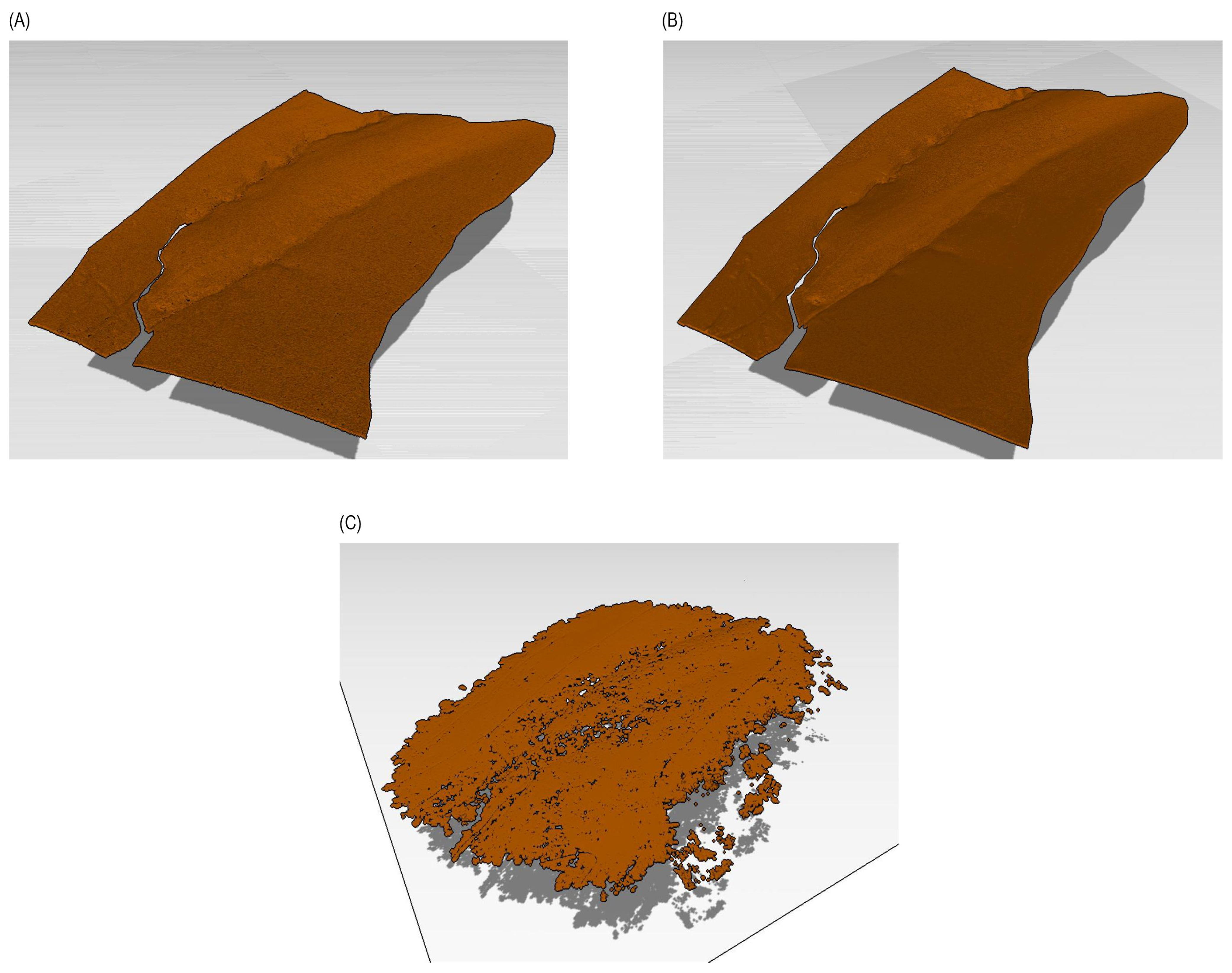
ALS and SfM Field Data Survey as a Basis of Forest Road Design




Abstract
1. Introduction
2. Materials and Methods
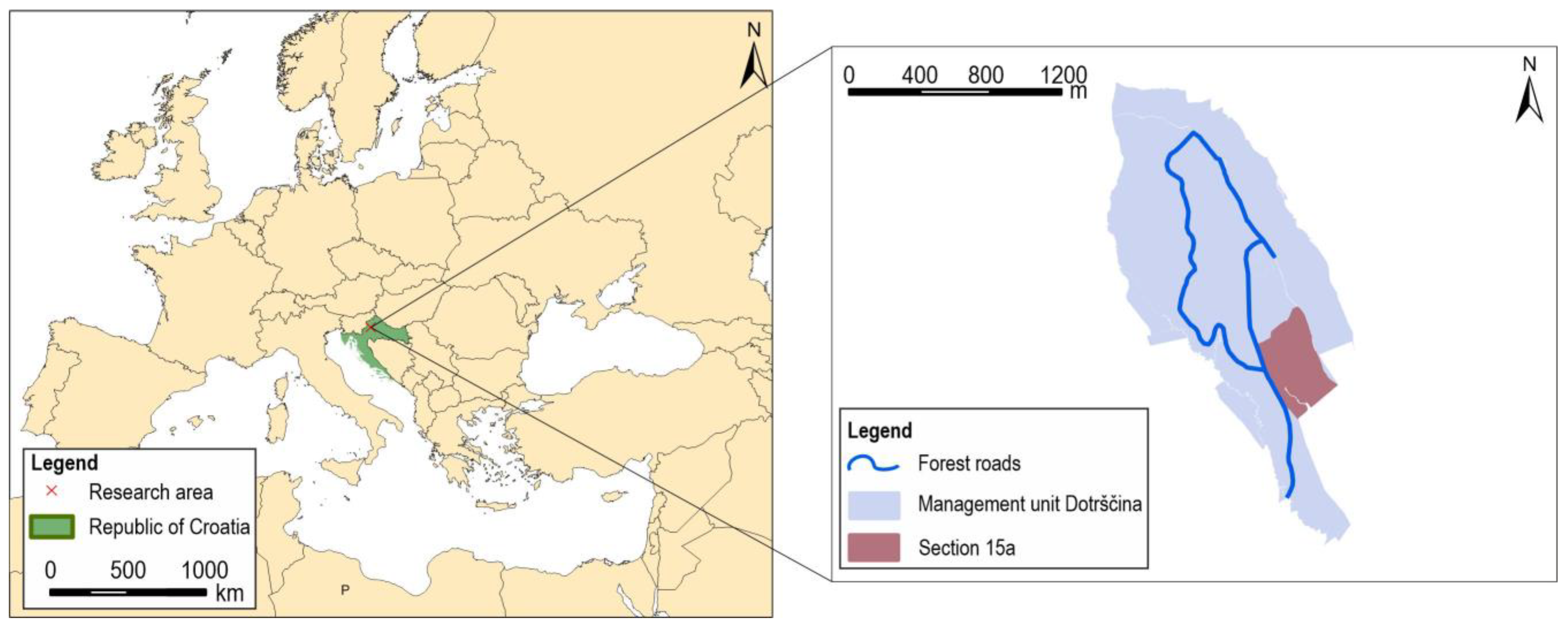
2.1. Study Area
2.2. Data Collection and Processing
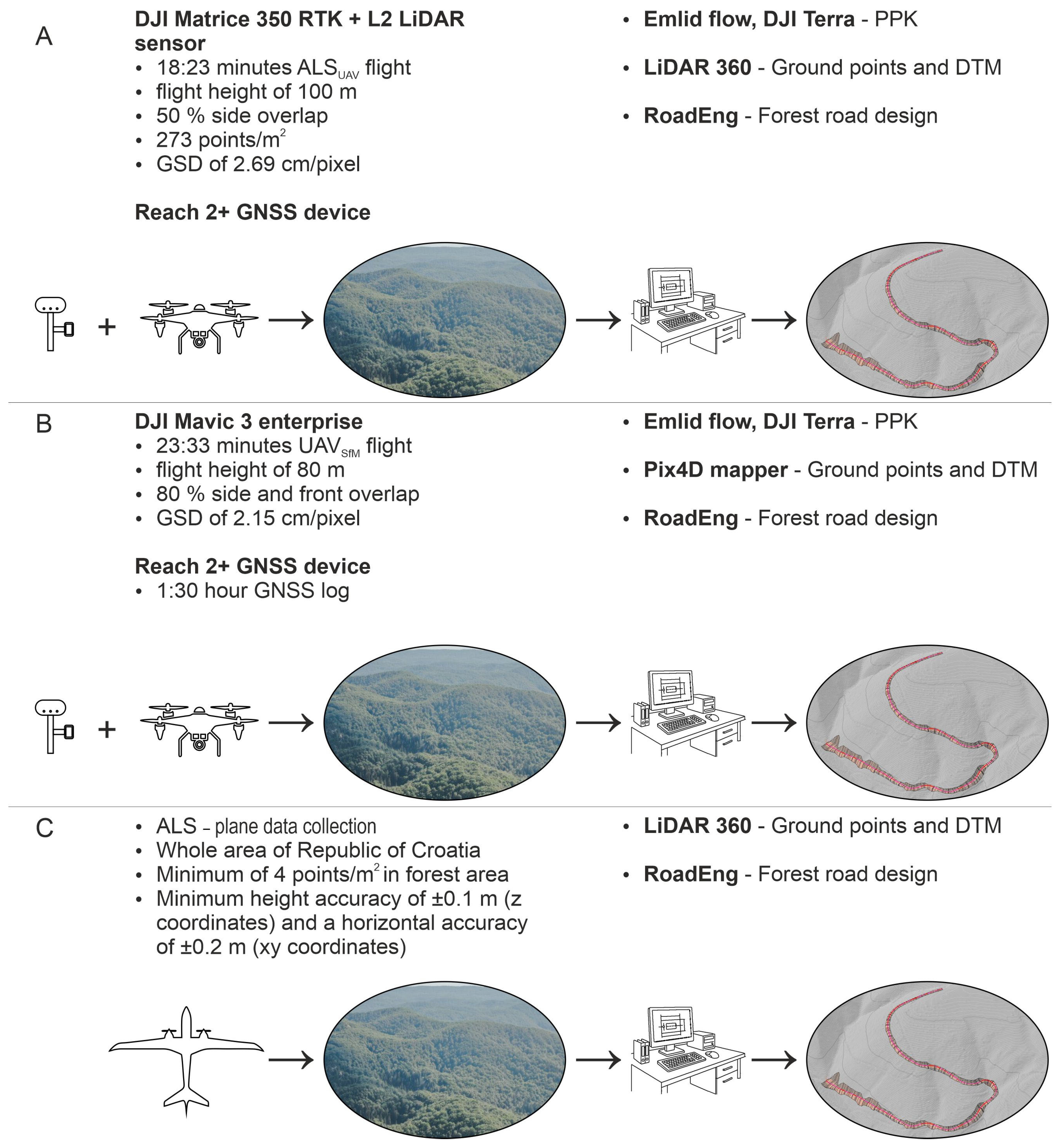
2.2.1. Field Data Survey Using the DJI Mavic 3 Enterprise
2.2.2. Field Data Survey Using the DJI Matrice 350 RTK with DJI Zenmuse L2 Sensor
2.2.3. State Geodetic Administration LiDAR Data of the Republic of Croatia
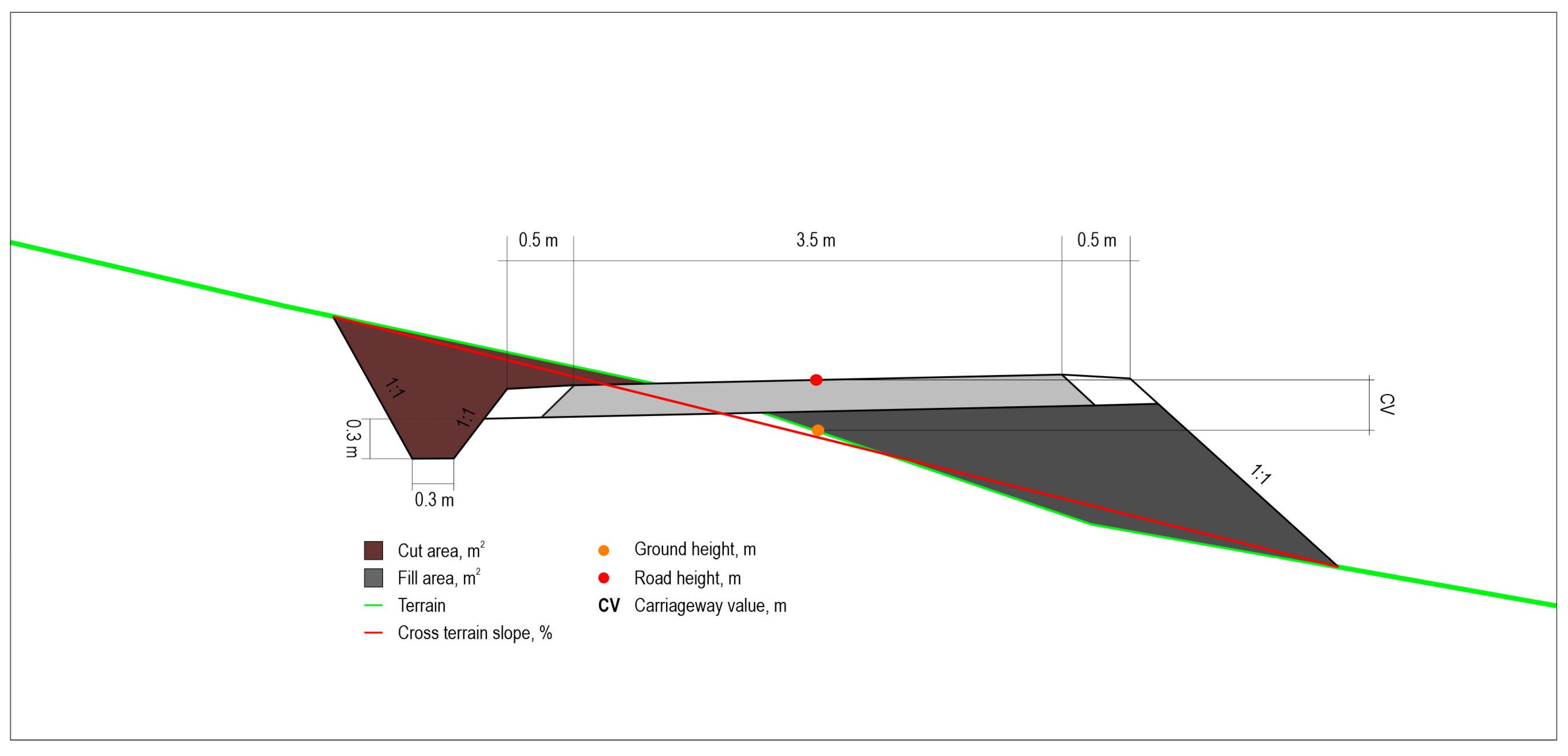
2.3. Detailed Forest Road Design and Analysis
- Earthwork volumes (fill and cut).
- Carriageway value (wearing course height (in centerline) reduced by the ground height).
- Cross-terrain slope.
- vd is the value difference, and
- n is the number of observations.
3. Results
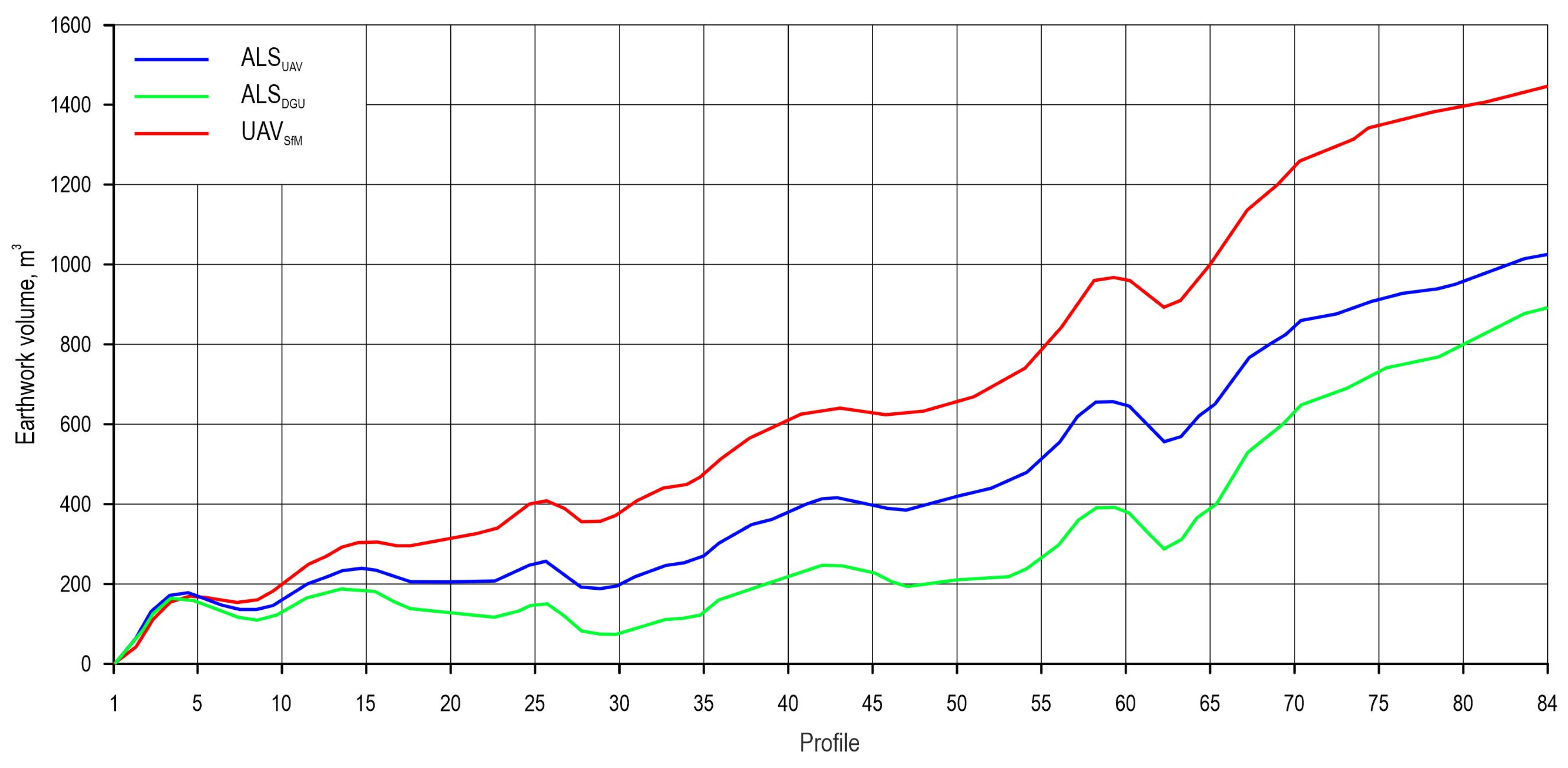
3.1. Earthwork Volumes
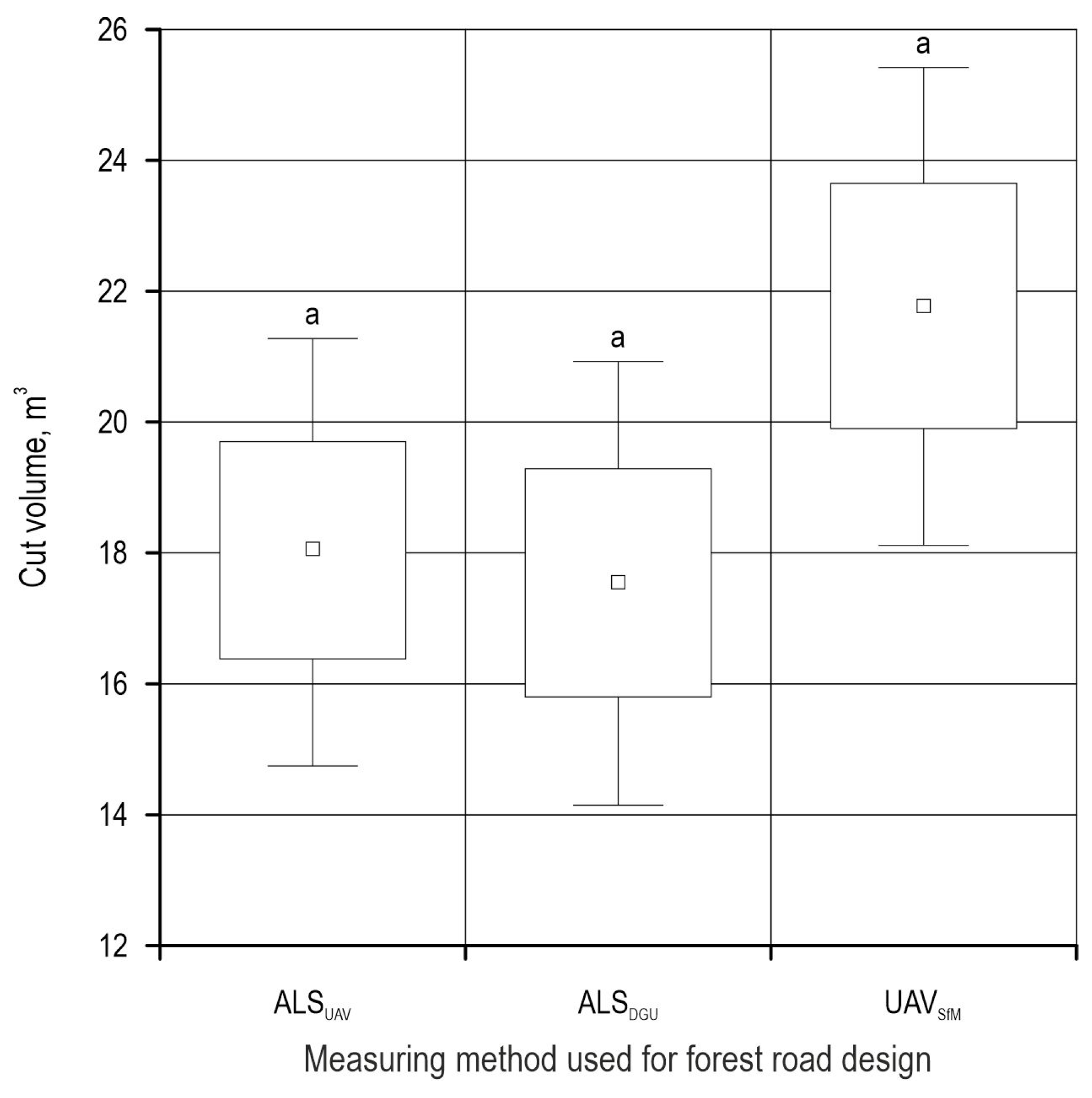
3.1.1. Cut Volume
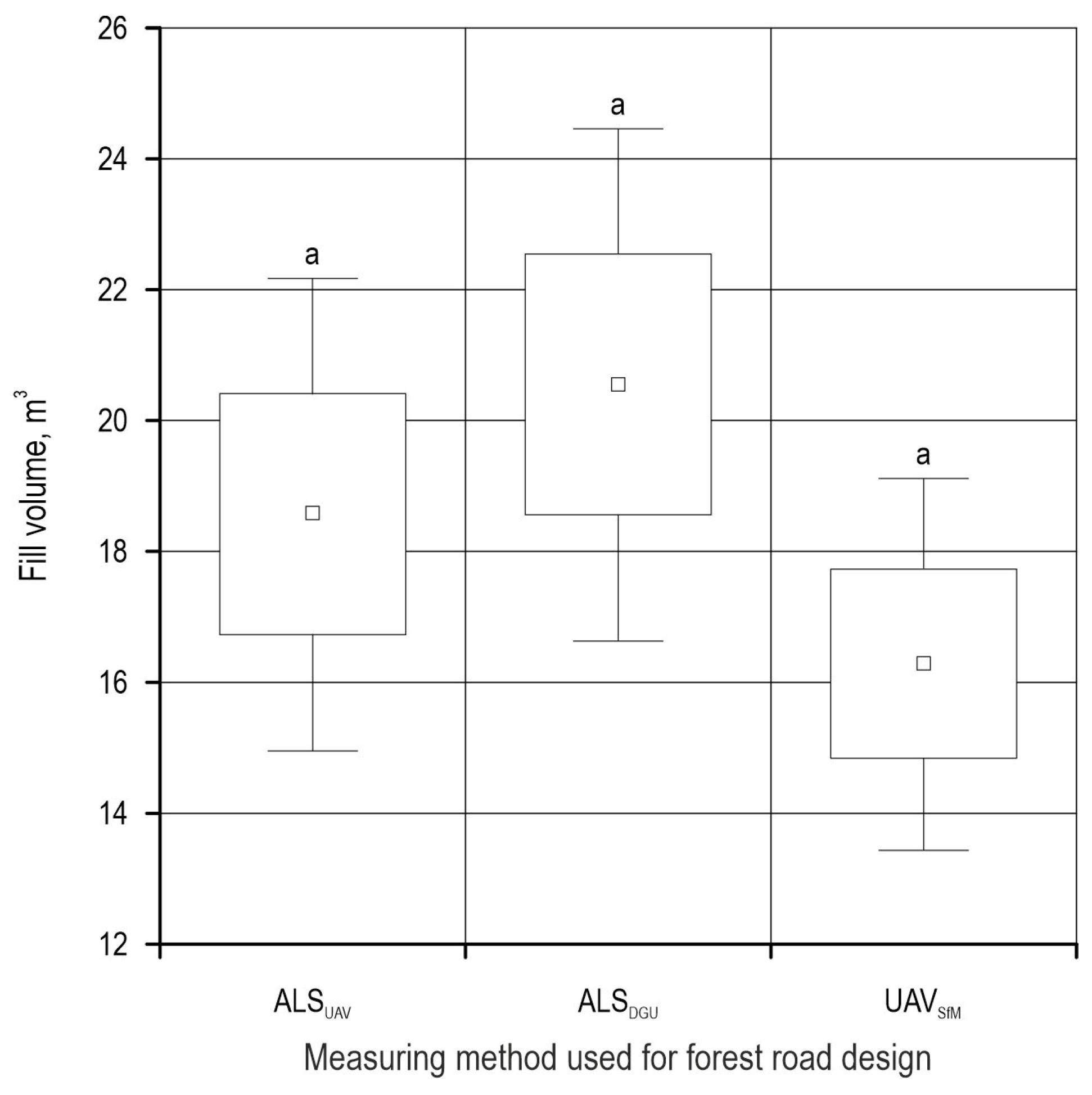
3.1.2. Fill Volume
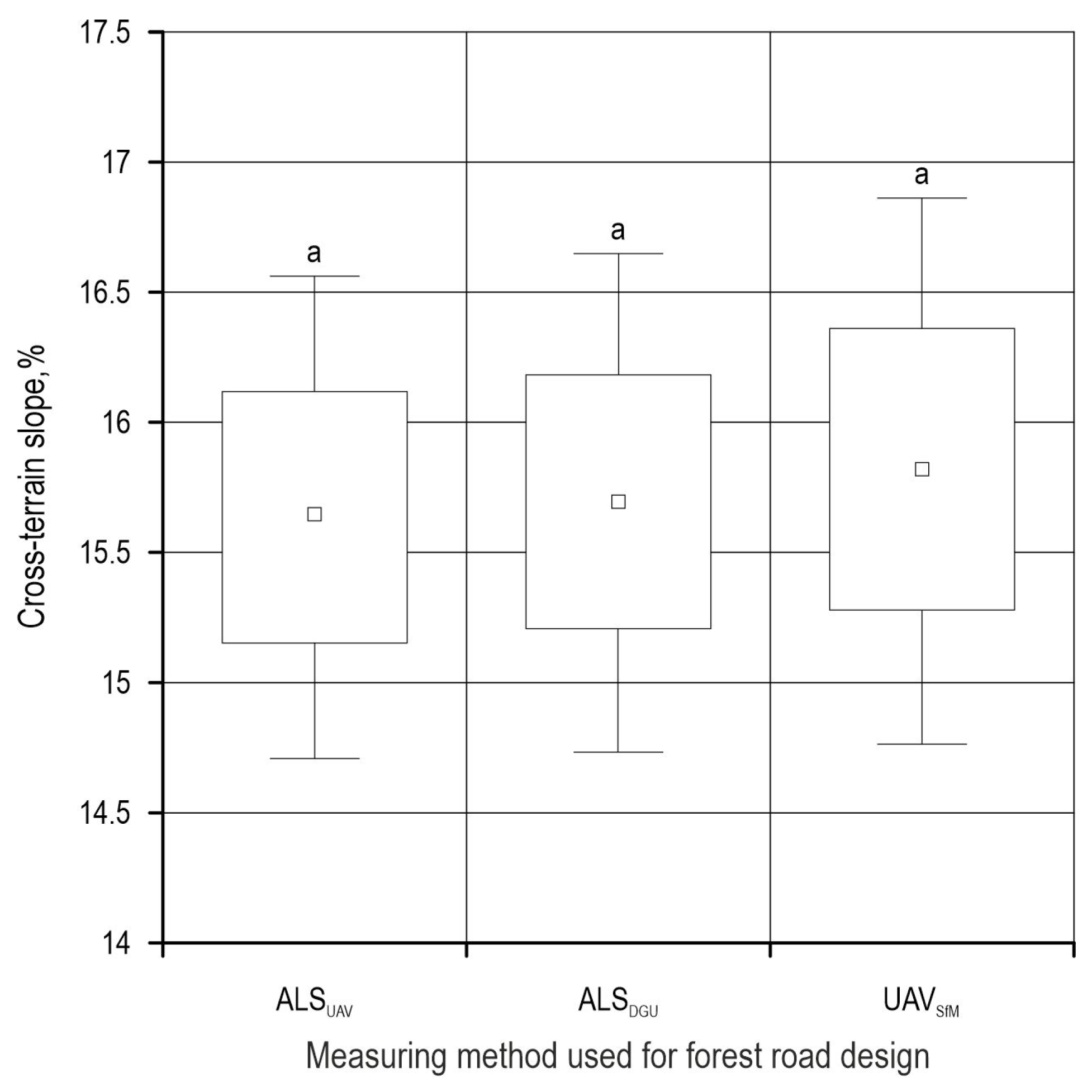
3.2. Cross-Terrain Slope
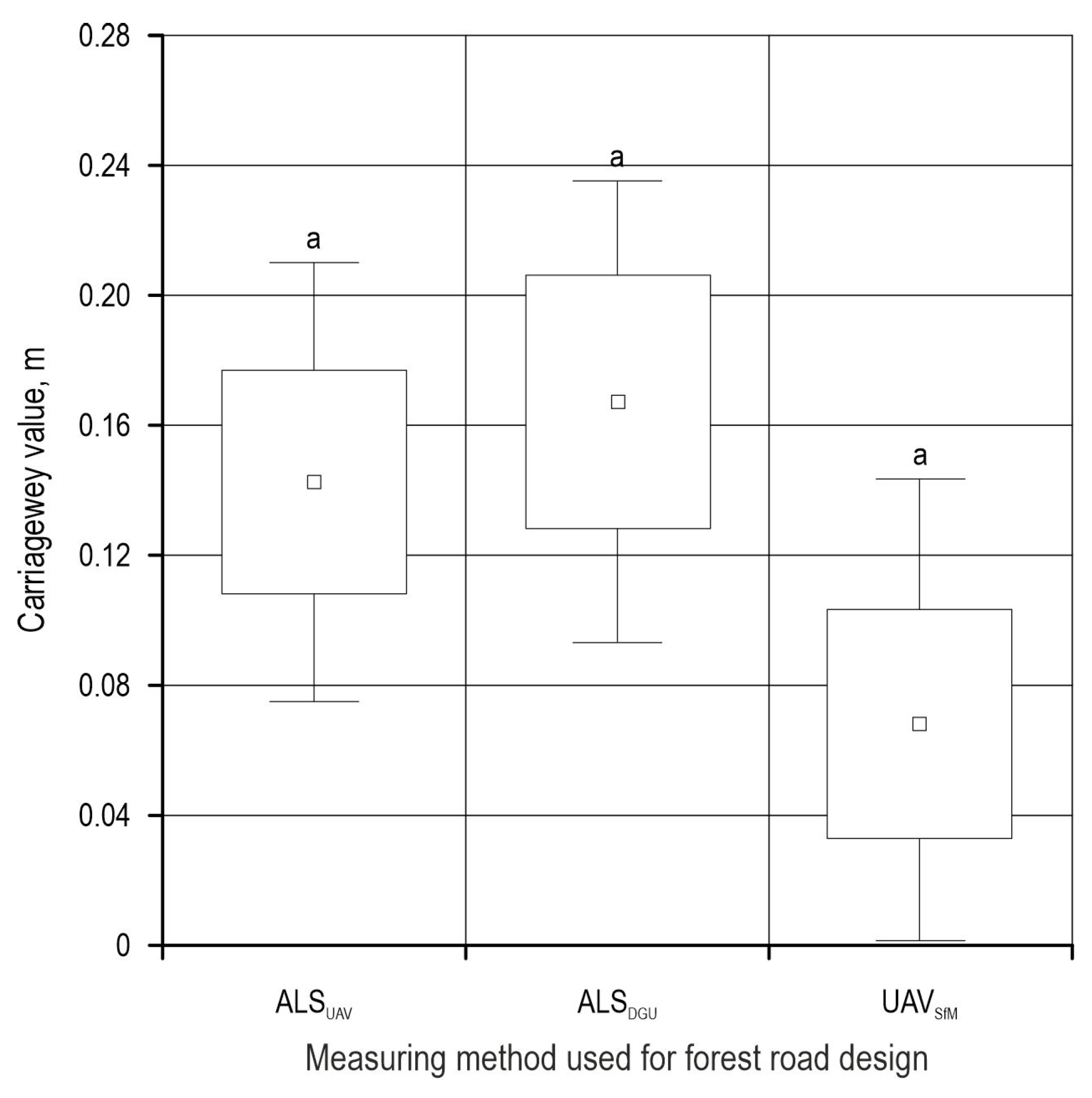
3.3. Carriageway Value
4. Discussion
5. Conclusions
- The ALSDGU and UAVSfM survey methods provide comparable and sufficiently accurate field data necessary for forest road design on terrain with moderate cross-terrain slopes and simpler reliefs.
- Airplane ALS survey data, when used for forest road design, has a tendency to underestimate cut volume and overestimate fill volume.
- The UAVSfM-based design, in this study, had a tendency to overestimate cut volume and underestimate fill volume. As there is no clear trend of this phenomenon in other studies, it cannot be claimed that this is a constant phenomenon.
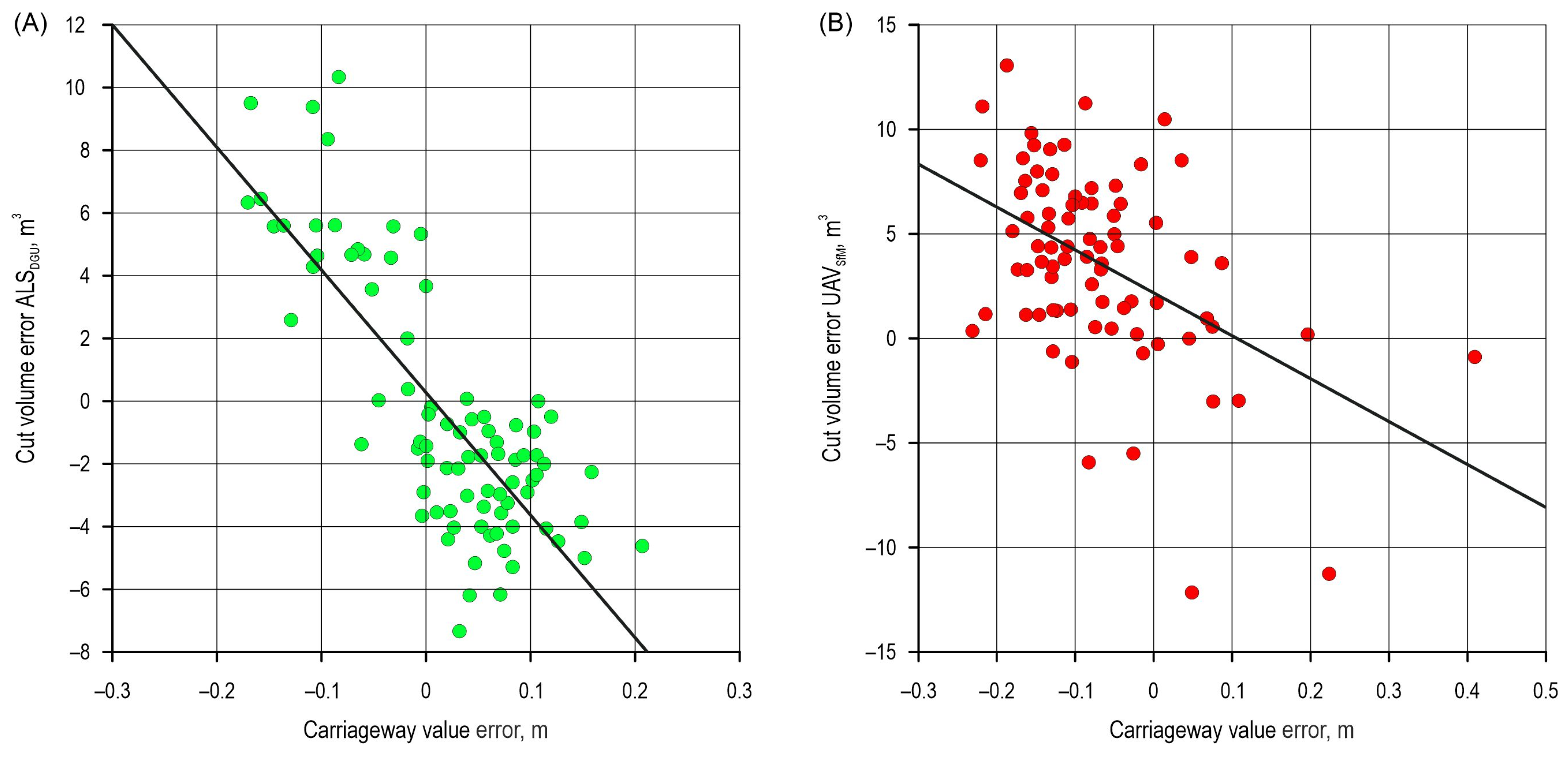
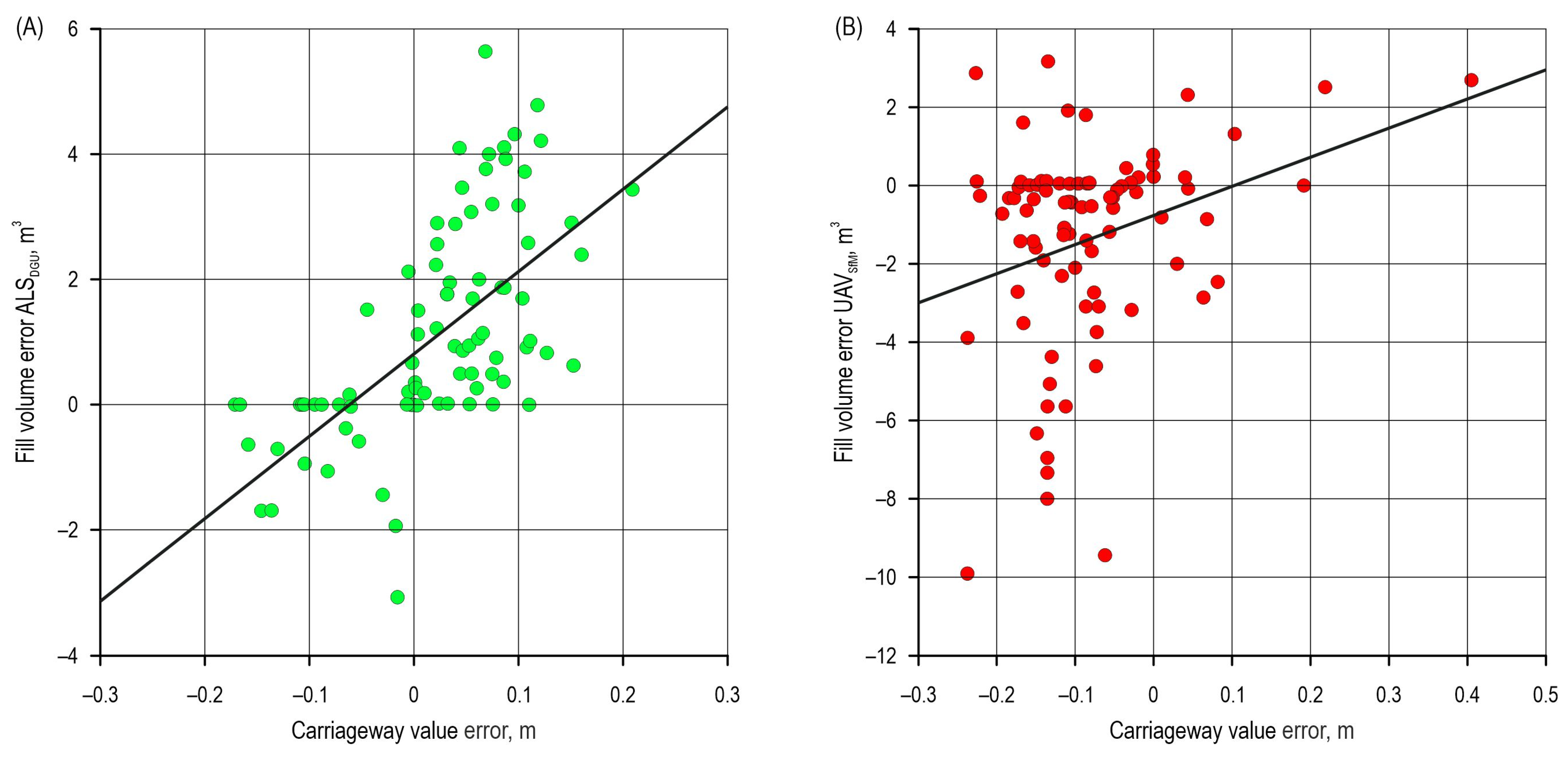
- The carriageway value error strongly affects the calculated cut volume and moderately affects the fill volume of designs based on ALSDGU data, while for UAVSfM-based design, there is a moderate and weak correlation between carriageway value error and cut and fill volume error.
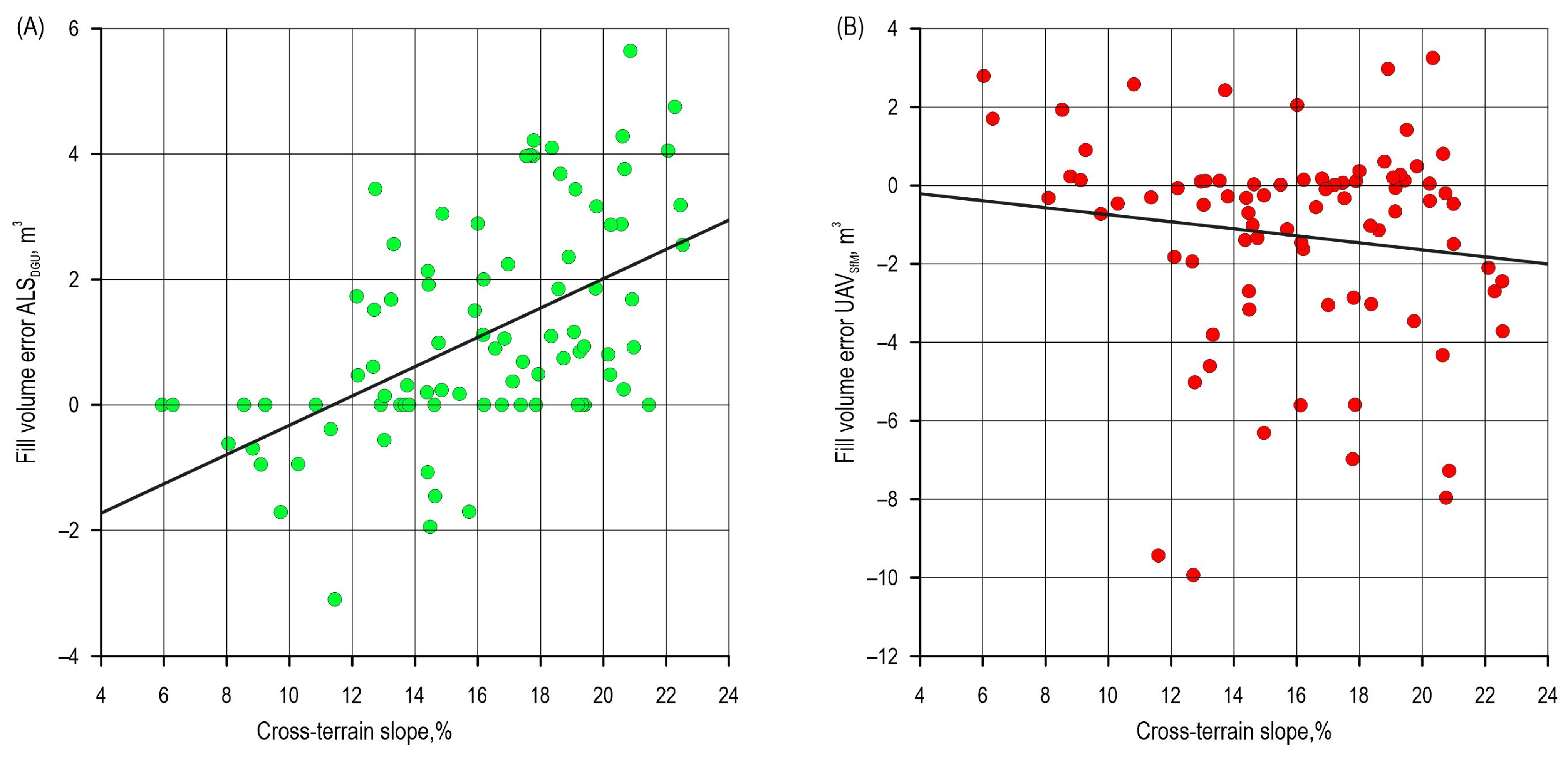
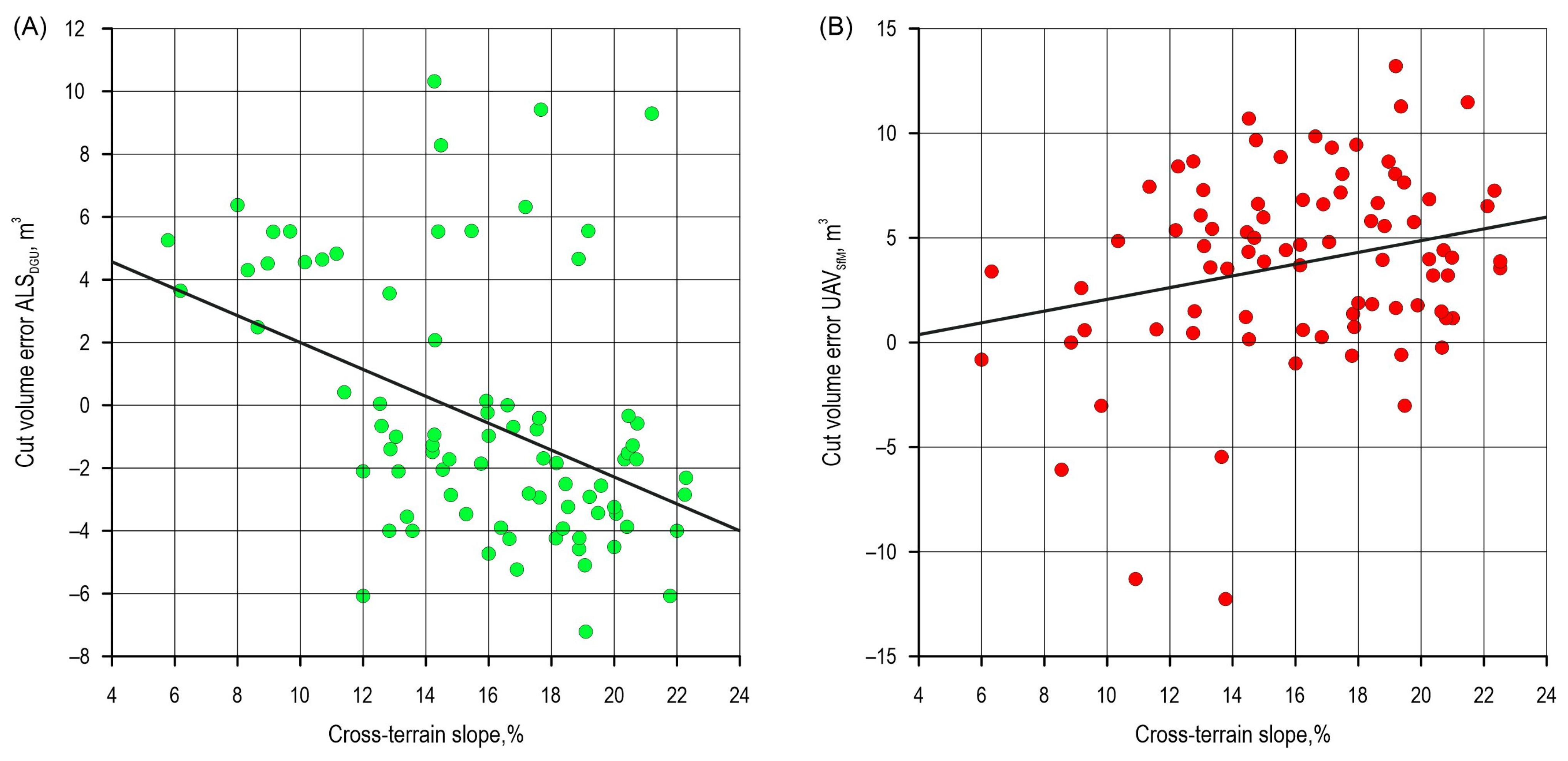
- The cross-terrain slope is moderately related to the earthworks error of the ALSDGU-based design and weakly related to the volume error of the UAVSfM design.
- It should be noted that the results obtained are in a forest with a moderate slope and a medium-developed understory. Further testing in different field conditions is necessary to draw strong conclusions about the usability of the tested conditions.
- It is necessary to eliminate the human factor as a source of error in testing different measurement systems for forest road design, such as horizontal or vertical road development.
Author Contributions
Funding
Data Availability Statement
Acknowledgments
Conflicts of Interest
Appendix A


References
- Đuka, A.; Papa, I.; Proto, A.R.; Latterini, F.; Mederski, P.S.; Borz, S.A.; Iordache, E.; Sokolović, D.; Karšik, A.; Stojnić, D. Forest Accessibility and Road Network Density: A Global Overview with a Special Focus on Europe. Curr. For. Rep. 2025, 11, 26. [Google Scholar] [CrossRef] [Scilit]
- Lyons, C.K.; Borz, S.A.; Harvey, C.; Ramantswana, M.; Sakai, H.; Visser, R. Forest roads: Regional perspectives from around the world. Int. J. For. Eng. 2022, 34, 190–203. [Google Scholar] [CrossRef] [Scilit]
- Hodić, I.; Jurušić, Z. Analysis of Primary Opennes of Forest Managed by Hrvatske Šume Ltd. as Basis for Disigning of Future Policy Forest Roads Construction. Šumarski List 2011, 135, 487–499. Available online: https://hrcak.srce.hr/clanak/111444 (accessed on 10 November 2025).
- Petković, V.; Potočnik, I. Planning forest road network in natural forest areas: A case study in northern Bosnia and Herzegovina. Crojfe J. For. Eng. 2018, 39, 45–56. Available online: https://hrcak.srce.hr/193550 (accessed on 8 November 2025).
- Hapa, M.; Dinca, L.; Crisan, V. Forests along roads-a case of stability, resilience and biodiversity. Present Environ. Sustain. Dev. 2023, 17, 257–273. [Google Scholar] [CrossRef] [Scilit]
- Hasegawa, H.; Sujaswara, A.A.; Kanemoto, T.; Tsubota, K. Possibilities of Using UAV for Estimating Earthwork Volumes during Process of Repairing a Small-Scale Forest Road, Case Study from Kyoto Prefecture, Japan. Forests 2023, 14, 677. [Google Scholar] [CrossRef] [Scilit]
- Dražić, S.; Danilović, M.; Ristić, R.; Stojnić, D.; Antonić, S. Evaluation of morphometric terrain parameters and their influence on determining optimal density of primary forest road network. Crojfe J. For. Eng. 2023, 44, 301–312. [Google Scholar] [CrossRef] [Scilit]
- Simões, D.; Cavalcante, F.S.; Lima, R.C.A.; Rocha, Q.S.; Pereira, G.; Miyajima, R.H. Optimal Forest Road Density as Decision-Making Factor in Wood Extraction. Forests 2022, 13, 1703. [Google Scholar] [CrossRef] [Scilit]
- Ryan, T.; Phillips, H.; Ramsay, J.; Dempsey, J. Forest Road Manual: Guidelines for the Design, Construction and Management of Forest Roads, 1st ed.; COFORD: Dublin, Ireland, 2004; Available online: https://www.unirc.it/documentazione/materiale_didattico/598_2007_39_832.pdf (accessed on 15 November 2025).
- Papa, I.; Pentek, T.; Janeš, D.; Šerić, T.; Vusić, D.; Đuka, A. Usporedba podataka prikupljenih različitim metodama terenske izmjere pri rekonstrukciji šumske ceste. Nova Meh. Šum. 2017, 38, 1–14. Available online: https://hrcak.srce.hr/192251 (accessed on 10 November 2025).
- Lovrinčević, M.; Papa, I.; Janeš, D.; Hodak, L.; Pentek, T.; Đuka, A. New Possibilities of Field Data Survey in Forest Road Design. Sensors 2025, 25, 4192. [Google Scholar] [CrossRef] [Scilit]
- Šporčić, M.; Landekić, M.; Šušnjar, M.; Pandur, Z.; Bačić, M.; Mijoč, D. Shortage of labour force in forestry of Bosnia and Herzegovina–forestry experts’ opinions on recruiting and retaining forestry workers. Crojfe J. For. Eng. 2024, 45, 183–198. [Google Scholar] [CrossRef] [Scilit]
- Handel, M.J. Labor shortages: What is the problem. Intereconomics 2024, 59, 136–142. [Google Scholar] [CrossRef] [Scilit]
- Tang, L.; Shao, G. Drone remote sensing for forestry research and practices. J. For. Res. 2015, 26, 791–797. [Google Scholar] [CrossRef] [Scilit]
- Guimarães, N.; Pádua, L.; Marques, P.; Silva, N.; Peres, E.; Sousa, J.J. Forestry Remote Sensing from Unmanned Aerial Vehicles: A Review Focusing on the Data, Processing and Potentialities. Remote Sens. 2020, 12, 1046. [Google Scholar] [CrossRef] [Scilit]
- Dainelli, R.; Toscano, P.; Di Gennaro, S.F.; Matese, A. Recent Advances in Unmanned Aerial Vehicles Forest Remote Sensing—A Systematic Review. Part II: Research Applications. Forests 2021, 12, 397. [Google Scholar] [CrossRef] [Scilit]
- Açıl, A.; Aydın, A.; Eker, R.; Duyar, A. Use of UAV data and HEC-RAS model for dimensioning of hydraulic structures on forest roads. Crojfe J. For. Eng. 2023, 44, 171–188. [Google Scholar] [CrossRef] [Scilit]
- Yrttimaa, T.; Matsuzaki, S.; Kankare, V.; Junttila, S.; Saarinen, N.; Kukko, A.; Vastaranta, M. Assessing forest traversability for autonomous mobile systems using close-range airborne laser scanning. Crojfe J. For. Eng. 2024, 45, 169–182. [Google Scholar] [CrossRef] [Scilit]
- Woellner, R.; Wagner, T.C. Saving species, time and money: Application of unmanned aerial vehicles (UAVs) for monitoring of an endangered alpine river specialist in a small nature reserve. Biol. Conserv. 2019, 233, 162–175. [Google Scholar] [CrossRef] [Scilit]
- Taş, İ.; Kaska, M.S.; Akay, A.E. Assessment of Using UAV Photogrammetry Based DEM and Ground-Measurement Based DEM in Computer-Assisted Forest Road Design. Eur. J. For. Eng. 2023, 9, 1–9. [Google Scholar] [CrossRef] [Scilit]
- Xu, D.; Wang, H.; Xu, W.; Luan, Z.; Xu, X. LiDAR Applications to Estimate Forest Biomass at Individual Tree Scale: Opportunities, Challenges and Future Perspectives. Forests 2021, 12, 550. [Google Scholar] [CrossRef] [Scilit]
- Sun, Y.; Jin, X.; Pukkala, T.; Li, F. Predicting Individual Tree Diameter of Larch (Larix olgensis) from UAV-LiDAR Data Using Six Different Algorithms. Remote Sens. 2022, 14, 1125. [Google Scholar] [CrossRef] [Scilit]
- Alvites, C.; Marchetti, M.; Lasserre, B.; Santopuoli, G. LiDAR as a Tool for Assessing Timber Assortments: A Systematic Literature Review. Remote Sens. 2022, 14, 4466. [Google Scholar] [CrossRef] [Scilit]
- Honkavaara, E.; Arbiol, R.; Markelin, L.; Martinez, L.; Cramer, M.; Bovet, S.; Chandelier, L.; Ilves, R.; Klonus, S.; Marshal, P.; et al. Digital Airborne Photogrammetry—A New Tool for Quantitative Remote Sensing?—A State-of-the-Art Review On Radiometric Aspects of Digital Photogrammetric Images. Remote Sens. 2009, 1, 577–605. [Google Scholar] [CrossRef] [Scilit]
- White, J.C.; Wulder, M.A.; Vastaranta, M.; Coops, N.C.; Pitt, D.; Woods, M. The Utility of Image-Based Point Clouds for Forest Inventory: A Comparison with Airborne Laser Scanning. Forests 2013, 4, 518–536. [Google Scholar] [CrossRef] [Scilit]
- Díaz, G.M.; Mohr-Bell, D.; Garrett, M.; Muñoz, L.; Lencinas, J.D. Customizing unmanned aircraft systems to reduce forest inventory costs: Can oblique images substantially improve the 3D reconstruction of the canopy? Int. J. Remote Sen. 2020, 41, 3480–3510. [Google Scholar] [CrossRef] [Scilit]
- Iglhaut, J.; Cabo, C.; Puliti, S.; Piermattei, L.; O’Connor, J.; Rosette, J. Structure from motion photogrammetry in forestry: A review. Curr. For. Rep. 2019, 5, 155–168. [Google Scholar] [CrossRef] [Scilit]
- Swayze, N.C.; Tinkham, W.T.; Vogeler, J.C.; Hudak, A.T. Influence of flight parameters on UAS-based monitoring of tree height, diameter, and density. Remote Sens. Environ. 2021, 263, 112540. [Google Scholar] [CrossRef] [Scilit]
- Dhruva, A.; Hartley, R.J.L.; Redpath, T.A.N.; Estarija, H.J.C.; Cajes, D.; Massam, P.D. Effective UAV Photogrammetry for Forest Management: New Insights on Side Overlap and Flight Parameters. Forests 2024, 15, 2135. [Google Scholar] [CrossRef] [Scilit]
- Tomaštík, J.; Mokroš, M.; Saloň, Š.; Chudý, F.; Tunák, D. Accuracy of Photogrammetric UAV-Based Point Clouds under Conditions of Partially-Open Forest Canopy. Forests 2017, 8, 151. [Google Scholar] [CrossRef] [Scilit]
- Zhang, H.; Aldana-Jague, E.; Clapuyt, F.; Wilken, F.; Vanacker, V.; Van Oost, K. Evaluating the potential of post-processing kinematic (PPK) georeferencing for UAV-based structure-from-motion (SfM) photogrammetry and surface change detection. Earth Surf. Dyn. 2019, 7, 807–827. [Google Scholar] [CrossRef] [Scilit]
- Đuka, A.; Tomljanović, K.; Franjević, M.; Janeš, D.; Žarković, I.; Papa, I. Application and Accuracy of Unmanned Aerial Survey Imagery after Salvage Logging in Different Terrain Conditions. Forests 2022, 13, 2054. [Google Scholar] [CrossRef] [Scilit]
- Klaas-Witt, T.; Emeis, S. The five main influencing factors for lidar errors in complex terrain. Wind. Energy Sci. 2022, 7, 413–431. [Google Scholar] [CrossRef] [Scilit]
- Stöcker, C.; Nex, F.; Koeva, M.; Gerke, M. Quality assessment of combined IMU/GNSS data for direct georeferencing in the context of UAV-based mapping. ISPRS 2017, 42, 355–361. [Google Scholar] [CrossRef] [Scilit]
- Tomaštík, J.; Mokroš, M.; Surový, P.; Grznárová, A.; Merganič, J. UAV RTK/PPK Method—An Optimal Solution for Mapping Inaccessible Forested Areas? Remote Sens. 2019, 11, 721. [Google Scholar] [CrossRef] [Scilit]
- Padró, J.C.; Muñoz, F.J.; Planas, J.; Pons, X. Comparison of four UAV georeferencing methods for environmental monitoring purposes focusing on the combined use with airborne and satellite remote sensing platforms. Int. J. Appl. Earth Obs. 2019, 75, 130–140. [Google Scholar] [CrossRef] [Scilit]
- Miller, Z.M.; Hupy, J.; Chandrasekaran, A.; Shao, G.; Fei, S. Application of postprocessing kinematic methods with UAS remote sensing in forest ecosystems. J. For. 2021, 119, 454–466. [Google Scholar] [CrossRef] [Scilit]
- Papa, I.; Popović, M.; Hodak, L.; Đuka, A.; Pentek, T.; Hikl, M.; Lovrinčević, M. Water and Vegetation as a Source of UAV Forest Road Cross-Section Survey Error. Forests 2025, 16, 507. [Google Scholar] [CrossRef] [Scilit]
- Craven, M.; Wing, M.G. Applying airborne LiDAR for forested road geomatics. Scand. J. For. Res. 2014, 29, 174–182. [Google Scholar] [CrossRef] [Scilit]
- Azizi, Z.; Najafi, A.; Sadeghian, S. Forest road detection using LiDAR data. J. For. Res. 2014, 25, 975–980. [Google Scholar] [CrossRef] [Scilit]
- Karjalainen, T.; Karjalainen, V.; Waga, K.; Tokola, T. Predicting the roadway width of forest roads by means of airborne laser scanning. Int. J. Appl. Earth Obs. 2024, 133, 104109. [Google Scholar] [CrossRef] [Scilit]
- Schmelz, W.J.; Psuty, N.P. Quantification of airborne lidar accuracy in coastal dunes (Fire island, New York). Photogramm. Eng. Remote Sens. 2019, 85, 133–144. [Google Scholar] [CrossRef] [Scilit]
- Liu, X. A new framework for accuracy assessment of LIDAR-derived digital elevation models. ISPRS 2022, 4, 67–73. [Google Scholar] [CrossRef] [Scilit]
- Elaksher, A.; Ali, T.; Alharthy, A. A Quantitative Assessment of LIDAR Data Accuracy. Remote Sens. 2023, 15, 442. [Google Scholar] [CrossRef] [Scilit]
- Park, H.C.; Rachmawati, T.S.N.; Kim, S. UAV-Based High-Rise Buildings Earthwork Monitoring—A Case Study. Sustainability 2022, 14, 10179. [Google Scholar] [CrossRef] [Scilit]
- Aruga, K.; Sessions, J.; Akay, A.E. Application of an airborne laser scanner to forest road design with accurate earthwork volumes. J. For. Res. 2005, 10, 113–123. [Google Scholar] [CrossRef] [Scilit]
- Matinnia, B.; Parsakhoo, A.; Mohamadi, J.; Jouibary, S.S. Study of the LiDAR accuracy in mapping forest road alignments and estimating the earthwork volume. J. For. Sci. 2018, 64, 469–477. [Google Scholar] [CrossRef] [Scilit]
- Chonpatathip, S. Earthwork Volume Measurement in Road Construction Using Unmanned Aerial Vehicle (UAV). Int. J. Geoinform. 2023, 19, 51–64. [Google Scholar] [CrossRef] [Scilit]
- Türk, Y.; Canyurt, H. Capabılıtıes of usıng UAVs to determıne forest road excavatıon volumes ın mountaınous areas. Šumarski List 2024, 137–150. Available online: https://ojs.srce.hr/index.php/sumlist/article/view/29496 (accessed on 13 November 2025). [CrossRef] [Scilit]
- Šikić, D.; Babić, B.; Topolnik, D.; Knežević, I.; Božičević, D.; Švabe, Ž.; Piria, I.; Sever, S. Tehnički Uvjeti za Gospodarske Ceste, 1st ed.; Znanstveni Savjet za Promet Jugoslavenske Akademije Znanosti i Umjetnosti: Zagreb, Croatia, 1989; pp. 1–78. [Google Scholar]
- Anonymous. Pravilnik o provedbi intervencije 73.08. “Izgradnja šumske infrastructure”. In iz Strateškog Plana Zajedničke Poljoprivredne Politike Republike Hrvatske 2023–2027; NN 90/2024; Government of Croatia: Zagreb, Croatia, 2024; Available online: https://narodne-novine.nn.hr/clanci/sluzbeni/full/2024_07_90_1681.html (accessed on 5 November 2025).
- CROPOS—Državna Mreža Referentnih Stanica Republike Hrvatske. Available online: https://www.cropos.hr/ (accessed on 15 August 2025).
- Vautherin, J.; Rutishauser, S.; Schneider-Zapp, K.; Choi, H.F.; Chovancova, V.; Glass, A.; Strecha, C. Photogrammetric accuracy and modeling of rolling shutter cameras. ISPRS 2016, 3, 139–146. [Google Scholar] [CrossRef] [Scilit]
- Zhou, Y.; Daakir, M.; Rupnik, E.; Pierrot-Deseilligny, M. A two-step approach for the correction of rolling shutter distortion in UAV photogrammetry. ISPRS 2020, 160, 51–66. [Google Scholar] [CrossRef] [Scilit]
- Štroner, M.; Urban, R.; Křemen, T.; Braun, J. UAV DTM acquisition in a forested area–comparison of low-cost photogrammetry (DJI Zenmuse P1) and LiDAR solutions (DJI Zenmuse L1). Eur. J. Remote Sens. 2023, 56, 2179942. [Google Scholar] [CrossRef] [Scilit]
- Urban, R.; Štroner, M.; Kovanič, L.; Blišťan, P.; Křemen, T.; Braun, J.; Peťovský, P.; Topitzer, B. Testing the accuracy and characteristics of data acquired using DJI Zenmuse L1 and L2 lidar systems and photogrammetric data acquired using DJI Zenmuse P1 in a quarry environment. Eur. J. Remote Sens. 2025, 58, 2595361. [Google Scholar] [CrossRef] [Scilit]
- Anonymous. Specifikacija Proizvoda, LiDAR Snimanje iz Zraka; Republika Hrvatska—Državna Geodetska Uprava: Zagreb, Croatia, 2022; pp. 1–50. Available online: https://dgu.gov.hr/UserDocsImages/dokumenti/Istaknute%20teme/Multisenzorno%20snimanje/LiDAR%20snimanje%20iz%20zraka.pdf (accessed on 10 October 2025).
- Chekole, S.D. Surveying with GPS, Total Station and Terresterial Laser Scaner: A Comparative Study. Master’s Thesis, Royal Institute of Technology (KTH), Stockholm, Sweden, May 2014. [Google Scholar] [CrossRef]
- Sokolović, D.; Bajrić, M. Volumen zemljanih radova pri izgradnji šumskih cesta na strmim terenima. Nova Meh. Šum. 2015, 36, 33–42. Available online: https://hrcak.srce.hr/file/227355 (accessed on 10 November 2025).
- Hrůza, P.; Mikita, T.; Tyagur, N.; Krejza, Z.; Cibulka, M.; Procházková, A.; Patočka, Z. Detecting Forest Road Wearing Course Damage Using Different Methods of Remote Sensing. Remote Sens. 2018, 10, 492. [Google Scholar] [CrossRef] [Scilit]
- Kınalı, M.; Çalışkan, E. Use of unmanned aerial vehicles in forest road projects. Bartın Orman Fakültesi Derg. 2022, 24, 530–541. [Google Scholar] [CrossRef] [Scilit]
- Kim, Y.H.; Shin, S.S.; Lee, H.K.; Park, E.S. Field Applicability of Earthwork Volume Calculations Using Unmanned Aerial Vehicle. Sustainability 2022, 14, 9331. [Google Scholar] [CrossRef] [Scilit]
- Gülci, S. The determination of some stand parameters using SfM-based spatial 3D point cloud in forestry studies: An analysis of data production in pure coniferous young forest stands. Environ. Monit. Assess. 2019, 191, 495. [Google Scholar] [CrossRef] [Scilit]
- Su, J.; Bork, E. Influence of vegetation, slope, and lidar sampling angle on DEM accuracy. Photogramm. Eng. Remote Sens. 2006, 72, 1265–1274. [Google Scholar] [CrossRef] [Scilit]
- Tinkham, W.T.; Smith, A.M.; Hoffman, C.; Hudak, A.T.; Falkowski, M.J.; Swanson, M.E.; Gessler, P.E. Investigating the influence of LiDAR ground surface errors on the utility of derived forest inventories. Canad. J. For. Res. 2012, 42, 413–422. [Google Scholar] [CrossRef] [Scilit]
- Salleh, M.R.M.; Ismail, Z.; Rahman, M.Z.A. Accuracy assessment of lidar-derived digital terrain model (DTM) with different slope and canopy cover in tropical forest region. ISPRS 2015, 2, 183–189. [Google Scholar] [CrossRef] [Scilit]





| Specs | DJI Mavic 3 E | DJI Matrice 350 RTK |
|---|---|---|
| Dimensions; Folded (without propellers) | 221.0 × 96.3 × 90.3 mm (L × W × H) | 810 × 670 × 430 mm (L × W × H) |
| Dimensions; Unfolded (without propellers) | 347.5 × 283 × 107.7 mm (L × W × H) | 430 × 420 × 430 mm (L × W × H) |
| Weight | 0.915 kg | Without batteries—3.77 kg With two TB65 batteries—6.47 kg |
| Max Take-off Weight | 1.063 kg | 9.2 kg |
| Hovering Accuracy | Vertical: ±0.5 m (GNSS) ±0.1 m (RTK) Horizontal: ±0.5 m (GNSS) ±0.1 m (RTK) | Vertical: ±0.5 m (GNSS) ±0.1 m (RTK) Horizontal: ±1.5 m (GNSS) ±0.1 m (RTK) |
| RTK Positioning Accuracy (RTK FIX) | 1 cm + 1 ppm (horizontal) 1.5 cm + 1 ppm (vertical) | 1 cm + 1 ppm (horizontal) 1.5 cm + 1 ppm (vertical) |
| Max Flight Speed | 15 m/s | 23 m/s |
| Max Take-off Altitude Above Sea Level | 6000 m | 5000 m or 7000 m |
| Max Wind Speed Resistance | 12 m/s | 12 m/s |
| Max Flight Time (no wind) | 45 min | 55 min |
| Operating Temperature Range | −10° to 40 °C | −20° to 50 °C |
| Class (EU) | C1 | C3 |
| Sensor | DJI Mavic 3E Wide Camera: 20 MP sensor FOV: 84° Format Equivalent: 24 mm Aperture: f/2.8–f/11 Focus: 1 m to ∞ Electronic Shutter: 8–1/8000 s Mechanical Shutter: 8–1/2000 s | DJI Zenmuse L2 Ranging Accuracy: 2 cm at a flight altitude of 150 m Maximum Returns Supported: 5 Minimum Detection Range: 3 m Scanning Modes: Non-repetitive scanning pattern and repetitive scanning pattern |
| Method | Mean, m3 | Minimum, m3 | Maximum, m3 | RMSE, m3 |
|---|---|---|---|---|
| ALSUAV | 17.99 | 0.00 | 69.39 | - |
| ALSDGU | 17.51 | 0.00 | 70.66 | 4.03 |
| UAVSfM | 21.73 | 0.00 | 74.88 | 5.82 |
| Method | Mean, m3 | Minimum, m3 | Maximum, m3 | RMSE, m3 |
|---|---|---|---|---|
| ALSUAV | 5.78 | 0.00 | 47.99 | - |
| ALSDGU | 6.92 | 0.00 | 49.52 | 2.04 |
| UAVSfM | 4.47 | 0.00 | 37.98 | 2.92 |
| Method | Mean, % | Minimum, % | Maximum, % | RMSE, % |
|---|---|---|---|---|
| ALSUAV | 15.62 | 3.47 | 28.75 | - |
| ALSDGU | 15.67 | 2.79 | 22.76 | 1.55 |
| UAVSfM | 15.80 | 1.72 | 24.29 | 1.20 |
| Method | Mean, m | Minimum, m | Maximum, m | RMSE, m |
|---|---|---|---|---|
| ALSUAV | 0.14 | −0.71 | 1.23 | - |
| ALSDGU | 0.17 | −0.68 | 1.19 | 0.08 |
| UAVSfM | 0.06 | −0.66 | 1.01 | 0.12 |
Disclaimer/Publisher’s Note: The statements, opinions and data contained in all publications are solely those of the individual author(s) and contributor(s) and not of MDPI and/or the editor(s). MDPI and/or the editor(s) disclaim responsibility for any injury to people or property resulting from any ideas, methods, instructions or products referred to in the content. |
© 2026 by the authors. Licensee MDPI, Basel, Switzerland. This article is an open access article distributed under the terms and conditions of the Creative Commons Attribution (CC BY) license.
Share and Cite
Papa, I.; Hodak, L.; Popović, M.; Đuka, A.; Pentek, T.; Lovrinčević, M. ALS and SfM Field Data Survey as a Basis of Forest Road Design. Forests 2026, 17, 265. https://doi.org/10.3390/f17020265
Papa I, Hodak L, Popović M, Đuka A, Pentek T, Lovrinčević M. ALS and SfM Field Data Survey as a Basis of Forest Road Design. Forests. 2026; 17(2):265. https://doi.org/10.3390/f17020265
Chicago/Turabian StylePapa, Ivica, Luka Hodak, Maja Popović, Andreja Đuka, Tibor Pentek, and Mihael Lovrinčević. 2026. "ALS and SfM Field Data Survey as a Basis of Forest Road Design" Forests 17, no. 2: 265. https://doi.org/10.3390/f17020265
APA StylePapa, I., Hodak, L., Popović, M., Đuka, A., Pentek, T., & Lovrinčević, M. (2026). ALS and SfM Field Data Survey as a Basis of Forest Road Design. Forests, 17(2), 265. https://doi.org/10.3390/f17020265