1. Introduction
According to the Intergovernmental Panel on Climate Change (IPCC) Sixth Assessment Report Synthesis (AR6), limiting global warming to 1.5 °C requires rapid, deep, and sustained reductions in greenhouse gas emissions, with global carbon neutrality projected to be achieved around the mid-21st century [
1]. While global climate change is intensifying, China’s urbanization process is also accelerating. Recent projections based on United Nations urbanization estimates and national demographic trends suggest that China’s urban population share is expected to continue rising toward roughly ~75%–80% by 2050 [
2]. Rapid urbanization has brought about a reduction in ecological land use and an increase in carbon emissions, further exacerbating climate change. In September 2020, China announced, at the 75th United Nations General Assembly, that the country would reach its carbon peak by 2030 and strive to achieve carbon neutrality by 2060 [
3]. Therefore, addressing global warming and striving to achieve carbon neutrality are two of China’s major strategic decisions [
3,
4,
5].
Forest ecosystems play an important role in absorbing and fixing atmospheric carbon dioxide, and their carbon sequestration accounts for two-thirds of the total carbon sequestration of terrestrial ecosystems [
6,
7,
8], which is considered to be one of the most effective ways to offset carbon dioxide emissions [
8,
9,
10,
11]. As the “lung of the city”, urban green space penetrates into every block of the city, not only providing aesthetic landscapes and leisure and entertainment places for human life, but also has obvious cooling and humidification, purification of the environment, carbon fixation and oxygen release, reducing noise, adjusting and storing rainwater, and preventing and avoiding disasters and other ecological benefits, which can effectively improve the living environment and maintain ecological security [
7,
11]. The accurate estimation of the three-dimensional green quantity of existing urban green space is the basic premise of quantitative evaluation of UGS carbon sequestration benefits, and it is also one of the important research contents of urban ecological environment construction and protection [
7,
12].
The ecological benefit of UGS depends not only on plant species and coverage area, but also on the spatial structure of plants and the growth status of vegetation. As a greening index to measure the quality of green space, the three-dimensional green volume [
7,
12] more accurately reflects the rationality of the spatial composition of plants and the ecological benefit level of urban green space than the traditional two-dimensional indicators, such as green coverage and leaf area [
7]. The 3DGQ is defined as “the volume of space occupied by the stems and leaves of all growing plants” [
7,
12], and the unit is generally expressed in cubic meters (m
3). The shape of “space occupied by stems and leaves” is “irregular”. In recent years, to improve the accuracy of urban green measurement, a large number of studies focusing on how to obtain the volume of “irregular” spaces have emerged at home and abroad. The widely used mathematical model is to use the volume of regular geometry to model the volume of the tree canopy; this is the Approximate Geometry Method (AGM). For example, use the volume of the cone to approximate the volume of the pine, use the volume of the ellipsoid to evaluate the volume of the
Cinnamomum camphora [
12], etc. The calculation of AGM requires data such as crown height, crown diameter, and crown shape.
However, the shape of the canopy varies not only among different tree species, but also within the same tree species due to differences in site conditions and growth environment. Even the same tree may have different shapes due to seasonal changes, man-made pruning, etc. To reduce the error of simulating tree morphology with regular geometry, the authors proposed to segment the tree crown to obtain a number of small cones and small truncated cones. The 3DGQ can be obtained through the accumulation of truncated cones and cones [
13]. On this basis, considering the irregular shape of the stems and leaves, when calculating the volume of the divided body, the cross-sectional area of the crown is used instead of the regular circle to improve the volume calculation accuracy [
14].
With the continuous optimization of spatial geometric models, increasing attention has been paid to the spatial distribution of stems and leaves. Vehicle-mounted laser scanning has been applied to analyze point-cloud completeness from different canopy orientations. Based on this analysis, an incompleteness rate was proposed and incorporated as a weighting factor in crown volume estimation [
15]. The extreme values of laser point cloud statistics tree data form a regular spatial geometry, and the 3DGQ is calculated according to the effective ratio by the differential LiDAR-based point cloud method (PCM) [
10,
16,
17,
18]. However, if the LiDAR-based PCM was used to estimate the 3DGQ of the entire city, the workload of collecting data using a laser is incalculable.
The existing research for 3DGQ estimation primarily focused on establishing and optimizing 3D mathematical models of canopy morphology, involving substantial measurement workload and making it challenging to ensure estimation accuracy. Although existing research has used new technologies, it still has the following limitations:
The data collection workload is enormous, and evaluating a city-scale 3DGQ and CSORB usually takes months, even years, due to the wide variety of tree species and individual growth being affected by multiple factors.
The gaps between the stems and leaves within a tree’s crown do not contribute to any CSORB for the ecosystem. Therefore, it is crucial to exclude the influence of such gaps from the evaluation of 3DGQ and CSORB to further improve the accuracy of the evaluation.
A key research question is as follows: How to efficiently and accurately evaluate 3DGQ for combating climate change?
In this work, the authors aim to develop a mathematical model for 3D Green Quantity that integrates an edge-derived crown boundary profile with Simpson’s numerical integration (an Improved Simpson Method, ISM) to accurately estimate tree canopy volume. Based on this aim, this study is guided by the following hypotheses.
H1. UAV-based 3DGQ estimates obtained using the proposed Improved Simpson Model (ISM) show close agreement with LiDAR point cloud-derived crown volume measurements (LiDAR-based PCMs), which are used as a surrogate reference.
H2. ISM exhibits stable 3DGQ estimation performance across different tree species.
The remainder of this paper is organized as follows: In
Section 2, we introduce the study area, the data source, and the mathematical model of 3DGQ. Analysis and results are presented in
Section 3. Finally, in
Section 4, we provide a summary of key findings.
2. Materials and Methods
This study’s methodology consists (1) data collection using UAV imagery for a diverse set of urban trees, (2) image processing to extract 2D canopy silhouettes and derive structural parameters, and (3) development of a Simpson’s rule-based model to estimate 3D canopy volume (3DGQ) and associated carbon sequestration, which is then compared to existing methods (AGM and LiDAR-based PCM) for validation.
2.1. Study Area
The empirical study was conducted in Shanghai, China. Shanghai is located at 120°52′–122°12′ E, 30°40′–31°53′ N. The climate belongs to the north subtropical monsoon climate, with four distinct seasons, sufficient sunshine, abundant rainfall, a mild and humid climate, and short springs and autumns. Winter and summer are longer. The annual average temperature in 2021 is 17.9 °C. January is the coldest month in winter, with a monthly average temperature of 2.1 °C; July is the hottest month in the summer, with a monthly average temperature of 32.2 °C. The sunshine conditions are relatively sufficient, and the annual sunshine time is about 2000 h. The seasonal distribution of rainfall is relatively even, accounting for about 40.1% in summer and 13.0% in winter, and about 70% of the rainfall is concentrated in April to September. As the global center for finance, business and economics, research, education, science and technology, manufacturing, tourism, culture, and transportation, on 8 July 2022, the Shanghai Municipal People’s Government issued the “Shanghai Carbon Peak Implementation Plan”. In the plan, the Shanghai Municipal People’s Government pointed out that it will focus on key structural ecological spaces, continue to increase afforestation efforts, comprehensively promote the construction of urban green ecological barriers, and consolidate and improve forest carbon sink capacity. The total number of parks in Shanghai is approaching 973 by the end of 2024 [
19], and the largest botanical garden, Shanghai Chenshan Botanical Garden, has more than 6000 species of plants. Through the plant data from the Shanghai Municipal Park Management Department, we chose the 18 species of trees, as in
Table 1.
2.2. Data Source
This work involved several data sources. Firstly, greening status information at the garden was taken from the Shanghai Chenshan Botanical Garden Management Department and the Shanghai Municipal Park Management Department. Based on this, we create a database (denoted by DBInfo) for the study trees. The attributes of each data include species ID, tree ID, tree age, and growth status. We select 540 trees, with each species in
Table 1 having 30 trees of the same age through DBInfo.
Furthermore, we used a UAV (DJI, Inspire 2) equipped with an aerial camera (X7 gimbal camera) [
20] to collect low altitude high-resolution images of trees (
Table 1). For each tree, we took 30 images of three views: top view, front view, and left view, with each view having 10 images. The X7 supports 10 burst photos in JPEG + DNG, and DNG unlimited burst photos of 20 frames per second, with each photo having 24 million pixels. Finally, we had a total of 16,200 images. Then, we used OpenCV to process these images. In OpenCV, the Fourier transform and convolution operations were first applied to denoise the collected images. Gaussian and bilateral filter functions were then used to further suppress noise and enhance image quality. Edge detection was performed to extract canopy silhouettes (boundaries), which provide the geometric input for the silhouette-based rotational-solid volume estimation in ISM. By integrating the extracted boundaries with the UAV position and viewing angle at the time of image acquisition, crown structural parameters, including east–west crown diameter, north–south crown diameter (with the mean value reported in
Table 1), and crown height, were calculated using trigonometric relationships.
Metric scaling for each image was derived from the UAV’s recorded pose (latitude, longitude, and altitude) and the camera geometry. This enabled us to convert pixel measurements into actual crown dimensions using basic geometry. We applied such calculations for crown width and height, adjusting for each image’s altitude rather than assuming a constant flight height.
2.3. Mathematical Model of 3DGQ
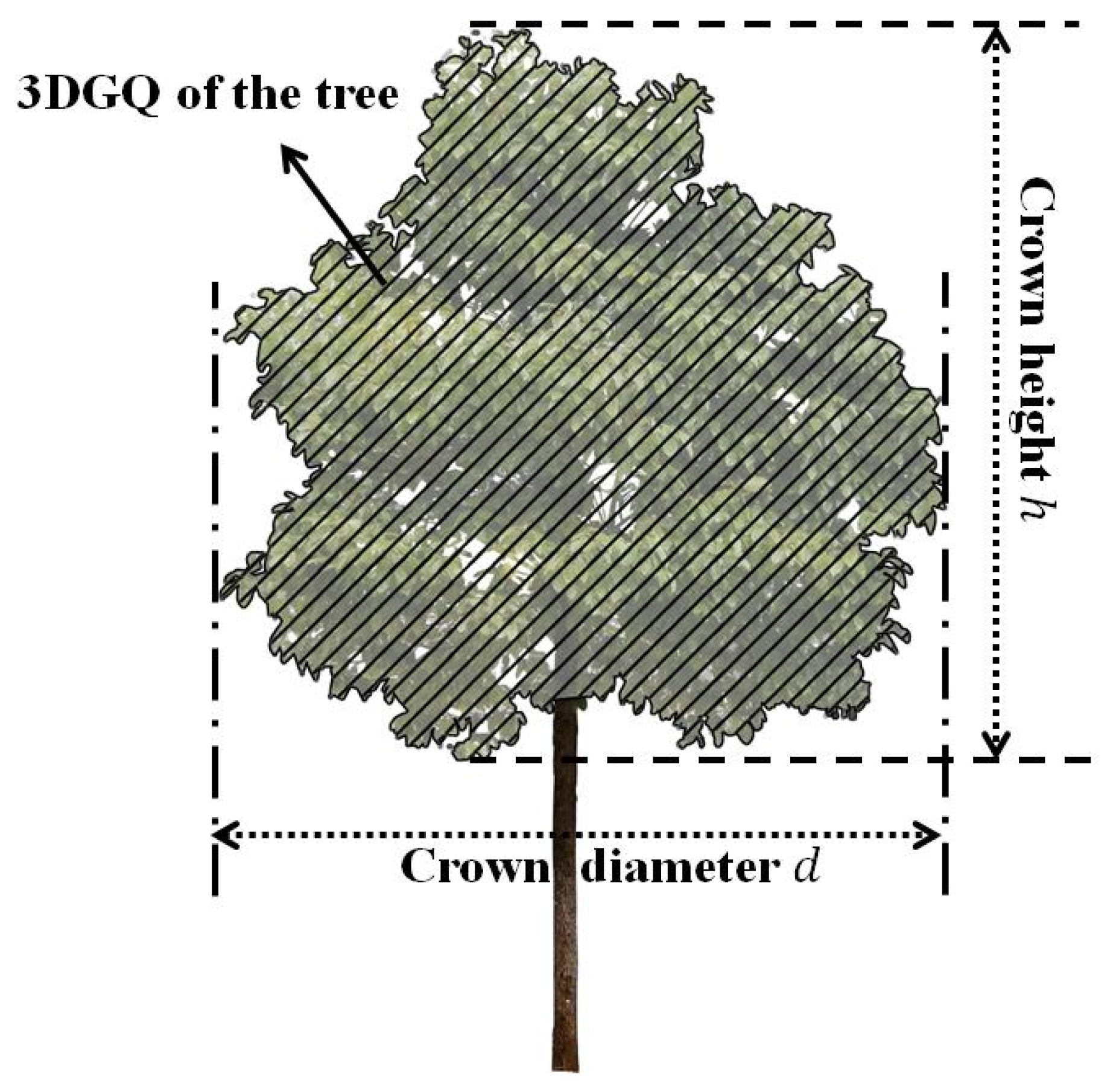
The 3DGQ is defined as “the volume of space occupied by the stems and leaves of all growing plants” [
7,
12], and the unit is generally expressed in cubic meters (m
3),
Figure 1. In this section, we will introduce the widely used mathematical model of 3DGQ [
12] (the Approximate Geometry Model, AGM), the model closest to the true value [
16,
17] (the point cloud method, LIDAR-based PCM), and our improved model based on the Simpson Model [
21] (denoted by ISM).
2.3.1. 3DGQ of AGM and LIDAR-BASED PCM
The regular mathematical geometries used in this work to approximate the selected species [
12] are presented in
Table 1. And the volume of these geometries is given in
Table 2. The 3DGQ in LIDAR-BASED PCM is given by the volume of the point cloud.
2.3.2. 3DGQ of ISM
The proposed ISM is a silhouette-based volumetric estimation method. It does not rely on multi-view photogrammetric point-cloud reconstruction (SfM/MVS) or stereo geometry; instead, crown volume is inferred by extracting canopy silhouettes from multiple UAV views and integrating the resulting rotational solids via Simpson’s rule.
In this section, we will take one front-view image as an example to introduce how to calculate the 3DGQ using ISM. One front-view image is used here only to illustrate the computational procedure; in practice, the final 3DGQ for each tree is obtained by averaging estimates across multiple images from different viewing directions (Equation (9)).
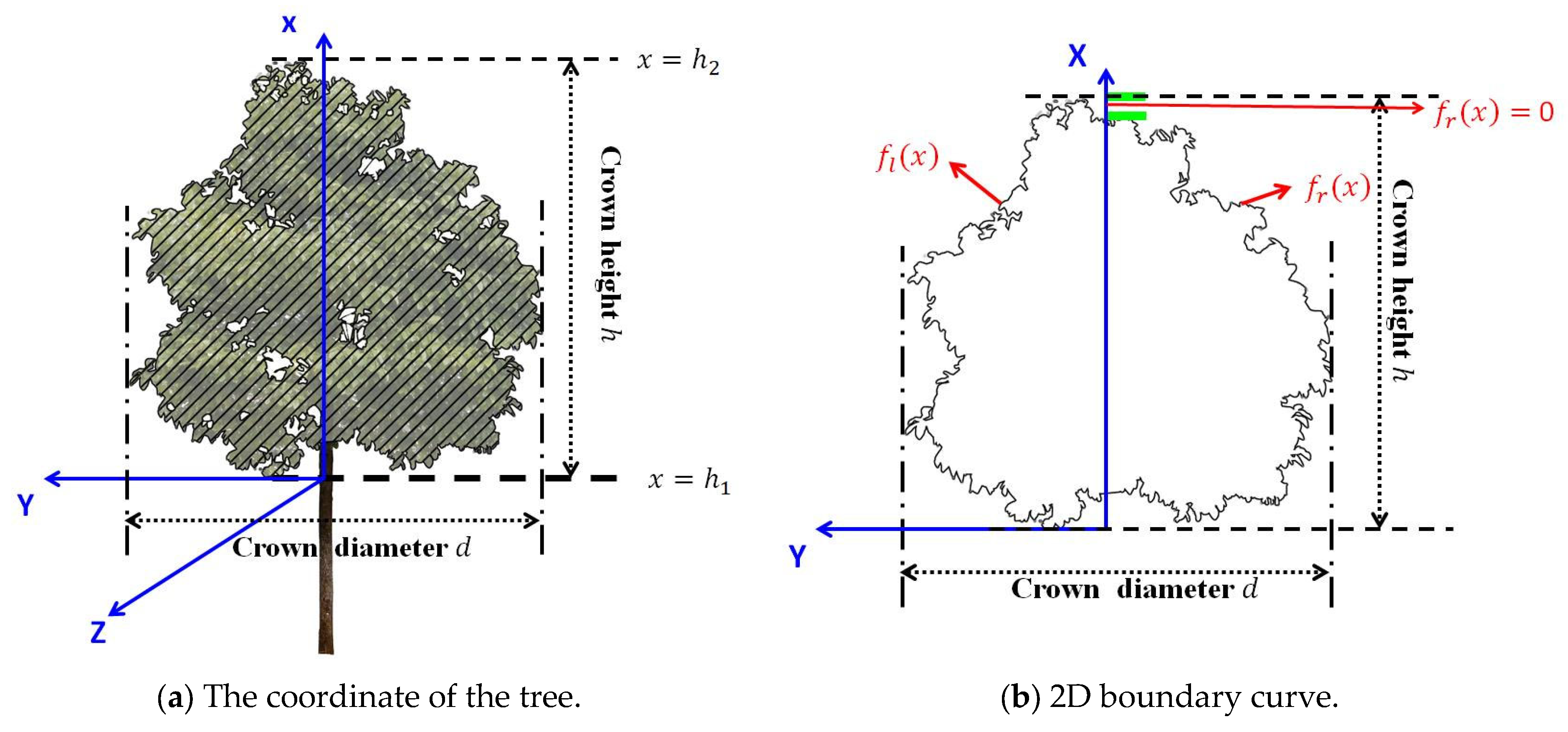
Two-dimensional boundary model of the crown. Through image processing, we obtain the crown 2D boundary curve as in
Figure 2. The curve function can also be obtained through processing the curve and numerical simulation in MATLAB R2025b. Divide the boundary curve into two curves as in
Figure 2b. The functions of the two curves are denoted as
and
,
, respectively, and
The 3DGQ of the “asymmetrical” tree can be regarded as the sum of different rotating bodies. When there is only one image, its volume can be approximately regarded as half of the sum of the volumes of the two rotating bodies obtained by rotating the left and right boundary curves, respectively. That is,
where
and
are the rotating volumes of
and
around the
x-axis as in
Figure 3. In the following, we will take
as an example to present how to calculate the
Vl.
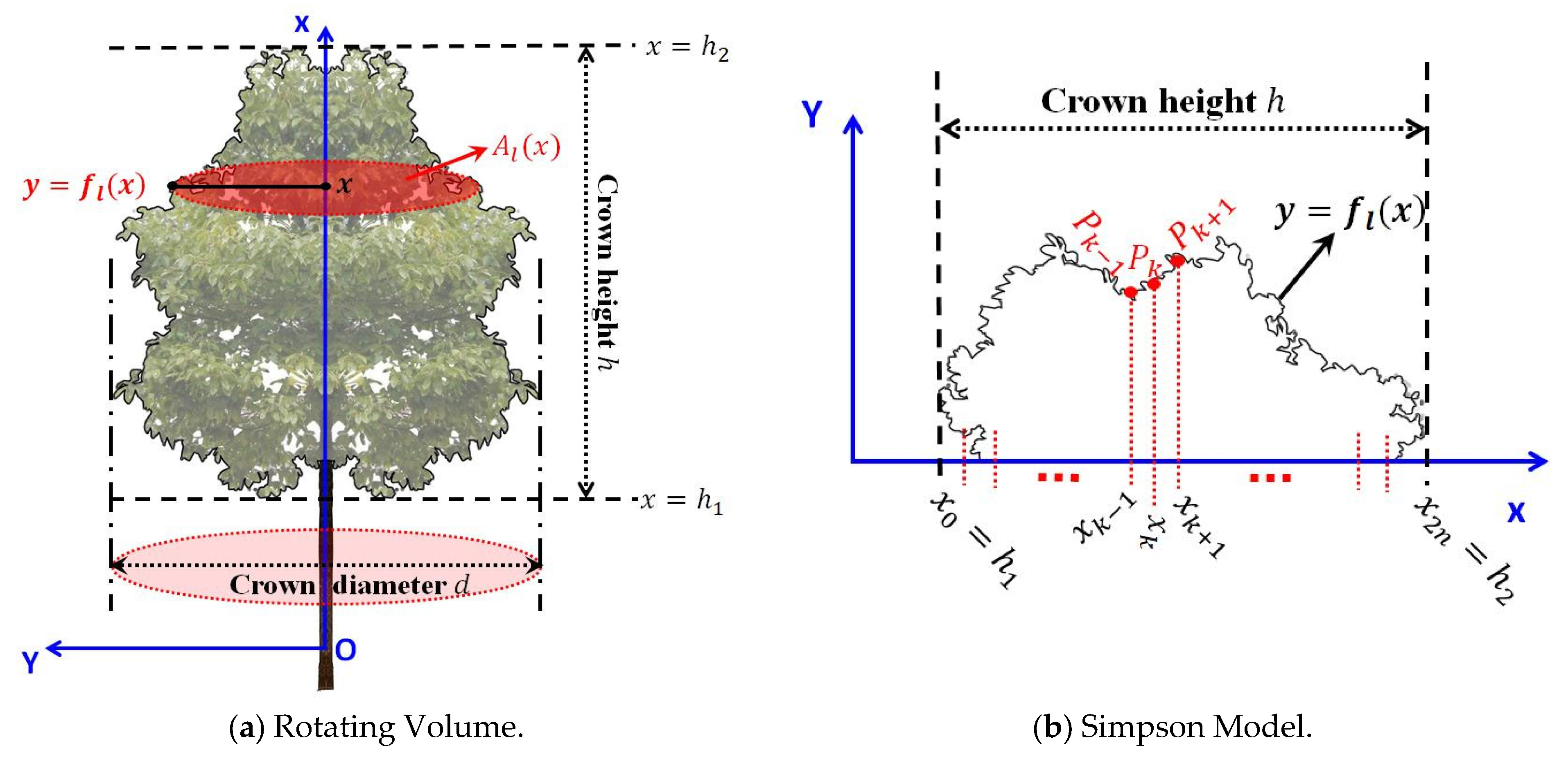
calculation based on definite integral. We build a two-dimensional Cartesian Coordinate System, as in
Figure 3a. The 2D boundary curve of the crown is denoted as
. The
is obtained through rotating the
around the
x-axis within the two straight lines
and
(as in
Figure 3a), and the crown height
.
Let
be the cross-sectional area of the rotating geometry perpendicular to the
x-axis (
Figure 3a); then,
From the geometric meaning of the integral, the rotating volume can be obtained by
where f(x)
2 is integrable, and its original function is denoted as
F(
x); the rotating volume can be calculated by the Newton–Leibniz formula [
21]:
When
is non-integrable (The ones whose original functions cannot be expressed through elementary functions are defined as non-integrable functions [
21]), which is more realistic for the outline of a crown; the rotating volume can be obtained through the Simpson Model.
Integral calculation of non-integrable functions based on the Simpson Model. The Simpson Model is a definite integral calculation model that is usually used to calculate the integral of non-integrable functions. The integration interval [
h1,
] is equally divided as
and
According to the Median-value theorem [
21], when
n → +∞,
f(
x) =
f′(
x) (
x ∈ [
,
]) where
f′(
x) is a linear function in [
,
], which pass through the
and
, as presented in
Figure 3b. Thus,
f′(
x) is an integrable function and its original function can be expressed through elementary functions and quadratic functions. Finally, the definite integral of
f(
x) in [
h1,
h2] can be calculated.
can be regarded as the area surrounded by the curve
f(
x),
x =
,
x =
and the
x-axis (
Figure 3b). The Simpson Model has been widely used in the calculation of complex models in applied mathematics and physics. Similarly, it gets
Then, the 3DGQ of the tree in
Figure 2a can be regarded as the sum of the volume of two half-rotating (
Figure 3), as in Equation (2).
The aforementioned calculation is based on only one image; one front-view image is used here only to illustrate the computational procedure; in practice, each tree is photographed from three directions (top/front/left, with 10 images per direction), and the final 3DGQ is obtained by averaging multi-image estimates as in Equation (9). The accuracy could also be improved by taking the average of all calculations when there are multiple images for a given tree. For example, if we have
N images, taken from
N positions of the tree, the 3DGQ, the tree can be given as
where
is the volume of the rotating body obtained through the
i-
tℎ image. It is worth noting that the more image information collected, the more accurate the calculation.
2.4. Evaluation of Carbon Sequestration Benefits
In this study, carbon sequestration benefits (CSBs) refer to the annual CO2 sequestration estimated from vegetation structural indicators. CSB is computed using Equation (10).
The CSB evaluation of the total leaf area (TLA) method is to measure the instantaneous
concentration and water in and out of plant leaves, and multiply the plant total leaf area by the net photosynthesis per unit time of the plant (photosynthetic accumulation minus respiration accumulation) to obtain the plant CSB [
22]. In this section, we will compare the annual CSBs per tree (denoted by
, kg) of the plant among a 3D index (AGM, LiDAR-based PCM, and ISM) and a 2D index (TLA method).
2.4.1. Annual CSB in 3DGQ Method
In this work, we adopt the widely used method to calculate the annual CSB in 3DGQ [
12]: the annual CSB per unit volume for evergreen plants and deciduous plants is 4.85 kg⋅
(let
= 4.85) and 2.62 kg
(let
= 2.62), respectively.
where
V is the 3DGQ, which can be replaced by
,
, and
when calculating the annual CSB using AGM, LiDAR-based PCM, and ISM methods, respectively. The calculations for each method are presented in
Table 3. In this method, the annual rainfall days and the characteristics of different species of trees in the same growth type are not considered.
2.4.2. Annual CSB in TLA Method
The TLA of a tree is given by
where
A is the TLA, m
2, and
=
πd (
h +
d) [
7]. Furthermore, the daily CSB per unit leaf area (
, g m
−2 D
−1,
Table 3), and the number of rainy days in the green period is also required when calculating annual CSB in the TLA method. According to the monthly average rainfall days in Shanghai from 1961 to 2015 [
30], the average number of days without rainfall is 220.28 days (let
De = 220.28), the number of days without rainfall outside winter is 159.29 days (let
= 159.29). The number of rainy days is 220.28 days. Then,
2.5. Accuracy Assessment Metrics
Model performance was evaluated using root mean square error (RMSE) and mean absolute error (MAE), which quantify the magnitude of estimation errors between ISM-derived results and the reference values. RMSE emphasizes the influence of larger deviations and is used as the primary metric to identify potential large-error cases, whereas MAE reflects the typical absolute error level and provides a more robust measure of average performance.
Given the heterogeneous nature of the dataset, which includes multiple tree species with different crown architectures and magnitude ranges, RMSE and MAE were considered more appropriate than goodness-of-fit measures such as the coefficient of determination (R2), which can be unstable or misleading and may even become negative under surrogate-reference evaluations.
To reduce random errors, multiple images acquired from three viewing directions (top, front, and left) were used for each tree, and the final 3DGQ estimate was obtained by averaging multi-image results (Equation (9)). Overall estimation accuracy was assessed across all samples and further analyzed by tree species to examine performance consistency.
3. Results
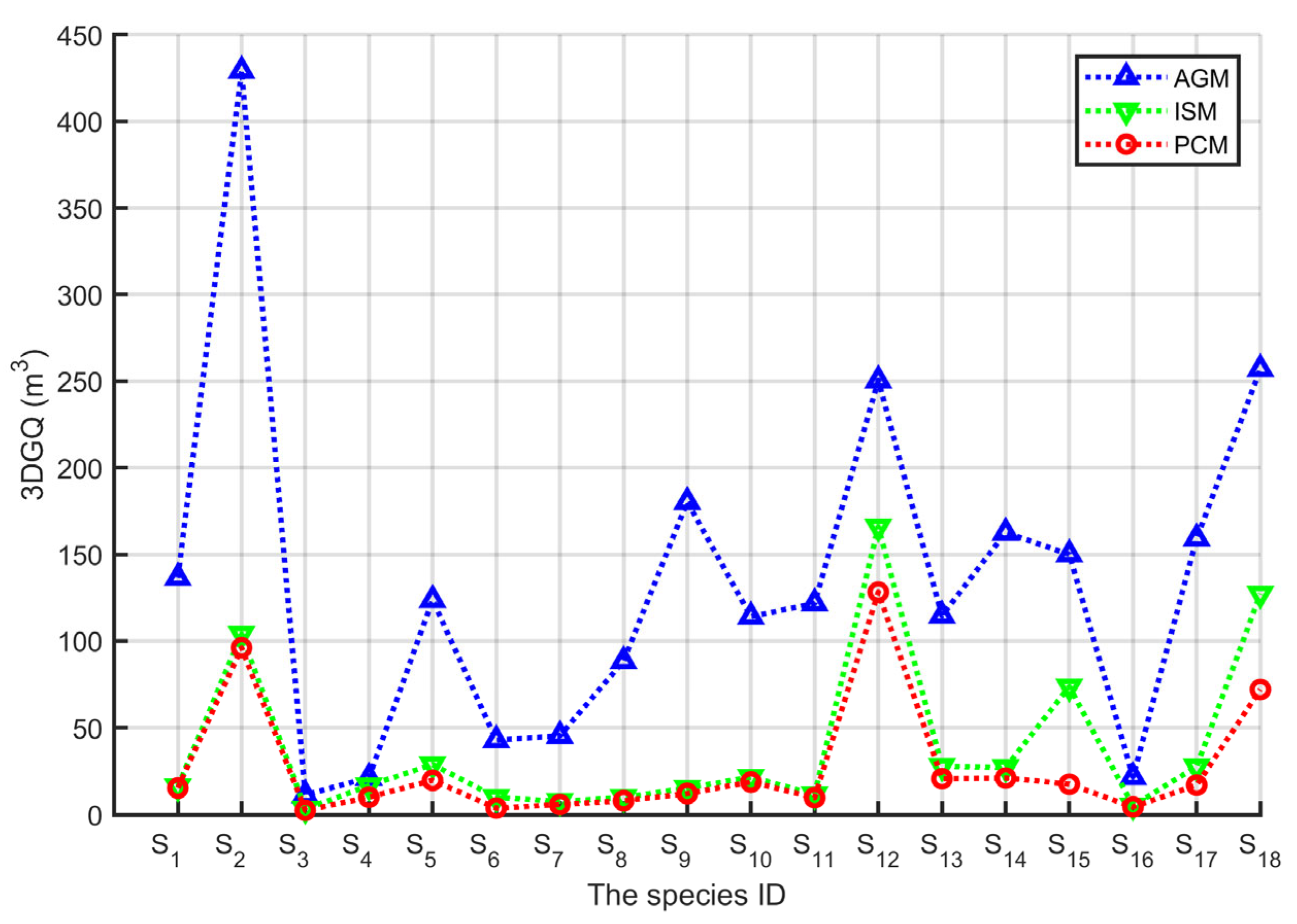
The evaluation of 3DGQ in different methods is presented in
Table 3 and
Figure 4. It was noticed that, for each species, the final value of
A,
, and
in
Table 3 are given by the mean of 30 trees at the same age.
3.1. 3DGQ Estimated by AGM, ISM, and LiDAR-Based PCM
Figure 4 presents the 3DGQ calculations of the
>
>
comparison as a whole. The
VPCM is the estimate closest to the true value [
7]. This is because in LiDAR-based PCM, most of the effects of leaf gaps on the evaluation results are eliminated. The evaluation of AGM deviates the most from the
. Since it regards the crown as an approximate geometry, it is quite different from the actual situation. Even for those whose crown geometry is relatively regular, e.g.,
Metasequoia glyptostroboides (
) and the
Taxodium “Zhongshanshan” (
), the evaluated values are 11 times and 7 times as big in the LiDAR-based PCM, while the corresponding values in ISM are 7 times and 5 times as big in the LiDAR-based PCM. The evaluation accuracy is enhanced by about 223%∼363%. This is because, in ISM, the crown boundary is well identified through image processing. Furthermore, the ISM partially eliminates the effect of leaf gaps on the evaluation results to a certain extent. Therefore, the more accurately the boundaries are identified, the closer the ISM to the LiDAR-based PCM than AGM.
Furthermore, it can be seen from
Figure 4 and
Table 1 that the influence of tree size on 3DGQ is greater than the influence of crown boundary on 3DGQ. For species whose crowns are relatively regular, leaf distribution density is relatively dense, and the tree size is relatively small, e.g., the
Magnolia grandiflora (
), the
Ginkgo biloba (
), and the
Bischofia polycarpa (
); the evaluated values of the three methods are very close to each other. And for species whose crowns are relatively regular, leaf distribution density is relatively dense, but the tree size is relatively large, e.g.,
Platanus ×
acerifolia (
),
Ailanthus altissima (
), and
Ulmus pumila (
); the calculations of AGM are much bigger than in the other two methods. This is because the larger the size of the tree, the more difficult it is to estimate the effect of leaf gaps on the 3DGQ.
3.2. Accuracy Assessment and Interspecific Comparison of 3DGQ Estimation
To quantitatively assess ISM performance and its robustness across different tree species, we compared UAV-derived 3DGQ estimates from ISM to the LiDAR-based PCM reference for each of the 18 species (
Table 4). We focus on species-level error metrics (RMSE and MAE) to evaluate estimation accuracy and to identify any interspecific variability in model performance. Overall, ISM achieved high accuracy for 3DGQ estimation in virtually all species, with RMSE values mostly below 3 m
3 and often under 10% of each species’ mean crown volume. In contrast, the traditional AGM consistently produced much larger errors due to its inability to account for irregular canopy shapes and internal gaps.
3.2.1. Best and Worst Performing Species
The ISM’s most accurate results were observed in species with relatively small, dense, and regularly shaped crowns. For instance, Magnolia grandiflora, Ginkgo biloba, and Bischofia polycarpa, all of which have compact canopies, showed minimal estimation error. ISM RMSE for these species was on the order of only 0.2–0.5 m3, indicating an excellent agreement with LiDAR-based PCM-measured volumes. In fact, for Magnolia grandiflora (an evergreen broadleaf with a symmetric crown), the RMSE was just ~0.15 m3 (≈5.9% of the species’ mean volume) while Bischofia (a deciduous broadleaf) had an RMSE ~0.17 m3 (~3.7% of the mean). These extremely low errors suggest that the ISM can precisely capture the crown volume when the tree’s foliage distribution is uniform and the canopy outline is well-defined. On the other hand, species with larger or more complex canopy architectures tended to exhibit higher ISM errors, though still far smaller than AGM errors. The highest ISM RMSE was found in Ulmus pumila (Siberian elm), a species with a tall stature (~10 m height) but relatively open crown structure. Ulmus had an ISM RMSE of about 15.1 m3, which corresponds to ~21% of its mean crown volume (≈72 m3). This was the worst-case scenario for ISM among the studied species. Two other species showed somewhat elevated ISM errors: Prunus serrulata (ornamental cherry) and Ailanthus altissima (tree-of-heaven). Prunus serrulata had an RMSE of ~10.7 m3 (~60% of its mean volume), while Ailanthus (a fast-growing deciduous tree with an expansive crown) showed ~10.7 m3 RMSE (~8.3% of its much larger mean volume of ~128 m3). The cherry’s high relative error may be attributed to its irregular, pruned crown shape and sparse foliage, which can challenge the silhouette-based volume integration. In the case of Ailanthus, despite its large absolute error in m3, the relative error remained under 10%, indicating that ISM still captured the bulk of its extensive canopy volume reasonably well. Importantly, even for these “worst” cases, ISM outperformed the AGM by a wide margin; AGM’s RMSE for Ulmus and Ailanthus exceeded 140–180 m3 (an almost complete overestimation of volume), whereas ISM reduced that error to the 10–15 m3 range.
3.2.2. ISM vs. AGM Performance Across Species
Figure 4 and
Table 4 together highlight stark differences between ISM and AGM accuracy for each species. The AGM approach, which uses simple geometric shapes, showed particularly poor performance for large trees. For species with broad, dense crowns and substantial size, such as
Platanus ×
acerifolia,
Ailanthus altissima, and
Ulmus pumila, AGM dramatically overestimated crown volumes, yielding errors an order of magnitude larger than those of ISM. For example,
Platanus (with a mean PCM volume of ~96 m
3) had an AGM RMSE of over 340 m
3, whereas ISM’s RMSE was only ~1.7 m
3. This huge discrepancy is because larger trees tend to have significant internal leaf gaps and complex branching, causing AGM’s single-shape approximation to over-count empty space, whereas ISM’s segmented rotational integration can partly account for those gaps. By contrast, for smaller species or those with very regular, conical crowns, AGM’s simplifications were less harmful, and all methods gave closer results.
Magnolia grandiflora and
Ginkgo biloba are illustrative: these species have moderate size and relatively regular shapes (
Magnolia is roughly ellipsoidal;
Ginkgo was modeled as a cone). In such cases, AGM, ISM, and LiDAR-based PCM volumes were very close to each other, and indeed, our ISM errors for Magnolia and Ginkgo were near the measurement noise level. This suggests that crown size exerts a stronger influence on estimation error than species type or crown geometry per se. When trees are small, even a crude geometric model can approximate their volume (and the absolute error remains low). But as tree size increases, leaf gaps and crown complexity increasingly undermine simplistic models, making the refined ISM approach markedly more accurate.
3.2.3. Consistency and Variability Among Species
In general, the ISM demonstrated robust performance across the diverse set of species, supporting our hypothesis (H2) that its accuracy is relatively stable for different crown forms. For the majority of species (over two-thirds of those studied), the ISM’s RMSE remained below 10% of the mean crown volume, indicating a consistent level of precision. We observed that evergreen broadleaf trees and dense-canopied deciduous trees had particularly consistent, low errors, likely because their fuller canopies produce well-defined silhouettes from multiple angles. Deciduous conifers presented a mixed picture: Taxodium “Zhongshanshan” had a low RMSE (~0.4 m3, ~7% of mean), suggesting good performance, whereas Metasequoia glyptostroboides (dawn redwood) showed a higher relative RMSE (~1.53 m3, ~39%). This discrepancy could be due to slight differences in foliage density or imagery conditions; for instance, if some Metasequoia had already begun partial defoliation or had very fine, feathery foliage, the UAV images might not capture the full outline, causing underestimation. In contrast, Taxodium might have denser clustering of leaves on branchlets, yielding a more solid silhouette. Similarly, broadleaf deciduous trees with very open, light-transmitting crowns (such as the umbrella-shaped Melia azedarach, or the weeping willow Salix babylonica) had somewhat higher ISM errors (~12%–16% of volume) compared to tightly foliated species. These variations suggest that while ISM significantly reduces error from geometric assumptions, residual errors can arise if the UAV views miss internal crown components (e.g., thin branches or gaps not visible in silhouettes). Nonetheless, across all species, the ISM was consistently closer to the LiDAR-based PCM “ground-truth” than AGM was, affirming that our method’s improvements hold true regardless of species. We conclude that, in practice, the ISM can be reliably applied across a broad spectrum of urban tree types, with an expectation of consistently low errors so long as extreme crown conditions (very sparse foliage or extremely large size) are recognized and accommodated (e.g., by increasing image captures or combining with other data).
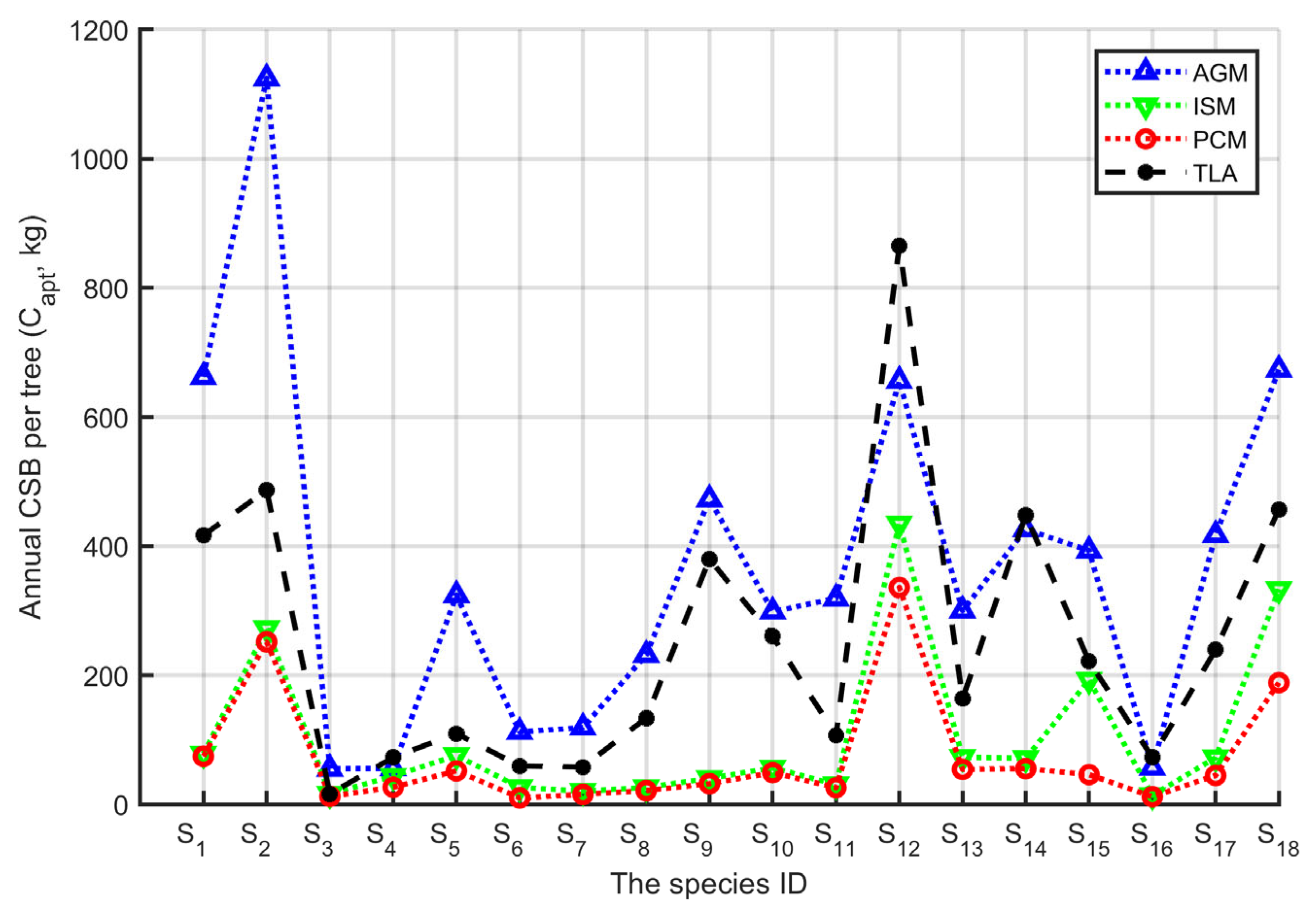
3.3. Comparison of Annual CSB per Tree Estimated by AGM, ISM, LiDAR-Based PCM, and TLA
For the annual CSB assessment of a single tree, this paper uses 2D index (TLA) and 3D index (AGM, ISM, and LiDAR-based PCM) for estimation (
Table 3 and
Figure 5).
It can be seen from
Figure 5 that the evaluations of different methods are quite different for the same species, except for the
Magnolia grandiflora (
),
Ginkgo biloba (
), and the
Bischofia polycarpa (
). The three species have a smaller size than other species (
Table 1). That is the influence of tree size on
is greater than growth type, and crown shape. The 3D metrics have similar reasons to the ones that affect the calculations of 3DGQ, as in
Section 3.1.
Factually, the tree size also has a huge impact on the TLA. For example, the species that have a large size, e.g., Platanus × acerifolia (), Ailanthus altissima (), and Ulmus pumila (), the are much larger than other species. The others have a small size, e.g., Magnolia grandiflora (), Ginkgo biloba (S4), and Bischofia polycarpa (); the of the four methods are very close to each other. Moreover, from Equation (11), it can be found that the crown height and crown diameter include the leaf gaps. Thus, the larger the size of the tree, the larger the estimation error of TLA. On the contrary, the smaller the size of the tree, the higher the estimation accuracy of TLA. Therefore, the ones that have a smaller size have smaller evaluation errors than the ones that have a larger size.
For other cases, the difference in evaluation error is huge among different methods. Which of the two-dimensional and three-dimensional indicators is closer to the true value is still inconclusive. This is because Equation (10) is obtained from AGM and TLA. It ignores the characteristics of different species.
4. Discussions
Our evaluation of 18 urban tree species confirms that the proposed UAV-based Improved Simpson Model (ISM) is a substantially more accurate and robust 3DGQ estimation method than the conventional geometric model. Across all species examined, ISM crown volume estimates aligned much more closely with the LiDAR-based PCM reference values than did AGM estimates. The ISM’s ability to incorporate irregular canopy shapes and internal foliage gaps led to major reductions in RMSE and MAE for every species, validating Hypothesis H1. In practical terms, this means the ISM can quantify tree crown volume (and thus carbon sequestration potential) with high fidelity, whereas simpler models tend to overestimate volume by treating porous crowns as solid forms. Notably, ISM achieved near-optimal accuracy without relying on dense 3D point clouds or labor-intensive scanning; instead, it used only a few UAV images per tree combined with numerical integration. This efficiency is a key advantage for urban applications, as it enables large-scale tree assessments in a fraction of the time required by terrestrial LiDAR surveys.
Despite its overall strong performance, the ISM did show some variability in accuracy among species, which provides insight into its capabilities and limitations. The estimation biases observed were generally intuitive. Species with very sparse or complex branching (e.g., Prunus serrulata and Ulmus pumila) had the largest errors, suggesting that the ISM tends to slightly underestimate 3DGQ when significant portions of the crown are not captured by the silhouette outlines. In such cases, interior gaps or slender branches may not contribute fully to the 2D projection area, leading to the rotational volume integration to under-count actual biomass. Conversely, for species with dense, contiguous foliage, the ISM sometimes overestimates slightly or shows minimal bias. For example, evergreen broadleaved trees like Cinnamomum camphora and deciduous trees with uniform canopies like Platanus × acerifolia exhibited almost zero bias; their UAV-derived volumes essentially matched the LiDAR-based PCM measurements. This indicates that when a tree’s crown is well-filled (few gaps) and matches an “ideal” shape reasonably well, the ISM does not systematically over- or under-predict. In summary, the dominant error pattern for ISM across species appears to be a mild underestimation in cases of highly irregular or open crowns, likely stemming from unseen interior structure. This is an inherent consequence of using exterior silhouettes; however, the magnitude of underestimation is relatively small (on the order of 5%–20% at most, for the extreme cases). No consistent overestimation bias was evident, even for the densest crowns. ISM volumes did not exceed LiDAR-based PCM reference values by large margins, implying that our method’s integration scheme properly avoids double-counting or overfilling beyond the crown’s true extent.
Another study demonstrated that UAV photogrammetry-based models can estimate single-tree biomass with high accuracy, achieving R
2 ≈ 0.90–0.96 for species like
Ginkgo and
Camphor and no significant differences from LiDAR-based estimates [
31]. Our findings are consistent with these outcomes; we likewise find that UAV-derived 3D metrics can closely replicate LiDAR “ground truth” for urban trees. In this work, incorporating canopy volume significantly improved biomass predictions compared to using only height and crown diameter [
31], underscoring the importance of 3D structural information. The ISM directly capitalizes on this by providing an accurate volume measurement, which could be used as a predictor for biomass/carbon in similar regression models. Other researchers have explored full 3D reconstruction approaches (e.g., Structure-from-Motion (SfM) photogrammetry or quantitative structure models) to estimate tree volume and carbon. For instance, the authors applied deep learning on UAV imagery for urban carbon stock mapping, reporting area-based estimation errors around 26–28 kg C using a CNN model for tree crown detection and volume inference [
32]. While such AI-driven methods are promising for broad-scale mapping, their moderate accuracy indicates room for improvement in capturing fine tree-scale variability. By contrast, our ISM takes a physics-based approach to individual tree volume and achieves errors corresponding to only a few kilograms of carbon for most trees, effectively an order of magnitude smaller uncertainty on a per-tree basis. This suggests that for applications requiring high precision at the single-tree level (e.g., detailed urban forestry inventories or monitoring of valuable specimen trees), a model like ISM is preferable to purely statistical or deep learning approaches, which may smooth over individual differences.
It is also instructive to compare the ISM with hybrid approaches that attempt to handle crown complexity. One recent study used UAV-derived canopy volumes to estimate urban tree carbon storage, but noted limitations due to missing trunk information and other uncertainties [
33]. Their approach essentially scaled volumetric estimates to carbon using generalized factors, which can introduce error if crown density or wood density differs by species. In contrast, our method maintains high geometric fidelity and can be paired with species-specific biomass conversion factors (as we did for annual carbon sequestration benefits) to reduce such errors. Another study proposed a “high-precision” 3DGQ estimation method using differential point clouds (essentially a refined LiDAR-based PCM) and reported improved accuracy for urban forest volume. However, the method still relies on extensive 3D scanning data. The ISM can achieve comparable precision using far fewer resources: standard UAV photographs and automated image processing. This is a significant practical advantage: for city-wide deployment, a single UAV operator can capture hundreds of trees per day, whereas mobile LiDAR or terrestrial laser scanning would be orders of magnitude slower and more costly. The study in [
7] comparing UAV and 3D laser methods also indicated that UAV-based estimates can closely approach LiDAR accuracy for urban trees, while drastically cutting down the required time and labor. The present study reinforces that conclusion with a more advanced UAV method (ISM) and a comprehensive multi-species dataset.
Model applicability boundaries: Based on the interspecific comparisons, we can delineate the conditions under which the ISM performs optimally versus where caution is warranted. The ISM is exceptionally reliable for medium-sized to moderately large trees with contiguous foliage. In scenarios with low precision requirements or very small trees, even a simple AGM might suffice; indeed, if a tree’s crown is only a few cubic meters, the absolute difference between methods is negligible. This explains why, for small ornamentals, all methods yielded similar results. On the other hand, for very large trees or those with unusual architecture, the ISM, while far better than AGM, may still benefit from complementary techniques. For example, an extremely sparse crown (like a leaf-off deciduous tree or a palm with distinct fronds) might not produce enough silhouette area for Simpson integration to capture volume accurately. In such cases, incorporating additional data such as multi-angle oblique imagery or partial point clouds could help. Likewise, if a tree exceeds a certain size (e.g., crown diameter > ~15 m), even our multi-view image approach might miss interior sections; a segmented scanning (sector-wise) approach or multiple UAV passes might be needed to maintain accuracy. It is also important to note that the ISM, being image-based, can be affected by occlusions; if parts of the crown are blocked from view (by buildings or other trees), the volume will be underestimated. In this study, we chose isolated street trees specifically to avoid occlusion issues; extending the method to park or forest conditions would require a strategy to address overlapping canopies (such as individually segmenting crowns in images). In summary, the ISM’s current implementation is best suited for open-grown urban trees and achieves high accuracy within that domain. With further enhancements (discussed below), its applicability could broaden to denser stands or leaf-off conditions, but users should remain aware of its current assumptions (foliated crowns, clear view angles around the tree).
When considering carbon sequestration (CSB) estimation, our analysis found that the accuracy ranking of methods (ISM > AGM) for 3DGQ generally carried over to CSB per tree as well. All 3D volume-based methods (LiDAR-based PCM, ISM, and AGM) produced higher CSB estimates than the 2D leaf-area method (TLA) for large trees, and closer values for small trees. This is because large trees have significant leaf gap volumes that TLA (based on crown area) does not discount, causing TLA to over-predict carbon uptake for big crowns. ISM, by accurately quantifying effective crown volume, provides a more realistic CSB estimate that inherently accounts for those gaps. Therefore, the ISM not only improves 3DGQ measurement but also strengthens subsequent ecological calculations, yielding carbon benefit estimates that are more species-specific and size-appropriate than traditional methods. This addresses a key gap in urban forestry assessments; previous evaluations often applied a single carbon density factor to broad groups (all “evergreen” or all “deciduous” trees), which overlooks inter-species differences. By integrating species-level 3DGQ with tailored CSB calculations, our approach can refine estimates of urban green space services. In the broader context of urban ecosystem modeling, having such a high-precision, UAV-based tool is invaluable. It enables frequent monitoring (since UAV flights can be repeated easily) and thus can capture temporal changes like growth, planting, or storm damage impacts on carbon storage with unprecedented detail. Recent methodological reviews emphasize the need for approaches that balance accuracy and scalability. The ISM contributes to this need by offering near-LiDAR accuracy at a fraction of the effort, making comprehensive city-scale carbon accounting more feasible than ever.
In summary, the ISM has proven to be a robust estimator of 3D green volume across diverse urban tree species, markedly improving accuracy over legacy methods. Its strengths lie in combining advanced image processing with a classic numerical integration technique, yielding a method that is both grounded in geometric rigor and practical for large-scale applications. The few limitations observed point to clear avenues for future work. The next section outlines how these insights will guide further improvements and applications of this model.
5. Conclusions
In this study, we introduced a novel UAV-based Improved Simpson Model (ISM) for estimating the 3DGQ of urban trees, and we rigorously validated its performance on 540 trees (the most popularly used 18 street species in Shanghai) in the largest botanical garden, Shanghai Chenshan Botanical Garden. The key findings can be summarized as follows. First, the ISM mathematical model significantly outperforms the conventional 3DGQ estimation mathematical model. It achieved very high accuracy (low RMSE and MAE) in estimating individual tree crown volumes, consistently closer to LiDAR-derived reference values than the widely used Approximate Geometry Model (AGM). On average, ISM reduced volume estimation errors by an order of magnitude relative to AGM, a substantial improvement that was evident for every species tested. Second, the ISM proved to be robust across a variety of tree forms. It maintained low errors for broadleaf and conifer species alike, and exhibited stable estimation performance regardless of differences in crown shape or growth habit. While some variability exists (e.g., slightly larger errors for trees with extremely porous canopies), no species showed failure of the method, supporting the idea that a single UAV-based model can be generalized for city-wide tree assessment (Hypothesis H2 confirmed). Third, by integrating the ISM’s volume estimates with species-specific carbon conversion factors, we were able to compute annual carbon sequestration for each tree. The ISM-based carbon sequestration estimates are more species- and size-sensitive than traditional approaches; for example, they capture how large, sparsely leafed trees sequester less carbon than their silhouette area might suggest, whereas small dense trees sequester relatively more. This demonstrates the broader utility of accurate 3DGQ models: they lay a more solid foundation for quantitative urban ecosystem service evaluation, from carbon storage to cooling effects.
However, our study also has several limitations that need to be acknowledged. One limitation is related to viewing angle and occlusion. We used three fixed view angles (top, front, and side) for image capture under the assumption of an isolated street tree. In more complex urban scenes, trees can be partially obscured by buildings or other vegetation, and a limited number of views might not capture the entire crown. This viewpoint dependency could introduce errors if parts of the crown remain unseen. Future studies should explore multi-view or omnidirectional image acquisition, for instance, using UAVs to collect a 360° coverage or employing fish-eye lenses from the ground, to ensure the entire canopy is profiled. Another limitation is that our evaluation was conducted during a single season with trees in full leaf. Seasonal changes (phenology) were not considered. Deciduous species exhibit vastly different 3DGQ in leaf-on versus leaf-off conditions, and the ISM (like most optical methods) would estimate much lower volume in winter when only branches are present. While this is not an error per se (since 3DGQ by definition excludes bare branches), it does mean that carbon sequestration processes that continue year-round are not captured by a purely foliar volume metric. In addition, some evergreens flush or shed foliage seasonally, altering canopy density. Future research should incorporate seasonal monitoring, using the ISM across multiple time points in a year to capture dynamic changes in urban green volume. This would improve annual carbon budget estimates and could be correlated with seasonal flux measurements for validation.
A further limitation lies in the lack of direct ground-truth volume measurements. We treated the LiDAR-based PCM as the reference “actual” volume because direct measurement of irregular tree crowns is impractical. It is possible that the LiDAR-based PCM itself has minor errors. Thus, while ISM was validated against the best available standard, an absolute accuracy assessment (e.g., via destructive sampling or water displacement of crowns, which is infeasible for large trees) remains elusive. We also note that our carbon sequestration estimates rely on certain allometric constants (for converting volume to biomass and biomass to CO2 uptake) taken from the literature, which assume average tree conditions. In reality, individual tree physiology can vary, and factors like health, soil conditions, and microclimate could cause actual carbon uptake to differ from the estimated values even if volume is accurate. These uncertainties do not undermine the comparative advantages of ISM, but they remind us that an integrated approach is needed to fully quantify ecosystem services, combining precise structural measurements with physiological and environmental data.
Based on this study, there are several directions for our future work. One direction is the fusion of LiDAR and photogrammetry data to leverage the strengths of both. For example, UAV-mounted LiDAR could be used in a sparse sampling mode to capture internal structure or ground reference points, while the ISM fills in dense crown volume efficiently. Such a hybrid method might further improve accuracy for extremely large or complex trees, and help calibrate the ISM for cases where it tends to underestimate. Another direction is combined with advanced deep learning technologies, especially the Vision Transformer (ViT) [
34], which is a transformer architecture adapted specifically for computer vision tasks. For instance, a neural network could be trained to predict correction factors for ISM-estimated volume based on tree species or crown texture features, thereby auto-tuning the model for specific conditions.
On the application side, an important future step is to integrate the ISM-based 3DGQ estimation into urban ecosystem modeling frameworks. As cities pursue carbon neutrality goals, having accurate, spatially detailed carbon sequestration data is invaluable. Our approach can contribute to urban tree carbon inventories, identify “high-value” trees or neighborhoods in terms of ecosystem services, and improve the parameterization of urban climate models (e.g., better estimates of transpiration or shading based on actual 3D leaf volume). We also acknowledge that long-term monitoring is key; establishing repeated UAV surveys could help city managers track growth, carbon accrual, or losses in the urban forest with unprecedented precision. Additionally, expanding the method to include understory vegetation or green walls/roofs could broaden its impact for urban green infrastructure assessment.
In conclusion, this work contributes a novel high-precision method to quantify urban green volume and carbon benefits, and demonstrates its effectiveness across species under real city conditions. By addressing both the technical challenges (through the ISM) and practical considerations (UAV efficiency and automated processing), we move closer to the goal of establishing an accurate, operational urban ecosystem assessment model. Such a model can greatly enhance our ability to evaluate and manage urban forests as nature-based solutions for climate mitigation and adaptation. In the context of global carbon peaking and neutrality targets, the ability to reliably measure how much carbon each city tree sequesters and to do so city-wide is exceedingly meaningful. It lays a data-driven foundation for protecting and expanding urban green spaces, optimizing species selection and planting strategies, and quantitatively verifying the progress of urban greening initiatives in offsetting carbon emissions. We therefore emphasize the significance of developing high-accuracy urban ecosystem assessment tools like the ISM: they empower city planners and environmental stakeholders with better information, and ultimately help cities harness their natural assets in the fight against climate change.