Skip to Content
ForestsForests
  • Article
  • Open Access

15 February 2026

Deep Soil as a Critical Nutrient Reservoir: Different C–N–P Stoichiometry and Drivers Between Surface and Subsoil in the Loess Plateau, China


,
,
,
,
,
,
,
,
and
1
College of Resources and Environment, Shanxi Agricultural University, Taigu 030801, China
2
School of Land Science and Technology, China University of Geosciences Beijing, Beijing 100083, China
3
Key Laboratory of Land Consolidation and Rehabilitation, Ministry of Natural Resources, Beijing 100035, China
4
Technology Innovation Center for Ecological Restoration in Mining Areas, Ministry of Natural Resources, Beijing 100083, China
This article belongs to the Section Forest Soil

Abstract

Soil stoichiometric characteristics serve as key indicators for assessing soil nutrient status and quality. Previous studies have predominantly focused on surface soil (0–40 cm), with limited understanding of deep soil (>40 cm) stoichiometric traits and their underlying drivers. In this study, we provide a case study of three typical restoration stands from China’s Loess Plateau, which compared differences between surface and deep soil layers in stoichiometric traits and influencing factors. Soil samples were systematically collected at 20 cm intervals down to bedrock to analyze the reserves and stoichiometric differences in C, N, and P between surface and deep soil layers, and to identify relevant environmental influencing factors. The results showed that: (1) Within this Loess Plateau case study, deep soil accounted for 33%–47% of the total profile storage of C, N, and P, representing a critical nutrient reservoir. (2) The differences from China’s average in C:N and C:P were markedly greater in deep soil (15.55 and 68.62, respectively) than in surface soil (11.63 and 8.31, respectively), indicating more pronounced nitrogen and phosphorus limitations in deep soil. (3) The factors influencing surface soil stoichiometry were mainly climate-related and biological interaction (altitude, soil water content and pH), while those for deep soil layers were factors related to nutrient storage and transport (soil thickness, soil bulk density and altitude). These results highlight that neglecting deep soil can lead to substantial underestimation of ecosystem nutrient reserves and misinterpretation of soil stoichiometry and its drivers. Therefore, we advocate incorporating deep soil into sampling designs in stoichiometric studies and attach more research attention to deep soil’s stoichiometry and its role in biogeochemical cycling.

1. Introduction

As a crucial component of ecosystems, soil directly shapes the structure and productivity of plant communities by supplying essential nutrients for growth. Its stoichiometric characteristics serve as key indicators for assessing soil nutrient status and quality [1,2,3]. For instance, the soil C:N ratio is an important predictor of nitrogen mineralization, and the decomposition rate of organic carbon reflects the quality of soil organic matter, with soil C:N generally being inversely related to decomposition rate [4,5]. Soil C:N can also be used to estimate dissolved organic carbon concentration [6] and the degree of nitrate leaching [7,8,9], and shows a significant negative correlation with N2O emissions [10]. When combined with other indicators, it can better characterize the nitrogen status of an ecosystem. The soil C:P ratio reflects the release of phosphorus through microbial mineralization of organic matter as well as phosphorus immobilization from the environment [11]. Meanwhile, the soil N:P ratio is an effective predictor of nutrient limitation types [12,13]; an N:P ratio below 10 typically indicates nitrogen limitation for plant growth [5,14]. Therefore, studying the ecological stoichiometry of soil organic carbon, nitrogen, and phosphorus is essential for evaluating soil quality, reflecting net accumulation vs. mineralization of nutrient elements, and revealing ecosystem nutrient limitations.
Surface soil is the most biologically active and nutrient-rich zone, with high spatial heterogeneity [15,16,17,18], and hence has drawn much research attention. Nevertheless, deep soil also plays a vital role in biogeochemical cycling. It plays a key role in nutrient cycling, acting as both a primary store of nutrients and a fundamental source of plant nutrition. (1) It serves as a significant storage zone for soil nutrients [19,20]. Due to its large mass and volume, more than 30% of carbon [21,22], 64% of nitrogen [20], and 25%–70% of phosphorus [23,24] are stored in deep soil layers. The retention of organic matter in subsoil is attributed to the spatial separation of organic matter, particle fractions, microorganisms, and extracellular enzymes associated with heterogeneous carbon inputs [25,26]. Phosphorus accumulation in deep soil is largely due to the presence of parent materials or phosphorus-rich compounds [27]. (2) Subsoil is an important nutrient source for plants, which actively acquire nutrients from deeper layers [28,29,30]. Tree roots often extend beyond one meter in depth [31], and in arid regions, deep soil becomes an especially critical nutrient source [32]. Plants can increase phosphorus uptake from subsoil (below 20–30 cm), including sapropelic layers [33] and weathered bedrock [23]. Trees may obtain 10%–80% of their phosphorus requirement from subsoil, depending on root extent [23,34], while spring wheat can absorb 37%–85% of phosphorus from deep soil, and winter wheat may acquire up to 75% of its nitrogen from deeper layers [35]. (3) Deep soil plays a central role in biogeochemical cycling and vertical nutrient redistribution within soil profiles [23]. For instance, deep soil nitrogen can drive the redistribution of soil organic carbon and facilitate its translocation to deeper layers [36], while phosphorus in deep soil can be transferred to surface soil through root turnover and litterfall [37].
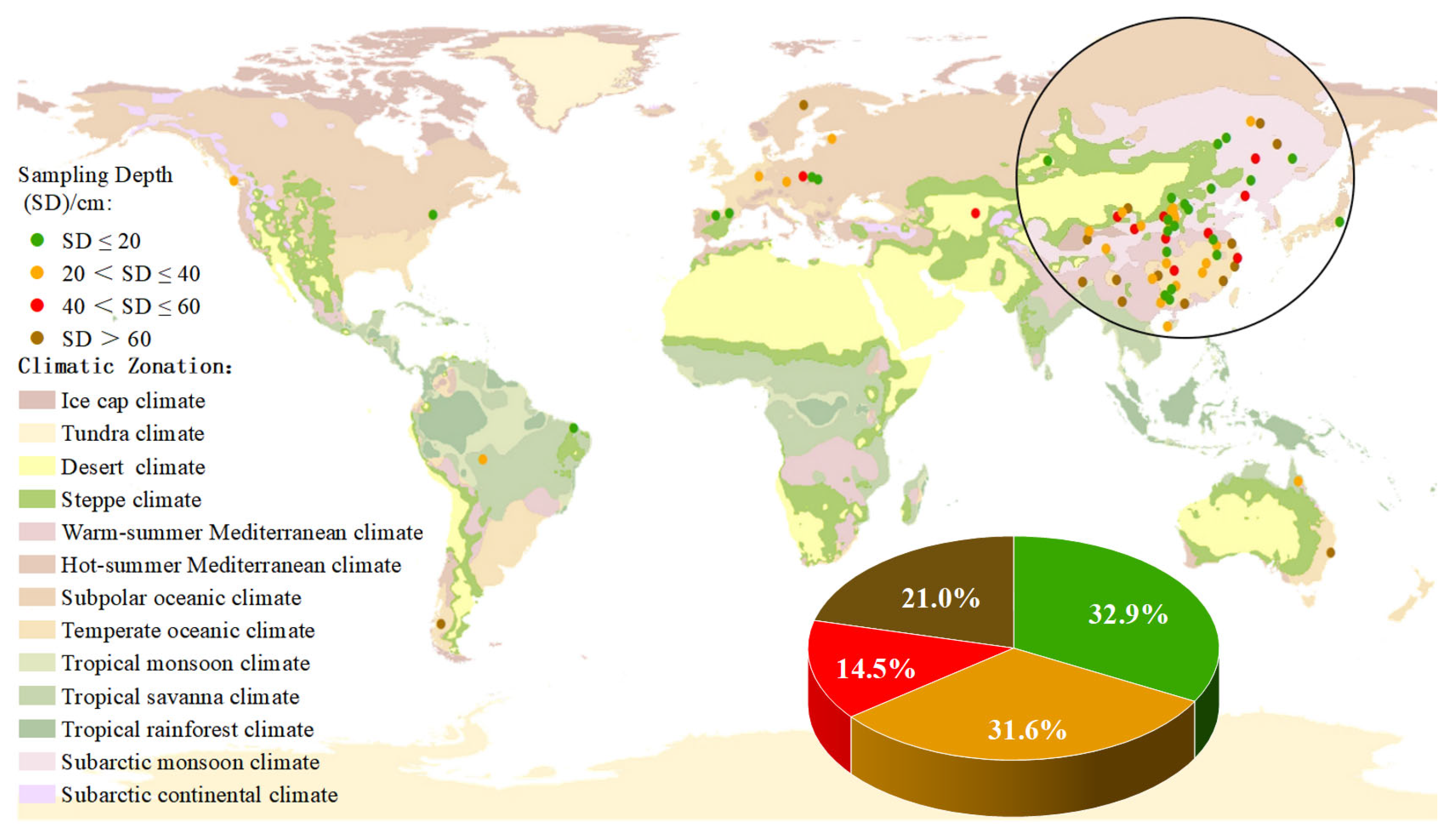
However, current research often focuses only on surface soil stoichiometry, with insufficient attention given to deep soil. We incompletely reviewed 76 papers (detailed in Supplementary Materials, Table S1) on soil stoichiometry published during the past 5 years globally, and the soil sampling depth in 49 studies was ≤40 cm, with only 11 and 16 studies reaching 40–60 cm and exceeding 60 cm, respectively (Figure 1). Likewise, in carbon-related ecological studies, the median sampling depth is only 15 cm, with over 90% of research confined to the surface soil [36]. Obviously, the inadequate research on deep soil stoichiometry is a concession made due to the difficulty and cost of sampling deep soil layers [38,39]. Focusing solely on surface soil not only leads to underestimation of nutrient pools [40] but may also result in misinterpretation of key controlling factors, as drivers of nutrient stoichiometry differ between surface and deep soil [41]. As most natural soil profiles extend well beyond 15–20 cm [39], sampling to at least 1 m depth or to the top of the C horizon is recommended to ensure representativeness [42].
Figure 1. Global soil stoichiometry study sampling depth distribution. (These 76 studies were searched on Google Scholar and the keywords were soil stoichiometry and ecological restoration. Paper information is detailed in-Supplementary Materials Table S1).
Given our limited understanding of deep soil stoichiometric traits, this paper aims to compare nutrient reservoirs, stoichiometric characteristics and their drivers between deep and surface soil layers using three typical restoration stands on the Chinese Loess Plateau. Conceptually, nutrient inputs and stabilization mechanisms differ with depth: surface soils are dominated by litter inputs and intense biological cycling, whereas deep soils rely more on downward transport (e.g., DOC leaching), fine-root turnover, and parent-material contributions (especially for P), together with stronger mineral protection. These depth-dependent processes are expected to generate distinct C–N–P coupling patterns and to shift dominant controls from microclimate factors near the surface toward storage properties in deeper layers. The specific objectives are: (1) to compare soil organic carbon (SOC), total nitrogen (TN), and total phosphorus (TP) stocks between surface soil layer (0–40 cm) and deep soil layer (from 40 cm to bedrock); (2) to examine differences in stoichiometric ratios between these two layers; and (3) to identify factors influencing SOC, TN, TP stocks and their stoichiometry in surface vs. deep soil layers.

2. Methodology

2.1. Study Area Overview

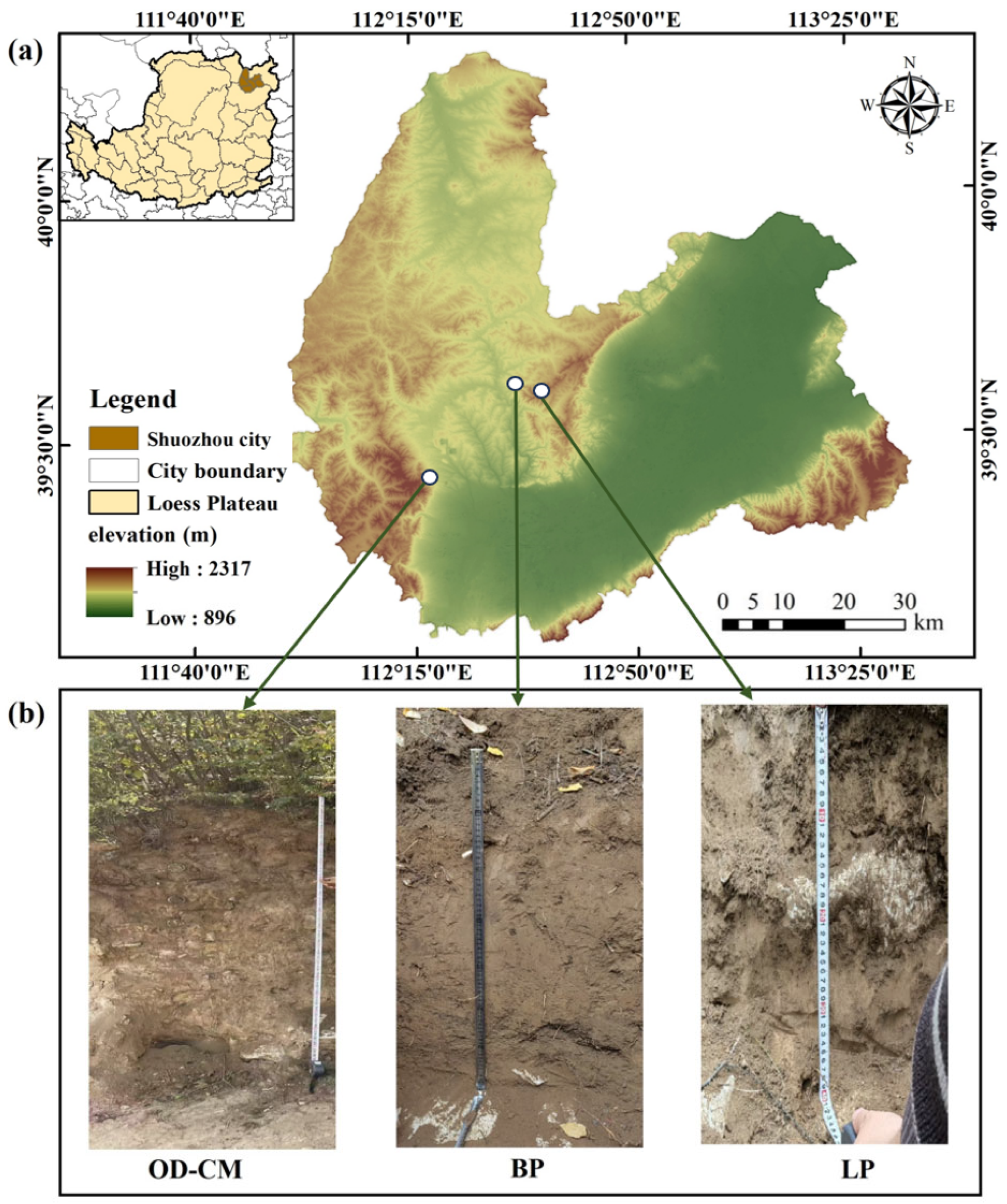
We chose three typical restoration stands on China’s Loess Plateau, which is one of the most severely eroded areas in the world due to climatic drought and prolonged human disturbance [43,44]. In recent decades, large-scale ecological restoration projects such as the Grain-for-Green Program and the Three-North Shelterbelt Project have been implemented. The study area is located in Shuozhou City, Shanxi Province, China (Figure 2). Shuozhou is situated north of Yanmenguan in Northern Shanxi. Characterized by a loess-covered mountainous plateau with an average elevation exceeding 1000 m, the region experiences a distinct four-season temperate continental monsoon climate. Its river systems belong to the Haihe and Yellow River basins. Shuozhou is rich in mineral resources, notably possessing the largest coal reserves in Shanxi Province—accounting for one-sixth of the provincial total—which are known for their high quality and ease of mining. Key coal-producing counties (districts) under its jurisdiction include Youyu County, Huairen City, Shanyin County, Pinglu District, and Shuocheng District.
Figure 2. (a) Geographical location of the study area; (b) soil profiles of three ecological restoration types.

2.2. Field Investigation and Sampling

During the 2023 growing season, three distinct local ecological restoration types were selected for investigation: two sites on the Heituo Mountain (at the junction of Shuocheng and Pinglu Districts) and one on the Langbei Mountain in Shanyin County. The types comprised natural secondary shrubland (Ostryopsis davidiana and Cotoneaster multiflorus (OD-CM), Betula platyphylla (BP), and Larix principis-rupprechtii (LP) (Figure 2; Table 1).
Table 1. Information on study sites.
For each restoration type, three 25 m × 25 m plots were randomly positioned. To minimize edge effects, sample plots were established at least 10 m from any forest edge. Soil samples were collected using a stratified “five-point sampling” method within each quadrat to better represent overall plot conditions [45]. Surface litter and stones were removed prior to sampling. Soil cores were extracted at 20 cm depth intervals using a soil auger at each sampling point. Additionally, a soil profile was excavated at the center of each plot, and soil bulk density was measured for each layer using four ring-knife samples.
Soil layer thickness varied across sampling points due to natural heterogeneity, generally being less than 100 cm, though exceeding 100 cm at some locations. To thoroughly assess soil nutrient profiles, samples were collected as completely as possible from all points. For locations where the soil layer exceeded 100 cm, additional drilling was performed to determine the full depth. In total, 181 valid soil samples were obtained.
Samples were air-dried upon return to the laboratory and then sieved through 2.000 mm and 0.149 mm mesh sieves to ensure uniformity. The air-dried soil was homogenized by coning and quartering. One-half of each sample was reserved for subsequent analysis, while the other half was archived. Site parameters, including altitude (Alt), slope (Slope), and soil thickness (Thickness), were recorded for each plot.

2.3. Determination of Soil Physicochemical Properties

Soil bulk density (SBD) and soil water content (SWC) were determined by oven-drying undisturbed soil samples at 105 °C for 24 h. For chemical analyses, samples were air-dried, ground, and sieved through a 2 mm mesh to remove visible roots, rocks, and plant debris. A subset of the sieved soil was further passed through a 0.149 mm sieve. Soil organic carbon (SOC) content was quantified using the H2SO4-K2Cr2O7 oxidation method [46]. Total nitrogen (TN) was determined by the micro-Kjeldahl method [47], and total phosphorus (TP) was determined by the molybdenum blue colorimetric method, as described by Murphy and Riley [48]. Soil pH was measured in a 1:2.5 soil-water suspension.

2.4. Data Processing and Analysis

One-way analysis of variance (ANOVA) was employed to test for significant differences in SOCstock, TNstock, TPstock, and their stoichiometric ratios across different vegetation types and soil depths. Relationships between environmental factors and these soil variables were examined using Pearson correlation analysis. Redundancy analysis (RDA) was conducted with SOCstock, TNstock, TPstock, and stoichiometric ratios as response variables and environmental factors (pH, SBD, SWC, Alt, Slope, Thickness) as explanatory variables to identify dominant controlling factors. Significance testing and correlation analyses were performed using SPSS 22.0. Figures were generated using Origin 2024. Soil stoichiometric ratios were calculated on a molar basis. Plots were treated as experimental units in statistical analyses.

3. Results

3.1. SOCstock, TNstock and TPstock in Surface and Deep Soil

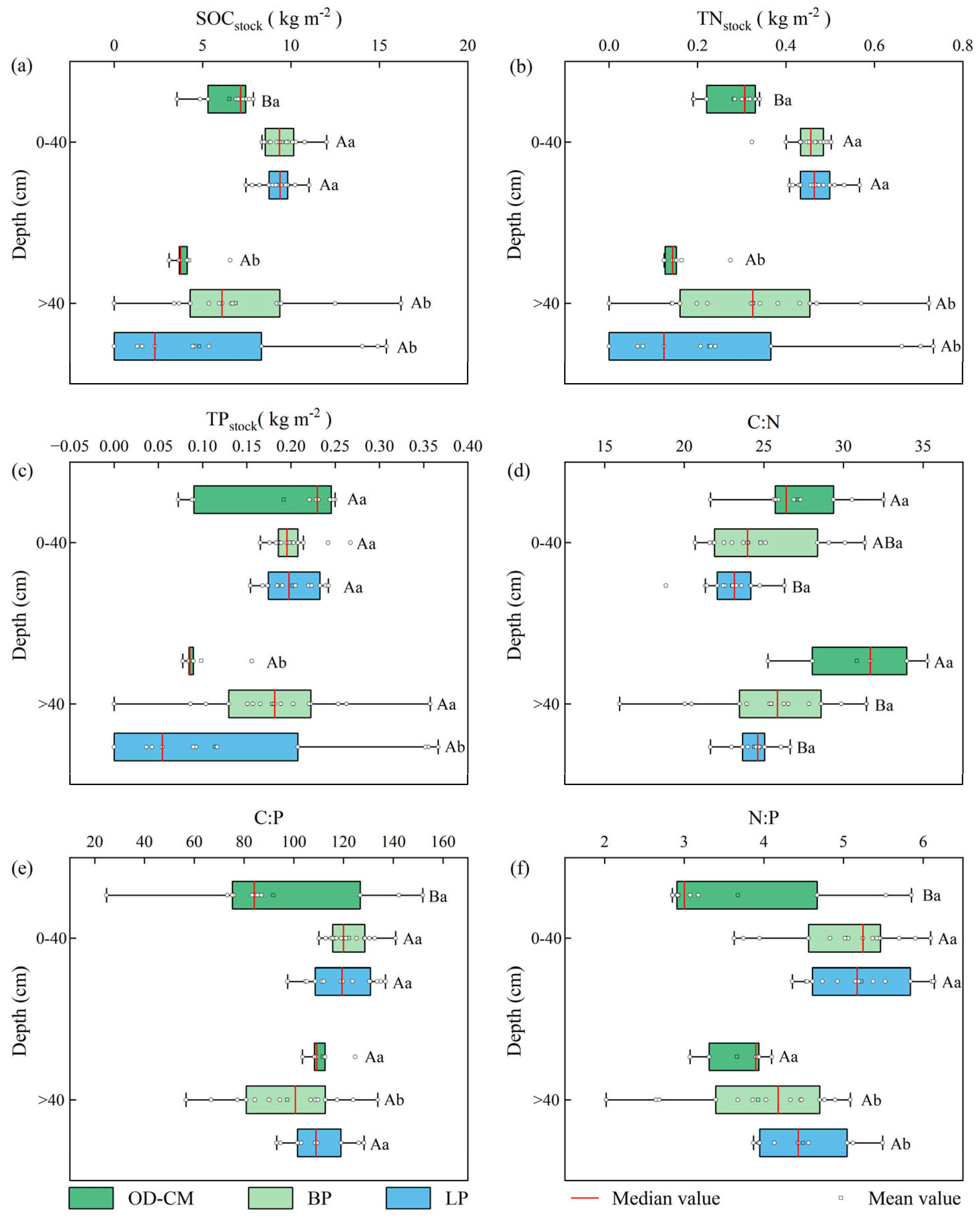
Significant differences in soil nutrient reserves were observed between the surface and deep layers across all vegetation types (Figure 3a–c). (1) SOCstock was significantly higher in surface soil than in deep soil for OD-CM, BP, and LP (p < 0.05). The greatest difference occurred in LP, with surface SOCstock (9.22 kg m−2) being 1.92 times that of deep soil (4.81 kg m−2). In contrast, the difference was smallest in BP, where surface SOCstock (9.52 kg m−2) was 1.39 times the deep soil value (6.87 kg m−2). (2) Similarly, TNstock was significantly higher in surface soil than in deep soil for OD-CM, BP, and LP (p < 0.05). The largest discrepancy was found in LP, with surface TNstock (0.47 kg m−2) exceeding deep soil TNstock (0.23 kg m−2) by a factor of 2.04. The smallest difference occurred in BP, where surface TNstock (0.45 kg m−2) was 1.36 times that of deep soil (0.33 kg m−2). (3) For TPstock, surface soil values in OD-CM and LP were significantly higher than those in deep soil (p < 0.05). The largest contrast was observed in LP, with surface TPstock (0.19 kg m−2) being 1.90 times the deep soil value (0.10 kg m−2). In BP, however, no significant difference was detected between surface (0.20 kg m−2) and deep soil TPstock (0.18 kg m−2) (p > 0.05).
Figure 3. Differences in surface soil and deep soil storage and stoichiometric characteristics under different restoration types: (ac) are the differences in SOCstock, TNstock and TPstock, respectively; (df) were the differences in soil C:N, C:P and N:P, respectively. Note: Different capital letters indicate significant differences between repair types at the same depth (p < 0.05). Different lowercase letters indicated that there was a significant difference between the surface and deep soil under the same restoration type (p < 0.05).
Variability in nutrient stocks across different vegetation types was more pronounced in surface soils than in deep soils (Figure 3a–c). (1) In surface soil, SOCstock and TNstock in BP and LP were significantly higher than those in OD-CM (p < 0.05), with the BP:LP ratio remaining close to 1:1 across these measures. Overall, surface soil nutrient stocks followed the order: BP ≈ LP > OD-CM for SOCstock, TNstock, and TPstock. (2) In deep soil, no significant differences were detected in SOCstock, TNstock, or TPstock among OD-CM, BP, and LP (p > 0.05). Nevertheless, the values consistently exhibited the trend: BP > LP > OD-CM.
The variability in SOC, TN, and TP stocks was greater in the surface soil than in the deep soil under OD-CM treatment, whereas the opposite trend was observed for BP and LP, where surface soil exhibited lower variability in SOC and TN stocks compared to the deep soil. As shown in Figure 3a–c, the deep soil layer under OD-CM contained 34%–39% of the total profile stocks of C, N, and P. In contrast, deep soil contributions under BP and LP accounted for 42%–47% and 33%–35% of the total profile stocks, respectively.

3.2. Stoichiometric Ratios in Surface and Deep Soil

Soil stoichiometry differed significantly between surface and deep layers across all vegetation types (Figure 3d,e). Specifically: (1) The C:N ratio did not differ significantly between OD-CM, BP, and LP in either surface or deep soil (p > 0.05). The difference in C:N between surface and deep soil was smallest under OD-CM, with a surface C:N of 27.13, approximately 0.88 times that of the deep layer (30.84). (2) The C:P ratio in BP surface soil was significantly higher than in deep soil (p < 0.05), with a value of 122.22, about 1.25 times that of the deep layer (97.4). (3) The N:P ratio was significantly higher in surface soil than in deep soil for both BP and LP (p < 0.05). In BP, surface soil N:P was 5.03, roughly 1.28 times that of deep soil (3.93); in LP, surface N:P reached 5.23, about 1.16 times that of deep soil (4.50).
Across vegetation types, C:N followed the order OD-CM > BP ≈ LP, whereas both C:P and N:P exhibited the pattern BP ≈ LP > OD-CM (Figure 3d,e). In surface soil, the C:N ratio of OD-CM (27.13) was significantly higher than that of LP (23.01) (p < 0.05). Conversely, the C:P (BP: 122.22; LP: 119.18) and N:P (BP: 5.03; LP: 5.23) values of BP and LP were significantly greater than those of OD-CM (C:P: 98.52; N:P: 3.68) (p < 0.05). In deep soil, C:N and C:P maintained the trend OD-CM > BP ≈ LP, while N:P followed LP > OD-CM ≈ BP (Figure 3d,e). The C:N of OD-CM (30.84) was significantly higher than that of BP (25.47) and LP (24.40) (p < 0.05), whereas no significant differences were observed in C:P or N:P among the three vegetation types in deep soil. Overall, C:P values ranged between 98.52 and 122.22, and N:P values varied from 3.68 to 5.23.

3.3. Correlations of SOCstock, TNstock and TPstock and Stoichiometric Ratios with Environmental Factors in Surface and Deep Soils

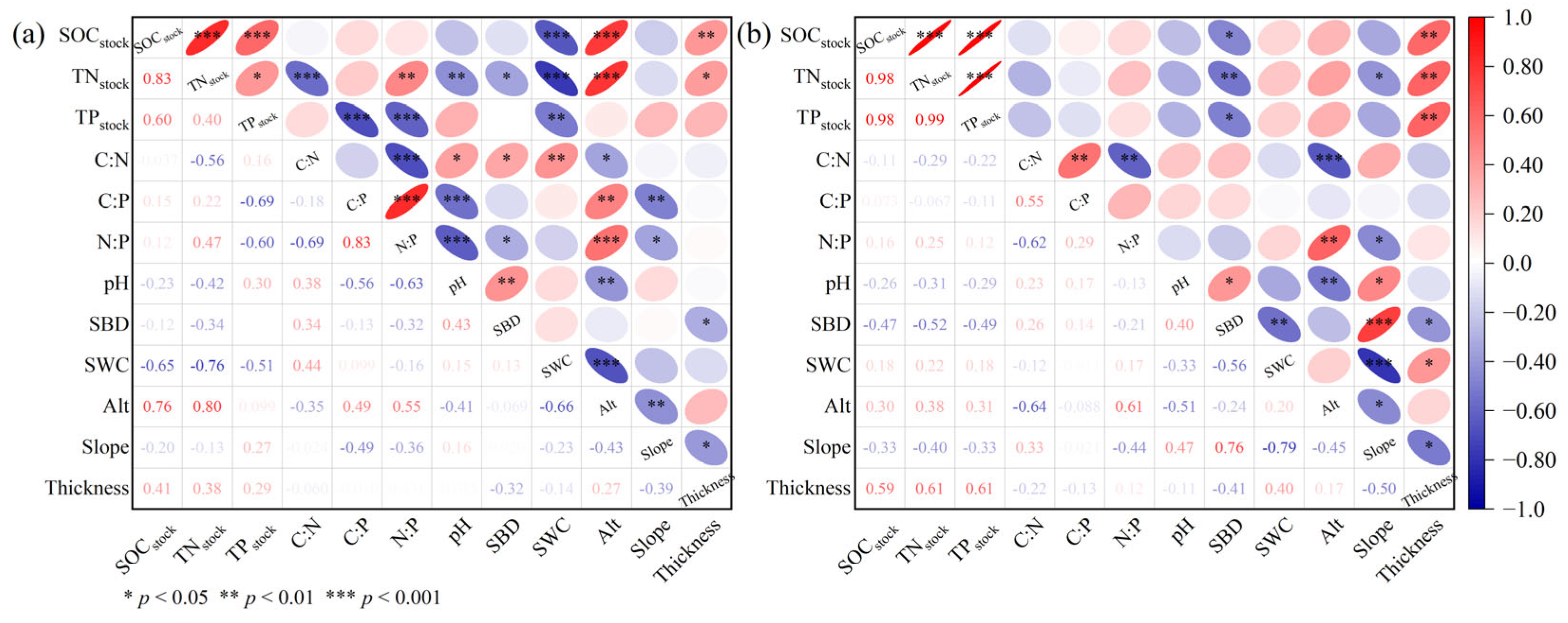
The correlations of SOCstock, TNstock, and TPstock with environmental factors differed markedly between surface and deep soil layers (Figure 4). (1) In surface soil, SOCstock showed a significant positive correlation with Alt and Thickness (p < 0.01) and a strong negative correlation with SWC (p < 0.001). In deep soil, however, it was positively correlated with Thickness (p < 0.01) and negatively correlated with SBD (p < 0.05). (2) For TNstock in surface soil, significant positive correlations were observed with Alt and Thickness (p < 0.01), while a significant negative correlation was found with SWC (p < 0.001). In deep soil, TNstock correlated positively with Thickness (p < 0.01) and negatively with Slope and SBD (p < 0.05). (3) TPstock in surface soil was significantly negatively correlated with SWC (p < 0.01). In deep soil, it exhibited a positive correlation with Thickness (p < 0.01) and a negative correlation with SBD (p < 0.05).
Figure 4. The correlation between surface soil and deep soil reserves and stoichiometric characteristics and environmental factors: (a) surface soil; (b) deep soil.
The correlations of soil C:N, C:P, and N:P with environmental factors differed significantly between surface and deep soil layers (Figure 4). In surface soil, C:N showed a significant positive correlation with pH, SBD, and SWC (p < 0.05), but a significant negative correlation with Alt (p < 0.05). In contrast, in deep soil, C:N was significantly negatively correlated with Alt (p < 0.001). For C:P in surface soil, a significant positive correlation was observed with Alt (p < 0.01), while significant negative correlations were found with pH and Slope (p < 0.01). In deep soil, however, C:P exhibited no significant correlations with any environmental factors.
Regarding N:P in topsoil, it correlated positively with Alt (p < 0.001) and negatively with pH, SBD, and Slope (p < 0.05). In deep soil, N:P was also positively correlated with Alt (p < 0.01), but negatively correlated with Slope (p < 0.05).

3.4. Factors Affecting SOCstock, TNstock and TPstock and Stoichiometric Ratios in Surface and Deep Soils

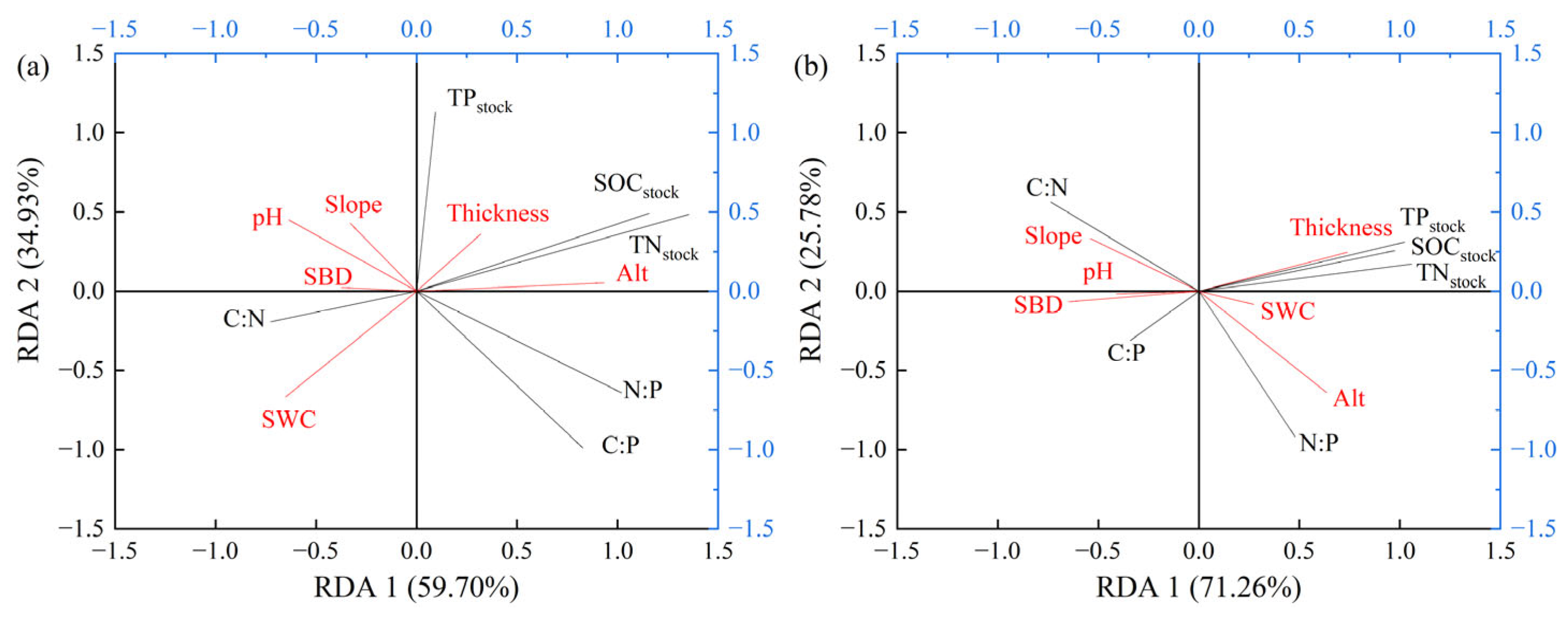
The results of redundancy analysis (RDA) for SOCstock, TNstock, TPstock, stoichiometric ratios, and environmental factors in surface and deep soil layers are presented in Figure 5. In the RDA ordination, SOCstock, TNstock, TPstock, and stoichiometric ratios were treated as response variables (black), while soil environmental factors served as explanatory variables (red). For surface soil (Figure 5a), RDA1 and RDA2 together accounted for 94.63% of the total variation. In deep soil (Figure 5b), these two axes explained 97.04% of the variation. The dominant environmental factors influencing SOCstock, TNstock, TPstock, and stoichiometric ratios differed between the two soil layers (Figure 5). In surface soil, the three primary influencing factors were Alt, SWC, and pH (Figure 5a). In deep soil, the main factors were Thickness, SBD, and Alt (Figure 5b). Notably, Alt was the only factor that significantly affected these variables in both soil layers (Figure 5).
Figure 5. Redundancy analysis of surface soil and deep soil storage, stoichiometric characteristics and environmental factors. (a) RDA results of surface soil; (b) RDA results of deep soil.
The cosine of the arrow angle serves as a proxy for the correlation between variables: an angle approaching 90° indicates a weaker correlation, whereas an angle substantially deviating from 90°—toward either 0° (strong positive correlation) or 180° (strong negative correlation)—reflects a stronger relationship. The results revealed distinct correlation patterns between soil nutrient stocks and environmental factors in surface versus deep soil layers. (1) In surface soil, SOCstock, TNstock, and TPstock showed negative correlations with SWC but positive correlations with Alt and Thickness (Figure 5a). In contrast, in deep soil, SOCstock, TNstock, and TPstock were positively correlated with SWC and Thickness, and negatively correlated with SBD, pH, and Slope (Figure 5b). (2) For surface soil, the soil C:N ratio was positively correlated with SBD, SWC, pH, and Slope, and negatively correlated with Alt and Thickness. In comparison, soil C:P and N:P ratios were negatively correlated with SBD, pH, and Slope, and positively correlated with Alt and Thickness (Figure 5a). In deep soil, C:N and C:P ratios exhibited positive correlations with SBD, pH, and Slope, and negative correlations with SWC, Alt, and Thickness. Meanwhile, the N:P ratio was positively correlated with SWC, Alt, and Thickness, and negatively correlated with SBD, pH, and Slope (Figure 5b).

4. Discussion

4.1. Difference Between Surface and Deep Soil in Nutrient Stock

In this study, the surface SOCstock, TNstock, and TPstock under the OD-CM, BP, and LP stands were higher than those in the deep soil (Figure 3a–c). This pattern can be attributed to the direct input of substantial plant litter into the surface layer, along with concentrated root biomass and abundant root exudates [49,50]. Furthermore, the surface soil provides more favorable temperatures [51], improved aeration, and higher microbial activity [52], collectively enhancing the input and accumulation efficiency of organic carbon, nitrogen, and phosphorus. In contrast, deep soil exhibits significantly reduced root biomass and litter input [52,53], with nutrients primarily reliant on downward leaching and bioturbation from overlying layers [26,54]. Environmental conditions in deep soil—such as lower temperatures, hypoxia [55], weaker microbial activity [56], and reduced substrate accessibility—promote organic matter stability but result in overall nutrient inputs far lower than those in the surface layer. Additionally, phosphorus originates mainly from the weathering of geological parent material, exhibits poor mobility, and has limited replenishment in deep layers [57]. Consequently, the reserves of all three elements were significantly higher in the surface soil. Surface nutrient enrichment may also stem from root uptake of subsoil nutrients and their subsequent recycling to the topsoil via litterfall [31].
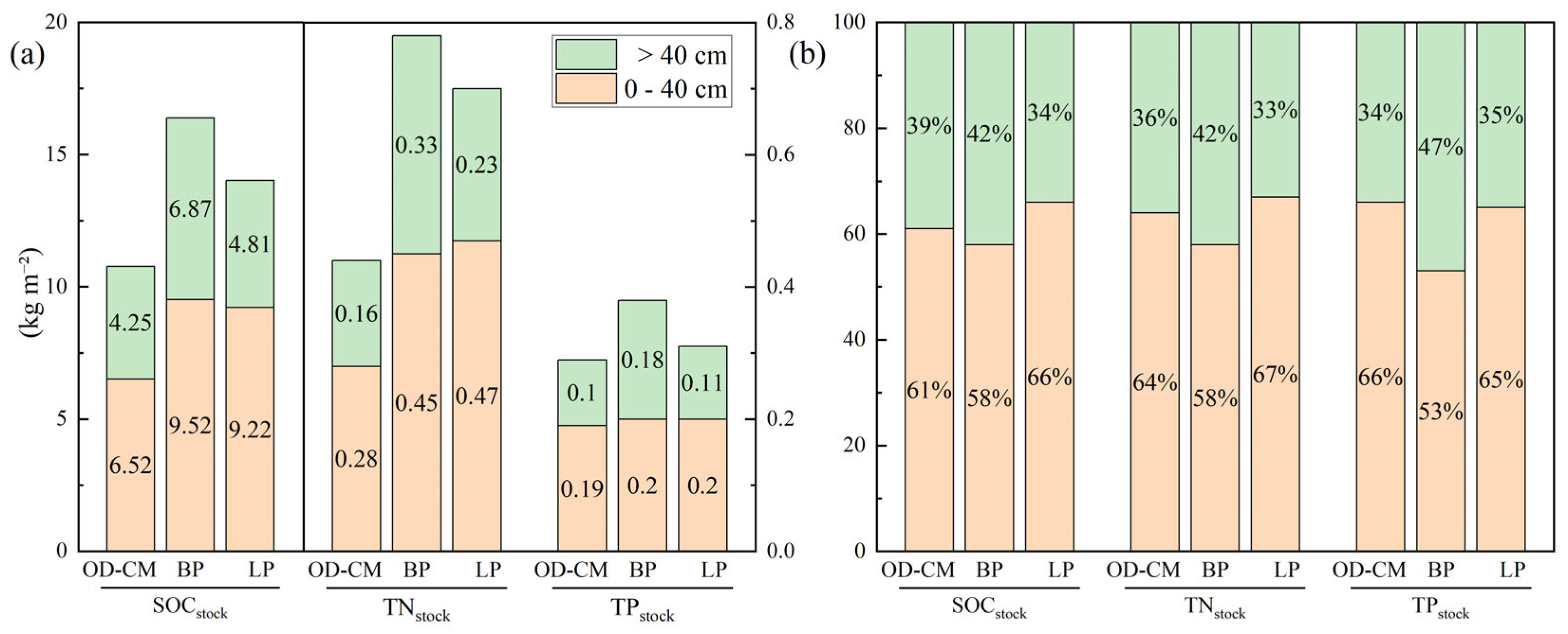
Despite the lower nutrient stock in the deep soil than the surface soil, deep SOCstock, TNstock, and TPstock under the three restoration types accounted for approximately 33%–47% of the total soil profile reserves (Figure 6b). This result aligns with findings from existing studies [39,58,59]. This one-third of total soil nutrients underscores the critical role of deep soil as nutrient pools and demonstrates that insufficient soil sampling depth would substantially underestimate total soil nutrient reserves [39]. Moreover, when comparing nutrient reserves between different restoration types, focusing solely on surface soil may lead to false ranking. For example, BP had lower TNstock than LP in the surface soil; however, its total TNstock exceeded LP (Figure 6a). A similar phenomenon was observed in TPstock.
Figure 6. Surface and deep soil stock and proportion ((a): the surface and deep soil stock, (b): the surface and deep soil stock as a percentage of the total stock).

4.2. Stoichiometric Ratio Differences Between Surface and Deep Soil and the Indications

4.2.1. Vertical Variation in Stoichiometric Ratios

The surface soil C:N ratio (24.98) in the study area was lower than that in deep soil (26.90) (Figure 3d). This result is consistent with findings from the transitional zone of desert and steppe in Inner Mongolia [18], but diverges from results found in the forest ecosystem from South China [60,61]. There are three possible causes: (1) The soil N source is mainly from litter decomposition and nitrogen fixation, which mainly concentrate in the surface soil [62]. And as the study area is nitrogen-limited, the limited surface soil N is difficult to reach the deep soil layer due to rapid absorption and utilization by plants and microorganisms [63]. (2) The study area is located on the Loess Plateau, characterized by low precipitation and high evaporation, leading to predominant upward migration of soil moisture. Inorganic nitrogen (particularly nitrate) dissolved in soil water moves upward with evaporative flux and crystallizes upon water evaporation, enriching nitrogen in the surface soil [64]. This results in relative nitrogen enrichment and a lower surface soil C:N. (3) The sources of organic matter in deep soil are mainly infiltration of dissolved organic carbon from the upper layer, and a small amount of root exudates, fine root litter, which is characterized by high C:N [65,66].
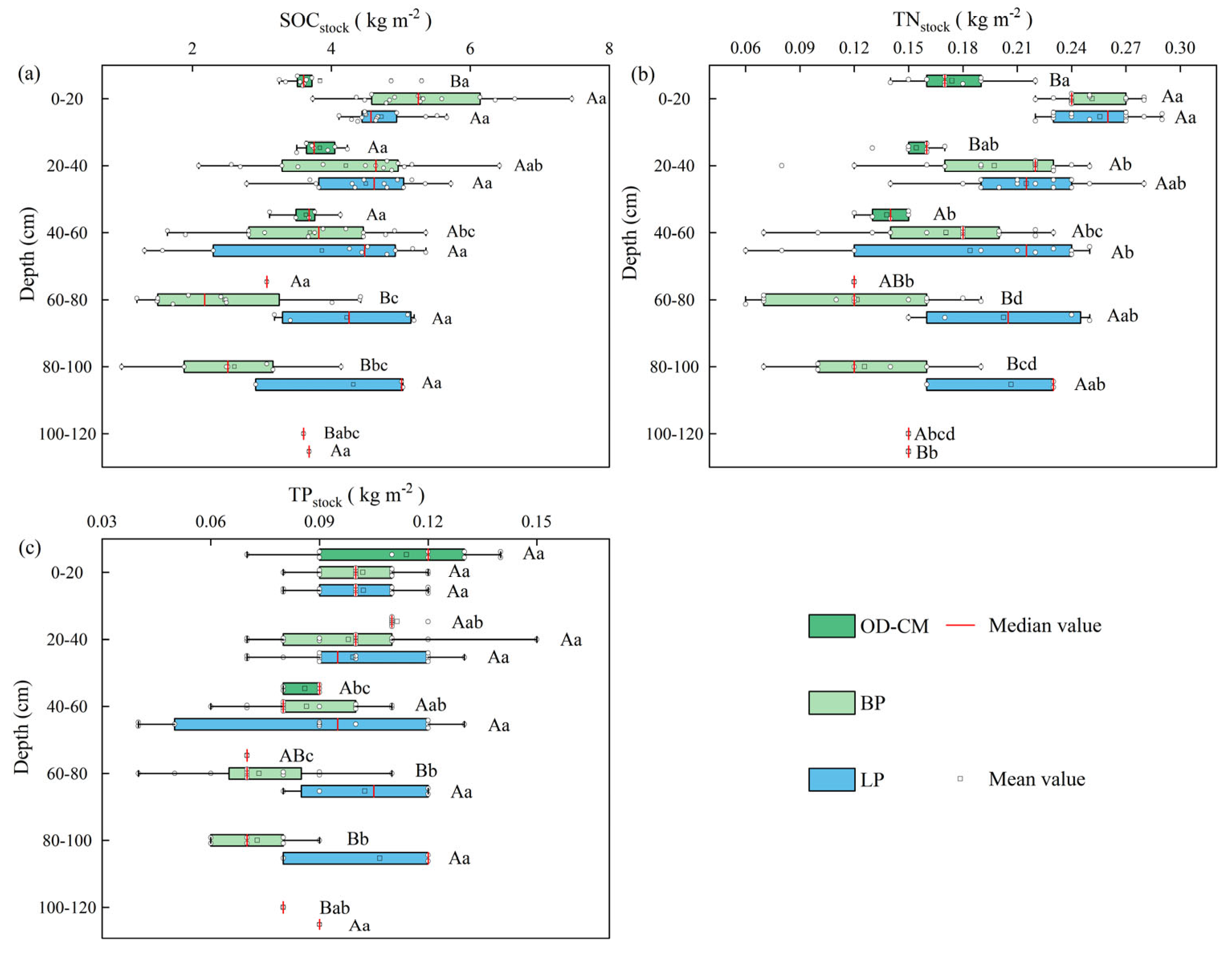
Surface soil C:P (113.31) and N:P (4.65) were higher than deep soil values (106.12, 4.03) (Figure 3d,e), aligning with existing studies [60,67,68] and China’s national patterns (surface: C:P (105), N:P (7.7); deep: C:P (37.5), N:P (3.45)) [69]. This was mainly due to the stronger “surface aggregation” effect of C and N than that of P. Specifically, SOC originates mainly from litter decomposition, and the main source of N is litter decomposition and nitrogen fixation—both of which occur primarily in the surface soil layer (Figure 7a,b). In contrast, soil P ultimately derives from phosphate-containing minerals in soil parent materials or the bedrock [4], which means that the deep soil layer contains a considerable amount of P in spite of the “surface aggregation” effect (Figure 7c). And hence, soil C and N decrease more rapidly with soil depth compared with P, resulting in decreased C:P and N:P with depth.
Figure 7. Vertical variation in SOC, TN and TP stocks under different restoration types: (ac) are the vertical changes in SOC, TN and TP stocks, respectively.

4.2.2. Differences in Nutrient Balance Between Surface and Deep Soil

Our results indicate that the deep soil had more pronounced N and P limitations than the surface soil. Specifically, the mean surface soil C:N and C:P ratios in the study area were 24.98 and 113.31, respectively (Figure 3d,e). Taking China’s national averages as a coarse benchmark, these values are 11.63 and 8.31 higher than China’s national averages for 0–50 cm soil layer, respectively (Table 2), indicating N and P limitations in the surface soil. In deep soil, the differences from China’s average increased substantially to 15.55 and 68.62, respectively (Table 2), suggesting strong potential nitrogen and P limitations. It is worth noting that the phosphorus content of loess parent material in the Loess Plateau is lower than that in other regions of the country, which will lead to the carbon-phosphorus ratio in the deep layer of this study being much higher than the national level. And similar situations are still observed in other studies on the Loess Plateau [70,71].
Table 2. Comparison of soil stoichiometric ratios between the study area and China’s average.

4.3. Factors Influencing SOCstock, TNstock, TPstock, and Stoichiometric Ratios in Surface and Deep Soil Layers

The high RDA explained variance (94.63%–97.04%) should be interpreted cautiously, as it may be inflated by limited sample size and by mathematical dependence between elemental variables (C, N, P) and derived stoichiometric ratios, which reduces effective dimensionality in linear ordination. Here, we treat it mainly as a visualization of multivariate associations rather than causal inference. Surface SOCstock, TNstock, TPstock, and their stoichiometric ratios were primarily regulated by Alt, SWC, and pH (Figure 5a). In contrast, deep soil C, N, and P stocks and stoichiometry depended more on Thickness, SBD, and Alt (Figure 5b). As the common influencing factor for both surface and deep soil, altitude was positively correlated with both surface and deep soil C, N, and P stocks (Figure 4 and Figure 5). This may be attributed to higher elevations that are typically associated with lower temperatures, reduced microbial activity, slower organic carbon decomposition, weakened nitrogen mineralization and nitrification, and enhanced rock weathering, leading to increased phosphorus release into the soil [68,71]. Alt was negatively correlated with soil C:N but positively correlated with N:P in both surface and deep layers (Figure 4 and Figure 5). This likely occurred because soil C did not increase as much as N with rising altitude, while P remained relatively stable. A significant positive correlation was observed between Alt and surface soil C:P (p < 0.01), whereas a negative correlation was found in deep soil (Figure 4). This pattern may be explained as follows: with increasing altitude, temperature decreases, and P accumulates more slowly than C. In the surface soil, higher altitude in our study region is linked to cooler conditions that suppress microbial decomposition and thereby promote SOC accumulation [72]. In contrast, total soil P is largely governed by parent material inputs and soil mineral interactions, and thus tends to vary less than SOC along the same gradient [73,74,75]. Consequently, SOC increases faster than TP in the surface layer, resulting in higher C:P at higher altitude.
Besides Alt, other influencing factors differed between surface and deep soil stoichiometry. In surface soil, SWC and pH were key regulators. Specifically, SWC was significantly negatively correlated with SOCstock, TNstock, and TPstock (p < 0.01) (Figure 4a). This was likely due to the nutrient stocks increasing with vegetation growth, while dense vegetation exhausts soil water [27,76]. In contrast, SWC was positively correlated with C:N (p < 0.01) (Figure 4a), which may be attributed to the SOC transformation and nitrogen-fixing process. When the vegetation biomass is high, diazotroph has sufficient carbon source for nitrogen-fixing [77,78], and hence the N limitation is released and C:N decreases. Meanwhile, however, the SWC is rapidly consumed by the dense vegetation [76]. This ultimately leads to a positive relationship between soil C:N and SWC.
As the third influencing factor of surface soil stoichiometry, pH was significantly negatively correlated with surface soil TNstock (p < 0.01) (Figure 4a), which may be due to: (1) Both are regulated by plant biomass. With the increase in plant biomass, the increase in organic carbon and microbial activity in the input soil will reduce the pH [79]. At the same time, the increase in organic carbon source enhanced the activity of nitrogen-fixing microorganisms, thus increasing the amount of nitrogen fixation. Therefore, with the increase in plant biomass, pH decreased and TNstock increased, and the two were negatively correlated. (2) An alkaline environment will inhibit the activity of nitrogen-fixing microorganisms (such as rhizobium), reduce the efficiency of biological nitrogen fixation, and lead to a decrease in soil total nitrogen input [80,81]. Therefore, pH is negatively correlated with TNstock. Our results showed that surface soil C:P and N:P were significantly negatively correlated with pH (p < 0.001) (Figure 4a), which may be because the increase in litter resulted in an increase in soil carbon and nitrogen storage, while phosphorus storage remained basically unchanged. C:N was significantly positively correlated with pH (p < 0.05) (Figure 4a), which may be because the alkaline environment inhibits microorganisms involved in organic matter decomposition and nitrogen mineralization. When the decomposition rate slows down, the accumulation of carbon may increase relatively, while the mineralization and utilization efficiency of nitrogen may decrease, resulting in an increase in C:N [82].
In deep soil, Thickness was the dominant factor and showed significant positive correlations with SOCstock, TNstock, and TPstock (p < 0.01) (Figure 4b). Importantly, Thickness should be interpreted primarily as a proxy for the size of the subsoil reservoir (i.e., soil mass/volume per unit area) and the degree of profile development, rather than a direct indicator of favorable rooting conditions. In loess landscapes, thicker profiles generally represent less eroded soils with greater capacity to retain mineral-associated organic matter and nutrients, and they can buffer topsoil nutrient losses caused by erosion [40,83]. In addition, deeper and thicker profiles provide more exploitable rooting volume and subsoil resources; thus, plant access to subsoil nutrients and the delivery of plant nutrients belowground can increase where rooting depth is not strongly constrained [23,26].
Nevertheless, the realization of this storage potential is strongly conditioned by soil physical accessibility. SBD integrates key constraints on subsoil accessibility, including reduced hydraulic conductivity and increased mechanical impedance (penetration resistance). High SBD can restrict fine-root elongation and penetration—particularly in deeper layers—thereby reducing rhizodeposition and fine-root turnover that constitute major sources of subsoil organic matter [23,26]. Because direct litter-derived inputs into deep mineral soil are generally limited compared with root-derived inputs [26,50], such root constraints can translate into lower SOCstock and associated TNstock, consistent with the negative correlations observed between SBD and SOCstock, TNstock and TPstock in our deep layers (Figure 4b) and in other studies [68,84,85].
In summary, as the interface between soil and the external environment, surface soil is more susceptible to disturbances from environmental factors and biological activities [15,86], and is hence influenced by micro-climate and biological-related factors (Alt, SWC, and pH). The major difference is that the deep soil stoichiometry was strongly governed by factors related to nutrient storage and transport (Thickness, SBD and Alt).

4.4. Implications, Limitations and Future Research

4.4.1. Implications for Soil Stoichiometric Studies

Our study underscores the importance of deep soil in three aspects. First, the deep soil accounted for 33%–47% of the total nutrient storage within the profile (Figure 6), representing a critical nutrient reservoir. Second, the differences in C:N and C:P from China’s average were markedly greater in deep soil (15.55 and 68.62, respectively) than in surface soil (11.63 and 8.31, respectively) (Table 2), indicating more pronounced N and P limitations in the deep soil. Third, the factors influencing soil stoichiometry differed between layers: the deep soil stoichiometry was primarily governed by properties related to nutrient storage and transport (thickness, SBD, and Alt), whereas the surface soil stoichiometry was mainly influenced by microclimate and biological-related factors (Alt, SWC and pH) (Figure 5; detailed in Section 4.3).
These findings provide strong evidence that soil stoichiometric studies should adopt greater sampling depths. First, because the deep soil layer acts as a major nutrient reservoir, relying solely on surface data would substantially underestimate actual nutrient stocks. Second, the complex migration and transformation of nutrients create stoichiometric heterogeneity with depth; surface ratios alone cannot accurately reflect overall nutrient balance or limitation status. Third, since different factors control surface and deep soil stoichiometry, drivers identified from surface samples are not representative of the entire profile. This aligns with soil carbon research, which shows that shallow sampling underestimates carbon pools and can even alter conclusions regarding carbon accumulation versus loss [39,42,87].
More importantly, our study also has important implications for biogeochemical and ecosystem modeling. Recent Earth system and regional land-model studies increasingly argue for extending soil observations beyond the surface layer—often to 1 m depth—to better constrain vertically structured biogeochemical processes and improve model benchmarking and parameterization, and our study advocates this viewpoint. Earlier model applications commonly relied on topsoil datasets for calibration and evaluation, and subsequent model–data assessments highlighted uncertainties in simulated soil carbon stocks and turnover behavior, motivating a shift toward depth-explicit representations and the use of soil-profile constraints (e.g., vertically resolved soil biogeochemistry in CLM; observation-based benchmarks and topsoil–subsoil datasets distinguishing 0–0.3 m vs. 0.3–1 m; and profile-data assimilation efforts that improve parameter constraints) [88,89,90,91,92]. In parallel, nutrient-enabled land models further emphasize that predictive skill depends on how N and P availability are parameterized, reinforcing the need for depth-resolved constraints on sub-surface nutrient conditions [93,94]. Our case study aligns with and supports this recent direction: by providing depth-resolved C:N:P measurements to 1 m, we offer evidence that deep layers can represent a substantial component of the total profile pool and exhibit depth-specific stoichiometric patterns, which can be used to benchmark and inform nutrient-cycling simulations in restoration landscapes on the Loess Plateau.

4.4.2. Limitations and Future Research

This case study highlights the role of deep soil as a vital nutrient reservoir and reveals its differing stoichiometric characteristics and drivers compared to surface soil. However, to avoid overgeneralization and to ensure the rigor of our conclusions, several limitations should be acknowledged. First, due to practical challenges in excavating deep soil profiles in rural forested landscapes, we examined only three representative restoration types in the study region. And the number of plots per restoration type (n = 3) may limit statistical power, especially in deep soil where heterogeneity is high; therefore, non-significant differences among restoration types at depth should not be interpreted as evidence of complete ecological homogeneity, but rather as patterns requiring validation with larger spatial replication. Second, in this study, we treated soils below 40 cm as a single “deep-soil” layer, whereas depth-dependent biogeochemical processes may produce different stoichiometric patterns and controls across subsoil intervals (e.g., 40–80 cm vs. deeper horizons). Future work should employ more uniform and deeper coring across all plots and explicitly compare multiple subsoil intervals to clarify how stoichiometric traits and their drivers vary with depth and to better understand the functional roles of different layers in biogeochemical cycling. Third, the influencing factors identified here are based on statistical associations with measured environmental variables rather than process-based mechanistic investigations; therefore, causal pathways cannot be fully resolved. Given the pronounced differences in stoichiometry and its controls between deep and surface soils observed in this study, we encourage increased research attention on subsurface layers to advance a comprehensive understanding of biogeochemical cycling and to better inform ecosystem management and ecological restoration practices [38,41].

5. Conclusions

This study underscores the often-overlooked role of deep soil in shaping ecosystem nutrient profiles and stoichiometric balances. By systematically comparing surface and deep layers in the Loess Hilly Region, we reveal fundamental disparities in nutrient storage, elemental stoichiometry, and the dominant drivers regulating these properties. These findings challenge the prevailing surface-centric research paradigm and demonstrate that excluding deep soil can lead to incomplete or biased interpretations of nutrient limitation and regulatory mechanisms. We therefore advocate for the explicit integration of deep soil layers into standard monitoring protocols and sampling designs, which is essential for advancing the accuracy and comprehensiveness of terrestrial biogeochemical assessments.

Supplementary Materials

The following supporting information can be downloaded at: https://www.mdpi.com/article/10.3390/f17020259/s1, Table S1: Global soil stoichiometry study sampling depth distribution.

Author Contributions

Conceptualization, Y.G. and X.F.; methodology, Y.G., T.H. and X.F.; validation, Y.G. and X.F.; formal analysis, Y.G. and J.S.; investigation, Y.G., T.H., J.S., J.X., J.L. and Z.L.; resources, X.F.; data curation, Y.G. and J.S.; writing—original draft preparation, Y.G. and X.F.; writing—review and editing, T.H., X.F. and Z.B.; visualization, Y.G., J.S., J.X., J.L.,Y.W. and D.W.; supervision, X.F. and Z.B.; project administration, X.F.; funding acquisition, X.F. All authors have read and agreed to the published version of the manuscript.

Funding

This research was funded by the National Natural Science Foundation of China (No. 42201298), the Scientific and Technological Innovation Foundation of Shanxi Agricultural University (Ph.D. Research Startup) (No. 2021BQ96 and No. 2022BQ10), and the Shanxi Province Excellent Doctor Award Fund (No. SXBYKY2022065 and No. SXBYKY2022043).

Data Availability Statement

The data presented in this study are available on request from the corresponding author.

Conflicts of Interest

The authors declare no conflicts of interest.

References

  1. Paudel, B.R.; Udawatta, R.P.; Kremer, R.J.; Anderson, S.H. Soil Quality Indicator Responses to Row Crop, Grazed Pasture, and Agroforestry Buffer Management. Agrofor. Syst. 2012, 84, 311–323. [Google Scholar] [CrossRef]
  2. Mao, R.; Chen, H.M.; Zhang, X.H.; Shi, F.X.; Song, C.C. Effects of P Addition on Plant C: N: P Stoichiometry in an N-Limited Temperate Wetland of Northeast China. Sci. Total Environ. 2016, 559, 1–6. [Google Scholar] [CrossRef] [PubMed]
  3. Song, M.; Peng, W.; Du, H.; Xu, Q. Responses of Soil and Microbial C:N:P Stoichiometry to Vegetation Succession in a Karst Region of Southwest China. Forests 2019, 10, 755. [Google Scholar] [CrossRef]
  4. Paul, E.A. Soil Microbiology, Ecology, and Biochemistry in Perspective. In Soil Microbiology, Ecology and Biochemistry, 3rd ed.; Elsevier: Amsterdam, The Netherlands, 2006; pp. 3–24. ISBN 0125468075. [Google Scholar]
  5. Bui, E.N.; Henderson, B.L. C:N:P Stoichiometry in Australian Soils with Respect to Vegetation and Environmental Factors. Plant Soil 2013, 373, 553–568. [Google Scholar] [CrossRef]
  6. Aitkenhead, J.A.; McDowell, W.H. Soil C:N Ratio as a Predictor of Annual Riverine DOC Flux at Local and Global Scales. Global Biogeochem. Cycles 2000, 14, 127–138. [Google Scholar] [CrossRef]
  7. Disea, N.B.; Matznerb, E.; Forsiusc, M. Evaluation of Organic Horizon C:N Ratio as an Indicator of Nitrate Leaching in Conifer Forests across Europe. Environ. Pollut. 1998, 102, 453–456. [Google Scholar] [CrossRef]
  8. Gundersena, P.; Callesena, I.; De Vriesb, W. Nitrate Leaching in Forest Ecosystems Is Related to Forest Floor C/N Ratios. Environ. Pollut. 1998, 102, 403–407. [Google Scholar] [CrossRef]
  9. Lovett, G.M.; Weathers, K.C.; Arthur, M.A. Control of Nitrogen Loss from Forested Watersheds by Soil Carbon:Nitrogen Ratio and Tree Species Composition. Ecosystems 2002, 5, 712–718. [Google Scholar] [CrossRef]
  10. Klemedtsson, L.; Von Arnold, K.; Weslien, P.; Gundersen, P. Soil CN Ratio as a Scalar Parameter to Predict Nitrous Oxide Emissions. Glob. Change Biol. 2005, 11, 1142–1147. [Google Scholar] [CrossRef]
  11. Xu, X.; Thornton, P.E.; Post, W.M. A Global Analysis of Soil Microbial Biomass Carbon, Nitrogen and Phosphorus in Terrestrial Ecosystems. Glob. Ecol. Biogeogr. 2013, 22, 737–749. [Google Scholar] [CrossRef]
  12. Güsewell, G.; Koerselman, W.; Verhoeven, J.T.A. Biomass N:P Ratios as Indicators of Nutrient Limitation for Plant Populations in Wetlands. Ecol. Appl. 2003, 13, 372–384. [Google Scholar] [CrossRef]
  13. Tessier, J.T.; Raynal, D.J. Use of Nitrogen to Phosphorus Ratios in Plant Tissue as an Indicator of Nutrient Limitation and Nitrogen Saturation. J. Appl. Ecol. 2003, 40, 523–534. [Google Scholar] [CrossRef]
  14. Elser, J.J.; Fagan, W.F.; Denno, R.F.; Dobberfuhl, D.R.; Folarin, A.; Huberty, A.; Interlandi, S.; Kilham, S.S.; McCauley, E.; Schulz, K.L.; et al. Nutritional Constraints in Terrestrial and Freshwater Food Webs. Nature 2000, 408, 578–580. [Google Scholar] [CrossRef]
  15. Liu, X.; Ma, J.; Ma, Z.W.; Li, L.H. Soil Nutrient Contents and Stoichiometry as Affected by Land-Use in an Agro-Pastoral Region of Northwest China. Catena 2017, 150, 146–153. [Google Scholar] [CrossRef]
  16. Kooch, Y.; Ghorbanzadeh, N.; Francaviglia, R. Soil Carbon Stocks Can Be Negatively Affected by Land Use and Climate Change in Natural Ecosystems of Semi-Arid Environment of Iran. Geoderma Reg. 2022, 31, e00591. [Google Scholar] [CrossRef]
  17. Liu, C.; Li, J.; Sun, W.; Gao, Y.; Yu, Z.; Dong, Y.; Li, P. Temporal and Spatial Variations in Soil Elemental Stoichiometry Coupled with Alterations in Agricultural Land Use Types in the Taihu Lake Basin. Agriculture 2023, 13, 484. [Google Scholar] [CrossRef]
  18. Lu, J.; Feng, S.; Wang, S.; Zhang, B.; Ning, Z.; Wang, R.; Chen, X.; Yu, L.; Zhao, H.; Lan, D.; et al. Patterns and Driving Mechanism of Soil Organic Carbon, Nitrogen, and Phosphorus Stoichiometry across Northern China’s Desert-Grassland Transition Zone. Catena 2023, 220, 106695. [Google Scholar] [CrossRef]
  19. Alcántara, V.; Don, A.; Vesterdal, L.; Well, R.; Nieder, R. Stability of Buried Carbon in Deep-Ploughed Forest and Cropland Soils—Implications for Carbon Stocks. Sci. Rep. 2017, 7, 5511. [Google Scholar] [CrossRef]
  20. Jobbágy, E.G.; Jackson, R.B. The Distribution of Soil Nutrients with Depth: Global Patterns and the Imprint of Plants. Biogeochemistry 2001, 53, 51–77. [Google Scholar] [CrossRef]
  21. Chen, J.; Luo, Y.; Kätterer, T.; Olesen, J.E. Depth-Dependent Responses of Soil Organic Carbon Stock under Annual and Perennial Cropping Systems. Proc. Natl. Acad. Sci. USA 2022, 119, e2203486119. [Google Scholar] [CrossRef]
  22. Vancampenhout, K.; De Vos, B.; Wouters, K.; Swennen, R.; Buurman, P.; Deckers, J. Organic Matter of Subsoil Horizons under Broadleaved Forest: Highly Processed or Labile and Plant-Derived? Soil Biol. Biochem. 2012, 50, 40–46. [Google Scholar] [CrossRef]
  23. Kautz, T.; Amelung, W.; Ewert, F.; Gaiser, T.; Horn, R.; Jahn, R.; Javaux, M.; Kemna, A.; Kuzyakov, Y.; Munch, J.C.; et al. Nutrient Acquisition from Arable Subsoils in Temperate Climates: A Review. Soil Biol. Biochem. 2013, 57, 1003–1022. [Google Scholar] [CrossRef]
  24. Barej, J.A.M.; Pätzold, S.; Perkons, U.; Amelung, W. Phosphorus Fractions in Bulk Subsoil and Its Biopore Systems. Eur. J. Soil Sci. 2014, 65, 553–561. [Google Scholar] [CrossRef]
  25. Li, C.; Zhao, L.; Sun, P.; Zhao, F.; Kang, D.; Yang, G.; Han, X.; Feng, Y.; Ren, G. Deep Soil c, n, and p Stocks and Stoichiometry in Response to Land Use Patterns in the Loess Hilly Region of China. PLoS ONE 2016, 11, e0159075. [Google Scholar] [CrossRef] [PubMed]
  26. Rumpel, C.; Kögel-Knabner, I. Deep Soil Organic Matter-a Key but Poorly Understood Component of Terrestrial C Cycle. Plant Soil 2011, 338, 143–158. [Google Scholar] [CrossRef]
  27. Xu, H.; Qu, Q.; Li, P.; Guo, Z.; Wulan, E.; Xue, S. Stocks and Stoichiometry of Soil Organic Carbon, Total Nitrogen, and Total Phosphorus after Vegetation Restoration in the Loess Hilly Region, China. Forests 2019, 10, 27. [Google Scholar] [CrossRef]
  28. Stone, E.L.; Comerford, N.B. 4 Plant and Animal Activity Below the Solum. In Whole Regolith Pedology; Soil Science Society of America: Madison, WI, USA, 1994. [Google Scholar]
  29. Lehmann, J. Subsoil Root Activity in Tree-Based Cropping Systems. Plant Soil 2003, 255, 319–331. [Google Scholar] [CrossRef]
  30. Frelih-Larsen, A.; Hinzmann, M.; Ittner, S. The “invisible” Subsoil: An Exploratory View of Societal Acceptance of Subsoil Management in Germany. Sustainability 2018, 10, 3006. [Google Scholar] [CrossRef]
  31. Osman, K.T. Soil Organic Matter. In Soils; Springer: Dordrecht, The Netherlands, 2013; pp. 89–96. [Google Scholar]
  32. McCulley, R.L.; Jobbágy, E.G.; Pockman, W.T.; Jackson, R.B. Nutrient Uptake as a Contributing Explanation for Deep Rooting in Arid and Semi-Arid Ecosystems. Oecologia 2004, 141, 620–628. [Google Scholar] [CrossRef]
  33. Uhlig, D.; Amelung, W.; von Blanckenburg, F. Mineral Nutrients Sourced in Deep Regolith Sustain Long-Term Nutrition of Mountainous Temperate Forest Ecosystems. Glob. Biogeochem. Cycles 2020, 34, e2019GB006513. [Google Scholar] [CrossRef]
  34. Rodionov, A.; Bauke, S.L.; von Sperber, C.; Hoeschen, C.; Kandeler, E.; Kruse, J.; Lewandowski, H.; Marhan, S.; Mueller, C.W.; Simon, M.; et al. Biogeochemical Cycling of Phosphorus in Subsoils of Temperate Forest Ecosystems. Biogeochemistry 2020, 150, 313–328. [Google Scholar] [CrossRef]
  35. Kuhlmann, H.; Barraclough, P.B.; Weir, A.H. Utilization of Mineral Nitrogen in the Subsoil by Winter Wheat. J. Plant Nutr. Soil Sci. 1989, 152, 291–295. [Google Scholar] [CrossRef]
  36. Almaraz, M.; Wang, C.; Wong, M.Y. Deep Soil Contributions to Global Nitrogen Budgets. Nat. Commun. 2025, 16, 966. [Google Scholar] [CrossRef]
  37. Zhou, Y.; Boutton, T.W.; Wu, X. Ben Soil Phosphorus Does Not Keep Pace with Soil Carbon and Nitrogen Accumulation Following Woody Encroachment. Glob. Change Biol. 2018, 24, 1992–2007. [Google Scholar] [CrossRef]
  38. Kwatcho Kengdo, S.; McCormack, M.L.; Ostonen, I.; Torn, M.S. Fine-Root Dynamics in Deeper Soils: A Critical but Overlooked Component of Ecosystem Responses to Climate Warming. New Phytol. 2025, 247, 2507–2513. [Google Scholar] [CrossRef] [PubMed]
  39. Harrison, R.B.; Footen, P.W.; Strahm, B.D. Deep Soil Horizons: Contribution and Importance to Soil Carbon Pools and in Assessing Whole-Ecosystem Response to Management and Global Change. For. Sci. 2011, 57, 67–76. [Google Scholar] [CrossRef]
  40. James, J.; Knight, E.; Gamba, V.; Harrison, R. Deep Soil: Quantification, Modeling, and Significance of Subsurface Nitrogen. For. Ecol. Manag. 2015, 336, 194–202. [Google Scholar] [CrossRef]
  41. Wang, X.; Xue, X.; Zhang, Y.; Qin, S.; You, Q.; Duan, Y.; Wang, L.; Chen, J.; Liu, J.; Yao, B.; et al. Divergent Mechanisms Driving Nutrient Stoichiometry in Surface and Deep Soils of Desert Ecosystems on the Qinghai–Tibetan Plateau. Catena 2024, 246, 108417. [Google Scholar] [CrossRef]
  42. Hamburg, S.P. Simple Rules for Measuring Changes in Ecosystem Carbon in Forestry-Offset Projects. Mitig. Adapt. Strateg. Glob. Change 2000, 5, 25–37. [Google Scholar] [CrossRef]
  43. Shi, H.; Shao, M. Soil and Water Loss from the Loess Plateau in China. J. Arid Environ. 2000, 45, 9–20. [Google Scholar] [CrossRef]
  44. Fu, B.; Wang, S.; Liu, Y.; Liu, J.; Liang, W.; Miao, C. Hydrogeomorphic ecosystem responses to natural and anthropogenic changes in the Loess Plateau of China. Annu. Rev. Earth Planet. Sci. 2017, 45, 223–243. [Google Scholar] [CrossRef]
  45. Liu, Y.; Fu, L.; Lu, X.; Yan, Y. Characteristics of Soil Nutrients and Their Ecological Stoichiometry in Different Land Use Types in the Nianchu River Basin. Land 2022, 11, 1001. [Google Scholar] [CrossRef]
  46. Nelson, D.W.; Sommers, L.E. Total Carbon, Organic Carbon, and Organic Matter. In Methods of Soil Analysis; Soil Science Society of America: Madison, WI, USA, 1996. [Google Scholar]
  47. Misra, R. Ecology Workbook; Misra, R., Ed.; Oxford & IBH Publishing Company: New Delhi, India, 1968. [Google Scholar]
  48. Murphy, J.; Riley, J.P. A Modified Single Solution Method for the Determination of Phosphate in Natural Waters. Anal. Chim. Acta 1962, 27, 31–36. [Google Scholar] [CrossRef]
  49. Singh, G.; Schoonover, J.E.; Williard, K.W.J.; Kaur, G.; Crim, J. Carbon and Nitrogen Pools in Deep Soil Horizons at Different Landscape Positions. Soil Sci. Soc. Am. J. 2018, 82, 1512–1525. [Google Scholar] [CrossRef]
  50. Fröberg, M.; Jardine, P.M.; Hanson, P.J.; Swanston, C.W.; Todd, D.E.; Tarver, J.R.; Garten, C.T. Low Dissolved Organic Carbon Input from Fresh Litter to Deep Mineral Soils. Soil Sci. Soc. Am. J. 2007, 71, 347–354. [Google Scholar] [CrossRef]
  51. Bi, X.; Li, B.; Nan, B.; Fan, Y.; Fu, Q.; Zhang, X. Characteristics of Soil Organic Carbon and Total Nitrogen under Various Grassland Types along a Transect in a Mountain-Basin System in Xinjiang, China. J. Arid Land 2018, 10, 612–627. [Google Scholar] [CrossRef]
  52. Hicks Pries, C.E.; Sulman, B.N.; West, C.; O’Neill, C.; Poppleton, E.; Porras, R.C.; Castanha, C.; Zhu, B.; Wiedemeier, D.B.; Torn, M.S. Root Litter Decomposition Slows with Soil Depth. Soil Biol. Biochem. 2018, 125, 103–114. [Google Scholar] [CrossRef]
  53. Button, E.S.; Pett-Ridge, J.; Murphy, D.V.; Kuzyakov, Y.; Chadwick, D.R.; Jones, D.L. Deep-C Storage: Biological, Chemical and Physical Strategies to Enhance Carbon Stocks in Agricultural Subsoils. Soil Biol. Biochem. 2022, 170, 108697. [Google Scholar] [CrossRef]
  54. Wilkinson, M.T.; Richards, P.J.; Humphreys, G.S. Breaking Ground: Pedological, Geological, and Ecological Implications of Soil Bioturbation. Earth Sci. Rev. 2009, 97, 257–272. [Google Scholar] [CrossRef]
  55. Salomé, C.; Nunan, N.; Pouteau, V.; Lerch, T.Z.; Chenu, C. Carbon Dynamics in Topsoil and in Subsoil May Be Controlled by Different Regulatory Mechanisms. Glob. Change Biol. 2010, 16, 416–426. [Google Scholar] [CrossRef]
  56. Fang, C.; Moncrieff, J.B. The Variation of Soil Microbial Respiration with Depth in Relation to Soil Carbon Composition. Plant Soil 2005, 268, 243–253. [Google Scholar] [CrossRef]
  57. Mehmood, A.; Akhtar, M.S.; Imran, M.; Rukh, S. Soil Apatite Loss Rate across Different Parent Materials. Geoderma 2018, 310, 218–229. [Google Scholar] [CrossRef]
  58. Jobbágy, E.G.; Jackson, R.B. The Vertical Distribution of Soil Organic Carbon and Its Relation to Climate and Vegetation. Ecol. Appl. 2000, 10, 423–436. [Google Scholar] [CrossRef]
  59. Luo, X.; Hou, E.; Chen, J.; Li, J.; Zhang, L.; Zang, X.; Wen, D. Dynamics of Carbon, Nitrogen, and Phosphorus Stocks and Stoichiometry Resulting from Conversion of Primary Broadleaf Forest to Plantation and Secondary Forest in Subtropical China. Catena 2020, 193, 104606. [Google Scholar] [CrossRef]
  60. Ding, X.; Li, X.; Qi, Y.; Zhao, Z.; Sun, D.; Wei, H. Depth-Dependent c-n-p Stocks and Stoichiometry in Ultisols Resulting from Conversion of Secondary Forests to Plantations and Driving Forces. Forests 2021, 12, 1300. [Google Scholar] [CrossRef]
  61. Qiao, Y.; Wang, J.; Liu, H.; Huang, K.; Yang, Q.; Lu, R.; Yan, L.; Wang, X.; Xia, J. Depth-Dependent Soil C-N-P Stoichiometry in a Mature Subtropical Broadleaf Forest. Geoderma 2020, 370, 114357. [Google Scholar] [CrossRef]
  62. Hu, J.; Zhou, D.; Li, Q.; Wang, Q. Vertical Distributions of Soil Nutrients and Their Stoichiometric Ratios as Affected by Long Term Grazing and Enclosing in a Semi-Arid Grassland of Inner Mongolia. Agriculture 2020, 10, 382. [Google Scholar] [CrossRef]
  63. Wang, W.; Chen, D.; Zhang, Q.; Sun, X.; Zhang, S. Effects of Mixed Coniferous and Broad-Leaved Litter on Bacterial and Fungal Nitrogen Metabolism Pathway during Litter Decomposition. Plant Soil 2020, 451, 307–323. [Google Scholar] [CrossRef]
  64. Robinson, J.B.D.; Gacoka, P. Evidence of the Upward Movement of Nitrate During the Dry Season in the Kikuyu Red Loam Coffee Soil. Eur. J. Soil Sci. 1962, 13, 133–139. [Google Scholar] [CrossRef]
  65. Gross, C.D.; Harrison, R.B. The Case for Digging Deeper: Soil Organic Carbon Storage, Dynamics, and Controls in Our Changing World. Soil Syst. 2019, 3, 28. [Google Scholar] [CrossRef]
  66. Liu, Y.; Shahbaz, M.; Ge, T.; Zhu, Z.; Liu, S.; Chen, L.; Wu, X.; Deng, Y.; Lu, S.; Wu, J. Effects of Root Exudate Stoichiometry on CO2 Emission from Paddy Soil. Eur. J. Soil Biol. 2020, 101, 103247. [Google Scholar] [CrossRef]
  67. Rahman, M.; Wang, Y.; Zhang, K.; Ahmad, B.; Ali, A.; Ahamd, A.; Muhammad, D.; Afzaal, M.; Zhang, Z.; Bohnett, E. Variations in Soil C, N, P Stocks and Stoichiometry with Soil Depth and Forest Types in Qilian Mountains of Northwest China. Front. Environ. Sci. 2022, 10, 882842. [Google Scholar] [CrossRef]
  68. Wang, L.; Zhang, G.; Zhu, P.; Xing, S.; Wang, C. Soil C, N and P Contents and Their Stoichiometry as Affected by Typical Plant Communities on Steep Gully Slopes of the Loess Plateau, China. Catena 2022, 208, 105740. [Google Scholar] [CrossRef]
  69. Tian, H.; Chen, G.; Zhang, C.; Melillo, J.M.; Hall, C.A.S. Pattern and Variation of C:N:P Ratios in China’s Soils: A Synthesis of Observational Data. Biogeochemistry 2010, 98, 139–151. [Google Scholar] [CrossRef]
  70. Cao, Y.; Zhang, P.; Chen, Y. Soil C:N:P Stoichiometry in Plantations of N-Fixing Black Locust and Indigenous Pine, and Secondary Oak Forests in Northwest China. J. Soils Sediments 2018, 18, 1478–1489. [Google Scholar] [CrossRef]
  71. Chen, Y.; Li, Y.; Duan, Y.; Wang, L.; Wang, X.; Yao, C.; Chen, Y.; Cao, W.; Niu, Y. Patterns and Driving Factors of Soil Ecological Stoichiometry in Typical Ecologically Fragile Areas of China. Catena 2022, 219, 106628. [Google Scholar] [CrossRef]
  72. Walz, J.; Knoblauch, C.; Böhme, L.; Pfeiffer, E.M. Regulation of Soil Organic Matter Decomposition in Permafrost-Affected Siberian Tundra Soils—Impact of Oxygen Availability, Freezing and Thawing, Temperature, and Labile Organic Matter. Soil Biol. Biochem. 2017, 110, 34–43. [Google Scholar] [CrossRef]
  73. Bertin-Benavides, A.; Bascuñán-Godoy, L.; Henríquez-Castillo, C.; Delgado, M.; Burgos, C.F.; Mardones, C.; Ávila-Valdés, A.; Valdebenito, F.; Bravo, S.; Rubilar, R.; et al. Contrasting Responses of Cluster Roots Formation Induced by Phosphorus and Nitrogen Supply in Embothrium Coccineum Populations from Different Geographical Origin. Plant Soil 2020, 453, 473–485. [Google Scholar] [CrossRef]
  74. Yang, J.L.; Yuan, D.G.; Zhao, Y.G.; He, Y.; Zhang, G.L. Stoichiometric Relations of C, N, and P in Urban Top Soils in Nanjing, China, and Their Biogeochemical Implications. J. Soils Sediments 2021, 21, 2154–2164. [Google Scholar] [CrossRef]
  75. Rawat, P.; Das, S.; Shankhdhar, D.; Shankhdhar, S.C. Phosphate-Solubilizing Microorganisms: Mechanism and Their Role in Phosphate Solubilization and Uptake. J. Soil Sci. Plant Nutr. 2021, 21, 49–68. [Google Scholar] [CrossRef]
  76. Zhang, Z.H.; Peng, H.Y.; Kong, Y. Effects of the “Grain for Green” Program on Soil Water Dynamics in the Semi-Arid Grassland of Inner Mongolia, China. Water 2021, 13, 2034. [Google Scholar] [CrossRef]
  77. Wakelin, S.A.; Matson, A.; Wigley, K.; Waller, L.; Dickie, I.A.; Whitehead, D.; Garrett, L. High Maintenance of Rhizosphere Soil C and N Equilibrium Regardless of Plant Species or Species Traits. Front. Soil Sci. 2021, 1, 762510. [Google Scholar] [CrossRef]
  78. Dovrat, G.; Bakhshian, H.; Masci, T.; Sheffer, E. The Nitrogen Economic Spectrum of Legume Stoichiometry and Fixation Strategy. New Phytol. 2020, 227, 365–375. [Google Scholar] [CrossRef] [PubMed]
  79. Puissant, J.; Jones, B.; Goodall, T.; Mang, D.; Blaud, A.; Gweon, H.S.; Malik, A.; Jones, D.L.; Clark, I.M.; Hirsch, P.R.; et al. The PH Optimum of Soil Exoenzymes Adapt to Long Term Changes in Soil PH. Soil Biol. Biochem. 2019, 138, 107601. [Google Scholar] [CrossRef]
  80. Fernández, N.; Cabrera, J.J.; Varadarajan, A.R.; Lutz, S.; Ledermann, R.; Roschitzki, B.; Eberl, L.; Bedmar, E.J.; Fischer, H.M.; Pessi, G.; et al. An Integrated Systems Approach Unveils New Aspects of Microoxia-Mediated Regulation in Bradyrhizobium diazoefficiens. Front. Microbiol. 2019, 10, 924. [Google Scholar] [CrossRef]
  81. Li, Y.; Pan, F.; Yao, H. Response of Symbiotic and Asymbiotic Nitrogen-Fixing Microorganisms to Nitrogen Fertilizer Application. J. Soils Sediments 2019, 19, 1948–1958. [Google Scholar] [CrossRef]
  82. Wu, X.; Zhang, H.; Wang, Z.; Tian, W.; Liu, Z. Patterns of Soil Stoichiometry Driven by Mixed Tree Species Proportions in Boreal Forest. Sustainability 2024, 16, 8646. [Google Scholar] [CrossRef]
  83. Quinton, J.N.; Govers, G.; Van Oost, K.; Bardgett, R.D. The Impact of Agricultural Soil Erosion on Biogeochemical Cycling. Nat. Geosci. 2010, 3, 311–314. [Google Scholar] [CrossRef]
  84. Liu, J.; Gou, X.; Liu, J.; Yang, H.; Yin, D. Stocks of Soil Carbon, Nitrogen, and Phosphorus in Coniferous Forests on the Qilian Mountains: Spatial Trends and Drivers. Eur. J. For. Res. 2023, 142, 1113–1123. [Google Scholar] [CrossRef]
  85. Rahman, M.; Zhang, K.; Wang, Y.; Ahmad, B.; Ahmad, A.; Zhang, Z.; Khan, D.; Muhammad, D.; Ali, A. Variations in Soil Physico-Chemical Properties, Soil Stocks, and Soil Stoichiometry under Different Soil Layers, the Major Forest Region Liupan Mountains of Northwest China. Braz. J. Biol. 2024, 84, e256565. [Google Scholar] [CrossRef]
  86. Li, T.; Wang, C.; He, B.; Liang, C.; Zhang, Y.; Zhang, Y. Soil Nutrient Concentrations and Stoichiometry under Different Tree-Cropping Systems in a Purple Hillslope in Southwestern China. Arch. Agron. Soil Sci. 2019, 65, 741–754. [Google Scholar] [CrossRef]
  87. Rolando, J.L.; Dubeux, J.C.B.; de Souza, T.C.; Mackowiak, C.; Wright, D.; George, S.; Pires, T.; Santos, E. Organic Carbon Is Mostly Stored in Deep Soil and Only Affected by Land Use in Its Superficial Layers: A Case Study. Agrosyst. Geosci. Environ. 2021, 4, e20135. [Google Scholar] [CrossRef]
  88. Koven, C.D.; Riley, W.J.; Subin, Z.M.; Tang, J.Y.; Torn, M.S.; Collins, W.D.; Bonan, G.B.; Lawrence, D.M.; Swenson, S.C. The Effect of Vertically Resolved Soil Biogeochemistry and Alternate Soil C and N Models on C Dynamics of CLM4. Biogeosciences 2013, 10, 7109–7131. [Google Scholar] [CrossRef]
  89. Todd-Brown, K.E.O.; Randerson, J.T.; Post, W.M.; Hoffman, F.M.; Tarnocai, C.; Schuur, E.A.G.; Allison, S.D. Causes of Variation in Soil Carbon Simulations from CMIP5 Earth System Models and Comparison with Observations. Biogeosciences 2013, 10, 1717–1736. [Google Scholar] [CrossRef]
  90. Wang, J.; Xia, J.; Zhou, X.; Huang, K.; Zhou, J.; Huang, Y.; Jiang, L.; Xu, X.; Liang, J.; Wang, Y.P.; et al. Evaluating the Simulated Mean Soil Carbon Transit Times by Earth System Models Using Observations. Biogeosciences 2019, 16, 917–926. [Google Scholar] [CrossRef]
  91. Zhang, L.; Yang, L.; Crowther, T.W.; Zohner, C.M.; Doetterl, S.; Heuvelink, G.B.M.; Wadoux, A.M.J.C.; Zhu, A.X.; Pu, Y.; Shen, F.; et al. Mapping Global Distributions, Environmental Controls, and Uncertainties of Apparent Topsoil and Subsoil Organic Carbon Turnover Times. Earth Syst. Sci. Data 2025, 17, 2605–2623. [Google Scholar] [CrossRef]
  92. Tao, F.; Zhou, Z.; Huang, Y.; Li, Q.; Lu, X.; Ma, S.; Huang, X.; Liang, Y.; Hugelius, G.; Jiang, L.; et al. Deep Learning Optimizes Data-Driven Representation of Soil Organic Carbon in Earth System Model Over the Conterminous United States. Front. Big Data 2020, 3, 17. [Google Scholar] [CrossRef]
  93. Goll, D.S.; Vuichard, N.; Maignan, F.; Jornet-Puig, A.; Sardans, J.; Violette, A.; Peng, S.; Sun, Y.; Kvakic, M.; Guimberteau, M.; et al. A Representation of the Phosphorus Cycle for ORCHIDEE (Revision 4520). Geosci. Model Dev. 2017, 10, 3745–3770. [Google Scholar] [CrossRef]
  94. Sun, Y.; Goll, D.S.; Chang, J.; Ciais, P.; Guenet, B.; Helfenstein, J.; Huang, Y.; Lauerwald, R.; Maignan, F.; Naipal, V.; et al. Global Evaluation of the Nutrient-Enabled Version of the Land Surface Model ORCHIDEE-CNP v1.2 (R5986). Geosci. Model Dev. 2021, 14, 1987–2010. [Google Scholar] [CrossRef]
Disclaimer/Publisher’s Note: The statements, opinions and data contained in all publications are solely those of the individual author(s) and contributor(s) and not of MDPI and/or the editor(s). MDPI and/or the editor(s) disclaim responsibility for any injury to people or property resulting from any ideas, methods, instructions or products referred to in the content.

Article Metrics

Citations

Article Access Statistics

Multiple requests from the same IP address are counted as one view.