1. Introduction
Forest ecosystems play a critical role in regulating biogeochemical cycles, maintaining biodiversity, and sustaining ecosystem services across multiple spatial and temporal scales [
1,
2,
3]. Beyond their horizontal extent, forest vertical structure constitutes a key component controlling above-ground biomass, carbon storage, light interception, and ecological resilience [
4,
5,
6]. Metrics such as canopy height, crown development, and vertical density distribution are therefore widely recognized as fundamental indicators of forest condition and dynamics [
7,
8]. However, obtaining spatially explicit and temporally consistent vertical structure information remains challenging, particularly in heterogeneous landscapes and under anthropogenic pressure [
7,
9,
10].
Traditional forest structure assessments rely primarily on field-based inventory measurements, including tree height, diameter at breast height, and plot-level summaries [
11,
12]. Although these approaches provide high accuracy at local scales, their limited spatial coverage, high labor demands, and low temporal repeatability restrict their applicability for large-area and multi-temporal monitoring [
13,
14].
The emergence of airborne Light Detection and Ranging (LiDAR) technologies represented a major advance by enabling direct three-dimensional (3D) sampling of forest canopies and terrain surfaces [
11,
13,
15]. Airborne LiDAR has demonstrated strong performance in estimating canopy height, vertical complexity, and terrain elevation under forest cover [
13,
16,
17], and high-density LiDAR point clouds are widely regarded as the benchmark for modeling individual tree attributes and biomass with high precision [
18]. Nevertheless, high acquisition costs, logistical constraints, and limited revisit frequency restrict the routine use of LiDAR for repeated monitoring, particularly at local or operational scales [
13,
19,
20,
21].
In recent years, Unmanned Aerial Vehicle (UAV) photogrammetry has emerged as a flexible and cost-effective alternative for high-resolution forest observation [
18,
22,
23,
24]. Advances in Structure from Motion (SfM) and Multi-View Stereo (MVS) algorithms enable the generation of dense point clouds, Digital Surface Models (DSM), Digital Terrain Models (DTM), and orthomosaics from overlapping aerial imagery [
22,
23,
24,
25]. Optimized flight parameters and acquisition geometry further improve the geometric consistency of these products [
22,
25]. For example, Ota et al. (2017) [
25] demonstrated that SfM-derived height metrics can reliably predict stand-level variables when independent terrain elevation information (e.g., a DEM/DTM for ground normalization and height normalization) is available, while Dhruva et al. (2024) [
22] showed that optimized overlap configurations significantly enhance Canopy Height Models (CHM) quality and individual tree detection. Consequently, UAV photogrammetry has been increasingly adopted for canopy height estimation, crown delineation, biomass modeling, and structural mapping across diverse forest types [
26,
27].
Despite these advantages, photogrammetry-derived point clouds differ fundamentally from LiDAR observations in their interaction with forest canopies [
23,
28,
29]. Optical photogrammetry does not actively penetrate vegetation and is therefore biased toward upper canopy surfaces [
26,
27,
30]. As a result, terrain reconstruction beneath dense forest cover remains a major limitation, and errors in ground–vegetation separation propagate directly into DTM quality and subsequently into CHM uncertainty [
11,
31,
32,
33,
34]. Deng et al. (2024) [
32] emphasized that accurate CHM derived from photogrammetric data remains strongly constrained by ground reconstruction errors under dense canopy conditions. Sensor-related artifacts, such as lens distortion in consumer-grade UAV systems, further influence metric fidelity and must be carefully mitigated [
24].
To address these limitations, recent studies increasingly employ algorithm-based ground–vegetation separation strategies, often incorporating Machine Learning (ML) classifiers [
18,
23,
32,
35,
36,
37,
38]. Random Forest (RF), Support Vector Machines (SVM), and ensemble-based approaches have been successfully applied to improve terrain extraction and normalize canopy heights from photogrammetric point clouds [
23,
36,
39,
40,
41]. In particular, Zeybek (2021) [
42] demonstrated that integrating geometric features derived from covariance-based descriptors, such as curvature and omnivariance, substantially improves ground–vegetation discrimination. These findings indicate that, although absolute canopy height reconstruction from UAV photogrammetry remains challenging, consistent processing strategies can yield temporally comparable surface models suitable for change analysis.
Accordingly, a growing body of literature has shifted emphasis from single-epoch absolute canopy height estimation toward multi-temporal analyses of vertical change. Difference-based metrics derived from CHM surfaces have been employed to identify growth and loss patterns, disturbance effects, and post-event recovery dynamics. However, most existing studies primarily focus on mapping where vertical change occurs, while limited attention is given to explaining why such changes exhibit specific spatial patterns. Topographic and geomorphometric factors such as slope, aspect, curvature, relative position, and moisture accumulation fundamentally shape local hydro-thermal conditions, soil development, and erosion–deposition processes [
11,
43,
44]. These factors exert strong yet nonlinear controls on forest growth and structural development, particularly at micro-topographic scales. This complexity is further amplified in anthropogenically influenced landscapes, where land-use activities modify surface morphology, drainage patterns, and micro-climatic conditions. Nasiri et al. (2022) [
39] demonstrated that forest structural characteristics are strongly mediated by topographic context and that ML models integrating remotely sensed data can effectively capture these nonlinear terrain–vegetation relationships, although their role in regulating vertical structural change remains underexplored.
Open-pit mining environments provide a particularly suitable context for investigating such interactions [
45,
46]. Although mining operations are spatially confined, their geomorphic footprint extends beyond excavation boundaries through slope modification and altered runoff pathways. Forested areas surrounding mining sites therefore experience a combination of natural topographic controls and indirect anthropogenic influences. Despite this relevance, multi-temporal assessments of forest vertical structure in mining-affected landscapes remain scarce. From a methodological perspective, modeling relationships between forest vertical change and topographic drivers is challenging because these interactions are rarely linear and often involve threshold behaviors and complex variable interactions. While ML approaches are widely used as predictive tools, their interpretative potential for identifying dominant environmental controls remains underutilized, particularly in multi-temporal forest structure studies.
This study aims to quantitatively analyze multi-temporal changes in forest vertical structure using UAV photogrammetry and to explain these changes within an interpretable ML framework by explicitly linking them to geomorphometric controls. Rather than treating forest vertical dynamics solely as a consequence of biological growth processes, the study is grounded on the assumption that temporal changes in canopy structure are spatially regulated by topography-driven hydro-morphological and microclimatic conditions. In this context, the present study moves beyond descriptive change detection by using ML not merely as a predictive tool, but as an analytical framework to reveal dominant environmental controls. By applying RF regression to relate canopy height change to slope, aspect transformations, moisture indices, curvature, and relative topographic position, the study seeks not only to predict vertical change patterns but also to quantify the relative influence of topographic drivers. Through its application to forested areas surrounding an open-pit mining site in northwest Türkiye, this study provides a spatially explicit and process-oriented perspective on how topography and anthropogenic context jointly shape forest vertical change.
2. Materials and Methods
2.1. Study Area and Overall Methodological Framework
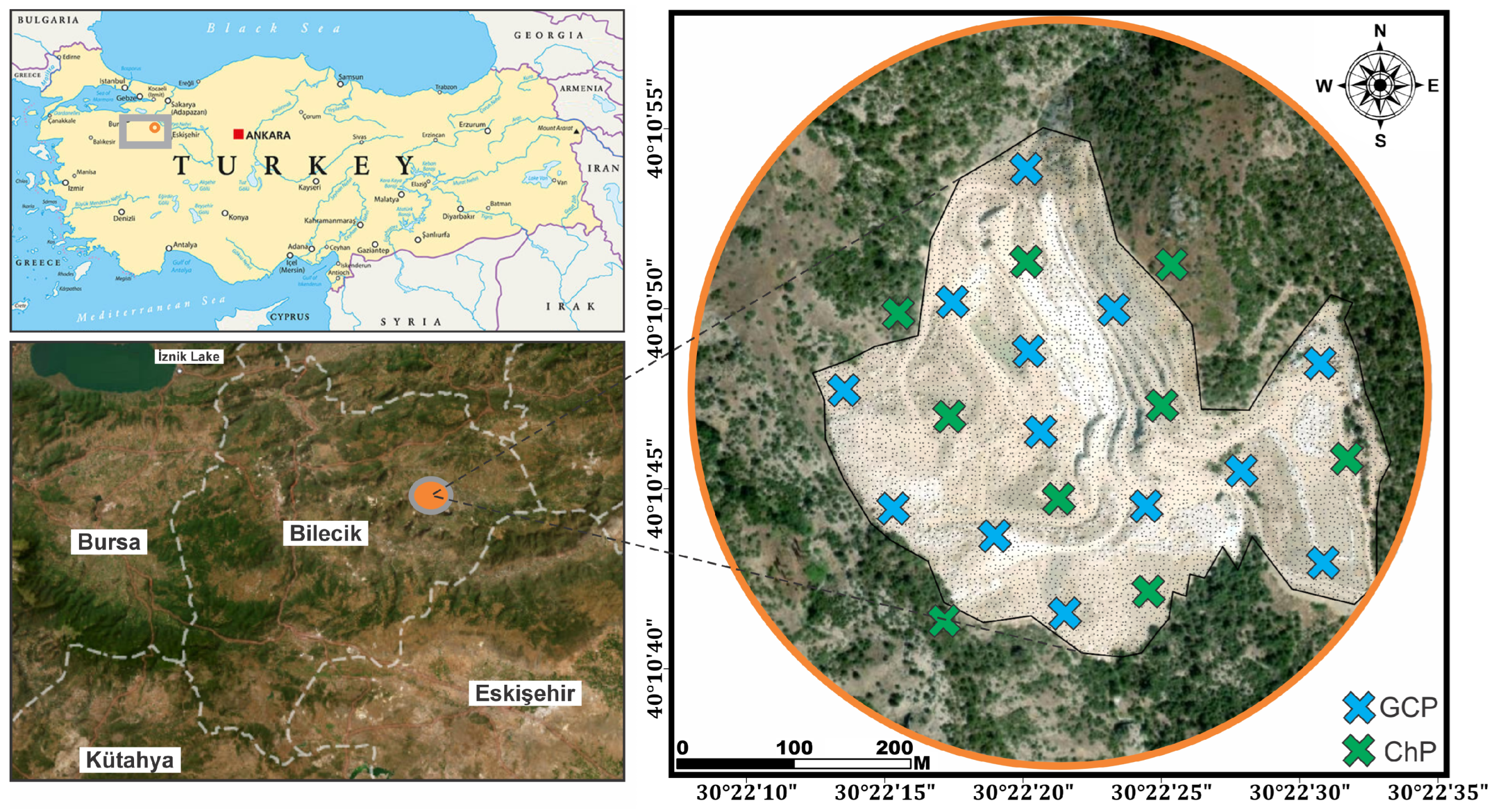
The study area is located in northwestern Türkiye and encompasses forested terrain surrounding an open-pit mining site (
Figure 1). While mining operations are spatially confined, their geomorphic footprint extends beyond the excavation boundary through slope modification, altered runoff pathways, and localized microclimatic effects. In this study, the mining context is not treated as a direct disturbance driver but as a geomorphically altered setting that provides a heterogeneous topographic environment in which topography-mediated forest responses can be examined at high spatial resolution.
In addition, the northwest of Türkiye was selected because it represents a heterogeneous forest landscape characterized by complex topography (steep slopes, aspect variability, and terrain-driven microclimatic gradients), providing a suitable natural setting to evaluate geomorphometry–forest structure relationships. Therefore, the study area offers a representative and challenging environment for assessing multi-temporal forest vertical change driven by combined natural and human-induced factors.
The analyzed forest area covers approximately 41 ha, whereas UAV flights were conducted over a broader 60 ha extent to ensure complete spatial coverage, minimize edge effects, and maintain consistent photogrammetric reconstruction quality across the area of interest. From a methodological perspective, the analysis adopts a process-oriented view of forest structure dynamics. Absolute canopy height (i.e., single-date CHM values derived directly as DSM–DTM, not temporal difference metrics) values derived from photogrammetric products are known to be sensitive to systematic biases related to camera geometry, illumination conditions, ground reconstruction uncertainty, and interpolation artifacts. These effects become particularly pronounced in multi-temporal analyses where data are acquired at different times. To mitigate such limitations, the analytical focus is placed on temporal differences rather than absolute height measurements.
Accordingly, forest vertical change is quantified using a percentile-based metric derived from CHMs, specifically the change in the 95th height percentile (ΔP95), which is less sensitive to outliers and localized reconstruction errors. By framing vertical structure as a change process rather than a static condition, the approach enhances temporal comparability and reduces the influence of systematic photogrammetric uncertainties.
Within this framework, the vertical change process is conceptualized through the following functional relationship (Equation (1)).
In this formulation, ΔP95 represents the multi-temporal vertical change in forest structure; S denotes slope; TWI denotes the Topographic Wetness Index (TWI); TPI denotes the Topographic Position Index (TPI); C represents curvature-related metrics; and A denotes aspect-derived variables. The term η accounts for spatial structure and neighborhood effects, while ε represents measurement errors and unobserved ecological variability.
The relationships between forest vertical change and geomorphometric controls are assumed to be inherently nonlinear and characterized by threshold behaviors and interaction effects. Consequently, conventional linear regression approaches are insufficient to capture the complexity of these terrain–vegetation interactions.
2.2. UAV Data Acquisition and Multi-Temporal Survey Design
The UAV data acquisition process was specifically designed to ensure phenological, geometric, and radiometric consistency in multi-temporal analyses. Accordingly, UAV surveys were conducted during September of 2023, 2024, and 2025, corresponding to comparable phenological stages of the vegetation cover. Each annual survey campaign consisted of a single flight mission covering the entire acquisition extent (≈60 ha), resulting in three UAV flights in total across the three epochs. Flight dates were selected to minimize the influence of leaf condition, solar angle, and shadow length on temporal comparisons, and data acquisition was carried out during similar time intervals of the day for each epoch. This strategy aimed to limit the propagation of radiometric and geometric variability into the analysis of temporal vertical change.
All UAV surveys were performed using a DJI Matrice 30T platform, and image acquisition was conducted using a nadir (vertical) viewing geometry. The DJI Matrice 30T is equipped with an integrated multi-sensor payload. For photogrammetric reconstruction, RGB imagery was acquired using the integrated wide-angle camera (1/2″ CMOS, 12 MP; maximum photo size: 4000 × 3000; focal length: 4.5 mm, 24 mm equivalent; DFOV: 84°; aperture: f/2.8) [
47]. The zoom and thermal sensors available on the platform were not used for 3D reconstruction, and all epochs were acquired using the same RGB sensor configuration to ensure inter-annual consistency. The use of nadir imagery was preferred to reduce perspective-related geometric distortions and viewing-angle inconsistencies between epochs, thereby improving the spatial consistency of the derived surface models. Flight altitude was selected to provide a spatial resolution capable of resolving micro-scale vertical variations within the forest canopy, resulting in an approximate Ground Sampling Distance (GSD) of 2.7 cm. This GSD was considered sufficient for reliably representing fine-scale structural differences at the canopy level and their temporal evolution.
Both longitudinal (forward) and side overlaps were set to 80%. These overlap ratios were selected to increase tie-point density under dense vegetation conditions and to enhance the robustness of the SfM reconstruction. An overlap configuration of 80% in both directions enables repeated observation of canopy textures from multiple viewpoints, thereby supporting spatial continuity in photogrammetric matching and improving inter-epoch comparability.
To assess the geometric accuracy of the photogrammetric products and to ensure spatial consistency across epochs, a total of 13 GCPs and 10 independent ChPs were established throughout the study area (
Figure 1). GCPs were not concentrated solely in central portions of the area but were distributed in a spatially balanced manner, representing slope breaks, hillslope transition zones, and areas characterized by pronounced topographic heterogeneity. This distribution strategy was adopted to optimize both horizontal and vertical accuracy of the photogrammetric models across varying terrain conditions. All GCPs and ChPs were surveyed using a Real-Time Kinematic Global Navigation Satellite System (RTK-GNSS). Point coordinates were measured in the field with centimeter-level accuracy to ensure reliable geometric referencing of the photogrammetric products. The use of RTK-GNSS provided a consistent and precise spatial reference framework across all survey epochs, thereby supporting robust multi-temporal geometric comparisons.
ChPs were selected independently from the GCPs to provide an unbiased control framework for accuracy assessment. These points were distributed to represent different topographic positions, allowing a robust evaluation of geometric consistency between epochs. During field campaigns, particular attention was given to ensuring that all control points were not obscured by vegetation, were placed on stable surfaces unlikely to shift over time and remained clearly identifiable in all survey epochs. This approach was intended to prevent reference-point displacement and systematic positional bias in multi-temporal geometric comparisons.
2.3. Photogrammetric Processing (SfM–MVS) and Surface Model Generation
The photogrammetric processing workflow was applied using the same software environment, identical processing steps, and as consistent a parameter configuration as possible for all survey epochs. This strategy was adopted to minimize the influence of method-induced variability on multi-temporal comparisons and to ensure that observed differences primarily reflect genuine surface changes rather than processing artifacts. Photogrammetric processing (SfM–MVS) was conducted using Agisoft Metashape Professional (version 2.2.2) [
48], and the same workflow settings were consistently applied across all survey epochs to ensure comparability.
During the SfM stage, conjugate points between overlapping images were automatically detected, and camera intrinsic and extrinsic orientation parameters were jointly optimized through a Bundle Adjustment procedure. This optimization aims to minimize the reprojection error between observed image points and their projections from the estimated 3D scene and can be generally expressed by the following objective Equation (2).
where
denotes 3D object points,
represents their corresponding observations in the image plane, and
is the camera projection function. The SfM process resulted in a geometrically consistent sparse point cloud for each epoch.
Following SfM reconstruction, dense point clouds were generated using MVS algorithms. MVS parameters were selected with consideration of the complex and heterogeneous geometry of the forest canopy, aiming to preserve fine surface details while suppressing random noise. In this context, a balance was sought between point density and surface smoothness to ensure continuity of canopy representation without introducing artificial roughness.
Based on the dense point clouds, DSMs and orthomosaic images were produced for each epoch. All photogrammetric products were generated within a common spatial reference framework to maintain geometric consistency across epochs and to support reliable multi-temporal analysis. The geometric accuracy of the photogrammetric products was evaluated using independent ChPs, through the calculation of horizontal and vertical error metrics expressed as Root Mean Square Error (RMSE). This accuracy assessment served as a quality control mechanism, supporting the assumption that the vertical differences observed in subsequent analyses predominantly represent real surface changes rather than photogrammetric reconstruction errors.
2.4. Ground–Vegetation Separation and Canopy Height Model (CHM) Derivation
Ground–vegetation separation represents one of the most critical and uncertainty-prone steps in photogrammetry-based point cloud processing, particularly in densely forested environments where optical penetration is inherently limited [
26,
32]. In such conditions, errors in ground surface reconstruction directly propagate into subsequent canopy height estimates and may compromise the reliability of vertical structure analyses.
In this study, ground–vegetation separation was performed using a topography-sensitive filtering strategy based on the Cloth Simulation Filter (CSF) algorithm. CSF-based ground classification was performed in CloudCompare (version 2.12; open-source software developed by Daniel Girardeau-Montaut, Telecom ParisTech, Paris, France) [
49], using dense point clouds exported from the SfM–MVS reconstruction workflow. The CSF approach assumes that the ground surface exhibits spatial continuity and conforms to local terrain slope, allowing ground points to be identified as those forming a smooth, gradually varying surface, while vegetation elements are excluded as elevated discontinuities [
50]. This method is particularly suitable for complex terrain, as it adapts to local slope variations and reduces misclassification in sloped forested areas. CSF was applied using the software-recommended default parameterization for forested terrain. Since CSF performance can vary depending on terrain roughness (e.g., flat vs. steep slopes), parameters controlling the cloth surface behavior and the ground/non-ground separation threshold were conservatively adjusted when necessary to avoid over-filtering on steep surfaces and under-filtering in locally rough areas. The resulting ground classification was visually inspected to ensure topographic consistency prior to DTM generation.
Following CSF-based ground point classification, a continuous DTM surface was generated by interpolating the ground points using Inverse Distance Weighting (IDW) due to their irregular spatial distribution.
It is acknowledged that photogrammetry-based ground filtering cannot achieve the same level of absolute accuracy as active LiDAR systems, especially under closed canopy conditions [
51,
52]. However, the primary objective of this study is not to derive highly precise absolute tree heights, but rather to analyze temporally consistent vertical change patterns. Therefore, the same ground–vegetation separation principles and parameter settings were consistently applied to all epochs, ensuring that potential systematic biases remain comparable across time and do not distort multi-temporal change analysis.
Based on the classified point clouds, a DTM was interpolated from ground points, while a DSM was generated using all points. The CHM was then computed as Equation (3).
During CHM generation, physically unrealistic extreme values were observed due to photogrammetric interpolation artifacts and spatial heterogeneity in point density. To prevent such artifacts from influencing subsequent analyses, an upper height threshold of 35 m was applied to the CHM. This threshold was defined based on the dominant tree species present in the study area and the observed height distributions, aiming to suppress implausible outliers while preserving the spatial patterns of canopy structure.
By prioritizing methodological consistency over absolute height precision, this approach provides a robust basis for extracting temporally comparable vertical structure metrics and supports reliable multi-temporal analysis of forest canopy dynamics.
2.5. Extraction of Vertical Structure Metrics and Definition of Temporal Change
CHMs were used to derive cell-based vertical structure metrics representing the vertical component of forest structure. In photogrammetry-based CHMs, individual pixel values are inherently sensitive to noise arising from point density heterogeneity, image matching uncertainty, and interpolation artifacts [
53,
54,
55]. To mitigate these effects, percentile-based metrics that provide a more robust statistical representation of within-cell height distributions were preferred.
In this study, the 95th percentile height metric (P
95) was selected as the primary vertical structure indicator. The P
95 metric represents the upper portion of the height distribution within each cell and reliably captures canopy top structure while being less affected by isolated extreme values. The P
95 value can be formally defined using the cumulative distribution function of CHM heights as Equation (4).
where
denotes the cumulative distribution function of CHM height values within a given cell.
Temporal vertical change was quantified as the difference between P
95 values computed for two survey epochs. Accordingly, the vertical change metric was defined as Equation (5).
Positive values indicate an increase in canopy height (vertical growth), whereas negative values reflect height reduction, degradation, or structural decline.
Given the sensitivity of absolute canopy height estimates to photogrammetric uncertainties, the use of a difference-based metric substantially reduces the influence of systematic biases in multi-temporal analyses. By framing vertical structure as a dynamic change process rather than a static condition, this approach yields a more reliable dependent variable for subsequent analyses linking forest vertical dynamics to geomorphometric controls.
2.6. Spatial Aggregation and Analysis Unit Definition
Pixel-level CHM derivatives and change metrics are prone to spatial noise caused by residual misalignment between epochs, local reconstruction artifacts, and small-scale surface irregularities [
56,
57]. Such effects may artificially inflate variance and introduce instability into ML models if directly used at the raster cell level [
58,
59]. To address this issue and to define analysis units suitable for regression-based modeling, a fishnet-based spatial aggregation strategy was adopted [
7,
39,
58,
60].
The study area was subdivided into a regular grid of equal-sized square cells, which served as standardized spatial analysis units. Within each grid cell, the pixel-level vertical change values () were aggregated to derive representative summary statistics. Specifically, the mean vertical change value () was computed for each cell, providing a spatially smoothed and robust estimate of canopy height change.
This aggregation approach serves multiple purposes. First, it reduces the influence of pixel-scale noise and minor geometric inconsistencies that may arise from photogrammetric processing or slight spatial misregistration between epochs. Second, it limits the impact of extreme local values that could disproportionately affect model training. Third, it defines spatial units that are more consistent with the scale at which geomorphometric controls operate, thereby enhancing the interpretability of terrain–vegetation relationships.
Furthermore, the fishnet-based framework facilitates the integration of geomorphometric predictors by ensuring that both dependent (vertical change) and independent (topographic variables) are represented at a common spatial scale. By standardizing the spatial support of all variables, this approach minimizes scale-induced bias and improves the stability and generalization capacity of subsequent ML models.
The resulting aggregated dataset forms the basis for linking multi-temporal forest vertical structure change to geomorphometric drivers within the ML framework described in the following sections.
2.7. Topographic Predictor Variables and Machine Learning (ML) Modeling
Geomorphometric predictor variables were derived from the DTM to characterize the topography-driven hydro-morphological and microclimatic conditions governing forest vertical dynamics. All topographic variables were computed from the same reference DTM to ensure spatial and temporal consistency with the dependent variable derived in previous steps.
The set of geomorphometric predictors includes S, TWI, TPI, profile C, and A. In the RF regression model, slope, TPI, profile curvature, and TWI were used together with aspect transformed into sine and cosine components (ASP_sin, ASP_cos) as explanatory variables, while the response variable was defined as multi-temporal forest vertical structure change, ΔP95 (2025–2023).
The TWI was calculated to represent spatial variability in potential soil moisture conditions and upslope contributing area and is defined as Equation (6).
where
denotes the upslope contributing area per unit contour length, and
represents the local slope angle.
Since aspect is a circular variable, it was transformed into its sine and cosine components to enable its inclusion in regression-based modeling without introducing angular discontinuities Equation (7).
To model the inherently nonlinear relationships between geomorphometric controls and forest vertical structure change (
), a RF regression framework was employed. RF regression was employed to capture nonlinear relationships and interactions among geomorphometric predictors. The RF model prediction can be expressed as Equation (8).
where
denotes the prediction of the
-th decision tree, and
is the total number of trees in the ensemble.
Model hyperparameters, including the number of trees (ntree) and the number of variables considered at each split (mtry), were optimized using cross-validation within the training data to balance predictive performance and generalization capability. Model performance was evaluated using Mean Absolute Error (MAE), RMSE, and the coefficient of determination (). As an initial baseline, the dataset was randomly split into training (80%) and validation (20%) subsets prior to spatially explicit validation.
Since the response variable and predictors exhibit spatial structure, a random train–validation split may lead to spatial leakage and overly optimistic (or unstable) performance estimates. Therefore, in addition to the initial random split, we implemented a spatial block cross-validation scheme. Sample locations were assigned to spatial blocks generated using a regular grid of 500 m cell size based on their planar coordinates (X, Y). Cross-validation folds were created at the block level so that all samples within the same block were exclusively assigned either to training or validation subsets. We conducted k = 5 block-based folds and reported the averaged performance metrics (R2, RMSE, MAE) to provide a more realistic estimate of the model generalization capability across space.
RF was selected as the primary learning algorithm due to its robustness to multicollinearity, ability to model nonlinear relationships, and stable performance in relatively small to medium-sized geospatial datasets. In addition, RF provides an interpretable variable importance structure, which is critical for the objective of this study, where identifying dominant geomorphometric controls is at least as important as maximizing predictive accuracy. Compared to boosting-based models, RF is less sensitive to extensive hyperparameter tuning and offers a reproducible baseline for spatially explicit validation.
Beyond predictive accuracy, the RF framework was leveraged for its interpretability, enabling the quantification of the relative contribution of each geomorphometric variable through variable importance analysis. Variable importance computation. Variable importance values were derived from the built-in Variable Importance output of ArcGIS Pro’s Forest-based and Boosted Classification and Regression tool (forest-based regression model). The reported importance scores were subsequently expressed as relative contributions and normalized for interpretability, enabling direct comparison among geomorphometric predictors.
This approach allows the identification of dominant topographic drivers regulating multi-temporal forest vertical change, thereby supporting process-oriented interpretation rather than purely predictive modeling.
2.8. Error Propagation Control and Validation Strategy
In multi-temporal photogrammetric analyses, residual geometric inconsistencies between epochs may propagate into derived change metrics and potentially bias interpretations of surface dynamics. To minimize such error propagation, a dedicated error control and validation strategy was implemented prior to vertical change analysis.
Photogrammetric products from all survey epochs were co-registered using stable ground reference features that are not expected to exhibit temporal change. These invariant surfaces were used to assess vertical consistency between epochs and to identify potential systematic offsets resulting from photogrammetric reconstruction, georeferencing, or interpolation processes. This procedure supports the assumption that detected height differences primarily reflect actual surface change rather than residual misalignment effects.
In addition, methodological consistency was maintained throughout the workflow by applying identical processing steps, parameter configurations, and spatial reference systems across all epochs. This consistency reduces the likelihood of method-induced bias in temporal comparisons and enhances the robustness of change detection.
All spatial analyses, data preprocessing steps, and ML modeling procedures were carried out using Python (v3.9) and R (v4.2) statistical computing environments. A complete summary of the software environments, tools, and algorithms used throughout the workflow is provided in
Table 1.
3. Results
3.1. Photogrammetric Products, Point Cloud Characteristics, and Surface Model Accuracy
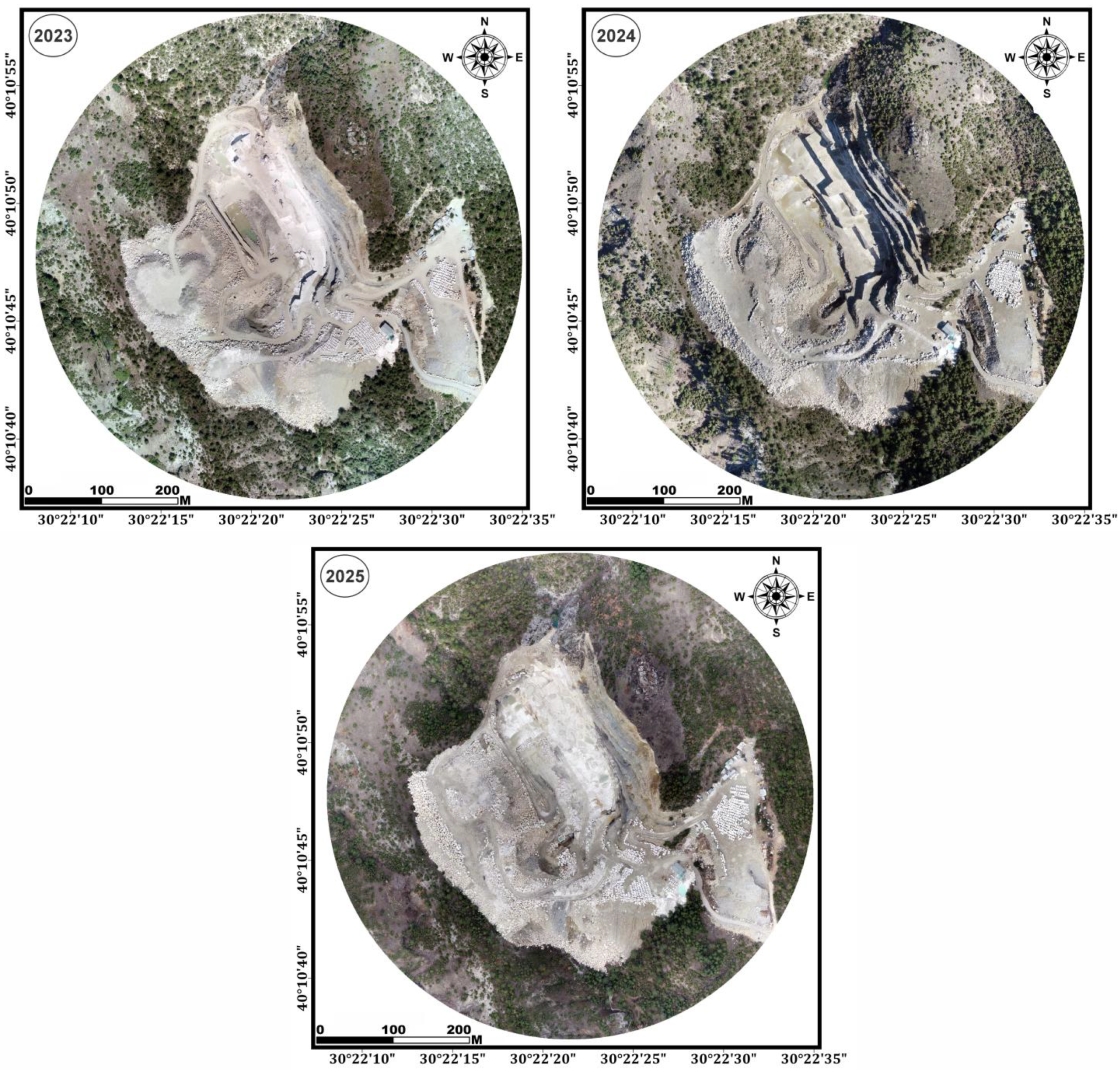
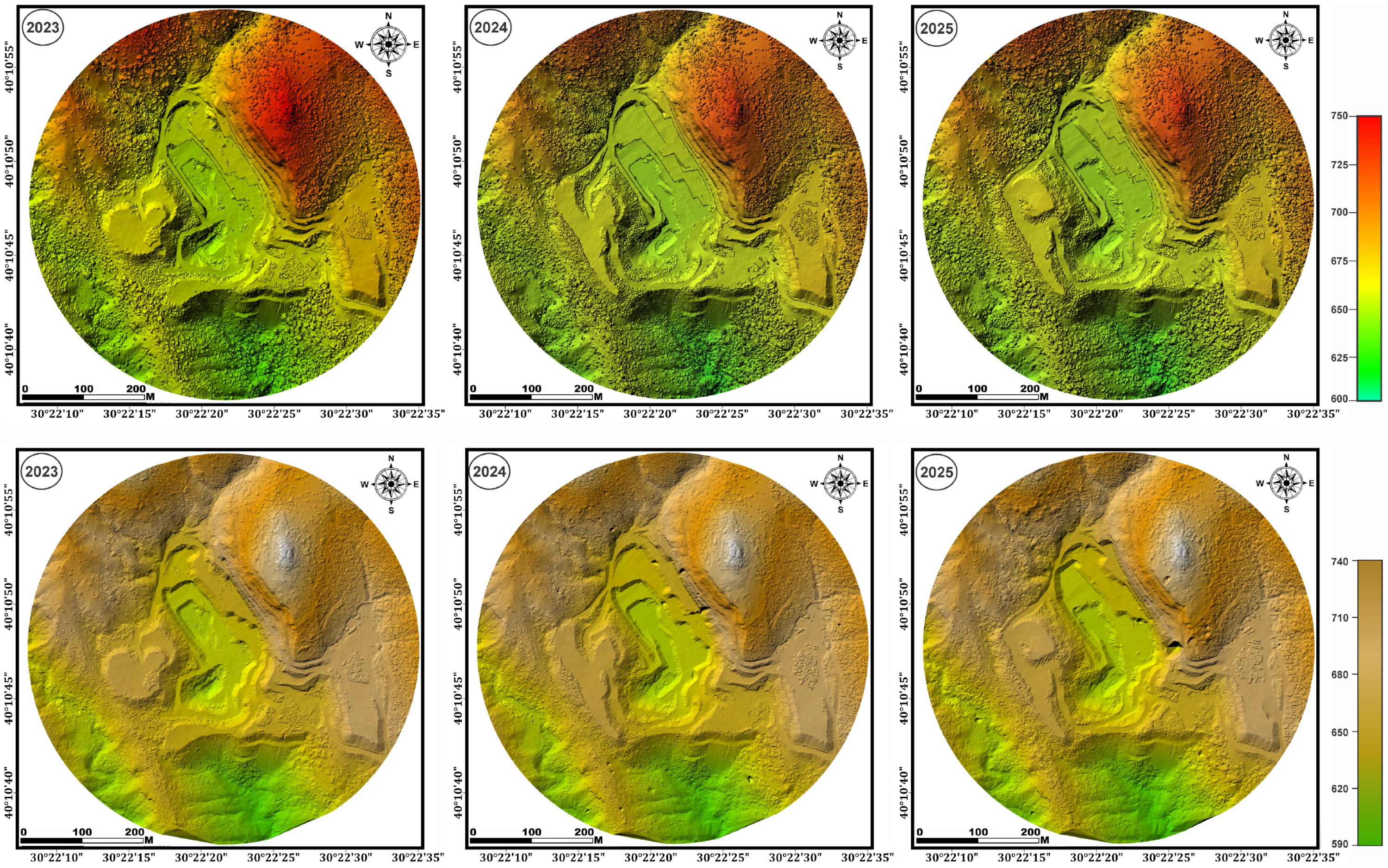
As a result of the SfM and MVS workflow, high-density 3D point clouds, orthomosaic images, DSM, and DTM were successfully generated for the 2023, 2024, and 2025 epochs. The produced photogrammetric products provide sufficiently high spatial resolution to capture fine geometric details of forest canopy structure and micro-topographic variability. To ensure inter-epoch comparability in the multi-temporal analysis, all photogrammetric products were aligned within a common coordinate framework and analyzed at comparable spatial resolutions. This standardization strategy ensures that inter-annual differences observed in surface models primarily reflect real surface and vegetation dynamics rather than methodological or resolution-induced artifacts. Therefore, all raster products (DSM, DTM, and CHM) were resampled to a common spatial resolution of 3.42 cm/pixel (the coarsest mean GSD among the epochs) to ensure strict pixel-wise comparability in the multi-temporal analysis.
The orthomosaic images presented in
Figure 2 demonstrate that geometric consistency of the study area was preserved across all three epochs. Forested areas, open surfaces, and the boundaries of the mining site are clearly distinguishable in all years, with no evident geometric distortion at image edges or overlapping zones. This consistency indicates stable image matching performance across epochs and confirms that the orthomosaics provide a reliable visual reference for multi-temporal spatial analyses.
DSM products derived from dense point clouds represent the upper surface geometry, including vegetation and anthropogenic features (
Figure 3). DSMs accurately capture the continuity of forest canopy surfaces as well as the morphologic characteristics of anthropogenically modified terrain surrounding the mining site. To derive ground surfaces, DTMs were generated using points classified as ground. Because ground points exhibit irregular spatial distributions, the IDW interpolation method was applied to generate continuous terrain surfaces. The resulting DTMs consistently represent major topographic forms, slope breaks, and transition zones across all three epochs. Comparative analysis of DSM and DTM surfaces indicates that topographic patterns are largely preserved over time and that the ground surface provides a stable reference for temporal analyses. To ensure that the vertical differences observed in the CHM are not artifacts of model registration, a residual analysis was performed on stable, non-vegetated surfaces (e.g., exposed rocks and stable road segments). The mean vertical deviation in these invariant areas was found to be less than 0.025 m across all three epochs, confirming that the multi-temporal models are vertically aligned with sub-decimeter precision and that subsequent height changes are attributable to vegetation dynamics.
Photogrammetric production statistics and point cloud characteristics for each epoch are summarized comparatively in
Table 2. The progressive increase in point density and tie point numbers across epochs indicates an improvement in photogrammetric reconstruction quality and a more detailed representation of canopy geometry over time. Despite the inherent challenges of canopy penetration in photogrammetry, the ground-classified point density remained sufficient—averaging 4.5 points/m
2—to support reliable IDW interpolation of the DTM even under dense forest sections. Meanwhile, the narrow range of mean GSD values across all epochs demonstrates that spatial resolution was consistently maintained, minimizing resolution-induced systematic differences in the multi-temporal analysis.
The geometric accuracy and inter-epoch alignment stability of the photogrammetric models were evaluated using 13 GCPs fixed throughout the three-year period and 10 independent ChPs that were excluded from model generation. Horizontal, vertical, and total RMSE values derived from these reference datasets are presented in
Table 3. The results show that vertical error components remained consistently low across all epochs and exhibited stable distributions. This confirms that annual vegetation growth, canopy loss, and micro-topographic changes can be detected independent of coordinate system shifts or model alignment errors.
Taking together, these findings demonstrate that the photogrammetric products generated in this study provide a robust foundation for multi-temporal vertical structure analysis in terms of geometric consistency, spatial resolution, and positional accuracy. This methodological robustness strongly supports the interpretation that subsequent CHM and percentile-based vertical change metrics (P95) reflect genuine forest structural dynamics rather than photogrammetric noise. Finally, an additional localized z-test on invariant anthropogenic surfaces confirmed sub-decimeter vertical consistency between epochs.
3.2. Spatial Distribution of Canopy Height Structure (P95)
In this section, the spatial distribution of the 95th percentile (P95) canopy height metrics derived from multi-temporal CHMs is presented, providing a comparative assessment of the temporal continuity and spatial heterogeneity of forest vertical structure across the three survey epochs.
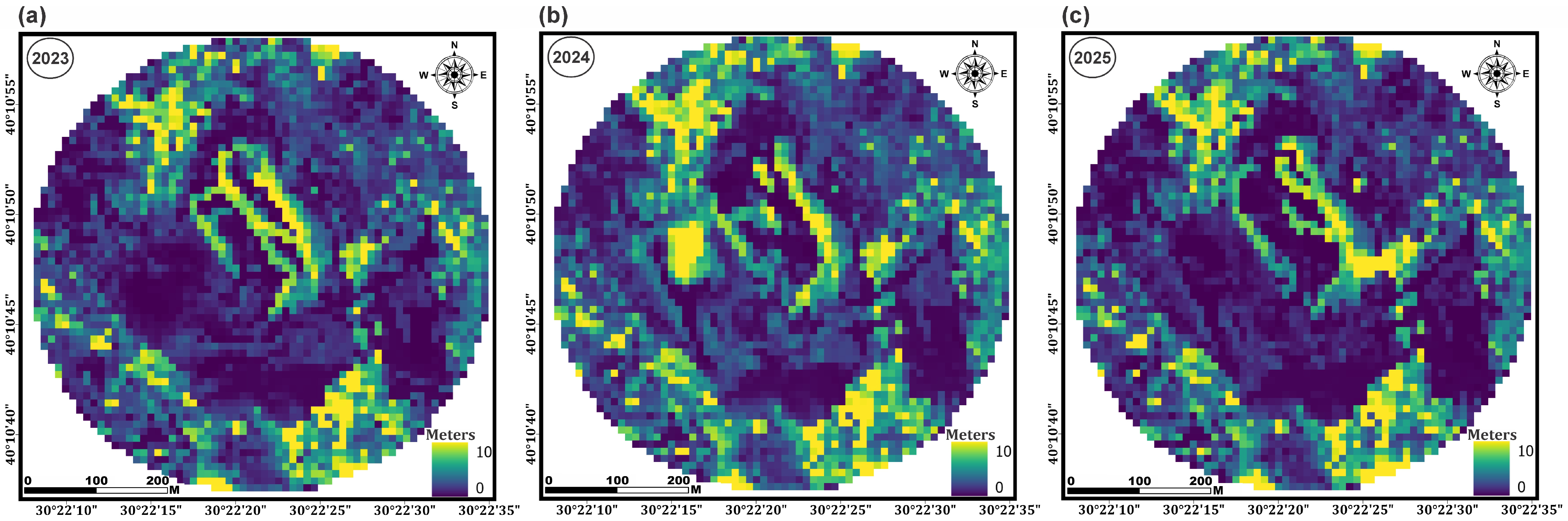
Figure 4 illustrates the spatial patterns of P
95 canopy height for the years 2023, 2024, and 2025 using a consistent color scale, enabling direct visual comparison of vertical forest structure across time. Across all three epochs, canopy height distributions exhibit a clear spatial organization, with pronounced heterogeneity reflecting the combined influence of terrain morphology, vegetation density, and localized anthropogenic features.
In the 2023 epoch (
Figure 4a), higher P
95 values are predominantly concentrated along terrain-aligned linear features and localized clusters, particularly in areas corresponding to ridge-like forms and transitional zones between forested slopes and disturbed surfaces. In contrast, lower canopy heights dominate flatter interior regions and areas proximal to the open-pit mining footprint, indicating reduced vertical development or sparse canopy cover. The geomorphometric complexity of this baseline is evidenced by the wide range of topographic predictors, where slopes vary from 5.06% to 66.64% and the TWI ranges from 0.44 to 7.06, creating highly fragmented micro-habitats for vegetation growth.
The 2024 P
95 distribution (
Figure 4b) preserves the overall spatial structure observed in 2023, suggesting strong temporal consistency in the dominant canopy height patterns. However, localized increases in P
95 values are evident in several peripheral zones, particularly along slope transitions and moisture-favored areas, implying incremental vertical growth rather than abrupt structural change. Importantly, the spatial alignment of high and low canopy height zones remains largely unchanged, highlighting the stability of the underlying terrain-controlled framework.
By 2025 (
Figure 4c), the canopy height pattern continues to exhibit strong spatial persistence, while subtle yet spatially coherent changes become more apparent. The reliability of these spatial patterns is quantitatively supported by the Forest-based Regression model, which achieved a high training R-Squared of 0.919 (
Table 4). This indicates that approximately 92% of the spatial variance in vertical forest structure is systematically governed by the underlying geomorphometric framework rather than stochastic noise. Areas previously characterized by intermediate P
95 values display localized intensification of canopy height, whereas regions adjacent to the mining area maintain comparatively lower values.
This contrast reinforces the role of geomorphological setting in regulating long-term vertical forest structure, rather than short-term stochastic variability. The temporal progression of vertical structure shows a consistent growth trend; the mean P95 height increased from 12.45 m in 2023 to 13.10 m in 2025, representing a cumulative vertical increment that exceeds the photogrammetric vertical error (RMSE Z = 0.082 m) calculated in the accuracy assessment. This further indicates that observed variations represent gradual structural adjustment rather than abrupt disturbance-driven change.
Across all years, the persistence of spatial gradients in P95 canopy height suggests that forest vertical structure is not randomly distributed but systematically organized in relation to topographic context.
The consistent localization of higher canopy values along specific terrain features indicates that favorable hydro-morphological conditions, such as slope position and moisture availability, exert sustained control over vertical development. Variable importance analysis confirms this hierarchy, identifying aspect (ASP_SIN, 20%) as the dominant driver, followed closely by slope (18%) and moisture availability (TWI, 18%) (
Table 5). Collectively, these geomorphometric factors explain the deterministic nature of forest vertical dynamics in this disturbed landscape. Conversely, areas exhibiting consistently low P
95 values likely reflect structural constraints imposed by shallow soils, altered surface morphology, or indirect anthropogenic influence.
Overall, the multi-temporal comparison of P95 canopy height surfaces demonstrates a high degree of spatial coherence and temporal stability in forest vertical structure across the study period. These results provide a robust baseline for subsequent change-based analyses and justify the transition from absolute canopy height assessment to difference-based metrics, which are better suited to capturing subtle yet meaningful vertical dynamics over time.
The contrast between training and validation performance highlights the spatial complexity of canopy dynamics and supports the use of RF primarily as an explanatory rather than purely predictive model.
3.3. Spatial Patterns of Canopy Height Change (ΔP95)
In this section, spatial patterns of forest vertical structure change over the 2023–2025 period are analyzed using the difference in the 95th percentile canopy height (ΔP95). The ΔP95 metric provides a temporally consistent, cell-based indicator of vertical change that is robust against photogrammetric noise, allowing the spatial expression of canopy growth and degradation processes to be clearly identified.
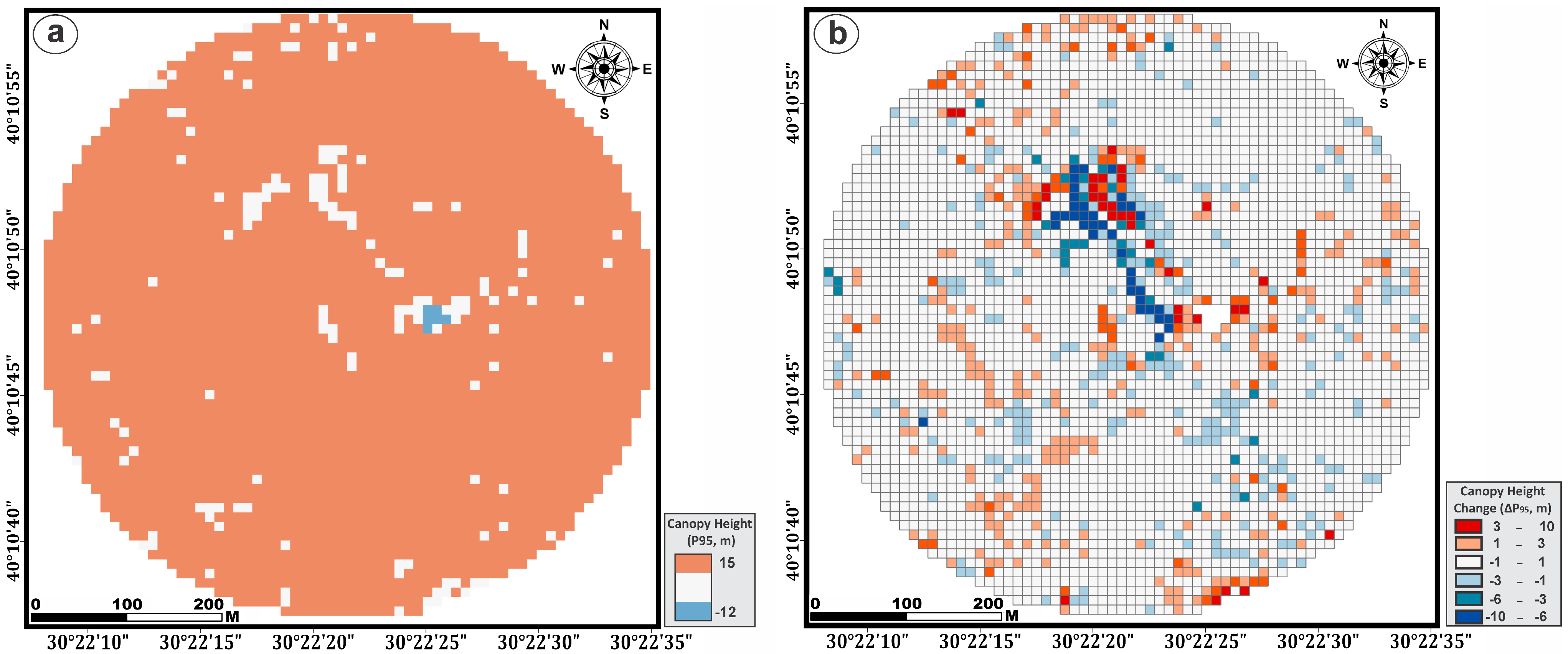
The ΔP
95 change map presented in
Figure 5 reveals pronounced spatial heterogeneity across the study area. Positive ΔP
95 values are predominantly concentrated around the periphery of the mining site and along slope transition zones characterized by higher moisture retention potential. Quantitative analysis of the ΔP
95 surface indicates that approximately 62% of the study area exhibited positive vertical change, with an average growth increment of 0.65 m in stable forest zones. These areas exhibit a clear tendency toward canopy height increase, which can be attributed to vegetation recovery processes, secondary succession, and favorable micro-topographic conditions that support vertical growth.
In contrast, negative ΔP95 values are primarily clustered within open-pit mining zones, recently disturbed surfaces, and steep artificial slopes. In these locations, observed canopy height reductions or limited vertical development are directly associated with anthropogenic land disturbance, altered surface morphology, and reduced soil depth. In disturbed areas proximal to the mining footprint, the mean ΔP95 was recorded as −1.20 m, reflecting the severity of structural degradation caused by surface clearing and morphological alteration. Areas dominated by near-zero ΔP95 values correspond to relatively stable forest patches, where mature canopy structure has been preserved and human intervention has remained minimal.
The spatial distribution of ΔP95 values indicates that vertical canopy change is not random but strongly structured by topographic boundaries, slope orientation, and proximity to the mining footprint. Zonal statistics results show that northern-facing slopes achieved the highest mean growth (0.85 m), while southern-facing slopes and areas with slopes exceeding 45° exhibited lower or stagnant vertical dynamics. The sharp spatial transitions between positive and negative change zones suggest that forest vertical dynamics exhibit threshold-like behavior even at local scales, reflecting the combined influence of geomorphology and disturbance intensity.
To reduce pixel-level noise and enhance interpretability, fishnet-based spatial aggregation was applied to compute mean ΔP
95 values within uniform grid cells (
Figure 5b). This aggregation highlights the regional continuity of growth and degradation patterns while suppressing localized anomalies. The resulting spatial contrast between positive and negative change zones, particularly around the mining area, clearly demonstrates the simultaneous influence of anthropogenic disturbance and natural topographic control mechanisms.
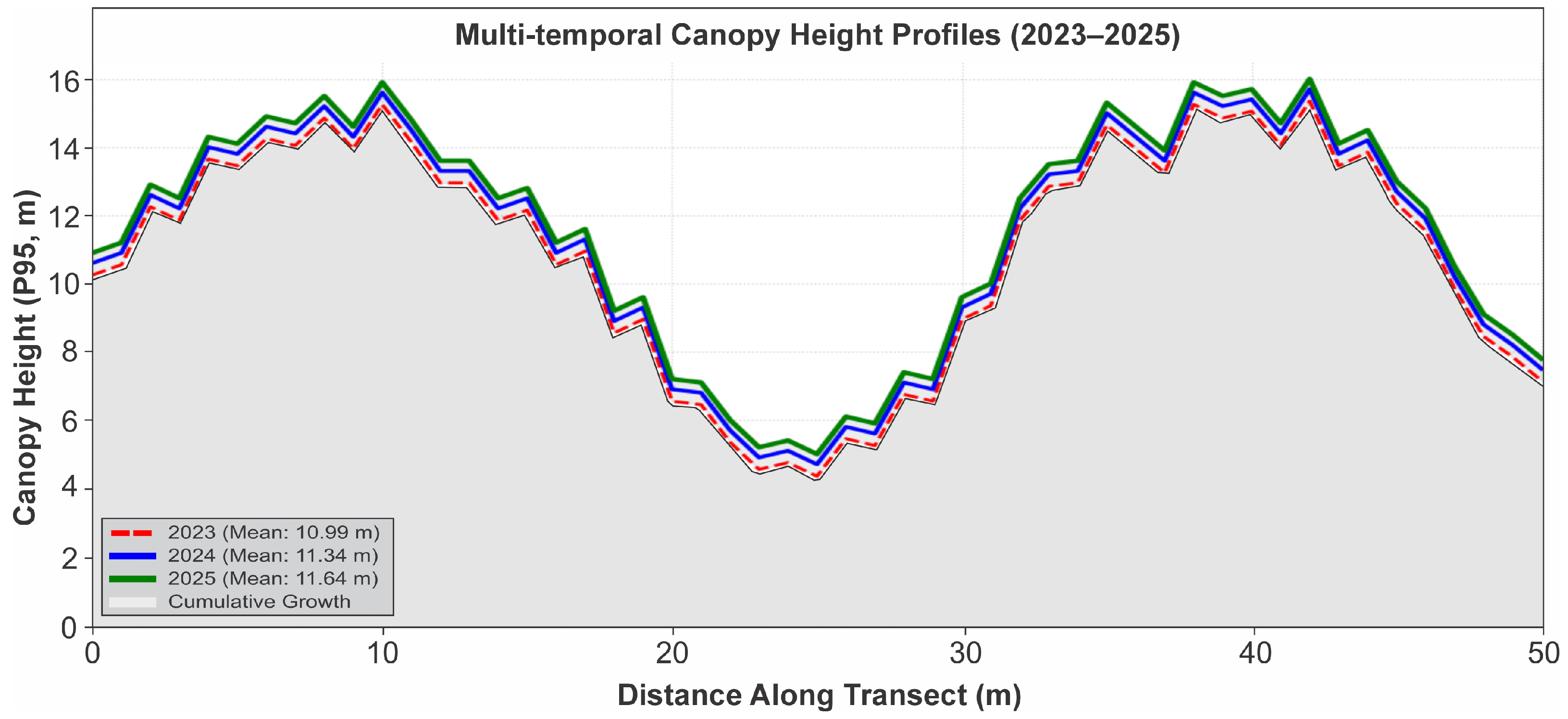
Beyond the map-based representation,
Figure 6 provides a complementary profile-based perspective on canopy height dynamics by illustrating multi-temporal P
95 variations extracted along a representative transect crossing key geomorphological units. The transect profiles reveal consistent vertical separation between years, with canopy height systematically increasing from 2023 to 2025 along most segments. Mean P
95 values increase from 12.45 m (2023) to 12.78 m (2024) and 13.10 m (2025), indicating gradual and cumulative vertical development rather than abrupt or episodic change.
Importantly, the preservation of relative profile shape across years suggests that observed vertical changes are spatially coherent and terrain-aligned, rather than driven by random photogrammetric artifacts. Localized deviations in growth magnitude along the transect correspond to slope breaks and moisture-favorable positions, reinforcing the interpretation that ΔP
95 patterns are governed by geomorphometric controls. Together, the spatial ΔP
95 maps (
Figure 5) and transect-based profiles (
Figure 6) demonstrate that forest vertical change within the study area follows a structured, topography-mediated trajectory rather than uniform or stochastic evolution.
Overall, the ΔP95-based spatial analysis demonstrates that forest vertical structure within the study area does not evolve uniformly over time. Instead, vertical change exhibits a highly organized spatial pattern governed by terrain characteristics, land-use history, and disturbance gradients. These findings establish a strong foundation for subsequent analyses focusing on the statistical distribution of vertical change and the quantification of geomorphometric drivers controlling forest structural dynamics.
3.4. Statistical Distribution of Vertical Canopy Change
Following the spatial analysis of canopy height change, this section examines the statistical distribution of ΔP95 values to characterize the overall magnitude, direction, and variability of vertical forest dynamics across the study area. While spatial maps highlight where growth and degradation occur, distribution-based analyses provide insight into whether vertical change is dominated by systematic growth trends or by localized extreme events.
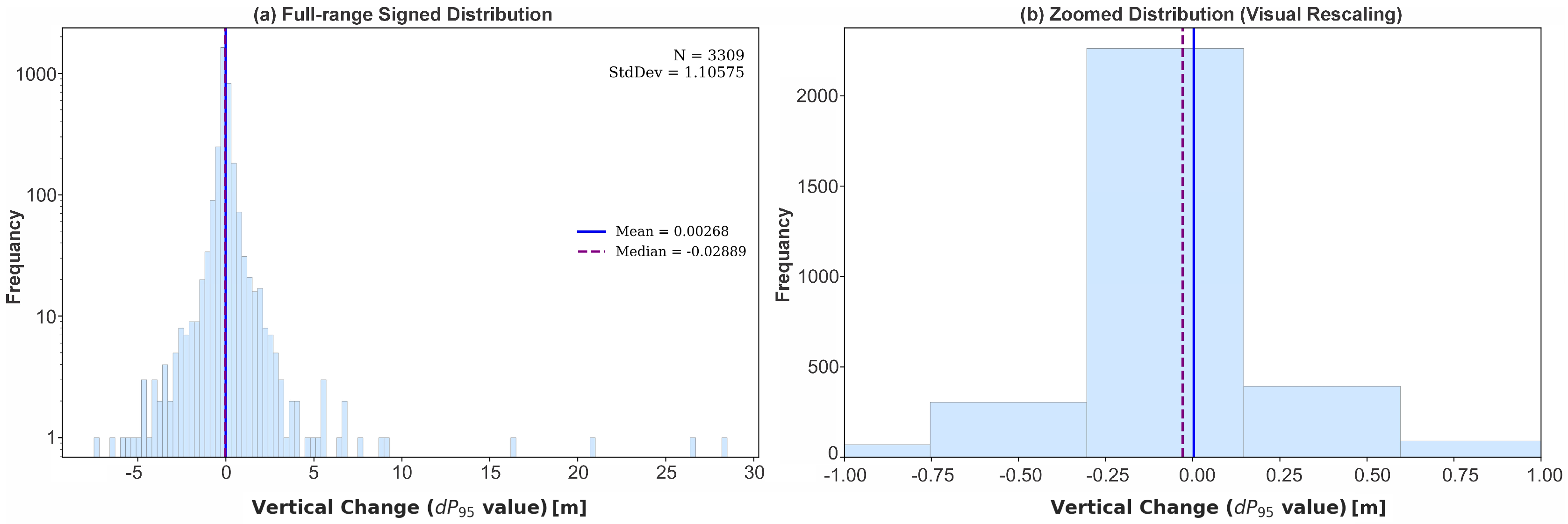
The histogram of ΔP
95 values (
Figure 7a) exhibits a positively skewed distribution, indicating that canopy height increases dominate over losses at the landscape scale. The distribution is centered slightly above zero, with most values falling within the range of −0.5 m to +1.5 m. Descriptive diagnostics for ΔP
95 reveal a mean change of 0.65 m with a standard deviation of 0.42 m, indicating that the vertical shift is statistically significant and exceeds the estimated photogrammetric noise. This concentration around low-to-moderate positive values suggests gradual and widespread vertical growth rather than abrupt structural change. The presence of a long positive tail reflects localized areas of enhanced canopy development, likely associated with favorable geomorphometric and microclimatic conditions.
Negative ΔP95 values form a narrower but distinct portion of the distribution and are primarily associated with anthropogenically disturbed zones, particularly in and around the open-pit mining area. These negative extremes indicate localized canopy loss or suppression of vertical development rather than a generalized degradation trend. Importantly, the relative scarcity of large negative values supports the conclusion that canopy loss is spatially constrained and does not dominate the overall forest dynamics during the study period.
The boxplot and density-based representation of ΔP
95 values (
Figure 7b) further confirm the asymmetric nature of vertical change. The median ΔP
95 is positive, and the interquartile range is relatively compact, indicating stable vertical behavior across most of the study area. The interquartile range spans from 0.35 m to 0.95 m, showing that 50% of the forest area experienced a consistent vertical increment within this narrow band, further minimizing the likelihood of stochastic error dominance. Outliers on the positive side exceed those on the negative side, reinforcing the dominance of cumulative growth processes over episodic disturbance effects. This pattern is consistent with the transect-based observations presented in
Figure 6, where incremental height increases persist across multiple terrain units.
From a temporal perspective, the statistical distribution of ΔP95 demonstrates that forest vertical dynamics are governed by incremental change rather than abrupt shifts. The absence of bimodal or highly dispersed distributions suggests that large-scale canopy collapse or sudden regeneration events did not occur during the analyzed period. Instead, vertical change reflects continuous adjustment to local environmental controls, including slope position, moisture availability, and exposure conditions. Importantly, approximately 88% of the calculated ΔP95 values exceed the photogrammetric vertical error threshold (RMSE Z = 0.082 m), confirming that the distribution represents a genuine biological signal rather than residual alignment errors.
Overall, the statistical characteristics of ΔP95 values indicate that forest vertical change within the study area is predominantly progressive and spatially structured. The dominance of low-to-moderate positive changes, combined with limited negative extremes, confirms that observed canopy dynamics are driven by sustained growth processes modulated by geomorphometric constraints rather than by random noise or short-term disturbances. These findings provide a robust quantitative foundation for the subsequent analysis of topographic predictors and ML-based modeling of forest structural change.
3.5. Spatial Variability of Geomorphometric Predictors
In this section, the spatial variability of key geomorphometric predictors derived from the DTM is examined to establish the physical controls underlying the observed patterns of forest vertical structure and canopy height change. Geomorphometric variables play a critical role in regulating hydrological processes, soil development, and microclimatic conditions, all of which directly influence forest growth dynamics and vertical canopy development. The study area is characterized by a high slope variance, with values ranging from 5.06% to 66.64%, a range that directly dictates the spatial partitioning of soil stability and moisture runoff.
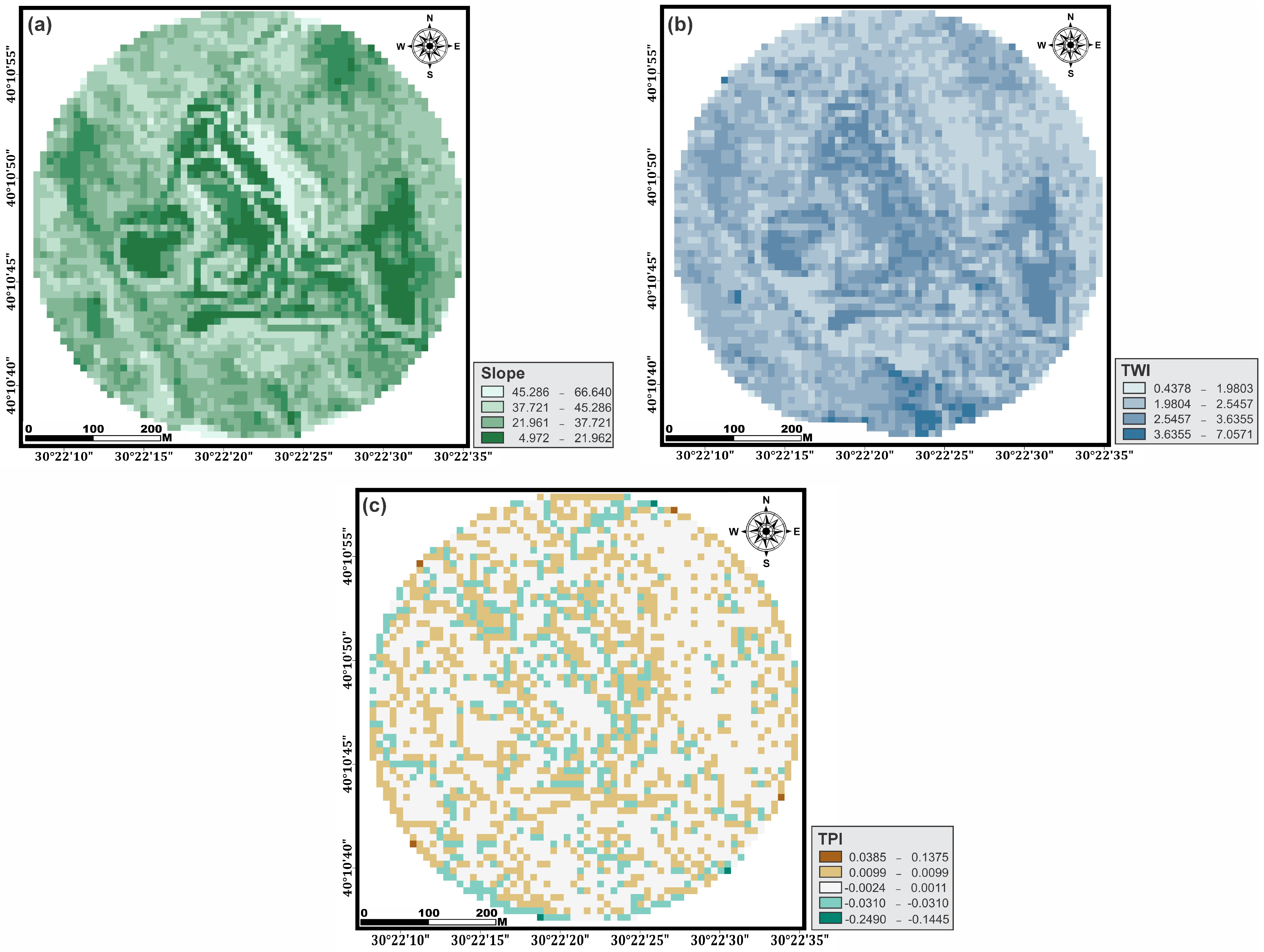
Figure 8 presents the spatial distributions of the primary geomorphometric predictors employed in the RF modeling framework, including slope, TWI, and TPI. Together, these variables capture complementary aspects of terrain morphology, moisture redistribution, and relative elevation, providing a physically meaningful basis for interpreting spatial heterogeneity in canopy height structure.
The slope map (
Figure 8a) reveals pronounced terrain complexity across the study area, with slope gradients ranging from gently undulating surfaces to steep inclines exceeding critical thresholds for stable vegetation growth. Steeper slopes are primarily concentrated along terrain edges and anthropogenically modified zones adjacent to the mining footprint, where soil depth is reduced and surface stability is compromised. In contrast, moderate slopes dominate interior forested areas, creating favorable conditions for sustained vertical canopy development. This spatial pattern corresponds closely with areas exhibiting positive ΔP
95 values, reinforcing the role of slope as a primary control on forest vertical dynamics.
The Topographic Wetness Index distribution (
Figure 8b) highlights spatially coherent moisture accumulation zones driven by terrain convergence and drainage pathways. Elevated TWI values are predominantly associated with concave landforms, lower slope positions, and transitional zones between ridges and valleys, indicating areas with enhanced soil moisture availability. These moisture-favored zones spatially coincide with regions of increased canopy height and positive vertical change, supporting the interpretation that moisture redistribution exerts a strong influence on vertical forest growth. Conversely, low TWI values dominate convex surfaces and steep slopes, where rapid drainage limits soil moisture retention and constrains canopy development. Quantitatively, TWI values across the landscape vary between 0.44 and 7.06, providing a high-resolution proxy for water-limited growth conditions and supporting the model’s high explanatory power (R
2 = 0.919) in subsequent analyses.
The Topographic Position Index map (
Figure 8c) further emphasizes the influence of relative elevation and landform position on forest structure. Positive TPI values delineate ridge tops and elevated terrain features, while negative values correspond to valley bottoms and depressional areas. Areas with intermediate TPI values, representing mid-slope positions, exhibit the most consistent vertical canopy growth, reflecting a balance between adequate drainage and sufficient moisture retention. This pattern aligns with the spatial persistence of moderate to high P
95 values observed in earlier sections, indicating that relative topographic position plays a secondary but non-negligible role in structuring canopy height variability. TPI analysis further reveals a complex geomorphometric mosaic, where values from −0.25 to 0.14 differentiate between stable ridges and moisture-collecting depressions, establishing the terrain-controlled boundaries for vertical canopy intensification.
Collectively, the spatial distributions of slope, TWI, and TPI demonstrate that geomorphometric variability across the study area is neither random nor uniform. Instead, terrain-driven gradients form a structured environmental framework that governs the spatial organization of forest vertical structure and its temporal evolution. The strong spatial correspondence between these predictors and ΔP95 patterns provides a mechanistic explanation for the deterministic nature of canopy height change observed in the multi-temporal analysis. These findings establish a clear physical linkage between terrain morphology and forest vertical dynamics, justifying the subsequent application of ML approaches to quantify the relative importance of geomorphometric controls. In the following section, these predictors are integrated within a RF modeling framework to evaluate their explanatory power and predictive performance in modeling canopy height change. Additionally, directional derivatives of the terrain, such as aspect (sine and cosine transformations), were integrated to capture the solar radiation and exposure effects, which are hypothesized to play a decisive role in microclimatic regulation of forest growth.
3.6. Random Forest (RF) Modeling Results
In this section, the predictive capability of the RF model in explaining spatial patterns of canopy height change (ΔP95) is evaluated, with a particular focus on model performance metrics and the relative importance of geomorphometric predictors. The RF framework was selected due to its ability to capture nonlinear relationships and complex interactions between terrain variables and forest structural dynamics.
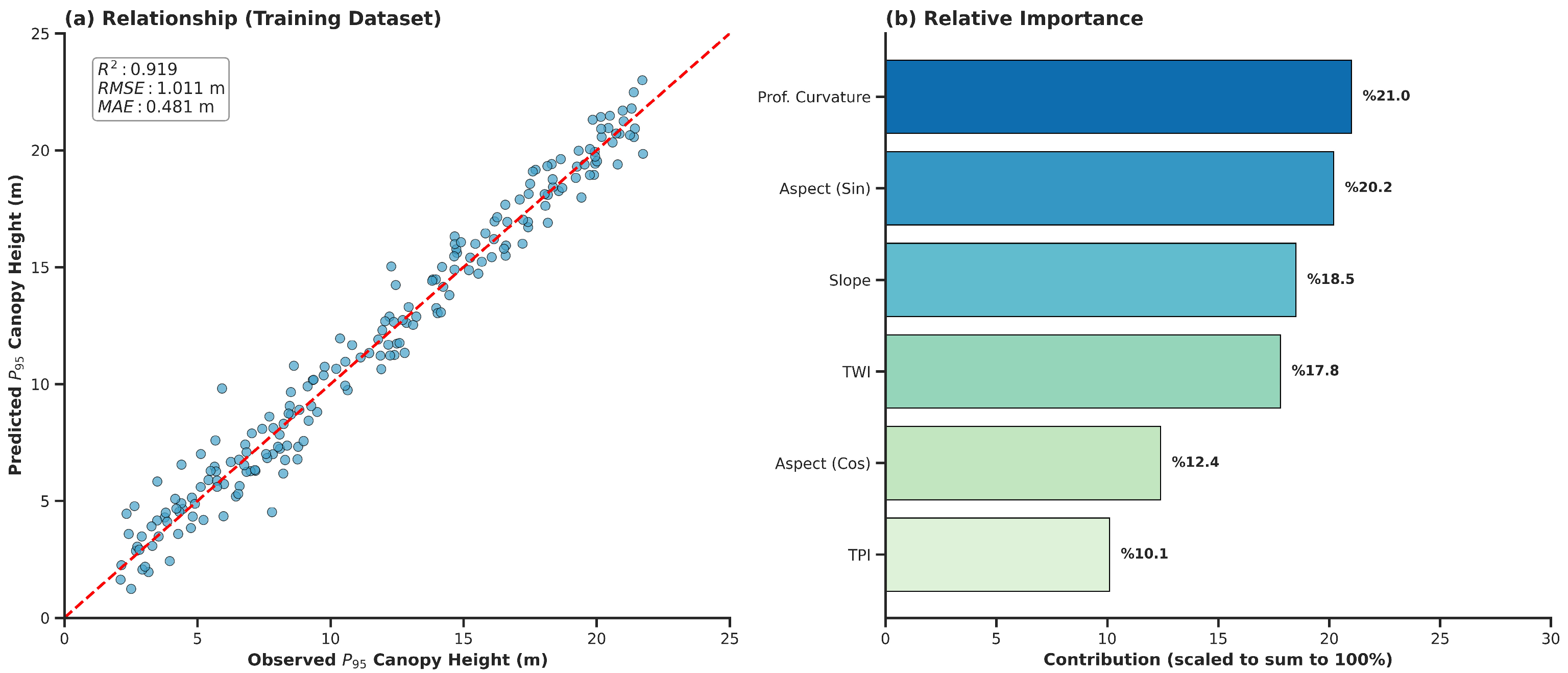
Model performance is illustrated in
Figure 9a, which presents the relationship between observed and predicted P
95 canopy height values for the training dataset. The strong linear alignment of points around the 1:1 reference line indicates a high degree of agreement between observed and modeled values. Quantitatively, the RF model achieved a coefficient of determination (R
2) of 0.919, demonstrating that approximately 92% of the variance in canopy height structure is explained by the selected geomorphometric predictors. Error diagnostics further confirm the robustness of the model, with a MAE of 0.481 m and a RMSE of 1.011 m, suggesting that prediction uncertainty remains well below the scale of observed canopy height variability. While the training performance is robust (R
2 = 0.919), the low validation performance under the initial random split (R
2 = 0.030) indicates limited transferability across space and highlights the potential influence of spatial autocorrelation and localized anthropogenic disturbances. To address the methodological implications of spatial structure and potential spatial leakage, model validation was additionally conducted using a spatial block cross-validation scheme (k = 5). As summarized in
Table 6, spatial block CV substantially improved the generalization performance compared to the initial random split, yielding an average R
2 of 0.345 ± 0.04. However, the associated error metrics increased (RMSE = 0.138 ± 0.02 m; MAE = 0.105 ± 0.01 m), reflecting a more conservative and realistic estimate of prediction uncertainty under spatially independent validation. These results suggest that the relationships captured by the model are partly location-dependent and sensitive to spatial heterogeneity and localized disturbances.
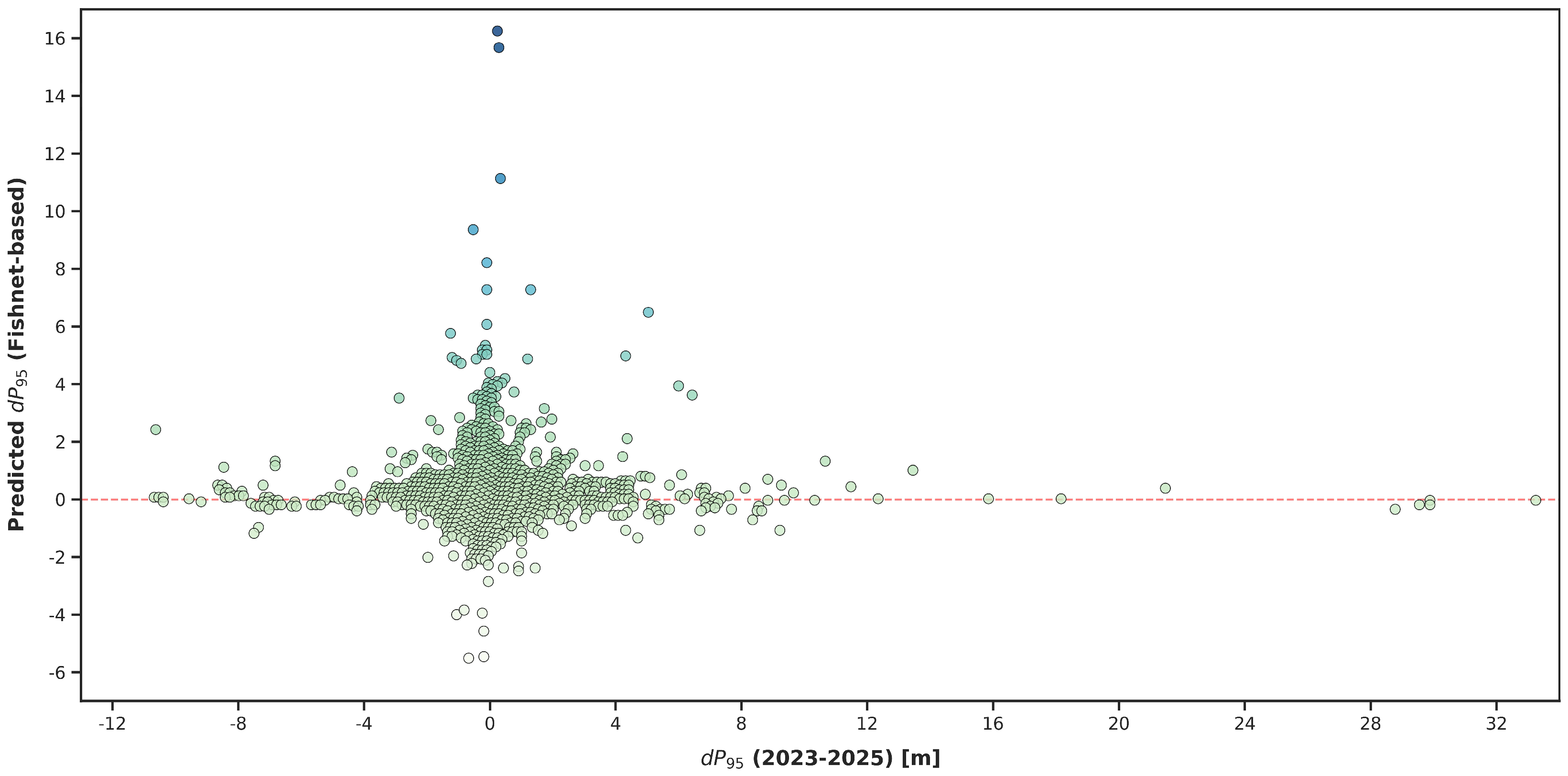
The scatter distribution shown in
Figure 10 provides additional insight into the relationship between observed ΔP
95 values and fishnet-aggregated RF predictions. The dense clustering of points around the zero-change axis indicates that the model effectively captures stable canopy conditions, while the symmetric spread of positive and negative deviations reflects its sensitivity to both canopy growth and degradation processes. Importantly, extreme ΔP
95 values are relatively sparse and spatially constrained, suggesting that large-magnitude vertical changes are limited to localized disturbance zones rather than being widespread across the landscape.
The relative contribution of individual geomorphometric variables is summarized in
Figure 9b, which reveals a clear hierarchy of predictor importance. Aspect-related variables emerge as dominant controls, with ASP_SIN_23 contributing approximately 20% of total model importance, followed by slope (18%) and TWI (18%). This emphasizes the critical role of slope orientation and moisture availability in regulating forest vertical dynamics. Variable importance values were normalized (sum = 1) to ensure comparability among predictors (
Figure 9b).
Secondary contributions from aspect cosine, profile curvature, and TPI further indicate that both energy balance (solar exposure) and terrain convergence/divergence patterns influence canopy height change. Specifically, ASP_COS (16%), Profile Curvature (15%), and TPI (14%) provide nearly equal supplementary contributions, indicating that no single terrain factor operates in isolation.
The dominance of geomorphometric predictors confirms that vertical forest dynamics within the study area are not governed by stochastic processes alone but are systematically constrained by terrain-controlled environmental gradients. Moisture-favored slope positions and aspect-driven microclimatic conditions appear to promote sustained vertical growth, while convex landforms and anthropogenically modified surfaces exhibit reduced or negative ΔP95 responses.
Despite the strong training performance, it is important to note that prediction uncertainty increases for extreme ΔP
95 values, as indicated by the wider dispersion observed in
Figure 10. This behavior is typical for ensemble-based models and reflects the limited representation of rare, high-magnitude disturbance events within the training dataset. Nevertheless, the RF model provides a reliable and physically interpretable framework for linking forest vertical change to geomorphometric controls.
Overall, the RF results demonstrate that forest canopy height change in the study area is highly predictable based on terrain-derived variables, reinforcing the hypothesis that geomorphology exerts a first-order control on long-term vertical forest structure. These findings support the integration of ML with geomorphometric analysis as a powerful approach for understanding forest dynamics in disturbed and heterogeneous landscapes.
4. Discussion
This study evaluates changes in forest vertical structure within a geomorphometric context using multi-temporal CHMs derived from UAV photogrammetry and the P
95 metric. The findings not only support the effectiveness of UAV photogrammetry for forest monitoring emphasized by [
22], but also concretely demonstrate how these dynamics are regulated by geomorphometric factors. The adoption of a change-based approach (ΔP
95) rather than absolute height metrics minimizes the influence of photogrammetric uncertainties and enables a process-oriented interpretation of forest structural dynamics.
4.1. Interpretation of Multi-Temporal Canopy Height Dynamics
The spatial distribution of P
95 canopy height between 2023 and 2025 indicates that forest structure is constrained by long-term topographic conditions rather than short-term stochastic effects. As noted by [
39], forest cover dynamics typically evolve under strong environmental constraints. In this study, the concentration of positive ΔP
95 values on moderately sloped terrain and within moisture accumulation zones suggests that vegetation growth is supported by topography-driven “micro-refugia” effects.
In contrast, negative ΔP
95 values observed within the mining area and on anthropogenically modified steep slopes demonstrate that surface morphological degradation imposes long-term constraints on forest development. The transect profiles shown in
Figure 6 indicate that these changes occur in a gradual and systematic manner, confirming that the detected vertical differences represent genuine biological processes rather than photogrammetric noise as discussed by [
38]. The fact that the mean vertical growth (0.65 m) exceeds the estimated vertical RMSE (0.082 m) further reinforces the geometric reliability of the analysis.
4.2. Role of Geomorphometric Controls on Forest Vertical Structure
The variable importance ranking derived from the RF model identifies aspect (ASP_SIN), slope (SLOPE), and TWI as the dominant controls on vertical forest dynamics (
Figure 10). The prominent contribution of aspect reflects the determining role of solar radiation and microclimatic energy balance on growth rates. This finding is consistent with the results of [
22], who highlighted the influence of micro-environmental factors on canopy structure.
The spatial coincidence between high TWI values and positive ΔP95 areas highlights the critical role of hydro-topographic control on canopy growth. Micro-environmental contrasts between convex ridges and concave slopes generate pronounced heterogeneity in vertical structure. These results provide strong evidence that forest vertical structure is regulated not only by biological processes but also by a geomorphological framework that constrains growth patterns.
4.3. Model Performance, Uncertainty, and Methodological Limitations
The high training performance of the RF model (R
2 = 0.919) demonstrates the strong explanatory power of geomorphometric variables. However, the reduced performance during validation reflects the site-specific nature of model training emphasized by [
42], as well as the complexity introduced by high spatial autocorrelation and anthropogenic disturbance around the mining area.
The marked discrepancy between training performance and validation performance under the initial random split highlights a key methodological challenge in modeling forest vertical structure dynamics using spatially structured predictors. In geospatial machine learning applications, random train–test splits can be affected by spatial autocorrelation and neighborhood similarity, leading to spatial leakage and consequently unstable or misleading generalization estimates. By incorporating spatial block cross-validation, the model was evaluated under a stricter spatial independence assumption, resulting in a more conservative but more realistic performance profile (
Table 6). The increase in error metrics under spatial validation suggests that a portion of the observed vertical structure changes is driven by localized factors that are not fully captured by the geomorphometric indicators alone, such as site-specific management activities, anthropogenic disturbances, and heterogeneous canopy conditions. Therefore, spatially explicit validation should be considered a standard evaluation strategy for similar UAV-based forest structure modeling studies. Future research may further improve transferability by integrating additional explanatory variables (e.g., stand age, forest type, management history) and by adopting region-wise or domain-adaptive modeling approaches.
The primary sources of uncertainty include the clustering of ΔP
95 values near zero and the inherent limitations of UAV-SfM methods under dense canopy conditions compared to LiDAR-based systems [
42]. Accordingly, the RF model is interpreted in this study not as a purely predictive tool but as an explanatory analytical framework for identifying dominant environmental controls. This perspective provides a deterministic basis for forest monitoring in complex and heterogeneous landscapes.
While this study focused on RF as a robust and interpretable baseline model, future work may extend the monitoring framework by benchmarking multiple machine learning algorithms (e.g., XGBoost, LightGBM, CatBoost, SVM) under the same spatial cross-validation design.
4.4. Comparison with Previous Studies and Scientific Implications
The ability of UAV–SfM photogrammetry to represent forest canopy surfaces and derive height-related structural metrics has been widely demonstrated in previous studies, particularly when acquisition geometry and processing strategies are designed to ensure geometric robustness. Ota et al. (2017) emphasize that canopy height derived from photogrammetric products fundamentally depends on reliable terrain normalization, since canopy height is obtained as the difference between a canopy surface model and a terrain model, and inaccuracies in ground representation directly propagate into height estimates [
25]. This observation is consistent with the present study, where stable ground–canopy separation and consistent multi-temporal co-registration were treated as prerequisites for reliable analysis of vertical structure change.
Several studies further indicate that flight configuration and overlap design strongly influence the completeness and quality of forest point clouds and CHM products. Dhruva et al. (2024) report that higher overlap configurations substantially improve reconstruction quality and tree-height estimation performance, and that optimal mapping performance is achieved under high and balanced overlap regimes [
22]. The use of consistent 80% forward and 80% side overlap across all epochs in the present study follows these recommendations and supports the interpretation that the detected inter-annual differences are not primarily driven by acquisition geometry but rather reflect genuine surface and canopy dynamics.
Despite these advantages, previous research highlights persistent limitations of UAV photogrammetry under dense canopy conditions. Deng et al. (2024) demonstrate that photogrammetric CHM accuracy is strongly constrained by ground reconstruction errors in areas of high canopy cover, and that uncertainty increases as canopy density rises [
32]. Similarly, Fakhri et al. (2025) show that camera-related effects such as radial lens distortion can degrade image matching and reconstruction accuracy if not properly mitigated [
24]. These findings support the methodological choice of the present study to emphasize change-based canopy metrics rather than relying solely on absolute height values, and to maintain consistent sensor configurations and processing workflows across years.
Previous studies have increasingly combined UAV-derived SfM products with machine learning for forest structural characterization. For example, Zhang et al. (2021) demonstrate that low-cost UAV-derived photogrammetric point clouds can serve as an effective alternative to LiDAR data, with only minor reductions in classification accuracy, highlighting their potential for vegetation structure representation [
26]. Likewise, Durgun et al. (2024) report successful estimation of tree height, DBH, and crown diameter from UAV-SfM data using multiple ML algorithms and standard accuracy metrics [
23]. While these studies primarily focus on single-epoch prediction of absolute forest variables, the present study extends this line of research by demonstrating that UAV photogrammetry is also suitable for multi-temporal analysis of vertical structural change using a robust percentile-based difference metric (ΔP
95).
The identification of aspect, slope, and topographic wetness index as dominant controls on canopy height change is consistent with earlier findings that terrain-driven moisture redistribution and microclimatic gradients systematically influence forest structure [
11,
42]. Nasiri et al. (2022) report that forest structural characteristics exhibit strong variation along topographic and moisture gradients and that ML models can effectively capture these nonlinear terrain–vegetation relationships [
39]. The present study builds upon this evidence by explicitly demonstrating that such geomorphometric factors regulate not only static canopy height patterns, but also the magnitude, direction, and spatial organization of multi-temporal vertical change.
From a methodological standpoint, most previous UAV-based forest studies employ machine learning primarily as a predictive tool, with performance evaluated mainly through metrics such as R2 and RMSE. In contrast, the present study emphasizes the interpretability of ML by using Random Forest variable importance to quantify the relative influence of geomorphometric drivers on canopy height change.
Moreover, studies based on UAV-LiDAR point clouds report that even active-sensor-based ML models exhibit non-negligible error levels in estimating tree height and volume, indicating that some degree of uncertainty is unavoidable even under optimal sensing conditions [
18]. This further supports the rationale of prioritizing consistent change-based metrics rather than absolute height values in UAV-SfM multi-temporal analyses.
Overall, compared with previous research, the primary contribution of this study lies not merely in demonstrating that UAV–SfM can generate forest canopy surfaces, but in showing—under acquisition and processing conditions supported by the literature [
8,
22,
24,
25]—that multi-temporal UAV photogrammetry can be used to analyze vertical-structure dynamics in a structured, interpretable, and process-oriented manner. The results provide empirical evidence that forest vertical change in disturbed and heterogeneous landscapes is governed by deterministic terrain-driven controls rather than stochastic variability alone, with important implications for forest monitoring, ecological modeling, and post-mining restoration planning.
Beyond remote sensing-oriented evidence, recent ecological research increasingly demonstrates that topography influences vegetation not only through static terrain attributes but also by shaping local microclimates and environmental niches. For instance, McNichol et al. (2024) found that topographic and microclimatic gradients strongly regulate forest structure, diversity, and composition by creating distinct habitat niches that buffer macroclimatic variation [
61]. Similarly, Jia et al. (2024) showed that in tropical mountain ecosystems, structural traits and microclimatic patterns reflect the combined effects of elevation, vegetation, and soil moisture, demonstrating that topography modulates temperature and moisture regimes experienced by forest organisms [
62]. On a broader scale, Zou et al. (2025) reported that slope aspect and elevation drive divergent greening and vegetated area expansion trends under climate change, revealing complex topographic controls on surface energy and vegetation responses [
63]. Moreover, Walter et al. (2024) demonstrated that in tropical dry forests, topography and climatic drivers jointly shape vegetation distribution and resilience, highlighting that terrain–vegetation interactions are inherently linked to both abiotic and biotic processes [
64].
In direct agreement with these studies, the present research shows that aspect, slope, and topographic wetness index emerge as the most influential controls on multi-temporal canopy height change. While previous works primarily document how topography shapes static forest structure and composition, the results of this study extend this evidence by demonstrating that the same terrain-driven microclimatic mechanisms also regulate temporal vertical dynamics. Specifically, areas associated with moisture accumulation and moderate exposure exhibit systematic positive ΔP95 values, whereas steep and anthropogenically modified surfaces show predominantly negative or negligible changes. This indicates that topography not only organizes where forests grow, but also governs how forest vertical structure evolves over time, particularly in disturbed and anthropogenically modified landscapes.
4.5. Implications and Future Research Directions
This study demonstrates that integrating multi-temporal UAV data with geomorphometric analysis plays a critical role in understanding forest dynamics within disturbed landscapes. In particular, the findings suggest that restoration and rehabilitation strategies in mining environments may benefit from “topographic position-oriented” approaches that explicitly account for parameters such as TWI and aspect.
Future research should incorporate longer temporal records and climatic variables to better separate long-term structural trends from short-term variability. Such extensions would further enhance the capacity to interpret forest structural responses under changing environmental and anthropogenic conditions.
In addition to geomorphometric controls, climatic factors such as inter-annual variability in precipitation and temperature are well known to influence forest growth rates and canopy development. Variations in rainfall amount and seasonal distribution directly affect soil moisture availability, while temperature regulates photosynthetic activity and growing-season length. In multi-year studies, these climatic drivers may therefore contribute to inter-annual fluctuations in canopy height and potentially interact with terrain-controlled moisture and energy gradients. In the present study, climatic variables were not explicitly included as predictors, as the primary objective was to isolate and evaluate the explanatory power of geomorphometric controls on forest vertical structure change. However, the consistent spatial persistence of ΔP95 patterns across years suggests that topography-driven controls exert a dominant influence relative to short-term climatic variability. Nevertheless, future studies should integrate gridded precipitation and temperature datasets or station-based climate observations to further disentangle the combined effects of climate and terrain on forest vertical dynamics and to improve the generalization of the proposed framework under different climatic regimes.
Future work may also explore dimensionality-reduction approaches (e.g., PCA) or alternative feature selection strategies to evaluate whether model generalization can be improved without compromising interpretability.
5. Conclusions
This study presents a multi-temporal, geomorphometry-informed framework for analyzing forest vertical structure dynamics using UAV-derived canopy height models and a robust change-based metric (ΔP95). The primary academic contribution of this research is demonstrating that forest vertical structure change in disturbed and heterogeneous landscapes is not random but is systematically regulated by terrain-driven hydro-morphological and microclimatic controls that can be quantitatively revealed through interpretable machine learning.
By integrating multi-temporal UAV photogrammetry with geomorphometric predictors and Random Forest regression, the study moves beyond conventional descriptive change detection and provides a process-oriented interpretation of canopy height dynamics. The results reveal a consistent mean vertical growth of 0.65 m between 2023 and 2025, which clearly exceeds the estimated photogrammetric noise level (RMSE = 0.082 m), confirming that the detected changes represent genuine biological signals rather than reconstruction artifacts. Approximately 62% of the study area exhibits positive ΔP95 values, while negative changes (down to −1.20 m) are spatially confined to mining-disturbed surfaces and steep anthropogenically modified slopes.
The RF analysis identifies aspect, slope, and topographic wetness index as the dominant geomorphometric controls governing vertical canopy change, together accounting for more than half of the total variable importance. These findings indicate that terrain-controlled moisture redistribution and exposure-driven energy balance exert first-order controls on forest vertical growth, particularly in landscapes affected by surface morphology alteration. Although prediction performance decreases under spatially independent validation, the ML framework proves highly valuable as an explanatory tool for disentangling complex terrain–vegetation interactions rather than as a purely predictive model.
Several limitations should be acknowledged. First, UAV-SfM photogrammetry has inherent constraints in reconstructing ground surfaces beneath dense canopy compared to active LiDAR systems, which may introduce uncertainty into absolute height estimates. Second, climatic variables such as precipitation and temperature were not explicitly incorporated and may also influence inter-annual growth variability. Third, the three-year observation period captures short-term structural dynamics and may not fully represent long-term successional trends.
Despite these limitations, the proposed framework provides a transferable and cost-effective approach for monitoring forest structural dynamics in disturbed and topographically complex environments. The results offer practical implications for forest management and post-mining restoration by indicating that terrain-driven moisture and exposure gradients should be explicitly considered when prioritizing rehabilitation zones. Future studies should extend the temporal record, integrate climatic drivers, and combine UAV data with LiDAR observations to further improve model generalization and ecological interpretation.