Preliminary Metrological Characterization of Low-Cost MEMS Inclinometer for Tree Stability Assessment: From Laboratory to Field
 ,
,  , ,
, ,  and
and 
Abstract
1. Introduction
- (i)
- Quantify the performance of a low-cost MEMS inclinometer under controlled laboratory conditions using a geometric inclination reference;
- (ii)
- Assess its stability and repeatability for quasi-static inclination measurements in replicated in situ pulling tests;
- (iii)
- Discuss the implications of the experimental results in terms of potential scalability and future applications under typical urban operational constraints.
2. Materials and Methods
2.1. Experimental Design
2.2. Laboratory Tests
2.3. Field Tests
2.4. Data Processing
2.4.1. Laboratory Data
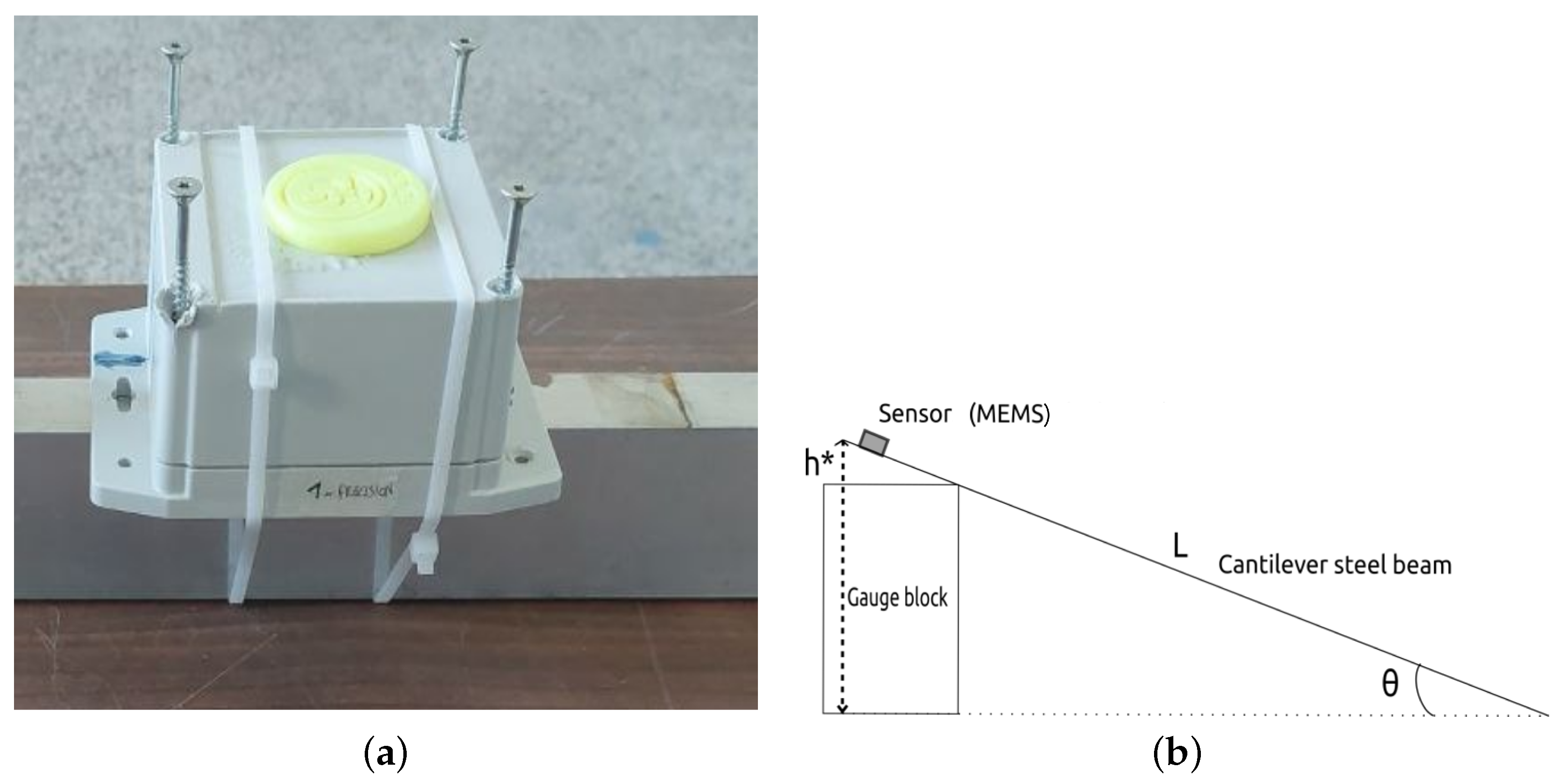
- is the theoretical (expected) inclination derived from the geometric configuration of the beam;
- is the inclination measured by the MEMS sensor;
- is the absolute error, computed as , expressed in degrees [°];
- is the relative error, defined as the ratio between the absolute error and the corresponding expected value (dimensionless).
2.4.2. Field Data
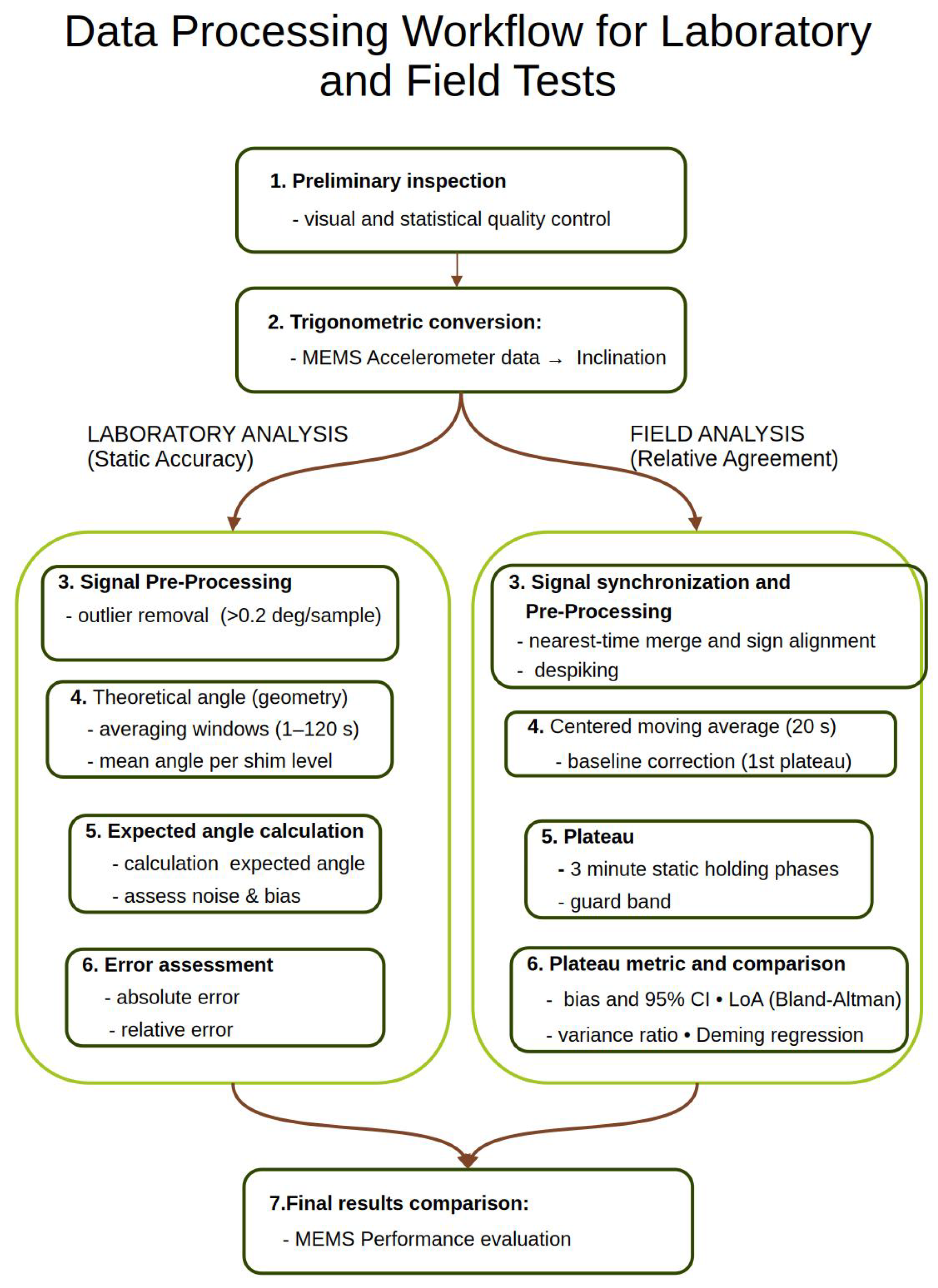
- Preliminary inspection: Visual and statistical screening of raw time series to ensure signal integrity and identify missing data or sensor drift.
- Signal synchronization: Reference high-precision inclinometer timestamps were reconstructed as , while MEMS timestamps were absolute. A nearest-time merge was therefore sufficient to align both datasets, precluding the need for drift correction. The reference axis was a reference high-precision inclinometer X, sign-aligned to MEMS.
- Trigonometric conversion: Accelerometric data were converted into inclination angles consistent with the laboratory reference frame.
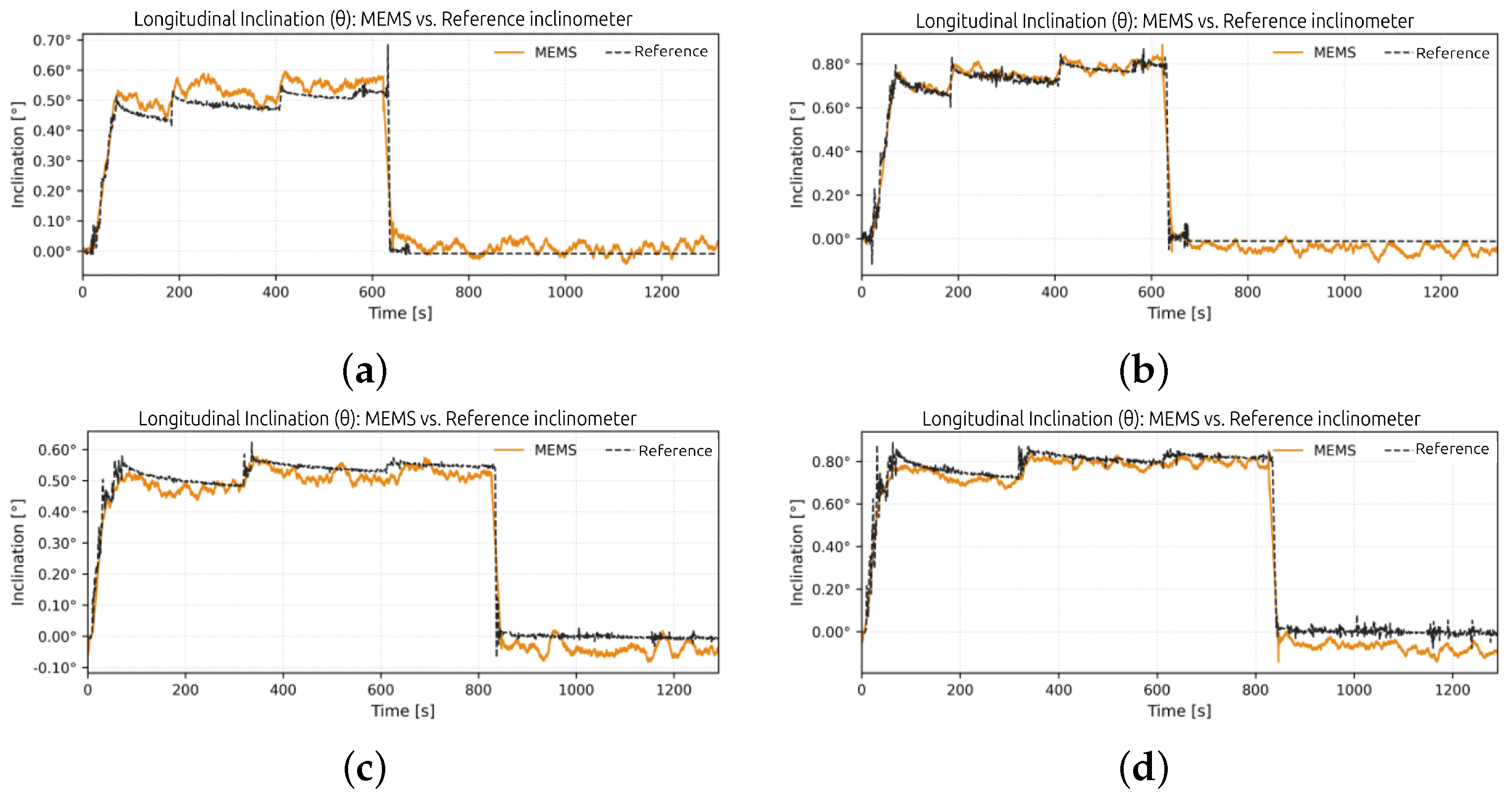
- Pre-processing: Based on laboratory findings, where longer averaging windows systematically reduced random noise without altering the mean inclination, a centered 20 s moving average was adopted for field data to stabilize plateau estimates during the 3-min holds, attenuating high-frequency noise while preserving the step-like transitions between successive pull–hold phases (26 Hz ≈ 520 samples). This window length represents an operational compromise derived from laboratory calibration results and tailored to the duration of the field holding phases.
- Relative baseline: The first stable plateau was used as reference. Each series was centered by subtracting its median value over this window, i.e., and , thereby removing absolute offset differences.
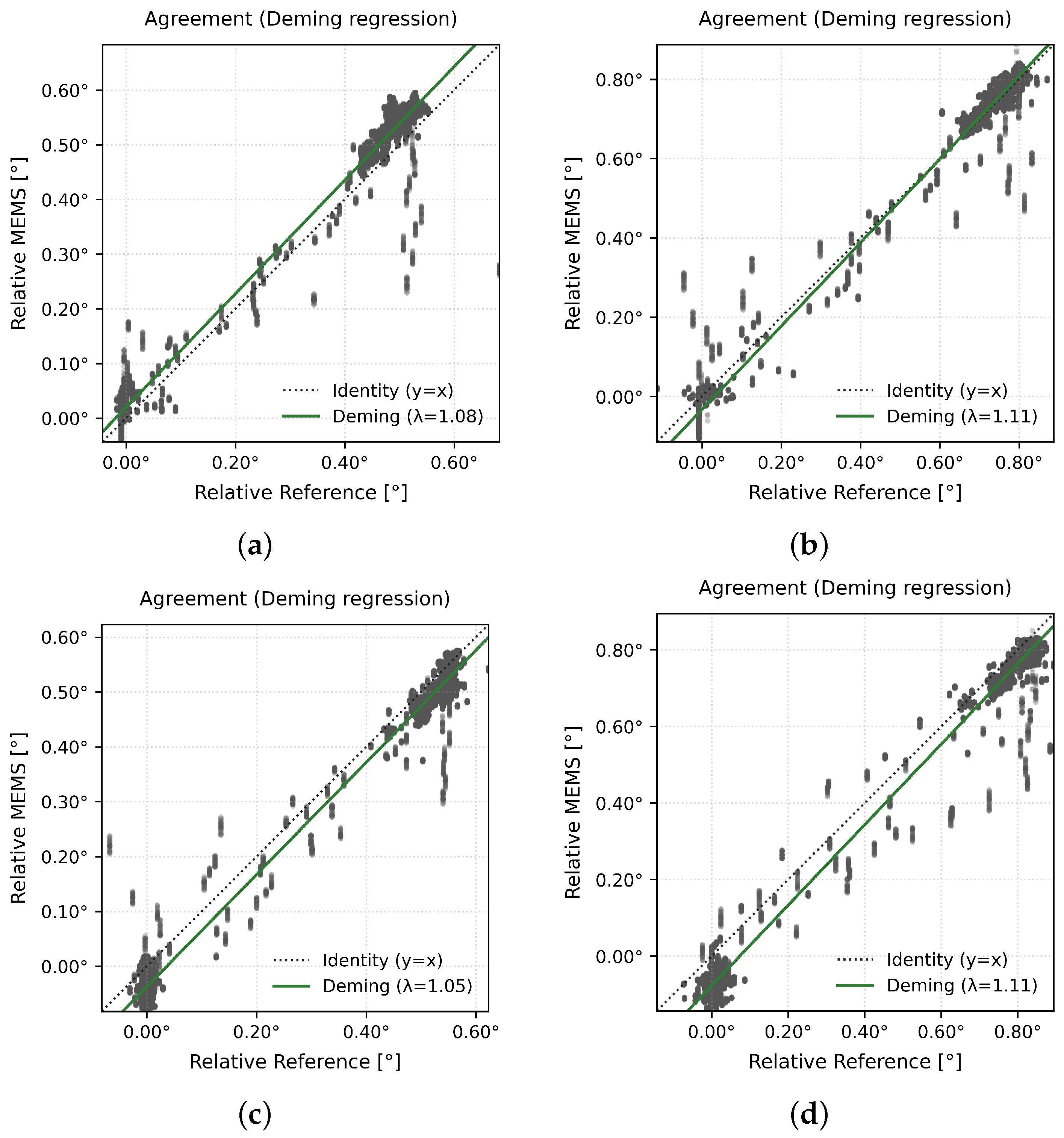
- Plateau metrics and statistical comparison: Bland–Altman analysis [41] was used to evaluate systematic bias and limits of agreement (LoA) between the two instruments, providing a direct visualization of measurement consistency across the amplitude range. Deming regression [42,43] was applied to model the linear relationship between MEMS and the reference high-precision inclinometer, accounting for uncertainty in both variables.
3. Results
3.1. Laboratory Test
3.2. Field Test
4. Discussion
5. Conclusions
Author Contributions
Funding
Data Availability Statement
Acknowledgments
Conflicts of Interest
References
- Bottalico, F.; Travaglini, D.; Chirici, G.; Garfì, V.; Giannetti, F.; Marco, A.D.; Fares, S.; Marchetti, M.; Nocentini, S.; Paoletti, E.; et al. A spatially-explicit method to assess the dry deposition of air pollution by urban forests in the city of Florence, Italy. Urban For. Urban Green. 2017, 27, 221–234. [Google Scholar] [CrossRef]
- Haase, D.; Larondelle, N.; Andersson, E.; Artmann, M.; Borgström, S.; Breuste, J.; Gomez-Baggethun, E.; Gren, Å; Hamstead, Z.; Hansen, R.; et al. A quantitative review of urban ecosystem service assessments: Concepts, models, and implementation. Ambio 2014, 43, 413–433. [Google Scholar] [CrossRef]
- Ariluoma, M.; Ottelin, J.; Hautamäki, R.; Tuhkanen, E.M.; Mänttäri, M. Carbon sequestration and storage potential of urban green in residential yards: A case study from Helsinki. Urban For. Urban Green. 2021, 57, 126939. [Google Scholar] [CrossRef]
- Gómez-Baggethun, E.; Barton, D.N. Classifying and valuing ecosystem services for urban planning. Ecol. Econ. 2013, 86, 235–245. [Google Scholar] [CrossRef]
- Meili, N.; Manoli, G.; Burlando, P.; Carmeliet, J.; Chow, W.T.; Coutts, A.M.; Roth, M.; Velasco, E.; Vivoni, E.R.; Fatichi, S. Tree effects on urban microclimate: Diurnal, seasonal, and climatic temperature differences explained by separating radiation, evapotranspiration, and roughness effects. Urban For. Urban Green. 2021, 58, 126970. [Google Scholar] [CrossRef]
- Bolund, P.; Hunhammar, S. Ecosystem services in urban areas. Ecol. Econ. 1999, 29, 293–301. [Google Scholar] [CrossRef]
- Akubue, J.A. Effects of Street Geometry on Airflow Regimes for Natural Ventilation in Three Different Street Configurations in Enugu City. In Different Strategies of Housing Design; Çakmaklı, A.B., Ed.; IntechOpen: London, UK, 2019; Chapter 2. [Google Scholar] [CrossRef]
- Li, B.; Jiang, C.; Wang, L.; Cai, W.; Liu, J. A parametric study of the effect of building layout on wind flow over an urban area. Build. Environ. 2019, 160, 106160. [Google Scholar] [CrossRef]
- Cui, D.; Li, X.; Liu, J.; Yuan, L.; Mak, C.; Fan, Y.; Kwok, K. Effects of building layouts and envelope features on wind flow and pollutant exposure in height-asymmetric street canyons. Build. Environ. 2021, 205, 108177. [Google Scholar] [CrossRef]
- Mullaney, J.; Lucke, T.; Trueman, S.J. A review of benefits and challenges in growing street trees in paved urban environments. Landsc. Urban Plan. 2015, 134, 157–166. [Google Scholar] [CrossRef]
- Döhren, P.V.; Haase, D. Ecosystem disservices research: A review of the state of the art with a focus on cities. Ecol. Indic. 2015, 52, 490–497. [Google Scholar] [CrossRef]
- Buson, M.; Bortolini, L. Analysis of Tree Falls Caused by Weather Events in Urban Areas: The Case Study of the City of Venice. Land 2025, 14, 1131. [Google Scholar] [CrossRef]
- Van Haaften, M.; Gardebroek, C.; Heijman, W.; Meuwissen, M.M. Injuries and deaths due to tree failure in The Netherlands: Analysis of observational data from 1998–2021. Sci. Rep. 2024, 14, 22415. [Google Scholar] [CrossRef]
- Schmidlin, T.W. Human fatalities from wind-related tree failures in the United States, 1995–2007. Nat. Hazards 2009, 50, 13–25. [Google Scholar] [CrossRef]
- Koeser, A.K.; Hauer, R.J.; Miesbauer, J.W.; Peterson, W. Municipal tree risk assessment in the United States: Findings from a comprehensive survey of urban forest management. Arboric. J. 2016, 38, 218–229. [Google Scholar] [CrossRef]
- Portoghesi, L.; Masini, E.; Tomao, A.; Agrimi, M. Could climate change and urban growth make Europeans regard urban trees as an additional source of danger? Front. For. Glob. Change 2023, 6, 1155016. [Google Scholar] [CrossRef]
- Roman, L.A.; Conway, T.M.; Eisenman, T.S.; Koeser, A.K.; Barona, C.O.; Locke, D.H.; Jenerette, G.D.; Östberg, J.; Vogt, J. Beyond ‘trees are good’: Disservices, management costs, and tradeoffs in urban forestry. Ambio 2021, 50, 615–630. [Google Scholar] [CrossRef]
- Ordóñez, C.; Threlfall, C.G.; Livesley, S.J.; Kendal, D.; Fuller, R.A.; Davern, M.; van der Ree, R.; Hochuli, D.F. Decision-making of municipal urban forest managers through the lens of governance. Environ. Sci. Policy 2020, 104, 136–147. [Google Scholar] [CrossRef]
- Linhares, C.S.; Gonçalves, R.; Martins, L.M.; Knapic, S. Structural stability of urban trees using visual and instrumental techniques: A review. Forests 2021, 12, 1752. [Google Scholar] [CrossRef]
- Mattheck, C.; Breloer, H. Field guide for visual tree assessment (VTA). ARboricult. J. 1994, 18, 1–23. [Google Scholar] [CrossRef]
- Allison, R.B.; Wang, X.; Senalik, C.A. Methods for Nondestructive Testing of Urban Trees. Forests 2020, 11, 1341. [Google Scholar] [CrossRef]
- Wessolly, L.; Erb, M. Handbuch der Baumstatik und Baumkontrolle; Patzer Verlag: Berlin, Germany, 1998. [Google Scholar]
- Lundström, T.; Jonas, T.; Stöckli, V.; Ammann, W. Anchorage of mature conifers: Resistive turning moment, root–soil plate geometry and root growth orientation. Tree Physiol. 2007, 27, 1217–1227. [Google Scholar] [CrossRef]
- James, K.R.; Dahle, G.A.; Grabosky, J.; Kane, B.; Detter, A. Tree biomechanics literature review: Dynamics. Arboric. Urban For. 2014, 40, 1–15. [Google Scholar] [CrossRef]
- Wessolly, L. Stability of Trees: Explanation of the Tipping Process. Stadt Grün 1996, 4, 268–272. [Google Scholar]
- Jonsson, M.J.; Foetzki, A.; Kalberer, M.; Lundström, T.; Ammann, W.; Stöckli, V. Root–soil rotation stiffness of Norway spruce (Picea abies (L.) Karst) growing on subalpine forested slopes. Plant Soil 2006, 285, 267–277. [Google Scholar] [CrossRef]
- Esche, D.; Schumacher, P.; Detter, A.; Rust, S. Experimentelle Überprüfung der Windlastanalyse für statische Zugversuche. In Jahrbuch der Baumpflege; Dujesiefken, D., Ed.; Haymarket Media: Augsburg, Germany, 2018; pp. 229–236. [Google Scholar]
- Giambastiani, Y.; Preti, F.; Errico, A.; Sani, L. On the Tree Stability: Pulling Tests and Modelling to Assess the Root Anchorage. Procedia Environ. Sci. Eng. Manag. 2017, 4, 237–244. [Google Scholar]
- Detter, A.; Rust, S.; Böttcher, J.; Bouillon, J. Ambient Influences on the Results of Non-Destructive Pulling Tests. In 21st International Nondestructive Testing and Evaluation of Wood Symposium; Wang, X., Sauter, U.H., Ross, R.J., Eds.; U.S. Department of Agriculture, Forest Service, Forest Products Laboratory: Madison, WI, USA, 2019; General Technical Report FPL-GTR-272; pp. 422–436. [Google Scholar]
- Peterson, C.J.; Claassen, V. An evaluation of the stability of Quercus lobata and Populus fremontii on river levees assessed using static winching tests. Forestry 2013, 86, 201–209. [Google Scholar] [CrossRef]
- Detter, A.; Rust, S.; Krišāns, O. Experimental Test of Non-Destructive Methods to Assess the Anchorage of Trees. Forests 2023, 14, 533. [Google Scholar] [CrossRef]
- Nicoll, B.C.; Gardiner, B.A.; Rayner, B.; Peace, A.J. Anchorage of coniferous trees in relation to species, soil type, and rooting depth. Can. J. For. Res. 2006, 36, 1871–1883. [Google Scholar] [CrossRef]
- Schindler, D. Responses of Scots pine trees to dynamic wind loading. Agric. For. Meteorol. 2008, 148, 1733–1742. [Google Scholar] [CrossRef]
- Kolbe, S.; Schindler, D. TreeMMoSys: A low cost sensor network to measure wind-induced tree response. HardwareX 2021, 9, e00180. [Google Scholar] [CrossRef] [PubMed]
- Incollu, I.; Giachetti, A.; Giambastiani, Y.; Corti, H.A.; Giannetti, F.; Bartoli, G.; Piredda, I.; Giadrossich, F. Feasibility of a Low-Cost MEMS Accelerometer for Tree Dynamic Stability Analysis: A Comparative Study with Seismic Sensors. Forests 2025, 16, 1572. [Google Scholar] [CrossRef]
- Yang, Z.; Hui, K.W.; Abbas, S.; Zhu, R.; Kwok, C.Y.T.; Heo, J.; Ju, S.; Wong, M.S. A Review of Dynamic Tree Behaviors: Measurement Methods on Tree Sway, Tree Tilt, and Root–Plate Movement. Forests 2021, 12, 379. [Google Scholar] [CrossRef]
- Van Emmerik, T.; Steele-Dunne, S.; Hut, R.; Gentine, P.; Guerin, M.; Oliveira, R.S.; Wagner, J.; Selker, J.; Van De Giesen, N. Measuring tree properties and responses using low-cost accelerometers. Sensors 2017, 17, 1098. [Google Scholar] [CrossRef]
- Herath, P.; Bai, X. Benefits and co-benefits of urban green infrastructure for sustainable cities: Six current and emerging themes. Sustain. Sci. 2024, 19, 1039–1063. [Google Scholar] [CrossRef]
- Shiravi, M.; Depina, I.; Uzielli, M.; Bartoli, G. A Novel Methodology for Modeling the Effects of Geometrical Uncertainties in Tree Root-Soil Geometry on Tree Uprooting. Biogeotechnics, 2025; in press. [Google Scholar] [CrossRef]
- Masini, E.; Tomao, A.; Corona, P.; Fattorini, L.; Giuliarelli, D.; Portoghesi, L.; Agrimi, M. The ecosystem disservices of trees on sidewalks: A study based on a municipality urban tree inventory in Central Italy. Urban For. Urban Green. 2023, 86, 128007. [Google Scholar] [CrossRef]
- Bland, J.M.; Altman, D.G. Statistical Methods for Assessing Agreement Between Two Methods of Clinical Measurement. Lancet 1986, 327, 307–310. [Google Scholar] [CrossRef]
- Deming, W.E. Statistical Adjustment of Data; John Wiley & Sons: New York, NY, USA, 1943. [Google Scholar]
- Linnet, K. Evaluation of Regression Procedures for Methods Comparison Studies. CLinical Chem. 1993, 39, 424–432. [Google Scholar] [CrossRef]
- Fourcaud, T.; Ji, J.N.; Zhang, Z.Q.; Stokes, A. Understanding the impact of root morphology on overturning mechanisms: A modelling approach. Ann. Bot. 2008, 101, 1267–1280. [Google Scholar] [CrossRef] [PubMed]
- Stubbs, C.J.; Cook, D.D.; Niklas, K.J. A general review of the biomechanics of root anchorage. J. Exp. Bot. 2019, 70, 3439–3451. [Google Scholar] [CrossRef] [PubMed]





| Category | Test Description | ID | Step | Peak Force (N) |
|---|---|---|---|---|
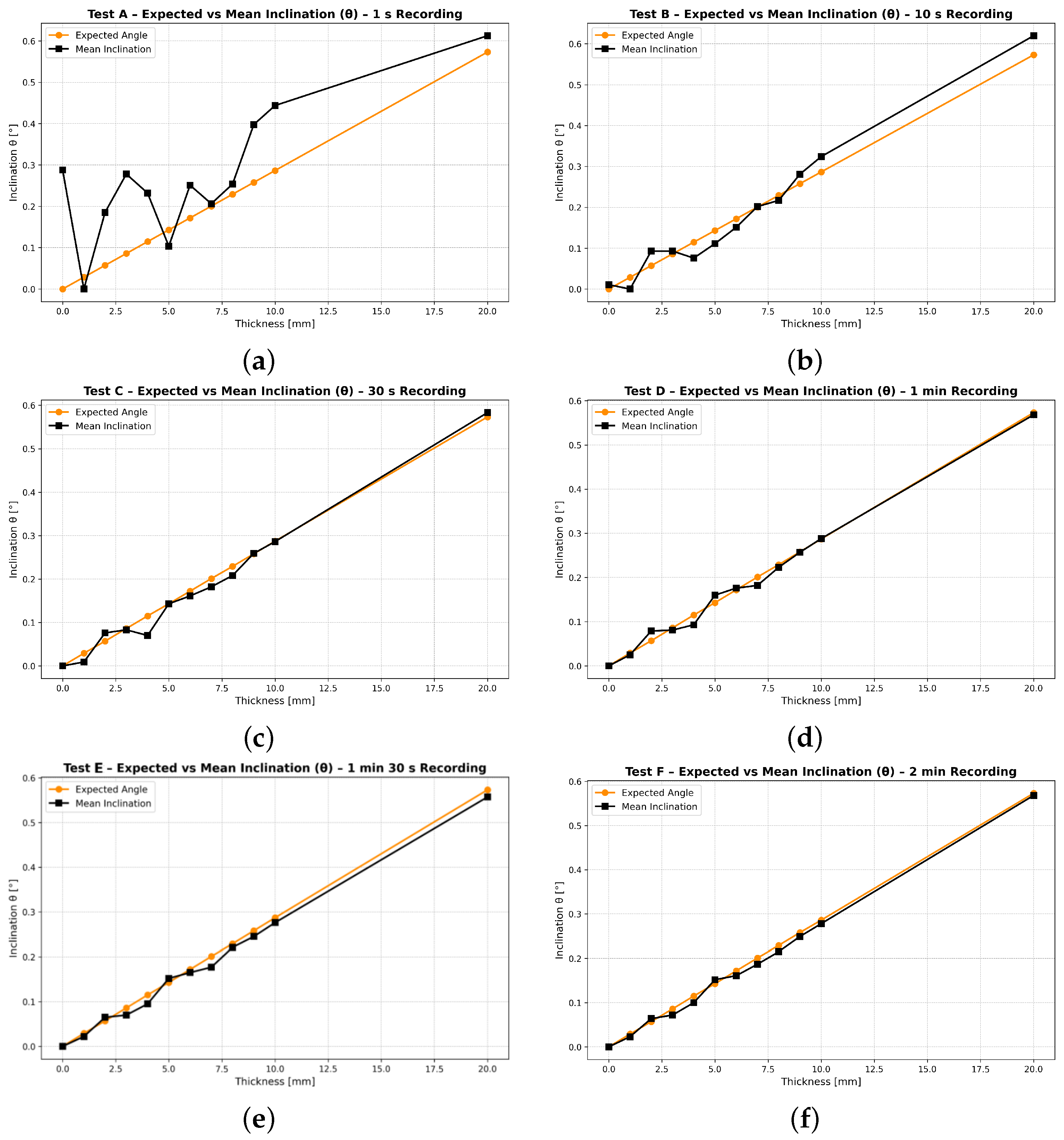
| Laboratory tests | LAB-1: Static tilt calibration with Borletti steel shims (0–20 mm), MEMS acquisition, various averaging windows (1–120 s). | A | 1 s | – |
| B | 10 s | – | ||
| C | 30 s | – | ||
| D | 60 s | – | ||
| E | 90 s | – | ||
| F | 120 s | – | ||
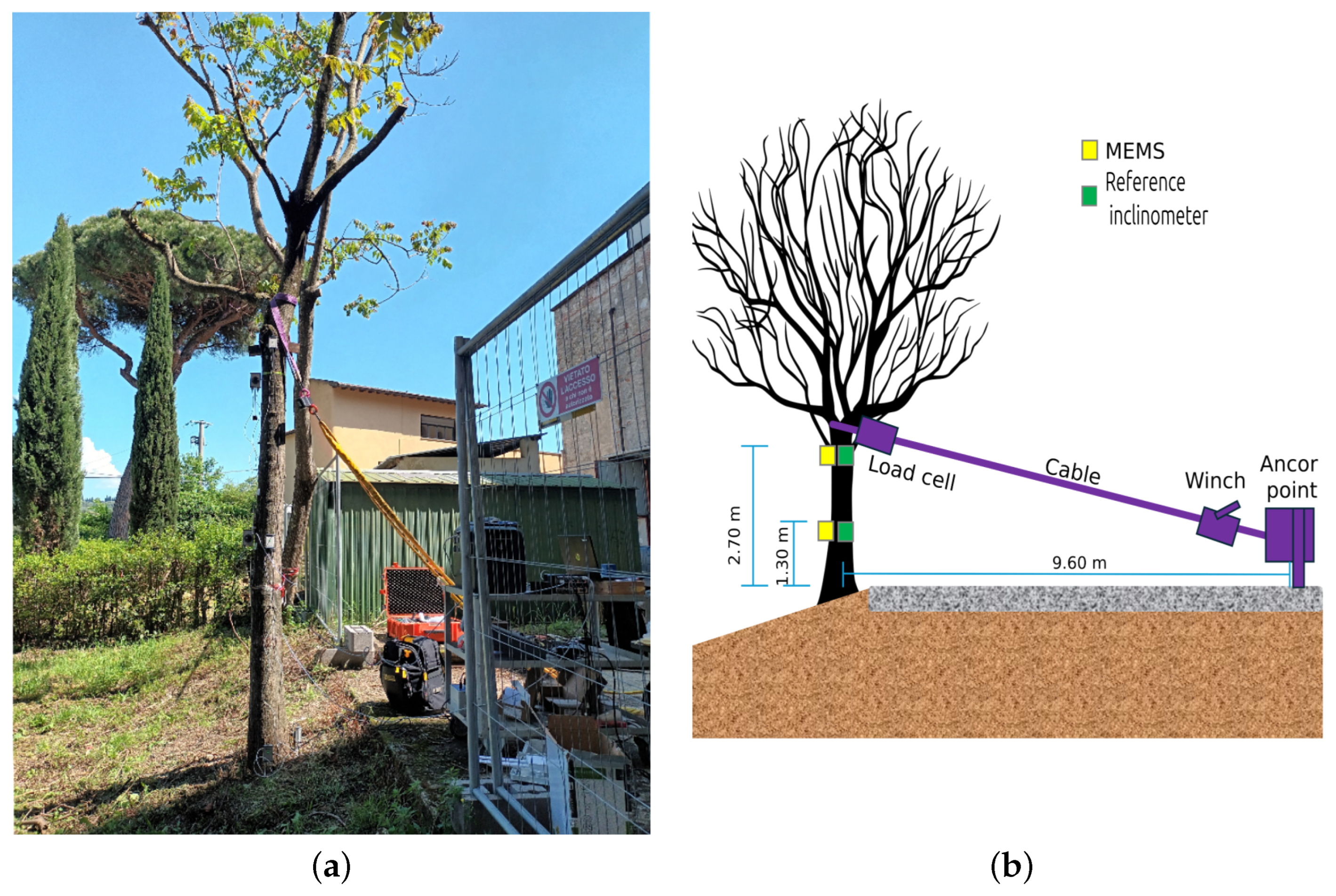
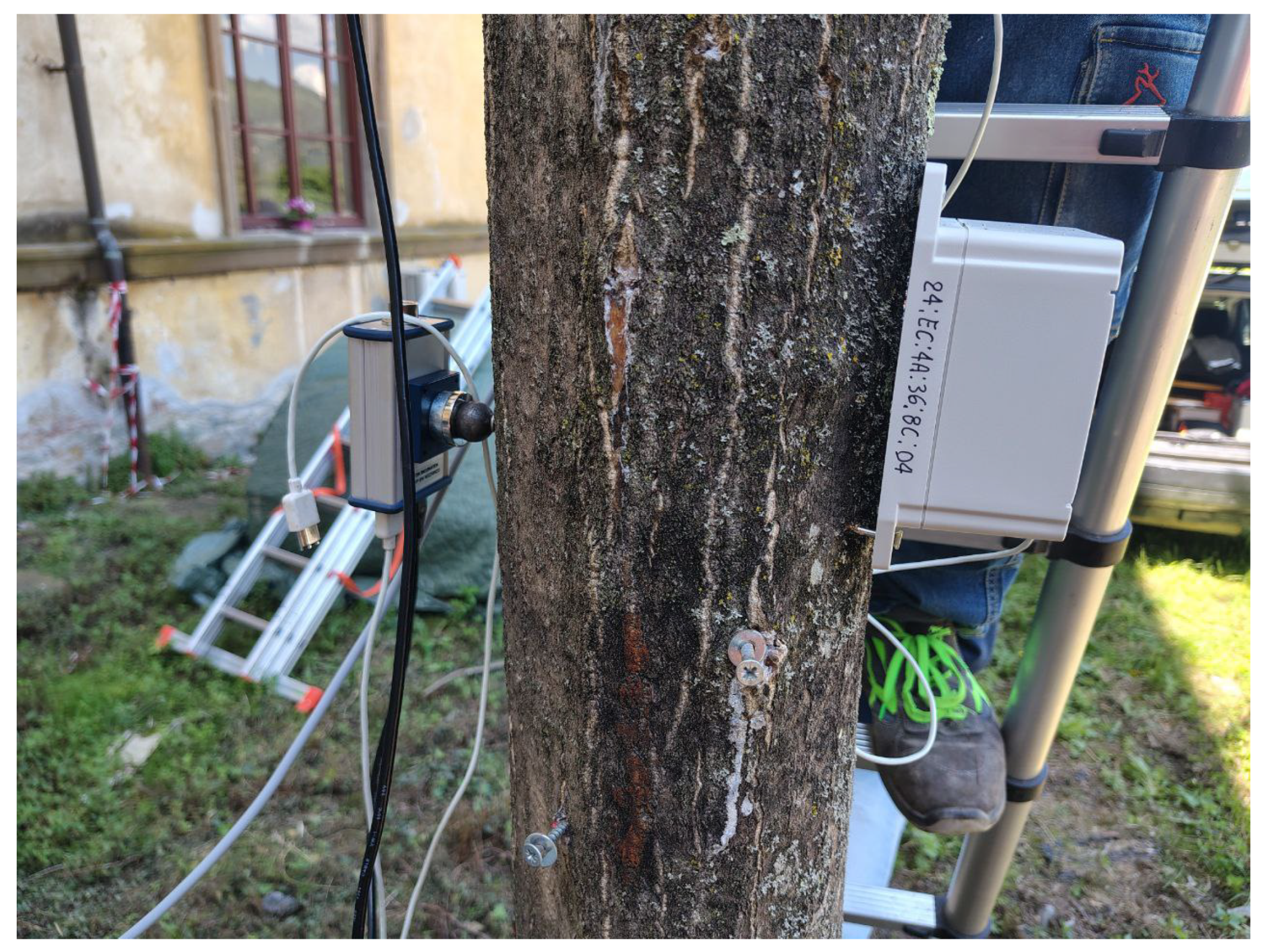
| Field tests | FIELD-A:Controlled pulling test on a standing tree with sensors installed at 1.30 m and 2.70 m (reference high-precision inclinometer + MEMS co-located). | A | 1 | 450 |
| A | 2 | 917 | ||
| A | 3 | 928 | ||
| FIELD-B: Controlled pulling test on a same standing tree with sensors installed at 1.30 m and 2.70 m (reference high-precision inclinometer + MEMS co-located). | B | 1 | 843 | |
| B | 2 | 1002 | ||
| B | 3 | 1017 |
| Parameter | Value | Acquisition Method |
|---|---|---|
| Diameter at breast height (DBH) | 17.5 cm | Caliper |
| Total height | 11 m | Vertex hypsometer |
| Crown area | 5 m2 | Manual delineation on orthophoto |
| Thickness | MEMS Measured | |||
|---|---|---|---|---|
| [mm] | [°] | [°] | [°] | [%] |
| 0 | 0.000 | 0.000 | 0.000 | – |
| 1 | 0.029 | 0.023 | 0.006 | 20.7 |
| 2 | 0.057 | 0.066 | −0.009 | −15.2 |
| 3 | 0.086 | 0.073 | 0.013 | 15.0 |
| 4 | 0.115 | 0.100 | 0.015 | 12.7 |
| 5 | 0.143 | 0.153 | −0.010 | −6.8 |
| 6 | 0.172 | 0.163 | 0.009 | 5.2 |
| 7 | 0.201 | 0.187 | 0.014 | 6.7 |
| 8 | 0.229 | 0.216 | 0.013 | 5.8 |
| 9 | 0.258 | 0.251 | 0.007 | 2.6 |
| 10 | 0.286 | 0.279 | 0.007 | 2.6 |
| 20 | 0.573 | 0.568 | 0.005 | 0.9 |
| Test (Height) | r | RMSE (°) | a (°) | b | BA Bias (°) | BA LoA (°) | ||
|---|---|---|---|---|---|---|---|---|
| Test A (1.30 m) | 33,888 | 0.993 | 0.042 | 0.020 | 1.038 | 1.08 | 0.028 | |
| Test A (2.70 m) | 35,978 | 0.996 | 0.041 | −0.033 | 1.052 | 1.11 | −0.015 | |
| Test B (1.30 m) | 33,226 | 0.995 | 0.040 | −0.037 | 1.023 | 1.05 | −0.030 | |
| Test B (2.70 m) | 35,258 | 0.996 | 0.065 | −0.078 | 1.052 | 1.11 | −0.051 |
Disclaimer/Publisher’s Note: The statements, opinions and data contained in all publications are solely those of the individual author(s) and contributor(s) and not of MDPI and/or the editor(s). MDPI and/or the editor(s) disclaim responsibility for any injury to people or property resulting from any ideas, methods, instructions or products referred to in the content. |
© 2026 by the authors. Licensee MDPI, Basel, Switzerland. This article is an open access article distributed under the terms and conditions of the Creative Commons Attribution (CC BY) license.
Share and Cite
Incollu, I.; Giannetti, F.; Giambastiani, Y.; Giachetti, A.; Corti, H.A.; Tognetti, T.; Bartoli, G.; Giadrossich, F. Preliminary Metrological Characterization of Low-Cost MEMS Inclinometer for Tree Stability Assessment: From Laboratory to Field. Forests 2026, 17, 250. https://doi.org/10.3390/f17020250
Incollu I, Giannetti F, Giambastiani Y, Giachetti A, Corti HA, Tognetti T, Bartoli G, Giadrossich F. Preliminary Metrological Characterization of Low-Cost MEMS Inclinometer for Tree Stability Assessment: From Laboratory to Field. Forests. 2026; 17(2):250. https://doi.org/10.3390/f17020250
Chicago/Turabian StyleIncollu, Ilaria, Francesca Giannetti, Yamuna Giambastiani, Andrea Giachetti, Hervè Atsè Corti, Tommaso Tognetti, Gianni Bartoli, and Filippo Giadrossich. 2026. "Preliminary Metrological Characterization of Low-Cost MEMS Inclinometer for Tree Stability Assessment: From Laboratory to Field" Forests 17, no. 2: 250. https://doi.org/10.3390/f17020250
APA StyleIncollu, I., Giannetti, F., Giambastiani, Y., Giachetti, A., Corti, H. A., Tognetti, T., Bartoli, G., & Giadrossich, F. (2026). Preliminary Metrological Characterization of Low-Cost MEMS Inclinometer for Tree Stability Assessment: From Laboratory to Field. Forests, 17(2), 250. https://doi.org/10.3390/f17020250