Article

Specific Eucalyptus grandis Tubulin Isoforms Are Involved in Determining the Orientation of Cellulose Microfibrils in the Secondary Cell Wall of Wood Fibres


by
Lynette Taylor
1,
Larissa Machado Tobias
1,
Gerd Bossinger
1,
Simon Southerton
2 and
Antanas V. Spokevicius
1,*
1
The School of Ecosystem and Forest Sciences, Faculty of Science, The University of Melbourne, Water St, Shire of Hepburn, VIC 3363, Australia
2
CSIRO Agriculture Flagship, Canberra, ACT 2601, Australia
*
Author to whom correspondence should be addressed.
Forests 2026, 17(2), 234; https://doi.org/10.3390/f17020234
Submission received: 30 November 2025 / Revised: 19 January 2026 / Accepted: 4 February 2026 / Published: 9 February 2026

Abstract

Cortical microtubules comprise heterodimeric units of α- and β-tubulin which have been shown to guide the deposition of cellulose microfibrils in plant cell walls where their arrangement is important in determining cell morphology and cell wall properties. Tubulin genes are highly expressed in woody tissues and a functional study has demonstrated a role for a β-tubulin gene family member in affecting the orientation of cellulose microfibrils in wood fibre cells, an important trait in determining the mechanical properties of wood fibres. To further understand the role of tubulins in plant cell trait determination, this study identified and investigated the expression of the α- and β-tubulin gene families in Eucalyptus and then, using transgenesis techniques, investigated the role of specific eucalypt tubulin isoforms in determining secondary cell wall traits of wood fibres in plant stems. This study found that the α- and β-tubulin gene families in Eucalyptus are relatively small compared to other species and show higher expression in woody stem tissue when compared to leaf. Functional studies revealed that cambial cells transformed with α- and β-tubulin overexpression and knockdown vectors, either on their own or in combination, lead to changes in the angle of microfibrils in the secondary cell wall of wood fibre cells with Class I- and Class I-like gene family members explicitly involved. This study demonstrates the importance of tubulins in determining the mechanical properties of wood fibres through a mechanism involving specific tubulin isoform expression during wood fibre formation.

1. Introduction

The differentiation of a vascular cambium and secondary tissues are important events in the evolution of plants and a prerequisite for the existence of woody trees. Since its first appearance in the middle Devonian (~390 Ma), secondary xylem (wood) has adapted to transport water and minerals from the roots to the shoots, to hold upright the plant’s photosynthetic machinery [1,2] while also acting as a large store of fixed carbon [3]. In addition, wood is an important renewable material, providing timber, pulp, paper, biofuel and other wood products. In wood cells, a lignified secondary cell wall is deposited within the primary wall after a cell has finished its expansion, providing mechanical strength for static and dynamic loads associated with maintaining the plant upright and resisting negative pressures associated with water transportation [4]. Consequently, the angles in which cellulose microfibrils are deposited in relation to the long axis of the cell within the secondary cell wall, known as the microfibril angle (MFA), affect cell architecture and the mechanical properties of fibres and tracheids which impact development and industrial traits.
While the molecular machinery behind MFA determination is still unclear, some genes have been identified to have a role in this process. Expressed sequence tags (ESTs) and microarray analyses have described several genes being differentially expressed in reaction wood [5,6,7]. Among them, α- and β-tubulins have been linked to secondary cell wall development and MFA determination [3,7,8,9,10]. For instance, [11] assessed transcript expression levels in the cambial tissue of bent stems in poplar and found tubulin genes, namely TUA1, TUA5, TUB9 and TUB15, were discovered to be specifically up-regulated two- to four-fold when compared to the cambial tissue of upright stems. Furthermore, these authors showed that α- and β-tubulins are encoded by multigene families in plants and that different isoforms show tissue and developmental expression specificities. Transcriptional regulation has also been shown to influence microtubule composition [12] and tubulin expression appears to be balanced between α- and β-tubulins in angiosperm tree species [13]. Studies have indicated functional links between tubulins and MFA where young stems harbouring a Eucalyptus grandis β-tubulin transgene (EgrTUB1) demonstrated a small but significant increase in MFA in transgenic fibres [14]. α-tubulin isoform misexpression has been associated with changes in non-cellulosic cell wall polysaccharides in woody tissues [15] while in leaf cell walls, overexpression has been linked to changes in homogalacturonan and xylose composition [16]. Therefore, it is likely that targeted tissue-specific expression of certain tubulin gene family members play an important role in cell wall formation.
Tubulins form heterodimers comprising equal amounts of α- and β-tubulin monomers [17] that bind head to tail, forming microtubule protofilaments which, in turn, bind together to form a cylindric-structured microtubule. Microtubules are dynamic and undergo stochastic changes between growing and shrinking phases based on GTP hydrolysis and, ultimately, result in a well-recognised microtubule labile network [18]. Microtubules play a key role in cell division, cytoplasmic streaming and organelle transport in all eukaryotic cells and the plant cell cortical array participates in the regulation of cellulose deposition [19].
Cellulose is synthesised by CESA (cellulose synthase) proteins, which are plasma membrane-embedded proteins arranged into a unique hexagonal “rosette” structure called a cellulose synthase complex (CSC) [20,21]. Microtubules share spatiotemporal co-localisation with CESAs in both the primary [22] and secondary cell wall [23] while cellulose synthase interactive protein 1 (CSI1/POM-POM2) has been shown to physically connect microtubules to the cellulose synthase complex [24,25]. The pom2-4 mutant also exhibits significantly higher MFA and lower cellulose crystallinity [26]. High-precision particle tracking [27] and the observations that CSC tracks rapidly recover after microtubule organisation disruption [22,26,28] suggest that CESAs require physical association with microtubules at the start of cellulose synthesis, but no guidance is necessary for continuous CSC movement.
While previous studies have established links between tubulins and secondary cell wall formation, the specific roles of individual α- and β-tubulin isoforms in determining MFA and other wood fibre traits remain largely unexplored. Cortical microtubule organisation influences cellulose synthesis and microfibril patterning, with certain α- and β-tubulin gene family members exhibiting tissue-specific expression responses, while functional studies have shown that a tubulin isoform can determine the deposition angle of cellulose microfibrils in the xylem cell secondary walls. Our study aims to build on this work by investigating the functional roles of multiple eucalypt α- and β-tubulin gene family members in secondary cell wall formation. We employ overexpression and knockdown approaches across various tubulin isoforms using the ISSA transformation system, allowing direct in vivo comparison between transgenic and wild-type tissues within the same stem to elucidate the specific contributions of multiple tubulin isoforms to MFA determination and assess their impact on other fibre morphological traits in relatively short timeframes. By focusing on eucalypts and extending experiments to poplars, we aim to provide a broader understanding of tubulin function in woody plants, potentially opening new avenues for manipulating wood properties in forestry and biomaterials applications.

2. Materials and Methods

2.1. Tubulin Gene Family and Phylogeny

α- and β-tubulin gene family member sequences described in Oakley et al. [11] for Populus tremuloides were sourced from GenBank and used to locate complete α- and β-tubulin sequences from the Populus trichocarpa genome [29] version 3.0 in Phytozome (www.phytozome.net, last accessed on the 1 May 2024). These sequences were then used to extract α- and β-tubulin sequences from Eucalyptus grandis genome Version 2 in Phytozome [30] and Arabidopsis thaliana sequences (www.phytozome.net, last accessed on the 1 May 2024) using the BLAST function provide at this URL. Protein sequences from these three species were then aligned using Clustal W and phylogenetic trees were determined using maximum likelihood tree in MEGA version 11 [31] with AlgaAAN87017 (TUA) and Cre12.g542250.t1.1 (TUB) used as outgroups. Classifications adopted use the classes defined by Oakley et al. [11].

2.2. Plant Material and Growth Conditions

Three-month-old vegetatively propagated seedlings of 11 Eucalyptus camaldulensis X grandis and globulus X grandis clones where sourced from Narromine Transplants (Narromine, Australia) while seedlings of a single Populus alba ‘pyramidalis’ clone, growing on the Creswick campus of the University of Melbourne, Australia, were vegetatively propagated from cuttings. Seedlings and cuttings were re-potted as needed and allowed to grow for approximately four months prior to experimentation. Throughout, seedlings and cuttings were grown and maintained in a glasshouse supplemented with 16 h light period and temperature control (24 °C +/− 3 °C daytime and 18 °C +/− 3 °C). Plants were watered three times daily via a dripper system.

2.3. Gene Selection and Vector Creation

For experimental work, gene constructs for overexpression (+) and microRNA (miR) knockdown (-) were created for α-tubulin 1 and 2 and β-tubulin 1, 2, 3, 4 and 5 as either single (EgrTUA1+, EgrTUA2-, EgrTUB1+, EgrTUB1-, EgrTUB2-, EgrTUB3-, EgrTUB4- and EgrTUB5-) or double (EgrTUA1+/TUB1+ and EgrTUA1/TUB1-) gene constructs. For the single gene overexpression vectors, target gene sequences were amplified from E. grandis cDNA libraries created by [9] (β-tubulin 1 Forward primer—5′GTCTAGAGCTCAAGATGAGAGAAAT 3′ and Reverse primer—5′ CATACTGCAGTTTCCCCTGTTCAATC 3′, α-tubulin 1 = Forward primer—5′ GGTACCATGAGGGAGTGCATC 3′ and Reverse primer—5′ TCTAGATCAATACTCTTCTCCCTCA 3′) and cloned into the pCR8-GW-TOPO TA cloning entry vector (Invitrogen, Cat no. K250020, Thermo Fisher Scientific, Carlsbad, CA, USA) prior to being recombined into the destination vector pCAMBIA1305.1GW [32] via Gateway LR clonase (Invitrogen, Cat no. 11791019). This vector has had a Gateway recombinase site inserted into the multi-cloning site (MCS) and a GUS reporter gene present downstream of this feature to confirm transgene integration. In the case of the double overexpression vector EgrTUA1/TUB1+, α-tubulin 1 was amplified via PCR using the primers outlined above and cloned into vector using the pGEM-T-Easy Vector System (Promega, Cat no. A3600, Promega, Madison, WI, USA); it was digested with ApaI then ligated into the EgrTUB1+ gene construct.
Due to high homology between tubulin gene family members, miR knockdown vectors were used to target downregulation for all tubulin genes (EgrTUA1-, EgrTUB1-, EgrTUB2-, EgrTUB3-, EgrTUB4-, EgrTUB5- and EgrTUA1/TUB1-). Artificial miR (amiR) knockdown sequences of around 21 base pairs targeting the hyper-variable regions were designed using the WMD3 amiR design tool (http://wmd3.weigelworld.org/cgi-bin/webapp.cgi?page=Help, accessed on 1 May 2024) into an miR backbone and synthesised commercially with flanking Gateway Recombinase sites and within a pUC-57 vector (GenScript, Nanjing, China www.genscript.com). Two different Arabidopsis miR backbones miR164A and miR164B [33] and Gateway recombination sites attL1/attl2 or attL5/attR5 where used. For the single miR vectors (EgrTUA2-, EgrTUB1-, EgrTUB2-, EgrTUB3-, EgrTUB4- and EgrTUB5-), the miR164A backbone and attL1/attL2 sites were used while for the double vector (EgrTUA1/TUB1-), miR164A and attL1/attL2 sites were used for the EgrTUB1- and MIR164B and attL5/attR5 sites was used for EgrTUA2-. amiRs were recombined into the destination vector pCAMBIA1305.1GW containing an in-frame GUS gene via Gateway LR clonase as previously described. Mature amiR sequences can be found in Supplementary Table S11.

2.4. Transgenic Tissue Production and Morphological Measurements

The Induced Somatic Sector Analysis (ISSA) cambial window inoculation and bark peel harvest method was used to create and harvest transgenic tissue for the functional analysis of α- and β-tubulin gene constructs using methods described by Spokevicius et al. [34] on eucalypt seedlings and poplar cuttings. Cambial window inoculation involved peeling back the phloem portion of a region of the plant stem of about 1 cm2 and introducing an Agrobacterium solution harbouring the vector containing a transgene to the exposed cambial region to transform cambial cells. The phloem portion was then replaced to allow the wound to heal and recommence wood formation. In total, 947 one cm2 cambial windows were introduced in 109 eucalypt stems and 160 one cm2 cambial windows in 40 poplar stems across the trials were conducted. All gene constructs described were introduced into eucalypt stems whereas in poplar stems only the EgrTUB1+, EgrTUB1-, EgrTUA1/TUB1+ and EgrTUA1/TUB1- gene constructs as part of the α- and β-tubulin trial were used. The GUS-only vector was used across all trials. In total, three independent ISSA inoculations were conducted where between eight and sixteen gene constructs were introduced into a single stem either once or twice during late spring. Gene constructs were introduced every three centimetres along the stem starting at nine centimetres from the base of the stem where the height that each vector was placed along the length of the stem alternating between plants. Cambial windows were harvested between 63 and 108 days of growth after sufficient diameter growth at 10 cm had been observed (between 1 and 3 cm of new woody tissue) for histological GUS assays to identify transgenic and non-transgenic fibres for morphological analysis. Harvesting involved the excision of the region of stem inoculated with the agrobacterium solution followed by the removal of the phloem region before the xylem tissue was placed in the GUS histological assay solution. After the assay was complete, GUS-positive woody tissue or ‘cambial sectors’ were identified, isolated along with adjacent non-transgenic ‘wild-type’ tissue and utilised for downstream phenotyping.
For morphological analysis, between 20 and 23 cambial sectors per gene construct (20–23 replicates) were selected from each trial and fibre microfibril angle (MFA), fibre length, cell wall thickness, cell area and lumen area were measured for both transgenic and non-transgenic tissues. Transgenic tissue included all fibres found in radial files that showed GUS staining at the cambium and developing xylem region. MFA measurements were conducted as described by Spokevicius et al. [14] where woody tissue from the cambial sector (GUS-stained cells) and control tissue (cells with no GUS staining adjacent to a sector) were dissected using a razor blade and placed into a microtube, macerated and mounted on slides for microscopic analysis. MFA for each fibre was determined by measuring the angle of three pit apertures relative to the long axis of a GUS-stained fibre, with the median value used for analysis. These slides were also used to determine fibre length using microscopy where the distance along the long axis of the fibre was measured. Scanning electron microscopy (SEM) was used to measure cell wall thickness (median value of three measurements per fibre was used for analysis), cell area and lumen area using methods previously described in Melder et al. [32] with measurements taken from micrographs using Image J (Version 1.46, https://imagej.net/ij/). Cambial sectors boundaries were identified along the edge of radial files that showed GUS staining at the cambium and/or developing xylem region and a razor blade was used to mark these boundaries for SEM. In all cases, the average value of five fibre measurements from each of the transgenic and adjacent non-transgenic tissues in an experimental pair was used for pairwise Student t-tests to derive p-values representing the analysis between 200 and 230 fibres per gene construct.

2.5. Gene Expression Analysis

Gene expression data from leaf, developing and developed xylem tissues under well-watered conditions from Eucalyptus globulus and Eucalyptus cladocalyx were sourced from work conducted by Spokevicius et al. [35].

3. Results

3.1. Phylogeny of Eucalypt α- and β-Tubulin Gene Families

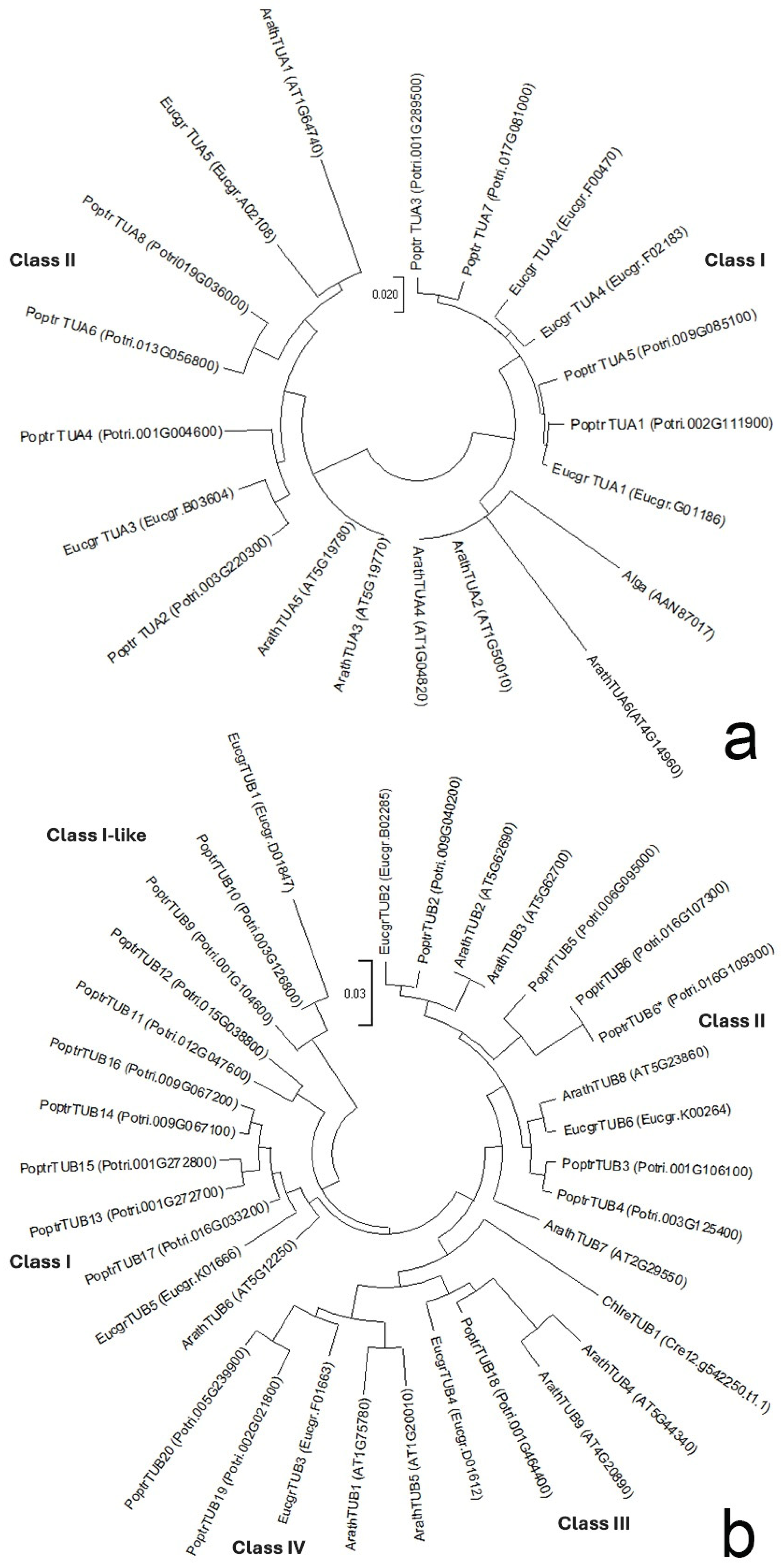
To determine the size and structure of the eucalypt α- and β-tubulin gene families in Eucalyptus, Populus trichocarpa α- and β-tubulin family member protein sequences [11] were used to find their homologues in the Eucalyptus grandis V1 genome (https://phytozome.jgi.doe.gov/pz/portal.html, last accessed on the 1 May 2024). This analysis identified the α-tubulin family to comprise five members and the β-tubulin family of six, which was found across all the tubulin plant classes identified in Oakley et al. [11]. Phylogenetic tree analysis of the α-tubulins found three members to belong to Plant Class I (EucgrTUA1, 2 and 4) and the remaining two to Plant Class II (EucgrTUA3 and 5) (Figure 1a). In the case of β-tubulins, EugrTUB1 was found to belong to Plant Class I-like; EucgrTUB5 to class I; EucgrTUB2 and 6 to class II; EucgrTUB4 to Class III; EucgrTUB3 to Class IV (Figure 1b).

3.2. Expression of Tubulins Is Higher in Xylem Tissues

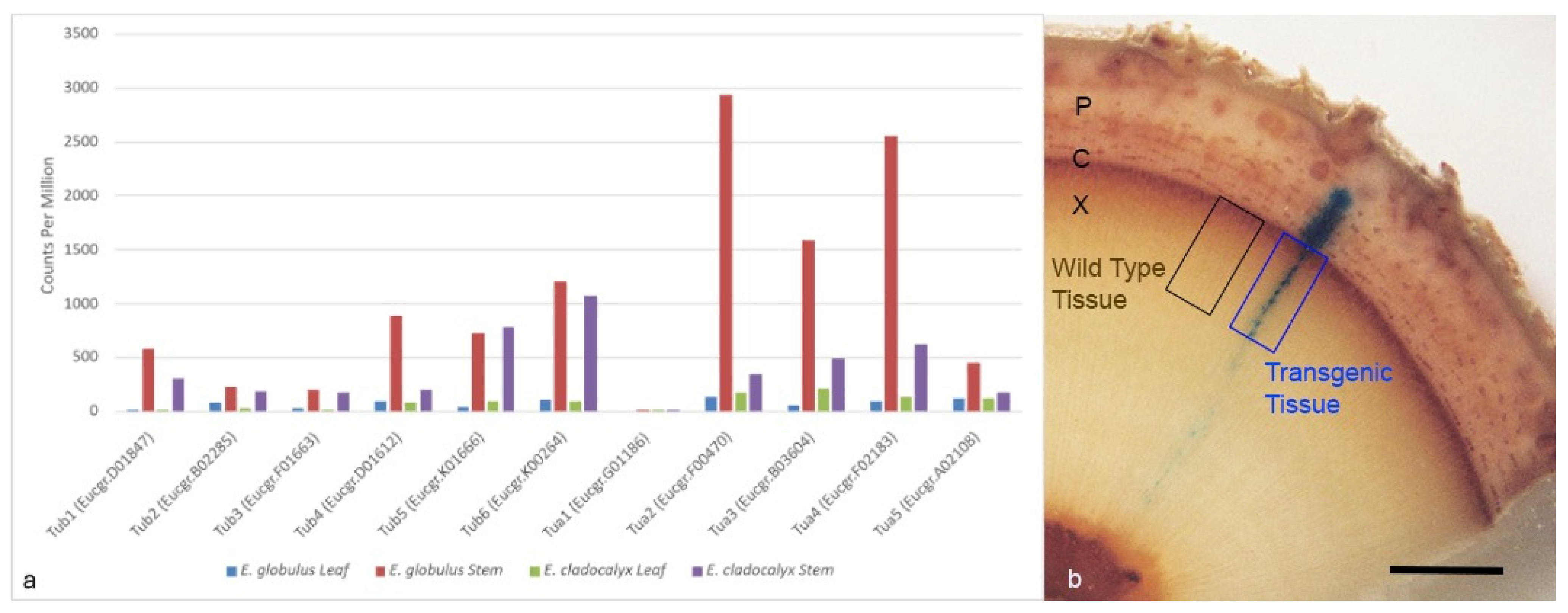
To determine the expression of α- and β-tubulin gene family members in developing and developed secondary xylem tissue (referred to from here as xylem tissue) and leaf tissue to assist with the identification of candidates for further functional analysis, RNAseq data from two eucalypt species was investigated (Figure 2a). For all α- and β-tubulins, other than EucgrTUB2, 3, and EucgrTUA5, significantly higher expression (α ≤ 0.01) was observed in xylem tissues compared to leaf tissue where differences were generally more pronounced in E. globulus. β -tubulins EucgrTUB1, 4, 5, and 6 showed high relative expression (>500 cpm) in xylem tissue in E. globulus whereas in E. cladocalyx, only EucgrTUB5 and 6 showed relatively high expression in the xylem tissue. Relatively low expression of all β-tubulins was observed in leaf tissues across both species. In the case of the α-tubulin family, EucgrTUA2, 3 and 4 showed relatively high expression in the xylem tissue in E. globulus whereas only EucgrTUA4 showed relatively high expression in this tissue type in E. cladocalyx. Similarly, expression of α-tubulins in leaf tissue was relatively low. Interestingly, EucgrTUA1 showed very little expression in either tissue across the two species.

3.3. Plant Growth and Transformation Efficiency During ISSA Experimentation

A range of functional experiments investigating α- and β-tubulin gene family members were undertaken using the ISSA transformation system on eucalypt and poplar seedling (Supplementary Figure S1). The ISSA transformation system allows for the efficient creation of transgenic tissue in vivo, where it can be compared to wild-type tissue in the same stem to elucidate gene function during wood formation in the space of 2–4 months. Importantly, transgenic and wild-type tissue is located directly adjacent to each other in the same part of the stem (Figure 2b), so has been exposed to exactly the same environmental and physiological conditions with any changes observed in phenotypic traits therefore being able to be attributed to the insertion of a transgene. Height and diameter for all seedlings were measured throughout experimentation where eucalypt seedlings grew on average 0.63 cm/day (±0.06) in height and 0.034 mm/day (±0.002) in diameter whereas poplar seedlings showed faster growth rates with average height and diameter growth being more than double at 1.48 cm/day (±0.19) for height and 0.76 mm/day (±0.005) for diameter. Overall, sufficient growth was observed in stems (>1 mm of new woody tissue) for fibre morphological assessments.
Transformation efficiency was also calculated for each tree species and gene construct used across all experiments. In total, 13,661 transgenic sectors were created in 947 windows in eucalypts and 604 sectors in 160 windows in poplar. Overall, eucalypts showed a higher total Average Number of Transformation Events per cm2 of Cambium Inoculated (ATS−2) of 20.9 (±0.8) compared to an ATS−2 of 3.8 (±0.5) for poplar. The bark peal ISSA harvesting method was adopted for this study so all sectors identified were cambial sectors. In eucalypts, gene construct ATS−2 (including GUS-only controls) ranged from as high as 33.5 (±4.2) for EgrTUA1/TUB1- and as low 6.7 (±1) for a EgrMirTUB3-, whereas in poplar ATS−2 ranged from as high as 5.7 (±1.1) for EgrTUA1+ and as low as 0.5 (±0.1) for EgrTUA1/TUB1+ (see Supplementary Tables S1 and S2 for additional details).

3.4. Overexpression and microRNAi/Antisense Knockdown Vectors of EgrTUA1 and EgrTUB1 Lead to Changes in Microfibril Angle in Secondary Cell Walls of Angiosperm Fibre Cells

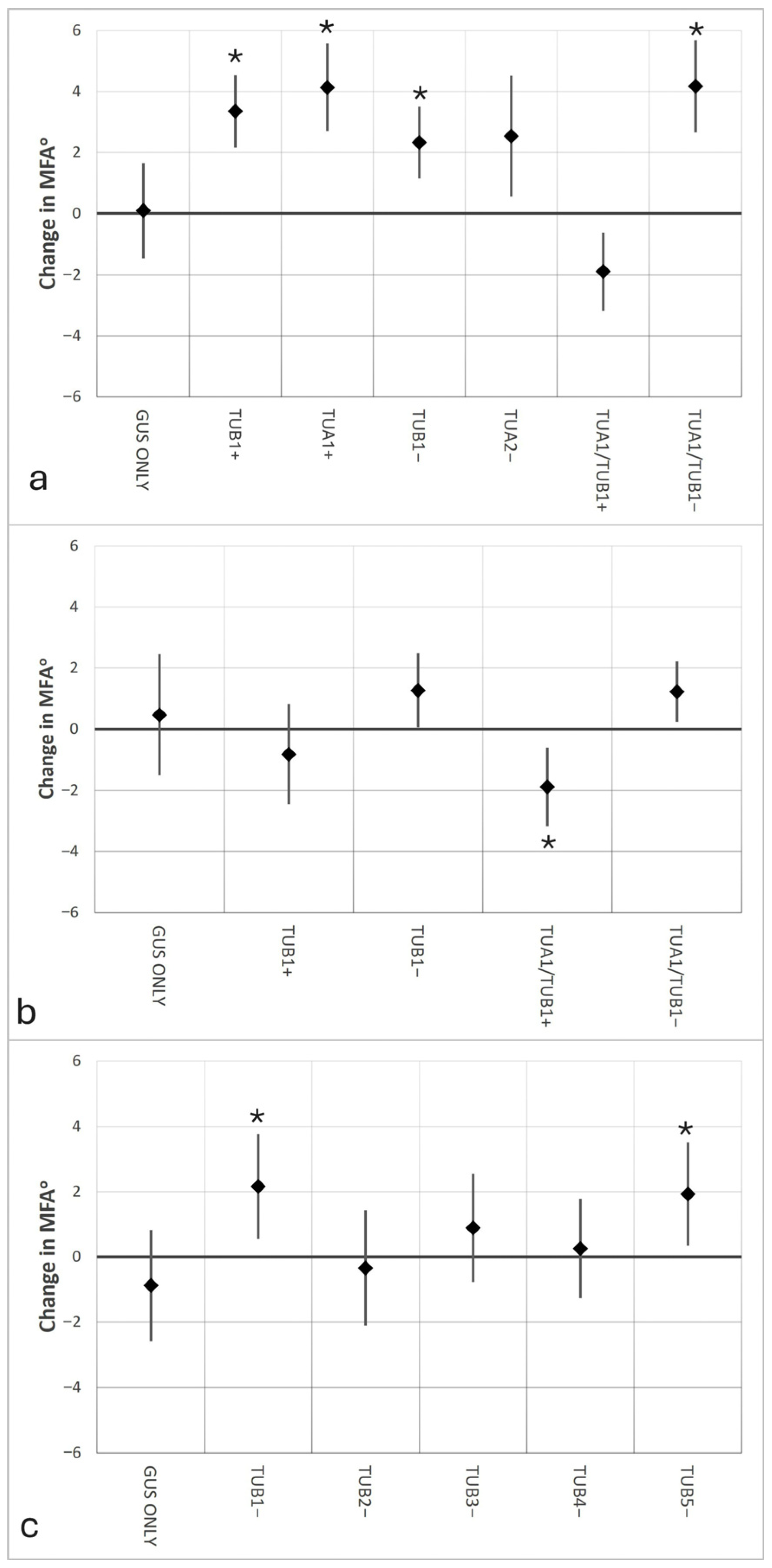
As tubulins occur as a heterodimer involving both α- and β- subunits, the influence of both α- and β- subunits on MFA and other wood fibre traits was investigated through a series of single and double gene overexpression and knockdown vectors involving Plant Class I and Plant Class I-like α- and β- tubulins, which are either highly and/or differentially expressed in woody tissue, and in eucalypt and poplar stems using ISSA. In the eucalypt stems, overexpression and microRNA knockdown gene constructs for EgrTUB1 (TUB1+ and TUB1, respectively), an overexpression gene construct for EgrTUA1 (TUA1+), double overexpression (TUB1/TUA1+) and a double microRNA knockdown (TUA1/TUB1-) vector were investigated. Due to difficulties in cloning the EgrTUA1 microRNA single knockdown vector, EgrTUA2 (TUA2-), a closely related Plant Class I α-tubulin was used for a single TUA knockdown experiment. For gene constructs TUB1+, TUA1+, TUB1-, TUA2-, and TUA1/TUB1-, a significant (α < 0.05) increase in average MFA between 2.3° to 4.2° was observed in transgenic fibres when compared to adjacent non-transgenic fibres (Figure 3a). In contrast, TUA1/TUB1+ showed a significant (α < 0.05) decrease in average MFA of 1.9° in transgenic fibres. The GUS-only control was also assessed and no significant differences (α < 0.05) in fibre MFA between transgenic and non-transgenic fibres were observed. When the average difference in fibre MFA was compared between gene constructs and the GUS-only control, all gene vectors except TUA2- (α = 0.058) and TUA1/TUB1+ (α = 0.055) showed a significant difference (α < 0.05). TUA1+/TUA1+ showed significant difference to all other gene constructs whereas no significant difference was observed in average MFA between gene constructs TUB1+, TUA1+, TUB1-, TUA2- and TUA1/TUB1- (see Supplementary Table S3 for p-values).
In poplar stems, a subset of overexpression and microRNA knockdown gene constructs were used including the TUB1+, TUB1-, TUA1/TUB1+ and TUA1/TUB1- gene constructs. Similar trends were observed for TUB1- and TUA1/TUB1- which showed a significantly (α < 0.05) higher MFA in transgenic fibres when compared to adjacent non-transgenic fibres (1.3° and 1.2°, respectively) and the TUA1/TUB1+, showing a significant (α < 0.05) decrease (1.9°). TUB1+ and the GUS controls showed no significant differences (α < 0.05) in MFA between transgenic and adjacent non-transgenic fibres (Figure 3b). When the average difference in fibre MFA between gene constructs and the GUS-only control was compared, only the TUA1/TUB1+ gene construct showed a significant difference (α < 0.05) to the GUS-only control. Amongst the gene constructs, the TUA1/TUB- was significantly different (α < 0.05) to the TUA1/TUB1+ and TUB1+ while TUA1/TUB1+ was significantly different (α < 0.05) to TUB1- (see Supplementary Table S4 for p-values).
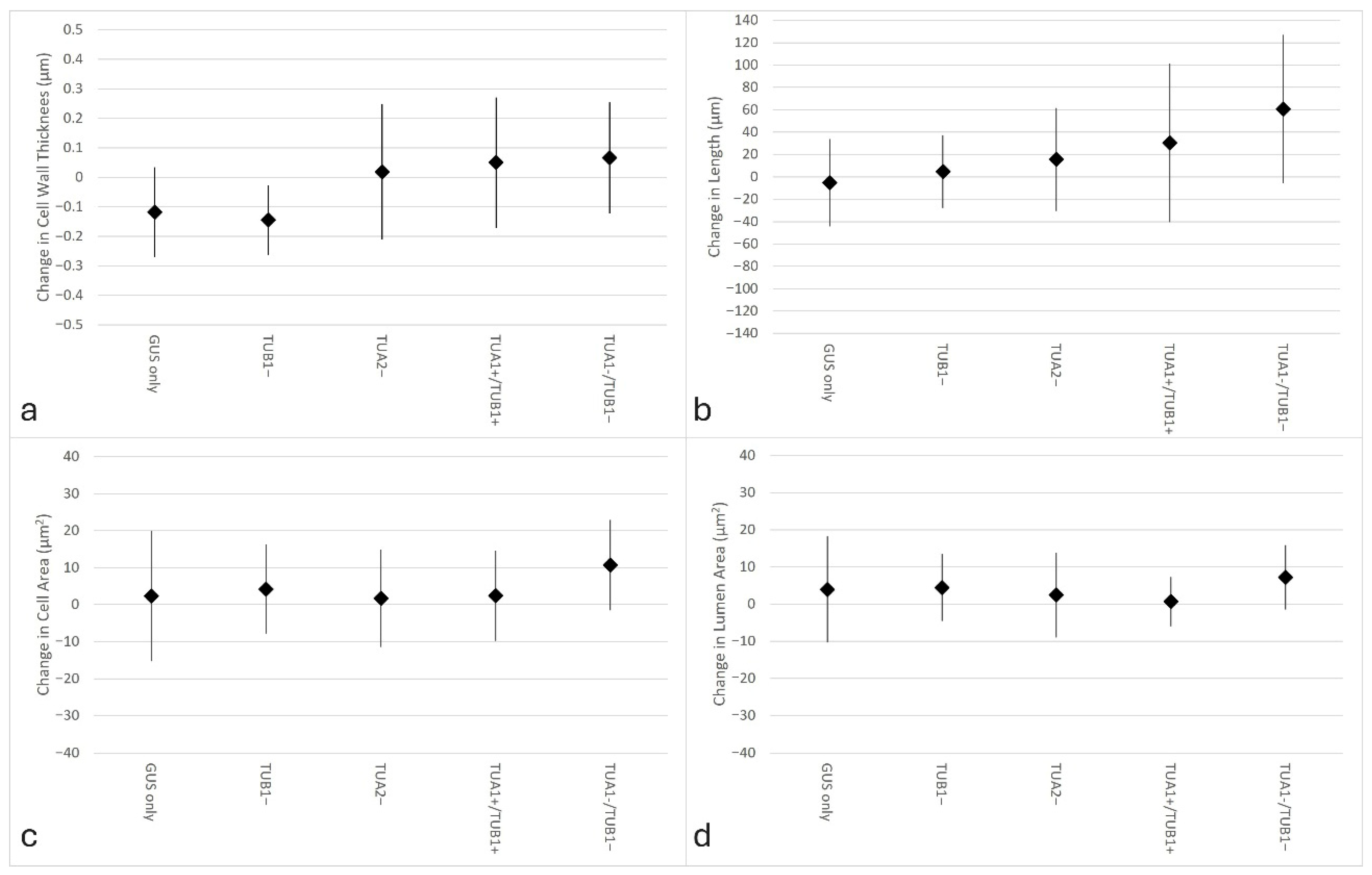
To determine if MFA changes area coupled with other reaction wood trait variations, additional fibre traits including fibre length, cell size, lumen size and cell wall thicknesses were investigated in a different subset of the gene constructs (TUB1-, TUB2-, TUA1/TUB1+, TUA1/TUB1- and GUS control), in eucalypt stems. Significant differences (α < 0.05) between transgenic and adjacent non-transgenic fibres were observed for cell wall thickness for the TUB1- only (Figure 4a), where a decrease was observed; however, this was not significantly different to the GUS-only control. No significant differences (α < 0.05) were observed for all other fibre morphological traits for all gene constructs. When the average difference in fibre morphological traits between gene constructs and the GUS-only control were compared, no significant differences (α < 0.05) were observed (Figure 4, Supplementary Tables S5–S8). Taken together, these finding suggest a role for both α- and β- tubulins specifically in the determination of MFA in wood fibres.

3.5. MicroRNAi Knockdown of β-Tubulin Gene Family Members Show Family Member Specificity in Determining Microfibril Angle in Secondary Cell Walls of Angiosperm Fibre Cells

To determine whether specific tubulin classes are involved in the microtubule arrays during fibre development and, more specifically, in MFA determination, β-tubulin genes from classes 1 (TUB5-), 2 (TUB2-), 3 (TUB4-) 4 (TUB3-) and a class 1 like β-tubulin (TUB1-) were targeted for microRNA knockdown using the ISSA transformation system in eucalypt stems. Significant differences (α < 0.05) in MFA between transgenic and the adjacent non-transgenic fibres were observed for gene constructs TUB1- and TUB5- only where a 2.2° and 1.9° increase was observed (Figure 3c). Again, transgenic and non-transgenic fibres in the GUS-only control showed no significant differences (α < 0.05). When the average differences in fibre MFA between gene constructs and the GUS-only control were compared, significantly higher (α < 0.05) fibre MFA was observed in TUB1- and TUB5- compared to the GUS-only control (Supplementary Table S9). TUB1- also showed a significantly higher (α < 0.05) MFA to TUB2-. Based on these findings, Plant Class I and Plant Class I-like β-tubulins appear to be specifically involved in the determination of fibre development where they influence fibre MFA.

4. Discussion

4.1. Eucalypt α- and β-Tubulin Gene Families Are Relatively Small and Show Tissue Specificity

In plants, tubulins are encoded by multigene families where expression of different family members is tissue-specific and varies with plant development [11,36]. When compared to another tree species, poplar, the size of the published α-tubulin gene family in Eucalyptus grandis is relatively similar (five and seven, respectively), whereas the number of β-tubulins is significantly lesser (six and twenty, respectively). The significantly larger β-tubulin gene family in poplar is likely to be the result of a more recent genome duplication event [29], where 10 pairs of highly homologous β-tubulins have been identified [11]. This is consistent with observations of the tubulin gene family in the closely related genus Salix [13]. Other diploid plant species with published tubulin gene families have only slightly larger tubulin genes families relative to eucalypts: Arabidopsis thaliana with six α-tubulins [37] and nine β-tubulins [38]; Zea mays with six α-tubulins [39] and six β-tubulins [40]; Oriza sativa with eight β-tubulins [41]. While the size of the eucalypt tubulin gene family is overall slightly smaller than in other plant genomes, they are still represented across all identified tubulin Plant Classes of α- and β-tubulins.
Most eucalypt α- and β-tubulin gene family members were shown to be expressed in both stem and leaf tissue; however, expression levels varied between tubulin family members with relatively higher expression observed in stem tissues and in E. globulus. Six of the eleven tubulins identified showed significantly higher expression in stem tissues with all these tubulins being either Plant Class I α-tubulins or Plant Class I or Plant Class I-like β-tubulin. Tissue specificity of tubulin expression has been observed in several studies suggesting the importance of certain isoforms for different cell and tissue developmental stages. As a result, these tubulin isoforms were targeted for investigation.

4.2. Overexpression and Knockdown Vectors of Specific Heterodimers α- and β-Tubulins Influence Microfibril Angle in Secondary Cell Walls

Gene expression studies have demonstrated that the α- and β-tubulin gene family isoforms are highly expressed during wood formation and linked to traits such as MFA determination; however, to date, only a single β-tubulin isoform (a Plant Class 1-like) has been functionally characterised during this process [14]. Here, a range of α- and β-tubulin isoforms from E. grandis were placed into overexpression and/or knockdown gene constructs, individually and together, and then transformed into cambial cells using the ISSA method to elucidate their functions during secondary cell wall formation in fibre cells in eucalypts and poplar. Results show that in eucalypts and poplar stems, transgenic fibres harbouring either overexpression and knockdown gene constructs containing EgrTUB1, EgrTUA1, EgrTUA2 and EgrTUB5 showed significant changes in cell wall MFA compared to non-transgenic fibres, suggesting that α- and β-tubulins have a functional role in MFA determination.
Findings further imply that decreased expression leads to an increase in MFA, where in all cases, transgenic fibres harbouring knockdown gene constructs for these tubulin isoforms had higher average MFA compared to controls while some harbouring an overexpression gene construct led to an opposite effect. This is consistent with observations in reaction wood RNA expression studies where higher tubulin expression correlates with lower MFA in wood fibre [9]. However, in some cases in eucalypt stems, transgenics fibres containing the overexpression gene constructs EgrTUB1+ and EgrTUA2+ showed an increase in MFA. A similar increase in MFA was also observed in a separate study by Spokevicius et al., [14], using the same EgrTUB1+ overexpression gene construct as in this study, who noted that this is likely due to homology-dependent gene silencing (HDGS). HDGS leads to gene silencing in response to high sequence homology between the transgene and a homologues gene and would apply here as a full-length eucalypt tubulin gene has been inserted into a eucalypt host. Interestingly, the EgrTUA1/TUB1+ overexpression gene construct did not trigger any HDGS response, even though it contained two full-length tubulin genes. HDGS requires that the plant cell detects repetitive sequences, high transcript levels, or dsRNA-forming structures from the tDNA that has incorporated into the genome and it does not appear and that this has meet the triggering threshold in the case of this vector. Findings also indicate that specific tubulin isoforms play a primary role during secondary cell wall development in fibres where miRNA knockdowns targeting β-tubulin isoform from each of the main clades of the gene family revealed Plant Class I and Plant I-like β-tubulin genes were the only gene family members that led to any changes in MFA in transgenic fibres when compared to controls. Taken together, this functional characterisation work suggests that MFA determination in secondary cell wall appears to be controlled by the expression of specific α- and β-tubulins isoforms.
In reaction wood, changes in MFA are coupled with changes to other secondary cell wall traits such as cell wall thickness and chemical composition [42], while in the primary cell wall, microtubule arrays guide primary cell wall development [43] where their arrangement can influence elongation and expansion processes and ultimately the final size and shape of a cell. This study did not find any evidence of changes in any other morphological cell wall and fibre traits investigated, indicating that Plant Class 1-like β-tubulin and Plant Class 1 α-tubulins influence MFA determination specifically.
Changes in the expression of tubulin genes or tubulin protein levels in transgenic tissues were unable to validated in this study due to technical limitations of sourcing RNA and proteins from ISSA-derived tissues. However, the tightly controlled ISSA system and robust fibre sampling methodologies used, where transgenic fibres grow directly adjacent to wild-type fibres within the same stem under the same environmental conditions, mean that any changes observed between transgenic and non-transgenic fibres can notionally be attributed to the presence of the transgene and its impacts on cellular functions as there is no other plausible explanations for any differences. Specifically worth noting is that these results exactly replicate findings of earlier published work utilising the same gene construct EgrTUB1+ [14], demonstrating that observed phenotypes in ISSA-derived tissues are not a result of chance, supporting the strength of the methodologies used. Changes in MFA reported for this study, while statistically significant in several cases, were, however, relatively small. This can be attributed to the inability to select transgenic sectors where high up- or downregulation occurred with the sampled sectors representing the average effect of a random selection of transgenic incorporation events.
While the link between MFA and Plant Class 1 and Plant Class 1-like α- and β-tubulins appears to be clear, the mechanism as to how tubulin expression, and presumably their cellular concentrations, as well as isoform structure and composition in a cortical microtubule influence this developmental process remains elusive. Expression studies and functional work conducted here imply an inverse relationship between MFA in wood fibres and the expression of specific tubulin isoforms, suggestive of a concentration and isoform dependency model in determining microfibril orientation in the secondary cell wall in response to mechanical stress, gravitropic stresses or other stimuli. In plants, tubulin isoform variation and a range of post-translational modifications involved in guiding interactions with specific proteins could explain the specificity as well as the diversity of tubulin functions [36,44]. For example, in rice, overexpression of a tubulin tyrosine ligase-like 12 protein affected the structural and dynamic features of microtubules [45]. Tubulin concentrations and/or isoform structure are also likely to influence a range of microtubule properties such length, density, bundling and/or branching and facilitate cortical MT array alignment in partnership with MAPs and other MT-interacting proteins [46]. Finally, it is unclear how mechanical or gravitropic stress is perceived within the secondary cell wall of fibre cells and the cascades that would lead to changes in expression or function of tubulins, MAPs or other associated protein, in order to adjust MFA and other secondary cell wall traits to allow fibres to remain intact under these stresses. While many questions remain, it is becoming clearer that regulation of tubulin isoform expression and post-translational modifications are likely to be involved in determining microfibril orientation and, in turn, the strength characteristic of secondary cell walls.
These findings also raise contrary evidence on the importance of maintaining a balance between α- and β-tubulin concentrations as previous functional studies, where single heterodimers were either knocked out or overexpressed, did not lead to the regeneration of transgenic plants in poplar [11] and maize calli [47]. Swamy et al. [15] was able to regenerate poplar plants with the inclusion of a post-translational C-terminal modification to an α-tubulin but observed varied expression across tissues with high expression noted in leaves and low expression in stem tissues, suggesting that imbalances were not tolerated in wood-forming tissue during regeneration of plants. However, when only one heterodimer of either α- or β-tubulins was targeted for overexpression or knockdown directly in mature woody tissue here and in another study [14], potential imbalances appear to have been tolerated as a comparable number of transgenic sectors were observed for the vectors containing tubulins compared to the GUS-only controls. One possible explanation is that tubulin imbalances during the early stages of plant organogenesis may be detrimental to development whereas this may not be as significant an issue in already-developed secondary meristematic tissues where feedback mechanism may exist to maintain balance.

5. Conclusions

This study provides evidence for the crucial role of α- and β-tubulins in determining MFA in the secondary cell walls of woody plant fibre cells. It demonstrates that specific tubulin isoforms, particularly Class 1 and Class 1-like isoforms, directly influence MFA with changes occurring independently of other fibre morphological traits through a mechanism that appears to be dependent on the transcriptional regulation of specific tubulin isoforms. By elucidating the molecular mechanisms underlying secondary cell wall architecture in woody plants, this study provides key insights into the evolutionary success of trees and other woody perennials where the ability to fine-tune MFA through tubulin regulation can contribute to their adaptability to various environmental stresses. These findings also open avenues for potential genetic manipulation of wood properties in forestry and biomaterials applications, potentially leading to more resilient and versatile woody biomass.

Supplementary Materials

The following supporting information can be downloaded at https://www.mdpi.com/article/10.3390/f17020234/s1, Supplementary Figure S1: Eucalypt (a) and Poplar (b) seedlings growing in the glasshouse following inoculation of stems using the induced somatic sector analysis (ISSA) in vivo stem transformation method. Supplementary Table S1: Summary transformation efficiency data for α- and β- tubulin overexpression and knockdown vectors in poplar. Supplementary Table S2: Summary transformation efficiency data for α- and β- tubulin overexpression and knockdown vectors in eucalypts. Supplementary Table S3: p-values associated with the average difference in fibre MFA between transgenic and non-transgenic tissues for α- and β-tubulin gene constructs in eucalypt stems. Values with α < 0.05 in italic. Supplementary Table S4: p-values associated with the average difference in fibre MFA between transgenic and non-transgenic tissues for α- and β-tubulin gene constructs in poplar stems. Values with α < 0.05 in italic. Supplementary Table S5: p-values associated with the average difference in fibre cell wall thickness between transgenic and non-transgenic tissues for α- and β-tubulin gene constructs in eucalypt stems. Values with α < 0.05 in italic. Supplementary Table S6: p-values associated with the average difference in fibre length between transgenic and non-transgenic tissues for α- and β-tubulin gene constructs in eucalypt stems. Values with α < 0.05 in italic. Supplementary Table S7: p-values associated with the average difference in fibre cell area between transgenic and non-transgenic tissues for α- and β-tubulin gene constructs in eucalypt stems. Values with α < 0.05 in italic. Supplementary Table S8: p-values associated with the average difference in fibre lumen area between transgenic and non-transgenic tissues for α- and β-tubulin gene constructs in eucalypt stems. Values with α < 0.05 in italic. Supplementary Table S9: p-values associated with comparison made between the average difference in fibre MFA between transgenic and non-transgenic tissue for β-tubulin microRNA knockdown gene constructs in eucalypt stems. Values with α < 0.05 in italic. Supplementary Table S10: RNAseq expression data of α- and β-tubulins in leaf and stem tissue in two eucalypt species. Values with α < 0.01 are in italic and indicate significant differential tissue between tissue types based on count per million data. Supplementary Table S11: Sequences of mature amiR sequences used for α- and β-tubulin gene knockdown studies.

Author Contributions

L.T., A.V.S., S.S. and G.B. conceived and designed research. L.T. and L.M.T. conducted the experiments. L.T., L.M.T., A.V.S., G.B. and S.S. were involved in analysis and interpreted the data. A.V.S., L.T. and L.M.T. wrote the manuscript. All authors have read and agreed to the published version of the manuscript.

Funding

This work was supported by the University of Melbourne’s Melbourne Research Scholarship and the Australian Government Department of Agriculture, Fisheries and Forestry Science and the Innovation Award, both awarded to L.T.

Data Availability Statement

The original contributions presented in this study are included in the article and Supplementary Materials. Further inquiries can be directed to the corresponding author.

Acknowledgments

The authors would like to thank Emma Melder and Josquin Tibbits for their invaluable insight and assistance during the experimental work and to Heather McFarlane for reviewing the manuscript and providing valuable feedback. Julio Najera provided technical assistance in the laboratory.

Conflicts of Interest

The authors declare no conflicts of interest.

References

  1. Carlquist, S. How wood evolves: A new synthesis. Botany 2012, 90, 901–940. [Google Scholar] [CrossRef]
  2. Meyer-Berthaud, B.; Soria, A.; Decombeix, A.L. The land plant cover in the Devonian: A reassessment of the evolution of the tree habit. In Terrestrialization Process: Modelling Complex Interactions at the Biosphere-Geosphere Interface; Vecoli, M., Clement, G., MeyerBerthaud, B., Eds.; Geological Society Special Publication; Geological Soc Publishing House: Bath, UK, 2010; Volume 339, pp. 59–70. [Google Scholar]
  3. Andersson-Gunneras, S.; Mellerowicz, E.J.; Love, J.; Segerman, B.; Ohmiya, Y.; Coutinho, P.M.; Nilsson, P.; Henrissat, B.; Moritz, T.; Sundberg, B. Biosynthesis of cellulose-enriched tension wood in Populus: Global analysis of transcripts and metabolites identifies biochemical and developmental regulators in secondary wall biosynthesis. Plant J. 2006, 45, 144–165. [Google Scholar] [CrossRef] [PubMed]
  4. Lampugnani, E.R.; Khan, G.A.; Somssich, M.; Persson, S. Building a plant cell wall at a glance. J. Cell Sci. 2018, 131, 6. [Google Scholar] [CrossRef] [PubMed]
  5. Paux, E.; Carocha, V.; Marques, C.; de Sousa, A.M.; Borralho, N.; Sivadon, P.; Grima-Pettenati, J. Transcript profiling of Eucalyptus xylem genes during tension wood formation. New Phytol. 2005, 167, 89–100. [Google Scholar] [CrossRef]
  6. Chen, H.J.; Chen, B.B.; Zhang, D.Q. Transcript profiling of Populus tomentosa genes in normal, tension, and opposite wood by RNA-seq. BMC Genom. 2015, 16, 65–73. [Google Scholar] [CrossRef]
  7. Li, G.X.; Yang, X.H.; Wu, H.X. Transcriptome profiling of radiata pine branches reveals new insights into reaction wood formation with implications in plant gravitropism. BMC Genom. 2013, 14, 768. [Google Scholar] [CrossRef]
  8. Lafarguette, F.; Leple, J.C.; Dejardin, A.; Laurans, F.; Costa, G.; Lesage-Descauses, M.C.; Pilate, G. Poplar genes encoding fasciclin-like arabinogalactan proteins are highly expressed in tension wood. New Phytol. 2004, 164, 107–121. [Google Scholar] [CrossRef]
  9. Qiu, D.; Wilson, I.W.; Gan, S.; Washusen, R.; Moran, G.F.; Southerton, S.G. Gene expression in Eucalyptus branch wood with marked variation in cellulose microfibril orientation and lacking G-layers. New Phytol. 2008, 179, 94–103. [Google Scholar] [CrossRef]
  10. Azri, W.; Ennajah, A.; Nasr, Z.; Woo, S.Y.; Khaldi, A. Transcriptome profiling the basal region of poplar stems during the early gravitropic response. Biol. Plant. 2014, 58, 55–63. [Google Scholar] [CrossRef]
  11. Oakley, R.V.; Wang, Y.S.; Ramakrishna, W.; Harding, S.A.; Tsai, C.J. Differential expansion and expression of alpha- and beta-tubulin gene families in Populus. Plant Physiol. 2007, 145, 961–973. [Google Scholar] [CrossRef] [PubMed]
  12. Hu, H.; Gu, X.; Xue, L.J.; Swamy, P.S.; Harding, S.A.; Tsai, C.J. Tubulin C-terminal Post-translational Modifications Do Not Occur in Wood Forming Tissue of Populus. Front. Plant Sci. 2016, 7, 1493. [Google Scholar] [CrossRef] [PubMed]
  13. Rao, G.D.; Zeng, Y.F.; He, C.Y.; Zhang, J.G. Characterization and putative post-translational regulation of alpha- and beta-tubulin gene families in Salix arbutifolia. Sci. Rep. 2016, 6, 19258. [Google Scholar] [CrossRef] [PubMed]
  14. Spokevicius, A.V.; Southerton, S.G.; MacMillan, C.P.; Qiu, D.; Gan, S.; Tibbits, J.F.G.; Moran, G.F.; Bossinger, G. beta-tubulin affects cellulose microfibril orientation in plant secondary fibre cell walls. Plant J. 2007, 51, 717–726. [Google Scholar] [CrossRef]
  15. Swamy, P.S.; Hu, H.; Pattathil, S.; Maloney, V.J.; Xiao, H.; Xue, L.J.; Chung, J.D.; Johnson, V.E.; Zhu, Y.Y.; Peter, G.F.; et al. Tubulin perturbation leads to unexpected cell wall modifications and affects stomatal behaviour in Populus. J. Exp. Bot. 2015, 66, 6507–6518. [Google Scholar] [CrossRef]
  16. Harding, S.A.; Hu, H.; Nyamdari, B.; Xue, L.J.; Naran, R.; Tsai, C.J. Tubulins, rhythms and cell walls in poplar leaves: It’s all in the timing. Tree Physiol. 2018, 38, 397–408. [Google Scholar] [CrossRef]
  17. Lowe, J.; Li, H.; Downing, K.H.; Nogales, E. Refined structure of alpha beta-tubulin at 3.5 A resolution. J. Mol. Biol. 2001, 313, 1045–1057. [Google Scholar] [CrossRef]
  18. Heald, R.; Nogales, E. Microtubule dynamics. J. Cell Sci. 2002, 115, 3–4. [Google Scholar] [CrossRef]
  19. Baskin, T.I. On the alignment of cellulose microfibrils by cortical microtubules: A review and a model. Protoplasma 2001, 215, 150–171. [Google Scholar] [CrossRef]
  20. Herth, W. Plasma membrane rosettes involved in localised wall thickening during xylem vessel formation of Lepidium sativum L. Planta 1985, 164, 12–21. [Google Scholar] [CrossRef]
  21. Haigler, H.C.; Brown, R.M. Transport of rosettes from the golgi-apparatus to the plasma membrane in isolated mesophyll-cells of Zinnia elegans differentiation to tracheary elements in suspension culture. Protoplasma 1986, 134, 111–120. [Google Scholar] [CrossRef]
  22. Paredez, R.A.; Somerville, C.R.; Ehrhardt, D.W. Visualization of cellulose synthase demonstrates functional association with microtubules. Science 2006, 312, 1491–1495. [Google Scholar] [CrossRef]
  23. Watanabe, Y.; Meents, M.J.; McDonnell, L.M.; Barkwill, S.; Sampathkumar, A.; Cartwright, H.N.; Demura, T.; Ehrhardt, D.W.; Samuels, A.L.; Mansfield, S.D. Visualization of cellulose synthases in Arabidopsis secondary cell walls. Science 2015, 350, 198–203. [Google Scholar] [CrossRef]
  24. Bringmann, M.; Li, E.Y.; Sampathkumar, A.; Kocabek, T.; Hauser, M.T.; Persson, S. POM-POM2/CELLULOSE SYNTHASE INTERACTING1 Is Essential for the Functional Association of Cellulose Synthase and Microtubules in Arabidopsis. Plant Cell 2012, 24, 163–177. [Google Scholar] [CrossRef]
  25. Li, S.; Lei, L.; Somerville, C.R.; Gu, Y. Cellulose synthase interactive protein 1 (CSI1) links microtubules and cellulose synthase complexes. Proc. Natl. Acad. Sci. USA 2012, 109, 185–190. [Google Scholar] [CrossRef] [PubMed]
  26. Schneider, R.; Tang, L.; Lampugnani, E.R.; Barkwill, S.; Lathe, R.; Zhang, Y.; McFarlane, H.E.; Pesquet, E.; Niittyla, T.; Mansfield, S.D.; et al. Two Complementary Mechanisms Underpin Cell Wall Patterning during Xylem Vessel Development. Plant Cell 2017, 29, 2433–2449. [Google Scholar] [CrossRef] [PubMed]
  27. Woodley, M.; Mulvihill, A.; Fujita, M.; Wasteneys, G.O. Exploring microtubule-dependent cellulose-synthase-complex movement with high precision particle tracking. Plants 2018, 7, 53. [Google Scholar] [CrossRef]
  28. Somerville, C. Cellulose synthesis in higher plants. In Annual Review of Cell and Developmental Biology; Annual Review of Cell and Developmental Biology; Annual Reviews: Palo Alto, CA, USA, 2006; Volume 22, pp. 53–78. [Google Scholar]
  29. Tuskan, G.A.; DiFazio, S.; Jansson, S.; Bohlmann, J.; Grigoriev, I.; Hellsten, U.; Putnam, N.; Ralph, S.; Rombauts, S.; Salamov, A.; et al. The genome of black cottonwood, Populus trichocarpa (Torr. & Gray). Science 2006, 313, 1596–1604. [Google Scholar] [CrossRef]
  30. Myburg, A.A.; Grattapaglia, D.; Tuskan, G.A.; Hellsten, U.; Hayes, R.D.; Grimwood, J.; Jenkins, J.; Lindquist, E.; Tice, H.; Bauer, D.; et al. The genome of Eucalyptus grandis. Nature 2014, 510, 356–362. [Google Scholar] [CrossRef]
  31. Tamura, K.; Stecher, G.; Kumar, S. MEGA11: Molecular Evolutionary Genetics Analysis Version 11. Mol. Biol. Evol. 2021, 38, 3022–3027. [Google Scholar] [CrossRef] [PubMed]
  32. Melder, E.; Bossinger, G.; Spokevicius, A.V. Overexpression of ARBORKNOX1 delays the differentiation of induced somatic sector analysis (ISSA) derived xylem fibre cells in poplar stems. Tree Genet. Genomes 2015, 11, 87. [Google Scholar] [CrossRef]
  33. Reinhart, B.J.; Weinstein, E.G.; Rhoades, M.W.; Bartel, B.; Bartel, D.P. MicroRNAs in plants. Genes Dev. 2002, 16, 1616–1626. [Google Scholar] [CrossRef]
  34. Spokevicius, A.; Taylor, L.; Melder, E.; Van Beveren, K.; Tibbits, J.; Creux, N.; Bossinger, G. The Use of Induced Somatic Sector Analysis (ISSA) for Studying Genes and Promoters Involved in Wood Formation and Secondary Stem Development. Jove-J. Vis. Exp. 2016, 116, 54553. [Google Scholar] [CrossRef]
  35. Spokevicius, A.V.; Tibbits, J.; Rigault, P.; Nolin, M.A.; Muller, C.; Merchant, A. Medium term water deficit elicits distinct transcriptome responses in Eucalyptus species of contrasting environmental origin. Bmc Genom. 2017, 18, 284. [Google Scholar] [CrossRef]
  36. Breviario, D.; Giani, S.; Morello, L. Multiple tubulins: Evolutionary aspects and biological implications. Plant J. 2013, 75, 202–218. [Google Scholar] [CrossRef]
  37. Kopczak, S.D.; Haas, N.A.; Hussey, P.J.; Silflow, C.D.; Snustad, D.P. The small genome of Arabidopsis contains at least 6 expressed alpha-tubulin genes. Plant Cell 1992, 4, 539–547. [Google Scholar] [CrossRef]
  38. Snustad, D.P.; Haas, N.A.; Kopczak, S.D.; Silflow, C.D. The small genome of Arabidopsis contains at least 9 expressed beta-tubulin genes. Plant Cell 1992, 4, 549–556. [Google Scholar] [CrossRef] [PubMed]
  39. Villemur, R.; Joyce, C.M.; Haas, N.A.; Goddard, R.H.; Kopczak, S.D.; Hussey, P.J.; Snustad, D.P.; Silflow, C.D. Alpha tubulin gene family of maize (Zea mays L): Evidence for 2 ancient alpha-tubulin genes in plants. J. Mol. Biol. 1992, 227, 81–96. [Google Scholar] [CrossRef] [PubMed]
  40. Villemur, R.; Haas, N.A.; Joyce, C.M.; Snustad, D.P.; Silflow, C.D. Characterization Of 4 New Beta-Tubulin Genes And Their Expression During Male Flower Development In Maize (Zea-mays L). Plant Mol. Biol. 1994, 24, 295–315. [Google Scholar] [CrossRef] [PubMed]
  41. Yoshikawa, M.; Yang, G.X.; Kawaguchi, K.; Komatsu, S. Expression analyses of beta-tubulin isotype genes in rice. Plant Cell Physiol. 2003, 44, 1202–1207. [Google Scholar] [CrossRef]
  42. Almeras, T.; Clair, B. Critical review on the mechanisms of maturation stress generation in trees. J. R. Soc. Interface 2016, 3, 20160550. [Google Scholar] [CrossRef]
  43. Paradez, A.; Wright, A.; Ehrhardt, D.W. Microtubule cortical array organization and plant cell morphogenesis. Curr. Opin. Plant Biol. 2006, 9, 571–578. [Google Scholar] [CrossRef] [PubMed]
  44. Parrotta, L.; Cresti, M.; Cai, G. Accumulation and post-translational modifications of plant tubulins. Plant Biol. 2014, 16, 521–527. [Google Scholar] [CrossRef] [PubMed]
  45. Zhang, K.X.; Zhu, X.; Durst, S.; Hohenberger, P.; Han, M.J.; An, G.; Sahi, V.P.; Riemann, M.; Nick, P. A rice tubulin tyrosine ligase-like 12 protein affects the dynamic and orientation of microtubules. J. Integr. Plant Biol. 2021, 63, 848–864. [Google Scholar] [CrossRef]
  46. Tobias, L.M.; Spokevicius, A.V.; McFarlane, H.E.; Bossinger, G. The Cytoskeleton and Its Role in Determining Cellulose Microfibril Angle in Secondary Cell Walls of Woody Tree Species. Plants 2020, 9, 90. [Google Scholar] [CrossRef]
  47. Anthony, R.G.; Hussey, P.J. Suppression of endogenous alpha and beta tubulin synthesis in transgenic maize calli overexpressing alpha and beta tubulins. Plant J. 1998, 16, 297–304. [Google Scholar] [CrossRef] [PubMed]
Figure 1. Phylogenetic analysis of eucalypt, poplar and Arabidopsis α-tubulin (a) and β-tubulin; (b)gene family members. AlgaAAN87017 and Cre12.g542250.t1.1 were used as outgroups.
Forests 17 00234 g001
Figure 2. Normalised expression data (counts per million) of α- and β-tubulin gene family members in stem and leaf tissues of Eucalyptus globulus and Eucalyptus cladocalyx (a) and depiction of the typical location where ISSA-derived transgenic tissue (blue rectangle) and wild-type tissue (brown rectangle) were sourced for cell wall fibre measurements (b). C = cambium; P = phloem; X = xylem; scale bar approx. 1 mm.
Forests 17 00234 g002
Figure 3. Average and 95% confidence intervals for the difference in microfibril angle (MFA) in fibre cells between transgenic and non-transgenic tissue for Eucalyptus grandis α-tubulin and β-tubulin overexpression and downregulation vectors in eucalypt (a,c) and poplar (b). * indicates distributions that are statistically significantly different (p = < 0.05) to the GUS-only control.
Forests 17 00234 g003
Figure 4. Average and 95% confidence intervals of the mean difference between transgenic and non-transgenic fibres for selected α- and β-tubulin overexpression and knockdown vectors in eucalypt stems. Fibre properties investigated include (a) cell wall thickness, (b) fibre length, (c) cell area and (d) lumen area.
Forests 17 00234 g004
Disclaimer/Publisher’s Note: The statements, opinions and data contained in all publications are solely those of the individual author(s) and contributor(s) and not of MDPI and/or the editor(s). MDPI and/or the editor(s) disclaim responsibility for any injury to people or property resulting from any ideas, methods, instructions or products referred to in the content.