Article

Mapping a Fine-Resolution Landscape of Annual Spatial Distribution of Enhanced Vegetation Index (EVI) Since 1850 Using Tree-Ring Plots
1
College of Forestry and Landscape Architecture, South China Agricultural University, Guangzhou 510642, China
2
Guangxi Shengqi Technology Co., Ltd., Nanning 530000, China
3
Nanning Jiayang Forestry Planning and Design Co., Ltd., Nanning 530000, China
*
Author to whom correspondence should be addressed.
Forests 2026, 17(2), 228; https://doi.org/10.3390/f17020228
Submission received: 14 January 2026 / Revised: 4 February 2026 / Accepted: 6 February 2026 / Published: 7 February 2026

Abstract

As global climate change intensifies and extreme weather events become more frequent, understanding the historical spatial distribution of vegetation is of critical importance. However, most vegetation studies are temporally limited to the post-1980 period due to satellite data constraints. To bridge this gap, we integrated tree-ring width chronologies from the International Tree-Ring Databank with Landsat-derived Enhanced Vegetation Index (EVI) data and evaluated three machine learning models—Random Forest (RF), Support Vector Machine (SVM), and Convolutional Neural Network (CNN)—to reconstruct annual, spatially explicit EVI for the period 1850–1985 in Diqing, Yunnan, China. RF regression was the best among the three with highest adjusted R2 (0.90) and lowest Root Mean Square Error (0.032). The RF-based reconstruction indicated a consistent increase in regional EVI from 1991 to 2005. Breakpoint analysis identified three distinct sub-periods, each with unique spatiotemporal variation patterns. In current times, the EVI value shows a significant positive correlation with average temperatures in June, July, August, and December. In the contemporary period, it also correlates significantly and positively with winter average temperatures, March average precipitation, and spring average precipitation. The spatial pattern for the past 100 years reflects the succession of the local vegetation ecosystem and provides an insight into the influences of natural disturbances (low-temperature damages and droughts) on vegetation growth. This study demonstrates the feasibility of reconstructing high-resolution, long-term vegetation spatial dynamics using tree-ring proxies and machine learning.

1. Introduction

Global climate change is reshaping the spatial distribution patterns of terrestrial vegetation at an unprecedented rate and intensity [1,2]. Studies have shown that climate change leads to significant spatial shifts and reorganization of vegetation types and productivity with variations in key climatic factors such as temperature and precipitation [3], especially the substantial changes in the mid- to high latitudes of the Northern Hemisphere and southern South America [4,5]. Scientists have examined the historical changes in the spatial distribution of vegetation and their driving mechanisms, which is crucial for predicting the future impacts of climate change on ecosystems [6,7]. However, research on historical vegetation spatial dynamics has relied mainly on satellite remote sensing data, such as Landsat and MODIS, and most studies were conducted after 1980. Prior to this, due to the lack of regular, consistent and global observational tools, monitoring vegetation spatial changes depended primarily on ground surveys, aerial photography, and sparse data from a few early satellites, making it difficult to systematically and continuously track regional vegetation dynamics. Because vegetation responses to climate change often take several decades or even longer to manifest [8,9], the lack of long-term observational data slowed down our exploration on historical trajectory and mechanisms of vegetation spatial evolution. For study periods up to 100 years ago, historical documents like local newspapers, government reports and private diaries were the only accessible records to fill the knowledge gap in vegetation spatial variations prior to the era of remote sensing. Chen reconstructed the spatial pattern of croplands in southwestern China during the Qing Dynasty (1661–1784) using historical reports [10]. Li reconstructed Holocene agricultural systems in Jiangsu Province based on archaeobotanical evidence and historical documents [11]. Although historical documents can provide millennial-scale information on vegetation distribution, accurate and quantitative observations and records on vegetation shift were relatively rare in ancient societies, and much paperwork is irretrievably missing. As a result, such records are highly incomplete in both temporal and spatial dimensions.
Tree-ring data has the following characteristics: long longevity, high temporal resolution (annual record), and widespread distribution [12,13,14]. These provide a high-precision proxy for the historical changes in vegetation spatial distribution. Tree-ring width (tree radial growth) is closely related to surrounding vegetation growth. Its interannual variation directly reflects dynamic changes in the growth environment of trees, including key climatic factors such as temperature, precipitation, and extreme weather events [15]. In recent years, tree rings have made significant contributions to paleoclimate research, successfully reconstructing historical temperature, precipitation, and drought events in many regions [16,17]. One study reconstructed 359 years of precipitation variability in Chihuahua, Mexico, and identified drought patterns in the region from 1775 to 2007 [18]. Researchers at the Xishuangbanna Tropical Botanical Garden used tree-ring width data of Tsuga dumosa to reconstruct the evapotranspiration index in central Yunnan since 1826 and identify 11 extremely dry years [19]. These studies not only reveal the impacts of historical climate variability on vegetation, but also provide key evidence for exploring the mechanisms of vegetation responses to climatic fluctuations.
Currently, tree-ring width data have been combined with remote sensing products and widely used to derive various vegetation indicators, such as the Normalized Difference Vegetation Index (NDVI) [20] and EVI [21]. A global review synthesis reported that many studies found strong interannual relationships between tree-ring width and vegetation indices during growing-season months, though growth trends recorded by the two metrics were often decoupled over longer timescales [22], particularly temperature and precipitation [16]. However, these relationships are not uniform; they exhibit considerable spatial heterogeneity and differences among vegetation indices [23]. Despite these recognized potentials and complexities, existing work combining tree-ring data and satellite imagery has mainly focused on point-based analyses, lacking systematic exploration of vegetation dynamics at regional scales [24]. This limitation of point-based analyses prevents a comprehensive understanding of regional vegetation response patterns to climate change and hampers effective assessment of spatial differences in vegetation sensitivity to climatic fluctuations.
EVI and NDVI are both widely used vegetation indices in remote sensing, employed to assess vegetation cover, growth status, and vigor at the land surface [25,26]. Studies have shown that NDVI and tree-ring width exhibit a certain degree of discontinuity when used for climate reconstruction or environmental change analyses [27,28]. By contrast, EVI shows potential advantages in areas with dense vegetation cover, where it can more effectively capture vegetation phenological changes [29,30,31]. However, EVI satellite data are constrained by satellite launch dates and cannot provide information on vegetation spatial changes prior to 1985.
Therefore, to address the temporal gap in direct EVI observations and the spatial limitation of existing point-based reconstructions, this study proposes to use tree-ring width data from Diqing, Yunnan, and apply machine learning models to reconstruct spatially explicit annual EVI for the period 1850–1985. Using tree-ring data from four sampling sites and satellite-based EVI products, we reconstruct EVI with multiple models. We combine simulated (1850–1985) and observed (1986–2005) EVI maps to analyze the temporal and spatial characteristics of EVI dynamics in the study area and explore the relationship between EVI and radial tree growth.
On this basis, we propose three hypotheses: 1. There exists a model that can accurately reconstruct EVI from tree-ring width data and map spatial patterns with acceptable errors. 2. EVI always exhibits increasing temporal trends in the current period (1850–1949) and the contemporary period (1950–2005). 3. The reconstructed EVI maps can help us spatially analyze the impacts of historical natural disasters on vegetation.

2. Materials and Methods

2.1. Study Area

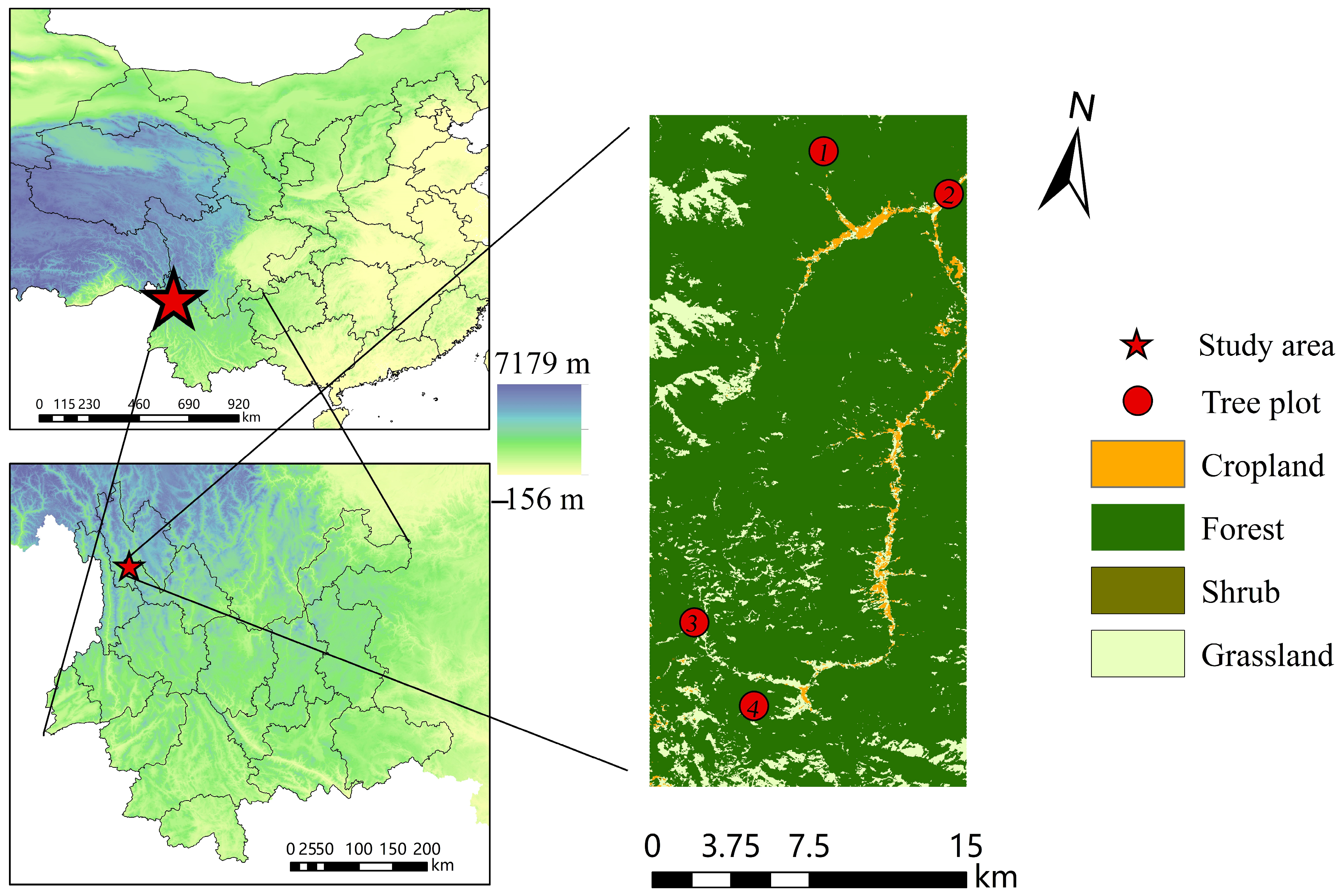
The study area is located in Deqin Tibetan Autonomous Prefecture, northwest Yunnan Province, China, at the intersection of the southeastern margin of the Qinghai–Tibet Plateau and the heartland of the Hengduan Mountains. It has an average elevation of 3053.8 m and covers an area of 542.61 km2, with latitude ranging from 27.28° N to 27.61° N and longitude from 99.20° E to 99.40° E (Figure 1). The terrain is dominated by high-altitude mountainous landscapes, characterized by dramatic topographic fluctuations influenced by the geomorphological features of the Jinsha River, Lancang River, and Nujiang River systems. Slopes in the region predominantly range between 25° and 45°, creating complex topography where factors like elevation, slope, and aspect potentially modulate local climate and vegetation patterns. The study area is subjected to the dual influences of the Indian Ocean southwest monsoon and the East Asian monsoon, resulting in a distinct seasonal division of dry and wet periods. The average summer temperature is 14.84 °C (58.7 °F), while the average winter temperature is 6.10 °C (42.9 °F), with an annual precipitation of 951.54 mm. Diqing experiences a high frequency and diversity of meteorological hazards, including drought, flood, low-temperature frost damage, and hailstorms, which are widely distributed and severely impact local crops and vegetation. The study area is primarily dominated by cold-temperate coniferous forests. Key tree species involved in the research (numbers in parentheses indicate the number of sample plots for each species) include: Picea likiangensis (Franch.) E. Pritz. (n = 1), Tsuga dumosa (D. Don) Eichler (Pinaceae) (n = 1), and Abies forrestii Coltm.-Rog. (n = 2).

2.2. Data Collection and Preprocessing

The tree-ring width dataset was obtained from the International Tree-Ring Databank (ITRDB, 4 sampling sites). Detailed information on the sampling sites is provided in Table 1. The selected plots were detrended and synthesized into a standard tree-ring chronology using the age-dependent spline method in ARSTAN version 48 [32]. ARSTAN was also used to calculate autocorrelation and the Expressed Population Signal (EPS), and only chronologies with EPS values greater than 0.85 were retained. We used the Landsat Collection 2 Tier 1 level 32-day EVI composite as our base images, calculated the mean as our annual data [33], and directly downloaded them from the Google Earth Engine platform. The EVI values range from −1 to 1, with typical values in green vegetated areas ranging from 0.2 to 0.8. The temporal coverage of the EVI data is from 1986 to 2005. Monthly mean temperature and precipitation data from 1901 to 2005 with a spatial resolution of 1 km were accessible from the National Tibetan Plateau Data Center (https://data.tpdc.ac.cn/, accessed on 30 November 2025). The dataset was validated using observations from 496 independent meteorological stations. We first extracted all datasets to the study area and then calculated the mean value of all pixels to obtain regional monthly mean temperature and precipitation from 1901 to 2005. According to the seasonal pattern of temperature and precipitation in Diqing, one year was divided into four seasons: spring (from March to May), summer (from June to August), fall (from September to November), and winter (from December to February of the following year) [34]. Topographic data were obtained from the Geospatial Data Cloud (https://www.gscloud.cn/, accessed on 18 December 2025), whose source was The Advanced Spaceborne Thermal Emission and Reflection Radiometer Global Digital Elevation Model (ASTER GDEM), with a spatial resolution of 30 m.

2.3. Data Processing

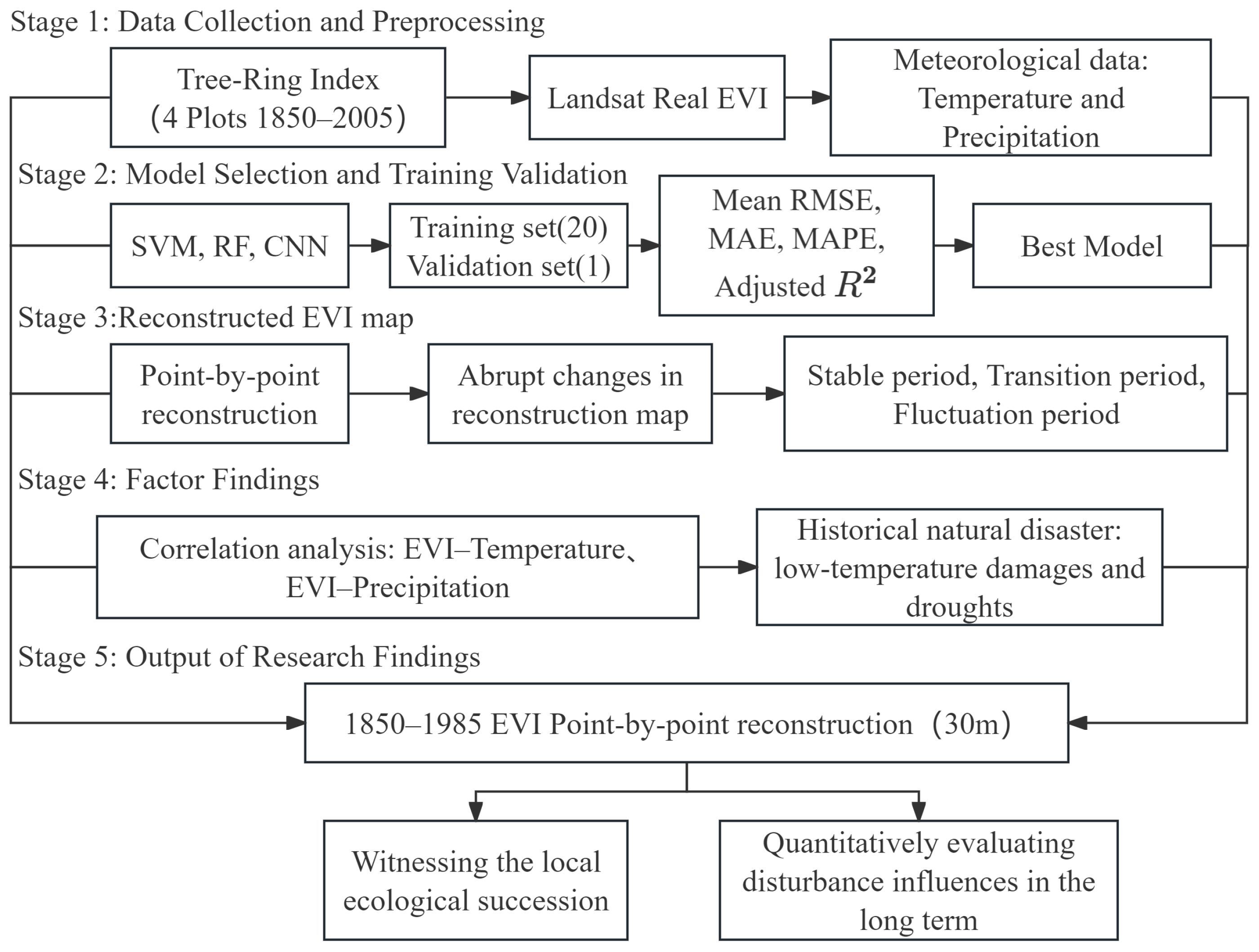
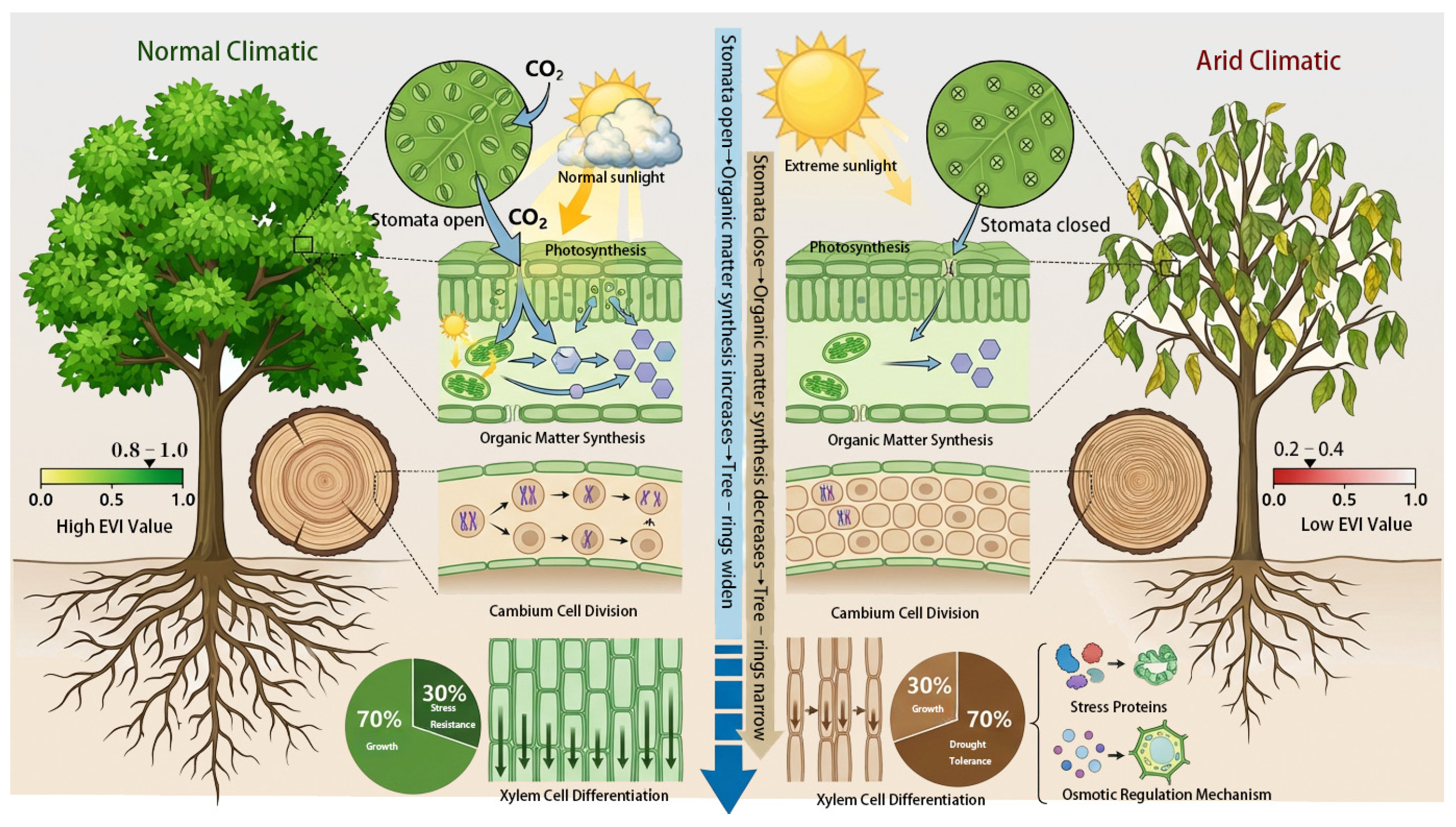
EVI is an important remote sensing indicator of vegetation growth, and its magnitude reflects vegetation cover and growth status. Based on plant physiological principles, we hypothesize that tree radial growth is directly related to EVI: higher EVI values generally correspond to wider tree rings, implying a positive correlation between EVI and the ring-width index (RWI). Under drought, the amount of available water decreases and trees close their stomata to reduce transpiration loss (Figure 2). But the close also limits CO2 diffusion into leaves, reducing photosynthetic rates and hindering synthesis of organic matter. Photosynthates are the main source of energy and material for cambial cell division and xylem development. When carbohydrate accumulation is insufficient, cambial cell division slows or even ceases. Then, the number and size of newly formed xylem cells decrease, which ultimately results in narrower annual rings. Under a favorable climate, photosynthesis is efficient and cell division is more active. Xylem cells have full enlargement and differentiation and tree growth is relatively stable during the growing season, with faster radial growth and wider rings. However, the relationships between climatic factors (e.g., precipitation and temperature) and EVI are more complex, and a clear quantitative relationship between EVI and RWI has not been established. This study aims to use tree-ring data to build a reliable RWI–EVI model for each pixel. After data collection and preprocessing, machine learning models were compared with multiple metrics and the annual reconstructed EVIs were mapped with the best model. Then, we calculated the correlations between the reconstructed EVIs and climate factors. Finally, we explore the long-term local vegetation pattern and evaluate the impacts of natural disturbances on the vegetation shifts (Figure 3).

2.3.1. Model Selection

The datasets used for modeling include tree-ring width and Landsat imagery, covering the period 1986–2005. The starting year (1986) corresponds to the launch of Landsat 5, while 2005 was chosen as the ending year because only limited tree-ring records are available for the study area after this date.
Support Vector Machine (SVM) is a nonlinear machine learning method that has become a focal point in the machine learning community since it was proposed by Vapnik and Cortes in 1995 [37]. Through appropriate kernel functions and support vectors, SVM seeks an optimal hyperplane in continuous space that best fits the data points. Because the temporal window of tree-ring samples is relatively short from 1986 to 2005, SVM was selected as one of the models. Previous studies have shown that SVM performs well with small training samples [38,39]. SVM regression aims to minimize structural risk, not only focusing on training error but also controlling model complexity via a regularization term to improve generalization capacity. Its high accuracy has been demonstrated in a variety of applications [40,41,42].
The second model is Convolutional Neural Network (CNN), first introduced by Lecun et al. [43]. CNN is a deep learning model specifically designed for grid-structured data. By mimicking the human visual system, the model can automatically extract local features and combine them into higher-level semantic information, making them suitable for analyzing images and time series [44]. Studies have shown that CNNs exhibit superior performance in numerous remote sensing research including land-cover classification and regression [45,46].
The third model is RF, proposed by Leo Breiman [47]. RF is an ensemble learning algorithm that generates multiple decision trees (in our study, we used 100 trees) by randomly sampling from the original dataset and aggregates their predictions, using the average of all trees as the final estimate for each target pixel, which yields a high regression accuracy [48]. RF has been widely applied in land-cover classification and index reconstruction, often outperforming other models [49,50]. In this study, all three models (SVM, CNN, and RF) were applied, and the best-performing model was selected based on model evaluation.

2.3.2. Model Training and Validation

We employed five-year fold validation, where the observed EVI values from 1986 to 2005 were used as the training (20 years) and validation (one year) datasets. For each pixel, SVM, CNN, and RF models were trained to establish RWI–EVI relationships using tree-ring data from 1986 to 2005. Model validation was based on four metrics: Root Mean Square Error (RMSE), Mean Absolute Percentage Error (MAPE), Mean Absolute Error (MAE), and adjusted R2. However, some studies have indicated that adjusted R2 may provide less reliable assessments for nonlinear regressions [51]. Therefore, we placed greater emphasis on RMSE, MAPE, and MAE when evaluating model performance. The four metrics were calculated as follows:
R M S E = i = 1 n ( X r e a l X s i m ) 2 n
M A E = 1 n i = 1 n | X r e a l X s i m |
M A P E = 100 % n i = 1 n | X r e a l X s i m X r e a l |
R 2 = 1 i = 1 n ( X r e a l X s i m ) 2 i = 1 n ( X r e a l X r e a l ¯ ) 2
A d j u s t e d   R 2 = 1 1 R 2 n p 1 ( n 1 )
P e a r s o n s   R = i = 1 n ( X real X real ¯ ) ( X s i m X sim ¯ ) i = 1 n ( X real X real ¯ ) 2 i = 1 n ( X s i m X sim ¯ ) 2
where X r e a l , X s i m are the real and simulated values of one pixel, X real ¯   a n d   X sim ¯ are real and simulated mean values among all training years individually, p is the number of predictors, and n is the number of total training years, which is 20 (1986–2005).
We organized the years from 1986 to 2005 into five subsets. In each subset, one year was selected as the validation dataset (details about validation year can be found in Table 2). After each selection, the four metrics (RMSE, MAPE, MAE, and adjusted R2) were calculated for each pixel to quantify the differences between predicted and observed values. The procedure was repeated five times, and for each pixel the mean of the five metric values was computed. The study area contains a total of 4,875,852 pixels, and we further averaged the metrics across all pixels. The mean metrics served for evaluating the performance of the three models (SVM, RF, and CNN) to choose the optimal model. Once the best model had been identified, we used it to reconstruct annual EVI from 1850 to 1985. Then, we calculated the slope and intercept of the EVI time series and analyzed the EVI tendencies for a short term (1986–2005) and a long term (1850–2005).

2.3.3. Changepoint Detection and Correlation Analysis

Killick proposed the PELT (Pruned Exact Linear Time) algorithm, which can efficiently and accurately detect multiple changepoints in time series, achieving an excellent balance between computational efficiency and statistical accuracy, making it well suited for modern large-scale changepoint detection problems [52]. Based on this algorithm, we used the standard deviation of simulated and observed EVI values (1850–2005) to detect and locate abrupt changes in the series. This approach helps us characterize the timing, magnitude, and trend consistency of EVI shifts and provides a basis for revealing mechanisms of terrestrial ecosystems under long-term global change. The Pearson correlation coefficient is a classical statistical measure of the strength of linear association between two continuous variables [53]. We analyzed the linear relationships of EVI with monthly mean temperature, seasonal mean temperature, monthly mean precipitation, and seasonal mean precipitation, and assessed statistical significance using a two-tailed t-test. The strength of correlation was classified according to the absolute value of the correlation coefficient: the closer the coefficient is to 1, the stronger the correlation between EVI and climate factors; the closer it is to 0, the weaker the correlation. The results were visualized using heatmaps to reveal the temporal and spatial characteristics of climatic influences on vegetation growth.

3. Results

3.1. Model Performances

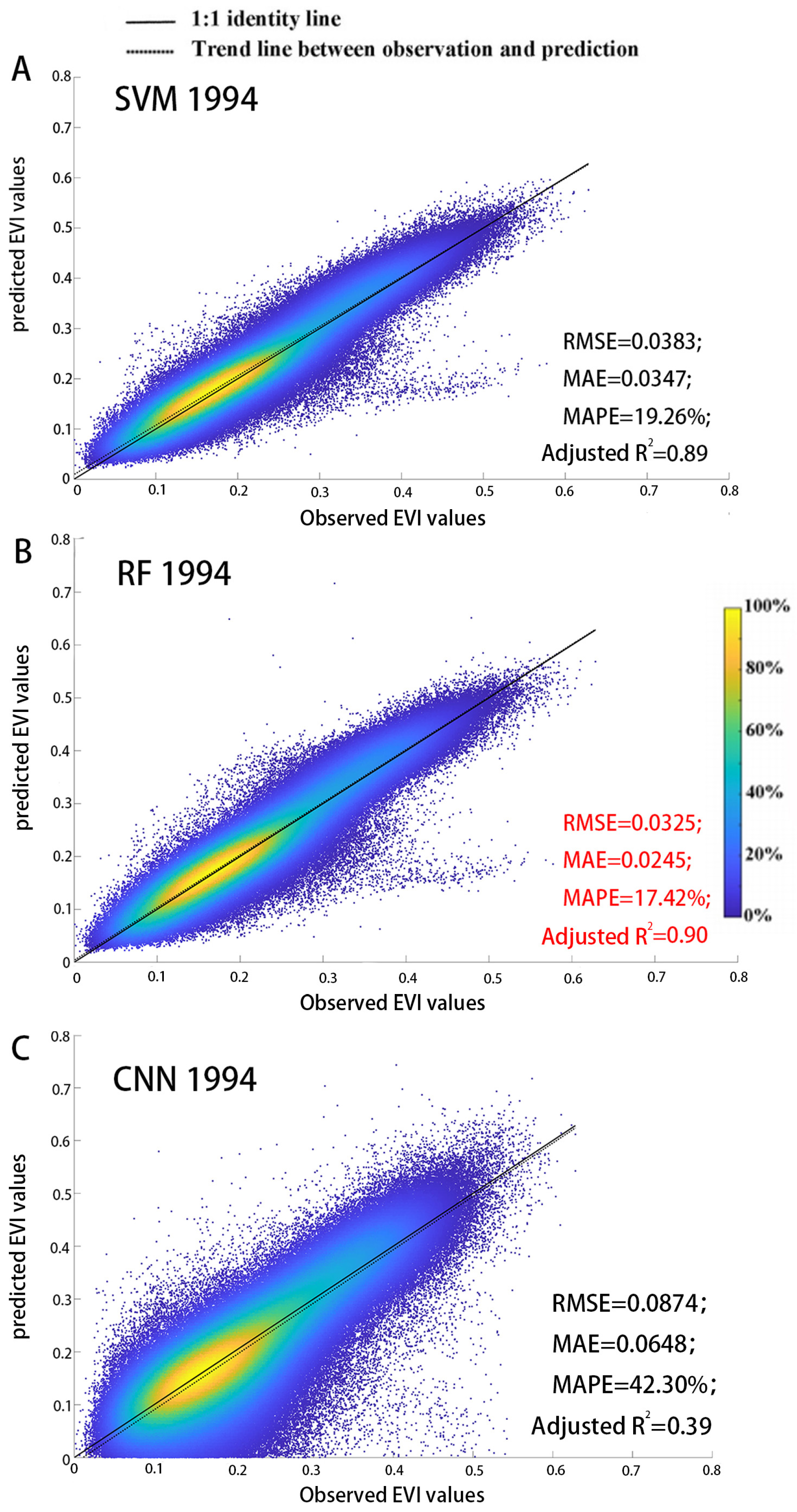
We evaluated the performance of the three selected models (SVM, RF, and CNN) (Figure 4), running each model five times and then calculating the mean values. Among the three models (Table 2), the CNN model was the worst because its RMSE, MAPE, MAE, and adjusted R2 were clearly inferior to those of the other two models (CNN RMSE = 0.08, CNN MAPE = 42.30%, CNN MAE = 0.06, CNN adjusted R2 = 0.39; RF RMSE = 0.03, RF MAPE = 17.42%, RF MAE = 0.02, RF adjusted R2 = 0.90). Between RF and SVM, the RF model showed lower errors (RMSE, MAE, MAPE), but also the highest correlation with observed data, with a Pearson’s R of 0.96, explaining 90% of the variance (adjusted R2 = 0.90). Although SVM also performed robustly (adjusted R2 = 0.89), RF consistently outperformed it across all metrics. These results suggest that RF has strong generalization ability for regional EVI reconstruction and provides the most accurate and stable predictions. The overall ranking of model performance is RF > SVM > CNN. Based on the comprehensive evaluation of accuracy, stability, and correlation strength, we selected the RF model to reconstruct the spatial distribution of EVI from 1850 to 1985.

3.2. Reconstructed EVI from 1850 to 1985

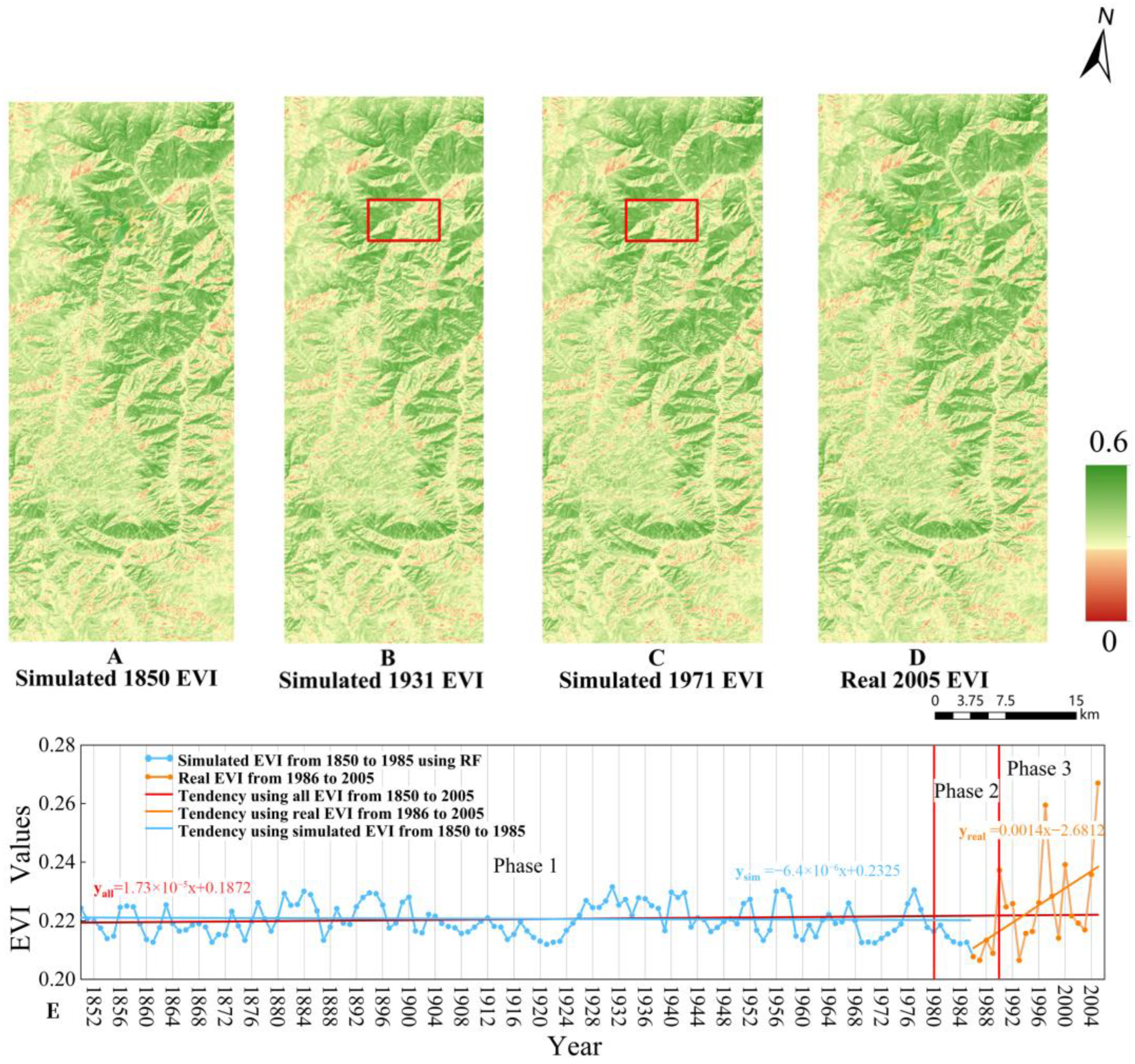
The reconstructed maps provide insight into the spatiotemporal dynamics captured by the model. The map for 1850, the earliest year that we reconstructed, shows that low EVI clusters (red pixels) were concentrated in the western and southeastern parts of the study area, whereas high EVI clusters were mainly located in the central and northern parts (Figure 5A). Except for the pronounced differences in the west and southeast, overall EVI values in 1850 were lower than the observed values in 2005 (Figure 5D). The map in 1931 was characterized as a humid period, with an annual precipitation of 896.11 mm where high EVI clusters were predominantly distributed in the central and northern parts of the study area, while low EVI clusters were concentrated in the southern regions. In contrast, 1971 was a drought year, with annual precipitation dropping to 707.26 mm. Despite maintaining high EVI clusters in the central and northern zones, low EVI clusters expanded significantly into the southern regions, with overall lower EVI values compared to 1931.
The EVI series includes both simulated values (1850–1985) and observed values (1986–2005), revealing divergent trends at different timescales. EVI shows an overall increasing trend within the period only with real EVI data (Figure 5E). However, when we extend to the full series (the real plus the simulated), EVI actually exhibits a slowly decreasing long-term trend, different from the short observed segment. Using automatic changepoint detection on the combined EVI time series (blue line) based on standard deviation, we identified abrupt shifts and divided the record into three stages. (1) Stable period (1850–1980): EVI fluctuates but remains relatively stable overall. (2) Transition period (1981–1990): interannual EVI variation is small, with an overall decreasing trend. (3) Fluctuation period (1991–2005): EVI exhibits larger interannual variability and an overall increasing trend.

3.3. Correlations Between EVI and Climate Factors

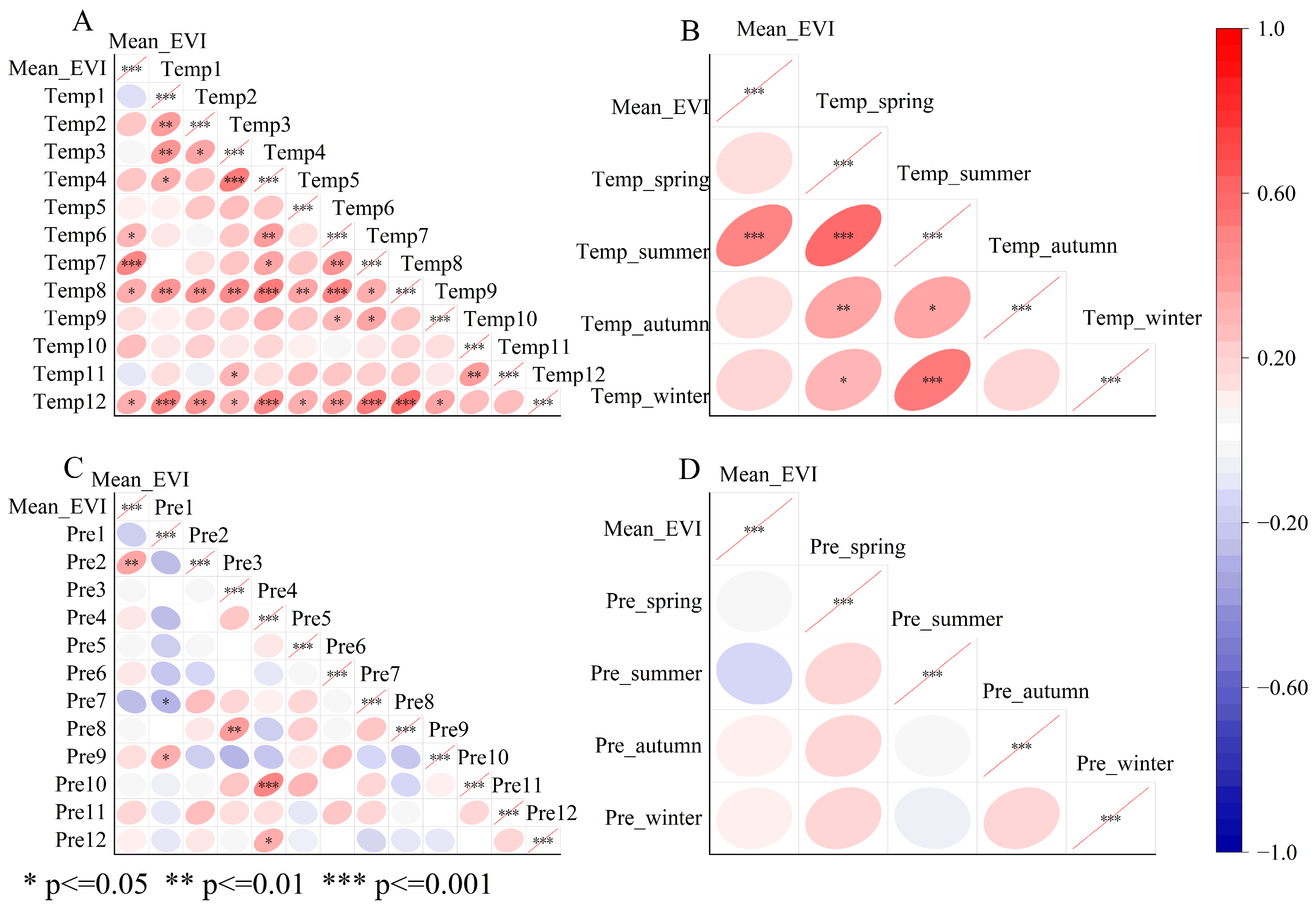
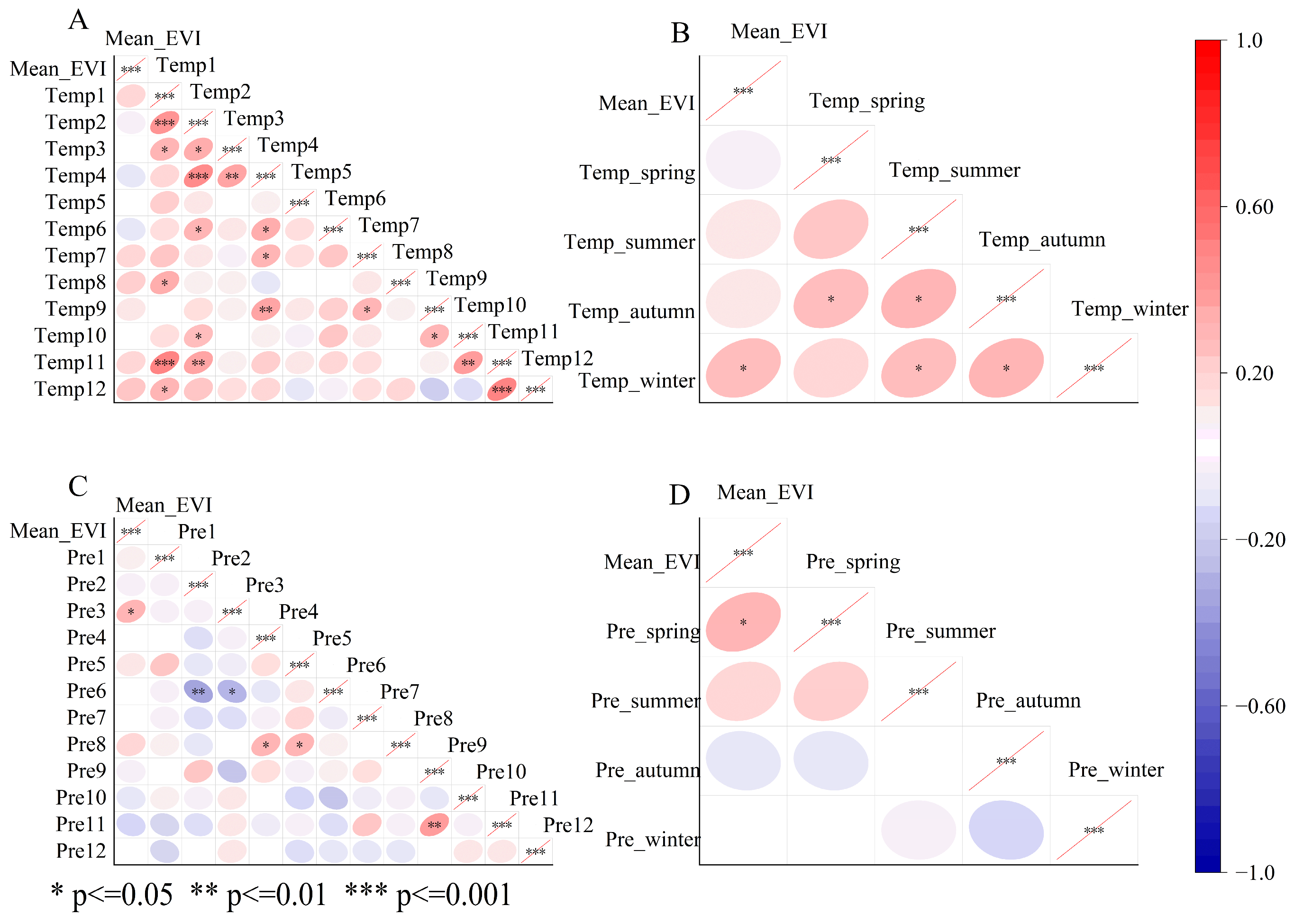
By systematically analyzing the relationships between mean EVI and monthly/seasonal mean temperature and precipitation, we revealed marked differences in the climatic controls on tree growth between the current period (1850–1949) and the contemporary period (1950–2005). In the current period, the response of EVI to climatic factors shows clear seasonality. EVI is significantly positively correlated with mean temperatures in June, August, and December, and highly significantly positively correlated with July mean temperature and summer mean temperature (r July temperature = 0.48; r summer temperature = 0.49; all p values < 0.05; Figure 6). In the contemporary period (1950–2005), the response pattern of EVI to climatic factors changes substantially. EVI is significantly positively correlated with winter mean temperature, March mean precipitation, and spring mean precipitation (r winter temperature = 0.27; r March precipitation = 0.31; r = spring precipitation = 0.29; all p values < 0.05; Figure 7), while its response to summer temperature weakens or disappears.

4. Discussion

4.1. Scientific Basis for Model Selection and Its Impact on the Results

A training set (n = 20) was used to evaluate the RF, SVM, and CNN models. Among the three machine learning approaches, the RF model performed best, with the lowest RMSE (0.03), MAE (0.02), MAPE (17.42%) and highest adjusted R2 (0.90) all superior to those of SVM and CNN. The RF model can effectively represent the complex nonlinear linkages between tree-ring width and EVI. At the same time, random feature subsetting and bootstrap sampling reduce the risk of overfitting and enhance model generalization, providing a reliable technical basis for EVI reconstruction. Numerous studies have demonstrated that RF has high accuracy in capturing relationships between tree rings and vegetation indices such as NDVI and NPP [54,55]. Although the SVM model is also capable of dealing with nonlinear problems, its performance is strongly influenced by the choice of kernel function and parameter tuning [56], whereas RF provides greater parameter stability and robustness [57], making it the more suitable and reliable choice for the reconstruction.
Unexpectedly, the CNN model performed distinctly worse than RF and SVM in this study, with higher RMSE (0.06), MAE (0.04), and MAPE (25.57%). While CNNs have achieved notable success in modeling vegetation indices and biomass in other contexts [58,59,60], their performance is highly dependent on large training datasets. CNNs possess a substantially greater number of trainable parameters compared to ensemble (RF) or kernel-based (SVM) methods, increasing their susceptibility to overfitting when training data are limited. In our study, the 20-year training datasets provided insufficient samples for the CNN to generalize effectively. Consequently, the combination of limited training volume and high model complexity explains the suboptimal performance of CNN [61]. Based on the overall performance of the three models, we ultimately selected RF as the optimal model for reconstructing EVI for the period 1850–1985. For future tree-ring-based reconstructions using larger and richer datasets to reconstruct maps, CNN approaches will still be considered.

4.2. EVI Reconstruction and Its Correlations with Climate Factors

4.2.1. Trend Differences in Reconstructed EVI

Our results (Figure 5E) show a clear trend difference between the reconstructed EVI (1850–1985) and the observed EVI (1986–2005). The combined reconstructed + observed EVI series exhibits a slow overall decline, while the observed data alone show an increasing trend. Multiple studies have also reported an in trend in EVI across many regions in China after 2000 [62,63,64]. This divergence may be related to economic and social developments and forest management, such as the Natural Forest Protection Program and ecological compensation policies implemented in China after 1998, which have significantly promoted forest cover and net primary productivity [65]. Meanwhile, global warming and rising atmospheric CO2 concentration may have enhanced plant growth through a “fertilization effect” [66], particularly for high-elevation vegetation [67], which may respond more strongly to elevated CO2. However, some scholars have argued that such short-term increases may obscure the negative impacts of long-term water shortage caused by the higher frequency of droughts [68] and mix the contribution of natural climate variability and human activities. Based on changepoint detection, we divided the combined reconstructed + observed time series into three phases. The 1850–1980 sub-period is characterized as a stable phase, with small EVI fluctuations. The 1981–1990 sub-period is a transition phase, during which EVI shows a gentle downward trend. The 1991–2005 sub-period is a fluctuating phase, with large variations and an overall increasing trend. These fluctuations in each phase reflect the nonlinear response of tree-ring width to the temporal regional climate system and may be influenced by regional historical background, natural disasters, and the intensity of human interventions under each sub-period.

4.2.2. EVI Spatial Variation

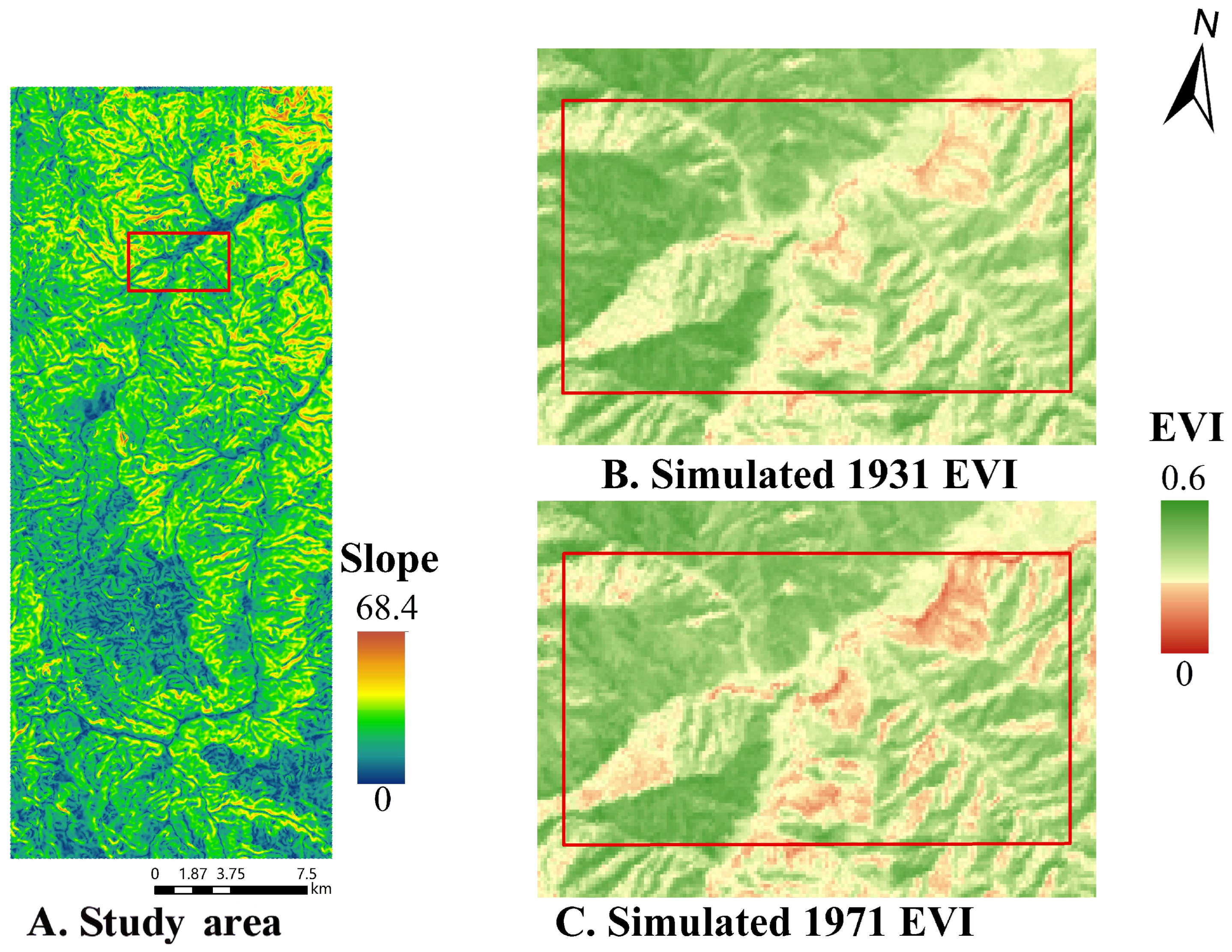
The complex topography of Diqing significantly influences local temperature and precipitation, which in turn affect vegetation patterns. For comparative analysis, we examined a humid year (1931) and a drought year (1971), focusing on a specific region within the study area (Figure 8). We overlapped the slope map processed by DEM (Figure 8A) and compared the differences between the landscape patterns in 1931 and 1971 (Figure 8B,C). In areas with steeper slopes, EVI values exhibited larger variability between 1931 and 1971. This may be due to soil water-holding capacity where steep slopes accelerate surface runoff and reduce soil infiltration [69]. On steep slopes, water retention is not achievable and during drought periods there is no water replenishment [70]. Meanwhile, in relatively flat areas (such as valleys, basins, or plateaus), precipitation has more time to infiltrate and higher groundwater levels or seasonal waterlogging can provide a more stable water supply during drought years, which led to smaller differences in EVI between drought and humid years. However, we observed some exceptions, for example, in flat areas where EVI values in drought years were higher than in humid years. This is a seemingly paradoxical phenomenon that could be explained by the following mechanisms. First, excessive soil moisture may suppress vegetation growth: in humid years, particularly when precipitation is overly concentrated in spring or early in the growing season, prolonged soil saturation or short-term waterlogging in low-lying areas may cause root hypoxia, nutrient leaching, or disease outbreaks, thereby inhibiting plant growth [71] and generating locally anomalous EVI patterns. Second, in plateau regions, EVI is influenced not only by climatic variables but also by complex topographic and hydrological factors [72,73]. Therefore, future studies should incorporate topographic variables such as slope and aspect as covariates into machine learning frameworks to improve the accuracy and mechanistic interpretability of EVI reconstruction in complex terrain.

4.2.3. Mechanisms and Causes of Long-Term Vegetation Shifts

Based on the historical development of Diqing, we divided the time series into a “current” period (1850–1949) and a “contemporary” period (1950–2005) (Figure 5E). We found that during the current period, EVI is significantly positively correlated with mean monthly temperatures in June, July, August, and December, summer mean temperature, and February precipitation. In the contemporary period, EVI is significantly positively correlated with winter temperature, March precipitation, and spring precipitation. Significant positive correlations between EVI and both temperature and precipitation in Diqing during the current and contemporary periods underscore the fundamental role of climate factors in vegetation growth. As an optimized vegetation index, EVI effectively reflects vegetation biomass and photosynthetic activity and is closely related to interannual climate variability and global warming [30]. Numerous studies have confirmed significant correlations between EVI and regional temperature and precipitation [63,74,75].
Compared with the current period, the correlation between EVI and mean monthly temperature is weak in the contemporary period, while its correlation with precipitation turns to be stronger. The shift reflects a transition of the climate constraint on vegetation growth from temperature-dominated to water-dominated conditions, likely driven by changes in the climatic environment and human activities. From 1850 to 1900, the Northern Hemisphere experienced the Little Ice Age, with relatively low temperatures that strongly limited vegetation growth [76]. With the end of the Little Ice Age, temperatures rose markedly and vegetation growth increased rapidly. In the 1950–2005 period, the reform and opening-up period, rapid industrialization and urbanization in China led to a substantial increase in carbon emissions and a rise in mean temperature [77,78]. Rising temperatures have altered vegetation growth and phenology, resulting in an earlier onset of the growing season [79,80]. Some studies suggest that an earlier growing season may not benefit tree growth because a longer growing season can intensify water stress [81,82], which is reflected in larger EVI fluctuations driven by precipitation in the contemporary period. The slight change verified the shift in the relationships between EVI and temperature/precipitation from the current to the contemporary period in our study area.

4.3. Evaluating the Impact of Historical Natural Disasters

Our analysis of the historical EVI succession highlights its potential as an ecological indicator for natural disaster detection and prediction. In this study, we successfully identified years with significantly low EVI (1860, 1870, and 1922), all showing obvious multi-year downward trends indicative of prolonged drought (Figure 5E). A typical example is Adamson, who used local reports and newspapers to analyze how drought-induced crop failures caused famines in the West Indies from 1790 to 1860 [83]. Historically, studies of past disasters have relied heavily on documentary evidence [84,85]. Although these studies compiled very detailed historical materials, textual records alone cannot quantitatively assess the impacts of disasters on crops or vegetation. To overcome the limitations of documentary records, some researchers have turned to proxy data for quantitative reconstructions [86,87]. Song intended to access to quantitative paleo-environment data and reconstructed a 283-year PDSI series for Mount Kongtong using tree-ring width and identified a severe drought event that widely affected northern China [88]. Previous tree-ring studies confirmed that analysis of the relationships between tree-ring width, temperature, and precipitation can effectively capture historical natural disasters, but most of them focus on temporal series and provide limited spatial information. By building a pixel-by-pixel tree-ring–EVI model, our vegetation reconstruction not only forms a continuous time series but also has relatively high spatial resolution, enabling simultaneous tracking of the temporal and spatial evolution of vegetation responses to climatic anomalies.
To validate the reconstructed low-EVI periods, we performed a consistency check against independent historical evidence from Yunnan Province. The reconstructed multi-year EVI declines align closely with documented descriptions of “prolonged severe drought leading to abandoned farmland and soaring grain prices” [89]. These periods often coincided with wartime unrest, when massive population displacement led to farmland abandonment and lack of necessary care for forests and crops. Under the combined influence of internal and external factors, radial tree growth declined and ring widths narrowed, which can serve as phenological evidence of the interplay between climatic anomalies and social crises. Reconstructed EVI maps may therefore reveal “hidden” disaster events not quantitatively recorded in historical documents, whose annual maps vividly display what happened in the paleo-disturbance and trace back to past disaster periodicity and recurrence intervals accurately. This approach breaks through the temporal and spatial limitations of traditional disaster records, extends the spatial characterization of vegetation under disaster conditions to centennial and even longer time scales, and offers a new perspective for risk assessment and management of natural disasters in the context of climate change.

4.4. Challenge and Future Study

This study has three main limitations. First, the simulation algorithms can be further improved, and additional factors influencing EVI should be considered. The current training dataset spans only 20 years, which is relatively limited, and therefore the advantages of deep learning models such as CNN have not been fully realized. A comprehensive sensitivity analysis to evaluate the robustness of the results to variations in model parameters and input data should be conducted in future studies, as it would help to better quantify reconstruction uncertainty. Future research could focus on improving deep learning architectures including enhanced CNN, Long Short-Term Memory (LSTM), and Transformer-based models to improve their adaptability and robustness under small sample sizes. Second, the reconstruction relies on only four tree-ring sites. While the species are dominant in the area, the density of tree-ring sites is sparse and may not fully capture sub-regional heterogeneity, particularly in complex terrain. Recent tree-ring collections with available periods extending to the present (2025) would improve spatial representativeness. Finally, the factors influencing EVI are inherently complex. While this study focused on climatic variables (temperature and precipitation), other key factors were not fully incorporated. The complex topography of the area (slopes of 25°–45°) was not explicitly analyzed in terms of aspect or terrain effects, and anthropogenic disturbances such as historical warfare and agriculture were not considered, both of which may influence reconstruction accuracy. Future work should integrate topographic, environmental, and human factors to improve the comprehensiveness and precision of EVI modeling.

5. Conclusions

This study successfully reconstructed the annual spatial distribution of the EVI in Diqing, Yunnan, from 1850 to 1985 using a pixel-based RF model. The RF model outperformed SVM and CNN, achieving the lowest errors and highest explanatory power. The reconstruction revealed a shift in the primary climatic driver of EVI, from the temperature in the first phase (1850–1949) to the precipitation in the second phase (1950–2005) suggesting a changing climate constraint on this high-altitude ecosystem. While recent decades show greening, the full reconstruction indicates a slow long-term decline, highlighting the value of centennial-scale perspectives. The reconstructed maps successfully captured spatial patterns associated with documented multi-year droughts, demonstrating their utility for spatially explicit paleo-environmental analysis.
This study provides a methodological framework for integrating tree-ring proxies and machine learning to map long-term vegetation dynamics, offering insights into ecosystem responses to climate change and historical disturbances. Future efforts should focus on conducting more comprehensive sensitivity analyses of the modeling approach, incorporating more proxies, refining uncertainty quantification, and applying similar approaches in other regions beyond mountainous areas to improve our understanding of global vegetation–climate interactions over the past centuries.

Author Contributions

Conceptualization, Y.H. and H.L.; methodology, Y.H. and H.L.; software, Z.Z.; validation, R.H. and Z.W.; formal analysis, R.H. and Z.W.; investigation, S.D., Z.S. and G.L.; resources, Z.Z.; data curation, Y.H. and H.L.; writing—original draft preparation, Y.H.; writing—review and editing, Y.H. and H.L.; visualization, Y.H., R.H. and Z.W.; supervision, H.L.; project administration, H.L.; funding acquisition, H.L. All authors have read and agreed to the published version of the manuscript.

Funding

This research received no external funding.

Data Availability Statement

The original contributions presented in this study are included in the article. Further inquiries can be directed to the corresponding author.

Acknowledgments

The authors would like to acknowledge the International Tree-Ring Databank for providing the tree-ring data. We also acknowledge National Tibetan Plateau/Third Pole Environment Data Center for providing datasets on temperature and precipitation (http://data.tpdc.ac.cn, accessed on 30 November 2025).

Conflicts of Interest

The authors declare that this study received funding from Guangxi Shengqi Technology Co., Ltd. and Nanning Jiayang Forestry Planning and Design Co., Ltd. The funders were not involved in the study design, collection, analysis, interpretation of data, the writing of this article, or the decision to submit it for publication.

References

  1. Li, L.; Pang, Y.-Z.; Sun, G.-Q.; Ruan, S. Impact of climate change on vegetation patterns in Altay Prefecture, China. Math. Med. Biol. A J. IMA 2024, 41, 53–80. [Google Scholar] [CrossRef]
  2. He, Y.; Xiong, Q.; Yu, L.; Yan, W.; Qu, X. Impact of Climate Change on Potential Distribution Patterns of Alpine Vegetation in the Hengduan Mountains Region, China. Mt. Res. Dev. 2020, 40, R48. [Google Scholar] [CrossRef]
  3. Malla, R.; Neupane, P.R.; Köhl, M. Climate change impacts: Vegetation shift of broad-leaved and coniferous forests. Trees For. People 2023, 14, 100457. [Google Scholar] [CrossRef]
  4. Almazroui, M.; Ashfaq, M.; Islam, M.; Rashid, I.; Shahzad, K.; Abid, M.A.; O’Brien, E.; Ismail, M.; Reboita, M.; Sörensson, A.; et al. Assessment of CMIP6 Performance and Projected Temperature and Precipitation Changes Over South America. Earth Syst. Environ. 2021, 5, 155–183. [Google Scholar] [CrossRef]
  5. Gilarranz, M.; Pérez, I.A.; García, M.Á.; Sánchez, M.L.; Pardo, N.; Fernández-Duque, B. Analysis of spatial distribution and evolution of terrestrial precipitation. J. Atmos. Sol. Terr. Phys. 2022, 237, 105930. [Google Scholar] [CrossRef]
  6. Dong, D.; Shen, J.; Gong, D.; Sun, T.; Chen, J.; Fujioka, Y. Research Trends in Vegetation Spatiotemporal Dynamics and Driving Forces: A Bibliometric Analysis (1987–2024). Forests 2025, 16, 588. [Google Scholar] [CrossRef]
  7. Sun, G.; Guo, B.; Zang, W.; Huang, X.; Han, B.; Yang, X.; Chen, S.; Wei, C.; Wu, H. Spatial–temporal change patterns of vegetation coverage in China and its driving mechanisms over the past 20 years based on the concept of geographic division. Geomat. Nat. Hazards Risk 2020, 11, 2263–2281. [Google Scholar] [CrossRef]
  8. Fastovich, D.; Meyers, S.; Saupe, E.; Williams, J.; Dornelas, M.; Dowding, E.; Finnegan, S.; Huang, H.-H.; Jonkers, L.; Kiessling, W.; et al. Coupled, decoupled, and abrupt responses of vegetation to climate across timescales. Science 2025, 389, 64–68. [Google Scholar] [CrossRef]
  9. Luo, Y.; Melillo, J.; Niu, S.; Beier, C.; Clark, J.S.; Classen, A.T.; Davidson, E.; Dukes, J.S.; Evans, R.D.; Field, C.B.; et al. Coordinated approaches to quantify long-term ecosystem dynamics in response to global change. Glob. Change Biol. 2011, 17, 843–854. [Google Scholar] [CrossRef]
  10. Chen, Y.-S. Gridding Reconstruction of Cropland Spatial Patterns in Southwest China in the Qing Dynasty. Prog. Geogr. 2012, 31, 1196–1203. [Google Scholar] [CrossRef]
  11. Li, H.; Liu, Z.; James, N.; Li, X.; Hu, Z.; Shi, H.; Sun, L.; Lu, Y.; Jia, X. Agricultural Transformations and Their Influential Factors Revealed by Archaeobotanical Evidence in Holocene Jiangsu Province, Eastern China. Front. Earth Sci. 2021, 9, 661684. [Google Scholar] [CrossRef]
  12. Bond-Lamberty, B.; Duchesne, L.; D’Orangeville, L.; Ouimet, R.; Houle, D.; Kneeshaw, D. Extracting coherent tree-ring climatic signals across spatial scales from extensive forest inventory data. PLoS ONE 2017, 12, e0189444. [Google Scholar] [CrossRef]
  13. DeRose, R.J.; Wang, S.; Shaw, J.D. Feasibility of High-Density Climate Reconstruction Based on Forest Inventory and Analysis (FIA) Collected Tree-Ring Data. J. Hydrometeorol. 2013, 14, 375–381. [Google Scholar] [CrossRef]
  14. LaMarche, V.C. Paleoclimatic Inferences from Long Tree-Ring Records. Science 1974, 183, 1043–1048. [Google Scholar] [CrossRef]
  15. Bhuyan, U.; Zang, C.; Vicente-Serrano, S.M.; Menzel, A. Exploring Relationships among Tree-Ring Growth, Climate Variability, and Seasonal Leaf Activity on Varying Timescales and Spatial Resolutions. Remote Sens. 2017, 9, 526. [Google Scholar] [CrossRef]
  16. Pearl, J.; Keck, J.; Tintor, W.; Siekacz, L.; Herrick, H.; Meko, D.; Pearson, C. New frontiers in tree-ring research. Holocene 2020, 30, 095968362090223. [Google Scholar] [CrossRef]
  17. Hughes, M.K.; Swetnam, T.W.; Diaz, H.F. Tree rings and climate: Sharpening the focus. Eos Trans. Am. Geophys. Union 2004, 85, 303. [Google Scholar] [CrossRef]
  18. Miranda-Briones, R.; Cerano-Paredes, J.; Esquivel-Arriaga, G.; Morató-Farreras, J.; Cervantes-Martínez, R.; Sánchez-Cohen, I.; Gómez-Nísino, A. Precipitation variability (1660–2018) for the western part of Chihuahua induced with tree rings. Rev. Chapingo Ser. Hortic. 2022, 28, 349–366. [Google Scholar] [CrossRef]
  19. Yin, Y.-L.; Zaw, Z.; Peng, X.-H.; Zhang, H.; Fu, P.-L.; Wang, W.-L.; Bräuning, A.; Fan, Z.-X. Tree rings in Tsuga dumosa reveal increasing drought variability in subtropical southwest China over the past two centuries. Palaeogeogr. Palaeoclimatol. Palaeoecol. 2023, 628, 111757. [Google Scholar] [CrossRef]
  20. Xu, P.; Fang, W.; Zhou, T.; Zhao, X.; Luo, H.; Hendrey, G.; Yi, C. Spatial Upscaling of Tree-Ring-Based Forest Response to Drought with Satellite Data. Remote Sens. 2019, 11, 2344. [Google Scholar] [CrossRef]
  21. Decuyper, M.; Chávez, R.O.; Čufar, K.; Estay, S.A.; Clevers, J.G.P.W.; Prislan, P.; Gričar, J.; Črepinšek, Z.; Merela, M.; de Luis, M.; et al. Spatio-temporal assessment of beech growth in relation to climate extremes in Slovenia—An integrated approach using remote sensing and tree-ring data. Agric. For. Meteorol. 2020, 287, 107925. [Google Scholar] [CrossRef]
  22. Leduc, F.; Coops, N.C.; Morin-Bernard, A.; Moreau, G.; Achim, A. A Review of Dendrochronology and Remote Sensing Integration for Forest Growth and Disturbance Monitoring. Curr. For. Rep. 2025, 11, 25. [Google Scholar] [CrossRef] [PubMed]
  23. Nasiri, V.; Hawryło, P.; Tymińska-Czabańska, L.; Socha, J. Not always in sync: Environmental drivers of the relationship between tree radial growth and vegetation indices in Central Europe. Sci. Total Environ. 2025, 1008, 180969. [Google Scholar] [CrossRef]
  24. Peng, K.; Liu, Y.; Zhang, K.; Li, J.; Li, J.; Wei, X.; Wang, M.; Peng, J. Regional NDVI reconstruction based on tree-ring width of Pinus massoniana Lamb. in the north-south transition zone of China. Dendrochronologia 2025, 92, 126373. [Google Scholar] [CrossRef]
  25. Vasiliev, D.; Ilienko, T. Effectiveness evaluation of a modified EVI-S index in monitoring system of vegetation cover. Agroecol. J. 2025, 2, 55–67. [Google Scholar] [CrossRef]
  26. Vidican, R.; Mălinaș, A.; Ranta, O.; Moldovan, C.; Marian, O.; Ghețe, A.; Ghișe, C.R.; Popovici, F.; Cătunescu, G.M. Using Remote Sensing Vegetation Indices for the Discrimination and Monitoring of Agricultural Crops: A Critical Review. Agronomy 2023, 13, 3040. [Google Scholar] [CrossRef]
  27. Brehaut, L.; Danby, R.K. Inconsistent relationships between annual tree ring-widths and satellite-measured NDVI in a mountainous subarctic environment. Ecol. Indic. 2018, 91, 698–711. [Google Scholar] [CrossRef]
  28. D’Andrea, G.; Šimůnek, V.; Castellaneta, M.; Vacek, Z.; Vacek, S.; Pericolo, O.; Zito, R.G.; Ripullone, F. Mismatch between Annual Tree-Ring Width Growth and NDVI Index in Norway Spruce Stands of Central Europe. Forests 2022, 13, 1417. [Google Scholar] [CrossRef]
  29. Radočaj, D.; Šiljeg, A.; Marinović, R.; Jurišić, M. State of Major Vegetation Indices in Precision Agriculture Studies Indexed in Web of Science: A Review. Agriculture 2023, 13, 707. [Google Scholar] [CrossRef]
  30. Kumari, N.; Srivastava, A.; Dumka, U.C. A Long-Term Spatiotemporal Analysis of Vegetation Greenness over the Himalayan Region Using Google Earth Engine. Climate 2021, 9, 109. [Google Scholar] [CrossRef]
  31. Javed, T.; Li, Y.; Feng, K.; Ayantobo, O.O.; Ahmad, S.; Chen, X.; Rashid, S.; Suon, S. Monitoring responses of vegetation phenology and productivity to extreme climatic conditions using remote sensing across different sub-regions of China. Environ. Sci. Pollut. Res. Int. 2021, 28, 3644–3659. [Google Scholar] [CrossRef] [PubMed]
  32. Speer, J. Fundamentals of Tree Ring Research; University of Arizona Press: Tucson, AZ, USA, 2010. [Google Scholar]
  33. Jiang, Z.; Huete, A.R.; Didan, K.; Miura, T. Development of a two-band enhanced vegetation index without a blue band. Remote Sens. Environ. 2008, 112, 3833–3845. [Google Scholar] [CrossRef]
  34. Fan, Z.X.; Bräuning, A.; Cao, K.F. Tree-ring based drought reconstruction in the central Hengduan Mountains region (China) since A.D. 1655. Int. J. Climatol. 2008, 28, 1879–1887. [Google Scholar] [CrossRef]
  35. Cook, E.; Anchukaitis, K.; Buckley, B.; D’Arrigo, R.; Jacoby, G.; Wright, W. Asian Monsoon Failure and Megadrought During the Last Millenium. Science 2010, 328, 486–489. [Google Scholar] [CrossRef]
  36. Ahmed, M.; Anchukaitis, K.J.; Asrat, A.; Borgaonkar, H.P.; Braida, M.; Buckley, B.M.; Büntgen, U.; Chase, B.M.; Chris-tie, D.A.; Cook, E.R.; et al. Continental-scale temperature variability during the past two millennia. Nat. Geosci. 2013, 6, 339–346. [Google Scholar] [CrossRef]
  37. Cortes, C.; Vapnik, V.N. Support-Vector Networks. Mach. Learn. 1995, 20, 273–297. [Google Scholar] [CrossRef]
  38. Myburgh, G.; van Niekerk, A. Impact of Training Set Size on Object-Based Land Cover Classification: A Comparison of Three Classifiers. Int. J. Appl. Geospat. Res. 2014, 5, 49–67. [Google Scholar] [CrossRef]
  39. Dris, A.B.; Alzakari, N.; Kurdi, H. A Systematic Approach to Identify an Appropriate Classifier for Limited-Sized Data Sets. In Proceedings of the 2019 International Symposium on Networks, Computers and Communications (ISNCC), Istanbul, Turkey, 18–20 June 2019. [Google Scholar]
  40. Kok, Z.H.; Mohamed Shariff, A.R.; Alfatni, M.S.M.; Khairunniza-Bejo, S. Support Vector Machine in Precision Agriculture: A review. Comput. Electron. Agric. 2021, 191, 106546. [Google Scholar] [CrossRef]
  41. Filali Bouami, M.; Benchat, M. SVM on HPC Clouds: Choosing the Appropriate Classification Algorithm and Kernel Type According to the Data Set Characteristics. In Advances in Smart Technologies Applications and Case Studies. SmartICT 2019. Lecture Notes in Electrical Engineering; El Moussati, A., Kpalma, K., Ghaouth Belkasmi, M., Saber, M., Guégan, S., Eds.; Springer: Cham, Switzerland, 2019; Volume 684. [Google Scholar] [CrossRef]
  42. Kheterpal, A.; Gill, K.S.; Upadhyay, D.; Devliyal, S. Predicting Heart Failure Early with SVM Technology for Heart Protection. In Proceedings of the 2024 Global Conference on Communications and Information Technologies (GCCIT), Bangalore, India, 25–26 October 2024. [Google Scholar]
  43. Lecun, Y.; Bottou, L.; Bengio, Y.; Haffner, P. Gradient-based learning applied to document recognition. Proc. IEEE 1998, 86, 2278–2324. [Google Scholar] [CrossRef]
  44. Namatēvs, I. Deep Convolutional Neural Networks: Structure, Feature Extraction and Training. Inf. Technol. Manag. Sci. 2017, 20, 40–47. [Google Scholar] [CrossRef]
  45. Ma, J.; Sun, Y.; Deng, G.; Huang, S.; Tao, Y.; Zhu, H.; Teng, Q.; Meng, X. Evaluation of Different Approaches of Convolutional Neural Networks for Land Use and Land Cover Classification Based on High Resolution Remote Sensing Images. In Proceedings of the 2019 IEEE International Conference on Signal, Information and Data Processing (ICSIDP), Chongqing, China, 11–13 December 2019. [Google Scholar]
  46. Tong, X.-Y.; Xia, G.-S.; Lu, Q.; Shen, H.; Li, S.; You, S.; Zhang, L. Land-cover classification with high-resolution remote sensing images using transferable deep models. Remote Sens. Environ. 2020, 237, 111322. [Google Scholar] [CrossRef]
  47. Breiman, L. Random Forests. Mach. Learn. 2001, 45, 5–32. [Google Scholar] [CrossRef]
  48. Couronne, R.; Probst, P.; Boulesteix, A.L. Random forest versus logistic regression: A large-scale benchmark experiment. BMC Bioinform. 2018, 19, 270. [Google Scholar] [CrossRef]
  49. Jasim, L.K.; Hasan, R.H.; Ibrahim, O.A. Evaluation of the Accuracy of Machine Learning Classifiers and Spectral Indices in Land Cover Classification. Eng. Technol. Appl. Sci. Res. 2025, 15, 22548–22552. [Google Scholar] [CrossRef]
  50. Adugna, T.; Xu, W.; Fan, J. Comparison of Random Forest and Support Vector Machine Classifiers for Regional Land Cover Mapping Using Coarse Resolution FY-3C Images. Remote Sens. 2022, 14, 574. [Google Scholar] [CrossRef]
  51. Chen, Q.; Qi, J. How much should we trust R2 and adjusted R2: Evidence from regressions in top economics journals and Monte Carlo simulations. J. Appl. Econ. 2023, 26, 2207326. [Google Scholar] [CrossRef]
  52. Killick, R.; Fearnhead, P.; Eckley, I.A. Optimal Detection of Changepoints with a Linear Computational Cost. J. Am. Stat. Assoc. 2012, 107, 1590–1598. [Google Scholar] [CrossRef]
  53. Pearson, K., VII. Mathematical contributions to the theory of evolution.—III. Regression, heredity, and panmixia. Philos. Trans. A Math. Phys. Eng. Sci. 1896, 187, 253–318. [Google Scholar] [CrossRef]
  54. Li, H.; Rex, J. Reconstructing Evapotranspiration in British Columbia Since 1850 Using Publicly Available Tree-Ring Plots and Climate Data. Remote Sens. 2025, 17, 930. [Google Scholar] [CrossRef]
  55. Li, H.; Speer, J.; Thapa, I. Reconstructing and Mapping Annual Net Primary Productivity (NPP) Since 1940 Using Tree Rings in Southern Indiana, U.S. J. Geophys. Res. Biogeosci. 2024, 129, e2023JG007929. [Google Scholar] [CrossRef]
  56. Jin, Y.; Hu, Y.; Huang, J.; Zhang, J. Study on influences of model parameters on the performance of SVM. In Proceedings of the 2011 International Conference on Electrical and Control Engineering, Yichang, China, 16–18 September 2011. [Google Scholar]
  57. Lachaud, A.; Adam, M.; Mišković, I. Comparative Study of Random Forest and Support Vector Machine Algorithms in Mineral Prospectivity Mapping with Limited Training Data. Minerals 2023, 13, 1073. [Google Scholar] [CrossRef]
  58. Kwak, G.H.; Park, C.W.; Lee, K.D.; Na, S.I.; Ahn, H.Y.; Park, N.W. Potential of Hybrid CNN-RF Model for Early Crop Mapping with Limited Input Data. Remote Sens. 2021, 13, 1629. [Google Scholar] [CrossRef]
  59. Zhao, H.; Morgenroth, J.; Pearse, G.; Schindler, J. A Systematic Review of Individual Tree Crown Detection and Delineation with Convolutional Neural Networks (CNN). Curr. For. Rep. 2023, 9, 149–170. [Google Scholar] [CrossRef]
  60. Dong, L.; Du, H.; Han, N.; Li, X.; Zhu, D.; Mao, F.; Zhang, M.; Zheng, J.; Liu, H.; Huang, Z.; et al. Application of Convolutional Neural Network on Lei Bamboo Above-Ground-Biomass (AGB) Estimation Using Worldview-2. Remote Sens. 2020, 12, 958. [Google Scholar] [CrossRef]
  61. Ng, W.; Minasny, B.; Mendes, W.D.S.; Demattê, J.A.M. The influence of training sample size on the accuracy of deep learning models for the prediction of soil properties with near-infrared spectroscopy data. Soil 2020, 6, 565–578. [Google Scholar] [CrossRef]
  62. Li, J.; Xi, M.; Wang, L.; Li, N.; Wang, H.; Qin, F. Vegetation Responses to Climate Change and Anthropogenic Activity in China, 1982 to 2018. Int. J. Environ. Res. Public Health 2022, 19, 7391. [Google Scholar] [CrossRef] [PubMed]
  63. He, D.; Yi, G.; Zhang, T.; Miao, J.; Li, J.; Bie, X. Temporal and Spatial Characteristics of EVI and Its Response to Climatic Factors in Recent 16 years Based on Grey Relational Analysis in Inner Mongolia Autonomous Region, China. Remote Sens. 2018, 10, 961. [Google Scholar] [CrossRef]
  64. Wang, G.; Peng, W.; Zhang, L.; Zhang, J.; Xiang, J. Vegetation EVI changes and response to natural factors and human activities based on geographically and temporally weighted regression. Glob. Ecol. Conserv. 2023, 45, e02531. [Google Scholar] [CrossRef]
  65. Viña, A.; McConnell, W.J.; Yang, H.; Xu, Z.; Liu, J. Effects of conservation policy on China’s forest recovery. Sci. Adv. 2016, 2, e1500965. [Google Scholar] [CrossRef]
  66. Huang, J.G.; Bergeron, Y.; Denneler, B.; Berninger, F.; Tardif, J. Response of Forest Trees to Increased Atmospheric CO2. Crit. Rev. Plant Sci. 2007, 26, 265–283. [Google Scholar] [CrossRef]
  67. LaMarche, V.C.; Graybill, D.A.; Fritts, H.C.; Rose, M.R. Increasing Atmospheric Carbon Dioxide: Tree Ring Evidence for Growth Enhancement in Natural Vegetation. Science 1984, 225, 1019–1021. [Google Scholar] [CrossRef]
  68. Babst, F.; Bouriaud, O.; Poulter, B.; Trouet, V.; Girardin, M.P.; Frank, D.C. Twentieth century redistribution in climatic drivers of global tree growth. Sci. Adv. 2019, 5, eaat4313. [Google Scholar] [CrossRef]
  69. Li, T.; Zhao, L.; Duan, H.; Yang, Y.; Wang, Y.; Wu, F. Exploring the interaction of surface roughness and slope gradient in controlling rates of soil loss from sloping farmland on the Loess Plateau of China. Hydrol. Process. 2020, 34, 339–354. [Google Scholar] [CrossRef]
  70. Dan, Y.; Ting, W.; Jiang-Feng, L.; Ke-Ping, M. Advances in Research on the Relationship Between Climatic Change and Tree-Ring Width. Chin. J. Plant Ecol. 2003, 27, 23–33. [Google Scholar] [CrossRef]
  71. Zhang, Y.; Chen, X.; Geng, S.; Zhang, X. A review of soil waterlogging impacts, mechanisms, and adaptive strategies [Review]. Front. Plant Sci. 2025, 16, 1545912. [Google Scholar] [CrossRef] [PubMed]
  72. Ma, Y.; He, T.; McVicar, T.R.; Liang, S.; Liu, T.; Peng, W.; Song, D.-X.; Tian, F. Quantifying how topography impacts vegetation indices at various spatial and temporal scales. Remote Sens. Environ. 2024, 312, 114311. [Google Scholar] [CrossRef]
  73. Hu, M.Q.; Mao, F.; Sun, H.; Hou, Y.Y. Study of normalized difference vegetation index variation and its correlation with climate factors in the three-river-source region. Int. J. Appl. Earth Obs. Geoinf. 2011, 13, 24–33. [Google Scholar] [CrossRef]
  74. Yang, Q.; Zhang, H.; Peng, W.; Lan, Y.; Luo, S.; Shao, J.; Chen, D.; Wang, G. Assessing climate impact on forest cover in areas undergoing substantial land cover change using Landsat imagery. Sci. Total Environ. 2019, 659, 732–745. [Google Scholar] [CrossRef]
  75. Guo, W.; Ni, X.; Jing, D.; Li, S. Spatial-temporal patterns of vegetation dynamics and their relationships to climate variations in Qinghai Lake Basin using MODIS time-series data. J. Geogr. Sci. 2014, 24, 1009–1021. [Google Scholar] [CrossRef]
  76. Rowan, A. The ‘Little Ice Age in the Himalaya: A review of glacier advance driven by Northern Hemisphere temperature change. Holocene 2016, 27, 292–308. [Google Scholar] [CrossRef]
  77. Qiu, J.; Yang, X.; Cao, B.; Chen, Z.; Li, Y. Effects of Urbanization on Regional Extreme-Temperature Changes in China, 1960–2016. Sustainability 2020, 12, 6560. [Google Scholar] [CrossRef]
  78. Wang, C.; Wang, F.; Zhang, X.; Yang, Y.; Su, Y.; Ye, Y.; Zhang, H. Examining the driving factors of energy related carbon emissions using the extended STIRPAT model based on IPAT identity in Xinjiang. Renew. Sustain. Energy Rev. 2017, 67, 51–61. [Google Scholar] [CrossRef]
  79. Piao, S.; Fang, J.; Zhou, L.; Ciais, P.; Zhu, B. Variations in satellite-derived phenology in China’s temperate vegetation. Glob. Change Biol. 2006, 12, 672–685. [Google Scholar] [CrossRef]
  80. Zhang, X.; Friedl, M.A.; Schaaf, C.B.; Strahler, A.H. Climate controls on vegetation phenological patterns in northern mid- and high latitudes inferred from MODIS data. Glob. Change Biol. 2004, 10, 1133–1145. [Google Scholar] [CrossRef]
  81. Kang, J.; Yang, Z.; Yu, B.; Ma, Q.; Jiang, S.; Shishov, V.V.; Zhou, P.; Huang, J.-G.; Ding, X. An earlier start of growing season can affect tree radial growth through regulating cumulative growth rate. Agric. For. Meteorol. 2023, 342, 109738. [Google Scholar] [CrossRef]
  82. Gao, S.; Liang, E.; Liu, R.; Babst, F.; Camarero, J.J.; Fu, Y.H.; Piao, S.; Rossi, S.; Shen, M.; Wang, T.; et al. An earlier start of the thermal growing season enhances tree growth in cold humid areas but not in dry areas. Nat. Ecol. Evol. 2022, 6, 397–404. [Google Scholar] [CrossRef]
  83. Adamson, G.C.D. Institutional and community adaptation from the archives: A study of drought in western India, 1790–1860. Geoforum 2014, 55, 110–119. [Google Scholar] [CrossRef]
  84. Nash, D.J.; Klein, J.; Endfield, G.H.; Pribyl, K.; Adamson, G.C.D.; Grab, S.W. Narratives of nineteenth century drought in southern Africa in different historical source types. Clim. Change 2019, 152, 467–485. [Google Scholar] [CrossRef]
  85. Wan, J.; Yan, D.; Fu, G.; Hao, L.; Yue, Y.; Li, R.; Li, Y.; Liu, J.; Deng, J. Temporal and Spatial Variations of Drought in China: Reconstructed from Historical Memorials Archives during 1689–1911. PLoS ONE 2016, 11, e0148072. [Google Scholar] [CrossRef][Green Version]
  86. Chinthala, B.D.; Ranhotra, P.S.; Grießinger, J.; Singh, C.P.; Bräuning, A. Himalayan fir reveals moist phase during Little Ice Age in the Kashmir region of the western Himalayas. Quat. Sci. Rev. 2023, 312, 108167. [Google Scholar] [CrossRef]
  87. Tian, Q.; Gou, X.; Zhang, Y.; Peng, J.; Wang, J.; Chen, T. Tree-Ring Based Drought Reconstruction (A.D. 1855–2001) for the Qilian Mountains, Northwestern China. Tree-Ring Res. 2007, 63, 27–36. [Google Scholar] [CrossRef]
  88. Song, H.; Liu, Y. PDSI variations at Kongtong Mountain, China, inferred from a 283-year Pinus tabulaeformis ring width chronology. J. Geophys. Res. Atmos. 2011, 116, D22111. [Google Scholar] [CrossRef]
  89. Wen, K. China Meteorological Disasters Yunnan Volume; China Meteorelogical Press: Beijing, China, 2006. [Google Scholar]
Figure 1. Location of our study areas with 4 plots.
Forests 17 00228 g001
Figure 2. Model assumption. Notes: There are two scenarios: drought and favorable climate. Under drought, leaves are affected by water shortage with less energy from photosynthesis and the radial growth slows down with the limited energy. Vice versa, under a favorable climate, the radial growth has a high speed with more energy from photosynthesis and the density of leaves is also increased.
Forests 17 00228 g002
Figure 3. The workflow of the study. Notes: There are five phases in our study, including data collection, model evaluation, EVI reconstruction, factor findings and achievement display.
Forests 17 00228 g003
Figure 4. Scatter plots using SVM, RF, and CNN in 1994. Notes:(AC) are the performance of SVM, RF and CNN in 1994, respectively. Lighter colors indicate higher point density. The dashed line is the trend line, and the solid line is the 1:1 line. Metrics shown are the mean values from the three validation runs, with the best results highlighted in red.
Forests 17 00228 g004
Figure 5. The simulated EVI maps and EVI tendency curves. Notes: (AC) are the simulated EVI map of the study area for 1850, 1931 and 1971, respectively (D) The Real EVI map in 1850; (E) The EVI series between 1850 and 2005. In the time-series plots, the red, blue, and orange lines represent the trends of the combined observed and simulated data (1850–2005), the simulated data (1850–1985), and the observed data (1986–2005), respectively. The landscapes in red boundaries for 1931 and 1971 are zoomed in on and further landscape pattern analysis is provided in the following figure.
Forests 17 00228 g005
Figure 6. Correlations between EVI and climate factors (temperature and precipitation) in the current period (1850–1949). Notes: (A) heatmap of EVI vs. monthly mean temperature; (B) heatmap of EVI vs. monthly mean precipitation; (C) heatmap of EVI vs. seasonal temperature; (D) heatmap of EVI vs. seasonal precipitation. Red indicates positive correlation and blue indicates negative correlation. *, **, and *** denote significance levels of 0.05, 0.01, and 0.001, respectively.
Forests 17 00228 g006
Figure 7. Correlations between EVI and climate factors (temperature and precipitation) in the contemporary period (1950–2005). Notes: (A) heatmap of EVI vs. monthly mean temperature; (B) heatmap of EVI vs. monthly mean precipitation; (C) heatmap of EVI vs. seasonal temperature; (D) heatmap of EVI vs. seasonal precipitation. Red indicates positive correlation and blue indicates negative correlation. *, **, and *** denote significance levels of 0.05, 0.01, and 0.001, respectively.
Forests 17 00228 g007
Figure 8. Topographic influences on vegetation in 1931 (humid year) and 1971 (drought year). Notes: (AC) are the slope map of the study area and enlarged views of simulated EVI for 1931 and 1971, respectively. The enlarged views of red areas in (B,C) are shown in Figure 5B,C and Figure 8A.
Forests 17 00228 g008
Table 1. The basic information for each plot.
ITRDB IDNameEarliest YearLatest YearSpecies NameDOI
CHIN027Wright–Pantiange2, Weixi County13482007Abies forrestii Coltm.-Rog.doi:10.1126/science.1185188 [35]
CHIN025Wright–Pantiange, Weixi County14832007Abies forrestii Coltm.-Rogdoi:10.1126/science.1185188 [35]
CHIN037Hengduan Mountains 10GK_P_r14292005Picea likiangensis (Franch.) E. Pritz.doi:10.1038/NGEO1797 [36]
CHIN038Hengduan Mountains 11YC_T_r15422005Tsuga dumosa (D. Don) Eichler doi:10.1038/NGEO1797 [36]
Table 2. The five metrics of three models, measured five times.
RMSE ↓MAE ↓MAPE ↓ (%)Adjusted R2Pearson’s R ↑
YearSVMRFCNNSVMRFCNNSVMRFCNNSVMRFCNNSVMRFCNN
19860.0460.0440.1030.0340.0340.07835.8837.8375.390.840.850.210.930.940.54
19900.0570.0300.0570.0740.0230.04423.9710.9822.480.890.900.670.960.960.92
19940.0300.0290.0610.0220.0210.04312.3112.2125.070.900.910.600.950.960.85
19980.0310.0310.0720.0220.0230.05412.6313.8529.170.900.900.490.950.950.78
20020.0250.0260.1420.0190.0200.10311.5212.2159.400.930.920.000.970.970.63
Average0.0380.0320.0870.0340.0240.06419.2617.4242.300.890.900.390.950.960.74
Notes: The arrows indicate the direction of performance (↓ lower is worse, ↑ higher is better); Pearson’s R quantifies the linear association between the observed and predicted values.
Disclaimer/Publisher’s Note: The statements, opinions and data contained in all publications are solely those of the individual author(s) and contributor(s) and not of MDPI and/or the editor(s). MDPI and/or the editor(s) disclaim responsibility for any injury to people or property resulting from any ideas, methods, instructions or products referred to in the content.