Article

Global Warming Drives the Adaptive Distribution and Landscape Fragmentation of Neosinocalamus affinis Forests in China


1
Research Center for Engineering Ecology and Nonlinear Science, North China Electric Power University, Beijing 102206, China
2
Theoretical Ecology and Engineering Ecology Research Group, School of Life Sciences, Shandong University, Qingdao 250100, China
3
School of Engineering, RMIT University, P.O. Box 71, Bundoora, VIC 3083, Australia
*
Author to whom correspondence should be addressed.
Forests 2026, 17(1), 84; https://doi.org/10.3390/f17010084
Submission received: 17 November 2025 / Revised: 30 December 2025 / Accepted: 7 January 2026 / Published: 8 January 2026
(This article belongs to the Section Forest Ecology and Management)

Abstract

Compared with other forest vegetation, bamboo forests have a stronger carbon sequestration capacity, which plays a vital role in achieving the national goals of carbon peak and carbon neutrality. Global warming has profoundly impacted the adaptive distribution and landscape fragmentation of bamboo forests. This study utilized an optimized MaxEnt model to calculate the current habitat range of Neosinocalamus affinis (Rendle) Keng f. forests across China and project their potential distribution under three future climate scenarios (SSP126, SSP370, SSP585) for the 2050s and 2090s and analyzed the landscape fragmentation of their land use using landscape indices. The results reveal that Neosinocalamus affinis forests are currently primarily distributed in Chongqing Municipality, eastern and southeastern Sichuan Province, and northern Guizhou Province. The key environmental factors influencing their distribution are identified as: mean diurnal temperature range (Bio2), precipitation of warmest quarter (Bio18), and precipitation of wettest quarter (Bio16). Across the three future scenarios, the suitable habitat area for Neosinocalamus affinis forests demonstrates an overall expanding trend. Rising CO2 concentrations correlate with a reduction in suitable habitat. The habitat centroid shifts southward in the 2050s and northeastward in the 2090s. In the future, the fragmentation degree of highly suitable areas for Neosinocalamus affinis forests will be higher than at present and show an increasing trend, with forest fragmentation significantly intensifying and overall landscape quality further declining. The predictive results of this study provide a scientific basis for the effective conservation and management of Neosinocalamus affinis forests, thereby contributing to the sustainable utilization of bamboo forest resources.

1. Introduction

Climate change, as a key driver affecting global biodiversity and species’ potential distribution patterns, has become a focal issue of common concern in ecological research and the international community [1,2,3]. Climate change can affect plants’ morphological characteristics, physiological indicators, and ecological habits, or cause adaptive migration of their distribution ranges or even species extinction by altering their growing environments [4,5,6]. With the ongoing intensification of global warming, the distribution ranges of organisms are undergoing significant shifts, the integrity of habitats is being eroded and increasingly fragmented, biodiversity levels are generally declining, and the survival of some species is on the brink of extinction [3,7,8,9]. Simultaneously, these changes have led to the degradation of terrestrial ecosystem carbon pools, affecting the absorption and sequestration of atmospheric CO2 and further exacerbating global warming [10].
Neosinocalamus affinis (Rendle) Keng f. forests constitutes a substantial proportion of China’s bamboo forests. They are naturally distributed across China’s Yangtze River Basin, with particularly dense concentrations in the southwestern regions. They have become one of the most extensively cultivated bamboo species for weaving and papermaking purposes, and have also emerged as one of the primary species utilized in the Grain-for-Green Program (GFGP) in recent years. They play a pivotal role in both establishing ecological barriers along the upper-middle Yangtze River and promoting regional economic development [11,12,13]. Compared to other forest types, they exhibit faster growth rates, shorter harvesting cycles, and superior carbon sequestration capacity, serving as both significant carbon sinks and sources [14,15]. Evaluation data indicate that bamboo forests exhibit remarkable carbon sequestration efficiency, with their carbon fixation capacity per unit area reaching 1.46 times that of cedar forests and 1.33 times that of tropical rainforests, respectively [16,17]. Currently, research on species distribution patterns by scholars primarily focuses on individual species. Most studies on Neosinocalamus affinis concentrate on changes in its mechanical properties and physicochemical characteristics [18,19], lacking systematic and forward-looking coupling analyses that integrate habitat suitability changes under future climate change with the resulting landscape pattern dynamics (such as fragmentation). We hypothesize that, the spatial pattern of suitable habitats for Neosinocalamus affinis forests in China will undergo significant shifts under future climate scenarios, and this process will exacerbate the degree of landscape fragmentation.
Species distribution models (SDMs) are a modeling tool based on niche theory, which establishes quantitative associations between known species occurrence data and the biotic and abiotic variables of their respective environments. Using specific algorithms, they calculate the species’ ecological niche and simulate or predict future distribution and habitat suitability of the species in a probabilistic form [20,21,22]. In recent years, SDMs as a core research method, have been widely applied across multiple research fields such as ecology, invasion biology, and conservation biology [23]. Commonly used models include the Genetic Algorithm Rule-set Prediction (GARP) model [24], the Maximum Entropy (MaxEnt) model [25,26] and the Random Forest (RF) model [27]. Compared to other models, the MaxEnt model is widely recognized for its user-friendly operation, fast processing speed, and high predictive accuracy. It maintains superior prediction performance even with limited and incomplete distribution samples [28,29]. Numerous studies have employed this model to investigate distributional pattern changes of resource plants, revealing the dynamic responses of plant suitable habitats under different climate change scenarios [29,30,31,32]. Furthermore, quantitative analysis of landscape patterns utilizes landscape indices to study the structural composition, functional levels, and dynamic changes of landscape types as well as the overall environment at a broader scale. It serves as a critical basis for assessing ecological conditions, processes, and responses, as well as for enhancing ecosystem conservation and management [33]. Fragstats 4.2, a widely utilized landscape analysis tool in recent years, evaluates landscape structure and function through landscape pattern indices constructed based on the “patch-corridor-matrix” paradigm. These analyses operate across three hierarchical levels (patch, class, and landscape) incorporating metrics such as patch area, core areas, edge characteristics, proximity, and aggregation [34,35].
By screening key environmental variables (ultimately including climatic, topographic, and soil factors), based on the geographical distribution of vegetation, employing an optimized MaxEnt model and “Fragstats 4.2” software to comprehensively analyze the distribution patterns of Neosinocalamus affinis forests in China and their influencing factors, while also assessing the habitat fragmentation of bamboo forests. The purpose of this research is to (1) investigate the adaptive distribution of Neosinocalamus affinis forests and their environmental driving factors; (2) predict the potential contraction and expansion of suitable areas for Neosinocalamus affinis forests under different future scenarios, and simulating the shift in their distribution centroids; (3) evaluate scenario-dependent habitat fragmentation patterns of Neosinocalamus affinis forests populations. This study provides a scientific basis for the conservation and management of Neosinocalamus affinis forests. With the aim of better enabling the bamboo forest ecosystem to leverage its carbon sequestration and emission reduction capabilities, thereby offering greater support for China’s “carbon peak and carbon neutrality” (hereinafter referred to as the “dual-carbon” goals) national strategy.

2. Materials and Methods

2.1. Data Screening and Processing

This study utilized Chinese basemap boundary data obtained from the Resource and Environmental Science Data Platform (RESDC, https://www.resdc.cn, accessed on 5 April 2025). Distribution data of Neosinocalamus affinis forests were sourced from the “Vegetation Atlas of China (1:1,000,000)” published by Science Press in 2001. To minimize spatial autocorrelation among sample points, a homogenization process was applied using the “Trim duplicate occurrences” tool in ENMTools (version 5.26). This ensured that only one distribution point was retained per 1 km × 1 km grid cell (approximately 30 arc-seconds). This procedure reduced errors in model outputs, ultimately yielding 998 sample points (Figure 1).
A total of 40 environmental factors were selected as initial modeling variables in this study (Table S1), including 19 climatic factors, 16 soil factors, 3 topographic factors, and 2 human activity factors. Among them, climatic factors and elevation data were obtained from the WorldClim website (https://www.worldclim.org, accessed on 5 April 2025) with a spatial resolution of 1 km. Slope and aspect data were derived from this elevation dataset using the surface analysis tool in ArcGIS 10.8. Soil factors were sourced from the Harmonized World Soil Database (HWSD, https://www.fao.org/soils-portal/soil-survey/soil-maps-and-databases/harmonized-world-soil-database-v12/en, accessed on 5 April 2025). Regarding the impact of human activities, we utilized indicators provided by the Socio-economic Data and Application Center (SEDAC, https//sedac.ciesin.columbia.edu, accessed on 5 April 2025). Furthermore, land use data were referenced from Zhang et al. [36], covering current (2020) and future (2050 and 2090) simulated outcomes under three Shared Socioeconomic Pathways (SSP126, SSP370, and SSP585).
The selection of future climate models is based on the BCC-CSM2-MR model from CMIP6. This coupled climate model offers higher accuracy and reliability compared to CMIP5 evaluations and has been widely applied in studies of vegetation distribution in China [37,38,39,40,41]. This study employs three representative greenhouse gas emission scenarios (SSP126, SSP370, and SSP585) derived from the BCC-CSM2-MR model, corresponding to future low, medium, and high emission levels, respectively.
This study used ArcGIS 10.8 software to extract, clip, resample, and mask all environmental factors, ensuring that their resolution matched that of the Neosinocalamus affinis forests distribution point data. All data were ultimately standardized to a spatial resolution of 1 km (approximately 30 arc-seconds) and projected into the WGS1984 UTM Zone 50 N coordinate system. Given that changes in topographic and soil factors are generally limited within the projection timeframe, this study assumes they will remain stable and unchanged under future climate conditions [27].

2.2. Selection of Environment Variables

To prevent model overfitting and ensure prediction accuracy by avoiding multicollinearity among environmental factors, correlation analysis of various environmental factors was conducted prior to Neosinocalamus affinis forests habitat suitability modeling. Initially, 40 environmental factors and Neosinocalamus affinis forests occurrence data were incorporated into the MaxEnt model for preliminary runs. During the preliminary screening of the model outputs, we first excluded environmental factors with contribution rates below 0.5%. Subsequently, based on the filtered set of factors, Pearson correlation analysis was conducted on the remaining environmental factors using SPSS 27.0. In cases where two environmental factors exhibited a very strong correlation (absolute correlation coefficient > 0.85), we retained the variable with higher contribution to the model [17]. Based on the contribution rate results of the MaxEnt model and correlation analysis, eight environmental factors involved in the modeling were ultimately determined (Table 1).

2.3. Calculation of Adaptive Distribution and Centroid Shift in Neosinocalamus affinis Forests

This study employed a data partitioning method to divide a total of 998 Neosinocalamus affinis forests distribution points into four subsets. Following the common data-splitting strategy in machine learning, three subsets were used for model training, while the remaining one subset was reserved for model testing and validation to ensure the independence and reliability of the evaluation results [42]. Then, the regularization multiplier (RM) was set to a range of 0.5 to 4, with adjustments made at intervals of 0.5, thereby generating eight distinct RM parameter combinations [43]. Concurrently, this study considered five fundamental types of feature combinations (FC): linear (L), quadratic (Q), product (P), hinge (H), and threshold (T). Based on these, 29 different feature combinations were constructed. Furthermore, 8 regularization multiplier (RM) parameters were combined with these 29 feature combinations (FC), ultimately resulting in 232 distinct model parameter configurations. The parameter tuning for the aforementioned 232 combinations was conducted using the ENMeval package (version 4.2.2), with priority given to the parameter combination exhibiting the lowest AICc natural logarithm value [44]. Ultimately, the optimal parameter set, determined by a delta. AICc value of 0, was selected for MaxEnt modeling.
We input Neosinocalamus affinis forests distribution point data and environmental factor data into the MaxEnt model for simulation analysis, and the optimized RM and FC parameters were applied for simulation. The model run parameters were set as follows: maximum iterations = 500, number of background points = 10,000, Jackknife test enabled, and output format set to Logistic. To enhance result stability, the entire process was repeated 10 times to obtain stable contribution percentages and response curves for each environmental variable. Finally, by combining the jackknife test results with the variable contribution analysis, the dominant environmental factors influencing Neosinocalamus affinis forests distribution were identified, and the suitable ranges of these environmental factors for Neosinocalamus affinis forests growth were analyzed accordingly [45]. In ecological niche modeling, typically, when the habitat suitability probability corresponding to an environmental variable is greater than or equal to 0.5, the associated range can be regarded as the optimal ecological suitability range for the species [46]. In this study, the area under the receiver operating characteristic (ROC) curve (AUC value) was used as an evaluation metric for model goodness-of-fit. The AUC value ranges from 0 to 1, with a higher value indicating better predictive performance of the model. The AUC value ranges from 0 to 1, with higher values indicating better predictive performance of the model [47,48]. The generally accepted interpretation of AUC values is as follows: AUC 0.5–0.7: Indicates poor model discrimination. AUC 0.7–0.8: Represents acceptable discrimination capability. AUC 0.8–0.9: Demonstrates good discriminatory power. AUC > 0.9: Signifies excellent predictive discrimination [49].
In ArcGIS 10.8, the reclassification function within the Spatial Analyst toolbox was used to classify the suitable habitat results for Neosinocalamus affinis forests generated by the MaxEnt model. Based on the presence probability, we classified the habitat suitability of Neosinocalamus affinis forests into four levels: unsuitable habitat (0–0.1), poorly suitable habitat (0.1–0.3), moderately suitable habitat (0.3–0.5), and highly suitable habitat (0.5–1). This allowed us to identify the potential geographic distribution areas of Neosinocalamus affinis forests in China. The Raster Calculator was then employed to quantify the area of each suitability zone. Subsequently, both current and future suitable habitat projections were imported into ArcGIS 10.8. Using the “Distribution Changes Between Binary SDMs” tool in SDMtoolbox, we derived three potential states for Neosinocalamus affinis forests habitats: gain, stability, and loss. We then defined the potentially suitable distribution areas of Neosinocalamus affinis forests using geometric centroids [50]. The Mean Center Method was used to calculate the centroid points of suitable habitats for Neosinocalamus affinis forests in each future period. Based on this, the direction and distance of centroid shifts under different climate scenarios were further quantified, thereby systematically simulating and comparing the spatial dynamics of the centroids of moso bamboo suitable areas over time and under varying climate conditions.

2.4. Calculation of Landscape Fragmentation

We reclassified the distribution raster of Neosinocalamus affinis forests under different climate scenarios, dividing them into highly suitable habitat and other suitable habitat. Subsequently, the reclassified Neosinocalamus affinis forest distribution data were spatially overlaid with land use data from the current period (1970–2000) and three future climate scenarios for the 2050s and 2090s. Based on the overlay results, the landscape pattern characteristics of moso bamboo suitable areas were systematically extracted and compared between the current and future periods. Then, we employed Fragstats 4.2 software to calculate landscape pattern indices for the climate-suitable distribution of Neosinocalamus affinis forests. To quantify habitat fragmentation, we selected five commonly used and well-defined landscape indices: Patch Density (PD), Total Area of Suitable Habitat (CA), Aggregation Index (AI), Number of Patches (NP), and Percentage of Landscape (PLAND). By calculating these indices, we systematically analyzed the changes in landscape fragmentation of Neosinocalamus affinis forests suitable habitats under future conditions. In the landscape fragmentation analysis, PD serves as an indicator of fragmentation intensity, where higher PD values correspond to greater fragmentation levels. Conversely, AI measures spatial aggregation, with lower AI values indicating higher fragmentation. The PLAND index is used to quantify the area proportion of each patch type in the landscape, reflecting their relative abundance. These metrics effectively characterize landscape patterns by revealing their structural composition and spatial configuration.

3. Results

3.1. Suitable Habitats and Driving Factors

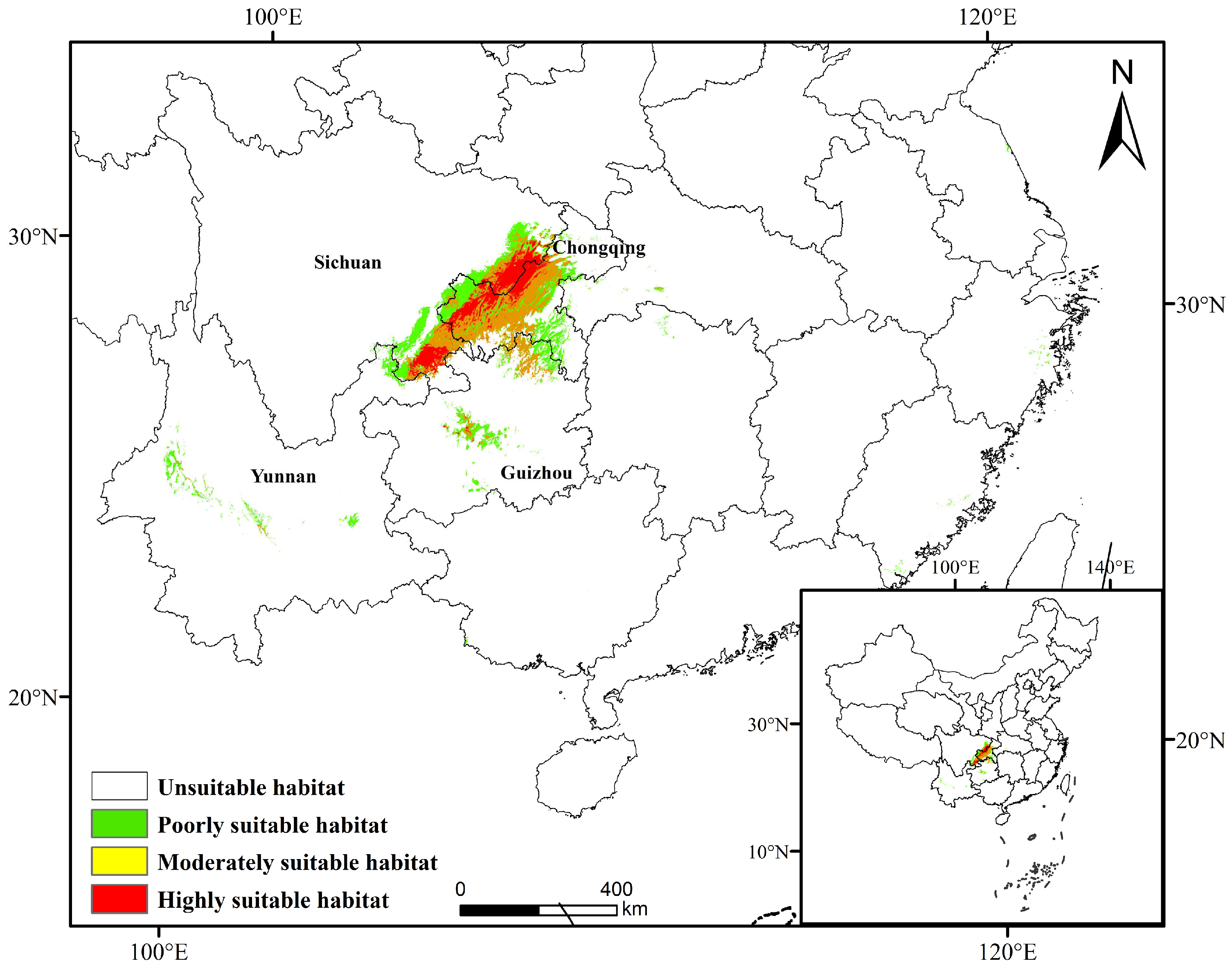
Neosinocalamus affinis forests are currently concentrated mainly in the southwestern region of China, covering approximately 0.94% of the total study area (Figure 2). The centroid of these suitable habitats is located in the northern part of Guizhou Province (28°34′ N, 106°43′ E). Highly suitable habitats are predominantly distributed in western Chongqing, eastern and southeastern Sichuan. Their total area accounts for approximately 19.48% of all suitable habitat area. Moderately suitable habitats radiate outward from the highly suitable zones, primarily extending southeastward, with key distributions in central and southern Chongqing, southeastern Sichuan, and northern Guizhou, along with scattered patches in central Guizhou and central Yunnan. They cover approximately 39.38% of all suitable habitat area. Poorly suitable habitats further expand from moderately suitable regions and are mainly found in central-eastern Chongqing, eastern and southeastern Sichuan, with limited distribution in central Guizhou, central Yunnan, and southeastern coastal areas of China. These zones occupy 0.39% of the total study area and 41.14% of the total suitable habitat area (Figure 2).
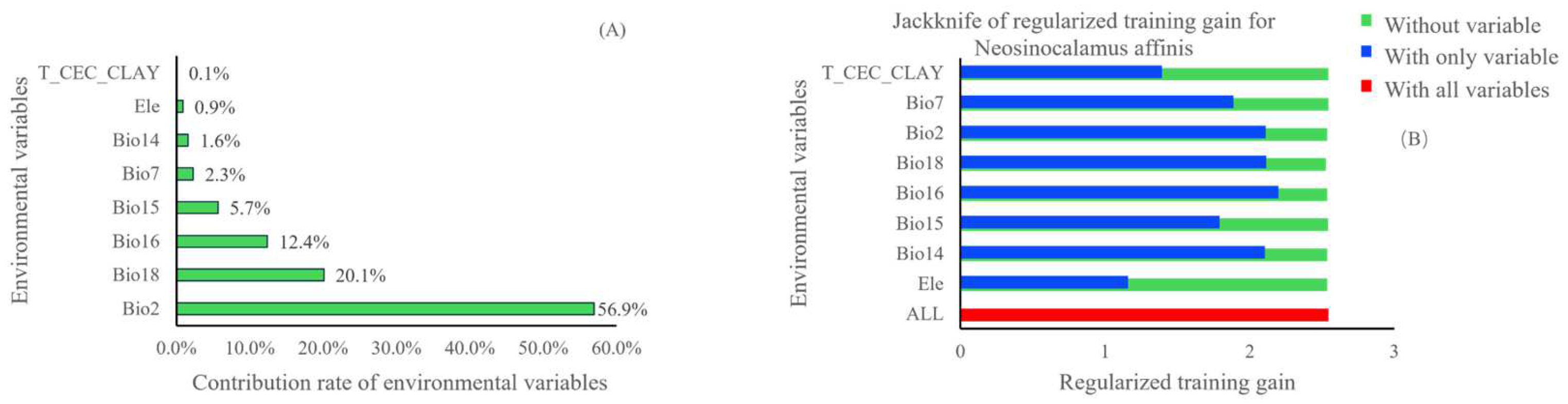
Among the eight environmental factors affecting the distribution of Neosinocalamus affinis forests, the mean diurnal temperature range (Bio2) is the primary limiting factor influencing its potential distribution, with a single-factor contribution rate of 56.9% (Figure 3A). This is followed by precipitation of the warmest quarter (Bio18), precipitation of the wettest quarter (Bio16), precipitation seasonality (Bio15), and temperature annual range (Bio7). The cumulative contribution rate of these five environmental factors reaches 97.4% (Figure 3A). In terms of regularized training gain, the highest-ranked factor is precipitation of the wettest quarter (Bio16) (Figure 3B). This is followed by the mean diurnal temperature range (Bio2), precipitation of the warmest quarter (Bio18), precipitation of the driest month (Bio14), and temperature annual range (Bio7). The integrated jackknife test and percentage contribution analysis indicate that under current climatic conditions, the mean diurnal temperature range (Bio2), precipitation of the warmest quarter (Bio18), and precipitation of the wettest quarter (Bio16) are the primary environmental factors influencing the distribution of Neosinocalamus affinis forests.
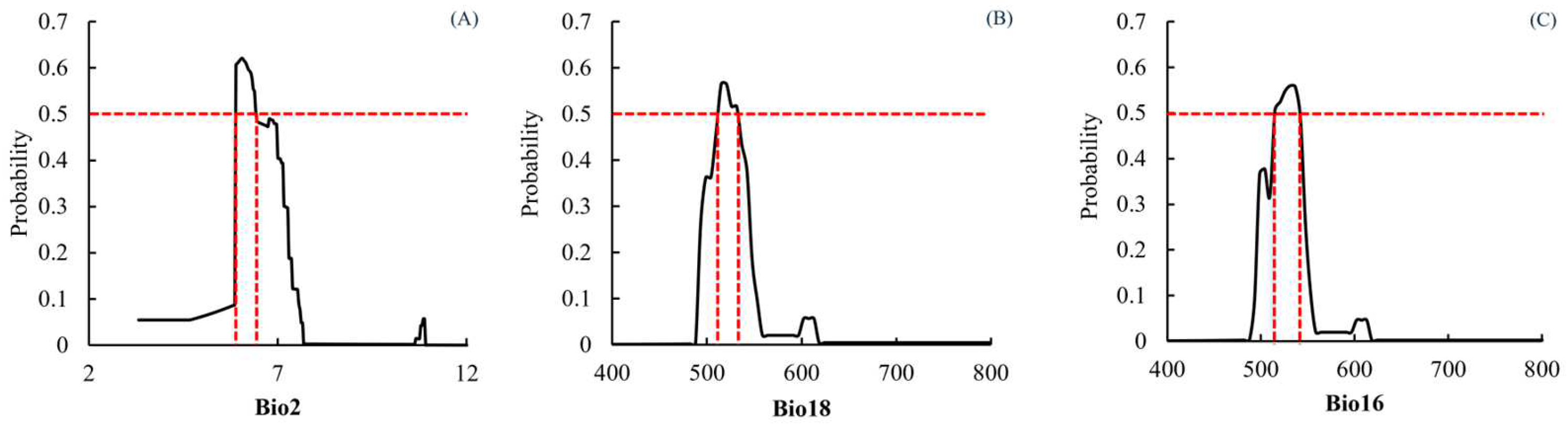
We conducted an in-depth analysis of the influence mechanisms of three key environmental factors on the distribution of Neosinocalamus affinis forests and plotted response curves between these variables and the presence probability of Neosinocalamus affinis forests, aiming to visually reveal the ecological suitability thresholds and trends. The study revealed the following optimal ranges: the mean diurnal temperature range (Bio2) had a suitable range of 5.89–6.41 °C (Figure 4A), precipitation of the warmest quarter (Bio18) showed an optimal range of 515.03–531.36 mm (Figure 4B), Precipitation of the wettest quarter (Bio16) exhibited a suitable range of 515.03–536.80 mm (Figure 4C).

3.2. Global Warming Drives Adaptive Distribution and Centroid Migration

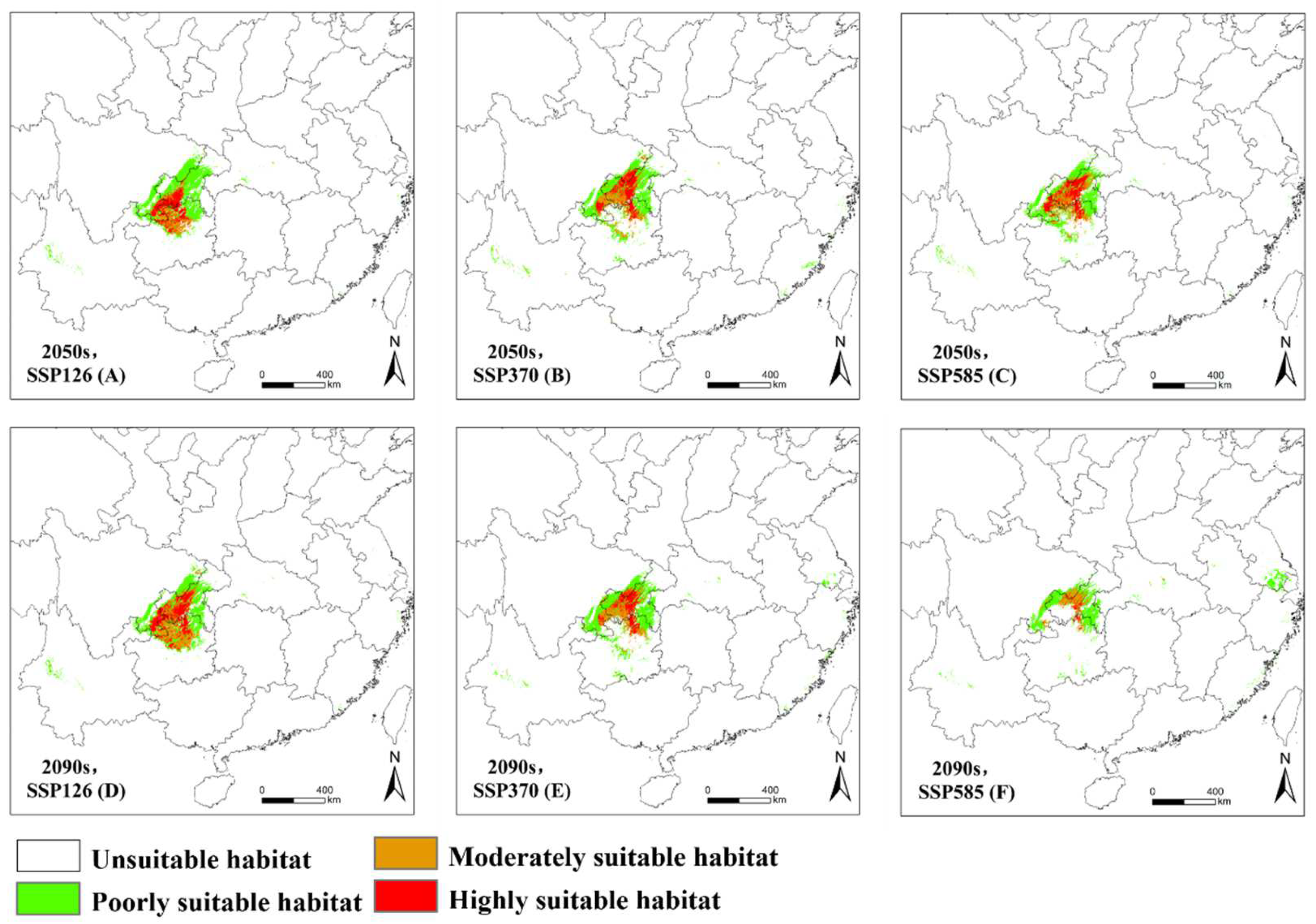
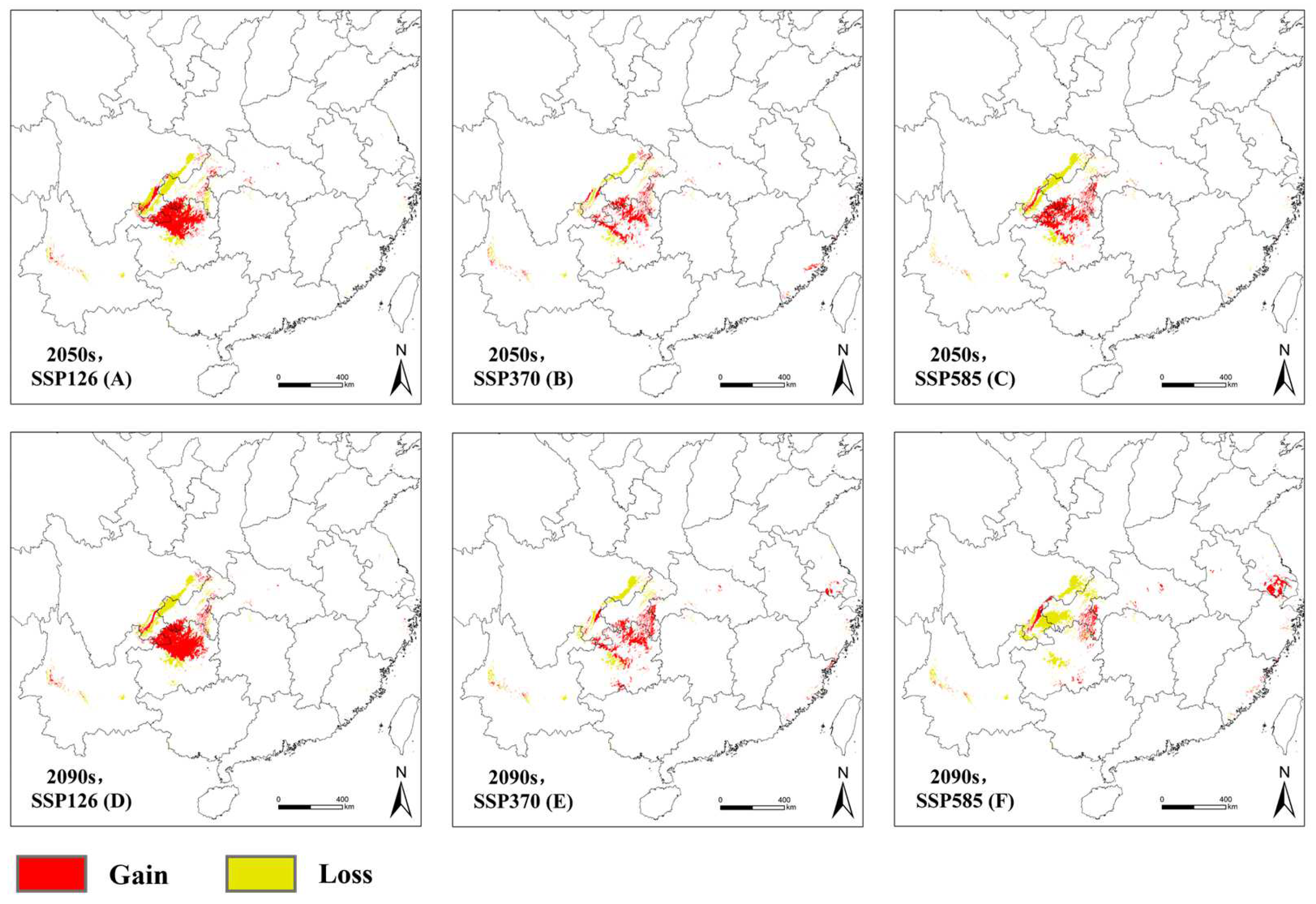
The overall distribution pattern of Neosinocalamus affinis forests in future climate scenarios remains relatively consistent with its current spatial distribution, though varying degrees of differences are observed under different scenarios (Figure 2 and Figure 5A–F). In the future, the suitable habitat area for Neosinocalamus affinis forests will generally expand, although it shows a decreasing trend as carbon emissions increase.
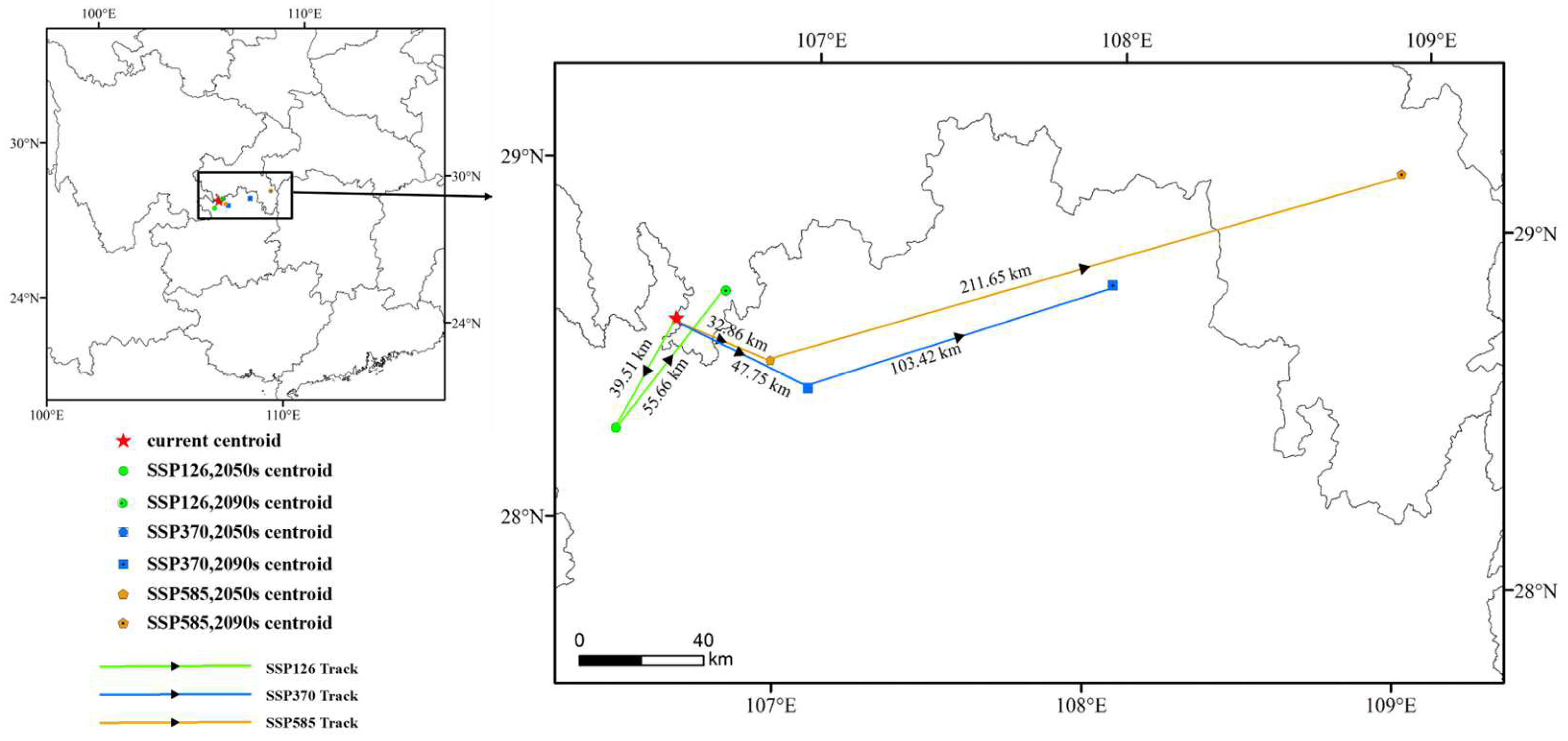
Under the SSP126 climate scenario, the increase in suitable habitat area is greater than under the SSP370 and SSP585 scenarios (Table S2 and Figure 6A–F). Over time, under the SSP126 climate scenario, the suitable habitat area of Neosinocalamus affinis forests in the two future periods increases by 23.23% and 29.38% (Table S2), respectively, with expansion primarily occurring in northern Guizhou Province. Meanwhile, the centroid of the suitable habitat initially shifts southwestward and then moves back northeastward (Figure 7). Under the SSP370 climate scenario, the suitable habitat area of Neosinocalamus affinis forests in the two future periods increases by 19.27% and 10.83% (Table S2), with the expansion areas mainly concentrated in southeastern Chongqing Municipality and northeastern Guizhou Province, while the centroid shifts first to the southeast and then to the northeast. Under the SSP585 climate scenario, however, the area of suitable habitat for Neosinocalamus affinis forests showed a decreasing trend. By the 2090s, its area had fallen below the current level, with a reduction of 25.63% (Table S2). The main contraction areas are located in southwestern Chongqing Municipality and northeastern Sichuan Province, and the centroid generally shifts northeastward with the longest migration distance (Table S3).

3.3. Landscape Fragmentation of Suitable Areas

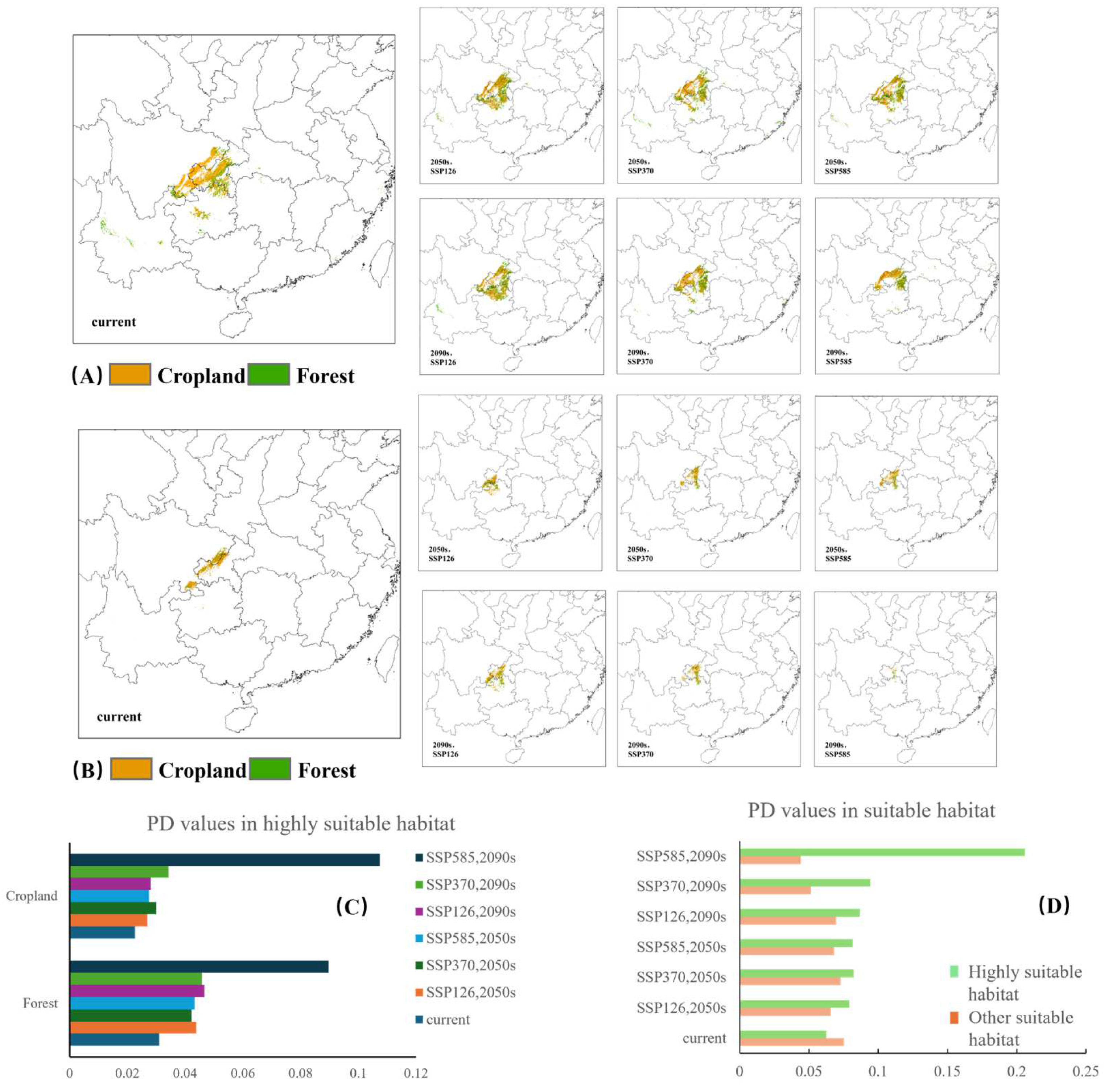
The highly suitable habitats of Neosinocalamus affinis forests exhibit a substantial degree of fragmentation. By the 2050s, the total Number of Patches (NP) and Patch Density (PD) values in the high suitability zones increased, while the Aggregation Index (AI) decreased (Figure 8D and S3). This trend was further intensified with rising carbon emissions. In contrast, changes in NP, PD, and AI values in other suitable habitats were relatively minor. Over time, by the 2090s, as the suitable habitat area for Neosinocalamus affinis forests diminished, NP values decreased. Concurrently, PD values continued to rise, and AI values continued to decline with increasing carbon emissions, reaching their lowest levels under the SSP585 scenario. This indicates that highly suitable habitats for Neosinocalamus affinis forests are expected to become increasingly fragmented in the future, with an overall decline in landscape quality.
Within the suitable habitats for Neosinocalamus affinis forests, the land use types with the largest area proportions are cropland and forest (Figure 8A,B). Compared to the present, under the SSP126 scenario, as the highly suitable habitats for Neosinocalamus affinis forests increase, forest distribution gradually expands, and aggregation levels show a moderate rise. Under the SSP370 and SSP585 scenarios, forest distribution showed a trend of initial increase followed by a decrease (Figure 8A,B). Particularly under high carbon emission scenarios, the area of suitable habitats shrinks sharply, with the forest PD value continuously increasing and the AI value steadily declining (Figure 8C and S4). This indicates that most of the disappeared bamboo area is located within forests, and the degree of forest fragmentation is intensifying.

4. Discussion

The MaxEnt model is currently one of the most widely used ecological niche models and has been extensively applied in biogeography and conservation biology [51]. Previous studies predominantly employed default parameters when constructing models in MaxEnt, resulting in limited transferability due to model overfitting and consequently introducing bias in species distribution predictions [52,53]. This study systematically integrated multiple parameters through the ENMeval package to optimize the complexity of the MaxEnt model, thereby significantly enhancing the robustness of the model outputs and making the AUC evaluation more accurate and reliable. The optimization results demonstrated that the model achieved the lowest AICc value when configured with RM = 0.5 and FC = LPTH. Furthermore, under these fine-tuned settings, the response curves exhibited smoother patterns and yielded a higher AUC value of 0.965 ± 0.001 (>0.9) (Figure S1), indicating superior model performance and high reliability in predicting the adaptive distribution of Neosinocalamus affinis forests.
In ecological research, temperature, precipitation, topography, and soil are generally considered the main environmental factors influencing vegetation growth, among which hydrothermal conditions are the decisive factors influencing species distribution [54,55,56]. Based on the comprehensive model prediction results, precipitation and temperature are the dominant environmental factors influencing the spatial distribution of Neosinocalamus affinis forests. Among them, the single-factor contribution rate of the mean diurnal temperature range (Bio2) reached 56.9%, far exceeding that of other factors, suggesting that temperature is a more critical limiting environmental factor for the distribution of Neosinocalamus affinis forests. This may be because most of its habitats are located in southwestern China, where precipitation is relatively abundant, thereby reducing the limiting effect of rainfall. This conclusion aligns with findings on the influence of temperature and moisture on the ecological stoichiometric characteristics of Neosinocalamus affinis forests [57]. However, we cannot overlook the influence of precipitation-related factors on the growth and development of Neosinocalamus affinis forests. Particularly during the growing season, sufficient precipitation remains a critical factor for sustaining the survival of most plants [58,59]. The cumulative contribution rate of precipitation-related factors in this study reaches 39.8%, and the normalized training gains of these factors are also notably high. A study on the growth patterns of Neosinocalamus liangshanensis found that soil temperature and moisture content were the primary limiting factors for the growth of bamboo shoots and young culms [60], indicating that both temperature and precipitation have significant impacts on the growth and development of Neosinocalamus affinis during the shoot-emergence stage. Therefore, in the introduction and cultivation of Neosinocalamus affinis, special attention should be paid to soil moisture management to improve seedling survival rates [61]. Overall, among the various environmental factors influencing the geographical distribution of bamboo plants, the dominant role of climatic factors is more pronounced compared to soil and topographic factors, which aligns with previous research findings [17,62,63].
Understanding changes in species’ potential distribution patterns under climate change is crucial for assessing climate change impacts on species and developing conservation strategies to maintain ecological balance [64]. The changes in suitable habitats primarily occur at the margins of the current suitable range, indicating that the potential distribution will still be concentrated in southwestern China. The newly expanded range primarily extends outward from the existing area into surrounding regions, with sporadic occurrences being relatively small in scale. This pattern may be attributed to the limited dispersal distance associated with the rare seed reproduction events of Neosinocalamus affinis forests, which results in a relatively slow natural spread. Furthermore, Neosinocalamus affinis forests predominantly reproduces asexually via rhizomes (underground stems), forming clonal populations. While this mode allows for rapid colonization of existing habitats, the clonal spread is spatially constrained, making long-distance migration challenging. Consequently, these factors suggest that the distribution of Neosinocalamus affinis forests is likely to remain relatively stable in the foreseeable future [65,66]. This suggests that the distribution of Neosinocalamus affinis forests will remain relatively stable in the near future, with limited susceptibility to environmental changes. China boasts exceptionally abundant bamboo forest resources with a long history of cultivation and utilization [15]. However, bamboo distribution is predominantly concentrated in the Yangtze River Basin and southern regions, resulting in uneven resource allocation. Identifying these expansion zones provides key target regions for bamboo introduction and cultivation which is of great significance for northern regions lacking bamboo resources. Some studies have found that under high carbon emission scenarios, temperature and precipitation patterns become more volatile and irregular, with increased frequency of extreme events [67]. As a dominant species in sympodial bamboo zones, Neosinocalamus affinis forests—particularly in low-latitude sympodial bamboo regions becomes more vulnerable to extreme heat events and the dual threats of droughts and floods [68]. Its habitat range projected to expand northward under climate warming scenarios. Previous studies have shown that, driven by global climate change, many plant species may exhibit a distribution trend of migrating toward higher latitudes and higher elevations in the future [69], which aligns well with our findings.
Habitat fragmentation is a key indicator for assessing the structure and integrity of habitats. The process of habitat fragmentation, accompanied by changes in the spatial configuration of habitats, profoundly impacts species survival, migration, and population maintenance. It is also recognized as one of the primary drivers behind the current global decline in biodiversity and even species extinction [70,71,72]. Quantitatively analyzing the landscape pattern characteristics of habitat fragmentation using landscape pattern indices can elucidate the fundamental principles governing the spatial distribution of ecological elements during the habitat fragmentation process [73]. The findings of this study indicate that the fragmentation of high-suitability areas for bamboo forests is projected to intensify in the future. As atmospheric CO2 concentrations increase, the forest aggregation within these high-suitability areas shows a significant declining trend. Particularly under the high-emission SSP585 scenario in the 2090s, the suitable habitat area for Neosinocalamus affinis forests is expected to shrink sharply, with internal fragmentation becoming notably more severe. This may be attributed to heightened climatic instability under high-emission scenarios, which significantly alters the distribution patterns of species’ suitable habitats and subsequently affects the stability and continuity of their geographical distribution [67,74]. Previously continuous habitats are likely to be fragmented into isolated patches, and some areas may even lose their suitability entirely [75]. It is noteworthy that habitat fragmentation does not necessarily coincide with an overall reduction in total habitat area. Recent studies have shown that even when the total area remains unchanged, alterations in the spatial configuration of habitats can still lead to increased fragmentation [75], The trends in landscape pattern indices revealed by this study align with the aforementioned perspective, further indicating that, the deterioration of habitat spatial structure may occur independently of changes in area. This provides important insights for a deeper understanding of the mechanisms underlying habitat degradation.
Therefore, under the trend of global climate warming, Neosinocalamus affinis forests may face certain survival pressures and risks. Furthermore, bamboo forest research is often conducted through project-based approaches, lacking long-term, fixed-point monitoring data. As a result, uncertainties remain regarding the future dynamics of bamboo stands. Unclear evaluation criteria and incomplete assessment systems have led to inaccuracies in evaluating the ecological functions of bamboo forests. To promote their long-term conservation and sustainable development, it is necessary to adopt systematic restoration and management strategies: For habitats that have already become significantly fragmented, it is recommended to enhance community structure and spatial aggregation through artificial replanting, thereby improving the overall carbon sequestration capacity of the forests. For existing contiguous Neosinocalamus affinis forests, efforts should be made to advance regionalized protection planning, large-scale management, and scientific administration, integrating the resource advantages of regional bamboo forests to achieve synergistic development of ecological, social, and economic benefits [76]. Additionally, establish a long-term dynamic monitoring system for the adaptive distribution of bamboo forests. This can be achieved by utilizing high-resolution satellite remote sensing, drone aerial photography, and other technologies to obtain more precise spatial information [77,78]. Furthermore, by incorporating artificial intelligence algorithms, it is possible to deeply analyze the complex interrelationships among various influencing factors, providing scientific support for the formulation of refined and adaptive conservation strategies.
It should be noted that the analysis of environmental drivers in this study relies on the standard outputs of the MaxEnt model, specifically percentage contribution and the jackknife test. While this approach aids in identifying key climatic variables and facilitates comparison with a wide range of similar studies, future research could enhance robustness by incorporating Bootstrap resampling to provide confidence intervals for contribution estimates, or by employing methods such as multi-model averaging and structural equation modeling to more accurately quantify the complex interactions among environmental factors and their relative influence on distribution predictions [79,80]; Additionally, controlled factorial experiments or process-based models could be used to disentangle the relative contributions of individual meteorological factors, such as temperature and precipitation, to habitat fragmentation, thereby elucidating the underlying physio-ecological mechanisms at a finer scale.

5. Conclusions

The strong carbon sequestration capacity of Neosinocalamus affinis forests plays a vital role in maintaining global carbon balance. Global warming has profoundly impacted the adaptive distribution and landscape fragmentation of bamboo forests. This study utilized an optimized MaxEnt model and the “FragStats 4.2” software to comprehensively analyze and predict the adaptive distribution, environmental driving factors, and centroid shifts of Neosinocalamus affinis forests under three scenarios (SSP126, SSP370, SSP585) for both current and future periods. Additionally, landscape metrics are employed to assess the fragmentation degree of suitable habitats for the Neosinocalamus affinis forests. Results indicate that: (1) Neosinocalamus affinis forests currently have a potentially suitable habitat, primarily distributed in Chongqing Municipality, eastern and southeastern Sichuan Province, and northern Guizhou Province, with the centroid of suitable habitat located in northern Guizhou Province. (2) Climate factors dominate over soil and topographic variables in shaping its distribution. The primary environmental determinants for Neosinocalamus affinis forests distribution include: mean diurnal temperature range (Bio2, 5.89–6.41 °C), along with precipitation during the warmest (Bio18, 515.03–531.36 mm) and wettest quarters (Bio16, 515.03–536.80 mm). (3) Compared to the current period, the area of suitable habitat for Neosinocalamus affinis forests will expand under low and medium carbon emission scenarios but shrink under high carbon emission scenarios. As CO2 concentrations increase, the suitable habitat area shows a decreasing trend. By the 2050s, the suitable habitat is projected to shift slightly southward, while by the 2090s, it is expected to migrate northeast. (4) In the future, the fragmentation degree of highly suitable areas for Neosinocalamus affinis forests will be higher than in the current period and will show an increasing trend. As carbon emissions rise, fragmentation intensifies and overall landscape quality further declines. Among the suitable habitats for Neosinocalamus affinis forests, cropland and forest land are the land use types with the largest area proportions. With increasing carbon emissions, forest fragmentation continues to intensify. The findings of this study provide a basis for understanding the potential suitable habitats and habitat fragmentation of Neosinocalamus affinis forests, offering data support for their future management and conservation, aiming to enhance the ecosystem’s inherent carbon sequestration and emission reduction potential. This will contribute more effectively to the achievement of the “Dual Carbon” goals.

Supplementary Materials

The following supporting information can be downloaded at: https://www.mdpi.com/article/10.3390/f17010084/s1, Figure S1: (A) R program model selection results (B) AUC result of MaxEnt modeling; Figure S2. Pearson correlation coefficient matrix of environmental factors; Figure S3. AI and NP values of suitable habitat; Figure S4. Fragmentation of Neosinocalamus affinis forests land use landscape under different climate scenarios (A1–A4, other suitable habitat; B1–B3, highly suitable habitat); Table S1: List of environmental variables; Table S2: Changes in the potential suitable habitat area for Neosinocalamus affinis forests under current and future climate scenarios; Table S3: Centroid coordinates and migration distence of Neosinocalamus affinis forests.

Author Contributions

Conceptualization, H.Z.; methodology, H.Z.; software, J.L.; validation, H.Z., Y.Z. and Z.W.; formal analysis, J.L.; investigation, H.Z. and J.L.; resource, H.Z.; data curation, J.L.; writing—original draft preparation, H.Z. and J.L.; writing—review and editing, H.Z., J.L., Y.Z., Z.W. and Z.L.; visualization, J.L.; supervision, H.Z.; project administration, H.Z. and Z.L.; funding acquisition, H.Z. All authors have read and agreed to the published version of the manuscript.

Funding

This research was funded by the National Water Pollution Control and Treatment Science and Technology Major Project (2017ZX07101) and the Discipline Construction Program of Huayong Zhang, Distinguished Professor of Shandong University, School of Life Sciences (61200082363001).

Data Availability Statement

All links to input data are reported in the manuscript and all output data are available upon request to the authors.

Conflicts of Interest

The authors declare no conflicts of interest.

References

  1. He, Y.; Xiong, Q.; Yu, L.; Yan, W.; Qu, X. Impact of Climate Change on Potential Distribution Patterns of Alpine Vegetation in the Hengduan Mountains Region, China. Mt. Res. Dev. 2020, 40, R48–R54. [Google Scholar] [CrossRef]
  2. Xiang, Y.; Li, S.; Yang, Q.; Ren, J.; Liu, Y.; Luo, Y.; Zhao, L.; Luo, X.; Yao, B.; Guo, X. Forecasting Northward Range Expansion of Switchgrass in China via Multi-Scenario MaxEnt Simulations. Biology 2025, 14, 1061. [Google Scholar] [CrossRef]
  3. Yang, Q.; Yuan, Y.; Su, X.; Liu, Y.; Wang, D.; Li, X.; Sun, C.; Yang, P. Prediction of Suitable Distribution Area of Corydalis trachycarpa (Papaveraceae) in China under Climate Change. Bull. Bot. Res. 2024, 44, 17–26. [Google Scholar] [CrossRef]
  4. Scholze, M.; Knorr, W.; Arnell, N.W.; Prentice, I.C. A Climate-Change Risk Analysis for World Ecosystems. Proc. Natl. Acad. Sci. USA 2006, 103, 13116–13120. [Google Scholar] [CrossRef]
  5. Peñuelas, J.; Boada, M. A Global Change-induced Biome Shift in the Montseny Mountains (NE Spain). Glob. Change Biol. 2003, 9, 131–140. [Google Scholar] [CrossRef]
  6. Wang, G.G.; Lu, D.; Gao, T.; Zhang, J.; Sun, Y.; Teng, D.; Yu, F.; Zhu, J. Climate-Smart Forestry: An AI-Enabled Sustainable Forest Management Solution for Climate Change Adaptation and Mitigation. J. For. Res. 2024, 36, 7. [Google Scholar] [CrossRef]
  7. Yang, Y. The Impacts of Global Environmental Changes on Typical Ecosystems: Status, Challenges and Trends. Acta Ecol. Sin. 2017, 37, 1–11. [Google Scholar] [CrossRef]
  8. Bellard, C.; Bertelsmeier, C.; Leadley, P.; Thuiller, W.; Courchamp, F. Impacts of Climate Change on the Future of Biodiversity. Ecol. Lett. 2012, 15, 365–377. [Google Scholar] [CrossRef]
  9. Hosseini, N.; Mehrabian, A.; Nasab, F.K.; Mostafavi, H.; Ghorbanpour, M. Forecasting Climate Change Effects on the Potential Distribution of Zhumeria majdae as an Endangered Monotypic Endemic Species: A Maxent Modeling Approach. BMC Ecol. Evol. 2025, 25, 85. [Google Scholar] [CrossRef] [PubMed]
  10. Zhang, H.; Zhan, W.; Xu, Q.; Tu, C.; Li, J.; Yue, C.; Wang, Y.; Wang, Z. Research progress on carbon sequestration capacity and influencing factors of bamboo forests. J. Zhejiang Agric. Sci. 2025, 66, 241–245. [Google Scholar] [CrossRef]
  11. Li, R.; Hu, T.; Tu, L.; Liu, C.; Luo, S.; Xiang, Y.; Dai, H.; Xie, C. Nutrient Release in Decomposition of Leaf Litter in Neosinocalamus affinis Stands in Response to Simulated Nitrogen Deposition in Rainy Area of Western China. Sci. Silvae Sin. 2010, 46, 8–14. [Google Scholar]
  12. Liu, X.; Hu, X. Discussion on the Effect of the New Cutting Mode of Neosinocalamus affinis Forest in Sichuan Area on Bamboo Forest Construction. IOP Conf. Ser. Earth Environ. Sci. 2018, 170, 22128. [Google Scholar] [CrossRef]
  13. Shi, J.; Wu, L.; Zhou, D.; Pan, Y.; Ma, L.; Yao, J.; Li, Z. Diversity and Value of Bamboo Cultivars in China. J. Bamboo Res. 2021, 40, 6–13. [Google Scholar] [CrossRef]
  14. Fu, L.; Su, J. Calculation of Carbon Sink of Bamboo Forest in China and Its Potential Prediction. China For. Econ. 2023, 31, 96–102. [Google Scholar] [CrossRef]
  15. Pu, J.; Wang, X.; Pang, S.; Liang, C.; Wang, S.; Qin, C. Current Status of Assessment on Carbon Sequestration in Bamboo Forests and Carbon Footprint of Bamboo Industry. China Pulp Pap. 2023, 42, 37–45. [Google Scholar]
  16. Luo, J.; Wu, X.; Sun, J.; Liu, T.; Huang, Y.; Yang, Y.; Luo, G.; Huang, H. Effects of Stand Density on Carbon Storage in Phyllostachys edulis Forest Ecosystem. World Bamboo Ratt. 2025, 23, 98–103. [Google Scholar] [CrossRef]
  17. Zhang, H.; Liu, P.; Zhang, Y.; Wang, Z.; Liu, Z. Global Warming and Landscape Fragmentation Drive the Adaptive Distribution of Phyllostachys edulis in China. Forests 2024, 15, 2231. [Google Scholar] [CrossRef]
  18. Zhao, C.; Liu, J.; Zhu, F.; Wang, S. Effects of Foliar Application of Potassium Fertilizer on Anatomical and Physiological Changes of Neosinocalamus affinis Leaves. Forests 2025, 16, 388. [Google Scholar] [CrossRef]
  19. Fan, H.; Ma, L.; Li, H.; Zhang, M.; Yu, Z.; Zhao, S.; Zhou, Q.; Chen, S. Experimental Study on Mechanical Behavior of Bolted Steel-neosinocalamus Affinis-based Bamboo Scrimber and Steel Connections. Earthq. Eng. Resil. 2024, 3, 574–593. [Google Scholar] [CrossRef]
  20. Elith, J.; Leathwick, J.R. Species Distribution Models: Ecological Explanation and Prediction across Space and Time. Annu. Rev. Ecol. Evol. Syst. 2009, 40, 677–697. [Google Scholar] [CrossRef]
  21. Sánchez-Mercado, A.Y.; Ferrer-Paris, J.R. Mapping Species Distributions: Spatial Inference and Prediction by Janet Franklin (2009), Xviii + 320 pp., Cambridge University Press, Cambridge, UK. ISBN 9780521876353 (Hbk), GBP 70.00; 9780521700023 (Pbk), GBP 35.00. Oryx 2010, 44, 615. [Google Scholar] [CrossRef]
  22. Li, G.; Liu, C.; Liu, Y.; Yang, J.; Zhang, X.; Guo, K. Advances in theoretical issues of species distribution models. Acta Ecol. Sin. 2013, 33, 4827–4835. [Google Scholar] [CrossRef]
  23. Li, X.; Tang, J.; Yin, X.; Liu, Y.; Li, Z. Predicting the Suitable Habitat of Rare and Endangered Yulania spach Species Using Optimization MaxEnt Modeling. J. Northeast For. Univ. 2025, 53, 64–72. [Google Scholar] [CrossRef]
  24. Buebos-Esteve, D.E.; Mamasig, G.D.N.S.; Ringor, A.M.D.; Layog, H.N.B.; Murillo, L.C.S.; Dagamac, N.H.A. Modeling the Potential Distribution of Two Immortality Flora in the Philippines: Applying MaxEnt and GARP Algorithms under Different Climate Change Scenarios. Model. Earth Syst. Environ. 2023, 9, 2857–2876. [Google Scholar] [CrossRef]
  25. Elith, J.; Graham, C.H.; Anderson, R.P.; Dudík, M.; Ferrier, S.; Guisan, A. Novel Methods Improve Prediction of Species’ Distributions from Occurrence Data. Ecography 2006, 29, 129–151. [Google Scholar] [CrossRef]
  26. Zhang, H.; Sun, P.; Zou, H.; Ji, X.; Wang, Z.; Liu, Z. Adaptive Distribution and Vulnerability Assessment of Endangered Maple Species on the Tibetan plateau. Forests 2024, 15, 491–508. [Google Scholar] [CrossRef]
  27. Zhang, H.; Zhou, Y.; Ji, X.; Wang, Z.; Liu, Z. Climate Change Drives the Adaptive Distribution and Habitat Fragmentation of Betula albosinensis Forests in China. Forests 2025, 16, 184. [Google Scholar] [CrossRef]
  28. Chen, Y.; Le, X.; Chen, Y.; Cheng, W.; Du, J.; Zhong, Q.; Cheng, D. Identification of the potential distribution area of Cunninghamia lanceolata in China under climate change based on the MaxEnt model. Chin. J. Appl. Ecol. 2022, 33, 1207–1214. [Google Scholar] [CrossRef]
  29. Xie, C.; Li, M.; Jim, C.Y.; Chen, R. Distribution Pattern of Endangered Cycas taiwaniana Carruth. in China under Climate-Change Scenarios Using the MaxEnt Model. Plants 2025, 14, 1600. [Google Scholar] [CrossRef]
  30. Wu, Y.; Yan, L.; Shen, H.; Guan, R.; Ge, Q.; Huang, L.; Rohani, E.R.; Ou, J.; Han, R.; Tong, X. Potentially Suitable Geographical Area for Pulsatilla chinensis Regel under Current and Future Climatic Scenarios Based on the MaxEnt Model. Front. Plant Sci. 2025, 16, 1538566. [Google Scholar] [CrossRef]
  31. Chen, Y.; Xie, H.; Luo, H.; Yang, B.; Xiong, D. Impacts of climate change on the distribution of Cymbidium kanran and the simulation of distribution pattern. Chin. J. Appl. Ecol. 2019, 30, 3419–3425. [Google Scholar] [CrossRef]
  32. Luo, M.; Yang, P.; Yang, L.; Zheng, Z.; Chen, Y.; Li, H.; Wu, M. Predicting Potentially Suitable Bletilla Striata Habitats in China under Future Climate Change Scenarios Using the Optimized MaxEnt Model. Sci. Rep. 2025, 15, 21231. [Google Scholar] [CrossRef] [PubMed]
  33. Gong, J.; Zhao, C.; Xie, Y.; Gao, Y. Ecological risk assessment and its management of Bailongjiang watershed, southern Gansu based on landscape pattern. Chin. J. Appl. Ecol. 2014, 25, 2041–2048. [Google Scholar] [CrossRef]
  34. Feng, Q.; Fan, H.; Yang, L.; Chen, L.; Huang, Y.; Li, B.; Fan, Y.; Yang, N. Theory and application of the Landscape Ecology Toolbox software for landscape pattern analysis based on the Patch-Corridor-Matrix and the Source-Flow-Sink paradigm. Acta Ecol. Sin. 2024, 44, 4678–4686. [Google Scholar] [CrossRef]
  35. Tang, M.; Chen, Z.; Zheng, X.; Liu, L.; Wang, X.; Li, B.; Fu, Z.; Jia, Y.; Wang, X. Analysis on landscape pattern change and driving forces of Liqiu River basin in Kangding, Sichuan Province. J. Sichuan For. Sci. Technol. 2025, 46, 13–20. [Google Scholar] [CrossRef]
  36. Zhang, T.; Cheng, C.; Wu, X. Mapping the Spatial Heterogeneity of Global Land Use and Land Cover from 2020 to 2100 at a 1 km Resolution. Sci. Data 2023, 10, 748. [Google Scholar] [CrossRef]
  37. Wu, T.; Lu, Y.; Fang, Y.; Xin, X.; Li, L.; Li, W.; Jie, W.; Zhang, J.; Liu, Y.; Zhang, L.; et al. The Beijing Climate Center Climate System Model (BCC-CSM): The Main Progress from CMIP5 to CMIP6. Geosci. Model Dev. 2019, 12, 1573–1600. [Google Scholar] [CrossRef]
  38. Tokarska, K.B.; Stolpe, M.B.; Sippel, S.; Fischer, E.M.; Smith, C.J.; Lehner, F.; Knutti, R. Past Warming Trend Constrains Future Warming in CMIP6 Models. Sci. Adv. 2020, 6, eaaz9549. [Google Scholar] [CrossRef] [PubMed]
  39. Harvey, B.J.; Cook, P.; Shaffrey, L.C.; Schiemann, R. The Response of the Northern Hemisphere Storm Tracks and Jet Streams to Climate Change in the CMIP3, CMIP5, and CMIP6 Climate Models. J. Geophys. Res. Atmos. 2020, 125, e2020JD032701. [Google Scholar] [CrossRef]
  40. Ma, D.; Lun, X.; Li, C.; Zhou, R.; Zhao, Z.; Wang, J.; Zhang, Q.; Liu, Q. Predicting the Potential Global Distribution of Amblyomma americanum (Acari: Ixodidae) under near Current and Future Climatic Conditions, Using the Maximum Entropy Model. Biology 2021, 10, 1057. [Google Scholar] [CrossRef] [PubMed]
  41. Zhang, X.; Zhao, J.; Wang, M.; Li, Z.; Lin, S.; Chen, H. Potential Distribution Prediction of Amaranthus palmeri S. Watson in China under Current and Future Climate Scenarios. Ecol. Evol. 2022, 12, e9505. [Google Scholar] [CrossRef]
  42. Warren, D.L.; Seifert, S.N. Ecological Niche Modeling in Maxent: The Importance of Model Complexity and the Performance of Model Selection Criteria. Ecol. Appl. 2011, 21, 335–342. [Google Scholar] [CrossRef]
  43. Zhao, Y.; Deng, X.; Xiang, W.; Chen, L.; Ouyang, S. Predicting Potential Suitable Habitats of Chinese Fir under Current and Future Climatic Scenarios Based on Maxent Model. Ecol. Inf. 2021, 64, 101393. [Google Scholar] [CrossRef]
  44. Muscarella, R.; Galante, P.J.; Soley-Guardia, M.; Boria, R.A.; Kass, J.M.; Uriarte, M.; Anderson, R.P. ENMEval: An R Package for Conducting Spatially Independent Evaluations and Estimating Optimal Model Complexity for MAXENT Ecological Niche Models. Methods Ecol. Evol. 2014, 5, 1198–1205. [Google Scholar] [CrossRef]
  45. Wang, X.; Liu, G.; Xiao, S.; Quan, M. Habitat Suitability Distribution and Fragmentation of Camellia oleifera in China under Current and Future Climate Scenarios Based on MaxEnt and Fragstats. Environ. Monit. Assess 2025, 197, 1113. [Google Scholar] [CrossRef] [PubMed]
  46. Wang, Q.; Fan, B.; Zhao, G. Prediction of potential distribution area of Corylus mandshurica in China under climate change. Chin. J. Ecol. 2020, 39, 3774–3784. [Google Scholar] [CrossRef]
  47. Li, Y.; Li, M.; Li, C.; Liu, Z. Optimized Maxent Model Predictions of Climate Change Impacts on the Suitable Distribution of Cunninghamia lanceolata in China. Forests 2020, 11, 302. [Google Scholar] [CrossRef]
  48. Zhao, S.; Zhang, Z.; Gao, C.; Dong, Y.; Jing, Z.; Du, L.; Hou, X. MaxEnt-Based Predictions of Suitable Potential Distribution of Leymus secalinus under Current and Future Climate Change. Plants 2025, 14, 293. [Google Scholar] [CrossRef]
  49. Mao, Y.; Tang, X.; Shi, W.; Zhang, C.; Zhou, R. Prediction of the Potential Distribution of Tirpitzia sinensis in China Based on MaxEnt Modelling. Environ. Monit. Assess. 2025, 197, 1115. [Google Scholar] [CrossRef]
  50. Zhang, Y.; Liu, Y.; Qin, H.; Meng, Q. Prediction on spatial migration of suitable distribution of Elaeagnus mollis under climate change conditions in Shanxi Province, China. Chin. J. Appl. Ecol. 2019, 30, 496–502. [Google Scholar] [CrossRef]
  51. Elith, J.; Phillips, S.J.; Hastie, T.; Dudík, M.; Chee, Y.E.; Yates, C.J. A Statistical Explanation of MaxEnt for Ecologists. Divers. Distrib. 2011, 17, 43–57. [Google Scholar] [CrossRef]
  52. Jia, X.; Wang, C.; Jin, H.; Zhao, Y.; Liu, L.; Chen, Q.; Li, B.; Xiao, Y.; Yin, H. Assessing the suitable distribution area of Pinus koraiensis based on an optimized MaxEnt model. Chin. J. Ecol. 2019, 38, 2570–2576. [Google Scholar] [CrossRef]
  53. Zhu, G.; Qiao, H. Effect of the Maxent Model’s Complexity on the Prediction of Species Potential Distributions. Biodivers. Sci. 2016, 24, 1189–1196. [Google Scholar] [CrossRef]
  54. Coelho, M.T.P.; Barreto, E.; Rangel, T.F.; Diniz-Filho, J.A.F.; Wüest, R.O.; Bach, W.; Skeels, A.; McFadden, I.R.; Roberts, D.W.; Pellissier, L.; et al. The Geography of Climate and the Global Patterns of Species Diversity. Nature 2023, 622, 537–544. [Google Scholar] [CrossRef]
  55. Zhao, Y.; Cao, H.; Xu, W.; Chen, G.; Lian, J.; Du, Y.; Ma, K. Contributions of Precipitation and Temperature to the Large Scale Geographic Distribution of Fleshy-Fruited Plant Species: Growth Form Matters. Sci. Rep. 2018, 8, 17017. [Google Scholar] [CrossRef]
  56. Ma, Z.; Liu, H.; Mi, Z.; Zhang, Z.; Wang, Y.; Xu, W.; Jiang, L.; He, J. Climate Warming Reduces the Temporal Stability of Plant Community Biomass Production. Nat. Commun. 2017, 8, 15378. [Google Scholar] [CrossRef] [PubMed]
  57. Liu, Y.; Wei, T.; Long, Z.; Xu, G.; Hu, S.; Hu, Y. Effects of temperature and different moisture on ecological stoichiometry of Dendrocalamus farinosus. J. For. Environ. 2018, 38, 209–215. [Google Scholar] [CrossRef]
  58. Liu, X.; Li, W.; Zhao, H. Grassland Vegetation in Alpine Grassland: Phenological Period and Its Relation Patterns with Meteorological Factors. Chin. Agric. Sci. Bull. 2019, 35, 117–122. [Google Scholar]
  59. Cao, Y.; Qin, F.; Pang, Y.; Zhao, F.; Huang, J. Spatiotemporal changes in vegetation and hydrological factors in the North China Plain from 2002 to 2016. Acta Ecol. Sin. 2019, 39, 1560–1571. [Google Scholar] [CrossRef]
  60. Xiong, Z.; Dong, W.; Liu, S.; Wang, Z. Study on Height Growth Rhythm from Shoot to Young Bamboo of Dendrocalamus farinosus and Its Aboveground Biomas. World Bamboo Ratt. 2011, 9, 5–9. [Google Scholar] [CrossRef]
  61. Zhang, Y.; Wang, S.; Long, H.; Huang, L.; Li, J.; Li, J. The physiological adaptation of Neosinocalamus affinis cuttings at different time periods post-transplantation. J. For. Environ. 2021, 41, 248–254. [Google Scholar] [CrossRef]
  62. Takano, K.T.; Hibino, K.; Numata, A.; Oguro, M.; Aiba, M.; Shiogama, H.; Takayabu, I.; Nakashizuka, T. Detecting Latitudinal and Altitudinal Expansion of Invasive Bamboo Phyllostachys edulis and Phyllostachys bambusoides (Poaceae) in Japan to Project Potential Habitats under 1.5 °C–4.0 °C Global Warming. Ecol. Evol. 2017, 7, 9848–9859. [Google Scholar] [CrossRef]
  63. Jin, J.; Jiang, H.; Peng, W.; Zhang, L.; Lu, X.; Xu, J.; Zhang, X.; Wang, Y. Evaluating the Impact of Soil Factors on the Potential Distribution of Phyllostachys edulis (Bamboo) in China Based on the Species Distribution Model. Chin. J. Plant Ecol. 2013, 37, 631–640. [Google Scholar] [CrossRef]
  64. Deb, J.C.; Phinn, S.; Butt, N.; McAlpine, C.A. The Impact of Climate Change on the Distribution of Two Threatened Dipterocarp Trees. Ecol. Evol. 2017, 7, 2238–2248. [Google Scholar] [CrossRef] [PubMed]
  65. Li, D.; Wei, J.; Wu, J.; Zhong, Y.; Chen, Z.; He, J.; Zhang, S.; Yu, L. The Expansion of Moso Bamboo (Phyllostachys edulis) Forests into Diverse Types of Forests in China from 2010 to 2020. Forests 2024, 15, 1418. [Google Scholar] [CrossRef]
  66. Shen, J.; Zeng, X.; Fan, S.; Liu, G. Impacts of Intensive Management Practices on the Long-Term Sustainability of Soil and Water Conservation Functions in Bamboo Forests: A Mechanistic Review from Silvicultural Perspectives. Forests 2025, 16, 787–804. [Google Scholar] [CrossRef]
  67. Lemordant, L.; Gentine, P. Vegetation Response to Rising CO2 Impacts Extreme Temperatures. Geophys. Res. Lett. 2019, 46, 1383–1392. [Google Scholar] [CrossRef]
  68. Shan, B.; Li, Y.; Qin, J.; Shi, L. Spatiotemporal Change of the Extreme Climate in China’s Bamboo Forest during 1960–2050. Sci. Silvae Sin. 2025, 61, 50–61. [Google Scholar] [CrossRef]
  69. Fang, J.; Zhu, J.; Shi, Y. The Responses of Ecosystems to Global Warming. Chin. Sci. Bull. 2018, 63, 136–140. [Google Scholar] [CrossRef]
  70. Wilson, M.C.; Chen, X.-Y.; Corlett, R.T.; Didham, R.K.; Ding, P.; Holt, R.D.; Holyoak, M.; Hu, G.; Hughes, A.C.; Jiang, L.; et al. Habitat Fragmentation and Biodiversity Conservation: Key Findings and Future Challenges. Landsc. Ecol. 2016, 31, 219–227. [Google Scholar] [CrossRef]
  71. Valente, J.J.; Gannon, D.G.; Hightower, J.; Kim, H.; Leimberger, K.G.; Macedo, R.; Rousseau, J.S.; Weldy, M.J.; Zitomer, R.A.; Fahrig, L.; et al. Toward Conciliation in the Habitat Fragmentation and Biodiversity Debate. Landsc. Ecol. 2023, 38, 2717–2730. [Google Scholar] [CrossRef]
  72. Chase, J.M.; Blowes, S.A.; Knight, T.M.; Gerstner, K.; May, F. Ecosystem Decay Exacerbates Biodiversity Loss with Habitat Loss. Nature 2020, 584, 238–243. [Google Scholar] [CrossRef] [PubMed]
  73. Wu, J.; Liu, Z. Effect of habitat fragmentation on biodiversity: A review. Chin. J. Ecol. 2014, 33, 1946–1952. [Google Scholar] [CrossRef]
  74. Raghunathan, N.; François, L.; Dury, M.; Hambuckers, A. Contrasting Climate Risks Predicted by Dynamic Vegetation and Ecological Niche-Based Models Applied to Tree Species in the Brazilian Atlantic Forest. Reg. Environ. Change 2019, 19, 219–232. [Google Scholar] [CrossRef]
  75. Fahrig, L. Ecological Responses to Habitat Fragmentation per Se. Annu. Rev. Ecol. Evol. Syst. 2017, 48, 1–23. [Google Scholar] [CrossRef]
  76. Li, Z.; Wang, D.; Fan, B. Analysis on Status Quo and Policy of China’s Bamboo Industry. J. Beijing For. Univ. (Soc. Sci.) 2005, 4, 50–54. [Google Scholar] [CrossRef]
  77. Rawat, B.; Gairola, S.; Tewari, L.M.; Rawal, R.S. Long-Term Forest Vegetation Dynamics in Nanda Devi Biosphere Reserve, Indian West Himalaya: Evidence from Repeat Studies on Compositional Patterns. Environ. Monit. Assess. 2021, 193, 459. [Google Scholar] [CrossRef] [PubMed]
  78. Praticò, S.; Solano, F.; Di Fazio, S.; Modica, G. Machine Learning Classification of Mediterranean Forest Habitats in Google Earth Engine Based on Seasonal Sentinel-2 Time-Series and Input Image Composition Optimisation. Remote Sens. 2021, 13, 586. [Google Scholar] [CrossRef]
  79. Zhang, H.; Zhang, B.; Zhang, Y.; Wang, Z.; Liu, Z. Climate Change Drives Shifts in Suitable Habitats of Three Stipa Purpurea Alpine Steppes on the Western Tibetan Plateau. Diversity 2025, 17, 145. [Google Scholar] [CrossRef]
  80. Bakshi, B.; Polasky, S.; Frelich, L.E. Predicting the Impact of Climate Change on Forest Composition, Deer, and Outdoor Recreation Using Structural Equation Modeling (SEM) in Northeastern Minnesota. J. Environ. Manag. 2025, 392, 126695. [Google Scholar] [CrossRef] [PubMed]
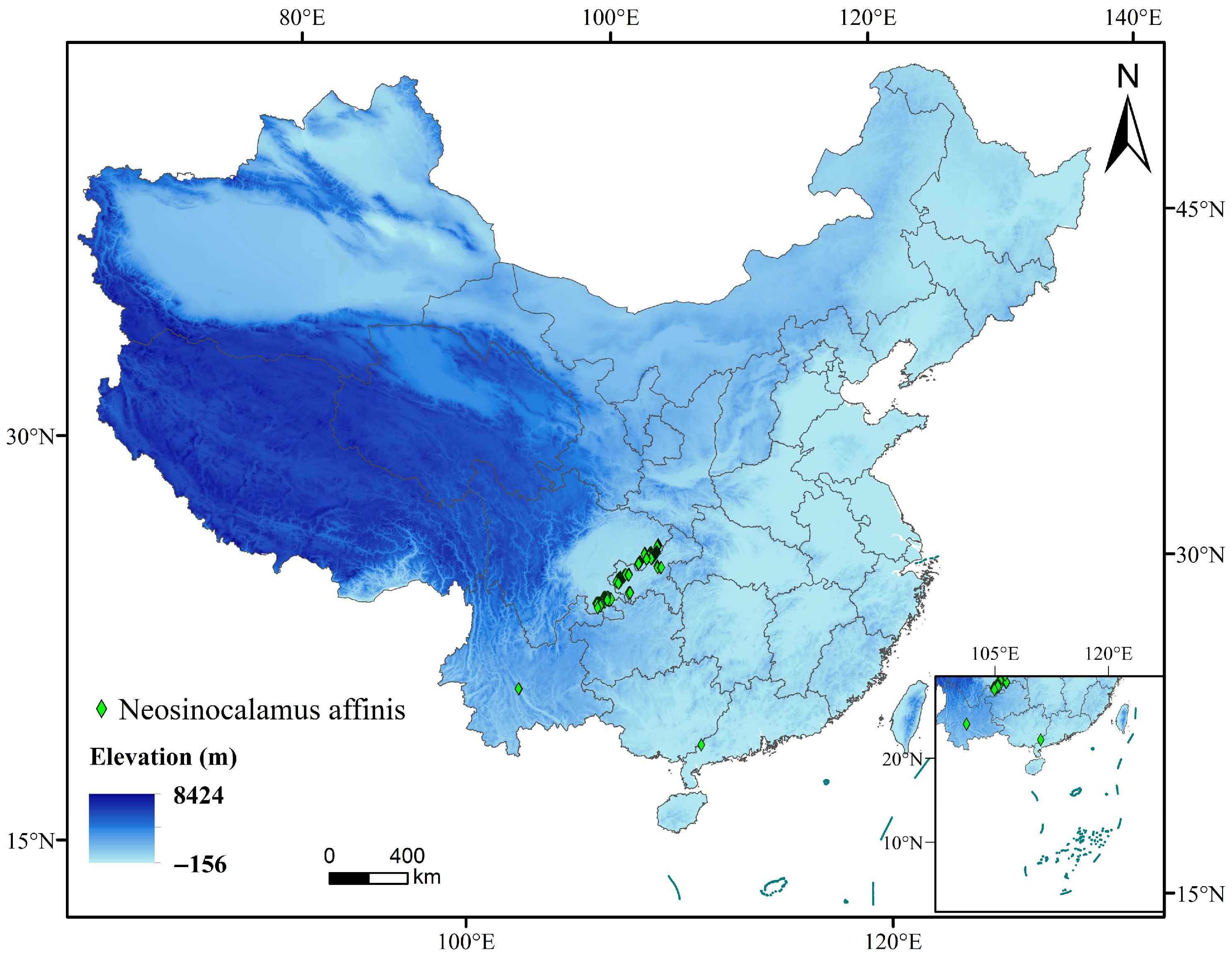
Figure 1. Distribution of occurrence points of Neosinocalamus affinis (Rendle) Keng f. forests in China.
Forests 17 00084 g001
Figure 2. Suitable habitats of Neosinocalamus affinis forests under current climate conditions.
Forests 17 00084 g002
Figure 3. (A) Percentage contribution of environmental factors; (B) jack-knife test for a single environmental variable.
Forests 17 00084 g003
Figure 4. Response curve of the main environmental factors (AC).
Forests 17 00084 g004
Figure 5. Adaptive distribution of Neosinocalamus affinis forests under future climate conditions based on the MaxEnt model.
Forests 17 00084 g005
Figure 6. Changes in suitable habitats of Neosinocalamus affinis forests.
Forests 17 00084 g006
Figure 7. The centroid position and migration trajectory of suitable area of Neosinocalamus edulis forests under different climate scenarios in different periods.
Forests 17 00084 g007
Figure 8. Landscape patterns and landscape pattern indices of land use in Neosinocalamus affinis forests suitable areas under different climate scenarios: (A) other suitable habitat. (B) highly suitable habitat. (C) PD values in highly suitable habitat. (D) PD values in suitable habitat.
Forests 17 00084 g008
Table 1. Environmental variables for the models.
VariableDescriptionUnit
Bio2Mean diurnal range°C
Bio7Temperature annual range°C
Bio14Precipitation of the driest monthmm
Bio15Precipitation seasonality%
Bio16Precipitation of the wettest quartermm
Bio18Precipitation of the warmest quartermm
T_CEC_CLAYTopsoil CEC (clay)cmol/kg
EleElevationm
Note: Human activity variables were excluded during the screening stage.
Disclaimer/Publisher’s Note: The statements, opinions and data contained in all publications are solely those of the individual author(s) and contributor(s) and not of MDPI and/or the editor(s). MDPI and/or the editor(s) disclaim responsibility for any injury to people or property resulting from any ideas, methods, instructions or products referred to in the content.