Article

Beyond the Growing Season: Variability of 13C-CO2 Fluxes in Temperate Forests and Peatlands
by
Kamila M. Harenda
1,*,
Marcin Stróżecki
1 and
Maciej Górka
2
1
Department of Bioclimatology, Faculty of Environmental and Mechanical Engineering, Poznań University of Life Sciences, Piątkowska 94, 60-649 Poznań, Poland
2
Institute of Geological Sciences, Faculty of Earth Science and Environmental Management, University of Wrocław, Cybulskiego 32, 50-205 Wrocław, Poland
*
Author to whom correspondence should be addressed.
Forests 2026, 17(1), 55; https://doi.org/10.3390/f17010055 (registering DOI)
Submission received: 3 December 2025 / Revised: 26 December 2025 / Accepted: 28 December 2025 / Published: 30 December 2025
(This article belongs to the Special Issue Climate Change Effects on Forest and Peatland Ecosystems)

Abstract

Winter processes are increasingly recognised as important components of ecosystem carbon cycling, yet 13C-CO2 fluxes from temperate forests and peatlands remain poorly quantified. This study quantified cold-season 13C-CO2 fluxes in a Scots pine forest and a temperate fen in western Poland using manual closed chambers coupled with a Picarro G2201-i isotope analyser. Measurements were conducted during the cold half of the year and related to soil temperature, air temperature and, at the forest site, soil moisture. Median 13C-CO2 fluxes were about twice as high in the forest (607 µg·m−2·h−1) as in the fen (290 µg·m−2·h−1), indicating stronger winter respiratory activity in the mineral soil than in the water-saturated peat. In the forest, 13C-CO2 fluxes showed a weak, non-significant tendency to increase with temperature, whereas in the fen they were significantly negatively correlated with soil temperature and tended to peak near 0 °C, pointing to an important role of zero-curtain and freeze–thaw conditions. These plot-scale measurements provide rare constraints on winter 13C-CO2 losses from temperate forest–peatland mosaics and highlight the need to represent cold-season isotopic fluxes in carbon–climate assessments. From a biogeochemical perspective, the findings emphasize that 13C losses during the cold season can occur as transient, high-intensity ‘hot moments’. Such episodic fluxes should therefore be explicitly incorporated into winter carbon accounting and isotopically enabled carbon–climate feedback assessments to improve the fidelity of annual net ecosystem exchange projections.

1. Introduction

Global climate warming is reshaping the seasonality of carbon cycling in mid- and high-latitude ecosystems. While most carbon flux studies have focused on the growing season, there is increasing evidence that the non-growing season—including late autumn, winter and early spring—can contribute substantially to annual CO2 losses from soils and ecosystems [1,2,3,4]. In many boreal and temperate systems, cold-season CO2 emissions already account for 10%–40% of annual soil respiration and, in some cases, may offset a large fraction of growing-season carbon uptake [1,3,5]. As warming is often strongest outside the growing season, particularly in winter months, these fluxes are expected to increase and may shift some forest and peatland ecosystems from long-term carbon sinks towards net annual sources [2,6,7,8]. The role of non-growing season emissions is therefore crucial for understanding the global carbon balance.
Temperate forests and peatlands are key terrestrial carbon reservoirs. Globally, forest soils store more carbon than the atmosphere, much of it in slowly cycling organic matter fractions and deep soil horizons [9,10]. Peatlands, although they occupy only approximately 3% of the global land surface, store roughly 30% of the world’s soil organic carbon, making them among the most carbon-dense ecosystems on Earth [2,6,8]. In temperate regions, forest and peatland landscapes often co-occur under similar climatic conditions but differ strongly in hydrology, soil oxygen availability and microbial communities, which can lead to contrasting controls on winter CO2 production and emissions [7,11,12]. Drained or partially drained peatlands may be especially vulnerable to enhanced winter decomposition under warming, because previously anoxic soil layers become aerated and remain unfrozen for more extended periods [7,8]. Winter warming has been shown to modify CO2 flux dynamics substantially, stimulating heterotrophic respiration even at sub-zero temperatures [13,14]. Empirical evidence indicates that microorganisms in forest and peat soils retain the ability to hydrolyse complex biopolymers, such as cellulose, at temperatures of −5 °C and lower [14,15]. This activity is strongly moderated by snow cover, which acts as an insulating layer and decouples the soil from extremely low air temperatures [2,13,16]. Snow insulation can maintain a so-called zero-curtain layer, in which partially frozen soil remains biologically active for many weeks, emitting significant amounts of carbon [4].
A key mechanism controlling the variability of winter fluxes is the occurrence of freeze–thaw cycles, which can trigger rapid pulses of gas emissions [5,13]. These processes have both physical and biological components: physically, the release of previously trapped gases from soil pores, and biologically, the sudden availability of nutrients and substrates from microbial cells damaged or lysed by frost [5,13]. Studies using stable carbon isotopes (13C) allow differentiation of the sources of these emissions and tracking of the decomposition dynamics of fresh organic matter versus older soil carbon during such critical transition periods [14,16,17].
Over the past decade, an expanding body of research has demonstrated that non-growing-season carbon fluxes are neither negligible nor temporally uniform. Rather, they exhibit pronounced sensitivity to variations in soil temperature, snow cover, freeze–thaw dynamics, and hydrological conditions [1,3,18,19]. Despite these advances, most syntheses and ecosystem-scale modelling studies continue to rely predominantly on eddy-covariance measurements from boreal and Arctic environments, while high-resolution chamber observations in temperate forests and peatlands remain comparatively limited [2,3]. Furthermore, measurements of the isotopic composition of respired CO2 during the cold season are rare, even though 13C signatures offer critical insights into substrate origin and turnover, the relative contributions of autotrophic and heterotrophic respiration, and the influence of recent photosynthetic inputs on ecosystem-level CO2 efflux [10,20,21,22,23].
Natural-abundance δ13C measurements of soil-respired CO2 in forest and peatland soils have revealed strong temporal variability, reflecting shifts in substrate use, diffusion processes and meteorological forcing [20,22,24]. Experimental work also indicates that snow cover and litter dynamics can modify both the magnitude of soil CO2 efflux and its isotopic signature during winter and freeze–thaw transitions [20,23,25]. At the ecosystem scale, recent studies have shown that extreme precipitation events and hydrological anomalies can dampen or obscure the isotopic signal of recent photosynthates in ecosystem respiration, underscoring the complex coupling between above- and below-ground processes under a changing climate [3,10,26]. Nevertheless, there is still a lack of integrated understanding of how winter CO2 and 13C-CO2 fluxes vary across contrasting temperate ecosystems such as forests and peatlands, and how these fluxes respond to microclimatic variability during the cold half-year.
The non-growing season in temperate regions is also changing rapidly. Warmer winters, thinner or intermittent snowpacks, more frequent rain-on-snow and freeze–thaw events, and shifts in the timing and duration of soil freeze–thaw and zero-curtain periods have already been documented and are projected to intensify [3,18,19,27]. These changes are likely to alter soil thermal and moisture regimes, oxygen availability and substrate accessibility for decomposers, thereby modifying the magnitude and timing of winter CO2 losses, as well as the partitioning of 13C between ecosystem carbon pools and the atmosphere [7,19,28]. However, winter processes are still poorly represented in most land-surface and Earth system models, which often assume minimal cold-season respiration or rely on simple temperature functions calibrated on growing-season data [2,3,29]. This modelling gap directly translates into uncertainty in projections of forest and peatland feedbacks to climate.
Here, these knowledge gaps were addressed by quantifying 13C-CO2 fluxes during the cold half-year in a temperate Scots pine forest and a temperate fen in western Poland using manual closed chambers coupled with a cavity ring-down spectroscopic analyser (Picarro). The focus was on the period beyond the growing season, when photosynthetic activity is strongly reduced but soil and ecosystem respiration persist [27]. Specifically, this study (i) characterises the magnitude and variability of winter 13C-CO2 fluxes in forest and peatland ecosystems; (ii) examines how these fluxes respond to microclimatic variability, with particular emphasis on soil and air temperature and, in the forest, soil moisture, including the occurrence of near-freezing and frozen conditions; and (iii) compares winter 13C-CO2 fluxes between the forest and the peatland to infer ecosystem-level differences in carbon turnover during the cold half-year. By combining repeated plot-scale chamber measurements with in situ 13C-CO2 mole fraction data, this work provides rare constraints on winter 13C losses from temperate forest–peatland mosaics and clarifies the role of near-freezing conditions in shaping peatland emissions. These results underscore the need to explicitly represent cold-season isotopic fluxes in assessments of ecosystem carbon balance and in isotopically enabled carbon–climate models.

2. Materials and Methods

2.1. Study Sites

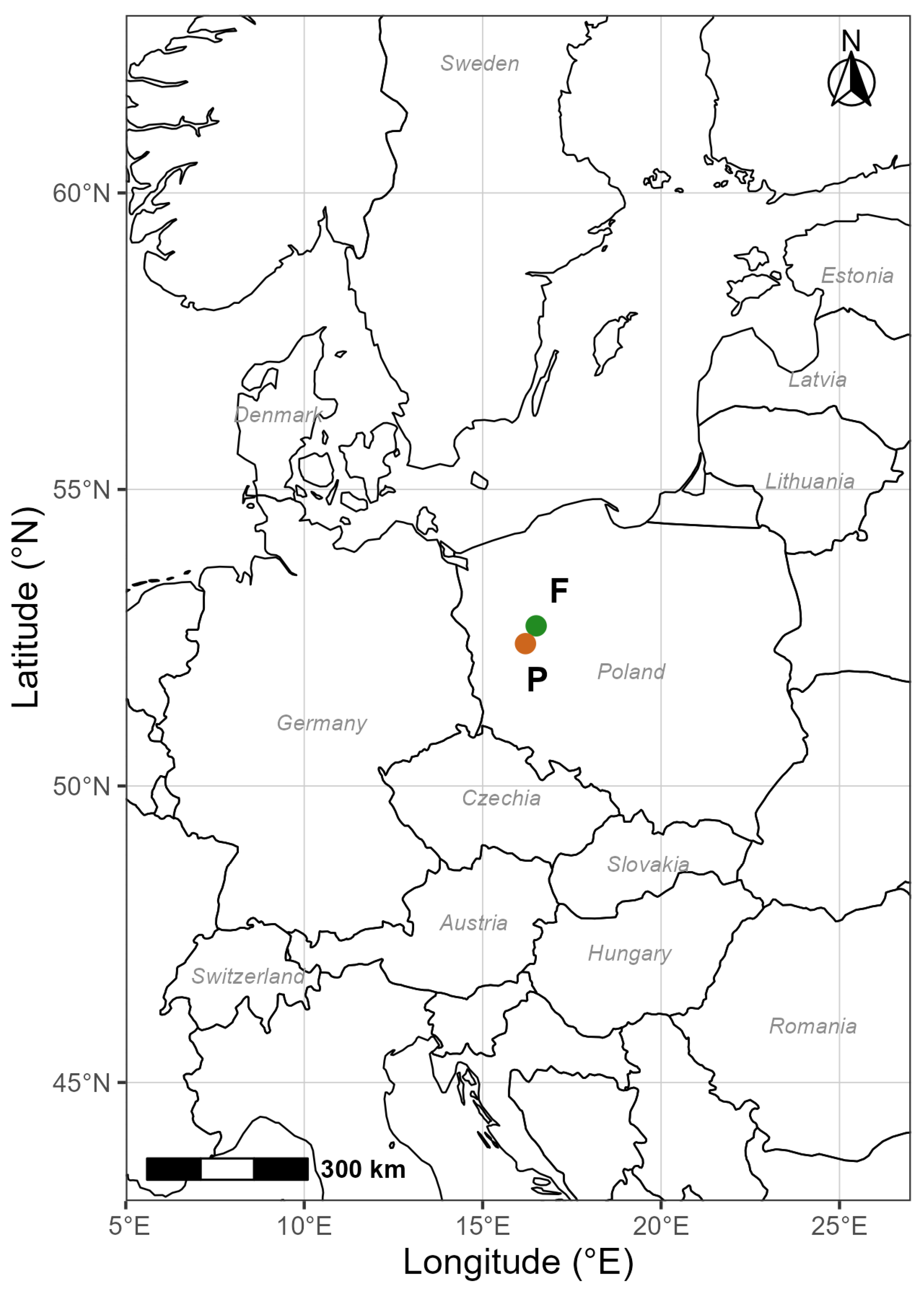
The study was conducted in two temperate ecosystems located in Greater Poland Voivodeship, western Poland, approximately 20 km apart (Figure 1):
(1)
a forest stand in the Oborniki Forest District (52.7° N; 16.5° E), representing mesic mixed forest and mesic pine forest, and
(2)
the Rzecin transitional peatland, classified as a fen (52.4° N; 16.2° E).
Both sites experience a temperate climate with cold winters and warm summers and are exposed to similar regional meteorological conditions. Mean annual air temperature and precipitation are approximately 9.5 °C and 555 mm, respectively (own data from Rzecin station, 2018 to 2024). Soils at the forest site are classified as Dystric Brunic Sideralic Arenosols according to the World Reference Base 2014. The Rzecin peatland is a mesotrophic, minerotrophic fen formed by terrestrialisation, with a floating peat mat overlying peat deposits several metres thick and a water table that typically remains within about 0–30 cm below the peat surface during the growing season [11]. Vegetation at the forest site is dominated by Scots pine (Pinus sylvestris L.) with a closed canopy and continuous ground vegetation [30]. In contrast, the peatland is characterised by a mosaic of mosses dominated by Sphagnum teres (Schimp.) and vascular species typical of peatland ecosystems (e.g., Drosera rotundifolia L., Carex limosa L., Oxycoccus palustris Pers., etc.) [31]. The two ecosystems lie within the same regional climate but differ strongly in hydrology, soil aeration, and organic matter accumulation.

2.2. Chamber Measurements of 13C-CO2 Fluxes

Soil and ecosystem 13C-CO2 fluxes were measured during the cold period (October–March, 2018–2021 in the peatland and December 2023, January–March 2024 in the forest) using two manual dynamic closed-chamber configurations coupled to an isotope-ratio cavity ring-down spectrometer (Picarro G2201-I, Picarro Inc., Santa Clara, CA, USA). At the forest site, permanent chamber collars (25 cm diameter) were installed randomly before the start of measurements to minimise soil disturbance. In the peatland site, square collars measuring 75 × 75 cm were used to better accommodate the heterogeneous surface microtopography. All collars were inserted into the soil and peat and left in place throughout the study.
For each flux measurement in the forest, an opaque, dome-shaped chamber (approximately 10 L) was placed gas-tight on the collar for 30 min. Air from the chamber headspace was circulated in a closed loop through tubing to the analyser, and the 13C-CO2 mole fraction was recorded every 1 s. Raw time series were visually inspected, and measurements affected by possible leaks or instrument instability were discarded. Due to the different vegetation structure and surface conditions at the peatland site, the chamber system was configured differently. The opaque chamber, constructed from white PVC, measured 76 × 76 × 50 cm and had a volume of approximately 306 litres. Despite the differences in chamber shape and volume, both chambers were equipped with appropriate fans (peatland chamber: two 7 × 7 cm, 2 W, Sunon, Kaohsiung, Taiwan; forest chamber: 0.07 W, Zephyr 40 MM, SilentiumPC, Sokołów, Poland) to ensure adequate air mixing. To prevent pressure changes during measurements, both chambers were fitted with a pressure equalisation system. A thermohygrometer (HygroVue5, Campbell Sci., Logan, UT, USA) was placed inside the peatland chamber to monitor internal conditions. Because of the large chamber volume and the relatively low flow rate of the analyser, the peatland system was equipped with an additional pump (flow rate 10 L·min−1) to increase airflow between the analyser and the chamber. The analyser, which drew air for analysis, was connected to this loop. This configuration reduced the time required to detect changes in 13C-CO2 concentration to approximately 3 min. The 13C-CO2 mole fraction was recorded every 1 s.
The 13C-CO2 flux (F, µmol·m−2·s−1) for each chamber closure was estimated from the linear increase in 13C-CO2 concentration over time [32]:
F = 1 A d C d t V R T
where A is chamber area, V chamber volume, dC/dt the slope of 13C-CO2 concentration versus time, R the gas constant and T the mean chamber air temperature during the closure. Fluxes were first calculated in µmol·m−2·s−1 and subsequently converted to µg·m−2·h−1 for statistical analysis and presentation.
Different chamber geometries were used because of ecosystem-specific constraints: the larger peatland chamber better captured heterogeneous moss–vascular plant microtopography and reduced edge effects on the floating mat, whereas smaller collars are standard for mineral forest soils. Before carrying out forest measurements, comparative tests using both chamber types were conducted, demonstrating that flux estimates were consistent and unambiguous across configurations.

2.3. Microclimatic Measurements

At each site, air temperature (Tair), soil temperature (Ts) and soil moisture were measured continuously. At the forest site, TMS-4 dataloggers (Tomst s.r.o, Prague, Czechia) were installed near the previously installed soil collars. Ts was measured at 5 cm depth and Tair was measured near the ground surface and at 15 cm height. At the peatland, Tair was measured using a HygroVue5 thermohygrometer (Campbell Sci., Logan, UT, USA), while Ts was measured using a T107 thermistor (Campbell Sci.; UK) installed 5 cm beneath the peat surface. Both sensors were connected to a CR1000 datalogger (Campbell Sci., UK). At the peatland, measurements were recorded every 30 min; in the forest, recordings were made every 15 min.

2.4. Statistical Analysis

All statistical analyses were performed in R (v4.4.1, R Core Team, Vienna, Austria) [33]. Because fluxes were derived from chamber CO2 time series, an initial quality filter was applied based on the coefficient of determination (R2) of the regression used to estimate each 13C-CO2 flux. Measurements with poorly constrained regressions (R2 < 0.80) were excluded from further analysis. This threshold represents a compromise between retaining a sufficient number of winter observations and ensuring robust flux estimates under low-flux, high-noise conditions typical of the cold season. As a sensitivity check, all key analyses were repeated using a more conservative cut-off (R2 ≥ 0.90), which reduced the sample size but did not qualitatively change the results or the main conclusions.
For each ecosystem, descriptive statistics were calculated for 13C-CO2 fluxes and environmental variables (Ts at 5 cm, Tair 15 cm above the surface and soil moisture). The number of observations, mean, standard deviation, median, interquartile range (25th–75th percentile) and range (minimum-maximum) are reported to characterise the overall magnitude and variability of winter 13C-CO2 fluxes in the forest and peatland sites.
Differences in 13C-CO2 fluxes between the forest and peatland were evaluated using the non-parametric Mann–Whitney U test (Wilcoxon rank-sum test), which does not assume normality and is suitable for unequal sample sizes. In addition to p-values, median fluxes for each ecosystem and the difference in medians with its 95% confidence interval are reported to emphasise the magnitude of ecosystem differences.
Relationships between 13C-CO2 fluxes and environmental variables were examined separately for the forest and peatland. Ts and Tair were treated as primary drivers. Spearman rank correlations were used to quantify monotonic associations between 13C-CO2 fluxes and Ts, and between 13C-CO2 fluxes and Tair. Correlation coefficients (ρ) and associated p-values are reported and interpreted in an exploratory sense rather than as definitive evidence.
To explore the role of freezing conditions at the peatland site, peatland measurements were classified into two categories based on peat temperature: “frozen” (Ts ≤ 0 °C) and “unfrozen” (Ts > 0 °C). 13C-CO2 fluxes were then compared across these categories using the Mann–Whitney U test, and flux distributions (medians, interquartile ranges) were summarised for each thermal state. This analysis was designed to assess whether near-freezing and frozen conditions are associated with systematically different winter 13C-CO2 fluxes. At the forest site, a Spearman rank correlation between forest 13C-CO2 fluxes and daily mean soil moisture was also computed.
Scatterplots were used throughout to visualise relationships between 13C-CO2 fluxes and environmental drivers, with trend lines added to aid graphical interpretation. These lines are intended solely for exploratory visualisation and are not used for formal inference. Given the limited sample size, emphasis is placed on consistent patterns across methods (descriptive statistics, non-parametric tests, correlations and graphical exploration) rather than on individual p-values.

3. Results

3.1. Environmental Conditions During Measurement Periods

Chamber measurements of 13C-CO2 fluxes were conducted during the cold half-year. After applying the quality filter (R2 ≥ 0.80), the final dataset comprised 40 flux estimates. Soil temperature at 5 cm depth (Ts) during flux measurements ranged from 2.3 to 6.3 °C in the forest (median 3.7 °C) and from −0.37 to 7.54 °C in the peatland (median 1.0 °C), indicating more frequent near-freezing and slightly sub-zero conditions in the peatland. Near-surface air temperature showed a similar pattern, with generally lower values at the peatland site and several episodes close to or below 0 °C. Average meteorological conditions for the study areas on flux-measurement days are summarised in Table 1.
During field measurements, snow cover was present at the forest site in January 2024, whereas the peatland study area was snow-free during the peatland campaigns.
At the forest site, continuous soil-moisture monitoring over two cold seasons (2023/2024 and 2024/2025) showed daily mean volumetric water content (SWC) between 0.03 and 0.46 m3·m−3 (median 0.25 m3·m−3, interquartile range 0.18–0.29 m3·m−3). On the campaign days when forest 13C-CO2 fluxes were measured, daily mean SWC ranged from 0.19 to 0.27 m3·m−3 (median 0.24 m3·m−3), i.e., within the central part of the seasonal distribution. This indicates that forest flux measurements were not biased towards unusually dry or wet conditions. In contrast, peat at 5 cm depth in the fen remained close to full water saturation throughout the cold season, consistent with a high and relatively stable water table.
Because the peatland chamber collars were installed on a floating peat mat that remained water-saturated throughout the year, soil moisture was effectively constant and was not analysed as a separate driver.

3.2. Magnitude and Variability of Winter 13C-CO2 Fluxes

Both ecosystems acted as sources of 13C-CO2 during the cold half-year. Fluxes derived from high-quality chamber closures (R2 ≥ 0.80) showed substantial variability, reflecting differences among plots, dates and local microclimatic conditions.
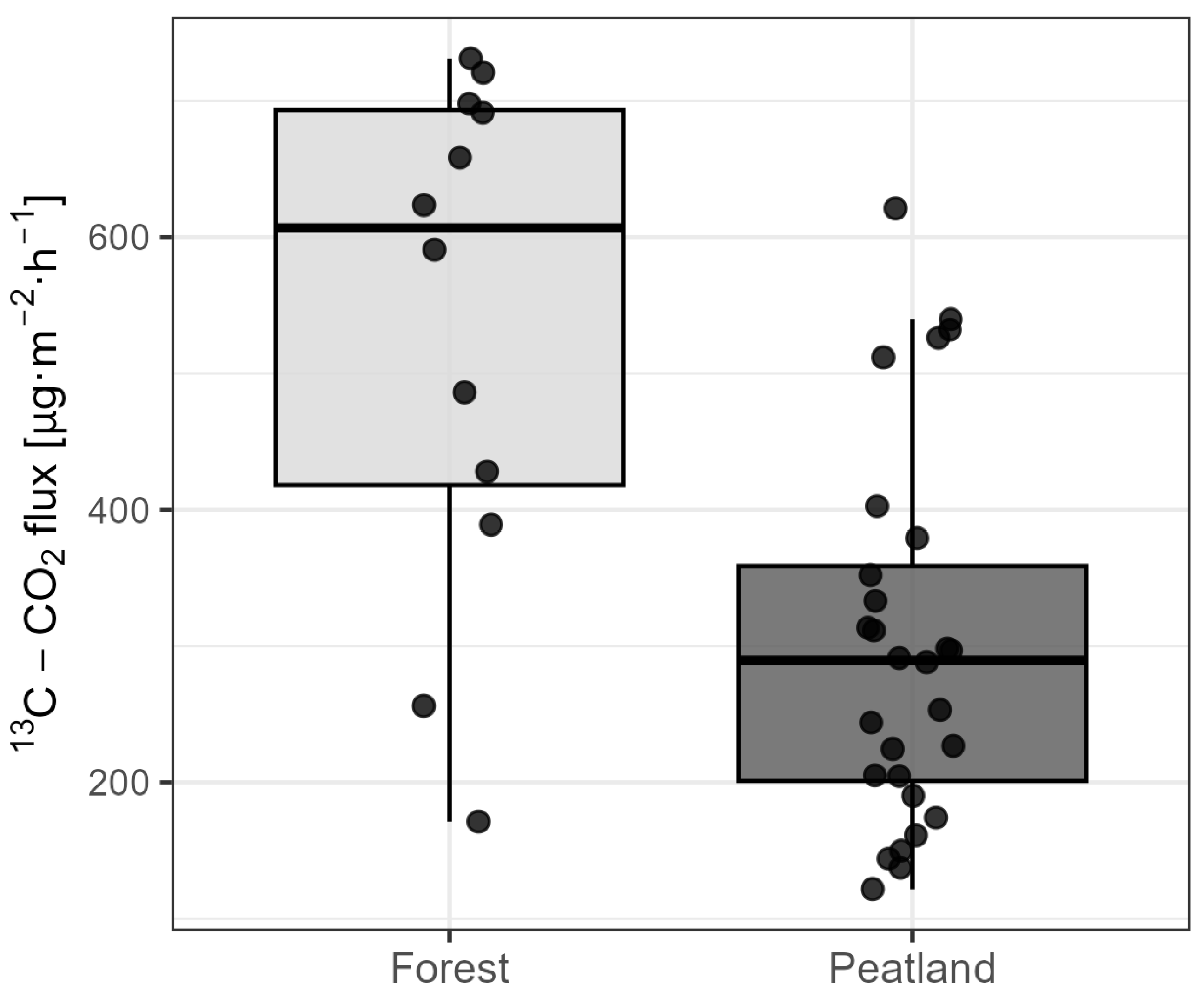
In the forest, 13C-CO2 fluxes ranged from 171 to 731 (µg·m−2·h−1), with a mean of 537 µg·m−2·h−1 and a median of 607 µg·m−2·h−1 (interquartile range 418–693). In the peatland, fluxes ranged from 122 to 621 µg·m−2·h−1, with a mean of 301 µg·m−2·h−1 and a median of 290 µg·m−2·h−1 (interquartile range 201–359). Although some peatland measurements overlapped with the lower part of the forest distribution, the overall flux level was clearly reduced relative to the forest site (Figure 2). Median winter 13C-CO2 fluxes were approximately two times higher in the forest than in the peatland, with a larger spread of values in the forest and a more compact distribution in the peatland.
In addition, the mean of total CO2 flux in the forest was approximately 2 µmol·m−2·s−1, compared with 0.38 µmol·m−2·s−1 in the peatland. For clarity of presentation, total CO2 fluxes are reported in µmol m−2 s−1, whereas 13C-CO2 fluxes are expressed in µg·m−2·h−1 to reflect their smaller magnitudes and improve the readability of the figures and tables. In the forest, the lowest mean total flux during winter was observed under snow-covered conditions in January 2024 (mean 1.3 µmol·m−2·s−1), whereas measurements one month later indicated the highest winter total flux (mean 2.8 µmol·m−2·s−1).

3.3. Differences Between Forest and Peatland

The forest–peatland contrast in winter 13C-CO2 fluxes was statistically distinct. A Mann–Whitney U test indicated significantly higher fluxes in the forest than in the peatland (U = 281, p ≈ 0.0009). Median fluxes were 606.9 µg·m−2·h−1 in the forest and 289.8 µg·m−2·h−1 in the peatland, with a bootstrap-estimated difference in medians of approximately 320 µg·m−2·h−1 (95% confidence interval ≈ 117–443 µg·m−2·h−1). Under the observed winter conditions, forest soils therefore released substantially more 13C-CO2 than the peatland surface in terms of both central tendency and overall distribution, even though ranges overlapped at intermediate flux levels (Figure 2). This forest–peatland contrast in 13C-CO2 fluxes provides a baseline for parallel analyses of total CO2 fluxes using the same non-parametric framework.

3.4. Relationships Between 13C-CO2 Fluxes and Temperature

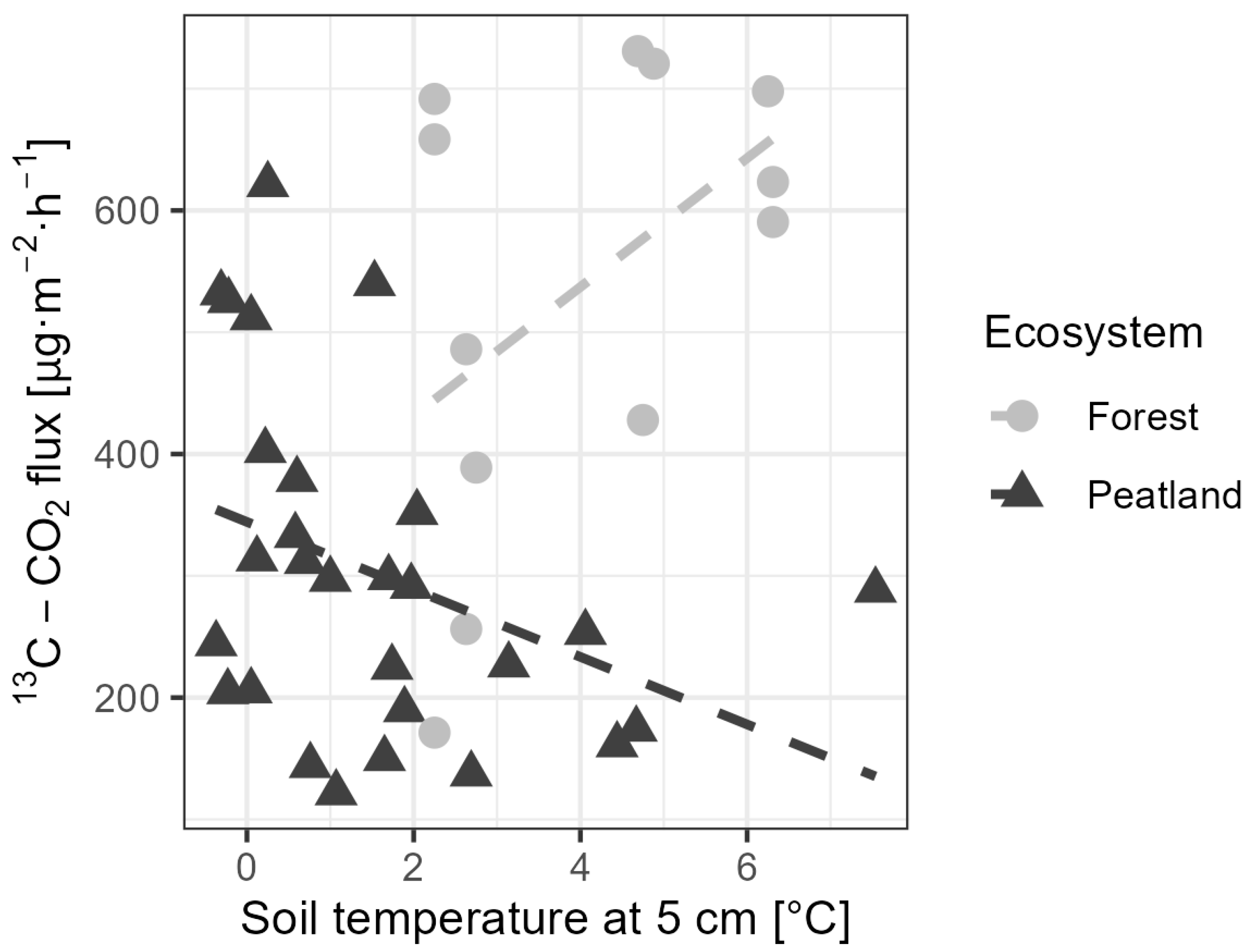
Associations between 13C-CO2 fluxes and temperature were ecosystem-specific (Table 2). In the forest, 13C-CO2 fluxes tended to increase with both soil and near-surface air temperature, but correlations were not statistically significant. These values indicate a tendency towards higher fluxes under warmer conditions. However, the limited number of observations and the relatively narrow winter temperature range at the forest site preclude strong inferences.
In the peatland, a different pattern emerged. A moderate, statistically significant negative correlation was observed between 13C-CO2 fluxes and soil temperature at 5 cm depth, whereas the relationship with near-surface air temperature was weak and not significant (Table 2).
These results indicate that the highest 13C-CO2 fluxes tended to occur at near-freezing or slightly sub-zero soil temperatures, rather than under the warmest winter conditions, whereas air temperature alone did not capture this behaviour. Scatterplots of 13C-CO2 fluxes against Ts, with separate points for forest and peatland, showed a weak positive trend in the forest and a clear negative trend in the peatland, consistent with the correlation analysis (Figure 3).

3.5. Influence of Freezing Conditions in the Peatland

To further examine the role of freezing in the peatland, measurements were classified into “frozen” (Ts ≤ 0 °C) and “unfrozen” (Ts > 0 °C) categories. In total, four observations were classified as frozen and 24 as unfrozen. Median 13C-CO2 fluxes under frozen conditions were approximately 385 µg·m−2·h−1 (interquartile range ≈ 234–528), compared with approximately 290 µg·m−2·h−1 (IQR ≈ 186–338) under unfrozen conditions. Thus, fluxes tended to be higher under frozen than under unfrozen soil temperatures, despite the expectation that very low temperatures might suppress microbial activity. However, this difference was not statistically significant (Mann–Whitney U test, U = 61, p ≈ 0.43), likely due to the small number of frozen observations.
The combination of a significant negative correlation between 13C-CO2 fluxes and Ts and slightly elevated median fluxes under frozen conditions suggests that near-freezing and zero-curtain periods may favour enhanced winter 13C-CO2 emissions in the peatland. These periods likely involve partially unfrozen pore water, changing gas-diffusion pathways and potential freeze–thaw pulses, which together can stimulate short-term CO2 production and release despite low ambient temperatures.

3.6. Soil Moisture Content at the Forest Site

At the forest site, soil moisture during flux measurements was representative of typical winter conditions rather than of extremes. Daily mean SWC over the two cold seasons ranged from 0.03 to 0.46 m3·m−3, with a median of 0.25 m3·m−3 and an interquartile range of 0.18–0.29 m3·m−3. On the five days when forest 13C-CO2 fluxes were measured, SWC values ranged from 0.19 to 0.27 m3·m−3 (median 0.24 m3·m−3), closely matching the seasonal median and lying within the interquartile range.
A Spearman correlation between forest 13C-CO2 fluxes and daily mean SWC was weak and not significant (ρ ≈ 0.19, p ≈ 0.56, n = 12), indicating no clear monotonic relationship between winter 13C-CO2 fluxes and soil moisture at the forest site under the conditions sampled. This likely reflects both the modest variability in soil moisture on the measurement days and the limited number of observations. The available data therefore suggest that, within the typical winter moisture range observed, temperature is a more important short-term driver of forest 13C-CO2 fluxes than soil moisture.
In contrast, all peatland measurements were performed under water-saturated conditions on a floating peat mat, and no within-site gradient in soil moisture was available to test its effect on winter 13C-CO2 fluxes.

4. Discussion

4.1. Winter CO2 Emissions as a Key Component of Annual Carbon Balance

The measurements confirm that both temperate forests and peatlands remain active sources of 13C-CO2 during the cold half-year. Median winter 13C-CO2 fluxes were approximately twice as high in the forest as in the peatland, indicating that forest soils can sustain substantial respiratory activity even under low-temperature conditions. In this study, the presence of snow cover at the forest site was associated with only a slight, statistically non-significant reduction in soil CO2 efflux compared to snow-free conditions. Previous work has shown that natural variations in snow cover can modify winter soil respiration but exert only a minor influence on annual soil CO2 efflux [34], and that winter CO2 emissions generally account for only a small fraction (on the order of a few percent) of the annual carbon budget [35]. In peatlands, recent work has likewise highlighted that non-growing-season carbon fluxes contribute substantially to annual CO2 budgets and are projected to increase under future warming scenarios [2].
The present plot-scale chamber measurements complement ecosystem-scale eddy-covariance studies that integrate fluxes across heterogeneous snow and vegetation patterns [36,37], as well as recent regional assessments of winter soil CO2 fluxes based on snowpack diffusion-gradient methods [3]. By explicitly quantifying 13C-CO2 fluxes at the plot scale, the results provide a first-order constraint on the magnitude of winter 13C losses from temperate forest and peatland soils, which is rarely reported explicitly in non-growing-season studies that focus on total CO2.

4.2. Forest–Peatland Contrast in Winter Fluxes

The consistently higher winter 13C-CO2 fluxes in the forest relative to the peatland likely reflect differences in substrate availability, soil physical environment and microbial functioning between mineral and organic soils. Temperate forest mineral soils typically have better aeration and higher gas diffusivity than waterlogged peat, and often contain substantial pools of relatively labile litter- and root-derived carbon, which can sustain appreciable soil respiration throughout the non-growing season [2]. In contrast, fen peat is characterised by high water content and a shallow water table, conditions known to restrict oxygen availability and slow aerobic decomposition, thereby reducing CO2 production relative to better-drained mineral soils [38,39].
Additionally, the partial overlap between forest and peatland flux ranges indicates that peatland microsites can occasionally emit 13C-CO2 at rates comparable to the lower part of the forest distribution. Similar spatial heterogeneity in cold-season CO2 efflux has been reported for northern bogs and fens, where hummocks, sedge-dominated patches and zones influenced by fluctuating water tables show elevated winter fluxes, especially during thaw events or under thin snow cover [38,40].
From a carbon-budget perspective, the observed forest–peatland contrast suggests that, under present climatic conditions, winter CO2 and 13C-CO2 losses from temperate mineral soils can be proportionally larger than from temperate fens, even though peatlands store much more carbon per unit area and are typically small annual CO2 sinks [8,41]. At the same time, non-growing-season CO2 fluxes from northern peatlands have been shown to contribute on the order of 10%–30% of annual respiration in some sites and to increase under warmer and less stable winter conditions [8,41], suggesting that the relative difference between forest and peatland winter emissions may diminish under future climate scenarios. Higher CO2 emission rates in forest ecosystems are driven by efficient aerobic respiration and a constant supply of labile carbon from extensive root systems and litter, which stimulates microbial metabolism [42]. In contrast, high water saturation in peatlands induces anaerobic conditions, which, together with lower soil temperatures and the presence of biochemically resistant organic substrates, significantly limit the rate of carbon mineralization [16,42,43]. Importantly, because the forest and peatland campaigns were conducted in different years, the magnitude of the forest–peatland contrast should be considered indicative, since interannual variability in snow cover, freeze–thaw frequency and winter temperatures can modulate cold-season fluxes.

4.3. Temperature and Freeze–Thaw Controls on Winter 13C–CO2 Emissions

The ecosystem-specific relationships between 13C-CO2 fluxes and soil temperature are broadly consistent with previous work on winter soil respiration. In the forest, 13C-CO2 fluxes tended to increase with soil and air temperature, although correlations were not statistically significant. Similar weak but positive temperature responses have been reported in other temperate forests, where winter soil respiration is frequently controlled by small thermal changes around 0–5 °C and by the insulating effects of snow [2]. Experimental studies have further shown that apparent Q10 values can be higher in winter than in the growing season, implying a high sensitivity of CO2 efflux to temperature under cold conditions [2,44]. The present results are consistent with this picture but do not allow robust quantification of Q10 due to the limited number of observations and narrow winter temperature range.
In the peatland, a significant negative correlation between 13C-CO2 fluxes and soil temperature, alongside slightly higher median fluxes under frozen than under unfrozen conditions, points to a different control regime. Similar patterns have been observed in northern bogs and other wetland systems, where near-freezing zero-curtain periods and freeze–thaw transitions can enhance CO2 production by maintaining liquid water films, mobilising substrates and inducing microbial pulses during thaw [2,38,45]. In such water-saturated systems, the transition between frozen and unfrozen states, rather than absolute temperature, often emerges as a key driver of winter CO2 fluxes. In addition, Zhao et al. (2026) [46] demonstrated that in terrestrial ecosystems with mean annual temperatures below 3.75 °C (characteristic of, among others, the Tibetan Plateau and cold boreal zones), annual soil respiration (Rs) exhibits a U-shaped response, with negative responses to warming at lower temperature ranges. The primary mechanism responsible for this phenomenon is moisture-mediated microbial suppression: rising temperature accelerates the thawing of snow cover and permafrost, rapidly increasing soil moisture content and constraining aerobic microbial activity. Given the small frozen subset in this study, the observed peatland pattern should be regarded as hypothesis-generating. One likely explanation is a zero-curtain behavior in saturated peat, where temperatures remain near 0 °C, and physical constraints on gas transport (ice barriers, changing diffusivity and episodic release) and/or short-term microbial pulses during thawing can result in elevated fluxes without a monotonic temperature response. The weak and non-significant relationships between peatland 13C-CO2 fluxes and near-surface air temperature are also consistent with previous studies showing a decoupling between air temperature and subsurface processes in snow-dominated environments, where snow depth, ice formation and water-table position strongly mediate soil temperatures and gas transport [2,38,40]. Taken together, these findings support the emerging view that winter peatland CO2 dynamics are more directly linked to the subsurface thermal and hydrological regime than to air temperature alone.

4.4. Interpretation of 13C-CO2 Fluxes and Isotopic Processes

Most previous work on carbon isotopes in forest and peatland soils has focused on δ13C of respired CO2, rather than on 13C-CO2 fluxes themselves. Natural-abundance δ13C measurements of soil-respired CO2 have been widely used to infer the contributions of autotrophic versus heterotrophic respiration, the coupling between recent photosynthesis and root respiration, and the depth origin of CO2 in different ecosystems [20,21,22,24,47]. These studies consistently show that soil respiration is highly dynamic, responding to changes in recent photosynthate supply, soil moisture, snow and litter conditions on timescales from days to seasons. Forest management and associated soil compaction can also alter CO2 dynamics and soil aeration and should be considered in the case of managed forests [48]. At broader spatial scales, remote-sensing studies have documented pronounced changes in the extent and configuration of land in different regions [49], underscoring that land-use and land-cover changes can further modify the structure and functioning of terrestrial carbon pools.
By explicitly quantifying 13C-CO2 fluxes, the present study adds complementary information on the magnitude of 13C export from soils during the cold half-year. This is relevant for isotopic mass balances in ecosystem and atmospheric models, which are increasingly incorporating 13C to constrain carbon turnover and source contributions [10,50]. Differences in 13C-CO2 fluxes between the forest and peatland likely reflect not only contrasting total CO2 fluxes but also differences in the isotopic composition of respired CO2 arising from distinct vegetation types, organic matter pools and hydrological regimes. For example, peat formed from Sphagnum and other wetland plants is typically more 13C-depleted and decomposes under more reducing conditions than tree-litter-dominated organic matter in mineral forest soils, which can imprint different δ13C signatures on respired CO2 [2,44]. Analysed data quantify absolute 13C-CO2 fluxes and report mean total CO2 fluxes for context, but measurements of the δ13C of soil-respired CO2 or the isotopic composition of potential source pools are not provided. Consequently, inferences about isotopic discrimination or source partitioning are limited and are discussed as potential mechanisms rather than direct evidence.
Process-based models and conceptual studies indicate that post-photosynthetic fractionation, microbial processing, diffusion and dissolution can all generate differences between the behaviour of 12C and 13C in soils and in emitted CO2 [8,51]. Although δ13C of soil-respired CO2 was not measured here, combining future winter 13C-CO2 flux measurements with isotopic signatures of CO2 and source pools would help to separate the roles of flux magnitude and isotopic composition in driving ecosystem-level differences in 13C loss.

4.5. Role of Soil Moisture, Snow and Microclimate

At the forest site, soil moisture during flux campaigns was within the median and interquartile range of the seasonal winter distribution and showed no clear monotonic relationship with 13C-CO2 fluxes. The relatively narrow moisture range observed during winter likely limited the ability to detect potential non-linear or threshold responses of soil respiration to moisture. Similar results have been reported in temperate forests, where winter soil respiration is often more strongly controlled by soil temperature and snow insulation than by soil moisture, provided that soils are neither extremely dry nor deeply frozen [2,6,52]. Under such conditions, snow cover can maintain relatively warm and stable soil temperatures near 0 °C, supporting continuous microbial activity despite low air temperatures and masking moisture effects that may become apparent only across broader hydrological gradients or during extreme events.
In the peatland, soil profiles were essentially water-saturated throughout all flux measurements, reflecting the presence of a floating peat mat and a persistently high water table. Consequently, no within-site moisture gradient was available to assess moisture controls on CO2 fluxes statistically. Nevertheless, numerous studies [53,54,55] have demonstrated that water-table depth and soil saturation exert strong controls on peatland CO2 emissions by regulating oxygen availability, redox conditions, and gas diffusivity, with deeper water tables and warmer soils generally favouring higher CO2 efflux in drained or partially drained sites [38,39]. In intact or restored peatlands, however, interactions between water-table dynamics, ice formation and snow cover determine whether winter conditions suppress or enhance CO2 emissions [8,56,57], highlighting the importance of coupled moisture–temperature processes rather than independent controls.
Overall, the results of the study are consistent with earlier studies showing that the effects of snow on cold-season carbon exchange are highly complex and context-dependent. Natural variations in snow cover can alter soil temperatures and winter soil respiration, yet may have a limited impact on annual soil CO2 efflux in some peatlands and cold-climate ecosystems [34,35,40,51]. In contrast, experimental snow removal or reduction has been shown to decrease winter CO2 fluxes by exposing soils to colder conditions and increasing frost penetration [2]. In peatlands, anticipated changes in snow and ice regimes, combined with shifts in water-table position, are expected to modulate both winter CO2 fluxes and the timing and duration of zero-curtain events [2,38]. The observed negative dependence of peatland 13C-CO2 fluxes and soil temperature, along with the tendency for elevated fluxes near 0 °C, is therefore consistent with mechanistic expectations related to freeze–thaw dynamics, gas–release processes and transient microbial activity under near-isothermal winter soil conditions.
In the context of urban ecosystems, studies by Bezyk et al. (2021, 2023) [58,59] confirm that soil temperature and moisture are key factors controlling biogenic CO2 fluxes even in areas of high anthropogenic pressure, providing a useful reference point for the processes observed in temperate forests. These authors showed that the δ13C isotopic signature of ecosystem respiration is clearly enriched outside the growing season (during the so-called heating period) compared to the plant-growth period, reflecting a shift from the dominance of photosynthesis to microbial metabolic processes and heterotrophic respiration. At the same time, their studies highlighted the role of moisture as a moderator of thermal sensitivity. The Q10 coefficient for CO2 emissions ranged between 1.68 and 1.79, with the highest respiration rates observed under moderate moisture conditions (20%–25%), while extreme water saturation inhibited gas diffusion and microbial activity. Those findings emphasise the universal nature of the hydrothermal control of emissions outside the growing season, indicating that the biogenic contribution to the total carbon budget—amounting to about 16.3% in urban conditions—is a dynamic process and highly responsive to winter warming.

4.6. Climatic Implications and Limitations

The finding that winter 13C-CO2 fluxes are substantial in both ecosystems, and markedly higher in the forest than in the peatland, reinforces the importance of explicitly representing non-growing-season processes in carbon-cycle assessments. Across a range of ecosystems, winter and non-growing-season CO2 efflux has been shown to contribute from a few per cent up to roughly 20%–30% of annual soil respiration or ecosystem respiration, with peatlands and other cold-climate systems often falling at the upper end of this range [2,38,44,60]. For northern peatlands, recent analyses indicate that non-growing-season carbon emissions could increase substantially under future warming, thereby weakening or even reversing their role as long-term carbon sinks [2,8].
Several limitations of the present study should be considered when interpreting these implications. First, the number of flux observations is modest, particularly for frozen peatland conditions, and measurements were restricted to selected days within the cold half-year. Moreover, forest and peatland flux campaigns were conducted in different years, so part of the observed forest–peatland contrast may reflect interannual variability in winter conditions in addition to inherent ecosystem differences. Second, chamber measurements integrate over small spatial footprints and short time intervals, and may not capture lateral and advective fluxes or the full heterogeneity seen by eddy covariance systems. Third, δ13C of soil-respired CO2 and potential source pools were not determined, precluding direct isotopic partitioning of the contributing autotrophic and heterotrophic respiratory sources, or attribution of the observed 13C-CO2 fluxes to specific substrate pools. Finally, key winter microclimate variables such as snow depth, frost depth, ice-layer formation and water-table dynamics were not quantified directly, although they can influence soil thermal regimes and gas-transport regimes, particularly in the peatland. Campaign-based chamber sampling may miss short-lived pulses during rapid thawing or other transient events, and plot-scale measurements represent a small footprint relative to ecosystem-scale heterogeneity. In particular, the frozen peatland sample size was very small (n = 4), so freeze–thaw/zero-curtain processes are necessarily tentative.
Despite these limitations, the study provides rare plot-scale estimates of winter 13C-CO2 fluxes from a temperate forest and fen, documents clear ecosystem contrasts in flux magnitude and highlights the apparent importance of near-freezing conditions for winter peatland emissions. Future work that combines continuous CO2 and 13C-CO2 measurements with δ13C-based source partitioning, detailed microclimate observations and model integration would help to refine estimates of winter carbon losses and their sensitivity to ongoing climatic change.

5. Conclusions

  • Both ecosystems remained active 13C-CO2 sources during the cold half-year.
Winter chamber measurements demonstrated measurable 13C-CO2 fluxes from both the temperate forest and the temperate fen, confirming that non-growing-season processes contribute non-negligibly to ecosystem carbon loss.
2.
Winter 13C-CO2 fluxes were substantially higher in the studied forest than in the peatland.
Median 13C-CO2 fluxes in the forest were roughly twice those in the peatland, indicating a stronger winter respiratory activity in mineral forest soils than in water-saturated peat, despite the much larger carbon stocks in peatlands. Whether similar contrasts hold across other temperate forest–peatland systems remains to be tested with coordinated measurements at a broader set of sites.
3.
Controls on winter 13C-CO2 emissions differed between the forest and the peatland.
In the forest, 13C-CO2 fluxes tended to increase with soil and air temperature, whereas in the peatland, a significant negative relationship with soil temperature and slightly higher fluxes under frozen conditions pointed to an important role of near-freezing, zero-curtain and freeze–thaw conditions for winter emissions. However, the frozen peatland subset was small (n = 4), so these freeze–thaw-related patterns should be considered exploratory.
4.
Soil moisture effects were ecosystem-specific and constrained by data availability.
At the forest site, flux measurements were made under typical winter soil-moisture conditions, and no clear monotonic relationship between 13C-CO2 fluxes and soil moisture was detected. In the peatland, soils remained water-saturated throughout, preventing analysis of within-site moisture effects but highlighting the importance of persistent saturation for limiting aerobic decomposition.
5.
Plot-scale 13C-CO2 flux measurements provide complementary constraints to ecosystem-scale approaches.
The chamber-based 13C-CO2 fluxes complement eddy-covariance and snowpack studies by resolving small-scale heterogeneity and explicitly quantifying 13C losses in winter, thereby offering useful constraints for isotopically enabled ecosystem and atmospheric models.
6.
Future work should integrate isotopes, microclimate and modelling to refine winter carbon budgets.
Extending measurements to include δ13C of respired CO2 and source pools, continuous winter flux observations, and detailed snow-ice-soil microclimate, combined with process-based modelling, would improve understanding of how temperate forests and peatlands respond to ongoing changes in winter climate and freeze–thaw regimes.

Author Contributions

Conceptualization, K.M.H. and M.S.; methodology, K.M.H.; software, K.M.H. and M.S.; validation, K.M.H. and M.S.; investigation, K.M.H., M.S. and M.G.; resources, K.M.H. and M.S.; data curation, K.M.H. and M.S.; writing—original draft preparation, K.M.H.; writing—review and editing, K.M.H., M.S. and M.G.; visualization, K.M.H. and M.S.; supervision, K.M.H. and M.G.; project administration, K.M.H. and M.S.; funding acquisition, K.M.H. and M.S. All authors have read and agreed to the published version of the manuscript.

Funding

This research was funded by the Poznań University of Life Sciences under the research project number 507.868.06.06, financed under the “First Grant” competition, and research was also supported by the National Science Centre of Poland (NCN) within grants No. 2016/21/B/ST10/02271 and 2017/25/N/ST10/02212.

Data Availability Statement

Data are contained within the article.

Acknowledgments

This study was conducted at the Poznań University of Life Sciences. The authors would like to thank Radosław Juszczak—Department of Bioclimatology, whose efforts and project support contributed significantly to the creation of this work.

Conflicts of Interest

The authors declare no conflicts of interest.

References

  1. Contosta, A.R.; Burakowski, E.A.; Varner, R.K.; Frey, S.D. Winter soil respiration in a humid temperate forest: The roles of moisture, temperature, and snowpack. J. Geophys. Res. Biogeosci. 2016, 121, 3072–3088. [Google Scholar] [CrossRef]
  2. Rafat, A.; Rezanezhad, F.; Quinton, W.L.; Humphreys, E.R.; Webster, K.; Van Cappellen, P. Non-growing season carbon emissions in a northern peatland are projected to increase under global warming. Commun. Earth Environ. 2021, 2, 111. [Google Scholar] [CrossRef]
  3. Mavrovic, A.; Sonnentag, O.; Lemmetyinen, J.; Voigt, C.; Rutter, N.; Mann, P.; Sylvain, J.-D.; Roy, A. Environmental controls of winter soil carbon dioxide fluxes in boreal and tundra environments. Biogeosciences 2023, 20, 5087–5108. [Google Scholar] [CrossRef]
  4. Arndt, K.A.; Hashemi, J.; Natali, S.M.; Schiferl, L.D.; Virkkala, A.-M. Recent Advances and Challenges in Monitoring and Modeling Non-Growing Season Carbon Dioxide Fluxes from the Arctic Boreal Zone. Curr. Clim. Change Rep. 2023, 9, 27–40. [Google Scholar] [CrossRef]
  5. Kurganova, I.; Teepe, R.; Loftfield, N. Influence of freeze-thaw events on carbon dioxide emission from soils at different moisture and land use. Carbon Balance Manag. 2007, 2, 2. [Google Scholar] [CrossRef]
  6. Harenda, K.; Lamentowicz, M.; Samson, M.; Chojnicki, B. The Role of Peatlands and Their Carbon Storage Function in the Context of Climate Change. In Interdisciplinary Approaches for Sustainable Development Goals; GeoPlanet: Earth and Planetary Sciences; Springer: Cham, Switzerland, 2018; pp. 169–187. [Google Scholar] [CrossRef]
  7. Byun, E.; Rezanezhad, F.; Fairbairn, L.; Slowinski, S.; Basiliko, N.; Price, J.S.; Quinton, W.L.; Roy-Léveillée, P.; Webster, K.; Van Cappellen, P. Temperature, moisture and freeze–thaw controls on CO2 production in soil incubations from northern peatlands. Sci. Rep. 2021, 11, 23219. [Google Scholar] [CrossRef]
  8. Mander, Ü.; Öpik, M.; Espenberg, M. Global peatland greenhouse gas dynamics: State of the art, processes, and perspectives. New Phytol. 2025, 246, 94–102. [Google Scholar] [CrossRef]
  9. Davidson, E.A.; Belk, E.; Boone, R.D. Soil water content and temperature as independent or confounded factors controlling soil respiration in a temperate mixed hardwood forest. Glob. Change Biol. 1998, 4, 217–227. [Google Scholar] [CrossRef]
  10. van der Velde, I.R.; Miller, J.B.; Schaefer, K.; van der Werf, G.R.; Krol, M.C.; Peters, W. Terrestrial cycling of 13CO2 by photosynthesis, respiration, and biomass burning: A model–data comparison. Biogeosciences 2014, 11, 6553–6573. [Google Scholar] [CrossRef]
  11. Juszczak, R.; Humphreys, E.; Acosta, M.; Michalak-Galczewska, M.; Kayzer, D.; Olejnik, J. Ecosystem respiration in a heterogeneous temperate peatland and its sensitivity to peat temperature and water table depth. Plant Soil 2013, 366, 505–520. [Google Scholar] [CrossRef]
  12. Poczta, P.; Urbaniak, M.; Sachs, T.; Harenda, K.M.; Klarzyńska, A.; Juszczak, R.; Schüttemeyer, D.; Czernecki, B.; Kryszak, A.; Chojnicki, B.H. A multi-year study of ecosystem production and its relation to biophysical factors over a temperate peatland. Agric. For. Meteorol. 2023, 338, 109529. [Google Scholar] [CrossRef]
  13. Wang, C.; Han, Y.; Chen, J.; Wang, X.; Zhang, Q.; Bond-Lamberty, B. Seasonality of soil CO2 efflux in a temperate forest: Biophysical effects of snowpack and spring freeze–thaw cycles. Agric. For. Meteorol. 2013, 177, 83–92, PNNL-SA-91383. [Google Scholar] [CrossRef]
  14. Segura, J. Microbial Life in Boreal Soils: On the Availability and Fate of Carbon Substrates for Microbial Activity in Boreal Soils. Ph.D. Thesis, Swedish University of Agricultural Sciences, Umeå, Sweden, April 2018. [Google Scholar]
  15. Andersson, S.; Wikberg, H.; Pesonen, E.; Maunu, S.L.; Serimaa, R. Studies of crystallinity of Scots pine and Norway spruce cellulose. Trees 2004, 18, 346–353. [Google Scholar] [CrossRef]
  16. Waldrop, M.P.; McFarland, J.W.; Manies, K.L.; Leewis, M.C.; Blazewicz, S.J.; Jones, M.C.; Neumann, R.B.; Keller, J.K.; Cohen, L.; Euskirchen, E.S.; et al. Carbon fluxes and microbial activities from boreal peatlands experiencing permafrost thaw. J. Geophys. Res. Biogeosci. 2021, 126, e2020JG005869. [Google Scholar] [CrossRef]
  17. Oelbermann, M.; English, M.; Schiff, S. Evaluating carbon dynamics and microbial activity in arctic soils under warmer temperatures. Can. J. Soil Sci. 2008, 88, 31–44. [Google Scholar] [CrossRef]
  18. Wilson, G.; Green, M.; Brown, J.; Campbell, J.; Groffman, P.; Durán, J.; Morse, J. Snowpack affects soil microclimate throughout the year. Clim. Change 2020, 163, 705–722. [Google Scholar] [CrossRef]
  19. Xu, X.K. Effect of freeze–thaw disturbance on soil C and N dynamics and GHG fluxes of East Asia forests: Review and future perspectives. Soil Sci. Plant Nutr. 2022, 68, 413–424. [Google Scholar] [CrossRef]
  20. Ekblad, A.; Högberg, P. Natural abundance of 13C in CO2 respired from forest soils reveals speed of link between tree photosynthesis and root respiration. Oecologia 2001, 127, 305–308. [Google Scholar] [CrossRef]
  21. Millard, P.; Midwood, A.J.; Hunt, J.E.; Whitehead, D.; Boutton, T.W. Partitioning soil surface CO2 efflux into autotrophic and heterotrophic components using natural gradients in soil δ13C. Soil Biol. Biochem. 2008, 40, 1575–1582. [Google Scholar] [CrossRef]
  22. Bahn, M.; Schmitt, M.; Siegwolf, R.; Richter, A.; Bruggemann, N. Does photosynthesis affect grassland soil-respired CO2 and its carbon isotope composition on a diurnal timescale? New Phytol. 2009, 182, 451–460. [Google Scholar] [CrossRef] [PubMed]
  23. Diao, H.; Wang, A.; Yuan, F.; Guan, D.; Wu, J. Autotrophic respiration modulates the carbon isotope composition of soil respiration in a mixed forest. Sci. Total Environ. 2022, 807, 150834. [Google Scholar] [CrossRef]
  24. Wordell-Dietrich, P.; Wotte, A.; Rethemeyer, J.; Bachmann, J.; Helfrich, M.; Kirfel, K.; Leuschner, C.; Don, A. Vertical partitioning of CO2 production in a forest soil. Biogeosciences 2020, 17, 6341–6356. [Google Scholar] [CrossRef]
  25. Davidson, G.R. The stable isotopic composition and measurement of carbon in soil CO2. Geochim. Cosmochim. Acta 1995, 59, 2485–2489. [Google Scholar] [CrossRef]
  26. Bowling, D.R.; Burns, S.P.; Conway, T.J.; Monson, R.K.; White, J.W.C. Ecological processes dominate the 13C land disequilibrium in a Rocky Mountain subalpine forest. Glob. Biogeochem. Cycles 2014, 28, 352–370. [Google Scholar] [CrossRef]
  27. Bowling, D.R.; Schädel, C.; Smith, K.R.; Richardson, A.D.; Bahn, M.; Arain, M.A.; Varlagin, A.; Ouimette, A.P.; Frank, J.M.; Barr, A.G.; et al. Phenology of photosynthesis in winter-dormant temperate and boreal forests: Long-term observations from flux towers and quantitative evaluation of phenology models. J. Geophys. Res. Biogeosci. 2024, 129, e2023JG007839. [Google Scholar] [CrossRef]
  28. Liu, H.; Branham, J.E.; Strack, M. Freeze–thaw cycles alter soil hydro-physical properties and dissolved organic carbon release from peat. Front. Environ. Sci. 2022, 10, 930052. [Google Scholar] [CrossRef]
  29. Kantola, N.; Welker, J.M.; Leffler, A.J.; Lämsä, J.; Paavola, R.; Suominen, O.; Väisänen, M. Impacts of winter climate change on northern forest carbon balance. Sci. Total Environ. 2025, 995, 180089. [Google Scholar] [CrossRef] [PubMed]
  30. Oborniki Forest District. Available online: https://oborniki.poznan.lasy.gov.pl/ (accessed on 20 January 2025).
  31. Harenda, K.M.; Markowicz, K.M.; Poczta, P.; Stachlewska, I.S.; Bojanowski, J.S.; Czernecki, B.; McArthur, A.; Schütemeyer, D.; Chojnicki, B.H. Estimation of the effects of aerosol optical properties on peatland production in Rzecin, Poland. Agric. For. Meteorol. 2022, 316, 108861. [Google Scholar] [CrossRef]
  32. Hoffmann, M.; Jurisch, N.; Borraz, E.A.; Hagemann, U.; Drösler, M.; Sommer, M.; Augustin, J. Automated modelling of ecosystem CO2 fluxes based on periodic closer chamber measurements: A standardized conceptual and practical approach. Agric. For. Meteorol. 2015, 200, 30–45. [Google Scholar] [CrossRef]
  33. R Core Team. R: A Language and Environment for Statistical Computing; R Foundation for Statistical Computing: Vienna, Austria, 2024; Available online: https://www.R-project.org/ (accessed on 15 December 2025).
  34. Schindlbacher, A.; Jandl, R.; Schindlbacher, S. Natural variations in snow cover do not affect the annual soil CO2 efflux from a mid-elevation temperate forest. Glob. Change Biol. 2013, 20, 622–632. [Google Scholar] [CrossRef]
  35. Liu, B.; Mou, C.; Yan, G.; Xu, L.; Jiang, S.; Xing, Y.; Han, S.; Yu, J.; Wang, Q. Annual soil CO2 efflux in a cold temperate forest in northeastern China: Effects of winter snowpack and artificial nitrogen deposition. Sci. Rep. 2016, 6, 18957. [Google Scholar] [CrossRef] [PubMed]
  36. Baldocchi, D.D. Assessing the eddy covariance technique for evaluating carbon dioxide exchange rates of ecosystems: Past, present and future. Glob. Change Biol. 2003, 9, 479–492. [Google Scholar] [CrossRef]
  37. Pastorello, G.; Trotta, C.; Canfora, E.; Chu, H.; Christianson, D.; Cheah, Y.-W.; Poindexter, C.; Chen, J.; Elbashandy, A.; Humphrey, M.; et al. The FLUXNET2015 dataset and the ONEFlux processing pipeline for eddy covariance data. Sci. Data 2020, 7, 225. [Google Scholar] [CrossRef]
  38. Roehm, C.L.; Roulet, N.T. Seasonal contribution of CO2 fluxes in the annual C budget of a northern bog. Glob. Biogeochem. Cycles 2003, 17, 1029. [Google Scholar] [CrossRef]
  39. Vigricas, E.; Čiuldienė, D.; Armolaitis, K.; Valujeva, K.; Laiho, R.; Jauhiainen, J.; Schindler, T.; Bārdule, A.; Lazdiņš, A.; Butlers, A.; et al. Total soil CO2 efflux from drained Terric Histosols. Plants 2024, 13, 139. [Google Scholar] [CrossRef] [PubMed]
  40. Lafleur, P.M.; Roulet, N.T.; Admiral, S. Annual cycle of CO2 exchange at a bog peatland. J. Geophys. Res. 2001, 106, 3071–3082. [Google Scholar] [CrossRef]
  41. Lund, M.; Lindroth, A.; Christensen, T.R.; Ström, L. Annual CO2 balance of a temperate bog. Tellus B Chem. Phys. Meteorol. 2007, 59, 804–811. [Google Scholar] [CrossRef]
  42. Saher, A.; Kim, G.; Ahn, J.; Chae, N.; Chung, H.; Son, Y. Factors Affecting CO2, CH4, and N2O Fluxes in Temperate Forest Soils. Forests 2025, 16, 1723. [Google Scholar] [CrossRef]
  43. Song, C.; Luo, F.; Zhang, L.; Yi, L.; Wang, C.; Yang, Y.; Li, J.; Chen, K.; Wang, W.; Li, Y.; et al. Nongrowing Season CO2 Emissions Determine the Distinct Carbon Budgets of Two Alpine Wetlands on the Northeastern Qinghai—Tibet Plateau. Atmosphere 2021, 12, 1695. [Google Scholar] [CrossRef]
  44. Qin, L.; Lv, G.H.; He, X.M.; Yang, J.J.; Wang, H.L.; Zhang, X.N.; Ma, H.Y. Winter soil CO2 efflux and its contribution to annual soil respiration in different ecosystems of Ebinur Lake Area. Eurasian Soil Sci. 2015, 48, 871–880. [Google Scholar] [CrossRef]
  45. Helbig, M.; Živković, T.; Alekseychik, P.; Aurela, M.; El-Madany, T.S.; Euskirchen, E.S.; Flanagan, L.B.; Griffis, T.J.; Hanson, P.J.; Hattakka, J.; et al. Warming response of peatland CO2 sink is sensitive to seasonality in warming trends. Nat. Clim. Change 2022, 12, 743–749. [Google Scholar] [CrossRef]
  46. Zhao, W.; Yang, M.; Wang, Q.; Hao, T.; Zhu, J.; Chen, Z.; Yu, G. A new pattern expanding current temperature models: A negative correlation between soil respiration and temperature in cold environments. CATENA 2026, 262, 109653. [Google Scholar] [CrossRef]
  47. Garnett, M.H.; Hardie, S.M.L. Isotope (14C and 13C) analysis of deep peat CO2 using a passive sampling technique. Soil Biol. Biochem. 2009, 41, 2477–2483. [Google Scholar] [CrossRef]
  48. Staněk, L.; Neruda, J.; Ulrich, R. Changes in the concentration of CO2 in forest soils resulting from the traffic of logging machines. J. For. Sci. 2025, 71, 250–267. [Google Scholar] [CrossRef]
  49. Omar, P.J.; Gupta, N.; Tripathi, R.P.; Shekhar, S. A study of change in agricultural and forest land in Gwalior city using satellite imagery. SAMRIDDHI A J. Phys. Sci. Eng. Technol. 2017, 9, 109–112. [Google Scholar] [CrossRef]
  50. Cerling, T.E.; Solomon, D.K.; Quade, J.; Bowman, J.R. On the isotopic composition of carbon in soil carbon dioxide. Geochim. Cosmochim. Acta 1991, 55, 3403–3405. [Google Scholar] [CrossRef]
  51. Backstrand, K.; Crill, P.M.; Jackowicz-Korczyński, M.; Mastepanov, M.; Christensen, T.R.; Bastviken, D. Annual carbon gas budget for a subarctic peatland, northern Sweden. Biogeosciences 2009, 6, 5705–5740. [Google Scholar] [CrossRef]
  52. Lellei-Kovács, E.; Kovács-Láng, E.; Botta-Dukát, Z.; Kalapos, T.; Emmett, B.; Beier, C. Thresholds and interactive effects of soil moisture on the temperature response of soil respiration. Eur. J. Soil Biol. 2011, 47, 247–255. [Google Scholar] [CrossRef]
  53. Jassey, V.E.J.; Signarbieux, C. Effects of climate warming on Sphagnum photosynthesis in peatlands depend on peat moisture and species-specific anatomical traits. Glob. Change Biol. 2019, 25, 3859–3870. [Google Scholar] [CrossRef]
  54. Anthony, T.L.; Silver, W.L. Hot spots and hot moments of greenhouse gas emissions in agricultural peatlands. Biogeochemistry 2024, 167, 461–477. [Google Scholar] [CrossRef]
  55. Tiemeyer, B.; Albiac Borraz, E.; Augustin, J.; Bechtold, M.; Beetz, S.; Beyer, C.; Drösler, M.; Ebli, M.; Eickenscheidt, T.; Fiedler, S.; et al. High emissions of greenhouse gases from grasslands on peat and other organic soils. Glob. Change Biol. 2016, 22, 4134–4149. [Google Scholar] [CrossRef]
  56. Strack, M.; Zuback, Y.C.A. Annual carbon balance of a restored peatland. Biogeosciences 2012, 9, 17203–17233. [Google Scholar] [CrossRef]
  57. Mander, Ü.; Espenberg, M.; Melling, L.; Kull, A. Peatland restoration pathways to mitigate greenhouse gas emissions and retain peat carbon. Biogeochemistry 2024, 167, 523–543. [Google Scholar] [CrossRef] [PubMed]
  58. Bezyk, Y.; Sówka, I.; Górka, M. Assessment of urban CO2 budget: Anthropogenic and biogenic inputs. Urban Clim. 2021, 39, 100949. [Google Scholar] [CrossRef]
  59. Bezyk, Y.; Dorodnikov, M.; Górka, M.; Sówka, I.; Sawiński, T. Temperature and soil moisture control CO2 flux and CH4 oxidation in urban ecosystems. Geochemistry 2023, 83, 125989. [Google Scholar] [CrossRef]
  60. Alm, J.; Saarnio, S.; Nykänen, H.; Silvola, J.; Martikainen, P. Winter CO2, CH4 and N2O fluxes on some natural and drained boreal peatlands. Biogeochemistry 1999, 44, 163–186. [Google Scholar] [CrossRef]
Figure 1. Location of the study sites in Europe. The green dot marks the temperate forest site (F) and the orange dot marks the peatland study area (P) in western Poland.
Forests 17 00055 g001
Figure 2. Distribution of winter 13C-CO2 fluxes at the forest and peatland sites during the cold half-year.
Forests 17 00055 g002
Figure 3. Relationship between 13C-CO2 fluxes and soil temperature at 5 cm depth for the forest and peatland during the cold half-year. Lines indicate simple linear trend lines.
Forests 17 00055 g003
Table 1. Mean values and standard deviations of meteorological conditions during the cold half-year on days with flux measurements at the peatland and forest sites.
SiteSeasonSoil/Peat Temperature (°C)Air Temperature (°C) *Soil Moisture (%)Soil Water Content (m3·m−3)
Peatland01.10.2018–31.03.20193.70 ± 3.543.79 ± 5.72 (4.78)--
01.10.2019–31.03.20204.47 ± 3.224.49 ± 5.28 (5.81)--
01.10.2020–31.03.20213.53 ± 4.162.89 ± 6.05 (3.87)--
Forest01.10.2023–31.03.20247.23 ± 3.375.0 ± 6.16 (5.51)8.0 ± 3.00.24 ± 0.08
01.10.2024–31.03.20255.86 ± 2.913.68 ± 5.27 (4.32)7.0 ± 3.00.21 ± 0.11
* numbers in parentheses represent mean Tair at the Poznań Ławica meteorological station, which is part of the Polish national meteorological network.
Table 2. Spearman rank correlations (ρ, p) between 13C-CO2 fluxes and soil temperature (Ts), air temperature (Tair) in the forest and peatland during the cold half-year.
ForestPeatland
13C-CO2 vs. Ts13C-CO2 vs. Tair13C-CO2 vs. Ts13C-CO2 vs. Tair
ρ0.300.44−0.43−0.09
p0.340.150.0230.65
number of forest observations n = 12 and number of peatland observations n = 28.
Disclaimer/Publisher’s Note: The statements, opinions and data contained in all publications are solely those of the individual author(s) and contributor(s) and not of MDPI and/or the editor(s). MDPI and/or the editor(s) disclaim responsibility for any injury to people or property resulting from any ideas, methods, instructions or products referred to in the content.