Sustainable Insulation Panels Made of Tree Bark Fibers: Thermal and Fire Performance



Abstract
1. Introduction
2. Materials and Methods
2.1. Raw Material Preparation
2.2. Production of Thermal Insulation Panels
2.3. Determination of Fiber Size
2.4. Determination of Apparent Density
2.5. Determination of Thermal Conductivity
2.6. Density Profile Determination
2.7. Determination of Wettability
2.8. Determination of Fire Performance
3. Results
3.1. Characterization of Tree Bark Fiber Morphology
3.2. Characterization of Tree Bark-Based Panels
3.3. Thermal Conductivity of Tree Bark Based Panels
3.4. Wettability of Tree Bark-Based Panels
3.5. Fire Test Performance
4. Discussion
5. Conclusions
- This pilot study of binderless insulation boards produced from bark fibers of Tilia spp. (Lime) and Robinia pseudoacacia (Black Locust) shows promising thermal and fire-related properties, providing a foundation for further improvement and potential real-world application in sustainable construction.
- Thermal conductivity values of both investigated insulation boards for hardwood tree bark fibers are in the range of 0.055–0.057 W/m·K, which complies with the typical range of bio-based insulation materials. These results confirm their potential as environmentally friendly alternatives to conventional synthetic products.
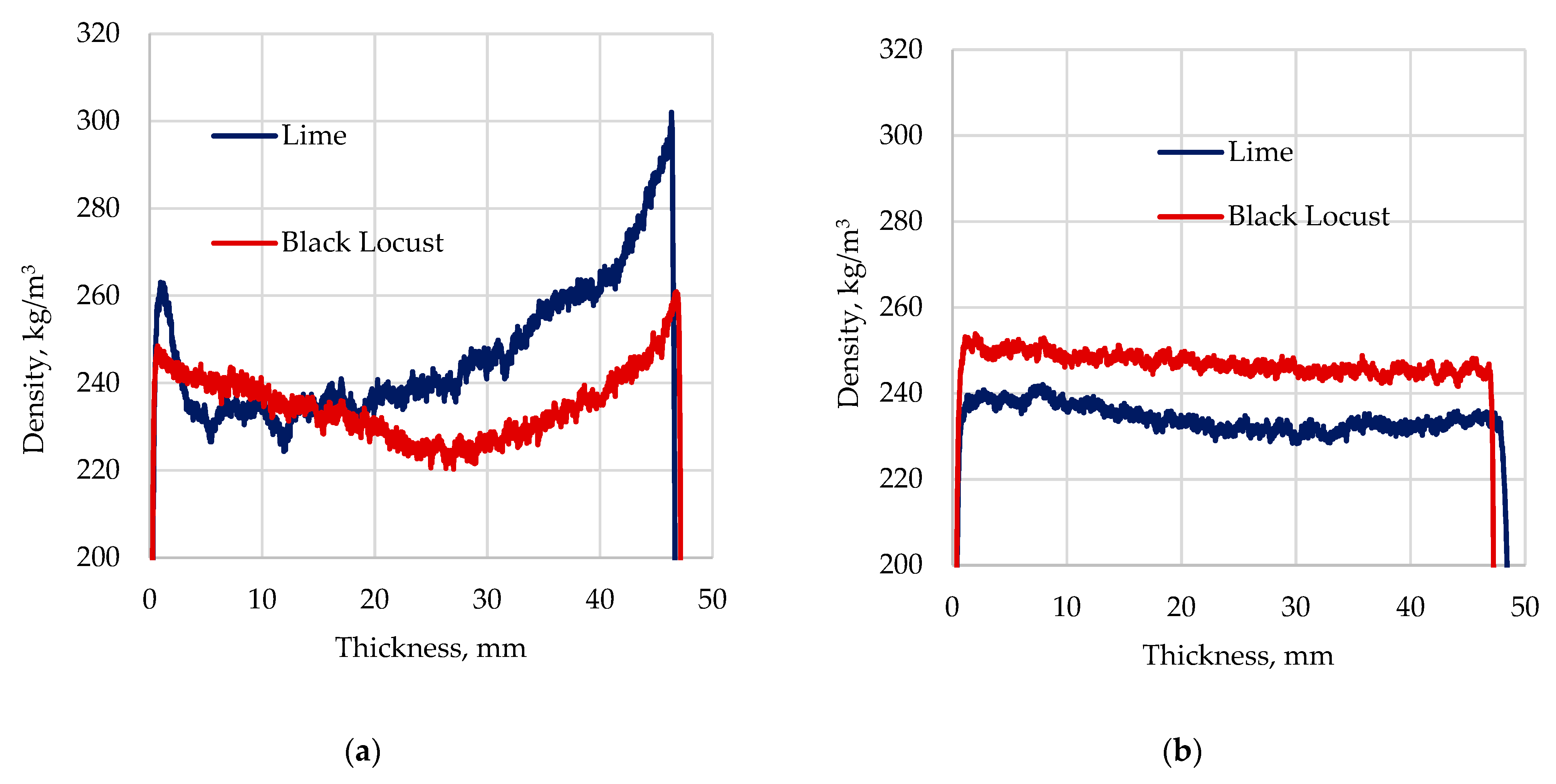
- Density profile analysis revealed a characteristic vertical gradient of wet-formed boards, with denser bottom layers and lighter top layers. This highlights the need for optimization of processing parameters to enhance structural uniformity and improve overall insulation performance.
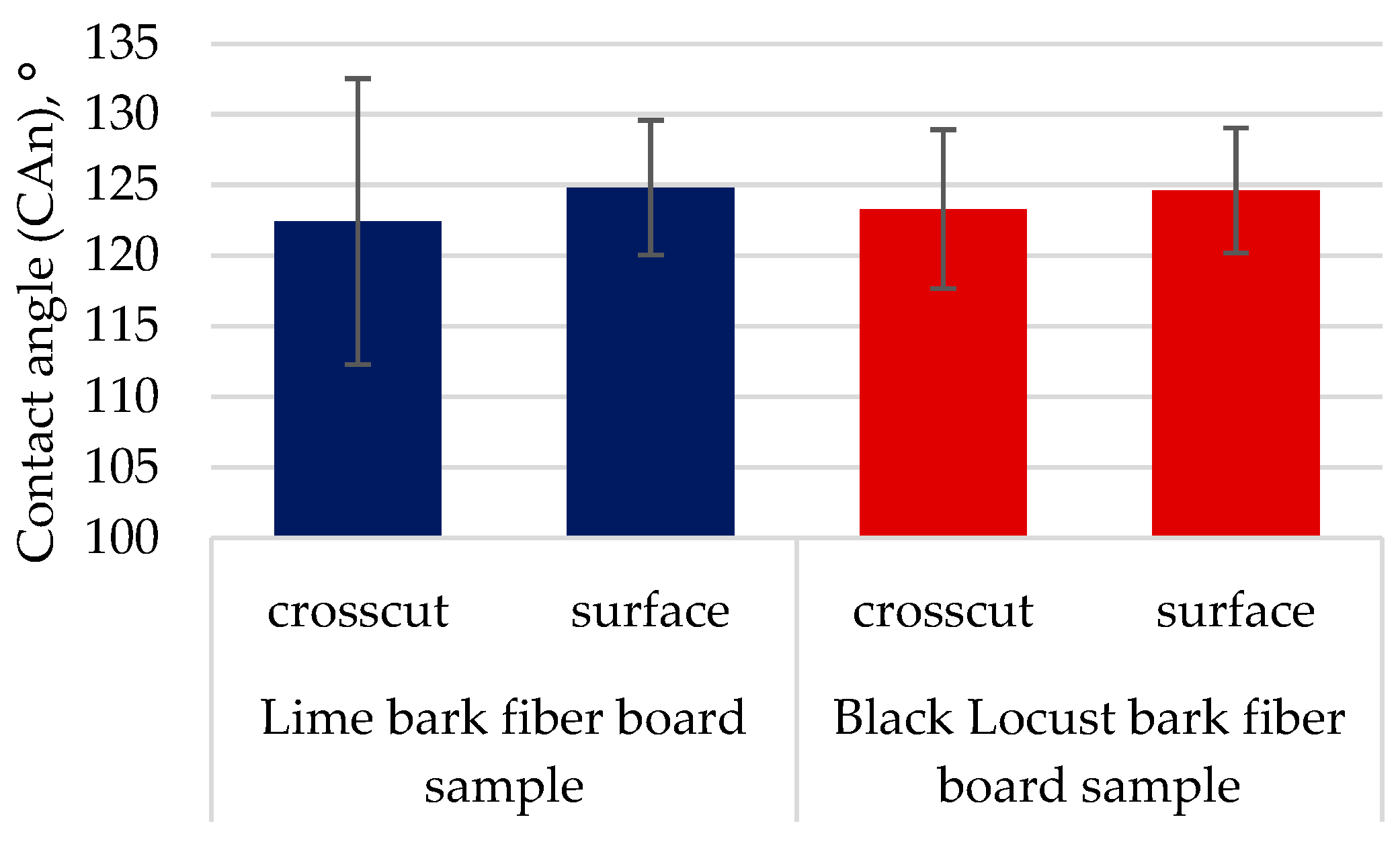
- Wettability tests confirmed that both board types are hydrophobic, with contact angles above 90°, likely influenced by the relatively high lignin content of bark fibers. This property may contribute to improved durability by reducing moisture sensitivity.
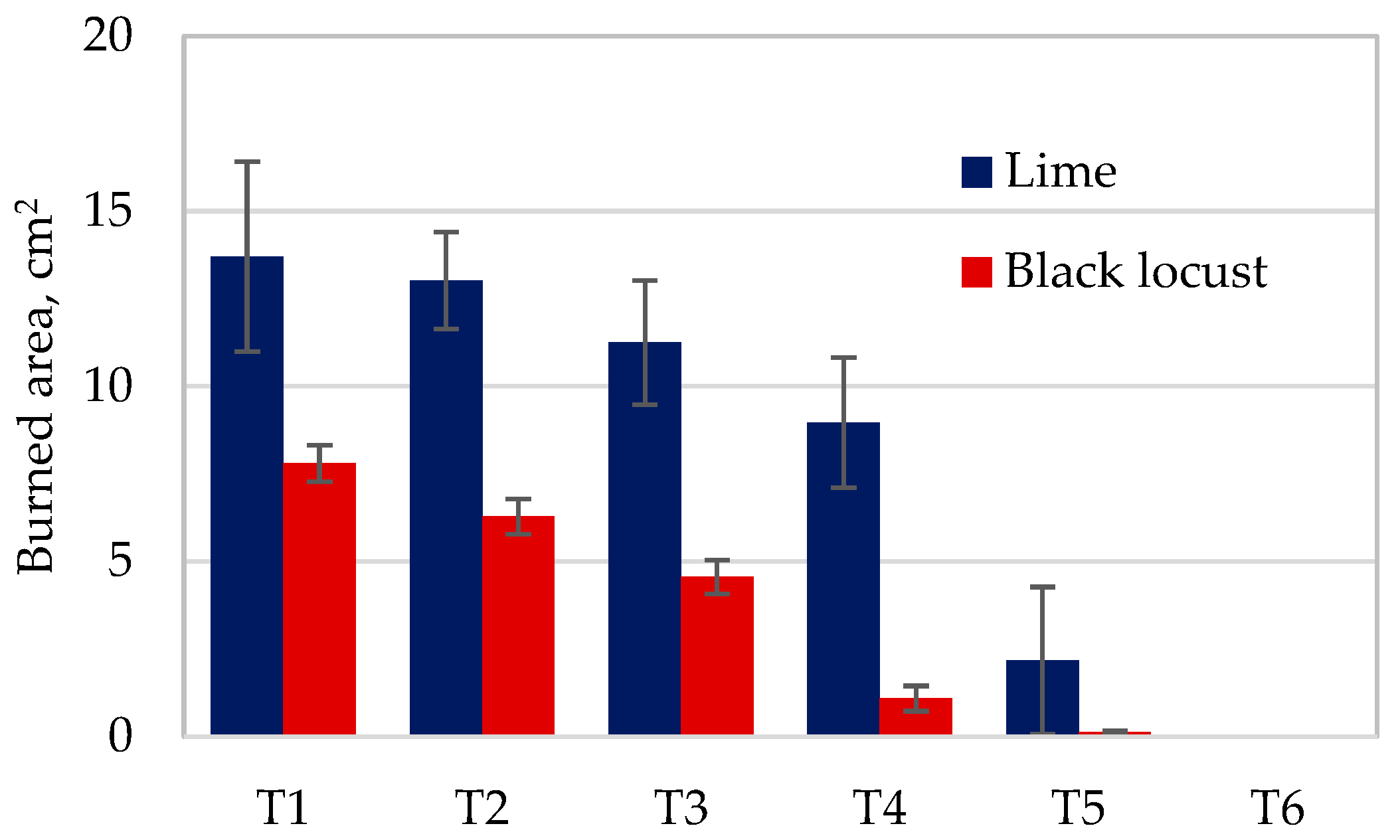
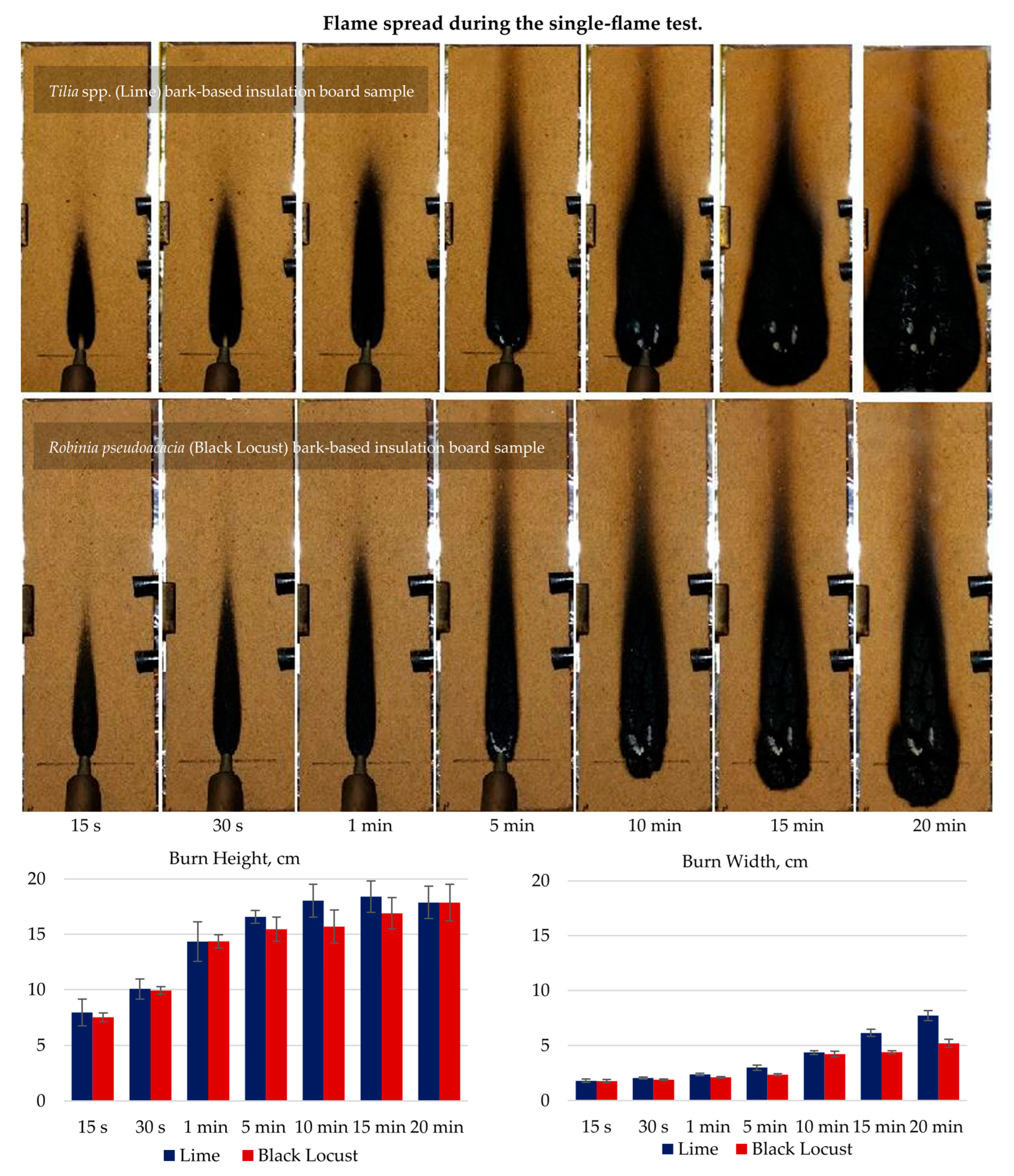
- The fire performance evaluation showed species-specific differences: Black Locust boards showed greater thermal stability, with smaller affected zones and lower internal temperatures, while Lime boards were more prone to deeper thermal degradation. No board ignition or filter paper ignition was observed, and smoke development followed a similar pattern in both cases, remaining consistent during the test.
Author Contributions
Funding
Data Availability Statement
Acknowledgments
Conflicts of Interest
Abbreviations
| CO2 | Carbon dioxide |
| CO | Carbon monoxide |
| EU | European Union |
| LCA | Life Cycle Assessment |
| CPR | Construction Products Regulation |
| TGA | Thermogravimetric Analysis |
| PCFC | Pyrolysis Combustion Flow Calorimetry |
| DP | Density Profile |
| RH | Relative Humidity |
| CAn | Contact Angle |
| CV | Coefficient of Variation |
| SBI | Single Burning Item |
| PUR | Polyurethane |
| MDF | Medium-Density Fibreboard |
| PC | Personal Computer |
References
- United Nations Environment Programme. Yale Center for Ecosystems + Architecture. In Building Materials and the Climate: Constructing a New Future; United Nations Environment Programme: Washington, DC, USA, 2023. [Google Scholar]
- Hossain, M.S.; Therasme, O.; Crovella, P.; Volk, T.A. Assessing the Environmental Impact of Biobased Exterior Insulation Panel: A Focus on Carbon Uptake and Embodied Emissions. Energies 2024, 17, 3406. [Google Scholar] [CrossRef]
- Cordier, S.; Blanchet, P.; Robichaud, F.; Amor, B. Dynamic LCA of the Increased Use of Wood in Buildings and Its Consequences: Integration of CO2 Sequestration and Material Substitutions. Build. Environ. 2022, 226, 109695. [Google Scholar] [CrossRef]
- Maier, D. Building Materials Made of Wood Waste a Solution to Achieve the Sustainable Development Goals. Materials 2021, 14, 7638. [Google Scholar] [CrossRef]
- Cetiner, I.; Shea, A.D. Wood Waste as an Alternative Thermal Insulation for Buildings. Energy Build. 2018, 168, 374–384. [Google Scholar] [CrossRef]
- Zhang, J.; Yin, K.; Zhuang, Z.; Zhou, J.; Tang, Y.; Xu, J.; Chen, Y.; Li, Y.; Sun, Q. Wood Waste-Derived Dual-Mode Materials Paving the Way for Year-Round Energy Saving in Buildings. Mater. Horiz. 2024, 11, 3633–3642. [Google Scholar] [CrossRef] [PubMed]
- Eurostat. “ENV_WASTRT: Total Waste Generation [Custom Table] (2022)”. Available online: https://ec.europa.eu/eurostat/databrowser/view/ENV_WASTRT__custom_17929033/default/table?page=time:2022 (accessed on 23 September 2025).
- Supriyadi, D.; Damayanti, D.; Veigel, S.; Hansmann, C.; Gindl-Altmutter, W. Unlocking the Potential of Tree Bark: Review of Approaches from Extractives to Materials for Higher-Added Value Products. Mater. Today Sustain. 2025, 29, 101074. [Google Scholar] [CrossRef]
- Muszynski, Z.; Dobbin Mcnatt, J. Investigations on the Use of Spruce Bark in the Manufacture of Particleboard in Poland. For. Prod. J. 1984, 34, 28–35. [Google Scholar]
- Xing, C.; Cloutier, A. Impact of Bark Content on the Properties of Medium Density Fiberboard (MDF) in Four Species Grown in Eastern Canada. Artic. For. Prod. J. 2006, 56, 64–69. [Google Scholar]
- Xing, C.; Zhang, S.Y.; Deng, J.; Wang, S. Investigation of the Effects of Bark Fiber as Core Material and Its Resin Content on Three-Layer MDF Performance by Response Surface Methodology. Wood Sci. Technol. 2007, 41, 585–595. [Google Scholar] [CrossRef]
- Álvarez, T.; Ramírez, R. Effects of Mimosa Bark Usage on Some Properties of Particleboard. Turk. J. Agric. For. 2005, 29, 227–230. [Google Scholar]
- Bakatovich, A.; Bakatovich, N.; Silva, A.; Gaspar, F. Thermal Insulation Materials Based on Eucalyptus Bark Fibres. Constr. Build. Mater. 2024, 449, 138559. [Google Scholar] [CrossRef]
- Fuentealba, C.; Segovia, C.; Pradena-Miquel, M.; César, A.G. Efficient Bio-Based Insulation Panels Produced from Eucalyptus Bark Waste. Forests 2024, 15, 1628. [Google Scholar] [CrossRef]
- Göβwald, J.; Barbu, M.C.; Nemec, M.; Igaz, R.; Adamcik, L.; Kristak, L.; Tudor, E.M. Innovative Porous Panels Made from Alpine Tree Bark-Fibre Bundles for Enhanced Acoustic and Thermal Insulation. Wood Mater. Sci. Eng. 2025. [Google Scholar] [CrossRef]
- Živković, V.; Novosel, A.; Krstić, H. Innovative Solutions: Comparative Study of Laboratory and In Situ Measurements of Thermal Properties of Bark Insulated Exterior Walls. Buildings 2025, 15, 810. [Google Scholar] [CrossRef]
- Morandini, M.; Barbu, M.C.; Váňová, R.; Kain, S.; Tippner, J.; Petutschnigg, A.; Kristak, L.; Kain, G.; Sepperer, T.; Schnabel, T. Valorization of Extracted Bark for Particleboard Production: A Life-Cycle Impact Assessment. Polymers 2025, 17, 925. [Google Scholar] [CrossRef]
- Richards, W.J.; Masarei, M.; Guzzomi, A.L. Adhesive Free Melaleuca Rhaphiophylla (Swamp Paperbark) Bark as an Engineered Wood Product. Eur. J. Wood Wood Prod. 2025, 83, 32. [Google Scholar] [CrossRef]
- Gößwald, J.; Barbu, M.C.; Petutschnigg, A.; Tudor, E.M. Binderless Thermal Insulation Panels Made of Spruce Bark Fibres. Polymers 2021, 13, 1799. [Google Scholar] [CrossRef]
- Gao, Z.; Wang, X.-M.; Wan, H.; Brunette, G. Binderless Bark Panels. Bioresources 2011, 6, 3960–3972. [Google Scholar] [CrossRef]
- Urstöger, J.; Kain, G.; Prändl, F.; Barbu, M.C.; Kristak, L. Physical-Mechanical Properties of Light Bark Boards Bound with Casein Adhesives. Sustainability 2023, 15, 13530. [Google Scholar] [CrossRef]
- Vitrone, F.; Ramos, D.; Ferrando, F.; Salvadó, J. Binderless Fiberboards for Sustainable Construction. Materials, Production Methods and Applications. J. Build. Eng. 2021, 44, 102625. [Google Scholar] [CrossRef]
- Sitzia, T.; Cierjacks, A.; de Rigo, D.; Caudullo, G. Robinia Pseudoacacia in Europe: Distribution, Habitat, Usage and Threats. In European Atlas of Forest Tree Species; Publications Office of the European Union: Luxembourg, 2016; pp. 166–167. [Google Scholar]
- Paczkowski, S.; Sauer, C.; Anetzberger, A.; Jaeger, D.; Pelz, S. Utilization of Black Locust (Robinia Pseudoacacia) Sawdust as an Alternative Pelletization Raw Material. Biomass Convers. Biorefinery 2024, 14, 25583–25597. [Google Scholar] [CrossRef]
- Grohmann, D.; Petrucci, R.; Torre, L.; Micheli, M.; Menconi, M.E. Street Trees’ Management Perspectives: Reuse of Tilia Sp.’s Pruning Waste for Insulation Purposes. Urban For. Urban Green. 2019, 38, 177–182. [Google Scholar] [CrossRef]
- Šilinskas, B.; Povilaitienė, A.; Urbaitis, G.; Aleinikovas, M.; Varnagirytė-Kabašinskienė, I. The Wood Quality of Small-Leaved Lime (Tilia Cordata Mill.) Trees in an Urban Area: A Pilot Study. Forests 2021, 12, 420. [Google Scholar] [CrossRef]
- Janowski, D. Anthropological Significance of Tilia Trees in Japan. Ecol. Evol. 2023, 13, e10303. [Google Scholar] [CrossRef]
- European Parliament & Council of the European Union Regulation (EU). 2024/3110 of the European Parliament and of the Council of 27 November 2024 Laying down Harmonised Rules for the Marketing of Construction Products and Repealing Regulation (EU); No 305/2011; Official Journal of the European Union (OJ L): Brussels, Belgum, 2024. [Google Scholar]
- Niziurska, M.; Wieczorek, M.; Borkowicz, K. Fire Safety of External Thermal Insulation Systems (ETICS) in the Aspect of Sustainable Use of Natural Resources. Sustainability 2022, 14, 1224. [Google Scholar] [CrossRef]
- Tudor, E.M.; Scheriau, C.; Barbu, M.C.; Réh, R.; Krišt’ák, L.; Schnabel, T. Enhanced Resistance to Fire of the Bark-Based Panels Bonded with Clay. Appl. Sci. 2020, 10, 5594. [Google Scholar] [CrossRef]
- Tributsch, H.; Fiechter, S. The Material Strategy of Fire-Resistant Tree Barks. High Perform. Struct. Mater. IV 2008, 97, 43–52. [Google Scholar] [CrossRef]
- Pausas, J.G. Bark Thickness and Fire Regime. Funct. Ecol. 2015, 29, 315–327. [Google Scholar] [CrossRef]
- Bär, A.; Mayr, S. Bark Insulation: Ten Central Alpine Tree Species Compared. For. Ecol. Manag. 2020, 474, 118361. [Google Scholar] [CrossRef]
- Wei, R.; Yang, G.; Zhang, J.; Wang, X.; Zhou, X. The Thermal Insulation Properties of Oak (Quercus Mongolica) Bark and the Applicability of Stem Heating Models. Int. J. Wildland Fire 2019, 28, 969–980. [Google Scholar] [CrossRef]
- da Silva, J.R.; da Silva Matos, D.; Boaretto, A.G.; Carollo, C.A.; Silva de Oliveira, L.C.; Scremin-Dias, E.; Damasceno Junior, G.A.; de Oliveira Arruda, R.d.C. Fire Tolerance Strategies in Woody Species from Pantanal Riparian Forests Involve Phenolic Compounds and Structure of the Inner Bark. Flora 2021, 281, 151865. [Google Scholar] [CrossRef]
- Bossu, J.; Moreau, J.; Delisée, C.; Le Moigne, N.; Corn, S.; Sonnier, R.; Viretto, A.; Beauchêne, J.; Clair, B. Revealing the Potential of Waste Fibers from Timber Production and Clearings for the Development of Local Bio-Based Insulation Fiberboards in French Guiana. Waste Biomass Valorization 2023, 14, 4281–4295. [Google Scholar] [CrossRef]
- Lowden, L.A.; Hull, T.R. Flammability Behaviour of Wood and a Review of the Methods for Its Reduction. Fire Sci. Rev. 2013, 2, 4. [Google Scholar] [CrossRef]
- Gebke, S.; Thümmler, K.; Sonnier, R.; Tech, S.; Wagenführ, A.; Fischer, S. Flame Retardancy of Wood Fiber Materials Using Phosphorus-Modified Wheat Starch. Molecules 2020, 25, 335. [Google Scholar] [CrossRef] [PubMed]
- Pacher, T.; Barbu, M.C.; Urstöger, J.; Petutschnigg, A.; Tudor, E.M. Fire Retardancy of Cementitious Panels with Larch and Spruce Bark as Bio-Admixtures. Polymers 2022, 14, 1469. [Google Scholar] [CrossRef]
- Renner, J.S.; Mensah, R.A.; Jiang, L.; Xu, Q. A Critical Assessment of the Fire Properties of Different Wood Species and Bark from Small- and Bench-Scale Fire Experiments. J. Therm. Anal. Calorim. 2022, 148, 1423–1434. [Google Scholar] [CrossRef]
- Efe, F.T. Investigation of Some Physical and Thermal Insulation Properties of Honeycomb-Designed Panels Produced from Calabrian Pine Bark and Cones. Eur. J. Wood Wood Prod. 2022, 80, 705–718. [Google Scholar] [CrossRef]
- Park, S.-H.; Lee, M.; Seo, P.-N.; Kang, E.-C. Effect of Resin Content on the Physiochemical and Combustion Properties of Wood Fiber Insulation Board. Bioresources 2020, 15, 5210–5225. [Google Scholar] [CrossRef]
- Lee, M.; Lee, S.M.; Kang, E.C.; Son, D.W. Combustibility and Characteristics of Wood-Fiber Insulation Boards Prepared with Four Different Adhesives. Bioresources 2019, 14, 6316–6330. [Google Scholar] [CrossRef]
- Christy, E.O.; Soemarno; Sumarlan, S.H.; Soehardjono, A. Binderless Bark Particleboard Made from Gelam (Melaleuca Viridiflora Sol. Ex Gaertn.) Bark Waste: The Effect of the Pressing Temperature on Its Mechanical and Physical Properties. Bioresources 2021, 16, 4171–4199. [Google Scholar] [CrossRef]
- Oktoberyani Christy, E.; Hadi Sumarlan, S.; Soehardjono, A. Gelam Wood Particleboards. Bioresources 2020, 15, 7390–7403. [Google Scholar]
- Liu, H.; Zhu, Y.; Ye, Y.; Therrien, I.; Wiesner, F.; Jiang, F. Flame-Retardant Strategies for Lignocellulose: Recent Progress and Prospect. Prog. Mater. Sci. 2026, 155, 101529. [Google Scholar] [CrossRef]
- Rosenblad, K.C.; Perret, D.L.; Sax, D.F. Niche Syndromes Reveal Climate-Driven Extinction Threat to Island Endemic Conifers. Nat. Clim. Chang. 2019, 9, 627–631. [Google Scholar] [CrossRef]
- EN 12667:2002; Thermal Performance of Building Materials and Products—Determination of Thermal Resistance by Means of Guarded Hot Plate and Heat Flow Meter Methods—Products of High and Medium Thermal Resistance. European Committee for Standardization: Brussels, Belgium, 2002.
- ISO 8301; Thermal Insulation, Determination of Steady-State Thermal Resistance and Related Properties, Heat Flow Meter Apparatus. International Organization for Standardization: Geneva, Switzerland, 1991.
- Martin, R.E.; Crist, J.B. Elements of Bark Structure and Terminology. Wood Fiber Sci. 1970, 2, 269–279. [Google Scholar]
- Mawardi, I.; Aprilia, S.; Faisal, M.; Ikramullah; Rizal, S. An Investigation of Thermal Conductivity and Sound Absorption from Binderless Panels Made of Oil Palm Wood as Bio-Insulation Materials. Results Eng. 2022, 13, 100319. [Google Scholar] [CrossRef]
- Tang, Y.; Wu, T.H.; He, G.W.; Qi, D. Multi-Flexible Fiber Flows: A Direct-Forcing Immersed Boundary Lattice-Boltzmann Lattice-Spring Approach. Int. J. Multiph. Flow 2018, 99, 408–422. [Google Scholar] [CrossRef]
- Hunt, J.F.; Leng, W.; Tajvidi, M. Vertical Density Profile and Internal Bond Strength of Wet-Formed Particleboard Bonded with Cellulose Nanofibrils. Res. Contrib. 2017, 49, 1–11. [Google Scholar]
- Gao, Y.; Fu, Z.; Zhou, Y.; Gao, X.; Zhou, F.; Cao, H. Moisture-Related Shrinkage Behavior of Wood at Macroscale and Cellular Level. Polymers 2022, 14, 5045. [Google Scholar] [CrossRef]
- Vieira, M.G.A.; Rocha, S.C.S. Drying Conditions Influence on Physical Properties of Recycled Paper. Chem. Eng. Process. Process Intensif. 2007, 46, 955–963. [Google Scholar] [CrossRef]
- Maloney, T.M. Modern Particleboard & Dry-Process Fiberboard Manufacturing; Miller Freeman Publications, Inc.: San Francisco, CA, USA, 1977; p. 672. [Google Scholar]
- Ali, A.; Issa, A.; Elshaer, A. A Comprehensive Review and Recent Trends in Thermal Insulation Materials for Energy Conservation in Buildings. Sustainability 2024, 16, 8782. [Google Scholar] [CrossRef]
- Duong, L.; Anh, H.; Pásztory, Z.; Chi, H.; City, M.; Ward, L.T.; District, T.D.; Nam, V. An Overview of Factors Influencing Thermal Conductivity of Building Insulation Materials. J. Build. Eng. 2021, 44, 2352–7102. [Google Scholar] [CrossRef]
- Cosentino, L.; Fernandes, J.; Mateus, R. A Review of Natural Bio-Based Insulation Materials. Energies 2023, 16, 4676. [Google Scholar] [CrossRef]
- Gößwald, J.; Barbu, M.C.; Tudor, E.M.; Král, P. Leveraging Spruce Bark Particle Morphology for Enhanced Internal Bonding in Particleboard Production. Polymers 2024, 16, 2988. [Google Scholar] [CrossRef]
- Law, K.-Y. Definitions for Hydrophilicity, Hydrophobicity, and Superhydrophobicity: Getting the Basics Right. J. Phys. Chem. Lett. 2014, 5, 686–688. [Google Scholar] [CrossRef]
- Wulf, M.; Netuschil, P.; Hora, G.; Schmich, P.; Cammenga, H.K. Investigation of the Wetting Characteristics of Medium Density Fibreboards (MDF) by Means of Contact Angle Measurements. Holz Als Roh—Und Werkst. 1997, 55, 331–335. [Google Scholar] [CrossRef]
- McCarter, R. Smoldering Combustion of Wood Fibers: Cause and Prevention. J. Fire Flammabl. 1978, 9, 119–126. [Google Scholar]
- Steen-Hansen, A.; Mikalsen, R.F.; Jensen, U.E. Smouldering Combustion in Loose-Fill Wood Fibre Thermal Insulation: An Experimental Study. Fire Technol. 2018, 54, 1585–1608. [Google Scholar] [CrossRef]
- Zhang, Z.; Ding, P.; Wang, S.; Huang, X. Smouldering-to-Flaming Transition on Wood Induced by Glowing Char Cracks and Cross Wind. Fuel 2023, 352, 129091. [Google Scholar] [CrossRef]
- Liu, L.F.; Li, H.Q.; Lazzaretto, A.; Manente, G.; Tong, C.Y.; Liu, Q.B.; Li, N.P. The Development History and Prospects of Biomass-Based Insulation Materials for Buildings. Renew. Sustain. Energy Rev. 2017, 69, 912–932. [Google Scholar] [CrossRef]
- Zhang, D.; Zhang, A.; Xue, L. A Review of Preparation of Binderless Fiberboards and Its Self-Bonding Mechanism. Wood Sci. Technol. 2015, 49, 661–679. [Google Scholar] [CrossRef]
- Lu, Z.; Hauschild, M.; Ottosen, L.M.; Ambaye, T.G.; Zerbino, P.; Aloini, D.; Lima, A.T. Climate Mitigation Potential of Biobased Insulation Materials: A Comprehensive Review and Categorization. J. Clean. Prod. 2024, 470, 143356. [Google Scholar] [CrossRef]
- Benallel, A.; Tilioua, A.; Garoum, M. Development of Thermal Insulation Panels Bio-Composite Containing Cardboard and Date Palm Fibers. J. Clean. Prod. 2024, 434, 139995. [Google Scholar] [CrossRef]
- Benallel, A.; Tilioua, A.; Dlimi, M. Assessment of the Thermal Performance of a New Insulation Material Based on Date Palm and Cardboard: Experimental and Numerical Study. Constr. Build. Mater. 2024, 419, 135476. [Google Scholar] [CrossRef]
- Benallel, A.; Tilioua, A.; Ettakni, M.; Ouakarrouch, M.; Garoum, M.; Ahmed Alaoui Hamdi, M. Design and Thermophysical Characterization of New Thermal Insulation Panels Based on Cardboard Waste and Vegetable Fibers. Sustain. Energy Technol. Assess. 2021, 48, 101639. [Google Scholar] [CrossRef]
- Marín-Calvo, N.; González-Serrud, S.; James-Rivas, A. Thermal Insulation Material Produced from Recycled Materials for Building Applications: Cellulose and Rice Husk-Based Material. Front. Built Environ. 2023, 9, 1271317. [Google Scholar] [CrossRef]
- Martínez, B.; Mendizabal, V.; Roncero, M.B.; Bernat-Maso, E.; Gil, L. Towards Sustainable Building Solutions: Development of Hemp Shiv-Based Green Insulation Material. Constr. Build. Mater. 2024, 414, 134987. [Google Scholar] [CrossRef]
- Lian, X.; Tian, L.; Li, Z.; Zhao, X. Thermal Conductivity Analysis of Natural Fiber-Derived Porous Thermal Insulation Materials. Int. J. Heat. Mass. Transf. 2024, 220, 124941. [Google Scholar] [CrossRef]
- Sekino, N. Density Dependence in the Thermal Conductivity of Cellulose Fiber Mats and Wood Shavings Mats: Investigation of the Apparent Thermal Conductivity of Coarse Pores. J. Wood Sci. 2015, 62, 20–26. [Google Scholar] [CrossRef]
- Krainer, S.; Hirn, U. Contact Angle Measurement on Porous Substrates: Effect of Liquid Absorption and Drop Size. Colloids Surf. A Physicochem. Eng. Asp. 2021, 619, 126503. [Google Scholar] [CrossRef]
- Schellbach, S.L.; Monteiro, S.N.; Drelich, J.W. A Novel Method for Contact Angle Measurements on Natural Fibers. Mater. Lett. 2016, 164, 599–604. [Google Scholar] [CrossRef]
- Lößlein, S.M.; Merz, R.; Müller, D.W.; Kopnarski, M.; Mücklich, F. An In-Depth Evaluation of Sample and Measurement Induced Influences on Static Contact Angle Measurements. Sci. Rep. 2022, 12, 19389. [Google Scholar] [CrossRef]
- Huhtamäki, T.; Tian, X.; Korhonen, J.T.; Ras, R.H.A. Surface-Wetting Characterization Using Contact-Angle Measurements. Nat. Protoc. 2018, 13, 1521–1538. [Google Scholar] [CrossRef]
- Jin, H.; Kose, R.; Akada, N.; Okayama, T. Relationship between Wettability of Pulp Fibers and Tensile Strength of Paper during Recycling. Sci. Rep. 2022, 12, 1560. [Google Scholar] [CrossRef]
- Tonello, K.C.; Campos, S.D.; de Menezes, A.J.; Bramorski, J.; Mathias, S.L.; Lima, M.T. How Is Bark Absorbability and Wettability Related to Stemflow Yield? Observations From Isolated Trees in the Brazilian Cerrado. Front. For. Glob. Chang. 2021, 4, 650665. [Google Scholar] [CrossRef]
- Vangeel, T.; Sels, B. Tree Bark in the Biorefinery: Implementing Lignin-First Principles; K.U. Leuven: Leuven, Belgium, 2020. [Google Scholar]
- Kusiak, W.; Majka, J.; Zborowska, M.; Ratajczak, I. Chemical Composition and Related Properties of Lime (Tilia Cordata Mill.) Bark and Wood as Affected by Tree Growth Conditions. Materials 2022, 15, 4033. [Google Scholar] [CrossRef]
- Mensah, R.A.; Jiang, L.; Renner, J.S.; Xu, Q. Characterisation of the Fire Behaviour of Wood: From Pyrolysis to Fire Retardant Mechanisms. J. Therm. Anal. Calorim. 2023, 148, 1407–1422. [Google Scholar] [CrossRef]
- Albert, C.M.; Liew, K.C. Recent Development and Challenges in Enhancing Fire Performance on Wood and Wood-Based Composites: A 10-Year Review from 2012 to 2021. J. Bioresour. Bioprod. 2024, 9, 27–42. [Google Scholar] [CrossRef]
- Richter, F.; Atreya, A.; Kotsovinos, P.; Rein, G. The Effect of Chemical Composition on the Charring of Wood across Scales. Proc. Combust. Inst. 2019, 37, 4053–4061. [Google Scholar] [CrossRef]
- Dorez, G.; Ferry, L.; Sonnier, R.; Taguet, A.; Lopez-Cuesta, J.M. Effect of Cellulose, Hemicellulose and Lignin Contents on Pyrolysis and Combustion of Natural Fibers. J. Anal. Appl. Pyrolysis 2014, 107, 323–331. [Google Scholar] [CrossRef]
- Zhang, Y.; Jing, M.; Hou, S.; Gong, Y.; Wang, Z.; Jiang, J.; Zhang, B. Preparation and Fire-Retardant Mechanism of Self-Hardening Silica Foam for Wood Fire Prevention. Silicon 2022, 14, 12633–12644. [Google Scholar] [CrossRef]



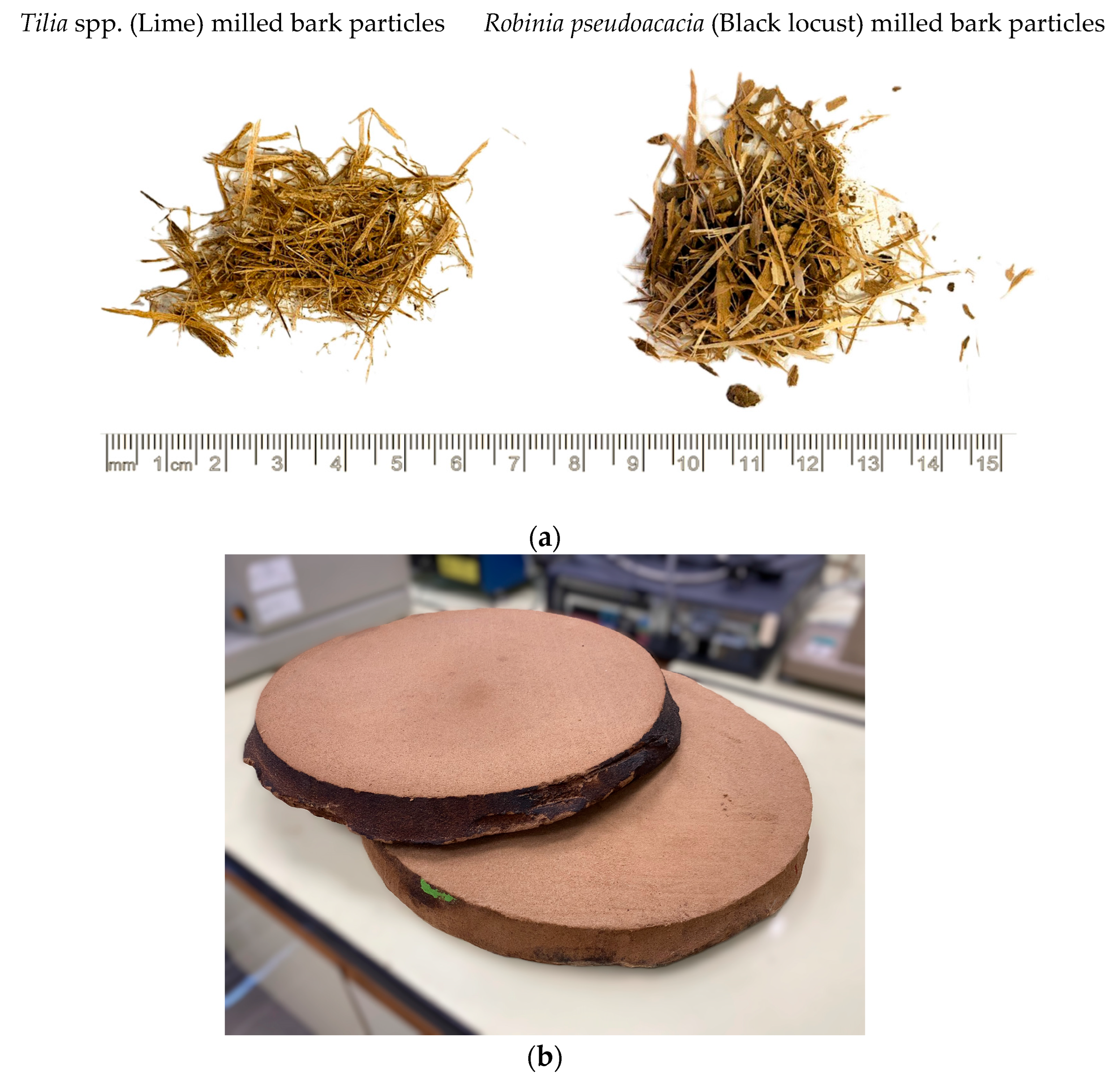
| Wood Species | Board | Fiber Longitudinal Slenderness (Length-to-Width Ratio) | |
|---|---|---|---|
| Density, kg/m3 | Thickness, mm | ||
| Tilia spp. (Lime) | 218 ± 4 | 47 | 17.8 |
| Robinia pseudoacacia (Black Locust) | 231 ± 9 | 11.3 | |
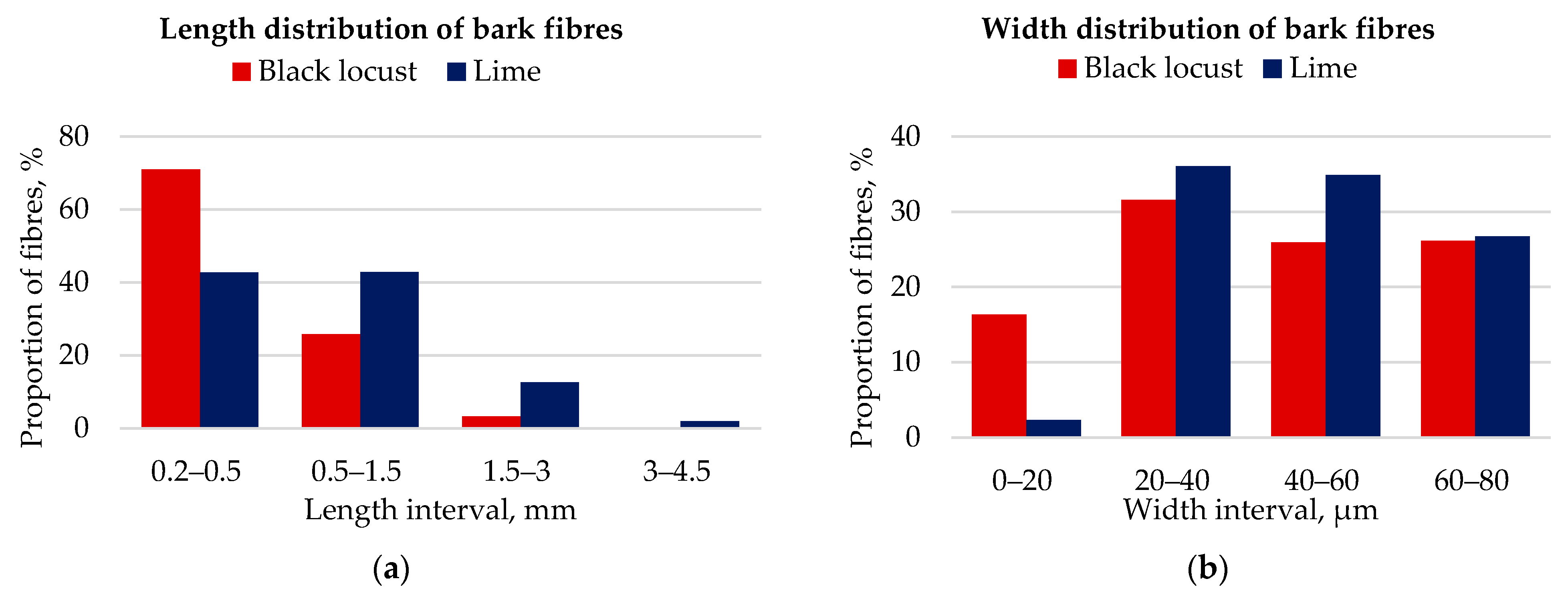
| Fiber | Mean Fiber Length, µm | Mean Fiber Width, µm | Fines, % | Mean Shape, % |
|---|---|---|---|---|
| Bark Black locust | 474.8 | 42.5 | 96.6 | 85.8 |
| Bark Lime | 834.8 | 46.9 | 85.3 | 85.6 |
| Bark Source | Thermal Conductivity, W/m·K | Density, kg/m3 | Fabrication Method | Fiber obtaining | Reference |
|---|---|---|---|---|---|
| Black Locust Robinia pseudoacacia | 0.055 | 218 ± 4 | Wet | Defibration | Current study |
| Lime Tilia spp. | 0.057 | 231 ± 9 | Wet | Defibration | Current study |
| Spruce | 0.044 | 162.00 | Wet | After debarking by high-pressure water jets | [19] |
| C. Obtusa V. Surinamensis (French Guiana species) | 0.04–0.06 | 120–250 | Air-laid | Impact milling | [36] |
| Eucalyptus globulus | 0.071–0.076 | 200–250 | Wet | Hammer mill, defibration | [14] |
| Eucalyptus | 0.042–0.062 | 50–220 | Bulk fibres | Mill grinder | [13] |
| Pinus sylvestris L., Picea abies L., Quercus robur (Alpine tree species) | 0.068–0.079 | 170–330 | Wet | After debarking within high-pressure water jets, sieving | [60] |
| Thermocouple | Lime Bark Fiber Board | Black Locust Bark Fiber Board |
|---|---|---|
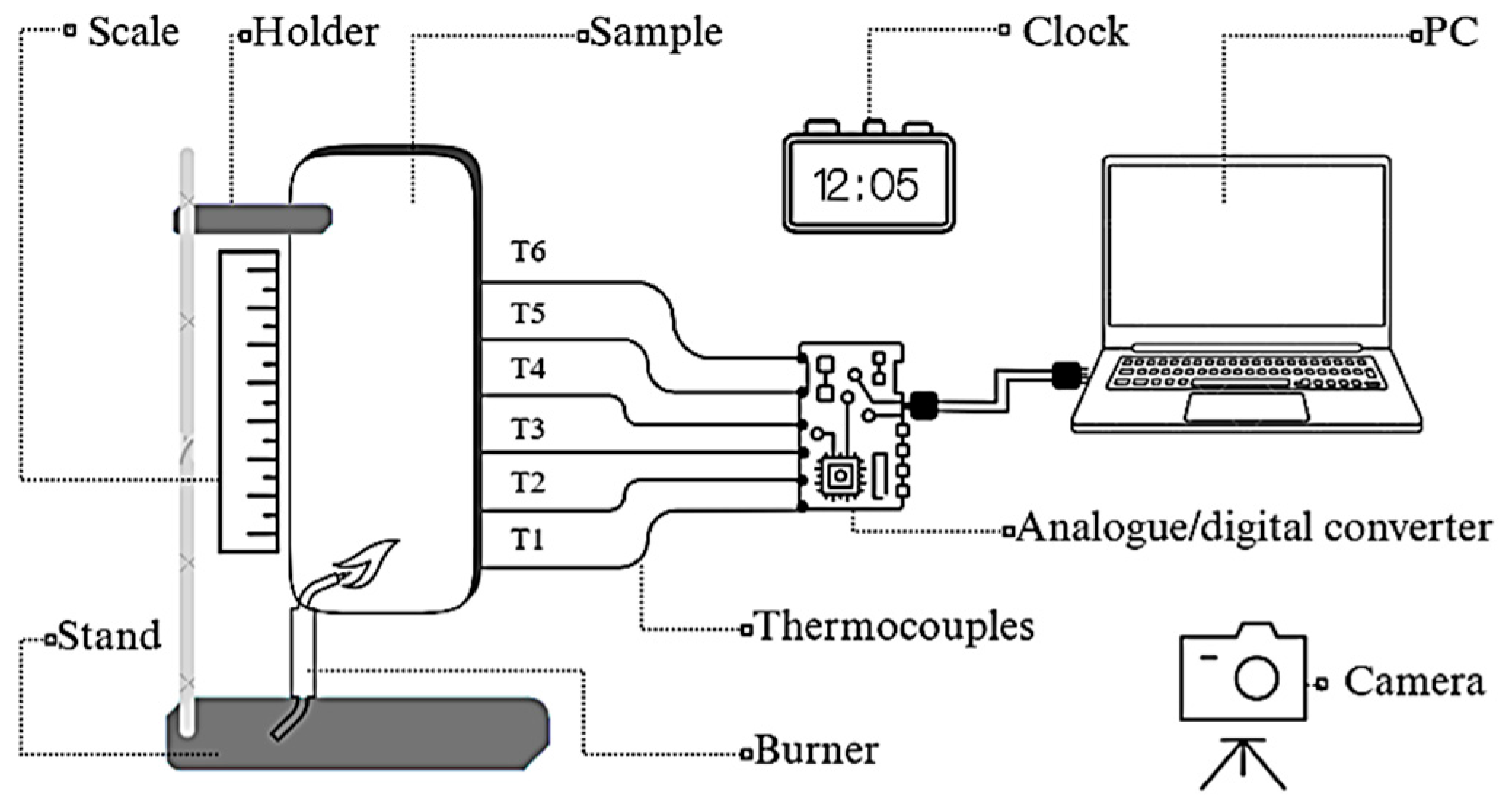
| Max Temperature, °C | ||
| T1 | 115.3 | 78.0 |
| T2 | 120.9 | 91.3 |
| T3 | 81.8 | 76.1 |
| T4 | 96.1 | 67.1 |
| T5 | 81.9 | 42.2 |
| T6 | 36.0 | 33.5 |
Disclaimer/Publisher’s Note: The statements, opinions and data contained in all publications are solely those of the individual author(s) and contributor(s) and not of MDPI and/or the editor(s). MDPI and/or the editor(s) disclaim responsibility for any injury to people or property resulting from any ideas, methods, instructions or products referred to in the content. |
© 2025 by the authors. Licensee MDPI, Basel, Switzerland. This article is an open access article distributed under the terms and conditions of the Creative Commons Attribution (CC BY) license.
Share and Cite
Mialeshka, V.; Kowaluk, G.; Pásztory, Z. Sustainable Insulation Panels Made of Tree Bark Fibers: Thermal and Fire Performance. Forests 2026, 17, 26. https://doi.org/10.3390/f17010026
Mialeshka V, Kowaluk G, Pásztory Z. Sustainable Insulation Panels Made of Tree Bark Fibers: Thermal and Fire Performance. Forests. 2026; 17(1):26. https://doi.org/10.3390/f17010026
Chicago/Turabian StyleMialeshka, Volha, Grzegorz Kowaluk, and Zoltán Pásztory. 2026. "Sustainable Insulation Panels Made of Tree Bark Fibers: Thermal and Fire Performance" Forests 17, no. 1: 26. https://doi.org/10.3390/f17010026
APA StyleMialeshka, V., Kowaluk, G., & Pásztory, Z. (2026). Sustainable Insulation Panels Made of Tree Bark Fibers: Thermal and Fire Performance. Forests, 17(1), 26. https://doi.org/10.3390/f17010026