Article

Effects of PDADMAC Solution Pretreatment on Beech Wood—Waterborne Coating Interaction

1
Faculty of Forestry, University of Belgrade, Kneza Višeslava 1, 11108 Belgrade, Serbia
2
Institute for Multidisciplinary Research, University of Belgrade, 11108 Belgrade, Serbia
3
Biotechnical Faculty, University of Ljubljana, 1000 Ljubljana, Slovenia
*
Author to whom correspondence should be addressed.
Forests 2026, 17(1), 148; https://doi.org/10.3390/f17010148 (registering DOI)
Submission received: 18 December 2025 / Revised: 14 January 2026 / Accepted: 20 January 2026 / Published: 22 January 2026
(This article belongs to the Special Issue Testing and Assessment of Wood and Wood Products)

Abstract

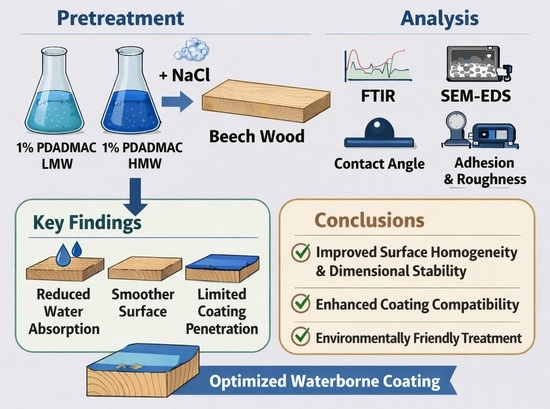
This study builds on previous research into the surface modification of beech wood with polyethyleneimine (PEI) prior to finishing it with a waterborne coating. Poly(diallyldimethylammonium chloride) (PDADMAC) is introduced as an alternative cationic polyelectrolyte for the pretreatment of beech wood surfaces. Wood samples were treated with aqueous 1% PDADMAC solutions of low (LMW—8000 g mol−1) and high (HMW—100,000–200,000 g mol−1) molecular weights, with or without NaCl addition. The effects of the treatments on wood surface chemistry, wettability, surface energy, water absorption, coating penetration, coating adhesion strength, and surface roughness of coated wood were analysed using FTIR, fluorescence microscopy, SEM/EDS, and standardised tests commonly used in wood surface finishing. The results showed that polyelectrolyte pretreatment modified the surface properties of wood, reducing water absorption and surface roughness without significantly affecting coating adhesion strength. PDADMAC formed a more uniform surface layer of wood with limited coating penetration, and NaCl addition improved wood surface smoothness (reducing surface roughness parameters of coated wood by 23%–29%, in samples treated with PDADMAC LMW with 0.01 M NaCl). These findings confirm that cationic polyelectrolyte pretreatment enhances the compatibility and performance of waterborne coatings, offering an environmentally friendly approach to improving wood–waterborne coating interactions.

1. Introduction

Wood, as a carbon-neutral and renewable material [1], has attracted increasing attention due to growing environmental awareness [2]. To extend its service life, surface protection with a coating is essential [3,4]. Traditional solvent-borne coatings release volatile organic compounds (VOCs), which pose health and environmental concerns [5]. Consequently, waterborne coatings have become more prominent as eco-friendly alternatives [6], offering lower toxicity and easier cleanup, though they present challenges such as high sensitivity to humidity [7,8] and swelling of wood fibres of the wood surface (grain raising) [5]. Because wood is hygroscopic, contact with water can raise fibres and increase surface roughness, negatively affecting coating adhesion and penetration [9]. Recent research suggests that polyelectrolytes (PEs), charged macromolecules, can modify the surface properties of wood by electrostatic interaction with negatively charged cellulose [10,11]. Polyelectrolytes (PEs) can alter the surface charge, energy, and mechanical properties of substrates, while water in the PE solution greatly increases wood conductivity compared to dry wood [12]. Considering the negative zeta potential of wood, it is necessary to treat the wood with cationic polyelectrolytes [13]. Previous investigations have shown that polyethyleneimine (PEI) pretreatment can reduce uptake of water and surface roughness without compromising coating adhesion [11,14]. Since the influence of PEI concentration and molecular weight on the behaviour of waterborne coatings remains insufficiently understood, we investigated the effects of PEI pretreatment on the surface properties of beech wood prior to finishing with a waterborne transparent acrylic coating (WTAC) [15]. In this study, wood samples were pretreated with PEI solutions of varying concentrations (0.5%, 1%, and 2%) of low (LMW) and high (HMW) molecular weights to assess changes in surface chemistry, wettability, water absorption, coating adhesion, and surface roughness. The results revealed that PEI LMW penetrated deeper into the wood structure, while PEI HMW mainly remained on the surface, forming a thin barrier layer. Treatment with a 1% PEI HMW solution was most effective, reducing water uptake by 72% and surface energy by 23.2% compared to untreated wood, while maintaining the WTAC’s adhesion strength. This treatment also significantly decreased the roughness of the coated surface, leading to smoother finishes. The findings indicate that PEI pretreatment, particularly with high-molecular-weight PEI at 1% concentration, can enhance the performance of waterborne coatings on wood without compromising adhesion strength, offering an environmentally friendly approach to improving surface quality in wood finishing.
However, while PEI exhibited strong interactions with the wood substrate through hydrogen bonding and electrostatic attraction [15], its high reactivity and molecular structure may limit uniform adsorption and long-term stability under certain conditions. Building on our previous investigation of PEI pretreatment of beech wood prior to waterborne coating [15], this study examines poly(diallyldimethylammonium chloride) (PDADMAC) as a structurally distinct cationic polyelectrolyte to further clarify the relationship between molecular architecture, surface modification, and coating performance. Cationic polyelectrolyte PDADMAC is synthetic, water-soluble, and composed of repeating units containing quaternary ammonium groups that permanently carry a positive charge, regardless of pH [13]. Due to high charge density [16], PDADMAC can effectively adsorb onto negatively charged surfaces, such as the cellulose, lignin, or hemicellulose components of wood. It is widely used in water clarification treatment [16], paper production [17], and surface modification processes [18,19,20] because of its strong electrostatic interactions and stability in aqueous environments. In wood surface modification, PDADMAC acts as an electrostatic binding agent, improving the surface charge balance and potentially influencing coating adhesion and wettability. Unlike PEI, which can form both hydrogen and covalent bonds with wood polymers, PDADMAC primarily interacts through electrostatic attraction [21], offering a more controlled and uniform modification of the wood surface.
Previous studies have indicated that the extent of polyelectrolyte adsorption within the cell wall of cellulose fibres is influenced directly by the molecular weight and polyelectrolyte conformation [22]. The inclusion of salt in the polyelectrolyte solution can affect the level of polyelectrolyte adsorption onto the substrate by inducing changes in the molecular conformation of strong polyelectrolytes. Electrostatic charges on polyelectrolytes are attenuated by the presence of salts, leading to a reduction in the repulsive forces between polymer segments [13]. Consequently, when adsorbed into a surface, polymers are less repelled by adjacent polyion segments and therefore are more likely to adopt a coiled conformation rather than an extended one [21]. The degree of adsorption increases when the salt concentration is sufficient to effectively screen the charges of the polyelectrolyte segments, while at an extremely high salt concentration, the degree of polyelectrolyte adsorption sharply decreases [22]. Furthermore, the introduction of salt can enhance the electrostatic bonding of PDADMAC to the wood surface, which is attributed to the increased electrical conductivity of wood resulting from surface modification with NaCl solution [23]. As the optimal effect of wood surface modification prior to finishing was achieved by applying a solution with a PEI concentration of 1% [15], this same concentration was used in the current study for the pretreatment of the wood with a PDADMAC solution. Consistent with previous research [15], the molecular weight of the 1% PDADMAC solution was varied, along with the amount of NaCl incorporated into the solution, to affect the PE absorption on the wood surface by PDADMAC conformation.
By comparing the effects of PEI and PDADMAC, this study aims to deepen the understanding of how the type and molecular architecture of cationic polyelectrolytes influence the surface chemistry, wettability, and adhesion behaviour of wood treated before waterborne finishing. This continuation of research offers a broader perspective on the role of cationic polyelectrolytes in sustainable wood surface modification and contributes to the development of environmentally friendly, high-performance coating systems. This research provides new insights into the mechanisms of PE adsorption, water absorption, and surface energy modification of wood, presenting an innovative and environmentally friendly strategy to improve the performance of waterborne coatings.

2. Materials and Methods

2.1. Preparation of Wood Samples

Beech wood (Fagus moesiaca C.) samples with dimensions of 225 mm × 30 mm × 10 mm (longitudinal × radial × tangential) were prepared from quarter-sawn boards to minimise swelling behaviour influenced by anatomical direction. The samples were conditioned for two months in a climate chamber under controlled conditions (t = 15 ± 1 °C and φ = 50 ± 2%) until they reached an average moisture content of 9.53% (determined in accordance with ISO 13061-1:2014 [24]). This moisture content corresponds to the equilibrium moisture level of wood used in indoor end-use applications. The samples were sanded on a wide-belt sanding machine (LSM 8, Heesemann, Bad Oeynhausen, Germany) using a four-grit sanding belt system (P60, P80, P100, and P150) with a belt speed of 16.5 m/min and a sanding speed of 20 m/s. Afterwards, surfaces were manually sanded with abrasive paper of grit size P150 before application of the polyelectrolyte solution. Test specimens were prepared with dimensions of 90 mm × 30 mm × 10 mm, 50 mm × 30 mm × 10 mm, and 30 mm × 30 mm × 10 mm (longitudinal × radial × tangential) to accommodate the requirements of the different tests: larger samples for surface characterisation and coating penetration, medium samples for water absorption and surface energy measurements, and smaller samples for coating adhesion and microscopy analyses.

2.2. Treatment of Wood Samples with PDADMAC Solutions

The specifications of the applied polyelectrolytes are given in Table 1. To achieve a higher degree of adsorption by modulating the polymer conformation, NaCl was added to 1% PDADMAC solutions of both molecular weights. The selected concentration was determined by referencing earlier studies on cellulose fibres and veneer surfaces [13,22], along with findings from our earlier work, which showed that treatment with a 1% PEI solution produced the most effective results [15]. Three NaCl concentrations were tested (0.01 M, 0.1 M, and 0.5 M) to evaluate the effect of ionic strength on polyelectrolyte adsorption and subsequent wood surface modification.
The 1% PDADMAC solutions were prepared using deionised water (electrical conductivity ≈ 0 µS·cm−1) and homogenised on a magnetic stirrer for 2 h at 1000 rpm. NaCl (manufacturer VWR, International, LLC, Radnor, PA, USA) was added to 1% PDADMAC solutions of low and high molecular weight at concentrations of 0.01 M, 0.1 M, and 0.5 M. All solutions were manually applied to the sample surfaces using a sponge-coated roller and dried under controlled conditions (t = 23 ± 2 °C and φ = 50 ± 5%) for 90 min.

2.3. Surface Finishing of Untreated and Treated Wood Samples

All sample groups (untreated and those treated with different PDADMAC solutions) were surface-finished with the waterborne transparent acrylic coating WTAC “AQUAL—basecoat for furniture” (Pitura, Belgrade, Serbia). The measured properties of the liquid WTAC were as follows: solid content: 31.3% (acc. to EN ISO 3251: 2019 [25]); density: 1.024 g/mL (acc. to EN ISO 2811-1: 2016 [26]); flow time: 55.5 s (acc. to EN ISO 2431: 2012 [27]); viscosity: 3460 mPa·s (acc. to EN ISO 2555: 2018 [28]); and surface tension: 28.15 mJ/m2 (acc. to ISO 304: 1985 [29]). WTAC was applied with a manual film applicator with a gap of 200 µm for a wet film.

2.4. Characterisation of the Wood Surface Pretreatment with PDADMAC Solution

Changes in the chemical composition of the wood surface were analysed using FTIR spectroscopy (MB-102 FTIR, BOMEM Michelfan, Frankfurt, Germany, transmission mode). FTIR spectra of untreated and PDADMAC-treated samples were obtained from KBr pellets prepared by mixing finely ground surface wood powder with potassium bromide. FT-IR was measured only for selected representative samples (untreated and treated with 1% PDADMAC HMW); therefore, it is used here only for qualitative confirmation and not for comparing all treatments. As sodium chloride (NaCl) has no IR-active vibrational modes and is essentially transparent in the mid-infrared range [30], it does not introduce characteristic FTIR absorption bands and does not significantly influence the shape or position of the observed spectral features.
The distribution of the polyelectrolyte within the wood tissue was analysed by an epi-fluorescence microscope (Axio Observer Z1, Carl Zeiss Microscopy, Jena, Germany). Polyelectrolytes were fluorescently labelled with rhodamine B (Centrohem d.o.o., Stara Pazova, Serbia) to enable visualisation. The procedure was as follows: a solution with a rhodamine concentration five times higher than that of PDADMAC was prepared, the pH was adjusted to 9 by adding a hydrochloric acid solution, and the excess rhodamine B was removed by a dialysis device (Float-a-Lyzer with a MWCO pore size of 500–1000 Da, SpecraPure, Tempe, AZ, USA, for PDADMAC LMW and Slide-A-LyzerTM with a MWCO pore size of 10 kDa, Thermo Fisher Scientific, Waltham, MA, USA, for PDADMAC HMW) (Figure 1). The detailed staining and dialysis procedure was described in a previous study [15]. After treatment, samples (50 mm × 30 mm × 10 mm) were sectioned for microscopy, and imaging was performed using DAPI, FAM, and DsRED filters to differentiate fluorescence from lignin- and polyelectrolyte-labelled regions [31]. Composite RGB micrographs were obtained by overlaying images from all filters (blue colour was assigned to the FAM filter, red to the DsRED filter, and green to the DAPI filter).
The penetration depth of polyelectrolytes was qualitatively evaluated using a scanning electron microscope (SEM; Tescan Vega TS 5130MM, Brno, Czech Republic) equipped with a backscattered electron (BSE) detector. SEM images were taken of microtome-prepared sections from 30 mm × 30 mm × 10 mm samples of untreated and treated wood. These sections were mounted on metal stubs with conductive carbon tape and then sputter-coated with a 10–20 nm gold layer under argon to prevent charging. Imaging was performed using backscattered electrons, allowing visualisation of the surface layer and the effects of polyelectrolyte treatment. This preparation ensured high-quality micrographs while preserving the surface features of the treated wood. Microtome-prepared sections of beech wood treated with 1% PDADMAC solutions of low and high molecular weight were observed.
Energy-dispersive spectroscopy (EDS) was employed to evaluate the penetration depth and distribution of polyelectrolyte within the wood cell wall. The analysis was conducted on samples treated with 1% PDADMAC solutions (prepared in the form of microtome-prepared sections for SEM analysis), using chlorine content as an indicator of polyelectrolyte concentration. Samples treated with PDADMAC solutions containing NaCl were excluded, as chlorine from the salt could not be distinguished from that bound within the polymer. EDS measurements were taken from two regions: the surface layer (cells adjacent to the coating film) and a deeper layer (~2 mm below the surface), at several points within the cell lumens, compound middle lamella, and secondary cell walls.
Wettability of the treated wood with water droplets and WTAC was evaluated by the “sessile-drop test” on test samples (90 mm × 30 mm × 10 mm), according to EN 828:2013 [32]. Contact angles were measured for water, formamide, and diiodomethane 1 s after droplet deposition on the wood surface, to calculate surface energy following the Chibowski and Perea-Carpio approach [33]. Droplets of liquid (~2 µL) were applied to the wide sides of the samples, while the narrower sides were protected with a coating, and the contact angle was recorded along the wood fibres for 25 s using an optical microscope (Olympus SZH, Olympus, Tokyo, Japan). For each group, the contact angle of four droplets of each tested liquid was measured on 5 test samples.
Water absorption was determined by applying water droplets to the surface of test samples (30 mm × 30 mm × 10 mm). Five droplets (~0.2 g total) were applied using a syringe (TRO-JECTOR-3, TROGE, Hamburg, Germany). After the exposure period (1 min, 2 min, and 5 min), excess water was absorbed by the paper. Water absorption was expressed as the percentage increase in sample mass relative to the total mass of the applied droplets. For each group, three measurements were performed to determine water absorption at different times.
Surface roughness was measured with a stylus contact tester (TimeSurf TR200, Beijing TIME High Technology Ltd., Beijing, China) using a 2 µm diamond with a load of 4 mN. The most commonly used surface roughness parameters, Ra (arithmetic mean deviation of the profile), Rz (maximum profile height), and Rt (total height of the profile), were determined following the ISO 4287:1997 [34] with a measurement distance of 2.5 mm. Measurements were conducted in three stages: before polyelectrolyte application, after polyelectrolyte drying, and after application and drying of WTAC. The measurement positions on the samples were determined by the template to obtain the most accurate data possible regarding changes in the wood surface roughness throughout the different phases of the experiment. Within each sample group, surface roughness was measured at six positions on five specimens (285 mm × 50 mm × 10 mm), totalling 30 measurements per sample group per phase.
The dry film thickness (DFT) of WTAC was measured with an ultrasonic gauge (PosiTector200, DeFelsko, Ogdensburg, NY, USA) according to EN ISO 2808: 2019 [35]. For each group of test samples, 30 measurements were taken.
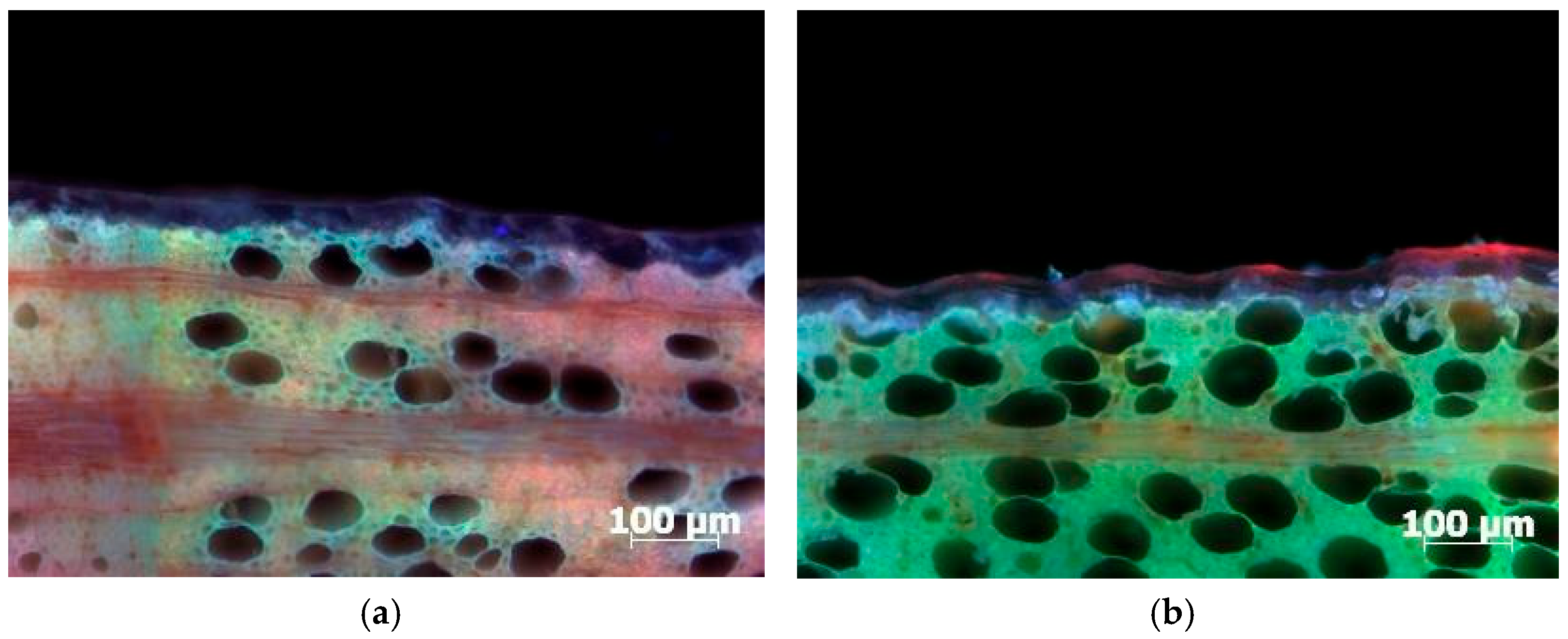
The depth of WTAC and polyelectrolyte penetration was determined by overlapping fluorescence micrographs obtained with different filters under epi-fluorescence microscopy (Figure 2). For each group, 30 microtome sections were examined (270 images in total). The maximum (Dmax) and average (Dav) penetration depths were measured on each image using ImageJ software (version 1.46), following the method of Van den Bulcke et al. [36,37]. The penetration surface (PS) was defined as the area between the highest and lowest visible coating points, and the areas of filled (ALF) and available (ALA) cell lumens were calculated to determine the mean coating penetration depth.
The WTAC adhesion strength was determined using the pull-off test in accordance with SRPS EN ISO 4624:2023 [38], employing an automatic hydraulic device (POSITest AT-A, DeFelsko, Ogdensburg, NY, USA). Steel seals (20 mm diameter) were bonded to the coated surface with two-component epoxy adhesive (Epoxy Universal, Bison, Zoetermeer, The Netherlands) and dried for 24 h under ambient conditions. The coating was then cut around each dolly, which was pulled vertically at a rate of 0.7 MPa·s−1 until failure.
The parameters DFT, surface roughness, adhesion strength, and WTAC penetration depth were statistically analysed using IBM SPSS Statistics 20. Differences among the groups were evaluated by analysis of variance (ANOVA) to identify statistically significant variations. When the assumption of variance homogeneity was confirmed with Levene’s test, ANOVA was applied. When significant differences were detected, Tukey’s HSD post hoc test was applied. In cases where the homogeneity assumption was not met, the Welch test was used, with the Games–Howell post hoc test subsequently applied to identify specific group differences. Statistical analyses were performed using a 95% confidence level (p < 0.05).

3. Results and Discussion

3.1. FT-IR Analysis

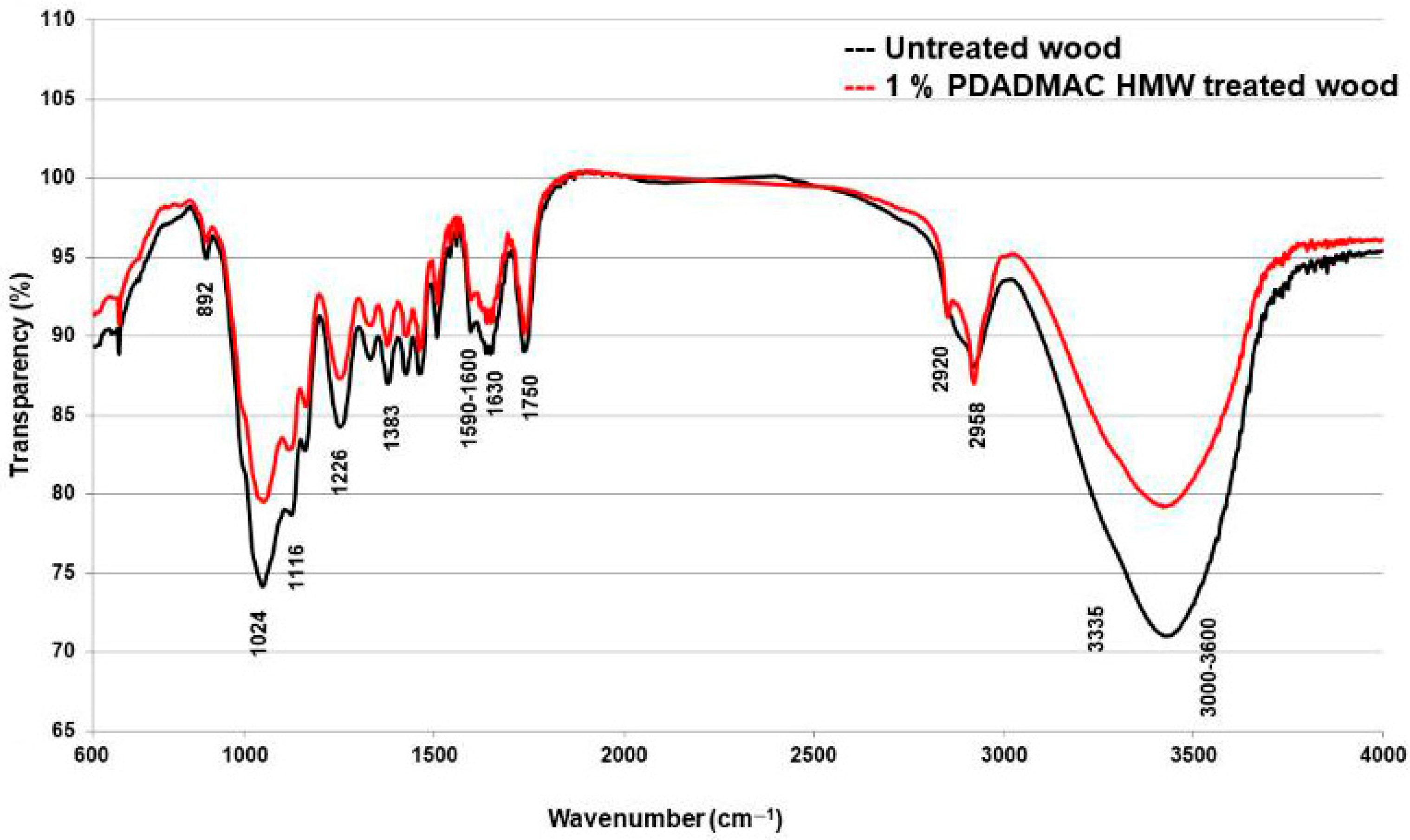
Based on FT-IR analysis, exposure of the wood surface to the 1% PDADMAC HMW solution resulted in distinct, yet subtle, spectral changes compared with the untreated control (Figure 3). The most noticeable change occurred in the broad region between 3600 and 3000 cm−1, typically attributed to hydroxyl stretching and hydrogen-bonded water [39,40]. The reduced intensity in this region suggests a partial loss of adsorbed moisture and rearrangement of hydrogen bonds within the cell wall matrix. Under alkaline conditions, PDADMAC likely penetrates the amorphous domains, disturbing the existing hydrogen-bonded networks among cellulose and hemicellulose chains. This disruption promotes the formation of more compact structures as water is released [41].
Spectral features around 3335 cm−1, associated with intermolecular O–H vibrations in crystalline cellulose [31], remained present but became slightly sharper, which is consistent with the assumption of improved structural ordering after treatment. Such rearrangements can be attributed to the transient separation of cellulose chain planes in the alkaline medium [42], a process that promotes swelling and relaxation of stress within the fibrillar regions. Microscopic observations confirmed minor deformation and expansion of the cell wall surface, corresponding to this molecular reorganisation.
Bands at 2958 cm−1 and 2920 cm−1 showed no measurable shifts [39], implying that the 1% PDADMAC HMW treatment did not change the hydrocarbon backbone of wood polymers. In the carbonyl and aromatic range (1800–1600 cm−1), the bands at 1750 cm−1 and around 1650–1580 cm−1 retained their original profiles, indicating the absence of chemical modification of lignin or hemicellulose.
No additional absorption bands or wavenumber shifts were detected in the fingerprint region below 1600 cm−1. The C–O–C stretching near 1151 cm−1 and the C–O vibrations around 1024 cm−1, characteristic of polysaccharides, showed a noticeable decrease in intensity while their positions remained unchanged. The β-glycosidic linkage band at 892 cm−1 also remained unchanged. Taken together, these FT-IR results suggest that PDADMAC interacts with the wood matrix mainly through electrostatic attraction and hydrogen bonding rather than covalent linkage formation. The observed spectral behaviour thus reflects physical adsorption and structural adjustment rather than chemical interactions, which can be attributed to the spatially cyclic structure of PDADMAC.
Table 2 lists the characteristic FT-IR bands of wood components obtained from the literature, which were used as a reference for the interpretation of the spectra in this study.

3.2. Penetration Depth of PDADMAC Solution

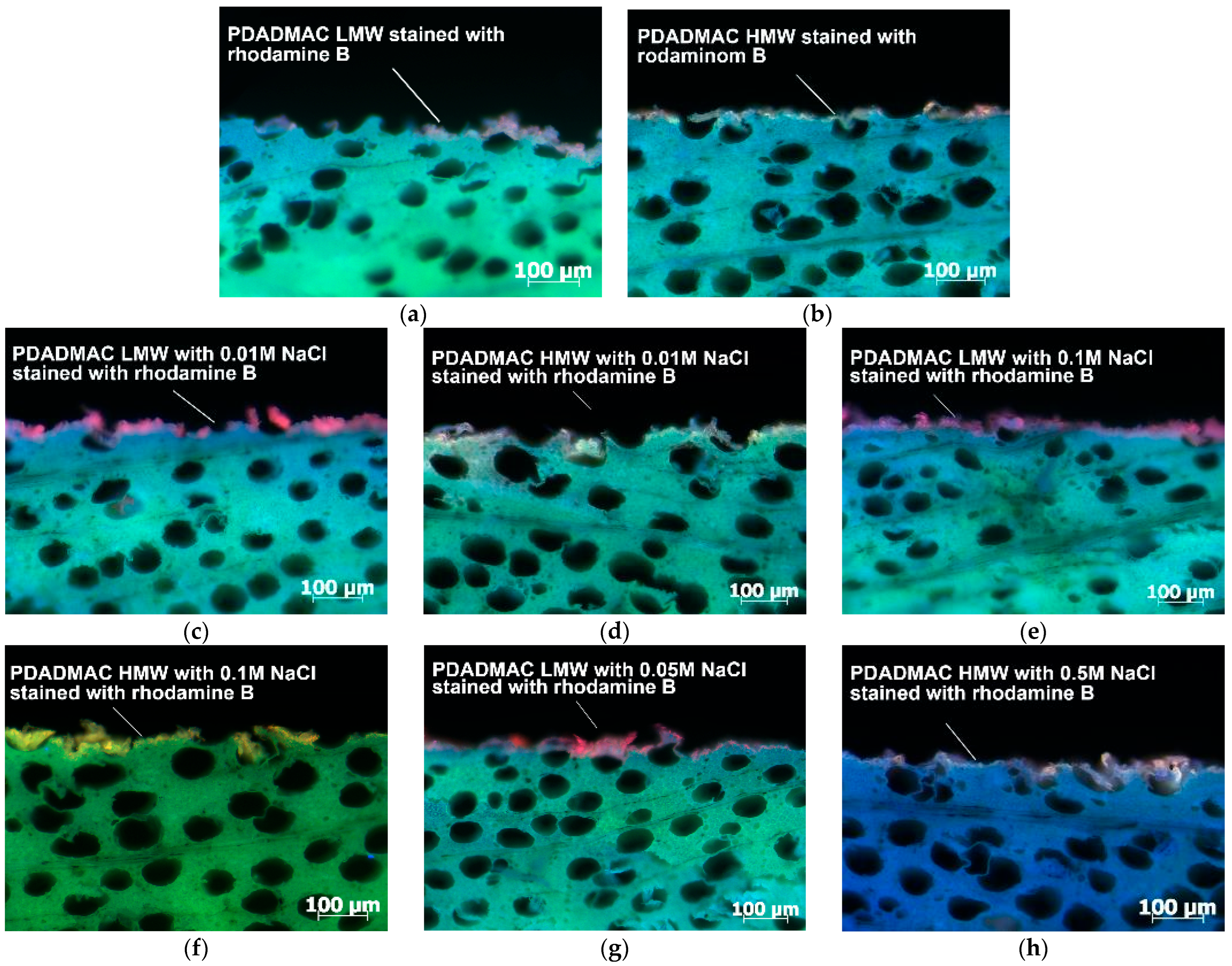
By superimposing images captured with an epi-fluorescence microscope equipped with different filters (DAPI, FAM, and DsRed), the penetration depth of the polyelectrolytes could be clearly visualised, as they are made visible through the fluorescence of rhodamine B (Figure 4). PDADMAC remained confined to the surface layer, and variations in molecular weight were not observed in the treated wood. This result aligns with earlier research on PEI penetration [15], which demonstrated that molecular weight does not influence depth of penetration into the wood structure. Moreover, adding salts to PDADMAC solutions did not influence the penetration behaviour of the polyelectrolyte, according to qualitative observations.
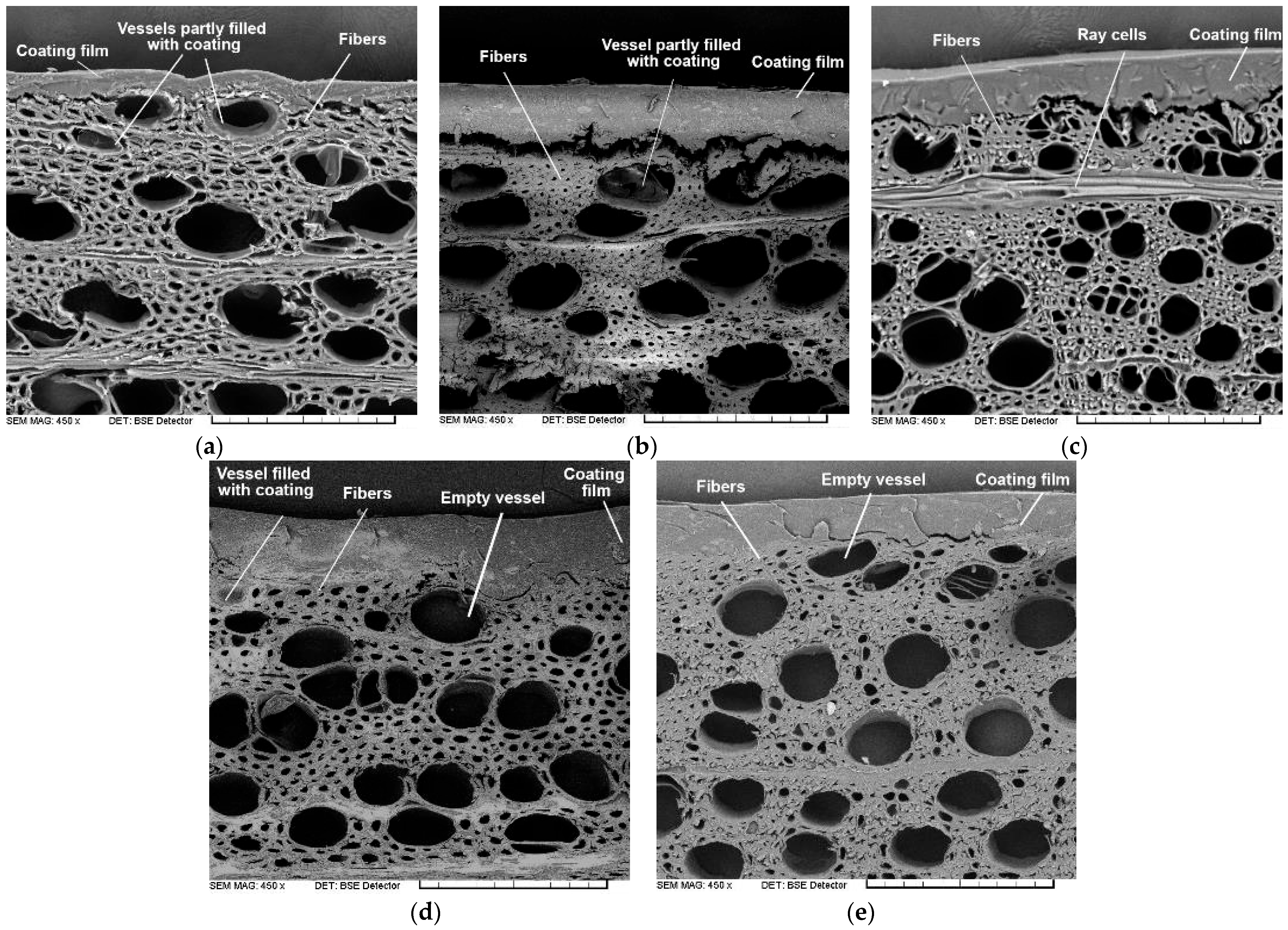
As shown in the SEM images (Figure 5), the samples treated with PDADMAC solutions display clear differences in cell structure between the surface layers and the deeper regions of the wood. The most noticeable change is the reduction in the lumen of wood fibres in the outermost cell rows of the treated samples (Figure 5b,c). This indicates that the bulking of cell wall occurred due to the deposition of polyelectrolytes, resulting in an increase in wall volume. Furthermore, the texture of the surface cells in the treated samples appears noticeably smoother (Figure 5b–e), which may be attributed to improved mechanical integrity of the wood resulting from cell wall filling. Consequently, the treated surfaces exhibit a smoother microtome cut during sectioning. In terms of WTAC penetration into beech wood, vessel lumen filling was observed in only a few cells within the first cell row in both untreated (Figure 5a) and treated samples (Figure 5b–e). These observations have previously been confirmed in SEM images of PEI penetration into beech wood [15].
SEM images showed that in most samples, partial detachment of the coating film from the wood surface occurred (Figure 5a–c), likely due to microtome preparation, where the knife blade impacts the coating layer. In contrast, samples treated with 1% PDADMAC (both low and high molecular weight) containing 0.1 M NaCl showed no coating detachment (Figure 5d,e), indicating improved coating adhesion under these treatment conditions.
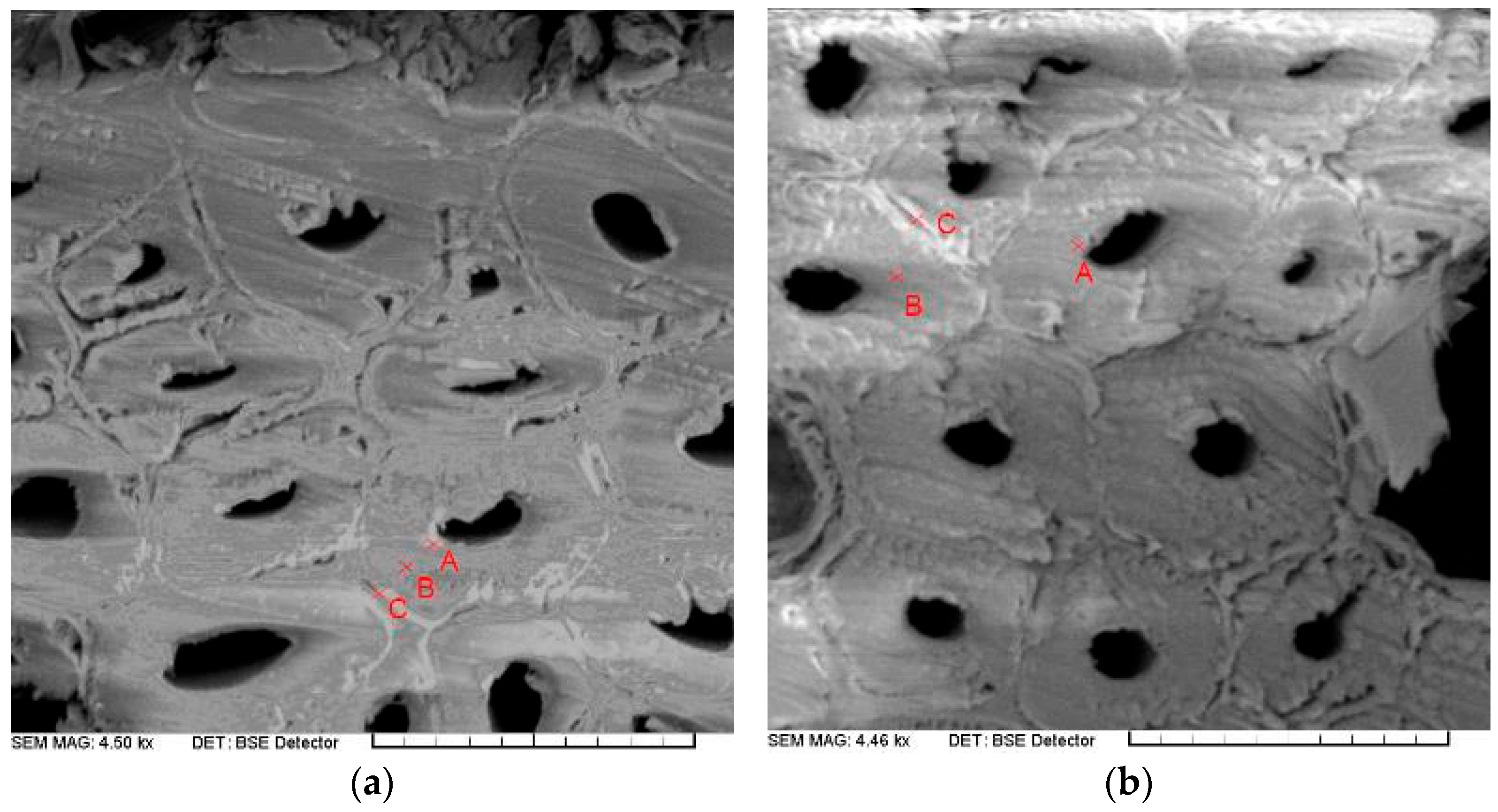
In the SEM images (Figure 6), an example is shown of the measurement points used for EDS analysis of a sample treated with a 1% PDADMAC LMW solution, taken both from the surface layer (a) and from a deeper, inner region (b) of the sample, observed in the cross-section relative to the coating film.
Table 3 presents the results of the EDS analysis showing the contents of carbon, oxygen, and chlorine at different observation layers and measurement points in samples pretreated with a 1% aqueous PDADMAC LMW solution before coating. The measurement points were selected in regions relevant to material transport through the wood cells:
Point A—located at the boundary of the inner secondary cell wall (S3) layer, on the lumen side;
Point B—positioned within the inner secondary cell wall (S2) layer;
Point C—situated in the region of the compound middle lamella and the primary cell wall.
The location and content of PDADMAC LMW within the wood cells were evaluated using chlorine concentration data obtained from the EDS analysis. The results indicate that the average chlorine content, and thus the amount of polyelectrolyte, in the surface layer of the samples (0.63%) is approximately 1.4 times higher than in the deeper, inner layer (0.46%).
Regarding the measurement points, the highest chlorine concentration was detected in the compound middle lamella region (point C), while the lowest was recorded in the inner secondary wall (point B), regardless of the layer observed. However, the overall chlorine content in the surface layer was almost twice as high as in the inner layer at corresponding positions, approximately 1.8 times higher in the middle lamella region and 1.6 times higher in the cell wall interior.
In the surface layer, differences in chlorine concentration at various measurement points (Table 3) show that the polyelectrolyte content near the compound middle lamella (point C) is 2.4 to 2.9 times higher than in the regions close to the lumen (point A) and in the inner secondary cell wall (point B), respectively. The nearly uniform chlorine content observed within the secondary cell wall at positions A and B suggests that low-molecular-weight PDADMAC successfully penetrated into the cell wall structure.
In the deeper (inner) layers of the samples, a clearer difference in chlorine concentration (Table 3) was recorded between the outer layers of the cell wall (points A and C) and the inner-wall layer (point B). The chlorine content in the inner regions of the samples was 2.3 to 2.4 times higher in the boundary layers (points A and C) compared to the inner part of the secondary wall (point B), indicating limited penetration capability.
Although EDS analysis provides only approximate quantitative data, these results confirm that low-molecular-weight PDADMAC is capable of penetrating the cell walls, likely moving through the cell lumens and subsequently being transported into the deeper wood tissue regions.
The EDS analysis results measured at different observation layers and points in samples pretreated with a 1% PDADMAC HMW solution prior to coating showed that the higher molecular weight of the polyelectrolyte resulted in a different distribution pattern of the polymer within the wood cells compared to that observed for the low-molecular-weight PDADMAC (Table 3). The trend of a higher polyelectrolyte concentration in the surface layers compared to the inner wood layers was also confirmed for the high-molecular-weight polyelectrolyte. However, the chlorine concentration in the surface layer (2.91%) was approximately 5.9 times higher than that measured in the deeper layers (0.49%) of the wood tissue.
In both the surface and inner layers, the highest chlorine content (Table 3) was found in the cell wall region near the lumen (point A). The chlorine concentration decreased at the other measurement points, with values in the compound middle lamella (point C) and the inner secondary wall (point B) being 4–4.3 times lower in the surface layer. In the inner layer of the sample, chlorine levels at points C and B were 2.5–3.1 times lower than at point A near the lumen. These findings indicate a limited penetration capacity of high-molecular-weight PDADMAC into the cell wall interior. As the distance from the surface increased, this effect became less pronounced. The reduction in chlorine concentration in the inner layer compared to the surface layer was relatively uniform across all measurement points: approximately 85% at point A, 80% at point B, and 77% at point C.
The EDS analysis of samples treated with PDADMAC of different molecular weights confirmed distinct treatment effects regarding the chlorine concentration at various positions within the wood cells. The average chlorine content in the surface layer was higher than in the inner layer in both cases, but this difference was much more pronounced for samples treated with high-molecular-weight PDADMAC (≈83%) than for those treated with the low-molecular-weight form (≈26%).
Although high-molecular-weight polyelectrolytes are generally considered unable to penetrate wood cell walls, the EDS results indicate that some penetration occurred. This can be attributed to cell wall swelling in the presence of molecules capable of forming and breaking hydrogen bonds between the wood’s structural components, thus facilitating diffusion through the cell wall [53]. Additionally, the water in the solution likely contributed to this process by promoting swelling and pore opening, enhancing the transport of the polyelectrolyte into the inner wood structure.
A research paper on fluorescent complexes of pDADMA+ with sulfonated rhodamine [54] demonstrates that dye binding to the polycation is strongly dependent on ionic strength. At elevated Cl concentrations, the complexes dissociate because Cl competes with the dye for the positively charged sites along the chain. The same research concluded that dye binding also depends on the polymer molecular weight, with a preference for lower-molecular-weight complexes, which are simultaneously more sensitive to changes in solution composition.
Based on this, the discrepancy between the EDS and epi-fluorescence images in the PDADMAC LMW samples can be explained as follows: PDADMAC LMW is present throughout the bulk, as indicated by the uniform Cl signal. However, in the inner layers, the higher local salt content and greater susceptibility of LMW complexes to dissociation result in predominantly dissociated PDADMAC–rhodamine complexes and, consequently, the absence of detectable fluorescence. At the surface, where the ionic strength is lower and exchange with the dye is more efficient, more stable complexes are formed, giving rise to the observed fluorescent surface layer.
EDS analysis was not conducted for samples treated with PDADMAC contacting NaCl, since Cl content cannot be reliably interpreted, as it is not possible to differentiate between Cl originating from NaCl and Cl associated with PDADMAC.

3.3. Surface Characterisation of the Treated Samples

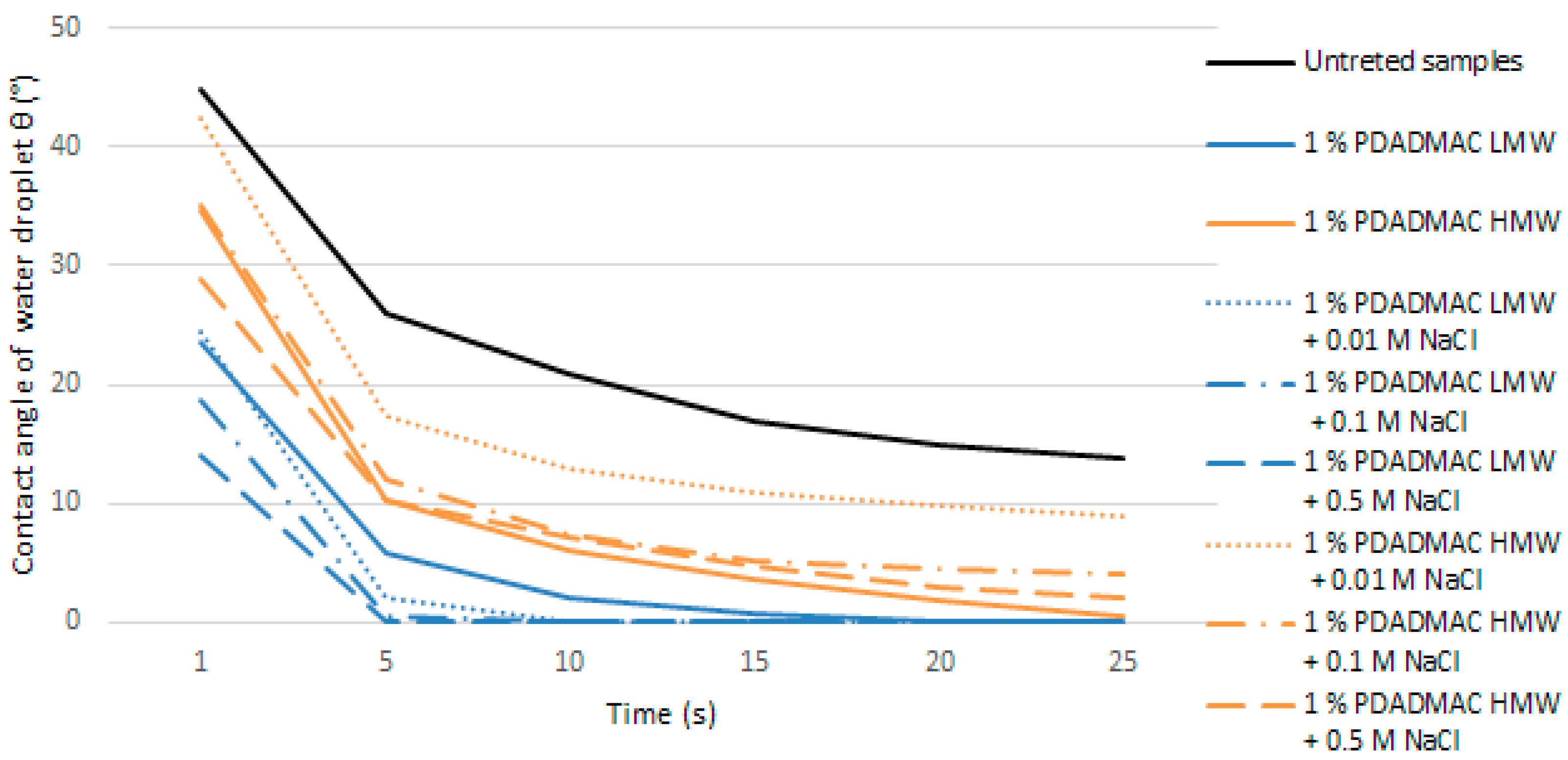
The change in water droplet contact angle over time on the surfaces of both control and treated samples is shown in Figure 7.
As expected, the initial contact angle of the water droplet on the surface of untreated beech samples (observed in the first second) showed typical values. In research on the influence of different treatments of beech wood (Fagus sylvatica L.), the contact angle was 52.4° [55]. The slightly higher value observed here can be explained by measurement immediately after the droplet was deposited and differences in the surface preparation of the samples.
Compared to untreated samples, all samples treated with PDADMAC solutions exhibited lower contact angles, indicating improved wettability throughout the entire observation period. This suggests that polyelectrolyte treatment can modify the wood surface, as confirmed by previous studies [11,15]. The molecular weight of the PDADMAC solution clearly affects the water wettability of the surface of beech samples treated with polyelectrolyte solution. The best wettability with water was achieved in samples treated with PDADMAC LMW, which is consistent with our previous study’s results [15], where the surface of the samples was treated with a low-molecular-weight PEI solution. Treatment with PDADMAC HMW resulted in higher contact angle values, but these remained below those of untreated samples. In contrast, samples treated with a higher-molecular-weight PEI solution disclosed worse wettability than untreated samples at all observed concentrations [15].
The amount of added salt in the solution influenced the wettability of samples treated with 1% PDADMAC solutions of both low and high molecular weight. The lowest contact angle was observed in samples treated with a PDADMAC LMW solution containing 0.5 M NaCl. As the amount of NaCl in the PDADMAC solution used for treatment increased, the wettability of the treated samples improved, with this effect being more pronounced in samples treated with the PDADMAC LMW solution. The addition of NaCl did not mask the influence of molecular weight on the treated samples’ wettability, as those treated with PDADMAC HMW solutions exhibited lower wettability compared to samples treated with PDADMAC LMW solutions, regardless of the amount of added salt.
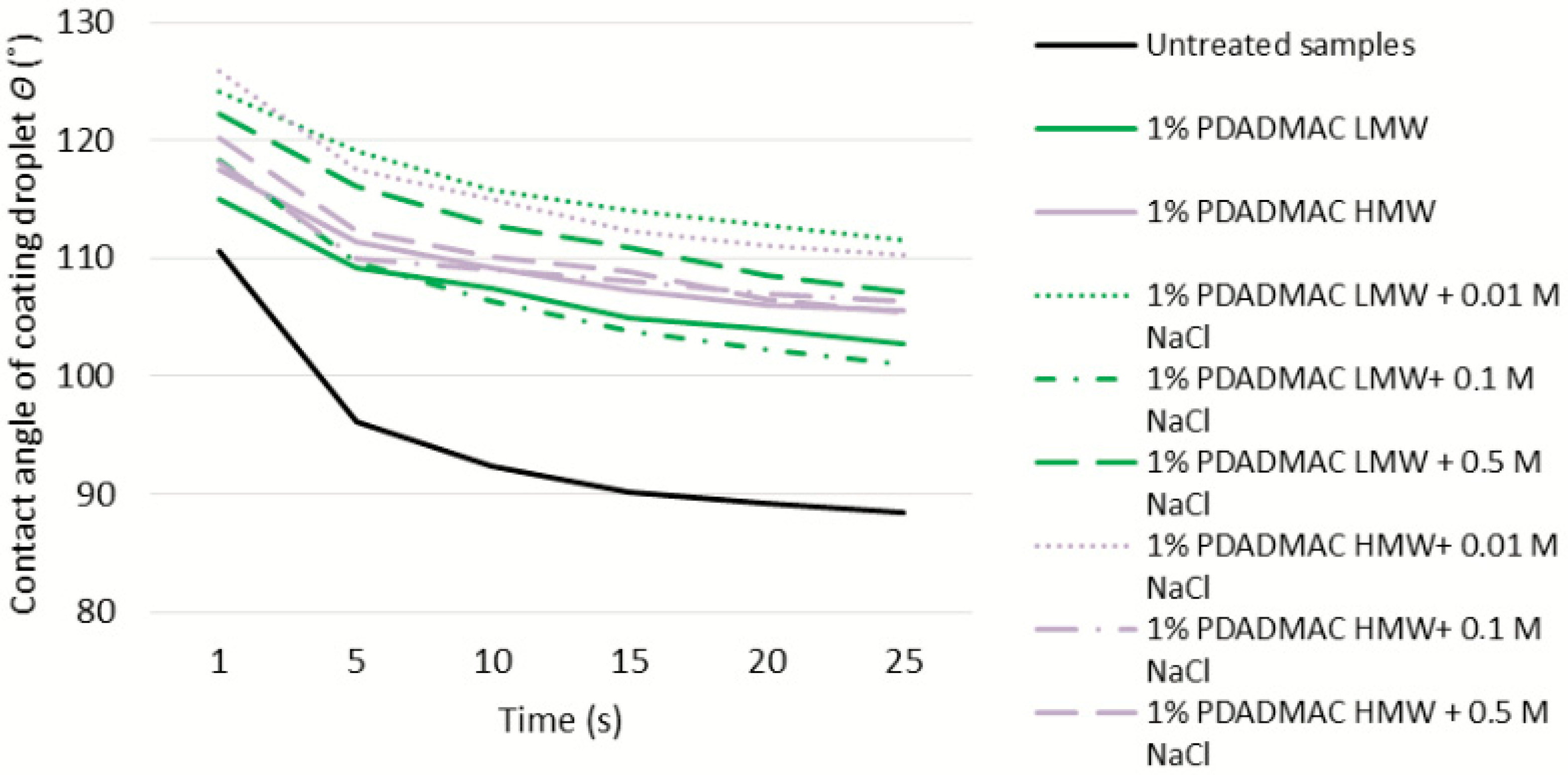
The wettability of samples treated with 1% PDADMAC of different molecular weights, with or without added NaCl, by the WTAC was evaluated based on the contact angle values of the WTAC coating droplet (Figure 8).
Based on the contact angle values, all treated samples showed weaker wettability with the WTAC compared to untreated samples. Regarding the molecular weight of the polyelectrolyte solution, without salt addition, better wettability was achieved by treating samples with PDADMAC LMW. This aligns with previous research, where a clear influence of polyelectrolyte molecular weight on the wettability of surfaces treated with WTAC was detected in treated samples with PEI solutions [15].
The addition of salt to the 1% PDADMAC solutions of both low and high molecular weight did not significantly affect the contact angle values of the WTAC droplets on the surfaces of treated samples. Through the addition of NaCl, the best wettability with the WTAC was observed in treated samples with a 1% PDADMAC solution containing 0.1 M NaCl. In research on the dielectric and wood surface properties modified with NaCl aqueous solutions [23], the contact angle of the waterborne coating was slightly lower on modified wood surfaces with NaCl at lower concentrations (0.3–1.2 M) than on untreated samples.

3.4. Wood Surface Energy

The results of surface energy determination for samples treated with PDADMAC solutions are presented in Table 4.
For treated samples with PDADMAC solutions of both molecular weights without salt addition, samples exhibited higher γAB values. Adding NaCl to the 1% PDADMAC LMW solution increased γLW values (by 2%–5%), while the γAB component decreased (by 12%–26%), depending on the salt concentration, compared to samples treated with the same solution without NaCl. A similar trend was observed for samples treated with 1% PDADMAC HMW solutions containing NaCl, though the changes were less pronounced (an increase in γLW up to 2% for 0.1 M NaCl and a decrease in γAB by 8%–12% for 0.1 M and 0.5 M NaCl, correspondingly). The only deviation from this pattern was found in samples treated with 1% PDADMAC LMW solution containing 0.01 M NaCl, which showed a 5% decrease in γLW and a 20% increase in γAB compared to samples treated with the same solution without NaCl.
In contrast to treatment with PEI HMW solutions, which resulted in significant reductions in total surface energy (by 16.7%, 23.2%, and 29.1% for concentrations of 0.5%, 1%, and 2%, respectively, compared to untreated wood), only small differences in surface energy were observed in samples treated with PDADMAC solutions of both molecular weights, with and without salt addition. This indicates that the type and conformation of the polyelectrolyte are crucial for modifying the wood surface.

3.5. Water Absorption

Analysis of water absorption results showed that the mass of absorbed water increased with contact time between the water droplet and the wood surface for all samples. Frenzel et al. [11] reported that wood species affect the water absorption rate: in Scots pine (Pinus sylvestris) veneer, maximum absorption occurred within the first two minutes and then remained constant, while in oak (Quercus robur) veneer, water uptake continued to increase for up to five minutes. These differences were attributed to the lower density of Scots pine compared to oak. Interestingly, the presence of large pores in oak did not result in faster absorption. The water absorption behaviour of untreated beech wood over the same time intervals (1, 2, and 5 min) was like that of oak veneer, confirming that density strongly influences water absorption.
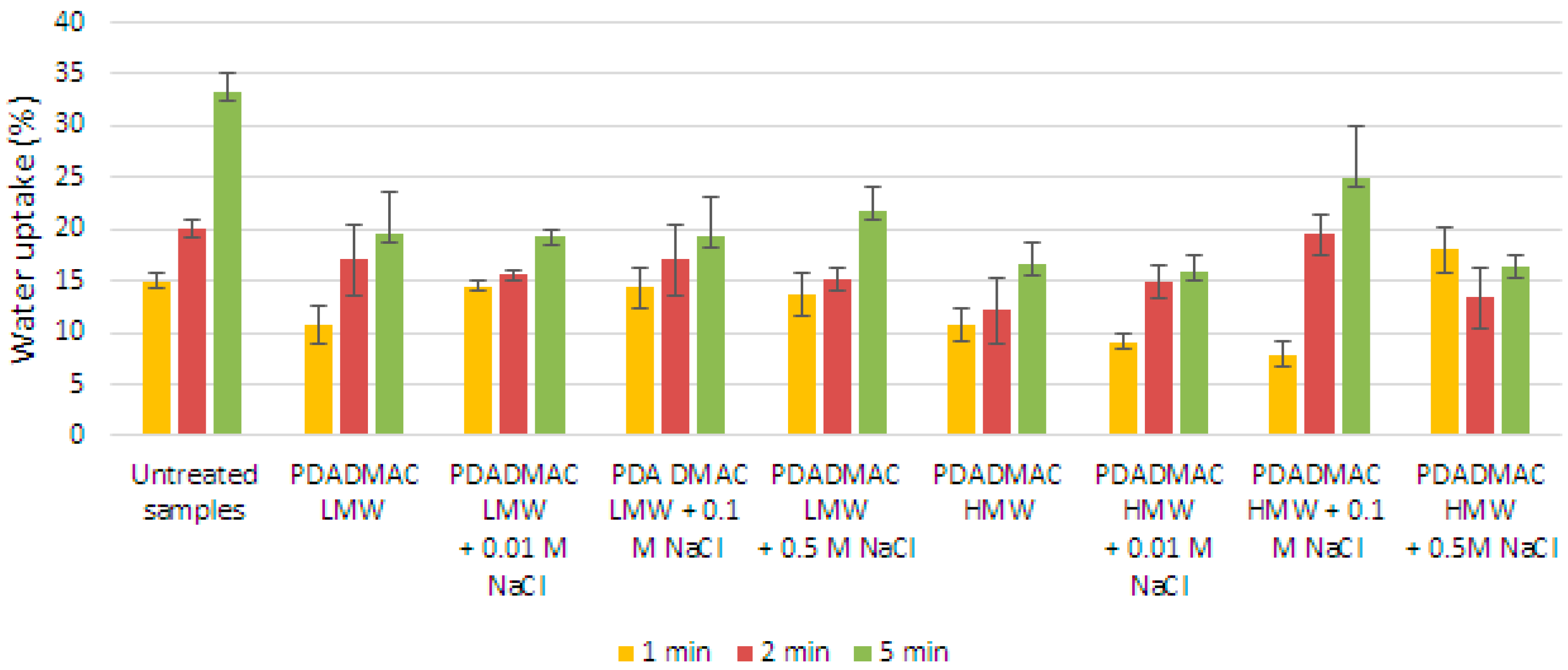
In general, treatment with polyelectrolyte solutions resulted in lower water absorption in all samples relative to the untreated ones (Figure 9).
Analysis of the influence of polyelectrolyte molecular weight on water absorption showed that using polyelectrolytes with high molecular weight results in lower water absorption compared to treated samples with low-molecular-weight polyelectrolytes of the same type. As high-molecular-weight polyelectrolytes have limited ability to penetrate the cell wall, they primarily coat the lumen surfaces, forming a barrier that hinders water molecule penetration into the wood structure.
Adding salt to the polyelectrolyte solution alters its conformation (into a coiled form), enabling greater adsorption of the polyelectrolyte on the wood surface. Salt addition also reduces wood swelling by releasing bound ionisable groups in cellulose, thereby lowering the osmotic gradient [41]. However, comparison of samples treated with 1% PDADMAC solutions (both low and high molecular weight) with and without salt showed that NaCl addition did not reduce water absorption. Lower wood swelling in the presence of salt enables the formation of a double electrical layer in nanoscopic cell wall pores [56]. Because these pores are extremely small, large polyelectrolyte molecules cannot penetrate them. Nevertheless, the coiled conformation allows diffusion into larger subsurface pores, potentially introducing water molecules deeper into the structure and slightly increasing absorption.
This behaviour supports the use of polyelectrolytes as effective agents for reducing wood swelling and, consequently, surface roughness in wood-finishing processes.

3.6. Wood Surface Roughness After PDADMAC Treatment

The average surface roughness parameter Ra of all beech wood samples before polyelectrolyte treatment was 3.412 µm. Table 5 shows the effect of adding salt to a 1% PDADMAC solution of low and high molecular weight on the surface roughness Ra of the treated wood surface.
The addition of NaCl, regardless of the amount, to a 1% solution of PDADMAC LMW resulted in a statistically lower roughness of the treated surface compared to samples treated with the same solution without the addition of salt. In treated samples with a 1% PDADMAC HMW solution, the addition of NaCl statistically significantly reduced the Ra roughness of the treated surface only when the salt was added at a concentration of 0.1 M.

3.7. Dry Film Thickness of WTAC

Table 6 presents the results of the dry film thickness of WTAC on untreated and treated samples.
Welch Anova test (F(8, 108.549) = 5.402, p < 0.05) showed significant differences in DFT of WTAC among the different groups and subgroups of samples. Post hoc analysis with the Games–Howell test showed that the highest DFT on samples treated with 1% PDADMAC HMW with the addition of 0.5 M NaCl was statistically significant. This result can be explained by the dense conformations of PDADMAC polymer chains when adding a larger amount of salt (0.5 M NaCl), which forms a barrier on the surface of the samples that prevents penetration into the deeper wood layers. Since the DFT of WTAC on the samples treated with PDADMAC HMW, without and with the addition of a smaller amount of salt (0.01 M and 0.1 M), was not higher compared to untreated samples, the conformation of the polymer is important for forming a homogeneous and effective barrier to the penetration of the coating into the wood tissue.
On the other hand, it can be concluded that deeper penetration of PDADMAC LMW into the inner layers of wood, as confirmed by EDS analysis (Table 3), reduces the barrier effect of the polyelectrolyte on the wood surface, resulting in DFT values like those of untreated samples.

3.8. Penetration Parameters of WTAC

The fundamental parameters of WTAC penetration for both untreated and treated samples are shown in Table 7.
The measured mean penetration depths of the WTAC into beech wood were within the expected limits, as previous studies on waterborne acrylic coatings with similar properties reported penetration depths of about 50 µm [36]. The relatively low penetration depths observed in both untreated (Dav = 43.3 µm) and treated samples (Dav = 39.5 µm) are likely due to the high viscosity of the coating.
The filling of the lumens with WTAC was significantly higher in samples treated with the PDADMAC solutions of both molecular weights. The most favourable combination of Dav, Dmax, and LF was observed in samples treated with PDADMAC HMW solution with added salt, compared to untreated samples. The addition of salt to the PDADMAC HMW solution resulted in higher Dav, Dmax, and a significantly higher percentage of lumen filling (about 65% higher LF at the addition of 0.01 M and 0.1 M salt). In contrast, samples treated with PDADMAC LMW solution, with or without added salt, showed lower coating penetration depth (Dav and Dmax) compared to untreated samples, although the LF was higher (except for samples treated with an additional 0.5 M NaCl).
Comparison of the average penetration depth (Dav) of the WTAC showed a statistically significant difference (F = 9.97; p < 0.0005) between untreated samples and those treated with PDADMAC solutions. Samples treated with a 1% PDADMAC HMW solution containing 0.01 M or 0.1 M NaCl exhibited greater penetration depth than untreated samples, while samples treated with a 1% PDADMAC LMW solution contained 0.1 M NaCl. Similarly, for the maximum penetration depth (Dmax), a statistically significant difference (F = 16.38; p < 0.0005) was observed between untreated samples and those treated with various PDADMAC solutions. The greatest penetration was found in samples treated with a 1% PDADMAC HMW solution containing 0.1 M NaCl. Significant differences were also recorded for samples treated with 1% PDADMAC LMW solutions containing 0.01 M and 0.1 M NaCl. The influence of a high molecular weight on the depth of penetration of WTAC was not confirmed for samples treated with solutions without the addition of salt (of high molecular weight).
In our previous research on the penetration of the same coating on samples treated with PEI solution, lower penetration depths (Dav and Dmax), as well as lower LF, are recorded in all treated samples [15], confirming that the type of polyelectrolyte is a key parameter affecting penetration.

3.9. The Adhesion Strength of WTAC

Statistical analysis of the adhesion strength of WTAC on wood surfaces revealed a significant difference between untreated samples and those treated with specific polyelectrolyte solutions F(8, 261 = 8.972; p < 0.05). Adhesion strength results were considered only when failure occurred at the wood–coating interface. Table 8 presents the adhesion strength of the WTAC for both control and treated samples, shown in subgroups according to statistical differences determined by Tukey’s post hoc test.
Treatments with 1% PDADMAC LMW solutions containing 0.01 M and 0.5 M NaCl led to a reduction in the adhesive bond strength between the WTAC and the wood substrate. This result may be due to the combined effect of the reduced average coating penetration depth (Table 7) and the chemically weakened interfacial layer formed at the coating–wood interface. In contrast, adhesion strength values for the other subgroups were comparable to those of the untreated samples.
Morphological analysis (SEM; Figure 5 and Figure 6) showed that treatment with polyelectrolytes resulted in partial filling of the cell walls, which may reduce the mechanical properties of the wood surface layer by decreasing the number of microfibrils per unit area [57]. As coating adhesion is influenced by the mechanical characteristics of the substrate [58], this effect may weaken the coating–substrate bond. However, the increased surface roughness observed after treatment enlarged the real contact area (Table 5), enhancing mechanical interlocking—one of the dominant adhesion mechanisms of waterborne coatings [58]—which may partially compensate for the loss in adhesion strength.

3.10. The Surface Roughness of the Wood’s Coated Surface

The measured values of the surface roughness parameters for the control (untreated) samples and samples treated with 1% PDADMAC solutions, of different molecular weight, with and without NaCl addition in different concentrations before coating with WTAC are presented in Table 9. Statistical analysis of the surface roughness parameters (Ra, Rz, and Rt) confirmed that treatment of beech wood with PDADMAC solutions of both molecular weights reduced the surface roughness of the WTAC. The addition of NaCl to 1% PDADMAC solutions (both LMW and HMW) further reduced roughness, confirming the beneficial effect of salt in improving surface smoothness (Table 9). The addition of NaCl, regardless of its concentration, to 1% PDADMAC LMW solutions resulted in a statistically significant reduction in the surface roughness of the coated samples compared to those treated with the same solution without salt. For samples treated with 1% PDADMAC HMW, a significant increase in Ra roughness was observed only when 0.5 M NaCl was added.
In the case of PDADMAC LMW, with the addition of salt, the polyelectrolytes adopt a “coiled” form that carries the fewest water molecules, and in this form, they penetrate into the cell walls. It is assumed that the coiled conformation of the low-molecular-weight polyelectrolyte enabled a greater degree of penetration and filling of the cell walls, thereby reducing the possibility of physical absorption of water from the WTAC. This is supported by the very small difference in the degree of water absorption over time in the samples treated with the PDADMAC LMW solution with added salt (Figure 9). Filling of the cell walls may have narrowed the lumens, which serve as the penetration paths of the coating, thereby reducing the depth of coating penetration into the wood. The lowest WTAC penetration depth, measured in samples treated with the PDADMAC LMW solution with added salt, supports this finding (Table 7).
The conformation also changes in PDADMAC HMW with the addition of salt. In samples treated with the PDADMAC HMW solution, adding salt to the solution likely enabled the formation of a dense network of polymer chains on the surface, which prevented water molecules from penetrating into the deeper layers. This is supported by the highest WTAC penetration depth observed in these samples (Table 7). The high values of Ra of the coated surface can be explained by the increased interaction between water molecules and the surface fibres of the wood, due to reduced penetration of water molecules into the inner wood layers.
The effect of adding NaCl to the PDADMAC solution on the Rz and Rt values of the coated surface is like that observed for Ra; lower roughness is achieved when treatment is performed with a low-molecular-weight PDADMAC solution containing added salt.
Based on the results for wettability, surface energy, water absorption, and surface roughness, it can be concluded that treatment with 1% PDADMAC solutions modifies the wood surface.

4. Conclusions

This study showed that surface pretreatment of beech wood with the cationic polyelectrolyte, poly(diallyldimethylammonium chloride) (PDADMAC), significantly alters its surface properties and affects the performance of waterborne coatings. PDADMAC acted as an effective surface-active agent, forming a uniform cationic layer that improved surface homogeneity, increased water wettability while reducing wettability with WTAC, reduced roughness, and enhanced water absorption of the wood without adversely affecting coating adhesion. Regarding molecular weight, treatment with lower-molecular-weight PDADMAC resulted in better wettability with water and WTAC, accompanied by a greater decrease in surface energy compared to untreated samples. In contrast, treatment with higher-molecular-weight PDADMAC, which remained on the wood surface, led to reduced water absorption and exhibited the highest adhesion strength values for WTAC (within the range of untreated samples). However, the higher-molecular-weight PDADMAC treatment also limited the average and maximum penetration depth of the WTAC compared to untreated samples and significantly reduced all roughness parameters of coated wood (Ra, Rz, and Rt decreased by 41%–45% compared to untreated coated wood).
The addition of NaCl to PDADMAC solutions promoted conformational rearrangement of the polymer chains, resulting in more compact adsorption, improved surface smoothness, and a slight increase in coating penetration, particularly for the high-molecular-weight variant. However, the impact of salt addition on the interaction between wood and coating varied depending on the molecular weight of the PDADMAC solution and the salt concentration used. Within the PDADMAC LMW treatment, adding salt reduced the adhesion strength of WTAC but improved the surface roughness of coated wood. On the other hand, when salt was added to the PDADMAC HMW solution, it either preserved or enhanced the coating’s adhesion strength, although the surface roughness of coated wood increased. The best adhesion strength of WTAC on wood was achieved with a 0.1 M salt concentration in the PDADMAC LMW solution, yielding an adhesion strength of 3.21 MPa. Meanwhile, the lowest surface roughness of coated wood was recorded with a 0.01 M salt concentration in the PDADMAC LMW solution (a reduction in Ra, Rz, and Rt by 23%–29%, compared to samples coated with 1% PDADMAC LMW). Within the treatment with PDADMAC HMW solution, the addition of 0.01 M NaCl proved to be the best in terms of adhesion strength, reaching 3.63 MPa. Additionally, it resulted in the smallest increase in surface roughness of the coated samples compared to those treated with PDADMAC HMW without salt, considering all roughness parameters (an increase in Ra, Rz, and Rt by 14%–24%, compared to samples coated with 1% PDADMAC LMW).
Compared to the polyethyleneimine (PEI) examined in our previous study, which penetrated deeper into the cell walls and acted through hydrogen bonding, PDADMAC primarily interacted electrostatically with negatively charged wood components, resulting in more controlled and stable surface modification. The 1% PDADMAC HMW solution with 0.1 M NaCl provided the most favourable balance of surface smoothness, coating uniformity, and adhesion performance.
These findings confirm that PDADMAC, due to its permanent quaternary ammonium charge and structural stability in aqueous systems, is a promising and environmentally compatible option for modifying wood surfaces prior to finishing with waterborne coatings. The study offers a deeper understanding of the role of molecular weight, ionic strength, and electrostatic interactions in optimising coating–substrate compatibility and enhancing the durability and aesthetic quality of waterborne finishes.

Author Contributions

Conceptualization, T.P.; methodology, T.P., M.R. and D.D.; validation, M.P. (Marko Petrič) and M.R.; formal analysis, T.P., M.P. (Matjaž Pavlič), D.D., M.R. and M.P. (Marko Petrič); investigation, T.P., M.R., M.P. (Matjaž Pavlič) and D.D.; resources, T.P., M.R. and D.D.; data curation, T.P., M.P. (Matjaž Pavlič), D.D. and M.R.; writing—original draft preparation, T.P.; writing—review and editing, M.R., M.P. (Marko Petrič) and M.P. (Matjaž Pavlič); visualisation, T.P. and D.D.; supervision, M.P. (Marko Petrič); project administration, T.P. All authors have read and agreed to the published version of the manuscript.

Funding

This research was funded by the Ministry of Science, Technological Development and Innovation of the Republic of Serbia, grant number 451-03-137/2025-03/200169 and grant number 451-03-136/2025-03/200053, and by the Slovenian Research and Innovation Agency ARIS under the program P4-0015 (wood and lignocellulosic composites).

Institutional Review Board Statement

Not applicable.

Data Availability Statement

The dataset of the presented research is available on Zenodo, an open-access research data repository: https://doi.org/10.5281/zenodo.17986411.

Conflicts of Interest

The authors declare no conflicts of interest.

References

  1. Meyer, F.; Elliot, T.; Craig, S.; Goldstein, B.P. The Carbon Footprint of Future Engineered Wood Construction in Montreal The Carbon Footprint of Future Engineered Wood Construction in Montreal. Environ. Res. Infrastruct. Sustain. 2024, 4, 015012. [Google Scholar]
  2. Blanchet, P.; Breton, C. Wood Productions and Renewable Materials: The Future Is Now. Forests 2020, 11, 657. [Google Scholar] [CrossRef]
  3. Jirouš-Rajković, V.; Miklečić, J. Enhancing Weathering Resistance of Wood—A Review. Polymers 2021, 13, 1980. [Google Scholar] [CrossRef]
  4. Hang, J.; Yan, X.; Li, J. A Review on the Effect of Wood Surface Modification on Paint. Coatings 2024, 14, 1313. [Google Scholar] [CrossRef]
  5. Landry, V.; Pierre, B. Surface Preparation of Wood for Application of Waterborne Coatings. For. Prod. J. 2012, 62, 39–45. [Google Scholar] [CrossRef]
  6. Liu, C.; Xu, W. Effect of Coating Process on Properties of Two-Component. Coatings 2022, 12, 1857. [Google Scholar] [CrossRef]
  7. Topçuoğlu, Ö.; Altinkaya, S.A.; Balköse, D. Characterization of Waterborne Acrylic Based Paint Films and Measurement of Their Water Vapor Permeabilities. Prog. Org. Coat. 2006, 56, 269–278. [Google Scholar]
  8. Copak, A.; Jirouš-Rajković, V.; Živković, V.; Miklečić, J. Water Vapour Transmission Properties of Uncoated and Coated Wood-Based Panels. Wood Mater. Sci. Eng. 2022, 18, 1086–1093. [Google Scholar] [CrossRef]
  9. Rowell, R.M. Understanding Wood Surface Chemistry and Approaches to Modification: A Review. Polymers 2021, 13, 2558. [Google Scholar] [CrossRef] [PubMed]
  10. Delgado, M.Z.; Aranda, F.L.; Hernandez-Tenorio, F.; Garrido-Miranda, K.A.; Meléndrez, M.F.; Palacio, D.A. Polyelectrolytes for Environmental, Agricultural, and Medical Applications. Polymers 2024, 16, 1434. [Google Scholar] [CrossRef]
  11. Frenzel, R.; Swaboda, C.; Petzold, G.; Emmler, R.; Simon, F. Controlling the Water Uptake of Wood by Polyelectrolyte Ad-sorption. Prog. Org. Coat. 2011, 72, 88–95. [Google Scholar] [CrossRef]
  12. Simpson, W.; TenWolde, A. Physical Properties and Moisture Relations of Wood. In The Encyclopedia of Wood; Skyhorse Publishing, Inc.: New York, NY, USA, 2007; pp. 3–21. [Google Scholar]
  13. Zhou, Y. Nanoscale Surface Modification of Wood Veneers for Adhesion. Master’s Thesis, Faculty of Virginia Polytechnic Institute and State University, Blacksburg, VA, USA, 2008. [Google Scholar]
  14. Palija, T. The Impact of Polyelectrolyte on Interaction between Wood and Water-Borne Coatings. Ph.D. Thesis, University of Belgrade Faculty of Foresty, Belgrade, Serbia, 2015. [Google Scholar]
  15. Palija, T.; Rančić, M.; Djikanović, D.; Radotić, K.; Petrič, M.; Pavlič, M. Effects of Beech Wood Surface Treatment with Poly-ethylenimine Solution Prior to Finishing with Water-Based Coating. Polymers 2025, 17, 77. [Google Scholar] [CrossRef]
  16. Di Gaudio, F.; Barreca, S.; Orecchio, S. Diallyldimethylammonium Chloride (DADMAC) in Water Treated with Poly-Diallyldimethylammonium Chloride (PDADMAC) by Reversed-Phase Ion-Pair Chromatography—Electrospray Ion-ization Mass Spectrometry. Separations 2023, 10, 311. [Google Scholar]
  17. Razali, M.A.A.; Ahmad, Z.; Ariffin, A. Treatment of Pulp and Paper Mill Wastewater with Various Molecular Weight of PolyDADMAC Induced Flocculation with Polyacrylamide in the Hybrid System. Adv. Chem. Eng. Sci. 2012, 2, 490–503. [Google Scholar] [CrossRef]
  18. Pigareva, V.A.; Senchikhin, I.N.; Bolshakova, A.V.; Sybachin, A.V. Modification of Polydiallyldimethylammonium Chloride with Sodium Polystyrenesulfonate Dramatically Changes the Resistance of Polymer-Based Coatings towards Wash-Off from Both Hydrophilic and Hydrophobic Surfaces. Polymers 2022, 14, 1247. [Google Scholar] [CrossRef] [PubMed]
  19. Li, S.; Mohseni, M. Development of Poly (Diallyldimethylammonium) Chloride-Modified Activated Carbon for Efficient Adsorption of Methyl Red in Aqueous Systems. Clean Technol. 2025, 7, 61. [Google Scholar] [CrossRef]
  20. Razali, M.A.A.; Hanafi, I.; Ariffin, A. Graft Copolymerization of PolyDADMAC to Cassava Starch: Evaluation of Process Variables via Central Composite Design. Ind. Crops Prod. 2015, 65, 535–545. [Google Scholar]
  21. Wagberg, L. Polyelectrolyte Adsorption on Cellulose Fibres—A Review. Nord. Pulp Pap. Res. J. 2000, 15, 586–597. [Google Scholar]
  22. Horvath, A.E. The Effects of Cellulosic Fiber Charges on Polyelectrolyte Adsorption and Fiber-Fiber Interactions. Ph.D. Thesis, Royal Institute of Technology, Stockholm, Sweden, 2006. [Google Scholar]
  23. Žigon, J.; Petrič, M.; Dahle, S. Dielectric and Surface Properties of Wood Modified with NaCl Aqueous Solutions and Treated with FE-DBD Atmospheric Plasma. Eur. J. Wood Wood Prod. 2021, 79, 1117–1128. [Google Scholar] [CrossRef]
  24. ISO 13061-1:2014; Physical and Mechanical Properties of Wood—Test Methods for Small Clear Wood Specimens—Part 1: Determination of Moisture Content for Physical and Mechanical Tests. International Organization for Standardization: Geneva, Switzerland, 2014.
  25. EN ISO 3251:2019; Paints, Varnishes and Plastics—Determination of Non-Volatile-Matter Content. European Committee for Standardization: Brussels, Belgium, 2019.
  26. EN ISO 2811-1:2016; Paints and Varnishes—Determination of Density—Pycnometer Method. European Committee for Standardization: Brussels, Belgium, 2016.
  27. EN ISO 2431:2012; Paints and Varnishes—Determination of Flow Time by Use of Flow Cups. European Committee for Standardization: Brussels, Belgium, 2012.
  28. EN ISO 2555:2018; Plastics—Resins in the Liquid State or as Emulsions or Dispersions—Determination of Apparent Viscosity Using a Single Cylinder Type Rotational Viscometer Method. European Committee for Standardization: Brussels, Belgium, 2018.
  29. ISO 304:1985; Surface Active Agents—Determination of Surface Tension by Drawing up Liquid Films. International Organization for Standardization: Geneva, Switzerland, 1985.
  30. Derrick, M.R.; Stulik, D.; Landry, J.M. Infrared Spectroscopy in Conservation Science; Scientific Tools for Conservation; Getty Conservation Institute: Los Angeles, CA, USA, 1999. [Google Scholar]
  31. Đikanović Golubović, D. Strukturna Ispitivanja Ćelijskog Zida i Lignina Različitog Porekla. Ph.D. Thesis, University of Belgrade, Belgrade, Serbia, 2013. [Google Scholar]
  32. EN 828:2013; Adhesives—Wettability—Determination by Measurement of Contact Angle and Surface Free Energy of Solid Surface. European Committee for Standardization: Brussels, Belgium, 2013.
  33. Chibowski, E.; Perea-Carpio, R. Problems of Contact Angle and Solid Surface Free Energy Determination. Adv. Colloid Interface Sci. 2002, 98, 245–264. [Google Scholar] [CrossRef]
  34. ISO 4287:1997; Geometrical Product Specifications (GPS)—Surface Texture: Profile Method—Terms, Definitions and Surface Texture Parameters. International Organization for Standardization: Geneva, Switzerland, 1997.
  35. EN ISO 2808:2019; Paints and Varnishes—Determination of Film Thickness. European Committee for Standardization: Brussels, Belgium, 2019.
  36. Van den Bulcke, J.; Rijckaert, V.; Van Acker, J.; Stevens, M. Quantitative Measurement of the Penetration of Water-Borne Coatings in Wood with Confocal Lasermicroscopy and Image Analysis. Holz als Roh-und Werkst. 2003, 61, 304–310. [Google Scholar] [CrossRef]
  37. Van den Bulcke, J.; Boone, M.; Van Acker, J.; Van Hoorebeke, L. High-Resolution X-Ray Imaging and Analysis of Coatings on and in Wood. J. Coat. Technol. Res. 2010, 7, 271–277. [Google Scholar] [CrossRef]
  38. EN ISO 4624:2023; Paints and Varnishes—Pull-Off Test for Adhesion. European Committee for Standardization: Brussels, Belgium, 2023.
  39. Tolvaj, L. Monitoring of Photodegradation for Wood by Infrared Spectroscopy. In Proceedings of the COST Action IE0601 Conference, Hamburg, Germany, 7–9 October 2009. [Google Scholar]
  40. Mohebby, B. Attenuated Total Reflection Infrared Spectroscopy of White-Rot Decayed Beech Wood. Int. Biodeterior. Biodegrad. 2005, 55, 247–251. [Google Scholar] [CrossRef]
  41. Florian, M.-L.; Kronkright, D.P.; Norton, R.E. The Conservation of Artifacts Made from Plant Materials; Getty Publications: Los Angeles, CA, USA, 1990. [Google Scholar]
  42. Stevanović-Janežić, T. Hemija Drveta Sa Hemijskom Preradom; Jugoslaviapublik: Belgrade, Serbia, 1993. [Google Scholar]
  43. Liang, C.Y.; Marchessault, R.H. Infrared Spectra of Crystalline Polysaccharides I. Hydrogen Bonds in Native Celluloses. J. Polym. Sci. 1959, 37, 385–395. [Google Scholar] [CrossRef]
  44. Faix, O. Classification of Lignin from Different Botanical Origins by FT-IR Spectroscopy. Holzforschung 1991, 45, 21–27. [Google Scholar] [CrossRef]
  45. Pandey, K.K. A Study of Chemical Structure of Soft and Hardwood and Wood Polymers by FTIR Spectroscopy. J. Appl. Polym. Sci. 1999, 71, 1969–1975. [Google Scholar] [CrossRef]
  46. Soltani, M.; Najafi, A.; Yousefian, S.; Reza Naji, H.; Suhaimi Bakar, E. Water Repellent Effect and Dimension Stability of Beech Wood Impregnated with Nano-Zinc Oxide. BioResources 2013, 8, 6280–6287. [Google Scholar] [CrossRef]
  47. Solár, R.; Kurjatko, S.; Mamon, M.; Košíková, B.; Neuschlová, E.; Výbohová, E.; Hudec, J. Selected Properties of Beech Wood Degraded by Brown-Rot Fungus Coniophora puteana. Drv. Ind. 2007, 58, 3–11. [Google Scholar]
  48. Popescu, C.M.; Vasile, C.; Popescu, M.C.; Singurel, G. Degradation of Lime Wood Painting Supports II. Spectral Characterisation. Cellul. Chem. Technol. 2006, 40, 649–658. [Google Scholar]
  49. Lujan Luna, M.; Marace, M.A.; Robledo, G.L.; Saparrat, M.C. Characterization of Schinopsis haenkeana Wood Decayed by Phellinus chaquensis (Basidiomycota, Hymenochaetales). IAWA J. 2012, 33, 91–104. [Google Scholar] [CrossRef]
  50. Tolvaj, L.; Faix, O. Artificial Ageing of Wood Monitored by DRIFT Spectroscopy and CIE Lab* Color Measurements. Holzforschung 1995, 49, 397–404. [Google Scholar] [CrossRef]
  51. Hori, R.; Suzuki, H.; Kamiyama, T.; Sugiyama, J. Variation of Microfibril Angles and Chemical Composition: Implication for functional properties. J. Mater. Sci. Lett. 2003, 22, 963–966. [Google Scholar] [CrossRef]
  52. Pandey, K.K.; Pitman, A. FTIR Studies of the Changes in Wood Chemistry Following Decay by Brown-Rot and White-Rot Fungi. Int. Biodeterior. Biodegrad. 2003, 52, 151–160. [Google Scholar] [CrossRef]
  53. Hill, C. Wood Modification Chemical, Thermal and Other Processes; John Wiley & Sons, Ltd.: Chichester, UK, 2006; ISBN 9780470021729. [Google Scholar]
  54. Johnson, A.M.; Jutton, F.; Remsen, E.E. Characterization of Fl Uorescent Poly (Diallyldimethylammonium Ion)—Sulfonated Rhodamine Dye Complexes and Their Interactions with Chloride and Carboxylate Ions. Polym. Int. 2025, 74, 981–989. [Google Scholar] [CrossRef]
  55. Žigon, J.; Kovač, J.; Petrič, M. The Influence of Mechanical, Physical and Chemical Pre-Treatment Processes of Wood Surface on the Relationships of Wood with a Waterborne Opaque Coating. Prog. Org. Coat. 2022, 162, 106574. [Google Scholar] [CrossRef]
  56. Hubbe, M.A. Bonding between Cellulosic Fubers in the Absence and Presence of Dry-Strenhgt Agents—A Review. BioResources 2006, 1, 281–318. [Google Scholar] [CrossRef]
  57. Bjurhager, I. Effects of Cell Wall Structure on Tensile Properties of Hardwood; KTH Chemical Science and Engineering: Stockholm, Sweden, 2011. [Google Scholar]
  58. Jaić, M.; Palija, T. Uticaj Vrste Drveta i Sistema Površinske Obrade Na Adheziju Premaza. Zaštita Mater. 2012, 53, 299–303. [Google Scholar]
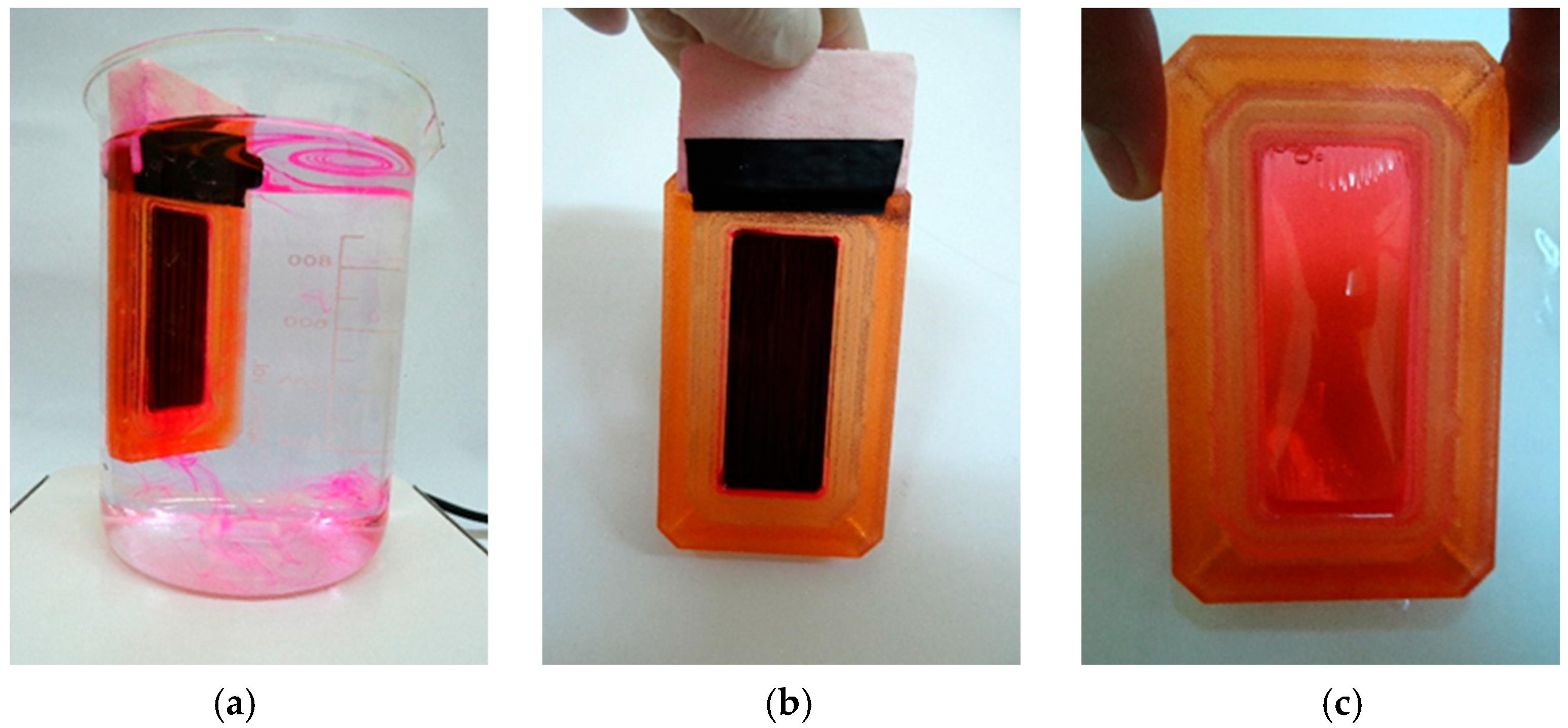
Figure 1. Dialysis of PDADMAC in deionised water: (a) start of the dialysis process; (b) appearance of the dialysis device with the sample before dialysis; and (c) appearance of the sample after completion of dialysis.
Forests 17 00148 g001
Figure 2. Examples of composite RGB micrographs of WTAC-coated samples treated with (a) 1% PDADMAC LMW with 0.5 M NaCl and (b) 1% PDADMAC HMW.
Forests 17 00148 g002
Figure 3. FT-IR spectra of untreated samples and samples treated with 1% PDADMAC HMW solution in the range of 600–4000 cm−1.
Forests 17 00148 g003
Figure 4. Epi-fluorescence images showing the penetration of 1% PDADMAC solutions of low (LMW) and high (HMW) molecular weight, with different amounts of added NaCl, and stained with Rhodamine B into the surface layer of the wood. Images were obtained by overlapping DAPI, FAM, and DsRED filters: (a) 1% PDADMAC LMW; (b) 1% PDADMAC HMW; (c) 1% PDADMAC LMW + 0.01 M NaCl; (d) 1% PDADMAC LMW + 0.1 M NaCl; (e) 1% PDADMAC LMW + 0.5 M NaCl; (f) 1% PDADMAC HMW + 0.01 M NaCl; (g) 1% PDADMAC HMW + 0.1 M NaCl; and (h) 1% PDADMAC HMW + 0.5 M NaCl.
Forests 17 00148 g004
Figure 5. SEM images of the cross-section of wood coated with a coating layer (900× magnification): (a) untreated wood; (b) samples treated with a solution of 1% PDADMAC LMW; (c) samples treated with a solution of 1% PDADMAC HMW; (d) 1% PDADMAC LMW + 0.1 M NaCl; and (e) 1% PDADMAC HMW + 0.1 M NaCl.
Forests 17 00148 g005
Figure 6. Example of measurement point positions for EDS analysis in a sample treated with a 1% PDADMAC LMW solution: (a) in the surface layer; and (b) in the inner layer (observed relative to the coating film on the cross-section of the sample). Letters A, B and C present measuring points.
Forests 17 00148 g006
Figure 7. The contact angle of a water droplet on the surface of samples treated with 1% PDADMAC solutions of low (LMW) and high (HMW) molecular weight, containing different concentrations of added NaCl, measured over a period of 1–25 s.
Forests 17 00148 g007
Figure 8. Contact angle of a WTAC droplet on the surface of samples pretreated with 1% PDADMAC solutions of low (LMW) and high (HMW) molecular weight, with varying concentrations of added NaCl, observed over a period of 1 to 25 s.
Forests 17 00148 g008
Figure 9. Degree of water absorption after 1, 2, and 5 min for control (untreated) samples and samples treated with 1% PDADMAC solutions of low (LMW) and high (HMW) molecular weight, with and without the addition of NaCl in different concentrations.
Forests 17 00148 g009
Table 1. Specifications of used polyelectrolytes.
PolyelectrolyteManufacturerMolecular Weight, g/molAbbreviationNaCl
Concentration in 1% Solution
Poly(diallyldimethylammonium chloride) (PDADMAC)Katpol-Chemie
Bitterfeld, Germany
8000PDADMAC LMW/
0.01 M
0.1 M
0.5 M
Sigma-Aldrich
Chemie GmbH
Taufkirchen, Germany
100,000–200,000PDADMAC HMW/
0.01 M
0.1 M
0.5 M
Table 2. Literature-based FT-IR band assignments for wood used as reference.
Wavenumber (cm−1)Band AssignmentComponent/Functional Group
3600–3000O–H stretching vibrations (hydrogen-bonded OH groups)Cellulose, hemicellulose, and adsorbed water [31,39,40,43]
2958C–H asymmetric stretching in methyl and methylene groupsLignin and hemicellulose [44,45]
2920C–H symmetric stretching in methyl and methylene groupsLignin, hemicellulose, and extractives [44,45]
1739C=O stretching in unconjugated ketone or ester groupsHemicellulose (acetyl and uronic ester groups) [46]
1640C=O stretching vibration in conjugated carbonyl groupsLignin (conjugated with aromatic rings) [39,47]
1510Aromatic skeletal vibrationsLignin (aromatic ring vibrations of guaiacyl and syringyl units) [44]
1457CH2 deformation stretchingLignin and xylan [48]
1425Aromatic skeletal vibrations combined with C–H in-plane deformationLignin and cellulose [48]
1371Aliphatic C–H bending and O–H deformation in phenolic OHCellulose and hemicellulose [49,50]
1320C1–O vibrations in syringyl derivatives; CH in-plane bendingCellulose I and II [48,49]
1267Syringyl ring breathing and C–O stretchingLignin and xylan [48]
1160C–O–C asymmetric stretchingCellulose I and II (β-glycosidic linkages) [48]
1059C–O stretching vibrationCellulose and hemicellulose [48]
1034C–O stretching vibrationCellulose, hemicellulose, and lignin [49,51,52]
897C1–H deformation and glycosidic bond vibrationCellulose (β-glycosidic linkages) [48,50]
Table 3. Carbon (C), oxygen (O), and chlorine (Cl) content in samples treated with a 1% PDADMAC LMW and 1% PDADMAC HMW solution, measured at different positions within the surface and deeper inner layers of the sample.
Surface LayerInner Layer
Treated SamplesMeasurement PointElement Content, %Element Content, %
COClCOCl
PDADMAC LMWPoint A66.0033.560.4461.3838.070.55
Point B62.8636.770.3766.0333.740.24
Point C64.4034.541.0766.8232.590.60
Average value64.4234.960.6364.7434.800.46
Minimal–maximal value62.86–66.0033.56–36.770.37–1.0761.38–66.8232.59–38.070.24–0.60
Standard deviation1.571.650.392.942.890.20
PDADMAC HMWPoint A72.221.925.8865.833.340.86
Point B69.6428.991.3866.5933.140.28
Point C72.0726.471.4775.5824.080.34
Average value71.3025.792.9169.3230.180.49
Minimal–maximal value69.64–72.2021.92–28.991.38–5.8865.80–75.5824.08–33.340.28–0.86
Standard deviation1.443.582.575.435.290.32
Table 4. Results of total surface energy (γ) and individual components of surface energy (γLW and γAB) for untreated samples and samples treated with 1% PDADMAC solutions of different MW, with and without NaCl addition.
Group of SamplesNaCl
Concentration
Surface Energy, mJ/m2
γLWγABγ
Untreated samples/48.210.558.7
Treated samplesPDADMAC LMW/45.911.357.2
0.01 M47.69.857.5
0.1 M46.810.056.8
0.5 M48.38.456.7
PDADMAC HMW/46.211.858.0
0.01 M43.814.258.0
0.1 M47.310.457.7
0.5 M46.310.857.0
γLW—nonpolar component of surface energy; γAB—polar component of surface energy; γ—total surface energy.
Table 5. Effect of adding salt to the polyelectrolyte solution on the Ra roughness of the treated wood surface.
NaCl ConcentrationRa of Treated Wood Surface, µm
/0.01 M0.1 M0.5 M
1% PDADMAC LMW8.61b z6.83a x y7.32b y6.35a x
1% PDADMAC HMW7.27a y6.83a x6.49a x7.00b x
Letters a and b indicate a statistically significant difference between treatments with polyelectrolyte solutions of different molecular weights (for equal salt addition), while letters x, y, and z indicate a statistically significant difference between treatments with 1% PDADMAC solution with different NaCl additions (for the same molecular mass of polyelectrolyte in the solution) in terms of Ra roughness of the treated surface.
Table 6. Dry film thickness of WTAC for untreated samples and samples treated with 1% PDADMAC solutions, with and without NaCl addition in different amounts.
Dry Film Thickness (DFT) of WTAC *, µm
Untreated SamplesTreated Samples
PDADMAC LMWPDADMACHMW
NaCl ConcentrationNaCl Concentration
57.80
(5.27)
/0.01 M0.1 M0.5 M/0.01 M0.1 M0.5 M
54.67
(6.63)
56.20
(5.51)
59.17
(6.09)
56.13
(6.14)
56.83
(9.85)
59.03
(6.49)
61.23
(6.81)
66.10
(9.36)
* Values in parentheses are standard deviations.
Table 7. Penetration parameters of WTAC of untreated samples and samples treated with 1% PDADMAC solutions, with and without NaCl addition in different amounts: maximum penetration depth (Dmax); average penetration depth (Dav); and lumen filling (LF).
SamplesNaCl
Concentration
Penetration Parameters of WTAC
Dmax *, µmDav *, µmLF *, %
Untreated samples [15]-84.18 (19.40) 43.31 (11.67)37.6 (18.8)
Treated
samples
PDADMAC LMW -69.49 (14.06)43.37 (10.26)62.5 (14.2)
0.01 M45.15 (15.90)28.24 (12.36)55.3 (14.8)
0.1 M44.52 (18.13)24.98 (10.57)53.7 (20.3)
0.5 M67.32 (22.90)43.10 (15.53)36.2 (17.4)
PDADMAC HMW-76.02 (19.19)42.06 (11.91)54.8 (23.9)
0.01 M99.19 (37.57)49.78 (17.33)62.3 (21.6)
0.1 M117.60 (26.00)60.10 (15.99)61.7 (17.6)
0.5 M85.16 (34.34)39.26 (13.96)55.7 (21.6)
* Standard deviation values are presented in parentheses.
Table 8. The adhesion strength of WTAC on the surface of untreated samples and samples treated with 1% PDADMAC solutions, with and without NaCl addition in different concentrations, presented in subgroups according to statistical differences determined by Tukey’s post hoc test.
SamplesAdhesion Strength *, MPa
1% PDADMAC LMW + 0.01 M3.04 (0.36) a
1% PDADMAC LMW + 0.5 M3.08 (0.41) a
1% PDADMAC LMW + 0.1 M3.21 (0.43) ab
1% PDADMAC HMW + 0.1 M3.46 (0.37) bc
1% PDADMAC LMW3.46 (0.39) bc
1% PDADMAC HMW + 0.5 M3.48 (0.34) bc
Control samples3.54 (0.58) bc
1% PDADMAC HMW + 0.01 M3.63 (0.49) c
1% PDADMAC HMW3.72 (0.49) c
* letters a, b, and c indicate a statistically significant difference in untreated samples and samples treated with 1% PDADMAC solutions, with and without NaCl addition at different concentrations, in terms of adhesion strength of WTAC. Values in parentheses are standard deviations.
Table 9. The surface roughness of WTAC-coated wood of untreated samples and samples treated with 1% PDADMAC solutions, with and without NaCl addition in different concentrations.
SamplesNaCl
Concentration
Surface Roughness of Wood Coated with WTAC, µm
RaRzRt
Untreated samples [15]-6.6638.8454.20
Treated
samples
PDADMAC LMW -5.19 by *30.55 bz *41.68 by *
0.01 M3.71 ax *22.85 ax *32.24 ax *
0.1 M3.92 ax *25.72 ay *32.83 ax *
0.5 M3.98 ax *24.07 axy *31.23 ax *
PDADMAC HMW-3.69 ax *22.99 ax *29.81 ax *
0.01 M4.15 ax *26.21 by *34.23 ay *
0.1 M4.36 ax *27.47 byz *37.18 by *
0.5 M5.21 by *29.39 bz *42.27 bz *
* letters indicate the statistically significant difference in individual surface roughness parameters of coated wood treated with PDADMAC of different molecular weights and NaCl concentrations: letters a and b indicate a statistically significant difference between treatments with polyelectrolyte solutions of different molecular weights (for equal salt addition), and letters x, y and z indicate a statistically significant difference between treatments with 1% PDADMAC solution with different NaCl concentrations (for the same molecular mass of polyelectrolyte in the solution).
Disclaimer/Publisher’s Note: The statements, opinions and data contained in all publications are solely those of the individual author(s) and contributor(s) and not of MDPI and/or the editor(s). MDPI and/or the editor(s) disclaim responsibility for any injury to people or property resulting from any ideas, methods, instructions or products referred to in the content.