Foliar Nitrogen and Phosphorus Asymmetrically Predict the Thermal and Hydric Niches of Woody Plants in Eastern China

Abstract
1. Introduction
2. Materials and Methods
2.1. Leaf Nitrogen and Phosphorus Data for Woody Plants
2.2. Hydrothermal Niche Data
2.3. Statistical Methods
2.3.1. Phylogenetic Signal
2.3.2. Phylogenetic Generalized Linear Models and Linear Models
3. Results
4. Discussion
4.1. Phylogenetic Signal Variation Reveals Divergent Evolutionary Trajectories of Niche Dimensions
4.2. Asymmetric Roles of Leaf N and P in Shaping Thermal and Hydric Niches
4.3. The Necessity of Controlling for Phylogenetic Relationships in Trait-Niche Studies
4.4. Limitations and Future Directions
5. Conclusions
- (1)
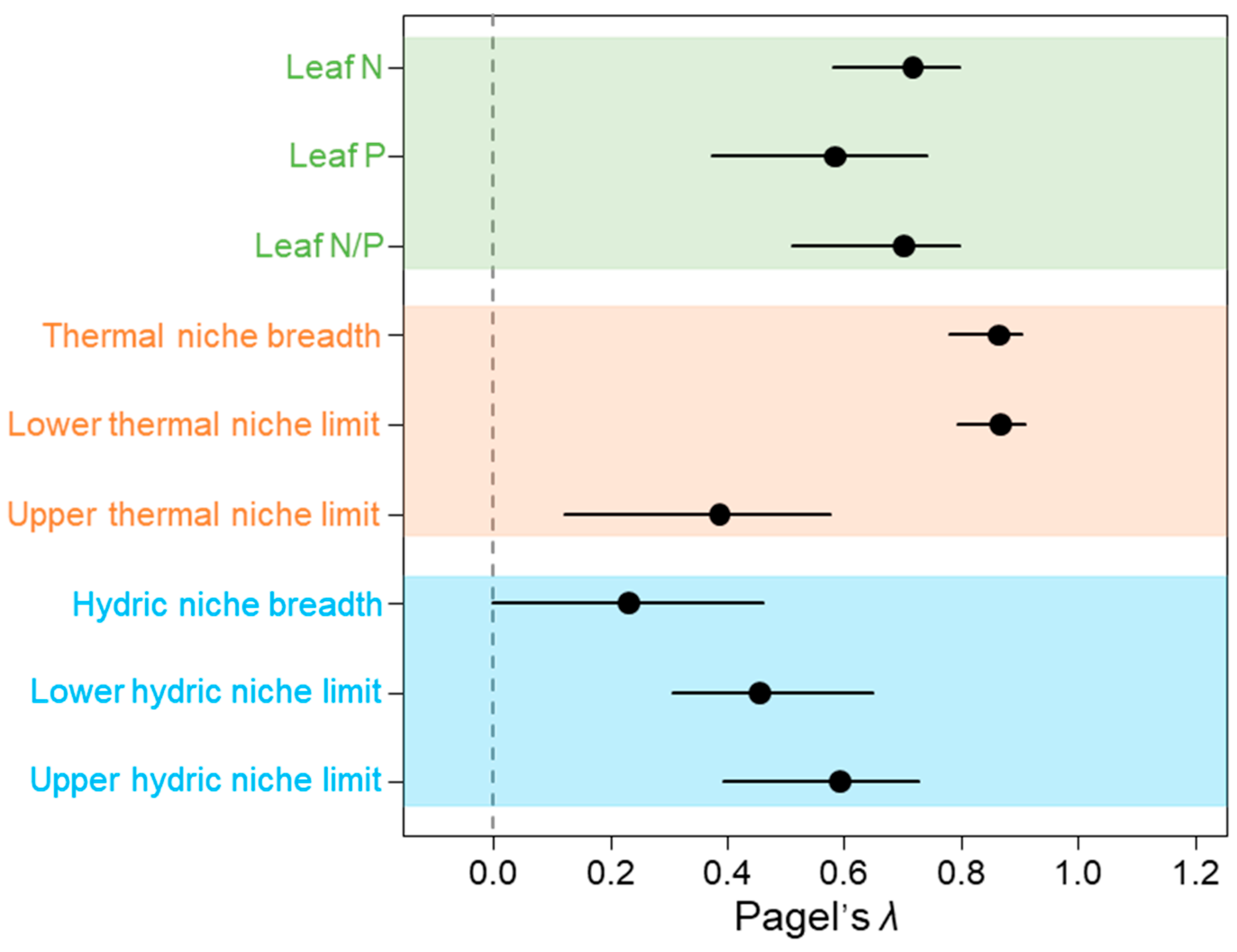
- Phylogenetic signal strength varied notably across niche dimensions. Thermal niche breadth exhibited a stronger phylogenetic signal (Pagel’s λ = 0.867) compared to hydric niche breadth (0.235). Similarly, the lower thermal limit (0.869) showed a stronger signal than the upper thermal limit (0.391) and both hydric niche limits (0.457 and 0.596), indicating greater evolutionary conservatism in cold tolerance.
- (2)
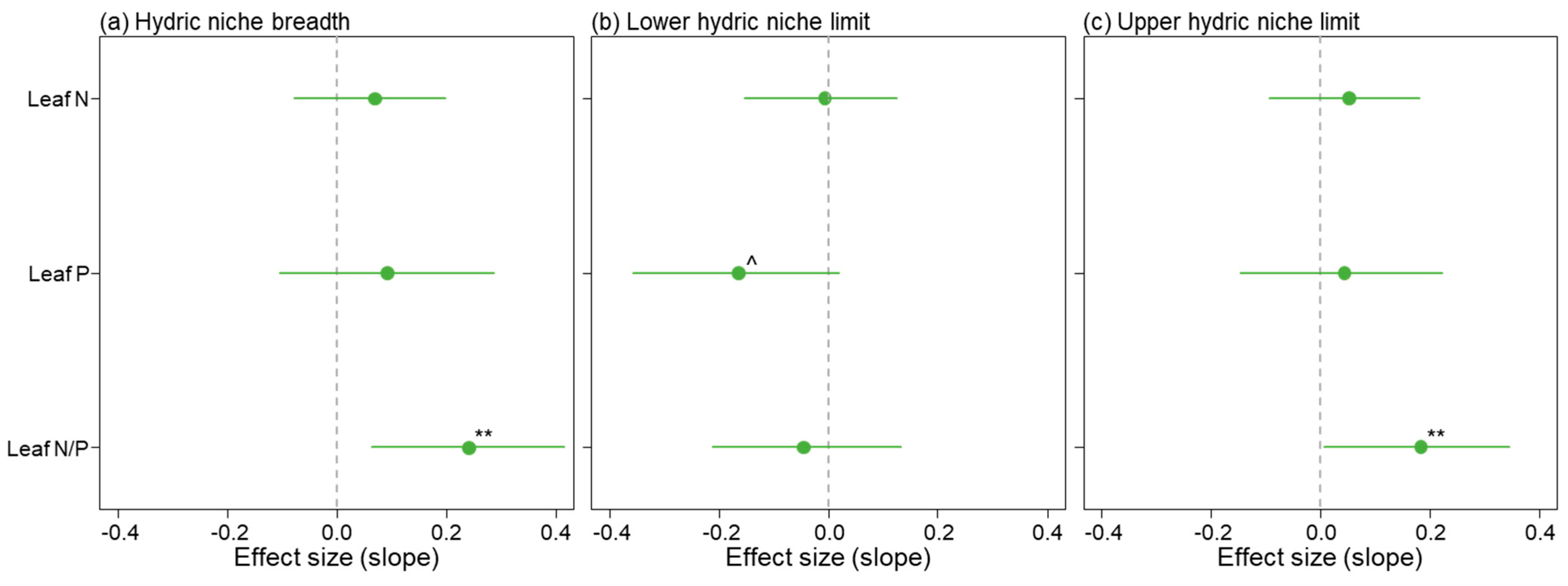
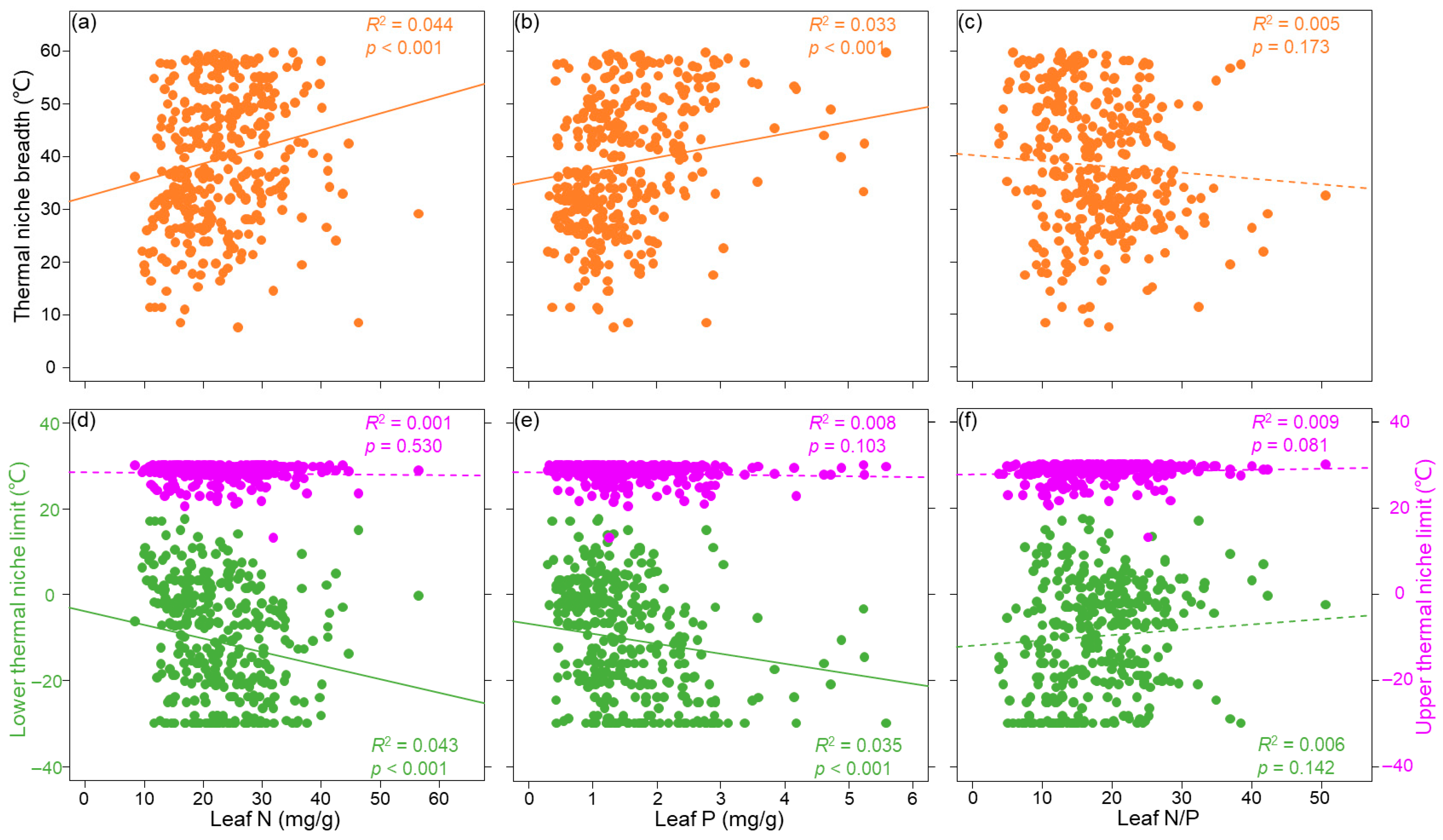
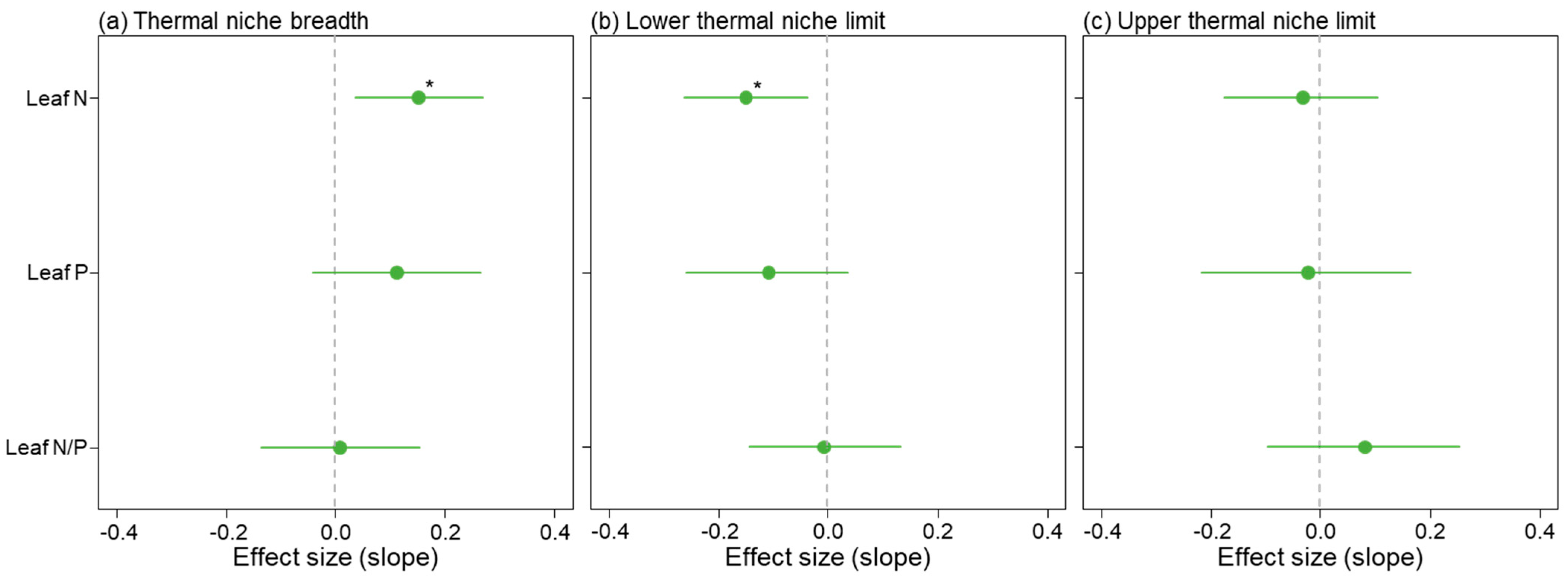
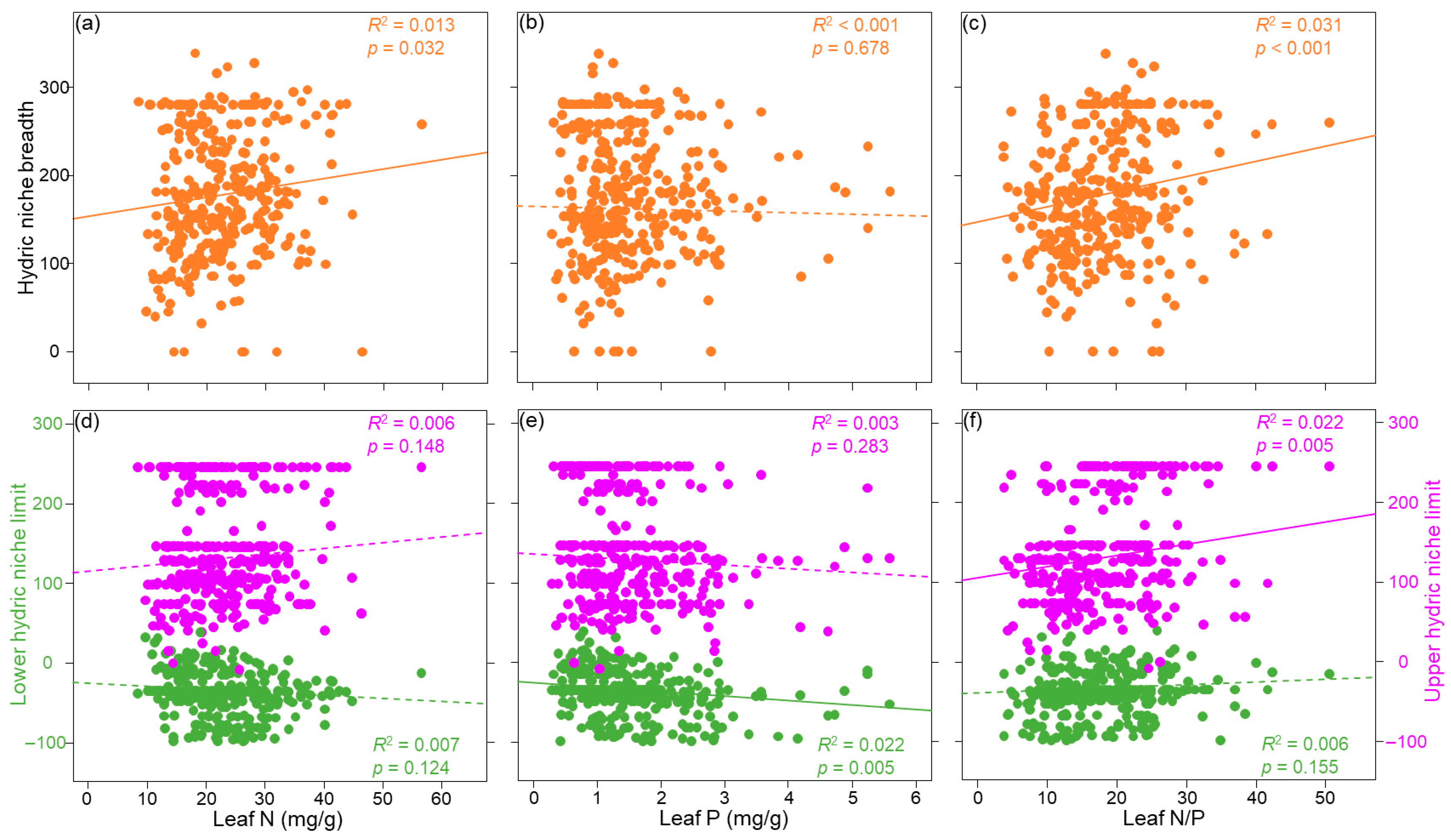
- Leaf N and P differentially predicted thermal and hydric niche dimensions. In phylogenetic models, leaf N (R2 = 0.044) and leaf P (R2 = 0.033) were positively associated with thermal niche breadth, and both were negatively correlated with the lower thermal limit (R2 = 0.043 and 0.035, respectively). Our quantitative models estimate that, for instance, a 10 mg/g increase in leaf N is associated with an expansion of thermal niche breadth by approximately 3.2 °C and an increase in cold tolerance (lower limit) by about 3.2 °C. In contrast, leaf N/P was the primary predictor for hydric niche breadth (R2 = 0.031), with an estimated increase of about 17.4 moisture index units for every 10-unit rise in leaf N/P, while leaf P consistently correlated with the lower hydric limit and leaf N/P with the upper hydric limit.
- (3)
- Model comparison underscored the necessity of phylogenetic control. When phylogeny was accounted for, explanatory power (R2) generally decreased, and in multiple-trait models, leaf N emerged as the dominant driver for thermal niche parameters—a pattern masked in conventional linear models.
Supplementary Materials
Author Contributions
Funding
Data Availability Statement
Acknowledgments
Conflicts of Interest
Abbreviations
| N | Nitrogen |
| P | Phosphorus |
| PGLM | Phylogenetic generalized linear model |
| LM | Linear regression model |
References
- Ordoñez, J.C.; van Bodegom, P.M.; Witte, J.P.M.; Wright, I.J.; Reich, P.B.; Aerts, R. A global study of relationships between leaf traits, climate and soil measures of nutrient fertility. Glob. Ecol. Biogeogr. 2009, 18, 137–149. [Google Scholar] [CrossRef] [Scilit]
- Wiens, J.J.; Ackerly, D.D.; Allen, A.P.; Anacker, B.L.; Buckley, L.B.; Cornell, H.V.; Damschen, E.I.; Davies, T.J.; Grytnes, J.-A.; Harrison, S.P.; et al. Niche conservatism as an emerging principle in ecology and conservation biology. Ecol. Lett. 2010, 13, 1310–1324. [Google Scholar] [CrossRef] [Scilit] [PubMed]
- Briceño, V.F.; Arnold, P.A.; Cook, A.M.; Courtney Jones, S.K.; Gallagher, R.V.; French, K.; Bravo, L.A.; Nicotra, A.B.; Leigh, A. Drivers of thermal tolerance breadth of plants across contrasting biomes. J. Ecol. 2025, 113, 3812–3829. [Google Scholar] [CrossRef] [Scilit]
- Reich, P.B.; Oleksyn, J. Global patterns of plant leaf N and P in relation to temperature and latitude. Proc. Natl. Acad. Sci. USA 2004, 101, 11001–11006. [Google Scholar] [CrossRef] [Scilit]
- Wright, I.J.; Reich, P.B.; Westoby, M.; Ackerly, D.D.; Baruch, Z.; Bongers, F.; Cavender-Bares, J.; Chapin, T.; Cornelissen, J.H.C.; Diemer, M.; et al. The worldwide leaf economics spectrum. Nature 2004, 428, 821–827. [Google Scholar] [CrossRef] [Scilit]
- Reich, P.B. The world-wide ‘fast-slow’ plant economics spectrum: A traits manifesto. J. Ecol. 2014, 102, 275–301. [Google Scholar] [CrossRef] [Scilit]
- Wright, I.J.; Reich, P.B.; Cornelissen, J.H.C.; Falster, D.S.; Garnier, E.; Hikosaka, K.; Lamont, B.B.; Lee, W.; Oleksyn, J.; Osada, N.; et al. Assessing the generality of global leaf trait relationships. New Phytol. 2005, 166, 485–496. [Google Scholar] [CrossRef] [Scilit]
- Blomberg, S.P.; Garland, T.; Ives, A.R. Testing for phylogenetic signal in comparative data: Behavioral traits are more labile. Evolution 2003, 57, 717–745. [Google Scholar] [CrossRef] [Scilit]
- McGill, B.J.; Enquist, B.J.; Weiher, E.; Westoby, M. Rebuilding community ecology from functional traits. Trends Ecol. Evol. 2006, 21, 178–185. [Google Scholar]
- Violle, C.; Navas, M.L.; Vile, D.; Kazakou, E.; Fortunel, C.; Hummel, I.; Garnier, E. Let the concept of trait be functional! Oikos 2007, 116, 882–892. [Google Scholar] [CrossRef]
- Laughlin, D.C. The intrinsic dimensionality of plant traits and its relevance to community assembly. J. Ecol. 2014, 102, 186–193. [Google Scholar] [CrossRef] [Scilit]
- Kearney, M.; Porter, W. Mechanistic niche modelling: Combining physiological and spatial data to predict species’ ranges. Ecol. Lett. 2009, 12, 334–350. [Google Scholar] [CrossRef] [Scilit] [PubMed]
- Thuiller, W.; Münkemüller, T.; Lavergne, S.; Mouillot, D.; Mouquet, N.; Schiffers, K.; Gravel, D. A road map for integrating eco-evolutionary processes into biodiversity models. Ecol. Lett. 2013, 16, 94–105. [Google Scholar] [CrossRef] [Scilit] [PubMed]
- Díaz, S.; Kattge, J.; Cornelissen, J.H.C.; Wright, I.J.; Lavorel, S.; Dray, S.; Reu, B.; Kleyer, M.; Wirth, C.; Prentice, I.C.; et al. The global spectrum of plant form and function. Nature 2016, 529, 167–171. [Google Scholar] [CrossRef] [Scilit]
- Körner, C. Alpine Plant Life: Functional Plant Ecology of High Mountain Ecosystems, 2nd ed.; Springer: Berlin, Germany, 2003. [Google Scholar]
- Sastry, A.; Barua, D. Leaf thermotolerance in tropical trees from a seasonally dry climate varies along the slow-fast resource acquisition spectrum. Sci. Rep. 2017, 7, 11246. [Google Scholar] [CrossRef] [Scilit]
- Güsewell, S. N: P ratios in terrestrial plants: Variation and functional significance. New Phytol. 2004, 164, 243–266. [Google Scholar] [CrossRef] [Scilit]
- Ho, M.D.; Rosas, J.C.; Brown, K.M.; Lynch, J.P. Root architectural tradeoffs for water and phosphorus acquisition. Funct. Plant Biol. 2005, 32, 737–748. [Google Scholar] [CrossRef] [Scilit]
- Lambers, H.; Oliveira, R.S. Plant Physiological Ecology, 3rd ed.; Springer Nature: Cham, Switzerland, 2019. [Google Scholar]
- Zhang, C.; Li, C.; Ma, Z.; Du, G. Identification of determinants of species germination niche breadth on the eastern Tibetan Plateau. Glob. Ecol. Conserv. 2020, 24, e01312. [Google Scholar] [CrossRef] [Scilit]
- Cavender-Bares, J.; Kozak, K.H.; Fine, P.V.A.; Kembel, S.W. The merging of community ecology and phylogenetic biology. Ecol. Lett. 2009, 12, 693–715. [Google Scholar] [CrossRef] [Scilit]
- Chen, Y.; Han, W.; Tang, L.; Tang, Z.; Fang, J. Leaf nitrogen and phosphorus concentrations of woody plants differ in responses to climate, soil and plant growth form. Ecography 2013, 36, 178–184. [Google Scholar] [CrossRef] [Scilit]
- Cornelissen, J.H.C.; Lavorel, S.; Garnier, E.; Díaz, S.; Buchmann, N.; Gurvich, D.E.; Reich, P.B.; ter Steege, H.; Morgan, H.D.; van der Heijden, M.G.A.; et al. A handbook of protocols for standardised and easy measurement of plant functional traits worldwide. Aust. J. Bot. 2003, 51, 335–380. [Google Scholar] [CrossRef] [Scilit]
- John, M.K. Colorimetric determination of phosphorus in soil and plant materials with ascorbic acid. Soil Sci. 1970, 109, 214–220. [Google Scholar] [CrossRef] [Scilit]
- Fang, J.; Wang, Z.; Tang, Z. (Eds.) Atlas of Woody Plants in China: Distribution and Climate; Springer: Berlin, Germany, 2011. [Google Scholar]
- Thornthwaite, C.W. An approach toward a rational classification of climate. Geogr. Rev. 1948, 38, 55–94. [Google Scholar] [CrossRef] [Scilit]
- Fang, J.; Yoda, K. Climate and vegetation in China III water balance and distribution of vegetation. Ecol. Res. 1990, 5, 9–23. [Google Scholar] [CrossRef] [Scilit]
- Pearman, P.B.; Guisan, A.; Broennimann, O.; Randin, C.F. Niche dynamics in space and time. Trends Ecol. Evol. 2008, 23, 149–158. [Google Scholar] [CrossRef] [Scilit]
- Sillero, N.; Barbosa, A.M. Want to model a species niche? A step-by-step guideline on correlative ecological niche modelling. Ecol. Model. 2021, 456, 109671. [Google Scholar]
- Sexton, J.P.; McIntyre, P.J.; Angert, A.L.; Rice, K.J. Evolution and ecology of species range limits. Annu. Rev. Ecol. Evol. Syst. 2009, 40, 415–436. [Google Scholar] [CrossRef] [Scilit]
- Jin, Y.; Qian, H.V. PhyloMaker2: An updated and enlarged R package that can generate very large phylogenies for vascular plants. Plant Divers. 2022, 44, 335–339. [Google Scholar]
- Davies, T.J.; Fritz, S.A.; Grenyer, R.; Orme, C.D.L.; Bielby, J.; Bininda-Emonds, O.R.P.; Cardillo, M.; Jones, K.E.; Gittleman, J.L.; Mace, G.M.; et al. Phylogenetic trees and the future of mammalian biodiversity. Proc. Natl. Acad. Sci. USA 2008, 105, 11556–11563. [Google Scholar] [CrossRef] [Scilit]
- Zanne, A.E.; Tank, D.C.; Cornwell, W.K.; Eastman, J.M.; Smith, S.A.; FitzJohn, R.G.; Beaulieu, J.M.; O’Meara, B.C.; Moles, A.T.; Reich, P.B.; et al. Three keys to the radiation of angiosperms into freezing environments. Nature 2014, 506, 89–92. [Google Scholar]
- Pagel, M. Inferring the historical patterns of biological evolution. Nature 1999, 401, 877–884. [Google Scholar] [CrossRef] [Scilit] [PubMed]
- Revell, L.J. Phytools: An R package for phylogenetic comparative biology (and other things). Methods Ecol. Evol. 2012, 3, 217–223. [Google Scholar] [CrossRef] [Scilit]
- Brazzale, A.R. Boot: Bootstrap Functions; R Package Version 1.3-32. Available online: https://cran.r-project.org/web/packages/boot (accessed on 26 November 2025).
- Forstmeier, W.; Wagenmakers, E.J.; Parker, T.H. Detecting and avoiding likely false-positive findings—A practical guide. Biol. Rev. 2017, 92, 1941–1968. [Google Scholar] [CrossRef] [Scilit] [PubMed]
- Dormann, C.F.; Elith, J.; Bacher, S.; Buchmann, C.; Carl, G.; Carré, G.; Marquéz, J.R.G.; Gruber, B.; Lafourcade, B.; Leitão, P.J.; et al. Collinearity: A review of methods to deal with it and a simulation study evaluating their performance. Ecography 2013, 36, 27–46. [Google Scholar] [CrossRef] [Scilit]
- Gelman, A.; Stern, H. The difference between “significant” and “not significant” is not itself statistically significant. Am. Stat. 2006, 60, 328–331. [Google Scholar] [CrossRef] [Scilit]
- Tung Ho, L.S.; Ané, C. A linear-time algorithm for Gaussian and non-Gaussian trait evolution models. Syst. Biol. 2014, 63, 397–408. [Google Scholar] [CrossRef] [Scilit]
- R Core Team. R: A Language and Environment for Statistical Computing; R Foundation for Statistical Computing: Vienna, Austria, 2025. [Google Scholar]
- Hutchinson, G.E. Concluding remarks. Cold Spring Harb. Symp. Quant. Biol. 1957, 22, 415–427. [Google Scholar] [CrossRef] [Scilit]
- Soberón, J.; Peterson, A.T. Interpretation of models of fundamental ecological niches and species’ distributional areas. Biodivers. Inform. 2005, 2, 1–10. [Google Scholar] [CrossRef] [Scilit]
- Guisan, A.; Thuiller, W. Predicting species distribution: Offering more than simple habitat models. Ecol. Lett. 2005, 8, 993–1009. [Google Scholar] [CrossRef] [Scilit]
- Araya, Y.N.; Silvertown, J.; Gowing, D.J.; McConway, K.J.; Peter Linder, H.; Midgley, G. A fundamental, eco-hydrological basis for niche segregation in plant communities. New Phytol. 2011, 189, 253–258. [Google Scholar] [CrossRef] [Scilit]
- Zhang, C.; Xi, N. Precipitation changes regulate plant and soil microbial biomass via plasticity in plant biomass allocation in grasslands: A meta-analysis. Front. Plant Sci. 2021, 12, 614968. [Google Scholar] [CrossRef] [Scilit] [PubMed]
- Brown, J.H.; Gillooly, J.F.; Allen, A.P.; Savage, V.M.; West, G.B. Toward a metabolic theory of ecology. Ecology 2004, 85, 1771–1789. [Google Scholar] [CrossRef] [Scilit]
- Perez, T.M.; Feeley, K.J. Photosynthetic heat tolerances and extreme leaf temperatures. Funct. Ecol. 2020, 34, 2236–2245. [Google Scholar] [CrossRef] [Scilit]
- González, M.; Cuervo-Gómez, M.; Garnica-Díaz, C.; Álvarez-Flórez, F.; Cubillos-Ariza, L.; Giral, V.; John, G.; Melgarejo, L.M.; Salgado-Negret, B. Thermal tolerance is linked to anatomical but not morphological leaf traits in woody species of Andean tropical montane forests. Funct. Ecol. 2025, 39, 1537–1549. [Google Scholar] [CrossRef] [Scilit]
- Lambers, H. Phosphorus acquisition and utilization in plants. Annu. Rev. Plant Biol. 2022, 73, 17–42. [Google Scholar] [CrossRef] [Scilit]
- Choat, B.; Brodribb, T.J.; Brodersen, C.R.; Duursma, R.A.; López, R.; Medlyn, B.E. Triggers of tree mortality under drought. Nature 2018, 558, 531–539. [Google Scholar] [CrossRef] [Scilit]
- Felsenstein, J. Phylogenies and the comparative method. Am. Nat. 1985, 125, 1–15. [Google Scholar] [CrossRef] [Scilit]
- Revell, L.J. Phylogenetic signal and linear regression on species data. Methods Ecol. Evol. 2010, 1, 319–329. [Google Scholar] [CrossRef] [Scilit]
- Araújo, M.B.; Luoto, M. The importance of biotic interactions for modelling species distributions under climate change. Glob. Ecol. Biogeogr. 2007, 16, 743–753. [Google Scholar] [CrossRef] [Scilit]
- Violle, C.; Reich, P.B.; Pacala, S.W.; Enquist, B.J.; Kattge, J. The emergence and promise of functional biogeography. Proc. Natl. Acad. Sci. USA 2014, 111, 13690–13696. [Google Scholar] [CrossRef] [Scilit]
- Weigelt, A.; Mommer, L.; Andraczek, K.; Iversen, C.M.; Bergmann, J.; Bruelheide, H.; Fan, Y.; Freschet, G.T.; Guerrero-Ramírez, N.R.; Kattge, J.; et al. An integrated framework of plant form and function: The belowground perspective. New Phytol. 2021, 232, 42–59. [Google Scholar] [CrossRef] [Scilit]
- Violle, C.; Enquist, B.J.; McGill, B.J.; Jiang, L.; Albert, C.H.; Hulshof, C.; Jung, V.; Messier, J. The return of the variance: Intraspecific variability in community ecology. Trends Ecol. Evol. 2012, 27, 244–252. [Google Scholar] [CrossRef] [Scilit]



| Trait/Niche Parameter | Mean ± SD | Range | Units |
|---|---|---|---|
| Leaf nitrogen | 22.849 ± 7.505 | 8.400–56.400 | mg g−1 |
| Leaf phosphorus | 1.524 ± 0.854 | 0.290–5.580 | mg g−1 |
| Leaf N/P ratio | 18.089 ± 7.175 | 3.780–50.550 | - |
| Thermal niche breadth | 39.107 ± 12.485 | 7.600–59.700 | °C |
| Lower thermal niche limit | −10.414 ± 12.952 | −29.800–17.700 | °C |
| Upper thermal niche limit | 28.693 ± 1.960 | 13.300–30.100 | °C |
| Hydric niche breadth | 177.771 ± 69.901 | 7.333 × 10⁻⁵–338.800 | - |
| Lower hydric niche limit | −35.335 ± 31.975 | −97.300–214.400 | - |
| Upper hydric niche limit | 142.436 ± 65.919 | −7.600–246.500 | - |
Disclaimer/Publisher’s Note: The statements, opinions and data contained in all publications are solely those of the individual author(s) and contributor(s) and not of MDPI and/or the editor(s). MDPI and/or the editor(s) disclaim responsibility for any injury to people or property resulting from any ideas, methods, instructions or products referred to in the content. |
© 2026 by the authors. Licensee MDPI, Basel, Switzerland. This article is an open access article distributed under the terms and conditions of the Creative Commons Attribution (CC BY) license.
Share and Cite
Zhang, L.; Huang, Y.; Zhang, X.; Ren, W.; Ma, Z.; Zhang, C. Foliar Nitrogen and Phosphorus Asymmetrically Predict the Thermal and Hydric Niches of Woody Plants in Eastern China. Forests 2026, 17, 146. https://doi.org/10.3390/f17010146
Zhang L, Huang Y, Zhang X, Ren W, Ma Z, Zhang C. Foliar Nitrogen and Phosphorus Asymmetrically Predict the Thermal and Hydric Niches of Woody Plants in Eastern China. Forests. 2026; 17(1):146. https://doi.org/10.3390/f17010146
Chicago/Turabian StyleZhang, Longxin, Yufang Huang, Xiaoying Zhang, Wenmei Ren, Zhen Ma, and Chunhui Zhang. 2026. "Foliar Nitrogen and Phosphorus Asymmetrically Predict the Thermal and Hydric Niches of Woody Plants in Eastern China" Forests 17, no. 1: 146. https://doi.org/10.3390/f17010146
APA StyleZhang, L., Huang, Y., Zhang, X., Ren, W., Ma, Z., & Zhang, C. (2026). Foliar Nitrogen and Phosphorus Asymmetrically Predict the Thermal and Hydric Niches of Woody Plants in Eastern China. Forests, 17(1), 146. https://doi.org/10.3390/f17010146