Article

Spatial-Scale Dependence and Non-Stationarity of Ecosystem Service Interactions and Their Drivers in the Black Soil Region of Northeast China During Multiple Ecological Restoration Projects

1
Co-Innovation Center of Sustainable Forestry in Southern China, Nanjing Forestry University, Nanjing 210037, China
2
Jiangsu Provincial Key Lab of Soil Erosion and Ecological Restoration, Nanjing Forestry University, Nanjing 210037, China
*
Author to whom correspondence should be addressed.
Forests 2026, 17(2), 149; https://doi.org/10.3390/f17020149
Submission received: 25 December 2025 / Revised: 19 January 2026 / Accepted: 21 January 2026 / Published: 23 January 2026
(This article belongs to the Section Forest Ecology and Management)

Abstract

The black soil region of Northeast China (NEC) is China’s most important food production base. Long-term inefficient land use has made its ecosystem vulnerable to widespread degradation, prompting the implementation of ecological restoration projects (ERPs) to enhance ecosystem service (ES) resilience. Yet, the complex interactions among key ESs, including grain production (GP), water yield (WY), soil conservation (SC), and carbon storage (CS), as well as the spatial non-stationarity of their driving factors post-ERPs, have caused spatially heterogeneous, scale-dependent ES relationships. To address these gaps, this study aims to analyze temporal changes in ESs across multiple scales in NEC from 2000 to 2020. By mapping the interactions and quantifying their intensities, we revealed spatial variations in driving factors under different ERPs. The results show that the Natural Wetland Conservation Project (NWCP) and Three-North Shelterbelt Program (TNSP) have led to overall improvements in all ESs. In contrast, the Grain for Green Program (GFGP), the Land Salinity/Sodicity Amelioration Project (LASP), and the Natural Forests Conservation Program (NFCP) are associated with trade-offs between ESs. Interactions between ESs exhibited clear spatial scale dependence, and the dominant drivers varied across scales and restoration contexts. These findings highlight the importance of considering spatial scale and non-stationarity when evaluating ecological restoration outcomes. This study provides a scientific basis for the development and management of ecological restoration programs in intensively managed agricultural regions worldwide, particularly those undergoing multiple, overlapping restoration interventions, from a multi-scale spatial perspective.

1. Introduction

The black soil region of Northeast China (NEC) is rich in fertile land, forest, and wetland resources and is a well-known food production base [1]. Similar to other globally important agricultural regions, such as the U.S. Corn Belt and the Pampas of Argentina, NEC has undergone profound land-use changes over recent decades. These changes have been driven by rapid industrialization, urban expansion, and agricultural intensification [2,3]. Rapid urbanization and industrialization resulted in the loss of significant fertile land and serious environmental pollution, putting enormous pressure on natural ecosystems [4,5,6]. In addition, population growth in China intensified demands on food production, and the excessive cultivation of black land in NEC has led to a serious depletion of natural resources, giving rise to ecological issues like severe soil erosion, water resource scarcity, and natural habitat loss [7,8,9]. Environmental destruction results in the loss and degradation of ecosystem services (ESs) and has serious implications for human well-being. Therefore, a crucial step in revitalizing NEC is restoring the environment and improving ESs. However, despite extensive research on ecosystem service trade-offs, there remains limited consensus in the international literature on how such trade-offs vary across spatial scales and management contexts, particularly under large-scale ecological restoration interventions.
Since 2000, NEC has implemented a series of ecological restoration projects (ERPs) to ensure ecological security, including the Three-North Shelterbelt Program (TNSP), the Natural Forests Conservation Program (NFCP), the Grain for Green Program (GFGP), the Natural Wetland Conservation Project (NWCP), and the Land Salinity/Sodicity Amelioration Project (LASP) [9,10,11,12,13]. Numerous studies have shown that these ERPs have led to the restoration and improvement of forest land and grassland [14,15,16,17,18]. However, changes in land use and land cover (LULC) do not always guarantee increased environmental benefits [19,20]. More specifically, ERPs do not consistently improve all ESs, and trade-offs between different ESs have been observed in some studies [12,21,22]. For example, the GFGP improves soil conservation (SC) and carbon storage (CS) while reducing water yield (WY) [23,24]. Similarly, the TNSP increases forest cover but leads to moisture reduction and soil drying [25]. Clarifying the complex interrelationships between ESs and their driving factors is crucial for developing comprehensive and effective ERPs. Recent international studies have demonstrated that afforestation can lead to trade-offs among ecosystem services. For example, Zhang et al. found in the climatic transition zone of the southern Great Plains of the United States that increasing tree cover enhanced carbon sequestration and ecosystem productivity, but reduced water yield due to higher evapotranspiration [26]. Similarly, global assessments indicate that planted forests tend to provide less water-related ecosystem services under drier climatic conditions, particularly in arid and semi-arid regions, highlighting the potential adverse impacts of large-scale afforestation on water availability [27]. Previous studies analyzing the interrelationships between ESs have relied on simple correlation coefficients, such as correlation analysis and the Bayesian network method [28,29,30]. However, these approaches often lack spatial details and fail to capture the strength of correlation effects. Moreover, considering the diverse purposes and implementation ranges of ERPs, it is essential to account for spatial non-stationarity when exploring the drivers of interactions between ESs. Hence, a geospatial perspective is necessary to assess the interrelationships between ESs. Although scale dependence of ecosystem service interactions has been increasingly recognized, most existing studies focus on describing scale effects rather than explicitly linking them to spatially varying driving mechanisms, limiting their ability to inform spatially targeted ecosystem management.
An increasing number of international research findings indicate that ecological restoration often brings about a series of benefits. However, research on the interactions between ecosystem services is usually limited to one spatial scale, which can be misleading [31]. Trade-offs and synergies between ESs may vary at different spatial scales [32,33]. For example, Hou et al. found that the correlation between grain production (GP) and WY changed with scale on the Loess Plateau [34]. Similarly, Huang et al. showed that the correlation between WY and net primary productivity changed from synergy to a trade-off when the scale was shifted from the Tibet Autonomous Region to the county level [35]. However, Zhou et al. found that, on the Qinghai–Xizang Plateau, relationships among ecosystem services remained relatively stable across spatial scales, with comparable correlation strengths [36]. These inconsistencies suggest that scale effects may be strongly context-dependent, highlighting the need for further investigation. A seminal study in the United States demonstrated that relationships among multiple ecosystem services can vary significantly with spatial scale. By analyzing eight service indicators across grid-cell, sub-watershed, and watershed scales in the Yahara Watershed, Qiu et al. found that some trade-offs and synergies changed strength and even direction across scales, while others lacked simple scaling rules, indicating that local service interactions do not necessarily scale up to broader units [37]. Analysis of interactions among ecosystem services at multiple spatial scales facilitates the development and management of ERPs [38]. Furthermore, whether the response of trade-offs and synergies between ESs to drivers varies with spatial scale has been less frequently explored. Therefore, there is a need to explore the trade-offs and synergies between ESs and their responses to driving factors at different spatial scales.
This gap is particularly evident in regions where multiple ecological restoration projects with different objectives are implemented simultaneously, yet their comparative effects on ecosystem service interactions across spatial scales remain poorly understood. The effectiveness of various ERPs implemented in NEC, as well as their impact on the interactions between ESs, remains unclear. Additionally, few studies have examined the specific ecological benefits of each ERP in depth from a spatial scale perspective. This knowledge gap hampers regional economic development and improvements in human well-being. Therefore, it is imperative to investigate how the interactions between ESs respond to each land-use decision and their respective driving factors to foster sustainable development in NEC. The purpose of this study is to assess the scale-dependent correlations between ESs under multiple ERPs in NEC from 2000 to 2020. Specifically, we aimed to (1) map the spatial distribution and intensity of trade-offs and synergies between ESs at different spatial scales; (2) identify the primary drivers influencing the correlations between ESs at different spatial scales; and (3) explore the ecological effects of different ERPs.

2. Materials and Methods

2.1. Study Area

NEC includes the provinces of Heilongjiang, Jilin, and Liaoning, as well as the eastern part of the Inner Mongolia Autonomous Region. It has a land area of about 1.24 × 10⁶ km2 (13% of China’s total land area) and is an important grain-producing region (25% of China’s total GP). Most of NEC has a temperate monsoon continental climate, with a small portion having a cold monsoon climate. The average annual precipitation ranges from about 300 mm to 1100 mm, decreasing from the southeast to the northwest. NEC plays an important role in food security and ecological benefits in China.

2.2. Data Sources

LULC data for 2000 and 2020 were obtained from the annual land cover dataset of China for 1990–2020 (https://zenodo.org/record/5210928, accessed on 19 January 2026). The Digital Elevation Model (DEM) was obtained from the Chinese Academy of Sciences (http://www.resdc.cn/, accessed on 19 January 2026) with a resolution of 90 m, from which the Gross Domestic Product (GDP) data were also derived. Population density (POP) data were obtained from the World Pop Dataset (https://www.worldpop.org/, accessed on 19 January 2026). Normalized Difference Vegetation Index (NDVI) monthly data were obtained from the MODIS vegetation index product (MOD13A2) (https://modis.gsfc.nasa.gov/data/dataprod/mod13.php, accessed on 19 January 2026). Grain yield data were obtained from the National Bureau of Statistics (http://www.stats.gov.cn/, accessed on 19 January 2026). Precipitation, evapotranspiration dispersion, soil database, and fractional vegetation cover were downloaded from the National Tibetan Plateau Scientific Data Center (http://data.tpdc.ac.cn/, accessed on 19 January 2026). To avoid annual weather extremes influencing the study results, the average meteorological data from 1990 to 2020 were used in this study. Long-term average climate data were used to reduce the influence of short-term climate variability and extreme events when evaluating restoration-driven changes in ecosystem services, while providing a stable climatic background for the analysis. All spatial datasets were reprojected to a unified coordinate system using the WGS 1984 Albers Equal Area Conic coordinate system, and resampled to a spatial resolution of 1 km × 1 km using the nearest-neighbor method for categorical variables and bilinear interpolation for continuous variables. Missing or no-data values were excluded from subsequent analyses to avoid artificial bias in ecosystem service estimation and interaction assessment. These preprocessing steps ensured spatial consistency across datasets and comparability of ecosystem service indicators. The data sources and descriptions are shown in Table S1.

2.3. ESs Quantification

This study evaluated four Ess, including GP, WY, SC, and CS. To facilitate interpretation of ecosystem service interactions across different spatial contexts, two spatial scales were considered in this study: pixel scale (1 km × 1 km) and county scale. The pixel scale captures fine-scale spatial heterogeneity in ecosystem services and their interactions, which is essential for revealing localized trade-offs and synergies. In contrast, the county scale corresponds to an administrative and management-relevant unit, reflecting aggregated ecosystem service interactions that are more directly linked to regional policy implementation and decision-making. The comparison between these two scales allows the assessment of scale dependence in ecosystem service interactions. ESs were first quantified at the pixel scale (1 km × 1 km) for the years 2000 and 2020, and then the average of county-scale ESs was calculated using the zonal statistics toolbox in the ArcGIS 10.4 platform. The key parameters required by the InVEST model(version 3.14.2) are shown in Table S2.
It has been shown that there is a significant linear relationship between GP and NDVI [39]. This approach may introduce uncertainties in areas with heterogeneous cropping systems or management practices, but it remains suitable for capturing large-scale spatial patterns of grain production. The calculation formula is as follows:
G i = N D V I i N D V I s u m × G s u m
where G i is the grain yield of the first raster cell and G s u m is the total grain yield in the study area, N D V I i is the NDVI value of raster cell i , and N D V I s u m is the sum of the NDVI values of the cropland in the study area.
WY was evaluated using the InVEST model’s WY module, which is based on the Budyko water balance principle.
W Y i j = 1 A E T i j P R E i × P R E i
where W Y i j is the W Y of pixel i for LULC type j ; A E T i j is the actual evapotranspiration of pixel i for LULC type j ; and P R E i is the annual precipitation of pixel i .
SC was evaluated using the Revised Universal Soil Loss Equation (RUSLE). The results were validated by comparison with previous studies conducted in the Songhua River Basin in Northeast China, showing good agreement (Wang et al., 2013 [40]). The formula is as follows:
S C = R × K × L S × 1 C × P
where R , K , L S , C , and P are the precipitation erosivity factor, soil erodibility factor, slope length and slope factor, vegetation cover factor, and management measures factor, respectively.C and P values are obtained by referring to previous study on BSR, which have been verified to be applicable (Fang and Fan, 2020 [41]; Wan et al., 2022 [42]).
CS was evaluated using the InVEST model’s CS module, which is based on four carbon pools of different vegetation types.
C S = C a b o v e + C b e l o w + C s o i l + C d e a d
where C a b o v e , C b e l o w , C s o i l , and C d e a d are the carbon pools of aboveground biomass, underground biomass, and soil and dead organic matter, respectively.
GP was calculated from validated open remote sensing products and statistical almanacs, and CS was calculated from validated LULC and previous studies’ carbon density data. Thus, it is only necessary to verify WY and SC. The R2 values of WY and SC were 0.781 and 0.8158, indicating that the results of this study are credible (Figures S1 and S2). The specific validation process is described in the Supplementary Materials.

2.4. Quantifying the Trade-Offs and Synergies Between ESs

In this study, we used the trade-off and synergy criterion (TSC) and trade-off-synergy index (TSI) proposed by Xue et al. to evaluate trade-offs and synergies between ecosystem services [43]. Unlike conventional correlation-based approaches, this method integrates changes in paired ecosystem services over time, allowing trade-offs and synergies to be explicitly identified at the pixel level. If TSC > 0, the ESs are synergistic with each other; if TSC is not > 0, they are trade-offs. The higher the value of TSI, the higher the strength of the trade-off or synergy between ESs. All values of ES were normalized. The formulas are as follows:
T S C = E S i , t 2 E S i , t 1 E S j , t 2 E S j , t 1
T S I = 1 Δ E S i Δ E S j
where E S i , t 2 and E S i , t 1 refer to the ecosystem service value for type i in t 2 and t 1 period, respectively; E S j , t 2 and E S j , t 1 refer to the ecosystem service value for type j in t 2 and t 1 period, respectively; and Δ E S i and Δ E S j are the differences in ES values for types i and j between the two periods (2000−2020).

2.5. Exploring the Driving Mechanisms of Trade-Offs and Synergies Between ESs

Combining past studies, we selected four categories of socio-ecological drivers to assess their effects on the strength of interactions between ES pairs (Table 1).
The geographic detector (GD) is an effective spatial statistical method based on the analysis of spatial variation in the geographic layers of variables [44]. The formula is:
q = 1 1 N σ 2 h = 1 L N h σ h 2
where q is the explanatory power of the landscape index, h = 1 , 2 , 3 , ; L is the classification or stratification of the landscape index; N and σ 2 are the total sample size and the variance, respectively; and N h and σ h 2 are the number of samples and the variance of layer h , respectively.
Prior to regression analysis, multicollinearity among explanatory variables was assessed using the variance inflation factor (VIF). Variables with VIF values exceeding the commonly accepted threshold were excluded to reduce collinearity effects. In addition, the use of geographically weighted regression inherently accounts for spatial non-stationarity and spatial autocorrelation by allowing model coefficients to vary across space, thereby reducing bias associated with global regression assumptions.
We first used GD to identify key drivers affecting the strength of interactions between ES pairs and then used geographically weighted regression (GWR) to explore their driving mechanisms from a geospatial location perspective. The GWR equation is expressed as:
y k = β 0 u k , v k + i = 1 n β i u k , v k x k i + c k
where y k is the value of TSI; x k i is the driving factor; n is the total number of spatial units involved in the analysis; c k is the random error term; u k , v k is the spatial location of sample k ; β 0 u k , v k is the intercept at location k ; and β i ( u k , v k ) x k i is the coefficient of the i th independent variable of sample k .

3. Results

3.1. Spatial Patterns of ERPs, LULC, and ESs

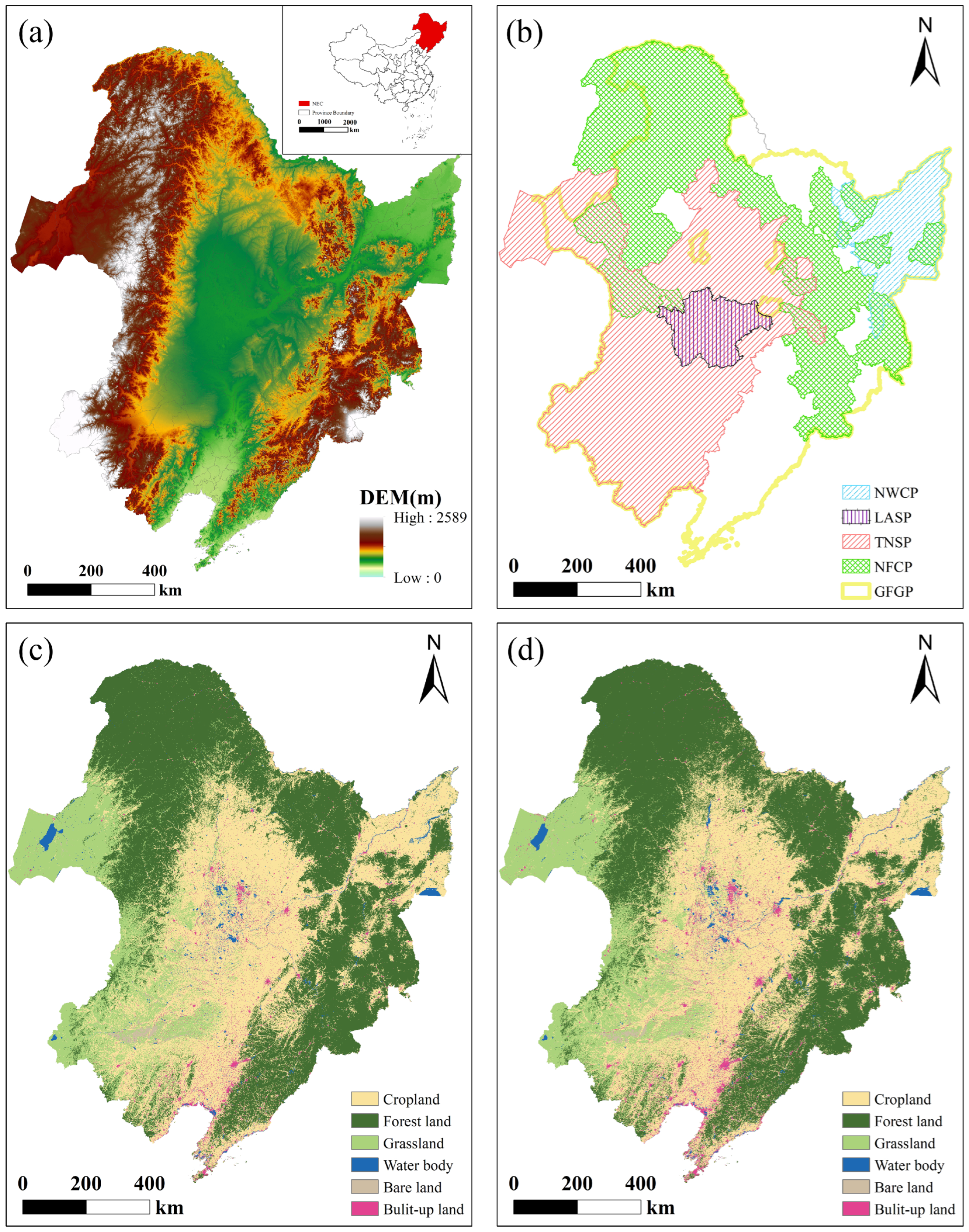
The spatial distributions of ERPs and the LULC are shown in Figure 1. The GFGP had the widest coverage (90.78% of the study area), whereas the TNSP and the NFCP were also extensive (44.13% and 38.22%, respectively). In contrast, the NWCP and the LASP covered relatively small proportions of the region (8.36% and 4.10%). The TNSP was mainly distributed in the southwestern part of NEC, while the NFCP was mainly distributed in the northeastern part of NEC. The NWCP is located primarily in the eastern part of NEC, while the LASP is located in the central part of NEC in the Songnen Plain. The LULC types of NEC were mainly cropland, forest land, and grassland.
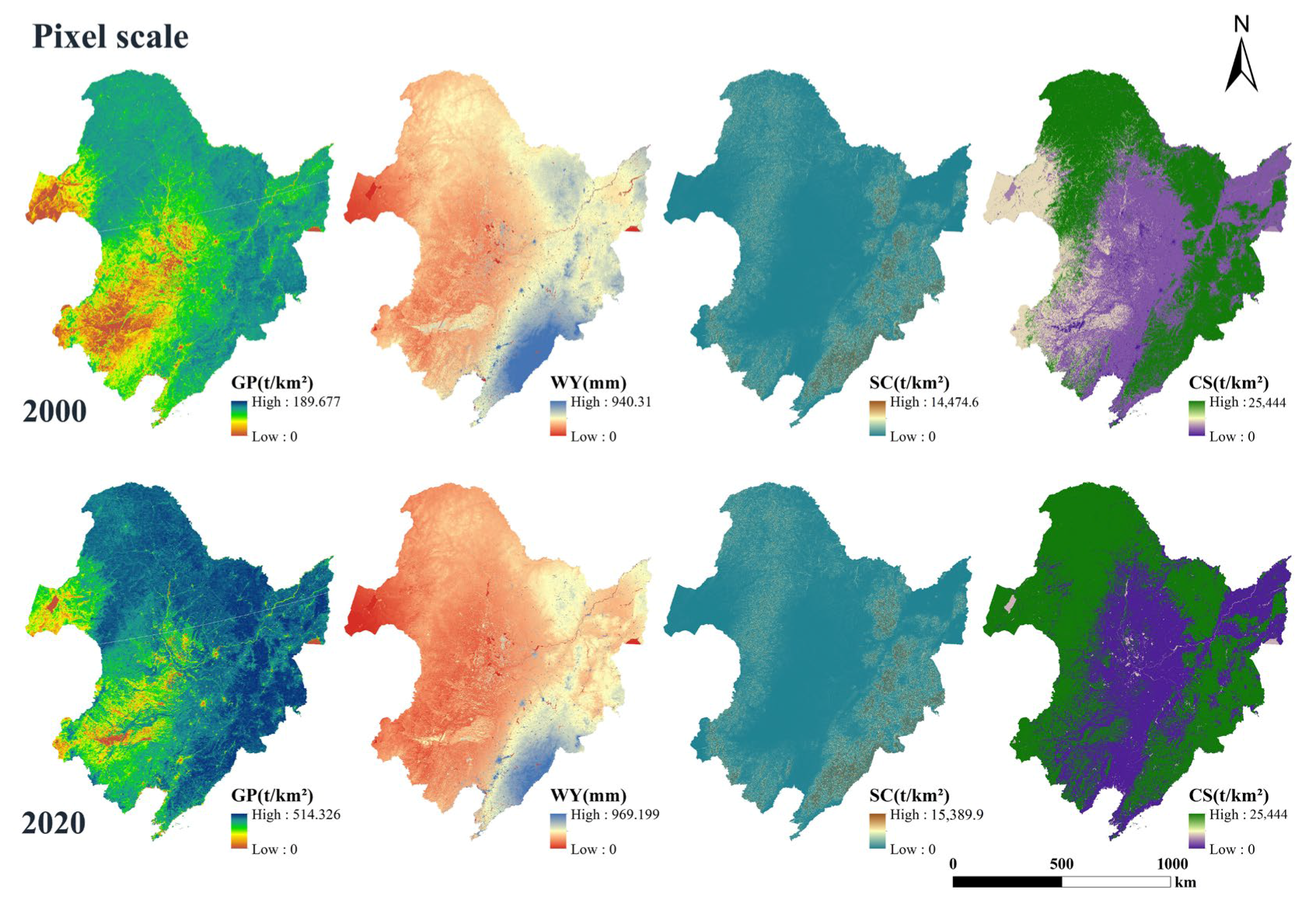
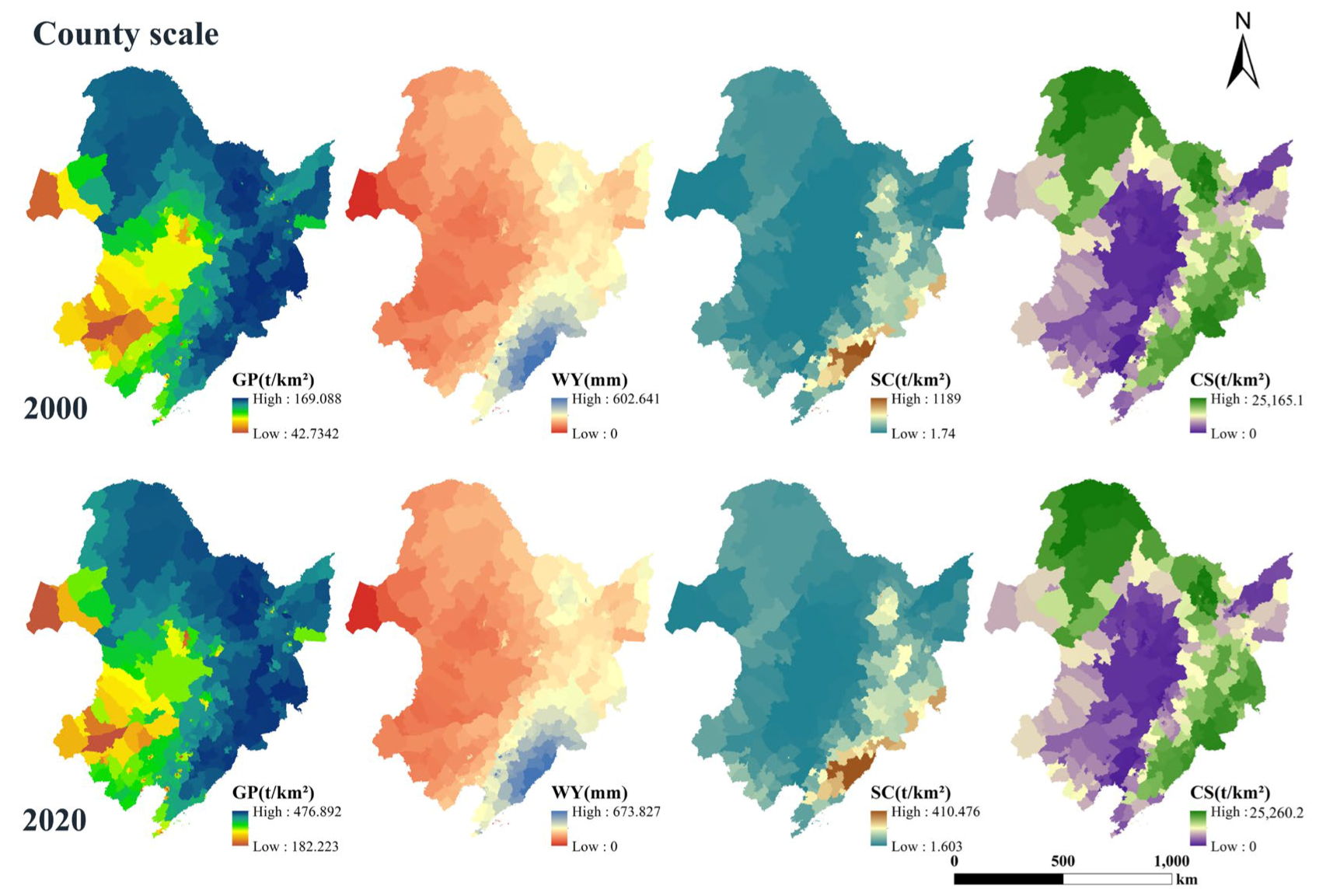
Across both pixel and county scales (Figure 2 and Figure 3), ESs exhibited broadly consistent spatial patterns, but their temporal changes differed among services. GP showed the largest increase from 2000 to 2020 (141.81 to 421.19 t/km2), whereas WY changed only slightly and SC and CS decreased marginally. GP and CS showed similar spatial distribution patterns, with their high-value areas mainly located in the NFCP area and the southeast of the GFGP. The spatial distribution pattern of WY showed an increasing trend from northwest to southeast. The high-value area of SC was mainly concentrated in the southeast of NEC.

3.2. Spatial Pattern of Trade-Offs and Synergies Between ESs

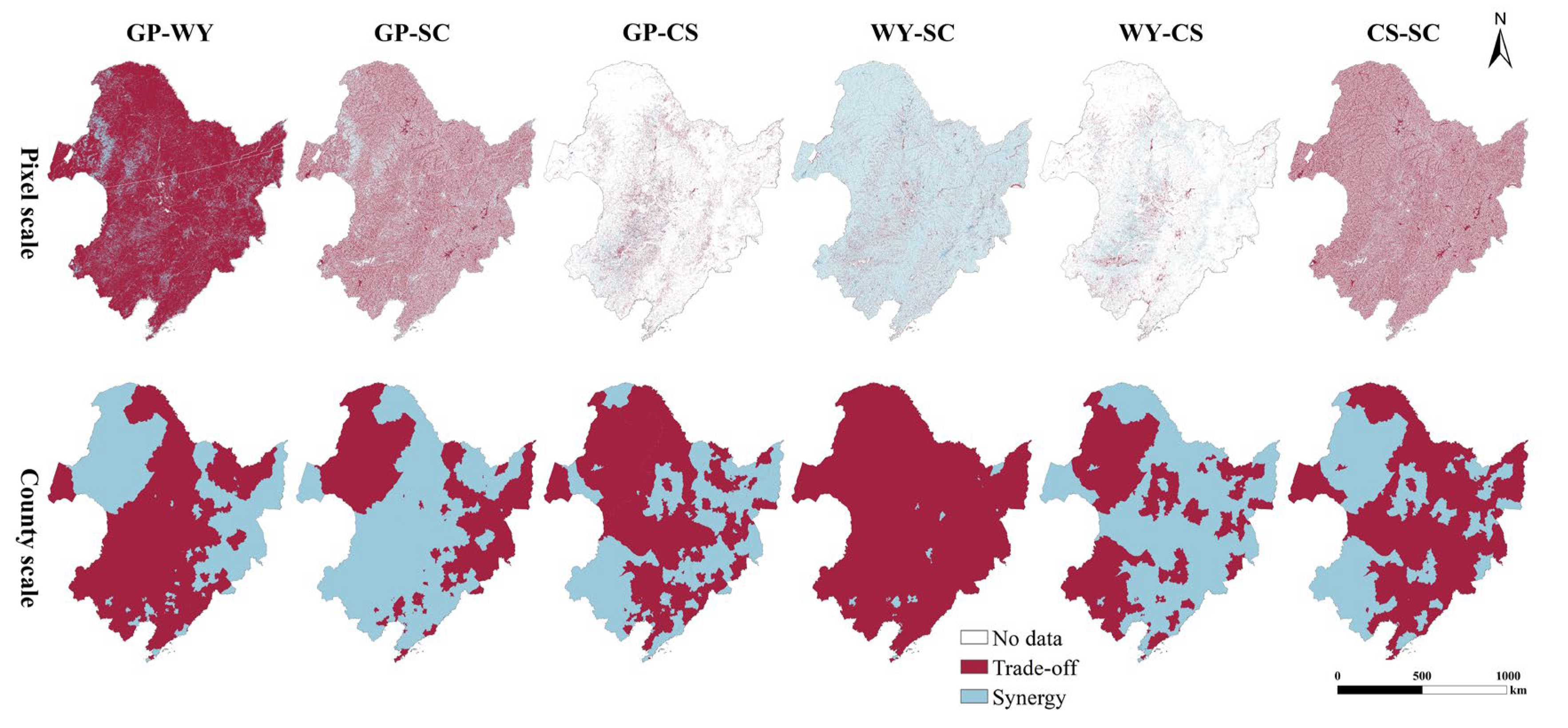
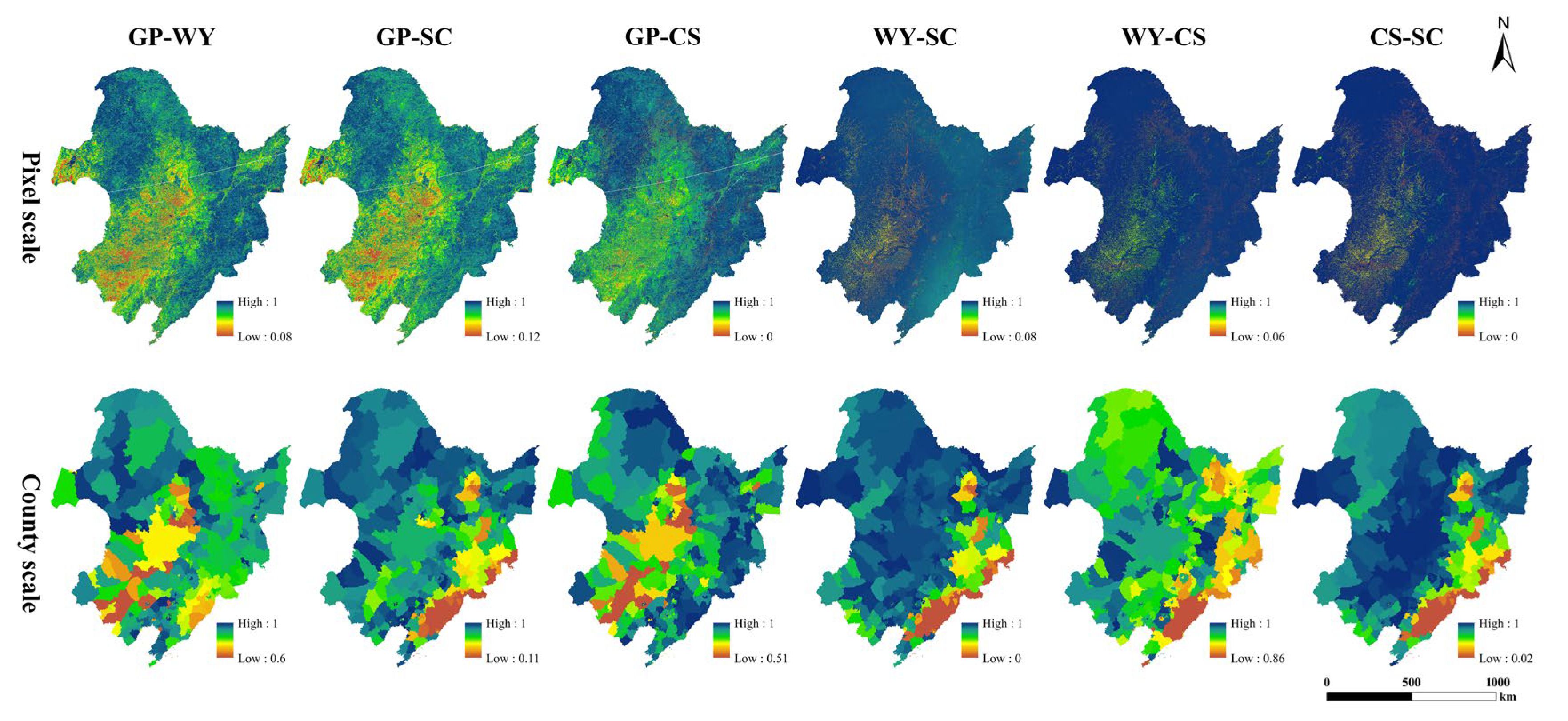
Ecosystem service interactions showed pronounced scale dependence, with trade-offs dominating at the pixel scale and more synergistic relationships emerging at the county scale. Figure 4 provides explicit spatial details of the trade-offs and synergies between ESs, and the strength values of these correlations are shown in Figure 5. At the pixel scale, the proportion of spatial trade-offs of GP-WY, CS-SC, GP-SC, and GP-CS was greater than the proportion of spatial synergies, indicating that they mainly exhibited spatial trade-offs. In contrast, WY-SC and WY-CS mainly exhibited spatial synergies. In contrast to the pixel scale, GP-SC and WY-SC at the county scale are dominated by spatial synergies. At the pixel scale, the regions with strong trade-offs and synergies between ESs were mainly in the NFCP and the eastern and southern regions of the GFGP (Figure 5). In addition, at the county scale, the regions with strong trade-offs and synergies between ESs were more diverse in distribution.

3.3. Identifying the Dominant Drivers of Trade-Offs and Synergies Between ESs at Different Scales

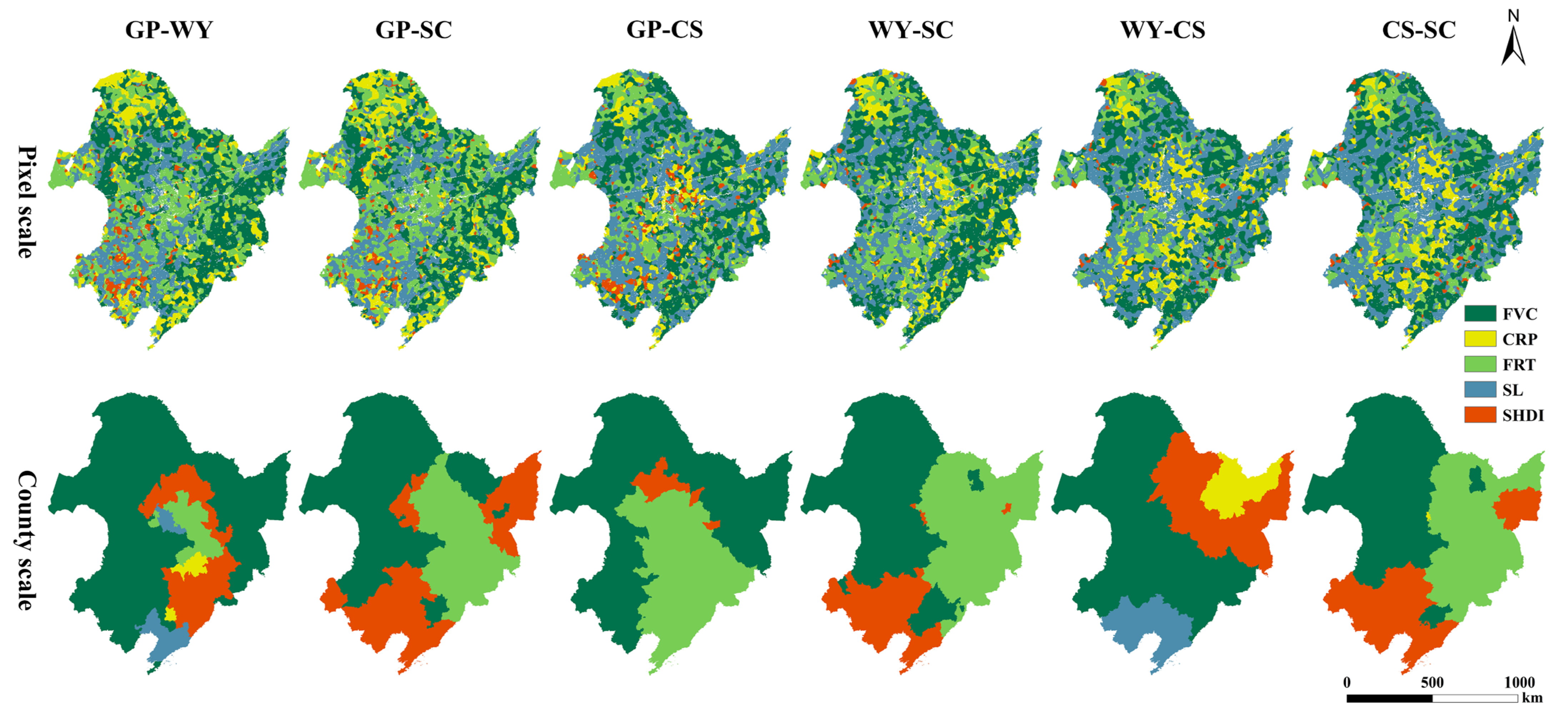
The results of GD revealed that the effects of drivers on the trade-offs and synergies between ESs were different at different scales (Table 2 and Table 3). At the pixel scale, the drivers affecting the correlations between WY-CS, SC-CS, and GP-CS were similar, mainly CRP, FRT, LPI, and SHDI. Additionally, the correlations between GP-WY and GP-SC were mainly affected by SL, FRT, and FVC. The main driver of the correlations between WY-SC was LPI. At the county level, SL, CRP, and FRT were the main drivers affecting the correlations between ESs, while other drivers were less influential. Overall, SL, CRP, FRT, SHDI, and FVC were the main drivers influencing the correlations between ESs.

3.4. Spatial Non-Stationary in the Effects of Key Drivers on the Strength of Interactions Between ESs

The effects of CRP, FRT, SHDI, SL, and FVC on the strength of interactions between ESs were revealed using the GWR model based on the results of the multicollinearity test and the GD model. Compared to the OLS model, the GWR model had a higher R2 and a lower AICc, indicating that the GWR model had a better-fitting result and could better explain the effects of the drivers on the strength of interactions between ESs (Table S3). At the pixel scale, CRP and FRT mainly had a positive effect on the strength of interactions between GP-WY, WY-SC, and GP-CS, and conversely, had a negative effect on the other three ES pairs (Figures S3 and S4). In addition, at the county scale, CRP and FRT shifted from positive to negative effects on the strength of interactions between GP-CS and SC-CS. At the pixel scale, FVC had mainly positive effects on the strength of interaction between WY-SC and had mainly negative effects on other ES pairs (Figure S7). At the county scale, FVC had mainly positive effects on the strength of interactions between GP-WY, WY-CS, WY-SC, and GP-CS, and mainly negative effects on other ES pairs. Interestingly, at the pixel scale, SL had mainly positive effects on the strength of interactions between ESs, while SHDI had mainly negative effects, and when the scale shifted to the county level, the direction of SL and SHDI effects also shifted (Figures S5 and S6).
These drivers had different effects in different ERPs (Table 4 and Table S4). In more than 57% of the LASP region, CRP, SHDI, SL, and FVC negatively influenced the strength of the interaction between GP-WY and GP-SC. CRP, SL, and FVC positively influenced the strength of interaction between WY-SC and WY-CS in more than 53% of the LASP region. All drivers negatively influenced the strength of the interaction between GP-CS in more than 50% of the LASP region. In more than 50% of the NFCP region, CRP, FRT, SHDI, and FVC negatively influenced the strength of the interaction between WY-CS and SC-CS. CRP, FRT, SL, and FVC negatively influenced the strength of GP-WY and WY-SC interactions in more than 60% of the NWCP region. All drivers positively influenced the strength of the interaction between GP-SC in more than 57% of the NWCP region.
By extracting the maximum regression coefficients of the drivers, the distribution of the main factors was plotted (Table 5 and Figure 6). At the pixel scale, SL and FVC were the dominant factors influencing the strength of interactions between ESs in the GFGP region, while at the county scale, FVC alone was dominant. At the pixel scale, FRT and SL were the dominant factors affecting the strength of the interactions between ESs of LASP, while at the county scale, FRT and FVC were the dominant factors. In NFCP, FVC was the dominant factor influencing the strength of interactions between ESs regardless of pixel or county scale. At the pixel scale, SL and FVC were the dominant factors influencing the strength of interactions between ESs in NWCP, while at the county scale, FRT, SHDI, and FVC were the dominant factors. In the TNSP region, SL was the dominant factor influencing the strength of interactions between ESs at the pixel scale, and the dominant factor at the county scale was consistent with NWCP.

4. Discussion

4.1. The Effectiveness of ERPs

It is widely acknowledged that ERPs can improve the overall quality of ecosystems. For instance, a global meta-analysis on land restoration studies found that restoration measures could increase biodiversity compared to degraded areas, indicating an improvement in the overall condition of the ecosystem [45]. However, the effects of different ERPs on ecosystem functions are not uniformly positive. Similar patterns have been widely reported in international studies, which show that restoration interventions frequently enhance certain services while constraining others, particularly when assessed at different spatial scales. For instance, global and regional assessments have shown that afforestation and forest restoration often increase carbon storage and soil protection while reducing water yield or streamflow, with the magnitude of these trade-offs varying across spatial scales and climatic contexts [46,47]. Against this broader background, recent studies have shown that not all ESs in the NEC increased due to the implementation of various ERPs. For instance, GP showed an increase, whereas WY, SC, and CS showed a decrease [9,12]. Our study showed similar results, except for WY. This divergence could be attributed to our study’s employment of average climate data, which dampens the influence of interannual climate variability and extreme climate events on WY estimates [44]. Therefore, ERPs need to incorporate considerations of trade-offs and synergies between ESs during the planning and implementation stages. Moreover, it is important to recognize that diverse ERPs may prioritize distinct environmental benefits, further underscoring the need for a tailored approach in each case.
These outcomes indicate that the effects of ERPs on ecosystem services are strongly mediated by restoration pathways and local biophysical constraints. This pattern is illustrated by the different responses observed under the GFGP and NFCP. The GFGP and NFCP aim to address the issue of indiscriminate deforestation and its associated ecological consequences. In the GFGP region, cropland area decreased, accompanied by an increase in forested land, whereas land use changes in the NFCP region were dominated by forest conservation rather than large-scale land conversion. Despite these efforts, SC and CS showed a decreasing trend. However, it is noteworthy that the GFGP region exhibits a less pronounced decrease in SC and CS as compared to the NFCP region. Furthermore, the trade-offs between GP and other ESs were revealed to have strong associations in both the GFGP and NFCP regions. Similar conclusions have been drawn from restoration programs in other regions, where land-cover conversion alone was insufficient to improve regulating services without improvements in vegetation structure, management intensity, and site suitability [12,48].
Similar context-dependent effects were observed for other ERPs. The NWCP slowed wetland loss in the Three Rivers Plain but did not fully prevent wetland encroachment driven by agricultural expansion, resulting in pronounced trade-offs between GP and CS [13]. In contrast, the TNSP showed more consistent improvements across multiple ESs and weaker trade-offs, reflecting the benefits of integrated shelterbelt construction and landscape configuration [49]. The LASP further illustrates that increases in GP can be achieved with relatively mild trade-offs when restoration strategies are well matched to local environmental conditions.

4.2. Implications and Recommendations for ERPs

From a broader perspective, the policy implications of this study highlight a key challenge faced by large-scale ecological restoration programs worldwide: balancing provisioning and regulating ecosystem services across spatial scales. Similar scale-related interactions of ecosystem services have also been reported in international studies. These studies indicate that the intensity and direction of transactional relationships and synergistic effects can vary depending on the spatial resolution and assessment units. For instance, multi-scale analyses conducted in Canada and Europe have shown that the relationships between ecosystem services vary significantly across different scales, which limits the transferability of single-scale conclusions in a broader management context [50,51]. In our study, the correlations between ecosystem service pairs also exhibited clear scale dependence, such as GP–SC and WY–SC (Figure 4). These patterns are closely related to the composition and layout of land use and land cover types, as well as climatic factors such as rainfall. This has been confirmed through case studies conducted both domestically and internationally [52,53]. In the TNSP and NWCP zones, characterized by a high percentage of cropland and a low percentage of forest, there is both a heightened potential for GP and a considerable risk of soil erosion. In such instances, the trade-offs between ES pairs, driven by land use conflicts, may shift towards synergistic interactions with changes in spatial scale [33,54]. Previous studies in arid mountain regions have shown that food–ecosystem service trade-offs are largely confined to fine spatial scales due to the spatial isolation of oasis-based agriculture [55]. In contrast, our results indicate that under humid conditions with extensive and spatially continuous cropland, food-related trade-offs weaken but remain detectable at broader spatial scales, reflecting the cross-scale propagation of agricultural pressures. In addition, ESs exhibit strong spatial heterogeneity, and different services may have different best-fit spatial scales. This is consistent with international evidence showing that scale effects differ across ecosystem services [56]. Therefore, during the formulation and implementation of ERPs, decision-makers should take into account the diverse spatial scales of ESs to ensure their appropriate and effective management [32]. This principle also has wide applicability in ecological restoration projects outside the study area.
The spatial heterogeneity of driver effects further supports the need for region-specific management strategies. In the GFGP and NFCP regions, FVC is the dominant factor affecting the strength of the interactions between ES pairs. These regions exhibit a high proportion of forest and grassland area, leading to high FVC. However, the forest structure is not optimal, and the overall quality of forests is comparatively low in these areas [57]. Similar patterns have been reported in international studies, which indicate that increases in vegetation cover alone do not necessarily translate into proportional improvements in ecosystem services when forest structure and stand quality are poor [58]. This could explain the lower levels of ESs and higher intensity of the trade-off between ESs in these regions. In addition, the limited afforestation in these regions can be attributed to the low levels of rainfall, which poses challenges to afforestation efforts. Therefore, it is imperative to consider region-specific management measures to address the impacts of climate extremes [59]. In light of these findings, forest conservation may be more appropriate for the GFGP and NFCP regions when compared to afforestation [60,61]. Implementing measures that prioritize forest conservation and focus on improving forest quality can effectively address the ecological challenges in these two regions.
SL also played a critical role in shaping interactions between carbon storage and other ecosystem services by influencing runoff processes, soil moisture, and vegetation growth. In China, ERPs have different land use policies based on different slopes. For example, cropland with a slope exceeding 25° must be returned to forest or grass [62,63,64]. Many ecological restoration projects around the world also adopt slope-based land use policies to mitigate these risks. For instance, steep farmland is usually planned for conversion into forests, grasslands, or agro-forestry systems, in order to reduce soil erosion and stabilize ecosystem functions [65,66]. Therefore, we propose the implementation of agroforestry and contour planting techniques on steep slopes [67]. Such practices can effectively promote the natural formation of terraces, thereby improving ESs.
At the county scale, SHDI is the dominant factor influencing the strength of interactions between GP and SC as well as between WY and CS in the implementation regions of the NWCP and TNSP. Notably, SHDI has a positive effect on these interactions, reflecting the impact of landscape diversity and heterogeneity.
The TNSP has actively promoted the construction of farmland protection forests. Compared to single agricultural landscapes, agroforestry composite landscapes have superior ecological benefits [28]. Protective forests play a vital role in reducing wind erosion, the impact of pests on GP, and soil erosion, facilitating a synergistic effect of GP-SC [68,69]. Although protective forests increase CS, the forest floor consumes more water due to high evapotranspiration [70]. In addition, an excessively high density of protective forests can lead to competition for water and nutrients, causing a decline in GP [71,72]. To optimize the construction and management of protective forests, we suggest ensuring a certain number of protective forests and then focusing on their spatial configuration. This could optimize connectivity to strike a balance between ecological benefits and potential trade-offs [68].
Although this study focuses on Northeast China, the analytical framework developed here is applicable to other regions undergoing large-scale ecological restoration and land use transitions. Northeast China provides a representative setting with multiple restoration projects implemented concurrently, allowing insights into scale-dependent and spatially heterogeneous ecosystem service interactions that may inform similar studies elsewhere.

4.3. Limitations and Future Work

In this study, the analysis focuses on four key ecosystem services closely related to food production and ecological regulation. While this selection allows for a targeted assessment of major provisioning and regulating services, it may not fully capture the multifunctionality of landscapes under ecological restoration projects. The exclusion of other services, such as biodiversity conservation, water purification, wood production, and cultural services, should therefore be considered when interpreting the observed trade-offs and synergies. Incorporating a broader range of ecosystem services in future studies would provide a more comprehensive basis for evaluating the ecological effectiveness of ERPs. In addition to spatial scales, ecosystem service interactions may also vary across temporal scales, such as monthly, seasonal, or longer-term periods. Future research should therefore consider appropriate temporal scales to further improve the understanding of ecosystem service dynamics under ecological restoration.

5. Conclusions

This study examined the effect of ERPs on correlations between ESs across various scales in NEC. It quantified the spatial distribution of factors affecting these correlations. The main conclusions are as follows:
(1)
ERPs have altered land-cover patterns, increasing forest area and slowing wetland loss, but these changes did not lead to uniform improvements across all ecosystem services.
(2)
Ecosystem service responses differed among ERPs. The NWCP and TNSP generally enhanced multiple ESs, whereas the GFGP, LASP, and NFCP were associated with pronounced trade-offs, particularly between grain production and regulating services.
(3)
Ecosystem service interactions exhibited clear scale dependence, with relationships such as GP–SC and WY–SC varying markedly between pixel and county scales.
(4)
The strength of ES interactions showed strong spatial heterogeneity, driven primarily by forest proportion, fractional vegetation cover, slope, and landscape diversity, with their effects differing across spatial scales and restoration contexts.
These findings have direct implications for ecosystem management and policy. Restoration strategies should be tailored to local environmental conditions and spatial scale, including prioritizing forest conservation in the GFGP and NFCP regions, optimizing shelterbelt configuration in the TNSP, and strengthening wetland protection under the NWCP.
Overall, this study advances understanding of scale-dependent ecosystem service interactions under multiple restoration strategies and provides a practical reference for designing more effective and sustainable ecological restoration policies. Future studies could build on this framework by integrating additional ecosystem services and longer-term observations to better capture restoration outcomes under changing environmental conditions.

Supplementary Materials

The following supporting information can be downloaded at: https://www.mdpi.com/article/10.3390/f17020149/s1, Figure S1. The observed data versus modeled data. Figure S2. The observed data versus modeled data. Figure S3. Spatial distribution of regression coefficients of CRP. Figure S4. Spatial distribution of regression coefficients of FRT. Figure S5. Spatial distribution of regression coefficients of SHDI. Figure S6. Spatial distribution of regression coefficients of SL. Figure S7. Spatial distribution of regression coefficients of FVC. Table S1. Summary of the primary data. Table S2. Critical parameter settings. Table S3. Comparison of the fitting measures for different models. Table S4. proportion of positive and negative effects of drivers on the interactions between ES of different ERPs at different scales (%).

Author Contributions

Conceptualization, S.-Y.Y.; Methodology, S.-Y.Y.; Software, H.-R.L.; Validation, M.Z.; Formal analysis, S.-Y.Y. and M.Z.; Investigation, S.-Y.Y., M.Z. and S.M.; Resources, H.-R.L.; Data Curation, M.Z. and S.M.; Writing—original draft, S.-Y.Y.; Writing—review and editing, L.-J.W.; Visualization, H.-R.L.; Supervision, L.-J.W.; Project administration, L.-J.W.; Funding acquisition, L.-J.W. All authors have read and agreed to the published version of the manuscript.

Funding

This study was supported by the National Natural Science Foundation of China (Grant No. 41601209).

Data Availability Statement

The original contributions presented in this study are included in the article/Supplementary Materials. Further inquiries can be directed to the corresponding author.

Acknowledgments

We are grateful to our colleagues from the Co-Innovation Center of Sustainable Forestry in Southern China, Nanjing Forestry University, and the Jiangsu Provincial Key Lab of Soil Erosion and Ecological Restoration for their insightful discussions and technical support throughout this research.

Conflicts of Interest

The authors declare no conflicts of interest.

Abbreviations

The following abbreviations are used in this manuscript:
CRPCropland proportion
FRTForest proportion
GRSGrassland proportion
BLTBuilt-up land proportion
CONTAGContagion index
LPILargest patch index
SHDIShannon’s Diversity Index
PDPatch density
DEMElevation
SLSlope
PREPrecipitation
FVCFractional vegetation cover
GDPGross Domestic Product
POPPopulation density

References

  1. Song, F.; Su, F.; Zhu, D.; Li, L.; Li, H.; Sun, D. Evaluation and driving factors of sustainable development of the wetland ecosystem in Northeast China: An emergy approach. J. Clean. Prod. 2020, 248, 119236. [Google Scholar] [CrossRef]
  2. Gurgel, A.; Narayan, K.B.; Reilly, J.; Gao, X.; Vernon, C.; Morris, J.; Schlosser, A.; Paltsev, S. Future spatially explicit patterns of land transitions in the United States with multiple stressors. Earth’s Future 2025, 13, e2024EF005016. [Google Scholar] [CrossRef]
  3. Aguilera, M.A.; Tapia, J.; Gallardo, C.; Núñez, P.; Varas-Belemmi, K. Loss of coastal ecosystem spatial connectivity and services by urbanization: Natural-to-urban integration for bay management. J. Environ. Manag. 2020, 276, 111297. [Google Scholar] [CrossRef] [PubMed]
  4. Barbero, F.M.; Dominchin, M.F.; Verdenelli, R.A.; Frasier, I.; Restovich, S.B.; Mancilla, E.J.C.; Mlewski, E.C.; Labuckas, D.; Gil, S.V.; Meriles, J.M. Impact of land use changes on soil chemical properties, enzyme activities and microbial communities in two contrasting localities of the Argentinian Pampas. Appl. Soil Ecol. 2025, 206, 105836. [Google Scholar] [CrossRef]
  5. Liang, L.; Wang, Z.; Li, J. The effect of urbanization on environmental pollution in rapidly developing urban agglomerations. J. Clean. Prod. 2019, 237, 117649. [Google Scholar] [CrossRef]
  6. Wang, S.; Fang, C.; Sun, L.; Su, Y.; Chen, X.; Zhou, C.; Feng, K.; Hubacek, K. Decarbonizing China’s Urban Agglomerations. Ann. Am. Assoc. Geogr. 2019, 109, 266–285. [Google Scholar] [CrossRef]
  7. Jiang, S.; Wang, J.; Zhao, Y.; Shang, Y.; Gao, X.; Li, H.; Wang, Q.; Zhu, Y. Sustainability of water resources for agriculture considering grain production, trade and consumption in China from 2004 to 2013. J. Clean. Prod. 2017, 149, 1210–1218. [Google Scholar] [CrossRef]
  8. Ma, S.; Wang, L.-J.; Wang, H.-Y.; Zhao, Y.-G.; Jiang, J. Impacts of land use/land cover and soil property changes on soil erosion in the black soil region, China. J. Environ. Manag. 2023b, 328, 117024. [Google Scholar] [CrossRef]
  9. Mao, D.; He, X.; Wang, Z.; Tian, Y.; Xiang, H.; Yu, H.; Man, W.; Jia, M.; Ren, C.; Zheng, H. Diverse policies leading to contrasting impacts on land cover and ecosystem services in Northeast China. J. Clean. Prod. 2019, 240, 117961. [Google Scholar] [CrossRef]
  10. Ouyang, Z.; Zheng, H.; Xiao, Y.; Polasky, S.; Liu, J.; Xu, W.; Wang, Q.; Zhang, L.; Yang, X.; Rao, E.; et al. Improvements in ecosystem services from investments in natural capital. Science 2016, 352, 1455–1459. [Google Scholar] [CrossRef]
  11. Song, W.; Feng, Y.; Wang, Z. Ecological restoration programs dominate vegetation greening in China. Sci. Total Environ. 2022, 848, 157729. [Google Scholar] [CrossRef] [PubMed]
  12. Wang, L.-J.; Ma, S.; Zhao, Y.-G.; Zhang, J.-C. Ecological restoration projects did not increase the value of all ecosystem services in Northeast China. For. Ecol. Manag. 2021, 495, 119340. [Google Scholar] [CrossRef]
  13. Xiang, H.; Wang, Z.; Mao, D.; Zhang, J.; Xi, Y.; Du, B.; Zhang, B. What did China’s National Wetland Conservation Program Achieve? Observations of changes in land cover and ecosystem services in the Sanjiang Plain. J. Environ. Manag. 2020, 267, 110623. [Google Scholar] [CrossRef] [PubMed]
  14. Feng, Q.; Zhao, W.; Hu, X.; Liu, Y.; Daryanto, S.; Cherubini, F. Trading-off ecosystem services for better ecological restoration: A case study in the Loess Plateau of China. J. Clean. Prod. 2020, 257, 120469. [Google Scholar] [CrossRef]
  15. Liu, Z.; Wang, J.; Wang, X.; Wang, Y. Understanding the impacts of ‘Grain for Green’ land management practice on land greening dynamics over the Loess Plateau of China. Land Use Policy 2020, 99, 105084. [Google Scholar] [CrossRef]
  16. Ma, S.; Wang, L.-J.; Wang, H.-Y.; Jiang, J.; Zhang, J. Multiple ecological effects and their drivers of ecological restoration programmes in the Qinghai-Tibet Plateau, China. Land Degrad. Dev. 2023, 34, 1415–1429. [Google Scholar] [CrossRef]
  17. Qu, S.; Wang, L.; Lin, A.; Zhu, H.; Yuan, M. What drives the vegetation restoration in Yangtze River basin, China: Climate change or anthropogenic factors? Ecol. Indic. 2018, 90, 438–450. [Google Scholar] [CrossRef]
  18. Wu, X.; Wang, S.; Fu, B.; Liu, J. Spatial variation and influencing factors of the effectiveness of afforestation in China’s Loess Plateau. Sci. Total Environ. 2021, 771, 144904. [Google Scholar] [CrossRef]
  19. Filho, W.L.; Barbir, J.; Sima, M.; Kalbus, A.; Nagy, G.J.; Paletta, A.; Villamizar, A.; Martinez, R.; Azeiteiro, U.M.; Pereira, M.J.; et al. Reviewing the role of ecosystems services in the sustainability of the urban environment: A multi-country analysis. J. Clean. Prod. 2020, 262, 121338. [Google Scholar] [CrossRef]
  20. Xie, G.; Zhang, C.; Zhen, L.; Zhang, L. Dynamic changes in the value of China’s ecosystem services. Ecosyst. Serv. 2017, 26, 146–154. [Google Scholar] [CrossRef]
  21. Feng, X.; Fu, B.; Piao, S.; Wang, S.; Ciais, P.; Zeng, Z.; Lü, Y.; Zeng, Y.; Li, Y.; Jiang, X.; et al. Revegetation in China’s Loess Plateau is approaching sustainable water resource limits. Nat. Clim. Chang. 2016, 6, 1019–1022. [Google Scholar] [CrossRef]
  22. Zhou, Y.; Dong, J.; Cui, Y.; Zhao, M.; Wang, X.; Tang, Q.; Zhang, Y.; Zhou, S.; Metternicht, G.; Zou, Z.; et al. Ecological restoration exacerbates the agriculture-induced water crisis in North China Region. Agric. For. Meteorol. 2023, 331, 109341. [Google Scholar] [CrossRef]
  23. Cao, S.; Zhang, J.; Chen, L.; Zhao, T. Ecosystem water imbalances created during ecological restoration by afforestation in China, and lessons for other developing countries. J. Environ. Manag. 2016, 183, 843–849. [Google Scholar] [CrossRef]
  24. Fu, B.; Wang, S.; Liu, Y.; Liu, J.; Liang, W.; Miao, C. Hydrogeomorphic Ecosystem Responses to Natural and Anthropogenic Changes in the Loess Plateau of China. Annu. Rev. Earth Planet. Sci. 2017, 45, 223–243. [Google Scholar] [CrossRef]
  25. Zhai, J.; Wang, L.; Liu, Y.; Wang, C.; Mao, X. Assessing the effects of China’s Three-North Shelter Forest Program over 40 years. Sci. Total Environ. 2023, 857, 159354. [Google Scholar] [CrossRef]
  26. Zhang, T.; Yang, J.; Winrich, A.; Will, R.E.; Zou, C.B. Trade-off of ecosystem productivity and water use related to afforestation in southcentral USA under climate change. Sci. Total Environ. 2024, 915, 170255. [Google Scholar] [CrossRef] [PubMed]
  27. Hua, F.; Bruijnzeel, L.A.; Meli, P.; Martin, P.A.; Zhang, J.; Nakagawa, S.; Miao, X.; Wang, W.; McEvoy, C.; Peña-Arancibia, J.L.; et al. The biodiversity and ecosystem service contributions and trade-offs of forest restoration approaches. Science 2022, 376, 839–844. [Google Scholar] [CrossRef] [PubMed]
  28. Guo, Y.; Ren, Z.; Dong, Y.; Zhang, P.; Wang, C.; Ma, Z.; He, X. Multifunctionality can be promoted by increasing agriculture-dominated heterogeneous landscapes in an agro-forestry interlacing zone in northeast China. Landsc. Urban Plan. 2023, 238, 104832. [Google Scholar] [CrossRef]
  29. Yang, S.; Bai, Y.; Alatalo, J.M.; Wang, H.; Jiang, B.; Liu, G.; Chen, J. Spatio-temporal changes in water-related ecosystem services provision and trade-offs with food production. J. Clean. Prod. 2021, 286, 125316. [Google Scholar] [CrossRef]
  30. Zhong, L.; Wang, J.; Zhang, X.; Ying, L. Effects of agricultural land consolidation on ecosystem services: Tradeoffs and synergies. J. Clean. Prod. 2020, 264, 121412. [Google Scholar] [CrossRef]
  31. Xia, H.; Yuan, S.; Prishchepov, A.V. Spatial-temporal heterogeneity of ecosystem service interactions and their social-ecological drivers: Implications for spatial planning and management. Resour. Conserv. Recycl. 2023, 189, 106767. [Google Scholar] [CrossRef]
  32. Felipe-Lucia, M.; Comín, F.; Bennett, E. Interactions Among Ecosystem Services Across Land Uses in a Floodplain Agroecosystem. Ecol. Soc. 2014, 19, 4. [Google Scholar] [CrossRef]
  33. Xu, S.; Liu, Y.; Wang, X.; Zhang, G. Scale effect on spatial patterns of ecosystem services and associations among them in semi-arid area: A case study in Ningxia Hui Autonomous Region, China. Sci. Total Environ. 2017, 598, 297–306. [Google Scholar] [CrossRef]
  34. Hou, Y.; Lü, Y.; Chen, W.; Fu, B. Temporal variation and spatial scale dependency of ecosystem service interactions: A case study on the central Loess Plateau of China. Landsc. Ecol. 2017, 32, 1201–1217. [Google Scholar] [CrossRef]
  35. Huang, J.; Zheng, F.; Dong, X.; Wang, X.-C. Exploring the complex trade-offs and synergies among ecosystem services in the Tibet autonomous region. J. Clean. Prod. 2023, 384, 135483. [Google Scholar] [CrossRef]
  36. Zhou, J.; Yang, J.; Tang, Z.; Xue, L.; Zhang, W.; Zhang, J. Driving mechanisms of ecosystem services and their trade-offs and synergies in the transition zone between the Qinghai-Tibet Plateau and the Loess Plateau. Ecol. Indic. 2025, 171, 113148. [Google Scholar] [CrossRef]
  37. Qiu, J.; Carpenter, S.R.; Booth, E.G.; Motew, M.; Zipper, S.C.; Kucharik, C.J.; Ii, S.P.L.; Turner, M.G. Understanding relationships among ecosystem services across spatial scales and over time. Environ. Res. Lett. 2018, 13, 054020. [Google Scholar] [CrossRef]
  38. Holland, R.A.; Eigenbrod, F.; Armsworth, P.R.; Anderson, B.J.; Thomas, C.D.; Heinemeyer, A.; Gillings, S.; Roy, D.B.; Gaston, K.J. Spatial covariation between freshwater and terrestrial ecosystem services. Ecol. Appl. 2011, 21, 2034–2048. [Google Scholar] [CrossRef]
  39. Ren, J.; Chen, Z.; Zhou, Q.; Tang, H. Regional yield estimation for winter wheat with MODIS-NDVI data in Shandong, China. Int. J. Appl. Earth Obs. Geoinf. 2008, 10, 403–413. [Google Scholar] [CrossRef]
  40. Wang, Z.; Jian, J.; Jiao, J.; Su, Y. Estimation of sediment delivery radio in different soil erosion regions in the Songhua River Basin based on RUSLE. Res. Soil Water Conserv. 2013, 20, 50–56. [Google Scholar]
  41. Fang, H.; Fan, Z. Assessment of Soil Erosion at Multiple Spatial Scales Following Land Use Changes in 1980–2017 in the Black Soil Region, (NE) China. Int. J. Environ. Res. Public Health 2020, 17, 7378. [Google Scholar] [CrossRef]
  42. Wan, W.; Liu, Z.; Li, B.G.; Fang, H.Y.; Wu, H.Q.; Yang, H.Y. Evaluating soil erosion by introducing crop residue cover and anthropogenic disturbance intensity into cropland C-factor calculation: Novel estimations from a cropland-dominant region of Northeast China. Soil Tillage Res. 2022, 219, 105343. [Google Scholar] [CrossRef]
  43. Xue, C.; Chen, X.; Xue, L.; Zhang, H.; Chen, J.; Li, D. Modeling the spatially heterogeneous relationships between tradeoffs and synergies among ecosystem services and potential drivers considering geographic scale in Bairin Left Banner, China. Sci. Total Environ. 2023, 855, 158834. [Google Scholar] [CrossRef] [PubMed]
  44. Wang, H.; Wang, W.J.; Liu, Z.; Wang, L.; Zhang, W.; Zou, Y.; Jiang, M. Combined effects of multi-land use decisions and climate change on water-related ecosystem services in Northeast China. J. Environ. Manag. 2022, 315, 115131. [Google Scholar] [CrossRef] [PubMed]
  45. Atkinson, J.; Brudvig, L.A.; Mallen-Cooper, M.; Nakagawa, S.; Moles, A.T.; Bonser, S.P. Terrestrial ecosystem restoration increases biodiversity and reduces its variability, but not to reference levels: A global meta-analysis. Ecol. Lett. 2022, 25, 1725–1737. [Google Scholar] [CrossRef] [PubMed]
  46. Farley, K.A.; Jobbágy, E.G.; Jackson, R.B. Effects of afforestation on water yield: A global synthesis with implications for policy. Glob. Change Biol. 2005, 11, 1565–1576. [Google Scholar] [CrossRef]
  47. Ellison, D.; Morris, C.E.; Locatelli, B.; Sheil, D.; Cohen, J.; Murdiyarso, D.; Gutierrez, V.; van Noordwijk, M.; Creed, I.F.; Pokorny, J.; et al. Trees, forests and water: Cool insights for a hot world. Glob. Environ. Chang. 2017, 43, 51–61. [Google Scholar] [CrossRef]
  48. Mäkelä, A.; Minunno, F.; Kujala, H.; Kosenius, A.-K.; Heikkinen, R.K.; Junttila, V.; Peltoniemi, M.; Forsius, M. Effect of forest management choices on carbon sequestration and biodiversity at national scale. Ambio 2023, 52, 1737–1756. [Google Scholar] [CrossRef]
  49. Chu, X.; Zhan, J.; Li, Z.; Zhang, F.; Qi, W. Assessment on forest carbon sequestration in the Three-North Shelterbelt Program region, China. J. Clean. Prod. 2019, 215, 382–389. [Google Scholar] [CrossRef]
  50. Raudsepp-Hearne, C.; Peterson, G.D.; Bennett, E.M. Ecosystem service bundles for analyzing tradeoffs in diverse landscapes. Proc. Natl. Acad. Sci. USA 2010, 107, 5242–5247. [Google Scholar] [CrossRef]
  51. Crouzat, E.; Mouchet, M.; Turkelboom, F.; Byczek, C.; Meersmans, J.; Berger, F.; Verkerk, P.J.; Lavorel, S. Assessing bundles of ecosystem services from regional to landscape scale: Insights from the F rench A lps. J. Appl. Ecol. 2015, 52, 1145–1155. [Google Scholar] [CrossRef]
  52. de Magalhães, S.F.C.; de Moura Barboza, C.A.; Maia, M.B.; Molisani, M.M. Influence of land cover, catchment morphometry and rainfall on water quality and material transport of headwaters and low-order streams of a tropical mountainous watershed. Catena 2022, 213, 106137. [Google Scholar] [CrossRef]
  53. Zhang, Y.; Qu, S.; Huang, F.; Gao, J. Scale-dependent mechanisms of karst ecosystem service drivers revealed by landscape pattern indices. Ecol. Indic. 2026, 182, 114566. [Google Scholar] [CrossRef]
  54. Zhang, Z.; Liu, Y.; Wang, Y.; Liu, Y.; Zhang, Y.; Zhang, Y. What factors affect the synergy and tradeoff between ecosystem services, and how, from a geospatial perspective? J. Clean. Prod. 2020, 257, 120454. [Google Scholar] [CrossRef]
  55. Tian, F.; Li, X.; Wu, X.; Gong, L. Identifying supply–demand mismatches of ecosystem services and social-ecological drivers at different scales to support land use planning. Ecol. Indic. 2025, 174, 113462. [Google Scholar] [CrossRef]
  56. Irvine, F.; Pedersen, E.J.; Bundy, A. Spatial coherence of ecosystem indicators across the Scotian Shelf, Canada. Ecol. Indic. 2025, 178, 113823. [Google Scholar] [CrossRef]
  57. Zhu, J.; Zhang, Q.; Wang, A.; Wang, C.; Yu, L.; Yu, D.; Zhang, Q.; Yan, Q.; Zheng, X.; Wang, B.; et al. Suggestions for Improving the Qualities and Functions of Forest Ecosystems in Northeast China. Terr. Ecosyst. Conserv. 2022, 2, 41–48. (In Chinese) [Google Scholar] [CrossRef]
  58. Peters, F.; Lippe, M.; Eguiguren, P.; Günter, S. Forest ecosystem services at landscape level–Why forest transition matters? For. Ecol. Manag. 2023, 534, 120782. [Google Scholar] [CrossRef]
  59. Yu, X.; Ma, Y. Spatial and Temporal Analysis of Extreme Climate Events over Northeast China. Atmosphere 2022, 13, 1197. [Google Scholar] [CrossRef]
  60. Dong, L.; Bettinger, P.; Liu, Z. Periodic harvests, rather than passive conservation, increase the carbon balance of boreal forests much more in Northeast China. For. Ecol. Manag. 2023, 530, 120777. [Google Scholar] [CrossRef]
  61. Peng, J.; Hu, T.; Qiu, S.; Hu, Y.; Dong, J.; Lin, Y. Balancing the Effects of Forest Conservation and Restoration on South China Karst Greening. Earth’s Future 2023, 11, e2023EF003487. [Google Scholar] [CrossRef]
  62. Chen, S.; Ma, M.; Wu, S.; Tang, Q.; Wen, Z. Topography intensifies variations in the effect of human activities on forest NPP across altitude and slope gradients. Environ. Dev. 2023, 45, 100826. [Google Scholar] [CrossRef]
  63. Chen, S.; Zhang, G.; Zhu, P.; Wang, C.; Wan, Y. Impact of slope position on soil erodibility indicators in rolling hill regions of northeast China. Catena 2022, 217, 106475. [Google Scholar] [CrossRef]
  64. Li, H.; Zhang, H.; Li, Q.; Zhao, J.; Guo, X.; Ying, H.; Deng, G.; Rihan, W.; Wang, S. Vegetation Productivity Dynamics in Response to Climate Change and Human Activities under Different Topography and Land Cover in Northeast China. Remote Sens. 2021, 13, 975. [Google Scholar] [CrossRef]
  65. Fenta, A.A.; Tsunekawa, A.; Haregeweyn, N.; Tsubo, M.; Yasuda, H.; Kawai, T.; Berihun, M.L.; Ebabu, K.; Sultan, D.; Mekuriaw, S. An integrated framework for improving watershed management planning. Environ. Res. 2023, 236, 116872. [Google Scholar] [CrossRef]
  66. Erdozain, M.; Alberdi, I.; Aszalós, R.; Bollmann, K.; Detsis, V.; Diaci, J.; Đodan, M.; Efthimiou, G.; Gálhidy, L.; Haase, M.; et al. The evolution of forest restoration in Europe: A synthesis for a step forward based on national expert knowledge. Curr. For. Rep. 2024, 11, 4. [Google Scholar] [CrossRef]
  67. Do, V.H.; La, N.; Bergkvist, G.; Dahlin, A.S.; Mulia, R.; Nguyen, V.T.; Öborn, I. Agroforestry with contour planting of grass contributes to terrace formation and conservation of soil and nutrients on sloping land. Agric. Ecosyst. Environ. 2023, 345, 108323. [Google Scholar] [CrossRef]
  68. Li, X.; Liu, L.; Xie, J.; Wang, Z.; Yang, S.; Zhang, Z.; Qi, S.; Li, Y. Optimizing the quantity and spatial patterns of farmland shelter forests increases cotton productivity in arid lands. Agric. Ecosyst. Environ. 2020, 292, 106832. [Google Scholar] [CrossRef]
  69. Wu, J.; Zheng, X.; Zhao, L.; Fan, J.; Liu, J. Effects of Ecological Programs and Other Factors on Soil Wind Erosion between 1981–2020. Remote Sens. 2022, 14, 5322. [Google Scholar] [CrossRef]
  70. Cao, S.; Suo, X.; Xia, C. Payoff from afforestation under the Three-North Shelter Forest Program. J. Clean. Prod. 2020, 256, 120461. [Google Scholar] [CrossRef]
  71. Bryan, B.A.; Gao, L.; Ye, Y.; Sun, X.; Connor, J.D.; Crossman, N.D.; Stafford-Smith, M.; Wu, J.; He, C.; Yu, D.; et al. China’s response to a national land-system sustainability emergency. Nature 2018, 559, 193–204. [Google Scholar] [CrossRef] [PubMed]
  72. Yu, L.; Li, X.; Bu, K.; Yan, F.; Zhang, S.; Liu, T. Increased background precipitation masks the moisture deficit caused by crop greening in Northeast China. J. Hydrol. 2023, 623, 129857. [Google Scholar] [CrossRef]
Figure 1. Overview of NEC’s location: (a) Location and spatial distribution of NEC in China; (b) Spatial distribution of ERPs in NEC; (c) Spatial distribution of LULC in 2000; (d) Spatial distribution of LULC in 2020.
Forests 17 00149 g001
Figure 2. Spatial distribution of ESs at the pixel scale.
Forests 17 00149 g002
Figure 3. Spatial distribution of ESs at the county scale.
Forests 17 00149 g003
Figure 4. Spatial distribution of trade-offs and synergistic relationships between ES pairs.
Forests 17 00149 g004
Figure 5. Spatial distribution of trade-off-synergy index between ES pairs.
Forests 17 00149 g005
Figure 6. Spatial distribution of the main drivers of the strength of interactions between ES pairs.
Forests 17 00149 g006
Table 1. Social-ecological drivers.
CategoryIndicatorAbbreviation
Landscape compositionCropland proportionCRP
Forest proportionFRT
Grassland proportionGRS
Built-up land proportionBLT
Landscape configurationContagion indexCONTAG
Largest patch indexLPI
Shannon’s Diversity IndexSHDI
Patch densityPD
Biophysical indicatorElevationDEM
SlopeSL
PrecipitationPRE
Fractional vegetation coverFVC
Anthropogenic indicatorGross Domestic ProductGDP
Population densityPOP
Table 2. Effects of drivers on trade-offs and synergistic relationships between ESs at the pixel scale.
GP-WYGP-SCGP-CSWY-SCWY-CSSC-CS
DEM0.0717 **0.0674 **0.0576 **0.03930.0361 **0.0324 **
SL0.1428 **0.1318 **0.0635 **0.031 **0.0145 **0.0137 **
PRE0.1557 **0.1472 **0.3371 **0.0203 **0.0113 **0.0087 **
FVC0.3891 **0.4076 **0.1193 **0.0627 **0.0021 **0.0089 **
CRP0.13520.12860.16620.09170.13270.1271
FRT0.3218 **0.2992 **0.1953 **0.03970.14490.1155
GRS0.1301 **0.1377 **0.0591 **0.0387 **0.02090.0343 **
BLT0.065 **0.0535 **0.0201 **0.1285 **0.0004 **0.0011 **
CONTAG0.0565 **0.0562 **0.1219 **0.06340.0872 **0.0873 **
LPI0.0594 **0.0602 **0.153 **0.1034 **0.12850.1303
PD0.0577 **0.0581 **0.1464 **0.1149 **0.118 **0.1218 **
SHDI0.0639 **0.0643 **0.1527 **0.1179 **0.1247 **0.1272 **
GDP0.0181 **0.0145 **0.0066 **0.0235 **0.0003 **0.0002 **
POP0.0049 **0.0029 **0.0004 **0.0223 **0.0001 **0.0001 **
Note: ** present p < 0.01.
Table 3. Effects of drivers on trade-offs and synergistic relationships between ESs at the county scale.
GP-WYGP-SCGP-CSWY-SCWY-CSSC-CS
DEM0.04300.10460.06990.11340.08630.1614 **
SL0.07070.4775 **0.13630.4957 **0.12900.5899 **
PRE0.3324 **0.27980.3721 **0.07680.354 **0.1173
FVC0.07960.04490.09600.02820.13400.0699
CRP0.04050.2276 **0.06320.2638 **0.23920.2636 **
FRT0.10190.3183 **0.20780.2931 **0.13540.3846 **
GRS0.08040.03480.11790.04670.11500.0467
BLT0.08420.05520.10580.04750.09130.0889
CONTAG0.05320.04530.12630.05550.10800.0782
LPI0.02290.04290.02410.02500.14970.0251
PD0.04100.11070.05490.12520.16380.1091
SHDI0.02890.05230.03940.04540.15700.0519
GDP0.06960.03160.08270.02900.09540.0421
POP0.11320.04620.14980.02600.15080.0390
Note: ** present p < 0.01.
Table 4. Proportion of positive and negative effects of drivers on interactions between ESs at different scales.
ScaleEffectCRPFRTSHDISLFVC
GP-WYPixelPositive60.838%77.452%40.279%52.292%47.016%
Negative39.162%22.548%59.721%47.708%52.984%
CountyPositive53.145%58.176%83.333%24.528%69.497%
Negative46.855%41.824%16.667%75.472%30.503%
GP-SCPixelPositive60.197%76.472%46.174%51.517%43.271%
Negative39.803%23.528%53.826%48.483%56.729%
CountyPositive61.321%61.635%95.597%4.403%46.855%
Negative38.679%38.365%4.403%95.597%53.145%
GP-CSPixelPositive37.517%39.150%25.920%59.465%42.587%
Negative62.483%60.850%74.080%40.535%57.413%
CountyPositive52.830%78.302%68.553%3.774%53.774%
Negative47.170%21.698%31.447%96.226%46.226%
WY-SCPixelPositive67.428%71.300%24.478%73.394%60.233%
Negative32.572%28.700%75.522%26.606%39.767%
CountyPositive62.579%65.094%89.308%0.000%50.629%
Negative37.421%34.906%10.692%100.000%49.371%
WY-CSPixelPositive43.691%30.330%24.609%65.281%49.332%
Negative56.309%69.670%75.391%34.719%50.668%
CountyPositive33.333%32.704%100.000%37.736%66.667%
Negative66.667%67.296%0.000%62.264%33.333%
SC-CSPixelPositive42.066%32.354%23.751%65.098%48.566%
Negative57.934%67.646%76.249%34.902%51.434%
CountyPositive60.692%60.377%80.503%0.000%39.308%
Negative39.308%39.623%19.497%100.000%60.692%
Table 5. Dominant factors for the strength of interactions between ES pairs in different ERPs.
GFGPLASPNFCPNWCPTNSP
PixelCountyPixelCountyPixelCountyPixelCountyPixelCounty
GP-WYFVCFVCFRTFVCFVCFVCFVCFVCSLFVC
GP-SCFVCFVCFRTFVCFVCFVCFVCSHDISLSHDI
GP-CSSLFVCSLFRTFVCFVCSLFVCSLFVC
WY-SCFVCFVCSLFVCFVCFVCFVCFRTSLFRT
WY-CSSLFVCSLFVCFVCFVCSLSHDISLSHDI
SC-CSSLFVCSLFVCFVCFVCSLFRTSLFRT
Disclaimer/Publisher’s Note: The statements, opinions and data contained in all publications are solely those of the individual author(s) and contributor(s) and not of MDPI and/or the editor(s). MDPI and/or the editor(s) disclaim responsibility for any injury to people or property resulting from any ideas, methods, instructions or products referred to in the content.