Article

Can Spatial Patterns Moderate Nonlinearity Between Greenspace and Subjective Wellbeing? Evidence from China’s Urban Areas


College of Urban and Environmental Sciences, Peking University, No.100, Zhongguancun North Street, Haidian District, Beijing 100871, China
*
Author to whom correspondence should be addressed.
Forests 2026, 17(1), 143; https://doi.org/10.3390/f17010143
Submission received: 17 December 2025 / Revised: 5 January 2026 / Accepted: 20 January 2026 / Published: 22 January 2026
(This article belongs to the Section Urban Forestry)

Abstract

Although extensive evidence notes a nonlinear relationship between urban greenspace and wellbeing, the conditional role of spatial patterns in this relationship has rarely been examined. To address this gap, this study investigates whether and how landscape metrics moderate the nonlinear association between greenspace coverage and life satisfaction (LS) in urban China. Using nationally representative data from the 2015 wave of the Chinese Social Survey (N = 4319 across 321 subdistricts), this study combines individual-level LS scores with high-resolution GlobeLand30 land use data. Moderated quadratic regression models and formal endpoint slope and turning point tests are applied to identify both the shape and dynamics of the greenspace–wellbeing relationship. The analysis reveals a robust U-shaped curve: LS is lowest at moderate greenspace levels and higher at both low and high extremes. Critically, spatial pattern features, including aggregation index, Euclidean nearest neighbor distance, patch density, and patch richness, significantly moderate this relationship. The turning point of the U-shape moves rightward with greater aggregation and leftward with higher fragmentation or richness. While visual presentation indicates that the curve flips at low patch isolation, further statistical analyses indicate insufficient curve steepness. These findings support that the “more is better” argument should be extended to consider both greenspace quantity and spatial configuration in urban planning for optimal wellbeing outcomes.

1. Introduction

Worldwide urbanization is now in a phase in which the quality of everyday environments matters as much as economic growth [1,2]. Dense cities face a familiar problem: how to deliver thermal comfort, cleaner air, and spaces for recreation and social life when land is scarce [3]. Greenspace, in this sense, is expected to work as green infrastructure rather than decoration [3,4]. This shift is not merely academic—it directly shapes what planners can credibly set as actionable targets [1]. At the same time, the evidence base no longer supports a simple “more is always better” narrative [2,5]. Recent syntheses emphasize heterogeneity in wellbeing responses across pathways and populations, while inequities in access and quality remain stubbornly persistent [1,2,6]. Parallel work has sharpened attention to how green is arranged: configuration and morphology—aggregation, fragmentation, isolation, and diversity—can alter cooling, ventilation, and pollutant exposure, with implications for health beyond total cover [3,7,8]. Longitudinal findings add further nuance by showing that exposure across the life course can matter differently across contexts [9]. Taken together, these developments motivate an explicit test of whether spatial patterns help to explain the complex greenspace–wellbeing relationships.
A large and growing body of work links greenspace with subjective wellbeing [10,11,12], yet the association is often nonlinear, with both U-shaped and inverted-U patterns plausible across outcomes, greenness measures, and study contexts [5,13,14]. An inverted-U can arise from diminishing marginal returns alongside emergent “disservices” at higher greenness—such as allergenic load, safety or maintenance concerns, reduced amenities, and pollutant trapping—all of which can offset initial gains in comfort, esthetics, and stress recovery by greenspace [15,16]. A U-shape is also plausible when very low greenness corresponds to dense, amenity-rich urban cores that support life satisfaction through accessibility and social opportunity, whereas intermediate greenness often reflects transitional urban morphologies—urban fringes and redevelopment landscapes where vegetation is fragmented, residual, or privatized—so greenness increases without delivering proportional recreational, social, or restorative benefits [6,10,17]. Importantly, observed curvature is sensitive to how exposure is defined in space, because both the spatial configuration of vegetation and the analytical unit used to summarize it shape measured relationships through aggregation effects and contextual specification [18,19].
The spatial pattern of urban greenspace plausibly conditions the size and even the sign of its health returns because configuration governs core exposure pathways, including microclimate regulation, air pollution dispersion, opportunities for activity and social interaction, and visual–psychological affordances [3,17,20]. Dense, contiguous tree canopies can amplify neighborhood-scale cooling and thermal comfort, which are closely tied to daily wellbeing in cities [21]. By contrast, in narrow street canyons, the same tree mass can impede pollutant dispersion and trap traffic emissions, offsetting benefits for sensitive populations and undermining perceived health [16,22]. Morphological indicators, such as shape complexity, fragmentation, and aggregation, correlate with chronic disease risks and functional green access above and beyond area alone, indicating that spatial structure carries independent health relevance [3,23]. Contiguous, naturalistic patterns of vegetation provide stronger restorative affordances than scattered, hard-edged parcels, again implying different marginal gains at different points on the dose–response curve [17,24]. Together, this evidence indicates that identical percent cover can yield different marginal effects under varying spatial patterns, creating the conditions for configuration to moderate both the level and the curvature of greenspace–wellbeing relationships [3,20].
A central reason these curves differ across places is that spatial configuration—how green is arranged, not just how much—changes the pathways through which nature influences wellbeing. Patch aggregation, connectivity, edge contrast, and diversity relate to microclimate, ventilation, pollution dispersion, soundscapes, perceived safety, and opportunities for recreation and social contact [16,21,25]. Studies repeatedly find that configuration indices such as the aggregation index, patch density, and nearest-neighbor distance account for meaningful variance in health-relevant exposures and outcomes beyond total cover [17,26,27]. Closely spaced or continuous tree canopy can produce stronger summertime cooling than the same canopy split into small, isolated fragments, with implications for thermal comfort and mood [21,25,28]. Conversely, dense roadside vegetation in narrow canyons can hinder pollutant dilution, an effect that depends on spatial arrangement rather than area alone [16]. City-scale analyses in Europe and China indicate that fragmentation and isolation are associated with higher land surface temperatures and poorer air quality, both of which are linked to lower wellbeing [7,28]. Epidemiological work using configuration metrics at the neighborhood scale also shows that morphology—connectivity, aggregation, and shape—relates to mortality risks net of greenness amount, reinforcing the moderating role of pattern [24]. Reviews of configuration and health converge on the same point: the human benefits of greening are contingent on spatial layout, not simply on total hectares [17]. Because exposure definitions are scale-dependent, the apparent importance of configuration also varies with the buffer or unit used, making moderation by pattern and by scale empirically intertwined [9].
These effects of spatial pattern also make moderated nonlinearity, and even the movement or flip of curves, theoretically plausible and practically important. When patches are isolated or highly fragmented, the same amounts of green may deliver weaker benefits due to poorer connectivity, access, and microclimatic performance, with stronger returns only after connectivity increases. Conversely, when vegetation is already highly aggregated, additional area may yield diminishing or even adverse returns through crowding, allergenic load, shade and humidity build-up, or pollutant trapping [15,16,22]. Because configuration effects are scale-dependent, the observed curvature and any moderation are sensitive to the analytical unit and buffer size, an issue documented across green–health studies [18,19,20]. Scale experiments also demonstrate that biophysical and behavioral benefits of canopy and patch structure emerge at distinct spatial grains, so turning points and shape-flip thresholds can shift with the unit of analysis [20,21]. Methodologically, this implies that tests of U- or inverted-U relationships should be paired with explicit moderation by configuration and careful scale justification, using formal curvature tests and conditional plots to detect right or left shifts in turning points [29]. Practically, moderating effects identify when planners and decision makers should prioritize “green quantity” versus “green arrangement,” guiding urban greening toward aggregation, connectivity, or diversity that move communities onto the beneficial side of the curve [3,17].
Against this backdrop, the present study advances the literature by examining whether the spatial configuration of urban greenspace systematically moderates the well-established nonlinear association between greenspace quantity and subjective wellbeing. While prior research has documented both curvilinear “dose–response” relationships [5,13,14] and the independent importance of spatial patterns, such as aggregation, fragmentation, isolation, or diversity [3,4,8], few studies have integrated these two strands to investigate how landscape morphology may shift, strengthen, or even reverse the shape of the greenspace–wellbeing curve [2,4]. Leveraging nationally representative data from the 2015 wave of the Chinese Social Survey linked with high-resolution GlobeLand30 land use imagery, this study evaluates whether greenspace–SWB relationships vary across different spatial patterns captured by multiple landscape metrics. By combining formal tests for U-shaped and inverted U-shaped relationships with a moderated quadratic specification, the analysis identifies not only whether spatial patterns alter the marginal effects of greenspace but also whether they shift the location of optimal greenspace levels or induce shape-flipping between inverted U-shaped and U-shaped forms. Through this integrated design, the study provides the first of this kind of empirical evidence from China’s urban areas on how spatial distributive characteristics of greenspace condition the nonlinear benefits of urban greening, offering new theoretical and practical insights for urban planning and wellbeing-oriented greening strategies.

2. Materials and Methods

2.1. Survey Data and Analytical Units

This study uses data from the 2015 wave of the Chinese Social Survey (CSS), a nationally representative multi-wave cross-sectional survey conducted biennially since 2005 by the Chinese Academy of Social Sciences [30]. The CSS employs a multistage, probability-proportional-to-size sampling strategy covering all provinces in mainland China and targets residents aged 18 to 70 [30]. Data are collected through face-to-face interviews administered by trained enumerators, ensuring high data quality and consistent implementation across regions [30]. The original CSS 2015 version consists of 10,243 respondents from 586 subdistricts across 148 cities. After removing observations with missing or incomplete address information and retaining only respondents identified as living in urban areas, the final analytical dataset includes 4319 individuals residing in 321 subdistricts. The appealing feature of the CSS 2015 is that it provides administrative address information at the subdistrict (township) level, an administrative unit comparable to ZIP code areas in the United States. Subdistricts offer well-defined geographic boundaries that allow consistent measurement of greenspaces relevant to respondents’ daily living environments. Boundaries for all sampled subdistricts were identified through Gaode Maps in the year 2020 [31], manually checked for any boundary adjustment and annexation between the survey year 2015 and 2020, and georeferenced in ArcGIS Pro 3.5.2 to support subsequent spatial analyses. Given that the shape of each township is not consistent and some even have several detached areas, a buffer radius of 3 km from the centroid of each built-up area within each township was used as the analytical unit. The 3 km radius was selected with reference to the built-up (urban construction land) area of sampled townships/subdistricts, aiming to approximate residents’ routine activity space while maintaining a consistent spatial unit for nationwide comparison. This distance can not only enable consistent measurements of spatial patterns of greenspace across the nation but also make these results more comparable with similar international studies [32,33,34]. Also, in China’s urban areas, such distance is proved appropriate for adopting landscape metrics [26,35].
The 2015 survey year provides a representative snapshot within China’s ongoing urbanization process. According to the China Statistical Yearbook, the per capita park greenspace area in urban built-up areas has shown a steady upward trend from 2000 to 2023, with an approximately linear increase during the decade following 2015. This trajectory indicates that 2015 represents a typical midpoint within a long-term greening process rather than an abrupt policy or structural shift. Moreover, 2015 marked a pivotal phase in national greenspace governance, as the National Forest City evaluation system had undergone multiple refinements and entered a more mature stage. During this period, urban greening became a core component of China’s ecological civilization and green development agendas, emphasizing not only quantitative expansion but also qualitative dimensions, such as greenspace functionality, ecological performance, and contributions to residents’ wellbeing [36,37,38].

2.2. Outcome: Subjective Wellbeing (SWB)

Subjective wellbeing (SWB) is measured at the individual level using self-reported life satisfaction scores from the CSS 2015. Respondents evaluate their satisfaction on a 10-point Likert scale across six dimensions—education, social life, entertainment, family relationships, economic status, and living conditions. Scores across these dimensions are summed to produce a comprehensive index of life satisfaction for each respondent. Prior research shows that 10-point Likert formats are more intuitive for respondents [39], and provide higher validity and reliability in measuring subjective experience [40]. The Cronbach’s alpha for the six sub-indicators is 0.775, indicating a good internal consistency across the six items. Item–total correlations ranged from 0.53 to 0.76, all above the recommended 0.30 threshold, and Cronbach’s alpha did not improve when any item was deleted, indicating that all six items contribute meaningfully to the composite SWB index. The KMO statistic was 0.79 and Bartlett’s test was highly significant (χ2 = 6738.9, p < 0.001), confirming that the six items share adequate common variance for factor analysis.

2.3. Independent Variables

2.3.1. Quantity of Greenspace

To measure the spatial pattern of greenspace, this study used preprocessed land use data from GlobeLand30 (2015 version v1), which was derived from cloud-free 30 m multispectral images [41]. The land use data contains ten classes: cultivated land, forest, grassland, shrubland, wetland, water bodies, tundra, artificial surfaces, bare land, and perennial snow/ice. The sub-category of each class contains finer information of land use and is thus considered to extract vegetation only. The land use types (and sub-types) used to identify vegetation pixels for the greenspace mask are summarized in Table S2 (Supplementary Materials). To measure the quantity of greenspace, the total area of pixels that are considered as vegetation were calculated then divided by the area of the 3 km buffer for each township. While activity space-based exposure measures could better capture individual mobility, such data are not available in the CSS 2015; therefore, the buffer-based approach is used as a consistent proxy for residential activity space.

2.3.2. Moderators: Spatial Patterns of Greenspace

To measure spatial patterns, a series of landscape metrics (LMs) commonly used in landscape ecology were calculated for each subdistrict using FRAGSTATS v4 [42]. Serving as supply side indicators, LMs capture the spatial structure of greenspace within a standardized neighborhood-scale activity space proxy. Referring to prior applications of LMs in urban greenspace–mental health research [34], urban landscape pattern and PM2.5 exposure assessments [35], and modeled noise/air pollution exposure around urban structures [43], the criteria for selecting the LMs were as follows: (1) a widely acknowledged relationship with environment protection and local climate adjustment in urban areas; (2) a comprehensive reflection of the spatial pattern and diversity of urban greenspace; and (3) applicability to urban greening practice and easy to interpret. Selected indicators include the aggregation index (AI), Euclidean nearest neighbor distance (ENN), patch density (PD), patch richness (PR), and Shannon’s Diversity Index (SHDI). The AI captures the extent to which vegetated patches cluster together, with higher values indicating more contiguous and spatially cohesive green areas. ENN reflects the average spatial separation between patches and therefore represents the degree of greenspace isolation or connectivity across the landscape. PD measures the number of distinct greenspace patches per unit area and serves as an indicator of greenspace fragmentation. PR describes the number of different greenspace patch types present, providing a measure of compositional diversity. SHDI integrates both richness and evenness to quantify overall heterogeneity in the greenspace mosaic. These metrics capture the degree of spatial clustering, separation among patches, fragmentation, diversity of greenspace types, and overall heterogeneity of the greenspace mosaic. The LMs for each township were calculated using FRAGSTATS v.4 [42]. The metric equations/definitions and brief interpretive notes are provided in Table S1 (Supplementary Materials). Two Supplementary Figures are provided for visual illustration purposes. Figure S1 presents examples of low, median, and high greenspace coverage (PLAND) with the corresponding LMs measured in this study, and Figure S2 provides a conceptual illustration of the LMs used in the analysis.

2.4. Control Variables

Control variables were derived from the CSS 2015 survey data. Based on previous studies, we included demographic characteristics, such as gender, age, and marital status [44], and socioeconomic characteristics including highest degree earned, household income, employment, and domestic migration status. Community-type indicators were also included to capture contextual differences in respondents’ immediate living environments. In addition, we added township-level environmental and land use characteristics. The population density in 2015 was calculated based on Landscan Population Data [45]. Road density was measured by using China’s 2015 national road network data [46]. The point of interest was obtained from Gaode Map to calculate the land use functional fix within the built-up area of a township. The mixture was based on Shannon’s entropy equation with details in the Supplementary Material.

2.5. Estimation Approach

The analysis starts with established procedures for detecting U-shaped and inverted U-shaped relationships, which require evaluating the slopes of the estimated curve at the lower and upper bounds of the data range and verifying that the implied turning point lies within the empirical support. These tests rely on formal criteria developed for validating nonlinear forms rather than solely interpreting the significance of quadratic coefficients [29], with the baseline model as follows.
S W B i = β 0 + β 1   G i + β 2   G i 2 + X i γ + ε i
In Equation (1), S W B i denotes the subjective wellbeing of individual i . The constant β 0 represents the intercept. G i denotes the quantity of greenspace around i . The coefficient β 1 measures the linear effect of greenspace quantity on subjective wellbeing. G i 2 is the squared quantity of greenspace. The coefficient β 2 captures curvature, in which a negative value implies that the marginal benefit of additional greenspace diminishes and may eventually become negative as greenspace continues to increase. The vector X i represents the full set of control variables and the associated parameter vector γ contains the coefficients for these control variables. The term ε i is the idiosyncratic error term. Given that our individual is nested in a township, we cluster the standard error at the township level.
The statistical validity of a curve is not established solely by the sign pattern of β 1 and β 2 or by the location of the turning point. A more rigorous test requires examining the slopes of the fitted curve at the lower and upper bounds of the observed greenspace distribution. Therefore, following the three-step procedure in previous studies [29,47], this study first ran an F-test to examine the joint significance of the coefficients of the linear and squared terms of G . Then, tested whether the slopes are sufficiently steep at both ends of the data range for a quadratic relationship, followed by identifying whether the value of the turning point is within the range of this explanatory variable.
Further, to investigate whether spatial patterns of greenspace moderate both the level and curvature of the relationship between greenspace and SWB, the baseline model (Equation (1)) is extended to include interactions between greenspace and each spatial-pattern metric—LM in our case. Let M i denote a given LM. Following previous studies [29,48], the moderated nonlinear model is written as follows:
S W B i   =   β 0 +   β 1   G i   +   β 2   G i 2   +   β 3   ( G i · M i ) +   β 4   ( G i 2 · M i ) +   β 5   M i +   X i γ   +   ε i
In this specification (2), the term G S i × M i is the product of greenspace quantity and the moderator, and its coefficient β 3 captures how the linear effect of greenspace changes with the spatial pattern metric. A positive β 3 implies that the marginal effect of greenspace becomes larger as the moderator increases; a negative value implies that the marginal effect becomes smaller with higher values of the LM. The term G S i 2 × M i is the interaction between the squared greenspace quantity and the moderator, and its coefficient β 4 captures how curvature itself depends on the LM. A negative β 4 indicates that the curve becomes a more strongly inverted U-shaped as the moderator increases, while a positive β 4 suggests that the curve flattens or even becomes U-shaped at high levels of the moderator. The main effect term M i with coefficient β 5 captures the association between the spatial pattern metric and SWB when greenspace quantity is at its reference level, controlling for other covariates.
Lastly, this study aims to identify how the curve’s turning point moves and shape flips with changes in moderators. To check how the turning point shifts as the moderator changes, this study first measured the conditional turning point of the greenspace–SWB curve by using the following equation [29,48]:
G   =     β 1   β 3 M 2 ( β 2 + β 4 M )  
Further, take the derivative of G with respect to M :
G M   =   β 1 β 4   β 2 β 3 2 ( β 2 + β 4 M ) 2
Because the denominator is strictly positive whenever the curve remains quadratic, the sign of this derivative depends entirely on the numerator β 1 β 4 β 2 β 3 . A positive numerator implies that the turning point shifts to the right as the moderator increases, whereas a negative numerator implies a leftward shift.
The moderated quadratic specification also permits the possibility that the curve changes shape entirely from being inverted U-shaped to U-shaped or vice versa as the moderator varies, a phenomenon termed “shape-flip”. Shape-flip occurs when the curvature term in the denominator of the turning point expression changes sign. In terms of the moderated quadratic coefficients, the curve becomes linear when the denominator in Equation (4) approaches zero, and the location of the turning point closes to infinity. Thus, the value of M at which the shape-flip occurs can be obtained by the following [29,48]:
M =   β 2 β 4
At this value of the moderator, the turning point moves to infinity and the relationship between greenspace and subjective wellbeing becomes linear. For moderator values below and above M * , the conditional curves take on opposite shapes. The analysis therefore computes M * and compares it to the observed distribution of each LM. If M * lies well within the observed value of the moderator, shape-flip is not only a mathematical possibility but an empirically relevant phenomenon, and the interpretation of marginal effects must account for the fact that some experience an inverted U-shaped relationship while others experience a U-shaped relationship as spatial patterns change. If M * lies far outside the observed range, then the curve does not flip shape, even if β 4 is significantly different from zero. The curves were plot at different values of the moderator, including turning point and lower and higher percentile, to visually check the possibility of curve-flip. For the flipped curves, this study also replicates the procedure of checking the steepness of the curve at low and high end by assigning a min or max value of the moderator in Equation (2). All of the estimation approaches were performed in STATA version 17.
During the preparation of this study, the authors used GPT-5.2 for the purposes of improving readability and language. The authors have reviewed and edited the output and take full responsibility for the content of this publication.

3. Results

3.1. Descriptive Statistics Results

Table 1 reports descriptive statistics for all variables. The dependent variable, life satisfaction (LS), has a mean score of 36.71, ranging from 6 to 60, with a standard deviation of 8.96. Greenspace coverage (G) shows considerable variation, with an average of 29.75% and a standard deviation of 26.65%. The AI has a mean value of 70.95, indicating a generally high degree of greenspace clustering, while ENN has an average of 77.38 m, suggesting moderate spatial separation between green patches. PD and PR show a mean of 13.82 and 5.76, respectively, highlighting the diversity in greenspace fragmentation and composition across urban areas. SHDI is 0.90 on average, indicating moderate diversity in the greenspace mosaic. Socio-demographic variables include an average respondent age of about 44 years, with a fairly even gender distribution (55.1% female), and the majority (80.8%) of respondents are married. The sample spans a range of income, education, and community types.

3.2. Nonlinearity Between Quantity of Greenspace and SWB

As can be seen in Table 2, Model 1 only introduced control variables and results are largely consistent with previous studies. Model 2 includes only the linear term for greenspace coverage, which shows no significant association (b = 0.001, p > 0.1). However, Model 3, which introduces the quadratic term (G2), demonstrates a statistically significant curvilinear relationship. The coefficient for the linear term is negative and significant (b = −0.066, p < 0.1), while the coefficient for the squared term is positive and significant (b = 0.001, p < 0.05). This combination of a negative linear and a positive quadratic coefficient indicates a U-shaped relationship, where LS initially decreases with increasing greenspace coverage but eventually reverses and increases after a certain turning point.
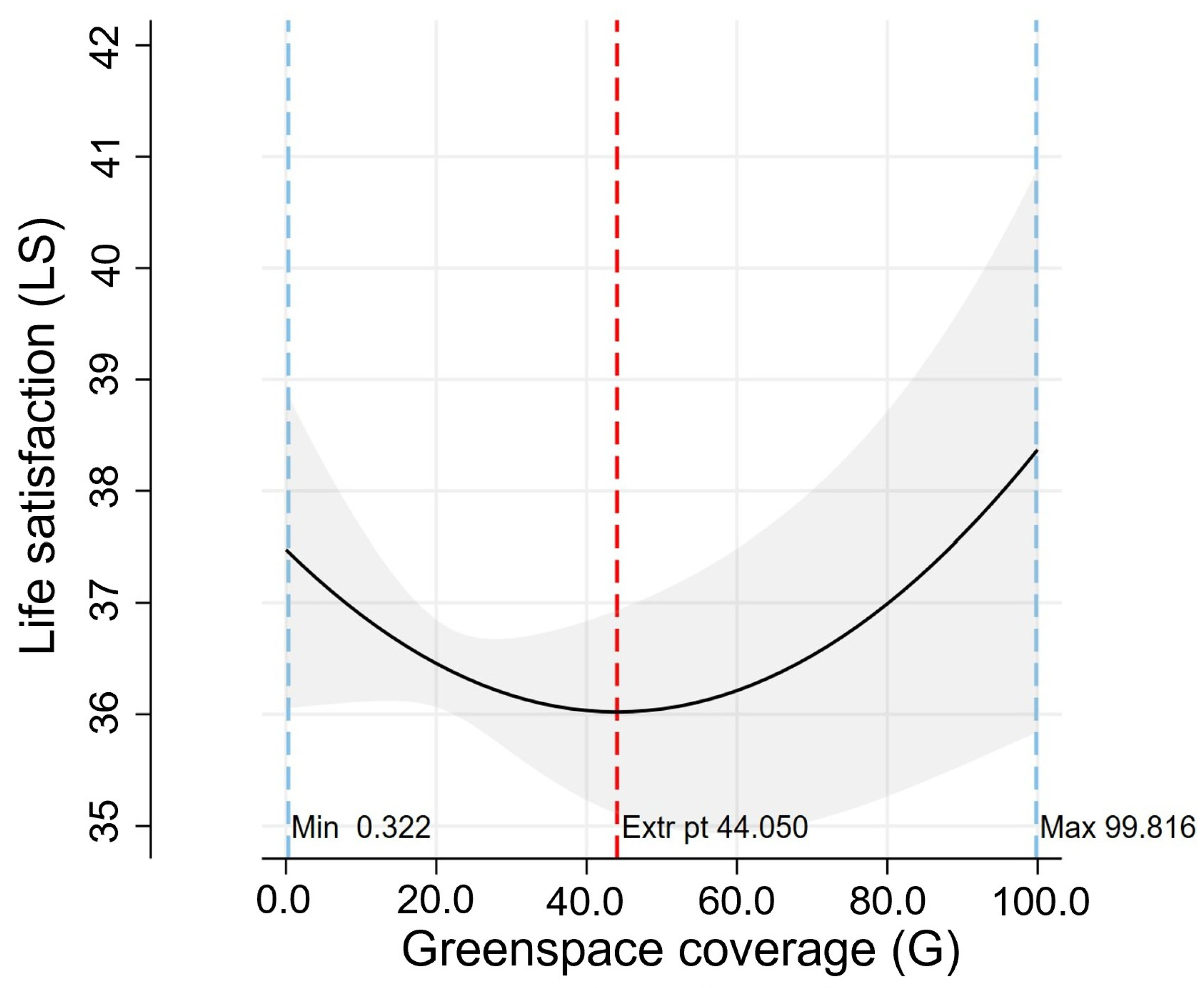
The F-test on the coefficients of the linear and squared terms of greenspace coverage returned a p-value of 0.080. Further tests calculated slopes at two ends of greenspace coverage values. The results show that at the low end, the slope was negative ( δ l o w = −0.066, p = 0.047), and at the high end, the slope showed a positive sign ( δ h i g h = 0.084, p = 0.014). The overall test for the presence of a U-shape returned a p-value of 0.047. The curve between greenspace coverage and LS was plotted in Figure 1, showing a turning point at 44.050 within the range of observed values. Further, the bootstrapping method with 500 replications was set to calculate the turning point. The estimated results showed that the 95% confidence interval for the turning point ranged from 13.09 to 75.01, which is located within the data range. Therefore, these further tests largely support the presence of a U-shaped relationship between greenspace coverage and LS.

3.3. Moderating Effects of Spatial Patterns

In Table 2, the moderated nonlinear models (Models 4 to 8) reveal that the U-shaped relationship between G and LS is significantly conditioned by several spatial pattern metrics—LMs. The AI acts as a significant moderator, with its interaction with the squared greenspace term being negative and modestly significant (G2 × AI b = −0.0001, p < 0.1). This indicates that in landscapes where greenspace is more clustered, the U-shaped curve becomes flatter, attenuating the strength of the nonlinear relationship. A more pronounced moderating effect is found for the ENN. The significant negative linear interaction (G × ENN b = −0.008, p < 0.01) combined with the significant positive quadratic interaction (G2 × ENN b = 0.0001, p < 0.01) demonstrates that greater spatial isolation between greenspace patches substantially intensifies the U-shaped relationship, making the initial decline and subsequent rise in LS more acute. Similarly, both PD and PR strengthen the U-shape, as shown by their positive and significant interactions with the squared term (G2 × PD b = 0.0001, p < 0.05; G2 × PR b = 0.001, p < 0.05). This suggests that more fragmented landscapes and those with a greater diversity of greenspace types exacerbate the U-shaped curve. In contrast, the interactions involving SHDI were not statistically significant (p > 0.1).
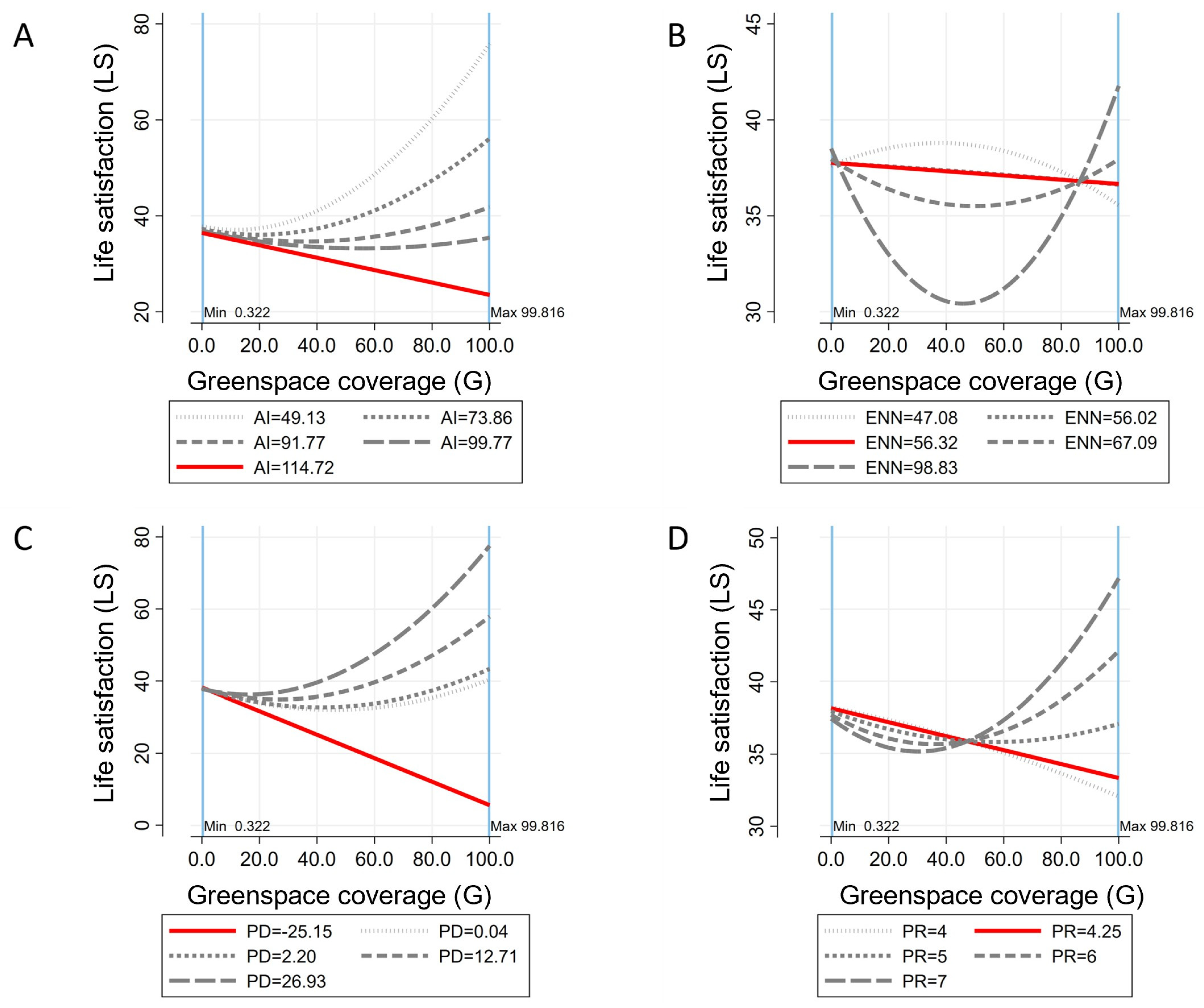
Next, the movement of the extreme point was examined by assigning meaningful values to each moderator, namely the AI, ENN, PD, and PR. The SHDI was excluded as there was no moderated nonlinearity observed. The estimation results are reported in Table 3. For the AI, G M is positive and statistically significant when the value of the AI is larger than the median, which indicates that the turning point moves rightward as the AI becomes larger but only within the range of the 50th percentile and maximum value, 73.86 and 99.77, respectively. Regarding the ENN, all the estimations were insignificant and no turning point movement was observed. The estimation of PD showed negative and statistically significant results across minimum to maximum values. In other words, the turning point moves leftward as the PD increases. For PR, there is only modest evidence showing movement of the turning point, as only one value of PR returned marginal significance.
To test the shape-flip phenomenon, the conditional curves between greenspace coverage and LS at different LM indicators are plotted in Figure 2. In A and C of Figure 2, the value of the moderator when the curve starts to flip lies beyond the range of the moderators AI and PD. A visual inspection indicated the absence of the shape-flip phenomenon. In B and D of Figure 2, shape-flip was evident for ENN but was not too obvious for PR based on visual inspection. When the ENN was lower than the value of 56.32, the U-shape between greenspace coverage and LS became inverted. Similarly, if patch richness was smaller than 4.25, the U-shape turned upside down. The conditional plots are presented as a diagnostic illustration, whereas whether a shape inversion is empirically supported is evaluated by the endpoint slope steepness criteria. Therefore, this study replicated the procedure of checking a quadratic curve with a low and high value of the moderator entered in Equation (2). The estimation results showed that, setting the ENN at a minimal value of 47.08, at the low end the slope was positive ( δ l o w = 0.063, p = 0.237) and at the high end the slope showed a negative sign ( δ h i g h = −0.104, p = 0.098). For PR assigned with a minimal value of four, both ends showed negative values ( δ l o w = −0.039, p = 0.648; δ h i g h = −0.084, p = 0.324). Thus, there is no strong evidence to support that a shape-flip occurs for all spatial patterns.

3.4. Sensitivity Test

A series of sensitivity tests was performed. First, the actual boundary of a township was used to replace the 3 km buffer from the centroid of a subdistrict. The boundary data is derived from Gaode Map with same the procedures as in Section 2.1; the greenspace coverage and LMs were measured by the same approaches in Section 2.3 and the results are insignificant, and thus are not reported. To assess the sensitivity to buffer choice, greenspace coverage is measured repeatedly by using 2 km, 4 km, and 5 km buffers. These alternative measures returned highly correlated with the baseline 3 km exposure (r > 0.80), and thus the main nonlinear and moderation results remain substantively unchanged. Second, a cubic term of greenspace coverage was entered in Equation (1), and the results were statistically insignificant for the cubic terms, indicating that the relationship is U-shaped rather than S-shaped. Third, following the preceding studies [47,48], a U-shaped relationship requires the coefficient of greenspace coverage to be significantly negative for the subsample below the turning point and significantly positive for the subsample above the turning point. Therefore, the turning point of 44.050 was used as a threshold to split the total sample into two subsamples and we performed regressions using Equation (1) without the quadratic term of greenspace coverage involved in each subsample. The results showed that, in the subsample with greenspace coverage larger than the turning point, the coefficient is positive and statistically significant (b = 0.068, p < 0.05), whilst, in the other subsample, the coefficient is negative and insignificant (b = −0.037, p > 0.1), which partially support our main claims of a U-shape relationship. Lastly, to reduce the effects of outliers on the nonlinearity between greenspace coverage and LS, Equation (1) was performed again by excluding samples below the 1% and above the 99% percentiles of greenspace coverage. This approach assists to reduce the possibility that the nonlinearity was driven by extreme values. The results are largely consistent, with the linear term being negative (b = 0.080, p < 0.05) and the quadratic term positive (b = 0.001, p < 0.01), and both are statistically significant.

4. Discussion

4.1. The Nonlinear Relationship Between Greenspace Coverage and SWB

The observation of a U-shaped relationship between greenspace coverage and life satisfaction reflects the complexity of ecosystem services and disservices in urban environments that are often associated with different urbanization levels. Our results suggest that life satisfaction reaches its lowest level when greenspace coverage is around 45% (the estimated turning point). A plausible interpretation is that this intermediate level of greenness often reflects a transitional urban morphology rather than a genuinely park-rich environment [49,50,51]. In many cities, moderate greenspace shares can coincide with discontinuous vegetation embedded within a largely built-up fabric, where greenspace is present but spatially broken and functionally limited [49]. This pattern is especially common in rapidly changing urban fringes and redevelopment areas, where land conversion and construction leave behind greenspace as small residual parcels and narrow strips rather than large, contiguous patches capable of delivering strong recreational and restorative benefits [50,51]. In addition, intermediate greenspace levels may be associated with high-end, gated residential compounds in which much of the vegetation is privatized, internally oriented, and managed for visual amenity rather than open, everyday use [1,52]. When green is fragmented, fenced, or designed more as a private landscape feature than an accessible public resource, its capacity to support routine physical activity, social interaction, and stress recovery may be muted [2,4,6]—helping to explain why wellbeing can be the lowest at this level despite nontrivial overall coverage. At low levels of greenspace, residents may benefit more from a dense urban fabric, which provides accessibility to amenities, employment, and transit—factors known to contribute to life satisfaction [53]. Similarly, at higher levels of greenspace coverage, the cumulative benefits—such as thermal comfort, air quality improvement, and psychological restoration—begin to outweigh these drawbacks [1,7,10]. Notably, the finding that models using administrative borders rather than ecologically meaningful spatial buffers yield insignificant associations strongly supports the proposition that the scale and context of exposure measurement fundamentally shape the detection of nonlinear environment–health effects, echoing the modifiable areal unit problem and the uncertain geographic context problem [18,54].

4.2. The Moderating Role of Spatial Patterns

Importantly, the nonlinearity observed here is not fixed but is conditional upon the spatial pattern of greenspace. Aggregated green patches tend to deliver more consistent and uniform ecological functions, reducing edge effects and stabilizing microclimatic benefits, which is consistent with evidence that more contiguous vegetation can moderate temperature and improve environmental quality more effectively than dispersed patches [21,25,28]. Conversely, increased isolation among patches—captured by greater ENN—intensifies the nonlinearity by amplifying the disadvantages of poorly connected green areas, such as reduced wildlife movement and diminished cooling effects [1,7,17]. Fragmentation, reflected in higher density or richness, can similarly amplify nonlinear patterns. International studies demonstrate that fragmentation often increases edge environments, leading to more variable local climates and potentially higher allergen concentrations, which can undermine the perceived benefits of intermediate greenspace coverage [16,21,55].
Finally, the dynamics of the turning point and the prospect of a curve “flip” merit consideration. Theoretically, as landscape metrics such as aggregation or fragmentation shift, so too does the location of the greenspace “optimum” for life satisfaction—moving rightward with greater aggregation and leftward with higher fragmentation [21,25,27]. While visual analysis may occasionally hint at a transition from U-shaped to inverted-U-shaped associations (particularly under extreme patch isolation), formal statistical tests frequently reveal these apparent flips to be unsupported once one accounts for the requirement of sufficiently steep endpoint slopes and the location of the curvature change within the observed data range [29,48]. This reflects the empirical reality that urban landscape metrics rarely cross the critical threshold needed for true “shape-flip,” as also observed in recent international studies of landscape–health relationships [2,7,17]. The moderation of nonlinearity thus appears robust, while full curve inversion remains a rare and typically unstable phenomenon in large urban samples.

4.3. Urban Planning and Design Applications

The findings provide clear evidence that simply increasing the total amount of urban greenspace does not guarantee linear improvements in residents’ wellbeing. Instead, the relationship is nonlinear and significantly moderated by spatial pattern. This challenges the “more is better” paradigm by demonstrating that the configuration, aggregation, and connectivity of greenspace are critical to maximizing health and life satisfaction gains [2,3]. This also aligns with recent evidence emphasizing a shift from greenness quantity to quality when explaining life satisfaction and inequality [1]. Planners and policymakers should therefore prioritize strategies that enhance both the quantity and the spatial quality of urban green infrastructure. Regulatory frameworks and urban development guidelines could explicitly incorporate spatial pattern metrics—such as the aggregation index and patch connectivity—when designing new greenspaces or upgrading existing ones [3,17,25]. Practical recommendations should consider trade-offs: increasing greenspace quantity through small additions may raise fragmentation, whereas improving aggregation/connectivity can be constrained by land scarcity, redevelopment costs, and equity considerations. Accordingly, the planning implication should be framed as a prioritization logic—quantity expansion where baseline cover is low and fragmented, and configuration improvement (e.g., connectivity/aggregation) where cover is moderate but spatially inefficient—rather than as a single universal target. Moreover, the results highlight that the measurement of greenspace exposure must align with the lived experiences and daily activity spaces of urban residents, rather than relying on administrative boundaries. Access measures do not necessarily correspond to actual nature exposure, with direct implications for health research [52]. This concern is consistent with the uncertain geographic context problem and the modifiable areal unit problem [18,54].

4.4. Limitations and Future Studies

This study is subject to several limitations. First, its cross-sectional design prevents direct causal inference regarding the relationship between greenspace patterns and life satisfaction. Second, the analysis relies on remotely sensed land cover and does not account for greenspace quality, accessibility, or residents’ actual usage patterns. Third, potential contextual factors—such as local climate, governance, or socio-cultural preferences—may influence the observed associations but are not fully addressed here. Fourth, although the survey in 2015 is representative for urban greening practice in China, the estimated turning points and moderators may differ across cultural contexts and urban systems. Future research should employ longitudinal or quasi-experimental designs to track how changes in both greenspace quantity and configuration affect wellbeing over time [9]. Such designs would be especially valuable for testing whether configuration-driven shifts in the turning point represent causal “movement along the curve” following greening interventions, rather than cross-sectional co-variation. It should also integrate objective provision with perceived quality and use behaviors, as recent evidence shows that subjective measures can mediate links between objective greenspace provision and health/wellbeing in high-density contexts [56]. In addition, exposure measurements can be improved by moving beyond residence-based buffers to real-time activity space indicators, which would help to separate access, exposure, and use and reduce the bias associated with uncertain geographic contexts [18,52]. Mechanism-focused work is also needed via linking landscape metrics to mediators, such as heat exposure, air pollution, noise, perceived safety, and social cohesion, which would clarify why aggregation tends to flatten the curve while fragmentation and richness steepen it.

5. Conclusions

By linking nationally representative life satisfaction data (CSS 2015; N = 4319 across 321 urban subdistricts) with high-resolution GlobeLand30 land cover measures, this study tests whether greenspace spatial configuration moderate nonlinear greenspace–wellbeing associations. A robust U-shaped relationship between greenspace coverage and life satisfaction is identified using moderated quadratic regression paired with formal endpoint slope and turning point tests. Spatial pattern metrics condition both the curvature and the location of the minimum: greater aggregation attenuates the U-shape and shifts the turning point toward higher coverage, whereas higher fragmentation (patch density) and compositional richness strengthen the U-shape and shift the turning point toward lower coverage; patch isolation (ENN) amplifies curvature but does not yield a statistically supported curve movement or inversion within the observed range. These results provide a configuration-based explanation for why prior studies may report different curvilinear forms across settings: “how green is arranged” can move thresholds and reshape marginal returns, not merely add an independent effect. For urban greenspace planning, the evidence supports configuration-aware targets—especially reducing fragmentation and improving aggregation/connectivity—alongside quantity expansion, because these features determine where neighborhoods fall on the nonlinear dose–response curve.

Supplementary Materials

The following supporting information can be downloaded at: https://www.mdpi.com/article/10.3390/f17010143/s1, Table S1: Landscape metric equations used in the study and explanations; Table S2: Land use types to determine greenspace quantity and landscape metrics; Figure S1: Examples of different percentages of greenspace (PLAND) with corresponding landscape metrics; Figure S2: Conceptual illustration of landscape metrics involved in this study.

Author Contributions

Conceptualization, L.W.; methodology, C.L., C.J. and L.W.; software, C.L. and C.J.; validation, C.L., C.J. and J.G.; formal analysis, C.L. and L.W.; investigation, C.L.; resources, L.W.; data curation, C.L. and L.W.; writing—original draft preparation, C.L. and L.W.; writing—review and editing, C.L., C.J., J.G. and L.W.; visualization, C.L.; supervision, L.W.; project administration, L.W.; funding acquisition, L.W. All authors have read and agreed to the published version of the manuscript.

Funding

This research is funded by the National Natural Science Foundation of China (Grant No. 52308041).

Data Availability Statement

The study analyzed secondary data from the 2015 Chinese Social Survey (CSS). Access to the CSS microdata is subject to the data provider’s policies and restrictions; therefore, this data cannot be publicly shared by the authors. Researchers may obtain access to the CSS data from the data provider upon request and approval. The analysis code and documentation are available from the corresponding author upon reasonable request.

Acknowledgments

During the preparation of this work, the authors used GPT-5.2 in order to improve readability and language. After using the tool, all authors reviewed and edited the content as needed and take full responsibility for the content of the publication.

Conflicts of Interest

The authors declare no conflicts of interest.

Abbreviations

AI, Aggregation Index; CSS, Chinese Social Survey; ENN, Euclidean Nearest Neighbor Distance; G, Greenspace Coverage; LM, Landscape Metrics; LS, Life Satisfaction; PD, Patch Density; PR, Patch Richness; SHDI, Shannon’s Diversity Index; SWB, Subjective Wellbeing.

References

  1. Wu, W.; Tan, W.; Wang, R.; Chen, W.Y. From quantity to quality: Effects of urban greenness on life satisfaction and social inequality. Landsc. Urban Plan. 2023, 238, 104843. [Google Scholar] [CrossRef]
  2. Chen, Y.; Ying, J.; Zhang, Y.; Feng, Y.; Chen, X.; Zhou, X. A systematic review of urban green spaces affecting subjective well-being: An explanation of their complex mechanisms. Ecol. Indic. 2025, 178, 113786. [Google Scholar] [CrossRef]
  3. Wang, H.; Gholami, S.; Xu, W.; Samavatekbatan, A.; Sleipness, O.; Tassinary, L.G. Where and how to invest in greenspace for optimal health benefits: A systematic review of greenspace morphology and human health relationships. Lancet Planet. Health 2024, 8, e574–e587. [Google Scholar] [CrossRef] [PubMed]
  4. Beute, F.; Marselle, M.R.; Olszewska-Guizzo, A.; Andreucci, M.B.; Lammel, A.; Davies, Z.G.; Glanville, J.; Keune, H.; O’Brien, L.; Remmen, R.; et al. How do different types and characteristics of green space impact mental health? A scoping review. People Nat. 2023, 5, 1839–1876. [Google Scholar] [CrossRef]
  5. Navarrete-Hernandez, P.; Kiarostami, N.; Yang, D.; Ozcakir, A. Green Enough? A dose-response curve of the impact of street greenery levels and types on perceived happiness. Landsc. Urban Plan. 2024, 251, 105130. [Google Scholar] [CrossRef]
  6. Syamili, M.S.; Takala, T.; Korrensalo, A.; Tuittila, E.-S. Happiness in urban green spaces: A systematic literature review. Urban For. Urban Green. 2023, 86, 128042. [Google Scholar] [CrossRef]
  7. Wu, L.; Chen, C. Does pattern matter? Exploring the pathways and effects of urban green space on promoting life satisfaction through reducing air pollution. Urban For. Urban Green. 2023, 82, 127890. [Google Scholar] [CrossRef]
  8. Wang, H.; Tassinary, L.G. Association between greenspace morphology and prevalence of non-communicable diseases mediated by air pollution and physical activity. Landsc. Urban Plan. 2024, 242, 104934. [Google Scholar] [CrossRef]
  9. Deng, B.; Boden, J.; Ye, N.; Morgenroth, J.; Campbell, M.; Eggleton, P.; McLeod, G.; Hobbs, M. Life in green: Associations between greenspace availability and mental health over the lifecourse—A 40-year prospective birth cohort study. Environ. Int. 2025, 195, 109223. [Google Scholar] [CrossRef]
  10. White, M.P.; Alcock, I.; Grellier, J.; Wheeler, B.W.; Hartig, T.; Warber, S.L.; Bone, A.; Depledge, M.H.; Fleming, L.E. Spending at least 120 minutes a week in nature is associated with good health and wellbeing. Sci. Rep. 2019, 9, 7730. [Google Scholar] [CrossRef]
  11. Patino, J.E.; Martinez, L.; Valencia, I.; Duque, J.C. Happiness, life satisfaction, and the greenness of urban surroundings. Landsc. Urban Plan. 2023, 237, 104811. [Google Scholar] [CrossRef]
  12. Ambrey, C.; Fleming, C. Public Greenspace and Life Satisfaction in Urban Australia. Urban Stud. 2013, 51, 1290–1321. [Google Scholar] [CrossRef]
  13. Wu, W.; Tan, W.; Chen, W.Y.; Wang, R. Disentangling the non-linear impacts of natural attributes of urban built environment on life satisfaction. Cities 2024, 155, 105496. [Google Scholar] [CrossRef]
  14. Cao, W.; Wang, L.; Wang, J.; Elsadek, M.; Zhang, D. Nonlinear health benefits of public green space: Evidence from a nationwide machine learning study in China. Front. Public Health 2025, 13, 1680591. [Google Scholar] [CrossRef]
  15. Lyytimäki, J.; Sipilä, M. Hopping on one leg—The challenge of ecosystem disservices for urban green management. Urban For. Urban Green. 2009, 8, 309–315. [Google Scholar] [CrossRef]
  16. Janhäll, S. Review on urban vegetation and particle air pollution—Deposition and dispersion. Atmos. Environ. 2015, 105, 130–137. [Google Scholar] [CrossRef]
  17. Mears, M.; Brindley, P.; Jorgensen, A.; Ersoy, E.; Maheswaran, R. Greenspace spatial characteristics and human health in an urban environment: An epidemiological study using landscape metrics in Sheffield, UK. Ecol. Indic. 2019, 106, 105464. [Google Scholar] [CrossRef]
  18. Kwan, M.-P. The Uncertain Geographic Context Problem. Ann. Assoc. Am. Geogr. 2012, 102, 958–968. [Google Scholar] [CrossRef]
  19. Fotheringham, A.S.; Wong, D.W.S. The Modifiable Areal Unit Problem in Multivariate Statistical Analysis. Environ. Plan. A 1991, 23, 1025–1044. [Google Scholar] [CrossRef]
  20. Labib, S.M.; Lindley, S.; Huck, J.J. Spatial dimensions of the influence of urban green-blue spaces on human health: A systematic review. Environ. Res. 2020, 180, 108869. [Google Scholar] [CrossRef]
  21. Ziter, C.D.; Pedersen, E.J.; Kucharik, C.J.; Turner, M.G. Scale-dependent interactions between tree canopy cover and impervious surfaces reduce daytime urban heat during summer. Proc. Natl. Acad. Sci. USA 2019, 116, 7575–7580. [Google Scholar] [CrossRef] [PubMed]
  22. Abhijith, K.V.; Kumar, P.; Gallagher, J.; McNabola, A.; Baldauf, R.; Pilla, F.; Broderick, B.; Di Sabatino, S.; Pulvirenti, B. Air pollution abatement performances of green infrastructure in open road and built-up street canyon environments—A review. Atmos. Environ. 2017, 162, 71–86. [Google Scholar] [CrossRef]
  23. Shen, Y.S.; Lung, S.C. Can green structure reduce the mortality of cardiovascular diseases? Sci. Total Environ. 2016, 566–567, 1159–1167. [Google Scholar] [CrossRef]
  24. Wang, H.; Tassinary, L.G. Effects of greenspace morphology on mortality at the neighbourhood level: A cross-sectional ecological study. Lancet Planet. Health 2019, 3, e460–e468. [Google Scholar] [CrossRef] [PubMed]
  25. Rakoto, P.Y.; Deilami, K.; Hurley, J.; Amati, M.; Sun, Q.C. Revisiting the cooling effects of urban greening: Planning implications of vegetation types and spatial configuration. Urban For. Urban Green. 2021, 64, 127266. [Google Scholar] [CrossRef]
  26. Wu, H.; Yang, C.; Chen, J.; Yang, S.; Lu, T.; Lin, X. Effects of Green space landscape patterns on particulate matter in Zhejiang Province, China. Atmos. Pollut. Res. 2018, 9, 923–933. [Google Scholar] [CrossRef]
  27. Wang, C.; Guo, M.; Jin, J.; Yang, Y.; Ren, Y.; Wang, Y.; Cao, J. Does the Spatial Pattern of Plants and Green Space Affect Air Pollutant Concentrations? Evidence from 37 Garden Cities in China. Plants 2022, 11, 2847. [Google Scholar] [CrossRef] [PubMed]
  28. Schwaab, J.; Meier, R.; Mussetti, G.; Seneviratne, S.; Bürgi, C.; Davin, E.L. The role of urban trees in reducing land surface temperatures in European cities. Nat. Commun. 2021, 12, 6763. [Google Scholar] [CrossRef]
  29. Lind, J.T.; Mehlum, H. With or Without U? The Appropriate Test for a U-Shaped Relationship*. Oxf. Bull. Econ. Stat. 2010, 72, 109–118. [Google Scholar] [CrossRef]
  30. Li, P.; Li, W.; Chen, G.; Zou, Y.; Cui, Y.; Ren, L.; Tian, Z.; Zhang, L.; Fan, L.; Wang, K.; et al. 2018. Available online: http://csqr.cass.cn/ (accessed on 15 March 2020).
  31. Gaode Map. Gaode Map. Available online: https://www.amap.com/ (accessed on 19 March 2020).
  32. Shen, Y.S.; Lung, S.C. Mediation pathways and effects of green structures on respiratory mortality via reducing air pollution. Sci. Rep. 2017, 7, 42854. [Google Scholar] [CrossRef]
  33. Jaafari, S.; Shabani, A.A.; Moeinaddini, M.; Danehkar, A.; Sakieh, Y. Applying landscape metrics and structural equation modeling to predict the effect of urban green space on air pollution and respiratory mortality in Tehran. Environ. Monit. Assess. 2020, 192, 412. [Google Scholar] [CrossRef]
  34. Ha, J.; Kim, H.J.; With, K.A. Urban green space alone is not enough: A landscape analysis linking the spatial distribution of urban green space to mental health in the city of Chicago. Landsc. Urban Plan. 2022, 218, 104309. [Google Scholar] [CrossRef]
  35. Wu, J.; Xie, W.; Li, W.; Li, J. Effects of Urban Landscape Pattern on PM2.5 Pollution--A Beijing Case Study. PLoS ONE 2015, 10, e0142449. [Google Scholar] [CrossRef]
  36. Wang, M.; Feng, C. How will the greening policy contribute to China’s greenhouse gas emission mitigation? A non-parametric forecast. Environ. Res. 2021, 195, 110779. [Google Scholar] [CrossRef]
  37. Dahlan, M.Z.; Faisal, B.; Chaeriyah, S.; Hutriani, I.W.; Amelia, M. A New Urban Greening Scheme Approach: Increasing Quantity and Quality of Urban Green Space. IOP Conf. Ser. Earth Environ. Sci. 2022, 1092, 12010. [Google Scholar] [CrossRef]
  38. Zhang, Z.; Cenci, J.; Zhang, J. Policies for Equity in Access to Urban Green Space: A Spatial Perspective of the Chinese National Forest City Policy. Forests 2024, 15, 608. [Google Scholar] [CrossRef]
  39. Preston, C.C.; Colman, A.M. Optimal number of response categories in rating scales: Reliability, validity, discriminating power, and respondent preferences. Acta Psychol. 2000, 104, 1–15. [Google Scholar] [CrossRef] [PubMed]
  40. Taherdoost, H. What is the best response scale for survey and questionnaire design; review of different lengths of rating scale/attitude scale/Likert scale. Int. J. Acad. Res. Manag. 2019, 8, 1–10. [Google Scholar]
  41. The Ministry of Natural Resources of the People’s Republic of China. GlobeLand30; National Geomatics Center of China: Beijing, China, 2020. Available online: http://www.webmap.cn/mapDataAction.do?method=globalLandCover (accessed on 16 June 2020).
  42. McGarigal, K.; Cushman, S.A.; Ene, E. FRAGSTATS v4: Spatial Pattern Analysis Program for Categorical Maps. Computer Software Program Produced by the Authors. Available online: https://www.fragstats.org (accessed on 15 May 2023).
  43. Weber, N.; Haase, D.; Franck, U. Assessing modelled outdoor traffic-induced noise and air pollution around urban structures using the concept of landscape metrics. Landsc. Urban Plan. 2014, 125, 105–116. [Google Scholar] [CrossRef]
  44. de Bell, S.; White, M.; Griffiths, A.; Darlow, A.; Taylor, T.; Wheeler, B.; Lovell, R. Spending time in the garden is positively associated with health and wellbeing: Results from a national survey in England. Landsc. Urban Plan. 2020, 200, 103836. [Google Scholar] [CrossRef]
  45. Bright, E.A.; Rose, A.N.; Urban, M.L. LandScan 2015 Global Population Database; Oak Ridge National Laboratory: Oak Ridge, TN, USA, 2016. Available online: https://landscan.ornl.gov (accessed on 19 January 2020).
  46. Peking University, College of Urban and Environmental Sciences. Geographic Data Sharing Infrastructure. Available online: http://geodata.pku.edu.cn (accessed on 16 January 2021).
  47. Li, J.; Li, Y.; Yu, Y.; Yuan, L. Search broadly or search narrowly? Role of knowledge search strategy in innovation performance. J. Knowl. Manag. 2019, 23, 809–835. [Google Scholar] [CrossRef]
  48. Haans, R.F.J.; Pieters, C.; He, Z.-L. Thinking about U: Theorizing and testing U- and inverted U-shaped relationships in strategy research. Strateg. Manag. J. 2016, 37, 1177–1195. [Google Scholar] [CrossRef]
  49. Kuang, W.; Zhang, S.; Li, X.; Lu, D. A 30 m resolution dataset of China’s urban impervious surface area and green space, 2000–2018. Earth Syst. Sci. Data 2021, 13, 63–82. [Google Scholar] [CrossRef]
  50. Li, F.; Zheng, W.; Wang, Y.; Liang, J.; Xie, S.; Guo, S.; Li, X.; Yu, C. Urban Green Space Fragmentation and Urbanization: A Spatiotemporal Perspective. Forests 2019, 10, 333. [Google Scholar] [CrossRef]
  51. di Cristofaro, M.; Di Pirro, E.; Ottaviano, M.; Marchetti, M.; Lasserre, B.; Sallustio, L. Greener or Greyer? Exploring the Trends of Sealed and Permeable Spaces Availability in Italian Built-Up Areas during the Last Three Decades. Forests 2022, 13, 1983. [Google Scholar] [CrossRef]
  52. Jarvis, I.; Gergel, S.; Koehoorn, M.; van den Bosch, M. Greenspace access does not correspond to nature exposure: Measures of urban natural space with implications for health research. Landsc. Urban Plan. 2020, 194, 103686. [Google Scholar] [CrossRef]
  53. Mouratidis, K. Built environment and leisure satisfaction: The role of commute time, social interaction, and active travel. J. Transp. Geogr. 2019, 80, 102491. [Google Scholar] [CrossRef]
  54. Openshaw, S. The Modifiable Areal Unit Problem; Geo Books: Norwich, UK, 1983. [Google Scholar]
  55. von Döhren, P.; Haase, D. Ecosystem disservices research: A review of the state of the art with a focus on cities. Ecol. Indic. 2015, 52, 490–497. [Google Scholar] [CrossRef]
  56. Hua, J.; Ren, C.; Yin, S.; Chen, W.Y. Effects of urban greenspaces on public health and wellbeing: Serial mediation model of objective and subjective measures. Urban For. Urban Green. 2025, 106, 128753. [Google Scholar] [CrossRef]
Figure 1. The nonlinear relationship between greenspace coverage and life satisfaction (red line indicates turning point, blue lines indicate minimum and maximum values of greenspace coverage percentage, solid black line is fit curve, and gray shaded area is 95 CI).
Forests 17 00143 g001
Figure 2. The conditional nonlinear curve at different LM indicators. The conditional nonlinear curve between greenspace coverage and LS across different moderators: (A) AI; (B) ENN; (C) PD; (D) PR. (Red line indicates the slope when curve flips; blue line indicates minimum and maximum values of greenspace coverage percentage).
Forests 17 00143 g002
Table 1. Descriptive statistics of all variables (N = 4319).
VariablesDescriptions%MeanS.D.MinMax
LSLife satisfaction-36.7078.9566.00060.000
GGreenspace coverage (%)-29.75226.6520.32298.229
AIAggregation index-70.94616.99034.64099.324
ENNEuclidean nearest neighbor distance (m)-77.37940.85347.080477.353
PDPatch density-13.8249.1260.10642.048
PRPatch richness-5.7560.5294.0007.000
SHDIShannon’s diversity index-0.9010.3570.0401.542
RoadRoad density (km per km2)-5.7724.8310.14021.803
MixDiversity of land use type mixture by POI-1.2680.2160.0001.748
PopPopulation density (person per km2)-514473834153,612
SlopeSlope mean (degree)-2.4163.1290.17618.360
Age18–3528.8
36–4524.2
46–6031.2
61 and above15.8
GenderFemale = 055.1
Male = 144.9
MarriageMarried = 180.8
Not married or other = 019.2
EmploymentEmployed = 157.0
Not employed = 043.0
IncomeBelow 18 k CNY21.0
18–30 k CNY24.1
30–48 k CNY17.6
Above 48 k CNY20.2
No answer17.1
EducationPrimary school or below47.6
High school or equivalent25.2
College and above26.9
Other0.3
CommunityCommercial housing community41.8
New urban community16.6
Old urban community19.6
Work unit mixed community14.7
Affordable housing community4.5
High end villa community1.6
Other1.2
Table 2. Nonlinear regression of urban green space and life satisfaction.
VariablesModel 1Model 2Model 3Model 4Model 5Model 6Model 7Model 8
G 0.001−0.066 *−0.1110.443 ***−0.261 ***0.109−0.077
(0.018)(0.039)(0.213)(0.144)(0.071)(0.237)(0.109)
G2 0.001 **0.009 *−0.005 ***0.003 ***−0.0040.001
(0.0003)(0.005)(0.002)(0.001)(0.002)(0.001)
AI −0.020
(0.038)
G × AI −0.0001
(0.003)
G2 × AI −0.0001 *
(0.00004)
ENN 0.018 **
(0.007)
G × ENN −0.008 ***
(0.002)
G2 × ENN 0.0001 ***
(0.00002)
PD −0.008
(0.064)
G × PD 0.003
(0.004)
G2 × PD 0.0001 **
(0.0001)
PR −0.264
(0.782)
G × PR −0.037
(0.039)
G2 × PR 0.001 **
(0.0004)
SHDI −1.030
(1.456)
G × SHDI 0.025
(0.094)
G2 × SHDI −0.00003
(0.001)
Road−0.139 *−0.139 *−0.148 *−0.112−0.124−0.134−0.144 *−0.145 *
(0.082)(0.081)(0.082)(0.085)(0.082)(0.086)(0.084)(0.083)
Mix1.0461.0430.9130.9451.0420.9200.9210.923
(1.146)(1.133)(1.193)(1.166)(1.128)(1.204)(1.195)(1.175)
Pop0.0000.0000.0000.0000.0000.0000.0000.000
(0.000)(0.000)(0.000)(0.000)(0.000)(0.000)(0.000)(0.000)
Slope0.1450.1400.0900.1470.128−0.0620.0940.076
(0.094)(0.143)(0.140)(0.141)(0.145)(0.148)(0.144)(0.141)
Age (18−35 as ref)
36−45−1.380 ***−1.380 ***−1.374 ***−1.375 ***−1.387 ***−1.394 ***−1.396 ***−1.382 ***
(0.392)(0.392)(0.392)(0.391)(0.389)(0.391)(0.391)(0.393)
46−600.1670.1670.1560.1490.1370.1280.1560.151
(0.418)(0.418)(0.419)(0.419)(0.419)(0.419)(0.418)(0.419)
61 and above3.246 ***3.246 ***3.226 ***3.218 ***3.210 ***3.202 ***3.213 ***3.212 ***
(0.548)(0.548)(0.548)(0.547)(0.545)(0.546)(0.547)(0.549)
Gender−0.006−0.006−0.008−0.009−0.004−0.0170.005−0.006
(0.269)(0.269)(0.269)(0.269)(0.270)(0.269)(0.269)(0.270)
Marriage−0.145−0.145−0.149−0.138−0.139−0.150−0.146−0.145
(0.405)(0.405)(0.405)(0.405)(0.403)(0.404)(0.405)(0.406)
Employment0.0570.0570.0330.0360.0140.0140.0270.035
(0.323)(0.323)(0.324)(0.324)(0.325)(0.323)(0.323)(0.324)
Income (Below 18 k CNY as ref)
18−30 k CNY1.277 ***1.277 ***1.284 ***1.296 ***1.284 ***1.334 ***1.317 ***1.296 ***
(0.425)(0.424)(0.425)(0.423)(0.423)(0.423)(0.424)(0.425)
30−48 k CNY2.271 ***2.271 ***2.284 ***2.277 ***2.281 ***2.293 ***2.301 ***2.290 ***
(0.428)(0.428)(0.429)(0.430)(0.428)(0.429)(0.431)(0.431)
Above 48 k CNY3.654 ***3.654 ***3.669 ***3.657 ***3.636 ***3.701 ***3.692 ***3.674 ***
(0.469)(0.470)(0.471)(0.471)(0.469)(0.468)(0.472)(0.474)
No answer1.553 ***1.553 ***1.542 ***1.546 ***1.525 ***1.561 ***1.587 ***1.554 ***
(0.481)(0.481)(0.481)(0.481)(0.481)(0.482)(0.482)(0.482)
Education (Primary school or below as ref)
High school2.397 ***2.397 ***2.406 ***2.412 ***2.414 ***2.415 ***2.405 ***2.404 ***
(0.328)(0.328)(0.329)(0.328)(0.328)(0.329)(0.328)(0.328)
College and above5.584 ***5.584 ***5.597 ***5.588 ***5.554 ***5.558 ***5.592 ***5.593 ***
(0.372)(0.372)(0.373)(0.373)(0.372)(0.371)(0.372)(0.374)
Other5.220 **5.218 **5.348 **5.377 **5.302 **5.227 **5.380 **5.364 **
(2.241)(2.242)(2.276)(2.277)(2.254)(2.208)(2.282)(2.272)
Community (Commercial housing community as ref)
New urban −0.422−0.422−0.481−0.515−0.503−0.531−0.489−0.438
(0.528)(0.529)(0.530)(0.525)(0.520)(0.507)(0.532)(0.534)
Old urban −1.579 ***−1.580 ***−1.548 ***−1.516 ***−1.349 ***−1.436 ***−1.555 ***−1.528 ***
(0.401)(0.400)(0.402)(0.403)(0.398)(0.399)(0.403)(0.404)
Work unit mixed 0.2630.2620.2690.2540.3440.2140.3740.284
(0.432)(0.434)(0.434)(0.433)(0.439)(0.429)(0.440)(0.437)
Affordable −1.213−1.214−1.209−1.284 *−1.353 *−1.332 *−1.163−1.242 *
(0.737)(0.737)(0.739)(0.735)(0.718)(0.740)(0.730)(0.738)
High end villa1.2941.2911.3971.4121.3811.3171.5151.436
(0.911)(0.921)(0.919)(0.926)(0.953)(0.940)(0.927)(0.937)
Other1.1211.1211.0711.0301.1351.1731.1391.072
(1.100)(1.100)(1.097)(1.104)(1.100)(1.096)(1.097)(1.099)
Constant31.048 ***31.044 ***31.939 ***32.728 ***30.686 ***32.810 ***33.830 ***32.690 ***
(1.779)(1.792)(1.972)(2.941)(1.944)(2.180)(4.726)(2.101)
Observations43194319431943194319431943194319
R-squared0.1940.1940.1950.1960.1970.1970.1960.195
Note: Robust standard errors in parentheses. *** p < 0.01, ** p < 0.05, * p < 0.1. The regression sample comprises 4319 respondents.
Table 3. Estimation of the significance from Equation (4) with selected values of moderators.
ModeratorsMin10th25th50th75th90thMax
AI0.1320.1970.2420.509 **0.985 ***1.613 ***3.801 *
(0.096)(0.132)(0.155)(0.252)(0.334)(0.411)(2.004)
ENN−0.711−672.865−3.610-0.523−0.098−0.034−0.000
(1.472)(21,487.904)(9.485)(0.911)(0.159)(0.055)(0.001)
PD−2.279 ***−1.933 ***−1.428 ***−1.009 ***−0.734 ***−0.533 **−0.320 *
(0.509)(0.303)(0.184)(0.222)(0.233)(0.216)(0.167)
PR−414.470−48.333−8.816 *−8.816 *−8.816 *−8.816 *−3.563
(3161.081)(45.836)(5.299)(5.299)(5.299)(5.299)(3.064)
Note: Standard errors are in parentheses. *** p < 0.01, ** p < 0.05, * p < 0.1. For patch richness, the observed value ranged from 4 to 7; the 25th to 90th percentiles are the same value of six.
Disclaimer/Publisher’s Note: The statements, opinions and data contained in all publications are solely those of the individual author(s) and contributor(s) and not of MDPI and/or the editor(s). MDPI and/or the editor(s) disclaim responsibility for any injury to people or property resulting from any ideas, methods, instructions or products referred to in the content.