Review

A Review of Remote Sensing Monitoring of Plant Diversity in Tropical Forests


1
Department of Geography & Spatial Information, Center for Land and Marine Spatial Utilization and Governance Research, Ningbo University, Ningbo 315211, China
2
College of Ecology and Environment, Xinjiang University, Urumqi 830017, China
3
Institute of East China Sea, Ningbo University, Ningbo 315211, China
4
Ningbo Key Laboratory of Remote Sensing and Ecological Security of Coastal Zone, Ningbo University, Ningbo 315211, China
5
Ningbo Forestry Development Center, Ningbo 315211, China
*
Author to whom correspondence should be addressed.
These authors contributed equally to this work.
Forests 2026, 17(1), 142; https://doi.org/10.3390/f17010142 (registering DOI)
Submission received: 28 November 2025 / Revised: 19 January 2026 / Accepted: 20 January 2026 / Published: 22 January 2026
(This article belongs to the Section Forest Biodiversity)

Abstract

Tropical forests are the most plant-diverse ecosystems on Earth, characterized by extremely high species richness and playing essential roles in ecosystem stability, carbon sequestration, and hydrological regulation. Although remote sensing has been widely applied to monitoring tropical forest plant diversity in recent decades, a systematic understanding of its actual monitoring capacity remains limited. Based on a bibliometric analysis of 15,878 publications from 1960 to 2025, this study draws several key conclusions: (1) Global research is highly unevenly distributed, with most studies concentrated in China’s tropical monsoon forests, Brazil’s Amazon rainforest, Costa Rica’s tropical rainforests, and Mexico’s tropical dry forests, while many other regions remain understudied; (2) The Sentinel-2 and Landsat series are the most widely used satellite sensors, and indirect indicators are applied more frequently than direct spectral metrics in monitoring models. Hyperspectral data, Light Detection and Ranging (LiDAR), and nonlinear models generally achieve higher accuracy than multispectral data, Synthetic Aperture Radar (SAR), and linear models; (3) Sampling scales range from 64 m2 to 1600 ha, with the highest accuracy achieved when plot size is within 400 m2 < Area ≤ 2500 m2, and spatial resolutions below 10 m perform best. Based on these findings, we propose four priority directions for future research: (1) Quantifying spectral indicators and models; (2) Assessing the influence of canopy structure on biodiversity remote sensing accuracy; (3) Strengthening the application of high-resolution data and reducing intraspecific spectral variability; and (4) Enhancing functional diversity monitoring and advancing research on the relationship between biodiversity and ecosystem functioning.

1. Introduction

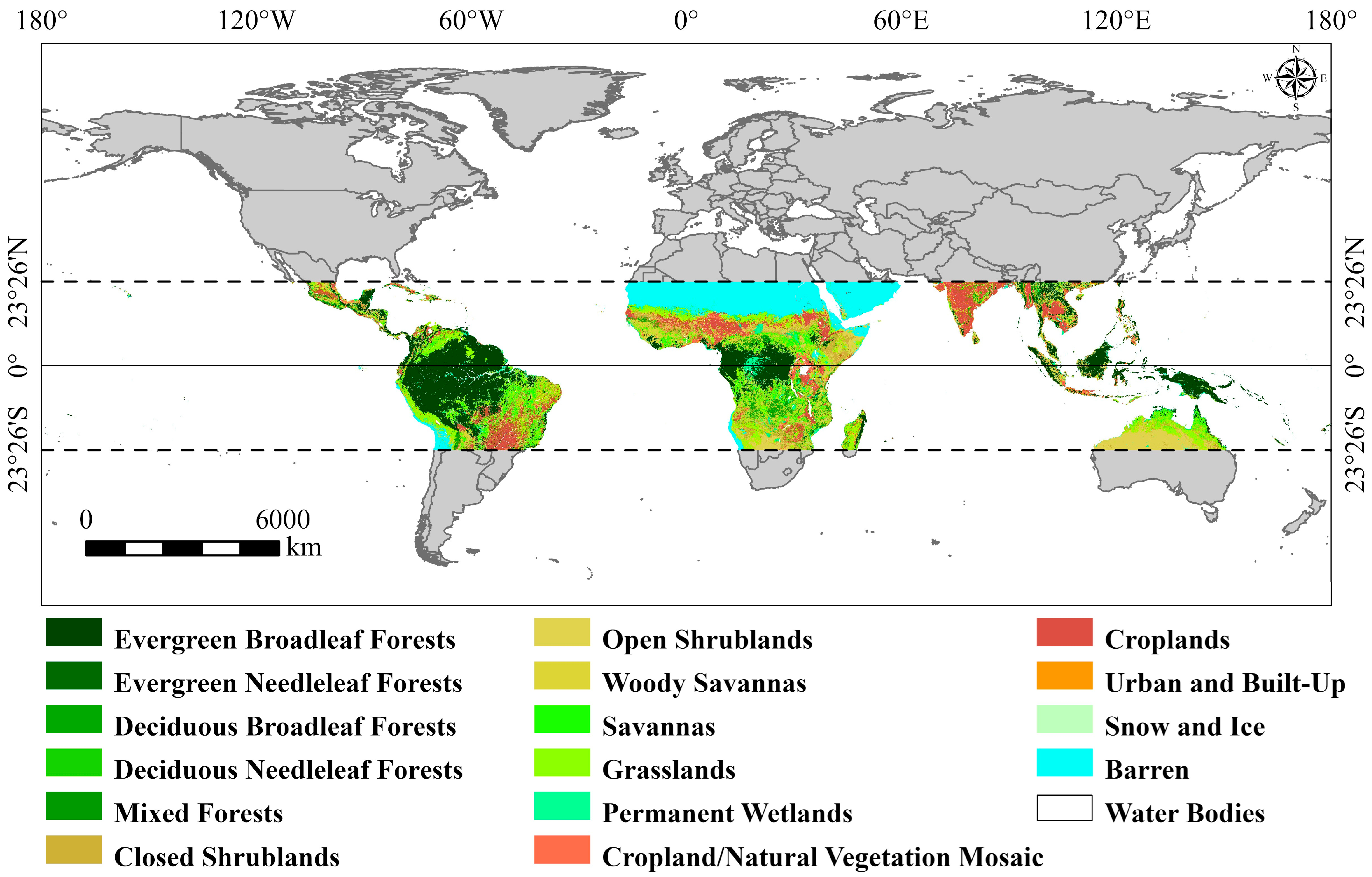
Tropical forests are ecosystems located near the Earth’s equator, typically distributed on both sides of the equator, within the region between approximately 23.5° north and south latitude. They mainly include tropical rainforests, tropical seasonal forests, and tropical dry forests [1]. Tropical forests are the most biodiverse regions on Earth, accounting for 44.60% of the world’s forests, and are primarily distributed in the Amazon Basin of South America, the Malay Archipelago in Southeast Asia, the Congo Basin of Africa, Central America, Madagascar, and the southern edge of the Sahara Desert (Figure 1) [2,3]. More than half of terrestrial plant species are distributed in these regions, and their species richness and functional complexity are unparalleled in global ecosystems [4,5]. High plant diversity not only supports the exceptionally high primary productivity of tropical forests but also enhances ecosystem stability through mechanisms such as niche complementarity and functional redundancy, playing a key role in processes such as carbon sequestration, water cycle regulation, soil formation, and nutrient maintenance [6,7]. For human society, tropical forest plant diversity is a vital source of medicinal active compounds, timber and non-timber forest products, genetic resources, and potential new materials; over a quarter of the global food, fiber, and industrial raw materials, along with thousands of other items, are directly or indirectly derived from tropical plants [8,9]. Moreover, high plant diversity provides the livelihood foundation for millions of local residents and supports cultural traditions and local knowledge systems.
With the intensification of deforestation, land use changes, and climate change, tropical forest plant diversity is facing rapid loss. The area of tropical forests is decreasing at an alarming rate, with 6.73 million hectares disappearing in 2024 alone [10,11]. As a result, efficiently and accurately monitoring and protecting tropical forest plant diversity on a large scale has become a frontier issue and urgent task of common concern in the fields of ecology, remote sensing science, and global environmental governance. Traditional ground-based plot surveys, although highly accurate and reliable for species identification on a local scale, are limited by factors such as intensive survey efforts, time consumption, high costs, and poor accessibility in remote and complex terrains, making it difficult to meet the demands for large-scale, long-term, and high-frequency biodiversity monitoring of forests [12,13]. Furthermore, the complex species composition and significant seasonal phenological differences in forest ecosystems make it increasingly difficult to achieve large-scale, systematic, standardized, and sustainable monitoring through traditional manual surveys alone. Remote sensing technology, as a non-destructive, wide-area coverage, temporally continuous, and cost-effective monitoring tool, has become a key alternative for studying plant community diversity [14,15,16].
However, remote sensing monitoring of tropical forests faces uniquely distinct challenges compared to that of temperate and boreal forests, stemming from the unique biophysical and ecological characteristics of tropical ecosystems [17,18]. In contrast, temperate and boreal forests have relatively simple canopy structures, a feature that makes their remote sensing monitoring more straightforward to implement. The core challenges in tropical forest remote sensing, on the other hand, lie in two key aspects: extremely high plant diversity and highly complex vertical stratification [19,20]. The combination of these two characteristics directly leads to severe spectral mixing of adjacent species in remote sensing images. It not only limits the penetration depth of optical remote sensing signals but also greatly increases the difficulty of extracting understory diversity information [21]. It is important to emphasize that the technical methods of remote sensing are universal. Therefore, once the monitoring bottlenecks caused by the high diversity and complex structure of tropical forests are broken through, and the corresponding solutions are transferred and applied to temperate and boreal forests with relatively simple structures, the relevant monitoring problems of the latter will naturally be easily resolved.
The research on remote sensing monitoring of tropical forest plant diversity has gradually emerged since 2003. The initial studies, based on Landsat remote sensing imagery and feedforward neural networks, successfully estimated 30% of species richness, laying the foundation for the application of remote sensing technology in plant diversity monitoring [16]. Subsequently, researchers have expanded the scope of diversity in remote sensing data, modeling methods, and monitoring indicators. The first major advancement was in remote sensing data, with hyperspectral sensors such as AVIRIS, with a spectral resolution of 10 nm, being mounted on drones to capture imagery of study areas and monitor species richness, improving the accuracy of plant diversity assessment to 85% [22]. Later, SAR and LiDAR were also introduced, bringing new indicators such as canopy vertical structure and terrain. With the advent of UAV platforms, the spectral resolution of hyperspectral imagery has improved to 6 nm, and the spatial resolution has reached 0.11 m [23]. These technological advancements have enabled remote sensing to provide more accurate and comprehensive information for plant diversity monitoring [24,25]. In using remote sensing to monitor tropical forest plant diversity, early studies primarily relied on Pearson correlation regression and multiple linear regression models [22,26,27], but these methods have certain limitations when dealing with complex and high-dimensional data. With the improvement in computational power and the abundance of data, modern machine learning methods have gradually been introduced [28,29,30]. These methods are capable of extracting more complex spatial and temporal features from large-scale remote sensing data, significantly improving the accuracy and reliability of prediction results [31,32]. Ensemble learning methods, such as Random Forest (RF) and Extreme Gradient Boosting (XG Boost), have demonstrated strong performance in diversity monitoring by combining multiple weak learners, thereby enhancing prediction stability and robustness [33,34,35].
In the selection of remote sensing monitoring indicators, research has gradually expanded from traditional spectral reflectance [36], vegetation indices [37,38], and texture metrics [39] to more diverse spectral features and structural indicators. For example, metrics such as the Mean Distance to Centroid (MDC) and Spectral Angle Mapper (SAM) are frequently used to assess plant diversity, as they can reveal spectral differences between species, which is particularly important for species differentiation in complex ecosystems [40,41]. Moreover, structural indicators such as canopy structure and canopy density have also become commonly used parameters in plant diversity monitoring [42,43]. These indicators can reflect information on vegetation growth state, layering structure, and biomass, providing further support for species richness and functional diversity [33]. With the use of these diversified indicators, the accuracy of remote sensing monitoring has been significantly improved, allowing for a more comprehensive assessment of plant diversity in tropical forests.
Although significant progress has been made in remote sensing technology for monitoring tropical forest plant diversity, achieving more precise estimation of diversity indicators through multi-source data fusion and significantly improving the spatiotemporal coverage and predictive accuracy, there are still many challenges and shortcomings in this field. First, there is a lack of systematic quantification in the matching of remote sensing indicators with diversity indicators. Some studies use a large number of redundant indicators for monitoring plant diversity [28], such as employing the same 25 vegetation and soil parameter combinations to monitor the Pielou index, Shannon index, and Simpson index [30], but the sensitivity and contribution of each indicator have not been fully validated. Moreover, although there are many estimation models, the interaction mechanisms between “indicator-model-diversity” and cross-scale evaluations are insufficient, limiting the standardization and application of methods. Secondly, the significant vertical stratification of tropical forests presents a major challenge for the application of optical remote sensing. LiDAR and SAR mainly focus on forest structural features, lacking effective characterization of plant functional traits and ecological functions, which limits their effectiveness in monitoring functional diversity and lacks in-depth analysis driven by systematic mechanisms.
Thirdly, the application of high-resolution imagery remains relatively limited in existing studies on tropical forest plant diversity, making it difficult to effectively resolve intraspecific spectral variability (ISV) and its interference with spectral signals. This results in obvious limitations in the application of spectral clustering [40,44]. Finally, research on functional diversity and the Biodiversity-Ecosystem Functioning (BEF) relationship is still relatively scarce. Although functional diversity is considered an important indicator of ecosystem health and function, existing research still primarily focuses on species diversity, with limited quantitative studies on how functional diversity impacts ecosystem services and productivity.
To promote the sustainable application of remote sensing technology in tropical forest conservation, we employ bibliometric analysis to systematically summarize the research progress in remote sensing monitoring of tropical forest plant diversity from 1960 to 2025, and propose optimization pathways aimed at enhancing the application effect and accuracy of remote sensing technology, overcoming the limitations posed by the aforementioned issues on the stability of monitoring frameworks and their potential application in the context of global change.

2. Theoretical Basis for Spatial Monitoring of Tropical Forest Plant Diversity

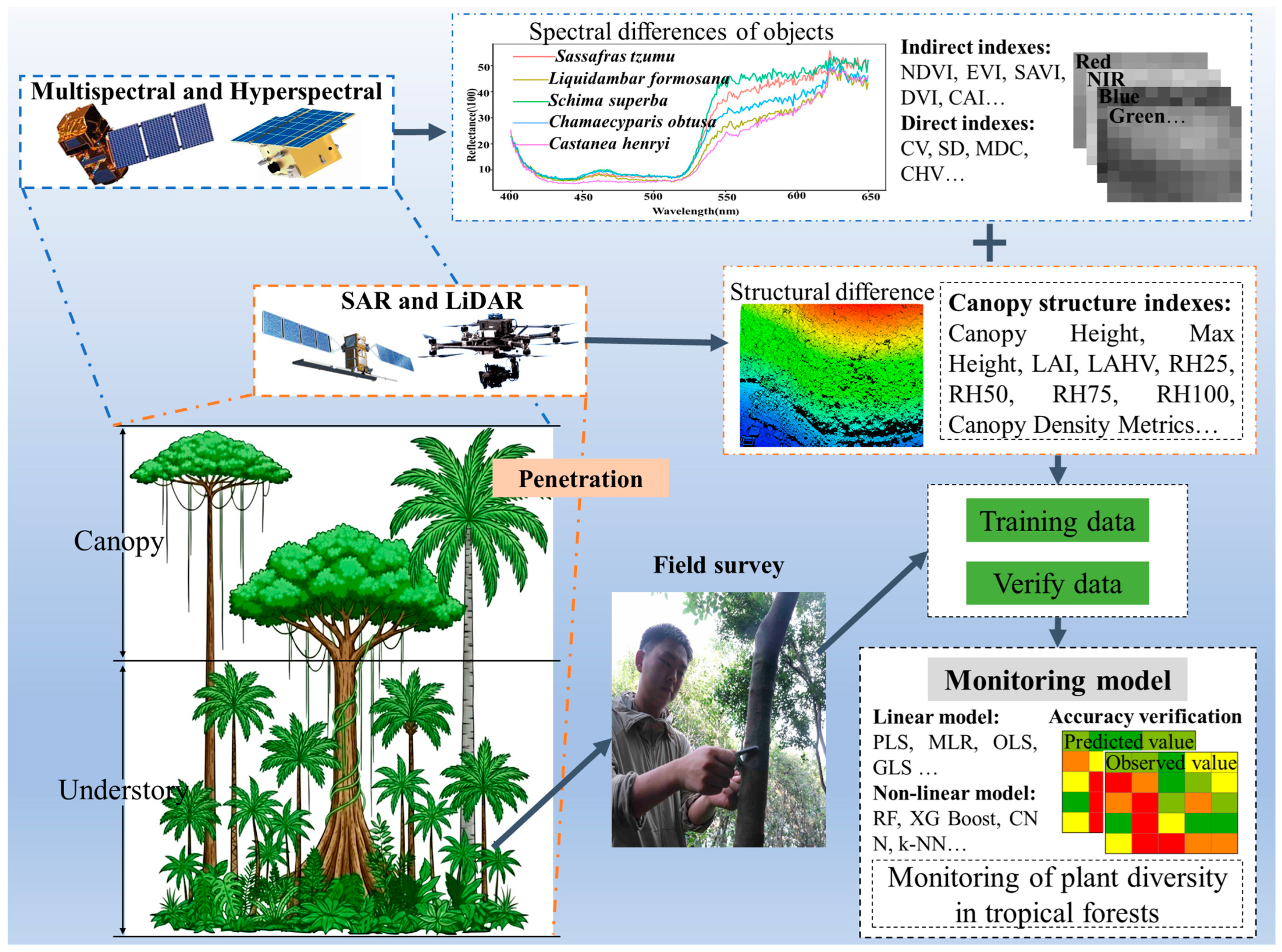
The theoretical foundation for remote sensing monitoring of forest plant diversity is the spectral variation hypothesis [45]. This hypothesis suggests that the spatial variability of vegetation spectra is closely related to species composition and functional differences. Differences in physiological and biochemical characteristics (such as leaf structure, pigment content, and water content) between species and functional types of plants affect their spectral reflectance properties, which are then manifested as distinct spectral features in remote sensing imagery (Figure 2) [46]. Therefore, vegetation spectral characteristics can largely reflect species composition and functional attributes.
Under the framework of the spectral variation hypothesis, remote sensing monitoring methods for tropical forest plant diversity can be classified into two main categories: direct estimation and indirect estimation [47]. Direct estimation methods emphasize using spectral signals that carry information about plant physiological, biochemical, and structural differences to directly infer species composition or functional differences from imagery [48]. Common approaches include statistical metrics of spectral heterogeneity (e.g., spectral variance, spectral angle, spectral centroid distance), spectral clustering methods to extract spectral classes, hyperspectral reflectance analysis of key functional traits, and pixel unmixing to obtain endmember proportions [15,26,28]. These methods rely on spectral information itself, without the need for additional environmental or structural variables, and are suitable for hyperspectral or high-resolution imagery, offering high accuracy in regions where plant physiological differences or species spectral characteristics are distinguishable.
Indirect estimation methods do not directly use spectral differences to describe species or functional differences, but instead predict diversity through proxy variables closely related to plant diversity, such as environmental, structural, or terrain factors. Vegetation indices provide effective information on productivity, water status, and canopy vitality [49]. LiDAR or SAR-derived canopy height, canopy height heterogeneity, Plant Area Index (PAI), Plant Area Volume Density (PAVD), and backscatter intensity can reflect forest vertical structure, ecological niche stratification, and canopy complexity [50,51]. Terrain variables like elevation, slope, and humidity index characterize environmental gradients and resource heterogeneity [52,53]. By inputting these variables into statistical models or machine learning algorithms, indirect estimation methods can infer plant diversity through the “environmental drive–community structure” pathway, making them more applicable in large-scale, complex terrains, or areas with severe spectral saturation in tropical forests [27]. Direct methods map diversity using spectral differences, emphasizing spectral information; indirect methods predict diversity using environmental and structural variables, emphasizing ecological driving mechanisms. These two approaches represent the “spectral–diversity” and “environmental–diversity” inference paths, forming a complementary relationship in forest plant diversity remote sensing monitoring.
Ground data in tropical forests are typically collected through standard plot surveys. Based on forest type and species richness, researchers establish permanent sample plots randomly or systematically, with sizes ranging from 0.1 to 50 hectares [54,55,56]. For vascular plants meeting the diameter at breast height (DBH) threshold, a full census is conducted, including measurements of DBH, tree height, and other relevant parameters, as well as species identification by comparing voucher specimens with herbarium collections [57]. Core measurements include three categories: (1) taxonomic diversity indices (e.g., species richness and Shannon-Wiener index) calculated from individual abundance [51,58]; (2) functional traits (e.g., leaf area and specific leaf area) and canopy structural traits (e.g., crown width and crown base height) measured using laser rangefinders or clinometers [3,59]; and (3) environmental covariates (e.g., elevation, slope, and aspect) aligned with remote sensing-derived variables [60]. These field survey methods provide reliable validation for remote sensing estimates and enable high-precision local assessments, yet they are constrained by issues such as complex terrain, poor accessibility, high labor intensity, and substantial costs. While they complement remote sensing’s strengths in large-scale, non-contact monitoring, they also highlight significant disparities between the two approaches in terms of scale, cost, coverage, and the ability to capture understory species or fine-scale variations in functional traits.

3. Remote Sensing Monitoring of Tropical Forest Plant Diversity

3.1. Research Methods

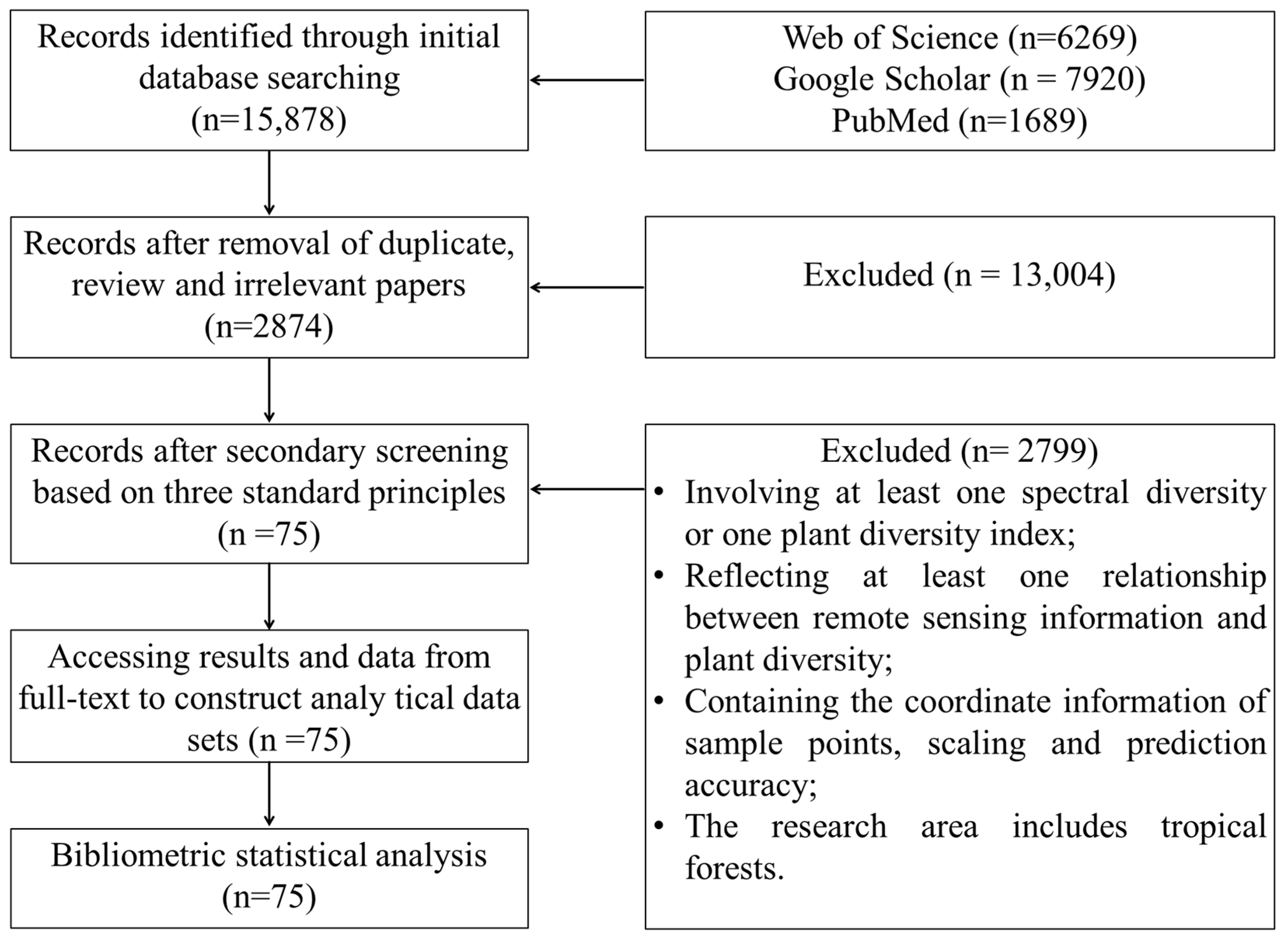
This study employs bibliometric analysis to objectively evaluate and review tropical forest plant diversity over the past 65 years. We selected multiple relevant keywords and conducted searches in the Web of Science, Google Scholar, and PubMed databases. The search query was structured as follows: ((TS = (“Remote sensing”) OR TS = (UAV) OR TS = (“Sentinel”) OR TS = (LiDAR) OR TS = (“Landsat”) OR TS = (Radar) OR TS = (Hyperspectral) OR TS = (Multispectral) OR TS = (“Microwave remote sensing”)) AND (TS = (Forest) OR TS = (Tropical) OR TS = (“Rainforest”) OR TS = (“Tropical seasonal rainforest”) OR TS = (“Tropical forest”) OR TS = (Mangrove) OR TS = (“Tropical dry forest”) OR TS = (“Seasonal rainforest”) OR TS = (“Tropical rainforest”)) AND (TS = (Biodiversity) OR TS = (Diversity))). A total of 15,878 papers published between 1960 and 2025 were retrieved. After removing duplicates, reviews, and irrelevant papers, 2874 papers were selected. Subsequently, a second round of selection was conducted based on the following four criteria: (1) The paper includes at least one spectral diversity or plant diversity indicator; (2) The paper reflects at least one relationship between remote sensing information and plant diversity; (3) The paper includes sample point coordinates, scale, and prediction accuracy; (4) The study area is located in tropical forests. After further filtering along these four criteria, 75 core papers were selected for bibliometric statistical analysis (Figure 3) (see Supplementary Materials for details).

3.2. Global Distribution of Existing Research

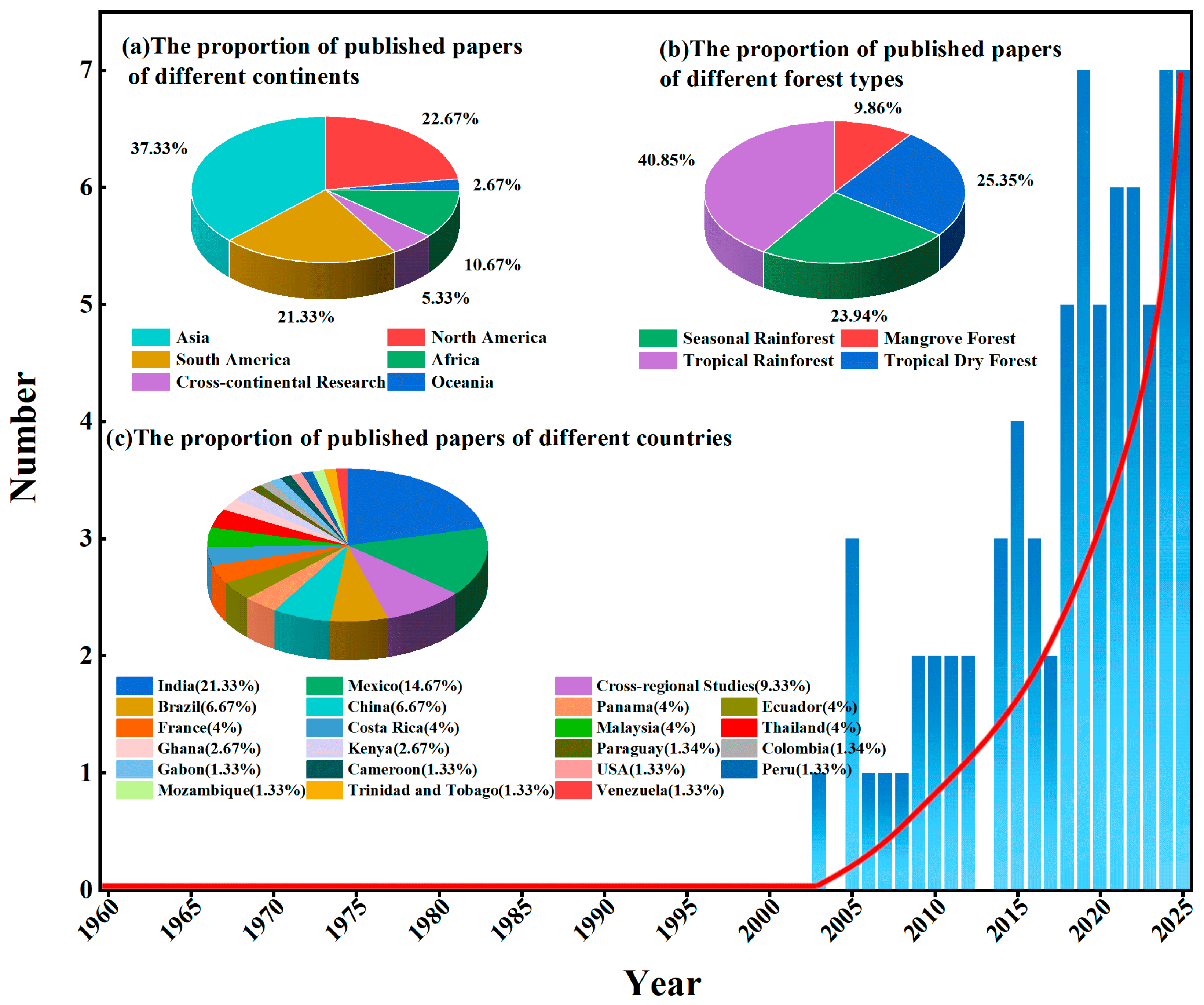
Over the past 65 years, through an initial search of databases (including Web of Science and Google Scholar), a total of 15,878 papers related to forest plant diversity have been obtained. After removing duplicate papers, review articles, and irrelevant content, 2874 valid papers were finally retained. Among these valid papers, only 75 studies specifically focus on remote sensing-based monitoring of tropical forest plant diversity and associated statistical testing, and this number accounts for a mere 2.61% of the total valid papers. This low proportion clearly indicates that the application of remote sensing technology in tropical forest diversity research is still in its infancy. From 1960 to 2025, the number of studies in the field of remote sensing of tropical forest plant diversity showed a significant upward trend, particularly after 2015, with a noticeable increase in research volume. Between 2020 and 2025, the number of publications peaked, with 5–7 papers being published annually. Additionally, the geographical distribution of these papers is highly uneven. Research in Asia accounted for the highest proportion, reaching 37.33%, with a focus on tropical seasonal rainforests in southern China and the Western Ghats of India, which are key areas for tropical plant diversity research. North America accounted for 22.67%, primarily focused on tropical dry forests in Mexico and tropical rainforests in Costa Rica. Notably, research on plant diversity in Mexico is almost entirely concentrated in the Yucatán Peninsula. South America accounted for 21.33%, with most studies focused in Brazil, particularly in the Amazon rainforest. In contrast, research in Africa and Oceania accounted for 10.67% and 2.67%, respectively, highlighting the relative lack of research in these regions. At the national level, the concentration of research distribution becomes even more pronounced (Figure 4c): India accounted for 21.33% of the studies, making it the core research country in Asia; Brazil, with a 16.67% share, emerged as a key research focus in South America; Mexico accounted for 14.67%, serving as the core research country in North America, and its plant diversity research is almost entirely concentrated in the Yucatán Peninsula; China accounted for 6.67% of studies, focused on tropical seasonal rainforests in southern China. By contrast, countries such as Ghana and Colombia accounted for only 2.67% of studies, while the share for countries like Cameroon, Peru, and the United States dropped to just 1.33%; there are also cross-regional studies accounting for 9.33%, which attempt to conduct analyses by integrating data from different regions. Additionally, about four studies conducted multi-regional, cross-continental research, attempting to analyze tropical plant diversity changes by integrating data from different regions. There are four forest types covered in these studies: tropical rainforests, tropical monsoon forests, tropical dry forests, and mangrove forests. Among them, tropical rainforests are the most prevalent, accounting for 40.85%. Despite the crucial role of tropical forests in global ecosystems and their immense biodiversity resources, current research is still heavily concentrated in specific regions, especially South America and Asia. This uneven geographical distribution means that our understanding of equally important ecological areas, such as Africa and Oceania, remains very limited (Figure 4).

3.3. Remote Sensing Platforms Used for Monitoring Tropical Forest Diversity

The papers on remote sensing monitoring of tropical forest plant diversity have used a variety of sensor platforms, including satellite-based, airborne, and handheld platforms. Sensor types include multispectral, hyperspectral, LiDAR, SAR, microwave scatterometers, multi-sensor, and optical cameras. There are 25 types of multispectral and hyperspectral sensors (Table 1). In multispectral remote sensing, commonly used satellite sensors include Sentinel-2, the Landsat series, MODIS, WorldView-2, IPS-P6, and RapidEye. These sensors have spatial resolutions ranging from 0.46 to 250 m. No studies have used airborne sensors for multispectral monitoring. In hyperspectral remote sensing, common satellite sensors include EO-1 and Zhuhai-1, with spatial resolutions ranging from 10 to 30 m. AVIRIS-NG is a commonly used airborne sensor with a resolution of 0.3 m. For drone-based hyperspectral monitoring, the Nano-Hyperspec sensor is often used in tropical forest studies, with a high spatial resolution of 0.17 m, allowing for precise remote sensing monitoring of plant diversity in small areas.
LiDAR and SAR sensors also have 25 types (Table 2). In LiDAR, commonly used satellite sensors include GEDI with a 25 m resolution, used for obtaining forest canopy height, structure, and vegetation coverage information. Common airborne LiDAR sensors include Optech ALTM 3100, LVIS, CAO AToMS LiDAR, and RIEGL-QV-480, with spatial resolutions ranging from 0.1 to 20 m. The most commonly used UAV sensor is Velodyne VLP-16, with a spatial resolution of 0.17 m. A commonly used handheld LiDAR sensor is the Riegl LD90-3100VHS-FLP, with a resolution of 0.025 m. For SAR, the most commonly used satellite sensors are Sentinel-1 and ALOS-2, with resolutions ranging from 3 to 10 m. A commonly used airborne SAR sensor is SRTM, with a spatial resolution of 30 m. For microwave scatterometers, the commonly used satellite platform is QSCAT, with a spatial resolution of 15 km [24]. Optical cameras are used less frequently, with only two studies using optical cameras to extract forest area and coverage information [43,51].

3.4. Comparison of Monitoring Indicators and Accuracy for Tropical Forest Plant Diversity

We have summarized the current spectral diversity indicators, their correlation with plant diversity, the sources of remote sensing sensors or platforms, modeling methods, and overall accuracy (Table 3 and Table 4). We found that in the research on remote sensing monitoring of plant diversity, most studies focus on taxonomic diversity, with very little attention given to functional diversity. Only a few studies focus on functional richness and leaf height diversity [33,34,92]. Species richness, the Shannon-Wiener diversity index, and the Simpson index are the most commonly used plant diversity indicators in existing research. In remote sensing monitoring of tropical forest plant diversity, indirect estimation indicators are more widely used, mainly including spectral indices, canopy structure parameters, LiDAR-derived indices, and SAR backscatter coefficients. Spectral indices, such as the Normalized Difference Vegetation Index (NDVI), Enhanced Vegetation Index (EVI), and Soil Adjusted Vegetation Index (SAVI), are primarily used to estimate plant growth status, Leaf Area Index (LAI), and greenness variations. Canopy structure parameters, such as Canopy Height (CH), relative height indices, canopy density, and stand gap fraction, reflect the vertical structure and spatial heterogeneity of forests. LiDAR-derived indices include Standard Deviation of Canopy Height (SDCH), PAI, and canopy profile. Additionally, SAR backscatter coefficients, such as Sentinel-1 VV/VH polarization data and ALOS PALSAR L-band data, are commonly used. Common direct estimation indicators in biodiversity inversion studies include MDC, Convex Hull Volume (CHV), mean spectral reflectance, range of spectral reflectance, and the first derivative of spectral reflectance. These indicators estimate plant diversity by analyzing the spectral features of different species or vegetation types in remote sensing imagery.
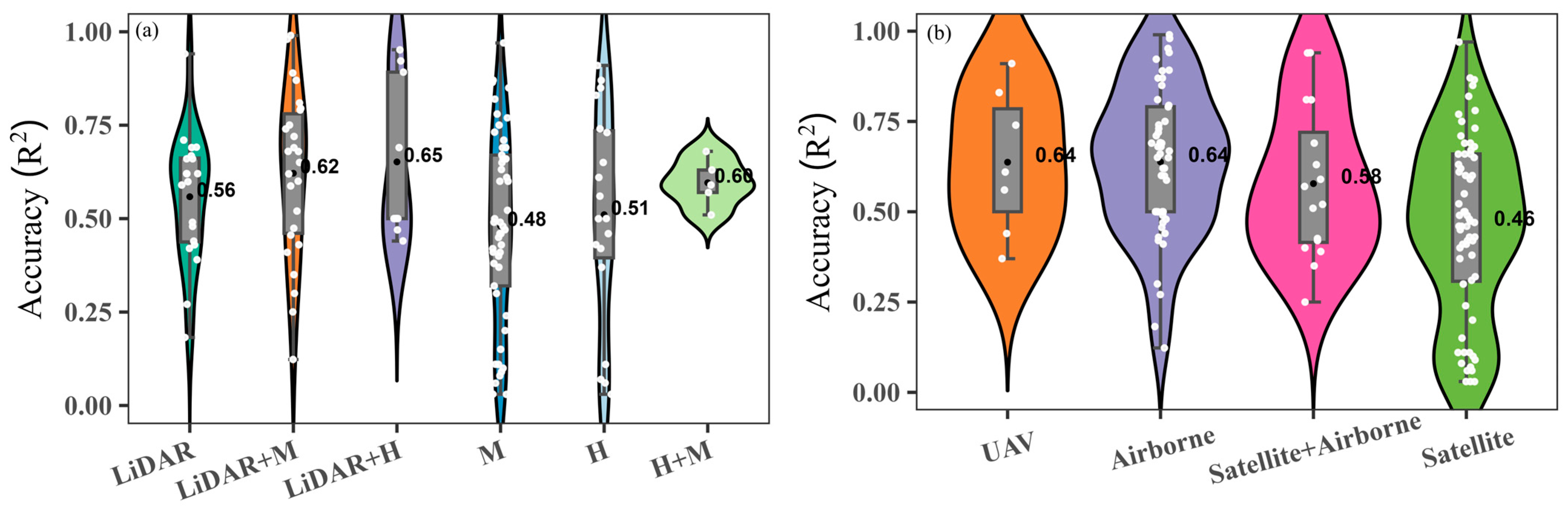
Based on differences in image acquisition approaches, remote sensing techniques for plant diversity monitoring fall into two primary categories: active remote sensing and passive remote sensing. Active remote sensing can be further divided into LiDAR and SAR based on imaging, while passive remote sensing is categorized into multispectral and hyperspectral based on spectral channels. Reviewing these monitoring methods for tropical forest vegetation diversity, some studies use single indicators for monitoring, while others use multiple indicators. Among studies using multiple indicators, some rely solely on passive remote sensing indicators, others solely on active remote sensing indicators, and some use both passive and active remote sensing indicators. Passive remote sensing indicators include single-band reflectance, band transformations, vegetation indices, texture features, and spectral clustering. Active remote sensing indicators include canopy structure, stand gap fraction, terrain features, and backscatter. Studies using passive remote sensing indicators exclusively for monitoring vegetation diversity are the most common. Among them, multispectral indicators are used more frequently than hyperspectral indicators, but the monitoring accuracy of hyperspectral indicators (0.51 ± 0.29) is higher than that of multispectral indicators (0.48 ± 0.25). In studies using only active remote sensing, the frequency of LiDAR usage has increased in recent years, and LiDAR monitoring accuracy (0.56 ± 0.17) is higher than that of SAR (0.31).
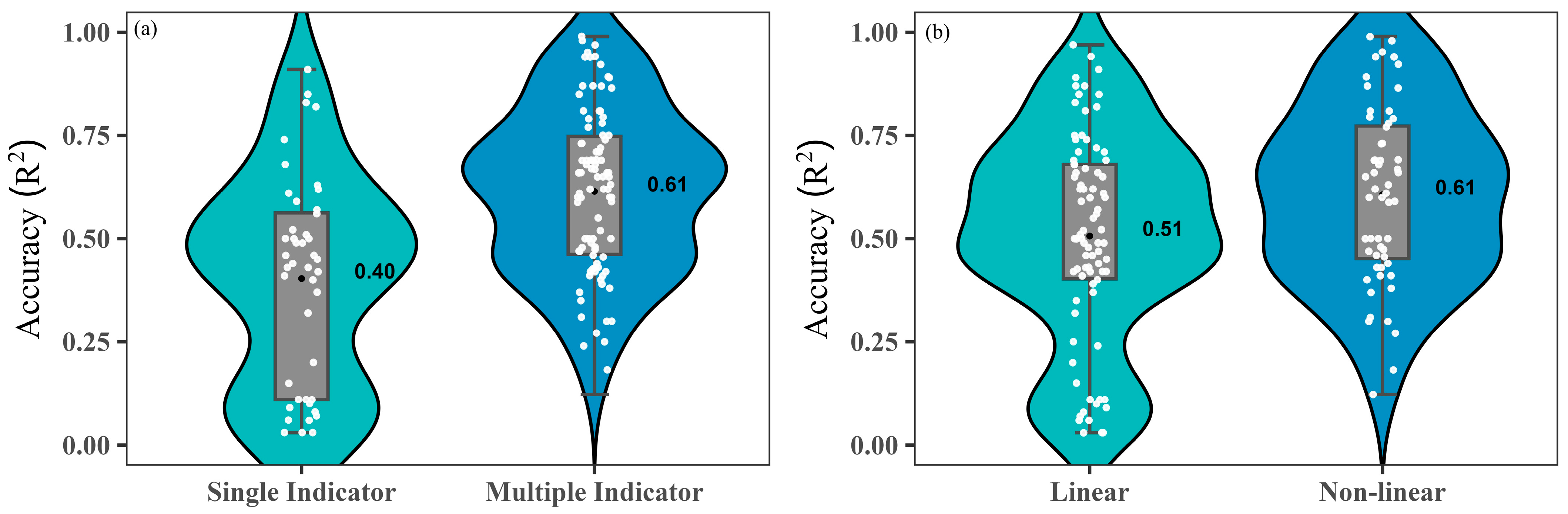
Overall, the monitoring accuracy using only active remote sensing indicators (0.55 ± 0.18) is higher than using only passive remote sensing indicators (0.49 ± 0.26), but both are lower than the monitoring accuracy using both active and passive remote sensing indicators (0.62 ± 0.21), which indicates that using multiple sensor types can better achieve biodiversity monitoring. From the model construction perspective, some studies use single monitoring indicators like NDVI to monitor biodiversity [56], but more studies have developed models by combining multiple indicators (Figure 5a). Monitoring accuracy with a single indicator (0.40 ± 0.25) is lower than that with multiple indicators in model-based research. Furthermore, we found that monitoring accuracy using airborne sensor data (0.64 ± 0.20) is higher than using a combination of satellite and airborne data (0.58 ± 0.21) or satellite-only data (0.46 ± 0.25) (Figure 5b).
In addition to monitoring indicators, the selection of monitoring methods and models also exerts a significant impact on the accuracy of tropical forest plant diversity assessment results. Further analysis of existing studies reveals that differences in model types constitute one of the key factors restricting monitoring accuracy, with linear and nonlinear methods exhibiting distinct disparities in both application frequency and performance outcomes. Overall, linear methods boast a longer application history and higher usage frequency in tropical forest plant diversity research. However, the application popularity of nonlinear methods has been on a steady rise in recent years, among which Random Forest (RF) stands as the most widely used nonlinear model to date. Our findings indicate that the total number of applications of RF and its regression variants reaches 25, with an accuracy range spanning from 0.18 to 0.69.
From a quantitative comparison of model performance, the average accuracy of nonlinear models (0.61 ± 0.21) is significantly higher than that of linear models (0.51 ± 0.24) (Figure 6). In terms of methodological diversity, the linear model category encompasses various techniques such as the Generalized Linear Model (GLM), Multiple Linear Regression (MLR), and Ordinary Least Squares (OLS) regression, with an accuracy range of 0.24 to 0.87. In contrast, nonlinear models not only include tree-based models like RF and XG Boost but also cover machine learning algorithms such as Convolutional Neural Networks (CNN) and k-Nearest Neighbors (k-NN), as well as geostatistical methods including kriging and regression kriging, thus forming a more diverse technical system.

3.5. Spatial Scale of Tropical Forest Plant Diversity Monitoring

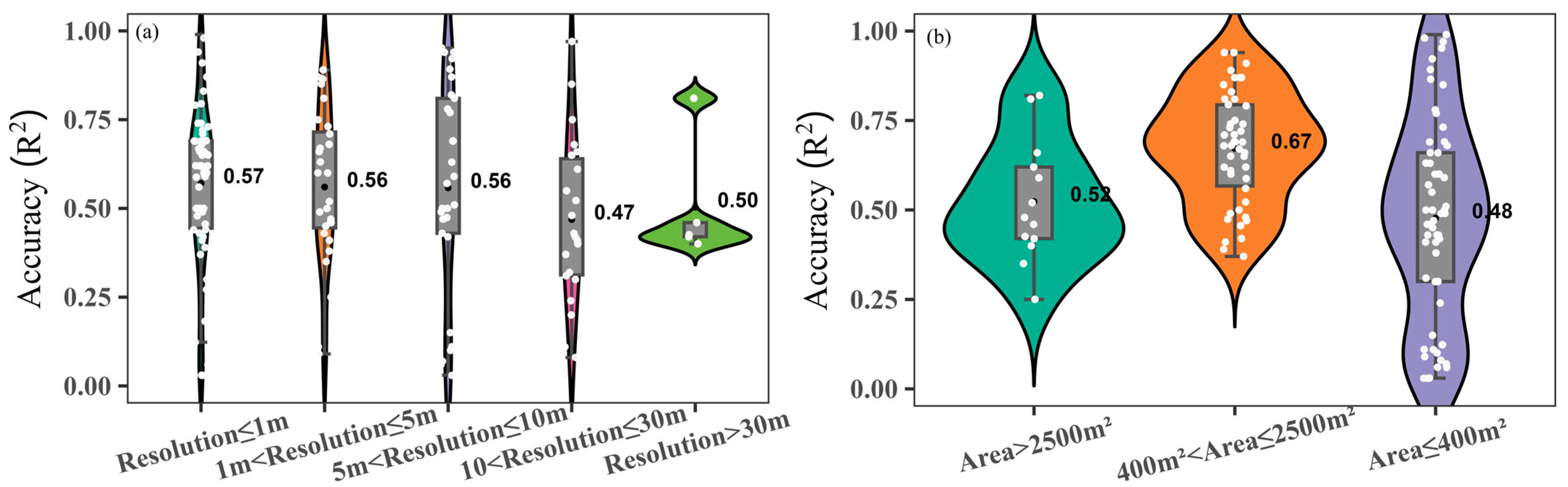
The spatial scale of tropical forest plant diversity monitoring is one of the key factors affecting the accuracy and applicability of remote sensing data. The observations at different scales may lead to variations in capturing plant information, thereby affecting the model’s generalization ability and prediction reliability. We conducted a systematic review of the plot sizes used in existing studies on tropical forest plant diversity monitoring. The results show that plot sizes vary widely, ranging from a minimum of 64 m2 to a maximum of 1600 ha. Among these, cases using 100 m2 and 400 m2 as the smallest sampling units are more common. Additionally, the majority of studies used square plot designs, which not only facilitate spatial correspondence and overlay analysis with rasterized remote sensing imagery but also simplify the data extraction process and reduce errors introduced by edge effects. However, some studies have used circular plots with radii of 7 m and 32 m, respectively [22,63]. Further analysis revealed that, overall, the highest monitoring accuracy was achieved with minimum plot sizes ranging from 40 m2 to 2500 m2 (Figure 6). This may be attributed to the interactive effects of various factors, including the resolution limits of remote sensing sensors, the complexity of vegetation types, and environmental noise interference.
We also noted the impact of sensor resolution on research accuracy. The spatial resolution of all sensors used for monitoring tropical forest plant diversity ranges from 0.1 m to 1000 m. Among them, studies using 30 m resolution remote sensing data were the most frequent. However, data analysis showed that the highest accuracy was concentrated in the resolution range below 10 m, with accuracy exceeding 0.55 (Figure 7). After exceeding the 10 m resolution range, the monitoring accuracy declined. Furthermore, we found that it is not always the case that higher sensor resolution leads to higher monitoring accuracy when the plot size and sensor resolution are more closely matched. In fact, most studies showed that the larger the plot relative to the sensor resolution, the higher the monitoring accuracy.

4. Status and Prospects of Tropical Forest Plant Diversity Detection

4.1. The Effects of Various Spectral Indicators and Estimation Models in Tropical Forest Plant Diversity Monitoring Need to Be Further Quantified

We found that in remote sensing monitoring of tropical forest plant diversity, studies commonly use multiple types of variables to build predictive models, including single-band reflectance, vegetation indices, spectral heterogeneity indicators, LiDAR canopy structure parameters, and SAR backscatter coefficients. However, most studies tend to adopt a “large number of indicators in one model” strategy, with some studies directly using all 47 structural indicators derived from LiDAR as independent variables [28], and others using the same combination of 25 vegetation and soil parameters to monitor the Pielou index, Shannon index, and Simpson index [30]. However, such empirical or “stacking” variable selection lacks a comprehensive evaluation of the predictive capability of specific indicators for corresponding diversity indices and does not clarify the relative contributions of different indicators and their gain effects on the results [100]. This research gap significantly limits the portability and applicability of the monitoring framework across different forest types and spatial scales.
Meanwhile, although various estimation models have been widely applied for diversity prediction, studies often use the same indicators in different models, and a systematic correspondence between “indicator type-model type-diversity index” has yet to be established [101]. For instance, spectral heterogeneity variables may be more suitable for nonlinear models, while structural variables might perform well in ensemble learning frameworks; however, quantitative exploration of these mechanisms remains extremely limited [102]. Existing literature often combines variables and models without fine-tuning the assessment of their individual effects, interaction effects, and potential redundancy [102]. Therefore, future research should further systematically quantify the specific contributions of various spectral and structural indicators to diversity dimensions, identify the most representative core indicators, develop an indicator contribution evaluation system, distinguish “core indicators” from “redundant indicators,” build an indicator-model matching framework suitable for tropical forests, reveal the performance differences and underlying mechanisms of different models under specific data characteristics, and establish standardized criteria for indicator selection to provide a standardized technical path for large-scale diversity monitoring.

4.2. Urgent Need to Strengthen Research on the Impact of Forest Vertical Structure on Plant Diversity

Tropical forests have a significant vertical stratification, including ground cover, shrub layers, lower canopy trees, mid-canopy trees, upper canopy trees, and emergent species, which results in a highly complex canopy structure. Additionally, the canopy coverage is extremely high [103]. This structure limits the penetration depth and observability of optical remote sensing signals, particularly when monitoring understory vegetation and species in the lower canopy, posing major challenges for optical remote sensing. Optical remote sensing technologies mainly focus on monitoring surface vegetation, and due to canopy occlusion and complex lighting conditions, the distribution of understory plants and shrubs is often overlooked or difficult to accurately capture [103]. In tropical forests, understory vegetation often plays a critical ecological role, such as carbon sequestration, water cycling, and providing habitat for species. Therefore, overcoming the research difficulties in complex vertical structures using optical remote sensing technology has become a key issue in tropical forest plant diversity monitoring [104].
Although remote sensing technologies like LiDAR and SAR have made some progress in tropical forest research, providing rich information about forest structure, such as canopy height and canopy density, they still face challenges in monitoring plant diversity, especially functional diversity. Currently, the application of LiDAR and SAR mainly focuses on forest structural characteristics, with the resulting indicators being relatively limited and lacking effective representation of plant functional traits [105]. LiDAR can effectively measure the three-dimensional structure of forests and provide information on canopy height and vegetation distribution, but it does not directly provide plant physiological traits or ecological functions, making it difficult to comprehensively reflect the diversity and ecological functions of plant communities. SAR is primarily used to monitor forest cover but similarly lacks the ability to capture plant functional traits.
Despite achieving high monitoring accuracy in many studies, current research often relies on empirical models, overlooks systematic driving mechanisms, and lacks deep understanding of relationships among forest vertical structure, species distribution, and ecological functions [3,106]. Plants’ ecological functions and contributions to ecosystem services are also largely neglected [107]. Multi-source data fusion has emerged as the core and most promising solution to these limitations. Integrating optical remote sensing, LiDAR, and SAR data enables comprehensive capture of spectral, structural, and functional information across the entire vertical profile of tropical forests, overcoming the constraints of single technologies. Although this approach has demonstrated advantages in vertical stratification analysis, it still faces challenges such as data registration errors, complexity in feature extraction, and the lack of standardized algorithms suitable for multi-layered forests. Future research should prioritize the development of high-precision multi-source remote sensing data registration models to reduce spatiotemporal deviations among data from different sensors; construct deep learning-based automated feature extraction frameworks to achieve efficient interpretation of vertical structural and functional parameters of tropical forests; and establish standardized technical procedures for remote sensing monitoring of multi-layered forests to promote the universal application of multi-source data fusion methods. This will provide critical technical support for enhancing the coupled monitoring capabilities of plant diversity and ecological functions in tropical forests.

4.3. Urgent Enhancement of Research on the Impact of ISV on Remote Sensing Monitoring of Forest Plant Diversity

In the process of monitoring tropical forest plant diversity using remote sensing, spectral heterogeneity is considered a core dynamic factor affecting monitoring accuracy and uncertainty [108]. Spectral heterogeneity refers to the spectral reflectance differences in the same species caused by various environmental factors, such as lighting conditions, leaf age, water content, canopy layers, and microenvironment differences [109]. These differences are not inherent to the species but result from the interplay between external environmental factors and plant physiological structures, making them highly unstable and uncontrollable, which poses significant challenges for plant diversity monitoring. Spectral clustering, as an effective classification tool, can alleviate the spectral heterogeneity issue to some extent and address some challenges in species identification [110]. It groups pixels with similar spectral features in remote sensing imagery, categorizing them into the same group and thus enabling species or vegetation type classification [111]. However, the application of spectral clustering methods in tropical forest plant diversity monitoring still faces some problems. Due to the complexity of canopy structure and variation in lighting conditions, spectral clustering struggles to effectively distinguish subtle differences between species. Additionally, spectral clustering is highly sensitive to data noise, especially in the shortwave infrared band, where the presence of noise leads to unstable clustering results [112]. More importantly, most remote sensing images used in current spectral clustering studies are low-resolution, making it difficult for clustering algorithms to finely separate spectral signals within and between species, further exacerbating the impact of spectral heterogeneity.
High spatial resolution remote sensing imagery, especially when combined with hyperspectral data, can alleviate the above-mentioned issues to some extent, improving the accuracy and stability of spectral clustering. High spatial resolution imagery can more accurately capture the spectral information of individual plants or leaves, reducing misclassification caused by spectral signal mixing [113]. Hyperspectral data provides richer spectral information than traditional multispectral data, offering continuous narrow-band reflectance characteristics. It can reveal biophysical parameters closely related to environmental changes, such as plant biochemical traits, water content, and leaf structure [114], allowing clustering algorithms to more precisely differentiate the spectral characteristics of different species or communities. Notably, the improvement in radiometric resolution is equally critical. Higher radiometric resolution can enhance the sensor’s ability to capture subtle spectral differences, reduce the interference of spectral noise caused by variations in illumination, fluctuations in leaf water content, and other factors, and further optimize the discriminability of species-specific spectral signals [115,116].
Although the advantages of high-resolution remote sensing imagery in plant diversity monitoring are widely recognized, the use of such data in existing studies remains limited. Our bibliometric analysis shows that between 1960 and 2025, only 23.73% of studies used hyperspectral data. Over 64.40% of studies used imagery with spatial resolutions greater than 4 m, and one-third of studies still rely on multispectral and LiDAR data with resolutions of 10 to 30 m, without discussing or correcting the impact of spectral heterogeneity on spectral clustering. To overcome this issue, future research should place more emphasis on the application of high spatial resolution imagery in tropical forest plant diversity monitoring, particularly by combining hyperspectral data and active remote sensing technologies, to further improve monitoring accuracy and stability. However, far less attention has been paid to radiometric resolution, and there has been no systematic exploration of the impact of different radiometric resolution levels on the accuracy of spectral identification for tropical forest species.
To address this issue, future research should place greater emphasis on the application of high spatial resolution imagery in the remote sensing monitoring of tropical forest plant diversity. In particular, it is necessary to integrate hyperspectral data with active remote sensing technologies to further improve monitoring accuracy and stability, while also prioritizing efforts to fill the research gap in radiometric resolution through systematic investigations into the impacts of different radiometric resolution levels on the spectral identification accuracy of tropical forest species. Furthermore, current research exhibits obvious deficiencies in multi-temporal analysis, while multi-temporal monitoring holds irreplaceable importance in the remote sensing study of tropical forest plant diversity. Plant phenological dynamics significantly alter their spectral and structural characteristics, with notable differences in spectral reflectance and canopy structure observed during germination, growth, flowering, and defoliation stages [55]. This heterogeneity directly affects the accuracy and reliability of plant diversity monitoring indicators. On the other hand, multi-temporal monitoring can dynamically capture the temporal evolution of plant diversity, including seasonal shifts in species composition, adjustments in community structure, and responses to environmental disturbances, thereby more authentically revealing the natural change trajectory of tropical forest plant diversity. However, existing studies have insufficiently emphasized multi-temporal factors, lacking systematic analysis of the temporal heterogeneity of spectral and structural characteristics, and rarely utilizing multi-temporal data for dynamic monitoring. This limits the comprehensiveness and timeliness of monitoring results, making it difficult to effectively support the in-depth analysis and mechanism exploration of the dynamic changes in plant diversity.

4.4. Urgent Need to Strengthen Remote Sensing Monitoring of Plant Functional Diversity and BEF Relationships

Current research on remote sensing monitoring of tropical forest plant diversity is primarily focused on taxonomic diversity, particularly species richness, the Shannon-Wiener index, and the Simpson index. Although taxonomic diversity reflects the number and proportion of different species within a community, it cannot reveal inter- and intra-species relationships or explain how these relationships influence ecosystem functions. Functional diversity can address this gap, as it refers to differences in functional traits among species within a plant community, such as photosynthetic efficiency, root distribution, drought resistance, and leaf area [117]. These traits determine the role of plants in the ecosystem and influence ecological functions such as carbon sequestration, water cycling, and nutrient flow [118]. Communities with high functional diversity typically exhibit stronger complementarity in ecological functions between species, enhancing the ecosystem’s ability to adapt to environmental changes, provide more ecosystem services, and maintain higher productivity and stability [119]. Remote sensing technology can play an important role in functional diversity studies by providing high-resolution spatial data that effectively capture the functional characteristics and distribution of different species within plant communities, thereby revealing the functional diversity of the community. However, despite the important role of functional diversity in ecology, current research remains limited. To date, only a small number of studies have applied remote sensing technology to monitor plant functional diversity. Thus, there remains a significant research gap in remote sensing monitoring of plant functional diversity.
Additionally, the BEF relationship is a key issue in ecology. The BEF relationship reveals how species diversity influences ecosystem functions such as productivity, carbon storage, and water cycling [120]. This relationship is important not only for theoretical ecology but also for practical applications in ecological conservation, climate change adaptation, and ecosystem restoration [121]. Remote sensing technology will play a critical role in studying the BEF relationship [122]. Remote sensing can provide high-resolution [123], large-scale data support to help monitor and assess the interactions between plant diversity and ecosystem functions across different regions [124]. By utilizing multispectral, hyperspectral, and LiDAR remote sensing technologies, the structure, species distribution, and functional traits of plant communities can be monitored in real time [125], providing more precise data to understand the BEF relationship [122]. Despite the significant potential of remote sensing technology in BEF research, there is still relatively little quantitative research that integrates remote sensing data with plant diversity and ecosystem functions. Particularly, research on how to establish a quantitative relationship between remote sensing data and ecosystem functions is still in its early stages.
To address this research gap, future studies should further strengthen the integration of remote sensing technology with ecosystem functions. High-resolution remote sensing data should be used to accurately extract plant functional traits. By combining remote sensing data with ecological models, a more comprehensive simulation of the impact of plant diversity on ecosystem functions, particularly in carbon storage, productivity, and water cycling, can be achieved. This will not only help quantitatively analyze the relationship between functional diversity and ecosystem functions but also promote the application of remote sensing technology in ecosystem service assessments, providing scientific support and decision-making for ecological conservation and forest management.
In addition, remote sensing technologies are advancing rapidly. This has promoted the application of high-precision technologies such as LiDAR, hyperspectral sensing, and multispectral imaging, while also generating a continuously growing demand for the management and optimization of digitization footprints. Although these high-precision technologies offer unprecedented support for capturing complex diversity traits, their massive data requirements have significantly increased labor and computational costs. These two types of costs are the core components of digitization footprints. Tropical regions have complex terrain and poor accessibility, which has further exacerbated the aforementioned burden and directly limited monitoring efficiency and coverage. Persistent issues in the field of digitization footprints, including low standardization, high integration difficulty, and insufficient accessibility, have also hindered cross-study data utilization [12,126,127]. Therefore, meeting the growing demand for digitization footprint management and addressing related challenges is crucial for unlocking the potential of big data in this field. Future research should prioritize advancing data standardization and explore efficient compression technologies and cloud-based collaborative processing models. These measures will reduce resource consumption, improve data accessibility, and support large-scale, high-precision monitoring of plant diversity in tropical forests.

5. Conclusions

This review systematically summarizes the tropical forest plant diversity remote sensing monitoring research published over the past 65 years. We found that research on remote sensing monitoring of tropical forest plant diversity exhibits significant regional imbalance globally, with most studies concentrated in tropical seasonal rainforests. The most used sensors are the Sentinel-2 and Landsat series. In terms of monitoring accuracy, hyperspectral data generally outperform multispectral data, and the use of multiple indicators yields better results than single indicators, with nonlinear models significantly outperforming linear models. Additionally, plot scales in these studies vary widely, the sample size is set to 400 m2 < Area ≤ 2500 m2, with the highest monitoring accuracy. The spatial resolution of sensors also exerts a distinct impact on monitoring accuracy, with optimal performance observed when spatial resolution is less than 10 m. Existing studies mainly focus on traditional diversity indicators such as species richness, Shannon index, and Simpson index, while studies on β-diversity and functional diversity are relatively scarce. At the same time, the impact of canopy structure on plant diversity has not received enough attention. Although the fusion of multi-source remote sensing data can improve monitoring accuracy, current methods have not effectively addressed the problem of acquiring information on understory vegetation from a mechanistic perspective.
Future research needs to focus on the following areas: first, systematically quantifying the mechanisms of various spectral indices and estimation models, clarifying their applicability and sensitivity across different diversity indices and forest types; second, further investigating the impact of canopy structure on plant diversity, optimizing the application of remote sensing data in complex canopy structures; third, further advancing the application of high-resolution remote sensing data, strengthening the use of spectral clustering in plant diversity monitoring; and finally, enhancing the use of remote sensing technology in monitoring functional diversity in tropical forests, and exploring the relationship between plant diversity and ecosystem functions. This will help to better understand the impact of plant functional diversity on ecosystem services and productivity, providing a more scientific basis for ecological conservation and sustainable management.

Supplementary Materials

The following supporting information can be downloaded at: https://www.mdpi.com/article/10.3390/f17010142/s1, Table S1: In this study, the remaining 75 core literatures were selected.

Author Contributions

X.-Q.S., H.-B.W., X.-D.Y. and D.-S.C. conceived of the idea. X.-Q.S. and H.-B.W. designed the study and performed the data analyses. X.-D.Y. and D.-S.C. supervised the research work. X.-Q.S. and H.-B.W. wrote the first draft of the manuscript. X.-Q.S., H.-B.W., X.-R.M., H.-C.F., X.-Y.C., H.-T.Z., R.-Z.W. and S.Y. contributed to development of the analytical methods. X.-D.Y. reviewed and edited the manuscript. All authors have read and agreed to the published version of the manuscript.

Funding

This work was supported by the Key Technology Breakthrough Plan Project of Science and Innovation Yongjiang 2035 (Nos. 2023Z146 and 2024Z249), the Public Welfare Science and Technology Program Projects of the Ningbo Natural Science Foundation (Grant No. 2024S123), and the National Natural Science Foundation of China (Grant No. 42371027).

Data Availability Statement

Not applicable.

Conflicts of Interest

The authors declare that they have no known competing financial interests or personal relationships that could have appeared to influence the work reported in this paper.

Abbreviations

The following abbreviations are used in this manuscript:
LiDARLight Detection and Ranging
SARSynthetic Aperture Radar
RFRandom Forest
GLMGeneralized Linear Model
MLRMultiple Linear Regression
OLSOrdinary Least Squares
XG BoostExtreme Gradient Boosting
CNNConvolutional Neural Networks
k-NNk-Nearest Neighbors
MDCMean Distance to Centroid
SAMSpectral Angle Mapper
ISVIntraspecific spectral variability
BEFBiodiversity-Ecosystem Functioning
PAIPlant Area Index
PAVDPlant Area Volume Density
DBHDiameter at Breast Height
PLSPartial Least Squares Regression
GLSGeneralized Least Squares Regression
NDVINormalized Difference Vegetation Index
EVIEnhanced Vegetation Index
SAVISoil Adjusted Vegetation Index
LAILeaf Area Index
CHCanopy Height
SDCHStandard Deviation of Canopy Height
CHVConvex Hull Volume

References

  1. Murphy, B.P.; Bowman, D.M.J.S. What Controls the Distribution of Tropical Forest and Savanna? Ecol. Lett. 2012, 15, 748–758. [Google Scholar] [CrossRef]
  2. McMichael, C.N.H.; Bush, M.B.; ter Steege, H.; Piperno, D.R.; Gosling, W.D.; Nascimento, M.N.; Lombardo, U.; de Souza Coelho, L.; Leão do Amaral, I.; de Almeida Matos, F.D.; et al. Centuries of Compounding Human Influence on Amazonian Forests. Proc. Natl. Acad. Sci. USA 2025, 122, e2514040122. [Google Scholar] [CrossRef] [PubMed]
  3. Aguirre-Gutiérrez, J.; Rifai, S.W.; Deng, X.; ter Steege, H.; Thomson, E.; Corral-Rivas, J.J.; Guimaraes, A.F.; Muller, S.; Klipel, J.; Fauset, S.; et al. Canopy Functional Trait Variation across Earth’s Tropical Forests. Nature 2025, 641, 129–136. [Google Scholar] [CrossRef]
  4. Silva de Miranda, P.L.; Dexter, K.G.; Swaine, M.D.; de Oliveira-Filho, A.T.; Hardy, O.J.; Fayolle, A. Dissecting the Difference in Tree Species Richness between Africa and South America. Proc. Natl. Acad. Sci. USA 2022, 119, e2112336119. [Google Scholar] [CrossRef] [PubMed]
  5. Hagen, O.; Skeels, A.; Onstein, R.E.; Jetz, W.; Pellissier, L. Earth History Events Shaped the Evolution of Uneven Biodiversity across Tropical Moist Forests. Proc. Natl. Acad. Sci. USA 2021, 118, e2026347118. [Google Scholar] [CrossRef]
  6. Borma, L.S.; Costa, M.H.; da Rocha, H.R.; Arieira, J.; Nascimento, N.C.C.; Jaramillo-Giraldo, C.; Ambrosio, G.; Carneiro, R.G.; Venzon, M.; Neto, A.F.; et al. Beyond Carbon: The Contributions of South American Tropical Humid and Subhumid Forests to Ecosystem Services. Rev. Geophys. 2022, 60, e2021RG000766. [Google Scholar] [CrossRef]
  7. Li, J.; Gu, S.; Cao, M.; Tan, X.; Xuan, K.; Juan, Z.; Cao, W.; Lin, Y.; Wang, Y.; Xia, J.; et al. Plant Modulation on Daytime Ground Surface Temperature: An Overlooked Mechanism in Climate Warming Regulation. Innov. Geosci. 2025, 3, 100159. [Google Scholar] [CrossRef]
  8. Strand, J.; Soares-Filho, B.; Costa, M.H.; Oliveira, U.; Ribeiro, S.C.; Pires, G.F.; Oliveira, A.; Rajão, R.; May, P.; van der Hoff, R.; et al. Spatially Explicit Valuation of the Brazilian Amazon Forest’s Ecosystem Services. Nat. Sustain. 2018, 1, 657–664. [Google Scholar] [CrossRef]
  9. Héger, M.; Noiset, P.; Nkoba, K.; Vereecken, N.J. Traditional Ecological Knowledge and Non-Food Uses of Stingless Bee Honey in Kenya’s Last Pocket of Tropical Rainforest. J. Ethnobiol. Ethnomed. 2023, 19, 42. [Google Scholar] [CrossRef]
  10. Bourgoin, C.; Ceccherini, G.; Girardello, M.; Vancutsem, C.; Avitabile, V.; Beck, P.S.A.; Beuchle, R.; Blanc, L.; Duveiller, G.; Migliavacca, M.; et al. Human Degradation of Tropical Moist Forests Is Greater than Previously Estimated. Nature 2024, 631, 570–576. [Google Scholar] [CrossRef]
  11. Lu, M. Charted: Tropical Forest Loss in 2024. Visual Capitalist, 8 June 2025. Available online: https://www.visualcapitalist.com/charted-tropical-forest-loss-in-2024/ (accessed on 10 November 2025).
  12. Sun, W.; Chen, D.; Li, Z.; Li, S.; Cheng, S.; Niu, X.; Cai, Y.; Shi, Z.; Wu, C.; Yang, G.; et al. Monitoring Wetland Plant Diversity from Space: Progress and Perspective. Int. J. Appl. Earth Obs. Geoinf. 2024, 130, 103943. [Google Scholar] [CrossRef]
  13. Tian, Y.; Huang, H.; Zhou, G.; Zhang, Q.; Xie, X.; Ou, J.; Zhang, Y.; Tao, J.; Lin, J.; Tian, Y.; et al. Mangrove Biodiversity Assessment Using UAV Lidar and Hyperspectral Data in China’s Pinglu Canal Estuary. Remote Sens. 2023, 15, 2622. [Google Scholar] [CrossRef]
  14. Xin, J.; Li, J.; Zeng, Q.; Peng, Y.; Wang, Y.; Teng, X.; Bao, Q.; Yang, L.; Tang, H.; Liu, Y.; et al. High-Precision Estimation of Plant Alpha Diversity in Different Ecosystems Based on Sentinel-2 Data. Ecol. Indic. 2024, 166, 112527. [Google Scholar] [CrossRef]
  15. Peng, Y.; Li, J.; Yuan, J.; Wang, C.; Bao, Q.; Li, G.; Zeng, W. Climate Change Increases Biotic Homogeneity and Species Alpha Diversity in Global Forests. Eur. J. For. Res. 2025, 144, 741–754. [Google Scholar] [CrossRef]
  16. Foody, G.M.; Cutler, M.E.J. Tree Biodiversity in Protected and Logged Bornean Tropical Rain Forests and Its Measurement by Satellite Remote Sensing. J. Biogeogr. 2003, 30, 1053–1066. [Google Scholar] [CrossRef]
  17. Marselis, S.M.; Abernethy, K.; Alonso, A.; Armston, J.; Baker, T.R.; Bastin, J.-F.; Bogaert, J.; Boyd, D.S.; Boeckx, P.; Burslem, D.F.R.P.; et al. Evaluating the Potential of Full-Waveform Lidar for Mapping Pan-Tropical Tree Species Richness. Glob. Ecol. Biogeogr. 2020, 29, 1799–1816. [Google Scholar] [CrossRef]
  18. Ehbrecht, M.; Seidel, D.; Annighoefer, P.; Kreft, H.; Koehler, M.; Zemp, D.C.; Puettmann, K.; Nilus, R.; Babweteera, F.; Willim, K.; et al. Global Patterns and Climatic Controls of Forest Structural Complexity. Nat. Commun. 2021, 12, 519. [Google Scholar] [CrossRef]
  19. Kou, W.; Liang, C.; Wei, L.; Hernandez, A.J.; Yang, X. Phenology-Based Method for Mapping Tropical Evergreen Forests by Integrating of MODIS and Landsat Imagery. Forests 2017, 8, 34. [Google Scholar] [CrossRef]
  20. Asner, G.P.; Martin, R.E. Canopy Phylogenetic, Chemical and Spectral Assembly in a Lowland Amazonian Forest. New Phytol. 2011, 189, 999–1012. [Google Scholar] [CrossRef] [PubMed]
  21. Nie, C.; Wang, C.; Cheng, F.; Wu, J.; Wang, J.; Li, W.; Zhang, J. A Tree-Shrub Layer Separation Method for MLS LiDAR Point Clouds of Typical Tropical Seasonal Rainforests. IEEE Trans. Geosci. Remote Sens. 2024, 62, 4408612. [Google Scholar] [CrossRef]
  22. Carlson, K.M.; Asner, G.P.; Hughes, R.F.; Ostertag, R.; Martin, R.E. Hyperspectral Remote Sensing of Canopy Biodiversity in Hawaiian Lowland Rainforests. Ecosystems 2007, 10, 536–549. [Google Scholar] [CrossRef]
  23. Pinon, T.B.M.; de Mendonça, A.R.; da Silva, G.F.; Effgen, E.M.; Rodrigues, N.M.M.; Fernandes, M.M.; Sansevero, J.B.B.; Almeida, C.T.d.; Dias, H.M.; Gonçalves, F.G.; et al. Biodiversity from the Sky: Testing the Spectral Variation Hypothesis in the Brazilian Atlantic Forest. Remote Sens. 2024, 16, 4363. [Google Scholar] [CrossRef]
  24. Saatchi, S.; Buermann, W.; ter Steege, H.; Mori, S.; Smith, T.B. Modeling Distribution of Amazonian Tree Species and Diversity Using Remote Sensing Measurements. Remote Sens. Environ. 2008, 112, 2000–2017. [Google Scholar] [CrossRef]
  25. Parmentier, I.; Harrigan, R.J.; Buermann, W.; Mitchard, E.T.A.; Saatchi, S.; Malhi, Y.; Bongers, F.; Hawthorne, W.D.; Leal, M.E.; Lewis, S.L.; et al. Predicting Alpha Diversity of African Rain Forests: Models Based on Climate and Satellite-Derived Data Do Not Perform Better than a Purely Spatial Model. J. Biogeogr. 2011, 38, 1164–1176. [Google Scholar] [CrossRef]
  26. Nagendra, H.; Rocchini, D.; Ghate, R.; Sharma, B.; Pareeth, S. Assessing Plant Diversity in a Dry Tropical Forest: Comparing the Utility of Landsat and Ikonos Satellite Images. Remote Sens. 2010, 2, 478–496. [Google Scholar] [CrossRef]
  27. George-Chacon, S.P.; Dupuy, J.M.; Peduzzi, A.; Hernandez-Stefanoni, J.L. Combining High Resolution Satellite Imagery and Lidar Data to Model Woody Species Diversity of Tropical Dry Forests. Ecol. Indic. 2019, 101, 975–984. [Google Scholar] [CrossRef]
  28. Yip, K.H.A.; Liu, R.; Wu, J.; Hau, B.C.H.; Lin, Y.; Zhang, H. Community-Based Plant Diversity Monitoring of a Dense-Canopy and Species-Rich Tropical Forest Using Airborne LiDAR Data. Ecol. Indic. 2024, 158, 111346. [Google Scholar] [CrossRef]
  29. Foody, G.M.; Cutler, M.E.J. Mapping the Species Richness and Composition of Tropical Forests from Remotely Sensed Data with Neural Networks. Ecol. Modell. 2006, 195, 37–42. [Google Scholar] [CrossRef]
  30. Chen, Z.; Pan, X.; Wu, T.; Shi, T.; Lei, J.; Li, Y.; Chen, X.; Huang, J.; Wang, Z.; Chen, Y. Improved Mangrove α-Diversity Estimation by Coupling Multispectral Satellite Images, Canopy Traits and Soil Properties. Catena 2025, 251, 108813. [Google Scholar] [CrossRef]
  31. Li, Y.; Li, M.; Li, C.; Liu, Z. Forest Aboveground Biomass Estimation Using Landsat 8 and Sentinel-1A Data with Machine Learning Algorithms. Sci. Rep. 2020, 10, 9952. [Google Scholar] [CrossRef] [PubMed]
  32. Pimple, U.; Simonetti, D.; Hinks, I.; Oszwald, J.; Berger, U.; Pungkul, S.; Leadprathom, K.; Pravinvongvuthi, T.; Maprasoap, P.; Gond, V. A History of the Rehabilitation of Mangroves and an Assessment of Their Diversity and Structure Using Landsat Annual Composites (1987–2019) and Transect Plot Inventories. For. Ecol. Manag. 2020, 462, 118007. [Google Scholar] [CrossRef]
  33. Peña-Lara, V.A.; Dupuy, J.M.; Reyes-Garcia, C.; Sanaphre-Villanueva, L.; Portillo-Quintero, C.A.; Hernández-Stefanoni, J.L. Modelling Species Richness and Functional Diversity in Tropical Dry Forests Using Multispectral Remotely Sensed and Topographic Data. Remote Sens. 2022, 14, 5919. [Google Scholar] [CrossRef]
  34. Chaurasia, A.N.; Parmar, R.M.; Dave, M.G.; Krishnayya, N.S.R. Integrating Field- and Remote Sensing Data to Perceive Species Heterogeneity across a Climate Gradient. Sci. Rep. 2024, 14, 42–54. [Google Scholar] [CrossRef] [PubMed]
  35. Sesnie, S.E.; Espinosa, C.I.; Jara-Guerrero, A.K.; Tapia-Armijos, M.F. Ensemble Machine Learning for Mapping Tree Species Alpha-Diversity Using Multi-Source Satellite Data in an Ecuadorian Seasonally Dry Forest. Remote Sens. 2023, 15, 583. [Google Scholar] [CrossRef]
  36. Maeda, E.E.; Heiskanen, J.; Thijs, K.W.; Pellikka, P.K.E. Season-Dependence of Remote Sensing Indicators of Tree Species Diversity. Remote Sens. Lett. 2014, 5, 404–412. [Google Scholar] [CrossRef]
  37. Pouteau, R.; Gillespie, T.W.; Birnbaum, P. Predicting Tropical Tree Species Richness from Normalized Difference Vegetation Index Time Series: The Devil Is Perhaps Not in the Detail. Remote Sens. 2018, 10, 698. [Google Scholar] [CrossRef]
  38. Feeley, K.J.; Gillespie, T.W.; Terborgh, J.W. The Utility of Spectral Indices from Landsat ETM+ for Measuring the Structure and Composition of Tropical Dry Forests. Biotropica 2005, 37, 508–519. [Google Scholar] [CrossRef]
  39. Hernández-Stefanoni, J.L.; Dupuy, J.M.; Castillo-Santiago, M.A. Assessing Species Density and Abundance of Tropical Trees from Remotely Sensed Data and Geostatistics. Appl. Veg. Sci. 2009, 12, 398–414. [Google Scholar] [CrossRef]
  40. Féret, J.-B.; Asner, G.P. Mapping Tropical Forest Canopy Diversity Using High-Fidelity Imaging Spectroscopy. Ecol. Appl. 2014, 24, 1289–1296. [Google Scholar] [CrossRef]
  41. Singh, P.; Srivastava, P.K.; Shah, D.; Pandey, M.K.; Anand, A.; Prasad, R.; Dave, R.; Verrelst, J.; Bhattacharya, B.K.; Raghubanshi, A.S. Crop Type Discrimination Using Geo-Stat Endmember Extraction and Machine Learning Algorithms. Adv. Space Res. 2024, 73, 1331–1348. [Google Scholar] [CrossRef]
  42. Wallis, C.I.B.; Brehm, G.; Donoso, D.A.; Fiedler, K.; Homeier, J.; Paulsch, D.; Süßenbach, D.; Tiede, Y.; Brandl, R.; Farwig, N.; et al. Remote Sensing Improves Prediction of Tropical Montane Species Diversity but Performance Differs among Taxa. Ecol. Indic. 2017, 83, 538–549. [Google Scholar] [CrossRef]
  43. Sánchez-Azofeifa, G.A.; Guzmán-Quesada, J.A.; Vega-Araya, M.; Campos-Vargas, C.; Durán, S.M.; D’Souza, N.; Gianoli, T.; Portillo-Quintero, C.; Sharp, I. Can Terrestrial Laser Scanners (TLSs) and Hemispherical Photographs Predict Tropical Dry Forest Succession with Liana Abundance? Biogeosciences 2017, 14, 977–988. [Google Scholar] [CrossRef]
  44. Bongalov, B.; Burslem, D.F.R.P.; Jucker, T.; Thompson, S.E.D.; Rosindell, J.; Swinfield, T.; Nilus, R.; Clewley, D.; Phillips, O.L.; Coomes, D.A. Reconciling the Contribution of Environmental and Stochastic Structuring of Tropical Forest Diversity through the Lens of Imaging Spectroscopy. Ecol. Lett. 2019, 22, 1608–1619. [Google Scholar] [CrossRef] [PubMed]
  45. Laughlin, D.C.; Mommer, L.; Sabatini, F.M.; Bruelheide, H.; Kuyper, T.W.; McCormack, M.L.; Bergmann, J.; Freschet, G.T.; Guerrero-Ramírez, N.R.; Iversen, C.M.; et al. Root Traits Explain Plant Species Distributions Along Climatic Gradients Yet Challenge the Nature of Ecological Trade-Offs. Nat. Ecol. Evol. 2021, 5, 1123–1134. [Google Scholar] [CrossRef] [PubMed]
  46. Wohlgemuth, T. Quantitative Tools for Perfecting Species Lists. Environmetrics 2002, 13, 121–137. [Google Scholar] [CrossRef]
  47. Wang, R.; Gamon, J.A. Remote Sensing of Terrestrial Plant Biodiversity. Remote Sens. Environ. 2019, 231, 111218. [Google Scholar] [CrossRef]
  48. Williams, D.; Britten, A.; McCallum, S.; Jones, H.; Aitkenhead, M.; Karley, A.; Loades, K.; Prashar, A.; Graham, J. A Method for Automatic Segmentation and Splitting of Hyperspectral Images of Raspberry Plants Collected in Field Conditions. Plant Methods 2017, 13, 74. [Google Scholar] [CrossRef]
  49. Kumar, P.; Dobriyal, M.; Kale, A.; Pandey, A.K.; Tomar, R.S.; Thounaojam, E. Calculating Forest Species Diversity with Information-Theory Based Indices Using Sentinel-2A Sensor’s of Mahavir Swami Wildlife Sanctuary. PLoS ONE 2022, 17, e0268018. [Google Scholar] [CrossRef]
  50. Marselis, S.M.; Tang, H.; Armston, J.; Abernethy, K.; Alonso, A.; Barbier, N.; Bissiengou, P.; Jeffery, K.; Kenfack, D.; Labrière, N.; et al. Exploring the Relation between Remotely Sensed Vertical Canopy Structure and Tree Species Diversity in Gabon. Environ. Res. Lett. 2019, 14, 94013. [Google Scholar] [CrossRef]
  51. Sun, Y.; Huang, J.; Ao, Z.; Lao, D.; Xin, Q. Deep Learning Approaches for the Mapping of Tree Species Diversity in a Tropical Wetland Using Airborne LiDAR and High-Spatial-Resolution Remote Sensing Images. Forests 2019, 10, 1047. [Google Scholar] [CrossRef]
  52. Ranglong, A.; Dutta Roy, A.; Das, S.; Deb, S. Estimating Aboveground Biomass and Biodiversity of a Protected Area in Moist Tropical Forest Ecosystem Using Remote Sensing Application. J. Nat. Conserv. 2025, 84, 126823. [Google Scholar] [CrossRef]
  53. Chitale, V.S.; Behera, M.D.; Roy, P.S. Deciphering Plant Richness Using Satellite Remote Sensing: A Study from Three Biodiversity Hotspots. Biodivers. Conserv. 2019, 28, 2183–2196. [Google Scholar] [CrossRef]
  54. Anderson-Teixeira, K.J.; Davies, S.J.; Bennett, A.C.; Gonzalez-Akre, E.B.; Muller-Landau, H.C.; Wright, S.J.; Abu Salim, K.; Almeyda Zambrano, A.M.; Alonso, A.; Baltzer, J.L.; et al. CTFS-ForestGEO: A Worldwide Network Monitoring Forests in an Era of Global Change. Glob. Change Biol. 2015, 21, 528–549. [Google Scholar] [CrossRef]
  55. Kishore, B.S.P.C.; Kumar, A.; Saikia, P.; Khan, M.L. Alpha and Beta Diversity Mapping in Indian Tropical Deciduous Forests Using High-Fidelity Imaging Spectroscopy. Adv. Space Res. 2024, 73, 1413–1426. [Google Scholar] [CrossRef]
  56. Sommeechai, M.; Wachrinrat, C.; Dell, B.; Thangtam, N.; Srichaichana, J. Ecological Structure of a Tropical Urban Forest in the Bang Kachao Peninsula, Bangkok. Forests 2018, 9, 36. [Google Scholar] [CrossRef]
  57. São Pedro, M.; Smith, M.N.; Zuquim, G.; Tuomisto, H.; Stark, S.C.; Pereira, L.G.d.A.; Bobrowiec, P.E.D.; Bueno, A.S.; Capaverde, U., Jr.; Castilho, C.; et al. Forest Structure Predicts Plant and Animal Species Diversity and Composition Changes in an Amazonian Forest. Biodivers. Conserv. 2025, 34, 3865–3888. [Google Scholar] [CrossRef]
  58. Rocchini, D.; Balkenhol, N.; Carter, G.A.; Foody, G.M.; Gillespie, T.W.; He, K.S.; Kark, S.; Levin, N.; Lucas, K.; Luoto, M.; et al. Remotely Sensed Spectral Heterogeneity as a Proxy of Species Diversity: Recent Advances and Open Challenges. Ecol. Inf. 2010, 5, 318–329. [Google Scholar] [CrossRef]
  59. Zheng, Z.; Schmid, B.; Zeng, Y.; Schuman, M.C.; Zhao, D.; Schaepman, M.E.; Morsdorf, F. Remotely Sensed Functional Diversity and Its Association with Productivity in a Subtropical Forest. Remote Sens. Environ. 2023, 290, 113530. [Google Scholar] [CrossRef]
  60. Guitet, S.; Sabatier, D.; Brunaux, O.; Couteron, P.; Denis, T.; Freycon, V.; Gonzalez, S.; Hérault, B.; Jaouen, G.; Molino, J.-F.; et al. Disturbance Regimes Drive the Diversity of Regional Floristic Pools across Guianan Rainforest Landscapes. Sci. Rep. 2018, 8, 3872. [Google Scholar] [CrossRef] [PubMed]
  61. Chraibi, E.; Arnold, H.; Luque, S.; Deacon, A.; Magurran, A.E.; Féret, J.-B. A Remote Sensing Approach to Understanding Patterns of Secondary Succession in Tropical Forest. Remote Sens. 2021, 13, 2148. [Google Scholar] [CrossRef]
  62. Chraibi, E.; de Boissieu, F.; Barbier, N.; Luque, S.; Féret, J.-B. Stability in Time and Consistency between Atmospheric Corrections: Assessing the Reliability of Sentinel-2 Products for Biodiversity Monitoring in Tropical Forests. Int. J. Appl. Earth Obs. Geoinf. 2022, 112, 102884. [Google Scholar] [CrossRef]
  63. Bacar, F.F. Mapping Plant Taxonomic Diversity and Spatial Structure of Mangrove Communities with Spaceborne Imagery. Community Ecol. 2025, 26, 329–344. [Google Scholar] [CrossRef]
  64. Hernández-Stefanoni, J.L.; Alberto Gallardo-Cruz, J.; Meave, J.A.; Dupuy, J.M. Combining Geostatistical Models and Remotely Sensed Data to Improve Tropical Tree Richness Mapping. Ecol. Indic. 2011, 11, 1046–1056. [Google Scholar] [CrossRef]
  65. Hernandez-Stefanoni, J.L. Relationships between Landscape Patterns and Species Richness of Trees, Shrubs and Vines in a Tropical Forest. Plant Ecol. 2005, 179, 53–65. [Google Scholar] [CrossRef]
  66. Hernández-Stefanoni, J.L.; Gallardo-Cruz, J.A.; Meave, J.A.; Rocchini, D.; Bello-Pineda, J.; López-Martínez, J.O. Modeling α- and β-Diversity in a Tropical Forest from Remotely Sensed and Spatial Data. Int. J. Appl. Earth Obs. Geoinf. 2012, 19, 359–368. [Google Scholar] [CrossRef]
  67. Medeiros, E.S.e.S.; Machado, C.C.C.; Galvíncio, J.D.; de Moura, M.S.B.; de Araujo, H.F.P. Predicting Plant Species Richness with Satellite Images in the Largest Dry Forest Nucleus in South America. J. Arid. Environ. 2019, 166, 43–50. [Google Scholar] [CrossRef]
  68. Agarwal, S.; Rocchini, D.; Marathe, A.; Nagendra, H. Exploring the Relationship between Remotely-Sensed Spectral Variables and Attributes of Tropical Forest Vegetation under the Influence of Local Forest Institutions. ISPRS Int. J. Geo-Inf. 2016, 5, 117. [Google Scholar] [CrossRef]
  69. Rajaniemi, S.; Tomppo, E.; Ruokolainen, K.; Tuomisto, H. Estimating and Mapping Pteridophyte and Melastomataceae Species Richness in Western Amazonian Rainforests. Int. J. Remote Sens. 2005, 26, 475–793. [Google Scholar] [CrossRef]
  70. Chen, B.; Ma, J.; Yang, C.; Xiao, X.; Kou, W.; Wu, Z.; Yun, T.; Zaw, Z.N.; Nawan, P.; Sengprakhon, R.; et al. Diversified Land Conversion Deepens Understanding of Impacts of Rapid Rubber Plantation Expansion on Plant Diversity in the Tropics. Sci. Total Environ. 2023, 874, 162505. [Google Scholar] [CrossRef]
  71. Canto-Sansores, W.G.; López-Martínez, J.O.; González, E.J.; Meave, J.A.; Hernández-Stefanoni, J.L.; Macario-Mendoza, P.A. The Importance of Spatial Scale and Vegetation Complexity in Woody Species Diversity and Its Relationship with Remotely Sensed Variables. ISPRS J. Photogramm. Remote Sens. 2024, 216, 142–153. [Google Scholar] [CrossRef]
  72. Ray, T.; Mohanasundari, T.; Madguni, O.D.; Rajkumar, M. Forest Fire Regimes and Plant Diversity in Tropical Dry Deciduous Forests of Central India. J. Sustain. For. 2025, 44, 1203–1217. [Google Scholar] [CrossRef]
  73. Fricker, G.A.; Wolf, J.A.; Saatchi, S.S.; Gillespie, T.W. Predicting Spatial Variations of Tree Species Richness in Tropical Forests from High-Resolution Remote Sensing. Ecol. Appl. 2015, 25, 1776–1789. [Google Scholar] [CrossRef] [PubMed]
  74. Wang, D.; Qiu, P.; Wan, B.; Cao, Z.; Zhang, Q. Mapping α- and β-Diversity of Mangrove Forests with Multispectral and Hyperspectral Images. Remote Sens. Environ. 2022, 275, 113021. [Google Scholar] [CrossRef]
  75. Solórzano, J.V.; Gallardo-Cruz, J.A.; González, E.J.; Peralta-Carreta, C.; Hernández-Gómez, M.; Oca, A.F.-M.d.; Cervantes-Jiménez, L.G. Contrasting the Potential of Fourier Transformed Ordination and Gray Level Co-Occurrence Matrix Textures to Model a Tropical Swamp Forest’s Structural and Diversity Attributes. J. Appl. Remote Sens. 2018, 12, 36006. [Google Scholar] [CrossRef]
  76. Thakur, T.; Swamy, S.L.; Nain, A.S. Composition, Structure and Diversity Characterization of Dry Tropical Forest of Chhattisgarh Using Satellite Data. J. For. Res. 2014, 25, 819–825. [Google Scholar] [CrossRef]
  77. Pattanaik, C.; Reddy, C.S.; Murthy, M.S.R. Geospatial Modeling of Biological Richness in Kuldiha Wildlife Sanctuary of Orissa, India. J. Indian Soc. Remote Sens. 2010, 38, 477–485. [Google Scholar] [CrossRef]
  78. Njomaba, E.; Ofori, J.N.; Guuroh, R.T.; Aikins, B.E.; Nagbija, R.K.; Surový, P. Assessing Forest Species Diversity in Ghana’s Tropical Forest Using PlanetScope Data. Remote Sens. 2024, 16, 463. [Google Scholar] [CrossRef]
  79. Kumar, P.; Pandey, P.C.; Kumar, V.; Singh, B.K.; Tomar, V.; Rani, M. Efficient Recognition of Forest Species Biodiversity by Inventory-Based Geospatial Approach Using LISS IV Sensor. IEEE Sens. J. 2015, 15, 1884–1891. [Google Scholar] [CrossRef]
  80. Jha, C.S.; Fararoda, R.; Singhal, J.; Reddy, C.S.; Rajashekar, G.; Maity, S.; Patnaik, C.; Das, A.; Misra, A.; Singh, C.P.; et al. Characterization of Species Diversity and Forest Health Using AVIRIS-NG Hyperspectral Remote Sensing Data. Curr. Sci. 2019, 116, 1124–1135. [Google Scholar] [CrossRef]
  81. Anand, A.; Malhi, R.K.M.; Srivastava, P.K.; Singh, P.; Mudaliar, A.N.; Petropoulos, G.P.; Kiran, G.S. Optimal Band Characterization in Reformation of Hyperspectral Indices for Species Diversity Estimation. Phys. Chem. Earth Parts A/B/C 2022, 126, 103040. [Google Scholar] [CrossRef]
  82. Schäfer, E.; Heiskanen, J.; Heikinheimo, V.; Pellikka, P. Mapping Tree Species Diversity of a Tropical Montane Forest by Unsupervised Clustering of Airborne Imaging Spectroscopy Data. Ecol. Indic. 2016, 64, 49–58. [Google Scholar] [CrossRef]
  83. Badourdine, C.; Féret, J.-B.; Pélissier, R.; Vincent, G. Exploring the Link between Spectral Variance and Upper Canopy Taxonomic Diversity in a Tropical Forest: Influence of Spectral Processing and Feature Selection. Remote Sens. Ecol. Conserv. 2023, 9, 235–250. [Google Scholar] [CrossRef]
  84. Somers, B.; Asner, G.P.; Martin, R.E.; Anderson, C.B.; Knapp, D.E.; Wright, S.J.; Van De Kerchove, R. Mesoscale Assessment of Changes in Tropical Tree Species Richness across a Bioclimatic Gradient in Panama Using Airborne Imaging Spectroscopy. Remote Sens. Environ. 2015, 167, 111–120. [Google Scholar] [CrossRef]
  85. Fagua, J.C.; Jantz, P.; Burns, P.; Massey, R.; Buitrago, J.Y.; Saatchi, S.; Hakkenberg, C.; Goetz, S.J. Mapping Tree Diversity in the Tropical Forest Region of Chocó-Colombia. Environ. Res. Lett. 2021, 16, 054024. [Google Scholar] [CrossRef]
  86. Vaglio Laurin, G.; Puletti, N.; Chen, Q.; Corona, P.; Papale, D.; Valentini, R. Above Ground Biomass and Tree Species Richness Estimation with Airborne Lidar in Tropical Ghana Forests. Int. J. Appl. Earth Obs. Geoinf. 2016, 52, 371–379. [Google Scholar] [CrossRef]
  87. Robinson, C.; Saatchi, S.; Clark, D.; Astaiza, J.H.; Hubel, A.F.; Gillespie, T.W. Topography and Three-Dimensional Structure Can Estimate Tree Diversity along a Tropical Elevational Gradient in Costa Rica. Remote Sens. 2018, 10, 629. [Google Scholar] [CrossRef]
  88. Martins-Neto, R.P.; Tommaselli, A.M.G.; Imai, N.N.; David, H.C.; Miltiadou, M.; Honkavaara, E. Identification of Significative LiDAR Metrics and Comparison of Machine Learning Approaches for Estimating Stand and Diversity Variables in Heterogeneous Brazilian Atlantic Forest. Remote Sens. 2021, 13, 2444. [Google Scholar] [CrossRef]
  89. Marselis, S.M.; Keil, P.; Chase, J.M.; Dubayah, R. The Use of GEDI Canopy Structure for Explaining Variation in Tree Species Richness in Natural Forests. Environ. Res. Lett. 2022, 17, 45003. [Google Scholar] [CrossRef]
  90. Almeida, D.R.A.; Almeyda Zambrano, A.M.; Broadbent, E.N.; Wendt, A.L.; Foster, P.; Wilkinson, B.E.; Salk, C.; Papa, D.d.A.; Stark, S.C.; Valbuena, R.; et al. Detecting Successional Changes in Tropical Forest Structure Using GatorEye Drone-Borne Lidar. Biotropica 2020, 52, 1155–1167. [Google Scholar] [CrossRef]
  91. Sitthi, A.; Pimple, U.; Piponiot, C.; Gond, V. Assessing the Effectiveness of Mangrove Rehabilitation Using Above-Ground Biomass and Structural Diversity. Sci. Rep. 2025, 15, 7839. [Google Scholar] [CrossRef]
  92. Kacic, P.; Hirner, A.; Ponte, E.D. Fusing Sentinel-1 and -2 to Model GEDI-Derived Vegetation Structure Characteristics in GEE for the Paraguayan Chaco. Remote Sens. 2021, 13, 5105. [Google Scholar] [CrossRef]
  93. Andres-Mauricio, J.; Valdez-Lazalde, J.R.; George-Chacón, S.P.; Hernández-Stefanoni, J.L. Mapping Structural Attributes of Tropical Dry Forests by Combining Synthetic Aperture Radar and High-Resolution Satellite Imagery Data. Appl. Veg. Sci. 2021, 24, e12580. [Google Scholar] [CrossRef]
  94. Hernández-Stefanoni, J.L.; Castillo-Santiago, M.Á.; Andres-Mauricio, J.; Portillo-Quintero, C.A.; Tun-Dzul, F.; Dupuy, J.M. Carbon Stocks, Species Diversity and Their Spatial Relationships in the Yucatán Peninsula, Mexico. Remote Sens. 2021, 13, 3179. [Google Scholar] [CrossRef]
  95. Chaurasia, A.N.; Dave, M.G.; Parmar, R.M.; Bhattacharya, B.; Marpu, P.R.; Singh, A.; Krishnayya, N.S.R. Inferring Species Diversity and Variability over Climatic Gradient with Spectral Diversity Metrics. Remote Sens. 2020, 12, 2130. [Google Scholar] [CrossRef]
  96. Kayet, N.; Pathak, K.; Chakrabarty, A.; Kumar, S.; Singh, C.P.; Chowdary, V.M. Assessment of Mining Activities on Tree Species and Diversity in Hilltop Mining Areas Using Hyperion and Landsat Data. Environ. Sci. Pollut. Res. 2020, 27, 42750–42766. [Google Scholar] [CrossRef]
  97. Pangtey, D.; Padalia, H.; Bodh, R.; Rai, I.D.; Nandy, S. Application of Remote Sensing-Based Spectral Variability Hypothesis to Improve Tree Diversity Estimation of Seasonal Tropical Forest Considering Phenological Variations. Geocarto Int. 2023, 38, 2178525. [Google Scholar] [CrossRef]
  98. Wolf, J.A.; Fricker, G.A.; Meyer, V.; Hubbell, S.P.; Gillespie, T.W.; Saatchi, S.S. Plant Species Richness Is Associated with Canopy Height and Topography in a Neotropical Forest. Remote Sens. 2012, 4, 4010–4021. [Google Scholar] [CrossRef]
  99. Hernández-Stefanoni, J.L.; Johnson, K.D.; Cook, B.D.; Dupuy, J.M.; Birdsey, R.; Peduzzi, A.; Tun-Dzul, F. Estimating Species Richness and Biomass of Tropical Dry Forests Using LIDAR during Leaf-on and Leaf-off Canopy Conditions. Appl. Veg. Sci. 2015, 18, 724–732. [Google Scholar] [CrossRef]
  100. Kacic, P.; Kuenzer, C. Forest Biodiversity Monitoring Based on Remotely Sensed Spectral Diversity—A Review. Remote Sens. 2022, 14, 5363. [Google Scholar] [CrossRef]
  101. Muise, E.R.; Andrew, M.E.; Coops, N.C.; Hermosilla, T.; Burton, A.C.; Ban, S.S. Disentangling Linkages between Satellite-Derived Indicators of Forest Structure and Productivity for Ecosystem Monitoring. Sci. Rep. 2024, 14, 13717. [Google Scholar] [CrossRef]
  102. Hoffmann, J.; Muro, J.; Dubovyk, O. Predicting Species and Structural Diversity of Temperate Forests with Satellite Remote Sensing and Deep Learning. Remote Sens. 2022, 14, 1631. [Google Scholar] [CrossRef]
  103. Ngo, Y.-N.; Huang, Y.; Minh, D.H.T.; Ferro-Famil, L.; Fayad, I.; Baghdadi, N. Tropical Forest Vertical Structure Characterization: From GEDI to P-Band SAR Tomography. IEEE Geosci. Remote Sens. Lett. 2022, 19, 7004705. [Google Scholar] [CrossRef]
  104. de Conto, T.; Armston, J.; Dubayah, R. Characterizing the Structural Complexity of the Earth’s Forests with Spaceborne Lidar. Nat. Commun. 2024, 15, 8116. [Google Scholar] [CrossRef]
  105. Balestra, M.; Marselis, S.; Sankey, T.T.; Cabo, C.; Liang, X.; Mokroš, M.; Peng, X.; Singh, A.; Stereńczak, K.; Vega, C.; et al. LiDAR Data Fusion to Improve Forest Attribute Estimates: A Review. Curr. For. Rep. 2024, 10, 281–297. [Google Scholar] [CrossRef]
  106. van der Sande, M.T.; Poorter, L.; Kooistra, L.; Thonicke, K.; Boit, A.; Dutrieux, L.P.; Equihua, J.; Gerard, F.; Herold, M.; Kolb, M.; et al. The Integration of Empirical, Remote Sensing and Modelling Approaches Enhances Insight in the Role of Biodiversity in Climate Change Mitigation by Tropical Forests. Curr. Opin. Environ. Sustain. 2017, 26–27, 69–76. [Google Scholar] [CrossRef]
  107. Ojea, E.; Nunes, P.A.L.D.; Loureiro, M.L. Mapping Biodiversity Indicators and Assessing Biodiversity Values in Global Forests. Environ. Resour. Econ. 2010, 47, 329–347. [Google Scholar] [CrossRef]
  108. Fassnacht, F.E.; Müllerová, J.; Conti, L.; Malavasi, M.; Schmidtlein, S. About the Link between Biodiversity and Spectral Variation. Appl. Veg. Sci. 2022, 25, e12643. [Google Scholar] [CrossRef]
  109. Zagajewski, B.; Tømmervik, H.; Bjerke, J.W.; Raczko, E.; Bochenek, Z.; Kłos, A.; Jarocińska, A.; Lavender, S.; Ziółkowski, D. Intraspecific Differences in Spectral Reflectance Curves as Indicators of Reduced Vitality in High-Arctic Plants. Remote Sens. 2017, 9, 1289. [Google Scholar] [CrossRef]
  110. Rocchini, D.; Santos, M.J.; Ustin, S.L.; Féret, J.-B.; Asner, G.P.; Beierkuhnlein, C.; Dalponte, M.; Feilhauer, H.; Foody, G.M.; Geller, G.N.; et al. The Spectral Species Concept in Living Color. J. Geophys. Res. Biogeosci. 2022, 127, e2022JG007026. [Google Scholar] [CrossRef]
  111. Foody, G.M. Characterising the Thematic Content of Image Pixels with Topologically Structured Clustering. Remote Sens. 2025, 17, 130. [Google Scholar] [CrossRef]
  112. Rama Rao, K.; Garg, S.; Montgomery, J. Investigation of Unsupervised Models for Biodiversity Assessment. In AI 2018: Advances in Artificial Intelligence; Mitrovic, T., Xue, B., Li, X., Eds.; Springer International Publishing: Cham, Switzerland, 2018; pp. 160–171. [Google Scholar]
  113. Chen, J.; Chen, Z.; Huang, R.; You, H.; Han, X.; Yue, T.; Zhou, G. The Effects of Spatial Resolution and Resampling on the Classification Accuracy of Wetland Vegetation Species and Ground Objects: A Study Based on High Spatial Resolution UAV Images. Drones 2023, 7, 61. [Google Scholar] [CrossRef]
  114. Lu, B.; Dao, P.D.; Liu, J.; He, Y.; Shang, J. Recent Advances of Hyperspectral Imaging Technology and Applications in Agriculture. Remote Sens. 2020, 12, 2659. [Google Scholar] [CrossRef]
  115. Sozzi, M.; Kayad, A.; Gobbo, S.; Cogato, A.; Sartori, L.; Marinello, F. Economic Comparison of Satellite, Plane and UAV-Acquired NDVI Images for Site-Specific Nitrogen Application: Observations from Italy. Agronomy 2021, 11, 2098. [Google Scholar] [CrossRef]
  116. Verde, N.; Mallinis, G.; Tsakiri-Strati, M.; Georgiadis, C.; Patias, P. Assessment of Radiometric Resolution Impact on Remote Sensing Data Classification Accuracy. Remote Sens. 2018, 10, 1267. [Google Scholar] [CrossRef]
  117. Lewis, S.L. Tropical Forests and the Changing Earth System. Philos. Trans. R. Soc. Lond. B Biol. Sci. 2006, 361, 195–210. [Google Scholar] [CrossRef]
  118. Borer, E.T.; Seabloom, E.W.; Tilman, D. Plant Diversity Controls Arthropod Biomass and Temporal Stability. Ecol. Lett. 2012, 15, 1457–1464. [Google Scholar] [CrossRef] [PubMed]
  119. Chen, C.; Bongers, F.J.; Schmid, B.; Ma, K.; Liu, X. Ecosystem Consequences of Functional Diversity in Forests and Implications for Restoration. New Phytol. 2025, 247, 1081–1097. [Google Scholar] [CrossRef]
  120. Ali, A. Biodiversity–Ecosystem Functioning Research: Brief History, Major Trends and Perspectives. Biol. Conserv. 2023, 285, 110210. [Google Scholar] [CrossRef]
  121. Xu, M.; Yang, X.; Han, Y.; Huang, J.; Chen, Z.; Liu, X.; Yun, P.; Zhang, G.; Zeng, J. Variations in Macrofaunal Communities along Sand Physico-Chemical Gradient across the Intertidal Zones on Island Beaches. Ecol. Indic. 2024, 161, 111957. [Google Scholar] [CrossRef]
  122. Li, Z.; Wu, J.; Peng, S.; Xu, Y.; Sun, W.; Gao, J. Editorial: Remote Sensing Advances in Biodiversity and Ecosystem Functioning Research. Front. Ecol. Evol. 2024, 12, 1367840. [Google Scholar] [CrossRef]
  123. Li, W.; Ren, M.; Zhang, H.; Duan, Y.; Chen, D.; Li, S.; Xu, M.; Wang, L.; Yang, X. Estimation of Water Quality in Coastal Aquaculture Waters Using the Combination of Machine Learning and Unmanned Aerial Vehicle Multispectral Imagery. Aquaculture 2026, 611, 743002. [Google Scholar] [CrossRef]
  124. Xu, M.; Yang, A.; Yang, X.; Cao, W.; Zhang, Z.; Li, Z.; Zhang, Y.; Zhang, H.; You, W.; Yan, E.-R.; et al. Island Area and Remoteness Shape Plant and Soil Bacterial Diversity through Land Use and Biological Invasion. Funct. Ecol. 2023, 37, 1232–1244. [Google Scholar] [CrossRef]
  125. Li, S.; Li, W.; Yu, M.; Chen, D.; Xu, M.; Ren, M.; Yang, X. Urban Three-Dimension Green Quantity Estimation: An Approach Utilizing UAV, Satellite Imagery, and Machine Learning. Remote Sens. Appl. Soc. Environ. 2025, 39, 101691. [Google Scholar] [CrossRef]
  126. Dritsas, E.; Trigka, M. Remote Sensing and Geospatial Analysis in the Big Data Era: A Survey. Remote Sens. 2025, 17, 550. [Google Scholar] [CrossRef]
  127. Cheng, H.; Wu, H.; Zheng, J.; Li, Z.; Qi, K.; Gong, J.; Xiang, L.; Cao, Y. A Distributed Data Management and Service Framework for Heterogeneous Remote Sensing Observations. Remote Sens. 2025, 17, 4009. [Google Scholar] [CrossRef]
Figure 1. Tropical vegetation distribution.
Forests 17 00142 g001
Figure 2. Remote sensing monitoring mechanism of tropical forest plant diversity.
Forests 17 00142 g002
Figure 3. Flowchart of literature selection.
Forests 17 00142 g003
Figure 4. Annual number of related research publications. The bar chart illustrates the number of publications in the corresponding year, while the red line indicates the publication trend.
Forests 17 00142 g004
Figure 5. Comparison of sensor types and sensor platforms for tropical forest plant diversity monitoring. (a) Different sensor types; (b) Different sensor platforms. The white spots represent the individual accuracy (R2) values extracted from the reviewed literature for the meta-analysis.
Forests 17 00142 g005
Figure 6. Comparison of monitoring indicators and accuracy for tropical forest plant diversity. (a) Different indicator types; (b) Different algorithm types. The white spots represent the individual accuracy (R2) values extracted from the reviewed literature for the meta-analysis.
Forests 17 00142 g006
Figure 7. Comparison of monitoring indicators and accuracy for tropical forest species diversity. (a) Different spatial resolutions; (b) Different survey plot sizes. The white spots represent the individual accuracy (R2) values extracted from the reviewed literature for the meta-analysis.
Forests 17 00142 g007
Table 1. Information on multispectral and hyperspectral sensors used for biodiversity inversion.
Satellite/Sensor ModelWavelength Range (nm)Resolution (m)Number of BandsPlatformSpectral TypeReference
Sentinel-2432–229010, 20, 6013SatelliteMultispectral[61,62,63]
Landsat 7 ETM+450–235015, 30, 608Satellite[64,65,66]
Landsat 8 OLI460–229015, 309Satellite[67,68]
Landsat 5 TM450–235030, 1207Satellite[67,69,70]
Landsat 9 OLI430–229015, 309Satellite[71]
MODIS405–14,385250, 500, 100036Satellite[72]
RapidEye440–85055Satellite[73]
WorldView-2400–104028Satellite[74]
Kompsat-3450–9000.70, 2.805Satellite[75]
IKONOS445–90045Satellite[26]
IRS ID LISS III520–175023.50, 70.504Satellite[76,77]
PlanetScope465–88537Satellite[78]
Quickbird450–9002.404Satellite[73]
Resourcesat-2520–8605.803Satellite[79]
AVIRIS-NG380–25104425AirborneHyperspectral[55,80]
EO-1 Hyperion357–257630242Satellite[81]
AisaEAGLE400–10001129Airborne[82]
Hyspex VNIR-1600414–9941160Airborne[83]
Nano-Hyperspec397.80–1002.300.11273UAV[23]
HSG-1400–10000.10220UAV[13]
Zhuhai-1460–9401032Satellite[74]
CAO AToMS VSWIR380–25102214Airborne[40]
Specim AISA Fenix380–25001448Airborne[44]
CAO-2 AToMS VSWIR252–26482480Airborne[84]
ASD spectroradiometer350–2500//Handheld[80]
“/” indicates that there is no data.
Table 2. Information on radar sensors used for biodiversity inversion.
Satellite/Sensor ModelWavelength RangePlatformTypeReference
CAO AToMS LiDAR1064 nmAirborneLiDAR[40]
Riegl LD90-3100VHS-FLP900 nmAirborne[57]
VEGNET TLS635 nmGround[43]
Optech ALTM 31001064 nmAirborne[85]
Optech ALTM Orion M-201064 nmAirborne[85]
Optech ALTM 30331064 nmAirborne[85]
Optech ALTM GEMINI1064 nmAirborne[86]
LVIS1064 nmAirborne[87]
RIEGL-QV-4801550 nmAirborne[27]
ALS1064/1550 nmAirborne[17]
Riegl LMS-Q5601550 nmAirborne[60]
RIegl LMS-Q680i1550 nmAirborne[88]
Riegl LMS-Q7801550 nmAirborne[83]
Riegl VQ-1560i1064 nmAirborne[28]
Trimble Harrier 68i1550 nmAirborne[51]
Leica ALS50-II1064 nmAirborne[44]
GEDI1064 nmSatellite[89]
ICESat1064/532 nmSatellite[50]
AS-900HL905 nmUAV[13]
Velodyne VLP-16903 nmUAV[90]
SRTM5.60 cmSatelliteSAR[25,53]
JERS-1 SAR23.50 cmSatellite[25]
Sentinel-15.55 cmSatellite[29,91]
TanDEM-X3.11 cmSatellite[92]
ALOS PALSAR23.50 cmSatellite[93]
ALOS2 PALSAR223.50 cmSatellite[94]
TRMM PR2.22 cmSatellite[24]
Table 3. Direct indicators for remote sensing monitoring of tropical forest plant diversity.
Diversity IndexesRemote Sensing
Indexes
Sensor or PlatformModeling
Methods
Estimation
Accuracy (R2)
Reference
Shannon diversityCVNano-HyperspecLinear model0.74[23]
Simpson0.61
Species richness0.91
Shannon diversitySD0.83
Simpson0.37
Species richness0.56
Shannon diversityRao’s Q indexWorldView-2Linear model0.42[74]
CV0.39
SD0.39
Rao’s Q indexZhuhai-10.07
CV0.03
SD0.06
Rao’s Q indexSentinel-20.11
CV0.15
SD0.10
Shannon diversityMDCCAO AToMSLinear model0.07[40]
Species richnessCHVAVIRIS-NGSupport vector machine0.89[95]
0.92
0.95
Species richnessMean Reflectance + Range of Reflectance + Mean First Derivative of Reflectance + Range of the First Derivative of ReflectanceAVIRISLinear model0.85[22]
Species richnessMEAN + SDLandsat5 ETMLinear model0.11[26]
Tree species richness0.08
Shannon diversity0.09
Species richnessIKONOS0.06
Tree species richness0.03
Shannon diversity0.03
CV, SD, RAO’S Q INDEX, MDC, CHV and MEAN are abbreviations for coefficient of variation, standard deviation, Rao’s quadratic index, mean distance from spectral centroid, convex hull volume and average pixel values.
Table 4. Indirect indicators for remote sensing monitoring of tropical forest plant diversity.
Diversity IndexesRemote Sensing IndexesSensor or
Platform
Modeling
Methods
Estimation
Accuracy (R2)
Reference
Shannon diversityNDVI + EVI + SAVI + SRI + NDREPlanetScopeLinear model0.42[78]
Simpson0.47
PielouNDVI + SAVI + EVI + MVI5 + MVI7 + Patch MetricLandsat5 TMLinear model0.75[65]
Shannon diversity0.65
Species richnessVV + VH + NDVI + SAVI + Band 2 (20 indexes)Sentinel-1; Sentinel-2; LISS-IVRandom forest0.69[52]
Shannon diversity0.78
Margalef’s richness0.69
Shannon diversityDVI + NDVI + RVI + mNDVI705 + TSAVI + NDVI705 + PVI + NLI + mSR705 + VOG1 + MSR + TC GreennessHyperion; Landsat-8-OLILinear model0.76[96]
Shannon diversityNDVISentinel 2Linear model0.69[97]
Species richnessStandard Deviation Canopy Height (SDCH) + Mean Canopy Height (MCH) + Mean Elevation + Mean Curvature + InterceptOptech 3100Linear model0.48[98]
Species richnessMean Height + Quadratic Mean Height + Standard Deviation Height + Skewness and Kurtosis + Height Bins at 5m Intervals + 10% Percentile HeightsOptech ALTM GEMINILinear model0.62[86]
Multivariate Adaptive Regression Splines0.64
Species richness
(1 km2)
Canopy Height + Total PAIGEDIRandom forest0.35[89]
Species richness
(4 km2)
0.38
Species richness
(16 km2)
0.44
Species richness
(Area A)
Canopy Relief Ratio + Percentage of All Returns Above 4RIEGL-QV-480Linear model0.69[27]
Exponential Shannon
(Area A)
Elevation Skewness + Percentage of All Returns Above 40.74
Species richness
(Area A)
NDVISE + NDVICONTR + Band 3 Range + Band 3 MOCRapidEye0.87
Exponential Shannon
(Area A)
NDVIDV + Band 3 SV0.65
Species richness
(Area A)
Intercept + NDVISE + Band 3 Range + Band 3 MOC + Percentage of All Returns Above 4RIEGL-QV-480; RapidEye0.89
Exponential Shannon
(Area A)
Elevation MAD Mod + Elevation P95 + Elevation P99 + (All Returns Above 4/Total First Returns) × 1000.81
Species richness
(Area B)
Elevation MAD Mode + Elevation P80 + (All Returns Above 4/Total First Returns) × 100RIEGL-QV-4800.62
Exponential Shannon
(Area B)
Elevation MAD Mode + Elevation P95 + (All Returns Above 4/Total First Returns) × 1000.68
Species richness
(Area B)
Band 3 ENTR + Band 3 SE + EVISD + NDVIDVRapidEye0.72
Exponential Shannon
(Area B)
Band 3 SE + Band 4 SV + 4Band3 ASM + NDVIDV0.60
Species richness
(Area B)
Intercept + NDVISE + Band 3 Range + Band 3 MOC + Percentage of All Returns Above 4RIEGL-QV-480; RapidEye0.75
Exponential Shannon
(Area B)
0.68
Plant abundance47 Canopy Structural Metrics from Three Categories: 34 Height Metrics, 4 Return Number Metrics, and 9 Shape MetricsRIEGL VQ-1560iRandom
forest
0.67[28]
Species richness0.57
Shannon diversity0.30
Pielou’s evenness0.10
Gini-Simpson0.16
Species richnessCanopy Height + Gap Fraction + Spatial Heterogeneity + LAHVVelodyne VLP-16 Puck LiteSpearman correlation/[90]
Shannon diversity/
Species richness
(DBH > 1 cm)
Maximum Canopy Height + Mean Canopy Height + Elevation-Relief Ratio + Vegetation Quantity + Leaf Area Index + Leaf Area Height Volume + Gap Fraction + Height of 50% Incident Light + Skewness + Kurtosis + Canopy Shannon IndexRiegl LD90-3100VHS-FLPLinear model0.62[57]
Species richness
(DBH > 10 cm)
0.43
Shannon diversity54 Metrics Extracted Using Elevation, Intensity, and Pulse Return ValuesRIEGL LMS-Q680iArtificial neural network/[88]
Simpson/
Species richnessRH98 and Total PAILVIS; GEDI, ALSLinear model0.39[17]
Species richnessCanopy Density Metrics + Canopy Threshold HeightRIEGL-QV-480; G-LiHTLinear model0.49[99]
Fisher’s alphaElevation + CHMRiegl LMS-Q560Linear model0.42[60]
Species richnessAspect + RH100 + RH25 SDLVISLinear model0.60[87]
Shannon diversityElevation + Aspect + Slope SD + Aspect SD + RH25 + RH50 + RH75 + RH100 + RH25 SD + RH50 SD0.94
Margalef RichnessDEM + CHM + DSMTrimble Harrier 68iConvolutional neural network0.46[51]
Simpson0.79
Shannon diversity0.79
Pielou Evenness0.59
Shannon diversityNDVILandsat 7 ETM+Linear model0.52[56]
Exponential Shannon0.55
Shannon’s equitability0.18
Shannon diversityARI + ARVI + CRI + CAI + DVI + GEMI + GARI + GDVI + GRVI + GVI + IPVI + MCARI (38 Vegetation indexes)EO-1 HyperionLinear model0.41[81]
Margalef’s richness0.11
McIntosh0.40
Brillouin0.42
“/” indicates that there is no data.
Disclaimer/Publisher’s Note: The statements, opinions and data contained in all publications are solely those of the individual author(s) and contributor(s) and not of MDPI and/or the editor(s). MDPI and/or the editor(s) disclaim responsibility for any injury to people or property resulting from any ideas, methods, instructions or products referred to in the content.