The Impact of Inundation Frequency on the Distribution of Floodplain Vegetation in the Jingjiang Section of the Yangtze River

Abstract
1. Introduction
2. Materials and Methods
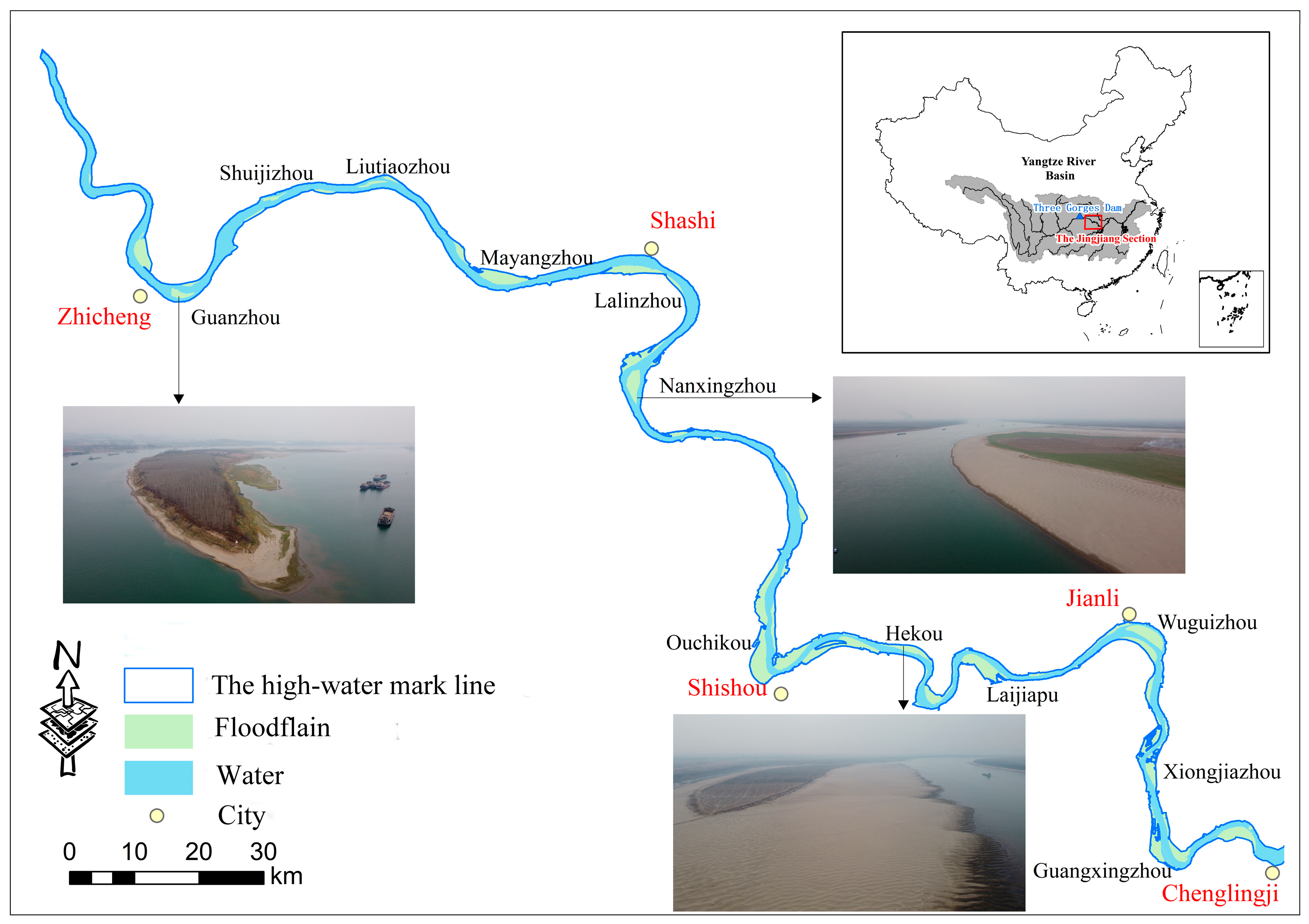
2.1. Study Area
2.2. Study Data
2.3. Study Methods
2.3.1. Calculation of Annual Mean NDVI
2.3.2. Threshold Segmentation Method
2.3.3. Trend Analysis
2.3.4. Geodetector
3. Results
3.1. Spatiotemporal Distribution and Variation Characteristics
3.1.1. Spatiotemporal Distribution Characteristics of Annual Mean NDVI Values on River Floodplains
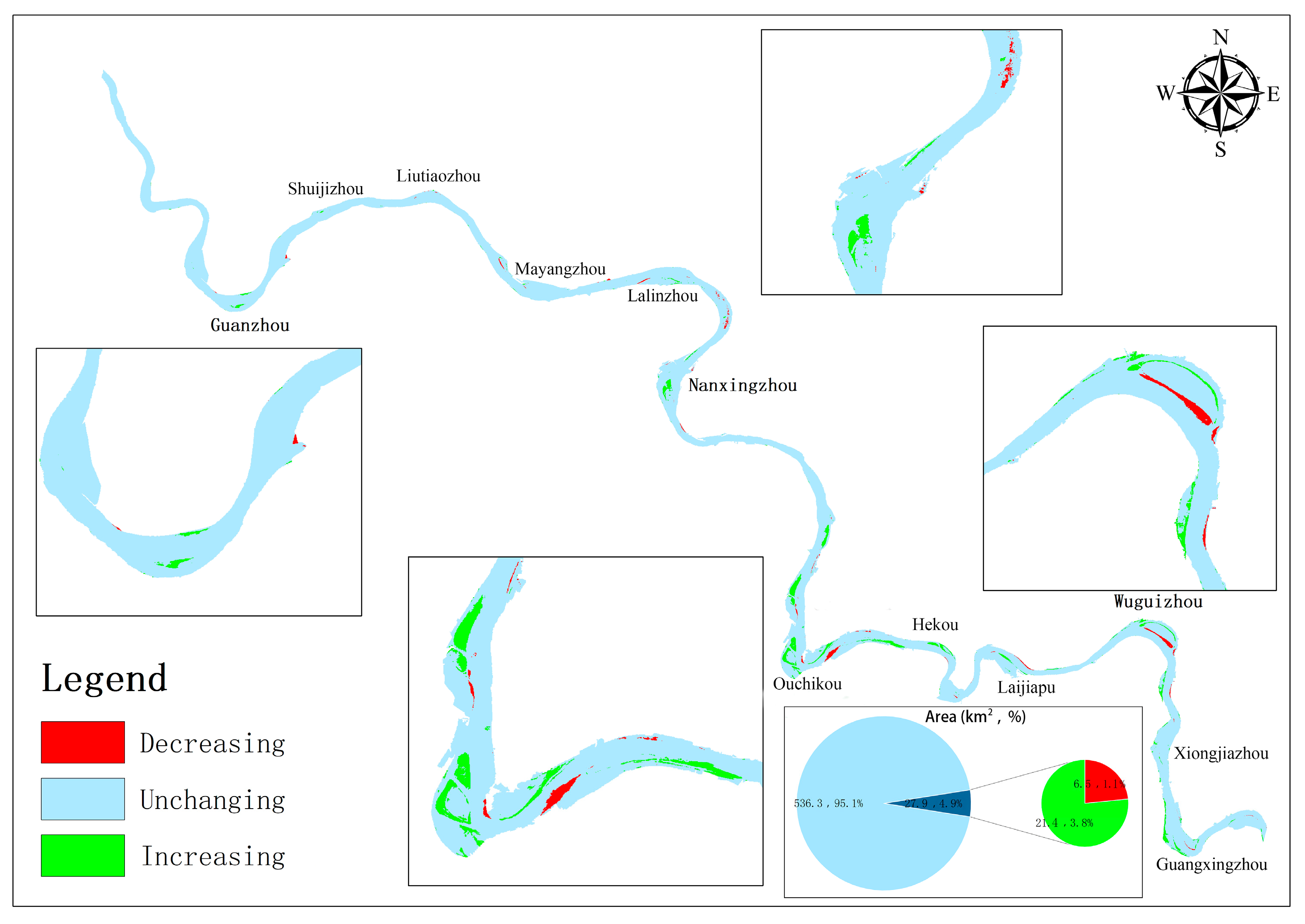
3.1.2. Spatiotemporal Distribution of NDVI Trends in Riverine Floodplains
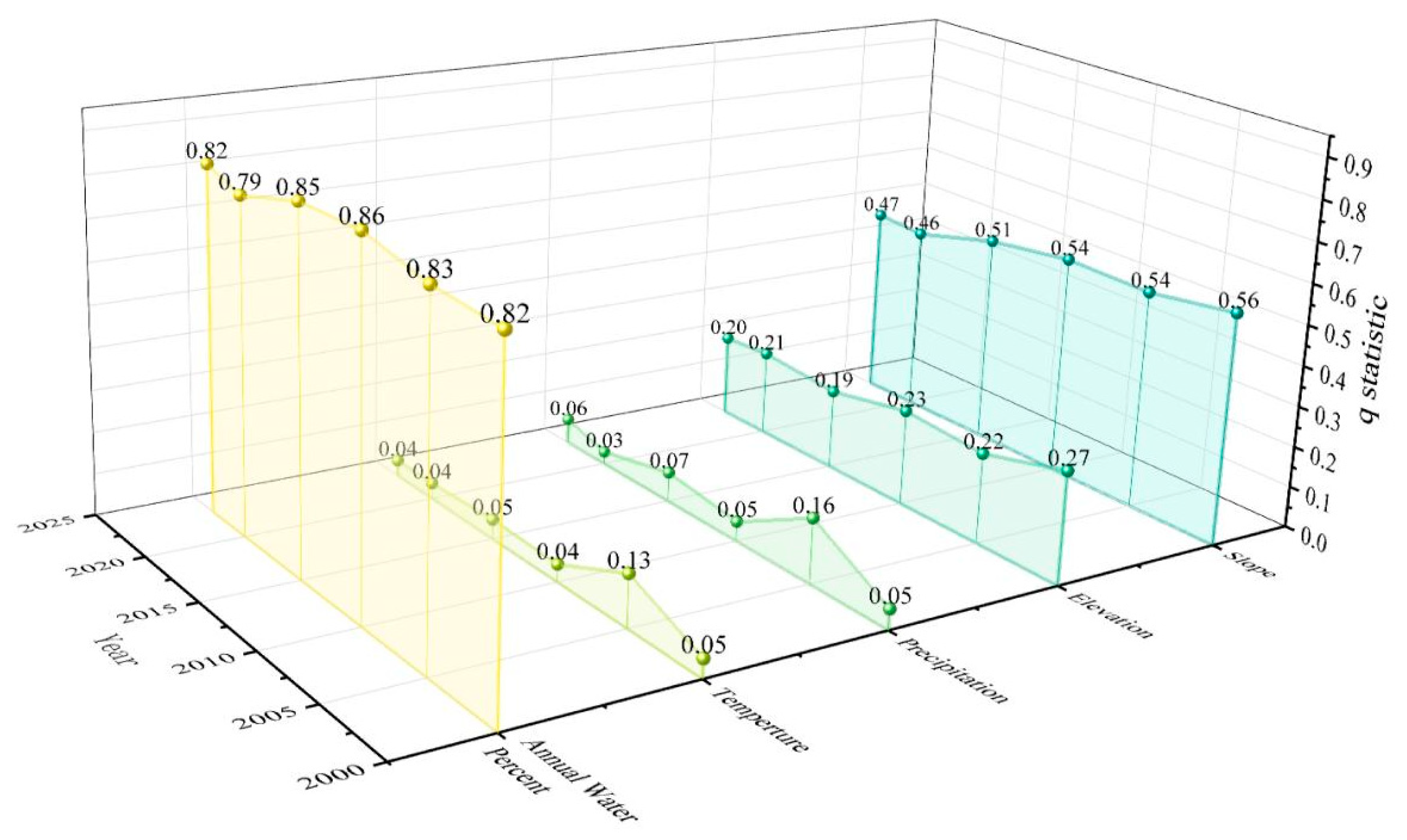
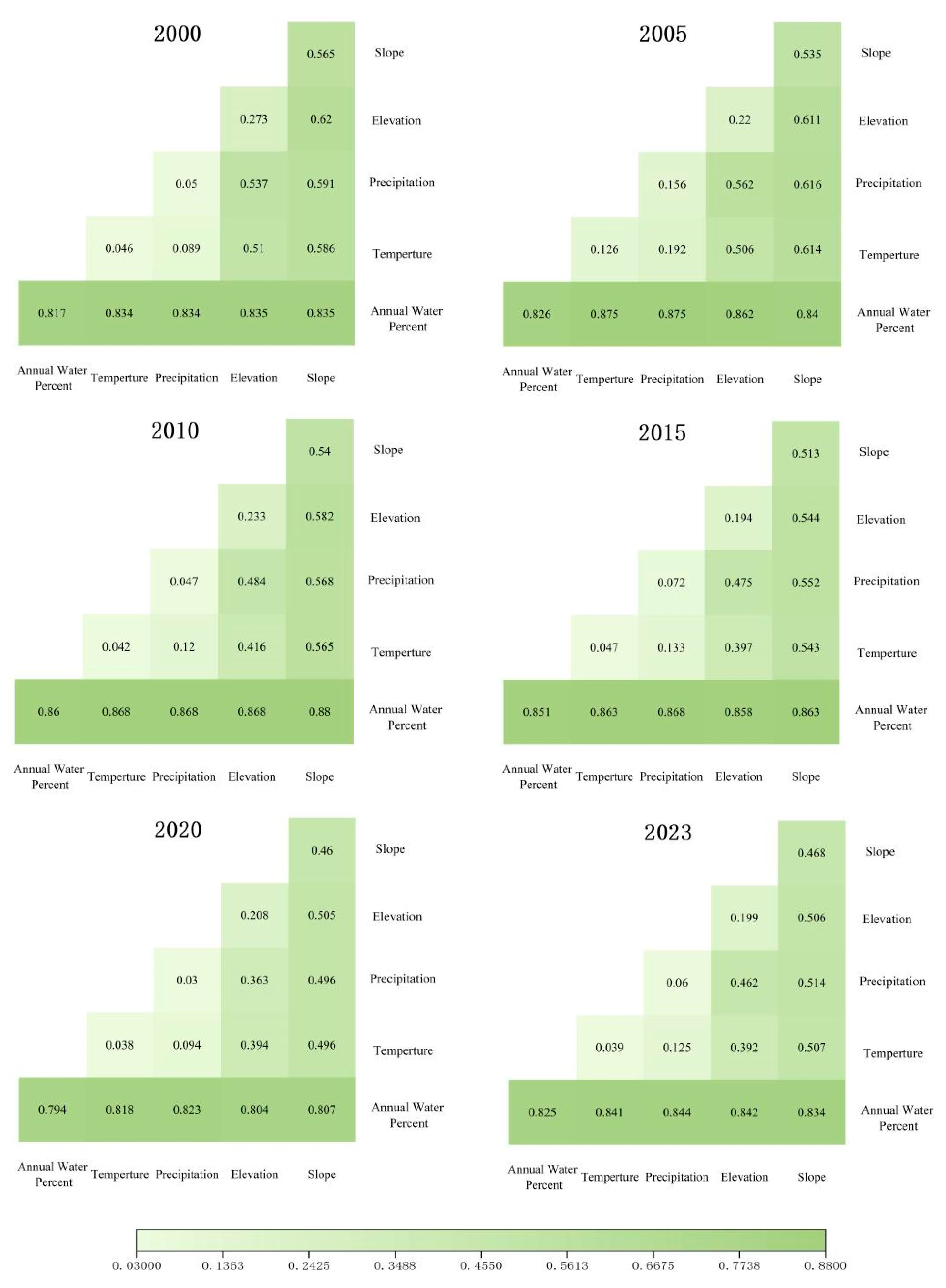
3.2. Analysis of Factors Influencing Spatiotemporal Variations in NDVI
3.3. Identification of Key Influence Zones
4. Discussion
4.1. Impact of Hydraulic Engineering and Extreme Precipitation Events on Floodplain Vegetation Growth
4.2. Impact of Flooding Frequency on Floodplain Vegetation
4.3. Controlling Optimal Growth Conditions for Barrier Island Vegetation
5. Conclusions
- (1)
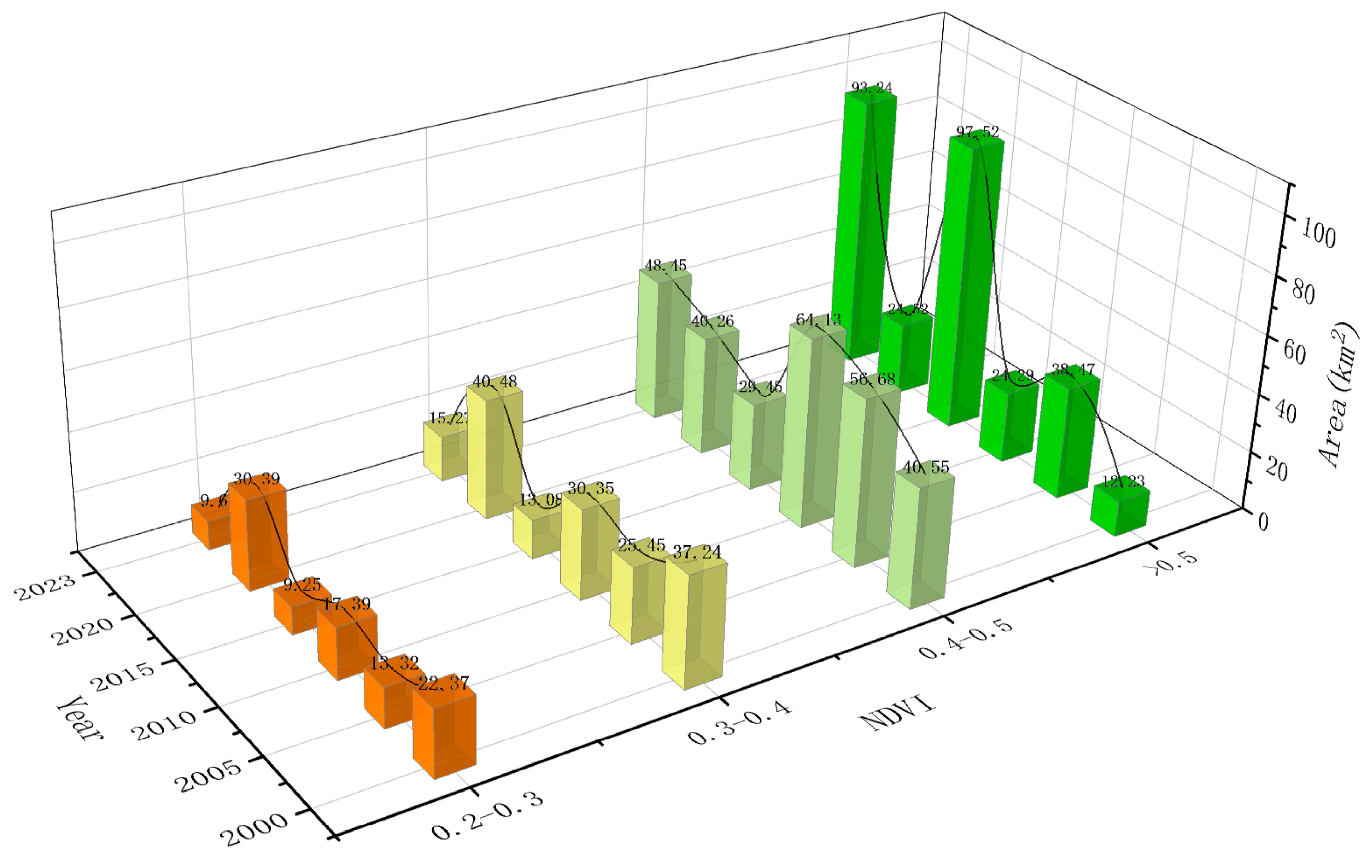
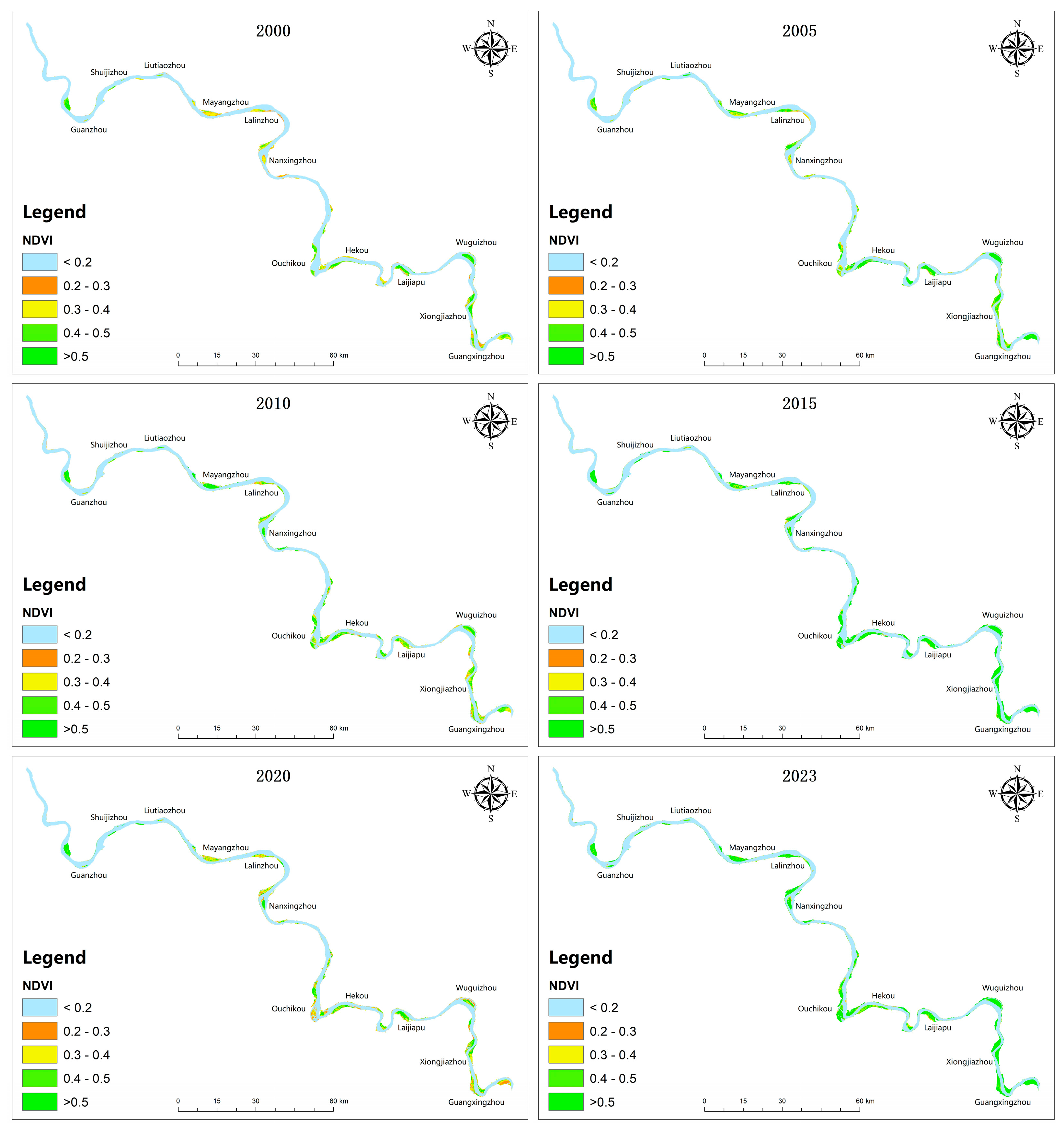
- Over six time periods from 2000 to 2023, the vegetation-covered area on floodplains in the Jingjiang section exhibited a fluctuating growth trend, with declines observed in 2010 and 2020. The total vegetation-covered area increased by 66.94 km2, with the greatest expansion occurring in high-vegetation zones (81.01 km2). Over this period, areas with unchanged NDVI values accounted for 95.1% of the Jingjiang section, primarily consisting of water bodies. Areas with increasing NDVI trends constituted 3.8%, while decreasing trends covered 1.2%. Overall, the pattern indicates fundamental stability with localized increases.
- (2)
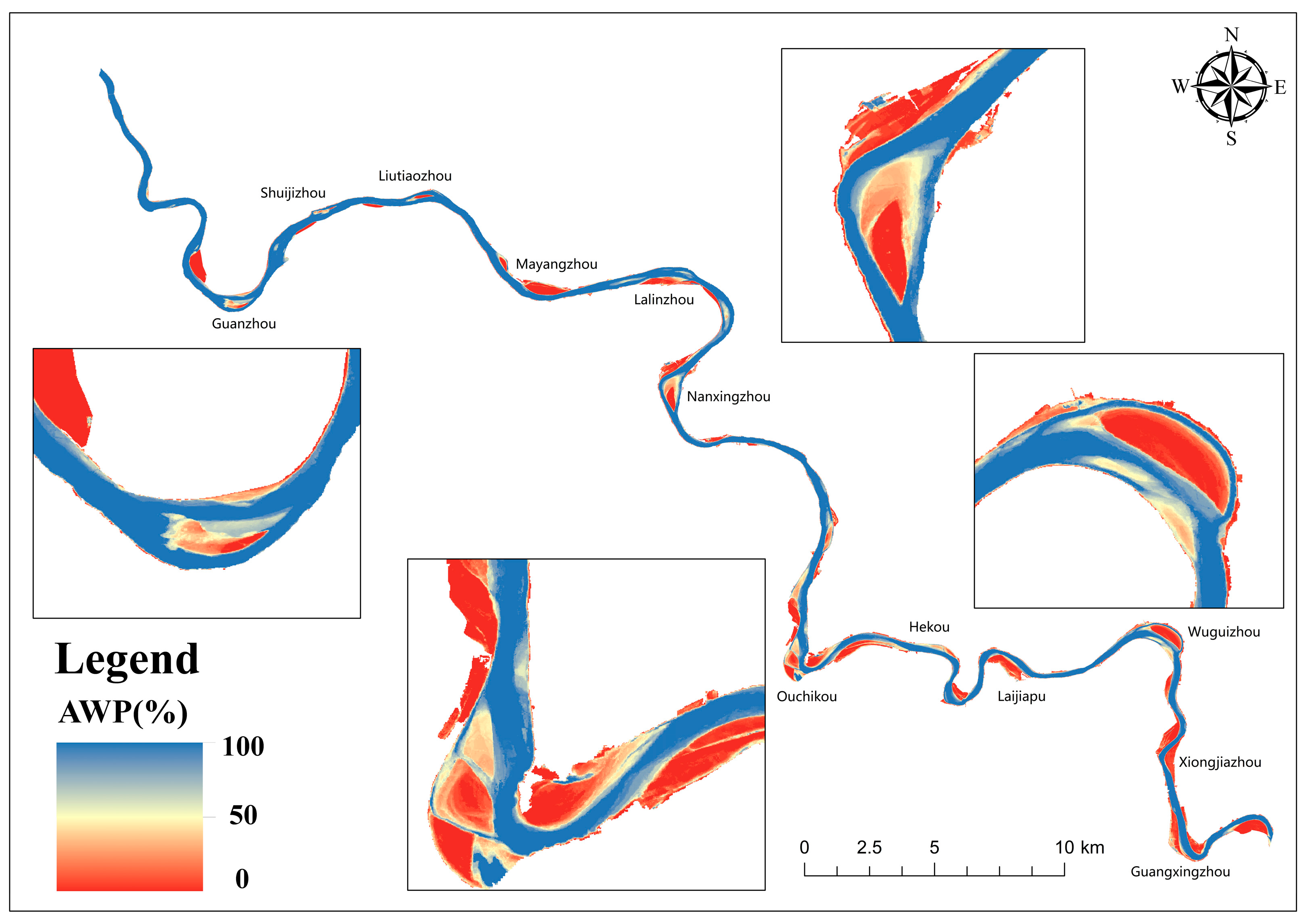
- Geodetector analysis identified inundation frequency (AWP) as the dominant factor influencing vegetation change in the Jingjiang section (q-value: 0.79–0.86), followed by slope (q-value: 0.46–0.56). Elevation had a minor influence (q-value < 0.3), while precipitation and temperature exerted negligible effects (q-value < 0.2). Pairwise combinations of these drivers produced a synergistic effect on the annual mean NDVI, indicating that NDVI distribution in the Jingjiang section is shaped not only by hydrological conditions but also by the significant combined effects of topography and climate. This suggests a synergistic mechanism operating across multiple scales.
- (3)
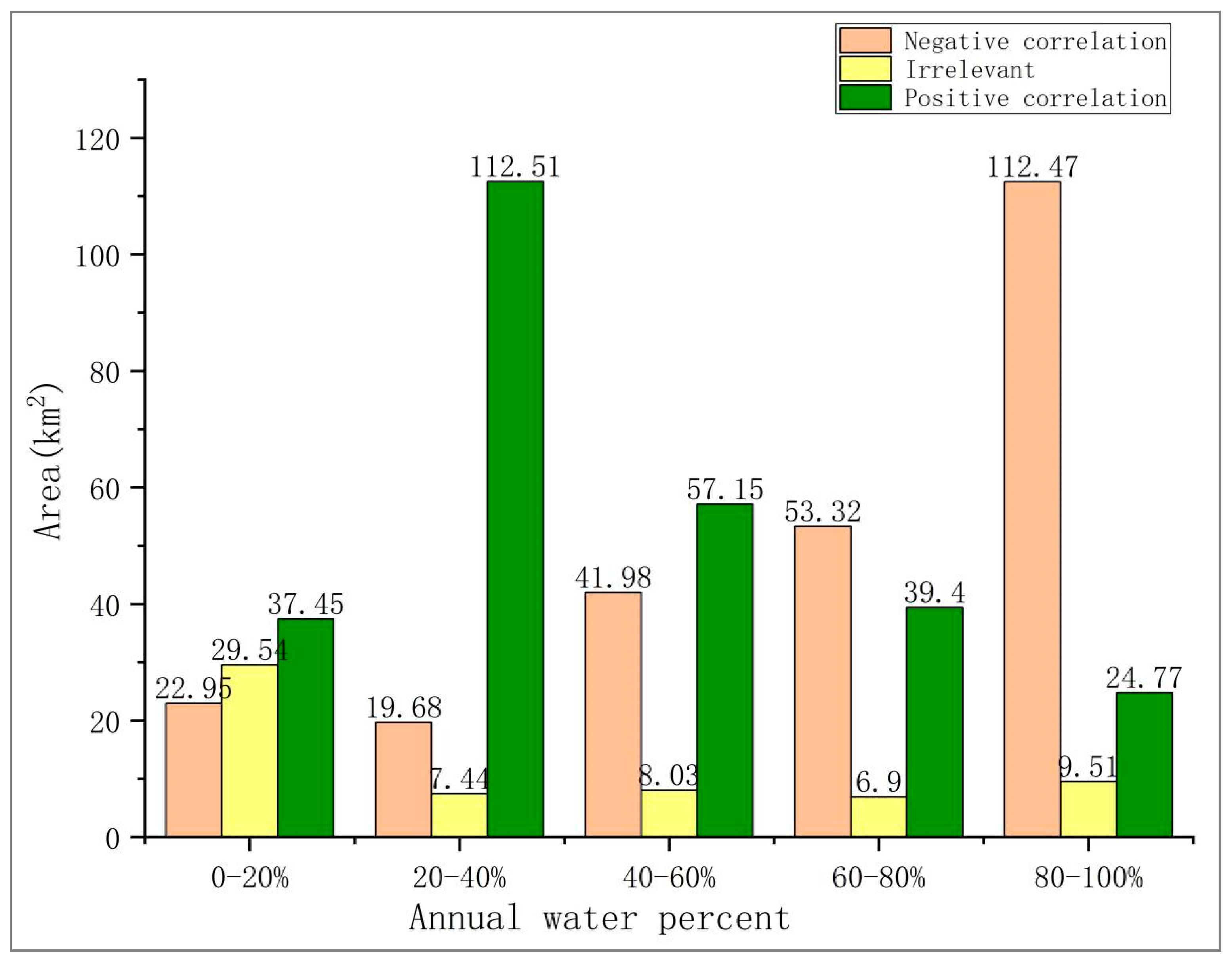
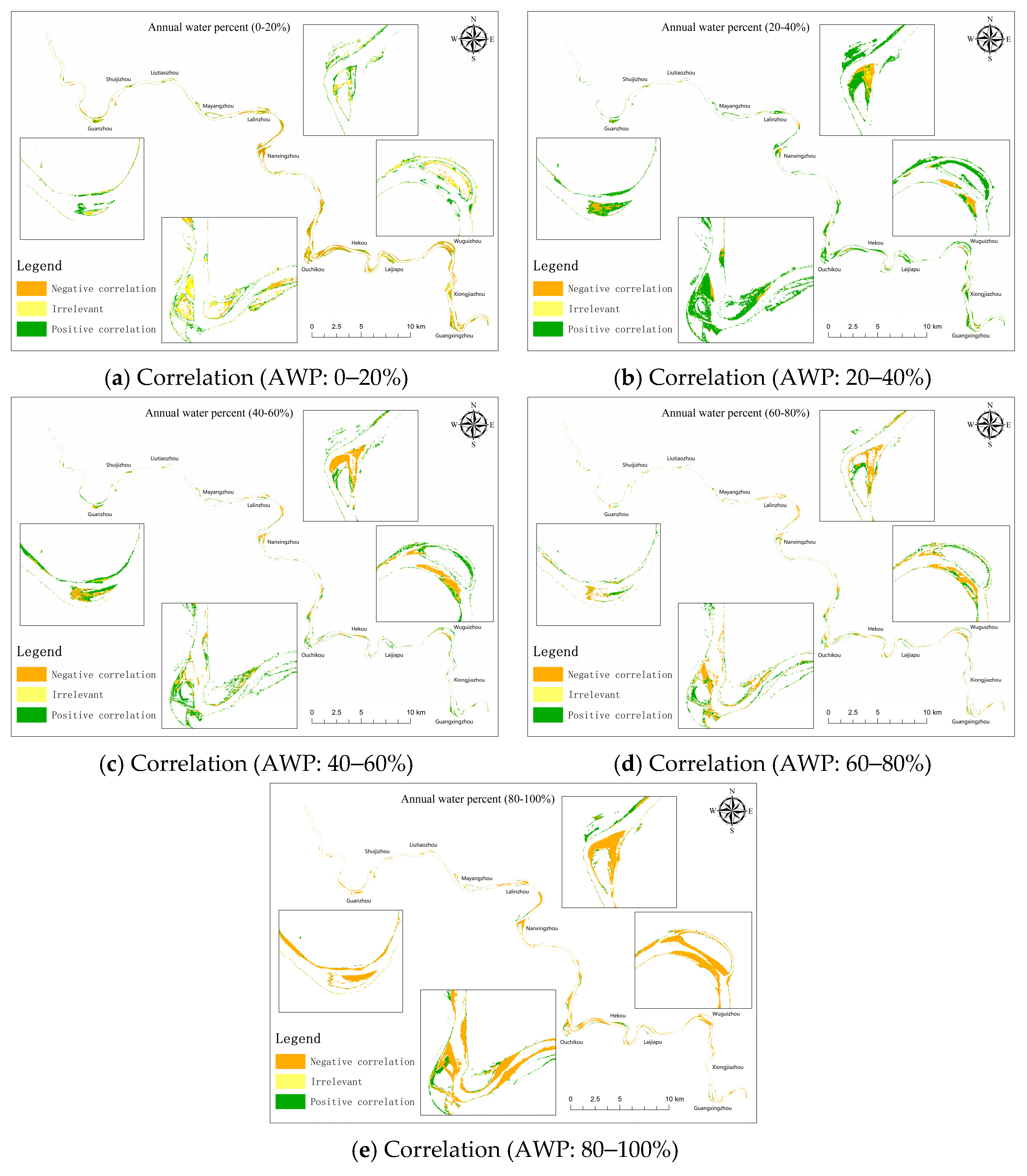
- The largest positively correlated area (112.51 km2) occurred at 20%–40% inundation frequency (AWP) and was concentrated on central and marginal bars. This inundation frequency (AWP) range conferred the strongest positive effect on vegetation growth. In contrast, the largest negatively correlated area (112.47 km2) occurred at an inundation frequency of 80%–100%, also predominantly covering central and marginal bars. This inundation frequency range imposed the strongest inhibitory effect on vegetation growth.
Author Contributions
Funding
Data Availability Statement
Acknowledgments
Conflicts of Interest
References
- Rodriguez-Iturbe, I.; D’Odorico, P.; Laio, F.; Ridolfi, L.; Tamea, S. Challenges in humid land ecohydrology: Interactions of water table and unsaturated zone with climate, soil, and vegetation. Water Resour. Res. 2007, 43, W09301. [Google Scholar] [CrossRef]
- Lewin, J.; Ashworth, P.J. Defining large river channel patterns: Alluvial exchange and plurality. Geomorphology 2014, 215, 83–98. [Google Scholar] [CrossRef]
- Naito, K.; Parker, G. Can bankfull discharge and bankfull channel characteristics of an alluvial meandering river be cospecified from a flow duration curve? J. Geophys. Res. Earth Surf. 2019, 124, 2381–2401. [Google Scholar] [CrossRef]
- Funk, A.; Martínez-López, J.; Borgwardt, F.; Trauner, D.; Bagstad, K.J.; Balbi, S.; Magrach, A.; Villa, F.; Hein, T. Identification of conservation and restoration priority areas in the Danube River based on the multi-functionality of river-floodplain systems. Sci. Total Environ. 2019, 654, 763–777. [Google Scholar] [CrossRef] [PubMed]
- Karpack, M.N.; Morrison, R.R.; McManamay, R.A. Quantitative assessment of floodplain functionality using an index of integrity. Ecol. Indic. 2020, 111, 106051. [Google Scholar] [CrossRef]
- Ye, X.-C.; Meng, Y.-K.; Xu, L.-G.; Xu, C.-Y. Net primary productivity dynamics and associated hydrological driving factors in the floodplain wetland of China’s largest freshwater lake. Sci. Total Environ. 2019, 659, 302–313. [Google Scholar] [CrossRef]
- Camporeale, C.; Perucca, E.; Ridolfi, L.; Gurnell, A.M. Modeling the interactions between river morphodynamics and riparian vegetation. Rev. Geophys. 2013, 28, 379–414. [Google Scholar] [CrossRef]
- Robertson, J.; Fletcher, T.; Danger, A.; Szota, C. Identifying critical inundation thresholds to maintain vegetation cover in stormwater treatment wetlands. Ecol. Eng. 2018, 116, 80–86. [Google Scholar] [CrossRef]
- Hu, Y.-X.; Huang, J.-L.; Du, Y.; Han, P.-P.; Wang, J.-L.; Huang, W. Monitoring wetland vegetation pattern response to water-level change resulting from the Three Gorges Project in the two largest freshwater lakes of China. Ecol. Eng. 2015, 74, 274–285. [Google Scholar] [CrossRef]
- Dai, X.; Wan, R.; Yang, G.; Wang, X.; Xu, L. Responses of wetland vegetation in Poyang Lake, China to water-level fluctuations. Hydrobiologia 2016, 773, 35–47. [Google Scholar] [CrossRef]
- Todd, M.J.; Muneepeerakul, R.; Pumo, D.; Azaele, S.; Miralles-Wilhelm, F.; Rinaldo, A.; Rodriguez-Iturbe, I. Hydrological drivers of wetland vegetation community distribution within Everglades National Park, Florida. Adv. Water Resour. 2010, 33, 1279–1289. [Google Scholar] [CrossRef]
- Casanova, M.T.; Brock, M.A. How do depth, duration and frequency of flooding influence the establishment of wetland plant communities? J. Plant Ecol. 2000, 147, 237–250. [Google Scholar] [CrossRef]
- Benjankar, R.; Jorde, K.; Yager, E.M.; Egger, G.; Goodwin, P.; Glenn, N.F. The impact of river modification and dam operation on floodplain vegetation succession trends in the Kootenai River, USA. Ecol. Eng. 2012, 46, 88–97. [Google Scholar] [CrossRef]
- Wen, Z.; Yang, H.; Zhang, C.; Shao, G.; Wu, S. Remotely sensed mid-channel bar dynamics in downstream of the Three Gorges Dam, China. Remote Sens. 2020, 12, 409. [Google Scholar] [CrossRef]
- Zhang, B.; Niu, Z.; Zhang, D.; Huo, X. Dynamic changes and driving forces of alpine wetlands on the Qinghai–Tibetan Plateau based on long-term time series satellite data: A case study in the Gansu Maqu wetlands. Remote Sens. 2022, 14, 4147. [Google Scholar] [CrossRef]
- Han, X.; Chen, X.; Feng, L. Four decades of winter wetland changes in Poyang Lake based on Landsat observations between 1973 and 2013. Remote Sens. Environ. 2015, 156, 426–437. [Google Scholar] [CrossRef]
- Hooke, J.; Yorke, L. Channel bar dynamics on multi-decadal timescales in an active meandering river. Earth Surf. Proc. Landf. 2011, 36, 1910–1928. [Google Scholar] [CrossRef]
- Diamond, J.S.; McLaughlin, D.L.; Slesak, R.A.; Stovall, A. Microtopography is a fundamental organizing structure of vegetation and soil chemistry in black ash wetlands. Biogeosciences 2020, 17, 901–915. [Google Scholar] [CrossRef]
- Siepielski, A.M.; Morrissey, M.B.; Buoro, M.; Carlson, S.M.; Caruso, C.M.; Clegg, S.M.; Coulson, T.; DiBattista, J.; Gotanda, K.M.; Francis, C.D.; et al. Precipitation drives global variation in natural selection. Science 2017, 355, 959–962. [Google Scholar] [CrossRef]
- Boniface, C. Vegetation Succession on Mid-Channel Bars of the Fraser River. Master’s Thesis, Simon Fraser University, Vancouver, BC, Canada, 1985. Available online: https://api.semanticscholar.org/CorpusID:130383418 (accessed on 15 January 2026).
- Xu, Q.; Yuan, S.; Shen, M.; Liu, X. Assemblage structure characteristics of hygrophytic plants and their driving factors in sand bars in Yichang-Jianli section of the Yangtze mainstem. Resour. Environ. Yangtze Basin 2020, 29, 928–937. [Google Scholar]
- Camporeale, C.; Ridolfi, L. Riparian vegetation distribution induced by river flow variability: A stochastic approach. Water Resour. Res. 2006, 10, 42. [Google Scholar] [CrossRef]
- Liang, D.; Lu, J.; Chen, X.; Liu, C.; Lin, J. An investigation of the hydrological influence on the distribution and transition of wetland cover in a complex lake–floodplain system using time-series remote sensing and hydrodynamic simulation. J. Hydrol. 2020, 587, 125038. [Google Scholar] [CrossRef]
- Dong, X.; Hu, C. A new method for describing the inundation status of floodplain wetland. Ecol. Indic. 2021, 131, 108144. [Google Scholar] [CrossRef]
- Liu, H.; Zheng, L.; Yin, S. Multi-perspective analysis of vegetation cover changes and driving factors of long time series based on climate and terrain data in Hanjiang River Basin, China. Arab. J. Geosci. 2018, 11, 509. [Google Scholar] [CrossRef]
- Peng, W.; Kuang, T.; Tao, S. Quantifying influences of natural factors on vegetation NDVI changes based on geographical detector in Sichuan, western China. J. Clean. Prod. 2019, 233, 353–367. [Google Scholar] [CrossRef]
- Li, B.; Wan, R.; Yang, G.; Yang, S.; Dong, L.; Cui, J.; Zhang, T. Centennial loss of lake wetlands in the Yangtze Plain, China: Impacts of land use changes accompanied by hydrological connectivity loss. Water Res. 2024, 256, 121578. [Google Scholar] [CrossRef] [PubMed]
- Mu, S.; Li, B.; Yao, J.; Yang, G.; Wan, R.; Xu, X. Monitoring the spatio-temporal dynamics of the wetland vegetation in Poyang Lake by Landsat and MODIS observations. Sci. Total Environ. 2020, 725, 138096. [Google Scholar] [CrossRef]
- Xie, Y.H.; Yue, T.; Cheng, X.; Feng, L.-C.; Deng, Z. The impact of Three Gorges Dam on the downstream eco-hydrological environment and vegetation distribution of East Dongting Lake. Ecohydrology 2015, 8, 738–746. [Google Scholar] [CrossRef]
- Zheng, Y.; Lu, D.; Yang, Z.; Chang, J. Unravelling the Characteristics of Microhabitat Alterations in Floodplain Inundated Areas Based on High-Resolution UAV Imagery and Remote Sensing: A Case Study in Jingjiang, Yangtze River. Drones 2025, 9, 315. [Google Scholar] [CrossRef]
- Han, J.; Wang, Y.; Sun, Z. Changes of Water stage in the middle Yangtze River influenced by human activities in the past 70 years. Front. Earth Sci. 2021, 15, 121–132. [Google Scholar] [CrossRef]
- Huang, S.; Xia, J.; Wang, G.; Lei, J. The impact of flood regime on river floodplain vegetation coverage: Insights from a 30-year Landsat record. J. Hydrol. 2023, 626, 130355. [Google Scholar] [CrossRef]
- Yang, X.; Sun, Z.; Li, Y.; Deng, J.; Xiong, H.; Li, D. Mechanisms of bar adjustments in the Jingjiang Reach of the Yangtze River in response to the operation of the Three Gorges Dam. J. Hydrol. 2023, 616, 128802. [Google Scholar] [CrossRef]
- Lou, Y.; Dai, Z.; Lu, X.; Li, D. Anthropogenic pressures induced hydromorphodynamic changes of riverine islands in the Upper Jingjiang reach along the Changjiang (Yangtze) River. Catena 2022, 217, 106488. [Google Scholar] [CrossRef]
- Pickens, A.H.; Hansen, M.C.; Hancher, M.; Stehman, S.V.; Tyukavina, A.; Potapov, P.; Marroquin, B.; Sherani, Z. Mapping and sampling to characterize global inland water dynamics from 1999 to 2018 with full Landsat time-series. Remote Sens. Environ. 2020, 243, 111792. [Google Scholar] [CrossRef]
- Li, J.; Peng, S.; Li, Z.; Meteorology, F. Detecting and attributing vegetation changes on China’s Loess Plateau. Agric. For. Meteorol. 2017, 247, 260–270. [Google Scholar] [CrossRef]
- DeVries, B.; Decuyper, M.; Verbesselt, J.; Zeileis, A.; Herold, M.; Joseph, S. Tracking disturbance-regrowth dynamics in tropical forests using structural change detection and Landsat time series. Remote Sens. Environ. 2015, 169, 320–334. [Google Scholar] [CrossRef]
- Running, S.W.; Loveland, T.R.; Pierce, L.L.; Nemani, R.R.; Hunt, E.R., Jr. A remote sensing based vegetation classification logic for global land cover analysis. Remote Sens. Environ. 1995, 51, 39–48. [Google Scholar] [CrossRef]
- Nemani, R.; Running, S. Land cover characterization using multitemporal red, near-IR, and thermal-IR data from NOAA/AVHRR. Ecol. Appl. 1997, 7, 79–90. [Google Scholar] [CrossRef]
- Piao, S.; Wang, X.; Ciais, P.; Zhu, B.; Wang, T.; Liu, J. Changes in satellite-derived vegetation growth trend in temperate and boreal Eurasia from 1982 to 2006. Glob. Change Biol. 2011, 17, 3228–3239. [Google Scholar] [CrossRef]
- Wang, J.; Xu, C. Geodetector: Principle and prospective. Acta Geogr. Sin. 2017, 72, 116–134. [Google Scholar] [CrossRef]
- Han, X.; Feng, L.; Hu, C.; Chen, X. Wetland changes of China’s largest freshwater lake and their linkage with the Three Gorges Dam. Remote Sens. Environ. 2018, 204, 799–811. [Google Scholar] [CrossRef]
- Liu, H.; Zheng, L.; Jiang, L.; Liao, M. Forty-year water body changes in Poyang Lake and the ecological impacts based on Landsat and HJ-1 A/B observations. J. Hydrol. 2020, 589, 125161. [Google Scholar] [CrossRef]
- Zhang, D.; Qi, Q.; Tong, S.; Wang, J.; Zhang, M.; Zhu, G.; Lu, X. Effect of hydrological fluctuation on nutrient stoichiometry and trade-offs of Carex schmidtii. Ecol. Indic. 2021, 120, 106924. [Google Scholar] [CrossRef]
- Li, J.; Zhai, P.; Mao, J.; Song, L.; Xiao, Q. Synergistic effect of the 25–60-day tropical and midlatitude intraseasonal oscillations on the persistently severe Yangtze floods. Geophys. Res. Lett. 2021, 48, e2021GL095129. [Google Scholar] [CrossRef]
- Sun, R.; Deng, W.Q.; Yuan, X.Z.; Liu, H.; Zhang, Y. Riparian vegetation after dam construction on mountain rivers in China. Ecohydrology 2014, 7, 1187–1195. [Google Scholar] [CrossRef]
- Hupp, C.R.; Osterkamp, W. Riparian vegetation and fluvial geomorphic processes. Geomorphology 1996, 14, 277–295. [Google Scholar] [CrossRef]
- Deng, F.; Wang, X.; Cai, X.; Li, E.; Jiang, L.; Li, H.; Yan, R. Analysis of the relationship between inundation frequency and wetland vegetation in Dongting Lake using remote sensing data. Ecohydrology 2014, 7, 717–726. [Google Scholar] [CrossRef]
- Johnson, S.E.; Amatangelo, K.L.; Townsend, P.A.; Waller, D.M. Large, connected floodplain forests prone to flooding best sustain plant diversity. Ecology 2016, 97, 3019–3030. [Google Scholar] [CrossRef] [PubMed]
- Wang, Q.; Du, Y.; Su, Y.; Chen, K. Environmental impact post-assessment of dam and reservoir projects: A review. Procedia Environ. Sci. 2012, 13, 1439–1443. [Google Scholar] [CrossRef]
- Egger, G.; Politti, E.; Woo, H.; Cho, K.-H.; Park, M.; Cho, H.; Benjankar, R.; Lee, N.-J.; Lee, H. Dynamic vegetation model as a tool for ecological impact assessments of dam operation. J. Hydro-Environ. Res. 2012, 6, 151–161. [Google Scholar] [CrossRef]
- Catford, J.A.; Jansson, R. Drowned, buried and carried away: Effects of plant traits on the distribution of native and alien species in riparian ecosystems. New Phytol. 2014, 204, 19–36. [Google Scholar] [CrossRef] [PubMed]
- Barker, L.S.; Felton, G.K.; Russek-Cohen, E.; Assessment. Use of Maryland biological stream survey data to determine effects of agricultural riparian buffers on measures of biological stream health. Environ. Monit. Assess. 2006, 117, 1–19. [Google Scholar] [CrossRef] [PubMed]
- Kui, L.; Stella, J.C.; Diehl, R.M.; Wilcox, A.C.; Lightbody, A.; Sklar, L.S. Can environmental flows moderate riparian invasions? The influence of seedling morphology and density on scour losses in experimental floods. Freshw. Biol. 2019, 64, 474–484. [Google Scholar] [CrossRef]
- New, T.; Xie, Z. Impacts of large dams on riparian vegetation: Applying global experience to the case of China’s Three Gorges Dam. Biodivers. Conserv. 2008, 17, 3149–3163. [Google Scholar] [CrossRef]
- Alldredge, B.; Moore, G. Assessment of riparian vegetation sensitivity to river hydrology downstream of a major Texas dam. River Res. Appl. 2014, 30, 230–244. [Google Scholar] [CrossRef]
- Altenfelder, S.; Schmitz, M.; Poschlod, P.; Kollmann, J.; Albrecht, H. Managing plant species diversity under fluctuating wetland conditions: The case of temporarily flooded depressions. Wetl. Ecol. Manag. 2016, 24, 597–608. [Google Scholar] [CrossRef]





| Data Name | Spatial Resolution/m | Data Source |
|---|---|---|
| NDVI | 30 | Google Earth Engine |
| AWP | 30 | GLAD global surface water dynamics (https://storage.googleapis.com/earthenginepartners-hansen/waterC2/download.html) (accessed on 10 October 2025) |
| Elevation | 30 | Geospatial Data Cloud (http://www.gscloud.cn/) (accessed on 12 October 2025) |
| Slope | 30 | |
| Temperature | 30 | National Earth System Science Data Center (http://www.geodata.cn/) (accessed on 15 October 2025) |
| Precipitation | 30 |
| Reason of Judgment | Interactive Display |
|---|---|
| q(X1∩X2) < min〔q(X1), q(X2)〕 | Nonlinearity attenuation |
| min〔q(X1), q(X2)〕 < q(X1∩X2) < max〔q(X1), q(X2)〕 | The single-factor nonlinearity decreases |
| q(X1∩X2) > max〔q(X1), q(X2)〕 | Two-factor enhancement |
| q(X1∩X2) = q(X1) + q(X2) | Independence |
| q(X1∩X2) > q(X1) + q(X2) | Nonlinear enhancement |
Disclaimer/Publisher’s Note: The statements, opinions and data contained in all publications are solely those of the individual author(s) and contributor(s) and not of MDPI and/or the editor(s). MDPI and/or the editor(s) disclaim responsibility for any injury to people or property resulting from any ideas, methods, instructions or products referred to in the content. |
© 2026 by the authors. Licensee MDPI, Basel, Switzerland. This article is an open access article distributed under the terms and conditions of the Creative Commons Attribution (CC BY) license.
Share and Cite
Kou, J.; Huang, X.; Lin, J.; Zhuo, H.; Zhou, Z.; Yang, C. The Impact of Inundation Frequency on the Distribution of Floodplain Vegetation in the Jingjiang Section of the Yangtze River. Forests 2026, 17, 133. https://doi.org/10.3390/f17010133
Kou J, Huang X, Lin J, Zhuo H, Zhou Z, Yang C. The Impact of Inundation Frequency on the Distribution of Floodplain Vegetation in the Jingjiang Section of the Yangtze River. Forests. 2026; 17(1):133. https://doi.org/10.3390/f17010133
Chicago/Turabian StyleKou, Jiefeng, Xiaolong Huang, Jingjing Lin, Haihua Zhuo, Zheng Zhou, and Chao Yang. 2026. "The Impact of Inundation Frequency on the Distribution of Floodplain Vegetation in the Jingjiang Section of the Yangtze River" Forests 17, no. 1: 133. https://doi.org/10.3390/f17010133
APA StyleKou, J., Huang, X., Lin, J., Zhuo, H., Zhou, Z., & Yang, C. (2026). The Impact of Inundation Frequency on the Distribution of Floodplain Vegetation in the Jingjiang Section of the Yangtze River. Forests, 17(1), 133. https://doi.org/10.3390/f17010133