Systematic Review

Global Shifts in Fire Regimes Under Climate Change: Patterns, Drivers, and Ecological Implications Across Biomes


by
Ana Paula Oliveira
* and
Paulo Gil Martins
School of Administration, Engineering and Aeronautics (EGEA), Instituto Superior de Educação e Ciências de Lisboa (ISEC Lisboa), Alameda das Linhas de Torres, 179, 1750-142 Lisboa, Portugal
*
Author to whom correspondence should be addressed.
Forests 2026, 17(1), 104; https://doi.org/10.3390/f17010104
Submission received: 25 November 2025 / Revised: 5 January 2026 / Accepted: 8 January 2026 / Published: 13 January 2026
(This article belongs to the Special Issue Forest Fire: Landscape Patterns, Risk Prediction and Fuels Management)

Abstract

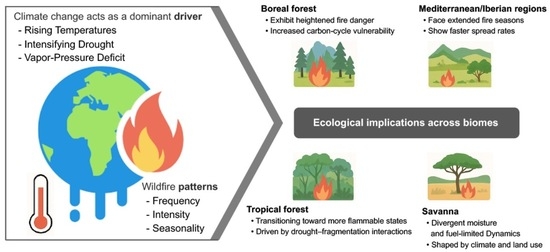
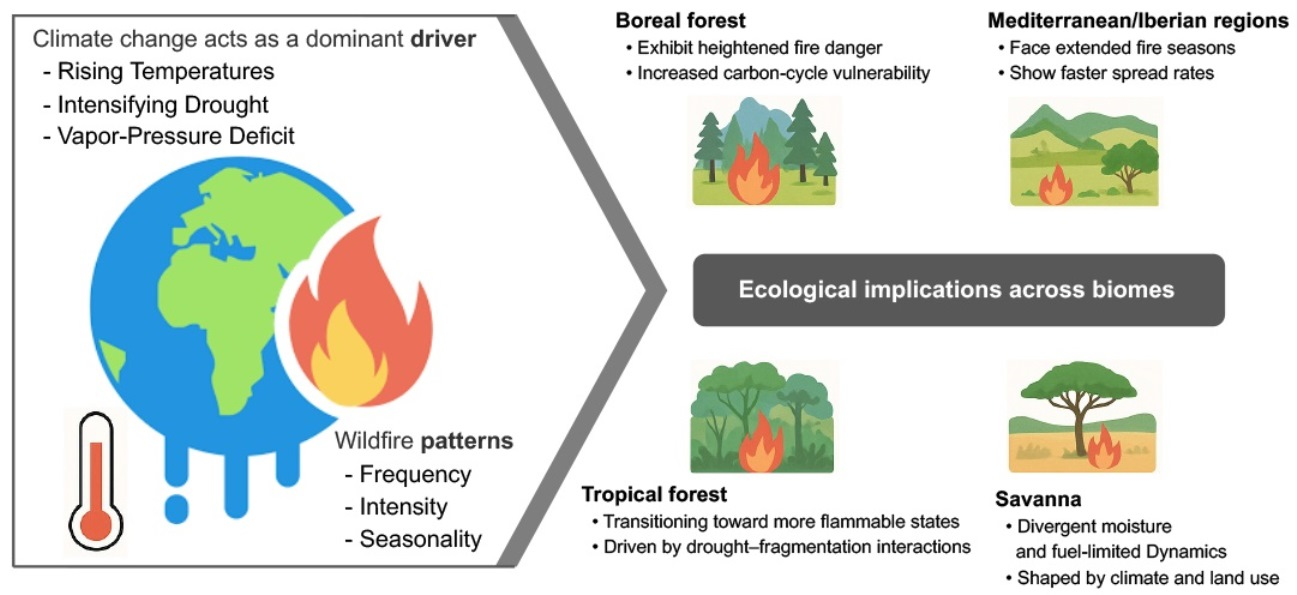
Wildfire regimes are undergoing rapid transformation under anthropogenic climate change, with major implications for biodiversity, carbon cycling, and ecosystem resilience. This systematic review synthesizes findings from 42 studies across global, continental, and regional scales to assess emerging patterns in fire frequency, intensity, and seasonality, and to identify climatic, ecological, and anthropogenic drivers shaping these changes. Across biomes, evidence shows increasingly fire-conducive conditions driven by rising temperatures, vapor-pressure deficit, and intensifying drought, with climate model projections indicating amplification of extreme fire weather this century. Boreal ecosystems show heightened fire danger and carbon-cycle vulnerability; Mediterranean and Iberian regions face extended fire seasons and faster spread rates; tropical forests, particularly the Amazon, are shifting toward more flammable states due to drought–fragmentation interactions; and savannas display divergent moisture- and fuel-limited dynamics influenced by climate and land use. These results highlight the emergence of biome-specific fire–climate–fuel feedback that may push certain ecosystems toward alternative stable states. The review underscores the need for improved attribution frameworks, integration of fire–vegetation–carbon feedback into Earth system models, and development of adaptive, regionally tailored fire-management strategies.

Graphical Abstract

1. Introduction

The Wildfire is a fundamental ecological process shaping the structure, composition, and functioning of terrestrial ecosystems. Across evolutionary timescales, fire has acted as a selective force influencing vegetation dynamics, nutrient cycling, and species adaptations. However, in recent decades, the frequency, intensity, and spatial extent of wildfires have changed dramatically, reflecting the combined pressures of anthropogenic climate change, land-use modification, and altered fuel dynamics [1,2,3]. The escalation of extreme fire events, such as the 2019–2020 Australian “Black Summer”, the 2020 fires in the western United States, and the recurrent Siberian and Mediterranean wildfires, has heightened global concern over the stability of fire-prone landscapes and their role in the Earth’s climate system [4,5,6].
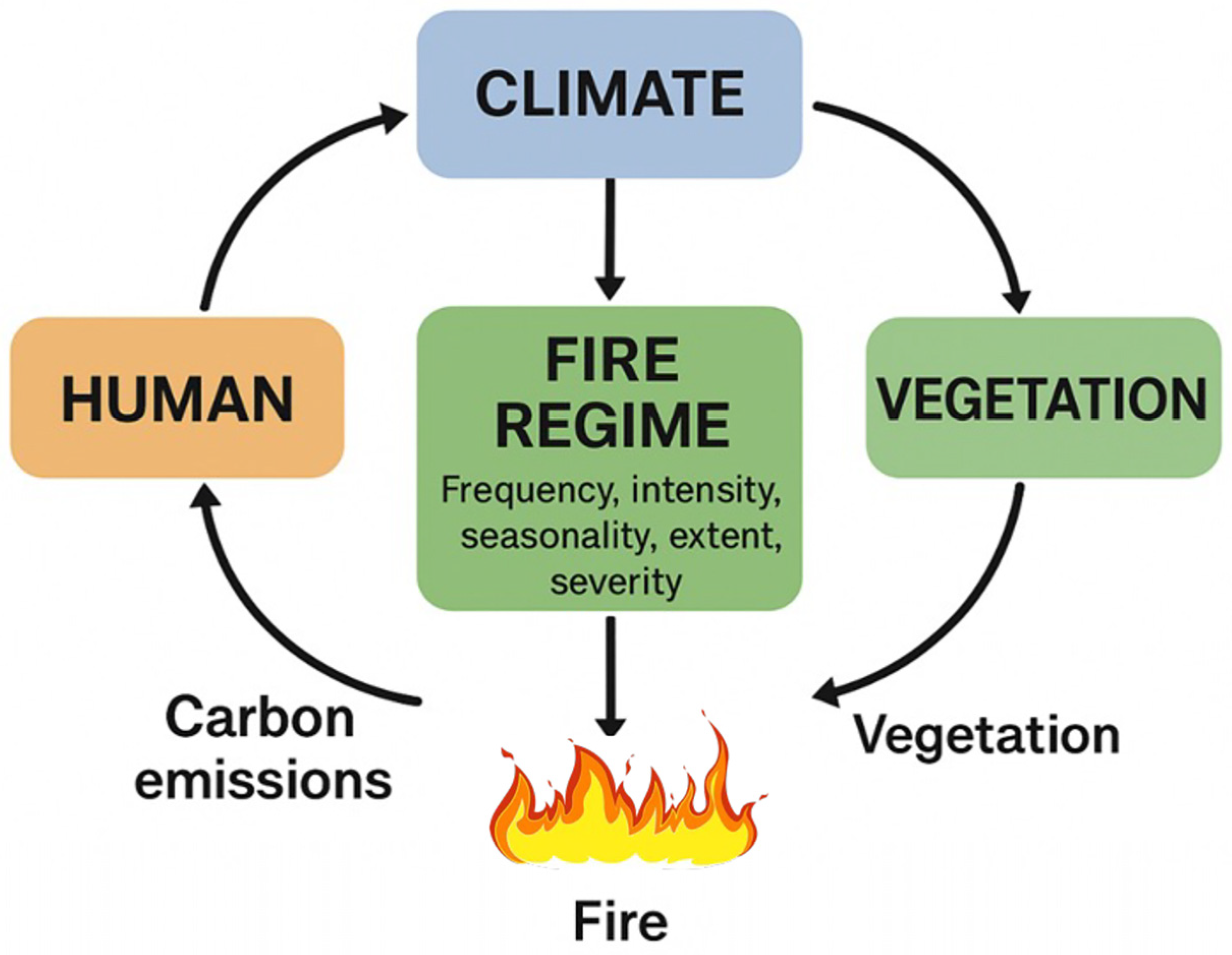
A fire regime encompasses the characteristic pattern of fire occurrence and behavior in a particular ecosystem, typically described in terms of its frequency, intensity, seasonality, extent, and severity [7,8,9,10]. These attributes are determined by the complex interplay between climate, vegetation (fuels), and ignition sources, both natural and human-induced. Climate sets the broad boundaries for fire activity by regulating temperature, precipitation, and fuel moisture; vegetation determines the availability and continuity of burnable material; and human activities influence ignition patterns, suppression efforts, and land transformation [8,11,12,13]. Consequently, fire regimes are not static; they respond dynamically to environmental changes and socio-economic pressures.
Climate change has emerged as a dominant driver of recent shifts in global fire regimes. Rising temperatures, increased vapor pressure deficit (VPD), altered precipitation patterns, and the intensification of droughts have expanded the window of flammable conditions across many regions [14,15]. Observational evidence indicates that the global average fire season length has increased by nearly 20% over the past four decades, with particularly strong trends in the Mediterranean Basin, western North America, and parts of southern Africa [9,16,17]. At the same time, the distribution of fire activity is changing: while some savanna regions exhibit declining burned area due to land conversion and grazing, forested biomes, especially in boreal and temperate zones, are experiencing more frequent and severe fires [18,19].
The human dimension adds further complexity. Fire suppression policies in historically fire-adapted landscapes have altered fuel structures, leading to the accumulation of combustible biomass and creating conditions for larger and more intense fires [20,21]. Agricultural expansion, logging, and urban encroachment into wildland areas have modified ignition probabilities and increased exposure to fire hazards. In tropical regions, the combination of deforestation, fragmentation, and recurring droughts has enabled fires to penetrate previously fire-resistant rainforests, threatening global biodiversity and accelerating carbon losses [22,23]. Conversely, in some developing regions, reduced rural populations and changes in traditional fire use have resulted in the suppression of low-intensity burns, thereby altering long-standing ecological fire balances [24].
Globally, the redistribution of fire activity has significant biogeochemical and ecological implications. Wildfires currently contribute an estimated 15%–20% of annual anthropogenic carbon dioxide (CO2) emissions, while also releasing large quantities of aerosols, methane, and black carbon that affect atmospheric chemistry and radiative forcing [25,26,27]. Repeated high-severity fires can deplete soil organic matter, alter hydrological processes, and transform vegetation assemblages, potentially pushing ecosystems beyond resilience thresholds [26,27]. These transformations can initiate feedback loops wherein fire-induced carbon emissions amplify climate warming, which in turn promotes more frequent and intense fires, a phenomenon now recognized as a hallmark of the “fire–climate feedback” system [28,29,30].
Despite advances in fire monitoring, a complete understanding of evolving fire regimes across biomes remains incomplete. Boreal forests face intensified burning and permafrost thaw, releasing long-stored carbon. Mediterranean ecosystems exhibit increasing fire weather extremes driven by drought. Tropical forests are becoming more flammable due to land-use change and altered moisture. Savannas are experiencing shifts in fire frequency and extent due to grazing and invasive grasses. These diverse trajectories reflect the heterogeneity of fire–climate–human interactions and necessitate a global synthesis.
The objective of this review is to comprehensively assess the global patterns and drivers of changing fire regimes under climate change, emphasizing inter-biome variability and ecological implications. Thus, the specific objectives are: (1) synthesize trends in fire frequency, intensity, and seasonality; (2) identify the key climatic, ecological, and anthropogenic factors shaping these changes; (3) examine differential responses across boreal, Mediterranean, tropical, and savanna ecosystems; and (4) discuss the consequences for biodiversity, carbon cycling, and ecosystem resilience. Finally, we highlight emerging research priorities and management strategies essential for mitigating fire risk and enhancing adaptive capacity.
By integrating findings from remote sensing, climate modeling, and field studies, this review seeks to advance mechanistic understanding of the global reorganization of fire regimes and its implications for ecological stability and climate feedback. It aims to bridge the gap between biophysical science and practical fire management, offering a framework for developing regionally tailored, globally informed strategies for managing fire in the Anthropocene.
However, emerging evidence also reveals substantial regional heterogeneity, methodological divergence, and in some cases conflicting trends in fire activity, reflecting differences in fuel limitation, land-use legacies, climate forcing, and modelling assumptions. These disparities highlight that global fire-regime shifts cannot be interpreted as spatially uniform responses to climate change, underscoring the need for a critical synthesis that explicitly addresses uncertainty and regional contrasts.

2. Conceptual Framework

Fire regimes are shaped by a dynamic interplay between climate, vegetation, and human activities, creating complex feedback that operates across multiple spatial and temporal scales (Figure 1). Understanding these interactions is critical for predicting fire behavior under climate change and for designing effective management strategies. This section presents a conceptual framework linking the key components that determine fire regimes and their responses to environmental and anthropogenic drivers.

2.1. Defining Fire Regimes

A fire regime represents the characteristic pattern of fire occurrence and behavior in a given ecosystem over time. Traditionally, fire regimes are described by five primary attributes: frequency (how often fires occur), intensity (energy release and severity of combustion), seasonality (timing of fire relative to ecological and climatic cycles), extent (area affected by fire), and severity (degree of ecological impact) [8]. These attributes vary among biomes depending on climate, vegetation type, fuel availability, and ignition sources. For example, boreal forests historically experience infrequent, high-intensity fires, while savannas are characterized by frequent, low-intensity burns [31,32].

2.2. Climate as a Primary Driver

Climate fundamentally constrains fire activity by influencing fuel flammability and fire weather conditions. Temperature, precipitation, humidity, and wind patterns determine the moisture content of live and dead fuels, the probability of ignition, and the potential for rapid fire spread. Increasing global temperatures and prolonged droughts elevate the VPD, promoting the desiccation of fuels and lengthening the fire season [33,34,35]. Moreover, extreme climate anomalies such as heatwaves and prolonged dry spells create episodic windows for megafires. Large-scale modes of climate variability, particularly the El Niño–Southern Oscillation (ENSO), modulate interannual anomalies in temperature and precipitation, thereby indirectly influencing fuel moisture, drought intensity, and regional fire danger rather than acting as a direct fire driver [36,37].

2.3. Vegetation and Fuel Dynamics

Vegetation not only supplies the combustible material required for fires but also influences fire behavior through fuel load, continuity, and structure. Dense forests with high fuel loads can support large, high-severity fires, while patchy landscapes with discontinuous fuels may limit fire spread. Vegetation type interacts with climate: for example, Mediterranean shrublands accumulate fine, flammable fuels that ignite easily under dry, windy conditions. Changes in vegetation composition, due to invasive species, land-use change, or previous fire history, can significantly alter fire regimes. Invasive grasses, such as Bromus tectorum and Melinis minutiflora, increase fine fuel continuity, promoting more frequent fires even in historically low-fire ecosystems [38,39,40].

2.4. Human Influence on Fire Regimes

Humans act as both ignition sources and fire suppressors, adding a critical socio-ecological dimension to fire regimes. Agricultural practices, accidental ignitions, arson, and industrial activities increase fire occurrence in some regions. Conversely, fire suppression policies, urbanization, and landscape fragmentation can reduce low-intensity fires, resulting in fuel accumulation and the potential for larger, more severe fires [21,41]. Socio-economic factors, land tenure, and governance capacity further shape the effectiveness of management interventions [18].

2.5. Fire-Climate-Vegetation Feedback Loops

Interactions among climate, vegetation, and fire create complex feedback loops (Figure 1) that can either intensify or mitigate fire activity. These key mechanisms include self-reinforcing cycles where recurrent fires drive positive feedback. For instance, frequent burning can convert forests into shrublands or grasslands, and since these new vegetation types dry more quickly and ignite easily, they promote even more fire activity. A critical positive feedback loop also occurs in boreal peatlands, where fire releases vast amounts of stored carbon, increasing atmospheric CO2 levels, which accelerates climate warming and consequently heightens the risk of future fires [42]. Conversely, some ecosystems exhibit negative feedback. In these cases, frequent, low-intensity burns effectively reduce the accumulation of fuel, thus limiting the potential for subsequent severe fire events. Savannas provide a classic example where fire plays a stabilizing ecological role, actively preventing the encroachment of woody plants [43,44].
This feedback operates across scales: local vegetation changes influence fire intensity, regional climatic patterns govern fire seasonality, and global climate change modulates baseline flammability conditions. Understanding this feedback is critical for predicting biome-specific responses under future climate scenarios.

2.6. Implications for Global Fire Studies

This framework provides a structured approach for analyzing changes in fire regimes across biomes and spatial scales. Explicitly linking climate, vegetation, and human activity enables comparison of fire responses in boreal, Mediterranean, tropical, and savanna ecosystems. Moreover, it highlights the importance of integrating observational datasets, remote sensing products, and predictive modeling to capture the dynamic nature of global fire regimes. The framework also underscores the need to consider ecological feedback, management interventions, and socio-economic contexts in fire risk assessments and policy development.
While the feedback described above operates at local to regional scales, their expression and relative importance vary markedly across biomes due to differences in climate forcing, vegetation structure, and human land use. To place this conceptual framework in a global context and to guide the subsequent systematic synthesis, a conceptual spatial overview of climate-driven fire-regime change across major biomes is presented in Figure 2.

3. Materials and Methods

3.1. Research Question and PICOS Framework

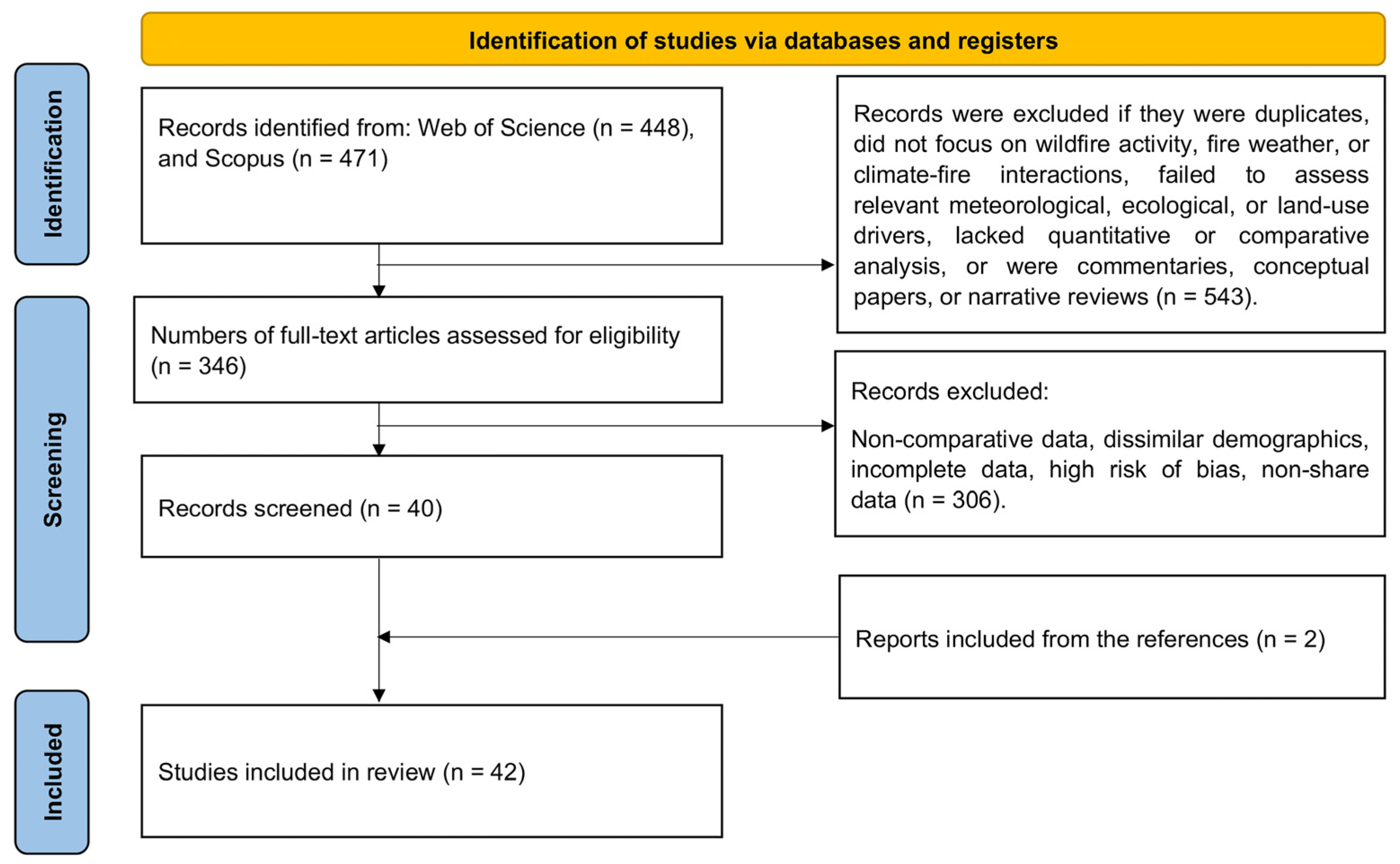
This systematic review was registered in PROSPERO (registration number: CRD420251238621) and conducted according to PRISMA 2020 guidelines [45] and AMSTAR-2 [46] methodological standards (Figure 3). A completed PRISMA checklist is provided as Supplementary Material (Additional File S1). The final literature search was completed on 1 November 2025.
The research question was formulated using the PICOS framework to ensure methodological rigor and relevance to global fire–climate science. Specifically, the review evaluated whether climate change and associated environmental drivers (Population/Exposure) influence wildfire danger, fire occurrence, burned area, fire behavior, and fire–carbon feedback (Outcomes), compared with historical baselines or counterfactual climate conditions (Comparator).
Eligible studies investigated at least one dimension of climate–fire interactions, including climate projections, fire weather indices (e.g., FWI—Fire Weather Index, FFDI—Forest Fire Danger Index, DSR—Daily Severity Rating), drought metrics, vegetation and fuel dynamics, land-use change, and socio-ecological feedback. Empirical observational studies, remote-sensing analyses, dynamic vegetation and fire-behavior models, and Earth system model projections were considered (Study design). Studies focused exclusively on unrelated natural hazards, non-fire climatic impacts, or conceptual non-empirical work without quantitative data were excluded.
Subgroup analyses considered biome type (e.g., boreal, Mediterranean, tropical forests, savannas), climate scenario (e.g., RCPs—Representative Concentration Pathways, SSPs—Shared Socioeconomic Pathways, CO2 forcings), and modeling approach (e.g., statistical, dynamical, hybrid) as potential sources of heterogeneity.

3.2. Eligibility Criteria

Studies were excluded if they met any of the following criteria: (i) commentary pieces, policy notes, or non-empirical conceptual papers without primary data; (ii) review articles (systematic or narrative), editorials, or conference abstracts without full quantitative results; (iii) duplicate publications derived from the same dataset, modelling framework, or observational record; or (iv) studies with insufficient methodological detail or judged to present a high risk of bias.
Additional exclusions included studies lacking measurable climate–fire relationships (e.g., no quantified fire danger metrics, burned area, fire behaviour, fuel dynamics, or climate drivers); analyses unrelated to wildfire regimes or natural vegetation fires (e.g., solely agricultural burning or prescribed-fire planning without climatic context); and publications without comparative temporal or scenario-based assessment, which precluded meaningful synthesis of climate–fire interactions.

3.3. Information Sources

A comprehensive and systematic literature search was conducted using Web of Science, Scopus, and Google Scholar, without restrictions on publication date or language. To ensure full coverage across wildfire regimes, climate-change projections, fire danger indices, vegetation–fuel dynamics, and land-use interactions, relevant gray literature sources (e.g., governmental and international agency reports) were also consulted when appropriate.
Reference lists of all eligible articles were systematically screened to identify additional relevant studies not captured by the initial database search, including foundational modeling papers and regional analyses from fire-prone biomes such as boreal forests, Mediterranean ecosystems, tropical rainforests, and savannas.

3.4. Search Methods for Identification of Studies

The search strategy combined controlled vocabulary and free-text terms related to wildfire regimes, climate change, and fire-weather indicators. Keywords included broad descriptors of fire systems and combustion processes (e.g., fire*, wildfire, burned area, fire behaviour, fire severity, burn), climate and global change forcings (e.g., climate change, global change, warming, drought index, vapor pressure deficit, fire weather index, ENSO), and landscape and forest structure drivers (e.g., forest*, vegetation, fuel load, land-use change, deforestation, fragmentation).
Database-specific search strings were constructed using Boolean operators, truncation, and proximity rules to capture both observational and modelling approaches. Complete search strategies for each database are provided in Additional File S2.
Study selection followed a two-stage screening process consisting of title/abstract screening and full-text eligibility assessment based on predefined inclusion and exclusion criteria. No language restrictions were applied. The final study pool reflects the application of strict relevance and quality-based eligibility criteria rather than limitations in search sensitivity.

3.5. Data Extraction and Data Items

For each included study, bibliographic information, geographic focus, biome classification, study design, climate scenario or historical period examined, and primary fire-related outcomes were systematically extracted. Methodological characteristics were recorded, including observational, remote-sensing, statistical modelling, dynamic vegetation–fire modelling, and Earth system modelling approaches.
Climate drivers extracted included temperature anomalies, drought indices, vapor pressure deficit, and precipitation trends. Fire metrics comprised burned area, fire frequency, intensity or severity, fire danger indices (FWI, FFDI, DSR), and carbon-cycle responses. Vegetation- and land-use-related variables included fuel load, forest cover change, fragmentation, and regrowth.
Additional extracted items included sample-period length, spatial scale (local, regional, continental, global), uncertainty assessment methods, and author-reported limitations. Potential sources of methodological bias, such as single-model dependence, lack of scenario comparison, or incomplete uncertainty reporting, were documented to support the interpretation of heterogeneity and robustness across studies.
No new spatial or temporal analyses of fire occurrence or climate variables were conducted as part of this review. All spatial patterns and temporal trends discussed are derived from the original analyses reported in the included studies, in accordance with PRISMA guidelines and to avoid introducing bias through selective reanalysis of heterogeneous global datasets.

4. Results

4.1. Study Selection

A total of 919 records were initially retrieved from Web of Science (n = 448) and Scopus (n = 471) (Figure 3). After removal of duplicates and screening of titles and abstracts, 543 records were excluded for not focusing on wildfire activity, fire weather, or climate-fire interactions; lacking assessment of relevant meteorological, ecological, or land-use drivers; lacking quantitative or comparative analysis; or being commentaries, conceptual papers, or narrative reviews. Subsequently, 346 full-text articles were assessed for eligibility. Of these, 306 were excluded due to non-comparative data, dissimilar methodological scope, incomplete data, high risk of bias, or unavailability of extractable results. Additionally, two relevant studies were identified through manual screening of reference lists. In total, 42 studies met the inclusion criteria and were included in the qualitative synthesis [43,47,48,49,50,51,52,53,54,55,56,57,58,59,60,61,62,63,64,65,66,67,68,69,70,71,72,73,74,75,76,77,78,79,80,81,82,83,84,85,86,87].

4.2. Study Characteristics

Additional File S3 summarizes the principal characteristics of the studies included in this synthesis, which examine climate–fire interactions across diverse biomes worldwide, including boreal forests, Mediterranean ecosystems, temperate woodlands, tropical rainforests, savannas, and wetland ecosystems. The research spans global multi-model projections, continental-scale analyses (e.g., North America, Europe, Amazonia), and regional studies focused on high-risk landscapes such as the Iberian Peninsula, Alaska, the Canadian boreal, the Brazilian Cerrado and Amazon, and Southeast Asia.
Methodologically, the evidence encompasses climate-driven fire projections, remote-sensing observational analyses, machine-learning approaches, and dynamic fire-vegetation–carbon models. Climate projection studies employ General Circulation Models (GCMs), Earth System Models (ESMs), and downscaled Regional Climate Models (RCMs) under historical, RCP, and SSP scenarios to assess changes in fire weather indices (FWI, FFDI, DSR), fire danger days, and fire-season length. Remote-sensing studies analyze multi-decadal MODIS (NASA’s Moderate Resolution Imaging Spectroradiometer) and Landsat time series alongside drought indicators (SPI—Standardized Precipitation Index, VPD, PDSI—Palmer Drought Severity Index) to characterize burned area trends, fire frequency, landscape fragmentation, and vegetation response to drought and fire. Machine-learning models (e.g., Random Forest, GBM, XGBoost, SHAP) increasingly support the prediction of burned area and fire behaviour while disentangling climatic, ecological, and anthropogenic drivers. Dynamic models simulate feedback between fuels, vegetation transitions, emissions, and climate forcing, capturing long-term ecosystem responses and thresholds.
Across studies, primary objectives include detecting climate change signals in fire weather; projecting future fire danger, megafire risk, and fire-season extension; linking drought and vegetation stress to fire occurrence; evaluating carbon losses; and reconstructing historical fire–climate regimes. Attribution studies distinguish anthropogenic warming effects from natural variability, while several analyses highlight biotic feedback and fire self-regulation in fuel-limited systems.
Overall, the findings show robust evidence of increasing extreme fire weather conditions and heightened fire-conducive climates across many fire-prone biomes, particularly Mediterranean, boreal, and tropical forest regions. Observational data reveal strengthening drought–fire coupling and reduced ecosystem resilience under recurrent disturbances. Despite regional variability driven by fuels and land management, the synthesis underscores an emerging global pattern of intensifying fire regimes under continued warming.
Despite the overall consistency in identifying climate change as a dominant driver, substantial methodological divergence exists across studies, including the use of different climate models, emissions scenarios, fire indices, remote-sensing products, and spatial resolutions. These differences contribute to variability in estimated magnitudes of fire-regime change and partially explain contradictory regional trends reported in some biomes, particularly at local to regional scales.

4.3. Outcomes

4.3.1. Global Climate–Fire Projections and Attribution

Global projections of climate-driven wildfire risk reveal a consistent intensification of fire-conducive conditions as warming progresses, with emerging methods combining multi-model climate ensembles, attribution science, and machine-learning approaches to characterize future fire regimes. Analyses based on Coupled Model Intercomparison Project Phase 6 (CMIP) Phase 6 (CMIP6) scenarios indicate that both established fire danger indices (e.g., FWI, FFDI) and probabilistic frameworks converge toward a clear signal of more frequent and severe fire weather in the coming decades, particularly under high-emission pathways. He et al. [64] demonstrated that under SSP5-8.5, strong amplification of fire danger emerges across historically fire-prone regions, confirmed through XGBoost (v0.6) and SHAP (v0.37.0) analyses that clarify the evolving role of meteorological drivers in different biomes. Liu et al. [70] extended this understanding by applying large-ensemble attribution to fire-weather extremes, showing that both the intensity and duration of high-FWI events have already increased due to anthropogenic warming, with the strongest attributable signals in southern North America, southeastern Europe, and Australia. Complementary advances by Gallo et al. [60] introduced performance-weighted CMIP6 ensemble projections, revealing significant increases in seasonal fire weather across most fire-prone land by mid-century and reducing uncertainties associated with traditional multi-model means. Earlier global pyrogeography research by Krawchuk et al. [66] illustrated that future wildfire patterns will involve both expansion and retreat driven by interacting temperature and precipitation changes, while Abatzoglou et al. [47] quantified the time at which anthropogenic fire-weather signals exceed natural variability, showing early emergence in regions such as the Amazon and Mediterranean. Additional global analyses highlight increasing likelihood of very-large fires in the United States [50], widespread extension of fire-prone seasons toward the end of the century [77], persistent fire danger even under negative-emissions scenarios due to climate system inertia [65], and substantial escalation of extreme fire probabilities in Europe [57]. Collectively, this evidence underscores a rapidly strengthening climate signal in global fire danger, with broad agreement across independent methodologies that anthropogenic warming is driving expansion of fire-prone regions, earlier and longer fire seasons, and heightened extremes that are unlikely to be fully reversed even under aggressive mitigation pathways.

4.3.2. Boreal Ecosystems

Across circumpolar boreal forests, a substantial body of evidence indicates that climate warming is reshaping fire regimes through enhanced fire weather, longer fire seasons, and altered vegetation–fuel dynamics. Foundational work by de Groot, Flannigan, and Cantin [55] simulated late-century fire regimes in Canada and Russia and showed pronounced increases in Daily Severity Rating and head-fire intensity under CMIP-based warming scenarios, with more extreme seasonal peaks in western Canada. Amiro et al. [49] similarly projected a near-doubling of annual greenhouse gas emissions from Canadian boreal fires under 2–3× CO2 conditions, driven primarily by expansion of burned area rather than per-unit fuel consumption increases.
Regional modelling efforts by Tymstra et al. [84] corroborate these findings, estimating 13%–30% increases in area burned in Alberta under elevated CO2 scenarios, while work by Malevsky-Malevich et al. [71] indicates up to 12%–30% more fire-danger days across southern boreal Russia. Broad-scale synthesis by Flannigan et al. [58] suggests that although warming historically coincided with declines in fire frequency in parts of the Northern Hemisphere, projected future climates exceed past variability envelopes, raising the likelihood of increasing fire activity in many high-latitude regions. Likewise, Girardin and Mudelsee [61], integrating tree-ring reconstructions with GCM projections, found that future large-fire occurrence in eastern Canadian boreal forests is likely to reach or exceed upper pre-industrial bounds.
Important refinements have emerged from studies emphasizing ecological feedback. Krawchuk and Cumming [67] demonstrated that climate-driven fire increases can activate negative feedback where fuel self-limitation and harvest legacies dampen subsequent fire activity. Foster et al. [59] used updated individual-based vegetation–fire models to show that warming may increase deciduous dominance and lower mean fire intensity in some regions despite drier fuels. At the landscape scale, Terrier et al. [82] projected strong increases in burn rates and crown-fire behaviour in eastern Canadian black spruce–Sphagnum forests without immediate biome state shifts, reflecting slow successional constraints.
Two additional strands strengthen this picture. Van Bellen et al. [85] synthesized evidence for Quebec and indicated that future increases in fire severity and drier late-season fire weather may reduce forest-floor carbon storage, tipping regional carbon balance even where tree cover persists. Meanwhile, Rupp et al. [76] highlighted the sensitivity of boreal fire simulations to climate driver datasets: only Climate Research Unit (CRU) driven runs reproduced observed boreal fire patterns, while NCEP- and MM5-forced (National Centers for Environmental Prediction—NCEP, Mesoscale Model—MM5) simulations suppressed fire due to unrealistic cool-wet biases, underscoring the need for careful climate–fire model coupling.
Atmospheric chemistry work by Yue et al. [87] showed that fire-emitted aerosols may briefly enhance productivity via diffuse-radiation fertilization but ultimately amplify drought stress, accelerating mid-century carbon losses. Ensemble machine-learning projections by Boulanger et al. [53] projected >4-fold increases in Canadian burn rates under RCP8.5, while emphasizing that model-specification uncertainty can exceed both GCM and scenario spread.
Taken together, boreal evidence points to intensifying fire weather, greater emissions, and carbon-cycle vulnerability, modulated by vegetation feedback, land-use history, and high model uncertainty. This complexity highlights the need for integrated climate–fuel–ecosystem modelling and adaptive management strategies as boreal systems transition under continued warming.
However, the reviewed evidence also reveals disagreement regarding the long-term balance between climate-driven fire intensification and fuel self-limitation through vegetation shifts, indicating substantial uncertainty in the timing and magnitude of future boreal fire escalation.

4.3.3. Mediterranean and Iberian Ecosystems

Mediterranean ecosystems, including the Iberian Peninsula, represent one of the world’s most fire-prone regions, where warming, aridification, and seasonal circulation shifts are amplifying fire danger despite long-standing fire management investments. Using a 13-member EURO-CORDEX ensemble, Bento et al. [52] showed that future summer fire weather (FWI) and the instability-enhanced FWIe will substantially intensify, extending the high-danger season into June and, to a lesser degree, September. Northern Portugal and north-western to central Spain emerge as hotspots, where the combination of highly flammable vegetation and rising atmospheric instability could drive more energetic fire behaviour, with sharper scenario divergence under RCP8.5. These findings align with earlier regional modelling by Vázquez de la Cueva et al. [86], showing that under Special Report on Emissions Scenarios (SRES) A2/B2 projections, the number of fires could double and the burned area increase by ~3–5× across much of Spain, underscoring the need for adaptive silviculture and resilience-focused forest management.
Continental-scale remote-sensing evidence by Grünig et al. [62] indicates that although area burned declined in recent decades across Europe, rising vapor-pressure deficit strongly predicts larger and more severe fires, with the probability of extreme events more than doubling by century’s end. Mediterranean-wide statistical modelling by Batllori et al. [51] further highlights the biome’s sensitivity to both fuel moisture and biomass availability, revealing that small shifts in precipitation regimes could trigger divergent trajectories: warmer-drier futures promoting fire expansion in fuel-rich zones, whereas severe drying may eventually constrain fire by limiting fuels. This climate–fuel trade-off also emerges in Greece, where Rovithakis et al. [75] found fire danger days could rise by up to ~40 per year under RCP8.5, concentrated in southern and Aegean regions, reinforcing concerns for expanding seasonal windows of suppression pressure.
Long-term observations in Northeastern (NE) Spain analyzed by Turco et al. [83] revealed that, absent improvements in fire-management capacity, climate warming alone would have produced increasing fire frequency over recent decades; instead, enhanced suppression temporarily offset climate forcing. However, structural fuel changes linked to warming reduced fine-fuel continuity and slightly lowered burned area historically, indicating that human intervention and ecological adjustments jointly shape fire outcomes in Mediterranean ecosystems. Most recently, attribution work by Senande-Rivera et al. [78] showed that >50% of large Iberian wildfires since 2001 spread faster than they would have under a pre-industrial climate, with 2%–8% acceleration attributable to warming-driven fuel dryness and potentially greater influence from CO2-stimulated vegetation growth.
Collectively, Mediterranean and Iberian evidence points toward intensified summer fire danger, extended fire seasons, and higher spread rates under continued warming, but with regionally variable fuel-climate interactions and strong modulation by socio-ecological systems and management legacies. These studies consistently stress the need for forward-looking adaptation strategies, including fuel restructuring, land-use planning, and readiness for more explosive fire behaviour in a warming Mediterranean basin.
Importantly, long-term observational studies indicate that improved suppression and fuel management have partially offset climate forcing in recent decades, illustrating that fire trends in Mediterranean ecosystems do not evolve uniformly and remain highly contingent on socio-ecological governance.

4.3.4. Tropical Forests and Amazon Basin

Across tropical forests, and particularly the Amazon Basin, growing evidence indicates that climate warming, intensifying drought regimes, and human land-use change are jointly transforming historically fire-resistant ecosystems into fire-vulnerable landscapes. Foundational synthesis by Cochrane and Barber [54] posited that climate-driven drying, compounded by anthropogenic ignition sources and forest fragmentation, could shift Amazon fire regimes from infrequent, human-constrained burns to recurrent, landscape-scale fires. Their work emphasized that while intact humid forests have historically resisted ignition and spread, severe drought frequency will determine the spatial extent of future fire incursions, underscoring the need to preserve large, unfragmented forest blocks to maintain natural fire regulation.
Dynamic carbon–fire modeling by de Faria et al. [56] quantified how major droughts (2005, 2010) sharply increased understory fire intensity (by up to 494 kW m−1) and reduced live carbon stocks, with projected climate warming amplifying carbon losses by up to 90% per burned area. Their results attribute fire intensification primarily to rising temperature and fuel desiccation, with vegetation structural degradation playing an accelerating role. This aligns with remote-sensing work by Le Roux et al. [68] showing that fire-degraded Amazon stands exhibit heightened drought sensitivity and altered seasonal greening responses, suggesting that synergistic drought–fire stress may push degraded forests toward long-term drying and reduced resilience.
The interaction of land-use change and drought further modulates fire dynamics. In western Amazonia, Gutiérrez-Vélez et al. [63] found that burning probability rises in non-degraded pastures, young fallow, and immature oil-palm areas, with drought severity overriding fuel-break effects of secondary forests in extreme dry years. Similarly, frontier-zone analysis by Silva Junior et al. [79] showed that ~95% of fire activity and the most intense fire radiative power (>500 MW) occur within 1 km of forest edges, underscoring fragmentation as a dominant driver of fire entry into primary forests.
Beyond the Amazon, emerging tropical-Asia evidence highlights parallel mechanisms. Machine-learning and structural equation analysis by Luo et al. [69] revealed that temperature and vapor-pressure deficit indirectly drive tropical Asian carbon emissions via fire behavior, with mixed forests showing far higher sensitivity than evergreen broadleaf ecosystems, suggesting vegetation-specific climate-fire coupling across humid tropics.
Hydrologically connected biomes also influence Amazon-adjacent fire outcomes. In the Pantanal wetlands, Rodrigues de Sousa et al. [74] demonstrated that multi-year soil-moisture decline and drought across linked Amazon–Cerrado–Atlantic Forest catchments strongly predict extreme fire seasons, with widespread drying trends implying escalating future wildfire pressure in the world’s largest tropical wetland.
Collectively, tropical evidence indicates accelerating transitions toward more flammable ecosystems driven by warming, drought intensification, land-use disturbance, and vegetation feedback. Yet, intact-forest conservation, controlled land-use expansion, and integrated hydrological–fire management emerge as critical buffers capable of preserving natural fire regimes and stabilizing carbon-climate feedback across the Amazon and other tropical ecosystems. While most studies indicate increasing fire vulnerability, the relative contribution of drought versus land-use fragmentation varies considerably across regions, leading to divergent estimates of future Amazon fire sensitivity and carbon loss.

4.3.5. Savanna Ecosystems

Savanna ecosystems, characterized by herbaceous–woody coexistence and climate-controlled fuel dynamics, exhibit fire regimes that respond to complex interactions among precipitation seasonality, drought intensity, and human land-use patterns. Long-term remote-sensing analysis in Brazilian Cerrado mountain landscapes by Alvarado et al. [48] reveals a predominantly moisture-limited regime, where ignition-season drought, rather than annual rainfall volume or fuel load accumulation, most strongly predicts burned area. These results contrast with fuel-limited African savannas, underscoring continental differences in resilience and recovery trajectories under shifting fire regimes and climatic change.
Future projections reinforce vulnerability in South American savannas. Using fire-weather indices calibrated to regional climate simulations, Silva et al. [80] estimate Cerrado burned area increases of 39% under RCP4.5 and 95% under RCP8.5 by 2100, with only the 1.5 °C-compatible RCP2.6 scenario showing long-term moderation, highlighting the importance of stringent climate mitigation to constrain fire expansion in a biome already shaped by recurrent burning. Complementing climate-driven assessments, Indigenous-land fire monitoring by Melo et al. [72] identifies recurring dry-season fires and local hotspots in the Cerrado, emphasizing the role of traditional knowledge and community-based management in shaping fire mosaics and buffering landscape-scale impacts.
Beyond South America, satellite-based spatiotemporal modeling in Ghana by Naawa et al. [73] indicates declining burned area over two decades despite high fire incidence, driven by human proximity, fuel–topography interactions, and climatic gradients. These patterns reinforce that demographic expansion and landscape fragmentation remain dominant ignition controls in West African savannas.
Paleofire evidence from North America by Leys et al. [43] shows that Euro-American landscape fragmentation and fire suppression disrupted historical fire–climate coupling, shifting dominant fuel sources from grasses to woody fuels and demonstrating how anthropogenic disturbance can override climate-fire linkages over centennial scales.
In southern Africa, high-resolution downscaled projections by Singo et al. [81] depict intensified fire danger under warming exceeding 4.5 °C and declining rainfall, with large increases in high-FFDI days, especially in western savannas adjoining Botswana. These findings point to heightened fire risk in a rapidly warming region where fuel accumulation, heatwaves, and soil-moisture deficits converge.
Taken together, savanna research reveals diverse but converging trajectories: intensified drought-driven fire regimes in moisture-limited ecosystems like the Cerrado, persistent human-driven ignition in West African savannas, and climate-escalated danger in southern Africa. The contrasting moisture- versus fuel-limitation paradigms across continents emphasize the need for region-specific fire management strategies, integration of local knowledge systems, and stringent climate mitigation to maintain savanna structure, biodiversity, and carbon stability in a warming world. These contrasting moisture- versus fuel-limited regimes demonstrate that savanna fire trends cannot be generalized globally, and that opposing regional trajectories may coexist under similar warming scenarios.
To facilitate cross-biome comparison and to synthesize similarities and contrasts in fire-regime responses to climatic and anthropogenic forcing, a comparative overview of major trends, sensitivities, and dominant drivers across boreal, Mediterranean, tropical, and savanna ecosystems is provided in Table 1.

5. Discussion

5.1. A Strengthening Global Climate–Fire Signal

The global increase in fire-weather severity found across the included studies aligns closely with earlier assessments demonstrating that anthropogenic warming has already increased the probability of extreme fire-weather events [17,70,88]. Several works included in our review [17,70] show that human influence has accelerated high-FWI conditions and advanced the emergence of climate-driven fire signals. This corroborates global projections by the Intergovernmental Panel on Climate Change (IPCC) Sixth Assessment Report (AR6), which identified fire-weather indices as among the most robustly increasing extreme indicators under warming [89,90].
Furthermore, the multi-model convergence reported in studies such as Gallo et al. [60] mirrors earlier findings by Flannigan et al. [91], Williams and Abatzoglou [92] and Jones et al. [28], who emphasized that despite regional uncertainties, warming consistently shifts temperature–moisture regimes toward greater flammability. Our synthesis contributes to this literature by demonstrating that newer CMIP6-based projections, augmented by machine-learning approaches [64], confirm and sharpen these earlier CMIP3/CMIP5 patterns, reducing ambiguity around global fire-weather trajectories.
Nevertheless, the strength and expression of the climate–fire signal remain uneven across regions and across methodological approaches. Some studies report weak or even declining burned-area trends in highly managed landscapes, while others project strong increases under similar climatic forcing. These discrepancies arise from differences in land-use history, fuel limitation, fire suppression efficiency, and the structure of statistical versus process-based fire models, highlighting that confidence levels vary across regions and metrics.

5.2. Boreal Forests: Feedbacks and Intensification

Our review finds broad agreement that boreal regions are experiencing intensified fire weather, longer fire seasons, and higher emissions [53,55]. These results align with well-established observations that boreal warming exceeds the global average and has historically expanded fire activity [17,42,70].
However, several reviewed studies [59,67] emphasize fuel self-limitation and successional shifts. This reflects the operation of ecological feedback mechanisms [93,94,95], which determine whether post-fire vegetation trajectories will dampen or amplify climate-fire interactions
Projected increases in crown-fire behavior and carbon vulnerability [82,85] align with other findings [96,97,98]. These studies identified black spruce forests and carbon-rich peatlands as uniquely susceptible to high-severity fire under a warming climate. Our results, therefore, strongly reinforce the concern that boreal ecosystems may be nearing fire-mediated tipping points, risking a critical loss of resilience.

5.3. Mediterranean and Iberian Ecosystems: Rising Extremes Despite Management

The reviewed studies consistently report strong increases in summer fire danger and fire-season length throughout the Mediterranean region [52,75], confirming that the area remains a global hotspot of climate-driven fire risk [99,100,101]. Importantly, this risk is driven by a synergistic influence of atmospheric instability, fuel aridification, and land-use legacies [51,83], which aligns with established research [17,19,28,101] demonstrating that factors like fire suppression, rural depopulation, and resulting fuel continuity interact with climate to modulate regional fire outcomes. Furthermore, the direct attribution of faster fire spread to anthropogenic warming [78] significantly strengthens conclusions from recent event-based attribution studies in southern Europe [60,70,102], suggesting that climate change is already impacting operational fire behavior metrics, and not merely statistical fire-weather indices.

5.4. Tropical Forests and the Amazon: Transitions Toward Flammable States

Our findings confirm that tropical forests, historically resilient to fire, are now facing increasing vulnerability. This heightened risk stems from the synergistic pressures of drought intensification, habitat fragmentation, and elevated ignition sources. These findings align with established literature [54,79]. Studies demonstrate that severe drought combined with edge effects from fragmentation dramatically increases the susceptibility of the forest understory to fire [103,104,105]. Furthermore, several included studies emphasize the existence of synergistic drought–fire–degradation feedback [56,68]. This is consistent with long-term observations that repeated fire events can initiate a shift, pushing humid forest ecosystems toward savannization [106,107,108,109]. This ecological dynamic is further influenced by hydrological connectivity, which is a crucial driver influencing fire dynamics in regions like the Pantanal and the Amazon–Cerrado transition [74]. This regional pattern is supported by evidence of basin-wide drying trends [110,111] and reinforces the understanding that local and regional fire regimes are closely linked to moisture recycling and deforestation-driven climatic shifts.

5.5. Savannas: Contrasting Moisture- and Fuel-Limited Regimes

The reviewed studies demonstrate a divergence in fire drivers across global savannas. Specifically, South American savannas, such as the Cerrado, are reported to be becoming increasingly drought-driven [48,80], while West African savannas remain primarily shaped by human ignition [73]. These contrasting patterns are consistent with the established dichotomy described by Archibald et al. [112,113,114] and Williamson et al. [115], who documented strong variation in fuel–climate–people interactions across these systems. Further reinforcing the importance of socio-cultural drivers, evidence of Indigenous fire stewardship actively shaping landscape mosaics [72] aligns with established work on cultural burning and pyrodiversity [116,117]. Looking forward, future fire danger projections for southern Africa [81] confirm, alongside regional studies [88,118], that the combined impact of warming and declining rainfall is likely to intensify regional fire-weather conditions.

5.6. Implications for Ecological Resilience and Carbon Cycling

Our synthesis reaffirms widespread concerns that the combination of climate change and repeated burning is actively eroding ecosystem resilience across all biomes. This is evidenced by observed outcomes such as significant boreal carbon losses, dramatic Mediterranean vegetation transitions, accelerated Amazon forest degradation, and shifts in savanna woody–grass imbalances, all of which align with global meta-analyses [119,120,121]. Crucially, the reviewed studies consistently highlight that many of these ecosystems are now approaching critical thresholds. At these points, intensified fire–climate interactions risk triggering lasting biome transformations, a fundamental threat previously proposed in global tipping point frameworks [28,95] but now increasingly supported by robust empirical and model-based evidence.

5.7. Key Findings

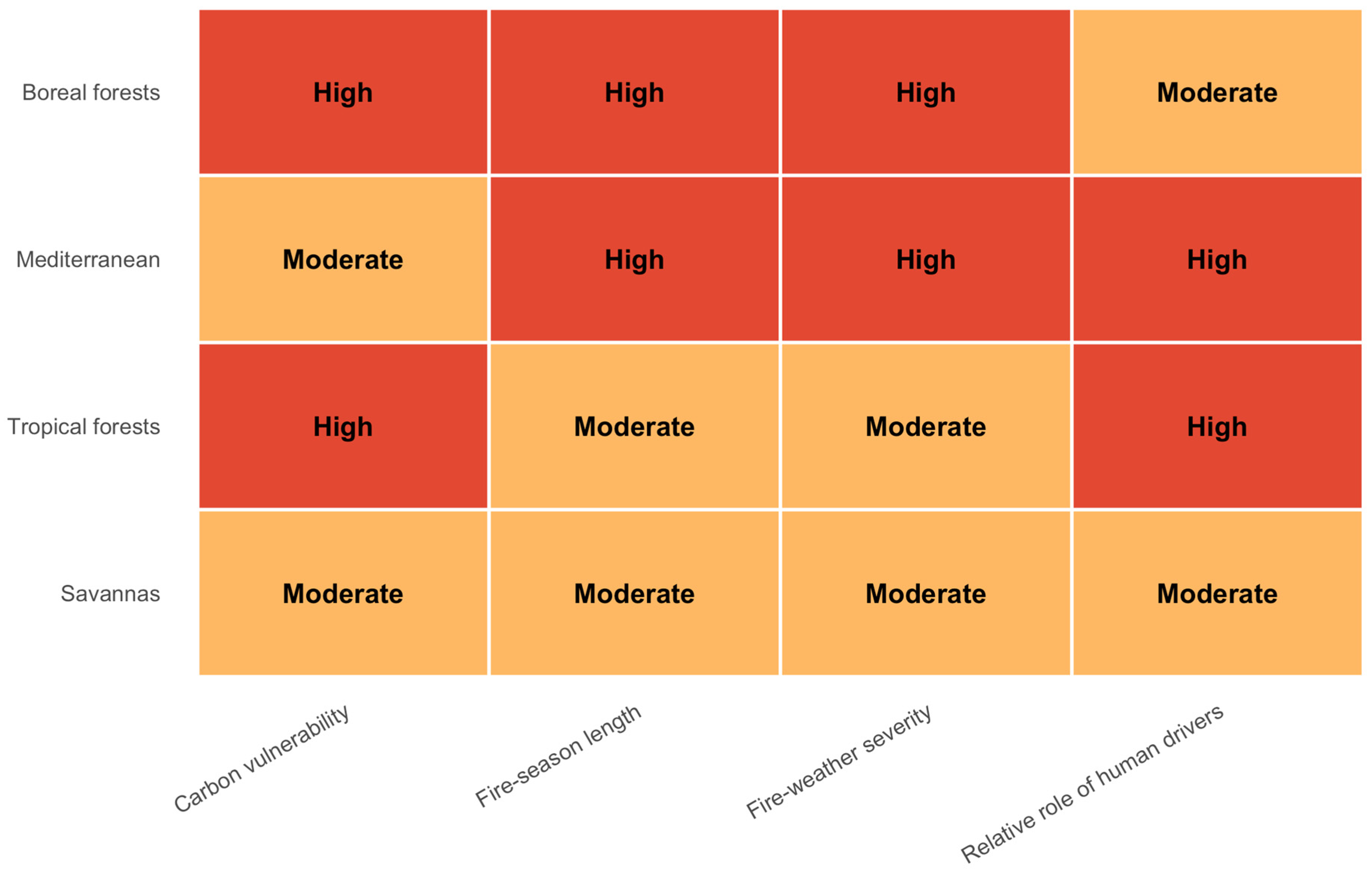
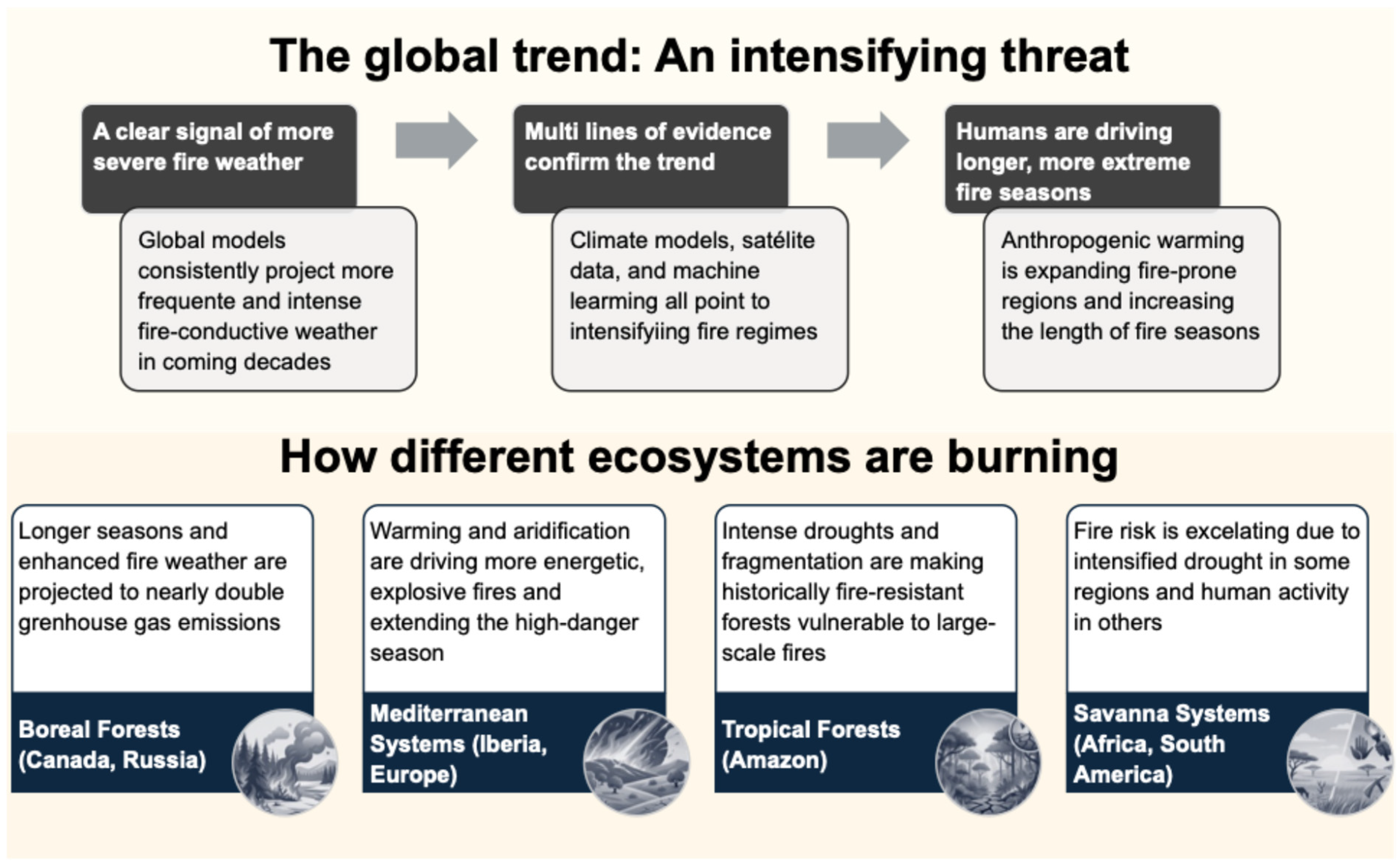
The key findings, visually summarized in Figure 4, demonstrate a clear and alarming trend: global fire regimes are intensifying across the world’s diverse biomes, driven primarily by the synergistic effects of climate change and human activity. Multiple independent lines of evidence, including climate models, satellite data, and machine learning, consistently confirm this trajectory, signaling a definitive shift toward more frequent and intense severe fire weather.
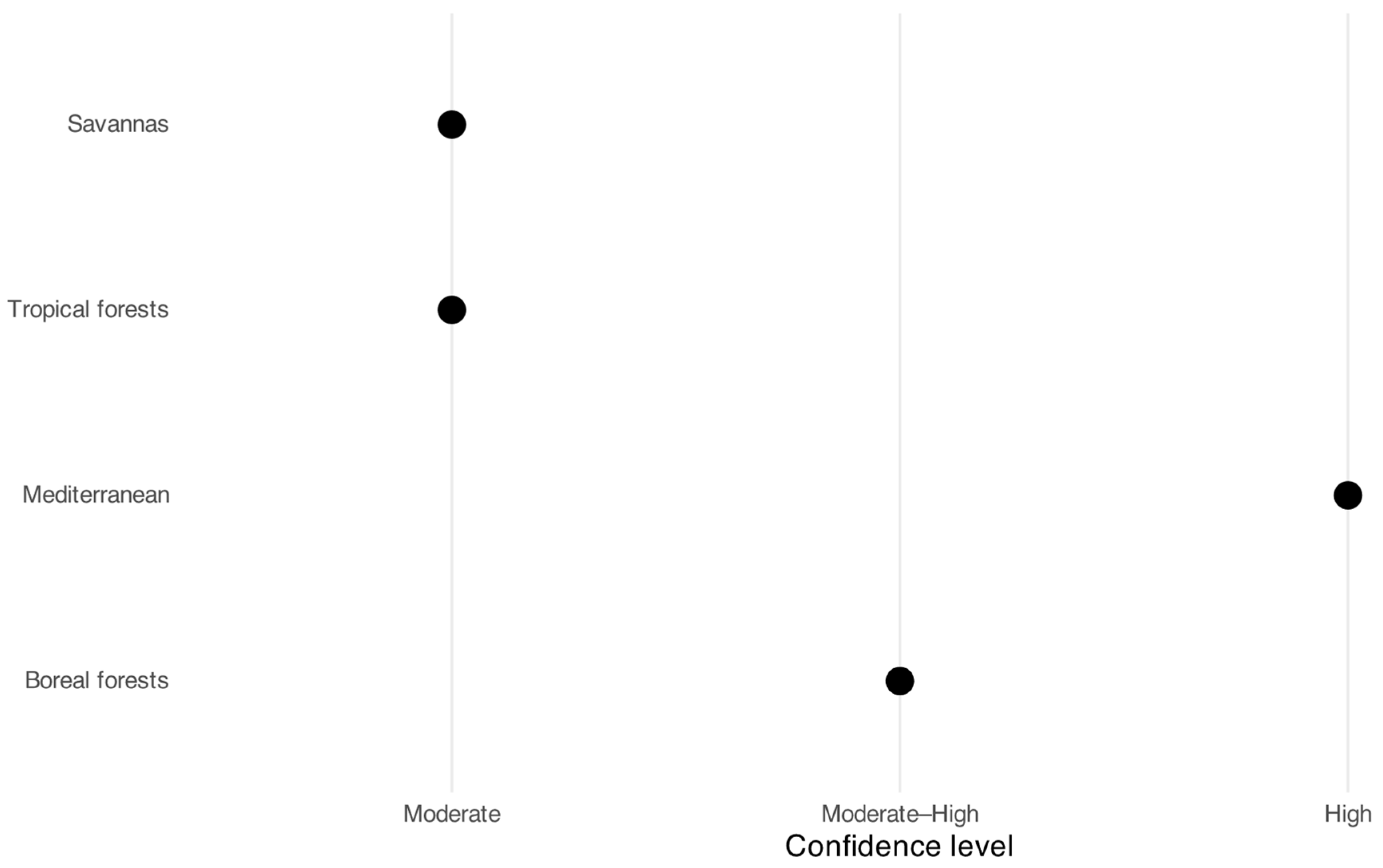
As illustrated in Figure 5, confidence in the synthesized evidence varies across biomes. Mediterranean ecosystems show the highest confidence, supported by strong convergence between observational records, climate projections, and attribution studies. Boreal forests exhibit moderate to high confidence, reflecting a robust climate signal tempered by uncertainty in vegetation and fuel feedback. In contrast, tropical forests and savannas display moderate confidence, largely due to pronounced regional heterogeneity and strong dependence on land-use dynamics and socio-ecological context.
The manifestation of this intensification is not uniform but is expressed through ecosystem-specific mechanisms. For instance, Boreal Forests are experiencing longer fire seasons directly linked to enhanced greenhouse gas emissions. Mediterranean ecosystems are facing more energetic, explosive fires as a result of regional warming and aridification. Critically, Tropical Forests (such as the Amazon), historically fire-resistant, are now highly vulnerable to large-scale fires due to the combined impact of intense drought and habitat fragmentation. Furthermore, Savanna ecosystems in regions like Africa and South America exhibit a heightened fire risk resulting from increased drought severity and localized human activity. Ultimately, our comprehensive analysis confirms that anthropogenic warming is both expanding fire-prone regions and substantially lengthening fire seasons globally, underscoring the urgent necessity of developing and implementing integrated management and policy responses to mitigate this growing, human-driven environmental threat. Importantly, this intensification is neither spatially uniform nor methodologically invariant, with confidence levels varying substantially across biomes, fire metrics, and modelling frameworks, underscoring the need for regionally explicit interpretation rather than global generalization.

5.8. Biome-Specific Research Priorities and Future Directions

Beyond synthesising existing evidence, this review highlights the need for coordinated, biome-specific research frameworks to advance understanding of climate-driven fire regime change. In boreal ecosystems, future efforts should prioritise improved representation of vegetation–fire–carbon feedback, permafrost dynamics, and post-fire successional trajectories in Earth system models. In Mediterranean ecosystems, research should focus on integrating extreme fire-weather conditions with land-use legacies, fuel management, and suppression capacity. In tropical forests, disentangling the relative roles of drought intensification, fragmentation, and ignition sources remains critical for assessing long-term fire vulnerability and carbon stability. In savannas, resolving moisture- versus fuel-limited fire regimes and incorporating Indigenous and local fire-management knowledge are key priorities. These directions provide a conceptual framework to guide future research rather than proposing new empirical analyses.

6. Conclusions

This review demonstrates that climate change is driving a global reorganization of fire regimes, with clear signals emerging across multiple lines of evidence, including climate projections, remote sensing, machine-learning models, and dynamic vegetation–fire–carbon simulations. Across all biomes examined—boreal forests, Mediterranean ecosystems, tropical rainforests, and savannas—fire-conducive conditions are intensifying, although the mechanisms, magnitude, and ecological outcomes differ markedly.
At the global scale, fire-weather indices show consistent upward trends, and attribution studies reveal that anthropogenic warming has already increased the likelihood and severity of fire-weather extremes in many regions. Boreal ecosystems are experiencing heightened fire danger, increasing emissions, and carbon-cycle vulnerabilities, yet complex fuel and vegetation feedback modulates regional outcomes. Mediterranean and Iberian ecosystems face expanding fire seasons and more explosive fire behaviour, with human land-use and management acting as critical mediators of climate signals. Tropical forests, once inherently resistant to burning, are undergoing transitions toward more flammable states due to drought intensification, fragmentation, and land-use pressures. Savanna ecosystems exhibit divergent responses governed by moisture limitation, fuel availability, and human ignition patterns, highlighting the need for region-specific frameworks.
Across these varied landscapes, a common theme emerges: the erosion of ecological resilience under interacting climate and anthropogenic pressures. Many ecosystems appear to be approaching thresholds beyond which fire regimes may shift to new, persistent configurations with profound consequences for biodiversity, carbon storage, and ecosystem functioning.
Looking forward, addressing these challenges requires integrated research and management strategies. Priority areas include improving representation of fire–vegetation–carbon feedback in Earth system models, advancing attribution techniques, expanding long-term monitoring across understudied regions, and incorporating Indigenous and local fire knowledge into management. Equally important is the development of adaptive, biome-specific fire strategies that account for the distinct drivers and vulnerabilities identified in this synthesis.
Ultimately, mitigating future fire risk will depend on both global climate policy and regionally tailored land management. By combining scientific insight with proactive governance, it is possible to enhance ecosystem resilience, reduce socioecological impacts, and improve our capacity to live with fire in a rapidly warming world.

Supplementary Materials

The following supporting information can be downloaded at: https://www.mdpi.com/article/10.3390/f17010104/s1, Additional File S1: PRISMA 2020 checklist; Additional File S2: Full electronic database search strategies (Web of Science, Scopus); Additional File S3: Baseline characteristics of the 42 included studies.

Author Contributions

Conceptualization, A.P.O.; methodology, A.P.O. and P.G.M.; software, A.P.O.; validation, A.P.O. and P.G.M.; formal analysis, A.P.O. and P.G.M.; investigation, A.P.O. and P.G.M.; resources, A.P.O. and P.G.M.; data curation, A.P.O. and P.G.M.; writing—original draft preparation, A.P.O.; writing—review and editing, A.P.O. and P.G.M.; visualization, A.P.O. and P.G.M.; supervision, A.P.O.; project administration, A.P.O. All authors have read and agreed to the published version of the manuscript.

Funding

This research received no external funding.

Institutional Review Board Statement

Not applicable.

Data Availability Statement

The original contributions presented in this study are included in the article/Supplementary Materials. Further inquiries can be directed to the corresponding author.

Conflicts of Interest

The authors declare no conflicts of interest.

References

  1. Baijnath-Rodino, J.A.; Le, P.V.V.; Foufoula-Georgiou, E.; Banerjee, T. Historical spatiotemporal changes in fire danger potential across biomes. Sci. Total Environ. 2023, 870, 161954. [Google Scholar] [CrossRef] [PubMed]
  2. Dastour, H.; Ahmed, M.R.; Hassan, Q.K. Analysis of forest fire patterns and their relationship with climate variables in Alberta’s natural subregions. Ecol. Inform. 2024, 80, 102531. [Google Scholar] [CrossRef]
  3. Jones, M.W.; Veraverbeke, S.; Andela, N.; Doerr, S.H.; Kolden, C.; Mataveli, G.; Pettinari, M.L.; Le Quéré, C.; Rosan, T.M.; van der Werf, G.R.; et al. Global rise in forest fire emissions linked to climate change in the extratropics. Science 2025, 386, eadl5889. [Google Scholar] [CrossRef]
  4. Haque, K.M.S.; Uddin, M.; Ampah, J.D.; Haque, M.K.; Hossen, M.S.; Rokonuzzaman, M.; Hossain, M.Y.; Hossain, M.S.; Rahman, M.Z. Wildfires in Australia: A bibliometric analysis and a glimpse on ‘Black Summer’ (2019/2020) disaster. Environ. Sci. Pollut. Res. 2023, 30, 73061–73086. [Google Scholar] [CrossRef]
  5. Heap, A.; Penman, T.; Bennett, L.; Fairman, T. Short-interval fires homogenise the structure of diverse temperate forests. For. Ecol. Manag. 2025, 584, 122580. [Google Scholar] [CrossRef]
  6. Kelley, D.; Burton, C.; Di Giuseppe, F.; Jones, M.; Barbosa, M.; Brambleby, E.; McNorton, J.R.; Liu, Z.; Bradley, A.S.I.; Blackford, K.; et al. State of wildfires 2024–2025. Earth Syst. Sci. Data 2025, 17, 5377–5488. [Google Scholar] [CrossRef]
  7. Gill, A.; Allan, G. Large fires, fire effects and the fire-regime concept. Int. J. Wildland Fire 2008, 17, 688–695. [Google Scholar] [CrossRef]
  8. McLauchlan, K.K.; Higuera, P.E.; Miesel, J.; Rogers, B.M.; Schweitzer, J.; Shuman, J.K.; Tepley, A.J.; Varner, J.M.; Veblen, T.T.; Adalsteinsson, S.A.; et al. Fire as a fundamental ecological process: Research advances and frontiers. J. Ecol. 2020, 108, 2047–2069. [Google Scholar] [CrossRef]
  9. Moreira, F.; Leal, M.; Bergonse, R.; Canadas, M.J.; Novais, A.; Oliveira, S.; Ribeiro, P.F.; Zêzere, J.L.; Santos, J.L. Recent trends in fire regimes and associated territorial features in a fire-prone Mediterranean region. Fire 2023, 6, 60. [Google Scholar] [CrossRef]
  10. Wasserman, T.N.; Mueller, S.E. Climate influences on future fire severity: A synthesis of climate–fire interactions and impacts on fire regimes, high-severity fire, and forests in the western United States. Fire Ecol. 2023, 19, 43. [Google Scholar] [CrossRef]
  11. Fernández-García, V.; Beltrán-Marcos, D.; Fernández-Guisuraga, J.M.; Marcos, E.; Calvo, L. Predicting potential wildfire severity across southern Europe with global data sources. Sci. Total Environ. 2022, 829, 154729. [Google Scholar] [CrossRef]
  12. Corning, S.; Krasovskiy, A.; Kiparisov, P.; San Pedro, J.; Viana, C.M.; Kraxner, F. Anticipating future risks of climate-driven wildfires in boreal forests. Fire 2024, 7, 144. [Google Scholar] [CrossRef]
  13. Chambers, J.C.; Brown, J.L.; Koutzoukis, S.; Miller, R.F.; Barga, S.; Boswell, R.; Heckman, R.W.; Madsen, M.; Reeves, M.C.; Thacker, V.; et al. Major changes in climate, vegetation, and ecological resilience in recent decades suggest climate smart management strategies for western US dryland shrublands and woodlands. Fire Ecol. 2025, 21, 48. [Google Scholar] [CrossRef]
  14. Resco de Dios, V.; Hedo, J.; Cunill Camprubí, À.; Thapa, P.; Martínez del Castillo, E.; Martínez de Aragón, J.; Bonet, J.A.; Balaguer-Romano, R.; Díaz-Sierra, R.; Yebra, M.; et al. Climate change induced declines in fuel moisture may turn currently fire-free Pyrenean mountain forests into fire-prone ecosystems. Sci. Total Environ. 2021, 797, 149104. [Google Scholar] [CrossRef] [PubMed]
  15. Xu, J.; Yao, M.; Chen, Y.; Jiang, L.; Xing, B.; Clarke, H. The range of projected change in vapour pressure deficit through 2100: A seasonal and regional analysis of the CMIP6 ensemble. Climate 2025, 13, 143. [Google Scholar] [CrossRef]
  16. Ermitão, T.; Gouveia, C.M.; Bastos, A.; Russo, A.C. Recovery following recurrent fires across Mediterranean ecosystems. Glob. Change Biol. 2024, 30, e70013. [Google Scholar] [CrossRef]
  17. Abatzoglou, J.T.; Kolden, C.A.; Cullen, A.C.; Sadegh, M.; Williams, E.L.; Turco, M.; Jones, M.W. Climate change has increased the odds of extreme regional forest fire years globally. Nat. Commun. 2025, 16, 6390. [Google Scholar] [CrossRef]
  18. Kala, C.P. Environmental and socioeconomic impacts of forest fires: A call for multilateral cooperation and management interventions. Nat. Hazards Res. 2023, 3, 286–294. [Google Scholar] [CrossRef]
  19. Shen, Z.; Giljohann, K.; Liu, Z.; Pausas, J.; Rogers, B. Novel wildfire regimes under climate change and human activity: Patterns, driving mechanisms and ecological impacts. Philos. Trans. R. Soc. B 2025, 380, 20230446. [Google Scholar] [CrossRef]
  20. Hai, J.; Zhang, L.; Gao, C.; Wang, H.; Wu, J. How does fire suppression alter the wildfire regime? A systematic review. Fire 2023, 6, 424. [Google Scholar] [CrossRef]
  21. Pérez-Izquierdo, C.; Gómez, Á.; Pulido, F. Landscape-level, participatory wildfire governance reduces fire hazard and potential carbon emission. J. Environ. Manag. 2025, 394, 127308. [Google Scholar] [CrossRef] [PubMed]
  22. Pivello, V.R.; Vieira, I.; Christianini, A.V.; Ribeiro, D.B.; da Silva Menezes, L.; Berlinck, C.N.; Melo, F.P.L.; Marengo, J.A.; Tornquist, C.G.; Tomas, W.M.; et al. Understanding Brazil’s catastrophic fires: Causes, consequences and policy needed to prevent future tragedies. Perspect. Ecol. Conserv. 2021, 19, 233–255. [Google Scholar] [CrossRef]
  23. Casais, G.; Guimarães, N.S.; Cortes, T.R.; Pescarini, J.; Rebouças de Magalhães, P.; Wells, V.; de Sousa Filho, J.F.; Delgado Neves, D.J.; Shimonovich, M.; Olsen, J.R.; et al. Wildfire, deforestation and health in tropical rainforest areas: A scoping review protocol. BMJ Open 2024, 14, e082381. [Google Scholar] [CrossRef] [PubMed]
  24. Kalfas, D.; Kalogiannidis, S.; Chatzitheodoridis, F.; Margaritis, N. The other side of fire in a changing environment: Evidence from a Mediterranean country. Fire 2024, 7, 36. [Google Scholar] [CrossRef]
  25. Cristofanelli, P.; Trisolino, P.; Calzolari, F.; Busetto, M.; Calidonna, C.R.; Amendola, S.; Arduini, J.; Fratticioli, C.; Hundal, R.A.; Maione, M.; et al. Influence of wildfire emissions to carbon dioxide (CO2) observed at the Mt. Cimone station (Italy, 2165 m asl): A multi-year investigation. Atmos. Environ. 2024, 330, 120577. [Google Scholar] [CrossRef]
  26. Thishan Dharshana, K.G.; Tai, N.; Jiang, X.; Wang, X.; Li, L.; Yung, Y. Impacts of California wildfires on CO2 and other trace gases. Geophys. Res. Lett. 2024, 51, e2024GL109352. [Google Scholar] [CrossRef]
  27. Zhao, J.; Ciais, P.; Chevallier, F.; Canadell, J.G.; van der Velde, I.R.; Chuvieco, E.; Chen, Y.; Zhang, Q.; He, K.; Zheng, B. Enhanced CH4 emissions from global wildfires likely due to undetected small fires. Nat. Commun. 2025, 16, 804. [Google Scholar] [CrossRef]
  28. Jones, M.; Abatzoglou, J.; Veraverbeke, S.; Andela, N.; Lasslop, G.; Forkel, M.; Smith, A.; Burton, C.; Betts, R.; Werf, G.; et al. Global and regional trends and drivers of fire under climate change. Rev. Geophys. 2022, 60, e2020RG000726. [Google Scholar] [CrossRef]
  29. Singh, S. Forest fire emissions: A contribution to global climate change. Front. For. Glob. Change 2022, 5, 925480. [Google Scholar] [CrossRef]
  30. Verjans, V.; Franzke, C.L.E.; Lee, S.-S.; Kim, I.-W.; Tilmes, S.; Lawrence, D.M.; Vitt, F.; Li, F. Quantifying CO2 forcing effects on lightning, wildfires, and climate interactions. Sci. Adv. 2025, 11, eadt5088. [Google Scholar] [CrossRef]
  31. Bowman, D.M.J.S.; Balch, J.; Artaxo, P.; Bond, W.J.; Cochrane, M.A.; D’Antonio, C.M.; DeFries, R.; Johnston, F.H.; Keeley, J.E.; Krawchuk, M.A.; et al. The human dimension of fire regimes on Earth. J. Biogeogr. 2011, 38, 2223–2236. [Google Scholar] [CrossRef] [PubMed]
  32. Pais, C.; Gonzalez-Olabarria, J.R.; Elimbi Moudio, P.; Garcia-Gonzalo, J.; González, M.C.; Shen, Z.-J.M. Global scale coupling of pyromes and fire regimes. Commun. Earth Environ. 2023, 4, 267. [Google Scholar] [CrossRef]
  33. Alves, D.; Almeida, M.; Reis, L.; Raposo, J.; Viegas, D.X. The role of field measurements of fine dead fuel moisture content in the Canadian Fire Weather Index System—A case study in the central region of Portugal. Forests 2024, 15, 1429. [Google Scholar] [CrossRef]
  34. Andrade, C.; Bugalho, L. Fire danger climatology using the hot–dry–windy index: Case studies from Portugal. Forests 2025, 16, 1417. [Google Scholar] [CrossRef]
  35. Bilal, M. Spectral indices alone are not enough: A critical assessment of pre-fire wildfire risk mapping. Ecol. Inform. 2025, 91, 103435. [Google Scholar] [CrossRef]
  36. Clarke, B.; Otto, F.; Stuart-Smith, R.; Harrington, L. Extreme weather impacts of climate change: An attribution perspective. Environ. Res. Clim. 2022, 1, 012001. [Google Scholar] [CrossRef]
  37. Wibig, J.; Jędruszkiewicz, J. Has climate change affected the occurrence of compound heat wave and heavy rainfall events in Poland? Sustainability 2025, 17, 4447. [Google Scholar] [CrossRef]
  38. Brooks, M.; D’Antonio, C.; Richardson, D.; Grace, J.; Keeley, J.; DiTomaso, J.M.; Hobbs, R.J.; Pellant, M.; Pyke, D. Effects of invasive alien plants on fire regimes. BioScience 2004, 54, 677–688. [Google Scholar] [CrossRef]
  39. Underwood, E.; Klinger, R.; Brooks, M. Effects of invasive plants on fire regimes and postfire vegetation diversity in an arid ecosystem. Ecol. Evol. 2019, 9, 8793–8807. [Google Scholar] [CrossRef]
  40. Nkosi, S.E.; Chabalala, Y.; Mamathaba, M.P. Mapping research trends on fire and invasive plant species in grassland restoration: A bibliometric review. Conservation 2025, 5, 59. [Google Scholar] [CrossRef]
  41. Kreider, M.R.; Higuera, P.E.; Parks, S.A.; Rice, W.L.; White, N.; Larson, A.J. Fire suppression makes wildfires more severe and accentuates impacts of climate change and fuel accumulation. Nat. Commun. 2024, 15, 2412. [Google Scholar] [CrossRef]
  42. Morison, M.; van Beest, C.; Macrae, M.; Nwaishi, F.; Petrone, R. Deeper burning in a boreal fen peatland 1-year post-wildfire accelerates recovery trajectory of carbon dioxide uptake. Ecohydrology 2021, 14, e2277. [Google Scholar] [CrossRef]
  43. Leys, B.A.; Griffin, D.; Larson, E.R.; McLauchlan, K.K. Century-scale fire dynamics in a savanna ecosystem. Fire 2019, 2, 51. [Google Scholar] [CrossRef]
  44. Fernández-Guisuraga, J.M.; Calvo, L. Fuel build-up promotes an increase in fire severity of reburned areas in fire-prone ecosystems of the western Mediterranean Basin. Fire Ecol. 2023, 19, 72. [Google Scholar] [CrossRef]
  45. Page, M.J.; McKenzie, J.E.; Bossuyt, P.M.; Boutron, I.; Hoffmann, T.C.; Mulrow, C.D.; Shamseer, L.; Tetzlaff, J.M.; Akl, E.A.; Brennan, S.E.; et al. The PRISMA 2020 statement: An updated guideline for reporting systematic reviews. BMJ 2021, 372, n71. [Google Scholar] [CrossRef]
  46. Shea, B.J.; Reeves, B.C.; Wells, G.; Thuku, M.; Hamel, C.; Moran, J.; Moher, D.; Tugwell, P.; Welch, V.; Kristjansson, E.; et al. AMSTAR 2: A critical appraisal tool for systematic reviews that include randomised or non-randomised studies of healthcare interventions, or both. BMJ 2017, 358, j4008. [Google Scholar] [CrossRef]
  47. Abatzoglou, J.T.; Williams, A.P.; Barbero, R. Global emergence of anthropogenic climate change in fire weather indices. Geophys. Res. Lett. 2019, 46, 326–336. [Google Scholar] [CrossRef]
  48. Alvarado, S.T.; Fornazari, T.; Cóstola, A.; Morellato, L.P.C.; Silva, T.S.F. Drivers of fire occurrence in a mountainous Brazilian cerrado savanna: Tracking long-term fire regimes using remote sensing. Ecol. Indic. 2017, 78, 270–281. [Google Scholar] [CrossRef]
  49. Amiro, B.D.; Cantin, A.; Flannigan, M.; de Groot, W.J. Future emissions from Canadian boreal forest fires. Can. J. For. Res. 2009, 39, 383–395. [Google Scholar] [CrossRef]
  50. Barbero, R.; Abatzoglou, J.T.; Larkin, N.K.; Kolden, C.A.; Stocks, B. Climate change presents increased potential for very large fires in the contiguous United States. Int. J. Wildland Fire 2015, 24, 892–899. [Google Scholar] [CrossRef]
  51. Batllori, E.; Parisien, M.A.; Krawchuk, M.A.; Moritz, M.A. Climate change-induced shifts in fire for Mediterranean ecosystems. Glob. Ecol. Biogeogr. 2013, 22, 1118–1129. [Google Scholar] [CrossRef]
  52. Bento, V.A.; Lima, D.C.A.; Santos, L.C.; Lima, M.M.; Russo, A.; Nunes, S.A.; DaCamara, C.C.; Trigo, R.M.; Soares, P.M.M. The future of extreme meteorological fire danger under climate change scenarios for Iberia. Weather Clim. Extrem. 2023, 42, 100623. [Google Scholar] [CrossRef]
  53. Boulanger, Y.; Parisien, M.A.; Wang, X. Model-specification uncertainty in future area burned by wildfires in Canada. Int. J. Wildland Fire 2018, 27, 164–175. [Google Scholar] [CrossRef]
  54. Cochrane, M.A.; Barber, C.P. Climate change, human land use and future fires in the Amazon. Glob. Change Biol. 2009, 15, 601–612. [Google Scholar] [CrossRef]
  55. de Groot, W.J.; Flannigan, M.D.; Cantin, A.S. Climate change impacts on future boreal fire regimes. For. Ecol. Manag. 2013, 294, 35–44. [Google Scholar] [CrossRef]
  56. De Faria, B.L.; Brando, P.M.; Macedo, M.N.; Panday, P.K.; Soares-Filho, B.S.; Coe, M.T. Current and future patterns of fire-induced forest degradation in Amazonia. Environ. Res. Lett. 2017, 12, 094005. [Google Scholar] [CrossRef]
  57. El Garroussi, S.; Di Giuseppe, F.; Barnard, C.; Wetterhall, F. Europe faces up to tenfold increase in extreme fires in a warming climate. NPJ Clim. Atmos. Sci. 2024, 7, 75. [Google Scholar] [CrossRef]
  58. Flannigan, M.D.; Bergeron, Y.; Engelmark, O.; Wotton, B.M. Future wildfire in circumboreal forests in relation to global warming. J. Veg. Sci. 1998, 9, 469–476. [Google Scholar] [CrossRef]
  59. Foster, A.C.; Shuman, J.K.; Rogers, B.M.; Walker, X.J.; Mack, M.C.; Bourgeau-Chavez, L.L.; Veraverbeke, S.; Goetz, S.J. Bottom-up drivers of future fire regimes in western boreal North America. Environ. Res. Lett. 2022, 17, 034020. [Google Scholar] [CrossRef]
  60. Gallo, C.; Dieppois, B.; Quilcaille, Y.; Vincenza Chiriacò, M.; Fulé, P.Z.; Drobyshev, I.; San-Miguel-Ayanz, J.; Blackett, M.; Eden, J.M. Future impacts of climate change on global fire weather: Insight from weighted CMIP6 multimodel ensembles. J. Clim. 2025, 38, 6445–6462. [Google Scholar] [CrossRef]
  61. Girardin, M.P.; Mudelsee, M. Past and future changes in Canadian boreal wildfire activity. Clim. Change 2008, 18, 391–406. [Google Scholar] [CrossRef]
  62. Grünig, M.; Seidl, R.; Senf, C. Increasing aridity causes larger and more severe forest fires across Europe. Glob. Change Biol. 2023, 29, 1648–1659. [Google Scholar] [CrossRef]
  63. Gutiérrez-Velez, V.H.; Uriarte, M.; Defries, R.; Pinedo-Vasquez, M.; Fernandes, K.; Ceccato, P.; Baethgen, W.; Padoch, C. Land cover change interacts with drought severity to change fire regimes in western Amazonia. Ecol. Appl. 2014, 24, 1323–1340. [Google Scholar] [CrossRef]
  64. He, Y.; Zhou, Z.; Im, E.S.; Kwon, H.H. Wildfire risk in a changing climate: Evaluating fire weather indices and their global patterns with CMIP6 multi-model projections. Weather Clim. Extrem. 2025, 48, 100751. [Google Scholar] [CrossRef]
  65. Kim, H.J.; Kim, J.S.; An, S.I.; Shin, J.; Oh, J.H.; Kug, J.S. Pervasive fire danger continued under a negative emission scenario. Nat. Commun. 2024, 15, 10010. [Google Scholar] [CrossRef] [PubMed]
  66. Krawchuk, M.A.; Moritz, M.A.; Parisien, M.A.; Van Dorn, J.; Hayhoe, K. Global pyrogeography: The current and future distribution of wildfire. PLoS ONE 2009, 4, e5102. [Google Scholar] [CrossRef]
  67. Krawchuk, M.A.; Cumming, S.G. Effects of biotic feedback and harvest management on boreal forest fire activity under climate change. Ecol. Appl. 2011, 21, 122–136. [Google Scholar] [CrossRef] [PubMed]
  68. Le Roux, R.; Wagner, F.; Blanc, L.; Betbeder, J.; Gond, V.; Dessard, H.; Funatzu, B.; Bourgoin, C.; Cornu, G.; Herault, B.; et al. How wildfires increase sensitivity of Amazon forests to droughts. Environ. Res. Lett. 2022, 17, 054028. [Google Scholar] [CrossRef]
  69. Luo, S.; Su, Z.; Wei, S.; Zhong, Y.; Chen, Y.; Li, X.; Zhou, Y.; Liu, Y.; Wu, Z. The climate–fire–carbon nexus in tropical Asian forests: Fire behavior as a mediator and forest type-specific responses. Forests 2025, 16, 1544. [Google Scholar] [CrossRef]
  70. Liu, Z.; Eden, J.M.; Dieppois, B.; Drobyshev, I.; Krikken, F.; Blackett, M. Global assessment of historical changes in extreme fire weather: Insight from CMIP6 ensembles and implications for probabilistic attribution to global warming. Glob. Planet. Change 2025, 252, 104822. [Google Scholar] [CrossRef]
  71. Malevsky-Malevich, S.P.; Molkentin, E.K.; Nadyozhina, E.D.; Shklyarevich, O.B. An assessment of potential change in wildfire activity in the Russian boreal forest zone induced by climate warming during the twenty-first century. Clim. Change 2008, 86, 463–474. [Google Scholar] [CrossRef]
  72. Melo, P.; Sparacino, J.; Argibay, D.; Sousa Júnior, V.; Barros, R.; Espindola, G. Assessing wildfire regimes in indigenous lands of the Brazilian savannah-like cerrado. Fire 2021, 4, 34. [Google Scholar] [CrossRef]
  73. Naawa, A.M.; Folega, F.; Kobo-Bah, A.; Walz, Y.; Wala, K.; Amponsah, A. Spatio-temporal dynamics, drivers of wildfire occurrence and distribution in the Northern Savannah ecological zone of Ghana. Sci. Afr. 2025, 27, e02580. [Google Scholar] [CrossRef]
  74. de Sousa, B.R.; Fonseca, H.P.; Arévalo, S.M.M.; Lorenzon, A.S.; Torres, F.T.P.; do Amaral, C.H. Pantanal wetland wildfires are associated with drought in interconnected biomes. Nat. Hazards 2025, 121, 16719–16745. [Google Scholar] [CrossRef]
  75. Rovithakis, A.; Grillakis, M.G.; Seiradakis, K.D.; Giannakopoulos, C.; Karali, A.; Field, R.; Lazaridis, M.; Voulgarakis, A. Future climate change impact on wildfire danger over the Mediterranean: The case of Greece. Environ. Res. Lett. 2022, 17, 054046. [Google Scholar] [CrossRef]
  76. Rupp, T.S.; Chen, X.; Olson, M.; McGuire, A.D. Sensitivity of simulated boreal fire dynamics to uncertainties in climate drivers. Earth Interact. 2007, 11, 1–21. [Google Scholar] [CrossRef]
  77. Senande-Rivera, M.; Insua-Costa, D.; Miguez-Macho, G. Spatial and temporal expansion of global wildland fire activity in response to climate change. Nat. Commun. 2022, 13, 5674. [Google Scholar] [CrossRef]
  78. Senande-Rivera, M.; Insua-Costa, D.; Miguez-Macho, G. Climate change aggravated wildfire behaviour in the Iberian Peninsula in recent years. NPJ Clim. Atmos. Sci. 2025, 8, 906. [Google Scholar] [CrossRef] [PubMed]
  79. Silva, C.H.L.; Aragão, L.E.O.C.; Fonseca, M.G.; Almeida, C.T.; Vedovato, L.B.; Anderson, L.O. Deforestation-induced fragmentation increases forest fire occurrence in central Brazilian Amazonia. Forests 2018, 9, 305. [Google Scholar] [CrossRef]
  80. Silva, P.S.; Bastos, A.; Libonati, R.; Rodrigues, J.A.; DaCamara, C.C. Impacts of the 1.5 °C global warming target on future burned area in the Brazilian cerrado. For. Ecol. Manag. 2019, 446, 193–203. [Google Scholar] [CrossRef]
  81. Singo, M.V.; Chikoore, H.; Engelbrecht, F.A.; Ndarana, T.; Muofhe, T.P.; Mbokodo, I.L.; Murungweni, F.M.; Bopape, M.J.M. Projections of future fire risk under climate change over the South African savanna. Stoch. Environ. Res. Risk Assess. 2023, 37, 2677–2691. [Google Scholar] [CrossRef]
  82. Terrier, A.; Girardin, M.P.; Cantin, A.; de Groot, W.J.; Anyomi, K.A.; Gauthier, S.; Bergeron, Y. Disturbance legacies and paludification mediate the ecological impact of an intensifying wildfire regime in the Clay Belt boreal forest of eastern North America. J. Veg. Sci. 2015, 26, 588–602. [Google Scholar] [CrossRef]
  83. Turco, M.; Llasat, M.C.; von Hardenberg, J.; Provenzale, A. Climate change impacts on wildfires in a Mediterranean environment. Clim. Change 2014, 125, 369–380. [Google Scholar] [CrossRef]
  84. Tymstra, C.; Flannigan, M.D.; Armitage, O.B.; Logan, K. Impact of climate change on area burned in Alberta’s boreal forest. Int. J. Wildland Fire 2007, 16, 153–160. [Google Scholar] [CrossRef]
  85. van Bellen, S.; Garneau, M.; Bergeron, Y. Impact of climate change on forest fire severity and consequences for carbon stocks in boreal forest stands of Quebec, Canada: A synthesis. Fire Ecol. 2010, 6, 16–44. [Google Scholar] [CrossRef]
  86. Vázquez de la Cueva, A.; Quintana, J.R.; Caellas, I. Fire activity projections in the SRES A2 and B2 climatic scenarios in peninsular Spain. Int. J. Wildland Fire 2012, 21, 653–665. [Google Scholar] [CrossRef]
  87. Yue, X.; Strada, S.; Unger, N.; Wang, A. Future inhibition of ecosystem productivity by increasing wildfire pollution over boreal North America. Atmos. Chem. Phys. 2017, 17, 13699–13719. [Google Scholar] [CrossRef]
  88. Di Nunno, F.; Granata, F. Spatiotemporal analysis of the FWI over Europe and North Africa: Historical trends and climate projections under RCP4.5 and RCP8.5. Geosci. Front. 2025, 16, 102178. [Google Scholar] [CrossRef]
  89. Matteo, A.; Garnés-Morales, G.; Moreno, A.; Ribeiro, A.F.S.; Azorin-Molina, C.; Bedia, J.; Di Giuseppe, F.; Dunn, R.J.H.; Herrera, S.; Provenzale, A.; et al. Challenges in assessing fire weather changes in a warming climate. NPJ Clim. Atmos. Sci. 2025, 8, 284. [Google Scholar] [CrossRef]
  90. Arias, P.; Bellouin, N.; Coppola, E.; Jones, C.; Krinner, G.; Marotzke, J.; Naik, V.; Plattner, G.-K.; Rojas, M.; Sillmann, J.; et al. Climate Change 2021: The Physical Science Basis. In Contribution of Working Group I to the Sixth Assessment Report of the Intergovernmental Panel on Climate Change; Technical Summary; IPCC: Geneva, Switzerland, 2021. [Google Scholar]
  91. Flannigan, M.; Krawchuk, M.; de Groot, W.; Wotton, M.; Johnston, L. Implications of changing climate for global wildland fire. Int. J. Wildland Fire 2009, 18, 483–507. [Google Scholar] [CrossRef]
  92. Williams, A.P.; Abatzoglou, J.T. Recent advances and remaining uncertainties in resolving past and future climate effects on global fire activity. Curr. Clim. Change Rep. 2016, 2, 1–14. [Google Scholar] [CrossRef]
  93. Tepley, A.J.; Thomann, E.; Veblen, T.T.; Perry, G.L.W.; Holz, A.; Paritsis, J.; Kitzberger, T.; Anderson-Teixeira, K.J. Influences of fire–vegetation feedbacks and post-fire recovery rates on forest landscape vulnerability to altered fire regimes. J. Ecol. 2018, 106, 1925–1940. [Google Scholar] [CrossRef]
  94. Nolan, R.H.; Collins, L.; Leigh, A.; Ooi, M.K.J.; Curran, T.J.; Fairman, T.A.; Resco de Dios, V.; Bradstock, R. Limits to post-fire vegetation recovery under climate change. Plant Cell Environ. 2021, 44, 3471–3489. [Google Scholar] [CrossRef]
  95. Harvey, B.J.; Enright, N.J. Climate change and altered fire regimes: Impacts on plant populations, species, and ecosystems in both hemispheres. Plant Ecol. 2022, 223, 699–709. [Google Scholar] [CrossRef]
  96. Bourgeau-Chavez, L.L.; Grelik, S.L.; Billmire, M.; Jenkins, L.K.; Kasischke, E.S.; Turetsky, M.R. Assessing boreal peat fire severity and vulnerability of peatlands to early season wildland fire. Front. For. Glob. Change 2020, 3, 20. [Google Scholar] [CrossRef]
  97. Augustin, F.; Girardin, M.P.; Terrier, A.; Grondin, P.; Lambert, M.-C.; Leduc, A.; Bergeron, Y. Projected changes in fire activity and severity feedback in the spruce–feather moss forest of western Quebec, Canada. Trees For. People 2022, 8, 100229. [Google Scholar] [CrossRef]
  98. Schulze, C.; Sonnentag, O.; Emmerton, C.A.; Harris, L.; Alcock, H.; Marouelli, K.; Hould Gosselin, G.; Knox, S.H.; Howard, R.; Skeeter, J.; et al. Large carbon losses from burned permafrost peatlands during post-fire succession. Geophys. Res. Lett. 2025, 52, e2025GL118344. [Google Scholar] [CrossRef]
  99. Lazoglou, G.; Papadopoulos-Zachos, A.; Georgiades, P.; Zittis, G.; Velikou, K.; Manios, E.M.; Anagnostopoulou, C. Identification of climate change hotspots in the Mediterranean. Sci. Rep. 2024, 14, 29817. [Google Scholar] [CrossRef] [PubMed]
  100. Resco de Dios, V.; Schütze, S.J.; Cunill Camprubí, À.; Balaguer-Romano, R.; Boer, M.M.; Fernandes, P.M. Protected areas as hotspots of wildfire activity in fire-prone temperate and Mediterranean biomes. J. Environ. Manag. 2025, 385, 125669. [Google Scholar] [CrossRef]
  101. Nunes, L.J.R. Analysis of the evolution of rural fire occurrences in Guimarães (Portugal) in the period 1980–2020: Relationship with climatic parameters. Fire 2025, 8, 354. [Google Scholar] [CrossRef]
  102. Aparício, B.; Santos, J.; Freitas, T.R.; Sá, A.; Pereira, J.; Fernandes, P. Unravelling the effect of climate change on fire danger and fire behaviour in the transboundary Biosphere Reserve of Meseta Ibérica (Portugal–Spain). Clim. Change 2022, 173, 13. [Google Scholar] [CrossRef]
  103. Numata, I.; Silva, S.; Cochrane, M.; d’Oliveira, M. Fire and edge effects in a fragmented tropical forest landscape in the southwestern Amazon. For. Ecol. Manag. 2017, 401, 135–146. [Google Scholar] [CrossRef]
  104. Prestes, N.C.C.D.S.; Massi, K.G.; Silva, E.A.; Nogueira, D.S.; de Oliveira, E.A.; Freitag, R.; Marimon, B.S.; Marimon-Junior, B.H.; Keller, M.; Feldpausch, T.R. Fire effects on understory forest regeneration in southern Amazonia. Front. For. Glob. Change 2020, 3, 10. [Google Scholar] [CrossRef]
  105. Xiao, C.; Zaehle, S.; Sitch, S.; Duveiller, G.; Pabon-Moreno, D.E.; Walker, A.; Knauer, J.; Maignan, F.; Schmullius, C.; Bastos, A. Deforestation increases vegetation vulnerability to drought across biomes. Glob. Biogeochem. Cycles 2025, 39, e2024GB008378. [Google Scholar] [CrossRef]
  106. Brando, P.M.; Balch, J.K.; Nepstad, D.C.; Morton, D.C.; Putz, F.E.; Coe, M.T.; Silvério, D.; Macedo, M.N.; Davidson, E.A.; Nóbrega, C.C.; et al. Abrupt increases in Amazonian tree mortality due to drought–fire interactions. Proc. Natl. Acad. Sci. USA 2014, 111, 6347–6352. [Google Scholar] [CrossRef] [PubMed]
  107. Staal, A.; Dekker, S.; Hirota, M.; Nes, E. Synergistic effects of drought and deforestation on the resilience of the south-eastern Amazon rainforest. Ecol. Complex. 2015, 22, 65–75. [Google Scholar] [CrossRef]
  108. Silva Junior, C.A.d.; Lima, M.; Teodoro, P.E.; Oliveira-Júnior, J.F.d.; Rossi, F.S.; Funatsu, B.M.; Butturi, W.; Lourençoni, T.; Kraeski, A.; Pelissari, T.D.; et al. Fires drive long-term environmental degradation in the Amazon Basin. Remote Sens. 2022, 14, 338. [Google Scholar] [CrossRef]
  109. Bourgoin, C.; Beuchle, R.; Branco, A.; Carreiras, J.; Ceccherini, G.; Oom, D.; San-Miguel-Ayanz, J.; Sedano, F. Extensive fire-driven degradation in 2024 marks worst Amazon forest in over 2 decades. Biogeosciences 2025, 22, 5247–5256. [Google Scholar] [CrossRef]
  110. Marques, J.F.; Alves, M.B.; Silveira, C.F.; e Silva, A.A.; Silva, T.A.; dos Santos, V.J.; Calijuri, M.L. Fires dynamics in the Pantanal: Impacts of anthropogenic activities and climate change. J. Environ. Manag. 2021, 299, 113586. [Google Scholar] [CrossRef] [PubMed]
  111. da Veiga, R.M.; von Randow, C.; Burton, C.; Kelley, D.I.; Cardoso, M.; Morelli, F. Review article: Fire emissions in the Brazilian cerrado—Dynamics, estimates, management, and their role in the global carbon budget. Nat. Hazards Earth Syst. Sci. 2025, 25, 3581–3601. [Google Scholar] [CrossRef]
  112. Archibald, S.; Roy, D.P.; van Wilgen, B.W.; Scholes, R.J. What limits fire? An examination of drivers of burnt area in southern Africa. Glob. Change Biol. 2009, 15, 613–630. [Google Scholar] [CrossRef]
  113. Archibald, S.; Staver, A.; Levin, S. Evolution of human-driven fire regimes in Africa. Proc. Natl. Acad. Sci. USA 2011, 109, 847–852. [Google Scholar] [CrossRef] [PubMed]
  114. Archibald, S.; Lehmann, C.; Gomez-Dans, J.; Bradstock, R. Defining pyromes and global syndromes of fire regimes. Proc. Natl. Acad. Sci. USA 2013, 110, 6442–6447. [Google Scholar] [CrossRef]
  115. Williamson, G.J.; Tng, D.Y.P.; Bowman, D.M.J.S. Climate, fire, and anthropogenic disturbance determine the current global distribution of tropical forest and savanna. Environ. Res. Lett. 2024, 19, 024032. [Google Scholar] [CrossRef]
  116. Long, J.; Lake, F.; Goode, R. The importance of indigenous cultural burning in forested regions of the Pacific West, USA. For. Ecol. Manag. 2021, 500, 119597. [Google Scholar] [CrossRef]
  117. Long, J.; Hankins, D.; Adams, M. Indigenous fire stewardship to revitalize disrupted ecosystems. Glob. Change Biol. 2025, 31, e70411. [Google Scholar] [CrossRef]
  118. Catarino, S.; Silva, J.; Neves, A.; Oom, D.; Pereira, J. Fire weather severity in southern Africa is increasing faster and more extensively in the late than in the early dry season. Int. J. Wildland Fire 2025, 34, WF24002. [Google Scholar] [CrossRef]
  119. Pörtner, H.-O.; Roberts, D.; Tignor, M.; Poloczanska, E.; Mintenbeck, K.; Alegría, A.; Craig, M.; Langsdorf, S.; Löschke, S.; Möller, V.; et al. Climate Change 2022: Impacts, Adaptation and Vulnerability. In Working Group II Contribution to the Sixth Assessment Report of the IPCC; IPCC: Geneva, Switzerland, 2022. [Google Scholar]
  120. Flores, B.M.; Montoya, E.; Sakschewski, B.; Nascimento, N.; Staal, A.; Betts, R.A.; Levis, C.; Lapola, D.M.; Esquível-Muelbert, A.; Jakovac, C.; et al. Critical transitions in the Amazon forest system. Nature 2024, 626, 555–564. [Google Scholar] [CrossRef]
  121. Gajendiran, K.; Kandasamy, S.; Narayanan, M. Influences of wildfire on the forest ecosystem and climate change: A comprehensive study. Environ. Res. 2024, 240, 117537. [Google Scholar] [CrossRef]
Figure 1. Conceptual framework of climate-fire-vegetation feedback. Arrows show bidirectional feedback.
Forests 17 00104 g001
Figure 2. Biome-specific synthesis of climate–fire regime change (qualitative).
Forests 17 00104 g002
Figure 3. PRISMA 2020 flow diagram illustrating the identification, screening, eligibility, and inclusion of studies in this systematic review.
Forests 17 00104 g003
Figure 4. This figure synthesizes the growing body of evidence showing that climate change and human pressures are intensifying fire weather, expanding fire-prone regions, and altering fire behaviour across major biomes. Examples from boreal, Mediterranean, tropical, and savanna systems illustrate how warming, aridification, drought, and land-use change are reshaping fire regimes worldwide.
Forests 17 00104 g004
Figure 5. Confidence level in the synthesized evidence of climate-driven fire-regime change across major biomes. Black dots indicate the overall confidence level assigned to each biome based on convergence of observational, modelling, and attribution evidence.
Forests 17 00104 g005
Table 1. Comparative synthesis of fire-regime trends, climatic sensitivity, dominant drivers, and uncertainty across major global biomes.
BiomeObserved & Projected Fire TrendsPrimary Climatic SensitivityFuel Limitation RegimeDominant Anthropogenic DriversMain Ecological ImpactsConfidence Level
Boreal forestsIncreasing fire weather severity, longer fire seasons, higher burned area and emissions; strong late-century increases in fire intensity and crown-fire behaviorTemperature rise, drought frequency, VPD increasePartially fuel-limited with emerging self-limitation via deciduous shiftsForest management, historical harvest legacies, fire suppressionCarbon losses, peat combustion, reduced soil carbon, permafrost thaw feedbackModerate–High (high model uncertainty, strong climate signal)
Mediterranean ecosystemsExtension of fire season, higher spread rates, intensified summer fire weather; mixed recent trends due to suppressionDrought intensity, atmospheric instability, heatwaves, VPDFuel-limited to mixed fuel–climate controlledFire suppression, rural depopulation, land abandonment, urban–wildland interfaceForest degradation, shrubland expansion, soil erosion, biodiversity lossHigh (strong observational and modelling agreement)
Tropical forests/AmazonTransition from fire-resistant to fire-vulnerable systems; increased understory fire, higher fire radiative power near edgesMulti-year droughts, temperature rise, soil moisture declineHistorically fuel-rich but moisture-limited; shifting toward fire-prone statesDeforestation, fragmentation, pasture expansion, ignition sourcesCarbon stock collapse, forest degradation, savannization riskModerate (high regional variability, strong land-use dependence)
SavannasDivergent trends: drought-driven fire increase in Cerrado; human-driven persistence in West Africa; rising danger in southern AfricaPrecipitation seasonality, drought severity, heatwavesStrong contrast between moisture-limited and fuel-limited systemsTraditional burning, agricultural expansion, population densityWoody–grass imbalance, altered mosaics, biodiversity redistributionModerate (strong regional contrasts)
Disclaimer/Publisher’s Note: The statements, opinions and data contained in all publications are solely those of the individual author(s) and contributor(s) and not of MDPI and/or the editor(s). MDPI and/or the editor(s) disclaim responsibility for any injury to people or property resulting from any ideas, methods, instructions or products referred to in the content.