Article

Quantifying the Effects of Carbon Growth Grade and Structural Diversity on Carbon Sinks of Natural Coniferous–Broadleaved Mixed Forests Across the Jilin Province of China


1
State Key Laboratory of Efficient Production of Forest Resources, Key Laboratory of Forest Management and Growth Modelling, National Forestry and Grassland Administration, Institute of Forest Resource Information Techniques, Chinese Academy of Forestry, Beijing 100091, China
2
Jilin Forestry Inventory and Planning Institute, Changchun 130022, China
*
Author to whom correspondence should be addressed.
Forests 2025, 16(2), 227; https://doi.org/10.3390/f16020227
Submission received: 25 November 2024 / Revised: 16 January 2025 / Accepted: 21 January 2025 / Published: 24 January 2025
(This article belongs to the Special Issue Estimation and Monitoring of Forest Biomass and Fuel Load Components)

Abstract

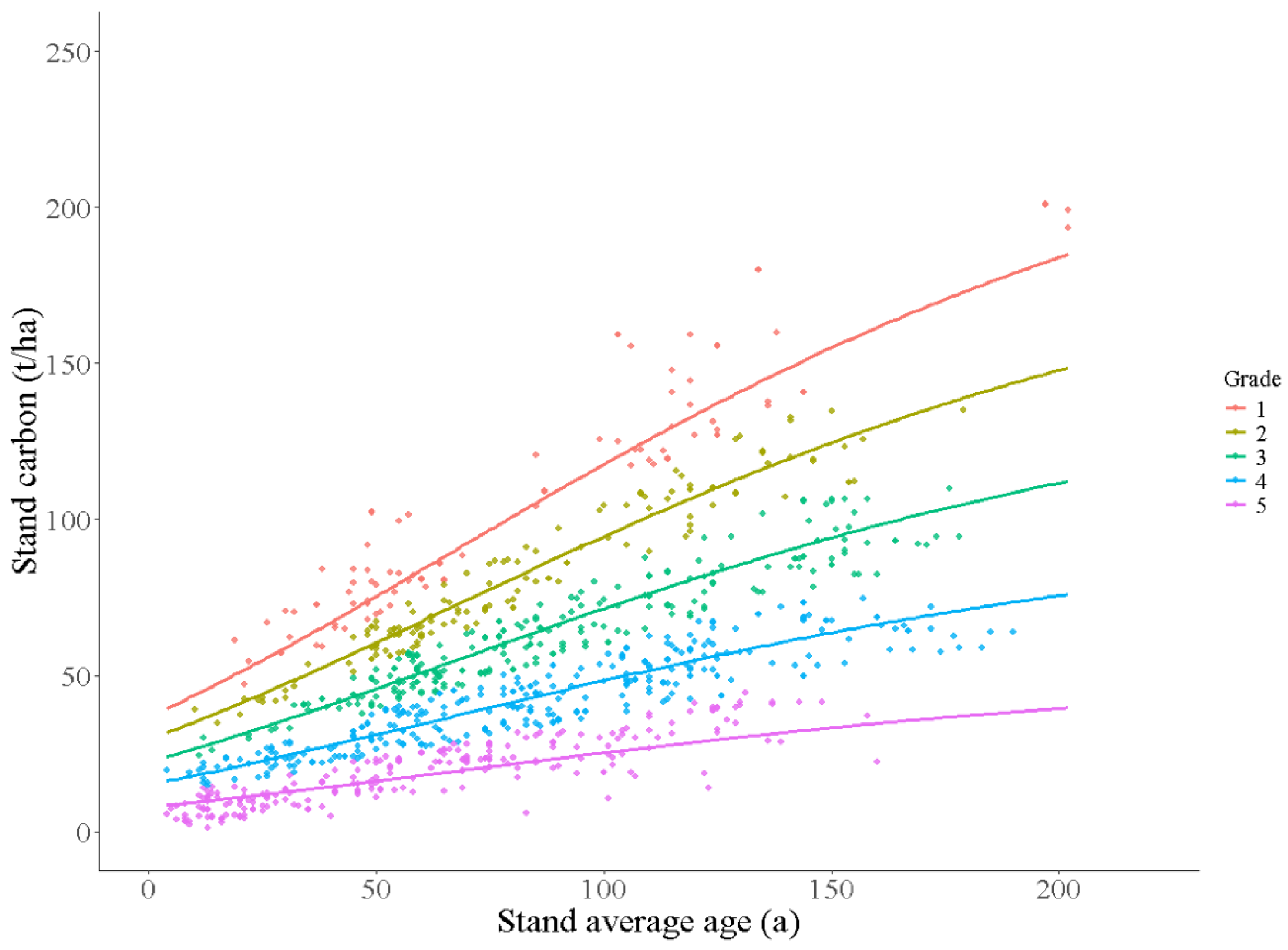
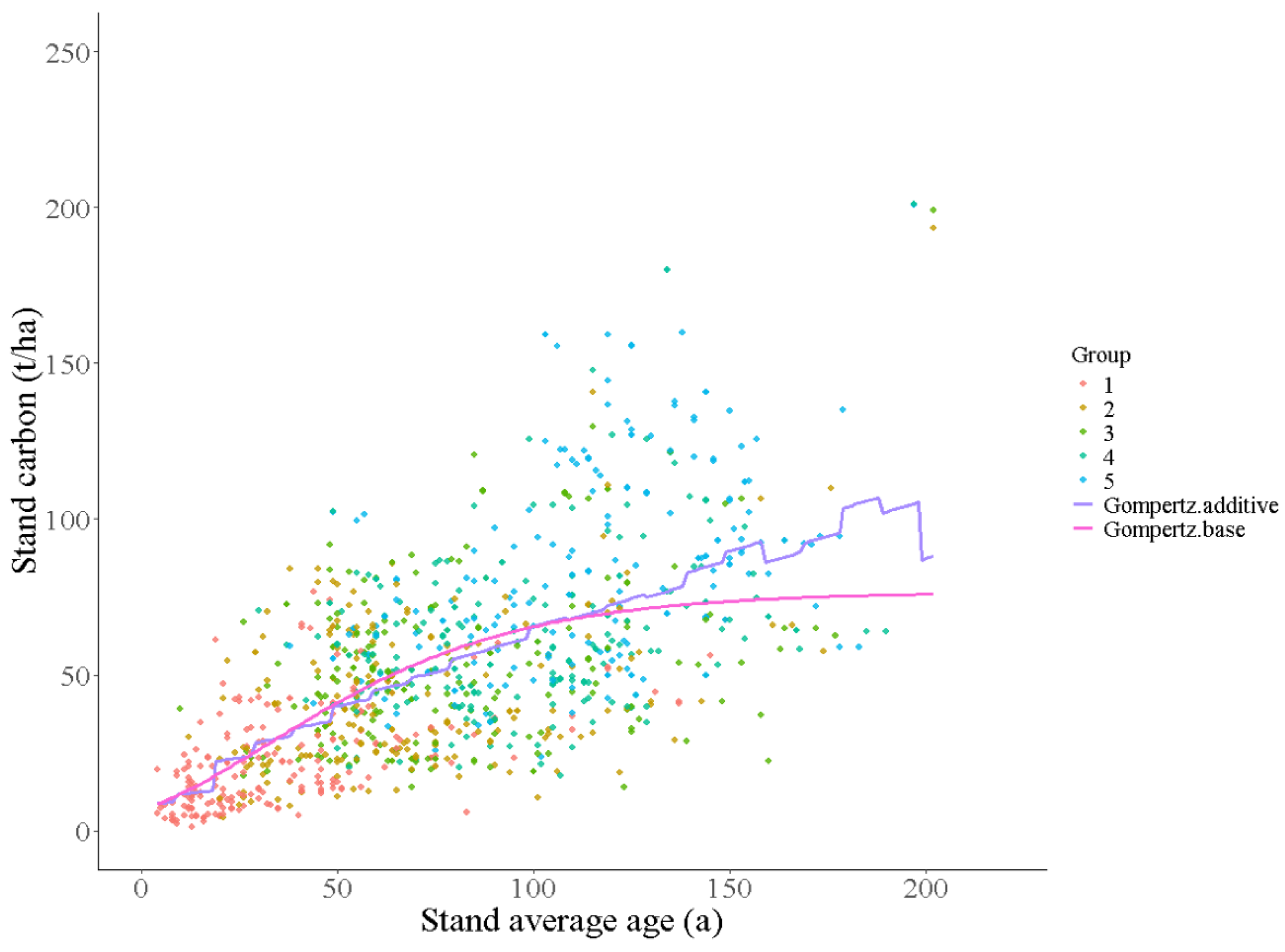
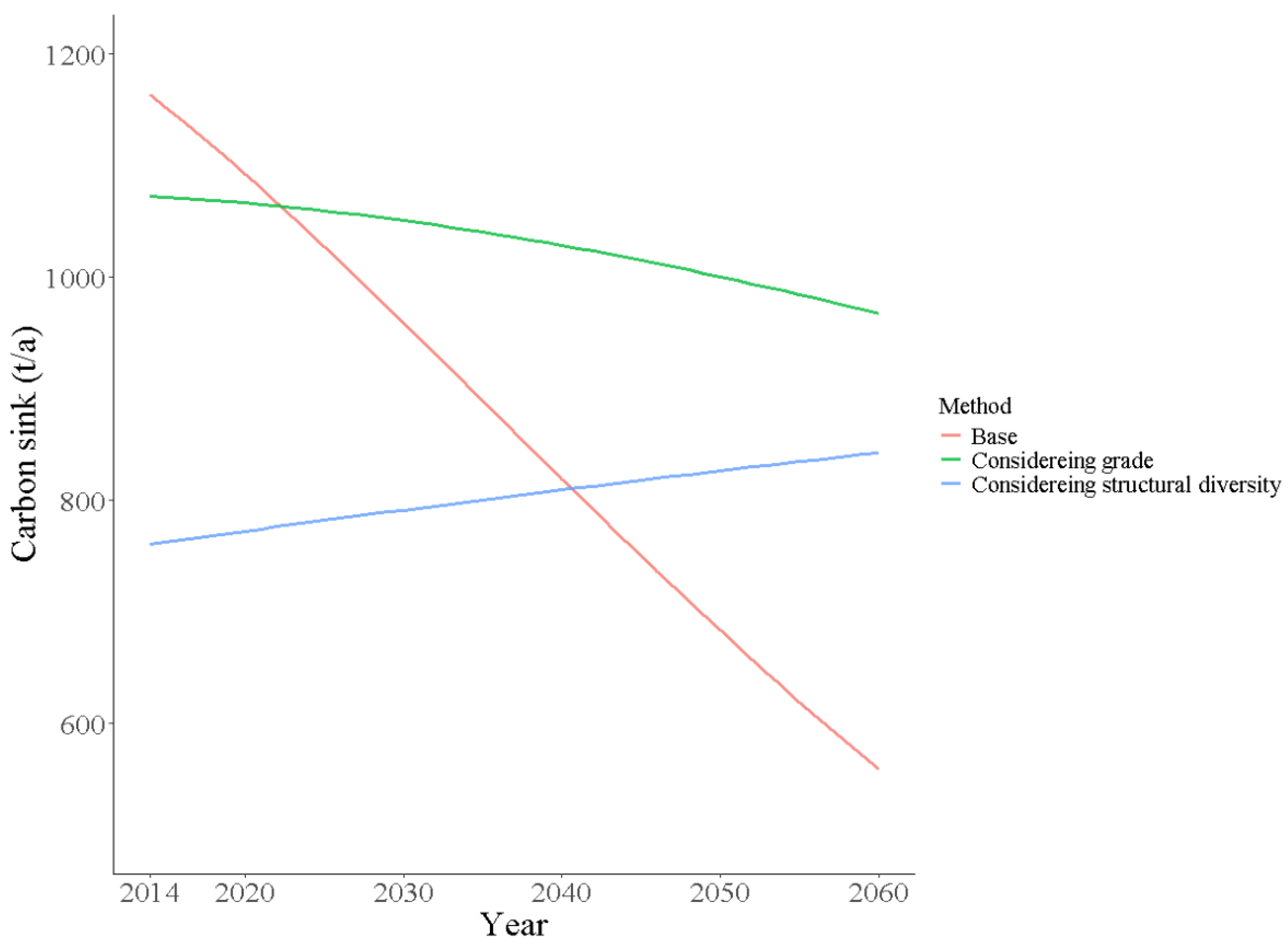
Natural mixed forests’ carbon sequestration capacity is crucial for mitigating climate change and maintaining ecological balance. However, most of the current studies only consider the role of forest age, ignoring the influence of carbon growth grade and stand structural diversity, which leads to an increase in uncertainty in large-scale forest carbon sink assessment. The aim of this study was to quantify the effects of carbon growth grade and stand structure diversity on the carbon sink of natural mixed forests and to establish a more accurate stand carbon growth model. Based on sample data from the National Forest Inventory (NFI) of China, the stand carbon growth model was established based on Gompertz and Logistic theoretical growth models, and the forest carbon sink at the regional scale was predicted. It was found that the stand carbon growth model considering only the stand age as a single variable often had poor results, with R2 less than 0.36, while R2 values of the optimal model introducing carbon growth grade and stand structural diversity were 0.87 and 0.48, respectively, which significantly improved the prediction accuracy of the model, and both had significant effects on stand carbon stocks. By predicting the future forest carbon sink, it was found that the forest carbon sink of the natural coniferous–broadleaved mixed forests in Jilin Province would reach 791 (781–801) t c/a and 843 (833–852) t c/a in 2030 and 2060, respectively, which were 17% lower and 51% higher than that of the forest carbon sink estimated by considering only the age. Moreover, the model considering structural diversity predicted a more positive carbon sink trend, indicating that forest carbon stocks could be more effectively maintained and carbon sinks increased by increasing the complexity of stand diameter at breast height structure, which has important guiding significance for future forest carbon sink management. This study provides scientific support for achieving the goal of “carbon neutrality” proposed by China.
Keywords: carbon sink; structural diversity; growth grade classification; mixed forests carbon sink; structural diversity; growth grade classification; mixed forests