Article

Novel Tomicus yunnanensis (Coleoptera, Curculionidae) Attractants Utilizing Dynamic Release of Catalytically Oxidized α-Pinene

1
College of Forestry, Southwest Forestry University, Kunming 650224, China
2
Yunnan Academy of Forestry and Grassland, Kunming 650201, China
*
Author to whom correspondence should be addressed.
These authors contributed equally to this work.
Forests 2025, 16(12), 1847; https://doi.org/10.3390/f16121847
Submission received: 12 November 2025 / Revised: 2 December 2025 / Accepted: 9 December 2025 / Published: 11 December 2025
(This article belongs to the Section Forest Health)

Abstract

This study aims to develop a novel high-efficiency lure for Tomicus yunnanensis Existing bark beetle attractants often rely on single or fixed-ratio blends of host volatiles and their oxidation products, which struggle to mimic the dynamic release process of insect semiochemicals in nature. To address this, we established a dynamic reaction system based on the catalytic oxidation of α-pinene: ① background control (no catalyst, no heating), ② thermal oxidation system (no catalyst, 40 °C), and ③ catalytic oxidation system (with a titanium–copper modified chabazite-type zeolite catalyst, 40 °C). Behavioral screening using a Y-tube olfactometer revealed a clear gradient in attraction effectiveness among the three systems: catalytic oxidation > thermal oxidation > background control. The products from the catalytic oxidation system at 2 h of reaction showed the highest efficacy, achieving an attraction rate of 61%, which was significantly superior to the α-pinene control. These results indicate that generating dynamically proportioned volatile mixtures through catalytic oxidation can significantly enhance the attraction of T. yunnanensis Further analysis by gas chromatography–mass spectrometry (GC-MS) demonstrated that the catalyst efficiently promoted the directional conversion of α-pinene into key bioactive compounds such as verbenol, myrtenal, and myrtenone, thereby substantially improving behavioral activity. After field validation, this dynamically released attractant could potentially be developed into a real-time field-release lure system for monitoring adult emergence and large-scale trapping, providing a feasible new technological pathway for the precise and sustained management of bark beetle pests.

1. Introduction

Insects of the subfamily Scolytinae are significant trunk-boring pests in global forest ecosystems, belonging to the order Coleoptera and the family Curculionidae. They exhibit high species diversity, with approximately 220 genera and 6000 species known worldwide, and over 500 species recorded in China. Among them, Tomicus yunnanensis Kirkendall, 2008. (Coleoptera, Curculionidae) of the genus Tomicus is a major pest in the pine forests of southwestern China and is listed as a significant forestry pest by the National Forestry and Grassland Administration [1]. For a long period, this bark beetle was considered conspecific with Tomicus. piniperda Linnaeus, 1758. (Coleoptera, Curculionidae) found in the forests of Northeast China and Eurasia. However, detailed morphological comparisons later confirmed distinct differences in the punctures and granules on the elytral surfaces between the two, leading to the formal designation of the species as T. yunnanensis, replacing previous designations such as T. piniperda [2,3]. These pests exhibit a highly cryptic life history, with stages such as shoot boring, trunk boring (including mating, oviposition, larval development, pupation, and eclosion), and brief transfer activities mostly occurring inside the tree tissues. This makes conventional monitoring and control extremely challenging, often resulting in widespread tree mortality and significant economic and ecological losses.
Currently, the primary methods for controlling T. yunnanensis infestations worldwide involve the removal of insect-damaged trees and the application of chemical pesticides [4,5,6]. Chemical control typically employs pesticides such as omethoate and deltamethrin [7]. Additionally, trap-based methods are used to suppress bark beetle populations and mitigate their damage [8,9,10,11,12]. The removal of infested trees is generally conducted once during the shoot-boring stage and once during the trunk-boring stage, with the felled trees subsequently treated using chemical agents or fumigation [7]. However, these methods have significant limitations: chemical pesticides pose risks of environmental pollution, pest resistance, and harm to non-target organisms; while the removal of infested trees involves high operational costs, poor timeliness, and limited effectiveness against insects lurking within apparently healthy trees. Consequently, neither chemical control nor physical removal has proven fully satisfactory. In recent years, the application of attractants to prevent damage by T. yunnanensis has become a key research focus. Compared to chemical control and tree removal, the use of synthetic attractants for trapping not only helps preserve the forest ecosystem but also saves substantial human and material resources, making it a comparatively ideal strategy for managing bark beetle infestations.
Insect attractants refer to chemical substances or mixtures that, in the form of vapor, induce directional or non-directional movement in insects, typically towards the source of the attractant or towards areas of preferred concentration [13]. Based on the origin of the active substances, bark beetle attractants can be broadly categorized into two types: pheromone attractants and food attractants. Current bark beetle pheromone attractants primarily utilize aggregation pheromones and sex pheromones.
When bark beetles bore into host tree trunks to feed on phloem and xylem contents (such as hydrocarbon monoterpenes), they obtain precursors for pheromone synthesis. Through the action of microorganisms in the hindgut, these precursors are converted into oxidized monoterpene alcohols (such as (+)-cis-verbenol and myrtenol), which are then excreted with feces and released into the environment. These substances can attract conspecific or heterospecific bark beetles to aggregate and cause damage, thereby functioning as aggregation pheromones [14]. Leveraging the attraction of bark beetles to aggregation or sex pheromones, new methods for monitoring and controlling these pests using pheromones have been developed [15,16]. For instance, Sun Shouhui et al. [17] conducted field trials using the aggregation pheromone of Cryphalus fulvus. Their results demonstrated that the number of beetles captured by traps correlated with the pest’s occurrence patterns, confirming that the combined use of bark beetle pheromones and traps can serve as an effective monitoring tool. Despite extensive research on pheromones and food-based attractants as green control technologies, their field effectiveness for T. yunnanensis has generally been poor, with almost no adult captures reported. This indicates significant deficiencies in existing attractant formulations [18,19,20,21,22].
The aggregation behavior of T. yunnanensis is precisely regulated by semiochemicals. During the initial infestation period, the volatiles from Pinus yunnanensis Franch., 1899. (Pinales, Pinaceae) needles and resin are predominantly terpenoids. Needle volatiles are primarily monoterpenes (accounting for 99.98% of the total content), with α-pinene being the most abundant (close to 80%), followed by β-pinene, D-limonene, camphene, and β-myrcene. Resin volatiles include monoterpenes, sesquiterpenes, and diterpenes, where α-pinene, 3-carene, and terpinolene are the main monoterpene components, while Palustric acid is the most abundant diterpene oxide (exceeding 50%) [23]. Zhou Nan et al. [19] conducted systematic research on the aggregation pheromone of T. piniperda, including extraction, analysis, and indoor/outdoor bioassays. They identified oxidized monoterpene alcohols such as (+)-cis-verbenol, verbenone, myrtenol, and myrtenal, present in adult abdomens, eggs, and frass, as the main components of the bark beetle aggregation pheromone. The content of these oxidized monoterpene alcohols peaks in the beetles when they transition from shoots to trunks and reach the resin-producing phloem and xylem, corresponding to the strongest response to the aggregation pheromone [19]. According to the latest research by Yuan et al. (2025) [24], during the early boring stage, the frass of T. yunnanensis was found to be rich in host volatiles or primary attractants. The combined content of α-pinene, β-pinene, β-myrcene, and 3-carene accounted for 99.19% and 94.20% of the volatiles, respectively. In the boring stage, the frass still contained substantial amounts of host volatiles, with their total content accounting for 87.80% and 74.67% of the volatiles; however, the content of aggregation pheromone components increased significantly during this period. The content of (-)-trans-verbenol and verbenone in males during the early boring stage was significantly higher than in females during the same period, a finding consistent with results from the mid- and hindgut. This indicates that host volatiles and gut volatiles in the frass may collectively regulate the population dynamics of T. yunnanensis.
A study by Camacho et al. [25] in 1998 found that six compounds—α-pinene, cymone, terpinolene, longifolene, myrtenal, and trans-Pinocarveol—were obtained from the phloem of Abies lasioxarpa via steam distillation. When 10 pg of the insect-derived pheromone exo-Brevicomin was added, all compounds except Terpinolene enhanced the attraction effect of the pheromone on bark beetles, whereas none of the six compounds alone could attract the beetles [25]. Indoor experiments by Yin Caixia et al. [20] demonstrated that a mixture formulated in the ratio α-pinene:β-pinene:β-phellandrene:Gamma-caryophyllene = 20.6:4.7:6.6:1, as well as extracts from the phloem and needles of P. yunnanensis, exhibited significant attraction to T. piniperda. In contrast, individual components or mixtures of α-pinene with terpinolene, α-terpinene, or Gamma-caryophyllene showed no notable attraction effect [20]. Field tests by Sun et al. [26] indicated that verbenone, either alone or in combination with non-host volatiles, significantly reduced bark beetle attacks on trap logs, whereas non-host volatiles alone did not exhibit such inhibitory effects. These findings underscore the importance of both the dynamic nature and specific ratios of compound combinations in determining attraction efficacy.
However, most commercial attractants currently employ fixed-component formulations with static ratios, which fail to simulate the dynamic variation characteristics of volatiles released by insect-infested trees in nature. This leads to unstable attraction efficacy and limited adaptability. This knowledge gap restricts the application of attractants in sustained and efficient pest control. Therefore, developing an attractant system capable of more authentically simulating the dynamic signals of natural infestation has become key to enhancing the effectiveness of green control strategies for bark beetles.
Based on the above background, although various effective semiochemicals have been identified through previous research, the development of highly efficient attractants for bark beetles still requires extensive and in-depth investigation. The current research gap lies in the fact that existing attractants mostly employ static, fixed formulations, failing to replicate the dynamic combination and release patterns of multiple active compounds found in natural states, as well as their synergistic effects. Accordingly, this study proposes a novel design strategy for a “dynamic-release attractant”: generating a dynamic mixture containing active compounds such as myrtenol, verbenol, and verbenone through the chemical catalytic oxidation of α-pinene, aiming to more authentically simulate and rapidly identify the effective chemical signals during T. yunnanensis infestation. This study hypothesized that the dynamic volatile mixture formed by the catalytic oxidation of α-pinene could significantly enhance the attraction effect on T. yunnanensis and validated this hypothesis through experiments. The research aims to provide a novel, efficient, and environmentally friendly control technology for managing forest infestations caused by this pest.

2. Materials and Methods

2.1. Materials

2.1.1. Source of Test Insects

The test insects were collected from the Fangmatian Reservoir (N 25°38′00.0″, E 103°51′47.0″) in Zhanyi District, Qujing City, Yunnan Province. P. yunnanensis shoots infested by T. yunnanensis were selected and transported to the laboratory, where the insects were manually extracted. Adult T. yunnanensis were identified based on morphological characteristics, including the presence or absence of punctate arrangements on the granulae of the second interstrial space on the elytral declivity, the length of granulae setae, the morphology of the abdominal tergites, and the visibility of the eighth tergite [3]. The identified adults were individually placed and stored in a refrigerator at 4 °C for subsequent use.

2.1.2. Experimental Materials and Apparatus

Materials for catalyst preparation: titanium dioxide (TiO2) (purity 98%, Shandong Keyuan Biochemical Co., Ltd., Heze, China), citric acid (C6H8O7) (purity ≥ 99.5%, Damao Chemical Reagent Factory, Tianjin, China), powdered molecular sieve (purity > 99.9%, Liaoning Raodong New Materials Co., Ltd., Dalian, China), concentrated hydrochloric acid (HCl) (purity 37%, Guangdong Daxiao Chemical Co., Ltd., Maoming, China), crucible, crucible tongs.
Equipment for catalyst preparation: muffle furnace.
Materials for novel attractant preparation: glass rod, α-pinene (C10H16) (purity 98%, Macklin, Shanghai, China), ethyl acetate (C4H8O2) (purity ≥ 99.5%, Zhiyuan Chemical Reagent Co., Ltd., Tianjin, China), Hydrogen Peroxide (H2O2) (purity 30%, Chuandong Chemical Co., Ltd., Chongqing, China), three-necked flask, stir bar.
Equipment for novel attractant preparation: heating magnetic stirrer, pipette.

2.2. Methods

2.2.1. Preparation Method of Ti-Cu-SSZ-13 Catalyst

(1)
Titanium dioxide solid was mixed with concentrated hydrochloric acid and deionized water, followed by stirring until a homogeneous slurry was obtained, thereby preparing the titanium dioxide solution.
(2)
A mixture containing the titanium dioxide solution from step (1) and a citric acid solution was prepared. The powdered molecular sieve was added to this mixture for impregnation, followed by drying and calcination in a muffle furnace to obtain the catalyst powder.
(3)
The catalyst powder was then shaped, dried, and calcined to produce the final formed catalyst.
In step (1), the concentration of the titanium dioxide attractant is 300 g/L. In step (2), the concentration of the citric acid solution is 10 g/L, the powdered molecular sieve is Cu-SSZ-13, and the mass ratio of the molecular sieve to the mixed solution is 1:10. In step (3), the drying temperature is 20–30 °C, and the drying duration is 1 day; the calcination temperature is 500 °C, and the calcination time is 10 h.

2.2.2. Preparation Method of New Attractant

The catalytic reaction was carried out in a three-neck flask, and a heated magnetic stirrer was used for constant temperature (room temperature or 40 °C) and stirring reaction.
The general reaction conditions were as follows: a molar ratio of α-pinene to H2O2 of 4:1, a volumetric ratio of solvent (ethyl acetate) to α-pinene of 4:1, Ti-Cu-SSZ-13 catalyst dosage of 10% (by mass) relative to α-pinene, and a reaction temperature of 40 °C.
A total of three novel lure reaction systems were prepared in this study to systematically analyze the role of each factor:
  • System with catalyst and heating: α-pinene + H2O2 + solvent + catalyst, reacted at 40 °C.
  • System without catalyst but with heating: α-pinene + H2O2 + solvent, reacted at 40 °C.
  • System without catalyst and without heating (background control): α-pinene + H2O2 + solvent, reacted at room temperature (approximately 25 °C).
Samples were collected from each system after reaction times of 1 h, 2 h, 3 h, and 4 h, resulting in a total of 12 lure samples.

2.2.3. New Attractant Trapping Test Method

The Y-tube olfactometer was assembled by connecting the tubing from an oxygen pump to two glass bulbs matching the diameter of the Y-tube arms, with the bottom ends plugged using cotton wool. Ten microliters (10 μL) of the novel attractant and α-pinene (control), respectively, were placed into the two glass bulbs, using cotton wool as a slow-release carrier, for the Y-tube olfactometer bioassay with T. yunnanensis.
In this study, the twelve attractants obtained under the three conditions were each tested using a group of 20 T. yunnanensis beetles, with sexes pooled for analysis. Five replicate trials were conducted for each group. In each trial, the arms of the Y-tube were rotated, and all tested insects were used only once. T. yunnanensis entering any arm beyond one-third of the tube length was recorded as a valid choice.
All trapping experiments were performed in a laboratory environment with controlled light, temperature, and humidity to exclude non-olfactory interference. Specific parameters were as follows:
Light environment: The experimental area was illuminated by a diffuse lighting system installed in the ceiling, providing uniform and shadow-free lighting to eliminate any potential directional visual cues and ensure insect choices were based solely on olfactory information.
Temperature and humidity: The indoor temperature and relative humidity were precisely maintained at 25 ± 1 °C and 65 ± 5% RH, respectively, using a constant temperature and humidity system to simulate the suitable habitat of T. yunnanensis and maintain stable insect activity.
Airflow control: The airflow rate was stabilized at 0.25 L/min prior to each experiment.

2.2.4. Detection of New Attractant Reaction System

To elucidate the key role of the catalyst in enhancing the efficacy of the attractant at the chemical level, this study employed gas chromatography–mass spectrometry (GC-MS) to focus on analyzing the reaction products (at 1 h, 2 h, 3 h, and 4 h) of the system with catalyst and heating—which exhibited the best performance in behavioral assays—and its critical control system, the system without catalyst but with heating. By systematically comparing the compositional differences between these two systems, which were subjected to identical heating conditions and differed only in the presence of the catalyst, this study aims to directly reveal how the catalyst directs the oxidation of α-pinene to selectively generate a higher proportion of effective attractant components (such as verbenol, myrtenal, etc.), thereby explaining its significant behavioral advantages from a chemical mechanism perspective.
The system without catalyst and without heating was explicitly defined in this study as the behavioral background control, intended to establish a baseline for attraction activity. Behavioral results indicated that this condition did not effectively drive significant oxidative transformation, and its product composition remained highly similar to the starting material. Therefore, this system was not subjected to repeated GC-MS analysis; instead, chemical analysis was focused on elucidating the chemical basis underlying the key differences in behavioral activity—namely, the catalytic enhancement effect.
All samples for analysis were collected immediately after the reaction, sealed, stored under refrigeration, and sent to Tongchuang Testing Technology Co., Ltd. in Kunming, China for qualitative and quantitative analysis.

2.2.5. Data Processing and Analysis

In this study, the Chi-square goodness-of-fit test was employed to evaluate the differences in attraction efficacy between the novel attractants and the α-pinene control under three different reaction conditions (with catalyst and heating, without catalyst but with heating, and without catalyst and without heating) at reaction times of 1 h, 2 h, 3 h, and 4 h, respectively.
For each test (i.e., for each reaction condition at each time point), the null hypothesis (H0) was defined as follows: under that specific condition, there is no significant difference between the capture numbers for the novel attractant and α-pinene, with the observed frequencies conforming to an expected 1:1 distribution. The alternative hypothesis (H1) was that under that specific condition, there is a significant difference between the capture numbers for the two, with the observed frequencies deviating from the expected 1:1 distribution. The significance level was set at α = 0.05.
Data obtained from the Y-tube olfactometer trapping assays were analyzed using R version 4.3.1 to perform the aforementioned Chi-square tests for significance evaluation.

3. Results

3.1. Trapping Results and Analysis of T. yunnanensis for the Three Reaction Systems

This study systematically evaluated the attraction efficacy of the novel attractants prepared under three reaction systems (with catalyst and heating, without catalyst but with heating, and without catalyst and without heating) against T. yunnanensis. The statistical test results are presented in Figure 1 and Table 1.
Overall, a clear gradient in attraction efficacy was observed: system with catalyst and heating > system without catalyst but with heating > system without catalyst and without heating. Specifically, under the condition with catalyst and heating, the attraction rates of the novel attractant at 1 h, 2 h, 3 h, and 4 h were 45%, 61%, 57%, and 48%, respectively. Notably, the attractant produced by this system at the 2 h reaction time exhibited the optimal effect, with an attraction rate of 61%.
The overall Chi-square test results strongly rejected the null hypothesis (H0). Under all three conditions—with catalyst and heating, without catalyst but with heating, and without catalyst and without heating—the total number of insects attracted by the novel attractant was significantly higher than that by α-pinene (χ2 values of 63.50, 43.56, and 23.44, respectively, all with p < 0.001), supporting the alternative hypothesis (H1).
Detailed analysis at each time point further revealed:
For the system with catalyst and heating, the novel attractant performed significantly better than α-pinene at the 1 h, 2 h, and 3 h time points (all p < 0.001), leading to the rejection of H0. However, no significant difference was observed at the 4 h time point (p = 0.335), and H0 was not rejected.
The system without catalyst but with heating (i.e., simple thermal oxidation) showed moderate attraction efficacy, with corresponding attraction rates of 23%, 31%, 42%, and 27% at the respective time points. The attractant was significantly superior to the control at all points except 4 h (p = 0.238), where no significant difference was found (all other p < 0.001), rejecting H0. This indicates that thermal oxidation alone can generate certain effective components with attractive activity.
The system without catalyst and without heating, serving as the background control, exhibited the lowest attraction rates (23%, 28%, 34%, and 28% from 1 h to 4 h). Chi-square tests showed no significant difference from the α-pinene control at the 1 h (p = 0.262) and 4 h (p = 0.238) time points, failing to reject H0. However, a significant yet weak attraction effect was observed at the 2 h (p = 0.002) and 3 h (p = 0.001) time points, rejecting H0. This suggests the possibility of a slight, non-catalytic, non-thermally driven slow oxidation reaction at room temperature.
The above results indicate that: First, within the same reaction system, the attraction efficacy of the products varied at different time points, confirming the “dynamic” nature of the product composition. Second, “heating” is a crucial condition for driving the reaction and generating effective attractive components. Third, on the basis of heating, the introduction of a “catalyst” can directionally and efficiently enhance the generation of effective components, thereby substantially improving the attraction efficacy, which validates the core value of the catalytic oxidation strategy. Fourth, all three novel attractants demonstrated superior performance compared to the traditional α-pinene.

3.2. Results and Analysis of New Attractant Reaction System

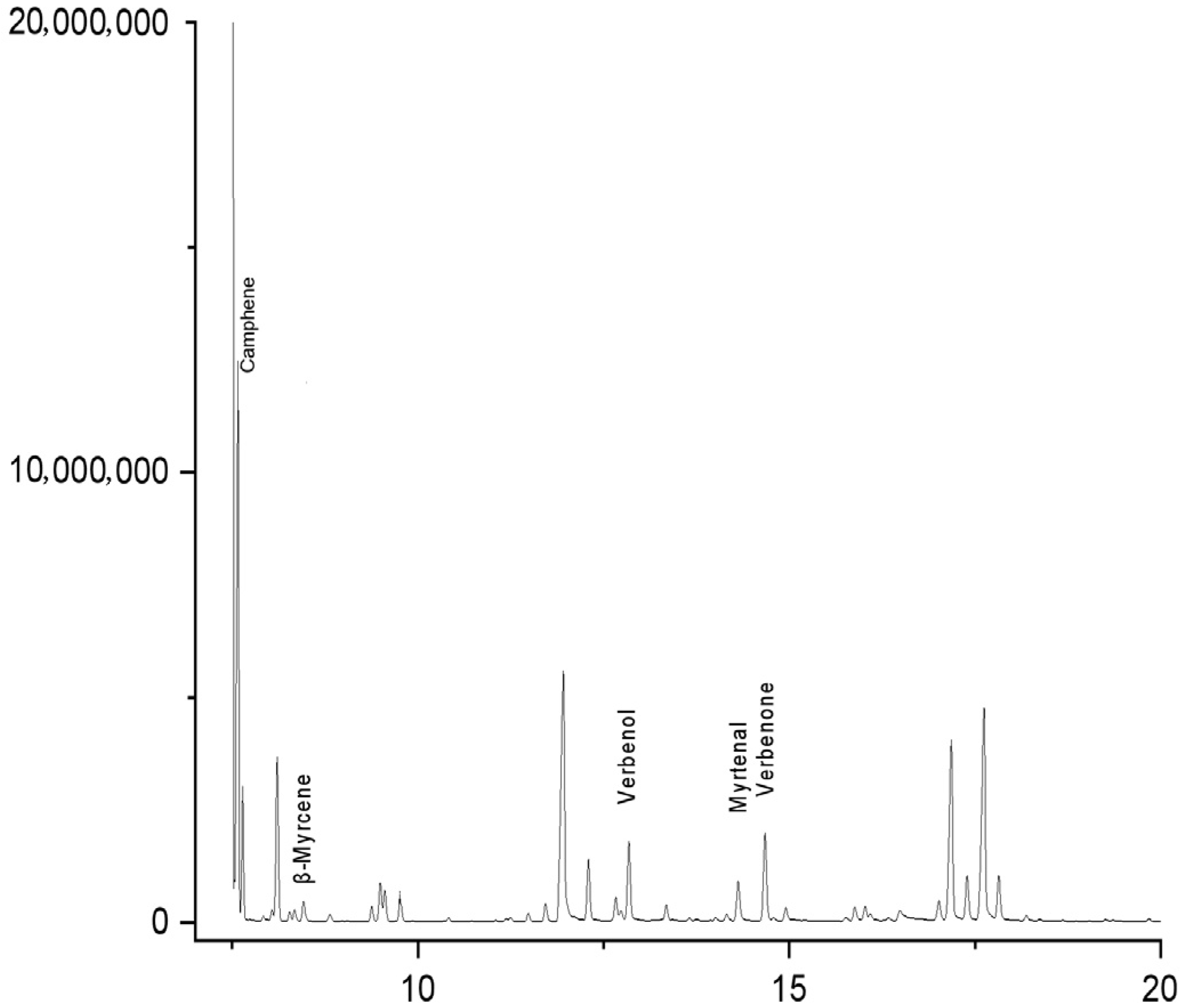
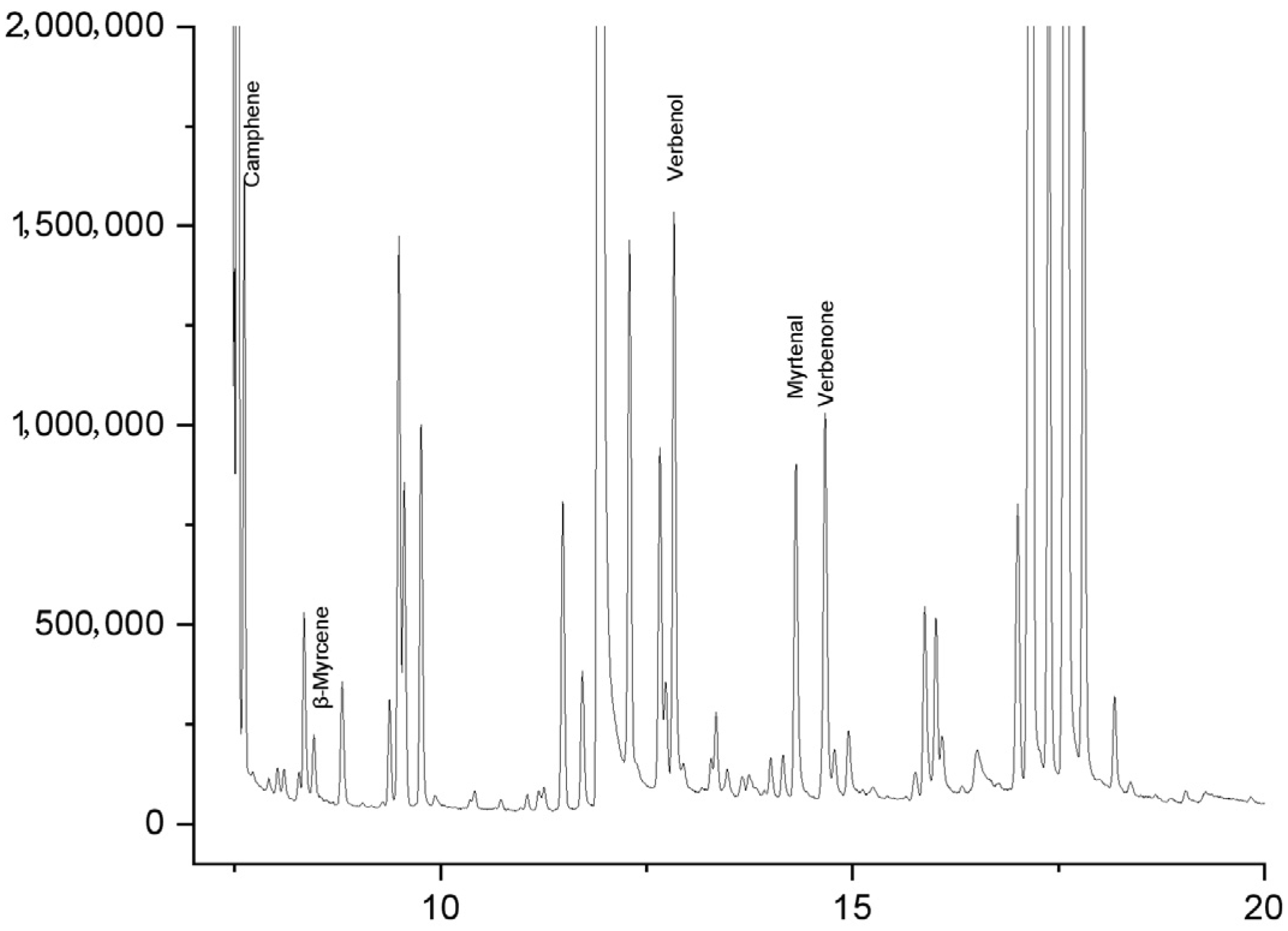
Behavioral assays indicated that among the products from the system with catalyst and heating, those obtained at the 2 h reaction time exhibited the highest attraction rate. To investigate the chemical basis of this observation, we performed GC-MS analysis on the products collected at different time points, focusing on a comparative analysis of the product compositions between the system with catalyst and heating and the system without catalyst but with heating at their respective optimal behavioral performance time points (i.e., the 2 h attractant from the catalytic system and the 3 h attractant from the non-catalytic, heated system). The GC-MS chromatograms for the system with catalyst and heating and the system without catalyst but with heating are presented in Figure 2 and Figure 3, respectively. The volatile component results for the novel attractants from these two systems are detailed in Table 2 and Table 3, respectively.
Although the y-axis scales of the two chromatograms have been individually optimized for clarity of detail (preventing direct comparison of absolute peak heights), a decisive difference remains observable: in the catalytic heating system, the chromatographic peak intensities for the target bioactive compounds such as verbenol, verbenone, and myrtenal are high. In contrast, in the non-catalytic heating system, the peak responses for these compounds are relatively low and flat.
Experimental results indicated that a total of 21 volatile compounds were identified in the novel attractant products obtained from the catalyst-containing heating reaction system at 1 h, 2 h, 3 h, and 4 h. Regarding the relative content of the volatile products, camphene was the highest, approximately 37.10%–53.06%; β-pinene was the next, approximately 9.72%–12.93%; verbenone and verbenol, approximately 6.03%–9.73%; myrtenal, approximately 3.74%–4.75%; D-limonene, approximately 2.59%–3.45%; campholenic aldehyde, approximately 3.16%–7.69%. The contents of cineole, (E)-3,7-dimethylocta-1,3,6-triene, β-myrcene, (-)-trans-pinocarveol, (±)-2(10)-pinen-3-one, 2,4-dimethylfuran, 6-methyl-5-hepten-2-one, α-phellandrene, p-isopropyltoluene, α-pinene oxide, carveol, α-terpinene, 2-cyclohexen-1-ol,2-methyl-5-(1-methylethenyl)-, (1R,5S)-rel-, and isoamyl alcohol were all below 2.87%. Based on the volatile content of the novel attractant products, it can be concluded that the main compounds generated were camphene, β-pinene, verbenone, verbenol, myrtenal, D-limonene, and campholenic aldehyde.
Regarding the changes in the relative contents of the main volatile components of the novel attractant product from 1 h to 4 h, the relative content of camphene was highest at the 2 h, then gradually decreased; the relative contents of β-pinene were higher at the 1 h and 4 h, while slightly lower and essentially unchanged at the 2 h and 3 h; the relative contents of verbenone, verbenol, and myrtenal all progressively increased; the relative contents of D-limonene were higher at the 1 h and 4 h, while slightly lower and essentially unchanged at the 2 h and 3 h; the relative content of campholenic aldehyde gradually increased.
Regarding the volatile chemical composition of the novel attractant product from 1 h to 4 h, monoterpene hydrocarbons (including camphene, β-pinene, D-limonene, β-myrcene, α-phellandrene, etc.) exhibited an overall declining trend, yet still constituted the predominant portion of the relative content. In contrast, oxygenated monoterpenes (including verbenone, verbenol, myrtenal, campholenic aldehyde, etc.) showed a markedly increasing trend overall. This indicates that within this reaction system, the oxidation of monoterpene hydrocarbons (particularly camphene) led to their conversion into oxygenated monoterpenes (such as alcohols, aldehydes, and ketones).
Numerous existing studies indicate that the volatile components of the novel attractant product in this system contain many substances proven to be attractive to T. yunnanensis, particularly the major volatiles such as camphene, β-pinene, verbenone, verbenol, myrtenal, and D-limonene. For instance, research by Wang Yanping et al. [27] found that (-)-cis-verbenol, myrcene, (-)-myrtenol, (-)-camphene, s-(-)-α-pinene, (+)-camphene, 1R-(+)-a-pinene, and (1s)-(-)-β-pinene exhibit a broad concentration range, thus these compounds possess a long-range attraction function for T. yunnanensis. Yan Zhengliang et al. [22] detected the presence of verbenol, myrtenal, and myrtenol in the volatile compounds from the posterior gut of both female and male T. yunnanensis; additionally, verbenone was identified in the volatiles from the male posterior gut.
The novel attractant from the system with catalyst and without heating comprised a total of 26 volatile compounds, specifically: 1-ethenyl-5,5-dimethylbicyclo[2.1.1]hexane, camphene, 1,1-diethoxyethane, trans-verbenol, 4-methyl-1-(propan-2-yl)bicyclo[3.1.0]hex-2-ene, D-limonene, campholenic aldehyde, α-pinene oxide, verbenone, (E)-3,7-dimethylocta-1,3,6-triene, myrtenol, cineole, (-)-trans-pinocarveol, 6-methyl-5-hepten-2-one, α-phellandrene, β-myrcene, carveol, cis-verbenol, 2,4-dimethylfuran, p-cymene, (±)-2(10)-pinen-3-one, 2-cyclohexen-1-ol, 2-methyl-5-(1-methylethenyl)-, (1R,5R)-rel-, phenylacetaldehyde, 2,6,6-trimethyl-(1α,2α,5α)-norpinan-3-one, isoborneol, and α-terpineol.
In terms of the relative content of the volatile products, 1-ethenyl-5,5-dimethylbicyclo[2.1.1]hexane exhibited the highest relative content, accounting for the majority at approximately 45.17%–79.52%; camphene showed the second highest relative content, ranging from about 3.56% to 10.85%; the relative contents of effective compounds such as trans-verbenol, verbenone, myrtenol, and cis-verbenol were all below 3.06%.
Analysis of the volatile components in the novel attractant product from this reaction system reveals that the primary compounds generated were 1-ethenyl-5,5-dimethylbicyclo[2.1.1]hexane and camphene. Their relative contents were significantly lower than those in the catalytic reaction system, and the relative contents of all other volatile product constituents were also low. Furthermore, this reaction system did not yield myrtenal, but produced a small amount of myrtenol.
Regarding the changes in the relative content of the main volatile components in the novel attractant product from 1 h to 4 h, the relative content of 1-ethenyl-5,5-dimethylbicyclo[2.1.1]hexane decreased at the 2 h mark before returning to its original level. The relative content of camphene was highest at the 2 h, then gradually decreased, which is consistent with the trend observed in the catalytic reaction system; the relative contents of effective components such as trans-verbenol, myrtenol, and cis-verbenol were also highest at the 2 h, subsequently gradually decreasing.
Regarding the volatile chemical composition of the novel attractant product from 1 h to 4 h, monoterpene hydrocarbons (including camphene, 1-ethenyl-5,5-dimethylbicyclo[2.1.1]hexane, etc.) constituted the majority. However, the product composition was disorganized, and the content of camphene itself was very low (reaching only 10.85% at its peak). This indicates that in the absence of a catalyst, the reaction pathways were random, primarily generating some structural byproducts rather than the target terpenes. The content of oxygenated monoterpenes (including verbenone, verbenol, myrtenol, etc.) was extremely low and exhibited no increasing trend. Most components showed a coincidental peak at the 2 h mark before declining, and their contents at 4 h showed no significant increase or even decreased compared to those at 1 h. This suggests that effective oxidation reactions scarcely occurred.
In summary, compared with the disordered and inefficient product profile of the novel attractants obtained from the system without catalyst but with heating at 1 h, 2 h, 3 h, and 4 h, the system with catalyst and heating clearly demonstrates its superiority and necessity. Therefore, a definitive conclusion can be drawn: the core function of the Ti-Cu-SSZ-13 catalyst is not merely to accelerate the reaction, but more importantly to significantly enhance the efficiency and selectivity of the directional conversion of α-pinene into key effective components such as verbenol and myrtenal.

4. Discussion

This study successfully established a dynamic release reaction system based on the catalytic oxidation of α-pinene, which can better assist in identifying the ratios and compositions effective against bark beetles. Unlike traditional attractants that rely on single or fixed-ratio formulations, the core advantage of this system lies in its dynamic bionic characteristics, which simulate the complex changing process of the volatile odor spectrum in host trees after being attacked by bark beetles. Our findings not only validate the effectiveness of this system but also provide new insights for its application in the chemical ecology and green control strategies of bark beetles.
The study confirms that the Ti-Cu-SSZ-13 catalyst significantly enhances the conversion rate of α-pinene into multiple key pheromone precursors (such as camphene and β-pinene) and their oxidation products (including verbenone, verbenol, and myrtenal). These compounds do not function in isolation but rather form a complex chemical communication network in nature. For example, Wu et al. [28] found that the hindgut extracts of T. yunnanensis contain only two aggregation pheromones, trans-verbenol and verbenone, and the concentration changes in these two compounds can modulate intraspecific and interspecific competitive relationships. Additionally, s-(-)-α-pinene, (+)-camphene, (+)-3-carene, and (1s)-(-)-β-pinene may be associated with the semiochemicals of T. yunnanensis [27].
Verbenone and verbenol are key components of the aggregation pheromones in many bark beetle species, and variations in their ratios can modulate the shift between “aggregation” and “deterrent” behaviors. myrtenal has also been reported to exhibit strong attraction activity towards several bark beetle species [29]. Our catalytic system enables the simultaneous and sustained generation of these active compounds, forming an evolving “odor environment” that more closely resembles that of an actual beetle-infested tree. This dynamic mixture may more effectively deceive the chemoreception system of bark beetles than any static formulation.
The bioassay results of the novel attractant demonstrated a peak trapping efficacy at approximately the 2-h mark, a temporal dynamic that may hold significant ecological implications. Under natural conditions, a time window exists between initial tree infestation and the accumulation/release of pheromones. The system achieving optimal attraction at 2 h may precisely simulate this critical period—when pheromone concentrations have reached the effective threshold but have not yet escalated to levels that could induce repellency or aggregation saturation. This suggests that a successful attractant requires not only the correct chemical composition but also a release kinetics that matches its natural emission pattern. Our dynamic system offers the potential for achieving such “timely” release.
This study validated the potential of the dynamic release system at laboratory scale, though several limitations require further investigation in future research. First, behavioral experiments were conducted solely in Y-tube olfactometers, lacking validation through field trials. Second, the experimental data did not differentiate between male and female behavioral responses, potentially obscuring sex-specific response information. Furthermore, the novel attractant reaction system did not systematically optimize parameters such as catalyst dosage, temperature, or solvent composition to determine the optimal volatile profile and attraction efficacy. Therefore, subsequent research should prioritize long-term field evaluations of this system, systematically investigate the effects of catalyst dosage, temperature, and solvent parameters on product composition and behavioral regulation, and integrate sex-specific experiments with more rigorous chemical analysis methods to advance this technology toward practical and precise integrated pest management strategies.

5. Conclusions

Based on systematic testing of the null hypothesis, this study confirms that the dynamically released novel attractants are significantly superior to conventional α-pinene, with the Ti-Cu-SSZ-13 catalyzed novel attractant demonstrating particularly enhanced attraction efficacy toward T. yunnanensis. The formulation of the novel attractants contains multiple compounds capable of synergistic effects, which more accurately simulate the pheromone profiles of bark beetles or host plant odor spectra. These compounds exhibit higher affinity for insect olfactory receptors, thereby maintaining stronger attraction across varying concentrations. This study provides a new technological pathway for the development of such attractants and demonstrates promising application potential. If further validated through field trials, these findings could contribute new strategies for the environmentally friendly control of T. yunnanensis.

Author Contributions

Conceptualization, D.F.; methodology, M.W. and D.F.; software, M.W. and G.Z.; validation, M.W.; formal analysis, D.F. and H.L.; investigation, M.W., H.L. and G.Z.; resources, H.L. and P.C.; data curation, M.W. and G.Z.; writing—original draft preparation, M.W. and D.F. writing—review and editing, M.W.; visualization, M.W.; supervision, D.F., H.L. and P.C.; project administration, D.F., H.L. and P.C.; funding acquisition, P.C. All authors have read and agreed to the published version of the manuscript.

Funding

This research was funded by Research on Key Technologies for the Green and Efficient Prevention and Control of Important Pests in Coniferous Plantations (Grant No. 202302AE090017) and the Yunnan Provincial Science and Technology Talent and Platform Program (Academician Expert Workstation Project, Grant No. 202505AF350074).

Data Availability Statement

The original contributions presented in this study are included in the article. Further inquiries can be directed to the corresponding author.

Conflicts of Interest

The authors declare no conflicts of interest.

References

  1. Wood, S.L.; Bright, D.E. A catalog of Scolytidae and Platypodidae (Coleoptera), Part 2: Taxonomic Index. Great Basin Nat. Mem. 1992, 13, 1833. [Google Scholar]
  2. Duan, Y.; Kerdelhué, C.; Ye, H.; Lieutier, F. Genetic study of the forest pest Tomicus piniperda (Col., Scolytinae) in Yunnan province (China) compared to Europe: New insights for the systematics and evolution of the genus Tomicus. Heredity 2004, 93, 416–422. [Google Scholar] [CrossRef]
  3. Kirkendall, L.R.; Faccoli, M.; Ye, H. Description of the Yunnan shoot borer, Tomicus yunnanensis Kirkendall & Faccoli sp n. (Curculionidae, Scolytinae), an unusually aggressive pine shoot beetle from southern China, with a key to the species of Tomicus. Zootaxa 2008, 1819, 25–39. [Google Scholar] [CrossRef]
  4. Borkowski, A.; Skrzecz, I. Ecological segregation of bark beetle (Coleoptera, Curculionidae, Scolytinae) infested Scots pine. Ecol. Res. 2016, 31, 135–144. [Google Scholar] [CrossRef]
  5. Lu, N.; Zhang, X.; Li, L.; Liu, H. Techniques of clearing Tomicus piniperda damaged woods in Pinus yunnanensis stands. Yunnan For. Sci. Technol. 2000, 2, 43–45. [Google Scholar]
  6. Gitau, C.W.; Bashford, R.; Carnegie, A.J.; Gurr, G.M. A review of semiochemicals associated with bark beetle (Coleoptera: Curculionidae: Scolytinae) pests of coniferous trees: A focus on beetle interactions with other pests and their associates. For. Ecol. Manag. 2013, 297, 1–14. [Google Scholar] [CrossRef]
  7. Ye, H. Tomicus yunnanensis; Yunnan Science and Technology Press: Kunming, China, 2011; pp. 1–5. [Google Scholar]
  8. Yousuf, F.; Gurr, G.M.; Carnegie, A.J.; Bedding, R.A.; Bashford, R.; Gitau, C.W. Biology of the bark beetle Ips grandicollis Eichhoff (Coleoptera: Scolytinae) and its arthropod, nematode and microbial associates: A review of management opportunities for Australia. Austral Entomol. 2014, 53, 298–316. [Google Scholar] [CrossRef]
  9. Braquehais, F. Trap trees as an integral part of the control of beetle pests. Bol. Estac. Cent. Ecol. 1973, 2, 65–70. [Google Scholar]
  10. El-Sayed, A.M.; Suckling, D.M.; Wearing, C.H.; Byers, J.A. Potential of mass trapping for long-term pest management and eradication of invasive species. J. Econ. Entomol. 2006, 99, 1550–1564. [Google Scholar] [CrossRef] [PubMed]
  11. Hansen, E.M.; Bentz, B.J.; Munson, A.S.; Vandygriff, J.C.; Turner, D.L. Evaluation of funnel traps for estimating tree mortality and associated population phase of spruce beetle in Utah. Can. J. For. Res. 2006, 36, 2574–2584. [Google Scholar] [CrossRef]
  12. Schiebe, C.; Blaženec, M.; Jakuš, R.; Unelius, C.R.; Schlyter, F. Semiochemical diversity diverts bark beetle attacks from Norway spruce edges. J. Appl. Entomol. 2011, 135, 726–737. [Google Scholar] [CrossRef]
  13. Browne, B.L. Host-related responses and their suppression: Some behavioral considerations. In Chemical Control of Insect Behavior: Theory and Application; Wiley: New York, NY, USA, 1977; pp. 117–127. [Google Scholar]
  14. Meng, X. Advances in insect pheromone research and application in China. Insect Knowl. 2000, 2, 75–84. [Google Scholar]
  15. Gries, G. Prospects of new semiochemicals and technologies. In Application of Semiochemical for Management of Bark Beetle infestations, Proceedings of an Informal Conference: Annual Meeting of the Entomological Society of America, Indianapolis, IN, USA, 12–16 December 1993; U.S. Department of Agriculture, Forest Service, Intermountain Research Station: Ogden, UT, USA, 1995; pp. 44–47. [Google Scholar]
  16. Jiao, X.G.; Xuan, W.J.; Sheng, C.F. Research progress on the application of sex pheromones in pest monitoring and forecasting. Plant Prot. 2006, 32, 9–12. [Google Scholar]
  17. Sun, S.H.; Yuan, Z.L.; Wang, Z.Y.; Liu, X.Y.; Gao, C.Q.; Wang, H.K. Preliminary report on field trapping effects of semiochemicals on Tomicus minor. For. Pest Dis. 2007, 26, 26–27. [Google Scholar]
  18. Li, L.S.; Shu, N.B.; Huai, K.Y.; Zhu, X.; Jin, H. Attraction experiments of several compounds to Tomicus piniperda. Chin. Bull. Entomol. 1993, 3, 159–161. [Google Scholar]
  19. Zhou, N.; Li, L.S.; Jiang, Z.L.; Liu, H.P.; Huai, K.Y.; Shu, N.B. Studies on the aggregation pheromone of Tomicus piniperda in Pinus yunnanensis. Yunnan For. Sci. Technol. 1997, 2, 23–41. [Google Scholar] [CrossRef]
  20. Yin, C.X.; Gao, Z.L.; Lyu, J.; Jiang, Y.; Ye, H.; Liu, F.C. Taxis test of Tomicus piniperda to extracts of Pinus yunnanensis twigs. Chin. Bull. Entomol. 2002, 5, 384–386. [Google Scholar]
  21. Lu, R.C.; Wang, H.B.; Zhang, Z.; Jin, Y.J. Research progress on monitoring and controlling Tomicus piniperda using volatile chemicals from Pinus yunnanensis. J. Northwest For. Univ. 2008, 2, 124–128. [Google Scholar]
  22. Yan, Z.L.; Ma, H.F.; Ze, S.Z. Differential response of Tomicus yunnanensis to volatiles from trunk and twig of Pinus yunnanensis. J. Environ. Entomol. 2011, 33, 191–194. [Google Scholar]
  23. Yan, G.; Zhang, M.D.; Qian, L.B.; Ze, S.Z.; Yang, B.; Li, Z.B. Electroantennographic and behavioral responses of Tomicus yunnanensis to volatiles from initially infested Pinus yunnanensis. J. Environ. Entomol. 2021, 43, 1389–1397. [Google Scholar]
  24. Yuan, H.; Jiang, Y.Y.; Luo, Y.J.; Yan, G.; Li, Z.B. Composition and stage-specific variations of semiochemical substances in Tomicus yunnanensis. J. West. For. Sci. 2024, 53, 90–96. [Google Scholar] [CrossRef]
  25. Camacho, A.D.; Pierce, H.D.; Borden, J.H. Host compounds as kairomones for the western balsam bark beetle Dryocoetes confusus Sw. (Col., Scolytidae). J. Appl. Entomol. 1998, 122, 287–293. [Google Scholar] [CrossRef]
  26. Sun, J.-H.; Clarke, S.R.; Kang, L.; Wang, H.-B. Field trials of potential attractants and inhibitors for pine shoot beetles in the Yunnan province, China. Ann. For. Sci. 2005, 62, 9–12. [Google Scholar] [CrossRef]
  27. Wang, P.Y. Studies on semiochemicals of three Tomicus species infesting Pinus yunnanensis. Ph.D. Thesis, Chinese Academy of Forestry, Beijing, China, 2012. [Google Scholar]
  28. Wu, C.X.; Liu, F.; Zhang, S.F.; Kong, X.B.; Zhang, Z. Semiochemical regulation of the intraspecific and interspecific behavior of Tomicus yunnanensis and Tomicus minor during the shoot-feeding phase. J. Chem. Ecol. 2019, 45, 227–240. [Google Scholar] [CrossRef] [PubMed]
  29. Wang, J.H. Studies on Chemical Ecological Relationships of Three Tomicus Species. Ph.D. Thesis, Chinese Academy of Forestry, Beijing, China, 2015. [Google Scholar]
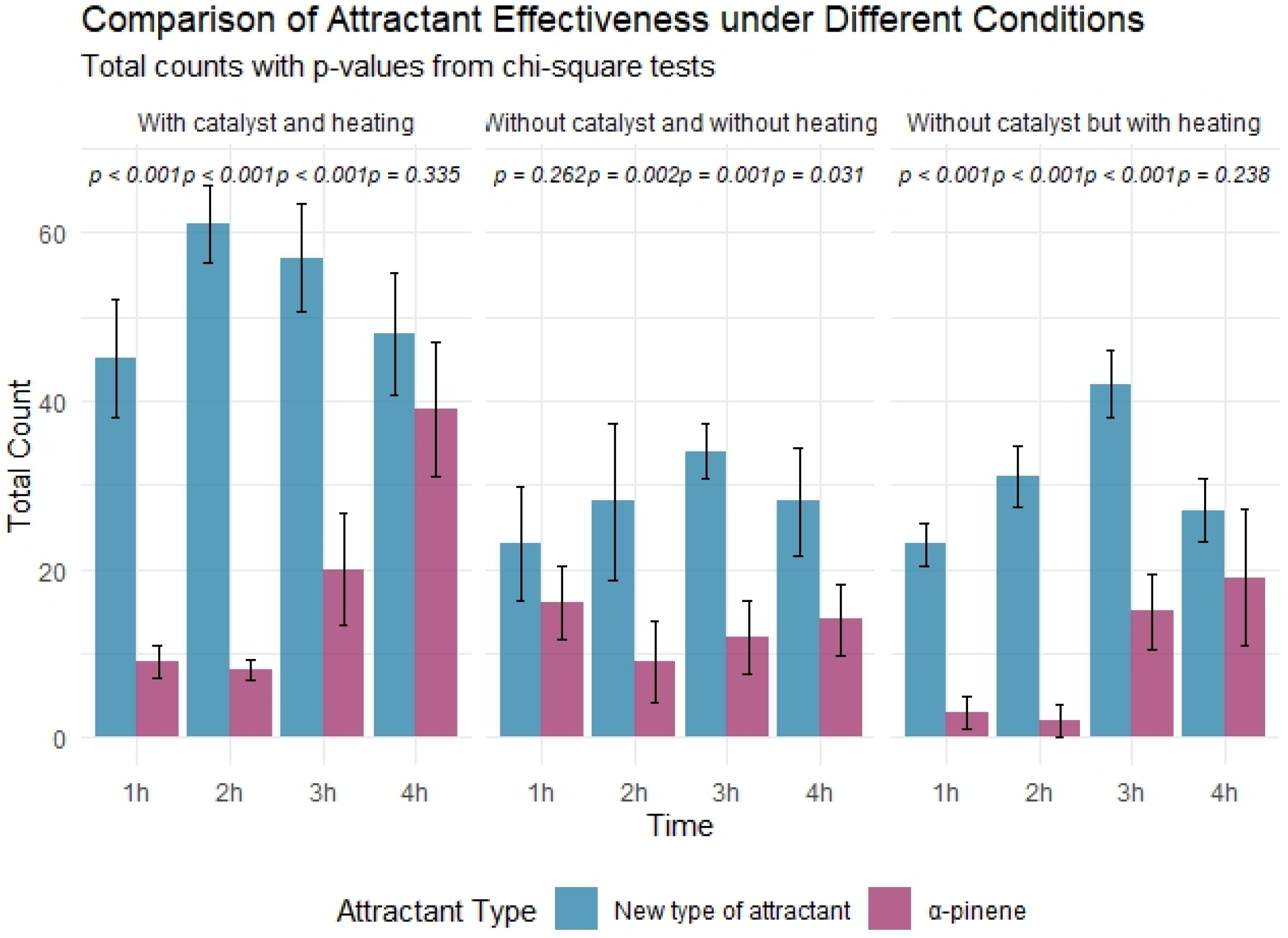
Figure 1. Attraction assays of novel attractants from the three reaction systems against T. yunnanensis (20 beetles × 5 replicates).
Forests 16 01847 g001
Figure 2. GC-MS chromatogram of the 2 h attractant from the system with catalyst and heating (Note: The y-axis response scale in Figure 2 is approximately 10 times that of Figure 3).
Forests 16 01847 g002
Figure 3. GC-MS chromatogram of the 3 h attractant from the system without catalyst but with heating (Note: The y-axis response scale in Figure 2 is approximately 10 times that of Figure 3).
Forests 16 01847 g003
Table 1. Chi-square test results for the comparison of attraction efficacy between novel attractants and the α-pinene control.
Reaction SystemTimeχ2dfp-ValueSignificance (α = 0.05)
With catalyst and heating1 h24.001<0.001Significant
2 h40.711<0.001Significant
3 h17.781<0.001Significant
4 h0.9310.335Non-significant
Without catalyst but with heating1 h15.391<0.001Significant
2 h25.491<0.001Significant
3 h12.791<0.001Significant
4 h1.3910.238Non-significant
Without catalyst and without heating1 h1.2610.262Non-significant
2 h9.7610.002Significant
3 h10.5210.001Significant
4 h4.6710.031Significant
Table 2. Analysis results of the relative content of volatile components from the system with catalyst and heating.
CategoryCompound Name1 h Attractant2 h Attractant3 h Attractant4 h AttractantRT/min
Monoterpene Hydrocarbonscamphene46.5553.0645.1437.107.58
β-pinene12.939.759.7210.418.1
D-limonene3.452.722.592.949.49
(E)-3,7-dimethylocta-1,3,6-triene2.301.811.732.049.77
β-myrcene2.011.361.511.588.47
α-phellandrene0.860.680.430.688.82
p-isopropyltoluene0.860.911.301.369.38
α-terpinene0.570.680.650.9014.16
Oxygenated Monoterpenesverbenone6.906.807.788.3714.67
verbenol6.036.127.789.7312.84
myrtenal3.743.404.104.7514.31
campholenic aldehyde3.164.086.487.6912.3
cineole2.872.042.162.269.56
(-)-trans-pinocarveol2.011.812.162.4912.66
(±)-2(10)-pinen-3-one1.441.361.511.5813.34
α-pinene oxide0.860.680.651.1311.49
carveol0.861.131.511.815.88
2-cyclohexen-1-ol, 2-methyl-5-(1-methylethenyl)-, (1R,5S)-rel-0.570.231.511.5814.95
Table 3. Analysis results of the relative content of volatile components from the system with catalyst and without heating.
CategoryCompound Name1 h Attractant2 h Attractant3 h Attractant4 h AttractantRT/min
Monoterpene Hydrocarbons1-ethenyl-5,5-dimethylbicyclo[2.1.1]hexane79.5245.1777.5577.506.51
camphene3.5610.853.683.457.52
4-methyl-1-(propan-2-yl)bicyclo[3.1.0]hex-2-ene1.655.011.841.606.72
D-limonene1.221.671.321.269.49
(E)-3,7-dimethylocta-1,3,6-triene0.871.110.960.939.77
α-phellandrene0.430.830.350.348.8
β-myrcene0.350.280.180.258.46
p-cymene0.170.560.260.259.38
Oxygenated Monoterpenestrans-verbenol2.175.011.671.9412.84
campholenic aldehyde1.134.731.932.1112.29
α-pinene oxide1.041.670.791.1811.49
verbenone0.953.061.231.1814.67
myrtenol0.872.501.051.1014.31
cineole0.781.950.790.769.56
(-)-trans-pinocarveol0.692.231.050.9312.66
carveol0.351.110.610.5915.88
cis-verbenol0.260.830.350.4212.73
(±)-2(10)-pinen-3-one0.170.830.260.2513.34
(1R,5R)-rel-2-methyl-5-(1-methylethenyl)-2-cyclohexen-1-ol0.170.560.350.3414.95
2,6,6-trimethyl-(1α,2α,5α)-norpinan-3-one0.090.280.180.1713.29
isoborneol0.090.280.180.1714.01
α-terpineol0.090.280.180.1714.16
Disclaimer/Publisher’s Note: The statements, opinions and data contained in all publications are solely those of the individual author(s) and contributor(s) and not of MDPI and/or the editor(s). MDPI and/or the editor(s) disclaim responsibility for any injury to people or property resulting from any ideas, methods, instructions or products referred to in the content.