Article

Morphological Response of Urban Trees to Pruning: A Case Study of Acacia auriculiformis Across Size Classes

1
College of Horticulture and Landscape Architecture, Zhongkai University of Agriculture and Engineering, Guangzhou 510225, China
2
Research Institute of Tropical Forestry, Chinese Academy of Forestry, Guangzhou 510520, China
3
School of Landscape Architecture, Guangdong Eco-Engineering Polytechnic, Guangzhou 510520, China
4
School of Landscape Architecture, Beijing Forestry University, Beijing 100083, China
*
Authors to whom correspondence should be addressed.
Forests 2025, 16(12), 1826; https://doi.org/10.3390/f16121826
Submission received: 29 October 2025 / Revised: 26 November 2025 / Accepted: 3 December 2025 / Published: 5 December 2025
(This article belongs to the Special Issue Urban Forests and Ecosystem Services)

Abstract

Pruning is a regular and essential urban tree maintenance practice aimed at sustaining overall health, ecosystem services, and public safety. However, knowledge of post-pruning recovery dynamics remains limited, which in turn hinders accurate assessments of growth and ecological functions. To address this, we examined recovery dynamics of Acacia auriculiformis, a common urban species. Tree height and crown radius were recorded monthly for 12 months after pruning. Trees were classified into two size groups based on diameter at breast height (DBH, trunk diameter measured at 1.3 m above ground): medium (DBH < 45 cm) and large (DBH ≥ 45 cm). A generalized linear mixed model (GLMM), appropriate for repeated measures and non-normal data, was fitted using a Tweedie distribution and a log-link function to model the recovery pattern. Results showed continuous growth over time, with medium-sized trees presenting significantly higher crown radius growth than large trees (p = 0.006), while height growth did not differ (p = 0.788). The best model for height included time (AIC = −846.4), whereas crown recovery was best modelled by time and size class (AIC = −1586.6). These findings demonstrate that, in this study, medium-sized A. auriculiformis generally recover faster, especially in crown expansion. This exploratory study suggests that tree size may influence post-pruning recovery and can provide a reference for subsequent differentiated management studies. The morphological modeling further provides preliminary quantitative evidence for annual recovery dynamics in urban A. auriculiformis.

1. Introduction

Trees are an important component of the urban ecosystem [1], mainly providing a range of ecosystem services, including urban carbon sequestration [1,2], air purification [3], biodiversity support [4], microclimate regulation [5,6], water regulation [4,5], and noise mitigation [4]. To ensure the effective functioning of ecological services of urban trees, scientific greening management practices are essential [7]. Among these, pruning represents one of the most common and crucial approaches in greening management practices [8]. However, pruning may compromise tree health. For example, crown lifting is typically conducted to improve clearance for safety purposes by increasing the height of the first branch [9]. Tree topping, although sometimes applied to reduce interference with infrastructure such as power lines, has now been widely regarded as an improper practice due to its detrimental effects on tree growth [10,11]. More importantly, pruning may also affect tree ecosystem services [12,13,14]. Research by Muscas et al. indicates that high-intensity pruning reduces leaf area and biomass, thereby diminishing the ability of trees to purify air (by reducing PM10 capture) and sequester carbon (weakening current carbon sink capacity and removing already fixed carbon) in the short term [14]. When pruning is necessary, it is imperative to elucidate the growth responses of trees, so as to meet management requirements while minimizing adverse impacts on tree development, thereby better maintaining their ecosystem services.
Pruning modifies the morphology of trees, for example, crown reduction decreases tree height and limits crown expansion [9]. These structural changes may subsequently alter tree growth rates and directions [15,16]. Nevertheless, the existing literature presents conflicting evidence concerning pruning impacts. In some studies, pruning may promote tree growth [17,18,19]. Alvarez et al. reported noticeable crown expansion after pruning [19]. Meanwhile, pruning also may suppress tree growth [16]. Amateis and Burkhart reported short-term growth decline in loblolly pine trees after pruning [20]. This variation is usually related to pruning methods, intensity, and frequency, but it may also be influenced by the characteristics of the trees themselves. Studies indicate a close relationship between tree growth rate and tree size [21,22,23]. Therefore, trees in different diameters at breast height (DBH) classes may show varied growth responses to pruning. Since tree growth and biomass allocation patterns are closely manifested in morphological traits, post-pruning morphology can thus serve as an important indicator for evaluating the growth potential and dynamic trends of trees in different DBH classes.
The growth of urban trees differs significantly from that of trees in nursery or orchard settings, as it is influenced by specific factors such as spatial limitations, soil conditions, and human disturbances [24,25]. Furthermore, the management objectives for urban trees differ from those for nursery management or orchard trees. The former emphasizes the maintenance and enhancement of ecological benefits [26], while the latter focuses more on economic returns [27]. Due to these differences in environmental conditions and management goals, the growth patterns of urban trees may diverge from those observed in non-urban environments. Consequently, post-pruning growth responses and morphological traits in urban trees may differ from those reported for trees in nursery or orchard environments. Therefore, findings from non-urban settings cannot be directly applied to urban trees. However, existing studies have largely focused on nursery or orchard contexts, and research on pruning responses in urban trees remains limited [19]. In addition, investigations into morphological responses of urban trees of different size classes after pruning are scarce [28], restricting understanding of resource allocation and morphological changes across size classes under pruning disturbance. Moreover, most urban tree pruning studies have relied on long-term, annual-scale monitoring [13,29], and short-term (monthly-scale) analyses of post-pruning morphological dynamics are lacking, hindering understanding of short-term recovery processes. Therefore, quantitative analysis of the dynamic morphological changes of urban trees after pruning is urgently needed to better understand their growth response mechanisms.
Acacia auriculiformis, a widely used urban greening species characterized by rapid growth and strong adaptability, provides ecological functions such as improving soil fertility and nitrogen fixation [20,30]. In this study, A. auriculiformis was selected to investigate the responses of urban trees to pruning. The research objectives are (1) to determine whether A. auriculiformis of different size classes (DBH) exhibit distinct morphological responses after pruning; and (2) to investigate the temporal dynamics of morphological changes in A. auriculiformis after pruning. This study quantifies the post-pruning recovery process of A. auriculiformis and aims to reveal the growth and morphological adjustment patterns of urban trees in response to anthropogenic disturbances. The results establish an empirical foundation for urban tree care decisions, which aids in optimizing greening management efficiency, thereby allowing trees to provide ecosystem services to the greatest possible extent.

2. Materials and Methods

2.1. Study Region, Subjects and Period

The study region was located along Xianlie Zhong Road, Yuexiu District, Guangzhou, Guangdong Province, China. Two sample plots of similar size were established on opposite sides of the road. One plot was adjacent to Huanghuagang Martyrs’ Park, with relatively high surrounding vegetation cover, while the other plot was near office buildings, with less surrounding greenery, resulting in different environmental conditions between the two plots. Within each plot, the trees were situated in an above-ground space open for growth without obstacles, whereas the underground area beneath the vertical projection of the tree canopy was restricted by hardened structures [31]. Trees were arranged linearly along the road. Due to road infrastructure (e.g., bus stops) and other surrounding factors, the trees were unevenly distributed, with approximate spacing of 3–10 m. All plots were exposed to full sunlight and received routine municipal maintenance, including irrigation and pest management. The soil in the plots consisted of common urban fill and ameliorated soils [32]. In 2024, the average temperature in Guangzhou was 23.1 °C. Annual precipitation totaled 2536.7 mm. The mean wind speed was 2.0 m/s [33].
Twenty-seven A. auriculiformis were selected as sample trees, with estimated ages ranging from 10 to 18 years [34]. All trees underwent crown reduction from 10 to 15 May 2024, with a pruning intensity of approximately 35%–40%. Morphological data were collected monthly for each individual tree throughout the following 12-month period. Meanwhile, the sample trees were divided into two DBH classes: medium DBH class (DBH < 45 cm, n = 17) and large DBH class (DBH ≥ 45 cm, n = 10). Trees with small DBH were excluded from this study, as their limited crown size makes crown reduction uncommon in urban greening management practices. It should be noted that, as the tree pruning in the study plots was conducted as part of a unified municipal pre-typhoon season maintenance program, no unpruned trees were retained. Thus, the study design did not include an unpruned control group.

2.2. Tree Morphological Data Acquisition

A handheld laser rangefinder (±2 mm) and a tape measure (±1 mm) were used to collect monthly morphological measurements from the sample trees over a continuous 12-month period following pruning. The measured and calculated parameters included tree height (H, m), diameter at breast height (DBH, cm), maximum crown radius (CRmax, m), minimum crown radius (CRmin, m) and mean crown radius ( CR ¯ , m). DBH refers to the trunk diameter measured at 1.3 m above the ground, using a tape measure. The maximum and minimum crown radii (CRmax and CRmin) were measured by circling each tree to identify the outermost and innermost edges of the crown, using a handheld laser rangefinder or a measuring tape. The CR ¯ was calculated as the average of CRmax and CRmin. H was measured with a handheld laser rangefinder.

2.3. Tree Morphological Data Processing and Analysis

To quantify the monthly morphological changes in A. auriculiformis after pruning, the growth rate (GR) was calculated as the primary analysis indicator based on the morphological data collected, in order to reduce the impact of initial individual differences. The calculation method is as follows (Equation (1)).
GR = x t + 1 x t x t
where GR represents the morphological growth rate, including tree height growth rate (HGR) and mean crown radius growth rate ( CR ¯ GR ) , and x t + 1 and x t represent the morphological parameters (tree height and mean crown radius) in two consecutive post-pruning month-periods. Based on the growth rates of H and CR ¯ of A. auriculiformis calculated from Equation (1), the Shapiro–Wilk test and Q–Q plot were conducted to assess the distribution characteristics of morphological growth rates.
Statistical analyses were conducted to test whether DBH classes had a statistically significant effect on the morphological growth rate. However, growth rates deviated from normality, and repeated measurements within individuals led to non-independence. To address these issues, the median growth rate was extracted for each sample tree, and the Wilcoxon rank-sum test [35,36] was performed using wilcox_test() from the R package “coin” (version 1.4-3) [37].
Morphological dynamics in post-pruning trees were systematically assessed using a repeated-measures design. Based on repeated-measures design, a Generalized Linear Mixed Model (GLMM) was employed to model the morphological response. Since the morphological growth rate data showed a skewed distribution and included zero values, the GLMM was implemented using the glmmTMB package (version 1.1-10) with a Tweedie distribution and log link function to meet the data requirements [38,39,40]. GLMMs combine linear mixed models (which incorporate random effects) and generalized linear models (which address non-normal data), offering a powerful tool for analyzing non-normal data involving random effects [41]. Tweedie distribution is suitable for the data that includes a large number of zero values along with continuous positive values. Log link function ensures that predicted values remain positive [42]. Several GLMM structures (Equations (2)–(5)) were constructed.
The model structure was flexibly selected based on goodness of fit and high explanatory power. Time was defined as sequential post-pruning monthly periods starting from the pruning date (each period ≈1 month, i.e., 28–31 days). In the mixed-effect models, time and DBH class were treated as fixed effects. Individual sample trees, sample plots, and unobserved stratum variation (unexplained variation at the observation level) were considered as random effects. This allowed the construction of models containing one or two fixed effect terms and one or more random effect terms.
When morphological growth rates exhibit an approximately linear trend with time on the logarithmic scale, the following models were constructed (Equations (2) and (3)):
E GR ijk   =   exp β 0 + β 1 · Month j   +   β 2 · D i   +   b k   +   b i   +   b p
E GR ijk = exp β 0 +   β 1 · Month j +   b k + b i +   b p
E GR ijk stands for the expected morphological growth rate of tree i in the month j after pruning at observation k. β 0 is the intercept term. M o n t h j is a continuous variable of time, with β 1 as its fixed effect coefficient. D i is a dummy variable for DBH class (large DBH class = 1, medium DBH class = 0), with β 2 as its fixed effect coefficient. And b i , b k and b p represent the random effects of individual sample trees, unobserved stratum variation, and sample plots, respectively (included depending on model fit).
When morphological growth rates displayed nonlinear temporal trends on the logarithmic scale, natural cubic splines were introduced for modeling. These splines consist of connected cubic polynomials that ensure continuity and smoothness at each knot. Linear constraints were imposed at the endpoints to guarantee stable behavior [43,44,45,46]. This method was used to construct morphological response models (Equations (4) and (5)).
E GR ijk = exp β 0 + β 1 · s 1 Month j + + β n · s n Month j +   b k + b i + b p
E GR ijk = exp β 0 + β 1 · s 1 Month j + + β n · s n Month j + β 2 · D i + b k + b i + b p
s 1 to s n denote the basis function of natural cubic spline, with β 1 to β n as their corresponding regression coefficients. Other variables are as previously defined.
All fitted morphological response models were compared based on Akaike Information Criterion (AIC), Bayesian Information Criterion (BIC), and p-values to select the model with the best goodness of fit and strongest explanatory power [47]. Prior to interpretation, all selected optimal models were validated using residual simulation with the DHARMa package (version 0.4-7, n = 1000) to assess the residual distribution, dispersion, and the appropriateness of random effects [48]. The validation results indicated no obvious deviations in the simulated residual QQ plots or residuals-versus-predicted plots, and both the dispersion and zero-inflation tests showed no departure from model assumptions, with random effects appropriately specified.
Meanwhile, to more clearly illustrate the changes in morphological growth rate over time. Based on the best-fit GLMM selected in the previous step, marginal effects of fixed effect variables were estimated over the 1st to 12th month after pruning, with 95% confidence intervals were calculated. Predicted values with their confidence interval curves were plotted to illustrate the dynamic changes in morphological growth rates over time after pruning.
All morphological data were processed using Excel (2019) and R (version 4.3.3).

3. Results

3.1. Acacia auriculiformis Baseline Measured Data

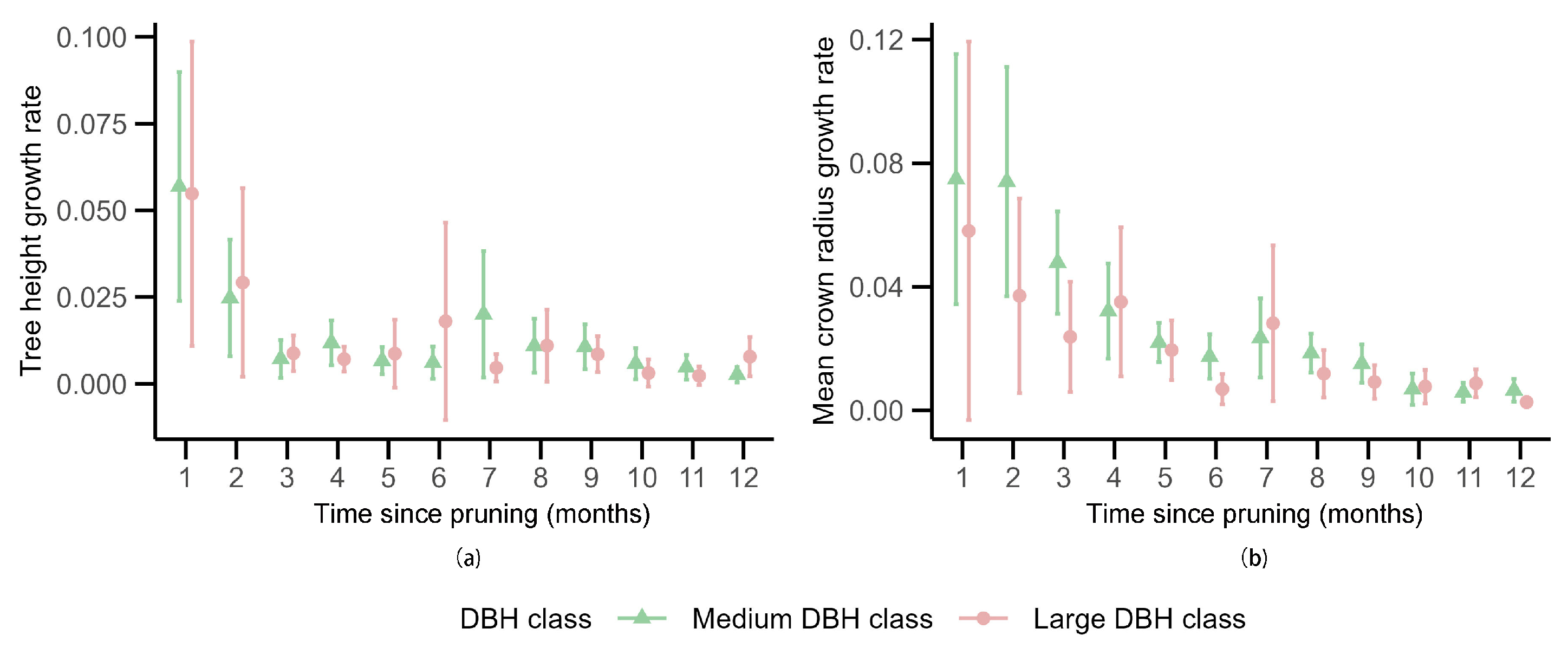
The measured morphological characteristics and post-pruning growth responses of sample trees are summarized in Table 1, categorized by DBH class. In the immediate post-pruning period, the average H was similar between DBH class, with medium DBH class trees averaging 11.12 ± 1.47 m and large DBH class trees 11.97 ± 1.39 m. The average CR ¯ was smaller in the medium DBH class (2.77 ± 0.83 m) than in the large DBH class (3.14 ± 0.85 m). After 12 months of growth, the average H for the medium and large DBH class sample trees was 13.05 ± 1.42 m and 13.98 ± 1.05 m, respectively, while their average CR ¯ for the medium and large DBH class sample trees was 3.80 ± 0.92 m and 3.98 ± 1.04 m.
For average monthly growth rates, trees in the medium DBH class showed higher HGR and CR ¯ GR compared to the large DBH class. Specifically, HGR averaged 0.0141 ± 0.0281 m/month and CR ¯ GR 0.0283 ± 0.0416 m/month for medium-class trees, while large-class trees showed lower rates of 0.0137 ± 0.0277 m/month in HGR and 0.0206 ± 0.0350 m/month in CR ¯ GR (Table 1).
In addition, the average HGR and CR ¯ GR in each month after pruning for each DBH class were plotted based on field measurements (Figure 1).

3.2. Distribution Characteristics and Preliminary Significance Testing of Tree Morphological Growth Rate

The Shapiro–Wilk test confirmed that both the CR ¯ GR (W = 0.5981, p < 0.001) and HGR (W = 0.5067, p < 0.001) significantly deviated from a normal distribution, which was further supported by the Q–Q plots. Then the Wilcoxon rank-sum test was applied to preliminarily assess differences in GR between DBH classes. The results revealed that the CR ¯ GR differed significantly between DBH classes (p = 0.027), while the HGR showed no significant difference (p = 0.733).

3.3. Morphological Response Trends of Post-Pruning Acacia auriculiformis

3.3.1. Temporal Trends in Tree Height Growth Rate

In modeling HGR after pruning, DBH class showed no significant effect (p = 0.788). Its inclusion failed to notably improve model fit ( Δ AIC ≤ 2). Therefore, the optimal models retained only time as a fixed effect, which was fitted using a natural spline with three degrees of freedom (df = 3). Random effects included sample trees and unobserved stratum variation (Table 2). The model exhibited a good fit (AIC = −846.4, BIC = −816.1, logLik = 431.2). Within the fixed effects, the regression coefficient of the first natural spline basis function was non-significant (p = 0.349), whereas the remaining two natural spline basis functions were both significant (p < 0.001) (Table 2), indicating a nonlinear temporal trend in HGR. Additionally, for the random effects, the variance of the random intercept across sample trees was 0.013 (SD = 0.112), indicating minor baseline variation in HGR between trees. The intercept variance at the unobserved stratum variation was 1.021 (SD = 1.010), indicating a greater contribution of unobserved stratum variation to growth rate variability.
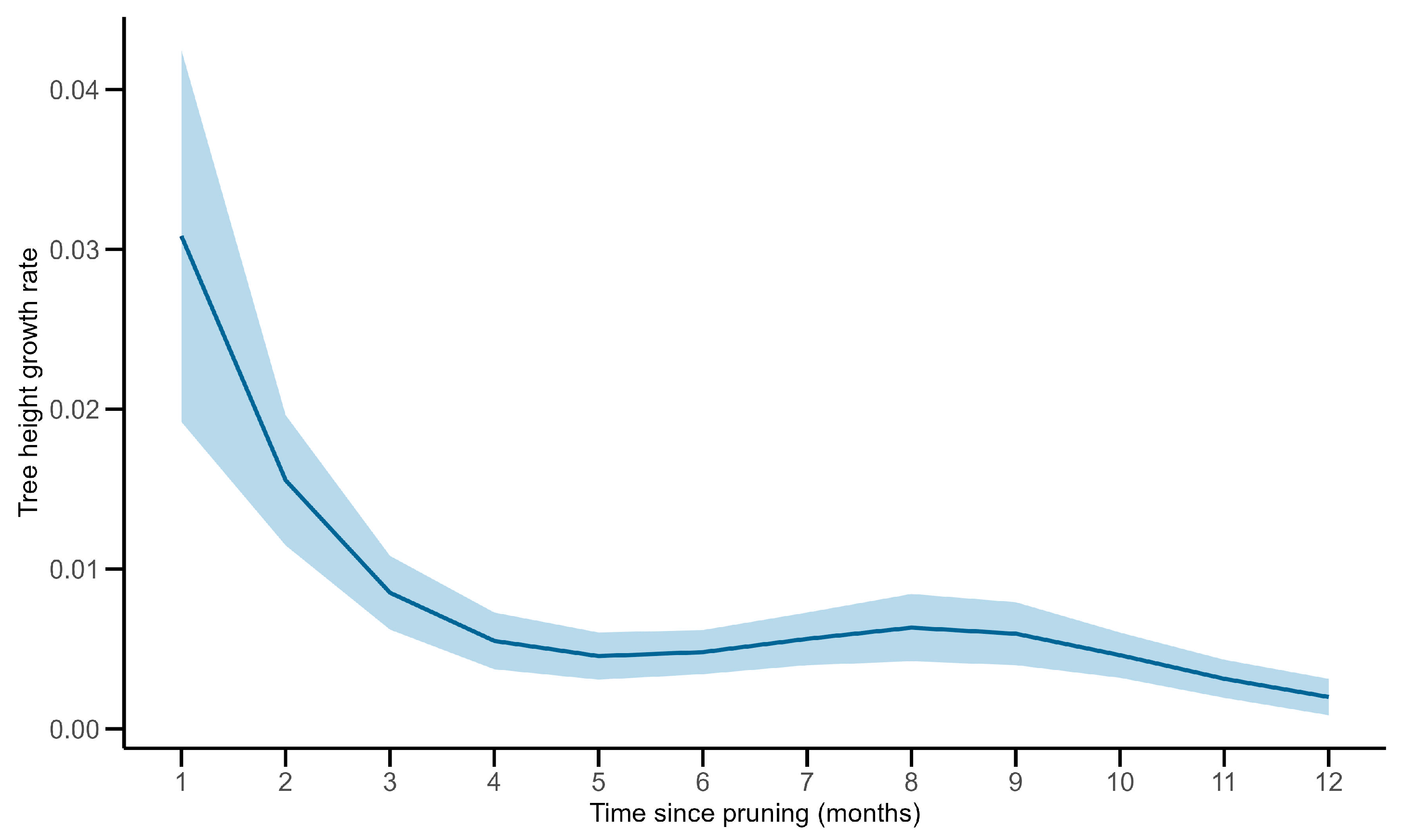
Based on the optimal model predictions, the HGR exhibited a temporal trend over the 12 monthly periods after pruning. HGR reached its peak in the 1st monthly period (predicted value: 0.031). Subsequently, a rapid decline followed. The steepest decrease occurred between the 1st and 2nd monthly periods (absolute variation: –0.015). From the 2nd to the 5th monthly periods, the HGR continued to decrease, though at a slower pace. After that, a slight recovery occurred from the 5th to the 8th monthly periods. Thereafter, from the 8th to the 12th monthly periods, HGR gradually declined again, with overlapping confidence intervals. Overall, the post-pruning HGR exhibited a sharp initial decline, followed by a brief recovery and ultimately a gradual deceleration (Figure 2; Table A1).

3.3.2. Temporal Trends in Mean Crown Radius Growth Rate Between Different DBH Classes

In modeling CR ¯ GR after pruning, DBH class was included as a fixed effect due to its significant influence between DBH classes (p = 0.006) and its inclusion resulted in improvement in model fit ( Δ AIC > 2). The optimal model included time and DBH class as fixed effects. Sample trees and unobserved stratum variation were included as random effects. The model demonstrated good fit (AIC = −1586.6, BIC = −1560.2, logLik = 800.3) and captured temporal changes in CR ¯ GR (Table 3). A significant negative correlation was observed between time and CR ¯ GR (estimate = −0.2092, p < 0.001). It indicated a consistent decline in the CR ¯ GR for A. auriculiformis. DBH class also significantly affected the CR ¯ GR (estimate = −0.3827, p < 0.01). The medium DBH class exhibited a significantly higher growth rate than the large DBH class. The variance of the random intercept across sample trees was 0.033 (SD = 0.182). The random intercept variance at the unobserved stratum variation was 0.684 (SD = 0.827). These results indicate that unobserved stratum variation contributed more to growth rate variability.
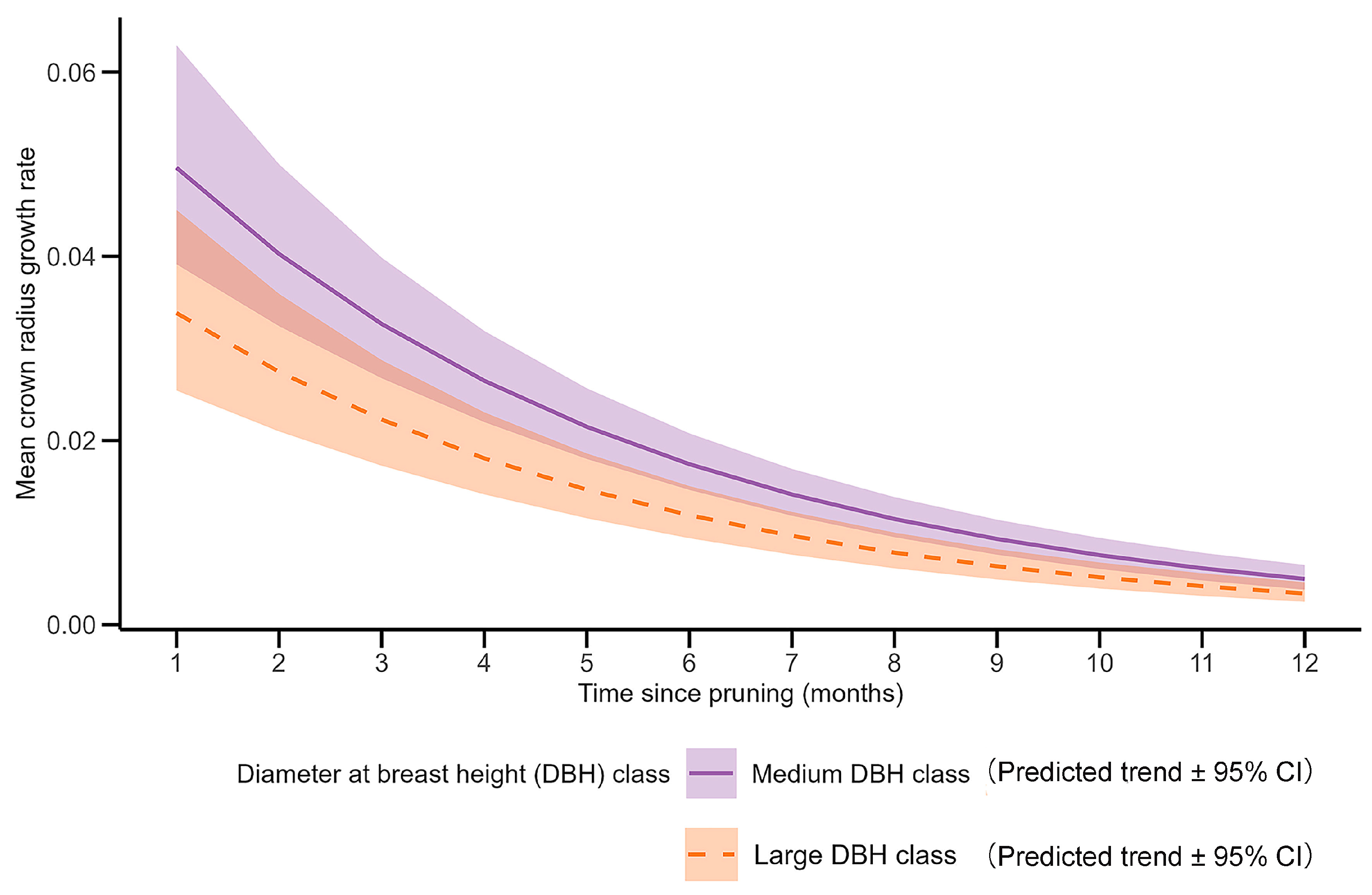
Based on the optimal model predictions, the CR ¯ GR exhibited a temporal trend over the 12 monthly periods after pruning. The CR ¯ GR peaked during the 1st monthly period (the predicted value for the large DBH class was 0.0338, the predicted value for the medium DBH class was 0.0496), then all DBH classes exhibited an exponential decline in growth rates, with the medium DBH class showing a relatively steeper drop during the initial stage after pruning. Over time, the declining trend slowed, and the differences in growth rate between DBH classes gradually narrowed and converged (Figure 3 and Table A2).

4. Discussion

Based on a one-year observation of urban Acacia auriculiformis following crown reduction pruning, this study found that tree size significantly influenced crown recovery dynamics. These results reveal an observational recovery trend, providing preliminary exploratory evidence for understanding tree responses to pruning disturbance in urban environments.

4.1. Morphological Growth Rate Response

The optimal GLMM showed that trees of different DBH classes had significantly different mean crown radius growth rates after pruning (p = 0.006), while no significant difference was observed in tree height growth rates (p = 0.788). This response pattern suggests that pruned trees allocate growth resources preferentially toward canopy recovery to rapidly rebuild photosynthetic capacity [19,49,50]. Consequently, tree height growth exhibited a certain degree of suppression or delay [19,51]. Since the response of tree height may require longer time to manifest, differences in tree height growth rates between DBH classes may not have emerged during the 12-month observation period of our study. In terms of the predicted values for mean crown radius growth rate, the large class exhibited markedly lower rates than the medium class (Figure 3 and Table A2). These findings align with earlier reports by Alvarez et al. and Xizhou Zhao et al. [19,29]. They found that canopy recovery after pruning was associated with tree size, with smaller trees showing higher sensitivity to pruning and faster growth responses. It should be emphasized that the pruning intensity in this study was approximately 35%–40%. As the pruning was carried out manually in the field, some variation in the actual pruning amount was unavoidable, which may have partially affected the observed growth rates [12,51]. Furthermore, potential age disparities among different DBH classes suggest that the observed differences in crown radius growth rates may also partly originate from tree age variations and the concomitant differences in inherent growth vigor. It should be noted that, although the approximate age of the sampled trees was estimated based on the method of Sarkar et al. [34], the estimates carry some uncertainty due to the inability to perform destructive sampling and the potential influence of environmental conditions and urban management practices on DBH [52].
Both the predicted and measured morphological growth rates of A. auriculiformis reached their peak within the 1st month after pruning (Figure 1, Figure 2 and Figure 3). This phenomenon likely stems from the combined effects of multiple factors. First, this phenomenon aligns with observations of Prunus persica by Mediene et al. [53]. Their study demonstrated that pruning raises short-term nitrogen levels within trees, thereby promoting cell division and accelerating shoot growth. Additionally, pruning increases canopy light penetration, which may further stimulate the sprouting and rapid elongation of latent buds [54]. Second, the pruning in this experiment was conducted in May, which coincides with the main growing season of A. auriculiformis (April to June) [55,56]. Moreover, during May to June 2024, Guangzhou experienced higher than average rainfall alongside noticeably elevated temperatures relative to the long-term average (1991–2020) [33]. This warm and humid climate also created a favorable environment for rapid growth of A. auriculiformis [20,30].
Following the initial peak, morphological growth rates exhibited an overall trend of decline followed by stabilization (Figure 2 and Figure 3), a pattern potentially regulated by tree carbon resource dynamics and inherent growth characteristics. Within the first month after pruning [57], trees experience substantial consumption of non-structural carbohydrates (NSC, e.g., starch) due to latent bud sprouting and growth [58]. Consequently, tree growth rates tend to decrease after the first month. Subsequently, both measured morphological growth rates showed a slight increase in the 7th monthly period (Figure 1). This slight increase may be linked to the recovery of carbon reserves in A. auriculiformis. This period also coincides with budburst and leaf flushing, which often occur from late November to December in subtropical regions [56]. After this period, growth rates decreased between the 8th and 9th months (December 2024 to February 2025). Huang et al. reported that A. auriculiformis enters dormancy and undergoes progressive leaf shedding during this time [56]. Ultimately, the decline in morphological growth rates stabilized from the 10th monthly period onward (absolute variation < 0.002; Table A1 and Table A2), with overlapping confidence intervals. This stabilization suggests the trees may be approaching a morphological recovery equilibrium under current environmental conditions approximately one-year post-pruning. However, rate stabilization does not indicate complete structural restoration. Previous studies suggest urban trees typically require about two years to achieve full morphological recovery after pruning [29], with interspecific variation in recovery duration [13]. Therefore, validation through controlled studies with unpruned counterparts remains necessary to accurately determine recovery stages.

4.2. Value and Limitations

This study focused on Acacia auriculiformis in urban environments and quantified the morphological responses of trees with different DBH classes after pruning, thereby providing exploratory evidence for understanding pruning recovery in urban trees. The model results showed that, under the conditions of this study, only the crown recovery rate differed significantly among DBH classes, indicating that tree crown is a more sensitive indicator of short-term post-pruning morphological responses than tree height. This suggests that greater attention may be given to crown metrics in related research and management, while recognizing DBH class as an essential factor when assessing pruning responses. In addition, the generalized linear mixed model (GLMM) developed in this study provides a preliminary quantitative basis for predicting the recovery dynamics of A. auriculiformis after pruning, which may support future efforts to refine pruning cycle planning in urban tree management.
It should be noted that due to the absence of an unpruned control group in this study, the observed growth changes cannot be strictly attributed solely to pruning responses, as they may also represent inherent seasonal growth rhythms. Furthermore, it was challenging to retain unpruned individuals of the same species in the urban environment for comparison.
Based on these considerations, future research would benefit from experimental designs that incorporate unpruned control groups, expand observations to multiple species and pruning methods, and extend the monitoring duration. Integrating high-resolution environmental and management data could further improve model accuracy and applicability. As pruning in southern China is typically conducted before the typhoon season and prior to winter dormancy, different pruning periods may generate distinct annual morphological responses [51,59]. Therefore, future studies should take different pruning periods into account. Moreover, Lin et al. reported that variations in urban habitats exert a significant influence on urban tree growth [31]. Building on this, future work could incorporate habitat characteristics alongside pruning practices to develop more precise and comprehensive growth rate prediction models for urban trees. Meanwhile, collecting key physiological and biochemical indicators such as photosynthetic capacity and endogenous hormone levels under clearly defined control conditions would help clarify the mechanisms underlying post-pruning changes in tree morphology and provide a more solid scientific basis for urban tree management.

5. Conclusions

Analysis of pruning effects on urban A. auriculiformis morphology revealed that the mean crown radius growth rate of medium DBH trees was significantly higher than that of large DBH trees, while tree height growth rate did not differ significantly across DBH classes. Modeling further indicated that post-pruning growth rates were relatively high in the early stage, gradually declined, and stabilized around the 10th monthly period. Therefore, our study provides a new perspective for urban tree pruning management: incorporating tree size class into the decision-making framework may help optimize the structural recovery process and long-term management benefits.
This study makes a preliminary contribution to filling a gap in the literature on the morphological responses of urban trees to pruning. Moreover, the morphological growth rate model developed here provides a preliminary quantitative basis for predicting the post-pruning recovery dynamics of A. auriculiformis and deepens understanding of growth patterns under pruning disturbances. The findings offer basic reference information for urban tree maintenance and can contribute to improving future urban greening management efficiency, thereby supporting the sustainable development of urban ecosystems.

Author Contributions

K.L.: Writing—original draft, Formal analysis, Data curation. N.P.: Writing—review & editing, Investigation, Data curation. Y.S.: Writing—review & editing, Formal analysis, Funding acquisition, Data curation. J.Z.: Investigation, Formal analysis, Data curation. W.G.: Writing—review & editing, Formal analysis, Conceptualization. C.L.: Writing—review & editing, Investigation, Funding acquisition, Formal analysis, Conceptualization. All authors have read and agreed to the published version of the manuscript.

Funding

This research was funded by the Guangzhou Science and Technology Plan Project (Grant No. 2025A04J5172), the National Natural Science Foundation of China (Grant No. 32201620) and the Guangdong Innovation Team for the Higher-educational Institution (Grant No. 2024KCXTD078).

Data Availability Statement

The datasets generated during and/or analyzed during the current study are available from the corresponding authors upon reasonable request.

Conflicts of Interest

The authors declare no conflicts of interest.

Appendix A

Table A1. Model prediction and analysis of tree height growth rate.
Monthly PeriodPredicted ValueAbsolute VariationConfidence Interval (95%)
Month 10.0308-(0.0192, 0.0425)
Month 20.0156−0.01529(0.0115, 0.0196)
Month 30.0085−0.00703(0.0062, 0.0108)
Month 40.0055−0.00301(0.0037, 0.0073)
Month 50.0046−0.00095(0.0031, 0.0060)
Month 60.00480.00025(0.0034, 0.0062)
Month 70.00560.00083(0.0040, 0.0073)
Month 80.00630.00070(0.0042, 0.0084)
Month 90.0060−0.00040(0.0040, 0.0079)
Month 100.0046−0.00134(0.0032, 0.0060)
Month 110.0031−0.00148(0.0019, 0.0043)
Month 120.0020−0.00114(0.0009, 0.0031)
Note. Months 1–12 indicate consecutive monthly periods after pruning. Absolute variation was calculated as the difference between predicted values of consecutive post-pruning monthly periods (later minus earlier) based on the optimal model.
Table A2. Model prediction and analysis of mean crown radius growth rate.
Monthly PeriodDBH ClassPredicted ValueAbsolute VariationConfidence Interval (95%)
Month 1M0.0496-(0.0391, 0.0629)
L0.0338-(0.0254, 0.0450)
Month 2M0.0403−0.00937(0.0324, 0.0500)
L0.0275−0.00639(0.0210, 0.0359)
Month 3M0.0327−0.00760(0.0268, 0.0398)
L0.0223−0.00518(0.0173, 0.0287)
Month 4M0.0265−0.00616(0.0220, 0.0319)
L0.0181−0.00420(0.0142, 0.0231)
Month 5M0.0215−0.00500(0.0180, 0.0257)
L0.0147−0.00341(0.0116, 0.0186)
Month 6M0.0174−0.00406(0.0146, 0.0208)
L0.0119−0.00277(0.0094, 0.0151)
Month 7M0.0141−0.00329(0.0118, 0.0169)
L0.0096−0.00224(0.0076, 0.0122)
Month 8M0.0115−0.00267(0.0095, 0.0139)
L0.0078−0.00182(0.0061, 0.0100)
Month 9M0.0093−0.00217(0.0076, 0.0114)
L0.0063−0.00148(0.0049, 0.0082)
Month 10M0.0075−0.00176(0.0061, 0.0094)
L0.0051−0.00120(0.0039, 0.0068)
Month 11M0.0061−0.00143(0.0048, 0.0078)
L0.0042−0.00097(0.0031, 0.0056)
Month 12M0.0050−0.00116(0.0038, 0.0065)
L0.0034−0.00079(0.0025, 0.0046)
Note. L denotes the large DBH class, and M denotes the medium DBH class. Months 1–12 indicate consecutive monthly periods after pruning. Absolute variation was calculated as the difference between predicted values of consecutive post-pruning monthly periods (later minus earlier) based on the optimal model.

References

  1. Tan, X.; Hirabayashi, S.; Shibata, S. Estimation of Ecosystem Services Provided by Street Trees in Kyoto, Japan. Forests 2021, 12, 311. [Google Scholar] [CrossRef]
  2. Rötzer, T.; Moser-Reischl, A.; Rahman, M.A.; Hartmann, C.; Paeth, H.; Pauleit, S.; Pretzsch, H. Urban Tree Growth and Ecosystem Services under Extreme Drought. Agric. For. Meteorol. 2021, 308–309, 108532. [Google Scholar] [CrossRef]
  3. Yang, J.; Chang, Y.; Yan, P. Ranking the Suitability of Common Urban Tree Species for Controlling PM2.5 Pollution. Atmos. Pollut. Res. 2015, 6, 267–277. [Google Scholar] [CrossRef]
  4. Liang, D.; Huang, G. Influence of Urban Tree Traits on Their Ecosystem Services: A Literature Review. Land 2023, 12, 1699. [Google Scholar] [CrossRef]
  5. Rötzer, T.; Rahman, M.; Moser-Reischl, A.; Pauleit, S. Process Based Simulation of Tree Growth and Ecosystem Services of Urban Trees under Present and Future Climate Conditions. Sci. Total Environ. 2019, 676, 651–664. [Google Scholar] [CrossRef] [PubMed]
  6. Zhao, J.; Zhao, X.; Wu, D.; Meili, N.; Fatichi, S. Satellite-based Evidence Highlights a Considerable Increase of Urban Tree Cooling Benefits from 2000 to 2015. Glob. Change Biol. 2023, 29, 3085–3097. [Google Scholar] [CrossRef]
  7. Hand, K.; Doick, K. Understanding the Role of Urban Tree Management on Ecosystem Services; Forestry Commission: Bristol, UK, 2019. [Google Scholar]
  8. Vogt, J.; Hauer, R.J.; Fischer, B.C. The Costs of Maintaining and Not Maintaining the Urban Forest: A Review of the Urban Forestry and Arboriculture Literature. Arboric. Urban For. (AUF) 2015, 41, 293–323. [Google Scholar] [CrossRef]
  9. ANSI A300; Tree, Shrub and Other Woody Plant Maintenance Standard Practices. Tree Care Industry Association Tree Care Industry Association: Manchester, UK, 2017.
  10. Harris, R.W. Clarifying Certain Pruning Terminology: Thinning, Heading, Pollarding. Arboric. Urban For. (AUF) 1994, 20, 50–54. [Google Scholar] [CrossRef]
  11. Purcell, L. Tree Pruning Essentials. In Forestry and Natural Resources; Purdue Extension: West Lafayette, IN, USA, 2015. [Google Scholar]
  12. Fini, A.; Frangi, P.; Faoro, M.; Piatti, R.; Amoroso, G.; Ferrini, F. Effects of Different Pruning Methods on an Urban Tree Species: A Four-Year-Experiment Scaling down from the Whole Tree to the Chloroplasts. Urban For. Urban Green. 2015, 14, 664–674. [Google Scholar] [CrossRef]
  13. Speak, A.F.; Salbitano, F. The Impact of Pruning and Mortality on Urban Tree Canopy Volume. Urban For. Urban Green. 2023, 79, 127810. [Google Scholar] [CrossRef]
  14. Muscas, D.; Orlandi, F.; Petrucci, R.; Proietti, C.; Ruga, L.; Fornaciari, M. Effects of Urban Tree Pruning on Ecosystem Services Performance. Trees For. People 2024, 15, 100503. [Google Scholar] [CrossRef]
  15. Pinkard, E.A. Effects of Pattern and Severity of Pruning on Growth and Branch Development of Pre-Canopy Closure Eucalyptus Nitens. For. Ecol. Manag. 2002, 157, 217–230. [Google Scholar] [CrossRef]
  16. Hevia, A.; Álvarez-González, J.G.; Majada, J. Comparison of Pruning Effects on Tree Growth, Productivity and Dominance of Two Major Timber Conifer Species. For. Ecol. Manag. 2016, 374, 82–92. [Google Scholar] [CrossRef]
  17. Cyr, G. Les Effets de Ĺélagage Sur Le Croissance. In Actes du Colloque Élaguer Pour Enrichir nos Forêts; L’académie des Sciences: Paris, France, 2006. [Google Scholar]
  18. Muñoz, F.; Espinosa, M.; Herrera, M.A.; Cancino, J. Características Del Crecimiento En Diámetro, Altura y Volumen de Una Plantación de Eucalyptus Nitens Sometida a Tratamientos Silvícolas de Poda y Raleo. Bosque 2005, 26, 93–99. [Google Scholar] [CrossRef]
  19. Alvarez, A.J.; Villagra, P.E.; Villalba, R.; Debandi, G. Effects of the Pruning Intensity and Tree Size on Multi-Stemmed Prosopis Flexuosa Trees in the Central Monte, Argentina. For. Ecol. Manag. 2013, 310, 857–864. [Google Scholar] [CrossRef]
  20. Amateis, R.L.; Burkhart, H.E. Growth of Young Loblolly Pine Trees Following Pruning. For. Ecol. Manag. 2011, 262, 2338–2343. [Google Scholar] [CrossRef]
  21. Coomes, D.A.; Allen, R.B. Effects of Size, Competition and Altitude on Tree Growth. J. Ecol. 2007, 95, 1084–1097. [Google Scholar] [CrossRef]
  22. Matsushita, M.; Takata, K.; Hitsuma, G.; Yagihashi, T.; Noguchi, M.; Shibata, M.; Masaki, T. A Novel Growth Model Evaluating Age–Size Effect on Long-term Trends in Tree Growth. Funct. Ecol. 2015, 29, 1250–1259. [Google Scholar] [CrossRef]
  23. Coates, K.D.; Lilles, E.B.; Astrup, R. Competitive interactions across a soil fertility gradient in a multispecies forest. J. Ecol. 2013, 101, 806–818. [Google Scholar] [CrossRef]
  24. Muscas, D.; Fornaciari, M.; Proietti, C.; Ruga, L.; Orlandi, F. Tree Growth Rate under Urban Limiting Conditions. Eur. J. For. Res. 2023, 142, 1423–1437. [Google Scholar] [CrossRef]
  25. Lüttge, U.; Buckeridge, M. Trees: Structure and Function and the Challenges of Urbanization. Trees 2023, 37, 9–16. [Google Scholar] [CrossRef]
  26. Livesley, S.J.; McPherson, E.G.; Calfapietra, C. The Urban Forest and Ecosystem Services: Impacts on Urban Water, Heat, and Pollution Cycles at the Tree, Street, and City Scale. J. Environ. Qual. 2016, 45, 119–124. [Google Scholar] [CrossRef]
  27. Devin, S.R.; Prudencio, Á.S.; Mahdavi, S.M.E.; Rubio, M.; Martínez-García, P.J.; Martínez-Gómez, P.; Devin, S.R.; Prudencio, Á.S.; Mahdavi, S.M.E.; Rubio, M.; et al. Orchard Management and Incorporation of Biochemical and Molecular Strategies for Improving Drought Tolerance in Fruit Tree Crops. Plants 2023, 12, 773. [Google Scholar] [CrossRef]
  28. Clark, J.R.; Matheny, N. The Research Foundation to Tree Pruning: A Review of the Literature. Arboric. Urban For. AUF 2010, 36, 110–120. [Google Scholar] [CrossRef]
  29. Zhao, X.; Mang, S.; Quan, W.; Ding, G. Growth Response of Trees with Different Growth Statuses to Pruning on a Pinus Massoniana Lamb. Plantation. Forests 2023, 14, 668. [Google Scholar] [CrossRef]
  30. Peng, S.L.; Liu, J.; Lu, H.F. Characteristics and Role of Acacia Auriculiformis on Vegetation Restoration in Lower Subtropics of China. J. Trop. For. Sci. 2005, 17, 508–525. [Google Scholar]
  31. Lin, W.; Guo, W.; Huang, S.; Wei, J.; Wei, Y.; Zhou, J.; Lai, C. Effects of Growth Space Limitation on Allometry of Ficus spp. in Urban Habitats. J. Clean. Prod. 2024, 471, 143413. [Google Scholar] [CrossRef]
  32. Guangzhou Administration for Market Regulation. Technical Specification for Soil Amelioration of Green Space; Guangzhou Administration for Market Regulation: Guangzhou, China, 2023. [Google Scholar]
  33. Guangzhou Meteorological. Guangzhou Climate Bulletin, 2024; Guangzhou Meteorological: Guangzhou, China, 2025. [Google Scholar]
  34. Sarkar, D.C.; Das, S.; Kibria, M.G. Growth Statistics of Akashmoni (Acacia Auriculiformis) in Strip and Block Plantation of Bangladesh. Bangladesh J. For. Sci. 2008, 31, 43–50. [Google Scholar]
  35. Tang, Y.; Shao, Q.; Shi, T.; Wu, G. Developing Growth Models of Stand Volume for Subtropical Forests in Karst Areas: A Case Study in the Guizhou Plateau. Forests 2021, 12, 83. [Google Scholar] [CrossRef]
  36. Wilcoxon, F. Individual Comparisons by Ranking Methods. In Breakthroughs in Statistics: Methodology and Distribution; Kotz, S., Johnson, N.L., Eds.; Springer: New York, NY, USA, 1992; pp. 196–202. ISBN 978-1-4612-4380-9. [Google Scholar]
  37. Hothorn, T.; Hornik, K.; van de Wiel, M.A.; Zeileis, A. A Lego System for Conditional Inference. Am. Stat. 2006, 60, 257–263. [Google Scholar] [CrossRef]
  38. Brooks, M.; Kristensen, K.; van Benthem, K.; Magnusson, A.; Berg, C.; Nielsen, A.; Skaug, H.; Mächler, M.; Bolker, B. glmmTMB Balances Speed and Flexibility Among Packages for Zero-Inflated Generalized Linear Mixed Modeling. R J. 2017, 9, 675. [Google Scholar] [CrossRef]
  39. Dunn, P.K.; Smyth, G.K. Series Evaluation of Tweedie Exponential Dispersion Model Densities. Stat. Comput. 2005, 15, 267–280. [Google Scholar] [CrossRef]
  40. Jankowski, P.A.; Calama, R.; Madrigal, G.; Pardos, M. Enhanced Interannual Drought Resilience in Mixed Stands: Unveiling Possible Complementarity Effects between Tree Species of the Spanish Northern Plateau. Eur. J. For. Res. 2024, 144, 755–774. [Google Scholar] [CrossRef]
  41. Bolker, B.M.; Brooks, M.E.; Clark, C.J.; Geange, S.W.; Poulsen, J.R.; Stevens, M.H.H.; White, J.-S.S. Generalized Linear Mixed Models: A Practical Guide for Ecology and Evolution. Trends Ecol. Evol. 2009, 24, 127–135. [Google Scholar] [CrossRef]
  42. Bolker, B. Getting Started with the glmmTMB Package; R Foundation for Statistical Computing Software: Vienna, Austria, 2016. [Google Scholar]
  43. Anderson, A.M.N.; Anderson, G.B. Chapter 4—Generalized Linear Models. In Advanced Epidemiological Analysis; Colorado State University: Fort Collins, CO, USA, 2025. [Google Scholar]
  44. Chuang, Y.; Mazumdar, S.; Park, T.; Tang, G.; Arena, V.C. Generalized Linear Mixed Models in Time Series Studies of Air Pollution. Atmos. Pollut. Res. 2011, 2, 428–435. [Google Scholar] [CrossRef]
  45. Fitzmaurice, G.; Davidian, M.; Verbeke, G.; Molenberghs, G. Longitudinal Data Analysis; CRC Press: Boca Raton, FL, USA, 2008; ISBN 978-1-4200-1157-9. [Google Scholar]
  46. Perperoglou, A.; Sauerbrei, W.; Abrahamowicz, M.; Schmid, M. A Review of Spline Function Procedures in R. BMC Med. Res. Methodol. 2019, 19, 46. [Google Scholar] [CrossRef]
  47. Burnham, K.P.; Anderson, D.R.; Huyvaert, K.P. AIC Model Selection and Multimodel Inference in Behavioral Ecology: Some Background, Observations, and Comparisons. Behav. Ecol. Sociobiol. 2011, 65, 23–35. [Google Scholar] [CrossRef]
  48. Hartig, F. DHARMa: Residual Diagnostics for Hierarchical (Multi Level/Mixed) Regression Models. In CRAN: Contributed Packages; The R Foundation: Vienna, Austria, 2022. [Google Scholar]
  49. Elfadl, M.A.; Luukkanen, O. Effect of Pruning on Prosopis juliflora: Considerations for Tropical Dryland Agroforestry. J. Arid. Environ. 2003, 53, 441–455. [Google Scholar] [CrossRef]
  50. Comin, S.; Fini, A.; Napoli, M.; Frangi, P.; Vigevani, I.; Corsini, D.; Ferrini, F. Effects of Severe Pruning on the Microclimate Amelioration Capacity and on the Physiology of Two Urban Tree Species. Urban For. Urban Green. 2025, 103, 128583. [Google Scholar] [CrossRef]
  51. Maurin, V.; Des Rochers, A. Physiological and Growth Responses to Pruning Season and Intensity of Hybrid Poplar. For. Ecol. Manag. 2013, 304, 399–406. [Google Scholar] [CrossRef]
  52. Ow, L.F.; Ghosh, S. Growth of street trees in urban ecosystems: Structural cells and structural soil. J. Urban Ecol. 2017, 3, jux017. [Google Scholar] [CrossRef][Green Version]
  53. Mediene, S.; Jordan, M.O.; Pagès, L.; Lebot, J.; Adamowicz, S. The Influence of Severe Shoot Pruning on Growth, Carbon and Nitrogen Status in Young Peach Trees (Prunus Persica). Tree Physiol. 2002, 22, 1289–1296. [Google Scholar] [CrossRef]
  54. Takiya, M.; Koyama, H.; Umeki, K.; Yasaka, M.; Ohno, Y.; Watanabe, I.; Terazawa, K. The Effects of Early and Intense Pruning on Light Penetration, Tree Growth, and Epicormic Shoot Dynamics in a Young Hybrid Larch Stand. J. For. Res. 2010, 15, 149–160. [Google Scholar] [CrossRef]
  55. Ren, H.; Peng, S. The Ecological and Biological Characteristics of Acacia Auriculaeformis. GUIHAIA 1998, 18, 146–152. [Google Scholar]
  56. Huang, M.; Huang, Y.; Zhao, M.; Ruan, S.; Ding, G.; He, S.; Lin, Q. Phenological Observation of 5 exotic Acacia Species. J. Fujian For. Sci Tech 2018, 45, 28–32. [Google Scholar]
  57. Chesney, P.; Vasquez, N. Dynamics of Non-Structural Carbohydrate Reserves in Pruned Erythrina poeppigiana and Gliricidia sepium Trees. Agrofor. Syst. 2007, 69, 89–105. [Google Scholar] [CrossRef]
  58. Smith, M.G.; Arndt, S.K.; Miller, R.E.; Kasel, S.; Bennett, L.T. Trees Use More Non-Structural Carbohydrate Reserves during Epicormic than Basal Resprouting. Tree Physiol. 2018, 38, 1779–1791. [Google Scholar] [CrossRef] [PubMed]
  59. Fini, A.; Ferrini, F.; Frangi, P.; Piatti, R.; Faoro, M.; Amoroso, G. Effect of Pruning Time on Growth, Wound Closure and Physiology of Sycamore Maple (Acer pseudoplatanus L.). Acta Hortic. 2013, 990, 99–104. [Google Scholar] [CrossRef]
Figure 1. Average morphological growth rates measured in each month after pruning. (a) Measured average tree height growth rate. (b) Measured average mean crown radius growth rate. Triangles represent the medium DBH class (green), circles represent the large DBH class (pink). The lines represent the 95% confidence interval. X-axis: “Time Since Pruning (months)” denotes sequential post-pruning measurement intervals. Values 1–12 represent the 1st to 12th consecutive monthly intervals, with growth rates for each interval calculated from measurements taken at the beginning and end of the period.
Forests 16 01826 g001
Figure 2. Predicted temporal trend of tree height growth rate based on the optimal mixed-effects model. Solid line: predicted values based on fixed effects. Shaded area: 95% confidence interval. X-axis: “Time Since Pruning (months)” denotes sequential post-pruning measurement intervals. Values 1–12 represent the 1st to 12th consecutive monthly intervals, with growth rates for each interval calculated from measurements taken at the beginning and end of the period.
Forests 16 01826 g002
Figure 3. Predicted temporal trend of mean crown radius growth rate based on the optimal mixed-effects model. The solid line represents the predicted values for the medium DBH class (purple) based on fixed effects, while the dashed line represents those for the large DBH class (orange). The shaded areas indicate their 95% confidence intervals. X-axis: “Time Since Pruning (months)” denotes sequential post-pruning measurement intervals. Values 1–12 represent the 1st to 12th consecutive monthly intervals, with growth rates for each interval calculated from measurements taken at the beginning and end of the period.
Forests 16 01826 g003
Table 1. Basic characteristics of sample trees at 0 and 12 months post-pruning.
IndicatorMedium DBH Class (Mean ± SD)Large DBH Class (Mean ± SD)
0-Months
Post-Pruning
12-Months
Post-Pruning
0-Months
Post-Pruning
12-Months
Post-Pruning
Average H/m11.12 ± 1.4713.05 ± 1.4211.97 ± 1.3913.98 ± 1.05
Average CR ¯ /m2.77 ± 0.833.80 ± 0.923.14 ± 0.853.98 ± 1.04
Average DBH/cm37.32 ± 4.2750.22 ± 6.48
Average monthly HGR0.0141 ± 0.02810.0137 ± 0.0277
Average monthly CR ¯ GR 0.0283 ± 0.04160.0206 ± 0.0350
Table 2. Fixed effect estimates from GLMMs for tree height growth rate of A. auriculiformis.
Model Fixed Effects CombinationModel TermEstimate (Standard Error)AIC Δ AIC
Time (ns (Month, df = 3))Intercept−3.4789 *** (0.1924)−846.42
ns (Month, df = 3)1−0.3213 (0.3432)
ns (Month, df = 3)2−4.3372 *** (0.5209)
ns (Month, df = 3)3−1.2950 *** (0.2942)
Time (ns (Month, df = 3)), DBH classIntercept−3.4619 *** (0.2026)−844.4
ns (Month, df = 3)1−0.3231 (0.3433)
ns (Month, df = 3)2−4.3355 *** (0.5208)
ns (Month, df = 3)3−1.2940 *** (0.2942)
DBH class−0.0468 (0.1745)
Note. Significant mark: *** represents p < 0.001. The values in parentheses are the standard errors. Δ AIC indicates the difference in AIC from the optimal model. A smaller AIC value signifies a better model fit. The medium DBH class was set as the reference level for the DBH class variable. Time: Sequential post-pruning monthly periods starting from pruning date.
Table 3. Fixed effects of the GLMM for mean crown radius growth rate in A. auriculiformis.
Model Fixed Effects
Combination
Model TermEstimate (Standard Error)AIC Δ AIC
Time, DBH classIntercept−2.7942 *** (0.1330)−1586.64.8
Time−0.2092 *** (0.0168)
DBH class−0.3827 ** (0.1394)
TimeIntercept−2. 9312 *** (0.1297)−1581.8
Time−0. 2097 *** (0.0168)
Note. Significant mark: *** p < 0.001, ** p < 0.01. The medium DBH class was set as the reference level for the DBH class variable. The values in parentheses are the standard errors. Δ AIC indicates the difference in AIC from the optimal model. A smaller AIC value signifies a better model fit. Time: Sequential post-pruning monthly periods starting from pruning date.
Disclaimer/Publisher’s Note: The statements, opinions and data contained in all publications are solely those of the individual author(s) and contributor(s) and not of MDPI and/or the editor(s). MDPI and/or the editor(s) disclaim responsibility for any injury to people or property resulting from any ideas, methods, instructions or products referred to in the content.