


Review

Forest Education: Past, Present, and Future

School of Biological Sciences, University of Aberdeen, Aberdeen AB24 3UU, UK
Forests 2025, 16(12), 1801; https://doi.org/10.3390/f16121801 (registering DOI)
Submission received: 26 October 2025 / Revised: 20 November 2025 / Accepted: 25 November 2025 / Published: 29 November 2025
(This article belongs to the Special Issue Future Trends and Challenges in Forest Education)

Abstract

In this narrative review, the purpose is to summarise the current state of forest education using a range of global examples. The literature on forest education is extensive, but the focus tends to be geographically specific or covers a limited period. This ‘story’ of forest education was led by academic sources in an iterative process. Context is provided by an overview of historical origins. Forestry has been transformed from a discipline that emphasised technical skills associated with timber production into a multidisciplinary pedagogy that incorporates social, ecological, and other dimensions that recognise the intrinsic value of forests. The main challenges in forest education are uncertainty and change. It is widely agreed in the literature that the pace and direction of change for forest education are not keeping up with demand in some parts of the world. The need for change is sometimes impeded by the status quo and a reluctance to adapt, struggles with recruitment, and insufficient resources to incorporate new technology. Forest education may need to adapt, with the inclusion of more interdisciplinary programmes and diversification. This approach may help with recruitment and a sense of relevance. The conclusion is that those working in forest education are alert to the challenges ahead.

1. Introduction

This review is a further contribution to important discussions about potential gaps between what is provided and what is needed in forest education. The context for this is the unprecedented, huge, and fast-moving changes that forest education is now facing at a global scale [1,2]. Although there have been extensive adaptations to the forest education curriculum over the decades, there is a risk of gaps remaining between supply and demand. It is possible that just some parts of the curriculum are being neglected, but clearly there is an appetite for making adaptations and improvements [1,2].
Forest education is regarded as “the pillar of the forestry profession” [3], and sometimes ‘forest education’ and ‘forestry’ are used interchangeably. Discussions about forest education (or forestry or forest science) perhaps should include a definition of the concept itself. In this review, I am using ‘forest education’ mostly to refer to academic courses (Bachelor’s, Master’s, or doctoral degrees) or professional training programmes [4,5]. Indeed, to be fully qualified, a forester might need at least five years of academic effort, which incorporates undergraduate and postgraduate study [6,7]. Terminology might be important. For example, ‘forestry science’ might lack the interdisciplinarity of ‘forest science’, and so they are not equivalent [7].
However, ‘forest’ or ‘forestry’ might not even feature in the programme titles [4]. It seems that, increasingly, such programmes may instead have titles invoking ‘environment’ or ‘ecosystem’, or have a focus on ‘conservation’ or ‘sustainability’ [4]. This trend might reflect the importance of attracting a wider range of students, while also still offering students the opportunities to focus on forests [8]. The very idea of a ‘forest’ may be defined in different ways, according to professionals’ perspectives [9,10]. For many regions in the world, ‘forests’ comprise plantations and semi-native forests (e.g., [11]), though plantations often include a majority (~80%) of native species [12]. Another explanation for any disappearance of ‘forestry’-badged degrees is that they have been increasingly incorporated into multi-disciplinary academic programmes [7]. These offer exciting opportunities for students that go beyond the more traditional emphasis of timber production, though this still remains hugely important [8].
There is also an argument that ‘forestry’ (and therefore forest education) is more about people than trees [13]. There is a consensus that ‘people skills’ should be an essential part of the forest education curriculum [14]. In fact, these wider interpretations of forest education will be an emerging theme in this review. Another way to think about this is to consider whether, in a given programme, forest education is primarily vocational or academic. Forest education can, of course, be both. Where there is forestry (in whatever form) in many universities, there will also be forest research [15], which can contribute to research-led teaching as well as being a possible career route for students, after graduation. This option might help to recruit students into forest education [16]. The relationship between different aspects of forest education and the associated fields can be represented in a Venn diagram (Figure 1), which importantly shows overlapping areas.
We could gain an understanding of the past, present, and future of forest education by considering the curriculum in tertiary institutions. Clearly, there have been some major shifts in emphasis, content, and delivery [7], and we shall consider some of these in this review. I will also refer to technical institutions and programmes offering postgraduate development and professional training (e.g., [15,18]). For lower age ranges, ‘forest schools’ provide important opportunities for students to gain an appreciation and understanding of forests [7,19] and may even be the beginning of a journey that could lead to forestry [4,20]. However, I will not focus on forest schools in this review, though I recognise their immense importance, not least as a starting point for early years education [5] and a potential pathway into forest education.
The numerous previous reviews of forest education (e.g., [20,21]) are an indication that practitioners have heavily invested in improvement. Part of the process has involved substantial revisions of the curriculum, in recognition of many global changes that affect forests (or indeed that are affected by forests). The consensus in the literature seems to be that major changes in forest education may still be urgently needed. The purpose of this review is to provide a wider context (historically and geographically) than is typically used.
In using the title ‘Forest education: past, present, and future’, I am emphasising changes, which are both undeniable [13] and desirable. It is important to understand the context, causes, and consequences of these ongoing shifts in content and emphasis. A major source of change is in the institutions themselves, which are alert to new possibilities and innovative opportunities. These could be regarded as supply-driven changes. But it is also likely that many changes have been demand-led, for example, in response to changing expectations from funders, competing industries, public engagement, and the need for conservation and sustainability. Forests are increasingly subject to public interest, even including management [13,22]. Employers have also changed their demands for forestry and forest science graduates [13,22], but forest education does not always match this demand [2,21].
We should also ask the following: What is a ‘forest’? This seems to be a legitimate question that foresters ask themselves [13]. Perhaps the loosest way to describe a forest is a ‘large’ collection of trees growing together, with a closed overhead canopy [23]. But when does a woodland become a forest [24]? And is a monoculture plantation a forest? Probably not, and in any case, mixed-species plantations have many advantages [25]. Purists might argue that to be regarded as a forest, the trees need to be numerous, mixed-aged, and comprising multiple species. In other words, a forest should be complex [24]. Depending on both spatial and temporal scales, a forest can be a habitat, ecosystem [26], or a biome. But if the content of forest education includes timber production, then we return to our simple (perhaps simplistic) definition of a ‘forest’ as being a large collection of trees. For the purposes of this review, we will use this terminology interchangeably while considering some of the many ways in which forestry and forest science are studied.

2. Materials and Methods

This is a narrative review rather than an exhaustive systematic review, since the decision was made to focus on scope (including historical origins) and geographical breadth. The text was constructed from the author’s decision to focus on the past, present, and future of forest education. Within each of these three themes, arguments were built in an iterative way. Beginning with generic concepts, sources were searched (using Google Scholar, Scopus, and JSTOR) to add support to arguments. Inevitably, and by design, sources themselves helped the author to add further layers of meaning.
Sources were chosen for relevance on a given theme, mainly using peer-reviewed papers, with some book chapters and reports when necessary. Where possible, the most recent sources were used. In some cases, a substantial proportion of these sources relate to past events, since Section 3 is an important part of the review that focusses on the historical antecedents of forest education. In other cases, sources themselves are significant reviews of forest education. Several of these are classic sources. Where possible, more than one source was obtained on a specific topic, especially if they represented divergent parts of the narrative. Sources that did not contribute logically to the narrative were not used.
ChatGPT was not used in this review. The content was informed by the numerous citations used in the writing process. Sources were organised using RefWorks v.3. Structure, integration, and synthesis were constructed by the author.

3. Forest Education: The Past

Forestry, and the forest education associated with it, emerged in Europe during the 18th century [8]. The discipline was established in response to the security of timber production [8]. The origins and location of schools of forestry were very much a function of local demand and expertise; these centres were born out of necessity [27]. In reality, schools of forestry are likely to arise in forested areas where the supply of quantity and/or quality of timber needed to be increased. Demand and supply are functions of prevailing local or national environmental, economic, cultural, and social priorities [27]. The quality of forestry, and perhaps forest education, may at least partly have been determined by the urgency of demand [27].
Locations of centres of forestry were often influenced by transport infrastructure, including access to railways, waterways, and coastal ports [27]. We would expect to see locations of intense forestry activity to be supported by regional centres of forest education, to supply the industry with expertise.
Forest, or forestry, schools began a long and continuous process of professionalisation [28]. In these institutions, a set of widely recognised transferable knowledge and skills was taught, often in a forest setting. Curricula tended to have a strong practical emphasis on sustainable forest management [2,29]. During the early evolution of forest education, forestry schools transferred from private agencies to public universities [13]. A further shift was a widening intake of students from predominantly rural backgrounds towards more recruitment from urban communities [13].

3.1. Historical Context by Continent or Region

The earliest forest schools, established in the mid-18th century in Prussia, were basically training centres for bushcraft, from which young men [not women at this stage] went out to secure apprenticeships with forest managers [27]. Forest managers trained a new generation of foresters in what became regarded as ‘master schools’ [27].
For context, a summary of the distribution of forestry institutions and their historical range is presented in Table 1.
Note that in some global regions (notably North America and Europe), forest education has had a long antecedence. We can safely assume that institutions that had earlier origins created traditions, culture, and curricula that inspired and informed the establishment of other institutions within the same nation and beyond. In this section, we also refer to colonial influences, not always benign, which went beyond national boundaries.
We can take a more detailed look at forest education within the continents and other regions. The groupings are generally consistent with those used in a global FAO/ITTO/IUFRO survey of forest education [5]. Although it is not always helpful to consider the history of forest education by continent, as we shall see that it can lead to simplistic generalisations and interpretations. One problem is that the biomes do not neatly map onto continents [31]. This means that major forested biomes, and therefore the forest education set up to utilise them, can differ widely in content. Another issue is that, at the continental scale, even adjacent countries, with comparable climates and natural resources, might have substantially different approaches to forest education.

3.2. Europe

The earliest origins of forest education can be regarded as the first forestry school in what was Prussia, in 1789 [13]. The first forestry institute (Tsarskoye Selo) in what was then the Russian Empire was established in 1803, with more widespread tertiary-level forest education beginning in the 1920s in the Soviet Union [32].
During the later part of the 20th century, massive shifts occurred in forestry within Central and Eastern European countries (CEECs), in which market economies and private ownership took over from central control systems [16]. There was a move to more sustainable ‘holistic’ practice during a period of recovery from poor management and damage to forests from air pollution [16]. But in some CEECs, this period of transition was accompanied by a loss of the prestige of forestry, and therefore of forest education [16].

3.3. North America

In the USA, the earliest forestry school was established in Biltmore in 1889. Founded by Carl A Schenk, the Biltmore Forest School began the professionalisation of forestry and is regarded as the ‘cradle’ or ‘Plymouth Rock’ of the discipline. Biltmore was quickly followed by forestry schools at the universities of Cornell and Yale in the late 1890s and early 1900s. The forest school in Biltmore consisted of a rolling 12-month programme, with a heavy emphasis on hands-on skills [33]. The curriculum included elements that we would still recognise today [33]. The content of early courses, including those led by Gifford Pinchot, professionalised forestry and created what Balogh referred to as ‘The Yale Machine’ [34]. Programmes were heavily informed by science [34], which undoubtedly helped to instil rigor, consistency, and systematic ways of working.
The history of forest education in the USA is marked by a series of national initiatives and priorities, including concerns about a shortage [35] or even ‘famine’, accreditation, post-WWII recovery, and a growing environmental movement [36]. From the mid-1900s, the curriculum moved away from pure technical forestry to include an increasing range of disciplines, including soil science, wildlife management, hydrology, and (later) social sciences [35].
Forest education, including professional training, was seen as important for the forestry industry in protecting foresters (e.g., for insurance purposes) and to ensure that they were working within agreed regulations [37]. Professionalisation of forestry in the USA helped to confer status. Salaries of foresters during the 1930s were regarded as good, though more recently the consensus is that the status of ‘forestry’ has been declining [38].

3.4. Latin America and the Caribbean (LAC)

The earliest ‘forestry’ interventions in Latin America were by indigenous people [39]. For colonial settlers, forests were overwhelming, alien, and ‘spaces of fear’ [40]. The main periods of development in forestry occurred from the mid-19th century. Substantial changes occurred during the period of 1850–1955, in particular [41]. Acceleration of deforestation rates commenced in the 1940s. Early forest education was, for example, initiated by foresters with managerial skills, introducing centres of professionalisation that were often modelled on colonial models from Europe [42]. The establishment of more formal centres of forest education occurred in the first half of the 20th century [43].

3.5. Africa

Forest education in Africa is generally regarded as ‘relatively new’ and strongly influenced by colonial influences from the 1930s [44]. The colonial and FAO influence in sub-Saharan Africa was significant during the 1960s [45]. The forest education was shaped by models from Western Europe and North America, with a strong emphasis on timber production and ‘theory’, but without the social dimension and ignoring the local biology, which have since proved to be vital components of the curriculum [45].
Forestry in South Africa was underway from about 1880, but without formal forest education [46]. The South African College in Cape Town, opened in 1906, was celebrated as the “first school of forestry in the southern hemisphere” [46]. The intention was to train foresters in the context of local conditions rather than by following less relevant ‘colonial’ programmes, but the school closed in 1911 [46]. Forest education in South Africa emerged more strongly from 1932 onwards [46,47], followed by a rapid series of changes associated with the development of plantations [15].

3.6. Asia and the Pacific

The origins of forestry (and forest education) in Southeast Asia were largely a function of colonial history, followed (after empires collapsed) by the emergence of professional networks organised by the Food and Agriculture Organisation (FAO) of the United Nations (UN) [48]. The earliest origins of forestry in SE Asia were in Java (Dutch East Indies), followed by Siam (Thailand), Malaya (Malaysia), Sarawak, and Burma (Myanmar) [48].
In Japan, forests are seen as a vital resource that needs to be valued and protected [15] in the face of climate change, pollution, and demands for land. The concern was that forestry represented a small contribution to the nation’s GDP in relation to comparable countries [15].
Forests in Australia and New Zealand were once the domain of the First Nations people, before European colonisation [49]. First Nations people had a tradition of clearing forests using fire for agriculture and for wood, but deforestation by colonisers was more extensive (40%) and much less sustainable [49]. Early ‘forestry’ initiatives in New Zealand involved cataloguing forest resources as a response to an anticipated ‘timber famine’ [50], and a major part of the solution during the last 150 years, and especially since the 1960s, has been plantation forestry [11]. The introduction of forest education was a recognition of the need to conserve forest resources [50].
Forest education began in Australia and in New Zealand in the early 20th Century (1910 and 1924, respectively) [50,51]. Origins were not easy; initial tensions and uncertainties can be attributed to an imperial past, which was then superseded in the 1960s with a growing national assertiveness [50,51]. By this time, forest education had become more academic and had moved into universities [50].

4. Forest Education: The Present

The consensus seems to be that forest education is currently undergoing a period of flux. This change is almost certainly necessary, but, at the same time, it is likely to be disruptive. As we shall see in the next section, the process of adjustment is set to continue into the future. It is also the case that the quality of forest education is inconsistent, both nationally and globally [5].
The main trends identified by a survey [36] have been shifts (a) from ‘consumptive’ natural resources programmes towards those that emphasise forests as ecosystems, (b) more interdisciplinary working, and (c) increasing proportions of female students and those from minority backgrounds [36,52], though inevitably this varies across nations (e.g., [53]). Ironically, just as increased biodiversity tends to enhance forest ecosystem stability [54], so also is increasing diversity of personnel likely to strengthen forest education [55,56].
In the Sharik et al. 2015 survey [36], among the minorities being enrolled into forest education programmes, there were patterns of preferences for the different disciplines within natural resources. For example, Asian students tended to enrol in programmes offering wood science, while African American students were more likely to choose classes related to forests for recreation. Hispanic students, who were the dominant minority group, chose across all disciplines in forest education [36]. At this point, we could point out that forest education can empower previously underrepresented groups in forestry [57]. There are persistent concerns about female underrepresentation in forest education [5,44], which can affect both students and staff. For potential recruits, “if you can’t see it, you can’t be it”.
The ’diversification’ of forest education captured in the Sharik et al. 2015 survey [36] is a good reflection of a range of factors identified elsewhere in this review. These include changes in public attitudes to the value of forests, a recognition by forest educators that forestry should be part of an interdisciplinary understanding of natural resources [7,58,59], and a realisation that programmes need to attract students, enhance employability [36], and satisfy sector demands [2]. Increasingly, ‘interdisciplinarity’ will not just operate within institutions, it will also function across sectors and among collaborating nations (e.g., [16]).
Established foresters and those in training need to be valued and understood by society [6]. One way to achieve this is to promote interdisciplinary working, which has been a strong and emerging theme in forest education since at least the 1990s [52]. Scenarios for interdisciplinary working could involve foresters working with climate modellers, soil scientists, economists, social scientists, wildlife biologists, hydrologists, and anthropologists, among many other potentially productive partnerships. For example, Swanson et al. (2021) [23] argue that a woodland cannot be understood fully without the perspective of a historian. There are other incentives for interdisciplinary work; forest researchers are likely to encounter (and hopefully welcome) a requirement for interdisciplinary work in grant applications.
Interdisciplinarity can be via different combinations, listed by Innes (2005) [7]: (a) informed disciplinarity: bringing ideas (or a guest lecturer) into the forestry discipline; (b) synthetic interdisciplinarity and joint enterprises; (c) trans-disciplinarity: a full integration of disciplines, which are no longer distinct; and (d) conceptual interdisciplinarity, in which a discipline (e.g., forestry) is critically viewed through the lens of another discipline. The implication of all this is that previously ‘isolated’ forestry educators (and their students) will learn to communicate with colleagues from other disciplines. The overall effect on forest education is likely to yield synergy, adaptability, and intellectual renewal. But the trend towards interdisciplinarity has sometimes been slow and impeded by what Andrade et al. [52] refer to as “antiquated, highly disciplinary academic programs”.
Massive changes in forestry are likely to continue or emerge in the foreseeable future. The nature (literally) of forestry is changing in a highly dynamic world with shifting demands and expectations. Consequently, forest education has what Fisher described as a ‘complex mission’ [6].
How forest education is currently organised at a particular location will strongly reflect the characteristics of the regional forests [4,20]. In fact, you could also assume that this is a reciprocal relationship, since the way that foresters have been trained is likely to shape those forests [56]. Added to this is the national or international reach of forestry schools. For example, researchers based in a forestry school in a temperate location might well include those who work in, and are informed by, tropical forests [60].
Provision of resources to support forest education is globally variable and inconsistent [5]. This includes access to new technology, opportunities to do field trips, and financial support [5]. Teaching and learning resources are typically ‘insufficient’ in many regions of Africa, Asia and the Pacific, and Latin America and the Caribbean. In Europe and North America, the availability of resources is regarded as ‘moderate’.
One challenge faced by forest educators is that some of the outcomes of their interventions might not be observed for several years or even decades [61] since commercially important tree species might take a while to reach maturity [62]. Added to this are the uncertainties of the effects of climate change [61]. However, reliable projections for the future can be made using modelling [63] and permanent plots [64]. Also, experimental work can be performed over shorter timescales using seedlings and saplings [65].
Demand for timber and forest products on an international scale has historically been partly determined by the characteristics of tree species. Temperate forests at higher latitudes support both softwood species (especially conifers) that are evergreen and fast-growing and also medium hardwood species that are deciduous [66].
There have been historical and ongoing shifts in public attitudes toward forests. In particular, there is a growing public consensus that forestry should incorporate a recognition of forests as being important as amenities, reservoirs of biodiversity, carbon sinks for climate mitigation, and many more priorities [67], including as a source of human wellbeing [61]. Forests, especially when managed sustainably, have a substantial role to play in protecting the world’s biodiversity—and this needs to be reflected in forest education [51,54]. It may be that forest education historically has over-emphasised technical knowledge and theory over the problem-solving skills that are required in an uncertain world [68]. There is a further risk that attempts to increase the academic rigour approach by adding yet more theoretical content [6], requiring the recruitment of additional specialists or at least heavier workloads for teaching staff [68]. Forestry accrediting bodies might insist on minimum student/faculty ratios [58]. To make forest education more sustainable, traditional ‘heavy’ content (which in any case might be no longer necessary) would need to be dropped to make way for a new curriculum [6]. The challenge is to maintain academic rigour while also promoting relevance [69].
The problem might be that forest education has not always kept up with public demands and expectations (e.g., [38]). In such scenarios, there is a risk of diminishing trust in foresters [6]. This is what Brown [68] refers to as a “growing crisis of confidence”. The difficulty is a perception, or possibly even a reality, that foresters might not be fully prepared for a rapidly changing agenda for forests.
‘Forest education’, in its now broader context, is becoming more accessible to a wider range of students [13]. One example of a broadening of the idea of forestry and forest science is how we can value forests as a ‘nature-based climate solution’ [6], for both the minimization of excessive loss of forest cover and for carbon mitigation.
We will now take a more detailed look at forest education within the continents and other regions. Again, these groupings are mostly consistent with those used in a global FAO/ITTO/IUFRO survey of forest education [5].

4.1. Europe

Public attitudes to foresters and forestry are generally positive in Europe, but there has been some loss of trust and acceptance [67,68]. ‘Logging’, ‘clearcut’, and ‘deforestation’ are sometimes regarded as pejorative terms. People want forests to be well-managed, so the implication is that good forest education will support this. Looking forward to the role of forest education in preparing for what British researchers refer to as a possible ‘catastrophic forest ecosystem collapse’ [61], audits have been conducted to examine what now needs to be emphasized in forest management. The responsibility for implementing this clearly belongs to forest education.
In Germany, there has been a lot of attention on a re-definition of the role of foresters, in response to major challenges involving climate change, new perceptions of forest management, and shifting social structures [56]. In a survey of forestry students, emerging priorities, which need to be recognised and supported in forest education, included promoting adaptability and embracing diversity in the students’ habitus or set of attitudes [56]. If the potential of these priorities is valued, they should be incorporated into recruitment strategies and also into course content.
Forest education in Central and Eastern European countries has been adapting to new national priorities, including flexibility and a broadening of the curriculum [16]. Those working in forest education have taken on additional roles as advisors to policymakers (in contrast to historical top-down, centrally controlled management of forests [16]. This has required changes in thinking, which are ongoing [70], but the risk is that there will be an insufficient number of experienced professors who can guide the required changes [71]. When discussing forestry within the Russian Federation, we recognise that we could be referring to both Eastern Europe and Northern Asia. Currently, forests, mainly coniferous, occupy 39% of the land area in Russia, mostly in Siberia and the Far Eastern areas [32]. In Russia, the modernization of forestry during the last 20 years has included a shift from clearcutting to forest regeneration models, with an increasing emphasis on efficiency [72]. Forestry education is delivered in 38 institutions, and the curriculum is strongly influenced by the Moscow State Forestry University [32].
Forests in some European countries, in some cases, represent a substantial part of the land area (e.g., [73]) and play a significant role in national culture. Despite vast differences in forest types, sizes, and ownership among their nations, Europeans tend to consistently value forests very highly, and forest education reflects and enhances this [73].

4.2. North America

Forest education is offered by hundreds of institutions in the USA [35]. Forest education is a substantial part of tertiary education in the USA, although the way that it is delivered and the organisation of forestry schools have undergone major restructuring. [14,18]. Recruitment into forestry and natural resources programmes in the USA has undergone major changes during at least the last 30 years [36]. However, there has been a [71] deficit in enrolment into forest education [8,35]. Furthermore, the diversity of students in forest education in the USA is still quite low and is mainly Caucasian and male [21,57]. This can often be a concern for employers [21].
Forests themselves tend to be managed by those with tertiary education [35]. Loggers in the USA have ‘mixed feelings’ about professional training, with some being concerned about cost resulting from lost production, while others recognise the value of an education that includes silviculture, forest ecology, and forest management [4,37].

4.3. Latin America and the Caribbean (LAC)

There is significant international attention on forestry practice in LAC countries and regions because of the global recognition of the forests and also because of foreign direct investment (FDI) arrangements (e.g., [74]). FDIs could have positive or negative effects on the ways in which forest education is developed in LAC.
Latin American and Caribbean forests contribute to the region’s ‘crown jewels’ status [75]. Currently, forest cover is approximately 47% of the Latin American countries combined [39]. Latin American forests are mostly (95%) tropical and are recognised for their high biodiversity [39,75]. Because of, or maybe despite, their high intrinsic biological value, these forests are increasingly threatened [39]. But, beyond biodiversity, LAC forests have a substantial role in maintaining hydrological cycles, carbon storage, and mitigation, as a vital habitat for endangered species [75] and as the home of threatened indigenous communities.
The complexity and value of LAC forests should be recognised in forest education. The consensus among undergraduates is that both biodiversity and forest ecology are adequately taught across LAC countries, but there is inconsistency in the coverage of technical subjects [76]. These disciplines include forest soils, genetics, and also wood or non-wood forest products [76]. But forest research (and forest education) in Latin America is increasingly interdisciplinary, international, collaborative, and also mindful of the huge responsibility carried by the profession (e.g., [77]). The concern, at least in Brazil, is that there are insufficient numbers of suitably trained professors to support these new ways of working [78].

4.4. Africa

Forestry in sub-Saharan Africa has emerged from the colonial era with varying degrees of success [45]. The extent of land currently covered by forest in Africa is about 21%, though a further 29% of ‘woodland’ could be added to this total [10]. Managing these resources requires personnel who are the product of an effective training infrastructure. The responsibility of this workforce is perhaps particularly acute in those African nations that include tropical forests.
The extent of forest education in Africa is difficult to determine, partly due to political instability and funding uncertainties in some regions, especially since forest education can be expensive [44,45,53]. Furthermore, employment and postgraduate opportunities are limited in some forested countries [44]. Overall, the number of degree programmes in forest education has now increased in Africa since the early 1990s [44]. In a major review by Temu et al. 2005 [44], the main identified trends in tertiary-level forest education in sub-Saharan Africa are increases in the numbers of degrees being offered, often without corresponding employment openings, relatively few postgraduate opportunities within the continent, intermittent funding, and international collaborations.
Tertiary forest education is very well developed in South Africa [15]. The country has had a long tradition of plantation forestry alongside woodlands (24% of land area) and the remaining precious fragments of natural forest (only 0.25%) with [15]. Woodlands play an essential role in the rural economy, while plantations contribute strongly to the national economy [15]. This mixed forestry model has a strong emphasis on sustainability and is supported by well-developed forest research and education infrastructure [15].

4.5. Asia and Pacific

In contrast to the USA and Western European countries, there has been a general increase in enrolment into forest education in nations in Asia and the southern hemisphere [3], with some exceptions [53]. Asia and Oceania have, respectively, approximately 26% and 5% of their land area forested; importantly, much of this land is tropical and therefore highly biodiverse [79]. Enrolment in undergraduate degree programmes has been increasing in Lao PDR, Malaysia, Thailand, and Vietnam, while it has been decreasing in the Philippines and variable in Indonesia [44]. Not all SE Asia countries offer MSc and PhD training, and some postgraduate students study in countries outside the region [44]. There has been a steady shift from ‘traditional’ to ‘social’ forestry and multidisciplinary working in SE Asia, with increased emphasis on communities and conservation [44]. For some regions (e.g., Pakistan), non-timber forest products (NTFPs) are a crucial part of forestry [80], which is recognised in the forest education curriculum.
Forest plantations represent a small proportion of global forests, but in Asia and Oceania, the amount is 48% [12]. Plantations, therefore, represent an important part of the forest education story in Oceania. A high proportion (92%) of planted forest is located in Australia and New Zealand, with the remaining areas in Papua New Guinea and Fiji [11]. In Australasia, there has been a shift in emphasis from wood and fibre production to ecosystem services, bioenergy, land rehabilitation, carbon capture, and the protection of biodiversity [11]. The organisation of forest education in this region already reflects these changing demands. But it is recognised that the pace and direction of change in forest education needs to reflect dynamic and complex challenges, which will require a lot of adaptability [51].

5. Forest Education: The Future

Analysis indicates that there has been a substantial and increasing interest in forest education [13,81], though research into factors involving recruitment has been scant [3]. Recent reviews of forest education indicated that, although there have been major advances in the curriculum, there are still ‘deficits’ in both quality and breadth of programs [55]. This shortfall is probably not due to a lack of imagination or motivation among forest educators. It may instead be an inevitable consequence of a rapid pace of change, often on a global scale. In this section, I want to describe a consensus that forest education needs to ‘play catch up’ in a rapidly shifting forested landscape that is often shaped by uncertain factors.

5.1. Forest Education During a Time of Uncertainty

A major challenge for forest education is future uncertainty. Preparing forestry students for this uncertainty is one of the challenges of forest education [82]. Students with a higher education live in, or are about a enter, a world that is volatile, uncertain, complex, and ambiguous (VUCA) [83]. Are forestry students ready for a VUCA world? It is possible that forest educators will now need to consider new paradigms for preparing their students for an uncertain world in forestry, conservation, and biodiversity [82]. VUCA is the reason why this section (unlike the preceding sections on the ‘Past’ and ‘Present’) is not organised by continent or region. However, clearly there will be a strong geopolitical dimension to our considerations of likely futures for forest education [1].
Forest education needs to anticipate developing, or not yet imagined, issues in an uncertain future and over long-time scales [61]. We are entering a challenging period for forestry. The effects of climate change and loss of biodiversity have been described as ‘crises’, in response to which forest education will need to adapt [61]. At the same time, those in forest education (students and educators) need to be able to communicate effectively with climate change deniers [84]. There is a view that the forest education model was “poorly equipped” to respond to the rapidly changing demands put upon it [2]. The question we should now ask ourselves is the following: Could this interpretation be correct and, if so, how extensive is this problem? A generation ago, forestry was described as being “at a crossroads” [6] for numerous reasons that we will refer to in this section.
What seems to be widely agreed on by observers is that while forest education has undergone substantial development, it will now need to adapt at an increasing rate. We must determine the optimal trajectory for the profession. Forest education needs to prepare a new generation of practitioners for a world that requires agile rather than fixed thinking, and a more holistic, contextual understanding [68]. Foresters will need to decide whether to adapt to changing circumstances or to resist them [85], but there is a risk that some conservative forces might resist change [7].
The consensus seems to be that global change will negatively impact the capacity of forests to provide ecosystem services [69,85]. Clearly, this has implications for the curriculum in forest education. Developments in forest education clearly need to be supported and incentivised, for example, through substantial capital investment [15]; so, nations and regional centres need a coherent sense of purpose.
The global changes that affect forests are complex, fast-moving, accelerating, and difficult to ignore [69]. Forest education, therefore, needs to be alert and ready to adapt [86]. In higher education, generally, for some time now, we have been moving away from simply ‘imparting knowledge’. Forest education faces huge changes over a range of spatial and temporal scales. Specific challenges include short-term dynamic changes in markets, pests and disease, fragmentation, wildfires, drought and desertification, invasive species, new technology, conservation, and social priorities [6,9,85]. Foresters also have to deal with long-term uncertainties, not least because trees take years or decades to grow from seeds [62]. These growth periods may be interrupted by fire, disease [15], floods, or drought, any of which can add uncertainties. Furthermore, challenges from climate change can operate over a range of time scales [61]. These contrasting challenges will require lots of agile, creative, and adaptive thinking, and a suitable development of the pedagogy [68,83].
For each global challenge, the response for forestry, and, therefore, forest education, involves a range of strategies, including adaptation, resistance, transformation, or possibly ‘do nothing’ [85]. Attitudes towards future climate effects on forests can be positive, neutral, or negative, according to context [85]. We would expect such future expectations to play out in a curriculum setting in forest education [59]. This should be a major priority in forest education. The timing, urgency, and practicality of any curriculum changes will be determined by context, including local priorities, resources, and human capacity.

5.2. The Social and Multidisciplinary Dimensions of Forest Education

A recurring theme in recent reviews has been that forestry, more than ever, should be seen as relevant to wider society [32,55,87]. Forest education needs not only to serve society but also to reflect its values [21]. Effectively, foresters need to be ‘society ready’ [69]. In a conference in Kenya in 2007, it was widely accepted that “There is a gap between what is being learnt in forestry schools and the new societal expectations” [88]. Furthermore, it was recognised that closing this gap and transforming forest education would require global guidance as well as regional efforts [88]. The question we should now ask is how much progress has been made globally in transforming forest education in the last 20 years?
So, forestry students are increasingly likely to take an interdisciplinary approach in their studies [7,52,68]. But multidisciplinary programmes may not be adequate if there is insufficient integration, such as is found in truly interdisciplinary degrees [7]. A broadening of an interdisciplinary curriculum will mean that forest educators will not all be traditional foresters [58] and that ‘forest education’ will include a range of formal and informal models [4,7]. Furthermore, forestry educators will increasingly need to impart ‘people skills’ [14,21,69] and nature awareness [73], which perhaps previously were not prioritised. If forest education has previously over-emphasised biophysical sciences, there may be a strong case for now incorporating social sciences [9,89]. The role of social sciences and humanities in forestry curricula has been advocated for more than 100 years, yet it seems that this integration has not been widely implemented [52,89] and probably should be a requirement for accreditation [14]. In the meantime, it still seems that foresters do not always incorporate social science methodologies into their programmes [9].

5.3. Human Diversity in Forest Education

Achieving diversity in forest education should be regarded as a priority [8,90]. Forest education curriculum is now expected to be both broader and deeper, and foresters will be regarded more as professionals than as technicians [6]. The risk then is that forest education is delivered by academics who themselves might not be sufficiently open to new challenges and opportunities [68,85], or who are insufficiently experienced (e.g., [71,78]). This could be a problem if accreditation requires a minimum number of full-time equivalent (FTE) faculty to support the programmes [58], especially if the demographics of faculties result in imminent retirements. A further complication is widening access for both undergraduate and postgraduate students, with a broadening set of demands and expectations [13]. Coupled with this, in some areas, there has been a reduction in resources to support programmes [13]. In some regions, doing an MSc or PhD in forestry might not inevitably result in increased employability [5]. If this is the case, there might be a shortfall in the recruitment of suitably qualified personnel back into forest education. Indeed, a decline in recruitment into forest education is a recognised concern [3].
Ongoing shifts in forest education are likely to include diversification of both students and faculty. Part of this will include continuing efforts to recruit those from minority communities [36] and also women [3,14]. As older, senior forest educators approach retirement [35], there is a risk of a demographic ‘time bomb’ in forest education. It seems to be widely agreed that diversification of forest education has been neglected on a global scale [5]. Some nations may not have the forest education that is needed for new ways of working in place [44].
Another complication is that for some young people, working in forests has no appeal [91]. In the high school curriculum, textbooks might not fully capture the complexity and rewards of forestry [91], so potential recruits to forestry programmes might not be fully informed. Under-recruitment and under-representation may mean that forestry as a profession is threatened in places [2]. Forest education has a role in strengthening diversity in recruitment and employability pipelines, which would enhance the profession [92]. In order to become more accessible for recruitment and to incorporate wider thinking, the diversity of students and staff will need to increase [21] in cases where it is currently quite homogeneous. At the same time as widening their horizons, ironically, forestry students might also be required to enter the ‘forestry bubble’ or a ‘tribal’ culture, which might include adopting (during studies) the ‘attitudes’ of becoming a forester in addition to learning the knowledge and skills [56]. In other words, attitudes are likely to be important alongside aptitudes.
Forest educators understand forests and so will increasingly have additional roles in consultancy and in advising policymakers [16]. Forest educators seem likely to also have a role in outreach and public education [73] and for networking (e.g., in conferences [14] or via social media) [93]. Forest educators and practitioners may also need to work hard to resolve the suspicion that forestry is not compatible with conservation [94]. Graduates of the forest education system will need to be effective communicators [9,14].

5.4. Making Changes in Forest Education in Response to New Opportunities

A major mechanism for quality control and development in forest education is professional accreditation [35]. We should acknowledge the continuing role of accreditation in helping to shape forest education programmes [36,58,95]. Accrediting bodies can provide assurance to the public and also to student applicants about the quality of the education being offered [58].
Another role of accrediting bodies is to help institutions to enhance their curriculums and benchmark their programmes against those in other institutions [58]. However, though we have established that change in forest education is both desirable and inevitable, some conservative or ‘traditional’ accrediting bodies might be resistant to this [9,68]. The composition of accrediting bodies, at least in some nations, might be dominated by foresters who seek to maintain a status quo [7] or to maintain forestry as a distinct, isolated discipline [9].
Information and communications technologies (ICTs) used in forestry include efficient communication among stakeholders, remote sensing, geographical information systems (GIS), X-ray scanning, radio frequency identification, bioinformatics, and the use of ‘big data’ from long-term monitoring [96]. Implementation of ICTs in forest education might be regarded as routine in developed countries [96]. But ICTs might not yet be adopted in some developing countries, especially those centres of forest education located in remote rural areas [44]. This imbalance could result in serious disparities in the effectiveness of forest education on a global scale. There are also implications for employability and mobility of forestry graduates, who are increasingly expected to have acquired ICT skills.
In order to increase flexibility and accessibility, at least some parts of forest education might in the future be delivered online, for example, by using a hybrid (e.g., blended learning) or a massive open online course (MOOC) model [58]. This might be particularly appropriate for postgraduate or professional development training. This might require the ‘lessons learnt’ during the global COVID-19 lockdown [97]. However, practical requirements of forest education that cannot easily be replaced are likely to remain [58].
Innovations in forest education are celebrated at a global scale [98]. Those working in forest education will be increasingly alert to the implications of modelling, information technology [2], and generative artificial intelligence (AI) [99]. Advanced techniques, including drones, are now being used for survey work and sampling in the forest canopy [100]. Procedures that were previously labour-intensive or impractical might become routine. AI clearly offers massive potential in forest management, including automating inventories [101], forest fire behaviour [102], environmental quality [103], tracking disease and climate effects [104], and other benefits.
Forest measurements often yield a potentially overwhelming amount of data, with multiple variables. The application of AI and machine learning (ML) can make the processing of satellite images more efficient. The fast turnaround of data could be important in dynamic situations, including the analysis of carbon fluxes and the detection of illicit logging, poaching [105], fires, and disease. Such innovative practice in forest education may be particularly appealing to a new generation and might help student recruitment [106] and subsequent employability. But the implementation of AI and ML is accompanied by challenges, such as stakeholder resistance, difficulty in using sensitive equipment in remote areas or over rough terrain, intrusion if data is collected of vulnerable indigenous groups, costs, and suitability [105].
The exact number of forestry institutions globally is difficult to determine, partly because of inconsistent definitions of ‘forestry’ and variations in departmental structures and sizes. Wikipedia [30] lists 534 forestry institutes (see also Table 1), and the author’s calculations are that these are distributed (in declining proportions) as follows: Asia (35%), Europe (26%), Latin America and the Caribbean (13%), Africa (12%), North America (13%), and Oceana (1%). Data on the number of students studying forestry indicates a decline [106,107] in the United States, but this has been slowed by recruitment into more interdisciplinary programs. The FAO suggests that there is an overall upward trend in recruitment into tertiary forest education [106]. Trends during 1969–2019 show an increase in forestry research activity [90].
At this stage in the review, we are ready to make a basic comparison of forestry curricula in the past, present, and future (Table 2).
Table 2 is necessarily brief and generic, for two main reasons:
(a)
There are substantial variations in the curriculum across institutions (even within the same nation), as well as over time. Some variation among institutions could be a function of their traditions, which in turn might be related to the age of establishment (see Table 1). Institutions rightly have autonomy, though they are also influenced by national priorities (e.g., communicated from governments), accrediting bodies, and market forces (e.g., recruitment, student supply and demand, and employability).
(b)
The summary table is not intended to be prescriptive. It is safer to describe more generic curriculum content, which is likely to apply across a range of institutions. In any case, there are arguments that the ‘past’ curriculum might have some charm, but it is not likely to feel very relevant. Similarly, inevitably, there will be uncertainty about the future, and our speculation needs to be cautious.
A key feature of forest education for the future is likely to be transformation in response to global changes. Educators (and their students) should ask the following question: Is our current curriculum fully relevant now, and will it be in the future? Foresters are already wondering if their current knowledge base is adequate for a changing and uncertain world [85]. The answer currently might well be ‘yes’, but it is still worth asking the question at intervals over time. To be regarded as relevant and important, foresters should be open to scrutiny and improvement (e.g., [14]). Foresters need to be understood by the public [37], but foresters also need to be informed about public attitudes to forests and foresters [85]. So, there is a distinct role for forest education in enhancing the ways in which forests are valued by all.

5.5. Recommendations from This Review

Obvious recommendations are those that have been recurring themes. The issues that are important to the forest education community are those that are researched and then reported in the literature. These are also likely to be issues that are discussed informally among forest education colleagues, and so are difficult to ignore. Issues that emerged from the review are summarised in Table 3.

6. Conclusions

Four major themes have emerged in this review. These are the following: change and uncertainty, the scale of the resulting challenges, the importance of the human dimension, and exciting opportunities for innovation and adaptation.
Firstly, in the construction of this review, it is clear from the abundant literature (undoubtedly, not all of it captured here) that the idea of uncertainty and change has been carefully considered since ‘forest education’ first emerged. Those working in forest education, or with a strong interest in it, have always cared about its relevance, effectiveness, and value. The understanding of forest education has inevitably been constantly evolving, sometimes in unexpected ways. Changes have required new ways of thinking and working in forest education. The need for flexibility and adaptability has been a recurrent theme. But the need for change has been progressing more rapidly than the responses required to meet those challenges. This gap has been referred to several times in the review. The delivery deficit is exacerbated, possibly at an increasing rate, by the urgency of climate change, loss of biodiversity, and habitat degradation, among many other factors. Forests need to be future-proofed against the effects of climate change, though those anticipated effects are still not fully understood. Yet another difficulty is that such changes are occurring over a wide range of spatial and temporal scales. These include global and geopolitical dimensions, which are also likely to present particular challenges for the forest education community.
Secondly, a recurrent theme in this review has been the need for interdisciplinary work, which has been cited by numerous sources. For those working in forest education, it is difficult and indeed probably unwise to ignore the pleas for increasing interdisciplinarity. To be fair, evidence suggests that forest educators have been working on this for a long time, but references to this theme by more recent publications suggest that efforts need to be stepped up and sustained.
The emphasis on interdisciplinarity in forest education has many implications. Among these is the need to include social components. The historical perception of ‘forestry’ only focusing on trees has, for some time now, been superseded by the notion of human interests being an integral part of the story. Maintaining sustainable forests for the future has obviously meant managing a delicate balance between utilisation (or even exploitation) and conservation. Forests can no longer be regarded as the private domain of foresters, and forest education can do a lot to help both practitioners and stakeholders to understand this. I think we all now accept that forests have intrinsic properties that far exceed the value of timber or indeed the land that a forest stands on. The social element of forest education includes a consideration of indigenous rights, biodiversity, and non-timber forest products. An undisturbed forest has a critical role in the regulation of hydrology and climate. And forest education can also help to remember the aesthetic and life-enhancing qualities of a forest. Forests or even forestry are also part of the mythology in many cultures [108]. All of this requires the incorporation of ‘people’ into the forest education curriculum. Those people provide the interdisciplinary input that forest education clearly requires.
This brings us to my third takeaway from this review, which is the need for diversification. Just as a truly diverse forest ecosystem tends to be more stable than a monoculture, so also is the case for human diversity in forest education. But, as we have seen in this review, forestry and forest education seem to have a reputation for homogeneity, at least in some cases. The uniform composition of practitioners might reflect cultural or simply historical traditions. There is a persuasive argument that greater diversity among staff and (perhaps consequently) students will tend to enrich forest education. Ethnic or gender diversity should reflect a wider society that has an interest and investment in forests. A broader range of participants in forest education would also provide an effective and powerful talent pool, who could contribute to the necessary changes that we have already discussed.
The importance of the social dimension in forest education has come through in several of the sources cited here. One of the implications of this is that foresters will increasingly be required to communicate effectively [56]. This is likely to include communication within the discipline, across disciplines, and with the public and stakeholders.
Finally, we should recognise that our awareness of the challenges facing forest education represents a set of important and exciting opportunities. Among these is the prospect of technological innovation, including artificial intelligence (AI). Digital readiness is accepted as being of critical importance in forest education [5]. Not only can AI not be ignored, but it can also be positively welcomed into the forest education curriculum. Also, more effective communication and increasing interconnectedness will assist collaboration and information sharing, even at an international scale. Forest education could help to shift a primary focus from mostly ‘local’ forest resources towards a better understanding of how forests can generally be managed sustainably, equitably, and sensitively.
Overall, the consensus from this review seems to be that, though forest education has always faced challenges (and that these are becoming yet more numerous), there are many enlightened practitioners who will continue to provide critical insights and practical solutions. All those who see the value of forest education, in whatever form, can look forward to its future contributions to the challenge of managing our forests.

Funding

This research received no external funding.

Data Availability Statement

Not applicable.

Conflicts of Interest

The author declares no conflicts of interest.

References

  1. Wilenius, K.; Rekola, M.; Nevgi, A.; Sandström, N. How is it Covered? —A Global Perspective on Teaching Themes and Perceived Gaps and Availability of Resources in University Forestry Education. Forests 2024, 15, 1360. [Google Scholar] [CrossRef]
  2. Jegatheswaran, R.; Florin, I.; Hazirah, A.L.; Shukri, M.; Latib, A.; Research, F.; Malaysia, I.; Al, H. Transforming Forest Education to Meet the Changing Demands for Professionals. J. Trop. For. Sci. 2018, 30, 431–438. [Google Scholar] [CrossRef]
  3. Sjølie, H.K.; Lauritzen, T.; Akin, D. Unveiling Multiple Pathways into Tertiary Forestry Education: A Mixed-Method Study. Scand. J. For. Res. 2025, 1–16. [Google Scholar] [CrossRef]
  4. Brack, C.L. Forestry Education that Goes Beyond the Standard and Unoriginal. Aust. For. 2019, 82, 163–165. [Google Scholar] [CrossRef]
  5. Rekola, M.; Shari, T.L. Global Assessment of Forest Education Creation of a Global Forest Education Platform and Launch of a Joint Initiative Under the Aegis of the Collaborative Partnership on Forests (FAO-ITTO-IUFRO Project GCP /GLO/044/GER); Food and Agriculture Organization: Rome, Italy, 2022; Volume 32, pp. 1–88. [Google Scholar]
  6. Fisher, R.F. Broader and Deeper: The Challenge of Forestry Education in the Late 20th Century. J. For. 1996, 94, 4–8. [Google Scholar] [CrossRef]
  7. Innes, J.L. Multidisciplinarity, Interdisciplinarity and Training in Forestry and Forest Research. For. Chron. 2005, 81, 324–329. [Google Scholar] [CrossRef]
  8. Himes, A.; Dues, K. Relational Forestry: A Call to Expand the Discipline’s Institutional Foundations. Ecosyst. People 2024, 20, 2365236. [Google Scholar] [CrossRef]
  9. Luloff, A.E. Regaining Vitality in the Forestry Profession: A Sociologist’s Perspective. J. For. 1995, 93, 6–9. [Google Scholar] [CrossRef]
  10. Reiner, F.; Brandt, M.; Tong, X.; Skole, D.; Kariryaa, A.; Ciais, P.; Davies, A.; Hiernaux, P.; Chave, J.; Mugabowindekwe, M.; et al. More than One Quarter of Africa’s Tree Cover is found Outside Areas Previously Classified as Forest. Nat. Commun. 2023, 14, 2258. [Google Scholar] [CrossRef]
  11. Rhodes, D.; Stephens, M. Planted Forest Development in Australia and New Zealand: Comparative Trends and Future Opportunities. N. Z. J. For. Sci. 2014, 44, S10. [Google Scholar] [CrossRef]
  12. Payn, T.; Carnus, J.; Freer-Smith, P.; Kimberley, M.; Kollert, W.; Liu, S.; Orazio, C.; Rodriguez, L.; Silva, L.N.; Wingfield, M.J. Changes in Planted Forests and Future Global Implications. For. Ecol. Manag. 2015, 352, 57–67. [Google Scholar] [CrossRef]
  13. Kanowski, P. Forestry Education in a Changing Landscape. Int. For. Rev. 2001, 3, 175–183. [Google Scholar]
  14. Bullard, S.H. Forestry Curricula for the 21st Century—Maintaining Rigor, Communicating Relevance, Building Relationships. J. For. 2015, 113, 552. [Google Scholar] [CrossRef]
  15. Suzuki, K. Beyond Forestry Education. For. Sci. Technol. 2005, 1, 199–202. [Google Scholar] [CrossRef]
  16. Vancura, K. Challenging Issues and Future Strategies of Forest Research and Education in Central and Eastern European Countries. For. Sci. Technol. 2010, 1, 156–167. [Google Scholar] [CrossRef]
  17. The Royal Forestry Society. What’s in A Name—Forest Education, Outdoor Learning, and Forest School, 2021. Available online: https://rfs.org.uk/fene/whats-in-a-name/ (accessed on 18 November 2025).
  18. O’hara, K.L.; Salwasser, H. Forest Science Education in Research Universities. J. For. 2015, 113, 581–584. [Google Scholar] [CrossRef]
  19. Garden, A.; Downes, G. New Boundaries, Undecided Roles: Towards an Understanding of Forest Schools as Constructed Spaces. Education 3–13 2024, 52, 1542–1553. [Google Scholar] [CrossRef]
  20. Sohail, M.; Riaz, S.; Rashid, M.H.U.; Khan, H.; Ahmad, I.; Asif, M.; Sahar, R. Forestry Holistic Education. In Revitalizing the Learning Ecosystem for Modern Students; IGI Global: Hershey, PA, USA, 2024; pp. 168–190. [Google Scholar]
  21. Sample, A.R.; Bixler, P.; McDonough, M.H.; Bullard, S.H.; Snieckus, M.M. The Promise and Performance of Forestry Education in the United States: Results of a Survey of Forestry Employers, Graduates, and Educators. J. For. 2015, 113, 528–537. [Google Scholar] [CrossRef]
  22. Sample, V.A.; Ringold, P.C.; Block, N.E.; Giltmier, J.W. Forestry Education: Adapting to the Changing Demands on Professionals. J. For. 1999, 97, 4–10. [Google Scholar] [CrossRef]
  23. Swanson, H.A.; Svenning, J.; Saxena, A.; Muscarella, R.; Franklin, J.; Garbelotto, M.; Mathews, A.S.; Saito, O.; Schnitzler, A.E.; Serra-Diaz, J.M.; et al. History as Grounds for Interdisciplinarity: Promoting Sustainable Woodlands via an Integrative Ecological and Socio-Cultural Perspective. One Earth 2021, 4, 226–237. [Google Scholar] [CrossRef]
  24. Chazdon, R.L.; Brancalion, P.H.S.; Laestadius, L.; Bennett-Curry, A.; Buckingham, K.; Kumar, C.; Moll-Rocek, J.; Vieira, I.C.G.; Wilson, S.J. When is a Forest a Forest? Forest Concepts and Definitions in the Era of Forest and Landscape Restoration. Ambio 2016, 45, 538–550. [Google Scholar] [CrossRef]
  25. Liu, C.L.C.; Kuchma, O.; Krutovsky, K.V. Mixed-Species Versus Monocultures in Plantation Forestry: Development, Benefits, Ecosystem Services and Perspectives for the Future. Glob. Ecol. Conserv. 2018, 15, e00419. [Google Scholar] [CrossRef]
  26. Brockerhoff, E.G.; Barbaro, L.; Castagneyrol, B.; Forrester, D.I.; Gardiner, B.; González-Olabarria, J.R.; Lyver, P.O.; Meurisse, N.; Oxbrough, A.; Taki, H.; et al. Forest Biodiversity, Ecosystem Functioning and the Provision of Ecosystem Services. Biodivers. Conserv. 2017, 26, 3005–3035. [Google Scholar] [CrossRef]
  27. Fernow, B.E. A Brief History of Forestry in Europe, the United States and Other Countries, 2nd ed.; University Press: Toronto, ON, USA, 1911; pp. 1–506. [Google Scholar]
  28. Cui, S.; Lippe, R.S.; Schweinle, J. Informal Employment in the Forest Sector: A Scoping Review. Forests 2022, 13, 460. [Google Scholar] [CrossRef]
  29. Croom, D.B. The Biltmore Forest School and the Establishment of Forestry Education in America. J. Res. Tech. Careers 2024, 8, 59–81. [Google Scholar] [CrossRef]
  30. Wikipedia Contributors. List of Forestry Universities and Colleges [Internet]. Wikipedia, The Free Encyclopedia; 2025 Nov 9, 22:28 UTC [cited 2025 Nov 27]. Available online: https://en.wikipedia.org/w/index.php?title=List_of_forestry_universities_and_colleges&oldid=1321320510 (accessed on 20 November 2025).
  31. Mucina, L. Biome: Evolution of a Crucial Ecological and Biogeographical Concept. New Phyt. 2019, 222, 97–114. [Google Scholar] [CrossRef]
  32. Teplyakov, V.K. Forestry Education in Russia. For. Chron. 1994, 70, 700–703. [Google Scholar] [CrossRef]
  33. Beanblossom, R. Biltmore -the Beginning of Forestry Education in America. Bioscience 2003, 118, 452–454. [Google Scholar] [CrossRef]
  34. Balogh, B. Scientific Forestry and the Roots of the Modern American State: Gifford Pinchot’s Path to Progressive Reform. Environ. Hist. 2002, 7, 198–225. [Google Scholar] [CrossRef]
  35. Guldin, R.W.; Brown, P. Forest Education and Research in the United States of America. For. Sci. Technol. 2005, 1, 120–126. [Google Scholar] [CrossRef]
  36. Sharik, T.L.; Lilieholm, R.J.; Lindquist, W.; Richardson, W.W. Undergraduate Enrollment in Natural Resource Programs in the United States: Trends, Drivers, and Implications for the Future of Natural Resource Professions. J. For. 2015, 113, 538–551. [Google Scholar] [CrossRef]
  37. Keefer, M.J.; Finley, J.C.; Luloff, A.E.; Mcdill, M.E. Understanding Loggers’ Perceptions. J. Sustain. For. 2003, 17, 81–102. [Google Scholar] [CrossRef]
  38. Sigg, C. Lessons from Yesterday’s Foresters. J. For. 2021, 120, 239. [Google Scholar] [CrossRef]
  39. Hufty, M. A Political Ecology of Latin American Forests Through Time. In Latin America 1810–2010; Imperial College Press: London, UK, 2014; pp. 241–267. [Google Scholar]
  40. Deloughrey, E.; Handley, G.B.; Paravisini-Gebert, L. Deforestation and the Yearning for Lost Landscapes in Caribbean Literatures. In Postcolonial Ecologies: Literatures of the Environment; Oxford University Press: Oxford, UK, 2011. [Google Scholar]
  41. Houghton, R.A.; Lefkowitz, D.S.; Skole, D.L. Changes in the Landscape of Latin America between 1850 and 1985 I. Progressive Loss of Forests. For. Ecol. Manag. 1991, 38, 143–172. [Google Scholar] [CrossRef]
  42. García-Pereda, I. Forestry Science in Argentina through the Figure of Lucas Tortorelli, 1936–1972. In Oxford Research Encyclopedia of Latin American History; Oxford University Press: Oxford, UK, 2024. [Google Scholar]
  43. González Hernández, G. Forest High Education Programs Implemented in Selected Latin America Countries. Stud. Mater. Cent. Nat. For. Educ. Rogów 2012, 31, 133–143. [Google Scholar]
  44. Temu Per, A.B.; Rudebjer, G.; Kiyiapi, J.; Van Lierop, P. Forestry Education in Sub-Saharan Africa and Southeast Asia: Trends, Myths and Realities; Food and Agriculture Organization: Rome, Italy, 2005; pp. 1–42. [Google Scholar]
  45. Legilisho-Kiyiapi, D.J. The State of Forest Education in Sub-Saharan Africa. In Forestry Policy and Institutions Working Paper; Food and Agriculture Organization: Rome, Italy, 2014; pp. 1–43. [Google Scholar]
  46. Bennett, B.M. The Rise and Demise of South Africa’s First School of Forestry. Environ. Hist. 2013, 19, 63–85. [Google Scholar] [CrossRef]
  47. Temu, A.B.; Okali, D.; Bishaw, B. Forestry Education, Training and Professional Development in Africa. Int. For. Rev. 2006, 8, 118–125. [Google Scholar] [CrossRef]
  48. Vandergeest, P.; Peluso, N.L. Empires of Forestry: Professional Forestry and State Power in Southeast Asia, Part 1. Environ. Hist. 2006, 12, 31–64. [Google Scholar] [CrossRef]
  49. Kanowski, P.; Edwards, P. Forests Under the Southern Cross: The Forest Environmental Frontier in Australia and New Zealand. Ambio 2021, 50, 2183–2198. [Google Scholar] [CrossRef]
  50. Roche, M.M.; Dargavel, J. Imperial Ethos, Dominions Reality: Forestry Education in New Zealand and Australia, 1910–1965. Environ. Hist. 2008, 14, 523. [Google Scholar] [CrossRef]
  51. Ferguson, I. Forestry Education in Australia the Challenges of Change. N. Z. J. For. 2013, 58, 31–34. [Google Scholar]
  52. Andrade, K.; Corbin, C.; Diver, S.; Eitzel, M.V.; Williamson, J.; Brashares, J.S.; Fortmann, L. Finding Your Way in the Interdisciplinary Forest: Notes on Educating Future Conservation Practitioners. Biodivers. Conserv. 2014, 23, 3405–3423. [Google Scholar] [CrossRef]
  53. Rudebjer, P.G.; Siregar, I. Trends in Forestry Education in Southeast Asia and Africa. Unasylva 2004, 55, 10–21. [Google Scholar]
  54. Mori, A.S.; Lertzman, K.P.; Gustafsson, L. Biodiversity and Ecosystem Services in Forest Ecosystems: A Research Agenda for Applied Forest Ecology. J. Appl. Ecol. 2016, 54, 12–27. [Google Scholar] [CrossRef]
  55. Rekola, M.; Taber, A.B.; Sharik, T.L.; Parrotta, J.A.; Dockry, M.J.; Babalola, F.D.; Bal, T.L.; Ganz, D.; Gruca, M.; Guariguata, M.R.; et al. Social and Knowledge Diversity in Forest Education: Vital for the World’s Forests. Ambio 2024, 54, 660–669. [Google Scholar] [CrossRef]
  56. Cichecki, D.; Weinbrenner, H.; Bethmann, S. Becoming a Forester. Exploring Forest Management Students’ Habitus in the Making. For. Policy Econ. 2024, 172, 349–362. [Google Scholar] [CrossRef]
  57. Mook, A.; Dwivedi, P. Exploring Links between Education, Forest Management Intentions, and Economic Outcomes in Light of Gender Differences in the United States. For. Policy Econ. 2022, 145, 102861. [Google Scholar] [CrossRef]
  58. Redelsheimer, C.L.; Boldenow, R.; Marshall, P. Adding Value to the Profession: The Role of Accreditation. J. For. 2015, 113, 566. [Google Scholar] [CrossRef]
  59. Walentowski, H.; Kietz, B.; Horsch, J.; Linkugel, T.; Viöl, W. Development of an Interdisciplinary Master of Forestry Program Focused on Forest Management in a Changing Climate. Forests 2020, 11, 632. [Google Scholar] [CrossRef]
  60. Lindenmayer, D.B. Landscape Change and the Science of Biodiversity Conservation in Tropical Forests: A View from the Temperate World. Biol. Conserv. 2010, 143, 2405–2411. [Google Scholar] [CrossRef]
  61. Tew, E.R.; Ambrose-Oji, B.; Beatty, M.; Büntgen, U.; Butterworth, H.; Clover, G.; Cook, D.; Dauksta, D.; Day, W.; Deakin, J.; et al. A Horizon Scan of Issues Affecting UK Forest Management within 50 Years. For. Int. J. For. Res. 2024, 97, 349–362. [Google Scholar] [CrossRef]
  62. Bialic-Murphy, L.; Mcelderry, R.M.; Esquivel-Muelbert, A.; Van Den Hoogen, J.; Zuidema, P.A.; Phillips, O.L.; Almeida De Oliveira, E.; Alvarez Loayza, P.; Alvarez-Davila, E.; Alves, L.F.; et al. The Pace of Life for Forest Trees. Science 2024, 386, 92–98. [Google Scholar] [CrossRef]
  63. Boukhris, I.; Marano, G.; Dalmonech, D.; Valentini, R.; Collalti, A. Modeling Forest Growth Under Current and Future Climate. Curr. For. Rep. 2025, 11, 17. [Google Scholar] [CrossRef]
  64. Condit, R.; Lao, S.; Singh, A.; Esufali, S.; Dolins, S. Data and Database Standards for Permanent Forest Plots in a Global Network. For. Ecol. Manag. 2014, 316, 21–31. [Google Scholar] [CrossRef]
  65. Lee, B.R.; Schaffer-Morrison, S. Forests of the Future: The Importance of Tree Seedling Research in Understanding Forest Response to Anthropogenic Climate Change. Tree Physiol. 2024, 44, tpae039. [Google Scholar] [CrossRef] [PubMed]
  66. Gilliam, F.S. Forest Ecosystems of Temperate Climatic Regions: From Ancient use to Climate Change. New Phytol. 2016, 212, 871–887. [Google Scholar] [CrossRef]
  67. Krokowska-Paluszak, M.; Wierzbicka, A.; Łukowski, A.; Gruchała, A.; Sagan, J.; Skorupski, M. Attitudes Towards Foresters in Polish Society. Forests 2022, 13, 294. [Google Scholar] [CrossRef]
  68. Brown, N. Critical Review of Forestry Education. Biosci. Educ. 2003, 1, 1–9. [Google Scholar] [CrossRef]
  69. Bullard, S.H.; Stephens Williams, P.; Coble, T.; Coble, D.W.; Darville, R.; Rogers, L. Producing ‘Society-Ready’ Foresters: A Research Based Process to Revise the Bachelor of Science in Forestry Curriculum at Stephen F. Austin State University. J. For. 2014, 112, 354–360. [Google Scholar] [CrossRef]
  70. Paluch, M. Forest Pedagogy Towards the Problem of Polish Educational Monoculture: Projective Pilot Studies. Stud. Ecol. Bioethicae 2023, 21, 31. [Google Scholar] [CrossRef]
  71. Durusoy, İ.; Bahçeci Öztürk, Y. What are Foresters Taught? an Analysis of Undergraduate Level Forestry Curricula in Türkiye. Sustainability 2022, 14, 12568. [Google Scholar] [CrossRef]
  72. Shvarts, E.A.; Karpachevskiy, M.L.; Shmatkov, N.M.; Baybar, A.S. Reforming Forest Policies and Management in Russia: Problems and Challenges. Forests 2023, 14, 1524. [Google Scholar] [CrossRef]
  73. Kowasch, M.; Oettel, J.; Bauer, N.; Lapin, K. Forest Education as Contribution to Education for Environmental Citizenship and Non-Anthropocentric Perspectives. Environ. Educ. Res. 2022, 28, 1331. [Google Scholar] [CrossRef]
  74. Laaksonen-Craig, S. The Determinants of Foreign Direct Investments in Latin American Forestry and Forest Industry. J. Sustain. For. 2008, 27, 172–188. [Google Scholar] [CrossRef]
  75. Blackman, A. Latin-American-and-Caribbean-Forests-in-the-2020s-Trends-Challenges-and-Opportunities: Foreword; Inter-American Development Bank (IDB): Washington, DC, USA, 2020. [Google Scholar]
  76. Rodriguez-Piñeros, S. Regional Assessment of Forest Education in Latin America and the Caribbean; Food and Agriculture Organization: Rome, Italy, 2021; pp. 1–124. [Google Scholar]
  77. Martínez Pastur, G.J.; Roig, F.A. Current Trends in Forestry Research of Latin-America: An Editorial Overview of the Special Issue. Ecol. Process. 2024, 13, 53. [Google Scholar] [CrossRef]
  78. Hakamada, R.; Frosini De Barros Ferraz, S.; Moré Mattos, E.; Sulbarán-Rangel, B. Trends in Brazil’s Forestry Education: Overview of the Forest Engineering Programs. Forests 2023, 14, 1644. [Google Scholar] [CrossRef]
  79. FAO. Global Forest Resources Assessment 2020; Food and Agriculture Organization: Rome, Italy, 2020; pp. 1–16. [Google Scholar]
  80. Zubair, M.; Jamil, A.; Lukac, M.; Manzoor, S.A. Non-Timber Forest Products Collection Affects Education of Children in Forest Proximate Communities in Northeastern Pakistan. Forests 2019, 10, 813. [Google Scholar] [CrossRef]
  81. Sun, Y.; Li, L.; Yang, Q.; Zong, B. Visualization of Forest Education using CiteSpace: A Bibliometric Analysis. Forests 2025, 16, 985. [Google Scholar] [CrossRef]
  82. Wallin, I.; Brukas, V. Training Forestry Students for Uncertainty and Complexity: The Development and Assessment of a Transformative Roleplay. Int. For. Rev. 2024, 26, 93–109. [Google Scholar] [CrossRef]
  83. El Aouri, Z. Higher Education in a VUCA-Driven World. the Need for 21st Century Skills. Rev. Linguist. Réf. Intercult. 2024, 2024, 2–8. [Google Scholar]
  84. Hepper, J. Making Change Visible—An Explorative Case Study of Dealing with Climate Change Deniers in Forest Education. J. Teach. Educ. Sustain. 2021, 23, 58. [Google Scholar] [CrossRef]
  85. Himes, A.; Bauhus, J.; Adhikari, S.; Barik, S.K.; Brown, H.; Brunner, A.; Burton, P.J.; Coll, L.; D’amato, A.W.; Diaci, J.; et al. Forestry in the Face of Global Change: Results of a Global Survey of Professionals. Curr. For. Rep. 2023, 9, 473. [Google Scholar] [CrossRef]
  86. Waeber, P.O.; Melnykovych, M.; Riegel, E.; Chongong, L.V.; Lloren, R.; Raher, J.; Reibert, T.; Zaheen, M.; Soshenskyi, O.; Garcia, C.A. Fostering Innovation, Transition, and the Reconstruction of Forestry: Critical Thinking and Transdisciplinarity in Forest Education with Strategy Games. Forests 2023, 14, 1646. [Google Scholar] [CrossRef]
  87. Sun, J.; Yu, P.; Wang, M.; Chen, H.; Nawaz, M.; Liu, X. Integration and Evaluation of SLAM-Based Backpack Mobile Mapping System. E3S Web Conf. 2025, 206, 03014. [Google Scholar]
  88. Kiyiapi, J.O. Foreword: New Perspectives in Forest Education. In Proceedings of the First Global Workshop on Forestry Education, Nairobi, Kenya, 25–27 September 2007; ICRAF: Nairobi, Kenya, 2007; pp. 1–493. [Google Scholar]
  89. Vonhof, S. Deficiencies of Undergraduate Forestry Curricula in their Social Sciences and Humanities Requirements. J. For. 2010, 108, 413–418. [Google Scholar] [CrossRef]
  90. Larasatie, P.; Jones, E.; Hansen, E.; Lewark, S. A Wake-Up Call? A Review of Inequality Based on the Forest-Related Higher Education Literature. Environ. Sci. Amp. Policy 2024, 162, 103942. [Google Scholar] [CrossRef]
  91. Ruiz-Mallen, I.; Barraza, L. Are Adolescents from a Forest Community Well-Informed about Forest Management? J. Biol. Educ. 2008, 42, 104. [Google Scholar] [CrossRef]
  92. Crandall, M.S.; Costanza, K.K.L.; Zukswert, J.M.; Kenefic, L.S.; Leahy, J.E. An Adaptive and Evidence-Based Approach to Building and Retaining Gender Diversity within a University Forestry Education Program: A Case Study of SWIFT. J. For. 2020, 118, 193. [Google Scholar] [CrossRef]
  93. Lewoń, R.; Pirożnikow, E. Getting to Know the Potential of Social Media in Forest Education. For. Res. Pap. 2019, 80, 159. [Google Scholar] [CrossRef]
  94. Putz, F. Are You a Conservationist or a Logging Advocate? In Working Forests in the Neotropics; Zarin, D., Alavalapati, J., Putz, F., Schmink, M., Eds.; Columbia University Press: New York, NY, USA, 2004; pp. 15–30. [Google Scholar]
  95. Dyer, C.; Wingfield, M.J. Challenges and Strategies Facing Forest Research and Education for the 21st Century: A Case Study from South Africa. For. Sci. Technol. 2010, 1, 135. [Google Scholar] [CrossRef]
  96. Gavilanes Montoya, A.V.; Castillo Vizuete, D.D.; Marcu, M.V. Exploring the Role of ICTs and Communication Flows in the Forest Sector. Sustainability 2023, 15, 10973. [Google Scholar] [CrossRef]
  97. Dodson, E.M.; Blinn, C.R. How Will COVID-19 Change Forestry Education? A Study of US Forest Operations Instructors. J. For. 2021, 120, 145. [Google Scholar] [CrossRef]
  98. Rodríguez-Piñeros, S.; Walji, K.; Rekola, M.; Owuor, J.A.; Lehto, A.; Tutu, S.A.; Giessen, L. Innovations in Forest Education: Insights from the Best Practices Global Competition. For. Policy Econ. 2020, 118, 102260. [Google Scholar] [CrossRef]
  99. Lexer, M.J.; Bravo, F.; Yang, S.; Ruano, I.; Ant Ón-Fern Ández, C.; Herrero, C.; Án Durango, I. Editorial: Artificial Intelligence and Forestry. Front. For. Glob. Change 2024, 7, 1500701. [Google Scholar]
  100. Cannon, C.H.; Borchetta, C.; Anderson, D.L.; Arellano, G.; Barker, M.; Charron, G.; Lamontagne, J.M.; Richards, J.H.; Abercrombie, E.; Banin, L.F.; et al. Extending our Scientific Reach in Arboreal Ecosystems for Research and Management. Front. For. Glob. Change 2021, 4, 712165. [Google Scholar] [CrossRef]
  101. Kovačovič, P.; Pirník, R.; Kafková, J.; Michálik, M.; Kanáliková, A.; Kuchár, P. Satellite-Based Forest Stand Detection using Artificial Intelligence. IEEE Access 2025, 13, 10898. [Google Scholar] [CrossRef]
  102. Khanmohammadi, S.; Cruz, M.G.; Perrakis, D.D.B.; Alexander, M.E.; Arashpour, M. Using AutoML and Generative AI to Predict the Type of Wildfire Propagation in Canadian Conifer Forests. Ecol. Inform. 2024, 82, 102711. [Google Scholar] [CrossRef]
  103. César De Lima Araújo, H.; Silva Martins, F.; Tucunduva Philippi Cortese, T.; Locosselli, G.M. Artificial Intelligence in Urban forestry—A Systematic Review. Urban For. Urban Green 2021, 66, 127410. [Google Scholar] [CrossRef]
  104. Xu, Z.; Jiang, D. AI-Powered Plant Science: Transforming Forestry Monitoring, Disease Prediction, and Climate Adaptation. Plants 2025, 14, 1626. [Google Scholar] [CrossRef]
  105. Raihan, A. Artificial Intelligence and Machine Learning Applications in Forest Management and Biodiversity Conservation. Nat. Resour. Conserv. Res 2023, 6, 3825. [Google Scholar] [CrossRef]
  106. Murphy, G. International Trends in Forestry Education. N. Z. J. For. 2013, 58, 24–28. [Google Scholar]
  107. Nyland, R.D. The Decline in Forestry Education Enrollment -some Observations and Opinions La Disminución De La Matrícula En Educación Forestal -Algunas Observaciones Y Opiniones. Bosque 2008, 29, 105–108. [Google Scholar] [CrossRef]
  108. Barton, G. Empire Forestry and the Origins of Environmentalism. J. Hist. Geogr. 2001, 27, 529–552. [Google Scholar] [CrossRef]
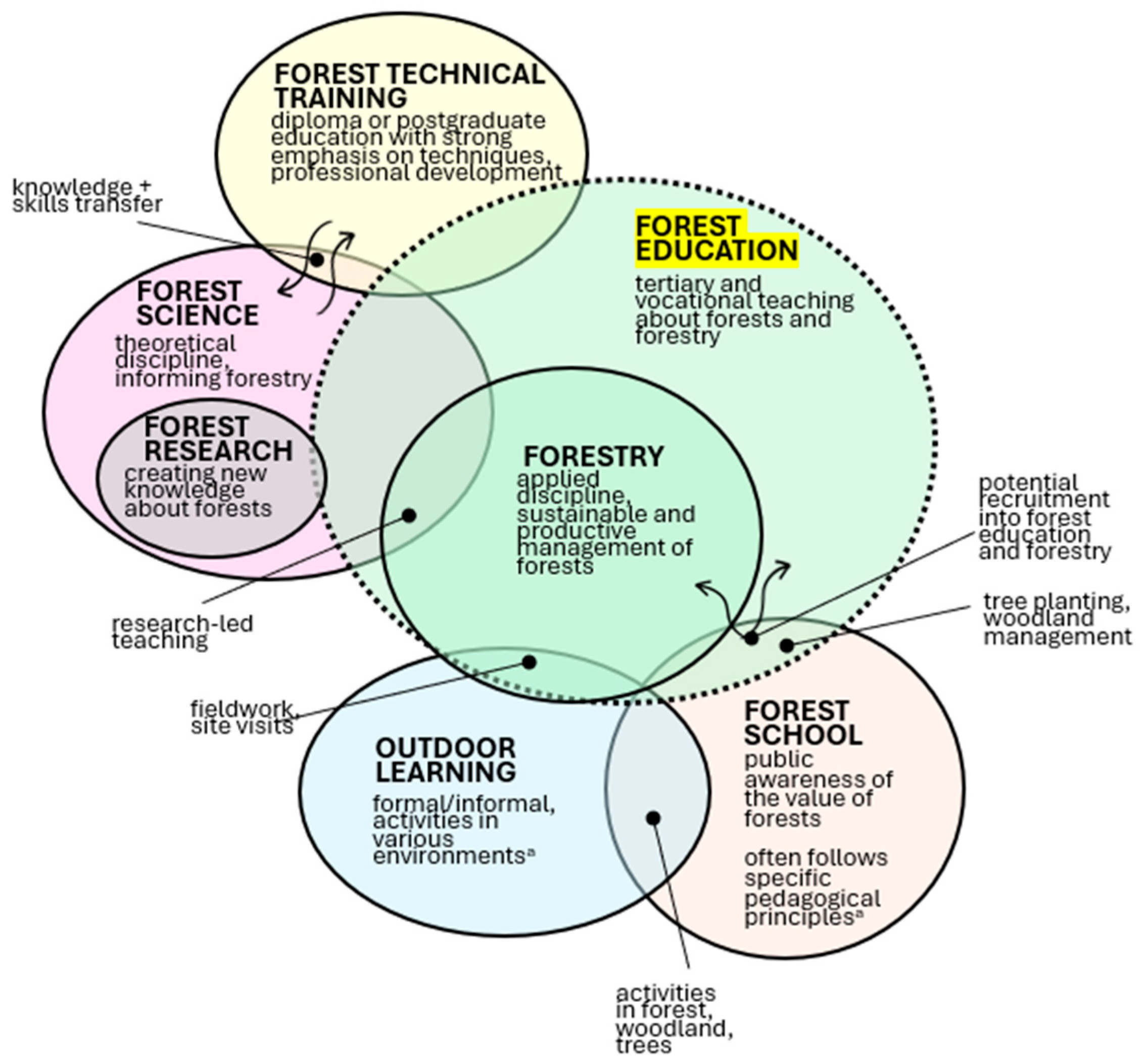
Figure 1. Venn diagram showing forest education in relation to other areas of teaching, learning, and research associated with forests. Part of the diagram a is informed by a Royal Forestry Society (2021) [17] source, to which the author has added further dimensions. The part of the diagram enclosed by a dashed line represents the main focus area of this review.
Forests 16 01801 g001
Table 1. Global distribution of 534 forestry institutes, including universities and colleges across six global regions. Establishment year data were derived for each institution from its website, using the ‘List of forestry universities and colleges’ [30]. Earliest, latest, and median years are shown for each global region. For the purposes of this comparison, * Russia is placed wholly in Europe, and + Mexico is placed with other Central American countries rather than with North America.
Year Established
Global regionTotal number of institutesCountry with most institutesEarliestLatestMedian year
N America60USA178519941877
Europe138Russia * = Turkey122220181949
Oceania4Australia187319701950
S + C America +, Caribbean82Brazil167620101960
Africa64Nigeria190220221976
Asia186Indonesia185120181978
Table 2. Overview of the forestry curricula for the past, present, and future. Many of the elements listed have been discussed in the text, with accompanying references.
PastPresentFuture
  • ‘Traditional’ skills
  • Logging, harvesting
  • Machine maintenance
  • Road building
  • Nursery tree work
  • Tree identification, botany
  • Forest inventories, surveying
  • Knowledge of forest wildlife
  • Hunting and fishing
  • Retention of any traditional skills that are still relevant.
  • Surveying, mapping, and monitoring
  • Silviculture, plant pathology, plant physiology, ecology, and soils
  • Remote sensing, GIS
  • Critical thinking, problem solving
  • Forest management, including different ownership models, law
  • Stronger relationship with forest science
  • Harvesting (not all curricula)
  • Greater emphasis on conservation, sustainability, and resource management
  • Forests as amenities, with ecosystem services
  • Harvesting
  • Retention of any traditional skills that are still relevant
  • Increased interdisciplinarity, widened appeal to students, supported by more diverse faculty
  • Use of short courses, online, and CPD training
  • Incorporation of social sciences
  • Increased collaboration, internationalisation
  • More use of AI, technology, and automation
  • More focus on genetics, breeding
  • Emphasis on implications of climate change, mitigation, sustainability, and biofuel
  • Non-timber forest products
  • Emphasis on public communication, outreach, and public relations
Table 3. Summary of recommendations or possible action points that seem to have emerged from this review.
IssuesRecommendations
  • Does there appear to be an overall decline in recruitment in undergraduate-level ‘forestry’ in recent years?
For a given forest education institution:
  • Use monitoring and longitudinal data to establish the reality or rate of any trend, especially if over consecutive years.
  • Investigate whether any declines have underlying demographic causes, for which temporary/permanent adjustments might be needed.
  • Conduct ‘market research’ to determine the possible cause of this trend and consider the long-term consequences if there is a shortfall in recruitment.
  • Perform a benchmarking exercise to discover if other forest education providers (who may also be competitors) are having a more positive experience with recruitment and retention.
  • Consider if your programmes continue to have sufficient appeal and relevance for recruitment, retention, and graduate outcomes.
2.
Is the forest education curriculum still fully relevant in a changing world?
For a given forest education institution:
  • Perform a benchmarking exercise to discover if other forest education providers (who may also be competitors) appear to have a more relevant curriculum.
  • Use external sources (e.g., external examiners, accreditation organisations, and employers) to advise on the curriculum.
  • Conduct an internal audit with colleagues to evaluate the relevance of the curriculum (see also below).
  • Use the literature, conferences, and professional organisations (e.g., ICF, RFS, IUFRO, ITTO, Pro Silva, EFI, CFA, FAO Forestry, and SAF); * there are also numerous local organisations that could provide guidance for the development of forest education.
3.
Is the forest education department engaging with opportunities (or obligations) to be interdisciplinary?
For a given forest education institution:
  • Perform a benchmarking exercise to discover if other forest education providers (who may also be competitors) appear to have interdisciplinary programmes.
  • Investigate which interdisciplinary programmes might be possible and desirable with an institution and beyond.
  • Identify possible collaborators locally, nationally, and internationally.
4.
Is there sufficient diversity among staff and students in the forest education department?
For a given forest education institution:
  • Consider whether the diversity of staff or students reflects that in the wider community.
  • Determine if the proportion of gender, ethnic group, and other ‘protected characteristics’ is reflected in balance within the department or faculty. This might be necessary to meet policy or even legal requirements.
  • Consider the possible beneficial effects on recruitment and a positive working environment for both staff and students.
5.
Is there scope and capacity to incorporate more innovative technological methods into the forest education?
For a given forest education institution:
  • Consider what additional tools and techniques could be added to the curriculum to enhance learning and employability.
  • Within inevitable constraints of funding, consider what innovative methods could be introduced over a realistic time scale.
  • Investigate possible funding models, including resources from collaborators in interdisciplinary arrangements, business partners, funding agencies, and benefactors.
* ICF (Institute of Chartered Foresters), RFS (Royal Forestry Society), IUFRO (International Union of Forest Research Organizations), ITTO (International Tropical Timber Organization), Pro Silva, EFI (European Forest Institute), CFA (Commonwealth Forestry Association), ISTF (International Society of Tropical Foresters), and SAF (Society of American Foresters).
Disclaimer/Publisher’s Note: The statements, opinions and data contained in all publications are solely those of the individual author(s) and contributor(s) and not of MDPI and/or the editor(s). MDPI and/or the editor(s) disclaim responsibility for any injury to people or property resulting from any ideas, methods, instructions or products referred to in the content.


