Genetic Diversity of Robinia pseudoacacia L. Populations from North-Western Romania Revealed by ISSR Markers

 , ,
, ,
Abstract
1. Introduction
- (a)
- General hypotheses regarding genetic diversity, focused on measuring intra- and inter-population genetic variation.
- (b)
- Hypotheses regarding population structure, aimed at examining how populations are genetically structured.
- (c)
- Specific hypotheses addressing the utility of ISSR markers, namely, whether the selected markers exhibit sufficient polymorphism and efficiency to detect and differentiate genetic variation at the subspecies level across the six populations of black locust (Robinia pseudoacacia L.)
2. Materials and Methods
2.1. Biological Material Used
- (a)
- First, the physiological condition and overall health of the trees were assessed using the Nikolaevsky method (1999), selecting individuals that fell within the score range of 35–40 [33].
- (b)
- Second, a minimum spatial distance of 50–150 m was maintained between sampled trees within the same population to minimize the likelihood of collecting clonal individuals. From each population, apical leaves (derived from annual branches) were collected from 10 individuals, with approximately 5 g per tree, and subsequently stored at –80 °C until further processing.
2.2. Isolation and Amplification of Genomic DNA
2.3. Statistical Analysis
3. Results and Discussion
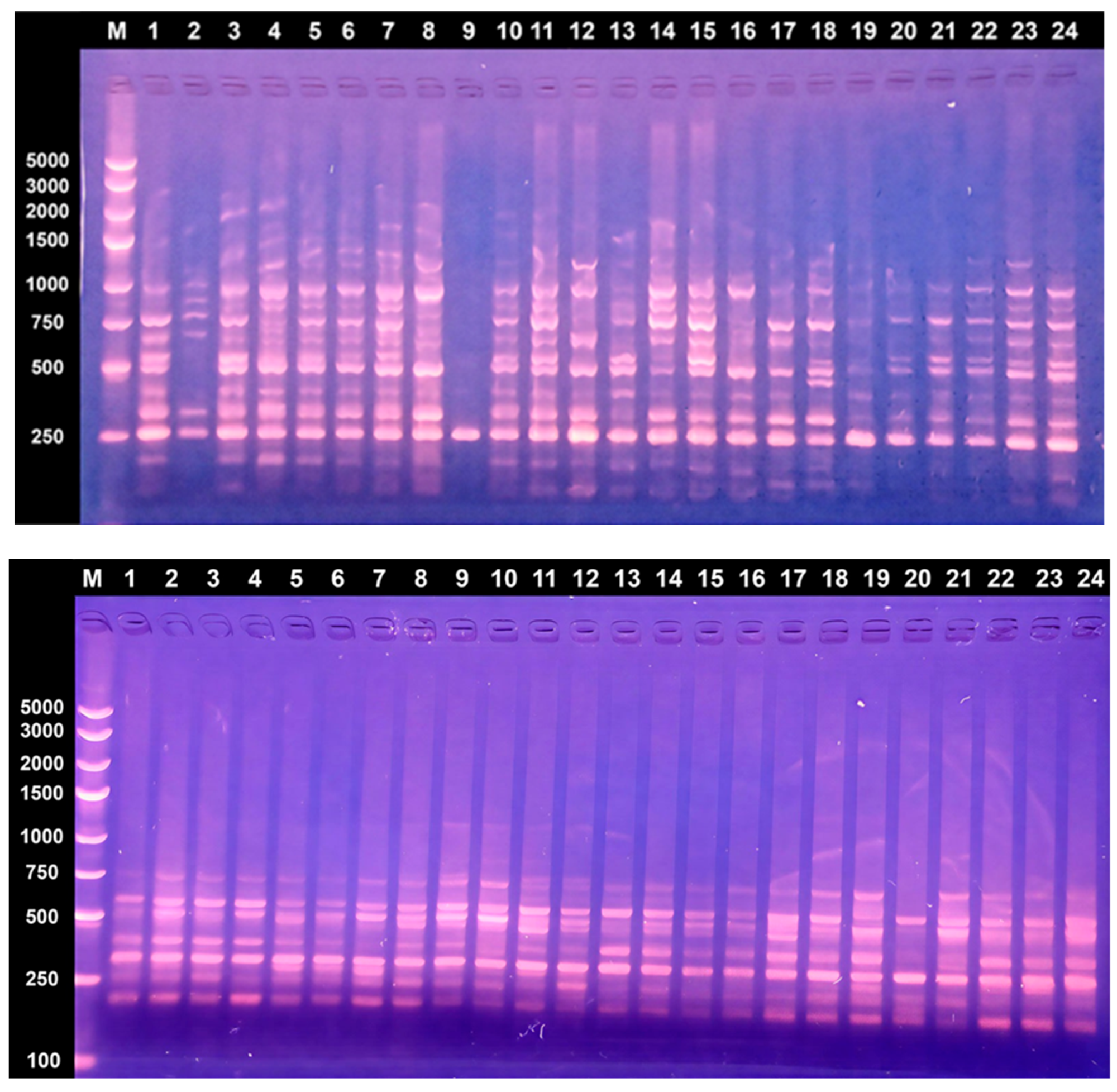
3.1. Statistical Analysis of the Population Structure for Each Locus
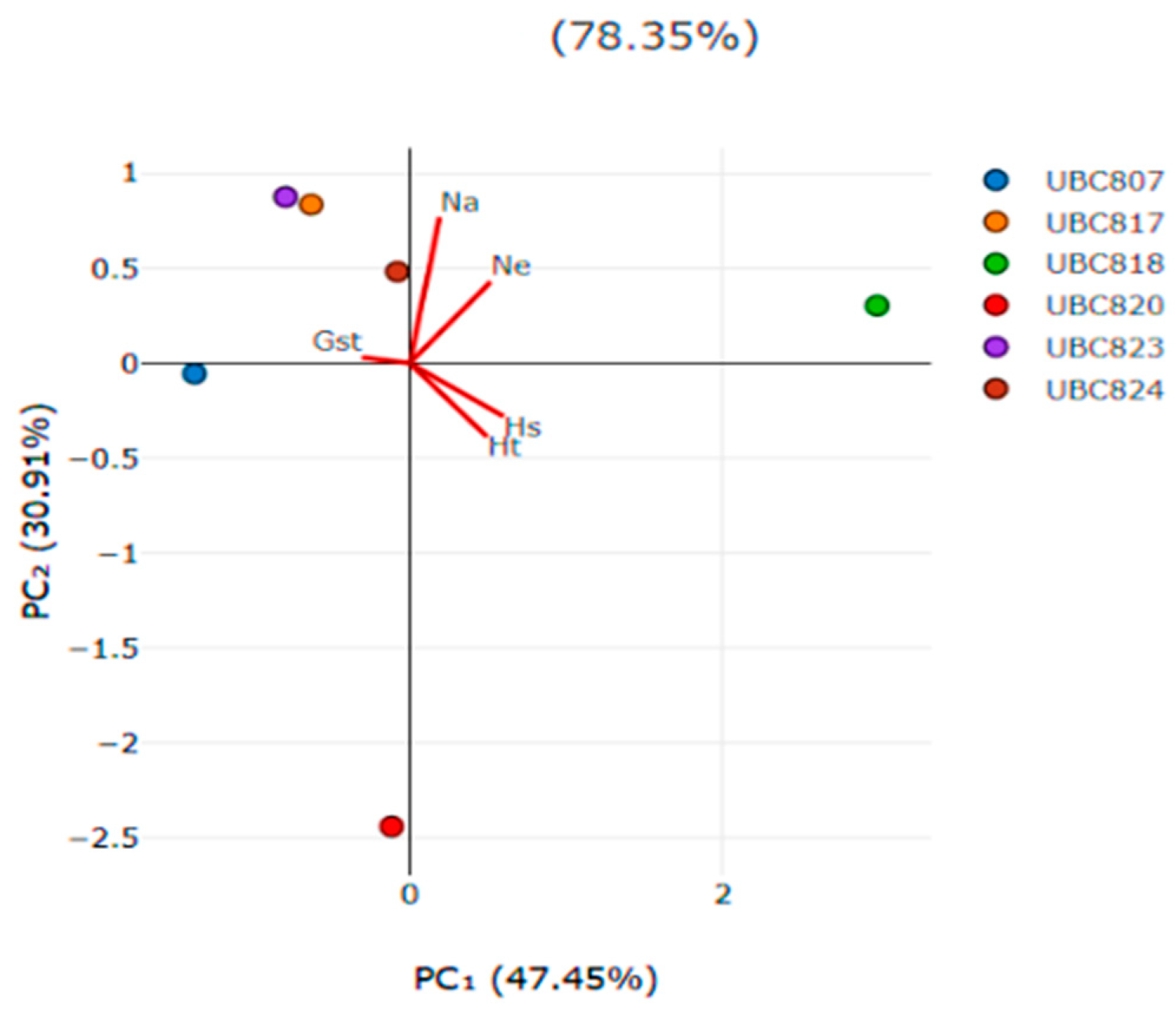
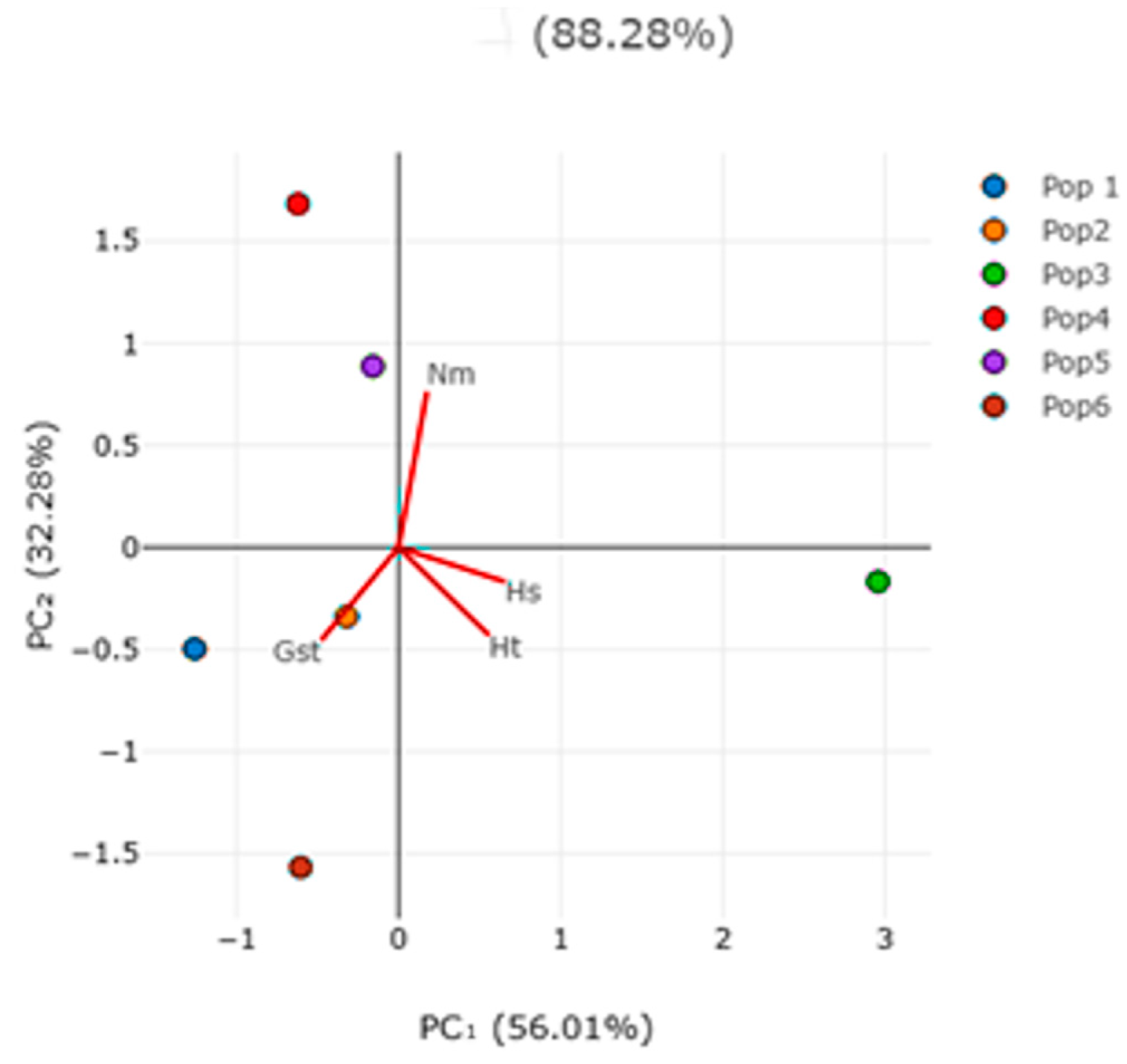
3.2. Assessment of Intra-Population Genetic Variability
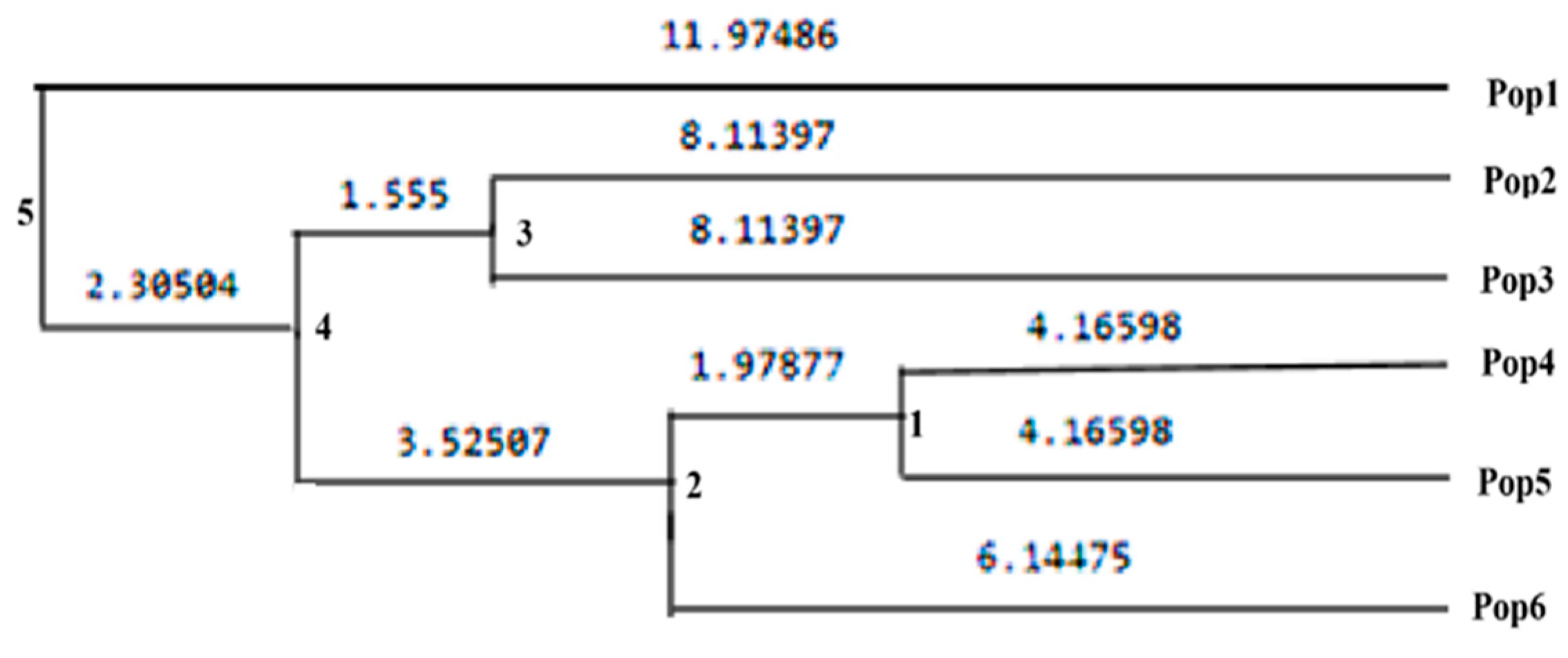
3.3. Genetic Distance
4. Conclusions
Author Contributions
Funding
Data Availability Statement
Conflicts of Interest
References
- Zagas, T.; Tsitsoni, T.; Ganatsas, P.; Tsakaldimi, M.; Skotidakis, T.; Zagas, D. Land reclamation and ecological restoration in a marine area. Int. J. Environ. Res. 2010, 4, 673–680. [Google Scholar] [CrossRef] [Scilit]
- Vítková, M.; Sádlo, J.; Roleček, J.; Petřík, P.; Sitzia, T.; Müllerová, J.; Pyšek, P. Robinia pseudoacacia-dominated vegetation types of Southern Europe: Species composition, history, distribution and management. Sci. Total Environ. 2020, 707, 134857. [Google Scholar] [CrossRef] [Scilit]
- Nicolescu, V.N.; Rédei, K.; Mason, W.L.; Vor, T.; Pöetzelsberger, E.; Bastien, J.-C.; Brus, R.; Benčať, T.; Đodan, M.; Cvjetkovic, B.; et al. Ecologie, creștere și gestionare a salcâmului negru (Robinia pseudoacacia L.), o specie alogenă integrată în pădurile europene. J. For. Res. 2020, 31, 1081–1101. [Google Scholar] [CrossRef] [Scilit]
- Unruh Snyder, L.J.; Mueller, J.P.; Luginbuhl, J.M.; Brownie, C. Growth characteristics and allometry of Robinia pseudoacacia as a silvopastoral system component. Agrofor. Syst. 2007, 70, 41–51. [Google Scholar] [CrossRef] [Scilit]
- Qiu, L.; Zhang, X.; Cheng, J.; Yin, X. Effects of black locust (Robinia pseudoacacia) on soil properties in the loessial gully region of the Loess Plateau, China. Plant Soil 2010, 332, 207–217. [Google Scholar] [CrossRef] [Scilit]
- Athy, E.R.; Keiffer, C.H.; Steven, M.H. Effects of Mulch on Seeding and Soil on a Closed Landfill. Restor. Ecol. 2006, 14, 233–241. [Google Scholar] [CrossRef] [Scilit]
- Pauleit, S.; Jones, N.; Garcia-Martin, G.; Garcia-Valdecantos, J.L.; Rivière, L.M.; Vidal-Beaudet, L.; Monique Bodson, M.; Randrup, T.B. Tree establishment practice in towns and cities—Results from a European survey. Urban For. Urban Green. 2002, 1, 83–96. [Google Scholar] [CrossRef] [Scilit]
- Balat, M. Bio-Oil Production from Pyrolysis of Black Locust (Robinia pseudoacacia) Wood. Energy Explor. Exploit. 2010, 28, 173–186. [Google Scholar] [CrossRef] [Scilit]
- Cierjacks, A.; Kowarik, I.; Joshi, J.; Hempel, S.; Ristow, M.; von der Lippe, M.; Weber, E. Biological Flora of the British Isles: Robinia pseudoacacia. J. Ecol. 2013, 101, 1623–1640. [Google Scholar] [CrossRef] [Scilit]
- Martin, G.D. Addressing geographical bias: A review of Robinia pseudoacacia (black locust) in the Southern Hemisphere. South Afr. J. Bot. 2019, 125, 481–492. [Google Scholar] [CrossRef] [Scilit]
- Kleinbauer, I.; Dullinger, S.; Peterseil, J.; Essl, F. Climate change might drive the invasive tree Robinia pseudacacia into nature reserves and endangered habitats. Biol. Conserv. 2010, 143, 382–390. [Google Scholar] [CrossRef] [Scilit]
- Govindaraj, M.; Vetriventhan, M.; Srinivasan, M. Importance of genetic diversity assessment in crop plants and its recent advances: An overview of its analytical perspectives. Genet. Resour. Int. 2015, 2015, 431487. [Google Scholar] [CrossRef] [Scilit]
- Marin, G.; Bouriaud, O.; Nițu, D.M.; Calotă, C.I.; Dumitru, M. Inventarul Forestier Naţional din România, Ciclul I (2008–2012); Editura Silvică: București, Romania, 2019; ISBN 978-606-8020-61-7. [Google Scholar]
- Enescu, C.M.; Dănescu, A. Black locust (Robinia pseudoacacia L.)—An invasive neophyte in the conventional land reclamation flora in Romania. Bull. Transilv. Univ. Brasov. Ser. II For. Wood Ind. Agric. Food Eng. 2013, 6, 23–30. [Google Scholar]
- Guo, Q.; Li, X.; Yang, S.; Yang, Z.; Sun, Y.; Zhang, J.; Cao, S.; Dong, L.; Uddin, S.; Li, Y. Evaluation of the Genetic Diversity and Differentiation of Black Locust (Robinia pseudoacacia L.) Based on Genomic and Expressed Sequence Tag-Simple Sequence Repeats. Int. J. Mol. Sci. 2018, 19, 2492. [Google Scholar] [CrossRef] [Scilit]
- Greene, W. Black Locust: The Tree on Which the US Was Built; Live Science: New York, NY, USA, 2015. [Google Scholar]
- Budău, R.; Bei, M.; Onet, C.; Agud, E.; Mintas, O.S.; Timofte, A.I.; Rosan, C.A.; Laslo, V.; Vicas, S.I. In Vitro Propagation of Several Valuable Selections of Robinia pseudoacacia L. as a Fast and Sustainable Source for Wood Production. Sustainability 2023, 15, 15243. [Google Scholar] [CrossRef] [Scilit]
- Budău, R. Importance, Biology and Breeding of Acacia (Robinia pseudoacacia L.) from Romania; Editura Universității din Oradea: Bihor, Romania, 2025; ISBN 978-606-10-2404-9. [Google Scholar]
- Bouteiller, X. Une Histoire Écologique et Évolutive du Robinier Faux-Acacia (Robinia pseudoacacia L.) Depuis son Introduction en Europe. Ph.D. Thesis, Biodiversité et Ecologie, Université de Bordeaux, Talence, France, 2018. (In French) [Google Scholar]
- Bouteiller, X.P.; Barraquand, F.; Garnier-Géré, P.; Harmand, N.; Laizet, Y.H.; Raimbault, A.; Segura, R.; Lassois, L.; Monty, A.; Verdu, C.; et al. No evidence for genetic differentiation in juvenile traits between Belgian and French populations of the invasive tree Robinia pseudoacacia. Plant Ecol. Evol. 2018, 151, 5–17. [Google Scholar] [CrossRef] [Scilit]
- Bouteiller, X.P.; Moret, F.; Ségura, R.; Klisz, M.; Martinik, A.; Monty, A.; Pino, J.; Van Loo, M.; Wojda, T.; Porté, A.J.; et al. The seeds of invasion: Enhanced germination in invasive European populations of black locust (Robinia pseudoacacia L.) compared to native American populations. Plant Biol. 2021, 23, 1006–1017. [Google Scholar] [CrossRef] [Scilit]
- Gemmill, C.E.C.; Grierson, E.R.P. Inter-Simple Sequence Repeats (ISSR), Microsatellite-Primed Genomic Profiling Using Universal Primers. Methods Mol. Biol. 2021, 2222, 249–262. [Google Scholar] [CrossRef] [Scilit] [PubMed]
- Nasim, N.; Sandeep, I.S.; Sahoo, A.; Das, S.; Panda, M.K.; Acharya, L.; RamaRao, V.V.; Nayak, S.; Mohanty, S. Population genetic structure and diversity analysis in economically important Pandanus odorifer (Forssk.) Kuntze accessions employing ISSR and SSR markers. Ind. Crops Prod. 2020, 143, 111894. [Google Scholar] [CrossRef] [Scilit]
- Uras, M.E.; Filiz, E.; Sen, U.; Ozyigit, I.I. Genetic diversity and phylogenetic analysis of Robinia pseudoacacia L. populations using ISSR markers, ITS1 and trnL-F intergenic spacer sequences. J. For. Sci. 2024, 70, 1–13. [Google Scholar] [CrossRef] [Scilit]
- Yang, X.; Zhang, K.; Wang, J.; Jia, H.; Ma, L.; Li, Y.; Duan, J. Assessment of genetic diversity and chemical composition among seven black locust populations from Northern China. Biochem. Syst. Ecol. 2020, 90, 104010. [Google Scholar] [CrossRef] [Scilit]
- Costa, M.; Amorim, L.; Onofre, A.; Melo, L.; Oliveira, M.; Carvalho, R.; Benko-Iseppon, A. Assessment of Genetic Diversity in Contrasting Sugarcane Varieties Using Inter-Simple Sequence Repeat (ISSR) Markers. Am. J. Plant Sci. 2011, 2, 425–432. [Google Scholar] [CrossRef]
- Černulienė, S.; Verbylaitė, R.; Stakėnas, V. Evolution of the Genetic Diversity and Spatial Distribution of Self-Establishing Black Locust (Robinia pseudoacacia L.) Stands. Appl. Biosci. 2025, 4, 33. [Google Scholar] [CrossRef] [Scilit]
- Budău, R. Cultura Salcâmului; Editura Universităţii din Oradea: Bihor, Romania, 2023. [Google Scholar]
- Kuzmin, P.A.; Krylov, P.A. Genetic Diversity Robinia pseudoacacia L. Growing in Drought Conditions using ISSR. Agric. Sci. Dig. 2024, 1–6. [Google Scholar] [CrossRef] [Scilit]
- Xiong, Y.; Lei, X.; Bai, S.; Xiong, Y.; Liu, W.; Wu, W.; Yu, Q.; Dong, Z.; Yang, J. Genomic survey sequencing, development and characterization of single- and multi-locus genomic SSR markers of Elymus sibiricus L. BMC Plant Biol. 2021, 21, 3. [Google Scholar] [CrossRef] [Scilit]
- Vinogradova, Y. Bio-Morphological Characters of Alien Legume Species, Influencing Their Invasion in Natural Plant Communities. Am. J. Plant Sci. 2016, 7, 2390–2398. [Google Scholar] [CrossRef]
- Kato-Noguchi, H.; Kato, M. Invasive Characteristics of Robinia pseudoacacia and Its Impacts on Species Diversity. Diversity 2024, 16, 773. [Google Scholar] [CrossRef] [Scilit]
- Nikolaevsky, V.S. Ecological Assessment of Environmental Pollution and the State of Terrestrial Ecosystems by Phytoindication Methods; MGUL: Moscow, Russia, 1999; 193p. [Google Scholar]
- Doyle, J. DNA Protocols for Plants. In Molecular Techniques in Taxonomy; NATO ASI Series; Hewitt, G.M., Johnston, A.W.B., Young, J.P.W., Eds.; Springer: Berlin/Heidelberg, Germany, 1991; Volume 57. [Google Scholar] [CrossRef] [Scilit]
- Bornet, B.; Branchard, M. Nonanchored Inter Simple Sequence Repeat (ISSR) markers: Reproducible and specific tools for genome fingerprinting. Plant Mol. Biol. Rep. 2001, 19, 209–215. [Google Scholar] [CrossRef] [Scilit]
- Lewontin, R.C. The apportionment of human diversity. In Evolutionary Biology; Spinger: Berlin/Heidelberg, Germany, 1972; Volume 6, pp. 381–398. [Google Scholar]
- Abd-dada, H.; Bouda, S.; Khachtib, Y.; Bella, Y.A.; Haddioui, A. Use of ISSR markers to assess the genetic diversity of an endemic plant of Morocco (Euphorbia resinifera O. Berg). J. Genet. Eng. Biotechnol. 2023, 21, 91. [Google Scholar] [CrossRef] [Scilit] [PubMed]
- Wright, S. Evolution and the Genetics of Populations, Volume 4. Variability Within and Among Natural Populations; University of Chicago Press: Chicago, IL, USA, 1978. [Google Scholar]
- Nei, M. Estimation of average heterozygosity and genetic distance from a small number of individuals. Genetics 1978, 89, 583–590. [Google Scholar] [CrossRef] [Scilit] [PubMed]
- Khan, S.; Vaishali; Sharma, V. Genetic differentiation and diversity analysis of medicinal tree Syzygium cumini (Myrtaceae) from ecologically different regions of India. Physiol. Mol. Biol. Plants 2010, 16, 149–158. [Google Scholar] [CrossRef] [Scilit]
- Malekmohammadi, L.; Sheidai, M.; Ghahremaninejad, F.; Danehkar, A.; Koohdar, F. Studies on genetic diversity, gene flow and landscape genetic in Avicennia marina: Spatial PCA, Random Forest, and phylogeography approaches. BMC Plant Biol. 2023, 23, 459. [Google Scholar] [CrossRef] [Scilit]
- Nei, M. Genetic Distance between Populations. Am. Nat. 1972, 106, 283–292. [Google Scholar] [CrossRef] [Scilit]
- Guo, Q.; Cao, S.; Dong, L.; Li, X.; Zhang, J.; Zhang, Y.; Li, Y. Genetic diversity and population structure of Robinia pseudoacacia from six improved variety bases in China as revealed by simple sequence repeat markers. J. For. Res. 2022, 33, 611–621. [Google Scholar] [CrossRef] [Scilit]
- Lian, C.; Hogetsu, T. Development of microsatellite markers in black locust (Robinia pseudoacacia) using a dual-suppression-PCR technique. Mol. Ecol. Notes 2002, 2, 211–213. [Google Scholar] [CrossRef] [Scilit]
- Guo, Q.; Wang, J.-X.; Su, L.-Z.; Lv, W.; Sun, Y.-H.; Li, Y. Development and Evaluation of a Novel Set of EST-SSR Markers Based on Transcriptome Sequences of Black Locust (Robinia pseudoacacia L.). Genes 2017, 8, 177. [Google Scholar] [CrossRef] [Scilit] [PubMed]
- Mishima, K.; Hirao, T.; Urano, S.; Watanabe, A.; Takata, K. Isolation and characterization of microsatellite markers from Robinia pseudoacacia L. Mol. Ecol. Resour. 2009, 9, 850–852. [Google Scholar] [CrossRef] [Scilit] [PubMed]



| Place | Altitude | Dominant Soil Types | Annual Precipitation (L/m2) | Average Annual Temperature (°C) |
|---|---|---|---|---|
| Valea lui Mihai | 127 | Sandy soils | 600 | 9.7 |
| Oradea | 126 | Brown soils | 585 | 10.3 |
| Paleu | 145 | White loamy soil | 700 | 8.5 |
| Cetariu | 189 | White loamy soil | 700 | 8.5 |
| Cauaceu | 124 | Cambic chernozem | 600 | 10.5 |
| Bârzești | 300 | Loamy soils | 600 | 10.6 |
| Code | Sequence | Primer annealing Temperature (Tm, °C) |
|---|---|---|
| UBC807 | 5′-AG AG AG AG AG AG AG AGT-3′ | 52 °C |
| UBC817 | 5′-CA CA CA CA CA CA CA CAA-3′ | 54 °C |
| UBC818 | 5′-CA CA CA CA CA CA CA CAG-3′ | 54 °C |
| UBC820 | 5′-GT GT GT GT GT GT GT GTC-3′ | 52 °C |
| UBC823 | 5′-TC TC TC TC TC TC TC TCC-3′ | 54 °C |
| UBC824 | 5′-AC AC AC AC AC AC AC ACG-3′ | 52 °C |
| Marker | Na 1 | Ne 2 | Ht 3 | Hs 4 | Gst 5 |
|---|---|---|---|---|---|
| UBC807 | 1.6667 | 1.3715 | 0.3250 | 0.1471 | 0.5180 |
| UBC817 | 1.8750 | 1.4529 | 0.2980 | 0.1730 | 0.4332 |
| UBC818 | 1.9333 | 1.7825 | 0.4498 | 0.2976 | 0.3383 |
| UBC820 | 1.3333 | 1.2440 | 0.4162 | 0.2351 | 0.4130 |
| UBC823 | 1.8889 | 1.3911 | 0.2809 | 0.1601 | 0.3552 |
| UBC824 | 1.8333 | 1.5882 | 0.4024 | 0.1700 | 0.5876 |
| Primer Code | Size Range (bp) | Total Loci | Polymorphic Loci | % Polymorphism |
|---|---|---|---|---|
| UBC807 | 150–850 | 13 | 9 | 69.23% |
| UBC817 | 250–800 | 8 | 6 | 75% |
| UBC818 | 200–1250 | 14 | 14 | 100% |
| UBC820 | 220–850 | 9 | 3 | 33.33% |
| UBC823 | 250–700 | 9 | 8 | 88.89% |
| UBC824 | 250–700 | 6 | 5 | 83.33% |
| Pop ID | Valea lui Mihai | Oradea | Paleu | Cetariu | Cauaceu | Bârzești |
|---|---|---|---|---|---|---|
| Valea lui Mihai | **** | 0.8342 | 0.7822 | 0.7669 | 0.7708 | 0.7828 |
| Oradea | 0.1813 | **** | 0.8502 | 0.8402 | 0.8464 | 0.8156 |
| Paleu | 0.2456 | 0.1623 | **** | 0.8665 | 0.7551 | 0.8256 |
| Cetariu | 0.2448 | 0.1741 | 0.1432 | **** | 0.9201 | 0.8815 |
| Cauaceu | 0.2654 | 0.1668 | 0.1916 | 0.0833 | **** | 0.8872 |
| Bârzești | 0.2604 | 0.2809 | 0.1261 | 0.2038 | 0.1197 | **** |
Disclaimer/Publisher’s Note: The statements, opinions and data contained in all publications are solely those of the individual author(s) and contributor(s) and not of MDPI and/or the editor(s). MDPI and/or the editor(s) disclaim responsibility for any injury to people or property resulting from any ideas, methods, instructions or products referred to in the content. |
© 2025 by the authors. Licensee MDPI, Basel, Switzerland. This article is an open access article distributed under the terms and conditions of the Creative Commons Attribution (CC BY) license (https://creativecommons.org/licenses/by/4.0/).
Share and Cite
Budau, R.; Agud, E.M.; Laslo, V.; Timofte, A.I.; Bei, M.F. Genetic Diversity of Robinia pseudoacacia L. Populations from North-Western Romania Revealed by ISSR Markers. Forests 2025, 16, 1795. https://doi.org/10.3390/f16121795
Budau R, Agud EM, Laslo V, Timofte AI, Bei MF. Genetic Diversity of Robinia pseudoacacia L. Populations from North-Western Romania Revealed by ISSR Markers. Forests. 2025; 16(12):1795. https://doi.org/10.3390/f16121795
Chicago/Turabian StyleBudau, Ruben, Eliza Maria Agud, Vasile Laslo, Adrian Ioan Timofte, and Mariana Florica Bei. 2025. "Genetic Diversity of Robinia pseudoacacia L. Populations from North-Western Romania Revealed by ISSR Markers" Forests 16, no. 12: 1795. https://doi.org/10.3390/f16121795
APA StyleBudau, R., Agud, E. M., Laslo, V., Timofte, A. I., & Bei, M. F. (2025). Genetic Diversity of Robinia pseudoacacia L. Populations from North-Western Romania Revealed by ISSR Markers. Forests, 16(12), 1795. https://doi.org/10.3390/f16121795