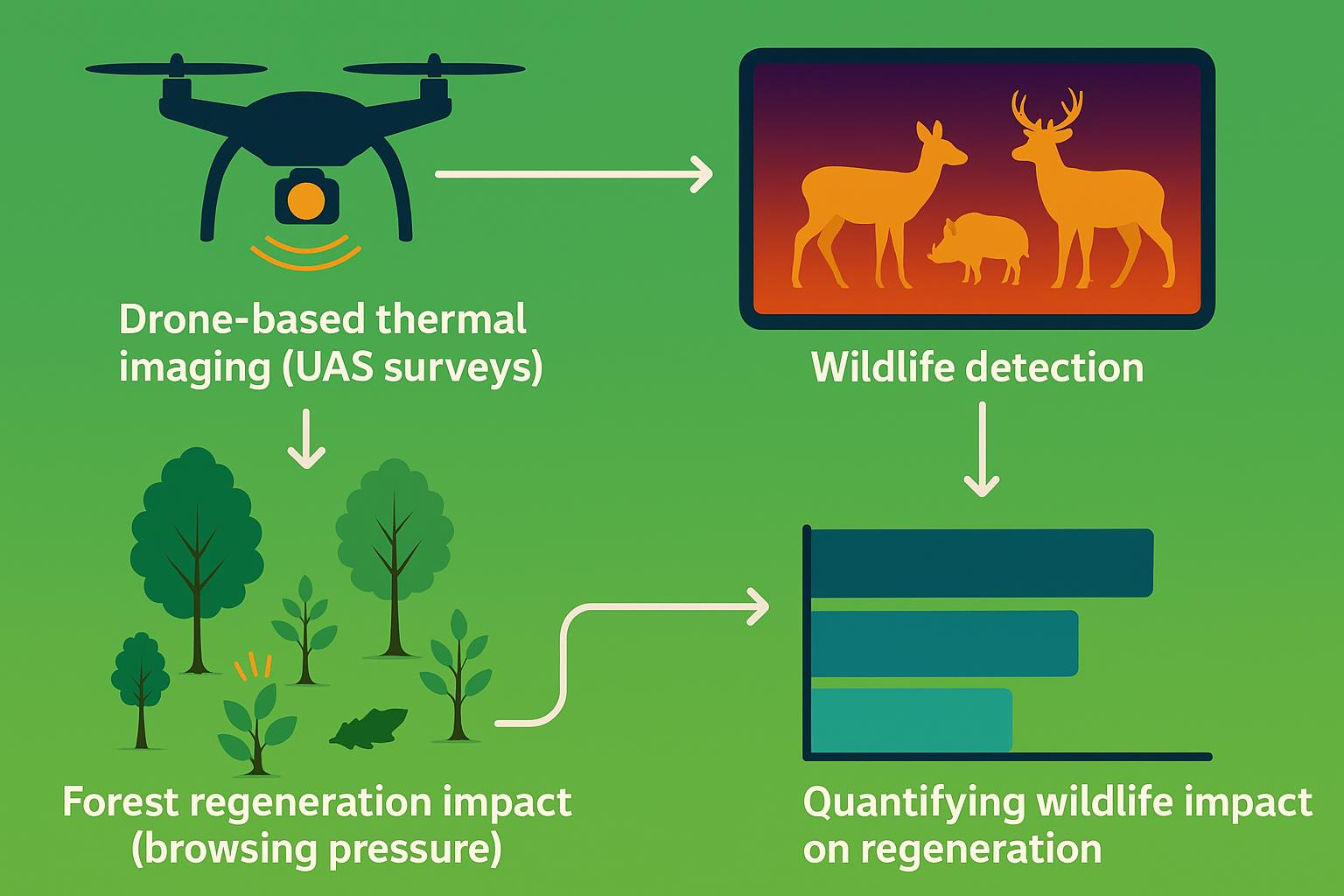
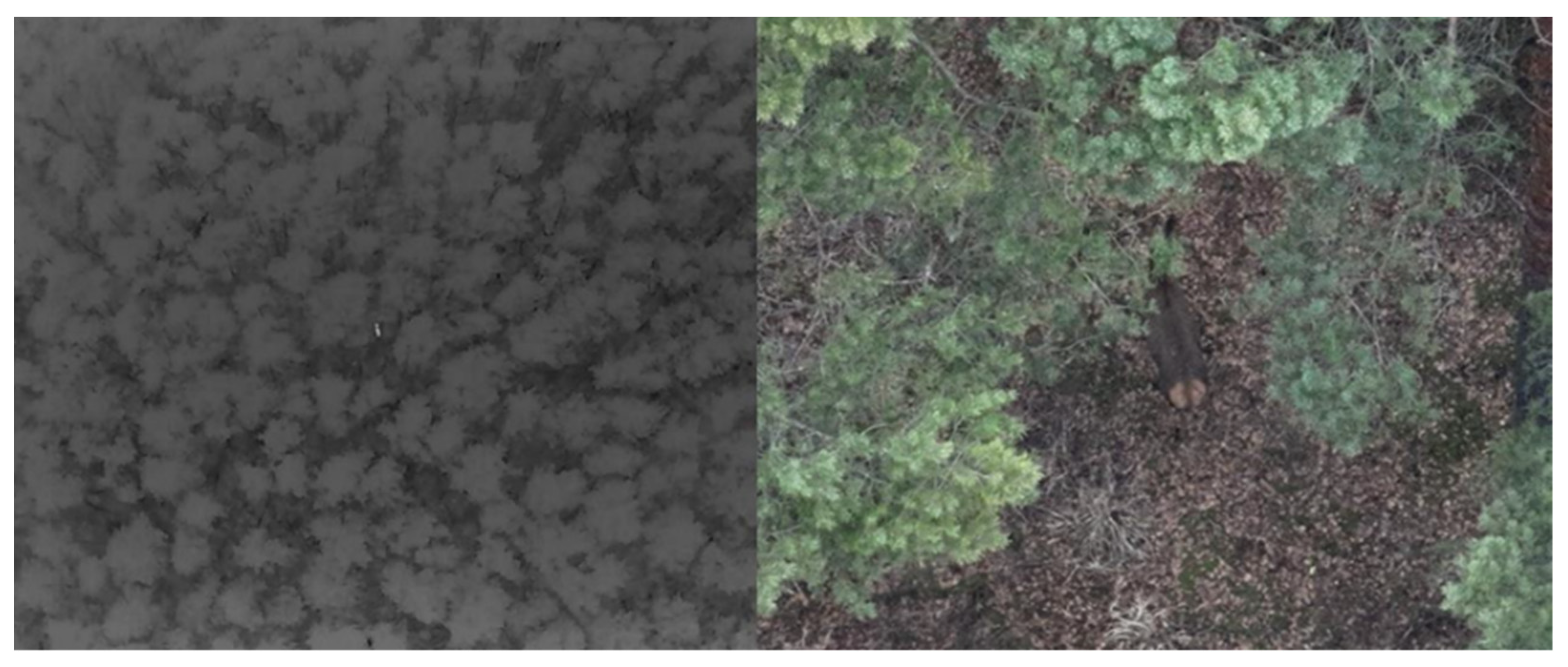
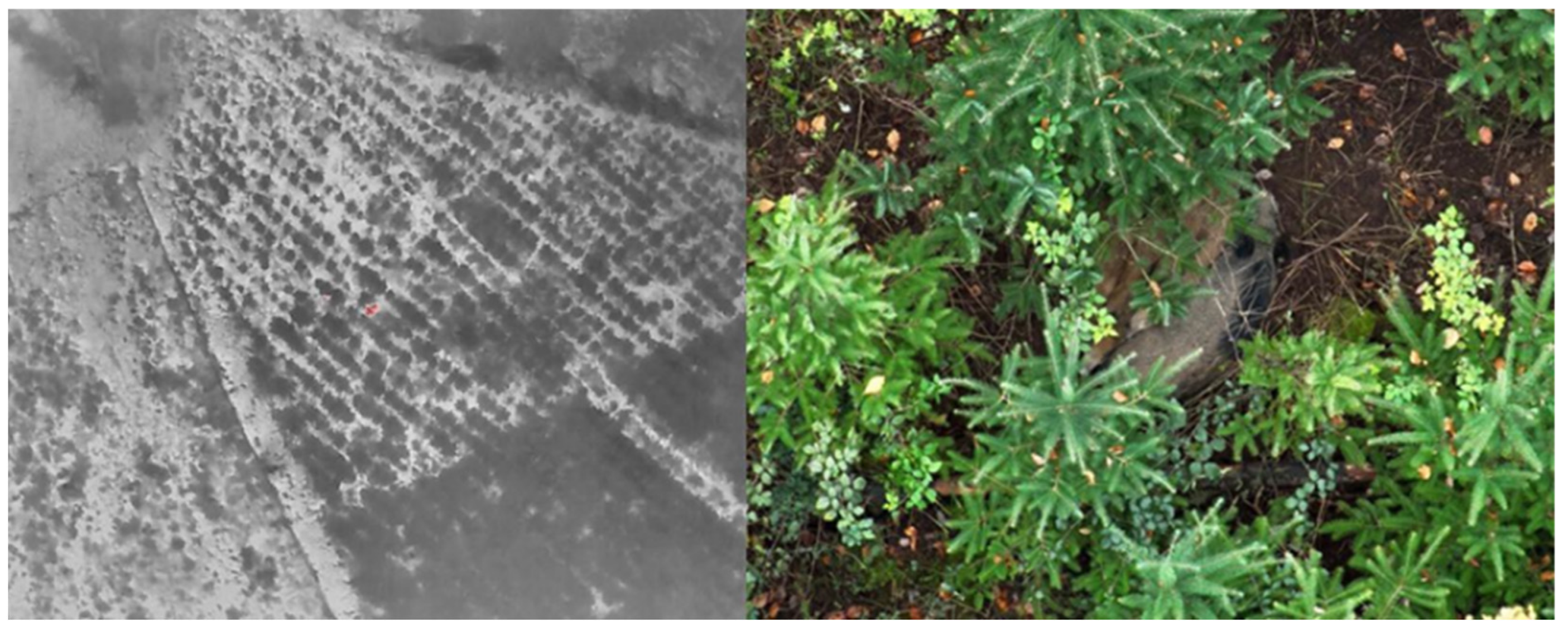
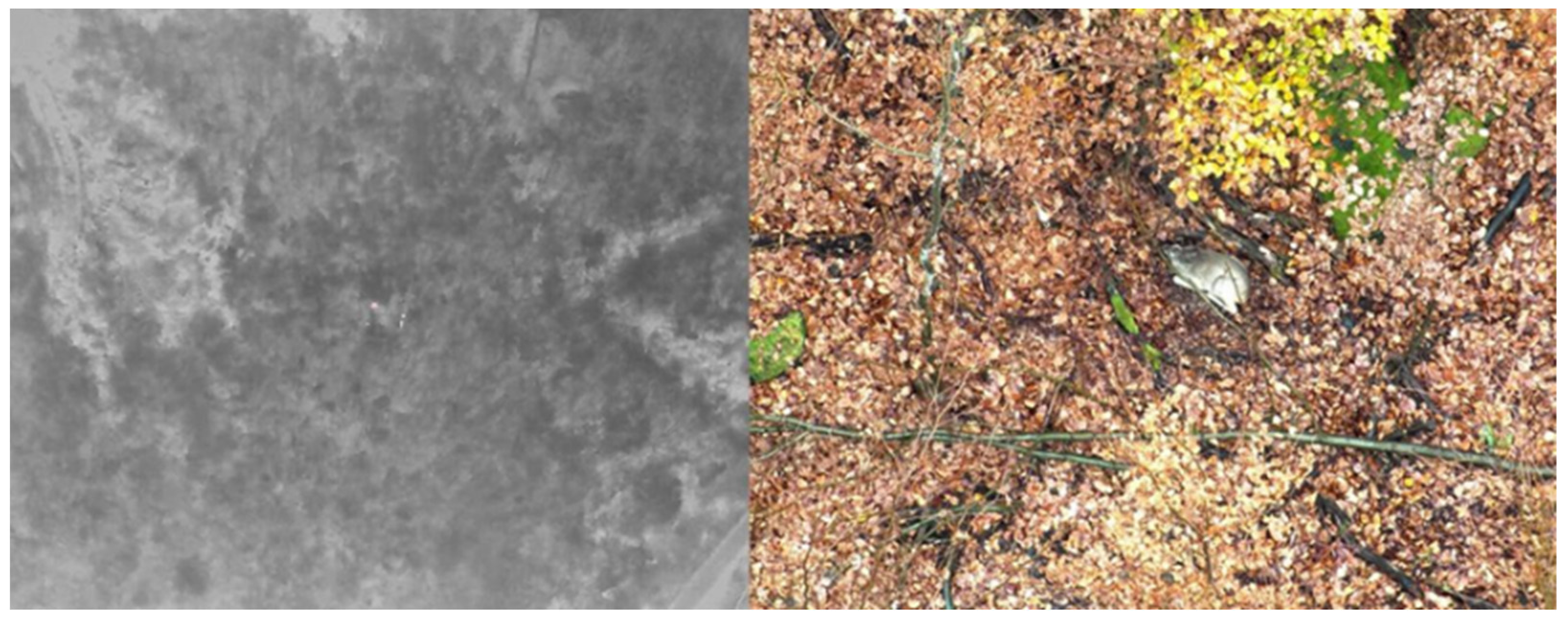
Assessing Wildlife Impact on Forest Regeneration Through Drone-Based Thermal Imaging

 ,
, 
Abstract
1. Introduction
2. Materials and Methods
2.1. Study Areas
2.2. Determination of the Abundance of Different Wildlife Species
2.3. Assessment of Wildlife Impact on Regeneration
2.4. Data Analysis
3. Results
3.1. Results of Aerial Surveys
3.1.1. Abundance and Density of Wildlife Species in the Heppenheim Study Area
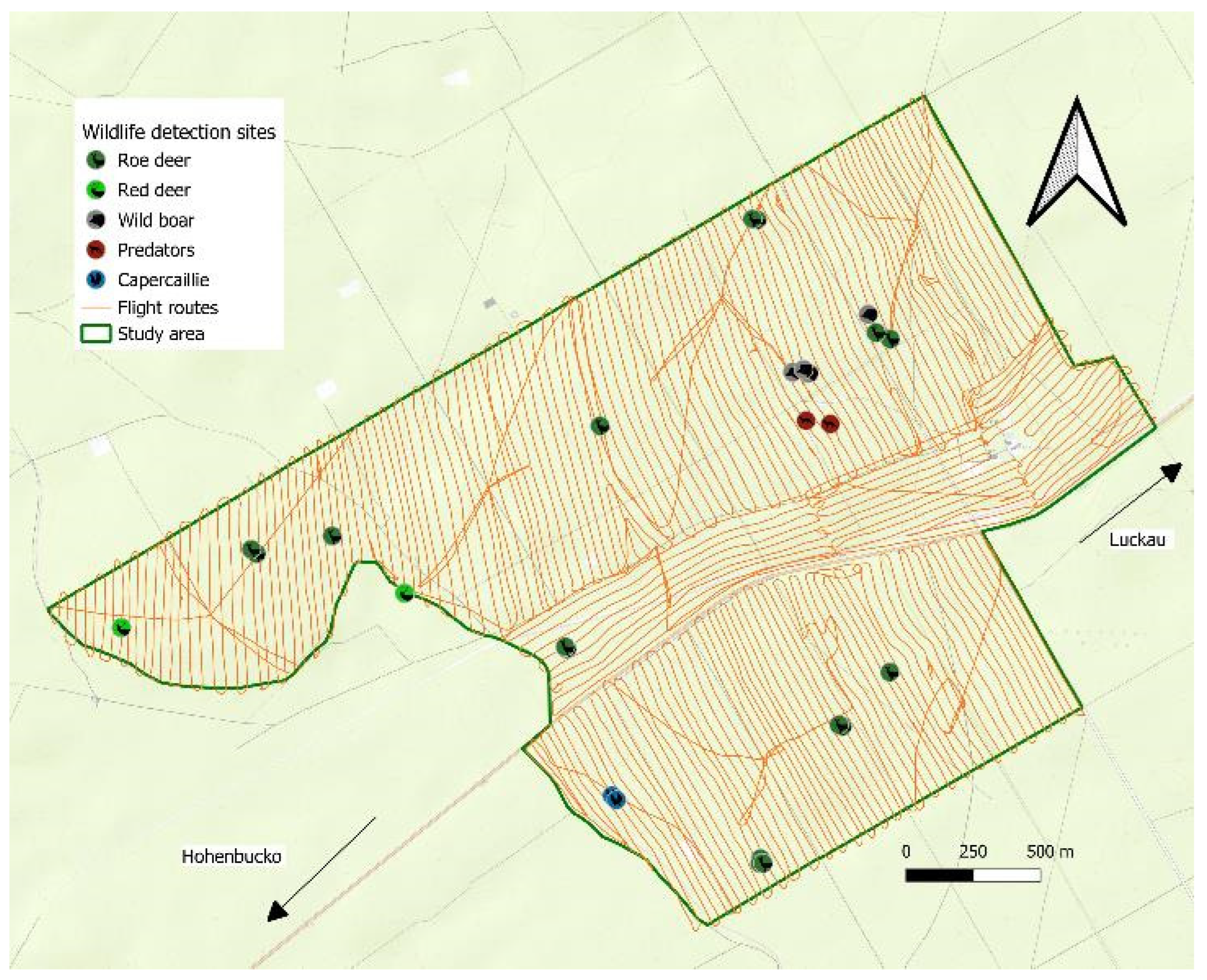
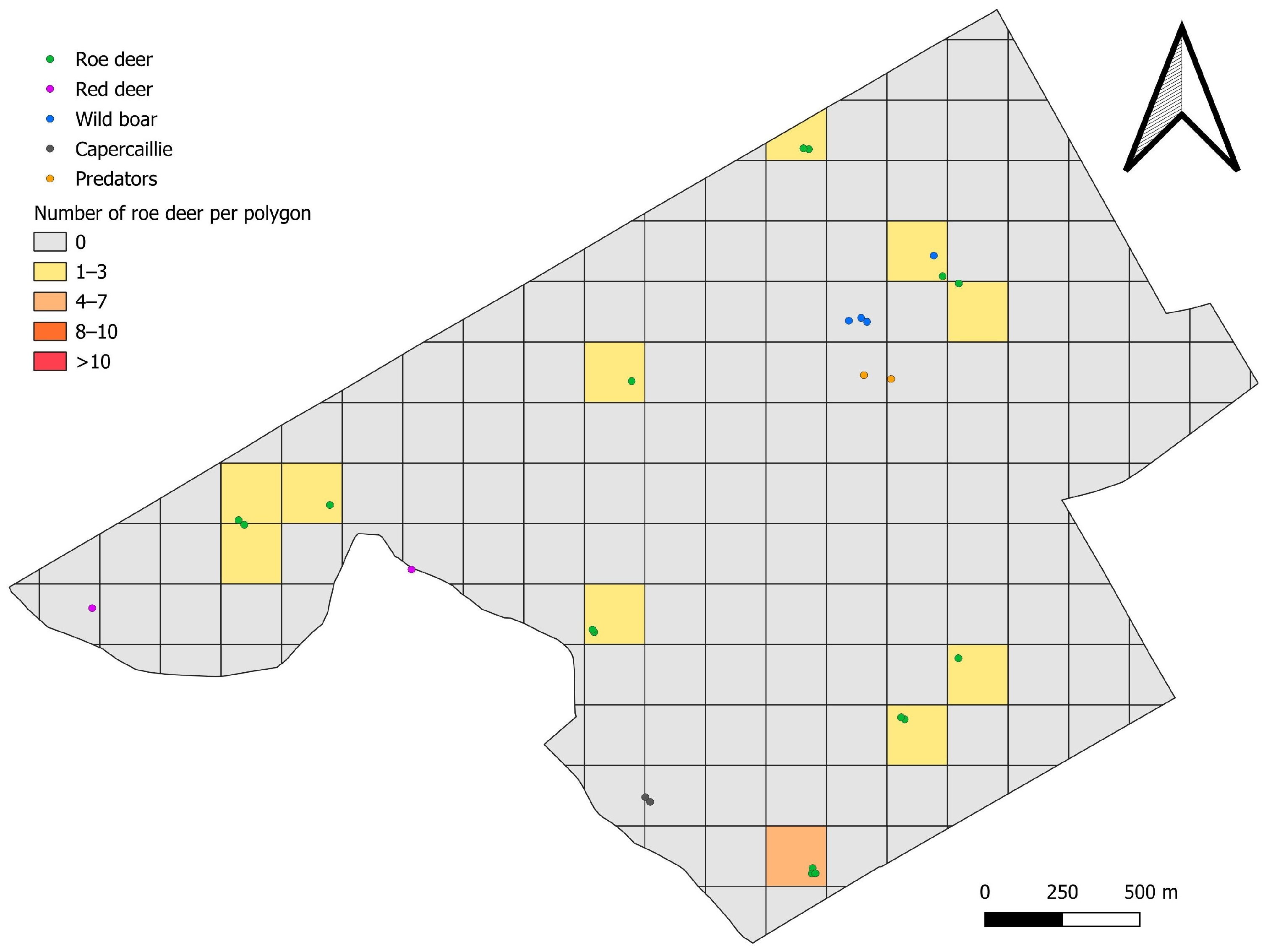
3.1.2. Abundance and Density of Different Wildlife Species in the Study Area Rochauer Heide
3.2. Evaluation of the Impact of Game
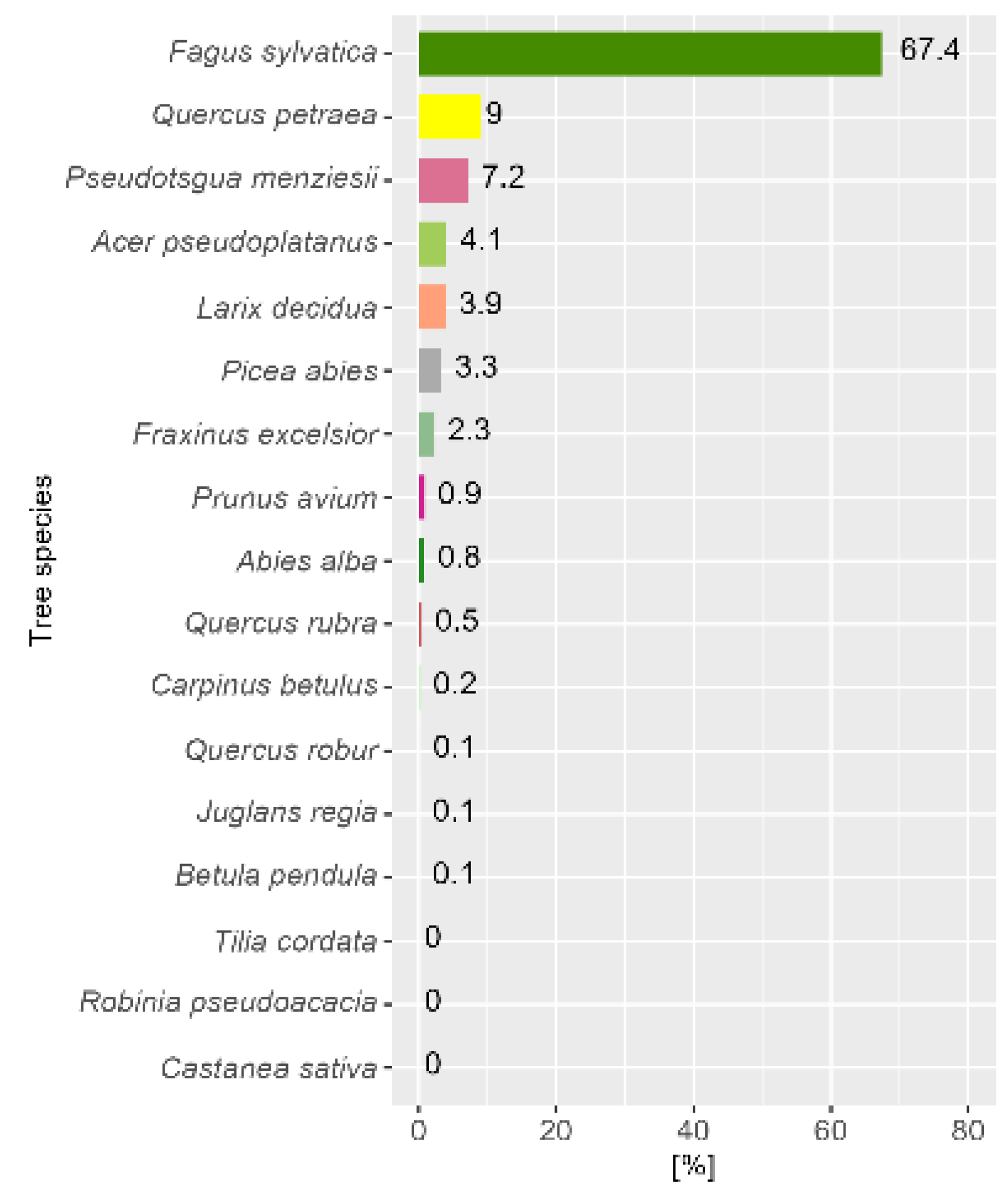
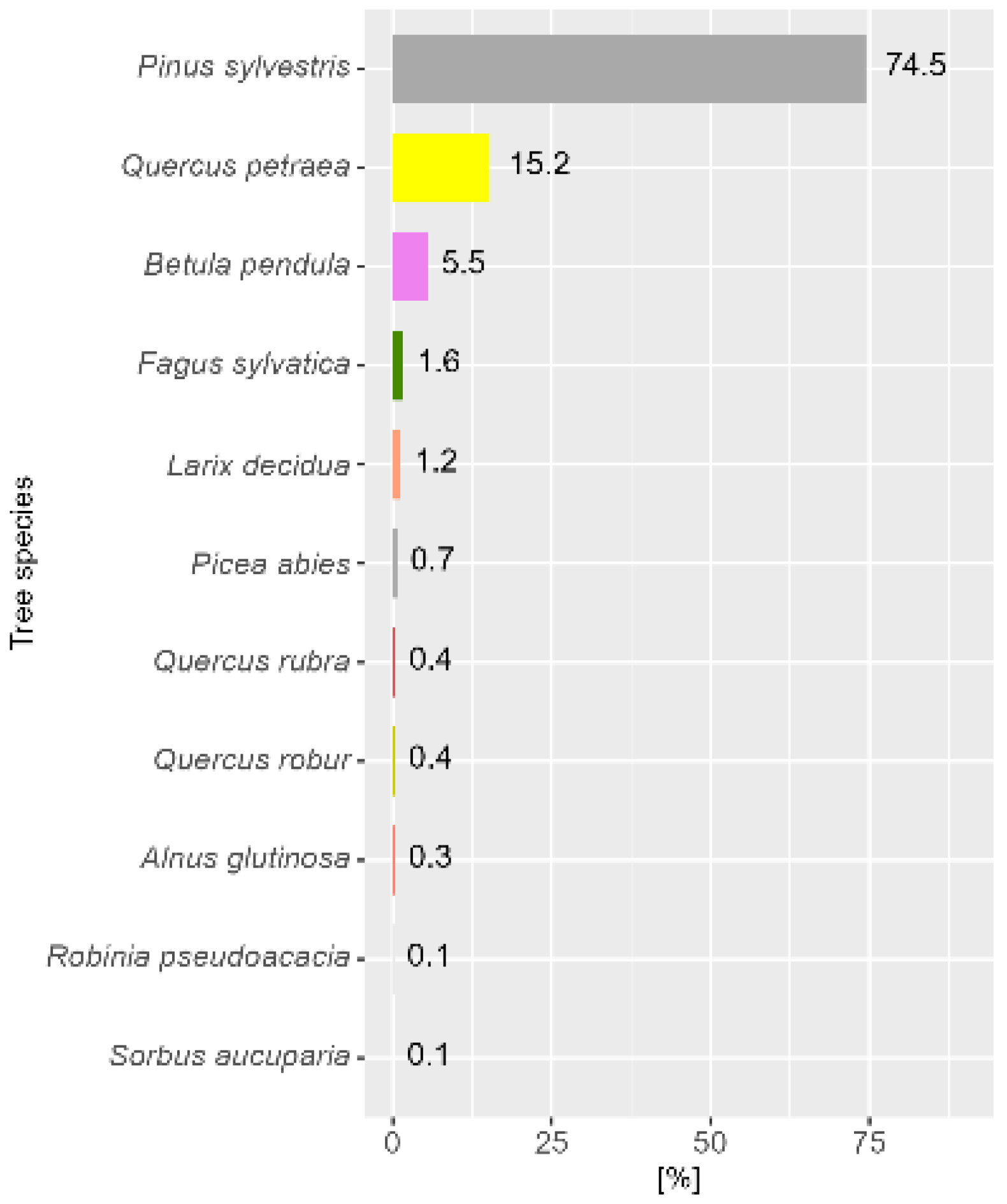
3.2.1. Tree Species Distribution in the Upper Stand
3.2.2. Canopy Closure of the Upper Stand
3.2.3. Differences Between the Rejuvenation Circles
3.2.4. Assessment of the State of Regeneration
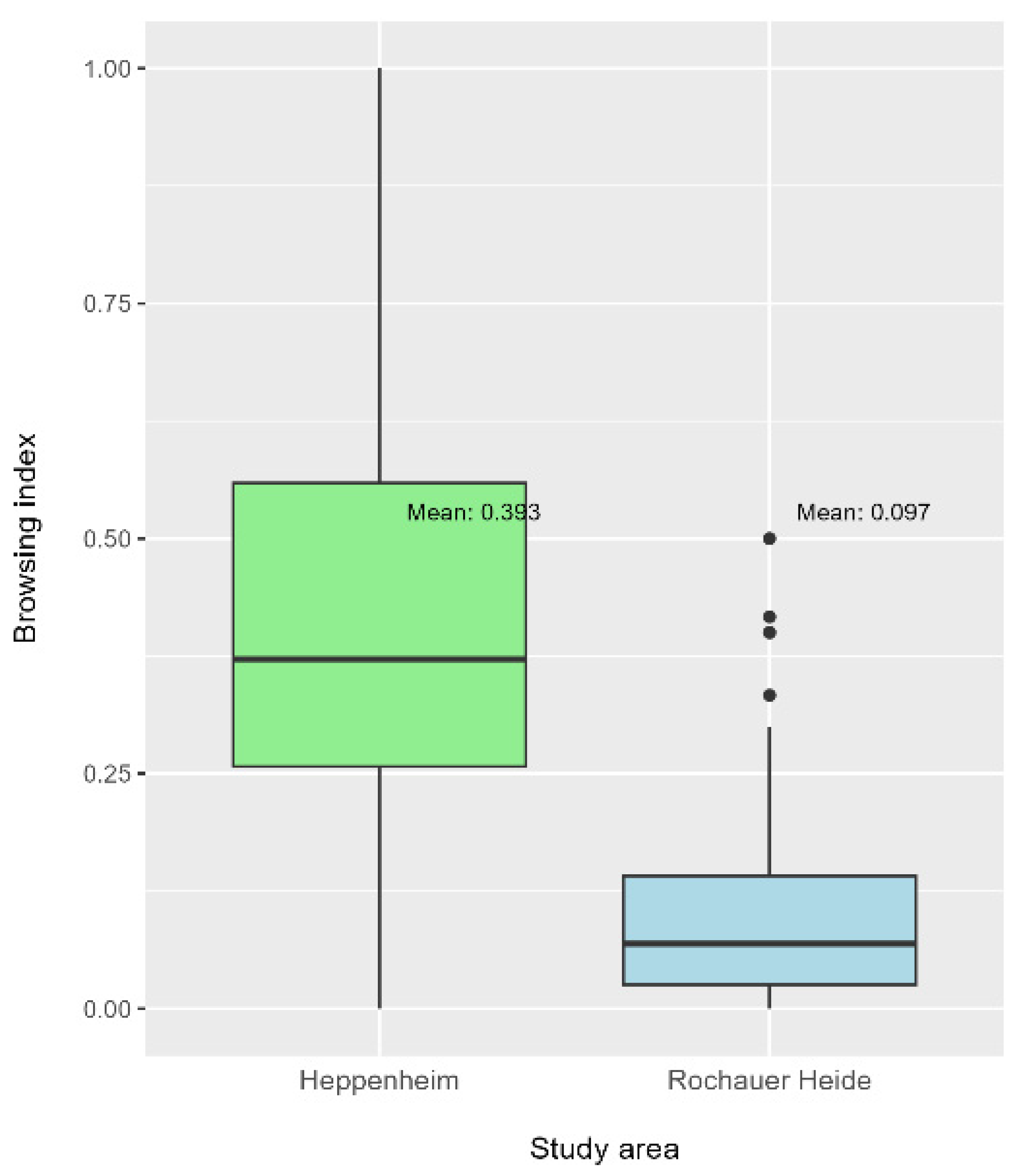
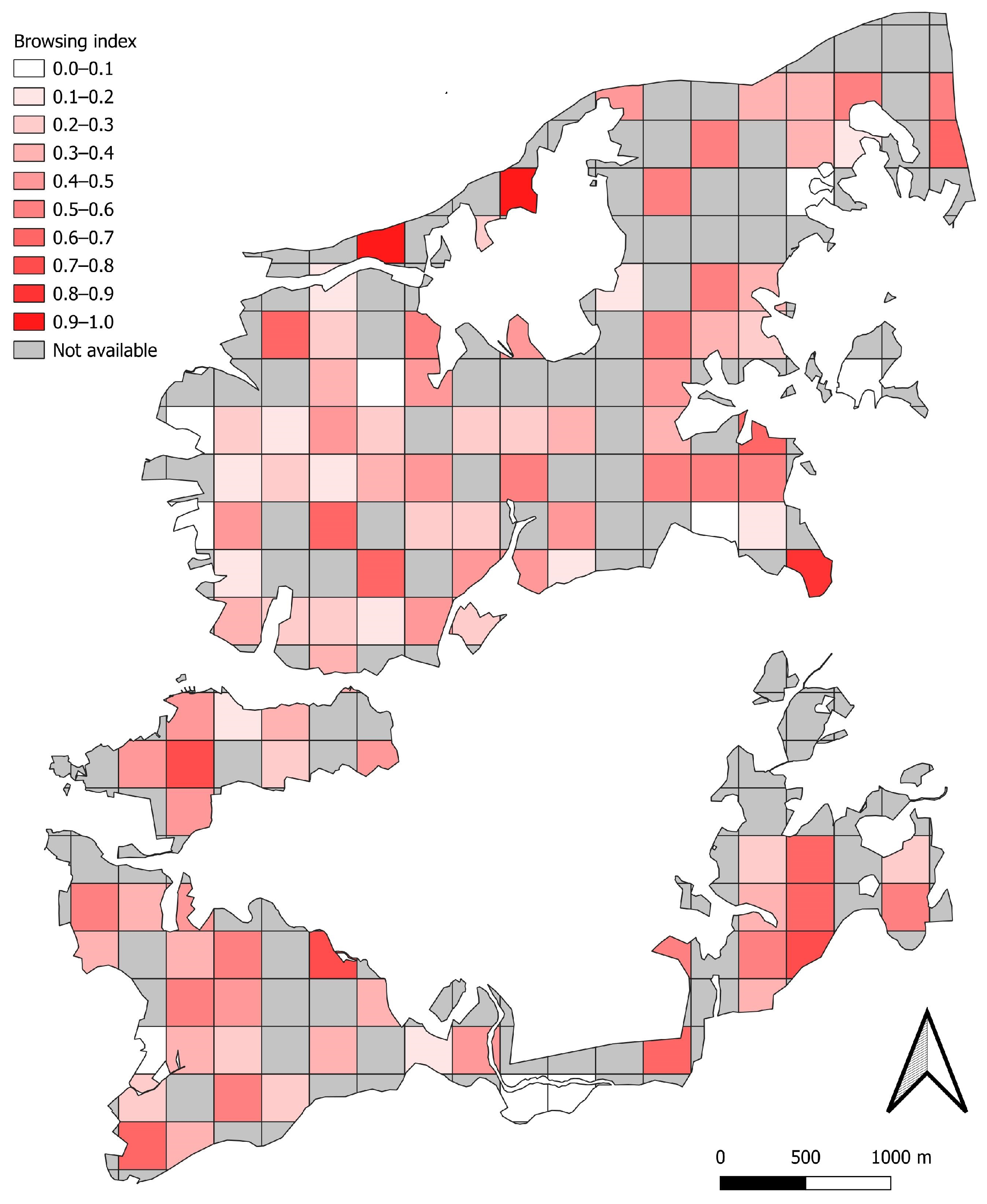
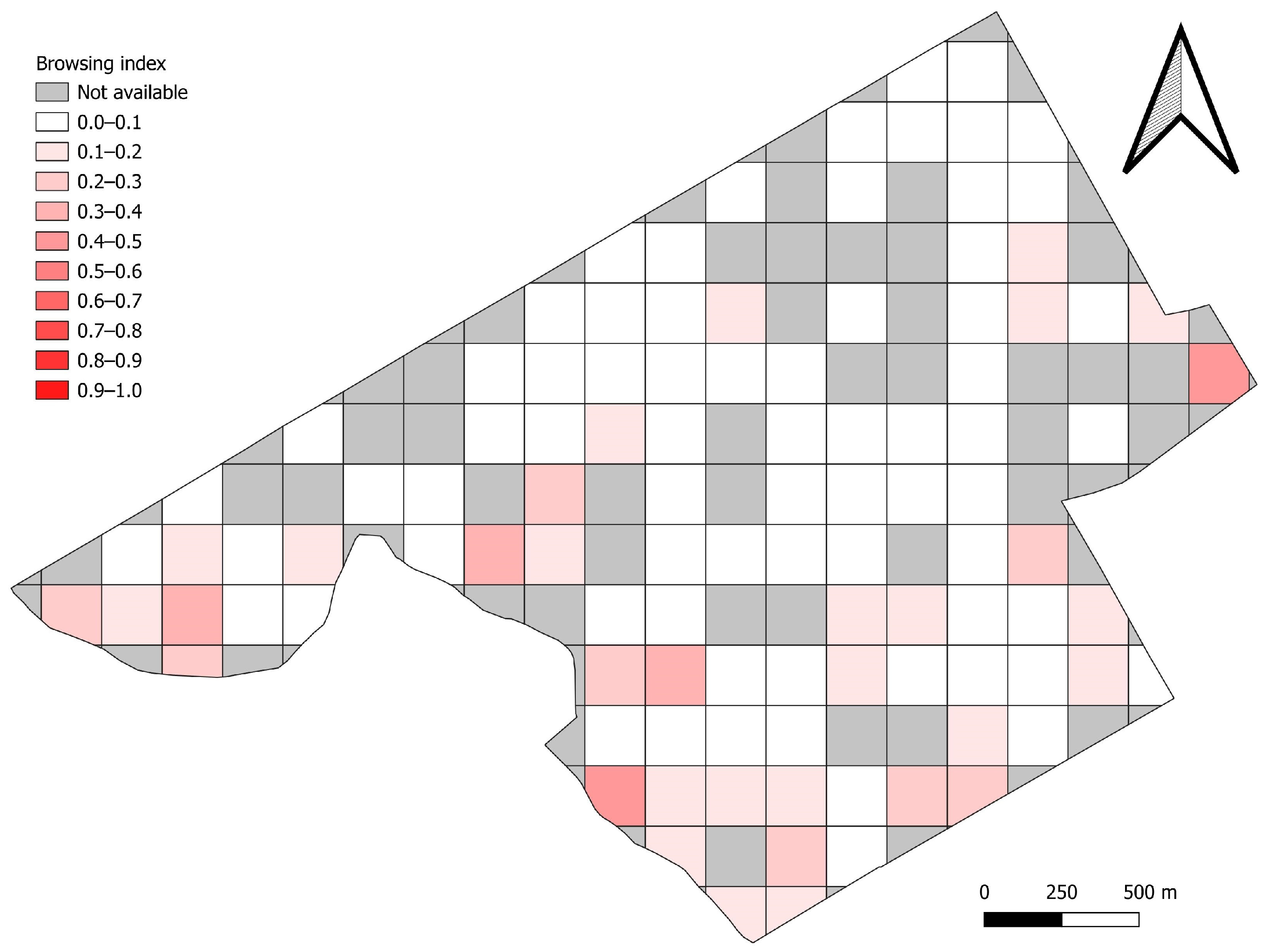
3.2.5. Comparison of Wildlife Impact in the Study Areas Heppenheim and Rochauer Heide
- Quantitative Wildlife Impact
- 2.
- Browsing Index
4. Discussion
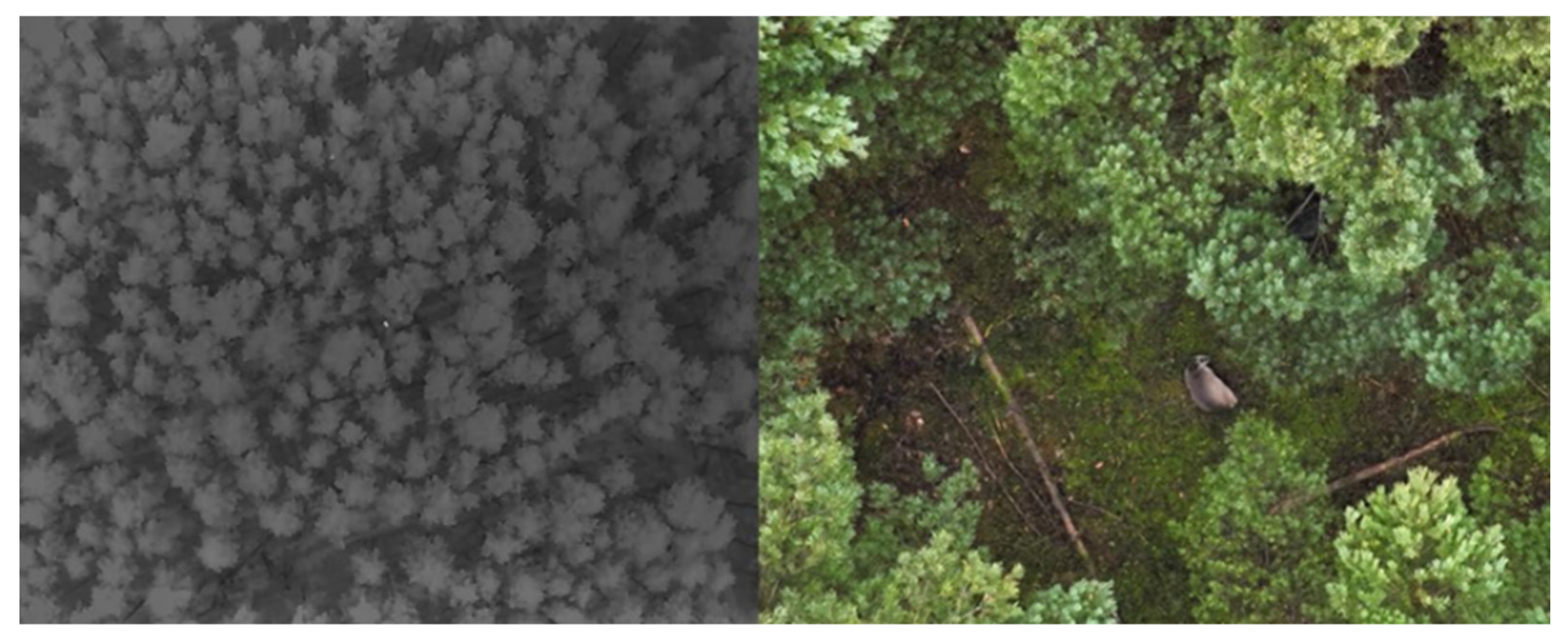
4.1. Thermal Drones as a Suitable Tool for Wildlife Surveys
4.1.1. Detection of Animals
4.1.2. Roe Deer Density and Browsing Pressure in Heppenheim
4.1.3. Population Structure and Regeneration Dynamics in Rochauer Heide
4.2. Wildlife Disturbance Due to Drone Flights
4.3. Hovering and Pausing Capability
4.4. Interpretation of Aerial Survey Results
4.5. Assessment of Wildlife Impact
4.6. Suitability of the Wildlife Impact Assessment Method
4.7. Ungulate Species and Their Impact on Tree Regeneration
4.8. Height Differences in Natural Regeneration and Their Modification by Ungulate Browsing
5. Conclusions
5.1. Drone Surveys for Estimating Wildlife Populations
5.2. Browsing Impact in the Study Areas
5.3. Summery
Author Contributions
Funding
Data Availability Statement
Acknowledgments
Conflicts of Interest
References
- Prien, S.; Müller, M. Wildschäden im Wald. Ökologische Grundlagen und Integrierte Schutzmaßnahmen. 2., überarb. und Stark erw. Aufl.; Neumann-Neudamm (Forst-Praxis): Melsungen, Germany, 2010. [Google Scholar]
- Kupferschmid, A.D.; Brang, P. Praxisrelevante Grundlagen: Zusammenspiel zwischen Wild und Wald. In Wald und Wild—Grundlagen für die Praxis; Bundesamt für Umwelt (BAFU): Ittigen, Switzerland, 2010; pp. 9–39. Available online: https://www.bafu.admin.ch/bafu/de/home/themen/biodiversitaet/publikationen-studien/publikationen/wald-wild-grundlagen-praxis.html (accessed on 22 October 2025).
- Holzer, D.; Bödeker, K.; Rammer, W.; Knoke, T. Evaluating dynamic tree-species-shifting and height development caused by ungulate browsing in forest regeneration using a process-based modeling approach. Ecol. Model. 2024, 493, 110741. [Google Scholar] [CrossRef]
- Ammer, C.; Vor, T.; Knoke, T.; Wagner, S. Der Wald-Wild-Konflikt. Analyse und Lösungsansätze vor dem Hintergrund rechtlicher, ökologischer und ökonomischer Zusammenhänge; Universitätsverlag Göttingen: Göttingen, Germany, 2010. [Google Scholar] [CrossRef]
- Ramírez Chiriboga, J.I.; Jansen, P.A.; Poorter, L. Effects of wild ungulates on the regeneration, structure and functioning of temperate and boreal forests: A systematic literature review. For. Ecol. Manag. 2018, 427, 371–383. [Google Scholar] [CrossRef]
- Deutscher Jagdverband. Handbuch 2023—Jahresstrecke Rehwild. 2023. Available online: https://www.jagdverband.de/sites/default/files/2025-02/2025-02_Infografik_Jahresjagdstrecke_Bundesrepublik_Deutschland_2023_2024.jpg (accessed on 21 October 2025).
- Gill, R.M.A. A Review of Damage by Mammals in North Temperate Forests: 3. Impact on Trees and Forests. For. Int. J. For. Res. 1992, 65, 363–388. [Google Scholar] [CrossRef]
- Morellet, N.; Gaillard, J.; Hewison, A.J.M.; Ballon, P.; Boscardin, Y.; Duncan, P.; Klein, F.; Maillard, D. Indicators of ecological change: New tools for managing populations of large herbivores. J. Appl. Ecol. 2007, 44, 634–643. [Google Scholar] [CrossRef]
- Berner, C.; Erber, J.; Frank, G.; Gorton, F.; Lexer, M.J.; Luidold, M.; Mayr-Melnhof, F.; Ramssl, F.; Reimoser, F.; Schadauer, K.; et al. Methoden der Wildstandserhebung. In Forst und Jagd-Dialog (10). Waidwerk. 2018. Available online: https://wildlife.reimoser.info/download/2018_Berner_et_al_Methoden_der_Wildstandserhebung_OW.pdf (accessed on 22 October 2025).
- Preston, T.M.; Wildhaber, M.L.; Green, N.S.; Albers, J.L.; Debenedetto, G.P. Enumerating White-Tailed Deer Using Unmanned Aerial Vehicles. Wildl. Soc. Bull. 2021, 45, 97–108. [Google Scholar] [CrossRef]
- Beaver, J.T.; Baldwin, R.W.; Messinger, M.; Newbolt, C.H.; Ditchkoff, S.S.; Silman, M.R. Evaluating the Use of Drones Equipped with Thermal Sensors as an Effective Method for Estimating Wildlife. Wildl. Soc. Bull. 2020, 44, 434–443. [Google Scholar] [CrossRef]
- Barasona, J.A.; Vicente, J.; Carrasco-Garcia, R.; Gortázar, C. Estimating ground surface visibility on thermal images from aerial drones in forested environments. Ecol. Inform. 2024, 78, 102453. [Google Scholar] [CrossRef]
- Chrétien, L.-P.; Théau, J.; Ménard, P. Exploring the feasibility of unmanned aerial vehicles and thermal infrared imaging for ungulate surveys in forests: Preliminary results. Drones 2016, 1, 4. [Google Scholar] [CrossRef]
- Krofel, M.; Allen, M.L. Advancing animal behaviour research using drone-based platforms. Anim. Behav. 2025, 222, 123147. Available online: https://www.sciencedirect.com/science/article/pii/S0003347225000740?via%3Dihub (accessed on 22 October 2025).
- Chrétien, L.-P.; Théau, J.; Ménard, P. Assessing the accuracy of counting large ungulates using UAV-mounted thermal infrared cameras. Wildl. Biol. 2017, wlb.00398. Available online: https://nsojournals.onlinelibrary.wiley.com/doi/10.1002/wlb3.01071 (accessed on 22 October 2025).
- Barasona, J.A.; Carrasco-Garcia, R.; Gortázar, C.; Vicente, J. Camera-trap methods and drone thermal surveillance: A review of wildlife monitoring technologies. Animals 2023, 13, 812. [Google Scholar] [CrossRef]
- Hardalau, D.; Codrean, C.; Iordache, D.; Fedorca, M.; Ionescu, O. The expanding thread of ungulate browsing—A review of forest ecosystem effects and management approaches in Europ. Forests 2024, 15, 1311. [Google Scholar] [CrossRef]
- Schwegmann, S.; Mörsdorf, M.; Bhardwaj, M.; Storch, I. Effects of understory characteristics on browsing patterns of roe deer in central European mountain forests. Ecol. Evol. 2023, 13, e10431. [Google Scholar] [CrossRef]
- Akashi, N.; Unno, A.; Uno, H. The browsing ratio as an index of the impact of deer browsing on tree seedlings. Trees For. People 2022, 8, 100276. [Google Scholar] [CrossRef]
- Meyer, P.; Aljes, M.; Culmsee, H.; Feldmann, E.; Glatthorn, J.; Leuschner, C.; Schneider, H. Quantifying old-growthness of lowland European beech forests by a multivariate indicator for forest structure. Ecol. Indic. 2021, 125, 27–40. [Google Scholar] [CrossRef]
- Bödeker, K.; Ammer, C.; Knoke, T.; Heurich, M. Determining statistically robust changes in ungulate browsing pressure as a basis for adaptive wildlife management. Forests 2021, 12, 1030. [Google Scholar] [CrossRef]
- Jones, G.P.; Pearlstine, L.G.; Percival, H.F. An Assessment of Small Unmanned Aerial Vehicles for Wildlife Research. Wildl. Soc. Bull. 2006, 34, 750–758. [Google Scholar] [CrossRef]
- Reimoser, F.; Schodterer, H.; Reimoser, S. Erfassung und Beurteilung des Schalenwildeinflusses auf die Waldverjüngung—Vergleich verschiedener Methoden des Wildeinfluss-Monitorings (“WEM-Methodenvergleich”); Bundesforschungs- und Ausbildungszentrum für Wald: Wien, Austria, 2014. [Google Scholar]
- Shapiro, S.S.; Wilk, M.B. An Analysis of Variance Test for Normality (Complete Samples). Biometrika 1965, 52, 591–611. [Google Scholar] [CrossRef]
- Kruskal, W.H.; Wallis, W.A. Use of ranks in one-criterion variance analysis. J. Am. Stat. Assoc. 1952, 47, 583–621. [Google Scholar] [CrossRef]
- Mann, H.B.; Whitney, D.R. On a test of whether one of two random variables is stochastically larger than the other. Ann. Math. Stat. 1947, 18, 50–60. [Google Scholar] [CrossRef]
- Gebert, C.; Verheyden-Tixier, H. Variations of diet composition of Red Deer (Cervus elaphus L.) in Europe. Mammal Rev. 2001, 31, 189–201. [Google Scholar] [CrossRef]
- Tixier, H.; Duncan, P. Are European roe deer browsers? A review of variations in the composition of their diets. Rev. Ecol. 1996, 51, 3–17. [Google Scholar] [CrossRef]
- Ivošević, B.; Han, Y.-G.; Cho, Y.; Kwon, O. The use of conservation drones in ecology and wildlife research. J. Ecol. Environ. 2015, 38, 113–118. [Google Scholar] [CrossRef]
- Hodgson, J.C.; Mott, R.; Baylis, S.M.; Pham, T.T.; Wotherspoon, S.; Kilpatrick, A.D.; Raja Segaran, R.; Reid, I.; Terauds, A.; Koh, L.P. Drones count wildlife more accurately and precisely than humans. Methods Ecol. Evol. 2018, 9, 1160–1167. [Google Scholar] [CrossRef]
- Linchant, J.; Lisein, J.; Semeki, J.; Lejeune, P.; Vermeulen, C. Are unmanned aircraft systems (UASs) the future of wildlife monitoring? A review of accomplishments and challenges. Mammal Rev. 2015, 45, 239–252. [Google Scholar] [CrossRef]
- Webster, C.; Jonas, T. Influence of canopy shading and snow coverage on effective albedo in a snow-dominated evergreen needleleaf forest. Remote Sens. Environ. 2018, 214, 48–58. [Google Scholar] [CrossRef]
- Israel, M. A UAV-based Roe deer fawndetection system. Int. Arch. Photogramm. Remote Sens. 2011, 38, 51–55. [Google Scholar] [CrossRef]
- Mulero-Pázmány, M.; Stolper, R.; Van Essen, L.D.; Negro, J.J.; Sassen, T. Remotely piloted aircraft systems as a rhinoceros anti-poaching tool in Africa. PLoS ONE 2014, 9, e83873. [Google Scholar] [CrossRef] [PubMed]
- Troeger, C.; Hohmann, U. Überprüfung der Anwendbarkeit von drohnengestützten Wärmebildkameras zur Erfassung von Schalenwild (am Beispiel des Rehwilds) im Pfälzerwald und Umgebung. Endbericht zu Forschungsmethoden; Deutsche Bundesstiftung Umwelt: Trippstadt, Germany, 2021. [Google Scholar]
- Herzog, S. Wildtiermanagement. Grundlagen und Praxis; Quelle & Meyer Verlag: Wiebelsheim, Germany, 2019. [Google Scholar]
- Gräber, R.; Ronnenberg, K.; Strauß, E.; Siebert, U.; Hohmann, U.; Sandrini, J.; Ebert, C.; Hettich, U.; Franke, U. Vergleichende Analyse verschiedener Methoden zur Erfassung von freilebenden Huftieren. Hg. v. Deutsche Bundesstiftung Umwelt. 2016. Available online: https://www.dbu.de/OPAC/ab/DBU-Abschlussbericht-AZ-30413.pdf (accessed on 22 October 2025).
- Larsen, H.L.; Møller-Lassesen, K.; Enevoldsen, E.M.E.; Madsen, S.B.; Obsen, M.T.; Povlsen, P.; Bruhn, D.; Pertoldi, C.; Pagh, S. Drone with mounted thermal infrared cameras for monitoring terrestrial mammals. Drones 2023, 7, 680. [Google Scholar] [CrossRef]
- Berezina, E.A.; Gilyov, A.N.; Karenina, K.A. The use of drones for studying the behaviour of mammals. Russ. J. Zool. 2024, 103, 100–118. [Google Scholar] [CrossRef]
- Elmore, J.A.; Curran, M.F.; Evans, K.O.; Samiappan, S.; Zhou, M.; Pfeiffer, M.B.; Blackwell, B.F.; Iglay, R.B. Evidence on the effectiveness of small unmanned aircraft systems (sUAS) as a survey tool for North American terrestrial, vertebrate animals: A systematic map protocol. Environ. Evid. 2023, 10, 15. [Google Scholar] [CrossRef]
- Del Re, A.; Kämper, N.; Schoch, A.; Scheele, P. Unbemannte Luftfahrtsysteme. Zivile Drohnen im Spannungsfeld von Wirtschaft, Recht, Sicherheit und Gesellschaftlicher Akzeptanz; Springer: Wiesbaden/Heidelberg, Germany, 2024. [Google Scholar]
- Duporge, I.; Spiegel, M.P.; Thomson, E.R.; Chapman, T.; Lamberth, C.; Pond, C.; Macdonald, D.W.; Wang, T.; Klinck, H. Determination of optimal flight altitude to minimise acoustic drone disturbance to wildlife using species audiograms. Methods Ecol. Evol. 2021, 12, 2196–2207. [Google Scholar] [CrossRef]
- Reimoser, S. Störung von Rot- und Rehwild. Weidwerk 2013, 9, 16–17. Available online: https://wildlife.reimoser.info/download/2013_Reimoser_Stoerung%20von%20Rot%20und%20Rehwild%202_Verhaltensaenderungen%20bei%20Stoerungen.pdf (accessed on 22 October 2025).
- Bruchmann, T. Verknüpfung komplexer digitaler Daten von UAS-Flugsteuerungen mit einer verständlichen Schnittstelle für Pilot:innen. Elektrotech. Inftech. 2024, 14, 217–221. [Google Scholar] [CrossRef]
- Stadt, H. Besprechung über Jagdstrategien, Verpachtung, Wildeinflussmonitoring und Abschussplanung im Städtischen Forstrevier der Stadt Heppenheim. 2023. Available online: https://www.heppenheim.de/buergerservice-rathaus/politik-gremien/buergermeister-erste-stadtraetin/ (accessed on 22 October 2025).
- Ellenberg, H. Zur Populationsökologie des Rehes (Capreolus capreolus L., Cervidae) in Mitteleuropa; Institut für Landschaftsökologie, TU-München: München, Germany, 1978. [Google Scholar]
- Lovari, S.; Serrao, G.; Mori, E. Woodland features determining home range size of roe deer. Behav. Process. 2017, 140, 115–120. [Google Scholar] [CrossRef]
- Pagon, N.; Grignolio, S.; Brivio, F.; Marcon, A.; Apollonio, M. Territorial behaviour of male roe deer: A telemetry study of spatial behaviour and activity levels. Folia Zool. 2017, 66, 267–276. [Google Scholar] [CrossRef]
- Reinecke, H.; Leinen, L.; Thißen, I.; Meißner, M.; Herzog, S.; Schütz, S.; Kiffner, C. Home range size estimates of red deer in Germany: Environmental, individual and methodological correlates. Eur. J. Wildl. Res. 2014, 60, 237–247. [Google Scholar] [CrossRef]
- Thomae, M.; Polaczek, K.; Eisenhauer, D.-R. Rotwildmanagement pro Waldumbau. Ergebnisse des Kooperationsprojektes im Erzgebirge und Elbsandsteingebirge. Unter Mitarbeit von Ute Tröber, Franziska Bandau und Ursula Franke. Hg. v. Staatsbetrieb Sachsenforst, Kompetenzzentrum für Wald und Forstwirtschaft. Staatsbetrieb Sachsenforst, Kompetenzzentrum für Wald und Forstwirtschaft; Technische Universität Dresden. 2023. Available online: https://cdn.website-editor.net/s/2e36ec4310cd4286be7c9db4d39528e7/files/uploaded/Rotwildprojekt_20250108_Hunting4Future.pdf?Expires=1764410932&Signature=M~Ra04TcrGF2ER0-fiBWoCq4~ItgFeiCM~kDI~I1-YFoHhlH7ow1z-mitK~uXpbNm-N42RBJw9xNHqRqG7YhHtwe1dn2c1KkGJkeXK8NPfAEdtisZ2IFBVUQ-bo3Tg9c5qt-mUBo8Of5sWwhqj7IRyiPpPs6sg08V4VYOqEhkLWSIVtTCIglxBttqpzQFdck7GnVCKGnM1dHZ-gP6W0t1Y3oGvfe6Ddbcjj0V7x3MqFTToaT-nm9EthK9s8KgAoJE3nwCqwUWFmvFHSdkfqfsNphsFOcnv8anTzRWFpO0WYztHze2PB6dIjvgMhrwFuALHU2zhAFhD1re7MhoqCVCQ__&Key-Pair-Id=K2NXBXLF010TJW (accessed on 22 October 2025).
- Kamler, J.F.; Jedrzejewski, W.; Jedrzejewska, B. Home Ranges of Red Deer in a European Old-growth Forest. Am. Midl. Nat. 2008, 159, 75–82. [Google Scholar] [CrossRef]
- Mårell, A.; Hamard, J.-P.; Pérot, T.; Perret, S.; Korboulewsky, N. The effect of deer browsing and understory light availability on stump mortality and sprout growth capacity in sessile oak. For. Ecol. Manag. 2018, 430, 134–142. [Google Scholar] [CrossRef]
- Kupferschmid, A.D.; Brang, P.; Bugmann, H. Abschätzung des Einflusses von Verbiss durch wildlebende Huftiere auf die Baumverjüngung. Schweiz. Z. Forstwes. 2019, 170, 125–134. [Google Scholar] [CrossRef]
- Stimm, K.; Uhl, E.; Pretzsch, H. Zur langfristigen Verjüngungsdynamik der Eichen (Quercus petraea MATT. Liebl und Quercus robur L.) in Kieferrein- und Eichenmischbeständen—Struktur, Wachstum, waldbauliche Behandlung. Forstl. Forschungsberichte München 2021, 221, 162–182. Available online: https://www.researchgate.net/publication/356683415_Zur_langfristigen_Verjungungsdynamik_der_Eichen_Quercus_petraea_MATT_Liebl_und_Quercus_robur_L_in_Kieferrein-_und_Eichenmischbestanden_-_Struktur_Wachstum_waldbauliche_Behandlung#fullTextFileContent (accessed on 22 October 2025).
- Eiberle, K.; Nigg, H. Grundlagen zur Beurteilung des Wildverbisses im Gebirgswald. Schweiz. Z. Forstwes. 1987, 138, 747–786. [Google Scholar]
- Kupferschmid, A.D.; Gmür, P.A. Methoden zur Einschätzung des Verbisseinflusses: Vergleich der Messungen an den k nächsten Bäumchen mit Zählungen im Probekreis. Schweiz. Z. Forstwes. 2020, 171, 69–78. [Google Scholar] [CrossRef]
- Abegg, M.; Allgaier Leuch, B.; Kupferschmid, A.D. Wildverbiss: Wichtige Baumarten unter Druck. Wald. Und Holz 2021, 9, 20–22. Available online: https://www.lfi.ch/media/documents/publikationen/WaldHolz_21-09.pdf (accessed on 22 October 2025).
- Reimoser, F.; Reimoser, S. (Eds.) Richtiges Erkennen von Wildschäden am Wald; Zentralstelle Österreichischer Landesjagdverbände: Wien, Austria, 2017; Available online: https://wildlife.reimoser.info/document/2017_Reimoser_Erkennen_Wildschaeden_low.pdf (accessed on 19 August 2024).
- Reif, A.; Gärtner, S. Die natürliche Verjüngung der laubabwerfenden Eichenarten Stieleiche (Quercus robur L.) und Traubeneiche (Quercus petraea Liebl.)—eine Literaturstudie mit besonderer Berücksichtigung der Waldweide. Wald. Online—Forstl. Veg. 2007, 5, 79–116. Available online: https://publikationen.ub.uni-frankfurt.de/opus4/frontdoor/deliver/index/docId/9383/file/waldoekologie_online_heft_5_3.pdf (accessed on 20 August 2024).
- Höllerl, S.; Mosandl, R. Der Bergahorn im Bergmischwald—unübertroffen in seinem Verjüngungspotential. LWF Aktuell 2009, 62, 24–29. Available online: https://www.lwf.bayern.de/mam/cms04/waldbau/dateien/w62-der-bergahorn-im-bergmischwald-unuebertroffen-in-seinem-verjuengungspotential.pdf (accessed on 22 October 2025).
- Brosinger, F.; Schmidt, O. Der Bergahorn in Bayern. LWF Wissen 2009, 62, 19–23. Available online: https://www.lwf.bayern.de/mam/cms04/waldbau/dateien/w62-der-bergahorn-in-bayern.pdf (accessed on 22 October 2025).
- Annighöfer, P.; Beckschäfer, P.; Vor, T.; Ammer, C. Regeneration Patterns of European Oak Species (Quercus petraea (Matt.) Liebl., Quercus robur L.) in Dependence of Environment and Neighborhood. PLoS ONE 2015, 10, e0134935. [Google Scholar] [CrossRef] [PubMed]
- Kupferschmid, A.D.; Angst, J.K. Auswirkungen des Verbisses in Buchenwäldern. Schweiz. Z. Forstwes. 2023, 174, 304–305. [Google Scholar] [CrossRef]
- FVA Baden-Württemberg. Die Vogelkirsche (Prunus avium L.). Praxis-Infoblatt zur Wertholzproduktion. ForstBW Prax. 2001, 1. Available online: https://www.fva-bw.de/fileadmin/publikationen/einblick/einblick201001.pdf (accessed on 20 August 2024).
- Schmidt, P.A. Picea abies. In Enzyklopädie der Holzgewächse—Handbuch und Atlas der Dendrologie; Schütt, P., Roloff, A., Weisgerber, H., Lang, U.M., Stimm, B., Eds.; Wiley-VCH: Weinheim, Germany, 2014. [Google Scholar]
- Eyholzer, R.; Baumann, M. Methoden zur Erhebung von Schalenwildbeständen. In Wald und Wild—Grundlagen für die Praxis; Bundesamt für Umwelt (BAFU): Ittigen, Switzerland, 2010; pp. 93–110. [Google Scholar]
- Angst, J.K.; Kupferschmid, A.D. Assessing Browsing Impact in Beech Forests: The Importance of Tree Responses after Browsing. Diversity 2023, 15, 262. [Google Scholar] [CrossRef]
- Bergquist, J.; Löf, M.; Örlander, G. Effects of roe deer browsing and site preparation on performance of planted broadleaved and conifer seedlings when using temporary fences. Scand. J. For. Res. 2009, 24, 308–317. [Google Scholar] [CrossRef]
- Reimoser, F.; Reimoser, S. Beurteilung des Huftiereinflusses auf die Entwicklung der Waldverjüngung im Wildnisgebiet Dürrenstein–Kontrollzaun Vergleichsflächenerhebung 2004–2013. Silva Fera 2015, 4, 77–85. Available online: https://wildlife.reimoser.info/download/2015_Reimoser%20und%20Reimoser_Huftiereinfluss%20auf%20Waldverjuengung_Wildnisgebiet%20Duerrenstein.pdf (accessed on 20 August 2024).
- Turczański, K.; Dyderski, M.K.; Rutkowski, P. Ash dieback, soil and deer browsing influence natural regeneration of European ash (Fraxinus excelsior L.). Sci. Total Environ. 2021, 752, 141787. [Google Scholar] [CrossRef]
- Thrippleton, T.; Lüscher, F.; Bugmann, H. Climate change impacts across a large forest enterprise in the Northern Pre-Alps: Dynamic forest modelling as a tool for decision support. Eur. J. For. Res. 2020, 139, 483–498. [Google Scholar] [CrossRef]












| Species | Absolute Count (1st Survey) [n/1362 ha] | Average Count (1st Survey) [n/100 ha] | Absolute Count (2nd Survey) [n/1362 ha] | Average Count (2nd Survey) [n/100 ha] |
|---|---|---|---|---|
| Roe Deer | 549.0 | 40.3 | 490.0 | 35.9 |
| Wild Boar | 57.0 | 4.2 | 100.0 | 7.3 |
| Hares | 11.0 | 0.8 | 13.0 | 0.9 |
| Red Fox | 6.0 | 0.4 | 1.0 | 0.07 |
| Others | 2.0 | 0.1 | 3.0 | 0.2 |
| Species | Absolute (Flight 1) [n/572 ha] | Average (Flight 1) [n/100 ha] | Absolute (Flight 2) [n/572 ha] | Average (Flight 2) [n/100 ha] |
|---|---|---|---|---|
| Roe deer | 19.0 | 3.31 | 23 | 4.02 |
| Red deer | 2.0 | 0.35 | 2 | 0.35 |
| Wild boar | 7.0 | 1.22 | 28 | 4.89 |
| Predators | 2.0 | 0.35 | 5 | 0.87 |
| Capercaillie | 2.0 | 0.35 | 0 | 0.0 |
| Hares | 0.0 | 0.0 | 3 | 0.53 |
| Species | Total Regeneration [n/ha] | Percentage of Total Regeneration [%] | Regeneration Affected [n/ha] | Percentage Affected [%] |
|---|---|---|---|---|
| F. sylvatica | 3953 | 46.8 | 2006 | 50.7 |
| A. spec. | 2018 | 23.9 | 1187 | 58.8 |
| Q. petraea | 1234 | 14.6 | 132 | 10.7 |
| F. excelsior | 833 | 9.9 | 443 | 53.2 |
| P. avium | 287 | 3.4 | 69 | 24.0 |
| J. regia | 30 | 0.4 | 0 | 0.0 |
| A. alba | 26 | 0.3 | 19 | 73.1 |
| P. menziesii | 22 | 0.3 | 12 | 54.5 |
| L. decidua | 22 | 0.3 | 22 | 100.0 |
| C. betulus | 11 | 0.1 | 7 | 63.6 |
| P. abies | 7 | 0.1 | 0 | 0.0 |
Disclaimer/Publisher’s Note: The statements, opinions and data contained in all publications are solely those of the individual author(s) and contributor(s) and not of MDPI and/or the editor(s). MDPI and/or the editor(s) disclaim responsibility for any injury to people or property resulting from any ideas, methods, instructions or products referred to in the content. |
© 2025 by the authors. Licensee MDPI, Basel, Switzerland. This article is an open access article distributed under the terms and conditions of the Creative Commons Attribution (CC BY) license (https://creativecommons.org/licenses/by/4.0/).
Share and Cite
Jordan-Fragstein, C.C.; Müller, M.G.; Bielefeld, N.; Georgi, R.; Friedrich, R. Assessing Wildlife Impact on Forest Regeneration Through Drone-Based Thermal Imaging. Forests 2025, 16, 1787. https://doi.org/10.3390/f16121787
Jordan-Fragstein CC, Müller MG, Bielefeld N, Georgi R, Friedrich R. Assessing Wildlife Impact on Forest Regeneration Through Drone-Based Thermal Imaging. Forests. 2025; 16(12):1787. https://doi.org/10.3390/f16121787
Chicago/Turabian StyleJordan-Fragstein, Claudia C., Michael G. Müller, Niklas Bielefeld, Richard Georgi, and Robert Friedrich. 2025. "Assessing Wildlife Impact on Forest Regeneration Through Drone-Based Thermal Imaging" Forests 16, no. 12: 1787. https://doi.org/10.3390/f16121787
APA StyleJordan-Fragstein, C. C., Müller, M. G., Bielefeld, N., Georgi, R., & Friedrich, R. (2025). Assessing Wildlife Impact on Forest Regeneration Through Drone-Based Thermal Imaging. Forests, 16(12), 1787. https://doi.org/10.3390/f16121787