


Abstract
In the semi-arid Loess Plateau of China, afforestation frequently leads to soil water depletion, threatening ecosystem sustainability. Although mixed-species plantations are encouraged to enhance resource use efficiency, their effects on deep soil water and root distribution strategies remain unclear. This study compared soil water content (SWC), deep soil water deficit (SWD), and fine root distribution in pure and mixed plantations of Robinia pseudoacacia, Platycladus orientalis, and Hippophae rhamnoides to assess whether species mixing intensifies consumption for deep soil water. Soil moisture and root samples were collected with a maximum depth of 20 m across five stand types in August 2018 and during the 2019 growing season. Results showed that mixed stands exhibited shallower water depletion depth and lower SWC below 2 m than pure stands, but a more severe deep soil water deficit, with observed SWD exceeding the expected values by 12% in the R. pseudoacacia-P. orientalis mixture (MRP) and 22% in the H. rhamnoides-P. orientalis mixture (MHP), indicating intensified water consumption below 2 m. In the MRP, the maximum rooting depth was shallower than in the corresponding pure stands. Within the mixture, species-specific root plasticity was observed: the normalized fine root length density (FRLD) of P. orientalis was four times greater in mixture than in pure stand, whereas that of R. pseudoacacia was 62% lower, suggesting divergent foraging strategies. Correlation analyses indicated that SWC was differently associated with root traits between pure and mixed stands, with relationships varying by soil depth. Mixed-effects models confirmed that both plantation type and soil depth significantly influenced FRLD and Root dry weight density (RDWD), while specific root length (SRL) was mainly affected by plantation type and its interaction with depth. These findings demonstrated that mixed-species afforestation intensifies deep soil water competition. Therefore, sustainable management should prioritize the selection of species with complementary root foraging strategies and the optimization of planting densities in semi-arid regions.
1. Introduction
Afforestation has been widely implemented worldwide as a critical strategy to combat land degradation, mitigate climate change, and restore ecosystem functions [1]. In semi-arid regions such as China’s Loess Plateau, large-scale afforestation projects have effectively reduced soil erosion and enhanced carbon sequestration and forest productivity [2,3]. Owing to their operational simplicity and suitability for intensive management, monoculture plantations have historically dominated afforestation programs [4]. However, this approach is increasingly threatened in water-scarce regions, where large-scale monoculture leads to severe overconsumption of water resources, progressively drying the soil and elevating the risk of widespread tree mortality [5]. Given that soil water is the critical limiting factor for ecosystem sustainability in arid and semi-arid regions [6], there is a pressing need to develop afforestation strategies that are more hydrologically sustainable.
In response to this challenge, mixed-species afforestation has been proposed as a viable alternative, with the potential to enhance water use efficiency and ecosystem resilience through complementary resource acquisition strategies [7,8]. By combining species with complementary functional traits, mixed plantations can theoretically reduce interspecific competition and promote more efficient partitioning of belowground resources such as water and nutrients [9]. This is particularly crucial in water-limited environments, where competition for soil moisture strongly influences vegetation dynamics. However, the effect of mixed-species plantations on soil moisture conditions on the Loess Plateau remains debated. Recent evidence suggests that mixed plantations can enhance drought resistance and improve plant survival by alleviating deep soil water deficit through hydrological niche partitioning. For example, soils in mixed-species plantations exhibit a greater capacity to intercept and retain rainfall compared to monocultures [10]. Furthermore, Robinia pseudoacacia in mixed stands has been shown to facilitate the growth of Platycladus orientalis by improving soil water availability [11]. A recent regional-scale study confirms the positive effects of mixed-species plantations on soil water storage across the Chinese Loess Plateau [12]. Differences in root architecture and distribution among co-occurring species can reduce overall water competition through hydrological niche segregation [13]. Nevertheless, when interacting species share similar functional traits, niche overlap may intensify water competition, thereby exacerbating drought stress. For instance, overlapping root systems in mixed stands have been reported to compete for water, thus reducing vegetation productivity [14,15]. In water-limited settings, intense interspecific competition in mixed plantations can adversely affect plant growth and ecosystem function [16]. Hence, the effectiveness of mixed-species plantations in mitigating regional water stress remains uncertain. Consequently, gaining critical insights into their impacts on both regional soil moisture regimes and ecosystem drought resilience is essential to guide evidence-based species selection and sustainable afforestation planning in semi-arid regions. However, the current understanding of belowground interactions is predominantly based on observations in shallow soil layers. It remains poorly understood whether intensified consumption in mixed stands extends into deep soil profiles, which serve as a vital reservoir that sustains plant growth and ecosystem function during periods of prolonged drought or seasonal water stress [17,18]. This knowledge gap fundamentally limits our ability to predict the long-term hydrological sustainability of afforestation.
Root systems play a vital role in plant water uptake and adaptation to water-limited conditions [19]. The spatial distribution of roots is a key functional trait that defines the potential soil zones for plant exploration and determines resource uptake intensity, thus controlling a plant’s ability to acquire environmental resources [20]. Fine root morphological traits (e.g., root density and specific root length) are critical in influencing soil water balance and interspecific competition [21,22]. Root dynamics are driven by soil water content, as indicated by a strong correlation between root growth and soil moisture availability [23]. Forest stands develop a complex morphological distribution and possess multiple strategies of water absorption, enabling them to adapt to different soil water conditions [24]. A deeper understanding of root system development and its response to soil water can help elucidate the diverse strategies plants use for resource acquisition [25]. However, the plasticity of belowground responses, particularly in root distribution and water use strategies to mixed versus pure stands, remains poorly understood. While several studies have compared water consumption and water use strategies between pure and mixed plantations, few have adopted a paired experimental design. Moreover, although vertical root distribution has been widely examined, the maximum root depth is often not sampled due to the difficulties associated with deep sampling [26]. This sampling limitation constrains our understanding of deep soil profile water trade-offs and rooting strategies under mixed afforestation.
Although the “Grain for Green” project on the Chinese Loess Plateau has effectively controlled soil erosion and increased vegetation coverage, the extensive planting of deep-rooted vegetation has led to plant transpiration demands that substantially exceed precipitation, resulting in soil desiccation that threatens the sustainable development of forestlands. Robinia pseudoacacia, Platycladus orientalis, and Hippophae rhamnoides are pioneer species widely used in vegetation restoration across this region. In this study, we selected five distinct plantation types for investigation: pure R. pseudoacacia (PR), pure P. orientalis (PP), pure H. rhamnoides (PH), mixed R. pseudoacacia-P. orientalis (MRP), and mixed H. rhamnoides-P. orientalis (MHP). Soil water content and root distribution characteristics were measured in each plot. The objectives were to: (1) compare the soil water content and deep soil water deficit between pure and mixed-species stands; (2) examine the influence of mixed planting on fine root distribution traits; and (3) identify the relationships between root trait plasticity and soil moisture dynamics. We hypothesized that (1) mixed stands would exhibit more intense belowground competition, resulting in greater deep soil water depletion than pure stands; and (2) root foraging strategies (e.g., rooting depth and fine root distribution) of a given species would differ significantly when grown in mixed versus pure stands. Our findings aim to provide a mechanistic understanding of plant–water interactions in mixed plantations and inform sustainable afforestation practices in semi-arid regions.
2. Materials and Methods
2.1. Site Description and Species
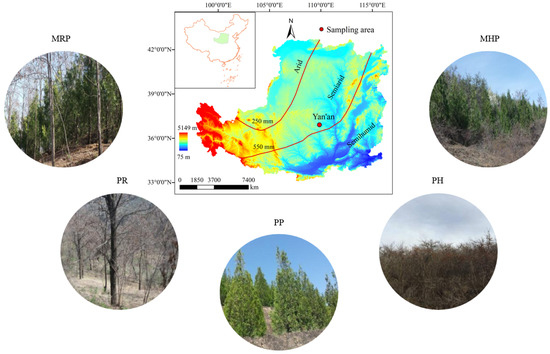
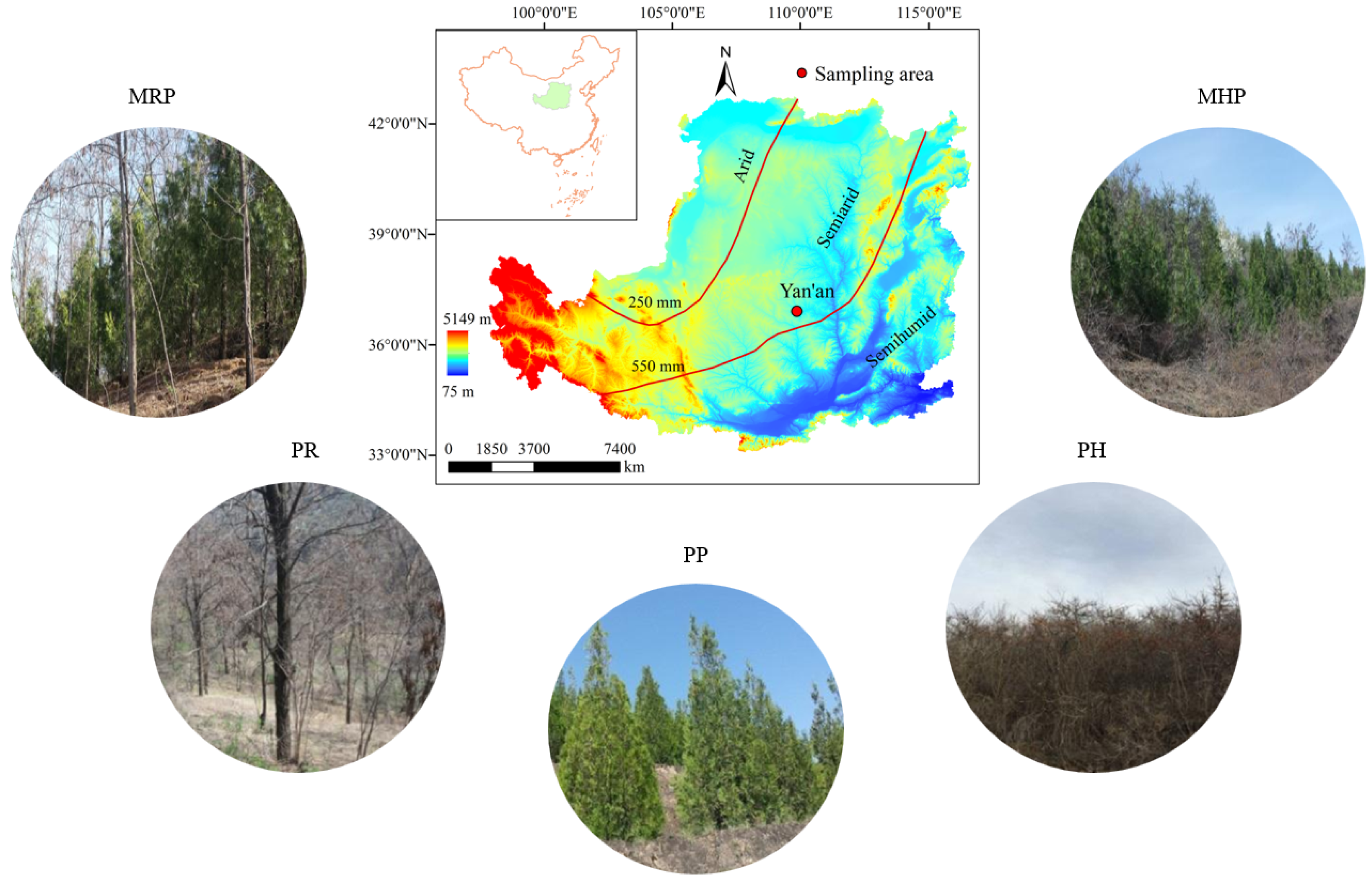
The study was conducted in the Tianhe River Basin (36°39′–36°40′ N, 109°22′–109°23′ E) of Yan’an City, situated within the semi-arid region of the Chinese Loess Plateau (Figure 1). This area features a temperate continental monsoon climate, with a long-term (1961–2019) average annual temperature of 10.8 °C. The average annual precipitation is 544 mm, while the potential evapotranspiration is 991 mm. Over 60% of the precipitation occurs between July and September. The topography is characterized by typical loess hills and gullies, with elevations ranging from 988 to 1344 m and groundwater levels between 40 and 100 m [27]. The soil texture is predominantly silty loam, with a silt content exceeding 60%. Deep soil profiles contain paleosol layers with a thickness of approximately 2 m, which significantly influences soil hydraulic properties. Since the implementation of the “Grain for Green” project, the basin has undergone substantial land-use changes. Dominant ecological forest species in the region include Robinia pseudoacacia, Hippophae rhamnoides, Caragana korshinskii, Rhus typhina, Platycladus orientalis, and Pinus tabuliformis. This research focused on two typical mixed stands on the Loess Plateau: R. pseudoacacia-P. orientalis (MRP) and H. rhamnoides-P. orientalis (MHP), with pure plantation of R. pseudoacacia (PR), P. orientalis (PP), and H. rhamnoides (PH) serving as controls. For each plantation type, three replicate sample plots (20 m × 20 m) were established at mid-slope positions under a uniform southeast aspect. It is critical to note that all selected plots were under natural, rain-fed conditions without any history of irrigation. The basic information of the sample plots is summarized in Table 1.
Figure 1.
Geographical location and forest conditions of the study area. Pure stands: R. pseudoacacia (PR), P. orientalis (PP), and H. rhamnoides (PH). Mixed stands: R. pseudoacacia-P. orientalis (MRP) and H. rhamnoides-P. orientalis (MHP).
Table 1.
The basic information about the sampling sites in the study area.
2.2. Soil Sampling and Measurements
To determine the deep soil water deficit, initial soil cores were obtained down to >20 m in August 2018 across all five plantation types and a control grassland site. These preliminary measurements revealed negligible variation in soil moisture below 10 m. Consequently, to efficiently capture seasonal dynamics, subsequent sampling during the 2019 growing season (April to October) was focused on the 0–10 m depth range and conducted on a monthly basis. Throughout the study, at each sampling point, soil samples were collected at 20 cm intervals using a 60 mm diameter auger. Three points per plot were systematically established at mid-slope positions within well-developed ecological forests.
For each sampled layer, fresh soil was homogenized, and a subsample of 30–50 g was placed into a pre-weighed aluminum box. The gravimetric soil water content (θg, g g−1) was determined by oven-drying the samples at 105 °C for 24 h. Soil bulk density (BD, g cm−3) was measured throughout the 0–2 m profile at 20 cm intervals using the core method. The volumetric soil water content (θv, cm cm−3) was calculated as:
The active soil water layer was identified according to the coefficient of variation (CV) of the volumetric soil water content at each depth across the multiple seasonal measurements. The CV was calculated as:
where SDi and θi are the standard deviation and the mean volumetric soil water content at depth i, respectively.
The soil water storage (SWS, mm) for a given soil profile was calculated using the following formula:
where θv,i is the volumetric soil water content (cm3 cm−3), hi is the layer thickness (cm), n is the number of layers, and 10 is the unit conversion factor.
The deep soil water deficit (SWD, mm) was defined as the difference in soil water storage between forestland and grassland, expressed as:
where SWSg and SWSf represent the soil water storage in grassland and forestland, respectively.
2.3. Root Sampling
Roots sampling was conducted at the end of the 2019 growing season. For each plantation type, four representative dominant trees per plot were selected based on diameter at breast height (DBH) and crown vitality. Root samples were obtained using an 85 mm internal diameter hand auger. Cores were extracted in successive 20 cm depth increments until no roots were visible. Three replicate root samples were collected within each plot. This study focuses on the R. pseudoacacia-P. orientalis mixture (MRP) for comparative analysis. The mixed stand of H. rhamnoides-P. orientalis (MHP) was excluded from this specific analysis because the roots of the two species could not be reliably distinguished due to their nearly identical coloration. The collected root samples were carefully rinsed with tap water on a 1 mm mesh sieve to remove soil. Subsequently, live fine roots were manually extracted with tweezers; their viability was determined based on color, turgor pressure, and mechanical resilience. Roots from different trees in mixed plantation were separated by visually examining their color, smell, shape, thickness and root forks [28,29], and then stored at 4 °C before further analysis.
The root samples were scanned at a resolution of 300 dpi, and root length across diameter classes was quantified using DELTA-T SCAN image analysis software (version 3.5, DELTA-T Devices Ltd., Cambridge, UK). Fine root length density (FRLD, cm cm−3), root dry weight density (RDWD, g m−3), and specific root length (SRL, m g−1)for roots with diameters less than 2 mm was calculated as follows:
where FRL is the total fine root length (cm), V is the corresponding soil volume (cm3), and FRW is fine root dry weight (g).
2.4. Statistical Analysis
The soil profile was divided into shallow (0–2 m) and deep (2–10 m) layers for comparative analysis. Differences in soil water content (SWC) among the five plantation types within each layer were examined using one-way ANOVA in SPSS 23 (IBM Corp., Armonk, NY, USA), after verifying data normality and homogeneity of variances with the Shapiro–Wilk and Levene’s tests, respectively. Post hoc pairwise comparisons were conducted using Tukey’s HSD test. Based on preliminary trends, the profile was further subdivided into four intervals (0–2 m, 2–6 m, 6–8 m, and 8–10 m) for more detailed ANOVA. A similar shallow-deep stratification was applied to root distribution data. Correlation analyses were used to assess the relationships between root parameters and SWC. The effects of plantation type, soil depth, and their interaction on root parameters were evaluated using mixed-effects models fitted with the glmmTMB package (version 1.1.7) in R (version 4.5.1). The models specified plantation type, soil depth, and their interaction as fixed effects, and plot_ID as a random intercept. The significance of fixed effects was assessed using Type III Wald χ2 tests. The adequacy of mixed-effects models was verified by inspecting diagnostic plots (Q-Q and residual vs. fitted plots) for normality and homoscedasticity, and by checking for overdispersion.
3. Results
3.1. Soil Water Content Dynamics
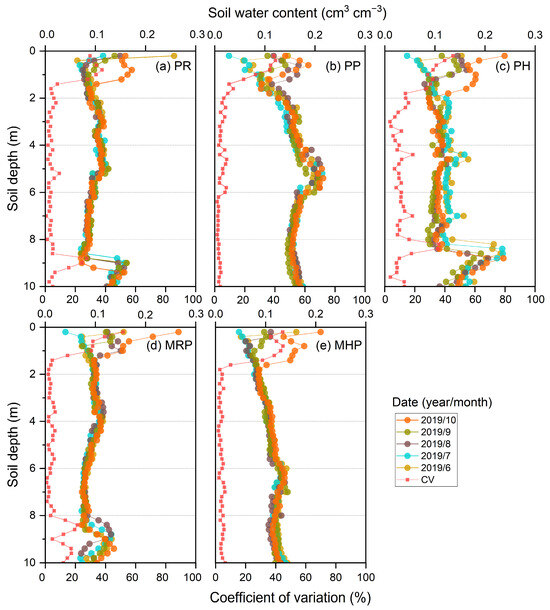
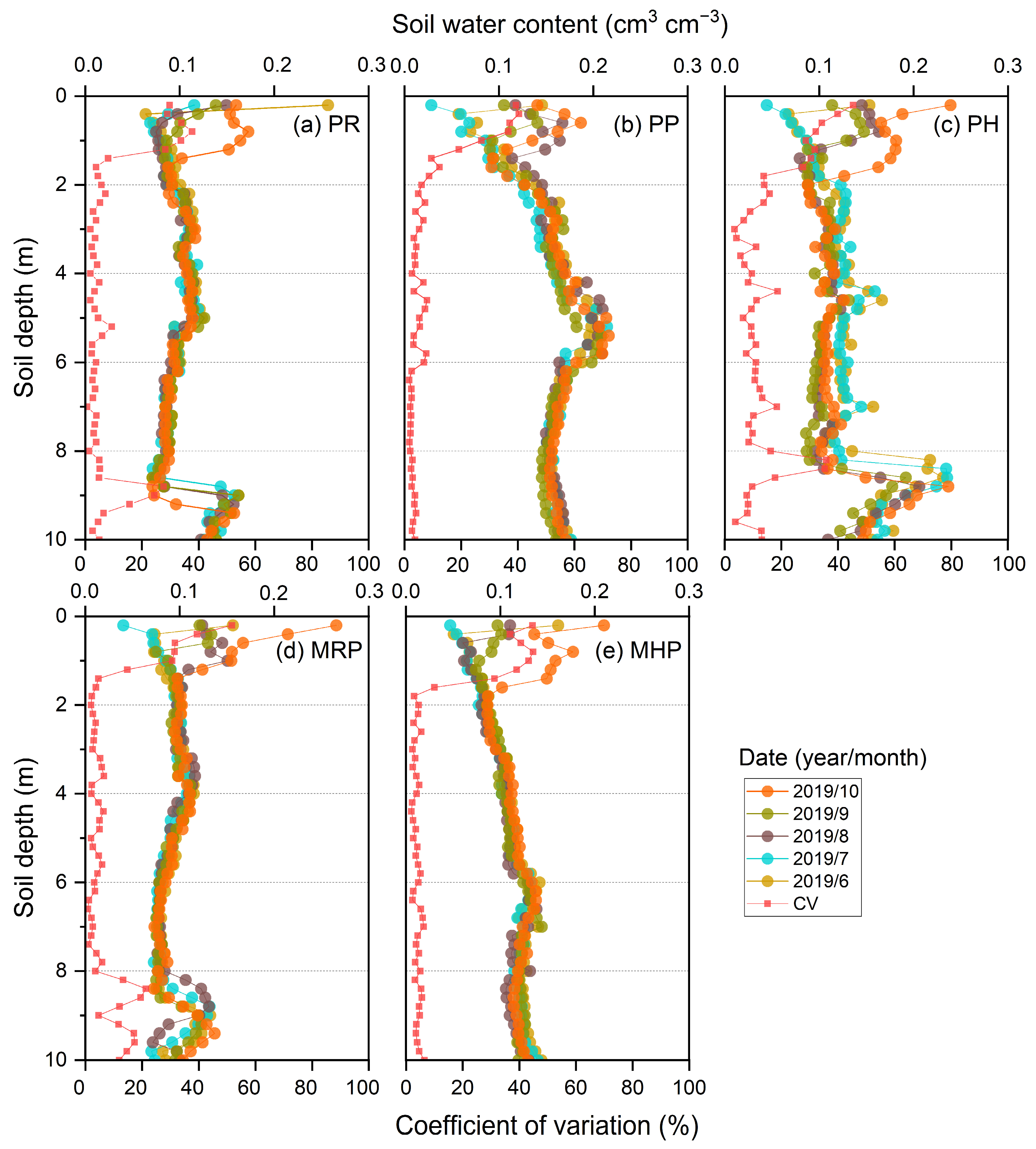
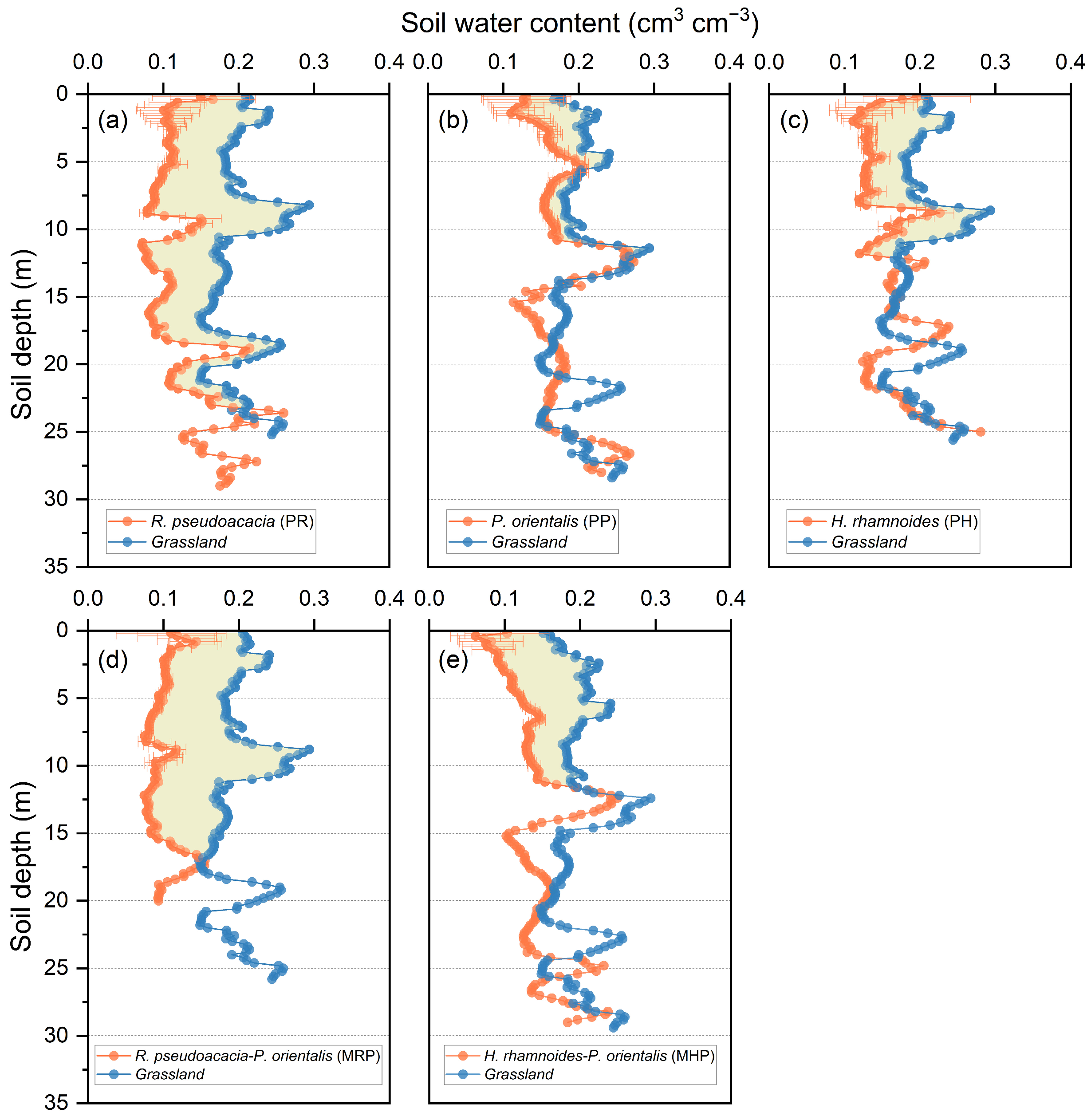
The seasonal soil moisture dynamics under pure and mixed stands are shown in Figure 2. Pronounced fluctuations in soil water content (SWC) occurred above 2 m across all stand types, driven by precipitation and evaporation. The mean SWC (0–2 m) was 0.102 cm3 cm−3 in R. pseudoacacia (PR), 0.114 cm3 cm−3 in P. orientalis (PP), 0.111 cm3 cm−3 in R. pseudoacacia-P. orientalis mixed plantation (MRP), 0.116 cm3 cm−3 in H. rhamnoides (PH), and 0.091 cm3 cm−3 in H. rhamnoides-P. orientalis mixed plantation (MHP). Except for MHP, which had a significantly lower mean SWC in the 0–2 m layer than the other stands, no statistically significant differences were observed among the remaining stand types. Below the 2 m depth, soil moisture remained relatively stable, with mean values of 0.104 (PR), 0.166 (PP), 0.127 (PH), 0.094 (MRP), and 0.115 cm3 cm−3 (MHP). The coefficient of variation (CV) of soil moisture exhibited a consistent pattern, decreasing with depth in the upper 2 m and stabilizing below, despite minor fluctuations in paleosol layers attributable to spatial heterogeneity.
Figure 2.
Seasonal variation and coefficient of variation (CV) of soil water content across soil profiles in pure stands of R. pseudoacacia (PR) (a), P. orientalis (PP) (b), H. rhamnoides (PH) (c), mixed stands of R. pseudoacacia-P. orientalis (MRP) (d) and H. rhamnoides-P. orientalis (MHP) (e) during the 2019 growing season.
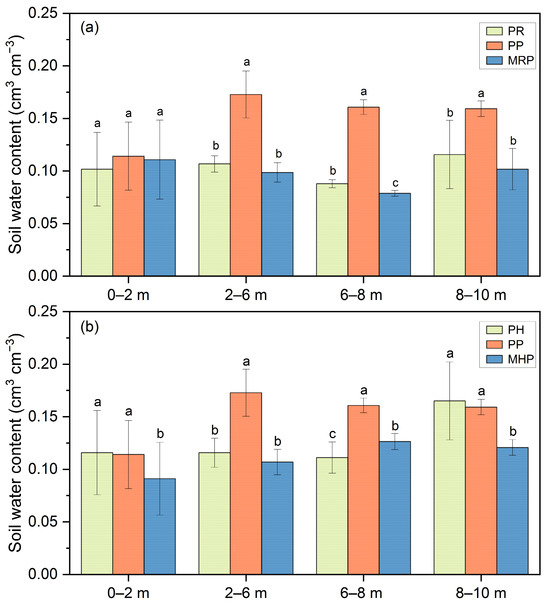
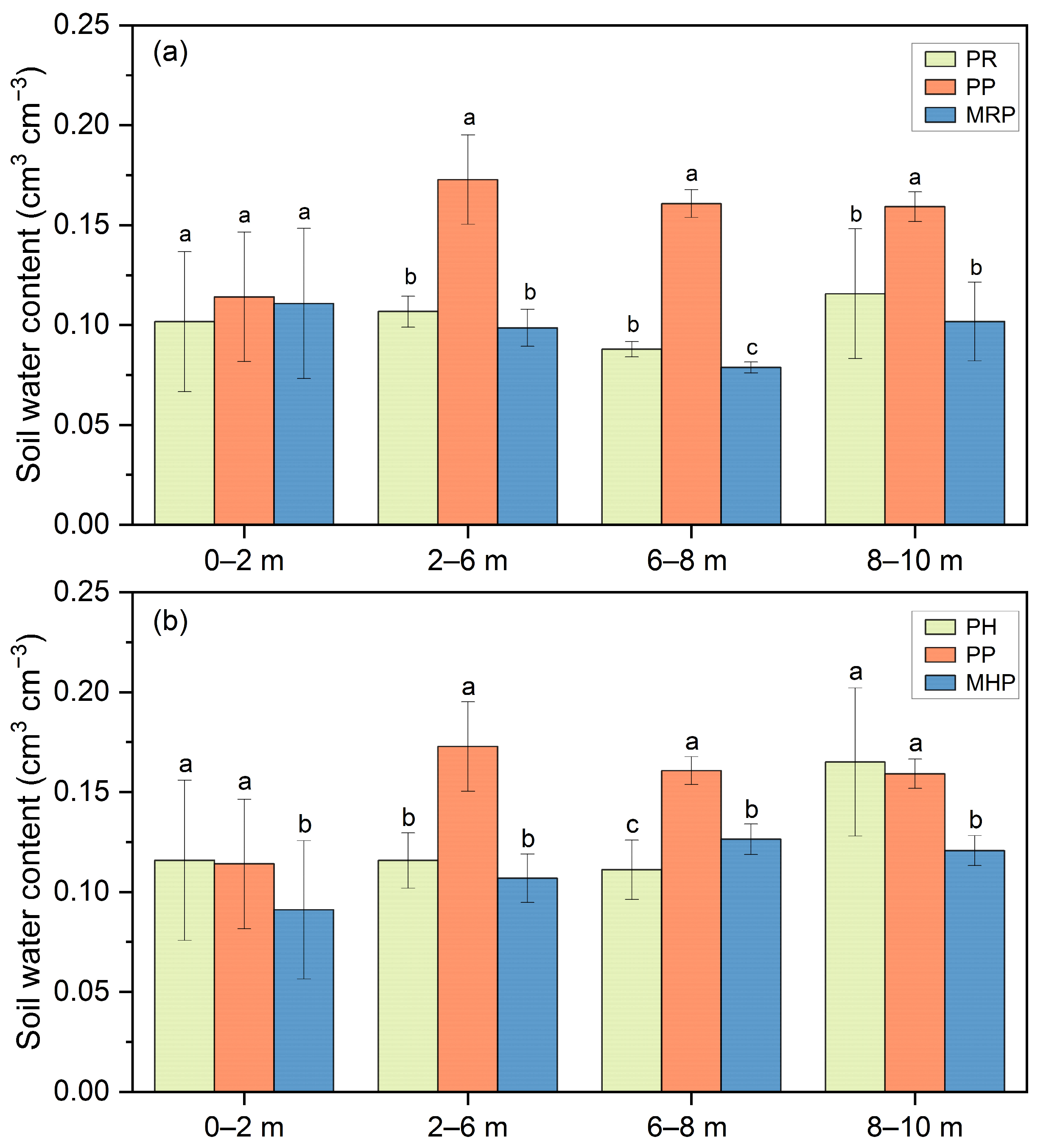
In the shallow soil layer (0–2 m), SWC was strongly influenced by precipitation and evaporation. No significant differences were detected among the PR, PP, and MRP stands. Although the PH stand did not differ significantly from PP, both exhibited significantly higher SWC than the MHP stand (Figure 3a). In the deep soil layer (2–10 m), the PP stand maintained the highest SWC, followed by PR, whereas the MRP stand showed the lowest. The MHP stand generally had lower SWC than its corresponding pure stands, except in the 6–8 m soil layer, where it exceeded the PH stand (Figure 3b).
Figure 3.
Comparison of soil water content between pure and mixed stands: R. pseudoacacia (PR) and P. orientalis (PP) versus their mixture (MRP) (a), H. rhamnoides (PH) and P. orientalis (PP) versus their mixture (MHP) (b). Different lowercase letters above the bars indicate significant differences at p < 0.05.
3.2. Soil Water Depletion Depth and Deficit
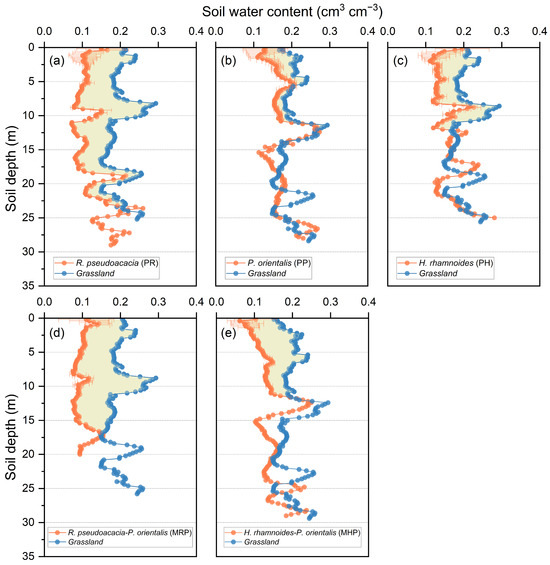
The deep soil water dynamics were assessed relative to a grassland baseline, whose profile exhibited two distinct moisture peaks at 13 m and 23.2 m, corresponding to paleosol layers. To ensure comparable vertical alignment, the grassland soil water content profile was shifted by matching the depths of these paleosol layers with those in the plantation profiles. The maximum water depletion depths for the PR, PP, MRP, PH, and MHP stands were 23.2, 12.0, 16.8, 12.0, and 11.6 m, respectively. The corresponding deep soil water deficit (SWD) values were 1763 mm (PR), 304 mm (PP), 1549 mm (MRP), 664 mm (PH), and 704 mm (MHP (Figure 4). To assess the overall ecosystem-level water consumption, we compared the observed total SWD in the MRP mixed stand with its expected value based on a weighted average of the pure stands. The actual SWD of the MRP mixed stand (1549 mm) was substantially higher than the expected value (1383 mm), representing a 12% increase (Figure S2). Similarly, the MHP mixed stand also exhibited higher water consumption, with an observed SWD of 704 mm exceeding its expected value of 578 mm by 21.8% (Figure S3).
Figure 4.
Vertical distribution of soil water content in five stand type: R. pseudoacacia (PR) (a), P. orientalis (PP) (b), H. rhamnoides (PH) (c); and mixed stands of R. pseudoacacia-P. orientalis (MRP) (d), H. rhamnoides-P. orientalis (MHP) (e). The soil water content in grassland serves as the baseline for calculating the deep soil water deficit (SWD) in all panels.
3.3. Root Distribution Characteristics
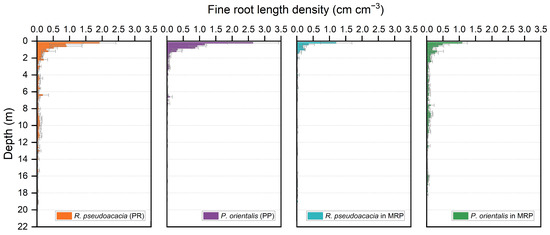
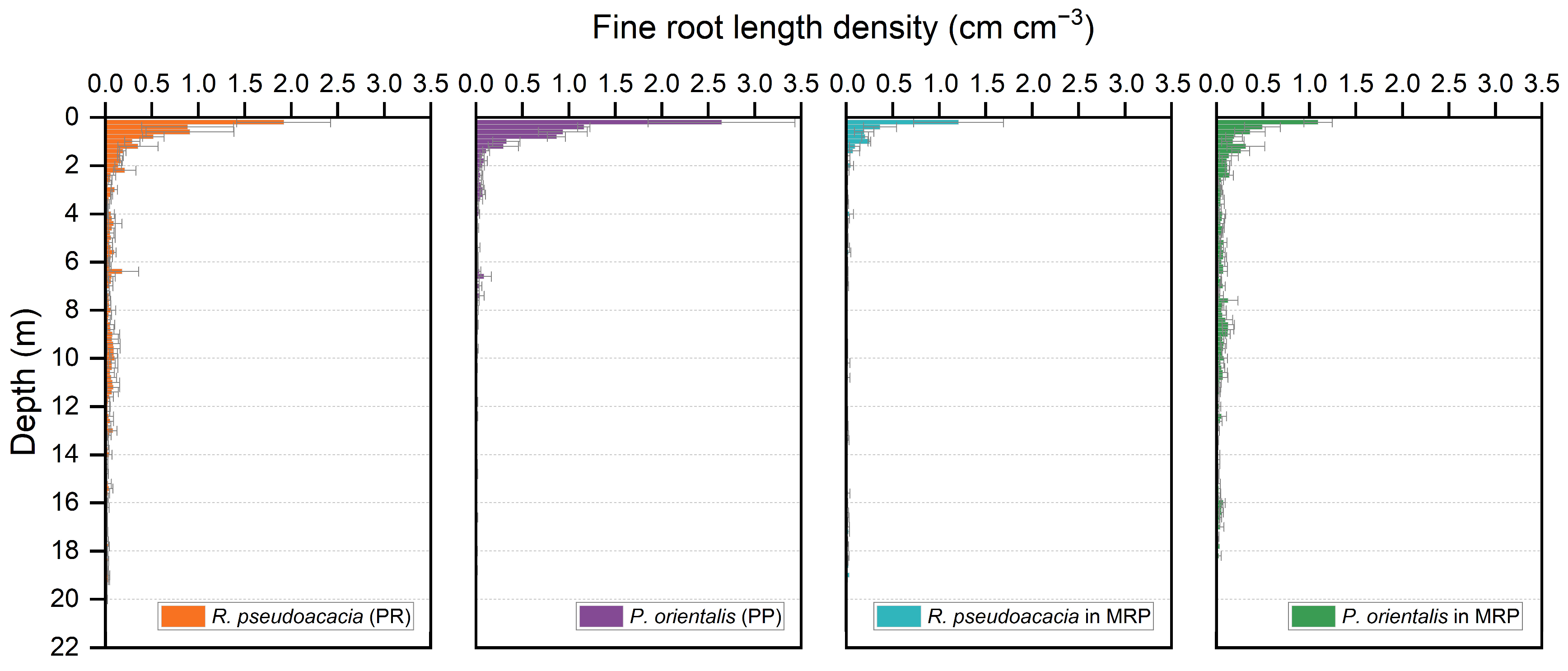
The fine root length density for MHP and its corresponding pure stands are available in the Supplementary Materials. The maximum rooting depth was 22.2 m in the PR stand and 21.6 m in the PP stand. In the MRP stand, both species reached a maximum depth of 20.0 m. Fine root length density (FRLD) decreased with soil depth across all stands, with the majority of fine roots concentrated in the upper 2 m and the highest FRLD values occurring at the 20 cm depth (Figure 5).
Figure 5.
Vertical distribution of fine root length density (FRLD) of R. pseudoacacia and P. orientalis in monoculture and in mixed-species (MRP) stands.
In the shallow layer (0–2 m), the mean fine root length density (FRLD) was 0.553 cm cm−3 in the PR stand, 0.657 cm cm−3 in the PP stand, 0.249 cm cm−3 for R. pseudoacacia in the MRP stand, and 0.326 cm cm−3 for P. orientalis in the MRP stand. No significant difference in shallow-layer FRLD was detected for either species between their pure and mixed stands. Below the 2 m depth, the mean FRLD decreased substantially to 0.041 cm cm−3 (PR), 0.013 cm cm−3 (PP), 0.010 cm cm−3 (R. pseudoacacia in MRP), and 0.044 cm cm−3 (P. orientalis in MRP). After normalizing for planting density (Figure S4), the fine root length density (FRLD) of R. pseudoacacia in pure stands was significantly higher than that in mixed stands. On a per-tree basis, the normalized FRLD of R. pseudoacacia was 62% lower in mixed stands compared to pure stands. Conversely, the normalized FRLD of P. orientalis in mixed stands was dramatically higher than that in its pure stand, being approximately four times greater.
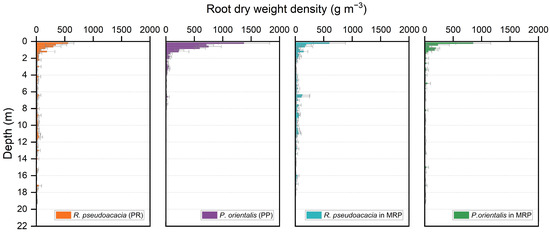
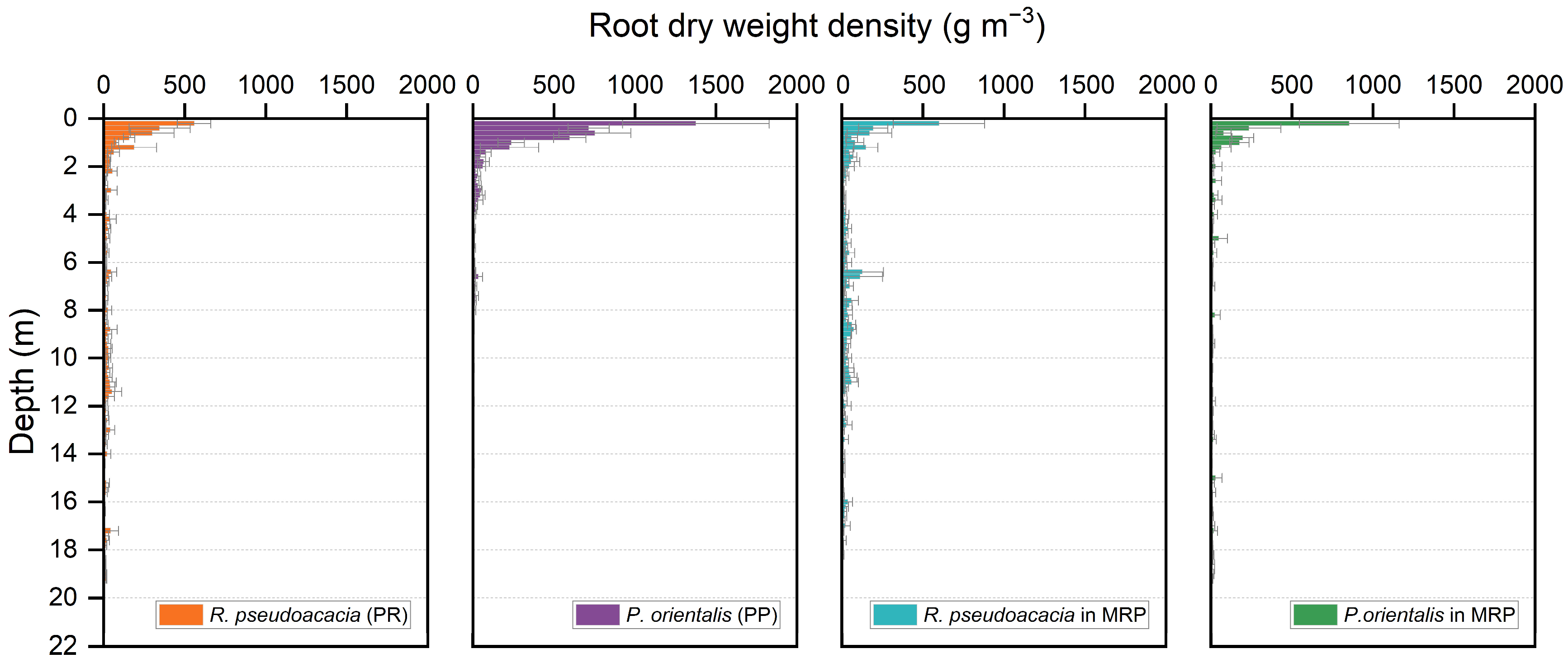
Root dry weight density (RDWD) followed a distribution pattern similar to FRLD, decreasing with depth and being predominantly concentrated in the upper 2 m (Figure 6). In the deep soil layers (>2 m), the RDWD of R. pseudoacacia was consistently greater than that of P. orientalis in both pure and mixed stands.
Figure 6.
Vertical distribution of fine root dry weight density (RDWD) of R. pseudoacacia and P. orientalis in monoculture and in mixed-species (MRP) stands.
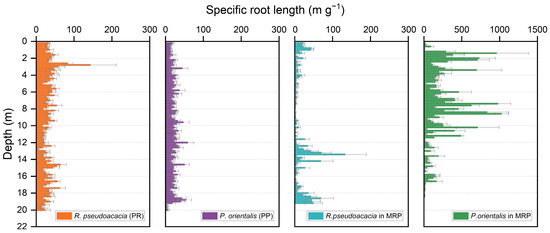
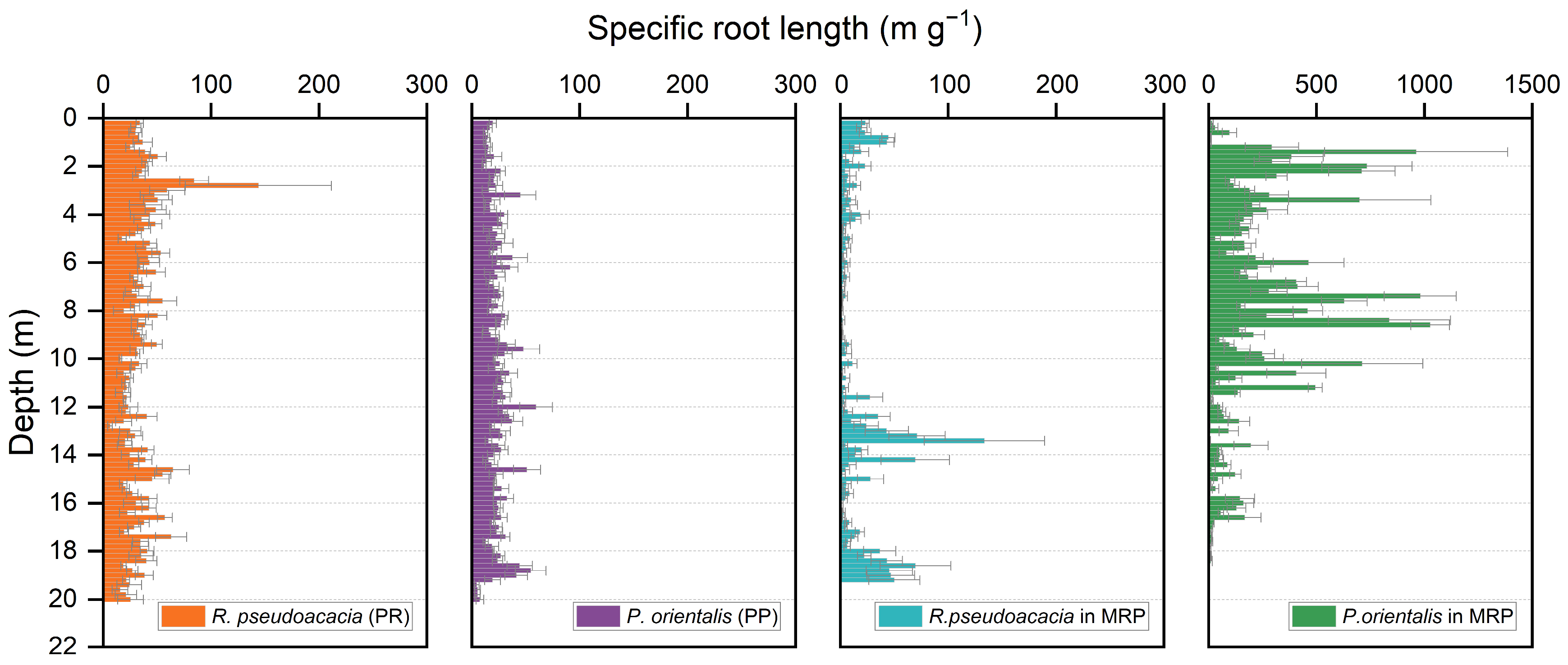
The vertical distribution patterns of specific root length (SRL) were similar for R. pseudoacacia and P. orientalis in their pure stands; however, the overall mean SRL of R. pseudoacacia was significantly higher. In the mixed stand, the SRL distributions of the two species diverged: R. pseudoacacia exhibited greater SRL in deeper soil layers, whereas P. orientalis maintained higher SRL in the upper soil layers (Figure 7).
Figure 7.
Vertical distribution of specific root length (SRL) of R. pseudoacacia and P. orientalis in monoculture and in mixed-species (MRP) stands.
3.4. Relationships Between Soil Water Content and Root Traits
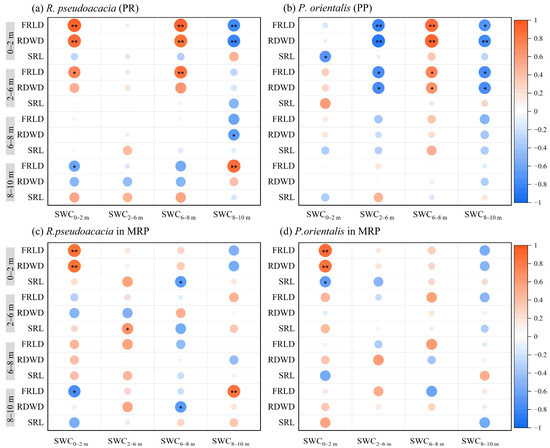
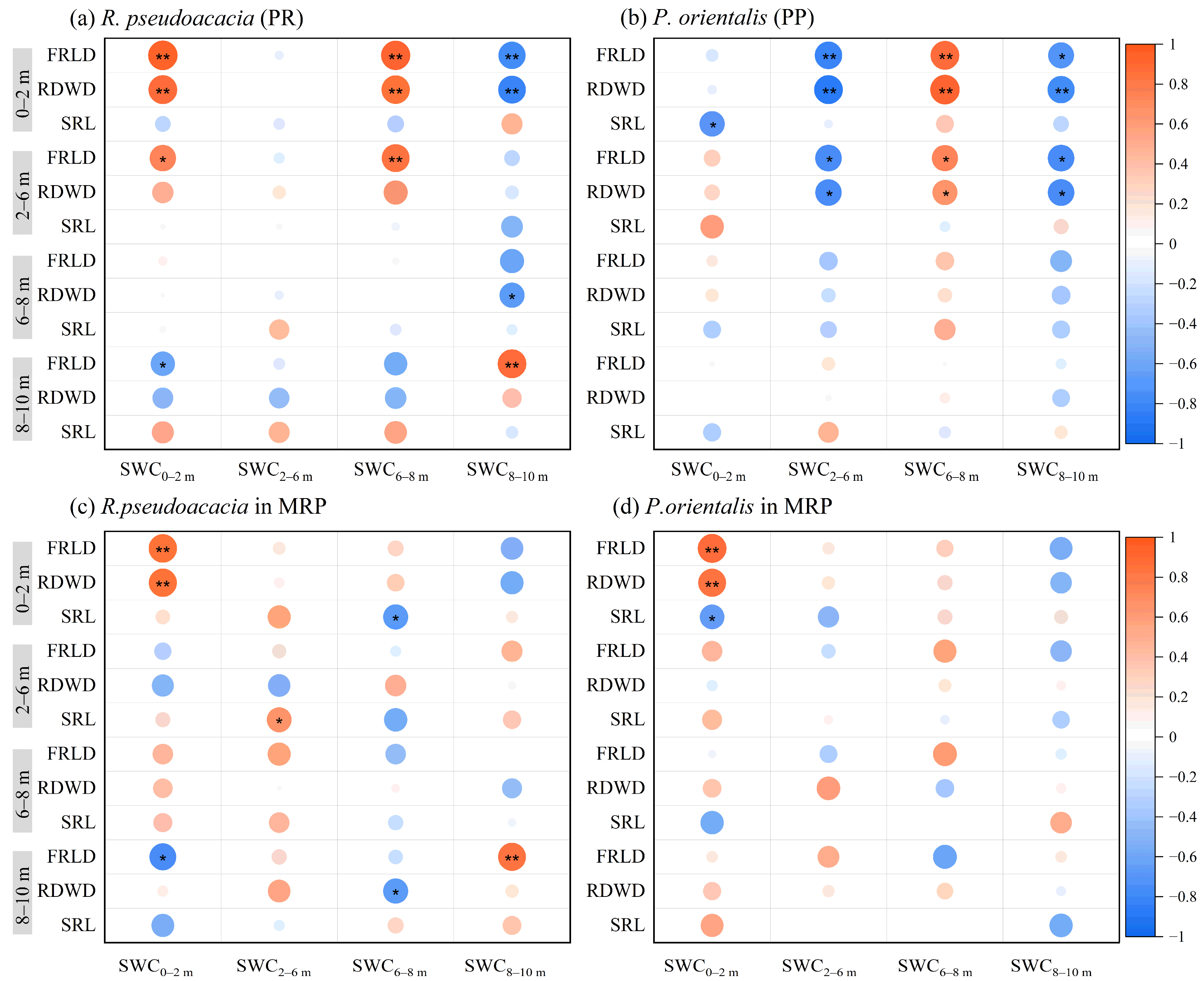
The correlation between root parameters and soil water content (SWC) differed between pure and mixed stands and varied with soil depth (Figure 8). In the pure R. pseudoacacia stand, SWC in the 0–2 m (SWC0–2m) and 6–8 m layers (SWC6–8m) was positively correlated with FRLD and RDWD in the 0–2 m layer, and with FRLD in the 2–6 m layer. SWC8–10m was positively correlated with FRLD in the 8–10 m layer and generally showed positive correlations with root parameters at other depths (Figure 8a). For P. orientalis in its pure stand, SWC6–8m was positively correlated with FRLD and RDWD in the 0–2 m and 2–6 m layers, whereas SWC in other layers was negatively correlated with most root parameters (Figure 8b). In the MRP mixed stand, the relationship between SWC0–2 m and the root parameters of R. pseudoacacia resembled that in its pure stand. A key difference was observed for SWC6–8m, which was negatively correlated with the root parameters of R. pseudoacacia, contrasting with the positive correlations observed for SWC8–10m (Figure 8c). For P. orientalis in the mixture, only SWC0–2m was significantly correlated with its root parameters, showing positive correlations with FRLD and RDWD and a negative correlation with SRL in the 0–2 m layer. No other significant correlations were detected for P. orientalis in the mixture (Figure 8d).
Figure 8.
Correlations between root traits and soil water content (SWC) across soil layers: pure R. pseudoacacia (PP) (a), pure P. orientalis (PR) (b), R. pseudoacacia in MRP mixed stands (c), and P. orientalis in MRP mixed stands (d). (**, p < 0.01; *, p < 0.05).
The mixed-effects model revealed that both plantation type and soil depth had highly significant effects on FRLD (p < 0.001), although their interaction was not significant. For RDWD, plantation type, soil depth, and their interaction all exerted significant effects. In contrast, for SRL, plantation type and its interaction with soil depth were highly significant, whereas soil depth alone had no significant effect (Table 2).
Table 2.
Mixed-effects model testing the effects of plantation type and soil depth on fine root length density (FRLD), root dry weight density (RDWD), and specific root length (SRL).
4. Discussion
4.1. Effect of Mixed-Species Afforestation on Soil Water Content
Our study revealed significant variation in soil water content (SWC) within the upper 2 m soil layer across all stand types, with the mixed stand MHP exhibiting significantly lower SWC than the others. Below 2 m, however, SWC showed relatively stable seasonal dynamics with low coefficients of variation, except for fluctuations in paleosol layers (Figure 2). This pattern indicated that precipitation and evaporation dominate shallow soil water dynamics, whereas subsurface soil moisture below 2 m is largely decoupled from short-term atmospheric processes, consistent with findings from the semi-arid Loess Plateau for other tree species [30,31].
Notably, mixed stands generally exhibited lower deep-layer (>2 m) SWC than pure stands (Figure 2 and Figure 3), alongside a higher soil water deficit (SWD) (Figure 4). This suggests that mixed afforestation may intensify interspecific consumption for water, leading to greater overall soil water depletion than in monocultures—a result aligned with the findings of other studies on the Loess Plateau [32,33,34]. This finding, however, contrasts with reports from other semi-arid regions where mixed-species plantations alleviated deep soil water stress through hydrological niche partitioning [35,36] or improved water retention [37,38,39]. A regional meta-analysis even suggested that mixing can mitigate soil water stress down to 5 m depth [40]. Placing these divergent findings into a comparative perspective reveals that the hydrological outcome of mixed afforestation in semi-arid regions is not universal but is contingent upon a balance of species traits and stand structure. The key lies in whether species mixtures create complementarity or competition. Complementarity, leading to reduced water stress, is more likely in mixtures of species with contrasting functional traits (e.g., deep- vs. shallow-rooted architectures, or differing water-use efficiencies) [36,41]. In contrast, our study involved two deep-rooted species with high water demands, R. pseudoacacia and P. orientalis, a combination predisposed to intense consumption for a limited deep-water resource [16]. Furthermore, stand management, particularly planting density, is a critical unifying factor across studies. As evidenced globally [42,43] and on the Loess Plateau [40], high density intensifies stand-level water consumption, an effect that can override the potential benefits of species mixing and explain many reported contradictions.
In the specific context of our study, the intensified consumption is likely amplified by a temporal overlap in peak water demand between the two species, as suggested by their potential phenological synchrony [44]. Therefore, the net hydrologic effect we observed stems from the interplay of species identity (two competitive, deep-rooted species), stand density, and their phenology. It is also important to address whether the intensified consumption we observed could be an artifact of confounding factors such as soil compaction, stand age, or density. We suggest that their influence is likely minimal. First, all stands were of a similar age and established on comparable former agricultural land, which minimizes differences in developmental stage and initial soil conditions. Second, and more critically, significant intra-specific differences in root strategy and associated water depletion persisted between pure and mixed stands even after normalizing for density. This evidence underscores that the observed effects are primarily driven by species interactions rather than the extrinsic factors examined. Therefore, future research needs to employ stable isotope tracing techniques to determine the dynamics of plant water source depth throughout the growing season.
4.2. Effect of Mixed-Species Afforestation on Root Traits
In this study, both pure and mixed-species stands developed deep root systems (Figure 5), a morphological adaptation that facilitates access to deeper soil water reserves under arid conditions or periods of high transpirational demand. The spatial distribution of roots governs resource absorption and determines a plant’s capacity to acquire water and nutrients [45], with fine root traits serving as sensitive indicators of shifts in absorptive capacity [46]. By shifting water uptake to deeper layers, plants can mitigate water stress and sustain physiological activity [31,47]. Notably, the maximum rooting depth of both species was shallower in the mixed stand than in their respective pure stands (Figure 5), suggesting that interspecific consumption constrained rooting depth. This implies that trees adjust their root distribution to compete for belowground space and resources [17], potentially leading to greater fine root proliferation in shallow layers to exploit nutrients and water, thereby reducing long-term investment in deeper roots [48].
In the upper 2 m, pure stands exhibited higher fine root length density (FRLD) than mixed forest (Figure 5), indicating that intense interspecific consumption in mixtures may have mutually inhibited shallow root development [49,50]. Below 2 m, the FRLD of Robinia pseudoacacia was higher in pure than in mixed stands, suggesting competitive pressure in the mixture limited its deep rooting. In contrast, P. orientalis in the mixed stand showed greater deep-layer FRLD than in its pure stand, implying a shift toward deeper soil layers as a competitive avoidance strategy. This aligns with reports that plants can expand their root distribution to deeper layers to maximize resource access [51,52]. These results indicated that P. orientalis may mitigate consumption through deeper root proliferation [53,54], allocating more absorptive tissue to depth than R. pseudoacacia in mixture. However, below 2 m soil depth, the root dry weight density (RDWD) of R. pseudoacacia exceeded that of P. orientalis in both pure and mixed stands (Figure 6). This indicates that although P. orientalis had greater fine root length density in deeper soil layers, R. pseudoacacia maintained higher biomass investment. This likely reflects a deep-rooting strategy characterized by thicker, more persistent structural roots suited for substantial water transport during dry periods [55]. In contrast, P. orientalis appears to employ a more flexible, cost-effective strategy by producing finer absorptive roots with lower biomass, consistent with an opportunistic approach to resource acquisition.
In the mixed stand, the root strategies of the two species diverged markedly, as evidenced by their specific root length (SRL): P. orientalis exhibited a higher SRL than R. pseudoacacia (Figure 7). This reflects a cost-effective strategy to maximize soil contact per unit biomass in a competitive environment [56,57], a phenomenon which aligns with the general observation that mixed-species planting can enhance resource efficiency [58,59]. In contrast, R. pseudoacacia invested in deeper, higher-biomass roots. This strategic divergence manifests in their distinct root economics: P. orientalis adopts a high SRL, likely high-turnover strategy, enabling rapid surface resource response and greater belowground carbon input [60], whereas R. pseudoacacia relies on deep, persistent roots as a long-term strategy to access deep water. Consequently, these contrasting foraging strategies likely exert distinct influences on ecosystem functions, particularly on soil carbon sequestration and stand resilience to droughts of varying duration and intensity. Rather than merely coexisting, these complementary morphological adjustments allowed both species to systematically and efficiently exploit soil moisture across different depths, collectively leading to the severe water deficit observed in the mixed stand.
4.3. Root-Water Relationships and Their Regulatory Factors
Correlation analysis revealed complex relationships between soil water content (SWC) and root traits, which varied not only with soil depth but also between pure and mixed stands (Figure 8). Overall, soil moisture was more strongly correlated with root traits in shallow layers, implying that root dynamics near the surface are closely coupled with short-term variations in water availability [23,61]. This pattern can be explained by differential root growth responses across soil depths: shallow fine roots are highly sensitive to fluctuations in precipitation and evaporation, whereas deep fine roots can maintain growth even during dry periods [24,62]. Previous studies have also emphasized that the effect of soil moisture on fine roots is variable and modulated by factors such as depth, climate, soil properties, and plant phenology [63,64].
The mixed-effects model further identified the key factors driving these root trait patterns (Table 2). It confirmed that both plantation type and soil depth significantly affected FRLD and RDWD, but only RDWD was significantly influenced by their interaction (Table 2). This suggests that while the vertical distribution of root length is generally consistent across plantation types, the allocation of root biomass along the soil profile differs between pure and mixed stands. Competition appeared to alter interspecific biomass allocation strategies throughout the soil profile. For instance, in mixed stands, R. pseudoacacia increased its biomass investment in deeper soil layers (Figure 6), representing a niche differentiation strategy to reduce direct competition in shallow zones [65]. Plantation type significantly influenced specific root length (SRL), whereas soil depth alone did not; however, their interaction was significant (Table 2), indicating that the effect of plantation type on SRL was depth-specific. In the competitive environment of mixed stands, P. orientalis exhibited higher SRL in shallow soil layers (Figure 7), suggesting an adaptive response to maximize soil exploration efficiency per unit carbon invested [66].
4.4. Implications for Forest Management
This study provides critical insights for guiding afforestation in semi-arid regions by demonstrating intensified soil water consumption below 2 m depth in mixed forests (Figure 2). This finding underscores the necessity of strategic species selection and stand design to mitigate deep soil desiccation. Although mixed-species plantations are promoted for enhancing biodiversity and ecosystem stability [67,68], our findings suggest that combining species with strongly overlapping hydrological niches can exacerbate deep soil water depletion. Therefore, based on our results, we specifically advise against the widespread practice of mixing R. pseudoacacia and P. orientalis in water-limited areas of the Loess Plateau, as this combination leads to severe competitive water depletion.
Instead, managers should prioritize creating mixtures based on functional complementarity. We propose that future afforestation projects should pair species with contrasting root architectures and water-use strategies to achieve hydrological niche partitioning. For instance, a deep-rooted species like R. pseudoacacia could be combined with a shallow-rooted, drought-avoidant shrub or tree species (e.g., H. rhamnoides or C. korshinskii) that primarily utilizes water from upper soil layers. This strategy can reduce direct competition for deep soil water and promote a more sustainable water balance across the soil profile.
The divergent root strategies of R. pseudoacacia and P. orientalis in mixture indicated that root trait plasticity is key to species coexistence and resource partitioning [69]. Forest managers can utilize such trait differences to design mixed stands that optimize resource use efficiency while minimizing interspecific competition. Furthermore, planting density should be carefully considered, as it critically governs stand-level water consumption. Our study confirms that higher planting densities intensify water use and exacerbate soil water deficit. Thus, adjusting planting density according to local precipitation and soil water retention capacity is essential for long-term soil water sustainability. In practice, we recommend using lower planting densities than are currently typical in regional afforestation campaigns, potentially below 1000 stems per hectare in the most arid sectors of the Loess Plateau, to minimize stand-level water stress. The depth-specific responses of fine root traits to soil moisture variations also underscore the importance of stratified soil water monitoring and root zone management. Shallow root zones, which are highly sensitive to precipitation variability, should be managed with vegetation that reduces evaporation and facilitates water infiltration. In deeper soil layers, where root activity is more stable but competition may still aggravate drying, selecting species with complementary root distributions and low water-use niche overlap is recommended to conserve deep soil water reserves. While this study provides a mechanistic framework for understanding soil water depletion in mixed-species plantations, some limitations should be considered. The insights are based on an intensive investigation at a single site, which provides depth but may affect the immediate regional generalizability of our results. Furthermore, while our analysis of root traits and soil moisture offers strong indirect evidence for competition, direct physiological measurements of plant water use (e.g., sap flow) are needed to fully quantify water stress. Future research should expand to a multi-site scale and integrate physiological monitoring to validate and extend these findings.
In summary, we propose an integrated afforestation management framework in water-limited ecosystems that emphasizes rational species matching (based on complementary traits, not just biodiversity per se), optimized planting density (tailored to local water budgets), and stratified soil-root zone management. These evidence-based practices will enhance plantation survival and growth while supporting the sustainable recovery of soil water resources and long-term ecosystem stability under a changing climate.
5. Conclusions
This study demonstrates that mixed-species afforestation in semi-arid regions intensifies consumption for deep soil water, leading to significantly lower soil moisture and a greater soil water deficit below 2 m depth compared to pure stands. When grown in mixture, P. orientalis and R. pseudoacacia exhibited divergent root foraging strategies: P. orientalis enhanced resource acquisition efficiency by increasing its fine root length density and specific root length, while R. pseudoacacia maintained higher biomass investment in deep soil layers. The correlations between soil water content and root traits were also depth-dependent, being strongest in shallow layers, which underscores the vertical zonation of plant–water interactions.
Our findings offer a scientific basis for refining afforestation strategies on the Loess Plateau, particularly for programs like “Grain for Green”. While mixed-species stands are valuable for biodiversity, we highlight an important trade-off: combinations of species with similar, high water use—such as R. pseudoacacia and P. orientalis—can pose a significant risk to deep soil water reserves. To help balance ecological and hydrological goals, we suggest that future efforts could benefit from: (1) prioritizing species mixtures that complement each other in root depth and water use, rather than compete; (2) adopting more flexible, site-specific planting densities that account for local water availability; and (3) integrating soil moisture monitoring into management practices to guide decisions. This approach provides an adaptable framework for building resilient ecosystems that support both healthy forests and sustainable water resources in the long term.
Supplementary Materials
The following supporting information can be downloaded at: https://www.mdpi.com/article/10.3390/f16111738/s1, Figure S1: Vertical distribution of fine root length density of H. rhamnoides and P. orientalis in monocultures compared to their mixture (MHP); Figure S2: Comparison between the observed soil water deficit (SWD) in the R. pseudoacacia-P. orientalis mixed stand and its expected value; Figure S3: Comparison between the observed soil water deficit (SWD) in the H. rhamnoides-P. orientalis mixed stand and its expected value; Figure S4: Comparison of normalized fine root length density (FRLD) per tree among Robinia pseudoacacia in pure (PR) and in mixed stand (R in MRP), Platycladus orientalis in pure (PP) and in the mixed stand (P in MRP).
Author Contributions
Conceptualization, T.M.; Methodology, M.L. and B.S.; Validation, W.W. and Q.D.; Formal analysis, T.M. and W.W.; Investigation, T.M. and G.C.; Data curation, T.M. and G.C.; Writing—original draft preparation, T.M.; Writing—review and editing, H.F. and W.W.; Visualization, T.M. and W.W.; Supervision, M.L. and Q.D.; Funding acquisition, H.F. and B.S. All authors have read and agreed to the published version of the manuscript.
Funding
This research was funded by the National Natural Science Foundation of China (41630860), the Key R&D Program of Shaanxi (2023-ZDLNY-56), the National Key R&D Program of China (2023YFD1900300), the Natural Science Foundation of Hunan Province (2024JJ6715), and the Natural Science Foundation of Henan Province (252300423264).
Data Availability Statement
The data are contained within the article.
Conflicts of Interest
The authors declare no conflicts of interest.
References
- Cao, S.X.; Chen, L.; Shankman, D.; Wang, C.M.; Wang, X.B.; Zhang, H. Excessive reliance on afforestation in China’s arid and semi-arid regions: Lessons in ecological restoration. Earth-Sci. Rev. 2011, 104, 240–245. [Google Scholar] [CrossRef] [Scilit]
- Deng, L.; Shangguan, Z.P.; Li, R. Effects of the grain-for-green program on soil erosion in China. Int. J. Sediment Res. 2012, 27, 120–127. [Google Scholar] [CrossRef] [Scilit]
- Hua, F.; Bruijnzeel, L.A.; Meli, P.; Martin, P.A.; Zhang, J.; Nakagawa, S.; Miao, X.; Wang, W.; McEvoy, C.; Peña-Arancibia, J.L.; et al. The biodiversity and ecosystem service contributions and trade-offs of forest restoration approaches. Science 2022, 376, 839–844. [Google Scholar] [CrossRef] [Scilit]
- Liu, C.; Kuchma, O.; Krutovsky, K.V. Mixed-species versus monocultures in plantation forestry: Development, benefits, ecosystem services and perspectives for the future. Glob. Ecol. Conserv. 2018, 15, e00419. [Google Scholar] [CrossRef] [Scilit]
- Wang, Y.Q.; Shao, M.A.; Zhu, Y.J.; Liu, Z.P. Impacts of land use and plant characteristics on dried soil layers in different climatic regions on the Loess Plateau of China. Agric. For. Meteorol. 2011, 151, 437–448. [Google Scholar] [CrossRef] [Scilit]
- Jia, X.X.; Shao, M.A.; Zhu, Y.J.; Luo, Y. Soil moisture decline due to afforestation across the Loess Plateau, China. J. Hydrol. 2017, 546, 113–122. [Google Scholar] [CrossRef] [Scilit]
- Forrester, D.I.; Bauhus, J. A review of processes behind diversity-productivity relationships in forests. Curr. For. Rep. 2016, 2, 45–61. [Google Scholar] [CrossRef] [Scilit]
- Liang, J.J.; Crowther, T.W.; Picard, N.; Wiser, S.; Zhou, M.; Alberti, G.; Schulze, E.D.; McGuire, A.D.; Bozzato, F.; Pretzsch, H.; et al. Positive biodiversity-productivity relationship predominant in global forests. Science 2016, 354, 6309. [Google Scholar] [CrossRef] [Scilit]
- Richards, A.E.; Forrester, D.I.; Bauhus, J.; Scherer-Lorenzen, M. The influence of mixed tree plantations on the nutrition of individual species: A review. Tree Physiol. 2010, 30, 1192–1208. [Google Scholar] [CrossRef] [Scilit]
- Zhang, B.B.; Xu, Q.; Gao, D.Q.; Jiang, C.W.; Liu, F.T.; Jiang, J.; Ma, Y.B. Higher soil capacity of intercepting heavy rainfall in mixed stands than in pure stands in riparian forests. Sci. Total Environ. 2019, 658, 1514–1522. [Google Scholar] [CrossRef] [Scilit]
- Chen, X.D.; Tang, M.; Zhang, X.L.; Hamel, C.; Li, W.; Sheng, M. Why does oriental arborvitae grow better when mixed with black locust: Insight on nutrient cycling? Ecol. Evol. 2018, 8, 744–754. [Google Scholar] [CrossRef] [Scilit] [PubMed]
- Gong, C.; Tan, Q.Y.; Liu, G.B.; Xu, M.X. Positive effects of mixed-species plantations on soil water storage across the Chinese Loess Plateau. For. Ecol. Manag. 2024, 552, 121571. [Google Scholar] [CrossRef] [Scilit]
- Schwendenmann, L.; Pendall, E.; Sanchez-Bragado, R.; Kunert, N.; Holscher, D. Tree water uptake in a tropical plantation varying in tree diversity: Interspecific differences, seasonal shifts and complementarity. Ecohydrology 2015, 8, 1–12. [Google Scholar] [CrossRef] [Scilit]
- Borden, K.A.; Thomas, S.C.; Isaac, M.E. Interspecific variation of tree root architecture in a temperate agroforestry system characterized using ground-penetrating radar. Plant Soil 2016, 410, 323–334. [Google Scholar] [CrossRef] [Scilit]
- Wei, X.; Wei, S.P.; Dong, Y.; Jia, L.; Hao, D.N.; Liang, W.J. Spatial distribution of fine roots in Pinus tabuliformis and Populus tomentosa and their competition in soils response to nutrient availability and proximity. Forests 2024, 15, 1895. [Google Scholar] [CrossRef] [Scilit]
- Han, L.; Liu, L.L.; Peng, L.; Wang, N.N.; Zhou, P. Mixing of tree species with the same water use strategy might lead to deep soil water deficit. For. Ecol. Manag. 2023, 534, 120876. [Google Scholar] [CrossRef] [Scilit]
- Christina, M.; Nouvellon, Y.; Laclau, J.P.; Stape, J.L.; Bouillet, J.P.; Lambais, G.R.; le Maire, G. Importance of deep water uptake in tropical eucalypt forest. Funct. Ecol. 2016, 31, 509–519. [Google Scholar] [CrossRef] [Scilit]
- Li, H.J.; Ma, X.J.; Lu, Y.W.; Ren, R.Q.; Cui, B.L.; Si, B.C. Growing deep roots has opposing impacts on the transpiration of apple trees planted in subhumid loess region. Agric. Water Manag. 2021, 258, 107207. [Google Scholar] [CrossRef] [Scilit]
- Bardgett, R.D.; Manning, P.; Morriën, E.; De Vries, F.T. Hierarchical responses of plant–soil interactions to climate change: Consequences for the global carbon cycle. J. Ecol. 2013, 101, 334–343. [Google Scholar] [CrossRef] [Scilit]
- Nippert, J.B.; Knapp, A.K. Linking water uptake with rooting patterns in grassland species. Oecologia 2007, 153, 261–272. [Google Scholar] [CrossRef] [Scilit] [PubMed]
- Freschet, G.T.; Pagès, L.; Iversen, C.M.; Comas, L.H.; Rewald, B.; Roumet, C.; Klimešová, J.; Zadworny, M.; Poorter, H.; Postma, J.A.; et al. A starting guide to root ecology: Strengthening ecological concepts and standardising root classification, sampling, processing and trait measurements. New Phytol. 2021, 232, 973–1122. [Google Scholar] [CrossRef] [Scilit] [PubMed]
- Warren, J.M.; Hanson, P.J.; Iversen, C.M.; Kumar, J.; Walker, A.P.; Wullschleger, S.D. Root structural and functional dynamics in terrestrial biosphere models-evaluation and recommendations. New Phytol. 2015, 205, 59–78. [Google Scholar] [CrossRef] [Scilit]
- Chairungsee, N.; Gay, F.; Thaler, P.; Kasemsap, P.; Thanisawanyangkura, S.; Chantuma, A.; Jourdan, C. Impact of tapping and soil water status on fine root dynamics in a rubber tree plantation in Thailand. Front. Plant Sci. 2013, 4, 538. [Google Scholar] [CrossRef] [Scilit]
- Germon, A.; Laclau, J.P.; Robin, A.; Jourdan, C. Tamm review: Deep fine roots in forest ecosystems: Why dig deeper? For. Ecol. Manag. 2020, 466, 118135. [Google Scholar] [CrossRef] [Scilit]
- Ma, L.S.; Li, Y.J.; Wu, P.T.; Zhao, X.N.; Chen, X.L.; Gao, X.D. Effects of varied water regimes on root development and its relations with soil water under wheat/maize intercropping system. Plant Soil 2018, 439, 113–130. [Google Scholar] [CrossRef] [Scilit]
- Xi, B.Y.; Wang, Y.; Jia, L.M.; Bloomberg, M.; Li, G.D.; Di, N. Characteristics of fine-root system and water uptake in a triploid Populus tomentosa plantation in the North China Plain: Implications for irrigation water management. Agric. Water Manag. 2013, 117, 83–92. [Google Scholar] [CrossRef] [Scilit]
- Chen, G.J.; Meng, T.F.; Wu, W.J.; Si, B.C.; Li, M.; Liu, B.Y.; Wu, S.F.; Feng, H.; Siddique, K.H.M. Evaluating potential groundwater recharge in the unsteady state for deep-rooted afforestation in deep loess deposits. Sci. Total Environ. 2013, 858, 159837. [Google Scholar] [CrossRef] [Scilit]
- Borja, I.; De Wit, H.A.; Steffenrem, A.; Majdi, H. Stand age and fine root biomass, distribution and morphology in a Norway spruce chronosequence in southeast Norway. Tree Physiol. 2008, 28, 773–784. [Google Scholar] [CrossRef] [Scilit]
- Zheng, G.C.; Su, X.P.; Chen, X.L.; Hu, M.Y.; Ju, W.; Zou, B.Z.; Wang, S.R.; Wang, Z.Y.; Hui, D.F.; Guo, J.F.; et al. Variations in fine root biomass, morphology, and vertical distribution in both trees and understory vegetation among Chinese fir plantations. For. Ecol. Manag. 2024, 557, 121748. [Google Scholar] [CrossRef] [Scilit]
- Tao, Z.; Evaristo, J.; Wang, X.; Chen, G.J.; Si, B.C.; Siddique, K.H.M. Tritium and trees: A bomb peak perspective on soil water dynamics in semi-arid apple orchards. Catena 2023, 232, 107474. [Google Scholar] [CrossRef] [Scilit]
- Wu, W.J.; Li, H.J.; Feng, H.; Si, B.C.; Chen, G.J.; Meng, T.F.; Li, Y.; Siddique, K.H.M. Precipitation dominates the transpiration of both the economic forest (Malus pumila) and ecological forest (Robinia pseudoacacia) on the Loess Plateau after about 15 years of water depletion in deep soil. Agric. For. Meteorol. 2021, 297, 108244. [Google Scholar] [CrossRef] [Scilit]
- Manson, D.G.; Schmidt, S.; Bristow, M.; Erskine, P.D.; Vanclay, J.K. Species-site matching in mixed species plantations of native trees in tropical Australia. Agrofor. Syst. 2013, 87, 233–250. [Google Scholar] [CrossRef] [Scilit]
- Gao, X.D.; Li, H.C.; Zhao, X.N.; Ma, W.; Wu, P.T. Identifying a suitable revegetation technique for soil restoration on water-limited and degraded land: Considering both deep soil moisture deficit and soil organic carbon sequestration. Geoderma 2018, 319, 61–69. [Google Scholar] [CrossRef] [Scilit]
- Tang, Y.K.; Wu, X.; Chen, Y.M.; Wen, J.; Xie, Y.L.; Lu, S.B. Water use strategies for two dominant tree species in pure and mixed plantations of the semiarid Chinese Loess Plateau. Ecohydrology 2018, 11, e1943. [Google Scholar] [CrossRef] [Scilit]
- Dai, J.J.; Li, Y.Y.; Wang, L. Mixed-species plantations alleviate deep soil water depletion and facilitate hydrological niche partitioning compared to pure plantations. For. Ecol. Manag. 2023, 539, 121017. [Google Scholar] [CrossRef] [Scilit]
- Fan, M.Y.; Zhou, H.; Tian, L.H.; Ren, H.; Liu, B.; Ji, X.B.; Feng, X.Y.; Yang, Q.Y.; Gu, H.L. Hydrological niche separation between two coexisting shrubs in an extremely arid region. J. Hydrol. Reg. Stud. 2025, 57, 102170. [Google Scholar] [CrossRef] [Scilit]
- Gong, C.; Tan, Q.Y.; Xu, M.X.; Liu, G.B. Mixed-species plantations can alleviate water stress on the Loess Plateau. For. Ecol. Manag. 2020, 458, 117767. [Google Scholar] [CrossRef] [Scilit]
- Peng, C.J.; Song, Y.D.; Li, C.; Mei, T.T.; Wu, Z.L.; Shi, Y.J.; Zhou, Y.F.; Zhou, G.M. Growing in mixed stands increased leaf photosynthesis and physiological stress resistance in moso bamboo and mature Chinese fir plantations. Front. Plant Sci. 2021, 12, 649204. [Google Scholar] [CrossRef] [Scilit] [PubMed]
- Yang, S.L.; Mao, K.S.; Yang, H.; Wang, Y.J.; Feng, Q.H.; Wang, S.Y.; Miao, N. Stand characteristics and ecological benefits of Chinese Fir, Chinese Cedar, and mixed plantations in the mountainous areas of the Sichuan Basin. For. Ecol. Manag. 2023, 544, 21168. [Google Scholar] [CrossRef] [Scilit]
- Wang, J.; Fu, B.; Wang, L.; Lu, N.; Li, J. Water use characteristics of the common tree species in different plantation types in the Loess Plateau of China. Agric. For. Meteorol. 2020, 288–289, 108020. [Google Scholar] [CrossRef] [Scilit]
- Pretzsch, H.; Schutze, G.; Uhl, E. Resistance of European tree species to drought stress in mixed versus pure forests: Evidence of stress release by inter-specific facilitation. Plant Biol. 2013, 15, 483–495. [Google Scholar] [CrossRef] [Scilit]
- Sui, M.Z.; Zhang, B.B.; Xu, Q.; Gao, D.Q.; Zhang, Y.; Wang, S.L. Effects of plantation types and patterns on rainfall partition in soil in a mid-subtropical region of China. Plant Soil 2021, 466, 223–237. [Google Scholar] [CrossRef] [Scilit]
- del Campo, A.D.; González-Sanchis, M.; Molina, A.J.; García-Prats, A.; Ceacero, C.J.; Bautista, I. Effectiveness of water-oriented thinning in two semiarid forests: The redistribution of increased net rainfall into soil water, drainage and runoff. For. Ecol. Manag. 2019, 438, 163–175. [Google Scholar] [CrossRef] [Scilit]
- Tan, Z.H.; Zhang, Y.P.; Song, Q.H.; Liu, W.J.; Deng, X.B.; Tang, J.W.; Deng, Y.; Zhou, W.J.; Yang, L.Y.; Yu, G.R.; et al. Rubber plantations act as water pumps in tropical China. Geophys. Res. Lett. 2011, 38, L24406. [Google Scholar] [CrossRef] [Scilit]
- Wu, W.J.; Tao, Z.; Chen, G.J.; Meng, T.F.; Li, Y.; Feng, H.; Si, B.C.; Manevski, K.; Andersen, M.N.; Siddique, K.H.M. Phenology determines water use strategies of three economic tree species in the semi-arid Loess Plateau of China. Agric. For. Meteorol. 2022, 312, 08716. [Google Scholar] [CrossRef] [Scilit]
- McCormack, M.L.; Guo, D.L.; Iversen, C.M.; Chen, W.L.; Eissenstat, D.M.; Fernandez, C.W.; Li, L.; Ma, C.G.; Ma, Z.Q.; Poorter, H.; et al. Building a better foundation: Improving root-trait measurements to understand and model plant and ecosystem processes. New Phytol. 2017, 215, 27–37. [Google Scholar] [CrossRef] [Scilit]
- Freschet, G.T.; Roumet, C.; Comas, L.H.; Weemstra, M.; Bengough, A.G.; Rewald, B.; Bardgett, R.D.; De Deyn, G.B.; Johnson, D.; Klimešová, J.; et al. Root traits as drivers of plant and ecosystem functioning: Current understanding, pitfalls and future research needs. New Phytol. 2021, 232, 1123–1158. [Google Scholar] [CrossRef] [Scilit]
- Salahuddin, B.R.; Muhammad, R.; Yang, L.X.; Ji, L.; Farmanullah, K.; Zhang, J. Root order-based traits of Manchurian walnut & larch and their plasticity under interspecific competition. Sci. Rep. 2018, 8, 9815. [Google Scholar] [CrossRef] [Scilit]
- Wambsganss, J.; Beyer, F.; Freschet, G.T.; Scherer-Lorenzen, M.; Bauhus, J. Tree species mixing reduces biomass but increases length of absorptive fine roots in European forests. J. Ecol. 2021, 109, 678–2691. [Google Scholar] [CrossRef] [Scilit]
- Duan, Z.P.; Gan, Y.W.; Wang, B.J.; Hao, X.D.; Xu, W.L.; Zhang, W.; Li, L.H. Interspecific interaction alters root morphology in young walnut/wheat agroforestry systems in Northwest China. Agrofor. Syst. 2019, 93, 419–434. [Google Scholar] [CrossRef] [Scilit]
- Wei, W.W.; Liu, T.T.; Zhang, S.; Shen, L.; Wang, X.Y.; Li, L.H.; Zhu, Y.; Zhang, W. Root spatial distribution and belowground competition in an apple/ryegrass agroforestry system. Agric. Syst. 2024, 215, 103869. [Google Scholar] [CrossRef] [Scilit]
- Müller, M.; Schneider, J.R.; Klein, V.A.; Da Silva Júnior, J.P.; Chavarria, G. Root growth and crop performance of soybean under chemical, physical, and biological changes after subsoiling. Agron. J. 2020, 112, 932–947. [Google Scholar] [CrossRef] [Scilit]
- Wang, X.Y.; Shen, L.; Liu, T.T.; Wei, W.W.; Zhang, S.; Li, L.H.; Zhang, W. Microclimate, yield, and income of a jujube–cotton agroforestry system in Xinjiang, China. Ind. Crops Prod. 2022, 182, 14941. [Google Scholar] [CrossRef] [Scilit]
- Liang, H.B.; Xue, Y.Y.; Li, Z.S.; Wang, S.; Wu, X.; Gao, G.Y.; Liu, G.H.; Fu, B.J. Soil moisture decline following the plantation of Robinia pseudoacacia forests: Evidence from the Loess Plateau. For. Ecol. Manag. 2018, 412, 62–69. [Google Scholar] [CrossRef] [Scilit]
- Wu, W.J.; Chen, G.J.; Meng, T.F.; Li, C.; Feng, H.; Si, B.C.; Siddique, K.H.M. Effect of different vegetation restoration on soil properties in the semi-arid Loess Plateau of China. Catena 2023, 220, 106630. [Google Scholar] [CrossRef] [Scilit]
- McCormack, M.L.; Dickie, I.A.; Eissenstat, D.M.; Fahey, T.J.; Fernandez, C.W.; Guo, D.L.; Helmisaari, H.S.; Hobbie, E.A.; Iversen, C.M.; Jackson, R.B.; et al. Redefining fine roots improves understanding of below-ground contributions to terrestrial biosphere processes. New Phytol. 2015, 207, 505–518. [Google Scholar] [CrossRef] [Scilit]
- Bristiel, P.; Roumet, C.; Violle, C.; Volaire, F. Coping with drought: Root trait variability within the perennial grass Dactylis glomerata captures a trade-off between dehydration avoidance and dehydration tolerance. Plant Soil 2019, 434, 327–342. [Google Scholar] [CrossRef] [Scilit]
- Jagodzinski, A.M.; Zio’łkowski, J.; Warnkowska, A.; Prais, H. Tree age effects on fine root biomass and morphology over chronosequences of Fagus sylvatica, Quercus robur and Alnus glutinosa stands. PLoS ONE 2016, 11, e0148668. [Google Scholar] [CrossRef] [Scilit]
- Shu, W.W.; Shen, X.X.; Lei, P.F.; Xiang, W.H.; Ouyang, S.; Yan, W.D. Temporal changes of fine root overyielding and foraging strategies in planted monoculture and mixed forests. BMC Ecol. 2018, 18, 9. [Google Scholar] [CrossRef] [Scilit]
- Zamora, D.S.; Jose, S.; Nair, P.K.R. Morphological plasticity of cotton roots in response to interspecific competition with pecan in an alley cropping system in the southern United States. Agrofor. Syst. 2007, 69, 107–116. [Google Scholar] [CrossRef] [Scilit]
- Roumet, C.; Birouste, M.; Picon-Cochard, C.; Ghestem, M.; Osman, N.; Vrignon-Brenas, S.; Cao, K.F.; Stokes, A. Root structure–function relationships in 74 species: Evidence of a root economics spectrum related to carbon economy. New Phytol. 2016, 210, 815–826. [Google Scholar] [CrossRef] [Scilit] [PubMed]
- Wang, S.F.; Yang, M.; Gao, X.D.; Zhang, Z.B.; Wang, X.Z.; Zhao, X.N.; Wu, P.T. Comparison of the root–soil water relationship of two typical revegetation species along a precipitation gradient on the Loess Plateau. Environ. Res. Lett. 2021, 16, 064054. [Google Scholar] [CrossRef] [Scilit]
- Lambais, G.R.; Jourdan, C.; de Cássia Piccolo, M.; Germon, A.; Pinheiro, R.C.; Nouvellon, Y.; Stape, J.L.; Campoe, O.C.; Robin, A.; Bouillet, J.P.; et al. Contrasting phenology of Eucalyptus grandis fine roots in upper and very deep soil layers in Brazil. Plant Soil 2017, 421, 301–318. [Google Scholar] [CrossRef] [Scilit]
- Finer, L.; Ohashi, M.; Noguchi, K.; Hirano, Y. Factors causing variation in fine-root biomass in forest ecosystems. For. Ecol. Manag. 2011, 261, 265–277. [Google Scholar] [CrossRef] [Scilit]
- Joslin, J.D.; Wolfe, M.H.; Hanson, P.J. Factors controlling the timing of root elongation intensity in a mature upland oak stand. Plant Soil 2001, 228, 201–212. [Google Scholar] [CrossRef] [Scilit]
- Zou, S.Y.; Li, D.D.; Di, N.; Liu, J.Q.; Li, L.Y.; Liu, Y.; Xi, B.Y.; Coleman, M. Stand development modifies effects of soil water availability on poplar fine-root traits: Evidence from a six-year experiment. Plant Soil 2022, 480, 165–184. [Google Scholar] [CrossRef] [Scilit]
- Kramer-Walter, K.R.; Bellingham, P.J.; Millar, T.R.; Smissen, R.D.; Richardson, S.J.; Laughlin, D.C. Root traits are multidimensional: Specific root length is independent from root issue density and the plant economic spectrum. J. Ecol. 2016, 104, 1299–1310. [Google Scholar] [CrossRef] [Scilit]
- Peng, S.; Chen, H.Y.H. Global responses of fine root biomass and traits to plant species mixtures in terrestrial ecosystems. Glob. Ecol. Biogeogr. 2021, 30, 289–304. [Google Scholar] [CrossRef] [Scilit]
- Gong, C.; Tan, Q.Y.; Liu, G.B.; Xu, M.X. Advantage of mixed trees in the trade-off between soil water storage and tree biomass: A meta-analysis from artificially planted forests in Chinese Loess Plateau. Catena 2022, 214, 106232. [Google Scholar] [CrossRef] [Scilit]

Disclaimer/Publisher’s Note: The statements, opinions and data contained in all publications are solely those of the individual author(s) and contributor(s) and not of MDPI and/or the editor(s). MDPI and/or the editor(s) disclaim responsibility for any injury to people or property resulting from any ideas, methods, instructions or products referred to in the content. |
© 2025 by the authors. Licensee MDPI, Basel, Switzerland. This article is an open access article distributed under the terms and conditions of the Creative Commons Attribution (CC BY) license (https://creativecommons.org/licenses/by/4.0/).