1. Introduction
Forests form the backbone of terrestrial ecosystems, playing an irreplaceable role in maintaining ecological balance, mitigating climate change, and supporting biodiversity. Yet, the increasing frequency and intensity of forest fires worldwide have become a major environmental and social concern [
1]. Driven by prolonged droughts, rising temperatures, and expanding human activity, large-scale fires have resulted in substantial ecological losses, economic damage, and threats to human life. In China, particularly in northeastern and southwestern regions, complex terrain and seasonal climate variability amplify fire risks, demanding more sophisticated systems for fire monitoring, prevention, and response [
2]. The urgency of protecting forest ecosystems thus calls for advanced, data-driven approaches that can capture the dynamic and multifactorial nature of forest fires.
Recent technological advances have enabled the collection of vast and diverse datasets from satellites, meteorological grids, geospatial systems, ground sensors, and operational firefighting records [
3]. These datasets collectively contain crucial information on vegetation conditions, weather evolution, terrain features, and human interventions that influence fire behavior. However, despite their richness, these data sources are typically managed in isolation, stored in different formats, and lack unified semantics [
4]. This fragmentation has resulted in serious interoperability challenges—commonly referred to as “data island” [
5]. Without data integration, decision-makers struggle to obtain a comprehensive and inferable understanding of forest fire dynamics. Existing tools often provide visualization or statistical summaries but fall short of modeling forest fire behavior in a way that connects environmental drivers, spatial factors, and human actions within a coherent analytical framework.
To overcome these limitations, researchers have increasingly turned to Semantic Web technologies as a means of integrating and reasoning over heterogeneous environmental data. Ontologies, as the core of the Semantic Web technologies, provide a structured, machine-interpretable representation of domain knowledge [
6]. By defining entities, relationships, and logical rules, ontologies enable the transformation of disconnected datasets into interoperable and inferable knowledge systems [
7]. At the same time, the emergence of digital twin technology has introduced new possibilities for intelligent environmental management. A semantic digital twin—linking real-time data streams with formal ontological models—can represent forest systems not merely as physical entities but as dynamic, knowledge-rich environments capable of reasoning and adaptation [
8]. Integrating semantic modeling with digital twin concepts allows forest fire management systems to move beyond static simulation and toward continuous learning and decision support.
This study proposes a Semantic Digital Twin-Driven Framework for Multi-Source Data Integration in Forest Fire Prediction and Response. The framework unifies environmental, spatial, and operational data through a multi-ontology collaboration network. The research objectives are threefold: (1) to establish a semantic architecture that enables consistent integration of heterogeneous forest fire data; (2) to develop a method for mapping and instantiating real-world data into a linked knowledge graph; and (3) to demonstrate, through a prototype and case study, how semantic reasoning and querying can enhance predictive accuracy and decision-making efficiency.
The remainder of this paper is organized as follows:
Section 2 reviews related studies on data management, ontology-based systems, and intelligent forestry;
Section 3 outlines the overall framework design;
Section 4 describes ontology construction, data instantiation, and reasoning methods;
Section 5 presents a case study validating the framework’s performance;
Section 6 discusses findings and future directions; and
Section 7 concludes the paper.
2. Literature Review
2.1. Forest Fire Data Management Research
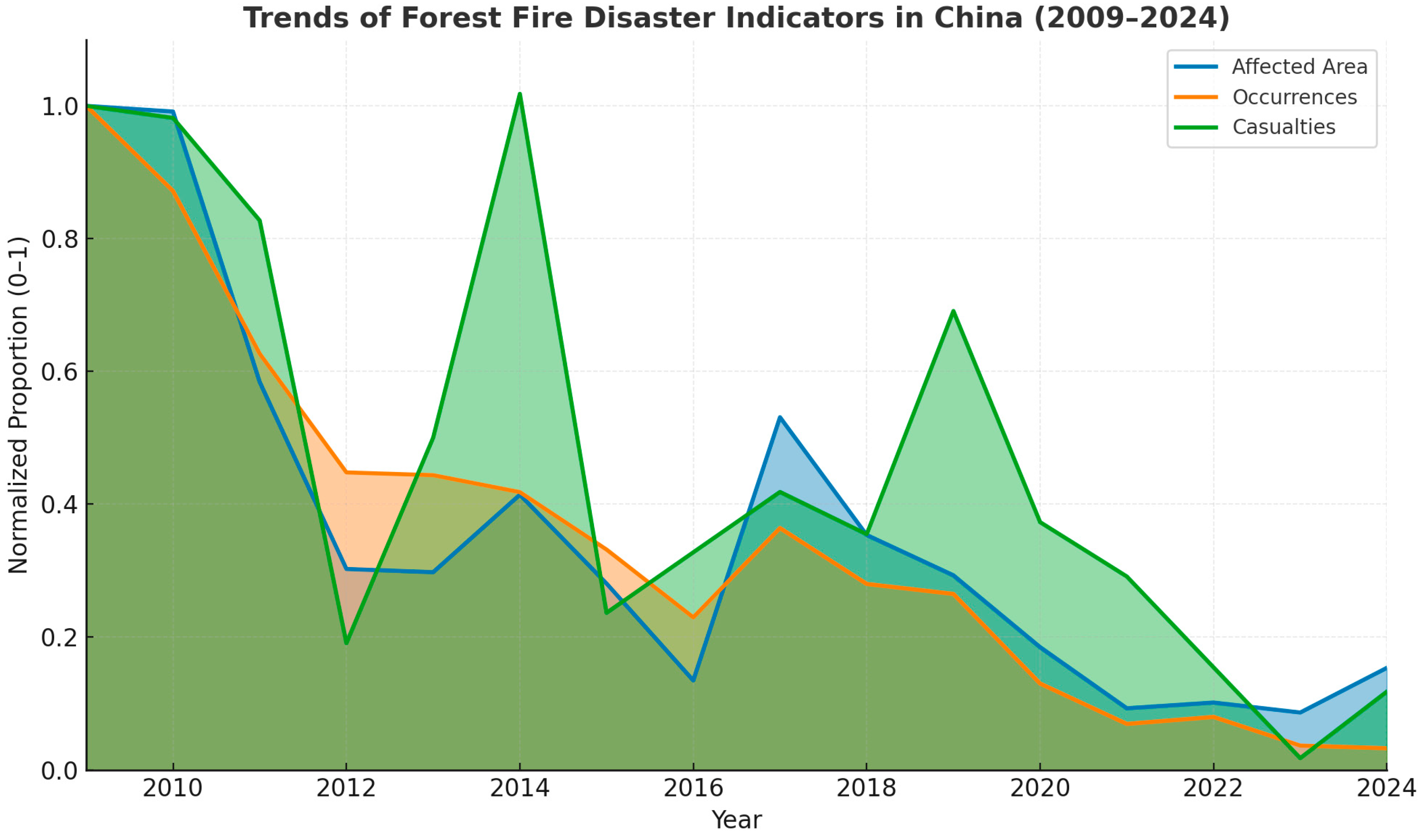
The statistical data presented in
Figure 1 were obtained from authoritative government bulletins and validated reports released by the National Forestry and Grassland Administration of China, as well as other publicly available datasets from official disaster management institutions. These sources were selected because forest fire incident statistics in China are centrally collected and verified by government departments rather than through independent academic surveys. Therefore, although some references [
3,
4,
5,
6,
7,
8] include governmental and institutional reports, they provide the most reliable and up-to-date data for depicting long-term forest fire trends. The figure aims to illustrate the evolving severity and frequency of forest fire disasters over the past 15 years and to highlight the ongoing need for intelligent, data-driven fire management systems despite recent technological advancements.
Existing studies in forest fire management often address isolated subproblems using single or limited data sources. Remote sensing imagery has been widely used for fire detection, burned area estimation, and severity assessment, offering valuable large-scale spatial insights [
15]. The Geographic Information System (GIS)-based models have been developed to optimize rescue route planning and allocate resources efficiently during firefighting operations [
16]. Meanwhile, meteorological datasets and fire weather indices (FWI, FFMC, DMC, DC) are routinely applied for fire risk forecasting and alerting systems [
17].
Although these domain-specific methods have yielded important results, they remain limited by their data fragmentation. Each dataset—be it meteorological, spatial, or operational—is typically managed within its own system, with inconsistent formats, semantics, and metadata [
18]. The absence of a unified semantic layer hinders the integration of the full data chain, restricting the capacity to uncover cross-domain relationships such as how weather patterns, terrain conditions, and human interventions collectively influence fire behavior [
19]. Consequently, current forest fire data management practices remain largely syntactic and descriptive, rather than semantic and inferential, limiting the potential for intelligent decision-making and automated reasoning across diverse information sources.
2.2. Ontology in Forest Fire Management
Ontologies—central to the Semantic Web paradigm—provide a formal, structured, and machine-understandable representation of domain knowledge, which defines the concepts, properties, and relationships that enable interoperability among heterogeneous datasets [
20]. And the Resource Description Framework (RDF) is a World Wide Web Consortium (W3C) standard for describing information on the web using a graph data model of subject-predicate-object triples [
21]. In emergency management, ontology-based approaches have been increasingly adopted for data integration, reasoning, and decision support [
22]. For example, the Semantic Sensor Network (SSN) ontology has emerged as the standard for describing sensors, observations, and sampling procedures [
23]. And the Sensor, Observation, Sample, and Actuator (SOSA) ontology is a lightweight core for SSN for a lightweight general-purpose specification to broaden the audience and application areas. In addition, the GeoSPARQL provides a well-defined framework for representing and querying geospatial features [
24].
In the context of forest fires, several domain ontologies have been proposed. An ontology-based framework for wildfire events (ONTO-SAFE) integrates information about fire events, weather conditions, and environmental impacts into a semantic model to support decision-making during emergencies [
25]. The SSN ontology-based decision support system encodes rules for fire weather index computation, transforming raw sensor streams into RDF graphs that can be semantically queried for early warning [
26], according to the Resource Description Framework. In addition, OntoFire introduced one of the first ontology-based geo-portals to improve wildfire data discovery and integration through semantic navigation [
27]. Kyzirakos et al. further demonstrated the combination of Earth observation ontologies and linked geospatial data for wildfire monitoring and knowledge extraction [
28]. Sirina expanded the scope by embedding indigenous ecological perspectives within an ontology of fire and forest management in Siberia [
29]. Dong et al. coupled ontology-driven data representation with an improved continuous Apriori algorithm to strengthen fire risk assessment [
30]. Most recently, Chandra et al. presented an ontology-based decision support system combining SSN, Apache Spark, and large language models for real-time forest fire management [
31]. Together, these studies highlight the evolution from semantic data integration to intelligent, hybrid AI–semantic frameworks for comprehensive forest fire prediction and response.
However, despite their effectiveness in real-time monitoring and post-event assessment, most of these models pay limited attention to the human operational dimension—that is, the structured representation of rescue missions, equipment usage, communication logistics, and tactical outcomes. Furthermore, few systems achieve bidirectional reasoning that semantically connects pre-disaster risk analysis with post-disaster response data.
2.3. Ontology and Digital Forests
The concept of the digital forest has evolved from simple data visualization and remote sensing toward intelligent, semantic, and dynamic management. Modern “smart forestry” initiatives emphasize the fusion of multi-source environmental and operational data within digital twin environments to enable predictive, knowledge-driven decision support [
32]. A digital forest framework aims to represent forest ecosystems as living, semantically enriched digital entities that reflect real-world processes, enabling continuous monitoring, reasoning, and optimization [
33].
Recent works have explored semantic frameworks that connect environmental ontologies, temporal reasoning, and predictive modeling for fire dynamics [
34]. For instance, Spatio-Temporal Knowledge Graph-based Forest Fire Prediction fuses multi-source heterogeneous data to build knowledge graphs supporting spatio-temporal reasoning and prediction [
35]. Similarly, recent advances in digital forest research emphasize integrating ontologies with emerging technologies such as 5G/6G networks and machine learning to enable intelligent, interconnected forest ecosystems. Tomaszewski and Kołakowski highlighted that next-generation communication infrastructures are essential for supporting smart forestry and real-time environmental monitoring [
36], while Rubí and Masa et al. demonstrated that ontology-based environmental data sharing and reasoning frameworks can bridge ecological modeling with predictive and decision-support applications, forming the foundation of semantic digital forests [
37,
38]. These models confirm that combining ontologies with data-driven reasoning significantly improves system interpretability and predictive power.
Therefore, the present study addresses these gaps by proposing a multi-ontology network—comprising SSN, GeoSPARQL, Fire Prevention, and Firefighting ontologies—that enables cross-domain integration, semantic instantiation, and automated reasoning. This framework bridges predictive fire risk modeling and emergency response decision-making, advancing the evolution of the semantic digital forest from data visualization toward knowledge-centric, reasoning-enabled fire management.
3. Semantic Digital Twin Framework
The proposed framework integrates Semantic Web technologies with digital twin principles to create a dynamic, knowledge-driven system for forest fire prediction and emergency response. It connects multi-source heterogeneous data—including satellite imagery, meteorological observations, GIS layers, operational mission records, and textual reports—into a unified semantic environment supporting reasoning, forecasting, and decision-making. By linking the physical and virtual representations of forest systems, the framework functions as a semantic digital twin, enabling continuous situational awareness and adaptive intelligence for data-driven fire management.
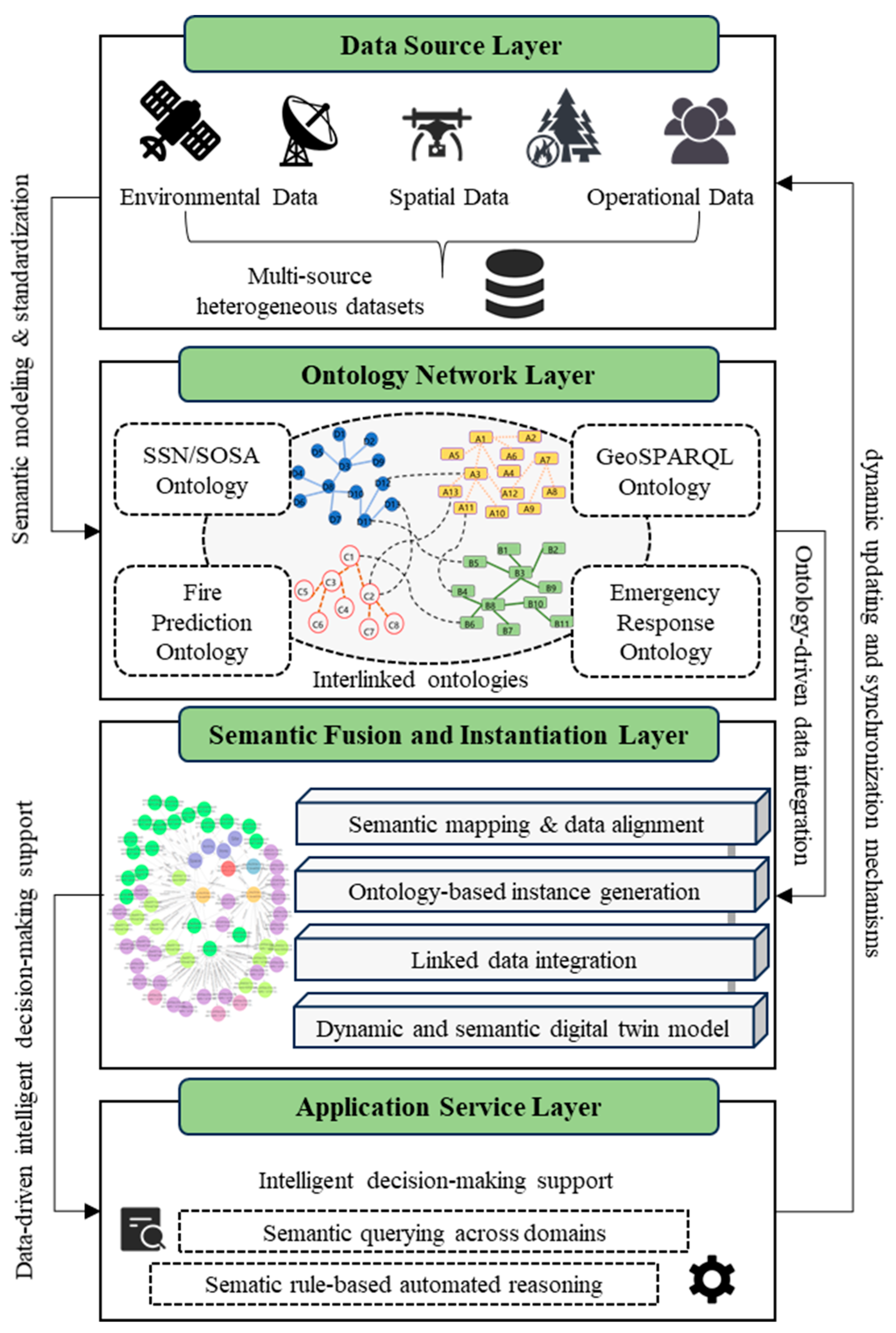
As shown in
Figure 2, the framework consists of four interconnected layers forming a semantic pipeline from raw data to intelligent decision support. The Data Source Layer aggregates diverse datasets describing forest fire dynamics. Environmental data include satellite imagery, meteorological records, and atmospheric indicators; spatial data cover GIS representations of terrain, vegetation, hydrology, and infrastructure; operational data capture firefighting missions, including personnel, equipment, outcomes, and textual reports. Each data category aligns with semantic domains in the ontology network, ensuring that physical observations are represented within a unified conceptual structure.
At the core, the Ontology Network Layer formalizes knowledge through four interlinked ontologies. The SSN/SOSA ontology provides a schema for representing sensor observations, enabling interoperability across environmental datasets. The GeoSPARQL ontology defines spatial entities and relations, supporting geospatial reasoning. On this basis, two domain ontologies are developed: the Fire Prediction Ontology (FPO), which models meteorological, ecological, and risk interactions for early warning; and the Emergency Response Ontology (ERO), which represents operational knowledge such as mission execution, team coordination, and equipment use. These ontologies are connected through shared entities and rule-based reasoning, allowing alerts inferred in the FPO to inform decisions in the ERO. Together, they form a closed-loop semantic ecosystem linking risk awareness and operational response.
The Semantic Instantiation and Fusion Layer connects ontology models to real-world data, forming an evolving linked knowledge graph. Through automated mapping and instance generation, heterogeneous datasets are transformed into structured RDF triples and stored in a graph database. Semantic reasoning engines uncover relationships among risk factors, conditions, and available resources, maintaining a context-aware model that reflects the current fire situation and supports predictive analysis.
The Application Service Layer provides the intelligent interface between the framework and end users. It offers (1) semantic querying to explore and correlate data across domains and (2) rule-driven reasoning for fire prediction, resource deployment, and emergency planning. Through continuous synchronization between field data and their semantic representation, this layer enables the system to deliver real-time situational awareness, early warning, and decision recommendations. Furthermore, the inferred results and decision outcomes generated at the application layer are utilized to semantically interpret and evaluate incoming real-time data streams, thereby establishing a continuous feedback loop that reinforces the twin’s capability for adaptive learning and data-driven decision refinement. In doing so, it transforms static datasets into a proactive decision-support system that continuously learns and adapts—embodying the operational essence of a semantic digital twin for forest fire management.
Unlike conventional Digital Twin systems that focus on physical simulation, the proposed Semantic Digital Twin constructs a virtual, knowledge-driven counterpart of the forest environment. Real-world monitoring systems capture diverse data—meteorological, geospatial, and operational—that often remain isolated across formats and platforms, forming digital silos. This framework bridges these gaps through ontology-based semantic integration, reconstructing a connected digital knowledge space that mirrors forest fire conditions in the virtual domain. Rather than replicating physical processes, the Semantic Digital Twin creates a semantically enriched digital representation capable of reasoning, inferring, and adapting to new observations—thus embodying the conceptual shift from physical replication to semantic intelligence.
4. Implementation of Semantic Digital Twin
4.1. Multi-Source Data Collection and Preprocessing
The foundation of the proposed semantic digital twin framework relies on the integration of heterogeneous data collected from multiple sources related to forest fire monitoring and emergency response, as is shown in
Table 1. These include national meteorological services, satellite observation systems, forestry and environmental departments, and emergency response authorities. For example, historical mission records and textual materials were provided by regional fire brigades and command centers. These datasets differ in modality, structure, and temporal granularity, but collectively provide a comprehensive digital representation of both environmental dynamics and human operational activities during forest fire prediction and response.
The collected datasets can be categorized into four major types:
- (1)
Time-series data, derived from satellite and radar observations, as well as ground-based sensors such as meteorological stations, thermal cameras, and surveillance devices. These datasets continuously record fire-related variables including temperature, humidity, and vegetation indices.
- (2)
Geospatial data, including GIS vector and raster layers that describe terrain, hydrology, vegetation, and infrastructure.
- (3)
Textual data, composed of unstructured documents such as post-event summaries and situation reports from fire departments.
- (4)
Tabular data, consisting of structured historical records of representative rescue missions, capturing team composition, mission timeline, equipment deployment, and operational outcomes.
All data underwent a standardized preprocessing workflow, including format harmonization (GeoJSON, CSV, TXT, etc.), spatial reference alignment, temporal normalization, and data validation. This process ensured interoperability and consistency for subsequent semantic integration.
4.2. Development and Integration of Cross-Domain Ontologies
To achieve semantic interoperability across heterogeneous data sources in forest fire prediction and emergency response, a multi-layered ontology network was constructed. Ontologies were developed using Protégé, importing SSN and GeoSPARQL as base ontologies, and constructing two other domain-specific ontologies, as shown in
Figure 3. Together, they provide a structured and machine-understandable representation of environmental sensing, spatial features, risk analysis, and emergency response. Uniform Resource Identifier (URI) prefixes for the main ontologies involved in this study can be found in
Table 2.
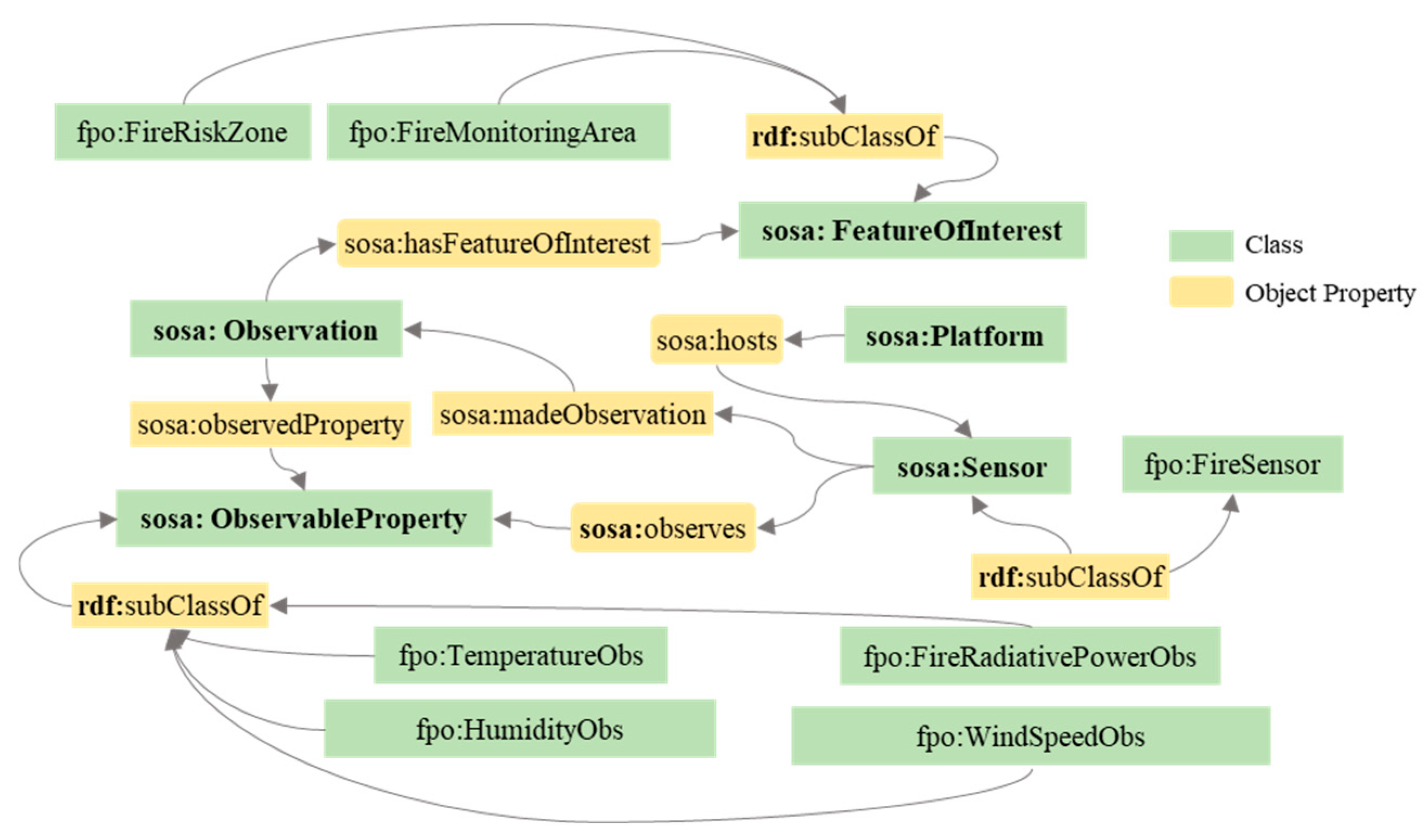
The SSN/SOSA ontology, developed by the W3C, provides a widely adopted framework for representing sensor-based observations and their associated processes [
39]. In this study, it was used to model time-series data from remote sensing satellites, meteorological stations, and ground-based environmental sensors. Concepts such as sosa:Observation, sosa:Sensor, and sosa:ObservedProperty were adapted and extended to ensure compatibility with fire-relevant measurements such as temperature, humidity, and wind speed, as shown in
Figure 4.
The GeoSPARQL ontology, maintained by the OGC, was introduced to formalize spatial relationships among physical entities in the landscape [
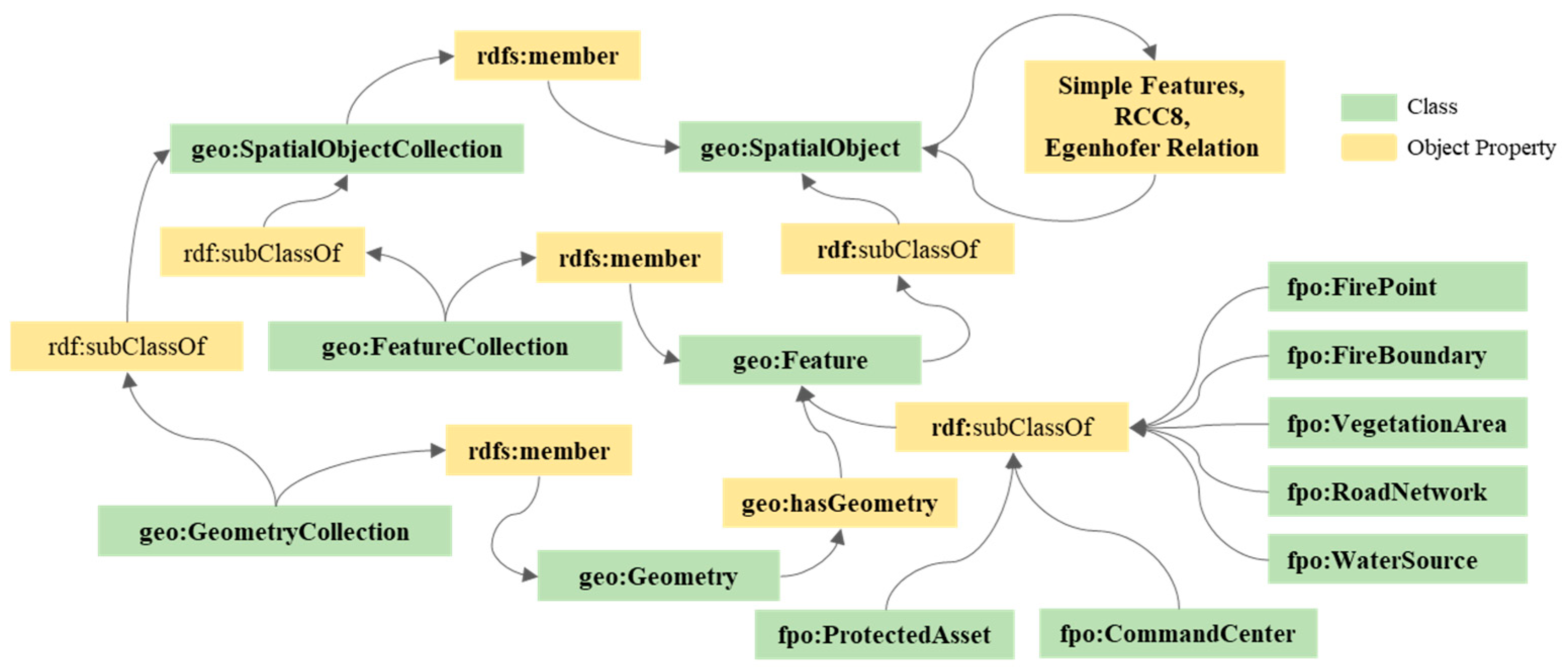
24]. It provides core classes such as geo:Feature and geo:Geometry, and supports topological predicates like sfWithin and sfOverlaps. In this framework, it enables precise spatial modeling of terrain, fire locations, administrative boundaries, and infrastructure, as shown in
Figure 5.
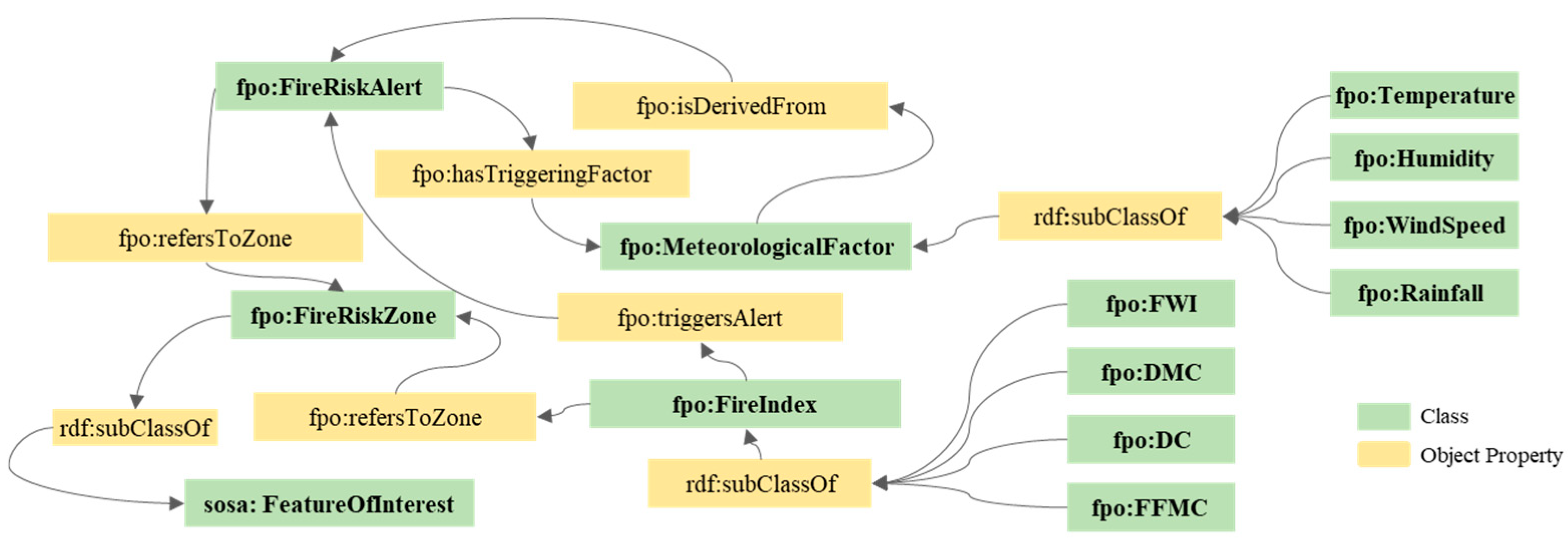
To address the domain of fire prediction, a Fire Prediction Ontology (FPO) was designed, as shown in
Figure 6. This ontology models the causal relationships between meteorological conditions and fire risk. It introduces domain-specific classes such as FireWeatherIndex, MeteorologicalFactor, and FireRiskAlert, and links these entities through properties that reflect the derivation of risk levels from environmental observations. Specifically, the FPO incorporates four core subclasses of FireIndex: the Fine Fuel Moisture Code (FFMC), Duff Moisture Code (DMC), Drought Code (DC), and Fire Weather Index (FWI). These indices represent short-, medium-, and long-term dryness conditions and provide a comprehensive measure of potential fire intensity. They are widely used in international forest fire management systems and have been semantically modeled here to enable automated reasoning for early fire risk alerts. The ontology supports reasoning over dynamic conditions to generate early warnings.
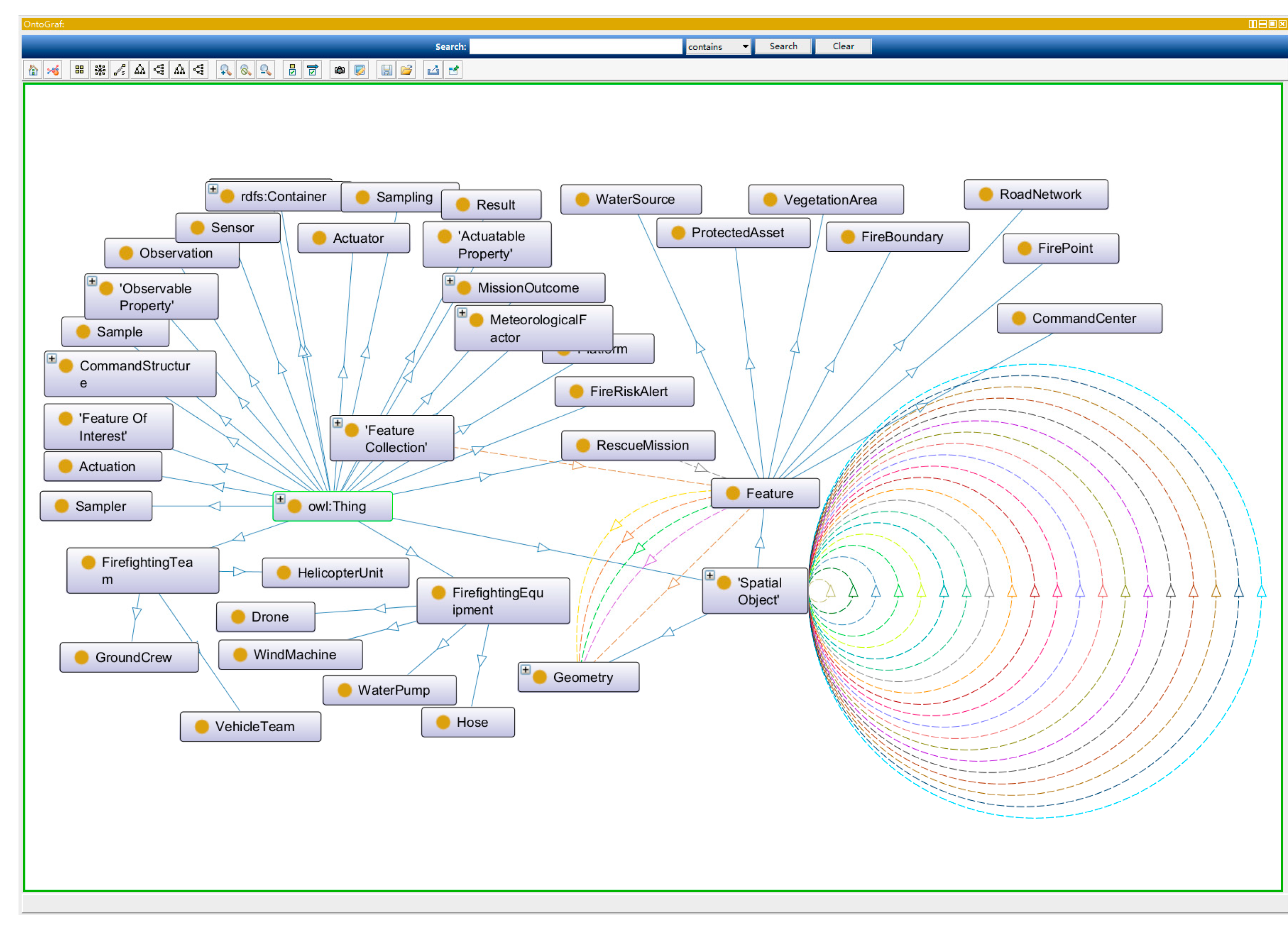
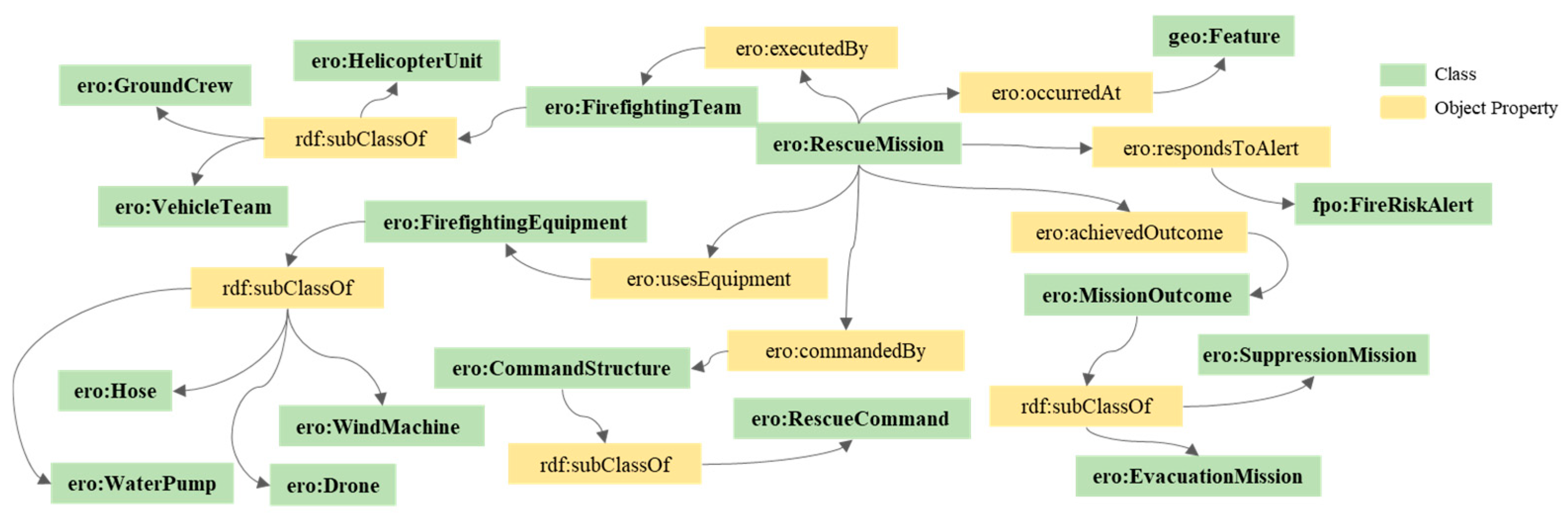
Complementing this, an Emergency Response Ontology (ERO) was created to represent operational knowledge derived from structured rescue mission data. It includes classes such as RescueMission, FirefightingTeam, Equipment, and MissionOutcome, and encodes key attributes such as deployment time, fire area controlled, and team composition, as shown in
Figure 7. This ontology was built based on real-world emergency response records to ensure relevance to decision-making processes.
To further demonstrate how heterogeneous data are semantically integrated within the proposed ontology framework,
Table 3 illustrates the mapping relationships between original data fields and ontology entities across four major data types: structured, time-series, textual, and geospatial. Structured and operational data are aligned with the ERO to represent missions, teams, and equipment in a standardized form. Time-series and sensor-based observations are modeled using the SOSA ontologies, which capture continuous environmental parameters such as temperature and humidity. Textual and unstructured reports are semantically annotated through Natural Language Processing (NLP) techniques, linking descriptive narratives to domain-specific classes within the FPO. Meanwhile, spatial information such as terrain and satellite imagery is represented using the GEO ontology through Well-Known Text (WKT) geometries, ensuring spatial interoperability. Together, these mappings support automated reasoning and enable the semantic digital twin to continuously fuse, interpret, and update multi-source forest fire data.
These four ontologies are semantically interlinked through well-defined object properties and shared conceptual anchors. For example, observed environmental variables described using the SSN ontology are linked to fire risk alerts in the FPO through the fpo:isDerivedFrom property. The geo:Feature class provides a shared spatial reference across all ontologies, connecting fire events, sensor locations, and mission deployment areas. Fire response actions represented in the ERO are tied to risk assessments from the FPO through rules that support decision recommendations. This integrated ontology network forms the semantic backbone of the proposed framework, enabling cross-domain reasoning, data integration, and knowledge discovery across the full lifecycle of forest fire management.
4.3. Semantic Instantiation and Linked Knowledge Graph
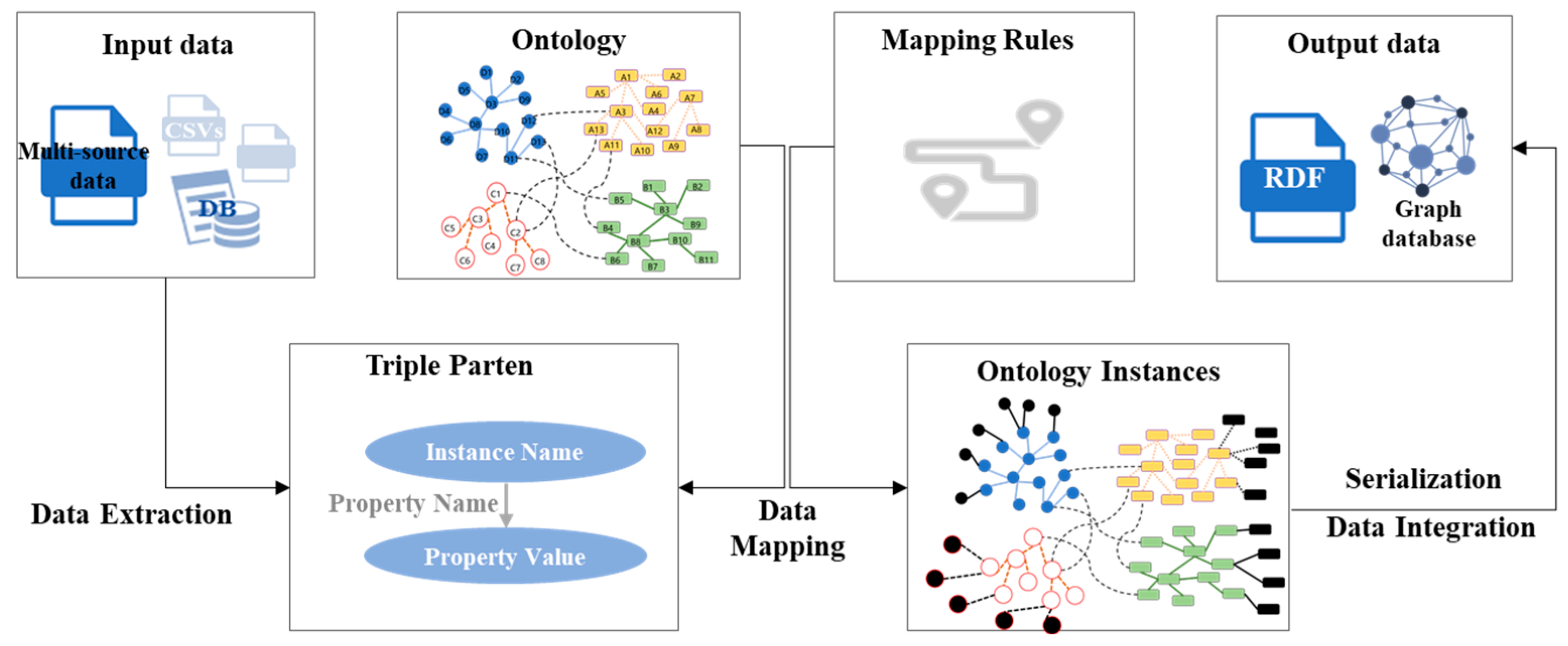
Following the construction of the ontology network, the next step involves transforming raw data into semantically rich knowledge through a structured process of instantiation and linkage, as shown in
Figure 8. Semantic instantiation refers to the creation of individuals—specific data instances—within the ontological classes defined in the previous stage. This transformation enables formerly isolated datasets to become part of a unified, machine-interpretable knowledge graph.
Time-series sensor data were ingested and mapped to sosa:Observation instances within the SSN ontology, where each observation retained its original temporal and spatial attributes. Meteorological measurements such as temperature, humidity, wind speed, and rainfall were connected to corresponding ObservedProperty and Sensor instances. Spatial features extracted from GIS data were instantiated as geo:Feature entities, and geometries were encoded using standard WKT literals in compliance with GeoSPARQL requirements. Textual and tabular records from historical rescue missions were parsed and converted into individuals of the ero:RescueMission, ero:FirefightingTeam, ero:FirefightingEquipment, and ero:MissionOutcome classes within the ERO, while pre-event warning conditions were instantiated within the FPO.
To support automated and scalable transformation, a Python-based pipeline was implemented using the RDFLib library for RDF generation and pandas for data wrangling. CSV and GeoJSON files were programmatically converted into OWL-compliant RDF triples, preserving data semantics through ontology-aligned URIs, object properties, and literal values. Cross-domain linking was achieved by referencing shared spatial entities, observation identifiers, and temporal overlaps. For example, a fire event location extracted from rescue mission logs was aligned with the corresponding geo:Feature instance used in environmental observation data. Similarly, a fire risk alert instance was linked to both meteorological observations and a historical mission conducted in the same region.
The resulting RDF triples were loaded into GraphDB, a semantic graph database that supports OWL 2 RL reasoning and GeoSPARQL-enabled spatial queries. This enabled the construction of a unified, cross-domain Linked Knowledge Graph that serves as the semantic core of the digital twin framework. Through this integration, the system not only preserves the granularity and context of the original data but also unlocks new possibilities for reasoning, querying, and insight generation across domains.
4.4. Intelligent Decision-Making Support
The constructed semantic knowledge graph enables not only integrated data storage but also real-time information retrieval and rule-based reasoning, forming the basis for intelligent decision support in both fire prediction and emergency response scenarios. Two core mechanisms underpin this functionality: SPARQL queries for semantic information retrieval, and semantic rules for logic-driven inference.
SPARQL queries allow users to flexibly retrieve multi-dimensional information that spans spatial, temporal, environmental, and operational aspects of forest fire management. Through semantic alignment of concepts across ontologies, the system supports queries such as identifying historically high-risk areas, matching current meteorological conditions to critical fire indices, or tracking the deployment history of firefighting resources in particular regions. These queries enable informed planning and rapid situation assessment. To systematically capture this capability,
Table 4 summarizes the types of semantic questions that can be answered using SPARQL queries, along with example formulations and the corresponding ontologies involved.
In addition to querying, the framework supports semantic reasoning through the Semantic Web Rule Language (SWRL) to generate alerts, recommendations, or classification outcomes based on domain knowledge. The rule set used in this study was established in consultation with two senior field experts from the Sichuan Provincial Forest Fire Corps, ensuring that the logical patterns reflect real-world operational decision practices. These rules were categorized into three groups: (1) environmental risk inference, (2) resource allocation and mission recommendation, and (3) long-term monitoring and prevention. Rules are encoded to reflect expert logic, enabling the system to respond to inferred risks, rather than relying solely on static thresholds. For example, a rule can combine meteorological observations with terrain conditions to suggest proactive evacuation or trigger resource mobilization.
Table 5 outlines selected SWRL rules currently implemented in the system, illustrating how semantic inference supports both fire prediction and response.
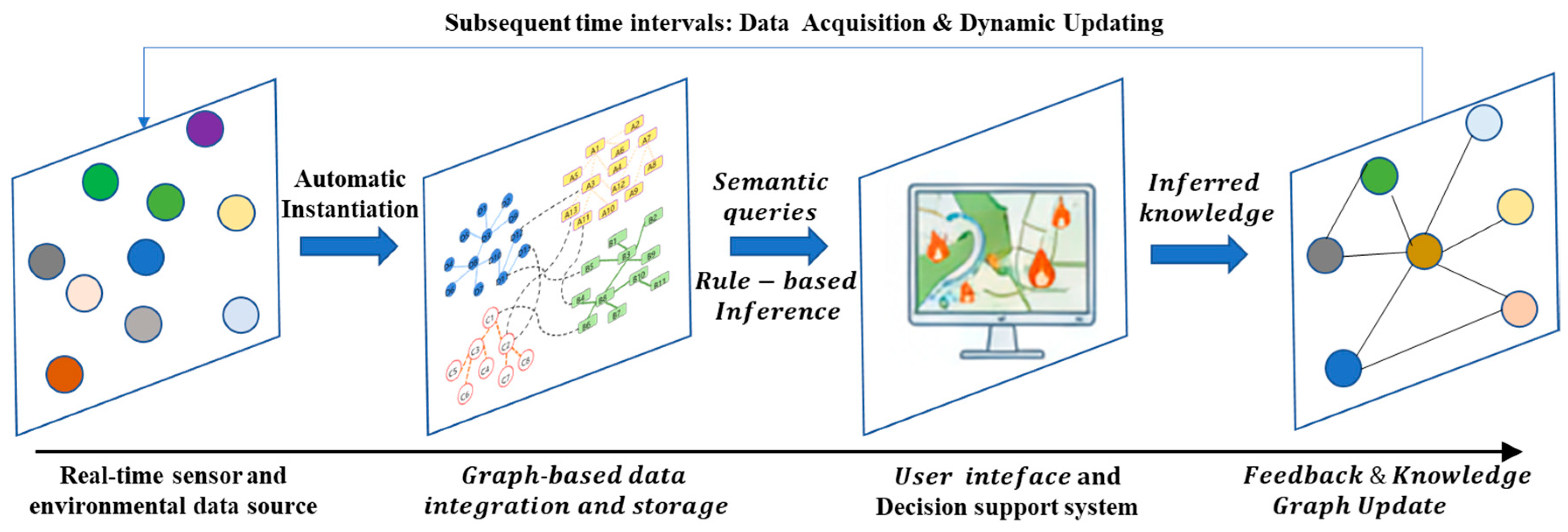
Figure 9 illustrates the dynamic workflow of the proposed Semantic Digital Twin framework for forest fire management. The process begins with multi-source sensing and data collection from physical environments, followed by automatic instantiation through interlinked ontologies that semantically integrate environmental, spatial, and operational information. The instantiated data are then stored in a graph-based repository, where rule-based reasoning and semantic querying are applied to infer new knowledge from existing relationships. Finally, the inferred knowledge is written back into the knowledge base, enabling the system to generate updated situational insights and adaptive recommendations for subsequent time intervals. For example, periodic SPARQL queries extract incremental data slices—such as temperature, humidity, and wind speed—from live sensor inputs, which are automatically evaluated through SWRL-based diagnostic rules to detect potential fire anomalies. Once triggered, process reasoning updates entity states within the knowledge graph (e.g., FireRiskAlert, FireRiskZone, RescueMission). This closed-loop cycle establishes a continuously evolving correspondence between the physical forest environment and its digital semantic representation.
These capabilities transform the knowledge graph from a passive data repository into an active, decision-supporting system. By enabling reasoning across spatial and temporal contexts, the framework allows fire managers to anticipate, respond to, and plan for complex risk scenarios with enhanced precision and confidence.
5. Case Study
To evaluate the practical effectiveness of the proposed semantic digital twin framework, a real-world forest fire event was selected as a demonstration scenario. The case study focuses on a forest fire that occurred in Sichuan Province. Data from this event were used to test the processes of ontology instantiation, and intelligent reasoning within the constructed system.
Four categories of data were collected and preprocessed according to the methodology described in
Section 4.1, including time-series meteorological data, geospatial fire location data, structured mission records, and textual summaries from post-event reports. Examples of these datasets are presented in
Table 6, which illustrates the diversity of data formats and attributes integrated into the knowledge graph.
5.1. Ontology Instantiation and Multi-Source Data Integration
All datasets were semantically instantiated and integrated into the cross-domain ontology network described in
Section 4.2. Meteorological observations were represented as sosa:Observation instances within the SSN ontology, while geospatial data were instantiated as geo:Feature entities following GeoSPARQL standards. Operational records from rescue teams were expressed as RescueMission, FirefightingTeam, and Equipment instances within the ERO and early-warning indicators such as temperature and humidity were linked to FireRiskAlert entities in the FPO.
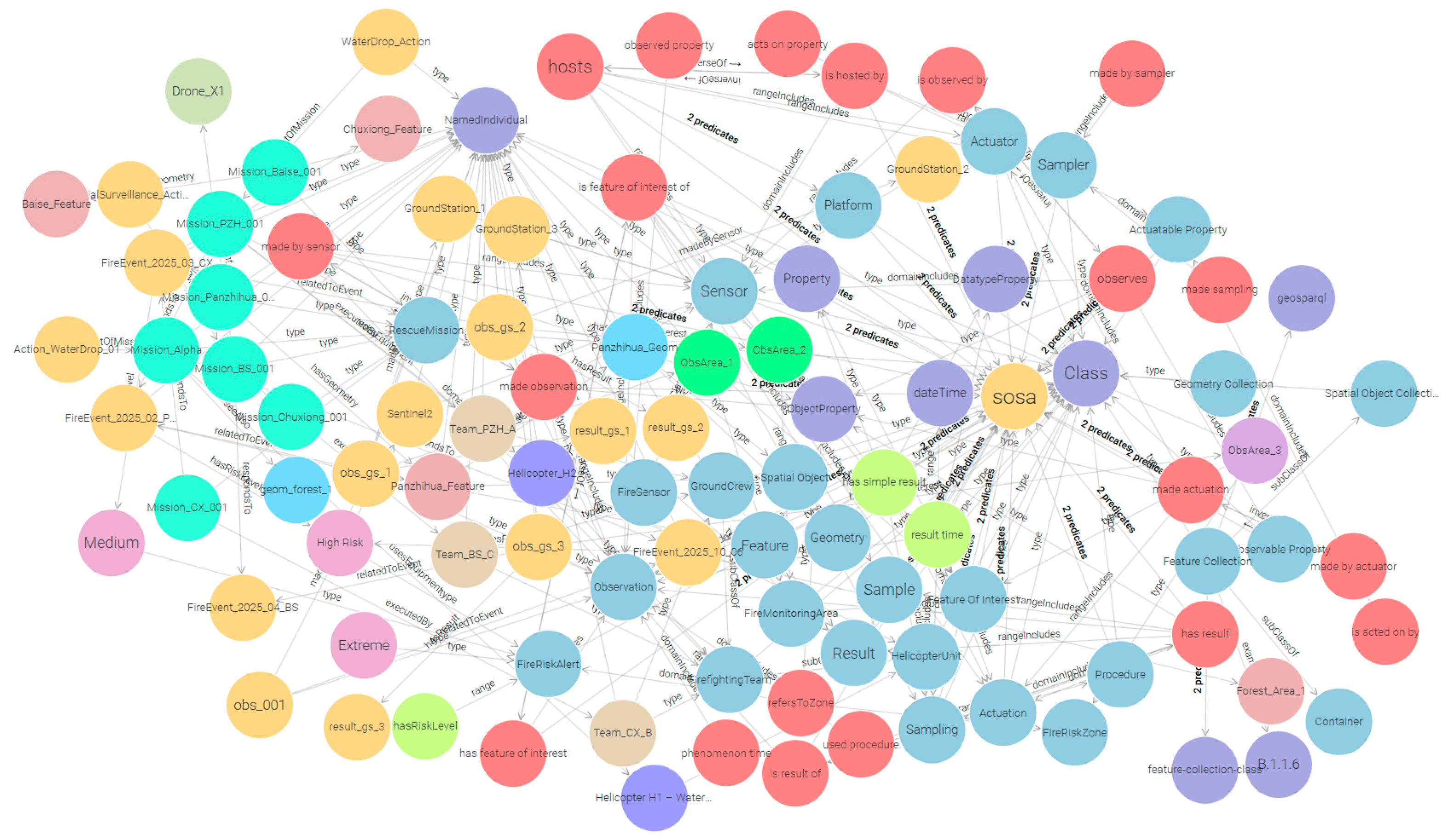
Through RDF mapping and URI alignment, all instances referring to the same geographic region were semantically connected via shared spatial identifiers. This integration allowed environmental conditions, operational actions, and risk indicators to be retrieved and reasoned upon within a unified semantic environment in GraphDB, as shown in
Figure 10. The resulting graph provided a linked representation of “what happened, where, and under which conditions,” offering a foundation for cross-domain queries and rule-based reasoning.
5.2. Information Query Using SPARQL
To demonstrate the capability of semantic information retrieval, a series of SPARQL queries were executed to extract integrated knowledge from the forest fire dataset. Each query was designed to access information from different ontologies and return cross-domain results, such as environmental conditions, operational resources, and mission outcomes, as shown in
Table 7.
These queries demonstrate how different ontologies—SSN, GeoSPARQL, Fire Prevention, and Firefighting—can be semantically connected to support multi-faceted situational analysis. A single SPARQL query can simultaneously access meteorological observations, spatial boundaries, and mission outcomes, yielding a comprehensive semantic snapshot of the event.
5.3. Logical Inference Based Using SWRL
Beyond information retrieval, the semantic digital twin framework incorporates rule-based reasoning to transform integrated data into actionable intelligence. For example, temperature and humidity readings exceeding threshold values could trigger a FireRiskAlert in the Fire Prediction Ontology (FPO), which subsequently activates resource deployment suggestions in the Emergency Response Ontology (ERO). This event-driven reasoning allows the framework to move from passive monitoring to proactive decision support. These rules were grouped according to their functional purpose: (1) Fire Risk Inference Rules, which link meteorological factors such as temperature, humidity, and wind speed to fire hazard levels; (2) Mission Activation Rules, which determine resource allocation strategies based on the inferred alert level and spatial zones; and (3) Outcome Association Rules, which associate mission results with long-term fire zone risk patterns. To ensure the practical relevance of the “resource allocation” and “early warning” rules, their logical design was informed by operational guidelines and expert experience from the Sichuan Provincial Forest Fire Corps. These rules are not intended as isolated logical statements but as mechanisms for dynamically updating the ontology network and linking inferred alerts to actionable decision entities. In practice, the rule-driven recommendations—such as pre-deploying aerial units or issuing local evacuation alerts—were reviewed by domain experts and aligned with standard emergency response protocols.
Table 8 lists the representative SWRL rules implemented in this study, together with their logical formulations and corresponding system actions. The rules cover a range of predictive and operational tasks, including early risk detection, resource pre-positioning, evacuation guidance, and patrol scheduling.
To validate the reasoning capability of the system, a qualitative verification process was conducted using expert-defined expectations derived from historical wildfire scenarios. The outputs of SWRL-based inference—such as the generation of FireRiskAlert and mission recommendations—were cross-checked by two experienced field officers from the Sichuan Provincial Forest Fire Corps. This process ensured that the reasoning results were logically consistent and operationally meaningful. In addition, the ontology network was examined for semantic consistency using the HermiT reasoner in Protégé, confirming the correctness of class hierarchies, property constraints, and rule implications within the knowledge base.
Finally, this case study verified the full workflow of the proposed framework—from multi-source data collection and semantic instantiation to intelligent querying and reasoning. The results demonstrated that the integration of heterogeneous data within a unified ontology network significantly enhances the interpretability and usability of information in forest fire management. By enabling automated inference through SWRL rules, the system can dynamically link environmental observations with operational knowledge, generating preemptive alerts and resource recommendations. Compared with traditional data-driven systems, this semantic digital twin framework provides not only improved data interoperability but also a higher level of reasoning-driven intelligence, establishing a strong foundation for future development of predictive, knowledge-based forest fire prevention and response systems.
6. Discussion
The proposed semantic digital twin framework demonstrates how ontology-based integration can transform multi-source forest fire data into structured, interoperable knowledge. By unifying heterogeneous inputs from meteorological sensors, remote sensing imagery, GIS layers, and operational records, the framework achieves a semantic foundation for intelligent forest fire management. The coordinated network of four ontologies—SSN, GeoSPARQL, Fire Prevention, and emergency response—forms a comprehensive representation of the physical, environmental, and human dimensions of wildfire processes. This multi-layered structure not only supports accurate data interpretation but also enables logical inference that reflects expert reasoning. As such, the framework extends the conventional notion of a digital twin into a semantic, knowledge-driven system that links perception, cognition, and decision-making in a closed loop.
Compared with existing approaches in emergency management and environmental modeling, this framework provides greater granularity and interoperability. Many previous ontology-based systems focused on general crisis scenarios but did not address the full lifecycle of forest fire prediction and response. The present framework distinguishes itself through its dual-domain design, explicitly connecting preventive and operational knowledge. This integration allows automatic propagation from early warnings to response recommendations, bridging the gap between risk sensing and field execution. Furthermore, the use of standard ontologies such as SSN and GeoSPARQL ensures that the model remains compatible with global data standards, facilitating potential interoperability with other environmental and geospatial systems. The adoption of RDF-based linked data principles also ensures extensibility, allowing the model to evolve with new datasets, rules, or domain concepts.
From a performance perspective, this study adopts a qualitative validation approach focusing on the interpretability, consistency, and adaptability of the proposed framework rather than quantitative metrics. The reasoning outcomes aligned closely with expert assessments, confirming the system’s reliability in real-world decision-making contexts. Compared with data-driven or machine learning-based methods, which rely heavily on extensive labeled datasets and often act as black-box models, the proposed semantic digital twin framework provides a transparent and explainable reasoning process grounded in domain semantics. Instead of requiring continuous retraining, the rule-based inference mechanism can incorporate new knowledge directly through ontology extension or expert-defined updates, making the system easier to adapt to emerging scenarios. Moreover, while machine learning models may struggle with heterogeneous data formats—such as environmental sensor streams, spatial data, and textual mission reports—the ontology-driven design seamlessly integrates these diverse data sources within a unified semantic layer. These characteristics highlight the practical advantages of the framework: (1) improved transparency and traceability of decision logic, (2) flexibility to integrate new data or expert knowledge without retraining, and (3) stronger cross-domain interoperability supporting real-time reasoning across environmental, spatial, and operational dimensions. This interpretability and adaptability constitute key strengths of the proposed approach, particularly in data-sparse or rapidly evolving forest fire management environments where model-based prediction alone is often insufficient.
Looking forward, the proposed semantic digital twin framework can be further extended through integration with data-driven models and large language models (LLMs). LLM-based reasoning could assist in interpreting unstructured textual reports, extracting contextual knowledge, and dynamically generating semantic rules to complement expert-defined logic. This synergy between symbolic reasoning and data-driven intelligence would enhance the adaptability, scalability, and autonomy of digital twin systems, paving the way toward more self-evolving and knowledge-aware forest fire management frameworks.
Despite its advantages, the framework faces several limitations that warrant further investigation. The accuracy of reasoning depends on the completeness and precision of domain knowledge encoded in the ontologies and SWRL rules. Expert-driven validation remains essential to prevent bias in automatic inference. In addition, the system currently operates on historical and static datasets; extending it to handle real-time sensor streams and large-scale, high-frequency data will require scalable reasoning mechanisms and distributed graph storage. Future work may focus on integrating semantic stream processing, machine learning–assisted ontology enrichment, and natural language query interfaces to improve usability and automation. Ultimately, by combining semantic modeling with dynamic sensing, the framework can evolve into a fully interactive digital twin capable of continuous learning, simulation, and prediction for comprehensive forest fire risk management.
7. Conclusions
This study developed a semantic digital twin-driven framework for integrating and reasoning over multi-source data in forest fire prediction and emergency response. Through a structured four-layer architecture—encompassing data sources, ontologies, semantic instantiation, and application services—the framework provides a unified semantic infrastructure for linking environmental, spatial, and operational knowledge. By aligning heterogeneous data through formal ontologies and rule-based reasoning, the model transforms fragmented datasets into actionable intelligence. The resulting system supports complex semantic queries and automated decision-making, demonstrating its potential to enhance both the accuracy and efficiency of forest fire management.
The case study validated the practical feasibility and effectiveness of the proposed approach. By instantiating real operational records, environmental data, and geographic information within the ontology network, the system successfully supported both cross-domain semantic queries and automated reasoning. SPARQL queries enabled integrated retrieval of mission data, environmental indicators, and spatial relationships, while SWRL rules translated observed conditions into proactive alerts and resource recommendations. The results confirmed that the framework not only facilitates comprehensive data interoperability but also delivers intelligent decision support that bridges prediction and response within a unified semantic environment.
In summary, this research contributes a theoretical and technical foundation for the next generation of knowledge-based forest fire management systems. By embedding semantic understanding, logical reasoning, and cross-domain integration into a digital twin framework, the study advances the capacity for predictive, adaptive, and intelligent fire prevention and emergency response. The approach is broadly applicable beyond forestry, offering a scalable model for other environmental and disaster management domains. Future extensions—such as real-time semantic streaming, LLM-based user interfaces, and digital twin visualization—will further enhance its operational value, moving toward a truly intelligent, data-informed, and knowledge-driven paradigm for ecological resilience and safety management.




 ,
,