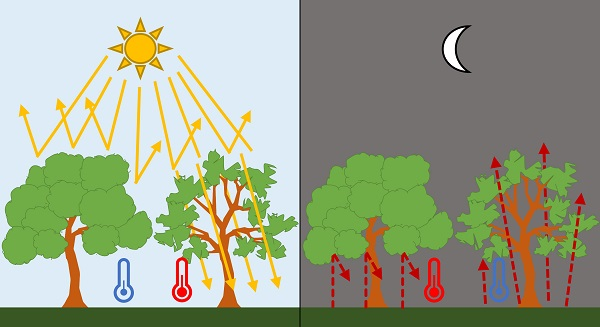
The Best Urban Trees for Daytime Cooling Leave Nights Slightly Warmer

Abstract
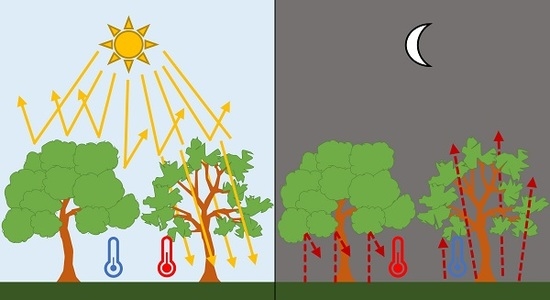
1. Introduction
2. Results
2.1. Species-Specific Differences in Tair
2.2. Tree Height
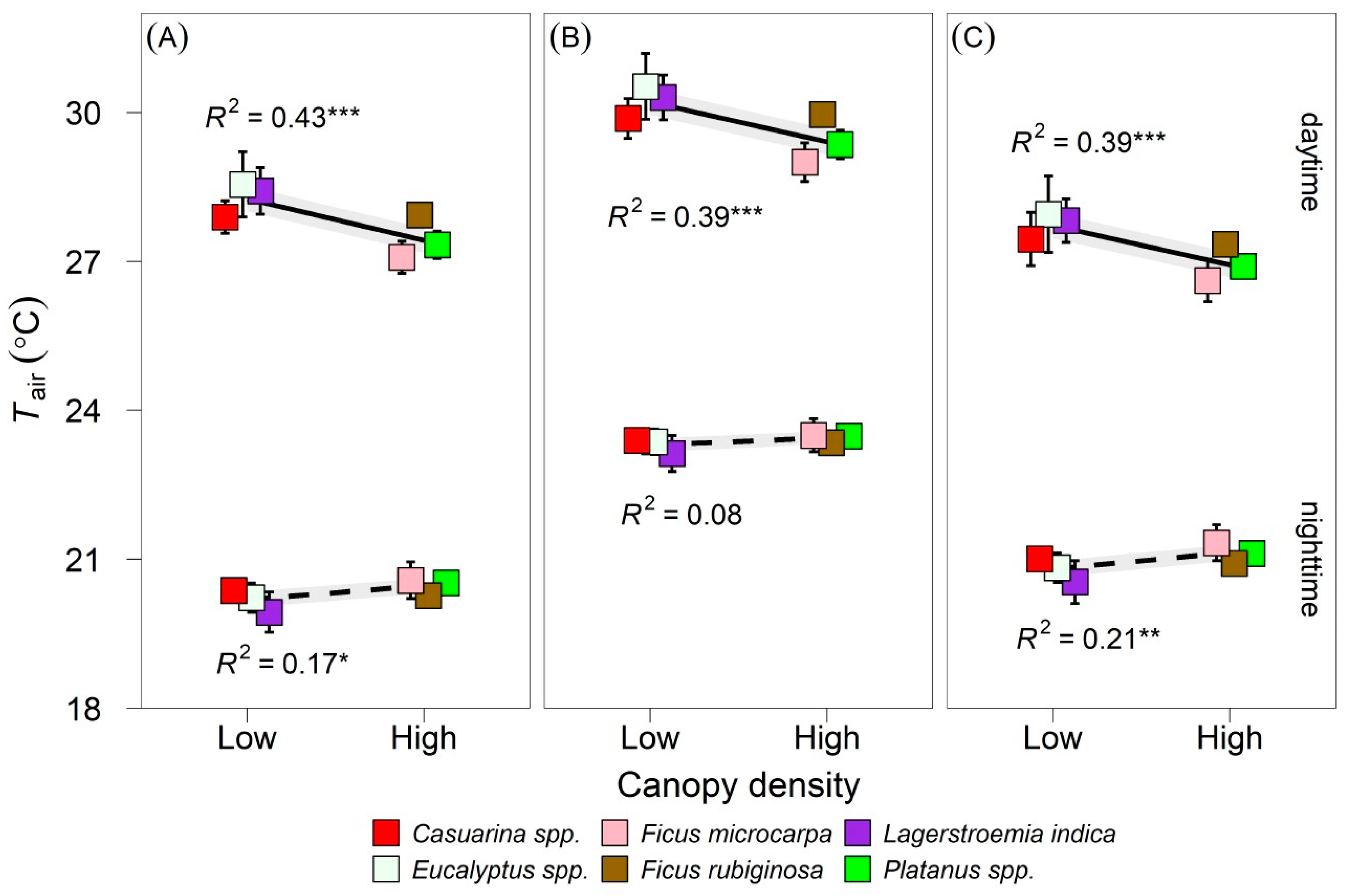
2.3. Canopy Density
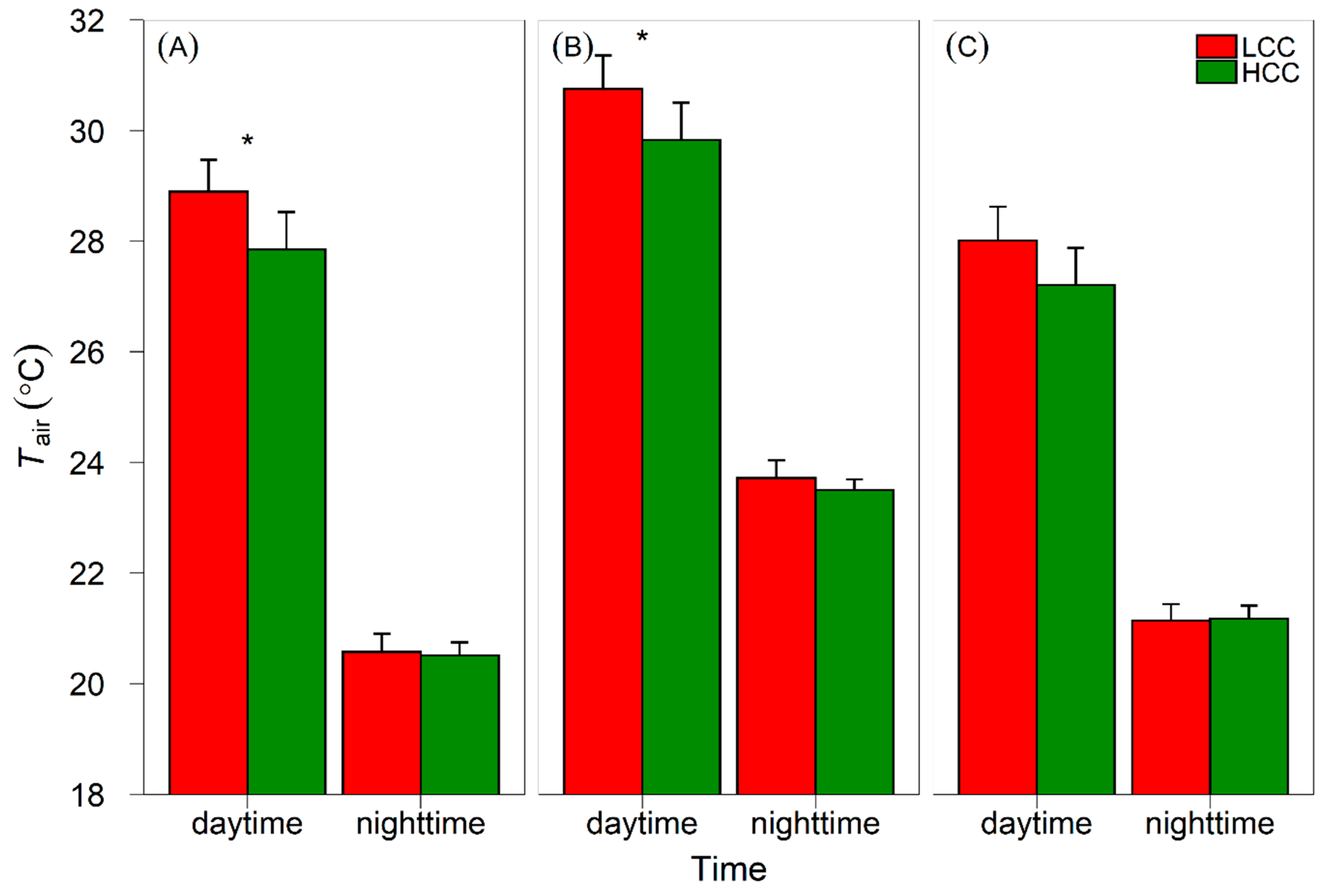
2.4. Canopy Cover
3. Discussion
4. Materials and Methods
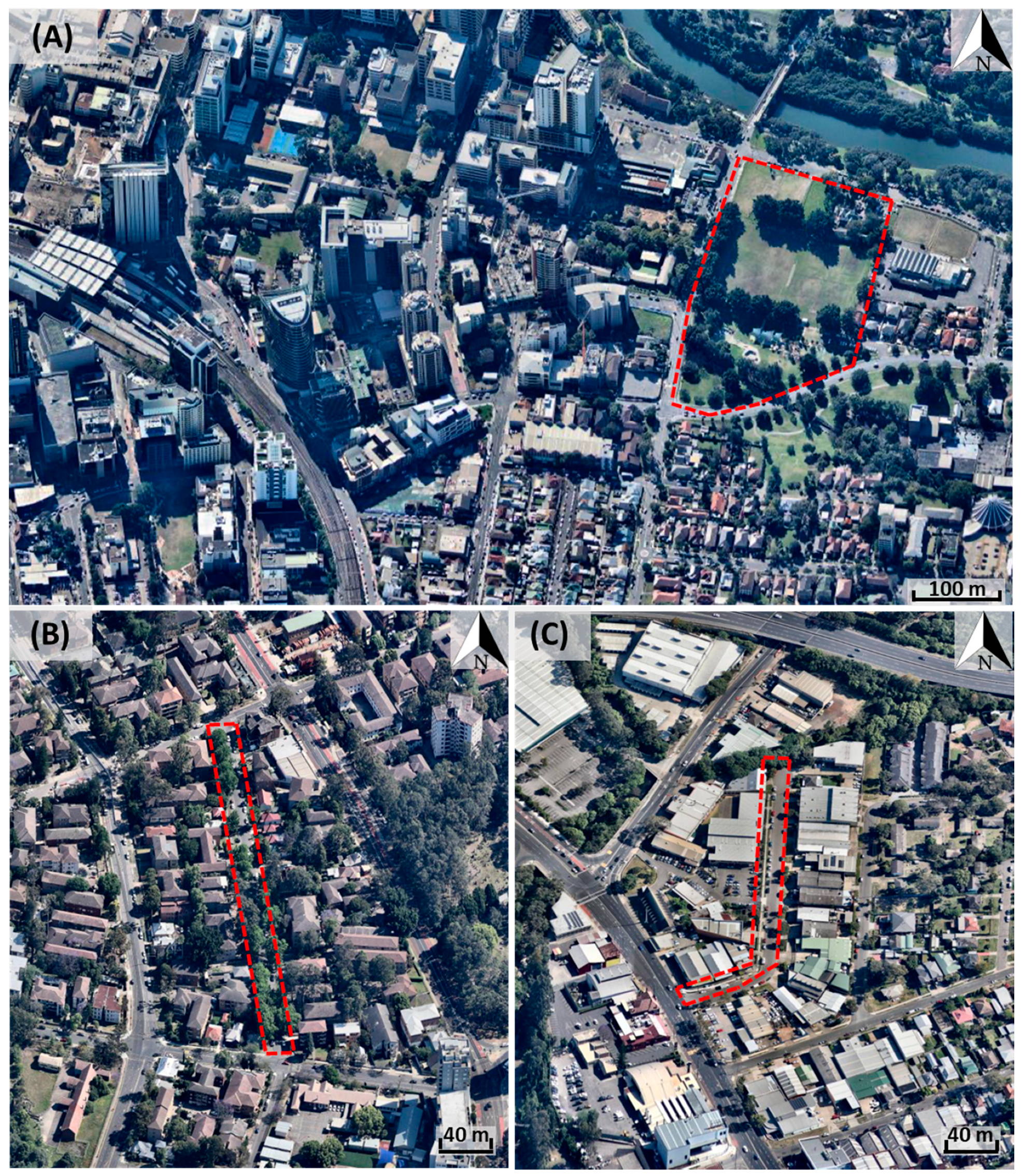
4.1. Research Sites
4.2. Experiments
4.3. Placing Loggers in the Field
4.4. Tree Height and Canopy Density
4.5. Daytime and Nighttime Tair
4.6. Statistical Analysis
5. Conclusions
Author Contributions
Funding
Acknowledgments
Conflicts of Interest
References
- Masson-Delmotte, V.; Zhai, P.; Pörtner, H.-O.; Roberts, D.; Skea, J.; Shukla, P.R.; Pirani, A.; Moufouma-Okia, W.; Péan, C.; Pidcock, R.; et al. Global Warming of 1.5 °C: An IPCC Special Report on the Impacts of Global Warming of 1.5 °C Above Pre-Industrial Levels and Related Global Greenhouse Gas Emission Pathways, In the Context of Strengthening the Global Response to the Threat of Climate Change, Sustainable Development, and Efforts to Eradicate Poverty; Intergovernmental Panel on Climate Change: Geneva, Switzerland, October 2018. [Google Scholar]
- Bowler, D.E.; Buyung-Ali, L.; Knight, T.M.; Pullin, A.S. Urban greening to cool towns and cities: A systematic review of the empirical evidence. Landsc. Urban Plan. 2010, 97, 147–155. [Google Scholar] [CrossRef] [Scilit]
- Rizwan, A.M.; Dennis, L.Y.; Liu, C. A review on the generation, determination and mitigation of Urban Heat Island. J. Environ. Sci. 2008, 20, 120–128. [Google Scholar] [CrossRef] [Scilit]
- Li, Y.; Ren, T.; Kinney, P.L.; Joyner, A.; Zhang, W. Projecting future climate change impacts on heat-related mortality in large urban areas in China. Environ. Res. 2018, 163, 171–185. [Google Scholar] [CrossRef] [Scilit] [PubMed]
- Oke, T.R. Urban Climates; Mills, G.M., Christen, A., Voogt, J.A., Eds.; Cambridge University Press: Cambridge, UK, 2017. [Google Scholar] [CrossRef] [Scilit]
- Oke, T.R.; Johnson, G.T.; Steyn, D.G.; Watson, I.D. Simulation of surface urban heat islands under ‘ideal’ conditions at night part 2: Diagnosis of causation. Bound. Layer Meteorol. 1991, 56, 339–358. [Google Scholar] [CrossRef] [Scilit]
- Oke, T.R. The energetic basis of the urban heat island. Q. J. R. Meteorol. Soc. 1982, 108, 1–24. [Google Scholar] [CrossRef] [Scilit]
- Arnfield, A.J. Two decades of urban climate research: A review of turbulence, exchanges of energy and water, and the urban heat island. Int. J. Clim. 2003, 23, 1–26. [Google Scholar] [CrossRef] [Scilit]
- Jamei, E.; Rajagopalan, P.; Seyedmahmoudian, M.; Jamei, Y. Review on the impact of urban geometry and pedestrian level greening on outdoor thermal comfort. Renew. Sustain. Energy Rev. 2016, 54, 1002–1017. [Google Scholar] [CrossRef] [Scilit]
- Martilli, A.; Krayenhoff, E.S.; Nazarian, N. Is the Urban Heat Island intensity relevant for heat mitigation studies? Urban Clim. 2020, 31, 100541. [Google Scholar] [CrossRef] [Scilit]
- Gago, E.; Roldán, J.; Pacheco-Torres, R.; Ordóñez, J. The city and urban heat islands: A review of strategies to mitigate adverse effects. Renew. Sustain. Energy Rev. 2013, 25, 749–758. [Google Scholar] [CrossRef] [Scilit]
- Argüeso, D.; Evans, J.; Fita, L.; Bormann, K.J. Temperature response to future urbanization and climate change. Clim. Dyn. 2013, 42, 2183–2199. [Google Scholar] [CrossRef] [Scilit]
- Broadbent, A.M.; Krayenhoff, E.S.; Georgescu, M. The motley drivers of heat and cold exposure in 21st century US cities. Proc. Natl. Acad. Sci. USA 2020, 202005492. [Google Scholar] [CrossRef] [Scilit] [PubMed]
- Solecki, W.D.; Rosenzweig, C.; Parshall, L.; Pope, G.; Clark, M.; Cox, J.; Wiencke, M. Mitigation of the heat island effect in urban New Jersey. Environ. Hazards 2005, 6, 39–49. [Google Scholar] [CrossRef] [Scilit]
- Wang, Y.; Berardi, U.; Akbari, H. Comparing the effects of urban heat island mitigation strategies for Toronto, Canada. Energy Build. 2016, 114, 2–19. [Google Scholar] [CrossRef] [Scilit]
- Taleghani, M. Outdoor thermal comfort by different heat mitigation strategies—A review. Renew. Sustain. Energy Rev. 2018, 81, 2011–2018. [Google Scholar] [CrossRef] [Scilit]
- Aram, F.; García, E.H.; Solgi, E.; Mansournia, S. Urban green space cooling effect in cities. Heliyon 2019, 5, e01339. [Google Scholar] [CrossRef] [Scilit] [PubMed]
- Smithers, R.J.; Doick, K.J.; Burton, A.; Sibille, R.; Steinbach, D.; Harris, R.; Groves, L.; Blicharska, M. Comparing the relative abilities of tree species to cool the urban environment. Urban Ecosyst. 2018, 21, 851–862. [Google Scholar] [CrossRef] [Scilit]
- Chen, X.; Zhao, P.; Hu, Y.; Ouyang, L.; Zhu, L.; Ni, G. Canopy transpiration and its cooling effect of three urban tree species in a subtropical city- Guangzhou, China. Urban For. Urban Green. 2019, 43, 126368. [Google Scholar] [CrossRef] [Scilit]
- Kotzen, B. An investigation of shade under six different tree species of the Negev desert towards their potential use for enhancing micro-climatic conditions in landscape architectural development. J. Arid. Environ. 2003, 55, 231–274. [Google Scholar] [CrossRef] [Scilit]
- Rahman, M.A.; Moser-Reischl, A.; Rötzer, T.; Pauleit, S. Within canopy temperature differences and cooling ability of Tilia cordata trees grown in urban conditions. Build. Environ. 2017, 114, 118–128. [Google Scholar] [CrossRef] [Scilit]
- Shashua-Bar, L.; Pearlmutter, D.; Erell, E. The cooling efficiency of urban landscape strategies in a hot dry climate. Landsc. Urban Plan. 2009, 92, 179–186. [Google Scholar] [CrossRef] [Scilit]
- Gillner, S.; Vogt, J.; Tharang, A.; Dettmann, S.; Roloff, A. Role of street trees in mitigating effects of heat and drought at highly sealed urban sites. Landsc. Urban Plan. 2015, 143, 33–42. [Google Scholar] [CrossRef] [Scilit]
- Sanusi, R.; Johnstone, D.; May, P.; Livesley, S.J. Microclimate benefits that different street tree species provide to sidewalk pedestrians relate to differences in Plant Area Index. Landsc. Urban Plan. 2017, 157, 502–511. [Google Scholar] [CrossRef] [Scilit]
- Armson, D.; Rahman, M.A.; Ennos, A.R. A Comparison of the Shading Effectiveness of Five Different Street Tree Species in Manchester, UK. Arboric. Urban For. 2013, 39, 157–164. [Google Scholar]
- Morakinyo, T.E.; Kong, L.; Lau, K.K.L.; Yuan, C.; Ng, E. A study on the impact of shadow-cast and tree species on in-canyon and neighborhood’s thermal comfort. Build. Environ. 2017, 115, 1–17. [Google Scholar] [CrossRef] [Scilit]
- Ziter, C.; Pedersen, E.J.; Kucharik, C.J.; Turner, M. Scale-dependent interactions between tree canopy cover and impervious surfaces reduce daytime urban heat during summer. Proc. Natl. Acad. Sci. USA 2019, 116, 7575–7580. [Google Scholar] [CrossRef] [Scilit] [PubMed]
- Coutts, A.M.; White, E.C.; Tapper, N.J.; Beringer, J.; Livesley, S.J. Temperature and human thermal comfort effects of street trees across three contrasting street canyon environments. Theor. Appl. Clim. 2015, 124, 55–68. [Google Scholar] [CrossRef] [Scilit]
- Mussetti, G.; Brunner, D.; Henne, S.; Allegrini, J.; Krayenhoff, E.S.; Schubert, S.; Feigenwinter, C.; Vogt, R.; Wicki, A.; Carmeliet, J. COSMO-BEP-Tree v1.0: A coupled urban climate model with explicit representation of street trees. Geosci. Model Dev. 2020, 13, 1685–1710. [Google Scholar] [CrossRef] [Scilit]
- Souch, C.A.; Souch, C. The effect of trees on summertime below canopy urban climates: A case study Bloomington, Indiana. J. Arboric. 1993, 19, 303–312. [Google Scholar]
- Bureau of Meteorology. Special Climate Statement 73—Extreme heat and fire weather in December 2019 and January 2020. 2020. Available online: http://www.bom.gov.au/climate/current/statements/scs73.pdf (accessed on 15 June 2020).
- Sidiqui, P.; Huete, A.; Devadas, R. Spatio-temporal mapping and monitoring of Urban Heat Island patterns over Sydney, Australia using MODIS and Landsat-8. In Proceedings of the 2016 4th International Workshop on Earth Observation and Remote Sensing Applications (EORSA), Guangzhou, China, 4–6 July 2016; pp. 217–221. [Google Scholar] [CrossRef] [Scilit]
- Speak, A.; Montagnani, L.; Wellstein, C.; Zerbe, S. The influence of tree traits on urban ground surface shade cooling. Landsc. Urban Plan. 2020, 197, 103748. [Google Scholar] [CrossRef] [Scilit]
- Rahman, M.A.; Moser, A.; Rötzer, T.; Pauleit, S. Microclimatic differences and their influence on transpirational cooling of Tilia cordata in two contrasting street canyons in Munich, Germany. Agric. For. Meteorol. 2017, 232, 443–456. [Google Scholar] [CrossRef] [Scilit]
- Santamouris, M.; Haddad, S.; Fiorito, F.; Osmond, P.; Ding, L.; Prasad, D.; Zhai, X.; Wang, R. Urban Heat Island and Overheating Characteristics in Sydney, Australia. An Analysis of Multiyear Measurements. Sustainability 2017, 9, 712. [Google Scholar] [CrossRef] [Scilit]
- Jacobs, B.; Mikhailovich, N.; Delaney, C. Where Are All the Trees? An Analysis of Tree Canopy Cover in Urban Australia; Institute for Sustainable Futures, University of Technology: Sydney, Australia, 2014. [Google Scholar]
- Middel, A.; Krayenhoff, E.S. Micrometeorological determinants of pedestrian thermal exposure during record-breaking heat in Tempe, Arizona: Introducing the MaRTy observational platform. Sci. Total. Environ. 2019, 687, 137–151. [Google Scholar] [CrossRef] [Scilit] [PubMed]
- Coutts, A.M.; Harris, R.J.; Phan, T.; Livesley, S.J.; Williams, N.S.G.; Tapper, N.J. Thermal infrared remote sensing of urban heat: Hotspots, vegetation, and an assessment of techniques for use in urban planning. Remote. Sens. Environ. 2016, 186, 637–651. [Google Scholar] [CrossRef] [Scilit]


| Tree Species | Mean Tair | Tmin | Tmax | Hot | Extreme |
|---|---|---|---|---|---|
| Callistemon viminalis * | 24.8 ± 5.3 | 12.6 | 43.4 | 40 | 13 |
| Casuarina spp. | 24.4 ± 4.8 | 13.3 | 42.1 | 29 | 6 |
| Eucalyptus spp. | 24.6 ± 5.2 | 12.0 | 44.8 | 43 | 16 |
| Ficus microcarpa | 24.1 ± 4.4 | 13.5 | 40.1 | 20 | 2 |
| Ficus rubiginosa | 24.4 ± 4.9 | 12.6 | 41.0 | 24 | 3 |
| Lagerstroemia indica | 24.4 ± 5.2 | 11.6 | 42.9 | 32 | 6 |
| Liquidambar styraciflua ** | 24.2 ± 4.7 | 13.7 | 41.5 | 24 | 4 |
| Platanus spp. | 24.2 ± 4.5 | 13.5 | 39.7 | 20 | 0 |
| Quercus palustris ** | 24.4 ± 5.1 | 12.8 | 41.3 | 28 | 5 |
| Source of Variation | Daytime | Nighttime | |||
|---|---|---|---|---|---|
| df | F | p | F | p | |
| Tree height | 2 | 29.08 | <0.001 | 9.77 | <0.001 |
| Month | 2 | 208.49 | <0.001 | 935.08 | <0.001 |
| Tree height * Month | 4 | 0.04 | 0.99 | 0.61 | 0.65 |
| Canopy density | 1 | 63.18 | <0.001 | 17.15 | <0.001 |
| Month | 2 | 219.62 | <0.001 | 933.18 | <0.001 |
| Canopy density * Month | 2 | 0.02 | 0.98 | 0.80 | 0.45 |
| Parameter | Lagerstroemia indica | Platanus spp. | Casuarina spp. | Eucalyptus spp. | Ficus microcarpa | Ficus rubigniosa |
|---|---|---|---|---|---|---|
| Total tree height (m) | <10 | 10–20 | <10 | <10 and 10–20 | >20 | <10 |
| Canopy density | Low | high | Low | low | high | high |
| Range of distance between the trees (m) | 5–15 | 5–40 | 4–110 | 8–119 | 22–170 | 3–118 |
| Parameter | HCCS | LCCS |
|---|---|---|
| Length of street (m) | 305 | 250 |
| Polygon area (m2) | 18,134 | 14,203 |
| Total canopy area (m2) | 5537 | 1511 |
| Relative canopy cover (%) | 30.5 | 10.6 |
| Number of canopies | 39 | 24 |
| Mean canopy size (m2) | 142 (± 274) | 63 (± 168) |
| Range of canopy size (m2) | 2–1511 | 4–842 |
| Maximum height profile of the polygon (m) | 29–50 | 18–34 |
| Range of distance between individual trees (m) | 17–183 | 9–131 |
| Canyon depth (m) | 21 | 16 |
| Average street width (m) | 27 | 24 |
| Surface | rough | Smooth |
© 2020 by the authors. Licensee MDPI, Basel, Switzerland. This article is an open access article distributed under the terms and conditions of the Creative Commons Attribution (CC BY) license (http://creativecommons.org/licenses/by/4.0/).
Share and Cite
Wujeska-Klause, A.; Pfautsch, S. The Best Urban Trees for Daytime Cooling Leave Nights Slightly Warmer. Forests 2020, 11, 945. https://doi.org/10.3390/f11090945
Wujeska-Klause A, Pfautsch S. The Best Urban Trees for Daytime Cooling Leave Nights Slightly Warmer. Forests. 2020; 11(9):945. https://doi.org/10.3390/f11090945
Chicago/Turabian StyleWujeska-Klause, Agnieszka, and Sebastian Pfautsch. 2020. "The Best Urban Trees for Daytime Cooling Leave Nights Slightly Warmer" Forests 11, no. 9: 945. https://doi.org/10.3390/f11090945
APA StyleWujeska-Klause, A., & Pfautsch, S. (2020). The Best Urban Trees for Daytime Cooling Leave Nights Slightly Warmer. Forests, 11(9), 945. https://doi.org/10.3390/f11090945