Article

Spectra-Net: Frequency-Aware Scale Adaptation for Small Object Detection

1
College of Automation, Chongqing University of Posts and Telecommunications, Chongqing 400065, China
2
School of Computer Science and Technology, Chongqing University of Posts and Telecommunications, Chongqing 400065, China
3
Computer Information Systems Department, State University of New York at Buffalo State, Buffalo, NY 14222, USA
4
School of Information and Control Engineering, Southwest University of Science and Technology, Mianyang 621010, China
*
Authors to whom correspondence should be addressed.
Algorithms 2026, 19(8), 628; https://doi.org/10.3390/a19080628
Submission received: 10 June 2026 / Revised: 19 July 2026 / Accepted: 21 July 2026 / Published: 27 July 2026

Abstract

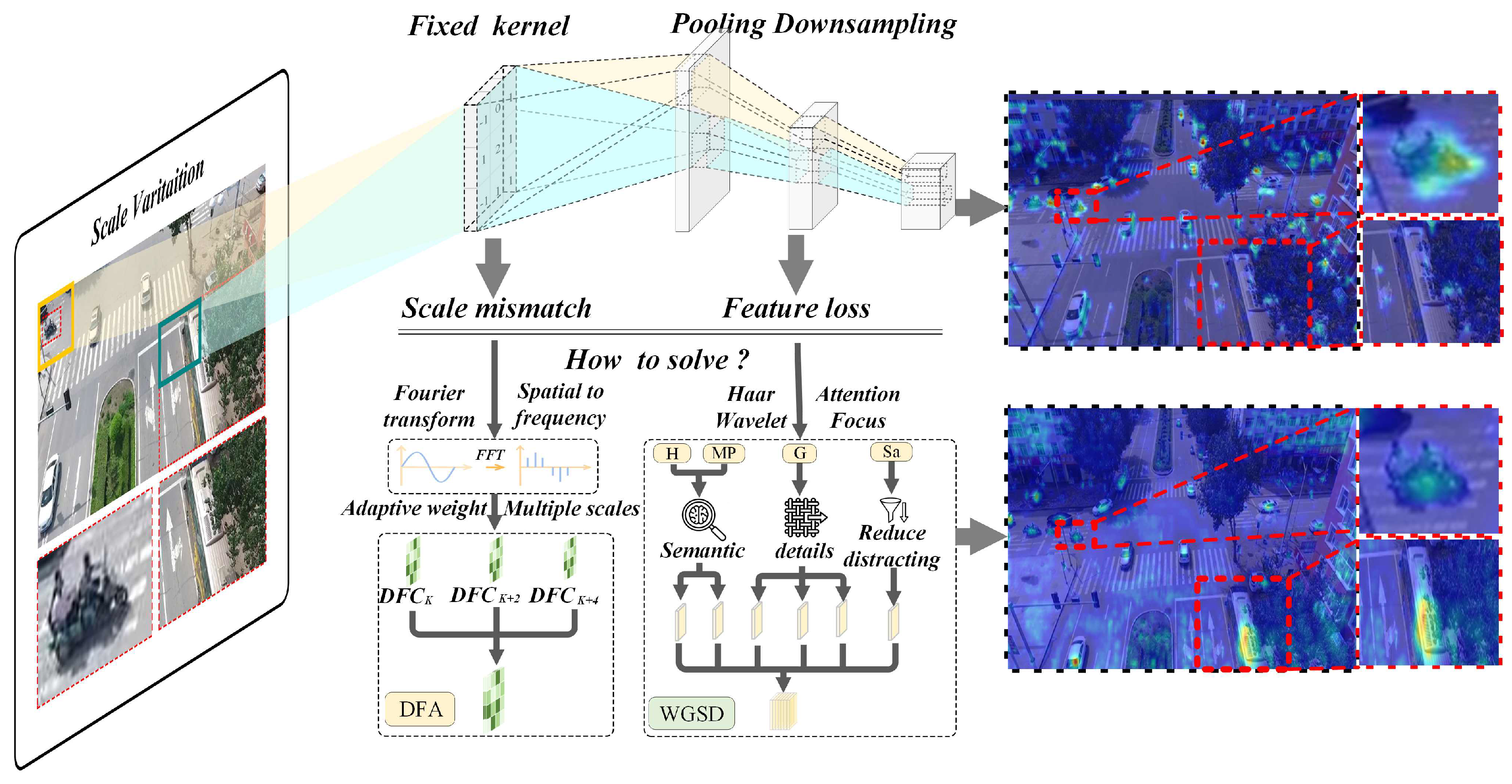
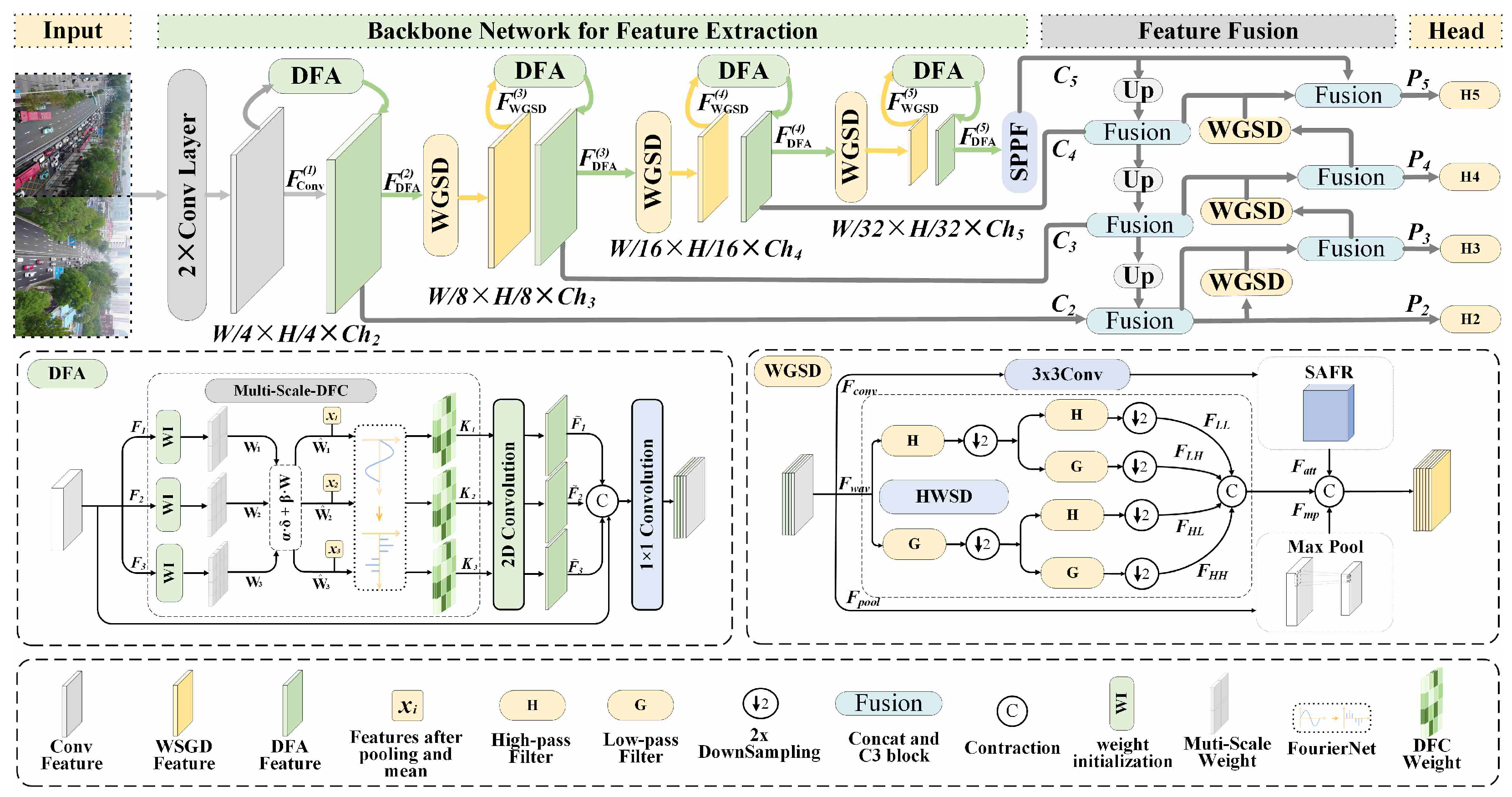
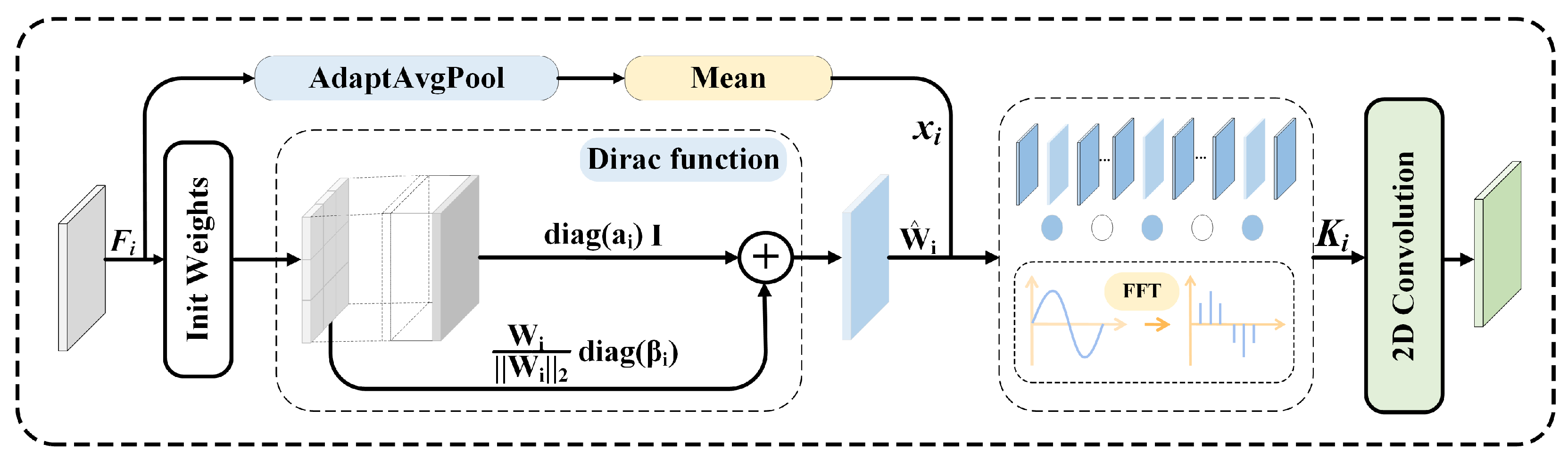
Small object detection in real-world scenarios remains challenging due to two coupled factors: severe scale imbalance and progressive degradation of fine-grained cues during backbone downsampling. Under drastic scale variations, conventional detectors still rely on static backbones whose fixed convolutional responses cannot consistently accommodate the divergent spectral characteristics of large and tiny objects, leading to scale-mismatched representations. Meanwhile, repeated strided operations reduce the sampling rate of feature maps and tend to introduce aliasing, eroding the high-frequency details that are critical for tiny objects. To address these issues, we propose Spectra-Net, a novel frequency-aware detection framework that redesigns backbone feature encoding with explicit spectral control. At its core, we introduce Dynamic Fourier Alignment (DFA), which performs content-adaptive yet frequency-controllable modulation to reshape convolutional responses in the spectral domain, aligning representations across scales and amplifying discriminative cues for small objects. In addition, we develop Wavelet-Guided Spectral Downsampling (WGSD), which conducts explicit sub-band decomposition via Haar wavelets to suppress aliasing while selectively preserving informative high-frequency components during resolution reduction. Extensive experiments on VisDrone-2019 and TT100K, together with comprehensive ablations, demonstrate that Spectra-Net consistently improves small object detection performance under severe scale imbalance.
Keywords: small object detection; scale adaptation; Fourier alignment small object detection; scale adaptation; Fourier alignment