
Application of Artificial Intelligence Algorithms in the Comprehensive Care of Patients with Breast Cancer

 ,
,  and
and 
Abstract
1. Introduction
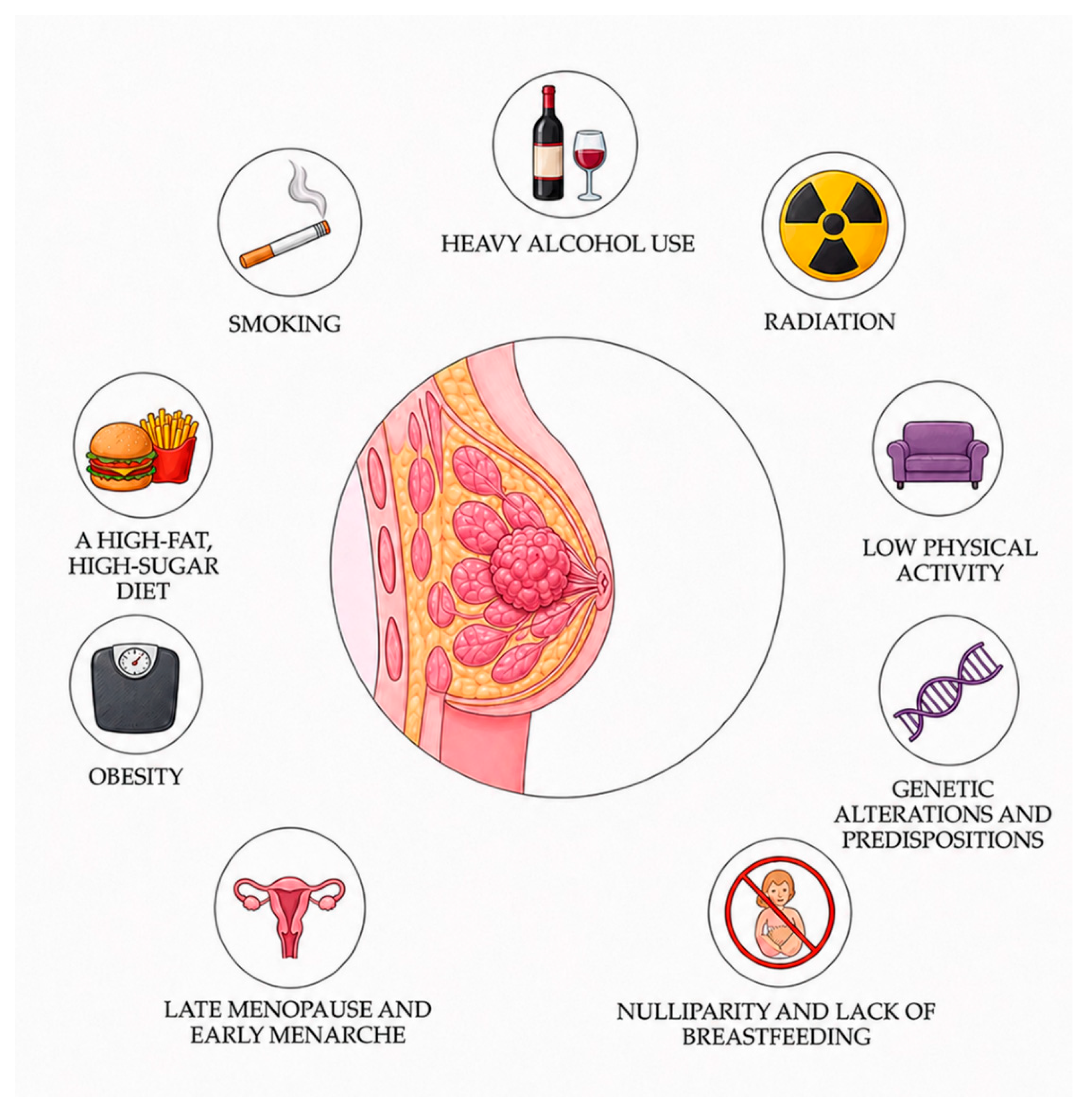
1.1. Epidemiology
1.2. The Role of Early Diagnosis in Breast Cancer
1.3. The Role of AI in Medicine
1.4. Objective of the Review
2. Materials and Methods
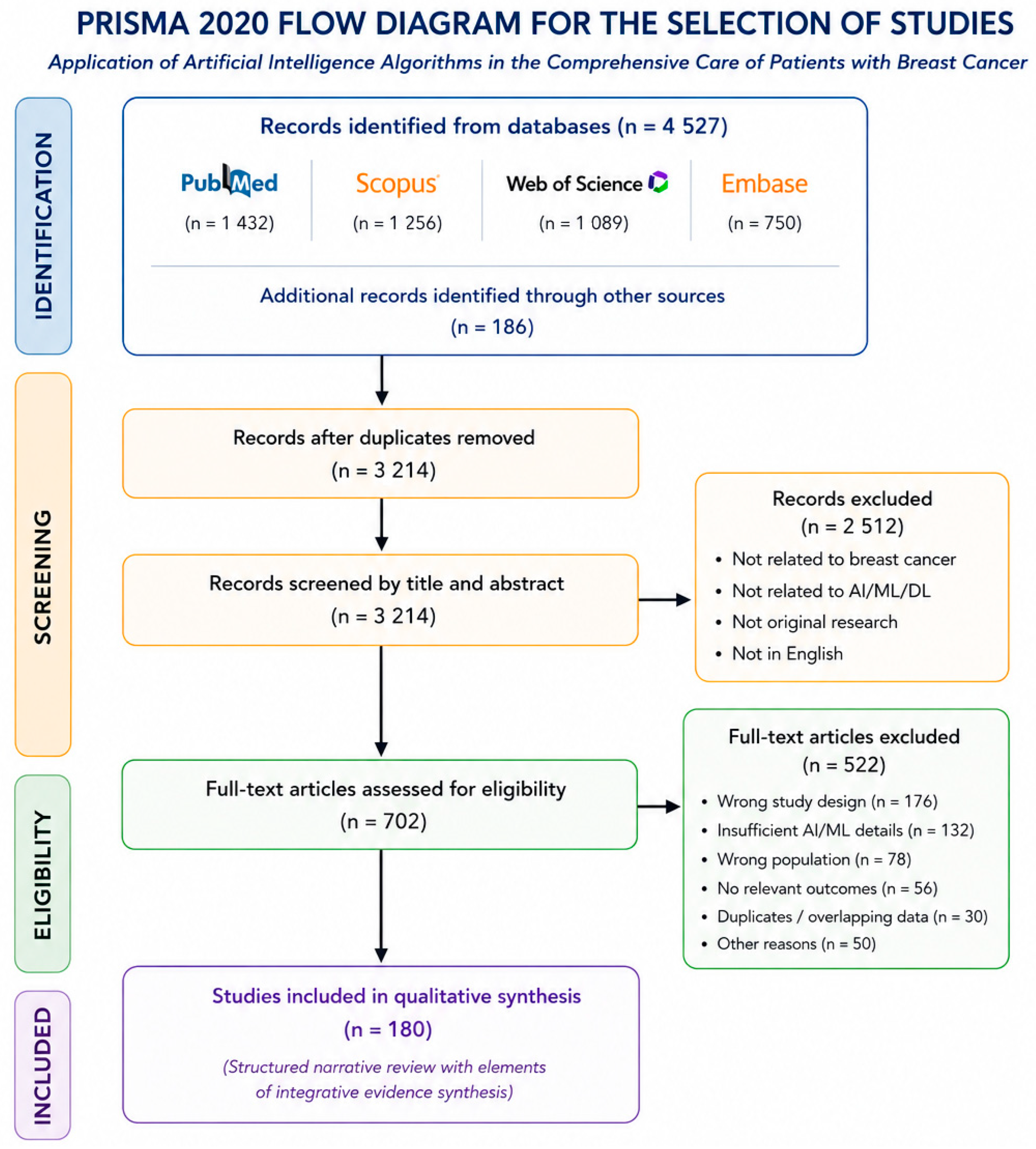
2.1. Study Design
2.2. Review Question and Conceptual Scope
- AI applications in breast imaging, including mammography, MRI, ultrasound, and multimodal imaging;
- AI-assisted histopathology and computational pathology;
- Prognostic modeling and prediction of treatment response;
- AI-guided treatment selection and precision oncology;
- Emerging AI paradigms and technical challenges, including foundation models, self-supervised learning, multimodal AI, federated learning, explainability, uncertainty quantification, causal AI, and continual learning.
- To summarize current applications of AI in breast cancer care;
- To compare the performance of AI-based approaches with conventional diagnostic and prognostic methods;
- To evaluate the clinical utility of emerging AI paradigms;
- To identify technical, ethical, and translational barriers to implementation;
- To discuss future directions for AI-driven precision oncology.
2.3. Information Sources
2.4. Search Strategy
2.5. Eligibility Criteria
- Original clinical studies, translational studies, and selected high-quality review articles;
- Studies concerning breast cancer;
- Publications analyzing the use of AI in diagnosis, prognosis, or treatment;
- Articles published in peer-reviewed scientific journals;
- Publications in English.
- Studies conducted exclusively on animal models or in vitro (unless mechanistically relevant);
- Conference abstracts without full text;
- Case reports, commentaries, and opinion articles without primary data;
- Publications not directly related to breast cancer or AI.
2.6. Study Selection
- Involving well-characterized patient cohorts;
- Using advanced AI methods;
- Including model validation;
- Relating findings to clinical practice.
2.7. Data Extraction
- Type of AI model (ML vs. DL);
- Type of data used;
- Performance metrics (e.g., AUC, sensitivity, and specificity);
- Potential clinical application;
- Model interpretability and explainability techniques;
- Multimodal data integration strategies;
- Use of external or multicenter validation;
- Privacy-preserving approaches such as federated learning;
- Reported limitations regarding generalizability and domain shift.
2.8. Methodological Quality Appraisal
2.9. Data Synthesis
3. Results
3.1. Review of Selected Algorithms
3.1.1. Machine Learning
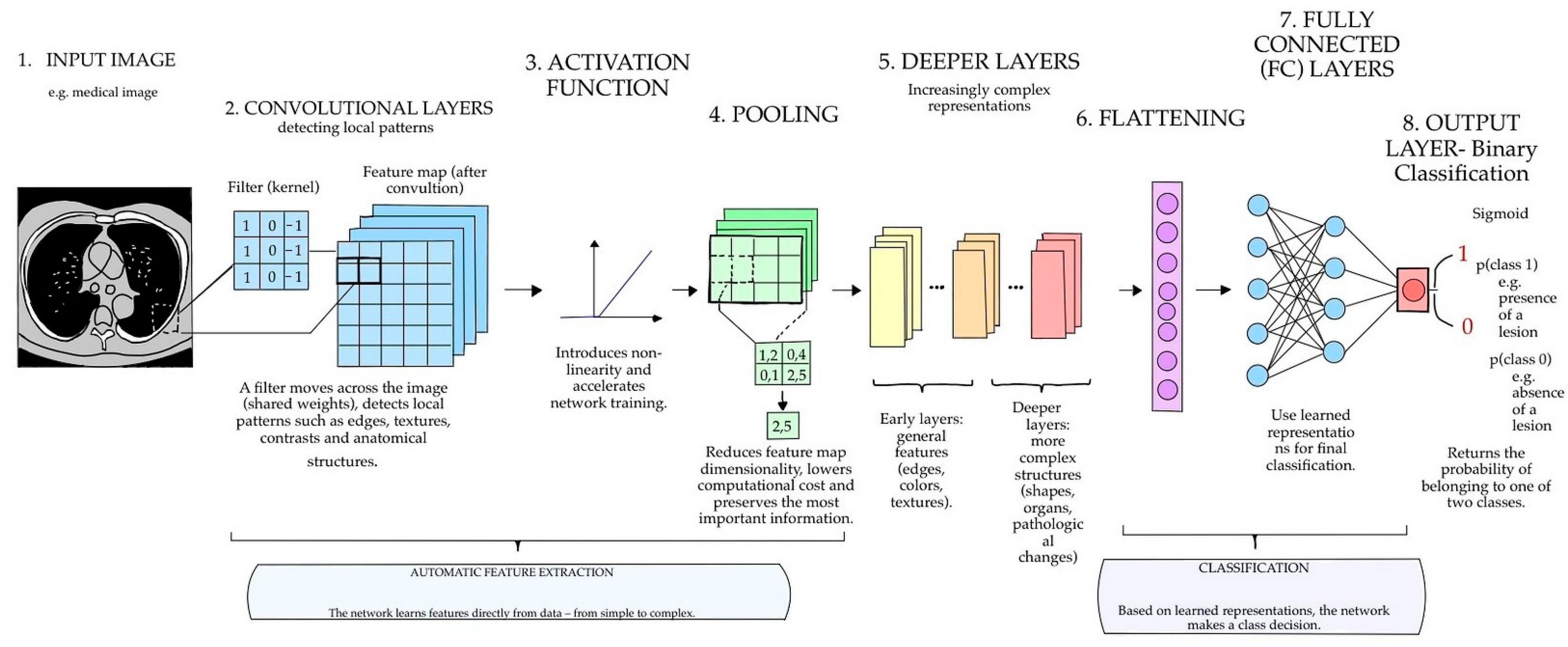
3.1.2. Deep Learning
3.1.3. Technical Challenges and Emerging AI Paradigms in Breast Cancer
CNNs Versus Transformers in Breast Imaging
2D vs. 3D Deep Learning in Breast MRI
Domain Shift and Generalizability
Weakly Supervised Learning for Mammography
Self-Supervised Learning in Breast Imaging
Foundation Models for Radiology/Pathology
Multimodal Fusion Models
Federated Learning and Privacy-Preserving AI
The Black-Box Challenge: Explainability and Human-AI Collaboration
3.2. AI in Breast Cancer Imaging
3.2.1. Mammography
3.2.2. Magnetic Resonance Imaging
3.2.3. Ultrasound, Other Techniques, and Combination Approaches
3.3. AI for Prognosis, Treatment-Response Prediction and Treatment Selection
3.3.1. Axillary Lymph-Node Prediction and Prognostic Stratification
3.3.2. Prediction of Treatment Response
3.3.3. AI-Guided Treatment Selection
3.3.4. Radiotherapy Planning and Procedure Selection
3.4. AI in Survivorship, Supportive Care, and Patient Communication
3.5. Comparative Clinical Readiness of AI Applications in Breast Cancer Care
4. Discussion
4.1. Challenges, Limitations and Future Directions of AI in Breast Cancer
4.2. Methodological Weaknesses of Current AI Studies
Sample Size, Model Complexity and Risk of Overfitting
4.3. Bias, Fairness, and Equity in AI-Based Breast Cancer Care
4.4. Explainable AI and Clinician-AI Collaboration
4.5. Emerging AI Approaches in Breast Cancer
4.6. Regulatory and Ethical Landscape
5. Conclusions
Supplementary Materials
Author Contributions
Funding
Data Availability Statement
Conflicts of Interest
References
- Wu, J.; Fan, D.; Shao, Z.; Xu, B.; Ren, G.; Jiang, Z.; Wang, Y.; Jin, F.; Zhang, J.; Zhang, Q.; et al. CACA Guidelines for Holistic Integrative Management of Breast Cancer. Holist. Integr. Oncol. 2022, 1, 7. [Google Scholar] [CrossRef] [PubMed]
- Bray, F.; Laversanne, M.; Sung, H.; Ferlay, J.; Siegel, R.L.; Soerjomataram, I.; Jemal, A. Global cancer statistics 2022: GLOBOCAN estimates of incidence and mortality worldwide for 36 cancers in 185 countries. CA Cancer J. Clin. 2024, 74, 229–263. [Google Scholar] [CrossRef] [PubMed]
- Siegel, R.L.; Giaquinto, A.N.; Jemal, A. Cancer statistics, 2024. CA Cancer J. Clin. 2024, 74, 12–49. [Google Scholar] [CrossRef] [PubMed]
- Xiong, X.; Zheng, L.W.; Ding, Y.; Chen, Y.F.; Cai, Y.W.; Wang, L.P.; Huang, L.; Liu, C.C.; Shao, Z.M.; Yu, K.D. Breast cancer: Pathogenesis and treatments. Signal Transduct. Target. Ther. 2025, 10, 49. [Google Scholar] [CrossRef] [PubMed]
- Milosevic, M.; Jankovic, D.; Milenkovic, A.; Stojanov, D. Early diagnosis and detection of breast cancer. Technol. Health Care 2018, 26, 729–759. [Google Scholar] [CrossRef] [PubMed]
- Huang, S.; Westvold, S.J.; Soulos, P.R.; Fan, J.; Winer, E.P.; Zhan, H.; Lustberg, M.B.; Lewin, J.; Robinson, T.J.; Dinan, M.A. Screening history, stage at diagnosis, and mortality in screen-detected breast cancer. JAMA Netw. Open 2025, 8, e255322. [Google Scholar] [CrossRef] [PubMed]
- Henderson, J.T.; Webber, E.M.; Weyrich, M.S.; Miller, M.; Melnikow, J. Screening for breast cancer: Evidence report and systematic review for the US Preventive Services Task Force. JAMA 2024, 331, 1931–1946. [Google Scholar] [CrossRef] [PubMed]
- Rajpurkar, P.; Chen, E.; Banerjee, O.; Topol, E.J. AI in health and medicine. Nat. Med. 2022, 28, 31–38. [Google Scholar] [CrossRef] [PubMed]
- Al Kuwaiti, A.; Nazer, K.; Al-Reedy, A.; Al-Shehri, S.; Al-Muhanna, A.; Subbarayalu, A.V.; Al Muhanna, D.; Al-Muhanna, F.A. A review of the role of artificial intelligence in healthcare. J. Pers. Med. 2023, 13, 951. [Google Scholar] [CrossRef]
- Umapathy, V.R.; Rajinikanth, B.S.; Samuel Raj, R.D.; Yadav, S.; Munavarah, S.A.; Anandapandian, P.A.; Mary, A.V.; Padmavathy, K.; R, A. Perspective of artificial intelligence in disease diagnosis: A review of current and future endeavours in the medical field. Cureus 2023, 15, e45684. [Google Scholar] [CrossRef] [PubMed]
- Popover, J.L.; Wallace, S.P.; Feldman, J.; Chastain, G.; Kalathia, C.; Imam, A.; Almasri, M.; Toomey, P.G. Artificial intelligence in medicine: A specialty-level overview of emerging AI trends. JSLS 2025, 29, e2025.00041. [Google Scholar] [CrossRef] [PubMed]
- Baklola, M.; Reda Elmahdi, R.; Ali, S.; Elshenawy, M.; Mohamed Mossad, A.; Al-Bawah, N.; Mohamed Mansour, R. Artificial intelligence in disease diagnostics: A comprehensive narrative review of current advances, applications, and future challenges in healthcare. Ann. Med. Surg. 2025, 87, 4237–4245. [Google Scholar] [CrossRef] [PubMed]
- Van Belle, V.; Van Calster, B.; Van Huffel, S.; Suykens, J.A.K.; Lisboa, P. Explaining support vector machines: A color based nomogram. PLoS ONE 2016, 11, e0164568. [Google Scholar] [CrossRef] [PubMed]
- Gaonkar, B.; Shinohara, R.T.; Davatzikos, C.; Alzheimer’s Disease Neuroimaging Initiative. Interpreting support vector machine models for multivariate group-wise analysis in neuroimaging. Med. Image Anal. 2015, 24, 190–204. [Google Scholar] [CrossRef] [PubMed]
- Rodríguez-Pérez, R.; Bajorath, J. Evolution of support vector machine and regression modeling in chemoinformatics and drug discovery. J. Comput. Aided Mol. Des. 2022, 36, 355–362. [Google Scholar] [CrossRef] [PubMed]
- Couronné, R.; Probst, P.; Boulesteix, A.L. Random forest versus logistic regression: A large-scale benchmark experiment. BMC Bioinform. 2018, 19, 270. [Google Scholar] [CrossRef] [PubMed]
- Strobl, C.; Boulesteix, A.L.; Zeileis, A.; Hothorn, T. Bias in random forest variable importance measures: Illustrations, sources and a solution. BMC Bioinform. 2007, 8, 25. [Google Scholar] [CrossRef] [PubMed]
- Ehsani, R.; Drabløs, F. Robust distance measures for kNN classification of cancer data. Cancer Inform. 2020, 19, 1176935120965542. [Google Scholar] [CrossRef] [PubMed]
- Ranganathan, P.; Pramesh, C.S.; Aggarwal, R. Common pitfalls in statistical analysis: Logistic regression. Perspect. Clin. Res. 2017, 8, 148–151. [Google Scholar] [CrossRef] [PubMed]
- Sperandei, S. Understanding logistic regression analysis. Biochem. Med. 2014, 24, 12–18. [Google Scholar] [CrossRef] [PubMed]
- Roy, D.; Panda, P.; Roy, K. Tree-CNN: A hierarchical deep convolutional neural network for incremental learning. Neural Netw. 2020, 121, 148–160. [Google Scholar] [CrossRef] [PubMed]
- Rani, S.; Memoria, M.; Almogren, A.; Bharany, S.; Joshi, K.; Altameem, A.; Rehman, A.U.; Hamam, H. Deep learning to combat knee osteoarthritis and severity assessment by using CNN-based classification. BMC Musculoskelet. Disord. 2024, 25, 817. [Google Scholar] [CrossRef] [PubMed]
- Shah, A.A.; Malik, H.A.M.; Muhammad, A.; Alourani, A.; Butt, Z.A. Deep learning ensemble 2D CNN approach towards the detection of lung cancer. Sci. Rep. 2023, 13, 2987. [Google Scholar] [CrossRef] [PubMed]
- Yang, Z.; Tong, K.; Jin, S.; Wang, S.; Yang, C.; Jiang, F. CNN-Siam: Multimodal siamese CNN-based deep learning approach for drug–drug interaction prediction. BMC Bioinform. 2023, 24, 110. [Google Scholar] [CrossRef] [PubMed]
- He, K.; Zhang, X.; Ren, S.; Sun, J. Deep residual learning for image recognition. In Proceedings of the IEEE Conference on Computer Vision and Pattern Recognition (CVPR), Las Vegas, NV, USA, 27–30 June 2016; pp. 770–778. [Google Scholar]
- Wang, Z.; Peng, Y.; Li, D.; Guo, Y.; Zhang, B. MMNet: A multi-scale deep learning network for the left ventricular segmentation of cardiac MRI images. Appl. Intell. 2022, 52, 5225–5240. [Google Scholar]
- Wang, C.; Wang, Z.; Xi, W.; Yang, Z.; Bai, G.; Wang, R.; Duan, M. MufiNet: Multiscale fusion residual networks for medical image segmentation. In Proceedings of the International Joint Conference on Neural Networks (IJCNN), Glasgow, UK, 19–24 July 2020; IEEE: Piscataway, NJ, USA, 2020; pp. 1–8. [Google Scholar]
- Gao, S.H.; Cheng, M.M.; Zhao, K.; Zhang, X.Y.; Yang, M.H.; Torr, P. Res2Net: A new multi-scale backbone architecture. IEEE Trans. Pattern Anal. Mach. Intell. 2019, 43, 652–662. [Google Scholar]
- Jameela, T.; Athotha, K.; Singh, N.; Gunjan, V.K.; Kahali, S. Deep learning and transfer learning for malaria detection. Comput. Intell. Neurosci. 2022, 2022, 2221728. [Google Scholar] [CrossRef] [PubMed]
- Maity, R.; Raja Sankari, V.M.; Snekhalatha, U.; Velu, S.; Alahmadi, T.J.; Alhababi, Z.A.; Alkahtani, H.K. Early detection of Alzheimer’s disease in structural and functional MRI. Front. Med. 2024, 11, 1520878. [Google Scholar] [CrossRef] [PubMed]
- Feng, S.; Zhang, R.; Zhang, W.; Yang, Y.; Song, A.; Chen, J.; Wang, F.; Xu, J.; Liang, C.; Liang, X.; et al. Predicting acute exacerbation phenotype in chronic obstructive pulmonary disease patients using VGG-16 deep learning. Respiration 2025, 104, 1–14. [Google Scholar] [CrossRef] [PubMed]
- Ali, R.; Lei, R.; Shi, H.; Xu, J. Cranio-maxillofacial post-operative face prediction by deep spatial multiband VGG-NET CNN. Am. J. Transl. Res. 2022, 14, 2527–2539. [Google Scholar] [PubMed]
- Alruwaili, M.; Mohamed, M. An integrated deep learning model with EfficientNet and ResNet for accurate multi-class skin disease classification. Diagnostics 2025, 15, 551. [Google Scholar] [CrossRef] [PubMed]
- Atila, Ü.; Uçar, M.; Akyol, K.; Uçar, E. Plant leaf disease classification using EfficientNet deep learning model. Ecol. Inform. 2021, 61, 101182. [Google Scholar] [CrossRef]
- Talukder, M.A.; Layek, M.A.; Kazi, M.; Uddin, M.A.; Aryal, S. Empowering COVID-19 detection: Optimizing performance through fine-tuned EfficientNet deep learning architecture. Comput. Biol. Med. 2024, 168, 107789. [Google Scholar] [CrossRef] [PubMed]
- Zhuang, F.; Qi, Z.; Duan, K.; Xi, D.; Zhu, Y.; Zhu, H.; Xiong, H.; He, Q. A comprehensive survey on transfer learning. Proc. IEEE 2020, 109, 43–76. [Google Scholar] [CrossRef]
- Gupta, J.; Pathak, S.; Kumar, G. Deep learning (CNN) and transfer learning: A review. J. Phys. Conf. Ser. 2022, 2273, 012012. [Google Scholar] [CrossRef]
- Iman, M.; Arabnia, H.R.; Rasheed, K. A review of deep transfer learning and recent advancements. Technologies 2023, 11, 40. [Google Scholar] [CrossRef]
- Jeny, A.A.; Hamzehei, S.; Jin, A.; Baker, S.A.; Van Rathe, T.; Bai, J.; Yang, C.; Nabavi, S. Hybrid transformer-based model for mammogram classification by integrating prior and current images. Med. Phys. 2025, 52, 2999–3014. [Google Scholar] [CrossRef] [PubMed]
- Kassis, I.; Lederman, D.; Ben-Arie, G.; Giladi Rosenthal, M.; Shelef, I.; Zigel, Y. Detection of breast cancer in digital breast tomosynthesis with vision transformers. Sci. Rep. 2024, 14, 22149. [Google Scholar] [CrossRef] [PubMed]
- Firouzbakht, M.; Amirmazlaghani, M. Breast cancer detection in mammography images using Neighborhood Attention transformer and Shearlet Transform. Comput. Biol. Med. 2025, 198, 111239. [Google Scholar] [CrossRef] [PubMed]
- Paschali, M.; Chen, Z.; Blankemeier, L.; Varma, M.; Youssef, A.; Bluethgen, C.; Langlotz, C.; Gatidis, S.; Chaudhari, A. Foundation models in radiology: What, how, why, and why not. Radiology 2025, 314, e240597. [Google Scholar] [CrossRef] [PubMed]
- Wu, C.; Zhang, X.; Zhang, Y.; Hui, H.; Wang, Y.; Xie, W. Towards generalist foundation model for radiology by leveraging web-scale 2D and 3D medical data. Nat. Commun. 2025, 16, 7866. [Google Scholar] [CrossRef] [PubMed]
- Vorontsov, E.; Bozkurt, A.; Casson, A.; Shaikovski, G.; Zelechowski, M.; Severson, K.; Zimmermann, E.; Hall, J.; Tenenholtz, N.; Fusi, N.; et al. A foundation model for clinical-grade computational pathology and rare cancers detection. Nat. Med. 2024, 30, 2924–2935. [Google Scholar] [CrossRef] [PubMed]
- Miller, J.D.; Arasu, V.A.; Pu, A.X.; Margolies, L.R.; Sieh, W.; Shen, L. Self-supervised deep learning to enhance breast cancer detection on screening mammography. arXiv 2022, arXiv:2203.08812. [Google Scholar]
- Figueiras, H.; Domingues, J.; Matela, N.; Garcia, N. Self-supervised learning for breast cancer detection: A review. Comput. Biol. Med. 2025, 198, 111245. [Google Scholar] [CrossRef] [PubMed]
- Wang, L. Self-supervised learning and transformer-based technologies in breast cancer imaging. Front. Radiol. 2025, 5, 1684436. [Google Scholar] [CrossRef] [PubMed]
- Luo, L.; Wu, M.; Li, M.; Xin, Y.; Wang, Q.; Vardhanabhuti, V.; Chu, W.C.; Li, Z.; Zhou, J.; Rajpurkar, P.; et al. A large model for non-invasive and personalized management of breast cancer from multiparametric MRI. Nat. Commun. 2025, 16, 3647. [Google Scholar] [CrossRef] [PubMed]
- Tzortzis, I.N.; Gutierrez-Torre, A.; Sykiotis, S.; Agulló, F.; Bakalos, N.; Doulamis, A.; Doulamis, N.; Berral, J.L. Towards generalizable federated learning in medical imaging: A real-world case study on mammography data. Comput. Struct. Biotechnol. J. 2025, 28, 106–117. [Google Scholar] [CrossRef] [PubMed]
- Shukla, S.; Rajkumar, S.; Sinha, A.; Esha, M.; Elango, K.; Sampath, V. Federated learning with differential privacy for breast cancer diagnosis enabling secure data sharing and model integrity. Sci. Rep. 2025, 15, 13061. [Google Scholar] [CrossRef] [PubMed] [PubMed Central]
- Koetzier, L.R.; Wu, J.; Mastrodicasa, D.; Lutz, A.; Chung, M.; Koszek, W.A.; Pratap, J.; Chaudhari, A.S.; Rajpurkar, P.; Lungren, M.P.; et al. Generating synthetic data for medical imaging. Radiology 2024, 312, e232471. [Google Scholar] [CrossRef] [PubMed]
- Montoya-Del-Angel, R.; Sam-Millan, K.; Vilanova, J.C.; Martí, R. MAM-E: Mammographic synthetic image generation with diffusion models. Sensors 2024, 24, 2076. [Google Scholar] [CrossRef] [PubMed]
- You, Y.; Zhuang, C.; Gan, H.S.; Rulaningtyas, R.; Ramlee, M.H.; Wahab, A.A. BreastDiff: A multi-condition guided diffusion model for breast cancer classification in diverse modalities. Biomed. Signal Process. Control 2026, 112, 108708. [Google Scholar] [CrossRef]
- Akbari, Y.; Abdullakutty, F.; Al Maadeed, S.; Bouridane, A.; Hamoudi, R. Breast cancer detection based on histological images using fusion of diffusion model outputs. Sci. Rep. 2025, 15, 21463. [Google Scholar] [CrossRef] [PubMed]
- Chegini, M.; Mahloojifar, A. Uncertainty-aware deep learning-based CAD system for breast cancer classification using ultrasound and mammography images. Comput. Methods Biomech. Biomed. Eng. Imaging Vis. 2024, 12, 2297983. [Google Scholar] [CrossRef]
- Chegini, M.; Mahloojifar, A. Reliable breast cancer molecular subtype prediction based on uncertainty-aware Bayesian deep learning by mammography. arXiv 2024, arXiv:2412.11953. [Google Scholar]
- Hespanhol, L.; Vallio, C.S.; Costa, L.M.; Saragiotto, B.T. Understanding and Interpreting Confidence and Credible Intervals around Effect Estimates. Braz. J. Phys. Ther. 2019, 23, 290–301. [Google Scholar] [CrossRef] [PubMed]
- Kurz, A.; Hauser, K.; Mehrtens, H.A.; Krieghoff-Henning, E.; Hekler, A.; Kather, J.N.; Fröhling, S.; von Kalle, C.; Brinker, T.J. Uncertainty Estimation in Medical Image Classification: Systematic Review. JMIR Med. Inform. 2022, 10, e36427. [Google Scholar] [CrossRef] [PubMed]
- Shen, Y.; Wu, N.; Phang, J.; Park, J.; Liu, K.; Tyagi, S.; Geras, K.J. An interpretable classifier for high-resolution breast cancer screening images utilizing weakly supervised localization. Med. Image Anal. 2021, 68, 101908. [Google Scholar] [CrossRef] [PubMed]
- Sajid, M.Z.; Hamid, M.F.; Qureshi, I. Explainable and uncertainty-aware ensemble framework with causal analysis for breast cancer detection. Front. Oncol. 2026, 15, 1751090. [Google Scholar] [CrossRef] [PubMed]
- da Câmara Ribeiro-Dantas, M.; Li, H.; Cabeli, V.; Dupuis, L.; Simon, F.; Hettal, L.; Isambert, H. Learning interpretable causal networks from very large datasets: Application to 400,000 medical records of breast cancer patients. iScience 2024, 27, 109736. [Google Scholar] [CrossRef]
- Chen, D.; Zhao, H.; He, J.; Pan, Q.; Zhao, W. A causal XAI diagnostic model for breast cancer based on mammography reports. In Proceedings of the 2021 IEEE International Conference on Bioinformatics and Biomedicine (BIBM), Houston, TX, USA, 9–12 December 2021; pp. 3341–3349. [Google Scholar] [CrossRef]
- Qazi, M.A.; Hashmi, A.U.R.; Sanjeev, S.; Almakky, I.; Saeed, N.; Gonzalez, C.; Yaqub, M. Continual learning in medical imaging: A survey and practical analysis. ACM Comput. Surv. 2026, 58, 1–25. [Google Scholar] [CrossRef]
- Li, H.; Whitney, H.M.; Ji, Y.; Edwards, A.; Papaioannou, J.; Liu, P.; Giger, M.L. Impact of continuous learning on diagnostic breast MRI AI: Evaluation on an independent clinical dataset. J. Med. Imaging 2022, 9, 034502. [Google Scholar] [CrossRef] [PubMed]
- Abimouloud, M.L.; Bensid, K.; Elleuch, M.; Aiadi, O.; Kherallah, M. Vision transformer-convolution for breast cancer classification using mammography images: A comparative study. Int. J. Hybrid Intell. Syst. 2024, 20, 67–83. [Google Scholar] [CrossRef]
- Dosovitskiy, A.; Beyer, L.; Kolesnikov, A.; Weissenborn, D.; Zhai, X.; Unterthiner, T.; Dehghani, M.; Minderer, M.; Heigold, G.; Gelly, S.; et al. An image is worth 16×16 words: Transformers for image recognition at scale. In Proceedings of the International Conference on Learning Representations (ICLR), Vienna, Austria, 3–7 May 2021. [Google Scholar]
- Zhou, G.; Mosadegh, B. Distilling knowledge from an ensemble of vision transformers for improved classification of breast ultrasound. Acad. Radiol. 2024, 31, 104–120. [Google Scholar] [CrossRef] [PubMed]
- Ayana, G.; Choe, S.W. BUViTNet: Breast ultrasound detection via Vision Transformers. Diagnostics 2022, 12, 2654. [Google Scholar] [CrossRef] [PubMed]
- Fontes, J.P.P.; Raimundo, J.N.C.; Magalhães, L.G.M.; Lopez, M.A.G. Accurate phenotyping of luminal A breast cancer in magnetic resonance imaging: A new 3D CNN approach. Comput. Biol. Med. 2025, 189, 109903. [Google Scholar] [CrossRef] [PubMed]
- Zhou, J.; Luo, L.Y.; Dou, Q.; Chen, H.; Chen, C.; Li, G.J.; Jiang, Z.F.; Heng, P.A. Weakly supervised 3D deep learning for breast cancer classification and localization of the lesions in MR images. J. Magn. Reson. Imaging 2019, 50, 1144–1151. [Google Scholar] [CrossRef] [PubMed]
- Wang, H.; Cao, J.; Feng, J.; Xie, Y.; Yang, D.; Chen, B. Mixed 2D and 3D convolutional network with multi-scale context for lesion segmentation in breast DCE-MRI. Biomed. Signal Process. Control 2021, 68, 102607. [Google Scholar] [CrossRef]
- Liu, G.; Mitra, D.; Jones, E.F.; Franc, B.L.; Behr, S.C.; Nguyen, A.; Bolouri, M.S.; Wisner, D.J.; Joe, B.N.; Esserman, L.J.; et al. Mask-guided convolutional neural network for breast tumor prognostic outcome prediction on 3D DCE-MR images. J. Digit. Imaging 2021, 34, 630–636. [Google Scholar] [CrossRef] [PubMed]
- Haarburger, C.; Baumgartner, M.; Truhn, D.; Broeckmann, M.; Schneider, H.; Schrading, S.; Merhof, D. Multi scale curriculum CNN for context-aware breast MRI malignancy classification. In Proceedings of the International Conference on Medical Image Computing and Computer-Assisted Intervention (MICCAI 2019), Shenzhen, China, 13–17 October 2019; pp. 495–503. [Google Scholar] [CrossRef]
- Kuang, S.; Woodruff, H.C.; Granzier, R.; van Nijnatten, T.J.; Lobbes, M.B.; Smidt, M.L.; Mehrkanoon, S. MSCDA: Multi-level semantic-guided contrast improves unsupervised domain adaptation for breast MRI segmentation in small datasets. Neural Netw. 2023, 165, 119–134. [Google Scholar] [CrossRef] [PubMed]
- Akyüz, U.; Katircioglu-Öztürk, D.; Süslü, E.K.; Keleş, B.; Kaya, M.C.; Durhan, G.; Akar, G.B. DoSReMC: Domain shift resilient mammography classification using batch normalization adaptation. arXiv 2025, arXiv:2508.15452. [Google Scholar]
- Yoon, J.S.; Oh, K.; Shin, Y.; Mazurowski, M.A.; Suk, H.I. Domain generalization for medical image analysis: A review. Proc. IEEE 2024, 112, 1583–1609. [Google Scholar] [CrossRef]
- Matta, S.; Lamard, M.; Zhang, P.; Le Guilcher, A.; Borderie, L.; Cochener, B.; Quellec, G. A systematic review of generalization research in medical image classification. Comput. Biol. Med. 2024, 183, 109256. [Google Scholar] [CrossRef] [PubMed]
- Garrucho, L.; Joshi, S.; Kushibar, K.; Osuala, R.; Bobowicz, M.; Bargalló, X.; Lekadir, K. The MAMA-MIA Challenge: Advancing generalizability and fairness in breast MRI tumor segmentation and treatment response prediction. arXiv 2026, arXiv:2603.01250. [Google Scholar]
- Pan, H.; Durak, G.; Aktas, H.E.; Bejar, A.M.; Tutun, B.; Uysal, E.; Bagci, U. LUMINA: A multi-vendor mammography benchmark with energy harmonization protocol. arXiv 2026, arXiv:2603.14644. [Google Scholar]
- Tayebi Arasteh, S.; Kuhl, C.; Saehn, M.J.; Isfort, P.; Truhn, D.; Nebelung, S. Enhancing domain generalization in the AI-based analysis of chest radiographs with federated learning. Sci. Rep. 2023, 13, 22576. [Google Scholar] [CrossRef] [PubMed]
- Bakalo, R.; Ben-Ari, R.; Goldberger, J. Classification and detection in mammograms with weak supervision via dual branch deep neural net. In Proceedings of the 2019 IEEE 16th International Symposium on Biomedical Imaging (ISBI 2019), Venice, Italy, 8–11 April 2019; pp. 1905–1909. [Google Scholar] [CrossRef]
- Bakalo, R.; Goldberger, J.; Ben-Ari, R. Weakly and semi supervised detection in medical imaging via deep dual branch net. Neurocomputing 2021, 421, 15–25. [Google Scholar] [CrossRef]
- Liang, G.; Wang, X.; Zhang, Y.; Jacobs, N. Weakly-supervised self-training for breast cancer localization. In Proceedings of the Annual International Conference of the IEEE Engineering in Medicine and Biology Society (EMBC 2020), Montreal, QC, Canada, 20–24 July 2020; pp. 1124–1127. [Google Scholar] [CrossRef] [PubMed]
- Liu, K.; Shen, Y.; Wu, N.; Chłędowski, J.; Fernandez-Granda, C.; Geras, K.J. Weakly-supervised high-resolution segmentation of mammography images for breast cancer diagnosis. Proc. Mach. Learn. Res. 2021, 143, 268–278. [Google Scholar] [PubMed]
- Zhang, M.; Wang, C.; Cai, L.; Zhao, J.; Xu, Y.; Xing, J.; Zhang, Y. Developing a weakly supervised deep learning framework for breast cancer diagnosis with HR status based on mammography images. Comput. Struct. Biotechnol. J. 2023, 22, 17–26. [Google Scholar] [CrossRef] [PubMed]
- Tang, Y.; Cao, Z.; Zhang, Y.; Yang, Z.; Ji, Z.; Wang, Y.; Chang, P. Leveraging large-scale weakly labeled data for semi-supervised mass detection in mammograms. In Proceedings of the IEEE/CVF Conference on Computer Vision and Pattern Recognition (CVPR 2021), Virtual Conference, 19–25 June 2021; pp. 3855–3864. [Google Scholar] [CrossRef]
- Chen, H.; Martel, A.L. Enhancing breast cancer detection on screening mammogram using self-supervised learning and a hybrid deep model of Swin Transformer and convolutional neural networks. J. Med. Imaging 2025, 12, S22007. [Google Scholar] [CrossRef] [PubMed]
- Zhou, S.; Wu, L.; Xiao, C.; Bhatia, P.; Kass-Hout, T. MammoDINO: Anatomically aware self-supervision for mammographic images. In Proceedings of the IEEE International Conference on Acoustics, Speech and Signal Processing (ICASSP 2026), Barcelona, Spain, 4–8 May 2026; pp. 8182–8186. [Google Scholar] [CrossRef]
- Jiao, L.; Wang, S.; Zhang, Y.; Liu, H.; Li, X.; Zhao, W.; Chen, H. Foundation Models Meet Medical Image Interpretation. Research 2026, 9, 1024. [Google Scholar] [CrossRef] [PubMed]
- D’Antonoli, T.A.; Bluethgen, C.; Cuocolo, R.; Klontzas, M.E.; Ponsiglione, A.; Kocak, B. Foundation models for radiology: Fundamentals, applications, opportunities, challenges, risks, and prospects. Diagn. Interv. Radiol. 2026, 32, 259–272. [Google Scholar]
- Tavakoli, N.; Shakeri, Z.; Gowda, V.; Samsel, K.; Bedayat, A.; Ghasemiesfe, A.; Rahsepar, A.A. Generative AI and foundation models in radiology: Applications, opportunities, and potential challenges. Radiology 2025, 317, e242961. [Google Scholar] [CrossRef] [PubMed]
- Ryu, J.S.; Kang, H.; Chu, Y.; Yang, S. Vision-language foundation models for medical imaging: A review of current practices and innovations. Biomed. Eng. Lett. 2025, 15, 809–830. [Google Scholar] [CrossRef] [PubMed]
- van Veldhuizen, V.; Botha, V.; Lu, C.; Cesur, M.E.; Lipman, K.G.; de Jong, E.D.; Teuwen, J. Foundation models in medical imaging: A review and outlook. arXiv 2025, arXiv:2506.09095. [Google Scholar]
- Tizhoosh, H.R. Beyond the failures: Rethinking foundation models in pathology. arXiv 2025, arXiv:2510.23807. [Google Scholar]
- Niu, C.; Wu, P.; De Man, B.; Wang, G. Foundation models for medical imaging: Status, challenges, and directions. arXiv 2026, arXiv:2602.15913. [Google Scholar]
- Nakach, F.Z.; Idri, A.; Goceri, E. A comprehensive investigation of multimodal deep learning fusion strategies for breast cancer classification. Artif. Intell. Rev. 2024, 57, 327. [Google Scholar] [CrossRef]
- Li, T.; Song, S.; Pan, Y.; Song, W.; Fong, S.; Gao, J.; Wang, Q.; Zhang, X.; Mohammed, S. Deep learning in multi-modal breast cancer data fusion: A literature review. Quant. Imaging Med. Surg. 2025, 15, 11578–11610. [Google Scholar] [CrossRef] [PubMed]
- Krasniqi, E.; Filomeno, L.; Arcuri, T.; Ferretti, G.; Gasparro, S.; Fulvi, A.; Vici, P. Multimodal deep learning for predicting neoadjuvant treatment outcomes in breast cancer: A systematic review. Biol. Direct 2025, 20, 72. [Google Scholar] [CrossRef] [PubMed]
- Eskreis-Winkler, S.; Vega, F.S.; Kohli, A.; Moiso, E.; Alto, M.; Fong, C.; Razavi, P. Multimodal analyses of clinical, radiology, pathology and genomic information for enhanced prediction of response to neoadjuvant therapy in breast cancer. Clin. Cancer Res. 2025, 31, P1-03-16. [Google Scholar] [CrossRef]
- Yao, Y.; Lv, Y.; Tong, L.; Liang, Y.; Xi, S.; Ji, B.; Zhang, G.; Li, L.; Tian, G.; Tang, M.; et al. ICSDA: A multi-modal deep learning model to predict breast cancer recurrence and metastasis risk by integrating pathological, clinical and gene expression data. Brief. Bioinform. 2022, 23, bbac448. [Google Scholar] [CrossRef] [PubMed]
- Zhang, T.; Tan, T.; Han, L.; Appelman, L.; Veltman, J.; Wessels, R.; Duvivier, K.M.; Loo, C.; Gao, Y.; Wang, X.; et al. Predicting breast cancer types on and beyond molecular level in a multi-modal fashion. NPJ Breast Cancer 2023, 9, 16. [Google Scholar] [CrossRef] [PubMed]
- Alhussan, A.A.; Nhidi, W.; Filali, I.; Benhmida, F.; Ejbali, R. Federated learning architecture for 3D breast cancer image classification. Cancers 2025, 17, 3450. [Google Scholar] [CrossRef] [PubMed]
- Gupta, C.; Gill, N.S.; Gulia, P.; Alduaiji, N.; Shreyas, J.; Shukla, P.K. Applying YOLOv6 as an ensemble federated learning framework to classify breast cancer pathology images. Sci. Rep. 2025, 15, 3769. [Google Scholar] [CrossRef] [PubMed]
- Babu, G.M.; Wong, K.W.; Parry, J. Federated learning for digital pathology: A pilot study. Procedia Comput. Sci. 2022, 207, 736–743. [Google Scholar] [CrossRef]
- Schoenpflug, L.A.; Nie, Y.; Sheikhzadeh, F.; Koelzer, V.H. A review on federated learning in computational pathology. Comput. Struct. Biotechnol. J. 2024, 23, 3938–3945. [Google Scholar] [CrossRef] [PubMed]
- Ghosh, D.; Mehjabin, M.; Rayed, M.E.; Mridha, M.F.; Kabir, M.M. Advancements and challenges of federated learning in medical imaging: A systematic literature review. Artif. Intell. Rev. 2026; in press.
- Ghasemi, A.; Hashtarkhani, S.; Schwartz, D.L.; Shaban-Nejad, A. Explainable artificial intelligence in breast cancer detection and risk prediction: A systematic scoping review. Cancer Innov. 2024, 3, e136. [Google Scholar] [CrossRef] [PubMed]
- Ameen, M.; Alshamrani, A.; Alghamdi, M.; Alzahrani, N.; Alsubaie, M. Explainable mammogram analysis with EfficientNetV2 and Grad-CAM++ for breast cancer diagnosis. Diagnostics 2025, 16, 105. [Google Scholar] [CrossRef] [PubMed]
- Calisto, F.M.; Abrantes, J.M.; Santiago, C.; Nunes, N.J.; Nascimento, J.C. Personalized explanations for clinician-AI interaction in breast imaging diagnosis by adapting communication to expertise levels. Int. J. Hum.-Comput. Stud. 2025, 197, 103444. [Google Scholar] [CrossRef]
- Dembrower, K.; Crippa, A.; Colón, E.; Eklund, M.; Strand, F.; ScreenTrustCAD Trial Consortium. Artificial intelligence for breast cancer detection in screening mammography in Sweden: A prospective, population-based, paired-reader, non-inferiority study. Lancet Digit. Health 2023, 5, e703–e711. [Google Scholar] [CrossRef] [PubMed]
- Hernström, V.; Josefsson, V.; Sartor, H.; Schmidt, D.; Larsson, A.M.; Hofvind, S.; Andersson, I.; Rosso, A.; Hagberg, O.; Lång, K. Screening performance and characteristics of breast cancer detected in the Mammography Screening with Artificial Intelligence trial (MASAI): A randomised, controlled, parallel-group, non-inferiority, single-blinded, screening accuracy study. Lancet Digit. Health 2025, 7, e175–e183. [Google Scholar] [CrossRef] [PubMed]
- Eisemann, N.; Bunk, S.; Mukama, T.; Baltus, H.; Elsner, S.A.; Gomille, T.; Hecht, G.; Heywang-Köbrunner, S.; Rathmann, R.; Siegmann-Luz, K.; et al. Nationwide real-world implementation of AI for cancer detection in population-based mammography screening. Nat. Med. 2025, 31, 917–924. [Google Scholar] [CrossRef] [PubMed]
- Gommers, J.; Hernström, V.; Josefsson, V.; Sartor, H.; Schmidt, D.; Hjelmgren, A.; Larsson, A.M.; Hofvind, S.; Andersson, I.; Rosso, A.; et al. Interval cancer, sensitivity, and specificity comparing AI-supported mammography screening with standard double reading without AI in the MASAI study: A randomised, controlled, non-inferiority, single-blinded, population-based, screening-accuracy trial. Lancet 2026, 407, 505–514. [Google Scholar] [CrossRef] [PubMed]
- Friedewald, S.M.; Sieniek, M.; Jansen, S.; Mahvar, F.; Kohlberger, T.; Schacht, D.; Bhole, S.; Gupta, D.; Prabhakara, S.; McKinney, S.M.; et al. Triaging mammography with artificial intelligence: An implementation study. Breast Cancer Res. Treat. 2025, 211, 1–10. [Google Scholar] [CrossRef] [PubMed]
- Rangarajan, K.; Manivannan, V.V.; Singh, H.; Gupta, A.; Maheshwari, H.; Gogoi, R.; Gogoi, D.; Das, R.J.; Hari, S.; Vyas, S.; et al. Simulation training in mammography with AI-generated images: A multireader study. Eur. Radiol. 2025, 35, 562–571. [Google Scholar] [CrossRef] [PubMed]
- Woode, M.E.; De Silva Perera, U.; Degeling, C.; Aquino, Y.S.J.; Houssami, N.; Carter, S.M.; Chen, G. Preferences for the use of artificial intelligence for breast cancer screening in Australia: A discrete choice experiment. Patient 2025, 18, 495–510. [Google Scholar] [CrossRef] [PubMed]
- Liang, Y.; Wei, Z.; Dai, Y.; Chen, X.; Du, S.; Wong, C.; Xu, Z.; Gao, W.; Han, C.; Chen, K.; et al. An interpretable AI system reduces false-positive MRI diagnoses by stratifying high-risk breast lesions. Nat. Commun. 2026, 17, 2263. [Google Scholar] [CrossRef] [PubMed]
- Yin, H.L.; Jiang, Y.; Xu, Z.; Jia, H.H.; Lin, G.W. Combined diagnosis of multiparametric MRI-based deep learning models facilitates differentiating triple-negative breast cancer from fibroadenoma magnetic resonance BI-RADS 4 lesions. J. Cancer Res. Clin. Oncol. 2023, 149, 2575–2584. [Google Scholar] [CrossRef] [PubMed]
- Zhang, J.; Zhan, C.; Zhang, C.; Song, Y.; Yan, X.; Guo, Y.; Ai, T.; Yang, G. Fully automatic classification of breast lesions on multi-parameter MRI using a radiomics model with minimal number of stable, interpretable features. Radiol. Med. 2023, 128, 160–170. [Google Scholar] [CrossRef] [PubMed]
- Yin, H.; Bai, L.; Jia, H.; Lin, G. Noninvasive assessment of breast cancer molecular subtypes on multiparametric MRI using convolutional neural network with transfer learning. Thorac. Cancer 2022, 13, 3183–3191. [Google Scholar] [CrossRef] [PubMed]
- Zhu, Z.; Albadawy, E.; Saha, A.; Zhang, J.; Harowicz, M.R.; Mazurowski, M.A. Deep learning for identifying radiogenomic associations in breast cancer. Comput. Biol. Med. 2019, 109, 85–90. [Google Scholar] [CrossRef] [PubMed]
- Meng, M.; Zhang, M.; Shen, D.; He, G. Differentiation of breast lesions on dynamic contrast-enhanced magnetic resonance imaging (DCE-MRI) using deep transfer learning based on DenseNet201. Medicine 2022, 101, e31214. [Google Scholar] [CrossRef] [PubMed]
- Lee, E.J.; Chang, Y.W.; Sung, J.K.; Thomas, B. Feasibility of deep learning k-space-to-image reconstruction for diffusion weighted imaging in patients with breast cancers: Focus on image quality and reduced scan time. Eur. J. Radiol. 2022, 157, 110608. [Google Scholar] [CrossRef] [PubMed]
- Zhu, Z.; Harowicz, M.; Zhang, J.; Saha, A.; Grimm, L.J.; Hwang, E.S.; Mazurowski, M.A. Deep learning analysis of breast MRIs for prediction of occult invasive disease in ductal carcinoma in situ. Comput. Biol. Med. 2019, 115, 103498. [Google Scholar] [CrossRef] [PubMed]
- Liu, H.; Zhang, Y.; Tan, B.; Yin, Y.F.; Yan, L.X.; Xiang, L.H.; Shan, D.D.; Zhang, Y.Y.; Ding, S.S.; Xu, G.; et al. Deep learning based on automated breast volume scanner images for the diagnosis of breast lesions: A multicenter diagnostic study. Int. J. Med. Sci. 2025, 22, 3924–3937. [Google Scholar] [CrossRef] [PubMed]
- Cai, L.; Pfob, A.; Barr, R.G.; Duda, V.; Alwafai, Z.; Balleyguier, C.; Clevert, D.A.; Fastner, S.; Gomez, C.; Goncalo, M.; et al. Deep learning model for breast shear wave elastography to improve breast cancer diagnosis (INSPiRED 006): An international, multicenter analysis. J. Clin. Oncol. 2025, 43, 3482–3493. [Google Scholar] [CrossRef] [PubMed]
- Fukuda, T.; Tsunoda, H.; Yagishita, K.; Naganawa, S.; Hayashi, K.; Kurihara, Y. Deep learning for differentiation of breast masses detected by screening ultrasound elastography. Ultrasound Med. Biol. 2023, 49, 989–995. [Google Scholar] [CrossRef] [PubMed]
- Zhang, L.; Jia, Z.; Leng, X.; Ma, F. Artificial intelligence algorithm-based ultrasound image segmentation technology in the diagnosis of breast cancer axillary lymph node metastasis. J. Healthc. Eng. 2021, 2021, 8830260. [Google Scholar] [CrossRef] [PubMed]
- Salim, M.; Liu, Y.; Sorkhei, M.; Ntoula, D.; Foukakis, T.; Fredriksson, I.; Wang, Y.; Eklund, M.; Azizpour, H.; Smith, K.; et al. AI-based selection of individuals for supplemental MRI in population-based breast cancer screening: The randomized ScreenTrustMRI trial. Nat. Med. 2024, 30, 2623–2630. [Google Scholar] [CrossRef] [PubMed]
- Zheng, H.; Jian, L.; Li, L.; Liu, W.; Chen, W. Prior clinico-radiological features informed multimodal MR images convolution neural network: A novel deep learning framework for prediction of lymphovascular invasion in breast cancer. Cancer Med. 2024, 13, e6932. [Google Scholar] [CrossRef] [PubMed]
- Ma, M.; Liu, R.; Wen, C.; Xu, W.; Xu, Z.; Wang, S.; Wu, J.; Pan, D.; Zheng, B.; Qin, G.; et al. Predicting the molecular subtype of breast cancer and identifying interpretable imaging features using machine learning algorithms. Eur. Radiol. 2022, 32, 1652–1662. [Google Scholar] [CrossRef] [PubMed]
- Wang, X.; Chou, K.; Zhang, G.; Zuo, Z.; Zhang, T.; Zhou, Y.; Mao, F.; Lin, Y.; Shen, S.; Zhang, X.; et al. Breast cancer pre-clinical screening using infrared thermography and artificial intelligence: A prospective, multicentre, diagnostic accuracy cohort study. Int. J. Surg. 2023, 109, 3021–3031. [Google Scholar] [CrossRef] [PubMed]
- Simsek-Cetinkaya, S.; Cakir, S.K. Evaluation of the effectiveness of artificial intelligence assisted interactive screen-based simulation in breast self-examination: An innovative approach in nursing students. Nurse Educ. Today 2023, 127, 105857. [Google Scholar] [CrossRef] [PubMed]
- Yu, Y.; He, Z.; Ouyang, J.; Tan, Y.; Chen, Y.; Gu, Y.; Mao, L.; Ren, W.; Wang, J.; Lin, L.; et al. Magnetic resonance imaging radiomics predicts preoperative axillary lymph node metastasis to support surgical decisions and is associated with tumor microenvironment in invasive breast cancer: A machine learning, multicenter study. EBioMedicine 2021, 69, 103460. [Google Scholar] [CrossRef] [PubMed]
- Dihge, L.; Vallon-Christersson, J.; Hegardt, C.; Saal, L.H.; Häkkinen, J.; Larsson, C.; Ehinger, A.; Loman, N.; Malmberg, M.; Bendahl, P.O.; et al. Prediction of lymph node metastasis in breast cancer by gene expression and clinicopathological models: Development and validation within a population-based cohort. Clin. Cancer Res. 2019, 25, 6368–6381. [Google Scholar] [CrossRef] [PubMed]
- Bhattarai, S.; Klimov, S.; Aleskandarany, M.A.; Burrell, H.; Wormall, A.; Green, A.R.; Rida, P.; Ellis, I.O.; Osan, R.M.; Rakha, E.A.; et al. Machine learning-based prediction of breast cancer growth rate in vivo. Br. J. Cancer 2019, 121, 497–504. [Google Scholar] [CrossRef] [PubMed]
- Pan, Y.; Zhang, Q.; Zhang, H.; Kong, F. Prognostic and immune microenvironment analysis of cuproptosis-related lncRNAs in breast cancer. Funct. Integr. Genom. 2023, 23, 38. [Google Scholar] [CrossRef] [PubMed]
- Jin, Y.; Lan, A.; Dai, Y.; Jiang, L.; Liu, S. Development and testing of a random forest-based machine learning model for predicting events among breast cancer patients with a poor response to neoadjuvant chemotherapy. Eur. J. Med. Res. 2023, 28, 394. [Google Scholar] [CrossRef] [PubMed]
- Lee, H.J.; Nguyen, A.T.; Song, M.W.; Lee, J.E.; Park, S.B.; Jeong, W.G.; Park, M.H.; Lee, J.S.; Park, I.; Lim, H.S. Prediction of residual axillary nodal metastasis following neoadjuvant chemotherapy for breast cancer: Radiomics analysis based on chest computed tomography. Korean J. Radiol. 2023, 24, 498–511. [Google Scholar] [CrossRef] [PubMed]
- Dercle, L.; McGale, J.; Zhao, B.; Schmitt, J.; Peltzer, A.; Schwartz, L.H.; Amend, M. Artificial intelligence and radiomics biomarkers for treatment response prediction in advanced HER2-negative breast cancer. Breast 2025, 84, 104571. [Google Scholar] [CrossRef] [PubMed]
- Coté, D.; Eustace, A.; Toomey, S.; Cremona, M.; Milewska, M.; Furney, S.; Carr, A.; Fay, J.; Kay, E.; Kennedy, S.; et al. Germline single nucleotide polymorphisms in ERBB3 and BARD1 genes result in a worse relapse-free survival response for HER2-positive breast cancer patients treated with adjuvant-based docetaxel, carboplatin and trastuzumab (TCH). PLoS ONE 2018, 13, e0200996. [Google Scholar] [CrossRef] [PubMed]
- Li, X.; Eastham, J.; Giltnane, J.M.; Zou, W.; Zijlstra, A.; Tabatsky, E.; Banchereau, R.; Chang, C.W.; Nabet, B.Y.; Patil, N.S.; et al. Automated tumor immunophenotyping predicts clinical benefit from anti-PD-L1 immunotherapy. J. Pathol. 2024, 263, 190–202. [Google Scholar] [CrossRef] [PubMed]
- Greenwald, N.F.; Nederlof, I.; Sowers, C.; Ding, D.Y.; Park, S.; Kong, A.; Houlahan, K.E.; Varra, S.R.; de Graaf, M.; Geurts, V.; et al. Temporal and spatial composition of the tumor microenvironment predicts response to immune checkpoint inhibition in metastatic TNBC. Nat. Cancer 2026, 7, 435–450. [Google Scholar] [CrossRef] [PubMed]
- Hernando-Calvo, A.; Yang, S.Y.C.; Vila-Casadesús, M.; Han, M.; Liu, Z.A.; Berman, A.H.K.; Spreafico, A.; Razak, A.A.; Lheureux, S.; Hansen, A.R.; et al. Combined transcriptome and circulating tumor DNA longitudinal biomarker analysis associates with clinical outcomes in advanced solid tumors treated with pembrolizumab. JCO Precis. Oncol. 2024, 8, e2400100. [Google Scholar] [CrossRef] [PubMed]
- Fan, L.; Zhang, W.J.; Li, H.P.; Zeng, X.H.; Teng, Y.E.; Gong, Y.; Jin, X.; Zhao, S.; Sun, T.; Chen, W.Y.; et al. Precision treatment with artificial intelligence-assisted subtyping enhances therapeutic efficacy in HR+/HER2− breast cancer: The LINUX trial. Cancer Cell 2026, 44, 355–365.e3. [Google Scholar] [CrossRef] [PubMed]
- Ge, H.; Mo, H.; Wei, Y.; Wang, J.; Qi, Y.; Li, L.; Ma, F. Biologically informed integration of drug representations for breast cancer treatment using deep learning. Nat. Commun. 2025, 17, 10. [Google Scholar] [CrossRef] [PubMed]
- Mao, Y.; Di, W.; Zong, D.; Mu, Z.; He, X. Machine learning-based radiomics nomograms to predict number of fields in postoperative IMRT for breast cancer. J. Appl. Clin. Med. Phys. 2024, 25, e14194. [Google Scholar] [CrossRef] [PubMed]
- Kazemimoghadam, M.; Chi, W.; Rahimi, A.; Kim, N.; Alluri, P.; Nwachukwu, C.; Lu, W.; Gu, X. Saliency-guided deep learning network for automatic tumor bed volume delineation in post-operative breast irradiation. Phys. Med. Biol. 2021, 66, ac176d. [Google Scholar] [CrossRef] [PubMed]
- Kaidar-Person, O.; Antunes, M.; Cardoso, J.S.; Ciani, O.; Cruz, H.; Di Micco, R.; Gentilini, O.D.; Gonçalves, T.; Gouveia, P.; Heil, J.; et al. Evaluating the ability of an artificial intelligence cloud-based platform designed to provide information prior to locoregional therapy for breast cancer in improving patient satisfaction with therapy: The CINDERELLA trial. PLoS ONE 2023, 18, e0289365. [Google Scholar] [CrossRef] [PubMed]
- Liu, H.; Chen, Y.; Zhang, Y.; Wang, L.; Luo, R.; Wu, H.; Wu, C.; Zhang, H.; Tan, W.; Yin, H.; et al. A deep learning model integrating mammography and clinical factors facilitates the malignancy prediction of BI-RADS 4 microcalcifications in breast cancer screening. Eur. Radiol. 2021, 31, 5902–5912. [Google Scholar] [CrossRef] [PubMed]
- Tzelves, L.; Manolitsis, I.; Varkarakis, I.; Ivanovic, M.; Kokkonidis, M.; Useros, C.S.; Kosmidis, T.; Muñoz, M.; Grau, I.; Athanatos, M.; et al. Artificial intelligence supporting cancer patients across Europe—The ASCAPE project. PLoS ONE 2022, 17, e0265127. [Google Scholar] [CrossRef] [PubMed]
- Jiang, L.; Xu, J.; Wu, Y.; Liu, Y.; Wang, X.; Hu, Y. Effects of the “AI-TA” mobile app with intelligent design on psychological and related symptoms of young survivors of breast cancer: A randomized controlled trial. JMIR Mhealth Uhealth 2024, 12, e50783. [Google Scholar] [CrossRef] [PubMed]
- Schmitz, K.H.; Kanski, B.; Gordon, B.; Caru, M.; Vasakar, M.; Truica, C.I.; Wang, M.; Doerksen, S.; Lorenzo, A.; Winkels, R.; et al. Technology-based supportive care for metastatic breast cancer patients. Support. Care Cancer 2023, 31, 401. [Google Scholar] [CrossRef] [PubMed]
- Lee, J.; Byun, H.K.; Kim, Y.T.; Shin, J.; Kim, Y.B. A study on breast cancer patient care using chatbot and video education for radiation therapy: A randomized controlled trial. Int. J. Radiat. Oncol. Biol. Phys. 2025, 122, 84–92. [Google Scholar] [CrossRef] [PubMed]
- Al-Hilli, Z.; Noss, R.; Dickard, J.; Wei, W.; Chichura, A.; Wu, V.; Renicker, K.; Pederson, H.J.; Eng, C. A randomized trial comparing the effectiveness of pre-test genetic counseling using an artificial intelligence automated chatbot and traditional in-person genetic counseling in women newly diagnosed with breast cancer. Ann. Surg. Oncol. 2023, 30, 5990–5996. [Google Scholar] [CrossRef] [PubMed]
- Steyerberg, E.W.; Vickers, A.J.; Cook, N.R.; Gerds, T.; Gonen, M.; Obuchowski, N.; Pencina, M.J.; Kattan, M.W. Assessing the Performance of Prediction Models: A Framework for Traditional and Novel Measures. Epidemiology 2010, 21, 128–138. [Google Scholar] [CrossRef] [PubMed]
- Chicco, D.; Jurman, G. The Advantages of the Matthews Correlation Coefficient (MCC) over F1 Score and Accuracy in Binary Classification Evaluation. BMC Genom. 2020, 21, 6. [Google Scholar] [CrossRef] [PubMed]
- Drukker, K.; Chen, W.; Gichoya, J.; Gruszauskas, N.; Kalpathy-Cramer, J.; Koyejo, S.; Myers, K.; Sá, R.C.; Sahiner, B.; Whitney, H.; et al. Toward fairness in artificial intelligence for medical image analysis: Identification and mitigation of potential biases in the roadmap from data collection to model deployment. J. Med. Imaging 2023, 10, 061104. [Google Scholar] [CrossRef] [PubMed]
- Chen, R.J.; Wang, J.J.; Williamson, D.F.K.; Chen, T.Y.; Lipkova, J.; Lu, M.Y.; Sahai, S.; Mahmood, F. Algorithmic fairness in artificial intelligence for medicine and healthcare. Nat. Biomed. Eng. 2023, 7, 719–742. [Google Scholar] [CrossRef] [PubMed]
- Viswanathan, V.S.; Parmar, V.; Madabhushi, A. Towards equitable AI in oncology. Nat. Rev. Clin. Oncol. 2024, 21, 628–637. [Google Scholar] [CrossRef] [PubMed]
- Istasy, P.; Lee, W.S.; Iansavichene, A.; Upshur, R.; Gyawali, B.; Burkell, J.; Sadikovic, B.; Lazo-Langner, A.; Chin-Yee, B. The impact of artificial intelligence on health equity in oncology: Scoping review. J. Med. Internet Res. 2022, 24, e39748. [Google Scholar] [CrossRef] [PubMed]
- Gichoya, J.W.; Banerjee, I.; Bhimireddy, A.R.; Burns, J.L.; Celi, L.A.; Chen, L.C.; Correa, R.; Dullerud, N.; Ghassemi, M.; Huang, S.C.; et al. AI recognition of patient race in medical imaging: A modelling study. Lancet Digit. Health 2022, 4, e406–e414. [Google Scholar] [CrossRef] [PubMed]
- Tjoa, E.; Guan, C. A survey on explainable artificial intelligence (XAI): Toward medical XAI. IEEE Trans. Neural Netw. Learn. Syst. 2021, 32, 4793–4813. [Google Scholar] [CrossRef] [PubMed]
- Sadeghi, Z.; Alizadehsani, R.; Cifci, M.A.; Kausar, S.; Rehman, R.; Mahanta, P.; Pardalos, P.M. A review of explainable artificial intelligence in healthcare. Comput. Electr. Eng. 2024, 118, 109370. [Google Scholar] [CrossRef]
- Muhammad, D.; Bendechache, M. Unveiling the black box: A systematic review of explainable artificial intelligence in medical image analysis. Comput. Struct. Biotechnol. J. 2024, 24, 542–560. [Google Scholar] [CrossRef] [PubMed]
- Hur, S.; Lee, Y.; Park, J.; Jeon, Y.J.; Cho, J.H.; Cho, D.; Lim, D.; Hwang, W.; Cha, W.C.; Yoo, J. Comparison of SHAP and clinician friendly explanations reveals effects on clinical decision behaviour. NPJ Digit. Med. 2025, 8, 578. [Google Scholar] [CrossRef] [PubMed]
- Salih, A.M.; Raisi-Estabragh, Z.; Galazzo, I.B.; Radeva, P.; Petersen, S.E.; Lekadir, K.; Menegaz, G. A perspective on explainable artificial intelligence methods: SHAP and LIME. Adv. Intell. Syst. 2025, 7, 2400304. [Google Scholar] [CrossRef]
- Ciardiello, A.; D’Angelo, A.; De Angelis, L.; Giagu, S.; Sala, E.; Gigante, G. Beyond the black box: Lessons in explainability from AI in mammography. Artif. Intell. Rev. 2026, 59, 130. [Google Scholar] [CrossRef]
- Talaat, F.M.; Gamel, S.A.; El-Balka, R.M.; Shehata, M.; ZainEldin, H. Grad-CAM enabled breast cancer classification with a 3D Inception-ResNet V2: Empowering radiologists with explainable insights. Cancers 2024, 16, 3668. [Google Scholar] [CrossRef] [PubMed]
- Moor, M.; Banerjee, O.; Abad, Z.S.H.; Krumholz, H.M.; Leskovec, J.; Topol, E.J.; Rajpurkar, P. Foundation models for generalist medical artificial intelligence. Nature 2023, 616, 259–265. [Google Scholar] [CrossRef] [PubMed]
- Azizi, S.; Mustafa, B.; Ryan, F.; Beaver, Z.; Freyberg, J.; Deaton, J.; Norouzi, M. Big self-supervised models advance medical image classification. In Proceedings of the IEEE/CVF International Conference on Computer Vision (ICCV 2021), Montreal, QC, Canada, 11–17 October 2021; pp. 3478–3488. [Google Scholar] [CrossRef]
- Sheller, M.J.; Edwards, B.; Reina, G.A.; Martin, J.; Pati, S.; Kotrotsou, A.; Milchenko, M.; Xu, W.; Marcus, D.; Colen, R.R.; et al. Federated learning in medicine: Facilitating multi-institutional collaborations without sharing patient data. Sci. Rep. 2020, 10, 12598. [Google Scholar] [CrossRef] [PubMed]
- Guan, H.; Liu, M. Domain adaptation for medical image analysis: A survey. IEEE Trans. Biomed. Eng. 2022, 69, 1173–1185. [Google Scholar] [CrossRef] [PubMed]
- Begoli, E.; Bhattacharya, T.; Kusnezov, D. The need for uncertainty quantification in machine-assisted medical decision making. Nat. Mach. Intell. 2019, 1, 20–23. [Google Scholar] [CrossRef]
- Pianykh, O.S.; Langs, G.; Dewey, M.; Enzmann, D.R.; Herold, C.J.; Schoenberg, S.O.; Brink, J.A. Continuous learning AI in radiology: Implementation principles and early applications. Radiology 2020, 297, 6–14. [Google Scholar] [CrossRef] [PubMed]
- Kazerouni, A.; Aghdam, E.K.; Heidari, M.; Azad, R.; Fayyaz, M.; Hacihaliloglu, I.; Merhof, D. Diffusion models in medical imaging: A comprehensive survey. Med. Image Anal. 2023, 88, 102846. [Google Scholar] [CrossRef] [PubMed]
- He, K.; Gan, C.; Li, Z.; Rekik, I.; Yin, Z.; Ji, W.; Shen, D. Transformers in medical image analysis. Intell. Med. 2023, 3, 59–78. [Google Scholar] [CrossRef]
- Benjamens, S.; Dhunnoo, P.; Meskó, B. The state of artificial intelligence-based FDA-approved medical devices and algorithms: An online database. NPJ Digit. Med. 2020, 3, 118. [Google Scholar] [CrossRef] [PubMed]
- Artificial Intelligence Act. Available online: https://artificialintelligenceact.eu/ (accessed on 24 May 2026).
- Char, D.S.; Shah, N.H.; Magnus, D. Implementing machine learning in health care—Addressing ethical challenges. N. Engl. J. Med. 2018, 378, 981–983. [Google Scholar] [CrossRef] [PubMed]
- Kelly, C.J.; Karthikesalingam, A.; Suleyman, M.; Corrado, G.; King, D. Key challenges for delivering clinical impact with artificial intelligence. BMC Med. 2019, 17, 195. [Google Scholar] [CrossRef] [PubMed]
- U.S. Food and Drug Administration. Artificial Intelligence Software as a Medical Device (SaMD). Available online: https://www.fda.gov/medical-devices/software-medical-device-samd/artificial-intelligence-software-medical-device (accessed on 24 May 2026).
- Voigt, P.; von dem Bussche, A. The EU General Data Protection Regulation (GDPR): A Practical Guide, 1st ed.; Springer International Publishing: Cham, Switzerland, 2017. [Google Scholar]
- World Health Organization. Ethics and Governance of Artificial Intelligence for Health: WHO Guidance; World Health Organization: Geneva, Switzerland, 2021; Available online: https://www.who.int/publications/i/item/9789240029200 (accessed on 24 May 2026).



| Method | Characteristics | Advantages | Limitations | References |
|---|---|---|---|---|
| SVM | A model based on margin maximization; uses kernel functions (linear, polynomial, RBF) | High predictive performance; effectiveness in high-dimensional spaces; flexibility due to kernels | Low interpretability (“black box”); difficulty in parameter selection | [13,14,15] |
| RF | An ensemble of decision trees; bootstrap + random feature selection | High accuracy; resistance to overfitting; ability to assess variable importance | Bias in importance measures (e.g., for categorical variables); more difficult global interpretation | [16,17] |
| kNN | A nonparametric, lazy method; classification based on similarity (distance metrics) | Simplicity; no assumptions about data distribution; flexibility | Sensitivity to the choice of metric and k; computational cost for large datasets; no explicit model | [18] |
| Logistic regression | A statistical model based on the logit link function; estimation of odds ratios | High interpretability; ability to analyze multiple variables; solid statistical foundations | Sensitivity to multicollinearity; requires correct model specification; limited to linear relationships in the logit | [19,20] |
| Method | Characteristics | Advantages | Limitations | Typical Application | References |
|---|---|---|---|---|---|
| CNN (Convolutional Neural Networks) | Deep neural networks using convolutional layers for automatic feature extraction from images; include pooling, activation functions (e.g., ReLU), and fully connected layers | Automatic feature extraction; high effectiveness in image analysis; no need for manual feature engineering | Require large datasets; high computational cost; prone to overfitting | Classification and detection of changes in medical images (e.g., mammography, histopathology) | [21,22,23,24] |
| ResNet | An extension of CNN with residual learning mechanism and shortcut connections (skip connections) enabling training of very deep networks | Solves the vanishing gradient problem; enables building very deep models; better convergence | Greater architectural complexity; higher computational requirements | Advanced classification and segmentation of medical images | [25,26,27,28] |
| VGG (VGG-16, VGG-19) | A classical CNN architecture with a simple, sequential arrangement of convolutional and pooling layers; uses fixed-size images (224 × 224) | Simple and interpretable architecture; good as a feature extractor; widely used | Large number of parameters; high memory consumption; slower than newer models | Feature extraction, medical image classification, hybrid models | [29,30,31,32] |
| EfficientNet | A modern architecture using compound scaling (scaling of depth, width, and resolution); uses MBConv and separable convolutions | High accuracy with lower computational cost; parameter efficiency; good generalization | More complex design process; dependence on proper scaling | Medical image classification, diagnostic systems requiring high precision | [33,34,35] |
| Transfer Learning | Use of pretrained models on large datasets; includes fine-tuning, layer freezing, and progressive learning | Reduced data requirements; faster training; improved performance on small datasets | Effectiveness depends on domain similarity; risk of mismatch | Breast cancer diagnostics with limited data; adaptation of models to new tasks | [36,37,38] |
| Vision Transformers (ViT) and Hybrid CNN–Transformer Models | Self-attention-based architectures capable of modeling global image dependencies; often combined with CNNs for local feature extraction | Capture long-range relationships; improved contextual understanding; enhanced classification performance | Require large datasets and substantial computational resources; susceptible to overfitting in small datasets | Mammography classification, digital breast tomosynthesis, longitudinal breast image analysis | [39,40,41] |
| Foundation Models | Large-scale pretrained models trained on multimodal medical data (images, reports, text) and adaptable to multiple downstream tasks | Strong transferability; support multiple clinical applications within a unified framework; scalability | High computational requirements; limited interpretability; risk of dataset bias; need for extensive validation | Classification, detection, segmentation, report generation, pathology and radiology AI systems | [42,43,44] |
| Self-Supervised Learning (SSL) | Representation learning from unlabeled data using contrastive learning, masked image modeling, and related techniques | Reduces annotation requirements; improves robustness and label efficiency; leverages large unlabeled datasets | Computationally intensive; optimal pretraining strategies remain uncertain | Mammography, MRI and pathology image analysis with limited annotations | [45,46,47] |
| Multimodal Large Models | Large AI systems integrating multiple data sources and performing multiple prediction tasks within a unified architecture | Comprehensive patient representation; supports personalized medicine and precision oncology | Complex implementation; requires extensive multimodal datasets and validation | Breast cancer risk assessment, tumor characterization, treatment planning | [48] |
| Federated Learning (FL) | Distributed training approach where institutions share model updates rather than patient data | Preserves privacy; enables multicenter collaboration; improves model generalizability | Data heterogeneity; communication overhead; optimization challenges | Collaborative breast imaging AI development across institutions | [49,50] |
| Synthetic Data Generation | Use of generative AI to create realistic artificial medical images for augmentation and research | Addresses data scarcity and class imbalance; supports privacy-preserving research | Clinical realism and diversity must be carefully validated | Mammographic image augmentation, algorithm development and validation | [51,52] |
| Diffusion Models | Generative probabilistic models capable of image synthesis, feature extraction and classification through iterative denoising processes | High-quality image generation; improved representation learning; versatile applications | Computationally expensive; limited clinical validation | Mammography synthesis, lesion generation, histopathology classification | [52,53,54] |
| Uncertainty-Aware AI | Models that estimate predictive uncertainty alongside diagnostic outputs using Bayesian approaches or Monte Carlo methods | Improved reliability; identifies low-confidence cases; supports clinical decision-making | Increased model complexity; calibration challenges | Breast cancer diagnosis, molecular subtype prediction, risk assessment | [55,56] |
| Explainable AI (XAI) | Methods such as Grad-CAM, saliency maps and SHAP providing interpretation of model predictions | Improves transparency, trust and clinical acceptance; facilitates validation of AI decisions | Explanations may not always reflect true model reasoning; additional computational burden | Mammography interpretation, breast cancer prediction systems | [59,60] |
| Causal AI | Approaches designed to identify cause-and-effect relationships rather than statistical associations | Improved interpretability; greater robustness; potentially better clinical reasoning | Difficult causal inference; requires high-quality data and validation | Outcome prediction, diagnostic support, treatment-effect analysis | [61,62] |
| Continual Learning | Incremental learning paradigm allowing models to incorporate new data while retaining previous knowledge | Adaptation to changing clinical environments; reduces dataset shift effects | Risk of catastrophic forgetting; implementation complexity | Long-term breast imaging AI systems and evolving diagnostic workflows | [63,64] |
| Application | Typical Performance | External Validation | Prospective Evidence | Current Clinical Readiness | References |
|---|---|---|---|---|---|
| Mammography screening AI | High diagnostic accuracy; improved cancer detection and workflow efficiency | Present in several large multicenter studies | Yes; randomized prospective trials available | Moderate-High | [110,111,112,113,114] |
| Breast MRI lesion classification | Moderate-to-high performance; several studies report AUC > 0.90 | Limited; available in selected studies | Rare | Low–Moderate | [117,118,119,120] |
| MRI molecular subtype prediction | Promising but variable radiogenomic performance | Rare | No | Low | [120,121] |
| Ultrasound and elastography AI | High performance in selected cohorts; reduction in false positives | Present in some multicenter studies | Rare | Low–Moderate | [125,126,127] |
| Multimodal imaging AI | Promising integration of imaging and clinical variables | Limited | No | Low | [129,130,131] |
| Prognostic and lymph node prediction models | Moderate-to-high performance in retrospective cohorts | Limited | Rare | Low | [134,135,136,137,138] |
| Prediction of neoadjuvant treatment response | Promising radiomic and clinical–radiomic performance | Rare | No | Low | [139,140] |
| Immunotherapy response prediction | Experimental but biologically promising multimodal approach | Rare | No | Very Low | [142,143,144] |
| AI-guided treatment selection systems | Early precision oncology applications with promising preliminary result | Very limited | No | Very Low | [145,146] |
| Radiotherapy planning and segmentation AI | Good technical performance in selected workflows | Limited | Rare | Low–Moderate | [147,148] |
| Patient support, survivorship and chatbot systems | Moderate improvements in symptom monitoring and patient engagement | Limited | Present in small prospective studies | Very Low | [151,152,153,154,155] |
| Study/Application | Sample Size | Study Design/Validation | Main Performance Results | Reference |
|---|---|---|---|---|
| ScreenTrustCAD—mammographic screening | 55,581 women | Prospective, population-based, paired-reader non-inferiority study | 261 vs. 250 detected cancers; 11 additional cancers, corresponding to a 4.4% relative increase | [110] |
| MASAI—AI-supported mammographic screening | >105,000 participants | Randomized controlled screening study | Cancer detection rate: 6.4 vs. 5.0 per 1000 examinations; 338 vs. 262 cancers; 29% relative increase; 44.2% reduction in radiological readings | [111] |
| Nationwide German implementation study | >463,000 women | Multicenter real-world implementation study | Cancer detection rate: 6.7 vs. 5.7 per 1000 women; 17.6% relative increase without an increase in the false-positive rate | [112] |
| BL4AS—breast MRI lesion classification | 2686 patients; 2803 lesions | External validation and prospective evaluation | AUC 0.896–0.930 in external validation and 0.892 in prospective evaluation; specificity 0.889 vs. 0.491 for radiologists | [117] |
| Multiparametric MRI model for differentiating TNBC from fibroadenoma | 319 patients | Retrospective single-center study with internal split-sample testing; no external validation | AUC 0.944; sensitivity 0.926; specificity 0.950; accuracy 0.940 | [118] |
| AI-SWE—shear-wave elastography | 924 patients (4026 images) in the development set; 194 patients (562 images) and 176 patients (188 images) in two external validation sets | International multicenter model-development study with two external validation cohorts, including validation using updated SWE software | AUROC 0.94 and 0.93; sensitivity 97.9% and 97.8% | [126] |
| ScreenTrustMRI—AI-based selection for supplemental MRI | 59,354 screened women; 559 underwent MRI | Interim analysis of prespecified secondary outcomes from the MRI intervention arm of a randomized population-based trial | 36 cancers detected among 559 MRI examinations; 64.4 cancers per 1000 MRI examinations | [129] |
Disclaimer/Publisher’s Note: The statements, opinions and data contained in all publications are solely those of the individual author(s) and contributor(s) and not of MDPI and/or the editor(s). MDPI and/or the editor(s) disclaim responsibility for any injury to people or property resulting from any ideas, methods, instructions or products referred to in the content. |
© 2026 by the authors. Licensee MDPI, Basel, Switzerland. This article is an open access article distributed under the terms and conditions of the Creative Commons Attribution (CC BY) license.
Share and Cite
Bartusik-Aebisher, D.; Czech, S.; Szpara, J.; Paul, A.; Xavierselvan, M.; Aebisher, D. Application of Artificial Intelligence Algorithms in the Comprehensive Care of Patients with Breast Cancer. Algorithms 2026, 19, 524. https://doi.org/10.3390/a19070524
Bartusik-Aebisher D, Czech S, Szpara J, Paul A, Xavierselvan M, Aebisher D. Application of Artificial Intelligence Algorithms in the Comprehensive Care of Patients with Breast Cancer. Algorithms. 2026; 19(7):524. https://doi.org/10.3390/a19070524
Chicago/Turabian StyleBartusik-Aebisher, Dorota, Sara Czech, Jakub Szpara, Avijit Paul, Marvin Xavierselvan, and David Aebisher. 2026. "Application of Artificial Intelligence Algorithms in the Comprehensive Care of Patients with Breast Cancer" Algorithms 19, no. 7: 524. https://doi.org/10.3390/a19070524
APA StyleBartusik-Aebisher, D., Czech, S., Szpara, J., Paul, A., Xavierselvan, M., & Aebisher, D. (2026). Application of Artificial Intelligence Algorithms in the Comprehensive Care of Patients with Breast Cancer. Algorithms, 19(7), 524. https://doi.org/10.3390/a19070524