4.1. Dynamic Operational Simulation Results
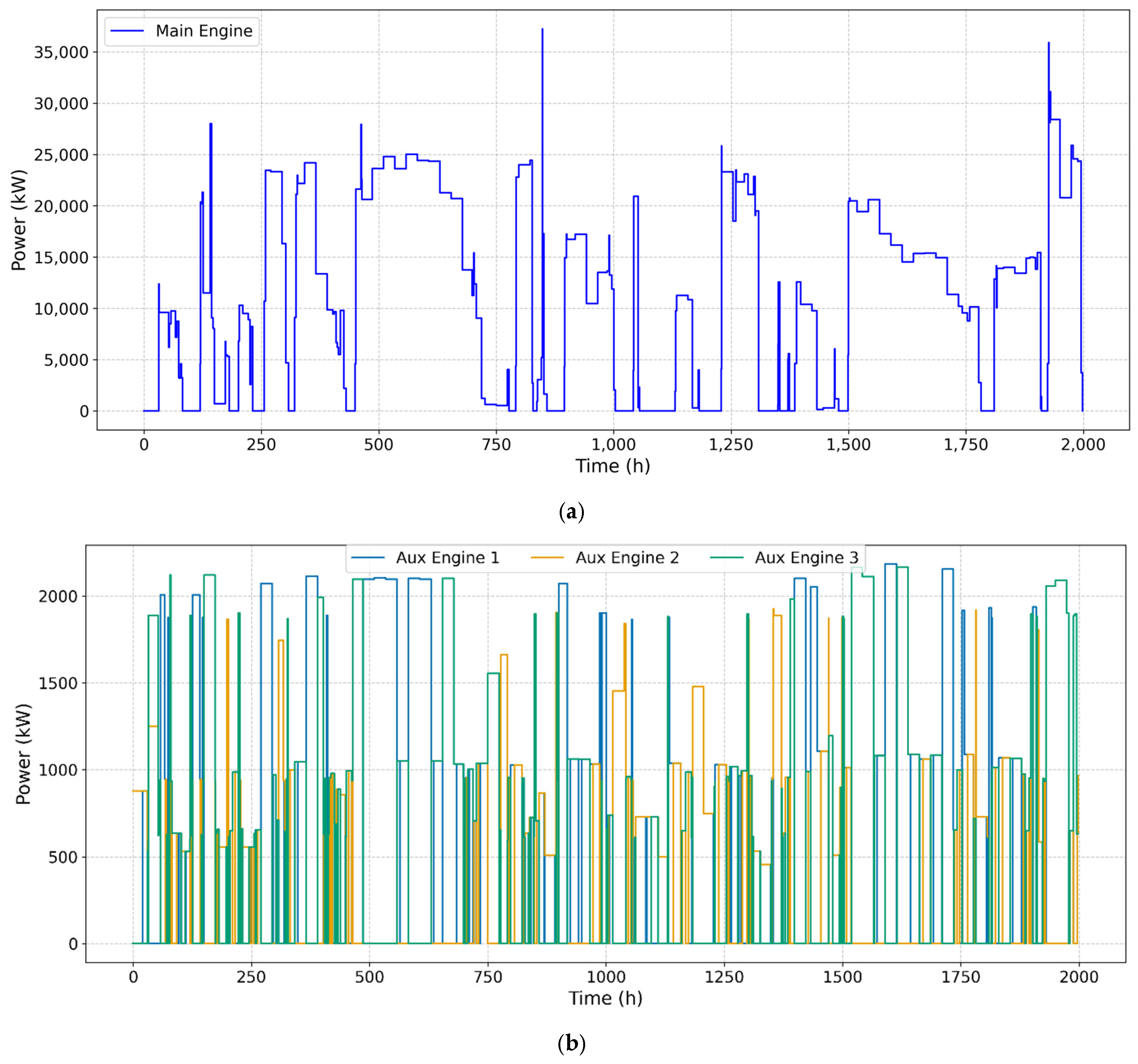
The dynamic operational simulation module processes the full round-trip power profile of the vessel, encompassing the main propulsion engine and the three auxiliary generator sets, to reconstruct the time-varying power demand, load factor, and energy consumption across every discrete operating mode of the voyage. The complete power profile of all four engines over the full round trip is presented in
Figure 2.
The complete round trip spans around 2000 h; the trip is divided into four distinct operating modes: sea passage, port, canal transit, and anchor/waiting. Sea passage dominates the profile, accounting for 1350 h (67.6%) of the total trip duration, confirming that propulsion power demand governs the bulk of the vessel’s energy and emission budget. Port operations constitute 459 h (23.0%), during which the main engine is shut down, and electrical load is served exclusively by the auxiliary generators. Canal transit represents 137 h (6.9%) and is characterized by low main engine power operation, reflecting the speed and maneuvering restrictions imposed by restricted waterway navigation. Anchor and waiting periods contribute a relatively minor 53 h (2.6%) to the total trip duration.
The main engine power profile is characterized by an extended low-to-moderate load regime during sea passage, with abrupt power reductions to near-zero or zero during port calls and short-duration peaks associated with river transit maneuvers. The maximum recorded main engine power is 37,260 kW, corresponding to 51.9% of MCR, a notably low peak utilization that reveals the vessel is operating well below its design capacity throughout the entire voyage. This finding is consistent with slow-steaming practices adopted widely in the container ship sector as a fuel and emission reduction measure. The mean power during operating hours is 14,757 kW, equivalent to an average operational load factor of 20.56% MCR, with a standard deviation of 10.75 percentage points reflecting the variability introduced by different sea conditions, vessel draught changes, and speed orders across the voyage legs.
The load factor distribution of the main engine reveals a strong concentration of operating hours in the low-to-moderate load range. 30.8% of all operating hours fall within the 10–20% MCR band and 28.9% in the 20–30% MCR band, making these two bins collectively responsible for 59.7% of total operating time. A further 24.4% of hours are spent in the 30–40% MCR range, bringing the cumulative fraction below 40% MCR to 99.9% of all operating hours. The engine never exceeds 55% MCR across the entire voyage, and operation above 50% MCR accounts for a negligible 0.1% of operating time.
From an engine design perspective, the dominance of low-load operation confirms the appropriateness of the engine selection criterion applied in
Section 3.2.1, where the retrofit MCR was sized at 110% of the maximum observed power demand (37,260 × 1.10 = 41,200 kW) rather than the original engine’s 71,770 kW nameplate rating. Operating the original engine at an average of 20.6% MCR implies that the propulsion plant is significantly oversized relative to the actual voyage power demand, a common characteristic of older ship designs that were specified for higher service speeds subsequently abandoned under slow-steaming regimes. The total mechanical energy delivered by the main engine over the round trip is 80.6 TJ, representing the primary driver of fuel consumption and emissions across all scenarios.
The vessel’s auxiliary power system consists of three diesel generator sets (AE1, AE2, and AE3), each rated at 4500 kW maximum continuous rating (MCR). These generators supply electrical power for ship operations, including propulsion support systems, cargo handling, hotel loads, and deck equipment. The operational simulation demonstrates a balanced dispatch strategy, where the number of active generators varies according to electrical demand during different voyage phases. AE1 recorded the highest operating duration at 1028 h (51.4% of the voyage), followed closely by AE3 with 1004 h (50.3%), while AE2 operated for 879 h (44.0%). Despite similar utilization rates, AE2 functioned mainly as the dedicated port-service generator, operating during 96% of port hours compared with only 14.8% and 21.3% for AE1 and AE3, respectively.
The auxiliary engines consistently operated at relatively low load factors. Average load factors during operation were 29.3% MCR for AE1, 27.2% for AE3, and only 20.1% for AE2. Even under peak conditions, no generator exceeded 48.5% MCR, confirming that the auxiliary plant is substantially oversized relative to actual electrical demand. Combined auxiliary power demand averaged 1679 kW, with a maximum recorded demand of 3139 kW, representing only 23.3% of the total installed auxiliary capacity of 13,500 kW. While this oversizing improves operational reliability, it also results in prolonged low-load operation, which negatively affects fuel efficiency.
Analysis of auxiliary engine dispatch patterns shows that single-engine operation dominates the voyage, accounting for 61.4% of total trip duration. Two-engine operation occurs during 30.6% of the voyage, mainly during periods of increased electrical demand such as cargo handling and ballast operations, while simultaneous operation of all three generators is limited to only 7.7% of voyage time during peak demand events. This operational pattern significantly influences fuel consumption because higher load operation on a single engine generally provides better specific fuel consumption than splitting the same load between multiple engines.
Role differentiation between sailing and port operations is also evident. AE1 and AE3 primarily support sea-passage operations at moderately higher load factors, whereas AE2 mainly operates during low-load port conditions. Overall, the auxiliary engines delivered 12.16 TJ of electrical energy during the round trip, equivalent to approximately 13.1% of the main engine’s total energy output. Therefore, the simulation results characterize the vessel as operating under a predominantly low-load duty cycle, providing important input data for fuel consumption, emissions, and regulatory compliance analyses.
4.2. Energy Analysis Results
Before presenting the energy analysis results, it is important to highlight the key modelling assumption underpinning this study: the lower heating value (LHV)-equivalence approach used to derive the ethanol specific gas consumption (SGC) from the methanol CEAS baseline. This assumption directly influences the predicted fuel consumption and, consequently, affects all subsequent energy, environmental, and regulatory performance results. To evaluate the robustness of the findings, a sensitivity analysis is conducted in
Section 4.5, where the two most influential and uncertain parameters, the ethanol SGC and the well-to-tank (WTT) emission factor, are varied by ±10% relative to their baseline values.
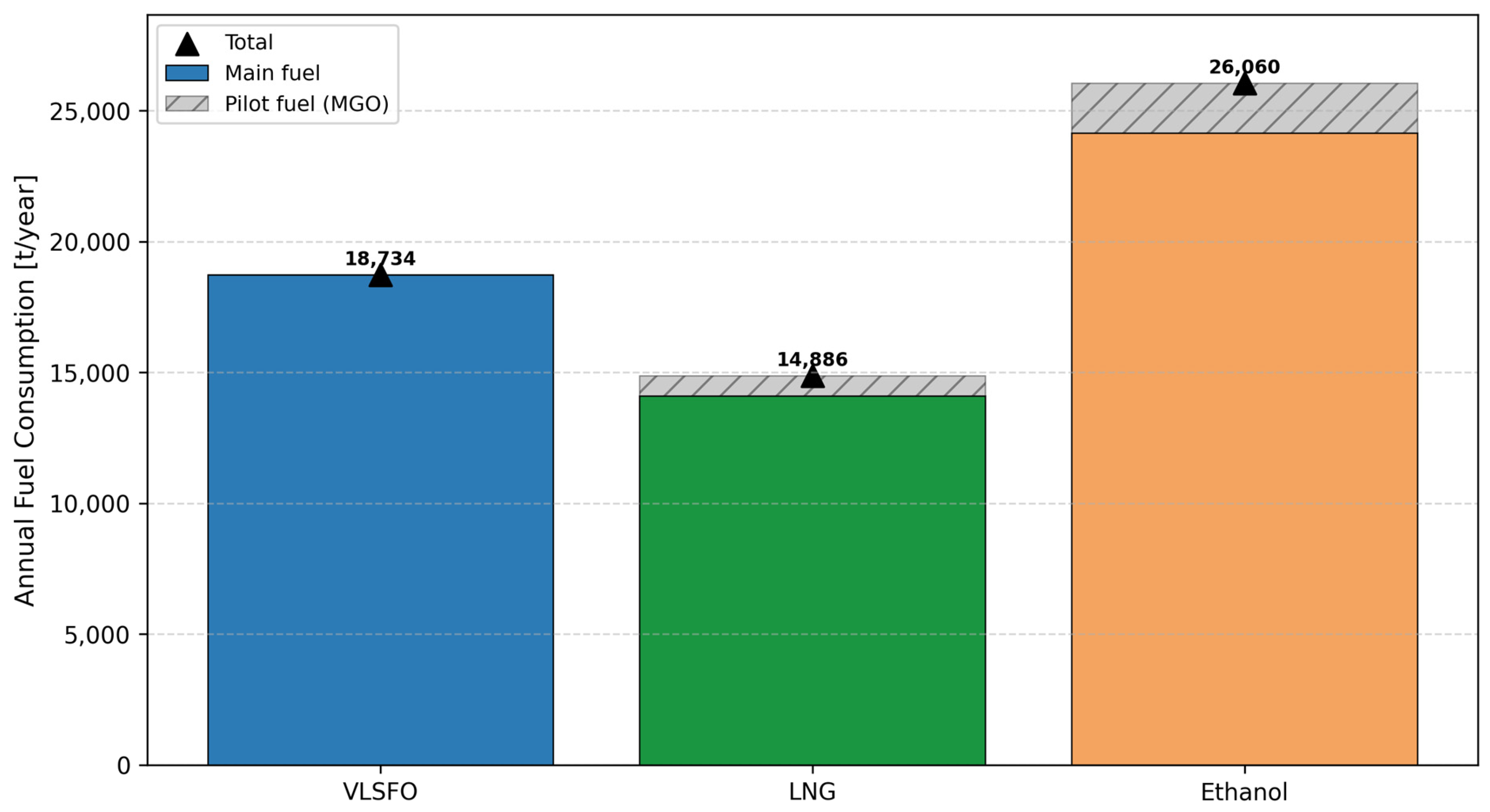
The energy analysis quantifies the annual fuel consumption and corresponding energy demand for each fuel scenario, with results disaggregated into primary fuel and pilot fuel contributions. It should be noted that the four ethanol pathways considered (S2–S5) differ only in their upstream production routes and associated lifecycle emission factors. As the combustion characteristics, engine performance assumptions, and fuel consumption parameters remain identical across these pathways, they produce the same fuel consumption and energy demand results. Consequently, differences among the ethanol scenarios emerge only in the environmental and regulatory assessments presented in the subsequent sections. The energy performance results for the three fuel configurations, VLSFO (S0), LNG (S1), and ethanol (S2–S5), are presented in
Figure 3.
Figure 3 presents the annual primary and pilot fuel mass consumption for each scenario. The VLSFO baseline (S0) consumes 18,734 t/year of primary fuel with no pilot fuel requirement. LNG (S1) requires 14,115 t/year of primary LNG supplemented by 771 t/year of MGO pilot fuel, for a combined total of 14,886 t/year, a 20.5% reduction in total fuel mass relative to VLSFO. This reduction is a direct consequence of LNG’s substantially higher lower heating value (LHV = 50.0 MJ/kg compared with 41.2 MJ/kg for VLSFO), which lowers the mass of fuel required to deliver an equivalent energy output for any given load.
The ethanol scenarios (S2–S5) display a fundamentally different consumption profile. The annual primary ethanol consumption reaches 24,159 t/year, with an additional 1901 t/year of MGO pilot fuel, yielding a combined total of 26,060 t/year. This represents a 39.1% increase in total fuel mass over the VLSFO baseline and a 75.1% increase over LNG. This is a thermodynamically unavoidable consequence of ethanol’s lower energy density (LHV = 27.0 MJ/kg), approximately 34% lower than VLSFO and 46% lower than LNG. To deliver the same shaft power output across the identical operational profile, the engine combusts a substantially larger mass of ethanol per unit time, as formalized by the LHV equivalence relation applied in the SFC estimation (
Section 3.2.2). This gravimetric penalty carries direct practical implications for bunker tank sizing, bunkering frequency, and cargo deadweight utilization, all key considerations for large-scale ethanol adoption in commercial shipping.
The MGO pilot fuel fraction also differs meaningfully between the two DF configurations. In the LNG scenario, the pilot fuel constitutes 5.2% of total fuel mass, whereas in the ethanol scenarios, it accounts for 7.3%. This elevated pilot ratio for ethanol reflects the engine SFC characteristics of the ME-LGIM reference platform when adapted to ethanol operation: because ethanol’s LHV is lower than that of methanol (the basis for the CEAS-derived SPOC values), the absolute pilot oil mass per unit energy delivered is comparatively higher. This increased MGO pilot dependency partially offsets the GHG advantages of ethanol as a low-carbon primary fuel, a trade-off captured in detail in the environmental analysis.
The pilot fuel ratio is not constant across the load range but varies as a function of engine load factor. At low loads (LF < 25% MCR), the pilot fuel requirement per unit of primary fuel is proportionally higher because the combustion chamber temperature and pressure are insufficient to reliably auto-ignite low-flashpoint liquid fuels without a larger ignition energy contribution from the pilot spray. At higher loads (LF > 40% MCR), the elevated in-cylinder conditions reduce the minimum pilot quantity needed for stable ignition, allowing the SPOC to decrease as a fraction of total fuel consumption. In the present study, the SPOC is evaluated from the CEAS load-dependent performance map and therefore already captures this load-dependent variation through the polynomial correlation of Equation (4).
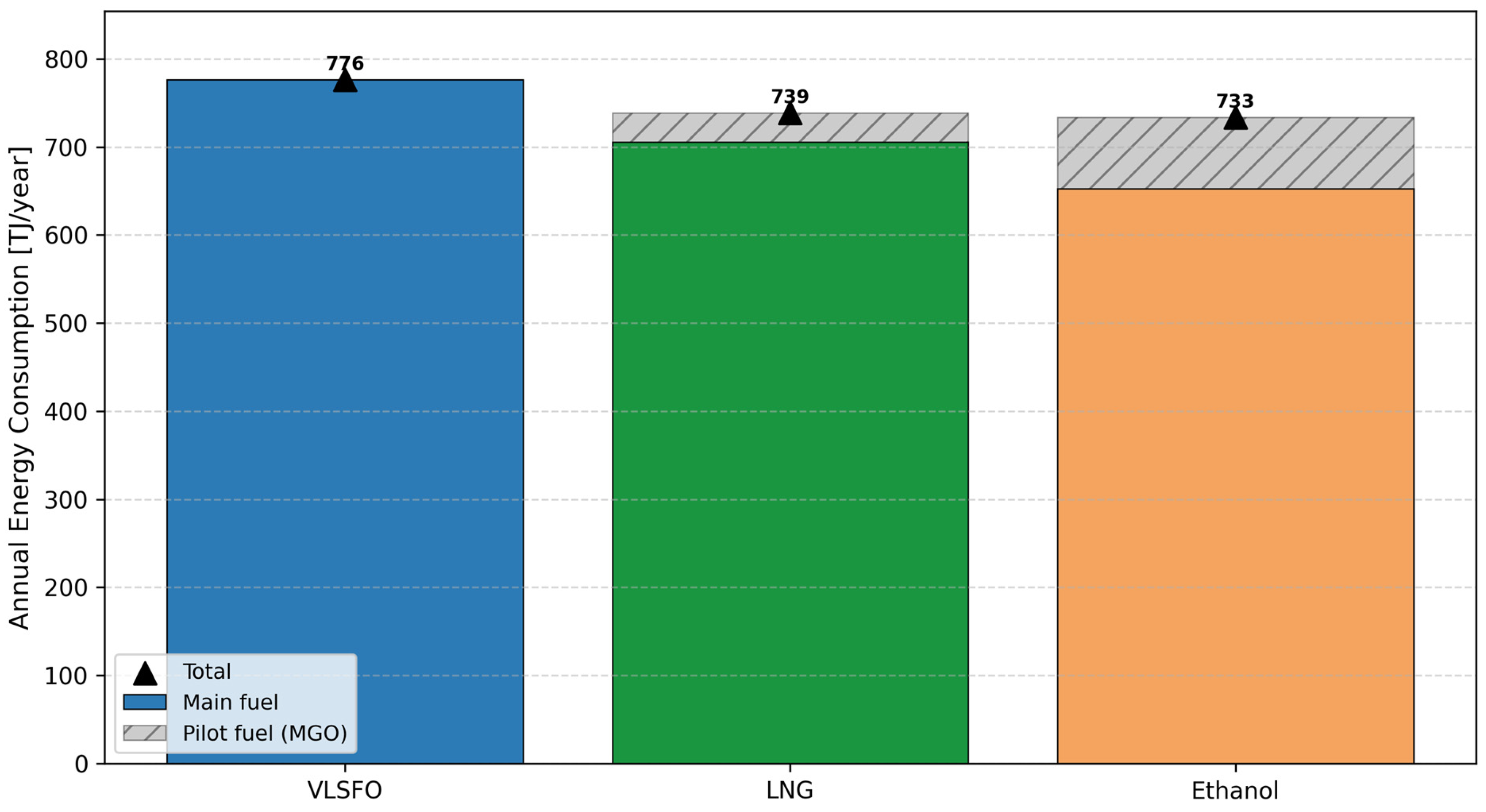
Figure 4 presents the annual thermal energy consumption in TJ/year, eliminating the mass-based distortion introduced by differing fuel densities. The VLSFO baseline (S0) records the highest total energy input of 776.5 TJ/year, entirely from primary fuel. LNG (S1) delivers the lowest total energy consumption of 738.7 TJ/year (705.7 TJ primary LNG + 32.9 TJ MGO pilot), representing a 4.9% reduction relative to VLSFO. This modest but meaningful efficiency advantage reflects the improved brake thermal efficiency associated with the lean-premixed combustion characteristics of natural gas in a low-speed two-stroke DF engine, reducing heat rejection and exhaust enthalpy losses relative to conventional diesel-cycle operation.
The ethanol scenarios (S2–S5) deliver a total annual energy input of 733.5 TJ/year (652.3 TJ primary ethanol + 81.2 TJ MGO pilot). Notably, this total is 5.5% lower than the VLSFO baseline and 0.7% lower than the LNG scenario, a result that initially appears counterintuitive given the large fuel mass penalty identified in
Figure 3. The explanation lies in the LHV equivalence methodology applied in the SFC estimation: the polynomial SFC correlations for ethanol are derived by scaling the methanol CEAS data by LHV ratio (LHV
MeOH/LHV
EtOH = 19.9/27.0 = 0.737), which reduces the energy delivered per unit SFC relative to methanol. The net result is that despite consuming 39.1% more fuel by mass, the ethanol scenarios deliver slightly less total thermal energy than VLSFO, indicating that the effective specific energy conversion in ethanol DF operates at a marginally lower thermodynamic efficiency than VLSFO baseline under equivalent power demand conditions.
The MGO pilot energy fraction shows a more pronounced divergence in energy terms than in mass terms. In the LNG scenario, pilot fuel contributes 32.9 TJ, or 4.5% of total energy. In the ethanol scenarios, the pilot contributes 81.2 TJ, or 11.1% of total energy. This more than doubling of the pilot energy share reflects both the higher SPOC of the ethanol configuration and the proportional amplification caused by ethanol’s lower LHV. This elevated pilot energy fraction is consequential from an environmental standpoint: each megajoule of MGO pilot carries a WtT upstream emission factor of 17.7 gCO
2e/MJ and a TTW CO
2 factor of 3.206 g CO
2/g fuel, meaning that the pilot fuel becomes a non-negligible contributor to the overall GHG footprint of the ethanol system.
Table 5 consolidates the key energy results for all scenarios.
4.3. Environmental Analysis Results
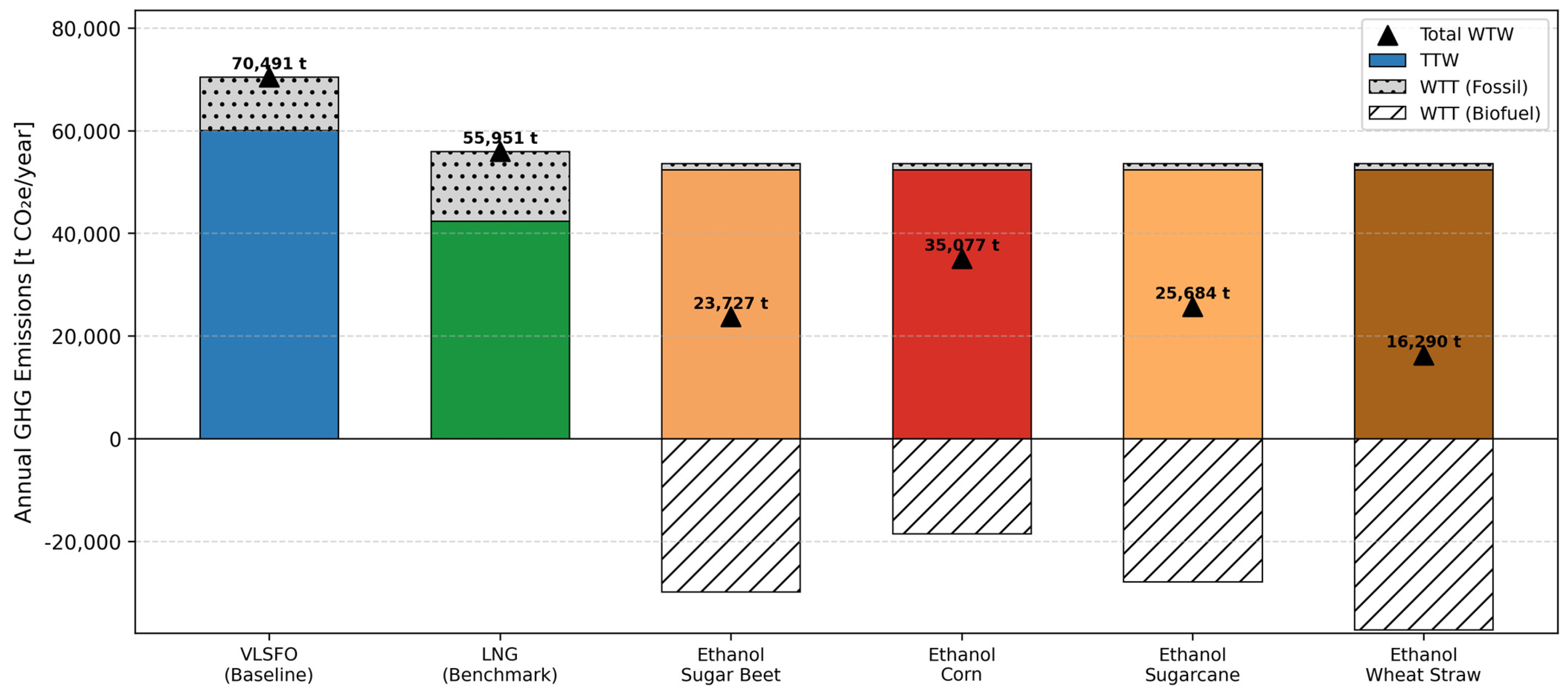
The environmental module evaluates the full WtW GHG footprint of each scenario by combining the TTW direct combustion emissions with the WTT upstream emissions from fuel production and supply. Unlike the energy analysis, the environmental assessment reveals significant differentiation among the four ethanol feedstock scenarios. The results are presented in
Figure 5.
The TTW emissions represent the total in-cycle GHG output from combustion of primary and pilot fuels, accounting for CO
2, CH
4 slip, and N
2O weighted by 100-year GWPs. As shown in
Figure 5, the VLSFO baseline (S0) records the highest TTW total of 60,083 t CO
2e/year, arising entirely from primary fuel combustion with no pilot contribution. The LNG scenario (S1) achieves a TTW total of 42,421 t CO
2e/year, a 29.4% reduction relative to the baseline. This reduction stems primarily from methane’s lower carbon-to-hydrogen ratio relative to the long-chain hydrocarbons in VLSFO, though the methane slip term imposes a GHG penalty on the LNG configuration that partially erodes its combustion carbon advantage.
All four ethanol scenarios (S2–S5) yield identical TTW emissions of 52,400 t CO2e/year, comprising 46,305 t CO2e/year from primary ethanol combustion and 6096 t CO2e/year from the MGO pilot fuel. This represents a 12.8% reduction relative to VLSFO, but still modest compared with the LNG TTW advantage of 29.4%. Two competing mechanisms determine this outcome. On one hand, ethanol’s substantially lower carbon-to-energy ratio (EFCO2 = 1.913 g CO2/g fuel, versus 3.151 for VLSFO) confers a clear TTW benefit per unit mass burned. On the other hand, the 29.1% higher primary fuel mass consumed (24,159 vs. 18,734 t/yr) partially erodes this per-unit advantage when expressed as an annual total. Furthermore, the elevated MGO pilot burden of 6096 t CO2e/year, absent in the VLSFO scenario, contributes an additional TTW penalty with no offset. The net result is that ethanol’s operational GHG performance remains substantially inferior to LNG at the TTW level, a finding that fundamentally motivates the lifecycle WtW perspective.
The WTT upstream contributions reveal the most decisive differentiator across all scenarios investigated. As shown in
Figure 5, VLSFO (S0) and LNG (S1) carry positive WTT burdens of 10,408 t CO
2e/year and 13,531 t CO
2e/year, respectively, reflecting the GHG intensity of fossil fuel extraction, refining, and liquefaction. The LNG upstream burden marginally exceeds that of VLSFO in absolute terms, primarily because the total energy consumed by the LNG system (738.7 TJ/year) is slightly lower than for VLSFO (776.5 TJ/year), but the WTT intensity factor applied to LNG’s supply chain incorporates contributions from natural gas field-to-liquefaction energy losses that offset part of the lower energy throughput.
The four ethanol scenarios exhibit strongly negative WTT contributions, indicating net upstream carbon credits arising from bio-based production pathways that displace fossil carbon accounting. The magnitude varies substantially by feedstock:
Corn ethanol (S3) carries the least favourable upstream profile among the ethanol variants, with a WTT contribution of −17,324 t CO2e/year. Despite being negative, the corn RED II default lifecycle emission factor of 42.5 gCO2e/MJ, the highest among the four pathways, reflects the significant agricultural energy inputs, fertilizer-derived N2O, and land-use implications of corn-based fermentation, which limit the extent of the upstream credit.
Sugarcane (S4) and sugar beet (S2) deliver intermediate upstream credits of −26,717 t CO2e/year and −28,674 t CO2e/year, respectively. Sugar beet’s slightly larger credit compared with sugarcane reflects its marginally lower RED II factor, which stems from the more favourable energy balance of beet-to-ethanol processing chains in Northern European production contexts.
Wheat straw ethanol (S5) achieves the most favourable upstream profile of all scenarios, with a WTT credit of −36,110 t CO2e/year driven by its RED II factor of 13.7 gCO2e/MJ and WTT factor of −57.15 gCO2e/MJ. As a second-generation lignocellulosic residue, wheat straw utilizes a material that would otherwise decompose or be field-burned, incurring minimal additional land-use pressure and substantially lower net process emissions relative to first-generation crops.
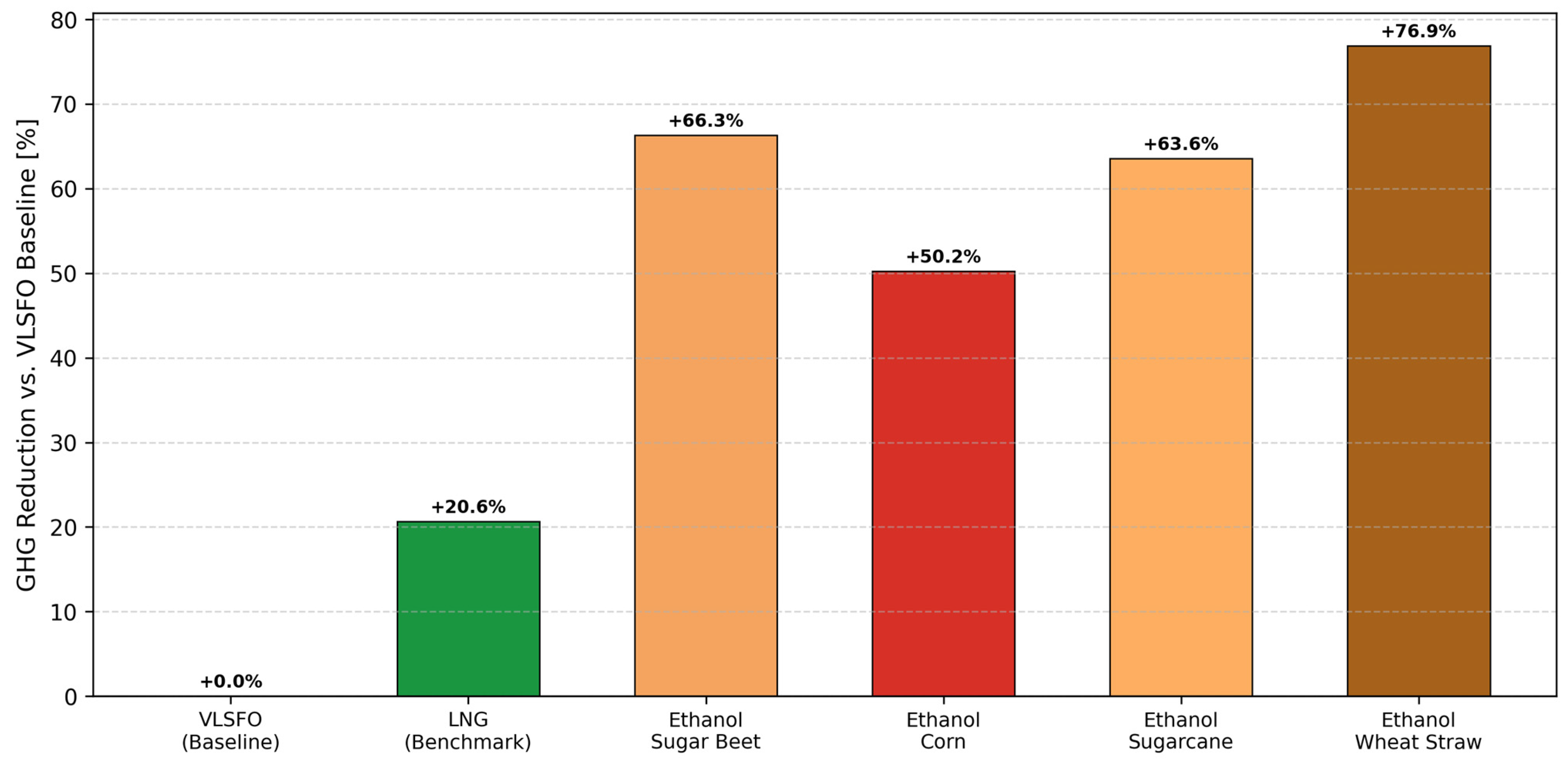
The WtW total, which integrates TTW direct and WTT upstream contributions, provides the most complete policy-relevant measure of lifecycle GHG performance and is illustrated by the relative reduction percentage in
Figure 6. The VLSFO baseline (S0) is the highest WtW emitter at 70,491 t CO
2e/year. LNG (S1) achieves 55,951 t CO
2e/year, a 20.6% reduction over VLSFO. Notably, this is smaller than LNG’s 29.4% TTW advantage, because the LNG upstream burden (13,531 t CO
2e/year) marginally exceeds that of VLSFO (10,408 t CO
2e/year), penalizing the WtW balance relative to the TTW comparison.
All four ethanol pathways substantially outperform both benchmarks at the WtW level. Corn ethanol (S3) achieves the most modest reduction of 50.2% (35,077 t CO2e/year), yet this is still more than double LNG’s lifecycle saving relative to VLSFO. Sugarcane (S4) and sugar beet (S2) deliver reductions of 63.6% and 66.3%, respectively. Wheat straw ethanol (S5) records the lowest WtW total of all scenarios at 16,290 t CO2e/year, representing a 76.9% reduction relative to the VLSFO baseline, the most substantial decarbonization outcome in this study, and more than three times the proportional reduction achieved by LNG.
From a practical deployment perspective, a key engineering constraint associated with ethanol adoption in marine fuel systems is material compatibility. Ethanol’s hydroxyl group (–OH) renders it mildly corrosive toward certain elastomers, aluminum alloys, and zinc-coated components commonly found in conventional fuel storage, piping, and injection systems designed for VLSFO or MGO. Specifically, nitrile rubber (NBR) seals widely used in legacy fuel systems, exhibit swelling and degradation in contact with ethanol blends above approximately 20% vol [
30,
36]. For the ethanol DF retrofit scenario considered in this study, the low-flashpoint fuel supply system of the ME-LGIM reference platform is already specified with fluorinated elastomers (FKM) and stainless-steel pipework, which are fully compatible with ethanol. However, the bunkering infrastructure (shore-side tanks, transfer hoses, and manifolds) would require targeted material verification and, in many cases, replacement of legacy components prior to ethanol service entry. This compatibility requirement represents an additional upfront capital cost recommended for quantitative assessment in future techno-economic studies.
4.4. Regulatory Compliance Results
The regulatory compliance module evaluates the performance of each scenario against the two principal decarbonization frameworks currently applicable to international shipping: the global IMO Net-Zero Framework (NZF) based on the Greenhouse Gas Fuel Intensity (GFI) methodology, and the regional FuelEU Maritime Regulation (EU 2023/1805), which mandates progressive reductions in the annual average WtW GHG intensity of ship energy use. Both frameworks operate on an energy-intensity basis (gCO
2e/MJ) and adopt a common reference GHG intensity derived from the 2008 fleet average. The GFI results are presented in
Figure 7.
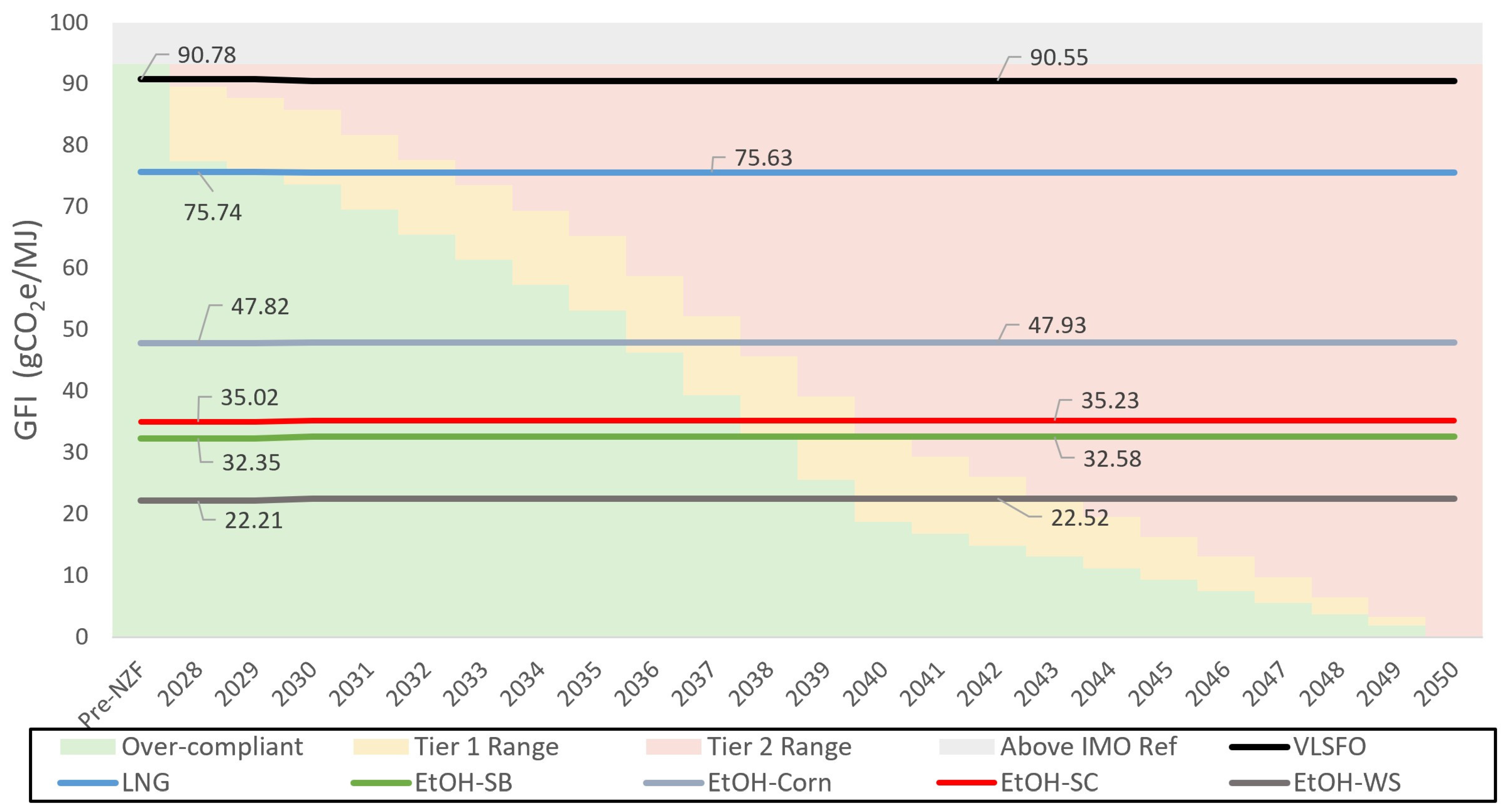
Figure 7 presents the well-to-wake GFI for each scenario plotted against the evolving IMO NZF Tier 1 (Direct target) and Tier 2 (Base target) annual reduction trajectories relative to the reference value of 93.3 gCO
2e/MJ. The VLSFO baseline (S0) records a GFI of 90.78 gCO
2e/MJ in the pre-2030 period, composed of a TTW component of 77.38 gCO
2e/MJ and a WTT upstream contribution of 13.4 gCO
2e/MJ. This places the VLSFO scenario marginally below the IMO reference value of 93.3 gCO
2e/MJ and above the Tier 1 target applicable from 2028 (77.44 gCO
2e/MJ), confirming that VLSFO operation is already in a non-compliant zone under the IMO NZF from the framework’s entry into force. After 2030, accounting for changes in port electricity emissions contributions, the VLSFO GFI adjusts marginally to 90.55 gCO
2e/MJ, remaining structurally non-compliant throughout the entire 2028–2050 horizon as the Tier 1 target progressively tightens from 77.44 (2028) to 73.71 (2030) to 53.18 (2035) to 18.70 (2040) and ultimately to 0 gCO
2e/MJ (2050). The divergence between the VLSFO GFI and the compliance corridor, therefore, widens monotonically over time, rendering continued VLSFO operation increasingly untenable from a regulatory standpoint beyond 2028.
The LNG scenario (S1) achieves a pre-2030 GFI of 75.74 gCO2e/MJ (TTW: 57.43; WTT: 18.32 gCO2e/MJ) and an adjusted post-2030 value of 75.63 gCO2e/MJ. This positions LNG below the Tier 1 target from 2028 through 2030, confirming Tier 1 compliance throughout the early NZF period. However, as the Tier 1 trajectory steepens beyond 2030, LNG crosses into non-compliance progressively: the Tier 1 target falls to 69.60 gCO2e/MJ in 2031, 65.50 in 2032, 61.39 in 2033, and 57.29 in 2034, values that converge on and then fall below the LNG GFI of 75.78 gCO2e/MJ. LNG therefore faces Tier 1 non-compliance from approximately 2031 onwards and remains well above the Tier 2 targets throughout the entire assessment horizon. This finding is highly significant for fleet investment planning: vessels retrofitted for LNG operation today will face regulatory non-compliance within the first decade of operation under the IMO NZF, underscoring the transitional rather than long-term nature of LNG as a decarbonization strategy.
The four ethanol scenarios (S2–S5) present a markedly different compliance picture, as illustrated by the wide spread of GFI values visible in
Figure 7. The pre-2030 GFI values are: sugar beet 32.35 gCO
2e/MJ, corn 47.82 gCO
2e/MJ, sugarcane 35.02 gCO
2e/MJ, and wheat straw 22.21 gCO
2e/MJ. All four values lie substantially below the Tier 1 trajectory of 2028. More significantly, two of the four pathways, sugar beet, and sugarcane also fall below the Tier 1 target from 2028 until 2038, placing them in the over-compliant zone that enables the accrual of GFI compliance surplus credits. Corn ethanol (S3), with the highest GFI among the four, falls within the Tier 1–Tier 2 corridor beyond 2036.
After 2030, accounting for the port electricity emission factor contribution (67 gCO2eq/MJ applied to the 6.93 TJ port electricity demand), all ethanol GFI values undergo a marginal upward adjustment but remain structurally compliant: sugar beet 32.58, corn 47.93, sugarcane 35.23, wheat straw 22.52 gCO2e/MJ. Wheat straw ethanol (S5) remains the strongest performer throughout the timeline, achieving a GFI 70.9% below the 2028 Tier 1 target of 77.44 gCO2e/MJ and already compliant with the 2039 Tier 1 target of 25.60 gCO2e/MJ. The WTT component of the wheat straw GFI is −49.23 gCO2e/MJ, indicating that the upstream carbon credit from lignocellulosic production more than offsets the positive TTW component (71.44 gCO2e/MJ), yielding a net WtW GFI substantially below even the long-term targets. This result demonstrates that, under a WtW accounting framework, second-generation lignocellulosic ethanol already satisfies the most stringent mid-century IMO compliance thresholds based on present-day production technology.
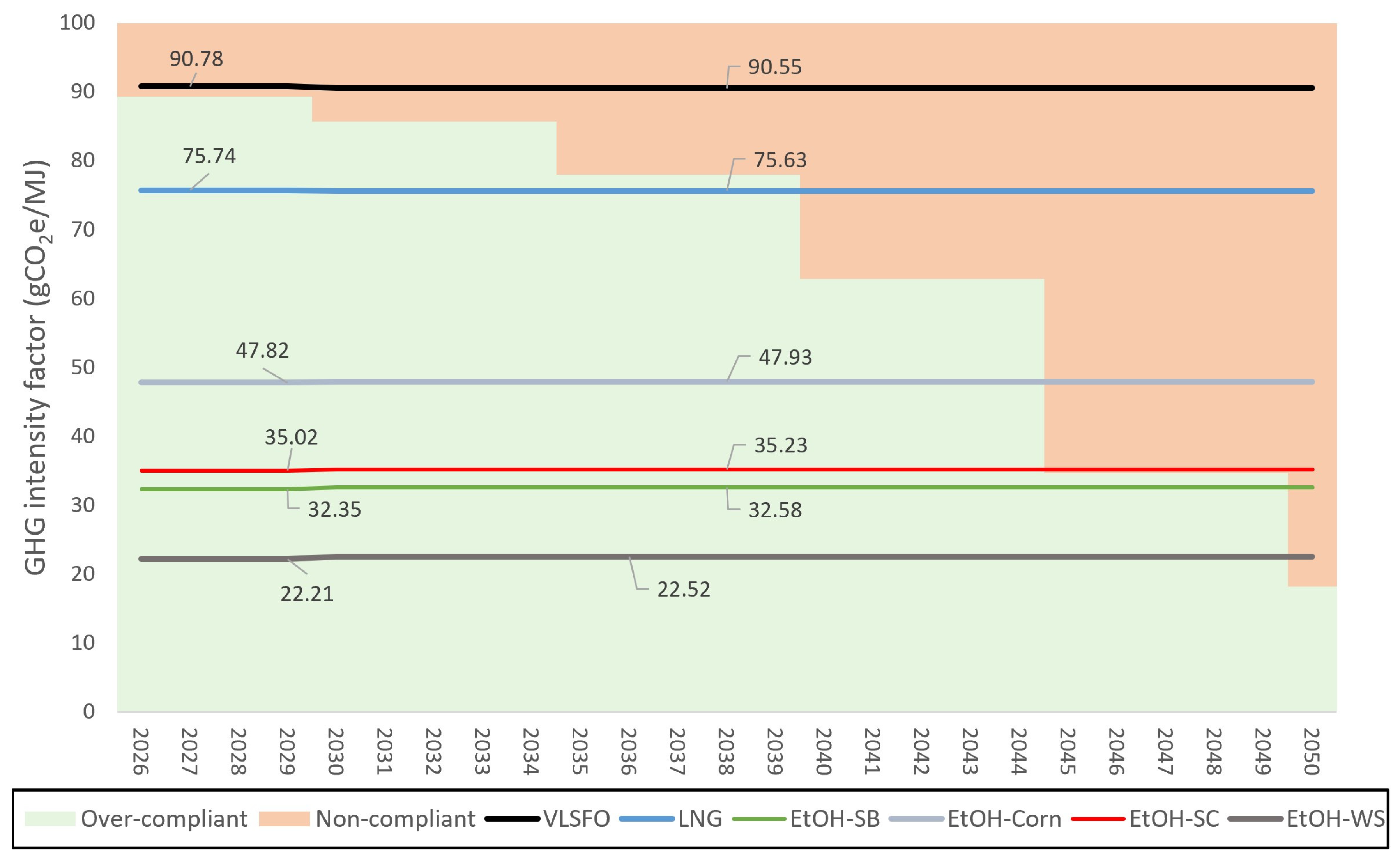
Figure 8 presents the annual GHG Energy Intensity (GHGI) of each scenario plotted against the FuelEU Maritime compliance trajectory, which mandates progressive intensity reductions relative to the 2020 reference value of 91.16 gCO
2e/MJ. The applicable annual FuelEU targets are: 89.34 gCO
2e/MJ from 2025 (−2%); 85.69 from 2030 (−6%); 77.94 from 2035 (−14.5%); 62.90 from 2040 (−31%); 34.64 from 2045 (−62%); and 18.23 from 2050 (−80%).
The VLSFO baseline (S0) records a GHGI of 90.78 gCO2e/MJ in the pre-2030 period, exceeding the FuelEU target from its first compliance year in 2026 (89.34 gCO2e/MJ). This non-compliance becomes progressively more severe as the target tightens: the VLSFO GHGI exceeds the 2030 target (85.69) by 4.86 gCO2e/MJ, the 2035 target (77.94) by 12.61 gCO2e/MJ, and the 2040 target (62.90) by 27.65 gCO2e/MJ. This confirms that conventional fossil-fuel operations are entirely incompatible with FuelEU Maritime compliance across the full study horizon.
The LNG scenario (S1) achieves a GHGI of 75.74 gCO2e/MJ (pre-2030) and 75.63 gCO2e/MJ (post-2030), placing it below the FuelEU compliance threshold from 2026 through 2039. LNG satisfies the −2% target (89.34 gCO2e/MJ, applicable 2025–2029) and the −6% target (85.69, applicable 2030–2034) with ample margin. However, as the FuelEU target drops to 62.9 gCO2e/MJ from 2040, the LNG post-2030 GHGI of 75.63 gCO2e/MJ does not satisfy the 2040–2044 target, with the deficit growing from 12.73 gCO2e/MJ in 2040 to 57.40 gCO2e/MJ in 2050. This result reinforces the conclusion from the IMO GFI analysis: LNG provides meaningful regulatory relief only in the short-to-medium term (2025–2039 under FuelEU) and cannot support long-term compliance trajectories without supplementary measures such as carbon capture or blending with bio-LNG.
The four ethanol scenarios (S2–S5) demonstrate a categorically different compliance profile. All four pathways record GHGI values substantially below the FuelEU compliance limit at every point in the regulatory timeline from 2026 to 2045, confirming full FuelEU Maritime compliance throughout the entire assessment horizon without exception.
As shown in
Figure 8, sugar beet (S2) achieves a pre-2030 GHGI of 32.35 gCO
2e/MJ, falling 63.8% below the 2026 FuelEU target of 89.34 gCO
2e/MJ. Post-2030, its GHGI adjusts marginally to 32.58 gCO
2e/MJ, remaining below even the most stringent 2045 FuelEU threshold of 34.64 gCO
2e/MJ by 2.06 gCO
2e/MJ. Similarly, sugarcane (S4) records a GHGI of 35.02 gCO
2e/MJ (pre-2030) and 34.23 gCO
2e/MJ (post-2030), achieving compliance margins against the 2045 target, respectively.
Corn ethanol (S3), the least favourable ethanol variant, records a GHGI of 47.82 gCO2e/MJ (pre-2030) and 47.93 gCO2e/MJ (post-2030). This remains below the 2025–2044 FuelEU targets with a comfortable margin. However, the 2045 FuelEU target (34.64 gCO2e/MJ) is tighter than the corn ethanol post-2030 GHGI, indicating that corn-based ethanol would enter non-compliance from 2045 onwards under FuelEU without improvement in upstream emission performance. This represents a critical planning horizon: shipowners adopting corn ethanol as their primary fuel need to account for the potential need to transition to lower-carbon feedstocks or blend with 2G/3G ethanol before 2045 to maintain FuelEU compliance.
Wheat straw ethanol (S5) achieves the strongest FuelEU performance, with a pre-2030 GHGI of 22.21 gCO2e/MJ and a post-2030 value of 22.52 gCO2e/MJ. This GHGI is more than the most stringent FuelEU 2050 target (18.23 gCO2e/MJ) by only 4.29 gCO2e/MJ. Therefore, the wheat straw scenario represents the only configuration in this study that satisfies both the IMO NZF and FuelEU near 2050 targets without requiring additional technological interventions such as carbon capture or blending with electrofuels. Achieving this performance level in practice, however, depends on maintaining the upstream emission intensity assumed for lignocellulosic ethanol production, which in turn requires rigorous supply chain management to prevent scope 1 and scope 2 emissions from escalating with production scale.
Taken together, the GFI and GHGI analyses converge on three overarching regulatory conclusions. First, VLSFO is incompatible with both frameworks from their respective compliance start dates and becomes increasingly penalized as the intensity targets tighten. Second, LNG provides short-to-medium term compliance relief under both IMO NZF (Tier 1 compliance to ~2030) and FuelEU (compliance to ~2034–2039) but faces certain non-compliance beyond these horizons, rendering it a transitional rather than long-term solution. Third, all ethanol pathways except corn deliver structural long-term compliance under both frameworks across the full 2026–2050 horizon, with wheat straw ethanol demonstrating sufficient compliance margin to satisfy even the most ambitious 2050 targets. Corn ethanol satisfies all targets through 2044 but faces a compliance gap from 2045 under FuelEU, identifying the specific policy-relevant threshold at which feedstock upgrading becomes mandatory. These findings provide a quantitative evidence base for fuel transition decision-making that goes beyond the binary “compliant/non-compliant” framing typically applied in regulatory assessments.