In this section, two simulation examples are presented to demonstrate the effectiveness of the proposed algorithm. The first example is based on an SOFC, and the second example is based on a practical wind power system.
4.1. Example 1: The SOFC Model
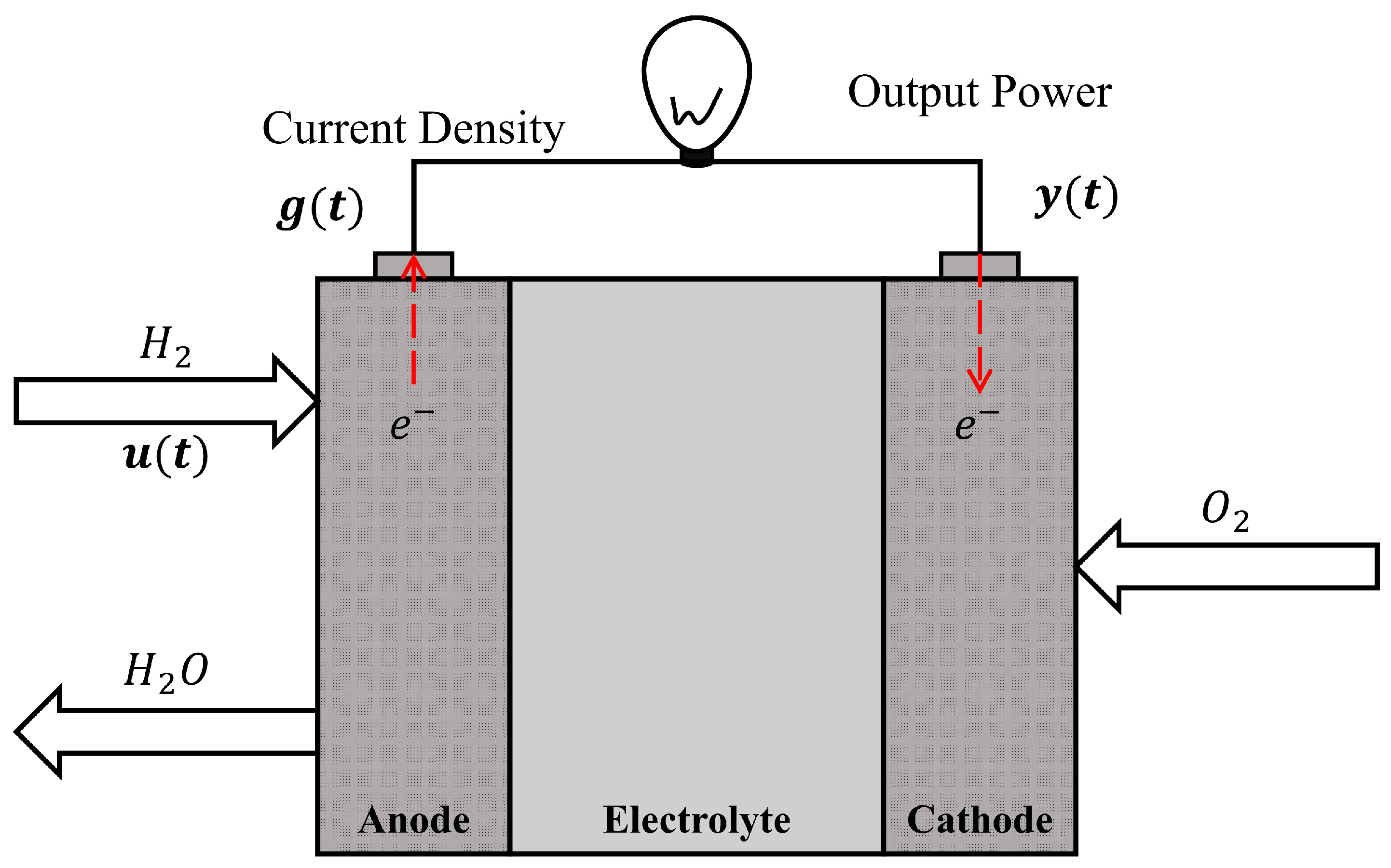
SOFC is an advanced electrochemical energy conversion device that can directly convert the chemical energy of fuels into electrical energy, offering significant advantages such as high efficiency, low emissions and strong fuel flexibility. These features position SOFC as a key enabling technology for environmental sustainability in the power generation sector. It has a wide range of applications, including small-scale residential combined heat and power systems to provide electricity and hot water for households, or as an auxiliary or main power source for vehicles, ships and drones [
27,
28]. As shown in
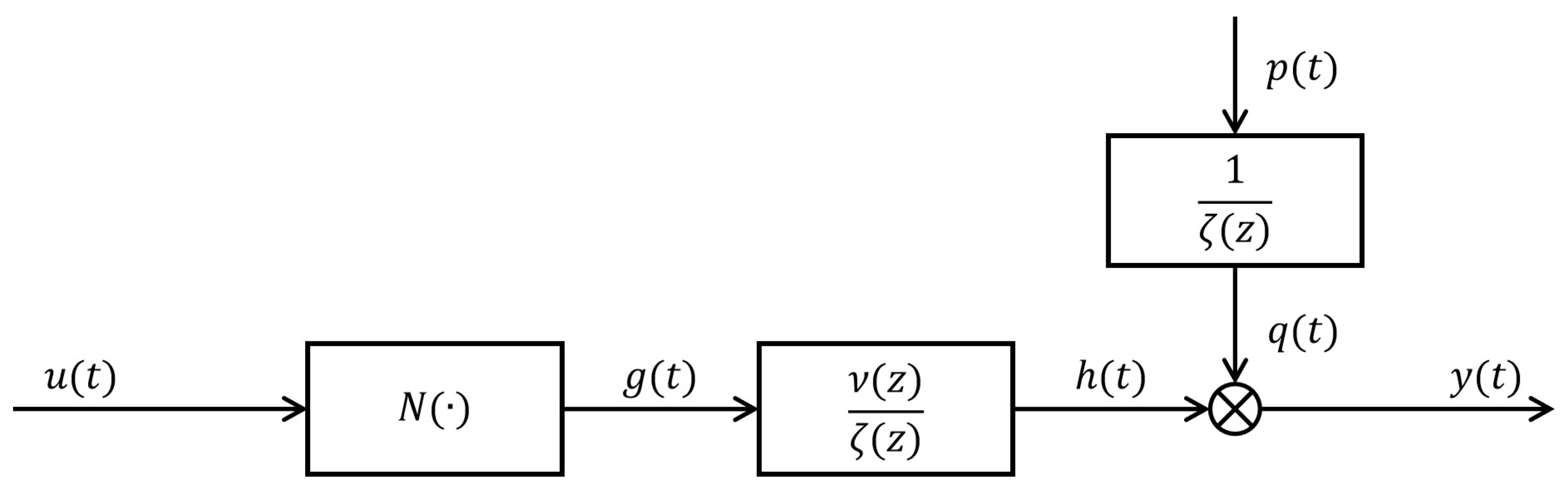
Figure 2, hydrogen is used as the fuel for the SOFC in this example, and the Hammerstein model is employed for modeling the energy conversion process. The nonlinear module describes the mapping from the hydrogen flow rate
to the current density
, and the linear module describes the dynamic characteristics from the current density
to the output power
.
In this example, a set of separable inputs is constructed using two distinct pairs of input–output datasets. The first signal, , is a uniformly distributed random sequence with zero mean and a variance of one, consisting of 3000 data points to ensure persistent excitation. The second signal, , comprising 500 data points, is intended to excite the nonlinear characteristics. The noise variance is set to . The input signal satisfies the assumptions of Theorem 1. It has zero mean by construction, i.e., . Moreover, a zero-mean uniformly distributed random sequence with a sufficiently large data length approximates a Gaussian distribution, which is a typical class of separable signals. Hence, the assumptions of Theorem 1 are considered to be satisfied in this simulation.
First, the parameters
and
of the linear module are estimated using the correlation analysis-based least squares algorithm with the first input–output dataset
and
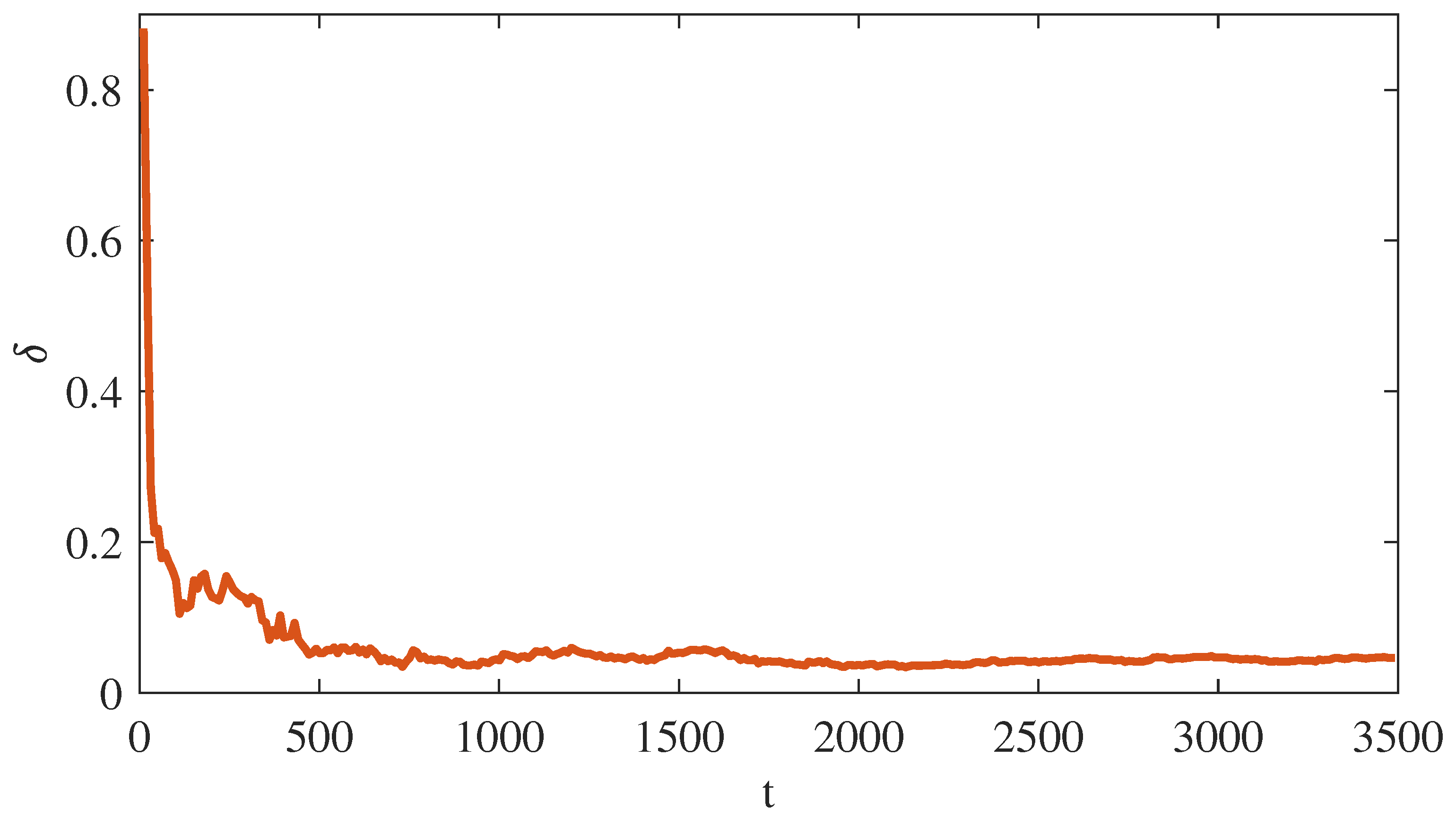
. The parameter estimation results, along with the normalized estimation error
, are presented in
Table 1. The evolution of this error over time
t is illustrated in
Figure 3.
Based on the second input–output dataset and , the parameters of the nonlinear module are then estimated using the LM algorithm, incorporating the previously estimated parameters of the linear module. Set the maximum number of iterations to 500 and the convergence tolerance .
To analyze the effect of
on the convergence performance of the LM algorithm,
Table 2 presents the number of iterations required for convergence and the mean squared error (MSE) achieved under different values of
.
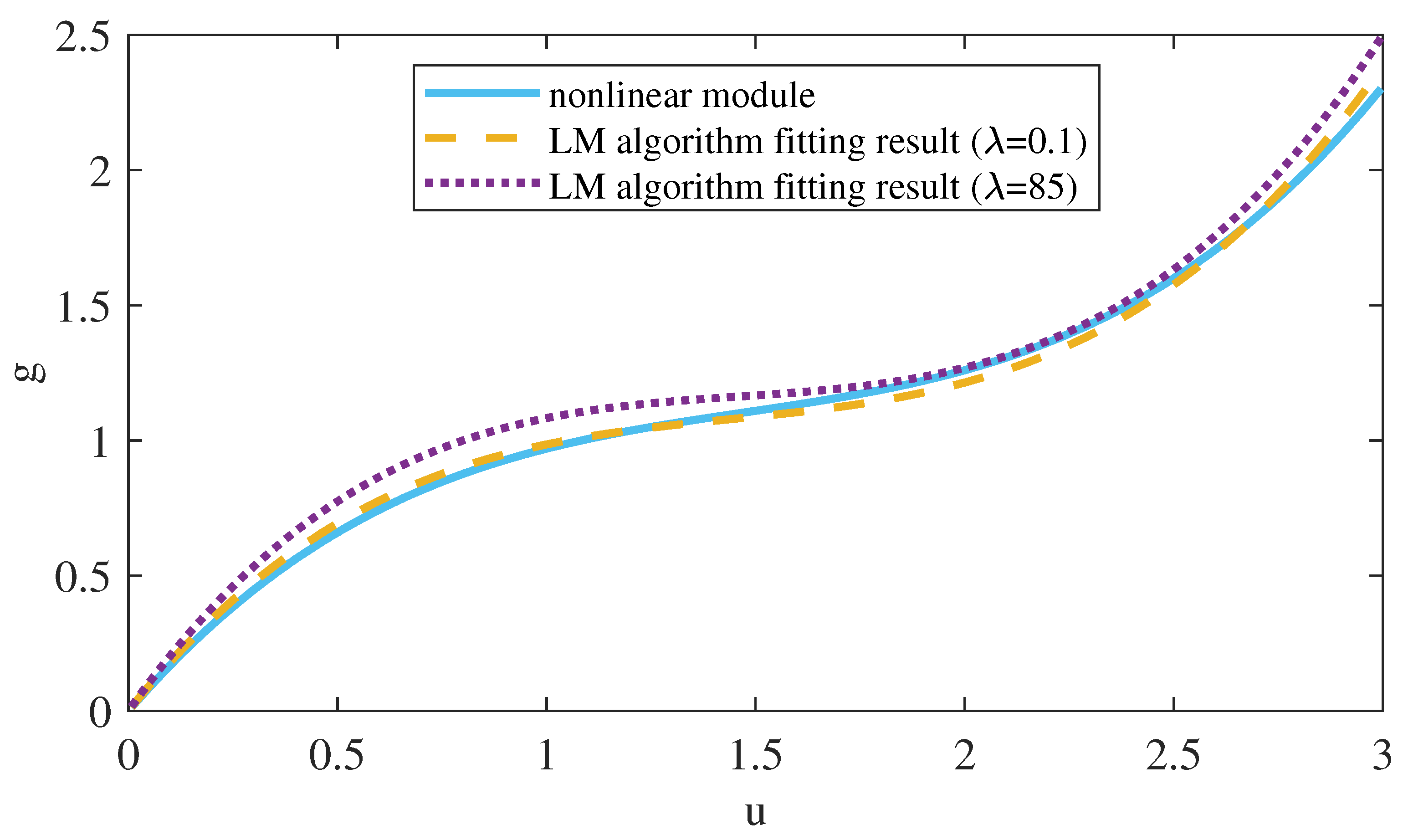
To illustrate the impact of
on fitting performance, two representative values are selected from
Table 2 for comparison in
Figure 4:
and
. The former leads to fast convergence and high fitting accuracy. However, the latter fails to converge within the maximum number of iterations. This is because when
is excessively large, the
term dominates the Hessian approximation
, making the LM update approximate gradient descent with a very small step size. Consequently, the algorithm progresses extremely slowly toward the optimum, demonstrating that an overly large damping parameter deteriorates the fitting performance.
Figure 4 presents a comparison between the actual nonlinear characteristics and the polynomial fitting results obtained using the estimated parameters. The blue line represents the actual nonlinear module. The yellow line denotes the polynomial fitting result based on the LM algorithm when
. The purple line is the fitting result of the LM algorithm when
.
To quantitatively evaluate the performance of the proposed hierarchical identification strategy, this paper compares it with the conventional over-parameterization method combined with least squares, which is one of the most widely used approaches for Hammerstein model identification. The over-parameterization method rewrites the Hammerstein model as a linear regression model by treating the product terms
as independent parameters. These parameters are estimated directly using the least squares algorithm. To obtain the individual parameters
and
for a fair comparison, the normalization constraint
is adopted. All comparisons are performed under the same simulation conditions.
Table 3 summarizes the estimated linear module parameters obtained by the proposed algorithm strategy and the over-parameterization method, together with the true values.
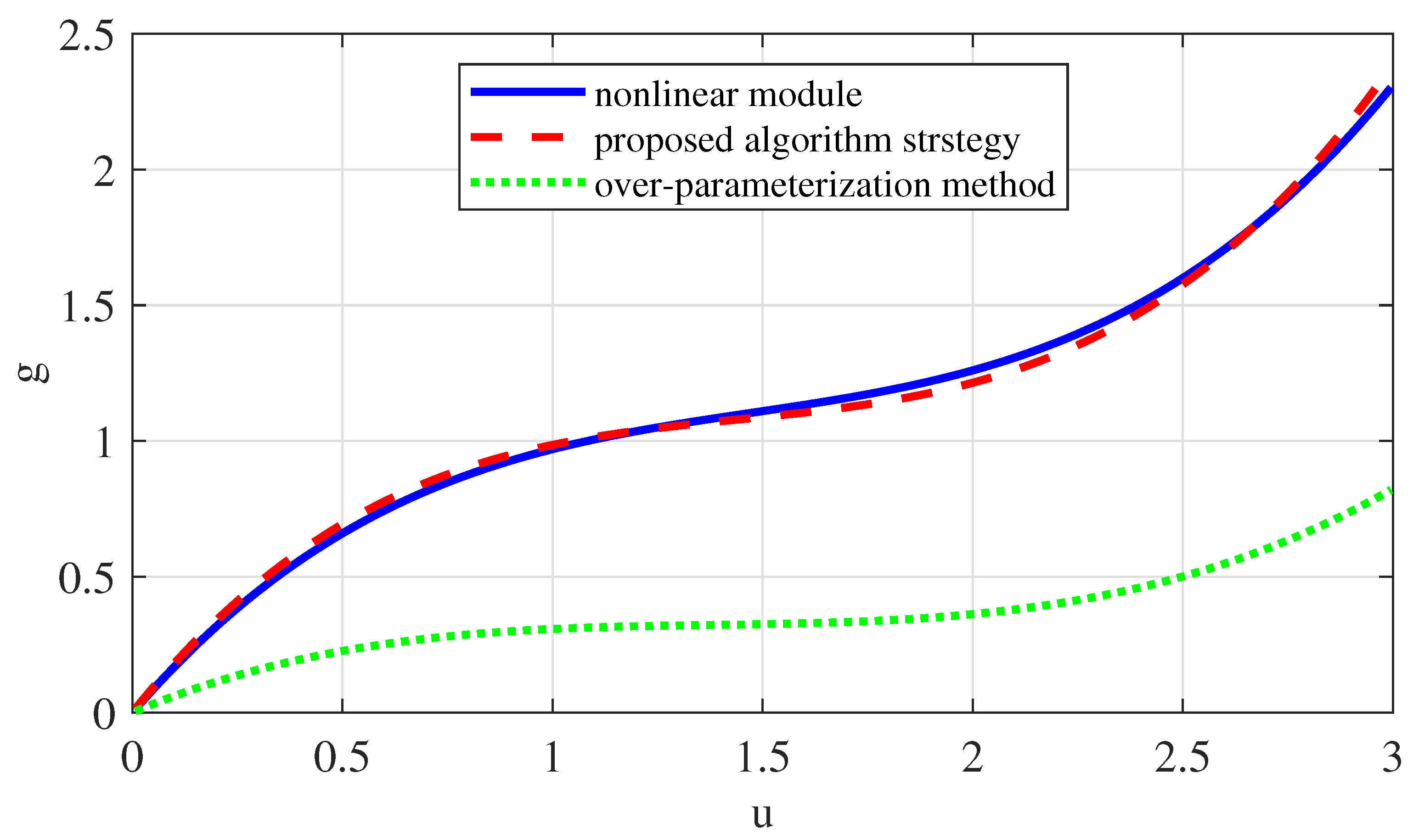
Figure 5 shows the fitted nonlinear curves of both methods, where the blue line represents the true nonlinear characteristics, the red dashed line represents the proposed algorithm strategy, and the green dotted line represents the over-parameterization method.
Table 4 presents the MSE for both methods.
Table 1 and
Figure 4 show that the correlation analysis-based least squares algorithm demonstrates high accuracy and fast convergence in estimating the parameters of the linear module. As time
t increases, the identification error gradually decreases and ultimately falls below 5%.
Figure 5 and
Table 2 show that the LM algorithm can effectively estimate the parameters of the nonlinear module and achieve good fitting performance. As the damping parameter
increases, the number of iterations required for convergence gradually grows. For all converging cases, the algorithm achieves exactly the same MSE of 0.033196, indicating that the optimization problem is convex and the global optimum is unique. However, when
exceeds a certain threshold, e.g.,
, the algorithm fails to converge within the maximum number of iterations and yields a higher MSE of 0.036153, demonstrating that an excessively large damping parameter leads to deteriorated fitting performance.
Compared with the over-parameterization method, the proposed algorithm strategy achieves significantly higher estimation accuracy. As shown in
Table 3, the linear parameter estimates obtained by the proposed algorithm are much closer to the true values. Moreover,
Table 4 and
Figure 5 demonstrate that the proposed algorithm achieves a much lower MSE of 0.0317, while the over-parameterization method gives an MSE of 0.1486. The proposed algorithm also achieves a better fit to the true nonlinear characteristics.
4.2. Example 2: The Wind Power System
Wind power systems exhibit complex physical relationships, strong nonlinearity, and inherent randomness, which pose significant challenges for system modeling and power prediction. The wind turbine converts wind energy into mechanical energy through the rotation of blades driven by wind force and then into electrical energy via a generator. The relationship between wind speed and output power is highly nonlinear due to factors such as wind speed variation, yaw adjustment lag, and turbine dynamics, while the dynamic response from the current density to the power output can be approximated as linear under certain operating conditions. Therefore, the wind power system can be appropriately described by a Hammerstein model, where the static nonlinear module captures the nonlinear mapping from wind speed to the current density, and the dynamic linear module characterizes the linear dynamics from the current density to the output power.
To validate the proposed identification algorithm on a real-world system, we apply the publicly available wind farm data from Turkey (
https://www.kaggle.com/winternguyen/wind-power-curve-modeling/data (accessed on 1 March 2021)). This dataset contains wind speed and power measurements collected every 10 min throughout each month. The data are categorized into two seasons: the breeze season and the gale season. Before parameter estimation, data preprocessing is performed [
29]. After that, the gale season data are reduced to 3214 data points, and the breeze season data are reduced to 1351 data points. In this study, the breeze season data and the gale season data are used as two separate input–output datasets. The gale season data, characterized by stronger fluctuations and richer dynamic characteristics, are used to estimate the parameters of the linear module and are denoted as (
). The breeze season data, which capture more stable and representative nonlinear relationships, are used to estimate the parameters of the nonlinear module and are denoted as (
). This strategy ensures that the distinct characteristics of the wind power system are fully exploited for accurate decoupled identification.
First, the linear module parameters are estimated using the correlation analysis-based least squares method with the gale season data (). The linear module orders are set as and . The poles of the estimated linear system are 0.7680 and 0.1318, both with magnitudes less than one, confirming the stability of the identified linear module. Next, the nonlinear module parameters are estimated using the Levenberg–Marquardt algorithm with the breeze season data (). The damping parameter is set as , and the maximum number of iterations is 500.
Using the estimated linear and nonlinear parameters, the predicted output
is computed.
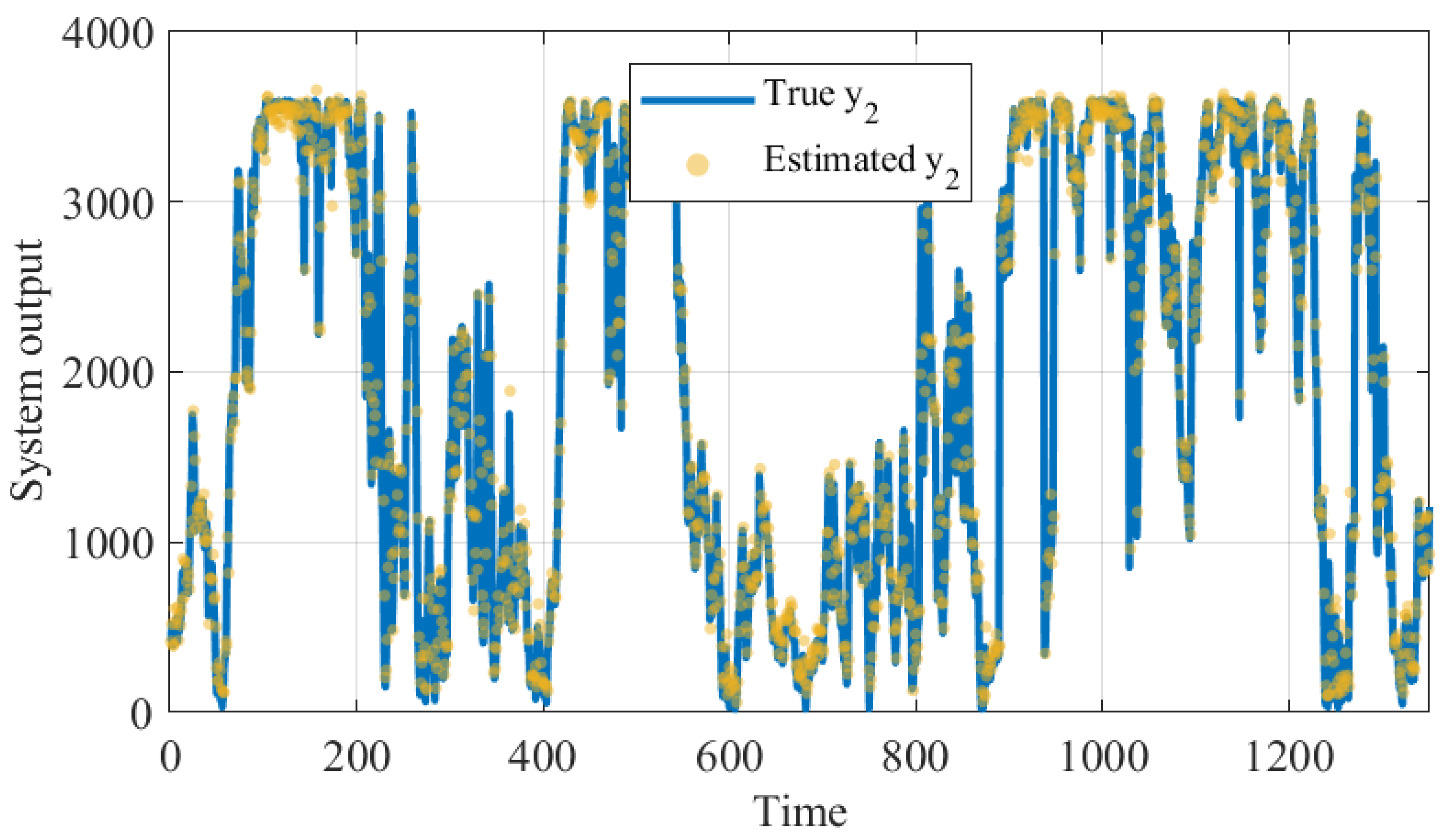
Figure 6 presents a comparison between the true output
and the estimated output
, where the blue line represents the true output and the yellow dots represent the estimated outputs. The proposed algortihm accurately tracks the actual power output throughout the entire time horizon, demonstrating the effectiveness of the identification strategy.
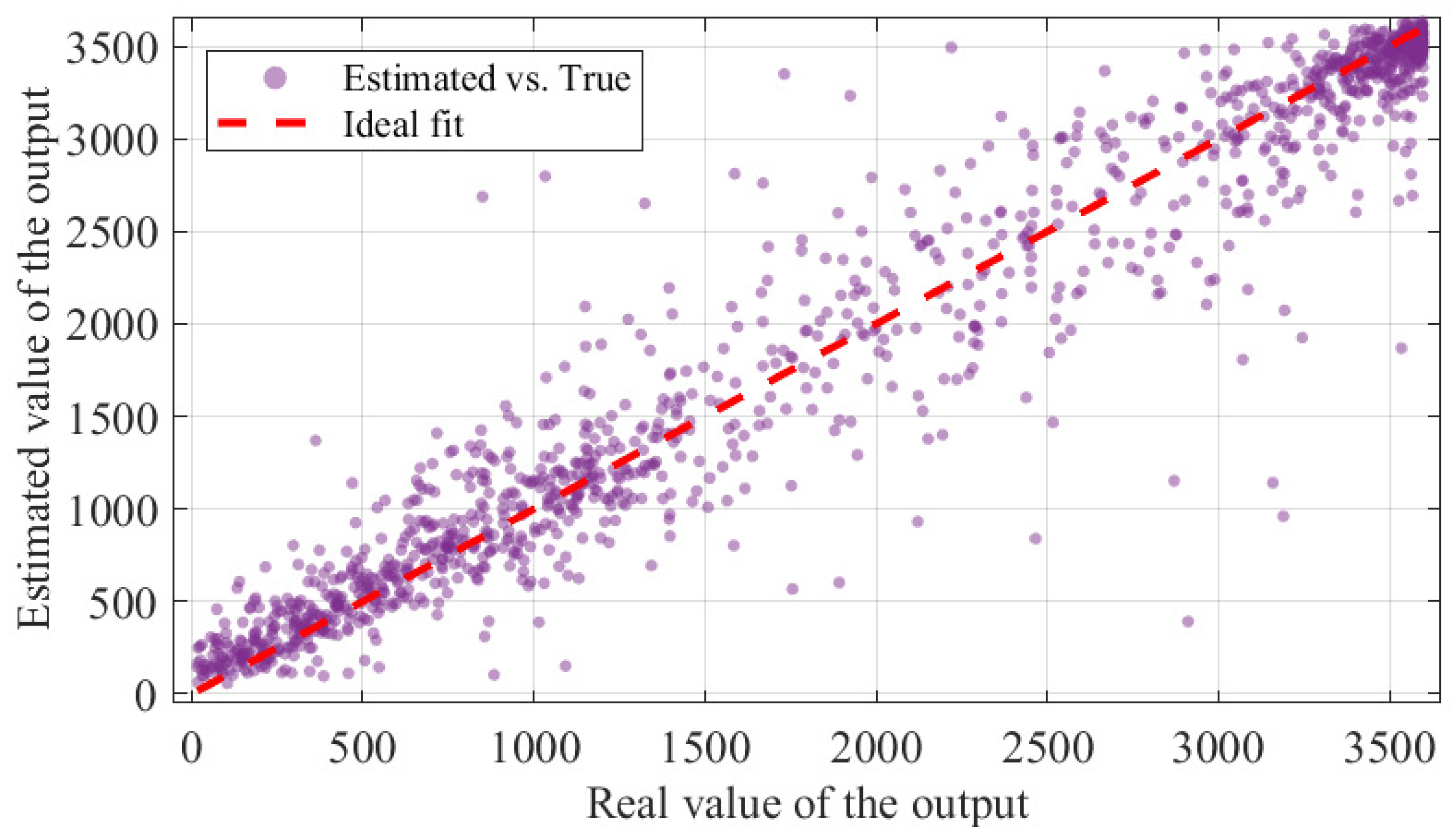
To further assess the estimation accuracy,
Figure 7 presents the scatter plot of estimated versus true values, where the blue line represents the true output and the yellow dots represent the estimated outputs. Most points lie close to the diagonal line, indicating a strong linear relationship between the predicted and actual outputs, with a correlation coefficient of 0.9676.
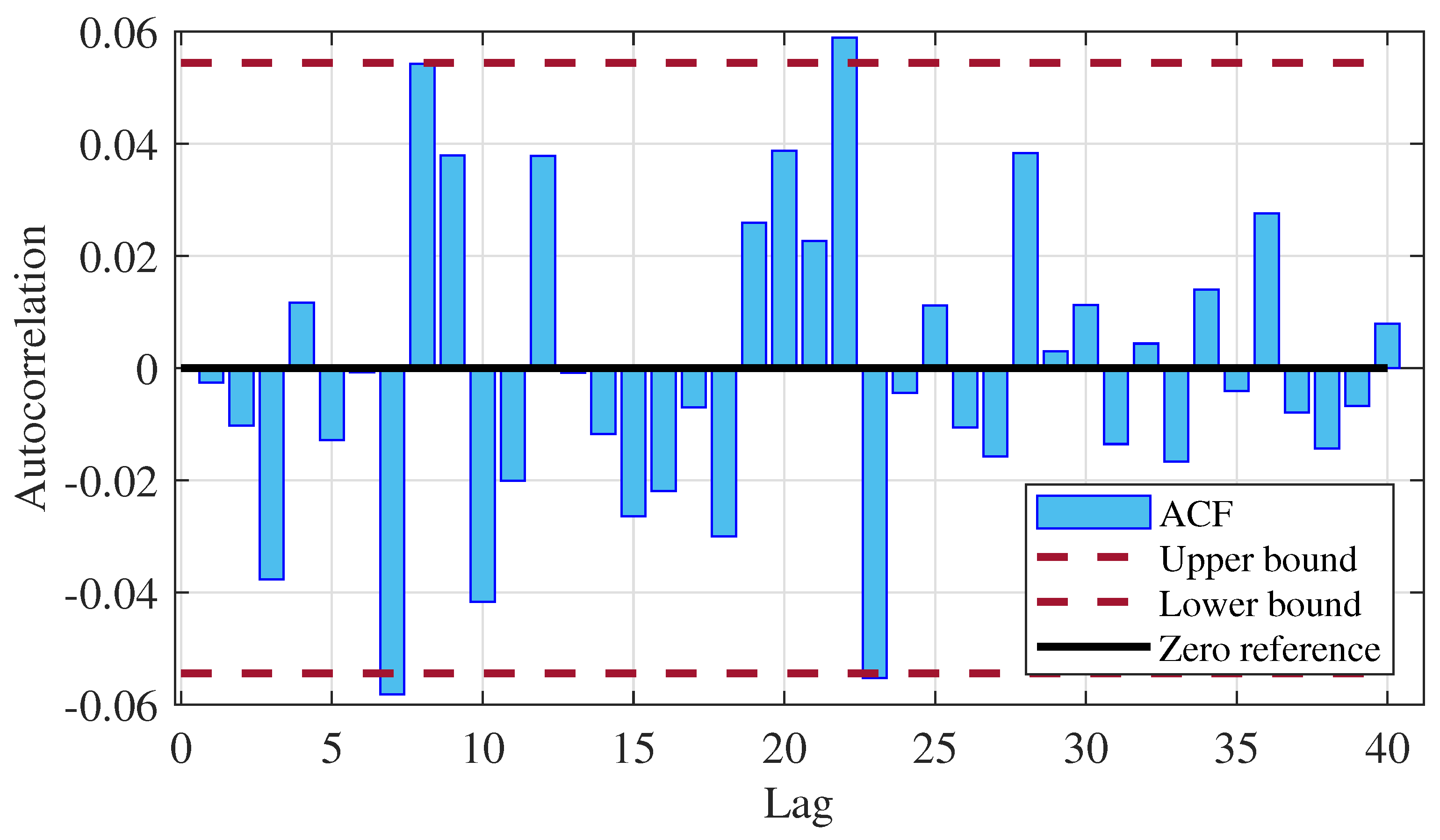
Figure 8 shows the autocorrelation function (ACF) of the residuals, where the blue bars represent the sample autocorrelations at different lags, the red dashed lines indicate the 95% confidence bounds, and the black solid line is the zero reference. The residuals exhibit no significant autocorrelation beyond the confidence bounds, supporting the whiteness of the residual sequence. The Ljung–Box test yields a
p-value of 0.2435, which is greater than the significance level of 0.05, confirming that the residuals are white noise.
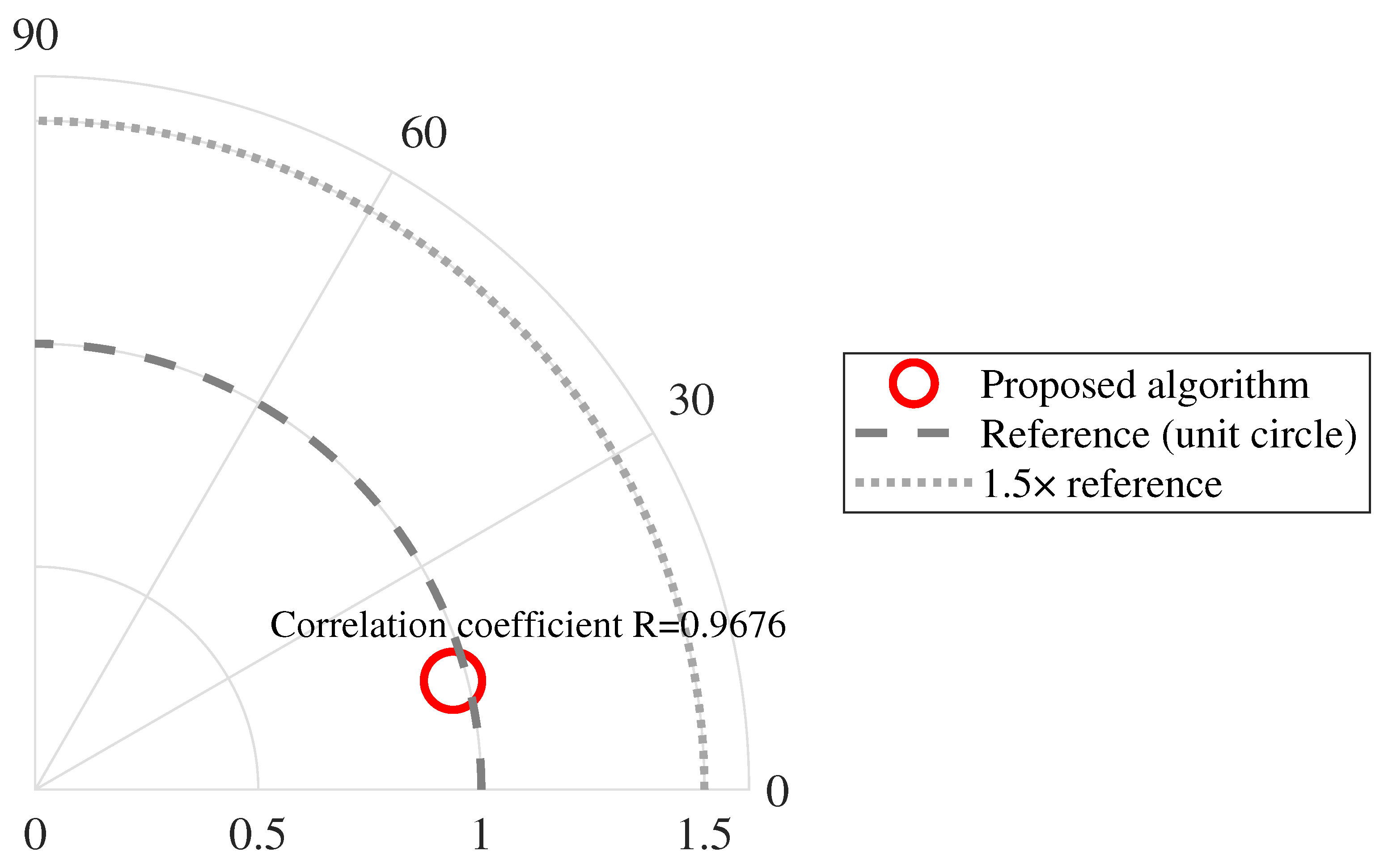
Figure 9 presents the Taylor diagram, which provides a visual summary of the model performance. The Taylor diagram uses polar coordinates, where the azimuthal angle represents the correlation coefficient and the radial distance represents the standard deviation ratio. In the diagram, the red circle represents the proposed algorithm, the black dashed line is the reference unit circle, and the black dotted line indicates the 1.5× reference radius. The point representing the predicted output lies very close to the reference point on the unit circle, with a correlation coefficient of 0.9676 and a standard deviation ratio of 0.9678, further confirming the high accuracy of the proposed identification method.
The numerical error metrics are summarized in
Table 5. The coefficient of determination (
) measures the proportion of the variance in the output that is explained by the model, indicating the overall goodness of fit. The correlation coefficient (
R) quantifies the linear relationship between the predicted and true outputs, with values close to one indicating strong agreement. The normalized root mean square error (NRMSE) is calculated with respect to the data range and provides a scale-independent measure of prediction accuracy, where lower values indicate better performance. The Ljung–Box test is applied to the residuals to check for whiteness; a
p-value greater than 0.05 indicates that the residuals are uncorrelated and the model adequately captures the system dynamics.
Based on the simulation results of the wind power system, the following conclusions can be drawn.
The correlation analysis-based least squares method successfully estimates the linear module parameters. The poles of the identified linear system are 0.7680 and 0.1318, both with magnitudes less than one, confirming that the linear module is stable. This stability is essential for reliable long-term prediction and control of the wind power system.
The Levenberg–Marquardt algorithm converges within 18 iterations with a damping parameter of , demonstrating fast convergence properties. This makes the LM algorithm well-suited for the parameter estimation of nonlinear systems.
The proposed hierarchical identification strategy achieves high prediction accuracy. The coefficient of determination () indicates that the model explains over 93% of the variance in the output, and the correlation coefficient () confirms a strong linear relationship between the predicted and true outputs. These results demonstrate that the proposed method effectively captures both the nonlinear and dynamic characteristics of the wind power system.
The Ljung–Box test yields a p-value of 0.2435, which is greater than the significance level of 0.05. This indicates that the residuals are white noise and exhibit no significant autocorrelation, confirming that the model adequately captures the system dynamics without leaving systematic information in the residuals.
The NRMSE with respect to the data range is 9.11%, meaning that the average prediction error is less than one-tenth of the full output range. This relatively low error, combined with the high value, further confirms the effectiveness and practical applicability of the proposed method for real-world wind power system identification.