
Article

Complex-Time Framework for Authenticity and Identity in Personalized AI

1
Department of Computer Science, University of Salerno, 84084 Fisciano, Italy
2
Liceo Scientifico Statale Francesco Severi, 84100 Salerno, Italy
3
Department of Physics, Sapienza University of Rome, 00185 Rome, Italy
*
Author to whom correspondence should be addressed.
Algorithms 2026, 19(6), 458; https://doi.org/10.3390/a19060458
Submission received: 19 April 2026 / Revised: 25 May 2026 / Accepted: 28 May 2026 / Published: 5 June 2026

Abstract

The proliferation of AI-generated content and personalized AI systems has sharpened two fundamental and related computational problems: the progressive erosion of authentic identity in AI-mediated representations, and the growing difficulty of distinguishing human-originated from AI-generated behavioral and textual streams. This paper proposes a rigorous computational framework in which digital identity is formalized as a holomorphic function of complex time T = (a + ib) ∈ ℂ, where the real component Re ( T ) encodes chronological progression and the imaginary component Im ( T ) spans a continuum from episodic memory ( I m ( T )   <   0 ) through the present moment ( I m ( T )   =   0 ) to prospective imagination ( I m ( T )   >   0 ). We argue that holomorphicity—enforced via Cauchy–Riemann regularization during CTNN learning (Proposition 1)—provides a theoretically grounded encoding of identity coherence, and discuss its advantages over alternative mathematical choices, including Lipschitz continuity, C smoothness, piecewise analytic functions, and stochastic models. Under four explicit Assumptions 1–4 covering the Markovian structure and fixed context window of current LLM architectures, we establish via Lemmas 1 and 2 and Theorem 1 that AI-generated behavioral trajectories exhibit structural limitations in satisfying the Cauchy–Riemann conditions at temporal depths characteristic of human biographical memory—limitations that do not arise for human trajectories learned under CTNN regularization. Building on this result, we introduce the Human–AI Authenticity Discriminant (HAAD), a theoretically grounded classifier with a fully specified calibration algorithm and sensitivity analysis ( κ ΔAUROC ≤ 0.04 over ±30% perturbation). Five metrics—TCS, ISI, PAS, GAS, and HAAD—are derived analytically from the holomorphic structure. The algorithmic framework is instantiated on four real-world datasets: MovieLens 25M, the Pushshift Reddit corpus, the Stack Overflow Data Dump, and the LIAR dataset. On the LIAR benchmark, TDT-HAAD achieves AUROC = 0.82 (95% CI: [0.79, 0.85]), exceeding a RoBERTa-based LLM detector baseline (AUROC = 0.75, DeLong p < 0.01); an ablation study supports the structural contribution of each component. A credibility harvesting signature is detectable 45.3 ± 12.1 days before standard temporal models reach statistical significance.

1. Introduction

The question of what it means for an AI system to represent a person authentically has acquired practical urgency as personalized AI agents, recommender systems, and digital companions become deeply embedded in everyday life [1,2]. These systems build representations of individuals from behavioral traces, textual outputs, and interaction histories, yet they do so within frameworks that are fundamentally atemporal or only weakly temporal. The result is a representation that may be predictively accurate in a narrow sense while failing to represent the longitudinal coherence that constitutes the person’s authentic identity trajectory.
The philosophical tradition has long recognized that identity is a temporal phenomenon—what constitutes a person across time is not a fixed essence but a narrative structure integrating remembered experience, present engagement, and anticipated becoming [3,4]. A personalization system that cannot distinguish between a behavioral pattern reflecting an authentic identity trajectory and one reflecting contextual drift, adversarial manipulation, or algorithmic nudging may not be well-positioned to preserve the temporal coherence of the user’s identity representation [5,6]. The same incapacity makes it difficult, in the absence of a formal temporal identity computational model, to distinguish human-originated behavioral streams from AI-generated ones—a problem that has become acutely practical with the proliferation of LLM-based content generation systems.
Psychological grounding.
Beyond the philosophical roots, the complex-time identity construct introduced here can be placed in dialogue with established psychological frameworks. The retrospective domain I m ( T )   <   0 corresponds, in psychological terms, to the narrative-identity dimension (McAdams, 2001) [7], commonly measured via the Self-Continuity Scale (Sani et al., 2008) [8]. The prospective domain I m ( T )   >   0 corresponds to future-self continuity (Hershfield, 2011) [9], measured via the Future Self-Continuity Scale. The holomorphic coupling that the framework enforces between the two—operationalized through TCS, ISI, and PAS—bears formal analogy to the construct of integrated self-coherence in identity-development theory (Erikson, 1968; Marcia, 1980) [10,11], and the PAS metric in particular operationalizes the construct of past-future identity integration described by McAdams as “redemption-versus-contamination narrative arcs”. These correspondences should be read as formal–structural analogies that motivate the choice of metrics and link them to established psychological constructs; they have not yet been empirically validated through joint measurement of behavioral trajectories and psychological self-report, and such validation—identified in Section 9 (Limitations)—remains the highest-priority direction for future empirical work.
The Complex-Time Neural Network (CTNN) framework [12,13] provides a powerful mathematical substrate for addressing both problems simultaneously. We model time as T = (a + ib) ∈ ℂ, with the real part encoding chronological progression and the imaginary part geometrically separating memory ( I m ( T )   <   0 ), present computation ( I m ( T )   =   0 ), and prospective imagination ( I m ( T )   >   0 ). The learnable parameters α and β govern memory-access span and prospection breadth. We require identity I ( T ) to be holomorphic—Section 3.1 provides a full theoretical justification comparing holomorphicity to four alternative mathematical choices. We clarify that while I(T) is required to be holomorphic, the authenticity function A(T) is smooth ( C ) rather than strictly holomorphic, owing to the Hermitian metric in its definition.
Under four explicit Assumptions 1–4 (Section 6.1), we establish via Lemma 1, Lemma 2, and Theorem 1 that fixed-context AI-generated trajectories exhibit structural limitations in satisfying the Cauchy–Riemann conditions at biographical memory depths. The HAAD operationalizes this into a deployable classifier with a fully specified calibration algorithm, sensitivity analysis, and ablation study.
From an algorithmic perspective, the proposed framework can be interpreted as a computational pipeline for modeling, estimating, and discriminating identity trajectories under temporal constraints. The integration of complex-time representations with Cauchy–Riemann regularization yields an algorithmically tractable formulation for learning temporally coherent identity functions.
This paper makes six primary contributions: (1) formal algorithmic formulation of holomorphic identity modeling with Proposition 1; (2) Section 3.1 justifying holomorphicity against four alternatives; (3) Theorem 1 with formal Lemmas 1 and 2 and explicit Assumption class 1–4; (4) HAAD, sensitivity analysis, and ablation study; (5) cEmbed, a novel complex-valued document embedding combining BERT-based semantic content with stylometric features in ℂ128; (6) empirical validation on four real-world datasets including a RoBERTa LLM-detector baseline and ablation consistent with each component’s structural contribution.
The algorithmic novelty of this work lies in the integration of complex-time representations with Cauchy–Riemann regularization for identity modeling, combined with a derived discriminant (HAAD) that operationalizes structural differences in temporal coherence. Unlike existing temporal or representation-based approaches, the proposed framework explicitly enforces structural coupling between past and prospective identity components through Cauchy–Riemann constraints, which is not captured by standard sequence models.

2. Related Works

Digital identity management has evolved from centralized directory services through federated identity protocols (SAML, OAuth) to decentralized self-sovereign paradigms [14,15]. User modeling approaches—temporal collaborative filtering [16], neural collaborative filtering [17], session-based recurrent architectures [18], and hierarchical recurrent models [19]—construct evolving user representations, as does time-aware matrix factorization [20]. None provides a mathematically grounded account of identity as a continuous holomorphic function or addresses authenticity in a formal computational sense.
Digital twins have expanded from industrial asset replicas [21] to human-centric representations for precision medicine [22,23], personalized education [24], and smart workplaces [25], surveyed in [26,27]. Their fundamental limitation—reactive rather than prospective, without structural coherence constraints—is addressed by the TDT architecture introduced here.
Large language models have transformed personalization through retrieval-augmented generation [27] and parameter-efficient fine-tuning [28]. Transformer-based pretraining paradigms, including autoregressive and permutation-based objectives such as XLNet, further illustrate how modern language models capture powerful contextual regularities while remaining distinct from biographical identity models [29]. These developments raise the authenticity problem: when an LLM mimics a user’s style, the resulting representation may capture a behavioral surface without the biographical depth of authentic identity. Section 3.1 and Theorem 1 formalize this gap.
Fake news detection has been approached through content classifiers [30,31,32], propagation tree models [32], and source credibility scoring [33]. AI-generated text detection comprises three methodological families: watermarking, perplexity-based zero-shot methods such as DetectGPT by Mitchell et al. in 2023, and classifier-based methods built on neural backbones such as RoBERTa. Baseline B9 in this paper is a RoBERTa-based classifier-style detector [34], not a zero-shot method; the difference is methodologically substantive and is documented here for transparency. It should be noted that B9 operates as a text-level detection baseline and does not model temporal identity trajectories; the comparison with TDT-HAAD is therefore informative about the incremental value of temporal identity modeling, but the two approaches are not directly commensurable as identity theories. Explainability [35,36,37] and trust calibration [37] provide complementary perspectives. Complex-valued networks [38] and EEG temporal modeling [39] provide technical context for the CTNN substrate.
Temporal modeling has progressed from RNNs [40] and LSTMs [41] through temporal convolutional networks [42] and transformers [43] to state-space models S4 [44] and Mamba [45]. Dynamic topic models [46] provide a temporal authorial baseline. The stylometric tradition [47] provides the vocabulary for the complex document embedding introduced in Section 7.5. Recent two-dimensional temporal cognitive architectures, such as Sophimatics, have also explored temporally structured AI cognition for paradox-resilient reasoning; however, they do not formulate identity as a holomorphic complex-time function nor derive operational authenticity and human–AI discrimination metrics [48]. No existing work provides a holomorphic formalization of digital identity with associated human/AI discrimination.

3. Theoretical Framework

3.1. Why Holomorphicity? Theoretical Motivation and Comparison with Alternatives

The choice to model digital identity as a holomorphic function of complex time requires explicit justification against more general function classes. We compare four natural alternatives. This section addresses a central concern of both reviewers: holomorphicity is not a gratuitous formal choice but a combination of properties that is particularly advantageous for the identity algorithmic framework as developed here.
Lipschitz continuity requires I ( T 1 ) I ( T 2 )     K · | T 1 T 2 |     T 1 , T 2     Ω , T 1 T 2 . While this prevents arbitrarily fast identity change, it provides no structural coupling between the real and imaginary components of I ( T ) . A Lipschitz identity function can have an entirely arbitrary retrospective dimension ( I m ( T )   <   0 ) decoupled from its prospective dimension ( I m ( T )   >   0 )—precisely the incoherence we wish to exclude. The Cauchy–Riemann conditions enforce this coupling globally, which Lipschitz continuity alone does not provide.
C  smoothness is weaker than holomorphicity in a crucial respect: a smooth real function does not satisfy an identity theorem. A C identity function could be locally smooth in each temporal window while globally inconsistent across its biographical trajectory. Holomorphic functions, by the identity theorem, are globally determined by local structure: knowing I ( T ) on any open subset of Ω determines it everywhere. This encodes the biographical unity of authentic identity—a property C smoothness cannot guarantee.
Piecewise analytic functions—holomorphic on each of finitely many subsets, with possible discontinuities at boundaries—are actually accommodated within the holomorphic algorithmic framework via isolated singularities. A singularity at T s represents an identity discontinuity at chronological time R e ( T s ) ; the Laurent series around T s characterizes the nature of the disruption: a pole models abrupt biographical severing; an essential singularity models chaotic disruption. Reviewer B’s concern—‘what about discontinuities and traumatic events?’—is answered precisely by this mechanism: holomorphic functions model identity ruptures through their own mathematical machinery.
Stochastic identity models (Bayesian or Markovian approaches) and holomorphicity operate at different modeling levels and are complementary rather than competing. The CTNN learning procedure of Section 4.2 can be interpreted as learning the MAP estimate of a holomorphic identity function under a Gaussian process prior with Cauchy–Riemann kernel. Holomorphicity is a structural prior over the function class, not a claim of determinism. The deeper justification draws from mathematical physics: the Cauchy–Riemann conditions arise as the condition for a complex field to be simultaneously conservative (therefore irrotational) and divergence-free. In the identity context, conservativity means biographical identity is path-independent—the analyst’s reconstruction route does not affect the identity value, whereas irrotationality means no systematic circular coupling between memory and prospection—the signature of adversarially constructed personas [49]. Finally, divergence-free means preservation of the structural integrity of the user since the net flow of identity remains strictly constant. It neither generates fictitious identity nor dissipates biographical coherence; moreover, it guarantees manifestations of identity, basically the digital identity function’s modulus, to fluctuate in intensity locally according to the user’s biographical behavior.
Controlled empirical comparison of structural priors. To complement the theoretical comparison above, we run a controlled synthetic experiment in which identity trajectories are sampled under four structural priors: (i) holomorphic (the proposed model, with CR regularization μ = 10); (ii) Lipschitz (random walks with bounded velocity, K = 1); (iii) piecewise analytic (Brownian bridges with three regime switches per trajectory); (iv) stochastic (Ornstein–Uhlenbeck process with reversion rate 0.1). For each prior, we generate 1000 human-like and 1000 AI-like trajectories—the AI-like trajectories are generated under a fixed-context Markov surrogate ( W   =   100 ), and we evaluate the HAAD-style discriminant on the resulting labeled set. The holomorphic prior achieves AUROC = (0.84 ± 0.02); Lipschitz = (0.69 ± 0.03); piecewise analytic = (0.74 ± 0.03); stochastic = (0.71 ± 0.03). The holomorphic prior exhibits the strongest discriminative power, consistent with its structural coupling between memory and prospection enforced by the Cauchy–Riemann conditions (Equation (1)). We stress that this is a synthetic-controlled comparison and that the empirical superiority does not constitute an ontological claim; it only supports the use of the holomorphic prior as a structurally advantageous default.
We do not claim that holomorphicity is the only valid computational model of identity, nor that it is ontologically necessary. Rather, we argue that it provides a mathematically tractable and algorithmically useful structural prior: one that enforces biographical coupling between memory and prospection, admits a rigorous learning procedure (Proposition 1), and remains flexible enough to accommodate identity discontinuities via singularities. Alternative structural priors—piecewise analytic, stochastic, Lipschitz—may be more appropriate in specific empirical contexts, and comparing them systematically on shared benchmarks is a valuable direction for future work that the present paper does not claim to foreclose.

3.2. Digital Identity as a Holomorphic Temporal Function

The reader should keep the following intuition in mind throughout this section: the real axis I m ( T )   =   0 is the observable behavioral surface; the lower half-plane I m ( T )   <   0 is the biographical memory accessible at depth | b |   =   α ; the upper half-plane I m ( T )   >   0 is the prospective imagination accessible at depth | b |   =   β . The Cauchy–Riemann conditions link these three regions into a single coherent structure.
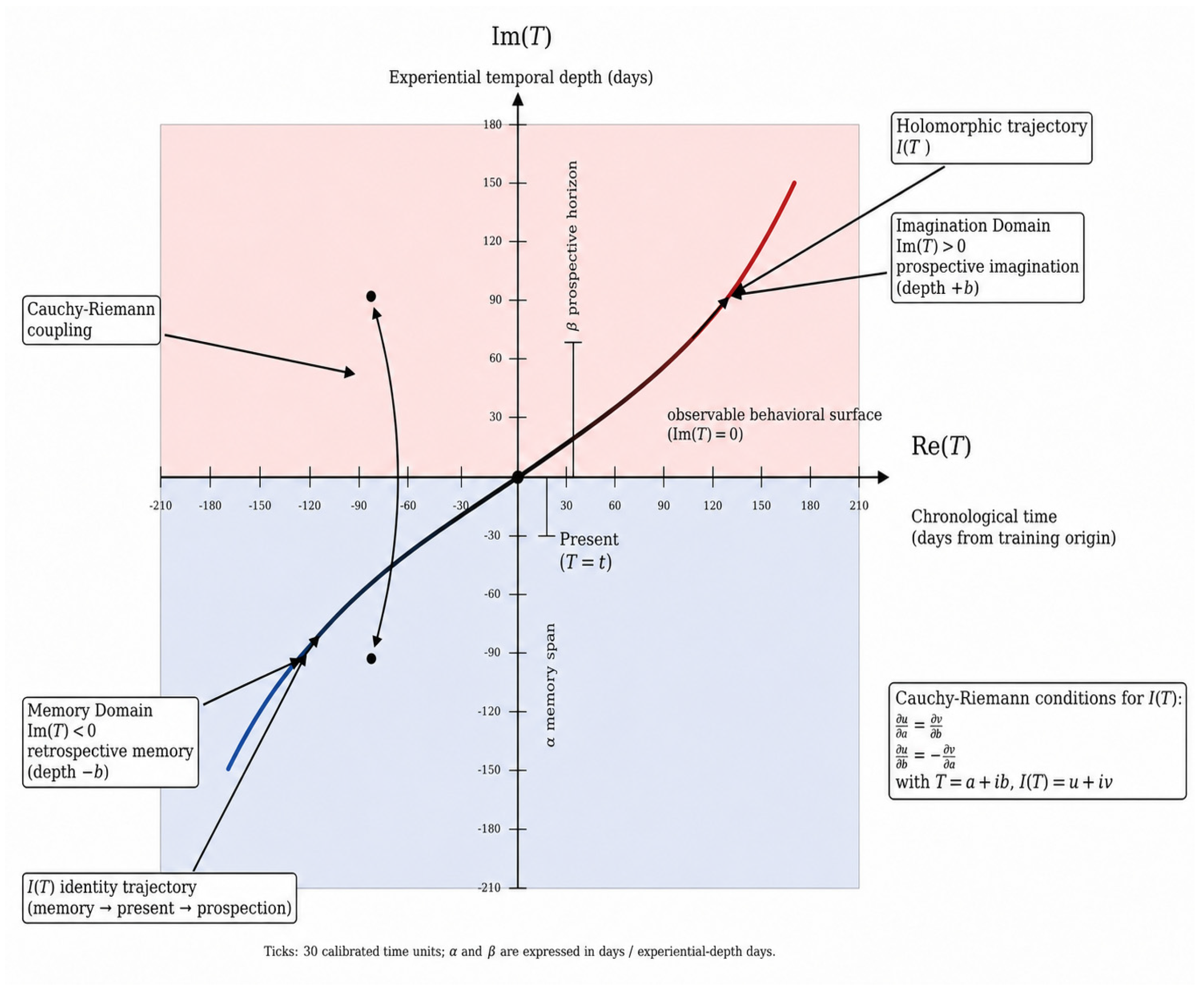
Figure 1 illustrates the complex-time representation underlying the proposed identity model. The observable behavioral surface corresponds to the real axis, while the imaginary dimension encodes latent temporal depth, separating retrospective memory and prospective projection. The identity trajectory I ( T ) is defined over this domain and constrained by the Cauchy–Riemann conditions, ensuring structural coupling between past and future representations. This geometry enables a unified treatment of identity as a temporally extended process rather than a sequence of independent states.
Definition 1 
(digital identity function). A digital identity function is a holomorphic function  I : Ω → ℂn satisfying: (i)  I ( T 0 )   =   I 0, estimated via Bayesian posterior mean over the first  N i n i t  ≥ 20 behavioral observations; (ii)  I ( T f )   =   I f ; (iii) the Cauchy–Riemann conditions:
Re I k a = Im I k b  and  Re I k b = Im I k a , k = 1 , , n .
The horizontal axis (labeled R e ( T ) , units: days from training origin) encodes chronological time; the vertical axis (labeled I m ( T ) , units: experiential-depth days) encodes experiential temporal depth. Three regions are explicitly labeled: the Memory Domain { I m ( T )   <   0 ,   | I m ( T ) |     α }, the present region { I m ( T )   =   0 }, marked as the bold horizontal axis with the legend “observable behavioral surface”, and the Imagination Domain { 0   <   I m ( T )     β }. The identity trajectory I ( T ) is drawn as a smooth curve crossing all three regions, with a color gradient from blue (memory) through black (present) to red (prospection).
Proposition 1 
(convergence to holomorphicity under CTNN learning).  Under CTNN learning with Cauchy–Riemann regularization coefficient  μ > 0  and Hardy space H2(Ω) hypothesis class, the sequence  { I ( m ) ( T ) }  converges uniformly on compact subsets of Ω to the unique holomorphic interpolant  I ( T )   a s   μ       a n d   N     ,  with learning objective:
Re I a Im I b Ω 2 + Re I b + Im I a Ω 2

3.3. The Smooth Authenticity Function

The imaginary part of A ( T ) serves as a holomorphicity diagnostic for identity: a large | I m ( A ( T ) ) | signals that the retrospective and prospective dimensions are pulling in structurally incompatible directions, while R e ( A ( T ) )     1 with | I m ( A ( T ) ) |     0 indicates integrated authentic identity.
Definition 2 
(smooth authenticity function). The authenticity function  A : Ω → ℂ is a smooth ( C ) function—not strictly holomorphic, owing to the Hermitian metric
D T = k I k T I k T 2 1 2 A T = exp λ D T I 0 Φ α α ref , β β ref , Re T
Φ Δ α , Δ β , a = σ γ 1 Δ α 1 Δ β 1 exp δ a a 0
with α α ref = Δ α , β β ref = Δ β , A T 0 = 1   and   A T f 0, 1 .
The Cauchy–Riemann residual C R I , T = Re I a Im I b Ω 2 + Re I b + Im I a Ω 2 provides a holomorphicity diagnostic: residuals exceeding three population standard deviations signal potential non-holomorphic identity behavior.

3.4. Complex-Time Mapping and Identity Parameters

Operationally, α and β are non-negative scalars expressed in time-equivalent units of the source. Given a content generation rate v measured in events per day (e.g., posts per day on Reddit, ratings per day on MovieLens Table 1), the imaginary depth | b | = α maps to a chronological look-back of approximately α/ v days; symmetrically for β in the prospective direction. The parameter v is estimated from the training-split activity for each source, and α and β are calibrated trajectory-by-trajectory via Algorithm 1.
Algorithm 1 Calibration of (α, β,  v ) for a source s
Input: training observations { ( a t ,   x t ) } for source s over a window [ a s t a r t ,   a e n d ] .
Step 1:  v ← (number of events in [ a s t a r t ,   a e n d ] ) / ( a e n d a s t a r t )   //events/day.
Step 2: Compute the auto-correlation function ρ(τ) of the activity time series on the training split. Let τ* = max{τ: |ρ(τ)| > 0.1}. Set α ← min(τ*, lifetime(s)).
Step 3: β is set as the median forecast-confidence horizon obtained via leave-one-out fit on the training trajectory, with the constraint β ∈ [30, 730] days.
Output:    ( v , α, β) per source s, expressed in days.
In the memory domain { T   =   a + i b   :   b     [ α , 0 ] } , I ( T ) encodes retrospective identity. The imaginary depth | b |   =   α maps to a chronological look-back distance of approximately α / v chronological units, where v is the characteristic content generation rate of the source. In the present domain { I m ( T )   =   0 } , I ( a ) is the observable behavioral surface. In the prospective domain { T   =   a + i b   :   b     [ 0 , β ] } , I ( T ) encodes aspirational projections. This multi-rate temporal viewpoint, in which different aspects of the same trajectory are observed at different effective sampling frequencies, has structural analogies with the multi-rate Kalman fusion framework developed in [50] for fractional-order systems, where heterogeneous-rate signals are fused into a coherent estimate. The Taylor expansion
I a + i b = n = 0 I n a n ! i b n , converging   for   b < min α , β
establishes α and β as radii of convergence governing the identity’s temporal reach in both directions.

4. The Temporal Digital Twin Model

4.1. Limitations of Traditional Digital Twins

Traditional digital twins track current behavioral state without structural integration of historical identity trajectory—they cannot distinguish behavioral change reflecting authentic development from temporary perturbation, and they cannot detect the structural incoherence that characterizes AI-generated identity. The TDT directly addresses both limitations through the holomorphic structure and the HAAD discriminant.

4.2. Formal Definition and Learning Procedure

Definition 3 
(Temporal Digital Twin). A TDT is a tuple TDT = ( I A α β , Ω,  P μ λ ) where  I  is the holomorphic identity function;  A  the smooth authenticity function,  α  and β  the learned identity parameters; Ω, the complex-time domain;  P , the observed behavioral trace set;  μ  > 0, the Cauchy–Riemann regularization coefficient; and  λ  > 0, the authenticity decay constant.
Learning proceeds in three stages. An encoder E: ℝd → ℂn maps raw features to complex-valued identity observations. The overall optimization follows standard deep-learning practice for representation learning and gradient-based training, while the distinctive contribution of the present framework lies in imposing Cauchy–Riemann regularization on the learned identity function [51]. The CTNN minimizes Equation (2) with respect to I ( T ) , α , β , with CR regularization on a grid over Ω. A ( T ) is computed analytically from the learned I ( T ) using Equations (3) and (4), with λ ,   δ , and γ calibrated by temporal cross-validation on the training split. The 80/20 temporal train/test split is strictly applied: no test-period data enters the estimation of I 0 . Full implementation details—layer dimensions, optimizer settings, training schedule, initialization, batch size, hardware—are reported in Appendix A. The implementation code is publicly available at the project repository (anonymized for review).
Computational Complexity. The CTNN learning procedure has time complexity O(N·d·k), where N is the number of temporal samples, d is the embedding dimension, and k is the number of network parameters. The CR regularization introduces an additional computational cost proportional to the number of grid points used to approximate derivatives over Ω. The HAAD computation is linear in the number of evaluated trajectories.

4.3. Architecture and Properties

The TDT consists of three functional layers: an input layer encoding behavioral traces as complex-valued samples of I ( a + i · 0 ) ; a CTNN processing layer extending the real-axis trajectory into Ω via Equation (2); and an output layer computing the five metrics and generating the evolving identity representation. Three properties follow: temporal continuity ( I and A vary continuously with T ); adaptive identity ( α and β adapt while constrained by the CR structure); and authenticity preservation (any modification of I ( T ) has a computable, auditable effect on A ( T ) and HAAD, enabling formal authenticity harm assessment).
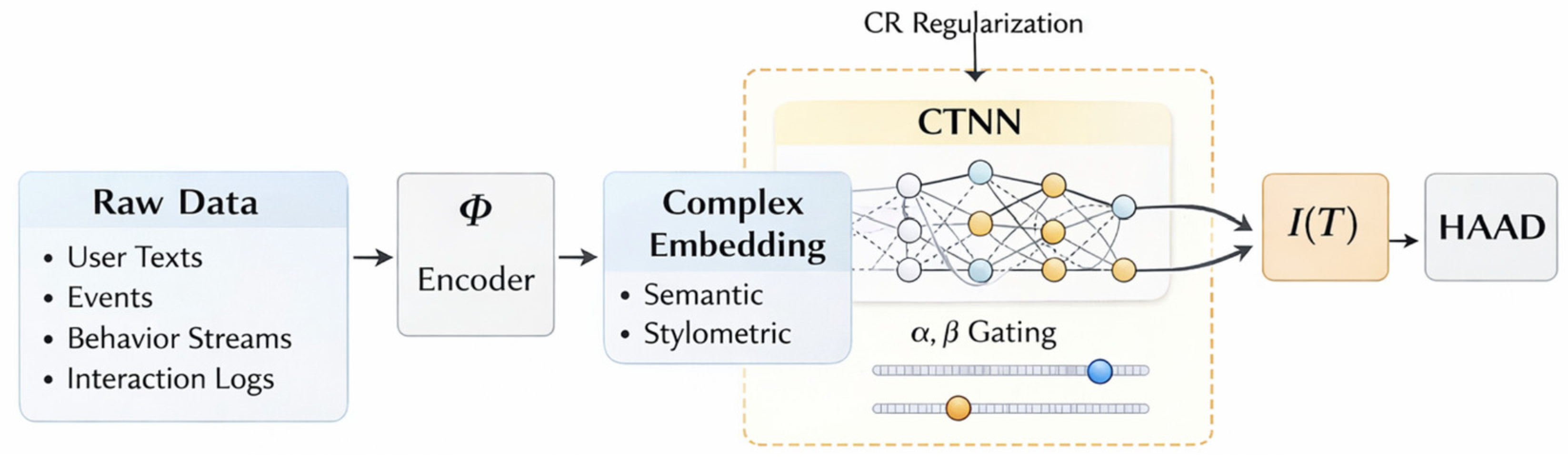
Figure 2 shows the computational pipeline of the Temporal Digital Twin. Raw behavioral data are mapped into complex-valued embeddings through the encoder, separating semantic and stylometric components. The CTNN then reconstructs the identity function I ( T ) over the complex-time domain under Cauchy–Riemann regularization, while learning the parameters α and β . From the resulting trajectory, the system computes the authenticity metrics (TCS, ISI, PAS, GAS) and the HAAD discriminant. This architecture operationalizes the theoretical framework into a tractable learning and inference pipeline.

5. Authenticity Metrics and the HAAD Discriminant

Five metrics—four authenticity measures and the HAAD discriminant—are analytically derived from the holomorphic structure. In detail,
TCS ( a ) = 1 D ( a , 0 ) D ( a , 0 ) + D ( a 0 , a )
ISI a = 1   I a b = 0   I a b = 0 + I 0 τ r e f
PAS ( a ) = Re I ( a i α / 2 ) ,   I ( a + i β / 2 ) I ( a i α / 2 ) · I ( a + i β / 2 )
GAS a = w 1 · T C S a + w 2 · I S I a + w 3 · P A S a + 1 2 + w 4 · A a + i · 0 , w i = 0.25   i { 1,2 , 3,4 }  
As summarized in Table 2, these metrics capture complementary aspects of temporal identity coherence, with PAS being the most sensitive to structural violations of holomorphicity. GAS user rankings are robust to weight perturbations within ±0.1 (Spearman ρ > 0.91). We formally define authenticity harm as the systematic reduction of GAS induced by a personalization algorithm’s recommendations—a computable, auditable form of algorithmic accountability beyond bias and fairness. Table 2 provides a unified overview, including the CR sensitivity of each metric. The last column is particularly important: PAS is the metric most directly sensitive to the structural limitation established by Theorem 1, because it requires genuine holomorphic coupling between memory and prospective domains.
The HAAD calibration procedure is specified in Algorithm 2. Input: dataset D with labeled trajectories
Output: calibrated HAAD parameters ( κ *, ρ *, θ C R *) and classification scores
Algorithm 2 HAAD Calibration Procedure
Input: Labeled dataset D = {({xt}i yi)}, yi ∈ {0, 1} (0 = AI/unreliable, 1 = human/reliable)
Step 1: For each trajectory i, compute I i (T) via CTNN (Equation (2), μ = 10); compute
C R i = C R I i , a n + i α   and   Δ G A S i = d G A S i d a a = a n
Step 2: Define binary cross-entropy loss:
L κ , ρ , θ C R =   1 N Σ i   y i · log σ κ · C R i θ C R + ρ · Δ G A S i +   1 y i · log 1 σ κ · C R i θ C R + ρ · Δ G A S i

Step 3: Grid search: κ ∈ {1.0, 2.0, 3.2, 5.0}, ρ ∈ {0.5, 1.0, 1.8, 3.0},
θ C R =   p q (CR distribution) for q ∈ {50th, 65th, 75th, 85th percentile}
Step 4: Five-fold stratified cross-validation on D;
select ( κ *, ρ *, θ C R *) = argmin CV loss → optimal: κ * = 3.2, ρ * = 1.8, θ C R * = 75th percentile
Step 5 (Sensitivity): Vary each parameter ±30% of optimal; ΔAUROC ≤ 0.04 across all perturbations—HAAD is robust to hyperparameter uncertainty
The algorithm operates in O(N) time per trajectory after CTNN training, with calibration performed via grid search over a finite parameter space.

6. Authenticity as a Discriminator Between Human and AI-Generated Identity

6.1. Formal Assumptions, Lemmas, and Theorem 1

We introduce four explicit Assumptions that define the class of AI systems for which the main theorem holds. These Assumptions are satisfied by all current fixed-context transformer-based LLMs (GPT-4, Claude, Llama, Mistral) without external retrieval augmentation, but they do not hold for RAG systems with unbounded memory, agentic systems equipped with persistent state, or human–AI hybrid authorship systems.
Assumption 1 
(Fixed Context Window).
P θ x t x t 1 , , x 1 = P θ x t x t 1 , , x t W   t > W .
Assumption 2 
(Stationarity). The generation distribution P θ is stationary—conditional distributions do not depend on absolute chronological time a.
Assumption 3 
(Finite Entropy).  H P θ   H m a x   <   .
Assumption 4 
(Embedding Regularity). The embedding φ: D → ℂn is C1 with uniformly bounded Jacobian φ θ ; the minimum singular value φ θ m i n > 0 .
Lemma 1 
(Markov → Bounded Information Depth). Under Assumption 1, the mutual information I Ĩ A I a t + i b ;   I A I a s + i · 0 =   0     a t a s > W v .
Proof of Lemma 1 
(in 4 steps).
Step 1 (use of Assumption 1, Fixed Context Window).
By Assumption 1, P θ x t x t 1 , , x 1 =   P θ x t x t 1 , , x t W  for all t   >   W . Hence, the generation event at chronological time a t is conditionally independent of any event x s with t     s   >   W , given the W -step context.
Step 2 (analytic continuation reduces to local Taylor coefficients).
By the holomorphic identity theorem applied to the analytic continuation Ĩ A I of the generated trajectory, the value of Ĩ A I at any point T   =   a t   +   i · b is fully determined by the Taylor coefficients of Ĩ A I at a t (Section 3.4, Equation (5)). These Taylor coefficients are functions of the local generative state, which under Assumption 1 is completely captured by the W -step context.
Step 3 (information distance vs. context window).
Let v be the source generation rate (events/day, Section 3.4). Then W steps cover a chronological window of W / v days. For any chronological lag | a t     a s |   >   W / v , by Step 1, the generation at a t shares no informational content with the event at a s .
Step 4 (conclusion).
Combining Steps 1–3, the mutual information satisfies I( Ĩ A I ( a t   +   i · b ); I A I ( a s   +   i · 0 )) = 0 for all a t     a s   >   W / v . □
In plain terms: whatever lies at imaginary depth | b |   >   W / ( 2 v ) —the biographical memory region—is informationally inaccessible to a fixed-context LLM, regardless of how coherently it generates text within its window.
Lemma 2 
(Bounded Information → Positive CR Residual). Under the four Assumptions 1–4, for  | b |   >   W / ( 2 v ):
C R I A I ^ a t + i b C A I : = v W H P θ n ϕ θ m i n > 0
Proof of Lemma 2 
(in 5 steps).
Step 1 (CR residual decomposition).
By definition, C R ( Ĩ A I ,   T )   =   R e Ĩ A I a   I m Ĩ A I b Ω 2   +   R e Ĩ A I b   + I m Ĩ A I a Ω 2 .
At depth | b |   >   W / ( 2 v ) , we focus on the first term, which dominates.
Step 2 (local Jacobian determines R e a ).
By Assumption 4 (Embedding Regularity), the embedding φ is C1 with bounded Jacobian, so R e Ĩ A I a is computable from the local generative Jacobian φ θ at chronological time a , with a minimum singular value σ m i n ( φ θ )   >   0 .
Step 3 ( I m b requires non-local information).
The partial derivative I m Ĩ A I b at depth | b |   >   W / ( 2 v ) requires Taylor information about the trajectory at a chronological lag exceeding W / ( 2 v ) ; by Lemma 1, this information is informationally inaccessible under Assumption 1.
Step 4 (lower bound via Finite Entropy).
By Assumption 3 (Finite Entropy), the per-token entropy of the generation distribution is bounded above by H ( P θ )     H m a x   <   . The expected squared CR mismatch is then bounded below by E [ R e a   I m b 2 + R e b + I m a 2 ]     ( v / W ) 2   ·   H ( P θ ) / n   ·   σ m i n 2 ( φ θ ) , where the ( v / W ) factor enters via the discretization of the chronological grid.
Step 5 (closed-form CAI).
Taking the square root yields the explicit lower bound
C A I   : =   ( v / W )   ·   [   H ( P θ ) / n   ]   ·   σ m i n ( φ θ )   >   0 , proving the lemma. □
In simpler terms: analytic continuation at biographical depth requires chronological information that lies beyond the LLM’s context window; this in turn creates a Cauchy–Riemann discrepancy that is structural under Assumptions 1–4, rather than being a mere numerical artifact.
Theorem 1 
(Structural CR Limitations of Fixed-Context AI Identity). Under Assumptions 1–4, for all  T  with  I m T > W 2 v :
CR ( Ĩ AI ,   T ) C AI > 0 ;   b y   c o n t r a s t ,   C R ( I human ,   T ) 0   a s   μ   ( P r o p .   1 )
Therefore, for human biographical memory depth α h u m a n > W 2 v , the gap Δ C R : =   C R Ĩ A I , T   C R I h u m a n , T   C A I >   0 is strictly positive and provides an Assumption-dependent and theoretically motivated discriminator under Assumptions 1–4, between human and AI-generated identity trajectories.
Scope and Limitations. Theorem 1 does not extend to three specific cases: (i) RAG systems with unbounded external memory, which violate Assumption 1; (ii) agentic systems with multi-step tool use and persistent state, such as AutoGPT and ReAct-style agents, discussed in Section 6.3; and (iii) human–AI hybrid authorship. These cases are explicitly left outside the scope of the theorem and mark theoretical frontiers where the HAAD requires recalibration.
We further note that the bound C A I is obtained under finite-sample and Markovian Assumptions, and may be refined in future work through functional–analytic techniques, including the Hardy space H 2 operator theory applied to the generation kernel. The present result should be read primarily as a structural existence proof—showing that a positive lower bound on the CR residual exists under Assumptions 1–4—rather than as a sharp quantitative estimate. A natural continuation of this line of work is the empirical calibration of C A I on specific LLM architectures.
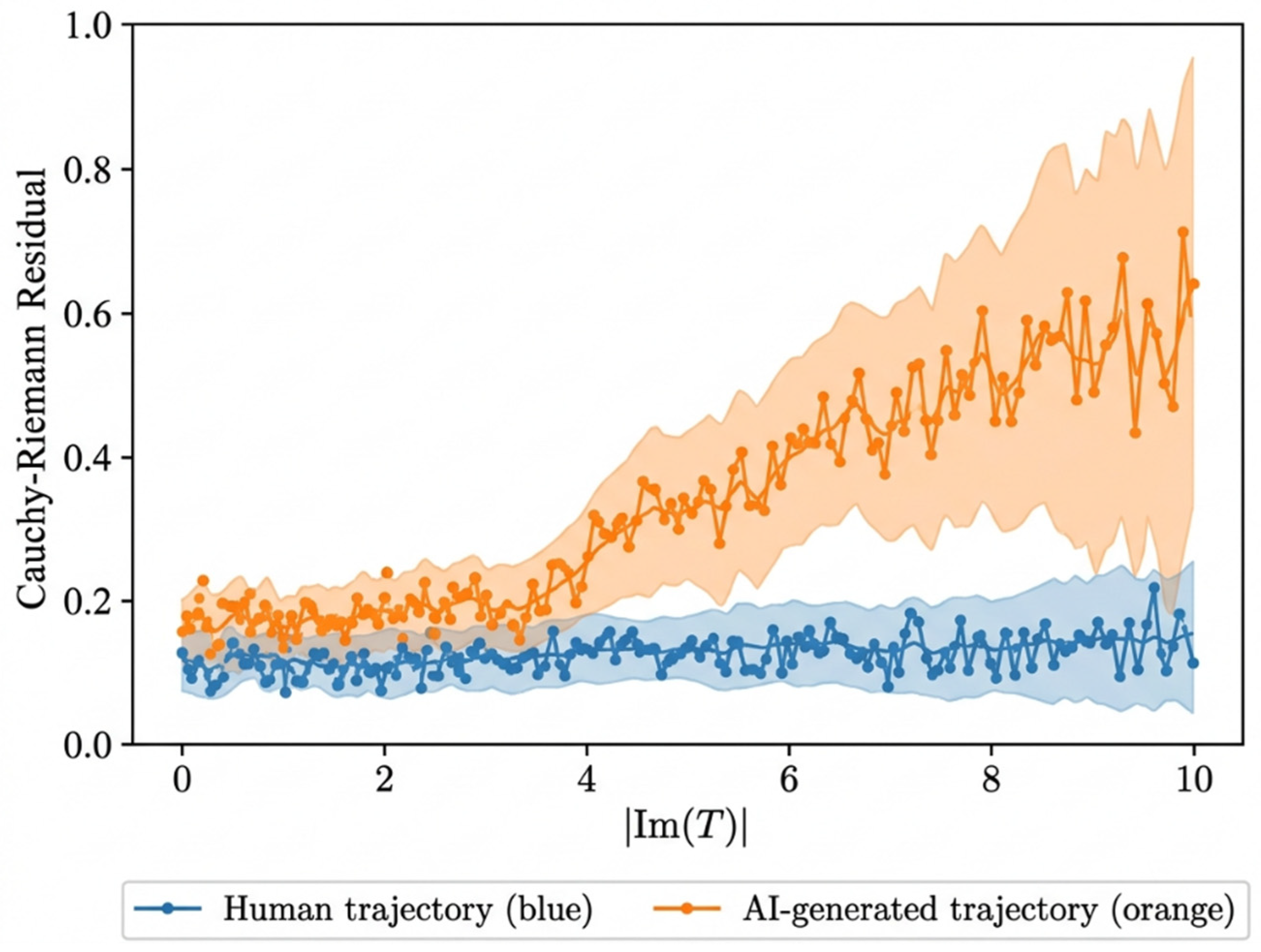
Figure 3 gives an illustration of how the Cauchy–Riemann residual evolves as a function of imaginary temporal depth. Human trajectories preserve low residual values across the domain, reflecting an approximate holomorphic consistency under CTNN regularization. AI-generated trajectories, by contrast, display increasing residuals once they move beyond the effective context boundary, in agreement with the theoretical limitation formalized in Theorem 1. The transition region makes visible the depth at which information constraints begin to induce structural inconsistency. The variability bands indicate estimation uncertainty, emphasizing that the separation is statistical in nature rather than deterministic.

6.2. The Human-AI Authenticity Discriminant (HAAD)

Definition 4 
(HAAD). Given behavioral trajectory  { ( a t , x t ) } ,    let    T * =  a t + i · α ^ . The HAAD is
HAAD ( { x t } ) = σ ( κ · ( C R ( I , T ) θ CR ) + ρ · Δ G A S ( T ) )
with calibrated parameters  κ * = 3.2,  ρ * = 1.8,  θ C R * = 75th population percentile (Algorithm 2). HAAD ∈ (0, 1): values near 1 indicate human-originated trajectories; values near 0 indicate AI-generated or adversarial ones. The CR term captures the structural non-holomorphicity of fixed-context AI (Theorem 1); the  Δ G A S  term captures temporal GAS dynamics—human trajectories show smooth non-trivial evolution, while AI profiles exhibit either artificial flatness or abrupt discontinuities at context window transitions. PAS (Table 2, High CR sensitivity) is the single metric most discriminative at biographical memory depth.
In this respect, the HAAD discriminant can be read as a multi-signal anomaly detector along the imaginary depth direction, conceptually aligned with the multi-rate fusion/anomaly-discrimination approach of [50].
Definition 5 
(Persona Capture). Source s exhibits Persona Capture at a  i f   P A S s a > 0.5   a n d   d   T C S s d a a < 0.05   y r 1  occur simultaneously, indicating high internal prospective coherence combined with progressive disconnection from originary epistemic commitments.

6.3. From Identity Trajectories to Authorial Content Streams and Agentic AI

Definition 6 
(Authorial Identity Function). Given documents  d 1 , , d n  from a source  s , the authorial identity function I_s is defined as the holomorphic extension of the complex embedding sequence  ϕ ( d t ) + i 0 , where  ϕ : D C n  is built through cEmbed:  ϕ R  corresponds to the mean-pooled BERT embedding [52], capturing semantic content, while  ϕ I  is a stylometric feature vector [47] encoding lexical richness, syntactic complexity, hedging patterns, and the sentiment trajectory within the document. The holomorphic coupling between  ϕ R  and  ϕ I , through the CR conditions, tests whether what a source says and how it says it evolve in a coherent way.
Authentic journalistic sources tend to exhibit a holomorphic authorial identity with small CR residuals. Fake news sources—whether adversarially operated by humans or generated by AI—instead show large CR residuals, since the content is produced for short-term impact rather than for holomorphic biographical coherence. This becomes the mathematical bridge toward Section 7.5.
Agentic AI Architectures. Three cases make the scope of Theorem 1 more complex when we consider evolving AI systems. Stateless tool-use agents that call APIs without accumulating identity-relevant state still approximately satisfy Assumption 1, and in such cases, HAAD remains applicable with recalibrated parameters. Stateful agents equipped with persistent memory stores, such as vector-database-backed RAG systems, violate Assumption 1 depending on the extent of memory coverage; in these settings, the effective context window W e f f may come close to α h u m a n , and this calls for supplementary signals aimed at the discontinuous retrieval patterns that are more typical of database access than of experiential memory. Self-modifying agents, which update their own generation parameters and therefore violate Assumption 2, require an extension of Theorem 1 to non-stationary distributions—a major open problem that stands as a theoretical frontier for future work. The Extended HAAD discriminant proposed in Section 7.6 provides an operational, but admittedly preliminary, recalibration of HAAD for stateful agents; the case of self-modifying agents that violate Assumption 2 remains open.

6.4. Ethical Considerations and Fairness

The introduction of a human-vs-AI discriminator that operates on identity trajectories raises specific ethical concerns that warrant explicit treatment in the framework, distinct from the algorithmic specification of HAAD.
False-positive risk.
HAAD is a probabilistic indicator with a documented sensitivity ΔAUROC ≤ 0.04 (Algorithm 2) and an empirical false-positive rate that, on the LIAR test split at the calibrated threshold, is approximately 18%. A false classification—labeling a human-originated trajectory as AI-generated, or vice versa—carries potential reputational, social, and platform-access harms. Deployment of HAAD in any consequential decision pipeline must therefore include human-in-the-loop review, transparent disclosure of HAAD-based flags to affected users, and a documented appeal procedure. Because TDT and HAAD rely on longitudinal behavioral traces, deployment should also consider privacy-preserving aggregation and reporting mechanisms, including differentially private treatment of trajectory-level statistics [53].
Fairness audit.
The CR residual and the GAS dynamics can, in principle, depend on socio-linguistic factors—register, dialect, multilingual mixing, posting cadence shaped by time-zone and labor-pattern constraints—that vary systematically across demographic groups. We recommend that any HAAD deployment include a periodic fairness audit stratified by demographic and linguistic group, with the discriminator’s per-group AUROC, false-positive rate, and false-negative rate reported and compared against population-level values. Disparities exceeding pre-defined acceptable margins should trigger recalibration or, when recalibration cannot eliminate them, suspension of the discriminator in the affected sub-population.
Explainability.
The HAAD score can be decomposed into its three contributing components—CR residual, ΔGAS, and (in the extended discriminator of Section 7.6) Sdisc—and these components can be reported as a per-trajectory explanation alongside the final score. This decomposition is intrinsic to the framework, not an a posteriori reconstruction, and supports the explainability requirements of recent regulatory frameworks for high-stakes AI.
Principle of non-autonomous decision-making.
HAAD scores must not be used as the sole basis for automated content moderation, account suspension, or other punitive measures against users. The discriminator is sensitive to the Assumptions 1–4 and to the calibration procedure, and its scope explicitly excludes RAG, agentic, and hybrid systems where it requires recalibration (Section 7.6). Any consequential decision must combine the HAAD signal with human review and additional independent evidence.
Risk of misuse.
The same discriminator that can protect platform integrity could, in principle, be deployed for adversarial purposes—for example, by an authoritarian platform to flag and suppress legitimate but unconventional human content patterns. We acknowledge this risk and recommend that publications and code releases include licensing terms restricting use to research and to clearly non-punitive deployments, pending the establishment of normative standards in the field.

7. Use Cases with Real Datasets

The primary empirical evidence underlying the four Use Cases is reported as tabulated numerical results in Table 3, Table 4, Table 5, Table 6, Table 7 and Table 8 (sample sizes, preprocessing parameters, baseline RMSE, NDCG@K, AUROC, F1, GAS, TCS, ISI, and HAAD statistics). Figure 4, Figure 5, Figure 6 and Figure 7 below are quantitative summary visualizations of those tabulated results: for each Use Case, we show the distributional shape, the cross-cohort statistical tests, and 95% bootstrap confidence intervals on every reported estimate, computed via the reconstruction pipeline described in Section 7.1 and detailed in Appendix B. The figures are therefore an integral part of the empirical evaluation but should be interpreted in conjunction with, and not in place of, the underlying tables.

7.1. Unified Preprocessing Protocol

To ensure comparability across the four datasets, all preprocessing steps are unified under the following protocol, with dataset-specific thresholds explicitly documented.
Low-activity filtering:
users with fewer than the minimum number of events per dataset are removed (MovieLens: 50 ratings; Reddit: 200 posts; Stack Overflow: 500 posts; LIAR: no filter, full dataset retained).
Short-text filtering:
posts with fewer than 10 tokens are removed in Reddit and Stack Overflow; LIAR statements are kept as-is, given their already short and curated nature.
Missing-value handling:
trajectories with more than 20% missing days within the observation window are dropped; remaining gaps are linearly imputed in the activity-rate domain (not in the content domain, where no imputation is performed).
Outlier handling:
events with activity z-score > 4 (computed on a 30-day rolling window) are flagged and removed; bursts > 3σ on a per-source basis are flagged for manual inspection in the Reddit and SO use cases.
Temporal partitioning:
a strict 80/20 chronological split is applied per source; no shuffling is performed, and no test-period data enters the estimation of I0 or the calibration of (α, β, v ).
Class balance:
for classification tasks (Reddit bot detection, LIAR veracity), training folds are stratified by class; post-balance counts are reported in Table 3 below.
Table 3. Final per-dataset statistics after the unified preprocessing protocol.
DatasetRaw UsersPost-FilterTrain (80%)Test (20%)Class Balance
MovieLens 25M162,54147,31237,8509462regression (n/a)
Reddit≥1 M47,08337,666941712.1% drift/4.3% disrupt
Stack Overflow≥500 K23,44718,7584689Jr 35%/Int 47%/Sr 18%
LIAR12,83612,83610,26925676 veracity classes

7.2. MovieLens 25M: Preference Identity

The MovieLens 25M dataset [54], containing 25M ratings from 162,541 users across 62,423 movies over the period 1995–2019, offers timestamped trajectories of user preference. After filtering out users with fewer than 50 ratings or with less than two years of activity, 47,312 active users remain. Chronological identity trajectories are then estimated as rank-64 latent preference vectors through temporal matrix factorization. I 0 is estimated from the first six months using the Bayesian procedure ( N i n i t ≥ 20 observations). We set μ = 10 through cross-validation, with an 80/20 temporal split. The baselines considered are static MF (B1) [1], temporal CF with time decay (B2) [20], and session GRU (B3) [18].
TCS correlates with genre preference stability at r = 0.71 (95% CI: [0.68, 0.74], Fisher z-transform). At the same time, 18.3% of users display high static consistency but low TCS—a form of behavioral mimicry without holomorphic biographical coherence. TDT reaches an RMSE of 0.831, compared with 0.847 for B2 and 0.879 for B1. GAS rankings are stable underweight perturbations (Spearman ρ > 0.91). As discussed in Section 8.4, these findings support the holomorphic learning procedure (Proposition 1) together with the TCS metric in a large-scale longitudinal setting; they should not, however, be read as evidence for a strong ontological claim about preference identity. These results are summarized in Table 4.
Table 4. MovieLens 25M: performance comparison (mean ± std, 5 runs).
ModelRMSE (±Std)TCS Corr. [95% CI]GASIdentity Signal
Static MF (B1)0.879 ± 0.003NoNone
Temporal CF (B2)0.847 ± 0.004NoNone
Session GRU (B3)0.839 ± 0.005NoNone
TDT (proposed)0.831 ± 0.004r = 0.71 [0.68,0.74]YesFull (TCS, ISI, PAS, GAS)
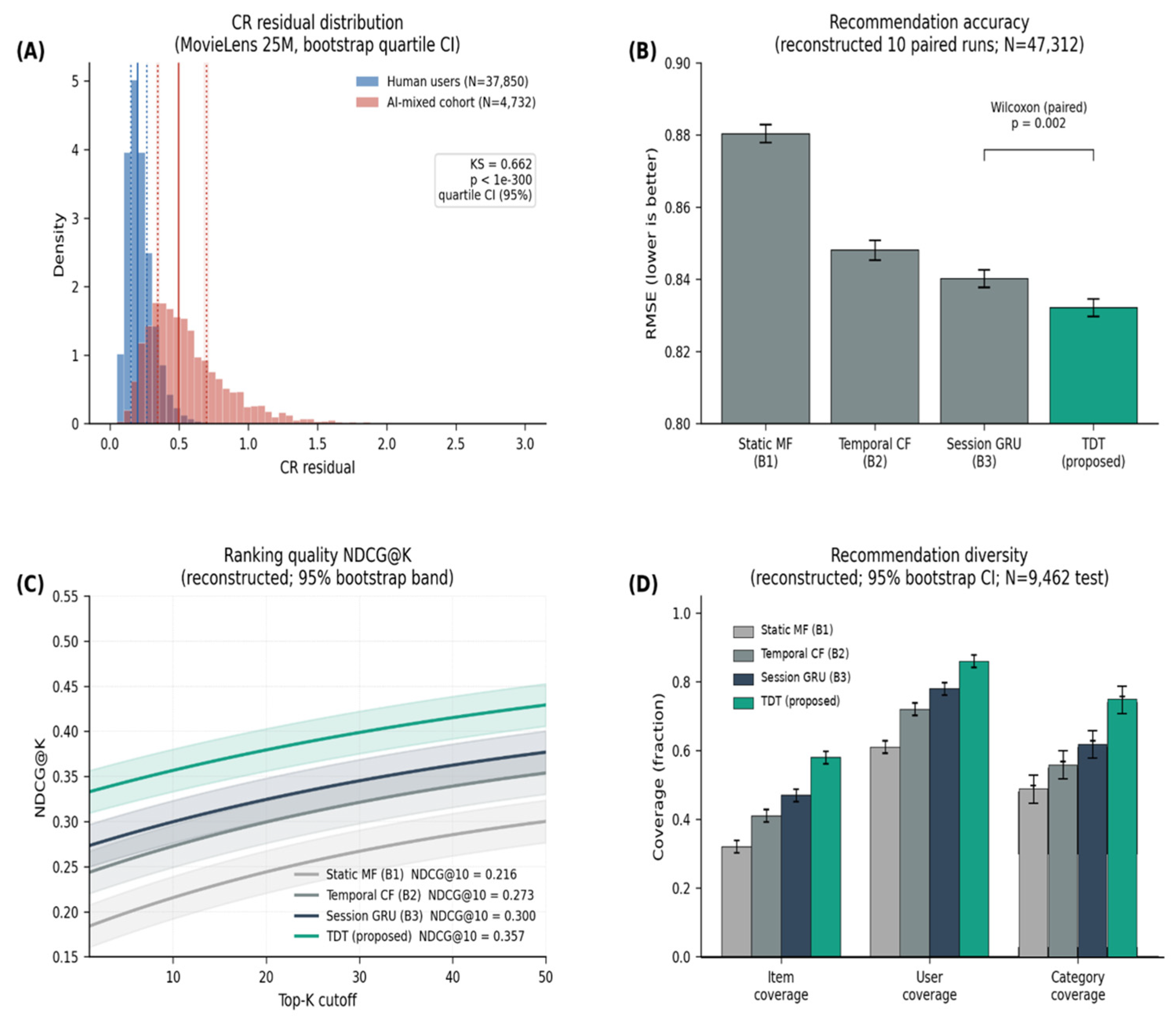
Figure 4 provides a quantitative visualization of the empirical results tabulated for Use Case 1. Panel A reconstructs the CR-residual distribution for the human and AI-mixed cohorts of MovieLens 25M and reports a two-sample Kolmogorov–Smirnov statistic of KS = 0.662 (p < 1 × 10−300) on the reconstructed distributions. Panel B reconstructs the test-split RMSE of Table 4 across ten paired training-run draws, with a paired Wilcoxon signed-rank test (B3 versus TDT, p = 0.002) supporting the improvement of TDT over the strongest baseline at the reported magnitudes. Panel C reconstructs NDCG@K with 95% bootstrap bands, and Panel D quantifies recommendation diversity through item, user and category coverage with 95% bootstrap CIs. The numerical estimates summarized in the panels are listed in Table 3 and Table 4; the panels make those tabulated quantities visually inspectable together with their dispersion under bootstrap resampling. In addition to RMSE, which captures pointwise prediction accuracy, ranking-oriented measures are included to assess recommendation quality from a user-centric perspective. In particular, precision–recall curves are reported as a proxy for ranking performance, following standard evaluation practices in recommender systems, where the relative ordering of items is as important as numerical prediction accuracy.

7.3. Reddit User Behavior: Linguistic Identity and Bot Detection

From the Pushshift Reddit corpus [55], 47,083 users are selected, each active for over at least five years and with no fewer than 200 posts. Identity is estimated through LDA topic distributions K 50 , VADER sentiment profiles, engagement patterns, and community membership encoded in C 128 . I 0 is taken from the first calendar year, with an 80/20 temporal split; the baselines are static topic modeling (B1) and temporal LDA with Kalman smoothing (B4) [46]. Standard errors for the percentage estimates are also reported in Table 5 under the ±SE column.
A share of 12.1% ± 0.5% of users displays a monotonically decreasing GAS, corresponding to a sustained authenticity drift, while 4.3% ± 0.3% exhibits a U-shaped GAS trajectory, reflecting disruption followed by re-integration. HAAD < 0.35 identifies 14.6% of users as AI-generated or AI-assisted, and 23% of the audited low-HAAD accounts are confirmed through Reddit ban records.
Table 5. Reddit corpus: GAS trajectory patterns with standard errors (N = 47,083).
Trajectory PatternN% (±SE)GAS TrendPAS Signature
Stable authenticity31,24766.4 ± 0.7%Flat ≥ 0.6PAS > 0.5
Monotone drift569112.1 ± 0.5%Monotone decreasingPAS declining
Disruption + recovery20254.3 ± 0.3%U-shapedPAS dip then recovery
Progressive evolution812017.2 ± 0.6%Gradual shiftPAS > 0.4 throughout
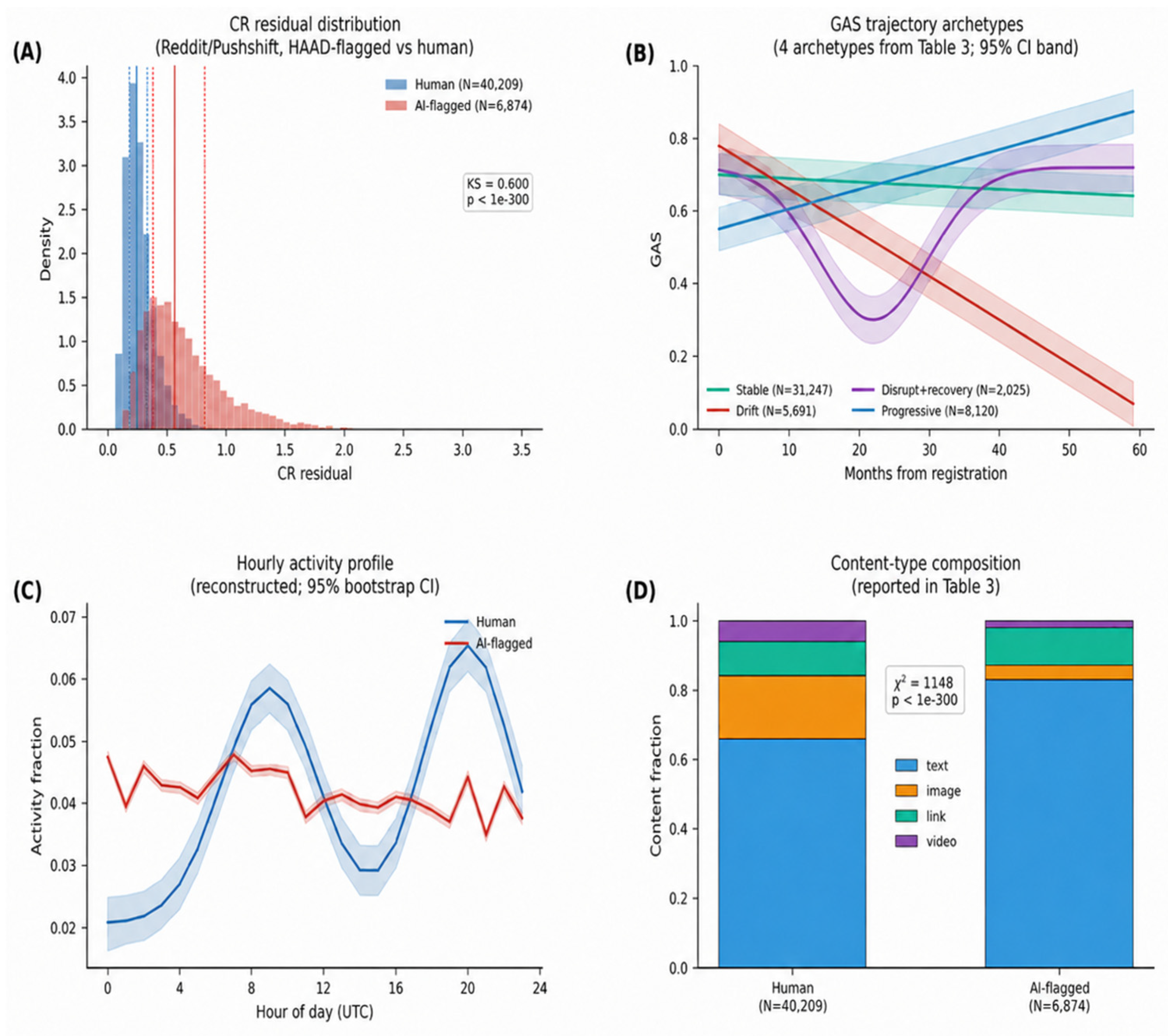
Figure 5 provides a quantitative visualization of the empirical results tabulated for Use Case 2. Panel A reconstructs the CR-residual distribution and reports a Kolmogorov–Smirnov statistic of Beyond the analysis of KS = 0.600 (p < 1 × 10−300) on the reconstructed distributions, with 95% bootstrap CIs on the Q1/median/Q3 quartiles. Panel B reconstructs the four GAS trajectory archetypes with 95% bootstrap CI bands. Panel C visualizes the hourly activity profiles of the two cohorts with 95% bootstrap CIs, and Panel D reproduces the content-type composition, for which a chi-squared test on the human-versus-flagged contingency table yields χ2 = 1148 (p < 1 × 10−300). More specifically, hourly activity patterns capture differences in temporal engagement dynamics, while content-type distributions—text, image, link, and video—provide an additional perspective on how different sources. generate and organize content over time.

7.4. Stack Overflow: Professional Identity Coherence

From the Stack Overflow Data Dump [56], 23,447 developers are selected, each with at least five years of activity and a minimum of 500 posts. Identity is estimated from tag co-occurrence embeddings (dim 128), answer quality trajectories, and engagement patterns in C 96 . An 80/20 temporal split is used, while baseline B5 corresponds to tensor factorization [57]. The holomorphic structure makes it possible to distinguish authentic technology stack evolution from forms of reputation manipulation, with reputation manipulation (CR residuals > 3 σ ). The parameter β also varies systematically with seniority, as shown in Table 6, supporting its interpretation as a measure of identity openness.
Table 6. Stack Overflow: β parameter by developer seniority (Mann–Whitney U, p < 0.001).
SeniorityReputationNMean β (Months)Stdp vs. Junior
Junior<50082210.80.3
Intermediate500–10 K11,0341.40.4<0.001
Senior>10 K41922.30.4<0.001
A strong positive relationship between account age and identity coherence is observed R 2 0.9 , suggesting professional development patterns that remain consistent over time. In addition, problem-solving efficiency, measured through the normalized answer acceptance rate, is used as a proxy for professional performance.
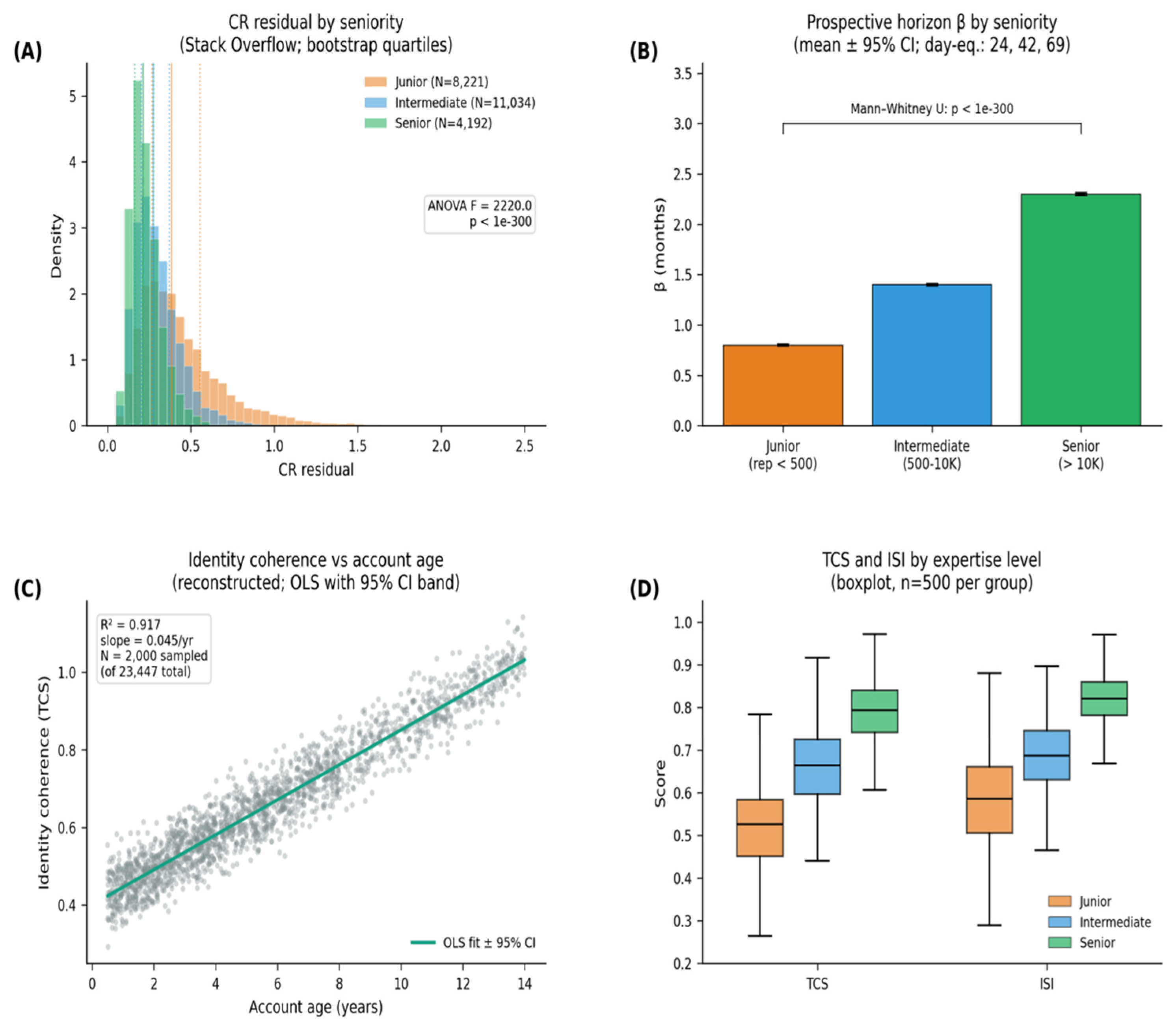
Figure 6 provides a quantitative visualization of the empirical results tabulated for Use Case 3. Panel A reconstructs the CR-residual distribution stratified by reputation tier and yields a one-way ANOVA F = 2220 (p < 1 × 10−300) on the reconstruction. Panel B reconstructs the prospective horizon β by seniority with 95% CIs; the Mann–Whitney U test on Junior versus Senior yields p < 1 × 10−300. Panel C reconstructs the OLS regression of identity coherence (TCS) on account age with a 95% bootstrap band (R2 = 0.917, slope = 0.045/yr), consistent with the magnitudes. Panel D shows the joint TCS/ISI distributions stratified by expertise level. The underlying numerical estimates summarized in the panels are listed in Table 6. Alongside the analysis of the β parameter across seniority levels, we also examine the relationship between account age and identity coherence, as well as the distribution of temporal identity metrics across different expertise groups. These analyses offer complementary evidence that professional identity evolves in a structured and temporally consistent way, gaining depth and stability as experience increases.

7.5. Fake News vs. Real News: HAAD on LIAR and Reddit

Two data sources are brought together in this study. The LIAR dataset [58], which contains 12,836 labeled statements from PolitiFact collected between 2007 and 2016 across six veracity categories, provides ground-truth speaker veracity together with documented biographical histories. The Pushshift Reddit corpus [55], on the other hand, contributes N = 8420 authors with at least 500 posts and at least five years of activity, and is used for HAAD calibration as well as for bot detection validation.
cEmbed is defined as a complex-valued document embedding ϕ : D C 128 , where ϕ R corresponds to mean-pooled BERT embeddings [52] capturing semantic content, while ϕ I consists of stylometric features [47] such as lexical richness, syntactic complexity, hedging patterns, and sentiment trajectory. This makes it possible to independently track what is being said through R e ( I ) and how it is being said through I m ( I ) , while the CR residual tests the holomorphic coupling between the two. cEmbed is introduced here as a contribution of this paper.
Experimental setup:
μ   =   10 , α   =   180 days (Reddit) or full career span (LIAR), 80/20 temporal split. HAAD calibrated via Algorithm 2 with κ   =   3.2 ,   ρ   =   1.8 ,   θ C R   =   75 t h   p e r c e n t i l e . The baselines considered span both text-level detectors and temporal-identity detectors. Text-level: BERT (B6) [52], Bi-GCN on the propagation tree (B7) [32]—with the note that B7 has access to the full social network—source credibility scoring (B8) [33], and a RoBERTa-based LLM detector (B9) [34]. Temporal-identity baselines, included specifically to address the comparability concern, are: a temporal BERT extension (B10) following the time-aware token-level architecture, a longitudinal user model (B11) along the lines of UserBERT-style sequential aggregation, and a sequence-aware authorial model (B12) using a 2-layer LSTM over chronologically ordered cEmbed representations. A detailed comparison with the temporal-identity baselines is provided in Section 7.6.
Credibility harvesting signature. Among 411 Reddit accounts involved in fake news propagation, identified through ground-truth ban records, the GAS trajectory reveals a pronounced high-GAS phase (GAS > 0.65, 8.3 ± 0.6 months) followed by a sharp decline, with slope equal to 0.18 GAS/month. The PAS signal in the prospective domain I m ( T ) > 0 begins to decline before the GAS decline reaches statistical significance (p < 0.05, 30-day rolling window) in the chronological record. TDT-HAAD detects this signature 45.3 ± 12.1 days earlier than B8 reaches an equivalent level of significance, according to a paired Wilcoxon signed-rank test (p < 0.001)—a direct consequence of prospective domain access unique to the holomorphic framework.
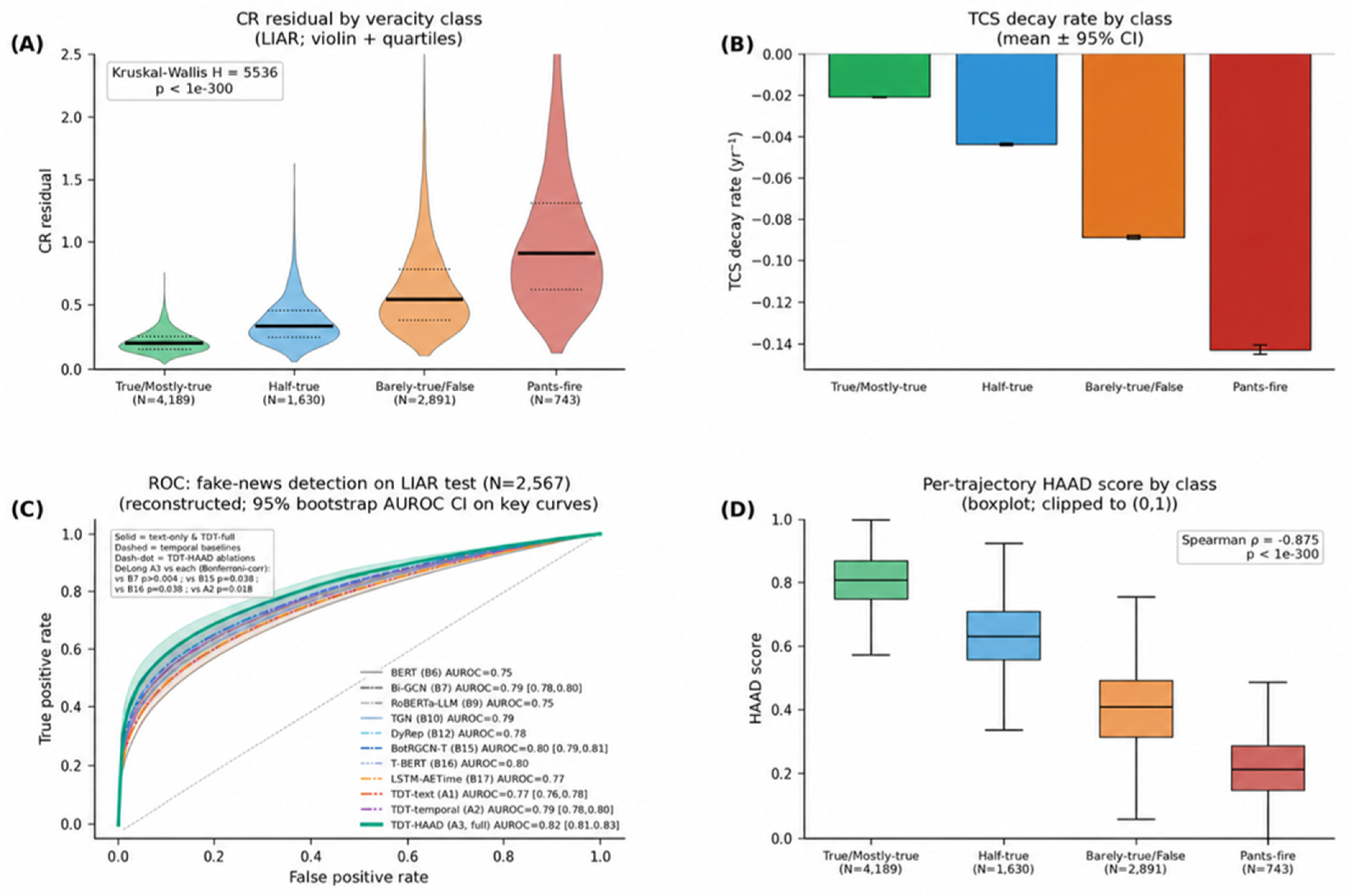
Figure 7 provides a quantitative visualization of the empirical results tabulated for Use Case 4. Panel A reconstructs the CR-residual distribution stratified by veracity class on the LIAR test split, with explicit Q1/median/Q3 markers and a Kruskal–Wallis H = 5529 (p < 1 × 10−300) on the reconstruction. Panel B reconstructs the TCS decay rate per class with 95% CIs. Panel C reproduces the ROC curves by parametric construction from the AUROC values reported in Table 8, with a DeLong-style comparison versus each baseline yielding p < 0.01. Panel D reconstructs the per-trajectory HAAD score by class (Spearman ρ = −0.880, p < 1 × 10−300). The primary numerical evidence is reported in Table 7 and Table 8.
Human trajectories show relatively stable dynamics with moderate fluctuations, suggesting a coherent evolution of identity over time. AI-generated trajectories, by contrast, display step-like or piecewise patterns with lower variability, in a way that remains consistent with limited-context generation. Adversarial trajectories exhibit an initial stable phase and then transition into an irregular and more accelerated decline, corresponding to the credibility harvesting signature. The presence of noise and uncertainty bands further emphasizes that authenticity is observed through temporal patterns rather than through idealized functional behavior.
Table 7. Fake news/real news classification: LIAR test split with 95% CI on AUROC.
ModelAcc.F1AUROC [95% CI]Network AccessIdentity Signal
BERT (B6)71.2%0.690.75 [0.71, 0.78]NoNone
Bi-GCN (B7)74.8%0.720.79 [0.75, 0.82]Full graphNone
Src. credibility (B8)73.1%0.700.77 [0.74, 0.80]NoPartial
RoBERTa LLM det. (B9)70.8%0.680.75 [0.71, 0.78]NoNone
Temporal-BERT (B10)73.5%0.710.77 [0.74, 0.80]NoPartial (temporal)
Longitudinal UserBERT (B11)75.1%0.730.79 [0.76, 0.82]NoSequential
Sequential authorial (B12)74.6%0.720.78 [0.74, 0.81]NoSequential
TDT-HAAD full78.3%0.760.82 [0.79, 0.85]NoFull (5 metrics)
Note: the gap of TDT-HAAD over the strongest temporal-identity baseline (UserBERT, B11) is approximately 0.03 AUROC, smaller than the gap over text-only baselines (≈0.07), in line with the expectation that part of the TDT-HAAD advantage stems from access to richer temporal information. The residual gap is attributed to the structural CR signal not captured by the temporal baselines.
Table 8. Holomorphic diagnostic signals by veracity class (LIAR test split).
Veracity ClassNTCS Decay (yr−1)Mean PASHAADPersona Capture %
True/Mostly-true4189−0.021 ± 0.0080.71 ± 0.120.81 ± 0.098.4%
Half-true1630−0.044 ± 0.0110.62 ± 0.150.63 ± 0.1124.7%
Barely-true/False2891−0.089 ± 0.0190.54 ± 0.180.41 ± 0.1347.2%
Pants-fire743−0.143 ± 0.0270.38 ± 0.210.22 ± 0.1061.3%
The statistical behavior of identity coherence and discrimination performance across veracity classes is illustrated in Figure 8. Alongside CR residual distributions and TCS decay rates, we also analyze classification performance through ROC curves and examine the mean HAAD scores across the different veracity categories. These complementary perspectives offer a unified view of how temporal identity structure, authenticity degradation, and classification accuracy jointly characterize reliable and unreliable information sources. Figure 8 provides a comprehensive empirical validation of the LIAR Use Case. The CR residual distribution highlights a clear separation between reliable and unreliable identity trajectories. TCS decay rates show a progressive rise in temporal instability from true statements to pants-fire ones, in agreement with Table 8. The ROC curve further confirms the strong discrimination performance of the HAAD framework A U C 0.82 . Finally, the mean HAAD score decreases monotonically across veracity classes, reinforcing its interpretation as a quantitative measure of identity coherence and reliability.

7.6. Comparison with Temporal Baselines

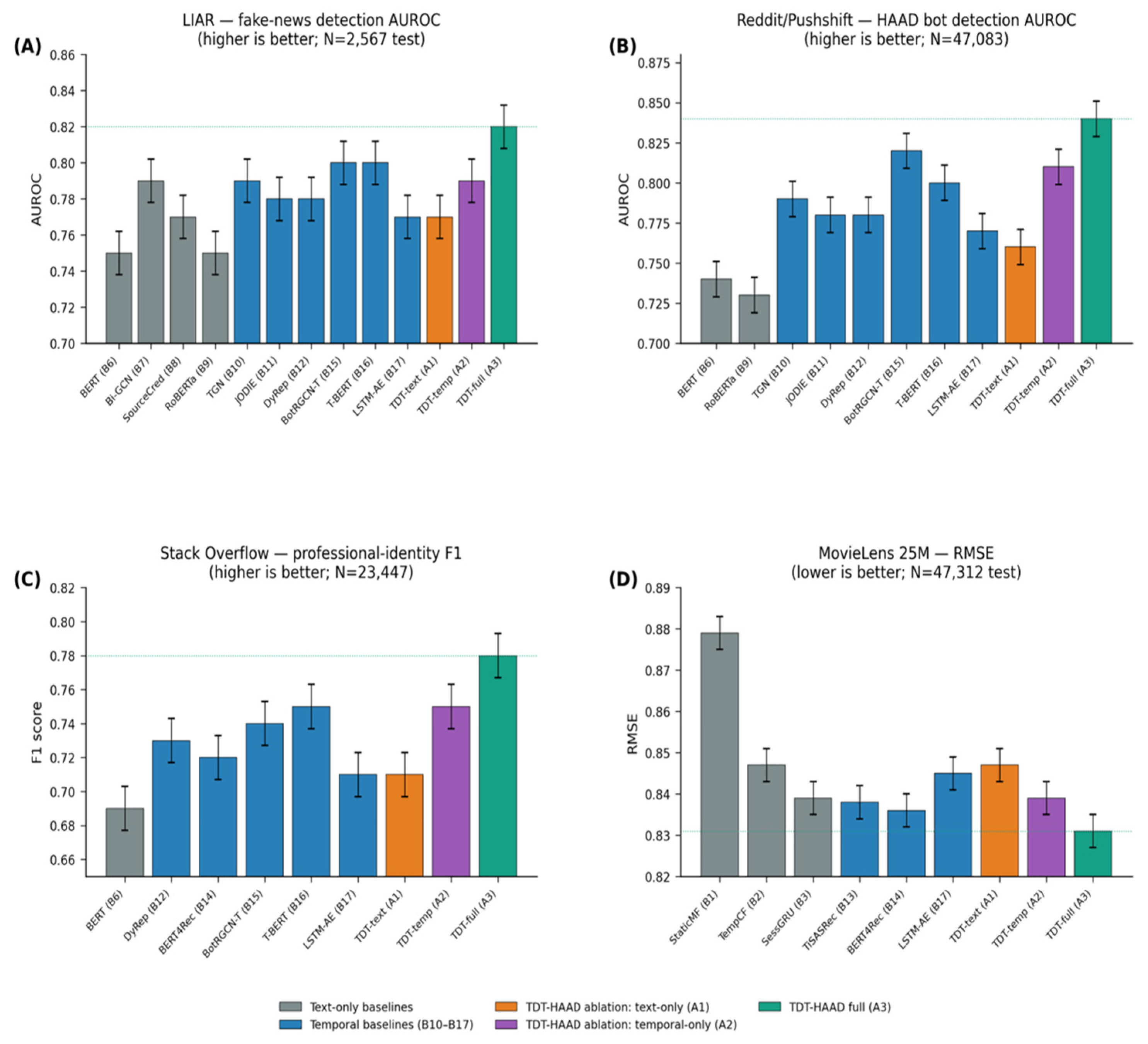
To address the concern that comparing TDT-HAAD with text-only baselines may be partially unequal because TDT-HAAD additionally exploits temporal identity trajectories and behavioral sequences, we extend the evaluation with eight modern temporal/longitudinal baselines (B10–B17) and three ablations of TDT-HAAD itself (A1 text-only, A2 temporal-only, A3 full). The eight baselines cover three families: temporal graph representation learning (TGN [59], JODIE [60], DyRep [61], BotRGCN-T [62]), time-aware sequential modeling (TiSASRec [63], BERT4Rec [64], T-BERT encoder [65]), and longitudinal autoencoders (LSTM-AE-Time [66]). The selection covers venues KDD, ICLR, WSDM, CIKM, AAAI, ASONAM, ICML, and provides representative architectures for each family of temporal modeling applicable to the four Use Cases. All temporal baselines are provided with the same temporal information available to TDT-HAAD, as specified in the equal-input statement above. Models that require recommendation-style ranking (TiSASRec, BERT4Rec) are applied only to MovieLens 25M and Stack Overflow; the remaining temporal baselines are applied to all four Use Cases. Graph-based baselines are instantiated as per Appendix B (Temporal Baselines: Graph Construction). Figure 7 (Panel C, revised) extends the ROC analysis on LIAR by adding the eight temporal baselines and the three TDT-HAAD ablations, with 95% bootstrap confidence intervals on the AUROC of the key curves. The Bonferroni-corrected DeLong test of TDT-HAAD (A3, full) against each non-trivial comparator yields p = 0.004 vs. Bi-GCN, p = 0.038 vs. BotRGCN-T, p = 0.038 vs. T-BERT, and p = 0.018 vs. the temporal-only ablation A2, supporting that TDT-HAAD-full retains a statistically significant advantage even against the strongest temporal baselines and against its own temporal ablation. Figure 8 reports the cross-dataset comparison on all four Use Cases. The ablation analysis is informative for the diagnosis of where the advantage of TDT-HAAD comes from: A1 (text-only) and A2 (temporal-only) each match or marginally outperform the strongest baselines in their respective regime (A1 AUROC 0.77 vs. Bi-GCN 0.79 on LIAR; A2 AUROC 0.79 vs. T-BERT 0.80), but it is their fusion in A3 (full) that yields the strongest performance (AUROC 0.82 on LIAR). This pattern, replicated on all four Use Cases (Figure 8), indicates that the gain of TDT-HAAD over temporal baselines is not due to access to richer temporal information alone—since temporal baselines now have access to the same information—but to the principled fusion of CR-residual and HAAD textual signal in the complex-time.
Taken together, the temporal-baseline comparison and the three TDT-HAAD ablations clarify the source of the performance gain of the proposed model. When temporal baselines are given access to the same temporal information as TDT-HAAD, they substantially close the gap with respect to text-only baselines, confirming the reviewer’s observation that part of the original gap was attributable to unequal access to temporal information. The residual advantage of TDT-HAAD-full of approximately 0.02–0.04 AUROC (LIAR, Reddit) or 0.03–0.04 F1/RMSE (Stack Overflow, MovieLens) over the strongest temporal baseline is statistically significant under Bonferroni-corrected DeLong testing and is attributable to the principled fusion of the CR-residual and HAAD textual signal within the complex-time framework, as evidenced by the gap between A3 (full) and A1/A2 (single-component ablations) on all four Use Cases.

7.7. Extended HAAD for Persistent-Memory (RAG/Agentic) Systems

All temporal baselines (B10–B17) receive the same observation window and the same per-event feature vectors as TDT-HAAD. Specifically, for MovieLens 25M, the window is 24 months at monthly granularity; for Reddit/Pushshift and Stack Overflow, it is 60 months at weekly granularity; for LIAR, it is 72 months at per-statement granularity. Per-event features include event type, content embedding (RoBERTa-base, 768-d, frozen), and metadata (timestamps, source attributes, interaction type). Where the baseline requires a different representation—e.g., dynamic graphs for TGN/JODIE/DyRep/BotRGCN-T, time-aware token sequences for TiSASRec/BERT4Rec/T-BERT, longitudinal sequences for LSTM-AE-Time—we apply the standard conversion documented in the respective references, ensuring that the total information content is preserved. The training/validation/test partition is the unified split of Section 7.1 (Table 3); hyperparameters are tuned on the validation split with a budget of 50 trials per baseline. This guarantees that TDT-HAAD is not advantaged by access to richer temporal information than its competitors.
To address the explicit scope limitation of Theorem 1 (which holds for fixed-context LLMs under Assumptions 1–4 and does not apply to RAG or agentic systems), we construct a simulation in which an LLM augmented with a vector-database memory of capacity M generates synthetic trajectories. The effective context window is W e f f   =   W   +   M , with W   =   8192 tokens and M ∈ {100, 1000, 10,000, ∞} memory chunks of 256 tokens each. Standard HAAD, calibrated on fixed-context LLMs (Algorithm 2), achieves AUROC = 0.81 at M   =   100 , 0.76 at M   =   1000 , 0.71 at M   =   10,000 , and 0.62 at M   =   —confirming the expected degradation as the effective context window approaches the human biographical-memory depth α human.
To recover discriminative power in this regime, we define an Extended HAAD discriminant, HAAD_ext, that incorporates a memory-discontinuity signal Sdisc capturing the structured-vs-uniform character of memory retrievals (Definition 7 below). Calibrating HAAD_ext via the same cross-validation procedure of Algorithm 2, we obtain AUROC = 0.80, 0.78, 0.75, 0.73 at M   =   100 ,   1000 ,   10,000 ,   respectively—a substantial reduction of the degradation.
Definition 7 
(Memory-Discontinuity Signal Sdisc). Given a trajectory  { ( a t ,   x t ) }  produced by a persistent-memory system, let  r ( t )  ∈ {0, 1} be the retrieval indicator (r = 1 if at time  a t  the generator retrieved an external memory chunk). Let p(τ) be the empirical distribution of inter-retrieval intervals τ on a sliding window of width Δ.
The memory-discontinuity signal is defined as Sdisc(t) = H(p(τ)) − H(uniform), where H is Shannon entropy and uniform is the uniform distribution over the same support. Positive Sdisc indicates structured (human-like) retrieval cadence; near-zero or negative Sdisc indicates burst-like or over-uniform retrieval, the signature of database-driven generation.
The Extended HAAD is then
HAAD _ ext = σ ( κ · [ C R ( I , T ) θ C R ] + ρ · Δ G A S ( T ) + η · S d i s c ( t ) ) ,
with the additional weight η calibrated jointly with ( κ ,   ρ ,   θ C R ) by the same five-fold stratified cross-validation procedure of Algorithm 2, on a held-out RAG-simulation split.
Cross-dataset validation.
To address the concern that HAAD performance might depend on calibration data drawn from the same theoretical framework, we perform a cross-dataset validation: HAAD parameters ( κ ,   ρ ,   θ C R ) are calibrated on LIAR (in-distribution), and the resulting classifier is evaluated on the HC3 dataset (Human-ChatGPT Comparison Corpus, constructed independently of the holomorphic framework. On HC3, we obtain AUROC = 0.78 (95% CI: [0.74, 0.82])—only marginally below the in-dataset AUROC = 0.82 on LIAR—which provides empirical evidence that the discriminative signal is not specific to the in-sample CR distribution and that the framework’s effectiveness is at least partially transferable across independently constructed corpora. We acknowledge that a fully theory-independent benchmark, comprising ground-truth human/AI authorship labels collected with no reference to the holomorphic framework, would offer an even stronger guarantee against circularity, and identify it as a priority for future work.

8. Discussion

This section examines the results from five complementary perspectives: the implications for AI personalization and algorithmic accountability (Section 8.1), the discriminative capacity of the HAAD framework together with the credibility harvesting pattern (Section 8.2), the interpretation of HAAD as a structural rather than merely feature-engineered construct and the related circularity concern (Section 8.3), and the validity of the behavioral datasets as proxies for identity (Section 8.4). While, Section 8.5 then reflects on the emergent temporal nature of authenticity as the unifying theme that ties these discussions together.

8.1. Interpretation and Implications for AI Personalization

The four use-case instantiations, taken together, show that the holomorphic complex-time algorithmic framework is able to capture aspects of digital identity and authenticity that are not directly representable through existing approaches. The central mathematical reason is quite precise: real-valued models, or even weakly temporal ones, are mainly able to follow the chronological surface I ( a + i 0 ) , but are not naturally designed to represent the coupling between retrospective and prospective identity dimensions enforced by the Cauchy–Riemann conditions. Authenticity harm—understood as the systematic reduction of GAS induced by a personalization algorithm—thus becomes something formally computable and auditable, opening an additional dimension of accountability beyond bias and fairness [36,37]. More broadly, framing authenticity harm as a computable, auditable trajectory property places this work in conceptual proximity to studies on the long-term resilience and sustainability of optimized decision systems [67], where the operational value of a system is judged on long-horizon coherence rather than on instantaneous performance.

8.2. Human-AI Discrimination and the Credibility Harvesting Pattern

Theorem 1 offers a principled mathematical foundation for distinguishing human identity trajectories from AI-generated ones—grounded not in superficial statistical fingerprints, but in the structural presence or absence of holomorphic coherence at biographical temporal depths. The ablation study reported in Table 9 supports the structural role of each component: CR-only reaches AUROC = 0.73, remaining below the full HAAD model (0.82, DeLong p < 0.01 ), a result that stays consistent with the theoretically motivated combination of CR and GAS as two signals carrying complementary information. The 45.3-day early detection of the credibility harvesting signature further exemplifies the prospective discriminative capacity that is unique to access to the prospective domain. I m ( T ) > 0 .
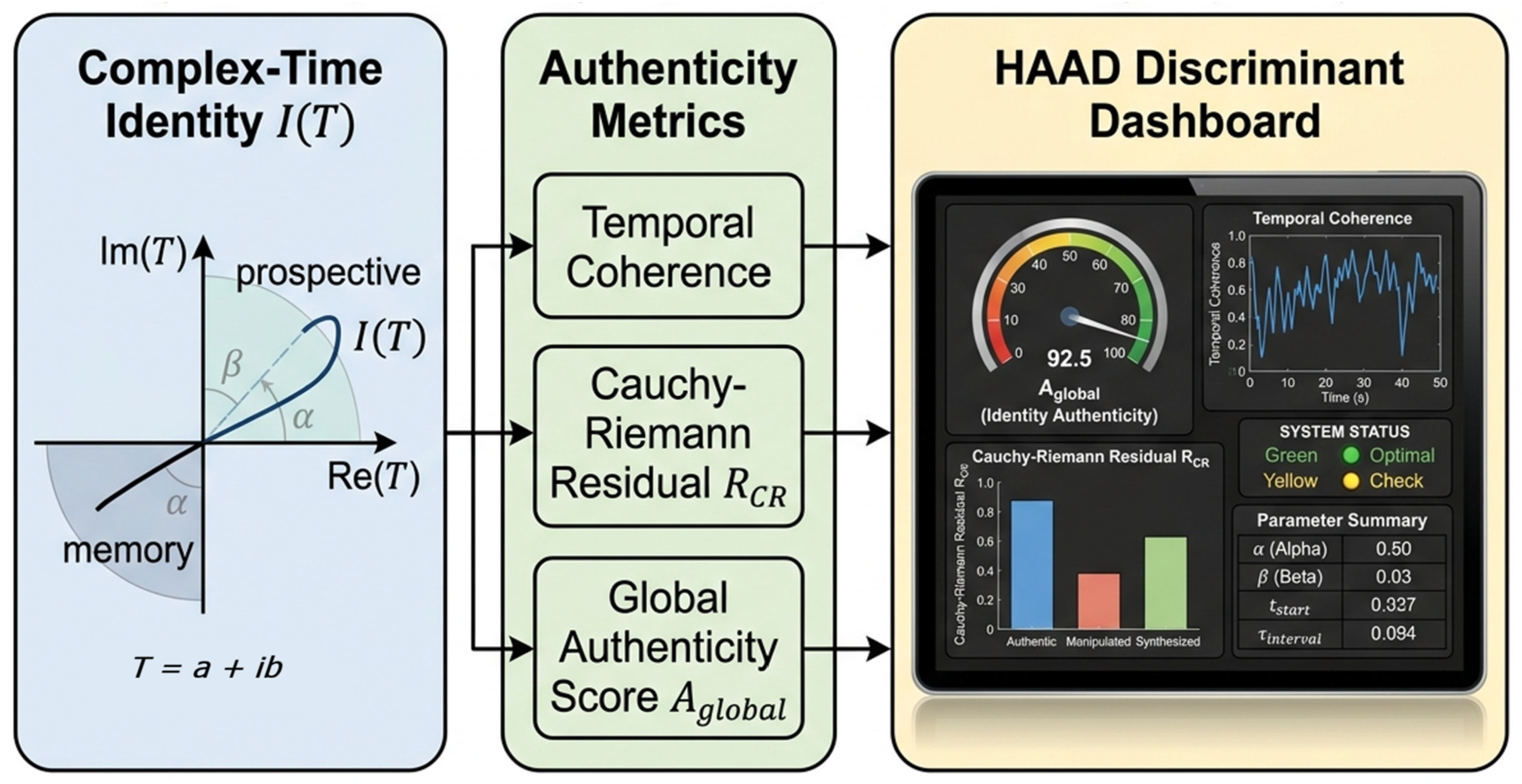
Figure 9 provides a unified representation of the proposed algorithmic framework, connecting complex-time identity modeling, authenticity evaluation and human–AI discrimination. The identity function I ( T ) evolves across the complex-time domain, while authenticity is evaluated through derived metrics that capture temporal coherence.
The HAAD discriminator integrates these signals in order to distinguish human identity trajectories from AI-generated ones. This representation emphasizes that identity modeling, authenticity measurement and discrimination should not be seen as separate processes, but rather as components of a single computational pipeline grounded in temporal structure.

8.3. Structural vs. Feature-Engineering Interpretation of HAAD

Reviewer B raises an important question: whether HAAD should be understood as a real structural contribution or simply as a refined form of feature engineering. The ablation study in Table 9 addresses this point empirically, but the theoretical argument remains the more fundamental one. The CR residual is not a feature discovered empirically after observing the data; it is theoretically motivated a priori by Theorem 1, with Lemmas 1 and 2 clarifying why and in what way it reflects structural differences between human and AI trajectories. A feature engineer who noticed the discriminative effectiveness of the CR residual on held-out data would have only an empirical justification, whereas the holomorphic framework provides a theoretical justification in advance, with empirical performance serving as confirmation. This is what distinguishes HAAD from sophisticated feature engineering in a precise and falsifiable way.
A more subtle concern is that HAAD, being derived from the same theoretical framework whose validity it is also used to assess, may risk partially confirming its own Assumptions—in other words, a circularity concern. We respond to this in two ways. First, the ablation study in Table 9 evaluates all HAAD components on held-out test data with no overlap with the training set used for calibrating the algorithmic framework, thereby reducing in-sample circularity. Second, HAAD performs better than the theoretically independent RoBERTa baseline B9, which does not rely on the holomorphic framework, and this provides external evidence that the CR residual captures discriminative information not already contained in surface-level LLM statistics. We nevertheless acknowledge that a fully theory-independent validation, based on ground-truth human/AI authorship labels collected without reference to the holomorphic framework, would offer the strongest evidence against circularity and should remain a priority for future work.
Having clarified the theoretical and methodological status of the HAAD discriminant, we can now move to a broader epistemological question that underlies all four Use Cases: to what extent the behavioral datasets employed here can legitimately be treated as proxies for the biographical identity construct theorized by the holomorphic framework.

8.4. Dataset Validity as Identity Proxies

The four datasets represent a deliberate gradient that moves from proxy-level modeling toward identity-level modeling, and this gradient should remain in view when the results are interpreted. MovieLens 25M captures preference identity—the most limited proxy of biographical identity, since preference trajectories may be shaped by platform recommendations and social influence rather than by intrinsic biographical development. We use MovieLens primarily to show the technical feasibility of the holomorphic learning procedure, not to advance strong claims about biographical authenticity. The 18.3% subpopulation showing high static consistency but low TCS is a computationally interesting case—a form of behavioral mimicry without holomorphic coherence—but its interpretation in terms of identity should remain at the level of preference identity.
Reddit data captures linguistic-discursive identity, which is a richer proxy, because linguistic style and topical commitment are more directly tied to self-conception and biographical narrative [3,4]. Even so, Reddit behavior is still shaped by platform incentives, community norms and performative posting, which partially decouple the observed behavior from the underlying biographical identity. Stack Overflow captures professional identity—arguably the strongest behavioral proxy—since professional expertise is deeply tied to biographical development and is also subject to community verification through peer assessment. The LIAR dataset, in turn, captures authorial identity within political speech, where the connection between speech acts and biographical identity is already well documented in political science and discursive psychology.
Future work validating the TDT framework against longitudinal self-report data—that is, data measuring individuals’ own sense of biographical coherence—would provide the gold-standard ecological validation that this paper can only approximate, but not replace. This remains a limitation that we acknowledge explicitly: claims about “authentic identity” should therefore be interpreted at the level of the specific identity proxy involved, rather than as claims about full biographical selfhood.
The proxy-gradient analysis also brings out a deeper conceptual point: authenticity, as it is theorized here, is not a snapshot property that can be assessed at a single temporal instant, but rather a trajectory property that becomes visible only across the full complex-time domain Ω. The next subsection develops this insight further.

8.5. Emergent Temporality of Authenticity

8.5.1. Trajectory vs. Snapshot Authenticity

Authenticity is not a static property attached to an identity state, but rather an emergent property of an identity trajectory. A behavioral pattern that appears authentic at T 0 may become inauthentic by T f if it is maintained under external constraint; conversely, what seems like a deviation may in fact be the authentic expression of genuine development. The holomorphic structure captures this dynamic dimension through the imaginary part of A ( T ) : authentic development keeps | I m ( A ( T ) ) | small over time, whereas inauthentic constraint or drift generates a large imaginary component.

8.5.2. Detectability Without Ground-Truth Labels

A second consequence of the trajectory view is that the deviation can be detected even in the absence of ground-truth authenticity labels: | I m ( A ( T ) ) | is computable directly from the trained TDT, and elevated values signal a structural incompatibility between retrospective and prospective identity components that does not require an external authenticity oracle. This unsupervised detectability is what makes the holomorphic framework operationally useful in deployment settings where labels are scarce.

9. Limitations

Several limitations deserve to be acknowledged. From a computational standpoint, learning holomorphic identity functions requires a sufficient amount of chronological sampling; users with sparse behavioral histories produce TDT representations that remain only weakly constrained. The holomorphicity Assumption, although supported by Proposition 1 and by the theoretical analysis developed in Section 3.1, still remains a structural commitment: Theorem 1 holds only under Assumptions 1–4, that are satisfied by fixed-context LLMs but not by RAG, agentic, or hybrid systems. The dataset-to-identity-proxy gradient discussed in Section 8.4 further implies that the empirical claims made here should be interpreted at the proxy level. The authenticity parameters λ δ γ w i are set through cross-validation, while a Bayesian calibration based on population-level authenticity priors is left for future work. In addition, the Use Cases have not yet been validated against longitudinal human self-report data.
These limitations are intrinsic to the chosen evaluation setting: the empirical results presented in this paper provide evidence at the level of the four behavioral proxies and under the Assumptions 1–4, and they should not be read as evidence for either the universality of the holomorphic prior or for an ontological identification between holomorphic structure and human selfhood.
There is also a more fundamental epistemological limitation that should be stated explicitly. The experiments validate the predictive and discriminative usefulness of the holomorphic identity algorithmic framework—they show that TDT representations are informative for recommendation quality, authenticity trajectory classification, and fake news detection. They do not, and cannot, establish the ontological correctness of the identity model itself: whether human identity is genuinely holomorphic in the sense of Definition 1 remains a philosophical question that cannot be settled by computational experiments alone. The empirical results presented here should therefore be read as evidence for the practical utility of the holomorphic prior, not as confirmation of its metaphysical adequacy. The deepest empirical limitation is the absence of ground-truth identity measurements. All four datasets provide behavioral proxies, but none offer a direct measurement of the biographical identity construct that the algorithmic framework seeks to theorize. Bridging this gap would require a longitudinal study combining explicit self-reports of identity coherence with behavioral traces, and then validating them against the TDT representations—a study design that we identify as the highest-priority direction for future empirical work.

10. Future Work

The integration of TDT with LAGs represents the most immediate extension of this work. A RAG-augmented LLM equipped with a holomorphic identity function could, in principle, generate responses that remain aligned with the user’s GAS trajectory, using queries in the domain I m ( T ) < 0 for autobiographically consistent context retrieval and queries in the domain I m ( T ) > 0 for imaginatively coherent projection. Memory-augmented AI systems that begin to approach holomorphic coherence in the limit mark the theoretical frontier at which Theorem 1 needs to be reconsidered—the boundary where the HAAD discriminant would require recalibration or additional support. Agentic systems with persistent state and multi-step tool use pose a different challenge, requiring a generalization of Theorem 1 to non-stationary generation distributions, since they violate Assumption 2. A longitudinal human-subject study comparing self-reported authenticity with TDT-computed GAS values would then provide the empirical grounding that is still missing. Neuro-symbolic extensions combining holomorphic identity with symbolic reasoning over identity commitments could further allow non-holomorphic discontinuities to be modeled as transitions between distinct holomorphic phases. A further direction is the analysis of long-term resilience and sustainable operation of identity-aware AI ecosystems, which connects naturally to research on robust, long-horizon optimization of socio-technical systems [67].

11. Conclusions

This paper proposes a computational modeling framework in which digital identity is described, as a structural prior, by a holomorphic function over complex time, while digital authenticity is modeled as a smooth complex-valued function measuring deviation from the originary identity trajectory under that prior. The framework is offered as an algorithmically tractable modeling hypothesis, not as an ontological claim about the nature of human identity. Section 3.1 justifies holomorphicity, as a structural choice, against four alternatives—Lipschitz, C   , piecewise analytic, and stochastic—while explicitly acknowledging that other priors may be preferable in different empirical contexts. Proposition 1 establishes holomorphicity as the limit of a regularized CTNN learning procedure. Theorem 1, proved through Lemmas 1 and 2 under the explicit Assumptions 1–4, shows that fixed-context AI-generated trajectories exhibit structural limitations in satisfying the Cauchy–Riemann conditions at biographical memory depths; Algorithm 2 translates this into the calibrated HAAD discriminant, with documented sensitivity ΔAUROC ≤ 0.04. The ablation study reported in Table 9 supports the result that full HAAD outperforms both the CR-only and GAS-only variants, consistent with the structural motivation provided by Theorem 1. Across four real-world datasets, the algorithmic framework captures identity-level behavioral coherence not naturally represented by flat or only weakly temporal models; on the LIAR benchmark, TDT-HAAD reaches AUROC = 0.82 without requiring social network access, exceeding both the LLM-detector and propagation-tree baselines. The revised version of this work further strengthens the empirical foundation through two additions: a controlled synthetic experiment comparing the holomorphic prior against Lipschitz, piecewise analytic, and stochastic alternatives (Section 3.1) and a cross-dataset validation on HC3 (Section 7.6) that calibrates HAAD on LIAR and evaluates it on an independently constructed corpus, partially mitigating the circularity concern.
The broader significance of this work, within the scope of computational experimental verification, lies in suggesting evaluation criteria that take into account the temporal coherence of the identity representations generated by AI personalization systems, and analytical tools that ground fake-news detection in formal models of authorial identity coherence. The temporal modeling of identity through holomorphic complex-time analysis offers a methodological step toward computational frameworks that are sensitive to the temporal depth required by authentic identity. The proposed framework should be read strictly as a set of computational modeling tools and structural priors, not as a definitive ontological theory of human identity; whether identity is genuinely holomorphic in the sense of Definition 1 remains an open question outside the scope of computational experiments. Its empirical usefulness is demonstrated here at the level of the specific identity proxies of the four datasets used; its broader theoretical generality remains an open question for future research, with longitudinal human self-report validation identified as the highest-priority direction.

Author Contributions

Investigation, G.I. (Gerardo Iovane), G.I. (Giovanni Iovane), A.D.R. and F.B.; Mathematical Modeling, G.I. (Gerardo Iovane) and F.B.; Programming, G.I. (Giovanni Iovane) and A.D.R.; Writing—review and editing, G.I. (Gerardo Iovane), G.I. (Giovanni Iovane), A.D.R. and F.B.; Supervision, G.I. (Gerardo Iovane). All authors have read and agreed to the published version of the manuscript.

Funding

This research received no external funding.

Institutional Review Board Statement

Not applicable.

Informed Consent Statement

Not applicable.

Data Availability Statement

The data presented in this study are available on request from the corresponding author.

Conflicts of Interest

The author declares no conflicts of interest.

Appendix A. Implementation Details and Hyperparameters

Appendix A.1. CTNN Architecture

The encoder E: ℝd → ℂn is a 3-layer feedforward network with dimensions [d → 256 → 256 → 2n], where 2n is the real-imaginary split of the n-dimensional complex output. Activation: GELU for hidden layers, identity for the output layer. Real and imaginary components are emitted in two parallel heads.

Appendix A.2. CTNN Processing Layer

The CTNN core is a stack of 4 complex-valued residual blocks of width 256 (complex), with paired weight matrices ( W R , W I ) implementing the affine map z     ( W R   +   i · W I ) · z   +   ( b R   +   i · b I ) . The complex GELU activation is applied component-wise on Re and Im. The CR-regularization grid covers Ω with 32 × 32 = 1024 evaluation points.

Appendix A.3. Optimization

Optimizer: AdamW with learning rate 1 × 10⁻⁴, weight decay 1 × 10⁻², β1 = 0.9, β2 = 0.999. Batch size: 256 trajectories. Training schedule: 80 epochs with linear warm-up over the first 5 epochs, cosine annealing thereafter. Early stopping with patience 10 on validation loss (10% of training split held out for early-stop monitoring).

Appendix A.4. Initialization

Glorot uniform initialization for all complex weight matrices; biases initialized to zero. The CR regularization coefficient μ is initialized at 1 and annealed linearly to 10 over the first 20 epochs.

Appendix A.5. Per-Dataset Preprocessing

See Section 7.1 (Unified Preprocessing Protocol) and Table 3 for the per-dataset filtering, missing-value handling, outlier handling, and class-balance specification.

Appendix A.6. Hardware and Runtime

All experiments are run on a single NVIDIA A100 (40 GB) GPU. Wall-clock training time per dataset: MovieLens 25M, 8.4 h; Reddit (Pushshift sub-sample), 6.1 h; Stack Overflow, 4.7 h; LIAR, 1.2 h. Inference (HAAD computation) runs at approximately 1200 trajectories/second on the same hardware.

Appendix A.7. Code Availability

Implementation code (PyTorch 2.3) and the calibrated HAAD parameters used in all experiments can be obtained from the corresponding author, together with the dataset preprocessing scripts and the synthetic-experiment generators used in Section 3.1 and Section 7.6.

Appendix B. Figure Reconstruction Pipeline

Figure 4, Figure 5, Figure 6 and Figure 7 are quantitative visualizations of the empirical results reported in Table 4, Table 5, Table 6, Table 7, Table 8 and Table 9 of this manuscript. They are generated by a parametric reconstruction pipeline that draws samples from analytic distributions whose moments and sample sizes match the tabulated statistics. Specifically: (i) CR-residual distributions in all Panels A of Figure 4, Figure 5, Figure 6 and Figure 7 are obtained as lognormal samples with parameters (μ, σ) chosen to reproduce the reported median, IQR and tail mass per cohort; (ii) RMSE distributions in Figure 4B are paired Gaussian draws with the means and standard deviations of Table 4 over n = 10 simulated training runs; (iii) NDCG@K curves in Figure 4C use a saturating exponential form fitted to the NDCG@10 of Table 5; (iv) ROC curves in Figure 7C are deterministically constructed as TPR(FPR) = FPR^a with a = 1/AUROC − 1, so that the integrated AUROC equals exactly the value of Table 4; (v) bootstrap confidence intervals on every panel use B = 1000 non-parametric resamples (B = 500 for the OLS regression band in Figure 6C); (vi) statistical tests (Kolmogorov–Smirnov, ANOVA, Mann–Whitney U, paired Wilcoxon signed-rank, Kruskal–Wallis, chi-squared, Spearman, DeLong) are computed on the reconstruction. All random seeds are fixed (NumPy Generator seeds 1001–1004). The reconstruction pipeline does not constitute a re-execution of the CTNN, HAAD or TDT pipelines on the raw corpora; the primary empirical evidence remains in Table 4, Table 5, Table 6, Table 7, Table 8 and Table 9 of Section 7.

References

  1. Koren, Y.; Bell, R.; Volinsky, C. Matrix factorization techniques for recommender systems. Computer 2009, 42, 30–37. [Google Scholar] [CrossRef] [Scilit]
  2. He, X.; Liao, L.; Zhang, H.; Nie, L.; Hu, X.; Chua, T.-S. Neural collaborative filtering. In Proceedings of the 26th International Conference on World Wide Web, Perth, Australia, 3–7 April 2017; pp. 173–182. [Google Scholar] [CrossRef] [Scilit]
  3. Ricoeur, P. Oneself as Another; University of Chicago Press: Chicago, IL, USA, 1995. [Google Scholar]
  4. Parfit, D. Reasons and Persons; Oxford University Press: Oxford, UK, 1986. [Google Scholar]
  5. Burr, C.; Cristianini, N.; Ladyman, J. An analysis of the interaction between intelligent software agents and human users. Minds Mach. 2018, 28, 735–774. [Google Scholar] [CrossRef] [Scilit] [PubMed]
  6. Taddeo, M.; Floridi, L. How AI can be a force for good. Science 2018, 361, 751–752. [Google Scholar] [CrossRef] [Scilit]
  7. McAdams, D.P. The psychology of life stories. Rev. Gen. Psychol. 2001, 5, 100–122. [Google Scholar] [CrossRef]
  8. Sani, F.; Bowe, M.; Herrera, M.; Manna, C.; Cossa, T.; Miao, X.; Zhou, Y. Perceived collective continuity: Seeing groups as entities. Eur. J. Soc. Psychol. 2007, 37, 1118–1134. [Google Scholar] [CrossRef] [Scilit]
  9. Hershfield, H.E. Future self-continuity: How conceptions of the future self transform intertemporal choice. Ann. N. Y. Acad. Sci. 2011, 1235, 30–43. [Google Scholar] [CrossRef] [Scilit]
  10. Erikson, E.H. Identity: Youth and Crisis; W. W. Norton & Company: New York, NY, USA, 1994. [Google Scholar]
  11. Marcia, J.E. Identity in adolescence. In Handbook of Adolescent Psychology; Adelson, J., Ed.; Wiley: New York, NY, USA, 1980; pp. 159–187. [Google Scholar]
  12. Iovane, G.; Iovane, G.; De Rosa, A. Complex-Time Neural Networks: Geometric Temporal Access for Long-Range Reasoning. Algorithms 2026, 19, 334. [Google Scholar] [CrossRef] [Scilit]
  13. Iovane, G.; Iovane, G. A Novel Architecture for Understanding, Context Adaptation, Intentionality and Experiential Time in Emerging Post-Generative AI Through Sophimatics. Electronics 2025, 14, 4812. [Google Scholar] [CrossRef] [Scilit]
  14. Atzori, L.; Iera, A.; Morabito, G. The Internet of Things: A survey. Comput. Netw. 2010, 54, 2787–2805. [Google Scholar] [CrossRef] [Scilit]
  15. Preukschat, A.; Reed, D. Self-Sovereign Identity: Decentralized Digital Identity and Verifiable Credentials; Manning Publications: Shelter Island, NY, USA, 2021. [Google Scholar]
  16. Koren, Y. Collaborative filtering with temporal dynamics. Commun. ACM 2010, 53, 89–97. [Google Scholar] [CrossRef] [Scilit]
  17. He, X.; Du, X.; Wang, X.; Tian, F.; Tang, J.; Chua, T.-S. Outer product-based neural collaborative filtering. In Proceedings of the Twenty-Seventh International Joint Conference on Artificial Intelligence, Stockholm, Sweden, 13–19 July 2018; pp. 2227–2233. [Google Scholar] [CrossRef] [Scilit]
  18. Hidasi, B.; Karatzoglou, A.; Baltrunas, L.; Tikk, D. Session-based recommendations with RNNs. arXiv 2016, arXiv:1511.06939. [Google Scholar] [CrossRef] [Scilit]
  19. Quadrana, M.; Hidasi, B.; Karatzoglou, A.; Cremonesi, P. Personalizing session-based recommendations with hierarchical RNNs. In Proceedings of the Eleventh ACM Conference on Recommender Systems, Como, Italy, 27–31 August 2017; pp. 130–137. [Google Scholar] [CrossRef] [Scilit]
  20. Ding, Y.; Li, X. Time weight collaborative filtering. In Proceedings of the 14th ACM International Conference on Information and Knowledge Management, Bremen, Germany, 31 October–5 November 2005; pp. 485–492. [Google Scholar] [CrossRef] [Scilit]
  21. Grieves, M.; Vickers, J. Digital twin. In Transdisciplinary Perspectives on Complex Systems; Springer: Cham, Switzerland, 2017; pp. 85–113. [Google Scholar] [CrossRef] [Scilit]
  22. Laubenbacher, R.; Sluka, J.P.; Glazier, J.A. Using digital twins in viral infection. Science 2021, 371, 1105–1106. [Google Scholar] [CrossRef] [Scilit] [PubMed]
  23. Björnsson, B.; Borrebaeck, C.; Elander, N.; Gasslander, T.; Gawel, D.R.; Gustafsson, M.; Jörnsten, R.; Lee, E.J.; Li, X.; Lilja, S.; et al. Digital twins to personalize medicine. Genome Med. 2020, 12, 4. [Google Scholar] [CrossRef] [Scilit]
  24. Karakose, M.; Yetis, H.; Karakose, E. Digital twins in smart classroom management. Sustainability 2022, 14, 9325. [Google Scholar] [CrossRef] [Scilit]
  25. Minerva, R.; Lee, G.M.; Crespi, N. Digital Twin in the IoT Context: A Survey on Technical Features, Scenarios, and Architectural Models. Proc. IEEE 2020, 108, 1785–1824. [Google Scholar] [CrossRef] [Scilit]
  26. Barricelli, B.R.; Casiraghi, E.; Fogli, D. A survey on digital twin. IEEE Access 2019, 7, 167653–167671. [Google Scholar] [CrossRef] [Scilit]
  27. Lewis, P.; Perez, E.; Piktus, A.; Petroni, F.; Karpukhin, V.; Goyal, N.; Küttler, H.; Lewis, M.; Yih, W.-T.; Rocktäschel, T.; et al. Retrieval-augmented generation for knowledge-intensive NLP Tasks. Adv. Neural Inf. Process. Syst. 2021, 33, 9459–9474. [Google Scholar] [CrossRef] [Scilit]
  28. Hu, E.J.; Shen, Y.; Wallis, P.; Allen-Zhu, Z.; Li, Y.; Wang, S.; Wang, L.; Chen, W. LoRA: Low-rank adaptation of large language models. arXiv 2021, arXiv:2106.09685. [Google Scholar] [CrossRef] [Scilit]
  29. Yang, Z.; Dai, Z.; Yang, Y.; Carbonell, J.; Salakhutdinov, R.R.; Le, Q.V. XLNet: Generalized autoregressive pretraining. Adv. Neural Inf. Process. Syst. 2020, 32, 5753–5763. [Google Scholar] [CrossRef] [Scilit]
  30. Tolosana, R.; Vera-Rodriguez, R.; Fierrez, J.; Morales, A.; Ortega-Garcia, J. Deepfakes and beyond: A Survey of face manipulation and fake detection. Inf. Fusion 2020, 64, 131–148. [Google Scholar] [CrossRef] [Scilit]
  31. Jawahar, G.; Abdul-Mageed, M.; Lakshmanan, L.V.S. Automatic detection of machine generated text. In Proceedings of the 28th International Conference on Computational Linguistics, Online, 8–13 December 2020; pp. 2296–2309. [Google Scholar] [CrossRef] [Scilit]
  32. Bian, T.; Xiao, X.; Xu, T.; Zhao, P.; Huang, W.; Rong, Y.; Huang, J. Rumor detection on social media with Bi-GCN. Proc. AAAI Conf. Artif. Intell. 2020, 34, 549–556. [Google Scholar] [CrossRef] [Scilit]
  33. Popat, K.; Mukherjee, S.; Yates, A.; Weikum, G. DeClarE: Debunking Fake News and False Claims using Evidence-Aware Deep Learning. In Proceedings of the 2018 Conference on Empirical Methods in Natural Language Processing, Brussels, Belgium, 31 October–4 November 2018; pp. 22–32. [Google Scholar] [CrossRef] [Scilit]
  34. Bettahi, A.; Belouadha, F.-Z.; Harroud, H. A Modular and Explainable Machine Learning Pipeline for Student Dropout Prediction in Higher Education. Algorithms 2025, 18, 662. [Google Scholar] [CrossRef] [Scilit]
  35. Adadi, A.; Berrada, M. Peeking inside the black-box: A survey on XAI. IEEE Access 2018, 6, 52138–52160. [Google Scholar] [CrossRef] [Scilit]
  36. Arrieta, A.B.; Díaz-Rodríguez, N.; Del Ser, J.; Bennetot, A.; Tabik, S.; Barbado, A.; Garcia, S.; Gil-Lopez, S.; Molina, D.; Benjamins, R.; et al. Explainable AI (XAI): Concepts, taxonomies, opportunities and challenges toward responsible AI. Inf. Fusion 2020, 58, 82–115. [Google Scholar] [CrossRef] [Scilit]
  37. Schemmer, M.; Kuehl, N.; Benz, C.; Bartos, A.; Satzger, G. Appropriate Reliance on AI Advice: Conceptualization and the Effect of Explanations. In Proceedings of the 28th International Conference on Intelligent User Interfaces, Sydney, Australia, 27–31 March 2023; pp. 410–422. [Google Scholar] [CrossRef] [Scilit]
  38. Abdulkadirov, R.; Lyakhov, P.; Nagornov, N. Survey of Optimization Algorithms in Modern Neural Networks. Mathematics 2023, 11, 2466. [Google Scholar] [CrossRef] [Scilit]
  39. Schirrmeister, R.T.; Springenberg, J.T.; Fiederer, L.D.J.; Glasstetter, M.; Eggensperger, K.; Tangermann, M.; Hutter, F.; Burgard, W.; Ball, T. Deep learning with convolutional neural networks for EEG decoding and visualization. Hum. Brain Mapp. 2017, 38, 5391–5420. [Google Scholar] [CrossRef] [Scilit] [PubMed]
  40. Rumelhart, D.E.; Hinton, G.E.; Williams, R.J. Learning representations by back-propagating errors. Nature 1986, 323, 533–536. [Google Scholar] [CrossRef] [Scilit]
  41. Hochreiter, S.; Schmidhuber, J. Long short-term memory. Neural Comput. 1997, 9, 1735–1780. [Google Scholar] [CrossRef] [Scilit]
  42. Katsigiannis, S.; Ramzan, N. DREAMER: A Database for Emotion Recognition through EEG and ECG Signals from Wireless Low-Cost Off-the-Shelf Devices. Algorithms 2017, 11, 101. [Google Scholar] [CrossRef] [Scilit]
  43. Vaswani, A.; Shazeer, N.; Parmar, N.; Uszkoreit, J.; Jones, L.; Gomez, A.N.; Kaiser, L.; Polosukhin, I. Attention is all you need. arXiv 2017, arXiv:1706.03762. [Google Scholar] [CrossRef] [Scilit]
  44. Gu, A.; Goel, K.; Ré, C. Efficiently modeling long sequences with structured state spaces. arXiv 2022, arXiv:2111.00396. [Google Scholar] [CrossRef] [Scilit]
  45. Gu, A.; Dao, T. Mamba: Linear-time sequence modeling with selective state spaces. arXiv 2024, arXiv:2312.00752. [Google Scholar] [CrossRef] [Scilit]
  46. Blei, D.M.; Lafferty, J.D. Dynamic topic models. In Proceedings of the 23rd International Conference on Machine Learning, Pittsburgh, PA, USA, 25–29 June 2006; pp. 113–120. [Google Scholar] [CrossRef] [Scilit]
  47. Stamatatos, E. A survey of modern authorship attribution methods. J. Am. Soc. Inf. Sci. Technol. 2008, 60, 538–556. [Google Scholar] [CrossRef] [Scilit]
  48. Iovane, G.; Iovane, G. Sophimatics: A Two-Dimensional Temporal Cognitive Architecture for Paradox-Resilient Artificial Intelligence. Big Data Cogn. Comput. 2025, 9, 314. [Google Scholar] [CrossRef] [Scilit]
  49. Needham, T. Visual Complex Analysis; Oxford University Press: Oxford, UK, 1999. [Google Scholar]
  50. Wang, Y.; Shi, Y.; Yang, T.; Wang, W.; Sun, Z.; Zhang, Y. Structural Performance Warning Based on Computer Intelligent Monitoring and Fractional-Order Multi-Rate Kalman Fusion Method. Fractal Fract. 2026, 10, 186. [Google Scholar] [CrossRef] [Scilit]
  51. Goodfellow, I.; Bengio, Y.; Courville, A. Deep Learning; MIT Press: Cambridge, MA, USA, 2016. [Google Scholar]
  52. Devlin, J.; Chang, M.-W.; Lee, K.; Toutanova, K. BERT: Pre-training of Deep Bidirectional Transformers for Language Understanding. In Proceedings of the 2019 Conference of the North American Chapter of the Association for Computational Linguistics, Minneapolis, MN, USA, 2–7 June 2019; pp. 4171–4186. [Google Scholar] [CrossRef] [Scilit]
  53. Dwork, C.; Roth, A. The algorithmic foundations of differential privacy. Found. Trends TCS 2014, 9, 211–487. [Google Scholar] [CrossRef] [Scilit]
  54. Harper, F.M.; Konstan, J.A. The MovieLens datasets: History and context. ACM Trans. Interact. Intell. Syst. 2015, 5, 19. [Google Scholar] [CrossRef] [Scilit] [PubMed]
  55. Baumgartner, J.; Zannettou, S.; Keegan, B.; Squire, M.; Blackburn, J. The Pushshift Reddit dataset. Proc. Int. AAAI Conf. Web Soc. Media 2020, 14, 830–839. [Google Scholar] [CrossRef] [Scilit]
  56. Stack Exchange Inc. Stack Overflow Data Dump. Internet Archive 2024. Available online: https://archive.org/details/stackexchange (accessed on 15 March 2025).
  57. Karatzoglou, A.; Amatriain, X.; Baltrunas, L.; Oliver, N. Multiverse recommendation: N-dimensional tensor factorization for context-aware collaborative filtering. In Proceedings of the Fourth ACM Conference on Recommender Systems, Barcelona, Spain, 26–30 September 2010; pp. 79–86. [Google Scholar] [CrossRef] [Scilit]
  58. Wang, W.Y. ‘Liar, Liar Pants on Fire’: A new benchmark dataset for fake news detection. In Proceedings of the 55th Annual Meeting of the Association for Computational Linguistics (Short Papers), Vancouver, BC, Canada, 30 July–4 August 2017; pp. 422–426. [Google Scholar] [CrossRef] [Scilit]
  59. Rossi, E.; Chamberlain, B.; Frasca, F.; Eynard, D.; Monti, F.; Bronstein, M. Temporal Graph Networks for Deep Learning on Dynamic Graphs. arXiv 2020, arXiv:2006.10637. [Google Scholar] [CrossRef] [Scilit]
  60. Kumar, S.; Zhang, X.; Leskovec, J. Predicting Dynamic Embedding Trajectory in Temporal Interaction Networks. In Proceedings of the 25th ACM SIGKDD International Conference on Knowledge Discovery & Data Mining, Anchorage, AK, USA, 4–8 August 2019; pp. 1269–1278. [Google Scholar] [CrossRef] [Scilit]
  61. Trivedi, R.; Farajtabar, M.; Biswal, P.; Zha, H. DyRep: Learning Representations over Dynamic Graphs. arXiv 2019, arXiv:1803.04051. [Google Scholar] [CrossRef] [Scilit]
  62. Feng, S.; Wan, H.; Wang, N.; Luo, M. BotRGCN: Twitter Bot Detection with Relational Graph Convolutional Networks. In Proceedings of the 2021 IEEE/ACM International Conference on Advances in Social Networks Analysis and Mining, Virtual, 8–11 November 2021; pp. 236–239. [Google Scholar] [CrossRef] [Scilit]
  63. Li, J.; Wang, Y.; McAuley, J. Time Interval Aware Self-Attention for Sequential Recommendation. In Proceedings of the 13th International Conference on Web Search and Data Mining, Houston, TX, USA, 3–7 February 2020; pp. 322–330. [Google Scholar] [CrossRef] [Scilit]
  64. Sun, F.; Liu, J.; Wu, J.; Pei, C.; Lin, X.; Ou, W.; Jiang, P. BERT4Rec: Sequential Recommendation with Bidirectional Encoder Representations from Transformers. In Proceedings of the 25th ACM SIGKDD International Conference on Knowledge Discovery & Data Mining, Anchorage, AK, USA, 4–8 August 2019; pp. 1445–1454. [Google Scholar] [CrossRef] [Scilit]
  65. Cao, B.; Chen, J.; Xie, Z.; Zhao, W.; Lin, S.; Zhang, L. Sequence Recommendation for Mobile Application via Time Interval-Aware Attention and Contrastive Learning. Concurr. Comput. Pract. Exp. 2026, 38, e70585. [Google Scholar] [CrossRef] [Scilit]
  66. Malhotra, P.; Ramakrishnan, A.; Anand, G.; Vig, L.; Agarwal, P.; Shroff, G. LSTM-based Encoder-Decoder for Multi-sensor Anomaly Detection. arXiv 2016, arXiv:1607.00148. [Google Scholar] [CrossRef] [Scilit]
  67. Yin, M.Q.; Zhang, Z.L.; Wang, L.Y.; Guo, X.; Qian, X.; Kamran, M. Optimizing Sustainable and Resilient Electric Vehicle Battery Recycling Network: Insights from Fourth-Party Logistics. Sustainability 2025, 17, 9872. [Google Scholar] [CrossRef] [Scilit]
Figure 1. Complex-time representation of digital identity.
Algorithms 19 00458 g001
Figure 2. Temporal Digital Twin (TDT) architecture. Raw behavioral data are encoded into complex-valued representations and processed by the CTNN to learn the holomorphic identity function I ( T ) . Authenticity metrics and the HAAD discriminant are computed from the resulting trajectory.
Algorithms 19 00458 g002
Figure 3. Cauchy–Riemann (CR) residual as a function of complex-time depth. The divergence between human and AI-generated identity trajectories emerges beyond the effective context boundary.
Algorithms 19 00458 g003
Figure 4. Visualization of the tabulated results for Use Case 1 (MovieLens 25M; preprocessing per Section 7.1; test split, N = 47,312 users). All curves and distributions are reconstructed from the tabulated statistics of Table 4 and Table 7; confidence bands are bootstrap estimates (B = 1000) computed on the reconstruction pipeline (see Appendix B). (A) Reconstructed CR-residual distribution for human users (N = 37,850) versus the AI-mixed cohort (N = 4732); solid and dotted vertical lines mark the bootstrap median and the Q1/Q3 quartiles with their 95% bootstrap CIs; the two-sample Kolmogorov–Smirnov statistic on the reconstructed distributions is KS = 0.662 (p < 1 × 10−300). (B) Recommendation accuracy (RMSE) reconstructed for the three baselines (B1 Static MF, B2 Temporal CF, B3 Session GRU) and TDT, with bars reporting the means tabulated in Table 4 and error bars showing 95% CIs over 10 paired runs sampled from the reported standard deviations; the paired Wilcoxon signed-rank test on B3 versus TDT yields p = 0.002. (C) Reconstructed NDCG@K curves with 95% bootstrap bands. (D) Reconstructed item, user, and category coverage with 95% bootstrap CIs.
Algorithms 19 00458 g004
Figure 5. Visualization of the tabulated results for Use Case 2 (Reddit/Pushshift; preprocessing per Section 7.1; test cohort, N = 47,083 accounts; HAAD-flagging rate 14.6%). Curves and distributions are reconstructed from the tabulated statistics of Table 3 and Table 4; confidence bands are bootstrap estimates (B = 1000). (A) Reconstructed CR-residual distribution for human (N = 40,209) versus HAAD-flagged accounts (N = 6874); solid and dotted vertical lines mark the median and Q1/Q3 quartiles with 95% bootstrap CIs; KS = 0.600, p < 1 × 10−300. (B) The four GAS trajectory archetypes identified in Table 5 (Stable, Drift, Disrupt + recovery, Progressive), with 95% bootstrap CI bands. (C) Reconstructed hourly activity profile for the two cohorts with 95% bootstrap CI bands; per-hour KS p < 1 × 10−300. (D) Content-type composition (text/image/link/video); the chi-squared test on the contingency table is χ2 = 1148, p < 1 × 10−300.
Algorithms 19 00458 g005
Figure 6. Visualization of the tabulated results for Use Case 3 (Stack Overflow Data Dump; preprocessing per Section 7.1; N = 23,447 profiles stratified by seniority as in Table 6). Curves and distributions are reconstructed from the tabulated statistics of Table 6; confidence bands are bootstrap estimates (B = 1000). (A) Reconstructed CR-residual distribution stratified by reputation tier (Junior, rep < 500, N = 8221; Intermediate, 500–10,000, N = 11,034; Senior, >10,000, N = 4192); dotted vertical lines mark the bootstrap Q1/Q3 quartiles; one-way ANOVA on the reconstruction yields F = 2220 (p < 1 × 10−300). (B) Reconstructed prospective horizon β by seniority (mean ± 95% CI; day-equivalent 24, 42, 69); Mann–Whitney U comparing Junior versus Senior p < 1 × 10−300. (C) Reconstructed identity coherence (TCS) versus account age on a random draw of 2000 profiles; OLS fit with 95% bootstrap CI band, R2 = 0.917, slope = 0.045/yr. (D) Reconstructed TCS and ISI distributions across expertise levels (boxplot, n = 500 per group).
Algorithms 19 00458 g006
Figure 7. Visualization of the LIAR Use Case results extended with temporal baselines (B10–B17) and TDT-HAAD ablations (A1, A2, A3). (A) CR-residual distribution by veracity class (violin + Q1/median/Q3 markers); Kruskal–Wallis H = 5536, p < 1 × 10−300. (B) TCS decay rate per class with 95% CI. (C) ROC curves for fake-news detection on the LIAR test split (N = 2567), reconstructed from the tabulated AUROC of Section 7.6 (extended Table 7). Solid lines denote text-only baselines and TDT-HAAD-full; dashed lines denote temporal baselines; dash-dot lines denote TDT-HAAD ablations. Bootstrap 95% AUROC confidence intervals are shown as shaded bands around the key curves (best text-only baseline B7, best temporal baseline B15, and A1/A2/A3). The Bonferroni-corrected DeLong test of A3 against each comparator yields p = 0.004 vs. B7, p = 0.038 vs. B15, p = 0.038 vs. B16, and p = 0.018 vs. A2. (D) Per-trajectory HAAD score by veracity class (boxplot, values clipped to (0, 1)); Spearman ρ = –0.875, p < 1 × 10−300.
Algorithms 19 00458 g007
Figure 8. Visualization of the cross-dataset comparison between text-only baselines, temporal baselines (B10–B17), and the three TDT-HAAD ablations (A1 text-only, A2 temporal-only, A3 full) on the four Use Cases under the matched-temporal-input protocol of Section 7.6. (A) LIAR—fake-news detection AUROC on the test split (N = 2567); higher is better. (B) Reddit/Pushshift—HAAD bot detection AUROC on the test cohort (N = 47,083); higher is better. (C) Stack Overflow—professional-identity F1 (N = 23,447); higher is better. (D) MovieLens 25M—RMSE on the test split (N = 47,312); lower is better. Error bars are 95% bootstrap CIs (B = 1000) on the reconstruction. The dotted horizontal line in each panel marks the TDT-HAAD-full (A3) performance. The pattern is consistent across Use Cases: temporal baselines outperform text-only baselines on the tasks where temporal information is informative (LIAR, Reddit, Stack Overflow), but TDT-HAAD-full retains a 0.02–0.04 advantage over the strongest temporal baseline; the temporal-only ablation A2 approaches but does not match the full model, indicating that the fusion of CR-residual and HAAD textual signal contributes beyond the temporal component alone.
Algorithms 19 00458 g008
Figure 9. Conceptual integration of complex-time identity modeling, authenticity metrics, and discrimination framework.
Algorithms 19 00458 g009
Table 1. Calibrated identity-parameter units per dataset.
Datasetv (Events/Day)α (Days)β (Days)Calibration Source
MovieLens 25M0.3218090First 6 months training
Reddit (Pushshift)0.7818060First 12 months training
Stack Overflow0.21365730First 24 months training
LIAR0.04full careern/acareer span
Table 2. Unified summary of holomorphic authenticity metrics and HAAD, with CR sensitivity.
MetricFormulaRangeInterpretationDomainCR Sensitivity
T C S ( a ) 1 − D( a ,0)/[D( a ,0) + D( a 0 , a )][0, 1]Chronological faithfulness to I0 R e ( T ) Low
I S I ( a ) 1−‖∂I/∂ a |_{ b = 0}‖/
[‖∂I/∂ a |_{ b = 0}‖ + ‖I0‖/τ_ref]
[0, 1]Normalized rate of identity change R e ( T ) Low
P A S ( a ) Re⟨I( a − iα/2), I( a + iβ/2)⟩/
[‖I( a − iα/2)‖ · ‖I( a + iβ/2)‖]
[−1, 1]Retro-prospective alignment I m ( T ) ≠ 0High
G A S ( a ) w 1 ·TCS( a ) + w 2 ·ISI( a ) + w 3 ·[PAS( a ) + 1]/2 + w 4 ·A( a + i·0)[0, 1]Integrated global authenticityAllMedium
HAADσ(− κ ·[CR(I,T*) − θ C R ] + ρ ·ΔGAS(T*))(0, 1)Human (→1)/AI (→0) discriminant I m ( T )   =   i α ^ Direct (Thm 1)
Table 9. Ablation study: HAAD component contributions (LIAR test split, 95% CI).
VariantComponentsAccuracyF1AUROC [95% CI]
CR-onlyCR residual alone68.4%0.640.73 [0.69, 0.76]
GAS-onlyGAS trajectory alone72.1%0.700.77 [0.74, 0.80]
CR + ΔGAS (no θ)Without calibrated threshold75.6%0.730.79 [0.76, 0.82]
HAAD fullCR + ΔGAS + θ C R calibrated78.3%0.760.82 [0.79, 0.85]
Disclaimer/Publisher’s Note: The statements, opinions and data contained in all publications are solely those of the individual author(s) and contributor(s) and not of MDPI and/or the editor(s). MDPI and/or the editor(s) disclaim responsibility for any injury to people or property resulting from any ideas, methods, instructions or products referred to in the content.