
Article

Spatiotemporal Optimization of Oilfield Electricity Consumption: A Multi-Objective Modeling Approach with Machine Learning

1
Kunlun Digital Technology Co., Ltd., Beijing 100043, China
2
Aliyun School of Big Data, Changzhou University, Changzhou 213159, China
*
Author to whom correspondence should be addressed.
Algorithms 2026, 19(5), 401; https://doi.org/10.3390/a19050401
Submission received: 31 March 2026 / Revised: 6 May 2026 / Accepted: 14 May 2026 / Published: 17 May 2026
(This article belongs to the Special Issue Machine Learning for Planning and Logistics)

Abstract

Oil enterprises face the challenge of reconciling escalating energy conservation targets with persistent production requirements, necessitating sophisticated electricity management solutions. The conventional ton-per-kWh allocation approach, often manually adjusted based on historical production and planning data, lacks a scientific basis and fails to accurately identify efficiency differences or assess energy-saving potential, making it difficult to convince participating units. To address this, we propose a dynamic spatiotemporal allocation scheme and develop a multi-objective optimization model that integrates electricity efficiency, operational stability, and production priority. The model incorporates nonlinear efficiency terms, stability components, and priority-weighted items, with constraints including total balance, monthly adjustment limits, and key area protection. Central to the efficiency term is the accurate prediction of liquid production from electricity consumption. We decompose electricity use into three components—core production electricity, auxiliary production electricity, and product transportation electricity—and derive their proportional coefficients through regression of historical data, enabling high-precision liquid production prediction via machine learning using the Light Gradient Boosting Machine (LGBM). The resulting constrained optimization problem is solved using the Sequential Least Squares Programming (SLSQP) algorithm. Validation using both simulated data and Daqing Oilfield field data demonstrates that the scheme effectively achieves electricity reduction targets while significantly mitigating associated liquid production loss, reducing it by 18.0% in simulated experiments and 32.5% in field validation compared to the conventional ton-per-kWh method. This offers a scientific and adaptive electricity management framework that supports refined energy control and facilitates the petroleum industry’s green and low-carbon transformation.

1. Introduction

The global energy landscape is undergoing a profound transition toward green and low-carbon sustainability, driven by escalating environmental concerns and stringent policy regulations [1,2,3]. As one of the most energy-intensive industries, the petroleum sector faces an unprecedented dual challenge: reconciling aggressive energy conservation and carbon emission reduction targets with the imperative of maintaining stable production operations [4,5,6]. Electricity consumption allocation, a core component of oilfield production management, directly determines the efficiency of energy utilization and the sustainability of the production system. Scientific and rational electricity allocation not only minimizes energy waste and carbon footprints but also ensures the smooth operation of critical production processes, making it a pivotal issue for the petroleum industry’s low-carbon transformation [7,8,9,10].
Traditional electricity allocation methods, most notably the ton-per-kWh approach, have been widely adopted in oilfield operations due to their operational simplicity and low implementation costs. This method distributes electricity indicators proportionally based on historical production data and planned output, achieving basic coordination between energy use and production in some scenarios [11]. However, its inherent limitations have become increasingly prominent in the context of refined energy management. By assuming uniform energy efficiency across all production units, the ton-per-kWh method ignores the significant heterogeneity of reservoir conditions, development stages, and operational efficiency among different areas. This leads to unreasonable electricity reduction tasks for high-efficiency units and insufficient constraints on low-efficiency ones, resulting in suboptimal overall energy utilization and reduced acceptance of allocation schemes by the production unit. Additionally, its heavy reliance on manual experience for parameter adjustment renders it unable to dynamically respond to real-time production changes, further limiting its adaptability to modern oilfield management needs [12].
To address these shortcomings, researchers have developed improved approaches centered on “reasonable energy consumption”, which integrate reservoir characteristics and production dynamics to enhance allocation scientificity [13]. These methods leverage reservoir numerical simulation [14,15], mathematical statistical analysis [16,17], and system optimization techniques to calculate the theoretical energy demand of each production unit [18,19,20]. For instance, Bai et al. [21] established an energy consumption optimization model for the injection-reservoir-production integrated system in high-water-cut reservoirs, while Dong et al. [22] applied fuzzy logic to identify key factors influencing energy consumption in water injection systems. Despite their enhanced scientific rigor, these reservoir-oriented methods face practical barriers: they require extensive foundational data (including detailed geological parameters and real-time production dynamics), involve complex computational processes, and rely heavily on professional technical personnel. Moreover, their high sensitivity to data quality limits their promotion in oilfields with inadequate data support, and their focus on static energy demand calculation lacks dynamic adjustment mechanisms for spatiotemporal production variations.
With the advancement of artificial intelligence and optimization algorithms, data-driven methods have emerged as a promising new direction for industrial energy management [23]. Machine learning techniques excel at capturing nonlinear relationships between energy consumption and production output, providing high-precision prediction support for electricity allocation. Algorithms such as LGBM have been widely applied in energy prediction due to their efficiency and accuracy, offering data-driven bases for energy allocation in oilfields [24], and recent reviews highlight the growing role of machine learning in the oil and gas industry [25,26]. Meanwhile, multi-objective optimization algorithms have been integrated to balance conflicting goals such as energy conservation, production stability, and operational efficiency. However, existing research rarely integrates electricity consumption decomposition, production prediction, and multi-objective optimization into a unified framework. Most studies focus on single-objective optimization or lack sufficient field validation, leading to a persistent gap between theoretical models and practical application.
To bridge these research gaps, this study proposes a dynamic spatiotemporal electricity allocation method for high-energy-consuming industries, integrating electricity consumption decomposition, machine learning prediction, and multi-objective optimization. The core objectives of this research are to: (1) develop a multi-objective optimization model that systematically balances electricity utilization efficiency, operational stability, and production priority; (2) establish a high-precision production prediction model by decomposing total electricity consumption into functional components (core production, auxiliary production, and product transportation) and leveraging machine learning; (3) validate the proposed method through both simulated data and field data from Daqing Oilfield to ensure its practical applicability.
The proposed method abandons over-reliance on complex reservoir parameters and manual experience, relying instead on universal production and electricity consumption data that are readily available in industrial settings. This ensures low data requirements and strong operability, making it suitable for widespread promotion. Comprehensive validation results demonstrate that the method can achieve scientific and reasonable electricity allocation while minimizing production loss, providing a practical and scalable solution for refined energy management in oilfields and other high-energy-consuming industries. Ultimately, this research aims to support the petroleum sector’s transition toward greener and more sustainable operations, aligning with global low-carbon development goals.

2. Materials and Methods

2.1. Overall Framework and Problem Description

To address the limitations of traditional electricity allocation methods and bridge the gap between theoretical models and practical application, this study proposes a systematic spatiotemporal electricity allocation framework for high-energy-consuming industries. The framework integrates three core modules—data collection and preprocessing, electricity consumption decomposition and production prediction, and multi-objective spatiotemporal optimization—forming a closed-loop decision-making process from data input to allocation output. Figure 1 illustrates the overall workflow, which is designed to achieve scientific electricity allocation with low data requirements, high operability, and strong adaptability to industrial scenarios.
The key logic of the framework is as follows: First, collect and preprocess universal production and electricity consumption data (avoiding reliance on complex geological or technical parameters) to lay a reliable data foundation. Second, decompose total electricity consumption into functional components to reveal the intrinsic relationship between electricity use and production output, then establish a machine learning-based production prediction model to provide high-precision input for optimization. Finally, construct a multi-objective optimization model that balances efficiency, stability, and production priority, and solve it using a mature optimization algorithm to generate spatiotemporal allocation schemes for each production unit.

2.2. Data Collection and Preprocessing

2.2.1. Data Sources

Simulated data in this study were designed to isolate the impact of allocation logic, including 3 production units with different efficiency levels and priority weights, covering a 12-month production cycle. Random noise was added to the simulated data to approximate the variability of real-world production data.
The field data used were collected from seven units of Daqing Oilfield Production Plant 7. In the context of oilfield enterprises, the term “unit” here specifically refers to an “operation area”—a common operational division for production management in petroleum engineering. Accordingly, the seven units in this study correspond to the seven operation areas (Area 0–Area 6) of the aforementioned production plant, ensuring consistency with the practical organizational structure of oilfield operations. A three-year observation period (2022–2024) was adopted to conduct a comparative analysis of planned and actual electricity consumption, and 2022 was selected as the empirical validation year due to its complete data and typical operational characteristics.
Because the simulated data follow a linear electricity-to-production relationship by design, the optimization efficiency term uses this linear model directly, in contrast to the field data, where a machine learning model (LGBM) is required.

2.2.2. Data Preprocessing

To ensure the reliability of parameters for subsequent electricity consumption decomposition, production prediction and multi-objective optimization, a targeted outlier removal process was implemented for the proportional coefficient k (k1, k2, k3), which denotes the proportion of three functional components in total industrial production electricity consumption for each production unit per month and satisfies k1 + k2 + k3 = 1.
Actual oilfield production data are often contaminated by outliers caused by equipment failures, extreme operating conditions, and data recording errors, which can severely distort the calibration results of k and further reduce the accuracy of subsequent analysis. Thus, a quantile-based truncation method combined with robust statistical estimation was adopted to clean the k values for each production unit-month group, ensuring the derived coefficients reflect the electricity consumption structure under normal production conditions. The specific processing steps are as follows:
(1) For the raw k value dataset of a single production unit in a single month, sort the data in ascending order to obtain the ordered sequence k(1), k(2), …, k(m) (where m is the number of raw samples for the k value in the unit-month group).
(2) Truncate the ordered sequence by removing extreme values outside the 10th to 90th quantile interval, retaining only the valid data subset kvalid = {kQ0.1 ≤ k ≤ Q0.9}, where Q0.1 and Q0.9 represent the 10th and 90th quantiles of the raw k value sequence, respectively.
(3) Calculate the median of the valid data subset kvalid as the final calibrated value kcal for the proportional coefficient of the target unit-month group. The calculation formula is defined as Equation (1):
k c a l = k v a l i d t + 1 2 ,   i f   t   i s   o d d 1 2 k v a l i d t 2 +   k v a l i d t 2 + 1 ,     i f   t   i s   e v e n

2.3. Electricity Consumption Decomposition and Production Prediction

2.3.1. Electricity Consumption Decomposition

Total industrial production electricity consumption (E) exhibits high complexity due to the involvement of multiple functional links. Directly using total electricity to predict production often leads to low accuracy. Therefore, this study decomposes E into three mutually exclusive functional components based on industrial production processes: core production electricity (E1), auxiliary production electricity (E2), and product transportation electricity (E3). Specifically, E1 corresponds to artificial lift (key power for crude oil extraction), E2 refers to water injection (auxiliary for reservoir maintenance and oil recovery), and E3 is gathering-transportation (responsible for crude oil transportation). This decomposition helps isolate the key electricity-consuming links driving production output and improves prediction precision.
The decomposition is realized through proportional coefficient calibration. For each production unit and month, define three proportional coefficients k1, k2, and k3 (corresponding to the three electricity components), satisfying k1 + k2 + k3 = 1. The coefficients are calibrated using historical data regression: for each unit-month combination, calculate the ratio of each sub-item electricity consumption to total electricity consumption based on historical records, then remove outliers and take the median as the final coefficient (to ensure robustness against data fluctuations). The decomposition formulas are as follows:
E 1 = k 1 × E
E 2 = k 2 × E
E 3 = k 3 × E
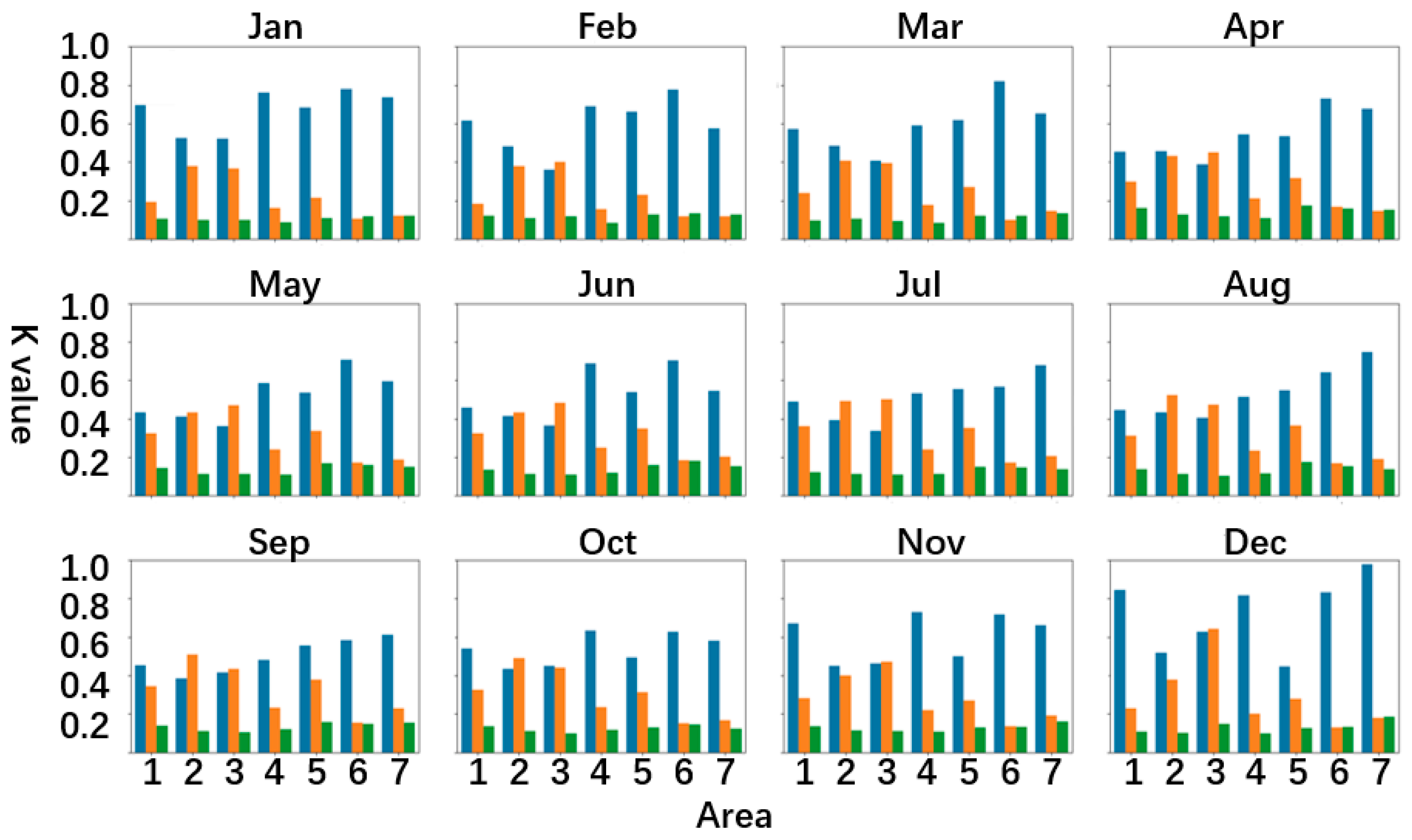
Figure 2 shows the monthly distribution of decomposition coefficients for the 7 Daqing Oilfield production units in 2023, where E1, E2, and E3 are depicted in blue, orange, and green, respectively. Twelve subplots arranged chronologically display the monthly variations, while the horizontal axis of each subplot corresponds to the seven operation areas within the production plant. It can be observed that E1 accounts for the largest proportion (60–80%) across all units and months, confirming it as the key driver of production output. This alignment between the proportional dominance of E1 and its functional role as artificial lift (the primary power source for crude oil extraction) further validates the rationality of our electricity consumption decomposition strategy.
Additionally, the coefficients exhibit temporal (seasonal variations) and spatial (differences between units) heterogeneity, which justifies the need for unit-specific and time-varying coefficient calibration.

2.3.2. Machine Learning-Based Production Prediction

To accurately quantify the nonlinear relationship between decomposed electricity consumption and production output, the LGBM [27] algorithm is selected as the prediction model. It is widely recognized for its high efficiency, accuracy, and ability to handle time-series data with seasonal variations, making it suitable for industrial production prediction scenarios.
(1) Model Input and Output
The input variables of the LGBM prediction model are designed to fully leverage the differentiated contributions of different electricity consumption components to production output, incorporating the decomposed three functional electricity consumption components (core production electricity E1, auxiliary production electricity E2, and product transportation electricity E3) as well as temporal feature of month; this variable selection abandons the over-reliance on single total electricity consumption data and effectively captures the intrinsic link between refined electricity utilization and production.
The unique output variable of the model is defined as the monthly liquid production of each individual production unit, which is the core indicator to reflect the actual production output level in oilfield daily operation and management, and the direct matching of the output with the key production indicator ensures the model’s practical guiding significance for subsequent electricity allocation optimization.
(2) Model Training and Evaluation
The field dataset (2021–2024) is split into a training set (80%, 245 samples) and a test set (20%, 49 samples) using a random stratified sampling method (preserving the temporal and spatial distribution characteristics of the original data). Four evaluation metrics are adopted to assess model performance: Mean Absolute Error (MAE), Root Mean Square Error (RMSE), Coefficient of Determination (R2), and Relative Error (RE), as defined in Equations (5)–(8):
M A E   = 1 n i = 1 n y i   ŷ i  
R M S E = 1 n i = 1 n y i ŷ i 2  
R 2 = 1 i = 1 n y i ŷ i 2 i = 1 n y i y ¯ 2  
R E = 1 n i = 1 n y i ŷ i y i × 100 %  
where y i is the actual production value, ŷ i is the predicted value, y ¯ is the average of actual values, and n is the number of samples.
For comparison, other mainstream machine learning algorithms (e.g., XGBoost, Extremely Randomized Trees, Linear Regression) are also trained under the same data conditions. Table 1 presents the performance comparison results, showing that the LGBM model achieves the optimal performance: R2 = 0.9933, MAE = 0.6091 × 10⁴ tons, RMSE = 0.7435 × 10⁴ tons, and RE = 3.59%. This confirms that the LGBM model can accurately capture the nonlinear relationship between electricity consumption and production, providing reliable prediction support for the subsequent optimization module.
LGBM is a gradient boosting framework that employs two novel techniques, namely Gradient-based One-Side Sampling and Exclusive Feature Bundling. These techniques significantly reduce computational cost while maintaining high accuracy, making LGBM particularly suitable for industrial time-series data with seasonal and spatial heterogeneity. In this study, the LGBM model was configured to predict monthly liquid production per operation area using the decomposed electricity components along with the month index as input features.
To achieve this performance, we employed the Optuna framework to automatically optimize the LGBM hyperparameters. A total of 30 trials were conducted with the following search space: learning rate (log uniform, [0.01, 0.1]), maximum tree depth (integer, [4, 12]), number of leaves (integer, [31, 128]), subsample ratio (uniform, [0.5, 1.0]), column subsampling ratio per tree (uniform, [0.5, 1.0]), L1 regularization coefficient (log uniform, [1 × 10⁴, 1.0]), L2 regularization coefficient (log uniform, [1 × 10⁴, 1.0]), and minimum number of child samples (integer, [10, 100]). The number of trees was fixed at 1000, with an early stopping of 50 rounds based on validation MAE. The objective function was set to L1 regression loss (i.e., MAE). The optimal hyperparameter combination was selected by minimizing the validation MAE over the 30 trials. All other parameters were left at their default values as implemented in the LGBM library.
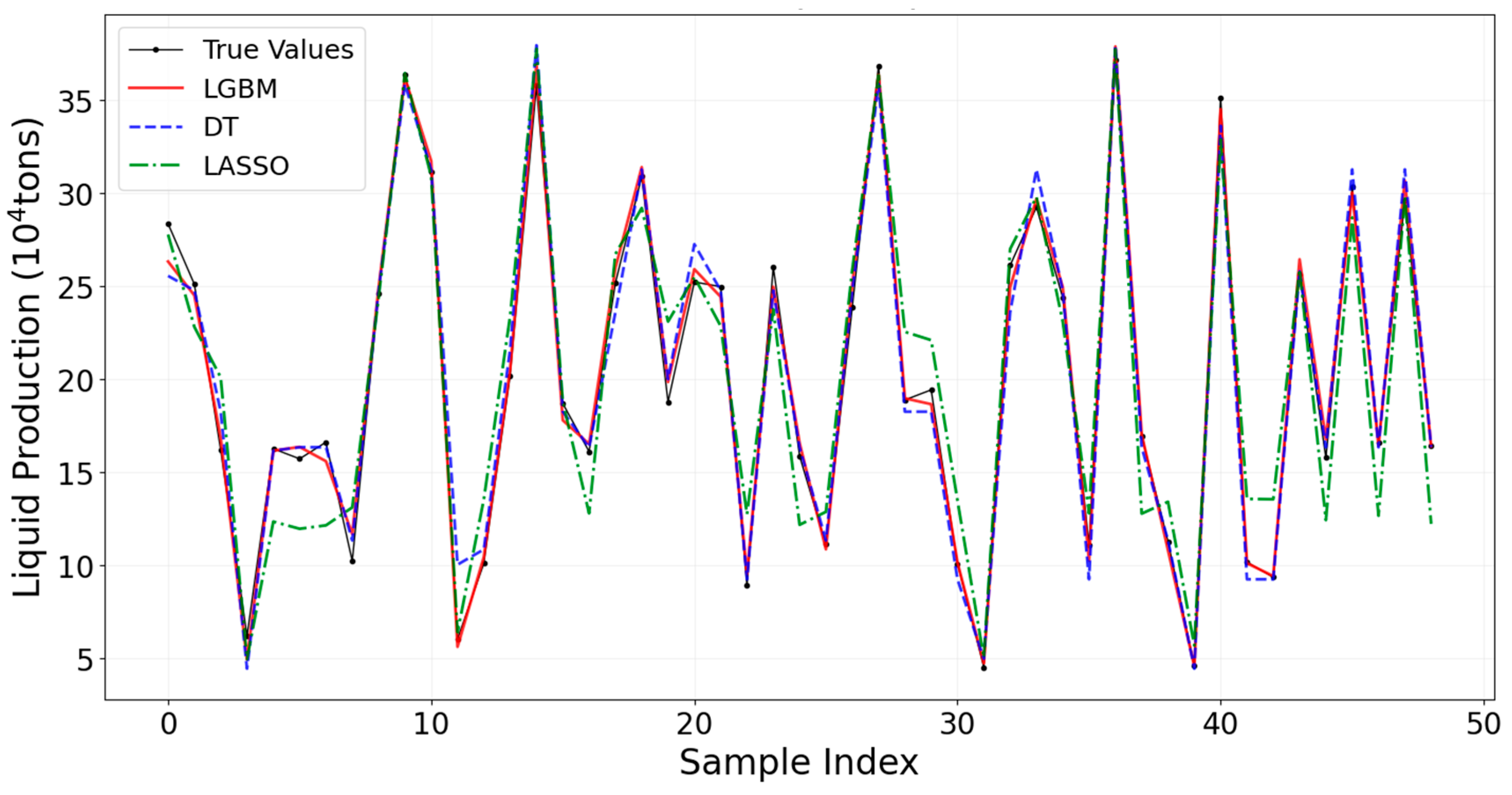
In addition to quantitative metric evaluation, we incorporate a qualitative assessment through visual comparison of prediction outcomes from three representative models: LGBM, DT, and LASSO. As illustrated in Figure 3, the observed liquid production values are denoted by a black dotted line, while the predictions from LGBM, DT, and LASSO are shown as solid red, dashed blue, and dot-dash green lines, respectively. The LGBM predictions demonstrate the closest alignment with the ground truth values shown as a dotted black line. This visual analysis confirms the superior performance of the LGBM framework in liquid production forecasting, thereby corroborating the quantitative findings presented in Table 1. Conversely, the LASSO model exhibits comparatively reduced predictive accuracy, which can be attributed to its inherent limitations in capturing complex nonlinear relationships due to its linear formulation.
To further verify the model’s robustness in practical applications, the prediction performance is tested using estimated decomposition coefficients (instead of true coefficients). The results (Table 2) show that the LGBM model still maintains high accuracy (R2 = 0.9649, RE = 6.82%), indicating its strong anti-interference ability to data uncertainties (e.g., slight deviations in decomposition coefficients), which fully meets the requirements of industrial engineering applications.
Note: We used LGBM version 4.6.0, XGBoost version 3.0.5, scikit-learn version 1.7.1 for SVM, ET, LR, SVR, RIDG, DT, and LASSO, and Optuna version 4.5.0 in this study.

2.4. Multi-Objective Spatiotemporal Optimization Model

2.4.1. Problem Definition

In this study, the three objectives are combined into a scalarized single-objective function using a weighted sum approach. The optimization problem is defined as follows: Given that the cumulative electricity consumption of production units exceeds the planned target in the early months (ΔE denotes the excess electricity), how to dynamically allocate electricity reduction tasks across production units (spatial dimension) and remaining months (temporal dimension) to ensure the annual electricity target is met, while maximizing electricity utilization efficiency, minimizing production fluctuations, and protecting key production units.
(1) Decision Variables
Define xt,n as the optimized monthly electricity allocation for production unit n in month t (where t ∈ [ts,12], ts is the adjustment start month; n ∈ [1, N], N is the total number of production units). The decision variable directly determines the spatial and temporal distribution of electricity resources.
(2) Objective Function
The total objective function f x t , n is a weighted combination of three sub-objective functions, namely the efficiency term f 1 x t , n , stability term f 2 x t , n and priority term f 3 x t , n , with weighted combination to reflect their relative importance in industrial practice. The function is formulated as a minimization problem (Equation (9)):
min f x t , n = t = t s 12 n = 1 N w 1 P t , n ŷ t , n x t , n 2 α n   Efficiency   Term   f 1 x t , n + w 2 x t , n E t , n o r g 2 S t a b i l i t y T e r m f 2 x t , n + w 3 C n x t , n E t , n P r i o r i t y T e r m f 3 x t , n
where
  • w1, w2, w2 are weighting coefficients (w1 + w2 + w2 = 1), determined based on industrial expert experience and production requirements (set as 0.5, 0.3, 0.2 in this study, prioritizing efficiency while ensuring stability and priority);
  • P t , n is the planned production target of unit n in month t;
  • ŷ t , n x t , n is the predicted production output of unit n in month t (derived from the LGBM model, with x t , n decomposed into E1, E2, E2 as input);
  • α n is the inverse efficiency coefficient of unit n ( α n = 1/mean (production/electricity consumption)), reflecting operational efficiency: higher efficiency leads to smaller α n imposing stronger penalties for production deviations;
  • E t , n o r g is the original planned electricity allocation of unit n in month t (before optimization);
  • C n is the priority coefficient of unit n, integrated by strategic importance, operational stability, and production urgency (normalized to [0, 1], higher values indicate higher priority, requiring stricter protection against excessive electricity adjustments).
The objective function is composed of three distinct terms, each designed to address a specific aspect of the optimization—namely, efficiency, stability, and priority—thereby ensuring a balanced and coordinated resolution between energy conservation and production requirements; these terms are explained as follows:
  • Efficiency term (   f 1 x t , n ): Minimizes the quadratic deviation between predicted and planned production, weighted by the inverse efficiency coefficient. This ensures that high-efficiency units (with smaller α n ) have smaller production deviations, achieving “energy saving without production loss”.
  • Stability term (   f 2 x t , n ): Constrains the quadratic deviation between optimized and original planned electricity allocation, avoiding drastic monthly adjustments that disrupt production stability.
  • Priority term ( f 3 x t , n ): Applies linear penalties for electricity adjustments based on unit priority, protecting key units from excessive reductions.
(3) Constraints
To ensure the feasibility, practicality, and industrial applicability of the spatiotemporal electricity allocation scheme, three types of constraints are formulated based on the actual characteristics of oilfield production operations and management requirements:
  • Total balance constraint: The cumulative electricity reduction across all units and remaining months must exactly offset the early excess electricity consumption (ΔE), ensuring compliance with the annual electricity target (Equation (10)):
Δ E = t = t s 12 n = 1 N E t , n o r g x t , n
  • Monthly adjustment limit constraint: The total monthly electricity allocation of all units shall not deviate excessively from the original plan (set as ±20% based on industrial practice), preventing production disruptions caused by extreme adjustments (Equation (11)):
1 δ · n = 1 N E t , n o r g   n = 1 N x t , n   1 + δ · n = 1 N E t , n o r g ,   t     t s ,   12
where δ = 0.2 (monthly adjustment coefficient).
  • Key unit protection constraint: The optimized electricity allocation of the key unit shall not be less than 85% of the original plan, ensuring the stability of core production capacity (Equation (12)).
x t , n   τ · E t , n o r g ,   n     K e y   U n i t s ,   t     t s ,   12
Here, τ = 0.85 (minimum protection coefficient for key units).
Note: These threshold values are derived from Daqing Oilfield’s practical experience. Users of the framework may modify them to suit their own operational contexts.

2.4.2. Model Solution Algorithm

The proposed optimization model is a constrained nonlinear programming problem, where the objective function contains nonlinear terms from the efficiency term and the LGBM prediction model, while the constraints are linear. The SLSQP algorithm is therefore selected for solution in this study, as it is highly efficient in solving smooth nonlinear optimization problems with linear constraints [36] and widely validated in industrial engineering applications.
The SLSQP algorithm iteratively constructs quadratic approximations of the Lagrangian function and linearizes constraints to solve subproblems, updating the solution through line search until convergence. The algorithm is implemented in Python (version 3.10.0) using the scipy.optimize.minimize function [37] with method = ‘SLSQP’. The solver was configured with maxiter = 1000 (maximum number of iterations) and ftol = 1 × 10⁻⁶ (function tolerance). Convergence is declared when both the maximum absolute change in the objective function value between iterations falls below ftol and the maximum constraint violation is less than 1 × 10⁻⁴. All other parameters were left at their default values as provided by SciPy (version 1.15.3).

3. Results and Analysis

This chapter validates the effectiveness and superiority of the proposed spatiotemporal electricity allocation method through two sequential validation stages: simulated data verification (for preliminary methodological feasibility) and field data validation (for practical industrial applicability). Comparative analysis is conducted against the conventional ton-per-kWh method, with all core indicators derived directly from the study’s simulated scenarios and Daqing Oilfield field data. The validation process adheres to the principles of scientific rigor, ensuring all results are traceable, quantifiable, and consistent with the methodological framework outlined in Section 2.

3.1. Simulated Data Validation

3.1.1. Simulation Scenario Setup

To isolate the impact of allocation logic and avoid interference from complex real-world factors (e.g., equipment failures, geological variability), a controlled simulation scenario was designed. The scenario included 3 production units (Area 0, Area 1, Area 2) with distinct operational scales and efficiency levels, covering a 12-month production cycle. Key simulation parameters and scenario settings are summarized in Table 3. We note that this simulated scenario is intentionally simplified and does not incorporate probabilistic uncertainties or Monte Carlo repetitions; its purpose is solely to illustrate the optimization logic under controlled conditions. Quantitative conclusions are primarily drawn from the field data validation in Section 3.2, which captures the true complexity and heterogeneity of oilfield operations.
A realistic electricity overconsumption event was simulated: in the 6th month, actual electricity consumption exceeded the planned target by 30% (Area 0), 50% (Area 1), and 50% (Area 2), resulting in a total excess electricity consumption of ΔE = 13,444 kWh (consistent with the target reduction requirement). The core task was to allocate electricity reduction tasks across the remaining 6 months (July–December) to offset the excess consumption, while minimizing production loss and ensuring operational rationality.
To approximate real-world data characteristics, 1% random noise was added to both electricity consumption and liquid production data during scenario construction. Linear regression was used to recalibrate efficiency coefficients, ensuring the simulation data reflected practical production variability without losing methodological verification validity.
Both the proposed multi-objective optimization method and the conventional ton-per-kWh method satisfied all core constraints of the designed simulation scenario, with three key compliance results achieved. Specifically, both methods completed the target electricity reduction of 13,444 kWh, which fully offset the cumulative electricity overconsumption in the early production stage. In addition, all electricity adjustments under both methods were implemented as downward reductions without any unreasonable electricity increases for individual production units, thus avoiding secondary energy waste caused by irrational allocation. Furthermore, both methods met the basic protection requirements for high-efficiency production units, while the proposed optimization method realized a more precise and scientific protection effect for core high-efficiency units (the detailed comparison is presented in Section 3.1.2).

3.1.2. Production Impact Minimization

The most prominent advantage of the optimization method is its ability to minimize production loss while achieving the predetermined energy conservation target. As shown in Table 4, quantitative analysis of the simulated output data shows that during the July–December adjustment period, the optimization method led to a cumulative production reduction of 275.57 × 10³ tons, whereas the ton-per-kWh method caused a loss of 336.07 × 10³ tons, representing an 18.0% reduction in production loss for the optimized approach. In terms of the production reduction ratio, the optimization method achieved a ratio of 7.74%, which was 1.69 percentage points lower than the 9.43% of the ton-per-kWh method, demonstrating a more efficient electricity-to-production conversion efficiency under the same energy-saving pressure.
The optimization method also realizes precise protection of high-efficiency and high-priority core production units. As the core unit with the highest efficiency and a priority coefficient of 0.9, Area 0 experienced a production loss of 164.82 × 10³ tons under the optimization method, a 43.3% decrease compared with the 290.61 × 10³ tons loss caused by the ton-per-kWh method. The traditional method imposed an excessive monthly electricity reduction of 11.1–11.5% on Area 0, leading to a severe monthly production drop of 11.4–14.3%, while the optimization method controlled Area 0’s monthly electricity reduction within 4.9–7.5%, limiting its monthly production loss to a moderate range of 5.6–8.4% and effectively safeguarding the core production capacity of the oilfield.
For low-efficiency production units, the optimization method makes a scientific and rational trade-off in electricity reduction allocation. Taking Area 2 with an efficiency coefficient of 0.02 tons/kWh as an example, the optimization method allocated a higher monthly electricity reduction ratio of 12.4–18.5% to this unit, resulting in a cumulative production loss of 84.85 × 10³ tons, which was higher than the 41.72 × 10³ tons loss from the ton-per-kWh method. This differentiated allocation strategy concentrates energy-saving tasks on units with greater energy waste potential, avoiding the unnecessary sacrifice of production capacity in high-efficiency units and ultimately improving the overall electricity utilization efficiency of the entire production system.

3.1.3. Allocation Fairness

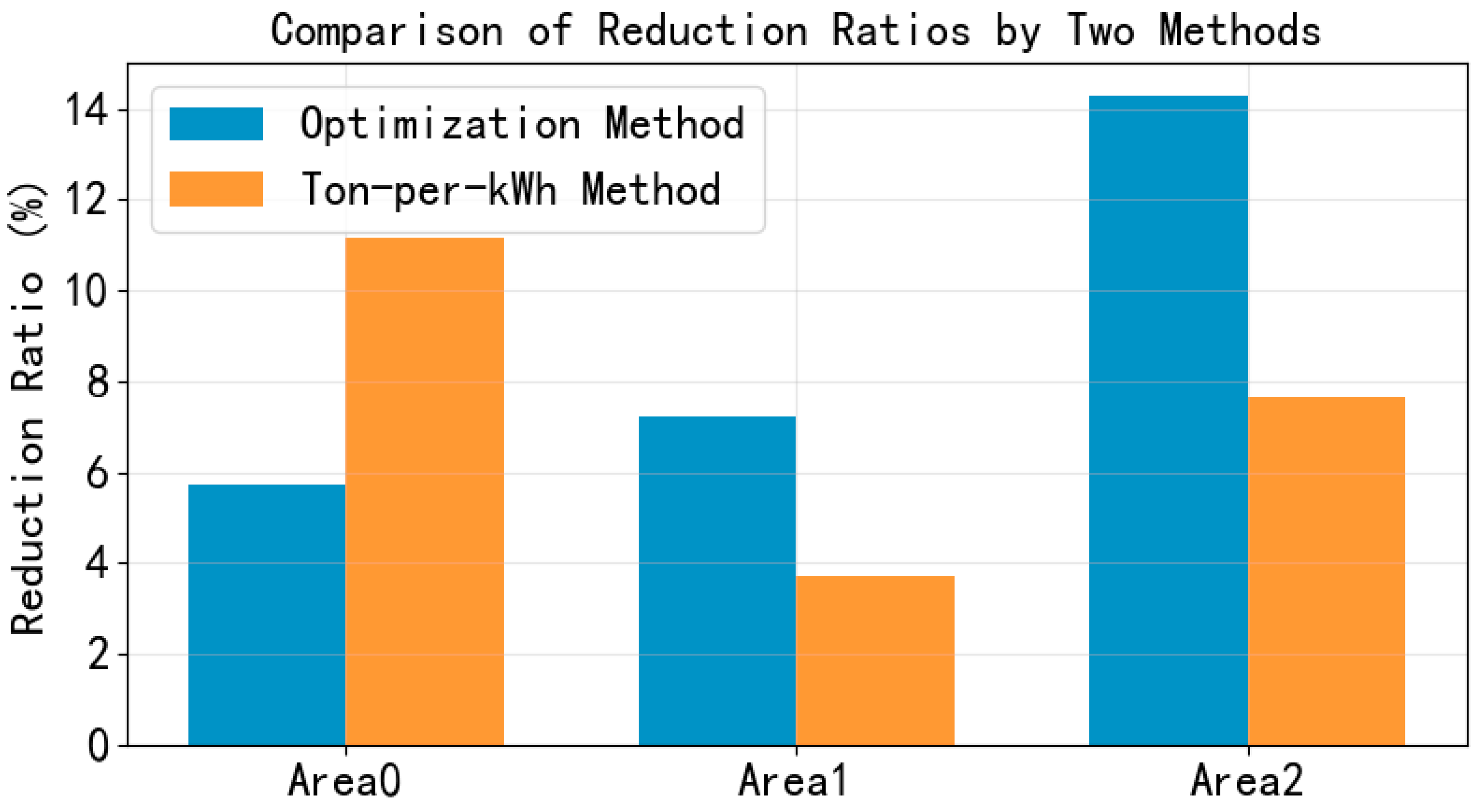
The optimization method breaks the rigid “one-size-fits-all” proportional allocation logic of the ton-per-kWh method by integrating the operational efficiency and priority weights of each production unit, thus achieving a more equitable and scientifically grounded electricity resource allocation scheme. The reduction ratios assigned by the optimization method are fully aligned with the inherent characteristics of each unit: the high-efficiency and high-priority Area 0 bears a reduction ratio of 5.77%, the medium-efficiency and medium-priority Area 1 has a ratio of 7.24%, and the low-efficiency Area 2 with medium priority is allocated a 14.43% reduction ratio, as shown in Figure 4. This allocation mechanism follows the core principle of “rewarding high efficiency and constraining low efficiency”, which ensures that energy-saving tasks are precisely targeted at units with greater potential for energy waste, and avoids imposing unreasonable reduction burdens on the core production units that are critical to the overall output.
In contrast, the ton-per-kWh method distributes electricity reduction tasks solely based on the production share of each unit, completely ignoring the significant differences in operational efficiency and production priority among units, leading to highly irrational allocation results. The most counterintuitive outcome is that the high-efficiency core Area 0, which should be protected, bears the highest reduction ratio of 11.27%, while the low-efficiency Area 2, which has greater energy-saving potential, is only assigned a reduction ratio of 7.59%. This unreasonable allocation not only fails to tap into the energy-saving potential of low-efficiency units but also unnecessarily sacrifices the production capacity of high-efficiency core units, resulting in suboptimal overall operational performance of the entire production system and a significant waste of electricity resources.

3.2. Oilfield Data Validation

3.2.1. Field Data Overview

Actual data were collected from seven operation areas within Daqing Oilfield Production Plant 7, as previously outlined in Section 2.3. A comparative analysis of planned versus actual electricity consumption was conducted across a three-year observation period spanning 2022 to 2024. Subsequently, the year 2022 was selected for empirical validation within this study. The corresponding statistical characteristics of the dataset are systematically presented in Table 5 and Table 6, which respectively organize the information according to spatial distribution across operation areas and temporal progression throughout the annual cycle.
Table 5 presents the basic production and efficiency parameters of the seven operation areas in 2022, among which the normalized efficiency (αₙ) and priority weight (Cₙ) are reference values comprehensively determined by oilfield management officials. The officials integrated multiple core factors, including reservoir development conditions, actual production operational efficiency, equipment configuration level, and the strategic importance of each unit in the overall production layout of the oilfield, to assign the values, ensuring the parameters are highly consistent with the actual production management requirements of the oilfield. Calculated from the above parameters, the normalized efficiency coefficients of each operation area exhibit a wide range of values from 1.0 to 0.37, corresponding to a maximum standardized efficiency of 1.00 in Area 0 and a minimum of 0.37 in Area 6, reflecting significant heterogeneity in operational efficiency among different areas. Similarly, production capacity also shows obvious divergence across the seven areas, with Area 1 achieving the highest liquid production output of 3838.2 × 103 tons while Area 6 records the minimum output of 625.3 × 10³ tons. The weighting scheme applied to the optimization framework in this study allocates relative importance of 0.5, 0.3, and 0.2 to the efficiency, stability, and priority components in Equation (9), respectively, matching the parameter setting logic of αₙ and Cₙ.
Annual data in Table 6 reveals consistent overconsumption during the January–May period of 2022, with cumulative electricity usage exceeding planned consumption by May, resulting in a maximum deviation of ΔE = 2156.4 × 103 kWh. This deviation led to the designation of May as the baseline for implementing electricity adjustments. Following this point, corrective measures were observed across all operational areas, which resulted in reduced electricity usage in the subsequent months. However, these reductions appeared less systematic, as the cumulative savings from June to December exceeded the initial overconsumption from January to May. Although this responsive approach successfully brought the annual electricity consumption within the planned indicators, its uncoordinated nature may have led to suboptimal operational disruptions and production inefficiencies.

3.2.2. Core Constraint Compliance

Both the proposed multi-objective optimization method and the conventional ton-per-kWh method strictly complied with all core constraints of the electricity allocation scheme in the field validation. The two methods both accurately achieved the target electricity reduction of 2156.4 × 103 kWh with zero balance error, fully offsetting the cumulative electricity overconsumption in the early stage. Meanwhile, all electricity adjustments under both methods were implemented as strict downward reductions without any reverse increments for individual operation areas, avoiding secondary energy waste caused by irrational allocation. In addition, both methods abided by the basic protection principle for high-efficiency and high-priority production areas, ensuring that the core production capacity of the oilfield was not excessively restricted by the electricity reduction tasks.

3.2.3. Field Production Impact Minimization

Under the identical electricity-saving target, the proposed optimization method achieves a remarkable reduction in actual production loss compared with the conventional ton-per-kWh method, demonstrating superior economic performance in practical oilfield scenarios. As shown in Table 7, during the June–December adjustment period, the optimization method results in a total production reduction of 11.40 × 10³ tons, while the ton-per-kWh method leads to a production loss of 16.88 × 10³ tons. This means the proposed method cuts down the actual production loss by 32.5%, fully embodying its core advantage of balancing energy conservation goals and production stability in real industrial applications.

3.2.4. Practical Allocation Rationality

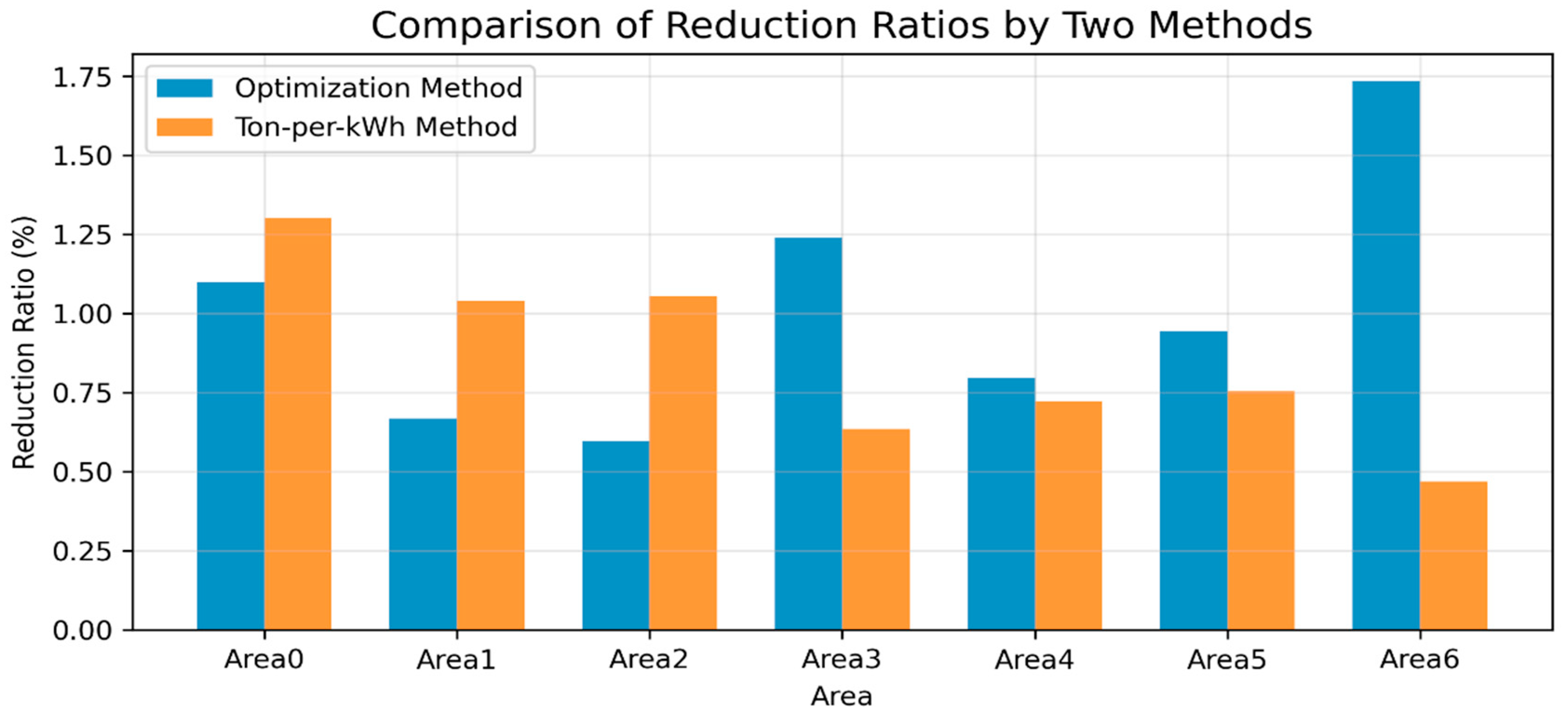
In actual oilfield production management, the rationality of spatial electricity allocation directly determines the practicability and acceptance of the allocation scheme by on-site production units. Combined with the normalized inverse efficiency coefficient αn and priority coefficient Cn of each operation area (Table 5), the proposed optimization method implements a differentiated allocation strategy that is highly consistent with the actual production characteristics and management requirements of the oilfield. Its formulated electricity reduction ratios strictly align with the efficiency and priority attributes of each area: the high-priority and high-efficiency Area 0 bears a reduction ratio of 1.10%, medium-priority and medium-efficiency Areas 1–5 have reduction ratios ranging from 0.60% to 1.24%, and the low-efficiency and low-priority Area 6 is assigned the highest reduction ratio of 1.73%, as shown in Figure 5. This allocation fully follows the core principle of “protecting high efficiency and restraining low efficiency”, which is also highly matched with the weighting scheme of the optimization model that prioritizes electricity utilization efficiency with a weight coefficient of 0.5.
By contrast, the conventional ton-per-kWh method distributes electricity reduction tasks solely based on the production share of each operation area, completely ignoring the significant heterogeneity in operational efficiency and production priority among different areas, resulting in an unreasonable and non-targeted allocation scheme. The high-quality Area 0, with the highest normalized efficiency of 1.00 and a top priority coefficient of 0.9, is burdened with an excessive reduction ratio of 1.30% under this method, while Area 6, the lowest-efficiency unit with a normalized efficiency of only 0.37, is allocated a mere 0.47% reduction ratio. Such an allocation not only excessively restricts the production capacity of core high-efficiency units but also fails to effectively tap into the energy-saving potential of low-efficiency units, which is the fundamental reason for the larger overall production loss caused by the ton-per-kWh method in field validation.
This contrast in allocation rationality further verifies the practical value of the proposed spatiotemporal optimization method. The differentiated allocation based on efficiency and priority not only ensures the scientificity and fairness of electricity resource distribution but also enhances the operability and acceptability of the allocation scheme in actual oilfield management. Unlike the rigid “one-size-fits-all” proportional allocation of the traditional method, the optimization method’s allocation strategy is more in line with the actual operational logic of oilfield production, providing a feasible and targeted decision-making basis for on-site production managers to implement electricity conservation and emission reduction measures.

4. Conclusions

This study proposes a dynamic spatiotemporal electricity allocation framework that decomposes industrial electricity consumption into three functional components (core production, auxiliary production, and product transportation) and employs an LGBM model to capture the nonlinear relationship between electricity use and liquid production. A multi-objective optimization model is formulated to balance electricity efficiency, operational stability, and priority protection of key units, solved via SLSQP under practical constraints derived from Daqing Oilfield’s practice.
Validation using simulated and field data from seven operation areas of Daqing Oilfield (2022) shows that, while both the proposed method and the conventional ton-per-kWh method achieve the same total electricity reduction target, the proposed method reduces liquid production loss by 18.0% in simulation and by 32.5% in the field. This improvement stems from a differentiated allocation strategy that protects high-efficiency, high-priority areas while directing larger reductions to low-efficiency units, thereby minimizing overall production loss.
The framework relies only on routinely available production and electricity data, offering a scalable decision support tool for refined electricity management. Future work will incorporate real-time data for dynamic updating of decomposition coefficients, introduce uncertainty analysis for extreme events, extend validation to other oilfield types, and move from the current scalarized approach to a full Pareto-based multi-objective optimization framework (e.g., using NSGA-II) to provide decision-makers with a richer set of trade-off solutions.

Author Contributions

Conceptualization, W.S.; Methodology, W.S., Y.X. and J.W.; Software, B.L. and W.L.; Validation, Y.X., B.L. and W.L.; Formal analysis, W.L.; Resources, B.L.; Writing—original draft, Y.Z. and J.W.; Writing—review & editing, J.W.; Visualization, Y.Z. All authors have read and agreed to the published version of the manuscript.

Funding

This research was funded by the China National Petroleum Corporation (CNPC) through a scientific research and technology development project (Grant No. 2023DJ8205).

Data Availability Statement

The simulated data can be generated according to the parameters provided in the manuscript. The field data from Daqing Oilfield are available from the corresponding author upon reasonable request.

Conflicts of Interest

Authors Wenrong Song, Yuan Xu, Bin Lyu, and Wenbin Liu are employed by Kunlun Digital Technology Co., Ltd., a wholly-owned subsidiary of China National Petroleum Corporation (CNPC) that provides digital and intelligent technologies for the oil and gas industry. The remaining authors declare no conflicts of interest. The funders had no role in the design of the study; in the collection, analyses, or interpretation of data; in the writing of the manuscript; or in the decision to publish the results.

References

  1. International Energy Agency (IEA). World Energy Outlook 2023; IEA Publications: Paris, France, 2023. [Google Scholar]
  2. Lyu, R.; Zhang, C.; Li, Z.; Li, Y. Manufacturers’ integrated strategies for emission reduction and recycling: The role of government regulations. Comput. Ind. Eng. 2022, 163, 107769. [Google Scholar] [CrossRef]
  3. Kunene, N.; Chung, Y.C. Sustainable production policy impact on palm oil firms’ performance: Empirical analysis from Indonesia. Sustainability 2020, 12, 8750. [Google Scholar] [CrossRef]
  4. Hunt, J.D.; Nascimento, A.; Nascimento, N.; Vieira, L.W.; Romero, O.J. Possible pathways for oil and gas companies in a sustainable future: From the perspective of a hydrogen economy. Renew. Sustain. Energy Rev. 2022, 160, 112291. [Google Scholar] [CrossRef]
  5. Ekechukwu, D.E.; Simpa, P. Trends, insights, and future prospects of renewable energy integration within the oil and gas sector operations. World J. Adv. Eng. Technol. Sci. 2024, 12, 152–167. [Google Scholar] [CrossRef]
  6. Oji, D.N.; Ezeh, E.M. Assessing the Progress of Decarbonization Efforts in Nigeria’s Oil and Gas Industry. Caritas J. Chem. Eng. Ind. Biotechnol. 2025, 2, 46–57. [Google Scholar]
  7. Cucchiella, F.; D’Adamo, I.; Gastaldi, M.; Miliacca, M. Efficiency and allocation of emission allowances and energy consumption over more sustainable European economies. J. Clean. Prod. 2018, 182, 805–817. [Google Scholar] [CrossRef]
  8. Mohamadinejad, H.; Amirteimoori, A.; Kordrostami, S.; Hosseinzadeh, L.F. A managerial approach in resource allocation models: An application in US and Canadian oil and gas companies. Yugosl. J. Oper. Res. 2023, 33, 481–498. [Google Scholar] [CrossRef]
  9. Chen, X.; Wang, M.; Wang, B.; Hao, H.; Shi, H.; Wu, Z.; Wang, B. Energy consumption reduction and sustainable development for oil & gas transport and storage engineering. Energies 2023, 16, 1775. [Google Scholar] [CrossRef]
  10. Virstyuk, A.; Bushmeleva, K.; Ivanov, F.; Mikshina, V. Reducing electricity consumption in oil production. In Proceedings of the 2020 International Conference on Electrotechnical Complexes and Systems (ICOECS), Ufa, Russia, 26–28 October 2020; IEEE: New York, NY, USA, 2020; pp. 1–4. [Google Scholar]
  11. Ma, Q. Analysis on energy consumption quota in oil production. Energy Conserv. Pet. Petrochem. Ind. 2017, 7, 33–34+11–12. [Google Scholar]
  12. Huang, Z.H. Exploration, research and application analysis of energy optimization technology for gathering and transportation system in Daqing oilfield. Oil-Gas Field Surf. Eng. 2023, 42, 82–85. [Google Scholar]
  13. Li, Z.Q.; Li, D.B.; Bing, S.X.; Xiao, W.; Zhang, H.Y.; Xu, Y.C.; Zheng, W.B.; Yang, X.L. Decomposition and allocation method of energy consumption quota for oil enterprises based on reasonable energy consumption of oil reservoir: A case of Shengli Oilfield. Pet. Geol. Recovery Effic. 2022, 29, 77–84. [Google Scholar]
  14. Chen, X.; Zhang, K.; Ji, Z.; Shen, X.; Liu, P.; Zhang, L.; Wang, J.; Yao, J. Progress and Challenges of Integrated Machine Learning and Traditional Numerical Algorithms: Taking Reservoir Numerical Simulation as an Example. Mathematics 2023, 11, 4418. [Google Scholar] [CrossRef]
  15. Azamifard, A.; Rashidi, F.; Ahmadi, M.; Pourfard, M.; Dabir, B. Toward more real-istic models of reservoir by cutting-edge characterization of permeability with MPS methods and deep-learning-based selection. J. Pet. Sci. Eng. 2019, 181, 106135. [Google Scholar] [CrossRef]
  16. Mishra, S.; Datta-Gupta, A. Applied Statistical Modeling and Data Analytics: A Practical Guide for the Petroleum Geosciences; Elsevier: Amsterdam, The Netherlands, 2017. [Google Scholar]
  17. Gabdrahmanova, K.F.; Izmailova, G.R.; Samigullina, L.Z. Methods of mathematical statistics application in assessing the density of actual and forecasting distribution density of residual oil reserves. In IOP Conference Series: Materials Science and Engineering; IOP Publishing: Bristol, UK, 2020; Volume 860, p. 012008. [Google Scholar]
  18. Wang, X.; Fei, Y.X.; Guo, J.J.; Zeng, L. Research on the application of energy consumption control and digital construction in improving quality and efficiency of oilfield station. Oil-Gas Field Surf. Eng. 2023, 42, 70–74. [Google Scholar]
  19. Cao, Y.; Song, M.H.; Zhao, W.D.; Xu, X.F.; Lin, G.Q. Analysis on energy efficiency evaluation method of key energy system in oil and gas fields: Taking the Tarim oilfield as an example. Chem. Eng. Oil Gas. 2020, 49, 106–114. [Google Scholar]
  20. Malekpoor, H.; Chalvatzis, K.; Mishra, N.; Mehlawat, M.K.; Zafirakis, D.; Song, M. Integrated grey relational analysis and multi objective grey linear programming for sustainable electricity generation planning. Ann. Oper. Res. 2018, 269, 475–503. [Google Scholar] [CrossRef]
  21. Bai, Y.; Hou, J.; Liu, Y.; Zhao, D.; Bing, S.; Xiao, W.; Zhao, W. Energy-consumption calculation and optimization method of integrated system of injection-reservoir-production in high water-cut reservoir. Energy 2022, 239, 121961. [Google Scholar] [CrossRef]
  22. Dong, Z.; Ruan, Y.; Ruan, Y.; Tian, Y. Identifying the primary factors influencing energy consumption in the water injection system through the use of fuzzy logic. In Proceedings of the 2024 6th International Conference on Intelligent Control, Measurement and Signal Processing (ICMSP), Xi’an, China, 29 November–1 December 2024; IEEE: New York, NY, USA, 2024; pp. 6–10. [Google Scholar] [CrossRef]
  23. Sievers, J.; Blank, T. A Systematic Literature Review on Data-Driven Residential and Industrial Energy Management Systems. Energies 2023, 16, 1688. [Google Scholar] [CrossRef]
  24. Munir, S.; Pradhan, M.R.; Abbas, S.; Khan, M.A. Energy Consumption Prediction Based on LightGBM Empowered with eXplainable Artificial Intelligence. IEEE Access 2024, 12, 91263–91271. [Google Scholar] [CrossRef]
  25. Olabanji, A.O.; Akeredolu, O.T. The role of Artificial Intelligence (AI) and Machine Learning (ML) in the oil and gas industry: A systematic literature review. J. Tech. Stud. 2025, 7, 45–68. [Google Scholar]
  26. Fan, D.; Lai, S.; Sun, H.; Yang, Y.; Yang, C.; Fan, N.; Wang, M. Review of machine learning methods for steady state capacity and transient production forecasting in oil and gas reservoir. Energies 2025, 18, 842. [Google Scholar] [CrossRef]
  27. Ke, G.; Meng, Q.; Finley, T.; Wang, T.; Chen, W.; Ma, W.; Ye, Q.; Liu, T.Y. Lightgbm: A highly efficient gradient boosting decision tree. Adv. Neural Inf. Process. Syst. 2017, 30, 3149–3157. [Google Scholar]
  28. Cortes, C.; Vapnik, V. Support-vector networks. Mach. Learn. 1995, 20, 273–297. [Google Scholar] [CrossRef]
  29. Geurts, P.; Ernst, D.; Wehenkel, L. Extremely randomized trees. Mach. Learn. 2006, 63, 3–42. [Google Scholar] [CrossRef]
  30. Chen, T.; Guestrin, C. XGBoost: A Scalable Tree Boosting System. In Proceedings of the 22nd ACM SIGKDD International Conference on Knowledge Discovery and Data Mining, San Francisco, CA, USA, 13–17 August 2016; Association for Computing Machinery: New York, NY, USA, 2016; pp. 785–794. [Google Scholar]
  31. Hosmer, D.W., Jr.; Lemeshow, S.; Sturdivant, R.X. Applied Logistic Regression, 3rd ed.; John Wiley & Sons, Inc.: Hoboken, NJ, USA, 2013. [Google Scholar]
  32. Drucker, H.; Burges, C.J.; Kaufman, L.; Smola, A.; Vapnik, V. Support vector regression machines. Adv. Neural Inf. Process. Syst. 1996, 9, 155–161. [Google Scholar]
  33. Hoerl, A.E.; Kennard, R.W. Ridge regression: Biased estimation for nonorthogonal problems. Technometrics 1970, 12, 55–67. [Google Scholar] [CrossRef]
  34. Breiman, L.; Friedman, J.H.; Olshen, R.A.; Stone, C.J. Classification and Regression Trees; Wadsworth: Belmont, CA, USA, 1984. [Google Scholar]
  35. Tibshirani, R. Regression Shrinkage and Selection via the Lasso. J. R. Stat. Soc. Ser. B (Methodol.) 1996, 58, 267–288. [Google Scholar] [CrossRef]
  36. Kraft, D. A Software Package for Sequential Quadratic Programming (DFVLR-FB 88-28); Institut für Dynamik der Flugsysteme, DFVLR: Oberpfaffenhofen, Germany, 1988. [Google Scholar]
  37. Virtanen, P.; Gommers, R.; Oliphant, T.E.; Haberland, M.; Reddy, T.; Cournapeau, D.; Burovski, E.; Peterson, P.; Weckesser, W.; Bright, J.; et al. SciPy 1.0: Fundamental algorithms for scientific computing in Python. Nat. Methods 2020, 17, 261–272. [Google Scholar] [CrossRef] [PubMed]
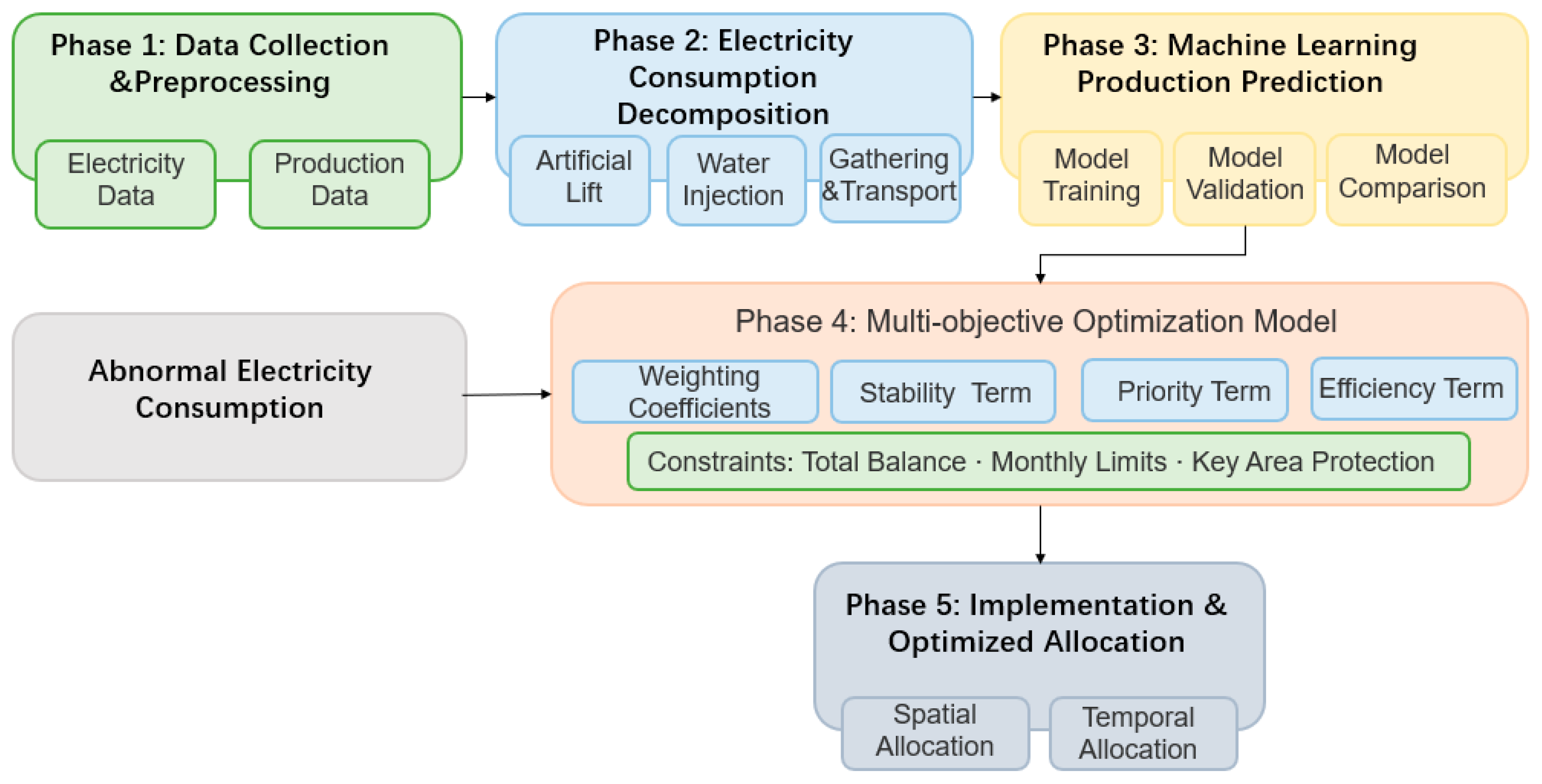
Figure 1. Overall Framework Diagram of the Proposed Model.
Algorithms 19 00401 g001
Figure 2. The distribution of electricity consumption coefficients across different operation areas and months during 2023.
Algorithms 19 00401 g002
Figure 3. Comparative visualization of prediction performance across the evaluated models.
Algorithms 19 00401 g003
Figure 4. Comparative visualization of allocation adjustments employing both methodologies based on simulated data.
Algorithms 19 00401 g004
Figure 5. Comparative visualization of electricity allocation adjustments employing both methodologies with actual operational data.
Algorithms 19 00401 g005
Table 1. Performance comparison of production prediction models.
MODELMAERMSER2Relative Error
LGBM [27]0.60910.74350.99330.0359
SVM [28]3.37544.20590.78560.2165
ET [29]0.60430.83820.99150.038
XGB [30]1.02441.50520.98050.0693
LR [31]2.15382.58680.91890.1466
SVR [32]3.37544.20590.78560.2165
RIDG [33]2.1542.58630.91890.1466
DT [34]0.94061.25870.98080.0626
LASSO [35]2.16232.58960.91870.1472
Table 2. Robustness test of the LGBM model with estimated decomposition coefficients.
K ValueMAERMSER2RE
True K0.60910.74350.99330.0359
Estimated K1.06361.70240.96490.0682
Table 3. Basic parameters of simulated production units.
UnitBaseline Electricity Consumption (103 kWh)Efficiency Coefficient (Tons/kWh)Planned Annual Production (103 Tons)Priority Weight
Area 050000.0318000.9 (High)
Area 140000.0114400.6 (Medium)
Area 220000.028640.7 (Medium)
Table 4. Production loss comparison.
MethodTotal (103 Tons)Ratio (%)Area 0 (103 Tons)Area 1 (103 Tons)Area 2 (103 Tons)
Optimization 275.577.74164.8225.9084.85
Ton-per-kWh 336.079.43290.613.7541.72
comparison60.50 (18.0%)1.69125.79 (43.3%)−22.15−43.13
Table 5. Basic production and efficiency parameters of seven operation areas in 2022.
AreaNormalized Efficiency (αn)Priority Weight (Cn)Planned
Production (103 Tons)
Area 01.000.92577.0
Area 10.890.63838.2
Area 20.800.73820.5
Area 30.460.81105.5
Area 40.670.752441.1
Area 50.620.851895.3
Area 60.370.65625.3
Table 6. Monthly production data for 2022.
MonthPlanned Production (103 Tons)Actual Production (103 Tons)Planned Electricity (103 kWh)Actual Electricity (103 kWh)Electricity Deviation (103 kWh)
11307.61469.044,703.045,877.21174.2
21185.11308.638,465.438,670.5205.1
31319.81448.038,502.338,569.567.2
41300.21403.432,276.532,712.7436.2
51374.91435.530,770.431,044.1273.7
Table 7. Performance comparison between two methods.
IndicatorTotal Electricity Reduction (103 kWh)Total Production Loss (103 Tons)Electricity Reduction Ratio (%)Production Reduction Ratio (%)
Optimization 2160.011.400.900.11
Ton-per-kWh 2160.016.880.900.17
Improvement /32.5%/0.06
Disclaimer/Publisher’s Note: The statements, opinions and data contained in all publications are solely those of the individual author(s) and contributor(s) and not of MDPI and/or the editor(s). MDPI and/or the editor(s) disclaim responsibility for any injury to people or property resulting from any ideas, methods, instructions or products referred to in the content.