
A Guided Collaborative Optimization Framework for the Stability-Constrained UAV Routing and Three-Dimensional Loading Problem

Abstract
1. Introduction
- (1)
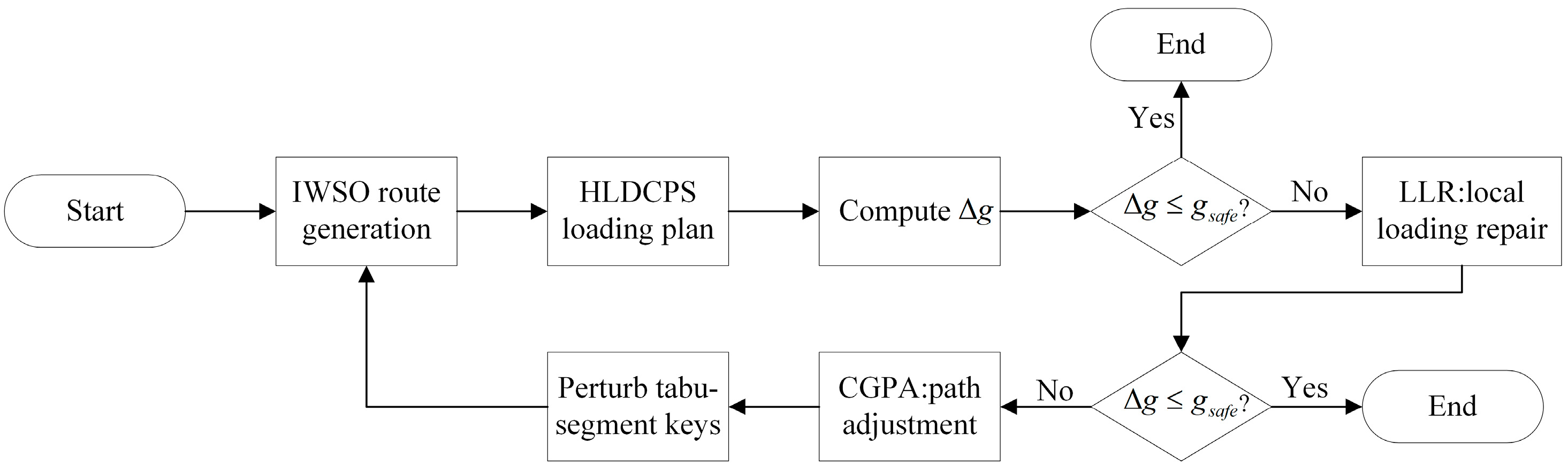
- Mathematical modeling of coupled constraints: Unlike existing UAV routing models that abstract cargo as scalar demand and neglect spatial loading configurations, and unlike ground-based 3L-VRP formulations that incorporate three-dimensional packing geometry but do not model CoG stability, the 3DLC-UAVRP explicitly encodes the full transmission chain from customer visit sequence to LIFO loading order, from loading order to three-dimensional parcel coordinates, and from parcel coordinates to static pre-takeoff CoG within a single unified formulation. This encoding makes the static CoG feasibility condition a direct function of routing decisions rather than an external post hoc check. Consequently, CoG violations can be structurally attributed to specific route segments, which is the prerequisite that enables the CGPA mechanism to translate loading infeasibility into targeted routing perturbations rather than simply discarding infeasible solutions.
- (2)
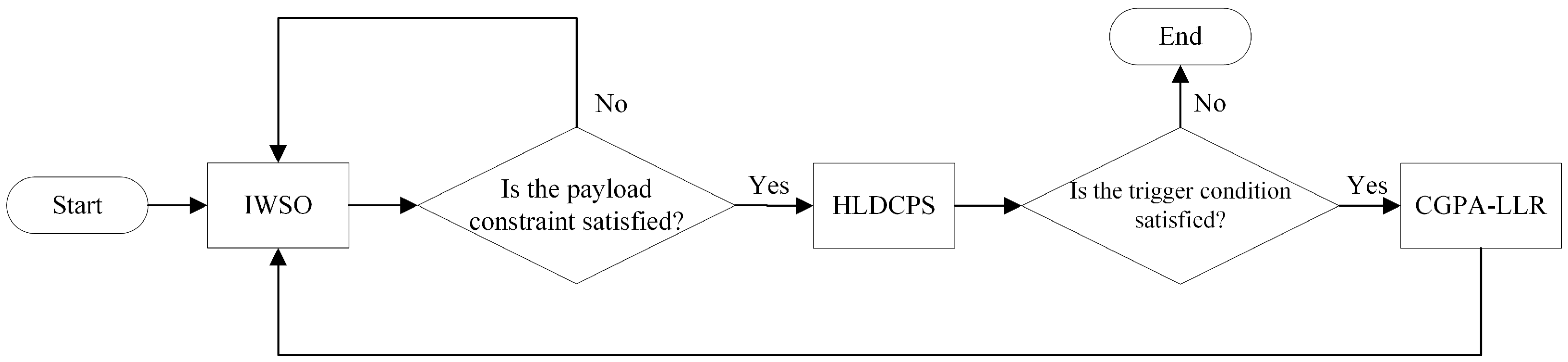
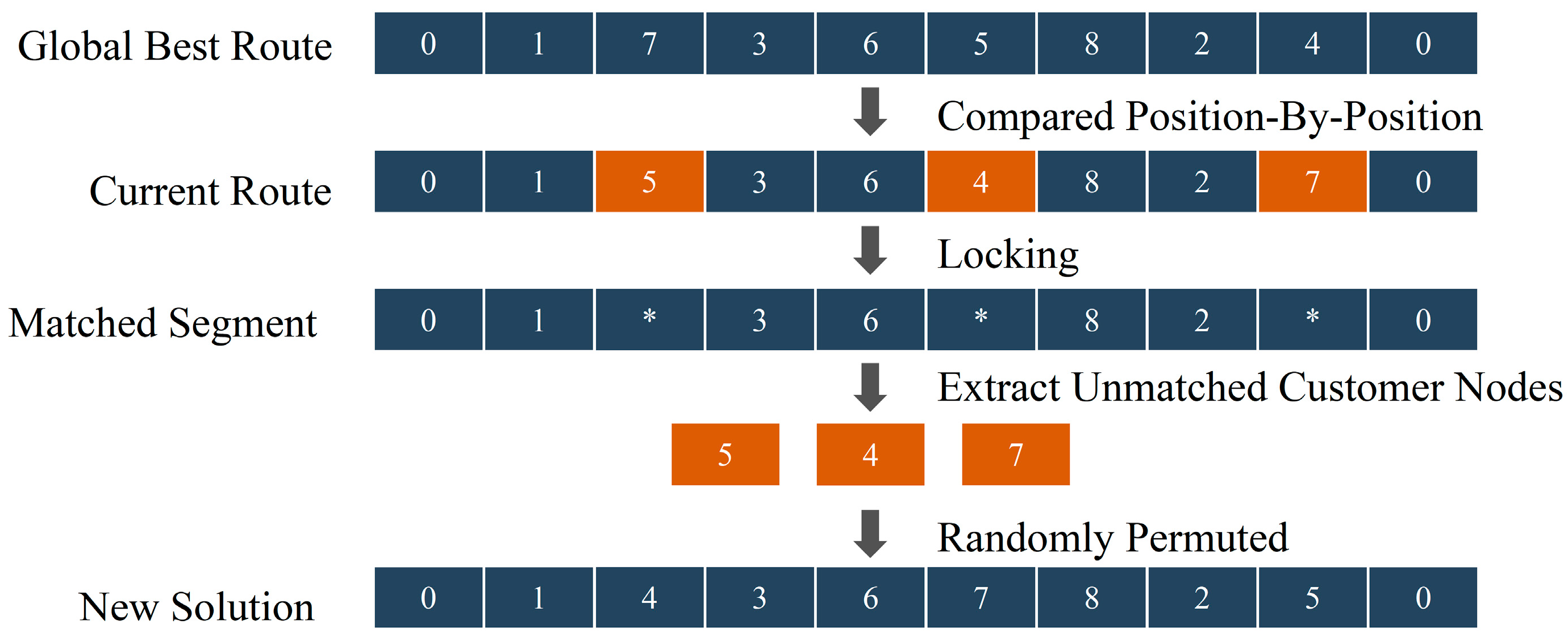
- A guided collaborative algorithmic framework: The GLS-WSCPA framework is proposed to address the circular dependency between routing feasibility and loading evaluation that traditional decoupled methods cannot resolve. The core algorithmic innovation lies in the CGPA-LLR mechanism, which establishes a bidirectional feedback loop between combinatorial route search and physical loading feasibility: LLR attempts to restore CoG balance through localized loading adjustments without altering the route structure, while CGPA translates unresolvable loading infeasibility into tabu-guided routing perturbations that actively redirect the global search trajectory. This tight coupling ensures that physical stability constraints are enforced throughout the search process rather than verified post hoc.
- (3)
- Algorithmic performance and sensitivity evaluation: Comprehensive computational experiments are conducted to evaluate the performance and scalability of the proposed framework across multiple problem scales. Wilcoxon signed-rank tests confirm that the performance advantages of GLS-WSCPA over competing methods reach statistical significance at n ≥ 50, with p-values below 0.001 at larger scales. Ablation studies with statistical validation quantify the complementary contributions of CGPA and LLR under varying constraint intensities. Sensitivity analysis further quantitatively reveals the non-linear impact of CoG stability margins and payload constraints on routing structures and fleet configurations, providing a reference benchmark for stability-constrained combinatorial optimization.
2. Related Works
2.1. Advances in UAV Delivery Routing Optimization
2.2. Joint Route–Loading Optimization
2.3. Evolution of Solution Strategies
3. Problem Description and Modeling
3.1. Problem Description
3.2. Mathematical Model
- (1)
- Each UAV has sufficient endurance to complete its assigned delivery route.
- (2)
- Each UAV can complete its mission and return to the depot within the prescribed time horizon.
- (3)
- Each customer’s demand must be fully satisfied in a single visit; split deliveries are not allowed.
- (4)
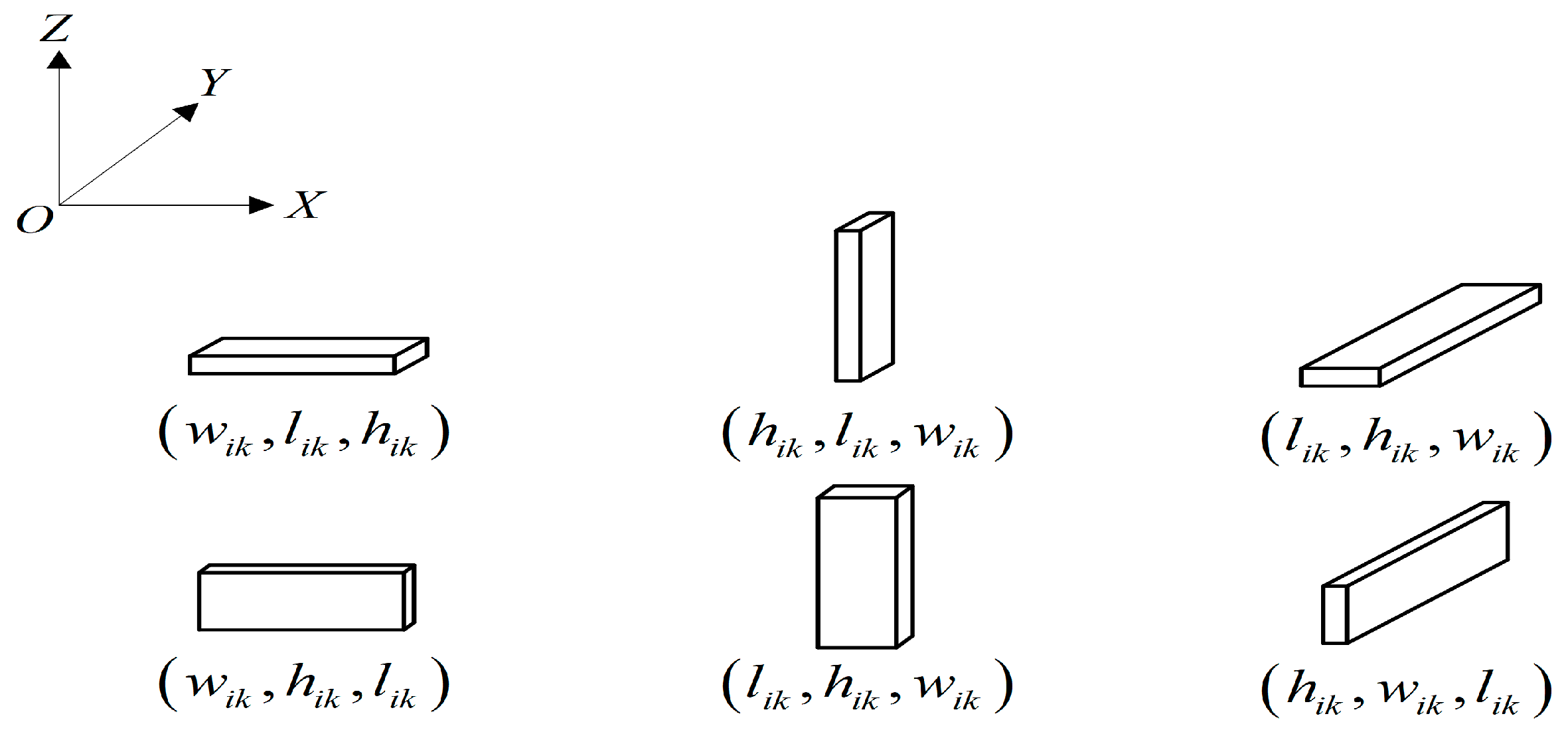
- All parcels are placed orthogonally, with their edges aligned parallel to the cargo bay boundaries.
- (5)
- No parcel may be suspended; each parcel must be fully supported from below.
- (6)
- The CoG of the UAV coincides with the geometric center of the empty cargo bay. The model imposes CoG constraints only on the mass distribution of loaded parcels, and the structural weight of the UAV body is not explicitly modeled.
- (7)
- CoG window constraints are enforced only at the fully loaded (pre-takeoff) state. A conservative CoG deviation threshold is adopted to maintain safety margins against CoG shifts caused by parcel unloading during delivery operations.
4. Guided Hybrid Heuristic Solution Approach
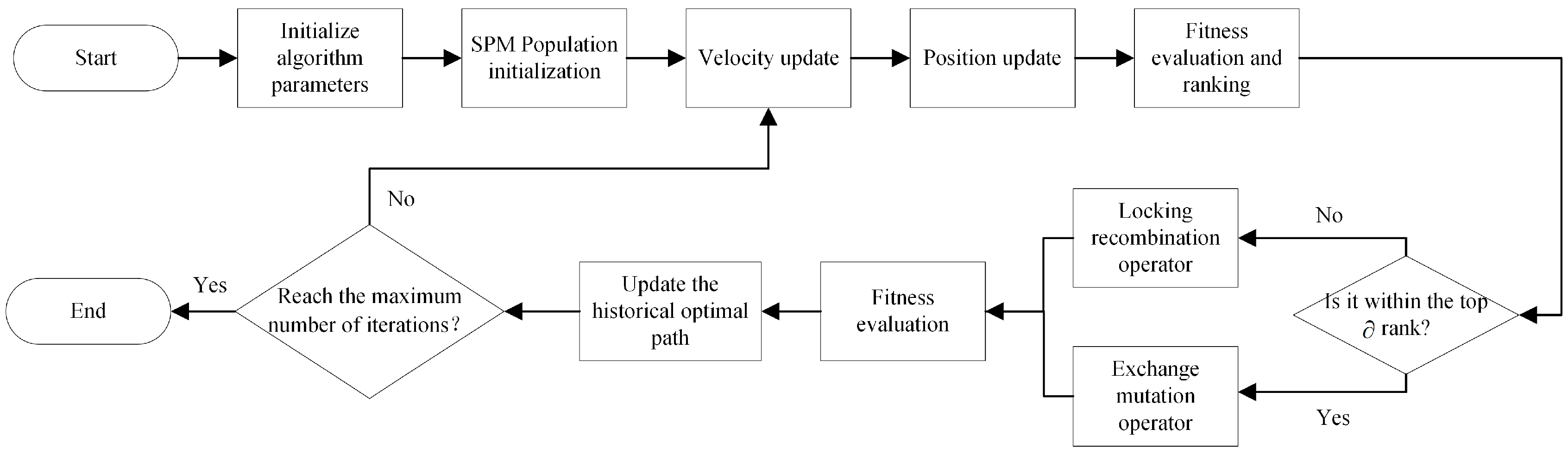
4.1. Improved White Shark Optimization
4.1.1. Encoding and Decoding Strategy
- (1)
- Encoding
- (2)
- Decoding
4.1.2. Fitness Function Design
4.1.3. Population Initialization
4.1.4. Velocity Update
- (1)
- Adaptive perturbation amplitude control
- (2)
- Composite guidance term construction
4.1.5. Hierarchical Position Update Mechanism
- (1)
- Position update
- (2)
- Fitness-based reconstruction strategy
4.2. Human-like Divide-And-Conquer Packing Strategy
4.3. Center-of-Gravity-Guided Path Adjustment and Local Loading Repair
4.3.1. Trigger Function
4.3.2. Local Loading Repair
- (1)
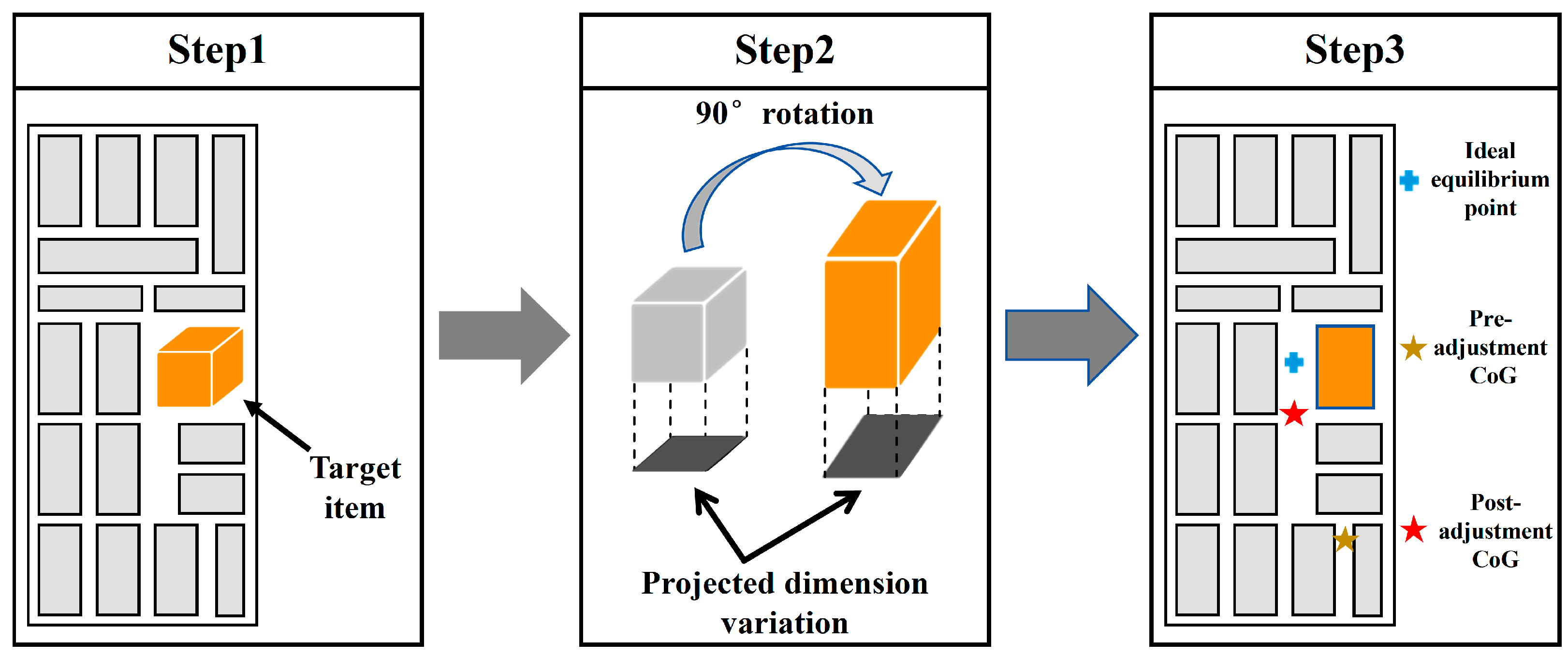
- Posture mutation operator
- (2)
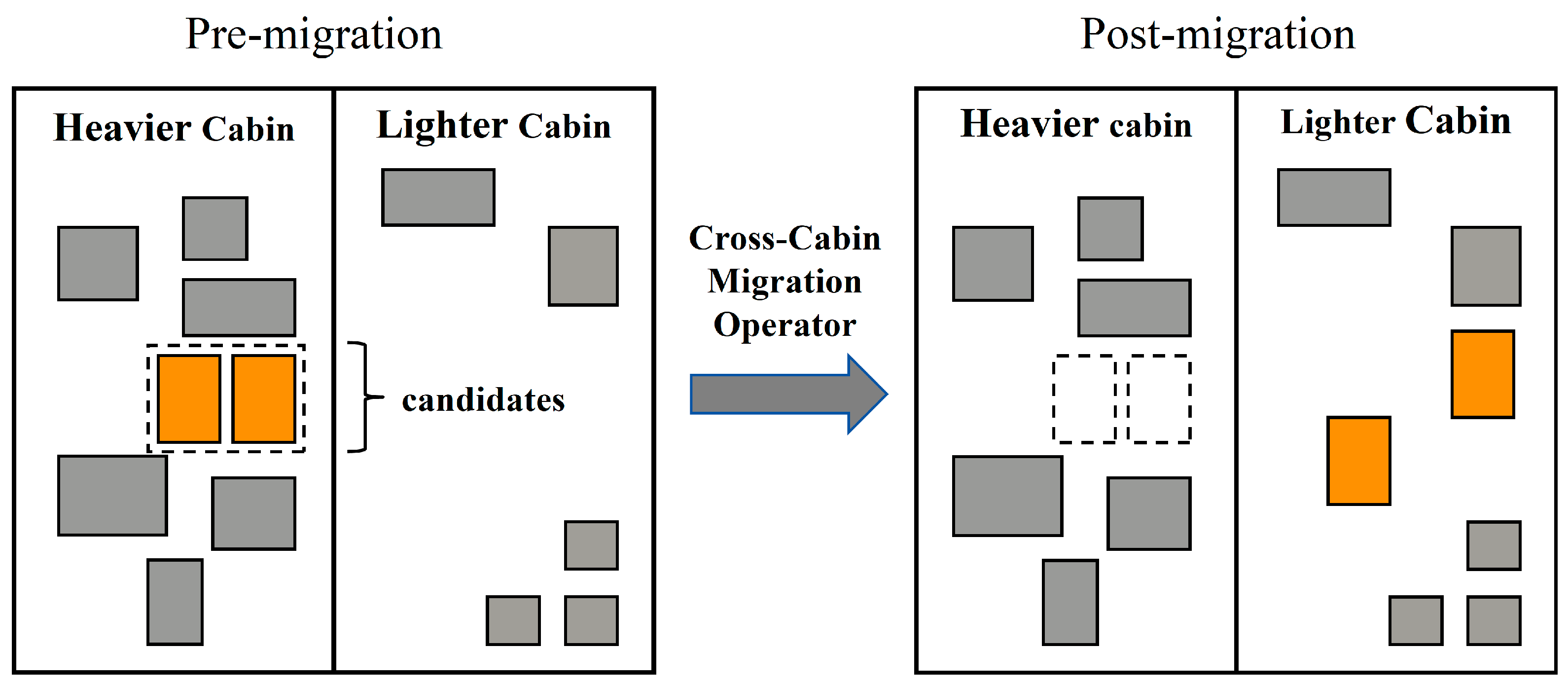
- Cross-cabin migration operator
4.3.3. CGPA Mechanism
| Algorithm 1 LLR | |
| Input: πp: the closed UAV delivery route of UAV p : the loading scheme of UAV p : the threshold of the centroid offset Output: and (if still infeasible, trigger CGPA) | |
| 1: | Compute Δg |
| 2: | If then |
| 3: | return and |
| 4: | endif |
| 5: | apply the posture mutation operator to |
| 6: | recompute |
| 7: | if then |
| 8: | return and |
| 9: | endif |
| 10: | apply the cross-cabin migration operator to |
| 11: | recompute |
| 12: | if then |
| 13: | trigger CGPA |
| 14: | endif |
| 15: | return and |
| Algorithm 2 CGPA | |
| Input: : the position vector of search individual s at iteration t : the sorting key value of customer i in : the threshold of the centroid offset : the global tabu set Output: | |
| 1: | If then |
| 2: | return |
| 3: | endif |
| 4: | identify |
| 5: | |
| 6: | decode to obtain the route |
| 7: | if contains in |
| 8: | randomly perturb the sorting key values corresponding to that segment to destroy the relative order |
| 9: | endif |
| 10: | return |
4.4. Convergence Criterion and Computational Complexity Analysis
4.4.1. Convergence Criterion
4.4.2. IWSO Routing Module
4.4.3. HLDCPS Loading Module
4.4.4. CGPA–LLR
4.4.5. Overall Complexity
5. Numerical Experiments
5.1. Performance Comparison of IWSO
5.2. Feasibility Verification of HLDCPS
5.3. Algorithmic Evaluation and Mechanism Analysis
5.3.1. Comparison with Other Methods
5.3.2. Ablation Experiments
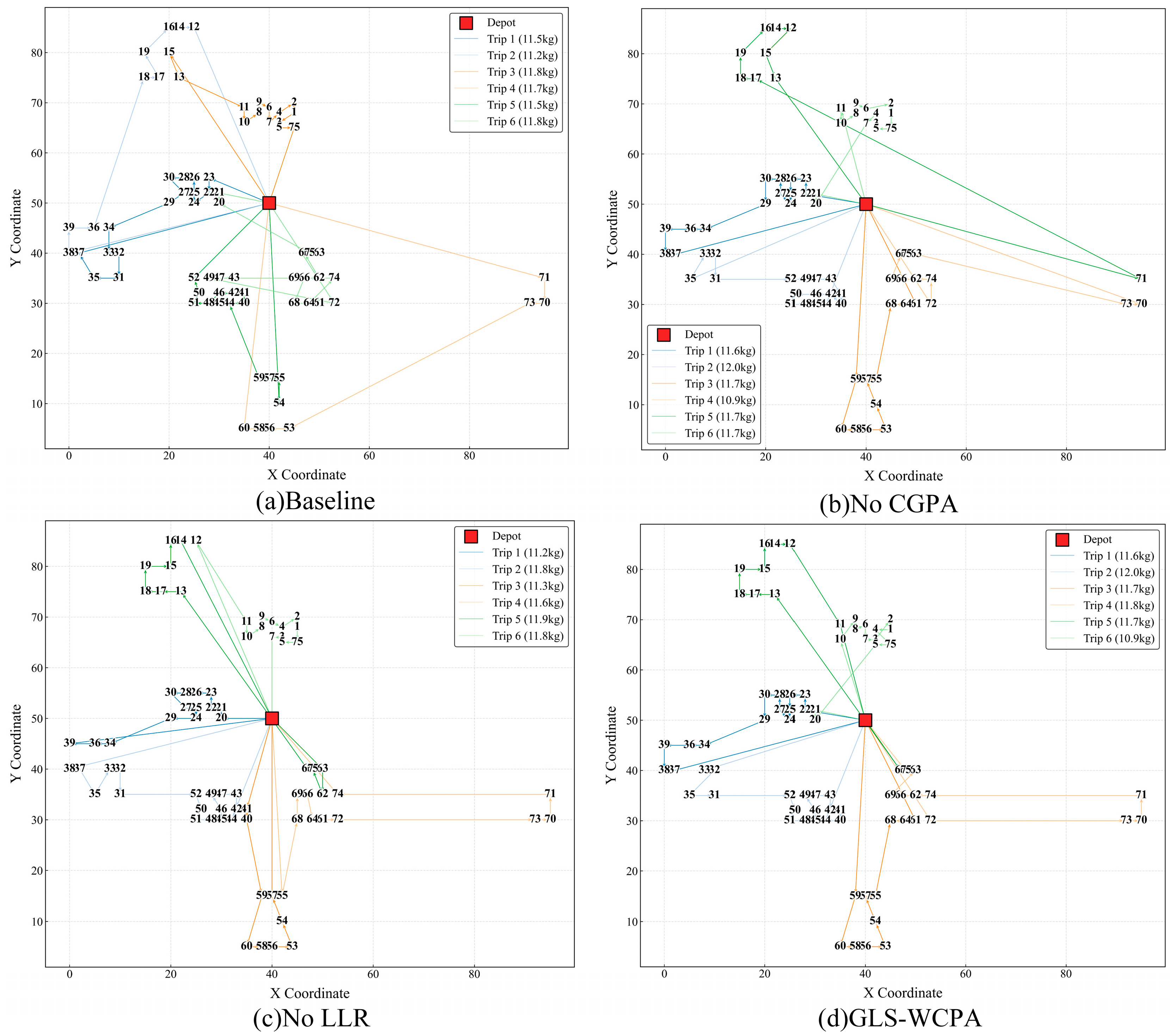
- (1)
- Baseline: The CGPA–LLR mechanism is completely removed. If the center-of-gravity constraint is violated, the solution is declared infeasible and the search process restarts.
- (2)
- No CGPA: Only LLR is retained. When imbalance occurs, local physical repair operations—such as posture mutation and cross-compartment migration—are performed. If repair fails, the solution is discarded.
- (3)
- No LLR: Only CGPA is retained. When imbalance occurs, physical repair is skipped. Instead, conflicting route segments are identified and converted into tabu constraints to adjust the visit sequence.
- (4)
- GLS-WSCPA: The complete collaborative framework integrating both CGPA and LLR mechanisms.
5.3.3. Sensitivity Analysis
5.4. Case Analysis
6. Conclusions
Author Contributions
Funding
Data Availability Statement
Acknowledgments
Conflicts of Interest
References
- Bafouni-Kotta, A.; Villanueva, J.; Kalakou, S.; Dias, J.G. Upcoming Drone Delivery Services: A Perceptions-Based Clustering of Citizens in Lisbon. Technol. Soc. 2023, 73, 102250. [Google Scholar] [CrossRef]
- Garg, V.; Niranjan, S.; Prybutok, V.; Pohlen, T.; Gligor, D. Drones in Last-Mile Delivery: A Systematic Review on Efficiency, Accessibility, and Sustainability. Transp. Res. Part D Transp. Environ. 2023, 123, 103831. [Google Scholar] [CrossRef]
- Altinses, D.; Salazar Torres, D.O.; Schwung, M.; Lier, S.; Schwung, A. Optimizing Drone Logistics: A Scoring Algorithm for Enhanced Decision Making across Diverse Domains in Drone Airlines. Drones 2024, 8, 307. [Google Scholar] [CrossRef]
- Lu, S.-H.; Kuo, R.J.; Ho, Y.-T.; Nguyen, A.-T. Improving the Efficiency of Last-Mile Delivery with the Flexible Drones Traveling Salesman Problem. Expert Syst. Appl. 2022, 209, 118351. [Google Scholar] [CrossRef]
- Kim, S.; Moon, I. Traveling Salesman Problem with a Drone Station. IEEE Trans. Syst. Man Cybern. Syst. 2019, 49, 42–52. [Google Scholar] [CrossRef]
- Tiniç, G.O.; Karasan, O.E.; Kara, B.Y.; Campbell, J.F.; Ozel, A. Exact Solution Approaches for the Minimum Total Cost Traveling Salesman Problem with Multiple Drones. Transp. Res. Part B Methodol. 2023, 168, 81–123. [Google Scholar] [CrossRef]
- Wen, J.; Wang, F.; Su, Y. A Bi-Layer Collaborative Planning Framework for Multi-UAV Delivery Tasks in Multi-Depot Urban Logistics. Drones 2025, 9, 512. [Google Scholar] [CrossRef]
- Yurek, E.E.; Ozmutlu, H.C. A Decomposition-Based Iterative Optimization Algorithm for Traveling Salesman Problem with Drone. Transp. Res. Part C Emerg. Technol. 2018, 91, 249–262. [Google Scholar] [CrossRef]
- Mohiuddin, A.; Taha, T.; Zweiri, Y.; Gan, D. Dual-UAV Payload Transportation Using Optimized Velocity Profiles via Real-Time Dynamic Programming. Drones 2023, 7, 171. [Google Scholar] [CrossRef]
- Pasha, J.; Elmi, Z.; Purkayastha, S.; Fathollahi-Fard, A.M.; Ge, Y.-E.; Lau, Y.-Y.; Dulebenets, M.A. The Drone Scheduling Problem: A Systematic State-of-the-Art Review. IEEE Trans. Intell. Transp. Syst. 2022, 23, 14224–14247. [Google Scholar] [CrossRef]
- Cen, X.; Zhou, G.; Ji, B.; Yu, S.S.; Zhang, Z.; Fang, X. Modelling and Heuristically Solving Three-Dimensional Loading Constrained Vehicle Routing Problem with Cross-Docking. Adv. Eng. Inform. 2023, 57, 102029. [Google Scholar] [CrossRef]
- Chi, J.; He, S.; Song, R. Solving Capacitated Vehicle Routing Problem with Three-Dimensional Loading and Relocation Constraints. Comput. Oper. Res. 2025, 173, 106864. [Google Scholar] [CrossRef]
- Zhai, S.; Li, G.; Huang, P.; Hou, M. Civil Aircraft Weight and Center-of-Gravity Real-Time Estimation via the Six-Degree-of-Freedom Model with Variable Center of Mass. Appl. Math. Model. 2025, 144, 116063. [Google Scholar] [CrossRef]
- Liu, Y.; Jiang, X. Dynamic Feedback Algorithm Based on Spatial Corner Fitness for Solving the Three-Dimensional Multiple Bin-Size Bin Packing Problem. Complex Intell. Syst. 2024, 10, 4055–4081. [Google Scholar] [CrossRef]
- Truong, L.-H.; Chien, C.-F. Multi-Objective Multi-Population Simplified Swarm Optimization for Container Loading Optimization with Practical Constraints. Appl. Soft Comput. 2024, 165, 112038. [Google Scholar] [CrossRef]
- Chen, J.; Ye, F.; Li, Y. Travelling Salesman Problem for UAV Path Planning with Two Parallel Optimization Algorithms. In Proceedings of the 2017 Progress in Electromagnetics Research Symposium-Fall (PIERS-FALL); IEEE: New York, NY, USA, 2017; pp. 832–837. [Google Scholar]
- Raj, R.; Murray, C. The Multiple Flying Sidekicks Traveling Salesman Problem with Variable Drone Speeds. Transp. Res. Part C Emerg. Technol. 2020, 120, 102813. [Google Scholar] [CrossRef]
- Salama, M.R.; Srinivas, S. Collaborative Truck Multi-Drone Routing and Scheduling Problem: Package Delivery with Flexible Launch and Recovery Sites. Transp. Res. Part E Logist. Transp. Rev. 2022, 164, 102788. [Google Scholar] [CrossRef]
- Ha, Q.M.; Deville, Y.; Pham, Q.D.; Hà, M.H. On the Min-Cost Traveling Salesman Problem with Drone. Transp. Res. Part C Emerg. Technol. 2018, 86, 597–621. [Google Scholar] [CrossRef]
- Dorling, K.; Heinrichs, J.; Messier, G.G.; Magierowski, S. Vehicle Routing Problems for Drone Delivery. IEEE Trans. Syst. Man Cybern. Syst. 2017, 47, 70–85. [Google Scholar] [CrossRef]
- Konstantakopoulos, G.D.; Gayialis, S.P.; Kechagias, E.P.; Papadopoulos, G.A.; Tatsiopoulos, I.P. A Multiobjective Large Neighborhood Search Metaheuristic for the Vehicle Routing Problem with Time Windows. Algorithms 2020, 13, 243. [Google Scholar] [CrossRef]
- Jiang, H.; Zhang, Z.; Wang, C.; Xiang, X. A Multiobjective Evolutionary Algorithm Incorporating Neighborhood Detection for the Vehicle Routing Problem with Soft Time Windows. Complex Intell. Syst. 2025, 11, 419. [Google Scholar] [CrossRef]
- Song, B.; Xu, R. Electric Vehicle Routing Problem with Heterogeneous Energy Replenishment Infrastructures Under Capacity Constraints. Algorithms 2025, 18, 216. [Google Scholar] [CrossRef]
- Song, B.D.; Park, K.; Kim, J. Persistent UAV Delivery Logistics: MILP Formulation and Efficient Heuristic. Comput. Ind. Eng. 2018, 120, 418–428. [Google Scholar] [CrossRef]
- Cheng, C.; Adulyasak, Y.; Rousseau, L.-M. Drone Routing with Energy Function: Formulation and Exact Algorithm. Transp. Res. Part B Methodol. 2020, 139, 364–387. [Google Scholar] [CrossRef]
- Hà, M.H.; Nguyen, T.D.; Duy, T.N.; Pham, H.G.; Do, T.; Rousseau, L.-M. A New Constraint Programming Model and a Linear Programming-Based Adaptive Large Neighborhood Search for the Vehicle Routing Problem with Synchronization Constraints. Comput. Oper. Res. 2020, 124, 105085. [Google Scholar] [CrossRef]
- Zhang, X.; Chen, L.; Gendreau, M.; Langevin, A. A Branch-and-Cut Algorithm for the Vehicle Routing Problem with Two-Dimensional Loading Constraints. Eur. J. Oper. Res. 2022, 302, 259–269. [Google Scholar] [CrossRef]
- Zhang, H.; Ge, H.; Yang, J.; Tong, Y. Review of Vehicle Routing Problems: Models, Classification and Solving Algorithms. Arch. Comput. Methods Eng. 2022, 29, 195–221. [Google Scholar] [CrossRef]
- Liu, C.; Lyu, J.; Fang, K. Integrated Packing and Routing: A Model and Its Solutions. Comput. Oper. Res. 2024, 172, 106790. [Google Scholar] [CrossRef]
- Cuevas, E.; Luque, A.; Aguirre, N.; Navarro, M.A.; Rodríguez, A. Metaheuristic Optimization with Dynamic Strategy Adaptation: An Evolutionary Game Theory Approach. Phys. A Stat. Mech. Its Appl. 2024, 645, 129831. [Google Scholar] [CrossRef]
- Pei, J.; Mei, Y.; Liu, J.; Zhang, M.; Yao, X. Adaptive Operator Selection for Meta-Heuristics: A Survey. IEEE Trans. Artif. Intell. 2025, 6, 1991–2012. [Google Scholar] [CrossRef]
- Knypiński, Ł. Adaptation of the Penalty Function Method to Genetic Algorithm in Electromagnetic Devices Designing. COMPEL 2019, 38, 1285–1294. [Google Scholar] [CrossRef]
- Ferreira, K.M.; de Queiroz, T.A. A Simulated Annealing Based Heuristic for a Location-Routing Problem with Two-Dimensional Loading Constraints. Appl. Soft Comput. 2022, 118, 108443. [Google Scholar] [CrossRef]
- Meliani, Y.; Hani, Y.; Elhaq, S.L.; Mhamedi, A.E. A Tabu Search Based Approach for the Heterogeneous Fleet Vehicle Routing Problem with Three-Dimensional Loading Constraints. Appl. Soft Comput. 2022, 126, 109239. [Google Scholar] [CrossRef]
- Tseremoglou, I.; Bombelli, A.; Santos, B.F. A Combined Forecasting and Packing Model for Air Cargo Loading: A Risk-Averse Framework. Transp. Res. Part E Logist. Transp. Rev. 2022, 158, 102579. [Google Scholar] [CrossRef]
- Braik, M.; Hammouri, A.; Atwan, J.; Al-Betar, M.A.; Awadallah, M.A. White Shark Optimizer: A Novel Bio-Inspired Meta-Heuristic Algorithm for Global Optimization Problems. Knowl.-Based Syst. 2022, 243, 108457. [Google Scholar] [CrossRef]
- Khan, I.; Maiti, M.K. A Swap Sequence Based Artificial Bee Colony Algorithm for Traveling Salesman Problem. Swarm Evol. Comput. 2019, 44, 428–438. [Google Scholar] [CrossRef]
- Akhand, M.A.H.; Ayon, S.I.; Shahriyar, S.A.; Siddique, N.; Adeli, H. Discrete Spider Monkey Optimization for Travelling Salesman Problem. Appl. Soft Comput. 2020, 86, 105887. [Google Scholar] [CrossRef]
- Côté, J.F.; Guastaroba, G.; Speranza, M.G. The Value of Integrating Loading and Routing. Eur. J. Oper. Res. 2017, 257, 89–105. [Google Scholar] [CrossRef]
- Li, Y.; Yang, Z.; Zhang, S.; Liu, W. A Study of the Capacitated Vehicle Routing Problem with Time-Window and Three-Dimensional Loading Constraints in Land–Sea Transport. Sustainability 2024, 16, 10272. [Google Scholar] [CrossRef]
- Gendreau, M.; Iori, M.; Laporte, G.; Martello, S. A Tabu Search Algorithm for a Routing and Container Loading Problem. Transp. Sci. 2006, 40, 342–350. [Google Scholar] [CrossRef]
- Küçük, M.; Yildiz, S.T. Constraint Programming-Based Solution Approaches for Three-Dimensional Loading Capacitated Vehicle Routing Problems. Comput. Ind. Eng. 2022, 171, 108505. [Google Scholar] [CrossRef]
- Yin, X.; Yu, Z.; Liu, Y.; Chen, Y.; Guo, A. An Improved Approach for Vehicle Routing Problem with Three-Dimensional Loading Constraints Based on Genetic Algorithm and Residual Space Optimized Strategy. Processes 2025, 13, 1449. [Google Scholar] [CrossRef]
- Krebs, C.; Ehmke, J.F. Axle Weights in Combined Vehicle Routing and Container Loading Problems. EURO J. Transp. Logist. 2021, 10, 100043. [Google Scholar] [CrossRef]








| Type | Notation | Definitions |
|---|---|---|
| Parameters | Distance from node to node | |
| Maximum payload capacity of the UAV | ||
| The -th cargo of customer | ||
| Weight of the -th cargo | ||
| Length, width, and height of the cargo | ||
| Volume of the cargo | ||
| Collection of customer nodes whose cargoes are placed in the left () or right () loading zone | ||
| Safe interval of the center of gravity along the -axis | ||
| Safe interval of the center of gravity along the -axis | ||
| Safe interval of the center of gravity along the -axis | ||
| A sufficiently large positive number | ||
| Threshold for the center of gravity deviation | ||
| Decision making variables | ||
| Visitation sequence index of customer in the route (1, 2, …) | ||
| Parameter | Description | Value |
|---|---|---|
| , , | The cargo bay width, length, height | 90 cm, 90 cm, 80 cm |
| Maximum payload capacity of the UAV | 12 kg | |
| Threshold for the CoG deviation | 10 cm | |
| Population size | 30 | |
| Maximum number of iterations | 500 | |
| Scaling factor | 0.67 | |
| The initial perturbation amplitude | 2.0 | |
| , | Control parameters | 5, 50 |
| Layering threshold ratio | 0.3 |
| No. | Instance | ABCSS | DSMO | WSO | IWSO |
|---|---|---|---|---|---|
| 1 | burma14 | 30.87 | 30.87 | 30.87 | 30.87 |
| 2 | ulysses16 | 73.99 | 73.99 | 86.33 | 73.99 |
| 3 | ulysses22 | 75.31 | 75.31 | 80.15 | 75.31 |
| 4 | eil51 | 428.98 | 428.86 | 463.21 | 426 |
| 5 | berlin52 | 7544.37 | 7544.37 | 8031.21 | 7542 |
| 6 | st70 | 682.57 | 677.11 | 693.36 | 675 |
| 7 | eil76 | 550.24 | 558.68 | 555.49 | 538 |
| 8 | pr76 | 108,879.7 | 108,159.4 | 108,409 | 108,159 |
| 9 | kroA100 | 21,299 | 21,298.21 | 21,459 | 21,282 |
| 10 | kroB100 | 22,229.71 | 22,308 | 24,109 | 22,141 |
| 11 | rd100 | 7944.32 | 8041.3 | 8062 | 7940 |
| 12 | eil101 | 646.05 | 648.66 | 701.6 | 629 |
| 13 | pr107 | 44,525.68 | 44,385.86 | 46,587.46 | 44,438 |
| 14 | pr124 | 59,030.74 | 60,285.21 | 61,235.12 | 59,030 |
| 15 | pr136 | 97,853.91 | 97,538.68 | 102,680 | 98,494 |
| 16 | gr137 | 713.91 | 709.48 | 736.89 | 711.53 |
| 17 | kroA150 | 26,981.98 | 27,591.44 | 28,693.73 | 26,524 |
| 18 | kroB150 | 26,760.79 | 26,601.94 | 28,125.23 | 26,350.34 |
| 19 | pr152 | 74,337.62 | 74,243.91 | 76,321.15 | 73,682 |
| 20 | d198 | 16,270.22 | 15,978.13 | 16,350.56 | 16,061 |
| 21 | kroA200 | 30,701.86 | 30,481.35 | 31,025 | 29,723 |
| 22 | kroB200 | 31,508.85 | 30,716.5 | 32,545.7 | 30,451.3 |
| 23 | gr202 | 507.27 | 501.83 | 512.36 | 491 |
| 24 | tsp225 | 4140.24 | 4013.68 | 4537.24 | 4011 |
| 25 | pr226 | 82,266 | 83,587.98 | 85,421.11 | 81,264 |
| 26 | gr229 | 1713.54 | 1683.45 | 1733 | 1680.41 |
| 27 | gil262 | 2526.99 | 2543.15 | 2853 | 2431 |
| 28 | pr299 | 50,265.88 | 50,579.82 | 51,208.16 | 50,168.32 |
| 29 | lin318 | 45,135.5 | 44,118.66 | 50,124 | 43,178 |
| 30 | fl417 | 12,356.44 | 12,218.98 | 13,966 | 11,978.32 |
| Routing Distance | Wilcoxon Signed-Rank Tests | ||||
|---|---|---|---|---|---|
| Scales | Method | Best | Mean | Std | vs. GLS-WSCPA |
| n = 25 | GLS-WSCPA | 309.42 | 311.79 | 1.15 | - |
| CP-EA | 305.81 | 306.57 | 0.38 | <0.682 | |
| RSO-IGA | 310.45 | 314.12 | 2.12 | <0.05 | |
| ALNS-DBLF | 313.20 | 316.47 | 1.95 | <0.01 | |
| n = 50 | GLS-WSCPA | 489.12 | 492.58 | 1.42 | - |
| CP-EA | 524.35 | 534.28 | 7.15 | <0.05 | |
| RSO-IGA | 516.82 | 524.30 | 5.34 | <0.01 | |
| ALNS-DBLF | 552.40 | 561.37 | 4.82 | <0.001 | |
| n = 75 | GLS-WSCPA | 768.45 | 772.26 | 2.05 | - |
| CP-EA | 815.12 | 838.54 | 13.85 | <0.001 | |
| RSO-IGA | 806.34 | 829.78 | 11.42 | <0.001 | |
| ALNS-DBLF | 851.65 | 869.27 | 9.35 | <0.001 | |
| n = 100 | GLS-WSCPA | 1391.54 | 1398.92 | 5.82 | - |
| CP-EA | 1558.40 | 1602.60 | 14.12 | <0.001 | |
| RSO-IGA | 1485.12 | 1544.63 | 9.45 | <0.001 | |
| ALNS-DBLF | 1668.75 | 1695.85 | 16.20 | <0.001 | |
| Scales | Indicator | Baseline | No CGPA | No LLR | GLS-WSCPA |
|---|---|---|---|---|---|
| n = 25 | Fleet size | 3 | 3 | 3 | 3 |
| total routing distance | 254.05 ** | 244.75 * | 244.96 * | 240.20 | |
| CoG deviation | 8.98 | 9.44 | 9.48 | 8.45 | |
| n = 50 | Fleet size | 4 | 4 | 4 | 4 |
| total routing distance | 404.34 *** | 369.82 ** | 370.28 ** | 361.81 | |
| CoG deviation | 8.82 | 9.33 | 9.77 | 9.14 | |
| n = 75 | Fleet size | 6 | 6 | 6 | 6 |
| total routing distance | 742.04 *** | 723.00 *** | 668.73 * | 659.27 | |
| CoG deviation | 9.15 | 9.24 | 9.31 | 9.06 | |
| n = 100 | Fleet size | 9 | 9 | 9 | 9 |
| total routing distance | 1097.16 *** | 997.11 *** | 913.74 * | 903.13 | |
| CoG deviation | 9.30 | 9.55 | 9.68 | 9.52 |
| Scale | The Payload Coefficient | Total Routing Distance | Scale | The Payload Coefficient | Total Routing Distance |
|---|---|---|---|---|---|
| 25 | 0.8 | 278.18 | 75 | 0.8 | 687.84 |
| 25 | 1 | 241.12 | 75 | 1 | 660.13 |
| 25 | 1.2 | 186.07 | 75 | 1.2 | 590.91 |
| 25 | 1.4 | 166.67 | 75 | 1.4 | 548.41 |
| 25 | 1.6 | 166.24 | 75 | 1.6 | 495.99 |
| 50 | 0.8 | 408.19 | 100 | 0.8 | 1037.64 |
| 50 | 1 | 360.19 | 100 | 1 | 902.65 |
| 50 | 1.2 | 344.36 | 100 | 1.2 | 730.39 |
| 50 | 1.4 | 335.66 | 100 | 1.4 | 608.29 |
| 50 | 1.6 | 320.45 | 100 | 1.6 | 582.38 |
| Scale | CoG Deviation Coefficients | Total Routing Distance | Scale | CoG Deviation Coefficients | Total Routing Distance |
|---|---|---|---|---|---|
| 25 | 0.8 | 355.10 | 75 | 0.8 | - |
| 25 | 1 | 241.12 | 75 | 1 | 660.13 |
| 25 | 1.2 | 231.71 | 75 | 1.2 | 651.67 |
| 25 | 1.4 | 225.49 | 75 | 1.4 | 645.80 |
| 25 | 1.6 | 214.16 | 75 | 1.6 | 645.35 |
| 50 | 0.8 | 435.96 | 100 | 0.8 | - |
| 50 | 1 | 360.19 | 100 | 1 | 902.65 |
| 50 | 1.2 | 359.09 | 100 | 1.2 | 779.29 |
| 50 | 1.4 | 353.47 | 100 | 1.4 | 767.69 |
| 50 | 1.6 | 339.26 | 100 | 1.6 | 766.02 |
| Strategy | Fleet Size | Total Routing Distance | SD | CV |
|---|---|---|---|---|
| Traditional | 5 | 143.00 | 4.27 | 2.99% |
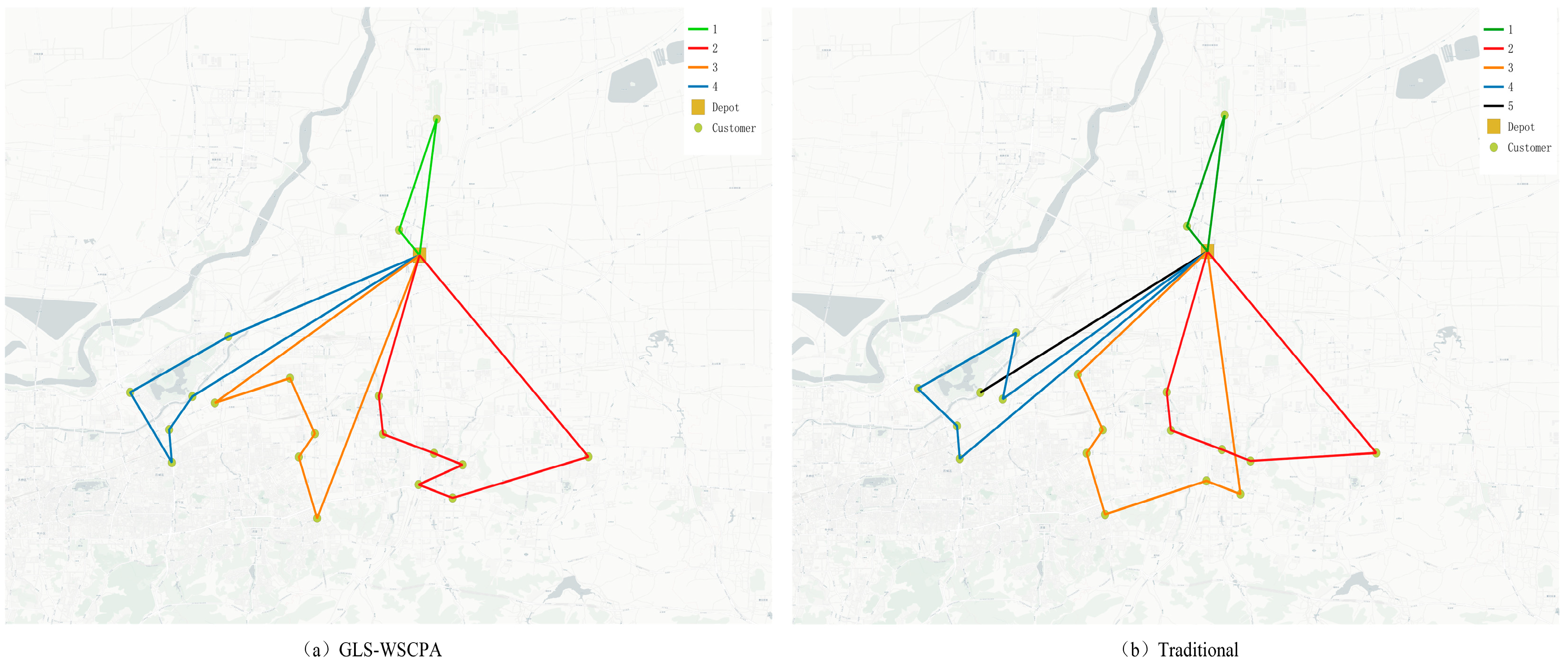
| GLS-WSCPA | 4 | 133.20 | 1.22 | 0.92% |
Disclaimer/Publisher’s Note: The statements, opinions and data contained in all publications are solely those of the individual author(s) and contributor(s) and not of MDPI and/or the editor(s). MDPI and/or the editor(s) disclaim responsibility for any injury to people or property resulting from any ideas, methods, instructions or products referred to in the content. |
© 2026 by the authors. Licensee MDPI, Basel, Switzerland. This article is an open access article distributed under the terms and conditions of the Creative Commons Attribution (CC BY) license.
Share and Cite
Han, C.; Zhang, M.; Zhang, J.; Ma, X. A Guided Collaborative Optimization Framework for the Stability-Constrained UAV Routing and Three-Dimensional Loading Problem. Algorithms 2026, 19, 403. https://doi.org/10.3390/a19050403
Han C, Zhang M, Zhang J, Ma X. A Guided Collaborative Optimization Framework for the Stability-Constrained UAV Routing and Three-Dimensional Loading Problem. Algorithms. 2026; 19(5):403. https://doi.org/10.3390/a19050403
Chicago/Turabian StyleHan, Changhui, Mengmeng Zhang, Jie Zhang, and Xiaolong Ma. 2026. "A Guided Collaborative Optimization Framework for the Stability-Constrained UAV Routing and Three-Dimensional Loading Problem" Algorithms 19, no. 5: 403. https://doi.org/10.3390/a19050403
APA StyleHan, C., Zhang, M., Zhang, J., & Ma, X. (2026). A Guided Collaborative Optimization Framework for the Stability-Constrained UAV Routing and Three-Dimensional Loading Problem. Algorithms, 19(5), 403. https://doi.org/10.3390/a19050403