


Abstract
Quantum computing is one of the most promising emerging technologies, and quantum machine learning (QML), as one of its key branches, is attracting growing interest for intelligent data processing in education. This study conducted a systematic review of QML in the context of Education 5.0 using the PRISMA 2020 methodology. A total of 48 peer-reviewed articles from Springer, Scopus, IEEE Xplore, PubMed, MDPI, arXiv, and APS were analyzed. The results indicate that QML has significant potential to enhance personalized learning, optimize educational data processing, support curriculum innovation, and foster the development of quantum-related competencies. Representative QML algorithms, including Quantum Support Vector Machines, variational quantum circuits, and quantum neural networks, are identified as key technological enablers for future educational applications. However, significant challenges remain, such as limited access to quantum infrastructure, lack of specialized curricula, hardware constraints, and the need for interdisciplinary training. Overall, this study highlights the growing relevance of QML for adaptive learning, learning analytics, and intelligent educational systems, while emphasizing the need for further empirical validation and scalable implementation in real educational environments.
1. Introduction
Education over the last few years has undergone an evolution marked by emerging tools and technologies that have transformed the way in which knowledge is imparted. From the implementation of different types of writing tools such as acrylic blackboards, to the widespread use of information and communication technologies, education has advanced considerably. Among these advances, computers, the internet and various digital platforms stand out, which have made it possible to rethink the organization, access to and personalization of educational processes. This transformation process has been characterized by a constant adjustment to social and technological demands.
In this context, Education 3.0 emerged as a model focused on the integration of digital tools in teaching processes, allowing for the personalization of learning through online platforms and collaboration through virtual environments. This stage marked a move towards a more accessible and flexible education, adapted to the individual needs of students.
Based on the connectivism proposed by [1], Education 3.0 is based on the intensive use of digital technologies, promoting access to knowledge networks and facilitating personalized learning in virtual environments. Along these lines, ref. [2] highlights the role of mobile learning as a transformative element, which allows students to access educational content in a flexible and ubiquitous way, fostering autonomy, collaboration, and co-creation of knowledge in the teaching–learning process.
However, with the development of even more disruptive technologies, such as artificial intelligence and automation, there came Education 4.0. This educational model aligns with the characteristics of Industry 4.0, adopting emerging technologies such as artificial intelligence, robotics and augmented reality to create immersive, hands-on educational experiences that allow students to tackle real problems and develop interdisciplinary skills [3].
Education 5.0, according to [4], represents the next phase in this educational evolution, in which the integration of emerging technologies, such as quantum computing, is key to redefining the teaching process. This educational model goes beyond digitization and interactivity, incorporating technologies capable of transforming teaching and learning through advanced personalization and computational optimization. According to [5], quantum computing, one of the most promising emerging technologies of the 21st century, offers significant potential for solving complex problems that classical computers cannot address.
One of the most promising emerging technologies for transforming Education 5.0 is quantum machine learning (QML). By combining quantum computing with machine learning, QML can process large volumes of educational data more efficiently than traditional methods. This can lead to more adaptive, personalized learning experiences, where educational content and pathways are dynamically adjusted based on real-time student needs and performance. Moreover, QML can enhance the security of digital learning environments, utilizing quantum cryptography to protect sensitive data.
However, the implementation of QML in education presents several significant challenges. These include the lack of specialized curricula that teach both the principles of quantum computing and its practical application in machine learning. The limited accessibility to quantum computing infrastructure in educational institutions is another barrier. Additionally, there is a growing need for interdisciplinary teacher training to ensure that educators can effectively integrate these advanced technologies into their teaching methods.
These technologies are known as emerging technologies because they have the potential to transform industrial and academic sectors; however, their widespread implementation faces significant challenges in terms of education, workforce readiness and scalability. Given this context, the quantum industry is at an early stage of development; however, it has achieved rapid growth in terms of investment and technological advancements [6].
According to [7], quantum technology comprises three main areas: quantum sensing, quantum networking, and quantum computing. In the words of [8], these are not only fundamental to the progress of science, but could also offer significant advantages over traditional technologies in terms of efficiency and security. Quantum computing, for example, may be able to solve problems that are difficult for classical computers to deal with, such as accurate simulation of molecules and materials at the quantum level, leading to more efficient materials and energy systems. In contrast to artificial intelligence, there is a mechanism for its training, generally referred to as machine learning [9]. In [10], machine learning is defined on the basis that the main idea behind quantum-level information processing is based on the following assumption: if quantum processors are able to produce statistical patterns that are computationally difficult to produce with a classical computer, then it is very likely that they can also recognize patterns in such information that are equally difficult to find classically.
Furthermore, ref. [11] refers to the fact that Education 5.0 seeks to implement various changes to education and quantum machine learning can be such a tool to facilitate these changes to the current education paradigms. Recent studies highlight the accelerated development of quantum computing and the growing consolidation of quantum machine learning as an interdisciplinary field with emerging near-term applications [6,7,11,12,13]. The increasing accessibility of both quantum technologies and QML suggests new opportunities for their integration into Education 5.0, particularly in contexts that demand advanced computational efficiency and adaptive learning capabilities [14].
Table 1 presents a synthesis of the evolution of educational models from Education 3.0 to Education 5.0, highlighting the pedagogical approaches and technologies that have enabled this transition. This contextualization is key to understanding the potential impact of quantum machine learning in Education 5.0.
Moreover, ref. [15] indicates that, within the context of quantum education, quantum education faces an additional challenge, as traditional academic programs are not designed to meet the specific needs of the quantum industry. The integration of quantum computing into curricula requires a significant overhaul in order to produce professionals who not only understand quantum theory, but can also apply this knowledge practically in multidisciplinary work environments [16].
Table 1.
Evolution of education models and key technologies.
This article reviews current trends in the impact of quantum machine learning (QML) on Education 5.0, focusing on the advantages, limitations, and future directions. It also analyses the role of higher education in training the quantum workforce and discusses the challenges and opportunities presented by the integration of these technologies into educational programs in order to prepare students for the new technological paradigms that lie ahead.
Existing systematic reviews have largely focused on technical developments in quantum computing or machine learning, with limited emphasis on their integration into educational frameworks. Despite the growing interest in quantum machine learning and quantum education, there is still a lack of systematic reviews that specifically analyze how QML contributes to Education 5.0 by integrating its implications, application areas, representative algorithms, challenges, and future research directions.
Within this context, QML not only offers improvements in key areas such as personalized learning, computational optimization, and security in educational platforms, but also shows significant potential in emerging sectors such as medicine, where it can enhance predictive diagnostics by processing large volumes of biomedical data, and in engineering, optimizing industrial processes through advanced quantum simulations. Additionally, in the field of inclusive education, QML offers customized solutions for students with disabilities, providing access to learning experiences more adapted to their needs ([5,16,20]).
Beyond these general challenges, structural and institutional factors further limit the large-scale adoption of QML in educational systems. These include the need for interdisciplinary curricula, institutional readiness, and sustainable access to quantum technologies. As suggested by [21,22], coordinated efforts between academia, industry, and policymakers are required to integrate quantum theory and its practical implementation into higher education, enabling scalable and long-term adoption of QML.
Moreover, access to quantum infrastructure remains a significant barrier, as most educational institutions do not have the capacity to implement quantum hardware. However, access to quantum platforms in the cloud could be a viable solution, allowing more institutions to integrate these technologies into their educational programs. To facilitate adoption and knowledge exchange, international collaborations between universities and research institutions must be promoted, enabling more equitable access to quantum infrastructure and strengthening QML training globally ([11,23]).
Regarding real applications of quantum machine learning in educational environments, ref. [24] applied a quantum kernel-based supervised learning algorithm (QSVC) to a university database to predict graduation rates, achieving results with 85% precision, which is identical to that obtained using a classical SVM. Nevertheless, no advantages related to time savings were observed in the process.
Also, ref. [25] used quantum machine learning to predict whether students would pass a university subject based on their test results. The study reported a prediction accuracy of 73.8%. In other words, the authors considered the use of QML to be a viable option in education.
There are multiple obstacles related to the implementation of QML that still need to be addressed. For instance, ref. [26] mentions that QML may present challenges such as algorithmic bias and limited access to technology. These aspects were considered in the analysis of the studies included in this review.
Despite the growing interest in quantum machine learning and quantum education, existing studies have mainly focused on technical developments, isolated applications, or general discussions of quantum technologies. However, there is still a lack of systematic reviews that specifically analyze how QML contributes to Education 5.0 by integrating its implications, application areas, representative algorithms, challenges, and future research directions. This study addresses this gap by providing a PRISMA-based systematic review that: (i) identifies the main implications of QML adoption in Education 5.0; (ii) analyzes the educational areas where QML-based solutions are being deployed; (iii) summarizes the main contributions and limitations reported in the literature; and (iv) contextualizes representative QML algorithms as technological foundations for future educational applications.
Beyond reviewing existing studies, this work contributes by organizing the current landscape of quantum machine learning in Education 5.0 into a structured perspective that connects its applications, limitations, and emerging research directions. This integrative view links technological developments with educational needs and provides a useful reference for researchers, educators, and decision-makers interested in the adoption of QML in learning environments.
2. Materials and Methods
The systematic review was conducted following the PRISMA 2020 methodology [27], ensuring rigorous source selection. In this methodology, multiple phases are contemplated. The first is the formulation of research questions that ensures the focus in the development of this work. Then, the sources to be used to collect sources are defined in a general way for the collection. After that, a selection process is carried out in which the inclusion criteria of the articles are considered based on multiple factors such as their accessibility, language, relevance, and date of publication, among others.
The number of articles collected, in general, decreases until only those that meet these requirements remain. Finally, the remaining articles that meet the inclusion criteria are included in the systematic review to be analyzed to extrapolate the final conclusions based on the research questions. The research questions are shown in Table 2 below to identify the path of the study to meet the stated objectives.
Table 2.
Research and motivation questions.
For the systematic review, databases with high scientific rigor were selected to ensure the relevance and quality of the scientific articles considered in this study. These databases were selected because they provide broad interdisciplinary coverage of quantum computing, machine learning, computer science, engineering, and education-related research. Therefore, their inclusion ensured access to relevant studies from both technical and educational perspectives.
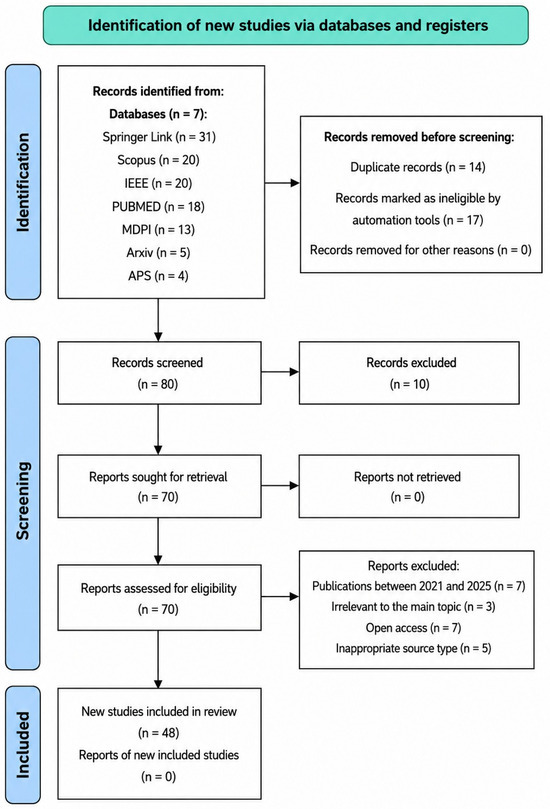
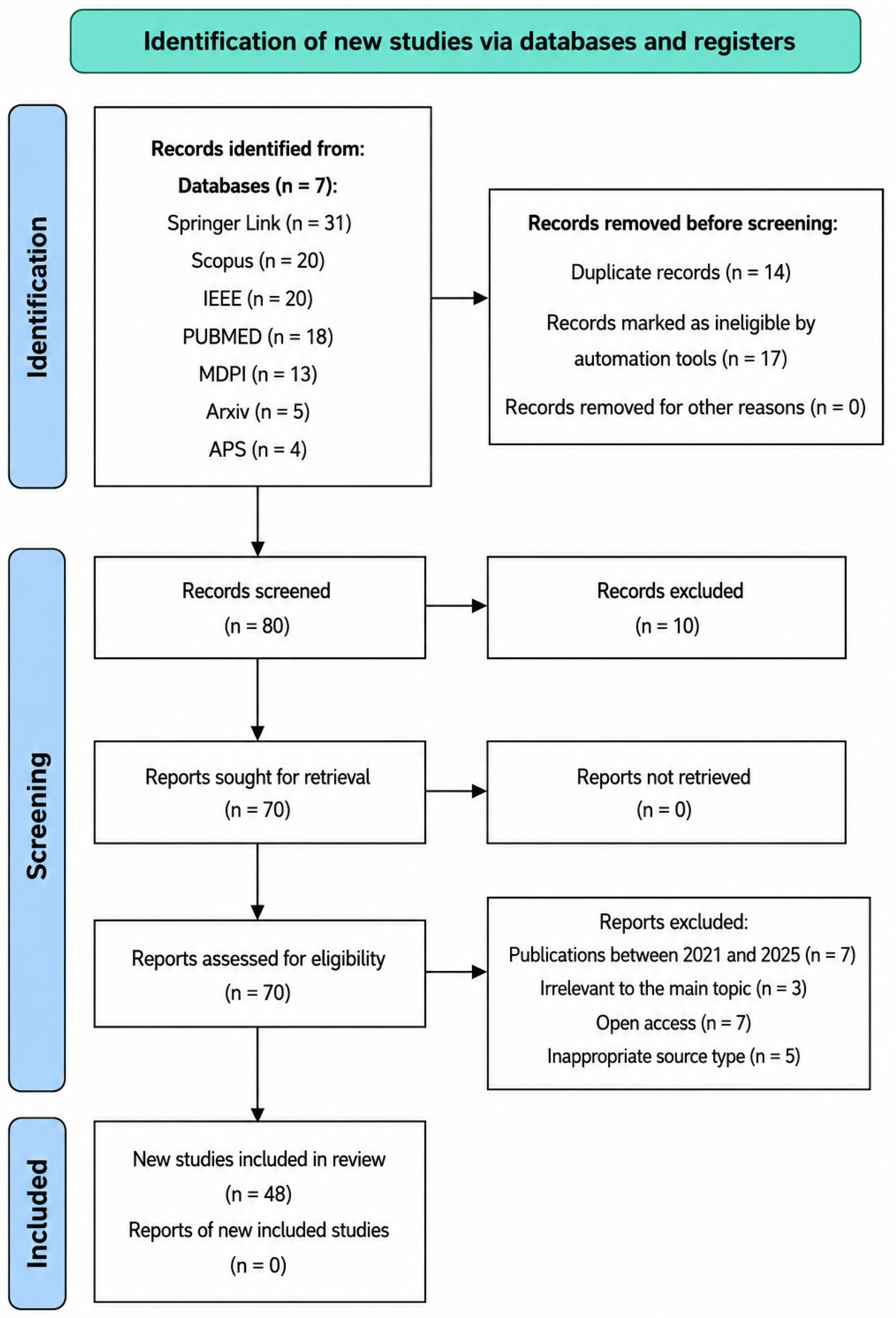
Table 3 presents the distribution of the articles identified during the initial search across the selected scientific databases. In total, 111 records were retrieved before applying the screening and eligibility criteria described in the PRISMA process illustrated in Figure 1.
Table 3.
Distribution of articles identified by scientific database.
Figure 1.
PRISMA 2020 scheme applied in the present research.
It can be concluded from the table above that Springer was the most frequently consulted database for the articles included in our systematic review.
For the methodology used for this article, articles were collected by complying with a series of internationally oriented guidelines, which facilitate the writing and carrying out of this type of study. According to [27], PRISMA provides guidelines oriented to achieve, through exclusion criteria, the filtering of a large number of articles to obtain only those relevant to the research.
In this regard, the exclusion process helped refine the formulation of the research questions. Thus, it was possible to analyze the perspectives presented by the authors of the selected studies. Based on this analysis, the present study contributes to the discussion and formulation of relevant conclusions for future research in computer science and informatics.
2.1. Selection Process
Table 4 shows the terms used in our search in the chosen databases.
Table 4.
Systematic search filter terms.
The search terms were designed to ensure specificity and relevance to quantum machine learning in educational contexts. However, broader terms such as “quantum AI” or “quantum education” could be considered in future studies to expand the scope of the review.
2.2. Screening
For this phase, a total of 111 articles identified during the initial search were examined considering their title, abstract, and keywords. From these, 63 articles were excluded because they focused on areas unrelated to education, engineering, or computer science.
The remaining articles were rigorously analyzed according to the following criteria: (a) publication period between 2021 and 2025, (b) relevance of the topic to education, (c) open access availability of the source, and (d) type of publication. Since quantum machine learning is still an emerging field, this period was selected to capture the most recent and relevant developments related to Education 5.0. The final set consisted of 48 studies distributed as follows: Springer (26), Scopus (5), IEEE (5), PubMed (3), MDPI (3), ArXiv (3), and APS (3).
The inclusion of open access articles was intended to ensure full accessibility and reproducibility of the analysis; however, this criterion may introduce a potential selection bias, which is acknowledged as a limitation of the study. Figure 1 illustrates this process.
2.3. Data Extraction
The articles used for this systematic review were organized in a structured template that included the following categories: author, year, title, abstract, problem, objectives, method, results, and conclusions. Additionally, each source’s specific contribution was extracted and analyzed through a commentary, as described below.
2.4. Assessment of the Quality of the Study
To minimize potential biases in the study, a collective, rigorous, and systematic approach was adopted. Moreover, the analysis objectives and filtering parameters were established to reduce the number of sources in a systematic manner. Likewise, a work protocol was implemented, which consisted of dividing the search for sources into two stages. First, the initial compilation of bibliographic sources was performed manually, and the results of this step were discussed to validate the identified sources.
Subsequently, the results were used in the second step. However, due to its relevance, one article was considered even though it was published outside Springer’s 2021–2025 publication period. Most of the sources were fully accessible, facilitating in-depth analysis and significantly reducing both the time required and the potential for bias in their inclusion in this study.
It is important to note that, due to the high scientific rigor, the databases with the largest number of retrieved sources were Scopus and Springer. However, the content of these databases is not neutral, given that most of their sources are of the document type: articles and conference papers. In addition, by assessing the quality of the bibliographic sources through systematic analysis, common themes were identified in several of the sources.
As a result, a broader picture of quantum machine learning in education was obtained. And through the various studies analyzed in this systematic review, it was identified that the integration of this technology into Education 5.0 can improve the personalization of learning and also optimize decision-making based on quantum data. Consequently, it would reduce the gaps in access to advanced technologies and foster a more inclusive and intelligent educational environment.
Finally, these rigorously analyzed articles meet the quality criteria. To further ensure consistency and reliability, the selection and analysis of articles were validated through a collaborative review process among the authors. This approach helped reduce individual bias and improve agreement in the interpretation of the selected studies. Table 5 summarizes the number of articles initially identified and those finally included in the systematic review after the screening and eligibility stages.
Table 5.
Summary of outcomes from the systematic review.
Table 6 shows the selected articles by database, with Springer being the database with the highest percentage. The contributions of the other databases are detailed below, highlighting the role of each one in the collection of the information needed for the study.
Table 6.
Articles filtered by scientific database.
3. Results
This section of the article presents the most important findings of the systematic review based on the PRISMA 2020 methodology on the impact of quantum machine learning (QML) in Education 5.0. The results show the main methodologies used in the studies analyzed, highlighting approaches based on quantum machine learning, quantum simulations, and hybrid neural networks to optimize educational processes. The thematic areas addressed in the literature were also identified, including the personalization of learning through QML, the optimization of recommendation algorithms for students, and the improvement of security in educational platforms through quantum cryptography. The reviewed studies also highlight the potential of QML to transform student performance assessment through advanced predictive analytics and complex pattern detection in large volumes of educational data.
3.1. Q01: What Are the Implications of Adopting Quantum Machine Learning in Education 5.0?
In response to this question, ref. [4] points out that quantum machine learning (QML) represents an evolution in computing by using superposition and entanglement, allowing large volumes of data to be processed efficiently. This capability has direct implications for Education 5.0, as it can optimize personalized learning systems and improve the adaptability of educational models to individual student needs. In [45] they explore how the use of Chebyshev polynomials in quantum neural networks facilitates the resolution of differential equations, which could be applied in the design of advanced educational tools to teach mathematics and physics in digital learning environments.
On the other hand, ref. [61] highlights the potential of Quantum Boltzmann Machines (QBMs) as learning models capable of processing classical and quantum data without facing stagnation problems in training, suggesting their viability in the optimization of adaptive educational models. Likewise, ref. [52] reinforces this perspective by pointing out that hybrid quantum–classical neural networks can improve the generalization of models and reduce the use of computational resources, which would allow for the personalization of learning and generation of more efficient educational content.
Regarding the integration of QML into education, ref. [62] demonstrates how quantum neural networks can improve the accuracy and speed of image classification models using quantum coding techniques. Similar applications could be implemented in Education 5.0 to analyze learning patterns and detect gaps in student performance more efficiently.
In this sense, ref. [25] implemented Quantum-enhanced Support Vector Machines to predict the potential failure of students in university courses, showing how QML models can be used to customize educational intervention strategies and improve decision-making in academic institutions. In ref. [21] also emphasizes the need to prepare quantum engineers through educational programs accessible to STEM students, proposing the inclusion of practical modules on quantum hardware, optics, nanotechnology, and cryogenic technologies. This specialized training would contribute to the integration of quantum machine learning into higher education programs, ensuring the development of skilled professionals for its application in teaching and research. On the other hand, from a mathematical and computational perspective, ref. [5] analyzes the behavior of quantum chaos and complexity in quantum neural networks, identifying that the stability of these models has a direct impact on their generalization capacity.
In an educational context, this suggests that optimizing quantum neural networks could improve the adaptability of learning models and ensure a more robust performance in predicting student achievement. In addition, ref. [28] contextualizes QML within the development of Industry 6.0, highlighting that its integration with artificial intelligence and quantum computing can transform different sectors, including education. It identifies opportunities and challenges in the adoption of these technologies, indicating that Education 5.0 should be prepared to incorporate quantum tools in a progressive and strategic way. In addition, ref. [50] argues that the barrier to entry into quantum computing has historically been difficult to overcome for computer science students without a strong physics background.
However, with recent advances, quantum machine learning (QML) is becoming increasingly accessible. In ref. [50] proposes a curriculum that allows computer science students to enter this area without requiring in-depth knowledge of quantum mechanics, suggesting a democratization of access to these technologies in education. In this sense, ref. [46] presents a comprehensive analysis of the state of the art of quantum machine learning, addressing quantum deep learning architectures, coding methods and classification tasks in the quantum domain. It highlights how quantum computing can improve the performance of classical machine learning models and optimize data classification in educational settings.
Moreover, ref. [29] investigates the use of modern quantum algorithms, such as Grover’s Algorithm and Quantum Annealing, in learning personalization and optimization of educational resources. It also highlights the relevance of quantum cryptography to ensure security in the transfer of educational data, which could impact the protection of information in digital learning platforms. However, it warns about the challenges associated with quantum infrastructure, ethics in data handling and the need for more stable hardware for large-scale implementation.
Additionally, ref. [30] emphasizes the inherent complexity of quantum computing and its impact on the training of professionals. Through a systematic review, the authors identify the technical and soft skills needed for students to enter the quantum workforce. They highlight the importance of designing curricula that combine advanced mathematical skills with interdisciplinary training to enhance the preparation of future experts in QML. In this context, the adoption of quantum machine learning in Education 5.0 has significant implications in personalizing learning, optimizing educational models, training professionals in quantum technologies, and developing more accurate and adaptive teaching environments.
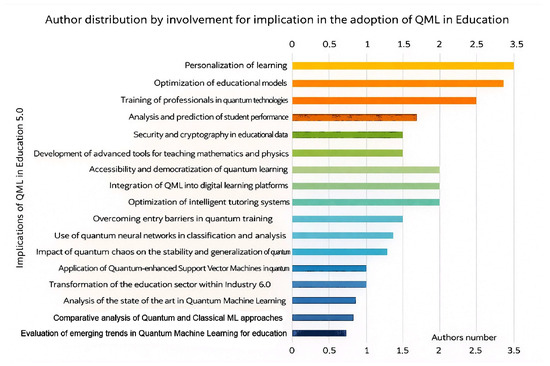
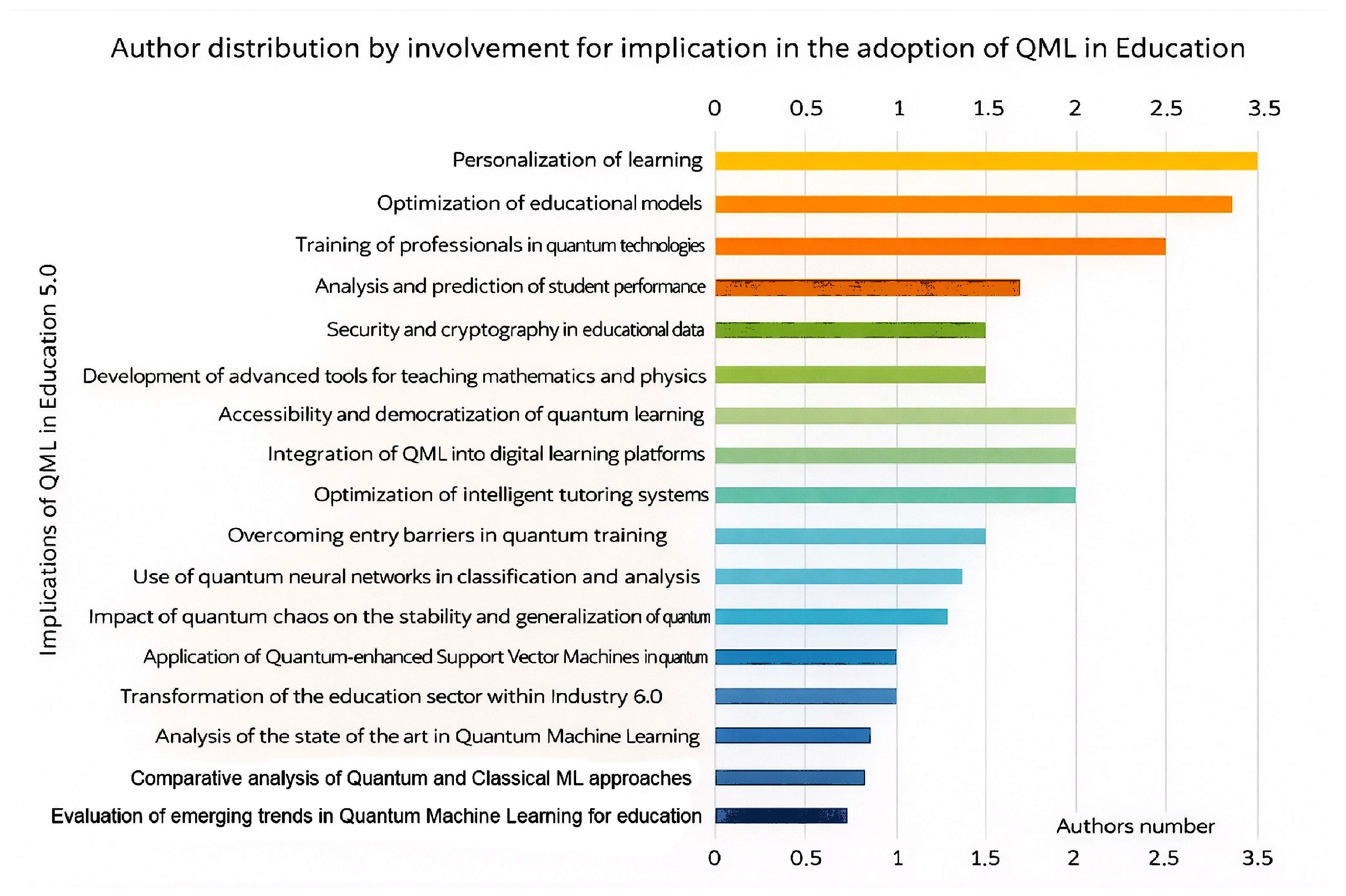
Figure 2 shows the distribution of the number of studies that identify each implication of quantum machine learning (QML) in Education 5.0. In addition, it is observed that the implications with the highest academic support are personalization of learning, optimization of educational models, and training of professionals in quantum technologies, which indicates that these implications are the most frequently supported in the reviewed literature.
Figure 2.
Distribution of the implications of adopting quantum machine learning in Education 5.0.
Furthermore, this indicates that these areas are the most explored within the current literature on QML and its impact on education. On the other hand, other relevant implications, such as the analysis and prediction of student achievement, the integration of QML in digital platforms, and the optimization of intelligent tutoring systems, are supported by two articles of the systematic review and this growing interest in the use of QML to improve the adaptability of educational models.
In addition, some implications are supported by only a single article, such as security and cryptography in educational data, the development of advanced tools for teaching mathematics and physics, and the transformation of the educational sector within Industry 6.0. These topics appear to be less explored, but they show potential for future research.
Although learning personalization, optimization of educational models, and workforce preparation emerge as the most supported implications, the limited number of studies backing each category suggests that quantum machine learning within Education 5.0 is still in a developmental phase. The distribution presented in Figure 2 does not reflect a consolidated empirical field, but rather an exploratory and evolving research landscape.
A closer analysis of the reviewed literature indicates that most contributions are grounded in theoretical models, conceptual reviews, or simulation-based experiments [52]. Although a limited number of studies report empirical applications within specific institutional contexts [25], these efforts generally remain at a pilot or proof-of-concept stage. Therefore, despite its promising potential, the practical integration of QML into large-scale educational systems remains at an early stage.
For instance, some studies have explored the application of quantum machine learning models to analyze academic performance datasets and predict student outcomes in higher education environments. These early implementations demonstrate that QML-based models can support educational analytics and data-driven decision-making, particularly in identifying students at risk and optimizing intervention strategies. Although these experiments remain limited in scale, they provide initial evidence of the practical feasibility of applying QML techniques in real educational contexts.
Furthermore, conceptual discussions have addressed applications such as cybersecurity and advanced quantum-based instructional tools [29]. However, empirical validation and institutional implementation remain limited. These areas therefore represent important directions for future work, particularly regarding institutional scalability and workforce preparation for quantum technologies [30].
3.2. Q02: In Which Areas of Education 5.0 Are Quantum Machine Learning-Based Solutions Typically Deployed?
In the field of higher education, ref. [31] highlights the application of quantum machine learning (QML) in disciplines such as artificial intelligence, business analytics, and quantum information systems, which reinforces its importance in the training of professionals in emerging technologies. In turn, ref. [7] addresses the deployment of QML in university teaching of computer science, designing structured courses with practical activities and evaluation methodologies aligned with learning outcomes. In terms of training and professional development, ref. [22] emphasizes the role of QML in building a quantum workforce through accessible educational programs, such as online courses, seminars, and community networks, that enable specialization in quantum technologies. Likewise, ref. [12] emphasizes the teaching of quantum information science (QIS) in post-secondary education, identifying key content in mathematics, physics, and engineering for the creation of academic programs that foster QML proficiency.
Complementarily, ref. [32] explores the integration of QML algorithms into curriculum development and cybersecurity programs, addressing their impact on higher education and data protection, as well as the need for more hands-on training for teachers and students. Likewise, ref. [63] highlights the role of artificial intelligence in Education 5.0, emphasizing its application in different subjects and educational levels, promoting didactic strategies that improve learning and contribute to the fulfillment of the 2030 Agenda. From a technical perspective, ref. [23] analyzes data encoding techniques in QML, highlighting their relevance to improving quantum algorithms in educational environments. These advances contribute to the optimization of the teaching of quantum computing and its applicability in solving complex problems.
Similarly, ref. [19] explores the impact of Education 5.0 on the digitization of learning, highlighting the role of technologies such as artificial intelligence and augmented reality in the personalization of quantum learning. On the other hand, ref. [33] presents a rigorous analysis of QML, identifying the main lines of research and its application in areas such as drug design, optimization and quantum reinforcement learning, suggesting emerging opportunities for university teaching and specialized training.
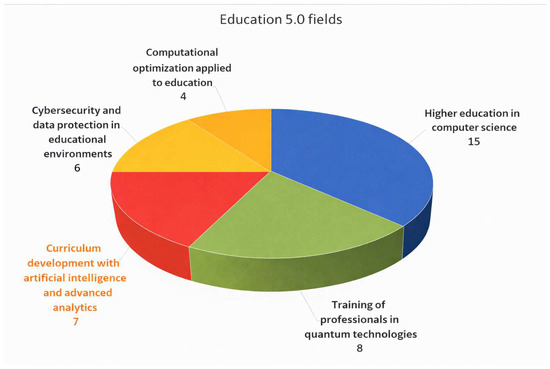
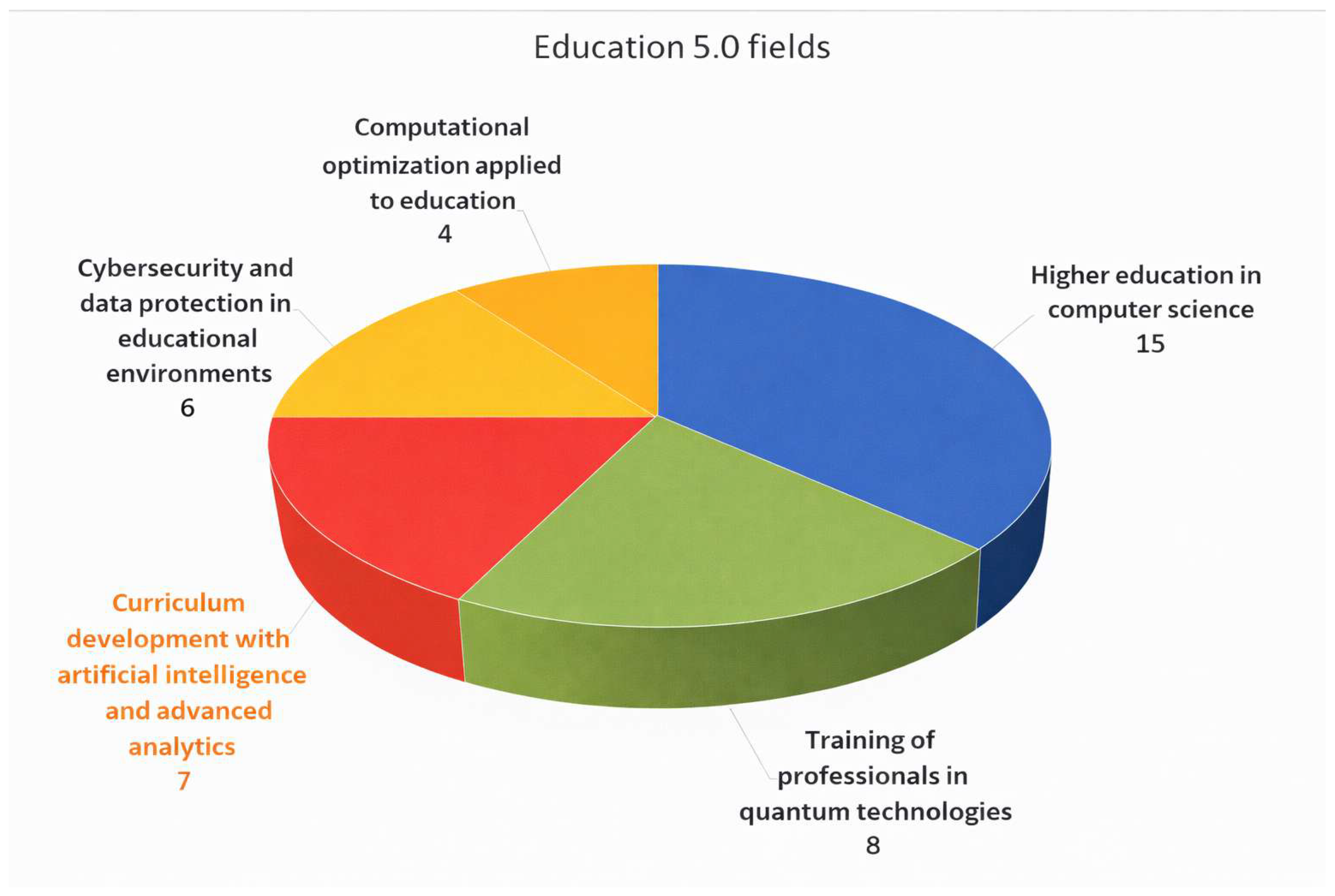
These contributions, summarized in Figure 3, show that QML-based solutions in Education 5.0 are mainly deployed in university teaching of computer science, in the training of professionals specialized in quantum technologies, and in the curricular development of educational programs that integrate artificial intelligence and advanced data analytics, as well as in the strengthening of key areas such as cybersecurity and computational optimization.
Figure 3.
Preferred Education 5.0 areas for Education 5.0 deployment solutions based on QML.
Figure 3 represents the distribution of areas within Education 5.0 in which quantum machine learning solutions are implemented, based on the number of sources supporting each category. It can be seen that higher education in computer science is the area with the highest number of endorsements (15 sources), indicating its relevance as a space for the application of these emerging technologies.
It is followed by the training of professionals in quantum technologies (eight sources), which is evidence of the interest in training a workforce specialized in QML. Curriculum development with artificial intelligence and advanced analytics (seven sources) highlights the importance of integrating these tools into educational programs, while cybersecurity and data protection in educational environments (six sources) demonstrate the growing need to strengthen security in digital learning systems.
Finally, computational optimization applied to education (four sources) represents an emerging area that is less represented in the reviewed literature, but with potential for expansion in the future.
As illustrated in Figure 3, the distribution of studies suggests that current research on quantum machine learning in Education 5.0 is strongly concentrated in technically oriented domains, particularly within computer science education and specialized training programs. In contrast, areas related to broader pedagogical transformation or interdisciplinary educational applications appear less represented. This imbalance indicates that the adoption of QML is currently driven mainly by technological and computational perspectives, while its integration into wider educational practices remains limited.
Although higher education in computer science appears as the primary context for QML deployment, this concentration suggests a disciplinary orientation toward technically specialized programs [7]. The predominance of initiatives within computing-related environments indicates that QML integration remains largely confined to specialized academic contexts, rather than being systematically distributed across diverse educational fields [12].
Furthermore, the growing demand for a diverse and sustainable quantum workforce highlights persistent gaps in educational pathways and talent development [22]. Addressing these gaps and expanding QML-related initiatives beyond specialized computer science programs will require sustained interdisciplinary collaboration and systemic innovation, in line with broader digital transformation frameworks in education [19].
In addition, systematic and scientometric reviews reveal that the existing body of research predominantly focuses on algorithmic development, experimental implementations, and emerging technical applications [33,49]. Evidence of sustained institutional implementation or measurable large-scale educational impact remains scarce. This pattern suggests that current efforts are largely exploratory, emphasizing technical advancement and research expansion rather than fully operational and system-level educational transformation.
These findings indicate that the current deployment of quantum machine learning within Education 5.0 remains concentrated in technically specialized educational domains. Understanding how these implementations translate into concrete benefits and challenges for educational systems requires further analysis, which is addressed in the following research question.
3.3. Q03: What Are the Main Contributions of Quantum Machine Learning in Education 5.0?
According to [34], quantum machine learning (QML) has emerged as a key component in Education 5.0, offering significant advances in learning personalization, computational optimization, and new paradigms in teaching. The integration of QML in educational environments enables improved efficiency and scalability of learning models, overcoming the limitations of traditional GPU-based approaches. Research such as that by [47] highlights how quantum algorithms can enhance learning personalization by processing large volumes of educational data faster and more efficiently, dynamically adapting to the individual needs of learners.
In ref. [8] emphasizes that quantum learning models can generalize with little training data, challenging conventional metrics for evaluating machine learning and suggesting the need for a new theoretical framework to understand its performance. In this regard, refs. [9,10] explore the feasibility of variational quantum algorithms and techniques such as data re-coding to improve model expressivity, optimizing the use of computational resources in the era of intermediate-scale quantum processors (NISQ).
The study highlights the potential of nonlinear parametric Kerr oscillators (KPOs) to reduce quantum resource consumption while maintaining model representability, paving the way for more efficient applications in educational contexts.
Additionally, refs. [11,13] demonstrated the applicability of QML in tasks such as image classification and medical diagnosis, comparing the effectiveness of quantum algorithms with their classical counterparts. The implementation of academic programs in this area, as evidenced by [51], allowed students and teachers to explore the potential of quantum computing in machine learning through simulations and specialized hardware. However, ref. [9] warns about the challenges of implementing QML in educational and work environments, highlighting the importance of developing teaching methodologies adapted to this new technology.
In terms of practical applications, ref. [6] proposed innovative pedagogical models that facilitate the teaching of quantum computing in secondary education through accessible tools, promoting a progressive understanding of complex concepts. Complementarily, ref. [44] analyzed the impact of integrating quantum embedding techniques into classical machine learning algorithms, observing improvements in classification accuracy and performance/computational load trade-offs in models such as Support Vector Machines and Random Forest.
Furthermore, ref. [14] explored the robustness of de-quantization in linear algebra and quantum machine learning problems, showing that certain techniques can be adapted to improve model stability in the presence of perturbations. That research addresses how recent advances in quantum singular value transformation can be reinterpreted in the classical context, allowing for a more robust analysis of quantum learning algorithms and their applicability in educational contexts. Also, ref. [15] developed NISQRC, an algorithm based on intermediate measurement quantum circuits that overcomes the limitations of quantum decoherence, demonstrating its effectiveness in the recovery of distorted signals in seven-qubit quantum processors.
In this context, ref. [16] investigated the potential of a single qubit to solve classical machine learning problems, covering classification, regression, and reinforcement learning tasks, showing that its use in hardware with limited resources, such as embedded systems and edge devices, can be a viable alternative for the implementation of efficient decision-making models.
Moreover, refs. [35,64,65] addressed the importance of interpretability in QML by applying Shapley values to analyze the relevance of parametric quantum circuits in classification, generative modeling and optimization tasks, facilitating the understanding of how quantum models work and their applicability in practice. In the field of computer vision, ref. [37] identified a key problem in quantum visual coding strategies, called the “Quantum Information Gap” (QIG), which generates an information gap between classical features and their quantum representations, affecting the performance of QML models.
To address this limitation, the authors developed a new loss function called Quantum Information Preserving (QIP), designed to minimize this gap and improve the accuracy of quantum algorithms applied to computer vision tasks. Their experiments validated the effectiveness of this solution, achieving state-of the-art results in quantum machine learning models.
Finally, ref. [38] explored the convergence between machine learning and computational architecture, highlighting how resource optimization in heterogeneous systems can inspire improvements in QML performance within educational environments, maximize processing efficiency, and reduce the computational cost of teaching based on quantum algorithms.
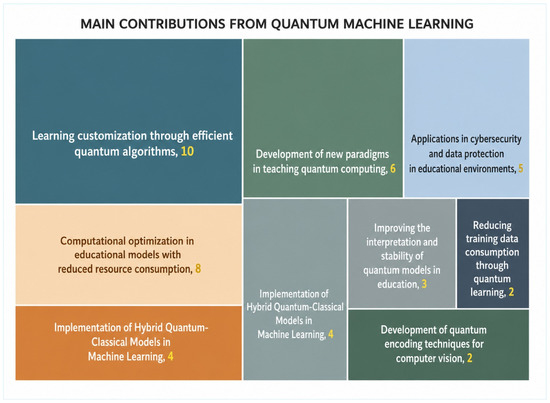
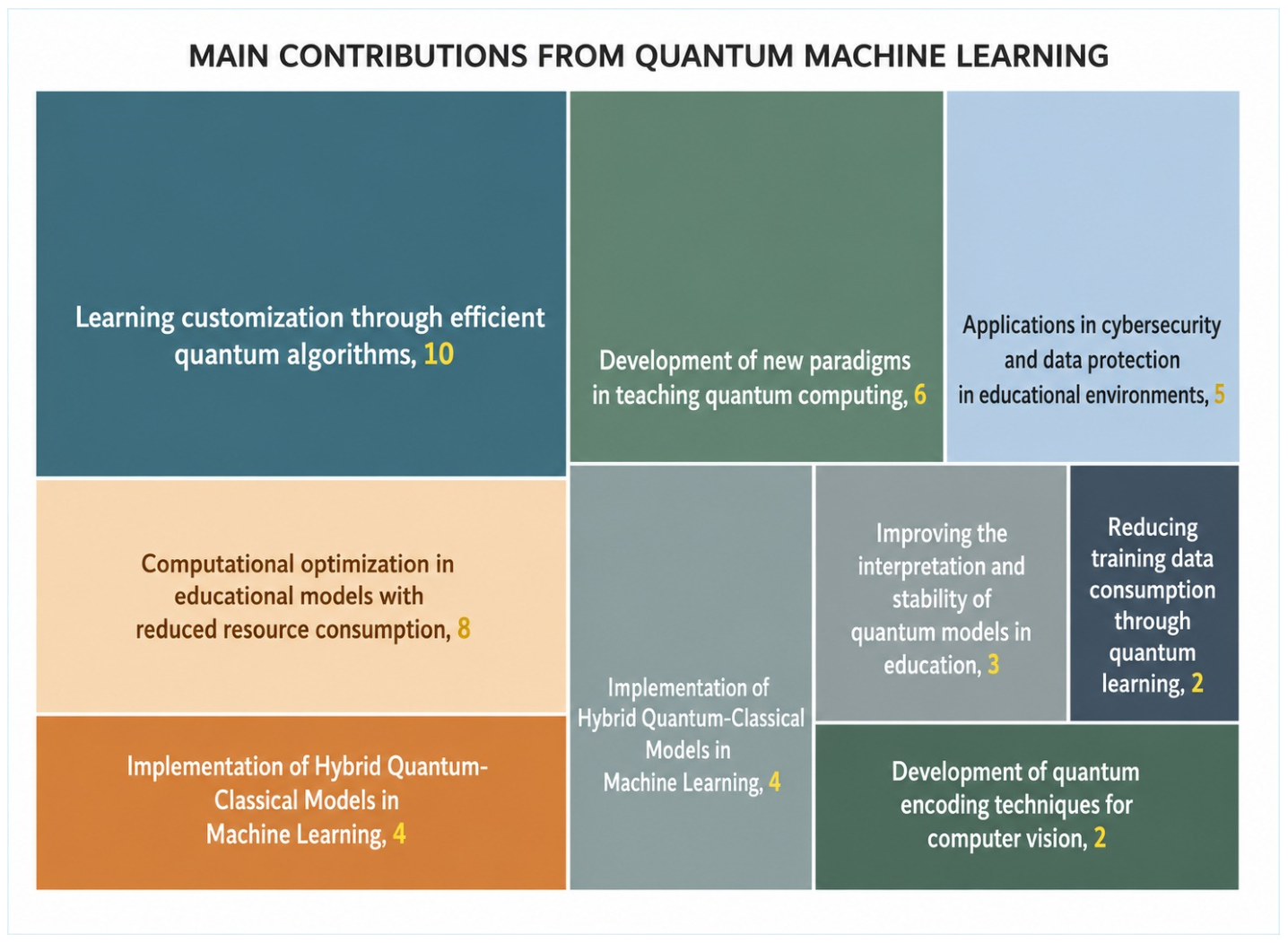
Figure 4 shows the main contributions of quantum machine learning to Education 5.0, where the size of each section is proportional to the number of studies supporting each contribution. It can be seen that the most prominent area is the personalization of learning through efficient quantum algorithms, with the highest support (10 authors), followed by computational optimization in educational models with lower resource consumption (8 authors).
Figure 4.
Main contributions of quantum machine learning.
Other relevant aspects include the development of new paradigms in quantum computing teaching (six authors) and applications in cybersecurity and data protection in educational environments (five authors).
Contributions that have less support, but are still significant, are the implementation of hybrid quantum–classical models in machine learning, the improvement in the interpretation and stability of quantum models in education, and the reduction of training data consumption by quantum learning, each with four, three and two authors, respectively. Finally, the development of quantum coding techniques for computer vision closes the list with the support of two authors. Together, these findings evidence the growing impact of quantum computing in education and its multiple applications in learning and teaching.
This distribution indicates that current QML research in Education 5.0 is still mainly concentrated on personalization and computational optimization, while areas such as empirical validation, scalability, and institutional implementation remain less developed.
Although algorithmic innovation and computational efficiency are frequently emphasized in QML research [11], much of the existing evidence remains confined to theoretical analyses and experimental validation on benchmark datasets [61]. While performance comparisons with classical models are reported in controlled settings, systematic evaluation within authentic educational environments remains limited. This constrains the ability to substantiate a demonstrated quantum advantage in real-world learning contexts.
Moreover, much of the existing literature relies on experimental validation within controlled computational settings, often constrained by the technical limitations of NISQ-era quantum hardware [46]. Persistent challenges related to coherence time, sampling noise, and hardware reliability continue to shape algorithmic design [15], raising important questions about scalability and long-term operational viability in large educational systems.
Therefore, while QML presents promising theoretical and computational contributions to Education 5.0, further empirical research is required to validate its practical effectiveness and economic feasibility [49]. Comparative analyses with advanced classical machine learning approaches remain necessary to assess its broader institutional relevance and long-term viability [52].
While the previous analysis addressed the research questions on the implications, deployment areas, and contributions of quantum machine learning in Education 5.0, these aspects are fundamentally supported by specific quantum learning algorithms. Therefore, the following subsection examines representative quantum machine learning algorithms reported in the scientific literature.
3.4. Representative Quantum Machine Learning Algorithms
The algorithms presented in this section were identified from the studies included in the systematic review conducted under the PRISMA 2020 framework. They were selected based on their recurrence in the analyzed literature and their relevance to classification, optimization, pattern recognition, and predictive modeling tasks.
Quantum machine learning (QML) combines principles of quantum computing with machine learning techniques to improve the processing and analysis of complex and high-dimensional data. In recent years, several QML algorithms have been proposed to address tasks such as classification, pattern recognition, optimization, and data generation. Many of these approaches rely on hybrid quantum–classical architectures, where parameterized quantum circuits are integrated with classical optimization techniques. This section summarizes some of the most representative QML algorithms reported in the literature and their main application domains.
An essential component of QML algorithms is the quantum data encoding process, which allows classical data to be mapped into quantum states. Different encoding strategies have been proposed in the literature, including angle encoding, amplitude encoding, basis encoding, and IQP encoding. The choice of encoding method can significantly affect the performance of QML models, as it determines how classical information is represented in the Hilbert space and how efficiently quantum circuits can process the data.
One of the most widely studied approaches is the Quantum Support Vector Machine (QSVM), which extends the classical Support Vector Machine by using quantum kernels to map data into high-dimensional Hilbert spaces. The QSVM has been applied in several domains, including medical diagnosis and image classification. For example, ref. [66] applied the QSVM for the automated detection of retinopathy of prematurity using retinal images. Similarly, ref. [67] used the QSVM together with other quantum classifiers for the classification of dementia based on EEG signals.
Another important class of algorithms is based on variational quantum circuits (VQCs). Variational approaches use parameterized quantum circuits whose parameters are optimized through classical optimization algorithms. These models have been widely adopted due to their compatibility with current Noisy Intermediate-Scale Quantum (NISQ) devices. For instance, ref. [68] proposed a hybrid model integrating Quantum Convolutional Neural Networks (QCNNs) with a variational quantum classifier, where circuit parameters were optimized using the Simultaneous Perturbation Stochastic Approximation (SPSA) algorithm for medical image classification tasks.
Quantum neural network architectures have also received significant attention. Quantum Neural Networks (QNNs) extend classical neural network models by representing neurons and weights through quantum circuits. Several variants have been proposed, including Quantum Convolutional Neural Networks (QCNNs) and Hybrid Quantum Neural Networks (HQNNs). For example, ref. [69] proposed hybrid models combining classical convolutional layers with parameterized quantum circuits to improve image classification performance.
In addition to neural network models, quantum optimization algorithms such as Quantum Annealing have been applied to machine learning tasks. Otgonbaatar and Datcu proposed a feature selection method for hyperspectral images using a D-Wave quantum annealer, where the problem is formulated as a Quadratic Unconstrained Binary Optimization (QUBO) model. The selected features are then classified using quantum boosting methods such as Qboost and Qboost-Plus. Similarly, ref. [70] proposed a Quantum Multiclass Support Vector Machine (QMSVM) based on Quantum Annealing for remote sensing data classification.
Generative quantum models have also emerged as an important research direction. Quantum Generative Adversarial Networks (QGANs) extend classical GAN architectures by implementing the generator through parameterized quantum circuits. For instance, ref. [71] proposed the Patch Quantum Wasserstein Generative Adversarial Network (PQWGAN), a hybrid quantum–classical generative model capable of producing high-resolution images using multiple parameterized quantum sub-generators.
Recent work has also explored more advanced architectures inspired by modern deep learning techniques. For example, ref. [72] introduced the Quantum Self-Attention Network (QSAN), which incorporates attention mechanisms into quantum circuits to improve image classification performance. Similarly, ref. [73] proposed the Superpixel Encoding Quantum Neural Network (SEQNN), a hybrid quantum–classical architecture designed for the classification of Earth observation imagery.
Beyond image analysis, QML algorithms have also been applied to engineering problems. For example ref. [74] proposed a QML-based prototype for predicting rock block falls in mining slopes using geotechnical parameters encoded into variational quantum circuits. Their results showed that QML models can achieve competitive performance compared with classical machine learning algorithms.
In general, these studies demonstrate the rapid development of QML algorithms in different domains such as healthcare, image processing, remote sensing, and engineering. Table 7 summarizes representative QML algorithms reported in the literature and their application areas.
Table 7.
Representative quantum machine learning algorithms and their application domains.
The QML algorithms described in this section represent the main computational approaches identified in the literature reviewed in this study. Understanding these algorithms is essential to analyze their potential implications, applications, and contributions within the context of Education 5.0 discussed in the previous sections.
Connection with Future Educational Applications
Although most existing studies apply QML algorithms in domains such as healthcare, remote sensing, computer vision, and engineering, their computational capabilities suggest potential applications in the educational domain. Algorithms such as the QSVM, QNN, VQC, and QCNN have demonstrated strong performance in classification, pattern recognition, and predictive modeling tasks. These capabilities could be leveraged in future research to support educational data mining and learning analytics, including applications such as student performance prediction, adaptive learning systems, and intelligent tutoring platforms within the context of Education 5.0.
To better connect the discussed quantum machine learning algorithms with the educational domain, their potential applications are considered based on their computational capabilities and the contexts identified in the reviewed literature. Although many of these algorithms are still primarily evaluated in technical or experimental settings, their functionalities suggest possible uses in educational scenarios such as learning analytics, student performance analysis, and adaptive learning environments.
Table 8 links representative QML algorithms with their computational functions and potential educational applications. Since QML in Education 5.0 remains at an early stage, most contributions are still based on conceptual, theoretical, or simulation-based approaches, while large-scale real-world implementations remain limited.
Table 8.
Potential educational applications of representative QML algorithms.
To further clarify the practical implications for educators and institutions, these applications can be interpreted through concrete educational scenarios. For example, QSVM-based models may support early-warning systems by classifying students according to academic risk levels, allowing educators to design timely intervention strategies. VQC-based approaches may contribute to learning analytics dashboards by optimizing the analysis of student performance data for academic decision support.
Similarly, QNN and QCNN models may support adaptive learning platforms by identifying learning patterns and processing complex educational data, while QGANs may assist in generating synthetic educational datasets for simulation-based learning and model training. These scenarios illustrate how representative QML algorithms can guide future educational innovation within Education 5.0.
4. Discussion
The findings of this systematic review suggest that quantum machine learning (QML) is still at an early stage of development within the context of Education 5.0. Although the literature highlights multiple potential applications, such as personalized learning, optimization of educational processes, and the development of quantum-related competencies, most of the existing evidence is based on conceptual frameworks, simulations, or limited experimental implementations. This indicates that the field is evolving, but has not yet reached a level of maturity that allows for large-scale deployment in real educational environments.
A key aspect that emerges from the analysis is the gap between the theoretical promise of QML and its practical feasibility. While many studies present QML as a transformative technology, its implementation is constrained by factors such as limited access to quantum hardware, the instability of current quantum devices, and the lack of institutional readiness. These limitations suggest that, at present, QML should be understood as a complementary approach rather than a replacement for existing educational technologies.
Another important dimension concerns the comparison between QML and classical machine learning methods. Although some studies report the competitive performance of QML models, there is still insufficient evidence to demonstrate a consistent advantage over well-established classical approaches in educational settings. In many cases, classical machine learning techniques remain more accessible, scalable, and cost-effective, particularly when applied to large educational datasets. Therefore, future research should focus on rigorous comparative analyses that evaluate the real benefits of QML under practical conditions.
From an economic and institutional perspective, the adoption of QML also involves significant challenges. The integration of quantum technologies into education requires investment in infrastructure, training of educators, curriculum redesign, and access to specialized computational resources. These requirements may limit adoption, especially in developing educational systems. However, the increasing availability of cloud-based quantum platforms may help reduce these barriers and enable gradual experimentation and integration in higher education contexts.
Overall, the results indicate that QML has significant potential to contribute to the evolution of Education 5.0, but its current role remains exploratory. Advancing this field will require a transition from theoretical and simulation-based studies to empirical research conducted in real educational environments. In addition, interdisciplinary collaboration and long-term evaluation will be essential to determine the true impact, scalability, and sustainability of QML in education.
Limitations
This study has several limitations that should be considered when interpreting its findings. First, the review was limited to open access publications, which may introduce a potential selection bias by excluding relevant studies available only through restricted-access databases or subscription-based sources.
Second, the temporal scope was restricted to studies published between 2021 and 2025. Although this period captures recent developments in quantum machine learning and Education 5.0, earlier foundational works may not have been included.
Third, most of the reviewed studies are based on theoretical approaches, simulations, or controlled experimental settings. Therefore, there is still limited empirical evidence from real educational environments, which restricts the generalizability of the findings.
Finally, the search strategy was focused on specific terms related to quantum machine learning and education. Broader terms, such as quantum AI or quantum education, could be considered in future reviews to expand the scope of analysis.
5. Conclusions
This study presented a systematic review of quantum machine learning (QML) in the context of Education 5.0, analyzing the literature published between 2021 and 2025. In relation to Q01–Q03, the findings show that QML is mainly associated with learning personalization, optimization of educational models, professional training in quantum technologies, curriculum innovation, and intelligent educational systems.
Overall, the evidence suggests that QML has promising potential to support the evolution of Education 5.0; however, its current level of development remains exploratory. Most reviewed studies are based on theoretical approaches, simulations, or limited experimental applications, while large-scale empirical validation in real educational environments is still scarce. Therefore, QML should be understood as an emerging and complementary technology rather than an immediately deployable solution for educational systems.
From a theoretical perspective, this review contributes by organizing the current landscape of QML in Education 5.0 into a structured analytical perspective that connects technological, pedagogical, and institutional dimensions. This synthesis helps clarify how QML algorithms, educational applications, infrastructure challenges, and future research needs are inter-related within the Education 5.0 framework.
In practical terms, the findings provide guidance for educators, institutions, and policymakers. The adoption of QML should be gradual, evidence-based, and supported by curriculum development, teacher training, accessible quantum infrastructure, ethical data governance, and comparative evaluation against classical machine learning approaches.
Future research should focus on validating QML models in real educational environments, evaluating their scalability and cost-effectiveness, and comparing their performance with advanced classical machine learning methods. This will help determine whether QML can provide practical advantages in learning analytics, adaptive learning systems, and student performance prediction.
Author Contributions
Conceptualization, J.A.R.H. and J.L.C.S.; methodology, J.O.A. and P.T.P.; software, J.O.A. and J.L.Q.E.; validation, E.C.M., P.T.P. and J.L.Q.E.; formal analysis, E.C.M. and J.L.C.S.; investigation, J.L.C.S. and J.A.R.H.; data curation, P.T.P.; writing—original draft preparation, E.C.M. and J.A.R.H.; writing—review and editing, J.A.R.H., J.L.Q.E. and J.O.A.; visualization, J.O.A. and E.C.M. All authors have read and agreed to the published version of the manuscript.
Funding
This research received no external funding.
Data Availability Statement
The data analyzed in this study consist of articles retrieved from several academic databases, including Springer, Scopus, IEEE, PubMed, MDPI, arXiv and APS. These articles are publicly available through the respective databases. The authors do not have the original datasets used for the analysis, as the study relies on secondary data in the form of published research articles. For further details on accessing the datasets, please refer to the respective databases.
Conflicts of Interest
The authors declare no conflicts of interest.
References
- Siemens, G. Elearnspace. Connectivism: A Learning Theory for the Digital Age. Elearnspace.org 2004, 14–16. Available online: http://www.itdl.org/Journal/Jan_05/article01.htm (accessed on 4 May 2026).
- Kukulska-Hulme, A. Will mobile learning change language learning? ReCALL 2009, 21, 157–165. [Google Scholar] [CrossRef] [Scilit]
- Schwab, K. The Fourth Industrial Revolution: What it means, how to respond. In Handbook of Research on Strategic Leadership in the Fourth Industrial Revolution; Edward Elgar Publishing: Cheltenham, UK, 2024; pp. 29–34. [Google Scholar]
- Jadhav, A.; Rasool, A.; Gyanchandani, M. Quantum Machine Learning: Scope for real-world problems. Procedia Comput. Sci. 2023, 218, 2612–2625. [Google Scholar] [CrossRef] [Scilit]
- Choudhury, S.; Dutta, A.; Ray, D. Chaos and complexity from quantum neural network: A study with diffusion metric in machine learning. J. High Energy Phys. 2021, 2021, 138. [Google Scholar] [CrossRef] [Scilit]
- Sun, Q.; Zhou, S.; Chen, R.; Feng, G.; Cheung, K.T.; Li, J.; Hou, S.-Y.; Zeng, B. From computing to quantum mechanics: Accessible and hands-on quantum computing education for high school students. EPJ Quantum Technol. 2024, 11, 58. [Google Scholar] [CrossRef] [Scilit]
- Kumar, S.; Adeniyi, T.; Alomari, A.; Ganguly, S. Design of quantum machine learning course for a computer science program. In 2023 IEEE International Conference on Quantum Computing and Engineering (QCE); IEEE: New York, NY, USA, 2023; pp. 68–77. [Google Scholar]
- Gil-Fuster, E.; Eisert, J.; Bravo-Prieto, C. Understanding quantum machine learning also requires rethinking generalization. Nat. Commun. 2024, 15, 2277. [Google Scholar] [CrossRef] [Scilit]
- Venumuddala, V.R.; Kamath, R. Work systems in the Indian information technology (IT) industry delivering artificial intelligence (AI) solutions and the challenges of work from home. Inf. Syst. Front. 2023, 25, 1375–1399. [Google Scholar] [CrossRef] [Scilit]
- Sihare, S.R. Student dropout analysis in higher education and retention by artificial intelligence and machine learning. SN Comput. Sci. 2024, 5, 202. [Google Scholar] [CrossRef] [Scilit]
- Zeguendry, A.; Jarir, Z.; Quafafou, M. Quantum machine learning: A review and case studies. Entropy 2023, 25, 287. [Google Scholar] [CrossRef] [Scilit] [PubMed]
- Meyer, J.C.; Passante, G.; Pollock, S.J.; Wilcox, B.R. Introductory quantum information science coursework at US institutions: Content coverage. EPJ Quantum Technol. 2024, 11, 1. [Google Scholar] [CrossRef] [Scilit]
- Kar, S.P.; Das, A.K.; Chatterjee, R.; Mandal, J.K. Assessment of learning parameters for students’ adaptability in online education using machine learning and explainable AI. Educ. Inf. Technol. 2024, 29, 7553–7568. [Google Scholar] [CrossRef] [Scilit]
- Le Gall, F. Robust dequantization of the quantum singular value transformation and quantum machine learning algorithms. Comput. Complex. 2025, 34, 2. [Google Scholar] [CrossRef] [Scilit]
- Hu, F.; Khan, S.A.; Bronn, N.T.; Angelatos, G.; Rowlands, G.E.; Ribeill, G.J.; Türeci, H.E. Overcoming the coherence time barrier in quantum machine learning on temporal data. Nat. Commun. 2024, 15, 7491. [Google Scholar] [CrossRef] [Scilit]
- Cuéllar, M.P. What we can do with one qubit in quantum machine learning: Ten classical machine learning problems that can be solved with a single qubit. Quantum Mach. Intell. 2024, 6, 76. [Google Scholar] [CrossRef] [Scilit]
- Bonfield, C.A.; Salter, M.; Longmuir, A.; Benson, M.; Adachi, C. Transformation or evolution? Education 4.0, teaching and learning in the digital age. High. Educ. Pedagog. 2020, 5, 223–246. [Google Scholar] [CrossRef] [Scilit]
- Salmon, G. May the fourth be with you: Creating education 4.0. J. Learn. Dev. 2019, 6, 95–115. [Google Scholar] [CrossRef] [Scilit]
- Ahmad, S.; Umirzakova, S.; Mujtaba, G.; Amin, M.S.; Whangbo, T. Education 5.0: Requirements, enabling technologies, and future directions. arXiv 2023, arXiv:2307.15846. [Google Scholar] [CrossRef] [Scilit]
- Sun, C.; Huang, S.; Sun, B.; Chu, S. Personalized learning path planning for higher education based on deep generative models and quantum machine learning: A multimodal learning analysis method integrating transformer, adversarial training and quantum state classification. Discov. Artif. Intell. 2025, 5, 29. [Google Scholar] [CrossRef] [Scilit]
- Asfaw, A.; Blais, A.; Brown, K.R.; Candelaria, J.; Cantwell, C.; Carr, L.D.; Combes, J.; Debroy, D.M.; Donohue, J.M.; Economou, S.E.; et al. Building a quantum engineering undergraduate program. IEEE Trans. Educ. 2022, 65, 220–242. [Google Scholar] [CrossRef] [Scilit]
- Kaur, M.; Venegas-Gomez, A. Defining the quantum workforce landscape: A review of global quantum education initiatives. Opt. Eng. 2022, 61, 081806. [Google Scholar] [CrossRef] [Scilit]
- Ranga, D.; Rana, A.; Prajapat, S.; Kumar, P.; Kumar, K.; Vasilakos, A.V. Quantum machine learning: Exploring the role of data encoding techniques, challenges, and future directions. Mathematics 2024, 12, 3318. [Google Scholar] [CrossRef] [Scilit]
- Ramos-Pulido, S.; Hernández-Gress, N.; Uehara, G.S.; Spanias, A.; Ceballos-Cancino, H. Implementation of quantum machine learning on educational data. In Proceedings of the 17th International Conference on Agents and Artificial Intelligence; SciTePress—Science and Technology Publications: Setúbal, Portugal, 2025; pp. 480–487. [Google Scholar]
- Caicedo-Castro, I. Quantum Course Prophet: Quantum Machine Learning for predicting course failures: A case study on numerical methods. In Learning and Collaboration Technologies; Zaphiris, P., Ioannou, A., Eds.; Springer Nature: Cham, Switzerland, 2024; pp. 220–240. [Google Scholar]
- Guan, J.; Fang, W.; Ying, M. Verifying fairness in quantum machine learning. arXiv 2022, arXiv:2207.11173. [Google Scholar] [CrossRef] [Scilit]
- Page, M.J.; McKenzie, J.E.; Bossuyt, P.M.; Boutron, I.; Hoffmann, T.C.; Mulrow, C.D.; Shamseer, L.; Tetzlaff, J.M.; Akl, E.A.; Brennan, S.E.; et al. The PRISMA 2020 statement: An updated guideline for reporting systematic reviews. BMJ 2021, 372, n71. [Google Scholar] [CrossRef] [Scilit] [PubMed]
- Chourasia, S.; Pandey, S.M.; Keshri, A.K. Prospects and challenges with legal informatics and legal metrology framework in the context of Industry 6.0. MAPAN 2023, 38, 1027–1052. [Google Scholar] [CrossRef] [Scilit]
- Hanafi, B.; Ali, M.; Singh, D. Quantum algorithms for enhanced educational technologies. Discov. Educ. 2025, 4, 8. [Google Scholar] [CrossRef] [Scilit]
- Juárez-Ramírez, R.; Jiménez, S.; Navarro, C.X.; Guerra-García, C.; Perez-Gonzalez, H.G.; Fernández-y-Fernández, C.; Ortiz-Hernández, J.; Cancino, K. Skills required for quantum computing: A comprehensive review of recent studies. Program. Comput. Softw. 2024, 50, 844–874. [Google Scholar] [CrossRef] [Scilit]
- Santosh, K.C.; Sood, S.K.; Pandey, H.M.; Virmani, C. (Eds.) Advances in Artificial-Business Analytics and Quantum Machine Learning: Select Proceedings of the 3rd International Conference, Com-IT-Con 2023, Volume 1; Lecture Notes in Electrical Engineering; Springer Nature: Singapore, 2024; Volume 1191. [Google Scholar]
- Abdullah, D.; Dacholfany, M.I.; Erliana, C.I.; Indrawati, I.; Miswar, M. Exploring the integration of quantum machine learning algorithms in higher education to enhance curriculum development and cybersecurity programs. Int. J. Teach. Learn. 2023, 1, 71–85. [Google Scholar]
- Sood, S.K.; Agrewal, M. Quantum machine learning for computational methods in engineering: A systematic review. Arch. Comput. Methods Eng. 2024, 31, 1555–1577. [Google Scholar] [CrossRef] [Scilit]
- Mori, Y.; Nakaji, K.; Matsuzaki, Y.; Kawabata, S. Expressive quantum supervised machine learning using Kerr-nonlinear parametric oscillators. Quantum Mach. Intell. 2024, 6, 14. [Google Scholar] [CrossRef] [Scilit]
- Heese, R.; Gerlach, T.; Mücke, S.; Müller, S.; Jakobs, M.; Piatkowski, N. Explaining quantum circuits with Shapley values: Towards explainable quantum machine learning. Quantum Mach. Intell. 2025, 7, 27. [Google Scholar] [CrossRef] [Scilit]
- Koch, C.P.; Boscain, U.; Calarco, T.; Dirr, G.; Filipp, S.; Glaser, S.J.; Kosloff, R.; Montangero, S.; Schulte-Herbrüggen, T.; Sugny, D.; et al. Quantum optimal control in quantum technologies. Strategic report on current status, visions and goals for research in Europe. EPJ Quantum Technol. 2022, 9, 19. [Google Scholar] [CrossRef] [Scilit]
- Nguyen, X.-B.; Nguyen, H.-Q.; Churchill, H.; Khan, S.U.; Luu, K. Quantum visual feature encoding revisited. Quantum Mach. Intell. 2024, 6, 61. [Google Scholar] [CrossRef] [Scilit]
- Allaqband, S.F.; Nazish, M.; Allaqband, S.F.; Bashir, J.; Banday, M.T. An efficient machine learning based CPU scheduler for heterogeneous multicore processors. Int. J. Inf. Technol. 2024, 17, 2493–2501. [Google Scholar] [CrossRef] [Scilit]
- Ezugwu, A.E.; Oyelade, O.N.; Ikotun, A.M.; Agushaka, J.O.; Ho, Y.S. Machine learning research trends in Africa: A 30 years overview with bibliometric analysis review. Arch. Comput. Methods Eng. 2023, 30, 4177–4207. [Google Scholar] [CrossRef] [Scilit]
- Kikan, V.; Kumar, A. A detailed review of 5G MIMO and array antenna design evolution with performance enhancement for mmWave applications. Wirel. Netw. 2024, 31, 2039–2090. [Google Scholar] [CrossRef] [Scilit]
- Krupp, L.; Bley, J.; Gobbi, I.; Geng, A.; Müller, S.; Suh, S.; Moghiseh, A.; Castaneda Medina, A.; Bartsch, V.; Widera, A.; et al. LLM-generated tips rival expert-created tips in helping students answer quantum-computing questions. EPJ Quantum Technol. 2025, 12, 33. [Google Scholar] [CrossRef] [Scilit]
- Pfaendler, S.M.L.; Konson, K.; Greinert, F. Advancements in quantum computing—Viewpoint: Building adoption and competency in industry. Datenbank-Spektrum 2024, 24, 5–20. [Google Scholar] [CrossRef] [Scilit]
- Blance, A.; Spannowsky, M. Quantum machine learning for particle physics using a variational quantum classifier. J. High Energy Phys. 2021, 2021, 212. [Google Scholar] [CrossRef] [Scilit]
- Rath, M.; Date, H. Quantum data encoding: A comparative analysis of classical-to-quantum mapping techniques and their impact on machine learning accuracy. EPJ Quantum Technol. 2024, 11, 72. [Google Scholar] [CrossRef] [Scilit]
- Setty, A.; Abdusalamov, R.; Motzoi, F. Self-adaptive physics-informed quantum machine learning for solving differential equations. Mach. Learn. Sci. Technol. 2025, 6, 015002. [Google Scholar] [CrossRef] [Scilit]
- Houssein, E.H.; Abohashima, Z.; Elhoseny, M.; Mohamed, W.M. Machine learning in the quantum realm: The state-of-the-art, challenges, and future vision. Expert Syst. Appl. 2022, 194, 116512. [Google Scholar] [CrossRef] [Scilit]
- Zhou, Y.; Xh, C.C.; Song, M.; Wong, Y.K. Quantum-powered personalized learning. arXiv 2024, arXiv:2408.15287. [Google Scholar] [CrossRef] [Scilit]
- Gamboa, J.C.R.; da Silva, A.J.; Araujo, I.C. Validation of the rapid detection approach for enhancing the electronic nose systems performance, using different deep learning models and support vector machines. Sens. Actuators B Chem. 2021, 327, 128921. [Google Scholar] [CrossRef] [Scilit]
- Peral-García, D.; Cruz-Benito, J.; García-Peñalvo, F.J. Systematic literature review: Quantum machine learning and its applications. Comput. Sci. Rev. 2024, 51, 100619. [Google Scholar] [CrossRef] [Scilit]
- De Luca, G.; Chen, Y. Teaching quantum machine learning in computer science. In 2023 IEEE 15th International Symposium on Autonomous Decentralized System (ISADS); IEEE: New York, NY, USA, 2023; pp. 1–7. [Google Scholar]
- Uehara, G.; Larson, J.; Barnard, W.; Esposito, M.; Posta, F.; Yarter, M.; Sharma, A.; Kyriacou, N.; Dobson, M.; Spanias, A. Undergraduate research and education in quantum machine learning. In 2022 IEEE Frontiers in Education Conference (FIE); IEEE: New York, NY, USA, 2022; pp. 1–5. [Google Scholar]
- Melnikov, A.; Kordzanganeh, M.; Alodjants, A.; Lee, R.-K. Quantum machine learning: From physics to software engineering. Adv. Phys. X 2023, 8, 2165452. [Google Scholar] [CrossRef] [Scilit]
- Delgado, F. Extending learning and collaboration in quantum information with Internet support: A future perspective on research education beyond boundaries, limitations, and frontiers. Future Internet 2023, 15, 160. [Google Scholar] [CrossRef] [Scilit]
- Malgieri, M.; Onorato, P. Recent progress on the sum over paths approach in quantum mechanics education. Physics 2022, 4, 1012–1025. [Google Scholar] [CrossRef] [Scilit]
- Meyer, J.C.; Passante, G.; Wilcox, B.R. Disparities in access to US quantum information education. arXiv 2023, arXiv:2309.08629. [Google Scholar]
- Genenz, U.; Anne, N.; Kılıç, Z.; Mathews, D.; Ok, O.; Schmidt, A.; Seskir, Z.C. Why teach quantum in your own time: The values of grassroots organizations involved in quantum technologies education and outreach. arXiv 2024, arXiv:2406.18761. [Google Scholar] [CrossRef] [Scilit]
- Goorney, S.; Bley, J.; Heusler, S.; Sherson, J. A framework for curriculum transformation in Quantum Information Science and Technology education. arXiv 2023, arXiv:2308.10371. [Google Scholar] [CrossRef] [Scilit]
- Donhauser, A.; Bitzenbauer, P.; Qerimi, L.; Heusler, S.; Küchemann, S.; Kuhn, J.; Ubben, M.S. Empirical insights into the effects of research-based teaching strategies in quantum education. Phys. Rev. Phys. Educ. Res. 2024, 20, 020601. [Google Scholar] [CrossRef] [Scilit]
- Oliver, K.A.; Borish, V.; Wilcox, B.R.; Lewandowski, H.J. Education for expanding the quantum workforce: Students’ perceptions of the quantum industry in an upper-division physics capstone course. Phys. Rev. Phys. Educ. Res. 2025, 21, 010129. [Google Scholar] [CrossRef] [Scilit]
- Merzel, A.; Weissman, E.Y.; Katz, N.; Galili, I. Mathematical structures in quantum physics education for high school students: Unveiling the power of Dirac notation for conceptual and problem-solving proficiency. Phys. Rev. Phys. Educ. Res. 2024, 20, 020134. [Google Scholar] [CrossRef] [Scilit]
- Coopmans, L.; Benedetti, M. On the sample complexity of quantum Boltzmann machine learning. Commun. Phys. 2024, 7, 274. [Google Scholar] [CrossRef] [Scilit]
- Bu, Y.; Xiao, Y.; Li, Y.; Meng, L. Recognition and classification of concrete surface cracks with an inception quantum convolutional neural network algorithm. Appl. Geophys. 2024, 22, 1475–1490. [Google Scholar] [CrossRef] [Scilit]
- Editorial Racionalidades. Educación 5.0: Denunciate Tecnológicas Educativas, Tomo I. 2025. Available online: https://www.researchgate.net/publication/387667513_Educacion_50_Tendencias_Tecnologicas_Educativas_Tomo_I_Editorial_Racionalidades (accessed on 6 March 2025).
- Zine, M.; Harrou, F.; Terbeche, M.; Sun, Y. Evaluating e-learning readiness using explainable machine learning and key organizational change factors in higher education. Educ. Inf. Technol. 2025, 30, 12905–12937. [Google Scholar] [CrossRef] [Scilit]
- Ovtšarenko, O. Opportunities of machine learning algorithms for education. Discov. Educ. 2024, 3, 209. [Google Scholar] [CrossRef] [Scilit]
- Sankari, V.M.R.; Umapathy, U.; Alasmari, S.; Aslam, S.M. Automated detection of retinopathy of prematurity using quantum machine learning and deep learning techniques. IEEE Access 2023, 11, 94306–94321. [Google Scholar] [CrossRef] [Scilit]
- Ho, R.; Hung, K.; Chui, K.T.; Fu, Y.; Wu, H.C. EEG-based dementia classification using CS-EMD synchrony features and quantum machine learning. IEEE Trans. Consum. Electron. 2025, 71, 2849–2863. [Google Scholar] [CrossRef] [Scilit]
- Aravinda, C.V.; Joseph, E.R.; Alasmari, S. A hybrid quantum-classical approach for multi-class skin disease classification using a 4-qubit model. IEEE Access 2025, 13, 114460–114470. [Google Scholar]
- Senokosov, A.; Sedykh, A.; Sagingalieva, A.; Kyriacou, B.; Melnikov, A. Quantum machine learning for image classification. Mach. Learn. Sci. Technol. 2024, 5, 015040. [Google Scholar] [CrossRef] [Scilit]
- Delilbasic, A.; Le Saux, B.; Riedel, M.; Michielsen, K.; Cavallaro, G. A single-step multiclass SVM based on quantum annealing for remote sensing data classification. IEEE J. Sel. Top. Appl. Earth Obs. Remote Sens. 2023, 17, 1434–1445. [Google Scholar] [CrossRef] [Scilit]
- Tsang, S.L.; West, M.T.; Erfani, S.M.; Usman, M. Hybrid quantum–classical generative adversarial network for high-resolution image generation. IEEE Trans. Quantum Eng. 2023, 4, 1–19. [Google Scholar] [CrossRef] [Scilit]
- Shi, J.; Zhao, R.-X.; Wang, W.; Zhang, S.; Li, X. QSAN: A near-term achievable quantum self-attention network. IEEE Trans. Neural Netw. Learn. Syst. 2024, 36, 13995–14008. [Google Scholar] [CrossRef] [Scilit]
- Fan, F.; Shi, Y.; Guggemos, T.; Zhu, X.X. Hybrid quantum deep learning with superpixel encoding for Earth observation data classification. IEEE Trans. Neural Netw. Learn. Syst. 2025, 36, 11271–11284. [Google Scholar] [CrossRef] [Scilit] [PubMed]
- Eufracio, A.C.; Saenz Perez Alvarado, R.; Huamani, J.A.R.; Villanueva, U.R.; Sequera, J.L.C.; Pulido, J.M.G. Rock block fall prediction prototype by structural control applied to slopes using Quantum Machine Learning (QML). J. Supercomput. 2025, 81, 422. [Google Scholar] [CrossRef] [Scilit]

Disclaimer/Publisher’s Note: The statements, opinions and data contained in all publications are solely those of the individual author(s) and contributor(s) and not of MDPI and/or the editor(s). MDPI and/or the editor(s) disclaim responsibility for any injury to people or property resulting from any ideas, methods, instructions or products referred to in the content. |
© 2026 by the authors. Licensee MDPI, Basel, Switzerland. This article is an open access article distributed under the terms and conditions of the Creative Commons Attribution (CC BY) license.