
Article

Multi-Route Search and Adaptive Fusion for Power QA with Small Language Model Guidance

1
Power Dispatch Control Center of Guangdong Power Grid Co., Ltd., Guangzhou 510335, China
2
School of Electric Power Engineering, South China University of Technology, Guangzhou 510641, China
*
Author to whom correspondence should be addressed.
Algorithms 2026, 19(5), 378; https://doi.org/10.3390/a19050378
Submission received: 11 March 2026 / Revised: 28 April 2026 / Accepted: 6 May 2026 / Published: 11 May 2026

Abstract

Power documentation serves as the core guideline for the safe operation of power systems, and its precise retrieval is crucial for ensuring grid stability and safety. In this context, Retrieval-Augmented Generation (RAG) frameworks emerge as an effective technique by combining LLMs with natural language understanding capabilities and a retrieval-based model with traceability. However, existing Retrieval-Augmented Generation (RAG) frameworks face several main challenges for power-system documents: semantic drift caused by non-standardized industry terminology, increased semantic noise due to fixed-window segmentation, and knowledge conflicts in the multi-source retrieval context. To address these challenges, we propose a multi-path adaptive fusion retrieval framework based on small language models (SLMs). To map queries to standard terminology, our framework first constructs a common terminology repository and section-structure-aware index for the power industry while fully preserving the physical hierarchical logic from related documents. Subsequently, the SLM in our framework assigns prior weights based on query features and retrieved context, which contributes to adaptive fusion of retrieval paths through confidence assessment and consistency verification. With the help of the fusion process, our method effectively filters retrieval noise and resolves knowledge conflicts. Experimental results on real-world power-document datasets covering dispatch, energy storage and emergency response show that our framework achieves an average recall of 91%, outperforming DENSE and BM25 by 21% and 28% respectively. Compared with other methods, it yields the optimal BERTScore F1 (0.7798) and Rouge-1/2/L F1 (0.2430, 0.1588, 0.2098) and achieves the best results in the RAGAS framework evaluation, which significantly enhances the rigor and reliability of the question-answering system in the power engineering domain.

1. Introduction

With the large-scale grid integration of new energy sources, intensified load fluctuations, and increasingly complex operational constraints, modern power systems require more precise dispatch operations [1,2,3]. To perform these precise operations, dispatchers often rely on power documents—such as dispatch procedures, operational regulations, technical standards, and equipment manuals—which serve as the most valuable references for grid dispatching, maintenance, and safety compliance [4,5,6]. However, practical question answering over such documents remains challenging. They are typically lengthy, hierarchically complex, and frequently updated and feature dense technical content. Consequently, in practical Q&A processing, answers to dispatching questions are often fragmented; furthermore, missing references or reliance on incorrect documents can trigger serious safety and compliance risks [7,8]. Therefore, building a question-answering (QA) system for the power sector must not only efficiently retrieve relevant information but also provide verifiable, traceable evidence to support actual operations [9,10,11]. This QA system would help enhance decision reliability and reduce operational risks during production.
Although power documents constitute essential knowledge resources for power industry management, practical question answering over such documents remains challenging due to their length, strong hierarchical structure, frequent updates, and dense technical content. As a result, developing a question answering system that can efficiently retrieve relevant information, reliably rank supporting evidence, and generate traceable answers has important engineering and practical value for power system operation, dispatch and human-machine collaborative management [12].
Recent advances in large language models (LLMs) and Retrieval-Augmented Generation (RAG) provide a promising technical foundation for intelligent QA in the power domain [13,14,15,16,17,18]. However, existing methods still face significant limitations in high-stakes power-document scenarios, motivating further research on more reliable and evidence-driven QA frameworks.
Specifically, pure LLMs suffer from intrinsic limitations, including hallucination [19], knowledge cut-off, and insufficient exposure to domain-specific long-tail knowledge [20,21,22], which makes them unreliable for high-stakes technical question answering in power systems. Although RAG alleviates the lack of external knowledge, conventional architectures introduce their own challenges in power-document QA. Fixed chunking over long and strongly structured regulations often causes semantic fragmentation, disrupting logical dependencies across related clauses [23]; inaccurate or partially conflicting retrieval results may introduce knowledge conflicts into the generation stage, thereby compromising answer reliability [24]; and terminology drift between user queries and official domain expressions weakens semantic matching and destabilizes retrieval [25,26,27].
Moreover, although recent RAG studies have incorporated multi-stage retrieval, reranking, and fusion, most of these designs are primarily developed for open-domain or general-purpose corpora, with the main objective of accelerating passage localization and improving generic retrieval effectiveness. In contrast, power dispatch regulations belong to a highly specialized vertical domain, where user queries are closely tied to professional terminology, clause dependencies, and document structure, requiring retrieval mechanisms that are substantially more fine-grained and domain-aware. Under such conditions, conventional multi-stage retrieval pipelines remain insufficient. Their reranking and fusion strategies are still largely driven by static weights, surface-level text similarity, or single-feature ranking, without adequately modeling the internal logic of domain knowledge. As a result, simple textual matching often fails to associate technical concepts expressed through different domain-specific forms; fixed-weight fusion struggles to distinguish credible evidence when multiple retrieved sources are partially conflicting; and one-dimensional ranking criteria tend to overlook structural dependencies among chapters, clauses, and conditions in long regulatory documents. These limitations can lead to misunderstandings during evidence integration and increase interference from irrelevant or weakly related content.
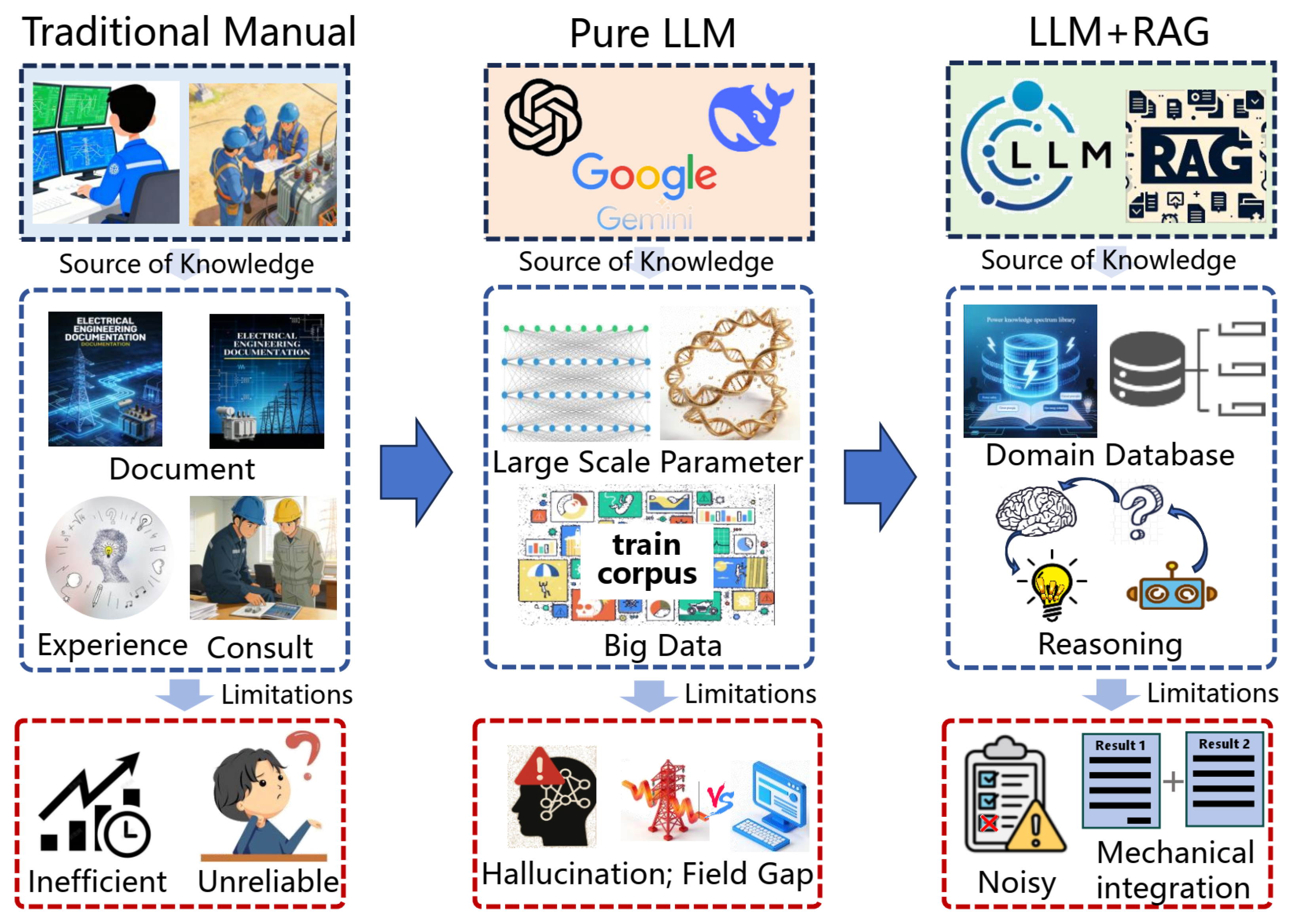
Consequently, existing methods still struggle to simultaneously ensure structural completeness, retrieval stability, terminology alignment, conflict resolution, and traceable evidence generation in power-document QA. To address these shortcomings (see Figure 1), we propose an “SLM-Guided Multi-Path Search and Adaptive Fusion Framework” for power-document question answering. This framework offers distinct theoretical and engineering advantages in terminology alignment, structural preservation, evidence fusion, and answer traceability. By constructing a domain-specific terminology repository and chapter-level hierarchical indexing for the power industry, this approach fundamentally resolves issues of abbreviation ambiguity and semantic fragmentation caused by fixed segmentation in power regulations, thereby preserving the logical integrity of knowledge retrieval in complex professional contexts. Meanwhile, the introduced SLM-guided multi-path parallel retrieval strategy exploits the complementarity of semantic, terminology, and structural priors, enabling evidence search from multiple perspectives and improving the relevance and coverage of retrieval candidates. Furthermore, instead of relying on conventional static fusion mechanisms, the proposed framework leverages the comprehension capability of SLMs to assign prior importance to evidence from different retrieval paths and then combines confidence and consistency signals to achieve adaptive weight calibration. This design effectively mitigates retrieval conflicts, suppresses irrelevant interference, and improves the stability and accuracy of evidence ranking. Beyond delivering precise technical responses, the framework achieves full traceability across the “document–chapter–clause” chain, effectively aligning with the power industry’s stringent requirements for safety production audits and operational compliance.
The main research work and contributions of this paper are summarized as follows:
  • We propose a retrieval paradigm for power sector question-answering systems that integrates term normalization with chapter-level structural indexing. Addressing the complex terminology and tightly interlinked logic of power regulations, we constructed a manually verified and adjusted domain-specific terminology repository and a hierarchical indexing system organized at the “document–chapter–content” level. This paradigm eliminates semantic drift through term mapping and replaces brute-force segmentation with structured units, ensuring professional precision in knowledge retrieval and semantic integrity of regulations from the source.
  • A multi-angle collaboration-based complementary search mechanism was designed, developing a parallel retrieval architecture comprising semantic coverage paths, terminology anchor paths, and structural a priori paths. By having the SLM collaboratively process raw queries and standardized queries, it effectively combines deep semantic understanding with precise keyword matching, substantially enhancing the system’s recall quality and coverage breadth when handling complex power technology inquiries.
  • We developed a retrieval SLM-driven constraint-adaptive weight fusion strategy, proposing a dynamic decision model based on confidence signals and execution constraints. This strategy enables the SLM to evaluate the confidence and consistency of search results across paths in real time, adaptively allocate fusion weights, and enforce pruning constraints. This resolves reordering challenges under multi-source knowledge conflicts, ensuring the interpretability and high reliability of output evidence.
The remainder of this paper is organized as follows: Section 2 reviews related work from three perspectives: traditional manual document consultation and retrieval in power systems, LLM-based QA and decision support in power systems, and LLM+RAG methods for power-domain question answering. Section 3 establishes two key components: the development of a domain-specific terminology repository for dynamic query correction and the implementation of a structure-aware indexing strategy at the section level for organized vector storage. Section 4 details the multi-path collaborative search mechanism facilitated by the SLM, which leverages three parallel paths—semantic coverage, term anchoring, and structural priors—to ensure accurate retrieval of evidence from the reconstructed knowledge base. Section 5 introduces an adaptive constraint fusion strategy, describing how the system dynamically calibrates weights using confidence and consistency metrics based on the priors of the SLM to provide rigorous and traceable answers. Section 6 discusses the experimental setup, results, and ablation studies, demonstrating the proposed framework’s superior performance in document-based QA tasks within the power sector. Finally, Section 7 provides a comprehensive summary of the entire paper.

2. Related Work

2.1. Traditional Manual Document Consultation and Retrieval in Power Systems

Power documents serve as important knowledge resources for dispatching, operation, maintenance, and safety compliance. However, automated information retrieval methods specifically tailored to the power sector have yet to gain widespread adoption. In practice, engineers and staff often still rely on manual searches, personal memory, or consultations to locate specific clauses during their tasks [28,29]. Such manual approaches become inefficient and unreliable under time pressure or when addressing complex issues, particularly in situations requiring precise identification of a specific chapter and verification of its applicability to the issue, such as conditions, thresholds, exceptions, and coordination requirements [30]. These manual methods result in inefficiency and increase potential risks [31]. Therefore, although human experience and document consultation remain fundamental in practical power-system operations, their dependence on individual expertise and manual verification makes them difficult to scale to complex, high-frequency, and evidence-intensive QA scenarios.

2.2. LLM-Based QA and Decision Support in Power Systems

Large language models (LLMs) [13,14,15], exemplified by GPT-5 and DeepSeek-3 [32], demonstrate immense transformative potential in the field of electrical power systems due to their advanced natural language processing capabilities and zero-shot reasoning abilities. According to a comprehensive review in [33], LLMs have been widely applied to tasks such as load forecasting, fault diagnosis, and the automatic generation of power-system simulation codes. Research in [34] highlights that LLMs can serve as intelligent assistants for dispatchers, enhancing grid operational responsiveness by up to 30% by simplifying the analysis of complex sensor data. These studies show that pure LLMs can provide a useful logical and linguistic interface for smart grid decision support and power-domain question answering.
However, existing LLM-based methods still mainly rely on the parameterized knowledge acquired during pre-training. As noted in [20,21], such models frequently suffer from hallucination [19] and cannot directly access real-time grid status or the latest industry standards because of the knowledge cut-off problem. In power Q&A scenarios, ref. [33] argues that the absence of power-sector-specific data in general pre-training datasets creates a domain knowledge gap, rendering pure models unreliable for precise tasks like relay protection setting calculations or specific substation operation and maintenance procedures. Moreover, due to privacy and regulatory constraints, LLMs in the power sector often have limited access to domain-specific data during pre-training [35]. This further aggravates the long-tail knowledge problem in technical scenarios [22]. Therefore, although LLMs provide a strong reasoning backbone, their reliability in high-stakes power-document QA remains constrained without external knowledge grounding.

2.3. LLM+RAG for Power-Domain QA

To address the suboptimal performance of pure LLMs in highly technical domains such as power systems, researchers introduced Retrieval-Augmented Generation (RAG) [16,17,18] architectures that leverage non-parametric knowledge bases to enhance question-answering quality. The ChatGrid framework, tailored for power dispatch control scenarios, demonstrated that RAG outperforms fine-tuned models alone in handling dedicated power regulation queries, markedly enhancing answer factuality [36]. The study [29] further indicates that RAG can effectively handle highly context-dependent protocol interpretation in power dispatch, providing dispatchers with real-time, logically grounded decision recommendations. Meanwhile, the GridCodex framework proposes addressing information overload in manual verification through multi-stage retrieval. Furthermore, the SPR-RAG framework enhances retrieval through semantic parsing, effectively addressing colloquial expressions in power policy documents. SPR-RAG mitigates false positives caused by entity name ambiguity, textual redundancy, and irrelevant retrieval content, thereby improving the verifiability and factual basis of generated answers [37]. For the massive volume of inquiries handled by power customer service, ref. [25] indicates that RAG fusion enhances performance for ambiguous or multifaceted queries by consolidating multiple retrieval results, notably improving response speed and stability for complex business standard queries. Ref. [38] proposed an energy infrastructure digital twin solution integrating RAG, proving that real-time retrieval technology enables models to accurately understand dynamically updated equipment asset states without retraining. In a case study on ABB circuit breakers [39], researchers demonstrated that RAG effectively supports power engineers in troubleshooting and operational decision-making by optimizing chunking strategies and embedding models.
Although the aforementioned methods have made progress in specific tasks, traditional RAG still faces persistent limitations when handling complex power-document QA. First, long and strongly structured power regulations are difficult to process with conventional chunking strategies. LongRAG [23] explicitly points out that traditional RAG chunking strategies for long-context documents disrupt the document’s overall structure and global semantics, fragmenting related information and making it challenging for generators to capture complete semantic context. Similarly, ref. [40] notes that the power sector features diverse document formats and a high proportion of long-form texts, making it difficult for conventional RAG chunking and retrieval strategies to ensure high coverage and stability. These findings reveal the semantic fragmentation problem of traditional RAG in structured power documents.
Second, existing RAG systems remain vulnerable to retrieval instability and knowledge conflicts. Astute-RAG [24] analyzes the core bottlenecks of RAG systems from the perspectives of unstable retrieval quality and knowledge conflicts. It highlights that even when retrieval errors occur or internal knowledge conflicts arise, the system may still output incorrect answers. This reveals the inherent unpredictability in the “retrieval plus generation” fusion process: inaccurate or conflicting retrieval results can be misused by LLMs, thereby compromising system stability. Ref. [41] further indicates that existing RAG architectures still face persistent limitations in retrieval quality and evidence utilization, motivating improvements in query optimization, reranking, and context compression.
Third, power-domain applications introduce an additional challenge of terminology drift between user queries and official expressions. Lee et al. showed that even small lexical or syntactic variations in queries can cause dense retrievers to miss relevant passages, and that multi-paraphrase retrieval with reranking can improve retrieval effectiveness and stabilize top-ranked evidence [26]. Further evidence indicates that query rewriting markedly improves recall and localization when encountering terminological variations and non-standard expressions, illustrating how foundational RAG suffers from retrieval instability due to term mismatches [25]. Ref. [27] also explicitly states that existing industry-standard terminology struggles to encompass all commonly used terms, abbreviations, and jargon. The existence of this “slang” limits the semantic analysis capabilities of intelligent systems. Standard dense retrieval methods often struggle with domain adaptation. Ref. [42] demonstrates that generic retrievers fail to capture the semantic nuances of specific technical jargon and abbreviations in zero-shot settings. Consequently, in the power sector, technical parameters and acronyms may fail to establish proper vector space connections with official long-form text.
In summary, existing power-domain RAG studies have demonstrated the value of external knowledge grounding, but they still do not jointly resolve terminology drift, semantic fragmentation, and knowledge conflict in a unified manner. This gap motivates the present work to integrate domain terminology normalization, chapter-level structural indexing, multi-path retrieval, and adaptive fusion into a single evidence-driven QA framework.

3. Knowledge Enhancement and Structural Perception Index Construction in the Power Grid Domain

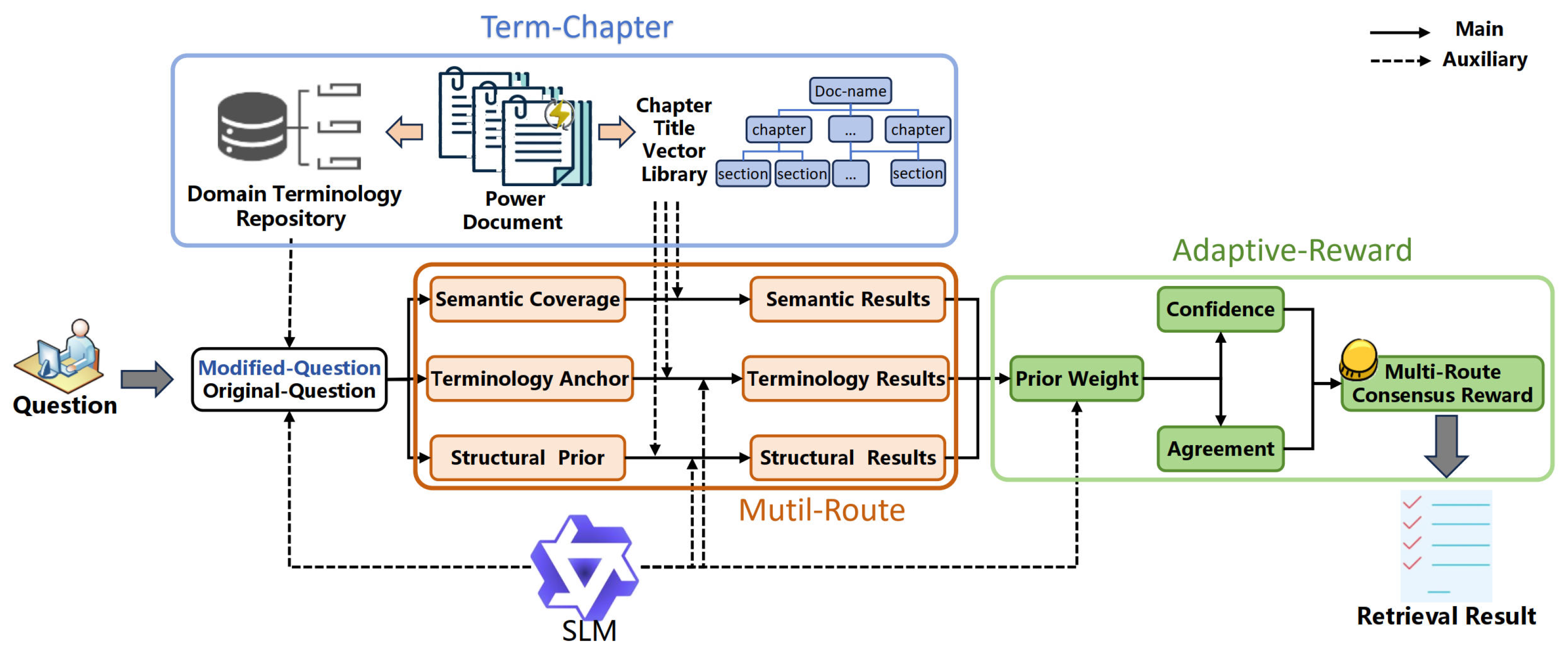
This section details a knowledge preprocessing and reconstruction framework for electric-power-domain documents. To bridge the semantic gap between industry-specific terminology and the standard literature while overcoming the disruption of document logical structure by traditional retrieval strategies, this paper constructs an end-to-end knowledge representation process spanning from “dynamic terminology correction” to “structure-aware indexing” (see the blue box section in Figure 2). This process first employs an LLM-driven terminology repository to semantically enhance user queries, ensuring precise intent mapping. Subsequently, chapter-level hierarchical modeling transforms unstructured documents into vector storage units governed by physical-logical constraints. This reconstruction paradigm not only enhances the atomicity and completeness of retrieval results but also establishes a reliable data foundation for evidence traceability in subsequent generation phases.

3.1. Dynamic Terminology Correction Mechanism Based on Domain Knowledge Alignment

Addressing the challenge of high heterogeneity in technical terms within power generation scenarios, this paper proposes a terminology correction mechanism combining LLM-inspired extraction with expert knowledge constraints. This approach aims to achieve precise alignment between non-standardized intents and standardized knowledge spaces.
The mechanism integrates domain knowledge and ontology extraction. By employing LLM-based semantic mining and heuristic prompt engineering, potential industry abbreviations and colloquial terms are extracted from multi-source heterogeneous corpora and compared against a power standards ontology to establish an editable terminology mapping database.
Based on a terminology correction mechanism, the system employs a dual-path semantic enhancement strategy. During query preprocessing, the terminology correction engine first processes raw input to eliminate vector shifts caused by colloquial expressions while preserving the original feature sequence to retain local characteristics within the input signal. This strategy fully accounts for terminology evolution during historical revisions of power regulations, effectively preventing retrieval failures of low-frequency terms caused by forced normalization.

3.2. Chapter-Level Structure-Aware Indexing for Physical Regulations

To ensure the rigor of power regulation Q&A and the integrity of provisions, this paper designs a chapter-level structure-aware indexing mechanism. By reconstructing the physical structure, it suppresses hallucinations and semantic noise.
Unlike traditional RAG’s fixed-length segmentation, we use natural chapters as atomic indexing units. By parsing the document’s hierarchical structure (headings and anchors), we preserve logical integrity and ensure that evidence chains remain unbroken, thereby safeguarding retrieval readability and suppressing semantic noise.
Structural metadata is further leveraged to enhance vector space representations. During vectorization, the system fuses document structural topology metadata (e.g., document titles, cascading headings) with textual semantics for joint encoding. Through this feature enhancement, each data point cluster in the vector space embodies not only semantic information but also its logical position within the process framework. This mechanism establishes a “heading–clause–content” indexing system, providing retrieval vectors with explicit structural-prior knowledge. This meaningfully improves accuracy in distinguishing highly similar content at the content level.
Building upon this foundation, structured indexes are retained to trace retrieval results, ensuring each result possesses a clear physical address and permission source. During the generation phase, the system injects complete structured metadata, providing the model with clear and precise prompts. Search content is transformed from fragmented text snippets into hierarchically related chapter collections. This provides the model with essential contextual inference information and content provenance, reducing noise pollution in segmented content. Consequently, it achieves high-confidence and traceable responses.

4. Multi-Path Retrieval Mechanism with Integrated Terminology Correction

In power scenarios, power-related issues face challenges of terminology ambiguity and multi-form problem expressions. Non-standardized problem formulations can easily lead to semantic drift, while single retrieval methods often only address specific problem forms. To address this, we first integrated a constructed power sector terminology repository and proposed a multi-path collaborative retrieval mechanism driven by an SLM (see the orange box section in Figure 2). This mechanism aims to systematically resolve the recall deficiencies and retrieval errors inherent in traditional RAG architectures when handling diverse problem categories through multi-angle parallel retrieval. First, queries are corrected using the constructed power sector terminology repository, followed by retrieval via distinct paths. The semantic coverage path handles coarse-grained alignment for global intent. The terminology retrieval path ensures precise matching of key parameters through hard constraints. The structure-priority path leverages the SLM’s pre-understanding of hierarchical directories and technical summaries within power documents, restricting the search space to specific logical domains. This considerably reduces false positives caused by cross-chapter semantic similarity. Terminology correction mitigates semantic drift in the power domain, while multi-path parallel retrieval effectively addresses recall deficiencies in lengthy power texts caused by differing question focuses. This ensures that retrieval results comply with the physical safety closed-loop requirements of power systems.

4.1. Intent Parsing and Global Feature Extraction for SLM

The SLM acts as the decision-making layer, transforming unstructured inquiries into logic-aligned retrieval strategies. It utilizes a power terminology normalization module to heuristically cross-reference industry jargon against an expert database, generating standardized queries that bridge the semantic gap between field expressions and technical documentation.
To enhance the SLM’s text comprehension capabilities in structured prior retrieval, a global feature navigation system based on chapter summaries was constructed. The SLM pre-extracts the core technical points of each chapter and establishes a summary index during the pre-retrieval phase. By integrating chapter indexes with chapter summaries, a high-level “logical navigation map” is created for subsequent structured prior retrieval. This establishes strong associations between content and titles throughout the retrieval process.

4.2. Complementary Multi-Path Parallel Retrieval Design

To balance precision and coverage, we propose a multi-path parallel retrieval architecture leveraging the complementarity of semantic coverage, terminology anchors, and structural priors. The introduction of structural-prior paths overcomes linear retrieval limitations by filtering searches using document topology, enabling precise isolation of irrelevant content within complex specifications. This enables precise isolation of irrelevant content within complex and similar technical specifications. This multi-path collaborative design noticeably improves retrieval accuracy when processing various types of queries.
The first retrieval path employs dual-version semantic coverage. This path concurrently calculates feature vectors for both the original colloquial query and the standardized query. Through joint perception within a dense vector space, the system captures contextual features of user expressions while reinforcing semantic alignment via standardized terminology. This ensures comprehensive recall even when expressions vary substantially.
The second path employs a term-enhanced anchor approach. The SLM extracts core information keywords from both raw and standardized queries for retrieval within power documents, executing an exact-match algorithm based on these keywords. By boosting the retrieval weight of professional entity terms, this path effectively corrects potential semantic deviations in the vector space, ensuring precise capture of factual core evidence.
The third approach is structure-priority-guided local constraint retrieval, which deeply leverages the physical structure of power documents. Based on the preliminary summary matching results generated in Section 4.1, the SLM focuses computational resources on specific chapter subsets with high-probability relevance. By incorporating logical a prioris of the physical structure, this path rapidly filters out semantically similar but technically divergent distractions from non-target chapters, notably enhancing localization accuracy and recall robustness for specific technical provisions.

5. Adaptive Constrained Fusion and Evidence-Driven Generation

Upon completion of the multi-path parallel retrieval process, the system obtains a set of candidate evidence from heterogeneous paths. However, due to pronounced differences in response confidence across different retrieval logics for the same query, simple linear stacking often results in the dilution of core information. To address this, we propose an adaptive weighting fusion strategy driven by the SLM (see the green box section in Figure 2). This strategy first assigns prior weights based on the SLM’s assessment of the relevance between different strategy answers and the query. It then incorporates adaptive verification signals to dynamically calibrate the weights of each path. In addition, a consensus incentive mechanism is established on the path to ensure a reasonable weight distribution between strategies, preserving the most relevant retrieval content. This guarantees that the evidence chain fed into the input generation model possesses exceptional authority and logical certainty.

5.1. SLM-Driven Feature Perception and Constraint-Adaptive Allocation

To further enhance the proportion of correctly retrieved content, the system fully leverages the SLM’s robust language comprehension capabilities. It employs prompt engineering to generate prior weights and incorporates adaptive weight validation to ensure proportionality and accuracy. This approach aims to extract optimal evidence chain path weights from an uncertain candidate set. During the initial fusion stage, the SLM employs prompt engineering to heuristically score the logical relevance of candidate content returned by each path relative to the query. By comprehensively considering connections among the input query, standard queries, keywords, recommended sections, and retrieval results, the SLM assigns differentiated prior weight coefficients to each retrieval path based on judgment rules and constraints. It simultaneously justifies weight allocation, ensuring the rationality of evidence distribution at its source. The SLM-driven multi-path weight distribution constraint expression is as follows:
r = 1 3 w r prior = 1 , 0 w r prior 1 .
where w r prior represents the prior weights of each path, and r denotes different retrieval paths: r = 1 indicates dual-version semantic coverage retrieval, r = 2 indicates term-enhanced anchor retrieval, and r = 3 indicates structure-priority guided retrieval.
To mitigate the impact of retrieval noise on the accuracy of prior weights, an adaptive calibration mechanism centered on confidence and consistency is integrated into the fusion phase of retrieval results. This mechanism features a dual capability: it effectively suppresses ambiguous or low-quality evidence from individual retrieval paths via confidence assessment while simultaneously identifying and reinforcing cross-path consensus knowledge through consistency verification. Specifically, confidence assessment is employed to quantify the certainty and discriminative power inherent in each discrete retrieval path. To ensure commensurability across different retrieval dimensions, similarity scores from the three paths are first uniformly normalized. Building upon the extraction of the Top-5 results, confidence is quantitatively defined as the score margin between the Top-1 and Top-2 results within a single path. A larger margin signifies higher uniqueness of the optimal result and greater retrieval certainty, thereby enabling the framework to filter out ambiguous scenarios where the model fails to adequately distinguish between competing candidates. Furthermore, consistency verification is used to measure the degree of knowledge overlap across different retrieval dimensions. It is quantitatively defined as the proportion of the intersection between the current path’s Top-5 result set and the union of the Top-5 results from the other two paths. A higher ratio indicates that the result represents cross-path consensus knowledge, with a lower probability of knowledge conflict, and thus offers greater reliability in the logical verification of power dispatch regulations.
conf r = s ^ r , 1 s ^ r , 2 .
agree r = T r T all T r max T all T r , 1 .
In Formula (2), s ^ r , k indicates the top-k similarity in the r-th path, where k is set to 1 and 2. In Formula (3), T r denotes the set of chapter IDs returned by the r-th top-K query, where k is set to 5. This ensures that the final evidence chain generated in power regulation Q&A, where domain noise and knowledge conflicts exist, possesses remarkable rigor and logical consistency.
After obtaining the SLM’s prior weights, intra-path confidence, and inter-path consistency, the initial weights for each path are adaptively calibrated. The final fusion weight calculation formula for the retrieved path is as follows:
w r * = w r prior · 1 + α conf r + β agree r , r { 1 , 2 , 3 } .
where w r * represents the final weight of the r t h search path, with α and β as hyperparameters, where α is set to 15 and β is set to 2.

5.2. Multi-Route Consensus Reward and Confidence Reordering

Adaptive weighting addresses the proportional representation of different paths. To further identify the certainty of candidate evidence within paths, the system introduces a consensus reward mechanism. Since different retrieval paths observe the same knowledge space from mutually independent feature dimensions, when retrieval content is simultaneously matched across multiple heterogeneous paths, its certainty as “target evidence” exhibits non-linear growth.
To enhance the proportion of identical retrieval content across heterogeneous paths, this paper proposes a multi-path consensus mechanism—an evidence-based reward mechanism. The reward function can be formally expressed as follows: The reward mechanism amplifies the weight of consistent clauses. It performs matching using “hard constraints” from word-anchor paths and structural-prior paths alongside “soft constraints” from semantic paths, effectively filtering out irrelevant retrieval content. This “score polarization” process provides more accurate contextual distributions for subsequent large model generation, fundamentally reducing the probability of model hallucinations caused by retrieval errors.
Finally, the system integrates initial path scores, adaptive weight coefficients, and path consensus rewards through a global optimal scoring operator to fuse all path results and execute global optimal score ranking. The entire system retains fragments most semantically relevant to the query, eliminates logically inconsistent noise, and constructs a final evidence chain with high confidence.

6. Experiment and Results

6.1. Experimental Environment and Dataset

This section first introduces the high-performance GPU computing platform and environment configuration supporting the experiment and describes the model adopted by this method. Subsequently, it presents four representative power regulation datasets covering core operations such as grid dispatch and energy storage monitoring. Finally, it outlines the construction of a power industry jargon corpus and a test question-answering set, laying the foundation for verifying the retrieval accuracy and logical rigor of the system within vertical power scenarios.

6.1.1. Experimental Environment and Resource Configuration

To validate the proposed framework’s efficacy in power regulation Q&A tasks, this study primarily relies on two NVIDIA GeForce RTX 3090 (24 GB VRAM) graphics cards to handle computational demands. This configuration ensures efficient execution of large-scale vector computations and real-time inference of complex logical chains. At the software environment level, the system operates on the Ubuntu 20.04 LTS operating system, leveraging the CUDA 12.2 GPU driver environment, and utilizes the 2.6.0+cu124 PyTorch deep learning framework as its underlying foundation. For the model deployment strategy, the lightweight Qwen 3-8B pre-trained model was selected as the SLM. Renowned for its exceptional logical reasoning capabilities and lightweight design, this model primarily handles intent correction, term refinement, full-process feature extraction, and prior weight extraction. Serving as the system’s decision-making brain, it guides the retrieval path. The larger-parameter Qwen3-32B model, with enhanced semantic representation capabilities, serves as the final answer generation engine. Its core task is to generate professional responses meeting the rigorous standards of the power industry, constrained by the structured evidence filtered by the SLM. All models are invoked via the Application Programming Interface (API).

6.1.2. Experimental Data Composition

This section details the data sources and composition required for the proposed method and experiments, specifically as follows: First, the raw document corpus comprises four documents: the “Regional Grid Dispatch Automation Design Specification” (5002-2021), “Technical Specifications for Electrochemical Energy Storage Station Monitoring Systems” (42726-2023), “Implementation Rules for Grid Connection Operation Management in Southern China” (Power rules), and “Interprovincial and Interregional Power Emergency Dispatch Management Measures” (Dispatch measures). These documents collectively contain 376 physical chapters, forming the underlying knowledge space for system retrieval.
Subsequently, to simulate real production interaction environments, this study constructed a corpus containing 124 “power jargon-to-technical term” mapping pairs. This corpus was generated through LLM-inspired extraction combined with manual verification and validation, covering most non-standard abbreviations and industry colloquialisms found in the original document corpus.
Finally, this study generated 122 high-quality test question–answer pairs for the four regulations. The dataset was created using a hybrid approach of LLM-generated questions and human review. First, large models simulated real-world document-based Q&A scenarios to generate diverse questions. Subsequently, humans verified the questions, answers, and corresponding regulatory references. This dataset encompasses multiple task types, aiming to comprehensively evaluate the system’s performance under physical and logical constraints. Please note that the aforementioned documents, power jargon-to-technical term mapping pairs, and Q&A datasets are all in Chinese format.

6.2. Experimental Settings

6.2.1. Evaluation Metrics

To evaluate system performance across multiple dimensions, including lexical, semantic, and retrieval depth, this paper selected the following four categories of evaluation metrics, covering the entire process from basic text matching to advanced semantic understanding.
Rouge-1 [43]: Rouge-1 is used to measure the degree of overlap between the generated answer and the standard regulation clauses at the character/word level. Precision represents the proportion of correct matches of power industry terminology in the generated answer, reflecting the terminological accuracy of the answer; recall represents the proportion of key terms in the standard clauses successfully captured by the model, reflecting the completeness of terminology extraction. The F1-score is the harmonic mean of precision and recall, comprehensively measuring the model’s ability to extract and match terminology at the lexical level; it serves as the core foundational metric for evaluating the accuracy of specialized terminology reproduction in the power sector.
Rouge-2 [44]: Rouge-2 focuses on matching performance at the two-word phrase level to evaluate the sentence coherence and accuracy of compound technical terms in the generated answers. Precision reflects the proportion of correctly matched consecutive two-word phrases in the generated content; recall reflects the extent to which key two-word phrases in the standard clauses are fully covered. The F1-score comprehensively demonstrates the model’s ability to reproduce fixed collocations and compound technical terms in power industry regulations, effectively measuring the local semantic coherence of the answers.
Rouge-L [45]: Rouge-L is calculated based on the Longest Common Subsequence (LCS) algorithm, focusing on the similarity between the generated answer and the standard clause in terms of overall sentence structure and sequence level. It evaluates the logical organization of content without requiring continuous text matching. Precision reflects the accuracy of alignment between the generated sentence structure and the standard clause; recall reflects the extent to which the core logical sequence of the standard clause is covered. The F1-score comprehensively measures the model’s ability to reproduce the stylistic norms and logical flow of power regulation clauses, indirectly verifying the answer’s compliance and the reliability of evidence traceability.
BERTScore [46]: BERTScore calculates semantic similarity based on deep contextual embeddings from pre-trained models, enabling the identification of semantically equivalent expressions such as synonym substitution and sentence restructuring. Precision characterizes the semantic accuracy of the generated answers, preventing misjudgments caused by literal mismatches; recall characterizes the extent to which the core semantics of the standard clauses are fully conveyed; and the F1-score comprehensively measures the model’s alignment with the deep semantics of the original power regulation text, effectively adapting to diverse expression scenarios for the same technical requirements in the power sector.
RAGAS [47]: This framework utilizes LLMs as reference-free evaluators, employing core metrics—specifically Faithfulness, Answer Relevancy, Context Precision, and Context Recall—to provide a granular assessment of hallucination mitigation, response pertinence, multi-route retrieval quality, and information coverage. Unlike traditional lexical-matching metrics such as BLEU or Rouge, Ragas is more effective at capturing the highly specialized semantics characteristic of the power industry. By adopting Qwen-8B as the underlying Judge LLM, the evaluation logic maintains high consistency and scientific interpretability even when applied to the complex compliance scenarios inherent to power grid regulation.
Recall: Specifically designed to quantify retrieval module performance, this metric evaluates the completeness of evidence extraction from complex knowledge bases by verifying whether the system’s returned candidate sections cover all annotated relevant procedure clauses. It is of core significance for ensuring that power dispatch operations do not omit critical safety constraints.

6.2.2. Comparative Methods

To validate the comprehensive performance of this framework, the following three representative retrieval techniques were selected as comparison baselines:
BM25 (Best Matching 25) [48]: A traditional lexical retrieval algorithm enhanced based on the TF-IDF framework, serving as a benchmark for pure text keyword matching capability.
DENSE (Dense Vector Retrieval) [49]: A dense retrieval method based on full-text vector embeddings, representing the current mainstream level of RAG systems in handling semantic generalization tasks.
BM25-BGE (Reranking-enhanced Lexical Retrieval): This method introduces the BGE reranker on top of BM25. It uses a cross-encoder to perform deep semantic re-scoring of the lexical-matching results, aimed at verifying the precision gains of semantic reranking on hard text matching.
DENSE-BGE (Reranking-enhanced Dense Retrieval): A typical two-stage retrieval pipeline that overlays the BGE reranker on dense vector retrieval. It is used to evaluate the effectiveness of the reranking model in further optimizing semantic alignment and mitigating vector retrieval bias.
GraphRAG (Knowledge Graph-based RAG) [50]: An enhanced retrieval method integrating knowledge graph structures, enabling evidence discovery through entity association paths. This represents cutting-edge technology for handling complex power logic associations. The experiment employed two retrieval modes of GraphRAG: Local Search and Global Search.

6.3. Comparative Experiments and Performance Analysis

To comprehensively validate the effectiveness of the proposed method in power-document question-answering tasks, this section presents the results of multi-dimensional comparative experiments. Six representative methods from the current RAG field are selected as baselines. These methods cover diverse technical approaches ranging from traditional lexical matching to higher-order graph reasoning. The aim is to quantitatively evaluate the superior performance of our system in addressing document question answering within the power domain. We conducted downstream experiments on the proposed Q&A dataset. The experimental results are presented in Table 1, Table 2, Table 3 and Table 4.
The proposed method consistently outperforms baseline methods in recall. As shown in Table 1, the proposed method achieved higher recall rates than all other comparison methods across all four documents. Specifically, compared to Dense, the proposed method achieved recall improvements of 19%, 28%, 23%, and 10% across four documents, with an overall recall increase of 21%. Compared to BM25, the proposed method achieved recall improvements of 52%, 16%, 17%, and 10% across four documents, with an overall recall increase of 28%. We conclude that the proposed method standardizes input queries and employs adaptive multi-path retrieval, enabling it to outperform all comparison methods in recall.
Table 2. Scores of different methods on the power-document Q&A dataset using BERTScore and Rouge-1. The underlined values in the figure represent suboptimal solutions, while the bolded values represent optimal solutions.
BERTScore F1BERTScore PrecisionBERTScore RecallRouge-1 F1Rouge-1 PrecisionRouge-1 Recall
DENSE0.76840.69340.86330.21300.1260.8411
DENSE-BGE0.77230.69590.86960.22830.13630.8495
BM250.76620.68990.86340.20620.12330.8347
BM25-BGE0.77320.69540.87220.22310.13320.8579
GraphRAG-Local0.71390.65380.78740.13740.07930.6117
GraphRAG-Global0.65990.61470.71430.09190.05340.4427
ours-8b0.77980.70150.87970.24300.14850.8731
ours-27b0.78160.70370.88080.25120.15470.8751
The proposed method demonstrates outstanding performance on BERTScore and Rouge-1. As shown in Table 2, it outperforms all comparison methods on both metrics. Specifically, compared to Dense and DENSE-BGE, our method using Qwen3-8B as the SLM achieves relative improvements of 17.8% and 8.9% in Rouge-1 precision, respectively. Compared to BM25 and BM25-BGE, the Rouge-1 F1-score improves by 17.9% and 6%, respectively. It achieves an 11.7% performance boost in BERTScore recall compared to GraphRAG-Local. Compared to GraphRAG-Global, it achieves a substantial improvement in Rouge-1 precision (0.0534–0.1485). This accurately demonstrates the proposed method’s advantage in achieving both semantic and keyword coverage for LLM responses in power-document Q&A.
The proposed method demonstrates outstanding performance on Rouge-2 and Rouge-L. As shown in Table 3, our method, which uses Qwen3-8B as the SLM, outperforms all comparison methods on both the Rouge-2 and Rouge-L metrics. Specifically, compared to DENSE and DENSE-BGE, the proposed method achieves approximately 27.6% and 15.3% improvements in Rouge-2 precision, respectively; in Rouge-2 F1, it outperforms BM25 and BM25-BGE by approximately 23.4% and 10.5%, respectively; and in Rouge-L precision, it outperforms BM25 and BM25-BGE by approximately 23.7% and 13.2%, respectively. Compared to GraphRAG-Local and GraphRAG-Global, it demonstrates substantial gains across all metrics. This precisely validates the proposed method’s advantage in ensuring consistency between local and global sentence structures in LLM responses for power-document Q&A.
Table 3. Scores of different methods on the power-document Q&A dataset using Rouge-2 and Rouge-L. The underlined values in the figure represent suboptimal solutions, while the bolded values represent optimal solutions.
Rouge-2 F1Rouge-2 PrecisionRouge-2 RecallRouge-L F1Rouge-L PrecisionRouge-L Recall
DENSE0.12830.07600.51180.17770.10510.7096
DENSE-BGE0.14160.08430.54320.19250.11470.7254
BM250.12860.07670.53270.17370.10350.7159
BM25-BGE0.14360.08580.56010.19000.11310.7419
GraphRAG-Local0.05590.03250.24490.10940.06310.4982
GraphRAG-Global0.03180.01850.15370.07090.04120.3510
ours-8b0.15880.09700.58390.20980.12810.7617
ours-27b0.16630.10230.59110.21600.13260.7646
It is worth noting that we also compared the performance of models with larger parameters. The results showed that the Qwen3-27B model delivered only a negligible improvement in performance, yet its increased parameter count led to significantly higher GPU memory consumption, computational overhead, and inference time compared to the Qwen3-8B model. This poses challenges for edge deployment and real-time inference, further validating the rationality and reliability of our choice of SLM.
Table 4. Scores of different methods on the power-document Q&A dataset using RAGAS. The underlined values in the figure represent suboptimal solutions, while the bolded values represent optimal solutions.
FaithfulnessRelevancyPrecisionRecall
DENSE0.83320.45750.73280.8644
DENSE-BGE0.82370.47310.78790.8500
BM250.82920.47040.73180.8115
BM25-BGE0.86530.46450.77820.8443
ours0.86950.47120.79610.9285
To further validate the performance of this framework, we conducted rigorous quantitative analysis using the RAGAS framework. As shown in Table 4, the results indicate that the proposed method consistently outperforms the baseline methods across all dimensions. Specifically, in terms of generation quality, it achieves a 3% relative improvement in Answer Relevancy over DENSE and a 5.5% gain in Faithfulness compared to DENSE-BGE. Regarding retrieval performance, our approach yields an 8.7% increase in Context Precision relative to BM25 and a 10% improvement in Context Recall over BM25-BGE. These results validate that the proposed method effectively suppresses potential hallucinations, ensuring that the generated answers are both in line with user intent and strictly based on authoritative power dispatch regulations.
To further evaluate the stability and reliability of the proposed framework in handling complex power grid regulation tasks, we performed five independent experimental runs ( N = 5 ) to conduct a rigorous statistical analysis. The experimental results are shown in Table 5. The experimental results demonstrate that the system exhibits substantial robustness against the inherent stochasticity of large language model (LLM) generation. Notably, the Faithfulness metric achieved a mean value of 0.8419 with a remarkably low standard deviation of 0.0124 , indicating that the generated responses consistently and accurately adhere to the retrieved context. Similarly, the Context Recall remained stable at 0.9195 ( s t d = 0.0048), highlighting the high consistency of the retrieval module in capturing critical knowledge. The minimal variance across these key metrics confirms that the performance gains of our method are statistically significant and are not a byproduct of random experimental fluctuations.
Overall, the framework represents a significant advancement in domain-specific knowledge enhancement, consistently outperforming all comparative baselines across both lexical and RAGAS metrics. This superior performance is underpinned by two core architectural strengths: First, the integration of a dynamically updatable terminology repository with chapter-level hierarchical indexing allows the system to resolve domain-specific semantic drift while preserving the complex physical logic of power regulations. Second, the framework effectively synergizes multi-route retrieval through an SLM-guided adaptive weight allocation mechanism. By incorporating confidence metrics and consensus rewards, the system autonomously resolves knowledge conflicts and prunes the retrieval noise. Consequently, this approach ensures that the evidence retrieved is not only comprehensive but also strictly factually grounded, providing a robust and traceable solution for high-safety power dispatch scenarios by effectively suppressing hallucination risks.

6.4. Ablation Study

Following the experimental environment and setup outlined in Section 6.1 and Section 6.2, we conducted ablation experiments on various modules using the 5002-2021 and Power Rule. These experiments validated the effectiveness of the proposed terminology normalization and section-structure-aware indexing mechanism, the complementary search framework for multi-source semantic collaboration, and the constraint-adaptive weight fusion strategy.
The Effectiveness of Term Standardization and Chapter Structure-Aware Indexing. We compared the proposed method with a retrieval strategy that mechanically integrates and directly assigns weights using the SLM to demonstrate the importance of the power terminology repository and chapter-structure-aware indexing in power documentation. As shown in Table 6, the proposed method achieves optimization across multiple metrics, improving Rouge-2 F1 by 35% and Rouge-L F1 by 31%. This improvement stems primarily from the power terminology repository, which precisely aligns terms to effectively eliminate retrieval omissions caused by semantic drift. Concurrently, the chapter-structure-aware indexing fully preserves the physical logic and hierarchical context of the regulations, preventing semantic fragmentation inherent in traditional segmentation approaches.
The Effectiveness of Multi-Angle Semantic Collaborative Complementary Search Mechanisms. We compared the proposed method with various single-pass retrieval approaches to validate the effectiveness of the proposed multi-perspective semantic retrieval mechanism incorporating SLM-based prior knowledge. Compared to all single-path retrieval methods (w/ Chapter-Slang), our approach achieved improvements. As shown in Table 6, compared to Dense (w/ Chapter-Slang), our method achieved a 23% improvement in Rouge-L F1, and compared to Term (w/ Chapter-Slang), it achieved a 64% improvement in Rouge-1 F1. At the same time, we designed a comparison method that contrasts paths lacking structural priors (w/o Struct) with those lacking term anchors (w/o Term) to validate the importance of structural priors and term anchors. Compared to methods lacking term-anchor paths, our proposed method achieved an approximately 9% improvement in Rouge-1 F1, Rouge-2 F1, and Rouge-L F1. Compared to the method without structural-prior paths, it achieved improvements of approximately 23.6%, 38.8%, and 26.7% in Rouge-1 F1, Rouge-2 F1, and Rouge-L F1, respectively. SLM-prior retrieval aims to filter interference and enhance retrieval accuracy through physical structure reinforcement. Term anchors effectively correct latent semantic biases in the vector space. However, mechanically integrating multi-path retrieval results remains ineffective, largely because such integration overlooks query features and introduces redundant noise, preventing the system from distinguishing genuine evidence during cross-chapter conflicts. This further underscores the necessity of combining multi-angle semantic retrieval with intelligent weighting.
The Effectiveness of Constraint-Adaptive Weight Fusion Strategies Driven by the SLM. We compared the proposed method with a non-adaptive weight fusion strategy, with experimental results shown in Table 6. The proposed method achieved a 9% improvement in Rouge-1 F1 and an 11% improvement in Rouge-L F1. A primary reason is that this strategy can acutely identify noise and logical conflicts within retrieval paths, automatically shifting the decision weight toward high-confidence retrieval paths.

7. Conclusions

In this paper, we propose a retrieval-enhanced generation framework specifically designed for power dispatch procedure question answering, aiming to address challenges such as non-standard terminology, fragmented logic, and knowledge conflicts in the power domain. We model the retrieval and fusion process as an SLM-guided adaptive optimization task. The algorithm constructs a domain-specific slang corpus and chapter-aware index. It acquires evidence through three parallel paths: term alignment, structural anchoring, and semantic enhancement. An SLM-driven adaptive weight fusion strategy is introduced, employing prior weight allocation, confidence evaluation, and consistency verification to perform real-time correction on retrieval results, ensuring information accuracy in high-noise environments. Experiments demonstrate that our approach significantly outperforms existing BM25, Dense, and GraphRAG methods on metrics including Rouge, BERTScore, and recall within the power vertical domain.

8. Limitations

Despite the significant improvements in power regulation QA, this study acknowledges several limitations. First, the framework’s effectiveness was primarily validated on power dispatch documents; its generalizability across other highly specialized industrial domains, such as medical or legal sectors, requires further empirical testing. Second, while the multi-route retrieval and SLM-guided adaptive fusion enhance accuracy, they introduce additional computational overhead, making response latency optimization under high-concurrency scenarios a priority for future research. Finally, the construction of the domain terminology database still partially relies on expert knowledge, which may constrain the system’s capacity for autonomous updates and rapid deployment in environments with frequently evolving regulations.

Author Contributions

Conceptualization, Z.S.; methodology, Z.S.; software, L.J.; validation, J.H. and H.P.; formal analysis, J.H. and H.P.; resources, Q.G., Z.Y. and X.C.; data curation, X.C. and H.P.; writing—original draft preparation, Z.S.; writing—review and editing, H.P.; visualization, Z.Y.; supervision, Q.G. and T.Y.; project administration, Q.G. and H.P.; funding acquisition, Q.G. All authors have read and agreed to the published version of the manuscript.

Funding

This research was funded by the Science and Technology Program of China Southern Power Grid Co., Ltd., grant number 036000KC23090003 (GDKJXM20231024). The APC was funded by South China University of Technology.

Institutional Review Board Statement

Not applicable.

Informed Consent Statement

Not applicable.

Data Availability Statement

The dataset used in this study can be made available by the corresponding author upon reasonable request.

Conflicts of Interest

Zhijun Shen, Qian Guo, Lizhou Jiang, Jingkang Huang, Zhenfan Yu and Xinlei Cai were employed by the Power Dispatch Control Center of Guangdong Power Grid Co., Ltd. The remaining authors declare that the research was conducted in the absence of any commercial or financial relationships that could be construed as a potential conflict of interest.

References

  1. Xu, S.; Zhu, J.; Li, B.; Yu, L.; Zhu, X.; Jia, H.; Terzija, V. Real-time power system dispatch scheme using grid expert strategy-based imitation learning. Int. J. Electr. Power Energy Syst. 2024, 161, 110148. [Google Scholar] [CrossRef]
  2. Ming, J.; Xie, Z.; Teng, H. Optimization of A comprehensive dispatching system based on ant colony algorithm and dynamic weight power dispatching strategy. Sci. Rep. 2025, 15, 39441. [Google Scholar] [CrossRef]
  3. Habib, S. Robust load and energy management in smart grids with Prosumer-Integrated distributed energy resources. J. Clean. Prod. 2025, 496, 145138. [Google Scholar] [CrossRef]
  4. Li, P.; Zhou, M.; Lin, X.; Zhou, L.; Cai, P. An Ancillary Decision-Making Method for Hydropower Station Failure Handling Based on Case-Based Reasoning and Knowledge Graph. Processes 2024, 12, 2731. [Google Scholar] [CrossRef]
  5. Tang, W.; Zhang, Y.; Mao, X.; Jia, H.; Lv, K.; Shan, L.; Jiang, T. Construction and Application of Knowledge Graph for Power Grid New Equipment Start-Up. Energies 2025, 18, 5471. [Google Scholar] [CrossRef]
  6. Zhang, S.; Huang, Q.; Zhang, Q.; Liang, X.; Liu, W.; Gao, K.; Shi, C. ElecBench: A large language model benchmark in electric power domain. Eng. Appl. Artif. Intell. 2025, 162, 112310. [Google Scholar] [CrossRef]
  7. Gao, M.; Li, M.; Ji, T.; Wang, N.; Lin, G.; Wu, Q. Key technologies of intelligent question-answering system for power system rules and regulations based on improved BERTserini algorithm. Processes 2023, 12, 58. [Google Scholar] [CrossRef]
  8. Cheng, Y.; Zhao, H.; Xiang, D.; Zhang, Z.; Liu, G.; Liu, Y.; Zhao, J.; Cai, X. Power system operational reliability evaluation with retrieval-augmented generation enhanced large language model. Energy AI 2026, 24, 100688. [Google Scholar] [CrossRef]
  9. Chen, J.; Lu, G.; Pan, Z.; Yu, T.; Ding, M.; Yang, H. Research review of the knowledge graph and its application in power system dispatching and operation. Front. Energy Res. 2022, 10, 896836. [Google Scholar] [CrossRef]
  10. Schimanski, T.; Ni, J.; Kraus, M.; Ash, E.; Leippold, M. Towards Faithful and Robust LLM Specialists for Evidence-Based Question-Answering. In Proceedings of the 62nd Annual Meeting of the Association for Computational Linguistics (Volume 1: Long Papers); Association for Computational Linguistics: Stroudsburg, PA, USA, 2024; pp. 1913–1931. [Google Scholar] [CrossRef]
  11. Gao, F.; Li, Y.; Sun, W.; Zhang, H. Intelligent Retrieval and Question Answering Technology for Power Grid Security Standards: A Brief Survey. In Proceedings of the 2023 IEEE International Symposium on Product Compliance Engineering-Asia (ISPCE-ASIA), Shanghai, China, 3–5 November 2023; pp. 1–7. [Google Scholar]
  12. Cheng, Y.; Zhao, H.; Zhou, X.; Zhao, J.; Cao, Y.; Yang, C.; Cai, X. A large language model for advanced power dispatch. Sci. Rep. 2025, 15, 8925. [Google Scholar] [CrossRef] [PubMed]
  13. Sanderson, K. GPT-4 is here: What scientists think. Nature 2023, 615, 773. [Google Scholar] [CrossRef] [PubMed]
  14. Brown, T.; Mann, B.; Ryder, N.; Subbiah, M.; Kaplan, J.D.; Dhariwal, P.; Amodei, D. Language models are few-shot learners. Adv. Neural Inf. Process. Syst. 2020, 33, 1877–1901. [Google Scholar]
  15. Wu, C.; Gan, Y.; Ge, Y.; Lu, Z.; Wang, J.; Feng, Y.; Shan, Y.; Luo, P. Llama Pro: Progressive Llama with Block Expansion. In Proceedings of the 62nd Annual Meeting of the Association for Computational Linguistics (Volume 1: Long Papers); Association for Computational Linguistics: Stroudsburg, PA, USA, 2024; pp. 6518–6537. [Google Scholar]
  16. Lewis, P.; Perez, E.; Piktus, A.; Petroni, F.; Karpukhin, V.; Goyal, N.; Kiela, D. Retrieval-augmented generation for knowledge-intensive NLP tasks. Adv. Neural Inf. Process. Syst. 2020, 33, 9459–9474. [Google Scholar]
  17. Guu, K.; Lee, K.; Tung, Z.; Pasupat, P.; Chang, M. Retrieval augmented language model pre-training. In Proceedings of the International Conference on Machine Learning, Virtual, 13–18 July 2020; pp. 3929–3938. [Google Scholar]
  18. Izacard, G.; Lewis, P.; Lomeli, M.; Hosseini, L.; Petroni, F.; Schick, T.; Grave, E. ATLAS: Few-shot learning with retrieval augmented language models. J. Mach. Learn. Res. 2023, 24, 1–43. [Google Scholar]
  19. Ji, Z.; Lee, N.; Frieske, R.; Yu, T.; Su, D.; Xu, Y.; Fung, P. Survey of hallucination in natural language generation. ACM Comput. Surv. 2023, 55, 1–38. [Google Scholar] [CrossRef]
  20. Zhang, W.; Zhang, J. Hallucination Mitigation for Retrieval-Augmented Large Language Models: A Review. Mathematics 2025, 13, 856. [Google Scholar] [CrossRef]
  21. Bernadic, A.; Kujundžić, G.; Primorac, I. Large Language Models in Power Systems: Enhancing Control and Decision-Making. Int. J. Innov. Solut. Eng. 2025, 1, 10–17. [Google Scholar] [CrossRef]
  22. Kandpal, N.; Deng, H.; Roberts, A.; Wallace, E.; Raffel, C. Large language models struggle to learn long-tail knowledge. In Proceedings of the 40th International Conference on Machine Learning; PMLR: Honolulu, HI, USA, 2023; pp. 15696–15707. [Google Scholar]
  23. Zhao, Q.; Wang, R.; Cen, Y.; Zha, D.; Tan, S.; Dong, Y.; Tang, J. LongRAG: A Dual-Perspective Retrieval-Augmented Generation Paradigm for Long-Context Question Answering. In Proceedings of the 2024 Conference on Empirical Methods in Natural Language Processing, Miami, FL, USA, 12–16 November 2024; pp. 22600–22632. [Google Scholar]
  24. Wang, F.; Wan, X.; Sun, R.; Chen, J.; Arik, S.O. Astute rag: Overcoming imperfect retrieval augmentation and knowledge conflicts for large language models. In Proceedings of the 63rd Annual Meeting of the Association for Computational Linguistics (Volume 1: Long Papers); Association for Computational Linguistics: Stroudsburg, PA, USA, 2025; pp. 30553–30571. [Google Scholar]
  25. Chan, H.Y.; Ho, K.T.; Ma, C.; Si, Y.; Lin, H.L.; Lam, S.L. Enhancing Retrieval-Augmented Generation for Electric Power Industry Customer Support. arXiv 2025, arXiv:2508.05664. [Google Scholar]
  26. Lee, J.; Yoon, S.; Lim, H. MP-RAG: Multi-Paraphrasing Enhanced Retrieval-Augmented Generation. In Proceedings of the 2025 IEEE International Conference on Big Data (BigData), Macau SAR, China, 8–11 December 2025; IEEE: Piscataway, NJ, USA, 2026; pp. 8272–8274. [Google Scholar]
  27. Xu, Y.; Wang, T.; Yuan, Y.; Huang, Z.; Chen, X.; Zhang, B.; Wang, Z. LLM-Enhanced Framework for Building Domain-Specific Lexicon for Urban Power Grid Design. Appl. Sci. 2025, 15, 4134. [Google Scholar] [CrossRef]
  28. Qi, D.; Yan, W.; Yan, Y.; Peng, J.; Guo, B. A Review of Research Methods on Event Knowledge Graph for Power Dispatching. J. Electron. Inf. Technol. 2024, 46, 3456–3466. [Google Scholar] [CrossRef]
  29. Zhang, K.; Li, L.; Xu, X.; Xin, R.; Xu, X.; Zhang, P. Intelligent Q&A System for Power Dispatching Based on Retrieval Augmented Generation. In Proceedings of the 2024 6th International Conference on Energy, Power and Grid (ICEPG), Guangzhou, China, 27–29 September 2024; IEEE: Piscataway, NJ, USA, 2024; pp. 1604–1608. [Google Scholar]
  30. Ji, Z.; Wang, X.; Zhang, J.; Wu, D. Construction and application of knowledge graph for grid dispatch fault handling based on pre-trained model. Glob. Energy Interconnect. 2023, 6, 493–504. [Google Scholar] [CrossRef]
  31. Choi, S.L.; Jain, R.; Feng, C.; Emami, P.; Zhang, H.; Hong, J.; Kroposki, B. Generative AI for Power Grid Operations (No. NREL/TP-5D00-91176); National Renewable Energy Laboratory (NREL): Golden, CO, USA, 2024. [Google Scholar]
  32. Deng, Z.; Ma, W.; Han, Q.-L.; Zhou, W.; Zhu, X.; Wen, S.; Xiang, Y. Exploring DeepSeek: A survey on advances, applications, challenges and future directions. IEEE/CAA J. Autom. Sin. 2025, 12, 872–893. [Google Scholar] [CrossRef]
  33. Mirshekali, H.; Shadi, M.R.; Ladani, F.G.; Shaker, H.R. A Review of Large Language Models for Energy Systems: Applications, Challenges, and Future Prospects. IEEE Access 2025, 13, 163162–163188. [Google Scholar] [CrossRef]
  34. Amjad, F.; Korotko, T.; Rosin, A. Review of llms applications in electrical power and energy systems. IEEE Access 2025, 13, 150951–150969. [Google Scholar] [CrossRef]
  35. Majumder, S.; Dong, L.; Doudi, F.; Cai, Y.; Tian, C.; Kalathil, D.; Xie, L. Exploring the capabilities and limitations of large language models in the electric energy sector. Joule 2024, 8, 1544–1549. [Google Scholar] [CrossRef]
  36. Ni, M.; Zhang, J.; Fu, C.; Wang, J.; Ning, X.; Li, S. ChatGrid: Intelligent Knowledge Q&A for Power Dispatching Control Based on Large Language Models and Retrieval-augmented Generation. In Proceedings of the 2024 IEEE 7th Information Technology, Networking, Electronic and Automation Control Conference (ITNEC), Chongqing, China, 20–22 September 2024; pp. 921–925. [Google Scholar] [CrossRef]
  37. Wang, Y.; Xu, T.; Zhu, Y. SPR-RAG: Semantic Parsing Retriever-Enhanced Question Answering for Power Policy. Algorithms 2025, 18, 802. [Google Scholar] [CrossRef]
  38. Ieva, S.; Loconte, D.; Loseto, G.; Ruta, M.; Scioscia, F.; Marche, D.; Notarnicola, M. A Retrieval-Augmented Generation Approach for Data-Driven Energy Infrastructure Digital Twins. Smart Cities 2024, 7, 3095–3120. [Google Scholar] [CrossRef]
  39. Alawadhi, S.; Abbas, N. Optimizing Retrieval-Augmented Generation for Electrical Engineering: A Case Study on ABB Circuit Breakers. In Computer Science & Information Technology (CS & IT)–CSCP 2025; AIRCC Publishing Corporation: Tamil Nadu, India, 2025; pp. 59–77. [Google Scholar] [CrossRef]
  40. Lu, Y.; Peng, J.; Xu, X.; He, Y.; Li, T.; Wei, J.; Song, H. A Retrieval-Augmented Generation Framework for Electric Power Industry Question Answering. In Proceedings of the 2024 2nd International Conference on Electronics, Computers and Communication Technology, Chengdu, China, 25–27 October 2024; pp. 95–100. [Google Scholar]
  41. Ma, Y.; Nie, H.; Chen, C.; Zhang, J.; Jiang, J.; Wang, B.; Xia, Y. A Survey of Retrieval-Augmented Generation (RAG) for Large Language Models. In Proceedings of the 2025 International Conference on Trustworthy Big Data and Artificial Intelligence (ICTBAI), Tokyo, Japan, 21–23 August 2025; IEEE: Piscataway, NJ, USA, 2025; pp. 7–13. [Google Scholar]
  42. Thakur, N.; Reimers, N.; Rücklé, A.; Srivastava, A.; Gurevych, I. BEIR: A Heterogeneous Benchmark for Zero-shot Evaluation of Information Retrieval Models. In Proceedings of the Neural Information Processing Systems Track on Datasets and Benchmarks 1; Curran Associates: Red Hook, NY, USA, 2021. [Google Scholar]
  43. Lin, C.Y. Rouge: A package for automatic evaluation of summaries. In Text Summarization Branches Out; Association for Computational Linguistics: Barcelona, Spain, 2004; pp. 74–81. [Google Scholar]
  44. Bhandari, M.; Gour, P.N.; Ashfaq, A.; Liu, P.; Neubig, G. Re-evaluating evaluation in text summarization. In Proceedings of the 2020 Conference on Empirical Methods in Natural Language Processing (EMNLP), Online, 16–20 November 2020; pp. 9347–9359. [Google Scholar]
  45. Lin, C.-Y.; Och, F.J. Looking for a few good metrics: Rouge and its evaluation. In Proceedings of the NTCIR Workshop, Tokyo, Japan, 2–4 June 2004; pp. 1–8. [Google Scholar]
  46. Zhang, T.; Kishore, V.; Wu, F.; Weinberger, K.Q.; Artzi, Y. BERTScore: Evaluating Text Generation with BERT. In Proceedings of the 8th International Conference on Learning Representations (ICLR 2020), Addis Ababa, Ethiopia, 26–30 April 2020; Available online: https://openreview.net/forum?id=SkeHuCVFDr (accessed on 5 May 2026).
  47. Es, S.; James, J.; Anke, L.E.; Schockaert, S. Ragas: Automated evaluation of retrieval augmented generation. In Proceedings of the 18th Conference of the European Chapter of the Association for Computational Linguistics: System Demonstrations, St. Julian’s, Malta, 17–22 March 2024; pp. 150–158. [Google Scholar]
  48. Robertson, S.; Zaragoza, H. The probabilistic relevance framework: BM25 and beyond. Found. Trends Inf. Retr. 2009, 3, 333–389. [Google Scholar] [CrossRef]
  49. Karpukhin, V.; Oguz, B.; Min, S.; Lewis, P.S.; Wu, L.; Edunov, S.; Yih, W.T. Dense Passage Retrieval for Open-Domain Question Answering. In Proceedings of the 2020 Conference on Empirical Methods in Natural Language Processing (EMNLP), Online, 16–20 November 2020; pp. 6769–6781. [Google Scholar]
  50. Han, H.; Wang, Y.; Shomer, H.; Guo, K.; Ding, J.; Lei, Y.; Tang, J. Retrieval-augmented generation with graphs (GraphRAG). arXiv 2024, arXiv:2501.00309. [Google Scholar] [CrossRef]
Figure 1. Motivation for the proposed method. The diagram illustrates the workflow and shortcomings of various methods in power-system documentation Q&A from top to bottom and presents the iteration of methods from left to right.
Algorithms 19 00378 g001
Figure 2. The overall architecture of the proposed method framework. Term-Chapter denotes term dictionary and structure-aware index construction; (2) Multi-Route represents SLM-guided multi-path collaborative retrieval; (3) Adaptive-Reward signifies adaptive weight fusion and multi-path consistency reward.
Algorithms 19 00378 g002
Table 1. Performance of different methods on recall tasks.
5002-202142726-2023Power RulesDispatch MeasuresAverage
DENSE0.73800.68000.57140.90000.70
BM250.40470.80000.62850.90000.63
ours0.92850.96000.80001.00000.91
Table 5. Stability analysis of the proposed method. Mean denotes the average of the metric, and std denotes its standard deviation.
FaithfulnessRelevancyPrecisionRecall
run-10.84480.48630.79700.9169
run-20.82630.49060.79200.9211
run-30.83000.48710.78540.9119
run-40.84800.47870.79850.9216
run-50.86030.46940.79100.9261
mean0.84190.482479220.9195
std0.01240.00760.00410.0048
Table 6. Ablation experiments for each module of the proposed method on partial datasets. Chapter-Slang denotes chapter-based storage and slang terminology repository (Section 3.2); Semantic represents semantic coverage through full-vector retrieval, Term signifies SLM-extracted terminology-enhanced retrieval, and Struct refers to structural-prior retrieval based on chapter summaries (Section 4.2); Agent-weight denotes SLM-driven feature-aware weight allocation (Equation (1)); Adaptive-weight signifies adaptive constraint weight calibration (Equations (2)–(4)); and BS F1 denotes BERTScore F1. ✓ indicate the presence of components. The underlined values in the figure represent suboptimal solutions, while the bolded values represent optimal solutions.
Chapter-SlangSemanticTermStructAgent-WeightAdaptive-WeightBS F1Rouge-1 F1Rouge-2 F1Rouge-L F1Recall
0.75870.19000.11730.15960.6200
0.75770.18610.11050.15420.6700
0.76770.1990.13160.17010.8400
0.73110.14810.07230.11990.3200
0.6640.15450.06760.12330.2900
0.76170.18720.11770.15780.7400
0.78740.31510.21500.27340.8100
0.76610.27810.16900.23530.6100
0.78440.34400.23470.29820.8700
Disclaimer/Publisher’s Note: The statements, opinions and data contained in all publications are solely those of the individual author(s) and contributor(s) and not of MDPI and/or the editor(s). MDPI and/or the editor(s) disclaim responsibility for any injury to people or property resulting from any ideas, methods, instructions or products referred to in the content.