1. Introduction
Artificial Intelligence is becoming part of the ordinary ecology of university life rather than remaining a distant or purely technical innovation. Students now encounter AI through tools used for searching information, summarizing texts, generating explanations, organizing ideas, and supporting academic writing. As a result, AI is influencing not only how academic tasks are completed but also how learners evaluate sources, construct arguments, and manage their study practices. This growing presence creates both opportunities and tensions: AI can expand access, speed, and individualized support, but it can also blur the boundaries between assistance, dependence, and independent judgment. In higher education, these developments raise broader questions about knowledge validation, academic responsibility, critical thinking, and the role of institutions in guiding responsible use. For this reason, students’ perceptions offer an important entry point for understanding how AI is normalized, contested, and trusted in university settings.
Over the last few decades, the rapid advancement of digital technologies has significantly influenced social, economic, and educational systems around the globe. Among these developments, Artificial Intelligence (AI) has emerged as a particularly influential innovation with the potential to reshape knowledge production, decision-making, and institutional governance [
1,
2]. In higher education, this shift is especially consequential because AI is no longer peripheral to academic work: it increasingly enters the processes through which students search for information, prepare assignments, and form judgments about what counts as reliable knowledge. Although this expansion creates opportunities to improve teaching, learning, and access, it also raises persistent concerns about reliability, trustworthiness, and legitimacy [
3].
These concerns are intensified by the fact that, in traditional educational systems, epistemic authority was vested primarily in teachers, textbooks, and the educational system as a whole [
4,
5,
6]. By contrast, contemporary AI systems can produce content, explain concepts, and assist students with academic tasks, thereby challenging the conventional hierarchy of the educational process [
7]. Universities therefore face a double task: they must make use of AI’s practical benefits while also addressing the ways in which AI may unsettle pedagogical relations, academic integrity, and epistemic authority [
3]. Within this context, students are a particularly important population because they are not only users of these systems but also active participants in normalizing their place in educational practice [
8,
9].
The AI-in-education literature provides a progressively clearer map of these developments. Early systematic evidence in higher education showed that most AI applications focused on prediction, profiling, and support functions, while educators’ pedagogical perspectives remained comparatively underrepresented [
9]. Subsequent work framed AI in education as a socio-technical transformation requiring alignment among innovation, pedagogy, and governance rather than purely technical adoption [
5,
6]. More recent research highlights both the rapid spread of generative AI for feedback, personalization, and learning support and the continued expansion of predictive and decision-support applications across educational contexts [
7,
10,
11]. For example, Gonzales et al. [
12] propose a hybrid AI approach for predicting academic performance in regular basic education, illustrating how contemporary AI-in-education research extends beyond student-facing support in higher education to broader predictive and intervention-oriented uses of AI.
Recent 2024–2025 studies bring the issue of trust into sharper focus. Nazaretsky et al. [
8] treat trust as a central component of AI-powered educational technology adoption rather than as a secondary attitude, showing that students’ trust positively shapes perceived usefulness directly and indirectly through AI-readiness. Makransky et al. [
7], meanwhile, argue that the educational value of generative AI depends on moving beyond novelty and designing it to support generative sense-making through learner-centered, theory-informed interaction. Taken together, these studies suggest that current AI-in-education research is increasingly linking adoption not only to access or efficiency, but also to trust and meaningful cognitive engagement.
At the same time, an important gap remains. Even with these advances, empirical research on trust in generative AI within higher education is still relatively limited at the level of epistemic verification. Much of the available literature continues to prioritize adoption rates, perceived usefulness, general attitudes, or intervention effects rather than how students inspect, cross-check, and qualify AI-generated knowledge claims in routine study practice. As a result, we still know less about when students treat AI as a practical tool, when they are willing (or unwilling) to grant it epistemic authority, and how verification practices mediate between those positions.
For clarity, this article uses epistemic trust to refer to the extent to which students judge AI-generated outputs as credible knowledge claims that can be relied on without extensive external verification. This differs from simple adoption or perceived usefulness: students may use AI because it is efficient and convenient while still withholding epistemic authority from its outputs. Closely related, institutional legitimacy refers here to whether AI-mediated practices are perceived as compatible with educational norms, academic authority, and governance expectations.
Generative AI systems can also be understood as algorithmic knowledge systems, where large-scale machine learning models generate, rank, and synthesize information for users. Understanding how individuals interpret and trust these algorithmic outputs is therefore essential for evaluating the societal and educational implications of contemporary algorithmic technologies.
From an algorithmic perspective, the generative tools discussed here are typically based on transformer-style large language models that produce text by predicting the next token from a probability distribution conditioned on prior context [
13,
14]. Their outputs are therefore generated probabilistically rather than retrieved from a verified knowledge base or derived through explicit symbolic reasoning. Because contextual weighting is distributed across many parameters, layers, and attention heads, users usually cannot inspect a simple causal path showing why one answer was produced rather than another, which contributes to the “black box” character of these systems [
15,
16]. Moreover, response generation depends not only on the prompt itself but also on decoding choices such as temperature and nucleus (top-
p) sampling, which influence how broadly the model samples from plausible continuations and can therefore yield different phrasings, emphases, or factual claims across runs [
17]. This algorithmic architecture helps explain why students may experience AI outputs as fluent and useful while also describing them as inconsistent, unreliable, or in need of external verification.
While adoption of AI tools among students has been widely documented, far less is known about how students evaluate the epistemic credibility of AI-generated knowledge and under what conditions they are willing to trust it. This gap is particularly important in the context of generative AI, where systems produce seemingly authoritative explanations and solutions that may be difficult for non-expert users to evaluate. This matters because higher education depends on credible knowledge practices: if adoption advances faster than epistemic trust, universities may normalize AI-assisted learning without sufficiently addressing verification standards, academic authority, and institutional legitimacy.
This article addresses this gap by examining pre-service teachers’ perceptions of AI with explicit focus on trust calibration, epistemic verification practices, and the adoption–trust paradox in university settings. Unlike many existing higher-education studies that primarily map AI use, perceived usefulness, or general attitudes, the present study focuses specifically on epistemic trust in AI-generated knowledge and on the conditions under which pre-service teachers treat AI as a legitimate academic authority. It also differs from more technically oriented explainable-AI discussions by foregrounding non-expert users’ verification practices and by linking trust judgments to institutional legitimacy rather than to system performance alone. In this article, the adoption–trust paradox is understood not as a rhetorical contradiction, but as a theoretically expected divergence between widespread instrumental use and cautious epistemic or institutional trust. It also contributes to explainable AI research by examining how non-expert users calibrate trust under conditions of partial opacity and by identifying transparency requirements for legitimate AI use in higher education. From an algorithmic systems perspective, the study therefore contributes empirical evidence on how non-expert users interpret, verify, and calibrate trust in algorithmically generated knowledge.
The study is guided by the following research questions:
- RQ1:
To what extent do pre-service teachers in Greece use AI technologies in everyday life and academic contexts?
- RQ2:
How much trust do pre-service teachers place in AI systems and in AI-generated answers?
- RQ3:
How do pre-service teachers evaluate the role of AI in higher education, future professional life, and institutions?
- RQ4:
Which latent attitudinal dimensions structure pre-service teachers’ perceptions of AI?
This study contributes to the literature in five ways. More specifically, its distinctive contribution lies in moving beyond adoption-centered accounts of AI in higher education and beyond broad attitude surveys by examining how use, epistemic trust, verification practices, and legitimacy judgments interact. It also combines thematic analysis with factor analysis to show not only whether pre-service teachers use AI, but how they differentiate practical utility from epistemic and relational authority. First, it empirically documents the coexistence of very high AI adoption and only moderate trust among pre-service teachers in Greece, clarifying that use and trust should not be treated as equivalent outcomes. Second, it provides evidence that trust in AI-generated knowledge is predominantly conditional and verification-based, supporting the concept of reflexive trust in educational settings. Third, by combining thematic analysis with factor analysis, it identifies a multidimensional trust structure that separates instrumental usefulness, epistemic confidence, and relational acceptance. Fourth, it situates participants’ attitudes within a wider framework of institutional uncertainty, linking AI trust to broader questions of legitimacy and governance. Fifth, it offers user-centered evidence relevant to explainable AI by indicating that transparency, verifiability, and human oversight are not peripheral features but core conditions for educational legitimacy.
2. Theoretical Framework
To avoid theoretical dispersion, the framework is organized around two analytical lines: (a) AI and knowledge authority, and (b) trust and institutional legitimacy.
2.1. AI and Knowledge Authority
The first line explains how AI enters education as an actor in knowledge production and validation. Following Castells, contemporary societies are increasingly structured through networked information flows, where digital infrastructures reshape institutional hierarchies and authority relations [
1,
18,
19,
20]. In this context, AI extends earlier digital mediation by participating not only in information access but also in content generation and decision support [
21,
22].
To clarify why this matters for education, Bourdieu’s field perspective is used to interpret classrooms and universities as social arenas where symbolic authority over legitimate knowledge is continuously negotiated [
23]. AI affects this struggle by introducing alternative sources of epistemic recognition. Complementarily, Foucault’s notion of governmentality helps explain how data-driven systems connect knowledge with classification, monitoring, and regulation [
24,
25,
26]. Taken together, these perspectives frame AI as a contested epistemic actor rather than a neutral technical instrument.
In empirical terms, Bourdieu’s perspective is connected to variables that capture struggles over legitimate knowledge and pedagogical authority: trust in AI-generated answers, willingness to accept AI as a teacher, support for integrating AI into university studies, and students’ reported verification practices. Foucault’s perspective is connected to variables and narratives concerning regulation, monitoring, and institutional ordering: attitudes toward AI in education and society, trust in autonomous AI systems, perceived future importance of AI, and open-ended references to misinformation, surveillance, accountability, and control. These indicators are not intended as direct measurements of the theorists themselves; rather, they serve as observable expressions of the authority and governance dynamics highlighted by these frameworks.
2.2. Trust and Institutional Legitimacy
The second line examines how students evaluate AI within broader trust relations. Educational trust includes interpersonal trust (teacher–student), organizational trust (institutional practices), and institutional trust (the wider governance order) [
27]. Trust in AI is therefore treated as embedded in existing educational and institutional arrangements, not as an isolated psychological attitude.
Research on human–AI interaction suggests that trust is shaped by reliability, predictability, explainability, and perceived fairness, especially in high-stakes educational contexts [
5,
6,
28,
29,
30]. At the same time, declining confidence in public institutions and concerns about surveillance, bias, and concentration of technological power affect how AI legitimacy is socially constructed [
31,
32,
33]. This perspective allows the empirical analysis to distinguish between practical AI acceptance and broader institutional legitimation.
These concerns are also reflected in recent debates on generative AI in universities, where trust is closely linked to transparency, assessment design, and safeguards for academic integrity [
10,
11].
This trust problem also has a specifically algorithmic basis. In transformer-based LLMs, self-attention enables the model to weight relations among tokens across long contexts, but the resulting internal representations do not amount to a human-readable explanation of the answer and should not be treated as transparent reasoning traces [
13,
16]. In addition, these systems optimize likely continuations of text rather than direct truth verification, which is one reason they can generate confident but weakly grounded or fabricated statements [
34,
35]. Decoding parameters such as temperature can further affect response variability by changing how conservatively or broadly the model samples from its learned token distribution [
17]. From this perspective, the verification practices reported by students are not only social reactions to novelty; they are also reasonable responses to the underlying algorithmic properties of large language models.
2.3. Conceptual Model of Trust in AI in Education
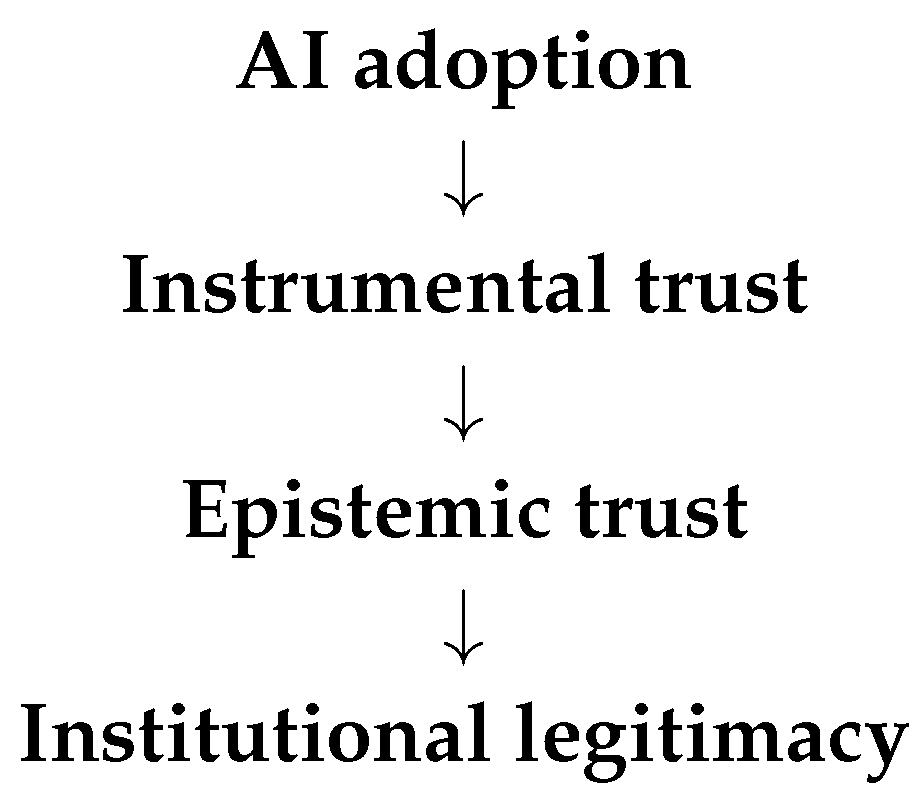
To strengthen the analytical link between the theoretical framework and the empirical findings, the study uses a four-step conceptual sequence. The model assumes that students’ engagement with AI in higher education develops from practice-oriented use toward broader legitimacy judgments, but with possible friction at each stage (see
Figure 1):
In practice, these stages are not strictly linear: repeated interaction with AI systems may recalibrate trust dynamically as users encounter both reliable and unreliable outputs. Accordingly, the model is proposed here as an analytical and interpretive sequence rather than as a formally tested causal pathway. Given the exploratory design, the limited multi-item operationalization of some constructs, and the uneven subgroup sizes, the model is not specified here for formal estimation through SEM or regression-based path testing.
In this model, AI adoptionrefers to frequency and scope of use in everyday and academic tasks. Instrumental trust concerns perceived usefulness, efficiency, and practical support in completing these tasks. Epistemic trust concerns whether AI outputs are judged as credible knowledge claims that can be accepted without extensive external verification. Finally, institutional legitimacy concerns whether AI-mediated practices are perceived as compatible with educational norms, academic authority, and governance expectations.
Conceptually, this sequence helps explain the study’s core finding: high adoption does not automatically produce high epistemic trust or full institutional legitimation. Students may adopt AI and recognize its utility while still withholding epistemic authority and demanding stronger institutional safeguards.
Within this framework, the adoption–trust paradox refers to the coexistence of high behavioral uptake and bounded epistemic or institutional trust. It is theoretically grounded in the distinction between adoption driven by perceived usefulness and trust shaped by explainability, verifiability, perceived risk, and legitimacy [
29,
30,
36,
37]. In higher education, students may therefore rely on AI because it is efficient and accessible while still withholding epistemic authority because its outputs remain opaque, fallible, or normatively contested [
28,
30]. The paradox is not a logical contradiction; rather, it is a structured outcome of evaluating the same system under different criteria—utility on the one hand, and credibility and legitimacy on the other.
This perspective allows the empirical analysis to interpret students’ trust judgments not simply as attitudes toward technology, but as evaluations of competing epistemic authorities within the educational field.
The theoretical framework directly guides the empirical design and interpretation of findings. The first analytical line, AI and knowledge authority, is examined through measures of AI use in everyday life and study practices, trust in AI-generated answers, and students’ reported verification strategies. The second line, trust and institutional legitimacy, is examined through attitudes toward AI in education, future professional life, and institution-related concerns, as well as through students’ acceptance or rejection of AI in relational and autonomous roles. In turn, the factor analysis is used to assess whether these orientations cluster empirically into distinct dimensions of instrumental usefulness, epistemic confidence, relational trust, and legitimacy boundaries. Thus, the framework is not only interpretive; it structures variable selection, thematic coding, and the reading of the quantitative and qualitative results.
Although the framework is used primarily as an interpretive sequence rather than as a fully estimated causal model, it generates four testable empirical expectations for the present study:
- H1:
AI adoption in everyday life and study practices will be more widespread than unconditional trust in AI-generated answers.
- H2:
Students’ attitudes toward AI will be multidimensional rather than unidimensional, with latent dimensions separating educational and instrumental endorsement from relational and autonomous trust.
- H3:
Mean scores for educational acceptance, practical usefulness, and future AI knowledge will be higher than mean scores for relational trust and trust in autonomous AI systems.
- H4:
Trust-related variables will show stronger positive associations with educational and practical-usefulness orientations than with relational and autonomous trust orientations.
These hypotheses translate the framework into observable expectations across the descriptive, correlational, and factor-analytic components of the study, without treating the full four-step sequence as a formally tested path model.
3. Research Design
The main goal of the study is to explore pre-service teachers’ perceptions of Artificial Intelligence, with particular emphasis on the role of trust in shaping attitudes toward AI technologies. More specifically, the study examines:
- (a)
The extent to which pre-service teachers use AI technologies in their everyday lives and academic settings;
- (b)
The level of trust pre-service teachers have in AI systems and AI-generated knowledge;
- (c)
Perceptions of the significance of AI within academic and professional environments;
- (d)
Perceptions of the significance of AI for the functioning of institutions;
- (e)
The underlying dimensions of pre-service teachers’ attitudes toward Artificial Intelligence.
3.1. Sample, Data Collection and Data Analysis
The methodology adopted in the study is a mixed-methods approach based on a structured questionnaire with both closed and open-ended questions [
38]. Data were collected between September 2025 and February 2026. The questionnaire was distributed online to undergraduate students enrolled in two Greek universities: the Department of Educational Sciences and Social Work at the University of Patras and the Department of Primary Education at the University of Ioannina. The final sample consisted of 363 students, with 62.3% from the University of Patras and 37.7% from the University of Ioannina. The multi-site sampling enhances the external validity of the findings.
3.2. Questionnaire Design
The questionnaire was organized into thematic blocks covering AI use, trust in AI systems and AI-generated answers, attitudes toward AI in education and society, an open-ended free-text component, and demographic characteristics. Its core attitudinal section included 22 items, which were later used in reliability and factor analysis. These attitudinal items—the ones reported in
Table 1 and
Appendix A—were measured on a 5-point Likert scale (1 = strong disagreement, 5 = strong agreement), while general trust in AI (
Table 2) was captured with a 7-point scale (1 = complete distrust, 7 = complete trust). In addition, the questionnaire included single-item closed questions on AI use in daily life and studies, trust in AI-generated answers, and demographic variables, as well as a free-text prompt used for the qualitative analysis; these additional items and their response formats are reproduced in
Appendix B.
Items were constructed deductively from the study’s research objectives and from key dimensions identified in the AI-in-education and trust literature (e.g., usefulness, epistemic reliability, relational acceptance, and institutional implications). The final wording aimed to ensure conceptual alignment between the theoretical framework and the empirical indicators used in the analysis.
Because the instrument was developed for the present study rather than adopted as a previously standardized scale, its measurement properties were assessed through an exploratory validation strategy. More specifically, the attitudinal block was examined through internal-consistency estimates (Cronbach’s alpha) and internal-structure evidence (KMO, Bartlett’s test of sphericity, and Principal Component Analysis with Varimax rotation). The resulting factor solution, together with the reliability estimates reported below, provides initial evidence of construct coherence for the attitudinal section, while remaining more limited than a full validation program involving pilot testing, cognitive interviewing, test–retest assessment, and confirmatory factor analysis.
More specifically, frequency-of-use items operationalize AI adoption, while general trust and trust-in-answers items operationalize instrumental and epistemic trust. In the present design, epistemic trust is not treated as a single exhaustive scale but is approached through a small set of indicators—especially general trust, trust in AI-generated answers, and students’ reported verification practices. In relation to Bourdieu’s field perspective, items on AI-generated answers, AI as teacher, AI in university studies, and students’ verification practices examine whether AI is granted legitimate pedagogical and epistemic authority. In relation to Foucault’s perspective, items on AI in society, future professions, autonomous systems, and institution-related concerns examine how students position AI within wider arrangements of regulation, oversight, and social ordering. Institutional legitimacy is therefore approached through these institution- and governance-related indicators rather than through a dedicated multi-item legitimacy scale. The open-ended questions complement these measures by showing how students justify, verify, contest, or conditionally accept AI outputs in practice. At the level of expected latent structure, items on AI in education and future AI knowledge are expected to capture academic legitimation, items on convenience and problem-solving are expected to capture instrumental usefulness, and items on AI as teacher, friend, or autonomous system are expected to capture the boundaries of relational and delegated trust. These operationalizations should therefore be read as theoretically informed facets of broader constructs rather than as exhaustive measurements of them.
Participation was voluntary and based on informed consent. Before completing the questionnaire, participants were informed about the purpose of the study, the use of the data for research only, and their right to discontinue participation at any point without penalty.
The survey was designed to ensure anonymity. No directly identifying personal data (e.g., names or student IDs) were collected, and responses were analyzed and reported only in aggregated form.
The study followed institutional research-ethics principles and received ethics approval through the relevant departmental review process before data collection began.
The qualitative component relies on the responses to the open-ended free-text prompt included in the questionnaire. These responses were analyzed as short narrative descriptions, similar to structured interview responses, focusing on trust, use, verification practices, and perceived risks associated with AI. All respondents were included in the qualitative analysis, and a total of 363 open-ended responses were analyzed.
The qualitative data were analyzed using thematic analysis following Braun and Clarke [
39]. The process included repeated reading, inductive coding, theme generation, and review for internal consistency. Three overarching themes emerged: (1) verification-based trust calibration, (2) perceived unreliability and inconsistency of AI outputs, and (3) instrumental usefulness with relational limits. For transparency, anonymized verbatim excerpts are reported with participant IDs in the
Section 4. To assist the qualitative analysis, Python-based text processing methods were also used as supporting tools, without replacing the interpretive logic of thematic analysis.
Quantitative analysis was conducted in IBM SPSS Statistics 29 and included reliability testing with Cronbach’s alpha; descriptive statistics; correlation analysis; group-comparison tests by gender and university affiliation, and by gender and year of study; principal component analysis; the Kaiser–Meyer–Olkin (KMO) measure of sampling adequacy; and Bartlett’s test of sphericity. For the attitudinal scale, Principal Component Analysis (PCA) with Varimax rotation was applied, and only factor loadings above 0.40 were retained for interpretation. The data proved highly suitable for factor extraction. Taken together, these psychometric checks were intended to provide initial evidence of internal consistency and construct structure for the questionnaire’s attitudinal items, rather than definitive validation of a standardized scale. The choice of descriptive statistics, PCA, and relatively simple inferential tests was deliberate and consistent with the study’s exploratory purpose, the cross-sectional questionnaire design, the newly assembled measurement instrument, and the uneven subgroup sizes. These analyses were designed to examine the empirical components associated with the conceptual model—adoption, trust, and legitimacy-related orientations—but not to test the full sequential pathway from adoption to instrumental trust, epistemic trust, and institutional legitimacy through a formal structural or path model. Interpretations of complex constructs such as epistemic trust and institutional legitimacy therefore rely on triangulation across several indicators and the open-ended responses rather than on dedicated multi-item batteries.
To address relationships and subgroup differences more explicitly, the statistical framework also includes three inferential components. First, correlations are examined between key variables (e.g., overall trust in AI, trust in AI-generated answers, and attitudinal dimensions) using Pearson’s r. Second, gender-based differences are assessed with independent-samples t-tests, and the results are interpreted with caution due to group-size imbalance.
The demographic profile of the sample is also notable. Women represented the majority of participants (312 out of 363), and first-year undergraduate students were especially strongly represented (336 out of 363). Students’ family residence was distributed across urban (64.2%), semi-urban (17.1%), and rural areas (18.7%).
4. Results
4.1. Use of Artificial Intelligence in Everyday Life and Academic Studies
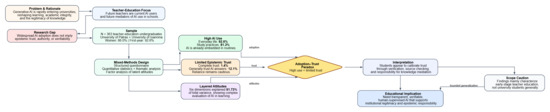
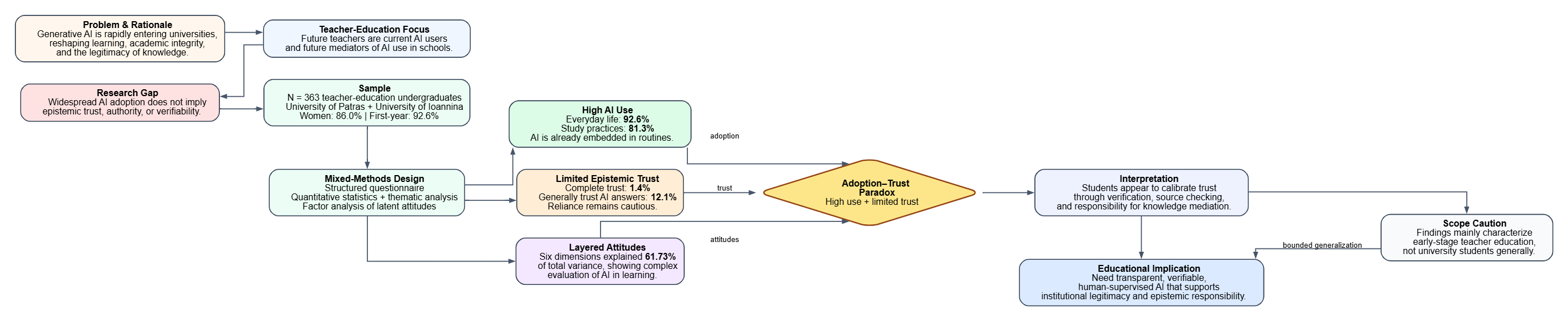
The results indicate that AI technologies have already been extensively integrated into students’ digital environments. More specifically, 336 of the 363 respondents (92.6%) reported having used AI in their daily life, whereas only 27 (7.4%) reported no such use. This suggests that AI has already become part of students’ everyday routine rather than being perceived merely as a novel technological innovation.
Qualitative responses reinforce this pattern by emphasizing usefulness and efficiency. Students described AI as helping them organize notes, simplify explanations, and make everyday activities easier.
AI has also been extensively adopted in academic contexts. In total, 295 of the 363 respondents (81.3%) reported having used AI in their studies, while 68 (18.7%) reported that they had not. These figures indicate that generative AI technologies are already embedded in students’ learning environments.
4.2. Trust in Artificial Intelligence
Although AI use is widespread, trust in AI is more moderate. Respondents were asked to rate their trust in AI on a 7-point scale ranging from complete distrust (1) to complete trust (7). The majority of participants reported moderate trust, while relatively few reported complete trust.
The qualitative data show that students often approach AI with caution, using verification strategies such as checking answers in books, consulting online sources, using Google Scholar, and reformulating prompts (see
Table 3 for illustrative excerpts). Trust is therefore not automatic but continuously negotiated.
A more specific picture emerges when respondents were asked whether they trust the answers or solutions provided by AI. Most selected “sometimes yes, sometimes no” (82.9%), which indicates that trust in AI-generated knowledge is situational rather than absolute. Only 12.1% reported generally trusting AI-generated answers, whereas 5.0% indicated that they do not trust them at all.
The qualitative data suggest that this skepticism is grounded in practical experiences of inconsistency and inaccuracy. Students reported encounters with contradictory outputs across different chats, incorrect information, and mismatches between answers and historical facts or dates (see
Table 3). These responses indicate that AI may be perceived as capable of producing plausible but not always reliable knowledge.
4.3. Attitudes Toward AI in Education and Social Life
Students showed the highest levels of agreement with statements related to the future relevance of AI knowledge and the importance of learning how to use AI well. They also expressed support for the inclusion of AI-related courses in higher education. By contrast, they were much less willing to accept AI in relational roles, such as teacher or friend.
For clarity,
Table 1 reports only the 22 Likert-type attitudinal items that formed the core scale and were later entered into reliability and factor analysis. The additional single-item closed questions and the open-ended free-text prompt are listed separately in
Appendix B.
The qualitative data support these results. Students emphasized usefulness, convenience, speed, and problem-solving, with Participant 46 describing AI as providing “useful and logical answers.” At the same time, Participant 49 stressed that “it does not have empathy.” This suggests that students draw a clear boundary between instrumental trust and relational trust.
The thematic analysis of the 363 open-ended responses yielded three core themes, which are summarized in
Table 3 together with selected anonymized verbatim excerpts.
4.4. Factor Analysis of Attitudes Toward Artificial Intelligence
To further investigate the underlying structure of students’ attitudes toward AI and to provide exploratory construct-validation evidence for the attitudinal block, a factor analysis was conducted. Principal Component Analysis with Varimax rotation was applied, and only loadings above 0.40 were retained for interpretation. The KMO measure of sampling adequacy was 0.876, and Bartlett’s test of sphericity was statistically significant (
,
), indicating that the correlation matrix was appropriate for factor analysis (
Table 4).
Six distinct factors were extracted, accounting for 61.73% of the total variance (
Table 5).
The six factors can be summarized as follows:
- 1.
AI in Education (): support for AI-related courses and applications in university studies.
- 2.
General Attitudes toward AI (): broad perceptions of AI’s overall value and benefits.
- 3.
Practical Usefulness of AI (): the perceived convenience and everyday usefulness of AI.
- 4.
Future Necessity of AI Knowledge (): strong recognition of AI as a necessary future skill.
- 5.
Relational Trust in AI (): low endorsement of AI in human-like relational roles.
- 6.
Trust in Autonomous AI Systems (): comparatively cautious endorsement of autonomous AI applications such as self-driving cars.
Internal consistency was acceptable for Factors 1–4, but weak for Factors 5 and 6 (Cronbach’s
and
, respectively). These values are clearly below conventional thresholds and should not be presented as evidence of robust subscale reliability. At the same time, their interpretation requires caution because coefficient alpha is partly a function of scale length and is especially constrained for very short scales [
40,
41,
42]. This point is particularly relevant for Factor 5, which contains only two items; for two-item measures, Cronbach’s alpha is often considered a suboptimal reliability index and alternative coefficients such as the Spearman–Brown estimate are commonly recommended [
43]. In the present study, Factors 5 and 6 are therefore retained only as exploratory, theory-linked item clusters that mark possible boundaries of AI acceptance, not as psychometrically stable latent subscales. The principal interpretive weight of the study rests on Factors 1–4, the direct trust items, and the open-ended verification narratives. Taken together, the KMO/Bartlett results, the interpretable factor solution, and the reliability estimates provide only preliminary support for construct structure, which should be strengthened in future work through item revision and confirmatory procedures.
As an additional sensitivity check, the factor solution was also inspected using a more conservative interpretive threshold of 0.50 for salient loadings. Under this stricter criterion, the overall six-factor structure remained broadly similar, but two items fell below the threshold: “I like using applications related to Artificial Intelligence” (loading = 0.444) and “If I have a job related to Artificial Intelligence, then my future will be bright” (loading = 0.401). This supplementary check therefore reinforces the view that Factors 1–4 represent the more stable core of the exploratory solution, whereas the later factors and a small number of marginal items should be interpreted with particular caution. Accordingly, the stricter threshold is used here not to redefine the reported factor structure post hoc, but to show that the main substantive conclusions rest on the strongest-loading and most interpretable parts of the solution.
These factors support a more differentiated theoretical interpretation of students’ AI orientations. Factors 1 (AI in Education) and 4 (Future Necessity of AI Knowledge) indicate strong normative acceptance of AI as part of legitimate academic preparation. In terms of the “AI and knowledge authority” line, students appear ready to institutionalize AI literacy in the curriculum, but mainly as a competence to be acquired rather than as authority to be delegated.
Factors 2 (General Attitudes toward AI) and 3 (Practical Usefulness of AI) reflect pragmatic legitimation: AI is recognized primarily through utility, convenience, and problem-solving value. This cluster aligns with an instrumental model of trust, where adoption is driven by performance expectations rather than deep epistemic commitment.
By contrast, Factors 5 (Relational Trust in AI) and 6 (Trust in Autonomous AI Systems) offer only tentative indications of possible boundaries of acceptance. Their low mean values are consistent with caution about transferring relational or high-stakes decision authority to AI systems, but this interpretation must remain restrained because these short factors do not demonstrate adequate internal consistency. Within the “trust and institutional legitimacy” line, they should therefore be read only as exploratory signals that students may accept AI as a support infrastructure while remaining hesitant about socially and morally sensitive substitutions for human judgment.
Importantly, this factor solution should not be read as a one-to-one empirical confirmation of the four-step conceptual model. Rather, it identifies attitudinal clusters that illuminate different components of that interpretive framework: practical usefulness and general attitudes correspond most closely to instrumental acceptance, education- and future-oriented factors indicate broader academic legitimation, and the relational and autonomous factors mark the limits students place on delegating authority to AI. In that sense, PCA is used here as an exploratory data-reduction and structure-detection technique rather than as confirmatory latent-variable modeling. More direct indicators of epistemic trust are examined separately through the trust-in-answers items and the open-ended verification narratives.
Overall, the factor structure does not describe a single continuum from rejection to acceptance. More robustly, Factors 1–4 reveal a layered configuration in which educational and practical endorsement coexist with bounded trust, reinforcing the study’s central adoption–trust paradox. Any additional inferences drawn from the relational and autonomous factors should be treated as hypothesis-generating rather than as stable measurement results.
4.5. Correlations and Group Differences
Beyond descriptive and factor-analytic findings, the analytical design allows further assessment of how trust, use, and attitudes are interrelated and whether they vary across student subgroups. Correlation analysis contributes to identifying the strength and direction of associations among trust-related constructs, while subgroup comparisons by gender and university affiliation provide a clearer picture of potential heterogeneity in AI perceptions.
These additional analyses are especially relevant for interpreting whether the adoption–trust pattern is uniform across the sample or concentrated in specific demographic and academic groups, thereby improving the explanatory depth of the quantitative results.
To support transparent reporting of these inferential analyses, the
Table 6,
Table 7 and
Table 8 can be used to present the statistical outputs.
5. Discussion
The factor-analytic results provide the interpretive backbone of the discussion. Rather than a single positive or negative orientation, participants’ attitudes are internally differentiated across educational endorsement, instrumental acceptance, and relational-autonomy boundaries. This multidimensionality is central for interpreting trust not as a binary state but as a calibrated and context-dependent judgment. At the same time, these dimensions are treated here as empirical clusters that illuminate parts of the conceptual framework, not as a direct test of its full four-step sequence.
These findings matter not simply because they show high AI use alongside moderate trust, but because they clarify how pre-service teachers distinguish between utility and authority. In this sample, AI is accepted primarily as a practical aid for efficiency, access, and academic support, but it is not automatically granted the status of a legitimate knowledge source or a substitute for human judgment. This distinction helps explain why adoption and trust do not rise together. Rather than indicating inconsistency, the pattern suggests an active process of trust calibration in which students use AI strategically while continuing to verify, compare, and qualify its outputs. Because the participants are teacher-education undergraduates rather than a general university sample, this verification-based trust calibration may also reflect an emerging pedagogical orientation: future teachers are likely to view knowledge claims as something to be checked, contextualized, and responsibly mediated before being passed on to others.
In that sense, the results point to a consistent gap between frequent use and full epistemic delegation. Participants appear willing to use AI for information retrieval, drafting, and study support while reserving final validation for human-mediated academic norms. The contribution of the study therefore lies in showing that adoption-centered accounts remain incomplete unless they also examine verification practices, legitimacy judgments, and the conditions under which AI is treated as authoritative knowledge. AI is not simply being accepted or rejected; its educational role is being actively negotiated. At the same time, because the sample is overwhelmingly first-year, this pattern should be interpreted more cautiously as characteristic of early-stage teacher education than as the result of fully developed pedagogical training.
This interpretation aligns with epistemic trust literature in human–AI interaction. Glikson and Woolley [
29] show that trust in AI is not a stable disposition but a relational outcome shaped by task type, perceived risk, and system characteristics. In that perspective, the present findings indicate “functional reliance” without full epistemic delegation: participants rely on AI to support cognitive work, but they withhold final authority over what counts as valid knowledge.
Shin’s work on explainability and causability [
30] further clarifies this point. Trust increases when users can understand why a system produces a given output and when that output can be meaningfully interrogated. The strong verification practices reported in this study can therefore be read as attempts to restore epistemic control under conditions of algorithmic opacity. Participants are not rejecting AI; they are trying to calibrate trust by combining AI-generated content with external validation.
An explicitly algorithmic reading of this pattern is also warranted. Participants’ references to inconsistency and unreliability are compatible with the black-box operation of transformer-based LLMs, where fluency is produced through distributed attention and probabilistic next-token generation rather than through explicit source attribution or built-in fact checking [
13,
14,
15]. As a result, even when a prompt remains broadly similar, differences in wording, conversational context, or decoding settings such as temperature can redirect the sampling path and produce different formulations, confidence levels, or factual details [
17]. The issue is therefore not only that users lack technical knowledge; it is also that the system itself does not expose a stable, human-readable justification for why a specific answer was selected. This helps explain why participants often treated AI as useful for drafting and exploration while still withholding full epistemic trust and insisting on verification.
Read in light of international algorithmic-trust literature, this adoption–trust paradox is theoretically coherent: practical uptake can expand faster than epistemic confidence whenever systems are perceived as useful but only partially transparent, contestable, or accountable [
22,
28,
29,
30]. In that sense, moderate trust in this sample does not signal resistance to innovation; it signals trust calibration under uncertainty, a pattern repeatedly observed where algorithmic performance and algorithmic legitimacy do not fully coincide.
This finding also resonates with technology adoption research, which shows that perceived usefulness may drive usage even when users retain reservations about reliability or transparency [
36,
37].
Recent 2025 research helps specify this point further. Nazaretsky et al. [
8] show that trust is one of the factors shaping students’ adoption of AI-powered educational technology and that it strengthens perceived usefulness through both direct and AI-readiness pathways. The present findings complement that model by showing what trust looks like in the everyday use of generative AI: not unconditional confidence, but conditional reliance sustained by checking, comparison, and selective delegation. Makransky et al. [
7] likewise argue that the educational value of GenAI lies in supporting generative sense-making rather than merely producing impressive outputs. From that perspective, the verification practices reported in this study are not incidental frictions; they can be understood as part of the learner activity through which AI use becomes cognitively meaningful and epistemically responsible.
For explainable AI agendas, this implies that perceived usefulness alone is insufficient; explanation quality and opportunities for user verification remain decisive for sustained trust calibration [
30].
The same pattern is also consistent with international research on human–AI collaboration in education. Participants appear to position AI primarily as a collaborative cognitive aid (for exploration, drafting, and support), while retaining human actors as final epistemic arbiters. This aligns with broader evidence that AI in higher education is most readily accepted in support functions and pedagogically guided augmentation rather than autonomous substitution of teachers or institutional judgment [
5,
6,
7,
8,
9,
10,
11].
Taken together, these strands support a stronger interpretation of the adoption–trust paradox. From algorithmic trust literature, high use with moderate trust reflects calibration under opacity and uncertainty; from human–AI collaboration research, it reflects role differentiation between AI assistance and human oversight; and from epistemic authority theory, it reflects an ongoing struggle over who can legitimately validate knowledge in the educational field [
23,
29,
30]. The paradox is therefore not a contradiction but a structured pattern of selective delegation: participants delegate efficiency functions to AI while retaining epistemic sovereignty in high-stakes judgment.
At the same time, the study only tentatively differentiates instrumental trust from relational trust. Participants acknowledged AI’s practical usefulness and educational value, while the short relational and autonomous item clusters point more cautiously to discomfort with AI as teacher, friend, or human substitute. Because these latter factors have weak reliability, they should not bear strong interpretive weight on their own; rather, they serve as exploratory indications that positive scores on usefulness- and education-related dimensions may coexist with reservations about delegating socially sensitive roles to AI.
This is where the distinction between AI as tool and AI as authority becomes analytically crucial. As a tool, AI is widely accepted for acceleration, support, and exploratory learning. As an authority, however, it remains contested because participants continue to locate epistemic legitimacy in human-mediated academic norms (teachers, peer dialogue, and disciplinary standards). In other words, usage is high, but authority transfer is partial.
These findings can be interpreted within the network society framework [
1], where digital infrastructures increasingly mediate knowledge production. AI may operate as an emerging epistemic actor, but one whose legitimacy remains negotiated in real time. This cautious positioning also resonates with broader concerns in AI-in-education research regarding bias, opacity, and accountability [
5,
6,
10,
11].
The results additionally suggest that trust in AI is embedded in a wider institutional climate marked by uncertainty and permacrisis. Concerns about misinformation, surveillance, and governance indicate that participants do not evaluate AI in isolation, but in relation to broader institutional and political vulnerabilities.
From a policy perspective, the findings support a dual strategy in higher education: first, systematic AI integration in curricula; second, explicit training in epistemic verification practices (source triangulation, claim checking, prompt traceability, model/version awareness, and reflective justification of AI-assisted outputs). Such an approach can align high levels of AI use with stronger epistemic resilience and prevent the uncritical substitution of educational judgment by automated outputs.
6. Conclusions
This study examined Greek pre-service teachers’ perceptions of Artificial Intelligence in relation to trust, education, and institutional transformation. The findings suggest that, in this sample, AI has already become part of everyday and academic practice, but widespread use does not translate into unconditional trust.
This interpretation is also consistent with the more reliable part of the factor structure, which suggests a layered attitudinal configuration: high educational and practical endorsement of AI coexists with bounded trust, while any inferred limits in relational and autonomous trust remain exploratory.
To conclude, the main findings can be summarized along the two analytical lines of the study:
AI and Knowledge Authority
Students in this sample use AI extensively for information retrieval and study support, suggesting that AI now occupies a practical place in educational knowledge workflows.
Despite high adoption, students do not grant AI automatic epistemic authority; they report verification practices that reflect conditional and reflexive trust.
Trust and Institutional Legitimacy
Students distinguish instrumental usefulness from relational legitimacy, accepting AI as a tool while rejecting its substitution for human educational roles.
Evaluations of AI also appear connected to wider concerns about bias, misinformation, surveillance, and institutional governance, suggesting that trust in AI is embedded in broader legitimacy structures.
These results suggest that a central challenge for higher education is no longer whether AI will be used, but under what epistemic and institutional conditions it should be trusted.
From the perspective of explainable AI, this suggests that successful educational deployment depends not only on performance gains but also on interpretable outputs, traceable reasoning, and human-in-the-loop validation practices.
The findings also have broader ethical implications for AI governance in education. If students use AI extensively while withholding full epistemic trust, universities cannot treat governance as a purely technical matter or as a narrow question of misconduct detection. The central issue is under what conditions AI use remains compatible with fairness, transparency, accountability, privacy, and meaningful human agency in educational practice. In this sense, governance must address not only performance and access, but also opacity of outputs, embedded bias, unequal access to high-quality tools, data-protection concerns, surveillance risks, and the displacement of responsibility when AI-mediated systems influence learning, assessment, or institutional judgment [
5,
6,
22,
28,
32,
33].
Relatedly, academic-integrity risks should be understood more broadly than plagiarism alone. Generative AI complicates authorship, source attribution, and the boundary between acceptable assistance and unacceptable outsourcing of reasoning. The risk is not only that students may submit AI-generated text, but also that they may rely on fabricated references, unverifiable claims, or polished arguments they cannot independently justify. A governance response centered only on detection would therefore be insufficient. What is needed is a developmental approach that combines clear rules with pedagogical support for disclosure, verification, reflective use, and students’ capacity to defend AI-assisted work as their own intellectual contribution [
10,
11].
Future studies should examine whether this adoption–trust configuration varies across disciplines, institutional contexts, and national higher education systems, and how different explanation interfaces shape trust calibration in each setting.
Universities should therefore treat AI literacy as a core academic competence and embed it across curricula rather than confining it to optional technical modules. At the pedagogical level, teaching and assessment should explicitly reward verification, source triangulation, argument quality, and transparent reporting of AI-assisted work. Institutions should also establish course- and program-level norms on permissible and non-permissible uses of AI, disclosure expectations, and documentation requirements where AI meaningfully contributes to a submission. In addition, universities should invest in faculty development and support structures so instructors can redesign assignments, incorporate oral or process-based assessment where appropriate, and use AI for learning support without weakening disciplinary standards, academic integrity, or students’ independent judgment.
At the policy level, higher-education systems need clear governance frameworks for educational AI that connect innovation with accountability. Priority areas include transparency requirements for AI-assisted assessment practices, minimum standards for data protection and privacy, procurement and vendor-scrutiny procedures for educational AI systems, and institutional guidelines for human oversight in high-stakes educational decisions. Effective policy should also define responsibility and appeal mechanisms when AI use affects grading, feedback, progression, or student support, so that automated or semi-automated practices do not obscure accountability. Finally, public policy should support equity-oriented implementation—including access to trusted tools, training for students and staff, and quality-assurance and audit mechanisms—so that AI adoption strengthens educational inclusion and epistemic reliability rather than amplifying existing inequalities.
These interpretations should remain bounded. The present study identifies a theoretically meaningful configuration of attitudes within a specific population, but it does not establish a universal or causal model of how trust in educational AI develops. The findings should therefore be read as exploratory and context-specific rather than as a definitive account that necessarily generalizes across disciplines, institutions, or national settings. Several limitations shape this scope of inference. First, the sample is intentionally focused on teacher-education students from two Greek universities (the University of Patras and the University of Ioannina). This focus is substantively important because future teachers are both current users of AI and likely future mediators of its educational use in school settings, but it also narrows the external validity of the findings. The results should therefore be interpreted as specific to teacher-education undergraduates in Greece rather than as representative of university students more broadly, since disciplinary, institutional, and national contexts may shape AI adoption, trust, and verification practices differently. Second, the sample is imbalanced in two important respects: women constitute the large majority of participants (312/363), and first-year students are also strongly overrepresented (336/363). Accordingly, subgroup comparisons should be interpreted with caution, and the findings should not be generalized uncritically beyond the specific population of teacher-education students represented here. This concern is consistent with broader methodological discussions showing that imbalance and limited representativeness can weaken robustness for underrepresented groups and constrain external validity [
44]. The strong concentration of first-year students also means that any link between pedagogical formation and verification-based trust calibration should be treated as provisional: the study likely captures an early pedagogical orientation toward checking and mediating knowledge claims, not the effect of fully developed pedagogical training. Third, the findings rely on self-reported questionnaire data, which may be affected by recall bias, social-desirability effects, and differences between reported and actual AI-use behavior. Fourth, although the questionnaire was theoretically grounded and examined through internal-consistency and factor-analytic procedures, the study provides only preliminary validation evidence for the instrument. The measurement design was not extended to a fuller validation sequence such as pilot testing, cognitive interviewing, test–retest reliability, or confirmatory factor analysis; accordingly, the questionnaire should be interpreted as an exploratory measurement tool rather than as a fully standardized scale. This limitation is especially visible in the fifth and sixth factors (Relational Trust in AI and Trust in Autonomous AI Systems), whose low internal-consistency coefficients (
and
) indicate weak reliability. Because these factors are also based on very short item sets, because coefficient alpha is sensitive to test length, and because alpha is not the ideal reliability coefficient for a two-item factor [
40,
41,
42,
43], these factors are retained only as exploratory item clusters preserved for theoretical coverage, not as psychometrically acceptable subscales. Accordingly, the manuscript does not draw strong substantive conclusions from them. Fifth, some theoretically complex constructs—particularly epistemic trust and institutional legitimacy—were measured through a limited number of indicators rather than through comprehensive multi-item scales. Although the mixed-methods design partly compensates for this by triangulating closed-ended responses with open-ended narratives and related attitudinal items, the findings should be interpreted as capturing selected facets of these constructs rather than their full dimensionality. Sixth, the quantitative strategy remains primarily exploratory and does not extend to more comprehensive multivariate approaches such as confirmatory factor analysis, structural equation modeling, regression-based path models, or longitudinal analyses. The results should therefore be read mainly as descriptive, associational, and dimension-revealing rather than as fully explanatory or causal. Seventh, although the conceptual model organizes the interpretation of the findings, the present design does not formally test the proposed sequence through structural equation modeling, path analysis, or longitudinal data. The model should therefore be read as a theoretically informed heuristic supported indirectly by the observed pattern of results rather than as a causally verified progression. Future research should therefore move beyond teacher-education cohorts and include students from a wider range of disciplinary fields, such as science, engineering, humanities, and social sciences, while also recruiting from multiple universities within Greece and, ideally, from institutions in other countries. In addition, future studies should adopt more balanced, stratified, or quota-based sampling designs across gender, year of study, discipline, and institution in order to strengthen subgroup inference, external validity, and generalizability [
44].
A further measurement limitation is that the questionnaire approached AI largely at a general level and did not systematically distinguish among specific AI tool categories or platforms. Future research should therefore separate generative AI tools, assistive or recommendation systems, and more autonomous or predictive AI applications, while refining trust measurement into cognitive, emotional, and institutional dimensions through validated multi-item subscales, pilot testing, and confirmatory validation.
An additional limitation is that the study is cross-sectional and non-experimental. Because the data were collected at a single point in time and without manipulation of conditions, the design cannot directly capture how trust in AI changes through repeated use, nor can it establish causal relationships among adoption, verification practices, and trust. Although the mixed-methods questionnaire included open-ended responses that offered qualitative insight into students’ reasoning, this format does not provide the depth of semi-structured interviews. Future research should therefore combine longitudinal or panel surveys with controlled or quasi-experimental designs—for example, comparing different levels of AI accuracy, explainability, or verification support—in order to examine how trust evolves over time and under varying conditions. In-depth interviews would also help clarify the underlying meanings, experiences, and normative concerns that shape students’ attitudes toward AI.
To make these implications more actionable, universities should translate general AI-governance principles into scenario-specific procedures. In classroom teaching, each course should include a short AI-use statement specifying which uses are permitted, restricted, or prohibited; whether disclosure is required; and how students are expected to verify AI-generated content. In academic evaluation, institutions should adopt assessment designs that align oversight with task stakes: for low-stakes assignments, disclosed AI assistance may be acceptable when accompanied by source checking and transparent reporting, whereas higher-stakes assessments may require additional safeguards such as oral defense, in-class writing, version-history review, or process documentation to confirm students’ independent understanding. In teacher training, universities should provide structured preparation for both pre-service and in-service educators on prompting, verification, bias awareness, privacy, citation, and the pedagogically responsible integration of AI into lesson planning, feedback, and assessment.
Overall, the study contributes to the literature on Artificial Intelligence in Education by indicating that, in this teacher-education sample, high adoption can coexist with bounded trust and ongoing negotiation of epistemic authority. The pattern observed here is therefore better read not as a transitional anomaly, but as a potentially durable condition of AI-mediated higher education that calls for sustained institutional design and policy response.





 ,
,