Article

Particle Swarm Optimization Based on Cubic Chaotic Mapping and Random Differential Mutation

1
International School, Beijing University of Posts and Telecommunications, Beijing 100876, China
2
School of Computer Science, Beijing University of Posts and Telecommunications, Beijing 100876, China
*
Author to whom correspondence should be addressed.
Algorithms 2026, 19(4), 297; https://doi.org/10.3390/a19040297
Submission received: 12 March 2026 / Revised: 6 April 2026 / Accepted: 8 April 2026 / Published: 10 April 2026
(This article belongs to the Section Evolutionary Algorithms and Machine Learning)

Abstract

Particle swarm optimization is a metaheuristic optimization algorithm that boasts advantages such as fast convergence speed, fewer tunable parameters, and a simple search mechanism. However, it suffers from premature convergence and insufficient later-stage exploitation, limiting its performance on multimodal and high-dimensional problems. In light of this, this paper proposes a Chaos-based Differential Mutation Particle Swarm Optimization (CDMPSO) algorithm to address these limitations. The algorithm employs four synergistic strategies: cubic chaotic mapping with inverse learning for population initialization; adaptive inertia weight to balance exploration and exploitation; convex lens imaging inverse learning to escape local optima; and random differential mutation to maintain population diversity. Ablation experiments validate the contribution of each strategy, with adaptive weight being the most significant. Comparative experiments demonstrate that CDMPSO achieves an average ranking of 1.00, outperforming standard PSO, CPSO (Constriction Particle Swarm Optimization), ACPSO (Adaptive Chaotic Particle Swarm Optimization), and HPSOALS (Hybrid Particle Swarm Optimization with Adaptive Learning Strategy). On the unimodal function f1, it attains ultra-high precision of 7.07 × 10−248, and on the multimodal function f9, it uniquely converges to the theoretical optimum of zero. The results demonstrate that CDMPSO possesses excellent convergence precision, global search capability, and robustness, providing an effective solution for complex engineering optimization problems.

1. Introduction

Optimization algorithms are fundamental tools for solving various complex decision-making problems in the fields of science and engineering. Traditional optimization methods, such as linear programming [1], gradient-based methods [2], and dynamic programming [3], have achieved significant success in dealing with well-structured problems with clear mathematical properties. However, when faced with practical optimization challenges characterized by nonlinearity, multimodality, discontinuity, or high dimensionality, these classical methods often encounter significant limitations. The complexity of the problem makes traditional precise methods computationally expensive, thus requiring the development of more flexible and robust solution paradigms.
To address these challenges, metaheuristic optimization algorithms have emerged. These types of algorithms simulate natural phenomena or biological behavior to find approximate optimal solutions in the search space, incorporating random elements and natural heuristic mechanisms. By balancing global exploration and local development, they can break out of local optima and continue to seek optimization, forming a rich family of techniques such as genetic algorithm (GA) [4], simulated annealing (SA) [5], ant colony optimization (ACO) [6], etc. Among them, the particle swarm optimization (PSO) [7] algorithm was proposed by Kennedy and Eberhart in 1995, inspired by the collective foraging behavior of bird and fish flocks. It abstracts each potential solution as a “particle” with position and velocity attributes and updates its own state by tracking individual and global optima. The mechanism of combining individual experience with social shared information enables particle swarm optimization to collaborate and quickly approach the optimal solution. PSO stands out among many metaheuristic algorithms due to its advantages of simple implementation, few parameters, and fast convergence speed, laying its important position in the optimization field and providing a broad space for future improvement research.
The advantages of the particle swarm optimization algorithm have led to its successful application in multiple fields, including parameter identification [8], image processing [9], feature selection [10,11], and neural network training [12]. However, the standard particle swarm optimization algorithm still has inherent limitations. Specifically, the particle swarm optimization algorithm exhibits a strong premature convergence trend, and due to the rapid loss of population diversity during the evolution process, the algorithm is prone to falling into local optima. In addition, algorithms often have insufficient convergence accuracy in the later stages, as particles are trapped in suboptimal regions and lose the ability to perform fine local searches. These deficiencies mainly stem from the imbalance between global exploration and local development, as well as excessive dependence on individual and global optimal positions.
Researchers have proposed various improvement strategies from different perspectives to address the above issues. Scholars have used chaotic mapping to generate initial solutions, utilizing the traversal and uniformity of chaotic sequences to enhance population diversity [13]. Another study combines reverse learning with a chaos strategy to expand the search space and improve initial population quality [14]. In terms of topology optimization, a dynamic neighborhood strategy based on circular topology has been designed to maintain population diversity by limiting particle information exchange [15]. For hybrid strategies, PSO has been combined with other algorithms and machine learning methods. For example, Alba et al. [16] introduced a PSO/SVM hybrid algorithm for cancer gene selection, and Li et al. [17] integrated dynamic PSO with K-means clustering to enhance image segmentation accuracy.
To address these challenges, this paper proposes a novel particle swarm optimization algorithm (CDMPSO) that integrates cubic chaotic mapping and random differential mutation. The algorithm enhances optimization performance through four key improvement strategies, detailed in Section 4. The principal contributions of this work include: (1) a hybrid population initialization method combining cubic chaotic mapping with reverse learning to improve initial solution quality and diversity; (2) a segmented adaptive inertia weight strategy that dynamically adjusts decay rates based on iteration stage for balanced exploration and exploitation; (3) a reverse learning mechanism inspired by convex lens imaging principles, incorporating adaptive step size factors to enhance local optima escape capability; and (4) a random differential mutation operator integrating global and individual information to maintain population diversity throughout evolution. Experimental results demonstrate that CDMPSO achieves superior convergence accuracy and stability compared to existing PSO variants across diverse benchmark functions. The key novelty lies not in the individual strategies but in their synergistic integration, where each strategy addresses a specific limitation of PSO in a complementary manner.
The rest of this article is structured as follows: Section 2 reviews relevant research work; Section 3 provides a brief introduction to the standard particle swarm optimization (PSO) algorithm; Section 4 elaborates on the proposed CDMPSO algorithm in detail from four improvement aspects; Section 5 introduces the CEC2005 and CEC2017 benchmark suites and the results of related experiments; and Section 6 summarizes the entire work, analyzes limitations, and looks forward to future research directions.

2. Related Work

In order to address the limitations of the particle swarm optimization algorithm, many researchers have been committed to improving its performance through various improvement strategies in recent years. These improvement methods can be broadly categorized into three main directions: population initialization techniques [18], parameter adjustment mechanisms [19], and learning strategy enhancements [20].

2.1. Population Initialization Techniques

To enhance the global convergence performance and convergence speed of PSO, numerous researchers have focused on optimizing the initial population. By substituting random initialization with more advanced strategies, the quality of the final solution can be significantly improved. For instance, chaotic mapping [21] and opposition-based learning have been widely used to generate uniformly distributed initial populations, enhancing diversity and convergence speed. A hybrid particle swarm optimization with adaptive learning strategy (HPSOALS) [22] also employs chaotic opposition-based learning for initialization. Chaotic inverse learning methods are employed to generate particles with a uniform distribution, aiming to improve the quality of the initial population. Furthermore, effective constraint handling mechanisms are crucial for algorithm performance in real-world applications. Deshpande et al. [23] demonstrated this through a constraint handling approach within the firefly algorithm framework, showing how metaheuristics can adapt to constrained optimization problems.

2.2. Parameter Adjustment

To more effectively balance local and global search capabilities, and further achieve wide-range global search in the early stages of iteration and high-precision local exploitation in the later stages, numerous scholars have developed various inertia weight and acceleration coefficient strategies for the algorithm. In [24], a particle swarm optimization algorithm with chaotic inertia weight (MPSO) was introduced to balance the global and local search of particles. In [25], by quantifying the distribution of particles relative to the global optimum, an expansion factor was introduced to dynamically adjust the inertia weight w. An improved particle swarm optimization algorithm (A-PSO) was introduced in [26], in which a nonlinear dynamic acceleration coefficient was developed to enhance the quality of solutions and accelerate global convergence.

2.3. Improvement of Learning Strategies

In the research on learning strategies for PSO, most current approaches aim to overcome the limitations of the standard algorithm, which relies solely on personal best and global best positions. Various strategies have been proposed to enhance information exchange and maintain diversity. For instance, dual search strategies are introduced to modify particle velocity for dynamic environments [27], an adaptive strategy combining random and mainstream learning is used to alleviate premature convergence [28], and a fuzzy logic-based hierarchical learning mechanism divides particles into layers with customized learning strategies [29].

3. Standard Particle Swarm Optimization Algorithm

In the particle swarm optimization (PSO) algorithm, each potential solution to an optimization problem is abstracted as a “particle” in the search space, and the entire set of particles constitutes a swarm. Each particle possesses three fundamental attributes: Position represents a candidate solution to the problem, with its dimension matching that of the problem. Velocity determines the direction and magnitude of the particle’s movement in the search space and serves as the basis for updating the particle’s position. Fitness is calculated through the objective function, which is used to evaluate the quality of the solution represented by the particle’s position and serves as a key criterion for determining the individual best (pbest) and global best (gbest) solutions.
In addition, the core mechanism of PSO is that particles update their own state by tracking two “best values”: the global best value is the optimal position currently found by the entire population; the individual best value is the optimal position found by the particle itself in its history. In each iteration, particles combine their own historical best experience with the best experience found by the entire population to dynamically adjust their speed and position. This process of collaboration and information sharing guides the population to gradually move towards the global optimum. The update equation of the standard particle swarm optimization algorithm is expressed as follows:
v i , j ( t + 1 ) = w v i , j ( t ) + c 1 r 1 ( p b est i , j ( t ) x i , j ( t ) ) + c 2 r 2 ( g b es t j ( t ) x i , j ( t ) )
x i , j ( t + 1 ) = x i , j ( t ) + v i , j ( t + 1 )
The former represents the velocity update equation for particles, while the latter represents the position update equation for particles. Here, t denotes the current iteration count; i denotes the particle index; j denotes the dimension index; v i , j   t represents the velocity of the i -th particle in the j -th dimension during the t -th iteration; x i , j   t represents the position of the i-th particle in the j-th dimension during the t -th iteration; p b e s t i , j ( t ) represents the individual optimal position of the i -th particle in the j -th dimension component up to the t -th iteration; and g b e s t j ( t ) represents the global optimal position of the entire swarm in the j -th dimension component up to the t -th iteration. w is the inertia weight, balancing global and local search; c 1 and c 2 are learning factors, reflecting the learning ability of particles towards their individual optimal position and the global optimal position of the swarm, respectively, and are generally set to 2; and r 1 and r 2 are random numbers distributed in the interval (0, 1).
From the formula, it can be seen that the velocity update of a particle consists of three parts: The first part represents the particle’s ability to maintain its previous motion trend. The second part represents the particle’s ability to learn from its own historical best. The third part represents the particle’s ability to learn from the global best. These three parts interact with each other, enabling the particle swarm to gradually converge to the global optimum during the iteration process. The position update of a particle is determined by the previous position of the particle and the update velocity.
It is worth noting that PSO generates the initial population in a completely random manner, with its inertia weight w typically set as a fixed constant. This approach lacks an effective local optimum escape mechanism, making it prone to getting stuck in local optima (pbest) and leading to premature convergence. In the later stages, when particles gradually converge towards the global best (gbest), population diversity rapidly diminishes, potentially leading to search stagnation. This paper aims to improve PSO by addressing these aspects and issues.

4. Proposed CDMPSO

Inspired by the above work, this paper proposes a particle swarm optimization algorithm based on cubic chaotic mapping and random differential mutation. The main improvements consist of four aspects, as follows.

4.1. Cubic Chaotic Mapping

The traditional particle swarm optimization (PSO) algorithm initializes its population randomly, with particles being uncorrelated. It ensures an equal probability distribution but does not guarantee a uniform distribution of samples. Especially for small sample sizes, the distribution tends to cluster, affecting subsequent searches. Unlike random initialization, chaotic mapping can effectively address these issues. On the one hand, a sufficiently long chaotic sequence can theoretically visit every point in the search space, ensuring that the distribution “fills” the entire interval. On the other hand, adjacent points in the chaotic sequence naturally maintain a distance from each other; if two points are too close, the exponential divergence of the chaotic system quickly pushes them apart. This natural “mutual exclusion” mechanism effectively prevents clustering, ensuring a uniform distribution.
Common chaotic maps include the Logistic map, cubic map, Tent map, and Sine map. In [30], two types of chaotic maps (Tent and Logistic) were utilized to enhance the quality of the initial population in PSO. In [31], a similar population initialization strategy based on chaotic opposition was employed in the particle swarm optimization algorithm, replacing random initialization to improve its optimization performance. In comparison, the cubic chaotic map exhibits strong ergodicity and a wide chaotic range, generating a more uniform chaotic sequence than the traditional Logistic chaotic map and making it more suitable for initializing the PSO population. Therefore, this paper adopts a population initialization method based on the cubic chaotic map to enhance the optimization performance of the particle swarm optimization algorithm. The formula is described as follows:
x n + 1 = ρ x n ( 1 x n 2 )
where x belongs to the interval (0, 1) and x n represents the chaotic variable at the nth iteration.   ρ is a control parameter. The chaotic properties of the cubic map are closely related to the value of parameter ρ . When ρ is appropriately configured within a specific range, the system exhibits rich chaotic dynamical characteristics and is capable of generating chaotic sequences with excellent ergodic uniformity. Finally, it maps to the search space:
P i , j = a j + x i , j ( b j a j )
where [ a j , b j ] represents the search range in the j -th dimension.
To further enhance the quality of initial solutions, we introduced an inverse learning strategy when generating initial solutions using cubic chaotic maps. The core idea is that for a candidate solution, its “opposite position” in the search space also has a certain probability of being a better solution. It expands the search space by simultaneously considering the original solution P i and its corresponding inverse solution O P i . For each initial solution generated by cubic chaotic maps, its inverse solution is calculated, and the superior individual is selected based on fitness to form the initial population. This expands the search space of particles, thereby improving the quality of the initial population of solutions. In this paper, we use inverse learning with random coefficients. The mathematical expression of the inverse learning strategy is as follows:
O P i = R ( P m i n + P m a x ) P i
where P i represents the i -th initial solution generated by the cubic chaotic map. O P i denotes the inverse solution corresponding to each initial solution P i . P m a x and P m i n represent the maximum and minimum values among the initial solutions, respectively. R is a random value within the range of (0, 1), which avoids deterministic symmetry trapping cycles and enables the inverse solutions to contract towards the center, better aligning with actual optimization problems.

4.2. Adaptive Inertia Weight

In the particle swarm optimization algorithm, the inertia weight w is a key parameter for particle velocity updating. It balances the global exploration and local exploitation capabilities of the algorithm, greatly assisting in solving the problems of premature convergence and falling into local optima. Various inertia weight strategies have been proposed to balance exploration and exploitation [32,33,34]. In evolution, a larger inertia weight helps particles explore in a vast space and discover new potential areas; a smaller inertia weight enables particles to conduct fine-grained search near the current optimal solution, improving convergence accuracy.
To dynamically adapt to the needs of the algorithm at different iteration stages, this paper adopts an adaptive inertia weight strategy. The design is motivated by three theoretical perspectives: (i) optimal control theory, which yields an exponential decay form for the control parameter; (ii) the simulated annealing algorithm, where the exponential cooling schedule guarantees convergence to the global optimum with probability 1; and (iii) the continuous-time differential equation model of PSO, which requires the decay function to satisfy certain stability conditions. Based on the above analysis, consider a monotonically decreasing function f ( t ) with respect to the iteration count t, which characterizes the transition from global exploration to local exploitation. The inertia weight w ( t ) can be expressed as:
w ( t ) = ( w max w min ) f ( t )
where f ( t ) must satisfy f ( 0 ) = 1 (maintaining the maximum weight at the initial stage for sufficient exploration), f ( T m a x )     0 (the weight approaches its minimum at the final stage for fine-grained search), and f ( t ) is continuously differentiable and monotonically decreasing on [0, T m a x ]. Drawing from the exponential decay form of control parameters in optimal control theory, the exponential cooling schedule in simulated annealing, and the stability conditions of continuous systems, f ( t ) takes the exponential function form:
f ( t ) = e τ t T max
This exponential form satisfies all the above constraints, i.e., f ( 0 ) = 1 and f ( T m a x ) = e 1 / τ   0 where τ is small), and it possesses the property of smooth monotonic decay. Substituting f ( t ) into the above expression yields the complete adaptive inertia weight formula:
w = ( w m a x w m i n ) e τ t T m a x 2 + w m i n
where w m i n and w m a x represent the minimum and maximum values of the inertia weight, respectively, and are typically set to 0.9 and 0.4, respectively; t denotes the current iteration count; T m a x signifies the maximum iteration count; and τ is an adjustment coefficient that controls the rate of weight decay.
At the beginning of the iteration (when t is small), the weight w is close to the maximum value w m a x , and particles conduct extensive search with a larger step size, enhancing the global exploration ability. As the iteration progresses, the weight gradually decreases and accelerates in the middle stage, enabling the algorithm to quickly transition to the local exploitation phase. In the later stages of iteration, the weight approaches the minimum value w m i n and particles conduct fine search near the optimal point, improving convergence accuracy. In addition, to further optimize the search process, this paper dynamically adjusts the adjustment coefficient τ according to the iteration stage: When t T m a x / 2 , τ takes the value of 20, making the weight decrease more gradually in the first half, maintaining a longer period of exploration ability. When t > T m a x / 2 , τ takes the value of 55, making the weight decrease rapidly in the second half, accelerating algorithm convergence. This segmented adjustment strategy effectively balances the global exploration and local exploitation of the algorithm, enhancing the overall optimization performance.

4.3. Convex Lens Inverse Imaging

To enhance the algorithm’s ability to escape local optima, this paper introduces a convex lens inverse imaging (CLII) strategy, which expands the candidate space for particle positions based on the Gaussian formula of convex lens optical imaging. This strategy aims to provide a new search direction for particles when they become trapped in local optima.
According to the convex lens imaging principle, the object distance u and image distance v satisfy the lens equation 1 / u + 1 / v = 1 / f , where f is the focal length. In this analogy, the current particle position is treated as the object point, and the corresponding inverse image point serves as the new candidate position. Based on the lens equation, the relationship between the object position and the image position can be derived as:
1 u + 1 v = 1 f v = u f u f
Let the optical center be located at the midpoint of the search interval c j =   ( a j   +   b j ) / 2 , and define the magnification factor as k   =   v / u . The new candidate position is then obtained by placing the image on the opposite side of the optical center:
X C L I I ( i , j ) = c j c j X n e w ( i , j ) k
Substituting c j =   ( a j   +   b j ) / 2 and simplifying yields the final CLII formula:
X C L I I ( i , j ) = a j + b j 2 + a j + b j 2 k X new ( i , j ) k
where Xnew(i,j) represents the current position of the i -th particle in the j -th dimension. XCLII(i,j) denotes the new candidate position generated by the convex lens inverse imaging corresponding to Xnew(i,j). a j and b j represent the lower and upper bounds of the search space in the j -th dimension, respectively. a j   +   b j / 2 represents the center of the search space in the j -th dimension (also known as the optical center). This design ensures that the transformation is always relative to the entire search space, providing good stability and globality. In [35], to further improve the search performance of the algorithm, a dynamic selection mechanism is utilized to update the target position by switching between an adaptive step size strategy and the convex lens inverse imaging strategy with a specific probability p l o b l .
To further enhance the search efficiency of the algorithm, this paper introduces an adaptive step size strategy when generating new candidate positions using CLII. This enables the algorithm to explore with a large step size during the initial iterations and conduct a fine search with a small step size in the later iterations. The adaptive step size factor is defined as follows (Equation (12)):
α ( t ) = 1 0.9 t T m a x
The adaptive step size weight is denoted as α ,   t represents the current iteration count, and T m a x denotes the maximum iteration count. This factor is close to 1 at the beginning of the iteration, providing a large perturbation amplitude; it decreases linearly as the iteration progresses, and drops to 0.1 at the end of the iteration, achieving small-amplitude fine-tuning.
The design is motivated by the idea of linear interpolation between two boundary states. Let Xnew(i,j) represent the current particle position and XCLII(i,j) represent the imaging position generated by Equation (11). Consider a convex combination of these two positions controlled by the adaptive step size factor α t :
X n e w C L I I ( i , j ) = ( 1 α ( t ) ) X n e w ( i , j ) + α ( t ) X C L I I ( i , j )
This yields the final inverse imaging candidate position formula:
X C L I I ( i , : ) = X new ( i , : ) + α ( X C L I I ( i , : ) X new ( i , : ) )
The essence of this formula is to perform linear interpolation between the current particle position Xnew(i,j) and the imaging position XCLII(i,j), achieving a continuous transition between two extreme states (completely using the imaging position and completely maintaining the current position). This avoids search instability caused by state mutations and enables the algorithm to adaptively adjust the step size according to the iteration process. Specifically, when α = 1 at the beginning of iteration, particles directly adopt the imaging position for large-step exploration; as α gradually decreases, the particle position falls between the two states; when α approaches 0.1 in the later stages, particles stay near the current position for fine adjustments.
In addition, to avoid excessive computational load and slow convergence caused by all particles frequently executing the CLII strategy, this paper adopts a probability-triggering mechanism with a triggering probability P set to 0.3. That is, in each generation, each particle has a 30% probability of executing the convex lens imaging strategy and a remaining 70% probability of maintaining the original update method, effectively balancing exploration ability and convergence speed.

4.4. Random Differential Mutation

To further enhance population diversity and prevent premature convergence, this paper introduces a random differential mutation strategy. Maintaining population diversity is crucial for preventing premature convergence in evolutionary algorithms [36].
The differential mutation strategy is a heuristic mutation strategy based on the positional differences between individuals within a population. Its core lies in constructing mutation candidate solutions by extracting positional difference information between the optimal individual and random individuals within the population. It does not refer to velocity information and directly generates new positions. This strategy breaks the state of local aggregation within the population and enhances the global exploration ability of the algorithm.
The design of the mutation operator is inspired by differential evolution (DE) [37]. We incorporate two complementary difference vectors: the first vector r 1   · ( g b e s t j   ( t )   x i , j ( t ) ) guides particles toward the global optimum to ensure convergence; the second vector r 2   · ( x i , j ( t )   x i , j ( t ) ) introduces perturbations from random individuals to maintain diversity. This dual-vector design strikes a balance between exploitation and exploration. Unlike traditional DE, which typically uses three randomly selected individuals to generate a mutation vector, our design incorporates the global best as a directional guide, accelerating convergence while preserving diversity through the random component. To avoid frequent mutations performed by all particles, leading to unstable convergence, this paper adopts a probability-triggered mechanism with a triggering probability set to q = 0.2 . The mathematical expression for its random differential mutation is as follows:
X i , j ( t + 1 ) = r 1 ( g b e s t j ( t ) x i , j ( t ) ) + r 2 ( x i , j ( t ) x i , j ( t ) )
The formula consists of two difference vectors, both based on the current particle x i , j ( t ) : the former represents the learning term towards the global optimum, while the latter represents the learning term towards a random individual. Here, X i , j ( t + 1 ) denotes the new individual obtained through random mutation, r 1 and r 2 are random values within the range of [0, 1], g b e s t j ( t ) represents the current global best position of the population, and x i , j t denotes the position of an individual randomly selected from the population.

4.5. CDMPSO Algorithm Process

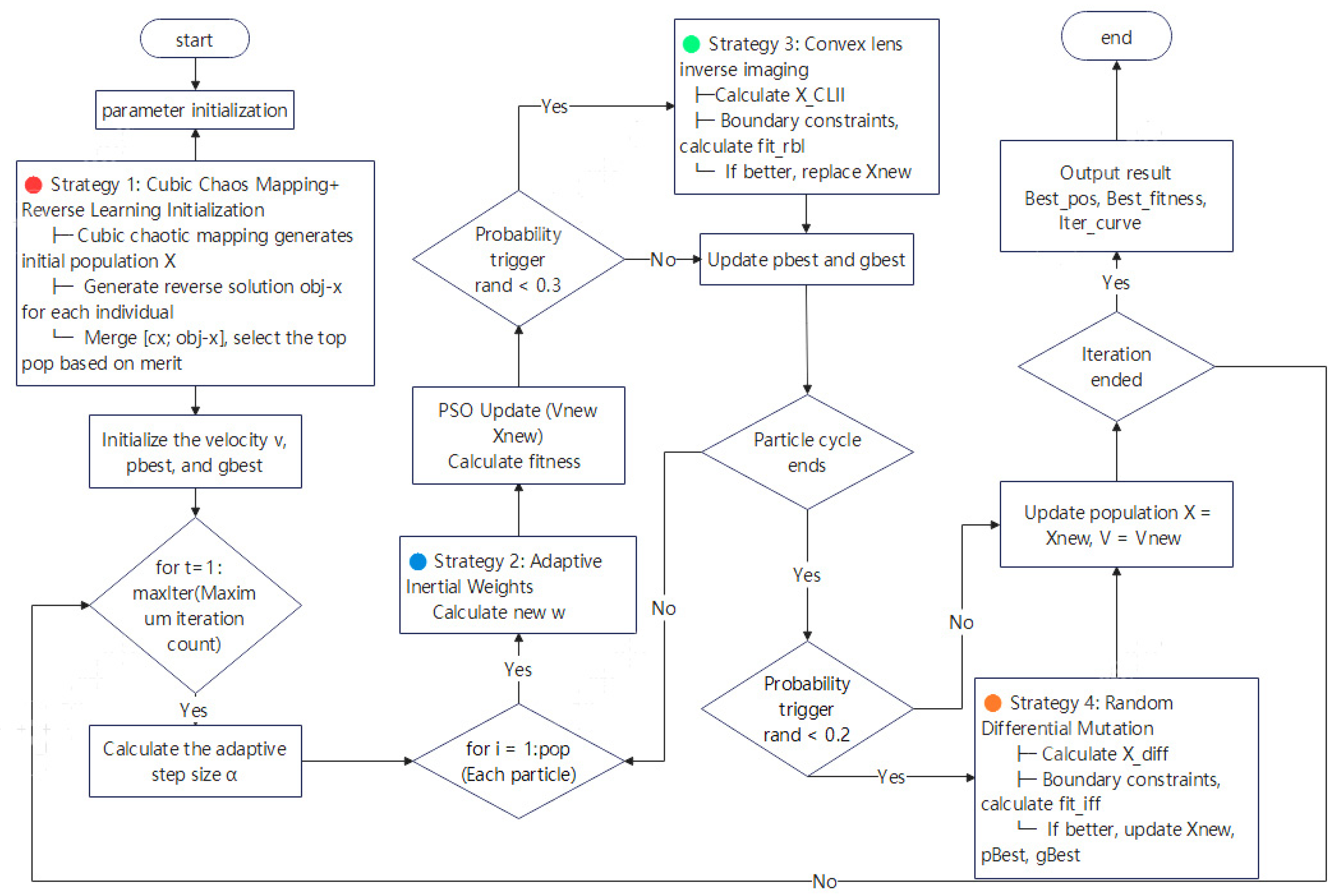
In summary, the complete process of the CDMPSO algorithm is shown in Figure 1:

5. Experiment and Analysis

5.1. Experimental Setup

5.1.1. Overview of Experimental Design

To comprehensively verify the performance advantages of the CDMPSO algorithm and the effectiveness of its four improvement strategies, this section designs a multi-dimensional experimental framework, including ablation experiments, comparative experiments, benchmark function verification, complexity analysis, and practical problem applications. For details on the experimental environment and software configuration, please refer to Section 5.6.
The ablation experiment aims to verify the effectiveness of each of the four improvement strategies. By constructing four ablation variants (CDMPSO-A without chaotic initialization, CDMPSO-B without adaptive weights, CDMPSO-C without convex lens imaging, and CDMPSO-D without differential mutation) based on CDMPSO, each strategy is omitted and compared with the complete algorithm. By observing the performance changes of each variant on nine CEC2005 benchmark functions, the contribution of each strategy can be quantitatively evaluated, clarifying its role in the algorithm. The comparative experiment aims to verify the overall progressiveness of CDMPSO. CDMPSO is compared with four representative PSO variants (standard PSO, CPSO [38], ACPSO, HPSOALS). These algorithms cover different stages of development, from classic improvements to hybrid strategies, and can measure the relative advantages of CDMPSO from multiple dimensions. By comparing their convergence accuracy, stability, and comprehensive ranking in 30-dimensional and 50-dimensional search spaces, the performance improvement of CDMPSO compared to existing algorithms can be comprehensively evaluated.
To further validate the algorithm’s generalization ability and practical application potential, additional experiments are conducted on 29 CEC2017 benchmark functions, including a detailed analysis of experimental results and statistical significance tests to confirm the significant performance advantages of CDMPSO. Meanwhile, a systematic time complexity analysis is carried out, covering theoretical complexity derivation, running time comparison with peer algorithms, and dimension scalability analysis, to fully evaluate the computational efficiency and practical feasibility of CDMPSO in large-scale optimization scenarios.

5.1.2. Evaluation Metrics

The experiment utilizes the following statistical metrics to quantitatively evaluate algorithm performance:
(1) Mean: The average of the optimal function values obtained from 30 independent runs. It reflects the solution quality and optimization accuracy of the algorithm.
(2) Standard Deviation (Std): The standard deviation of the optimal values obtained from 30 runs, reflecting the stability and consistency of the algorithm’s performance. A smaller standard deviation indicates a more robust and reliable optimization behavior of the algorithm.
(3) Rank: On each test function, algorithms are ranked based on their average performance, with 1 indicating the best.
(4) Average Rank (AR): The average value of the ranks obtained by the algorithm on all test functions, providing a comprehensive indicator of the overall performance of the algorithm.
(5) Final Rank (FR): All algorithms are ranked based on their average ranks, providing a comprehensive performance ranking for each algorithm across all test problems.

5.1.3. Parameter Setting and Sensitivity Analysis

Parameter configuration plays a key role in determining the optimization performance of PSO variants. The sensitivity analysis results are presented in Table 1 and Table 2 for   τ 1 and   τ 2 , respectively. For   τ 1 , the optimal values vary across functions, with a concentration at   τ 1 = 20 , while   τ 1 = 15 and 25 also achieve good results. For   τ 2 , the optimal values are mainly distributed in the range of 45 to 55. The design rationale is that a larger inertia weight in the early iterations enhances global search capability, while a smaller inertia weight in the later iterations improves local exploitation. Based on these analyses, we selected τ 1 = 20 and τ 2 = 55 as the default configuration.
For p l o b l and p d i f f , the optimal parameter distributions are relatively scattered across different test functions, indicating that the algorithm performance is not highly sensitive to these two parameters within reasonable ranges. Therefore, to balance robustness and simplicity, the final configuration is set to p l o b l = 0.3 and p d i f f = 0.2 .

5.2. Test Function

To evaluate the optimization performance of CDMPSO, we employed two benchmark suites: the classical CEC2005 suite and the modern CEC2017 suite.

5.2.1. CEC2005 Benchmark Functions

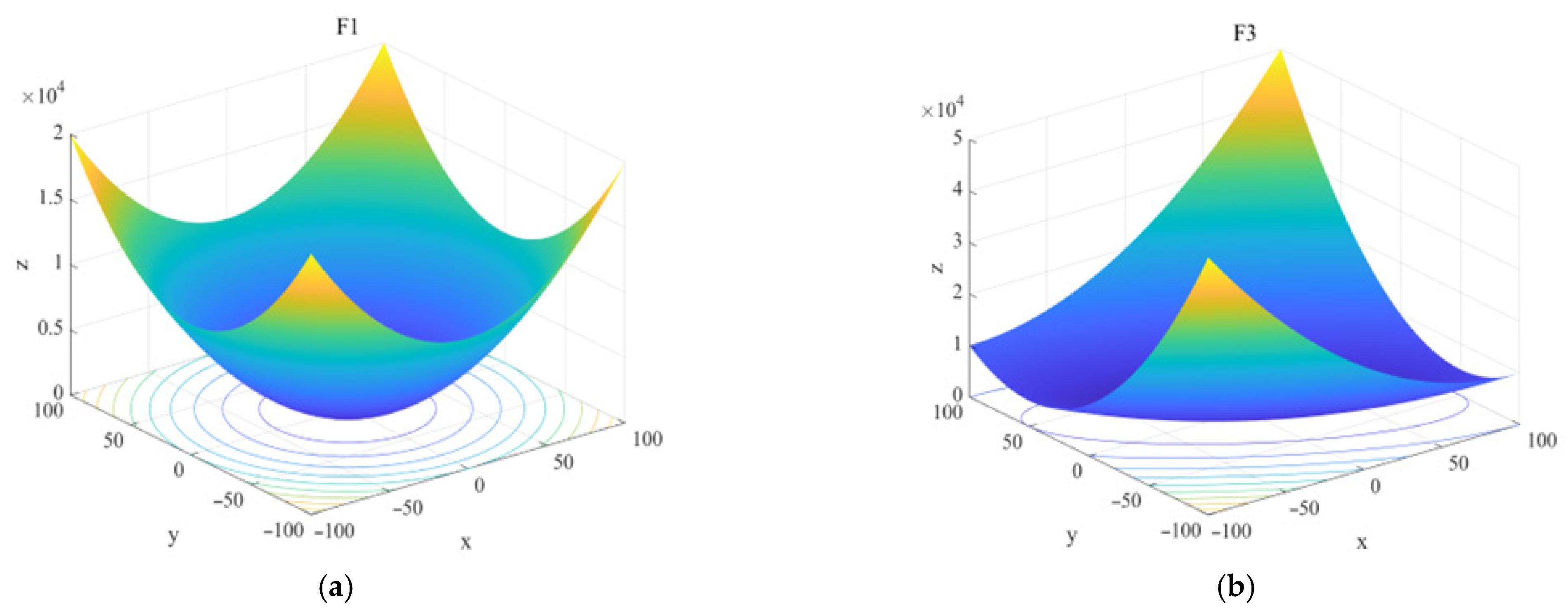
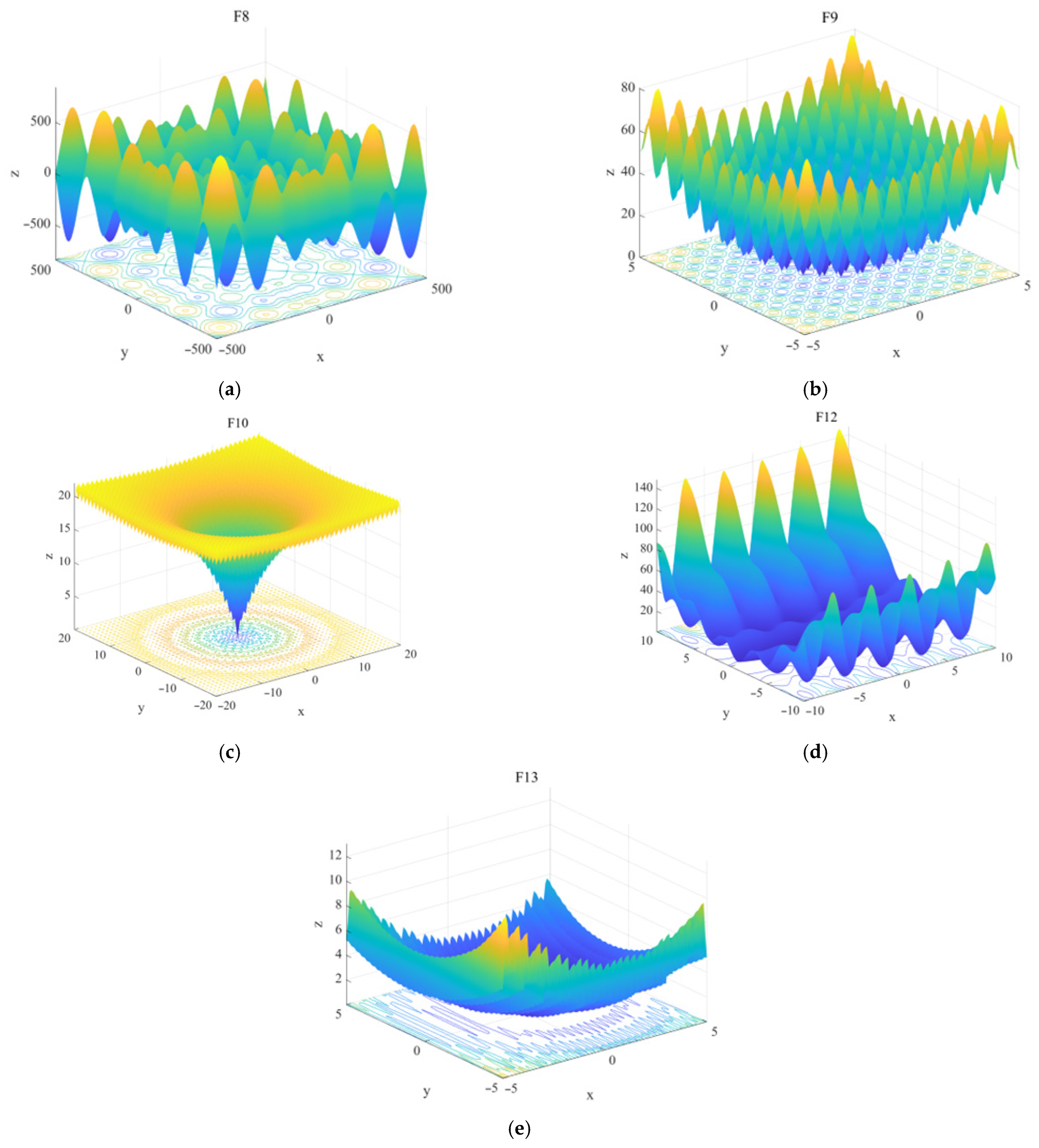
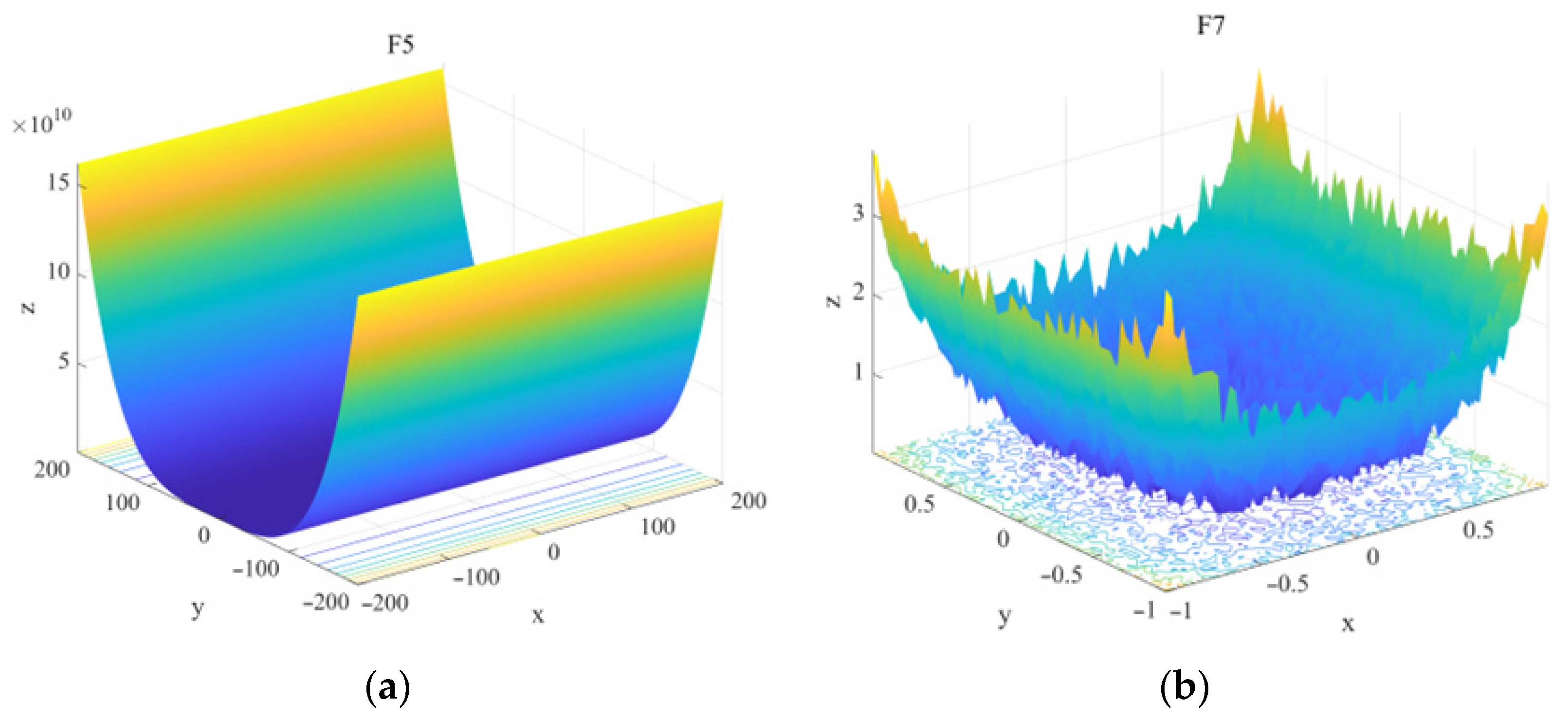
Nine classic CEC2005 benchmark functions were employed. Based on their mathematical properties, they are categorized into three groups: unimodal functions, multimodal functions, and functions with special characteristics. Table 3 summarizes their key properties, and Figure 2, Figure 3 and Figure 4 illustrates the landscapes of these functions. The detailed mathematical definitions of these functions are provided in Appendix A.
(1)
Group 1: Unimodal functions.
This group includes the Sphere function (F1) and the Schwefel 1.2 function (F3). Unimodal functions have a single global optimum without local optima, primarily testing convergence speed and accuracy. The F1 Sphere function tests basic convergence capability. The F3 Schwefel 1.2 function introduces strong variable coupling, testing the algorithm’s ability to handle interdependencies among dimensions. Figure 2 visualizes these functions.
(2)
Group 2: Multimodal functions.
This group includes the Schwefel function (F8), Rastrigin function (F9), Ackley function (F10), and Penalized 1 and 2 functions (F12, F13). Multimodal functions contain numerous local optima, testing global search capability and the ability to escape local optima. The F8 Schwefel function has a deceptive landscape with the global optimum near the boundary. The F9 Rastrigin function creates regularly distributed local optima. The F10 Ackley function balances exploration and exploitation. The F12 and F13 Penalized functions introduce sine modulation and penalty terms, creating densely distributed local optima. Figure 3 visualize these functions.
(3)
Group 3: Special characteristic functions.
This group includes the Rosenbrock function (F5) and the quartic function with noise (F7). These functions introduce additional complexities, such as ill-conditioned landscapes and random perturbations. The F5 Rosenbrock function presents a narrow parabolic valley testing local exploitation. The F7 quartic function with noise introduces random perturbations, testing algorithm robustness. Figure 4 visualizes these functions.

5.2.2. CEC2017 Benchmark Functions

To further validate the performance of CDMPSO on more challenging and modern problems, we also conducted experiments on the CEC2017 benchmark suite. This suite contains 30 functions (excluding the unstable F2), covering four categories: unimodal (F1, F3), multimodal (F4–F10), hybrid (F11–F20), and composition (F21–F30). All functions have a search range of [ 100 ,   100 ] n with dimension n = 30. The optimal values are shifted constants as defined in the CEC2017 technical report. Table 4 summarizes the detailed configuration of these functions.

5.3. Ablation Experiment

An ablation experiment is a systematic method for algorithm analysis. By removing or disabling specific components of an algorithm and observing performance changes, it quantitatively evaluates the contribution of each component to overall performance. This paper constructs four ablation variants based on the CEC2005 benchmark suite. Each variant retains the complete algorithm framework while only omitting one improvement strategy, with the remaining parts being identical to the complete algorithm. This design of controlled variables ensures that performance differences can be directly attributed to the omitted strategy. Based on the mathematical characteristics of the test functions, we perform ablation experiment analysis on three groups of CEC2005 functions separately to comprehensively evaluate the performance of various strategies on different types of optimization problems.
To ensure the fairness of the experiment, both CDSPSO and its ablation variant algorithms (CDMPSO-A, CDMPSO-B, CDMPSO-C, CDMPSO-D) adopt unified parameter settings, as shown in Table 5.

5.3.1. Unimodal Function Group

A unimodal function has only one global optimum and is free from local optimum interference. It is primarily used to evaluate the convergence speed and optimization accuracy of algorithms. This group includes the f1 Sphere function and the f3 Schwefel 1.2 function. The former tests basic convergence ability, while the latter introduces variable coupling characteristics to examine the algorithm’s accuracy performance in handling variable correlation. The experimental results are shown in Table 6.
On unimodal functions, the full CDMPSO-full algorithm ranks first with an average ranking of 1.5, verifying the comprehensive improvement of the four strategies on convergence accuracy and variable correlation handling. Especially on the f1 Sphere function, the full CDMPSO achieves an ultra-high accuracy of 7.07 × 10−248, significantly outperforming all ablation variants. Note that these extremely small values are well within the range of double-precision floating-point arithmetic (IEEE 754 [39]), which supports values as small as 10−324, and are genuine results achieved by the adaptive inertia weight strategy, not numerical underflow.
Relatively speaking, the performance of CDMPSO-B without adaptive weights is the worst (ranking fifth for both functions), differing from the complete algorithm by nearly 200 orders of magnitude. This significant gap fully demonstrates that the adaptive weight strategy is the core guarantee for achieving ultra-high-precision convergence. By reducing the weight to a minimum value in the later stages of iteration, it enables particles to conduct a fine search around the global optimum. However, fixed weights (w = 0.7) cannot achieve such dynamic adjustment, resulting in particles continuously oscillating near the optimal solution, making it difficult to further approach the theoretical optimum.
The non-differential mutation CDMPSO-A and the non-chaotic initialization CDMPSO-D ranked second and third, achieving orders of magnitude of 10−210 and 10−206, respectively. Although there is still a gap compared to the full algorithm, they have far surpassed other variants. This indicates that the chaotic initialization strategy lays a good foundation for subsequent iterations by providing a more evenly distributed initial population, enabling the algorithm to start from a more advantageous search starting point. Especially on the f3 Schwefel 1.2 function, which has strong variable coupling characteristics, the value of each dimension affects the summation terms of all subsequent dimensions. At this time, the non-chaotic initialization CDMPSO-A achieves the theoretical optimal value of 0, ranking first and even outperforming the full algorithm. The differential mutation strategy, by introducing random perturbations in the later stages of iteration, can effectively break the stagnation state of particles, helping the population continue to approach the theoretical optimum based on the already achieved high-precision region.
The convex lens imaging CDMPSO-C ranks fourth, achieving an order of magnitude of 4.12 × 10−101. Although it is still far superior to the unweighted variant, there is a significant gap between it and the top-ranked variants. This indicates that on terrains without local traps, such as unimodal functions, the wide-range perturbation effect of convex lens imaging is not prominent. Its main value lies in helping the algorithm escape from local optima, rather than improving convergence accuracy.
Based on the experimental results of the unimodal function set, we can draw the following conclusions: Adaptive weight is the core strategy of CDMPSO, and its absence will lead to a steep decline in performance. Differential mutation and chaotic initialization are important auxiliary strategies, ranked third and second, respectively, making significant contributions to improving convergence accuracy. Convex lens imaging contributes relatively limitedly to unimodal functions, ranking fourth, and its main value lies in multimodal and complex terrains. The complete algorithm ranks first in the unimodal function set with an average ranking of 1.5, proving the effectiveness of the synergistic action of the four strategies and performing well in both basic convergence ability and variable coupling issues.

5.3.2. Multimodal Function Group

Multimodal functions contain numerous local optima, posing significant challenges for optimization algorithms. This group includes the deceptive f8 (Schwefel), the moderately difficult f9 (Rastrigin) and f10 (Ackley), and the complex f12 and f13 (Penalized) functions. The experimental results are presented in Table 7.
On the multimodal function set, CDMPSO-full ranked first with an average ranking of 1.6, verifying the collaborative effectiveness of the four strategies in complex terrains. The following provides a detailed analysis from the perspective of the contributions made by each strategy:
The non-adaptive weight CDMPSO-B performed the worst on the three complex multimodal functions f8, f12, and f13, with an average ranking of 2.2, placing it at the bottom among all ablation variants. This once again confirms that adaptive weight remains the core strategy of the algorithm, not only affecting convergence accuracy but also profoundly influencing the algorithm’s global navigation ability in complex terrains. Its dynamic adjustment mechanism enables the algorithm to maintain exploration breadth in the early stages of iteration and focus on fine-grained search in the later stages, while fixed weights cannot achieve this balance.
For the chaos-free initialized CDMPSO-A, it performs exceptionally poorly on the f8 Schwefel function, which is typically deceptive (−1.15 × 10⁴), with a performance gap of up to 80.98% compared to the complete algorithm. However, it performs relatively well on other functions. This difference demonstrates that chaos initialization greatly helps the algorithm avoid falling into the wrong area in the early stages by improving the quality of the initial population, laying a crucial foundation for subsequent search.
The lens-free variant CDMPSO-C ranks third, first, first, second, and third on multimodal group functions and is tied for second with the chaos-free variant. This indicates that convex lens imaging has a moderate effect on multimodal functions, and its strength varies depending on the characteristics of the function. Meanwhile, the differential mutation variant CDMPSO-D ranks fifth and fourth only on the complex multimodal functions f12 and f13, but it ranks first for all other functions, showing the most unstable performance among all variants. This suggests that in complex terrains, differential mutation plays a significant role by introducing random perturbations to effectively prevent the population from prematurely falling into local optima.
In addition, on the two moderately difficult multimodal functions f9 and f10, all ablation variants achieved the theoretical optimal values (0 for f9 and 4.44 × 10⁻¹⁶ for f10). This demonstrates the robustness of the overall CDMPSO framework—even if a certain strategy is missing, its basic global search capability is still sufficient to handle such rule-distributed multimodal terrain.
It is noteworthy that an anomalous phenomenon occurred with the f12 function: the chaos-free initialized CDMPSO-A performed the best, while the complete algorithm only ranked fourth. This indicates that in specific complex terrains, there may be mutual interference between strategies, necessitating further optimization of parameter configurations to achieve better collaboration. On the f13 function, the contribution of strategies reverted to the conventional pattern of adaptive weight > chaos initialization > convex lens imaging > differential mutation, which is highly consistent with the ranking of the unimodal function group.
Based on the experimental results of the five multimodal functions, the following conclusions can be drawn: The CDMPSO-full algorithm still ranks first in the multimodal function group, verifying the comprehensive effectiveness of the four strategies in complex terrain navigation. Chaotic initialization contributes most prominently in deceptive terrains and maintains a stable contribution to complex multimodal functions, with an average ranking of 2.0. Adaptive weight remains the core strategy. Although it performs on par with the full algorithm on f8, its performance significantly decreases when omitted on f12 and f13. Convex lens imaging and differential mutation, as auxiliary strategies, both make stable contributions to multimodal functions, with average rankings of 2.0 and 3.0, respectively. On medium-difficulty multimodal functions, all variants achieve theoretical optimality, reflecting the robustness of the CDMPSO framework.

5.3.3. Special Characteristic Function Group

Special feature functions introduce additional complexities, including pathological terrain and random noise. This group includes f5 (Rosenbrock), which features a narrow-curved valley with strong variable coupling, and f7 (Quartic with Noise), which introduces random noise to test robustness. The experimental results are presented in Table 8.
Comparing the experimental results of f5 and f7, it can be observed that the convex lens imaging strategy plays a completely opposite role on different special feature functions.
On the f5 pathological function, the convex lens imaging CDMPSO-C performs the best, ranking first, even surpassing CDMPSO-FULL (ranked third). The Rosenbrock function features a narrow and curved valley terrain, with the global optimum located at the bottom of the valley, requiring particles to conduct fine local search along the valley. Large-scale perturbations from convex lens imaging may be counterproductive in such terrain—when particles have entered the valley region, large positional jumps can easily cause them to deviate from the narrow valley path, thereby interfering with the fine search process. Therefore, on f5, moderately reducing perturbations is beneficial for the algorithm to converge steadily along the valley. On the f7 noisy function, the situation is completely reversed. The convex lens imaging strategy contributes most prominently: CDMPSO-C performs the worst, with a performance drop of up to 89.97% compared to CDMPSO-FULL. Noise can make the fitness landscape rough and full of false local extremum points. If the algorithm only conducts local search, it is easy to fall into these false traps caused by noise. Large-scale perturbations from convex lens imaging can help particles escape from noise traps and reposition in more promising areas, thus maintaining the correct search direction macroscopically.
CDMPSO-B without adaptive weights performed extremely poorly on both functions (ranking fifth for f5 and ranking fourth for f7, with an average ranking of 4.5). This once again confirms the status of adaptive weights as a core strategy, demonstrating its indispensable dynamic adjustment capability for the search process, even on functions with special characteristics. Fixed weights cannot adjust the step size according to the iteration process, making it difficult to balance exploration and exploitation on ill-conditioned terrain, and are unable to effectively distinguish between true gradients and random perturbations in noisy environments.
For CDMPSO-FULL, although the complete algorithm ranks third in terms of f5, inferior to the lens-free variant C and the chaos-free variant A, its average ranking still ranks first. This proves that the complete algorithm performs evenly on different types of special feature functions, with no obvious shortcomings, which is the embodiment of the synergistic effect of the four strategies.
Regarding the experimental results of the comprehensive special feature function group, the complete algorithm ranks first in the special feature function group with an average ranking of 2.0, verifying the comprehensive effectiveness of the four strategies in morbid terrain and noisy environments. Convex lens imaging contributes most prominently in noisy environments and is a key strategy for the algorithm to cope with rough fitness landscapes; however, on morbid terrains that require fine search, its perturbation effect may interfere with the search and needs to be moderately controlled. Adaptive weighting remains the core strategy, and performance is the worst without it, reflecting its indispensability for dynamic adjustment of the search process. Both chaotic initialization and differential mutation, as auxiliary strategies, make stable positive contributions to the special feature function.

5.3.4. Summary of Ablation Experiment

Through systematic ablation experiments on unimodal function groups, multimodal function groups, and special feature function groups, the following comprehensive conclusions can be drawn:
Regarding the comprehensive evaluation of the contribution of the four strategies, (1) adaptive weighting is the core strategy of CDMPSO, playing a crucial role across all function types. Its dynamic adjustment capability cannot be replaced by fixed weighting, reflecting its universal value as the cornerstone of the algorithm. (2) Secondly, chaotic initialization contributes significantly to addressing deceptive landscapes and variable coupling issues. This proves that a high-quality initial population is the primary prerequisite for the algorithm’s success. The ergodicity and uniform distribution characteristics of chaotic initialization give it unique advantages in dealing with complex search spaces. (3) Furthermore, convex lens imaging exhibits irreplaceable value in noisy environments. However, in spaces requiring fine-grained search, its large-scale perturbations may interfere with precise search, causing the lens-free variant to perform better instead. This indicates that convex lens imaging is a “double-edged sword,” and its effect has significant function dependency. (4) Finally, random differential mutation, as an auxiliary strategy, plays an important role in escaping local optima.
In addition, on most functions, the four strategies exhibit good synergistic effects, with the complete algorithm ranking first or tied for first. However, on individual complex functions (such as f12 and f5), the complete algorithm is slightly inferior to some ablation variants, indicating that there may be subtle interference between strategies. These phenomena reveal the complexity of strategy synergy—the optimal combination of strategies may vary depending on the characteristics of the function, which points the way for future research on adaptive selection mechanisms for strategies. To address this, future work will explore three adaptive mechanisms: (1) landscape-aware adjustment of CLII perturbation intensity based on search space geometry to prevent unnecessary disruptions on narrow-valley functions; (2) state-dependent mutation probability that decreases from a high value in early exploration to a low value in late exploitation; and (3) an online learning framework (e.g., multi-armed bandit) that dynamically selects strategies based on their real-time contribution to fitness improvement. These mechanisms would enable CDMPSO to automatically favor beneficial strategies and suppress those causing interference.
Despite the presence of functional dependencies and individual interference phenomena, the complete CDMPSO ranks first on all three sets of functions. This fully demonstrates that the synergistic effect of the four strategies endows CDMPSO with comprehensive optimization capabilities—it can achieve ultra-high precision convergence on unimodal functions and effectively escape local optima on multimodal functions. The excellent performance of individual ablation variants on specific functions precisely reveals the functional dependency characteristics of the strategies, providing valuable insights for further optimization of the algorithm.

5.4. Comparative Experiment

To comprehensively evaluate the overall optimization performance of the proposed CDMPSO algorithm, this paper selected four representative particle swarm optimization variants for comparative experiments, namely, standard PSO, CPSO, ACPSO, and HPSOALS, aiming to systematically compare algorithm performance from different improvement paradigm levels. Among them, PSO serves as the benchmark algorithm, adopting the classic speed position update mechanism and fixed parameter configuration; CPSO introduces a compression factor instead of inertia weight and maintains population diversity while ensuring convergence through system velocity constraints; ACPSO integrates chaotic mapping and adaptive inertia weights to enhance population diversity and dynamically balance exploration and development; and HPSOALS combines chaos opposition learning and adaptive strategies to enhance global search capability.
To ensure the fairness of the experiment, all comparison algorithms adopted the parameter configurations recommended in their original literature (see Table 9) and were run in a unified experimental environment: the population size was uniformly set to 50, the maximum iteration count was 1000, and each test function was independently run 30 times in both 30-dimensional and 50-dimensional scenarios. By comparing the performance of various algorithms in terms of indicators such as mean, standard deviation, ranking, average ranking, and final ranking, the system evaluates the convergence accuracy, stability, and comprehensive optimization ability of CDMPSO in different dimensions and function types in order to verify its performance improvement compared to existing algorithms.

5.4.1. Thirty-Dimensional Comparison Test

(1)
Analysis of experimental results.
As shown in Table 10, in the 30-dimensional space, CDMPSO achieves excellent performance in ranking first on all nine test functions, significantly better than the other four comparison algorithms. ACPSO ranks second, with an average ranking of 2.56, CPSO ranks third, with 3.22, PSO and HPSOALS rank fourth and fifth, with 3.44 and 4.78, respectively.
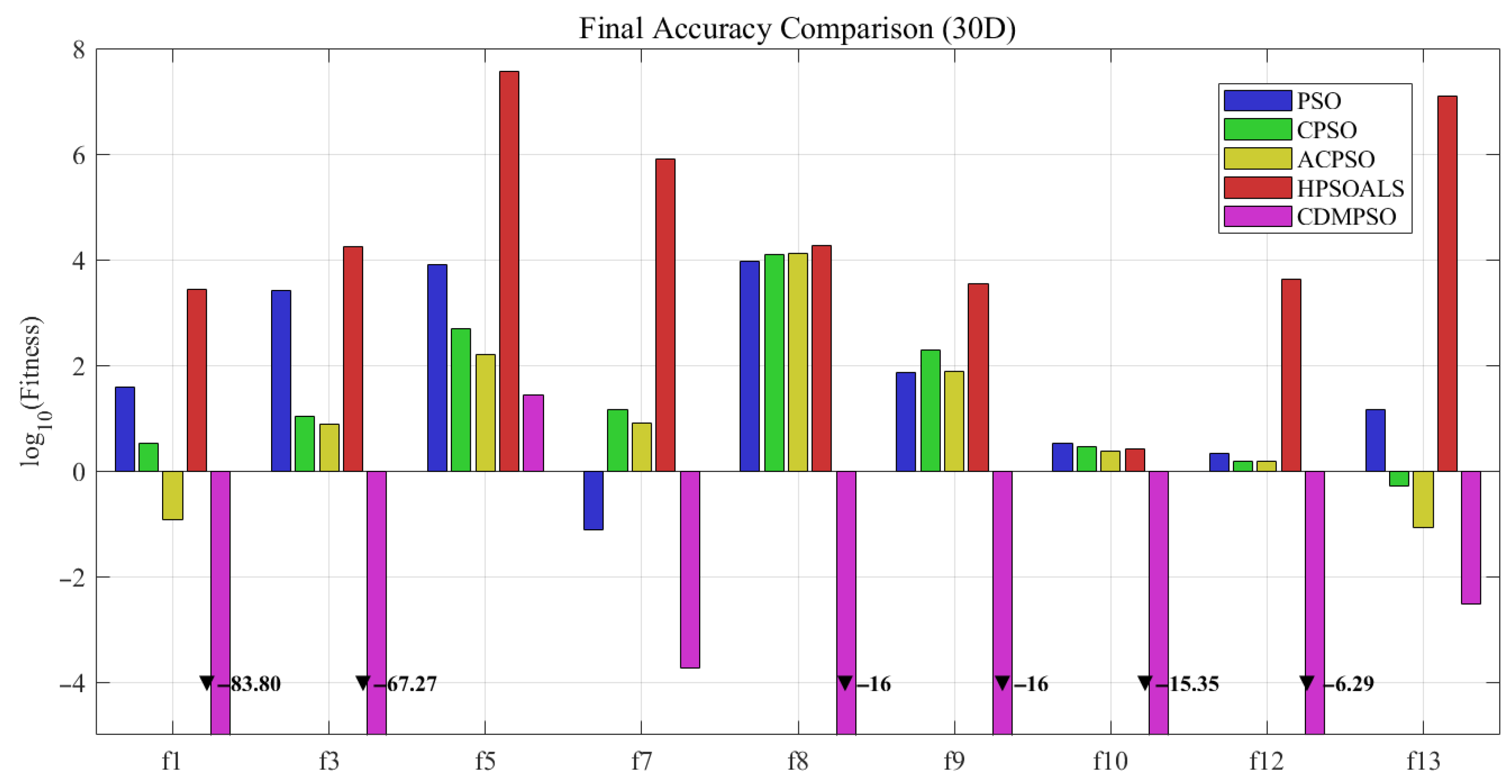
In order to better compare the differences between various algorithms, Figure 5 shows the order of magnitude comparison of the final accuracy of each algorithm on nine representative functions, with the y-axis being the commonly used logarithm of fitness values, log10 (f). The lower the column shape (the larger the negative value), the higher the convergence accuracy of the algorithm, and the closer it is to the theoretical optimum. On the contrary, the higher the column (the larger the positive value), the more the algorithm falls into a poor area and deviates from the optimal solution. By using parallel bar charts, it is possible to visually compare the relative performance of different algorithms on the same function, as well as the performance differences of the same algorithm on different types of functions.
From the overall difference situation, CDMPSO achieved a total of 45 comparisons on nine test functions (each function was compared with four comparison algorithms). The only difference that does not reach one order of magnitude is the comparison with ACPSO on the f5 Rosenbrock function (5.9 times, about 0.77 orders of magnitude), but this difference is already significant in pathological terrain. Specifically, on the four functions f1, f3, f9, and f10, the average difference between CDMPSO and the comparison algorithm exceeds 46 orders of magnitude, demonstrating a crushing advantage. On the three functions f7, f12, and f13, the average difference is 3.6 orders of magnitude, indicating a stable and significant advantage. On the f8 Schwefel function, CDMPSO reaches −2.09 × 10⁴, which is extremely close to the theoretical optimal value, while the comparison algorithms all fall into local optima, with outstanding advantages. This statistical result fully demonstrates that the advantages of CDMPSO are not occasional in individual functions but have broad applicability and stable superiority in optimization problems of different types and difficulties.
From the perspective of function types, CDMPSO exhibits comprehensive performance advantages. On unimodal functions, CDMPSO exhibits extremely high convergence accuracy, capable of approaching theoretical optimal values to extremely small orders of magnitude, while comparative algorithms generally stagnate at the level of 100 to 103. Especially on the f3 function with strong variable coupling characteristics, CDMPSO still maintains an exponential advantage, indicating its ability to effectively handle inter-dimensional dependencies and accurately navigate the coupling space. The global search capability of CDMPSO has been fully validated on multimodal functions. On the f8 function with deceptive terrain, CDMPSO is extremely close to the theoretical optimal value, while PSO only reaches −1.18 × 10⁴, falling into local optima. On the medium-difficulty multimodal functions f9 and f10, CDMPSO reaches the theoretical optimal value, becoming the only successful algorithm. On the penalty functions f12 and f13, CDMPSO achieves 5.11 × 10⁻⁷ and 2.96 × 10⁻³, respectively, which is several orders of magnitude higher than the second ranked ACPSO. On the special feature function, CDMPSO also performs outstandingly in the pathological function f5 and the noisy function f7, verifying its practicality and robustness in noisy environments.
In summary, CDMPSO has demonstrated excellent convergence accuracy, strong global search capability, and good robustness in 30-dimensional testing, and its overall performance is comprehensively leading compared algorithms.

5.4.2. Fifty-Dimensional Comparison Test

(1)
Analysis of Experimental Results.
As shown in Table 11, in the 50-dimensional search space, CDMPSO continued its excellent performance in the 30-dimensional test, ranking first on all nine test functions with an average ranking AR of 1.00 and a final ranking FR of 1. ACPSO ranks second, with an average ranking of 2.67, CPSO ranks third. with 3.00, PSO and HPSOALS rank fourth and fifth, with 3.44 and 5.00, respectively. This ranking result is completely consistent with the 30-dimensional test (30-dimensional ranking: CDMPSO > ACPSO > CPSO > PSO > HPSOALS), proving the stability and scalability of CDMPSO performance advantages.
(2)
Dimension Expansion Analysis.
In order to systematically evaluate the performance degradation of various algorithms as the problem dimension increases, this paper further conducts dimension scalability analysis on the experimental results of 30 and 50 dimensions. Table 12 shows the average ranking (AR) changes of five algorithms in 30 and 50 dimensions.
From Table 12, it can be clearly observed that CDMPSO maintains a perfect performance with an average ranking of 1.00 in both 30 and 50 dimensions, and the AR changes to 0, demonstrating excellent dimensional scalability. This result indicates that the performance advantage of CDMPSO does not decrease with the increase in problem dimension, and its four improvement strategies can still effectively collaborate in high-dimensional space. In contrast, although PSO maintains a stable ranking (AR changes to 0), it remains at a relatively poor level of 3.44. CPSO’s ranking slightly improves in 50 dimensions (from 3.22 to 3.00), indicating that its compression factor strategy is relatively effective in high-dimensional space. The rankings of ACPSO and HPSOALS both deteriorate, with HPSOALS ranking at the bottom, with an AR of 5.00 in 50 dimensions, indicating that its hybrid strategy may cause interference in high-dimensional problems.
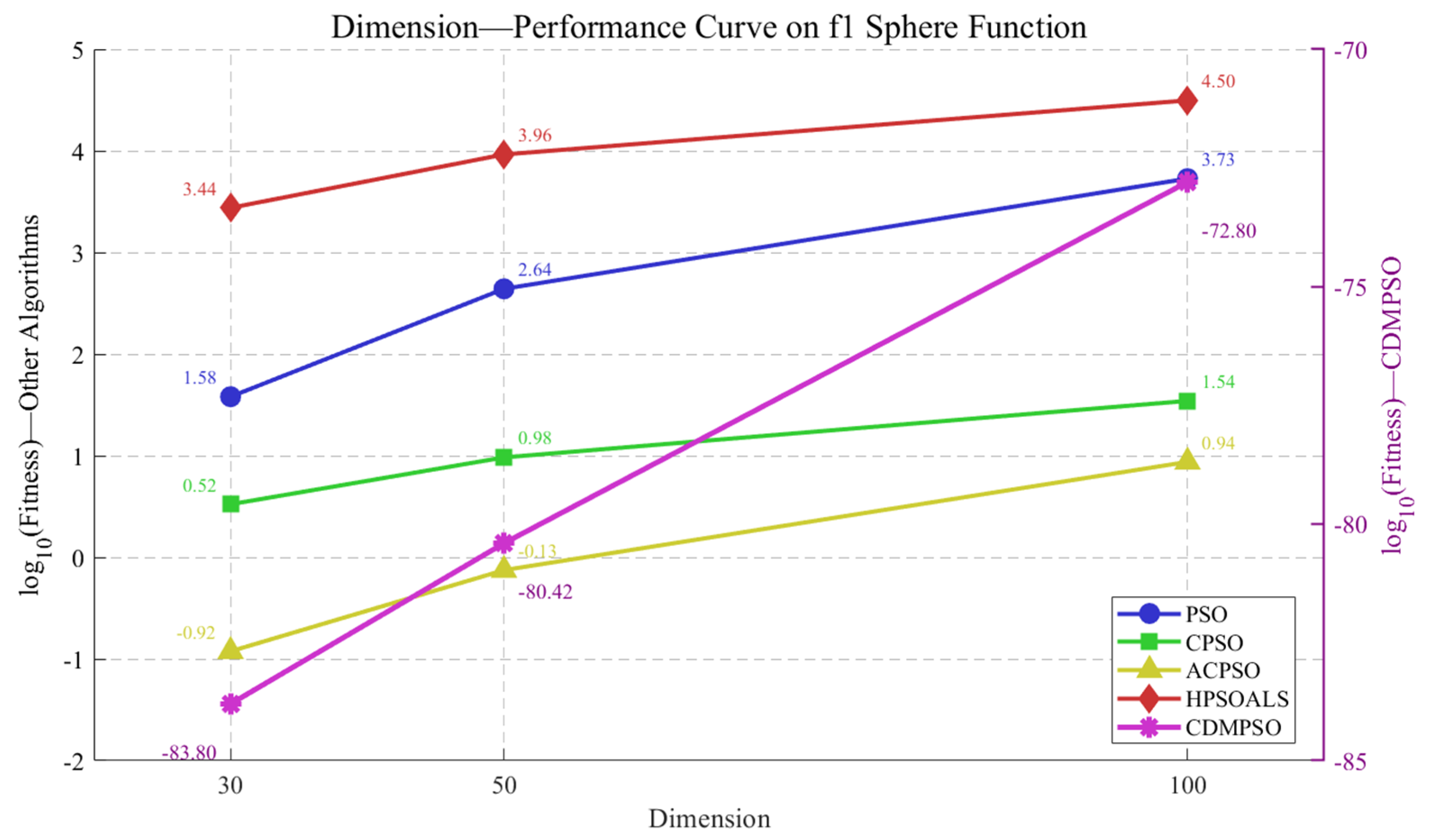
In order to further explore the performance trends of various algorithms with increasing dimensions, this paper takes the simplest unimodal function f1 as an example and adds experiments with 100 dimensions. Figure 6 shows the dimension performance curves of each algorithm on the f1 function in 30, 50, and 100 dimensions. The figure adopts a dual vertical axis design: the left vertical axis (−2 to 5) corresponds to the log10 fitness values of PSO, CPSO, ACPSO, and HPSOALS, the right vertical axis (−85 to −70) corresponds to the log10 fitness values of CDMPSO, and the horizontal axis is the search space dimension. This design not only avoids the extremely low values of CDMPSO from flattening the curves of other algorithms but also clearly displays the changing trends of all algorithms.
From Figure 6, it can be observed that the curves of PSO, CPSO, ACPSO, and HPSOALS show a gentle upward trend (with deterioration) in the range of 30 to 100 dimensions, with a variation range of 1.0 to 2.2 orders of magnitude. The curve of CDMPSO rises from −83.80 to −72.80, with a variation of 11.0 orders of magnitude and the largest change in absolute value. However, the curve of CDMPSO is much lower than other algorithms, with its log10 value consistently maintained at a very low level below −70, while the curve of the comparative algorithm is located in the higher range of −2 to 5, forming a huge gap of over 70 orders of magnitude between the two. This growth occurs at an extremely low level between 10−84 and 10−7, which can be considered as “staying near zero” in engineering. The attenuation of performance with increasing dimensions has almost no impact on the actual optimization effect.
Based on the quantitative ranking comparison in Table 12 and the dimension performance curve in Figure 6, CDMPSO consistently ranks first, with an average ranking of 1.00 in both the 30th and 50th dimensions, demonstrating stability that is not affected by increasing dimensions. From the dimension performance curve, CDMPSO consistently maintains an extremely low order of magnitude below 10−70 in the range of 30 to 100 dimensions, with a difference of 70 orders of magnitude compared to the comparative algorithm. This indicates that CDMPSO not only performs well in low- and medium-dimensional problems but also maintains a stable leading advantage in high-dimensional spaces. Its performance advantages have broad applicability and reliable scalability.

5.4.3. Convergence Analysis

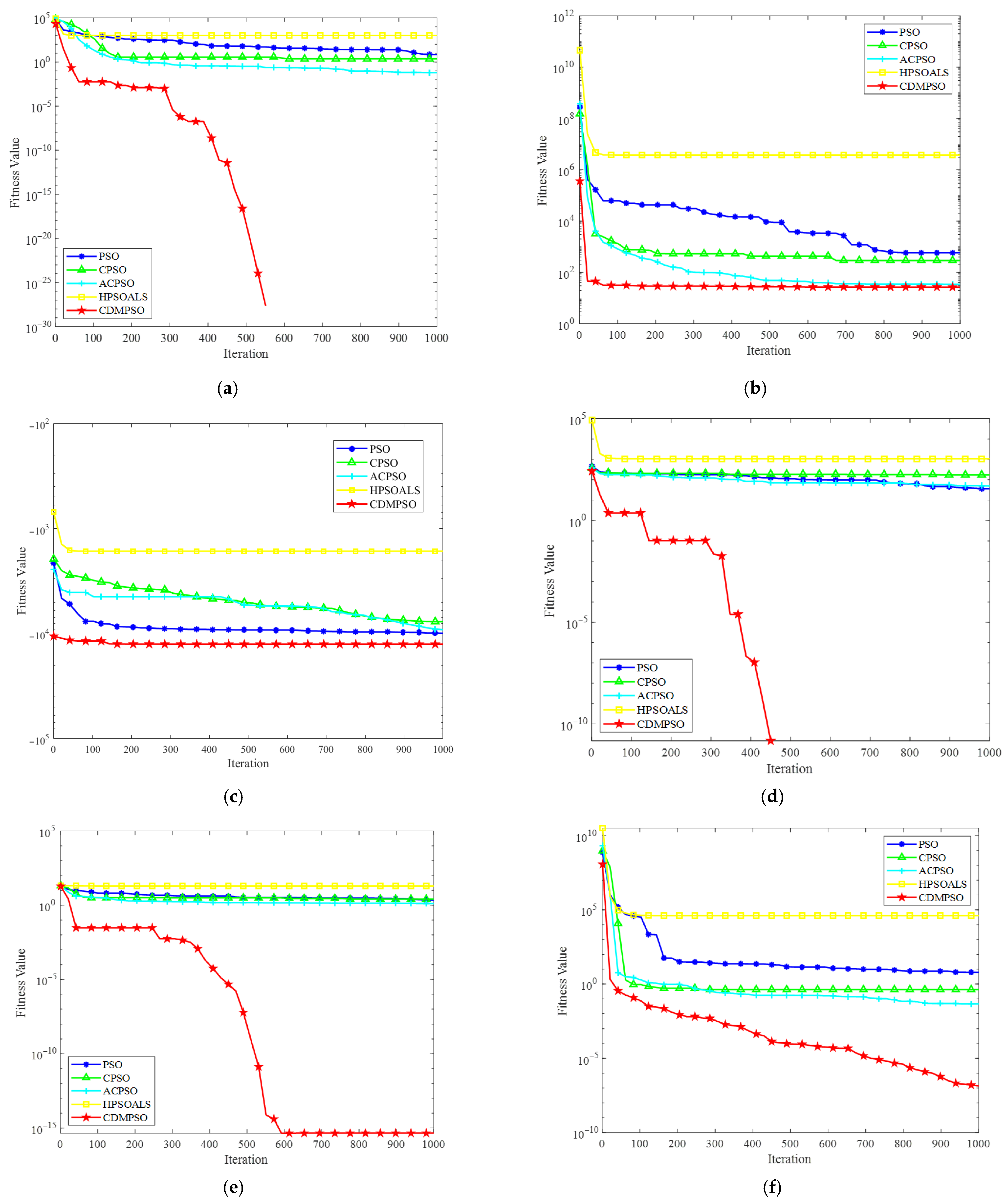
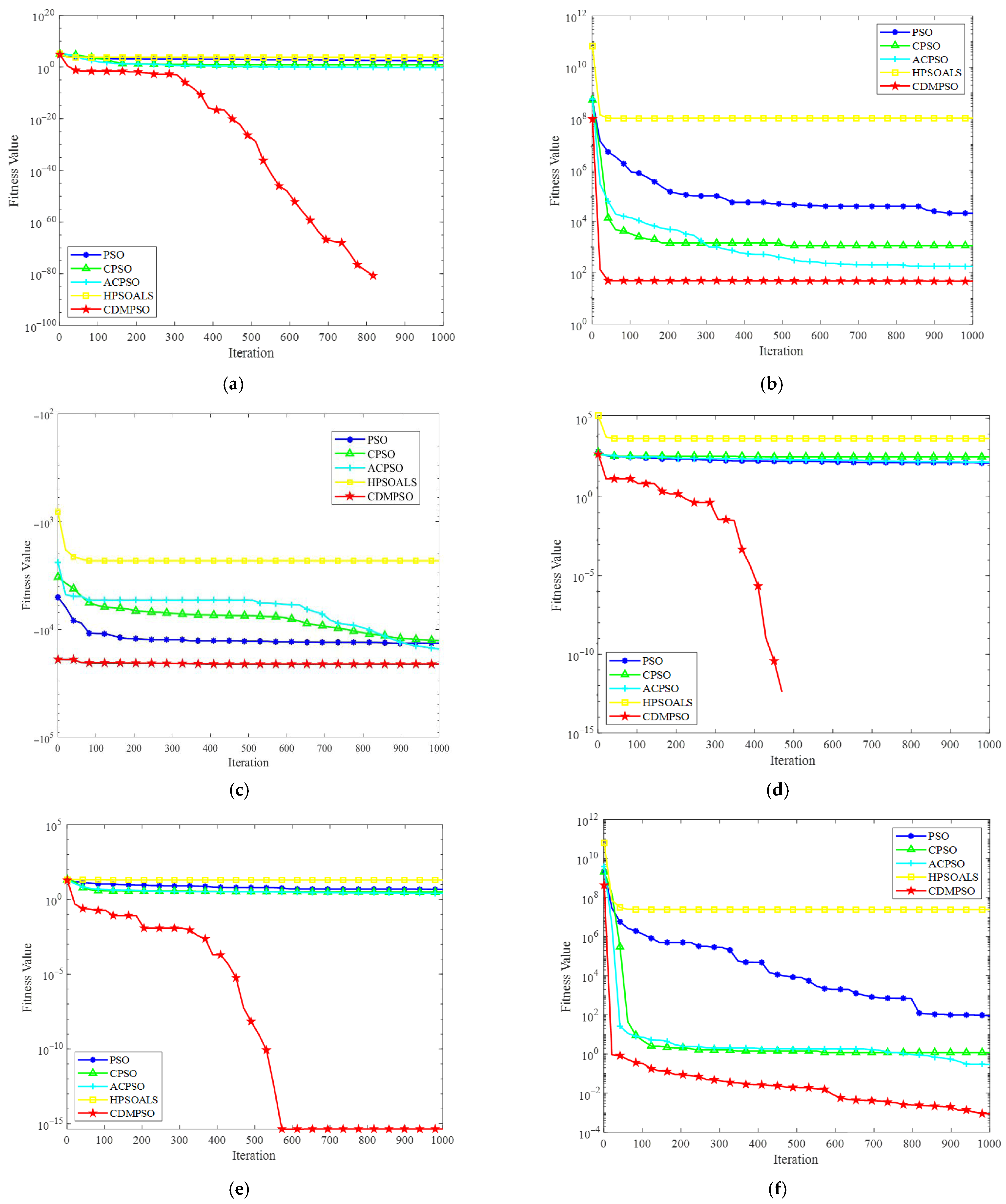
To further illustrate the search behavior of different PSO variants, Figure 7 and Figure 8 present the convergence curves of CDMPSO and its compared algorithms on six representative functions under 30-dimensional and 50-dimensional settings, respectively. The selected functions cover three categories: unimodal (f1), multimodal (f9, f10, f13), and ill-conditioned (f5, f8). Each curve represents the best run among 30 independent runs, plotted on a logarithmic scale.
As shown in Figure 7, CDMPSO exhibits the fastest convergence speed and the highest final precision across all six functions at 30 dimensions. On the unimodal Sphere function (f1), CDMPSO reaches approximately 10−84 after 1000 iterations (the vertical axis in the graph cannot be displayed), while PSO stagnates at around 101. On the ill-conditioned Rosenbrock function (f5), all algorithms decrease rapidly within the first 200 iterations, but CDMPSO maintains a steady downward trend and achieves the lowest final fitness value. On the deceptive Schwefel function (f8), CDMPSO reaches 2.09 × 10 4 , very close to the theoretical optimum.
Notably, on the multimodal Rastrigin function (f9), PSO, CPSO, ACPSO, and HPSOALS stagnate after 200–300 iterations, trapped in local optima at around 102~103. In contrast, CDMPSO breaks through the plateau period around 300 iterations and continues to decline, eventually reaching the theoretical optimum of zero. Similarly, on the Ackley function (f10), CDMPSO is the only algorithm that reaches the theoretical optimum ( 4.44 × 10 16 ). On the complex Penalized 2 function (f13), CDMPSO maintains a consistent downward trend throughout the entire iteration process without any obvious plateau period, achieving significantly better final precision than all compared algorithms, approximately six orders of magnitude lower than the second-ranked algorithm.
As shown in Figure 8, the convergence patterns at 50 dimensions are nearly identical to those at 30 dimensions, further confirming the robustness and scalability of CDMPSO. On the Sphere function (f1), CDMPSO achieves 10 81 compared to PSO’s 10 2 , an improvement of over 80 orders of magnitude. On the Rosenbrock function (f5), CDMPSO reaches 4.75 × 10 1 , significantly outperforming all compared algorithms. On the Rastrigin function (f9), CDMPSO again reaches the theoretical optimum of zero, while all other algorithms remain trapped in local optima.
The performance advantage of CDMPSO becomes even more pronounced at higher dimensions. For example, on the Schwefel function (f8), CDMPSO achieves 2.08 × 10 4 at 50D, very close to the theoretical optimum of 2.0949 × 10 4 . On the Ackley function (f10), CDMPSO reaches the theoretical optimum, while the other algorithms stagnate at around 100 to 101. On the Penalized 2 function (f13), CDMPSO achieves 7.41 × 10 3 , demonstrating its robust performance on highly complex terrains.
Across all six functions and both dimensions, CDMPSO consistently exhibits the fastest convergence speed, the highest final precision, and the best ability to escape local optima. Notably, on the Rastrigin and Ackley functions, CDMPSO is the only algorithm that reaches the theoretical optimum. The convergence curves of CDMPSO are smooth and stable, without severe oscillations, indicating that it maintains a good balance between exploration and exploitation throughout the entire search process. As dimensionality increases from 30 to 50, the performance advantage of CDMPSO remains stable or even becomes more pronounced, demonstrating its excellent scalability.

5.4.4. Stability Analysis

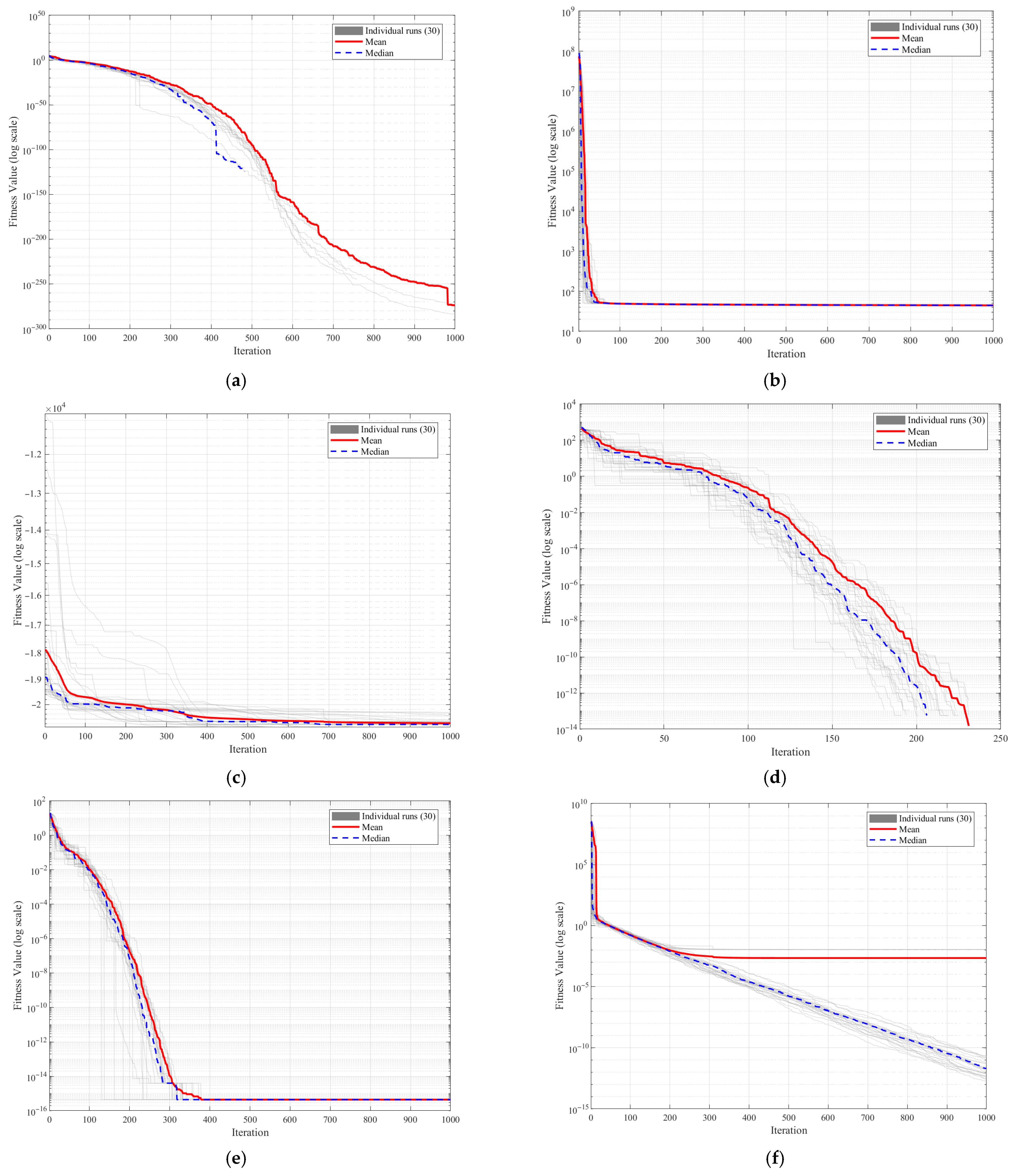
Beyond convergence accuracy, we also evaluated the stability of CDMPSO. A stability analysis was conducted on six representative functions (f1, f3, f5, f8, f9, f10, f13) by overlaying the convergence curves of 30 independent runs. As shown in Figure 9, the individual curves are tightly clustered across all functions, with the mean and median curves nearly overlapping throughout the entire iteration process. This indicates that CDMPSO produces consistently reliable results under different random seeds, demonstrating excellent stability. A slight bifurcation is observed on f13 during the middle stages, where the convergence curves split into two distinct groups—one remaining relatively flat while the other continues to decline. This suggests that some runs may experience temporary stagnation before eventually converging to the global optimum. Overall, the tight clustering of convergence curves confirms the robustness of CDMPSO across diverse function types.

5.5. CEC2017 Benchmark Test

To further validate the performance of CDMPSO on more challenging and modern benchmark functions, we conducted additional experiments on the CEC2017 test suite. Following the same experimental setup, we compared CDMPSO against PSO, CPSO, ACPSO, and HPSOALS on 29 CEC2017 functions (f2 is excluded due to its unstable behavior). The search range is 100 ,   100 D for all functions with dimension D = 30 . The velocity bounds were set to V m a x = 30 and V m i n = 30 , which is approximately 15% of the search space, to ensure adequate exploration capability.
The experimental results are presented in Table 13. The following subsections provide a detailed analysis.

5.5.1. Analysis of Experimental Results

As shown in Table 13, CDMPSO achieves the best overall performance on the CEC2017 benchmark suite, with an average rank of 1.41, significantly outperforming ACPSO (2.83), PSO (2.41), CPSO (3.83), and HPSOALS (4.52).
On unimodal and simple multimodal functions (f1–f10), ACPSO achieves optimal results on f1, f3, and f4, demonstrating its advantage on relatively simple landscapes. However, CDMPSO ranks first on six out of nine functions (f5–f10) and achieves second place on the remaining four (f1, f3, f4, f2), highlighting its strong and consistent global search capability across diverse multimodal terrains. On hybrid functions (f11–f20), CDMPSO exhibits clear superiority, ranking first on seven out of ten functions (f11, f14, f16, f17, f18, f19, f20), with particularly notable advantages on f19, where it outperforms the compared algorithms by several orders of magnitude (1.99 × 10⁴ vs. 1.66 × 10⁵–4.39 × 10⁷). CDMPSO achieves second place on f12, f13, and f15, demonstrating robust performance across this challenging category. On composition functions (f21–f30), CDMPSO continues to perform steadily, ranking first on six functions (f21, f22, f25, f26, f29, f30), second on three functions (f23, f27, f28), and third on f24. These results confirm CDMPSO’s robustness on highly complex optimization problems with intricate landscapes.
Overall, while ACPSO performs well on certain simple functions and PSO achieves competitive rankings on some individual problems, CDMPSO exhibits the most consistent and robust performance across the entire CEC2017 test suite. The statistical significance of these results is validated in the following subsection.

5.5.2. Statistical Significance Test

To further validate whether the performance differences between CDMPSO and the compared algorithms are statistically significant, we conducted the Wilcoxon signed-rank test for pairwise comparisons and the Friedman test for global comparison. All tests were performed at a significance level of α = 0.05 based on the mean fitness values from 30 independent runs across the 29 CEC2017 test functions. Table 14 presents the pairwise Wilcoxon test results between CDMPSO and each baseline algorithm, where “+” indicates that CDMPSO significantly outperforms the compared algorithm, “≈” indicates no significant difference, and “−” indicates significantly worse performance.
The Wilcoxon signed-rank test results demonstrate that CDMPSO exhibits significant advantages across all comparisons. Compared with HPSOALS, CDMPSO significantly outperforms it on all 29 test functions (29 wins, 0 ties, 0 losses). Against CPSO, CDMPSO achieves 27 wins, one tie, and one loss, with only f24 showing significantly worse performance and f27 showing no significant difference. Against ACPSO, CDMPSO achieves 21 wins, five ties, and three losses, with significantly worse performance on f3, f4, and f28, while no significant difference is observed on f1, f12, f13, f14, f18, f23, and f27. Against PSO, CDMPSO achieves 20 wins, eight ties, and one loss, with only F24 showing significantly worse performance. Overall, CDMPSO significantly outperforms all compared algorithms on the vast majority of test functions, with particularly pronounced advantages on complex multimodal, hybrid, and composition functions.
The p-value of 5.5353 × 10⁻¹⁴ obtained from Friedman’s test is much lower than 0.05, fully demonstrating the superiority, stability, and statistical significance of CDMPSO on the CEC2017 benchmark test. Combined with the average ranks (CDMPSO 1.41, PSO 2.41, ACPSO 2.83, CPSO 3.83, HPSOALS 4.52), it is evident that CDMPSO achieves significantly superior comprehensive performance compared to the other four algorithms. The statistical test results are fully consistent with the numerical experimental results, providing strong evidence for the superiority, robustness, and statistical significance of CDMPSO on the CEC2017 benchmark suite.

5.6. Time Complexity Analysis

To evaluate the computational efficiency of CDMPSO, we conducted both theoretical complexity analysis and empirical runtime comparisons, as outlined in this section. All experiments were performed on a computer equipped with a 13th Gen Intel Core i5-1340P processor and 16 GB RAM, running MATLAB R2023b (The MathWorks, Inc., Natick, MA, USA) under Windows 11.

5.6.1. Theoretical Complexity Analysis

Based on the CDMPSO algorithm flowchart shown in Figure 1, this subsection analyzes its computational complexity. Let N be the population size, T be the maximum number of iterations, and D be the problem dimension.
The main computational components of CDMPSO and their complexities are as follows: population initialization (cubic chaotic mapping with opposition learning) has a complexity of O(N⋅D); velocity and position updates have a complexity of O(N⋅D); adaptive inertia weight calculation has a complexity of O(N); convex lens imaging learning is triggered with probability p l o b l = 0.3 and has a complexity of O( p l o b l ⋅N⋅D); random differential mutation is triggered with probability p d i f f = 0.2 and has a complexity of O( p d i f f ⋅N⋅D); and fitness evaluation has a complexity of O(N⋅C), where C is the computational cost of the objective function. The total computational complexity per iteration is O(N⋅D + N⋅C). For most benchmark functions, the fitness evaluation cost C typically dominates, so the overall complexity of CDMPSO is O(T⋅N⋅C).
This is identical to the complexity of standard PSO. The additional strategies (chaotic initialization, convex lens imaging, and random differential mutation) introduce constant factors but do not change the asymptotic complexity order.

5.6.2. Comparison of Running Time

Table 15 presents the average runtime of each algorithm over 30 independent runs on nine CEC2005 benchmark functions (50-dimensional). The results show that CDMPSO requires approximately 0.4482 s per run on average, which is 1.17 times the runtime of standard PSO (0.3842 s). Notably, CDMPSO is faster than ACPSO (0.5345 s) and HPSOALS (0.5539 s), demonstrating that the additional mechanisms do not impose excessive computational overhead compared to other state-of-the-art PSO variants. CPSO achieves the fastest runtime (0.3366 s) due to its simplified parameter structure. The runtime varies significantly across functions, with simple functions (f1, f5, f9) requiring less than 0.2 s, while complex penalized functions (f12, f13) require up to 1.1 s. This variation is consistent across all algorithms and reflects the inherent complexity of the fitness evaluations.

5.6.3. Dimension Scalability Analysis of Running Time

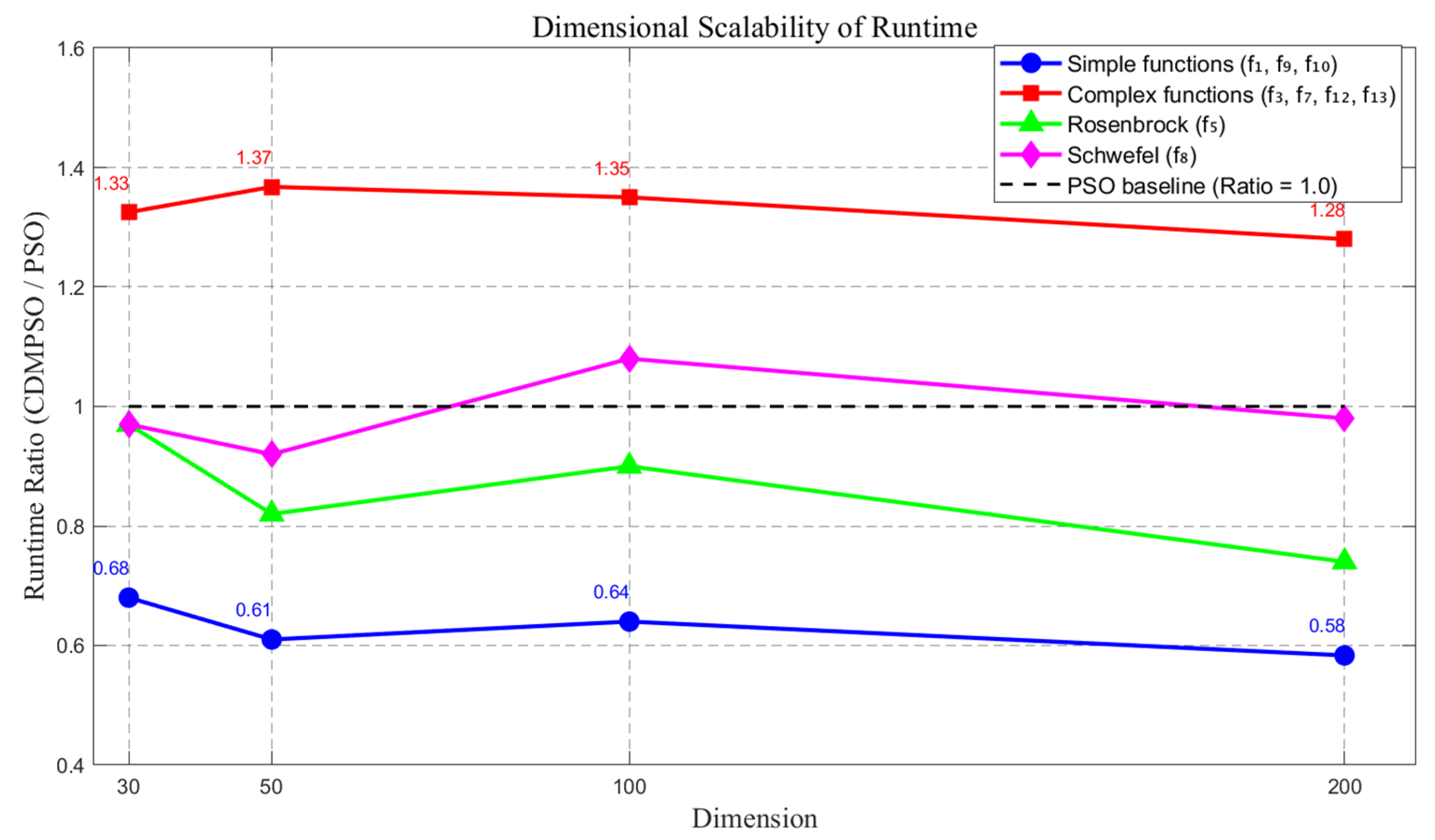
To evaluate how the computational overhead of CDMPSO scales with problem dimensionality, we conducted runtime experiments on nine CEC2005 benchmark functions (f1, f3, f5, f7, f8, f9, f10, f12, f13) at dimensions 30, 50, 100, and 200. Table 16 presents the runtime ratio (CDMPSO/PSO) for each function across all tested dimensions, along with the overall average ratio (All column).
Based on the results, the functions can be categorized into three groups for better visualization: simple functions (f1, f9, f10), complex functions (f3, f7, f12, f13), and two representative functions (f5 and f8) analyzed individually. Figure 10 illustrates the runtime ratio across dimensions for these function groups, where the dashed line at ratio = 1.0 indicates equal runtime between the two algorithms.
Table 16 and Figure 10 illustrate the runtime ratio between CDMPSO and standard PSO across dimensions 30 to 200 for different function types. Several observations can be made. First, on simple functions (f1, f9, f10), CDMPSO consistently achieves lower runtime than PSO, with ratios ranging from 0.55× to 0.78×. This is because CDMPSO’s chaotic initialization and adaptive inertia weight enable faster convergence in simple landscapes. Second, on complex functions (f3, f7, f12, f13), CDMPSO exhibits a moderate overhead of approximately 1.2–1.4×, which is acceptable given the substantial improvements in solution quality. Third, the runtime ratio remains stable across dimensions, with the overall average ratio across all nine functions ranging from 1.03× to 1.28×. Notably, at 200 dimensions, the ratio drops to nearly 1.0×, indicating that the additional mechanisms of CDMPSO do not incur significant extra cost as problem dimensionality increases. These results confirm that the performance gains of CDMPSO justify its moderate computational overhead across all practical dimensions (30–200).

5.7. Application in a Real-World Problem

To further validate the practical applicability of CDMPSO, we apply it to a wireless sensor network (WSN) coverage optimization problem. The goal is to maximize the coverage rate of a 100 m × 100 m square area by deploying 30 sensor nodes, each with a sensing radius of 15 m. This is a 60-dimensional optimization problem (30 nodes × 2 coordinates). The coverage rate is calculated using a 50 × 50 grid discretization, and the objective is to minimize the uncovered rate.
The experiment compares CDMPSO with four other PSO variants (standard PSO, CPSO, ACPSO, and HPSOALS) over 20 independent runs, with a population size of 50 and 500 iterations. Table 17 presents the coverage rates achieved by each algorithm.
As shown in Table 17, CDMPSO achieves the best overall performance. It is the only algorithm that attains 100% average coverage across all 20 runs, significantly outperforming PSO (99.85%), ACPSO (99.84%), CPSO (97.60%), and HPSOALS (79.61%). Moreover, CDMPSO exhibits the smallest standard deviation (8.94 × 10⁻⁵), demonstrating excellent stability and robustness.
Figure 11 visualizes the optimal sensor deployment obtained by CDMPSO, where the red dots represent sensor positions, the blue circles indicate sensing ranges, and the black square denotes the area boundary. The entire 100 m × 100 m area is fully covered, with sensors strategically placed to avoid both excessive overlap and uncovered gaps. This result confirms that CDMPSO is highly effective for high-dimensional, real-world engineering optimization problems. Figure 12 shows the convergence curves of all compared algorithms on the WSN coverage problem. CDMPSO converges faster and achieves a significantly lower uncovered rate than the other algorithms, demonstrating its superior convergence capability.


6. Conclusions

This article proposes a particle swarm optimization algorithm (CDMPSO) based on cubic chaotic mapping and random differential mutation. Through the synergistic effect of four strategies—cubic chaotic mapping with reverse learning initialization, adaptive inertia weight, convex lens imaging reverse learning, and random differential mutation. CDMPSO effectively improves global search ability, convergence accuracy, and robustness. Ablation experiments on CEC2005 benchmark functions validate the contribution of each strategy, with adaptive weight being the most significant. Comparative experiments on both CEC2005 and CEC2017 benchmark suites demonstrate that CDMPSO outperforms standard PSO, CPSO, ACPSO, and HPSOALS, achieving average ranks of 1.00 and 1.41, respectively. Statistical tests confirm the significance of these results. Runtime analysis shows that CDMPSO incurs a moderate computational overhead of approximately 1.2× compared to standard PSO, which is justified by the substantial improvements in solution quality. Dimension scalability analysis confirms the applicability of the algorithm to high-dimensional problems, and the key novelty lies in the synergistic integration of the four complementary strategies.
Despite its promising performance, CDMPSO has several limitations. First, the algorithm introduces additional parameters (τ1, τ2, p l o b l , p d i f f ) that require tuning, although sensitivity analysis shows robustness within reasonable ranges. Second, while CDMPSO demonstrates excellent scalability up to 200 dimensions, its performance on extremely high-dimensional problems has not been systematically evaluated. Third, the current framework has not been extensively tested on noisy fitness landscapes; further validation on a wider range of noisy problems is needed.
Future work will focus on exploring the application of CDMPSO to practical problems such as engineering optimization, multi-objective optimization, and dynamic optimization. Specifically, several directions will be pursued to further enhance CDMPSO. First, a convergence-based trigger mechanism will be introduced for the CLII strategy, activating perturbations only when the population diversity is low and the global best has stagnated, to reduce unnecessary interference near the optimum. Second, constraint-handling techniques—including feasibility-based selection, constraint-aware mutation, CLII projection, and adaptive penalty functions—will be incorporated to extend CDMPSO to real-world engineering problems with strict nonlinear constraints. Third, beyond constrained optimization, CDMPSO will be extended to dynamic optimization, multi-objective optimization, and large-scale engineering problems. Fourth, a formal convergence analysis, including Markov chain properties and sufficient conditions for convergence, will be pursued in future work to strengthen the theoretical foundation of CDMPSO.

Author Contributions

Conceptualization, X.L.; methodology, X.L.; software, X.L.; validation, X.L. and Y.G.; formal analysis, X.L.; resources, Y.G.; data curation, X.L.; writing—original draft preparation, X.L.; writing—review and editing, Y.G.; visualization, X.L.; supervision, Y.G.; project administration, Y.G.; All authors have read and agreed to the published version of the manuscript.

Funding

This research received no external funding.

Data Availability Statement

The data that support the findings of this study are available on request from the corresponding author at guoying@bupt.edu.cn, subject to reasonable request.

Conflicts of Interest

The authors declare no conflict of interest.

Appendix A

Sphere function (f1)
f 1 ( x ) = i = 1 n x i 2         x [ 100 , 100 ] n             f min = 0
Schwefel 1.2 function (f3)
f 3 ( x ) = i = 1 n j = 1 i x j 2         x [ 100 , 100 ] n               f min = 0
Rosenbrock function (f5)
f 5 ( x ) = i = 1 n 1 [ 100 x i + 1 x i 2 2 + x i 1 2 ]           x [ 30 , 30 ] n               f min = 0
Quartic with Noise function(f7)
f 7 ( x ) = i = 1 n i x i 4 + r a n d o m [ 0 , 1 )             x [ 1.28 , 1.28 ] n             f min = 0
Schwefel function (f8)
f 8 ( x ) = i = 1 n [ x i sin ( | x i | ) ]           x [ 500 , 500 ] n             f min = 418.9829 × n
Rastrigin function (f9)
f 9 ( x ) = i = 1 n x i 2 10 cos 2 π x i + 10           x [ 5.12 , 5.12 ] n             f min = 0
Ackley function (f10)
f 10 = 20 exp 0.2 1 n i = 1 n x i 2 exp 1 n i = 1 n cos ( 2 π x i ) + 20 + e
x [ 32 , 32 ] n             f min = 0
Penalized 1 function(f12)
f 12 ( x ) = π n { 10 sin ( π y 1 ) + i = 1 n 1 ( y i 1 ) 2 [ 1 + 10 sin 2 ( π y i + 1 ) ] + ( y n 1 ) 2 } + i = 1 n u ( x i , 10 , 100 , 4 )
y i = 1 + x i + 1 4
u ( x i , a , k , m ) = k ( x i a ) m x i > a 0 a < x i < a k ( x i a ) m x i < a
x [ 50 , 50 ] n                   f min = 0
Penalized 2 function (f13)
f 13 ( x ) = 0.1 sin 2 3 π x 1 + i = 1 n 1 x i 1 2 1 + sin 2 3 π x i + 1 + x n 1 2 1 + sin 2 2 π x n + i = 1 n μ x i , 5 , 100 , 4
x [ 50 , 50 ] n                   f min = 0

References

  1. Karmarkar, N. A new polynomial-time algorithm for linear programming. Combinatorica 1984, 4, 373–395. [Google Scholar] [CrossRef]
  2. Nocedal, J.; Wright, S.J. Numerical Optimization, 2nd ed.; Springer: New York, NY, USA, 2006. [Google Scholar] [CrossRef]
  3. Bertsekas, D.P. Dynamic Programming and Optimal Control, 4th ed.; Athena Scientific: Belmont, MA, USA, 2017; Volume 1. [Google Scholar]
  4. Holland, J. Genetic algorithms. Sci. Am. 1992, 267, 66–73. [Google Scholar] [CrossRef]
  5. Steinbrunn, M.; Moerkotte, G.; Kemper, A. Heuristic and randomized optimization for the join ordering problem. VLDB J. 1997, 6, 191–208. [Google Scholar] [CrossRef]
  6. Dorigo, M.; Maniezzo, V.; Colorni, A. Ant system: Optimization by a colony of cooperating agents. IEEE Trans. Syst. Man Cybern. B 1996, 26, 29–41. [Google Scholar] [CrossRef] [PubMed]
  7. Kennedy, J.; Eberhart, R. Particle swarm optimization. In Proceedings of the International Conference on Neural Networks, Perth, WA, Australia, 27 November–1 December 1995; pp. 1942–1948. [Google Scholar] [CrossRef]
  8. Yousri, D.; Allam, D.; Eteiba, M.; Suganthan, P. Static and dynamic photovoltaic models’ parameters identification using chaotic heterogeneous comprehensive learning particle swarm optimizer variants. Energy Convers. Manag. 2019, 182, 546–563. [Google Scholar] [CrossRef]
  9. Suresh, S.; Lal, S. Multilevel thresholding based on chaotic Darwinian particle swarm optimization for segmentation of satellite images. Appl. Soft Comput. 2017, 55, 503–522. [Google Scholar] [CrossRef]
  10. Nguyen, H.; Xue, B.; Liu, I.; Andreae, P.; Zhang, M. New mechanism for archive maintenance in PSO-based multi-objective feature selection. Soft Comput. 2016, 20, 3927–3946. [Google Scholar] [CrossRef]
  11. Javidi, M. Feature selection schema based on game theory and biology migration algorithm for regression problems. Int. J. Mach. Learn. Cybern. 2021, 12, 303–342. [Google Scholar] [CrossRef]
  12. Sanchez, D.; Melin, P.; Castillo, O. Comparison of particle swarm optimization variants with fuzzy dynamic parameter adaptation for modular granular neural networks for human recognition. J. Intell. Fuzzy Syst. 2020, 38, 3229–3252. [Google Scholar] [CrossRef]
  13. Liu, B.; Wang, L.; Jin, Y.H.; Tang, F.; Huang, D.X. Improved particle swarm optimization combined with chaos. Chaos Solitons Fractals 2005, 25, 1261–1271. [Google Scholar] [CrossRef]
  14. Wang, H.; Li, Y.; Zhang, L. Opposition-based chaotic initialization for enhancing metaheuristic population diversity. Sci. Rep. 2025, 15, 22718. [Google Scholar] [CrossRef]
  15. Zhang, E.; Zhao, Z.; Wei, J.; Ge, R.; Jiang, C. An multimodal multi-objective particle swarm optimization algorithm based on ring topology and dynamic neighborhood. J. Yangzhou Univ. (Nat. Sci. Ed.) 2023, 26, 19–24. [Google Scholar]
  16. Alba, E.; Garcia-Nieto, J.; Jourdan, L.; Talbi, E.-G. Gene selection in cancer classification using PSO/SVM and GA/SVM hybrid algorithms. In Proceedings of the 2007 IEEE Congress on Evolutionary Computation, Singapore, 25–28 September 2007; pp. 284–290. [Google Scholar] [CrossRef]
  17. Li, H.; He, H.; Wen, Y. Dynamic particle swarm optimization and k-means clustering algorithm for image segmentation. Optik 2015, 126, 4817–4822. [Google Scholar] [CrossRef]
  18. Chauhan, D.; Bala, A.; Mitchell, L. Orthogonally initiated particle swarm optimization with advanced mutation for real-parameter optimization. arXiv 2024, arXiv:2405.12542. [Google Scholar] [CrossRef]
  19. Ratnaweera, A.; Halgamuge, S.K.; Watson, H.C. Self-organizing hierarchical particle swarm optimizer with time-varying acceleration coefficients. IEEE Trans. Evol. Comput. 2004, 8, 240–255. [Google Scholar] [CrossRef]
  20. Xia, X.; Yu, G.; Cui, Q.; Zeng, X. Particle swarm optimization based on dimensional learning strategy. Swarm Evol. Comput. 2019, 46, 38–55. [Google Scholar] [CrossRef]
  21. Chen, K.; Xue, B.; Zhang, M.; Zhou, F. Novel chaotic grouping particle swarm optimization with a dynamic regrouping strategy for solving numerical optimization tasks. Knowl.-Based Syst. 2020, 194, 105568. [Google Scholar] [CrossRef]
  22. Wang, L.; Tian, D.; Gou, X.; Shi, Z. Hybrid particle swarm optimization with adaptive learning strategy. Soft Comput. 2024, 28, 9759–9784. [Google Scholar] [CrossRef]
  23. Deshpande, A.M.; Phatnani, G.M.; Kulkarni, A.J. Constraint handling in Firefly Algorithm. In Proceedings of the 2013 IEEE International Conference on Cybernetics (CYBCO), Lausanne, Switzerland, 13–15 June 2013; pp. 186–190. [Google Scholar] [CrossRef]
  24. Tian, D.; Shi, Z. MPSO: Modified particle swarm optimization and its applications. Swarm Evol. Comput. 2018, 41, 49–68. [Google Scholar] [CrossRef]
  25. Latiff, I.; Tokhi, M. Fast convergence strategy for particle swarm optimization using spread factor. In Proceedings of the IEEE Congress on Evolutionary Computation, Trondheim, Norway, 18–21 May 2009; pp. 2693–2700. [Google Scholar] [CrossRef]
  26. Chen, K.; Zhou, F.; Wang, Y.; Yin, L. An ameliorated particle swarm optimizer for solving numerical optimization problems. Appl. Soft Comput. 2018, 73, 482–496. [Google Scholar] [CrossRef]
  27. Yang, J.; Zou, J.; Yang, S.; Hu, Y.; Zheng, J.; Liu, Y. A particle swarm algorithm based on the dual search strategy for dynamic multi-objective optimization. Swarm Evol. Comput. 2023, 83, 101385. [Google Scholar] [CrossRef]
  28. Liu, H.; Zhang, X.; Tu, L. A modified particle swarm optimization using adaptive strategy. Expert Syst. Appl. 2020, 152, 113353. [Google Scholar] [CrossRef]
  29. Wang, Y.; Wang, Z.; Wang, G. Hierarchical learning particle swarm optimization using fuzzy logic. Expert Syst. Appl. 2023, 232, 120759. [Google Scholar] [CrossRef]
  30. Tian, D.; Zhao, T. Particle swarm optimization based on Tent map and Logistic map. J. Shaanxi Univ. Sci. Technol. 2010, 28, 17–23. [Google Scholar]
  31. Gao, W.; Liu, S.; Huang, L. Particle swarm optimization with chaotic opposition-based population initialization and stochastic search technique. Commun. Nonlinear Sci. Numer. Simul. 2012, 17, 4316–4327. [Google Scholar] [CrossRef]
  32. Shi, Y.; Eberhart, R.C. Empirical study of particle swarm optimization. In Proceedings of the IEEE Congress on Evolutionary Computation, Washington, DC, USA, 6–9 July 1999; IEEE: Piscataway, NJ, USA, 2002; Volume 3, pp. 1945–1950. [Google Scholar] [CrossRef]
  33. Tuppadung, Y.; Kurutach, W. Comparing nonlinear inertia weights and constriction factors in particle swarm optimization. Int. J. Knowl.-Based Intell. Eng. Syst. 2011, 15, 65–70. [Google Scholar] [CrossRef]
  34. Zhao, Z.; Cheng, C. Adaptive chaos particle swarm optimization algorithm. Comput. Eng. 2011, 37, 128–130. [Google Scholar]
  35. Long, W.; Jiao, J.; Xu, M.; Tang, M.; Wu, T.; Cai, S. Lens-imaging learning Harris hawks optimizer for global optimization and its application to feature selection. Expert Syst. Appl. 2022, 202, 117255. [Google Scholar] [CrossRef]
  36. Cutello, V.; Nicosia, G.; Pavone, M.; Stracquadanio, G. Entropic divergence for population based optimization algorithms. In Proceedings of the 2010 IEEE Congress of Evolutionary Computation, Barcelona, Spain, 18–23 July 2010; pp. 1–8. [Google Scholar] [CrossRef]
  37. Li, Y.; Sun, K.; Yao, Q.; Wang, L. A dual-optimization wind speed forecasting model based on deep learning and improved dung beetle optimization algorithm. Energy 2024, 286, 129604. [Google Scholar] [CrossRef]
  38. Eberhart, R.; Shi, Y. Comparing inertia weights and constriction factors in particle swarm optimization. In Proceedings of the Congress on Evolutionary Computation, La Jolla, CA, USA, 16–19 July 2000; pp. 84–88. [Google Scholar]
  39. IEEE 754-2019; IEEE Standard for Floating-Point Arithmetic. IEEE Computer Society: New York, NY, USA, 2019.
Figure 1. CDMPSO algorithm flowchart.
Algorithms 19 00297 g001
Figure 2. Visualization of unimodal functions. (a) f1 Sphere; (b) f3 Schwefel 1.2. The color bar indicates the fitness value (warmer colors represent higher values, cooler colors represent lower values).
Algorithms 19 00297 g002
Figure 3. Visualization of multimodal functions. (a) f8 Schwefel; (b) f9 Rastrigin; (c) f10 Ackley; (d) f12 Penalized 1; (e) f13 Penalized 2. The color bar indicates the fitness value.
Algorithms 19 00297 g003
Figure 4. Visualization of special characteristic functions. (a) f5 Rosenbrock; (b) f7 Quartic with Noise. The color bar indicates the fitness value.
Algorithms 19 00297 g004
Figure 5. Comparison results of algorithm convergence accuracy.
Algorithms 19 00297 g005
Figure 6. Dimensional performance comparison of the f1 function.
Algorithms 19 00297 g006
Figure 7. Convergence curves of 6 representative functions at 30D. (a) f1; (b) f5; (c) f8; (d) f9; (e) f10; (f) f13.
Algorithms 19 00297 g007
Figure 8. Convergence curves of six representative functions at 50D. (a) f1; (b) f5; (c) f8; (d) f9; (e) f10; (f) f13.
Algorithms 19 00297 g008
Figure 9. Stability analysis of CDMPSO on six representative functions. (a) f1; (b) f5; (c) f8; (d) f9; (e) f10; (f) f13.
Algorithms 19 00297 g009
Figure 10. Runtime ratio (CDMPSO/PSO) across different dimensions on nine CEC2005 functions. The dashed line at Ratio = 1.0 indicates equal runtime between the two algorithms.
Algorithms 19 00297 g010
Figure 11. Optimal WSN deployment obtained by CDMPSO (coverage = 100%).
Algorithms 19 00297 g011
Figure 12. Convergence curves on WSN coverage optimization.
Algorithms 19 00297 g012
Table 1. Sensitivity analysis of τ1 on CEC2017 functions (F1–F15).
Fucτ1 = 10τ1 = 15τ1 = 20τ1 = 25τ1 = 30τ1 = 35τ1 = 40
f11.603 × 1061.027 × 1083.584 × 1031.027 × 1082.213 × 1034.404 × 1035.498 × 103
f31.971 × 1042.083 × 1041.906 × 1041.809 × 1041.957 × 1041.949 × 1042.192 × 104
f45.073 × 1024.882 × 1025.036 × 1025.072 × 1024.935 × 1024.883 × 1025.087 × 102
f56.574 × 1026.877 × 1026.661 × 1026.809 × 1026.915 × 1026.954 × 1026.877 × 102
f66.390 × 1026.385 × 1026.454 × 1026.428 × 1026.436 × 1026.418 × 1026.445 × 102
f79.054 × 1028.365 × 1028.359 × 1028.434 × 1028.580 × 1028.523 × 1028.525 × 102
f89.356 × 1029.433 × 1029.288 × 1029.379 × 1029.456 × 1029.575 × 1029.491 × 102
f93.576 × 1033.224 × 1034.092 × 1034.057 × 1033.803 × 1033.564 × 1034.392 × 103
f105.042 × 1035.091 × 1034.702 × 1034.983 × 1034.815 × 1035.267 × 1035.203 × 103
f111.232 × 1031.210 × 1031.210 × 1031.218 × 1031.201 × 1031.193 × 1031.199 × 103
f122.616 × 1063.752 × 1061.083 × 1068.709 × 1051.115 × 1062.907 × 1061.920 × 106
f134.542 × 1054.486 × 1059.450 × 1031.185 × 1044.600 × 1051.709 × 1049.920 × 103
f145.259 × 1042.098 × 1043.001 × 1041.070 × 1043.118 × 1042.984 × 1041.975 × 104
f154.476 × 1037.434 × 1035.423 × 1035.976 × 1031.100 × 1046.171 × 1036.133 × 103
Note: Bold values indicate the best result in each row.
Table 2. Sensitivity analysis of τ2 on CEC2017 functions (F1–F15).
Fucτ2 = 40τ2 = 45τ2 = 50τ2 = 55τ2 = 60τ2 = 65τ2 = 70
f15.275 × 1073.947 × 1074.218 × 1035.275 × 1076.846 × 1078.009 × 1072.889 × 103
f32.027 × 1041.977 × 1041.991 × 1041.890 × 1042.207 × 1042.011 × 1041.974 × 104
f45.198 × 1025.019 × 1025.035 × 1025.172 × 1025.037 × 1025.098 × 1025.194 × 102
f56.841 × 1026.665 × 1026.770 × 1026.809 × 1026.851 × 1026.834 × 1026.830 × 102
f66.424 × 1026.414 × 1026.377 × 1026.416 × 1026.436 × 1026.457 × 1026.397 × 102
f78.484 × 1028.562 × 1028.382 × 1028.296 × 1028.449 × 1028.344 × 1028.358 × 102
f89.321 × 1029.327 × 1029.410 × 1029.292 × 1029.450 × 1029.400 × 1029.451 × 102
f94.703 × 1034.021 × 1033.393 × 1034.452 × 1034.160 × 1034.047 × 1033.573 × 103
f105.075 × 1034.823 × 1035.025 × 1034.833 × 1035.307 × 1034.865 × 1035.098 × 103
f111.203 × 1031.204 × 1031.208 × 1031.201 × 1031.199 × 1031.219 × 1031.216 × 103
f121.554 × 1067.898 × 1068.160 × 1051.402 × 1069.120 × 1051.354 × 1061.115 × 106
f131.115 × 1047.140 × 1037.549 × 1031.176 × 1042.401 × 1062.399 × 1061.371 × 104
f141.919 × 1042.095 × 1042.678 × 1041.737 × 1042.625 × 1042.614 × 1042.357 × 104
f154.690 × 1037.915 × 1035.869 × 1035.904 × 1036.989 × 1035.211 × 1037.277 × 103
Note: Bold values indicate the best result in each row.
Table 3. Grouping settings of test functions.
GroupFunctionFunction NameSearch SpaceOptimal ValueCharacteristics
Unimodal FunctionsF1Sphere [ 100 , 100 ] n 0Simplest unimodal function
F3Schwefel 1.2 [ 100 , 100 ] n 0Interdependency among dimensions
Multimodal FunctionsF8Schwefel [ 500 , 500 ] n −418.98 × nGlobal optimum located at the boundary
F9Rastrigin [ 5.12 , 5.12 ] n 0Numerous local optima
F10Ackley [ 32 , 32 ] n 0Numerous local optima
F12Penalized 1 [ 50 , 50 ] n 0Dense local optima, includes penalty term
F13Penalized 2 [ 50 , 50 ] n 0Dense local optima, includes penalty term
Special Characteristic FunctionF5Rosenbrock [ 30 , 30 ] n 0Banana function, narrow valley, strong variable coupling
F7Quartic with Noise [ 1.28 , 1.28 ] n 0Includes noise, tests robustness
Table 4. CEC2017 benchmark functions.
GroupFunctionFunction NameSearch SpaceOptimal Value
UnimodalF1Shifted and Rotated Bent Cigar[−100, 100]n100
F3Shifted and Rotated Zakharov[−100, 100]n300
MultimodalF4Shifted and Rotated Rosenbrock[−100, 100]n400
F5Shifted and Rotated Rastrigin[−100, 100]n500
F6Shifted and Rotated Expanded Schaffer[−100, 100]n600
F7Shifted and Rotated Lunacek Bi-Rastrigin[−100, 100]n700
F8Shifted and Rotated Non-Continuous Rastrigin[−100, 100]n800
F9Shifted and Rotated Levy[−100, 100]n900
F10Shifted and Rotated Schwefel[−100, 100]n1000
HybridF11Hybrid Function 1 (N = 3)[−100, 100]n1100
F12Hybrid Function 2 (N = 3)[−100, 100]n1200
F13Hybrid Function 3 (N = 3)[−100, 100]n1300
F14Hybrid Function 4 (N = 4)[−100, 100]n1400
F15Hybrid Function 5 (N = 4)[−100, 100]n1500
F16Hybrid Function 6 (N = 4)[−100, 100]n1600
F17Hybrid Function 6 (N = 5)[−100, 100]n1700
F18Hybrid Function 6 (N = 5)[−100, 100]n1800
F19Hybrid Function 6 (N = 5)[−100, 100]n1900
F20Hybrid Function 6 (N = 6)[−100, 100]n2000
CompositionF21Composition Function 1 (N = 3)[−100, 100]n2100
F22Composition Function 2 (N = 3)[−100, 100]n2200
F23Composition Function 3 (N = 4)[−100, 100]n2300
F24Composition Function 4 (N = 4)[−100, 100]n2400
F25Composition Function 5 (N = 5)[−100, 100]n2500
F26Composition Function 6 (N = 5)[−100, 100]n2600
F27Composition Function 7 (N = 6)[−100, 100]n2700
F28Composition Function 8 (N = 6)[−100, 100]n2800
F29Composition Function 9 (N = 3)[−100, 100]n2900
F30Composition Function 10 (N = 3)[−100, 100]n3000
Table 5. Parameter settings for ablation experiment.
Parameter NameSymbolValue
Population Size N 50
Maximum Number of Iterations T m a x 1000
Number of Runs R u n s 30
Space Dimension d i m 50
Table 6. Ablation experiment results of the unimodal function group (D = 50).
FucMetricCDMPSO-ACDMPSO-BCDMPSO-CCDMPSO-DCDMPSO-Full
f1Mean6.37 × 10−2067.18 × 10−564.12 × 10−1016.93 × 10−2107.07 × 10−248
Std0.002.77 × 10−551.08 × 10−1000.000.00
Rank35421
f3Mean0.001.39 × 10−475.23 × 10−542.03 × 10−2083.14 × 10−298
Std0.003.02 × 10−472.86 × 10−530.000.00
Rank15432
AR 2.05.04.02.51.5
FR 25431
Table 7. Ablation experiment results of the multimodal function group (D = 50).
FucMetricCDMPSO-ACDMPSO-BCDMPSO-CCDMPSO-DCDMPSO-Full
f8Mean−1.15 × 10⁴−2.09 × 10⁴−2.08 × 10⁴−2.03 × 10⁴−2.09 × 10⁴
Std2.47 × 1031.10 × 1025.59 × 1015.24 × 1029.97 × 101
Rank51341
f9Mean0.000.000.000.000.00
Std0.000.000.000.000.00
Rank11111
f10Mean4.44 × 10−164.44 × 10−164.44 × 10−164.44 × 10−164.44 × 10⁻¹⁶
Std0.000.000.000.000.00
Rank11111
f12Mean2.07 × 10−39.08 × 10−38.29 × 10−31.66 × 10−21.45 × 10−2
Std1.14 × 10−22.16 × 10−22.15 × 10−23.24 × 10−23.13 × 10−2
Rank13254
f13Mean3.30 × 10−33.19 × 10−24.76 × 10−35.13 × 10−32.93 × 10−3
Std5.12 × 10−31.31 × 10−21.06 × 10−25.58 × 10−34.94 × 10−3
Rank25341
AR 2.02.22.03.01.6
FR 23241
Table 8. Ablation experiment results of the special features function group (D = 50).
FucMetricCDMPSO-ACDMPSO-BCDMPSO-CCDMPSO-DCDMPSO-Full
f5Mean4.44 × 1014.74 × 1014.41 × 1014.52 × 1014.45 × 101
Std1.94 × 10−15.67 × 10−11.99 × 10−11.85 × 10−12.25 × 10−1
Rank25143
f7Mean7.68 × 10−51.53 × 10−44.52 × 10−45.79 × 10−54.53 × 10−5
Std7.04 × 10−51.04 × 10−43.67 × 10−45.45 × 10−54.64 × 10−5
Rank34521
AR 2.54.53.03.02.0
FR 25331
Table 9. Parameter comparison of five PSO variants.
AlgorithmsParameter Settings
PSOω = 0.9, c 1 = 1.2 , c 2 = 1.2, V m a x = ( u b l b ) × 0.15
HPSOALSω ∈ [0.4, 0.9], c 1 = 1.5, c 2 = 1.5, c 3 = 1.5, V m a x = 10, V m i n = −10, x ∈ [−100, 100]
CPSO c 1 = 2.0, c 2 = 2.0, ϕ = c 1 + c 2 = 4, λ = 1.0, V ∈ [1, −1]
CDMPSOω ∈ [0.4, 0.9], c 1 = 2.0, c 2 = 2.0, plobl = 0.3, klobl_base = 1.0, pdiff = 0.2, V ∈ [1, −1]
ACPSOω ∈ [0.4, 0.95], c 1 = 2.0, c 2 = 2.0, Vmax = 1, Vmin = −1, x ∈ [ l b , u b ]
Table 10. Comparison results (D = 30).
FucMetricPSOCPSOACPSOHPSOALSCDMPSO
f1Mean3.81 × 1013.331.19 × 10−12.75 × 1031.57 × 10−84
Std1.93 × 1014.10 × 10−13.68 × 10−21.20 × 1038.60 × 10−84
Rank43251
f3Mean2.56 × 1031.08 × 1017.771.79 × 1045.34 × 10−68
Std6.81 × 1021.712.606.89 × 1032.88 × 10−67
Rank43251
f5Mean8.21 × 1034.90 × 1021.59 × 1023.66 × 1072.69 × 101
Std2.28 × 1041.14 × 1021.55 × 1022.75 × 1071.87 × 10−1
Rank43251
f7Mean7.51 × 10−21.44 × 1018.178.02 × 1051.83 × 10−4
Std2.41 × 10−24.031.22 × 1016.70 × 1051.72 × 10−4
Rank24351
f8Mean−1.18 × 10⁴−8.62 × 10³−7.82 × 10³−2.10 × 10³−2.09 × 10⁴
Std8.06 × 1022.04 × 1033.53 × 1031.17 × 1021.02 × 102
Rank23451
f9Mean7.39 × 1011.90 × 1027.64 × 1013.46 × 1030.00
Std1.78 × 1011.14 × 1011.57 × 1011.09 × 1030.00
Rank24351
f10Mean3.272.882.372.634.44 × 10−16
Std6.15 × 10−11.08 × 10−15.01 × 10−19.77 × 10−20.00
Rank54231
f12Mean2.121.531.534.18 × 1035.11 × 10−7
Std1.271.508.95 × 10−11.11 × 1046.44 × 10−7
Rank42351
f13Mean1.43 × 1015.24 × 10−18.34 × 10−21.22 × 1072.96 × 10−3
Std6.948.06 × 10−24.01 × 10−21.67 × 1074.93 × 10−3
Rank43251
AR 3.443.222.564.781.00
FR 43251
Table 11. Comparison results (D = 50).
FucMetricPSOCPSOACPSOHPSOALSCDMPSO
f1Mean4.39 × 1029.637.49 × 10−19.22 × 1033.83 × 10−81
Std1.50 × 1021.061.56 × 10−12.25 × 1032.10 × 10−80
Rank43251
f3Mean1.85 × 1041.43 × 1021.56 × 1021.05 × 1051.98 × 10−65
Std6.15 × 1033.00 × 1013.87 × 1015.73 × 1041.09 × 10−64
Rank42351
f5Mean5.10 × 1041.51 × 1034.93 × 1022.78 × 1084.75 × 101
Std3.06 × 1043.94 × 1023.27 × 1021.53 × 1086.02 × 10−1
Rank43251
f7Mean3.66 × 10−11.20 × 1024.38 × 1017.49 × 1062.49 × 10−4
Std1.02 × 10−12.38 × 1015.56 × 1014.65 × 1061.91 × 10−4
Rank24351
f8Mean−1.19 × 10⁴−8.56 × 10³−8.36 × 10³−2.12 × 10³−2.08 × 10⁴
Std9.66 × 1021.46 × 1033.45 × 1031.48 × 1021.11 × 102
Rank23451
f9Mean1.97 × 1023.78 × 1022.18 × 1021.06 × 1030.00
Std3.33 × 1011.89 × 1012.41 × 1012.60 × 1030.00
Rank24351
f10Mean5.693.313.262.06 × 1014.44 × 10−16
Std6.60 × 10−18.32 × 10−24.20 × 10−19.71 × 10−20.00
Rank43251
f12Mean1.73 × 1012.742.832.11 × 1051.67 × 10−2
Std6.321.371.023.96 × 1053.24 × 10−2
Rank42351
f13Mean2.60 × 1031.465.77 × 10−11.31 × 1087.41 ×10−3
Std2.97 × 1039.92 × 10−23.70 × 10−18.35 × 1079.39 ×10−3
Rank43251
AR 3.443.002.675.001.00
FR 43251
Table 12. Comparison of algorithm dimensionality scalability (based on average ranking).
Algorithm30D Avg AR50D Avg ARAR ChangeScalability Evaluation
PSO3.443.440Stable but Poor
CPSO3.223.00↓ 0.22Slightly Improved
ACPSO2.562.67↑ 0.11Slightly Declined
HPSOALS4.785.00↑ 0.22Worst and Deterioration
CDMPSO1.001.000Perfectly Stable
Note: ↓ indicates a decrease (improvement) in average rank, ↑ indicates an increase (deterioration) in average rank.
Table 13. CEC2017 test function experimental results (D = 30).
FucMetricPSOCPSOACPSOHPSOALSCDMPSO
f1Mean1.26 × 1095.12 × 1092.40 × 1051.43 × 10104.87 × 108
Std1.42 × 1091.53 × 1098.23 × 1045.15 × 1097.17 × 108
Rank34152
f3Mean2.28 × 1043.14 × 1044.48 × 1025.99 × 1041.52 × 104
Std8.47 × 1031.05 × 1049.47 × 1011.48 × 1044.09 × 103
Rank34152
f4Mean6.36 × 1027.19 × 1024.97 × 1022.61 × 1035.41 × 102
Std2.13 × 1021.51 × 1021.96 × 1019.59 × 1029.92 × 101
Rank34152
f5Mean6.83 × 1027.25 × 1026.84 × 1027.20 × 1025.96 × 102
Std2.82 × 1011.27 × 1013.95 × 1013.35 × 1013.02 × 101
Rank25341
f6Mean6.12 × 1026.29 × 1026.49 × 1026.52 × 1026.05 × 102
Std6.604.796.645.507.18
Rank23451
f7Mean9.58 × 1021.09 × 1031.04 × 1031.09 × 1038.10 × 102
Std2.53 × 1011.72 × 1016.42 × 1016.07 × 1012.47 × 101
Rank24351
f8Mean9.63 × 1021.02 × 1039.31 × 1029.76 × 1028.82 × 102
Std3.20 × 1011.94 × 1012.55 × 1012.56 × 1012.53 × 101
Rank35241
f9Mean1.44 × 1032.50 × 1034.23 × 1034.51 × 1031.19 × 103
Std6.15 × 1023.14 × 1021.00 × 1038.23 × 1024.73 × 102
Rank23451
f10Mean6.53 × 1038.30 × 1035.09 × 1036.03 × 1034.66 × 103
Std8.35 × 1024.05 × 1027.01 × 1026.83 × 1025.81 × 102
Rank45231
f11Mean1.32 × 1031.81 × 1031.24 × 1032.11 × 1031.22 × 103
Std7.90 × 1011.09 × 1024.68 × 1015.75 × 1023.55 × 101
Rank34251
f12Mean1.99 × 1084.10 × 1083.37 × 1061.51 × 1092.88 × 107
Std4.82 × 1081.32 × 1082.31 × 1061.10 × 1097.22 × 107
Rank34152
f13Mean3.02 × 1061.55 × 1082.02 × 1059.80 × 1072.73 × 106
Std1.31 × 1075.82 × 1078.17 × 1051.59 × 1081.31 × 107
Rank35142
f14Mean5.88 × 1041.17 × 1053.06 × 1041.59 × 1051.99 × 104
Std7.27 × 1046.65 × 1045.12 × 1042.67 × 1052.32 × 104
Rank34251
f15Mean9.82 × 1032.34 × 1073.98 × 1043.57 × 1049.92 × 103
Std8.38 × 1038.33 × 1062.43 × 1042.06 × 1041.31 × 104
Rank15432
f16Mean2.60 × 1033.42 × 1033.14 × 1033.55 × 1032.59 × 103
Std2.58 × 1022.35 × 1022.99 × 1023.59 × 1023.22 × 102
Rank24351
f17Mean2.14 × 1032.34 × 1032.31 × 1032.45 × 1032.05 × 103
Std1.91 × 1021.22 × 1022.15 × 1022.29 × 1021.86 × 102
Rank24351
f18Mean1.41 × 1062.33 × 1064.39 × 1051.12 × 1061.89 × 105
Std1.49 × 1061.31 × 1069.62 × 1052.16 × 1061.34 × 105
Rank45231
f19Mean2.22 × 1044.39 × 1071.66 × 1052.00 × 1061.99 × 104
Std2.53 × 1041.73 × 1071.02 × 1053.20 × 1066.70 × 104
Rank25341
f20Mean2.37 × 1032.69 × 1032.71 × 1032.71 × 1032.39 × 103
Std1.47 × 1021.82 × 1022.15 × 1022.13 × 1021.80 × 102
Rank13452
f21Mean2.46 × 1032.52 × 1032.50 × 1032.53 × 1032.39 × 103
Std3.74 × 1011.57 × 1014.78 × 1012.97 × 1017.31 × 101
Rank24351
f22Mean4.89 × 1035.43 × 1036.76 × 1037.28 × 1032.50 × 103
Std2.68 × 1033.26 × 1036.05 × 1021.51 × 1031.58 × 102
Rank23451
f23Mean2.88 × 1032.92 × 1033.29 × 1033.28 × 1032.88 × 103
Std7.30 × 1013.93 × 1011.30 × 1021.15 × 1021.15 × 102
Rank13542
f24Mean3.09 × 1033.07 × 1033.48 × 1033.47 × 1033.27 × 103
Std1.05 × 1024.65 × 1011.27 × 1021.20 × 1021.67 × 102
Rank21543
f25Mean2.94 × 1033.10 × 1032.92 × 1033.30 × 1032.89 × 103
Std3.08 × 1017.53 × 1012.11 × 1011.67 × 1021.22 × 101
Rank34251
f26Mean4.65 × 1035.53 × 1038.40 × 1038.30 × 1033.74 × 103
Std1.04 × 1038.36 × 1026.73 × 1025.92 × 1025.85 × 102
Rank23541
f27Mean3.28 × 1033.28 × 1033.89 × 1033.91 × 1033.28 × 103
Std4.36 × 1014.65 × 1012.54 × 1022.28 × 1023.71 × 101
Rank31452
f28Mean3.35 × 1033.46 × 1033.22 × 1034.45 × 1033.26 × 103
Std1.02 × 1026.63 × 1012.22 × 1014.93 × 1026.20 × 101
Rank34152
f29Mean3.88 × 1034.28 × 1034.63 × 1035.03 × 1033.69 × 103
Std1.81 × 1021.79 × 1023.72 × 1023.71 × 1021.65 × 102
Rank23451
f30Mean1.01 × 1053.67 × 1071.01 × 1062.44 × 1072.44 × 104
Std1.23 × 1051.49 × 1074.59 × 1054.26 × 1073.23 × 104
Rank25341
AR 2.413.832.834.521.41
FR 24351
Note: Bold values indicate the best result in each row.
Table 14. Wilcoxon signed rank test results (CEC2017, D = 30).
FucPSOCPSOACPSOHPSOALS
f1+(1.96 × 10⁻²)+(1.73 × 10⁻⁶)≈(3.82 × 10⁻¹)+(1.73 × 10⁻⁶)
f3+(6.32 × 10⁻⁵)+(1.73 × 10⁻⁶)−(1.73 × 10⁻⁶)+(1.73 × 10⁻⁶)
f4+(3.38 ×10⁻³)+(2.16 × 10⁻⁵)−(4.07 × 10⁻²)+(1.73 × 10⁻⁶)
f5+(2.13 × 10⁻⁶)+(1.73 × 10⁻⁶)+(3.88 × 10⁻⁶)+(1.73 × 10⁻⁶)
f6+(1.48 × 10⁻⁴)+(2.13 × 10⁻⁶)+(1.73 × 10⁻⁶)+(1.73 × 10⁻⁶)
f7+(1.73 × 10⁻⁶)+(1.73 × 10⁻⁶)+(1.73 × 10⁻⁶)+(1.73 × 10⁻⁶)
f8+(2.35 × 10⁻⁶)+(1.73 × 10⁻⁶)+(5.22 × 10⁻⁶)+(1.73 × 10⁻⁶)
f9+(5.67 ×10⁻³)+(2.60 × 10⁻⁶)+(1.73 × 10⁻⁶)+(1.73 × 10⁻⁶)
f10+(1.73 × 10⁻⁶)+(1.73 × 10⁻⁶)+(1.85 × 10⁻²)+(1.73 × 10⁻⁶)
f11+(1.49 × 10⁻⁵)+(1.73 × 10⁻⁶)+(3.68 × 10⁻²)+(1.73 × 10⁻⁶)
f12≈(6.27 × 10⁻²)+(1.73 × 10⁻⁶)≈(7.04 × 10⁻¹)+(1.73 × 10⁻⁶)
f13≈(8.29 × 10⁻¹)+(1.73 × 10⁻⁶)≈(8.29 × 10⁻¹)+(3.88 × 10⁻⁶)
f14+(1.04 × 10⁻²)+(5.75 × 10⁻⁶)≈(4.17 × 10⁻¹)+(3.59 × 10⁻⁴)
f15≈(2.13 × 10⁻¹)+(1.73 × 10⁻⁶)+(6.34 × 10⁻⁶)+(2.60 × 10⁻⁶)
f16≈(9.92 × 10⁻¹)+(1.73 × 10⁻⁶)+(1.64 × 10⁻⁵)+(1.73 × 10⁻⁶)
f17≈(1.25 × 10⁻¹)+(6.98 × 10⁻⁶)+(4.90 × 10⁻⁴)+(5.75 × 10⁻⁶)
f18+(2.13 × 10⁻⁶)+(1.73 × 10⁻⁶)≈(2.29 × 10⁻¹)+(6.32 × 10⁻⁵)
f19+(1.04 × 10⁻²)+(1.73 × 10⁻⁶)+(2.16 × 10⁻⁵)+(2.13 × 10⁻⁶)
f20≈(5.58 × 10⁻¹)+(1.97 × 10⁻⁵)+(4.73 × 10⁻⁶)+(3.88 × 10⁻⁶)
f21+(1.15 × 10⁻⁴)+(2.13 × 10⁻⁶)+(6.34 × 10⁻⁶)+(1.73 × 10⁻⁶)
f22+(1.06 × 10⁻⁴)+(1.73 × 10⁻⁶)+(1.73 × 10⁻⁶)+(1.73 × 10⁻⁶)
f23≈(7.66 × 10⁻¹)+(3.68 × 10⁻²)+(1.73 × 10⁻⁶)+(1.73 × 10⁻⁶)
f24−(4.86 × 10⁻⁵)−(6.34 × 10⁻⁶)+(5.31 × 10⁻⁵)+(1.97 × 10⁻⁵)
f25+(2.35 × 10⁻⁶)+(1.73 × 10⁻⁶)+(1.97 × 10⁻⁵)+(1.73 × 10⁻⁶)
f26+(1.20 ×10⁻³)+(1.73 × 10⁻⁶)+(1.73 × 10⁻⁶)+(1.73 × 10⁻⁶)
f27≈(9.92 × 10⁻¹)≈(7.04 × 10⁻¹)+(1.73 × 10⁻⁶)+(1.73 × 10⁻⁶)
f28+(6.16 × 10⁻⁴)+(1.73 × 10⁻⁶)−(2.11 ×10⁻³)+(1.73 × 10⁻⁶)
f29+(2.26 ×10⁻³)+(1.73 × 10⁻⁶)+(1.73 × 10⁻⁶)+(1.73 × 10⁻⁶)
f30+(1.15 × 10⁻⁴)+(1.73 × 10⁻⁶)+(1.73 × 10⁻⁶)+(1.73 × 10⁻⁶)
+/≈/-20/8/127/1/121/5/329/0/0
Table 15. Average runtime comparison on the CEC2005 benchmark (50D, seconds per run).
FucPSOCPSOACPSOHPSOALSCDMPSO
f1 0.13390.08080.25860.28950.0850
f30.51690.47230.65940.68160.7179
f50.16980.11720.32940.32780.1350
f7 0.39960.36530.55130.56080.4947
f80.19700.15820.38380.36500.1747
f9 0.20130.14790.33560.37280.1072
f10 0.20870.15850.34490.38450.1137
f12 0.81980.76600.97081.01701.0956
f13 0.81090.76310.97630.98551.1096
Mean0.38420.33660.53450.55390.4482
×PSO1.00×0.88×1.39×1.44×1.17×
Table 16. Runtime ratio (CDMPSO/PSO) across different dimensions on nine CEC2005 functions.
Dimensionf1f3f5f7f8f9f10f12f13All
300.78×1.35×0.97×1.27×0.97×0.64×0.62×1.36×1.32×1.19×
500.65×1.34×0.82×1.32×0.92×0.63×0.55×1.36×1.45×1.28×
1000.67×1.39×0.90×1.25×1.08×0.63×0.62×1.39×1.37×1.21×
2000.63×1.31×0.74×1.19×0.98×0.56×0.56×1.27×1.35×1.03×
Table 17. WSN coverage optimization results.
AlgorithmBest CoverageMean CoverageStd
PSO100.00%99.85%1.17 ×10⁻³
CPSO99.12%97.60%6.19 ×10⁻³
ACPSO100.00%99.84%2.59 ×10⁻³
HPSOALS93.40%79.61%7.52 × 10⁻²
CDMPSO100.00%100.00%8.94 × 10⁻⁵
Disclaimer/Publisher’s Note: The statements, opinions and data contained in all publications are solely those of the individual author(s) and contributor(s) and not of MDPI and/or the editor(s). MDPI and/or the editor(s) disclaim responsibility for any injury to people or property resulting from any ideas, methods, instructions or products referred to in the content.