Article

HSMD-YOLO: An Anti-Aliasing Feature-Enhanced Network for High-Speed Microbubble Detection

College of Electronic Engineering, Naval University of Engineering, Wuhan 430033, China
*
Author to whom correspondence should be addressed.
Algorithms 2026, 19(3), 234; https://doi.org/10.3390/a19030234
Submission received: 6 February 2026 / Revised: 13 March 2026 / Accepted: 16 March 2026 / Published: 20 March 2026
(This article belongs to the Section Evolutionary Algorithms and Machine Learning)

Abstract

Underwater micro-bubble detection entails multiple challenges, including diminutive target sizes, sparse pixel information, pronounced specular highlights and water scattering, indistinct bubble boundaries, and adhesion or overlap between instances. To address these issues, we propose HSMD-YOLO, an improved detector tailored for high-resolution micro-bubble detection and built upon YOLOv11. The model incorporates three novel components: the Scale Switch Block (SSB), a scale-transformation module that suppresses artifacts and background noise, thereby stabilizing edges in thin-walled bubble regions and enhancing sensitivity to geometric contours; the Global Local Refine Block (GLRB), which achieves efficient global relationship modeling with an asymptotic linear complexity ( O ( N ) ) in spatial dimensions while further refining local features, thereby strengthening boundary perception and improving bubble–background separability; and the Bidirectional Exponential Moving Attention Fusion (BEMAF), which accommodates the multi-scale nature of bubbles by employing a parallel multi-kernel architecture to extract spatial features across scales, coupled with a multi-stage EMA based attention mechanism to enhance detection robustness under weak boundaries and complex backgrounds. Experiments conducted on an Side-Illuminated Light Field Bubble Database (SILB-DB) and a public gas–liquid two-phase flow dataset (GTFD) demonstrate that HSMD-YOLO achieves mAP@50 scores of 0.911 and 0.854, respectively, surpassing mainstream detection methods. Ablation studies indicate that SSB, GLRB, and BEMAF contribute performance gains of 1.3%, 2.0%, and 0.4%, respectively, thereby corroborating the effectiveness of each module for micro-scale object detection.

1. Introduction

During navigation, propeller cavitation, air entrainment along the wetted hull, and wave breaking generate a long-lived trailing wake [1]. The dense bubble clusters within this wake persist and delineate the vessel’s track [2]. Accordingly, detecting and tracking wake-bubble image signatures enables inference of key attributes such as heading, draft, and speed [3]. Single-stage detectors like YOLO are widely used in computer vision [4,5], offering a digital image–based approach for real-time surface-ship tracking and guidance. Despite the substantial advances achieved by the general-purpose YOLO family in object detection on natural images [6], direct transfer to bubble-imaging scenarios remains hindered by three fundamental challenges.
Multi-scale representation and anti-aliasing. Bubbles are typically thin-walled, low-contrast, and bounded by semi-transparent edges, often accompanied by specular highlights and mutual adhesion coalescence [6]. During up and down sampling in the backbone feature pyramid, interpolation and strided sampling readily introduce spurious high-frequency artifacts and aliasing noise [7], which bury weak edges and destabilize inter-scale representations, thereby diminishing the discriminability of small bubbles [8].
Representation and efficiency under high-resolution inputs. Variations in bubble boundaries and wall thickness simultaneously require long-range dependencies to stabilize global geometry and the preservation of fine-grained local texture; yet, standard self-attention exhibits quadratic complexity with respect to spatial resolution [9], rendering its direct application to high-resolution detection prohibitively expensive. Designing linear or near-linear attention interaction mechanisms that encode global context while maintaining local geometric consistency is therefore pivotal to practical detection performance [10,11].
Cross-scale fusion and regression robustness. Pronounced occlusion and coalescence among bubbles aggravate misalignment and noise propagation during cross-scale feature fusion, further weakening boundary discriminability; concurrently, IoU-type regression losses provide vanishing gradients at low or zero overlap, impeding optimization and convergence for small objects and initially mislocalized samples. More robust formulations leveraging geometric constraints, center, corner guidance, or quality-aware regression are thus required [12,13,14].
Taken together, the threefold challenge can be summarized as follows: aliasing artifacts introduced during up or down sampling obscure the bubbles’ faint edge cues; under high-resolution inputs, the demand for global semantic modeling is markedly at odds with computational efficiency; and cross-scale misalignment, compounded by the limited sensitivity of IoU-type regression losses to low-overlap instances, undermines stable optimization ultimately inflating false-positive rates for adherent or coalesced bubbles.
In this study, we aim to develop a high-precision microbubble detector tailored for underwater high-speed imaging, addressing challenges arising from intense specular highlights, weak boundaries, background scattering, and inter-bubble adhesion, while targeting high-precision deployment for offline underwater visual analysis. Overcoming insufficient feature representation and background confusion hinges on multi-scale contextual enhancement and cross-hierarchical feature fusion. On the enhancement front, tightly integrating local detail with global context markedly strengthens the network’s perceptual sensitivity and discriminative power for minute targets. To this end, we introduce three accuracy-prioritized, plug-and-play modules: the Scale Switch Block (SSB), which suppresses frequency-domain aliasing and spurious high-frequency components prior to up or down sampling to stabilize and harmonize multi-scale bubble features; the Global Local Refine Block (GLRB), which achieves the synergy of channel attention and a gated feed-forward network with an asymptotic linear complexity ( O ( N ) ) relative to spatial resolution to capture geometry-aware cues relevant to bubbles (e.g., circularity and radial intensity gradients); and the Bidirectional Exponential Moving Attention fusion module (BEMAF), which performs semantic–detail co-alignment and explicit boundary modeling to mitigate small-object bounding-box jitter and adhesion-induced false positives stemming from cross-scale geometric inconsistencies. Embedding these modules into the YOLOv11 framework yields a new detector, HSMD-YOLO, which, under a constrained computational budget, substantially improves the accuracy and robustness of microbubble detection, providing a viable technical solution for bubble monitoring in complex underwater environments.
The main contributions of this paper are as follows.
1. For bubble-detection applications, we design an efficient detector, HSMD-YOLO. Compared with several baselines and recent state-of-the-art (SOTA) methods, HSMD-YOLO achieves superior performance on bubble detection and shows strong potential for future underwater deployment.
2. We have designed three innovative modules for micro-bubble detection: the Scale Switch Block (SSB), which mitigates artifacts and background noise while preserving thin-wall edge stability and enhancing bubble contour perception; the Global Local Refine Block (GLRB), which efficiently models global relationships and refines local features to strengthen boundary sensitivity and improve bubble–background separability; and the Bidirectional Exponential Moving Attention Fusion (BEMAF), which leverages parallel multi-kernel spatial extraction and multi-layer EMA attention to adaptively fuse multi-scale features, thereby improving robustness against weak boundaries and complex backgrounds.
3. We construct a new target dataset, SILB-DB (Side-Illuminated Light Field Bubble Database), comprising bubble imagery captured under low-illumination, side-lighting conditions across diverse densities. Small objects (fewer than 32 × 32 pixels) account for more than 99.9% of instances, with abundant annotations, making it a strong benchmark for small-bubble detection.
The remainder of the paper is organized as follows: Section 2 reviews related work in bubble detection and analyzes key challenges; Section 3 details the design and implementation of the proposed SSB, GLRB, and BEMAF modules; Section 4 presents the experimental setup, main results, and ablation studies; and Section 5 concludes the paper and outlines future directions in cross-domain generalization, spatiotemporal modeling, and embedded deployment.

2. Related Work

2.1. Bubble Detection and Measurement

Bubble imagery typically suffers from specular reflections, backscatter noise, thin-wall weak boundaries, dense adhesion, and a markedly small target-scale distribution, all of which pose significant challenges to detection. Early approaches predominantly relied on classical image processing and combining adaptive thresholding and edge detection with Hough transforms to extract near-circular bubbles but these methods are sensitive to imaging conditions and parameter settings, limiting robustness. With the advent of deep learning, pixel-level segmentation methods such as U-Net and DeepLabv3+ [15,16] have been used to delineate thin-wall boundaries and estimate bubble size distributions, while Mask R-CNN [17] exhibits stronger separation in dense and overlapping scenes. More recently, end-to-end detectors like RT-DETR [18] have demonstrated high performance and robustness comparable to the YOLO family. For subcooled flow boiling scenarios, integrating generic object detection with multi-object tracking has proven effective for extracting bubble attributes and trajectories, validating the detection–tracking pipeline under weak contrast and occlusion [19]. To counter imaging degradation and underwater complexity, existing efforts often adopt anti-aliasing sampling and high-resolution feature modeling to suppress spectral aliasing and spurious high-frequency interference [7,8]. Some methods further incorporate deformable convolutions and alignment-aware fusion to alleviate geometric mismatches across scales [20,21].
Targeting the instability of features in small-bubble detection, we propose a Scale Switch Block (SSB). Positioned prior to up or down sampling, SSB first attenuates low-frequency background components and high-frequency noise, effectively reducing artifacts introduced during multi-scale feature fusion. This substantially stabilizes the representation of thin walls, weak edges, and geometric contours, providing a more reliable foundation for downstream detection.

2.2. Single-Stage and End-to-End High-Resolution Small Object Detection

Small-bubble detection has long been challenging. Common strategies include augmenting small-object samples and adopting high-resolution inputs to preserve detail, but these often increase computational complexity and slow inference. Within single-stage paradigms, SSD and the YOLO family are favored for high-frame-rate bubble monitoring due to their operator-efficient, end-to-end design and low latency; for tiny targets, RetinaNet [22,23]’s Focal Loss alleviates class imbalance and improves training stability for dense small objects. Recent engineering iterations (e.g., YOLOv4, yolov7, yolov8 [5,6,24]) have continued to optimize decoupled heads, anchor-free designs, label assignment, and deployment toolchains. Along the end-to-end Transformer route, DETR [24] reframes detection as set prediction and dispenses with NMS, reducing post-processing uncertainty; Deformable DETR [21] leverages deformable attention to focus on sparse key locations, accelerating convergence and strengthening multi-scale interaction; DAB-DN-DINO [25,26,27] enhance training efficiency and convergence via improved query initialization and denoising strategies. RT-DETR [18] further streamlines the encoder–decoder path and multi-scale interaction for high-efficiency performance, achieving a speed–accuracy trade-off comparable to the YOLO series.
However, the quadratic spatial complexity of standard self-attention becomes prohibitive for high-resolution bubble imagery, and weak boundaries along with specular backscatter-induced spurious high frequencies tend to be amplified during cross-scale propagation [10,11]. To address this, we propose the Local–Global Receptive-Field Block (GLRB), which, at approximately linear complexity, substantially enhances fine-detail feature extraction by jointly modeling local structural cues and global context. This improves detection accuracy on small bubbles and lays the groundwork for robust deployment in underwater environments.

2.3. Feature Fusion Mechanism

Building on the imaging challenges in bubble scenes, small bubbles occupy only a few pixels on feature maps and thus require multi-scale cues to boost visibility and discriminability. From 2018 to 2025, a wealth of work has advanced multi-scale representation: FPN fuses deep semantics with shallow localization to mitigate cross-level imbalance; PANet adds a bottom-up path to feed lower-level signals upward; NAS-FPN and EfficientDet’s BiFPN [28,29,30,31] leverage topology search and learnable weights to reinforce cross-scale semantic flow; DetectoRS [32] further enhances representation via recursive pyramids and switchable atrous convolutions. Yet richer multi-scale topologies raise structural complexity and computation, limiting overall inference efficiency. To reduce cross-level geometric mismatch, DCNv2 [20] applies deformable convolutions prior to fusion to align cross-scale deformations and ease shifts, misalignments across resolutions. Meanwhile, conventional up or down sampling introduces spectral aliasing and amplifies spurious high frequencies; anti-aliased strided conv, BlurPool low-pass prefiltering helps restore translation equivariance and stabilize boundaries [8]. For high-resolution detail retention, HRNet maintains a persistent high-resolution branch, while Swin and PVT balance global context and efficiency through hierarchical pyramids and windowed attention [33,34,35].
In summary, while existing methods provide foundational strategies for small object detection and feature fusion, they predominantly focus on generic optical scenarios and often struggle with the unique degradation factors of underwater microbubble imaging—specifically, profound specular highlights, severe background scattering, and widespread inter-bubble adhesion. Furthermore, the quadratic complexity of conventional self-attention hinders the application of global context modeling on high-resolution imagery required for preserving delicate bubble boundaries. To bridge these gaps, our proposed modules are specifically designed to suppress aliasing artifacts (SSB), model global-local dependencies at near-linear complexity (GLRB), and adaptively align multi-scale boundary semantics (BEMAF), thereby establishing a robust and highly efficient architecture tailored for microbubble detection.
Despite clear gains in geometric alignment, anti-aliasing, and efficient high-resolution modeling, computation–latency trade-offs remain prevalent. BEMAF is tailored to accommodate the multi-scale characteristics exhibited by bubbles in detection tasks. It adopts a parallel multi-kernel structure to extract spatial features at different scales, while integrating a multi-layer Exponential Moving Attention (EMA) mechanism.

3. Methods

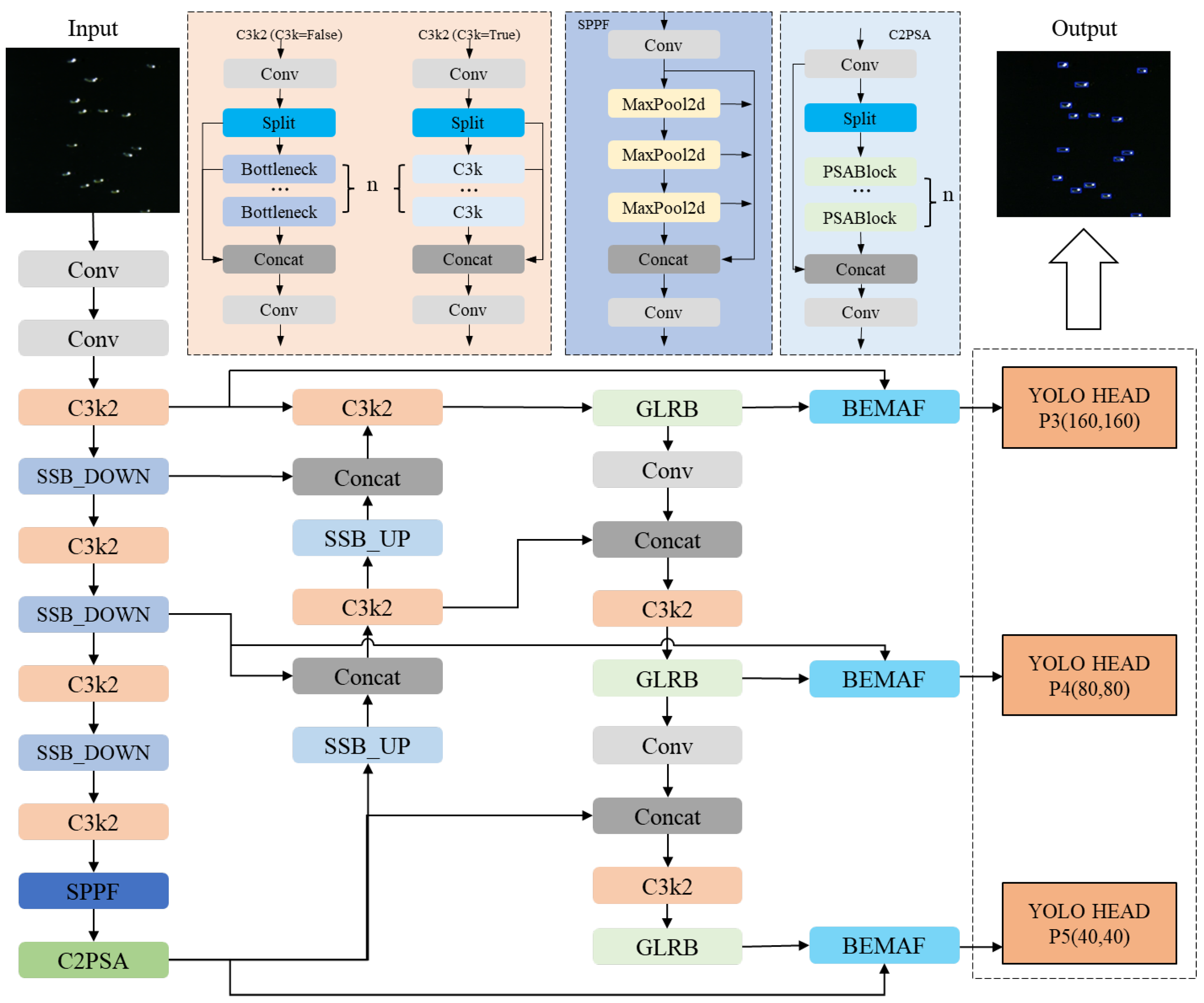
In this section, we present the overall architecture of HSMD-YOLO. Compared with the baseline, the upgraded network substantially enhances bubble-detection performance under challenging conditions, namely small objects, inter-object overlap, and indistinct or blurred boundaries. As illustrated in Figure 1, the framework comprises three innovation modules.

3.1. Scale Switch Block (SSB)

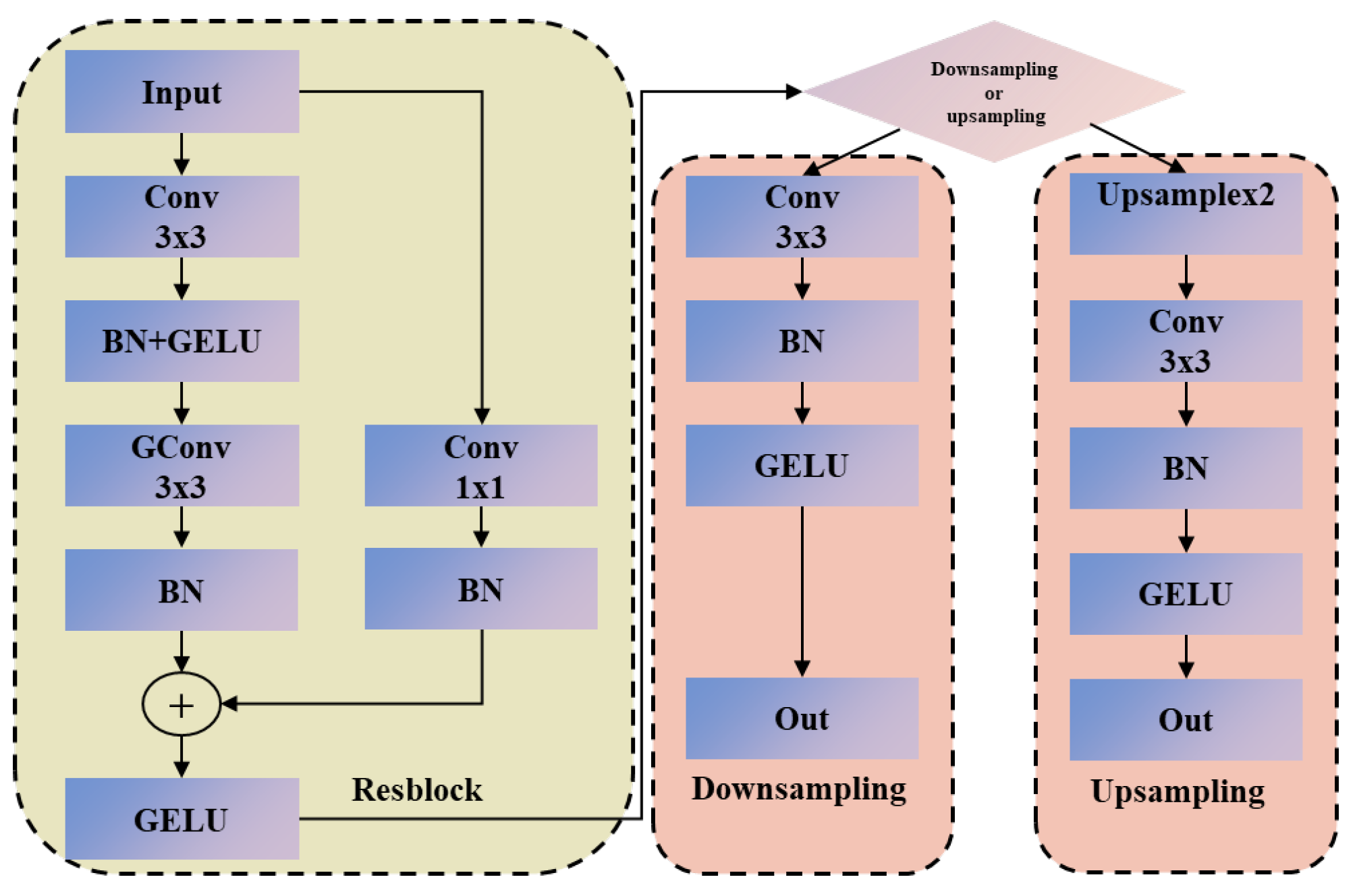
To address the instability of feature extraction in small-bubble detection, we propose a Scale Switch Block (SSB). Placed immediately prior to the network’s up or down sampling operations, this module effectively suppresses low-frequency bias and high-frequency noise, thereby mitigating artifacts introduced during multi-scale feature fusion. As a result, it markedly stabilizes the representation of thin bubble walls, weak boundaries, and geometric contours. As schematically illustrated in the figure, the SSB operates in two modes: in the downsampling mode, it replaces the stride convolution, pooling layers in the YOLOv11 backbone; in the up-sampling mode, it substitutes the nearest-neighbor, bilinear interpolation and the subsequent 1 × 1 convolution in the YOLOv11 neck.
The mathematical expressions for Resblock, Upsampling, and Downsampling can be represented as:
F = ϕ B N W 3 × 3 g ̲ ϕ B N W 3 × 3 x + B N W 1 × 1 x
F = ϕ ( B N ( W 3 × 3 U 2 ( x ) ) )
F = ϕ ( B N ( W 3 × 3 x ) )
where U 2 is defined as bilinear upsampling performed independently across samples and channels; x is the input feature tensor; W is the convolutional weight tensor (3 × 3 kernel); ∗ is the two-dimensional convolution operator; ϕ is the GELU activation function; B N ( · ) is the batch-normalization operation; W 3 × 3 g ̲ is the grouped-convolution weight tensor (3 × 3 kernel); and F is the output feature map.
As shown in Figure 2, conventional downsampling (strided convolution, pooling) and upsampling (nearest-neighbor, bilinear) operations tend to introduce noise and degrade edge textures during cross-scale processing, which readily erodes the boundaries of thin-walled and low-contrast bubbles. To address this, the proposed SSB stacks two 3 × 3 Conv–BN–GELU blocks to capture local details and fine-grained features from spatially adjacent pixels. A 1 × 1 convolutional residual pathway is incorporated to enhance feature stability and mitigate gradient vanishing. Moreover, a weight-sharing strategy emphasizes spatially continuous, small-receptive-field patterns, thereby suppressing false positives arising from pseudo-texture amplification and preserving the bubbles’ structural information as well as geometric and textural details. Unlike traditional BlurPool or fixed low-pass filters that apply static kernels, SSB utilizes learnable grouped convolutions to dynamically adapt to varying bubble boundary frequencies. The module is well suited to high-resolution bubble imagery and provides higher-quality features for subsequent GLRB refinement and BEMAF fusion.

3.2. Global-Local Refine Block (GLRB)

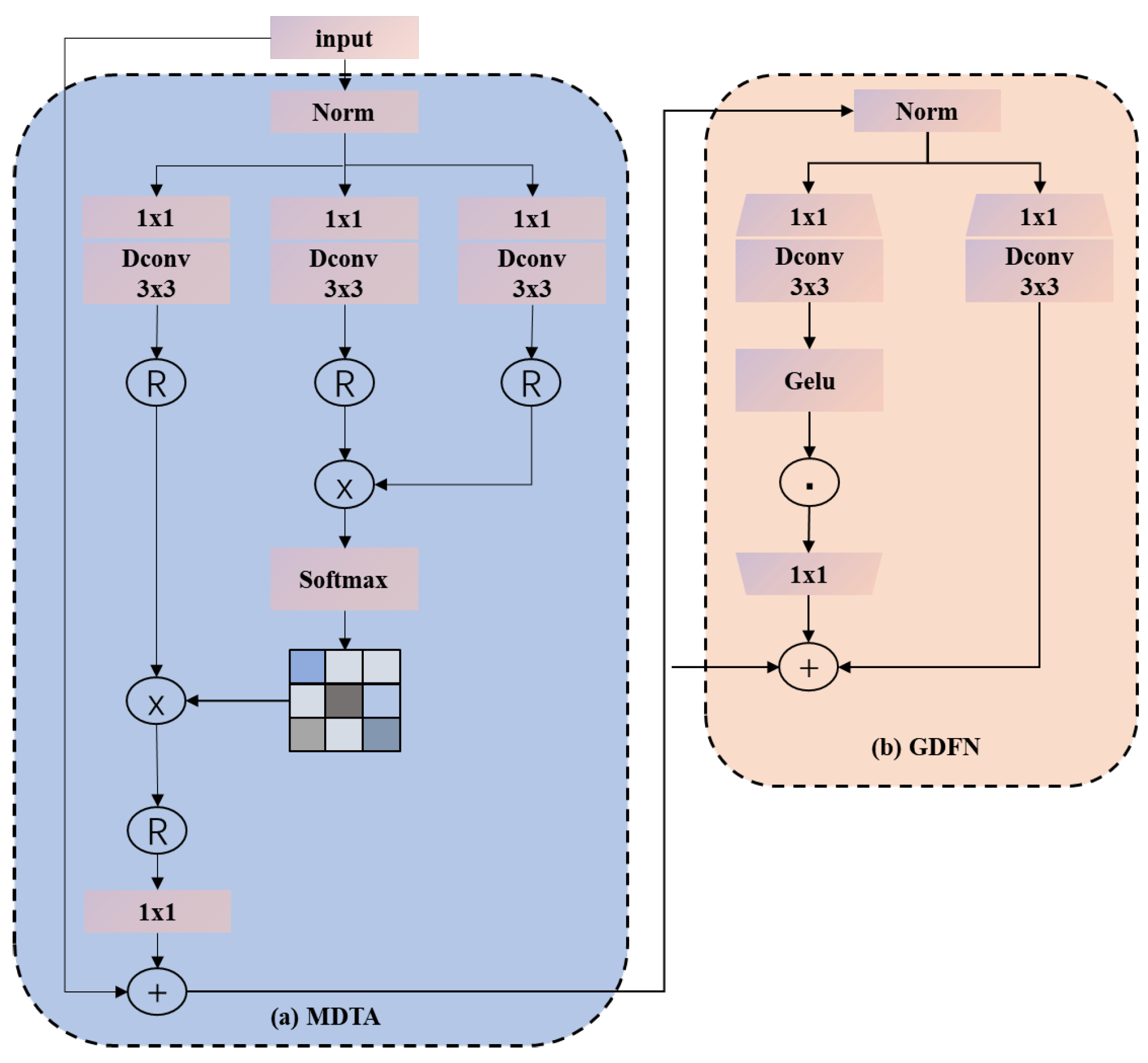
After passing through the SSB in the backbone, the feature maps already encode rich contextual information. Nevertheless, background noise in bubbly scenes remains a major impediment to detection. Because vanilla self-attention scales quadratically with spatial resolution and bubble imagery features razor-thin boundaries, weak contrast, and frequent overlap, necessitating both global relational modeling and faithful detail preservation, we introduce the GLRB module to refine globally captured information under near-linear computational complexity, thereby disentangling bubbles from the background. As shown in Figure 3, GLRB is a high-efficiency global–local collaborative Transformer block: channel-domain multi-head attention (MDTA) captures long-range dependencies, whereas a gated depthwise-convolutional feed-forward network (GDFN) injects local geometric detail and suppresses noise. We insert GLRB after each multi-scale fusion stage of YOLOv11, which mitigates the semantic inconsistency and detail loss induced by cross-scale aggregation and improves detection performance in heavily overlapping bubble scenarios.

3.2.1. Multi-DConv Head Transposed Self-Attention (MDTA)

Conventional self-attention models pairwise relations across spatial locations by computing an N × N attention matrix (where N = H × W ), leading to O ( N 2 ) quadratic complexity with respect to image resolution and rendering it computationally impractical for high-resolution bubbly scenes. In contrast, MDTA first obtains queries (Q), keys (K), and values (V) via a 1 × 1 convolution and performs local spatial mixing with a 3 × 3 depthwise convolution. By computing the cross-covariance matrix across the channel dimension ( C × C ) rather than the spatial dimension, MDTA reduces the spatial complexity from O ( N 2 ) to O ( N ) . This enables high-efficiency inference on high-resolution features that preserve the fine-grained separability of extremely small bubbles. By relocating self-attention to the feature (channel) dimension rather than the spatial domain, MDTA markedly lowers the computational burden. While existing linear attention mechanisms (e.g., Performer or Linformer) reduce complexity via spatial projections or kernel approximations that can compromise fine-grained details, MDTA achieves exact feature preservation. Although it does not explicitly encode pixel-to-pixel interactions in space, MDTA constructs attention maps from inter-channel covariance, implicitly capturing contextual cues arising from multi-bubble overlap. Consequently, GLRB retains a global receptive field while efficiently modeling long-range dependencies, facilitating the separation of overlapping bubbles. The mathematical formulation of MDTA can be expressed as:
Q , K , V = s p l i t 3 ( D 3 × 3 ( W q k ν { 1 × 1 } x ) )
Q a = R h a ( Q ) , K a = R h a ( K ) , V a = R h a ( V )
Q ^ a = n o r m s ( Q a ) , K ^ a = n o r m s ( K a )
F = W 1 × 1 R h 1 ( C o n c a t a = 1 h S o f t m a x ( τ a Q ^ a K ^ a T ) V a )
where W qkv denotes 1 × 1 convolution weights that project channel C to 3 C ; T denotes an intermediate output that expands the input projection; D ( · ) denotes a 3 × 3 depthwise convolution (with groups = 3 C , performing channel-wise local mixing); split ( T ) denotes an operation that equally splits the tensor into three parts Q , K , V along the channel dimension. For multi-head rearrangement and L 2 normalization on Q and K: R a 0 ( · ) denotes the rearrangement operator for the a-th head, which transforms between ( N , C , H , W ) and ( N , d , S ) and concatenates and restores across heads; Q a , K a , V a denote the rearranged results of Q , K , V , respectively; Q ^ a , K ^ a denote Q a and K a after L 2 normalization along the last dimension S;
Then, modify the attention weights for Q and K along the channel dimension, where Softmax ( · ) denotes a normalization operation along the last dimension such that the sum of weights from each query channel to all key channels is 1; and
τ a denotes a learnable temperature scalar for the a-th head. For merging the processed results and performing linear projection: R h 1 ( · ) denotes the inverse rearrangement operator for the a-th head and W denotes a 1 × 1 convolution that performs channel-wise linear projection on the merged features.

3.2.2. Gated-Dconv Feed-Forward Network (GDFN)

GDFN adopts a pre-normalization design: the input first undergoes LayerNorm, followed by channel expansion. A local content-mixing stage then applies a 3 × 3 depthwise separable convolution to the expanded features to encode local context from neighboring pixels, thereby strengthening the delineation of bubble boundaries and textures. A gating mechanism is subsequently employed, after which the features are projected back to the original dimensionality to close the residual pathway. The mathematical formulation of GDFN can be expressed as:
[ U 1 , U 2 ] = s p l i t 2 ( D 3 × 3 ( W 1 × 1 x ) )
F = W 1 × 1 ( ϕ ( U 1 ) U 2 )
where x denotes the input feature tensor of shape ( N , C , H , W ) ; W 1 × 1 denotes a learnable 1 × 1 pointwise convolution, and ∗ denotes the standard 2D convolution (cross-correlation), whereas D 3 × 3 ( · ) denotes a 3 × 3 convolution (stride 1, padding 1) applied to its argument; s p l i t 2 ( · ) denotes a channel-wise split into two equal parts, so that [ U 1 , U 2 ] = s p l i t 2 ( D 3 × 3 ( W 1 × 1 x ) ) produces U 1 , U 2 R N × ( C mid / 2 ) × H × W with C mid the channel count after D 3 × 3 ( W 1 × 1 x ) ; ϕ ( · ) denotes a nonlinear activation (e.g., sigmoid when used for gating), whereas ⊙ denotes element-wise (Hadamard) multiplication; and F = W 1 × 1 ϕ ( U 1 ) U 2 denotes the fused output feature map of shape ( N , C , H , W ) , where the second W 1 × 1 mixes or reduces channels after gating.
In standard Transformers, the feed-forward network (FFN) primarily performs per-channel nonlinear transformations and thus lacks explicit spatial modeling. GDFN remedies this by inserting a depthwise separable convolution into the feed-forward pathway, thereby injecting local geometric and edge cues. Coupled with a gating mechanism that selectively amplifies informative features while suppressing noise and spurious textures, this design substantially improves bubble-image restoration and fine-detail extraction.

3.3. Bidirectional Exponential Moving Attention Fusion (BEMAF)

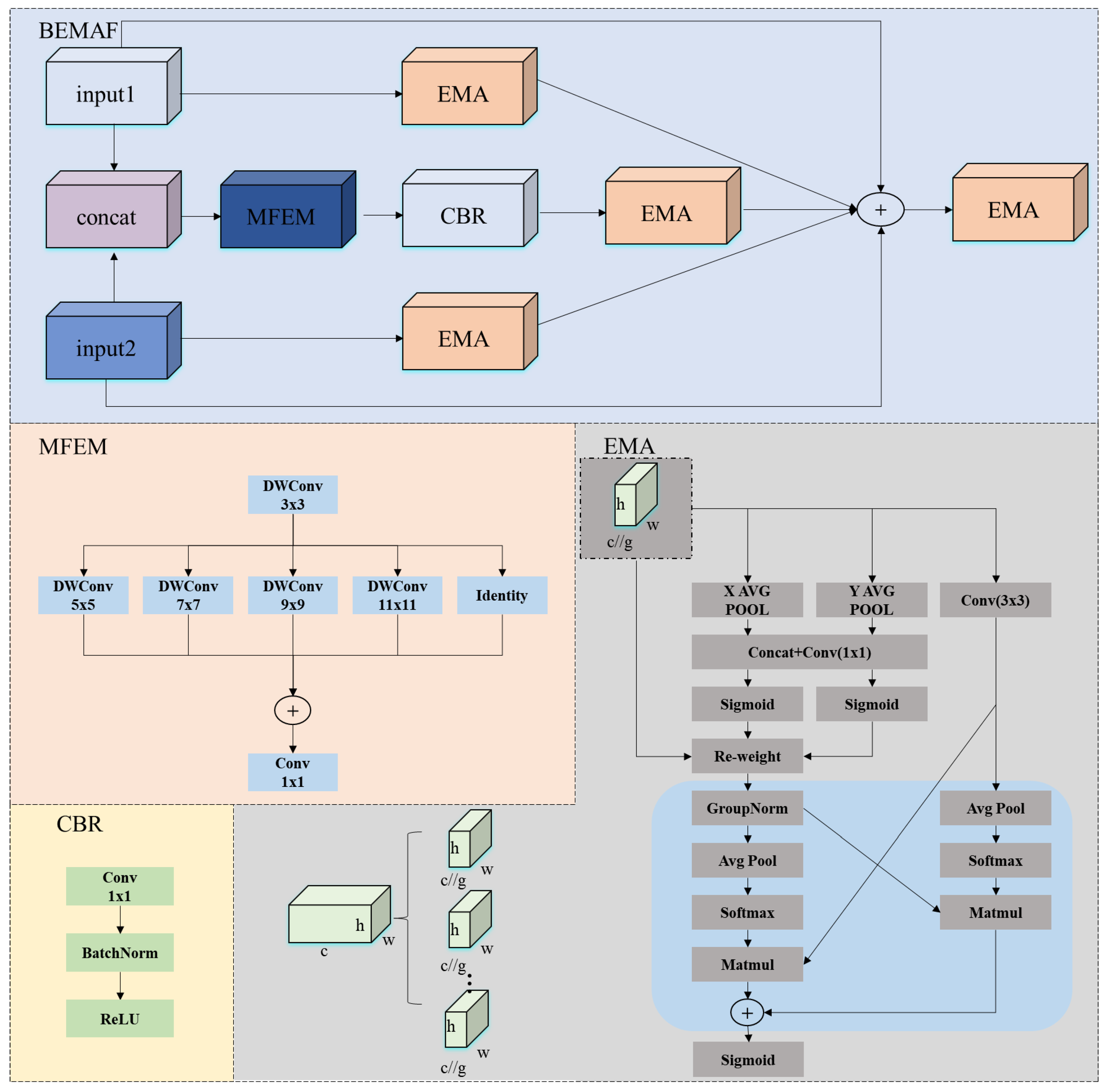
To address cross-scale semantic misalignment and the amplification of spurious high-frequency artifacts in bubble detection, we introduce a fusion module based on bidirectional exponential moving BEMAF inserted after the SSB and GLRB modules and before the detection head. As shown in Figure 4, through structured frequency-domain processing coupled with a cross-branch interaction mechanism, the module markedly enhances the geometric consistency of bubble edges while exhibiting strong suppression of nuisances such as specular highlights and water ripples. The mathematical formulation of the MFEM module is as follows:
z 1 = D 3 × 3 ( x )
F = W 1 × 1 ( D 3 × 3 ( z 1 ) D 3 × 3 ( z 2 ) D 3 × 3 ( z 3 ) D 3 × 3 ( z 4 ) D 3 × 3 ( z 5 ) )
where x denotes the input feature tensor of shape ( N , C , H , W ) ; D 3 × 3 ( · ) denotes a 3 × 3 convolution (stride 1, padding 1) applied to its argument; F is the resulting feature map.
EMA module is as follows:
H ˜ = W 1 × 1 concat H p o o l h ( R g ( x ) ) , swap ( p o o l w ( R g ( x ) ) )
[ H h , H w ] = split H H ˜ ; [ H , W ]
X 1 = GN τ X σ B W ( H h ) σ B H ( swap ( H w ) )
α 1 = Softmax ( vec ( GAP ( X 1 ) ) ) , α 2 = Softmax ( vec ( GAP ( W 3 × 3 X ) ) )
F = R g 1 ( X σ ( unflat ( α 1 flat ( W 3 × 3 X ) + α 2 flat ( X 1 ) ) ) )
where p o o l h ( · ) and p o o l w ( · ) denote direction-adaptive average pooling; R g ( · ) denotes the channel-wise rearrangement that partitions x into g groups and unfolds them along the batch axis, with R g 1 ( · ) as its inverse; s w a p ( · ) denotes the spatial-axis permutation that exchanges a ( 1 , W ) strip with a ( W , 1 ) strip (and vice versa) so as to enable height-wise concatenation; c o n c a t H ( · ) and s p l i t [ H , W ] ( · ) denote, respectively, concatenation along the height dimension and splitting in proportion to [ H , W ] ; σ denotes the Sigmoid function; B W ( H w ) and B H ( s w a p ( H w ) ) denote broadcasting operators that replicate H w along the width axis and its swapped counterpart H h along the height axis so as to form an H × W map; ⊙ denotes the Hadamard (element-wise) product; G N ( · ) denotes Group Normalization; G A P ( · ) denotes global average pooling to a 1 × 1 tensor; v e c ( · ) denotes channel-wise vectorization, rearrangement; and f l a t ( · ) , u n f l a t ( · ) denote reshaping between the spatial plane ( H × W ) and its flattened dimension S, where H and W denote spatial height and width, respectively.
Concatenated dual-branch features typically exhibit semantic and statistical discrepancies, and naively fusing them with convolutions can amplify spurious high-frequency artifacts such as specular highlights and water ripples. BEMAF first leverages exponential moving attention (EMA) to perform channel-wise attention weighting and global statistical alignment within each branch, thereby suppressing ineffective high-frequency components. It then aggregates boundary context at multiple bubble radii through cross-branch interaction and multi-scale atrous (dilated) convolutions. Finally, a gating mechanism adaptively fuses the features, followed by a second EMA pass for calibration. This design aligns cross-scale semantic information and strengthens the consistency of bubble edges and structural representations, all without introducing additional spatial complexity.

4. Experiment and Analysis

This section sequentially describes the datasets, experimental settings, evaluation, comparison to state-of the art methods, ablation study, and visualization analysis employed to evaluate object-detection performance. Under a unified evaluation protocol, we benchmark the proposed model against representative state-of-the-art methods and, using YOLOv11-n as the baseline network, perform a comprehensive ablation study to quantify the contribution of each innovation to the baseline. The results validate the effectiveness of the proposed approach. To facilitate intuitive assessment, we further present side-by-side visual comparisons between our method and the baseline; these qualitative demonstrations align closely with the quantitative metrics, jointly corroborating the efficacy of our improvement strategy.

4.1. Dataset

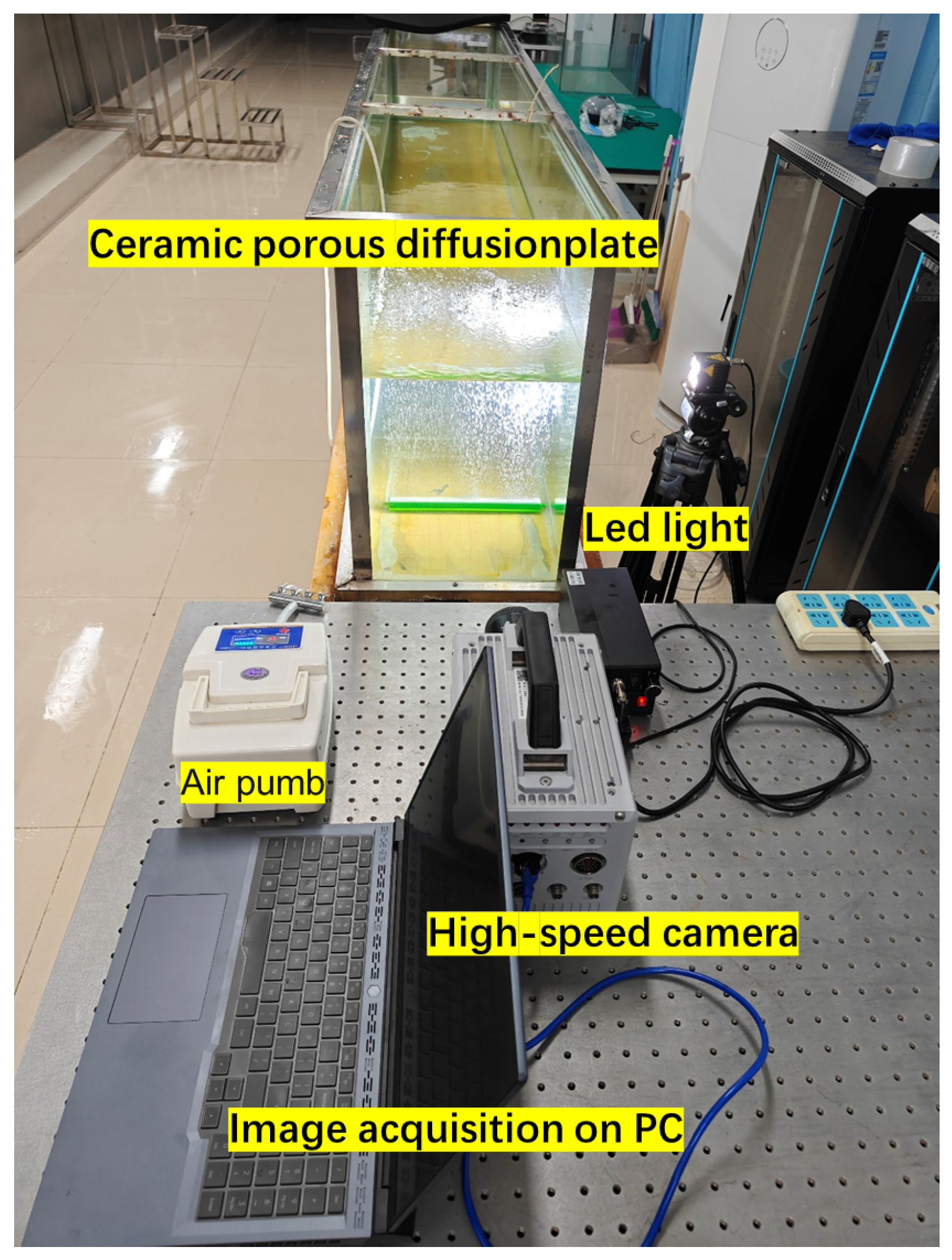
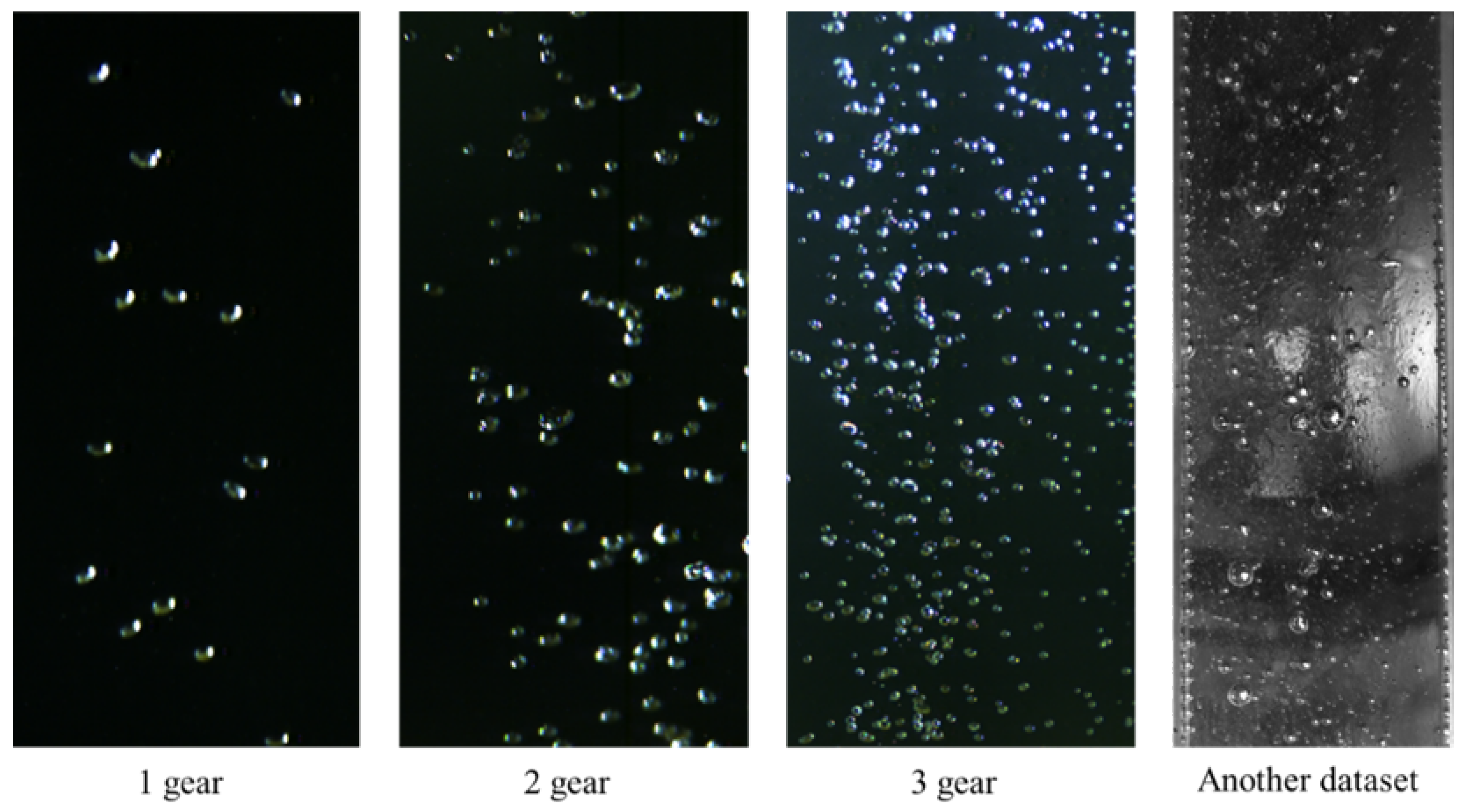
As illustrated in Figure 5, we built an in-house high-speed imaging platform to acquire bubble imagery and construct the SILB-DB (Side-Illuminated Light Field Bubble Database). The imaging setup employs lateral, directional LED illumination; the camera frame rate is set to 500 fps with an exposure time (shutter) of 1000 µs. We collected 200 images at a resolution of 300 × 640 and split them into training and test sets at a 9:1 ratio. To prevent data leakage from highly correlated adjacent frames, the training and test splits are temporally separated, drawing from distinct, non-overlapping imaging sessions. Using the professional annotation tool x-anylabelimg, we manually labeled 72,738 bubbles. The high temporal sampling suppresses motion blur and enhances edge contrast along the gas–liquid interface and within thin-film regions. Bubble generation is achieved with a system comprising an air pump and a ceramic porous diffusion plate; by adjusting the pump settings, we modulate the gas flow rate and bubbling frequency to obtain bubble fields with varying spatial densities. Figure 6 provides representative examples across different pump levels. For the detection task, we further curated challenging samples exhibiting intense specular highlights, backscattering, weak thin-film boundaries, and densely adhering coalescent bubbles to enable a comprehensive evaluation of model robustness. Specifically, the imaging system was calibrated to maintain an illumination intensity of approximately 5000 lux, mitigating external ambient light interference. To clarify the scale distribution, over 99.9% of the annotated bubbles occupy bounding boxes smaller than 32 × 32 pixels, strictly falling into the category of small objects under the MS COCO definition. Throughout data acquisition, the illumination layout and imaging geometry were kept fixed to ensure statistical comparability and reproducibility.
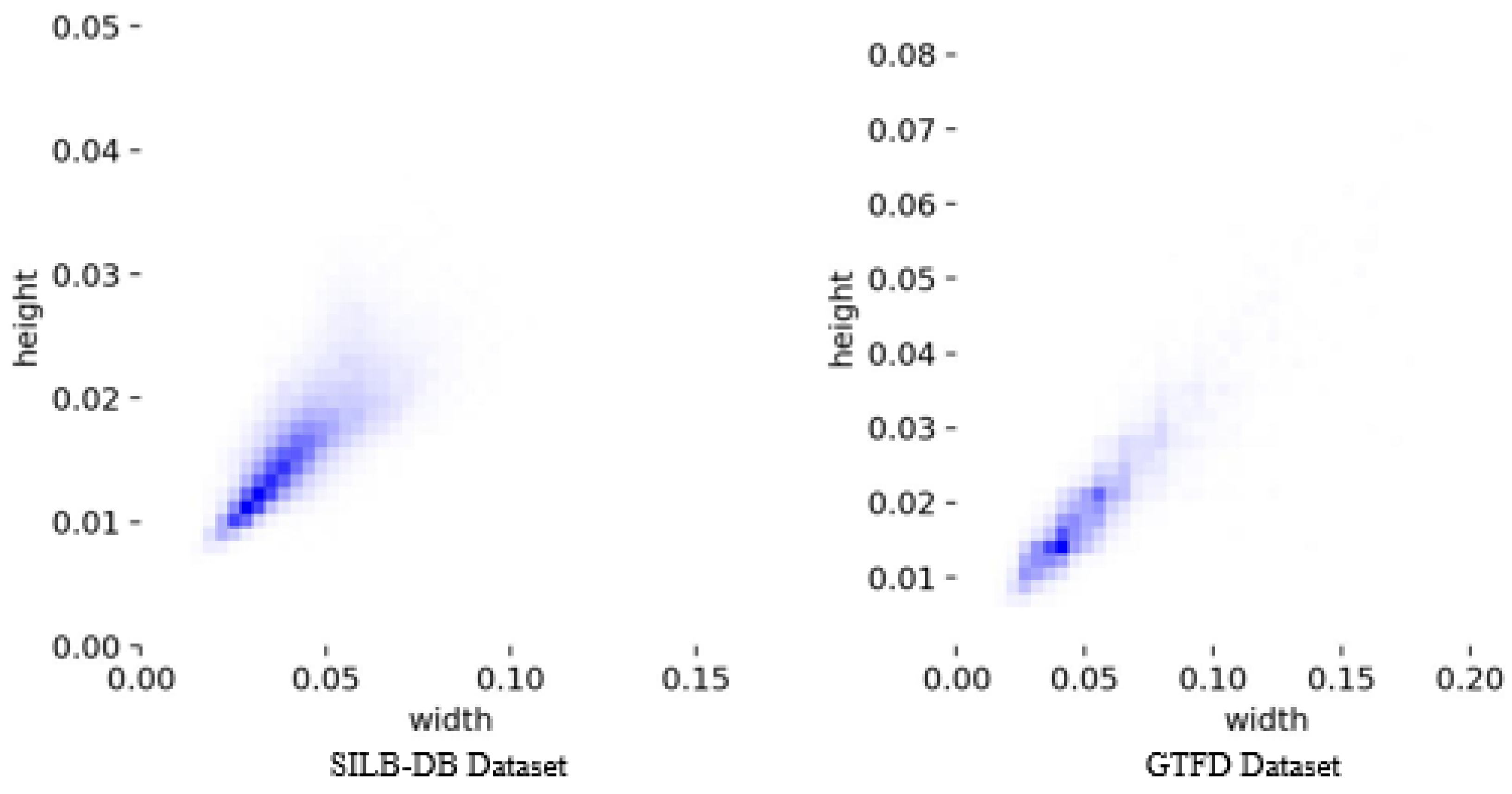
To assess generalization, we additionally adopt the public subcooled boiling flow dataset (GTFD) [19], which contains 200 bubble images at 488 × 1280, likewise partitioned into training and test sets at a 9:1 ratio. Images were annotated with the open source LabelImg tool to assemble a dataset in the YOLOv11 format. Each bubble is labeled with its location and size, yielding approximately 25,612 annotations in total. Building on this, we apply data augmentation including rotation, flipping, translation, scaling, shearing, brightness contrast adjustments, and noise injection to further enhance the model’s robustness and generalization capacity. Figure 7 presents the distribution of target sizes. It can be seen that all bubbles within the dataset are tiny targets, which introduces substantial challenges to bubble detection and this also constitutes the primary objective addressed in this paper.

4.2. Experiment Settings

The model was implemented in PyTorch 2.0.1 with CUDA 12.0. All experiments were conducted on Ubuntu 20.04 using an NVIDIA GeForce RTX 3090 Ti GPU (24 GB). Training employed stochastic gradient descent (SGD) with an initial learning rate of 0.01 and momentum of 0.937; a cosine-annealing schedule was used to adapt the learning rate dynamically. We trained for 200 epochs with a mini-batch size of 12. During training, all images were resized to 640 × 640 pixels.

4.3. Evaluation Metrics

To comprehensively and objectively evaluate the performance of the proposed model, we adopt several widely used metrics for object detection, namely precision (P), recall (R), mAP@0.5, and mAP@0.5:0.95. This section outlines the formulas employed to compute these indicators.
Precision is defined as the proportion of correctly predicted instances among all instances predicted as positive (i.e., the sum of true positives, TP, and false positives, FP). Here, TP denotes the number of correctly identified ground-truth instances, where as FP denotes the number of incorrectly predicted positives. The precision is computed as:
Here, TP denotes true positives (correct detections that match a ground-truth instance at or above the IoU threshold), FP denotes false positives (detections that do not match any ground-truth instance at the threshold), and FN denotes false negatives (missed ground-truth instances).
p = T P T P + F P
R = T P T P + F N
mAP (mean Average Precision) is the average of the AP (Average Precision) values across all categories. When the Intersection over Union (IoU) is set to a fixed value, the average precision A P i (i = 1, 2, …, n) for the i t h category equals the area under its precision–recall curve. The formulas for calculating AP and mAP are as follows:
A P = P ( R ) d R
m A P = i = 1 n A P i
mAP@0.5 is obtained by evaluating mAP at an IoU threshold of 0.5, whereas mAP@0.5:0.95 is computed by averaging mAP across IoU thresholds from 0.50 to 0.95 in increments of 0.05.

4.4. Compared to State-of-the-Art Methods

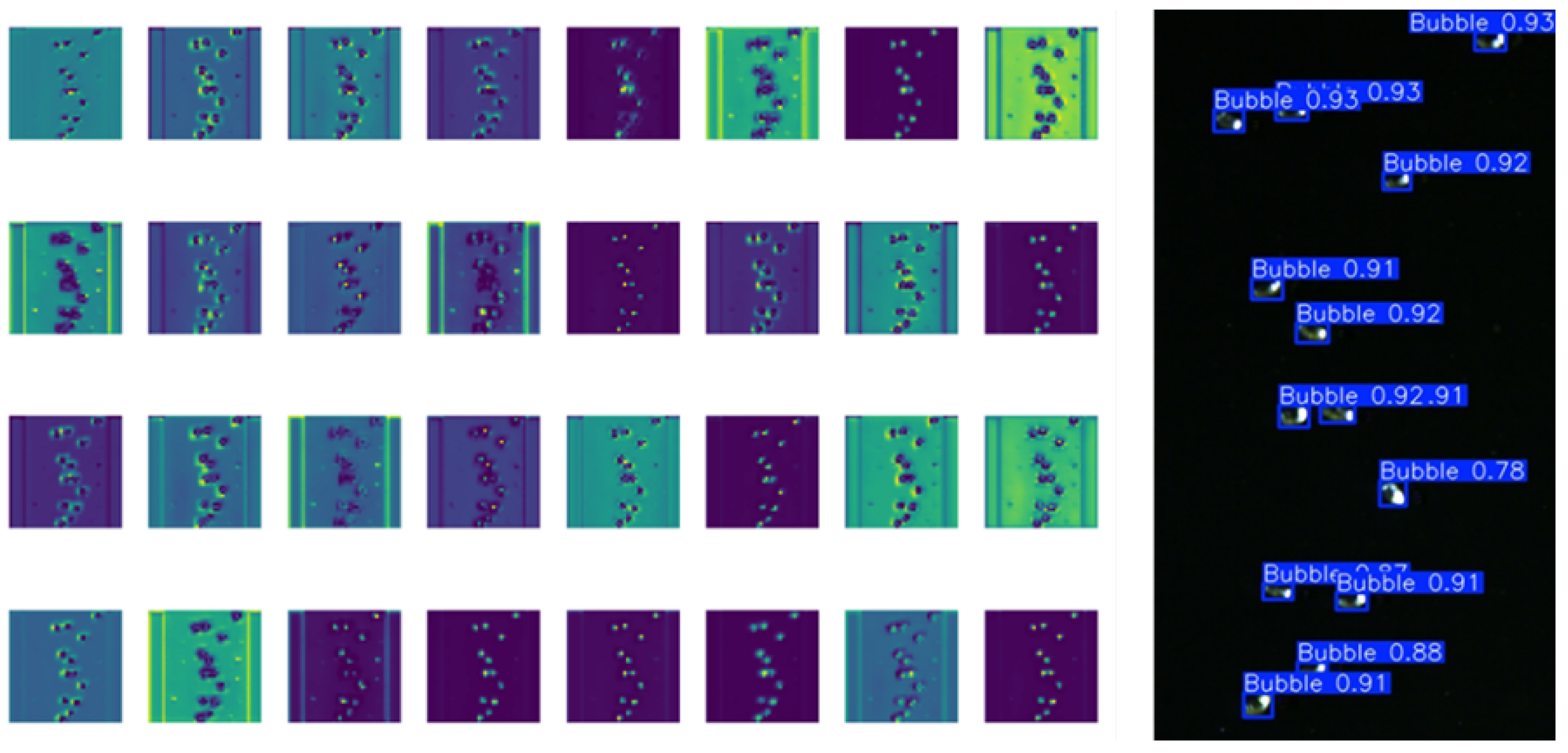
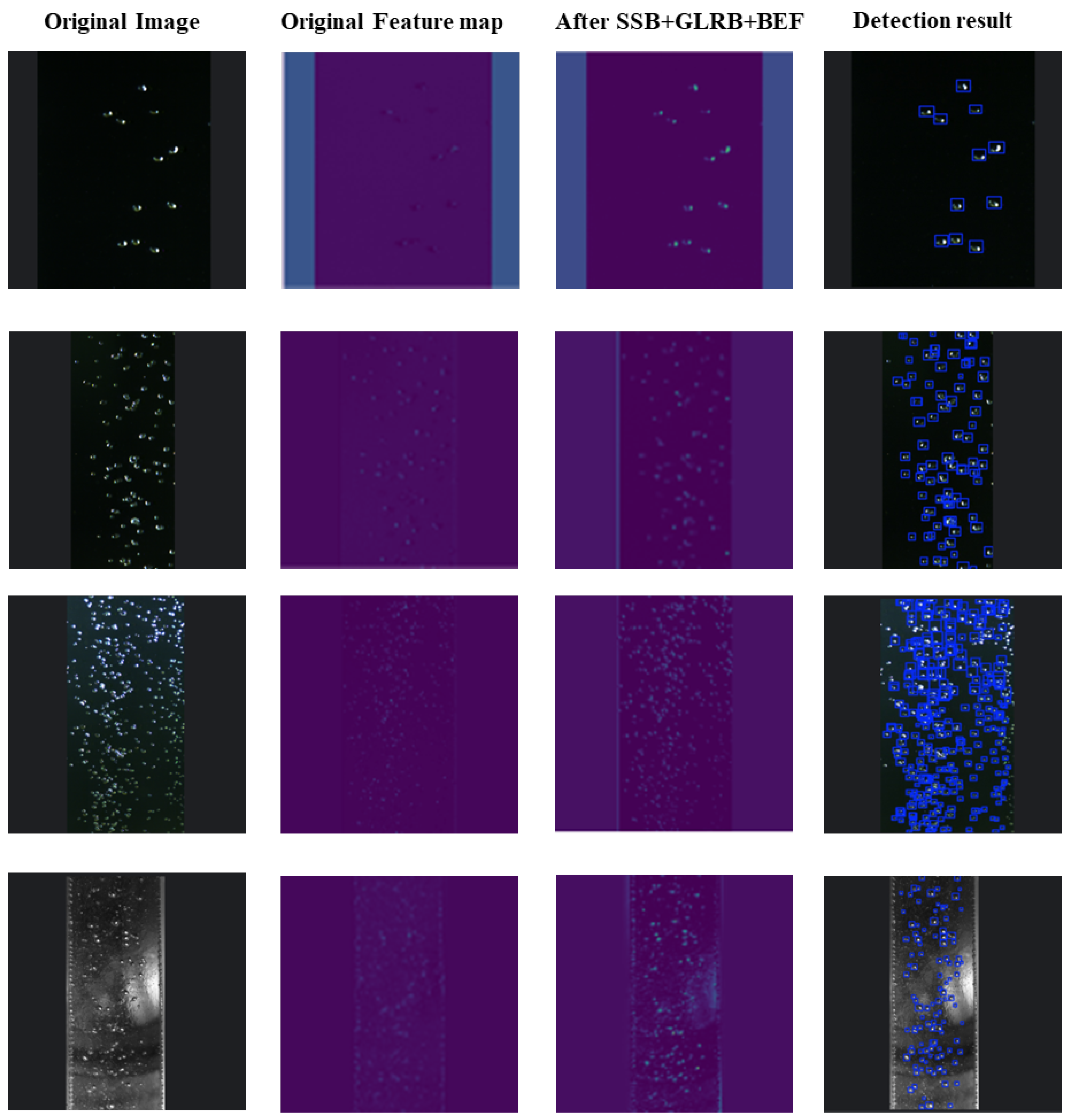
Figure 8 further visualizes the feature maps of representative images alongside the corresponding distributions of detection confidence scores.
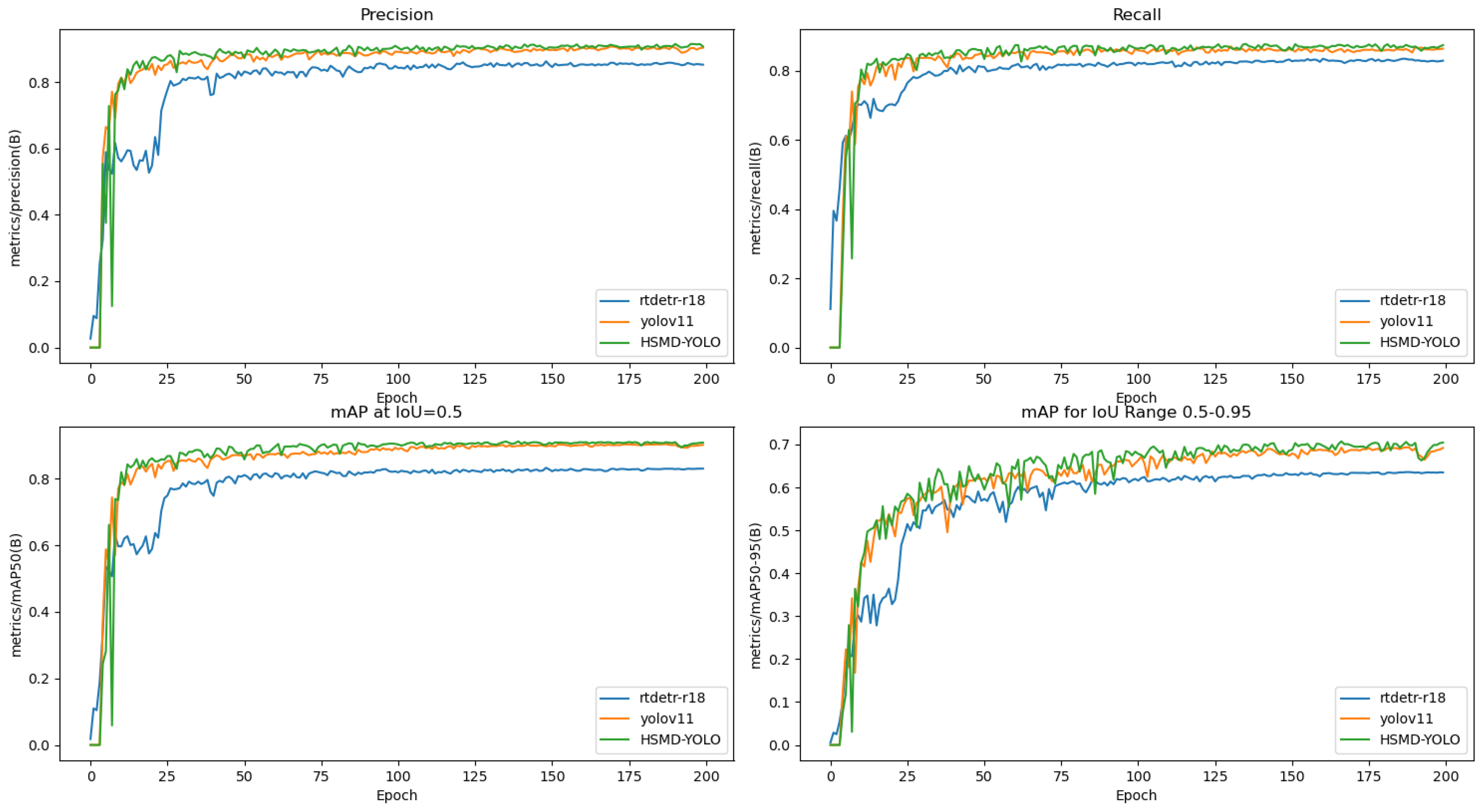
Under an identical training protocol, input resolution, and computational budget, we conduct a systematic comparison against representative one-stage detectors, namely the nano variants of the YOLO family (e.g., YOLOv11n, YOLOv8n) and the representative Transformer-based detector RT-DETR-R18, as well as state-of-the-art small-object and high-efficiency models (e.g., TPH-YOLOv5, Gold-YOLO-n) and classical baseline algorithms (Faster R-CNN, CenterNet, SSD). As shown in Table 1, the results demonstrate superior overall detection accuracy and markedly improved small-object performance, with especially salient gains in scenarios involving thin-walled, weak-edge structures, adherent overlapping instances, and severe specular highlight or water-ripple perturbations. Meanwhile, as indicated by the newly introduced computational metrics (Params and FLOPs), although our model exhibits higher overall complexity compared to the nano baselines—a necessary trade-off to capture extremely fine-grained underwater features—the GLRB module preserves a structural efficiency where spatial mixing scales linearly ( O ( N ) ) with input resolution. On our in-house bubble dataset 1, using identical training hyperparameters, the proposed approach achieves absolute improvements over YOLOv11n, YOLOv8n, and RT-DETR-R50 of +1.2 % points in mAP@0.5, +1.6% points in mAP@0.5:0.95, +0.3% points in precision, and +0.7% points in recall. As shown in Figure 9, compared to the baseline model, our model tends to take the lead during the training process.
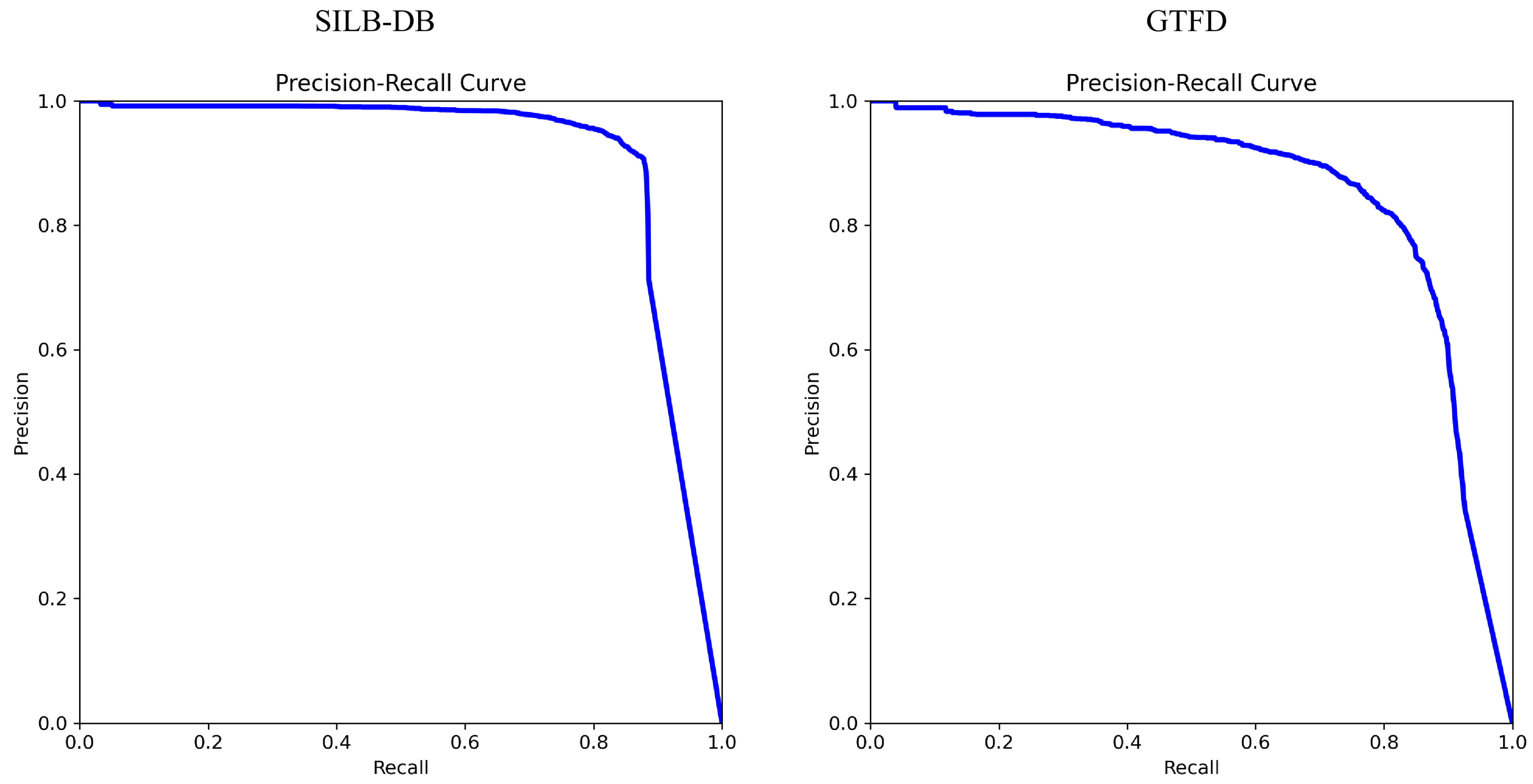
Beyond our primary in-house dataset, we further evaluate on a public gas–liquid two-phase flow dataset (GTFD) to assess cross-source generalization. Evaluation strictly follows the dataset’s native annotations and class taxonomy; we perform no training, fine-tuning, or hyperparameter tuning on this dataset, treating it solely as an external hold-out test set to avoid data leakage. For consistency, all images are processed with the same preprocessing pipeline as in the main experiments, and metrics such as mAP@0.5 and mAP@0.5:0.95 are computed under a unified evaluation protocol. The results in Table 2 indicate that the HSMD-YOLO sustains stable detection performance on this public dataset, evidencing strong generalization under domain shift, including varying imaging conditions and background noise. This strong zero-shot performance effectively demonstrates HSMD-YOLO’s resilience to domain shifts. The domain gap between SILB-DB and GTFD—primarily driven by differences in illumination (side-lit vs. backlit) and variations in background scattering—is mitigated by the GLRB and BEMAF modules, which emphasize geometric consistency and structural invariants over domain-specific illumination artifacts. Furthermore, to account for statistical variance, we conducted five independent training runs with different random seeds on SILB-DB, yielding a stable mAP@0.5 of 0.911 ± 0.003 for HSMD-YOLO, confirming the robustness of our architecture. Precision–recall (PR) curves for both datasets are shown in Figure 10, consistently demonstrating that our method maintains higher precision at high recall levels across both the in-house SILB-DB and the public GTFD benchmark.

4.5. Ablation Study

To substantiate the efficacy of the proposed model, we adopt YOLOv11n as the baseline and conduct a series of ablation studies to quantify the contributions of the SSB, GLRB, and BEMAF modules and Normalized Weighted Dice Loss (NWDloss) [47] in our self-bulted dataset SILB-DB. In the experimental design, to eliminate the interference of irrelevant variables on the experimental results and ensure that the performance differences observed can be accurately attributed to the presence or absence of the innovative module and NWDLoss, all key experimental parameters were strictly unified.
The Table 3 summarizes the variation in evaluation metrics under incremental inclusion or removal of each component, with a check mark (✓) indicating its presence. As evidenced by Table 3, for the SSB module, precision is slightly improved, while mAP@ and mAP@50:95 are slightly decreased, which indicates that SSB is targeted at optimizing precision but has limited assistance for the overall detection coverage. Compared with the baseline, the LRGB module significantly enhances recall and mAP@50:95, suggesting that LRGB is more favorable for retrieving true positive samples and ensuring robustness under multiple IoU thresholds. Precision reaches the highest value of 0.910 among single modules, demonstrating that BEMAF is remarkably effective in reducing false detections. Each single module has its own emphasis: SSB optimizes precision, GLRB improves recall and robustness under multiple IoU thresholds, and BEMAF reduces false detections. Furthermore, the combination of GLRB and BEMAF (exp7) significantly improves feature refinement and fusion, yielding a strong baseline. Although the precision (0.908) of exp8 (Ours) is slightly lower than that of exp5, its recall, mAP, and mAP@50:95 all rank the highest in all experiments. This indicates that the collaborative design of SSB + GLRB + BEMAF achieves an optimal balance in recall and robustness of full-scene detection, leading to the best comprehensive performance.
As summarized in Table 4, we adopt NWDLoss a Normalized Wasserstein Distance (NWD) regression objective specifically to improve the localization of small bubbles. By normalizing bounding-box center coordinates and dimensions, NWD jointly measures translational and scale discrepancies, delivering a stable, differentiable signal even with low or zero overlap; this is particularly beneficial for small objects where IoU-based losses often underperform. A ratio hyperparameter modulates sensitivity to displacement versus scale, as well as the weight of NWD within the total loss. Experiments on the SILB-DB bubble dataset reveal clear trade-offs: at a ratio of 0.3, precision peaks (0.916), suiting cases tolerant to false positives; at 0.4, recall, mAP@ and mAP@50:95 are jointly optimal, matching such as bubble distribution monitoring in the wake of high-speed fluid ships that need to balance recall and multi-scale consistency where recall and multi-scale consistency are critical; while at 0.8, mAP@ remains high but recall and mAP@50:95 drop, limiting robustness under strict IoU. These non-monotonic patterns reflect the intrinsic balance between minimizing false detections and avoiding missed bubbles, and they provide quantitative guidance for tuning NWDLoss to task-specific needs.

4.6. Visualization Analysis

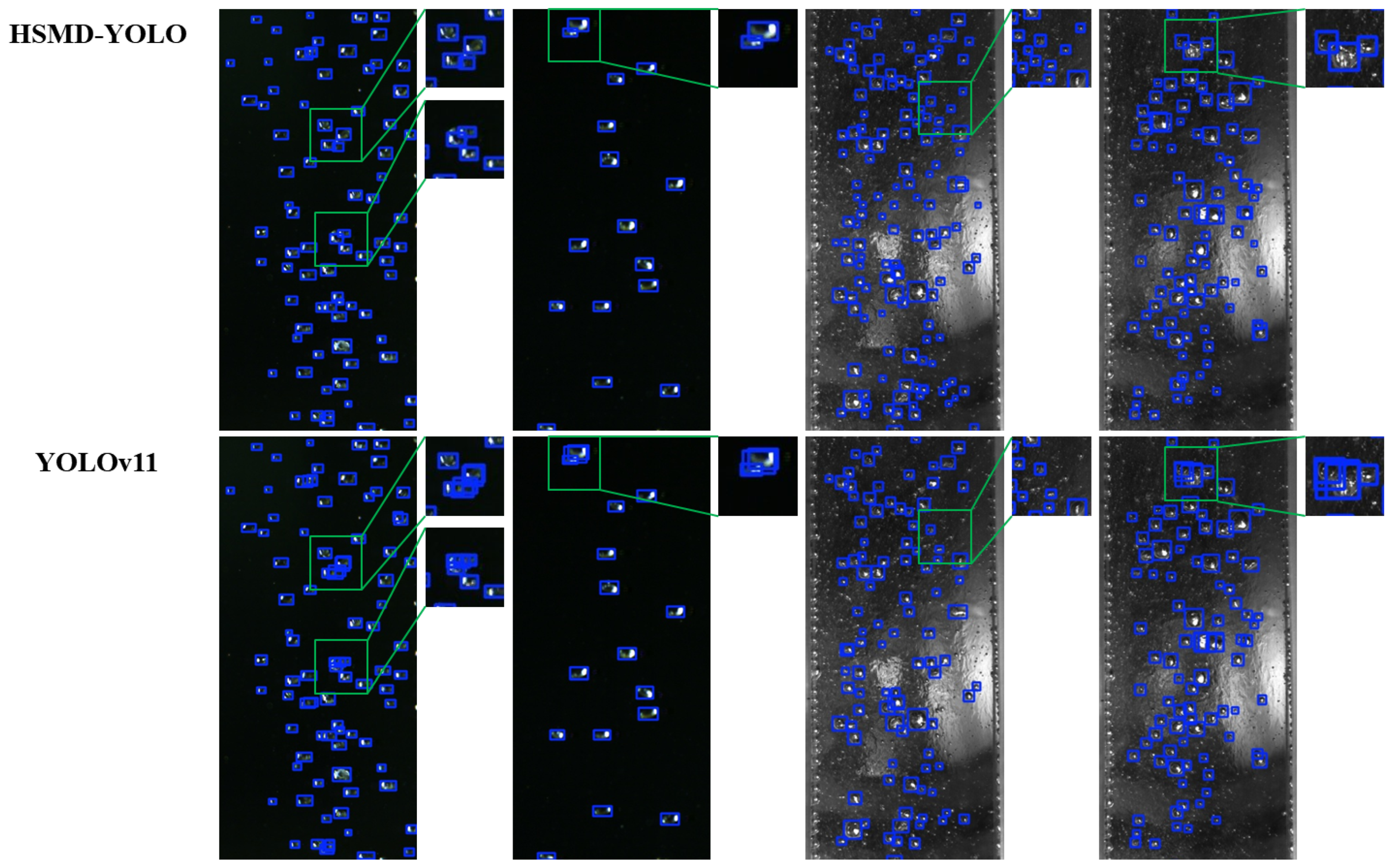
Figure 11 serves as key qualitative evidence for the detection performance of HSMD-YOLO and the baseline model YOLOv11 on two datasets. Its visualization results complement the quantitative analysis presented earlier (e.g., mAP curves, convergence trend of regression loss), further verifying the effectiveness of the optimizations in the proposed HSMD-YOLO model. This figure focuses on two core detection quality metrics detection box stability and small target coverage capability and clearly demonstrates the performance differences between the two models by comparing typical scenarios (e.g., regions with dense micro-bubbles, edge bubble regions under complex backgrounds). From the perspective of detection box jitter and redundancy control, compared with YOLOv11, HSMD-YOLO addresses two typical issues in the test scenarios of the dataset: detection box redundancy—specifically, for overlapping bubble targets, it resolves the problem of generating duplicate detection boxes; missed detection of extremely small bubbles—for extremely small bubbles in terms of pixel size, HSMD-YOLO exhibits higher detection accuracy.
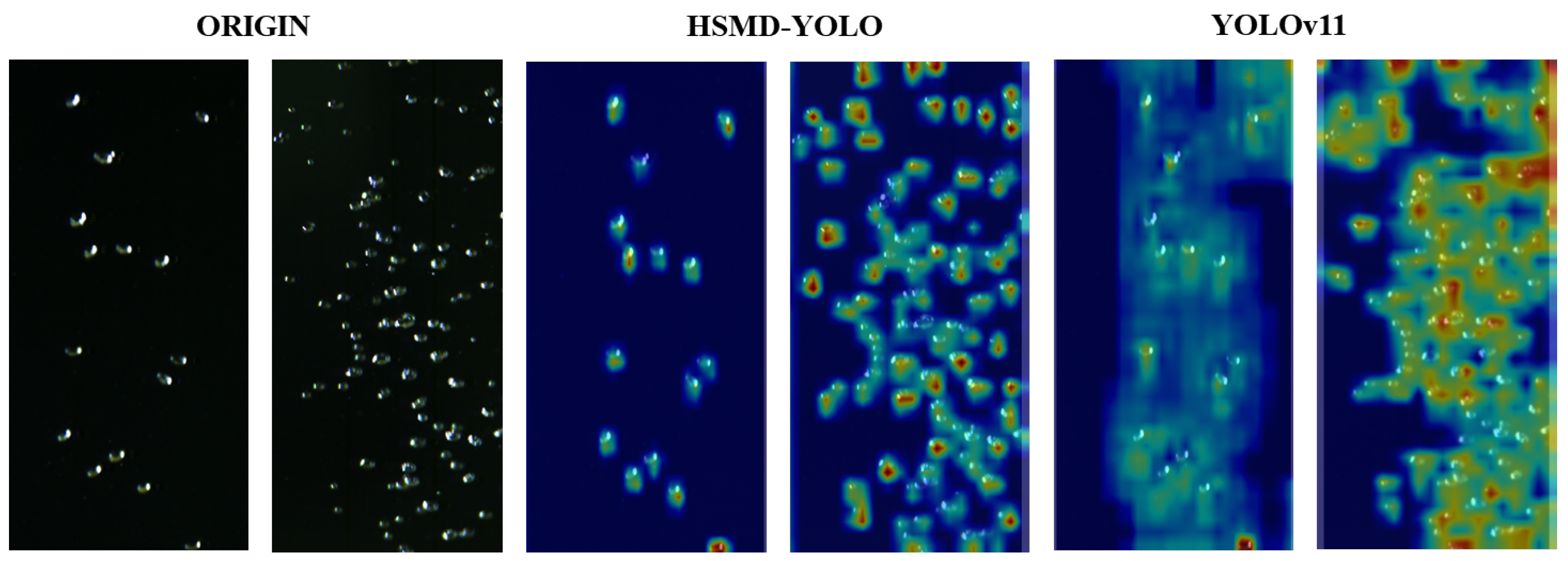
Figure 12 illustrates bubble activation mapping heatmaps, adapted from Class Activation Mapping (CAM) theory, serving as a key tool for model interpretability and performance evaluation. Compared with YOLOv11 and other mainstream detectors, HSMD-YOLO produces heatmaps with markedly improved spatial alignment to ground truth bubbles, reduced localization errors, and clearer instance separation even in dense bubble scenarios, thereby minimizing feature confusion. Background suppression is also stronger, with low-confidence regions effectively isolating non target areas. Moreover, the model maintains stable and precise coverage of targets under varying bubble densities, confirming the robustness imparted by its novel modules. These visual results collectively demonstrate HSMD-YOLO’s enhancements in localization accuracy, instance discrimination, and adaptability to complex scenarios.
In scenes characterized by densely packed microbubbles and adhesion, the baseline’s attention maps are markedly contaminated by strong specular highlights, resulting in diffuse, large-area focus. After integrating the improved module, non-target high activations are substantially suppressed, yielding more continuous responses along thin-walled regions in Figure 13.

5. Conclusions

This study introduces HSMD-YOLO, a model expressly designed for high-speed, micro-bubble detection—particularly addressing the longstanding challenges of small-object detection and achieving a notable advance in this domain. The architecture comprises three innovative components: SSB, GLRB, and BEMAF. SSB serves as a scale-switching module that mitigates artifacts and background noise, thereby stabilizing edges in thin-walled bubble regions and enhancing geometric contour awareness. GLRB attains efficient global dependency modeling with an asymptotic linear spatial complexity ( O ( N ) ) while further refining local features, thereby strengthening the feature-extraction pipeline. BEMAF accommodates the multi-scale characteristics of bubbles by integrating a multi-branch design with a multi-stage EMA-based attention mechanism and by restructuring the network bottleneck layers to capture richer contextual information. Empirical evaluations on the self-constructed high-speed micro-bubble dataset SILB-DB show that HSMD-YOLO surpasses the YOLOv11 baseline by 1.8% in mAP@0.5 and by 3.1% in mAP@0.5:0.95; relative to RT-DETR, it yields gains of 5.8% in mAP@0.5 and 5.4% in mAP@0.5:0.95. Furthermore, results on the public GTFD bubble-detection dataset substantiate its robustness for tiny-object detection. HSMD-YOLO markedly improves detection under weak boundaries, overlapping instances, and strong specular artifacts, offering a practical solution for multiphase-flow metrology and shipborne online monitoring. Future work will focus on optimizing the computational-accuracy trade-off through model quantization and structured pruning for resource-constrained edge deployment. Additionally, we plan to extend the dataset to include more diverse underwater environments with varying turbidity levels and validate the model’s spatiotemporal tracking capabilities for continuous bubble trajectory analysis.

Author Contributions

W.L.: conceived an improved YOLOv11-based detection algorithm, designed the methodology, developed the software, conducted formal analyses, and drafted the initial manuscript. S.Z. (corresponding author): contributed to experimental design and execution, led manuscript preparation, supervised the study, secured funding, and oversaw project management. Y.L.: collected and curated the bubble image dataset, performed formal analyses, assisted with method optimization, visualized experimental results, and contributed to manuscript writing. All authors have read and agreed to the published version of the manuscript.

Funding

This work received no specific grant from any funding agency in the public, commercial, or not-for-profit sectors. The research was supported by internal funds from Laboratory of Naval University of Engineering.

Data Availability Statement

The datasets generated during and analyzed during the current study are available from the corresponding author on reasonable request.

Conflicts of Interest

The authors declare no competing interests.

References

  1. Reed, A.M.; Milgram, J.H. Ship wakes and their radar images. Annu. Rev. Fluid Mech. 2002, 34, 469–502. [Google Scholar] [CrossRef]
  2. Trevorrow, M.V.; Vagle, S.; Farmer, D.M. Acoustical measurements of microbubbles within ship wakes. J. Acoust. Soc. Am. 1994, 95, 1922–1932. [Google Scholar] [CrossRef]
  3. Mazzeo, A.; Renga, A.; Graziano, M.D. A Systematic Review of Ship Wake Detection Methods in Satellite Imagery. Remote Sens. 2024, 16, 3775. [Google Scholar] [CrossRef]
  4. Redmon, J.; Divvala, S.; Girshick, R.; Farhadi, A. You Only Look Once: Unified, Real-Time Object Detection. In Proceedings of the IEEE Conference on Computer Vision and Pattern Recognition (CVPR); IEEE: New York, NY, USA, 2016; pp. 779–788. [Google Scholar] [CrossRef]
  5. Bochkovskiy, A.; Wang, C.Y.; Liao, H.Y.M. YOLOv4: Optimal Speed and Accuracy of Object Detection. arXiv 2020, arXiv:2004.10934. [Google Scholar] [CrossRef]
  6. Hibiki, T.; Ishii, M. Active nucleation site density in boiling systems: Part II—subcooled boiling flow. Int. J. Heat Mass Transf. 2003, 46, 2603–2615. [Google Scholar] [CrossRef]
  7. Odena, A.; Dumoulin, V.; Olah, C. Deconvolution and Checkerboard Artifacts. Distill 2016, 1, e3. [Google Scholar] [CrossRef]
  8. Zhang, R. Making Convolutional Networks Shift-Invariant Again. arXiv 2019, arXiv:1904.11486. [Google Scholar] [CrossRef]
  9. Vaswani, A.; Shazeer, N.; Parmar, N.; Uszkoreit, J.; Jones, L.; Gomez, A.N.; Kaiser, Ł.; Polosukhin, I. Attention Is All You Need. In Proceedings of the Advances in Neural Information Processing Systems (NeurIPS); Curran Associates Inc.: Red Hook, NY, USA, 2017; pp. 5998–6008. [Google Scholar]
  10. Katharopoulos, A.; Vyas, A.; Pappas, N.; Fleuret, F. Transformers are RNNs: Fast autoregressive transformers with linear attention. In Proceedings of the International Conference on Machine Learning (ICML); PMLR: Cambridge, MA, USA, 2020; pp. 5156–5165. [Google Scholar]
  11. Choromanski, K.; Likhosherstov, V.; Dohan, D.; Song, X.; Gane, A.; Sarlos, T.; Hawkins, P.; Davis, J.; Mohiuddin, A.; Kaiser, L.; et al. Rethinking attention with performers. In Proceedings of the International Conference on Learning Representations (ICLR); ICLR: Vienna, Austria, 2021. [Google Scholar]
  12. Yang, Z.; Liu, S.; Hu, H.; Wang, L.; Lin, S. RepPoints: Point set representation for object detection. In Proceedings of the IEEE/CVF International Conference on Computer Vision (ICCV); IEEE: New York, NY, USA, 2019; pp. 9657–9666. [Google Scholar] [CrossRef]
  13. Rezatofighi, H.; Tsoi, N.; Gwak, J.; Sadeghian, A.; Reid, I.; Savarese, S. Generalized Intersection over Union: A Metric and a Loss for Bounding Box Regression. In Proceedings of the IEEE/CVF Conference on Computer Vision and Pattern Recognition (CVPR); IEEE: New York, NY, USA, 2019; pp. 658–666. [Google Scholar] [CrossRef]
  14. Li, X.; Wang, W.; Wu, L.; Chen, S.; Hu, X.; Li, J.; Tang, J.; Yang, J. Generalized Focal Loss: Learning Qualified and Distributed Bounding Boxes for Dense Object Detection. In Proceedings of the Advances in Neural Information Processing Systems (NeurIPS); Curran Associates Inc.: Red Hook, NY, USA, 2020. [Google Scholar] [CrossRef]
  15. Ronneberger, O.; Fischer, P.; Brox, T. U-Net: Convolutional Networks for Biomedical Image Segmentation. In Proceedings of the International Conference on Medical Image Computing and Computer-Assisted Intervention (MICCAI); Springer: Cham, Switzerland, 2015; pp. 234–241. [Google Scholar] [CrossRef]
  16. Chen, L.C.; Zhu, Y.; Papandreou, G.; Schroff, F.; Adam, H. Encoder-Decoder with Atrous Separable Convolution for Semantic Image Segmentation. In Proceedings of the European Conference on Computer Vision (ECCV); Springer: Cham, Switzerland, 2018; pp. 801–818. [Google Scholar] [CrossRef]
  17. He, K.; Gkioxari, G.; Dollár, P.; Girshick, R. Mask R-CNN. In Proceedings of the IEEE International Conference on Computer Vision (ICCV); IEEE: New York, NY, USA, 2017; pp. 2961–2969. [Google Scholar] [CrossRef]
  18. Zhao, Y.; Lv, W.; Xu, S.; Wei, J.; Wang, G.; Dang, Q.; Liu, Y.; Chen, J. DETRs Beat YOLOs on Real-Time Object Detection. arXiv 2023, arXiv:2304.08069. [Google Scholar]
  19. Zhou, W.; Miwa, S.; Tsujimura, R.; Nguyen, T.B.; Okawa, T.; Okamoto, K. Bubble feature extraction in subcooled flow boiling using AI-based object detection and tracking techniques. Int. J. Heat Mass Transf. 2024, 222, 125188. [Google Scholar] [CrossRef]
  20. Zhu, X.; Hu, H.; Lin, S.; Dai, J. Deformable ConvNets v2: More Deformable, Better Results. In Proceedings of the IEEE/CVF Conference on Computer Vision and Pattern Recognition (CVPR); IEEE: New York, NY, USA, 2019; pp. 9308–9316. [Google Scholar] [CrossRef]
  21. Zhu, X.; Su, W.; Lu, L.; Li, B.; Wang, X.; Dai, J. Deformable DETR: Deformable Transformers for End-to-End Object Detection. In Proceedings of the International Conference on Learning Representations (ICLR); ICLR: Vienna, Austria, 2021. [Google Scholar] [CrossRef]
  22. Liu, W.; Anguelov, D.; Erhan, D.; Szegedy, C.; Reed, S.; Fu, C.Y.; Berg, A.C. SSD: Single Shot MultiBox Detector. In Proceedings of the European Conference on Computer Vision (ECCV); Springer: Cham, Switzerland, 2016; pp. 21–37. [Google Scholar]
  23. Lin, T.Y.; Goyal, P.; Girshick, R.; He, K.; Dollár, P. Focal Loss for Dense Object Detection. In Proceedings of the IEEE International Conference on Computer Vision (ICCV); IEEE: New York, NY, USA, 2017; pp. 2980–2988. [Google Scholar] [CrossRef]
  24. Carion, N.; Massa, F.; Synnaeve, G.; Usunier, N.; Kirillov, A.; Zagoruyko, S. End-to-End Object Detection with Transformers. In Proceedings of the European Conference on Computer Vision (ECCV); Springer: Berlin/Heidelberg, Germany, 2020; pp. 213–229. [Google Scholar]
  25. Liu, S.; Li, F.; Zhang, H.; Yang, X.; Qi, X.; Su, H.; Zhu, J.; Zhang, L. DAB-DETR: Dynamic Anchor Boxes are Better Queries for DETR. In Proceedings of the International Conference on Learning Representations (ICLR); ICLR: Online, 2022. [Google Scholar]
  26. Li, F.; Zhang, H.; Liu, S.; Guo, J.; Ni, L.M.; Zhang, L. DN-DETR: Accelerate DETR Training by Introducing Query DeNoising. arXiv 2022, arXiv:2203.01305. [Google Scholar] [CrossRef]
  27. Zhang, H.; Li, F.; Liu, S.; Zhang, L.; Su, H.; Zhu, J.; Ni, L.M.; Shum, H.Y. DINO: DETR with Improved DeNoising Anchor Boxes for End-to-End Object Detection. In Proceedings of the International Conference on Learning Representations (ICLR); ICLR: Kigali, Rwanda, 2023. [Google Scholar]
  28. Lin, T.Y.; Dollár, P.; Girshick, R.; He, K.; Hariharan, B.; Belongie, S. Feature Pyramid Networks for Object Detection. In Proceedings of the IEEE Conference on Computer Vision and Pattern Recognition (CVPR); IEEE: New York, NY, USA, 2017; pp. 2117–2125. [Google Scholar]
  29. Liu, S.; Qi, L.; Qin, H.; Shi, J.; Jia, J. Path Aggregation Network for Instance Segmentation. In Proceedings of the IEEE Conference on Computer Vision and Pattern Recognition (CVPR); IEEE: New York, NY, USA, 2018; pp. 8759–8768. [Google Scholar]
  30. Ghiasi, G.; Lin, T.Y.; Le, Q.V. NAS-FPN: Learning Scalable Feature Pyramid Architecture for Object Detection. In Proceedings of the IEEE/CVF Conference on Computer Vision and Pattern Recognition (CVPR); IEEE: New York, NY, USA, 2019; pp. 7036–7045. [Google Scholar]
  31. Tan, M.; Pang, R.; Le, Q.V. EfficientDet: Scalable and Efficient Object Detection. In Proceedings of the IEEE/CVF Conference on Computer Vision and Pattern Recognition (CVPR); IEEE: New York, NY, USA, 2020; pp. 10781–10790. [Google Scholar]
  32. Qiao, S.; Chen, L.C.; Yuille, A. DetectoRS: Detecting Objects with Recursive Feature Pyramid and Switchable Atrous Convolution. In Proceedings of the IEEE/CVF Conference on Computer Vision and Pattern Recognition (CVPR); IEEE: New York, NY, USA, 2021; pp. 10213–10224. [Google Scholar]
  33. Sun, K.; Xiao, B.; Liu, D.; Wang, J. High-Resolution Representations for Labeling Pixels and Regions. In Proceedings of the IEEE/CVF Conference on Computer Vision and Pattern Recognition (CVPR); IEEE: New York, NY, USA, 2019; pp. 3370–3379. [Google Scholar]
  34. Liu, Z.; Lin, Y.; Cao, Y.; Hu, H.; Wei, Y.; Zhang, Z.; Lin, S.; Guo, B. Swin Transformer: Hierarchical Vision Transformer using Shifted Windows. In Proceedings of the IEEE/CVF International Conference on Computer Vision (ICCV); IEEE: New York, NY, USA, 2021; pp. 10012–10022. [Google Scholar]
  35. Wang, W.; Xie, E.; Li, X.; Fan, D.P.; Song, K.; Liang, D.; Lu, T.; Luo, P.; Shao, L. Pyramid Vision Transformer: A Versatile Backbone for Dense Prediction without Convolutions. In Proceedings of the IEEE/CVF International Conference on Computer Vision (ICCV); IEEE: New York, NY, USA, 2021; pp. 548–558. [Google Scholar]
  36. Cheng, G.; Yuan, X.; Yao, X.; Yan, K.; Zeng, Q.; Xie, X.; Han, J. Towards Large-Scale Small Object Detection: Survey and Benchmarks. IEEE Trans. Pattern Anal. Mach. Intell. 2023, 45, 13467–13488. [Google Scholar] [CrossRef] [PubMed]
  37. Ren, S.; He, K.; Girshick, R.; Sun, J. Faster R-CNN: Towards Real-Time Object Detection with Region Proposal Networks. In Proceedings of the Advances in Neural Information Processing Systems (NeurIPS); MIT Press: Cambridge, MA, USA, 2015; Volume 28. [Google Scholar]
  38. Zhou, X.; Wang, D.; Krähenbühl, P. Objects as Points. arXiv 2019, arXiv:1904.07850. [Google Scholar] [PubMed]
  39. Zhu, X.; Lyu, S.; Wang, X.; Zhao, Q. TPH-YOLOv5: Improved YOLOv5 Based on Transformer Prediction Head for Object Detection on Drone-Captured Scenarios. In Proceedings of the IEEE/CVF International Conference on Computer Vision Workshops (ICCVW); IEEE: New York, NY, USA, 2021; pp. 2778–2788. [Google Scholar]
  40. Jocher, G.; Chaurasia, A.; Qiu, J. Ultralytics YOLOv8. 2023. Available online: https://github.com/ultralytics/ultralytics (accessed on 12 January 2026).
  41. Wang, C.Y.; Yeh, I.H.; Liao, H.Y.M. YOLOv9: Learning What You Want to Learn Using Programmable Gradient Information. arXiv 2024, arXiv:2402.13616. [Google Scholar] [CrossRef]
  42. Wang, A.; Chen, H.; Liu, L.; Chen, K.; Lin, Z.; Han, J.; Ding, G. YOLOv10: Real-Time End-to-End Object Detection. arXiv 2024, arXiv:2405.14458. [Google Scholar]
  43. Jocher, G.; Qiu, J. YOLO11 by Ultralytics. 2024. Available online: https://github.com/ultralytics/ultralytics (accessed on 12 January 2026).
  44. Tian, Y.; Ye, Q.; Doermann, D. YOLOv12: Attention-Centric Real-Time Object Detectors. arXiv 2025, arXiv:2502.12524. [Google Scholar]
  45. Liu, M.; Wang, J.; Wang, S.; Li, Y. YOLOv13: Real-Time Object Detection with Hypergraph-Enhanced Adaptive Aggregation. arXiv 2025, arXiv:2506.17733. [Google Scholar]
  46. Wang, C.; He, W.; Nie, Y.; Guo, J.; Liu, C.; Wang, Y.; Han, K. Gold-YOLO: Efficient Object Detector via Gather-and-Distribute Mechanism. In Proceedings of the Advances in Neural Information Processing Systems (NeurIPS); Curran Associates Inc.: Red Hook, NY, USA, 2023; Volume 36. [Google Scholar]
  47. Wang, J.; Xu, C.; Yang, W.; Yu, L. A Normalized Gaussian Wasserstein Distance for Tiny Object Detection. arXiv 2021, arXiv:2110.13389. [Google Scholar]
Figure 1. Network architecture of the HSMD-YOLO model.
Algorithms 19 00234 g001
Figure 2. Struct diagram of SSB.
Algorithms 19 00234 g002
Figure 3. Struct diagram of GLRB. (a) is Multi-DConv Head Transposed Self-Attention (MDTA), (b) is Gated-Dconv Feed-Forward Network (GDFN).
Algorithms 19 00234 g003
Figure 4. Struct diagram of BEMAF.
Algorithms 19 00234 g004
Figure 5. High-speed camera bubble detection environment.
Algorithms 19 00234 g005
Figure 6. Self-collected bubble images at different levels and typical images of public datasets.
Algorithms 19 00234 g006
Figure 7. Distribution of target sizes in the datasets. Most of the objects in the SILB-DB and GTFD conform to the definition of small objects [36] (the size ratio is less than 0.1).
Algorithms 19 00234 g007
Figure 8. Typical prediction result feature map and confidence map. Although some sub-regions exhibit overlap, the structural representation remains sufficiently clear for scientific interpretation.
Algorithms 19 00234 g008
Figure 9. Comparison of the training line plots of YOLOv11n, RT-DETR-18, and HSMD-YOLOn models on the SILB-DB dataset. The y-axis represents the evaluation metric (e.g., mAP or Loss, properly scaled).
Algorithms 19 00234 g009
Figure 10. Precision–recall curves of HSMD-YOLO on the SILB-DB dataset (left) and the GTFD dataset (right). The curve exhibits a high-precision plateau that persists to large recall values, confirming robust detection performance with few false positives under varying imaging conditions.
Algorithms 19 00234 g010
Figure 11. Typical detection results for two datasets.
Algorithms 19 00234 g011
Figure 12. Heat map comparison image.
Algorithms 19 00234 g012
Figure 13. Influence of SSB, GLRB, and BEMAF on feature extraction. The brighter color represents that the model pays more attention to that area.
Algorithms 19 00234 g013
Table 1. Comparative experiments on the SILB-DB dataset. All models are trained under an identical protocol (640 px input, 200 epochs, batch 12, RTX 3090 Ti). SSD and TPH-YOLOv5 are included as representative small-object detectors; Gold-YOLO-n represents recent state-of-the-art efficient detection. Bold values indicate the best detection accuracy.
ModelPrecisionRecallmAP@0.5mAP@50:95Params (M)FLOPs (G)
Faster R-CNN [37]0.8650.8300.8450.61041.5180.0
CenterNet [38]0.8720.8420.8560.62532.6140.5
SSD [22]0.8200.7630.8030.35926.334.4
TPH-YOLOv5 [39]0.8770.8510.8780.6187.517.0
YOLOv8n [40]0.9060.8670.9050.6903.28.7
YOLOv9t [41]0.9010.8680.9060.6882.07.7
YOLOv10n [42]0.8920.8530.8870.6632.36.7
YOLOv11n [43]0.9000.8680.9040.6879.06.6
YOLOv12n [44]0.8940.8700.9030.6878.86.4
YOLOv13n [45]0.8930.8700.9000.6818.56.2
RT-DETR-R18 [18]0.8630.8310.8330.63320.060.0
Gold-YOLO-n [46]0.8960.8620.8990.6755.612.1
HSMD-YOLO (ours)0.9080.8740.9110.70311.439.3
Table 2. Comparative experiments on the GTFD dataset [19]. Bold values indicate the best performance for each column.
ModelPrecisionRecallmAP@mAP@50:95
YOLOv8n0.8240.7510.8360.387
YOLOv9n0.8400.7700.8430.386
YOLOv10n0.7820.7260.8080.373
YOLOv11n0.8130.7790.8430.386
YOLOv12n0.8200.7570.8340.374
YOLOv13n0.8250.7490.8260.372
HSMD-YOLOn (Ours)0.8280.7850.8540.398
YOLOv8s0.8410.8050.8720.415
YOLOv9s0.8410.8070.8710.414
YOLOv10s0.8030.7770.8430.401
YOLOv11s0.8270.8060.8590.411
YOLOv12s0.8470.7780.8580.406
YOLOv13s0.8390.7740.8530.397
HSMD-YOLOs (Ours)0.8500.8100.8800.422
YOLOv8m0.8570.8020.8740.426
YOLOv9m0.8420.8090.8690.417
YOLOv10m0.8280.7680.8490.412
YOLOv11m0.8240.8040.8990.425
YOLOv12m0.8420.8060.8660.419
YOLOv13m0.8340.8120.8740.417
HSMD-YOLOm (Ours)0.8430.8240.8910.430
Table 3. Comparative ablation experiments of imporvement model on SILB-DB dataset. Bold values indicate the best performance for each column.
ModelSSBGLRBBEMAFPrecissionRecallmAP@mAP@50:95
exp1 0.9040.8600.8930.672
exp1 0.9090.8670.8980.685
exp3 0.9010.8650.8970.692
exp4 0.9100.8660.8940.676
exp5 0.9130.8660.9060.694
exp6 0.9090.8620.9000.693
exp7 0.9080.8700.9030.695
exp8 (Ours)0.9080.8740.9110.703
Table 4. Comparative ablation experiments of Nwdloss on the SILB-DB dataset. Bold values indicate the best performance for each column.
NWDlossPrecissionRecallmAP@mAP@50:95
0.20.9150.8720.9030.692
0.30.9160.8670.9070.702
0.40.9080.8740.9110.703
0.50.9050.8710.9050.699
0.60.9120.8670.9070.703
0.70.9070.8660.8920.677
0.80.9070.8680.9090.698
Disclaimer/Publisher’s Note: The statements, opinions and data contained in all publications are solely those of the individual author(s) and contributor(s) and not of MDPI and/or the editor(s). MDPI and/or the editor(s) disclaim responsibility for any injury to people or property resulting from any ideas, methods, instructions or products referred to in the content.