1. Introduction and Related Work
The Steiner problem is one of the most studied problems in combinatorial optimization. In its Euclidean formulation, the minimum-cost connection problem for a set of points is of significant interest in several logistical decision problems. In the design of microcircuits and electronic boards, the optimal interconnection of elements is governed by the rectilinear Steiner tree and Steiner forest problems. Furthermore, a set of constraints can be represented as a graph, where edges indicate possible connections; such a model corresponds to network topologies in which a multicast group must be established at minimal cost. In our study, this graph-theoretic version is the focus.
Definition 1 (The Steiner Tree Problem)
. Given a connected, undirected graph with edge weights and a terminal set , the objective is to find an acyclic subgraph such that and the total cost is minimized [1]. If
, the task becomes finding a minimum spanning tree (MST), which efficient algorithms from Kruskal [
2] and Prim [
3] can compute. When
M is a proper subset of
V, the Steiner problem is NP-hard. This distinction highlights the range of algorithmic challenges discussed in the literature. Fundamental definitions are provided in the
Appendix A.
Traditional heuristics for approximate partial minimum spanning trees typically run in polynomial time. Kruskal’s algorithm applies shortest paths between group members. Takahashi and Matsuyama [
4] build on Prim’s algorithm and also use shortest paths. Kou et al. [
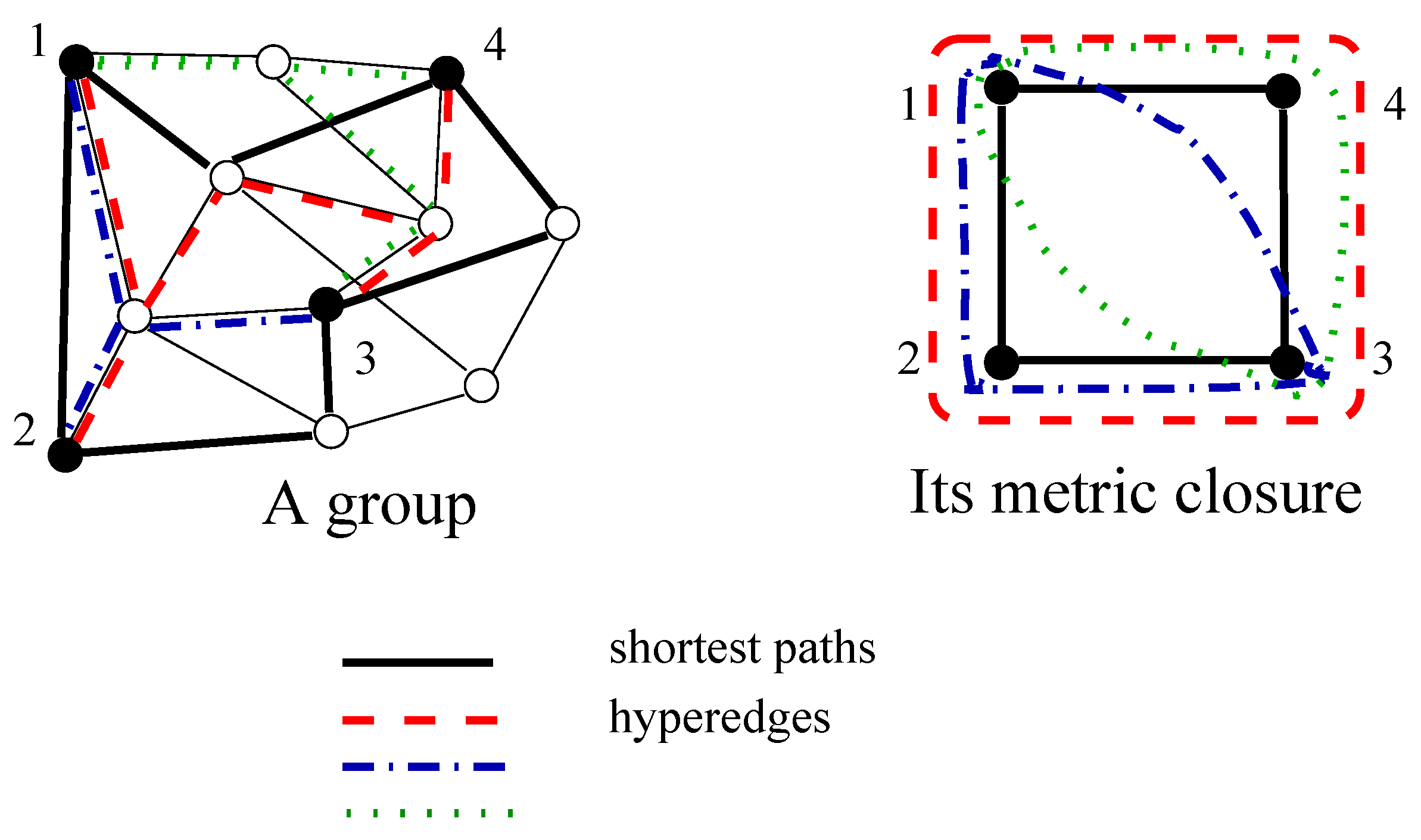
5] formulate the problem in the metric closure. All these algorithms yield 2-approximations of the minimum Steiner trees. However, heuristics that rely solely on shortest paths suffer from a severe structural limitation: they are inherently pairwise. By considering only distances between two nodes at a time, Kruskal and Takahashi–Matsuyama-based approaches overlook geometric opportunities to simultaneously unite multi-node clusters through central, non-terminal nodes (Steiner points). Models based on hypergraphs or
k-limited Steiner trees inherently capture these multi-way synergies, potentially improving coverage by embedding local optimal hubs directly into the routing options.
Building on these ideas, Zelikovsky proposed an 11/6-approximation using a greedy strategy [
6]. This proposal is also based on the metric closure but improves the simple MST approach by examining small Steiner trees for triplets of members. Let
be the MST of the group
M in the metric closure. For each triplet
z, the minimum Steiner tree
is computed in the original graph. The central node
of
is then considered a new node to cover if the gain given in (
1) is positive and maximal.
where
is the length of
,
is the length of the MST in the modified metric closure after the contraction of the nodes in
z, and
is the length of the minimal Steiner tree covering
z. By examining all triplets and adding appropriate Steiner points to the metric closure, the problem is approximated on an augmented graph, resulting in a 3-restricted tree.
Later studies by Zelikovsky proposed the relative greedy heuristic (RGH), with a unique selection function. They introduced a general objective function
. Karpinski and Zelikovsky also proposed efficient methods for pre-analyzing the gains and losses of tree parts. This preprocessing identifies useful full components and includes their Steiner points as nodes to cover. More general greedy algorithms have also been developed. Du et al. proposed algorithms for the Euclidean Steiner problem using
k-tuples [
7], with the graph-related version appearing in [
8]. It is also possible to progressively construct a tree spanning
M by greedily adding nodes to
M.
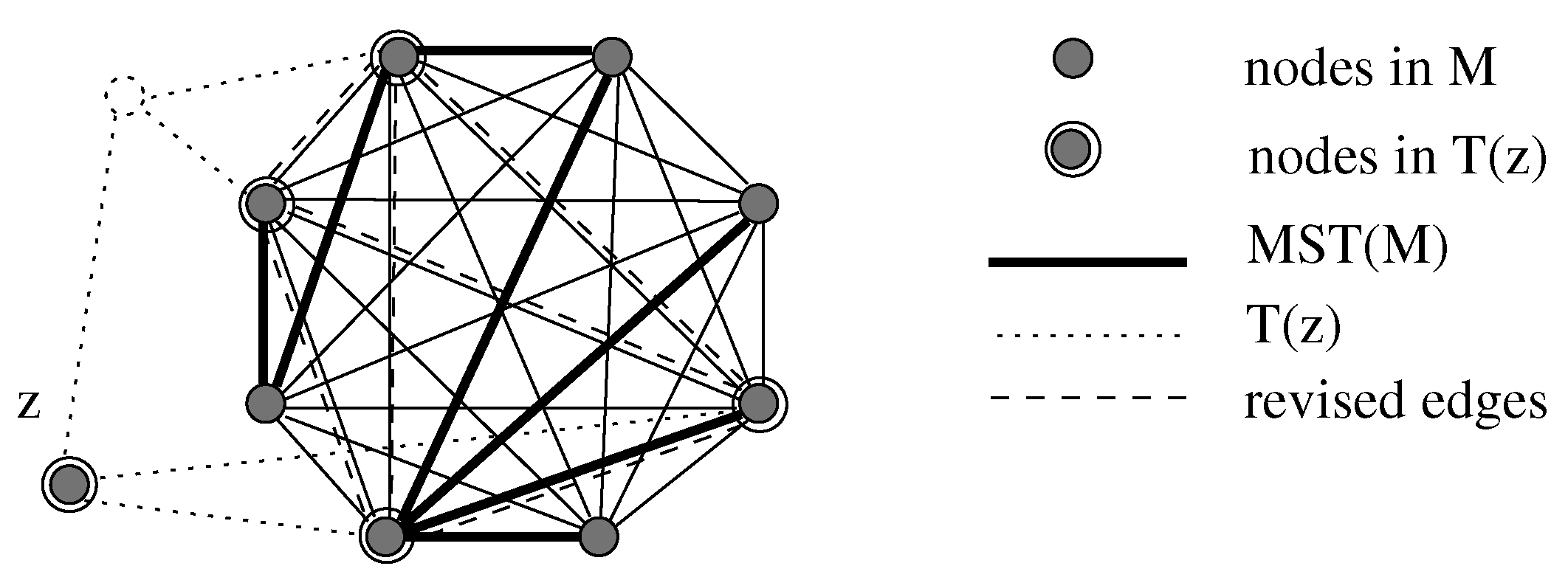
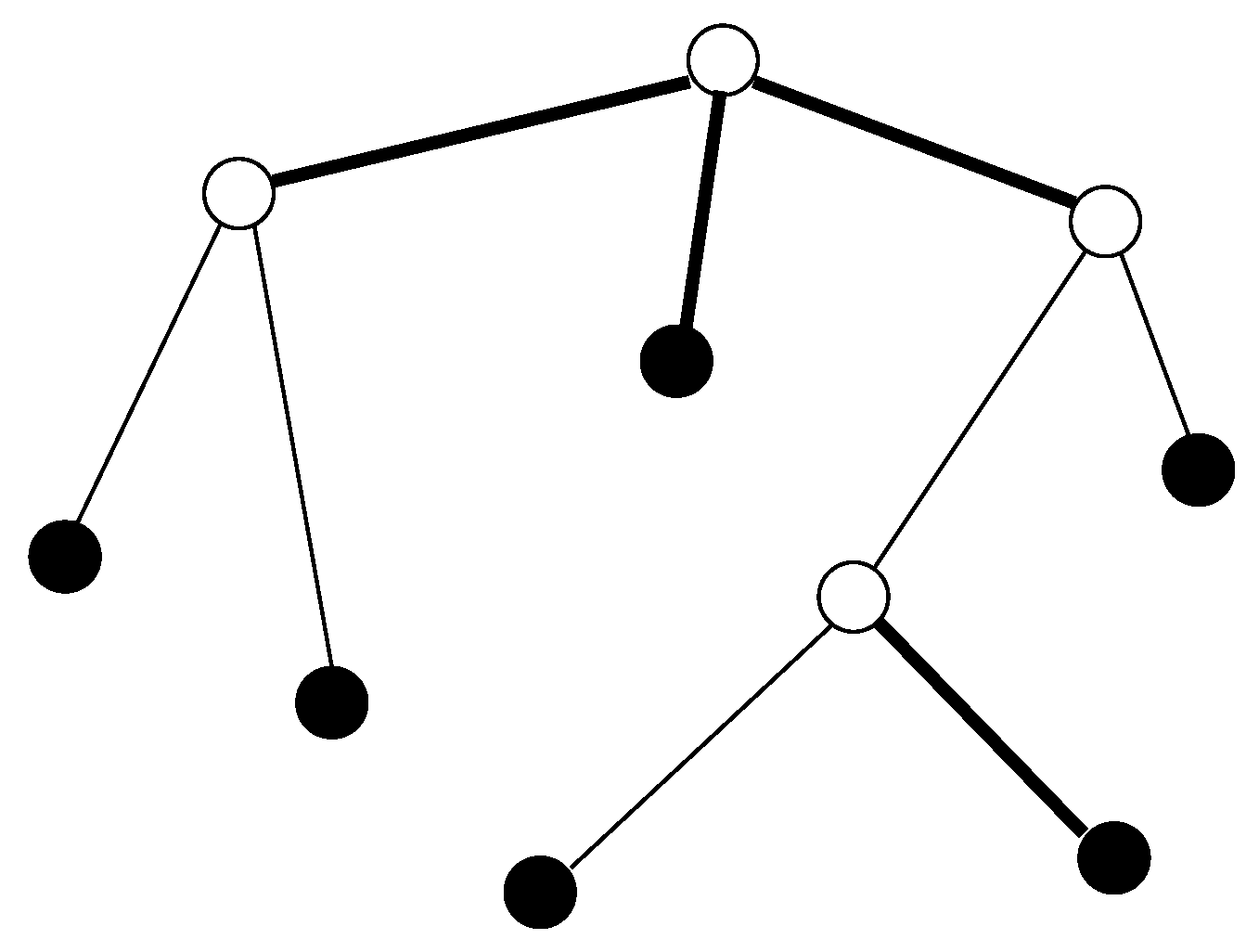
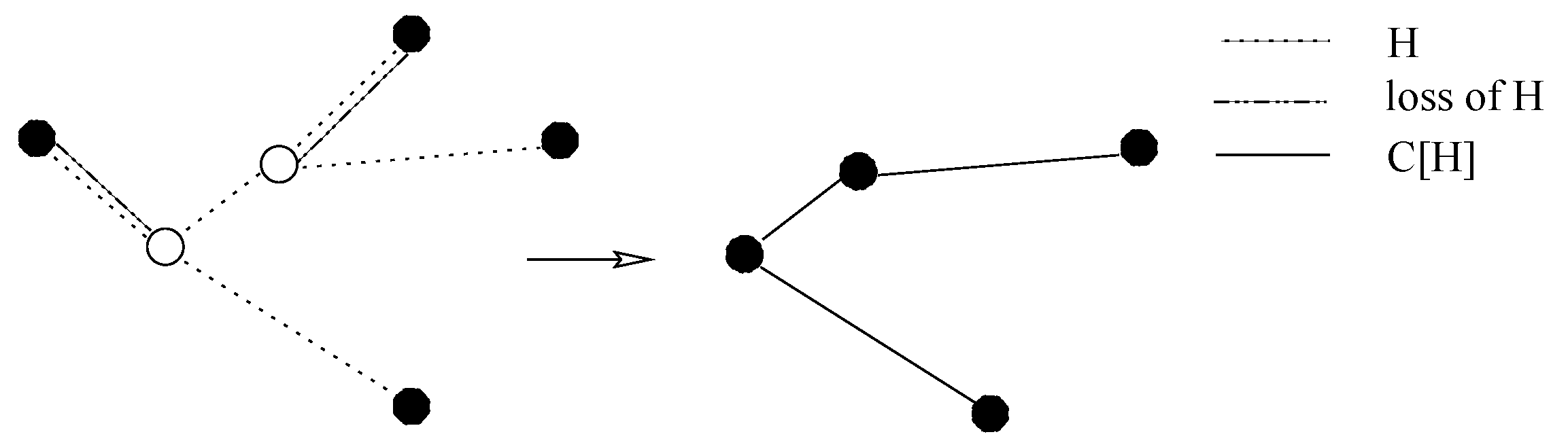
Let
be a new node and let
be a Steiner tree connecting
z to the MST by
k nodes (
cf. Figure 1). Adding
to
creates
cycles, allowing
edges of the metric closure to be revised for a new MST computation.
An improved approximation factor for a special case of the optimal Steiner tree problem is given in [
9]. The solution is an LP-based approximation algorithm based on the iterative randomized rounding technique. k-restricted Steiner trees are investigated, with a directed-component cut relaxation for the problem. The solution costs at most ln(4) times that of the optimal k-restricted Steiner tree.
Beyond traditional LP and greedy approaches, modern research has explored diverse computational paradigms. For instance, Chitty et al. recently compared the performance of quantum annealers against traditional metaheuristic methods for solving the Steiner problem [
10]. Similarly, the efficiency of machine learning has been demonstrated through ’learning-to-prune’ frameworks, which provide near-optimal solutions with significantly reduced computational overhead [
11].
The practical utility of these models continues to expand into critical infrastructure planning. A recent study analyzed the expansion of unbalanced three-phase electric distribution systems, utilizing Steiner tree topologies to minimize total annualized electrification costs [
12]. Furthermore, while our current study focuses on static network topologies, recent work by Raikwar et al. has introduced dynamic algorithms for maintaining approximate Steiner trees in graphs whose edge set changes over time [
13]. Theoretical foundations for connectivity in hypergraph-based models also continue to evolve, particularly regarding S-Steiner hyper-trees and node reachability in oriented structures.
A large online compendium on the approximability of the Steiner Tree-related optimization problems can be found at [
14]. An in-depth study of the Steiner problem in graphs, including descriptions of the most important exact solutions, heuristics, and approximations, is presented in [
15].
The main contributions of this paper are as follows:
Generalization of Heuristic Frameworks: While traditional Steiner tree approximations typically rely on pairwise shortest-path algorithms, we propose a methodological extension that utilizes small Steiner trees as fundamental building blocks in place of standard paths.
Enhanced Metric Closure Models: We introduce a generalized distance graph that transcends the standard shortest-path-based metric closure by incorporating k-limited Steiner trees to better capture multi-node synergies.
Optimal k-limited Approximation: We present an analytical framework for optimal Steiner tree approximation based on k-limited components, providing a structural alternative to classical pairwise techniques.
2. Hypergraphs and Steiner Trees
Warme proposed a hypergraph-based model to address the concatenation of full components in the Euclidean Steiner problem [
16,
17]. In this approach, discovered full components on a set of points are represented as hyperedges. The optimal global Steiner tree is obtained by solving the minimum spanning tree (MST) problem on the constructed hypergraph. Warme also demonstrated that finding the MST in a hypergraph is NP-hard.
A Steiner tree in a graph can be partitioned into edge-disjoint, connected full components by splitting at internal terminals. Each full component corresponds to a hyperedge, resulting in a hypergraph representation of the Steiner tree problem. As shown in [
18], this problem is related to the MST problem in weighted 3-uniform hypergraphs, and a fully polynomial randomized approximation scheme is presented.
In [
19], a Steiner tree representation of hyperedges is regarded as the edge representation of a hypergraph. The metric closure, or distance graph, is frequently used to solve the Steiner tree problem, as discussed in [
20]. This study examines the relationship between the Steiner problem in graphs and the MST problem in hypergraphs, and introduces a branch-and-cut method based on the linear relaxation of the integer-programming formulation.
Polzin and Vahdati Daneshmand [
21] compare various hypergraph-based relaxations with those derived from the traditional graph formulation of the Steiner problem. Their analysis suggests that the union of trees connected by hyperedges forms a graph, and the final concatenation is resolved by solving the classical Steiner problem on this structure.
Small Steiner trees corresponding to hyperedges can connect existing subtrees or link isolated members to trees covering a multicast group. Preliminary propositions for these concepts are presented in [
22,
23]. Theoretical foundations for these ideas are further developed in the following sections.
3. Bases of the Proposed Solutions
Approximate Steiner trees may be constructed by concatenating smaller, optimal components. The following property of optimal Steiner trees supports this method, even when the components are not full components, that is, subtrees in which all leaves are terminals.
Property 1 (Sub-optimality of Steiner Trees). Let be a minimum Steiner tree (MST) for the terminal set M. Let be a subtree of T delimited by a set of boundary nodes (leaves) . If represents the terminals within this subtree, then must be a minimum Steiner tree for the set .
Proof. The proof follows directly: assume is not minimal for , and a smaller tree exists. By substituting with , a Steiner tree smaller than T would be obtained, thereby contradicting the optimality of T. □
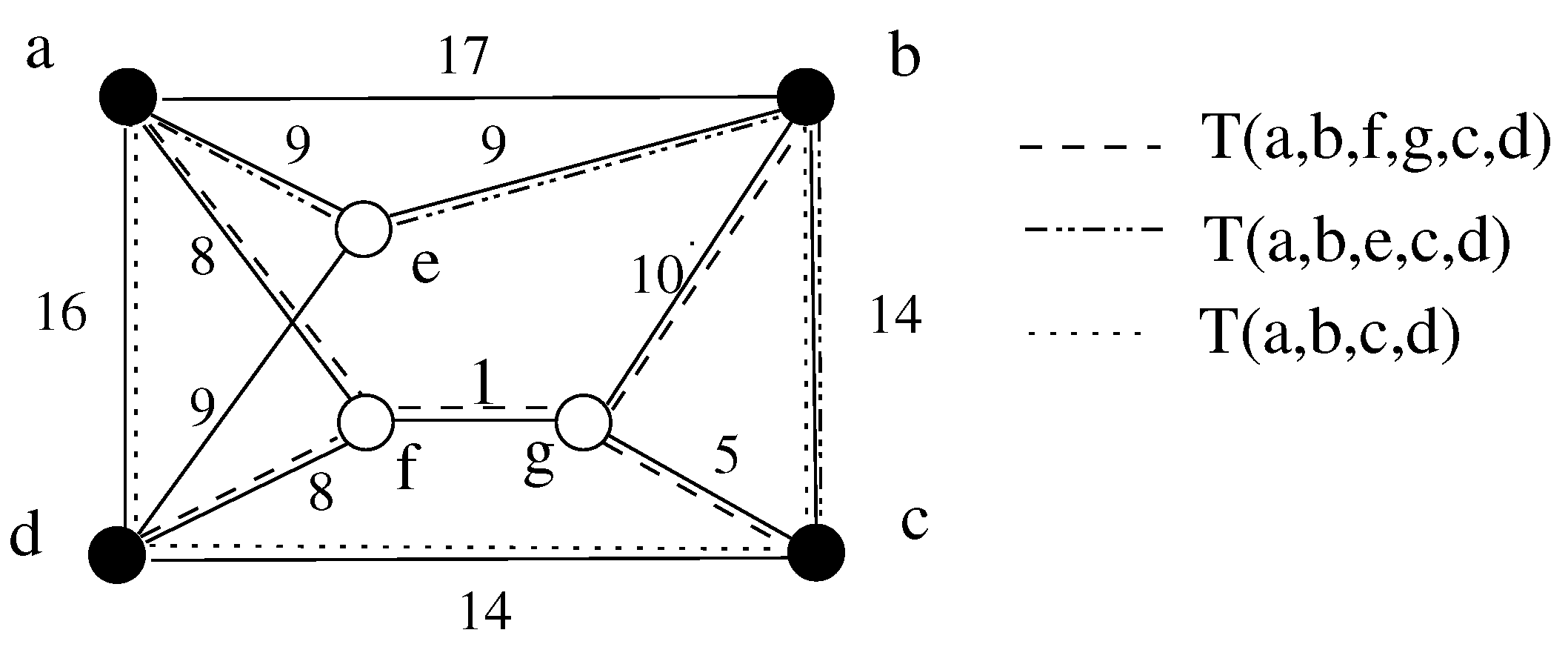
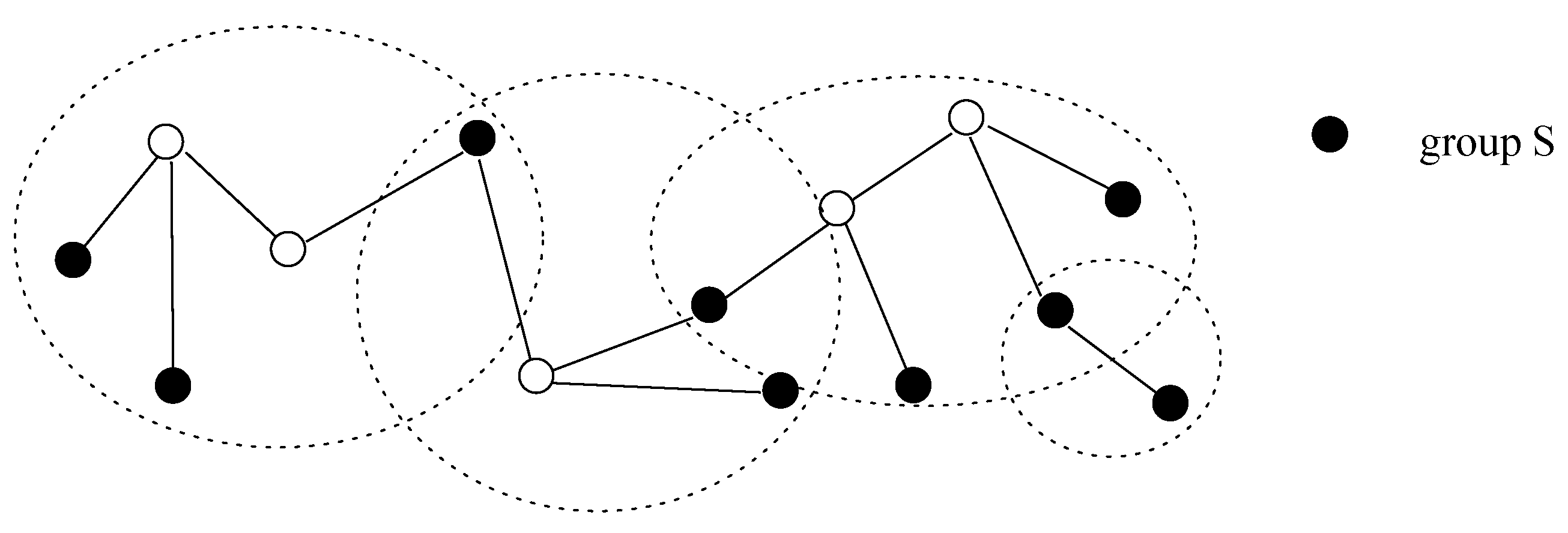
This property serves as the foundation for constructing Steiner trees within a generalized metric closure. However, the optimal decomposition of a Steiner tree into smaller components remains generally unknown. Moreover, concatenating optimal small trees does not guarantee a globally optimal solution. For instance, a collection of shortest paths, each representing a 2-node Steiner tree, that covers
M often produces a sub-optimal spanning structure. As shown in
Figure 2, the minimum Steiner tree for
is
with a length of 32, which notably excludes both the shortest paths between members and the local Steiner tree
.
Greedy heuristics, including the Takahashi–Matsuyama and Kruskal-based approaches, construct approximate Steiner trees by iteratively merging terminals or components using shortest paths. Previous work [
22,
23] proposed improving these strategies by employing small, optimized Steiner trees as connection units rather than simple pairwise edges.
Connections and Distances
The process of connecting trees modifies the measured distance between them.
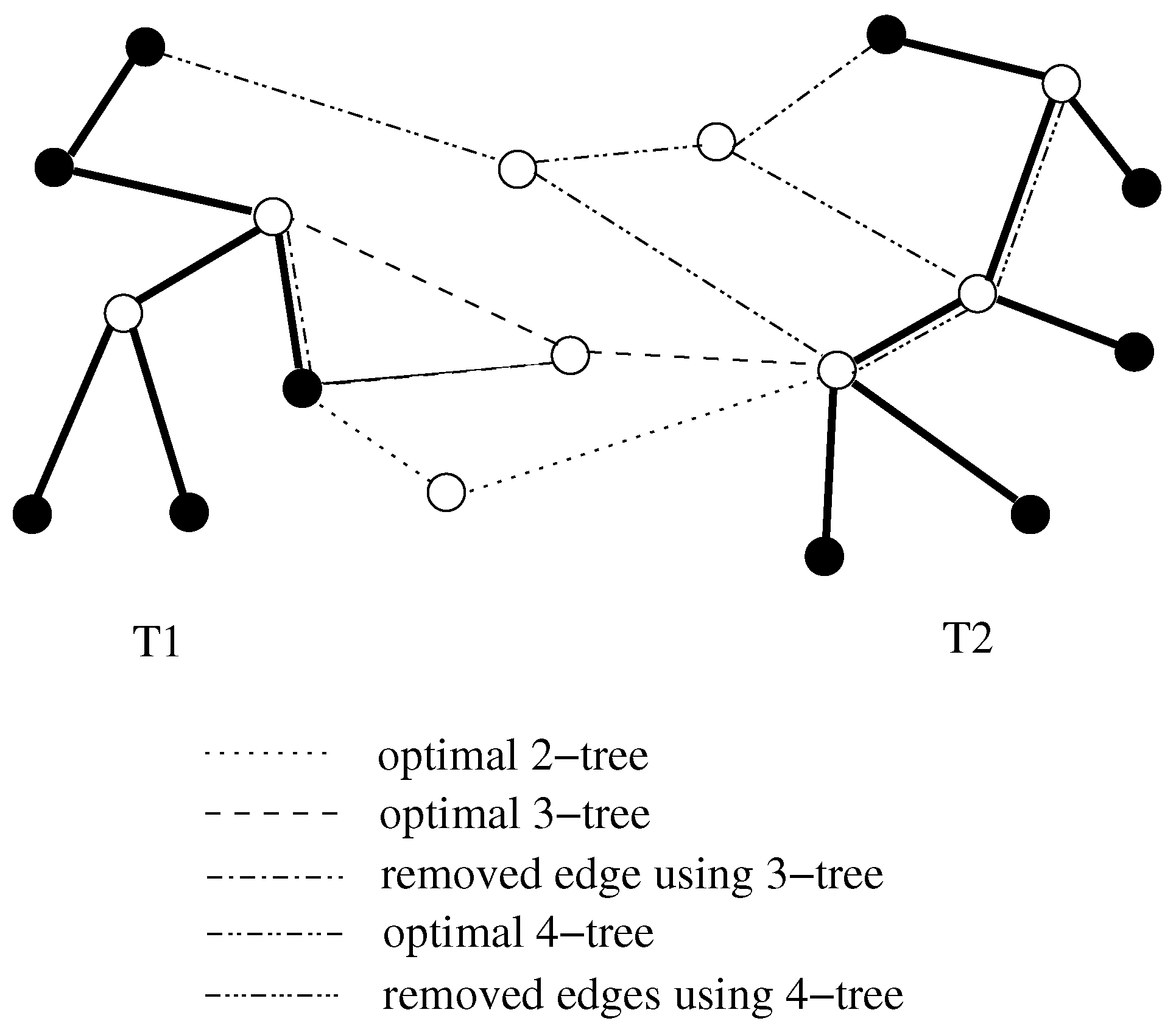
Figure 3 illustrates a basic example where a group
M of nodes is depicted by the filled nodes. Two distinct trees,
and
, each span separate subsets of
M. The primary objective is to unify the two trees by constructing a common partial spanning tree of minimal length, when possible. To achieve optimal connectivity, various types of connections may be defined, with each connection representing a specific distance between the trees.
Definition 2 (Optimal Connection of a Node to a Steiner Tree). Let T be a Steiner tree of the group M and n a node not in T. Let be a Steiner tree of n and l leaves in T, such that and T are edge-disjoint. Define as the union of T and . In general, does not necessarily form a tree and may contain cycles. Let denote the set of edges with maximal length that can be removed from T without compromising the connectivity of . Define as the resulting tree after removing from T.
is an optimal connection of l leaves between n and T if the length of is minimized. This length is referred to as the -distance of n from T, where the standard distance corresponds to the 0-distance. The optimal connection between n and T is achieved with leaves
The computational complexity of determining the optimal connection depends on the size of the Steiner tree. For a tree with nodes, the l leaves of can be positioned in distinct ways. In some cases, multiple equivalent Steiner trees may correspond to the same “distance” value, indicating that the connection is not necessarily unique. This non-uniqueness also occurs in the context of shortest paths. Such connections and “distances” can also be defined for linking two Steiner trees.
Definition 3 (Optimal Connection Between Two Steiner Trees). Let and be two Steiner trees covering and respectively; . Let denote a Steiner tree with l leaves, where its leaves are distributed between and . Define and as the sets of leaves of in and , respectively, with and . Furthermore, , , and are edge-disjoint. Let be the union of , and . Let be the set of edges with maximal length that can be deleted from without loss of connectivity between the members of . Let be the tree after removing from . The tree represents an optimal connection of l leaves between and if the length of is minimized.
This length is referred to as the (l-2)-distance between two Steiner trees. According to this concept, the standard distance between two trees, corresponding to the shortest path, is the 0-distance. The 1-distance is obtained by using a 3-tree as the connecting structure. These types of connections are illustrated in
Figure 3.
The optimal connection is not restricted to a specific number of leaves. The connection between
and
is achieved using
leaves.
The computational complexity of determining the optimal connection between the Steiner trees depends on the sizes of the trees. Suppose the trees have and nodes. The l leaves of can be assigned in different ways. No connection occurs when all leaves are contained within the same tree. This situation arises in cases, assuming l is less than both and .
The number of different connections is
For each connection, a corresponding set of edges can be removed from the trees. The sets of edges that can be removed from the respective Steiner trees form forests.
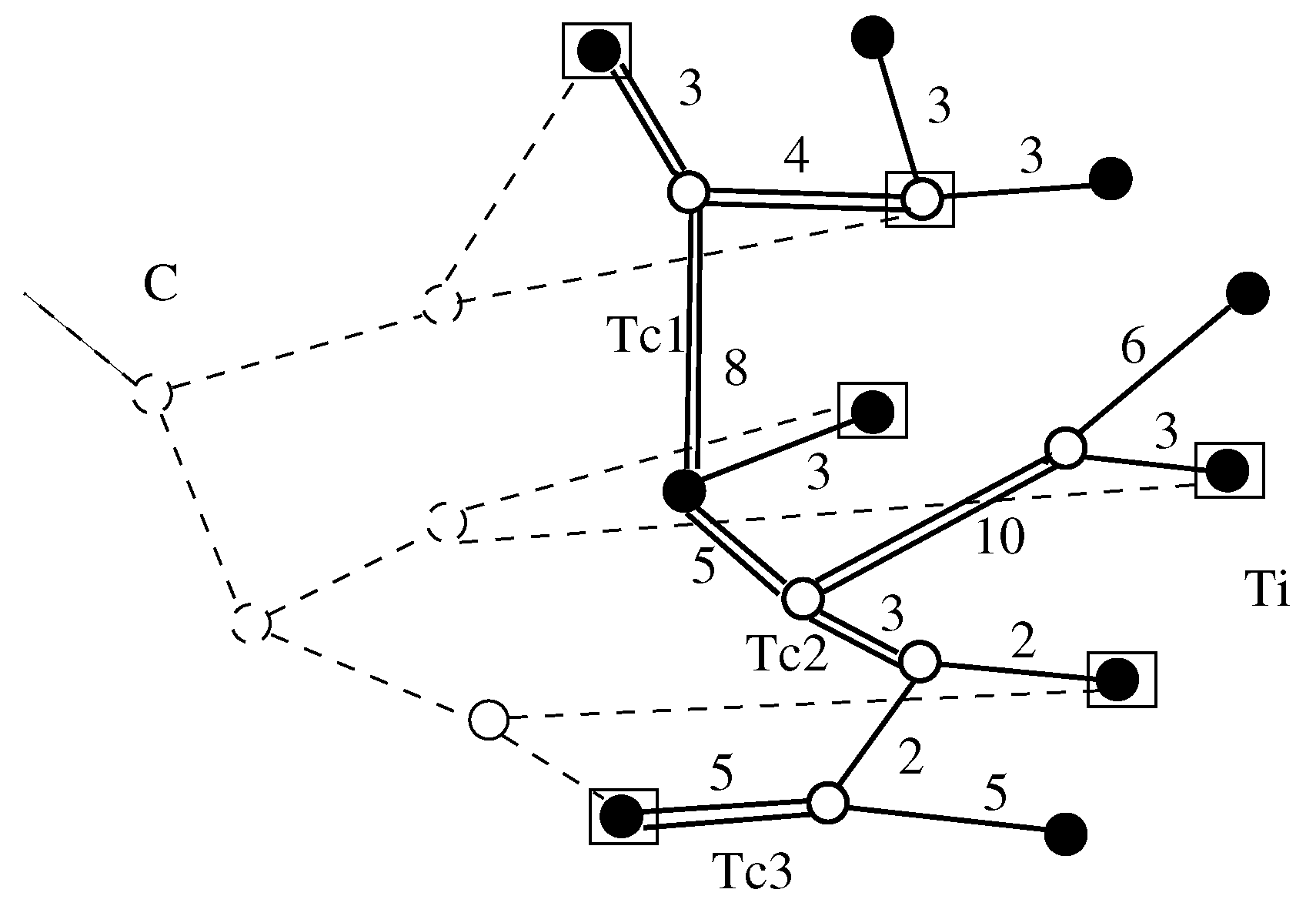
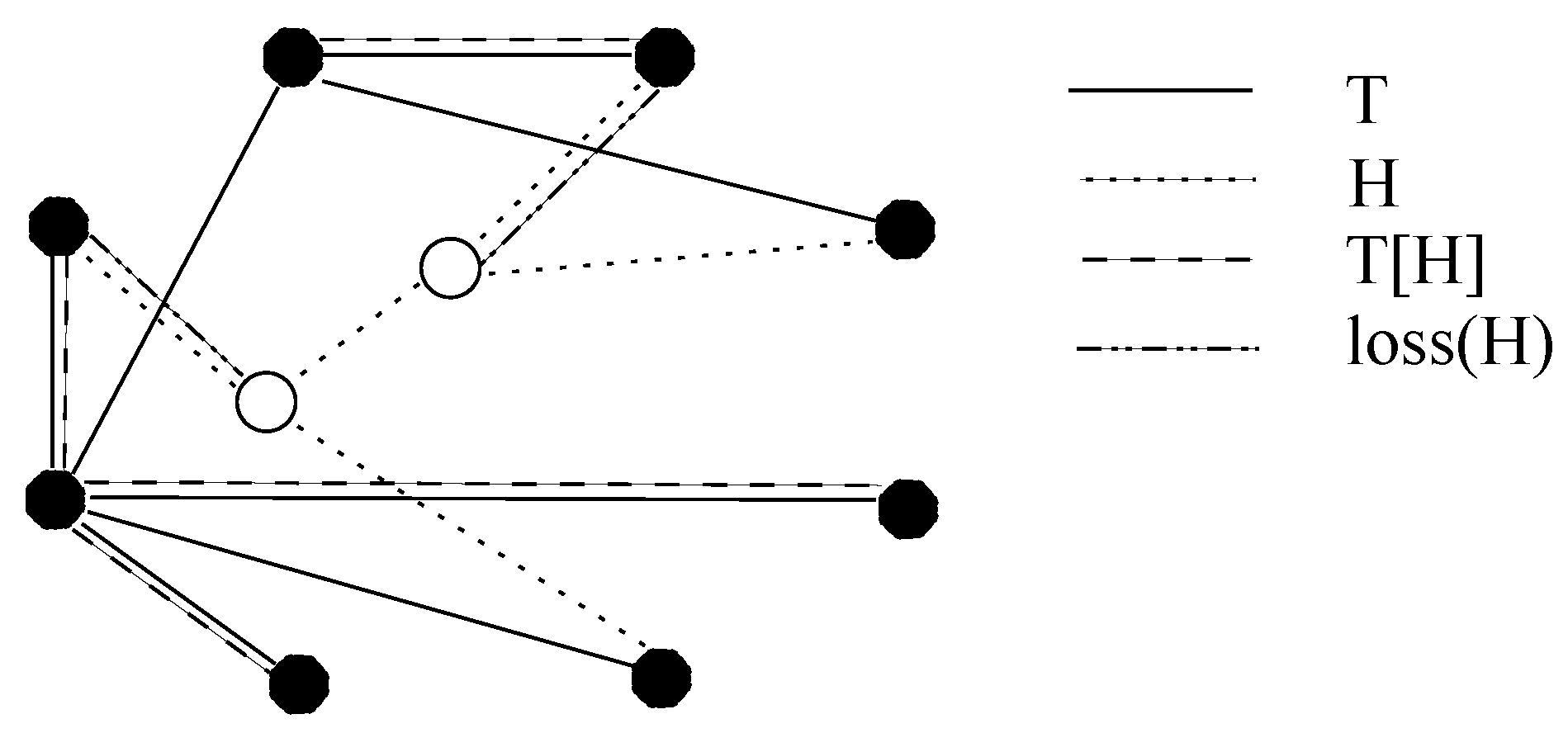
Figure 4 illustrates a Steiner tree
T covering the nodes of a set
M. This tree is to be connected to the remaining members using a tree
C, resulting in a single tree. To avoid cycles, a portion of
T must be removed. This portion lies within the subtree defined by the leaves of
C and constitutes a forest. The following criterion aids in edge selection:
Let be a Steiner tree for , and C a connected tree. is the leaves of C in . Let A be a tree with maximum cost such that contains at least one node from (a leaf of C). If is connected to another element via C, there is a forest with maximum cost that can be removed from and contains A.
4. Hypergraph Model and Metric Closure
To formalize and optimize Steiner tree construction, a hypergraph-based model can be employed. This framework is particularly effective when specific sub-components or local Steiner trees for subsets of the terminal group M are precomputed or known. The objective is to achieve a cost-effective coverage of M using a limited set of these components.
Definition 4. [Hyperedge Representation of Steiner Components:] Let be a connected subtree (component) of a potential Steiner tree. This component is represented in the generalized metric closure as a hyperedge such that the set of nodes incident to corresponds to the nodes in . The cost of the hyperedge, denoted , is defined as the sum of the weights of the edges in : Definition 5. [Coverage and Connectivity:] A tree T is considered covered by a set of hyperedges if every node in T belongs to at least one hyperedge. Connectivity in this model is defined as follows: two hyperedges are connected if they share at least one common node. To ensure global connectivity across a terminal set via hyperedges, there must exist a path of hyperedges between every pair of nodes. In specific configurations, this coverage may manifest as a chain (path) of hyperedges or a hyper-tree.
Definition 6. [Cost of Coverage:] The total cost of a coverage is defined as the sum of the costs of its constituent hyperedges.
Lemma 1. Let be a set of hyperedges covering a tree T. The total cost of is at least the cost of T: Proof. Each hyperedge represents a subtree of T. If we assume all nodes in T are covered but the total cost of T is strictly greater than the sum of the hyperedge costs, it implies at least one edge in T is not represented in any hyperedge. This would result in a loss of connectivity, contradicting the assumption that the hyperedges form a complete coverage of T. □
Metric closure graphs are frequently used to determine the effective coverage of sets of nodes. Typically, the metric closure encodes the pairwise distances between nodes. The distance between two nodes is defined as the cost of the shortest path connecting them. Trivially, a shortest path is a hyperedge of size 2 (a 2-tree). The metric closure can be generalized to larger (but still limited) hyperedges.
4.1. Generalized and k-Limited Metric Closures
Traditional metric closures utilize shortest paths between node pairs (2-node hyperedges). This concept can be generalized by considering larger, albeit size-limited, hyperedges.
Definition 7. Let M be a set of nodes in a connected graph. For , the set of hyperedges representing Steiner trees with a size of at most k forms a k-limited metric closure. This generalized hypergraph includes standard shortest paths alongside hyperedges representing optimal trees for triplets, quadruplets, and higher-order tuples up to size k.
It is assumed that the intersection of hyperedges covering a tree
T contains only one node per peer. This condition is necessary to minimize redundancies among the trees associated with the hyperedges. If the intersection of two hyperedges contains multiple nodes, then subgraphs defined by these nodes are present in the trees, resulting in unnecessary costs for effective coverage.
Figure 5 illustrates some hyperedges in the generalized metric closure of a small group.
4.2. Optimal Coverage Using k-Limited Components
The procedure for finding the minimum-cost coverage using k-limited components involves two exact algorithms:
- 1.
Construction of the Hyper Metric Closure (): We generate hyperedges for every i-tuple in M (where ), assigning the cost of the corresponding minimum Steiner tree to each hyperedge (cf. Algorithm 1).
- 2.
Optimal Hyperedge Selection: We identify the subset of connected hyperedges that covers M at the minimum total cost. This requires enumerating and evaluating connected subsets of (cf. Algorithm 2).
| Algorithm 1 Hyper Metric Closure. |
Require: M, k Ensure: for to k do for each i-tuple do Compute the minimum Steiner tree of Add to a hyperedge on with cost w end for end for return
|
| Algorithm 2 Optimal coverage with hyperedges. |
Require: Ensure: H ▹ The maximum of costs ▹ A sufficiently large upper bound for all
do ▹ The cost of the subset if ( is connected) ∧ ( covers M) ∧ () then end if end forreturn H
|
Complexity Note: The
phase involves
tuples for each
i. Given that Steiner tree computation is NP-complete, several exact algorithms have been proposed to compute it. For instance, a branch-and-cut algorithm is proposed in [
24]. The complexity is bounded by
, where
is the cost of a Steiner tree calculation for
i nodes. Finding the optimal coverage is significantly more expensive, as the number of hyperedge subsets to examine is
, where
.
This procedure does not yield the minimum-cost Steiner tree, but it produces the best tree that can be constructed using k-limited components. Moreover, the steps in this procedure to determine coverage are very expensive.
4.3. Greedy Strategy for k-Limited Components
To mitigate the computational intensity of the optimal approach, we propose a greedy heuristic (Algorithm 3) that builds the tree iteratively:
- 1.
Start with an arbitrary node and connect it to its nearest neighbors in M via a k-limited Steiner tree.
- 2.
From a leaf of the newly added hyperedge, select the next nearest uncovered terminals to form the subsequent hyperedge, creating a chain or tree-like structure until all terminals are covered.
| Algorithm 3 Greedy algorithm for constructing spanning trees with hyperedges |
Require: M, ▹ The usual metric closure Ensure: H ▹ A set of hyperdeges covering M a node of ▹ an arbitrary node while do ▹ A node set for to k do closest node from n if then break end if end for end while return H
|
Complexity Note: Using the Floyd–Warshall algorithm, the metric closure can be created with time complexity . Algorithm 3 is searching for the closest nodes for each node in M. This implies the complexity of .
The selection of the starting point and subsequent steps significantly influences the resulting cost. Notably, an effective solution may form a tree rather than a chain. Since the problem is NP-hard, greedy approaches do not guarantee optimality. The following experiment was conducted to illustrate the performance of the proposed approach.
Table 1 presents the results. In the known Geant network topology, random groups of different sizes have been generated. Group sizes are shown in the first column. Varying the value of
k, coverages using chains of
k-limited hyperedges have been computed. The values of
k are in the second column. The cost of the trees determined by the hyperedges is in the 4th column. The connected hyperedges contain some edges more than once. The number of duplicated edges is indicated in the 5th column. Using an exact algorithm, the optimal solutions are the partial minimum spanning trees (minimum Steiner trees). The last two columns show the ratios of the costs of the approximated “trees” to the optimums with and without duplicated edges (reduced ratios), respectively.
Experimental results (
Table 1) demonstrate that as the hyperedge limit
k increases, the cost of the resulting approximate tree approaches the optimal minimum Steiner tree (PMST). While greedy decisions do not guarantee global optimality, the reduced ratio (after eliminating duplicated edges) indicates significant performance improvements over standard pairwise heuristics.
4.4. Practical Applications
The principles underlying these algorithms have direct applicability in contemporary Internet of Things (IoT) networking scenarios:
Industrial IoT (IIoT) Multicast Routing: In dense wireless sensor networks deployed in industrial environments, frequent topology changes and energy constraints render the computation of exact global routing arrays computationally prohibitive. The use of k-limited hyperedge approximations facilitates decentralized construction of efficient multicast trees, such as those required for coordinated firmware updates or synchronized actuator commands, centered around key sensor cluster-heads. This approach significantly reduces evaluation time and extends overall network battery life.
Deadlock Resolution in Ad Hoc IoT Meshes: Addressing circular buffer dependencies in randomized IoT mesh topologies requires the construction of acyclic overlays. By applying the k-limited connectivity metric, spanning structures can be generated that map across critical bottleneck endpoint nodes, thereby resolving ring-topology deadlock conditions without necessitating a complete hierarchical recalculation.
5. Experimental Evaluation
To address the practical limitations of computing exact
k-limited Steiner trees (which are NP-hard even for small subsets), we conducted a series of computational experiments. The primary objective is to evaluate the empirical execution time of the Hyper Metric Closure (HMC), the optimal coverage, and the greedy heuristic proposed in
Section 4, as well as to measure the approximation ratio of the heuristic compared to the absolute exact Steiner tree baseline.
5.1. Methodology and Simulation Environment
The algorithms were implemented in Python 3 using the NetworkX library for core graph operations, including generating random graph instances and computing shortest-path metric closures. The testing environment utilized a standard modern CPU. We generated purely structural Erdős–Rényi topologies () to simulate dense, unoptimized networks. For each test instance, edge weights were assigned uniformly at random within the interval , and a specified subset of nodes was randomly designated as the multicast group M. The parameter k was strictly set to (forming 3-trees) based on the theoretical intractability for higher limits.
5.2. Results and Discussion
Table 2 presents the execution time (in seconds) for generating the
Hyper Metric Closure (Algorithm 1) and the Greedy Coverage heuristic (Algorithm 3). It also tracks the approximation ratio of the greedy solution relative to the absolute minimum Steiner tree cost.
The results explicitly highlight the combinatorial explosion discussed in the theoretical sections. As the graph size strictly increases from to (with ), the time required to build the foundational Hyper Metric Closure (Algorithm 1) skyrockets from approximately 14 s to over 44 s. Evaluating the absolute optimal coverage across these hyperedges (Algorithm 2) triggers exponential stalling, freezing computations, thus validating the mathematical limit. Conversely, the greedy strategy (Algorithm 3) avoids enumerating large numbers of subsets by iteratively combining local geometric metrics. It executed in under 3.5 s for the largest test and produced trees within of the theoretically exact, NP-hard minimum, occasionally identifying the optimal tree.
6. Conclusions
In this work, we provide an overview of the most well-known heuristics for solving the Steiner problem in graphs. A good part of the algorithms is based on shortest-path algorithms. In some cases, the constructed trees can be improved by adding small components, namely, partial spanning trees. In these cases, the edge set must be revised; some edges may be removed. Recently, hypergraph-based construction has been proposed. Partial spanning trees can be represented by hyperedges. They can be concatenated using greedy algorithms, or a Hyper Metric Closure can be constructed, after which an approximate solution can be found using it. In our study, we tested the effect of applying hyperedges to Steiner tree approximations. The results are encouraging; the approximated trees approach the optimum. The method’s counterpart is its high computational complexity. Only small Steiner trees can be computed within a reasonable time.
The construction of efficient heuristics for the aforementioned NP-hard optimization is a challenging goal. The “distance” based on Steiner trees used in our paper requires further analysis. The generalized metric closure should also be analyzed, and its properties extended.