
Mobility-Aware Cooperative Optimization for Task Offloading and Resource Allocation in Multi-Edge Computing

Abstract
1. Introduction
- (1)
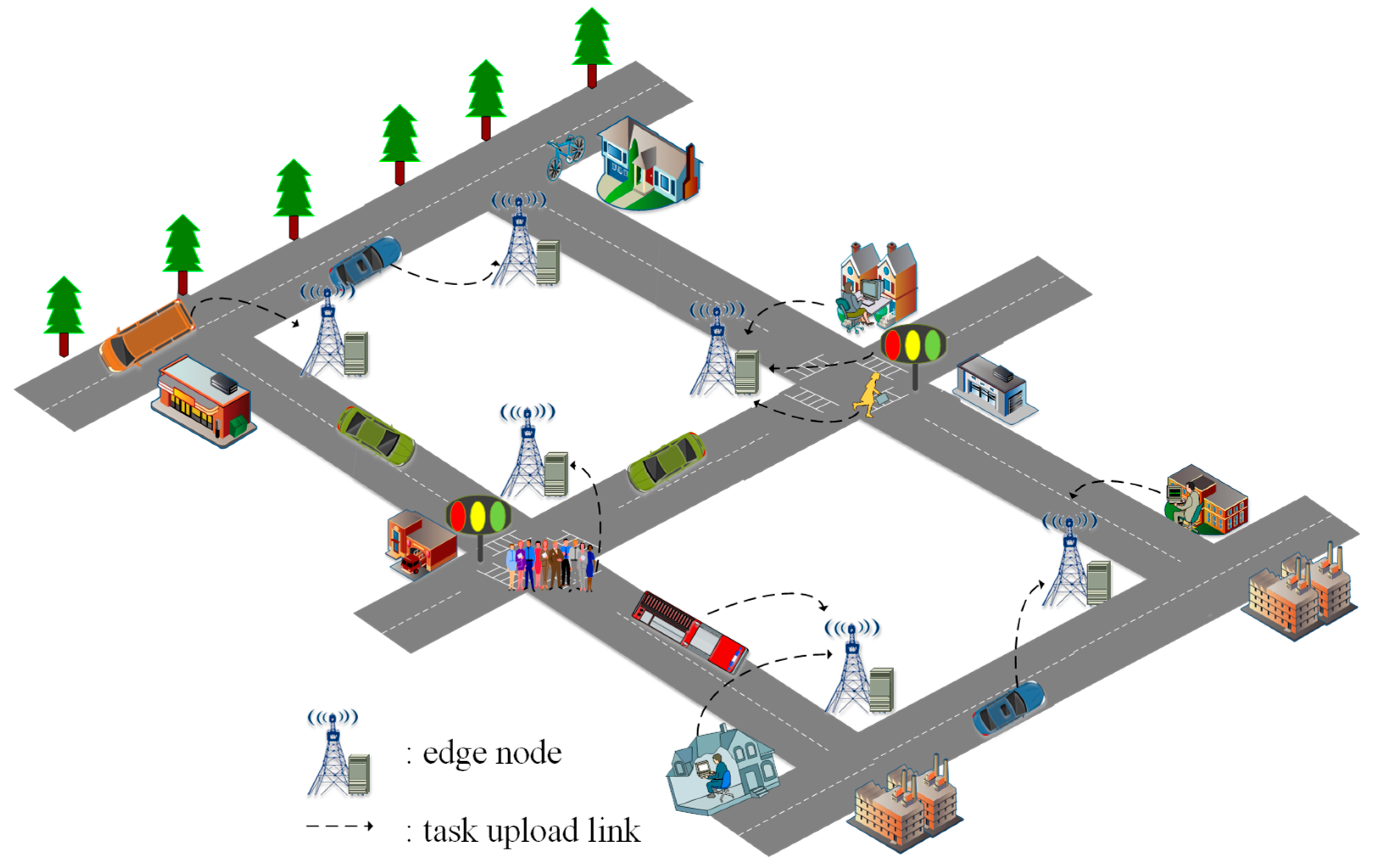
- A hierarchical optimization framework is proposed for multi-region edge computing environments. The framework integrates a mobility group-driven task offloading mechanism with adaptive resource scheduling among edge servers, achieving global optimization of task assignment and resource utilization under dynamic network conditions.
- (2)
- In order to accommodate the heterogeneity of devices with different mobility patterns, a mobility grouping mechanism is designed based on device trajectories and stay duration. A dynamic offloading decision process is then developed to intelligently determine whether tasks should be executed locally or offloaded to the most suitable edge server, with factors such as delay estimation and regional load being taken into account.
- (3)
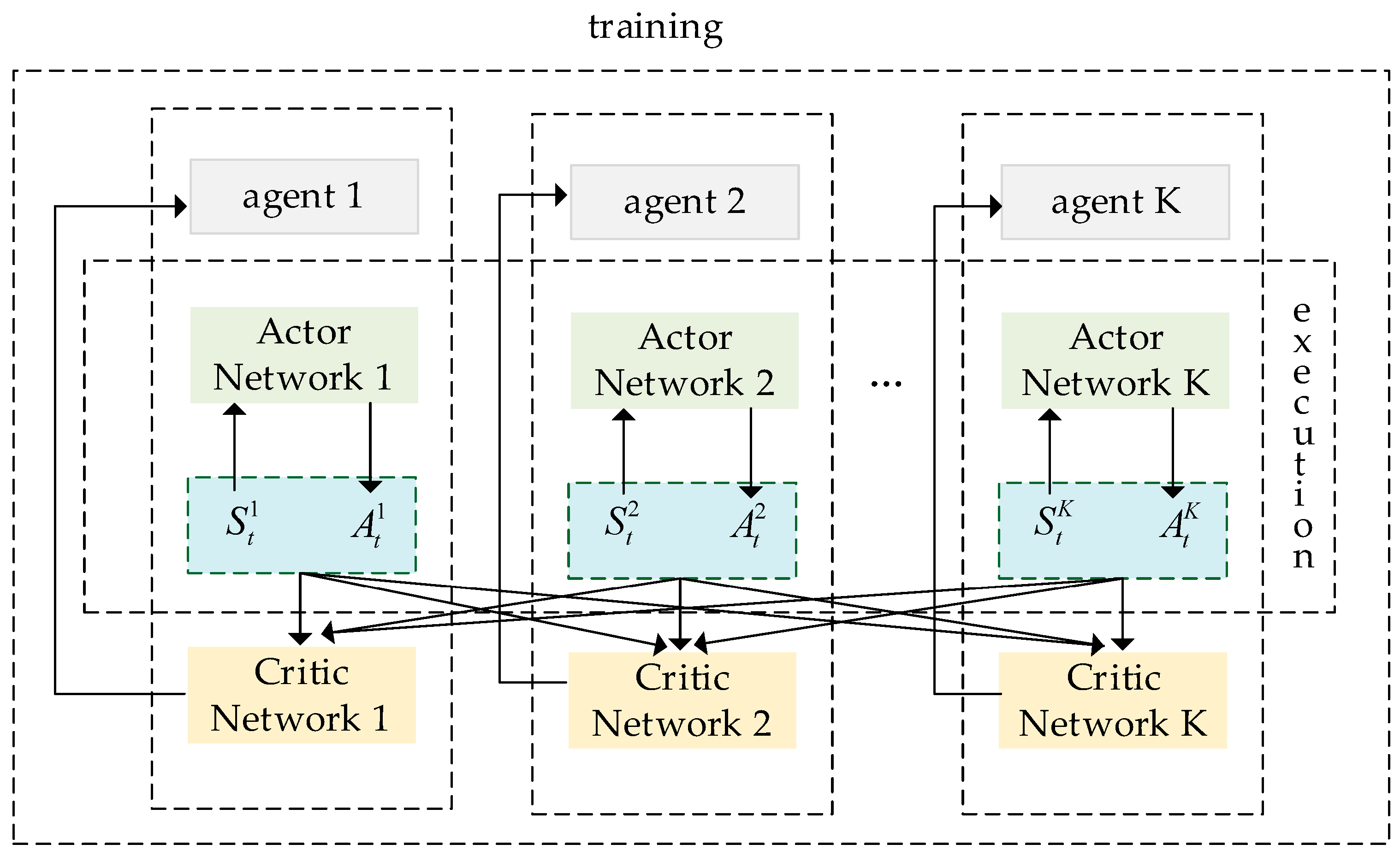
- Building on the offloading decisions, each edge server is modeled as an agent, and the MADDPG algorithm is employed to jointly optimize task delay and energy consumption. By leveraging task features and group-aware indicators, the agents learn to allocate limited computing resources efficiently, thereby enhancing the overall adaptability and scheduling performance of the system.
2. System Model
2.1. Computation Model
2.2. Mobility Modeling
2.3. Problem Formulation
3. Mobility Group-Driven Task Offloading and Edge Resource Allocation via MADDPG
3.1. Mobility Group-Driven Differentiated Offloading Policy
3.2. MADDPG-Based Computing-Network Resource Scheduling Strategy Design
3.2.1. Markov Decision Process Modeling
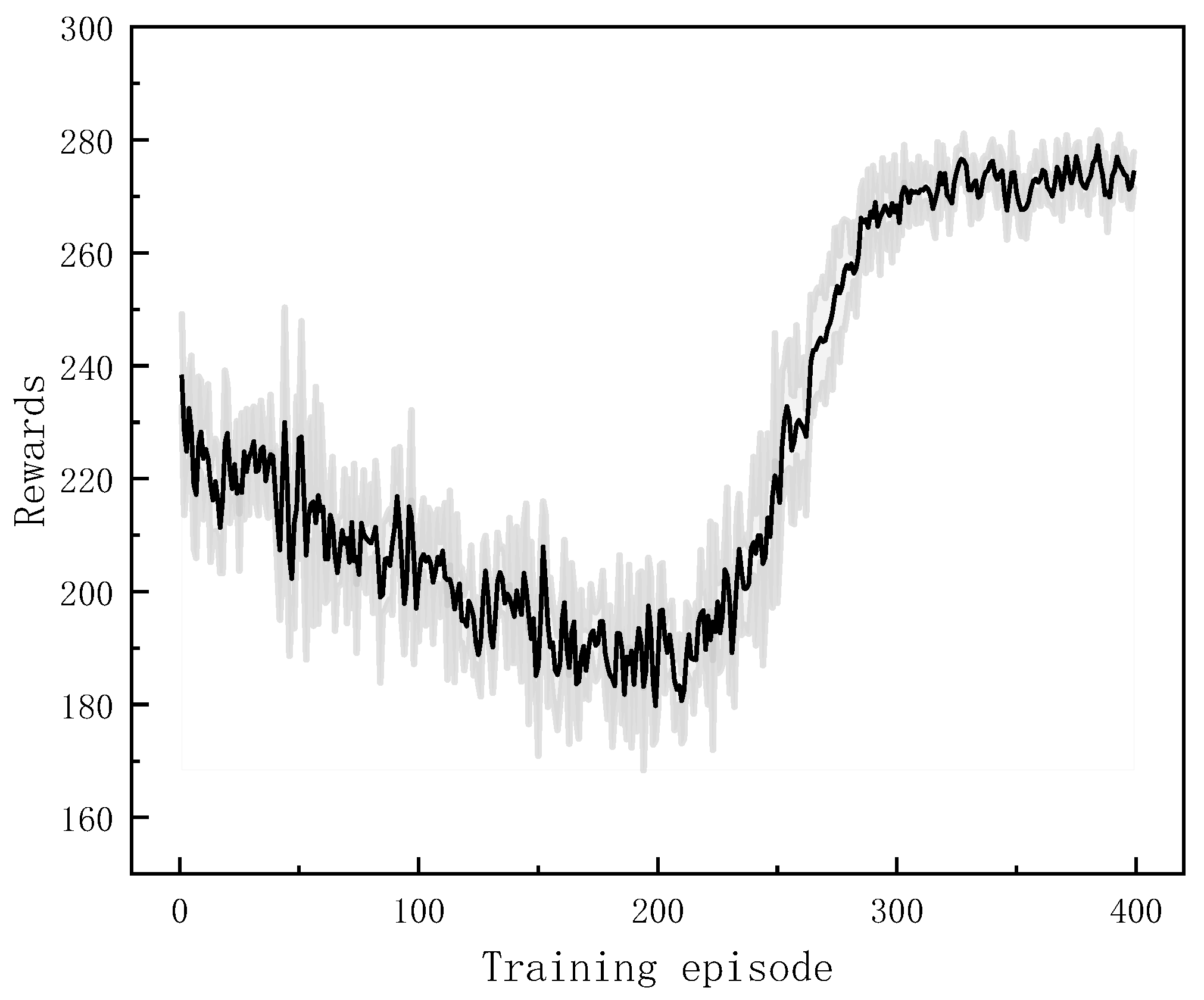
3.2.2. MADDPG Algorithm Training
| Algorithm 1: MADDPG-Based Resource Allocation |
| Input: number of devices, mobility group ratio, training episodes Max-Episode, Training step length per episode Training-Step, size of replay buffer B Output: optimal resource allocation policy for each edge server agent k 1: Initialize all agents’ Actor and Critic networks, and corresponding target networks 2: Initialize experience replay buffer Replay-Buffer for each agent 3: for episode = 1 to Max-Episode do 4: Generate random vehicle trajectories trajs 5: Assign mobility groups to vehicles based on Ratio 6: for each vehicle m do 7: According to mobility group[m] and traj[m], decide offloading: 8: if offloading condition satisfied then 9: Assign task to the designated edge server 10: else 11: Mark task as locally executed 12: end for 13: for step = 1 to Training-Step do 14: for each agent i = 1 to K do//K equals the number of edge nodes 15: Construct state 16: Select action ← () + exploration_noise, where noise is sampled from an Ornstein-Uhlenbeck (OU) process 17: end for 18: Execute actions , environment updates the task execution state 19: Compute global reward Rt 20: if replay buffer size < B then 21: Store into each agent’s replay buffer 22 else 23: Replace the earliest stored experience with 24: end if 25: if episode > 50 then 26: Sample a mini-batch from replay buffer for training 27: Update Actor and Critic using centralized training 28: Soft update target networks 29: end if 30: end for 31: end for 32: Return the final learned policy for each agent |
4. Experiment and Results
4.1. Experimental Environment Setup
4.2. Training Results
4.3. Comparative Experiment
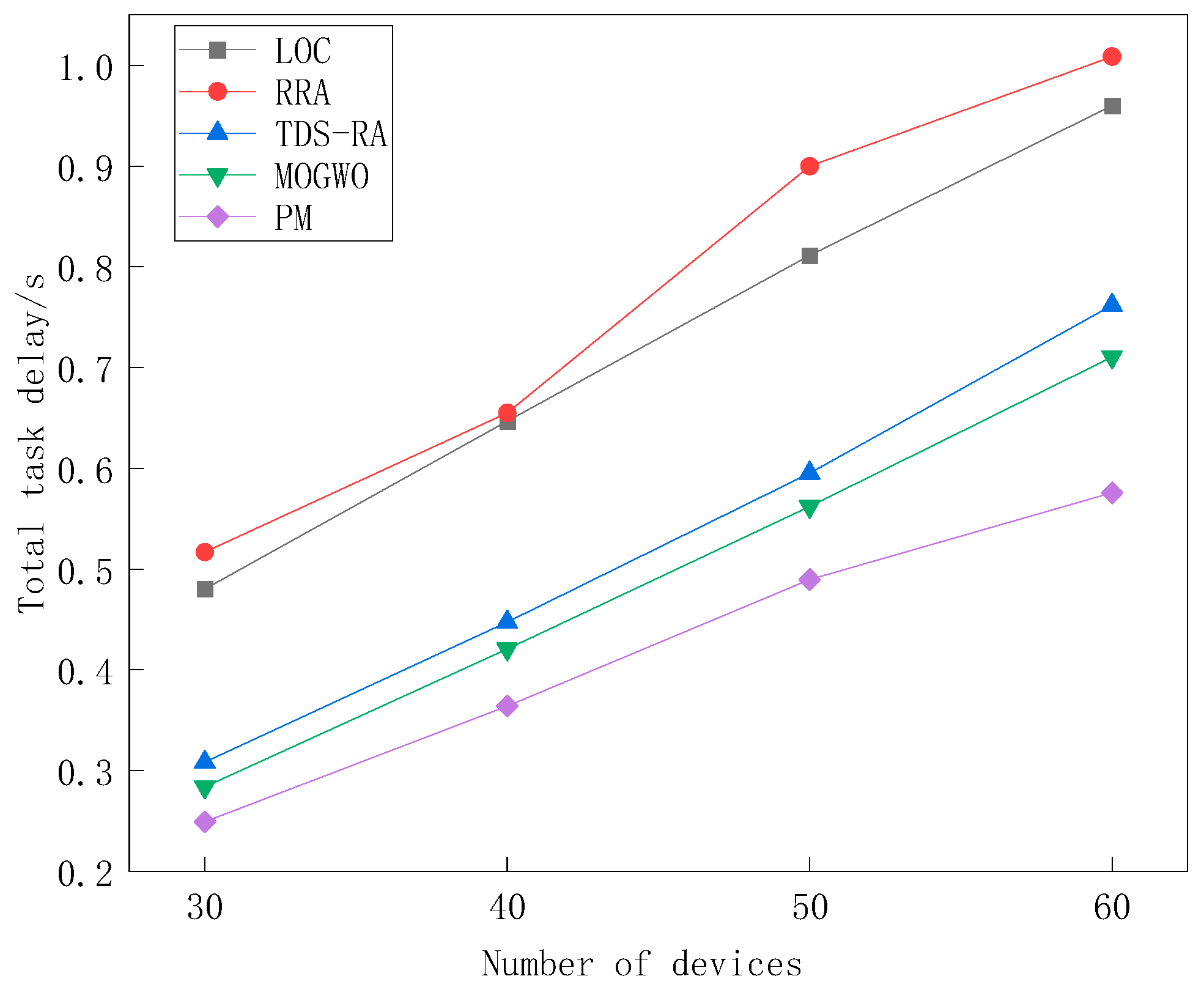
4.3.1. Impact of Different Device Scales on Total Task Processing Delay
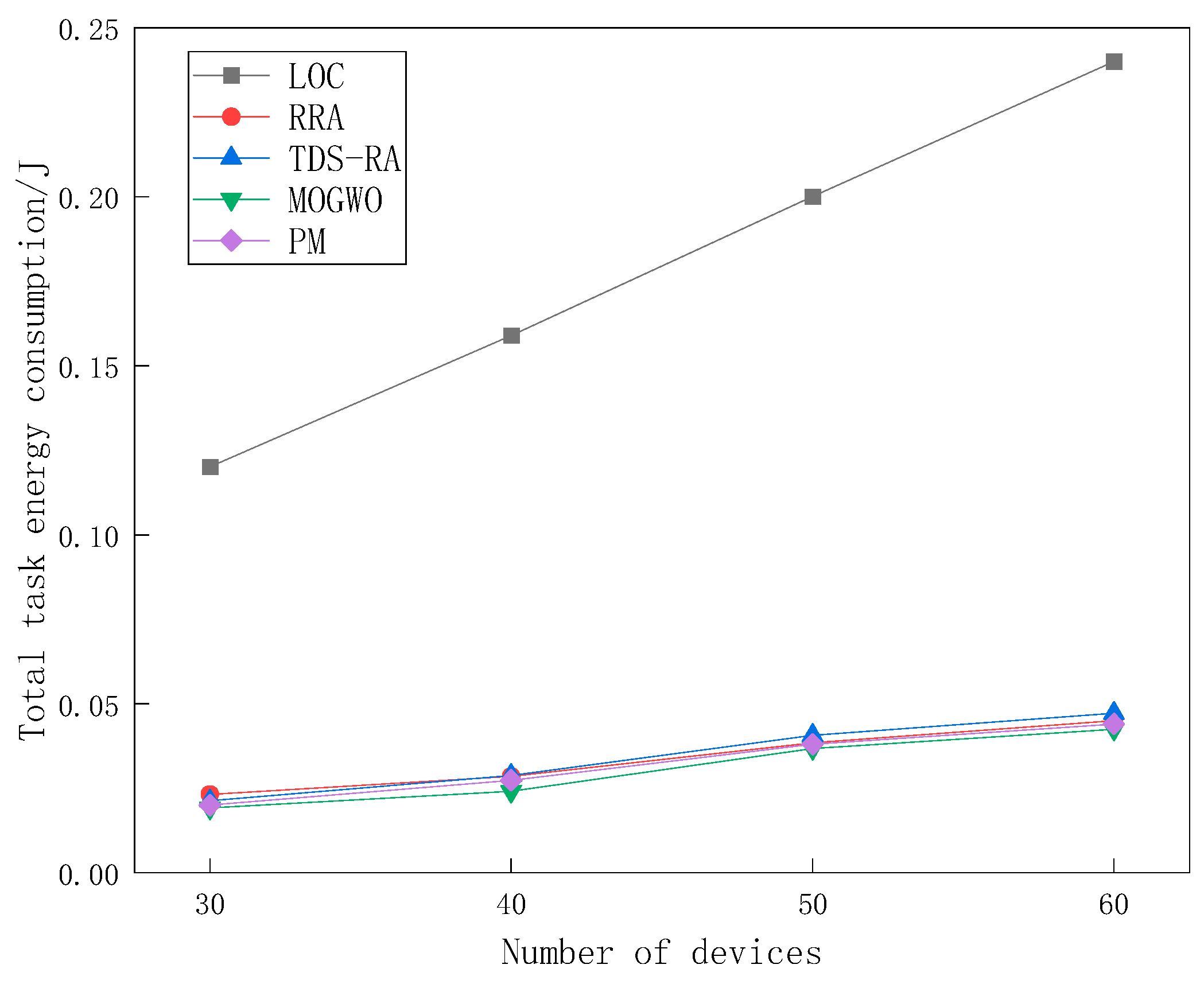
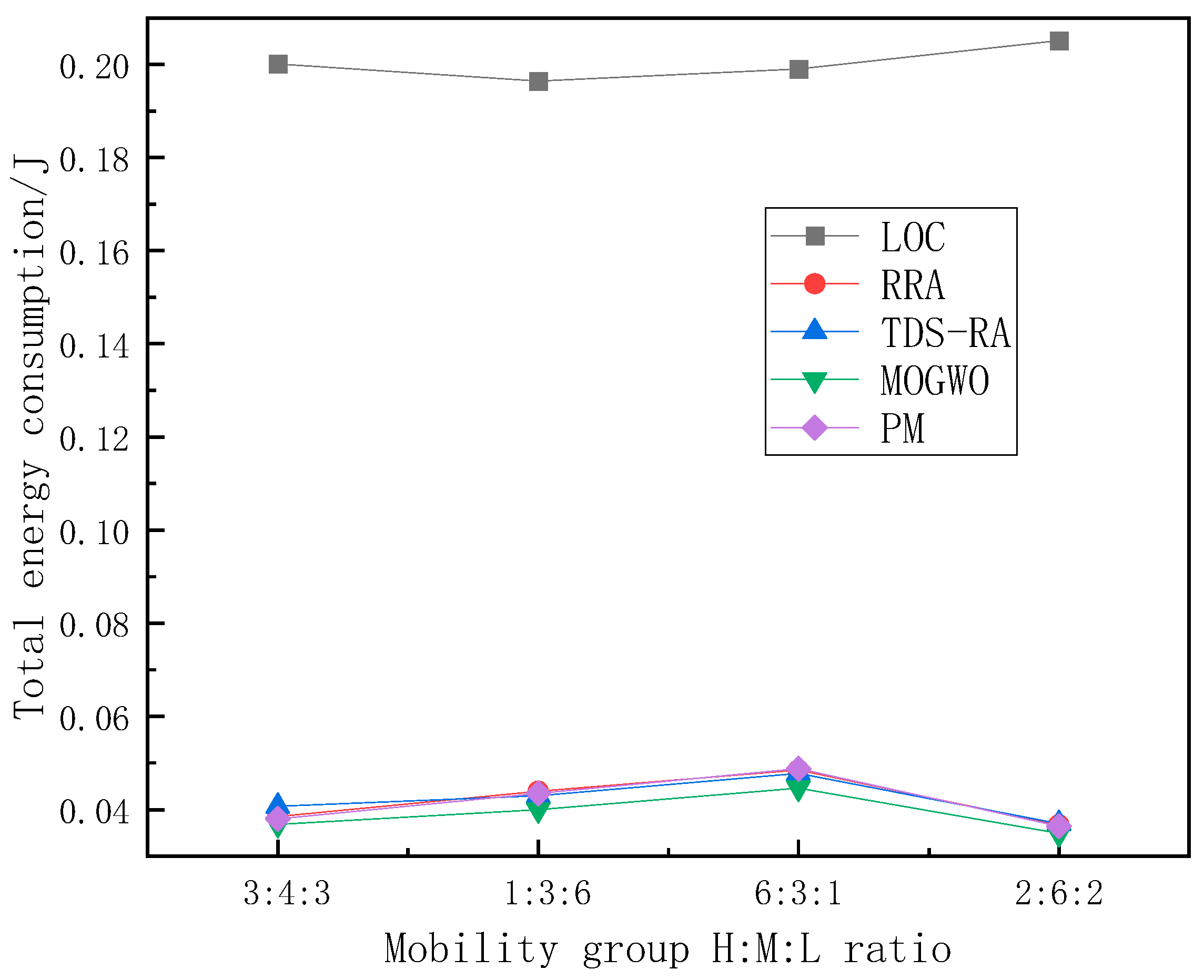
4.3.2. Impact of Different Device Scales on Energy Consumption
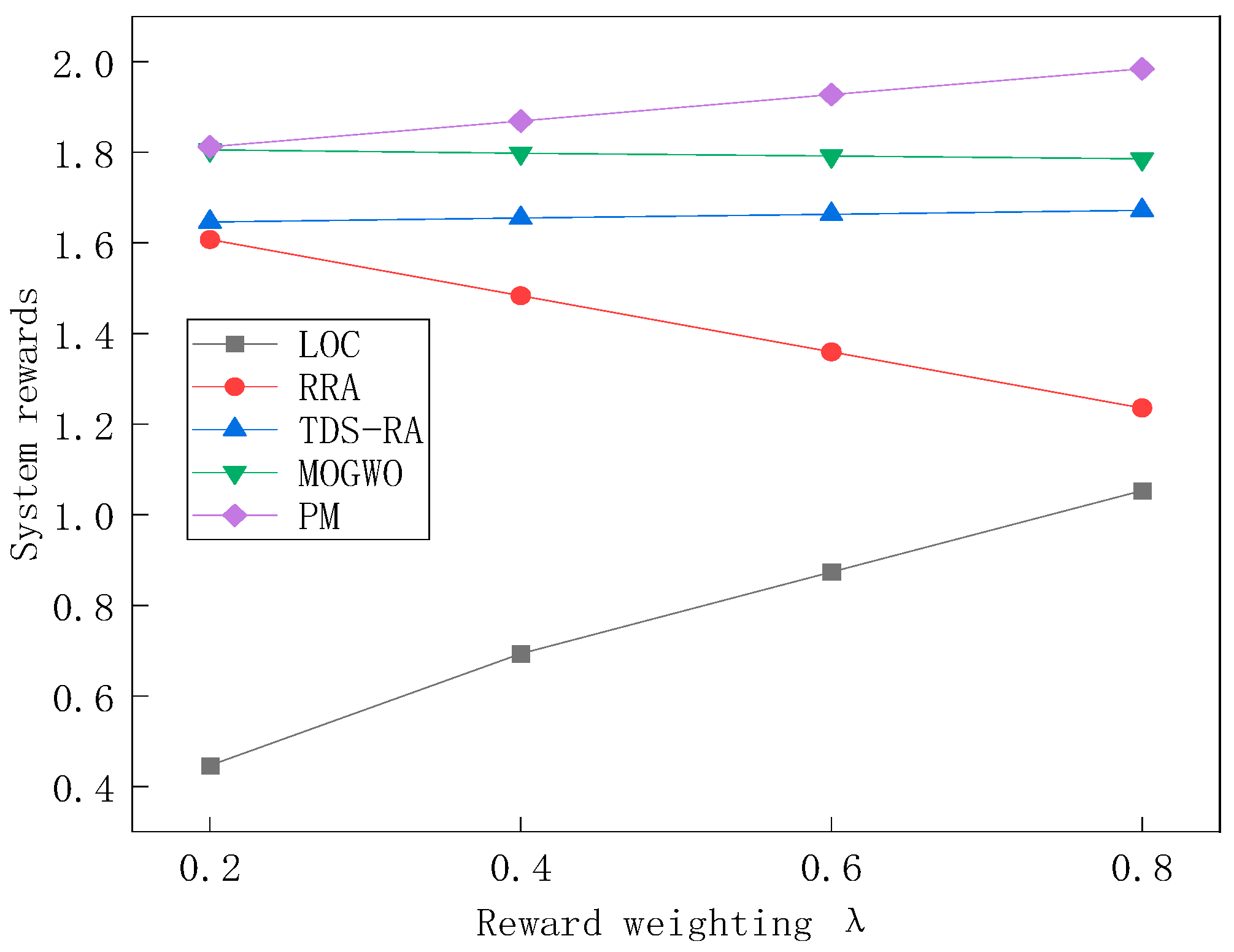
4.3.3. Impact of Energy-Delay Trade-Off Weights on System Reward
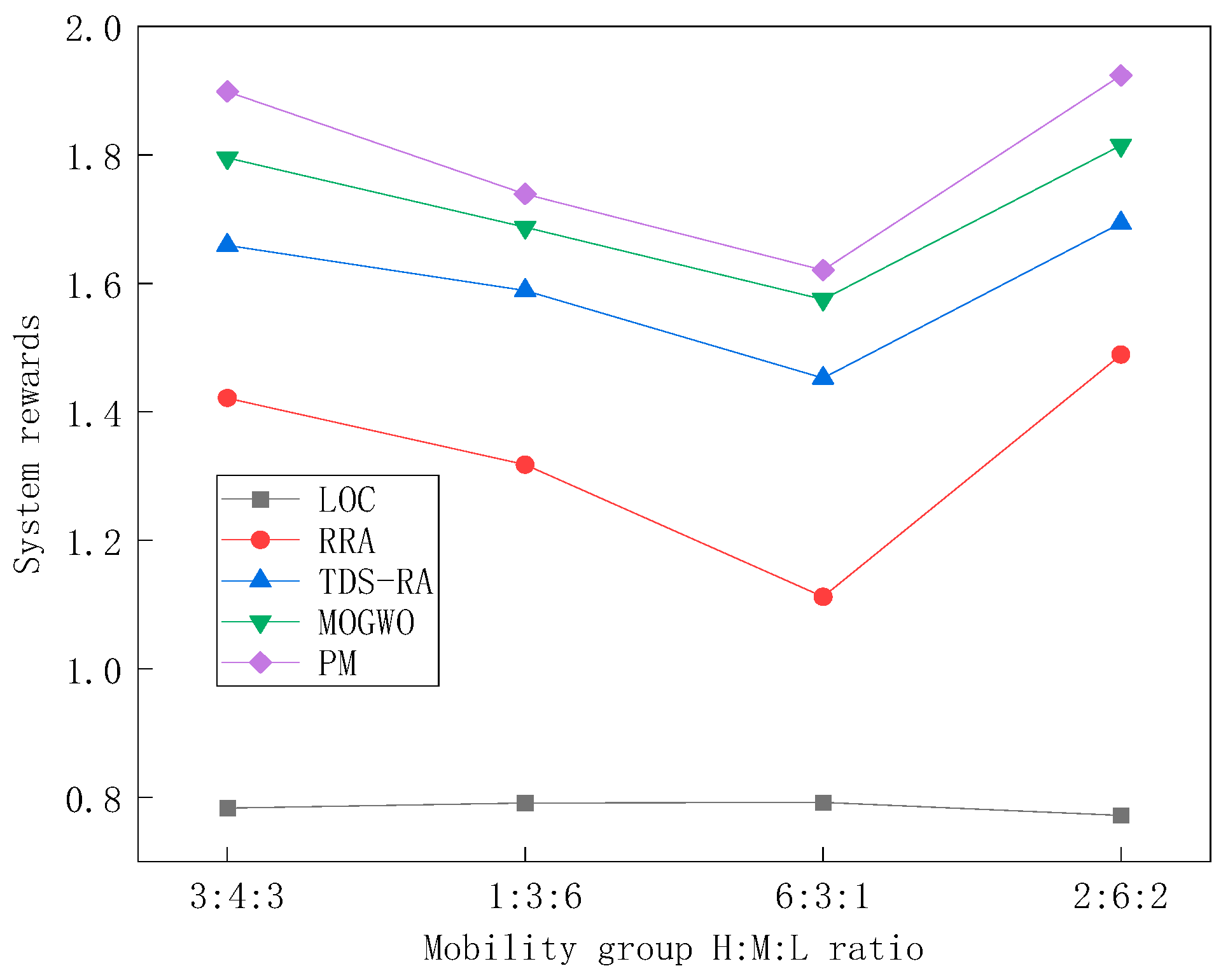
4.3.4. Impact of Different Mobility Group Ratios on System Reward
5. Conclusions
Author Contributions
Funding
Data Availability Statement
Acknowledgments
Conflicts of Interest
References
- Perwej, Y.; Haq, K.; Parwej, F.; Mumdouh, M. The Internet of Things (IoT) and its application domains. Int. J. Comput. Appl. 2019, 182, 36–49. [Google Scholar] [CrossRef]
- Fernández, C.M.; Rodríguez, M.D.; Muñoz, B.R. An edge computing architecture in the Internet of Things. In Proceedings of the 2018 IEEE 21st International Symposium on Real-Time Distributed Computing (ISORC), Singapore, 29–31 May 2018; pp. 99–102. [Google Scholar] [CrossRef]
- Liu, Q.; Mo, R.; Xu, X.; Ma, X. Multi-objective resource allocation in mobile edge computing using PAES for Internet of Things. Wirel. Netw. 2020, 30, 3533–3545. [Google Scholar] [CrossRef]
- Zhang, L.; Sun, Y.; Chen, Z.; Roy, S. Communications-caching-computing resource allocation for bidirectional data computation in mobile edge networks. IEEE Trans. Commun. 2021, 69, 1496–1509. [Google Scholar] [CrossRef]
- Raju, M.R.; Mothku, S.K. Delay and energy aware task scheduling mechanism for fog-enabled IoT applications: A reinforcement learning approach. Comput. Netw. 2023, 224, 109603. [Google Scholar] [CrossRef]
- Shokouhi, M.H.; Hadi, M.; Pakravan, M.R. Mobility-Aware Computation Offloading for Hierarchical Mobile Edge Computing. IEEE Trans. Netw. Serv. Manag. 2024, 21, 3372–3384. [Google Scholar] [CrossRef]
- Hu, H.; Song, W.; Wang, Q.; Zhou, F.; Hu, R.Q. Mobility-aware offloading and resource allocation in MEC-enabled IoT networks. In Proceedings of the 16th International Conference on Mobility, Sensing and Networking (MSN), Tokyo, Japan, 17–19 December 2020; pp. 554–560. [Google Scholar] [CrossRef]
- Zhan, W.; Luo, C.; Min, G.; Wang, C.; Zhu, Q.; Duan, H. Mobility-aware multi-user offloading optimization for mobile edge computing. IEEE Trans. Veh. Technol. 2020, 69, 3341–3356. [Google Scholar] [CrossRef]
- Dai, P.; Hu, K.; Wu, X.; Xing, H.; Teng, F.; Yu, Z. A probabilistic approach for cooperative computation offloading in MEC-assisted vehicular networks. IEEE Trans. Intell. Transp. Syst. 2020, 23, 899–911. [Google Scholar] [CrossRef]
- Cao, C.; Su, M.; Duan, S.; Dai, M.; Li, J.; Li, Y. QoS-Aware Joint Task Scheduling and Resource Allocation in Vehicular Edge Computing. Sensors 2022, 22, 9340. [Google Scholar] [CrossRef] [PubMed]
- Ismail, A.A.; Khalifa, N.E.; El-Khoribi, R.A. A survey on resource scheduling approaches in multi-access edge computing environment: A deep reinforcement learning study. Clust. Comput. 2025, 28, 184. [Google Scholar] [CrossRef]
- Wu, C.; Huang, Z.; Zou, Y. Delay Constrained Hybrid Task Offloading of Internet of Vehicle: A Deep Reinforcement Learning Method. IEEE Access 2022, 10, 102778–102788. [Google Scholar] [CrossRef]
- Lu, X.; Li, D. Task Offloading Algorithm for Large-scale Multi-access Edge Computing Scenarios. J. Electron. Inf. Technol. 2025, 47, 116–127. [Google Scholar] [CrossRef]
- Xu, J.; Liu, C. Resource Allocation in Multi-UAV Communication Networks Using MADDPG Framework with Double Reward and Task Decomposition. In Proceedings of the 2024 5th International Symposium on Computer Engineering and Intelligent Communications (ISCEIC), Wuhan, China, 8–10 November 2024; pp. 371–376. [Google Scholar] [CrossRef]
- Kareem, Z.H.; Malik, R.Q.; Jawad, S.; Abedi, F. Reinforcement learning-driven task offloading and resource allocation in wireless IoT networks. IEEE Access 2025, 13, 79314–79330. [Google Scholar] [CrossRef]
- Zhang, C.; Zhang, W.; Wu, Q.; Fan, P.; Fan, Q.; Wang, J.; Letaief, K.B. Distributed Deep Reinforcement Learning-Based Gradient Quantization for Federated Learning Enabled Vehicle Edge Computing. IEEE Internet Things J. 2025, 12, 4899–4913. [Google Scholar] [CrossRef]
- Lowe, R.; Wu, Y.; Tamar, A.; Harb, J.; Abbeel, P.; Mordatch, I. Multi-Agent Actor-Critic for Mixed Cooperative-Competitive Environments. In Proceedings of the 31st International Conference on Neural Information Processing Systems (NIPS 2017), Long Beach, CA, USA, 4–9 December 2017; pp. 6379–6390. [Google Scholar]
- Luo, L. Priority task offloading decision optimization based on multi-objective grey wolf algorithm in Internet of Things edge computing scenarios. In Proceedings of the 2023 IEEE 3rd International Conference on Data Science and Computer Application (ICDSCA), Dalian, China, 27–29 October 2023; pp. 1574–1577. [Google Scholar] [CrossRef]




| Category | Parameter | Value | Unit/Notes |
|---|---|---|---|
| Simulation Environment | Grid Size | 3 × 3 | / |
| Edge Server Compute Capacity | 8 | GHz | |
| Local Device Compute Capacity | 1 | GHz | |
| Energy Consumption Coefficient | 1 × 10⁻²⁶ | / | |
| Simulation Time Step | 0.02 | s | |
| Data Size | [0.3, 0.5] | MB | |
| Computational Intensity | 40 | CPU cycles/bit | |
| Uplink Bandwidth | 20 | MHz | |
| Transmit Power | 0.5 | W | |
| Channel Gain | 100 | Linear (corresponds to 20 dB) | |
| Noise Power | 1 × 10⁻¹³ | W | |
| MADDPG Training | Number of Agents | 9 | / |
| Training Episodes | 400 | / | |
| Replay Buffer Capacity | 50,000 | / | |
| Mini-batch Size | 2000 | / | |
| Actor Network Learning Rate | 10−5 | / | |
| Critic Network Learning Rate | 10−4 | / |
| Mobility Ratio | Method | Total Delay (s) | Total Energy (J) |
|---|---|---|---|
| 3:4:3 | LOC | 0.8111 | 0.2001 |
| RRA | 0.8997 | 0.0385 | |
| TDS-RA | 0.5951 | 0.0407 | |
| MOGWO | 0.5621 | 0.0368 | |
| PM | 0.4896 | 0.038 | |
| 1:3:6 | LOC | 0.8044 | 0.1964 |
| RRA | 0.8957 | 0.0439 | |
| TDS-RA | 0.6146 | 0.043 | |
| MOGWO | 0.5858 | 0.03999 | |
| PM | 0.5139 | 0.0435 | |
| entry 3 | LOC | 0.8006 | 0.199 |
| RRA | 1.1772 | 0.0485 | |
| TDS-RA | 0.6621 | 0.0478 | |
| MOGWO | 0.6041 | 0.0446 | |
| PM | 0.5332 | 0.0488 | |
| entry 4 | LOC | 0.8206 | 0.2051 |
| RRA | 0.8611 | 0.0367 | |
| TDS-RA | 0.6307 | 0.037 | |
| MOGWO | 0.5816 | 0.0349 | |
| PM | 0.4962 | 0.0364 |
Disclaimer/Publisher’s Note: The statements, opinions and data contained in all publications are solely those of the individual author(s) and contributor(s) and not of MDPI and/or the editor(s). MDPI and/or the editor(s) disclaim responsibility for any injury to people or property resulting from any ideas, methods, instructions or products referred to in the content. |
© 2026 by the authors. Licensee MDPI, Basel, Switzerland. This article is an open access article distributed under the terms and conditions of the Creative Commons Attribution (CC BY) license.
Share and Cite
Chen, D.; Zhang, X.; Lin, K.; Mei, C.; Huo, R. Mobility-Aware Cooperative Optimization for Task Offloading and Resource Allocation in Multi-Edge Computing. Algorithms 2026, 19, 221. https://doi.org/10.3390/a19030221
Chen D, Zhang X, Lin K, Mei C, Huo R. Mobility-Aware Cooperative Optimization for Task Offloading and Resource Allocation in Multi-Edge Computing. Algorithms. 2026; 19(3):221. https://doi.org/10.3390/a19030221
Chicago/Turabian StyleChen, Dong, Ximing Zhang, Kequan Lin, Chunhua Mei, and Ru Huo. 2026. "Mobility-Aware Cooperative Optimization for Task Offloading and Resource Allocation in Multi-Edge Computing" Algorithms 19, no. 3: 221. https://doi.org/10.3390/a19030221
APA StyleChen, D., Zhang, X., Lin, K., Mei, C., & Huo, R. (2026). Mobility-Aware Cooperative Optimization for Task Offloading and Resource Allocation in Multi-Edge Computing. Algorithms, 19(3), 221. https://doi.org/10.3390/a19030221