Article

A TSS-Compliant Ship Automatic Route-Planning Algorithm

1
Naval University of Engineering, Wuhan 430000, China
2
Naval Submarine Academy, Qingdao 266000, China
*
Authors to whom correspondence should be addressed.
Algorithms 2026, 19(3), 220; https://doi.org/10.3390/a19030220
Submission received: 23 January 2026 / Revised: 4 March 2026 / Accepted: 12 March 2026 / Published: 15 March 2026

Abstract

Aiming at solving the problem that existing automatic route-planning algorithms fail to consider the navigation rules in traffic separation scheme (TSS) zones, this paper proposes a ship automatic route-planning algorithm that fully considers TSS-zone navigation constraints. First, a formalized TSS-zone automatic planning module with a quadrilateral decomposition mechanism is designed, which realizes standardized processing of regular TSS zones and completes TSS-compliant route replanning through three core steps: invalid waypoint deletion, TSS-zone-traversal-order determination, and constrained route replanning. Second, a particle swarm optimization (PSO) algorithm is selected as the base global route-planning algorithm via a multi-algorithm comparative framework, considering the requirements of optimality, stability and real-time performance for ship-navigation. The TSS module is deeply integrated with the PSO algorithm, forming a unified global route-planning algorithm that balances TSS compliance and route optimality. Comparative experiments with four mainstream swarm intelligence algorithms (PSO/SSA/IVY/GOA) show that the PSO algorithm outperforms the others in terms of route length, stability and comprehensive efficiency, with an optimal route length of 57.71 and a low standard deviation of 3.42. Furthermore, the proposed algorithm is validated by real nautical chart data of Bohai Bay under single- and double-TSS-zone scenarios. The results indicate that the algorithm can stably generate TSS-compliant routes, with only a small increase in route length (0.6% and 4.4% for a single TSS zone, 1.1% and 1.8% for two TSS zones) and computational time and can automatically adjust the traversal strategy according to the start–end point settings. The designed TSS module has good scalability and can be integrated with other optimization algorithms, providing a feasible technical solution for an intelligent ship navigation system to realize automatic and compliant route planning in TSS zones with dense traffic.
Keywords:
route planning; TSS; PSO

1. Introduction

Ship route planning is a non-deterministic polynomial-time hard (NP-hard) problem [1]. It is infeasible to derive the optimal solution for this problem within polynomial time; instead, only heuristic algorithms can be adopted to find a satisfactory solution in a relatively short time, albeit at the cost of solution optimality [2]. In accordance with a degree of awareness regarding the marine environment, ship route planning can be categorized into global and local route planning, and this study focuses on the research of global route-planning algorithms. As a core module of an intelligent ship-navigation system, global route planning requires the integration of key procedures, including environmental perception, data collection, and map construction, ultimately generating a comprehensive environmental map that incorporates static obstacles, water depth conditions, and waterway distributions [3]. On this foundation, the algorithm accomplishes the route-planning task within a designated region, and this process can be decomposed into two core subproblems: environmental modeling and path search. Existing approaches for global ship route planning are primarily divided into two types: graph-based methods and evolutionary algorithm-based (or optimization algorithm-based) methods [4]. Graph-based algorithms leverage graph search and optimization techniques to identify the shortest path within a marine environmental map, with classic representatives being the Dijkstra algorithm [5,6] and the A* algorithm [7]. These methods feature simple frameworks, high computational efficiency, and broad applicability, yet their time and memory consumption rise markedly as the solution space expands [8]. In comparison, evolutionary algorithms realize path optimization by simulating biological evolution mechanisms, with typical instances including ant colony optimization (ACO), genetic algorithms (GAs), and particle swarm optimization (PSO) algorithms [9,10,11]. The core merit of such algorithms is their capacity for random exploration in the search domain; they achieve gradual iterative optimization of solutions by mimicking the processes of natural selection and genetic mutation, thus demonstrating outstanding adaptability to marine scenarios with complex obstacle distributions. In recent years, researchers have continuously developed various evolutionary algorithms by drawing on the behavioral characteristics of different species, among which the sparrow search algorithm (SSA) is regarded as a classic optimization method. Aiming at solving the drawbacks of traditional SSAs in unmanned ship path planning—such as its proneness to local optima, slow convergence rate and low optimization precision—Liu et al. [12] proposed an improved sparrow search algorithm that combines a three-dimensional chaotic map and a Gaussian random walk strategy for planning. Compared with the traditional sparrow search algorithm, the path planned by this algorithm has better quality and higher stability. Ghasemi et al. [13] put forward the Ivy Optimization Algorithm (IVYA) by simulating the coordinated and orderly growth, diffusion, and evolution of ivy colonies. This algorithm utilizes the empirical information of adjacent ivy individuals to determine growth directions and selects the nearest and healthiest neighbors to mimic the natural growth behavior of ivy, the effectiveness of which has been validated via comparative experiments. Hamad et al. [14] proposed the Grasshopper Optimization Algorithm (GOA). Taking the 19 CEC2005 benchmark test functions as the reference, the researchers compared GOA with other optimization algorithms, including the Dragonfly Algorithm (DA) and Whale Optimization Algorithm (WOA), on 10 CEC2019 test functions, and the experimental results show that GOA exhibits better performance in optimization tasks.
The traffic separation scheme (TSS) is a dedicated ship routing system, as defined in the International Regulations for Preventing Collisions at Sea (COLREGs) [15]. It is a traffic control measure established in sea zones with dense vessel traffic, which can effectively reduce the risks of head-on and crossing encounters. In practical route-planning tasks, it is quite common for planned routes to traverse TSS-zones [16]. However, current automatic planning algorithms fail to consider the particularities of navigation within such zones, resulting in planned routes that cross these zones directly [17]. If such issues are not corrected, they are likely to lead to potential safety hazards [18]. Existing studies on TSS-zone route planning mostly focus on manual navigation rule analysis or simple route adjustment for regular TSS zones, and few have designed a dedicated and formalized module to realize automatic replanning of TSS-zone routes. In addition, most studies lack the integration of global route optimization and TSS-rule compliance, resulting in the loss of overall route optimality while ensuring TSS compliance. Therefore, this paper has made the following innovations and contributions to address the above issues:
(1)
A dedicated TSS-zone planning module is designed and deeply integrated with the PSO algorithm, which for the first time realizes the automation of TSS-compliant route replanning on the basis of global optimal route planning, solving the problem that existing algorithms rely on manual adjustment for TSS-zone navigation.
(2)
A systematic comparative framework for four mainstream swarm intelligence optimization algorithms (PSO/SSA/IVY/GOA) is established for ship global route planning, and the superiority of PSO in terms of route optimality, stability and computational efficiency is verified by multi-index quantitative experiments.
(3)
The TSS module is designed with a quadrilateral decomposition mechanism for irregular TSS zones, which improves the adaptability of the algorithm to actual maritime TSS scenarios with complex shapes and provides a standardized processing method for TSS-zone route planning.
(4)
The proposed algorithm is validated by real nautical chart data of Bohai Bay, and the test results show that it can stably generate safe and compliant routes for both single- and multiple-TSS-zone scenarios, providing a feasible technical solution for intelligent ship-navigation systems.
This paper is structured into the following main sections: Section 1 elaborates on the current research status of global path planning and the necessity of route replanning in traffic separation scheme (TSS) areas; Section 2 presents the automatic planning module designed for TSS zones; Section 3 details the algorithm for automated route planning tailored to TSS areas; Section 4 validates the algorithm proposed in this paper through experimental tests; Section 5 provides a comprehensive summary of the full text and offers prospects for subsequent research work.

2. Automatic Planning Module for Traffic Separation Zones

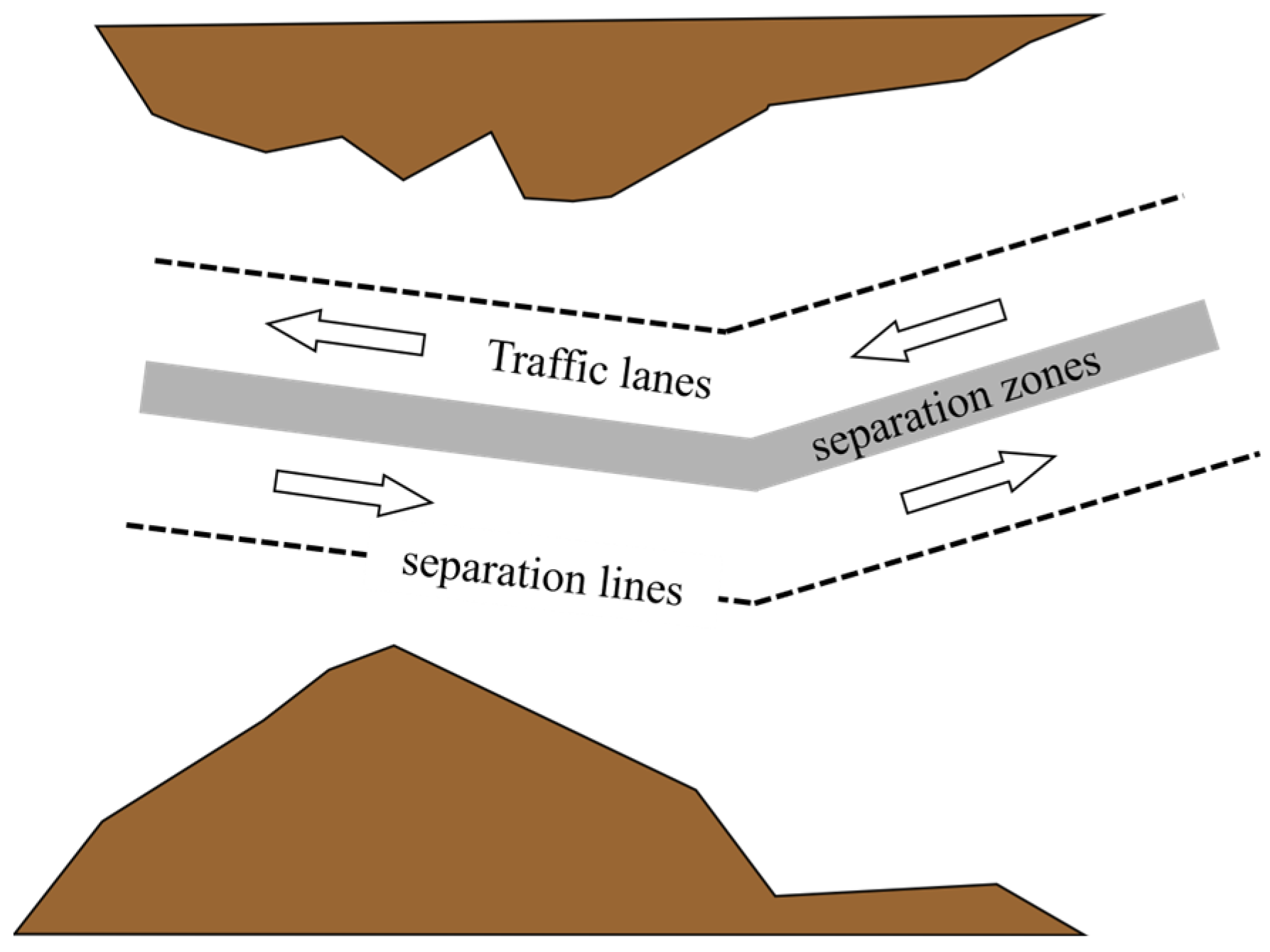
The data for the TSS zones used in this paper were manually mapped and saved as files based on the relevant content in China Sailing Directions and combined with TSS data from nautical charts, with storage partitioned by different regions. A TSS zone mainly consists of separation lines or separation zones, traffic lanes, and traffic flow directions, as illustrated in Figure 1 [19].
Vessels navigating in a TSS zone must comply with the following navigation rules [20]:
  • Navigate along the specified traffic flow direction within the traffic lane and maintain a straight course as much as possible.
  • Avoid separation zones or separation lines to the greatest extent, and it is advisable to take the midline of the traffic lane when passing markers.
  • Access or depart from the TSS zone via its end points and maintain the smallest feasible angle with the general traffic direction within the lane.
Current route-planning algorithms fail to account for the particularities of TSS zones and ignore the navigation requirements of such regions during planning [21]. This results in the need for manual adjustments after planning, which undermines the purpose of automatic route planning. To integrate the navigation rules of TSS zones into automatic route-planning algorithms, this paper proposes an automatic planning module for TSS zones [22]. This module enables route replanning tailored to the specific characteristics of TSS zones after the completion of global route planning. The TSS planning module is a formalized functional module for automatic route replanning, which takes the globally optimal route generated by the PSO algorithm and the actual TSS-zone geographic data as input, and outputs the TSS navigation rule-compliant route after replanning. Its core function is to judge the TSS-zone traversal state of the original route, delete invalid waypoints in the TSS zone, and generate a standardized replanning route according to COLREGs TSS navigation rules. The module executes three core steps in sequence: invalid waypoint deletion; TSS-zone-traversal-order determination; and TSS-zone route replanning, and each step has a standardized judgment and execution criterion.
The specific process is as follows:
(1)
Delete path waypoints within the TSS zones
To reduce interference from waypoints in the replanning area, first, iterate through each waypoint in sequence for each TSS zone and determine whether the waypoint is located within the TSS zone. If not, the waypoint is retained; otherwise, it is deleted.
(2)
Determine the TSS-area traversal order
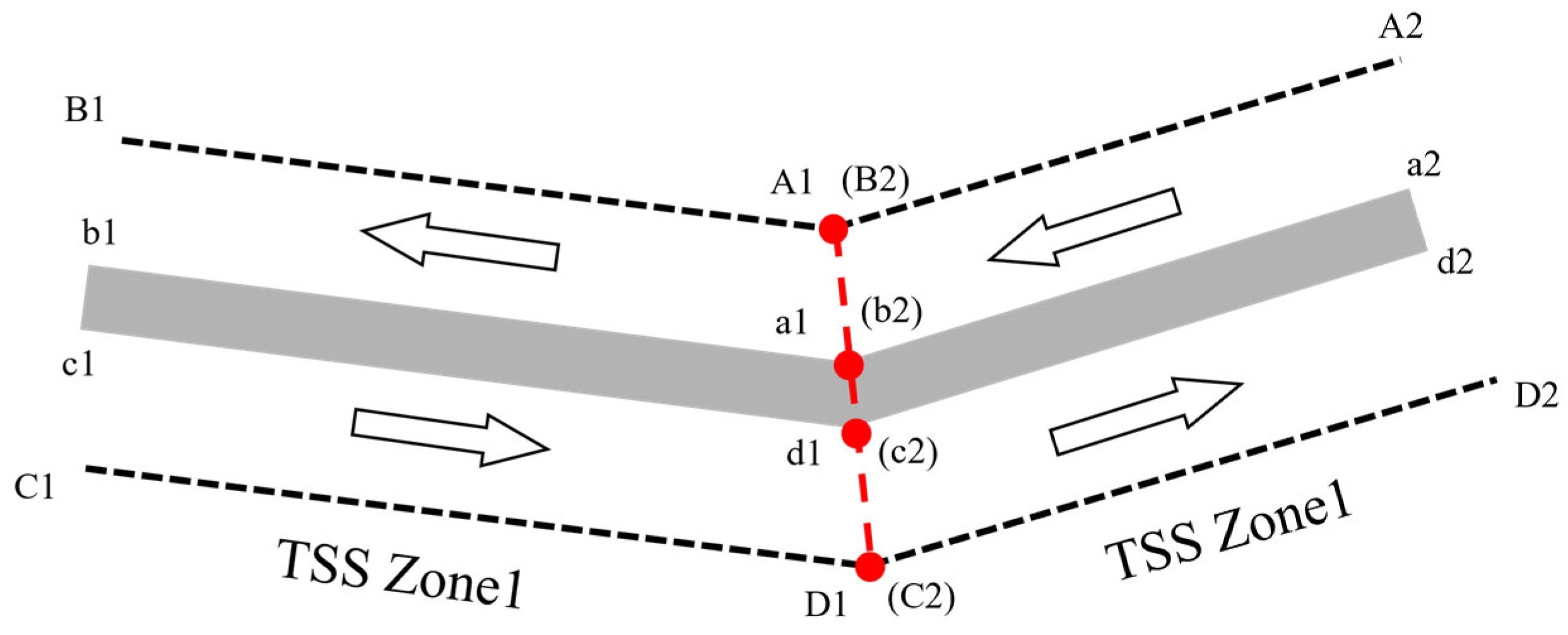
Traverse the newly obtained route segments from step (1), record the index values of the TSS zones passed through into an index list, and log the latitude and longitude coordinates of the entry and exit points. To better adapt to TSS zones of different shapes, non-quadrilateral zones are decomposed into two or more quadrilateral zones during area input, as shown in Figure 2. During storage, the external contour points and internal contour points of the lane are stored in counterclockwise order. The internal contour points may consist of either four points or two points, corresponding to internal separation zones and internal separation lines, respectively. This approach also facilitates the extraction of traffic flow directions within the lane.
(3)
Path replanning in the TSS zone
Traverse the index list of all TSS zones obtained in step (2). Based on the starting latitude and longitude of each route segment, determine the entry points and exit points of the TSS zones, and check whether these points comply with the TSS navigation rules. If they do not comply, perform local reprogramming in accordance with the rules.
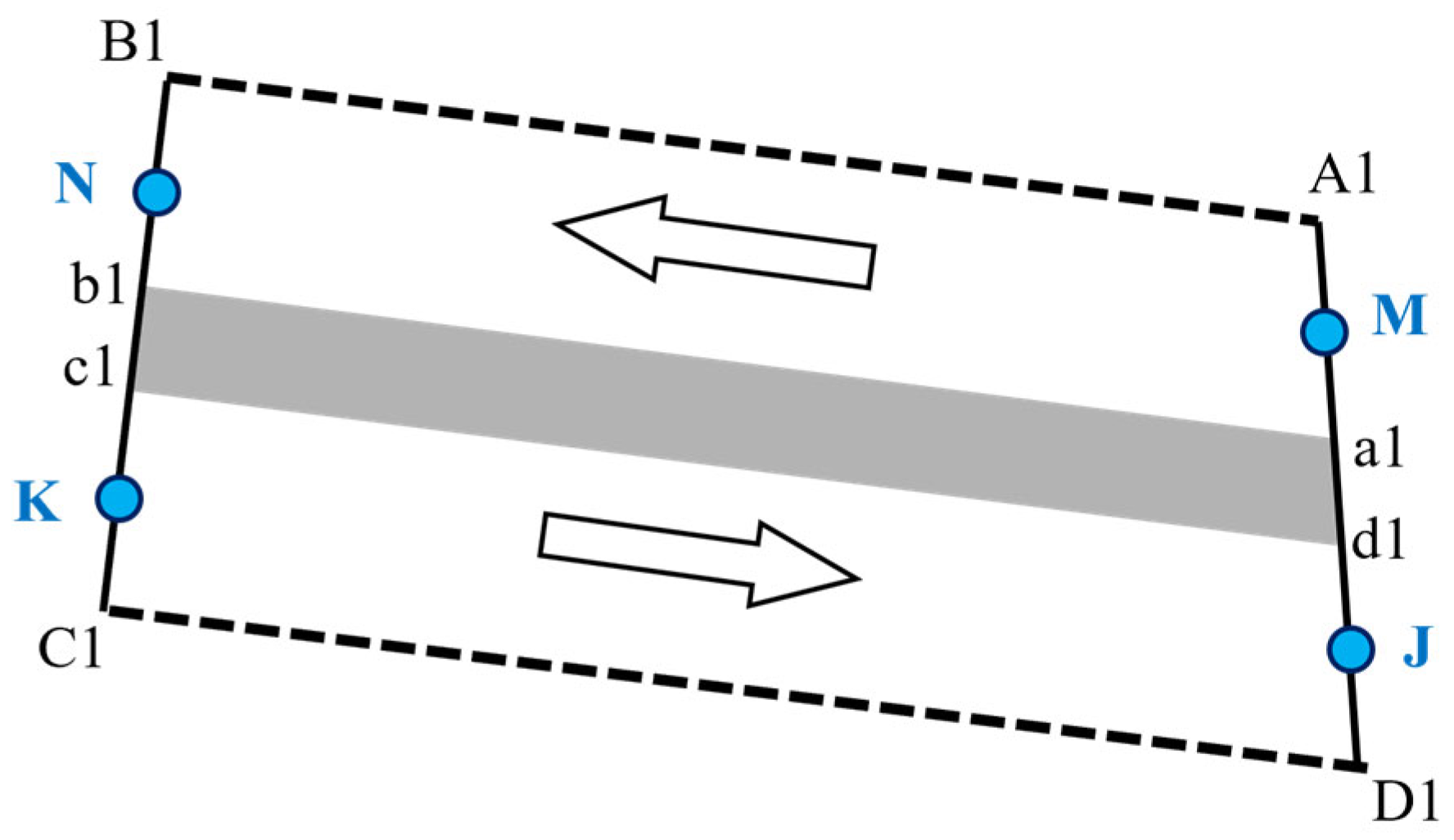
Firstly, read the coordinates of the four boundary points of the TSS zone and the end points of the separation zone or line. Calculate the starting and ending points of the recommended route for each waterway, as shown in Figure 3.
Read A 1 , B 1 , C 1 , D 1 , a 1 , b 1 , c 1 , and d 1 , respectively, and calculate the coordinates of M, N, K, J points using Formula (1).
X M = X A 1 + X a 1 2 Y M = Y A 1 + Y a 1 2 X N = X B 1 + X b 1 2 Y N = Y B 1 + Y b 1 2
In the formula, X is the abscissa, and Y is the ordinate of each point.
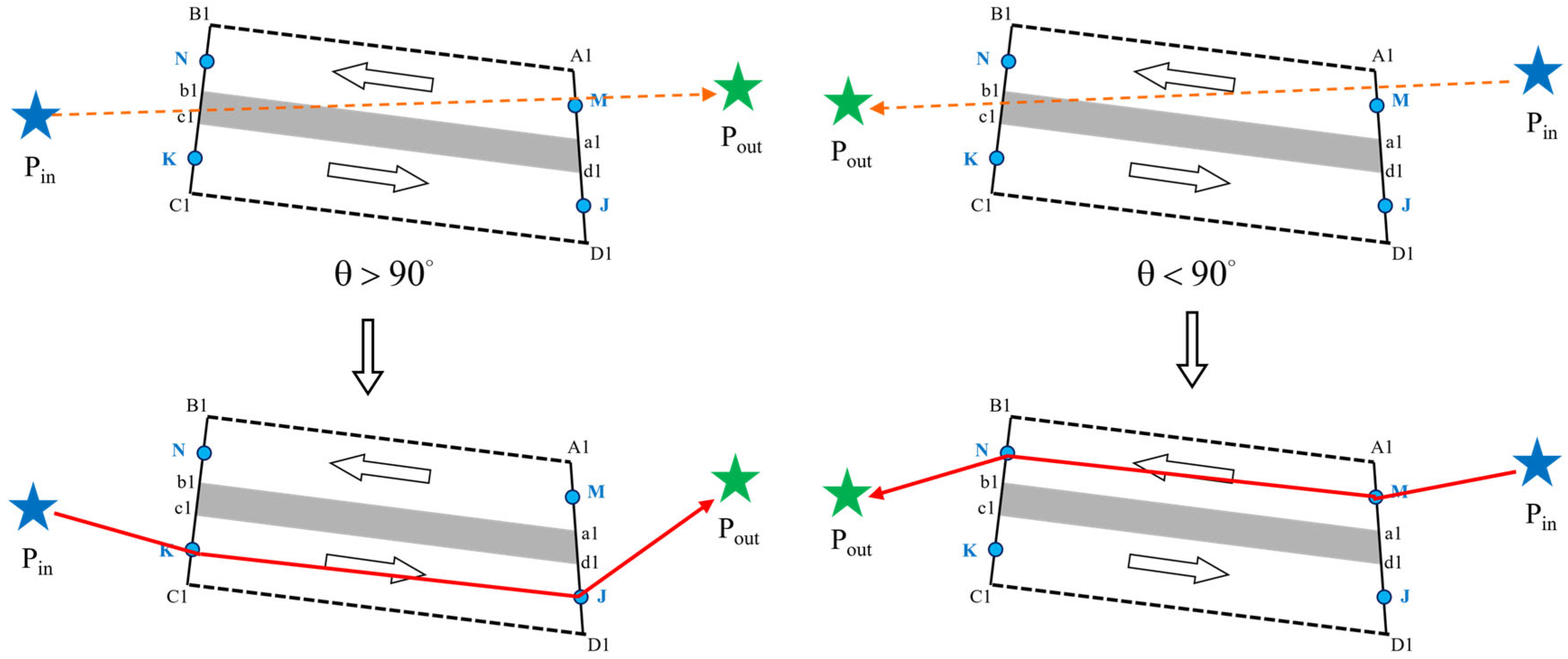
Then, calculate the angle between the in–out vector P i n P o u t and the traffic flow direction A 1 B 1 using Formula (2).
θ = arccos P i n P o u t A 1 B 1 P i n P o u t A 1 B 1
By comparing the magnitude relationship between θ and 90°, it can be determined which lane’s traffic flow direction the segment is more aligned with. A schematic diagram of this judgment process is shown in Figure 4.
The pseudo-code of the entire process algorithm is shown in Algorithm 1.
Algorithm 1: TSS-Zone Replanning algorithm
Input: Original planned route R = P 1 , P 2 , , P n (waypoints with latitude, longitude), TSS-zone set T = T 1 , T 2 , , T m , TSS-zone geographic data D T (traffic lane, flow direction, separation zone )
Output: TSS-compliant replanned route R
Begin:
        Initialize R                      // empty set for replanned route
        for  i = 1 to n  do                 // traverse all waypoints of original route
            for  j = 1 to m  do            // traverse all TSS zones in the scene
                if  P i T j  then          // judge if waypoint is inside TSS zone
                    read T j boundary points from D T
                    calculate the recommended route R j _ t o r and R j _ f r o m r by Formula (1)
                    calculate angle θ 1 between R j _ t o r and P i 1 P i by Formula (2)
                    calculate angle θ 2 between R j _ t o r and P i P i + 1 by Formula (2)
                    if  θ 1 0 , 90 θ 2 0 , 90  then   // route is consistent with R j _ t o r
                        delete P i from R                           // remove invalid waypoint
                        add R j _ t o r to R                    // add TSS-compliant recommended route
                         R R                                            // Assign R to R
                    if  θ 1 90 , 180 θ 2 90 , 180  then
                                                                               // route is consistent with R j _ f r o m r
                        delete P i from R
                        add R j _ f r o m r to R
                         R R
                    else
                        replan R with PSO
                    end if
                end if
                if  R cross T j  then                                   // judge if route crosses the TSS area
                    read T j boundary points from D T
                    calculate the recommended route R j _ t o r and R j _ f r o m r by Formula (1)
                    calculate angle θ between R j _ t o r and P i 1 P i + 1 by Formula (2)
                    if  θ 0 , 90  then                                // route is consistent with R j _ t o r
                        delete P i from R
                        add R j _ t o r to R
                         R R
                    if  θ 90 , 180  then                             // route is consistent with R j _ f r o m r
                        delete P i from R
                        add R j _ f r o m r to R
                         R R
                    else
                        replan R with PSO
                    end if
                else
                     R R
                end if
         end for
     end for
end

3. TSS-Compliant Ship Automatic Route-Planning Algorithm

3.1. PSO-Based Automatic Route-Planning Algorithm

Given the actual requirements of ship automatic route planning of optimality, stability, computational efficiency and expandability, and combined with comparative simulation experiments verifying its comprehensive superiority in global route planning, the PSO algorithm is adopted as the base algorithm for global route planning in this study [23]. The core reasons for selecting PSO instead of other swarm intelligence algorithms are as follows: (1) PSO has a simple mathematical model and a low computational complexity, which is suitable for the real-time requirement of ship route planning; (2) PSO has excellent global search ability and can balance exploration and exploitation, avoiding local optima in complex marine obstacle scenarios; (3) PSO is easy to integrate with custom constraint modules (such as the TSS module in this paper) by adding penalty terms to the fitness function, with strong scalability.
Integrating environmental data, such as water depth, penalty terms are incorporated into the fitness function to meet ship navigation constraints, enabling automatic avoidance of islands, shoal areas, navigational obstacles, and no-go zones [24]. This achieves automatic route planning in non-TSS areas. The algorithm flow is outlined as follows [25].
(1)
Particle swarm initialization
Let the solution space of the PSO algorithm be denoted as L = l 1 , l 2 , l 3 l 50 . The population size of the particle swarm is set to 50, where each particle represents a planned route. Each route consists of n path waypoints, and each waypoint contains two coordinate components, longitude and latitude:
x i = x s + rand ( ) , X min x i X max y i = y s + rand ( ) , Y min y i Y max
In the formula, x s and y s denote the coordinates of the route’s starting point; rand ( ) represents a random number; X min , X max , Y min , and Y max are the minimum and maximum longitude and latitude values of the planning range, respectively. In addition, the particle velocity is also defined in two directions and is initialized randomly to an extremely small value.
(2)
Crossover and mutation operations
Randomly select two particles for crossover to generate particle solutions. Randomly select particles and perform mutation operations on them to increase the diversity of solutions.
(3)
Update the particle velocity
v i = ϖ v i + c 1 r 1 ( p b e s t v i ) + c 2 r 2 ( g b e s t v i )
ϖ = ( 0.9 0.4 ) × ( 1000 m ) / 1000 + 0.4
where m is the current number of iterations, c 1 = c 2 = 2.05 denote the learning factor, r 1 , and r 2 are random numbers between [0, 1], p b e s t , and g b e s t are the particle’s local and global optimal solutions, respectively.
(4)
Update the particle position
x i = x i + v x , i , X min x i X max y i = y i + v y , i , Y min y i Y max
(5)
Calculate the fitness value and update the particle’s local and global optimal solutions.
Calculate the fitness value of each updated particle and set the position of the particle with the smallest fitness value as the local optimal value. Compare the current fitness value p b e s t with g b e s t . If it is smaller, assign p b e s t to g b e s t ; otherwise, do not update it.
The fitness function consists of two parts: the Euclidean distance of the planned path and the penalties for violating constraints such as passing through islands, no-fly zones, obstacles, failing to meet the horizontal safety distance, and safe water depth. This is specifically shown in the following formula.
H = min ( δ k i = 1 n 1 ( x i x i + 1 ) 2 + ( y i y i + 1 ) 2 )
δ = 1 , k = 0 1000 , k 0
Among them, k is the count of unmet constraints, and δ is the penalty coefficient.
(6)
Stop the solution search when the maximum number of iterations is reached, the global optimal solution has not been updated for more than 300 generations, or the particle fitness has not improved; otherwise, return to (2).

3.2. TSS-Compliant Ship Automatic Route-Planning Algorithm

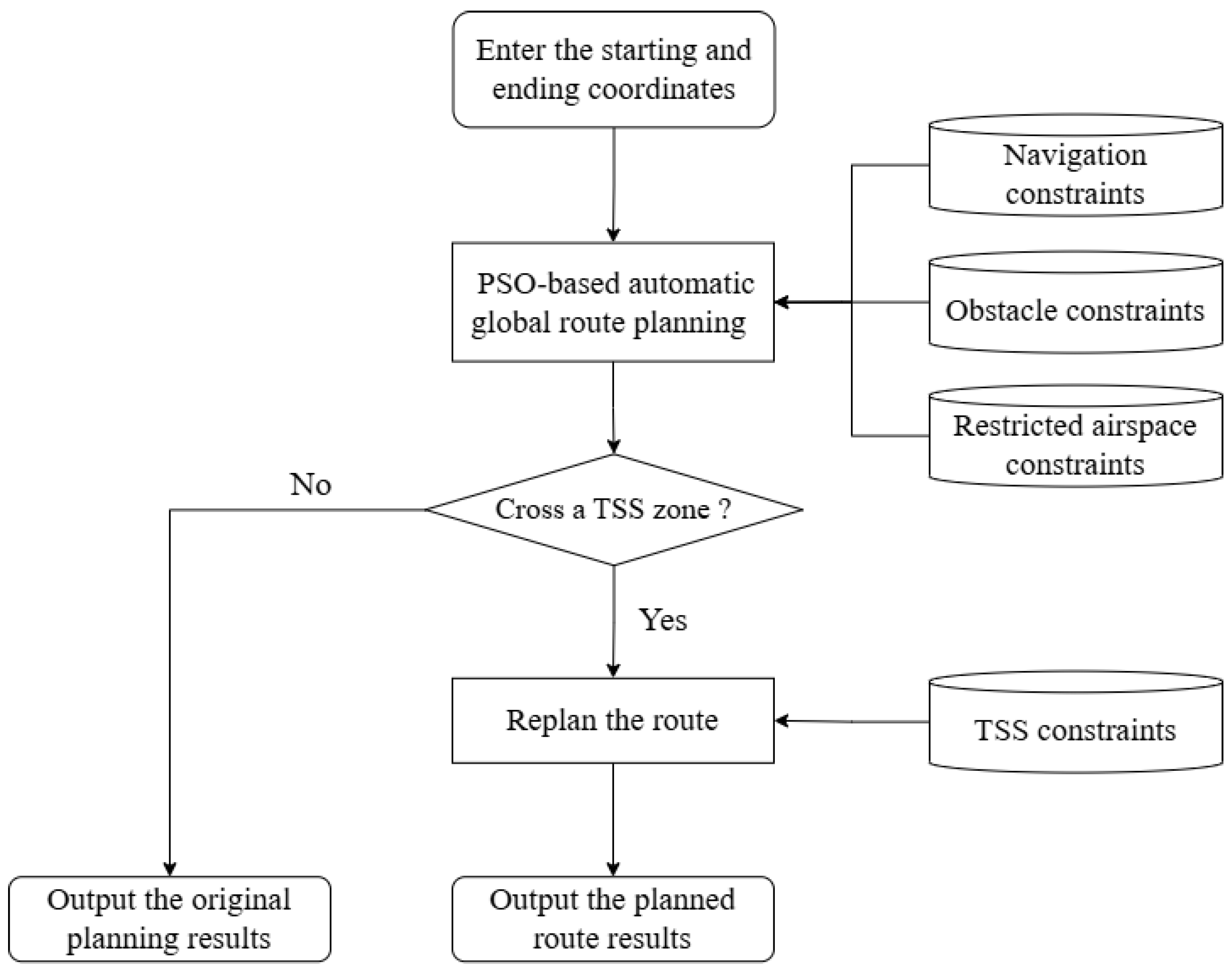
By integrating the TSS-area route-planning module introduced in Section 2 with the PSO-based global automatic route-planning algorithm presented in Section 3.1, the ship automatic route-planning algorithm proposed in this paper that incorporates TSS regulations is derived, and its flow chart is illustrated in Figure 5.

4. Experiment and Verification

4.1. Validation for the Effectiveness of the PSO-Based Global Route-Planning Algorithm

To verify the advantages of the PSO algorithm in global route planning, a simulation experiment was designed, wherein the PSO algorithm was compared with SSA, IVY and GOA.
SSA simulates the foraging and anti-predation behavior of sparrows, dividing the population into producers, scroungers and alarm individuals. The position update formulas include producer position update, scrounger position update and alarm individual position update:
X i , j t + 1 = X i , j t e i α T
X i , j t + 1 = X p , j t + 1 + X i , j t X p , j t + 1 β
X i , j t + 1 = X b e s t , j t + X i , j t X b e s t , j t γ
where t is the current iteration, T is the maximum iteration, α = 0.9 , β is a random number in [0, 1], γ is a step factor in [−1,1], X p , j is the producer position, X b e s t , j is the global optimal position.
IVY simulates the coordinated growth behavior of ivy colonies, where each ivy individual updates its growth direction through the empirical information of adjacent healthy individuals. The core position update formula is:
X i t + 1 = X i t + λ k = 1 K X k t X i t f i t n e s s X k t k = 1 K f i t n e s s X k t + μ randn
where K is the number of adjacent ivy individuals, λ = 0.8 is the growth step factor, μ = 0.05 is the random disturbance factor, randn is the standard normal distribution random number, f i t n e s s X k t is the fitness value of the k-th adjacent individual. The algorithm selects the nearest and healthiest adjacent individuals to determine the growth direction, which is consistent with ivy’s natural growth behavior.
GOA simulates the swarming behavior of grasshoppers, where each grasshopper individual updates its position through the interaction with other individuals. The core position update formula is:
X i , j t + 1 = c k = 1 N c d i k r i k + ε X k , j t X i , j t + X t a r g e t , j t
where N is the population size, c is the attenuation factor, d i k is the distance between the i-th and k-th grasshopper, r i k is the repulsion/attraction range, ε = 10 6 to avoid division by zero, X t a r g e t , j ( t ) is the target position (global optimal position).
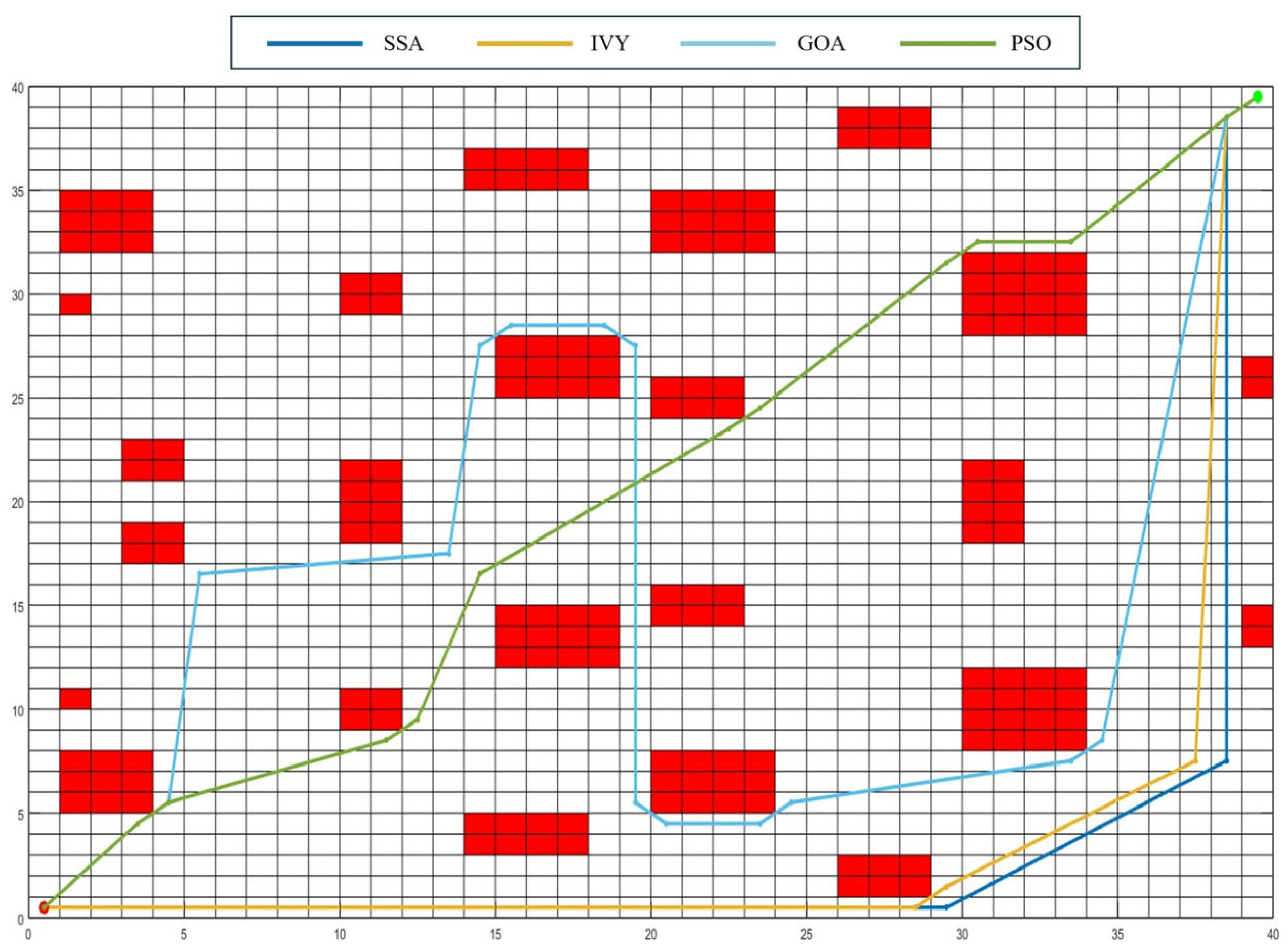
In the simulation, a 40 × 40 grid was adopted as the route-planning region, with obstacles of varying sizes placed inside. All algorithms were tasked with finding the safe and shortest path between the start and end points. The experimental environment was constructed based on MATLAB R2024a, and the hardware configuration for algorithm operation included an Intel Core i7 processor and an NVIDIA RTX 5060Ti graphics card. The population size was set to 50, and the number of iterations was fixed at 300.
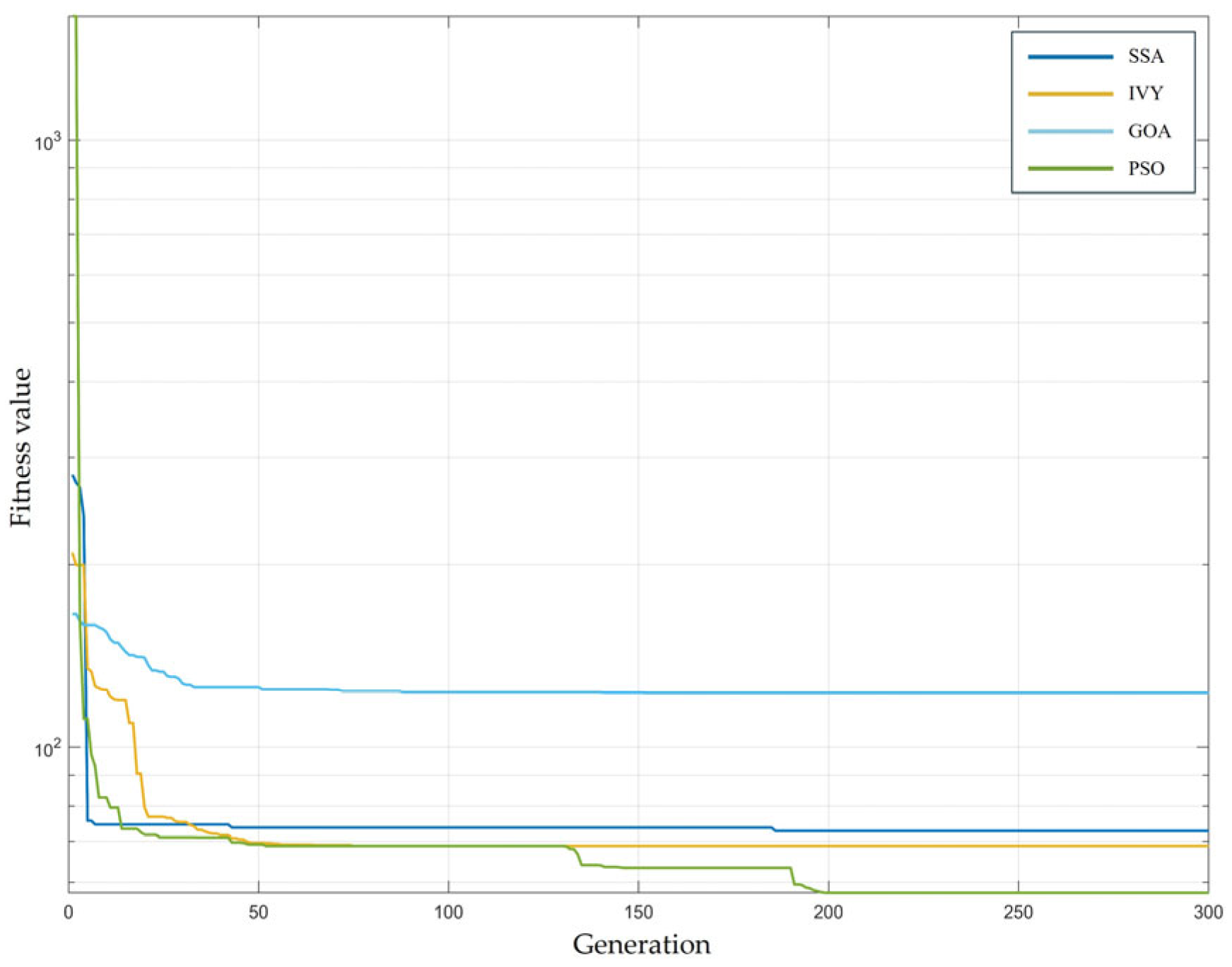
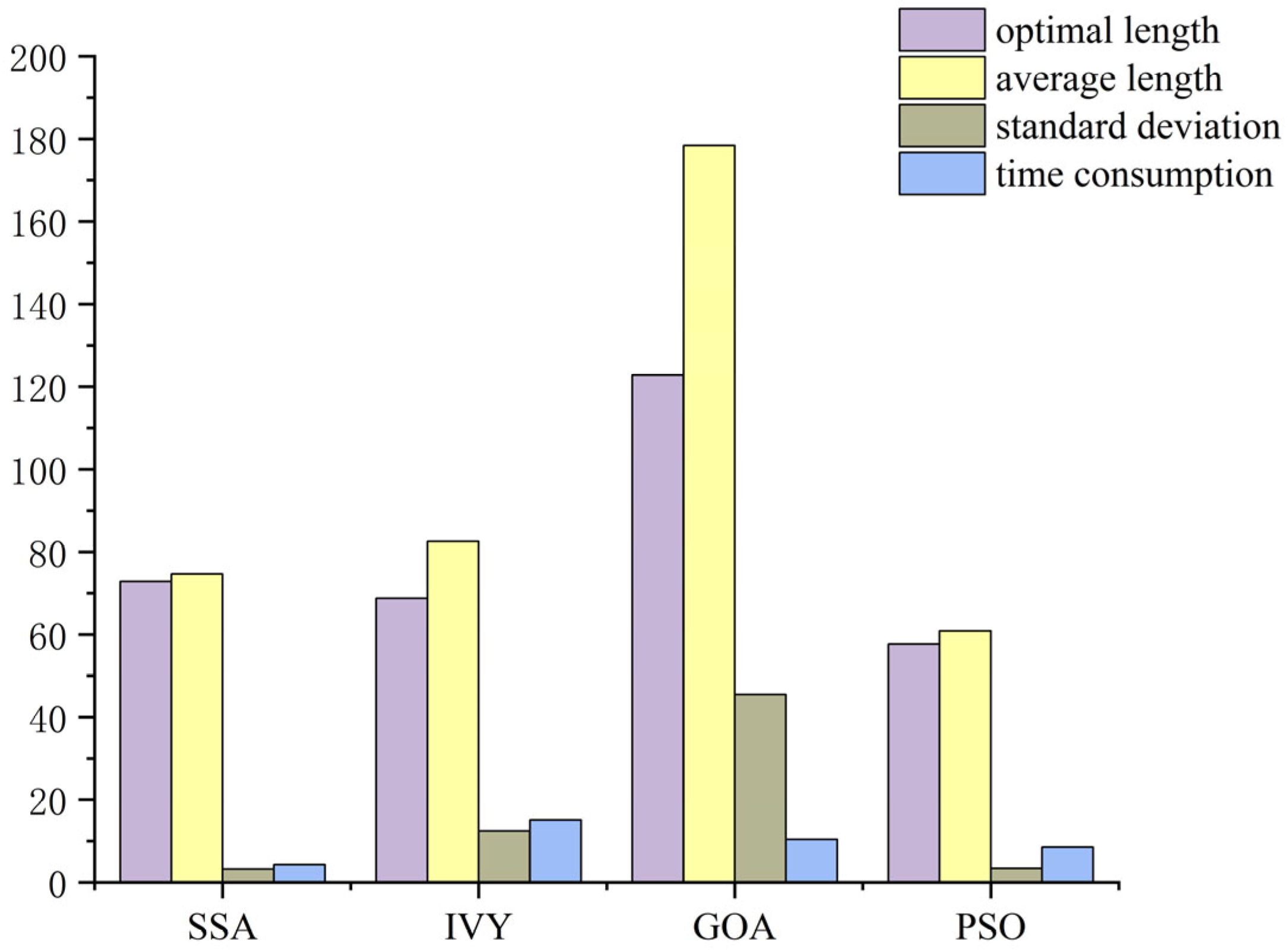
Considering that optimization algorithms may produce different results in each test due to inconsistent initialization states, each algorithm was run repeatedly 20 times. The optimal and average results of each algorithm across these 20 trials were analyzed and compared [25]. Figure 6 shows the convergence curves of each algorithm when obtaining the optimal path, while Figure 7 presents the optimal path outcomes of each algorithm from the 20 experiments. Table 1 records the optimal path length, average path length, path standard deviation, and average planning time of each algorithm over the 20 runs. Figure 8 intuitively visualizes the experimental results presented in Table 1.
It can be seen from the above comparative experimental results that the route planned by the PSO algorithm adopted in this study is shorter than those generated by the other comparative algorithms. In terms of algorithm stability (characterized by route length standard deviation) and operational speed (reflected by average time consumption), the PSO algorithm is marginally less effective than the SSA, yet it still outperforms the other two algorithms. In conclusion, the PSO-based global route-planning algorithm is capable of achieving optimal route planning between two points, while demonstrating satisfactory stability and operational speed.

4.2. Validation for the Effectiveness of Global Path-Planning Algorithms Considering TSS Zones

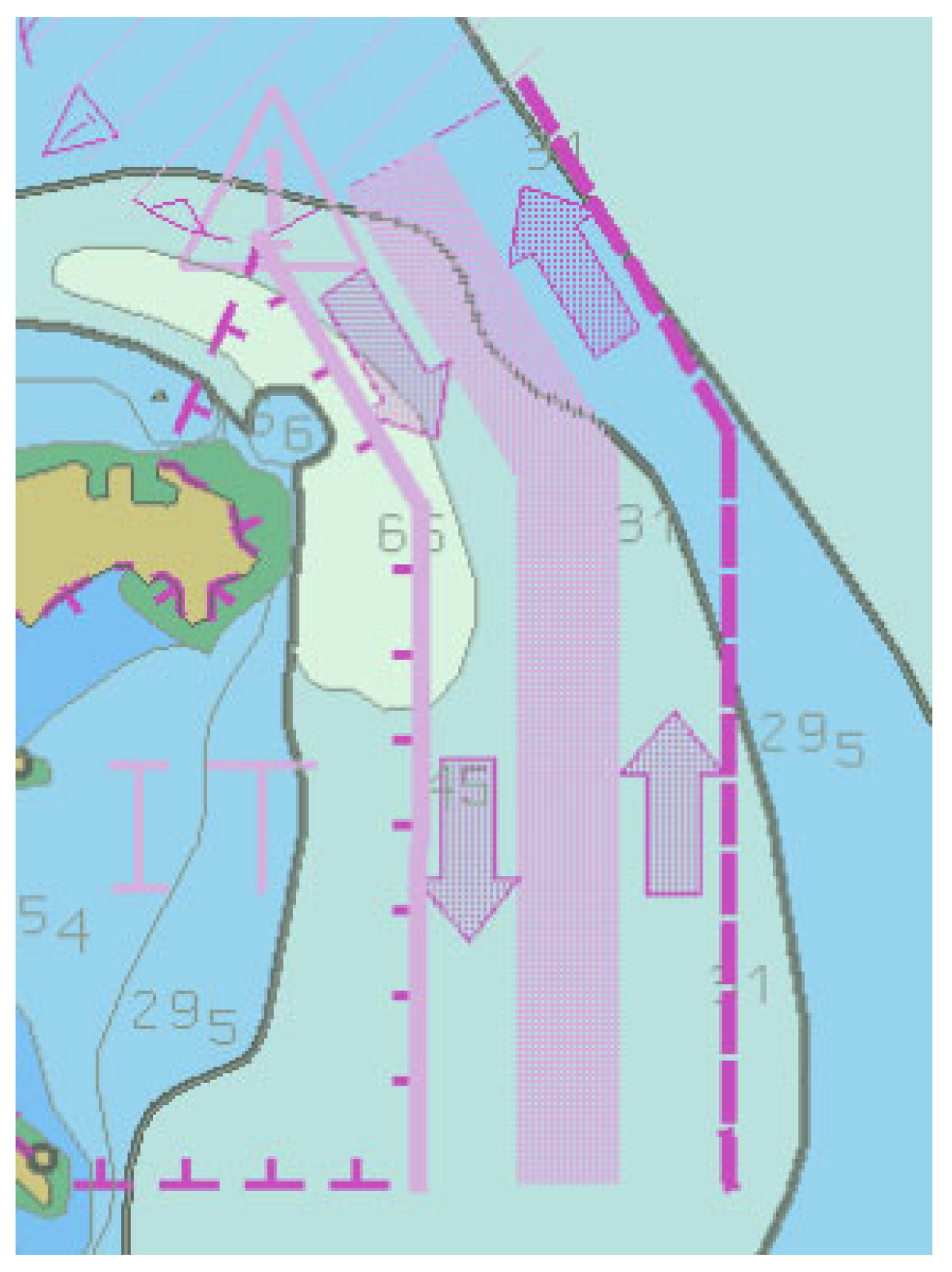
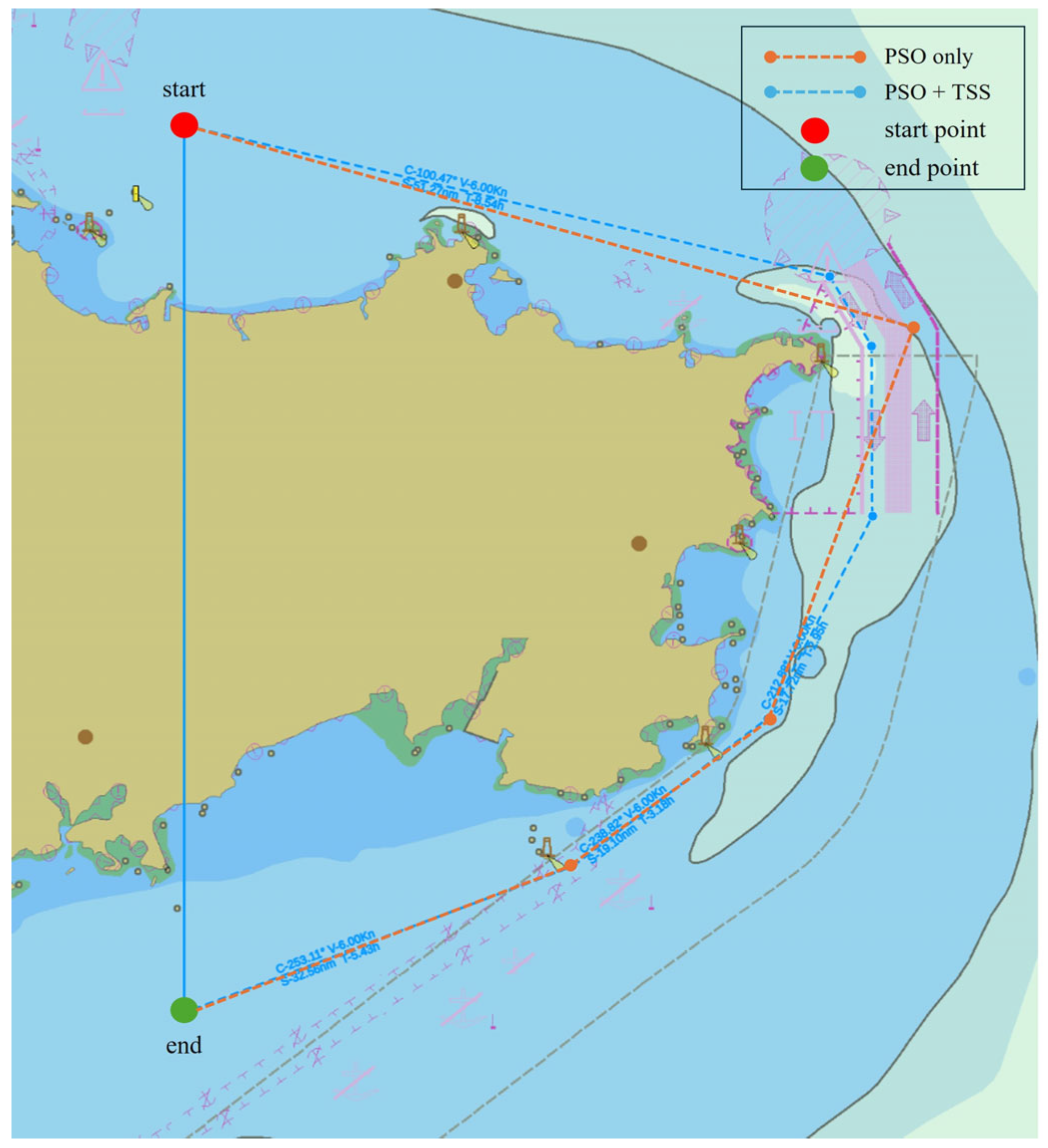
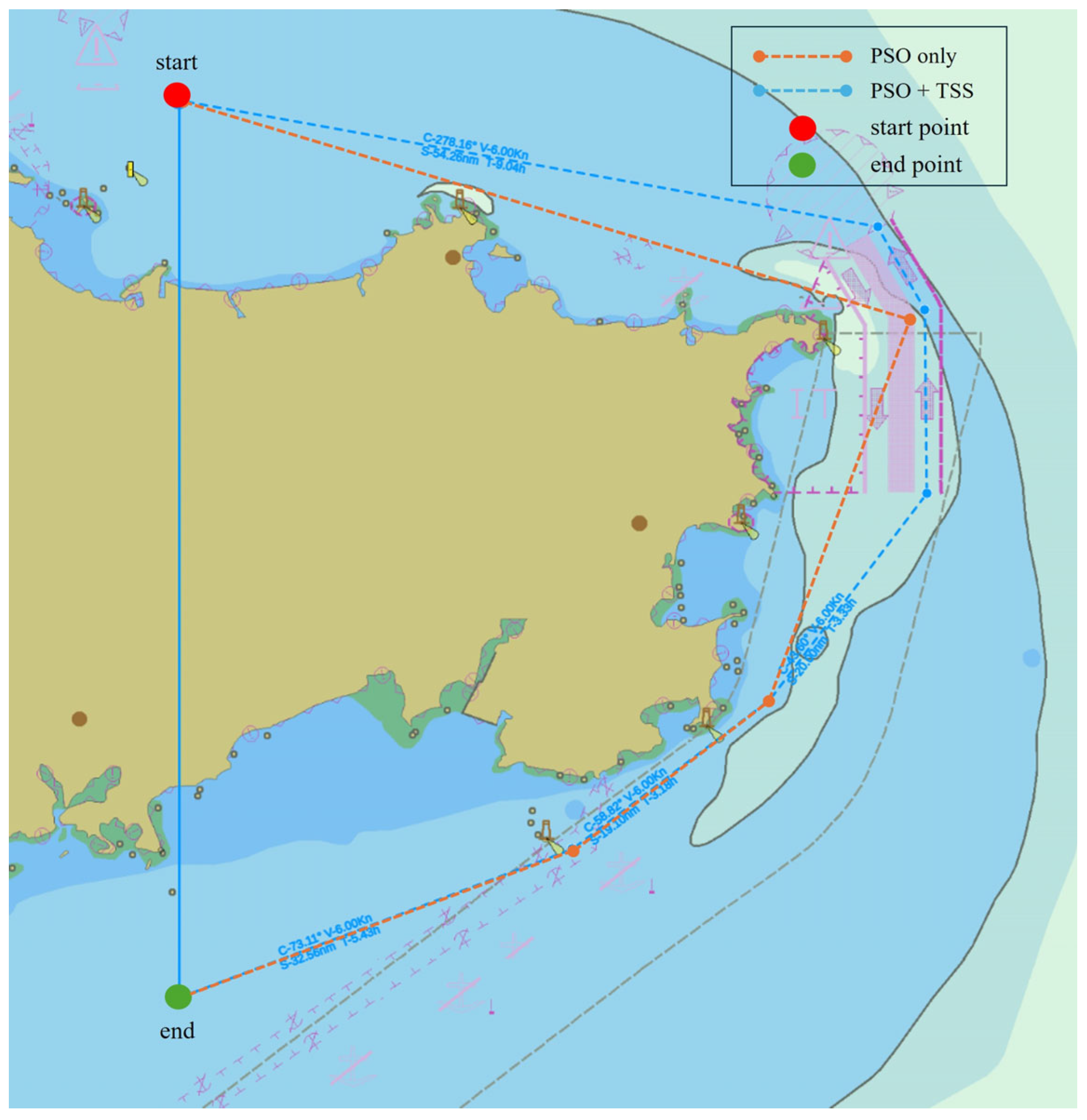
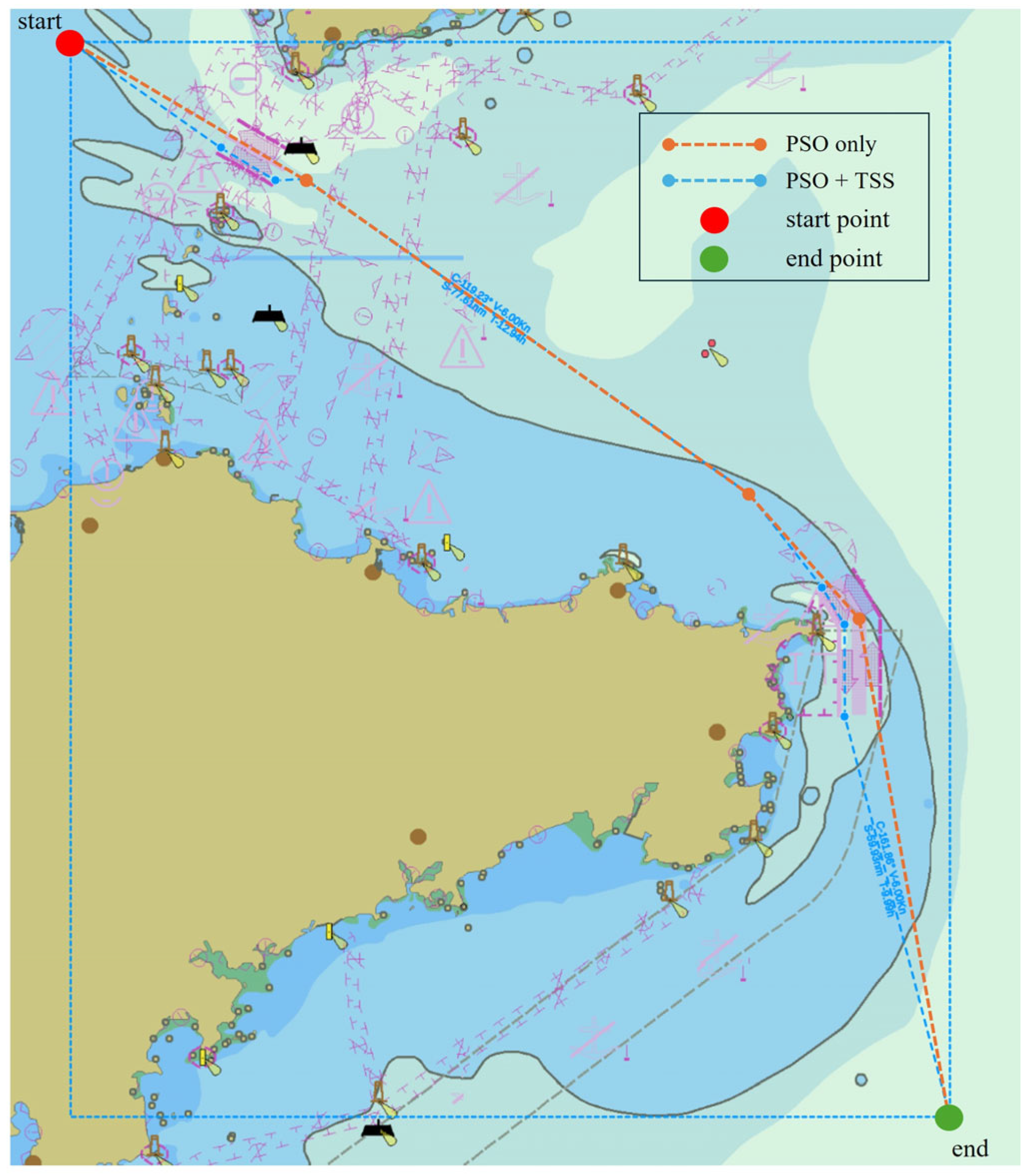
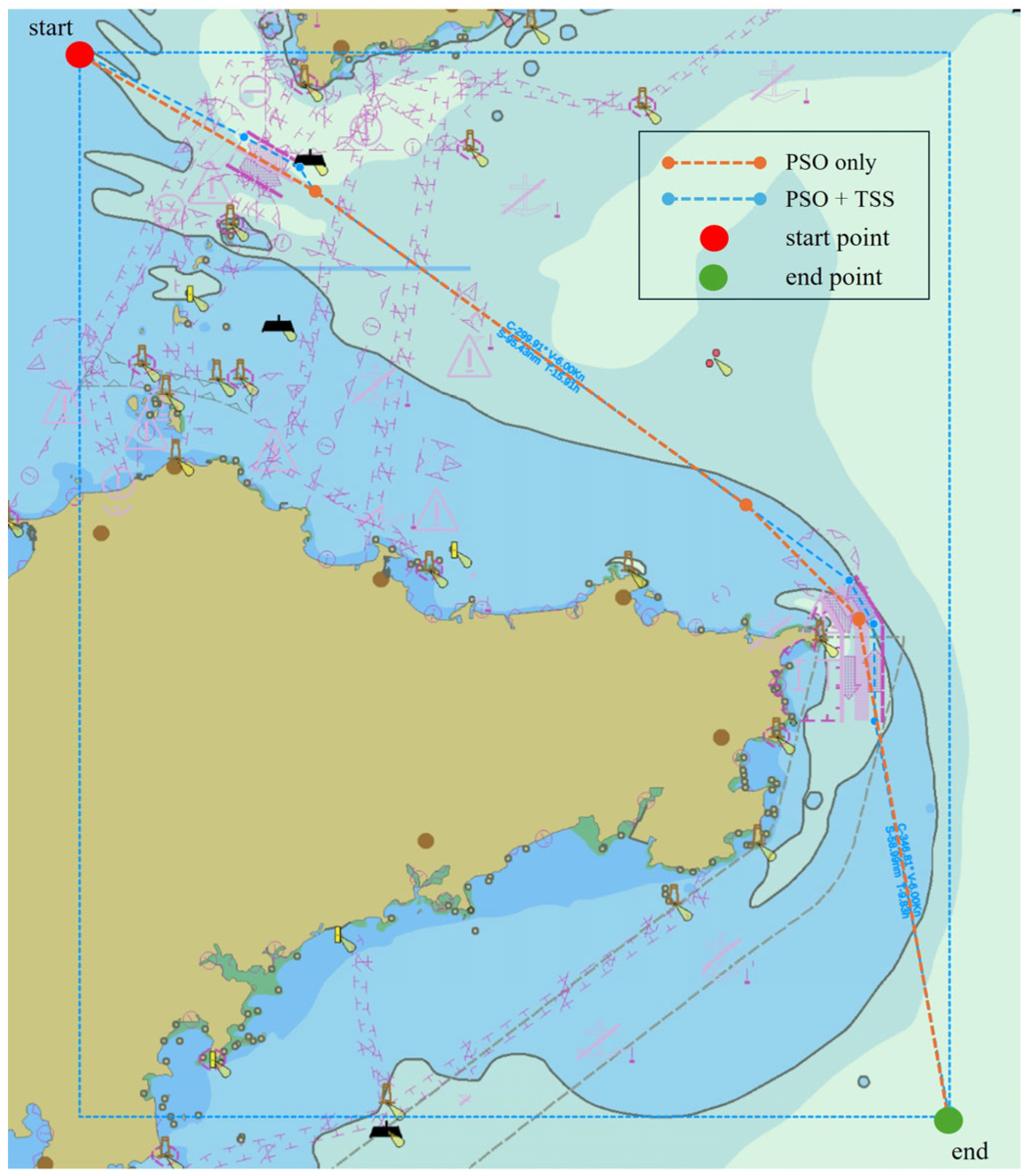
Furthermore, to validate the effectiveness and adaptability of the proposed algorithm, two realistic and diverse TSS scenarios based on the actual nautical chart data of a certain sea area in Bohai Bay were designed for testing [26], and the specific complexity parameters of the scenarios are clearly defined to enhance the credibility of the experimental results. Scenario 1 is a single TSS zone (one traffic lane, one separation zone); Scenario 2 is two adjacent TSS zones (two traffic lanes, two separation zones). Figure 9 shows the illustration of the TSS area in the actual nautical chart. Figure 10 and Figure 11, respectively, represent the planning results of the two situations where the starting points are swapped in Scenario 1, while Figure 12 and Figure 13 show the results of Scenario 2.
It can be seen from the above two figures that when the PSO algorithm is used alone for path planning, swapping the starting point and the ending point does not affect the path-planning result, and the planned path violates the navigation requirements of the TSS area. However, when the TSS module is added, the planning results of swapping the starting point and the ending point will be different. When passing through the traffic separation scheme area, the planned path will be replanned in accordance with the navigation rules of that area, and this will not affect the planned path of other areas that do not pass through the traffic separation scheme area. This indicates that the algorithm in this paper can meet the route rules of the traffic separation scheme area on the premise of ensuring the optimality of the planning results. To further verify the effectiveness and generality of the algorithm, experiments were conducted using Scenario 2, which is more complex than Scenario 1, and the results are as follows.
It can be seen from the two figures that for the more complex Scenario 2, the algorithm in this paper can still obtain the optimal route-planning result that satisfies the TSS-area constraints. To quantitatively compare the planning results, Table 2 shows the planned route lengths and algorithm consumption times for the two sets of origin–destination settings in each scenario.
It can be seen from the above table that compared with using only the PSO algorithm for planning, the PSO + TSS algorithm in this paper has a certain increase in both the planned path length and the algorithm time consumption. For Scenario 1 (a single TSS area), the planned path length increased by 0.6% and 4.4% respectively, and the algorithm time consumption increased by 20.1% and 22.6% respectively; for Scenario 2 (two TSS areas), the planned path length increased by 1.8% and 1.1% respectively, and the algorithm time consumption increased by 25.1% and 27.4%, respectively. What these small costs bring is the transformation of the planned voyage segments that violate the navigation rules of the TSS area into segments that meet the requirements acceptably.
This section comprehensively discusses and analyzes the experimental results of the proposed algorithm from multi-dimensional perspectives and in comparison [27] with existing studies to further highlight its advantages and practical application value. Cross-algorithm comparative experiments of PSO, SSA, IVY and GOA confirm that PSO has the best comprehensive performance in ship global route planning, with its selection as the base algorithm being verified by quantitative experiments and consistent with existing research conclusions [28], thus demonstrating rationality; SSA features fast computational speed but poor route optimality, while IVY and GOA have obvious deficiencies in stability or optimality, failing to meet practical application needs.
Experimental results of single- and dual-TSS-zone scenarios show the proposed algorithm has excellent adaptability and robustness to different TSS scenarios, which can automatically adjust TSS-zone traversal order and route according to start–end point settings, and only leads to a small route length increase ratio (0.6–4.4% for a single TSS zone, 1.1–1.8% for dual TSS zones), realizing the balance between TSS compliance and global route optimality—a major advantage over existing algorithms that sacrifice global optimality for TSS compliance.

5. Conclusions

Aiming at solving the problem that existing automatic route-planning algorithms fail to consider the navigation rules in traffic separation scheme (TSS) zones, this paper proposes a ship automatic route-planning algorithm integrating a dedicated TSS planning module with the PSO algorithm. The designed TSS module adopts a quadrilateral decomposition mechanism to realize standardized processing of regular TSS zones, and completes compliant route replanning through invalid waypoint deletion, traversal order determination and rule-based local adjustment, with a formalized and scalable structure that supports flexible integration with global optimization algorithms. Multi-index comparative experiments with four mainstream swarm intelligence algorithms verify that PSO has the best comprehensive performance in route optimality, stability and computational efficiency, making it the optimal base algorithm for global route planning. Experimental validation based on the real nautical chart data of Bohai Bay under single- and dual-TSS-zone scenarios shows that the proposed PSO + TSS algorithm can stably generate TSS-compliant routes, and only brings a small increase in route length (0.6% and 4.4% for a single TSS zone, 1.1% and 1.8% for dual TSS zones) and computational time, achieving a good balance between TSS compliance and global route optimality. The algorithm uses real maritime navigation data for testing, with objective and credible quantitative results, and can be directly integrated into intelligent ship-navigation systems to reduce manual intervention in TSS-zone navigation and improve navigation safety and efficiency in dense-traffic sea areas.
Based on the existing research results and limitations, this paper proposes the following key future research directions, combining the latest research results in the field of maritime navigation and inter-modal transportation:
  • Integration with local collision avoidance (COLAV) module: Refer to the hierarchical Gaussian-process-based nonlinear programming approach proposed by [29] for USV route-planning, integrate the global route-planning algorithm proposed in this paper with the local dynamic collision avoidance module, and realize the joint optimization of global TSS compliance and local dynamic obstacle avoidance, so as to adapt to the actual dynamic marine environment.
  • Optimization of the TSS module for complex TSS scenarios: Improve the quadrilateral decomposition method of the TSS module; add a concave polygon decomposition submodule to solve the decomposition problem of concave irregular TSS zones; and introduce real-time traffic-density parameters into the TSS module, and dynamically adjust the route replanning strategy according to the traffic density in the TSS zone.
  • Extension to multi-objective ship route planning: Add multi-objective optimization objectives to the PSO algorithm’s fitness function and design a multi-objective PSO algorithm based on the non-dominated sorting genetic algorithm (NSGA-II) to meet the diverse optimization requirements of actual ship navigation.
  • Integration with global logistics inter-modal transportation: Combined with the land-bridge transport research results of [30] on the Red Sea and Mediterranean Sea, extend the proposed algorithm to the field of global logistics multi-modal transportation. The algorithm will not only realize TSS-compliant ship route planning but also add a marine chokepoint avoidance module to judge whether to bypass congested marine chokepoints via land rail transport, so as to realize the optimal selection between maritime transportation and land-bridge transport and further improve the efficiency of global logistics transportation.

Author Contributions

Conceptualization, L.C. and N.Z.; methodology, N.Z.; software, F.H.; validation, N.Z., L.C. and J.Z.; formal analysis, F.H.; investigation, L.C.; resources, J.Z.; data curation, N.Z.; writing—original draft preparation, N.Z.; writing—review and editing, L.C.; visualization, F.H.; supervision, J.Z.; project administration, L.C.; funding acquisition, F.H. and J.Z. All authors have read and agreed to the published version of the manuscript.

Funding

This work was supported by the Hubei Provincial Natural Science Foundation under grant No. 2025AFB921 and the Youth Fund of the National Natural Science Foundation of China under grant No.42404009.

Data Availability Statement

Data sets generated during the current study are available from the corresponding author on reasonable request.

Conflicts of Interest

The authors declare no conflicts of interest.

References

  1. Tingwei, Z. Research on the Application of Particle Swarm Optimization Algorithm in NP-hard Problems. J. Nat. Sci. Harbin Norm. Univ. 2023, 39, 43–48. [Google Scholar] [CrossRef]
  2. Hao, C. Neighborhood search methods for solving NP-hard problems. J. Adult Educ. Coll. Hubei Univ. 2005, 23, 80–81. [Google Scholar] [CrossRef]
  3. Liang, Z.; Fang, W.; Yong, B. Current Status and Challenges of Path Planning for Unmanned Surface Vehicles. Ship Eng. 2022, 44, 1–7+48. [Google Scholar] [CrossRef]
  4. Yuntao, K.; Kun, Y.; Lijun, W. RPMTD: A Route Planning Model With Consideration of Tourists’ Distribution. IEEE Access 2024, 12, 69488–69504. [Google Scholar] [CrossRef]
  5. Dijkstra, E.W. A Note on Two Problems in Connection with Graphs. Numer. Math. 1959, 1, 269–271. [Google Scholar] [CrossRef]
  6. Lozano, T.; Wesley, M. An Algorithm for Planning Collision-free Paths among Polyhedral Obstacles. Commun. ACM 1979, 22, 436–450. [Google Scholar] [CrossRef]
  7. Wang, Y.L.; Yu, X.M.; Liang, X. Design and Implementation of Global Path Planning System for Unmanned Surface Vehicle among Multiple Task Points. Int. J. Veh. Auton. Syst. 2018, 14, 82–105. [Google Scholar] [CrossRef]
  8. Song, R.; Liu, Y.; Bucknall, R. Smoothed A* Algorithm for Practical Unmanned Surface Vehicle Path Planning. Appl. Ocean Res. 2019, 83, 9–20. [Google Scholar] [CrossRef]
  9. Li, S.; Wei, Y.; Liu, X.; Zhu, H.; Yu, Z. A New Fast Ant Colony Optimization Algorithm: The Saltatory Evolution Ant Colony Optimization Algorithm. Mathematics 2022, 10, 925. [Google Scholar] [CrossRef]
  10. Zhi, L.; Zuo, Y. Collaborative Path Planning of Multiple AUVs Based on Adaptive Multi-Population PSO. J. Mar. Sci. Eng. 2024, 12, 223. [Google Scholar] [CrossRef]
  11. Tam, C.K.; Bucknall, R. Path-Planning Algorithm for Ships in Close-Range Encounters. J. Mar. Sci. Technol. 2010, 15, 395–407. [Google Scholar] [CrossRef]
  12. Liu, G.; Zhang, S.; Ma, G.; Pan, Y. Path Planning of Unmanned Surface Vehicle Based on Improved Sparrow Search Algorithm. J. Mar. Sci. Eng. 2023, 11, 2292. [Google Scholar] [CrossRef]
  13. Ghasemi, M.; Zare, M.; Trojovský, P. Optimization based on the smart behaviour of plants with its engineering applications: Ivy algorithm. Knowl.-Based Syst. 2024, 295, 111850. [Google Scholar] [CrossRef]
  14. Hamad, R.K.; Rashid, T.A. GOOSE algorithm: A powerful optimization tool for real-world engineering challenges and beyond. Evol. Syst. 2024, 15, 1249–1274. [Google Scholar] [CrossRef]
  15. Liwen, H.; Luping, X.; Jiahao, C. Research on Navigation Decision-Making Method for Inland Wide Waters with Traffic Separation Scheme. J. Huazhong Univ. Sci. Technol. (Nat. Sci. Ed.) 2024, 52, 94–102. [Google Scholar] [CrossRef]
  16. Filipowicz, W. Traffic Control in Separation Schemes. J. Navig. 1983, 36, 445–453. [Google Scholar] [CrossRef]
  17. Lai, J.; Ding, Y.; Li, R.; Huang, X.; Wei, W.; Shen, H. A COLREGs-compliant route planning framework incorporating fairway and traffic separation scheme constraints. Appl. Ocean Res. 2025, 165, 104836. [Google Scholar] [CrossRef]
  18. Koch, P. Perform assessment of COLREGs onboard a maritime autonomous surface ship: Narrow Channels and Traffic Separation Schemes. J. Phys. Conf. Ser. 2024, 2867, 012026. [Google Scholar] [CrossRef]
  19. Liu, Z.; Wu, Z.; Zheng, Z.; Yu, X.; Yu, P. A rasterized and data-driven framework for the regional collision risk identification of traffic separation scheme. Ocean Eng. 2025, 318, 120170. [Google Scholar] [CrossRef]
  20. Emden, R.K.N. Yachts and Traffic Separation Schemes. J. Navig. 1977, 30, 495–497. [Google Scholar] [CrossRef]
  21. Sunaryo, S.; Priadi, A.A.; Tjahjono, T. Implementation of Traffic Separation Scheme for Preventing Accidents on the Sunda Strait. Int. J. Technol. 2015, 6, 990. [Google Scholar] [CrossRef]
  22. Cho, Y.; Han, J.; Kim, J. Efficient COLREG-Compliant Collision Avoidance in Multi-Ship Encounter Situations. IEEE Trans. Intell. Transp. Syst. 2022, 23, 1899–1911. [Google Scholar] [CrossRef]
  23. Amiri, A.; Kimiaghalam, B. Robust watermarking with PSO and DnCNN. Signal Image Video Process. 2024, 18, 663–676. [Google Scholar] [CrossRef]
  24. Jain, M.; Saihjpal, V.; Singh, N.; Singh, S.B. An Overview of Variants and Advancements of PSO Algorithm. Appl. Sci. 2022, 12, 8392. [Google Scholar] [CrossRef]
  25. Hou, W.; Xiong, Z.; Wang, C.; Chen, H. Enhanced Ant Colony Algorithm with Communication Mechanism for Mobile Robot Path Planning. Robot. Auton. Syst. 2022, 148, 103949. [Google Scholar] [CrossRef]
  26. Han, Y.; Shi, X.; Yang, S.; Zhang, Y.; Hong, Z.; Zhou, R. Hyperspectral Sea Ice Image Classification Based on the Spectral-Spatial-Joint Feature with the PCA Network. Remote Sens. 2021, 13, 2253. [Google Scholar] [CrossRef]
  27. Ma, Y.; Yin, W.; Guo, Z.; Xuan, J. The Ocean Surface Current in the East China Sea Computed by the Geostationary Ocean Color Imager Satellite. Remote Sens. 2023, 15, 2210. [Google Scholar] [CrossRef]
  28. Xu, X.; Fakhrmoosavi, F.; Zockaie, A.; Mahmassani, H.S. Estimating Path Travel Costs for Heterogeneous Users on Large-Scale Networks: Heuristic Approach to Integrated Activity-Based Model–Dynamic Traffic Assignment Models. Transp. Res. Rec. 2017, 2667, 119–130. [Google Scholar] [CrossRef]
  29. Tao, Y.; Du, J. Time-optimal global path planning and collision-avoidance local path planning for USVs in traffic separation scheme-implemented coastal waters. ISA Trans. 2025, 165, 280–294. [Google Scholar] [CrossRef]
  30. Wiseman, Y.; Giat, Y. Red Sea and Mediterranean Sea Land Bridge via Eilat. World Rev. Intermodal Transp. Res. 2015, 5, 353–368. [Google Scholar] [CrossRef]
Figure 1. Schematic diagram of TSS zone.
Algorithms 19 00220 g001
Figure 2. Schematic diagram of split storage in TSS zone. In the figure, A1, B1, C1, and D1 form the TSS zone 1, and A2, B2, C2, and D2 form the TSS zone 2. Among them, point A1 coincides with point B2, and point D1 coincides with point C2. a1, b1, c1, d1 and a2, b2, c2, d2 are the separation zones in each TSS area.
Algorithms 19 00220 g002
Figure 3. Read important points in the TSS zone. In the figure, M, N, K, and J are the midpoints of the line segments A1a1, B1b1, C1c1, and D1d1 respectively, and they are also the recommended route segment points obtained according to the rules.
Algorithms 19 00220 g003
Figure 4. Schematic diagram of replanning of TSS zones. In the figure, P in and P out are the segment points entering and leaving the TSS area, respectively.
Algorithms 19 00220 g004
Figure 5. Algorithm flow for global route planning considering traffic separation.
Algorithms 19 00220 g005
Figure 6. Convergence curves of different algorithms.
Algorithms 19 00220 g006
Figure 7. Optimal planning routes for different algorithms. The red areas are obstacles.
Algorithms 19 00220 g007
Figure 8. Results of comparative experiments.
Algorithms 19 00220 g008
Figure 9. TSS zones in nautical chart. The TSS zone is marked with a pink area, the solid line is the traffic lane, the dashed line is the separation zone, and the arrow in the lane indicates the specified traffic flow direction.
Algorithms 19 00220 g009
Figure 10. Route-planning result for the first pair of start–end points in Scenario 1. In the figure, the orange dashed line represents the path-planning result using only the PSO algorithm, and the blue dashed line represents the route-planning result using the PSO + TSS algorithm proposed in this paper. The red dot and the green dot represent the starting point and the ending point of the path plan, respectively.
Algorithms 19 00220 g010
Figure 11. Route-planning result for the second pair of start–end points in Scenario 1. In the figure, the orange dashed line represents the path-planning result using only the PSO algorithm, and the blue dashed line represents the route-planning result using the PSO + TSS algorithm proposed in this paper. The red dot and the green dot represent the starting point and the ending point of the path plan, respectively.
Algorithms 19 00220 g011
Figure 12. Route-planning result for the first pair of start–end points in Scenario 2. In the figure, the orange dashed line represents the path-planning result using only the PSO algorithm, and the blue dashed line represents the route-planning result using the PSO + TSS algorithm proposed in this paper. The red dot and the green dot represent the starting point and the ending point of the path plan, respectively.
Algorithms 19 00220 g012
Figure 13. Route-planning result for the second pair of start–end points in Scenario 2. In the figure, the orange dashed line represents the path planning result using only the PSO algorithm, and the blue dashed line represents the route-planning result using the PSO + TSS algorithm proposed in this paper. The red dot and the green dot represent the starting point and the ending point of the path plan, respectively.
Algorithms 19 00220 g013
Table 1. Comparison of route-planning results from 20 repeated experiments with four algorithms.
Optimal Route LengthAverage Route LengthStandard Deviation of Route LengthAverage Time Consumption
SSA72.8374.663.214.32
IVY68.8082.5612.4515.12
GOA122.8178.445.4510.42
PSO57.7160.853.428.56
Table 2. Comparison of PSO original route and TSS-adjusted route.
Route Length (nm)Time Consumption (s)
Scenario 1PSO only137.8616.4
PSO + TSS case1138.6419.7
PSO + TSS case2143.9220.1
PSO + TSS average141.2819.9
Scenario 2PSO only172.4817.9
PSO + TSS case1175.5422.4
PSO + TSS case2174.4222.8
PSO + TSS average174.9822.6
Disclaimer/Publisher’s Note: The statements, opinions and data contained in all publications are solely those of the individual author(s) and contributor(s) and not of MDPI and/or the editor(s). MDPI and/or the editor(s) disclaim responsibility for any injury to people or property resulting from any ideas, methods, instructions or products referred to in the content.