
Article

Research on Hybrid Energy Storage Optimisation Strategies for Mitigating Wind Power Fluctuations

1
Key Laboratory of Advanced Manufacturing and Automation Technology, Education Department of Guangxi Zhuang Autonomous Region, Guilin University of Technology, Guilin 541006, China
2
College of Mechanical and Control Engineering, Guilin University of Technology, Guilin 541006, China
*
Author to whom correspondence should be addressed.
Algorithms 2026, 19(3), 204; https://doi.org/10.3390/a19030204
Submission received: 10 January 2026 / Revised: 6 February 2026 / Accepted: 24 February 2026 / Published: 9 March 2026
(This article belongs to the Section Algorithms for Multidisciplinary Applications)

Abstract

Wind power generation exhibits pronounced volatility and intermittency, and direct grid connection may cause instability in grid frequency. To address this issue, this paper proposes an optimisation strategy for hybrid energy storage systems to mitigate wind power fluctuations, integrating lithium-ion batteries with supercapacitors within wind power systems. Firstly, the grid-connected power of wind turbines and the reference power of the energy storage system are determined through dynamic weight adjustment using a weighted filtering algorithm combining adaptive exponential smoothing and recursive averaging algorithms. Secondly, the fish-eagle optimisation algorithm is employed to refine variational modal decomposition parameters. The modal components derived from decomposing the energy storage system’s reference power are converted into Hilbert marginal spectra. Following determination of the cut-off frequency, high-frequency signal components are managed by supercapacitors, while low-frequency components are handled by lithium-ion batteries. Finally, an optimised configuration model for the hybrid energy storage system is constructed to minimise the annual lifecycle target cost. Case study analysis demonstrates that this approach effectively smooths fluctuations in wind power output while fully leveraging the complementary characteristics of both energy storage types, achieving a balance between system economics and overall performance.

1. Introduction

In recent years, heightened global awareness of the detrimental impact of traditional energy resources—particularly fossil fuels—on climate change has catalysed a significant shift towards renewable alternatives such as wind and solar power [1,2,3,4]. With the continuous expansion of renewable energy installations and generation capacity, projections indicate that photovoltaic (PV) and wind power will account for two-thirds of new renewable energy installations. Specifically, PV is projected to contribute 18% of new generation capacity, while wind power will account for 17% [5]. For wind power generation, its operation is significantly influenced by natural conditions, exhibiting intermittent and fluctuating characteristics. This places heightened demands on the secure and stable operation of power systems, necessitating urgent improvements in grid flexibility and coordination between load supply and demand. Utilising energy storage technologies, particularly through the precise optimisation of hybrid energy storage system (HESS) capacity, represents one effective approach to mitigating wind power fluctuations and enhancing system stability [6]. Currently, within the research domain of mitigating wind power fluctuations, the application of hybrid energy storage systems has emerged as a global academic focus, yielding substantial research outcomes. These systems ingeniously integrate multiple energy storage technologies—including batteries, flywheels, supercapacitors, and fuel cells—to achieve synergistic effects. By leveraging the complementary characteristics of these diverse technologies, the HESS represents an exceptional solution that surpasses the capabilities of individual storage devices [7,8]. Existing technical approaches predominantly rely on deploying multiple energy storage devices close to wind farms. Signal processing methods such as wavelet decomposition and low-pass filtering are employed to analyse wind power signals, thereby enabling the design of reference power allocation and coordinated control strategies for the HESS. Regarding reference power acquisition for energy storage systems, Haque, M.E. et al. [9] employed low-pass filtering to decompose raw wind power signals and derive grid-connected power. However, this approach fails to account for factors affecting real-time power signal control, resulting in response delays for rapidly changing power signals. Mahto, T. et al. [10] proposed a coordinated control strategy, dividing the energy storage system into multiple groups with distinct charge–discharge characteristics and utilising high-pass filtering algorithms for optimised processing. Jiang, Q. et al. [11] employed a wavelet packet algorithm to configure the capacity of hybrid energy storage systems. The core approach involves stratifying fluctuating power by frequency through time–frequency decomposition, matching the capacity characteristics of different storage technologies. This is then combined with probabilistic statistics and optimization models to determine the optimal capacity. Furthermore, leveraging the hybrid storage characteristics, they developed a wind power filtering method to mitigate both short-term and long-term fluctuations, simultaneously achieving the effect of smoothing power fluctuations. However, this effect still requires improvement. Ref. [12] employed wavelet packet decomposition to separate raw offshore wind power, allocating high-frequency signals to supercapacitors and low-frequency signals to batteries. This distribution method mitigated wind power fluctuations, though further refinement remains possible. Addressing the suboptimal filtering outcomes in prior studies, Zhang, Y. et al. [13] employed enhanced moving average filters and amplitude-limiting filtering algorithms to mitigate wind power fluctuations. This strategy both smooths grid connection variations from offshore energy sources and optimises HESS capacity.
When designing capacity allocation strategies for hybrid energy storage systems, most research focuses on the synergistic integration of different types of storage facilities, cost-benefit analyses of HESS layouts, and enhancing the grid stability of renewable energy integration. Hossain, M.B. et al. [14] proposed an optimised configuration model for hybrid energy storage systems comprising fuel cells and hydrogen storage, which effectively mitigates the intermittency of power generation whilst requiring greater economic storage costs. Nazir, M.S. et al. [15,16] concentrated on minimising energy storage costs to reduce overall microgrid operational expenditure, yet lacked comprehensive consideration of the microgrid system’s economic viability and operational stability. Ding, M. et al. [17] combined battery storage with supercapacitor storage to propose a multi-objective optimisation model for microgrids, though optimisation within the energy management system remains subject to improvement. This paper employs a hybrid energy storage system combining batteries and supercapacitors. This approach not only reduces economic costs but also mitigates fluctuations in wind power output, thereby ensuring stable operation of the grid system.
Renewable energy generation from wind farms requires a two-stage approach. The first stage involves allocating power output between grid-connected electricity and HESS electricity, while the second stage concerns the internal distribution of HESS electricity. Effective mitigation of wind power fluctuations necessitates rational power allocation between HESS storage equipment and the grid. Conventional power allocation strategies employ low-pass filters or various filtering algorithms to separate power signals into distinct frequency components [18]. However, the majority of a wind turbine’s average output power is transmitted to the grid, with residual power either curtailed or supplied by HESS [19,20,21]. The intermittent and fluctuating nature of wind power necessitates real-time tracking of frequency variations by hybrid energy storage systems. Employing a weighted combination algorithm integrating fused recursive averaging filtering with adaptive exponential smoothing to process raw wind power signals ensures both delay-free tracking and power smoothing. To investigate HESS power allocation and capacity configuration, ref. [22] proposed using empirical mode decomposition (EMD) for active power distribution, though EMD decomposition is prone to mode mixing. Variational Mode Decomposition (VMD) exhibits favourable local optimisation performance for noise-resistant and non-stationary burst signal processing, whilst mitigating modal overlap to some extent [23]. When employing VMD decomposition, optimisation algorithms are introduced to precisely adjust two critical parameters: the decomposition layer number K and the quadratic penalty coefficient α. Setting these parameters empirically may yield suboptimal decomposition results [24,25,26]. In summary, wind power as a renewable energy source poses significant challenges for grid integration. This paper examines the costs of mitigating wind power fluctuations and hybrid energy storage from the perspective of comprehensive wind farm resources. The main contributions of this study are as follows:
  • A wind power storage and generation system architecture has been established.
  • A weighted combination control strategy integrating a recursive averaging algorithm with adaptive exponential smoothing has been proposed. By applying weighted processing to the raw wind power signal, this approach ensures that the processed power components comply with grid connection technical standards while simultaneously generating reference power commands for the hybrid energy storage system.
  • The Osprey Optimisation Algorithm (OOA) was employed to precisely adjust two critical parameters in the VMD decomposition. These parameters were then substituted into the VMD decomposition to reference the system power, whilst the Hilbert algorithm determined the high-frequency and low-frequency power components in the HESS power allocation.
  • A full life-cycle economic model for hybrid energy storage has been constructed, and an optimised configuration strategy has been proposed to enhance economic benefits.
The remainder of this paper is organised as follows: Section 2 outlines the structure of wind–storage power generation systems. Section 3 presents a hybrid energy storage system control strategy optimising the VMD algorithm through weighted filtering and OOA algorithms. Section 4 establishes a comprehensive life-cycle economic model for hybrid energy storage systems. Section 5 conducts a case study based on actual wind power output data. Section 6 concludes the paper.This study employs a combination of algorithms to optimize power allocation and coordinated control in hybrid energy storage systems, offering a novel technical approach for precise mitigation of wind power fluctuations. It also enriches engineering application research on hybrid energy storage in the field of renewable energy integration

2. Wind–Storage Power Generation System Architecture

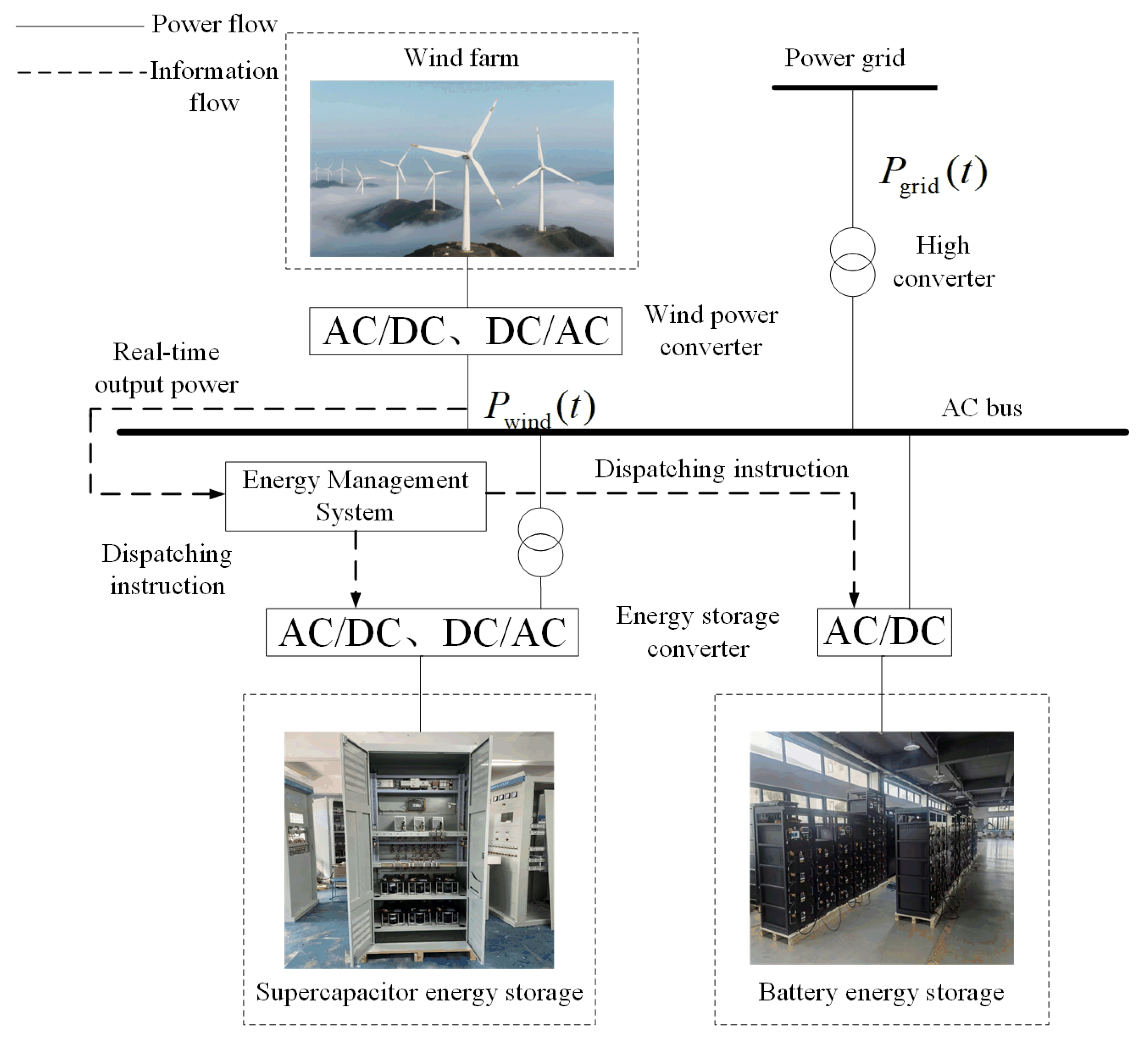
It integrates battery energy storage systems with supercapacitor energy storage systems to form a hybrid energy storage system [27], employing a centralised deployment scheme installed at the grid connection point of wind farms to mitigate wind power fluctuations and enhance grid-connected power quality. Its structure is illustrated in Figure 1. The power relationship of the wind power storage and generation system is expressed as:
P g r i d ( t ) = P w i n d ( t ) P h e s s ( t )
P h e s s ( t ) = P b ( t ) + P s o c ( t )
where P g r i d ( t ) is the target grid-connected power for wind energy; P w i n d ( t ) is the output power of the wind farm; P h e s s ( t ) is the reference power for hybrid energy storage systems; P b ( t ) is the power of lithium-ion batteries; and P s o c ( t ) is working on supercapacitor power.

3. Power Coordination Allocation Model for Mitigating Wind Power Fluctuations

3.1. Wind Power Smoothing via Weighted Filtering

The recursive average filtering method (RAFM) is a signal smoothing technique based on a fixed time window, achieving filtering effects by calculating the arithmetic mean of data points within the window [28]. This filtering method excels at suppressing periodic disturbances, significantly improving signal smoothness and data quality. However, it exhibits insufficient response to abrupt signal changes, weakens signal feature recognition capabilities, and introduces a time lag in the filtered output relative to the original signal. To overcome these limitations, this paper proposes a weighted filtering algorithm (WFA) combining adaptive exponential smoothing with recursive averaging, aiming to enhance dynamic response capability and real-time processing performance. Within this approach, adaptive exponential smoothing—a classical time-series analysis technique—preserves all historical observations while assigning progressively diminishing weights to earlier data. Its core principle holds that recent observations exert greater explanatory power over the current state, whereas the influence of distant data diminishes exponentially, with weights theoretically approaching zero. The specific calculation formula for adaptive exponential smoothing is as follows:
S n = α t X n + ( 1 α t ) S n 1
α t = α m i n + e t ÷ E m a x ( α m a x α m i n )
where S n is the smoothed value; X n is the current observation value; S n 1 is the smoothed value from the previous period; α t is the smoothing coefficient at the t-th moment; e t is the prediction error at time t; and E m a x is the maximum permissible error specified.
Dynamic adjustments are made according to the degree of fluctuation in wind power output, enabling the weights of the two filtering algorithms to adaptively change during processing. This more effectively balances smoothing effects and real-time performance. The weighted filtering algorithm calculation formula is given by:
P g r i d ( t ) = ( 1 c ) S n + C P r a f ( t )
where c is the weighting factor and P r a f ( t ) is the grid-connected power of wind turbines after smoothing via a recursive averaging algorithm.
By calculating the standard deviation of wind power output, the weighting factor c can be dynamically adjusted. The specific formula for this standard deviation is provided below:
ψ ( t ) = 1 β t = 0 β [ P w i n d ( t ) P ¯ w i n d ]
where β is the total number of sampled data points; P ¯ w i n d is the average value of the actual output power of wind turbines; and ψ ( t ) is the standard deviation of wind power output. The formula for calculating dynamic weighting is as follows:
C = 1 1 + e x p { α [ α ( t ) b ] }
where α is 0.2 and β is 4.
When data volatility is high, the weighting of the adaptive exponential smoothing method is increased, enabling the filtered output to respond more sensitively to immediate data changes. Conversely, when data volatility is low, the weighting of the recursive averaging filter is increased to enhance overall data smoothness, effectively filtering out non-essential fluctuations. This paper employs weighted filtering to process the wind power output P w i n d ( t ) , ensuring compliance with grid connection standards for wind power, thereby obtaining the reference power P h e s s ( t ) for the energy storage system. Subsequently, the reference power is decomposed by optimising the VMD parameters via OOA to identify the high-frequency power signal and low-frequency power signal.

3.2. VMD Algorithm

VMD, as a non-recursive signal processing method, excels in resolving modal overlap phenomena. It enables more effective separation and extraction of distinct frequency components within signals, proving particularly well-suited for analysing unstable and non-linear signals [29]. This approach progressively determines the core frequencies and bandwidths of each decomposed signal component by optimising a variational model, thereby achieving signal decomposition. Its core implementation comprises two steps: constructing the variational problem and solving the variational model. (1) Establish a variational model: Modulate each spectrum into the corresponding fundamental frequency band via exponential mixing, and estimate the bandwidth of the frequency-shifted analytical signal using Gaussian smoothing. Construct a constrained variational model, namely
m i n { ω k } { ω k } ( k = 1 K | | ζ ( t ) { [ δ ( t ) + j π t ] μ k ( t ) } e j ω k t | | 2 2 ) s . t . k = 1 K μ k ( t ) = f ( t )
where ∗ denotes the convolution operation; { μ k } is the entire weight of the IMF, { μ k } = { μ 1 ,   μ 2 ,   ,   μ k } ; { ω k } is the centre frequency corresponding to each IMF component, { ω k } = { ω 1 ,   ω 2 ,   ,   ω k } ; δ ( t ) is the unit impulse function; f ( t ) is the raw signal; and ζ t is the partial derivative with respect to t.
(2) Solve the variational model: Introduce a quadratic penalty term α and Lagrange multiplier λ to construct an augmented Lagrange function, transforming the original variational problem into a solvable form. The Lagrange expression is
L ( μ k , ω k , λ ( t ) ) = α k = 1 K | | ζ t [ δ ( t ) + j π t ] μ k ( t ) e j ω k t | | 2 2 + | | f ( t ) k = 1 K μ k ( t ) | | 2 2 + [ λ ( t ) , f ( t ) k = 1 K μ k ( t ) ]
The original constrained optimisation problem is reformulated as an unconstrained optimisation problem by employing Lagrange multipliers and a quadratic penalty term. The alternating direction method of multipliers seeks the optimal solution to the Lagrange expression, iteratively updating μ k n + 1 , ω k n + 1 and λ n + 1 , thereby achieving the decomposition of the original signal.

3.3. OOA Algorithm

The Osprey Optimisation Algorithm is an emerging swarm intelligence optimisation technique proposed by Dehghani Mohammad et al. in 2023, drawing inspiration from the natural hunting behaviour of ospreys on water surfaces [30]. This algorithm designs and optimises its search mechanism by simulating two critical phases experienced by ospreys during natural predation: global exploration and local exploitation. The specific implementation steps are outlined below. First, perform random initialisation on the population by normalising the feature vectors and subsequently assigning random initial values as per the following formula:
Y = Y 1 . . . Y i . . . Y N = y 1 , 1 y 1 , y y 1 , m . . . . . . . . . . . . . . . y i , 1 y i , j y i , m . . . . . . . . . . . . . . . y N , 1 y N , y y N , m
y i , j = l b j + r i , j ( μ b j l b j ) , i = 1 , 2 , , N ;   j = 1 , 2 , , m
where Y i is the position vector of the i-th individual; l and μ denote the lower bound and upper bound of the search space respectively; r i , j is randomly selected from the interval [0, 1]; b j is the threshold parameter of the hidden layer; N is an individual quantity; and m is the dimension.
Upon completion of the initialisation operation for the population positions of the fish eagles, the fitness value for each individual is calculated in conjunction with the objective function of the problem to be optimised:
A = A 1 . . . A i . . . A N = A ( Y 1 ) . . . A ( Y i ) . . . A ( Y N )
where A i is the i-th individual fitness value.
The first stage involves a global search, simulating the hunting behaviour of ospreys. The position of each individual is updated as follows:
P A i = { Y k / K { 1 , 2 , , N } A k < A i } { Y b e s t }
where P A i is the set of position vectors for the i-th individual; Y b e s t is the best player on the pitch.
Individual fish eagles within the population navigate randomly and search for the location of any prey to engage in predatory behaviour. If the objective function value corresponding to that prey location is more favourable, the eagle’s original position is updated and replaced with this new location. The position update expression is as follows:
y p l , i , j = y i , j + r i , j ( S A i , j I i , j y i , j )
y p l . i . j = y p l , i , j ,   l b j Y p l , i , j μ b j l b j ,   y p l , i , j l b j μ b j ,   y p l , i , j > μ b j
Y i = Y p l , i ,   A p l , i < A i Y i ,   e l s e
where S A i , j is the i-th fish eagle in the j-th dimension selected target value; I i , j is a random number from the set 1, 2; Y p l , i is the i-th fish eagle in the new position of the first stage; y p l , i , j is the i-th fish eagle at position Y p l , i with the j-th dimension value; and A p l , i is the corresponding fitness value.
The second stage of the algorithm constitutes the local exploitation phase. During this phase, a novel random position is generated using Equations (17)–(19), thereby simulating the behaviour of a fish eagle seeking suitable feeding grounds. Should the objective function value at this new position prove superior, the original position of the fish eagle individual is updated and replaced.
y p 2 , i , j = y i , j + l b j + r ( μ b j l b j ) t ,   i = 1 , 2 , , N ;   j = 1 , 2 , , m ;   t = 1 , 2 , , T
y p 2 , i , j = y p 2 , i , j ,   l b j y p 2 , i , j μ b j l b j ,   y p 2 , i , j < l b j ν b j ,   y p 2 , i , j > μ b j
Y i = Y p 2 , i ,   A p 2 , i < A i Y i ,   e l s e
where r is randomly selected from the interval [0, 1]; t is the current iteration count; T is the maximum iteration count set by the algorithm; Y p 2 , i is the new position vector corresponding to the i-th fish eagle in the second phase; y p 2 , i , j denotes the component value of the jth dimension at position Y p 2 , i for the ith fish eagle; and A p 2 , i is the fitness value corresponding to that position.

3.4. Optimisation of VMD Parameters for OOA

The modal number K and penalty coefficient α are pivotal factors influencing the effectiveness of VMD decomposition. Regarding the selection of parameter K, existing methods predominantly rely on empirical judgements concerning centre frequency stability. This highly subjective approach not only lacks flexibility but may also constrain the accuracy of decomposition. Regarding parameter α, although the particle swarm optimisation (PSO) algorithm is widely applied, it suffers from the limitation of being prone to local optima. To address this, this study proposes employing the fish-eagle optimisation algorithm to synchronously optimise both parameters in VMD. This approach enhances the objectivity of parameter selection and the overall performance of the decomposition, whilst selecting energy entropy as the fitness function.
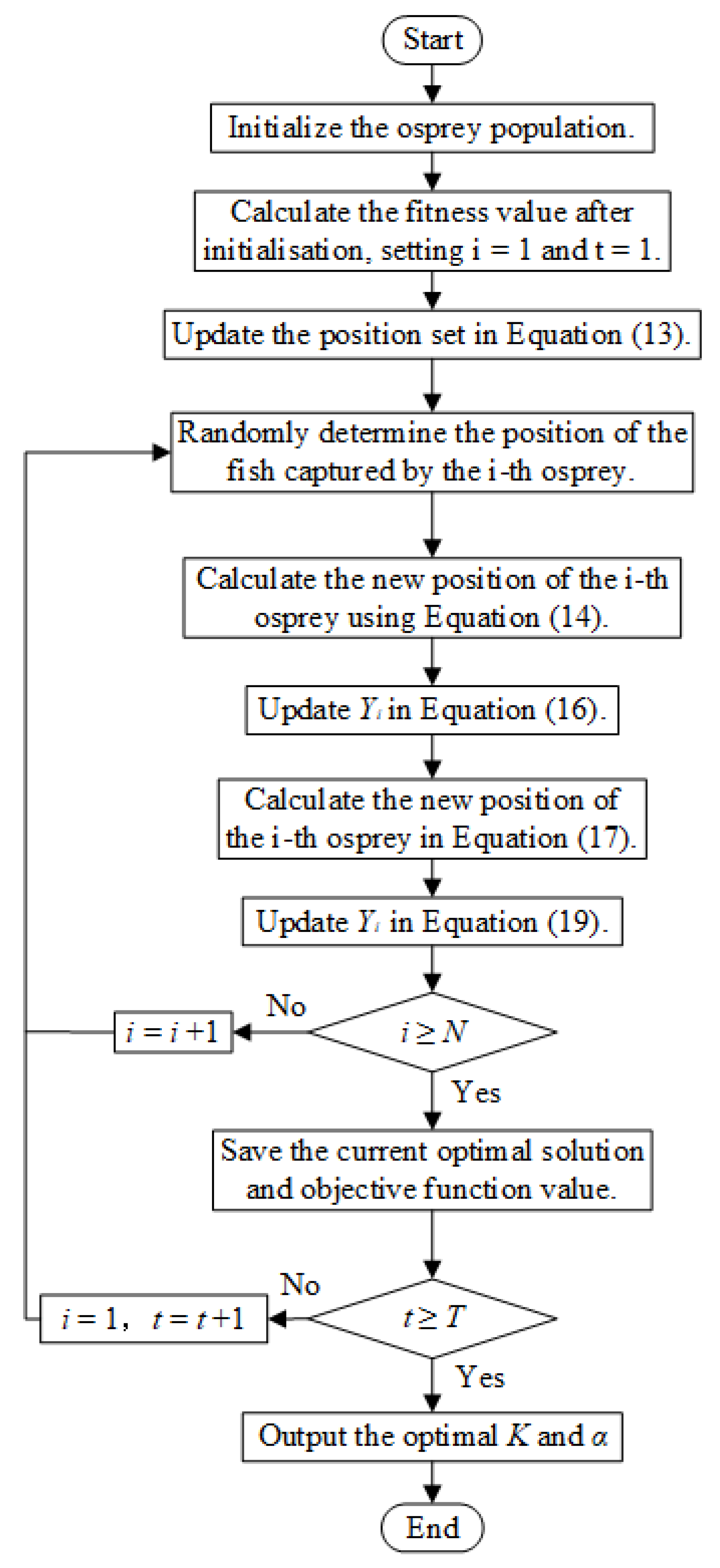
Energy entropy [31] may be employed to gauge the degree of concentration in the energy distribution across modal components following VMD decomposition of a signal. A lower energy entropy indicates greater independence and specificity among the decomposed modes, with reduced overlap between them. By minimising this energy entropy, the algorithm adaptively optimises two key decomposition parameters of VMD, thereby enhancing the accuracy and adaptability of signal decomposition. Following VMD processing, a signal yields several IMF components, each corresponding to a specific energy distribution. Should energy predominantly concentrate within a small number of IMF components, the energy entropy will be low, indicating a decomposition result with clear structure and minimal interference. Conversely, if energy is distributed relatively uniformly across IMF components, the energy entropy will be high, reflecting significant overlap between modes and an unsatisfactory decomposition outcome. The specific parameters of the algorithm presented herein are detailed in Table 1, while the algorithmic workflow is illustrated in Figure 2.

4. Capacity Optimization Model of HESS

4.1. HESS Capacity Optimization

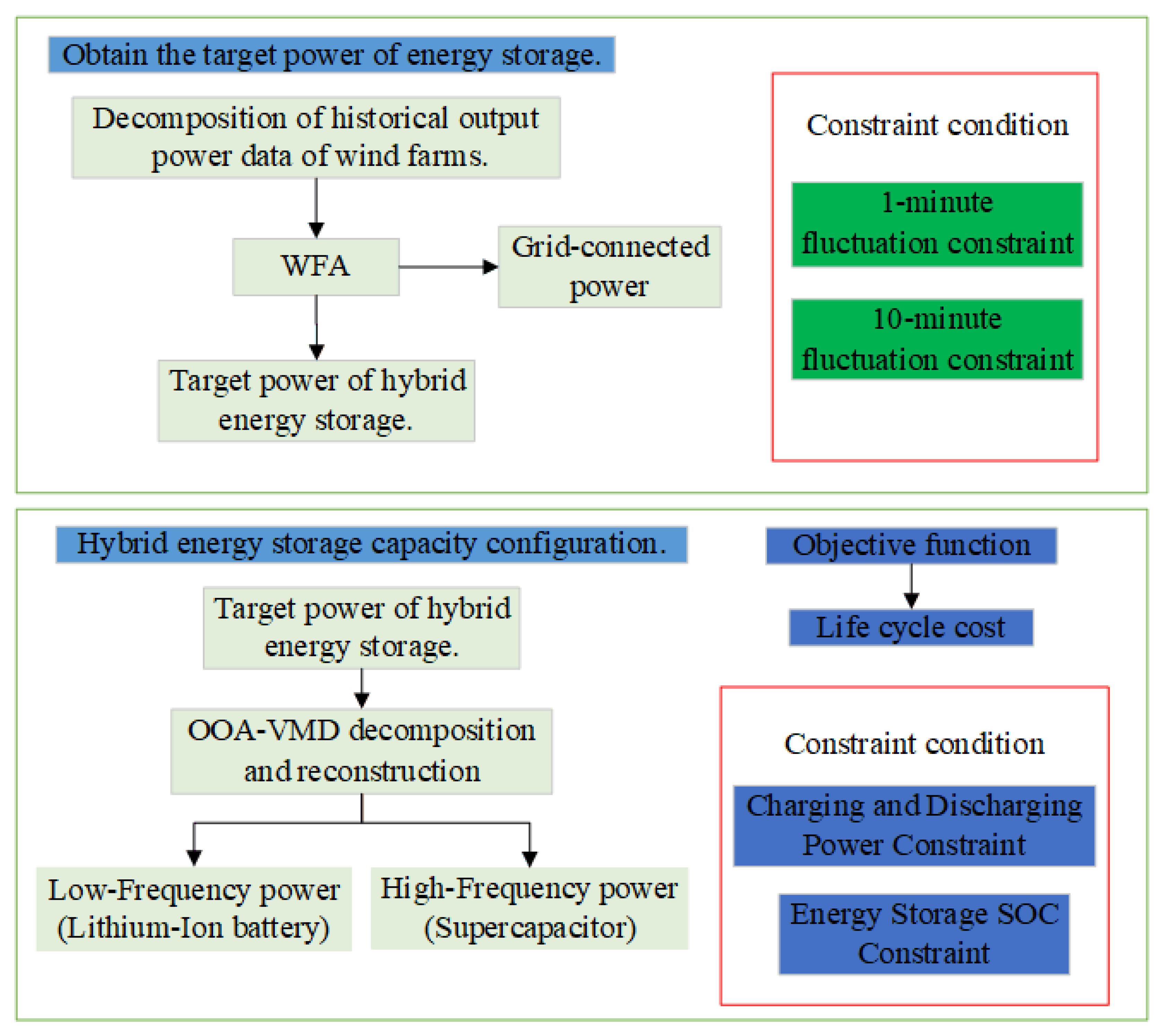
In the hybrid energy storage system, the active power allocation between supercapacitors and lithium-ion batteries is directly affected by the frequency division point, which defines the high-frequency and low-frequency power components borne by the two types of energy storage devices respectively [32]. If the division point is set too low, the active power reference value of lithium-ion batteries will contain more high-frequency components; limited by their charge–discharge rate, this may lead to insufficient response to power dispatch commands. Conversely, if the division point is set too high, supercapacitors have to undertake more low-frequency power components, which will increase their capacity demand and be unfavorable to cost control [33]. Therefore, to achieve the optimal balance between system economy and operational performance, it is necessary to reasonably determine the frequency division point and optimize the capacity and power allocation strategy of supercapacitors and lithium-ion batteries accordingly (Figure 3). For this purpose, this paper constructs an optimal configuration model of HESS with the objective of minimizing the annual life-cycle cost. By dynamically adjusting the frequency division point in power allocation, the optimal matching of capacity and power for energy storage devices is realized, which ensures the system’s capability of suppressing power fluctuations and improving grid-connected stability while controlling the overall cost.

4.2. Objective Function

When evaluating the operational performance of the combined wind power and energy storage system, it is necessary to comprehensively consider the system reliability and economic benefits based on the annual life-cycle cost theory. Accordingly, an objective function is established with the goal of minimizing the annual comprehensive cost, namely
f = m i n ( C i n + C p r e + C o m + C r e s + C s v )
Investment cost calculation Formula (21):
C i n = k p i P H N + k e i E H N
where k p i is the initial investment cost per unit power and k e i is the initial investment cost per unit capacity.
The calculation of the equipment replacement cost is shown in Equation (22):
C p r e = k = 1 n ( k p p P H N + k e p E H N ) ( 1 + r ) k T n + 1
where k p p is the replacement cost per unit power; k e p is the replacement cost per unit capacity; T is the service life; and r is the benchmark discount rate.
The calculation of operation and maintenance cost is shown in Equation (23):
C o m = k p o P H N ( 1 + r ) T 1 r ( 1 + r ) T + t = 1 T k e o W t ( 1 + r ) t
where k p o is the operation and maintenance cost per unit power and k e o is the operation and maintenance cost per unit capacity.
The calculation of the recycling cost is shown in Equation (24):
C r e c = ( k p r P H N + k e r E H N ) ( ξ + 1 ) ( 1 + r ) T
where k p r is the recycling cost per unit power; k e r is the recycling cost per unit capacity; and ξ is the replacement times of energy storage equipment.
The calculation of the salvage value of energy storage equipment is shown in Equation (25):
C s v = δ r e s ( C i n + C p r e ) ( 1 + r ) T
where δ r e s is the salvage value rate.

4.3. Constraint Conditions

(1) The constrained charging and discharging power of the energy storage system is as follows:
P b ( t ) | P b N | P s c ( t ) | P s c N |
where P b N is the rated power of lithium-ion batteries and P s c N is the rated power of supercapacitors.
(2) The energy storage SOC constraints are formulated to ensure service life, and the SOC values of lithium-ion batteries and supercapacitors must be maintained within a reasonable range at all times, namely
S b , m i n S b ( t ) S b , m a x S s o c , m i n S s o c ( t ) S s o c , m a x
where S b , m a x and S b , m i n denote the upper and lower limits of the state of charge (SOC) of lithium-ion batteries, respectively, and S s o c , m a x , S s o c , m i n denote the upper and lower limits of the state of charge (SOC) of supercapacitors, respectively.

5. Case Analysis

5.1. Fluctuation Mitigation Effect Analysis

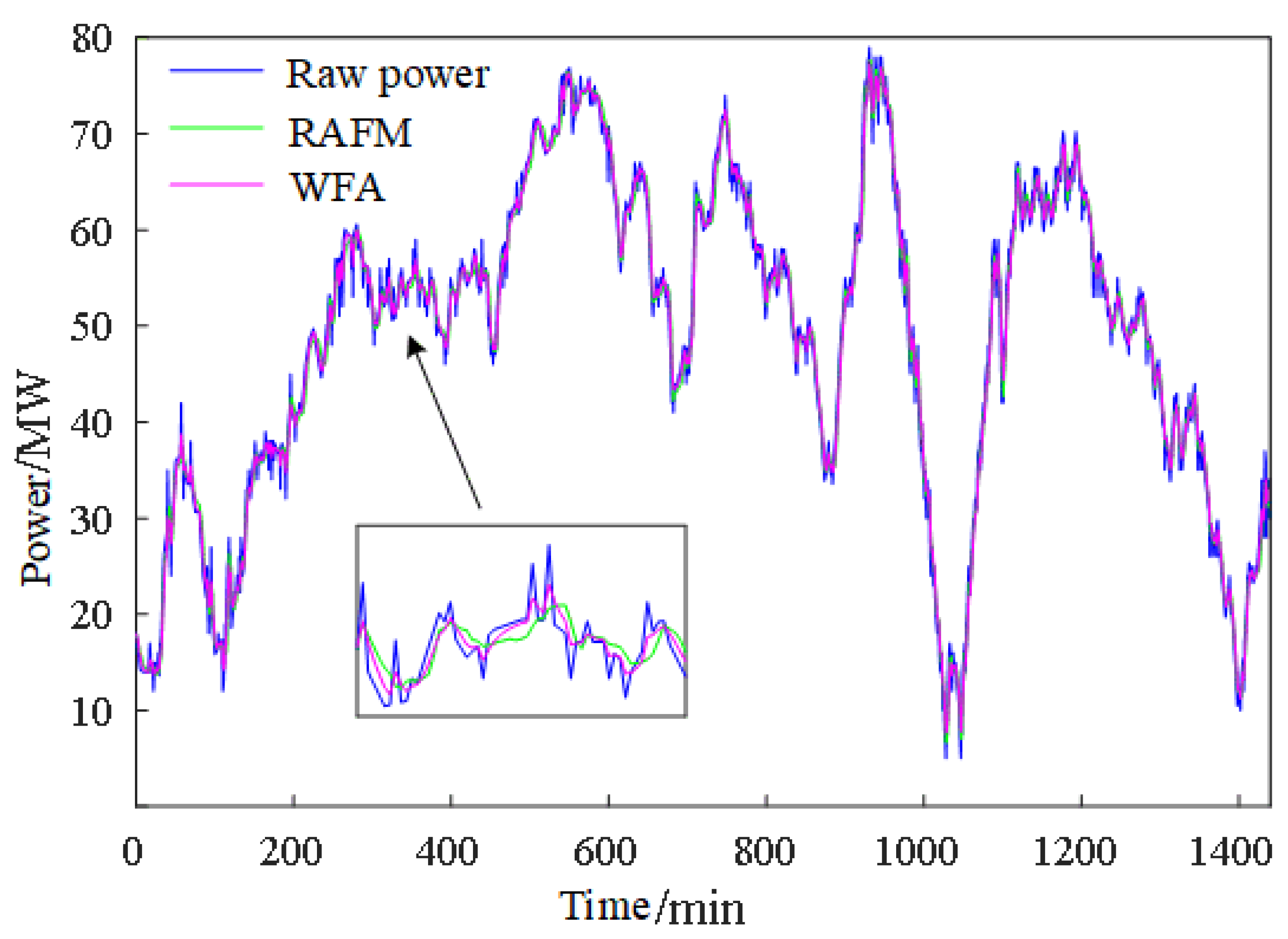
In this study, a domestic wind farm with an installed capacity of 80 MW was selected as the analysis case, and its active output power within a single day was sampled at an interval of 1 min. Based on the aforementioned data, the power and capacity configuration calculations of the hybrid energy storage system were completed. As can be seen from Figure 4, the target grid-connected power obtained by processing the original power with the weighted filtering algorithm shows a significant reduction in fluctuations compared with the original power, which is more in line with the grid-connection smoothness requirements of the power system.
According to the technical regulations for grid connection of wind farms in a certain country, the active power fluctuations of a wind farm’s grid-connected system must comply with the specifications and standards for safe and stable grid operation. For wind farms with an installed capacity between 30 MW and 150 MW, the fluctuation limit for 1-min intervals is one-tenth of the installed capacity, while the fluctuation limit for 10-min intervals is one-third of the installed capacity.As can be seen from Table 2, the maximum 1-min fluctuation of the original wind power reaches 10.7109 MW, which has exceeded the allowable limit of grid-connected power. After processing with the recursive average filtering method and the weighted filtering method proposed in this paper, the maximum 1-min fluctuation decreases to 4.6207 MW and 4.4782 MW, respectively, and the maximum fluctuation rate drops from 21.42% of the original data to 9.24% and 8.96% accordingly. On the 10-min time scale, the maximum fluctuations after treatment with the two methods reduce to 12.8004 MW and 12.8432 MW, respectively, while the maximum fluctuation rates decrease from 29.75% to 25.60% and 25.70%. Although both methods can meet the grid-connected fluctuation standards, the analysis combined with Figure 5 shows that the power curve processed by recursive average filtering has an obvious hysteresis phenomenon, whereas the weighted filtering method proposed in this paper significantly reduces the time delay of grid-connected power.

5.2. Power Allocation

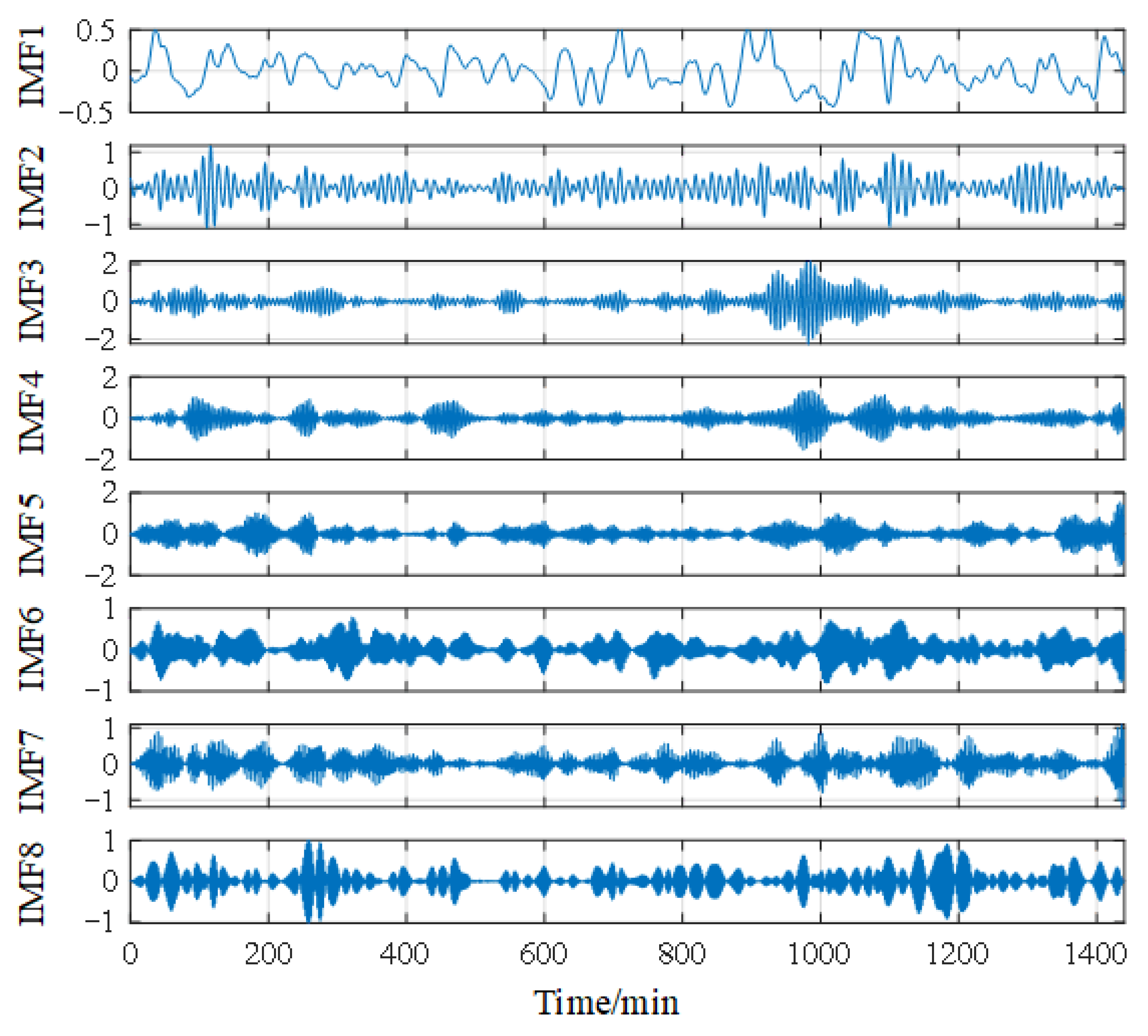
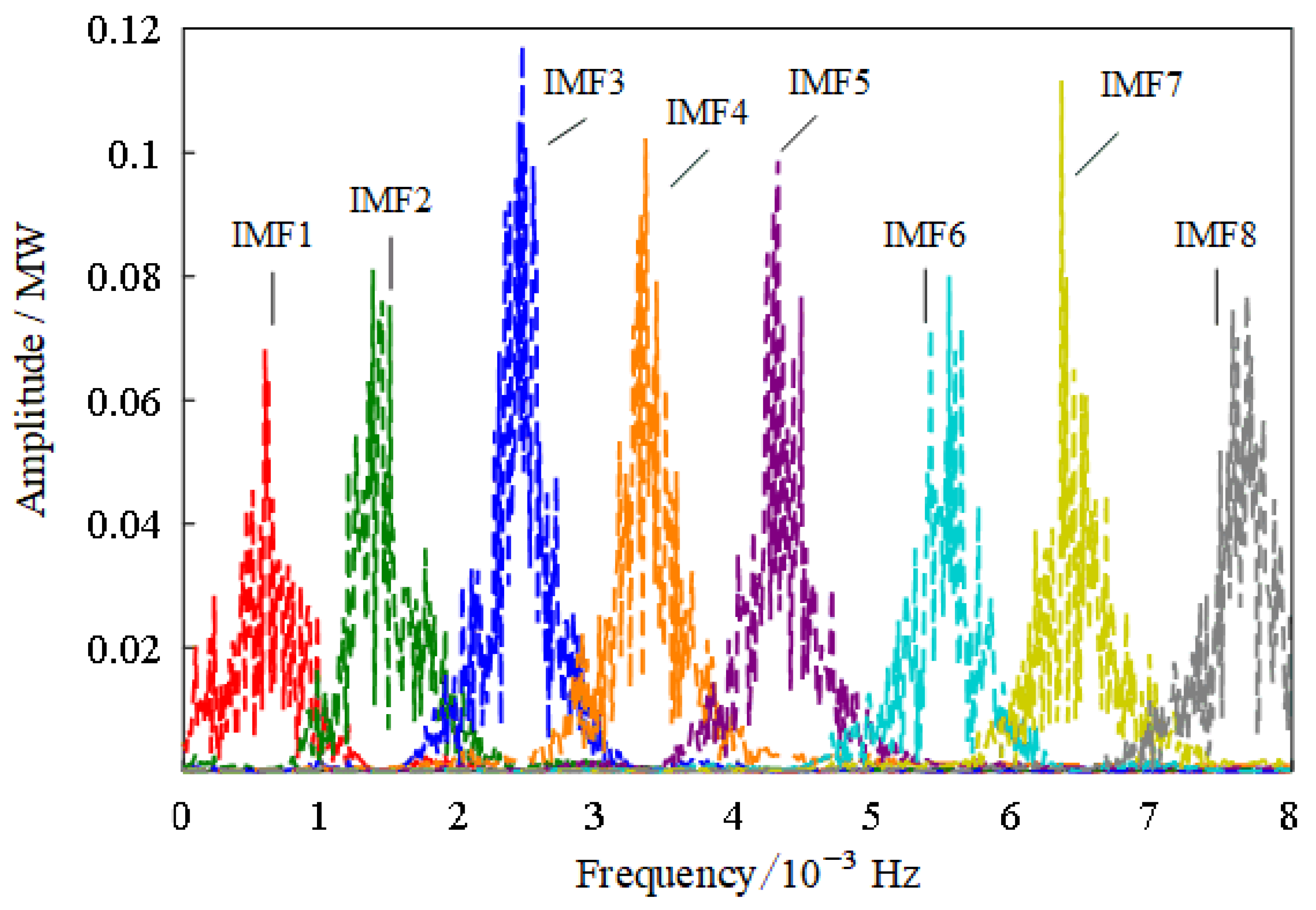
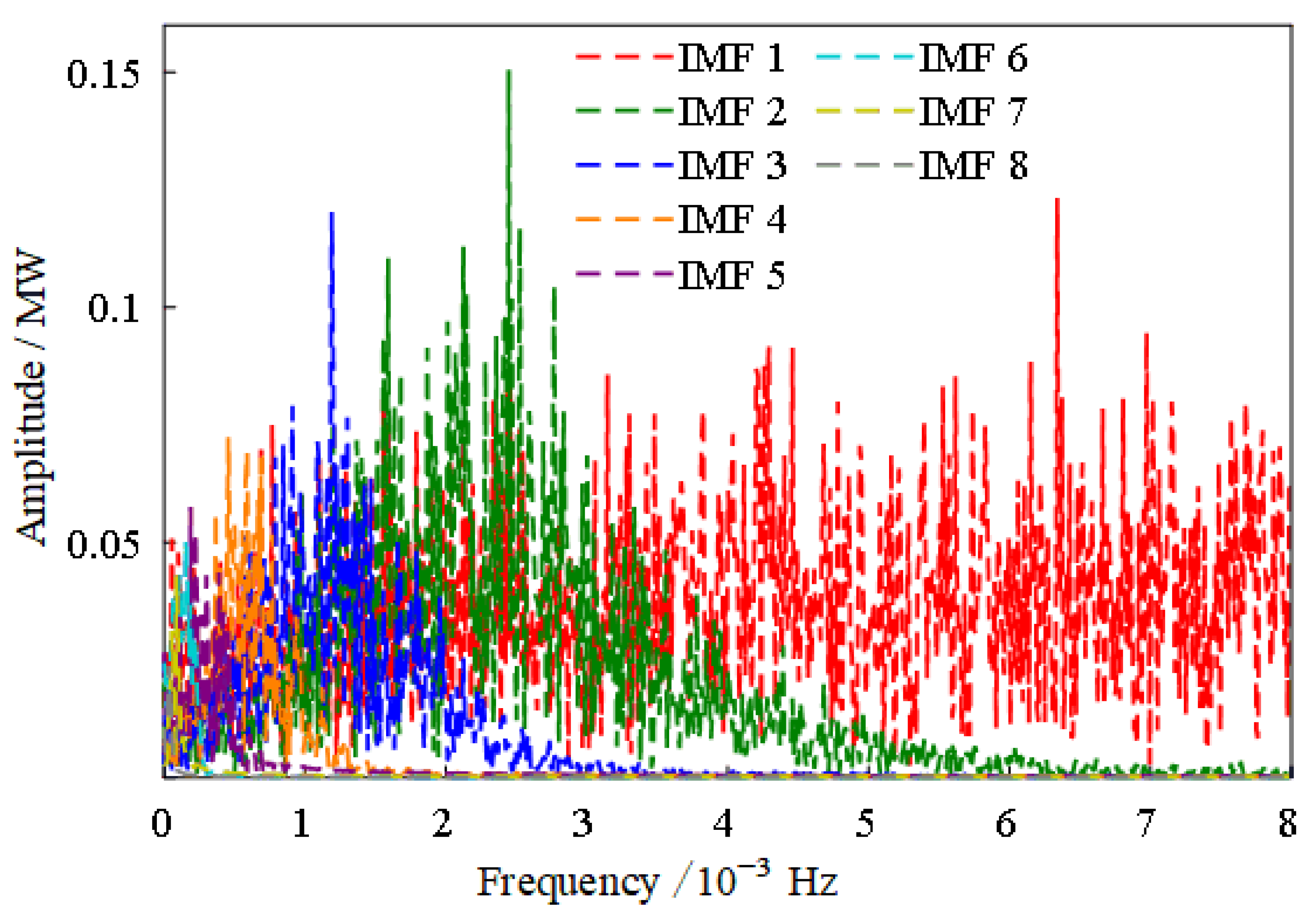
After the reference power of the energy storage system is obtained by mitigating the original wind power with the weighted filtering algorithm, the OOA is adopted to optimize the number of decomposed modes K and the quadratic penalty term α for the VMD, with the output of the optimal parameter combination being [K, α] = [8, 2930]. To evaluate the effectiveness of this algorithm, the Empirical Mode Decomposition (EMD) algorithm is simultaneously employed as a control in this study [34], and decomposition is performed on the same reference power. The two optimized key parameters are input into the VMD algorithm, and the resulting decomposition results are presented in Figure 5. On this basis, the Hilbert transform is further applied to each decomposed modal component to obtain the corresponding spectral distribution (Figure 6). It can be observed that the energy of each IMF is concentrated near the corresponding central frequency, with a clear distinction between high-frequency and low-frequency components. In contrast, the decomposed spectrum of the EMD algorithm (Figure 7) exhibits obvious mode mixing. The results indicate that the VMD algorithm with parameters optimized by the OOA can effectively overcome the mode mixing problem existing in EMD, thereby realizing a more reasonable and accurate decomposition and allocation of the reference power for the hybrid energy storage system.
By analysing each critical mode, capacity allocation schemes for the HESS were derived under different power distribution strategies and incorporated into the constructed annual lifecycle cost model for the HESS. As the frequency boundary point shifts upwards, the power and capacity requirements for lithium-ion batteries exhibit a downward trend, while the configuration demands for supercapacitors correspondingly increase. When the boundary point is set too low, supercapacitors bear a disproportionate share of the power load. However, given their higher unit capacity cost, this leads to increased overall economic costs for the system. Conversely, setting the boundary point too high shifts more power load to lithium-ion batteries, which not only shortens battery operational lifespan but also correspondingly increases the system’s investment costs. Therefore, determining the threshold requires balancing the configuration of supercapacitors and lithium-ion batteries to achieve equilibrium between system economics and operational lifespan. To establish the optimal threshold for separating high- and low-frequency signal components, all IMF mode indices were examined, with IMF6 selected as the threshold to decompose the power signal into high-frequency and low-frequency components.

5.3. Analysis of Configuration Results

The key input parameters required for lithium-ion batteries and supercapacitors within the HESS optimisation configuration model developed herein are provided in Table 3.
To verify the performance of the OOA-VMD-based power allocation strategy proposed in this paper in optimizing the energy storage configuration, the Empirical Mode Decomposition (EMD) and Variational Mode Decomposition (VMD) methods were simultaneously employed to decompose and reconstruct the output power of the energy storage system. According to the technical characteristics of supercapacitors and lithium-ion batteries, adaptive allocation was performed on the decomposed power, and the corresponding results of the optimal capacity configuration of the energy storage system are presented in Table 4.
In the comparison of power decomposition algorithms for different hybrid energy storage systems, the OOA-VMD algorithm adopted in this paper exhibits significant advantages over the traditional EMD and VMD algorithms. By effectively mitigating the inherent mode mixing problem of the EMD and VMD algorithms, the OOA-VMD algorithm enables more accurate power allocation, thus facilitating a more rational capacity configuration of the hybrid energy storage system. As can be seen from Table 4, the annual comprehensive cost of the HESS using the OOA-VMD algorithm is reduced by 36% compared with that configured by the EMD algorithm, and by 23% compared with that configured by the VMD algorithm. The remarkable cost reduction is attributed to the optimization of the OOA-VMD algorithm in improving the allocation accuracy of high- and low-frequency power components; this optimization ensures the precision of modal decomposition and addresses the issues of mode mixing and frequency leakage.
Compared with the configuration scheme relying solely on a single energy storage device, the hybrid energy storage system (HESS) adopting the OOA-VMD strategy can reduce the total annual cost by 24% relative to the system using only lithium-ion batteries. This cost-effectiveness is mainly attributed to the fact that the standalone lithium-ion battery system bears the full burden of wind power grid-connected fluctuations, resulting in more frequent charge–discharge cycles and accelerated lifespan degradation of the batteries, which increases the replacement cost. In contrast, the introduction of supercapacitors into the system to absorb high-frequency fluctuations reduces the reliance on lithium-ion batteries and their replacement frequency, extends the service life of the batteries, and significantly cuts down the costs caused by frequent replacements. Therefore, the incorporation of supercapacitors not only improves the operational efficiency of the system but also optimizes the energy storage configuration from an economic perspective, thus verifying the economic advantages of the hybrid energy storage scheme.

6. Conclusions

This paper takes the hybrid energy storage system composed of supercapacitors and storage batteries as the research object and proposes an OOA-VMD-optimized hybrid energy storage capacity configuration strategy for mitigating wind power fluctuations. By smoothing the initial wind power to meet the grid-connection standards, the strategy simultaneously generates reference power for optimized energy storage configurations, thereby addressing the power fluctuation issues caused by the random and intermittent characteristics of wind power generation. Through case simulation and analysis, the following core conclusions are drawn: (1) A fused weighted filtering algorithm is adopted to smooth wind power fluctuations, which can effectively make the output power more consistent with the grid-connection standards and significantly reduce the delay time of grid-connected power. (2) The OOA algorithm is employed to optimize and adjust the parameters of VMD, determining the optimal decomposition layer number K and quadratic penalty factor α. This approach can avoid the mode mixing problem caused by improper parameter settings. The optimized VMD can effectively decompose the energy storage reference power, achieving functional complementarity and rational power allocation between lithium-ion batteries and supercapacitors. (3) The established hybrid energy storage configuration model can significantly reduce the annual life-cycle cost, thereby verifying that this method has both economic feasibility and technical superiority in mitigating wind power fluctuations.

Author Contributions

Conceptualization, Z.S. and Y.Z.; methodology, Z.S.; software, Z.S.; validation, Z.S. and Y.Z.; formal analysis, Z.S.; investigation, Z.S.; resources, Z.S. and Y.Z.; data curation, Z.S.; writing—original draft preparation, Z.S.; writing—review and editing, Y.Z.; visualization, Z.S.; supervision, Y.Z.; project administration, Y.Z. All authors have read and agreed to the published version of the manuscript.

Funding

This research received no external funding.

Informed Consent Statement

Informed consent was obtained from all subjects involved in the study.

Data Availability Statement

Our data are all included in the manuscript and are genuine.

Conflicts of Interest

The authors declare no conflicts of interest.

References

  1. Olabi, A.G.; Abdelkareem, M.A. Renewable energy and climate change. Renew. Sustain. Energy Rev. 2022, 158, 112111. [Google Scholar] [CrossRef]
  2. Li, L.; Lin, J.; Wu, N.; Xie, S.; Meng, C.; Zheng, Y.; Wang, X.; Zhao, Y. Review and outlook on the international renewable energy development. Energy Built Environ. 2022, 3, 139–157. [Google Scholar] [CrossRef]
  3. Twidell, J. Renewable Energy Resources; Routledge: London, UK, 2021. [Google Scholar]
  4. Halkos, G.E.; Gkampoura, E.C. Reviewing usage, potentials, and limitations of renewable energy sources. Energies 2020, 13, 2906. [Google Scholar] [CrossRef]
  5. Emrani, A.; Berrada, A. A comprehensive review on techno-economic assessment of hybrid energy storage systems integrated with renewable energy. Energy Storage 2024, 84, 111010. [Google Scholar] [CrossRef]
  6. Hajiaghasi, S.; Salemnia, A.; Hamzeh, M. Hybrid energy storage system for microgrids applications: A review. J. Energy Storage 2019, 21, 543–570. [Google Scholar] [CrossRef]
  7. Ostadi, A.; Kazerani, M.E.A.; Chen, S.K. Hybrid Energy Storage System (HESS) in vehicular applications: A review on interfacing battery and ultra-capacitor units. In Proceedings of the 2013 IEEE Transportation Electrification Conference and Expo (ITEC), Detroit, MI, USA, 16–19 June 2013. [Google Scholar]
  8. Ilyas, U.; Khan, M.N.U.; Ashfaq, U.; Qaiser, I. Energy optimization of hybrid energy storage system (HESS) for hybrid electric vehicle (HEV). Eng. Proc. 2022, 12, 75. [Google Scholar]
  9. Haque, M.E.; Khan, M.N.S.; Sheikh, M.R.I. Smoothing control of wind farm output fluctuations by proposed low pass filter, and moving averages. In Proceedings of the 2015 International Conference on Electrical & Electronic Engineering (ICEEE), Rajshahi, Bangladesh, 4–6 November 2015. [Google Scholar]
  10. Mahto, T.; Mukherjee, V. Energy storage systems for mitigating the variability of isolated hybrid power system. Renew. Sustain. Energy Rev. 2015, 51, 1564–1577. [Google Scholar] [CrossRef]
  11. Jiang, Q.; Hong, H. Wavelet-based capacity configuration and coordinated control of hybrid energy storage system for smoothing out wind power fluctuations. IEEE Trans. Power Syst. 2012, 28, 1363–1372. [Google Scholar] [CrossRef]
  12. Lu, Q.; Yang, Y.; Chen, J.; Liu, Y.; Liu, N.; Cao, F. Capacity optimization of hybrid energy storage systems for offshore wind power volatility smoothing. Energy Rep. 2023, 9, 575–583. [Google Scholar] [CrossRef]
  13. Zhang, Y.; Yuan, C.; Du, X.; Chen, T.; Hu, Q.; Wang, Z.; Lu, J. Capacity configuration of hybrid energy storage system for ocean renewables. J. Energy Storage 2025, 116, 116090. [Google Scholar] [CrossRef]
  14. Hossain, M.B.; Islam, M.R.; Muttaqi, K.M.; Sutanto, D.; Agalgaonkar, A.P. A compensation strategy for mitigating intermittencies within a PV powered microgrid using a hybrid multilevel energy storage system. IEEE Trans. Ind. Appl. 2023, 59, 5074–5086. [Google Scholar] [CrossRef]
  15. Nazir, M.S.; Bilal, M.; Sohail, H.M.; Liu, B.; Chen, W.; Iqbal, H.M. Impacts of renewable energy atlas: Reaping the benefits of renewables and biodiversity threats. Int. J. Hydrogen Energy 2020, 45, 22113–22124. [Google Scholar] [CrossRef]
  16. Sedighi, M.; Moradzadeh, M. Impact of demand response program on hybrid renewable energy system planning. In Demand Response Application in Smart Grids; Springer International Publishing: Cham, Switzerland, 2020; pp. 215–230. [Google Scholar]
  17. Ding, M.; Wu, J. A novel control strategy of hybrid energy storage system for wind power smoothing. Electr. Power Components Syst. 2017, 45, 1265–1274. [Google Scholar] [CrossRef]
  18. Shi, J.; Wang, L.; Lee, W.J.; Cheng, X.; Zong, X. Hybrid Energy Storage System (HESS) optimization enabling very short-term wind power generation scheduling based on output feature extraction. Appl. Energy 2019, 256, 113915. [Google Scholar] [CrossRef]
  19. Li, Z.; Li, S.; Wang, F. Adaptive control strategy of hybrid energy storage system for mitigating wind power fluctuations. Mod. Electr. Power 2020, 37, 646–653. [Google Scholar]
  20. Rahimi, T.; Ding, L.; Kheshti, M.; Faraji, R.; Guerrero, J.M.; Tinajero, G.D.A. Inertia response coordination strategy of wind generators and hybrid energy storage and operation cost-based multi-objective optimizing of frequency control parameters. IEEE Access 2021, 9, 74684–74702. [Google Scholar] [CrossRef]
  21. Alzahrani, A.; Ramu, S.K.; Devarajan, G.; Vairavasundaram, I.; Vairavasundaram, S. A review on hydrogen-based hybrid microgrid system: Topologies for hydrogen energy storage, integration, and energy management with solar and wind energy. Energies 2022, 15, 7979. [Google Scholar] [CrossRef]
  22. Sun, Y.; Tang, X.; Sun, X.; Jia, D.; Cao, Z.; Pan, J.; Xu, B. Model predictive control and improved low-pass filtering strategies based on wind power fluctuation mitigation. J. Mod. Power Syst. Clean Energy 2019, 7, 512–524. [Google Scholar] [CrossRef]
  23. Zhang, Y.; Zhang, Y.; Wu, T. Integrated strategy for real-time wind power fluctuation mitigation and energy storage system control. Glob. Energy Interconnect. 2024, 7, 71–81. [Google Scholar] [CrossRef]
  24. Tan, N.; Zhou, Z.; Zou, M. Research on a novel wind power prediction method based on VMD-IMPA-BiLSTM. IEEE Access 2024, 12, 73451–73469. [Google Scholar] [CrossRef]
  25. Ren, F.; Cao, X. Wind power prediction based on VMD-BWO-KELM. Electr. Power Syst. Res. 2025, 247, 111765. [Google Scholar] [CrossRef]
  26. Wang, Y.; Zhao, K.; Hao, Y.; Yao, Y. Short-term wind power prediction using a novel model based on butterfly optimization algorithm-variational mode decomposition-long short-term memory. Appl. Energy 2024, 366, 123313. [Google Scholar] [CrossRef]
  27. Talha, M.; Palange, R.; Khan, S.A.; DeBlasio, C. Mitigating thermal runaway in EV batteries using hybrid energy storage and phase change materials. RSC Adv. 2025, 15, 24947–24974. [Google Scholar] [CrossRef] [PubMed]
  28. Shen, Y.; Sun, S. Distributed recursive filtering for multi-rate uniform sampling systems with packet losses in sensor networks. Int. J. Syst. Sci. 2023, 54, 1729–1745. [Google Scholar] [CrossRef]
  29. Hao, Y.; Lu, J.; Peng, G.; Wang, M.; Li, J.; Wei, G. F10.7 daily forecast using lstm combined with vmd method. Space Weather 2024, 22, e2023SW003552. [Google Scholar] [CrossRef]
  30. Ismaeel, A.A.; Houssein, E.H.; Khafaga, D.S.; Abdullah Aldakheel, E.; AbdElrazek, A.S.; Said, M. Performance of osprey optimization algorithm for solving economic load dispatch problem. Mathematics 2023, 11, 4107. [Google Scholar] [CrossRef]
  31. Liu, B.; Liu, C.; Zhou, Y.; Wang, D. A chatter detection method in milling based on gray wolf optimization VMD and multi-entropy features. Int. J. Adv. Manuf. Technol. 2023, 125, 831–854. [Google Scholar] [CrossRef]
  32. Zhou, Z.; Ma, Z.; Mu, T. Hybrid energy storage capacity optimization based on VMD-SG and improved Firehawk optimization. Electr. Power Syst. Res. 2025, 239, 111218. [Google Scholar] [CrossRef]
  33. Li, D.; Qian, K.; Gao, C.; Xu, Y.; Xing, Q.; Wang, Z. Research on Electric Hydrogen Hybrid Storage Operation Strategy for Wind Power Fluctuation Suppression. Energies 2024, 17, 5019. [Google Scholar]
  34. Liu, J.; Lv, Z.; Zhao, L. A dual-optimization building energy prediction framework based on improved dung beetle algorithm, variational mode decomposition and deep learning. Energy Build. 2025, 328, 115143. [Google Scholar] [CrossRef]
Figure 1. Schematic diagram of the wind power storage and generation system.
Algorithms 19 00204 g001
Figure 2. Flow chart of optimizing VMD key parameters via OOA.
Algorithms 19 00204 g002
Figure 3. Overall block diagram of the hybrid energy storage optimization strategy.
Algorithms 19 00204 g003
Figure 4. Effect diagram of wind farm power fluctuation mitigation.
Algorithms 19 00204 g004
Figure 5. Decomposition results of reference power via VMD algorithm.
Algorithms 19 00204 g005
Figure 6. Frequency spectrum of each IMF via the VMD algorithm.
Algorithms 19 00204 g006
Figure 7. Frequency spectrum of each IMF via the EMD algorithm.
Algorithms 19 00204 g007
Table 1. Key parameter settings for OOA optimisation of VMD.
ParametersNumerical Value
Population size N20
Total number of iterations T40
VMD modal number K[2, 10]
Penalty factor α[100, 5000]
Modal initial frequency init1
Convergence criterion tolerance limit tol10−7
Table 2. Wind power data before and after fluctuation mitigation.
ParametersOriginal DataRecursive Average FilteringWeighted Filtering
Maximum fluctuation value (1 min)/MW10.71094.62074.4782
Maximum fluctuation rate (1 min)/%21.429.248.69
Maximum fluctuation value (10 min)/MW14.876412.800412.8432
Maximum fluctuation rate (10 min)/%29.7525.6025.70
Table 3. Parameters related to energy storage systems.
ParametersLithium-Ion BatterySupercapacitor
Unit power investment cost/(CNY/kW)93001850
Unit investment cost/[CNY/(kW × h)]920011,300
Unit power replacement cost/(CNY/kW)24501950
Unit capacity replacement cost/[CNY/(kW × h)]950013,300
Operational maintenance cost per unit of power/(CNY/kW)15075
Operational maintenance cost per unit of capacity/[CNY/(kW × h)]0.0150.0125
Unit power auxiliary cost/(CNY/kW)720720
Unit auxiliary cost/[CNY/(kW × h)]00
Processing costs/(CNY/kW)45095
Charging and discharging efficiency/%8595
SOC upper and lower limits0.15~0.850.10~0.95
Table 4. HESS capacity configuration results.
ConfigurationSingle Energy StorageHybrid Energy Storage
ParametersLithium-Ion BatteryEMDVMDOOA-VMD
PBN/MW6.6556.5114.9904.252
EBN/(MW·h)1.1040.7811.0110.742
PSN/MW00.5562.1491.990
ESN/(MW·h)00.8970.04340.052
Annual comprehensive cost/CNY3.806 × 1074.536 × 1073.765 × 1072.902 × 107
Disclaimer/Publisher’s Note: The statements, opinions and data contained in all publications are solely those of the individual author(s) and contributor(s) and not of MDPI and/or the editor(s). MDPI and/or the editor(s) disclaim responsibility for any injury to people or property resulting from any ideas, methods, instructions or products referred to in the content.