
Virtual Reality Interventions for Enhancing Executive Functions in Children and Adolescents with Autism Spectrum Disorder



Abstract
1. Introduction
2. Literature Review
2.1. Executive Function Challenges in ASD and Importance of Intervention
2.2. Virtual Reality as an Intervention Tool
2.3. VR-Based Programs for Executive Function Training
2.4. Integrating ABA and Behavioral Strategies in VR
2.5. Design Principles for Effective VR Interventions
3. Materials and Methods
3.1. Methodology and VR Intervention
3.1.1. Participants and Design
3.1.2. Experimental Phases
3.1.3. Target Skills and VR Tasks
3.1.4. Trial Structure and Procedure
3.2. Data Collection
3.3. Data Analysis
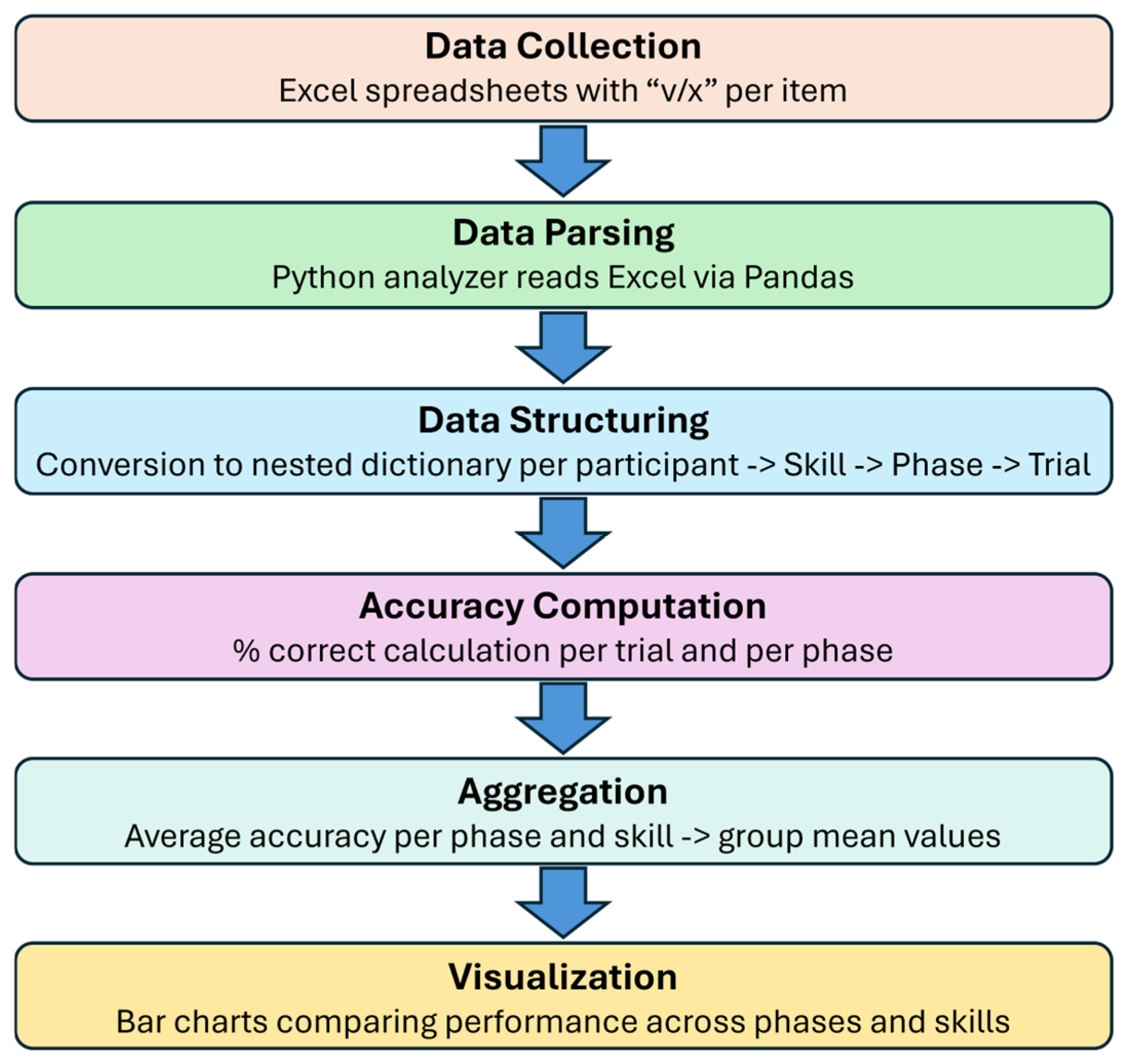
3.3.1. Data Parsing and Structure
- Top level: Child name (e.g., “Alexandros” or “Andreas”).
- Second level: Cognitive variable, inhibitory control, or working memory.
- Third level: Phase and trial identifier as extracted from the first column in the Excel, indicating which trial number and phase the data correspond to.
- Bottom level: A list of trial outcome dictionaries, each mapping item indices to the child’s response on that item (e.g., {“1”: “√”, “2”: “x”, …, “15”: “√”} for a given trial). Typically, each phase-trial combination had one such dictionary (since most trials were single instances per phase), but the data structure allowed multiple dictionaries in a list in case a phase had more than one trial entry.
3.3.2. Computation of Accuracy Metrics
- {
- “1 Β”: 0.20,
- “2 Β”: 0.40,
- “1 I”: 0.67,
- “1 G”: 0.80,
- “1 F”: 0.75
- }
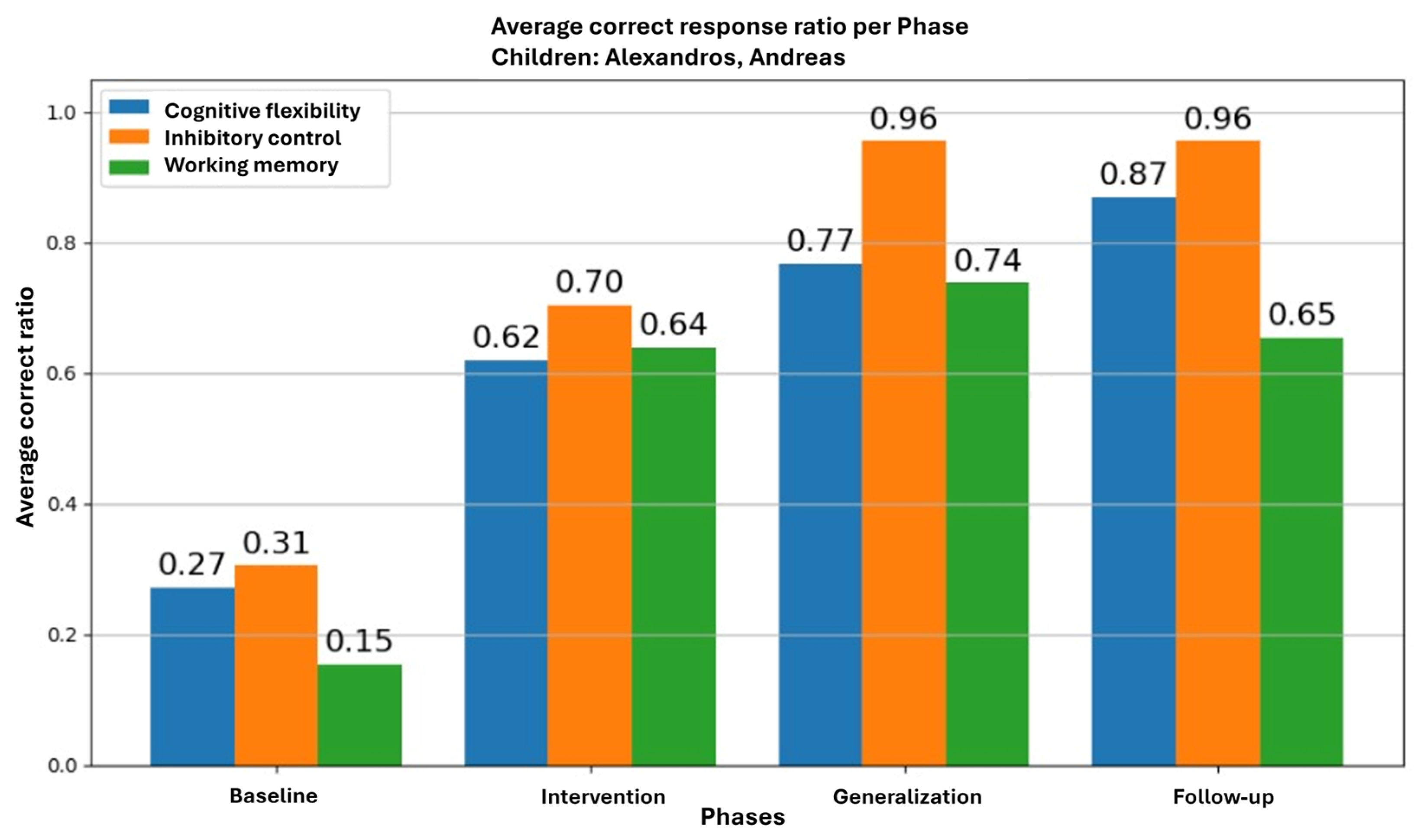
3.3.3. Visualization
4. Results
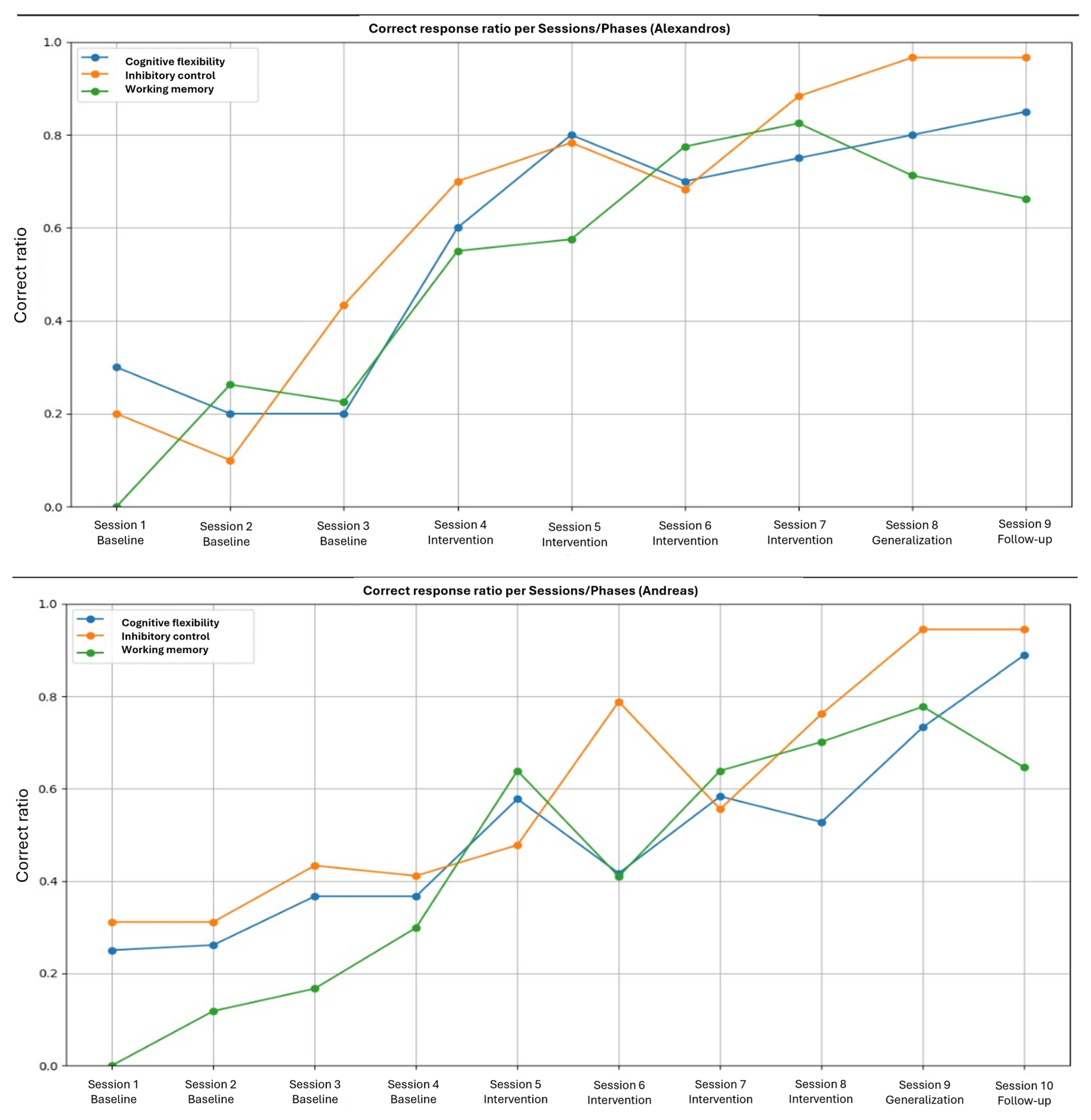
4.1. Baseline Performance
4.2. Intervention Phase Performance
4.3. Generalization Phase Performance
4.4. Follow-Up Performance (Retention)
4.5. Key Findings
5. Discussion
5.1. Discussion on the Results
5.2. Discussion on Methodological Scope and Generalizability
5.3. Discussion on Limitations
6. Conclusions
Author Contributions
Funding
Data Availability Statement
Conflicts of Interest
Abbreviations
| ASD | Autism Spectrum Disorder |
| EF | Executive Function |
| VR | Virtual Reality |
| ABA | Applied Behavior Analysis |
| XR | Extended Reality |
| SDK | Software Development Kit |
| CBT | Cognitive Behavioral Therapy |
Appendix A
Appendix A.1. Cognitive Flexibility (Tasks 1–6)
- Task 1:
- Dimensional Change Card Sort (DCCS), Rabbit and Boat
- Task 2:
- Dimensional Change Card Sort (DCCS), Fruits
- Task 3:
- Dimensional Change Card Sort (DCCS), Multicolored Animals
- Task 4:
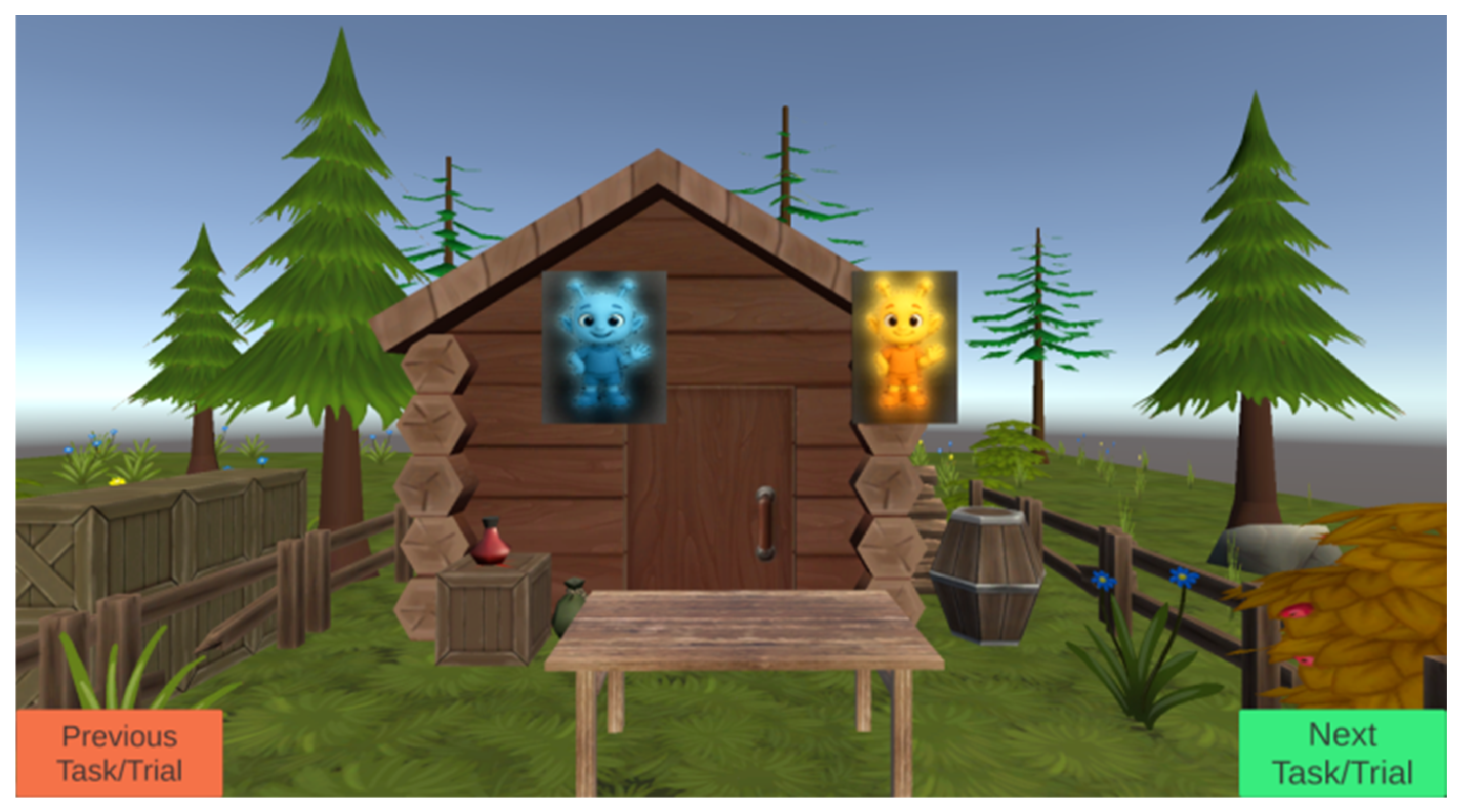
- Multicolored Aliens
- When the yellow alien is lowered, the player will clap.
- When the blue alien is lowered, the player will tap their hands on their legs.
- When the green alien is lowered, the player will tap their hands on the table.
- Task 5:
- The Light-Up Boxes
- Task 6:
- The Light-Up Boxes (with objects)
Appendix A.2. Impulse Control (Tasks 7–12)
- Task 7:
- Halli Galli, variation
- Task 8:
- Freddy & Nala
- Task 9:
- The Traffic Lights
- Task 10:
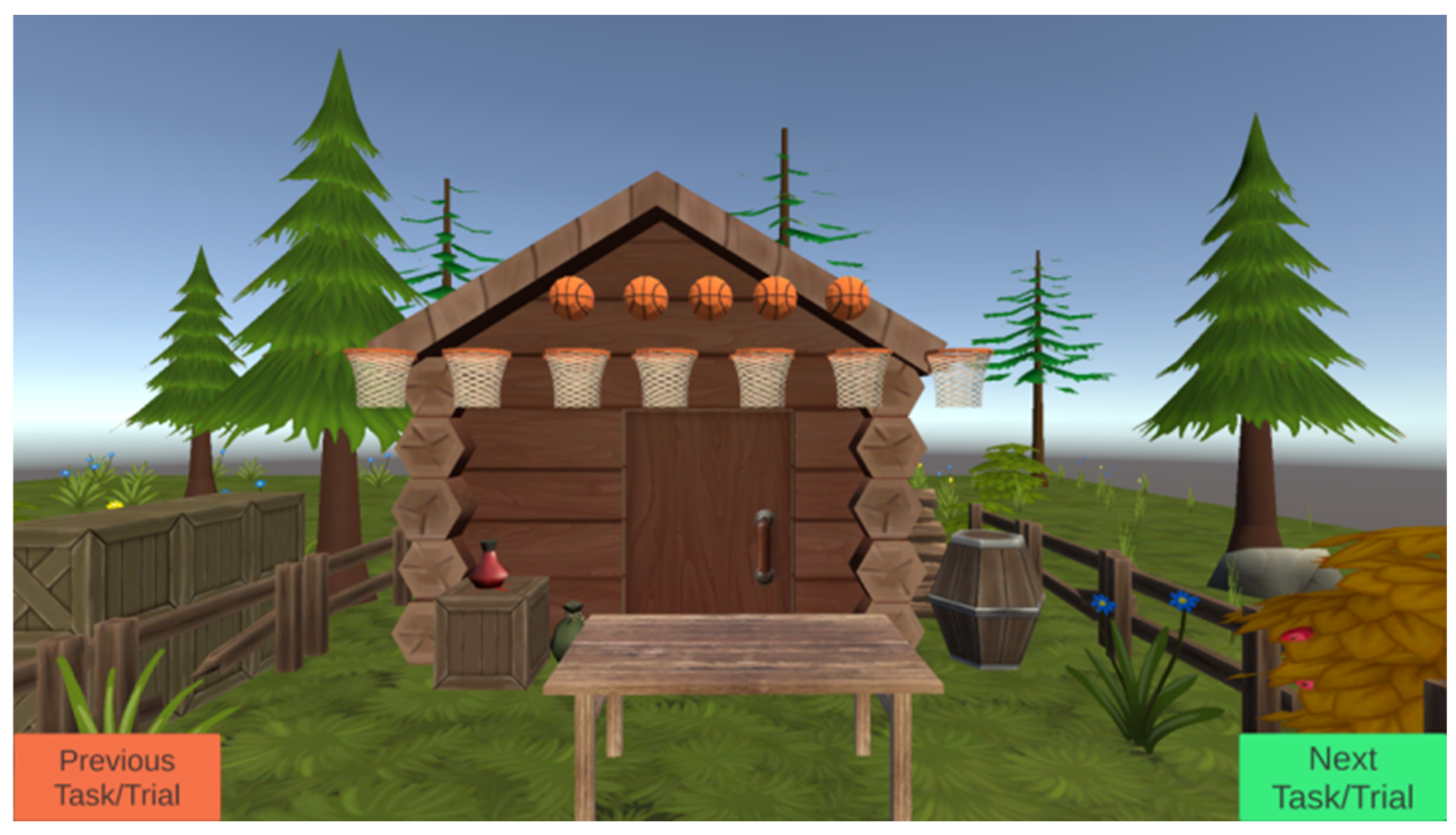
- The Three Baskets
- Task 11:
- Simon Says
- Task 12:
- The Teacher Says
Appendix A.3. Working Memory (Tasks 13–18)
- Task 13:
- Peter and the Numbers
- Task 14:
- Fruit Salad
- Task 15:
- Remember the Position, Spaceship
- Task 16:
- Remember the Position, Zoo
- Task 17:
- Remember the Position, Put the Ball
- Task 18:
- Remember the Position, Put the Earth
References
- Borgnis, F.; Baglio, F.; Pedroli, E.; Rossetto, F.; Uccellatore, L.; Oliveira, J.A.G.; Riva, G.; Cipresso, P. Available virtual reality-based tools for executive functions: A systematic review. Front. Psychol. 2022, 13, 833136. [Google Scholar] [CrossRef] [Scilit]
- Li, C.; Belter, M.; Liu, J.; Lukosch, H. Immersive virtual reality enabled interventions for Autism spectrum disorder: A systematic review and meta-analysis. Electronics 2023, 12, 2497. [Google Scholar] [CrossRef] [Scilit]
- Lledó, G.; Lledó, A.; Pérez-Vázquez, E. The use of augmented reality in people with ASD: A review. Int. J. Disabil. Dev. Educ. 2020, 70, 223–243. [Google Scholar] [CrossRef] [Scilit]
- Williams, R.M.; Alikhademi, K.; Gilbert, J.E. Design of a toolkit for real-time executive function assessment in custom-made virtual experiences and interventions. Int. J. Hum.-Comput. Stud. 2022, 158, 102734. [Google Scholar] [CrossRef] [Scilit]
- Dankbaar, M.E.W.; Alsma, J.; Jansen, E.E.H.; van Merrienboer, J.J.G.; van Saase, J.L.C.M.; Schuit, S.C.E. An experimental study on the effects of a simulation game on students’ clinical cognitive skills and motivation. Adv. Health Sci. Educ. 2019, 21, 505–521. [Google Scholar] [CrossRef] [Scilit]
- Georgescu, A.L.; Kuzmanovic, B.; Roth, D.; Bente, G.; Vogeley, K. The use of virtual characters to assess and train non-verbal communication in high-functioning autism. Front. Hum. Neurosci. 2014, 8, 807. [Google Scholar] [CrossRef] [Scilit]
- Weiss, P.L.; Rand, D.; Katz, N.; Kizony, R. Video capture virtual reality as a flexible and effective rehabilitation tool. J. Neuroeng. Rehabil. 2004, 1, 12. [Google Scholar] [CrossRef] [Scilit]
- Rothbaum, B.O.; Price, M.; Jovanovic, T.; Norrholm, S.D.; Gerardi, M.; Dunlop, B.; Ressler, K.J. A randomized controlled trial of virtual reality exposure therapy for posttraumatic stress disorder in Iraq and Afghanistan veterans. J. Consult. Clin. Psychol. 2014, 82, 1001–1012. [Google Scholar] [CrossRef] [Scilit]
- Strickland, D.; Coles, C.D.; Southern, L.B. JobTIPS: A transition to employment program for individuals with autism spectrum disorders. J. Autism Dev. Disord. 2013, 43, 2472–2483. [Google Scholar] [CrossRef] [Scilit]
- Neguț, A.; Matu, S.A.; Sava, F.A.; David, D. Virtual reality training for cognitive and functional independence: A systematic review. J. Clin. Med. 2016, 5, 102. [Google Scholar] [CrossRef] [Scilit]
- Josman, N.; Ben-Chaim, H.M.; Friedrich, S.; Weiss, P.L. Effectiveness of virtual reality for teaching street-crossing skills to children and adolescents with autism. Int. J. Disabil. Hum. Dev. 2008, 7, 49–56. [Google Scholar] [CrossRef] [Scilit]
- Al-Nafjan, A.; Alhakbani, N.; Alabdulkareem, A. Measuring engagement in robot-assisted therapy for autistic children. Behav. Sci. 2021, 11, 618. [Google Scholar] [CrossRef] [Scilit] [PubMed]
- Kandalaft, M.R.; Didehbani, N.; Krawczyk, D.C.; Allen, T.T.; Chapman, S.B. Virtual reality social cognition training for young adults with high-functioning autism. J. Autism Dev. Disord. 2013, 43, 34–44. [Google Scholar] [CrossRef] [Scilit] [PubMed]
- Yuan, S.N.V.; Ip, H.H.S. Using virtual reality to train emotional and social skills in children with autism spectrum disorder. Lond. J. Prim. Care 2018, 10, 110–112. [Google Scholar] [CrossRef] [Scilit]
- Didehbani, N.; Allen, T.; Kandalaft, M.; Krawczyk, D.; Chapman, S. Virtual reality social cognition training for children with high functioning autism. Comput. Hum. Behav. 2016, 62, 703–711. [Google Scholar] [CrossRef] [Scilit]
- Chen, J.; Hu, J.; Zhang, K.; Zeng, X.; Ma, Y.; Lu, W.; Zhang, K.; Wang, G. Virtual reality enhances the social skills of children with autism spectrum disorder: A review. Interact. Learn. Environ. 2024, 32, 2321–2342. [Google Scholar] [CrossRef] [Scilit]
- Kim, B. The Effectiveness of Mixed-Reality Based Intervention for Children with Autism Spectrum Disorders: A Meta-Analysis and Single-Case Study. Ph.D. Thesis, University of Tennessee, Knoxville, TN, USA, 2017. Available online: https://trace.tennessee.edu/utk_graddiss/4842 (accessed on 1 February 2025).
- Zhang, M.; Ding, H.; Naumceska, M.; Zhang, Y. Virtual reality technology as an educational and intervention tool for children with autism spectrum disorder: Current perspectives and future directions. Behav. Sci. 2022, 12, 138. [Google Scholar] [CrossRef] [Scilit]
- Ji, C.; Yang, J.; Lin, L.; Chen, S. Executive function improvement for children with autism spectrum disorder: A comparative study between virtual training and physical exercise methods. Children 2022, 9, 507. [Google Scholar] [CrossRef] [Scilit]
- Mouga, S.; Duarte, I.C.; Café, C.; Sousa, D.; Duque, F.; Oliveira, G.; Castelo-Branco, M. Attentional cueing and executive deficits revealed by a virtual supermarket task coupled with eye-tracking in autism spectrum disorder. Front. Psychol. 2021, 12, 671507. [Google Scholar] [CrossRef] [Scilit]
- Bozgeyikli, L.; Raij, A.; Katkoori, S.; Alqasemi, R. A survey on virtual reality for individuals with autism spectrum disorder: Design considerations. IEEE Trans. Learn. Technol. 2018, 11, 133–151. [Google Scholar] [CrossRef] [Scilit]
- Kourtesis, P.; Kouklari, E.-C.; Roussos, P.; Mantas, V.; Papanikolaou, K.; Skaloumbakas, C.; Pehlivanidis, A. Virtual reality training of social skills in adults with autism spectrum disorder: An examination of acceptability, usability, user experience, social skills, and executive functions. Behav. Sci. 2023, 13, 336. [Google Scholar] [CrossRef] [Scilit] [PubMed]
- Leung, P.W.S.; Li, S.X.; Tsang, C.S.O.; Chow, B.L.C.; Wong, W.C.W. Effectiveness of using mobile technology to improve cognitive and social skills among individuals with autism spectrum disorder: Systematic literature review. JMIR Ment. Health 2021, 8, e20892. [Google Scholar] [CrossRef] [Scilit] [PubMed]
- Alghamdi, M.; Alhakbani, N.; Al-Nafjan, A. Assessing the potential of robotics technology for enhancing education for children with autism spectrum disorder. Behav. Sci. 2023, 13, 598. [Google Scholar] [CrossRef] [Scilit] [PubMed]
- Epifânio, J.C.; da Silva, L.F. Embracing applied behavior analysis on a serious game design document model. IEEE Access 2023, 11, 72070–72083. [Google Scholar] [CrossRef] [Scilit]
- Chung, K.; Chung, E. Randomized controlled pilot study of an app-based intervention for improving social skills, face perception, and eye gaze among youth with autism spectrum disorder. Front. Psychiatry 2023, 14, 1126290. [Google Scholar] [CrossRef] [Scilit]
- Escobedo, L.; Tentori, M.; Quintana, E.; Favela, J.; Garcia-Rosas, D. Using augmented reality to help children with autism stay focused. IEEE Pervasive Comput. 2012, 13, 38–46. [Google Scholar] [CrossRef] [Scilit]
- Floridi, L.; Cowls, J.; Beltrametti, M.; Chatila, R.; Chazerand, P.; Dignum, V.; Luetge, C.; Madelin, R.; Pagallo, U.; Rossi, F.; et al. AI4People—An ethical framework for a good AI society: Opportunities, risks, principles, and recommendations. Minds Mach. 2018, 28, 689–707. [Google Scholar] [CrossRef] [Scilit]
- Lanovaz, M.J. Some characteristics and arguments in favor of a science of machine behavior analysis. Perspect. Behav. Sci. 2022, 45, 399–419. [Google Scholar] [CrossRef] [Scilit]
- De Luca, R.; Leonardi, S.; Portaro, S.; Le Cause, M.; De Domenico, C.; Colucci, P.V.; Pranio, F.; Bramanti, P.; Calabrò, R.S. Innovative use of virtual reality in autism spectrum disorder: A case-study. Appl. Neuropsychol. Child 2021, 10, 90–100. [Google Scholar] [CrossRef] [Scilit]
- Microsoft. HoloLens [Mixed Reality Headset]. 2021. Available online: https://www.microsoft.com/hololens (accessed on 1 February 2025).
- Nekar, D.M.; Lee, D.-Y.; Hong, J.-H.; Kim, J.-S.; Kim, S.-G.; Seo, Y.-G.; Yu, J.-H. Effects of augmented reality game-based cognitive–motor training on restricted and repetitive behaviors and executive function in patients with autism spectrum disorder. Healthcare 2022, 10, 1981. [Google Scholar] [CrossRef] [Scilit]
- Newbutt, N.; Sung, C.; Kuo, H.-J.; Leahy, M.J.; Lin, C.-C.; Tong, B. A Pilot Study of the Use of a Virtual Reality Headset in Autism Populations. J. Autism Dev. Disord. 2016, 46, 3166–3176. [Google Scholar] [CrossRef] [Scilit]
- Parsons, S.; Mitchell, P.; Leonard, A. The use and understanding of virtual environments by adolescents with autistic spectrum disorders. J. Autism Dev. Disord. 2004, 34, 449–466. [Google Scholar] [CrossRef] [Scilit]
- Parsons, T.D. Clinical Neuropsychology and Technology: What’s New and How Can We Use It? Springer: Cham, Switzerland, 2016. [Google Scholar] [CrossRef] [Scilit]
- Parsons, S.; Cobb, S. State-of-the-art of virtual reality technologies for children on the autism spectrum. Eur. J. Spec. Needs Educ. 2011, 26, 355–366. [Google Scholar] [CrossRef] [Scilit]
- Gilabert-Cerdá, A.; Pérez-Vázquez, E. Use of Augmented Reality to enhance Working Memory in individuals with Autism Spectrum Disorder: A case study. In Proceedings of the 19th International Technology, Education and Development Conference (INTED2025), Valencia, Spain, 4–5 March 2025; pp. 3368–3376. [Google Scholar] [CrossRef] [Scilit]
- Ravindran, V.; Osgood, M.; Sazawal, V.; Solorzano, R.; Turnacioglu, S. Virtual reality support for joint attention using the floreo joint attention module: Usability and feasibility pilot study. JMIR Pediatr. Parent. 2019, 2, e14429. [Google Scholar] [CrossRef] [Scilit]
- Strickland, D.; Coles, C.D.; Southern, L.B. Virtual reality for the treatment of autism. In Handbook of Virtual Environments: Design, Implementation, and Applications, 2nd ed.; Hale, K.S., Stanney, K.M., Eds.; CRC Press: Boca Raton, FL, USA, 2018; pp. 1067–1084. Available online: https://pubmed.ncbi.nlm.nih.gov/10184809/ (accessed on 1 June 2025).
- Bekele, E.; Zheng, Z.; Swanson, A.; Crittendon, J.; Warren, Z.; Sarkar, N. Understanding how adolescents with autism respond to facial expressions in virtual reality environments. IEEE Trans. Vis. Comput. Graph. 2013, 19, 711–720. [Google Scholar] [CrossRef] [Scilit]



| Feature | Description |
|---|---|
| Game Engine | Unity (XR Interaction Toolkit) |
| SDK | Meta XR SDK |
| Programming Language | C# |
| 3D Assets and World Design | Unity Asset Store |
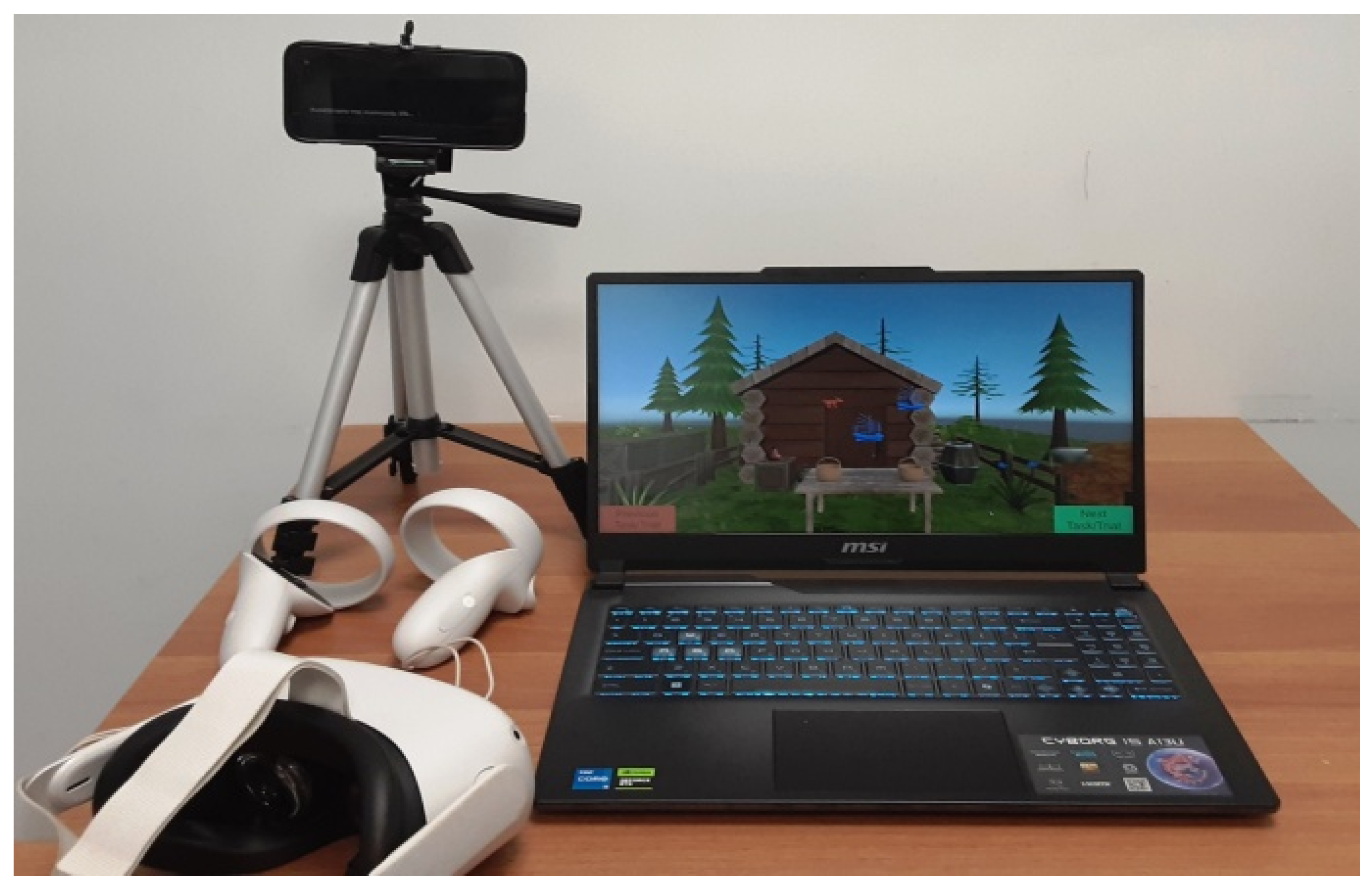
| Locomotion | No scene or camera movement; the user remains seated. Objects are displayed in front of the user (object-centric VR). |
| Interaction | Controller-based interaction; object-centric actions (inspect, select, grab, place) with multimodal feedback (visual and audio). |
| Performance Optimization (PO) | Not applied, due to the use of simple graphics. |
| VR Acceptance Testing | Approved by experts to ensure that the VR intervention is clinically safe and functionally acceptable. |
| Phase | Week | Sessions | Description |
|---|---|---|---|
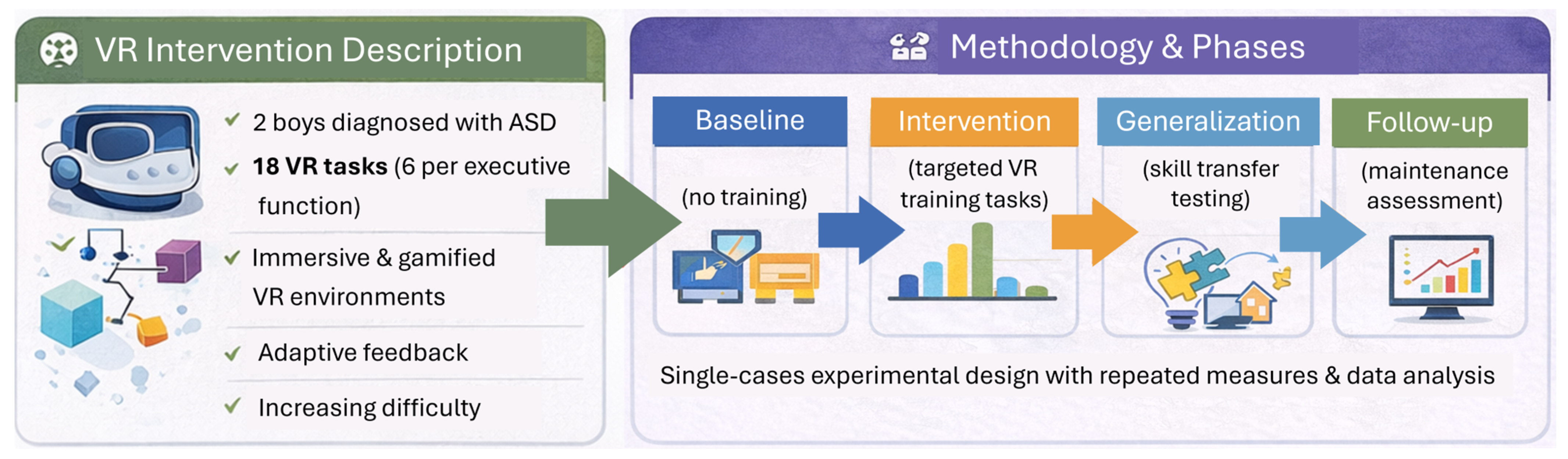
| Baseline | Week 1 | 2 sessions | Behavioral assessment without VR intervention |
| Intervention | Weeks 2–3 | 4 sessions (2/week × 60 min) | VR executive function training |
| Generalization | Week 4 | 1 session | Transfer tasks in modified VR environment |
| Follow-up | Week 5 | 1 session | Maintenance assessment |
| Phase | Week | Sessions | Description |
|---|---|---|---|
| Baseline | Week 2 | 2 sessions | Behavioral assessment without VR intervention |
| Intervention | Weeks 3–4 | 4 sessions (2/week × 60 min) | VR executive function training |
| Generalization | Week 5 | 1 session | Transfer tasks in modified VR environment |
| Follow-up | Week 6 | 1 session | Maintenance assessment |
Disclaimer/Publisher’s Note: The statements, opinions and data contained in all publications are solely those of the individual author(s) and contributor(s) and not of MDPI and/or the editor(s). MDPI and/or the editor(s) disclaim responsibility for any injury to people or property resulting from any ideas, methods, instructions or products referred to in the content. |
© 2026 by the authors. Licensee MDPI, Basel, Switzerland. This article is an open access article distributed under the terms and conditions of the Creative Commons Attribution (CC BY) license.
Share and Cite
Sideraki, A.; Anagnostopoulos, C.-N. Virtual Reality Interventions for Enhancing Executive Functions in Children and Adolescents with Autism Spectrum Disorder. Algorithms 2026, 19, 201. https://doi.org/10.3390/a19030201
Sideraki A, Anagnostopoulos C-N. Virtual Reality Interventions for Enhancing Executive Functions in Children and Adolescents with Autism Spectrum Disorder. Algorithms. 2026; 19(3):201. https://doi.org/10.3390/a19030201
Chicago/Turabian StyleSideraki, Angeliki, and Christos-Nikolaos Anagnostopoulos. 2026. "Virtual Reality Interventions for Enhancing Executive Functions in Children and Adolescents with Autism Spectrum Disorder" Algorithms 19, no. 3: 201. https://doi.org/10.3390/a19030201
APA StyleSideraki, A., & Anagnostopoulos, C.-N. (2026). Virtual Reality Interventions for Enhancing Executive Functions in Children and Adolescents with Autism Spectrum Disorder. Algorithms, 19(3), 201. https://doi.org/10.3390/a19030201