
A Review of AI-Driven Engineering Modelling and Optimization: Methodologies, Applications and Future Directions



Abstract
1. Introduction
2. Overview of AI Modelling Techniques
2.1. Introduction
2.2. Artificial Neural Networks
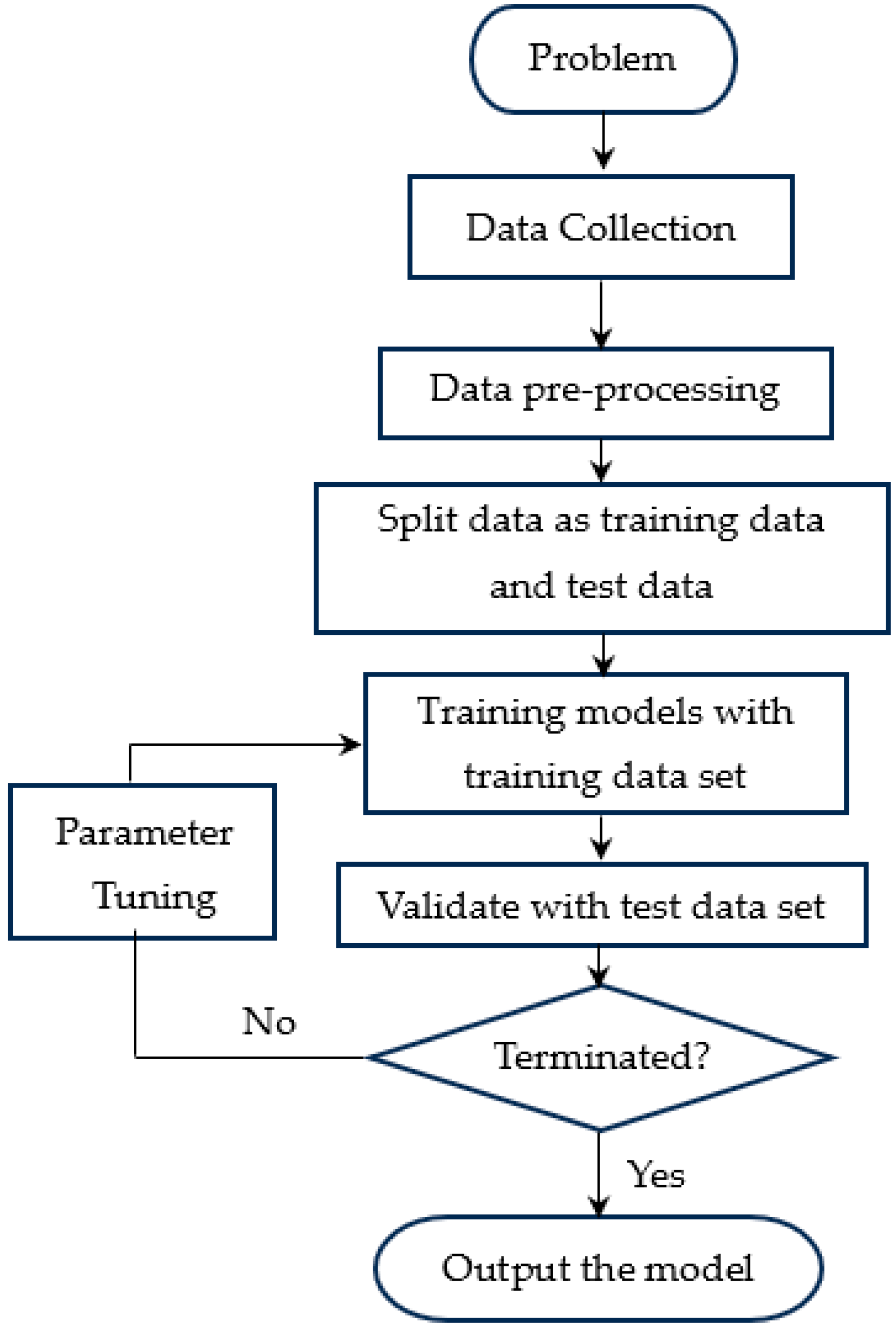
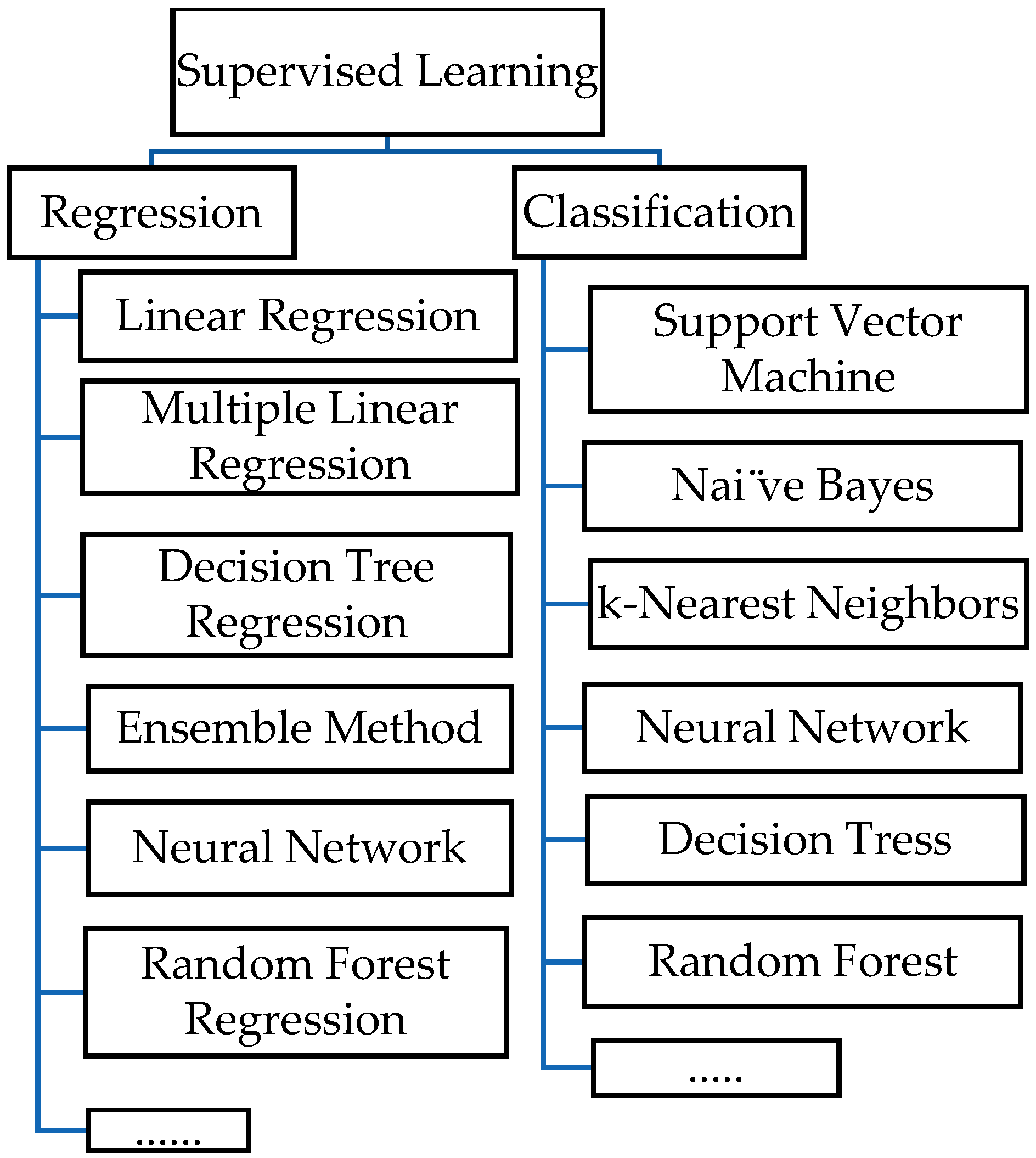
- Supervised learning: Supervised learning is a type of machine learning in which the model is trained using labeled data—data that includes both inputs and their corresponding outputs [17]. The process of applying supervised learning to a real-world problem is illustrated in Figure 5. First, data collected from a specific problem is processed and organized into labeled datasets. These datasets are then divided into two parts: one for training and the other for validation. During training, the model’s parameters (such as weights and biases) are adjusted by selecting an appropriate training method. The trained model is subsequently evaluated and validated using the validation dataset. According to the objectives of the algorithms, supervised learning algorithms can be classified into two categories: classification and regression (see Figure 6) [18]. Regression-based supervised learning algorithms are commonly used in engineering optimization. Typical methods include linear and polynomial regression, support vector regression, neural networks, and others.
- Unsupervised learning: The objective of unsupervised learning algorithms is fundamentally different from that of supervised learning. Their primary aim is to explore the structure, patterns, or relationships within the data without prior knowledge of the “correct” answers [19].
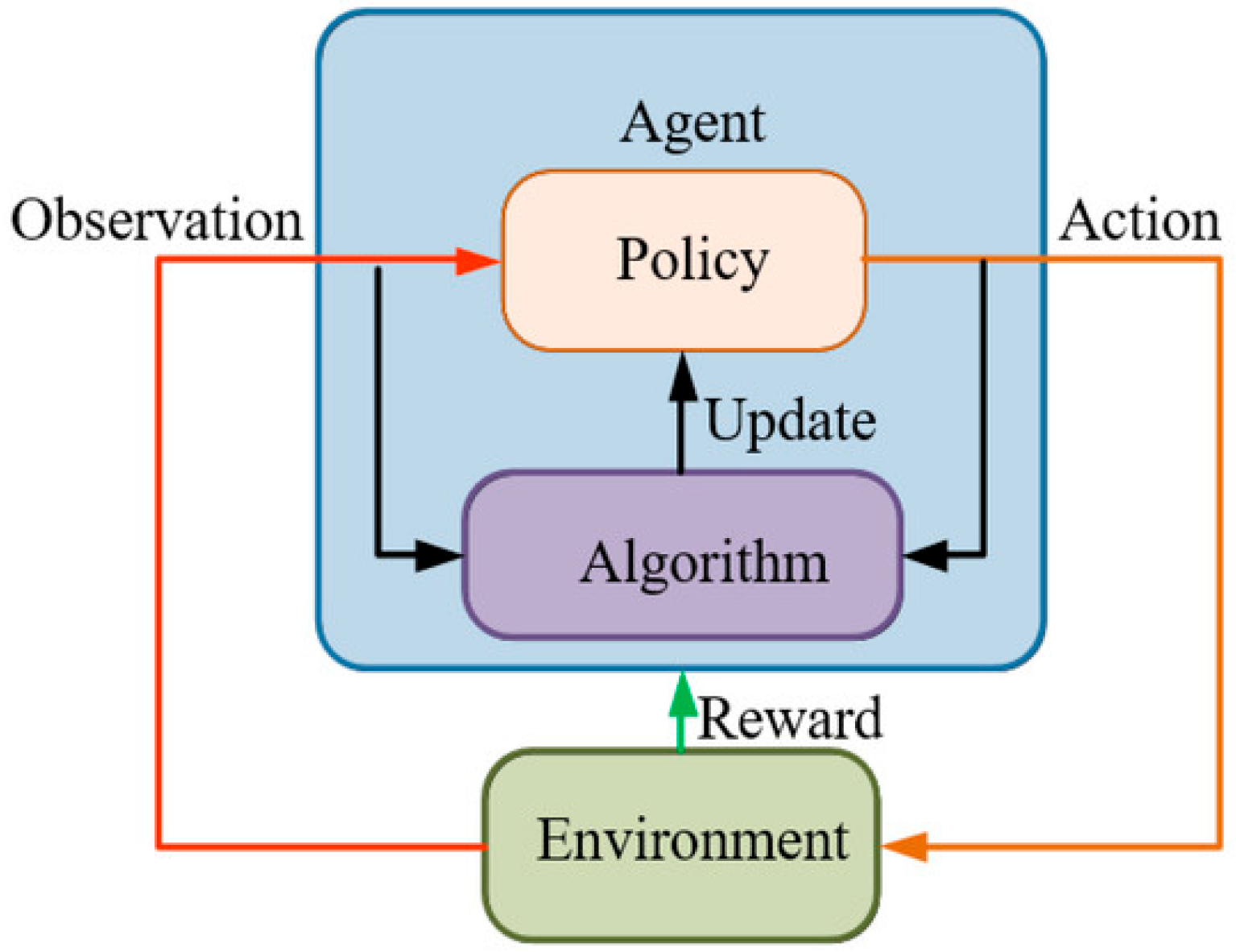
- Reinforcement learning: The aims of reinforcement learning (RL) are distinct from both supervised and unsupervised learning. In RL, an agent learns to make decisions by interacting with an environment using a trial-and-error approach, gradually developing an optimal behavioral strategy based on the reward signals received from previous interactions [20].
2.3. Deep Neural Networks
2.4. Large Language Models
3. Example Frameworks of AI-Driven Engineering Optimization
4. Optimization Techniques
4.1. Introduction
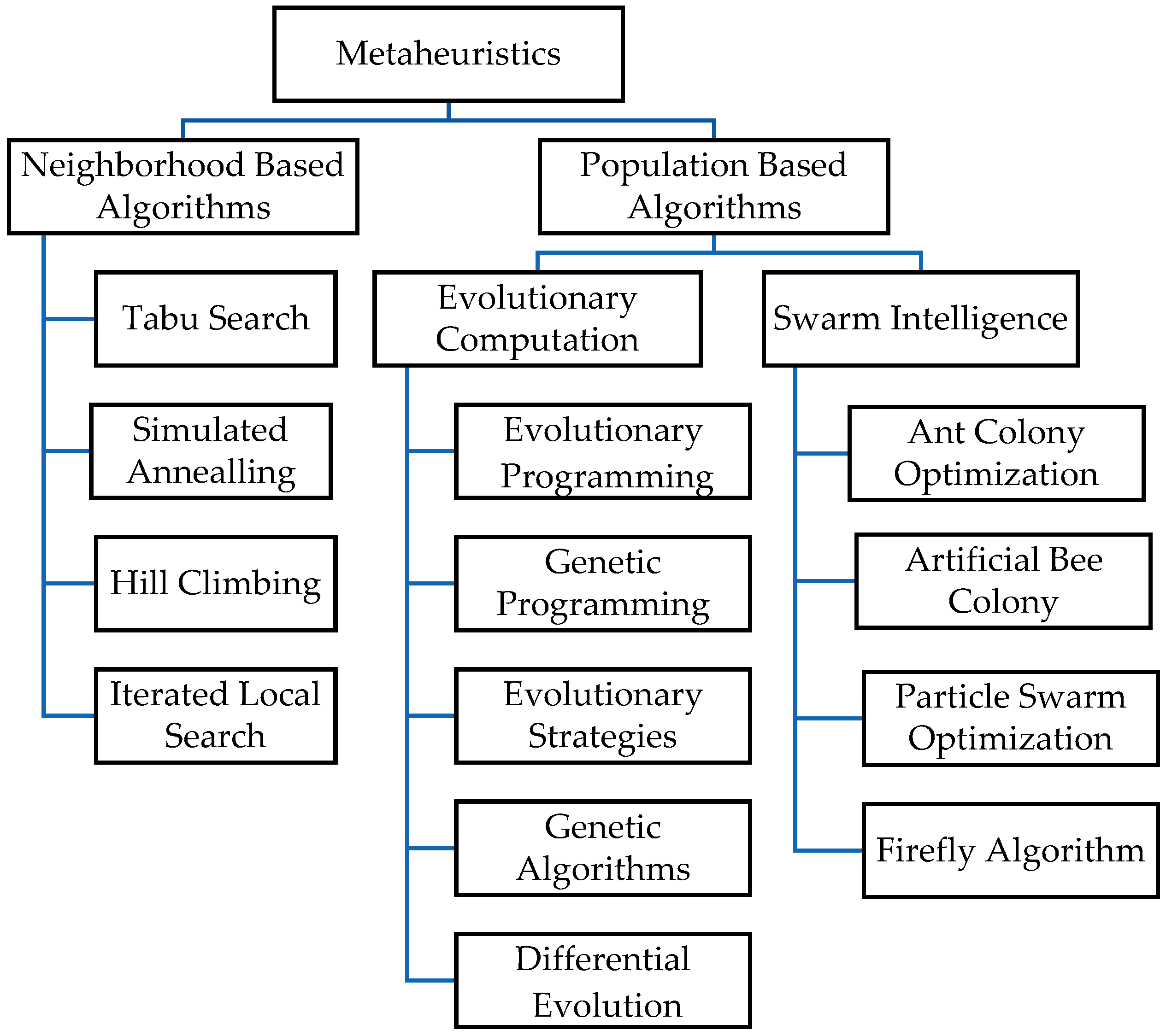
- Neighbourhood-based algorithms: These are local search methods that utilize the concept of a neighbourhood by exploring and tracking nearby candidate solutions. Examples include Simulated Annealing and Tabu Search.
- Population-based algorithms: These are nature-inspired methods that operate on a set of candidate solutions (a population). They can be further classified into evolutionary algorithms/computational methods and swarm intelligence.
4.2. Genetic Algorithms
- ○
- Crossover operators generate offspring by combining the genetic information of two parents randomly selected from the population.
- ○
- Mutation operators help maintain the diversity of the population, preventing premature convergence.
- ○
- Selection operators choose individuals to form a new population based on their fitness values, with individuals of higher fitness generally having a higher probability of survival in the next generation.
| Algorithm 1: Genetic Algorithm |
| Inputs:) Output: |
| 1. Begin 2. 3. Set iteration counter t = 0 4. of each chromosome 5. while (t < ) 6. Select n chromosomes from the population based fitness 7. Apply crossover operation on random selected pair with crossover probability 8. Apply mutation operation on random selected chromosome with mutation probability 9. t = t + 1; 10. end while 11. from the population 12. 13. end |
4.3. Particle Swarm Optimization
| Algorithm 2: Particle Swarm Optimization |
| Inputs:) Output: |
| 1. Begin 2. 3. Set iteration counter t = 0 4. of each chromosome 5. 6. 7. from the population 8. while (t < ) 9. for i = 1: n do 10. 11. ) 12. 13. then 14. 15. end if 16. ) then 17. 18. end if 19. end for 20. t = t + 1; 21. end while 22. from the population 23. 24. end |
4.4. Differential Evolution
- Mutation: For each target individual in the population, a mutant vector is generated by adding the scaled difference between two randomly selected individuals to a third individual. A common mutation formula is:
- Crossover: A trial vector is produced by combining components of the mutant vector and the target vector, typically using binomial or exponential crossover.
- Selection: The trial vector is compared to the target vector. If the trial vector yields a better (lower) objective function value, it replaces the target vector in the next generation; otherwise, the original target vector is retained.
4.5. Ant Colony Optimization
| Algorithm 3: Ant Colony Optimization |
| Inputs:); Output: |
| 1. Begin 2. Initialize pheromone trails 3. Set iteration counter t = 0 4. while (t < Max) 5. Construct ant solutions 6. Apply local search 7. Update pheromones 8. t = t + 1; 9. end while 10. from the population 11. 12. end |
4.6. Multi-Objective Evolutionary Algorithms
- NSGA-II (Non-dominated Sorting Genetic Algorithm II) [50]: A widely used MOEA that employs fast non-dominated sorting, elitism, and crowding distance to efficiently approximate a well-distributed Pareto front.
- MOEA/D (Multi-objective Evolutionary Algorithm based on Decomposition). MOEA/D decomposes a multi-objective problem into multiple scalar optimization subproblems and solves them simultaneously, promoting both convergence and diversity across the Pareto front [53].
4.7. Reinforcement-Learning-Based Algorithm for Optimization
| Algorithm 4: Training Phase |
| 1. while (true) 2. 3. do 4. 5. 6. Update Q functions 7. end for 8. if termination criterion is satisfied then 9. return Q 10. end if 11. end while |
| Algorithm 5: Search Phase |
|
1. 2. do 3. 4. 5. end for 6. if termination criterion is satisfied then 7. 8. end if |
4.8. Summary of Optimization Techniques
5. Engineering Applications of AI-Driven Optimization
5.1. Mechanical and Aerospace Engineering
5.1.1. Machine Learning as a Substitute for the Finite Element Method
5.1.2. Geometric Configurations
5.1.3. Turbine Engine
5.1.4. Heat Pump
5.1.5. Unmanned Aerial Vehicles
5.2. Civil and Environmental Engineering
5.3. Electrical and Computer Engineering
5.3.1. Blockchain
5.3.2. Semiconductor Design
5.3.3. Computer Science
5.3.4. Electric Vehicles
5.4. Chemical and Materials Engineering
5.4.1. Material
5.4.2. Chemical Process
5.4.3. Membrane Fouling
5.5. Energy
5.5.1. Power Energy
5.5.2. Renewable Energy
5.5.3. Food Dryer System
5.5.4. Unmanned Aerial Vehicles
5.6. Managements
5.6.1. Supply Chains
5.6.2. Maintenance
5.6.3. Project & Process
5.6.4. Inventory & Logistics
5.6.5. Manufacturing Process
6. Implementation Challenges and Limitations
6.1. Data Quality and Availability
6.2. Model Integration
6.3. Computational Demands and Scalability
6.4. Explainability
7. Outlook
7.1. Emerging Trends
7.1.1. Physics-Informed AI and Scientific Machine Learning
7.1.2. Human-AI Collaboration and Interactive Optimization
7.1.3. Edge AI and Real-Time Optimization
7.2. Environmental Sustainability Considerations
7.2.1. Resource Use Across the AI Lifecycle
7.2.2. Emerging Trends in Environmental Impact
7.2.3. The Need for Lifecycle-Sustainable AI
7.2.4. Environmentally Friendly AI Methods
8. Conclusions
Author Contributions
Funding
Data Availability Statement
Conflicts of Interest
Abbreviations
| ACO | Ant Colony Optimization |
| AI | Artificial Intelligence |
| ANN/NN | Artificial Neural Network/Neural Network |
| BPNN | Backpropagation Neural Network |
| CFD | Computational Flow Dynamics |
| CNN | Convolutional Neural Network |
| DE | Differential Evolution |
| DL | Deep Learning |
| DNN | Deep Neural Network |
| EA | Evolutionary Algorithm |
| EV | Electric vehicles |
| FEA | Finite Element Analysis |
| GA | Genetic Algorithm |
| LLM | Large Language Model |
| LP | Linear Programming |
| ML | Machine Learning |
| MSE | Mean Squared Error |
| MPPT | Maximum Power Point Tracking |
| MOEAs | Multi-Objective Evolutionary Algorithms |
| MOEA/D | Multi-objective Evolutionary Algorithm based on Decomposition |
| NSGA-II | Non-dominated Sorting Genetic Algorithm II |
| NSE | Navier–Stokes Equations |
| PINN | Physics-Informed Neural Network |
| PSO | Particle Swarm Optimization |
| RL | Reinforcement Learning |
| SI | Swarm Intelligence |
| UAV | Unmanned Aerial Vehicles |
References
- Blakea, R.W.; Mathewa, R.; George, A.; Papakostas, N. Impact of Artificial Intelligence on Engineering: Past, Present and Future. Procedia CIRP 2021, 104, 1728–1733. [Google Scholar] [CrossRef]
- Khaleel, M.M.; Ahmed, A.A.; Alsharif, A. Artificial Intelligence in Engineering. Brill. Res. Artif. Intell. Artic. Res. 2023, 3, 32–42. [Google Scholar] [CrossRef]
- Cai, S.; Mao, Z.; Wang, Z.; Yin, M.; Karniadakis, G.E. Physics-informed neural networks (PINNs) for fluid mechanics: A review. Acta Mech. Sin. 2021, 37, 1727–1738. [Google Scholar] [CrossRef]
- Papalambros, P.Y. The optimization paradigm in engineering design: Promises and challenges. Comput.-Aided Des. 2002, 34, 939–951. [Google Scholar] [CrossRef]
- Parikh, S. The Role of Artificial Intelligence in Energy Optimization and Efficiency. J. Energy Power Eng. 2025, 19, 85–90. [Google Scholar] [CrossRef]
- Mandal, P.K. A review of classical methods and Nature-Inspired Algorithms (NIAs) for optimization problems. Results Control Optim. 2023, 12, 100315. [Google Scholar] [CrossRef]
- Alenizi, F.A.; Abbasi, S.; Mohammed, A.H.; Rahmani, A.M. The artificial intelligence technologies in Industry 4.0: A taxonomy, approaches, and future directions. Comput. Ind. Eng. 2023, 185, 109662. [Google Scholar] [CrossRef]
- Ramesh, K.; Indrajith, M.N.; Prasanna, Y.S.; Deshmukh, S.S.; Parimi, C.; Ray, T. Comparison and assessment of machine learning approaches in manufacturing applications. Ind. Artif. Intell. 2025, 3, 2. [Google Scholar] [CrossRef]
- Abdolrasol, M.G.M.; Hussain, S.M.S.; Ustun, T.S.; Sarker, M.R.; Hannan, M.A.; Mohamed, R.; Ali, J.A.; Mekhilef, S.; Milad, A. Artificial Neural Networks Based Optimization Techniques: A Review. Electronics 2021, 10, 2689. [Google Scholar] [CrossRef]
- Swarnkar, A.; Swarnkar, A. Artificial Intelligence Based Optimization Techniques: A Review. In Intelligent Computing Techniques for Smart Energy Systems (Proceedings of ICTSES 2018); Springer: Singapore, 2018; pp. 95–103. [Google Scholar] [CrossRef]
- Deokar, S.; Kumar, N.; Singh, R.P. A comprehensive review on smart manufacturing using machine learning applicable to fused deposition modeling. Results Eng. 2025, 26, 104941. [Google Scholar] [CrossRef]
- Jenis, J.; Ondriga, J.; Hrcek, S.; Brumercik, F.; Cuchor, M.; Sadovsky, E. Engineering Applications of Artificial Intelligence in Mechanical Design and Optimization. Machines 2023, 11, 577. [Google Scholar] [CrossRef]
- Bagheri, M.; Akbari, A.; Mirbagheri, S.A. Advanced control of membrane fouling in filtration systems using artificial intelligence and machine learning techniques: A critical review. Process Saf. Environ. Prot. 2019, 123, 229–252. [Google Scholar] [CrossRef]
- Priddy, K.L.; Keller, P.E. Artificial Neural Networks: An Introduction; SPIE Digital Library: Bellingham, WA, USA, 2005. [Google Scholar] [CrossRef]
- Weichert, D.; Link, P.; Stoll, A.; Ruping, S.; Ihlenfeldt, S.; Wrobe, S. A review of machine learning for the optimization of production processes. Int. J. Adv. Manuf. Technol. 2019, 104, 1889–1902. [Google Scholar] [CrossRef]
- Elshewey, A.M.; Aziz, M.A.; Gaheen, O.A.; Sawah, M.S.; Elhamid, A.A.; Osman, A.M. Prediction of aerodynamic coefficients based on machine learning models. Model. Earth Syst. Environ. 2025, 11, 184. [Google Scholar] [CrossRef]
- Osisanwo, F.Y.; Akinsola, J.E.T.; Awodele, O.; Hinmikaiye, J.O.; Olakanmi, O.; Akinjobi, J. Supervised Machine Learning Algorithms: Classification and Comparison. Int. J. Comput. Trends Technol. 2017, 48, 128–138. [Google Scholar] [CrossRef]
- Pandey, D.; Niwaria, K.; Chourasia, B. Machine Learning Algorithms: A Review. Int. Res. J. Eng. Technol. 2019, 6, 916–922. [Google Scholar]
- Naeem, S.; Ali, A.; Anam, S.; Ahmed, M.M. An Unsupervised Machine Learning Algorithms: Comprehensive Review. Int. J. Comput. Digit. Syst. 2023, 13, 911–921. [Google Scholar] [CrossRef] [PubMed]
- Shakya, A.K.; Pillai, G.; Chakrabarty, S. Reinforcement learning algorithms: A brief survey. Expert Syst. Appl. 2023, 231, 120495. [Google Scholar] [CrossRef]
- Liu, W.; Wang, Z.; Liu, X.; Zeng, N.; Liu, Y.; Alsaadi, F.E. A survey of deep neural network architectures and their applications. Neurocomputing 2017, 234, 11–26. [Google Scholar] [CrossRef]
- LeCun, Y.; Boser, B.; Denker, J.S.; Henderson, D.; Howard, R.E.; Hubbard, W.; Jackel, L.D. Backpropagation applied to handwritten zip code recognition. Neural Comput. 1989, 1, 541–551. [Google Scholar] [CrossRef]
- Cong, S.; Zhou, Y. A review of convolutional neural network architectures and their optimizations. Artif. Intell. Rev. 2023, 56, 1905–1969. [Google Scholar] [CrossRef]
- Jiang, J.; Chen, M.; Fan, J.A. Deep Neural Networks for the Evaluation and Design of Photonic Devices. Nat. Rev. Mater. 2021, 6, 679–700. [Google Scholar] [CrossRef]
- Raissi, M.; Perdikaris, P.; Karniadakis, G.E. Physics-informed neural networks: A deep learning framework for solving forward and inverse problems involving nonlinear partial differential equations. J. Comput. Phys. 2019, 378, 686–707. [Google Scholar] [CrossRef]
- Huang, B.; Wang, J. Applications of Physics-Informed Neural Networks in Power Systems—A Review. IEEE Trans. Power Syst. 2023, 38, 572–588. [Google Scholar] [CrossRef]
- Laubscher, R. Simulation of multi-species flow and heat transfer using physics-informed neural networks. Phys. Fluids 2021, 33, 087101. [Google Scholar] [CrossRef]
- Raiaan, M.A.K.; Mukta, S.H.; Fatema, K.; Fahad, N.M.; Sakib, S.; Mim, M.M.J.; Ahmad, J.; Ali, M.E.; Azam, S. A Review on Large Language Models: Architectures, Applications, Taxonomies, Open Issues and Challenges. IEEE Access 2024, 12, 26839–26874. [Google Scholar] [CrossRef]
- Chien, C.T.; Chien, C.H. Hybrid AI-Driven Computer-Aided Engineering Optimization: Large Language Models Versus Regression-Based Models Validated Through Finite-Element Analysis. Appl. Sci. 2025, 15, 10123. [Google Scholar] [CrossRef]
- Krzywanski, J.; Sosnowski, M.; Grabowska, K.; Zylka, A.; Lasek, L.; Kijo-Kleczkowska, A. Advanced Computational Methods for Modeling, Prediction and Optimization—A Review. Materials 2024, 17, 3521. [Google Scholar] [CrossRef]
- Ibn-Mohammed, T.; Mustapha, K.B.; Abdulkareem, M.; Fuensanta, A.U.; Pecunia, V.; Dancer, C.E.J. Toward artificial intelligence and machine learning-enabled frameworks for improved predictions of lifecycle environmental impacts of functional materials and devices. MRS Commun. 2023, 12, 95–811. [Google Scholar] [CrossRef]
- Badarinath, P.V.; Chierichetti, M.; Kakhki, F.D. A Machine Learning Approach as a Surrogate for a Finite Element Analysis: Status of Research and Application to One Dimensional Systems. Sensors 2021, 21, 1654. [Google Scholar] [CrossRef]
- Jin, Y.; Wang, H.; Chugh, T.; Guo, D.; Miettinen, K. Data-Driven Evolutionary Optimization: An Overview and Case Studies. IEEE Trans. Evol. Comput. 2019, 23, 442–458. [Google Scholar] [CrossRef]
- Nadian, M.H.; Abbaspour-Fard, M.H.; Martynenko, A.; Golzarian, M.R. An intelligent integrated control of hybrid hot air-infrared dryer based on fuzzy logic and computer vision system. Comput. Electron. Agric. 2017, 137, 138–149. [Google Scholar] [CrossRef]
- Hsu, M.K.; Huang, B.Y.; Yu, C.H. AI-driven optimization of woven composite via integrated deep and reinforcement learning. Mater. Des. 2025, 259, 114798. [Google Scholar] [CrossRef]
- Bilal, M.; Pant, M.; Zaheer, H.; Garcia-Hernandez, L.; Abraham, A. Differential Evolution: A review of more than two decades of research. Eng. Appl. Artif. Intell. 2020, 90, 103479. [Google Scholar] [CrossRef]
- Bartz-Beielstein, T.; Branke, J.; Mehnen, J.; Mersmann, O. Evolutionary Algorithms. WIREs Data Min. Knowl. Discov. 2014, 4, 178–195. [Google Scholar] [CrossRef]
- Holland, J.H. Genetic algorithms and the optimal allocation of trials. SIAM J. Comput. 1973, 2, 88–105. [Google Scholar] [CrossRef]
- Fogel, L.J.; Owens, A.J.; Walsh, M.J. Artificial intelligence through a simulation of evolution. In Biophysics and Cybernetic Systems; Callahan, A., Maxfield, M., Fogel, L.J., Eds.; Spartan Books: Washington, DC, USA, 1965. [Google Scholar]
- Koza, J. Genetic Programming: On the Programming of Computers by Means of Natural Selection; MIT Press: Cambridge, MA, USA, 1992. [Google Scholar]
- Chakraborty, A.; Kar, A.K. Swarm intelligence: A review of algorithms. In Nature-Inspired Computing and Optimization—Theory and Applications, 1st ed.; Patnaik, S., Yang, X.S., Nakamatsu, K., Eds.; Springer: Cham, Switzerland, 2017; pp. 475–494. [Google Scholar] [CrossRef]
- Katoch, S.; Chauhan, S.S.; Kumar, V. A review on genetic algorithm: Past, present, and future. Multimed. Tools Appl. 2021, 80, 8091–8126. [Google Scholar] [CrossRef] [PubMed]
- Wang, D.; Tan, D.; Liu, L. Particle swarm optimization algorithm: An overview. Soft Comput. 2018, 22, 387–408. [Google Scholar] [CrossRef]
- Shami, T.M.; El-Saleh, A.A.; Alswaitti, M.; Al-Tashi, Q.; Summakieh, M.A.; Mirjalili, S. Particle Swarm Optimization: A Comprehensive Survey. IEEE Access 2022, 10, 10031–10061. [Google Scholar] [CrossRef]
- Dai, H.P.; Chen, D.D.; Zheng, Z.S. Effects of Random Values for Particle Swarm Optimization Algorithm. Algorithms 2018, 11, 23. [Google Scholar] [CrossRef]
- Storn, R.; Price, K. Differential Evolution—A Simple and Efficient Heuristic for Global Optimization over Continuous Spaces. J. Glob. Optim. 1997, 11, 341–359. [Google Scholar] [CrossRef]
- Dorigo, M.; Gambardella, L.M. Ant colony system: A cooperative learning approach to the traveling salesman problem. IEEE Trans. Evol. Comput. 1997, 1, 53–66. [Google Scholar] [CrossRef]
- Dorigo, M.; Birattari, M.; Stutzle, T. Ant colony optimization. IEEE Comput. Intell. Mag. 2006, 1, 28–39. [Google Scholar] [CrossRef]
- Pătrăusanu, A.; Florea, A.; Neghină, M.; Dicoiu, A.; Chis, R. A Systematic Review of Multi-Objective Evolutionary Algorithms Optimization Frameworks. Processes 2024, 12, 869. [Google Scholar] [CrossRef]
- Deb, K.; Pratap, A.; Agarwal, S.; Meyarivan, T. A fast and elitist multi-objective genetic algorithm: NSGA-II. IEEE Trans. Evol. Comput. 2002, 6, 182–197. [Google Scholar] [CrossRef]
- Zitzler, E.; Laumanns, M.; Thiele, L. SPEA2: Improving the Strength Pareto Evolutionary Algorithm. In TIK-Report; ETH Zurich, Computer Engineering and Networks Laboratory: Zurich, Switzerland, 2001. [Google Scholar]
- Zitzler, E.; Thiele, L. Multiobjective evolutionary algorithms: A comparative case study and the strength pareto approach. IEEE Trans. Evol. Comput. 1999, 3, 257–271. [Google Scholar] [CrossRef]
- Zhang, Q.; Li, H. MOEA/D: A multiobjective evolutionary algorithm based on decomposition. IEEE Trans. Evol. Comput. 2007, 11, 712–731. [Google Scholar] [CrossRef]
- Yuan, X.; Wang, Y.; Zhang, R.; Gao, Q.; Zhou, Z.; Zhou, R.; Yin, F. Reinforcement Learning Control of Hydraulic Servo System Based on TD3 Algorithm. Machines 2022, 10, 1244. [Google Scholar] [CrossRef]
- Yonekura, K.; Hattori, H. Framework for design optimization using deep reinforcement learning. Struct. Multidiscip. Optim. 2019, 60, 1709–1713. [Google Scholar] [CrossRef]
- Mishra, S.R.; Dev, A.N.; Pandey, A.K.; Awasthi, M.K. Design Optimization Using Artificial Intelligence, 1st ed.; CRC Press: Boca Raton, FL, USA, 2025; 298p. [Google Scholar] [CrossRef]
- Shah, K.; Chandnani, R.; Mavinkurve, U.; Raykar, N. Application of Machine Learning for Design-by-Analysis of Pressure Equipment. In Proceedings of the 2019 International Conference on Nascent Technologies in Engineering (ICNTE), Navi Mumbai, India, 4–5 January 2019; pp. 1–6. [Google Scholar] [CrossRef]
- Granados-Ortiz, F.J.; Ortega-Casanova, J. Machine learning-aided design optimization of a mechanical micromixer. Phys. Fluids 2021, 6, 063604. [Google Scholar] [CrossRef]
- Lynch, M.E.; Sarkar, S.; Maute, K. Machine learning to aid tuning of numerical parameters in topology optimization. J. Mech. Des. 2019, 141, 114502. [Google Scholar] [CrossRef]
- Kosowski, K.; Tucki, K.; Kosowski, A. Turbine stage design aided by artificial intelligence methods. Expert. Syst. Appl. 2009, 36, 11536−11542. [Google Scholar] [CrossRef]
- Xu, L.; Jin, S.; Ye, W.; Li, Y.; Gao, J. A Review of Machine Learning Methods in Turbine Cooling Optimization. Energies 2024, 17, 3177. [Google Scholar] [CrossRef]
- Du, Q.; Li, Y.; Yang, L.; Liu, T.; Zhang, D.; Xie, Y. Performance prediction and design optimization of turbine blade profile with deep learning method. Energy 2022, 254, 124351. [Google Scholar] [CrossRef]
- Patel, Z.; Senjaliya, N.; Tejani, A. AI enhanced optimization of Heat pump sizing and design for specific applications. Int. J. Mech. Eng. Technol. 2019, 10, 447–460. [Google Scholar]
- Sharma, R.S.; Hosder, S. Investigation of aircraft design space exploration with machine learning. In Proceedings of the AIAA. Scitech 2021 Forum, Virtual, 11–15, 19–21 January 2021; p. 0114. [Google Scholar] [CrossRef]
- Oroumieh, M.A.A.; Malaek, S.M.B.; Ashrafizaadeh, M.; Taheri, S.M. Aircraft design cycle time reduction using artificial intelligence. Aerosp. Sci. Technol. 2013, 26, 244–258. [Google Scholar] [CrossRef]
- Boutemedjet, A.; Samardžić, M.; Rebhi, L.; Rajić, Z.; Mouada, T. UAV aerodynamic design involving genetic algorithm and artificial neural network for wing preliminary computation. Aerosp. Sci. Technol. 2019, 84, 464–483. [Google Scholar] [CrossRef]
- Setayandeh, M.R. Surrogate model–based robust multidisciplinary design optimization of an unmanned aerial vehicle. J. Aerosp. Eng. 2021, 34, 04021029. [Google Scholar] [CrossRef]
- Karali, H.; Inalhan, G.; Tsourdos, A. Advanced UAV Design Optimization Through Deep Learning-Based Surrogate Models. Aerospace 2024, 11, 669. [Google Scholar] [CrossRef]
- Islam, F.A.S. Artificial Intelligence-driven Optimization of Nature-based Carbon Sequestration: A Scalable Architecture for Urban Climate Resilience. Int. J. Environ. Clim. Change 2025, 15, 252–277. [Google Scholar] [CrossRef]
- Luo, D.; Wang, K.; Wang, D.; Sharma, A.; Li, W.; Choi, I.H. Artificial intelligence in the design, optimization, and performance prediction of concrete materials: A comprehensive review. Mater. Sustain. 2025, 3, 14. [Google Scholar] [CrossRef]
- Golafshani, E.M.; Arashpour, M.; Kashani, A. Green mix design of rubbercrete using machine learning-based ensemble model and constrained multi-objective optimization. J. Clean. Prod. 2021, 327, 129518. [Google Scholar] [CrossRef]
- Zheng, W.; Shui, Z.; Xu, Z.; Gao, X.; Zhang, S. Multi-objective optimization of concrete mix design based on machine learning. J. Build. Eng. 2023, 76, 107396. [Google Scholar] [CrossRef]
- Huang, Y.; Zhang, J.; Ann, F.T.; Ma, G. Intelligent mixture design of steel fibre reinforced concrete using a support vector regression and firefly algorithm based multi-objective optimization model. Constr. Build. Mater. 2020, 260, 120457. [Google Scholar] [CrossRef]
- Parhi, S.K.; Dwibedy, S.; Panigrahi, S.K. AI-driven critical parameter optimization of sustainable self-compacting geopolymer concrete. J. Build. Eng. 2024, 86, 108923. [Google Scholar] [CrossRef]
- Saleh, M.A.; Kazemi, F.; Abdelgader, H.S.; Isleem, H.F. Optimization-based multitarget stacked machine-learning model for estimating mechanical properties of conventional and fiber-reinforced preplaced aggregate concrete. Arch. Civ. Mech. Eng. 2025, 25, 185. [Google Scholar] [CrossRef]
- Mohsen, B.M. AI-Driven Optimization of Urban Logistics in Smart Cities: Integrating Autonomous Vehicles and IoT for Efficient Delivery Systems. Sustainability 2024, 16, 11265. [Google Scholar] [CrossRef]
- Behnood, A.; Golafshani, E.M. Artificial Intelligence to Model the Performance of Concrete Mixtures and Elements: A Review. Arch. Comput. Methods Eng. 2022, 29, 1941–1964. [Google Scholar] [CrossRef]
- Hoang, T.D.; Ky, N.M.; Thuong, N.T.N.; Nhan, H.Q.; Ngan, N.V.C. Artificial Intelligence in Pollution Control and Management: Status and Future Prospects. In Artificial Intelligence and Environmental Sustainability, 1st ed.; Ong, H.L., Doong, R.A., Naguib, R., Lim, C.P., Nagar, A.K., Eds.; Springer: Berlin/Heidelberg, Germany, 2022; pp. 23–43. [Google Scholar] [CrossRef]
- Kulkarni, A.; Yardimci, M.; Sikder, M.N.K.; Batarseh, F.A. P2O: AI-Driven Framework for Managing and Securing Wastewater Treatment Plants. J. Environ. Eng. 2023, 149, 04023045. [Google Scholar] [CrossRef]
- Hong, S.P.V.; Thanh, V.N. Application of artificial intelligence algorithm to optimize the design of water distribution system. Int. J. Constr. Manag. 2023, 23, 2830–2840. [Google Scholar] [CrossRef]
- Dong, S.; Abbas, K.; Li, M.; Kamruzzaman, J. Blockchain technology and application: An overview. PeerJ Comput. Sci. 2023, 9, 315–333. [Google Scholar] [CrossRef]
- Yuan, F.; Zuo, Z.; Jiang, Y.; Shu, W.; Tian, Z.; Ye, C.; Yang, J.; Mao, Z.; Huang, X.; Gu, S.; et al. AI-Driven Optimization of Blockchain Scalability, Security, and Privacy Protection. Algorithms 2025, 18, 263. [Google Scholar] [CrossRef]
- Arulkumaran, R.; Khatri, D.K.; Bhimanapati, V.; Aggarwal, A.; Gupta, V. AI-Driven Optimization of Proof-of-Stake Blockchain Validators. Innov. Res. Thoughts 2023, 9, 315–333. [Google Scholar] [CrossRef]
- Mandadi, A.P.R. AI-Driven Engineering Productivity in the Semiconductor Industry: A Technological Paradigm Shift. J. Comput. Sci. Technol. Stud. 2025, 7, 543–549. [Google Scholar]
- Raghuwanshi, P. Revolutionizing semiconductor design and manufacturing with AI. Explor. Ethical Dilemmas Artif. Intell. Mach. Learn. 2024, 3, 272–277. [Google Scholar] [CrossRef]
- Panwar, V. AI-Driven Query Optimization: Revolutionizing Database Performance and Efficiency. Int. J. Comput. Trends Technol. 2024, 72, 18–26. [Google Scholar] [CrossRef]
- Richardson, N.; Kothapalli, S.; Onteddu, A.R.; Kundavaram, R.R.; Talla, R.R. AI-Driven Optimization Techniques for Evolving Software Architecture in Complex Systems. ABC J. Adv. Res. 2023, 12, 71–84. [Google Scholar] [CrossRef]
- Chen, G.; Qi, J.; Sun, Y.; Hu, X.; Dong, Z.; Sun, Y. A collaborative scheduling method for cloud computing heterogeneous workflows based on deep reinforcement learning. Future Gener. Comput. Syst. 2023, 121, 284–297. [Google Scholar] [CrossRef]
- Umoga, U.J.; Sodiya, E.O.; Ugwuanyi, E.D.; Jacks, B.S.; Lottu, O.A.; Daraojimba, O.D.; Obaigbena, A. Exploring the potential of AI-driven optimization in enhancing network performance and efficiency. Magna Sci. Adv. Res. Rev. 2024, 10, 368–378. [Google Scholar] [CrossRef]
- Lee, S.; Levanti, K.; Kim, H.S. Network monitoring: Present and future. Comput. Netw. 2014, 65, 84–98. [Google Scholar] [CrossRef]
- Rezk, H.; Olabi, A.G.; Wilberforce, T.; Sayed, E.T. Metaheuristic optimization algorithms for real-world electrical and civil engineering application: A review. Results Eng. 2024, 23, 102437. [Google Scholar] [CrossRef]
- Sarker, M.T.; Qwaid, M.A.; Shern, S.J.; Ramasamy, G. AI-Driven Optimization Framework for Smart EV Charging Systems Integrated with Solar PV and BESS in High-Density Residential Environments. World Electr. Veh. J. 2025, 16, 385. [Google Scholar] [CrossRef]
- Madika, B.; Saha, A.; Kang, C.; Buyantogtokh, B.; Agar, J.; Wolverton, C.M.; Voorhees, P.; Littlewood, P.; Kalinin, S.; Hong, S. Artificial Intelligence for Materials Discovery, Development, and Optimization. ACS Nano 2025, 19, 27116−27158. [Google Scholar] [CrossRef]
- Kim, Y.; Kim, Y.; Yang, C.; Park, K.; Gu, G.X.; Ryu, S. Deep learning framework for material design space exploration using active transfer learning and data augmentation. Comput. Mater. 2021, 7, 140. [Google Scholar] [CrossRef]
- Wang, H.; Kumar, R.; Pattanaik, A.; Kumar, R.; Aljaberi, A.S.O.; Abass, M.A. Computational methods and artificial intelligence-based modeling of magnesium alloys: A systematic review of machine learning, deep learning, and data-driven design and optimization approaches. Front. Mater. 2025, 12, 1645227. [Google Scholar] [CrossRef]
- Zhu, C.; Bamidele, E.A.; Shen, X.; Zhu, G.; Li, B. Machine Learning Aided Design and Optimization of Thermal Metamaterials. Chem. Rev. 2024, 124, 4258−4331. [Google Scholar] [CrossRef]
- Jassim, M.S.; Hammad, S.; Coskuner, G. AI-Driven Optimization Models for Prediction of Effluent Quality Parameters in a Wastewater Treatment Plant. Process Integr. Optim. Sustain. 2025. [Google Scholar] [CrossRef]
- He, C.; Zhang, C.; Bian, T.; Jiao, K.; Su, W.; Wu, K.J.; Su, A. A Review on Artificial Intelligence Enabled Design, Synthesis, and Process Optimization of Chemical Products for Industry 4.0. Process 2023, 11, 330. [Google Scholar] [CrossRef]
- Nayak, M.; Dhanarajan, G.; Dineshkumar, R.; Sen, R. Artificial intelligence driven process optimization for cleaner production of biomass with co-valorization of wastewater and flue gas in an algal biorefinery. J. Clean. Prod. 2018, 201, 1092–1100. [Google Scholar] [CrossRef]
- Sultan, N.; Almansoori, A.; Elkamel, A. AI-based modeling and optimization of green methanol production process. Comput. Chem. Eng. 2025, 203, 109324. [Google Scholar] [CrossRef]
- Sivan, D.; Kumar, K.S.; Abdullah, A.; Raj, V.; Misnon, I.I.; Ramakrishna, S.; Jose, R. Advances in materials informatics: A review. J. Mater. Sci. 2024, 59, 2602–2643. [Google Scholar] [CrossRef]
- Gregoire, J.M.; Zhou, L.; Haber, J.A. Combinatorial synthesis for AI-driven materials discovery. Nat. Synth. 2023, 2, 493–504. [Google Scholar] [CrossRef]
- Fang, C.; Yu, R.; Liu, S.; Li, Y. Nanomaterials applied in asphalt modification: A review. J. Mater. Sci. Technol. 2013, 29, 589–594. [Google Scholar] [CrossRef]
- Bhowmik, P.N.; Saini, K.; Anand, P. AI-Driven Optimization of Nano-modified Bitumen: CO2 reduction Efficiency Through Machine Learning and Optimization Framework. Int. J. Pavement Res. Technol. 2025, 1–20. [Google Scholar] [CrossRef]
- Al-Obaidi, M.A.; Li, J.P.; Kara-Zaitri, C.; Mujtaba, I.M. Optimisation of Reverse Osmosis Based Wastewater Treatment System for The Removal Of Chlorophenol Using Genetic Algorithms. Chem. Eng. J. 2017, 316, 91–100. [Google Scholar] [CrossRef]
- Al-Kathiri, D.S.M.S.; Rao, G.B.; Qahoor, N.M.S.; Banerjee, S.; Babu, N.R.; Kavitha, G.; Lakkimsetty, N.R.; Namdeti, R. Membrane Fouling Prediction and Control Using AI and Machine Learning: A Comprehensive Review. J. Environ. Earth Sci. 2025, 7, 315–350. [Google Scholar] [CrossRef]
- Agupugo, C.P.; Barrie, I.; Makai, C.C.; Alaka, E. AI learning-driven optimization of microgrid systems for rural electrification and economic empowerment. Eng. Sci. Technol. J. 2024, 5, 2835–2851. [Google Scholar] [CrossRef]
- Kumar, N.; Kumar, D.; Layek, A.; Yadav, S. Renewable energy and sustainable development: A global approach towards artificial intelligence. In Artificial Intelligence for Renewable Energy Systems, Woodhead Publishing Series in Energy; Elsevier: Amsterdam, The Netherlands, 2022; pp. 305–328. [Google Scholar] [CrossRef]
- Khan, M.A.; Yousaf, M.Z.; Luo, M.; Wu, W.; Mirsaeidi, S.; Muttaqi, K.M. AI-Driven Optimization Approach for Enhanced Performance of Power Converters through Efficient Controller Tuning. In Proceedings of the 2023 IEEE International Conference on Energy Technologies for Future Grids, Wollongong, Australia, 3–6 December 2023. [Google Scholar] [CrossRef]
- Biswas, P.; Rashid, A.; Biswas, A.; Nasim, M.A.A.; Chakraborty, S.; Gupta, K.D.; George, R. AI-driven approaches for optimizing power consumption: A comprehensive survey. Discov. Artif. Intell. 2024, 4, 116. [Google Scholar] [CrossRef]
- Boubaker, S.; Kamel, S.; Ghazouani, N.; Mellit, A. Assessment of machine and deep learning approaches for fault diagnosis in photovoltaic systems using infrared thermography. Remote Sens. 2023, 15, 1686. [Google Scholar] [CrossRef]
- Ağbulut, Ü.; Gürel, A.E.; Ergün, A.; Ceylan, İ. Performance assessment of a V-trough photovoltaic system and prediction of power output with different machine learning algorithms. J. Clean. Prod. 2020, 268, 122269. [Google Scholar] [CrossRef]
- Kannari, L.; Kantorovitch, J.; Piira, K.; Piippo, J. Energy cost driven heating control with reinforcement learning. Buildings 2023, 13, 427. [Google Scholar] [CrossRef]
- Yang, S.; Wan, M.P.; Chen, W.; Ng, B.F.; Dubey, S. Model predictive control with adaptive machine-learning-based model for building energy efficiency and comfort optimization. Appl. Energy 2020, 271, 115147. [Google Scholar] [CrossRef]
- Ahmed, W.; Ansari, H.; Khan, B.; Ullah, Z.; Ali, S.M.; Mehmood, C.A.A.; Qureshi, M.B.; Hussain, I.; Jawad, M.; Khan, M.U.S.; et al. Machine learning based energy management model for smart grid and renewable energy districts. IEEE Access 2020, 8, 185059–185078. [Google Scholar] [CrossRef]
- Malta, S.; Pinto, P.; Fernández-Veiga, M. Using reinforcement learning to reduce energy consumption of ultra-dense networks with 5G use cases requirements. IEEE Access. 2023, 11, 5417–5428. [Google Scholar] [CrossRef]
- Ashraf, W.M.; Uddin, G.M.; Tariq, R.; Ahmed, A.; Farhan, M.; Nazeer, M.A.; Hassan, R.U.; Naeem, A.; Jamil, H.; Krzywanski, J.; et al. Artificial Intelligence Modeling-Based Optimization of an Industrial-Scale Steam Turbine for Moving toward Net-Zero in the Energy Sector. ACS Omega 2023, 8, 21709−21725. [Google Scholar] [CrossRef]
- Global Wind Energy Council. Global Offshore Wind Report 2025; Global Wind Energy Council: Lisbon, Portugal, 2025. Available online: https://tethys.pnnl.gov/sites/default/files/publications/Williams-et-al-2025.pdf (accessed on 5 January 2026).
- Song, D.; Shen, G.; Huang, C.; Huang, Q.; Yang, J.; Dong, M.; Joo, Y.H.; Duic, N. Review on the Application of Artificial Intelligence Methods in the Control and Design of Offshore Wind Power Systems. J. Mar. Sci. Eng. 2024, 12, 424. [Google Scholar] [CrossRef]
- Lei, M.; Shiyan, L.; Chuanwen, J.; Hongling, L.; Yan, Z. A review on the forecasting of wind speed and generated power. Renew. Sustain. Energy Rev. 2009, 13, 915–920. [Google Scholar] [CrossRef]
- Mohandes, M.A.; Rehman, S.; Halawani, T.O. A neural networks approach for wind speed prediction. Renew. Energy 1998, 13, 345–354. [Google Scholar] [CrossRef]
- Mabel, M.C.; Fernandez, E. Analysis of wind power generation and prediction using ANN: A case study. Renew. Energy 2008, 33, 986–992. [Google Scholar] [CrossRef]
- Flores, P.; Tapia, A.; Tapia, G. Application of a control algorithm for wind speed prediction and active power generation. Renew. Energy 2005, 30, 523–536. [Google Scholar] [CrossRef]
- Guediri, A.; Hettiri, M.; Guediri, A. Modeling of a Wind Power System Using the Genetic Algorithm Based on a Doubly Fed Induction Generator for the Supply of Power to the Electrical Grid. Processes 2023, 11, 952. [Google Scholar] [CrossRef]
- Amine, H.M.; Abdelaziz, H.; Najib, E. Wind Turbine Maximum Power Point Tracking Using FLC Tuned with GA. Energy Procedia. 2014, 62, 364–373. [Google Scholar] [CrossRef]
- Song, D.; Liu, J.; Yang, Y.; Yang, J.; Su, M.; Wang, Y.; Gui, N.; Yang, X.; Huang, L.; Hoon Joo, Y. Maximum Wind Energy Extraction of Large-Scale Wind Turbines Using Nonlinear Model Predictive Control via Yin-Yang Grey Wolf Optimization Algorithm. Energy 2021, 221, 119866. [Google Scholar] [CrossRef]
- Mirjalili, S.; Mirjalili, S.M.; Lewis, A. Grey Wolf Optimizer. Adv. Eng. Softw. 2014, 69, 46–61. [Google Scholar] [CrossRef]
- Muñoz-Palomeque, E.; Sierra-García, J.E.; Santos, M. Wind Turbine Maximum Power Point Tracking Control Based on Unsupervised Neural Networks. J. Comput. Des. Eng. 2023, 10, 108–121. [Google Scholar] [CrossRef]
- Sun, H.; Qiu, C.; Lu, L.; Gao, X.; Chen, J.; Yang, H. Wind Turbine Power Modelling and Optimization Using Artificial Neural Network with Wind Field Experimental Data. Appl. Energy 2020, 280, 115880. [Google Scholar] [CrossRef]
- Mellit, A.; Kalogirou, S.A. Artificial intelligence techniques for photovoltaic applications: A review. Prog. Energy Combust. Sci. 2008, 34, 574–632. [Google Scholar] [CrossRef]
- Hossain, A.; Mamun, M.A.A.; Hossain, K.; Rahman, H.B.H.; Al-Jawahry, H.M.; Melon, M.M.H. AI-Driven Optimization and Management of Decentralized Renewable Energy Grids. Nanotechnol. Percept. 2024, 20, 76–97. [Google Scholar]
- Belrzaeg, M.; Bashir, A.M.; Ahmed, A.A.; Alarga, A.S.D. AI-Driven Optimization of Renewable Energy Grids Enhancing Efficiency and Sustainability. Open Eur. J. Appl. Sci. 2025, 1, 24–35. [Google Scholar]
- Bhuiyan, S.M.Y.; Chowdhury, A.; Hossain, M.S.; Mobinm, S.M.; Parvez, I. AI-Driven Optimization in Renewable Hydrogen Production: A Review. Am. J. Interdiscip. Stud. 2025, 6, 76–94. [Google Scholar] [CrossRef]
- Bassey, K.E.; Juliet, A.R.; Stephen, A.O. AI-Enhanced lifecycle assessment of renewable energy systems. Eng. Sci. Technol. J. 2024, 5, 2082–2099. [Google Scholar] [CrossRef]
- Sharma, P.; Cirrincione, M.; Mohammadi, A.; Cirrincione, G.; Kumar, R.R. An overview of artificial intelligence-based techniques for PEMFC system diagnosis. IEEE Access 2024, 12, 165708–165735. [Google Scholar] [CrossRef]
- Zielinska, M.; Zapotoczny, P.; Alves, O.; Eikevik, T.M.; Blaszczak, W. A multi-stage combined heat pump and microwave vacuum drying of green peas. J. Food Eng. 2013, 115, 347–356. [Google Scholar] [CrossRef]
- Barzigar, A.; Hosseinalipour, S.M.; Mujumdar, A.S. AI-driven optimization of hybrid solar-wind dryers for climate-resilient agriculture. Dry. Technol.-An. Int. J. 2025, 43, 2018–2019. [Google Scholar] [CrossRef]
- Sun, Q.; Zhang, M.; Mujumdar, A.S. Recent developments of artificial intelligence in drying of fresh food: A review. Crit. Rev. Food Sci. Nutr. 2018, 59, 2258–2275. [Google Scholar] [CrossRef]
- Haider, S.K.; Ahmed, A.; Khan, N.M.; Nauman, A.; Kim, S.W. AI-Driven Energy Optimization in UAV-Assisted Routing for Enhanced Wireless Sensor Networks Performance. Comput. Mater. Contin. 2024, 3, 4085–4110. [Google Scholar] [CrossRef]
- Jauhar, S.K.; Pant, M. Genetic algorithms in supply chain management: A critical analysis of the literature. Sādhanā 2016, 41, 993–1017. [Google Scholar] [CrossRef]
- Khadem, M.; Khadem, A.; Khadem, S. Application of Artificial Intelligence in Supply Chain: Revolutionizing Efficiency and Optimization. Int. J. Ind. Eng. Oper. Res. 2023, 5, 29–38. [Google Scholar]
- Onukwulu, E.C.; Agho, M.O.; Eyo-Udo, N.L. Developing a framework for AI-driven optimization of supply chains in energy sector. Glob. J. Adv. Res. Rev. 2023, 01, 082–0101. [Google Scholar] [CrossRef]
- Grover, N. AI-Enabled Supply Chain Optimization. Int. J. Adv. Res. Sci. Commun. Technol. 2025, 28–44. Available online: https://hal.science/hal-04927862v3 (accessed on 5 January 2026).
- Fogliatto, F.S.; Silveira, G.J.C.D.; Borenstein, D. The mass customization decade: An updated review of the literature. Int. J. Prod. Econ. 2012, 138, 14–25. [Google Scholar] [CrossRef]
- Alfayoumi, S.; Eltazi, N.; Elgammal, A. AI-Driven Optimization Approach Based on Genetic Algorithm in Mass Customization Supplying and Manufacturing. Int. J. Adv. Comput. Sci. Appl. 2023, 14, 1045–1054. [Google Scholar] [CrossRef]
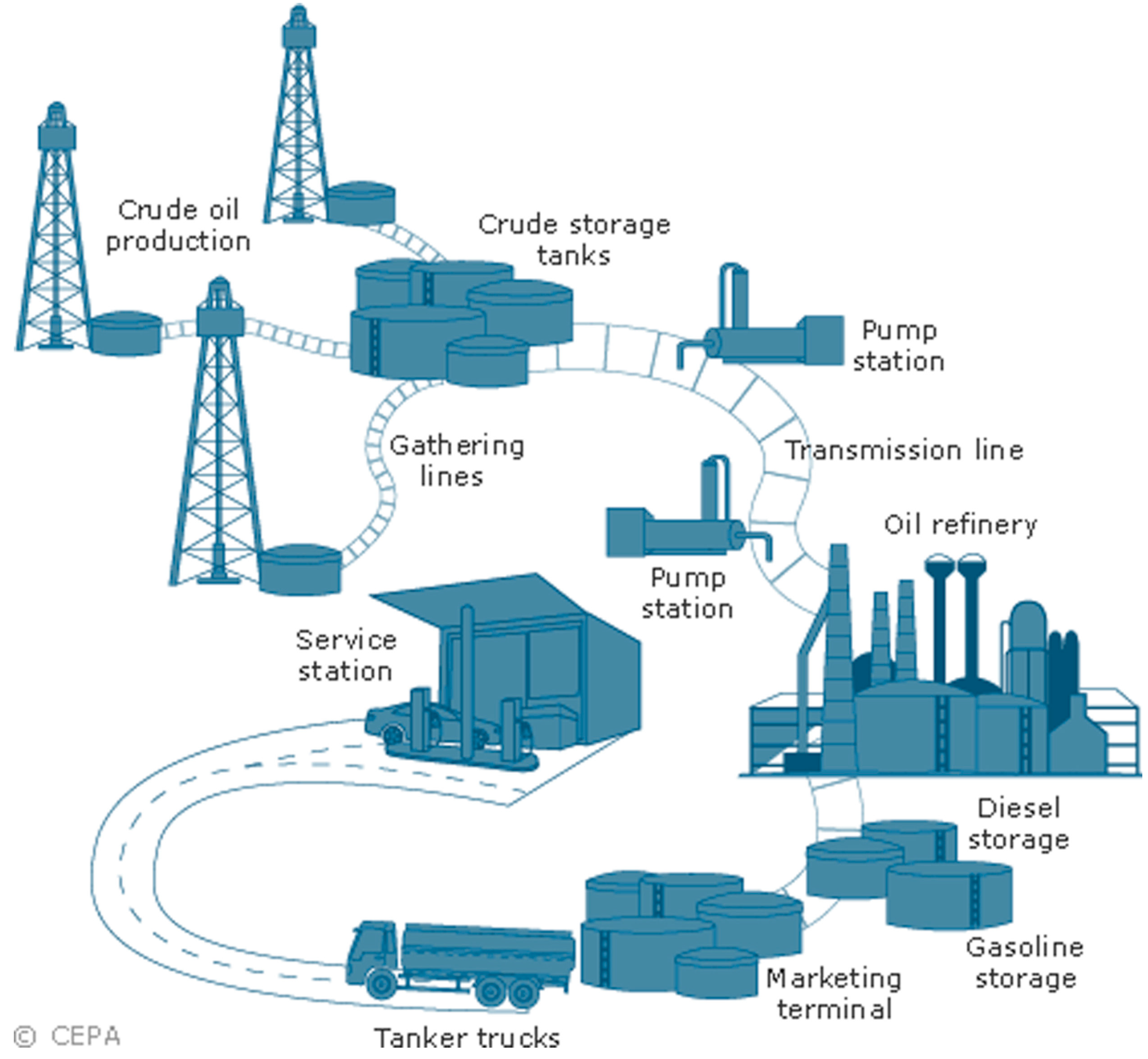
- Abudu, H.; Sai, R. Examining prospects and challenges of Ghana’s petroleum industry: A systematic review. Energy Rep. 2020, 6, 841–858. [Google Scholar] [CrossRef]
- Arinze, C.A.; Agho, M.O.; Eyo-Udo, N.L.; Abbey, A.B.N.; Onukwulu, E.C. AI-Driven Transport and Distribution Optimization Model (TDOM) for the downstream petroleum sector: Enhancing sme supply chains and sustainability. Magna Sci. Adv. Res. Rev. 2025, 13, 137–153. [Google Scholar] [CrossRef]
- Ghodake, S.P.; Malkar, V.R.; Santosh, K.; Jabasheela, L.; Abdufattokhov, S.; Gopi, A. Enhancing Supply Chain Management Efficiency: A Data-Driven Approach using Predictive Analytics and Machine Learning Algorithms. Int. J. Adv. Comput. Sci. Appl. 2024, 15, 672–686. [Google Scholar] [CrossRef]
- Ma, D.; Qin, H.; Hu, J. Achieving triple sustainability in closed-loop supply chain: The optimal combination of online platform sales format and blockchain-enabled recycling. Comput. Ind. Eng. 2022, 174, 108763. [Google Scholar] [CrossRef]
- Donthi, R.; Lakshmi, B.P.; Srinivas, G.; Sudhakar, S.; Koneru, H.P.; Yekula, P.K. AI-Driven Numerical Optimization for Carbon Footprint Reduction and Sustainable Supply Chain Management in the Fashion Industry. South. East. Eur. J. Public. Health 2024, 25, 1216–1222. [Google Scholar] [CrossRef]
- Elufioye, O.A.; Ike, C.U.; Odeyemi, O.; Usman, F.O.; Mhlongo, N.Z. AI-Driven predictive analytics in agricultural supply chains: A review: Assessing the benefits and challenges of AI in forecasting demand and optimizing supply in Agriculture. Comput. Sci. IT Res. J. 2024, 5, 473–497. [Google Scholar] [CrossRef]
- Espolov, T.; Espolov, A.; Kalykova, B.; Umbetaliyev, N.; Uspanova, M.; Suleimenov, Z. Asia agricultural market: Methodology for complete use of economic resources through supply chain optimization. Int. J. Supply Chain. Manag. 2020, 9, 408–413. [Google Scholar]
- Kaul, D.; Khurana, R. AI-Driven Optimization Models for E-commerce Supply Chain Operations: Demand Prediction, Inventory Management, and Delivery Time Reduction with Cost Efficiency Considerations. Int. J. Soc. Anal. 2022, 7, 59–77. [Google Scholar]
- Hamdan, A.; Ibekwe, K.I.; Ilojianya, V.I.; Sonko, S.; Etukudoh, E.A. AI in renewable energy: A review of predictive maintenance and energy optimization. Int. J. Sci. Res. Arch. 2024, 11, 718–729. [Google Scholar] [CrossRef]
- Bello, S.F.; Wada, I.U.; Ige, O.B.; Chianumba, E.C.C.; Adebayo, S.A. AI-driven predictive maintenance and optimization of renewable energy systems for enhanced operational efficiency and longevity. Int. J. Sci. Res. Arch. 2024, 13, 2823–2837. [Google Scholar] [CrossRef]
- Bhanderi, R. AI-Driven Project Management Revolutionizing Workflow Optimization and Decision-Making. Int. J. Trend Sci. Res. Dev. 2024, 8, 325–338. [Google Scholar]
- Li, X. AI-Driven Computational Resource Optimization: A Hybrid Deep Reinforcement Learning Framework for Enhancing Large-Scale Model Efficiency. Pinnacle Acad. Press. Proc. Ser. 2025, 3, 190–203. [Google Scholar]
- Okuyelu, O.; Adaji, O. AI-Driven Real-time Quality Monitoring and Process Optimization for Enhanced Manufacturing Performance. J. Adv. Math. Comput. Sci. 2024, 39, 81–89. [Google Scholar] [CrossRef]
- MoghadasNian, S. AI-Driven Inventory Optimization in Airline Logistics: Enhancing Efficiency, Sustainability, and Operational Performance. In Proceedings of the International Conference on “Artificial Intelligence in the Age of Digital Transformation”, Tbilisi, Georgia, 19 March 2025. [Google Scholar]
- Royappa, A.; Venkatesh, K.; Purushothaman, N.; Moorthy, A.; Solainayagi, P. AI-Driven Optimization for Freight and Logistics Management Using Predictive Analytics. In Proceedings of the 2024 International Conference on Cybernation and Computation, Dehradun, India, 15–16 November 2024. [Google Scholar] [CrossRef]
- Thuraka, B. AI-Driven Adaptive Route Optimization for Sustainable Urban Logistics and Supply Chain Management. Int. J. Sci. Res. Comput. Sci. Eng. Inf. Technol. 2021, 7, 667–684. [Google Scholar]
- Mahat, D.; Niranjan, K.; Naidu, C.S.K.V.R.; Babu, S.B.G.T.; Kumar, M.S.; Natrayan, L. AI-Driven Optimization of Supply Chain and Logistics in Mechanical Engineering. In Proceedings of the 2023 10th IEEE Uttar Pradesh Section International Conference on Electrical, Electronics and Computer Engineering, Nagar, India, 1–3 December 2023. [Google Scholar] [CrossRef]
- Osho, G.O.; Omisola, J.O.; Shiyanbola, J.O. A Conceptual Framework for AI-Driven Predictive Optimization in Industrial Engineering: Leveraging Machine Learning for Smart Manufacturing Decisions. Int. J. Adv. Multidiscip. Res. Stud. 2024, 4, 1516–1532. [Google Scholar] [CrossRef]
- Fok, R.; Weld, D.S. In search of verifiability: Explanations rarely enable complementary performance in ai-advised decision making. AI Mag. 2024, 45, 317–332. [Google Scholar] [CrossRef]
- Madathil, A.P.; Luo, X.; Liu, Q.; Walker, C.; Madarkar, R.; Qin, Y. A review of explainable artificial intelligence in smart manufacturing. Int. J. Prod. Res. 2025, 63, 8654–8697. [Google Scholar] [CrossRef]
- Lundberg, S.M.; Lee, S.-I. A unified approach to interpreting model predictions. Adv. Neural Inf. Process. Syst. 2017, 30. [Google Scholar] [CrossRef]
- Hong, J.; Hong, Y.; Baek, J.-W.; Kang, S.W. Enhancing the product quality of the injection process using explainable artificial intelligence. Processes 2025, 13, 912. [Google Scholar] [CrossRef]
- Zhou, F.; Liu, G.; Xu, F.; Deng, H. A generic automated surface defect detection based on a bilinear model. Appl. Sci. 2019, 9, 3159. [Google Scholar] [CrossRef]
- Selvaraju, R.R.; Cogswell, M.; Das, A.; Vedantam, R.; Parikh, D.; Batra, D. Grad-cam: Visual explanations from deep networks via gradient-based localization. In Proceedings of the IEEE International Conference on Computer Vision, Venice, Italy, 22–29 October 2017; pp. 618–626. [Google Scholar]
- Jaimini, U.; Sheth, A. CausalKG: Causal knowledge graph explainability using interventional and counterfactual reasoning. IEEE Internet Comput. 2022, 26, 43–50. [Google Scholar] [CrossRef]
- National Engineering Policy Centre. Engineering Responsible AI: Foundations for Environmentally Sustainable AI; National Engineering Policy Centre: London, UK, 2025. [Google Scholar]
- Ren, S.; Wierman, A. The Uneven Distribution of AI’s Environmental Impacts. Harvard Business Review, 15 July 2024. [Google Scholar]
- Zajko, M. Artificial intelligence, algorithms, and social inequality: Sociological contributions to contemporary debates. Sociol. Compass 2022, 16, e12962. [Google Scholar] [CrossRef]
- Sevilla, J.; Roldán, E. Compute as measured in FLOP. Training Compute of Frontier AI Models Grows by 4–5x per Year. Epoch AI, 28 May 2024. [Google Scholar]
- Nguyen, P.C.H.; Choi, J.B.; Udaykumar, H.S.; Baek, S. Challenges and Opportunities for Machine Learning in Multiscale Computational Modeling. ASME J. Comput. Inf. Sci. Eng. 2023, 23, 060808. [Google Scholar] [CrossRef]
- Exponential Growth of Parameters in Notable AI Systems, Our World in Data. 8 January 2025. Available online: https://ourworldindata.org/grapher/exponential-growth-of-parameters-in-notable-ai-systems (accessed on 5 January 2026).
- Wang, M.; Fu, W.; He, X.; Hao, S.; Wu, X. A Survey on Large-Scale Machine Learning. IEEE Trans. Knowl. Data Eng. 2022, 34, 2574–2594. [Google Scholar] [CrossRef]
- Data Centres 2025 Global Outlook, JLL Research. January 2025. Available online: https://www.jll.com/en-us/insights/market-outlook/data-center-outlook (accessed on 5 January 2026).
- Masanet, E.; Shehabi, A.; Lei, N.; Smith, S.; Koomey, J. Recalibrating global data center energy-use estimates. Science 2020, 367, 984–986. [Google Scholar] [CrossRef] [PubMed]
- 2024 Semiconductor Industry Outlook, Deloitte United States. 2024. Available online: https://www.deloitte.com/global/en/Industries/tmt/perspectives/semiconductor-industry-outlook.html (accessed on 5 January 2026).
- Cao, Y.; Chen, Y.; Fan, X.; Fu, H.; Xu, B. Advanced Design for High-Performance and AI Chips. Nano-Micro Lett. 2026, 18, 13. [Google Scholar] [CrossRef]
- Utilities Must Reinvent Themselves to Harness the AI-Driven Data Center Boom, Bain & Company. October 2024. Available online: https://www.bain.com/insights/utilities-must-reinvent-themselves-to-harness-the-ai-driven-data-center-boom/ (accessed on 5 January 2026).












| Model | Full Name | Key Characteristics | Typical Inputs | Strengths | Common Applications |
|---|---|---|---|---|---|
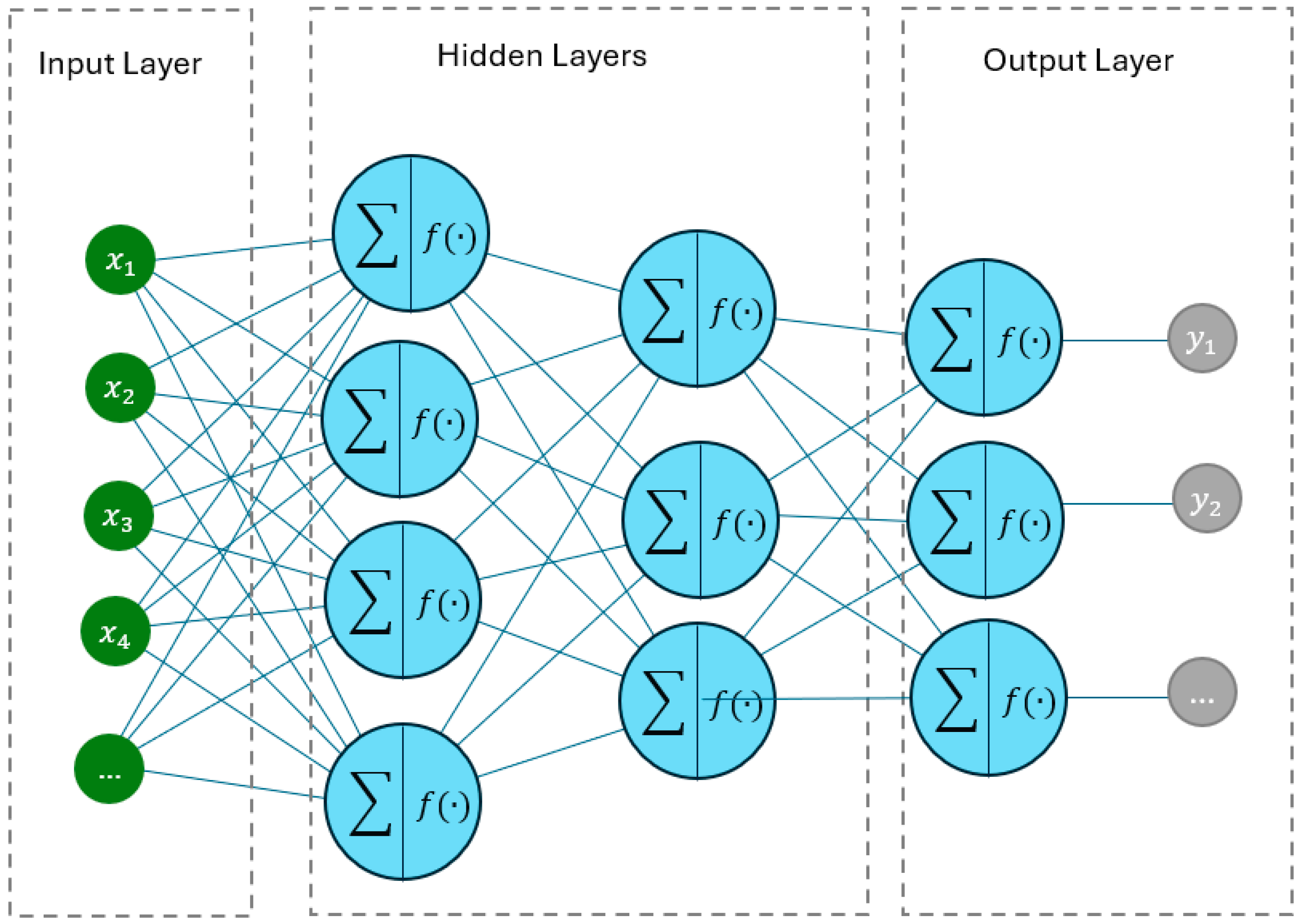
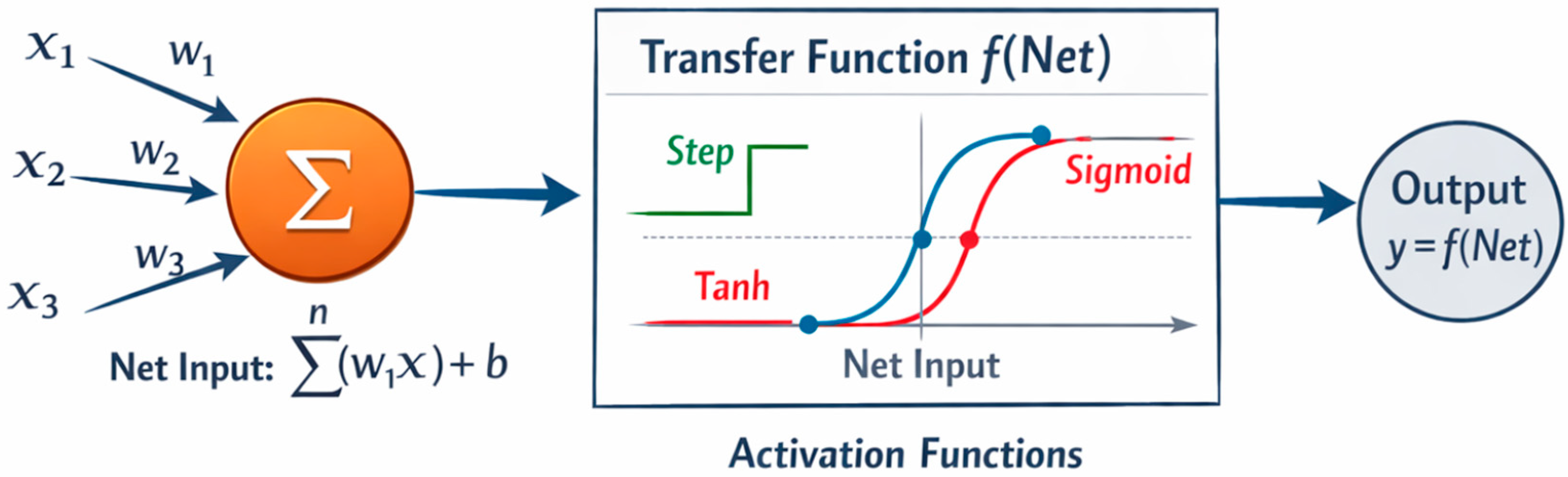
| NN | Neural Network | General term for models composed of interconnected neurons | Numerical, categorical | Flexible function approximation | Regression, classification |
| ANN | Artificial Neural Network | Fully connected feedforward networks | Structured numerical data | Simple, effective for low- to medium-dimensional problems | Regression |
| CNN | Convolutional Neural Network | Uses convolutional layers to capture spatial patterns | Images, grids, spatial data | Translation invariance, parameter efficiency | Image recognition, computer vision |
| PINN | Physics-Informed Neural Network | Embeds physical laws into the loss function | Spatial–temporal coordinates, boundary conditions | Data-efficient, physically consistent | Scientific computing, inverse problems, engineering simulations |
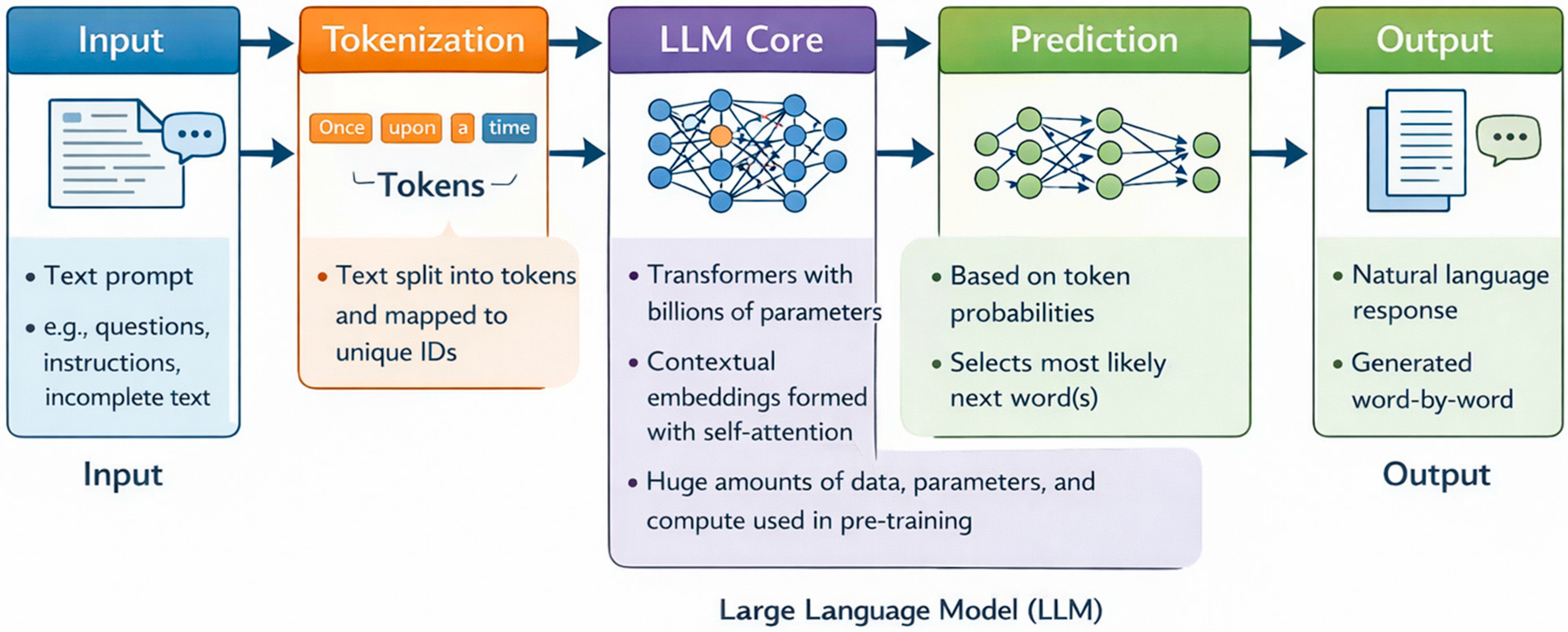
| LMM | Large Language Model | Very large transformer-based models trained on text | Natural language, code | Strong reasoning and generative ability | Text generation, code synthesis, optimization guidance |
| No | Framework | Description |
|---|---|---|
| #1 | AI-based Modelling | Machine learning models are used as objective and/or constraint functions in optimization problems |
| #2 | AI-improved optimization | Machine learning techniques are employed to develop AI-enhanced optimization algorithms |
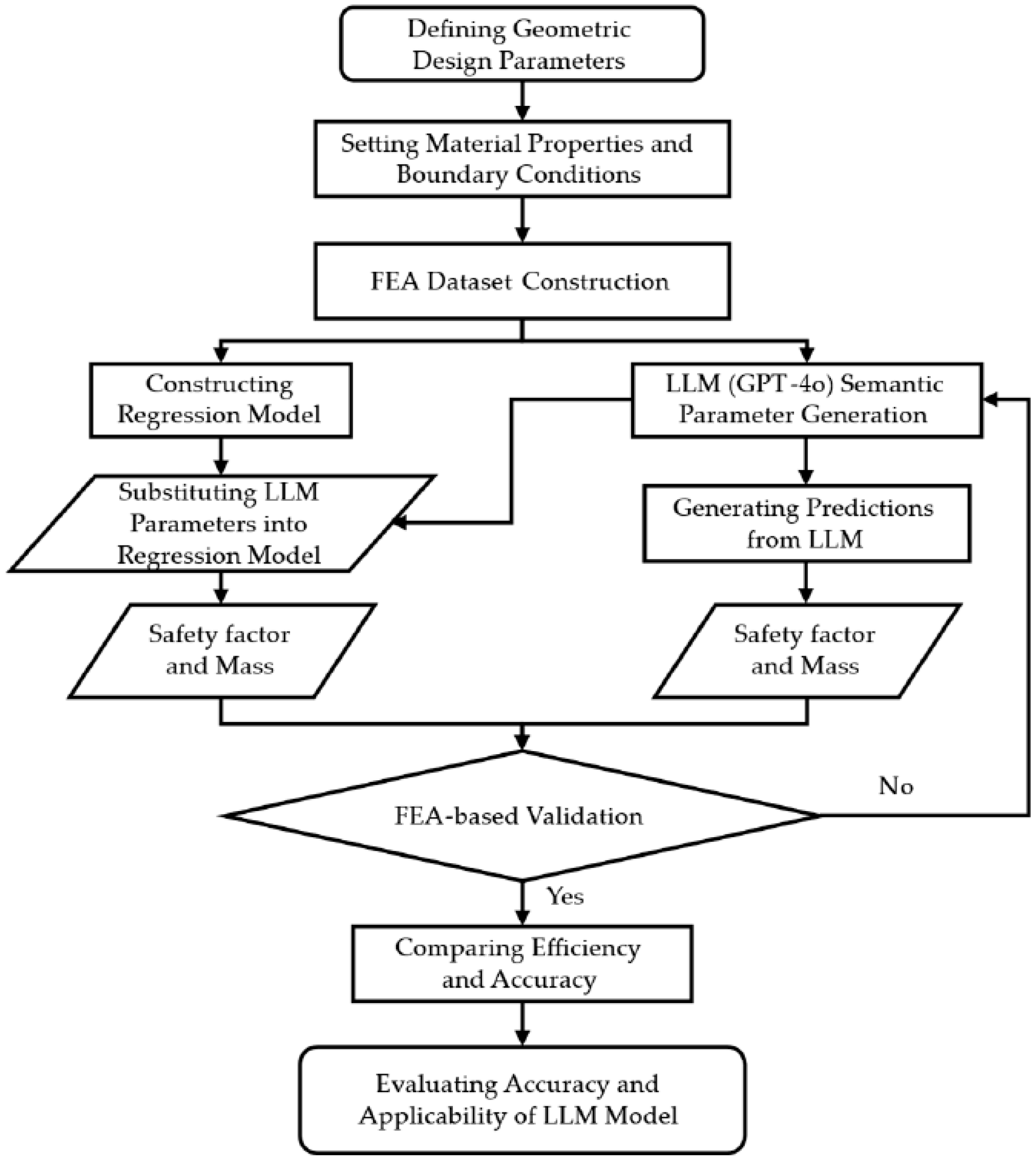
| #3 | AI-based Model to Approximate complex engineering simulations | Machine learning is used to approximate computationally expensive engineering simulations, such as finite element analysis (FEA) and computational fluid dynamics (CFD), making the optimization of complex engineering problems feasible |
| #4 | AI searches an initial solution | Machine learning techniques are employed to predict initial solutions or design parameters, which can significantly speed up the optimization process |
| Algorithms | Key Characteristics | Parameters | Strengths | Common Applications |
|---|---|---|---|---|
| Genetic Algorithm (GA) | Evolutionary algorithm based on natural selection and genetics | Population Size, mutation rate, crossover rate | Good global search, flexible, widely used | Optimization problems, engineering design, scheduling |
| Particle Swarm Optimization (PSO) | Swarm intelligence inspired by social behavior of birds/fish | Population Size, weight factors for inertial position and global position. | Fast convergence, simple to implement | Continuous optimization, neural network training, control systems |
| Differential Evolution (DE) | Evolutionary algorithm using vector differences for mutation | Images, grids, spatial data | Robust, easy to implement, good for continuous problems | Parameter optimization, engineering design, machine learning |
| Ant Colony Optimization (ACO) | Swarm-based algorithm inspired by ant foraging behavior | Pheromone trails, heuristic info, number of ants, evaporation rate | Good for combinatorial optimization | Traveling Salesman Problem, routing, scheduling |
| Non-dominated Sorting Genetic Algorithm II (NSGAII) | Multi-objective GA with elitism and fast non-dominated sorting | Population Size, mutation rate, crossover rate | Efficient multi-objective optimization, maintains diversity | Multi-objective engineering optimization |
| Multi-objective Evolutionary Algorithm based on Decomposition (MOEA/D) | Decomposes multi-objective problem into scalar subproblems | Population size, weight vectors, neighborhood size | Good convergence and diversity balance, scalable | Multi-objective engineering optimization |
| Reference | Key Characteristics | Problems | Performances |
|---|---|---|---|
| Badarinath et al. [31] | ML + FEA | One-Dimensional Beam | R2 is over 0.98 |
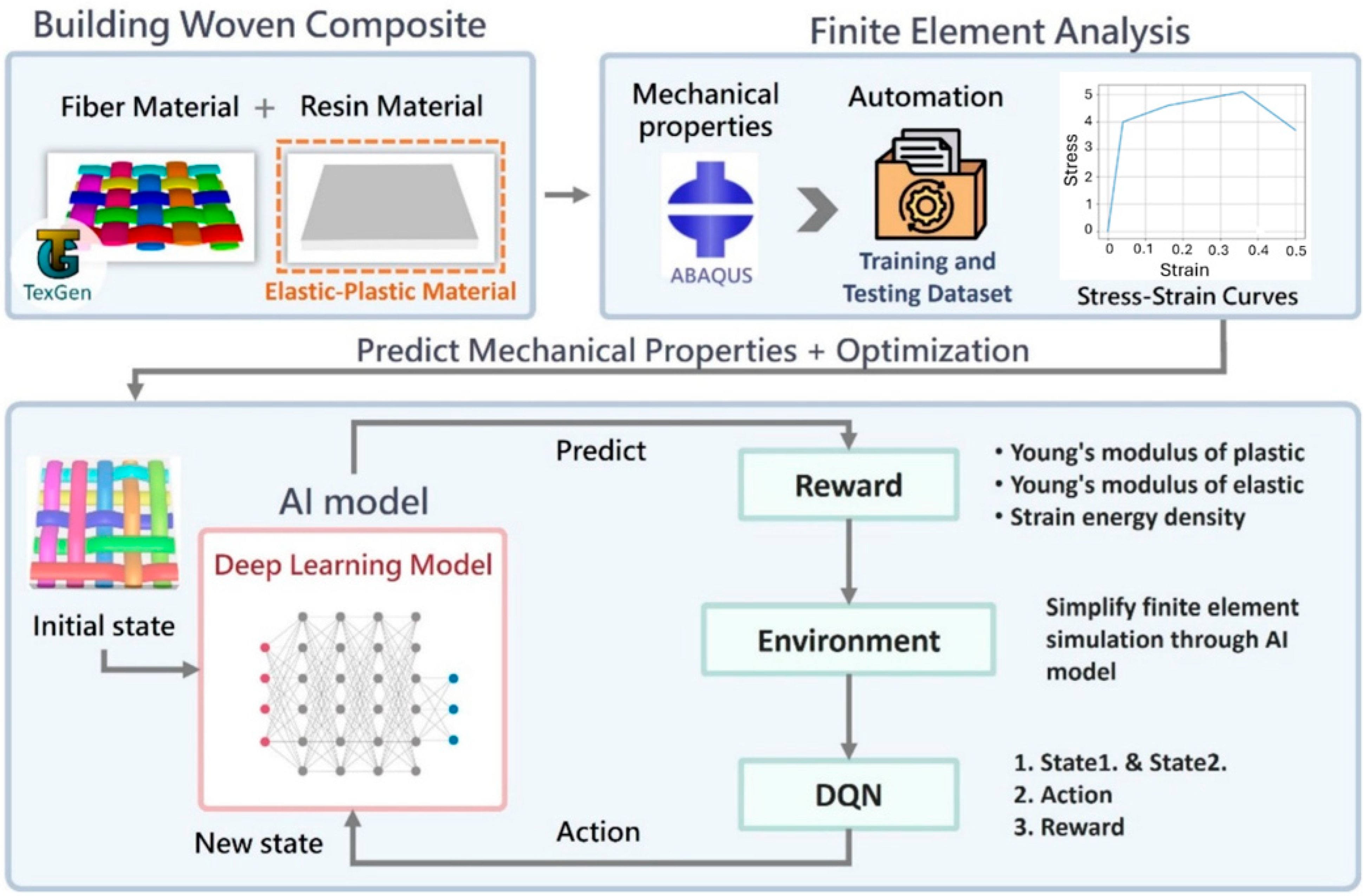
| Hsu et al. [35] | CNN + reinforcement learning-based optimization | Optimization of woven composites | R2 is over 0.96; 2.37-fold increase in strain energy density; 267-fold acceleration in simulation time |
| Shah et al. [57] | ML + ANSYS (FEA) | Design of Pressure Equipment | R2 is over 0.99865 |
| Granados-Ortiz et al. [58] | ML + NSGA-II | multi-objective optimization of mechanical micromixer | Efficiency improvement by 50% |
| Lynch et al. [59] | ML + Bayesian optimization | Topology Optimization | Reduce the total number of “wasted” tuning runs |
| Kosowski et al. [60] | ANN + evolutionary algorithms | Design of turbine cascades and stages | The optimization time was massively reduced, from days to less than one minute |
| Du et al. [62] | CNN + Gradient-based optimization | Rotor blade designs | The optimization time is within 38 s. R2 is over 0.99. |
| Patel et al. [63] | ML + Heuristics | Heat pump sizing and design | A 25% improvement in energy efficiency |
| Oroumieh et al. [65] | Fuzzy Logic + NN | Aircraft configuration design variables | Efffective to decrease aircraft design cycle time |
| Setayandeh [67] | NN + NSGA-II | UAV aerodynamic design | Reduce of computational costs by 94.1% |
| Karali et al. [68] | DNN + NSGA-II | UAV Design | R2 is 0.9971. The optimization process is 4–5 s. |
| Reference | Key Characteristics | Problems | Performances |
|---|---|---|---|
| Golafshani et al. [71] | ML + grey wolf optimization | Rubbercrete | Outperformed the conventional M5P tree and MGEP models by 13.7% and 5.5%, respectively |
| Zheng et al. [72] | ML + Bayesian optimization multi-objective optimization | Concrete mix design | R2 is over 0.98 |
| Huang et al. [73] | SVR + Multi Objective Optimization + Firefly Algorithm | Steel fiber reinforced concrete | R2 is over 0.9142 |
| Parhi et al. [74] | ML + Evolutionary Computations | Self-compacting geopolymer concrete | |
| Mohsen [76] | AI + AV + IoT | Route planning | |
| Kulkarni et al. [79] | DL | Wastewater Treatment Plants | 85% accuracy |
| Reference | Key Characteristics | Problems | Performances |
|---|---|---|---|
| Chen et al. [88] | DL | Cloud Workflows | the makespan was improved by 16.6% and the firness index was increased 5.3% |
| Sarker et al. [92] | RL + LP + real-time grid-aware scheduling | Residential EV charging systems | 31.5% reduction in peak transformer load, a decrease in voltage deviation from ±5.8% to ±2.3%, and an increase in solar utilization from 48% to 66%. |
| Reference | Key Characteristics | Problems | Performances |
|---|---|---|---|
| Hsu et al. [35] | CNN + Deep Q-Network + reinforcement learning-based optimization | Woven composite | 2.37-fold improvement in strain energy density; 267-fold speedup |
| Kim et al. [94] | DL + GA | Superior materials | Needs small datasets (0.5% of the initial datasets). |
| Nayak et al. [99] | ANN + GA | Wastewater treatment process | Improve productivity by about 57% |
| Sultan et al. [100] | ANN + DE | Green methanol production process | R2 is over 0.9831; 33.59% increase in production rate; 9.68% reduction in energy requirements |
| Bhowmik et al. [104] | SV + GA + PSO | Nano-modified Bitumen | CO2 reduction of 65.738% |
| Reference | Key Characteristics | Problem | Outcomes |
|---|---|---|---|
| Boubaker et al. 2023 [111] | Deep Learning + Machine Learning | Photovoltaic Diagnosis and detection | Accuracy of 98.7% |
| Ağbulut et al. 2020 [112] | Compare ML, SVM, ANN, DL | Power output of V-trough photovoltaic system | SVM outperforms with R2 of 0.9921 |
| Kannari et al. 2023 [113] | Reinforcement learning (RL) | Heating cost | Cost reduction by 23% |
| Yang et al. 2020 [114] | Machine learning | Building heat consumption | 36–38% of energy saving |
| Ahmed et al. 2020 [115] | Machine learning | Energy management of smart grid | |
| Malta et al. 2023 [116] | Reinforcement learning | Management of 5G base stations | 75% energy saving with 20 ms |
| Reference | Key Characteristics | Problems | Performances |
|---|---|---|---|
| Khan et al. [109] | ANN + Bayesian optimization | Power Converters | Significant improvements in dynamic response |
| Ashraf et al. [117] | ANN + SVM + Monte-Carlo -based method | High-pressure steam turbine | Efficiency improved by 3.4% |
| Mohandes et al. [121] | ANN + Autoregressive (AR) Model | Wind speed prediction | ANN was superior to AR model |
| Mabel et al. [121] | backpropagation neural network | Prediction of wind strength | MSE is 0.007 |
| Flores et al. [123] | ANN + GA | Wind speed and active power prediction | |
| Guediri et al. [124] | GA | Wind Power System | Greater efficiency, impressive results, |
| Song et al. [126] | Yin-Yang grey wolf optimization | Large-scale wind turbines | Capture 0.03–0.04% energy |
| Muñoz-Palomeque et al. [128] | NN | Wind turbine | 7.87% more power |
| Sun et al. [129] | ANN | Wind turbines | The power ration can reach 0.96 |
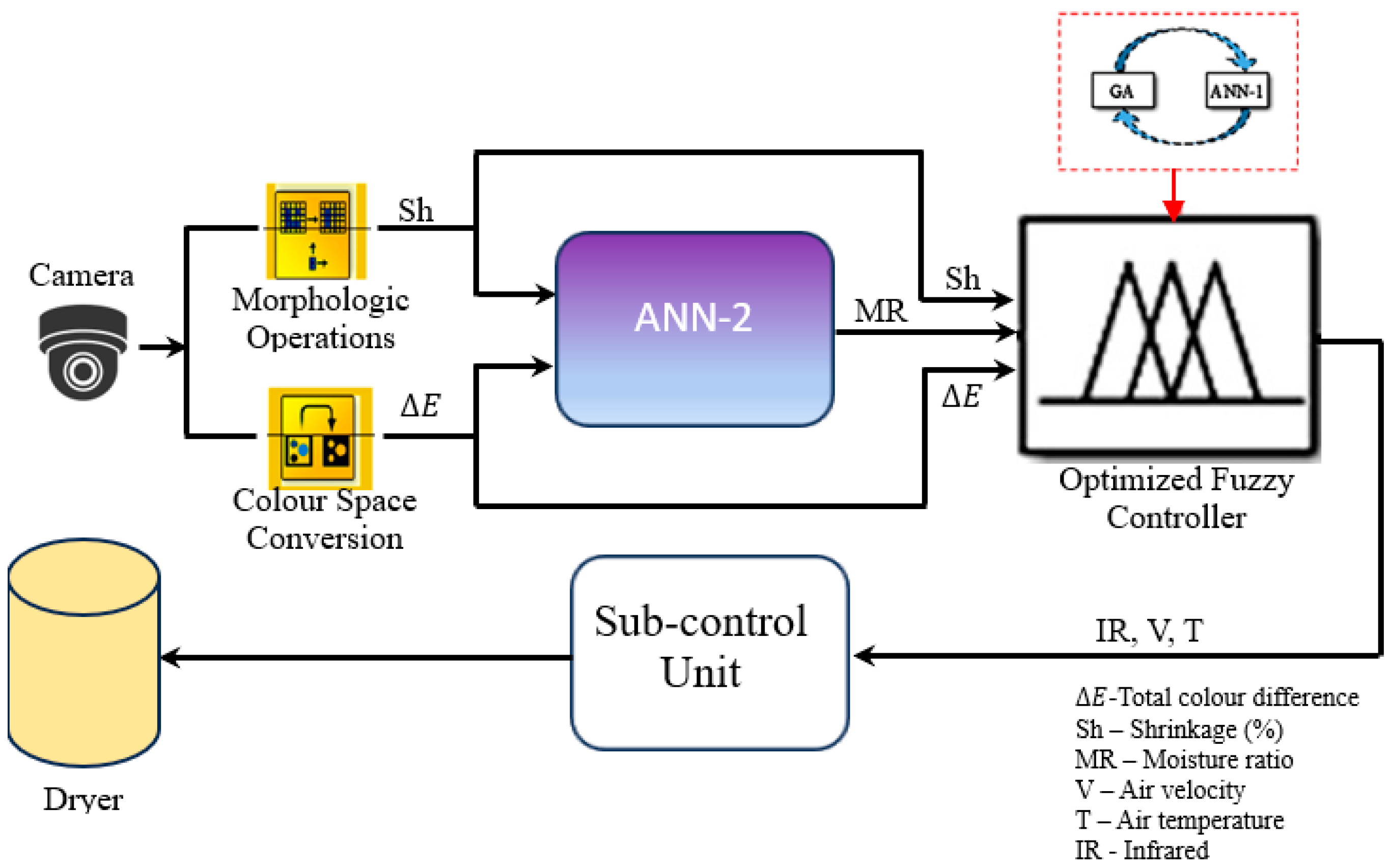
| Nadian et al. [34] | GA | Tybrid hot air–infrared dryer | Energy consumption (0.158 kW h) |
| Haider et al. [139] | clustering technique cluster-based dynamic algorithm | Unmanned aerial vehicles | 15% increase in energy conservation; 20% reduction in data transmission time |
| Reference | Key Characteristics | Problems | Performances |
|---|---|---|---|
| Alfayoumi et al. [145] | NSGAII | Mass customized orders | The time improved by 20.4% and the cost reduced by 29.8% |
| Arinze et al. [147] | ML + route optimization | Downstream petroleum sector–Supply Chain | 20–30% reduction in transport costs |
| Donthi et al. [150] | RL + GA | Fashion industry’s supply chain | 25% reduction in emissions |
| Kaul and Khurana [153] | ML + Optimization | E-commerce Supply Chain | Cost efficiency |
| Bello et al. [155] | ML (DL + RL) | Wind farm maintenance | Failures with 92% accuracy |
| Li [157] | RL + scheduling optimization | Resource allocation | 31.2% increase in resource utilization and 24.8% reduction in operational costs |
| MoghadasNian [159] | AI + Optimization | Airline logistics | Cost reductions from 25% to 40%; inventory decreases of 20% to 54%. |
| Royappa et al. [160] | ML + route optimization | Freight and logistics management | Cost reduction by 17%; customer satisfaction increases by 22%. |
Disclaimer/Publisher’s Note: The statements, opinions and data contained in all publications are solely those of the individual author(s) and contributor(s) and not of MDPI and/or the editor(s). MDPI and/or the editor(s) disclaim responsibility for any injury to people or property resulting from any ideas, methods, instructions or products referred to in the content. |
© 2026 by the authors. Licensee MDPI, Basel, Switzerland. This article is an open access article distributed under the terms and conditions of the Creative Commons Attribution (CC BY) license.
Share and Cite
Li, J.-P.; Polovina, N.; Konur, S. A Review of AI-Driven Engineering Modelling and Optimization: Methodologies, Applications and Future Directions. Algorithms 2026, 19, 93. https://doi.org/10.3390/a19020093
Li J-P, Polovina N, Konur S. A Review of AI-Driven Engineering Modelling and Optimization: Methodologies, Applications and Future Directions. Algorithms. 2026; 19(2):93. https://doi.org/10.3390/a19020093
Chicago/Turabian StyleLi, Jian-Ping, Nereida Polovina, and Savas Konur. 2026. "A Review of AI-Driven Engineering Modelling and Optimization: Methodologies, Applications and Future Directions" Algorithms 19, no. 2: 93. https://doi.org/10.3390/a19020093
APA StyleLi, J.-P., Polovina, N., & Konur, S. (2026). A Review of AI-Driven Engineering Modelling and Optimization: Methodologies, Applications and Future Directions. Algorithms, 19(2), 93. https://doi.org/10.3390/a19020093